EP2015162A1 - System und Verfahren zur Verwaltung einer tragbaren Energiequelle - Google Patents
System und Verfahren zur Verwaltung einer tragbaren Energiequelle Download PDFInfo
- Publication number
- EP2015162A1 EP2015162A1 EP07113398A EP07113398A EP2015162A1 EP 2015162 A1 EP2015162 A1 EP 2015162A1 EP 07113398 A EP07113398 A EP 07113398A EP 07113398 A EP07113398 A EP 07113398A EP 2015162 A1 EP2015162 A1 EP 2015162A1
- Authority
- EP
- European Patent Office
- Prior art keywords
- power
- usage
- auxiliary devices
- auxiliary
- host
- Prior art date
- Legal status (The legal status is an assumption and is not a legal conclusion. Google has not performed a legal analysis and makes no representation as to the accuracy of the status listed.)
- Withdrawn
Links
Images


Classifications
-
- G—PHYSICS
- G06—COMPUTING OR CALCULATING; COUNTING
- G06F—ELECTRIC DIGITAL DATA PROCESSING
- G06F1/00—Details not covered by groups G06F3/00 - G06F13/00 and G06F21/00
- G06F1/26—Power supply means, e.g. regulation thereof
- G06F1/32—Means for saving power
- G06F1/3203—Power management, i.e. event-based initiation of a power-saving mode
- G06F1/3234—Power saving characterised by the action undertaken
-
- G—PHYSICS
- G06—COMPUTING OR CALCULATING; COUNTING
- G06F—ELECTRIC DIGITAL DATA PROCESSING
- G06F1/00—Details not covered by groups G06F3/00 - G06F13/00 and G06F21/00
- G06F1/26—Power supply means, e.g. regulation thereof
- G06F1/266—Arrangements to supply power to external peripherals either directly from the computer or under computer control, e.g. supply of power through the communication port, computer controlled power-strips
-
- G—PHYSICS
- G06—COMPUTING OR CALCULATING; COUNTING
- G06F—ELECTRIC DIGITAL DATA PROCESSING
- G06F1/00—Details not covered by groups G06F3/00 - G06F13/00 and G06F21/00
- G06F1/26—Power supply means, e.g. regulation thereof
- G06F1/32—Means for saving power
- G06F1/3203—Power management, i.e. event-based initiation of a power-saving mode
-
- G—PHYSICS
- G06—COMPUTING OR CALCULATING; COUNTING
- G06F—ELECTRIC DIGITAL DATA PROCESSING
- G06F1/00—Details not covered by groups G06F3/00 - G06F13/00 and G06F21/00
- G06F1/26—Power supply means, e.g. regulation thereof
- G06F1/32—Means for saving power
- G06F1/3203—Power management, i.e. event-based initiation of a power-saving mode
- G06F1/3206—Monitoring of events, devices or parameters that trigger a change in power modality
- G06F1/3212—Monitoring battery levels, e.g. power saving mode being initiated when battery voltage goes below a certain level
Definitions
- the mobile computing devices may include, for example, laptop computers, personal digital assistants (PDAs), and mobile phones, among others.
- the auxiliary devices may include universal serial bus (USB) drives, digital video disk (DVD) drives, compact disk (CD) drives, and moving picture expert group (MPEG) based devices, among other current and future auxiliary devices.
- USB universal serial bus
- DVD digital video disk
- CD compact disk
- MPEG moving picture expert group
- a mobile computing device is normally configured with a portable power source such as a rechargeable battery.
- the portable power source of the mobile computing device supplies the power not only to the mobile computing device, but may also supply power to an attached auxiliary device. Because the portable power source has a limited amount of power, such as when no alternating current (AC) power is available, there may be a contention for power among the mobile computing device and the attached auxiliary devices.
- AC alternating current
- a system may be provided that includes a host system configured with a portable power source and a host power manager.
- the host power manager may be configured to monitor an available power level of the portable power source and at least one power usage by one or more auxiliary devices.
- the host power manager may be further configured to promote less than a full power usage by at least one of the auxiliary devices.
- a method for power management may be provided.
- the method may comprise monitoring an available power level of a portable power source, and monitoring at least one power usage by one or more auxiliary devices.
- the method may provide for promoting less than a full power usage by the one or more auxiliary devices.
- FIG. 3 illustrates an embodiment of a process of power management.
- FIG. 4 illustrates an exemplary general-purpose computer system suitable for implementing the several embodiments of the disclosure.
- the portable power source of the mobile computing device may supply the power not only to the mobile computing device itself, but also to the attached auxiliary devices. This may create a contention for the portable power source between the mobile computing device and the attached auxiliary devices. A sudden loss of power source may result in data loss, application interruption or other undesirable consequences, not only for the mobile computing device, but for the attached auxiliary devices as well. To address this, a user may unplug an auxiliary device to discontinue its power usage or leave the device plugged in and allow it to continue consuming power.
- the present disclosure provides for managing auxiliary device power and promotes no power or less than a full power usage by some devices and components in order to extend battery life and usage by higher priority devices and/or components.
- FIG. 1 illustrates an embodiment of a computing complex 100.
- the computing complex 100 comprise a host system 110 and a set of auxiliary devices 111 (111 a and 111b).
- the host system 110 in turn comprises a user interface (UI) 200, a host processor 121, and a battery power source 113.
- the host processor 121 supports a set of components 103 and a host power manager (H-PM) 151.
- the auxiliary devices 111 a and 111 b each include an auxiliary power manager (A-PM) 153 and a set of components 103.
- the host system 110 may be a mobile computing device that uses the portable power source 113.
- the example of the host system 110 may include a laptop, a PDA, and other hand-held computing devices that are configured with computing power to host other components and auxiliary devices.
- the host system 110 may communicate with or use some of the auxiliary devices.
- the auxiliary device 111 is a portable USB drive
- the host system may use the USB drive to store data or run a program from the USB drive.
- the auxiliary devices 111 may depend on the host system 110 to function.
- the host system 110 may host a USB driver for the portable USB drive to run properly.
- the host processor 121 may obtain its power from the portable power source 113 in order to provide the computing power for the host system 110, and to host the components 103, the H-PM 151, and other components for the host system to function properly.
- the auxiliary devices 111 are not a fixed part of the host system 110, because an auxiliary device 111 may be removed and added at any time. There may be a fixed number of the auxiliary devices 111 that can be attached to the host system 110, because of limited number of ports available on the host system 110. An auxiliary device 111 may host a number of components 103. Because of a lack of or a limited amount of computing power of its own, some auxiliary devices 111 may depend on the host processor 121 to run its component. Some auxiliary devices 111 may draw more power than others, depending on the type of the auxiliary device 111.
- the components 103 may be a software application or a hardware component that may use various resources, including the portable power source 113.
- the component 103 may be located on an auxiliary device 111 or the host system 110.
- the host system 110 may include host components 104 which may use some resources of an auxiliary device 111.
- a word processor on the host system 110 may use files stored on a USB drive.
- the host components 104 may be various hardware or software systems.
- Components 103 on auxiliary devices may use the host processor 121 on the host system to run.
- a game on a USB drive may use the host system 110 to run.
- Other examples of the components 103 may include a display screen or a battery or battery charging system on an auxiliary device 111, a music player for playing songs stored on an auxiliary device 111 or on the host system 110, among many others.
- the auxiliary power manager (A-PM) 153 may be a light-weight application residing on at least some of the auxiliary devices 111.
- the responsibilities of the A-PM 153 may include monitoring the power usages by various components on the auxiliary device 111, reporting the power usages to the H-PM 151, and collaborating with the H-PM 151 and other components on the auxiliary device in carrying out a power usage control action such as stopping a power usage of a particular component 103 of the auxiliary device 111.
- the A-PM 153 on the auxiliary device 111 b that has an auxiliary power (not shown) may collaborate with the onboard UI (not shown) to display the device power usage status and charging status.
- the functions of the A-PM 153 might be performed by the H-PM 151.
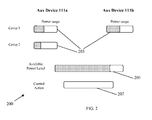
- FIG. 2 illustrates one example of the UI 200.
- the UI 200 is a user interface that is coupled with the host processor 121.
- the UI 200 may have an available power field 205 to provide a warning or a notification to a user on the available power level of the power source 113.
- the UI 200 may also have power usage fields 203 corresponding to each of the components 103 that are attached to the host system 110.
- the power usage fields 203 show the power usage of each component 103 of each auxiliary device 111.
- auxiliary device 111 a is shown having two components 103 (Comp1 and Comp2).
- auxiliary device 111a represent power consuming sub-systems of the auxiliary device 111 a.
- Comp 1 might be a display or rechargeable battery of the auxiliary device 111 a
- Comp 2 might be a storage medium or drive where media is stored on the auxiliary device 111 a.
- the auxiliary device 111 a might enable shutting down (Comp 1) the display or preventing recharging of the rechargeable battery, but still promote use of (Comp 2) the storage device. This would allow a user of the host system 110 to continue to access media from the auxiliary device 111a, but conserve power by reducing or eliminating power consumption by Comp 1 of auxiliary device 111 a.
- Comp 1 the display or rechargeable battery of the auxiliary device 111 a
- Comp 2 might be a storage medium or drive where media is stored on the auxiliary device 111 a.
- the auxiliary device 111 a might enable shutting down (Comp 1) the display or preventing recharging of the rechargeable battery, but still promote use of (Comp
- Auxiliary device 111 b is shown having only one component. Therefore the only alternative to reducing the power consumption of auxiliary device 111 b is to disable or shut-down the device completely.
- the UI 200 might provide features to enable the user to selectively shut-down or otherwise prevent auxiliary device 111 b from consuming power from the power source 113.
- the UI 200 might also have the capability to selectively re-initiate supplying power the auxiliary device 111 b, such as when AC power is restored to the host system 110.
- the Ul 200 may allow the user to enter a command at the control command field 207 for the H-PM 151 to help carry out various features and functionality. For example, the user may issue a command or select a button to go into a power conservation mode, and in response, the H-PM 151 may shut down certain components 103 on a priority basis in collaboration with other components of the host system 110.
- the user may select sequences or prioritize the auxiliary devices 111 and/or components 103 so that when a low priority situation arises the H-PM 151 might automatically begin shutting down or promoting reducing power to the devices, such as in conjunction with the A-PM 153. In some embodiments, this process might be accomplished manually by the user via the Ul 200.
- the Ul 200 may also allow the user to zoom in on a particular auxiliary device 111 and query for the power usage status of one or more of its component 103.
- the UI 200 might also provide for entry of a threshold power level of the power source 113, which when reached would prompt notification of the user.
- the UI 200 may allow the user to set a threshold that would trigger certain control actions on the portable power source 113. For example, if a threshold of 20% is set for the available power level, then the H-PM 151 may start promoting less than a full power usage by the auxiliary devices 111, when the threshold is reached.
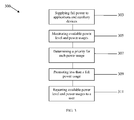
- the block 303 illustrates the step of supplying full power to the components and the attached auxiliary devices 111.
- full power is provided to all components 103 on the host system 110 and to all attached auxiliary devices 111.
- Supplying full power may continue until a change in the status of available power occurs.
- a minimum threshold for the available host power level is reached.
- the power conservation by providing less than full power to an auxiliary device 111 might be initiated even before a threshold is reached, such as in situations when the user knows the AC power may be unavailable for some time.
- the block 307 illustrates the step of determining a priority for each power usage.
- this step may include categorizing the power usages by the auxiliary devices 111 and components 103 into categories such as high or low power usage priority, based on a number of criteria.
- One example criterion may be based on whether stopping the power usage of an auxiliary device or a component would result in a data loss. For example, stopping a read-only component such as music player may not result in any data loss. On the other hand, stopping an online session that has an in-progress transaction may result in some data loss. Some other usages by components such as a DVD player may consume more power.
- the block 311 illustrates the step of reporting the available power level and the power usages to the user. Reporting the current available power level and the usages of the auxiliary devices 111 and the components 103 may take place during the whole period when the portable power source is available. The reporting may be on demand, at a fixed interval, or a combination of the two. The reporting may be through a GUI, a notification or other means.
- I/O devices 490 may include printers, video monitors, liquid crystal displays (LCDs), touch screen displays, keyboards, keypads, switches, dials, mice, track balls, voice recognizers, card readers, paper tape readers, or other well-known input devices.
- LCDs liquid crystal displays
- touch screen displays keyboards, keypads, switches, dials, mice, track balls, voice recognizers, card readers, paper tape readers, or other well-known input devices.
- the processor 482 executes instructions, codes, computer programs, scripts which it accesses from hard disk, floppy disk, optical disk (these various disk based systems may all be considered secondary storage 484), ROM 486, RAM 488, or the network connectivity devices 492.
Landscapes
- Engineering & Computer Science (AREA)
- Theoretical Computer Science (AREA)
- General Engineering & Computer Science (AREA)
- Physics & Mathematics (AREA)
- General Physics & Mathematics (AREA)
- Computer Hardware Design (AREA)
- Power Sources (AREA)
- Charge And Discharge Circuits For Batteries Or The Like (AREA)
- Remote Monitoring And Control Of Power-Distribution Networks (AREA)
Applications Claiming Priority (1)
| Application Number | Priority Date | Filing Date | Title |
|---|---|---|---|
| US11/777,092 US7945797B2 (en) | 2007-07-12 | 2007-07-12 | System and method for portable power source management |
Publications (1)
| Publication Number | Publication Date |
|---|---|
| EP2015162A1 true EP2015162A1 (de) | 2009-01-14 |
Family
ID=38969772
Family Applications (1)
| Application Number | Title | Priority Date | Filing Date |
|---|---|---|---|
| EP07113398A Withdrawn EP2015162A1 (de) | 2007-07-12 | 2007-07-30 | System und Verfahren zur Verwaltung einer tragbaren Energiequelle |
Country Status (5)
| Country | Link |
|---|---|
| US (3) | US7945797B2 (de) |
| EP (1) | EP2015162A1 (de) |
| CN (1) | CN101387902A (de) |
| CA (1) | CA2636908C (de) |
| SG (1) | SG149752A1 (de) |
Cited By (2)
| Publication number | Priority date | Publication date | Assignee | Title |
|---|---|---|---|---|
| WO2013133845A1 (en) * | 2012-03-08 | 2013-09-12 | Hewlett-Packard Development Company, L.P. | Virtualizing battery across a group of personal mobile devices |
| EP2755380A1 (de) * | 2013-01-15 | 2014-07-16 | Ricoh Company, Ltd. | Bildprojektionsvorrichtung und Leistungssteuerungsverfahren |
Families Citing this family (17)
| Publication number | Priority date | Publication date | Assignee | Title |
|---|---|---|---|---|
| US7945797B2 (en) * | 2007-07-12 | 2011-05-17 | Research In Motion Limited | System and method for portable power source management |
| JP5083975B2 (ja) * | 2008-04-07 | 2012-11-28 | 本田技研工業株式会社 | 燃料電池車両 |
| CN101800814B (zh) * | 2009-01-23 | 2013-09-04 | 瑞昱半导体股份有限公司 | 无线通讯装置的电源管理方法及无线通讯装置 |
| EP2457153B1 (de) * | 2009-07-20 | 2016-11-02 | Schneider Electric IT Corporation | Verfahren und vorrichtung zur leistungsanalyse |
| US20110223963A1 (en) * | 2010-03-12 | 2011-09-15 | Quantance, Inc. | Maximum transmit power controller |
| US20120292304A1 (en) * | 2011-05-16 | 2012-11-22 | International Business Machines Corporation | Portable electronic device case with active thermal protection |
| US9065922B2 (en) * | 2011-06-29 | 2015-06-23 | Blackberry Limited | System and method for providing low battery notifications on mobile devices |
| CN102369647B (zh) * | 2011-09-14 | 2013-12-04 | 华为技术有限公司 | 移动终端电源管理方法和装置 |
| US8738944B2 (en) * | 2011-11-16 | 2014-05-27 | Cisco Technology, Inc. | Energy-based feedback for transmission reception in a communication network |
| WO2014101110A1 (zh) * | 2012-12-28 | 2014-07-03 | 华为技术有限公司 | 以太网供电方法、装置、设备和系统 |
| US20150212662A1 (en) * | 2014-01-30 | 2015-07-30 | Unisys Corporation | Dropdown mode command button |
| KR102335217B1 (ko) | 2014-03-05 | 2021-12-03 | 삼성전자 주식회사 | 전류 또는 전력 소모량을 이용한 애플리케이션 프로세서의 구동 방법 및 모바일 장치 |
| KR20170082269A (ko) * | 2016-01-06 | 2017-07-14 | 삼성전자주식회사 | 검사장치 및 그 제어방법 |
| US11734302B2 (en) * | 2016-06-09 | 2023-08-22 | Apple Inc. | Multi-device context store |
| JP6812285B2 (ja) * | 2017-03-28 | 2021-01-13 | ルネサスエレクトロニクス株式会社 | 給電装置、及び給電制御装置 |
| CN110246475A (zh) * | 2018-03-07 | 2019-09-17 | 富泰华工业(深圳)有限公司 | 移动终端、ktv播放装置及点歌服务器 |
| CN115037832B (zh) * | 2022-08-08 | 2022-12-16 | 荣耀终端有限公司 | 一种数据处理方法及电子设备 |
Citations (7)
| Publication number | Priority date | Publication date | Assignee | Title |
|---|---|---|---|---|
| US6031999A (en) * | 1996-10-17 | 2000-02-29 | Nikon Corporation | Camera battery check device having multiple battery check levels |
| US6329794B1 (en) * | 2000-05-22 | 2001-12-11 | Hitachi, Ltd. | Information processing device and method for controlling power consumption thereof |
| WO2002009254A2 (en) | 2000-07-20 | 2002-01-31 | Qualcomm Incorporated | Battery monitoring system with low power and end-of-life messaging and shutdown |
| WO2002046895A2 (de) * | 2000-12-06 | 2002-06-13 | Daimlerchrysler Ag | System zur steuerung oder regelung |
| GB2412257A (en) * | 2004-03-15 | 2005-09-21 | Sirtec Internat Co Ltd | Computer power supply status display |
| US20050231042A1 (en) | 2004-03-22 | 2005-10-20 | David Kephart | Programmable power control unit |
| EP1679576A2 (de) | 2005-01-11 | 2006-07-12 | International Business Machines Corporation | Verfahren, System und Kalibriertechnik für Leistungsmessung und -verwaltung über mehrfache Zeitrahmen |
Family Cites Families (8)
| Publication number | Priority date | Publication date | Assignee | Title |
|---|---|---|---|---|
| US5560022A (en) * | 1994-07-19 | 1996-09-24 | Intel Corporation | Power management coordinator system and interface |
| CN1232945C (zh) * | 2000-04-03 | 2005-12-21 | 雅马哈株式会社 | 便携机、该便携机的节电方法和音量补偿方法 |
| US6802014B1 (en) * | 2000-10-26 | 2004-10-05 | Apple Computer, Inc. | Method and apparatus for managing power in computer systems |
| US7155623B2 (en) * | 2003-12-03 | 2006-12-26 | International Business Machines Corporation | Method and system for power management including local bounding of device group power consumption |
| KR100621399B1 (ko) * | 2005-02-04 | 2006-09-14 | 삼성전자주식회사 | 전력 제어 시스템 및 방법 그리고 그에 적용되는 메인기기및 서브기기 |
| US20090054100A1 (en) * | 2005-06-02 | 2009-02-26 | Hideo Ishida | Television broadcast reception device, television broadcast reception device control method, and television broadcast reception device power consumption management method |
| US7584376B2 (en) * | 2006-08-23 | 2009-09-01 | Palm, Inc. | Method and apparatus for power management |
| US7945797B2 (en) * | 2007-07-12 | 2011-05-17 | Research In Motion Limited | System and method for portable power source management |
-
2007
- 2007-07-12 US US11/777,092 patent/US7945797B2/en active Active
- 2007-07-30 EP EP07113398A patent/EP2015162A1/de not_active Withdrawn
-
2008
- 2008-06-26 SG SG200804868-8A patent/SG149752A1/en unknown
- 2008-07-04 CA CA2636908A patent/CA2636908C/en active Active
- 2008-07-14 CN CN200810135821.0A patent/CN101387902A/zh active Pending
-
2011
- 2011-05-16 US US13/108,860 patent/US8332677B2/en active Active
-
2012
- 2012-11-27 US US13/686,580 patent/US8886983B2/en active Active
Patent Citations (7)
| Publication number | Priority date | Publication date | Assignee | Title |
|---|---|---|---|---|
| US6031999A (en) * | 1996-10-17 | 2000-02-29 | Nikon Corporation | Camera battery check device having multiple battery check levels |
| US6329794B1 (en) * | 2000-05-22 | 2001-12-11 | Hitachi, Ltd. | Information processing device and method for controlling power consumption thereof |
| WO2002009254A2 (en) | 2000-07-20 | 2002-01-31 | Qualcomm Incorporated | Battery monitoring system with low power and end-of-life messaging and shutdown |
| WO2002046895A2 (de) * | 2000-12-06 | 2002-06-13 | Daimlerchrysler Ag | System zur steuerung oder regelung |
| GB2412257A (en) * | 2004-03-15 | 2005-09-21 | Sirtec Internat Co Ltd | Computer power supply status display |
| US20050231042A1 (en) | 2004-03-22 | 2005-10-20 | David Kephart | Programmable power control unit |
| EP1679576A2 (de) | 2005-01-11 | 2006-07-12 | International Business Machines Corporation | Verfahren, System und Kalibriertechnik für Leistungsmessung und -verwaltung über mehrfache Zeitrahmen |
Cited By (4)
| Publication number | Priority date | Publication date | Assignee | Title |
|---|---|---|---|---|
| WO2013133845A1 (en) * | 2012-03-08 | 2013-09-12 | Hewlett-Packard Development Company, L.P. | Virtualizing battery across a group of personal mobile devices |
| US9513696B2 (en) | 2012-03-08 | 2016-12-06 | Hewlett-Packard Development Company, L.P. | Migrating applications across a group of personal mobile devices based on battery usage |
| US10108251B2 (en) | 2012-03-08 | 2018-10-23 | Hewlett-Packard Development Company, L.P. | Virtualizing battery across a group of personal mobile devices |
| EP2755380A1 (de) * | 2013-01-15 | 2014-07-16 | Ricoh Company, Ltd. | Bildprojektionsvorrichtung und Leistungssteuerungsverfahren |
Also Published As
| Publication number | Publication date |
|---|---|
| US7945797B2 (en) | 2011-05-17 |
| US20130086406A1 (en) | 2013-04-04 |
| SG149752A1 (en) | 2009-02-27 |
| CN101387902A (zh) | 2009-03-18 |
| CA2636908C (en) | 2013-07-02 |
| US8886983B2 (en) | 2014-11-11 |
| US8332677B2 (en) | 2012-12-11 |
| CA2636908A1 (en) | 2009-01-12 |
| US20110219253A1 (en) | 2011-09-08 |
| US20090019300A1 (en) | 2009-01-15 |
Similar Documents
| Publication | Publication Date | Title |
|---|---|---|
| US7945797B2 (en) | System and method for portable power source management | |
| US7430675B2 (en) | Anticipatory power management for battery-powered electronic device | |
| US7389439B2 (en) | Method and apparatus for managing power of portable computer system | |
| US8244311B2 (en) | Time-related power systems | |
| US8250384B2 (en) | Optimizer mechanism to increase battery length for mobile devices | |
| US10234919B2 (en) | Accessory-based power distribution | |
| US8793518B2 (en) | Systems and methods for providing supplemental power to battery powered information handling systems | |
| EP2586115B1 (de) | Hierarchische stromglättung | |
| US8271054B2 (en) | Selective battery power management | |
| US11314311B2 (en) | Battery runtime and performance management based upon presence detection | |
| US10488905B2 (en) | Dynamic energy storage device discharging | |
| WO2018175138A1 (en) | Controlled energy utilization in a computing device | |
| AU2011323985A1 (en) | Application lifetime management | |
| JP2003150281A (ja) | 電気機器、コンピュータ装置、および電力供給方法 | |
| US11656666B2 (en) | Dynamic power source selection, charging, and discharging | |
| WO2014039311A1 (en) | Managing and revoking power allocated through bus interfaces | |
| US20180136708A1 (en) | Dynamic Energy Storage Device Charging | |
| JP5662478B2 (ja) | 中央処理装置内のデータをサンプリングするシステムおよび方法 | |
| US12000894B2 (en) | Systems and methods for managing use of portable IHS batteries |
Legal Events
| Date | Code | Title | Description |
|---|---|---|---|
| PUAI | Public reference made under article 153(3) epc to a published international application that has entered the european phase |
Free format text: ORIGINAL CODE: 0009012 |
|
| 17P | Request for examination filed |
Effective date: 20070730 |
|
| AK | Designated contracting states |
Kind code of ref document: A1 Designated state(s): AT BE BG CH CY CZ DE DK EE ES FI FR GB GR HU IE IS IT LI LT LU LV MC MT NL PL PT RO SE SI SK TR |
|
| AX | Request for extension of the european patent |
Extension state: AL BA HR MK RS |
|
| AKX | Designation fees paid |
Designated state(s): AT BE BG CH CY CZ DE DK EE ES FI FR GB GR HU IE IS IT LI LT LU LV MC MT NL PL PT RO SE SI SK TR |
|
| AXX | Extension fees paid |
Extension state: RS Payment date: 20070730 Extension state: MK Payment date: 20070730 Extension state: HR Payment date: 20070730 Extension state: BA Payment date: 20070730 Extension state: AL Payment date: 20070730 |
|
| RAP1 | Party data changed (applicant data changed or rights of an application transferred) |
Owner name: BLACKBERRY LIMITED |
|
| RAP1 | Party data changed (applicant data changed or rights of an application transferred) |
Owner name: BLACKBERRY LIMITED |
|
| STAA | Information on the status of an ep patent application or granted ep patent |
Free format text: STATUS: THE APPLICATION HAS BEEN WITHDRAWN |
|
| 18W | Application withdrawn |
Effective date: 20131122 |