EP2015245A1 - Procédé et système pour insérer des données ciblées dans les espaces disponibles d'une page Web - Google Patents
Procédé et système pour insérer des données ciblées dans les espaces disponibles d'une page Web Download PDFInfo
- Publication number
- EP2015245A1 EP2015245A1 EP08152213A EP08152213A EP2015245A1 EP 2015245 A1 EP2015245 A1 EP 2015245A1 EP 08152213 A EP08152213 A EP 08152213A EP 08152213 A EP08152213 A EP 08152213A EP 2015245 A1 EP2015245 A1 EP 2015245A1
- Authority
- EP
- European Patent Office
- Prior art keywords
- advertisement
- data packets
- webpage
- data
- user
- Prior art date
- Legal status (The legal status is an assumption and is not a legal conclusion. Google has not performed a legal analysis and makes no representation as to the accuracy of the status listed.)
- Withdrawn
Links
Images






Classifications
-
- H—ELECTRICITY
- H04—ELECTRIC COMMUNICATION TECHNIQUE
- H04L—TRANSMISSION OF DIGITAL INFORMATION, e.g. TELEGRAPHIC COMMUNICATION
- H04L63/00—Network architectures or network communication protocols for network security
- H04L63/14—Network architectures or network communication protocols for network security for detecting or protecting against malicious traffic
- H04L63/1408—Network architectures or network communication protocols for network security for detecting or protecting against malicious traffic by monitoring network traffic
- H04L63/1416—Event detection, e.g. attack signature detection
-
- G—PHYSICS
- G06—COMPUTING OR CALCULATING; COUNTING
- G06Q—INFORMATION AND COMMUNICATION TECHNOLOGY [ICT] SPECIALLY ADAPTED FOR ADMINISTRATIVE, COMMERCIAL, FINANCIAL, MANAGERIAL OR SUPERVISORY PURPOSES; SYSTEMS OR METHODS SPECIALLY ADAPTED FOR ADMINISTRATIVE, COMMERCIAL, FINANCIAL, MANAGERIAL OR SUPERVISORY PURPOSES, NOT OTHERWISE PROVIDED FOR
- G06Q30/00—Commerce
- G06Q30/02—Marketing; Price estimation or determination; Fundraising
- G06Q30/0241—Advertisements
- G06Q30/0277—Online advertisement
-
- H—ELECTRICITY
- H04—ELECTRIC COMMUNICATION TECHNIQUE
- H04L—TRANSMISSION OF DIGITAL INFORMATION, e.g. TELEGRAPHIC COMMUNICATION
- H04L67/00—Network arrangements or protocols for supporting network services or applications
- H04L67/50—Network services
- H04L67/53—Network services using third party service providers
-
- H—ELECTRICITY
- H04—ELECTRIC COMMUNICATION TECHNIQUE
- H04L—TRANSMISSION OF DIGITAL INFORMATION, e.g. TELEGRAPHIC COMMUNICATION
- H04L67/00—Network arrangements or protocols for supporting network services or applications
- H04L67/50—Network services
- H04L67/56—Provisioning of proxy services
-
- H—ELECTRICITY
- H04—ELECTRIC COMMUNICATION TECHNIQUE
- H04L—TRANSMISSION OF DIGITAL INFORMATION, e.g. TELEGRAPHIC COMMUNICATION
- H04L67/00—Network arrangements or protocols for supporting network services or applications
- H04L67/50—Network services
- H04L67/56—Provisioning of proxy services
- H04L67/565—Conversion or adaptation of application format or content
-
- H—ELECTRICITY
- H04—ELECTRIC COMMUNICATION TECHNIQUE
- H04L—TRANSMISSION OF DIGITAL INFORMATION, e.g. TELEGRAPHIC COMMUNICATION
- H04L63/00—Network architectures or network communication protocols for network security
- H04L63/02—Network architectures or network communication protocols for network security for separating internal from external traffic, e.g. firewalls
- H04L63/0227—Filtering policies
- H04L63/0245—Filtering by information in the payload
-
- H—ELECTRICITY
- H04—ELECTRIC COMMUNICATION TECHNIQUE
- H04L—TRANSMISSION OF DIGITAL INFORMATION, e.g. TELEGRAPHIC COMMUNICATION
- H04L67/00—Network arrangements or protocols for supporting network services or applications
- H04L67/01—Protocols
- H04L67/02—Protocols based on web technology, e.g. hypertext transfer protocol [HTTP]
Definitions
- the present invention is generally related to the area of data communication between a client and a server over the Internet. Particularly, the present invention is related to techniques for placing one or more advertisements in available spaces located in a webpage, wherein the advertisements are correlated with the interest of a user requesting the webpage.
- the present invention la also related to techniques for embedding selected data in a data packet sequence. Depending on the constraints of data packets in the data packet sequence, some of the data packets are modified or new data packets are fabricated to embed the selected data in the data packet sequence, all achieved transparently, wherein the selected data may represent one or more advertisments.
- banner ad One early form of advertising over the Internet is the "banner ad," which entails embedding an advertisement into a web page.
- the banner ad is intended to attract traffic to a website of the advertiser.
- the advertisement is typically constructed from a high-aspect ratio image, often employing colors, animation or sound to maximize its presence in a webpage.
- These types of advertisements can be positioned somewhere near the primary content in the webpage (e.g., from a newspaper article or a collection of web portal links).
- the typical banner ad is purchased in bulk by an advertiser from a publisher of the webpage.
- the content of the advertising bears no relationship to the interests of the viewer, and therefore makes it unlikely that the viewer may attempt to click through to the website of the advertiser. For example, it is very unlikely that male users would click through any banner ads that show cosmetic promotions for females.
- the first one is contextual-based; an advertisement being served is chosen based on the browsing context. In other words, an AD being delivered to the end user is based on the content of a web site being visited. For example, users going to a car site such as "Edmund's car buying guide" will most likely be presented with an automotive advertisement displaying a car or related accessories and services.
- the second one is behavioral based; an advertisement being served is chosen based on the previous browsing history of a user and is not necessarily related to the content of a site currently being viewed.
- the famous website www.google.com is one of the examples based on context.
- the website delivers advertisements based on the search terms in addition to delivering the requested content responding to the search query.
- the content provider i.e., the search engine website
- the content provider is the intended recipient of the search query from the user, so the content provider is able to provide targeted advertising based on the search query or the results from the relevant search websites.
- the content provider possesses the information necessary to make determinations regarding the content and context from the user.
- service providers The entities that own the networks, various mechanisms to facilitate the users to access the Internet and various websites are commonly referred to as "service providers". In various ways, these service providers facilitate movement of packetized information in a computer network. Such service providers typically provide value-added services, such as providing "last-mile” hook-up of the network to the home, office, or mobile product, using networks the service providers own or networks owned by other service providers.
- service providers possess the first-hand information of all the packets traveling in their networks. By examining information from content being communicated over the networks, a service provider can examine data packets to inspect for computer viruses, thereby enhancing the security of its network. In some cases, a service provider may even be able to obtain the first-hand knowledge how a subscriber browses the Internet for relevant information. However, the service provider is not being fully equipped to provide commercial information that may be of high interest to its subscribers.
- embodiments of the invention relate to techniques for providing media services over data networks.
- the techniques described herein are related to each other and each is believed independently novel in the art.
- the disclosed techniques may be performed alone or in any combination to provide a novel and unobvious system or a portion of a system. It should be understood that the techniques in combination yield an equally independently novel combination as well, even if combined in their broadest sense; i.e. with less than the specific manner in which each of the techniques has been reduced to practice.
- Embodiments of the present invention relate to various techniques for providing media services over data networks.
- some of the techniques when properly combined, can provide a mechanism to insert or place targeted information into data packets received from a website being visited.
- the targeted information may be commercial messages (e.g., advertisements) or messages (e.g., various warnings) that must draw attentions from users.
- an advertisement in a response to a request thereto is located and then replaced with a preferable advertisement, perhaps for a higher fee.
- the preferable advertisement may be more correlated with the interest of a user.
- the response is then released to the original destined address. When the response is caused to be displayed, the user sees the preferable advertisement without knowing that the original advertisement has been substituted.
- a location of placing the targeted commercial information is determined, based on a webpage to be viewed, to maximize its presence in a displayed webpage.
- a webpage on the fly when there is an error in receiving a desired webpage.
- the webpage includes whatever an error message that is supposed to be displayed to a user, but includes a number of advertisements that are closely correlated with the interest of the user. Besides being told an error message (e.g., resulting from a network interruption), the user sees the advertisements and may be tempted instead to click on one of the displayed advertisements.
- an error message e.g., resulting from a network interruption
- a service provider captures an opportunity no other websites could have to deliver targeted commercial information to its subscribers or users without interrupting its services or even changing the original data traffic pattern of all data packets going through its mechanism.
- a server is configured to receive metadata of a request made by a user.
- the metadata is analyzed to determine the current interest of a user so that an appropriate advertisement may be placed in a response to the request.
- various techniques are employed to deliver the advertisement as close to the interest of the user as possible.
- time elapsed between a current request and prior similar requests are factored in to determine an appropriate advertisement.
- a business entity designs a network device to be leased to a service provider.
- the network device is configured to examine all traffics and make modifications to some data packets when deeming appropriate.
- Such a network device is deployed by the service provider at a location in a network that has possibly the highest data traffic.
- the network device operates transparently to the users as well as to the websites being visited, and is configured to maximize opportunities of placing commercial information for the service provider.
- the business entity By logging the advertisement opportunities or results of interacting with any placed commercial information, the business entity has created an opportunity to generate revenues from serving targeted advertisements to the subscribers or users of the service provider using the first-hand information of all the data packets traveling in the networks of the service provider. With a predefined arrangement, the revenues may be shared between the business entity and the service provider, or with other parties that provide the advertisements.
- the invention provides a method for a method for placing an advertisement in a webpage, the method comprises: intercepting in a device a response being requested by a user, wherein the device is deployed at a location in a network; determining whether the intercepted response has a space for advertisement; selecting an advertisement for the space, when the intercepted response is determined to be a webpage and have the space for advertising, in accordance with selected criteria so that the advertisement is of interest to the user; modifying data packets representing the webpage to include the advertisement; and releasing the modified data packets to the user, wherein the advertisement is presented to the user when the webpage is displayed.
- the invention provides a method for placing an advertisement in a default webpage, the method comprises: intercepting a response in a device to a request from a client machine associated with a user, wherein the device is deployed at a location in a network; selecting an advertisement, when the intercepted response is determined to have an error message, in accordance with selected criteria so that the advertisement is of interest to the user; generating data packets representing the default webpage to include the advertisement; and releasing the data packets to the client machine, wherein the advertisement is presented to the user when the default webpage is displayed.
- the invention provides a method for replacing a first advertisement with a second advertisement in a default webpage, wherein the second advertisement is deemed to be more correlated with the interest of a user.
- the method comprises: intercepting a response in a device to a request from a client machine associated with the user, wherein the device is deployed at a location in a network; determining a presence of the first advertisement and further whether the first advertisement is replaceable; deciding the second advertisement in conjunction with criteria when the first advertisement is determined replaceable; reformatting the second advertisement to fit a size of an area in the webpage occupied by the first advertisement; modifying a data packet that represents the first advertisement to include the second advertisement; and releasing the data packet to the client machine, wherein the second advertisement is presented to the user when the response representing a webpage is displayed.
- Client machine local device, computer, or simply device - used interchangeably herein, is a computing device typically used by a user to access a website via a network (i.e., wired and/or wireless). Examples of such a machine include a desktop computer, a laptop, a PDA, and a handheld device with Internet access.
- a network i.e., wired and/or wireless. Examples of such a machine include a desktop computer, a laptop, a PDA, and a handheld device with Internet access.
- Content-extractor-inserter - a hardware appliance, also referred to as “network device” or “device”, deployed at a traffic concentration point on a network to capture or intercept requests from the users and responses to the requests to determine appropriate information that may be used to identify commercial data (e.g., advertisements) interesting to the users, and place such data in selected responses.
- network device also referred to as “network device” or “device” deployed at a traffic concentration point on a network to capture or intercept requests from the users and responses to the requests to determine appropriate information that may be used to identify commercial data (e.g., advertisements) interesting to the users, and place such data in selected responses.
- Server is a computing device, typically located remotely from the client machines.
- a server herein may mean a stand-alone computer, a part of the network device, or a cluster of two or more computers configured to deliver the server operations described herein.
- the server is configured to deliver features, advantages or objects disclosed in the presented invention.
- Publisher - an owner of a website that makes its website accessible by users and delivers contents to the users in responding to requests therefrom, for example, Microsoft Corporation is a publisher of www.msn.com.
- FIGS. 1 - 5 Embodiments of the present invention are discussed herein with reference to FIGS. 1 - 5 . However, those skilled in the art will readily appreciate that the detailed description given herein with respect to these figures is for explanatory purposes only as the invention extends beyond these limited embodiments.
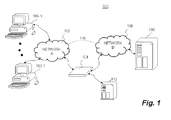
- FIG. 1 shows an exemplary configuration 100 in which the present invention may be practiced.
- the network 102 may be a local area network (wired and/or wireless).
- the client machines 103-1 ... 103-N are representation of users that rely on the network 102 (e.g., a local area network) to access the network 106 (e.g., the Internet).
- the network 102 is operated by a service provider. All users associated with the client machines 104 are subscribers of the service provider.
- a network device 104 is provided to couple the network 102 to the network 106.
- the network device 104 is deployed there without interrupting or altering any data traffic patterns but providing business opportunities to the service provider to serve targeted commercial information to its users. In other words, the operation of the network device 104 is transparent to the users and all websites being visited.
- a client machine e.g., 103-1
- a website e.g., www.ebay.com
- the request and the response thereto, alone or in combination, or data packets representing the request and the response are intercepted by the network device 104 and analyzed together with a dedicated device.
- the dedicated device may be part of the network device 104 or a separate server machine.
- the machine is described as a server 112 and configured to determine one or more appropriate advertisements that may be of high interest to the user.
- the advertisement is then placed in the response.
- the response is eventually displayed on the client machine, there is a high likelihood that the user may be temped to interact with the advertisement and brought up to a commercial website promoting a product or a service by the advertiser.
- the network device 104 is communicating with the server 112 and to provide intercepted information or metadata thereof (collectively "metadata") to the server 112 that is configured to record or update the browsing behaviors of users, and/or analyze the metadata from the network device 104 to determine appropriate advertisements in view of the content and/or context of the metadata, and/or in conjunction with the browsing behaviors.
- metadata intercepted information or metadata thereof (collectively "metadata"
- One of the important features, advantages and objects of the present invention is to provide commercial information that may be of high interest to the users.
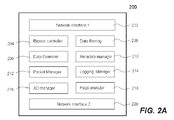
- FIG. 2A there shows a functional block diagram of a device 200, which may correspond to the network device 104 of FIG. 1 .
- the device 200 includes two network interfaces 202 and 220, a bypass controller 204, a data filtering 206, a data examiner 208, a page analyzer 210, a packet manager 212, a logging manager 214, an AD manager 216, and a Page analyzer 218.
- the device 200 may be deployed in a residential complex, a business complex or at a point on the network that most or all of data traffics come through.
- the device 200 is deployed by a service provider that provides various mechanisms to facilitate its users to access the Internet.
- a service provider provides various mechanisms to facilitate its users to access the Internet.
- a publisher of the website sometimes prefers to know who is visiting its website (e.g., from which IP address the website is being visited), thus making the operation of the device 200 invisible become; very important to a service provider.
- the original traffic patterns of all data packets are not altered, wherein a traffic pattern of a data packet is defined to be metadata of the data packet and typically includes in what is commonly referred to as a header.
- a header of a data packet is placed at the beginning of a block of data being stored or transmitted and contains information for the handling of the data block (e.g., source and destination information).
- the headers of data packets going to or coming back from a website remain nearly intact even the data packets go through the device 200 in which some of the data packets are modified to include one or more advertisements or new data packets are necessary (thus the sequence numbers of subsequent data packets may be modified).
- the device 200 is inserted in an inline fashion at a traffic point on a network.
- the network interface 202 is provided to facilitate data communication between the device 200 and one or more client machines that are to interact with the Internet.
- the network interface 220 is provided to facilitate data communication between the device 200 and a server.
- the server is configured to execute one embodiment of the present invention to analyze the content and/or context of a request and a response thereto, record and update a browsing behavior of a particular user, an eventually determine an appropriate advertisement for the user.
- the network interface 202 or 220 may be implemented in accordance with a protocol (e.g., TCP).
- TCP Transmission Control Protocol
- the bypass controller 204 is provided to allow data packets to bypass the device 200 in a predefined event. Depending on implementation, the bypass controller may be controlled automatically or manually, and locally or remotely. For example, in ar event that the device 200 is being updated or in default, the bypass controller 204 is commanded to allow the data packets to bypass the device 200 as if it is not there.
- the data filtering 206 is provided to filter out those data packets that are not meant for examination in the device 200.
- the data filtering 206 is configured to examine data packets to determine the characteristics of the data packets. If the characteristics of data packets does not fall into a pre-defined category, the data packets are routed out of the device 200 without further analysis. For example an exemplary category is defined to exclude data packets carrying audio data ("audio packets") or instant messages ("IM packets").
- audio packets audio packets
- IM packets instant messages
- the data examiner 208 is provided to examine the payloads of the data packets to determine whether there is an advertisement placement opportunity. Some publishers do not allow their contents to be altered thus data packets from websites of these publishers are not allowed to place an advertisement. Whenever there is an indication that data packets from a website disallowing any modification to its data packets, the received packets are bypassed by the data examiner 208. In one embodiment, there is a black list of publishers. Any packets from the websites of these publishers are bypassed. In another embodiment, the characteristics of the webpages are examined as there are certain pages that could not be placed any additional data. For example, a webpage itself is an advertisement. There are also webpages that are in fact applications such as Yahoo!Mail.
- the received data packets are applicable for placing an advertisement therein
- such data packets are routed to the metadata manager 210.
- the data examiner 208 may be configured to determine whether it is from such a publisher. If it is indeed from the publisher, the data packets are deemed to be applicable for advertisement opportunity.
- the data examiner 208 is configured to deem data packets representing an error message to be applicable for advertisement opportunity. Such an error message may result from a downtime of a website or a network being visited.
- the metadata manager 210 is provided to capture the essence of the received data packets inbound or outbound.
- the address of the website is extracted and sent to a dedicated server. For example, when a user desires to visit www.cars.com, either the whole address or a portion of the address "cars" is sent to the server.
- the server may determine that an advertisement of cars is appropriate to be placed in a response to the request, assuming that the response permits such a placement of the advertisement.
- the metadata of the address www.cars.com/lexus may be sent to the server that later selects an advertisement of a Lexus model to be placed in a response to the request.
- the metadata manager 210 when a response from a website to a request is received in the metadata manager 210, the metadata of the response is captured to determine an appropriate advertisement to be included in the response. For example, metadata of a response from www.cars.com may prompt the server to place a general car advertisement in the response. When a webpage of the response is displayed, the advertisement is also displayed.
- the packet manager 212 is designed to modify those data packets that are to be modified to include an advertisement selected for the user. It is assumed that an advertisement has been selected to place in a webpage, the packet manager 212 is configured to add some data to the data packets representing the webpage. Depending on the location of the advertisement in the webpage and the length of the payload of a data packet representing the portion of the webpage, the payload of the data packet may be expanded to include the data representing the advertisement.
- FIG. 2B.1 illustrates a situation in which one or more data packets identified to include data representing an advertisement. A response to a request is a webpage represented by a sequence of N+1 data packets. Each of the data packets is uniquely identified by an identifier that is herein referred to as a sequence number. Depending on implementation, a sequence number may be byte-based or packet-based. To facilitate the description of the present invention, packet-based sequence numbers are assumed in the following description unless otherwise specified.
- an N-th packet is the one that needs to be modified to include the advertisement 234.
- the packet manager 212 is configured to intercept the N-th packet and expand the payload thereof to include the advertisement 234. If the N-th packet, after being added the advertisement 234, exceeds a predefined length, a next packet may be used to include the remaining of the advertisement 234.
- FIG. 2B.2 illustrates that a new packet is fabricated by the packet manager 212 to carry an advertisement 236.
- the packet manager 212 adds a new data packet N+2 to the sequence.
- the data packet N+2 carries the advertisement 236 and becomes part of the sequence.
- the header of the new packet N+2 includes substantially the same information (e.g., a source address and a destination address) of other headers of the packets in the sequence.
- the newly added packet appears to be from the website.
- the newly added packet in fact breaks up the integrity of the data packets originally from the website because the sequence numbers of the data packets after the newly added packet are going to be off.
- a mapping table 238 is used to map the original packets to "new" packets.
- the sequence numbers of the data packets before the occurrence of the newly added packet remains unchanged, the sequence numbers of the data packets after the occurrence of the newly added packet are mapped to new sequence numbers.
- the packet N+2 is newly added and the packet offset is 1, a packet coming after the packet N+1 in the original sequence becomes a packet N+3.
- the packet offset is m, a packet coming after the packet N+1 in the original sequence becomes a packet N+m in a new sequence. It should be noted that the packet offset remains valid in an entire session (e.g., an HTTP session) regardless a user has left one webpage and moved to another page. Further, the packet offset can be accumulated as more advertisements are placed in the session.
- an acknowledgement is sent to or reported to its original source (e.g., a server sponsoring a website).
- its original source e.g., a server sponsoring a website.
- the acknowledgement is blocked or dropped from being further transported or reported to the source so that the source would not be confused with the inserted data packet.
- subsequent acknowledgements to the original data packets from the source are modified to recover the original sequence numbers of the data packets from the website.
- FIG. 2C illustrates an insertion of a data packet and removal of a corresponding acknowledgement. It is assumed that there are two data packets 240 and 242 in a packet sequence from a server. Each of the two data packets 240 and 242 has a data length of 10. Thus byte-based sequence numbers of the two data packets 240 and 242 are respectively 11 and 21. When the packet sequence is intercepted in the device 200, it is determined that a new data packet 244 has to be fabricated and inserted right after the data packet 240. As a result, byte-based sequence numbers for the three data packets are 11, 21 and 29, respectively, where the sequence number of the packet 244 has been modified.
- the client device After having receiving the data packets, the client device responds with a sequence of acknowledgements 246-248. Because the acknowledgement 247 is a result of the inserted data packet, it has to be dropped. At the same time, the acknowledgement 248 is not corresponding to the original data packet 242 (the sequence of which has been modified from 21 to 29). In one embodiment, the device 200 is configured to modify the acknowledgement 248 by modifying the sequence number from 29 back to 21.
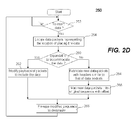
- FIG. 2D shows a flowchart or process 250 of placing selected data into a sequence of data packets, where the selected data may represent one or more advertisements or notifications that must draw attentions from one or more users.
- the process 250 determines whether there is data to be inserted into a response intercepted from a website being visited. It is assumed that the data represents an advertisement or a script including a link to the advertisement. If there is no need to insert any advertisements (e.g., perhaps a webpage can not be placed any advertisements therein), the process 250 goes back to wait for the decision at 252.
- a decision from 252 is to insert data in a response from a website.
- the process 250 now moves to 254 where data packets from the website are examined as they arrive to locate the packet or packets representing a particular location in the webpage where an advertisement is going to be placed. As illustrated in FIG. 2B.2 , the data packets are coming and numbered in a sequence. It is assumed that a particular data packet representing the location in the webpage is located.
- the data packet is determined whether it is expandable to accommodate the advertisement (or a script). It the payload of that data packet is not fully used, the process 250 goes from 260 to 262 where the data packet is modified to include the data. In one embodiment, a script containing a link to the advertisement is added in the payload of the data packet without modifying the header thereof. The modified data packet is then released to its original destined client machine at 268.
- the process 250 has to go from 260 to 264.
- one or more new data packets need to be fabricated.
- the header of the data packet in the original sequence is copied and its sequence number is noted, for example, N-th packet.
- a new data packet carries substantially the same header as the N-th packet but is sequenced as a data packet N+1 in a new sequence.
- the payload of the data packet N+1 is used to carry one or more advertisements or scripts.
- An offset between the new sequence and the original sequence is now set to be one.
- the offset is set accordingly. As a result, subsequent data packets to the N-th packet in the original sequence are now shifted by the offset at 266. Because of the way the new data packet is fabricated, the new data packet appears to be from the website being visited. At 268, the newly fabricated data packet is released together with the original data packets to their original destined client machine.
- the logging manager 214 is provided to record any access to or interactions with a placed advertisement.
- the logging manager 214 provides an evidence of how effective an advertisement may be so that the order of placing advertisements in a same category may be adjusted or the advertisements are priced differently.
- the logging manager 214 may be accessed by a business entity that owns the network device 200 to determine how to share revenues with a service provider as a result of interactions with the placed advertisements by the user.
- the logging manager 214 is used to provide a basis for auctioning a placement of an advertisement among advertisers.
- the AD manager 216 is provided to place an advertisement in a webpage requested by a user.
- a script including a link is added to a webpage represented in HTML.
- the script is executed to retrieve the advertisement from a repository or database. As a result, the user sees a display of the requested webpage embedded with the advertisement.
- the page analyzer 218 is provided to analyze a webpage to determine whether there is an available space in the webpage that may be utilized to include an advertisement.
- FIG. 2E shows a portion of the webpage from www.marketwatch.com that includes a number of spaces (e.g., referenced by 250 and 252, respectively) that may be used for placing an advertisement therein.
- the page analyzer 218 is configured to directly analyze the HTML data of the webpage to determine an available space that is suitable for placing an advertisement therein.
- a script is added to a received webpage. The script is configured, when executed, to look for an available space per some criteria. Depending one implementation, the criteria may be a particular size or location of a space that may be considered as applicable for placing an advertisement therein.
- the page analyzer 218 is a completely "off-line" module in a sense that it is configured to work with or acts as a web crawler, visiting various webpages, rendering them, and determining any available or suitable spaces for possible advertisements.
- the resulting space information may be stored in a database indexed by the corresponding URI.
- Such a database can be used by the AD manager 216 or an advertisement serving engine in the server to determine the optimal location of an advertisement when the advertisement is being served in a webpage.
- the location and size of a space is reported to the page analyzer 218 that in return reports to the server to determine an appropriate advertisement to fit into the detected space.
- the AD manager 216 is configured to work with a database of webpages collected by a web crawling or spidering process, in which case, the AD manager 216 knows exactly where in a webpage an advertisement may be placed.
- FIG. 2A shows only those essential functional blocks that may be combined to realize one or more features, advantages or objects of the present invention, and should not be considered to have precluded the presence or addition of elements, components, functional blocks and/or groups (e.g., memory, a CPU, and a data bus). Those skilled in the art may also appreciate that not all of the functional blocks must be present to practice the present invention.
- the device 200 of FIG. 2A operates completely transparently to a client device and a server device.
- a conventional proxy server terminates client connections before opening new connections to fetch information from servers while the device 200 is not engaged to terminate client connections.
- requests for contents come from the proxy server, not the client.
- the presence of the proxy server effectively masks the identity of end user clients.
- not all applications can be made to interoperate with a proxy server in the middle. Certain applications, such as security applications and/or real-time applications, would stop working either because the end points must know the network identities of each other or the proxy server simply introduces too much delay.
- the data filtering 206 or the data examiner 208 provides an inherent mechanism to bypass those data packets (e.g., video or audio) while a traditional proxy server lacks such a mechanism and has to deal with all trespassing data packets, thus lacking scalability. Accordingly, the device 200 in the present invention provides much improved handling of data packets with an increased level of transparency.
- FIG. 3 shows a functional block diagram of a server 300 communicating with the device 200 of FIG. 2A to facilitate the placement of an appropriate advertisement in a response to a request from a user.
- the server used herein is a relative term with respect to the network device 200 of FIG. 2A .
- the server 300 there is no clear distinction as to which functional blocks must be in the network device 200 and which functional blocks must be in the server 300.
- some of the functional blocks as shown in the network device 200 of FIG. 2A may be implemented in the server 300 while some of the functional blocks as shown in the server 300 may be implemented in the network device 200.
- all functional blocks may be implemented in the network device 200 or in a distributed manner. A shown in FIG.
- the server 200 in one embodiment, is configured to analyze raw information (e.g., metadata) from the network device 200 about a user and transform it into a user behavioral profile, and utilize a user profile together with advertiser and publisher business rules to select the most relevant advertisements for a user.
- raw information e.g., metadata
- the server 200 includes two network interfaces 302 and 320, a profiling engine 304, an AD serving engine 306, an event qualifier 308, and a yield manager 310.
- the server 300 may include or be coupled to a database that houses advertisements from advertisers.
- the network interface 302 is provided to facilitate data communication between the server 300 and the network device 200.
- the network interface 320 is provided to facilitate data communication between the server 300 and another device.
- another device is one of the client machines 103-1 ... 103-N and is caused to fetch one or more advertisements from the server 300 via the network interface 320 for display in a webpage.
- the server is updated or provided with new features, and communicates with other devices via the network interface 320.
- the network interface 302 or 320 may be implemented in accordance with a communication protocol (e.g., TCP/IP).
- the profiling engine 304 is configured to record, update and analyze a profile of a user.
- metadata is transported from the network device 200 of FIG. 2A .
- the profiling engine 304 transforms click-stream data and subsequent transformation of that data into a meaningful behavioral profile for a user.
- a behavioral profile comprises a user's unique demographics, geographic location, lifestyle, as well as quantified expressions of purchase intent for various products or services. Once the behavioral user profile is constructed, it is continuously updated and enhanced as user click-stream data becomes available.
- One of the important features of the profiling engine 304 is to keep all behavioral profiles unique, more importantly, anonymous. In other words, all personally identifiable information is filtered out from the captured user click-stream data.
- the AD serving engine 306 is designed to interface with a database of advertisements and various constraints therefor. Upon receiving an indication extracted from a behavioral profile or content and context of a request and a response thereto, th AD serving engine 306 selects from the database one or more advertisements to be placed in the response via the network device 200 so that the advertisements are shown when the response is displayed. In one embodiment, a separate module (not shown) or AD serving engine 306 is configured to reformat a selected advertisement to fit nicely in a located available space in a webpage.
- the event qualifier 308 is provided to qualify the metadata received from the network device 200.
- the event qualifier 308 defines a finite number of categories, each related to one type of interest. Given received metadata, the event qualifier 308 determines which category may correspond to a subject in the metadata. If no category can be fit, a new category is created. Through a separate module (not shown), received metadata usually goes through an initial process to ensure that a subject may be extracted from the metadata. If the metadata received from the network device can not be classified, the data examiner may be instructed to bypass the corresponding data packets or the categories are updated.
- the event qualifier 308 contains a portfolio of several qualifier types such as: page text or URL-based, search-based, 3 rd party ad-clicked based, etc.
- Each qualifier type attempts to identify a user's current interest category based on the occurrence of a specific user action: requesting a page, submitting a keyword search, clicking on a 3 rd party ad, etc..
- the portfolio may be structured as a tree structure, where each of the leaves of the tree structure is a respective category.
- the yield manager 310 utilizes a user profile in conjunction with advertise and publisher business rules (e.g., targeting constraints) to select the most relevant advertisements for a user. For each call that the yield manager 310 receives from the AD serving engine 306, the yield manager 310 first considers all available advertising campaigns active in an advertisement database or system and eliminates those that do not meet the targeting constraints. For the remaining advertising campaigns, the yield manager 310 calculates a predicted response from the user to the campaign advertisement (likelihood of a click or conversion) based on the profile of the user. Based on the predicted response and the campaign rates, the yield manager 310 calculates a projected revenue for each of the campaigns that could be generated from this call. Finally, the yield manager 310 selects the campaign with the highest projected revenue and passes the winning advertisement identifier to the AD serving engine 306.
- advertise and publisher business rules e.g., targeting constraints
- FIG. 4A shows a flowchart or process 400 of placing one or more advertisements in available spaces determined from a webpage requested by a user.
- the process 400 may be understood in conjunction with preceding figures.
- the process 400 may be implemented in software, hardware or a combination of both software and hardware.
- the process 400 can be advantageously used by a service provider to place targeted advertisements to generate additional revenues without disrupting data traffics in its networks.
- the process 400 is initiated at 402 when a requested webpage is being received in responding to a request from a user. It is assumed that the user (e.g., one of the subscribers to the Internet services) has requested to access a particular website by sending out an HTTP request, such a request is intercepted by a device (e.g., the network device 104 of FIG. 1 ). The request is analyzed to determine or update a browsing behavior (e.g., a behavioral profile) of the user. In one embodiment, the request or metadata thereof is transported to a server (e.g., the server 112 of FIG. 1 ) that is configured to perform the analysis of the request. The analysis helps to determine an appropriate advertisement that may be of interest to the user.
- a server e.g., the server 112 of FIG. 1
- the data packets representing the response go through a filtering process at 404 that is configured to bypass those responses or packets thereof that are not meant for placing an advertisement therein. For example, a user has requested to download a piece of music. The music data is in general not applicable for placing an advertisement and thus bypassed.
- the process 400 determines whether there is an opportunity to place an advertisement in the response. If it is determined that the intercepted response is not applicable for placing an advertisement there, the process 400 goes to 408 where the intercepted response is bypassed and continues its journey to a client machine that originally sends out the request. The process 400 then goes back to 402 to await a next response.
- the intercepted response does present an opportunity for an advertisement.
- the user has requested to access the front page of www.marketwatch.com.
- the response namely the front page as shown in FIG. 2D , is represented in HTML.
- the process 400 then moves from 406 to 410 where it determines where the webpage presents an opportunity to insert or place one or more targeted advertisement therein.
- the webpage is analyzed in a network device to determine whether there is an available space in the webpage that may be used to place an advertisement.
- the HTML file representing the webpage is analyzed, which may also be performed in conjunction with a browser being used by the user.
- a script is embedded in the webpage. The script is executed in a browser when the webpage is displayed.
- FIG. 2D shows that at least two spaces 250 and 252 meeting certain criteria are located.
- the criteria may be based on a size requirement, a shape, and/or a location requirement.
- a background color or surrounding color of a located area is also determined as some advertisements may not fit well in a certain color.
- whether a space is sufficient for an advertisement is determined by a display resolution or a display ratio.
- Many layouts of webpages are designed based on a certain resolution. As different displays are set to be in different display resolutions, a located available space in a webpage in one display resolution may not be necessarily an available resolution in the same webpage in another display resolution.
- a script embedded in a webpage locates an available space that may be further verified in a server (e.g., the server 300 of FIG. 3 ) before a decision to place an advertisement therein is made. Further, many layouts of webpages are designed based on a 4:3 display ratio while there are displays in 4:3 ratio, 16:9 ratio and others.
- FIG. 2D shows that there is an empty bar on the right side of the display.
- the objective of 410 is to find available spaces in the intercepted webpage for placement of advertisements that are of interest to the user, provided that the publisher allows such placements of advertisements.
- one or more targeted advertisements are determined.
- the advertisements may be determined based on the browsing behavior of the user and/or the content and context of the webpage.
- the server is configured to select from a database an appropriate advertisement based on the browsing behavior of the user (that may be constantly updated). For example, the browsing behavior indicates that the user spends a lot of time browsing websites related to cars in the last two days or the past hours, the selected advertisement may be a car advertisement. As a result, the car advertisement is placed in the received webpage, regardless whether the received webpage is related to the cars or not.
- the server is configured to select from a database an appropriate advertisement based on the content and/or context of the intercepted webpage.
- the requested webpage is www.marketwatch.com which may indicate that the user is interested in the security market.
- the selected advertisement may be something related to the security market (e.g., a brokerage advertisement).
- the advertisement placed in the received webpage is closely related to the content or/and context of the received webpage.
- scripts including links to the selected advertisements are generated. Examples of such a script may include, but not be limited to, javascript and actionscript.
- the advertisement is placed in the received page.
- a script containing a link to the advertisement is inserted in one or more of the data packets representing the page.
- the script is executed to pull the corresponding advertisement and place the advertisement in the space determined.
- appropriate packets are identified and then modified to include the script.
- one of the important features in the present invention is to modify such packets without interrupting or altering the original data traffic pattern of the data packet. Accordingly, only the payloads of the identified packets are modified to include the script. If the identified packets do not allow the script to be included (e.g., the packet length would exceed a limit), one or more new packets may be fabricated, resulting in mapping of the packets in the network device.
- the modified date packets are released to the client machine that requested the webpage.
- the client machine e.g., a browser
- the client machine activates to display the webpage, resulting in an execution of the embedded script.
- the client machine is then activated per the script to pull the advertisement from a device (e.g., a server or a database) in accordance with the link in the script.
- the pulled advertisement is eventually displayed in the located available space of the webpage. Because the advertisement is selected per the interest or browsing behavior of the user, there is a greater chance that the user may tempt to click on the advertisement, resulting in a click-though to a website of the advertiser.
- FIG. 4B shows that the webpage of FIG. 2D has been placed at least three targeted advertisements 450, 452 and 454, where the advertisements 450 and 453 are placed directly in the webpage while the advertisement 454 is placed in the expanded space as a result of a different display ratio.
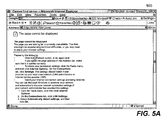
- FIG. 5A shows a snapshot 500 of an exemplary error message as a result of one of the error codes when a website www.msn.com can not be accessible at the time being requested, telling a user that a request to visit the website has failed.
- the failure to access the website may be one of many reasons (e.g., the website is brought down for maintenance, a local area network to the website is too congested or in downtime).
- the first-hand information i.e., the error code
- a default message composed as a webpage (e.g., HTML page).
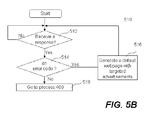
- FIG. 5B shows a flowchart or process 510 of placing one or more advertisements in an error message.
- a client machine is caused to send a request to visit a website.
- a browser is executed to send an HTTP request including a URI.
- the process 510 awaits a response from the website being requested to visit. If no any response is received for some time, the client machine associated with the user may generate an error message or display a webpage similar to the one shown in FIG. 5A .
- a network device e.g., corresponding to the device 104 of FIG.
- the network device may generate a default page and send the default page to the client machine, wherein the default page may include one or more advertisements or scripts that may be of high interest to the user.
- a predefined time e.g. 20 seconds
- the process 510 determines whether the response is a normal response to a request or indicates an error code (which meaning may be defined in the incorporated article). If the response is a standard response (e.g., an HTTP response to an HTTP request), the process may go back to 512 or go 518 that is essentially a beginning of the process 400. On the other end, if the response includes an error code, for example, 404: not found, which means the server has not found anything matching the request no indication is given of whether the condition is temporary or permanent.
- the process 510 goes to 516 where a default webpage is generated. In one embodiment, the default is in HTML and includes one or more scripts pertaining to the advertisements that are believed to be corrected with the interests of the user. The default page is then sent to the client machine. As explained above, packets representing the default pages may be fabricated to ensure that the packets are destined to the client machine.
- One of the important features, advantages and objects in the present invention is an inherent mechanism that can deliver time-sensitive advertisements correlated with the interest of a user.
- Many webpages include advertisements that may be scheduled or have been embedded therein for a predefined period. As a result, these advertisements may not be served at a time they are supposed to be served. For example, an advertisement from a restaurant is preferably to be served near a meal time or a holiday season. When a webpage carrying such an advertisement is being visited right after a meal time, the chance that a user interacts on the advertisement is lower than otherwise the advertisement would be shown before the meal time.
- FIG. 6A shows a screen capture 600 of a webpage from a website www.msn.com.
- the display shows that the publisher of the website has placed an advertisement 602.
- the advertisement 602 is replaced with another advertisement 604 without changing the layout of the webpage as shown in FIG. 6B .
- the advertisement 604 may be more time sensitive than the advertisement 602 and serving the advertisement 604 at a particular time may demand a higher fee than serving the advertisement 602.
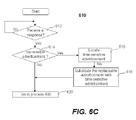
- FIG. 6C shows a flowchart or process 610 of substituting an existing advertisement with a preferable advertisement without altering the layout of a webpage.
- the process 610 may be initiated when a response to a request is intercepted in a network device (e.g., the device 104 of FIG. 1 ). It is assumed that the response is a webpage at 612. Thus the process 610 goes to 614 where the network device includes a module, referring to as ad detection module, that is configured to detect whether the webpage includes any advertisements. In one embodiment, the ad detection module looks up for a script that carries one or more links to advertisements. If there is a detection of the presence of such an advertisement or a script thereof, the process 610 determines at 614 whether the advertisement is replaceable. If the advertisement is not replaceable or not to be replaced, the process goes to an end or to 620 that is essentially the beginning of the process 400 of FIG. 4A .
- ad detection module looks up for a script that carries one or more links to advertisements
- the process 610 goes to 616.
- some webpages are not allowed to change while other webpages are allowed to be modified.
- a publisher servers some advertisements in its webpages while the advertisements are provided by various advertisers, an advertising agent or an advertising network (e.g., ValueClick Media) serving various publishers.
- an advertising agent or an advertising network are referred to interchangeably as an advertising agent.
- the publisher gets a fee whenever its webpages carrying the advertisements are visited or whenever the advertisements therein are interacted by a user.
- the advertisements may or may not be served at a particular time or in conjunction with a particular interest of a user.
- a service provider is able to negotiate with the advertising agent for a higher fee if a particular advertisement is served at a particular time, in a particular context/content, or in conjunction with a particular behavior. For example, a website being visited carries a cosmetic advertisement. When it is detected that the user appears to be male, the cosmetic advertisement would be far less meaningful to the user. Accordingly, the service provider may be in a position to request something else to be served.
- the process 610 Upon detecting at 614 that an advertisement in the intercepted webpage is replaceable (e.g., the advertisement is provided by an advertising agent), the process 610 goes to 616 where the advertising agent is negotiated to place a preferable advertisement (e.g., more time sensitive) with a higher fee.
- the preferable advertisement decided at 616 is believed to be correlated with the interest of the user.
- the original advertisement in the webpage is replaced by the preferable advertisement.
- the script for the original advertisement is either modified or replaced so that the webpage now carries a script including a link to the preferable advertisement.
- the webpage is displayed with the preferable advertisement as shown in FIG, 6B as opposed to the original advertisement in FIG. 6A .
- the process 610 may return to 612 (not shown). If the process 610 after 618 goes to 620 to enter the process 400, an identified space in the webpage or a presentation of the webpage on a display may be used for placing an advertisement.
- FIG. 6B shows that a preferable advertisement 604 is placed within the displayed webpage and two targeted advertisements 606 and 608 are placed respectively in located available spaces due to a display resolution or aspect ratio different from that of the original layout of the webpage.
- a new method of generating revenues from serving advertisements online can be realized.
- a service provider e.g., AT&T or Comcast
- AT&T or Comcast traditionally providing legacy services can now generate additional revenues by serving targeted advertisements to its users or subscribers.
- a service provider is now in a better position to replace an existing advertisement with something preferable for a different fee structure.
- the invention can also be embodied as computer-readable code on a computer-readable medium.
- the computer-readable medium can be any data-storage device that can store data which can be thereafter be read by a computer system. Examples of the computer-readable medium may include, but not be limited to, read-only memory, random-access memory, CD-ROMs, DVDs, magnetic tape, hard disks, optical data-storage devices, or carrier wave.
- the computer-readable media can also be distributed over network-coupled computer systems so that the computer-readable code is stored and executed in a distributed fashion.
Landscapes
- Engineering & Computer Science (AREA)
- Business, Economics & Management (AREA)
- Accounting & Taxation (AREA)
- Strategic Management (AREA)
- Finance (AREA)
- Development Economics (AREA)
- Computer Networks & Wireless Communication (AREA)
- Signal Processing (AREA)
- Marketing (AREA)
- General Physics & Mathematics (AREA)
- Entrepreneurship & Innovation (AREA)
- Theoretical Computer Science (AREA)
- Game Theory and Decision Science (AREA)
- General Business, Economics & Management (AREA)
- Economics (AREA)
- Physics & Mathematics (AREA)
- Computer Security & Cryptography (AREA)
- Computer Hardware Design (AREA)
- General Engineering & Computer Science (AREA)
- Computing Systems (AREA)
- Information Transfer Between Computers (AREA)
- Data Exchanges In Wide-Area Networks (AREA)
- Two-Way Televisions, Distribution Of Moving Picture Or The Like (AREA)
Applications Claiming Priority (1)
| Application Number | Priority Date | Filing Date | Title |
|---|---|---|---|
| US11/759,157 US20080306815A1 (en) | 2007-06-06 | 2007-06-06 | Method and system for inserting targeted data in available spaces of a webpage |
Publications (1)
| Publication Number | Publication Date |
|---|---|
| EP2015245A1 true EP2015245A1 (fr) | 2009-01-14 |
Family
ID=39720515
Family Applications (1)
| Application Number | Title | Priority Date | Filing Date |
|---|---|---|---|
| EP08152213A Withdrawn EP2015245A1 (fr) | 2007-06-06 | 2008-03-03 | Procédé et système pour insérer des données ciblées dans les espaces disponibles d'une page Web |
Country Status (8)
| Country | Link |
|---|---|
| US (1) | US20080306815A1 (fr) |
| EP (1) | EP2015245A1 (fr) |
| JP (1) | JP2008305381A (fr) |
| KR (1) | KR20080107248A (fr) |
| CN (1) | CN101320369A (fr) |
| AU (1) | AU2008200565A1 (fr) |
| CA (1) | CA2622187A1 (fr) |
| RU (1) | RU2008108557A (fr) |
Cited By (22)
| Publication number | Priority date | Publication date | Assignee | Title |
|---|---|---|---|---|
| GB2464528A (en) * | 2007-08-30 | 2010-04-28 | Clickstream Technologies Plc | Provision of targeted content |
| CN103023765A (zh) * | 2012-12-04 | 2013-04-03 | 杭州迪普科技有限公司 | 一种基于脚本语言的报文处理方法和装置 |
| US8589242B2 (en) | 2010-12-20 | 2013-11-19 | Target Brands, Inc. | Retail interface |
| US8606643B2 (en) | 2010-12-20 | 2013-12-10 | Target Brands, Inc. | Linking a retail user profile to a social network user profile |
| US8606652B2 (en) | 2010-12-20 | 2013-12-10 | Target Brands, Inc. | Topical page layout |
| US8630913B1 (en) | 2010-12-20 | 2014-01-14 | Target Brands, Inc. | Online registry splash page |
| USD703686S1 (en) | 2011-12-28 | 2014-04-29 | Target Brands, Inc. | Display screen with graphical user interface |
| USD703685S1 (en) | 2011-12-28 | 2014-04-29 | Target Brands, Inc. | Display screen with graphical user interface |
| USD705791S1 (en) | 2011-12-28 | 2014-05-27 | Target Brands, Inc. | Display screen with graphical user interface |
| USD705792S1 (en) | 2011-12-28 | 2014-05-27 | Target Brands, Inc. | Display screen with graphical user interface |
| USD706794S1 (en) | 2011-12-28 | 2014-06-10 | Target Brands, Inc. | Display screen with graphical user interface |
| USD706793S1 (en) | 2011-12-28 | 2014-06-10 | Target Brands, Inc. | Display screen with graphical user interface |
| US8756121B2 (en) | 2011-01-21 | 2014-06-17 | Target Brands, Inc. | Retail website user interface |
| USD711400S1 (en) | 2011-12-28 | 2014-08-19 | Target Brands, Inc. | Display screen with graphical user interface |
| USD711399S1 (en) | 2011-12-28 | 2014-08-19 | Target Brands, Inc. | Display screen with graphical user interface |
| USD712417S1 (en) | 2011-12-28 | 2014-09-02 | Target Brands, Inc. | Display screen with graphical user interface |
| USD715818S1 (en) | 2011-12-28 | 2014-10-21 | Target Brands, Inc. | Display screen with graphical user interface |
| US8965788B2 (en) | 2011-07-06 | 2015-02-24 | Target Brands, Inc. | Search page topology |
| US8972895B2 (en) | 2010-12-20 | 2015-03-03 | Target Brands Inc. | Actively and passively customizable navigation bars |
| US9024954B2 (en) | 2011-12-28 | 2015-05-05 | Target Brands, Inc. | Displaying partial logos |
| KR20160138345A (ko) * | 2015-05-25 | 2016-12-05 | 삼성전자주식회사 | 웹 페이지에 기초한 정보 제공 방법 및 장치 |
| EP2537102A4 (fr) * | 2010-02-15 | 2017-08-23 | Unwired Planet International Limited | Systèmes mandataire/de script, procédés et montages de circuits |
Families Citing this family (55)
| Publication number | Priority date | Publication date | Assignee | Title |
|---|---|---|---|---|
| US8364540B2 (en) * | 2005-09-14 | 2013-01-29 | Jumptap, Inc. | Contextual targeting of content using a monetization platform |
| US7844591B1 (en) * | 2006-10-12 | 2010-11-30 | Adobe Systems Incorporated | Method for displaying an image with search results |
| US9165301B2 (en) * | 2007-06-06 | 2015-10-20 | Core Audience, Inc. | Network devices for replacing an advertisement with another advertisement |
| US8799249B2 (en) * | 2007-06-08 | 2014-08-05 | Yahoo! Inc. | Method and system for rendering a collection of media items |
| US8533221B2 (en) * | 2007-08-30 | 2013-09-10 | 5Th Tier Limited | Provision of targeted content |
| US20090063268A1 (en) * | 2007-09-04 | 2009-03-05 | Burgess David A | Targeting Using Historical Data |
| US10296947B2 (en) * | 2007-11-28 | 2019-05-21 | Douglas R. Cloud | Information-market system |
| US8190990B2 (en) * | 2008-06-27 | 2012-05-29 | Google Inc. | Annotating webpage content |
| US20100030644A1 (en) * | 2008-08-04 | 2010-02-04 | Rajasekaran Dhamodharan | Targeted advertising by payment processor history of cashless acquired merchant transactions on issued consumer account |
| GB0817805D0 (en) * | 2008-09-29 | 2008-11-05 | Symbian Software Ltd | Method and system for receicing and displaying unsolicitted content on a device |
| EP2202935B1 (fr) * | 2008-12-23 | 2012-06-20 | Nokia Siemens Networks OY | Procédé et dispositif pour le traitement de données dans un réseau |
| JP2010152708A (ja) * | 2008-12-25 | 2010-07-08 | Optim Corp | 電子機器、情報表示システム、および情報表示方法 |
| WO2010075882A1 (fr) * | 2008-12-30 | 2010-07-08 | Nokia Siemens Networks Oy | Distribution de contenu selon l'utilisateur |
| US8769402B2 (en) | 2009-03-03 | 2014-07-01 | Admeta Aktiebolag | Method for optimising the placement of at least two pieces of information |
| US8335712B1 (en) * | 2009-04-06 | 2012-12-18 | Google Inc. | Minimizing ad production costs for print advertisers |
| CN102301658B (zh) * | 2009-09-11 | 2014-11-19 | 华为技术有限公司 | 广告投放方法、广告服务器和广告系统 |
| US8380570B2 (en) * | 2009-10-27 | 2013-02-19 | Yahoo! Inc. | Index-based technique friendly CTR prediction and advertisement selection |
| WO2011075886A1 (fr) * | 2009-12-22 | 2011-06-30 | Google Inc. | Affichage de publicités |
| EP2518947A1 (fr) * | 2009-12-24 | 2012-10-31 | Huawei Device Co., Ltd. | Procédé, dispositif et système permettant de délivrer un message publicitaire |
| US20110161135A1 (en) * | 2009-12-30 | 2011-06-30 | Teradata Us, Inc. | Method and systems for collateral processing |
| US8832559B2 (en) * | 2010-06-25 | 2014-09-09 | LeftsnRights, Inc. | Content distribution system and method |
| US8656456B2 (en) | 2010-07-22 | 2014-02-18 | Front Porch, Inc. | Privacy preferences management system |
| KR20120059995A (ko) * | 2010-12-01 | 2012-06-11 | 주식회사 팬택 | 이동 단말기 및 이동 단말기의 웹 브라우저 표시 제어방법 |
| CN102722306B (zh) * | 2011-03-29 | 2016-01-27 | 汉王科技股份有限公司 | 电子阅读器中图元的显示方法、装置及电子阅读器 |
| CN102769641B (zh) * | 2011-05-05 | 2016-12-07 | 腾讯科技(北京)有限公司 | 一种网页内容自适应控制的展示方法及系统 |
| US9064261B2 (en) * | 2011-05-20 | 2015-06-23 | Google Inc. | Auto-suggested content item requests |
| JPWO2012164672A1 (ja) * | 2011-05-30 | 2014-07-31 | 株式会社Mcホールディングス | コンテンツ表示装置及びプログラム |
| US20130117110A1 (en) * | 2011-11-08 | 2013-05-09 | Microsoft Corporation | Dynamic determination of number of served advertisements |
| CN102497595A (zh) * | 2011-12-06 | 2012-06-13 | 鄂文轩 | 一种固定终端中的广告发布方法和设备 |
| WO2013090992A1 (fr) * | 2011-12-21 | 2013-06-27 | Freenet Holdings Bv | Perfectionnements apportés à des réseaux sans fil |
| US8898560B1 (en) * | 2012-04-25 | 2014-11-25 | Google, Inc. | Fixing problems with a user interface |
| US9325676B2 (en) * | 2012-05-24 | 2016-04-26 | Ip Ghoster, Inc. | Systems and methods for protecting communications between nodes |
| US10778659B2 (en) | 2012-05-24 | 2020-09-15 | Smart Security Systems Llc | System and method for protecting communications |
| CN103577059A (zh) * | 2012-08-06 | 2014-02-12 | 联想(北京)有限公司 | 一种用户界面呈现方法及电子设备 |
| KR101327303B1 (ko) * | 2012-08-10 | 2013-11-11 | 조재일 | 패킷 제어를 통한 인터넷 광고 장치 및 그 방법 |
| CN103869936B (zh) * | 2012-12-12 | 2016-12-28 | 联想(北京)有限公司 | 信息的显示方法及电子设备 |
| KR20140098947A (ko) * | 2013-01-31 | 2014-08-11 | 삼성전자주식회사 | 광고 제공 시스템, 사용자 단말 및 광고 제공 방법 |
| US10565292B2 (en) * | 2013-06-14 | 2020-02-18 | Oath Inc. | Method and system for identifying and delivering enriched content |
| WO2015036054A1 (fr) * | 2013-09-16 | 2015-03-19 | Gülyurt Mehmet Isin | Dispositif de soumission de publicités et d'informations pour véhicule commercial |
| US9230038B2 (en) * | 2013-11-04 | 2016-01-05 | Verizon Patent And Licensing Inc. | Content fetching and caching on a mobile device |
| EP3119044B1 (fr) * | 2014-06-30 | 2020-04-01 | Huawei Technologies Co., Ltd. | Procédé et dispositif d'insertion de page |
| US9756058B1 (en) * | 2014-09-29 | 2017-09-05 | Amazon Technologies, Inc. | Detecting network attacks based on network requests |
| US10777164B2 (en) * | 2014-12-19 | 2020-09-15 | Qualcomm Incorporated | Power optimization by rendering low-resolution tiles during page load |
| WO2016190584A1 (fr) * | 2015-05-25 | 2016-12-01 | 삼성전자 주식회사 | Procédé et dispositif permettant de fournir des informations sur la base d'une page internet |
| CN105512904B (zh) * | 2015-10-10 | 2019-11-22 | 北京中创信测科技股份有限公司 | 一种推送广告的方法 |
| US20170109796A1 (en) * | 2015-10-14 | 2017-04-20 | Facebook, Inc. | Presenting content selected by an online system via content presented by an application along with additional content presented by the application |
| CN106815225B (zh) * | 2015-11-27 | 2020-09-04 | 方正国际软件(北京)有限公司 | 一种媒体界面的漂浮广告处理和显示的方法及装置 |
| JP6346684B1 (ja) * | 2017-03-17 | 2018-06-20 | ヤフー株式会社 | 生成プログラム、生成装置及び生成方法 |
| CN109597981B (zh) * | 2017-09-30 | 2022-05-17 | 腾讯科技(深圳)有限公司 | 一种文本互动信息的展示方法、装置及存储介质 |
| US11194930B2 (en) | 2018-04-27 | 2021-12-07 | Datatrendz, Llc | Unobtrusive systems and methods for collecting, processing and securing information transmitted over a network |
| CN112685211B (zh) * | 2021-01-04 | 2024-06-04 | 北京金山云网络技术有限公司 | 一种错误信息展示方法、装置、电子设备及介质 |
| CN113660292B (zh) * | 2021-10-19 | 2022-01-11 | 北京安华金和科技有限公司 | 一种获取调用客户端的主体的信息方法和装置 |
| US12236453B2 (en) * | 2021-12-03 | 2025-02-25 | Jpmorgan Chase Bank, N.A. | Systems and methods for providing offer interface platforms |
| CN116797956A (zh) * | 2022-03-14 | 2023-09-22 | 晒趣科技有限公司 | 广告插入位置搜索方法及在视频上自动插入广告的方法 |
| CN114817804B (zh) * | 2022-03-31 | 2024-08-13 | 北京达佳互联信息技术有限公司 | 一种网页生成方法、装置、电子设备及存储介质 |
Citations (6)
| Publication number | Priority date | Publication date | Assignee | Title |
|---|---|---|---|---|
| US20020009079A1 (en) * | 2000-06-23 | 2002-01-24 | Jungck Peder J. | Edge adapter apparatus and method |
| EP1241855A2 (fr) * | 2001-03-14 | 2002-09-18 | Stonesoft Corporation | Gestion de paquets de données |
| WO2006081680A1 (fr) * | 2005-02-07 | 2006-08-10 | Adzilla, Inc. | Procede et systeme de ciblage de contenu |
| US20070002769A1 (en) * | 2005-07-01 | 2007-01-04 | Eldad Matityahu | Active packet content analyzer for communications network |
| EP1755314A2 (fr) * | 2005-07-28 | 2007-02-21 | Third Brigade, Inc. | Moteur de normalisation pour TCP |
| WO2007123760A2 (fr) * | 2006-03-30 | 2007-11-01 | Nebuad, Inc. | Dispositif de réseau pour surveillance et modification du trafic de réseau entre l'utilisateur final et le fournisseur de contenu |
Family Cites Families (67)
| Publication number | Priority date | Publication date | Assignee | Title |
|---|---|---|---|---|
| US5694546A (en) * | 1994-05-31 | 1997-12-02 | Reisman; Richard R. | System for automatic unattended electronic information transport between a server and a client by a vendor provided transport software with a manifest list |
| US5781894A (en) * | 1995-08-11 | 1998-07-14 | Petrecca; Anthony | Method and system for advertising on personal computers |
| WO1997015885A1 (fr) * | 1995-10-25 | 1997-05-01 | Open Market, Inc. | Gestion des transferts d'informations dans un reseau de communication |
| US7039599B2 (en) * | 1997-06-16 | 2006-05-02 | Doubleclick Inc. | Method and apparatus for automatic placement of advertising |
| GB2330430B (en) * | 1997-10-16 | 2002-07-17 | Ibm | Error handler for a proxy server computer system |
| US6636489B1 (en) * | 1997-11-03 | 2003-10-21 | Bell South Wireless Data. L.P. | Wireless management system and a method for an automated over-the-air managing process for wireless communication device |
| AU5234999A (en) * | 1998-08-03 | 2000-02-28 | Doubleclick Inc. | Network for distribution of re-targeted advertising |
| US6829646B1 (en) * | 1999-10-13 | 2004-12-07 | L. V. Partners, L.P. | Presentation of web page content based upon computer video resolutions |
| US6487538B1 (en) * | 1998-11-16 | 2002-11-26 | Sun Microsystems, Inc. | Method and apparatus for local advertising |
| US7194554B1 (en) * | 1998-12-08 | 2007-03-20 | Nomadix, Inc. | Systems and methods for providing dynamic network authorization authentication and accounting |
| DE60020417T2 (de) * | 1999-01-25 | 2005-10-27 | Nippon Telegraph And Telephone Corp. | Push-Netzwerk |
| US7178106B2 (en) * | 1999-04-21 | 2007-02-13 | Sonic Solutions, A California Corporation | Presentation of media content from multiple media sources |
| US6430603B2 (en) * | 1999-04-28 | 2002-08-06 | World Theatre, Inc. | System for direct placement of commercial advertising, public service announcements and other content on electronic billboard displays |
| US7089194B1 (en) * | 1999-06-17 | 2006-08-08 | International Business Machines Corporation | Method and apparatus for providing reduced cost online service and adaptive targeting of advertisements |
| WO2001013579A1 (fr) * | 1999-08-18 | 2001-02-22 | Fujitsu Limited | Systeme et procede de repartition de charge dans un reseau, et support d'enregistrement destine au programme de ce systeme |
| US7263558B1 (en) * | 1999-09-15 | 2007-08-28 | Narus, Inc. | Method and apparatus for providing additional information in response to an application server request |
| US20070266150A1 (en) * | 2006-05-10 | 2007-11-15 | Interpols Network Incorporated | Systems and methods for self-checking and identifying errors in rich-media advertisements |
| US8631314B2 (en) * | 2006-05-18 | 2014-01-14 | Interpols Network Incorporated | Systems and methods for delivery of multiple online advertising units to communicate and interact on the same webpage |
| BR0014954A (pt) * | 1999-10-22 | 2002-07-30 | Activesky Inc | Sistema de vìdeo baseado em objetos |
| US6678734B1 (en) * | 1999-11-13 | 2004-01-13 | Ssh Communications Security Ltd. | Method for intercepting network packets in a computing device |
| US8032409B1 (en) * | 1999-11-22 | 2011-10-04 | Accenture Global Services Limited | Enhanced visibility during installation management in a network-based supply chain environment |
| US20020010757A1 (en) * | 1999-12-03 | 2002-01-24 | Joel Granik | Method and apparatus for replacement of on-line advertisements |
| US6912571B1 (en) * | 2000-02-22 | 2005-06-28 | Frank David Serena | Method of replacing content |
| US7031945B1 (en) * | 2000-07-24 | 2006-04-18 | Donner Irah H | System and method for reallocating and/or upgrading and/or rewarding tickets, other event admittance means, goods and/or services |
| US20020052925A1 (en) * | 2000-08-29 | 2002-05-02 | Yoohwan Kim | Method and apparatus for information delivery on the internet |
| JP2002183024A (ja) * | 2000-12-12 | 2002-06-28 | Ecoss Inc | 情報付加システム及び情報付加方法 |
| US20040024640A1 (en) * | 2000-12-21 | 2004-02-05 | Engle Joseph Craig | System and method for manipulating internet-based advertisements |
| US20020147634A1 (en) * | 2001-01-31 | 2002-10-10 | Ronald Jacoby | System for dynamic generation of online streaming media advertisements |
| US20030023631A1 (en) * | 2001-07-26 | 2003-01-30 | Castle Daniel C. | Advertisement selection engine for placing micro-advertising |
| JP2003069977A (ja) * | 2001-08-28 | 2003-03-07 | Sony Corp | ネット配信によるデータ送出方法、及びネット配信の受信方法、及びネット配信によるデータ送出システム、及びネット配信の受信システム |
| US6941512B2 (en) * | 2001-09-10 | 2005-09-06 | Hewlett-Packard Development Company, L.P. | Dynamic web content unfolding in wireless information gateways |
| US7209977B2 (en) * | 2001-10-01 | 2007-04-24 | International Business Machines Corporation | Method and apparatus for content-aware web switching |
| CN1610915B (zh) * | 2001-11-01 | 2015-11-25 | 汤姆森许可公司 | 指定互联网络用户目标广告替换的方法和系统 |
| US7617317B2 (en) * | 2001-12-03 | 2009-11-10 | Sprint Spectrum L.P. | Method and system for allowing multiple service providers to serve users via a common access network |
| JP2003274382A (ja) * | 2002-03-15 | 2003-09-26 | Toshiba Corp | 映像情報ストリーミング配信システム、コンピュータ、プログラム、映像情報ストリーミング配信方法 |
| US7343396B2 (en) * | 2002-06-20 | 2008-03-11 | Fineground Networks | Precomputation of web documents |
| US20040001494A1 (en) * | 2002-07-01 | 2004-01-01 | Zarlink Semiconductor V.N. Inc | Architecture for obtaining playback time from a packet sequence number in AAL2 SSCS voice |
| US8667525B2 (en) * | 2002-12-13 | 2014-03-04 | Sony Corporation | Targeted advertisement selection from a digital stream |
| US20040221034A1 (en) * | 2002-12-18 | 2004-11-04 | Kausik Balas Natarajan | Centralized measurement of web performance |
| US7453852B2 (en) * | 2003-07-14 | 2008-11-18 | Lucent Technologies Inc. | Method and system for mobility across heterogeneous address spaces |
| US7921152B2 (en) * | 2003-07-17 | 2011-04-05 | International Business Machines Corporation | Method and system for providing user control over receipt of cookies from e-commerce applications |
| US20050108091A1 (en) * | 2003-11-14 | 2005-05-19 | John Sotak | Methods, systems and computer program products for providing resident aware home management |
| US7801857B2 (en) * | 2003-12-19 | 2010-09-21 | Solace Systems, Inc. | Implicit routing in content based networks |
| US7921226B2 (en) * | 2004-07-20 | 2011-04-05 | Alcatel-Lucent Usa Inc. | User specific request redirection in a content delivery network |
| US20060200503A1 (en) * | 2005-03-03 | 2006-09-07 | Nokia Corporation | Modifying back-end web server documents at an intermediary server using directives |
| KR101159788B1 (ko) * | 2005-03-12 | 2012-06-26 | 주진용 | 웹페이지를 이용한 인터넷 광고방법과 광고시스템 |
| US20060259359A1 (en) * | 2005-05-16 | 2006-11-16 | Gogel Edward D | Method of monetizing networks |
| US20060293949A1 (en) * | 2005-06-23 | 2006-12-28 | Joshua Grossnickle | Method and apparatus for generating targeted advertisements |
| US7594003B2 (en) * | 2005-08-02 | 2009-09-22 | Aol Llc | Client/server web application architectures for offline usage, data structures, and related methods |
| US20070055982A1 (en) * | 2005-09-02 | 2007-03-08 | Netgear Inc. | System and method for digital content media distribution |
| US7926108B2 (en) * | 2005-11-23 | 2011-04-12 | Trend Micro Incorporated | SMTP network security processing in a transparent relay in a computer network |
| ATE426980T1 (de) * | 2005-12-02 | 2009-04-15 | Alcatel Lucent | Netzknoten mit modularer, mehrstufiger paketklassifizierung |
| US20070136136A1 (en) * | 2005-12-09 | 2007-06-14 | Thintropy Inc. | Method of intercepting and replacing advertising content |
| US20070179842A1 (en) * | 2006-01-27 | 2007-08-02 | Chaing Chen | Method and system to deliver a pixel or block based non-intrusive Internet web advertisement mall service via interactive games using one-time numeric codes |
| US20070180147A1 (en) * | 2006-02-01 | 2007-08-02 | Connect It, Llc | System for insertion of advertising content in user-requested internet web pages |
| US8620864B2 (en) * | 2006-02-06 | 2013-12-31 | Itaggit, Inc. | Physical item data record creation via cloning a data object in an accessible collection |
| US20070214251A1 (en) * | 2006-03-07 | 2007-09-13 | Zhong Li | Naming and accessing remote servers through security split reverse proxy |
| US9324081B2 (en) * | 2006-04-21 | 2016-04-26 | Fortinet, Inc. | Network advertising system |
| GB2442044B8 (en) * | 2006-05-11 | 2011-02-23 | Ericsson Telefon Ab L M | Addressing and routing mechanism for web server clusters. |
| US20080082662A1 (en) * | 2006-05-19 | 2008-04-03 | Richard Dandliker | Method and apparatus for controlling access to network resources based on reputation |
| KR20070113840A (ko) * | 2006-05-26 | 2007-11-29 | 인터넷채널이십일(주) | 디지털 방송의 광고물 편집시스템과 광고물 편집방법 |
| US20080052340A1 (en) * | 2006-08-28 | 2008-02-28 | Motorola, Inc. | Method and system for content advertising in ad hoc networks |
| US20080072249A1 (en) * | 2006-09-15 | 2008-03-20 | Speedus Corp. | User Designated Advertising Server |
| US7610276B2 (en) * | 2006-09-22 | 2009-10-27 | Advertise.Com, Inc. | Internet site access monitoring |
| US8239491B1 (en) * | 2006-10-30 | 2012-08-07 | Google Inc. | Content request optimization |
| US20080285565A1 (en) * | 2006-11-15 | 2008-11-20 | Utah State University | Systems and methods for content insertion within a router |
| US20080243625A1 (en) * | 2007-03-30 | 2008-10-02 | Matthew Adkisson | Sharing Revenue With a User-Selected Entity |
-
2007
- 2007-06-06 US US11/759,157 patent/US20080306815A1/en not_active Abandoned
-
2008
- 2008-02-06 AU AU2008200565A patent/AU2008200565A1/en not_active Abandoned
- 2008-02-26 CA CA002622187A patent/CA2622187A1/fr not_active Abandoned
- 2008-03-03 EP EP08152213A patent/EP2015245A1/fr not_active Withdrawn
- 2008-03-07 RU RU2008108557/09A patent/RU2008108557A/ru not_active Application Discontinuation
- 2008-03-13 CN CNA2008100065814A patent/CN101320369A/zh active Pending
- 2008-03-13 KR KR1020080023138A patent/KR20080107248A/ko not_active Ceased
- 2008-03-13 JP JP2008064203A patent/JP2008305381A/ja active Pending
Patent Citations (6)
| Publication number | Priority date | Publication date | Assignee | Title |
|---|---|---|---|---|
| US20020009079A1 (en) * | 2000-06-23 | 2002-01-24 | Jungck Peder J. | Edge adapter apparatus and method |
| EP1241855A2 (fr) * | 2001-03-14 | 2002-09-18 | Stonesoft Corporation | Gestion de paquets de données |
| WO2006081680A1 (fr) * | 2005-02-07 | 2006-08-10 | Adzilla, Inc. | Procede et systeme de ciblage de contenu |
| US20070002769A1 (en) * | 2005-07-01 | 2007-01-04 | Eldad Matityahu | Active packet content analyzer for communications network |
| EP1755314A2 (fr) * | 2005-07-28 | 2007-02-21 | Third Brigade, Inc. | Moteur de normalisation pour TCP |
| WO2007123760A2 (fr) * | 2006-03-30 | 2007-11-01 | Nebuad, Inc. | Dispositif de réseau pour surveillance et modification du trafic de réseau entre l'utilisateur final et le fournisseur de contenu |
Non-Patent Citations (1)
| Title |
|---|
| DHARMAPURIKAR S ET AL: "Deep packet inspection using parallel bloom filters", HIGH PERFORMANCE INTERCONNECTS, 2003. PROCEEDINGS. 11TH SYMPOSIUM ON 20-22 AUG 2003, PISCATAWAY, NJ, USA,IEEE, 20 August 2003 (2003-08-20), pages 44 - 51, XP010657973, ISBN: 978-0-7695-2012-4 * |
Cited By (25)
| Publication number | Priority date | Publication date | Assignee | Title |
|---|---|---|---|---|
| GB2464528A (en) * | 2007-08-30 | 2010-04-28 | Clickstream Technologies Plc | Provision of targeted content |
| EP2537102A4 (fr) * | 2010-02-15 | 2017-08-23 | Unwired Planet International Limited | Systèmes mandataire/de script, procédés et montages de circuits |
| US8589242B2 (en) | 2010-12-20 | 2013-11-19 | Target Brands, Inc. | Retail interface |
| US8606643B2 (en) | 2010-12-20 | 2013-12-10 | Target Brands, Inc. | Linking a retail user profile to a social network user profile |
| US8606652B2 (en) | 2010-12-20 | 2013-12-10 | Target Brands, Inc. | Topical page layout |
| US8630913B1 (en) | 2010-12-20 | 2014-01-14 | Target Brands, Inc. | Online registry splash page |
| US8972895B2 (en) | 2010-12-20 | 2015-03-03 | Target Brands Inc. | Actively and passively customizable navigation bars |
| US8756121B2 (en) | 2011-01-21 | 2014-06-17 | Target Brands, Inc. | Retail website user interface |
| US8965788B2 (en) | 2011-07-06 | 2015-02-24 | Target Brands, Inc. | Search page topology |
| USD715818S1 (en) | 2011-12-28 | 2014-10-21 | Target Brands, Inc. | Display screen with graphical user interface |
| USD703686S1 (en) | 2011-12-28 | 2014-04-29 | Target Brands, Inc. | Display screen with graphical user interface |
| USD706793S1 (en) | 2011-12-28 | 2014-06-10 | Target Brands, Inc. | Display screen with graphical user interface |
| USD703685S1 (en) | 2011-12-28 | 2014-04-29 | Target Brands, Inc. | Display screen with graphical user interface |
| USD711400S1 (en) | 2011-12-28 | 2014-08-19 | Target Brands, Inc. | Display screen with graphical user interface |
| USD711399S1 (en) | 2011-12-28 | 2014-08-19 | Target Brands, Inc. | Display screen with graphical user interface |
| USD706794S1 (en) | 2011-12-28 | 2014-06-10 | Target Brands, Inc. | Display screen with graphical user interface |
| USD712417S1 (en) | 2011-12-28 | 2014-09-02 | Target Brands, Inc. | Display screen with graphical user interface |
| USD705792S1 (en) | 2011-12-28 | 2014-05-27 | Target Brands, Inc. | Display screen with graphical user interface |
| USD705791S1 (en) | 2011-12-28 | 2014-05-27 | Target Brands, Inc. | Display screen with graphical user interface |
| US9024954B2 (en) | 2011-12-28 | 2015-05-05 | Target Brands, Inc. | Displaying partial logos |
| CN103023765B (zh) * | 2012-12-04 | 2015-09-09 | 杭州迪普科技有限公司 | 一种基于脚本语言的报文处理方法和装置 |
| CN103023765A (zh) * | 2012-12-04 | 2013-04-03 | 杭州迪普科技有限公司 | 一种基于脚本语言的报文处理方法和装置 |
| KR20160138345A (ko) * | 2015-05-25 | 2016-12-05 | 삼성전자주식회사 | 웹 페이지에 기초한 정보 제공 방법 및 장치 |
| EP3306491A4 (fr) * | 2015-05-25 | 2018-05-30 | Samsung Electronics Co., Ltd. | Procédé et dispositif permettant de fournir des informations sur la base d'une page internet |
| US10691768B2 (en) * | 2015-05-25 | 2020-06-23 | Samsung Electronics Co., Ltd. | Method and apparatus for providing information based on webpage |
Also Published As
| Publication number | Publication date |
|---|---|
| CA2622187A1 (fr) | 2008-12-06 |
| RU2008108557A (ru) | 2009-09-20 |
| KR20080107248A (ko) | 2008-12-10 |
| CN101320369A (zh) | 2008-12-10 |
| AU2008200565A1 (en) | 2009-01-08 |
| US20080306815A1 (en) | 2008-12-11 |
| JP2008305381A (ja) | 2008-12-18 |
Similar Documents
| Publication | Publication Date | Title |
|---|---|---|
| US9165301B2 (en) | Network devices for replacing an advertisement with another advertisement | |
| US7715448B2 (en) | Network device for embedding data in a data packet sequence | |
| US20080306815A1 (en) | Method and system for inserting targeted data in available spaces of a webpage | |
| US7941562B2 (en) | Network device for monitoring and modifying network traffic between an end user and a content provider | |
| US20090313318A1 (en) | System and method using interpretation filters for commercial data insertion into mobile computing devices | |
| US12321954B2 (en) | Techniques for integrating external content from advertising services into client applications | |
| US7734722B2 (en) | Deep clickflow tracking | |
| US10552878B2 (en) | Systems and methods for discovery and tracking of obscured web-based advertisements | |
| US20110314114A1 (en) | Persistent Cross Channel Cookie Method and System | |
| US20080270417A1 (en) | Method and System of Targeting Content | |
| JP2004536394A (ja) | ネットワークアーキテクチャにおいて連続式メッセージ送信ユニットを用いるシステムおよびその方法 | |
| JP5913550B2 (ja) | 埋め込みオブジェクトの宛先変更によりインターネットコンテンツを変更するための方法および装置 | |
| US20100042501A1 (en) | Method and apparatus for controlling content within a network | |
| US20140278996A1 (en) | Communication System | |
| JP4461059B2 (ja) | Www上の疑似プッシュ型情報配信システム | |
| KR100401307B1 (ko) | 인터넷상에서의 실시간 광고방법 | |
| Berners-Lee | Advertising and Embedded Content |
Legal Events
| Date | Code | Title | Description |
|---|---|---|---|
| PUAI | Public reference made under article 153(3) epc to a published international application that has entered the european phase |
Free format text: ORIGINAL CODE: 0009012 |
|
| PUAI | Public reference made under article 153(3) epc to a published international application that has entered the european phase |
Free format text: ORIGINAL CODE: 0009012 |
|
| 17P | Request for examination filed |
Effective date: 20080303 |
|
| AK | Designated contracting states |
Kind code of ref document: A1 Designated state(s): AT BE BG CH CY CZ DE DK EE ES FI FR GB GR HR HU IE IS IT LI LT LU LV MC MT NL NO PL PT RO SE SI SK TR |
|
| AX | Request for extension of the european patent |
Extension state: AL BA MK RS |
|
| AKX | Designation fees paid |
Designated state(s): AT BE BG CH CY CZ DE DK EE ES FI FR GB GR HR HU IE IS IT LI LT LU LV MC MT NL NO PL PT RO SE SI SK TR |
|
| STAA | Information on the status of an ep patent application or granted ep patent |
Free format text: STATUS: THE APPLICATION IS DEEMED TO BE WITHDRAWN |
|
| 18D | Application deemed to be withdrawn |
Effective date: 20100420 |