EP2015270A1 - Adressierungseinrichtung für Rauchmelder - Google Patents
Adressierungseinrichtung für Rauchmelder Download PDFInfo
- Publication number
- EP2015270A1 EP2015270A1 EP07290835A EP07290835A EP2015270A1 EP 2015270 A1 EP2015270 A1 EP 2015270A1 EP 07290835 A EP07290835 A EP 07290835A EP 07290835 A EP07290835 A EP 07290835A EP 2015270 A1 EP2015270 A1 EP 2015270A1
- Authority
- EP
- European Patent Office
- Prior art keywords
- data
- detector
- addressing
- coding
- detectors
- Prior art date
- Legal status (The legal status is an assumption and is not a legal conclusion. Google has not performed a legal analysis and makes no representation as to the accuracy of the status listed.)
- Withdrawn
Links
Images



Classifications
-
- G—PHYSICS
- G08—SIGNALLING
- G08B—SIGNALLING SYSTEMS, e.g. PERSONAL CALLING SYSTEMS; ORDER TELEGRAPHS; ALARM SYSTEMS
- G08B17/00—Fire alarms; Alarms responsive to explosion
- G08B17/10—Actuation by presence of smoke or gases, e.g. automatic alarm devices for analysing flowing fluid materials by the use of optical means
-
- G—PHYSICS
- G08—SIGNALLING
- G08B—SIGNALLING SYSTEMS, e.g. PERSONAL CALLING SYSTEMS; ORDER TELEGRAPHS; ALARM SYSTEMS
- G08B25/00—Alarm systems in which the location of the alarm condition is signalled to a central station, e.g. fire or police telegraphic systems
- G08B25/003—Address allocation methods and details
-
- G—PHYSICS
- G08—SIGNALLING
- G08B—SIGNALLING SYSTEMS, e.g. PERSONAL CALLING SYSTEMS; ORDER TELEGRAPHS; ALARM SYSTEMS
- G08B25/00—Alarm systems in which the location of the alarm condition is signalled to a central station, e.g. fire or police telegraphic systems
- G08B25/009—Signalling of the alarm condition to a substation whose identity is signalled to a central station, e.g. relaying alarm signals in order to extend communication range
Definitions
- the present invention relates to a device for addressing smoke detectors according to the preamble of claim 1, as well as various uses of this device.
- a state of the art EP 546401 B1 proposes that for each of the detectors provided with a serial number, an addressing code is also used and stored by means of a ROM ROM, PROM, EPROM or EEPROM module implanted at the detector.
- an addressing code is also used and stored by means of a ROM ROM, PROM, EPROM or EEPROM module implanted at the detector.
- One of the aims of the present invention is thus to secure the device for addressing smoke detectors in communication with a monitoring system.
- a smoke detector addressing device comprising a monitoring system connected to at least one data input with which an output of each detector is in contact. communication, an address is assigned to each detector output for transmission to the input. Since the output of at least one of the detectors is associable with a means for coding the transmitted address, itself adaptable to a decoding of the addressing specific to the surveillance system, it is thus possible via the coding of secure addressing for flawless operation of said device.
- the coding means may comprise means for encrypting transmitted data which will avoid any fraudulent manipulation or will reinforce the coding / decoding coupling during detector address transmission.
- the encoding means of a detector may comprise an electronic tag or an electronic radio-tag remotely activated by radio frequency. Because these elements have a unique identity, the addressing of a detector is made very secure. It is further possible through a database to complement this unique identity by other information specific to the detection device or its elements (output signals or detector states, statistical measurement values from several detectors, etc.) when their email address will be read / used. This makes the adequacy between the coding and the decoding of the address (extended) more pointed and thus more secure.
- the coding means can thus be connectable to a database which itself comprises addressing and coding data, which the installer or the user of the smoke detection device can update if necessary.
- the encoding means can encrypt the entire identity from the label or the electronic tag as well as simultaneously encrypt the other information. It thus becomes very difficult to decipher the set formed by the address per se and the information that joins it.
- the connection required for the output of the detector and the coding means comprises a single wire or none.
- the installation of a cabling is very light.
- the sending of the coded address requires only one wire or none.
- each detector output or the coding means is coupled to at least one multiplexing unit comprising an output multiplex signal which is transmitted to the input and therefore to the monitoring system.
- This approach has a very practical aspect, because allows to pass signals on a single link (wired) instead of several useful for a conventional address on several bits.
- This technique makes it possible not to have to add other wired links.
- the only disadvantage of multiplexing is that, in case of cable break or multiplexing faulty, all addresses or other additional information (detector alarms) are lost. This is why the invention provides so-called protection links which allow data traffic redundancy of addresses and other signals related to smoke detection.
- This technique of geographical "dispersion" of the multiplexing unit inputs and the remote sensor outputs can thus be a securely enhanced coding means.
- it also requires a dispersion of wired links between said inputs and outputs.
- an electronic radio-tag is placed at the output of the detector so as to correspond by air (wireless because by radio frequency) with an input of a multiplexing unit.
- parallel (redundant) air defense channels can also be added to make the smoke detection device even more foolproof.
- a set of subclaims also has advantages of the invention.
- Figure 1 presents a basic architecture for a smoke detection device comprising a plurality of smoke detectors D1, D2,... placed at various locations of an infrastructure to be monitored against a fire.
- all sensors are connected via their output signals S1, S2, ... to a BUS communication bus which centralizes the transmission of data to the input IN of a CTRL monitoring system.
- the signals at the outputs S1, S2,... include the addresses ADR1, ADR2,... Assigned to the detectors forming part of any DATA data useful for any information required by the CTRL monitoring system.
- addresses are stored in a read-only ROM, EPROM, EEPROM, etc. placed in each detector. These addresses are describable by the CTRL monitoring system and in particular have a multi-bit format in connection with the serial or parallel transmission on the BUS.
- it is appreciated to simplify this serial number by assigning a shorter and informative address on the location of each detector. This manipulation therefore requires specific programming of the ROM.
- Figure 2 represents a schematic device of at least one of the smoke detectors D1 according to figure 1 with a first coding means COD.
- the following description for the detector D1 is of course applicable to all or some of the other detectors D2, D3, ....
- the output S1 of the detector D1 is associable with the coding means COD of the transmitted address ADR1.
- adaptable to a decoding of the addressing specific to the CTRL monitoring system it is assumed that the decoding or read input properties IN of the CTRL monitoring system are known and defined, and that the addressing at the output S1 of the detector D1 to be installed is specifically still not appropriate for the decoding / reading requirements of the surveillance system.
- the invention therefore provides for a module comprising the coding means COD to be connected to at least one pin of the output S1 of the detector D1 in order to pass an encoded address ADR1 via this pin from the module. encoding COD to the BUS communication bus, then to the monitoring module where the decoding is ensured. Thus, a single wired link is required to pass the coded address signal.
- the module comprising the coding means COD may be autonomous and periodically deliver the coded address to the BUS communication bus. It can also be passive and activated via a "trigger" signal at regular intervals, for example from the CTRL monitoring system via the BUS communication bus.
- Figure 3 describes an embodiment according to the principle of figure 2 concerning an initialization of the addressing of the coding means COD.
- This precoding can be carried out by means of a PC specific calculator (which is therefore compatible with the decoding requirements of the CTRL monitoring system) which processes it in the form of a list allocating the address codes, for example in binary language with an absolute addressing. clean and compatible with the monitoring system.
- the coded addresses are then delivered from the PC computer via, for example, a single USB cable in a mobile module TOOL0 comprising the coding means COD where they are recorded in relation to the serial numbers of the detectors.
- Figure 4 represents the embodiment according to the figure 3 including the configuration of one of the detectors D1 according to the new coding of the addressing device.
- This configuration is here carried out manually by a technical operator who separates the BUS communication bus from the output S1 of the detector D1 by removing the interface (connector C1) from the bus of the output turret S1. It is then possible for him to connect the TOOLO mobile module via a connector C2 to program the new address code ADR1 at the detector output.
- This new code can be classically written on a read-only memory module that can be activated later in read mode, with a view to sending the coded address to the BUS communication bus.
- Figure 5 represents a schematic smoke detector device with a second coding means COD comprising an electronic tag ID tag where a coded address ADR1 (or encrypted) is assigned directly from the coding module to the output S1 of the detector D1.
- the e-mail address consists of a passive electronic chip that can generate a unique intrinsic ID code or via an external database, can access or provide access to data relevant to the fire monitoring system. It is in this way that a detector address is then permanently coded according to the principle of the invention.
- Figure 6 represents a schematic device of smoke detector, mainly identical to that of the figure 5 but comprising a third instead of the second coding means COD.
- the new coding means COD includes an RFID electronic tag-tag whose operating mode for electronic tagging is similar to that of the figure 5 , but for which the transmission of an identification code (ending coded address ADR1) is performed by radiofrequency air with the output S1 of the detector D1, retransmitting the coded address ADR1 to the BUS communication bus.
- a read-only memory module containing a coded address can also be implanted at the level of the detector D1 and be directly activated in reading by the electronic label or radio-tag in order to send the coded address to the data bus.
- BUS communication It is also possible to use an external / intermediate and activatable data source in particular when activating a radio-tag.
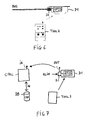
- Figure 7 represents an interesting alternative of a completely radio frequency addressing device for at least one detector D1 with the third coding means, that is to say the radio-tag RFID such that at the figure 6 .
- a TOOL3 tag activation reader serves as a periodic trigger or trigger for remotely activating the RFID tag.
- this reader could be part of the RFID RFID tag or even controlled by a signal from the CTRL monitoring system.
- a transmitter module via a turret-type base and an OUT antenna is connected to the detector so as to be able to transmit radio frequency signals comprising the coded address as well as alarm or test signal signals. smoke detector.
- ALIM wireless
- the connection between the S1 output and the IN input of the CTRL monitoring system is thus carried out by air (if necessary via radio frequency relays).
- radio-tag RFID as an encoding support for an address (such as the RFID identification code) coupled to an alarm code if this is the case. It is also possible, however, to use these same coded data and at their input at the level of the CTRL monitoring system to associate this coded data with a new intrinsic coding COD to the CTRL monitoring system. This can be done by simple conversions listed by means of a DB database coupled to the CTRL monitoring system. In this way, the complete device is easily updatable by reprogramming via the databank if radio tags are newly arranged in the general smoke detection device.
- the database DB can also be an antenna module connected to the input IN provided for the fire alarms of the CTRL monitoring system and that can convert in real time data to be coded, to decode and even to decrypt if an encryption of security has been carried out downstream, for example at the level of the radio-tag RFID.
- FIG 8 represents a complete possible device as presented to the figure 1 , where RFID1, RFID2, ... radio tags are used according to the principle of Figures 6 or 7 which have been affixed to each smoke detector D1, D2, ....
- the TOOL2, TOOL3 type activation module or modules are not shown for the sake of clarity.
- Such a second TOOL2 module, TOOL3 can also activate several RFID1, RFID2, RFID2, electronic radio tags sequentially or even simultaneously if, for example, various radio frequencies are used for each RFID and at the radio frequency input IN of the CTRL monitoring system. .
- Frequency or time multiplexing modules could be considered.
- the RFID1, RFID2, RFID4, RFID5 electronic RFID tags can serve as an over-the-air receiver-repeater relay for data transmission between the IN input and a second RFID3 RFID6 electronic tag.
- the radio-tags can also be an activation module (instead of TOOL2, TOOL3, see previous figures) of neighboring radio-labels, for example in the form of a cascade trigger from the furthest radio-label to the radio-label. closest to the CTRL monitoring system. In this way, one or more coded addresses are transmitted or co-transmitted to the CTRL monitoring system if it allows reception and / or decoding in parallel.
- a first active path of the addresses ADR1, ADR2, ADR3 is carried out via the RFID1, RFID2, RFID3 RFID tags to the antenna input IN which thus channels encoded addressing data and smoke detection signals from detectors D1, D2, D3 to the CTRL monitoring system.
- the signals and ADR3 addressing originating from the third radio-tag RFID3 can also be issued and received by another RFID5 RFID tag which will channel the coding address and additional alarm data via a second RFID4, RFID5 overhead protection bridge (or even a dotted arrow between RFID3 and RFID5).
- This protection may be permanent so as to achieve transmission redundancy of the radio frequency signals from each radio-tag to the CTRL monitoring system. It is in this case recommended to be able to physically distinguish the signals, for example by frequency or via an ADR3 addressing routing coding differentiating an RFID1, RFID2, RFID3 signal channel from its RFID3, RFID5, RFID4 protection channel.
- Figure 9 represents an alternative to the addressing device of the figure 8 for which the input IN of the CTRL monitoring system is connected to the detectors via (again) a data bus BUS by means of at least one interface IN1, IN2, ... RF receiver and adapted to receive addresses, codes and / or data of each radio-tag RFID1, RFID2, etc.
- Some of the RFID4 RFID tags may also be radio frequency relays for smoke detectors and their RFID5 radio-tags too far from the BUS transmission bus. This system is advantageous if the installation of smoke detectors can be done with a data bus and its monitoring system already installed in an infrastructure to be equipped. This division into local areas by subgroups of radio tags with their associated detectors also avoids the use of many radio frequencies which could negatively interfere with neighboring detectors in the same local area.
- the system must be able to decode and differentiate the addressing of these data.
Landscapes
- Business, Economics & Management (AREA)
- Emergency Management (AREA)
- Physics & Mathematics (AREA)
- General Physics & Mathematics (AREA)
- Chemical & Material Sciences (AREA)
- Analytical Chemistry (AREA)
- Fire Alarms (AREA)
- Alarm Systems (AREA)
Priority Applications (1)
| Application Number | Priority Date | Filing Date | Title |
|---|---|---|---|
| EP07290835A EP2015270A1 (de) | 2007-07-02 | 2007-07-02 | Adressierungseinrichtung für Rauchmelder |
Applications Claiming Priority (1)
| Application Number | Priority Date | Filing Date | Title |
|---|---|---|---|
| EP07290835A EP2015270A1 (de) | 2007-07-02 | 2007-07-02 | Adressierungseinrichtung für Rauchmelder |
Publications (1)
| Publication Number | Publication Date |
|---|---|
| EP2015270A1 true EP2015270A1 (de) | 2009-01-14 |
Family
ID=38668834
Family Applications (1)
| Application Number | Title | Priority Date | Filing Date |
|---|---|---|---|
| EP07290835A Withdrawn EP2015270A1 (de) | 2007-07-02 | 2007-07-02 | Adressierungseinrichtung für Rauchmelder |
Country Status (1)
| Country | Link |
|---|---|
| EP (1) | EP2015270A1 (de) |
Cited By (4)
| Publication number | Priority date | Publication date | Assignee | Title |
|---|---|---|---|---|
| CN102348099A (zh) * | 2010-03-30 | 2012-02-08 | 合肥科大立安安全技术股份有限公司 | 嵌入式视频烟雾探测器及烟雾识别方法 |
| CN103593878A (zh) * | 2013-11-29 | 2014-02-19 | 程勇 | 一种动车吸烟查处的实现方法 |
| CN103593662A (zh) * | 2013-11-29 | 2014-02-19 | 程勇 | 一种动车吸烟查处系统 |
| US20160069780A1 (en) * | 2013-04-22 | 2016-03-10 | Morin Énertech Inc. | Compound sampling system and method for sampling a compound using same |
Citations (4)
| Publication number | Priority date | Publication date | Assignee | Title |
|---|---|---|---|---|
| CA2085865A1 (en) * | 1992-12-18 | 1994-06-19 | Ken Slabotsky | Alarm system |
| BE1012388A6 (nl) * | 1999-01-15 | 2000-10-03 | Minds Naamloze Vennootschap | Controle-element en inrichting voor het uitoefenen van een controle met behulp van zulk controle-element. |
| EP1244081A1 (de) * | 2001-03-23 | 2002-09-25 | Siemens Gebäudesicherheit GmbH & Co. OHG | Verfahren zur Funkübertragung in einem Gefahrenmeldesystem |
| WO2003023690A1 (en) * | 2001-09-13 | 2003-03-20 | Tagtec Limited | Wireless communications system |
-
2007
- 2007-07-02 EP EP07290835A patent/EP2015270A1/de not_active Withdrawn
Patent Citations (4)
| Publication number | Priority date | Publication date | Assignee | Title |
|---|---|---|---|---|
| CA2085865A1 (en) * | 1992-12-18 | 1994-06-19 | Ken Slabotsky | Alarm system |
| BE1012388A6 (nl) * | 1999-01-15 | 2000-10-03 | Minds Naamloze Vennootschap | Controle-element en inrichting voor het uitoefenen van een controle met behulp van zulk controle-element. |
| EP1244081A1 (de) * | 2001-03-23 | 2002-09-25 | Siemens Gebäudesicherheit GmbH & Co. OHG | Verfahren zur Funkübertragung in einem Gefahrenmeldesystem |
| WO2003023690A1 (en) * | 2001-09-13 | 2003-03-20 | Tagtec Limited | Wireless communications system |
Cited By (7)
| Publication number | Priority date | Publication date | Assignee | Title |
|---|---|---|---|---|
| CN102348099A (zh) * | 2010-03-30 | 2012-02-08 | 合肥科大立安安全技术股份有限公司 | 嵌入式视频烟雾探测器及烟雾识别方法 |
| CN102348099B (zh) * | 2010-03-30 | 2013-07-31 | 合肥科大立安安全技术股份有限公司 | 嵌入式视频烟雾探测器及烟雾识别方法 |
| US20160069780A1 (en) * | 2013-04-22 | 2016-03-10 | Morin Énertech Inc. | Compound sampling system and method for sampling a compound using same |
| US9880076B2 (en) * | 2013-04-22 | 2018-01-30 | Morin Enertech Inc. | Compound sampling system and method for sampling a compound using same |
| CN103593878A (zh) * | 2013-11-29 | 2014-02-19 | 程勇 | 一种动车吸烟查处的实现方法 |
| CN103593662A (zh) * | 2013-11-29 | 2014-02-19 | 程勇 | 一种动车吸烟查处系统 |
| CN103593878B (zh) * | 2013-11-29 | 2015-08-26 | 程勇 | 一种动车吸烟查处的实现方法 |
Similar Documents
| Publication | Publication Date | Title |
|---|---|---|
| US7747710B1 (en) | System for detecting changes in preselected measurable conditions | |
| BE1025976B1 (fr) | Dispositif pour traiter des données d'un matériel roulant | |
| EP0699997B1 (de) | Verfahren zur Fehleridentifizierung in einem komplexen System | |
| EP0650169A1 (de) | Überwachungssystem für eine industrielle Anlage | |
| EP2015270A1 (de) | Adressierungseinrichtung für Rauchmelder | |
| US9729265B2 (en) | Network based onsite support | |
| FR3040817A1 (fr) | Procedes de desarmement automatique et d'utilisation d'un systeme d'alarme anti-intrusion, et systeme d'alarme associe | |
| EP0094279A1 (de) | Verfahren zum Schutz eines Fernüberwachungssystemes gegen Sabotage und System zur Ausführung dieses Verfahrens | |
| FR2736482A1 (fr) | Dispositif de communication entre une pluralite de modules fonctionnels installes dans une unite locale et un bus externe de type arinc 629 | |
| GB2532471A (en) | System and method for monitoring use of a sensor of a computing device | |
| CN104685430A (zh) | 包括至少一个现场装置、与其相关联的至少一个传感器单元或信号检测单元和至少一个功能块的布置 | |
| FR2764073A1 (fr) | Protocole de communication pour carte a memoire asynchrone | |
| EP0843931B1 (de) | Übertragungsverfahren über einen optischen bus mit gleichzeitig verschiedenen datenraten | |
| KR20060118471A (ko) | 네트워크에서 디바이스의 도난 방지를 위한 방법 및 장치 | |
| FR3019340A1 (fr) | Composant electronique a reponse determeniste | |
| US10474138B2 (en) | Simplified field device exchange in a processing device | |
| WO1994005119A1 (fr) | Dispositif de controle et de maintenance a distance de reseaux cables | |
| WO2009132977A1 (fr) | Ressource de confiance integree a un dispositif de controle de donnees biometriques assurant la securite du controle et celle des donnees | |
| EP3816957A1 (de) | Sicherheits- und überwachungssystem und sein funktionsverfahren | |
| EP1729241B1 (de) | Verfahren und Vorrichtung zur Parametrisierung einer Feldstation in einem Kommunikationsnetzwerk | |
| BE900816A (fr) | Procede de communication bidirectionnelle multipoints sur ligne unique. | |
| WO2016032379A1 (en) | Monitoring items using neighborhood-based network | |
| EP3490213A1 (de) | Mechatronisches system zur steuerung einer maschine | |
| EP0405353B1 (de) | Schutzvorrichtung für Übertragungssysteme digitaler Signale | |
| EP0166738A1 (de) | Automat zur prüfung von übertragungsnetzen |
Legal Events
| Date | Code | Title | Description |
|---|---|---|---|
| PUAI | Public reference made under article 153(3) epc to a published international application that has entered the european phase |
Free format text: ORIGINAL CODE: 0009012 |
|
| AK | Designated contracting states |
Kind code of ref document: A1 Designated state(s): AT BE BG CH CY CZ DE DK EE ES FI FR GB GR HU IE IS IT LI LT LU LV MC MT NL PL PT RO SE SI SK TR |
|
| AX | Request for extension of the european patent |
Extension state: AL BA HR MK RS |
|
| AKX | Designation fees paid | ||
| STAA | Information on the status of an ep patent application or granted ep patent |
Free format text: STATUS: THE APPLICATION IS DEEMED TO BE WITHDRAWN |
|
| 18D | Application deemed to be withdrawn |
Effective date: 20090715 |
|
| REG | Reference to a national code |
Ref country code: DE Ref legal event code: 8566 |