EP2015318B1 - Thermistor PTC empilé et son procédé de production - Google Patents
Thermistor PTC empilé et son procédé de production Download PDFInfo
- Publication number
- EP2015318B1 EP2015318B1 EP08010390A EP08010390A EP2015318B1 EP 2015318 B1 EP2015318 B1 EP 2015318B1 EP 08010390 A EP08010390 A EP 08010390A EP 08010390 A EP08010390 A EP 08010390A EP 2015318 B1 EP2015318 B1 EP 2015318B1
- Authority
- EP
- European Patent Office
- Prior art keywords
- alkali metal
- sintered compact
- ptc thermistor
- semiconductor ceramic
- stacked ptc
- Prior art date
- Legal status (The legal status is an assumption and is not a legal conclusion. Google has not performed a legal analysis and makes no representation as to the accuracy of the status listed.)
- Not-in-force
Links
- 238000000034 method Methods 0.000 title claims description 38
- 238000004519 manufacturing process Methods 0.000 title claims description 24
- 230000008569 process Effects 0.000 title claims description 22
- 229910052783 alkali metal Inorganic materials 0.000 claims description 133
- 239000004065 semiconductor Substances 0.000 claims description 71
- -1 alkali metal salt Chemical class 0.000 claims description 70
- 150000001340 alkali metals Chemical class 0.000 claims description 65
- 239000000919 ceramic Substances 0.000 claims description 60
- 229910002113 barium titanate Inorganic materials 0.000 claims description 42
- CDBYLPFSWZWCQE-UHFFFAOYSA-L Sodium Carbonate Chemical compound [Na+].[Na+].[O-]C([O-])=O CDBYLPFSWZWCQE-UHFFFAOYSA-L 0.000 claims description 40
- JRPBQTZRNDNNOP-UHFFFAOYSA-N barium titanate Chemical compound [Ba+2].[Ba+2].[O-][Ti]([O-])([O-])[O-] JRPBQTZRNDNNOP-UHFFFAOYSA-N 0.000 claims description 36
- 150000001875 compounds Chemical class 0.000 claims description 34
- 239000013078 crystal Substances 0.000 claims description 26
- VWDWKYIASSYTQR-UHFFFAOYSA-N sodium nitrate Chemical compound [Na+].[O-][N+]([O-])=O VWDWKYIASSYTQR-UHFFFAOYSA-N 0.000 claims description 24
- 239000002243 precursor Substances 0.000 claims description 23
- 229910000029 sodium carbonate Inorganic materials 0.000 claims description 20
- KWYUFKZDYYNOTN-UHFFFAOYSA-M Potassium hydroxide Chemical compound [OH-].[K+] KWYUFKZDYYNOTN-UHFFFAOYSA-M 0.000 claims description 18
- HEMHJVSKTPXQMS-UHFFFAOYSA-M Sodium hydroxide Chemical compound [OH-].[Na+] HEMHJVSKTPXQMS-UHFFFAOYSA-M 0.000 claims description 18
- 238000003475 lamination Methods 0.000 claims description 17
- 239000012298 atmosphere Substances 0.000 claims description 16
- IIPYXGDZVMZOAP-UHFFFAOYSA-N lithium nitrate Chemical compound [Li+].[O-][N+]([O-])=O IIPYXGDZVMZOAP-UHFFFAOYSA-N 0.000 claims description 12
- INHCSSUBVCNVSK-UHFFFAOYSA-L lithium sulfate Chemical compound [Li+].[Li+].[O-]S([O-])(=O)=O INHCSSUBVCNVSK-UHFFFAOYSA-L 0.000 claims description 12
- FUJCRWPEOMXPAD-UHFFFAOYSA-N Li2O Inorganic materials [Li+].[Li+].[O-2] FUJCRWPEOMXPAD-UHFFFAOYSA-N 0.000 claims description 10
- WMFOQBRAJBCJND-UHFFFAOYSA-M Lithium hydroxide Chemical compound [Li+].[OH-] WMFOQBRAJBCJND-UHFFFAOYSA-M 0.000 claims description 10
- XUCJHNOBJLKZNU-UHFFFAOYSA-M dilithium;hydroxide Chemical compound [Li+].[Li+].[OH-] XUCJHNOBJLKZNU-UHFFFAOYSA-M 0.000 claims description 10
- BWHMMNNQKKPAPP-UHFFFAOYSA-L potassium carbonate Chemical compound [K+].[K+].[O-]C([O-])=O BWHMMNNQKKPAPP-UHFFFAOYSA-L 0.000 claims description 10
- FGIUAXJPYTZDNR-UHFFFAOYSA-N potassium nitrate Chemical compound [K+].[O-][N+]([O-])=O FGIUAXJPYTZDNR-UHFFFAOYSA-N 0.000 claims description 10
- 229910052684 Cerium Inorganic materials 0.000 claims description 5
- 229910052692 Dysprosium Inorganic materials 0.000 claims description 5
- 229910052691 Erbium Inorganic materials 0.000 claims description 5
- 229910052688 Gadolinium Inorganic materials 0.000 claims description 5
- 229910052779 Neodymium Inorganic materials 0.000 claims description 5
- 229910052777 Praseodymium Inorganic materials 0.000 claims description 5
- 229910052772 Samarium Inorganic materials 0.000 claims description 5
- 229910052746 lanthanum Inorganic materials 0.000 claims description 5
- 229910052758 niobium Inorganic materials 0.000 claims description 5
- 229910000027 potassium carbonate Inorganic materials 0.000 claims description 5
- 229910052715 tantalum Inorganic materials 0.000 claims description 5
- 229910052720 vanadium Inorganic materials 0.000 claims description 5
- 229910052727 yttrium Inorganic materials 0.000 claims description 5
- 239000010410 layer Substances 0.000 description 86
- 239000000843 powder Substances 0.000 description 45
- 230000000052 comparative effect Effects 0.000 description 42
- 239000007864 aqueous solution Substances 0.000 description 35
- 238000010405 reoxidation reaction Methods 0.000 description 32
- VYPSYNLAJGMNEJ-UHFFFAOYSA-N Silicium dioxide Chemical compound O=[Si]=O VYPSYNLAJGMNEJ-UHFFFAOYSA-N 0.000 description 16
- 239000011812 mixed powder Substances 0.000 description 16
- 239000011800 void material Substances 0.000 description 16
- 239000000203 mixture Substances 0.000 description 15
- 239000000243 solution Substances 0.000 description 14
- 230000003647 oxidation Effects 0.000 description 13
- 238000007254 oxidation reaction Methods 0.000 description 13
- 238000005470 impregnation Methods 0.000 description 12
- 150000003839 salts Chemical class 0.000 description 12
- 238000010304 firing Methods 0.000 description 11
- GWEVSGVZZGPLCZ-UHFFFAOYSA-N Titan oxide Chemical compound O=[Ti]=O GWEVSGVZZGPLCZ-UHFFFAOYSA-N 0.000 description 10
- 150000001339 alkali metal compounds Chemical class 0.000 description 10
- AYJRCSIUFZENHW-UHFFFAOYSA-L barium carbonate Chemical compound [Ba+2].[O-]C([O-])=O AYJRCSIUFZENHW-UHFFFAOYSA-L 0.000 description 10
- 239000011230 binding agent Substances 0.000 description 10
- 239000012700 ceramic precursor Substances 0.000 description 10
- 238000005259 measurement Methods 0.000 description 9
- 239000011734 sodium Substances 0.000 description 9
- 238000009826 distribution Methods 0.000 description 8
- 230000001965 increasing effect Effects 0.000 description 8
- ZKATWMILCYLAPD-UHFFFAOYSA-N niobium pentoxide Chemical compound O=[Nb](=O)O[Nb](=O)=O ZKATWMILCYLAPD-UHFFFAOYSA-N 0.000 description 8
- 238000010298 pulverizing process Methods 0.000 description 8
- 239000000377 silicon dioxide Substances 0.000 description 8
- 229910052681 coesite Inorganic materials 0.000 description 7
- 229910052906 cristobalite Inorganic materials 0.000 description 7
- 238000010438 heat treatment Methods 0.000 description 7
- 229910052708 sodium Inorganic materials 0.000 description 7
- 229910052682 stishovite Inorganic materials 0.000 description 7
- 229910052905 tridymite Inorganic materials 0.000 description 7
- XLYOFNOQVPJJNP-UHFFFAOYSA-N water Chemical compound O XLYOFNOQVPJJNP-UHFFFAOYSA-N 0.000 description 7
- IJGRMHOSHXDMSA-UHFFFAOYSA-N Atomic nitrogen Chemical compound N#N IJGRMHOSHXDMSA-UHFFFAOYSA-N 0.000 description 6
- DGAQECJNVWCQMB-PUAWFVPOSA-M Ilexoside XXIX Chemical compound C[C@@H]1CC[C@@]2(CC[C@@]3(C(=CC[C@H]4[C@]3(CC[C@@H]5[C@@]4(CC[C@@H](C5(C)C)OS(=O)(=O)[O-])C)C)[C@@H]2[C@]1(C)O)C)C(=O)O[C@H]6[C@@H]([C@H]([C@@H]([C@H](O6)CO)O)O)O.[Na+] DGAQECJNVWCQMB-PUAWFVPOSA-M 0.000 description 6
- 239000004677 Nylon Substances 0.000 description 6
- XUIMIQQOPSSXEZ-UHFFFAOYSA-N Silicon Chemical compound [Si] XUIMIQQOPSSXEZ-UHFFFAOYSA-N 0.000 description 6
- 239000002003 electrode paste Substances 0.000 description 6
- 229910052751 metal Inorganic materials 0.000 description 6
- 239000002184 metal Substances 0.000 description 6
- 229920001778 nylon Polymers 0.000 description 6
- 239000008213 purified water Substances 0.000 description 6
- 229910052710 silicon Inorganic materials 0.000 description 6
- 239000010703 silicon Substances 0.000 description 6
- 229910052911 sodium silicate Inorganic materials 0.000 description 6
- 239000010953 base metal Substances 0.000 description 5
- CMIHHWBVHJVIGI-UHFFFAOYSA-N gadolinium(III) oxide Inorganic materials [O-2].[O-2].[O-2].[Gd+3].[Gd+3] CMIHHWBVHJVIGI-UHFFFAOYSA-N 0.000 description 5
- 238000000465 moulding Methods 0.000 description 5
- 229910052761 rare earth metal Inorganic materials 0.000 description 5
- 239000012266 salt solution Substances 0.000 description 5
- 239000002002 slurry Substances 0.000 description 5
- 239000002904 solvent Substances 0.000 description 5
- 239000003513 alkali Substances 0.000 description 4
- QVGXLLKOCUKJST-UHFFFAOYSA-N atomic oxygen Chemical compound [O] QVGXLLKOCUKJST-UHFFFAOYSA-N 0.000 description 4
- 229910010293 ceramic material Inorganic materials 0.000 description 4
- 238000010276 construction Methods 0.000 description 4
- 230000001747 exhibiting effect Effects 0.000 description 4
- VASIZKWUTCETSD-UHFFFAOYSA-N manganese(II) oxide Inorganic materials [Mn]=O VASIZKWUTCETSD-UHFFFAOYSA-N 0.000 description 4
- 238000002156 mixing Methods 0.000 description 4
- 239000001301 oxygen Substances 0.000 description 4
- 229910052760 oxygen Inorganic materials 0.000 description 4
- UFHFLCQGNIYNRP-UHFFFAOYSA-N Hydrogen Chemical compound [H][H] UFHFLCQGNIYNRP-UHFFFAOYSA-N 0.000 description 3
- 229910000990 Ni alloy Inorganic materials 0.000 description 3
- 229910004298 SiO 2 Inorganic materials 0.000 description 3
- 229910052784 alkaline earth metal Inorganic materials 0.000 description 3
- 239000011248 coating agent Substances 0.000 description 3
- 238000000576 coating method Methods 0.000 description 3
- 238000004453 electron probe microanalysis Methods 0.000 description 3
- 239000001257 hydrogen Substances 0.000 description 3
- 229910052739 hydrogen Inorganic materials 0.000 description 3
- 229910052757 nitrogen Inorganic materials 0.000 description 3
- 230000001590 oxidative effect Effects 0.000 description 3
- 239000002245 particle Substances 0.000 description 3
- 239000004014 plasticizer Substances 0.000 description 3
- 239000007858 starting material Substances 0.000 description 3
- 229910052723 transition metal Inorganic materials 0.000 description 3
- 238000004458 analytical method Methods 0.000 description 2
- 230000015572 biosynthetic process Effects 0.000 description 2
- 238000001354 calcination Methods 0.000 description 2
- ZCCIPPOKBCJFDN-UHFFFAOYSA-N calcium nitrate Chemical compound [Ca+2].[O-][N+]([O-])=O.[O-][N+]([O-])=O ZCCIPPOKBCJFDN-UHFFFAOYSA-N 0.000 description 2
- 238000007606 doctor blade method Methods 0.000 description 2
- 238000001035 drying Methods 0.000 description 2
- 230000000694 effects Effects 0.000 description 2
- 239000011810 insulating material Substances 0.000 description 2
- MIVBAHRSNUNMPP-UHFFFAOYSA-N manganese(II) nitrate Inorganic materials [Mn+2].[O-][N+]([O-])=O.[O-][N+]([O-])=O MIVBAHRSNUNMPP-UHFFFAOYSA-N 0.000 description 2
- 230000007246 mechanism Effects 0.000 description 2
- 229920006267 polyester film Polymers 0.000 description 2
- 238000003825 pressing Methods 0.000 description 2
- 238000007650 screen-printing Methods 0.000 description 2
- 238000005204 segregation Methods 0.000 description 2
- 239000002356 single layer Substances 0.000 description 2
- 239000000126 substance Substances 0.000 description 2
- OGIDPMRJRNCKJF-UHFFFAOYSA-N titanium oxide Inorganic materials [Ti]=O OGIDPMRJRNCKJF-UHFFFAOYSA-N 0.000 description 2
- 238000005303 weighing Methods 0.000 description 2
- NAWXUBYGYWOOIX-SFHVURJKSA-N (2s)-2-[[4-[2-(2,4-diaminoquinazolin-6-yl)ethyl]benzoyl]amino]-4-methylidenepentanedioic acid Chemical compound C1=CC2=NC(N)=NC(N)=C2C=C1CCC1=CC=C(C(=O)N[C@@H](CC(=C)C(O)=O)C(O)=O)C=C1 NAWXUBYGYWOOIX-SFHVURJKSA-N 0.000 description 1
- UXVMQQNJUSDDNG-UHFFFAOYSA-L Calcium chloride Chemical compound [Cl-].[Cl-].[Ca+2] UXVMQQNJUSDDNG-UHFFFAOYSA-L 0.000 description 1
- 229910004835 Na2B4O7 Inorganic materials 0.000 description 1
- 239000007832 Na2SO4 Substances 0.000 description 1
- 229910001252 Pd alloy Inorganic materials 0.000 description 1
- PMZURENOXWZQFD-UHFFFAOYSA-L Sodium Sulfate Chemical compound [Na+].[Na+].[O-]S([O-])(=O)=O PMZURENOXWZQFD-UHFFFAOYSA-L 0.000 description 1
- 229910000272 alkali metal oxide Inorganic materials 0.000 description 1
- 150000001341 alkaline earth metal compounds Chemical class 0.000 description 1
- 150000001342 alkaline earth metals Chemical class 0.000 description 1
- 229910045601 alloy Inorganic materials 0.000 description 1
- 239000000956 alloy Substances 0.000 description 1
- 239000002152 aqueous-organic solution Substances 0.000 description 1
- 239000012752 auxiliary agent Substances 0.000 description 1
- 230000004888 barrier function Effects 0.000 description 1
- 239000001110 calcium chloride Substances 0.000 description 1
- 229910001628 calcium chloride Inorganic materials 0.000 description 1
- 125000005588 carbonic acid salt group Chemical group 0.000 description 1
- 229910052927 chalcanthite Inorganic materials 0.000 description 1
- 230000008859 change Effects 0.000 description 1
- 238000012790 confirmation Methods 0.000 description 1
- 238000005520 cutting process Methods 0.000 description 1
- 230000007423 decrease Effects 0.000 description 1
- UQGFMSUEHSUPRD-UHFFFAOYSA-N disodium;3,7-dioxido-2,4,6,8,9-pentaoxa-1,3,5,7-tetraborabicyclo[3.3.1]nonane Chemical compound [Na+].[Na+].O1B([O-])OB2OB([O-])OB1O2 UQGFMSUEHSUPRD-UHFFFAOYSA-N 0.000 description 1
- 239000002270 dispersing agent Substances 0.000 description 1
- 239000011521 glass Substances 0.000 description 1
- XLYOFNOQVPJJNP-ZSJDYOACSA-N heavy water Substances [2H]O[2H] XLYOFNOQVPJJNP-ZSJDYOACSA-N 0.000 description 1
- 230000008595 infiltration Effects 0.000 description 1
- 238000001764 infiltration Methods 0.000 description 1
- 238000011835 investigation Methods 0.000 description 1
- 238000004898 kneading Methods 0.000 description 1
- 239000007788 liquid Substances 0.000 description 1
- 229910052744 lithium Inorganic materials 0.000 description 1
- 238000013507 mapping Methods 0.000 description 1
- 150000002739 metals Chemical class 0.000 description 1
- 229910052759 nickel Inorganic materials 0.000 description 1
- KBJMLQFLOWQJNF-UHFFFAOYSA-N nickel(II) nitrate Inorganic materials [Ni+2].[O-][N+]([O-])=O.[O-][N+]([O-])=O KBJMLQFLOWQJNF-UHFFFAOYSA-N 0.000 description 1
- 229910017604 nitric acid Inorganic materials 0.000 description 1
- 239000012299 nitrogen atmosphere Substances 0.000 description 1
- 239000012466 permeate Substances 0.000 description 1
- 238000005498 polishing Methods 0.000 description 1
- 229910052700 potassium Inorganic materials 0.000 description 1
- 238000011160 research Methods 0.000 description 1
- 150000003377 silicon compounds Chemical class 0.000 description 1
- 235000012239 silicon dioxide Nutrition 0.000 description 1
- 238000005245 sintering Methods 0.000 description 1
- 150000003388 sodium compounds Chemical class 0.000 description 1
- KKCBUQHMOMHUOY-UHFFFAOYSA-N sodium oxide Chemical compound [O-2].[Na+].[Na+] KKCBUQHMOMHUOY-UHFFFAOYSA-N 0.000 description 1
- 229910001948 sodium oxide Inorganic materials 0.000 description 1
- 229910052938 sodium sulfate Inorganic materials 0.000 description 1
- 238000001179 sorption measurement Methods 0.000 description 1
- 238000005507 spraying Methods 0.000 description 1
- 239000002966 varnish Substances 0.000 description 1
- ONDPHDOFVYQSGI-UHFFFAOYSA-N zinc nitrate Inorganic materials [Zn+2].[O-][N+]([O-])=O.[O-][N+]([O-])=O ONDPHDOFVYQSGI-UHFFFAOYSA-N 0.000 description 1
Images

Classifications
-
- H—ELECTRICITY
- H01—ELECTRIC ELEMENTS
- H01C—RESISTORS
- H01C7/00—Non-adjustable resistors formed as one or more layers or coatings; Non-adjustable resistors made from powdered conducting material or powdered semi-conducting material with or without insulating material
- H01C7/02—Non-adjustable resistors formed as one or more layers or coatings; Non-adjustable resistors made from powdered conducting material or powdered semi-conducting material with or without insulating material having positive temperature coefficient
- H01C7/022—Non-adjustable resistors formed as one or more layers or coatings; Non-adjustable resistors made from powdered conducting material or powdered semi-conducting material with or without insulating material having positive temperature coefficient mainly consisting of non-metallic substances
- H01C7/023—Non-adjustable resistors formed as one or more layers or coatings; Non-adjustable resistors made from powdered conducting material or powdered semi-conducting material with or without insulating material having positive temperature coefficient mainly consisting of non-metallic substances containing oxides or oxidic compounds, e.g. ferrites
- H01C7/025—Perovskites, e.g. titanates
-
- C—CHEMISTRY; METALLURGY
- C04—CEMENTS; CONCRETE; ARTIFICIAL STONE; CERAMICS; REFRACTORIES
- C04B—LIME, MAGNESIA; SLAG; CEMENTS; COMPOSITIONS THEREOF, e.g. MORTARS, CONCRETE OR LIKE BUILDING MATERIALS; ARTIFICIAL STONE; CERAMICS; REFRACTORIES; TREATMENT OF NATURAL STONE
- C04B35/00—Shaped ceramic products characterised by their composition; Ceramics compositions; Processing powders of inorganic compounds preparatory to the manufacturing of ceramic products
- C04B35/01—Shaped ceramic products characterised by their composition; Ceramics compositions; Processing powders of inorganic compounds preparatory to the manufacturing of ceramic products based on oxide ceramics
- C04B35/46—Shaped ceramic products characterised by their composition; Ceramics compositions; Processing powders of inorganic compounds preparatory to the manufacturing of ceramic products based on oxide ceramics based on titanium oxides or titanates
- C04B35/462—Shaped ceramic products characterised by their composition; Ceramics compositions; Processing powders of inorganic compounds preparatory to the manufacturing of ceramic products based on oxide ceramics based on titanium oxides or titanates based on titanates
- C04B35/465—Shaped ceramic products characterised by their composition; Ceramics compositions; Processing powders of inorganic compounds preparatory to the manufacturing of ceramic products based on oxide ceramics based on titanium oxides or titanates based on titanates based on alkaline earth metal titanates
- C04B35/468—Shaped ceramic products characterised by their composition; Ceramics compositions; Processing powders of inorganic compounds preparatory to the manufacturing of ceramic products based on oxide ceramics based on titanium oxides or titanates based on titanates based on alkaline earth metal titanates based on barium titanates
- C04B35/4682—Shaped ceramic products characterised by their composition; Ceramics compositions; Processing powders of inorganic compounds preparatory to the manufacturing of ceramic products based on oxide ceramics based on titanium oxides or titanates based on titanates based on alkaline earth metal titanates based on barium titanates based on BaTiO3 perovskite phase
-
- C—CHEMISTRY; METALLURGY
- C04—CEMENTS; CONCRETE; ARTIFICIAL STONE; CERAMICS; REFRACTORIES
- C04B—LIME, MAGNESIA; SLAG; CEMENTS; COMPOSITIONS THEREOF, e.g. MORTARS, CONCRETE OR LIKE BUILDING MATERIALS; ARTIFICIAL STONE; CERAMICS; REFRACTORIES; TREATMENT OF NATURAL STONE
- C04B35/00—Shaped ceramic products characterised by their composition; Ceramics compositions; Processing powders of inorganic compounds preparatory to the manufacturing of ceramic products
- C04B35/622—Forming processes; Processing powders of inorganic compounds preparatory to the manufacturing of ceramic products
- C04B35/626—Preparing or treating the powders individually or as batches ; preparing or treating macroscopic reinforcing agents for ceramic products, e.g. fibres; mechanical aspects section B
- C04B35/62605—Treating the starting powders individually or as mixtures
- C04B35/6261—Milling
- C04B35/6262—Milling of calcined, sintered clinker or ceramics
-
- C—CHEMISTRY; METALLURGY
- C04—CEMENTS; CONCRETE; ARTIFICIAL STONE; CERAMICS; REFRACTORIES
- C04B—LIME, MAGNESIA; SLAG; CEMENTS; COMPOSITIONS THEREOF, e.g. MORTARS, CONCRETE OR LIKE BUILDING MATERIALS; ARTIFICIAL STONE; CERAMICS; REFRACTORIES; TREATMENT OF NATURAL STONE
- C04B2235/00—Aspects relating to ceramic starting mixtures or sintered ceramic products
- C04B2235/02—Composition of constituents of the starting material or of secondary phases of the final product
- C04B2235/30—Constituents and secondary phases not being of a fibrous nature
- C04B2235/32—Metal oxides, mixed metal oxides, or oxide-forming salts thereof, e.g. carbonates, nitrates, (oxy)hydroxides, chlorides
- C04B2235/3201—Alkali metal oxides or oxide-forming salts thereof
-
- C—CHEMISTRY; METALLURGY
- C04—CEMENTS; CONCRETE; ARTIFICIAL STONE; CERAMICS; REFRACTORIES
- C04B—LIME, MAGNESIA; SLAG; CEMENTS; COMPOSITIONS THEREOF, e.g. MORTARS, CONCRETE OR LIKE BUILDING MATERIALS; ARTIFICIAL STONE; CERAMICS; REFRACTORIES; TREATMENT OF NATURAL STONE
- C04B2235/00—Aspects relating to ceramic starting mixtures or sintered ceramic products
- C04B2235/02—Composition of constituents of the starting material or of secondary phases of the final product
- C04B2235/30—Constituents and secondary phases not being of a fibrous nature
- C04B2235/32—Metal oxides, mixed metal oxides, or oxide-forming salts thereof, e.g. carbonates, nitrates, (oxy)hydroxides, chlorides
- C04B2235/3201—Alkali metal oxides or oxide-forming salts thereof
- C04B2235/3203—Lithium oxide or oxide-forming salts thereof
-
- C—CHEMISTRY; METALLURGY
- C04—CEMENTS; CONCRETE; ARTIFICIAL STONE; CERAMICS; REFRACTORIES
- C04B—LIME, MAGNESIA; SLAG; CEMENTS; COMPOSITIONS THEREOF, e.g. MORTARS, CONCRETE OR LIKE BUILDING MATERIALS; ARTIFICIAL STONE; CERAMICS; REFRACTORIES; TREATMENT OF NATURAL STONE
- C04B2235/00—Aspects relating to ceramic starting mixtures or sintered ceramic products
- C04B2235/02—Composition of constituents of the starting material or of secondary phases of the final product
- C04B2235/30—Constituents and secondary phases not being of a fibrous nature
- C04B2235/32—Metal oxides, mixed metal oxides, or oxide-forming salts thereof, e.g. carbonates, nitrates, (oxy)hydroxides, chlorides
- C04B2235/3205—Alkaline earth oxides or oxide forming salts thereof, e.g. beryllium oxide
- C04B2235/3208—Calcium oxide or oxide-forming salts thereof, e.g. lime
-
- C—CHEMISTRY; METALLURGY
- C04—CEMENTS; CONCRETE; ARTIFICIAL STONE; CERAMICS; REFRACTORIES
- C04B—LIME, MAGNESIA; SLAG; CEMENTS; COMPOSITIONS THEREOF, e.g. MORTARS, CONCRETE OR LIKE BUILDING MATERIALS; ARTIFICIAL STONE; CERAMICS; REFRACTORIES; TREATMENT OF NATURAL STONE
- C04B2235/00—Aspects relating to ceramic starting mixtures or sintered ceramic products
- C04B2235/02—Composition of constituents of the starting material or of secondary phases of the final product
- C04B2235/30—Constituents and secondary phases not being of a fibrous nature
- C04B2235/32—Metal oxides, mixed metal oxides, or oxide-forming salts thereof, e.g. carbonates, nitrates, (oxy)hydroxides, chlorides
- C04B2235/3205—Alkaline earth oxides or oxide forming salts thereof, e.g. beryllium oxide
- C04B2235/3213—Strontium oxides or oxide-forming salts thereof
-
- C—CHEMISTRY; METALLURGY
- C04—CEMENTS; CONCRETE; ARTIFICIAL STONE; CERAMICS; REFRACTORIES
- C04B—LIME, MAGNESIA; SLAG; CEMENTS; COMPOSITIONS THEREOF, e.g. MORTARS, CONCRETE OR LIKE BUILDING MATERIALS; ARTIFICIAL STONE; CERAMICS; REFRACTORIES; TREATMENT OF NATURAL STONE
- C04B2235/00—Aspects relating to ceramic starting mixtures or sintered ceramic products
- C04B2235/02—Composition of constituents of the starting material or of secondary phases of the final product
- C04B2235/30—Constituents and secondary phases not being of a fibrous nature
- C04B2235/32—Metal oxides, mixed metal oxides, or oxide-forming salts thereof, e.g. carbonates, nitrates, (oxy)hydroxides, chlorides
- C04B2235/3224—Rare earth oxide or oxide forming salts thereof, e.g. scandium oxide
-
- C—CHEMISTRY; METALLURGY
- C04—CEMENTS; CONCRETE; ARTIFICIAL STONE; CERAMICS; REFRACTORIES
- C04B—LIME, MAGNESIA; SLAG; CEMENTS; COMPOSITIONS THEREOF, e.g. MORTARS, CONCRETE OR LIKE BUILDING MATERIALS; ARTIFICIAL STONE; CERAMICS; REFRACTORIES; TREATMENT OF NATURAL STONE
- C04B2235/00—Aspects relating to ceramic starting mixtures or sintered ceramic products
- C04B2235/02—Composition of constituents of the starting material or of secondary phases of the final product
- C04B2235/30—Constituents and secondary phases not being of a fibrous nature
- C04B2235/32—Metal oxides, mixed metal oxides, or oxide-forming salts thereof, e.g. carbonates, nitrates, (oxy)hydroxides, chlorides
- C04B2235/3224—Rare earth oxide or oxide forming salts thereof, e.g. scandium oxide
- C04B2235/3225—Yttrium oxide or oxide-forming salts thereof
-
- C—CHEMISTRY; METALLURGY
- C04—CEMENTS; CONCRETE; ARTIFICIAL STONE; CERAMICS; REFRACTORIES
- C04B—LIME, MAGNESIA; SLAG; CEMENTS; COMPOSITIONS THEREOF, e.g. MORTARS, CONCRETE OR LIKE BUILDING MATERIALS; ARTIFICIAL STONE; CERAMICS; REFRACTORIES; TREATMENT OF NATURAL STONE
- C04B2235/00—Aspects relating to ceramic starting mixtures or sintered ceramic products
- C04B2235/02—Composition of constituents of the starting material or of secondary phases of the final product
- C04B2235/30—Constituents and secondary phases not being of a fibrous nature
- C04B2235/32—Metal oxides, mixed metal oxides, or oxide-forming salts thereof, e.g. carbonates, nitrates, (oxy)hydroxides, chlorides
- C04B2235/3224—Rare earth oxide or oxide forming salts thereof, e.g. scandium oxide
- C04B2235/3227—Lanthanum oxide or oxide-forming salts thereof
-
- C—CHEMISTRY; METALLURGY
- C04—CEMENTS; CONCRETE; ARTIFICIAL STONE; CERAMICS; REFRACTORIES
- C04B—LIME, MAGNESIA; SLAG; CEMENTS; COMPOSITIONS THEREOF, e.g. MORTARS, CONCRETE OR LIKE BUILDING MATERIALS; ARTIFICIAL STONE; CERAMICS; REFRACTORIES; TREATMENT OF NATURAL STONE
- C04B2235/00—Aspects relating to ceramic starting mixtures or sintered ceramic products
- C04B2235/02—Composition of constituents of the starting material or of secondary phases of the final product
- C04B2235/30—Constituents and secondary phases not being of a fibrous nature
- C04B2235/32—Metal oxides, mixed metal oxides, or oxide-forming salts thereof, e.g. carbonates, nitrates, (oxy)hydroxides, chlorides
- C04B2235/3224—Rare earth oxide or oxide forming salts thereof, e.g. scandium oxide
- C04B2235/3229—Cerium oxides or oxide-forming salts thereof
-
- C—CHEMISTRY; METALLURGY
- C04—CEMENTS; CONCRETE; ARTIFICIAL STONE; CERAMICS; REFRACTORIES
- C04B—LIME, MAGNESIA; SLAG; CEMENTS; COMPOSITIONS THEREOF, e.g. MORTARS, CONCRETE OR LIKE BUILDING MATERIALS; ARTIFICIAL STONE; CERAMICS; REFRACTORIES; TREATMENT OF NATURAL STONE
- C04B2235/00—Aspects relating to ceramic starting mixtures or sintered ceramic products
- C04B2235/02—Composition of constituents of the starting material or of secondary phases of the final product
- C04B2235/30—Constituents and secondary phases not being of a fibrous nature
- C04B2235/32—Metal oxides, mixed metal oxides, or oxide-forming salts thereof, e.g. carbonates, nitrates, (oxy)hydroxides, chlorides
- C04B2235/3231—Refractory metal oxides, their mixed metal oxides, or oxide-forming salts thereof
- C04B2235/3239—Vanadium oxides, vanadates or oxide forming salts thereof, e.g. magnesium vanadate
-
- C—CHEMISTRY; METALLURGY
- C04—CEMENTS; CONCRETE; ARTIFICIAL STONE; CERAMICS; REFRACTORIES
- C04B—LIME, MAGNESIA; SLAG; CEMENTS; COMPOSITIONS THEREOF, e.g. MORTARS, CONCRETE OR LIKE BUILDING MATERIALS; ARTIFICIAL STONE; CERAMICS; REFRACTORIES; TREATMENT OF NATURAL STONE
- C04B2235/00—Aspects relating to ceramic starting mixtures or sintered ceramic products
- C04B2235/02—Composition of constituents of the starting material or of secondary phases of the final product
- C04B2235/30—Constituents and secondary phases not being of a fibrous nature
- C04B2235/32—Metal oxides, mixed metal oxides, or oxide-forming salts thereof, e.g. carbonates, nitrates, (oxy)hydroxides, chlorides
- C04B2235/3231—Refractory metal oxides, their mixed metal oxides, or oxide-forming salts thereof
- C04B2235/3251—Niobium oxides, niobates, tantalum oxides, tantalates, or oxide-forming salts thereof
-
- C—CHEMISTRY; METALLURGY
- C04—CEMENTS; CONCRETE; ARTIFICIAL STONE; CERAMICS; REFRACTORIES
- C04B—LIME, MAGNESIA; SLAG; CEMENTS; COMPOSITIONS THEREOF, e.g. MORTARS, CONCRETE OR LIKE BUILDING MATERIALS; ARTIFICIAL STONE; CERAMICS; REFRACTORIES; TREATMENT OF NATURAL STONE
- C04B2235/00—Aspects relating to ceramic starting mixtures or sintered ceramic products
- C04B2235/02—Composition of constituents of the starting material or of secondary phases of the final product
- C04B2235/30—Constituents and secondary phases not being of a fibrous nature
- C04B2235/32—Metal oxides, mixed metal oxides, or oxide-forming salts thereof, e.g. carbonates, nitrates, (oxy)hydroxides, chlorides
- C04B2235/3262—Manganese oxides, manganates, rhenium oxides or oxide-forming salts thereof, e.g. MnO
-
- C—CHEMISTRY; METALLURGY
- C04—CEMENTS; CONCRETE; ARTIFICIAL STONE; CERAMICS; REFRACTORIES
- C04B—LIME, MAGNESIA; SLAG; CEMENTS; COMPOSITIONS THEREOF, e.g. MORTARS, CONCRETE OR LIKE BUILDING MATERIALS; ARTIFICIAL STONE; CERAMICS; REFRACTORIES; TREATMENT OF NATURAL STONE
- C04B2235/00—Aspects relating to ceramic starting mixtures or sintered ceramic products
- C04B2235/02—Composition of constituents of the starting material or of secondary phases of the final product
- C04B2235/30—Constituents and secondary phases not being of a fibrous nature
- C04B2235/32—Metal oxides, mixed metal oxides, or oxide-forming salts thereof, e.g. carbonates, nitrates, (oxy)hydroxides, chlorides
- C04B2235/327—Iron group oxides, their mixed metal oxides, or oxide-forming salts thereof
- C04B2235/3279—Nickel oxides, nickalates, or oxide-forming salts thereof
-
- C—CHEMISTRY; METALLURGY
- C04—CEMENTS; CONCRETE; ARTIFICIAL STONE; CERAMICS; REFRACTORIES
- C04B—LIME, MAGNESIA; SLAG; CEMENTS; COMPOSITIONS THEREOF, e.g. MORTARS, CONCRETE OR LIKE BUILDING MATERIALS; ARTIFICIAL STONE; CERAMICS; REFRACTORIES; TREATMENT OF NATURAL STONE
- C04B2235/00—Aspects relating to ceramic starting mixtures or sintered ceramic products
- C04B2235/02—Composition of constituents of the starting material or of secondary phases of the final product
- C04B2235/30—Constituents and secondary phases not being of a fibrous nature
- C04B2235/32—Metal oxides, mixed metal oxides, or oxide-forming salts thereof, e.g. carbonates, nitrates, (oxy)hydroxides, chlorides
- C04B2235/3281—Copper oxides, cuprates or oxide-forming salts thereof, e.g. CuO or Cu2O
-
- C—CHEMISTRY; METALLURGY
- C04—CEMENTS; CONCRETE; ARTIFICIAL STONE; CERAMICS; REFRACTORIES
- C04B—LIME, MAGNESIA; SLAG; CEMENTS; COMPOSITIONS THEREOF, e.g. MORTARS, CONCRETE OR LIKE BUILDING MATERIALS; ARTIFICIAL STONE; CERAMICS; REFRACTORIES; TREATMENT OF NATURAL STONE
- C04B2235/00—Aspects relating to ceramic starting mixtures or sintered ceramic products
- C04B2235/02—Composition of constituents of the starting material or of secondary phases of the final product
- C04B2235/30—Constituents and secondary phases not being of a fibrous nature
- C04B2235/32—Metal oxides, mixed metal oxides, or oxide-forming salts thereof, e.g. carbonates, nitrates, (oxy)hydroxides, chlorides
- C04B2235/3284—Zinc oxides, zincates, cadmium oxides, cadmiates, mercury oxides, mercurates or oxide forming salts thereof
-
- C—CHEMISTRY; METALLURGY
- C04—CEMENTS; CONCRETE; ARTIFICIAL STONE; CERAMICS; REFRACTORIES
- C04B—LIME, MAGNESIA; SLAG; CEMENTS; COMPOSITIONS THEREOF, e.g. MORTARS, CONCRETE OR LIKE BUILDING MATERIALS; ARTIFICIAL STONE; CERAMICS; REFRACTORIES; TREATMENT OF NATURAL STONE
- C04B2235/00—Aspects relating to ceramic starting mixtures or sintered ceramic products
- C04B2235/02—Composition of constituents of the starting material or of secondary phases of the final product
- C04B2235/30—Constituents and secondary phases not being of a fibrous nature
- C04B2235/34—Non-metal oxides, non-metal mixed oxides, or salts thereof that form the non-metal oxides upon heating, e.g. carbonates, nitrates, (oxy)hydroxides, chlorides
- C04B2235/3409—Boron oxide, borates, boric acids, or oxide forming salts thereof, e.g. borax
-
- C—CHEMISTRY; METALLURGY
- C04—CEMENTS; CONCRETE; ARTIFICIAL STONE; CERAMICS; REFRACTORIES
- C04B—LIME, MAGNESIA; SLAG; CEMENTS; COMPOSITIONS THEREOF, e.g. MORTARS, CONCRETE OR LIKE BUILDING MATERIALS; ARTIFICIAL STONE; CERAMICS; REFRACTORIES; TREATMENT OF NATURAL STONE
- C04B2235/00—Aspects relating to ceramic starting mixtures or sintered ceramic products
- C04B2235/02—Composition of constituents of the starting material or of secondary phases of the final product
- C04B2235/30—Constituents and secondary phases not being of a fibrous nature
- C04B2235/34—Non-metal oxides, non-metal mixed oxides, or salts thereof that form the non-metal oxides upon heating, e.g. carbonates, nitrates, (oxy)hydroxides, chlorides
- C04B2235/3418—Silicon oxide, silicic acids or oxide forming salts thereof, e.g. silica sol, fused silica, silica fume, cristobalite, quartz or flint
-
- C—CHEMISTRY; METALLURGY
- C04—CEMENTS; CONCRETE; ARTIFICIAL STONE; CERAMICS; REFRACTORIES
- C04B—LIME, MAGNESIA; SLAG; CEMENTS; COMPOSITIONS THEREOF, e.g. MORTARS, CONCRETE OR LIKE BUILDING MATERIALS; ARTIFICIAL STONE; CERAMICS; REFRACTORIES; TREATMENT OF NATURAL STONE
- C04B2235/00—Aspects relating to ceramic starting mixtures or sintered ceramic products
- C04B2235/02—Composition of constituents of the starting material or of secondary phases of the final product
- C04B2235/30—Constituents and secondary phases not being of a fibrous nature
- C04B2235/34—Non-metal oxides, non-metal mixed oxides, or salts thereof that form the non-metal oxides upon heating, e.g. carbonates, nitrates, (oxy)hydroxides, chlorides
- C04B2235/3427—Silicates other than clay, e.g. water glass
-
- C—CHEMISTRY; METALLURGY
- C04—CEMENTS; CONCRETE; ARTIFICIAL STONE; CERAMICS; REFRACTORIES
- C04B—LIME, MAGNESIA; SLAG; CEMENTS; COMPOSITIONS THEREOF, e.g. MORTARS, CONCRETE OR LIKE BUILDING MATERIALS; ARTIFICIAL STONE; CERAMICS; REFRACTORIES; TREATMENT OF NATURAL STONE
- C04B2235/00—Aspects relating to ceramic starting mixtures or sintered ceramic products
- C04B2235/02—Composition of constituents of the starting material or of secondary phases of the final product
- C04B2235/30—Constituents and secondary phases not being of a fibrous nature
- C04B2235/44—Metal salt constituents or additives chosen for the nature of the anions, e.g. hydrides or acetylacetonate
-
- C—CHEMISTRY; METALLURGY
- C04—CEMENTS; CONCRETE; ARTIFICIAL STONE; CERAMICS; REFRACTORIES
- C04B—LIME, MAGNESIA; SLAG; CEMENTS; COMPOSITIONS THEREOF, e.g. MORTARS, CONCRETE OR LIKE BUILDING MATERIALS; ARTIFICIAL STONE; CERAMICS; REFRACTORIES; TREATMENT OF NATURAL STONE
- C04B2235/00—Aspects relating to ceramic starting mixtures or sintered ceramic products
- C04B2235/02—Composition of constituents of the starting material or of secondary phases of the final product
- C04B2235/30—Constituents and secondary phases not being of a fibrous nature
- C04B2235/44—Metal salt constituents or additives chosen for the nature of the anions, e.g. hydrides or acetylacetonate
- C04B2235/442—Carbonates
-
- C—CHEMISTRY; METALLURGY
- C04—CEMENTS; CONCRETE; ARTIFICIAL STONE; CERAMICS; REFRACTORIES
- C04B—LIME, MAGNESIA; SLAG; CEMENTS; COMPOSITIONS THEREOF, e.g. MORTARS, CONCRETE OR LIKE BUILDING MATERIALS; ARTIFICIAL STONE; CERAMICS; REFRACTORIES; TREATMENT OF NATURAL STONE
- C04B2235/00—Aspects relating to ceramic starting mixtures or sintered ceramic products
- C04B2235/02—Composition of constituents of the starting material or of secondary phases of the final product
- C04B2235/30—Constituents and secondary phases not being of a fibrous nature
- C04B2235/44—Metal salt constituents or additives chosen for the nature of the anions, e.g. hydrides or acetylacetonate
- C04B2235/443—Nitrates or nitrites
-
- C—CHEMISTRY; METALLURGY
- C04—CEMENTS; CONCRETE; ARTIFICIAL STONE; CERAMICS; REFRACTORIES
- C04B—LIME, MAGNESIA; SLAG; CEMENTS; COMPOSITIONS THEREOF, e.g. MORTARS, CONCRETE OR LIKE BUILDING MATERIALS; ARTIFICIAL STONE; CERAMICS; REFRACTORIES; TREATMENT OF NATURAL STONE
- C04B2235/00—Aspects relating to ceramic starting mixtures or sintered ceramic products
- C04B2235/02—Composition of constituents of the starting material or of secondary phases of the final product
- C04B2235/30—Constituents and secondary phases not being of a fibrous nature
- C04B2235/44—Metal salt constituents or additives chosen for the nature of the anions, e.g. hydrides or acetylacetonate
- C04B2235/444—Halide containing anions, e.g. bromide, iodate, chlorite
-
- C—CHEMISTRY; METALLURGY
- C04—CEMENTS; CONCRETE; ARTIFICIAL STONE; CERAMICS; REFRACTORIES
- C04B—LIME, MAGNESIA; SLAG; CEMENTS; COMPOSITIONS THEREOF, e.g. MORTARS, CONCRETE OR LIKE BUILDING MATERIALS; ARTIFICIAL STONE; CERAMICS; REFRACTORIES; TREATMENT OF NATURAL STONE
- C04B2235/00—Aspects relating to ceramic starting mixtures or sintered ceramic products
- C04B2235/02—Composition of constituents of the starting material or of secondary phases of the final product
- C04B2235/30—Constituents and secondary phases not being of a fibrous nature
- C04B2235/44—Metal salt constituents or additives chosen for the nature of the anions, e.g. hydrides or acetylacetonate
- C04B2235/448—Sulphates or sulphites
-
- C—CHEMISTRY; METALLURGY
- C04—CEMENTS; CONCRETE; ARTIFICIAL STONE; CERAMICS; REFRACTORIES
- C04B—LIME, MAGNESIA; SLAG; CEMENTS; COMPOSITIONS THEREOF, e.g. MORTARS, CONCRETE OR LIKE BUILDING MATERIALS; ARTIFICIAL STONE; CERAMICS; REFRACTORIES; TREATMENT OF NATURAL STONE
- C04B2235/00—Aspects relating to ceramic starting mixtures or sintered ceramic products
- C04B2235/60—Aspects relating to the preparation, properties or mechanical treatment of green bodies or pre-forms
- C04B2235/602—Making the green bodies or pre-forms by moulding
- C04B2235/6025—Tape casting, e.g. with a doctor blade
-
- C—CHEMISTRY; METALLURGY
- C04—CEMENTS; CONCRETE; ARTIFICIAL STONE; CERAMICS; REFRACTORIES
- C04B—LIME, MAGNESIA; SLAG; CEMENTS; COMPOSITIONS THEREOF, e.g. MORTARS, CONCRETE OR LIKE BUILDING MATERIALS; ARTIFICIAL STONE; CERAMICS; REFRACTORIES; TREATMENT OF NATURAL STONE
- C04B2235/00—Aspects relating to ceramic starting mixtures or sintered ceramic products
- C04B2235/60—Aspects relating to the preparation, properties or mechanical treatment of green bodies or pre-forms
- C04B2235/616—Liquid infiltration of green bodies or pre-forms
-
- C—CHEMISTRY; METALLURGY
- C04—CEMENTS; CONCRETE; ARTIFICIAL STONE; CERAMICS; REFRACTORIES
- C04B—LIME, MAGNESIA; SLAG; CEMENTS; COMPOSITIONS THEREOF, e.g. MORTARS, CONCRETE OR LIKE BUILDING MATERIALS; ARTIFICIAL STONE; CERAMICS; REFRACTORIES; TREATMENT OF NATURAL STONE
- C04B2235/00—Aspects relating to ceramic starting mixtures or sintered ceramic products
- C04B2235/65—Aspects relating to heat treatments of ceramic bodies such as green ceramics or pre-sintered ceramics, e.g. burning, sintering or melting processes
- C04B2235/652—Reduction treatment
-
- C—CHEMISTRY; METALLURGY
- C04—CEMENTS; CONCRETE; ARTIFICIAL STONE; CERAMICS; REFRACTORIES
- C04B—LIME, MAGNESIA; SLAG; CEMENTS; COMPOSITIONS THEREOF, e.g. MORTARS, CONCRETE OR LIKE BUILDING MATERIALS; ARTIFICIAL STONE; CERAMICS; REFRACTORIES; TREATMENT OF NATURAL STONE
- C04B2235/00—Aspects relating to ceramic starting mixtures or sintered ceramic products
- C04B2235/65—Aspects relating to heat treatments of ceramic bodies such as green ceramics or pre-sintered ceramics, e.g. burning, sintering or melting processes
- C04B2235/658—Atmosphere during thermal treatment
- C04B2235/6582—Hydrogen containing atmosphere
-
- C—CHEMISTRY; METALLURGY
- C04—CEMENTS; CONCRETE; ARTIFICIAL STONE; CERAMICS; REFRACTORIES
- C04B—LIME, MAGNESIA; SLAG; CEMENTS; COMPOSITIONS THEREOF, e.g. MORTARS, CONCRETE OR LIKE BUILDING MATERIALS; ARTIFICIAL STONE; CERAMICS; REFRACTORIES; TREATMENT OF NATURAL STONE
- C04B2235/00—Aspects relating to ceramic starting mixtures or sintered ceramic products
- C04B2235/65—Aspects relating to heat treatments of ceramic bodies such as green ceramics or pre-sintered ceramics, e.g. burning, sintering or melting processes
- C04B2235/66—Specific sintering techniques, e.g. centrifugal sintering
- C04B2235/661—Multi-step sintering
- C04B2235/662—Annealing after sintering
- C04B2235/663—Oxidative annealing
-
- C—CHEMISTRY; METALLURGY
- C04—CEMENTS; CONCRETE; ARTIFICIAL STONE; CERAMICS; REFRACTORIES
- C04B—LIME, MAGNESIA; SLAG; CEMENTS; COMPOSITIONS THEREOF, e.g. MORTARS, CONCRETE OR LIKE BUILDING MATERIALS; ARTIFICIAL STONE; CERAMICS; REFRACTORIES; TREATMENT OF NATURAL STONE
- C04B2235/00—Aspects relating to ceramic starting mixtures or sintered ceramic products
- C04B2235/70—Aspects relating to sintered or melt-casted ceramic products
- C04B2235/74—Physical characteristics
- C04B2235/77—Density
-
- C—CHEMISTRY; METALLURGY
- C04—CEMENTS; CONCRETE; ARTIFICIAL STONE; CERAMICS; REFRACTORIES
- C04B—LIME, MAGNESIA; SLAG; CEMENTS; COMPOSITIONS THEREOF, e.g. MORTARS, CONCRETE OR LIKE BUILDING MATERIALS; ARTIFICIAL STONE; CERAMICS; REFRACTORIES; TREATMENT OF NATURAL STONE
- C04B2235/00—Aspects relating to ceramic starting mixtures or sintered ceramic products
- C04B2235/70—Aspects relating to sintered or melt-casted ceramic products
- C04B2235/80—Phases present in the sintered or melt-cast ceramic products other than the main phase
- C04B2235/85—Intergranular or grain boundary phases
-
- Y—GENERAL TAGGING OF NEW TECHNOLOGICAL DEVELOPMENTS; GENERAL TAGGING OF CROSS-SECTIONAL TECHNOLOGIES SPANNING OVER SEVERAL SECTIONS OF THE IPC; TECHNICAL SUBJECTS COVERED BY FORMER USPC CROSS-REFERENCE ART COLLECTIONS [XRACs] AND DIGESTS
- Y10—TECHNICAL SUBJECTS COVERED BY FORMER USPC
- Y10T—TECHNICAL SUBJECTS COVERED BY FORMER US CLASSIFICATION
- Y10T29/00—Metal working
- Y10T29/49—Method of mechanical manufacture
- Y10T29/49002—Electrical device making
- Y10T29/49082—Resistor making
-
- Y—GENERAL TAGGING OF NEW TECHNOLOGICAL DEVELOPMENTS; GENERAL TAGGING OF CROSS-SECTIONAL TECHNOLOGIES SPANNING OVER SEVERAL SECTIONS OF THE IPC; TECHNICAL SUBJECTS COVERED BY FORMER USPC CROSS-REFERENCE ART COLLECTIONS [XRACs] AND DIGESTS
- Y10—TECHNICAL SUBJECTS COVERED BY FORMER USPC
- Y10T—TECHNICAL SUBJECTS COVERED BY FORMER US CLASSIFICATION
- Y10T29/00—Metal working
- Y10T29/49—Method of mechanical manufacture
- Y10T29/49002—Electrical device making
- Y10T29/49082—Resistor making
- Y10T29/49085—Thermally variable
Definitions
- the present invention relates to a stacked PTC thermistor and to a process for its production.
- PTC (Positive Temperature Coefficient) thermistors are known as thermistors with positive resistance temperature characteristics, whereby the resistance increases with increased temperature.
- PTC thermistors are utilized in self-regulating heating units, overcurrent protection elements, temperature sensors and the like.
- As such PTC thermistors there have conventionally been implemented single-layer PTC thermistors comprising a semiconductor ceramic layer with conductivity imparted by adding a trace amount of a rare earth element to barium titanate (BaTiO 3 ) as the main component, and a pair of external electrodes sandwiching the semiconductor ceramic layer.
- BaTiO 3 barium titanate
- a stacked PTC thermistor is disclosed in Japanese Patent Publication No. 3636075 and US2002/0130318.
- This stacked PTC thermistor has an electronic part body obtained by alternating lamination of a barium titanate-based semiconductor ceramic layer and a base metal internal electrode, and an external electrode formed at the edge face of the electronic part body.
- the stacked PTC thermistor is formed by impregnating the electronic part body with a glass component.
- the stacked PTC thermistor is indicated as having low resistance and a high withstand voltage.
- PTC thermistors In addition to low room temperature resistivity, PTC thermistors must also have a very high ratio of resistivity during operation (hereinafter referred to as “high-temperature resistivity” for convenience) with respect to room temperature resistivity (this ratio will hereinafter be referred to as “jump characteristic” for convenience).
- a high jump characteristic represents high resistance variation with temperature change, and allows more reliable operation.
- investigation by the present inventors has revealed that while the stacked PTC thermistor disclosed in Japanese Patent Publication No. 3636075 allows the room temperature resistivity to be reduced, it cannot exhibit a sufficient jump characteristic.
- the present invention has been accomplished in light of these circumstances, and it is an object thereof to provide a stacked PTC thermistor capable of exhibiting a high level of both low room temperature resistivity and high jump characteristic. It is another object of the invention to provide a process for production of a stacked PTC thermistor having such properties.
- the invention provides a stacked PTC thermistor , defined by the features of independent claim 1.
- the thermistor comprises a body obtained by alternating lamination of a semiconductor ceramic layer and an internal electrode, and a pair of external electrodes provided at either edge face of the body and electrically connected with the internal electrode, the stacked PTC thermistor being characterized in that the semiconductor ceramic layer is composed of a porous sintered compact containing crystal grains of a barium titanate-based compound, and an alkali metal element is preferentially distributed in at least one of the grain boundaries and voids in the sintered compact.
- this type of stacked PTC thermistor has an alkali metal element preferentially distributed in at least one of the grain boundaries of the crystal grains and the voids composed of the crystal grains of the barium titanate-based compound, it can exhibit high levels of both low room temperature resistivity and high jump characteristic.
- the alkali metal element preferentially distributed at the grain boundaries and/or voids of the crystal grains causes selective adsorption of oxygen to form oxides in the grain boundaries and/or voids. As a result, it is possible to obtain a high jump characteristic while maintaining low room temperature resistivity.
- a process for production of a stacked PTC thermistor obtained by alternating lamination of a barium titanate-based compound-containing semiconductor ceramic layer and an internal electrode the process being defined by the features of independent claim 2.
- the process is characterized by comprising a first step in which a laminated body is formed by alternating lamination of the precursor layer for the semiconductor ceramic layer and the precursor layer for the internal electrode, a second step in which the laminated body is fired in a reducing atmosphere to form a porous sintered compact, a third step in which an alkali metal component is adhered to the sintered compact and a fourth step in which the alkali metal component-adhered sintered compact is re-oxidized.
- Reoxidation of the sintered compact obtained by firing in the process for production of a stacked PTC thermistor as described above results in oxidation near the grain boundaries of the barium titanate crystal grains in the semiconductor ceramic layer.
- a PTC property is exhibited as a result. This is believed to occur because oxidation near the grain boundaries forms a Schottky barrier which traps electrons at those sections.
- an alkali metal is adhered to the sintered compact obtained by firing the laminated body before reoxidation according to the invention, it is possible to increase the jump characteristic of the obtained stacked PTC thermistor.
- adhesion of the alkali metal component to the porous sintered compact before the reoxidation step tends to cause segregation of the alkali metal component at the grain boundaries and numerous voids formed in the sintered compact (for example, grain boundaries formed between three or more crystal grains among the crystal grains composing the semiconductor ceramic layer).
- the alkali metal component segregated at the grain boundaries in this manner is thought to function as an auxiliary agent to promote chemisorption of oxygen at the grain boundaries or voids in the sintered compact reoxidation step. Oxidation at the grain boundaries and voids is therefore accelerated by the alkali metal component during the reoxidation step. This presumably results in the high jump characteristic.
- the mechanism is not necessarily limited to this explanation.
- a solution containing the alkali metal salt is preferably adhered to the sintered compact in the third step of the production process of the invention to adhere the alkali metal component to the sintered compact. This will allow more efficient preferential distribution of the alkali metal element in the grain boundaries and voids of the sintered compact.
- the alkali metal salt is preferably at least one selected from the group consisting of NaNO 3 , NaOH, Na 2 CO 3 , Na 2 SiO 3 , Li 2 O, LiOH, LiNO 3 , Li 2 SO 4 , KOH, KNO 3 and K 2 CO 3 .
- Such alkali metal salts are readily soluble in solvents and therefore the alkali metal elements readily become preferentially distributed at the grain boundaries and voids of the sintered compact.
- the molecular weight of the alkali metal salt used in the production process of the invention is preferably 60-130.
- Such alkali metal salts are easily segregated at the grain boundaries and voids of the sintered compact, thus allowing more selective preferential distribution of the alkali metal elements at the grain boundaries and voids. It will thus be possible to achieve a more excellent jump characteristic while maintaining low room temperature resistivity.
- the invention it is possible to provide a stacked PTC thermistor capable of exhibiting a high level of both low room temperature resistivity and high jump characteristic.
- the invention further provides a process for production of a stacked PTC thermistor having such properties.
- Fig. 1 is a simplified cross-sectional view of a stacked PTC thermistor as a preferred embodiment of a stacked PTC thermistor according to the invention.
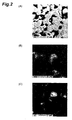
- Fig. 2 is an example of the microstructure and element distribution of a semiconductor ceramic layer according to the invention.
- A) of Fig.2 is a photograph (10,000x) showing an example of the microstructure (10 ⁇ m region) of a semiconductor ceramic layer according to the invention.
- B) of Fig.2 is an EPMA sodium element map of the semiconductor ceramic layer corresponding to the photograph in (A).
- C) of Fig.2 is an EPMA silicon element map of the semiconductor ceramic layer corresponding to the photograph in (A).
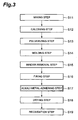
- Fig. 3 is a process flow chart showing a preferred example of the process for production of a stacked PTC thermistor according to the invention.
- the stacked PTC thermistor 1 comprises a cuboid body 4 obtained by alternating lamination of a semiconductor ceramic layer 2 and an internal electrode 3, and a pair of external electrodes 5a, 5b formed at the edge faces 4a, 4b of the body 4.
- the edge faces 4a, 4b are perpendicular to the interface between the semiconductor ceramic layer 2 and the internal electrode 3, and form a pair of surfaces on the body 4 parallel to the lamination direction of the semiconductor ceramic layer 2 and internal electrode 3.
- Only one of the electrode ends 3a of each internal electrode 3 is alternately exposed at the edge faces 4a, 4b of the body 4.
- the other electrode end 3b is positioned inside the semiconductor ceramic layer 2 and is embedded in the body 4.
- the external electrode 5a is electrically connected with the electrode end 3a of each internal electrode 3 at the edge face 4a of the body 4.
- the external electrode 5b is electrically connected with the electrode end 3a of each internal electrode 3 at the edge face 4b of the body 4.
- the stacked PTC thermistor 1 comprises a body 4 with a semiconductor ceramic layer 2 and a plurality of mutually parallel internal electrode 3 embedded in the semiconductor ceramic layer 2, and external electrodes 5a, 5b formed covering both edge faces 4a, 4b of the body 4 and electrically connected with at least one electrode end 3 a of each of the plurality of internal electrode 3.
- the semiconductor ceramic layer 2 is composed of a sintered compact containing a barium titanate (BaTiO 3 )-based ceramic material as the main component and an alkali metal compound as an accessory component.
- the specific composition as the major component of the semiconductor ceramic layer 2 is one in which a portion of the Ba sites of BaTiO 3 are replaced with a rare earth element (at least one element selected from the group consisting of Y, La, Ce, Pr, Nd, Sm, Gd, Dy and Er) and a portion of the Ti sites are replaced with at least one element selected from the group consisting of V, Nb and Ta.
- a portion of the Ba sites may also be replaced with an alkaline earth element such as Sr. Replacing a portion of the Ba with Sr allows the Curie temperature to be varied.
- the semiconductor ceramic layer 2 may also contain SiO 2 or MnO.
- RE represents at least one element selected from the group consisting of Y, La, Ce, Pr, Nd, Sm, Gd, Dy and Er.
- TM represents at least one element selected from the group consisting of V, Nb and Ta.
- General formula (1) is a formula wherein a portion of the Ba sites of barium titanate (BaTiO 3 ) are replaced with RE and a portion of the Ti sites are replaced with TM. Replacing a portion of the Ba sites with RE and a portion of the Ti sites with TM according to this embodiment can produce a stacked PTC thermistor exhibiting low resistance and an excellent PTC property.
- BaTiO 3 barium titanate
- MnO or SiO 2 may be further added to the compound represented by general formula (1).
- the amount of MnO added is preferably 0.005-0.0015 mol with respect to 1 mol of the elements at the Ti sites of general formula (1) above [i.e. (Ti 1-y TM y )]. This can still further improve the PTC property.
- an excessive amount of MnO will tend to result in room temperature resistivity that is too high to provide a satisfactory PTC property, thus producing a NTC (Negative Temperature Coefficient) characteristic whereby the resistance decreases with increasing temperature.
- the amount of SiO 2 added is preferably 0.1-0.3 mol to 1 mol of elements at the Ti site of general formula (1) above, from the viewpoint of accelerating sintering of the barium titanate-based compound.
- the content of the barium titanate-based compound represented by general formula (1), as the main component of the sintered compact composing the semiconductor ceramic layer 2, is preferably at least 95 wt%, more preferably at least 98 wt% and even more preferably at least 99 wt% with respect to the total sintered compact composing the semiconductor ceramic layer 2.
- a higher content can produce an even higher level of both low room temperature resistivity and high jump characteristic.
- the void percentage of the sintered compact composing the semiconductor ceramic layer 2 is preferably 5-25% and more preferably 10-20%.
- a void percentage of 5-25% can provide an even higher level of both low room temperature resistivity and excellent jump characteristic.
- An alkali metal oxide may be used as the alkali metal compound included as an accessory component in the semiconductor ceramic layer 2.
- the alkali metal compound content is preferably 0.001-0.007 mol in terms of the alkali metal element with respect to 1 mol of elements at the Ti site of general formula (1) above.
- a slightly high alkali metal compound content within this range can further improve the jump characteristic.
- a slightly low alkali metal compound content within this range can further reduce the room temperature resistivity.
- Fig. 2 shows the results of FE-EPMA element mapping for an example of the microstructure and element distribution of a semiconductor ceramic layer according to the invention.
- the sample used for analysis was the semiconductor ceramic layer of a stacked PTC thermistor obtained by impregnating a sintered compact composed mainly of a barium titanate-based compound with a Na 2 SiO 3 aqueous solution (9.5 wt%) and then reoxidizing it in air at 700-800°C. Before the analysis, the surface of the semiconductor ceramic layer was subjected to polishing pretreatment.
- FIG. 1 (A) of Fig.2 is a photograph (10,000x) showing the microstructure (10 ⁇ m region) of the semiconductor ceramic layer.
- the light portions in (A) represent the crystal grains of the barium titanate-based compound as the main component, and the dark portions represent voids.
- the sintered compact of the semiconductor ceramic layer is porous. That is, the semiconductor ceramic layer is composed of a porous sintered compact composed mainly of crystal grains of a barium titanate-based compound.
- (B) of Fig.2 is a sodium element map of the semiconductor ceramic layer corresponding to the photograph in (A).
- the light portions in (B) represent the locations where sodium element is present.
- sodium element was preferentially distributed at the grain boundaries of the crystal grains and at the voids formed by the crystal grains of the barium titanate-based compound as the main component of the sintered compact composing the semiconductor ceramic layer.
- the sodium element in the voids is presumably adhering to the walls of the voids (i.e. the surfaces of the crystal grains) as sodium compounds such as sodium oxide.
- (C) of Fig.2 is a silicon element map of the semiconductor ceramic layer corresponding to the photograph in (A).
- the light portions in (C) represent the locations where silicon element is present.
- silicon element was preferentially distributed at the grain boundaries of the crystal grains and at the voids formed by the crystal grains of the barium titanate-based compound as the main component of the sintered compact composing the semiconductor ceramic layer.
- the silicon element in the voids is presumably adhering to the walls of the voids (i.e. the surfaces of the crystal grains) as silicon compounds such as oxides (for example, silicon dioxide).
- the internal electrode 3 used preferably contains a base metal as the main component.
- a specific composition for the internal electrode 3 there may be mentioned Ni or a Ni alloy such as Ni-Pd.
- a specific composition for the external electrodes 5a, 5b there may be mentioned Ag or an alloy such as Ag-Pd alloy.
- the process for production of the stacked PTC thermistor 1 comprises, as the major steps, a step in which the starting material such as barium titanate is mixed (mixing step; step S11), a step in which the mixed starting material is calcined (calcining step; step S12), a step in which the calcined starting material is pulverized (pulverizing step; step S 13), a step in which a laminated body is formed by alternating lamination of the precursor layer for the semiconductor ceramic layer (hereinafter referred to as "semiconductor ceramic precursor layer") and the precursor layer for the internal electrode (hereinafter referred to as "internal electrode precursor layer" (molding step; step S14), a step in which the binder in the laminated body is removed (binder removal step; step S 15), a step in which the laminated body obtained from the binder removal step is fired in a reducing atmosphere to form a porous sintered compact (firing step; step S11), a step in which the mixed starting material is
- the starting powder is composed of a barium titanate-based ceramic material as the main component of the semiconductor ceramic layer, or a compound which is converted to the barium titanate-based ceramic material after the firing step or the reoxidation step.
- a barium titanate-based ceramic material as the main component of the semiconductor ceramic layer
- a compound which is converted to the barium titanate-based ceramic material after the firing step or the reoxidation step As the latter type of compound there may be mentioned oxides or salts (carbonic acid salts or nitric acid salts) of metals that will compose the barium titanate-based ceramic material.
- a rare earth element compound may be added to the starting powder.
- rare earth element compounds there may be mentioned compounds (oxides, salts and the like) of one or more elements selected from the group consisting of Y, La, Ce, Pr, Nd, Sm, Gd, Dy and Er.
- the starting powder may further contain an alkaline earth metal compound such as Sr, a compound of at least one element selected from the group consisting of V, Nb and Ta, and SiO 2 or MnO.
- step S 11 After weighing out prescribed amounts of each of the starting powders, they are placed in a nylon pot together with purified water and a pulverizing ball and pulverized and mixed at 4-8 hours in the mixing step (step S 11) and dried to obtain a mixed powder.
- step S12 the mixed powder is premolded if necessary and calcined for about 0.5-5 hours at an atmosphere temperature of about 1000-1150°C to obtain a calcined body.
- step S13 After obtaining the calcined body, it is pulverized in the pulverizing step (step S13) to obtain a calcined powder.
- the calcined powder is placed in a nylon pot together with purified water and a pulverizing ball, and prescribed amounts of a solvent, binder and plasticizer are added and mixed therewith for about 10-20 hours to obtain a green sheet slurry with a prescribed viscosity.
- a prescribed amount of a dispersing agent may also be added to the green sheet slurry if necessary.
- a laminated body is formed by alternating lamination of the semiconductor ceramic precursor layer and internal electrode precursor layer.
- the green sheet slurry is coated onto a polyester film or the like using a method such as a doctor blade method and dried to obtain a green sheet (semiconductor ceramic precursor layer).
- the thickness of the green sheet may be about 10-100 ⁇ m.
- the internal electrode paste may be obtained by, for example, mixing and preparing a base metal powder and an electrical insulating material (varnish).
- the base metal powder used may be, for example, Ni powder or a Ni alloy powder such as Ni-Pd.
- a plurality of green sheets with internal electrode precursor layers formed thereon are laminated, and green sheets without internal electrode precursor layers are stacked over the top and bottom.
- the stack is then pressed and contact bonded in the lamination direction using a pressing machine to obtain a contact bonded stack.
- the contact bonded stack is cut to a prescribed size using a cutter or the like to obtain a laminated body.
- the laminated body is formed into a shape corresponding to the body 4 of the stacked PTC thermistor 1.
- the laminated body has a construction wherein the green sheet (semiconductor ceramic precursor layer) and internal electrode precursor layer are alternatingly laminated, and the edge faces of each of the internal electrode precursors are exposed at the right or left edge face of the laminated body while the other edge faces are enclosed inside the laminated body.
- the obtained laminated body is held in air at about 250-600°C for 1-10 hours to remove the liquid components from the laminated body, including the binder in the green sheet.
- the laminated body obtained from the binder removal step is fired for about 0.5-4 hours in a reducing atmosphere at about 1200-1250°C to obtain a porous sintered compact.
- the reducing atmosphere is an atmosphere that does not cause oxidation at least in the internal electrode precursor layer, and for example, it may be a mixed atmosphere of hydrogen and nitrogen.
- Base metals (Ni or Ni alloys, for example) in internal electrode precursor layers have tended to readily oxidize in most cases and lose their function as an internal electrode, but firing the laminated body in a reducing atmosphere can prevent such oxidation when the laminated body is sintered.
- the void percentage of the porous sintered compact obtained by the firing step is preferably 5-25% and more preferably 10-20%.
- the void percentage of the sintered compact correlates with the room temperature resistivity and PTC characteristic of the stacked PTC thermistor 1. If the void percentage is less than 5% the PTC characteristic will tend to be inferior, while if the void percentage exceeds 25%, the room temperature resistivity will be increased and the PTC characteristic will tend to be inferior.
- a sintered compact void percentage in the aforementioned preferred range will allow suitable oxidation at the grain boundaries and voids of the crystal grains in the sintered compact.
- the void percentage of the sintered compact can be measured using a porosimeter or the like.
- Factors that affect the sintered void percentage of the sintered compact include the composition of the semiconductor ceramic precursor layer and the firing conditions for the laminated body.
- the composition of the semiconductor ceramic precursor layer is preferably a composition according to one of the following formulas (6)-(9), for example.
- the laminated body is also preferably fired in a 1200°C, 1% H 2 /N 2 atmosphere with a dew point of 10°C.
- an alkali metal component such as an alkali metal is adhered to the sintered compact in the alkali metal adhering step (step S17).
- the alkali metal is preferably one or more elements from among Li, Na and K, for example.
- the method for adhering the alkali metal component to the sintered compact is not particularly restricted, but it is preferably a method of adhering a solution containing the alkali metal salt to the sintered compact. More specifically, the sintered compact is impregnated with the solution containing the alkali metal salt.
- Impregnating the sintered compact with the solution containing the alkali metal salt causes the solution to permeate into the sintered compact, thus allowing the alkali metal salt to adhere preferentially to the voids and grain boundaries in the sintered compact composed mainly of the barium titanate-based compound.
- alkali metal salts there are preferred one or more selected from the group consisting of NaNO 3 , NaOH, Na 2 CO 3 , Na 2 SiO 3 , Li 2 O, LiOH, LiNO 3 , Li 2 SO 4 , KOH, KNO 3 and K 2 CO 3 .
- These alkali metal salts readily dissolve in solvents such as water, and tend to adhere more readily to the voids and grain boundaries of the sintered compact when the sintered compact is impregnated with the solution.
- an alkali metal salt with a molecular weight of 80-130 and more preferably 84.995-122.063 it is preferred to use an alkali metal salt with a molecular weight of 80-130 and more preferably 84.995-122.063.
- Alkali metal salts with molecular weights in this range easily segregate at the grain boundaries and voids of the sintered compact, thus allowing more selective preferential distribution of the alkali metal elements at the grain boundaries and voids. This allows both low room temperature resistivity and a high jump characteristic to be achieved more reliably.
- the concentration of the alkali metal salt in the solution containing the alkali metal salt is preferably 0.01-0.08 mol% and more preferably 0.01-0.03 mol% in terms of the alkali metal element.
- the alkali metal salt concentration can be varied within the aforementioned range in order to adjust the final amount of alkali metal compound in the sintered compact.
- the concentration of the alkali metal salt in the solution is too low, the amount of alkali metal compound present at the grain boundaries and voids of the sintered compact will be insufficient, tending to prevent oxidation from proceeding sufficiently at the grain boundaries of the crystal grains. Such a situation will tend to result in an insufficient jump characteristic- increasing effect.
- the alkali metal salt concentration in the solution is too high, an excessive amount of alkali metal salt will adhere to the sintered compact, tending to result in infiltration of the alkali metal into the grains in subsequent steps and causing excessive oxidation through to the interior of the sintered compact. Such a situation will tend to interfere with the low room temperature resistivity.
- the sintered compact After the sintered compact has been impregnated with the solution containing the alkali metal salt, the sintered compact is dried in the drying step (step S 18).
- the dried sintered compact is heat treated in an oxidizing atmosphere for reoxidation to obtain a body 4.
- the conditions for reoxidation are conditions that allow at least the obtained semiconductor ceramic layer 2 to reliably exhibit a PTC characteristic while preventing oxidation of the internal electrode 3.
- the reoxidation conditions include the oxygen concentration of the oxidizing atmosphere, heat treatment temperature and heat treatment time, and these may be appropriately set according to the dimensions of the sintered compact. Appropriately setting the conditions can yield a stacked PTC thermistor 1 with suitable room temperature resistivity and a suitable PTC characteristic.
- the heat treatment temperature during the reoxidation step is preferably 600-800°C and more preferably 700-800°C. If the heat treatment temperature is too low, oxidation at the grain boundaries of the crystal grains in the sintered compact will not proceed sufficiently, and the effect of increasing the jump characteristic will be minimal. If the heat treatment temperature is too high, on the other hand, the internal electrode will tend to be oxidized.
- the oxygen concentration of the oxidizing atmosphere is preferably about 0.1-30 vol%, and the heat treatment time is preferably about 0.5-2 hours.
- the alkali metal salt that has adhered to the grain boundaries and voids of the sintered compact in the alkali metal-adhering step may in some cases be oxidized to an oxide. This can produce a stacked PTC thermistor capable of exhibiting a high level of both low room temperature resistivity and high jump characteristic.
- both edge faces 4a, 4b of the body 4 are coated with their external electrode pastes and then baked in air at about 550-650°C to form external electrodes 5a, 5b at the edge faces.
- the external electrode paste there may be used Ag paste, Ag-Pd paste or the like. As a result, it is possible to obtain a stacked PTC thermistor 1 having the construction shown in Fig. 1 .
- the process for production of a stacked PTC thermistor 1 comprises adhering an alkali metal salt to crystal grains of a barium titanate-based compound in the sintered compact after the firing step and before the reoxidation step. This permits sufficient reoxidation near the grain boundaries of the sintered compact composing the semiconductor ceramic layer 2.
- the jump characteristic of the obtained stacked PTC thermistor 1 can be increased as a result.
- the alkali metal salt selectively adheres near the grain boundaries in the alkali metal-adhering step, causing selective oxidation near the grain boundaries in the reoxidation step and segregation of the alkali metal compound at the grain boundaries. It is therefore possible to adequately increase the jump characteristic while maintaining an adequately low value for the room temperature resistivity of the stacked PTC thermistor 1.
- the semiconductor ceramic layer 2 in the stacked PTC thermistor 1 obtained by the production process described above contains a barium titanate-based compound as the main component and an alkali metal component as an accessory component. As shown in Fig. 2 , the alkali metal component is segregated at either or both the grain boundaries of the crystal grains of the barium titanate-based compound and the voids formed by the crystal grains.
- a semiconductor ceramic precursor layer composed of a green sheet and an internal electrode precursor layer composed of an internal electrode paste were used as examples in the production process described above, but the semiconductor ceramic precursor layer and internal electrode precursor layer are not necessarily limited to these so long as a semiconductor ceramic layer and internal electrode can be obtained by firing and reoxidation.
- the stacked PTC thermistor is also not limited to the structure described above and may have different numbers of laminated layers or different positions for forming the internal electrode.
- starting powders for formation of the semiconductor ceramic layer there were prepared powders of BaCO 3 , TiO 2 , Gd 2 O 3 , SiO 2 and Mn(NO 3 ) 2 ⁇ 6H 2 O.
- the starting powders were weighed out in amounts for a barium titanate-based compound composition according to formula (6) above.
- the weighed amounts of each of the starting powders were placed in a nylon pot together with purified water and a pulverizing ball and mixed for 6 hours and dried to obtain a mixed powder.
- the mixed powder After subsequent pre-molding of the mixed powder, it was held for 4 hours in air at 1150°C and calcined to obtain a calcined body.
- the calcined body was shredded to form a calcined powder with a mean particle size of 1 ⁇ m.
- the calcined powder was placed in a nylon pot together with purified water and a pulverizing ball, and prescribed amounts of a solvent, binder and plasticizer were added and mixed therewith for about 20 hours using a triple roll to obtain a green sheet slurry.
- the mixing ratios of the solvent, binder and plasticizer were 50 parts by weight, 5 parts by weight and 2.5 parts by weight to 100 parts by weight of the calcined powder.
- the obtained green sheet slurry was coated onto the polyester film by a doctor blade method and dried, and then punched out to dimensions of 50 mm x 50 mm to fabricate a plurality of 20 ⁇ m-thick green sheets (semiconductor ceramic precursor layers).
- the internal electrode paste was printed onto the top of each green sheet by screen printing to form an internal electrode precursor layer.
- the internal electrode paste was prepared by kneading 10 parts by weight of BaTiO 3 as the electrical insulating material with 100 parts by weight of Ni powder with a mean particle size of 0.2 ⁇ m.
- the contact bonded stack was cut with a cutter to form a laminated body with 2 mm x 1.2 mm x 1.2 mm dimensions. For the cutting, only one end of the internal electrode precursor layer was extended to the edge face of the green sheet, while the other end of the internal electrode precursor was cut so as to be situated inside the green sheet.
- the spacing between the internal electrode precursor layers in the lamination direction was 14 ⁇ m.
- the obtained laminated body was heated in air at 300°C for 8 hours to remove the binder from the laminated body. It was then fired for 2 hours in a reducing atmosphere at 1200°C to obtain a porous sintered compact.
- the reducing atmosphere was a mixed atmosphere of hydrogen and nitrogen with a hydrogen/nitrogen volume ratio of 1:99, and the dew point of the mixed atmosphere was 10°C.
- the sintered compact was then impregnated with an aqueous solution containing the alkali metal salt, to adhere the alkali metal component to the sintered compact.
- the alkali metal salt used was Li 2 O with a molecular weight of 29.881.
- the alkali metal (Li) concentration in the aqueous solution of the alkali metal salt (Li 2 O) was 0.08 mol% as alkali metal element (Li element).
- the sintered compact After impregnating the sintered compact with the aqueous solution of Li 2 O, the sintered compact was dried at ordinary temperature for 1 hour. The sintered compact was heated in air at 700°C for 2 hours for reoxidation of the sintered compact to obtain a body 4.
- Stacked PTC thermistors for Examples 2-10 were fabricated by the same method as Example 1, except that the alkali metal salts shown in Table 1 were used as alkali metal salts instead of Li 2 O.
- a stacked PTC thermistor for Comparative Example 1 was fabricated by the same method as Example 1, except that the sintered compact was not impregnated with an alkali metal salt aqueous solution.
- a stacked PTC thermistor for Comparative Example 2 was fabricated by the same method as Example 1, except that the Mn(NO 3 ) 2 ⁇ 6H 2 O content of the starting powder was twice that of Example 1, and the sintered compact was not impregnated with an alkali metal salt aqueous solution.
- the composition of the barium titanate-based compound in the semiconductor ceramic layer in Comparative Example 2 was that of the following formula (10). Ba 0.997 Gd 0.003 ) 1.02 Tio 3 +0.05SiO 2 +0.002 MnI (10)
- Stacked PTC thermistors were fabricated for Comparative Examples 3 and 4 by the same method as Example 1, except that the sintered compacts were impregnated with aqueous solutions of the alkaline earth metal salts shown in Table 1 instead of an alkali metal salt aqueous solution.
- Stacked PTC thermistors were fabricated for Comparative Examples 5-7 by the same method as Example 1, except that the sintered compacts were impregnated with aqueous solutions of the transition metal salts shown in Table 1 instead of an alkali metal salt aqueous solution.
- a powder of the alkali metal salt Na 2 CO 3 was further prepared as a starting powder.
- An amount of Na 2 CO 3 powder was added to the mixed powder of Example 1 corresponding to 0.0035 mol as alkali metal element with respect to 1 mol of Ti element in formula (6) above.
- a stacked PTC thermistor for Comparative Example 8 was fabricated by the same method as Example 1, except that the mixed powder containing Na 2 CO 3 powder was used, and the sintered compact was not impregnated with an alkali metal salt aqueous solution.
- a powder of the alkali metal salt Na 2 CO 3 was further prepared as a starting powder.
- An amount of Na 2 CO 3 powder was added to the mixed powder of Example 1 corresponding to 0.0005 mol as alkali metal element with respect to 1 mol of Ti element in formula (6) above.
- a stacked PTC thermistor for Comparative Example 9 was fabricated by the same method as Example 1, except that the mixed powder containing Na 2 CO 3 powder was used, and the sintered compact was not impregnated with an alkali metal salt aqueous solution.
- a stacked PTC thermistor for Comparative Example 10 was fabricated by the same method as Example 1, except that the alkali metal salt aqueous solution was impregnated not into the sintered compact before reoxidation but into the sintered compact after reoxidation.
- a porosimeter was used to measure the void percentage of the sintered compacts in the semiconductor ceramic layers of each of the stacked PTC thermistors obtained for Examples 1-10 and Comparative Examples 1-10. The measurement results are shown in Table 2.
- Each of the stacked PTC thermistors of Examples 1-10 and Comparative Examples 1-10 were used to measure the resistivity at 25°C [R 25 (units: ⁇ cm); room temperature resistivity] and the resistivity at 200°C [R 200 (units: ⁇ cm); high-temperature resistivity].
- the resistance variation range R 200 /R 25 and the log 10 (R 200 /R 25 ) were also determined from the measured values for the room temperature resistivity R 25 and high-temperature resistivity R 200 .
- the measurement results for Examples 1-10 and Comparative Examples 1-10 are shown in Table 1.
- a larger resistance variation range R 200 /R 25 signifies a higher jump characteristic of the stacked PTC thermistor.
- a smaller room temperature resistivity R 25 is preferred, and a larger high-temperature resistivity R 200 and a larger resistance variation range R 200 /R 25 are preferred.
- Metal salt (*1) Void percentage 25°C Resistivity 200°C Resistivity Resistance variation range Chemical formula Mol. wt. mol % (%) R 25 [ ⁇ cm] R 200 [ ⁇ cm] R 200 /R 25 log 10 (R 200 /R 25 ) Comp. Ex. 1 No impregnation - - 14 2.33 ⁇ 10 2 7.36 ⁇ 10 4 3.16 ⁇ 10 2 2.5 Comp. Ex.
- Examples 1-10 wherein the sintered compact before reoxidation was impregnated with an alkali metal salt aqueous solution, had larger R 200 /R 25 and log 10 (R 200 /R 25 ) values than Comparative Example 1 wherein the sintered compact was not impregnated with an alkali metal salt aqueous solution. It was also confirmed that Examples 1-10 had practicably low values for the room temperature resistivity R 25 .
- Comparative Examples 3-7 wherein the sintered compact before reoxidation was impregnated with an aqueous solution of an alkaline earth metal salt or transition metal salt, had smaller R 200 /R 25 and log 10 (R 200/ R 25 ) values than Examples 1-10 wherein the sintered compact before reoxidation was impregnated with an alkali metal salt aqueous solution.
- Comparative Examples 8 and 9 wherein the alkali metal salt Na 2 CO 3 was added to the starting powder and the sintered compact was not impregnated with an alkali metal salt aqueous solution, had smaller R 200 /R 25 and log 10 (R 200 /R 25 ) values than Examples 1-10 wherein the sintered compact before reoxidation was impregnated with an alkali metal salt aqueous solution.
- Comparative Example 10 wherein not the sintered compact before reoxidation but rather the sintered compact after reoxidation was impregnated with an alkali metal salt aqueous solution, had smaller R 200 /R 25 and log 10 (R 200 /R 25 ) values than Examples 1-10 wherein the sintered compact before reoxidation was impregnated with an alkali metal salt aqueous solution.
- a porous sintered compact was prepared in the same manner as Example 1, except for using this mixed powder.
- the prepared sintered compact was then impregnated with an aqueous solution containing an alkali metal salt, to adhere the alkali metal salt to the sintered compact.
- the alkali metal salt used was NaNO 3 with a molecular weight of 84.995.
- the alkali metal (Na) concentration in the aqueous solution of the alkali metal salt (NaNO 3 ) was 0.08 mol% as alkali metal element (Na element).
- Stacked PTC thermistors for Examples 12-34 were fabricated by the same method as Example 11, except that the alkali metal salt solutions shown in Table 2 were used as the alkali metal salt solution instead of the 0.08 mol% aqueous solution of NaNO 3 .
- BaCO 3 , TiO 2 , Gd 2 O 3 , Nb 2 O 5 , MnO and SiO 2 were weighed out as starting powders in amounts so that the barium titanate-based compound had the composition shown in the following formula (12).
- a stacked PTC thermistor for Example 35 was fabricated in the same manner as Example 12, except for using these starting powders.
- a stacked PTC thermistor for Comparative Example 11 was fabricated in the same manner as Example 11, except that the sintered compact was not impregnated with an alkali metal salt aqueous solution.
- a powder of the alkali metal salt Na 2 CO 3 was further prepared as a starting powder.
- An amount of Na 2 CO 3 powder was added to the mixed powder of Example 11 corresponding to 0.0035 mol as alkali metal element with respect to 1 mol of Ti site elements [i.e., (Ti 0.9985 Nb 0.0015 )] in formula (11) above.
- a stacked PTC thermistor for Comparative Example 12 was fabricated by the same method as Example 11, except that the mixed powder containing Na 2 CO 3 powder was used, and the sintered compact was not impregnated with an alkali metal salt aqueous solution.
- a powder of the alkali metal salt Na 2 CO 3 was further prepared as a starting powder.
- An amount of Na 2 CO 3 powder was added to the mixed powder of Example 11 corresponding to 0.0005 mol as alkali metal element with respect to 1 mol of Ti site elements [i.e., (Ti 0.9985 Nb 0.0015 )] in formula (11) above.
- a stacked PTC thermistor for Comparative Example 13 was fabricated by the same method as Example 11, except that the mixed powder containing Na 2 CO 3 powder was used, and the sintered compact was not impregnated with an alkali metal salt aqueous solution.
- BaCO 3 , TiO 2 , Gd 2 O 3 , Nb 2 O 5 , MnO and SiO 2 were weighed out as starting powders in amounts so that the barium titanate-based compound had the composition shown in formula (12) above.
- a stacked PTC thermistor for Comparative Example 14 was fabricated in the same manner as Comparative Example 12, except for using these starting powders.
- BaCO 3 , TiO 2 , Gd 2 O 3 , Nb 2 O 5 and MnO were weighed out in amounts so that the obtained barium titanate-based compound had the composition shown in the following formula (13).
- the starting powders were placed in a nylon pot together with purified water and a pulverizing ball, mixed for 6 hours and dried to obtain a mixed powder.
- a stacked PTC thermistor for Comparative Example 15 was fabricated in the same manner as Example 11, except that the aforementioned mixed powder was used as the starting powder without impregnation with an alkali metal aqueous salt solution.
- a porosimeter was used to measure the void percentage of the sintered compacts in the semiconductor ceramic layers of each of the stacked PTC thermistors obtained for Examples 11-35 and Comparative Examples 11-15. The measurement results are shown in Table 2.
- An ICP emission analyzer was used to measure the amounts of alkali metal compounds in terms of alkali metals (alkali metal contents) in the semiconductor ceramic layers of each of the stacked PTC thermistors obtained in Examples 11-35 and Comparative Examples 11-15. The measurement results are shown in Table 2. The results of alkali metal quantitation with the ICP emission analyzer matched the amounts of alkali metals calculated based on the assumption that the voids in the sintered compacts were filled with the alkali metal salt aqueous solutions.
- Each of the stacked PTC thermistors obtained in Examples 11-35 and Comparative Examples 11-15 were used to measure the resistivity at 25°C (room temperature resistivity) R 25 (units: ⁇ cm) and the resistivity at 200°C (high-temperature resistivity) R 200 (units: ⁇ cm).
- the resistance variation range R 200 /R 25 and the log 10 (R 200 /R 25 ) were also determined from the measured values for the room temperature resistivity R 25 and high-temperature resistivity R 200 .
- Example 11 NaNO 3 84.995 0.08 0.08 14 Grain boundaries, voids 6.66 ⁇ 10 2 1.50 ⁇ 10 6 2.25 ⁇ 10 5 5.4
- Example 12 NaNO 3 84.995 0.04 0.04 14 Grain boundaries, voids 1.64 ⁇ 10 2 5.18 ⁇ 10 7 3.16 ⁇ 10 5 5.5
- Example 13 NaNO 3 84.995 0.02 0.02 14 Grain boundaries, voids 3.26 ⁇ 10 1 9.46 ⁇ 10 4 2.90 ⁇ 10 3 3.5
- Example 15 NaOH 39.997 0.01 0.01 14 Grain boundaries, voids 3.00 ⁇ 10 1 3.78 ⁇ 10 4 1.26 ⁇ 10 3 3.1
- Example 16 NaOH 39.997 NaNO 39.997
- Example 11-35 wherein the sintered compacts before reoxidation were impregnated with alkali metal salt aqueous solutions, the alkali metal elements were preferentially distributed in the grain boundaries and voids of the sintered compacts.
- the stacked PTC thermistors having such structures (Examples 11-35) exhibited high jump characteristics while maintaining low room temperature resistivity (R 25 ), compared to Comparative Examples 11-15 which were obtained without impregnation of an alkali metal salt aqueous solution.
- the stacked PTC thermistors of Examples 11-34 all had room temperature resistivity (R 25 ) values of below 1 ⁇ 10 3 ( ⁇ cm), and log 10 (R 200 /R 25 ) values of 3.0 or greater.
- the stacked PTC thermistor of Example 35 exhibited low room temperature resistivity (R 25 ) and a high jump characteristic compared to Comparative Example 14 which employed the same barium titanate-based compound.
- Comparative Examples 12-14 which contained the alkali metal salt Na 2 CO 3 in the starting powder and wherein the sintered compacts were not impregnated with an alkali metal salt aqueous solution, to exhibite both low room temperature resistivity and high jump characteristics.
Landscapes
- Engineering & Computer Science (AREA)
- Chemical & Material Sciences (AREA)
- Ceramic Engineering (AREA)
- Materials Engineering (AREA)
- Manufacturing & Machinery (AREA)
- Organic Chemistry (AREA)
- Structural Engineering (AREA)
- Microelectronics & Electronic Packaging (AREA)
- Physics & Mathematics (AREA)
- Electromagnetism (AREA)
- Inorganic Chemistry (AREA)
- Thermistors And Varistors (AREA)
- Compositions Of Oxide Ceramics (AREA)
Claims (6)
- Thermistance CTP empilée (1) comprenant un corps (4) obtenu en alternant la stratification d'une couche céramique semi-conductrice (2) et d'une électrode interne (3), et une paire d'électrodes externes (5a, 5b) disposées sur chaque face de bord (4a, 4b) du corps (4) et électriquement reliées à l'électrode interne (3),
dans laquelle la couche céramique semi-conductrice (2) est composée d'un compact fritté poreux contenant des grains de cristaux d'un composé à base de titanate de baryum, et un composant de métal alcalin adhère de préférence à au moins un élément parmi les joints de grains et les vides dans le compact fritté,
la thermistance CTP empilée (1) étant caractérisée en ce que le composé à base de titanate de baryum est représenté par la formule générale (1)
(Ba1-xREx)α(Ti1-yTMy)O3 (1)
dans laquelle RE représente au moins un élément choisi parmi le groupe constitué de Y, La, Ce, Pr, Nd, Sm, Gd, Dy et Er, TM représente au moins un élément choisi parmi le groupe constitué de V, Nb et Ta, et x, y et α satisfont aux formules (2), (3) et (4) suivantes


- Procédé pour la production d'une thermistance CTP empilée (1) obtenue en alternant la stratification d'une couche céramique semi-conductrice (2) contenant un composé à base de titanate de baryum et une électrode interne (3), le procédé étant caractérisé en ce qu'il comprend
une première étape au cours de laquelle un corps stratifié (4) est formé en alternant la stratification de la couche de précurseur pour la couche céramique semi-conductrice (2) et la couche de précurseur pour l'électrode interne (3),
une deuxième étape au cours de laquelle le corps stratifié (4) est chauffé dans une atmosphère réductrice pour former un compact fritté poreux,
une troisième étape au cours de laquelle un composant de métal alcalin adhère au compact fritté poreux ainsi obtenu, et
une quatrième étape au cours de laquelle le compact fritté adhérant au composé de métal alcalin ainsi obtenu est réoxydé,
dans lequel le composant de métal alcalin adhère de préférence à au moins un élément parmi les joints de grains et les vides dans le compact fritté. - Procédé pour la production d'une thermistance CTP empilée (1) selon la revendication 2, caractérisé en ce que le composant de métal alcalin adhère au compact fritté en faisant adhérer une solution contenant un sel de métal alcalin au compact fritté lors de la troisième étape.
- Procédé pour la production d'une thermistance CTP empilée (1) selon la revendication 3, caractérisé en ce que le sel de métal alcalin est au moins un élément choisi parmi le groupe constitué de NaNO3, NaOH, Na2CO3, Li2O, LiOH, LiNO3, Li2SO4, KOH, KNO3 et K2CO3.
- Procédé pour la production d'une thermistance CTP empilée (1) selon la revendication 3 ou 4, caractérisé en ce que la masse moléculaire du sel de métal alcalin est de 80 à 130.
- Procédé pour la production d'une thermistance CTP empilée (1) selon l'une quelconque des revendications 2 à 5, caractérisé en ce que le composé à base de titanate de baryum est représenté par la forme générale (1)
(Ba1-xREx)α(Ti1-yTMy)O3 (1)
dans laquelle RE représente au moins un élément choisi parmi le groupe constitué de Y, La, Ce, Pr, Nd, Sm, Gd, Dy et Er, TM représente au moins un élément choisi parmi le groupe constitué de V, Nb et Ta, et x, y et α satisfont aux formules (2), (3) et (4) suivantes


Applications Claiming Priority (2)
| Application Number | Priority Date | Filing Date | Title |
|---|---|---|---|
| JP2007155397 | 2007-06-12 | ||
| JP2008063104A JP4970318B2 (ja) | 2007-06-12 | 2008-03-12 | 積層型ptcサーミスタ及びその製造方法 |
Publications (3)
| Publication Number | Publication Date |
|---|---|
| EP2015318A2 EP2015318A2 (fr) | 2009-01-14 |
| EP2015318A3 EP2015318A3 (fr) | 2009-10-21 |
| EP2015318B1 true EP2015318B1 (fr) | 2012-02-29 |
Family
ID=39769263
Family Applications (1)
| Application Number | Title | Priority Date | Filing Date |
|---|---|---|---|
| EP08010390A Not-in-force EP2015318B1 (fr) | 2007-06-12 | 2008-06-06 | Thermistor PTC empilé et son procédé de production |
Country Status (2)
| Country | Link |
|---|---|
| US (1) | US7944337B2 (fr) |
| EP (1) | EP2015318B1 (fr) |
Families Citing this family (5)
| Publication number | Priority date | Publication date | Assignee | Title |
|---|---|---|---|---|
| EP2175457B1 (fr) * | 2008-10-09 | 2012-04-18 | Joinset Co., Ltd | Ensemble de puce en céramique |
| WO2012056797A1 (fr) * | 2010-10-27 | 2012-05-03 | 株式会社村田製作所 | Céramique semi-conductrice et élément résistif |
| US9035337B2 (en) * | 2011-02-14 | 2015-05-19 | Semiconductor Energy Laboratory Co., Ltd. | Light-emitting module, light-emitting panel, and lighting device |
| JP6520398B2 (ja) * | 2015-05-27 | 2019-05-29 | Tdk株式会社 | 電子部品 |
| CN113402986B (zh) * | 2021-08-20 | 2022-06-24 | 光之科技(北京)有限公司 | Ptc材料的制备方法及ptc材料 |
Family Cites Families (10)
| Publication number | Priority date | Publication date | Assignee | Title |
|---|---|---|---|---|
| JPH01228104A (ja) * | 1988-03-09 | 1989-09-12 | Matsushita Electric Ind Co Ltd | 正特性サーミスタ材料とその製造方法 |
| JPH08217536A (ja) * | 1995-02-14 | 1996-08-27 | Tdk Corp | 正の抵抗温度係数を有する半導体磁器組成物及びその製造方法 |
| JPH11102802A (ja) | 1997-09-26 | 1999-04-13 | Matsushita Electric Ind Co Ltd | 正特性サーミスタおよびその製造方法 |
| JP2000086336A (ja) * | 1998-09-11 | 2000-03-28 | Matsushita Electric Ind Co Ltd | 正特性サーミスタの製造方法 |
| JP3636075B2 (ja) * | 2001-01-18 | 2005-04-06 | 株式会社村田製作所 | 積層ptcサーミスタ |
| JP4311124B2 (ja) | 2002-09-10 | 2009-08-12 | 株式会社村田製作所 | チップ型電子部品 |
| JP2007048764A (ja) * | 2003-10-30 | 2007-02-22 | Murata Mfg Co Ltd | 積層型正特性サーミスタおよびその設計方法 |
| JP4765258B2 (ja) * | 2004-03-12 | 2011-09-07 | 日立金属株式会社 | 半導体磁器組成物 |
| TW200705481A (en) * | 2005-04-28 | 2007-02-01 | Tdk Corp | Method of production of multilayer ceramic electronic device |
| TW200903527A (en) | 2007-03-19 | 2009-01-16 | Murata Manufacturing Co | Laminated positive temperature coefficient thermistor |
-
2008
- 2008-06-06 EP EP08010390A patent/EP2015318B1/fr not_active Not-in-force
- 2008-06-11 US US12/136,924 patent/US7944337B2/en not_active Expired - Fee Related
Also Published As
| Publication number | Publication date |
|---|---|
| US7944337B2 (en) | 2011-05-17 |
| EP2015318A2 (fr) | 2009-01-14 |
| US20080309448A1 (en) | 2008-12-18 |
| EP2015318A3 (fr) | 2009-10-21 |
Similar Documents
| Publication | Publication Date | Title |
|---|---|---|
| JP4970318B2 (ja) | 積層型ptcサーミスタ及びその製造方法 | |
| CN112216510B (zh) | 陶瓷电子器件及其制造方法 | |
| US8339237B2 (en) | Multilayer PTC thermistor | |
| EP2003665B1 (fr) | Composition en céramique diélectrique et dispositif électronique | |
| JP4936087B2 (ja) | 積層正特性サーミスタ | |
| JP2006319205A (ja) | 積層セラミックコンデンサ及びその製造方法 | |
| JP6094682B2 (ja) | 積層型圧電セラミック電子部品、及び積層型圧電セラミック電子部品の製造方法 | |
| EP2015318B1 (fr) | Thermistor PTC empilé et son procédé de production | |
| JPWO2006085507A1 (ja) | 表面実装型負特性サーミスタ | |
| US7679485B2 (en) | Multilayer positive temperature coefficient thermistor | |
| JP4370217B2 (ja) | 積層セラミックコンデンサ | |
| JP4888405B2 (ja) | 積層型ptcサーミスタ及びその製造方法 | |
| JPH06302403A (ja) | 積層型半導体セラミック素子 | |
| EP1014391B1 (fr) | Composant monolithe à céramique semi-conducteur | |
| JP4888264B2 (ja) | 積層型サーミスタ及びその製造方法 | |
| JP4780306B2 (ja) | 積層型サーミスタ及びその製造方法 | |
| JP4144080B2 (ja) | 積層型半導体セラミック素子 | |
| US11410817B2 (en) | Ceramic electronic device | |
| JP4984958B2 (ja) | 積層型サーミスタおよびその製造方法 | |
| EP1939899B1 (fr) | Thermistor superposé à coefficient positif | |
| JPH0714702A (ja) | 正の抵抗温度特性を有する積層型半導体磁器 | |
| JP2008205343A (ja) | 積層型サーミスタの製造方法 | |
| JP2013206899A (ja) | 積層型ptcサーミスタ | |
| JP2841338B2 (ja) | 積層セラミックコンデンサの製造方法 | |
| TWI290404B (en) | Over-voltage protecting device having an insulation layer thereon and the method of making the same |
Legal Events
| Date | Code | Title | Description |
|---|---|---|---|
| PUAI | Public reference made under article 153(3) epc to a published international application that has entered the european phase |
Free format text: ORIGINAL CODE: 0009012 |
|
| PUAI | Public reference made under article 153(3) epc to a published international application that has entered the european phase |
Free format text: ORIGINAL CODE: 0009012 |
|
| AK | Designated contracting states |
Kind code of ref document: A2 Designated state(s): AT BE BG CH CY CZ DE DK EE ES FI FR GB GR HR HU IE IS IT LI LT LU LV MC MT NL NO PL PT RO SE SI SK TR |
|
| AX | Request for extension of the european patent |
Extension state: AL BA MK RS |
|
| PUAL | Search report despatched |
Free format text: ORIGINAL CODE: 0009013 |
|
| AK | Designated contracting states |
Kind code of ref document: A3 Designated state(s): AT BE BG CH CY CZ DE DK EE ES FI FR GB GR HR HU IE IS IT LI LT LU LV MC MT NL NO PL PT RO SE SI SK TR |
|
| AX | Request for extension of the european patent |
Extension state: AL BA MK RS |
|
| 17P | Request for examination filed |
Effective date: 20091222 |
|
| AKX | Designation fees paid |
Designated state(s): DE FR GB NL |
|
| 17Q | First examination report despatched |
Effective date: 20100802 |
|
| GRAP | Despatch of communication of intention to grant a patent |
Free format text: ORIGINAL CODE: EPIDOSNIGR1 |
|
| GRAS | Grant fee paid |
Free format text: ORIGINAL CODE: EPIDOSNIGR3 |
|
| GRAA | (expected) grant |
Free format text: ORIGINAL CODE: 0009210 |
|
| AK | Designated contracting states |
Kind code of ref document: B1 Designated state(s): DE FR GB NL |
|
| REG | Reference to a national code |
Ref country code: GB Ref legal event code: FG4D |
|
| REG | Reference to a national code |
Ref country code: DE Ref legal event code: R096 Ref document number: 602008013693 Country of ref document: DE Effective date: 20120503 |
|
| REG | Reference to a national code |
Ref country code: NL Ref legal event code: VDEP Effective date: 20120229 |
|
| PG25 | Lapsed in a contracting state [announced via postgrant information from national office to epo] |
Ref country code: NL Free format text: LAPSE BECAUSE OF FAILURE TO SUBMIT A TRANSLATION OF THE DESCRIPTION OR TO PAY THE FEE WITHIN THE PRESCRIBED TIME-LIMIT Effective date: 20120229 |
|
| PLBE | No opposition filed within time limit |
Free format text: ORIGINAL CODE: 0009261 |
|
| STAA | Information on the status of an ep patent application or granted ep patent |
Free format text: STATUS: NO OPPOSITION FILED WITHIN TIME LIMIT |
|
| 26N | No opposition filed |
Effective date: 20121130 |
|
| GBPC | Gb: european patent ceased through non-payment of renewal fee |
Effective date: 20120606 |
|
| REG | Reference to a national code |
Ref country code: DE Ref legal event code: R097 Ref document number: 602008013693 Country of ref document: DE Effective date: 20121130 |
|
| REG | Reference to a national code |
Ref country code: FR Ref legal event code: ST Effective date: 20130228 |
|
| PG25 | Lapsed in a contracting state [announced via postgrant information from national office to epo] |
Ref country code: FR Free format text: LAPSE BECAUSE OF NON-PAYMENT OF DUE FEES Effective date: 20120702 Ref country code: GB Free format text: LAPSE BECAUSE OF NON-PAYMENT OF DUE FEES Effective date: 20120606 |
|
| PGFP | Annual fee paid to national office [announced via postgrant information from national office to epo] |
Ref country code: DE Payment date: 20200527 Year of fee payment: 13 |
|
| REG | Reference to a national code |
Ref country code: DE Ref legal event code: R119 Ref document number: 602008013693 Country of ref document: DE |
|
| PG25 | Lapsed in a contracting state [announced via postgrant information from national office to epo] |
Ref country code: DE Free format text: LAPSE BECAUSE OF NON-PAYMENT OF DUE FEES Effective date: 20220101 |