EP2015402A2 - Elektrischer Steckverbinder - Google Patents
Elektrischer Steckverbinder Download PDFInfo
- Publication number
- EP2015402A2 EP2015402A2 EP08252372A EP08252372A EP2015402A2 EP 2015402 A2 EP2015402 A2 EP 2015402A2 EP 08252372 A EP08252372 A EP 08252372A EP 08252372 A EP08252372 A EP 08252372A EP 2015402 A2 EP2015402 A2 EP 2015402A2
- Authority
- EP
- European Patent Office
- Prior art keywords
- contacts
- contact
- main portion
- electric connector
- area
- Prior art date
- Legal status (The legal status is an assumption and is not a legal conclusion. Google has not performed a legal analysis and makes no representation as to the accuracy of the status listed.)
- Granted
Links
- 238000003780 insertion Methods 0.000 description 28
- 230000037431 insertion Effects 0.000 description 28
- 230000005540 biological transmission Effects 0.000 description 8
- 230000011664 signaling Effects 0.000 description 7
- 239000004734 Polyphenylene sulfide Substances 0.000 description 2
- 239000000470 constituent Substances 0.000 description 2
- 229920001707 polybutylene terephthalate Polymers 0.000 description 2
- 229920000069 polyphenylene sulfide Polymers 0.000 description 2
- 230000000593 degrading effect Effects 0.000 description 1
- 238000001746 injection moulding Methods 0.000 description 1
- 238000004519 manufacturing process Methods 0.000 description 1
- 239000000463 material Substances 0.000 description 1
- 239000002184 metal Substances 0.000 description 1
- 230000002093 peripheral effect Effects 0.000 description 1
- -1 polybutylene terephthalate Polymers 0.000 description 1
- 230000008054 signal transmission Effects 0.000 description 1
- 239000007787 solid Substances 0.000 description 1
- 229920003002 synthetic resin Polymers 0.000 description 1
- 239000000057 synthetic resin Substances 0.000 description 1
Images


Classifications
-
- H—ELECTRICITY
- H01—ELECTRIC ELEMENTS
- H01R—ELECTRICALLY-CONDUCTIVE CONNECTIONS; STRUCTURAL ASSOCIATIONS OF A PLURALITY OF MUTUALLY-INSULATED ELECTRICAL CONNECTING ELEMENTS; COUPLING DEVICES; CURRENT COLLECTORS
- H01R13/00—Details of coupling devices of the kinds covered by groups H01R12/70 or H01R24/00 - H01R33/00
- H01R13/646—Details of coupling devices of the kinds covered by groups H01R12/70 or H01R24/00 - H01R33/00 specially adapted for high-frequency, e.g. structures providing an impedance match or phase match
- H01R13/6473—Impedance matching
- H01R13/6474—Impedance matching by variation of conductive properties, e.g. by dimension variations
-
- H—ELECTRICITY
- H01—ELECTRIC ELEMENTS
- H01R—ELECTRICALLY-CONDUCTIVE CONNECTIONS; STRUCTURAL ASSOCIATIONS OF A PLURALITY OF MUTUALLY-INSULATED ELECTRICAL CONNECTING ELEMENTS; COUPLING DEVICES; CURRENT COLLECTORS
- H01R12/00—Structural associations of a plurality of mutually-insulated electrical connecting elements, specially adapted for printed circuits, e.g. printed circuit boards [PCB], flat or ribbon cables, or like generally planar structures, e.g. terminal strips, terminal blocks; Coupling devices specially adapted for printed circuits, flat or ribbon cables, or like generally planar structures; Terminals specially adapted for contact with, or insertion into, printed circuits, flat or ribbon cables, or like generally planar structures
- H01R12/50—Fixed connections
- H01R12/51—Fixed connections for rigid printed circuits or like structures
-
- H—ELECTRICITY
- H01—ELECTRIC ELEMENTS
- H01R—ELECTRICALLY-CONDUCTIVE CONNECTIONS; STRUCTURAL ASSOCIATIONS OF A PLURALITY OF MUTUALLY-INSULATED ELECTRICAL CONNECTING ELEMENTS; COUPLING DEVICES; CURRENT COLLECTORS
- H01R12/00—Structural associations of a plurality of mutually-insulated electrical connecting elements, specially adapted for printed circuits, e.g. printed circuit boards [PCB], flat or ribbon cables, or like generally planar structures, e.g. terminal strips, terminal blocks; Coupling devices specially adapted for printed circuits, flat or ribbon cables, or like generally planar structures; Terminals specially adapted for contact with, or insertion into, printed circuits, flat or ribbon cables, or like generally planar structures
- H01R12/70—Coupling devices
- H01R12/71—Coupling devices for rigid printing circuits or like structures
- H01R12/712—Coupling devices for rigid printing circuits or like structures co-operating with the surface of the printed circuit or with a coupling device exclusively provided on the surface of the printed circuit
-
- H—ELECTRICITY
- H01—ELECTRIC ELEMENTS
- H01R—ELECTRICALLY-CONDUCTIVE CONNECTIONS; STRUCTURAL ASSOCIATIONS OF A PLURALITY OF MUTUALLY-INSULATED ELECTRICAL CONNECTING ELEMENTS; COUPLING DEVICES; CURRENT COLLECTORS
- H01R13/00—Details of coupling devices of the kinds covered by groups H01R12/70 or H01R24/00 - H01R33/00
- H01R13/646—Details of coupling devices of the kinds covered by groups H01R12/70 or H01R24/00 - H01R33/00 specially adapted for high-frequency, e.g. structures providing an impedance match or phase match
- H01R13/6473—Impedance matching
-
- Y—GENERAL TAGGING OF NEW TECHNOLOGICAL DEVELOPMENTS; GENERAL TAGGING OF CROSS-SECTIONAL TECHNOLOGIES SPANNING OVER SEVERAL SECTIONS OF THE IPC; TECHNICAL SUBJECTS COVERED BY FORMER USPC CROSS-REFERENCE ART COLLECTIONS [XRACs] AND DIGESTS
- Y10—TECHNICAL SUBJECTS COVERED BY FORMER USPC
- Y10S—TECHNICAL SUBJECTS COVERED BY FORMER USPC CROSS-REFERENCE ART COLLECTIONS [XRACs] AND DIGESTS
- Y10S439/00—Electrical connectors
- Y10S439/941—Crosstalk suppression
Definitions
- the present invention relates to an electric connector used mainly for high-speed digital signaling and capable of providing good impedance matches.
- an insulative body has groups of contacts disposed in two rows along its width, and the groups of contacts are arranged in a staggered or zigzag manner.
- the groups of contacts include ground contacts and pairs of signal contacts to serve as differential pairs for high-speed digital signaling.
- ground contacts are wider than some of the signal contacts making up a pair, and each of the ground contacts is arranged so that their widthwise ends overlap widthwise ends of each pair of signal contacts in plain positions.
- impedance is matched within each differential pair of contacts and among the differential pairs of contacts (see Japanese Published Patent Publication No. 2003-505826 (Translation of Published International Application No. WO01/006602 )).
- the present invention was made in view of the above circumstances, and an embodiment of the present invention provides an electric connector capable of providing good impedance matches without adding a dummy ground contact or changing the shape of the shield cover.
- an electric connector includes an insulative body; and groups of contacts disposed in spaced relationship inside the body, the contacts being arranged in at least two rows in a lateral direction of the body.
- the groups of contacts include a plurality of first contacts; and a plurality of second contacts located in a different row from a row where their associated first contacts exist, the second contacts being arranged next to the first contacts.
- one of these two contacts has a width and an area thereof adjusted to compensate for any difference in impedance relative to impedances between other first and second contacts.
- one of the two contacts subject to impedance tuning has a width and an area thereof adjusted in accordance with a difference in impedance from impedances between other first and second contacts, impedance can be matched between the first and second contacts without adding a dummy ground contact or changing the shape of the shield cover; therefore, transmission characteristics of the connector can be improved without increase in costs.
- the first and second contacts subject to impedance tuning may be first and second contacts at an outermost end in the groups of contacts in the lateral direction of the body.
- one of the first and second contacts present at the outermost end has its width and area adjusted to compensate for any difference in impedance from impedances between other first and second contacts.
- the groups of contacts may be arranged such that a plurality of sets is disposed in the lateral direction of the body with respective vertical positional relationships of the sets turned upside down alternately.
- Each of the sets may be made up by a pair of first contacts and a second contact, and the first contacts may be signal contacts and the second contact may be a ground contact.
- the pair of first contacts opposes the second contact within each set, while the pair of first contacts is positioned next to second contacts from other sets.
- This contact arrangement is advantageous in terms of impedance matching and reduction in crosstalk within each pair of first contacts.
- widthwise ends of the second contact are so positioned as to overlap widthwise inner ends of the pair of first contacts in plain position. That is to say, when viewed from below, and disregarding the material of the projecting portion of the connector body positioned between the upper and lower groups of contacts, the widthwise ends or edges of the lower contact overlap or overlie the widthwise inner ends of edges of the upper contact in each set. Conversely, when viewed from above, the upper contacts overlap or overlie the lower contacts at the edges. This arrangement is advantageous in terms of impedance matching within each pair of first contacts.
- an overlapping width and area N1 is larger than an overlapping width and area N2, wherein N1 is an overlapping width and area where an outer end of a second contact at an outermost widthwise end of the groups of contacts overlaps, in plain position, a first contact at the outermost end, and N2 is an overlapping width and area where an outer end of another second contact overlaps, in plain position, an inner end of another first contact.
- impedance can be matched within the pair of first contacts at the outermost end without adding a dummy ground contact or changing the shape of the shield cover.
- the electric connector may be configured such that the first contacts each include a first main portion to be held in the body, a first contact portion continuous from or integral with a distal end of the first main portion and exposed from a first end in a longitudinal direction of the body, a first lead-out portion continuous from or integral with a rear end of the first main portion and exposed from a second end in the longitudinal direction of the body, and a first lead portion continuous from or integral with a rear end of the first lead-out portion, while the second contacts each include a second main portion to be held in the body, a widthwise end of the second main portion being located in such a plain position as to overlap a widthwise end of the first main portion of the nearest first contact, a second contact portion continuous from or integral with a distal end of the second main portion and exposed from the first end in a longitudinal direction of the body, a second lead-out portion continuous from or integral with a rear end of the second main portion and exposed from the second end in the longitudinal direction of the body, and a second lead portion continuous from or
- an overlapping width and area N1 is preferably larger than an overlapping width and area N2, wherein N1 is an overlapping width and area where an outer end of a second main portion of a second contact at an outermost widthwise end of the groups of contacts overlaps, in plain position, a first main portion of a first contact at the outermost end, and N2 is an overlapping width and area where an outer end of a second main portion of another second contact overlaps, in plain position, an inner end of a first main portion of another first contact.
- the electric connector shown in FIGS. 1 to 3 is a receptacle adapted to be mounted to a circuit board, capable of high-speed differential signaling.
- the electric connector includes an insulative body 100, upper and lower groups of contacts 200a and 200b, and a shield cover 300 covering the outer periphery of the body 100.
- the upper and lower groups of contacts 200a and 200b are disposed in spaced relationship inside the body and arranged in two rows in a lateral direction of the body 100 in a staggered or zigzag manner.
- Each of the components of the electric connector is detailed in the following description.
- first or upper contacts and their features have an “a” suffix
- second or lower contacts and their features have a “b” suffix
- sets of first (upper) and second (lower) terminal insertion holes provided in the electrical connector are denoted by 111a and 111b, respectively.
- the body 100 is formed from a synthetic resin for general use such as PBT (polybutylene terephthalate) or PPS (polyphenylene sulfide) by injection molding.
- the body 100 can be mated with a plug A, shown in dotted outine in FIG. 5 .
- the body 100 includes a connector main portion 110 having a substantially rectangular solid shape, a projecting portion 120 having a substantially inverted-U shape as viewed from the front, a base 130 having a substantially plate-like shape, and a cylindrical boss 140.
- the projecting portion 120 is provided at the front side of the connector main portion 110 and adapted to enter into a recess provided at a tip end of the plug A.
- the base 130 is provided under the connector main portion 110 and extended forward.
- the boss 140 is formed downward on a bottom surface of the base 130 and fits into a hole (not shown) in the circuit board.
- terminal insertion holes 111a and 111b are lined at equal pitch intervals in the lateral direction of the electric connector in two rows. These holes in two rows are shifted in phase from one another with spacing in between, so as to correspond to contacts (not shown) of the plug A. As shown in FIG. 1 , the widthwise ends of the first terminal insertion holes 111a are located in such plan positions as to overlap the widthwise ends of the second terminal insertion holes 111b.
- the terminal insertion holes 111a and 111b are through holes of horizontally elongated rectangular shape. Ten such holes are provided in each of the upper and lower rows to correspond to contact main portions 2012a and 2022b of the upper and lower groups of contacts 200a and 200b. Of the twenty terminal insertion holes, all holes other than a terminal insertion hole 111b' at the rightmost end in the lower row in FIG. 1 are identical to one another.
- the terminal insertion hole 111b' at the rightmost end is a through hole of a horizontally elongated rectangular shape, is wider than the other terminal insertion holes 111a and 111b, and corresponds to a main portion 2012b in the lower group of contacts 200b.
- an apostrophe is added to the reference numeral as above for distinction from the other terminal insertion holes 111b.
- a cutout 112 is provided in the rear surface of the connector main portion 110.
- the terminal insertion grooves 113 are long grooves arranged in the lateral direction of the body.
- the terminal insertion grooves 113 correspond in lateral width to lead-out portions 2013a and 2013b of the upper and lower groups of contacts 200a and 200b.
- terminal guide grooves 121a communicating with the terminal insertion holes 111a in the connector main portion 110 and extending in straight lines in a longitudinal direction of the body 100.
- terminal guide grooves 121b communicating with the terminal insertion holes 111b in the main portion 110 and extending in straight lines in a longitudinal direction of the body 100.
- the terminal guide grooves 121a and 121b correspond in lateral width to contact portions 2011a and 2011b of the upper and lower groups of contacts 200a and 200b.
- the terminal guide grooves 121a and 121b are shifted from each other in phase in the lateral direction, in a similar manner to the terminal insertion holes 111a and 111b.
- the shield cover 300 is a metal shell which can be brought into contact with an outer peripheral shield (not shown) of the plug A as mated with the body 100.
- the shield cover 300 includes a cover main body 310, a pair of legs 320 extending downward from opposite widthwise ends of the cover body 310, and a back cover 330 for openably covering an opening on the back side of the cover body 310.
- the cover body 310 shaped as a substantially square cylinder, fits about the connector main portion 110 of the body 100 so as to cover four sides - upper, lower, right and left sides - of the connector main portion 110 and the projecting portion 120 (i.e., the outer peripheries of the connector main portion 110 and the projecting portion 120).
- the legs 320 are adapted to be inserted into attachment holes (not shown) in the circuit board and connected to a ground pattern on the circuit board.
- the back cover 330 is a plate-like member that has its upper end pivotably attached to an upper edge of the opening on the rear side of the cover main body 310.
- the back cover 330 closes the opening on the rear side of the cover main body 310 so as to cover the rear side of the connector main portion 110 of the body 100.
- the upper contact group 200a consists of contacts 201a-210a.
- the lower contact group 200b consists of contacts 201b-210b.
- the contact 201a is representative of the contacts in the upper contact group 200a and includes a contact portion 2011a, a contact main portion 2012a, a lead-out portion 2013a, and a lead portion 2014a.
- the contact portion 2011a is a plate-like portion that can be brought into contact with a contact (not shown) of the plug A as engaged with the projecting portion 120 of the body 100.
- the contact main portion 2012a a plate-like portion with a larger width than that of the contact portion 2011a, is provided continuously from or integral with the rear end of the contact portion 2011a and is adapted to be press fitted into the associated terminal insertion hole 111a in the body 100.
- the lead-out portion 2013a a rod-like portion provided continuously from or integral with the rear end of the contact main portion 2012a, is bent substantially at a right angle so as to extend along the rear surface of the body 100.
- the lead portion 2014a a rod-like portion provided continuously from or integral with the rear end of the lead-out portion 2013a, is bent substantially at a right angle so as to be connected to a pattern on the circuit board.
- the contact 202b is one of the contacts in the lower contact group 200b and includes a contact portion 2021b, a contact main portion 2022b, a lead-out portion 2023b, and a lead portion 2024b.
- the contact portion 2021b is a plate-like portion which can be brought into contact with a contact (not shown) of the plug A as engaged with the projecting portion 120 of the body 100.
- the contact main portion 2022b, a plate-like portion with a larger width than that of the contact portion 2021b, is provided continuously from or integral with the rear end of the contact portion 2021b and is adapted to be press fitted into the associated terminal insertion hole 111b in the body 100.
- the lead-out portion 2023b a rod-like portion provided continuously from or integral with the rear end of the contact main portion 2022b, is bent substantially at a right angle so as to extend along the rear surface of the body 100.
- the lead portion 2024b a rod-like portion provided continuously from or integral with the rear end of the lead-out portion 2023b, is bent substantially at a right angle so as to be connected to the pattern on the circuit board.
- the contacts of the upper group 200a such as contact 201a and the contacts of the lower group 200b such as contact 202b are different from each other in that the lead-out portion 2013a is longer than the respective lead-out portion 2023b by the length of distance between the upper row and the lower row.
- Contacts 202a, 204a, 205a, 208a and 209a are the same as the contact 201a.
- contacts 203a, 206a, 207a and 210a are the same as the contact 201a except that their contact portions 2031a, 2061a, 2071a and 2101a are each longer than the contact portion 2011a of the contact 201a.
- Contacts 203b, 205b, 206b and 209b are the same as the contact 202b.
- Contacts 204b, 207b, 208b and 210b are the same as the contact 202b except that their contact portions 2041b, 2071b, 2081b and 2101b are each longer than the contact portion 2021b of the contact 202b.
- a contact 201b is the same as the contact 202b, except that its contact portion 2011b is longer than the contact portion 2021b of the contact 202b and that it has a plate-like extended portion 2012b1 along a widthwise end of the main portion 2012b.
- the electric connector according to the present embodiment is used as a power source line and also used for transmission of single end signals and first to fifth differential signals.
- the contacts 207a, 210a, 207b, 209b and 210b are connected to a pattern on the circuit board to function as contacts used in a power supply line or for single-ended signaling.
- the contacts 201a, 202b, 204a, 205b and 208a function as positive signal contacts (i.e., one of first contacts in each pair) for transmission of the first to fifth differential signals
- the contacts 202a, 203b, 205a, 206b and 209a function as negative signal contacts (i.e., the other one of the first contacts in each pair) for transmission of the first to fifth differential signals
- the contacts 201b, 203a, 204b, 206a, and 208b function as common ground contacts (i.e., second contacts) for transmission of the first to fifth differential signals, respectively.
- each triangular set or group of three contacts is formed by one positive signal contact and one negative signal contact disposed at one side of the triangular arrangement and one common ground contact disposed at the opposite apex.
- These five sets are sequentially arranged in the lateral direction of the body 100 with their vertical orientations alternately inverted.
- the contacts for signal transmission and other use are arranged in the above-described relationship. Therefore, for the purpose of reducing a skew, etc. between adjacent contacts of each differential pair and between the differential pairs, the longitudinal relationship among the contact portions 2011a-2111a of the contacts 201a-210a and the contact portions 2011b-2111b of the contacts 201b-210b is established as shown in FIGS. 6A and 6B .
- the contacts 201a-210a are positioned and inserted into ten associated terminal insertion holes 111a in the body 100 from the rear side of the body 100. Then, the contact portions 2011a-2101a of the contacts 201a-210a are received in the respective ten terminal guide grooves 121a in the body 100. Simultaneously therewith, the contact main portions 2012a-2102a of the contacts 201a-210a are press fitted within the respective ten terminal insertion holes 111a, and the lead-out portions 2013a-2103a are received in the respective ten terminal insertion grooves 113.
- the contacts 201b-210b are positioned and inserted into the terminal insertion hole 111b' and the nine terminal insertion holes 111b in the body 100, respectively, from the rear side of the body 100. Then, the contact portions 2011b-2101b of the contacts 201b-210b are received in the respective ten terminal guide grooves 121b in the body 100. Simultaneously therewith, the contact main portions 2012b-2102b of the contacts 201b-210b are press fitted within the terminal insertion hole 111b' and the nine terminal insertion holes 111b, respectively, and the lead-out portions 2013b to 2103b are received in the remaining ten terminal insertion grooves 113.
- the widthwise ends of the contact main portions 2012a-2102a of the contacts 201a-210a are located in such plain positions as to overlap the widthwise ends of the contact main portions 2012b-2102b of the contacts 201b-210b.
- any one of the common ground contacts opposite widthwise ends of the contact main portion are located in such plain positions as to overlap an inner widthwise end of the contact main portion of the adjacent plus signal contact and an inner widthwise end of the contact main portion of the minus signal contact.
- the common ground contacts in other sets are arranged adjacent to these plus signal contacts and minus signal contacts. This arrangement of the contacts achieves excellently matched impedances in the respective differential pairs of contacts.
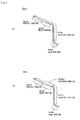
- the overlapping width and area (N1) of the extended portion 2012b1 of the contact main portion 2012b of the contact 201b overlapping the contact main portion 2012a of the contact 201a is approximately twice as large as each overlapping width and area (N2) of the ends of contact main portions of any other two contacts for differential signaling (i.e., the outer end and the inner end in each triangular set-for example, an end of the contact main portion 2032a of the contact 203a and an end of the contact main portion 2022b of the contact 202b that are next to each other).
- adjustment is made to the width and area of the contact main portion 2012b of the contact 201b, in accordance with the difference in impedance from other signal contacts with respect to common ground contacts.
- This structure prevents reduction in capacitance between the contact 201a and the contact 201b that should have been created due to the location of the contact 201a at the outmost end of the upper group of contacts 200a and absence of a neighboring common ground contact. Consequently, it becomes possible to suppress variation in impedance within the differential pair located at the outmost end of the groups of contacts, providing matched impedances.
- impedance can be matched within the differential pair at an outmost end of the groups of contacts without adding a dummy ground contact or changing the shape of the shield cover 300 as has been previously described. Matched impedances within each pair should result in matched impedances among the differential pairs. Accordingly, the transmission characteristics of the electric connector can be improved without increase in costs.
- any change in design can be made to the above-described electric connector as long as it includes an insulative body and groups of contacts disposed in spaced relationship inside the body, the contacts being arranged in at least two rows in a lateral direction of the body, as long as the groups of contacts include a plurality of first contacts; and a plurality of second contacts located in a different row from a row where their associated first contacts exist, the second contacts being arranged next to the first contacts, and as long as, out of one of the first contacts and one of the second contacts subject to impedance tuning, one of these two contacts has a width and an area thereof adjusted in accordance with a difference in impedance from impedances between other first and second contacts.
- the present invention is not limited thereto.
- the width and area of the main portion 2012a of the contact 201a which is a signal contact, may be reduced as compared with other signal contacts, thereby preventing reduction in capacitance between the contacts 201a and 201b to match the impedances.
- the contacts subject to impedance tuning are the contacts 201a, 202a, and 201b that are the differential pair and the common ground contact thereof at the outermost end in the groups of contacts, the present invention is not limited thereto. That is, contacts subject to impedance tuning may be appropriately selected depending on the arrangement of the contacts.
- the present electric connector can be applied to an electric connector for unbalanced (single-ended) signaling. More particularly, adjustment may be made to a single-ended signal contact and a ground contact thereof subject to impedance tuning, by adjusting a width and area of one of these two contacts in accordance with the difference in impedance from another set of a single-ended signal contact and a ground contact.
- the geometry of the contacts is not limited to one described in the above-described embodiment, and any change in design can be made.
- the arrangement design of the contacts can be changed as appropriate, so long as the contacts are arranged with spacing in at least two rows in the lateral direction inside the body.
- the present electric connector is an electric connector for differential signaling
- the contact arrangement may be modified such that, for example, a plurality of positive and negative signal contacts is arranged in a first row, and a plurality of common ground contacts is arranged in a second row.
- the contacts can also be arranged such that their widthwise ends do not overlap one another in their plain positions.
- the above electric connector is described as a receptacle, it may alternatively be a plug having contacts connected to a cable.
Landscapes
- Details Of Connecting Devices For Male And Female Coupling (AREA)
Applications Claiming Priority (1)
| Application Number | Priority Date | Filing Date | Title |
|---|---|---|---|
| JP2007184049A JP4932626B2 (ja) | 2007-07-13 | 2007-07-13 | 電気コネクタ |
Publications (3)
| Publication Number | Publication Date |
|---|---|
| EP2015402A2 true EP2015402A2 (de) | 2009-01-14 |
| EP2015402A3 EP2015402A3 (de) | 2013-02-13 |
| EP2015402B1 EP2015402B1 (de) | 2014-03-19 |
Family
ID=39863086
Family Applications (1)
| Application Number | Title | Priority Date | Filing Date |
|---|---|---|---|
| EP08252372.1A Ceased EP2015402B1 (de) | 2007-07-13 | 2008-07-11 | Elektrischer Steckverbinder |
Country Status (6)
| Country | Link |
|---|---|
| US (1) | US7670199B2 (de) |
| EP (1) | EP2015402B1 (de) |
| JP (1) | JP4932626B2 (de) |
| KR (1) | KR101383140B1 (de) |
| CN (1) | CN101345374B (de) |
| TW (1) | TWI433396B (de) |
Cited By (6)
| Publication number | Priority date | Publication date | Assignee | Title |
|---|---|---|---|---|
| EP2270932A1 (de) * | 2009-06-29 | 2011-01-05 | Hosiden Corporation | Mehrpoliger Steckverbinder |
| EP2339702A1 (de) * | 2009-12-25 | 2011-06-29 | Hosiden Corporation | Steckverbinder |
| EP2373131A1 (de) * | 2010-03-31 | 2011-10-05 | Hosiden Corporation | Steckverbinder und Leiterplattenfußstruktur für einen Verbinder |
| EP2393167A2 (de) * | 2010-06-01 | 2011-12-07 | Hosiden Corporation | Steckverbinder |
| EP2621025A1 (de) * | 2012-01-26 | 2013-07-31 | Hosiden Corporation | Kontaktimpedanzeinstellverfahren, Kontakt und Verbinder damit |
| LU503495B1 (de) * | 2023-02-16 | 2024-08-19 | Phoenix Contact Gmbh & Co | Steckverbinderteil und Steckverbindersystem |
Families Citing this family (25)
| Publication number | Priority date | Publication date | Assignee | Title |
|---|---|---|---|---|
| CN201117870Y (zh) * | 2007-11-12 | 2008-09-17 | 富士康(昆山)电脑接插件有限公司 | 电连接器 |
| JP4647675B2 (ja) * | 2008-07-22 | 2011-03-09 | ホシデン株式会社 | コネクタ |
| TWM357080U (en) * | 2008-12-24 | 2009-05-11 | Advanced Connectek Inc | Socket connector |
| JP4795444B2 (ja) * | 2009-02-09 | 2011-10-19 | ホシデン株式会社 | コネクタ |
| JP2010244901A (ja) * | 2009-04-07 | 2010-10-28 | Japan Aviation Electronics Industry Ltd | コネクタ |
| WO2011100740A2 (en) | 2010-02-15 | 2011-08-18 | Molex Incorporated | Differentially coupled connector |
| JP5554619B2 (ja) * | 2010-04-13 | 2014-07-23 | 富士通コンポーネント株式会社 | コネクタ |
| WO2011130465A2 (en) * | 2010-04-14 | 2011-10-20 | Molex Incorporated | Stacked connector |
| JP2012054215A (ja) | 2010-09-03 | 2012-03-15 | Yazaki Corp | コネクタ |
| JP5727902B2 (ja) * | 2011-09-13 | 2015-06-03 | ホシデン株式会社 | コネクタ |
| WO2013048918A1 (en) * | 2011-09-28 | 2013-04-04 | 3M Innovative Properties Company | Electrical contact and connector |
| JP5605378B2 (ja) * | 2012-01-18 | 2014-10-15 | Smk株式会社 | 電気コネクタ |
| JP5699110B2 (ja) * | 2012-05-28 | 2015-04-08 | 京セラコネクタプロダクツ株式会社 | コネクタ |
| MY174133A (en) * | 2013-01-16 | 2020-03-10 | Molex Inc | Bi-directional latch |
| JP6133107B2 (ja) * | 2013-04-08 | 2017-05-24 | 日本航空電子工業株式会社 | プラグコネクタ |
| EP2821988A1 (de) * | 2013-07-02 | 2015-01-07 | Samsung Electronics Co., Ltd | Verbinder zur Reduzierung von Nahnebensprechen |
| JP6206713B2 (ja) * | 2013-10-01 | 2017-10-04 | パナソニックIpマネジメント株式会社 | コネクタ |
| CN104158025A (zh) * | 2014-08-26 | 2014-11-19 | 苏州祥龙嘉业电子科技有限公司 | 用于传输高清数字信号的连接器母头 |
| KR102096440B1 (ko) * | 2014-09-25 | 2020-04-02 | 엘에스엠트론 주식회사 | 컨택트 어레이의 구조가 개선된 리셉터클 커넥터 |
| CN104518321B (zh) * | 2014-11-27 | 2023-05-05 | 连展科技电子(昆山)有限公司 | 插头电连接器 |
| CN107206896B (zh) * | 2014-12-22 | 2021-03-05 | 大众汽车有限公司 | 手指板条和手指板条的应用 |
| CN104538797B (zh) * | 2014-12-23 | 2023-11-17 | 连展科技电子(昆山)有限公司 | 防干扰插头电连接器 |
| CN205882228U (zh) * | 2016-07-27 | 2017-01-11 | 广东欧珀移动通信有限公司 | 电源接口、移动终端及电源适配器 |
| CN111224269B (zh) * | 2020-01-13 | 2021-05-25 | 番禺得意精密电子工业有限公司 | 电连接器 |
| TWI867446B (zh) * | 2023-02-23 | 2024-12-21 | 國立臺北科技大學 | 改善連接器共振問題及差動阻抗值的方法 |
Citations (1)
| Publication number | Priority date | Publication date | Assignee | Title |
|---|---|---|---|---|
| WO2001006602A1 (en) | 1999-07-16 | 2001-01-25 | Molex Incorporated | Impedance-tuned connector |
Family Cites Families (9)
| Publication number | Priority date | Publication date | Assignee | Title |
|---|---|---|---|---|
| US6439931B1 (en) * | 1998-05-13 | 2002-08-27 | Molex Incorporated | Method and structure for tuning the impedance of electrical terminals |
| US6454605B1 (en) * | 1999-07-16 | 2002-09-24 | Molex Incorporated | Impedance-tuned termination assembly and connectors incorporating same |
| TW456619U (en) * | 1999-07-16 | 2001-09-21 | Molex Inc | Impedance-tuned termination assembly and connectors incorporating same |
| US6368155B1 (en) * | 1999-07-16 | 2002-04-09 | Molex Incorporated | Intelligent sensing connectors |
| JP3495007B2 (ja) * | 2001-03-14 | 2004-02-09 | 日本航空電子工業株式会社 | 高速伝送用コネクタ |
| EP1391012A1 (de) * | 2001-08-01 | 2004-02-25 | Molex Incorporated | Impedanz-abgestimmter verbinder |
| WO2004001907A1 (en) * | 2002-06-21 | 2003-12-31 | Molex Incorporated | High-density, impedance-tuned connector having modular construction |
| JP2007080782A (ja) * | 2005-09-16 | 2007-03-29 | Japan Aviation Electronics Industry Ltd | 電気コネクタ |
| CN101162806B (zh) * | 2006-10-12 | 2011-01-12 | 富士康(昆山)电脑接插件有限公司 | 电连接器 |
-
2007
- 2007-07-13 JP JP2007184049A patent/JP4932626B2/ja active Active
-
2008
- 2008-05-19 TW TW097118382A patent/TWI433396B/zh active
- 2008-06-24 US US12/144,965 patent/US7670199B2/en active Active
- 2008-06-27 KR KR1020080061824A patent/KR101383140B1/ko active Active
- 2008-07-11 CN CN2008101303326A patent/CN101345374B/zh not_active Expired - Fee Related
- 2008-07-11 EP EP08252372.1A patent/EP2015402B1/de not_active Ceased
Patent Citations (2)
| Publication number | Priority date | Publication date | Assignee | Title |
|---|---|---|---|---|
| WO2001006602A1 (en) | 1999-07-16 | 2001-01-25 | Molex Incorporated | Impedance-tuned connector |
| JP2003505826A (ja) | 1999-07-16 | 2003-02-12 | モレックス インコーポレーテッド | インピーダンスが調整されたコネクタ |
Cited By (15)
| Publication number | Priority date | Publication date | Assignee | Title |
|---|---|---|---|---|
| US8376783B2 (en) | 2009-06-29 | 2013-02-19 | Hosiden Corporation | Multipolar connector |
| EP2270932A1 (de) * | 2009-06-29 | 2011-01-05 | Hosiden Corporation | Mehrpoliger Steckverbinder |
| EP2339702A1 (de) * | 2009-12-25 | 2011-06-29 | Hosiden Corporation | Steckverbinder |
| CN102157857A (zh) * | 2009-12-25 | 2011-08-17 | 星电株式会社 | 连接器 |
| CN102157857B (zh) * | 2009-12-25 | 2014-08-13 | 星电株式会社 | 连接器 |
| US8672711B2 (en) | 2009-12-25 | 2014-03-18 | Hosiden Corporation | Connector including a shield case and a contact at least a part of the contact adjacent to a part of the shield case |
| EP2373131A1 (de) * | 2010-03-31 | 2011-10-05 | Hosiden Corporation | Steckverbinder und Leiterplattenfußstruktur für einen Verbinder |
| US8342863B2 (en) | 2010-03-31 | 2013-01-01 | Hosiden Corporation | Connector and printed circuit board foot pattern for a connector |
| CN102255200A (zh) * | 2010-03-31 | 2011-11-23 | 星电株式会社 | 连接器和连接器用印刷电路板引脚图案 |
| CN102255200B (zh) * | 2010-03-31 | 2014-12-24 | 星电株式会社 | 连接器和连接器用印刷电路板引脚图案 |
| EP2393167A2 (de) * | 2010-06-01 | 2011-12-07 | Hosiden Corporation | Steckverbinder |
| EP2621025A1 (de) * | 2012-01-26 | 2013-07-31 | Hosiden Corporation | Kontaktimpedanzeinstellverfahren, Kontakt und Verbinder damit |
| US9225135B2 (en) | 2012-01-26 | 2015-12-29 | Hosiden Corporation | Contact impedance adjusting method, contact, and connector having the same |
| LU503495B1 (de) * | 2023-02-16 | 2024-08-19 | Phoenix Contact Gmbh & Co | Steckverbinderteil und Steckverbindersystem |
| WO2024170391A1 (de) * | 2023-02-16 | 2024-08-22 | Phoenix Contact Gmbh & Co. Kg | Steckverbinderteil und steckverbindersystem |
Also Published As
| Publication number | Publication date |
|---|---|
| US7670199B2 (en) | 2010-03-02 |
| JP2009021152A (ja) | 2009-01-29 |
| EP2015402B1 (de) | 2014-03-19 |
| TWI433396B (zh) | 2014-04-01 |
| US20090017646A1 (en) | 2009-01-15 |
| KR20090007213A (ko) | 2009-01-16 |
| CN101345374B (zh) | 2012-10-10 |
| TW200908453A (en) | 2009-02-16 |
| JP4932626B2 (ja) | 2012-05-16 |
| CN101345374A (zh) | 2009-01-14 |
| KR101383140B1 (ko) | 2014-04-09 |
| EP2015402A3 (de) | 2013-02-13 |
Similar Documents
| Publication | Publication Date | Title |
|---|---|---|
| EP2015402B1 (de) | Elektrischer Steckverbinder | |
| EP2015401B1 (de) | Elektrischer Steckverbinder | |
| US7473138B2 (en) | Electrical connector | |
| US5376018A (en) | High-density cable connector | |
| US6379188B1 (en) | Differential signal electrical connectors | |
| JP3685210B2 (ja) | コネクタ | |
| US8157573B2 (en) | Connector | |
| US9787039B2 (en) | Electrical connector with low-stress, reduced-electrical-length contacts | |
| DE69021828T2 (de) | Kabelverbinder mit niedriger Induktanzbahn. | |
| US6270358B1 (en) | Low-voltage male connector | |
| US7354300B2 (en) | Connector | |
| US10224675B2 (en) | Compensation structure for characteristics of network plug | |
| EP0994535B1 (de) | Modularer Steckverbinder mit verringertem Übersprechen | |
| JPH0635415Y2 (ja) | コネクタ | |
| KR0121794Y1 (ko) | 분로식 전기 커넥터 | |
| EP1603202A1 (de) | Plattenmontierter elektrischer Verbinder | |
| KR20130081196A (ko) | 커넥터 | |
| EP2015400B1 (de) | Kontakt und elektrischer Steckverbinder damit | |
| EP2538498B1 (de) | Anschluss und Signalleitungsstruktur | |
| US20130196541A1 (en) | Contact impedance adjusting method, contact, and connector having the same | |
| US20020013095A1 (en) | Connector having a shield for signal contacts | |
| KR102645369B1 (ko) | 모듈식 회로 기판 플러그 커넥터들의 배열체 | |
| US6851981B2 (en) | Terminal block with ground contact for connecting to adjacent terminal block | |
| KR102575274B1 (ko) | 리셉터클 커넥터의 단자 배치구조 |
Legal Events
| Date | Code | Title | Description |
|---|---|---|---|
| PUAI | Public reference made under article 153(3) epc to a published international application that has entered the european phase |
Free format text: ORIGINAL CODE: 0009012 |
|
| AK | Designated contracting states |
Kind code of ref document: A2 Designated state(s): AT BE BG CH CY CZ DE DK EE ES FI FR GB GR HR HU IE IS IT LI LT LU LV MC MT NL NO PL PT RO SE SI SK TR |
|
| AX | Request for extension of the european patent |
Extension state: AL BA MK RS |
|
| PUAL | Search report despatched |
Free format text: ORIGINAL CODE: 0009013 |
|
| AK | Designated contracting states |
Kind code of ref document: A3 Designated state(s): AT BE BG CH CY CZ DE DK EE ES FI FR GB GR HR HU IE IS IT LI LT LU LV MC MT NL NO PL PT RO SE SI SK TR |
|
| AX | Request for extension of the european patent |
Extension state: AL BA MK RS |
|
| 17P | Request for examination filed |
Effective date: 20130726 |
|
| RBV | Designated contracting states (corrected) |
Designated state(s): AT BE BG CH CY CZ DE DK EE ES FI FR GB GR HR HU IE IS IT LI LT LU LV MC MT NL NO PL PT RO SE SI SK TR |
|
| AKX | Designation fees paid |
Designated state(s): DE FR GB |
|
| REG | Reference to a national code |
Ref country code: DE Ref legal event code: R079 Ref document number: 602008030945 Country of ref document: DE Free format text: PREVIOUS MAIN CLASS: H01R0012200000 Ipc: H01R0013647400 |
|
| GRAP | Despatch of communication of intention to grant a patent |
Free format text: ORIGINAL CODE: EPIDOSNIGR1 |
|
| RIC1 | Information provided on ipc code assigned before grant |
Ipc: H01R 13/6474 20110101AFI20131021BHEP |
|
| INTG | Intention to grant announced |
Effective date: 20131111 |
|
| GRAS | Grant fee paid |
Free format text: ORIGINAL CODE: EPIDOSNIGR3 |
|
| GRAA | (expected) grant |
Free format text: ORIGINAL CODE: 0009210 |
|
| AK | Designated contracting states |
Kind code of ref document: B1 Designated state(s): DE FR GB |
|
| REG | Reference to a national code |
Ref country code: GB Ref legal event code: FG4D |
|
| REG | Reference to a national code |
Ref country code: DE Ref legal event code: R096 Ref document number: 602008030945 Country of ref document: DE Effective date: 20140430 |
|
| REG | Reference to a national code |
Ref country code: DE Ref legal event code: R097 Ref document number: 602008030945 Country of ref document: DE |
|
| PLBE | No opposition filed within time limit |
Free format text: ORIGINAL CODE: 0009261 |
|
| STAA | Information on the status of an ep patent application or granted ep patent |
Free format text: STATUS: NO OPPOSITION FILED WITHIN TIME LIMIT |
|
| 26N | No opposition filed |
Effective date: 20141222 |
|
| REG | Reference to a national code |
Ref country code: DE Ref legal event code: R097 Ref document number: 602008030945 Country of ref document: DE Effective date: 20141222 |
|
| REG | Reference to a national code |
Ref country code: FR Ref legal event code: PLFP Year of fee payment: 9 |
|
| REG | Reference to a national code |
Ref country code: FR Ref legal event code: PLFP Year of fee payment: 10 |
|
| REG | Reference to a national code |
Ref country code: FR Ref legal event code: PLFP Year of fee payment: 11 |
|
| REG | Reference to a national code |
Ref country code: DE Ref legal event code: R082 Ref document number: 602008030945 Country of ref document: DE Representative=s name: ETL IP PATENTANWALTSGESELLSCHAFT MBH, DE Ref country code: DE Ref legal event code: R082 Ref document number: 602008030945 Country of ref document: DE Representative=s name: ETL IP PATENT- UND RECHTSANWALTSGESELLSCHAFT M, DE Ref country code: DE Ref legal event code: R082 Ref document number: 602008030945 Country of ref document: DE Representative=s name: ETL WABLAT & KOLLEGEN PATENT- UND RECHTSANWALT, DE |
|
| REG | Reference to a national code |
Ref country code: DE Ref legal event code: R082 Ref document number: 602008030945 Country of ref document: DE Representative=s name: ETL IP PATENTANWALTSGESELLSCHAFT MBH, DE Ref country code: DE Ref legal event code: R082 Ref document number: 602008030945 Country of ref document: DE Representative=s name: ETL IP PATENT- UND RECHTSANWALTSGESELLSCHAFT M, DE |
|
| PGFP | Annual fee paid to national office [announced via postgrant information from national office to epo] |
Ref country code: GB Payment date: 20220606 Year of fee payment: 15 |
|
| PGFP | Annual fee paid to national office [announced via postgrant information from national office to epo] |
Ref country code: FR Payment date: 20220609 Year of fee payment: 15 |
|
| PGFP | Annual fee paid to national office [announced via postgrant information from national office to epo] |
Ref country code: DE Payment date: 20220531 Year of fee payment: 15 |
|
| REG | Reference to a national code |
Ref country code: DE Ref legal event code: R119 Ref document number: 602008030945 Country of ref document: DE |
|
| GBPC | Gb: european patent ceased through non-payment of renewal fee |
Effective date: 20230711 |
|
| PG25 | Lapsed in a contracting state [announced via postgrant information from national office to epo] |
Ref country code: DE Free format text: LAPSE BECAUSE OF NON-PAYMENT OF DUE FEES Effective date: 20240201 Ref country code: GB Free format text: LAPSE BECAUSE OF NON-PAYMENT OF DUE FEES Effective date: 20230711 |
|
| PG25 | Lapsed in a contracting state [announced via postgrant information from national office to epo] |
Ref country code: FR Free format text: LAPSE BECAUSE OF NON-PAYMENT OF DUE FEES Effective date: 20230731 |