EP2015461A2 - Impulsstörungsdetektion und -milderung in Empfängern - Google Patents
Impulsstörungsdetektion und -milderung in Empfängern Download PDFInfo
- Publication number
- EP2015461A2 EP2015461A2 EP08252329A EP08252329A EP2015461A2 EP 2015461 A2 EP2015461 A2 EP 2015461A2 EP 08252329 A EP08252329 A EP 08252329A EP 08252329 A EP08252329 A EP 08252329A EP 2015461 A2 EP2015461 A2 EP 2015461A2
- Authority
- EP
- European Patent Office
- Prior art keywords
- sample
- bit stream
- impulse noise
- predicted value
- difference
- Prior art date
- Legal status (The legal status is an assumption and is not a legal conclusion. Google has not performed a legal analysis and makes no representation as to the accuracy of the status listed.)
- Withdrawn
Links
- 230000000116 mitigating effect Effects 0.000 title claims abstract description 12
- 238000001514 detection method Methods 0.000 title claims description 14
- 238000000034 method Methods 0.000 claims abstract description 28
- 238000012545 processing Methods 0.000 claims description 9
- 238000005070 sampling Methods 0.000 claims description 3
- 230000000977 initiatory effect Effects 0.000 claims 2
- 238000004590 computer program Methods 0.000 abstract description 6
- 230000001629 suppression Effects 0.000 description 9
- 238000013459 approach Methods 0.000 description 4
- 238000012805 post-processing Methods 0.000 description 3
- 238000010586 diagram Methods 0.000 description 2
- 238000012886 linear function Methods 0.000 description 2
- XUIMIQQOPSSXEZ-UHFFFAOYSA-N Silicon Chemical compound [Si] XUIMIQQOPSSXEZ-UHFFFAOYSA-N 0.000 description 1
- 244000078534 Vaccinium myrtillus Species 0.000 description 1
- 235000021029 blackberry Nutrition 0.000 description 1
- 238000004891 communication Methods 0.000 description 1
- 239000004020 conductor Substances 0.000 description 1
- 230000003111 delayed effect Effects 0.000 description 1
- 238000013461 design Methods 0.000 description 1
- 230000000644 propagated effect Effects 0.000 description 1
- 238000012892 rational function Methods 0.000 description 1
- 229910052710 silicon Inorganic materials 0.000 description 1
- 239000010703 silicon Substances 0.000 description 1
- 230000001052 transient effect Effects 0.000 description 1
Images


Classifications
-
- H—ELECTRICITY
- H03—ELECTRONIC CIRCUITRY
- H03G—CONTROL OF AMPLIFICATION
- H03G3/00—Gain control in amplifiers or frequency changers
- H03G3/20—Automatic control
- H03G3/30—Automatic control in amplifiers having semiconductor devices
- H03G3/34—Muting amplifier when no signal is present
- H03G3/345—Muting during a short period of time when noise pulses are detected, i.e. blanking
Definitions
- the present disclosure generally relates to noise detection and mitigation.
- Noise refers to any unwanted aspects of a signal.
- the originally transmitted signal may include unwanted signals, such as interference, thermal noise, impulse noise, as well as other types of interference, which may be considered noise as well.
- Impulse noise is a type of noise characterized by a transient, a spike, or a burst.
- Impulse noise may be caused by electrical sources, such as lightning, electric motors, power switches, domestic lights, thermostats, gas lighters, car ignition systems, and anything that creates an abrupt change of current in a conductor.
- An antenna of a high definition television receiver may receive a high definition signal broadcast over-the-air.
- the received signal may include impulse noise caused by lightning, motors (e.g., a vacuum cleaner), and the like.
- the impulse noise corrupts the received signal introducing errors - resulting thus in errors in the decoded signal. From the perspective of a user of a high definition television receiver, these errors caused by impulse noise may result in degraded picture and sound quality. More worrisome, the user may, because of the degraded picture quality, regret purchasing the high definition television receiver. Therefore, there is a continuing need to improve the quality of the received signal by mitigating impulse noise.
- the subject matter disclosed herein provides methods and apparatus, including computer program products, for detecting and mitigating noise including impulse noise.
- noise suppressor to determine a predicted value for a sample in a bit stream, the predicted value determined without regard to an average of the bit stream.
- the noise suppressor may also detect whether impulse noise is present based on a difference between the predicted value and the sample.
- the noise suppressor may also identify the sample as impulse noise to enable the sample to be replaced with another value.
- the predicted value may be determined using a spline interpolation.
- the spline interpolation may use a first path for one or more even samples in the bit stream and a second path for one or more odd samples in the bit stream.
- the first and second paths may be recombined after a determination is made regarding whether impulse noise is present in the bit stream.
- the first path may process the one or more even samples in the bit steam by down sampling and interpolating the bit steam and determine the difference using the predicted sample obtained from the first path and the sample obtained from the second path.
- the detection of whether impulse noise is present may be based on whether the difference between the predicted sample and the sample exceeds a threshold. A threshold of 0.1 of the difference may be used.
- the other value may be determined as the predicted value, so that the sample may be replaced (e.g., inserted) with the determined value.
- the subject matter described herein may be implemented to realize the advantages of reducing and mitigating impulse noise associated with receivers, such as televisions, radios, and the like.
- FIG. 1 depicts a block diagram of an impulse noise detection and suppression system 100
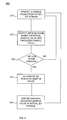
- FIG. 2 depicts a process 200 for detecting and suppressing impulse noise
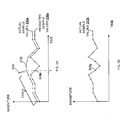
- FIG. 3a-b depict plots of predicted sample values and actual sample values
- FIG. 4 depicts an implementation of an impulse noise suppression module 120.
- FIG. 1 depicts a block diagram of an impulse noise detection and suppression system 100.
- Impulse noise detection and suppression system 100 may be incorporated into any type of receiver, such as the radio frequency (RF) front-end of a high definition digital television receiver, to detect and mitigate (i.e., suppress) impulse noise.
- Impulse noise detection and suppression system 100 includes an analog-to-digital converter/automatic gain control module 110, an impulse noise suppression module 120, and a post-processing module 130.
- the term “module” refers to a portion of impulse noise detection and suppression system 100.
- impulse noise detection and suppression system 100 including modules 110-130 may be implemented as hardware (e.g., an integrated circuit, Application Specific Integrated Circuit (ASIC), printed circuit board, etc.), software, firmware, and/or a combination of one or more of hardware, software, and firmware.
- hardware e.g., an integrated circuit, Application Specific Integrated Circuit (ASIC), printed circuit board, etc.
- software e.g., firmware
- firmware e.g., firmware, firmware, and/or a combination of one or more of hardware, software, and firmware.
- Analog-to-digital converter/automatic gain control module 110 may receive a signal, such as a radio frequency (RF) signal from an antenna or an intermediate frequency (IF) signal down converted (or tuned) from an antenna.
- RF radio frequency
- IF intermediate frequency
- An analog-to-digital converter included within module 110 may convert the received signal to a bit stream (also referred to as a "digital data stream,” “digital data,” or, simply, a "signal”).
- Analog-to-digital converter/automatic gain control module 110 may also include an automatic gain control feature for controlling the magnitude of the bit stream by providing gain. Automatic gain control controls the gain of an amplifier, so that the magnitude (e.g., voltage level) of the bit stream output by analog-to-digital converter/automatic gain control module 110 signal remains relatively stable for varying levels of input receive signal.
- the output of analog-to-digital converter/automatic gain control module 110 is a bit stream, such as a sequence of ones and zeroes (e.g., 10110), a time varying data signal having varying voltage levels, and the like.
- the output of analog-to-digital converter/automatic gain control module 110 may include impulse noise.
- impulse noise degrades the quality of the bit stream. Therefore, when the bit stream including impulse noise is decoded into audio and video, the decoded audio and video information includes noise - affecting the quality of the decoded audio and video information.
- Impulse noise suppressor 120 receives the bit stream and processes the bit stream to detect impulse noise and then suppress (i.e., mitigate), in whole or in part, the impulse noise when that noise is present in the bit stream.
- impulse noise suppressor 120 performs the process 200 depicted at FIG. 2 to detect and mitigate noise.
- impulse noise suppressor 120 receives a bit stream and predicts a sample value from the received bit stream (referred to as the "actual sample values").
- impulse noise suppressor 120 may use one or more of the following approaches: a bandpass filter may be used in the case of intermediate frequency (IF) signals (e.g., usually input to analog-to-digital converter); a lowpass filter may be used for baseband input (e.g., from silicon tuners); and analog characteristics of the signal may be use as well.
- IF intermediate frequency
- baseband input e.g., from silicon tuners
- the low pass filter averages one or more of values from actual sample values to provide a predicted sample value.
- an interpolator such as a spline interpolator, may offer enhanced results when compared to using a low pass filter alone.
- Interpolation generally refers to constructing predicted sample values from one or more actual sample values.
- an interpolation e.g., using linear functions
- a spline interpolation e.g., using linear functions
- a rational interpolation e.g., using interpolation by rational functions
- a trigonometric interpolation e.g., using interpolation by trigonometric polynomials, such as a discrete Fourier transform or a wavelet
- Whittaker-Shannon interpolation e.g., bilinear, bicubic, and trilinear amongst others.
- Spline interpolation uses low-degree polynomials as the interpolant rather than the linear function used with linear interpolation.
- a spline interpolation is used as described further below with respect to FIG. 4 .
- the use of a spline interpolation may offer enhanced results (e.g., improved detection of impulse noise), when compared to using only a low pass filter to determine predicted sample values.
- impulse noise suppressor 120 uses one or more actual sample values to determine a predicted sample value.
- impulse noise suppressor 120 detects whether impulse noise is present in the bit stream based on the predicted sample value and the actual sample value. To detect whether impulse noise is present, impulse noise suppressor 120 may determine a difference between the predicted sample value and the actual sample value. When the difference exceeds a threshold, the actual sample value is likely to be impulse noise.
- the threshold may be implemented in a variety of ways including as a predetermined threshold value determined heuristically, a threshold value set as 1/10 the value of the overall range of actual sample values, and a threshold value set at 1 standard deviation from the mean power.
- impulse noise suppressor 120 may resume processing at 210 of FIG. 2 .
- impulse noise suppressor 120 determines an adjusted sample value.
- the adjusted sample value is another value used to replace (e.g., adjust, insert, etc.) the actual sample value in the bit stream considered likely to be impulse noise. For example, impulse noise suppressor 120 may determine that an actual sample value is likely to be impulse noise. Impulse noise suppressor 120 may then determine an adjusted sample value.
- the adjusted sample value may be determined using one or more of the following: a predicted sample value determined at 210, an average of one or more actual sample values, and a predetermined value.
- the determined adjusted sample value is then used instead of the actual sample value.
- impulse noise suppressor 120 may replace the actual sample value with the adjusted sample value.
- Impulse noise suppressor 120 may repeat process 200 for one or more values in the bit stream received by impulse noise suppressor 120.
- the output bit stream of impulse noise suppressor 120 may, as a consequence of process 200, have fewer values corrupted by impulse noise, when compared to other approaches.
- FIG. 3A depicts a plot of the bit stream 312a received at impulse noise suppressor 120.
- the bit stream 310a may be in the form of voltage values, binary coded information, or any other form.
- the bit stream 312a includes one or more actual sample values, such as values 312a-j.
- FIG. 3A also includes a set of predicted sample values 310a.
- impulse noise suppressor 120 determines a predicted sample value 310b using bit stream 312a. For example, at time t, impulse noise suppressor 120 predicts sample value 310b corresponding to actual sample value 312i. To make that prediction, impulse noise suppressor 120 may use a spline interpolation based on one or more of the actual sample values in bit stream 312a.
- impulse noise suppressor 120 detects whether actual sample value 312i is impulse noise by comparing the difference between actual sample value 312i and predicted sample value 310b determined based on spline interpolation. If the difference exceeds a threshold, impulse noise suppressor 120 determines that actual sample value 312i is impulse noise.
- impulse noise suppressor 120 determines an adjusted value for actual sample 312i.
- the difference may exceed the threshold, so impulse noise suppressor 120 determines an adjusted value to use instead of sample 312i, which is likely to be impulse noise.
- impulse noise suppressor 120 may use the predicted sample value 310b as the adjusted value and replace 312i with the predicted sample value of 310b.
- FIG. 3B depicts the bit stream 312z output by impulse noise suppressor 120.
- the bit stream 312z represents bit stream 312a after impulse noise suppressor 120 uses process 200 on the sample values in the bit stream 312a.
- Sample value 312y is the value that replaced sample 312i in the bit stream.
- Impulse noise suppressor 120 may repeat process 200 for actual sample 312j as well as other values in bit stream 312a to mitigate impulse noise in bit stream 312a.
- post processing module 130 may include a rate converter (also referred to as a timing block) to convert the bit stream output by impulse noise suppressor 120 to another format.
- the bit stream output by impulse noise suppressor 120 may be converted from an over sampled bit stream (i.e., in terms of the Nyquist rate) to an under sampled bit steam (i.e., lower than the Nyquist rate) before being provided to other components of the receiver.
- FIG. 4 depicts an example implementation of impulse noise suppressor 120. Specifically, FIG. 4 depicts impulse noise suppressor 120 implemented using spline interpolation, although other forms of prediction may be used as well.
- the bit stream received by impulse noise suppressor 120 is split into two paths.
- the first path includes a down sample module 410a, an interpolator 412a, an upsampler 490a, and a difference and threshold module 414a.
- the second path includes a delay module 408, a down sample module 410b, an interpolator 412b, an upsampler 490b, and a difference and threshold module 414b.
- a feature of impulse noise suppression module 120 is the use of two paths, so that the first path can process some of the samples in the bit stream (e.g., even samples), while the second path can process the other samples in the bit stream (e.g., odd samples).
- the delay module 416 and summer 418 combine the first and second paths and provide them as an output of impulse noise suppressor 120.
- the upsamplers 490a and b are used to upsample to an appropriate rate the output of difference and threshold modules 419a and b.
- the first path is down sampled (e.g., every other sample value is discarded or ignored) by down sample module 410a.
- Interpolator module 412a uses splines to interpolate the down sampled bit stream provided by down sample module 410a.
- the difference and threshold module 414a determines the difference between the output of interpolator 412a and output of down sample module 410b.
- the output of interpolator 412a represents a predicted sample value, while the output 440a of down sample module 410b represents an actual sample value, although delayed by delay module 408. If difference and threshold module 414a determines that the difference exceeds a threshold, difference and threshold module 414a replaces the actual sample value in the bit stream with an adjusted value (e.g., a predetermined value, the predicted sample value, and the like).
- Interpolator module 412b uses splines to interpolate the down sampled bit stream provided by down sample module 410b.
- the difference and threshold module 414b determines the difference between the output of interpolator 412b and output of down sample module 410a.
- the output of interpolator 412b represents a predicted sample value, while the output 440b of down sample module 410a represents an actual sample value. If difference and threshold module 414b determines that the difference exceeds a threshold, difference and threshold module 414b replaces the actual sample value in the bit stream with an adjusted value (e.g., a predetermined value, the predicted sample value, and the like).
- the interpolators 412a and 412b may be implemented using a simple filter-based spline interpolation technique with very low filter orders that can be realized in hardware, although software and firmware implementations may be used as well. Simple algorithms for filter-based spline interpolations are described in " B-Spline Signal Processing: Part I - Theory," M. Unser et al., IEEE Trans. Signal Processing, vol. 41, pp. 821-833, Feb. 1993 , and " B-Spline Signal Processing: Part 2 - Design and Applications,” M. Unser et al., IEEE Trans. Signal Processing, vol. 41, pp. 834 -848, Feb. 1993 , the contents of both of which are hereby incorporate herein by reference. Moreover, the spline interpolation filter coefficients may be programmable, so that signals with different characteristics (such as VSB, QAM, and OFDM) may be processed with the same hardware.
- impulse noise suppressor 120 is associated with (e.g., includes) an application programming interface (API), which can be called by a device, such as a user interface, computer, and the like.
- API application programming interface
- the device may call (by sending a message or other form of indication) the API of impulse noise suppressor 120 to initiate detection and mitigation of impulse noise by impulse noise suppressor 120 and to disable detection and mitigation of impulse noise by impulse noise suppressor 120.
- the subject matter disclosed herein may be implemented to detect and mitigate noise including impulse noise.
- the subject matter disclosed herein may also be with a data stream that has been over sampled, with respect to the Nyquist rate, although the subject matter described herein may also be used in non-over sampled bit streams as well.
- a signal is over sampled with an analog-to-digital converter at a rate higher than the Nyquist rate, there may be correlation between neighboring samples in the bit steam.
- This correlation may be used to detect the presence of impulse noise by, as described above, predicting a sample value from adjacent sample values by applying a smoothness constraint (e.g., spline interpolation); detecting impulse noise by comparing the difference between the actual sample value and the predicted sample value; and then applying a threshold.
- a smoothness constraint e.g., spline interpolation
- impulse noise suppressor 120 in the context of a receiver (and, more particularly, in the context of a high definition television receiver), the implementations described above may be used in any environment including, for example, a radio, a digital satellite radio, a mobile wireless device (e.g., a mobile phone), wireless-enabled personal digital assistants (e.g., Blackberries), home media players (e.g., Slingbox), GPS receivers, digital ship-to-shore communication links, and the like.
- a radio e.g., a mobile phone
- wireless-enabled personal digital assistants e.g., Blackberries
- home media players e.g., Slingbox
- GPS receivers digital ship-to-shore communication links
- FIGs. 1-4 have been simplified to include only some of the aspects that may be included in system 100, impulse noise suppressor 120, or process 200.
- the systems and methods disclosed herein may be implemented as a computer program product, i.e., a computer program tangibly embodied in an information carrier, e.g., in a machine readable storage device or in a propagated signal, for execution by, or to control the operation of, data processing apparatus, e.g., a programmable processor, a computer, or multiple computers.
- a computer program can be written in any form of programming language, including compiled or interpreted languages, and it can be deployed in any form, including as a stand-alone program or as a module, component, subroutine, or other unit suitable for use in a computing environment.
Landscapes
- Noise Elimination (AREA)
- Testing, Inspecting, Measuring Of Stereoscopic Televisions And Televisions (AREA)
Applications Claiming Priority (1)
| Application Number | Priority Date | Filing Date | Title |
|---|---|---|---|
| US11/775,836 US20090016471A1 (en) | 2007-07-10 | 2007-07-10 | Impulse Noise Detection and Mitigation In Receivers |
Publications (2)
| Publication Number | Publication Date |
|---|---|
| EP2015461A2 true EP2015461A2 (de) | 2009-01-14 |
| EP2015461A3 EP2015461A3 (de) | 2010-07-07 |
Family
ID=39884249
Family Applications (1)
| Application Number | Title | Priority Date | Filing Date |
|---|---|---|---|
| EP08252329A Withdrawn EP2015461A3 (de) | 2007-07-10 | 2008-07-08 | Impulsstörungsdetektion und -milderung in Empfängern |
Country Status (2)
| Country | Link |
|---|---|
| US (1) | US20090016471A1 (de) |
| EP (1) | EP2015461A3 (de) |
Cited By (2)
| Publication number | Priority date | Publication date | Assignee | Title |
|---|---|---|---|---|
| WO2010097359A1 (en) * | 2009-02-26 | 2010-09-02 | Telefonaktiebolaget L M Ericsson (Publ) | Reducing switching noise |
| CN107517057A (zh) * | 2016-06-15 | 2017-12-26 | 晨星半导体股份有限公司 | 脉冲噪声侦测电路与方法 |
Families Citing this family (8)
| Publication number | Priority date | Publication date | Assignee | Title |
|---|---|---|---|---|
| JP5245622B2 (ja) * | 2008-07-31 | 2013-07-24 | 富士通株式会社 | ノイズ検出装置及びノイズ検出方法 |
| KR101423111B1 (ko) * | 2010-08-10 | 2014-07-30 | 창원대학교 산학협력단 | 밴드 패스 샘플링 수신기 |
| US8812416B2 (en) * | 2011-11-08 | 2014-08-19 | Nokia Corporation | Predictive service for third party application developers |
| US9641361B2 (en) * | 2013-11-19 | 2017-05-02 | Electronics And Telecommunications Research Institute | Sub-sampling receiver |
| TWI593238B (zh) * | 2016-05-17 | 2017-07-21 | 晨星半導體股份有限公司 | 脈衝雜訊偵測電路與方法 |
| US9634680B1 (en) | 2016-10-24 | 2017-04-25 | Keysight Technologies, Inc. | Large-error detection and correction of digital sample sequence from analog-to-digital converter |
| TWI640196B (zh) * | 2017-04-12 | 2018-11-01 | 晨星半導體股份有限公司 | 應用於顯示裝置的電路及相關的訊號處理方法 |
| CN115102563B (zh) * | 2022-07-22 | 2023-06-06 | 北京中宸微电子有限公司 | 一种电力线载波接收机脉冲噪声消除方法及系统 |
Family Cites Families (9)
| Publication number | Priority date | Publication date | Assignee | Title |
|---|---|---|---|---|
| US4587620A (en) * | 1981-05-09 | 1986-05-06 | Nippon Gakki Seizo Kabushiki Kaisha | Noise elimination device |
| US5136531A (en) * | 1991-08-05 | 1992-08-04 | Motorola, Inc. | Method and apparatus for detecting a wideband tone |
| JP2919685B2 (ja) * | 1992-11-02 | 1999-07-12 | シャープ株式会社 | 信号識別回路 |
| US6104992A (en) * | 1998-08-24 | 2000-08-15 | Conexant Systems, Inc. | Adaptive gain reduction to produce fixed codebook target signal |
| GB0214729D0 (en) * | 2002-06-26 | 2002-08-07 | Koninkl Philips Electronics Nv | Digital receiver arrangement and related method |
| WO2005008194A2 (en) * | 2003-07-14 | 2005-01-27 | The Government Of The United States Of America As Represented By The Secretary Of The Department Of Health And Human Services, Centers For Disease Control And Prevention | System for monitoring exposure to impulse noise |
| US20050075866A1 (en) * | 2003-10-06 | 2005-04-07 | Bernard Widrow | Speech enhancement in the presence of background noise |
| WO2006063361A2 (en) * | 2004-12-08 | 2006-06-15 | Guide Technology | Periodic jitter (pj) measurement methodology |
| US7558337B2 (en) * | 2005-08-12 | 2009-07-07 | Ati Technologies, Inc. | Systems, methods, and apparatus for impulse noise mitigation |
-
2007
- 2007-07-10 US US11/775,836 patent/US20090016471A1/en not_active Abandoned
-
2008
- 2008-07-08 EP EP08252329A patent/EP2015461A3/de not_active Withdrawn
Non-Patent Citations (2)
| Title |
|---|
| M. UNSER ET AL.: "B-Spline Signal Processing: Part 2 - Design and Applications", IEEE TRANS. SIGNAL PROCESSING, vol. 41, February 1993 (1993-02-01), pages 834 - 848, XP000346026, DOI: doi:10.1109/78.193221 |
| M. UNSER ET AL.: "B-Spline Signal Processing: Part I - Theory", IEEE TRANS. SIGNAL PROCESSING, vol. 41, February 1993 (1993-02-01), pages 821 - 833 |
Cited By (3)
| Publication number | Priority date | Publication date | Assignee | Title |
|---|---|---|---|---|
| WO2010097359A1 (en) * | 2009-02-26 | 2010-09-02 | Telefonaktiebolaget L M Ericsson (Publ) | Reducing switching noise |
| US8582700B2 (en) | 2009-02-26 | 2013-11-12 | Telefonaktiebolaget L M Ericsson (Publ) | Reducing switching noise |
| CN107517057A (zh) * | 2016-06-15 | 2017-12-26 | 晨星半导体股份有限公司 | 脉冲噪声侦测电路与方法 |
Also Published As
| Publication number | Publication date |
|---|---|
| US20090016471A1 (en) | 2009-01-15 |
| EP2015461A3 (de) | 2010-07-07 |
Similar Documents
| Publication | Publication Date | Title |
|---|---|---|
| US20090016471A1 (en) | Impulse Noise Detection and Mitigation In Receivers | |
| JP5139445B2 (ja) | 無線通信のための妨害信号検出及び抑制 | |
| US7519122B2 (en) | OFDM reception apparatus and OFDM reception method | |
| KR100816609B1 (ko) | 오에프디엠 수신장치 및 오에프디엠 수신방법 | |
| WO2003088538A1 (en) | Receiver and its receiving method | |
| JP2004166200A (ja) | 受信装置 | |
| US6201576B1 (en) | Apparatus and method for detecting an NTSC signal in an HDTV transmission signal | |
| US8526899B2 (en) | Broadcast receiving apparatus and method of determining presence of noise performed by broadcast receiving apparatus | |
| RU2531256C2 (ru) | Устройство приема, способ приема и программа | |
| US11381267B1 (en) | System, apparatus and method for cancelling tonal interference in an orthogonal frequency division multiplexing (OFDM) receiver | |
| CN101563850A (zh) | 用于确定性地减少信号干扰的技术 | |
| US8498597B2 (en) | Broadcast receiving apparatus and method of detecting noise components performed by broadcast receiving apparatus | |
| US11336317B2 (en) | Radio communication system, interference suppression method, control circuit, and program storage medium | |
| US7852958B2 (en) | Receiving apparatus, integrated circuit and receiving method | |
| JP5337804B2 (ja) | 多重搬送波受信機に使用する自己適応型周波数補間器 | |
| US20080292036A1 (en) | Method and Device for Signal Processing | |
| JP2008278363A (ja) | デジタル放送受信装置 | |
| US8437260B2 (en) | Victim system detector, method of detecting a victim system, wireless communication device and wireless communication method | |
| JP2012039169A (ja) | 高周波受信装置及び無線受信機 | |
| JP2008312027A (ja) | 受信装置及び受信方法 | |
| CN108781087B (zh) | 用于通过多项式插值来限制无线电噪声、尤其是fm带中的无线电噪声的方法 | |
| US20100279642A1 (en) | Diversity receiver and diversity reception method | |
| JP2011041060A (ja) | 受信装置 | |
| JP2009182596A (ja) | 受信装置 | |
| JP2005333528A (ja) | 妨害波除去装置 |
Legal Events
| Date | Code | Title | Description |
|---|---|---|---|
| PUAI | Public reference made under article 153(3) epc to a published international application that has entered the european phase |
Free format text: ORIGINAL CODE: 0009012 |
|
| 17P | Request for examination filed |
Effective date: 20080715 |
|
| AK | Designated contracting states |
Kind code of ref document: A2 Designated state(s): AT BE BG CH CY CZ DE DK EE ES FI FR GB GR HR HU IE IS IT LI LT LU LV MC MT NL NO PL PT RO SE SI SK TR |
|
| AX | Request for extension of the european patent |
Extension state: AL BA MK RS |
|
| RAP1 | Party data changed (applicant data changed or rights of an application transferred) |
Owner name: BROADCOM CORPORATION |
|
| PUAL | Search report despatched |
Free format text: ORIGINAL CODE: 0009013 |
|
| AK | Designated contracting states |
Kind code of ref document: A3 Designated state(s): AT BE BG CH CY CZ DE DK EE ES FI FR GB GR HR HU IE IS IT LI LT LU LV MC MT NL NO PL PT RO SE SI SK TR |
|
| AX | Request for extension of the european patent |
Extension state: AL BA MK RS |
|
| AKX | Designation fees paid |
Designated state(s): AT BE BG CH CY CZ DE DK EE ES FI FR GB GR HR HU IE IS IT LI LT LU LV MC MT NL NO PL PT RO SE SI SK TR |
|
| STAA | Information on the status of an ep patent application or granted ep patent |
Free format text: STATUS: THE APPLICATION IS DEEMED TO BE WITHDRAWN |
|
| 18D | Application deemed to be withdrawn |
Effective date: 20110108 |