EP2016188B1 - Procédés pour la détection d'adn méthylé - Google Patents
Procédés pour la détection d'adn méthylé Download PDFInfo
- Publication number
- EP2016188B1 EP2016188B1 EP06771406.3A EP06771406A EP2016188B1 EP 2016188 B1 EP2016188 B1 EP 2016188B1 EP 06771406 A EP06771406 A EP 06771406A EP 2016188 B1 EP2016188 B1 EP 2016188B1
- Authority
- EP
- European Patent Office
- Prior art keywords
- dna
- bisulfite
- denaturation
- conversion
- bisulfite conversion
- Prior art date
- Legal status (The legal status is an assumption and is not a legal conclusion. Google has not performed a legal analysis and makes no representation as to the accuracy of the status listed.)
- Not-in-force
Links
- 238000000034 method Methods 0.000 title claims description 73
- 238000001514 detection method Methods 0.000 title description 8
- LSNNMFCWUKXFEE-UHFFFAOYSA-M Bisulfite Chemical compound OS([O-])=O LSNNMFCWUKXFEE-UHFFFAOYSA-M 0.000 claims description 134
- 238000006243 chemical reaction Methods 0.000 claims description 117
- 238000004925 denaturation Methods 0.000 claims description 69
- 230000036425 denaturation Effects 0.000 claims description 69
- 238000011534 incubation Methods 0.000 claims description 34
- ZMXDDKWLCZADIW-UHFFFAOYSA-N N,N-Dimethylformamide Chemical compound CN(C)C=O ZMXDDKWLCZADIW-UHFFFAOYSA-N 0.000 claims description 29
- 239000003153 chemical reaction reagent Substances 0.000 claims description 22
- 239000011159 matrix material Substances 0.000 claims description 20
- 239000007787 solid Substances 0.000 claims description 20
- 238000004458 analytical method Methods 0.000 claims description 18
- QIGBRXMKCJKVMJ-UHFFFAOYSA-N Hydroquinone Chemical compound OC1=CC=C(O)C=C1 QIGBRXMKCJKVMJ-UHFFFAOYSA-N 0.000 claims description 17
- 238000003508 chemical denaturation Methods 0.000 claims description 12
- 230000007067 DNA methylation Effects 0.000 claims description 10
- 239000003795 chemical substances by application Substances 0.000 claims description 10
- 239000000126 substance Substances 0.000 claims description 10
- PEDCQBHIVMGVHV-UHFFFAOYSA-N Glycerine Chemical compound OCC(O)CO PEDCQBHIVMGVHV-UHFFFAOYSA-N 0.000 claims description 9
- XSQUKJJJFZCRTK-UHFFFAOYSA-N Urea Chemical compound NC(N)=O XSQUKJJJFZCRTK-UHFFFAOYSA-N 0.000 claims description 7
- 239000007864 aqueous solution Substances 0.000 claims description 5
- 239000004202 carbamide Substances 0.000 claims description 4
- 239000003638 chemical reducing agent Substances 0.000 claims description 3
- 108020004414 DNA Proteins 0.000 description 170
- HEMHJVSKTPXQMS-UHFFFAOYSA-M Sodium hydroxide Chemical compound [OH-].[Na+] HEMHJVSKTPXQMS-UHFFFAOYSA-M 0.000 description 63
- 239000000523 sample Substances 0.000 description 46
- 230000006326 desulfonation Effects 0.000 description 34
- 238000005869 desulfonation reaction Methods 0.000 description 34
- 239000000243 solution Substances 0.000 description 25
- LFQSCWFLJHTTHZ-UHFFFAOYSA-N Ethanol Chemical compound CCO LFQSCWFLJHTTHZ-UHFFFAOYSA-N 0.000 description 24
- 230000011987 methylation Effects 0.000 description 23
- 238000007069 methylation reaction Methods 0.000 description 23
- VYPSYNLAJGMNEJ-UHFFFAOYSA-N Silicium dioxide Chemical compound O=[Si]=O VYPSYNLAJGMNEJ-UHFFFAOYSA-N 0.000 description 21
- OPTASPLRGRRNAP-UHFFFAOYSA-N cytosine Natural products NC=1C=CNC(=O)N=1 OPTASPLRGRRNAP-UHFFFAOYSA-N 0.000 description 21
- ISAKRJDGNUQOIC-UHFFFAOYSA-N Uracil Chemical compound O=C1C=CNC(=O)N1 ISAKRJDGNUQOIC-UHFFFAOYSA-N 0.000 description 20
- 102000053602 DNA Human genes 0.000 description 19
- 239000002585 base Substances 0.000 description 17
- 238000010828 elution Methods 0.000 description 13
- 230000008569 process Effects 0.000 description 12
- 108020004682 Single-Stranded DNA Proteins 0.000 description 11
- 239000013612 plasmid Substances 0.000 description 11
- 239000011347 resin Substances 0.000 description 11
- 229920005989 resin Polymers 0.000 description 11
- 229940035893 uracil Drugs 0.000 description 10
- 239000000872 buffer Substances 0.000 description 9
- XLYOFNOQVPJJNP-UHFFFAOYSA-N water Chemical compound O XLYOFNOQVPJJNP-UHFFFAOYSA-N 0.000 description 9
- 238000012986 modification Methods 0.000 description 8
- 230000004048 modification Effects 0.000 description 8
- 238000011084 recovery Methods 0.000 description 8
- 239000000377 silicon dioxide Substances 0.000 description 8
- 238000002474 experimental method Methods 0.000 description 7
- 239000011534 wash buffer Substances 0.000 description 7
- 229910001868 water Inorganic materials 0.000 description 7
- 230000015556 catabolic process Effects 0.000 description 6
- 229940104302 cytosine Drugs 0.000 description 6
- 238000006731 degradation reaction Methods 0.000 description 6
- KWYUFKZDYYNOTN-UHFFFAOYSA-M Potassium hydroxide Chemical compound [OH-].[K+] KWYUFKZDYYNOTN-UHFFFAOYSA-M 0.000 description 5
- DWAQJAXMDSEUJJ-UHFFFAOYSA-M Sodium bisulfite Chemical compound [Na+].OS([O-])=O DWAQJAXMDSEUJJ-UHFFFAOYSA-M 0.000 description 5
- 230000009615 deamination Effects 0.000 description 5
- 238000006481 deamination reaction Methods 0.000 description 5
- 229960004198 guanidine Drugs 0.000 description 5
- 235000010267 sodium hydrogen sulphite Nutrition 0.000 description 5
- 238000006277 sulfonation reaction Methods 0.000 description 5
- 238000005382 thermal cycling Methods 0.000 description 5
- ZHNUHDYFZUAESO-UHFFFAOYSA-N Formamide Chemical compound NC=O ZHNUHDYFZUAESO-UHFFFAOYSA-N 0.000 description 4
- 239000007983 Tris buffer Substances 0.000 description 4
- 239000003513 alkali Substances 0.000 description 4
- 230000000692 anti-sense effect Effects 0.000 description 4
- 239000012148 binding buffer Substances 0.000 description 4
- 238000005251 capillar electrophoresis Methods 0.000 description 4
- 239000012149 elution buffer Substances 0.000 description 4
- PJJJBBJSCAKJQF-UHFFFAOYSA-N guanidinium chloride Chemical compound [Cl-].NC(N)=[NH2+] PJJJBBJSCAKJQF-UHFFFAOYSA-N 0.000 description 4
- 238000004128 high performance liquid chromatography Methods 0.000 description 4
- 239000000463 material Substances 0.000 description 4
- 238000007855 methylation-specific PCR Methods 0.000 description 4
- 238000001556 precipitation Methods 0.000 description 4
- 108091008146 restriction endonucleases Proteins 0.000 description 4
- HRZFUMHJMZEROT-UHFFFAOYSA-L sodium disulfite Chemical compound [Na+].[Na+].[O-]S(=O)S([O-])(=O)=O HRZFUMHJMZEROT-UHFFFAOYSA-L 0.000 description 4
- 238000001179 sorption measurement Methods 0.000 description 4
- PFNFFQXMRSDOHW-UHFFFAOYSA-N spermine Chemical compound NCCCNCCCCNCCCN PFNFFQXMRSDOHW-UHFFFAOYSA-N 0.000 description 4
- RWQNBRDOKXIBIV-UHFFFAOYSA-N thymine Chemical compound CC1=CNC(=O)NC1=O RWQNBRDOKXIBIV-UHFFFAOYSA-N 0.000 description 4
- LENZDBCJOHFCAS-UHFFFAOYSA-N tris Chemical compound OCC(N)(CO)CO LENZDBCJOHFCAS-UHFFFAOYSA-N 0.000 description 4
- LRSASMSXMSNRBT-UHFFFAOYSA-N 5-methylcytosine Chemical compound CC1=CNC(=O)N=C1N LRSASMSXMSNRBT-UHFFFAOYSA-N 0.000 description 3
- 241000972773 Aulopiformes Species 0.000 description 3
- 101000995194 Homo sapiens Nebulette Proteins 0.000 description 3
- 229910004879 Na2S2O5 Inorganic materials 0.000 description 3
- 102100034431 Nebulette Human genes 0.000 description 3
- 206010028980 Neoplasm Diseases 0.000 description 3
- DBMJMQXJHONAFJ-UHFFFAOYSA-M Sodium laurylsulphate Chemical compound [Na+].CCCCCCCCCCCCOS([O-])(=O)=O DBMJMQXJHONAFJ-UHFFFAOYSA-M 0.000 description 3
- LSNNMFCWUKXFEE-UHFFFAOYSA-N Sulfurous acid Chemical class OS(O)=O LSNNMFCWUKXFEE-UHFFFAOYSA-N 0.000 description 3
- 238000003556 assay Methods 0.000 description 3
- 239000011324 bead Substances 0.000 description 3
- 239000011230 binding agent Substances 0.000 description 3
- 201000011510 cancer Diseases 0.000 description 3
- 210000004027 cell Anatomy 0.000 description 3
- 230000003196 chaotropic effect Effects 0.000 description 3
- 239000013043 chemical agent Substances 0.000 description 3
- 238000011109 contamination Methods 0.000 description 3
- 230000029087 digestion Effects 0.000 description 3
- 239000013024 dilution buffer Substances 0.000 description 3
- 208000037265 diseases, disorders, signs and symptoms Diseases 0.000 description 3
- 239000012634 fragment Substances 0.000 description 3
- 238000003505 heat denaturation Methods 0.000 description 3
- 239000003550 marker Substances 0.000 description 3
- 239000012528 membrane Substances 0.000 description 3
- 108090000623 proteins and genes Proteins 0.000 description 3
- 238000000746 purification Methods 0.000 description 3
- 238000011160 research Methods 0.000 description 3
- 235000019515 salmon Nutrition 0.000 description 3
- 238000012163 sequencing technique Methods 0.000 description 3
- 229940083575 sodium dodecyl sulfate Drugs 0.000 description 3
- 235000019333 sodium laurylsulphate Nutrition 0.000 description 3
- 238000003860 storage Methods 0.000 description 3
- 241000894006 Bacteria Species 0.000 description 2
- KCXVZYZYPLLWCC-UHFFFAOYSA-N EDTA Chemical compound OC(=O)CN(CC(O)=O)CCN(CC(O)=O)CC(O)=O KCXVZYZYPLLWCC-UHFFFAOYSA-N 0.000 description 2
- 241000206602 Eukaryota Species 0.000 description 2
- WHXSMMKQMYFTQS-UHFFFAOYSA-N Lithium Chemical compound [Li] WHXSMMKQMYFTQS-UHFFFAOYSA-N 0.000 description 2
- WMFOQBRAJBCJND-UHFFFAOYSA-M Lithium hydroxide Chemical compound [Li+].[OH-] WMFOQBRAJBCJND-UHFFFAOYSA-M 0.000 description 2
- 108091028043 Nucleic acid sequence Proteins 0.000 description 2
- ZLMJMSJWJFRBEC-UHFFFAOYSA-N Potassium Chemical compound [K] ZLMJMSJWJFRBEC-UHFFFAOYSA-N 0.000 description 2
- 239000011543 agarose gel Substances 0.000 description 2
- 150000008044 alkali metal hydroxides Chemical class 0.000 description 2
- 239000003963 antioxidant agent Substances 0.000 description 2
- 230000003078 antioxidant effect Effects 0.000 description 2
- 239000003637 basic solution Substances 0.000 description 2
- 230000008901 benefit Effects 0.000 description 2
- 230000027455 binding Effects 0.000 description 2
- 230000015572 biosynthetic process Effects 0.000 description 2
- 229910052799 carbon Inorganic materials 0.000 description 2
- 238000004587 chromatography analysis Methods 0.000 description 2
- 125000004122 cyclic group Chemical group 0.000 description 2
- VUIKXKJIWVOSMF-GHTOIXBYSA-N d(CG)12 Chemical compound O=C1N=C(N)C=CN1[C@@H]1O[C@H](CO)[C@@H](OP(O)(=O)OC[C@@H]2[C@H](C[C@@H](O2)N2C3=C(C(NC(N)=N3)=O)N=C2)OP(O)(=O)OC[C@@H]2[C@H](C[C@@H](O2)N2C(N=C(N)C=C2)=O)OP(O)(=O)OC[C@@H]2[C@H](C[C@@H](O2)N2C3=C(C(NC(N)=N3)=O)N=C2)OP(O)(=O)OC[C@@H]2[C@H](C[C@@H](O2)N2C(N=C(N)C=C2)=O)OP(O)(=O)OC[C@@H]2[C@H](C[C@@H](O2)N2C3=C(C(NC(N)=N3)=O)N=C2)OP(O)(=O)OC[C@@H]2[C@H](C[C@@H](O2)N2C(N=C(N)C=C2)=O)OP(O)(=O)OC[C@@H]2[C@H](C[C@@H](O2)N2C3=C(C(NC(N)=N3)=O)N=C2)OP(O)(=O)OC[C@@H]2[C@H](C[C@@H](O2)N2C(N=C(N)C=C2)=O)OP(O)(=O)OC[C@@H]2[C@H](C[C@@H](O2)N2C3=C(C(NC(N)=N3)=O)N=C2)OP(O)(=O)OC[C@@H]2[C@H](C[C@@H](O2)N2C(N=C(N)C=C2)=O)OP(O)(=O)OC[C@@H]2[C@H](C[C@@H](O2)N2C3=C(C(NC(N)=N3)=O)N=C2)OP(O)(=O)OC[C@@H]2[C@H](C[C@@H](O2)N2C(N=C(N)C=C2)=O)OP(O)(=O)OC[C@@H]2[C@H](C[C@@H](O2)N2C3=C(C(NC(N)=N3)=O)N=C2)OP(O)(=O)OC[C@@H]2[C@H](C[C@@H](O2)N2C(N=C(N)C=C2)=O)OP(O)(=O)OC[C@@H]2[C@H](C[C@@H](O2)N2C3=C(C(NC(N)=N3)=O)N=C2)OP(O)(=O)OC[C@@H]2[C@H](C[C@@H](O2)N2C(N=C(N)C=C2)=O)OP(O)(=O)OC[C@@H]2[C@H](C[C@@H](O2)N2C3=C(C(NC(N)=N3)=O)N=C2)OP(O)(=O)OC[C@@H]2[C@H](C[C@@H](O2)N2C(N=C(N)C=C2)=O)OP(O)(=O)OC[C@@H]2[C@H](C[C@@H](O2)N2C3=C(C(NC(N)=N3)=O)N=C2)OP(O)(=O)OC[C@@H]2[C@H](C[C@@H](O2)N2C(N=C(N)C=C2)=O)OP(O)(=O)OC[C@@H]2[C@H](C[C@@H](O2)N2C3=C(C(NC(N)=N3)=O)N=C2)OP(O)(=O)OC[C@@H]2[C@H](C[C@@H](O2)N2C(N=C(N)C=C2)=O)OP(O)(=O)OC[C@@H]2[C@H](C[C@@H](O2)N2C3=C(C(NC(N)=N3)=O)N=C2)O)C1 VUIKXKJIWVOSMF-GHTOIXBYSA-N 0.000 description 2
- 230000003247 decreasing effect Effects 0.000 description 2
- 230000001419 dependent effect Effects 0.000 description 2
- 239000003599 detergent Substances 0.000 description 2
- 238000003745 diagnosis Methods 0.000 description 2
- 125000004177 diethyl group Chemical group [H]C([H])([H])C([H])([H])* 0.000 description 2
- 201000010099 disease Diseases 0.000 description 2
- 238000005516 engineering process Methods 0.000 description 2
- 239000003365 glass fiber Substances 0.000 description 2
- ZRALSGWEFCBTJO-UHFFFAOYSA-N guanidine group Chemical group NC(=N)N ZRALSGWEFCBTJO-UHFFFAOYSA-N 0.000 description 2
- 150000002357 guanidines Chemical class 0.000 description 2
- 230000006872 improvement Effects 0.000 description 2
- 229910052744 lithium Inorganic materials 0.000 description 2
- 239000002773 nucleotide Substances 0.000 description 2
- 125000003729 nucleotide group Chemical group 0.000 description 2
- -1 perchlortate Chemical compound 0.000 description 2
- 229920000768 polyamine Polymers 0.000 description 2
- 229910052700 potassium Inorganic materials 0.000 description 2
- 239000011591 potassium Substances 0.000 description 2
- 238000012545 processing Methods 0.000 description 2
- 230000014493 regulation of gene expression Effects 0.000 description 2
- 239000000741 silica gel Substances 0.000 description 2
- 229910002027 silica gel Inorganic materials 0.000 description 2
- 229940063675 spermine Drugs 0.000 description 2
- 238000010561 standard procedure Methods 0.000 description 2
- 239000008223 sterile water Substances 0.000 description 2
- BDHFUVZGWQCTTF-UHFFFAOYSA-M sulfonate Chemical compound [O-]S(=O)=O BDHFUVZGWQCTTF-UHFFFAOYSA-M 0.000 description 2
- 239000004094 surface-active agent Substances 0.000 description 2
- 229940113082 thymine Drugs 0.000 description 2
- QKNYBSVHEMOAJP-UHFFFAOYSA-N 2-amino-2-(hydroxymethyl)propane-1,3-diol;hydron;chloride Chemical compound Cl.OCC(N)(CO)CO QKNYBSVHEMOAJP-UHFFFAOYSA-N 0.000 description 1
- BFSVOASYOCHEOV-UHFFFAOYSA-N 2-diethylaminoethanol Chemical compound CCN(CC)CCO BFSVOASYOCHEOV-UHFFFAOYSA-N 0.000 description 1
- FWMNVWWHGCHHJJ-SKKKGAJSSA-N 4-amino-1-[(2r)-6-amino-2-[[(2r)-2-[[(2r)-2-[[(2r)-2-amino-3-phenylpropanoyl]amino]-3-phenylpropanoyl]amino]-4-methylpentanoyl]amino]hexanoyl]piperidine-4-carboxylic acid Chemical compound C([C@H](C(=O)N[C@H](CC(C)C)C(=O)N[C@H](CCCCN)C(=O)N1CCC(N)(CC1)C(O)=O)NC(=O)[C@H](N)CC=1C=CC=CC=1)C1=CC=CC=C1 FWMNVWWHGCHHJJ-SKKKGAJSSA-N 0.000 description 1
- FJNCXZZQNBKEJT-UHFFFAOYSA-N 8beta-hydroxymarrubiin Natural products O1C(=O)C2(C)CCCC3(C)C2C1CC(C)(O)C3(O)CCC=1C=COC=1 FJNCXZZQNBKEJT-UHFFFAOYSA-N 0.000 description 1
- 229920000936 Agarose Polymers 0.000 description 1
- QGZKDVFQNNGYKY-UHFFFAOYSA-O Ammonium Chemical compound [NH4+] QGZKDVFQNNGYKY-UHFFFAOYSA-O 0.000 description 1
- 208000031295 Animal disease Diseases 0.000 description 1
- OYPRJOBELJOOCE-UHFFFAOYSA-N Calcium Chemical compound [Ca] OYPRJOBELJOOCE-UHFFFAOYSA-N 0.000 description 1
- OKTJSMMVPCPJKN-UHFFFAOYSA-N Carbon Chemical compound [C] OKTJSMMVPCPJKN-UHFFFAOYSA-N 0.000 description 1
- 208000005623 Carcinogenesis Diseases 0.000 description 1
- 238000007445 Chromatographic isolation Methods 0.000 description 1
- 238000007399 DNA isolation Methods 0.000 description 1
- 238000001712 DNA sequencing Methods 0.000 description 1
- 230000004568 DNA-binding Effects 0.000 description 1
- 108700024394 Exon Proteins 0.000 description 1
- DGAQECJNVWCQMB-PUAWFVPOSA-M Ilexoside XXIX Chemical compound C[C@@H]1CC[C@@]2(CC[C@@]3(C(=CC[C@H]4[C@]3(CC[C@@H]5[C@@]4(CC[C@@H](C5(C)C)OS(=O)(=O)[O-])C)C)[C@@H]2[C@]1(C)O)C)C(=O)O[C@H]6[C@@H]([C@H]([C@@H]([C@H](O6)CO)O)O)O.[Na+] DGAQECJNVWCQMB-PUAWFVPOSA-M 0.000 description 1
- 208000026350 Inborn Genetic disease Diseases 0.000 description 1
- FYYHWMGAXLPEAU-UHFFFAOYSA-N Magnesium Chemical compound [Mg] FYYHWMGAXLPEAU-UHFFFAOYSA-N 0.000 description 1
- 241000124008 Mammalia Species 0.000 description 1
- 241001465754 Metazoa Species 0.000 description 1
- GMPKIPWJBDOURN-UHFFFAOYSA-N Methoxyamine Chemical compound CON GMPKIPWJBDOURN-UHFFFAOYSA-N 0.000 description 1
- 108060004795 Methyltransferase Proteins 0.000 description 1
- 102000016397 Methyltransferase Human genes 0.000 description 1
- CHJJGSNFBQVOTG-UHFFFAOYSA-N N-methyl-guanidine Natural products CNC(N)=N CHJJGSNFBQVOTG-UHFFFAOYSA-N 0.000 description 1
- 238000012408 PCR amplification Methods 0.000 description 1
- 229920001213 Polysorbate 20 Polymers 0.000 description 1
- 210000001766 X chromosome Anatomy 0.000 description 1
- 230000001594 aberrant effect Effects 0.000 description 1
- 230000006978 adaptation Effects 0.000 description 1
- 230000002411 adverse Effects 0.000 description 1
- 238000000246 agarose gel electrophoresis Methods 0.000 description 1
- 229910001854 alkali hydroxide Inorganic materials 0.000 description 1
- 239000002269 analeptic agent Substances 0.000 description 1
- 238000005349 anion exchange Methods 0.000 description 1
- 238000004166 bioassay Methods 0.000 description 1
- 229910052792 caesium Inorganic materials 0.000 description 1
- TVFDJXOCXUVLDH-UHFFFAOYSA-N caesium atom Chemical compound [Cs] TVFDJXOCXUVLDH-UHFFFAOYSA-N 0.000 description 1
- 239000011575 calcium Substances 0.000 description 1
- 229910052791 calcium Inorganic materials 0.000 description 1
- 230000036952 cancer formation Effects 0.000 description 1
- GZBKCIJLEXDUOL-UHFFFAOYSA-N carbamimidoylazanium;hydron;sulfite Chemical compound NC(N)=N.OS(O)=O GZBKCIJLEXDUOL-UHFFFAOYSA-N 0.000 description 1
- 231100000504 carcinogenesis Toxicity 0.000 description 1
- 230000001413 cellular effect Effects 0.000 description 1
- 238000005119 centrifugation Methods 0.000 description 1
- 230000008859 change Effects 0.000 description 1
- 238000011210 chromatographic step Methods 0.000 description 1
- 150000001875 compounds Chemical class 0.000 description 1
- 239000012468 concentrated sample Substances 0.000 description 1
- 238000010924 continuous production Methods 0.000 description 1
- 230000001351 cycling effect Effects 0.000 description 1
- 239000003398 denaturant Substances 0.000 description 1
- 238000010790 dilution Methods 0.000 description 1
- 239000012895 dilution Substances 0.000 description 1
- SWSQBOPZIKWTGO-UHFFFAOYSA-N dimethylaminoamidine Natural products CN(C)C(N)=N SWSQBOPZIKWTGO-UHFFFAOYSA-N 0.000 description 1
- 208000035475 disorder Diseases 0.000 description 1
- 230000000694 effects Effects 0.000 description 1
- 238000001962 electrophoresis Methods 0.000 description 1
- 230000013020 embryo development Effects 0.000 description 1
- 230000007717 exclusion Effects 0.000 description 1
- 239000011888 foil Substances 0.000 description 1
- 239000000499 gel Substances 0.000 description 1
- 230000014509 gene expression Effects 0.000 description 1
- 230000030279 gene silencing Effects 0.000 description 1
- 238000012226 gene silencing method Methods 0.000 description 1
- 208000016361 genetic disease Diseases 0.000 description 1
- ZRALSGWEFCBTJO-UHFFFAOYSA-O guanidinium Chemical compound NC(N)=[NH2+] ZRALSGWEFCBTJO-UHFFFAOYSA-O 0.000 description 1
- 229910052739 hydrogen Inorganic materials 0.000 description 1
- 239000001257 hydrogen Substances 0.000 description 1
- 125000004435 hydrogen atom Chemical group [H]* 0.000 description 1
- XMBWDFGMSWQBCA-UHFFFAOYSA-N hydrogen iodide Chemical compound I XMBWDFGMSWQBCA-UHFFFAOYSA-N 0.000 description 1
- QAOWNCQODCNURD-UHFFFAOYSA-M hydrogensulfate Chemical compound OS([O-])(=O)=O QAOWNCQODCNURD-UHFFFAOYSA-M 0.000 description 1
- 230000002209 hydrophobic effect Effects 0.000 description 1
- 230000003100 immobilizing effect Effects 0.000 description 1
- 230000003993 interaction Effects 0.000 description 1
- 230000002452 interceptive effect Effects 0.000 description 1
- 238000005342 ion exchange Methods 0.000 description 1
- 239000003456 ion exchange resin Substances 0.000 description 1
- 229920003303 ion-exchange polymer Polymers 0.000 description 1
- 238000002955 isolation Methods 0.000 description 1
- 230000000670 limiting effect Effects 0.000 description 1
- 239000011777 magnesium Substances 0.000 description 1
- 229910052749 magnesium Inorganic materials 0.000 description 1
- VTHJTEIRLNZDEV-UHFFFAOYSA-L magnesium dihydroxide Chemical compound [OH-].[OH-].[Mg+2] VTHJTEIRLNZDEV-UHFFFAOYSA-L 0.000 description 1
- 239000000347 magnesium hydroxide Substances 0.000 description 1
- 229910001862 magnesium hydroxide Inorganic materials 0.000 description 1
- LPHFLPKXBKBHRW-UHFFFAOYSA-L magnesium;hydrogen sulfite Chemical compound [Mg+2].OS([O-])=O.OS([O-])=O LPHFLPKXBKBHRW-UHFFFAOYSA-L 0.000 description 1
- WPBNNNQJVZRUHP-UHFFFAOYSA-L manganese(2+);methyl n-[[2-(methoxycarbonylcarbamothioylamino)phenyl]carbamothioyl]carbamate;n-[2-(sulfidocarbothioylamino)ethyl]carbamodithioate Chemical compound [Mn+2].[S-]C(=S)NCCNC([S-])=S.COC(=O)NC(=S)NC1=CC=CC=C1NC(=S)NC(=O)OC WPBNNNQJVZRUHP-UHFFFAOYSA-L 0.000 description 1
- 230000001404 mediated effect Effects 0.000 description 1
- 125000002496 methyl group Chemical group [H]C([H])([H])* 0.000 description 1
- 238000010208 microarray analysis Methods 0.000 description 1
- 239000000203 mixture Substances 0.000 description 1
- 238000010369 molecular cloning Methods 0.000 description 1
- 238000007899 nucleic acid hybridization Methods 0.000 description 1
- 238000001821 nucleic acid purification Methods 0.000 description 1
- 102000039446 nucleic acids Human genes 0.000 description 1
- 108020004707 nucleic acids Proteins 0.000 description 1
- 150000007523 nucleic acids Chemical class 0.000 description 1
- 239000013618 particulate matter Substances 0.000 description 1
- 239000000256 polyoxyethylene sorbitan monolaurate Substances 0.000 description 1
- 235000010486 polyoxyethylene sorbitan monolaurate Nutrition 0.000 description 1
- 238000002360 preparation method Methods 0.000 description 1
- 230000001737 promoting effect Effects 0.000 description 1
- 230000022983 regulation of cell cycle Effects 0.000 description 1
- 239000012047 saturated solution Substances 0.000 description 1
- 238000001542 size-exclusion chromatography Methods 0.000 description 1
- 239000011734 sodium Substances 0.000 description 1
- 229910052708 sodium Inorganic materials 0.000 description 1
- 229940001584 sodium metabisulfite Drugs 0.000 description 1
- 235000010262 sodium metabisulphite Nutrition 0.000 description 1
- 239000008247 solid mixture Substances 0.000 description 1
- 239000002904 solvent Substances 0.000 description 1
- 239000000021 stimulant Substances 0.000 description 1
- 238000010257 thawing Methods 0.000 description 1
- 210000001519 tissue Anatomy 0.000 description 1
- 238000012546 transfer Methods 0.000 description 1
- 229940066528 trichloroacetate Drugs 0.000 description 1
- YNJBWRMUSHSURL-UHFFFAOYSA-N trichloroacetic acid Chemical compound OC(=O)C(Cl)(Cl)Cl YNJBWRMUSHSURL-UHFFFAOYSA-N 0.000 description 1
- 238000003260 vortexing Methods 0.000 description 1
- 238000005406 washing Methods 0.000 description 1
Images



Classifications
-
- C—CHEMISTRY; METALLURGY
- C12—BIOCHEMISTRY; BEER; SPIRITS; WINE; VINEGAR; MICROBIOLOGY; ENZYMOLOGY; MUTATION OR GENETIC ENGINEERING
- C12Q—MEASURING OR TESTING PROCESSES INVOLVING ENZYMES, NUCLEIC ACIDS OR MICROORGANISMS; COMPOSITIONS OR TEST PAPERS THEREFOR; PROCESSES OF PREPARING SUCH COMPOSITIONS; CONDITION-RESPONSIVE CONTROL IN MICROBIOLOGICAL OR ENZYMOLOGICAL PROCESSES
- C12Q1/00—Measuring or testing processes involving enzymes, nucleic acids or microorganisms; Compositions therefor; Processes of preparing such compositions
- C12Q1/68—Measuring or testing processes involving enzymes, nucleic acids or microorganisms; Compositions therefor; Processes of preparing such compositions involving nucleic acids
- C12Q1/6806—Preparing nucleic acids for analysis, e.g. for polymerase chain reaction [PCR] assay
-
- C—CHEMISTRY; METALLURGY
- C12—BIOCHEMISTRY; BEER; SPIRITS; WINE; VINEGAR; MICROBIOLOGY; ENZYMOLOGY; MUTATION OR GENETIC ENGINEERING
- C12Q—MEASURING OR TESTING PROCESSES INVOLVING ENZYMES, NUCLEIC ACIDS OR MICROORGANISMS; COMPOSITIONS OR TEST PAPERS THEREFOR; PROCESSES OF PREPARING SUCH COMPOSITIONS; CONDITION-RESPONSIVE CONTROL IN MICROBIOLOGICAL OR ENZYMOLOGICAL PROCESSES
- C12Q1/00—Measuring or testing processes involving enzymes, nucleic acids or microorganisms; Compositions therefor; Processes of preparing such compositions
- C12Q1/68—Measuring or testing processes involving enzymes, nucleic acids or microorganisms; Compositions therefor; Processes of preparing such compositions involving nucleic acids
- C12Q1/6813—Hybridisation assays
- C12Q1/6827—Hybridisation assays for detection of mutation or polymorphism
Definitions
- the invention relates to the regulation of gene expression and more specifically to improved methods for determining the methylation status of specific DNA templates using the bisulfite method of methylation analysis.
- DNA methylation is a ubiquitous process in prokaryotes and eukaryotes.
- DNA methylation protects an organism's own DNA from restriction enzymes produced to digest foreign DNA.
- eukaryotes DNA methylation functions in the regulation of gene expression (Costello and Plass, 2001).
- Aberrant methylation is widespread in cancer and may be among the earliest changes to occur during oncogenesis (Stirzaker, 1997).
- DNA methylation has also been shown to play a central role in gene imprinting, embryonic development, X-chromosome gene-silencing, and cell-cycle regulation.
- DNA methylation In many plants and animals, DNA methylation consists of the addition of a methyl group to the fifth position carbon of the cytosine pyrimidine ring via a methyltransferase enzyme (Adams, 1995). The majority of DNA methylation in mammals occurs in 5'-CpG-3' dinucleotides but other methylation patterns have been described. Remarkably, about 80-percent of all 5'-CpG-3' dinucleotides found in mammalian genomes are methylated. Of the remaining 20-percent unmethylated dinucleotides, most are found within gene promoters and first exons.
- WO2004/067545 suggests in a method for bisulfite treatment of DNA a separate alkaline DNA denaturation step. Bisulfite conversion is performed for 1.5-3.5h between 70°C-90°C.
- US6960436 discloses a method for preparing a DNA template for methylation analysis comprising heat denaturation of double stranded DNA at variable temperatures. "For high molecular weight DNA, the denaturation temperature is generally greater than 90°C”. A cyclic protocol consisting of variable denaturation temperatures is suggested.
- the bisulfite conversion is consisting of two steps, the sulfonation and deamination for which cyclic conditions with changing temperatures are suggested.
- a preferred variant comprises a change of temperature from 4°C (10min) to 50°C (20min). It is mentioned that said chemical conversion can be performed in the presence of denaturing solvents.
- WO2005/054502 suggests use of guanidinium hydrogen sulfite without prior denaturation of DNA. Deamination of DNA is performed for 2h at 80°C.
- the invention provides a method for preparing DNA template for DNA methylation analysis.
- An important feature of the invention is the combined denaturation and bisulfite conversion, where cytosines are sulfonated and deaminated, using a high temperature.
- Some embodiments of the invention are coupled to in-column desulfonation of sample DNA for high yield recovery in a small elution volume.
- the temperature of denaturation is 96°C to 100°C.
- the high temperature is about 96°C.
- this high temperature incubation is the first of several different temperature incubations, some of which are described herein.
- the first high temperature incubation is followed by an additional incubation at a temperature of about 30°C to about 92°C.
- the additional incubation is at one or more temperatures of from about 37° to about 55°C.
- Some embodiments include a further or second additional incubation at a temperature from about 50°C to about 70°C. In one embodiment this temperatures of from about 37° to about 55°C.
- the combined denaturation and bisulfite conversion reaction is performed with the aid of a thermal cycling device; however, the present invention is not limited by this methodology or technology.
- Thermal cycling according to the following regime is used in some embodiments, but the invention is not limited to this particular scheme, program, or thermal cycling methodology:
- Steps 3-4 can be repeated for about 8 cycles.
- thermal cycling according to the following regime may improve results.
- the combined denaturation and bisulfite conversion is performed in the absence of added strong base to accomplish denaturation of the DNA template, including but not limited to sodium, potassium, lithium, cesium, and/or magnesium hydroxide.
- the pH of the combined denaturation and bisulfite conversion is about 7.0 or less, or even about 5.5 or less
- the combined denaturation and bisulfite conversion of the sample DNA may be performed in the presence or absence of one or more chemical agents that stimulate the conversion such as guanidine salts, diethyl triamine, spermine (polyamines), urea, glycerol, formamide, dimethylformamide (DMF), quinol, hydroquinol, 8-hydroxy quinone, or other like agents.
- these agents may be reducing or denaturing in character, but function to increase the efficiency of the bisulfite conversion reaction.
- the agent is the chemical agent DMF.
- DMF is used at concentrations from about 0.2 to about 40% of the bisulfite conversion solution, or final sample volume.
- the combined denaturation, bisulfite conversion, and desulfonation of the sample DNA may be performed in the presence or absence of a surfactant, such as sodium dodecylsulfate (SDS), TWEEN-20, NONIDET P-40, or other ionic and/or nonionic detergents, at a concentration sufficient to increase DNA denaturation efficiency at predetermined thermal denaturation conditions.
- a surfactant such as sodium dodecylsulfate (SDS), TWEEN-20, NONIDET P-40, or other ionic and/or nonionic detergents
- the solid matrix is the resin in a column.
- the resin is prepared from glass fiber, or like material, known in the art (e.g ., WHATMAN: type C and F glass fibers).
- the column may be adapted to assist in the handling of the adsorbed.
- the contemplated formats include columns suitable for use in standard centrifuges, microfuges (spin-columns), vacuum manifolds, or low or high pressure (HPLC, HPCE) modulated columns, all of which are commonly known in the art.
- the columns can be in a 96-well plate or strip format. In other embodiments columns in 384-well formats may be used.
- Such desulfonation is referred to herein as coupled in-column desulfonation.
- One embodiment of the invention is a method for preparing denatured, bisulfite converted, and desulfonated DNA template in a coupled process, the method comprising (a) performing combined denaturation and bisulfite conversion of the DNA by incubating at a temperature of from 96° to 100°C; (b) adsorbing the sulfonated DNA to a solid matrix; (c) desulphonating the adsorbed DNA on a solid matrix at a temperature from about 20°C to about 96°C; and (d) eluting the desulfonated DNA from the solid matrix.
- the elution is into a small volume of aqueous solution.
- the time of incubation at a given temperature may be adjusted to optimize denaturation, bisulfite conversion, and desulfonation.
- the solid matrix is in a column, or like device.
- the solid matrix comprises beads or membranes. In-column desulfonation is accomplished by passing a basic solution over the column.
- the combined single-reaction denaturation and bisulfite modification may be performed in the presence or absence of one or more chemical reducing or denaturing agent that stimulates the conversion (sulfonation/deamination).
- the presence of added strong base to facilitate denaturation before bisulfite reagent is added is not required.
- the use of heat alone in the presence of bisulfite and buffer mediates the denaturation and conversion in a single reaction saving significant time and also increasing overall efficiency.
- Another aspect of embodiments of the present invention is the use of a column for adsorbing DNA just subsequent to the combined thermal denaturation and bisulfite conversion modification at a high temperature.
- the column comprises a resin for binding or immobilizing the DNA during the coupled process.
- the column further allows efficient elution into small volumes of aqueous solutions.
- Solid matrix Beads, column matrix material (resin), membrane filter material, or other particulate matter to which DNA can be adsorbed for coupled desulfonation of denatured bisulfite converted (sulfonated/deaminated) DNA template.
- the solid matrix material should be stable for the limited time at high temperatures described herein.
- the solid matrix should also be stable in the presence of strong bases or denaturing agents, depending on the particular embodiment of the invention.
- Silica-based solid matrices are only one example.
- silica particles include, but are not limited to silica particles; silica resins; silica gel; hydrophobic-interaction silica resin; silica-embedded filters; magnetic silica particles; macroporous silica gel; and combinations thereof (Sambrook and Russel, 2001).
- modified silica materials and ion exchange resins may be used, either alone or in combinations, in the form of hybrid resins.
- Other mixed ion-exchange/adsorption chromatographic techniques have been commonly used in nucleic acid purification procedures and are suitable for use in additional embodiments. These include anion exchange (DEAE) and other hydrophobic interaction-based compounds.
- Preferred solid matrices simplify the handling of DNA samples.
- Particularly useful solid matrices are silica beads and membranes columns comprising a silica-based resin used in a column.
- a preferred column is a spin-column, which is used in embodiments described herein and in a commercially available product from ZYMO RESEARCH CORP.
- the column includes a narrow, tapered neck where silica resin material (or matrix) is contained.
- the configuration promotes efficient combined adsorption and desulfonation of the bisulfited converted DNA template for elution into a small volume.
- silica-based resin multi-well-plates are used, including, but not limited to 96-wells, or 384-wells, each well functioning as a column with a narrow tapered configuration that promotes efficient DNA template adsorption and desulfonation of DNA and elution into a small volume (ZYMO RESERCH CORP.).
- Such columns include a unique, tapered chamber bed for containing silica resin.
- These other embodiments contemplate use of similarly designed plates capable of use with, 96-well, 384-well, or greater number formats in automated high through-put analysis.
- a feature of these columns and plates is low-volume elution for allow the user to obtain concentrated DNA template at a suitable concentration.
- a typical volume is between about 4 ⁇ l to about 50 ⁇ l. In particular embodiments the volume is about 4 ⁇ l to about 20 ⁇ l or even about 8 ⁇ l to about 12 ⁇ l. This provides for concentrated samples amenable to sensitive downstream methylation analysis.
- Binding agent A solution for promoting the binding of denatured, bisulfite-converted DNA to a solid matrix.
- the preferred binding agent is a guanidine buffer of about 6 M final concentration.
- Other chaotropic agents include, but are not limited to, iodide, perchlortate, and trichloroacetate.
- Other DNA binding agents are known in the art.
- Denaturation efficiency and Bisulfite conversion efficiency Use of this terminology is consistent with its use in nucleic acid hybridization, methylation, and PCR technologies.
- Denaturation Generally refers to the efficiency of separating methylated or unmethylated double-stranded DNA. (dsDNA) into single stranded DNA (ssDNA), usually using heat, a strong base (e.g ., NaOH, KOH, LiOH, or similar), and/or a chemical denaturant or chaotropic agent (e.g ., guanidinium, urea, other chaotropic agents, SDS, detergent or surfactant, etc.).
- a strong base e.g ., NaOH, KOH, LiOH, or similar
- a chemical denaturant or chaotropic agent e.g guanidinium, urea, other chaotropic agents, SDS, detergent or surfactant, etc.
- denaturation is efficient when at least 80%, at least 90%, at least 95%, at least 98%, or even at least 99% of the dsDNA present in a sample is converted to ssDNA.
- Bisulfite conversioin efficiency refers to the efficiency of conversion of cytosine (C) to uracil (U) by bisulfite (e.g. , sodium bisulfite, magnesium bisulfite, and other bisulfite salts) after later desulfonation treatment (see, e.g. , below).
- bisulfite e.g. , sodium bisulfite, magnesium bisulfite, and other bisulfite salts
- denaturation is efficient when over 95% of the available unmethylated cytosine residues present in a sample are converted into uracil.
- the overall denaturation efficiency and bisulfite conversion efficency may be adjusted by one skilled in the art by varying incubation time and temperature.
- Desulfonation Refers to C to U conversion via deamination of the sulfonated cytosine Desulfonation may be performed by the addition of strong base including the base in a buffer (e.g. , 0.25 M NaOH, 80% ethanol), such that the pH of the final desulfonation solution is basic or alkaline, for example about 10 or more. Desulfonation may be carried out at a variety of temperatures, preferably between about 20°C to about 96°C, and most preferably between about 20° to about 30°C for suitable, incubation times to accomplish desulfonation. As used herein, desulfonation is efficient when over 95% of the available unmethylated cytosine residues present in a sample are converted into uracil.
- a buffer e.g. 0.25 M NaOH, 80% ethanol
- Temperature and high temperature Use of this terminology is consistent with incubation at a single temperature or more than one temperature within a specified range or about a specified temperature.
- a temperature between temperatures X and Y includes a single incubation temperature between X and Y as well as multiple temperatures between X and Y. Multiple temperatures should be construed to encompass cycling between temperatures within the specified range.
- a high temperature for combined denaturation and bisulfite conversion is from 96° to 100°C.
- Preferred individual high temperatures include about 96°C, about 97°C, about 98°C, and about 99°C.
- Temperature-cycling devices may be used to facilitate incubation at multiple incubation temperatures, or for any of the incubations described. Additional or intermittent incubations that are outside the specified temperature range, but which do not defeat the purpose of the incubation, do not circumvent the scope of the invention.
- DNA encompasses methylated and unmethylated DNA and single and doublestranded DNA, unless the description or context indicates or requires otherwise.
- the DNA may be mixed with other known or unknown components, e.g. , in a sample or clinical specimen.
- the DNA may be chemically or enzymatically modified to the extent that it does not interfere with the underlying principles of the invention.
- the DNA may be genomic DNA, epimeric DNA, synthetic DNA, or DNA from other sources.
- Strong base is one of sufficient strength to denature DNA. Examples include alkali metal hydroxides, such as NaOH and KOH. Note that the term refers to the final conditions under which DNA is incubated. The mere presence of base, which is neutralized by one or more other components, does not satisfy the definition. As used herein, the final pH of a strong base solution is preferably about 10 or higher.
- Bisulfite Reagents refer to saturated solutions of sodium bisulfite, although other bisulfite salts, such as lithium, potassium, ammonium, magnesium, manganese, and calcium, may substitute in some embodiments of the present invention.
- Bisulfite reagents may include sodium hydroxide (NaOH), or other alkali hydroxides, e.g. , at concentrations of OH - from about 0.3 M to about 0.4,M. as well as the antioxidant hydroquinone and reducing agents, or other stimulants of the bisulfite conversion ( i.e. , formation of a sulfonate adduct).
- the concentration of bisulfite ion is from about 0.8 M to about 2.5 M final concentrations. In other embodiments the bisulfite ion may be present at a concentration of about 1.0 M to about 2.0 M.
- the pH of the bisulfite reagent is from about pH from about 4.8 to about 5.5 (not a strong base as defined herein). The bisulfite reagent is light sensitive and thus it is preferred to conduct the denaturation and bisulfite conversion in the dark.
- Sample A clinical, forensic, or other biological specimen comprising or suspected of comprising DNA, from as small as a single cell, a few cells; to larger quantities of cells or cellular samples, or small or large tissue sources.
- Stimulating Agents refer to chemical agents that stimulate the bisulfite reaction and include, but are not limited to, guanidine salts, diethyl triamine, spermine (polyamines), urea, glycerol, formamide, dimethylformamide (DMF), quinol, hydroquinone, 8-hydroxyquinone methoxyamine, or, related agents.
- Unification refers to the chromatographic isolation of template DNA from all solutions in a sufficiently pure form suitable for sensitive methylation analysis after the combined denaturation, bisulfite conversion, and coupled in-column desulfonation, followed by elution in a small volume of aqueous solution, from about 4 ⁇ l to about 100 ⁇ l, in other embodiments the elution is about 4 ⁇ l to about 50 ⁇ l, and in still other embodiments about 4 ⁇ l to about 20 ⁇ l, and in still other embodiments in about 8 ⁇ l to about 12 ⁇ l.
- the invention is an improvement over existing methods for performing the bisulfite conversion method for modifying DNA for determination of the methylation state.
- the invention includes a method for preparing denatured, bisulfite converted, and desulfonated template DNA using combined thermal denaturation and bisulfite conversion at higher than normal temperatures. This method combines/integrates the previously separate steps of DNA denaturtion and bisulfite conversion, providing a more efficient one-step process for denaturation and efficient bisulfite modification (sulfonate adduct formation).
- the denatured and converted DNA may additionally be adsorbed to a solid matrix for efficient, coupled desulfonation and/or to assist in handling and recovery of the DNA.
- the resulting DNA is efficiently denatured, bisulfite converted, and desulphonated, while being minimally degraded.
- the DNA may be eluted in a small volume for downstream methylation analysis.
- the classical method for methylation detection using bisulfite treatment includes two separate and distinct steps.
- the first step is to denature double stranded DNA into single stranded DNA (ssDNA).
- the second step is treatment of the ssDNA with sodium bisulfite under conditions whereby cytosine (C) is converted to uracil (U) but where methylated cytosine (i.e. , 5-methylcytosine; C m ) is relatively non-reactive.
- Conversion entails sulfonation of the cytosine at position 6 with concurrent addition of a hydrogen at position 5, followed by desulfonation via deamination under basic conditions, which completes conversion to uracil.
- the uracil in the treated DNA behaves like thymine (T) in most biological reaction (such as methylation specific PCR (MSP), sequencing analysis and restriction endonuclease digestion, HPCE, or HPLC, among other assays, while the 5-methylcytosine continues to behave as a cytosine (Herman, J, 1996).
- T thymine
- MSP methylation specific PCR
- HPCE sequencing analysis and restriction endonuclease digestion
- HPLC HPLC
- the traditional method uses chemical, alkali-based denaturation to convert dsDNA into ssDNA to improve accessibility of the cytosine residues.
- sodium hydroxide NaOH
- NaOH sodium hydroxide
- bisulfite is added to the denatured DNA to start the bisulfite conversion process.
- the present invention uses heat to replace traditional chemical denaturation and integrates denaturation and bisulfite conversion into a combined and continuous process for increased efficiency, automation and ease of manipulation. This combined process does not require the use of a strongly basic solution alkali for the purpose of denaturation.
- the present invention may be coupled to the rapid, in-column desulfonation methodology, which is described for certain embodiments.
- An important feature of the present invention is that the combined thermal denaturation of the DNA and bisulfite conversion produces template suitable for the most sensitive downstream methylation analysis. Without being limited to a theory, it is believed that the use of high temperature, or thermal denaturation, is more efficient than conventional chemical methods for denaturation used in the bisulfite method. Moreover, the higher than normal temperatures promote efficient bisulfite conversion (i.e. , conversion via sulfonation of ssDNA template). This streamlines the procedure as well as increases the efficiency of conversion. It also reduces loss of DNA via degradation or from other causes.
- this combined denaturation/bisulfite conversion is coupled to adsorption of the resulting DNA to a solid matrix to facilitate desulfonation by increasing DNA concentration and optimizing DNA conformational/topology for desulfonation.
- a DNA molecule is adsorbed on the matrix, the ssDNA segments are thought to be present as loops that extend outward, or as contiguous segments adsorbed on the surface. Accessibility and desulfonation is believed to be enhanced compared to desulfonation (C to U) carried out in solution.
- FIG. 1 A comparison of an embodiment of the present invention with the prior art is shown schematically in Figure 1 (See Embodiment: 1 one step preferred Method, 2 traditional two-step method).
- the preferred embodiment and other embodiments of the present invention share combined denaturation and bisulfite conversion coupled to innovative in-column desulphonation methodology that eliminates cumbersome DNA precipitation steps and maximizes recovery in a small elution volume.
- Other embodiments entail simply the combined denaturation and bisulfite conversion.
- Embodiments of the present invention provide researchers consistent recovery of template DNA.
- the sequencing results of DNA samples amplified by PCR either with or without bisulfite conversion are shown (See figure 2 ).
- Samples that were bisulfite, treated were processed using the preferred embodiment of the present invention (See example 3).
- the original input plasmid DNA represented by the top sequence contains a methylated cytosine at nucleotide position 5 (C m pG)(SEQ ID NO: 3).
- the methylated cytosine is resistant to bisulfite conversion.
- the bottom sequence is the same DNA after being processed by a preferred embodiment after bisulfite conversion of the DNA (SEQ ID NO: 4). Note the methylated cytosine at position 5 remained intact while unmethylated cytosines ( e.g. , positions 7, 9, 11, 14, and 15) were efficiently converted into uracil and detected as thymine.
- the invention has been streamlined for high yield recovery of DNA following DNA bisulfite conversion and desulfonication in a small volume.
- the use of a high temperature for denaturation combined with bisulfite conversion replaces traditional chemical denaturation, performed by a first step of incubating the DNA in the presence of NaOH followed by addition of bisulfite in a second step, which is most common of bisulfite conversion methods ( Figure 1 : Embodiment 2; Example 4 protocol). Both methods are shown schematically.
- Kits exemplifying the invention have been designed to minimize template degradation, loss of DNA during treatment and clean-up, and to provide complete conversion of unmethylated cytosines. Recovered DNA is ideal for PCR amplification for downstream analyses including restriction endonuclease digestion, sequencing, microarray analysis, among other procedures employing, high performance capillary electrophoresis (HPCE), or high pressure liquidchromatography (HPLC).
- HPCE high performance capillary electrophoresis
- HPLC high pressure liquidchromatography
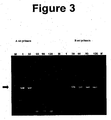
- Plasmid DNA samples of about 5 pg were incubated for different times at high temperature to determine the parameters of using heat alone to denature DNA for combined bisulfite mediated conversion (pUC19, Genbank Acession No. L09137; Yanisch-Perron, et al. 1985).
- the unconverted and converted templates were monitored by primer set A (SEQ ID NOs: 5 and 6) and set B SEQ ID NOs: 7 and 8) respectively. These primers are listed yin Example 1. Referring to Figure 3 , the numbers on the top indicate the various incubation times at 96°C (1, 30, 60, 90, and 120 seconds; the, M indicates the 100 bp DNA marker from NEBL). Individual samples were generally processed according to the protocol detailed in Example 3. The PCR products migrate between 400-500 bp in the 1.0% agarose gel.
- the top panel indicates the results of primer set B for converted template.
- the specific PCR product is represented by the 470 bp fragment migrating in the middle of the agarose gel (See arrow: top and bottom panels).
- the bottom panel indicates the results of primers set A for unconverted template.
- the results further indicated that the DNA templates were not efficiently converted after 2 minutes 50°C incubation (bottom panel primer A set; arrow). Incubation between 2-6 hours had no apparent effect on the template conversion efficiency. When incubation was extended up to 8 hours the bisulfite conversion was decreased slightly as assayed by the PCR products (compared to 2-6 hours incubation time points). The optimal time for bisulfite conversion at 50°C is between 4-6 hours.
- the bisulfite conversion was heat dependent led to the idea of using combined heat and bisulfite conversion in a single reaction without added base, thereby avoiding the need for separate denaturation and bisulfate steps. Since it has been reported that bisulfite conversion, or sulfonation of cytosine, is favored at low reaction temperatures and low pH (optimum at about pH 5.0), the observation that utilizing a high temperature for combined denaturation and bisulfite conversion is unexpected. In addition to saving time, the present invention provides efficient conversion and recovery, particularly when Combined with coupled solid matrix (e.g. , in-column) desulfonation.
- coupled solid matrix e.g. , in-column
- Varying temperature for the combined denaturation and bisulfite conversion was explored to define ranges that would be effective.
- the plasmid DNA samples were further processed by in-column desulfonation and reaction clean up according to the protocol outlined in example 3, and as described above except, for the various changes to temperature.
- the 470 bp plasmid (pUC19) was amplified with the primer Set B that specifically amplifies bisulfite converted template.
- Samples of about 5 pg of plasmid DNA were incubated at the first temperature for about 10 minutes in a gradient at indicated temperatures, 90°, 90.7°, 92°, 93.7°, 95.7°, 97.3°, 98.5°, and 99°C (See figure 5A , M indicates molecular weight marker, NEBL).
- M indicates molecular weight marker, NEBL.
- the samples were not further incubated at an additional temperature, but would be according to some embodiments of the invention.
- the stained gel shows the relative amount of amplified, bisulfite-converted sample plasmid DNA obtained following high temperature denaturation at the indicated temperatures.
- the maximum amount was obtained at the temperature of about 97.3°C, although temperatures of about 95.7° to about 99°C produced similar results.
- This experiment indicates that denaturation under the conditions for combined denaturation and bisulfite conversion occurs at a single incubation from about 90° to about 100°C, with the preferred temperature centering about 98°C.
- Some embodiments of the invention include one or more additional incubations at different temperatures. Such incubations improve the efficiency of bisulfite conversion.
- the samples of plasmid DNA were first incubated for 10 minutes at a high temperature of 98°C, then incubated at an additional temperature of 30°; 37°, 45°, 55°, 61°, 70°, 80°, or 90°C for 30 minutes (See figure 5B ). Additional temperature allows control of the overall degree of bisulfite conversion and can be varied in specific embodiments to accomplish desired levels. In this experiment bisulfite converted DNA was evident across the temperature range from about 30° to about 90°C. The maximum amount of bisulfite converted DNA was seen at about 45° to about 61°C.
- the combined thermal denaturation and bisulfite conversion need not be coupled to the Desulfonation process.
- the coupled in-column desulfonation on a solid matrix increases the efficiency of template recovery and minimizes degradation in addition to the rapid purification of the template.
- the primer pair A (SEQ. ID. NO: 4 and 5) are used to amplify a 470 bp DNA fragment from the pUC19 plasmid by PCR ( Genbank Acession No. L09137 ), when unmethylated cytosine (C) is not converted to uracil (U) (see Figure 3 ).
- the primer pair B (SEQ. ID. NO: 6 and 7) are used amplify a corresponding 470 bp DNA fragment from pUC19 by PCR when C is converted to U.
- Bisulfite conversion can be monitored using primer pair sets A and B.
- Primer set A detects unconverted DNA
- primer set B detects bisulfite-converted DNA where base C has been converted to U (see Figure 1-3 ).
- Primers were synthesized, prepared by commercial sources (IDT DNA Inc., Iowa), and all PCR methods and agarose electrophoresis were performed as known in the art.
- the bisulfite conversion reagent for approximately 10 reactions is a solid mixture of about 475 mg sodium metabisulfite (Na 2 S 2 O 5 , 1.9 M) and 0.5 mg hydroquinone (4.6 ⁇ M). It is recognized that sodium bisulfite and similar bisulfite salts may be used at concentrations from about 0.2 M to about 1.0 M, or about 1.0 M to about 2.0 M. In addition, the antioxidant hydroquinone may be omitted, or alternately used from about 3.0 ⁇ M to about 10 ⁇ M, or about 4 ⁇ M to about 5 ⁇ M.
- the dry chemicals are dissolved by adding 900 ⁇ l H 2 0, 50 ⁇ l of 50% DMF, and 300 ⁇ l of 2 M NaOH. The solution is mixed until the chemicals are completely dissolved. Vortexing or shaking is recommended. Many compositions of bisulfite conversion reagent are known in the art. It is not thought that minor variations in the concentrations or inclusion of specific additional chemical components, other than bisulfite, significantly affect conversion efficiency.
- the resulting solution is about pH 5.1 and comprises: 1.9 M Na 2 S 2 O 5 ; 4.5 uM hydroquinone; 0.4 M NaOH; and 100 mM DMF. It is normal to see trace amounts of undissolved reagent since the bisulfite conversion solution is near saturation.
- the dissolved bisulfite conversion solution is typically used immediately, but may be stored in the dark at about 20°-30°C for short periods, or until use for up to one week at - 20°C. If the solution is stored at -20°C upon thawing it should be mixed thoroughly before use.
- the bisulfite conversion solution is light sensitive and thus light exposure should be minimized.
- Example 3 Combined Thermal Denaturation and Bisulfite Conversion: Coupled to In-Column Desulfonation.
- the bisulfite conversion and desulfonaton (C-U) of DNA is accomplished using the following protocol.
- the Reaction volumes may be scaled as required (see embodiment 1, Figure 1 ).
- Step 1 A sample of 130 ⁇ l of the nearly saturated bisulfite solution from Example 2 is added to about 20 ⁇ l of DNA sample in a 250 ul tube (suitable for PCR reactions).
- 4 ⁇ l DNA sample, 16 ⁇ l H 2 O, and 130 ⁇ l bisulfite conversion solution constitutes a standard reaction, though modifications to account for DNA sample volume can readily be made.
- the DNA sample may contain from about 500 pg to about 2.0 ⁇ g of DNA template, and preferably between about 200 ng to about 500 ng.
- the sample may also contain about 500 ng of salmon sperm DNA or other non-interfering DNA carrier.
- the sample is mixed by hand by flicking the tube, or other convenient means.
- the sample is placed in a thermal-cycler device and subjected to either of the following temperature programs. For some samples the alternate temperature regime parameters may yield improved results, while other temperature combinations may also yield further improvements.
- Step 2 Thermal-Cycle Regime.
- Step 3 Following completion of the temperature program, 600 ⁇ l of a 6 M guanidine-HCl solution (i.e., binding buffer) is added.
- Step 4 The resulting solution is applied directly onto a column, for example a spin-column positioned onto a collection tube.
- Step 5 The column and collection tube are centrifuged in a microfuge at the maximum setting (> 10,000 x g) for about 30 seconds.
- Step 6 A sample of 200 ⁇ l of desulfonation solution is added onto the column and let stand incubating at room temperature (RT) for about 15-20 minutes (RT: about 20 ° to 30°C ⁇ 5°C). The column is centrifuged a second time at the maximum setting for about 30 seconds.
- RT room temperature
- Step 7 A 200 ⁇ l sample of wash buffer is added onto the column and centrifuged a second time at the maximum setting for about 30 seconds. As the collection tube has limited capacity (usually about 800 ⁇ l) it should be emptied when ever necessary to prevent contamination of the column contents by the flow-through.
- Step 8 Elution into a small volume is performed by addition of about 2 to about 20 ⁇ l, preferably about 4 to about 12 ⁇ l, or about 4 to about 8 ⁇ l, or about 4 ⁇ l to about 100 ⁇ l of elution buffer.
- the eluted DNA is suitable for immediate analysis or can be stored at or below -20°C for later use.
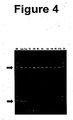
- eluted DNA typically 2 to about 4 ⁇ l is suitable for use in standard methylation analysis such as PCR, or other procedures (see Figures 1-4 ).
- the entire process can be completed rapidly, (e.g., in about 3 to about 3 and a half hours).
- an adjustment for the bisulfite conversion reagent is recommended.
- the amount of water is decreased to 100 ⁇ l for each 10 ⁇ l increase in DNA sample volume.
- DNA sample 700 ⁇ l of water is added to make the bisulfite conversion reagent.
- the suggested maximum DNA sample to be used for each conversion reaction is about 50 ⁇ l. It is recognized that many variations and modifications to the above mentioned protocol can be made to account for different samples, desired increase, or decrease bisulfite conversion efficiencies, or to otherwise tailor the combined methodology as desired by one skilled in the art.
- the bisulfite modification and conversion (C to U) of DNA for an embodiment representative of the prior art, for comparison purposes to embodiments of the present invention, is accomplished by the following protocol.
- the reaction volumes may be scaled as required (See embodiment 2, Figure 1 ).
- the bisulfite reagent solution used in this protocol is about pH 5.3 and consists of: 1.9 M Na 2 S 2 O 5 ; 4.5 uM hydroquinone; and about 0.2 M NaOH.
- Step 1 A sample or 5 ⁇ l of the dilution buffer (2M NaOH) is added to the DNA sample and the total volume adjusted to 50 ⁇ l with sterile water. For example: 14 ⁇ l of DNA sample, 5 ⁇ l of dilution buffer (2 M NaOH), and 31 ⁇ l of water form a standard chemical denaturation reaction.
- Step 2 The sample is incubated at 37°C for about 15 minutes. The combination of steps 1 and 2 constitute the chemical denaturation reaction started with addition of strong base (NaOH).
- Step 3 A 100 ⁇ l aliquot of the bisulfite conversion solution is added to the DNA sample in a 250 ul tube (suitable for PCR reactions). This begins the bisulfite conversion procedure of the denatured DNA (ssDNA).
- the DNA sample should contain between about 200 pg to about 2 ⁇ g DNA template.
- Carrier DNA of about 500 ng of salmon sperm DNA may be added.
- the sample is mixed by hand by flicking the tube, or other convenient means.
- Step 4 The sample is incubated at 50°C for about 12-16 hours to allow for sufficient conversion.
- Step 5 The sample is placed on ice for abut 10 minutes to stop the reaction.
- Step 6 An aliquot of 400 ⁇ l of binding buffer (guanidine-HCL) is added and mixed by pipetting up and down several times to prepare the sample for purification.
- Step 7 The mixed sample is loaded onto a column, for example a spin-column, and placed onto a collection tube.
- Step 8 The column and collection tube are centrifuged in a microfuge at the maximum setting (> 10,000 x g) for about 30 seconds. Note: the collection tube has limited capacity, usually about 800 ⁇ l and should be emptied when ever necessary to prevent contamination of the column contents by the flow-through.
- Step 9 An aliquot of 200 ⁇ l of wash buffer (10 mM Tris pH 7.5, 80% ethanol) is added and the sample is centrifuged a second time at the maximum setting for about 30 seconds.
- Step 10 An aliquot of 200 ⁇ l of desulfonation solution (0.25 M NaOH, 80% ethanol) is added onto the column and incubated at RT for about 15 minutes, followed by centrifugation at the maximum setting for 30 seconds.
- Step 11 A second aliquot of 200 ⁇ l of wash buffer is added and the sample is centrifuged a second time at the maximum setting for about 30 seconds.
- Step 12 Elution into a small volume is performed by addition of about 2 to about 4 ⁇ l, or 4 to about 20 ⁇ l, or alternatively about 8 to about 12 ⁇ l of elution buffer.
- the eluted DNA is suitable for immediate methylation analysis or can be stored at or below -20°C for later use.
- the eluted DNA is suitable for use in standard methylation analysis such as PCR, or other sensitive procedures (see Figures 1-3 ).
- the entire process can be completed in about 13-16 hours.
- the bisulfite conversion reaction consists of two main and separated steps: (1) The chemical denaturation of the DNA template with NaOH; (2) addition of bisulfite for conversion of the denatured template DNA.
- Example 5 96-Well Format for Combined Thermal Denaturation and Bisulfite Conversion
- the buffers and solutions are essentially the same as those described in example 3. Changes made in regards to volumes or amounts are indicated below.
- the sodium bisulfite reagent is prepared essentially the same as described above except for scaling for more sample volumes.
- the bisulfite reagent is identical to that described in example 3.
- the following procedure is an adaptation of the protocol in example 3 (embodiment 1) to a high-through put 96-well format.
- Step 1 A 5-20 ⁇ l of DNA samples is added to wells of a 96-well PCR plate. The total volume in each well is adjusted to 20 ⁇ l with sterile water. For example: 14 ⁇ l DNA sample, 6 ⁇ l water is added.
- Step 2 A 130 ⁇ l aliquot of the bisulfite solution is added to the DNA sample in each well (the 96-well plate should be suitable for thermal cycling).
- the DNA sample should contain from about 200 pg to about 2.0 ⁇ g DNA template.
- Carrier DNA of about 500 ng of salmon sperm DNA may be added.
- the sample is mixed by pipetting, or other convenient means.
- the plate should be sealed by an appropriate means such as a cover tape or foil to prevent sample loss during incubation.
- Step 3 The sample is places in a thermal-cycler device and subjected to the temperature program as stated in example 3.
- Step 4 An aliquot of 400 ⁇ l, or 600 ⁇ l of binding buffer (guanidine-HCL) is added and mixed by pippetting up and down several times.
- Step 5 Transfer the samples from the PCR plate (above) to the wells of the 96-well filter plate (Smaller volume shallow-well Silicon-A filter plate; larger volume for the Deep-well Zymo-Spin 1-96 filter plate).
- Different filter plates are commercially available and may be used with embodiments of this invention (ZYMO RESEARCH CORP.: Deep-well Zymo-Spin 1-96 filter plate, or shallow-well Silicon-A Filter plates are two examples).
- Step 6 The 96 well filter plate is placed over a collection plate and put into a centrifuge capable of handling plates and centrifuged at about 2,500 to about 5,000 rpm for about 5 minutes. The flow through is discarded from the collection plates. Stronger centrifugal forces are best for thorough removal of buffer from the plates.
- Step 7 About 400 ⁇ l of wash buffer (80% ethanol) is added to each well and the plate is centrifuged at about 2,500 to about 5,000 rpm for about 5 minutes. The collection plate can be emptied whenever necessary to prevent contamination of the filter plate if the volume of buffer is more than 800 ⁇ l.
- Step 8 About 200 ⁇ l of desulfonation buffer (0.25 M NaOH; 80% ethanol) is added and incubated at room temperature, or about 20° to 30°C for 15 minutes. After incubation the plate is centrifuged at about 2,500 to about 5,000 rpm for 5 minutes.
- Step 9 About 400 ⁇ l of wash buffer (80% ethanol, 10 mM Tris, pH 7.5) and centrifuged at about 2,500 to about 5,000 rpm for 5 minutes. This wash step is repeated but is centrifuged for a longer time of 10 minutes to ensure removal of the entire wash buffer.
- Step 10 The filter plate is placed onto an elution plate.
- elution buffer or water or TE (10 mM Tris, 1.0 mM EDTA, pH 7.5) is added to each well.
- the plate is centrifuged at about 2,500 to about 5,000 rpm for 5 minutes to elute the DNA template. The entire process can be completed in about 4 hours.
- Embodiments of the present invention are adaptable to 96-well, 384-well, or greater number formats outlined in the above example. In these high-throughput embodiments the increased efficiency and coupled one-step denaturation and bisulfite conversion would result in significant advantages.
Landscapes
- Chemical & Material Sciences (AREA)
- Organic Chemistry (AREA)
- Life Sciences & Earth Sciences (AREA)
- Zoology (AREA)
- Proteomics, Peptides & Aminoacids (AREA)
- Health & Medical Sciences (AREA)
- Engineering & Computer Science (AREA)
- Wood Science & Technology (AREA)
- Analytical Chemistry (AREA)
- Microbiology (AREA)
- Physics & Mathematics (AREA)
- Molecular Biology (AREA)
- Immunology (AREA)
- Biotechnology (AREA)
- Biophysics (AREA)
- Biochemistry (AREA)
- Bioinformatics & Cheminformatics (AREA)
- General Engineering & Computer Science (AREA)
- General Health & Medical Sciences (AREA)
- Genetics & Genomics (AREA)
- Chemical Kinetics & Catalysis (AREA)
- Measuring Or Testing Involving Enzymes Or Micro-Organisms (AREA)
Claims (13)
- Procédé de préparation une matrice d'ADN pour une analyse de méthylation d'ADN, le procédé comprenant l'incubation d'une matrice d'ADN en présence d'un réactif bisulfite à une température entre 96°C et 100°C pendant environ 10 minutes pour produire la dénaturation et la conversion du bisulfite de manière combinée de la matrice d'ADN.
- Procédé selon la revendication 1 comprenant en outre :l'adsorption de l'ADN sur une matrice solide ;la désulfonation de l'ADN adsorbé ; etl'élution de l'ADN désulfoné à partir de la matrice solide.
- Procédé selon la revendication 1, dans lequel la dénaturation et la conversion du bisulfite de l'ADN de l'échantillon sont effectuées en présence d'un agent réducteur chimique.
- Procédé selon la revendication 1, dans lequel la dénaturation et la conversion du bisulfite de l'ADN de l'échantillon sont effectuées en présence d'un réactif de dénaturation chimique.
- Procédé selon la revendication 3, dans lequel l'agent de réduction chimique est choisi dans le groupe constitué d'hydroquinone et 8-hydroxyquinone.
- Procédé selon la revendication 4, dans lequel l'agent de dénaturation chimique est choisi dans le groupe constitué de DMF, glycérol, et urée.
- Procédé selon la revendication 2, dans lequel l'élution est réalisée dans un volume de 4 µl à 20 µl d'une solution aqueuse.
- Procédé selon la revendication 1, comprenant en outre l'incubation de la matrice d'ADN à une température entre 30°C et 92°C.
- Procédé selon la revendication 8, comprenant en outre l'incubation de la matrice d'ADN pendant 2 à 6 heures.
- Procédé selon la revendication 1, dans lequel la température d'incubation est située entre 98°C et 100°C.
- Procédé selon la revendication 7, dans lequel la solution aqueuse éluée a un volume de 8 µl à 12 µl.
- Procédé selon la revendication 1, dans lequel la température d'incubation est située entre 96°C et 98°C.
- Procédé selon la revendication 1, dans lequel la température d'incubation est d'environ 98°C.
Applications Claiming Priority (2)
| Application Number | Priority Date | Filing Date | Title |
|---|---|---|---|
| US11/409,766 US20060286577A1 (en) | 2005-06-17 | 2006-04-24 | Methods for detection of methylated DNA |
| PCT/US2006/020618 WO2007123553A1 (fr) | 2006-04-24 | 2006-05-27 | Procédés pour la détection d'adn méthylé |
Publications (3)
| Publication Number | Publication Date |
|---|---|
| EP2016188A1 EP2016188A1 (fr) | 2009-01-21 |
| EP2016188A4 EP2016188A4 (fr) | 2009-10-14 |
| EP2016188B1 true EP2016188B1 (fr) | 2015-10-21 |
Family
ID=38625330
Family Applications (1)
| Application Number | Title | Priority Date | Filing Date |
|---|---|---|---|
| EP06771406.3A Not-in-force EP2016188B1 (fr) | 2006-04-24 | 2006-05-27 | Procédés pour la détection d'adn méthylé |
Country Status (2)
| Country | Link |
|---|---|
| EP (1) | EP2016188B1 (fr) |
| WO (1) | WO2007123553A1 (fr) |
Families Citing this family (2)
| Publication number | Priority date | Publication date | Assignee | Title |
|---|---|---|---|---|
| AU2021329235A1 (en) * | 2020-07-29 | 2023-02-23 | Exact Sciences Corporation | Purification of sulfonated DNA |
| CN116144734B (zh) * | 2023-02-23 | 2024-02-13 | 纳昂达(南京)生物科技有限公司 | 甲基化转化组合物及其应用 |
Citations (1)
| Publication number | Priority date | Publication date | Assignee | Title |
|---|---|---|---|---|
| US5804375A (en) * | 1990-08-06 | 1998-09-08 | Roche Molecular Systems, Inc. | Reaction mixtures for detection of target nucleic acids |
Family Cites Families (5)
| Publication number | Priority date | Publication date | Assignee | Title |
|---|---|---|---|---|
| US7668658B2 (en) * | 1999-10-13 | 2010-02-23 | Sequenom, Inc. | Methods for generating databases and databases for identifying polymorphic genetic markers |
| US6960436B2 (en) * | 2002-02-06 | 2005-11-01 | Epigenomics Ag | Quantitative methylation detection in DNA samples |
| DE602004009038T3 (de) * | 2003-01-29 | 2015-06-25 | Roche Diagnostics Gmbh | Verbessertes Verfahren zur Behandlung durch Bisulfit |
| US7368239B2 (en) * | 2003-08-29 | 2008-05-06 | Applera Corporation | Method and materials for polyamine catalyzed bisulfite conversion of cytosine to uracil |
| WO2005054502A1 (fr) * | 2003-12-02 | 2005-06-16 | Roche Diagnostics Gmbh | Procede ameliore de traitement au bisulfite |
-
2006
- 2006-05-27 EP EP06771406.3A patent/EP2016188B1/fr not_active Not-in-force
- 2006-05-27 WO PCT/US2006/020618 patent/WO2007123553A1/fr not_active Ceased
Patent Citations (1)
| Publication number | Priority date | Publication date | Assignee | Title |
|---|---|---|---|---|
| US5804375A (en) * | 1990-08-06 | 1998-09-08 | Roche Molecular Systems, Inc. | Reaction mixtures for detection of target nucleic acids |
Also Published As
| Publication number | Publication date |
|---|---|
| WO2007123553A1 (fr) | 2007-11-01 |
| EP2016188A4 (fr) | 2009-10-14 |
| EP2016188A1 (fr) | 2009-01-21 |
Similar Documents
| Publication | Publication Date | Title |
|---|---|---|
| US20240150814A1 (en) | Modification of dna on magnetic beads | |
| US9868756B2 (en) | Method for bisulfite treatment | |
| EP3252174B1 (fr) | Compositions, procédés, systèmes et kits pour l'enrichissement d'acides nucléiques cibles | |
| US20060286577A1 (en) | Methods for detection of methylated DNA | |
| US7413855B2 (en) | Method for bisulfite treatment | |
| CN100354298C (zh) | 使用单核苷酸多态性组分析受损样品的方法和组合物 | |
| EP1394172A1 (fr) | Procédé amélioré de traitement par bisulphite | |
| US20070190530A1 (en) | Method for bisulfite treatment | |
| US20200232014A1 (en) | Systems and methods for isolating nucleic acids | |
| EP2016188B1 (fr) | Procédés pour la détection d'adn méthylé | |
| EP1443052A1 (fr) | Procédé amélioré de traitement d'acide nucléique par le bisulfite | |
| US20150368636A1 (en) | Treatment of a sample vessel | |
| Liu et al. | Profiling DNA Methylation by Bisulfite Genomic Sequencing |
Legal Events
| Date | Code | Title | Description |
|---|---|---|---|
| PUAI | Public reference made under article 153(3) epc to a published international application that has entered the european phase |
Free format text: ORIGINAL CODE: 0009012 |
|
| 17P | Request for examination filed |
Effective date: 20081124 |
|
| AK | Designated contracting states |
Kind code of ref document: A1 Designated state(s): AT BE BG CH CY CZ DE DK EE ES FI FR GB GR HU IE IS IT LI LT LU LV MC NL PL PT RO SE SI SK TR |
|
| AX | Request for extension of the european patent |
Extension state: AL BA HR MK YU |
|
| RA4 | Supplementary search report drawn up and despatched (corrected) |
Effective date: 20090914 |
|
| 17Q | First examination report despatched |
Effective date: 20091111 |
|
| DAX | Request for extension of the european patent (deleted) | ||
| GRAP | Despatch of communication of intention to grant a patent |
Free format text: ORIGINAL CODE: EPIDOSNIGR1 |
|
| INTG | Intention to grant announced |
Effective date: 20141030 |
|
| INTG | Intention to grant announced |
Effective date: 20141105 |
|
| GRAP | Despatch of communication of intention to grant a patent |
Free format text: ORIGINAL CODE: EPIDOSNIGR1 |
|
| INTG | Intention to grant announced |
Effective date: 20150506 |
|
| GRAS | Grant fee paid |
Free format text: ORIGINAL CODE: EPIDOSNIGR3 |
|
| GRAA | (expected) grant |
Free format text: ORIGINAL CODE: 0009210 |
|
| AK | Designated contracting states |
Kind code of ref document: B1 Designated state(s): AT BE BG CH CY CZ DE DK EE ES FI FR GB GR HU IE IS IT LI LT LU LV MC NL PL PT RO SE SI SK TR |
|
| REG | Reference to a national code |
Ref country code: GB Ref legal event code: FG4D Ref country code: NL Ref legal event code: MP Effective date: 20151021 |
|
| REG | Reference to a national code |
Ref country code: CH Ref legal event code: EP |
|
| REG | Reference to a national code |
Ref country code: AT Ref legal event code: REF Ref document number: 756652 Country of ref document: AT Kind code of ref document: T Effective date: 20151115 |
|
| REG | Reference to a national code |
Ref country code: IE Ref legal event code: FG4D |
|
| REG | Reference to a national code |
Ref country code: DE Ref legal event code: R096 Ref document number: 602006047017 Country of ref document: DE |
|
| REG | Reference to a national code |
Ref country code: LT Ref legal event code: MG4D |
|
| REG | Reference to a national code |
Ref country code: AT Ref legal event code: MK05 Ref document number: 756652 Country of ref document: AT Kind code of ref document: T Effective date: 20151021 |
|
| PG25 | Lapsed in a contracting state [announced via postgrant information from national office to epo] |
Ref country code: IT Free format text: LAPSE BECAUSE OF FAILURE TO SUBMIT A TRANSLATION OF THE DESCRIPTION OR TO PAY THE FEE WITHIN THE PRESCRIBED TIME-LIMIT Effective date: 20151021 Ref country code: LT Free format text: LAPSE BECAUSE OF FAILURE TO SUBMIT A TRANSLATION OF THE DESCRIPTION OR TO PAY THE FEE WITHIN THE PRESCRIBED TIME-LIMIT Effective date: 20151021 Ref country code: NL Free format text: LAPSE BECAUSE OF FAILURE TO SUBMIT A TRANSLATION OF THE DESCRIPTION OR TO PAY THE FEE WITHIN THE PRESCRIBED TIME-LIMIT Effective date: 20151021 Ref country code: IS Free format text: LAPSE BECAUSE OF FAILURE TO SUBMIT A TRANSLATION OF THE DESCRIPTION OR TO PAY THE FEE WITHIN THE PRESCRIBED TIME-LIMIT Effective date: 20160221 Ref country code: ES Free format text: LAPSE BECAUSE OF FAILURE TO SUBMIT A TRANSLATION OF THE DESCRIPTION OR TO PAY THE FEE WITHIN THE PRESCRIBED TIME-LIMIT Effective date: 20151021 |
|
| PG25 | Lapsed in a contracting state [announced via postgrant information from national office to epo] |
Ref country code: AT Free format text: LAPSE BECAUSE OF FAILURE TO SUBMIT A TRANSLATION OF THE DESCRIPTION OR TO PAY THE FEE WITHIN THE PRESCRIBED TIME-LIMIT Effective date: 20151021 Ref country code: SE Free format text: LAPSE BECAUSE OF FAILURE TO SUBMIT A TRANSLATION OF THE DESCRIPTION OR TO PAY THE FEE WITHIN THE PRESCRIBED TIME-LIMIT Effective date: 20151021 Ref country code: GR Free format text: LAPSE BECAUSE OF FAILURE TO SUBMIT A TRANSLATION OF THE DESCRIPTION OR TO PAY THE FEE WITHIN THE PRESCRIBED TIME-LIMIT Effective date: 20160122 Ref country code: FI Free format text: LAPSE BECAUSE OF FAILURE TO SUBMIT A TRANSLATION OF THE DESCRIPTION OR TO PAY THE FEE WITHIN THE PRESCRIBED TIME-LIMIT Effective date: 20151021 Ref country code: PL Free format text: LAPSE BECAUSE OF FAILURE TO SUBMIT A TRANSLATION OF THE DESCRIPTION OR TO PAY THE FEE WITHIN THE PRESCRIBED TIME-LIMIT Effective date: 20151021 Ref country code: PT Free format text: LAPSE BECAUSE OF FAILURE TO SUBMIT A TRANSLATION OF THE DESCRIPTION OR TO PAY THE FEE WITHIN THE PRESCRIBED TIME-LIMIT Effective date: 20160222 Ref country code: LV Free format text: LAPSE BECAUSE OF FAILURE TO SUBMIT A TRANSLATION OF THE DESCRIPTION OR TO PAY THE FEE WITHIN THE PRESCRIBED TIME-LIMIT Effective date: 20151021 |
|
| REG | Reference to a national code |
Ref country code: DE Ref legal event code: R097 Ref document number: 602006047017 Country of ref document: DE |
|
| PG25 | Lapsed in a contracting state [announced via postgrant information from national office to epo] |
Ref country code: CZ Free format text: LAPSE BECAUSE OF FAILURE TO SUBMIT A TRANSLATION OF THE DESCRIPTION OR TO PAY THE FEE WITHIN THE PRESCRIBED TIME-LIMIT Effective date: 20151021 |
|
| PGFP | Annual fee paid to national office [announced via postgrant information from national office to epo] |
Ref country code: GB Payment date: 20160629 Year of fee payment: 11 |
|
| PLBE | No opposition filed within time limit |
Free format text: ORIGINAL CODE: 0009261 |
|
| STAA | Information on the status of an ep patent application or granted ep patent |
Free format text: STATUS: NO OPPOSITION FILED WITHIN TIME LIMIT |
|
| PG25 | Lapsed in a contracting state [announced via postgrant information from national office to epo] |
Ref country code: SK Free format text: LAPSE BECAUSE OF FAILURE TO SUBMIT A TRANSLATION OF THE DESCRIPTION OR TO PAY THE FEE WITHIN THE PRESCRIBED TIME-LIMIT Effective date: 20151021 Ref country code: BE Free format text: LAPSE BECAUSE OF NON-PAYMENT OF DUE FEES Effective date: 20160531 Ref country code: RO Free format text: LAPSE BECAUSE OF FAILURE TO SUBMIT A TRANSLATION OF THE DESCRIPTION OR TO PAY THE FEE WITHIN THE PRESCRIBED TIME-LIMIT Effective date: 20151021 Ref country code: DK Free format text: LAPSE BECAUSE OF FAILURE TO SUBMIT A TRANSLATION OF THE DESCRIPTION OR TO PAY THE FEE WITHIN THE PRESCRIBED TIME-LIMIT Effective date: 20151021 Ref country code: EE Free format text: LAPSE BECAUSE OF FAILURE TO SUBMIT A TRANSLATION OF THE DESCRIPTION OR TO PAY THE FEE WITHIN THE PRESCRIBED TIME-LIMIT Effective date: 20151021 |
|
| 26N | No opposition filed |
Effective date: 20160722 |
|
| PG25 | Lapsed in a contracting state [announced via postgrant information from national office to epo] |
Ref country code: SI Free format text: LAPSE BECAUSE OF FAILURE TO SUBMIT A TRANSLATION OF THE DESCRIPTION OR TO PAY THE FEE WITHIN THE PRESCRIBED TIME-LIMIT Effective date: 20151021 |
|
| REG | Reference to a national code |
Ref country code: DE Ref legal event code: R119 Ref document number: 602006047017 Country of ref document: DE |
|
| PG25 | Lapsed in a contracting state [announced via postgrant information from national office to epo] |
Ref country code: LU Free format text: LAPSE BECAUSE OF FAILURE TO SUBMIT A TRANSLATION OF THE DESCRIPTION OR TO PAY THE FEE WITHIN THE PRESCRIBED TIME-LIMIT Effective date: 20160527 Ref country code: BE Free format text: LAPSE BECAUSE OF FAILURE TO SUBMIT A TRANSLATION OF THE DESCRIPTION OR TO PAY THE FEE WITHIN THE PRESCRIBED TIME-LIMIT Effective date: 20151021 |
|
| REG | Reference to a national code |
Ref country code: CH Ref legal event code: PL |
|
| PG25 | Lapsed in a contracting state [announced via postgrant information from national office to epo] |
Ref country code: CH Free format text: LAPSE BECAUSE OF NON-PAYMENT OF DUE FEES Effective date: 20160531 Ref country code: LI Free format text: LAPSE BECAUSE OF NON-PAYMENT OF DUE FEES Effective date: 20160531 |
|
| REG | Reference to a national code |
Ref country code: IE Ref legal event code: MM4A |
|
| REG | Reference to a national code |
Ref country code: FR Ref legal event code: ST Effective date: 20170131 |
|
| PG25 | Lapsed in a contracting state [announced via postgrant information from national office to epo] |
Ref country code: DE Free format text: LAPSE BECAUSE OF NON-PAYMENT OF DUE FEES Effective date: 20161201 Ref country code: FR Free format text: LAPSE BECAUSE OF NON-PAYMENT OF DUE FEES Effective date: 20160531 |
|
| PG25 | Lapsed in a contracting state [announced via postgrant information from national office to epo] |
Ref country code: IE Free format text: LAPSE BECAUSE OF NON-PAYMENT OF DUE FEES Effective date: 20160527 |
|
| GBPC | Gb: european patent ceased through non-payment of renewal fee |
Effective date: 20170527 |
|
| PG25 | Lapsed in a contracting state [announced via postgrant information from national office to epo] |
Ref country code: GB Free format text: LAPSE BECAUSE OF NON-PAYMENT OF DUE FEES Effective date: 20170527 |
|
| PG25 | Lapsed in a contracting state [announced via postgrant information from national office to epo] |
Ref country code: HU Free format text: LAPSE BECAUSE OF FAILURE TO SUBMIT A TRANSLATION OF THE DESCRIPTION OR TO PAY THE FEE WITHIN THE PRESCRIBED TIME-LIMIT; INVALID AB INITIO Effective date: 20060527 Ref country code: CY Free format text: LAPSE BECAUSE OF FAILURE TO SUBMIT A TRANSLATION OF THE DESCRIPTION OR TO PAY THE FEE WITHIN THE PRESCRIBED TIME-LIMIT Effective date: 20151021 |
|
| PG25 | Lapsed in a contracting state [announced via postgrant information from national office to epo] |
Ref country code: TR Free format text: LAPSE BECAUSE OF FAILURE TO SUBMIT A TRANSLATION OF THE DESCRIPTION OR TO PAY THE FEE WITHIN THE PRESCRIBED TIME-LIMIT Effective date: 20151021 Ref country code: MC Free format text: LAPSE BECAUSE OF FAILURE TO SUBMIT A TRANSLATION OF THE DESCRIPTION OR TO PAY THE FEE WITHIN THE PRESCRIBED TIME-LIMIT Effective date: 20151021 |
|
| PG25 | Lapsed in a contracting state [announced via postgrant information from national office to epo] |
Ref country code: BG Free format text: LAPSE BECAUSE OF FAILURE TO SUBMIT A TRANSLATION OF THE DESCRIPTION OR TO PAY THE FEE WITHIN THE PRESCRIBED TIME-LIMIT Effective date: 20151021 |