EP2017236A1 - Composition de verre et entretoise de verre utilisant ladite composition - Google Patents
Composition de verre et entretoise de verre utilisant ladite composition Download PDFInfo
- Publication number
- EP2017236A1 EP2017236A1 EP07742699A EP07742699A EP2017236A1 EP 2017236 A1 EP2017236 A1 EP 2017236A1 EP 07742699 A EP07742699 A EP 07742699A EP 07742699 A EP07742699 A EP 07742699A EP 2017236 A1 EP2017236 A1 EP 2017236A1
- Authority
- EP
- European Patent Office
- Prior art keywords
- glass
- sro
- spacer
- bao
- temperature
- Prior art date
- Legal status (The legal status is an assumption and is not a legal conclusion. Google has not performed a legal analysis and makes no representation as to the accuracy of the status listed.)
- Withdrawn
Links
Images
Classifications
-
- C—CHEMISTRY; METALLURGY
- C03—GLASS; MINERAL OR SLAG WOOL
- C03C—CHEMICAL COMPOSITION OF GLASSES, GLAZES OR VITREOUS ENAMELS; SURFACE TREATMENT OF GLASS; SURFACE TREATMENT OF FIBRES OR FILAMENTS MADE FROM GLASS, MINERALS OR SLAGS; JOINING GLASS TO GLASS OR OTHER MATERIALS
- C03C3/00—Glass compositions
- C03C3/04—Glass compositions containing silica
- C03C3/062—Glass compositions containing silica with less than 40% silica by weight
- C03C3/064—Glass compositions containing silica with less than 40% silica by weight containing boron
- C03C3/066—Glass compositions containing silica with less than 40% silica by weight containing boron containing zinc
-
- C—CHEMISTRY; METALLURGY
- C03—GLASS; MINERAL OR SLAG WOOL
- C03C—CHEMICAL COMPOSITION OF GLASSES, GLAZES OR VITREOUS ENAMELS; SURFACE TREATMENT OF GLASS; SURFACE TREATMENT OF FIBRES OR FILAMENTS MADE FROM GLASS, MINERALS OR SLAGS; JOINING GLASS TO GLASS OR OTHER MATERIALS
- C03C8/00—Enamels; Glazes; Fusion seal compositions being frit compositions having non-frit additions
- C03C8/02—Frit compositions, i.e. in a powdered or comminuted form
-
- C—CHEMISTRY; METALLURGY
- C03—GLASS; MINERAL OR SLAG WOOL
- C03C—CHEMICAL COMPOSITION OF GLASSES, GLAZES OR VITREOUS ENAMELS; SURFACE TREATMENT OF GLASS; SURFACE TREATMENT OF FIBRES OR FILAMENTS MADE FROM GLASS, MINERALS OR SLAGS; JOINING GLASS TO GLASS OR OTHER MATERIALS
- C03C3/00—Glass compositions
- C03C3/04—Glass compositions containing silica
- C03C3/062—Glass compositions containing silica with less than 40% silica by weight
- C03C3/064—Glass compositions containing silica with less than 40% silica by weight containing boron
- C03C3/068—Glass compositions containing silica with less than 40% silica by weight containing boron containing rare earths
-
- C—CHEMISTRY; METALLURGY
- C03—GLASS; MINERAL OR SLAG WOOL
- C03C—CHEMICAL COMPOSITION OF GLASSES, GLAZES OR VITREOUS ENAMELS; SURFACE TREATMENT OF GLASS; SURFACE TREATMENT OF FIBRES OR FILAMENTS MADE FROM GLASS, MINERALS OR SLAGS; JOINING GLASS TO GLASS OR OTHER MATERIALS
- C03C8/00—Enamels; Glazes; Fusion seal compositions being frit compositions having non-frit additions
- C03C8/02—Frit compositions, i.e. in a powdered or comminuted form
- C03C8/04—Frit compositions, i.e. in a powdered or comminuted form containing zinc
-
- C—CHEMISTRY; METALLURGY
- C03—GLASS; MINERAL OR SLAG WOOL
- C03C—CHEMICAL COMPOSITION OF GLASSES, GLAZES OR VITREOUS ENAMELS; SURFACE TREATMENT OF GLASS; SURFACE TREATMENT OF FIBRES OR FILAMENTS MADE FROM GLASS, MINERALS OR SLAGS; JOINING GLASS TO GLASS OR OTHER MATERIALS
- C03C8/00—Enamels; Glazes; Fusion seal compositions being frit compositions having non-frit additions
- C03C8/24—Fusion seal compositions being frit compositions having non-frit additions, i.e. for use as seals between dissimilar materials, e.g. glass and metal; Glass solders
-
- H—ELECTRICITY
- H01—ELECTRIC ELEMENTS
- H01J—ELECTRIC DISCHARGE TUBES OR DISCHARGE LAMPS
- H01J29/00—Details of cathode-ray tubes or of electron-beam tubes of the types covered by group H01J31/00
- H01J29/86—Vessels; Containers; Vacuum locks
- H01J29/864—Spacers between faceplate and backplate of flat panel cathode ray tubes
-
- H—ELECTRICITY
- H01—ELECTRIC ELEMENTS
- H01J—ELECTRIC DISCHARGE TUBES OR DISCHARGE LAMPS
- H01J29/00—Details of cathode-ray tubes or of electron-beam tubes of the types covered by group H01J31/00
- H01J29/86—Vessels; Containers; Vacuum locks
- H01J29/87—Arrangements for preventing or limiting effects of implosion of vessels or containers
-
- H—ELECTRICITY
- H01—ELECTRIC ELEMENTS
- H01J—ELECTRIC DISCHARGE TUBES OR DISCHARGE LAMPS
- H01J31/00—Cathode ray tubes; Electron beam tubes
- H01J31/08—Cathode ray tubes; Electron beam tubes having a screen on or from which an image or pattern is formed, picked up, converted, or stored
- H01J31/10—Image or pattern display tubes, i.e. having electrical input and optical output; Flying-spot tubes for scanning purposes
- H01J31/12—Image or pattern display tubes, i.e. having electrical input and optical output; Flying-spot tubes for scanning purposes with luminescent screen
- H01J31/123—Flat display tubes
-
- H—ELECTRICITY
- H01—ELECTRIC ELEMENTS
- H01J—ELECTRIC DISCHARGE TUBES OR DISCHARGE LAMPS
- H01J2329/00—Electron emission display panels, e.g. field emission display panels
- H01J2329/86—Vessels
- H01J2329/8625—Spacing members
- H01J2329/864—Spacing members characterised by the material
Definitions
- the present invention relates to glass compositions.
- the present invention also relates to glass spacers formed using the glass compositions, particularly glass spacers that are used suitably for electron beam-excited displays.
- a self-luminous electron beam-excited display forms an image by irradiating phosphors with an electron beam emitted from an electron beam source and thereby allowing them to generate fluorescence.
- the self-luminous electron beam-excited display is used widely and practically as a flat display.
- the electron beam-excited display is characterized by obtaining bright images and having a wide viewing angle.
- the flat electron beam-excited display forms an image by irradiating phosphors with an electron beam
- a vacuum container with an atmospheric pressure resistant structure described in JP 7(1995)-230776 A has been proposed.
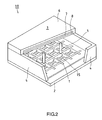
- FIG. 2 is a partially cutaway perspective view of a flat electron beam-excited display.
- a faceplate 3 in which a fluorescent film 7 and a metal back 8 to serve as an accelerating electrode are formed on the inner surface of a glass substrate 6 is disposed in the upper part.
- a rear plate 2 is disposed opposing the faceplate 3, with a supporting frame 4 interposed therebetween.
- An electron source 1 with a plurality of electron-emitting elements 15 disposed in the form of a matrix is fixed to the rear plate 2.
- High voltage is applied between the electron source 1 and the metal back 8 by a power source (not shown).
- the rear plate 2 and the supporting frame 4 as well as the faceplate 3 and the supporting frame 4 are sealed together, respectively, with, for example, frit glass and thereby form a vacuum container 10.
- Glass spacers 5 are provided inside the vacuum container 10. In order to form the vacuum container 10 into an atmospheric pressure resistant structure, a required number of glass spacers 5 are disposed at required intervals. Glass spacers include a flat-plate glass spacer that is referred to as a rib and a pillar-shaped glass spacer that is referred to as a pillar. In FIG. 1 , each glass spacer 5 is processed into, for example, a columnar shape with a diameter of 0.1 mm and a height of 1 mm.
- JP 2000-203857 A The following method has been proposed in JP 2000-203857 A as a method of producing a glass spacer with high precision. That is, a glass preform whose cross-sectional shape is substantially a similar figure to a desired cross-sectional shape of the glass spacer is prepared, and this glass preform is drawn while being heated so that the viscosity thereof reaches 10 5 dPa ⁇ sec to 10 9 dPa ⁇ sec (10 5 poise to 10 9 poise).
- This method also is referred to as a "redraw method”. This method makes it possible to improve the degree of similarity in cross-sectional shape between the glass preform and drawn glass and thereby to produce a glass spacer with a desired shape easily.
- a columnar glass spacer also can be produced with high precision by a method in which a glass material melted in a refractory container provided with a nozzle is withdrawn through the nozzle.
- This method also is referred to as a direct spinning method.
- the direct spinning method makes it possible to produce large amounts of glass spacers continuously at a time and is the method that allows columnar glass spacers to be produced with the highest precision.
- a glass spacer described in JP 2003-526187 A is mentioned.
- This document describes a glass spacer with a volume resistivity of 10 5 to 10 13 ⁇ cm.
- the glass spacer contain 25 to 75 mol% of SiO 2 and 1 to 30 mol% of transition element compound and further contain 5 to 10 mol% of alkali metal compound.
- spacers containing alkali metal compounds are used.
- a glass spacer for an electron beam-excited display device serves to keep the space between both the front panel and the rear panel of a vacuum container constant. This glass spacer is exposed to electron-emitting elements. Therefore, when a large amount of alkali metal oxide is contained in glass that forms the glass spacer, there is a problem that bias voltage scatters alkali metal ions and thereby electric-field breakdown is caused. Furthermore, when a large amount of alkali metal oxide is contained, glass with a high Young's modulus cannot be obtained. Moreover, the heat resistance of the glass also is deteriorated.
- JP 2002-104839 A describes, as a glass spacer that is free of alkali metal oxide, a glass spacer for an electron beam-excited display device that has a composition substantially free of alkali metal oxide and also free of oxide of transition metal that is present in a plurality of oxidation states.
- JP 2004-43288 A describes glass having a composition in which the content of (TiO 2 +Nb 2 O 5 +SnO 2 +Ta 2 O 5 +WO 3 +CeO 2 ) is at least 10 mol% and a field emission display device including a spacer formed of the glass.
- the glass spacers contain at least 15 mol% of Nb 2 O 5 .
- JP 2004-71158 A describes a glass spacer for an electron beam excitation display that has a composition containing 30 to 80 mol% of SiO 2 and 10 to 40 mol% of oxide of transition metal.
- JP 2005-263613 A describes a glass spacer in which the total content of SiO 2 and TiO 2 is 50 to 80 mol%, specifically, the content of SiO 2 is 20 to 50 mol% and the content of TiO 2 is 25 to 45 mol%, and a method of producing the same as well as a field emission display.
- the present invention relates to a glass composition that contains the following components, in terms of mass%:
- the present invention also relates to a glass spacer composed of this glass composition.
- the present invention relates to an electron beam-excited display including a vacuum container as well as electron-emitting elements and a glass spacer that are disposed inside the vacuum container, wherein the glass spacer is composed of the aforementioned glass composition.
- the glass composition according to the present invention tends not to cause electric-field breakdown and has good formability. Therefore, a glass spacer formed from the glass composition is suitable for an electron beam-excited display. An electron beam-excited display provided with the glass spacer tends not to cause electric-field breakdown in the glass spacer.
- Silicon dioxide is an essential main component forming the skeleton of glass. It also is a component that adjusts the devitrification temperature and viscosity of glass and further is a component that improves among chemical durability, particularly acid resistance.
- SiO 2 content is less than 20%, the devitrification temperature increases and thereby it becomes difficult to form the glass into the shape of a glass spacer.
- the devitrification temperature increases and thereby it becomes difficult to form the glass into the shape of a glass spacer.
- the content is 40% or more, the devitrification temperature increases and thereby it becomes difficult to form the glass into the shape of a glass spacer.
- the lower limit of SiO 2 is at least 20%, preferably at least 23%, more preferably at least 25%, and most preferably at least 27%.
- the upper limit of SiO 2 is lower than 40% and preferably 35% or lower.
- B 2 O 3 Boron trioxide
- B 2 O 3 Boron trioxide
- B 2 O 3 content is 6% or less, B 2 O 3 cannot provide the effect as a glass melting aid.
- B 2 O 3 content exceeds 30%, the glass tends to undergo phase separation, and further the chemical durability of the glass also is deteriorated.
- the lower limit of B 2 O 3 is higher than 6%, preferably at least 8%, and more preferably at least 10%.
- the upper limit of B 2 O 3 is 30% or lower, preferably 25% or lower, and more preferably 20% or lower.
- Aluminum oxide is a component forming the skeleton of glass. It also is a component that adjusts the devitrification temperature and viscosity of glass and further is a component that improves, among chemical durability, particularly water resistance. On the other hand, Al 2 O 3 also is a component that deteriorates, among chemical durability, acid resistance. When the Al 2 O 3 content exceeds 20%, the melting point of glass increases and thereby it becomes difficult to melt the raw material uniformly. Furthermore, since the devitrification temperature increases, it becomes difficult to form the glass into the shape of a glass spacer.
- Al 2 O 3 does not need to be contained but preferably it is contained.
- the lower limit thereof is preferably at least 3% and more preferably at least 5%.
- the upper limit of Al 2 O 3 is 20% or lower, preferably 15% or lower, more preferably 12% or lower, and most preferably 10% or lower.
- SiO 2 , B 2 O 3 and Al 2 O 3 are components forming the skeleton of glass and the total content (SiO 2 +Al 2 O 3 ) thereof is important for the formability of the glass.
- the devitrification temperature increases and thereby it becomes difficult to form the glass into a glass spacer. Furthermore, the chemical durability of the glass is deteriorated. On the other hand, when the total content exceeds 74%, the melting point of the glass increases and thereby it becomes difficult to melt the raw material uniformly. Moreover, the devitrification temperature increases and thereby it becomes difficult to form the glass into a glass spacer.
- the lower limit of (SiO 2 +B 2 O 3 +Al 2 O 3 ) is at least 45% and preferably at least 48%.
- the upper limit of (SiO 2 +B 2 O 3 +Al 2 O 3 ) is 74% or lower, preferably 70% or lower, more preferably 65% or lower, and most preferably 60% or lower.
- Alkaline earth oxides are components that adjust the devitrification temperature and viscosity of glass and also improve the thermal expansion coefficient and Young's modulus of glass.
- strontium oxide (SrO) and barium oxide (BaO) are highly effective in decreasing the devitrification temperature of glass.
- magnesium oxide MgO
- the devitrification temperature increases and thereby it becomes difficult to form the glass into the shape of a glass spacer.
- MgO does not need to be contained, and the upper limit of MgO is 15% or lower, preferably 10% or lower, and more preferably 5% or lower.
- the lower limit of CaO is at least 5% and preferably exceeds 10%.
- the upper limit of CaO is 40% or lower and preferably lower than 30%.
- SrO does not need to be contained but preferably is contained.
- the lower limit thereof is preferably at least 5%.
- the upper limit of SrO is 30% or lower and preferably 20% or lower.
- BaO does not need to be contained, and the upper limit of BaO is lower than 25%, preferably 20% or lower, and more preferably 15% or lower.
- SrO and BaO are components that adjust the devitrification temperature and viscosity of glass, and the total content (SrO+BaO) thereof is important for the formability of the glass.
- the lower limit of (SrO+BaO) be at least 5%.
- the upper limit of (SrO+BaO) is 50% or lower, preferably 30% or lower, more preferably lower than 25%, and most preferably 20% or lower.
- the lower limit of (MgO+CaO+SrO+BaO) is at least 20% and preferably at least 25%.
- the upper limit of (MgO+CaO+SrO+BaO) is 60% or lower, preferably 50% or lower, more preferably 45% or lower, and most preferably 40% or lower.
- Zinc oxide is a component that adjusts the devitrification temperature and viscosity of glass. When the ZnO content exceeds 10%, the devitrification temperature increases and thereby it becomes difficult to form the glass into the shape of a glass spacer.
- ZnO does not need to be contained, and the upper limit of ZnO is 10% or lower and preferably 5% or lower.
- Alkali metal oxide contained in glass may cause electric-field breakdown in an electron beam-excited display. Therefore the glass composition of the present invention is substantially free of alkali metal oxide.
- Zirconium dioxide improves the chemical durability of glass. Furthermore, it also improves the heat resistance properties of glass. However, when the ZrO 2 content is 10% or more, the devitrification temperature of the glass increases and thereby it becomes difficult to form the glass into the shape of a glass spacer.
- ZrO 2 does not need to be contained, and the upper limit of ZrO 2 is lower than 10% and preferably 5% or lower.
- Lanthanum oxide (La 2 O 3 ) is a component that adjusts the devitrification temperature and viscosity of glass and improves the Young's modulus of glass. When the La 2 O 3 content exceeds 20%, the devitrification temperature increases and thereby it becomes difficult to form the glass into the shape of a glass spacer.
- La 2 O 3 does not need to be contained but preferably it is contained.
- the upper limit of La 2 O 3 is 20% or lower, preferably 15% or lower, more preferably 12% or lower, and most preferably 10% or lower.
- Yttrium oxide (Y 2 O 3 ) is a component that adjusts the devitrification temperature and viscosity of glass and improves the Young's modulus of glass.
- the Y 2 O 3 content exceeds 10%, the devitrification temperature increases and thereby it becomes difficult to form the glass into the shape of a glass spacer.
- Y 2 O 3 does not need to be contained, and the upper limit of Y 2 O 3 is 10% or lower and preferably 5% or lower.
- Conventional glass spacers contain oxides of transitional metals, for example, Ti, V, Cr, Mn, Fe, Ni, Cu, and Nb, that are present in a plurality of oxidation states, so as to be provided with electron conductivity
- transitional metals for example, Ti, V, Cr, Mn, Fe, Ni, Cu, and Nb
- the devitrification temperature of the glass increases and thereby it becomes difficult to form a glass spacer.
- the content of iron oxide is adjusted and the contents of oxides of transition metals other than Fe are limited.
- Titanium oxide (TiO 2 ) is a component that adjusts the electrical properties of glass and also adjusts the devitrification temperature and viscosity of glass. When the TiO 2 content exceeds 3%, the devitrification temperature of glass increases and thereby it becomes difficult to form the glass into the shape of a glass spacer.
- TiO 2 does not need to be contained, and the upper limit of TiO 2 is 3% or lower, preferably 2% or lower, and more preferably 1% or lower, and most preferably glass is substantially free of TiO 2 .
- iron (Fe) contained in glass is a component that adjusts the electrical properties of glass and also adjusts the devitrification temperature and viscosity of glass.
- the content of iron (Fe) in terms of Fe 2 O 3 is less than 1%, the glass does not exhibit sufficiently high electron conductivity.
- the content of iron (Fe) in terms of Fe 2 O 3 exceeds 12%, the devitrification temperature of the glass increases and thereby it becomes difficult to form the glass into the shape of a glass spacer.
- the lower limit of iron (Fe) is at least 1%, preferably at least 2%, and more preferably at least 3%, in terms of Fe 2 O 3 .
- the upper limit of Fe 2 O 3 is 12% or lower, preferably lower than 10%, more preferably 9% or lower, and most preferably 8% or lower.
- Niobium pentoxide is a component that adjusts the devitrification temperature and viscosity of glass and improves the Young's modulus of glass. Furthermore, it also is a component that adjusts the electrical properties of glass. When the Nb 2 O 5 content exceeds 10%, the devitrification temperature increases and thereby it becomes difficult to form the glass into the shape of a glass spacer.
- Nb 2 O 5 does not need to be contained, and the upper limit of Nb 2 O 5 is 10% or lower, preferably 8% or lower, more preferably 6% or lower, and most preferably 5% or lower.
- Tantalum pentoxide (Ta 2 O 5 ) is a component that adjusts the devitrification temperature and viscosity of glass and improves the Young's modulus of glass. Furthermore, it also is a component that adjusts the electrical properties of glass. When the Ta 2 O 5 content exceeds 10%, the devitrification temperature increases and thereby it becomes difficult to form the glass into the shape of a glass spacer.
- Ta 2 O 5 does not need to be contained, and the upper limit of Ta 2 O 5 is 10% or lower, preferably 8% or lower, more preferably 6% or lower, and most preferably 5% or lower.
- TiO 2 , Fe 2 O 3 , Nb 2 O 5 and Ta 2 O 5 whose total content is described as (TiO 2 +Fe 2 O 3 +Nb 2 O 5 +Ta 2 O 5 ) are components that adjust the electrical properties of glass and also adjust the devitrification temperature and viscosity of glass.
- (TiO 2 +Fe 2 O 3 +Nb 2 O 5 +Ta 2 O 5 ) is less than 1%, the glass does not exhibit sufficiently high electron conductivity.
- the lower limit of (TiO 2 +Fe 2 O 3 +Nb 2 O 5 +Ta 2 O 5 ) is at least 1%, preferably at least 2%, and more preferably at least 3%.
- the upper limit of (TiO 2 + Fe 2 O 3 + Nb 2 O 5 +Ta 2 O 5 ) is 12% or lower, preferably lower than 10%, more preferably 9% or lower, and most preferably 8% or lower.
- V 2 O 5 vanadium pentoxide
- glass is substantially free of V 2 O 5 .
- the raw material of manganese oxide (MnO) may need to be handled with care.
- glass is substantially free of MnO.
- fluorine (F) and phosphorus pentoxide (P 2 O 5 ) tend to volatilize, they may evaporate while being melted. In the present invention, it is preferable that glass be substantially free of them.
- the raw material of lead oxide (PbO) may need to be handled with care.
- glass is substantially free of PbO.
- the expression "substantially free of a substance” denotes that the substance is not allowed to be contained intentionally except in the case where it is mixed unavoidably, for example, by contamination from industrial raw materials. Specifically, it denotes a content of less than 0.1%, preferably less than 0.05%, and more preferably less than 0.03%.
- the glass composition of the present invention can be obtained by mixing known glass materials, melting the mixture by heating it, and then cooling it according to a common procedure. In this case, it is advantageous to carry out, for example, formation and pulverization suitably according to the intended use of the glass composition.
- the glass composition of the present invention is useful particularly for glass spacers used for electron beam-excited displays.
- the glass composition of the present invention exhibits excellent formability in a method of manufacturing glass spacers, such as a direct spinning method. Furthermore, glass spacers for electron beam-excited displays that are formed of the glass composition of the present invention tend not to cause electric-field breakdown.
- the glass spacer of the present invention is formed of the aforementioned glass composition.
- the respective properties of the glass spacer according to the present invention are described in detail below.
- the glass temperature is adjusted so that the molten glass has a viscosity of 100 dPa ⁇ sec to 1000 dPa ⁇ sec (100 poise to 1000 poise) during spinning.
- the temperature at which the glass has a viscosity of 100 dPa ⁇ sec is lower than the devitrification temperature, devitrification (white turbidity caused by crystals generated and grown in the molten glass material) tends to occur during glass formation.
- the presence of generated crystals in the glass spacer is not preferable in terms of dimensional accuracy and characteristics of the glass spacer. Furthermore, it also adversely affects the formability.
- the temperature difference obtained when the devitrification temperature of the aforementioned glass composition is subtracted from the temperature at which the aforementioned glass composition has a viscosity of 100 dPa • sec be at least 0°C.
- the temperature difference is more preferably at least 10°C, further preferably at least 20°C, and most preferably at least 30°C.
- the temperature at which the glass has a viscosity of 100 dPa ⁇ sec can be determined by, for example, a platinum ball pulling method.
- the devitrification temperature can be determined as, for example, the highest temperature among the temperatures of an electric furnace with temperature gradient at positions where crystals appeared when glass is heated with the electric furnace.
- the glass transition point of the glass spacer increases, the heat resistance thereof becomes higher and therefore the glass spacer becomes more difficult to be deformed in the processing accompanied by high-temperature heating.
- the glass transition point of the glass composition is preferably at least 550°C, more preferably at least 580°C, and further preferably at least 600°C.
- the highest temperature value among the glass transition points of the glass composition within the aforementioned glass composition range is the upper limit of the glass transition point.
- the glass transition point can be determined by, for example, thermomechanical analysis (TMA).
- the glass spacer becomes more difficult to be separated from a display substrate with a decrease in the difference between the average linear expansion coefficient of the glass spacer and the thermal expansion coefficient of a display glass substrate.
- the average linear expansion coefficient of the display glass substrate at 50 to 350°C is 80 to 90 ⁇ 10 -7 /°C.
- the lower limit of the average linear expansion coefficient of the glass spacer at 50 to 350°C is preferably at least 70 ⁇ 10 -7 /°C, more preferably at least 75 ⁇ 10 -7 /°C, and further preferably at least 80 ⁇ 10 -7 /°C.
- the upper limit of the average linear expansion coefficient of the glass spacer at 50 to 350°C is preferably 100 ⁇ 10 -7 /°C or lower, more preferably 95 ⁇ 10 -7 /°C or lower, and further preferably 90 ⁇ 10 -7 /°C or lower.
- the average linear expansion coefficient can be determined by, for example, the thermomechanical analysis (TMA).
- the glass spacer can provide an electron beam-excited display with sufficiently high mechanical strength as the Young's modulus thereof increases.
- the Young's modulus of the glass composition is preferably at least 85 GPa, more preferably at least 90 GPa, further preferably at least 95 GPa, and most preferably at least 100 GPa.
- the highest value among the Young's moduli of glass compositions within the aforementioned glass composition range is the upper limit of the Young's modulus.
- the Young's modulus can be determined by, for example, the ultrasonic method.
- the lower limit of the volume resistivity of the glass spacer at 25°C is preferably at least 10 11 ⁇ cm, more preferably at least 10 12 ⁇ cm, further preferably at least 10 13 ⁇ cm, and most preferably at least 10 14 ⁇ cm.
- the upper limit of the volume resistivity of the glass spacer at 25°C is preferably 10 16 ⁇ cm or lower and more preferably 10 15 ⁇ cm or lower.
- the volume resistivity can be determined by, for example, the three terminal method according to JIS C 2141 (1992).
- a glass spacer of the present invention can be manufactured using the aforementioned glass composition, by a known method such as the redraw method or the direct spinning method.
- the direct spinning method is suitable from the viewpoints of formability of the aforementioned glass composition and dimensional accuracy of a resultant spacer.
- a preform can be produced first by melting a glass material composed of the aforementioned glass composition in a refractory container provided with a nozzle and drawing the molten glass material directly through the nozzle. Thereafter, the preform is cut precisely into a predetermined length and thereby a glass spacer is obtained.
- the aforementioned glass composition has excellent formability, this manufacturing method can achieve a higher yield than that of a conventional manufacturing method. Furthermore, the resultant glass spacer tends not to cause electric-field breakdown when used for an electron beam-excited display.
- the glass spacer according to the present invention is particularly suitable for electron beam-excited displays.
- the shape thereof is not particularly limited and can be a columnar shape or a flat plate shape.
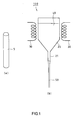
- the shape of the glass spacer according to the present invention is preferably a columnar shape (see the glass spacer 5 shown in FIG. 1(a) ).
- An electron beam-excited display of the present invention includes a vacuum container as well as electron-emitting elements and glass spacers that are disposed inside the vacuum container, with the glass spacers being formed of the aforementioned glass composition.
- the electron beam-excited display of the present invention can be configured, with, for example, the glass spacers 5 of the electron beam-excited display having the configuration shown in FIG. 2 being replaced by glass spacers formed of the aforementioned glass composition. In such an electron beam-excited display, the electric-field breakdown tends not to occur.
- compositions of Examples 1 to 21 and Comparative Examples 1 to 18 are indicated in "mol%" in Tables 1B, 2B, 3B, 4B, and 5B. These examples were conceived based on the compositions indicated in mol%. In prior art documents, however, many glass compositions are indicated in mass% (wt%). Accordingly, with consideration given to ease of comparison therewith, the present specification is based on the indication in mass%. Compositions indicated in mol% would allow the intentions of these examples to be understood easily.
- the average linear expansion coefficient and glass transition point thereof were determined from a thermal expansion curve. Furthermore, the velocities of longitudinal wave and transverse wave that propagate in the glass were determined by a sing-around method, while the Young's modulus was determined from the glass density measured by the Archimedes method. Furthermore, the relationship between the viscosity and temperature was examined by the common platinum ball pulling method, and from this result, the temperature at which the glass had a viscosity of 100 dPa • sec was determined.
- the glass produced in Example 1 has a composition containing SiO 2 , B 2 O 3 , and Al 2 O 3 as glass skeleton components, MgO, CaO, and SrO as alkaline earth metal oxides, and further ZnO, ZrO 2 , La 2 O 3 , and Fe 2 O 3 .
- the glasses produced in Examples 2, 3, and 4 each have a composition obtained by adjusting the contents of SiO 2 , B 2 O 3 , and Al 2 O 3 used in Example 1.
- the glasses produced in Examples 5, 6, 7, 8, and 9 each have a composition obtained by adjusting the contents of SiO 2 , B 2 O 3 , and alkaline earth metal oxides of the glass according to Example 1.
- the glass produced in Example 10 has a composition obtained by excluding ZnO from the glass of Example 1. Furthermore, the glass produced in Example 11 has a composition obtained by excluding ZrO 2 from the glass of Example 1. Moreover, the glass produced in Example 12 has a composition obtained by excluding La 2 O 3 from the glass of Example 1 and adjusting the contents of SiO 2 and Fe 2 O 3 of the glass of Example 1.
- the glass produced in Example 13 has a composition containing Y 2 O 3 added to the glass of Example 1. Furthermore, the glass produced in Example 14 has a composition containing TiO 2 added to the glass of Example 1.
- the glass produced in Example 15 has a composition obtained by adjusting the contents of SiO 2 , B 2 O 3 , Al 2 O 3 , and Fe 2 O 3 used in Example 1.
- the glass produced in Example 16 has a composition containing Nb 2 O 5 added to the glass of Example 1. Furthermore, the glass produced in Example 17 has a composition containing Ta 2 O 5 added to the glass of Example 1.
- the glasses produced in Examples 18, 19, and 20 each have a composition obtained by adjusting the content of Fe 2 O 3 of the glass according to Example 1.
- the volume resistivities were 1.1 ⁇ 10 14 ⁇ cm to 1.3 ⁇ 10 15 ⁇ cm at 25°C. This indicates that an increase in the content of Fe 2 O 3 results in a decrease in the volume resistivity.
- the glass produced in Example 21 has a composition containing SiO 2 , B 2 O 3 , Al 2 O 3 as glass skeleton components, CaO, SrO, and BaO as alkaline earth metal oxides, and further La 2 O 3 and Fe 2 O 3 .
- the glass produced in Comparative Example 1 has a composition obtained by excluding V 2 O 5 from the glass composition described in Example 4 in JP 2003-526187 A , which is a glass composition outside the scope of the present invention.
- the temperature difference obtained by subtracting the devitrification temperature of the glass from the temperature at which the glass had a viscosity of 100 dPa • sec was -95°C, which was lower than those of the examples according to the present invention.
- the glass produced in Comparative Example 2 has the glass composition described in Example D in JP 2004-43288 A , which is a glass composition outside the scope of the present invention.
- the Young's modulus was 87 GPa, which was smaller than those of the examples according to the present invention.
- the temperature difference obtained by subtracting the devitrification temperature of the glass from the temperature at which the glass had a viscosity of 100 dPa • sec was -77°C, which was lower than those of the examples according to the present invention.
- the glass produced in Comparative Example 3 has the glass composition described in Example 5 in JP 2004-71158 A , which is a glass composition outside the scope of the present invention.
- the average linear expansion coefficient was 67 ⁇ 10 -7 / °C, which was smaller than those of the examples according to the present invention.
- the temperature difference obtained by subtracting the devitrification temperature of the glass from the temperature at which the glass had a viscosity of 100 dPa • sec was -145°C, which was lower than those of the examples according to the present invention.
- the glass produced in Comparative Example 4 has the glass composition described in Example 8 in JP 2005-263613 A , which is a glass composition outside the scope of the present invention.
- the temperature difference obtained by subtracting the devitrification temperature of the glass from the temperature at which the glass had a viscosity of 100 dPa • sec was -132°C, which was lower than those of the examples according to the present invention.
- the glass produced in Comparative Example 5 is composed of a composition in which the B 2 O 3 content is outside the range of the present invention.
- the temperature difference obtained by subtracting the devitrification temperature of the glass from the temperature at which the glass had a viscosity of 100 dPa • sec was -3°C, which was lower than those of the examples according to the present invention.
- the glass produced in Comparative Example 6 is composed of a composition in which the Al 2 O 3 content is outside the range of the present invention.
- the temperature difference obtained by subtracting the devitrification temperature of the glass from the temperature at which the glass had a viscosity of 100 dPa • sec was -85°C, which was lower than those of the examples according to the present invention.
- the glass produced in Comparative Example 7 is composed of a composition in which the contents of MgO and CaO are outside the range of the present invention.
- the average linear expansion coefficient was 62 ⁇ 10 -7 /°C, which was smaller than those of the examples according to the present invention.
- the temperature difference obtained by subtracting the devitrification temperature of the glass from the temperature at which the glass had a viscosity of 100 dPa • sec was -128°C, which was lower than those of the examples according to the present invention.
- the glass produced in Comparative Example 8 is composed of a composition in which the contents of (SiO 2 +B 2 O 3 +Al 2 O 3 ), CaO, and SrO are outside the range of the present invention.
- the temperature difference obtained by subtracting the devitrification temperature of the glass from the temperature at which the glass had a viscosity of 100 dPa • sec was -12°C, which was lower than those of the examples according to the present invention.
- the glass produced in Comparative Example 9 is composed of a composition in which the contents of (SiO 2 +B 2 O 3 +Al 2 O 3 ) and BaO are outside the range of the present invention.
- the temperature difference obtained by subtracting the devitrification temperature of the glass from the temperature at which the glass had a viscosity of 100 dPa ⁇ sec was -123°C, which was lower than those of the examples according to the present invention.
- the glass produced in Comparative Example 10 is composed of a composition in which the content of (SrO+BaO) is outside the range of the present invention.
- the temperature difference obtained by subtracting the devitrification temperature of the glass from the temperature at which the glass had a viscosity of 100 dPa ⁇ sec was -18°C, which was lower than those of the examples according to the present invention.
- the glass produced in Comparative Example 11 is composed of a composition in which the contents of (MgO+CaO+SrO+BaO) and ZnO are outside the range of the present invention.
- the average linear expansion coefficient was 67 ⁇ 10 -7 /°C, which was smaller than those of the examples according to the present invention.
- the glass transition point was 612 °C, which was lower than those of the examples according to the present invention.
- the temperature difference obtained by subtracting the devitrification temperature of the glass from the temperature at which the glass had a viscosity of 100 dPa ⁇ sec was -23°C, which was lower than those of the examples according to the present invention.
- the glass produced in Comparative Example 12 is composed of a composition in which the content of ZrO 2 is outside the range of the present invention.
- the average linear expansion coefficient was 67 ⁇ 10 -7 / °C, which was smaller than those of the examples according to the present invention.
- the temperature difference obtained by subtracting the devitrification temperature of the glass from the temperature at which the glass had a viscosity of 100 dPa ⁇ sec was -203°C, which was lower than those of the examples according to the present invention.
- the glass produced in Comparative Example 13 is composed of a composition in which the contents of (SiO 2 +B 2 O 3 +Al 2 O 3 ) and La 2 O 3 are outside the range of the present invention.
- the temperature difference obtained by subtracting the devitrification temperature of the glass from the temperature at which the glass had a viscosity of 100 dPa ⁇ sec was -78°C, which was lower than those of the examples according to the present invention.
- the glass produced in Comparative Example 14 is composed of a composition in which the content of Y 2 O 3 is outside the range of the present invention.
- the temperature difference obtained by subtracting the devitrification temperature of the glass from the temperature at which the glass had a viscosity of 100 dPa ⁇ sec was -55°C, which was lower than those of the examples according to the present invention.
- the glass produced in Comparative Example 15 is composed of a composition in which the contents of (MgO+CaO+SrO+BaO), TiO 2 , and (TiO 2 +Fe 2 O 3 +Nb 2 O 5 +Ta 2 O 5 ) are outside the range of the present invention.
- the average linear expansion coefficient was 69 ⁇ 10 -7 /°C, which was smaller than those of the examples according to the present invention.
- the temperature difference obtained by subtracting the devitrification temperature of the glass from the temperature at which the glass had a viscosity of 100 dPa ⁇ sec was -65°C, which was lower than those of the examples according to the present invention.
- the glass produced in Comparative Example 16 is composed of a composition in which the contents of (SiO 2 +B 2 O 3 +Al 2 O 3 ), Fe 2 O 3 and (TiO 2 + Fe 2 O 3 +Nb 2 O 5 +Ta 2 O 5 ) are outside the range of the present invention.
- the temperature difference obtained by subtracting the devitrification temperature of the glass from the temperature at which the glass had a viscosity of 100 dPa ⁇ sec was -184°C, which was lower than those of the examples according to the present invention.
- the glass produced in Comparative Example 17 is composed of a composition in which the contents of Nb 2 O 5 and (TiO 2 +Fe 2 O 3 +Nb 2 O 5 +Ta 2 O 5 ) are outside the range of the present invention.
- the temperature difference obtained by subtracting the devitrification temperature of the glass from the temperature at which the glass had a viscosity of 100 dPa ⁇ sec was -40°C, which was lower than those of the examples according to the present invention.
- the glass produced in Comparative Example 18 is composed of a composition in which the contents of (SiO 2 +B 2 O 5 +Al 2 O 3 ), Ta 2 O 5 , and (TiO 2 +Fe 2 O 3 +Nb 2 O 5 +Ta 2 O 5 ) are outside the range of the present invention.
- the temperature difference obtained by subtracting the devitrification temperature of the glass from the temperature at which the glass had a viscosity of 100 dPa ⁇ sec was -130°C, which was lower than those of the examples according to the present invention.
- the temperature difference obtained by subtracting the devitrification temperature of the glass from the temperature at which the glass had a viscosity of 100 dPa ⁇ sec is small and a minus value.
- the temperature difference is at least 0°C. Accordingly, it is proved that the glasses produced in the examples have better formability than that of the glasses produced in the comparative examples.
- each glass composition obtained in the aforementioned examples was melted by the method described above, it was formed into pellets while being cooled. These pellets were fed into a manufacturing apparatus 100 and thereby a glass spacer was manufactured.
- the manufacturing apparatus used herein was the manufacturing apparatus 100 shown in FIG. 1(b) .
- the aforementioned pellets were fed into a refractory furnace vessel 20 and were melted by being heated with a heater 30.
- a glass material 40 was obtained.
- This glass material 40 was drawn out through a nozzle 21 attached to the lower part of the refractory furnace vessel 20 and thereby was formed into a fibrous preform 50.
- This preform was cut to a predetermined length and thus columnar glass spacers were manufactured. These glass spacers had a size and accuracy required for an electron beam-excited display.
Landscapes
- Chemical & Material Sciences (AREA)
- Life Sciences & Earth Sciences (AREA)
- Engineering & Computer Science (AREA)
- Chemical Kinetics & Catalysis (AREA)
- General Chemical & Material Sciences (AREA)
- Geochemistry & Mineralogy (AREA)
- Materials Engineering (AREA)
- Organic Chemistry (AREA)
- Glass Compositions (AREA)
- Vessels, Lead-In Wires, Accessory Apparatuses For Cathode-Ray Tubes (AREA)
- Cathode-Ray Tubes And Fluorescent Screens For Display (AREA)
Applications Claiming Priority (2)
| Application Number | Priority Date | Filing Date | Title |
|---|---|---|---|
| JP2006128188 | 2006-05-02 | ||
| PCT/JP2007/059264 WO2007129629A1 (fr) | 2006-05-02 | 2007-04-27 | composition de verre et entretoise de verre utilisant ladite composition |
Publications (2)
| Publication Number | Publication Date |
|---|---|
| EP2017236A1 true EP2017236A1 (fr) | 2009-01-21 |
| EP2017236A4 EP2017236A4 (fr) | 2009-12-16 |
Family
ID=38667738
Family Applications (1)
| Application Number | Title | Priority Date | Filing Date |
|---|---|---|---|
| EP07742699A Withdrawn EP2017236A4 (fr) | 2006-05-02 | 2007-04-27 | Composition de verre et entretoise de verre utilisant ladite composition |
Country Status (7)
| Country | Link |
|---|---|
| US (1) | US20090105061A1 (fr) |
| EP (1) | EP2017236A4 (fr) |
| JP (1) | JPWO2007129629A1 (fr) |
| KR (1) | KR20090018048A (fr) |
| CN (1) | CN101432238A (fr) |
| TW (1) | TW200804216A (fr) |
| WO (1) | WO2007129629A1 (fr) |
Cited By (14)
| Publication number | Priority date | Publication date | Assignee | Title |
|---|---|---|---|---|
| WO2010126581A1 (fr) * | 2009-05-01 | 2010-11-04 | Guardian Industries Corp. | Vitre isolante sous vide comprenant un fritté de verre fusible par infrarouges, et/ou son procédé de fabrication |
| US8500933B2 (en) | 2007-12-14 | 2013-08-06 | Guardian Industries Corp. | Localized heating of edge seals for a vacuum insulating glass unit, and/or unitized oven for accomplishing the same |
| US8506738B2 (en) | 2007-12-17 | 2013-08-13 | Guardian Industries Corp. | Localized heating via an infrared heat source array of edge seals for a vacuum insulating glass unit, and/or unitized oven with infrared heat source array for accomplishing the same |
| US8733128B2 (en) | 2011-02-22 | 2014-05-27 | Guardian Industries Corp. | Materials and/or method of making vacuum insulating glass units including the same |
| US8802203B2 (en) | 2011-02-22 | 2014-08-12 | Guardian Industries Corp. | Vanadium-based frit materials, and/or methods of making the same |
| RU2544205C1 (ru) * | 2014-03-12 | 2015-03-10 | Федеральное государственное унитарное предприятие "Всероссийский научно-исследовательский институт авиационных материалов" (ФГУП "ВИАМ") | Защитное технологическое покрытие |
| WO2016040425A1 (fr) | 2014-09-09 | 2016-03-17 | Ppg Industries Ohio, Inc. | Compositions de verre, compositions de verre permettant de former des fibres, et fibres de verre fabriquées à partir de celles-ci |
| US9290408B2 (en) | 2011-02-22 | 2016-03-22 | Guardian Industries Corp. | Vanadium-based frit materials, and/or methods of making the same |
| US9309146B2 (en) | 2011-02-22 | 2016-04-12 | Guardian Industries Corp. | Vanadium-based frit materials, binders, and/or solvents and methods of making the same |
| US9359247B2 (en) | 2011-02-22 | 2016-06-07 | Guardian Industries Corp. | Coefficient of thermal expansion filler for vanadium-based frit materials and/or methods of making and/or using the same |
| US9458052B2 (en) | 2011-02-22 | 2016-10-04 | Guardian Industries Corp. | Coefficient of thermal expansion filler for vanadium-based frit materials and/or methods of making and/or using the same |
| US9593527B2 (en) | 2014-02-04 | 2017-03-14 | Guardian Industries Corp. | Vacuum insulating glass (VIG) unit with lead-free dual-frit edge seals and/or methods of making the same |
| US9822580B2 (en) | 2011-02-22 | 2017-11-21 | Guardian Glass, LLC | Localized heating techniques incorporating tunable infrared element(s) for vacuum insulating glass units, and/or apparatuses for same |
| US9988302B2 (en) | 2014-02-04 | 2018-06-05 | Guardian Glass, LLC | Frits for use in vacuum insulating glass (VIG) units, and/or associated methods |
Families Citing this family (15)
| Publication number | Priority date | Publication date | Assignee | Title |
|---|---|---|---|---|
| DE112011104339B4 (de) * | 2010-12-08 | 2019-07-04 | Nippon Electric Glass Co., Ltd. | Glas mit hohem Brechungsindex |
| US9272943B2 (en) * | 2013-12-11 | 2016-03-01 | National Taipei University Of Technology | Medium temperature solid fuel cell glass packaging material |
| RU2609495C1 (ru) * | 2016-02-09 | 2017-02-02 | Юлия Алексеевна Щепочкина | Стекло |
| RU2640223C1 (ru) * | 2016-12-06 | 2017-12-27 | Юлия Алексеевна Щепочкина | Стекло |
| JP2020534238A (ja) | 2017-09-21 | 2020-11-26 | コーニング インコーポレイテッド | 高い破壊靭性を有する透明でイオン交換可能なケイ酸塩ガラス |
| CN108929035B (zh) * | 2018-07-02 | 2021-04-30 | 芜湖东旭光电装备技术有限公司 | 玻璃组合物以及高韧性玻璃及其制备方法和应用 |
| ES2980180T3 (es) | 2018-11-26 | 2024-09-30 | Owens Corning Intellectual Capital Llc | Composición de fibra de vidrio de alto rendimiento con módulo de elasticidad mejorado |
| CA3117986A1 (fr) | 2018-11-26 | 2020-06-04 | Owens Corning Intellectual Capital, Llc | Composition de fibres de verre hautes performances presentant un module specifique ameliore |
| JP7247825B2 (ja) * | 2018-12-17 | 2023-03-29 | Agc株式会社 | ガラス組成物、複合粉末材料、複合粉末材料ペースト、レーザプリンタ用のプリンタヘッド、及びサーマルプリンタヘッド |
| CN112851113B (zh) * | 2019-11-27 | 2022-04-15 | 成都光明光电股份有限公司 | 玻璃组合物 |
| CN116177871A (zh) * | 2019-11-27 | 2023-05-30 | 成都光明光电股份有限公司 | 无碱玻璃 |
| US11787729B2 (en) | 2020-05-18 | 2023-10-17 | Corning Incorporated | Glass compositions with high refractive indexes and low densities |
| KR102679287B1 (ko) | 2021-01-18 | 2024-06-27 | 강원대학교산학협력단 | 개느삼 추출물을 유효성분으로 포함하는 가금용 기능성 사료 조성물 및 이의 제조방법 |
| WO2023042717A1 (fr) * | 2021-09-14 | 2023-03-23 | Agc株式会社 | Bloc de verre et son procédé de production, ainsi qu'élément pour appareil de production de semi-conducteur |
| CN119191706A (zh) * | 2022-08-26 | 2024-12-27 | 成都光明光电股份有限公司 | 高折射高色散光学玻璃 |
Family Cites Families (14)
| Publication number | Priority date | Publication date | Assignee | Title |
|---|---|---|---|---|
| US4126437A (en) * | 1976-12-02 | 1978-11-21 | Xerox Corporation | Magnetic glass carrier materials |
| GB2243604A (en) * | 1990-04-25 | 1991-11-06 | United States Borax Chem | Glass compositions |
| WO1991016273A1 (fr) * | 1990-04-25 | 1991-10-31 | United States Borax & Chemical Corporation | Compositions de verre de calcia-alumino-boro-silicate |
| SU1761701A1 (ru) * | 1990-12-17 | 1992-09-15 | Научно-Исследовательский Институт Электровакуумного Стекла С Заводом | Стекло |
| JP3241219B2 (ja) | 1993-11-01 | 2001-12-25 | キヤノン株式会社 | 画像表示装置の製造方法 |
| JP2000203857A (ja) | 1999-01-08 | 2000-07-25 | Nippon Sheet Glass Co Ltd | ガラススペ―サの製造方法 |
| FR2806075B1 (fr) | 2000-03-07 | 2002-09-20 | Saint Gobain Vitrage | Espaceur en verre |
| JP3882489B2 (ja) * | 2000-09-27 | 2007-02-14 | 日本板硝子株式会社 | 電子線励起ディスプレイ素子用ガラススペーサ及び電子線励起ディスプレイ素子 |
| FR2838118B1 (fr) * | 2002-04-08 | 2004-09-10 | Saint Gobain | Espaceurs possedant une conductivite electronique, procede de fabrication et applications notamment pour les ecrans de visualisation |
| JP4370801B2 (ja) | 2002-05-14 | 2009-11-25 | 旭硝子株式会社 | ガラス、ガラスの製造方法およびフィールドエミッションディスプレイ装置 |
| KR100935822B1 (ko) * | 2002-05-14 | 2010-01-08 | 아사히 가라스 가부시키가이샤 | 글라스, 그 제조방법, 및 fed 장치 |
| JP3724457B2 (ja) | 2002-06-13 | 2005-12-07 | 日本板硝子株式会社 | 電子線励起型ディスプレイ用ガラススペーサ |
| JP4600061B2 (ja) | 2004-02-17 | 2010-12-15 | 旭硝子株式会社 | ガラススペーサーおよびその製造方法、ならびにフィールドエミッションディスプレイ |
| WO2006059492A1 (fr) * | 2004-11-30 | 2006-06-08 | Asahi Glass Company, Limited | Espaceur en verre cristallise pour ecran a emission de champ et son procede de fabrication |
-
2007
- 2007-04-27 KR KR1020087027382A patent/KR20090018048A/ko not_active Withdrawn
- 2007-04-27 JP JP2008514462A patent/JPWO2007129629A1/ja active Pending
- 2007-04-27 CN CNA2007800148632A patent/CN101432238A/zh active Pending
- 2007-04-27 WO PCT/JP2007/059264 patent/WO2007129629A1/fr not_active Ceased
- 2007-04-27 EP EP07742699A patent/EP2017236A4/fr not_active Withdrawn
- 2007-04-27 US US12/226,794 patent/US20090105061A1/en not_active Abandoned
- 2007-05-01 TW TW096115449A patent/TW200804216A/zh unknown
Cited By (35)
| Publication number | Priority date | Publication date | Assignee | Title |
|---|---|---|---|---|
| US8500933B2 (en) | 2007-12-14 | 2013-08-06 | Guardian Industries Corp. | Localized heating of edge seals for a vacuum insulating glass unit, and/or unitized oven for accomplishing the same |
| US10294140B2 (en) | 2007-12-17 | 2019-05-21 | Guardian Glass, LLC | Localized heating via an infrared heat source array of edge seals for a vacuum insulating glass unit, and/or unitized oven with infrared heat source array for accomplishing the same |
| US8506738B2 (en) | 2007-12-17 | 2013-08-13 | Guardian Industries Corp. | Localized heating via an infrared heat source array of edge seals for a vacuum insulating glass unit, and/or unitized oven with infrared heat source array for accomplishing the same |
| US10717668B2 (en) | 2007-12-17 | 2020-07-21 | Guardian Glass, Llc. | Localized heating via an infrared heat source array of edge seals for a vacuum insulating glass unit, and/or unitized oven with infrared heat source array for accomplishing the same |
| US8227055B2 (en) | 2009-05-01 | 2012-07-24 | Guardian Industries Corp. | Vacuum insulating glass unit including infrared meltable glass frit, and/or method of making the same |
| US8590343B2 (en) | 2009-05-01 | 2013-11-26 | Guardian Industries Corp. | Vacuum insulating glass unit including infrared meltable glass frit, and/or method of making the same |
| US8763427B2 (en) | 2009-05-01 | 2014-07-01 | Guardian Industries Corp. | Vacuum insulating glass unit including infrared meltable glass frit, and/or method of making the same |
| WO2010126581A1 (fr) * | 2009-05-01 | 2010-11-04 | Guardian Industries Corp. | Vitre isolante sous vide comprenant un fritté de verre fusible par infrarouges, et/ou son procédé de fabrication |
| US10329187B2 (en) | 2011-02-22 | 2019-06-25 | Guardian Glass, LLC | Coefficient of thermal expansion filler for vanadium-based frit materials and/or methods of making and/or using the same |
| US8733128B2 (en) | 2011-02-22 | 2014-05-27 | Guardian Industries Corp. | Materials and/or method of making vacuum insulating glass units including the same |
| US9290408B2 (en) | 2011-02-22 | 2016-03-22 | Guardian Industries Corp. | Vanadium-based frit materials, and/or methods of making the same |
| US9309146B2 (en) | 2011-02-22 | 2016-04-12 | Guardian Industries Corp. | Vanadium-based frit materials, binders, and/or solvents and methods of making the same |
| US9359247B2 (en) | 2011-02-22 | 2016-06-07 | Guardian Industries Corp. | Coefficient of thermal expansion filler for vanadium-based frit materials and/or methods of making and/or using the same |
| US9458052B2 (en) | 2011-02-22 | 2016-10-04 | Guardian Industries Corp. | Coefficient of thermal expansion filler for vanadium-based frit materials and/or methods of making and/or using the same |
| US11028009B2 (en) | 2011-02-22 | 2021-06-08 | Guardian Glass, LLC | Coefficient of thermal expansion filler for vanadium-based frit materials and/or methods of making and/or using the same |
| US11014847B2 (en) | 2011-02-22 | 2021-05-25 | Guardian Glass, LLC | Vanadium-based frit materials, and/or methods of making the same |
| US9776910B2 (en) | 2011-02-22 | 2017-10-03 | Guardian Glass, LLC | Vanadium-based frit materials, and/or methods of making the same |
| US9822580B2 (en) | 2011-02-22 | 2017-11-21 | Guardian Glass, LLC | Localized heating techniques incorporating tunable infrared element(s) for vacuum insulating glass units, and/or apparatuses for same |
| US10858880B2 (en) | 2011-02-22 | 2020-12-08 | Guardian Glass, LLC | Vanadium-based frit materials, binders, and/or solvents and/or methods of making the same |
| US10087676B2 (en) | 2011-02-22 | 2018-10-02 | Guardian Glass, LLC | Vanadium-based frit materials, and/or methods of making the same |
| US10107028B2 (en) | 2011-02-22 | 2018-10-23 | Guardian Glass, LLC | Method of making vacuum insulated glass (VIG) window unit |
| US10125045B2 (en) | 2011-02-22 | 2018-11-13 | Guardian Glass, LLC | Coefficient of thermal expansion filler for vanadium-based frit materials and/or methods of making and/or using the same |
| US10196299B2 (en) | 2011-02-22 | 2019-02-05 | Guardian Glass, LLC | Vanadium-based frit materials, and/or methods of making the same |
| US10752535B2 (en) | 2011-02-22 | 2020-08-25 | Guardian Glass, LLC | Coefficient of thermal expansion filler for vanadium-based frit materials and/or methods of making and/or using the same |
| US8802203B2 (en) | 2011-02-22 | 2014-08-12 | Guardian Industries Corp. | Vanadium-based frit materials, and/or methods of making the same |
| US10421684B2 (en) | 2014-02-04 | 2019-09-24 | Guardian Glass, LLC | Frits for use in vacuum insulating glass (VIG) units, and/or associated methods |
| US10465433B2 (en) | 2014-02-04 | 2019-11-05 | Guardian Glass, Llc. | Vacuum insulating glass (VIG) unit with lead-free dual-frit seals and/or methods of making the same |
| US9988302B2 (en) | 2014-02-04 | 2018-06-05 | Guardian Glass, LLC | Frits for use in vacuum insulating glass (VIG) units, and/or associated methods |
| US9593527B2 (en) | 2014-02-04 | 2017-03-14 | Guardian Industries Corp. | Vacuum insulating glass (VIG) unit with lead-free dual-frit edge seals and/or methods of making the same |
| RU2544205C1 (ru) * | 2014-03-12 | 2015-03-10 | Федеральное государственное унитарное предприятие "Всероссийский научно-исследовательский институт авиационных материалов" (ФГУП "ВИАМ") | Защитное технологическое покрытие |
| WO2016040425A1 (fr) | 2014-09-09 | 2016-03-17 | Ppg Industries Ohio, Inc. | Compositions de verre, compositions de verre permettant de former des fibres, et fibres de verre fabriquées à partir de celles-ci |
| US10870602B2 (en) | 2014-09-09 | 2020-12-22 | Electric Glass Fiber America, LLC | Glass compositions, fiberizable glass compositions, and glass fibers made therefrom |
| JP2017526607A (ja) * | 2014-09-09 | 2017-09-14 | ピーピージー・インダストリーズ・オハイオ・インコーポレイテッドPPG Industries Ohio,Inc. | ガラス組成物、線維化可能ガラス組成物、およびそれらから形成されるガラス繊維 |
| JP2023024500A (ja) * | 2014-09-09 | 2023-02-16 | エレクトリック グラス ファイバー アメリカ, エルエルシー | ガラス組成物、線維化可能ガラス組成物、およびそれらから形成されるガラス繊維 |
| US11905199B2 (en) | 2014-09-09 | 2024-02-20 | Electric Glass Fiber America, LLC | Glass compositions, fiberizable glass compositions, and glass fibers made therefrom |
Also Published As
| Publication number | Publication date |
|---|---|
| TW200804216A (en) | 2008-01-16 |
| EP2017236A4 (fr) | 2009-12-16 |
| US20090105061A1 (en) | 2009-04-23 |
| JPWO2007129629A1 (ja) | 2009-09-17 |
| KR20090018048A (ko) | 2009-02-19 |
| WO2007129629A1 (fr) | 2007-11-15 |
| CN101432238A (zh) | 2009-05-13 |
Similar Documents
| Publication | Publication Date | Title |
|---|---|---|
| US20090105061A1 (en) | Glass Composition and Glass Spacer Using the Same | |
| JP5413562B2 (ja) | 封着材料 | |
| US7968380B2 (en) | Semiconductor encapsulation material and method for encapsulating semiconductor using the same | |
| EP2202207B1 (fr) | Composition de verre pour substrat et son procédé de fabrication | |
| EP1653499B1 (fr) | Tube de verre pour lampe fluorescente a electrode exterieure | |
| US5459109A (en) | Substrate glasses for plasma displays | |
| EP2857366A1 (fr) | Verre exempt d'alcali et son procédé de fabrication | |
| EP2322491A1 (fr) | Verre flotté de type las | |
| JP5212884B2 (ja) | ビスマス系封着材料およびビスマス系ペースト材料 | |
| EP0499039B1 (fr) | Verres pour plaques frontales de tube cathodique | |
| JP4692915B2 (ja) | プラズマディスプレイ装置用前面ガラス基板。 | |
| KR100935822B1 (ko) | 글라스, 그 제조방법, 및 fed 장치 | |
| US6251811B1 (en) | Funnel glass for a cathode ray tube | |
| EP1870385A1 (fr) | Composition de verre pour lampes, lampe, unite de retro-eclairage et procede de fabrication d'une composition de verre pour lampes | |
| JP2007210870A (ja) | ビスマス系ガラス組成物およびビスマス系封着材料 | |
| JPH07291651A (ja) | マイクロチャンネルプレート製造用可溶性コアガラス | |
| KR20040098062A (ko) | 전자 전도성 스페이서, 이의 제조 방법 및 특히디스플레이 스크린의 사용방법 | |
| JP4953169B2 (ja) | 支持枠形成材料 | |
| JP2007320846A (ja) | ガラス組成物およびこれを用いたガラススペーサ | |
| US20230212060A1 (en) | Alkali-free glass panel | |
| JP2006188406A (ja) | 平板ディスプレイ用真空外囲器およびそれを用いた平板ディスプレイ | |
| EP4227274A1 (fr) | Verre pour tube, récipient d'emballage primaire pharmaceutique et verre de silicate alcalin | |
| JP5382609B2 (ja) | ガラス基板 | |
| JP2004277222A (ja) | フラットパネルディスプレイ装置用ガラス基板 | |
| JP2006143523A (ja) | ディスプレイ装置用基板ガラス |
Legal Events
| Date | Code | Title | Description |
|---|---|---|---|
| PUAI | Public reference made under article 153(3) epc to a published international application that has entered the european phase |
Free format text: ORIGINAL CODE: 0009012 |
|
| 17P | Request for examination filed |
Effective date: 20081120 |
|
| AK | Designated contracting states |
Kind code of ref document: A1 Designated state(s): AT BE BG CH CY CZ DE DK EE ES FI FR GB GR HU IE IS IT LI LT LU LV MC MT NL PL PT RO SE SI SK TR |
|
| AX | Request for extension of the european patent |
Extension state: AL BA HR MK RS |
|
| DAX | Request for extension of the european patent (deleted) | ||
| RBV | Designated contracting states (corrected) |
Designated state(s): DE FR GB |
|
| A4 | Supplementary search report drawn up and despatched |
Effective date: 20091113 |
|
| STAA | Information on the status of an ep patent application or granted ep patent |
Free format text: STATUS: THE APPLICATION HAS BEEN WITHDRAWN |
|
| 17Q | First examination report despatched |
Effective date: 20100422 |
|
| 18W | Application withdrawn |
Effective date: 20100422 |