EP2017264A1 - Substituted phenyl propargyl compounds, method for their manufacture and their use as herbicides and plant growth regulators - Google Patents
Substituted phenyl propargyl compounds, method for their manufacture and their use as herbicides and plant growth regulators Download PDFInfo
- Publication number
- EP2017264A1 EP2017264A1 EP07013871A EP07013871A EP2017264A1 EP 2017264 A1 EP2017264 A1 EP 2017264A1 EP 07013871 A EP07013871 A EP 07013871A EP 07013871 A EP07013871 A EP 07013871A EP 2017264 A1 EP2017264 A1 EP 2017264A1
- Authority
- EP
- European Patent Office
- Prior art keywords
- radicals
- alkyl
- alkoxy
- group
- substituted
- Prior art date
- Legal status (The legal status is an assumption and is not a legal conclusion. Google has not performed a legal analysis and makes no representation as to the accuracy of the status listed.)
- Withdrawn
Links
- -1 phenyl propargyl compounds Chemical class 0.000 title claims abstract description 274
- 239000004009 herbicide Substances 0.000 title claims abstract description 11
- 239000005648 plant growth regulator Substances 0.000 title claims abstract description 7
- 238000000034 method Methods 0.000 title claims abstract description 6
- 238000004519 manufacturing process Methods 0.000 title 1
- 125000000229 (C1-C4)alkoxy group Chemical group 0.000 claims abstract description 321
- 125000001997 phenyl group Chemical group [H]C1=C([H])C([H])=C(*)C([H])=C1[H] 0.000 claims abstract description 237
- 125000000449 nitro group Chemical group [O-][N+](*)=O 0.000 claims abstract description 149
- 229910052760 oxygen Inorganic materials 0.000 claims abstract description 141
- 229910052717 sulfur Inorganic materials 0.000 claims abstract description 137
- 125000006413 ring segment Chemical group 0.000 claims abstract description 110
- 125000004076 pyridyl group Chemical group 0.000 claims abstract description 76
- 125000000951 phenoxy group Chemical group [H]C1=C([H])C([H])=C(O*)C([H])=C1[H] 0.000 claims abstract description 68
- 150000001875 compounds Chemical class 0.000 claims abstract description 63
- 125000005842 heteroatom Chemical group 0.000 claims abstract description 58
- 125000000623 heterocyclic group Chemical group 0.000 claims abstract description 53
- 125000004432 carbon atom Chemical group C* 0.000 claims abstract description 31
- 150000003839 salts Chemical class 0.000 claims abstract description 24
- 125000001261 isocyanato group Chemical group *N=C=O 0.000 claims abstract description 19
- 125000003178 carboxy group Chemical group [H]OC(*)=O 0.000 claims abstract description 17
- 125000000852 azido group Chemical group *N=[N+]=[N-] 0.000 claims abstract description 16
- 125000000217 alkyl group Chemical group 0.000 claims abstract description 12
- 125000003342 alkenyl group Chemical group 0.000 claims abstract description 10
- 125000002837 carbocyclic group Chemical group 0.000 claims abstract description 8
- 125000002485 formyl group Chemical group [H]C(*)=O 0.000 claims abstract description 5
- 230000002363 herbicidal effect Effects 0.000 claims abstract description 5
- 229910052799 carbon Inorganic materials 0.000 claims abstract description 4
- 238000002360 preparation method Methods 0.000 claims abstract description 3
- 125000000446 sulfanediyl group Chemical group *S* 0.000 claims abstract description 3
- 238000006880 cross-coupling reaction Methods 0.000 claims abstract 2
- 150000003254 radicals Chemical class 0.000 claims description 945
- 229910052736 halogen Inorganic materials 0.000 claims description 452
- 150000002367 halogens Chemical class 0.000 claims description 452
- 125000004178 (C1-C4) alkyl group Chemical group 0.000 claims description 347
- 125000002915 carbonyl group Chemical group [*:2]C([*:1])=O 0.000 claims description 272
- 125000004767 (C1-C4) haloalkoxy group Chemical group 0.000 claims description 265
- 125000004433 nitrogen atom Chemical group N* 0.000 claims description 237
- 125000004765 (C1-C4) haloalkyl group Chemical group 0.000 claims description 217
- 125000006273 (C1-C3) alkyl group Chemical group 0.000 claims description 205
- 125000004169 (C1-C6) alkyl group Chemical group 0.000 claims description 176
- 229910052739 hydrogen Inorganic materials 0.000 claims description 174
- 239000001257 hydrogen Substances 0.000 claims description 174
- 125000004209 (C1-C8) alkyl group Chemical group 0.000 claims description 161
- 125000004414 alkyl thio group Chemical group 0.000 claims description 159
- 125000004390 alkyl sulfonyl group Chemical group 0.000 claims description 157
- 125000004191 (C1-C6) alkoxy group Chemical group 0.000 claims description 138
- 125000005913 (C3-C6) cycloalkyl group Chemical group 0.000 claims description 138
- 125000004441 haloalkylsulfonyl group Chemical group 0.000 claims description 133
- UFHFLCQGNIYNRP-UHFFFAOYSA-N Hydrogen Chemical compound [H][H] UFHFLCQGNIYNRP-UHFFFAOYSA-N 0.000 claims description 131
- 125000004768 (C1-C4) alkylsulfinyl group Chemical group 0.000 claims description 127
- 125000004440 haloalkylsulfinyl group Chemical group 0.000 claims description 126
- 125000006595 (C1-C3) alkylsulfinyl group Chemical group 0.000 claims description 125
- 125000004769 (C1-C4) alkylsulfonyl group Chemical group 0.000 claims description 123
- 125000004457 alkyl amino carbonyl group Chemical group 0.000 claims description 102
- 125000004435 hydrogen atom Chemical group [H]* 0.000 claims description 101
- 125000004648 C2-C8 alkenyl group Chemical group 0.000 claims description 96
- 125000000392 cycloalkenyl group Chemical group 0.000 claims description 94
- 125000006274 (C1-C3)alkoxy group Chemical group 0.000 claims description 92
- 125000003917 carbamoyl group Chemical group [H]N([H])C(*)=O 0.000 claims description 92
- 125000006677 (C1-C3) haloalkoxy group Chemical group 0.000 claims description 90
- 125000004737 (C1-C6) haloalkoxy group Chemical group 0.000 claims description 90
- 125000006583 (C1-C3) haloalkyl group Chemical group 0.000 claims description 89
- 125000000882 C2-C6 alkenyl group Chemical group 0.000 claims description 81
- 125000004995 haloalkylthio group Chemical group 0.000 claims description 79
- 229920006395 saturated elastomer Polymers 0.000 claims description 72
- 125000003118 aryl group Chemical group 0.000 claims description 69
- 125000003601 C2-C6 alkynyl group Chemical group 0.000 claims description 65
- 125000004649 C2-C8 alkynyl group Chemical group 0.000 claims description 64
- 125000004093 cyano group Chemical group *C#N 0.000 claims description 64
- 125000005862 (C1-C6)alkanoyl group Chemical group 0.000 claims description 55
- 125000003545 alkoxy group Chemical group 0.000 claims description 48
- 125000006809 haloalkylaminocarbonyl group Chemical group 0.000 claims description 42
- 125000004455 (C1-C3) alkylthio group Chemical group 0.000 claims description 40
- 125000001797 benzyl group Chemical group [H]C1=C([H])C([H])=C(C([H])=C1[H])C([H])([H])* 0.000 claims description 36
- 229910052757 nitrogen Inorganic materials 0.000 claims description 35
- 125000002924 primary amino group Chemical group [H]N([H])* 0.000 claims description 35
- 125000000171 (C1-C6) haloalkyl group Chemical group 0.000 claims description 34
- 125000003282 alkyl amino group Chemical group 0.000 claims description 34
- 125000006557 (C2-C5) alkylene group Chemical group 0.000 claims description 30
- 125000006643 (C2-C6) haloalkenyl group Chemical group 0.000 claims description 25
- 125000002887 hydroxy group Chemical group [H]O* 0.000 claims description 19
- 125000006644 (C2-C6) haloalkynyl group Chemical group 0.000 claims description 14
- 125000002947 alkylene group Chemical group 0.000 claims description 14
- 125000000262 haloalkenyl group Chemical group 0.000 claims description 13
- 125000004890 (C1-C6) alkylamino group Chemical group 0.000 claims description 12
- 125000006648 (C1-C8) haloalkyl group Chemical group 0.000 claims description 12
- 125000001424 substituent group Chemical group 0.000 claims description 12
- 125000004771 (C1-C4) haloalkylsulfinyl group Chemical group 0.000 claims description 10
- MYMOFIZGZYHOMD-UHFFFAOYSA-N Dioxygen Chemical compound O=O MYMOFIZGZYHOMD-UHFFFAOYSA-N 0.000 claims description 10
- 125000004682 aminothiocarbonyl group Chemical group NC(=S)* 0.000 claims description 10
- 239000001301 oxygen Substances 0.000 claims description 10
- 125000004430 oxygen atom Chemical group O* 0.000 claims description 10
- 125000004739 (C1-C6) alkylsulfonyl group Chemical group 0.000 claims description 9
- 125000003236 benzoyl group Chemical group [H]C1=C([H])C([H])=C(C([H])=C1[H])C(*)=O 0.000 claims description 8
- 125000003302 alkenyloxy group Chemical group 0.000 claims description 7
- 125000004450 alkenylene group Chemical group 0.000 claims description 6
- 125000000304 alkynyl group Chemical group 0.000 claims description 6
- 125000003277 amino group Chemical group 0.000 claims description 6
- 239000000460 chlorine Substances 0.000 claims description 6
- 230000001276 controlling effect Effects 0.000 claims description 6
- 125000000000 cycloalkoxy group Chemical group 0.000 claims description 6
- 125000004434 sulfur atom Chemical group 0.000 claims description 6
- 125000006700 (C1-C6) alkylthio group Chemical group 0.000 claims description 4
- 150000001450 anions Chemical class 0.000 claims description 4
- 125000004438 haloalkoxy group Chemical group 0.000 claims description 4
- 239000000203 mixture Substances 0.000 claims description 4
- 230000008635 plant growth Effects 0.000 claims description 4
- 125000004738 (C1-C6) alkyl sulfinyl group Chemical group 0.000 claims description 3
- 125000006766 (C2-C6) alkynyloxy group Chemical group 0.000 claims description 3
- ZAMOUSCENKQFHK-UHFFFAOYSA-N Chlorine atom Chemical compound [Cl] ZAMOUSCENKQFHK-UHFFFAOYSA-N 0.000 claims description 3
- PXGOKWXKJXAPGV-UHFFFAOYSA-N Fluorine Chemical compound FF PXGOKWXKJXAPGV-UHFFFAOYSA-N 0.000 claims description 3
- 229910052801 chlorine Inorganic materials 0.000 claims description 3
- 125000004465 cycloalkenyloxy group Chemical group 0.000 claims description 3
- 125000001559 cyclopropyl group Chemical group [H]C1([H])C([H])([H])C1([H])* 0.000 claims description 3
- 239000011737 fluorine Substances 0.000 claims description 3
- 229910052731 fluorine Inorganic materials 0.000 claims description 3
- 238000005304 joining Methods 0.000 claims description 3
- GJVFBWCTGUSGDD-UHFFFAOYSA-L pentamethonium bromide Chemical compound [Br-].[Br-].C[N+](C)(C)CCCCC[N+](C)(C)C GJVFBWCTGUSGDD-UHFFFAOYSA-L 0.000 claims description 3
- 238000006467 substitution reaction Methods 0.000 claims description 3
- 125000006297 carbonyl amino group Chemical group [H]N([*:2])C([*:1])=O 0.000 claims description 2
- 239000003795 chemical substances by application Substances 0.000 claims description 2
- 125000001995 cyclobutyl group Chemical group [H]C1([H])C([H])([H])C([H])(*)C1([H])[H] 0.000 claims description 2
- 125000000113 cyclohexyl group Chemical group [H]C1([H])C([H])([H])C([H])([H])C([H])(*)C([H])([H])C1([H])[H] 0.000 claims description 2
- 125000001511 cyclopentyl group Chemical group [H]C1([H])C([H])([H])C([H])([H])C([H])(*)C1([H])[H] 0.000 claims description 2
- 125000001589 carboacyl group Chemical group 0.000 claims 26
- 150000002431 hydrogen Chemical class 0.000 claims 5
- 125000002861 (C1-C4) alkanoyl group Chemical group 0.000 claims 4
- 230000001105 regulatory effect Effects 0.000 claims 3
- 150000002500 ions Chemical class 0.000 claims 2
- 125000006656 (C2-C4) alkenyl group Chemical group 0.000 claims 1
- 125000006650 (C2-C4) alkynyl group Chemical group 0.000 claims 1
- 125000005108 alkenylthio group Chemical group 0.000 claims 1
- 125000004644 alkyl sulfinyl group Chemical group 0.000 claims 1
- 125000004397 aminosulfonyl group Chemical group NS(=O)(=O)* 0.000 claims 1
- 238000009472 formulation Methods 0.000 claims 1
- 230000012010 growth Effects 0.000 claims 1
- 125000006678 phenoxycarbonyl group Chemical group 0.000 claims 1
- 125000006296 sulfonyl amino group Chemical group [H]N(*)S(*)(=O)=O 0.000 claims 1
- 125000001072 heteroaryl group Chemical group 0.000 abstract description 8
- 125000005843 halogen group Chemical group 0.000 abstract description 7
- HSFWRNGVRCDJHI-UHFFFAOYSA-N alpha-acetylene Natural products C#C HSFWRNGVRCDJHI-UHFFFAOYSA-N 0.000 abstract description 2
- 150000001728 carbonyl compounds Chemical class 0.000 abstract description 2
- 230000000694 effects Effects 0.000 abstract description 2
- UHOVQNZJYSORNB-UHFFFAOYSA-N monobenzene Natural products C1=CC=CC=C1 UHOVQNZJYSORNB-UHFFFAOYSA-N 0.000 abstract 10
- 125000004429 atom Chemical group 0.000 abstract 5
- 150000001408 amides Chemical group 0.000 abstract 2
- NOIXNOMHHWGUTG-UHFFFAOYSA-N 2-[[4-[4-pyridin-4-yl-1-(2,2,2-trifluoroethyl)pyrazol-3-yl]phenoxy]methyl]quinoline Chemical group C=1C=C(OCC=2N=C3C=CC=CC3=CC=2)C=CC=1C1=NN(CC(F)(F)F)C=C1C1=CC=NC=C1 NOIXNOMHHWGUTG-UHFFFAOYSA-N 0.000 abstract 1
- 230000010534 mechanism of action Effects 0.000 abstract 1
- QJGQUHMNIGDVPM-UHFFFAOYSA-N nitrogen group Chemical group [N] QJGQUHMNIGDVPM-UHFFFAOYSA-N 0.000 abstract 1
- 125000004043 oxo group Chemical group O=* 0.000 description 60
- 125000002252 acyl group Chemical group 0.000 description 52
- 125000006193 alkinyl group Chemical group 0.000 description 48
- 229910003827 NRaRb Inorganic materials 0.000 description 31
- 125000004356 hydroxy functional group Chemical group O* 0.000 description 30
- 241000196324 Embryophyta Species 0.000 description 8
- HCMJWOGOISXSDL-UHFFFAOYSA-N (2-isothiocyanato-1-phenylethyl)benzene Chemical compound C=1C=CC=CC=1C(CN=C=S)C1=CC=CC=C1 HCMJWOGOISXSDL-UHFFFAOYSA-N 0.000 description 5
- 125000001118 alkylidene group Chemical group 0.000 description 5
- 239000002585 base Substances 0.000 description 5
- QTBSBXVTEAMEQO-UHFFFAOYSA-N Acetic acid Chemical compound CC(O)=O QTBSBXVTEAMEQO-UHFFFAOYSA-N 0.000 description 3
- 239000004215 Carbon black (E152) Substances 0.000 description 3
- MUBZPKHOEPUJKR-UHFFFAOYSA-N Oxalic acid Chemical compound OC(=O)C(O)=O MUBZPKHOEPUJKR-UHFFFAOYSA-N 0.000 description 3
- KWYUFKZDYYNOTN-UHFFFAOYSA-M Potassium hydroxide Chemical compound [OH-].[K+] KWYUFKZDYYNOTN-UHFFFAOYSA-M 0.000 description 3
- 239000004480 active ingredient Substances 0.000 description 3
- 125000004122 cyclic group Chemical group 0.000 description 3
- 125000000753 cycloalkyl group Chemical group 0.000 description 3
- 229930195733 hydrocarbon Natural products 0.000 description 3
- 125000005346 substituted cycloalkyl group Chemical group 0.000 description 3
- 125000000069 2-butynyl group Chemical group [H]C([H])([H])C#CC([H])([H])* 0.000 description 2
- 125000001494 2-propynyl group Chemical group [H]C#CC([H])([H])* 0.000 description 2
- HBAQYPYDRFILMT-UHFFFAOYSA-N 8-[3-(1-cyclopropylpyrazol-4-yl)-1H-pyrazolo[4,3-d]pyrimidin-5-yl]-3-methyl-3,8-diazabicyclo[3.2.1]octan-2-one Chemical class C1(CC1)N1N=CC(=C1)C1=NNC2=C1N=C(N=C2)N1C2C(N(CC1CC2)C)=O HBAQYPYDRFILMT-UHFFFAOYSA-N 0.000 description 2
- BVKZGUZCCUSVTD-UHFFFAOYSA-M Bicarbonate Chemical class OC([O-])=O BVKZGUZCCUSVTD-UHFFFAOYSA-M 0.000 description 2
- DGAQECJNVWCQMB-PUAWFVPOSA-M Ilexoside XXIX Chemical compound C[C@@H]1CC[C@@]2(CC[C@@]3(C(=CC[C@H]4[C@]3(CC[C@@H]5[C@@]4(CC[C@@H](C5(C)C)OS(=O)(=O)[O-])C)C)[C@@H]2[C@]1(C)O)C)C(=O)O[C@H]6[C@@H]([C@H]([C@@H]([C@H](O6)CO)O)O)O.[Na+] DGAQECJNVWCQMB-PUAWFVPOSA-M 0.000 description 2
- YNAVUWVOSKDBBP-UHFFFAOYSA-N Morpholine Chemical compound C1COCCN1 YNAVUWVOSKDBBP-UHFFFAOYSA-N 0.000 description 2
- NQRYJNQNLNOLGT-UHFFFAOYSA-N Piperidine Chemical compound C1CCNCC1 NQRYJNQNLNOLGT-UHFFFAOYSA-N 0.000 description 2
- JUJWROOIHBZHMG-UHFFFAOYSA-N Pyridine Chemical compound C1=CC=NC=C1 JUJWROOIHBZHMG-UHFFFAOYSA-N 0.000 description 2
- 239000002253 acid Substances 0.000 description 2
- 230000002378 acidificating effect Effects 0.000 description 2
- 125000005282 allenyl group Chemical group 0.000 description 2
- 150000001412 amines Chemical class 0.000 description 2
- 150000003863 ammonium salts Chemical class 0.000 description 2
- 150000001768 cations Chemical class 0.000 description 2
- 239000002131 composite material Substances 0.000 description 2
- XBDQKXXYIPTUBI-UHFFFAOYSA-N dimethylselenoniopropionate Natural products CCC(O)=O XBDQKXXYIPTUBI-UHFFFAOYSA-N 0.000 description 2
- 125000001495 ethyl group Chemical group [H]C([H])([H])C([H])([H])* 0.000 description 2
- 125000001188 haloalkyl group Chemical group 0.000 description 2
- 125000000959 isobutyl group Chemical group [H]C([H])([H])C([H])(C([H])([H])[H])C([H])([H])* 0.000 description 2
- 125000001449 isopropyl group Chemical group [H]C([H])([H])C([H])(*)C([H])([H])[H] 0.000 description 2
- JVTAAEKCZFNVCJ-UHFFFAOYSA-N lactic acid Chemical compound CC(O)C(O)=O JVTAAEKCZFNVCJ-UHFFFAOYSA-N 0.000 description 2
- BDAGIHXWWSANSR-UHFFFAOYSA-N methanoic acid Natural products OC=O BDAGIHXWWSANSR-UHFFFAOYSA-N 0.000 description 2
- 125000002496 methyl group Chemical group [H]C([H])([H])* 0.000 description 2
- 125000006682 monohaloalkyl group Chemical group 0.000 description 2
- 125000004108 n-butyl group Chemical group [H]C([H])([H])C([H])([H])C([H])([H])C([H])([H])* 0.000 description 2
- 125000004123 n-propyl group Chemical group [H]C([H])([H])C([H])([H])C([H])([H])* 0.000 description 2
- 150000007524 organic acids Chemical class 0.000 description 2
- 230000036633 rest Effects 0.000 description 2
- YGSDEFSMJLZEOE-UHFFFAOYSA-N salicylic acid Chemical compound OC(=O)C1=CC=CC=C1O YGSDEFSMJLZEOE-UHFFFAOYSA-N 0.000 description 2
- 125000002914 sec-butyl group Chemical group [H]C([H])([H])C([H])([H])C([H])(*)C([H])([H])[H] 0.000 description 2
- HEMHJVSKTPXQMS-UHFFFAOYSA-M sodium hydroxide Inorganic materials [OH-].[Na+] HEMHJVSKTPXQMS-UHFFFAOYSA-M 0.000 description 2
- 150000003460 sulfonic acids Chemical class 0.000 description 2
- 125000000999 tert-butyl group Chemical group [H]C([H])([H])C(*)(C([H])([H])[H])C([H])([H])[H] 0.000 description 2
- JOXIMZWYDAKGHI-UHFFFAOYSA-N toluene-4-sulfonic acid Chemical compound CC1=CC=C(S(O)(=O)=O)C=C1 JOXIMZWYDAKGHI-UHFFFAOYSA-N 0.000 description 2
- 125000000196 1,4-pentadienyl group Chemical group [H]C([*])=C([H])C([H])([H])C([H])=C([H])[H] 0.000 description 1
- 125000005939 1-azabicyclo[2.2.1]heptyl group Chemical group 0.000 description 1
- 125000006028 1-methyl-2-butenyl group Chemical group 0.000 description 1
- 125000006030 1-methyl-3-butenyl group Chemical group 0.000 description 1
- 125000001462 1-pyrrolyl group Chemical group [*]N1C([H])=C([H])C([H])=C1[H] 0.000 description 1
- YBYIRNPNPLQARY-UHFFFAOYSA-N 1H-indene Natural products C1=CC=C2CC=CC2=C1 YBYIRNPNPLQARY-UHFFFAOYSA-N 0.000 description 1
- SCVJRXQHFJXZFZ-KVQBGUIXSA-N 2-amino-9-[(2r,4s,5r)-4-hydroxy-5-(hydroxymethyl)oxolan-2-yl]-3h-purine-6-thione Chemical compound C1=2NC(N)=NC(=S)C=2N=CN1[C@H]1C[C@H](O)[C@@H](CO)O1 SCVJRXQHFJXZFZ-KVQBGUIXSA-N 0.000 description 1
- 125000004974 2-butenyl group Chemical group C(C=CC)* 0.000 description 1
- 125000002941 2-furyl group Chemical group O1C([*])=C([H])C([H])=C1[H] 0.000 description 1
- 125000003903 2-propenyl group Chemical group [H]C([*])([H])C([H])=C([H])[H] 0.000 description 1
- 125000004105 2-pyridyl group Chemical group N1=C([*])C([H])=C([H])C([H])=C1[H] 0.000 description 1
- 125000000389 2-pyrrolyl group Chemical group [H]N1C([*])=C([H])C([H])=C1[H] 0.000 description 1
- 125000000175 2-thienyl group Chemical group S1C([*])=C([H])C([H])=C1[H] 0.000 description 1
- 125000000474 3-butynyl group Chemical group [H]C#CC([H])([H])C([H])([H])* 0.000 description 1
- 125000003682 3-furyl group Chemical group O1C([H])=C([*])C([H])=C1[H] 0.000 description 1
- 125000003349 3-pyridyl group Chemical group N1=C([H])C([*])=C([H])C([H])=C1[H] 0.000 description 1
- 125000001397 3-pyrrolyl group Chemical group [H]N1C([H])=C([*])C([H])=C1[H] 0.000 description 1
- 125000001541 3-thienyl group Chemical group S1C([H])=C([*])C([H])=C1[H] 0.000 description 1
- OSWFIVFLDKOXQC-UHFFFAOYSA-N 4-(3-methoxyphenyl)aniline Chemical compound COC1=CC=CC(C=2C=CC(N)=CC=2)=C1 OSWFIVFLDKOXQC-UHFFFAOYSA-N 0.000 description 1
- 125000000339 4-pyridyl group Chemical group N1=C([H])C([H])=C([*])C([H])=C1[H] 0.000 description 1
- ZCYVEMRRCGMTRW-UHFFFAOYSA-N 7553-56-2 Chemical compound [I] ZCYVEMRRCGMTRW-UHFFFAOYSA-N 0.000 description 1
- 108010000700 Acetolactate synthase Proteins 0.000 description 1
- QGZKDVFQNNGYKY-UHFFFAOYSA-O Ammonium Chemical compound [NH4+] QGZKDVFQNNGYKY-UHFFFAOYSA-O 0.000 description 1
- 235000017060 Arachis glabrata Nutrition 0.000 description 1
- 244000105624 Arachis hypogaea Species 0.000 description 1
- 235000010777 Arachis hypogaea Nutrition 0.000 description 1
- 235000018262 Arachis monticola Nutrition 0.000 description 1
- WKBOTKDWSSQWDR-UHFFFAOYSA-N Bromine atom Chemical compound [Br] WKBOTKDWSSQWDR-UHFFFAOYSA-N 0.000 description 1
- OKTJSMMVPCPJKN-UHFFFAOYSA-N Carbon Chemical group [C] OKTJSMMVPCPJKN-UHFFFAOYSA-N 0.000 description 1
- BVKZGUZCCUSVTD-UHFFFAOYSA-L Carbonate Chemical compound [O-]C([O-])=O BVKZGUZCCUSVTD-UHFFFAOYSA-L 0.000 description 1
- 229920000742 Cotton Polymers 0.000 description 1
- 235000010469 Glycine max Nutrition 0.000 description 1
- 244000068988 Glycine max Species 0.000 description 1
- 244000299507 Gossypium hirsutum Species 0.000 description 1
- VEXZGXHMUGYJMC-UHFFFAOYSA-N Hydrochloric acid Chemical compound Cl VEXZGXHMUGYJMC-UHFFFAOYSA-N 0.000 description 1
- CPELXLSAUQHCOX-UHFFFAOYSA-N Hydrogen bromide Chemical compound Br CPELXLSAUQHCOX-UHFFFAOYSA-N 0.000 description 1
- 229960000583 acetic acid Drugs 0.000 description 1
- 235000011054 acetic acid Nutrition 0.000 description 1
- 150000007513 acids Chemical class 0.000 description 1
- 230000009471 action Effects 0.000 description 1
- 239000013543 active substance Substances 0.000 description 1
- 125000003670 adamantan-2-yl group Chemical group [H]C1([H])C(C2([H])[H])([H])C([H])([H])C3([H])C([*])([H])C1([H])C([H])([H])C2([H])C3([H])[H] 0.000 description 1
- 239000002671 adjuvant Substances 0.000 description 1
- 150000001335 aliphatic alkanes Chemical class 0.000 description 1
- 125000001931 aliphatic group Chemical group 0.000 description 1
- 229910052783 alkali metal Inorganic materials 0.000 description 1
- 229910000272 alkali metal oxide Inorganic materials 0.000 description 1
- 150000001340 alkali metals Chemical class 0.000 description 1
- 229910052784 alkaline earth metal Inorganic materials 0.000 description 1
- 229910001860 alkaline earth metal hydroxide Inorganic materials 0.000 description 1
- 125000002877 alkyl aryl group Chemical group 0.000 description 1
- 125000005428 anthryl group Chemical group [H]C1=C([H])C([H])=C2C([H])=C3C(*)=C([H])C([H])=C([H])C3=C([H])C2=C1[H] 0.000 description 1
- 125000006615 aromatic heterocyclic group Chemical group 0.000 description 1
- 125000003710 aryl alkyl group Chemical group 0.000 description 1
- 230000008901 benefit Effects 0.000 description 1
- 230000015572 biosynthetic process Effects 0.000 description 1
- GDTBXPJZTBHREO-UHFFFAOYSA-N bromine Substances BrBr GDTBXPJZTBHREO-UHFFFAOYSA-N 0.000 description 1
- 229910052794 bromium Inorganic materials 0.000 description 1
- 150000001721 carbon Chemical group 0.000 description 1
- 150000004649 carbonic acid derivatives Chemical class 0.000 description 1
- 150000001735 carboxylic acids Chemical class 0.000 description 1
- 239000013043 chemical agent Substances 0.000 description 1
- 238000006243 chemical reaction Methods 0.000 description 1
- 239000003153 chemical reaction reagent Substances 0.000 description 1
- 238000013375 chromatographic separation Methods 0.000 description 1
- 244000038559 crop plants Species 0.000 description 1
- 230000001955 cumulated effect Effects 0.000 description 1
- 125000004663 dialkyl amino group Chemical group 0.000 description 1
- 150000002085 enols Chemical group 0.000 description 1
- 230000007613 environmental effect Effects 0.000 description 1
- 125000001033 ether group Chemical group 0.000 description 1
- 125000002534 ethynyl group Chemical group [H]C#C* 0.000 description 1
- 125000003983 fluorenyl group Chemical group C1(=CC=CC=2C3=CC=CC=C3CC12)* 0.000 description 1
- 235000019253 formic acid Nutrition 0.000 description 1
- 229940013688 formic acid Drugs 0.000 description 1
- 229940093915 gynecological organic acid Drugs 0.000 description 1
- 125000003187 heptyl group Chemical group [H]C([*])([H])C([H])([H])C([H])([H])C([H])([H])C([H])([H])C([H])([H])C([H])([H])[H] 0.000 description 1
- 150000002390 heteroarenes Chemical class 0.000 description 1
- 125000006038 hexenyl group Chemical group 0.000 description 1
- 125000004051 hexyl group Chemical group [H]C([H])([H])C([H])([H])C([H])([H])C([H])([H])C([H])([H])C([H])([H])* 0.000 description 1
- 125000002962 imidazol-1-yl group Chemical group [*]N1C([H])=NC([H])=C1[H] 0.000 description 1
- 125000003037 imidazol-2-yl group Chemical group [H]N1C([*])=NC([H])=C1[H] 0.000 description 1
- 125000002140 imidazol-4-yl group Chemical group [H]N1C([H])=NC([*])=C1[H] 0.000 description 1
- 125000000336 imidazol-5-yl group Chemical group [H]N1C([H])=NC([H])=C1[*] 0.000 description 1
- 125000003392 indanyl group Chemical group C1(CCC2=CC=CC=C12)* 0.000 description 1
- 125000003454 indenyl group Chemical group C1(C=CC2=CC=CC=C12)* 0.000 description 1
- 239000003112 inhibitor Substances 0.000 description 1
- 229910052500 inorganic mineral Inorganic materials 0.000 description 1
- 239000011630 iodine Substances 0.000 description 1
- 229910052740 iodine Inorganic materials 0.000 description 1
- 125000001793 isothiazol-3-yl group Chemical group [H]C1=C([H])C(*)=NS1 0.000 description 1
- 125000004500 isothiazol-4-yl group Chemical group S1N=CC(=C1)* 0.000 description 1
- 125000004501 isothiazol-5-yl group Chemical group S1N=CC=C1* 0.000 description 1
- 125000004284 isoxazol-3-yl group Chemical group [H]C1=C([H])C(*)=NO1 0.000 description 1
- 125000004498 isoxazol-4-yl group Chemical group O1N=CC(=C1)* 0.000 description 1
- 125000004499 isoxazol-5-yl group Chemical group O1N=CC=C1* 0.000 description 1
- 125000000468 ketone group Chemical group 0.000 description 1
- 239000004310 lactic acid Substances 0.000 description 1
- 235000014655 lactic acid Nutrition 0.000 description 1
- 229960000448 lactic acid Drugs 0.000 description 1
- 229910052751 metal Inorganic materials 0.000 description 1
- 239000002184 metal Substances 0.000 description 1
- 125000000325 methylidene group Chemical group [H]C([H])=* 0.000 description 1
- 239000011707 mineral Chemical class 0.000 description 1
- 235000010755 mineral Nutrition 0.000 description 1
- 150000007522 mineralic acids Chemical class 0.000 description 1
- NRVJYGTWOPLFON-UHFFFAOYSA-N n-[(2-pyrimidin-2-yloxyphenyl)methylidene]hydroxylamine Chemical class ON=CC1=CC=CC=C1OC1=NC=CC=N1 NRVJYGTWOPLFON-UHFFFAOYSA-N 0.000 description 1
- 125000003136 n-heptyl group Chemical group [H]C([H])([H])C([H])([H])C([H])([H])C([H])([H])C([H])([H])C([H])([H])C([H])([H])* 0.000 description 1
- 125000001280 n-hexyl group Chemical group C(CCCCC)* 0.000 description 1
- 125000001624 naphthyl group Chemical group 0.000 description 1
- 125000002868 norbornyl group Chemical group C12(CCC(CC1)C2)* 0.000 description 1
- 235000005985 organic acids Nutrition 0.000 description 1
- 235000006408 oxalic acid Nutrition 0.000 description 1
- 229940116315 oxalic acid Drugs 0.000 description 1
- 125000004287 oxazol-2-yl group Chemical group [H]C1=C([H])N=C(*)O1 0.000 description 1
- 125000003145 oxazol-4-yl group Chemical group O1C=NC(=C1)* 0.000 description 1
- 125000004304 oxazol-5-yl group Chemical group O1C=NC=C1* 0.000 description 1
- 125000003544 oxime group Chemical group 0.000 description 1
- FJKROLUGYXJWQN-UHFFFAOYSA-N papa-hydroxy-benzoic acid Natural products OC(=O)C1=CC=C(O)C=C1 FJKROLUGYXJWQN-UHFFFAOYSA-N 0.000 description 1
- 235000020232 peanut Nutrition 0.000 description 1
- 125000002255 pentenyl group Chemical group C(=CCCC)* 0.000 description 1
- 125000001147 pentyl group Chemical group C(CCCC)* 0.000 description 1
- 125000001792 phenanthrenyl group Chemical group C1(=CC=CC=2C3=CC=CC=C3C=CC12)* 0.000 description 1
- 125000003367 polycyclic group Chemical group 0.000 description 1
- 125000006684 polyhaloalkyl group Polymers 0.000 description 1
- 159000000001 potassium salts Chemical class 0.000 description 1
- 230000003389 potentiating effect Effects 0.000 description 1
- 239000002243 precursor Substances 0.000 description 1
- 235000019260 propionic acid Nutrition 0.000 description 1
- 229940095574 propionic acid Drugs 0.000 description 1
- 239000011814 protection agent Substances 0.000 description 1
- 125000004353 pyrazol-1-yl group Chemical group [H]C1=NN(*)C([H])=C1[H] 0.000 description 1
- 125000004289 pyrazol-3-yl group Chemical group [H]N1N=C(*)C([H])=C1[H] 0.000 description 1
- 125000002206 pyridazin-3-yl group Chemical group [H]C1=C([H])C([H])=C(*)N=N1 0.000 description 1
- 125000004940 pyridazin-4-yl group Chemical group N1=NC=C(C=C1)* 0.000 description 1
- UMJSCPRVCHMLSP-UHFFFAOYSA-N pyridine Natural products COC1=CC=CN=C1 UMJSCPRVCHMLSP-UHFFFAOYSA-N 0.000 description 1
- 125000000246 pyrimidin-2-yl group Chemical group [H]C1=NC(*)=NC([H])=C1[H] 0.000 description 1
- 125000004527 pyrimidin-4-yl group Chemical group N1=CN=C(C=C1)* 0.000 description 1
- 125000004528 pyrimidin-5-yl group Chemical group N1=CN=CC(=C1)* 0.000 description 1
- IUVKMZGDUIUOCP-BTNSXGMBSA-N quinbolone Chemical compound O([C@H]1CC[C@H]2[C@H]3[C@@H]([C@]4(C=CC(=O)C=C4CC3)C)CC[C@@]21C)C1=CCCC1 IUVKMZGDUIUOCP-BTNSXGMBSA-N 0.000 description 1
- 230000002829 reductive effect Effects 0.000 description 1
- 229960004889 salicylic acid Drugs 0.000 description 1
- 238000000926 separation method Methods 0.000 description 1
- 239000011734 sodium Substances 0.000 description 1
- 229910052708 sodium Inorganic materials 0.000 description 1
- 239000002689 soil Substances 0.000 description 1
- 238000001228 spectrum Methods 0.000 description 1
- 230000000707 stereoselective effect Effects 0.000 description 1
- 239000000126 substance Substances 0.000 description 1
- 125000000547 substituted alkyl group Chemical group 0.000 description 1
- 125000000565 sulfonamide group Chemical group 0.000 description 1
- 150000003462 sulfoxides Chemical class 0.000 description 1
- 125000001712 tetrahydronaphthyl group Chemical group C1(CCCC2=CC=CC=C12)* 0.000 description 1
- 125000005270 trialkylamine group Chemical group 0.000 description 1
- 125000000391 vinyl group Chemical group [H]C([*])=C([H])[H] 0.000 description 1
- 229920002554 vinyl polymer Polymers 0.000 description 1
Classifications
-
- C—CHEMISTRY; METALLURGY
- C07—ORGANIC CHEMISTRY
- C07D—HETEROCYCLIC COMPOUNDS
- C07D231/00—Heterocyclic compounds containing 1,2-diazole or hydrogenated 1,2-diazole rings
- C07D231/02—Heterocyclic compounds containing 1,2-diazole or hydrogenated 1,2-diazole rings not condensed with other rings
- C07D231/10—Heterocyclic compounds containing 1,2-diazole or hydrogenated 1,2-diazole rings not condensed with other rings having two or three double bonds between ring members or between ring members and non-ring members
- C07D231/12—Heterocyclic compounds containing 1,2-diazole or hydrogenated 1,2-diazole rings not condensed with other rings having two or three double bonds between ring members or between ring members and non-ring members with only hydrogen atoms, hydrocarbon or substituted hydrocarbon radicals, directly attached to ring carbon atoms
-
- A—HUMAN NECESSITIES
- A01—AGRICULTURE; FORESTRY; ANIMAL HUSBANDRY; HUNTING; TRAPPING; FISHING
- A01N—PRESERVATION OF BODIES OF HUMANS OR ANIMALS OR PLANTS OR PARTS THEREOF; BIOCIDES, e.g. AS DISINFECTANTS, AS PESTICIDES OR AS HERBICIDES; PEST REPELLANTS OR ATTRACTANTS; PLANT GROWTH REGULATORS
- A01N35/00—Biocides, pest repellants or attractants, or plant growth regulators containing organic compounds containing a carbon atom having two bonds to hetero atoms with at the most one bond to halogen, e.g. aldehyde radical
- A01N35/08—Biocides, pest repellants or attractants, or plant growth regulators containing organic compounds containing a carbon atom having two bonds to hetero atoms with at the most one bond to halogen, e.g. aldehyde radical at least one of the bonds to hetero atoms is to nitrogen
- A01N35/10—Biocides, pest repellants or attractants, or plant growth regulators containing organic compounds containing a carbon atom having two bonds to hetero atoms with at the most one bond to halogen, e.g. aldehyde radical at least one of the bonds to hetero atoms is to nitrogen containing a carbon-to-nitrogen double bond
-
- A—HUMAN NECESSITIES
- A01—AGRICULTURE; FORESTRY; ANIMAL HUSBANDRY; HUNTING; TRAPPING; FISHING
- A01N—PRESERVATION OF BODIES OF HUMANS OR ANIMALS OR PLANTS OR PARTS THEREOF; BIOCIDES, e.g. AS DISINFECTANTS, AS PESTICIDES OR AS HERBICIDES; PEST REPELLANTS OR ATTRACTANTS; PLANT GROWTH REGULATORS
- A01N37/00—Biocides, pest repellants or attractants, or plant growth regulators containing organic compounds containing a carbon atom having three bonds to hetero atoms with at the most two bonds to halogen, e.g. carboxylic acids
- A01N37/36—Biocides, pest repellants or attractants, or plant growth regulators containing organic compounds containing a carbon atom having three bonds to hetero atoms with at the most two bonds to halogen, e.g. carboxylic acids containing at least one carboxylic group or a thio analogue, or a derivative thereof, and a singly bound oxygen or sulfur atom attached to the same carbon skeleton, this oxygen or sulfur atom not being a member of a carboxylic group or of a thio analogue, or of a derivative thereof, e.g. hydroxy-carboxylic acids
- A01N37/38—Biocides, pest repellants or attractants, or plant growth regulators containing organic compounds containing a carbon atom having three bonds to hetero atoms with at the most two bonds to halogen, e.g. carboxylic acids containing at least one carboxylic group or a thio analogue, or a derivative thereof, and a singly bound oxygen or sulfur atom attached to the same carbon skeleton, this oxygen or sulfur atom not being a member of a carboxylic group or of a thio analogue, or of a derivative thereof, e.g. hydroxy-carboxylic acids having at least one oxygen or sulfur atom attached to an aromatic ring system
- A01N37/40—Biocides, pest repellants or attractants, or plant growth regulators containing organic compounds containing a carbon atom having three bonds to hetero atoms with at the most two bonds to halogen, e.g. carboxylic acids containing at least one carboxylic group or a thio analogue, or a derivative thereof, and a singly bound oxygen or sulfur atom attached to the same carbon skeleton, this oxygen or sulfur atom not being a member of a carboxylic group or of a thio analogue, or of a derivative thereof, e.g. hydroxy-carboxylic acids having at least one oxygen or sulfur atom attached to an aromatic ring system having at least one carboxylic group or a thio analogue, or a derivative thereof, and one oxygen or sulfur atom attached to the same aromatic ring system
-
- A—HUMAN NECESSITIES
- A01—AGRICULTURE; FORESTRY; ANIMAL HUSBANDRY; HUNTING; TRAPPING; FISHING
- A01N—PRESERVATION OF BODIES OF HUMANS OR ANIMALS OR PLANTS OR PARTS THEREOF; BIOCIDES, e.g. AS DISINFECTANTS, AS PESTICIDES OR AS HERBICIDES; PEST REPELLANTS OR ATTRACTANTS; PLANT GROWTH REGULATORS
- A01N41/00—Biocides, pest repellants or attractants, or plant growth regulators containing organic compounds containing a sulfur atom bound to a hetero atom
- A01N41/02—Biocides, pest repellants or attractants, or plant growth regulators containing organic compounds containing a sulfur atom bound to a hetero atom containing a sulfur-to-oxygen double bond
- A01N41/10—Sulfones; Sulfoxides
-
- A—HUMAN NECESSITIES
- A01—AGRICULTURE; FORESTRY; ANIMAL HUSBANDRY; HUNTING; TRAPPING; FISHING
- A01N—PRESERVATION OF BODIES OF HUMANS OR ANIMALS OR PLANTS OR PARTS THEREOF; BIOCIDES, e.g. AS DISINFECTANTS, AS PESTICIDES OR AS HERBICIDES; PEST REPELLANTS OR ATTRACTANTS; PLANT GROWTH REGULATORS
- A01N43/00—Biocides, pest repellants or attractants, or plant growth regulators containing heterocyclic compounds
- A01N43/34—Biocides, pest repellants or attractants, or plant growth regulators containing heterocyclic compounds having rings with one nitrogen atom as the only ring hetero atom
- A01N43/40—Biocides, pest repellants or attractants, or plant growth regulators containing heterocyclic compounds having rings with one nitrogen atom as the only ring hetero atom six-membered rings
-
- A—HUMAN NECESSITIES
- A01—AGRICULTURE; FORESTRY; ANIMAL HUSBANDRY; HUNTING; TRAPPING; FISHING
- A01N—PRESERVATION OF BODIES OF HUMANS OR ANIMALS OR PLANTS OR PARTS THEREOF; BIOCIDES, e.g. AS DISINFECTANTS, AS PESTICIDES OR AS HERBICIDES; PEST REPELLANTS OR ATTRACTANTS; PLANT GROWTH REGULATORS
- A01N43/00—Biocides, pest repellants or attractants, or plant growth regulators containing heterocyclic compounds
- A01N43/48—Biocides, pest repellants or attractants, or plant growth regulators containing heterocyclic compounds having rings with two nitrogen atoms as the only ring hetero atoms
- A01N43/56—1,2-Diazoles; Hydrogenated 1,2-diazoles
-
- A—HUMAN NECESSITIES
- A01—AGRICULTURE; FORESTRY; ANIMAL HUSBANDRY; HUNTING; TRAPPING; FISHING
- A01N—PRESERVATION OF BODIES OF HUMANS OR ANIMALS OR PLANTS OR PARTS THEREOF; BIOCIDES, e.g. AS DISINFECTANTS, AS PESTICIDES OR AS HERBICIDES; PEST REPELLANTS OR ATTRACTANTS; PLANT GROWTH REGULATORS
- A01N43/00—Biocides, pest repellants or attractants, or plant growth regulators containing heterocyclic compounds
- A01N43/48—Biocides, pest repellants or attractants, or plant growth regulators containing heterocyclic compounds having rings with two nitrogen atoms as the only ring hetero atoms
- A01N43/60—1,4-Diazines; Hydrogenated 1,4-diazines
-
- A—HUMAN NECESSITIES
- A01—AGRICULTURE; FORESTRY; ANIMAL HUSBANDRY; HUNTING; TRAPPING; FISHING
- A01N—PRESERVATION OF BODIES OF HUMANS OR ANIMALS OR PLANTS OR PARTS THEREOF; BIOCIDES, e.g. AS DISINFECTANTS, AS PESTICIDES OR AS HERBICIDES; PEST REPELLANTS OR ATTRACTANTS; PLANT GROWTH REGULATORS
- A01N47/00—Biocides, pest repellants or attractants, or plant growth regulators containing organic compounds containing a carbon atom not being member of a ring and having no bond to a carbon or hydrogen atom, e.g. derivatives of carbonic acid
- A01N47/02—Biocides, pest repellants or attractants, or plant growth regulators containing organic compounds containing a carbon atom not being member of a ring and having no bond to a carbon or hydrogen atom, e.g. derivatives of carbonic acid the carbon atom having no bond to a nitrogen atom
-
- C—CHEMISTRY; METALLURGY
- C07—ORGANIC CHEMISTRY
- C07C—ACYCLIC OR CARBOCYCLIC COMPOUNDS
- C07C251/00—Compounds containing nitrogen atoms doubly-bound to a carbon skeleton
- C07C251/32—Oximes
- C07C251/50—Oximes having oxygen atoms of oxyimino groups bound to carbon atoms of substituted hydrocarbon radicals
- C07C251/52—Oximes having oxygen atoms of oxyimino groups bound to carbon atoms of substituted hydrocarbon radicals of hydrocarbon radicals substituted by halogen atoms or by nitro or nitroso groups
-
- C—CHEMISTRY; METALLURGY
- C07—ORGANIC CHEMISTRY
- C07C—ACYCLIC OR CARBOCYCLIC COMPOUNDS
- C07C251/00—Compounds containing nitrogen atoms doubly-bound to a carbon skeleton
- C07C251/32—Oximes
- C07C251/50—Oximes having oxygen atoms of oxyimino groups bound to carbon atoms of substituted hydrocarbon radicals
- C07C251/54—Oximes having oxygen atoms of oxyimino groups bound to carbon atoms of substituted hydrocarbon radicals of hydrocarbon radicals substituted by singly-bound oxygen atoms
-
- C—CHEMISTRY; METALLURGY
- C07—ORGANIC CHEMISTRY
- C07C—ACYCLIC OR CARBOCYCLIC COMPOUNDS
- C07C251/00—Compounds containing nitrogen atoms doubly-bound to a carbon skeleton
- C07C251/72—Hydrazones
- C07C251/86—Hydrazones having doubly-bound carbon atoms of hydrazone groups bound to carbon atoms of six-membered aromatic rings
-
- C—CHEMISTRY; METALLURGY
- C07—ORGANIC CHEMISTRY
- C07C—ACYCLIC OR CARBOCYCLIC COMPOUNDS
- C07C255/00—Carboxylic acid nitriles
- C07C255/01—Carboxylic acid nitriles having cyano groups bound to acyclic carbon atoms
- C07C255/32—Carboxylic acid nitriles having cyano groups bound to acyclic carbon atoms having cyano groups bound to acyclic carbon atoms of a carbon skeleton containing at least one six-membered aromatic ring
- C07C255/33—Carboxylic acid nitriles having cyano groups bound to acyclic carbon atoms having cyano groups bound to acyclic carbon atoms of a carbon skeleton containing at least one six-membered aromatic ring with cyano groups linked to the six-membered aromatic ring, or to the condensed ring system containing that ring, by saturated carbon chains
-
- C—CHEMISTRY; METALLURGY
- C07—ORGANIC CHEMISTRY
- C07C—ACYCLIC OR CARBOCYCLIC COMPOUNDS
- C07C255/00—Carboxylic acid nitriles
- C07C255/01—Carboxylic acid nitriles having cyano groups bound to acyclic carbon atoms
- C07C255/32—Carboxylic acid nitriles having cyano groups bound to acyclic carbon atoms having cyano groups bound to acyclic carbon atoms of a carbon skeleton containing at least one six-membered aromatic ring
- C07C255/37—Carboxylic acid nitriles having cyano groups bound to acyclic carbon atoms having cyano groups bound to acyclic carbon atoms of a carbon skeleton containing at least one six-membered aromatic ring the carbon skeleton being further substituted by etherified hydroxy groups
-
- C—CHEMISTRY; METALLURGY
- C07—ORGANIC CHEMISTRY
- C07C—ACYCLIC OR CARBOCYCLIC COMPOUNDS
- C07C317/00—Sulfones; Sulfoxides
- C07C317/16—Sulfones; Sulfoxides having sulfone or sulfoxide groups and singly-bound oxygen atoms bound to the same carbon skeleton
- C07C317/22—Sulfones; Sulfoxides having sulfone or sulfoxide groups and singly-bound oxygen atoms bound to the same carbon skeleton with sulfone or sulfoxide groups bound to carbon atoms of six-membered aromatic rings of the carbon skeleton
-
- C—CHEMISTRY; METALLURGY
- C07—ORGANIC CHEMISTRY
- C07C—ACYCLIC OR CARBOCYCLIC COMPOUNDS
- C07C317/00—Sulfones; Sulfoxides
- C07C317/26—Sulfones; Sulfoxides having sulfone or sulfoxide groups and nitrogen atoms, not being part of nitro or nitroso groups, bound to the same carbon skeleton
- C07C317/32—Sulfones; Sulfoxides having sulfone or sulfoxide groups and nitrogen atoms, not being part of nitro or nitroso groups, bound to the same carbon skeleton with sulfone or sulfoxide groups bound to carbon atoms of six-membered aromatic rings of the carbon skeleton
-
- C—CHEMISTRY; METALLURGY
- C07—ORGANIC CHEMISTRY
- C07C—ACYCLIC OR CARBOCYCLIC COMPOUNDS
- C07C323/00—Thiols, sulfides, hydropolysulfides or polysulfides substituted by halogen, oxygen or nitrogen atoms, or by sulfur atoms not being part of thio groups
- C07C323/10—Thiols, sulfides, hydropolysulfides or polysulfides substituted by halogen, oxygen or nitrogen atoms, or by sulfur atoms not being part of thio groups containing thio groups and singly-bound oxygen atoms bound to the same carbon skeleton
- C07C323/18—Thiols, sulfides, hydropolysulfides or polysulfides substituted by halogen, oxygen or nitrogen atoms, or by sulfur atoms not being part of thio groups containing thio groups and singly-bound oxygen atoms bound to the same carbon skeleton having the sulfur atom of at least one of the thio groups bound to a carbon atom of a six-membered aromatic ring of the carbon skeleton
- C07C323/19—Thiols, sulfides, hydropolysulfides or polysulfides substituted by halogen, oxygen or nitrogen atoms, or by sulfur atoms not being part of thio groups containing thio groups and singly-bound oxygen atoms bound to the same carbon skeleton having the sulfur atom of at least one of the thio groups bound to a carbon atom of a six-membered aromatic ring of the carbon skeleton with singly-bound oxygen atoms bound to acyclic carbon atoms of the carbon skeleton
-
- C—CHEMISTRY; METALLURGY
- C07—ORGANIC CHEMISTRY
- C07C—ACYCLIC OR CARBOCYCLIC COMPOUNDS
- C07C323/00—Thiols, sulfides, hydropolysulfides or polysulfides substituted by halogen, oxygen or nitrogen atoms, or by sulfur atoms not being part of thio groups
- C07C323/23—Thiols, sulfides, hydropolysulfides or polysulfides substituted by halogen, oxygen or nitrogen atoms, or by sulfur atoms not being part of thio groups containing thio groups and nitrogen atoms, not being part of nitro or nitroso groups, bound to the same carbon skeleton
- C07C323/46—Thiols, sulfides, hydropolysulfides or polysulfides substituted by halogen, oxygen or nitrogen atoms, or by sulfur atoms not being part of thio groups containing thio groups and nitrogen atoms, not being part of nitro or nitroso groups, bound to the same carbon skeleton having at least one of the nitrogen atoms, not being part of nitro or nitroso groups, further bound to other hetero atoms
- C07C323/48—Thiols, sulfides, hydropolysulfides or polysulfides substituted by halogen, oxygen or nitrogen atoms, or by sulfur atoms not being part of thio groups containing thio groups and nitrogen atoms, not being part of nitro or nitroso groups, bound to the same carbon skeleton having at least one of the nitrogen atoms, not being part of nitro or nitroso groups, further bound to other hetero atoms to nitrogen atoms
-
- C—CHEMISTRY; METALLURGY
- C07—ORGANIC CHEMISTRY
- C07D—HETEROCYCLIC COMPOUNDS
- C07D213/00—Heterocyclic compounds containing six-membered rings, not condensed with other rings, with one nitrogen atom as the only ring hetero atom and three or more double bonds between ring members or between ring members and non-ring members
- C07D213/02—Heterocyclic compounds containing six-membered rings, not condensed with other rings, with one nitrogen atom as the only ring hetero atom and three or more double bonds between ring members or between ring members and non-ring members having three double bonds between ring members or between ring members and non-ring members
- C07D213/04—Heterocyclic compounds containing six-membered rings, not condensed with other rings, with one nitrogen atom as the only ring hetero atom and three or more double bonds between ring members or between ring members and non-ring members having three double bonds between ring members or between ring members and non-ring members having no bond between the ring nitrogen atom and a non-ring member or having only hydrogen or carbon atoms directly attached to the ring nitrogen atom
- C07D213/24—Heterocyclic compounds containing six-membered rings, not condensed with other rings, with one nitrogen atom as the only ring hetero atom and three or more double bonds between ring members or between ring members and non-ring members having three double bonds between ring members or between ring members and non-ring members having no bond between the ring nitrogen atom and a non-ring member or having only hydrogen or carbon atoms directly attached to the ring nitrogen atom with substituted hydrocarbon radicals attached to ring carbon atoms
- C07D213/26—Radicals substituted by halogen atoms or nitro radicals
-
- C—CHEMISTRY; METALLURGY
- C07—ORGANIC CHEMISTRY
- C07D—HETEROCYCLIC COMPOUNDS
- C07D213/00—Heterocyclic compounds containing six-membered rings, not condensed with other rings, with one nitrogen atom as the only ring hetero atom and three or more double bonds between ring members or between ring members and non-ring members
- C07D213/02—Heterocyclic compounds containing six-membered rings, not condensed with other rings, with one nitrogen atom as the only ring hetero atom and three or more double bonds between ring members or between ring members and non-ring members having three double bonds between ring members or between ring members and non-ring members
- C07D213/04—Heterocyclic compounds containing six-membered rings, not condensed with other rings, with one nitrogen atom as the only ring hetero atom and three or more double bonds between ring members or between ring members and non-ring members having three double bonds between ring members or between ring members and non-ring members having no bond between the ring nitrogen atom and a non-ring member or having only hydrogen or carbon atoms directly attached to the ring nitrogen atom
- C07D213/24—Heterocyclic compounds containing six-membered rings, not condensed with other rings, with one nitrogen atom as the only ring hetero atom and three or more double bonds between ring members or between ring members and non-ring members having three double bonds between ring members or between ring members and non-ring members having no bond between the ring nitrogen atom and a non-ring member or having only hydrogen or carbon atoms directly attached to the ring nitrogen atom with substituted hydrocarbon radicals attached to ring carbon atoms
- C07D213/44—Radicals substituted by doubly-bound oxygen, sulfur, or nitrogen atoms, or by two such atoms singly-bound to the same carbon atom
- C07D213/53—Nitrogen atoms
-
- C—CHEMISTRY; METALLURGY
- C07—ORGANIC CHEMISTRY
- C07D—HETEROCYCLIC COMPOUNDS
- C07D213/00—Heterocyclic compounds containing six-membered rings, not condensed with other rings, with one nitrogen atom as the only ring hetero atom and three or more double bonds between ring members or between ring members and non-ring members
- C07D213/02—Heterocyclic compounds containing six-membered rings, not condensed with other rings, with one nitrogen atom as the only ring hetero atom and three or more double bonds between ring members or between ring members and non-ring members having three double bonds between ring members or between ring members and non-ring members
- C07D213/04—Heterocyclic compounds containing six-membered rings, not condensed with other rings, with one nitrogen atom as the only ring hetero atom and three or more double bonds between ring members or between ring members and non-ring members having three double bonds between ring members or between ring members and non-ring members having no bond between the ring nitrogen atom and a non-ring member or having only hydrogen or carbon atoms directly attached to the ring nitrogen atom
- C07D213/60—Heterocyclic compounds containing six-membered rings, not condensed with other rings, with one nitrogen atom as the only ring hetero atom and three or more double bonds between ring members or between ring members and non-ring members having three double bonds between ring members or between ring members and non-ring members having no bond between the ring nitrogen atom and a non-ring member or having only hydrogen or carbon atoms directly attached to the ring nitrogen atom with hetero atoms or with carbon atoms having three bonds to hetero atoms with at the most one bond to halogen, e.g. ester or nitrile radicals, directly attached to ring carbon atoms
- C07D213/61—Halogen atoms or nitro radicals
-
- C—CHEMISTRY; METALLURGY
- C07—ORGANIC CHEMISTRY
- C07D—HETEROCYCLIC COMPOUNDS
- C07D213/00—Heterocyclic compounds containing six-membered rings, not condensed with other rings, with one nitrogen atom as the only ring hetero atom and three or more double bonds between ring members or between ring members and non-ring members
- C07D213/02—Heterocyclic compounds containing six-membered rings, not condensed with other rings, with one nitrogen atom as the only ring hetero atom and three or more double bonds between ring members or between ring members and non-ring members having three double bonds between ring members or between ring members and non-ring members
- C07D213/04—Heterocyclic compounds containing six-membered rings, not condensed with other rings, with one nitrogen atom as the only ring hetero atom and three or more double bonds between ring members or between ring members and non-ring members having three double bonds between ring members or between ring members and non-ring members having no bond between the ring nitrogen atom and a non-ring member or having only hydrogen or carbon atoms directly attached to the ring nitrogen atom
- C07D213/60—Heterocyclic compounds containing six-membered rings, not condensed with other rings, with one nitrogen atom as the only ring hetero atom and three or more double bonds between ring members or between ring members and non-ring members having three double bonds between ring members or between ring members and non-ring members having no bond between the ring nitrogen atom and a non-ring member or having only hydrogen or carbon atoms directly attached to the ring nitrogen atom with hetero atoms or with carbon atoms having three bonds to hetero atoms with at the most one bond to halogen, e.g. ester or nitrile radicals, directly attached to ring carbon atoms
- C07D213/62—Oxygen or sulfur atoms
- C07D213/63—One oxygen atom
- C07D213/64—One oxygen atom attached in position 2 or 6
-
- C—CHEMISTRY; METALLURGY
- C07—ORGANIC CHEMISTRY
- C07D—HETEROCYCLIC COMPOUNDS
- C07D213/00—Heterocyclic compounds containing six-membered rings, not condensed with other rings, with one nitrogen atom as the only ring hetero atom and three or more double bonds between ring members or between ring members and non-ring members
- C07D213/02—Heterocyclic compounds containing six-membered rings, not condensed with other rings, with one nitrogen atom as the only ring hetero atom and three or more double bonds between ring members or between ring members and non-ring members having three double bonds between ring members or between ring members and non-ring members
- C07D213/04—Heterocyclic compounds containing six-membered rings, not condensed with other rings, with one nitrogen atom as the only ring hetero atom and three or more double bonds between ring members or between ring members and non-ring members having three double bonds between ring members or between ring members and non-ring members having no bond between the ring nitrogen atom and a non-ring member or having only hydrogen or carbon atoms directly attached to the ring nitrogen atom
- C07D213/60—Heterocyclic compounds containing six-membered rings, not condensed with other rings, with one nitrogen atom as the only ring hetero atom and three or more double bonds between ring members or between ring members and non-ring members having three double bonds between ring members or between ring members and non-ring members having no bond between the ring nitrogen atom and a non-ring member or having only hydrogen or carbon atoms directly attached to the ring nitrogen atom with hetero atoms or with carbon atoms having three bonds to hetero atoms with at the most one bond to halogen, e.g. ester or nitrile radicals, directly attached to ring carbon atoms
- C07D213/62—Oxygen or sulfur atoms
- C07D213/63—One oxygen atom
- C07D213/68—One oxygen atom attached in position 4
-
- C—CHEMISTRY; METALLURGY
- C07—ORGANIC CHEMISTRY
- C07D—HETEROCYCLIC COMPOUNDS
- C07D213/00—Heterocyclic compounds containing six-membered rings, not condensed with other rings, with one nitrogen atom as the only ring hetero atom and three or more double bonds between ring members or between ring members and non-ring members
- C07D213/02—Heterocyclic compounds containing six-membered rings, not condensed with other rings, with one nitrogen atom as the only ring hetero atom and three or more double bonds between ring members or between ring members and non-ring members having three double bonds between ring members or between ring members and non-ring members
- C07D213/04—Heterocyclic compounds containing six-membered rings, not condensed with other rings, with one nitrogen atom as the only ring hetero atom and three or more double bonds between ring members or between ring members and non-ring members having three double bonds between ring members or between ring members and non-ring members having no bond between the ring nitrogen atom and a non-ring member or having only hydrogen or carbon atoms directly attached to the ring nitrogen atom
- C07D213/60—Heterocyclic compounds containing six-membered rings, not condensed with other rings, with one nitrogen atom as the only ring hetero atom and three or more double bonds between ring members or between ring members and non-ring members having three double bonds between ring members or between ring members and non-ring members having no bond between the ring nitrogen atom and a non-ring member or having only hydrogen or carbon atoms directly attached to the ring nitrogen atom with hetero atoms or with carbon atoms having three bonds to hetero atoms with at the most one bond to halogen, e.g. ester or nitrile radicals, directly attached to ring carbon atoms
- C07D213/78—Carbon atoms having three bonds to hetero atoms, with at the most one bond to halogen, e.g. ester or nitrile radicals
- C07D213/84—Nitriles
-
- C—CHEMISTRY; METALLURGY
- C07—ORGANIC CHEMISTRY
- C07D—HETEROCYCLIC COMPOUNDS
- C07D231/00—Heterocyclic compounds containing 1,2-diazole or hydrogenated 1,2-diazole rings
- C07D231/54—Heterocyclic compounds containing 1,2-diazole or hydrogenated 1,2-diazole rings condensed with carbocyclic rings or ring systems
- C07D231/56—Benzopyrazoles; Hydrogenated benzopyrazoles
-
- C—CHEMISTRY; METALLURGY
- C07—ORGANIC CHEMISTRY
- C07D—HETEROCYCLIC COMPOUNDS
- C07D241/00—Heterocyclic compounds containing 1,4-diazine or hydrogenated 1,4-diazine rings
- C07D241/02—Heterocyclic compounds containing 1,4-diazine or hydrogenated 1,4-diazine rings not condensed with other rings
- C07D241/10—Heterocyclic compounds containing 1,4-diazine or hydrogenated 1,4-diazine rings not condensed with other rings having three double bonds between ring members or between ring members and non-ring members
- C07D241/12—Heterocyclic compounds containing 1,4-diazine or hydrogenated 1,4-diazine rings not condensed with other rings having three double bonds between ring members or between ring members and non-ring members with only hydrogen atoms, hydrocarbon or substituted hydrocarbon radicals, directly attached to ring carbon atoms
-
- C—CHEMISTRY; METALLURGY
- C07—ORGANIC CHEMISTRY
- C07D—HETEROCYCLIC COMPOUNDS
- C07D241/00—Heterocyclic compounds containing 1,4-diazine or hydrogenated 1,4-diazine rings
- C07D241/02—Heterocyclic compounds containing 1,4-diazine or hydrogenated 1,4-diazine rings not condensed with other rings
- C07D241/10—Heterocyclic compounds containing 1,4-diazine or hydrogenated 1,4-diazine rings not condensed with other rings having three double bonds between ring members or between ring members and non-ring members
- C07D241/14—Heterocyclic compounds containing 1,4-diazine or hydrogenated 1,4-diazine rings not condensed with other rings having three double bonds between ring members or between ring members and non-ring members with hetero atoms or with carbon atoms having three bonds to hetero atoms with at the most one bond to halogen, e.g. ester or nitrile radicals, directly attached to ring carbon atoms
- C07D241/16—Halogen atoms; Nitro radicals
-
- C—CHEMISTRY; METALLURGY
- C07—ORGANIC CHEMISTRY
- C07D—HETEROCYCLIC COMPOUNDS
- C07D241/00—Heterocyclic compounds containing 1,4-diazine or hydrogenated 1,4-diazine rings
- C07D241/02—Heterocyclic compounds containing 1,4-diazine or hydrogenated 1,4-diazine rings not condensed with other rings
- C07D241/10—Heterocyclic compounds containing 1,4-diazine or hydrogenated 1,4-diazine rings not condensed with other rings having three double bonds between ring members or between ring members and non-ring members
- C07D241/14—Heterocyclic compounds containing 1,4-diazine or hydrogenated 1,4-diazine rings not condensed with other rings having three double bonds between ring members or between ring members and non-ring members with hetero atoms or with carbon atoms having three bonds to hetero atoms with at the most one bond to halogen, e.g. ester or nitrile radicals, directly attached to ring carbon atoms
- C07D241/18—Oxygen or sulfur atoms
Definitions
- the invention relates to the technical field of herbicides and plant growth regulators, in particular the herbicides for controlling harmful plants such as weeds and weeds in crops or generally for controlling undesirable plant growth.
- herbicidally active 2- (pyrimidin-2-yloxy) benzaldoximes are known, which may be etherified at the hydroxy group of the oxime group by short-chain alkyl, alkenyl or alkynyl or cycloalkyl, wherein the ether groups are optionally further substituted by radicals such as halogen or phenyl.
- These compounds are described as herbicides for controlling harmful plants in crop plants, for example for selective use in broadleaf crops such as cotton, soybean or peanut plantations.
- the active ingredients belong to the group of acetolactate synthase inhibitors.
- JP-A-11-147866 (1999 ) are herbicidal N-phenyl or N-pyridyl-alkylurethanes which are substituted on the phenyl group or pyridyl group with a (hetero) arylpropargyloxyoire or a (hetero) aryl-allyloxy distr.
- WO-A-2005/047233 furthermore herbicidal active compounds are known which contain a substituted with an optionally substituted and / or bridged phenylalkynyloxy group substituted benzene ring or 6-membered heteroaromatic ring. These herbicides can be used to control harmful plants in different monocotyledonous or dicotyledonous crops.
- a disadvantage for example, that they have no or some insufficient herbicidal activity against certain harmful plants that they have too low a spectrum of harmful plants that can be controlled with an active ingredient, that they have too low selectivity in crops or a toxicologically unfavorable profile have.
- Such agents which can be used as plant growth regulators in some crops, result in other crops undesirably reduced crop yields or are compatible with the crop or only in a narrow application rate range.
- Other known active compounds can not be produced economically on the industrial scale because of difficultly accessible precursors and reagents or have only insufficient chemical stabilities. For other active ingredients the effect depends too much on environmental conditions, such as weather and soil conditions.
- the compounds of the general formula (I) can exist as stereoisomers.
- the possible stereoisomers defined by their specific spatial form, such as enantiomers, diastereomers, Z and E isomers, geometric isomers and atropisomers, and mixtures thereof are all encompassed by formula (I). If, for example, one or more alkenyl groups are present, diastereomers (Z and E isomers) can occur.
- enantiomers and diastereomers may occur.
- Stereoisomers can be obtained from the mixtures obtained in the preparation by customary separation methods, for example by chromatographic separation methods.
- stereoisomers can be selectively prepared by using stereoselective reactions using optically active sources and / or adjuvants.
- the invention thus also relates to all stereoisomers which are encompassed by the general formula (I) but are not specified with their specific stereoform, and mixtures thereof.
- the compounds of formula (I) can form salts. Salt formation can be effected by the action of a base on those compounds of the formula (I) which carry an acidic hydrogen atom, for example in the case where R 1 , R 2 or R 3 contains a COOH group or a sulfonamide group -NHSO 2 -.
- Suitable bases are, for example, organic amines, such as trialkylamines, morpholine, piperidine or pyridine, and ammonium, alkali metal or alkaline earth metal hydroxides, carbonates and bicarbonates, in particular sodium and potassium hydroxide, carbonate and bicarbonate.
- salts are compounds in which the acidic Hydrogen is replaced by a cation suitable for agriculture, for example metal salts, especially alkali metal salts or alkaline earth metal salts, in particular sodium and potassium salts, or ammonium salts, salts with organic amines or quaternary (quaternary) ammonium salts, for example with cations of the formula [NRR'R R '''] + , wherein R to R''' each independently represent an organic radical, in particular alkyl, aryl, aralkyl or alkylaryl.
- metal salts especially alkali metal salts or alkaline earth metal salts, in particular sodium and potassium salts, or ammonium salts, salts with organic amines or quaternary (quaternary) ammonium salts, for example with cations of the formula [NRR'R R ''] + , wherein R to R''' each independently represent an organic radical, in particular alkyl, aryl, aralkyl or
- the compounds of formula (I) may be prepared by addition of a suitable inorganic or organic acid such as, for example, mineral acids such as HCl, HBr, H 2 SO 4 , H 3 PO 4 or HNO 3 or organic acids such as formic acid, acetic acid, propionic acid , Oxalic acid, lactic acid, salicylic acid or sulfonic acids, such as p-toluenesulfonic acid, to a basic group, such as amino, alkylamino, dialkylamino, piperidino, morpholino or pyridino, salts. These salts then contain the conjugate base of the acid as an anion.
- a suitable inorganic or organic acid such as, for example, mineral acids such as HCl, HBr, H 2 SO 4 , H 3 PO 4 or HNO 3 or organic acids such as formic acid, acetic acid, propionic acid , Oxalic acid, lactic acid, salicylic acid or sulfonic acids, such
- Suitable substituents which are in deprotonated form e.g. Sulfonic acids or carboxylic acids, may form internal salts with their turn protonatable groups, such as amino groups.
- (C 1 -C 4 ) alkyl means a short notation for open-chain alkyl having one to 4 carbon atoms corresponding to the range for C atoms ie, the radicals include methyl, ethyl, 1-propyl, 2-propyl, 1-butyl, 2-butyl, 2-methylpropyl or tert-butyl.
- General alkyl radicals having a larger specified range of carbon atoms eg. B.
- (C 1 -C 6 ) alkyl correspondingly also include straight-chain or branched alkyl radicals having a larger number of carbon atoms, ie according to Example, the alkyl radicals having 5 and 6 carbon atoms.
- the lower carbon skeletons for example having 1 to 6 carbon atoms, in particular having 1 to 4 carbon atoms or in unsaturated groups with 2 to 6 carbon atoms, in particular having 2 to 4 carbon atoms are preferred.
- Alkyl radicals including in the composite meanings such as alkoxy, haloalkyl, etc., mean, for example, methyl, ethyl, n- or i-propyl, n-, i-, t- or 2-butyl, pentyls, hexyls, such as n-hexyl, i -Hexyl and 1,3-dimethylbutyl, heptyls such as n-heptyl, 1-methylhexyl and 1,4-dimethylpentyl; Alkenyl and alkynyl radicals have the meaning of the possible unsaturated radicals corresponding to the alkyl radicals, wherein at least one double bond or triple bond is contained.
- Alkenyl also includes, in particular, straight-chain or denaturated hydrocarbon radicals having more than one double bond, such as 1,3-butadienyl and 1,4-pentadienyl, but also allenyl or cumulenyl radicals having one or more cumulated double bonds, such as, for example, allenyl (1, 2-propadienyl), 1,2-butadienyl and 1,2,3-pentatrienyl.
- alkynyl also includes straight-chain or denominated hydrocarbon radicals having more than one triple bond or else having one or more triple bonds and one or more double bonds, for example 1,3-butatrienyl and 3-penten-1-yn-1-yl, respectively.
- Alkenyl is, for example, vinyl, which may optionally be substituted by further alkyl radicals, for example 1-propen-1-yl, 1-buten-1-yl, allyl, 1-methyl-2-propen-1-yl, 2-methyl- 2-propen-1-yl, 2-buten-1-yl, 1-methyl-3-butenyl and 1-methyl-2-butenyl, 2-methylprop-1-en-1-yl, 1-methylprop-1 en-1-yl, 1-methylprop-2-en-1-yl, 2-methylprop-2-en-1-yl, but-2-en-1-yl, but-3-ene-1
- yl, 1-methyl-but-3-en-1-yl or 1-methyl-but-2-en-1-yl pentenyl, 2-methylpentenyl or hexenyl
- (C 2 -C 6 ) alkynyl means ethynyl
- Propargyl 1-methyl-2-propynyl, 2-butynyl, 2-pentyl
- Alkylidene e.g. In the form (C 1 -C 10 ) alkylidene, means the radical of a straight-chain or branched alkane which is bonded via a double bond. Naturally, only positions on the main body come in as a binding site for alkylidene Question in which two H atoms can be replaced by the double bond of the alkylidene; Remains are z.
- Cycloalkyl denotes a carbocyclic, saturated ring system preferably having 3 to 8 C atoms, preferably 3 to 6 C atoms, for example cyclopropyl, cyclobutyl, cyclopentyl or cyclohexyl.
- substituents wherein substituents having a double bond on the cycloalkyl, z.
- alkylidene group such as methylidene
- polycyclic aliphatic systems are also included, such as bicyclo [1.1.0] butan-1-yl, bicyclo [1.1.0] butan-2-yl, bicyclo [2.1.0] pentan-1-yl , Bicyclo [2.1.0] pentan-2-yl, bicyclo [2.1.0] pentan-5-yl, bicyclo [2.2.1] hept-2-yl (norbornyl), adamantan-1-yl and adamantan-2 yl.
- spirocyclic aliphatic systems are also included, such as spiro [2.2] pent-1-yl, spiro [2.3] hex-1-yl, spiro [2.3] hex-4-yl, 3-spiro [2.3 ] hex-5-yl.
- Cycloalkenyl means a carbocyclic, non-aromatic, partially unsaturated ring system preferably having 4-8 C atoms, e.g. 1-cyclobutenyl, 2-cyclobutenyl, 1-cyclopentenyl, 2-cyclopentenyl, 3-cyclopentenyl, or 1-cyclohexenyl, 2-cyclohexenyl, 3-cyclohexenyl, 1,3-cyclohexadienyl or 1,4-cyclohexadienyl.
- substituted cycloalkenyl the explanations for optionally substituted cycloalkyl apply correspondingly.
- halogen means, for example, fluorine, chlorine, bromine or iodine.
- Aryl is a mono-, bi- or polycyclic aromatic system having preferably 6 to 14, in particular 6 to 12, C atoms, for example phenyl, naphthyl, anthryl, phenanthrenyl, and the like, preferably phenyl.
- aryl In the case of substituted or unsubstituted aryl, polycyclic systems such as tetrahydronaphthyl, indenyl, indanyl, fluorenyl, biphenylyl are also included, the binding site being on the aromatic system. As a rule, aryl is also encompassed by the term "optionally substituted phenyl".
- heterocyclic radical contains at least one heterocyclic ring which is saturated, unsaturated or heteroaromatic and may be unsubstituted or substituted.
- heterocyclyl or heterocyclic ring When the heterocyclyl or heterocyclic ring is optionally substituted, it may be fused with other carbocyclic or heterocyclic rings.
- heterocyclyl In the case of optionally substituted heterocyclyl, more cyclic systems are also included, such as 8-azabicyclo [3.2.1] octanyl or 1-azabicyclo [2.2.1] heptyl.
- spirocyclic systems are also included, such as, for example, 1-oxa-5-aza-spiro [2.3] hexyl.
- the heterocyclic ring preferably contains 3 to 9 ring atoms, in particular 3 to 6 ring atoms, and one or more, preferably 1 to 4, in particular 1, 2 or 3 heteroatoms in the heterocyclic ring, preferably from the group N, O, and S, but not two oxygen atoms should be directly adjacent.
- Heteroaryl means any of the systems defined above under “heterocyclyl” a heteroaromatic compound, ie a fully unsaturated aromatic heterocyclic compound.
- heteroaryl with hetero ring atoms from the group N, O and S are:
- heteroaryl with hetero ring atoms from the group N, O and S are preferably: (The nomenclature and numbering of the binding positions is usually in accordance with the IUPAC nomenclature.)
- Aromatic five-membered heterocyclic radicals such as pyrrol-2-yl, pyrrol-1-yl, furan-2-yl, thien-2-yl, pyrrol-3-yl, furan-3-yl, thien-3-yl; aromatic six-membered heterocyclic radicals such as pyridin-2-yl, pyridin-3-yl, pyridin-4-yl,
- Aromatic five-membered heterocyclic radicals such as, for example, imidazol-1-yl, imidazol-2-yl, imidazol-4-yl, imidazol-5-yl, pyrazol-1-yl, pyrazol-3-yl, pyrazol-4-yl, pyrazole 5-yl; aromatic six-membered heterocyclic radicals such as pyrazine-2-yl, pyrazine-3-yl, pyrimidin-2-yl, pyrimidin-4-yl, pyrimidin-5-yl, pyridazin-3-yl, pyridazin-4-yl;
- Aromatic five-membered heterocycles such as Isoxazol-3-yl, isoxazol-4-yl, isoxazol-5-yl, oxazol-2-yl, oxazol-4-yl, oxazol-5-yl,
- Aromatic five-membered heterocycles such as isothiazol-3-yl, isothiazol-4-yl, isothiazol-5-yl, thiazol-2-yl, thiazol-4-yl, thiazol-5-yl
- Aromatic five-membered heterocycles such as 1,2,3-triazol-1-yl, 1,2,3-triazol-4-yl, 1,2,3-triazol-5-yl, 1,2,5-triazole 1-yl, 1,2,5-triazol-3-yl, 1,3,4-triazol-1-yl, 1,3,4-triazol-2-yl, 1,2,4-triazole-3 yl, 1,2,4-triazol-5-yl, aromatic six-membered heterocyclic radicals such as 1,3,5-triazin-2-yl, 1,2,4-triazin-3-yl, 1,2,4-triazin-5-yl, 1,2,4-triazine-6 -yl, 1,2,3-triazin-4-yl, 1,2,3-triazin-5-yl,
- Aromatic five-membered heterocycles such as 1,2,4-oxadiazol-3-yl, 1,2,4-oxadiazol-5-yl, 1,3,4-oxadiazol-2-yl, 1,2,3-oxadiazole 4-yl, 1,2,3-oxadiazol-5-yl, 1,2,5-oxadiazol-3-yl,
- Aromatic five-membered heterocycles such as 1,2,4-thiadiazol-3-yl, 1,2,4-thiadiazol-5-yl, 1,3,4-thiadiazol-2-yl, 1,2,3-thiadiazole 4-yl, 1,2,3-thiadiazol-5-yl, 1,2,5-thiadiazol-3-yl,
- Aromatic five-membered heterocycles such as 1,2,3,4-tetrazol-1-yl, 1,2,3,4-tetrazol-5-yl, 1,2,3,5-tetrazol-1-yl, 1, 2,3,5-tetrazol-4-yl, aromatic six-membered heterocyclic radicals such as 1,2,4,5-tetrazine-3-yl;
- Aromatic five-membered heterocycles such as 1,2,3,4-oxotriazol-5-yl, 1,2,3,5-oxotriazol-4-yl, 1,2,3,5-thiatriazol-4-yl, aromatic six-membered ring Heterocyclic radicals such as 1,2,4,6-thiatriazin-1-yl, 1,2,4,6-thiatriazin-3-yl, 1,2,4,6-thiatriazin-5-yl;
- heteroaryl are also 5- or 6-membered benzo-fused rings from the group Benzo [b] furanyl, dibenzofuranyl, Benzo [c] furanyl, benzo [b] thiophenyl, benzo [c] thiophenyl, dibenzothiophenyl, indolyl, isoindolyl, carbazolyl, Benzoxazolyl, benzisoxazolyl, benzothiazolyl, benzisothiazolyl, benzimidazolyl, benzopyrazolyl, Benzothiadiazolyl, benzotriazolyl, 1,2,3-benzotriazin-4-yl, 1,2,3-benzotriazin-5-yl, 1,2,3-benzotriazin-6-yl, 1,2,3-benzotriazin-7-yl, 1, 2,3-benzotriazine-8-yl; 1,2,4-benzotriazin-3-yl, 1,2,4-benzo
- Heterocyclyl comprises in addition to the heteroaromatic radicals mentioned also saturated or unsaturated, in particular saturated heterocyclyl radicals having 3 to 7, in particular 3 to 6 ring atoms.
- Heterocyclyl preferably contains hetero ring atoms from the group N, O and S.
- heterocyclyl are a partially or completely hydrogenated heterocyclic radical having 2 heteroatoms from the group consisting of N, O and S, for example imidazolinyl, oxazolinyl, thiazolinyl, piperazinyl, 1,3-dioxolanyl, 1,3- and 1,4- Dioxanyl, 1,3- and 1,4-dithianyl, oxazolinyl, isoxazolinyl, oxazolidinyl, isoxazolidinyl, thiazolidinyl and morpholinyl.
- Suitable substituents for a substituted heterocyclic radical are the substituents mentioned below, in addition to oxo and thioxo.
- the oxo group as a substituent on a ring C atom then means, for example, a carbonyl group in the heterocyclic ring.
- lactones and lactams are preferably also included.
- the oxo group can also occur on the hetero ring atoms, which can exist in different oxidation states, for example at N and S, and then form, for example, the divalent groups -N (O) -, -S (O) - (also short SO) and -S (O) 2 - (also short SO 2 ) in the heterocyclic ring. In the case of -N (O) and -S (O) groups, both enantiomers are included.
- Substituents other than the oxo group may also be bonded to a heteroatom on a heterocyclic ring, for example a nitrogen atom, if a hydrogen atom on the nitrogen atom of the main body is replaced. In the case of the nitrogen atom and other heteroatoms such.
- the sulfur atom is also a further substitution to form quaternary ammonium compounds or sulfonium compounds in question.
- Suitable substituents for a substituted heterocyclic radical are the substituents mentioned below, in addition to oxo and thioxo.
- the oxo group as a substituent on a ring C atom then means, for example, a carbonyl group in the heterocyclic ring.
- lactones and lactams are preferably also included.
- the oxo group can also occur on the hetero ring atoms, which can exist in different oxidation states, for example at N and S, and then form, for example, the divalent groups -N (O) -, -S (O) - (also abbreviated SO) and -S (O) 2 - (also short SO 2 ) in the heterocyclic ring. In the case of -N (O) and -S (O) groups, both enantiomers are included.
- Substituents other than the oxo group may also be bonded to a heteroatom on a heterocyclic ring, for example a nitrogen atom, if a hydrogen atom on the nitrogen atom of the main body is replaced. In the case of the nitrogen atom and other heteroatoms such.
- the sulfur atom is also a further substitution to form quaternary ammonium compounds or sulfonium compounds in question.
- Substituted radicals such as a substituted alkyl, alkenyl, alkynyl, cycloalkyl, cycloalkenyl, aryl, phenyl, benzyl, heterocyclyl and heteroaryl radical, are, for example, a substituted radical derived from the unsubstituted radical, where the substituents are, for example, a or more, preferably 1, 2 or 3, radicals from the group halogen, alkoxy, alkylthio, hydroxy, amino, nitro, carboxy, cyano, azido, alkoxycarbonyl, alkylcarbonyl, formyl, carbamoyl, mono- and dialkylaminocarbonyl, substituted amino, such as acylamino, Mono- and dialkylamino, trialkylsilyl and optionally substituted cycloalkyl, optionally substituted aryl, optionally substituted heterocyclyl, wherein each of the latter cyclic groups may also be
- cyclic systems are also included.
- substituents attached to the ring by a double bond e.g. B. substituted with an alkylidene group such as methylidene or ethylidene or an oxo group, imino group or substituted imino group.
- first substituent level if they contain hydrocarbon-containing moieties, may optionally be further substituted there (“second substituent plane"), for example by one of the substituents as defined for the first substituent level.
- second substituent plane corresponds further substituent levels.
- substituted radical includes only one or two substituent levels.
- Preferred substituents for the substituent levels are, for example, amino, hydroxyl, halogen, nitro, cyano, isocyano, mercapto, isothiocyanato, carboxy, carbonamide, SF 5 , aminosulfonyl, alkyl, cycloalkyl, alkenyl, cycloalkenyl, alkynyl, monoalkylamino, dialkylamino, N-alkanoylamino, alkoxy, alkenyloxy, alkynyloxy, cycloalkoxy, cycloalkenyloxy, alkoxycarbonyl, alkenyloxycarbonyl, alkynyloxycarbonyl, aryloxycarbonyl, alkanoyl, alkenylcarbonyl, alkynylcarbonyl, arylcarbonyl, alkylthio, cycloalkylthio, alkenylthio, Cycloalkenylthio, alkyny
- Substituents composed of plural substituent levels are preferably haloalkoxyalkoxy, haloalkoxyalkylthio, haloalkoxyalkanoyl, haloalkoxyalkyl.
- radicals with C atoms are those having 1 to 6 carbon atoms, preferably 1 to 4 C atoms, in particular 1 or 2 C atoms preferred.
- substituents from the group halogen for example fluorine and chlorine, (C 1 -C 4 ) alkyl, preferably methyl or ethyl, (C 1 -C 4 ) haloalkyl, preferably trifluoromethyl, (C 1 -C 4 ) alkoxy , preferably methoxy or ethoxy, (C 1 -C 4 ) haloalkoxy, nitro and cyano.
- substituents methyl, methoxy, fluorine and chlorine are particularly preferred.
- Substituted amino such as mono- or disubstituted amino means a radical from the group of substituted amino radicals which are N-substituted by, for example, one or two identical or different radicals from the group consisting of alkyl, alkoxy, acyl and aryl; preferably mono- and dialkyl-amino, mono- and diarylamino, acylamino, N-alkyl-N-arylamino, N-alkyl-N-acylamino and saturated N-heterocycles; while alkyl radicals having 1 to 4 carbon atoms are preferred;
- Aryl is preferably phenyl or substituted phenyl; for acyl, the definition given below applies, preferably (C 1 -C 4 ) alkanoyl. The same applies to substituted hydroxylamino or hydrazino.
- Substituted amino also includes quaternary ammonium compounds (salts) having four organic substituents on the nitrogen atom.
- Optionally substituted phenyl is preferably phenyl which is unsubstituted or mono- or polysubstituted, preferably up to three times by identical or different radicals from the group halogen, (C 1 -C 4 ) alkyl, (C 1 -C 4 ) alkoxy, (C 1 C 4 ) haloalkyl, (C 1 -C 4 ) haloalkoxy, (C 1 -C 4 ) alkylthio, (C 1 -C 4 ) haloalkylthio, cyano and nitro, for example o-, m- and p-tolyl, Dimethylphenols, 2-, 3- and 4-chlorophenyl, 2-, 3- and 4-fluorophenyl, 2-, 3- and 4-trifluoromethyl- and -trichloromethylphenyl, 2,4-, 3,5-, 2,5- and 2,3-dichlorophenyl, o-, m- and p-methoxy
- Optionally substituted cycloalkyl is preferably cycloalkyl which is unsubstituted or mono- or polysubstituted, preferably up to three times by identical or different radicals from the group halogen, cyano, (C 1 -C 4 ) -alkyl, (C 1 -C 4 ) -alkoxy, ( C 1 -C 4 ) haloalkyl and (C 1 -C 4 ) haloalkoxy is substituted, in particular by one or two (C 1 -C 4 ) alkyl radicals is substituted.
- Optionally substituted heterocyclyl is preferably heterocyclyl which is unsubstituted or mono- or polysubstituted, preferably up to three times by identical or different radicals from the group halogen, cyano, (C 1 -C 4 ) alkyl, (C 1 -C 4 ) alkoxy, ( C 1 -C 4 ) haloalkyl, (C 1 -C 4 ) haloalkoxy, nitro and oxo, in particular mono- or polysubstituted by radicals from the group consisting of halogen, (C 1 -C 4 ) alkyl, (C 1 -C 4 ) Alkoxy, (C 1 -C 4 ) haloalkyl and oxo, is particularly substituted by one or two (C 1 -C 4 ) alkyl radicals.
- the organic acid radical corresponds to the following formula and is formally formed by separating a hydroxy group on the acid function of the oxo acid, it being possible for the organic radical R in the acid also to be linked to the acid function via one or more heteroatoms:
- organic acid radicals derived from the oxo acids or thio acids of sulfur are S (O) OCH 3 , SO 2 OH, SO 2 OCH 3 or SO 2 NHR (N-substituted sulfonamide acids).
- alkylsulfonyl and alkylsulfinyl radicals such as (H 3 C) S (O) 2 , (F 3 C) S (O) 2 , p-tolylS (O) 2 , (H 3 C) S (O) (NH-nC 4 H 9 ), (C 6 H 5 ) S (S) (O) or (C 6 H 5 ) S (O).
- alkylphosphinyl and alkylphosphonyl radicals such as (H 3 C) 2 P (O), (C 6 H 5 ) 2 P (O), (H 3 C) (C 6 H 5 ) P (O); (H 3 C) P (O) OCH 3 , (H 5 C 2 ) P (O) (OC 2 H 5 ).
- acyl examples include the radical -CO-R of a carboxylic acid HO-CO-R and radicals derived therefrom or the radical of carbonic acid monoesters or N-substituted carbamic acids and carbonates and their esters.
- Acyl is, for example, formyl, oxalyl (ester), alkylcarbonyl such as [(C 1 -C 4 ) alkyl] carbonyl, haloalkylcarbonyl, phenylcarbonyl, alkyloxycarbonyl, especially tert-butyloxycarbonyl, phenyloxycarbonyl, benzyloxycarbonyl, fluorenyloxycarbonyl, N-alkyl-1-iminoalkyl , N-alkyl and N, N-dialkylcarbamoyl.
- alkylcarbonyl such as [(C 1 -C 4 ) alkyl] carbonyl
- haloalkylcarbonyl phenylcarbonyl, alkyloxycarbonyl, especially tert-butyloxycarbonyl, phenyloxycarbonyl, benzyloxycarbonyl, fluorenyloxycarbonyl, N-alkyl-1-imin
- radicals may each be further substituted in the alkyl or phenyl part, for example in the alkyl part by one or more radicals from the group halogen, cyano, alkoxy, phenyl and phenoxy; Examples of substituents in the phenyl moiety are already further generally mentioned above for substituted phenyl substituents.
- Acyl is preferably an acyl radical in the narrower sense, d. H. a residue of an organic acid in which the acid group is bonded directly to the carbon atom of an organic group, for example, alkanoyl such as formyl and acetyl, aroyl such as phenylcarbonyl, and other groups of saturated or unsaturated organic acids.
- Aroyl means an aryl radical as defined above bonded through a carbonyl group, e.g. the benzoyl group.
- the "base” or “base” of a substituted radical denotes the otherwise unsubstituted radical, i. H. the rest has no further substitution besides the binding site of the rest.
- the main body of a radical such as alkyl, alkenyl, phenyl, aryl, heteroaryl contains in each case the carbon skeleton or the carbon skeleton with the heteroatoms, wherein the number of other bonds on the skeleton is determined according to the respective defined degree of saturation and the bonds are occupied by hydrogen atoms.
- individual hydrogen atoms are occupied by radicals other than hydrogen.
- A preferably denotes a group of the abovementioned formula (A1), (A2), (A3) and (A4), in particular (A1), (A2) and (A3), more preferably (A1), where the radicals R 6 , R 7 , R 8 and R 9 preferably have the preferred meanings mentioned below.
- Q is preferably a phenyl radical or a heteroaromatic radical having 6 ring atoms which has 1, 2, 3 or 4 nitrogen atoms, preferably 1 or 2 nitrogen atoms, or a heteroaromatic radical having 5 ring atoms, 1, 2 or 3 nitrogen atoms or 1 sulfur atom or having 1 sulfur atom and 1 nitrogen atom as hetero ring atoms where the phenyl radical or heteroaromatic radical is unsubstituted at one or more CH groups of the ring or is substituted by a radical R 1 (CH will CR 1), wherein the optional substitution of the group Q is abbreviated by radicals R 1 by the formula (R 1 ) m and the radical or the radicals R 1 are independently defined on the ring as defined below, and wherein the heteroaromatic radical having 5-ring atoms, if it contains an NH group in which the NH group is unsubstituted or substituted by an R 2 radical (NH becomes NR 2 ), where R 1 , m and the radical
- m is an integer from 0 to the number of CH groups in the ring of the main body of the radical of the formula Q, preferably 0 or if possible 1 or 2 or 3, in particular 0 or, if possible, 1 or 2.
- the heteroaromatic radical Q may be bonded to the A radical with this N atom.
- the radical Q is bonded to a C atom of the respective ring on the radical A.
- Q is more preferably a radical of the formulas (Q1) to (Q12): wherein (R 1 ) m has the meaning mentioned in connection with formula (I), in particular the preferred meaning given below.
- n means corresponding to 0, 1, 2, 3, 4 or 5, preferably 0, 1, 2, 3 or 4, more preferably 0, 1, 2 or 3, in particular 0, 1 or 2.
- Q is the radical (Q1) in which (R 1 ) m has the meaning given, preferably has the preferred meaning mentioned below. More preferably, Q is also the radical (Q2), in particular a 2- or 3-pyridyl radical, in which (R 1 ) m has the meaning given, preferably has the preferred meaning mentioned below. More preferably, Q is also the radical (Q5) in which (R 1 ) m has the meaning given, preferably has the preferred meaning mentioned below.
- Halogen such as fluorine, chlorine, bromine or iodine, preferably fluorine or chlorine, or cyano, (C 1 -C 4 ) -alkyl, (C 1 -C 4 ) -haloalkyl, (C 1 -C 4 ) -alkoxy or (C 1 -) C 4 ) haloalkoxy,
- R 2 is hydrogen or (C 1 -C 4 ) alkyl which is unsubstituted or substituted by one or more radicals from the group halogen, such as fluorine or chlorine, CN, (C 1 -C 4) alkoxy, (C 1 -C 4) haloalkoxy and (C 1 -C 4) alkoxy- (C 1 -C 4) alkoxy, preferably selected from the group comprising halogen, (C 1 -C 4) alkoxy and ( C 1 -C 4 ) haloalkoxy, or Formyl, (C 1 -C 4 ) alkanoyl, (C 1 -C 4 ) haloalkanoyl, [(C 1 -C 3 ) alkoxy] carbonyl, phenoxy-carbonyl which is unsubstituted in the phenyl part or by one or more radicals from the group Halogen, CN, nitro
- R 6 is hydrogen, (C 1 -C 4 ) alkyl or cyclopropyl, in particular hydrogen or methyl.
- R 6 is hydrogen, (C 1 -C 4 ) alkyl or cyclopropyl, in particular hydrogen or methyl
- R 7 is preferably hydrogen, (C 1 -C 4 ) alkyl, (C 1 -C 4 ) alkanoyl or [(C 1 -C 4 ) alkoxy] carbonyl, in particular hydrogen, methyl or ethyl.
- R 8 is hydrogen, halogen, (C 1 -C 4 ) alkyl, in particular hydrogen, chlorine or methyl
- R 9 is hydrogen, halogen, (C 1 -C 4 ) alkyl, in particular hydrogen, chlorine or methyl
- R 8 and R 9 are preferably together a (C 2 -C 5 ) alkylene chain, which may be interrupted by one or more heteroatoms from the group N, O and S and which are unsubstituted or substituted by one or more radicals from the group halogen and (C 1 -C 4 ) alkyl, in particular together denote an unsubstituted (C 2 -C 5 ) alkylene chain, such as -CH 2 CH 2 -, -CH 2 CH 2 CH 2 -, -CH 2 CH 2 CH 2 CH 2 - or -CH 2 CH 2 CH 2 CH 2 CH 2 -.
- the starting compounds of the formulas (II), (III), (IV), (V), (VI), (VII), (VIII), (VIII '), (IX), (X), (XI) and ( XII) are generally known or can be prepared analogously to known processes from known starting materials.
- reaction procedures generally take place in solution, for example alcoholic solvents such as methanol, ethanol etc., hydrocarbons such as hexane, benzene, toluene etc., ethers such as diethyl ether, tetrahydrofuran etc, chlorinated hydrocarbons such as dichloromethane, chloroform etc., amide-containing solvents such as N, N Dimethylformamide etc. or sulfur-containing solvents such as dimethyl sulfoxide, sulfolane, etc. can be used.
- alcoholic solvents such as methanol, ethanol etc.
- hydrocarbons such as hexane, benzene, toluene etc.
- ethers such as diethyl ether, tetrahydrofuran etc
- chlorinated hydrocarbons such as dichloromethane, chloroform etc.
- amide-containing solvents such as N, N Dimethylformamide etc.
- sulfur-containing solvents such as dimethyl s
- the reaction temperature may range between -200 ° C and 250 ° C, but generally the reaction temperature is between -78 ° C and 150 ° C.
- an extraction with two or more immiscible solvents is made.
- solid phase extraction or precipitation of the products in a suitable solvent or solvent mixture may be used.
- the purification of the crude products is usually carried out by chromatographic methods such as column chromatography, HPLC, etc., by distillation or crystallization from suitable solvents. Other methods are not excluded.
- Suitable leaving groups are, for example, halides, in particular chloride or bromide, or else a hydroxy group esterified with organosulfonic acids, for example a methylsulfonate group or a tolylsulfonate group. Also conceivable is the use of other ester groups of organic and inorganic acids as a leaving group.
- organosulfonic acids for example a methylsulfonate group or a tolylsulfonate group.
- organosulfonic acids for example a methylsulfonate group or a tolylsulfonate group.
- organosulfonic acids for example a methylsulfonate group or a tolylsulfonate group.
- other ester groups of organic and inorganic acids as a leaving group.
- phosphates can be used, as analogous inter alia in Organic Letters 2004, 6 (24), 4631-4634 described.
- Phenylpropargylharmen (III ') reactions can be used, each forming a single bonds in addition to the CC triple bond
- XIII propargyl alcohols
- V phenyl derivatives
- X * represents a leaving group
- the leaving group X * can be, for example, a halide, preferably iodide or bromide, or a sulfonate.
- a transition metal catalyst usually a palladium complex, and a base is used.
- amines or phosphines can be used as the base. Reactions that occur especially under Sonogashira conditions may occur in the presence of additional transition metal salts such as copper iodide.
- transition metal salts such as copper iodide.
- the phenyl compounds (V) required for the reactions described here are commercially available in large numbers or can be prepared by conventional basic reactions of preparative organic chemistry. The introduction of an iodine substituent onto an aromatic can be carried out, for example, by direct electrophilic iodination or starting from inexpensive anilines via diazotization and reaction of the diazonium salt with potassium iodide.
- phenylalkynes (XIV) can also be reacted with ketones or aldehydes (XV) to prepare the phenylpropargyl alcohols (III ').
- the phenylalkyne (XIV) is usually deprotonated with a strong base, for example Grignard or organolithium compounds being suitable.
- a strong base for example Grignard or organolithium compounds being suitable.
- alkali metal amide bases such as lithium diisopropylamide or lithium hexamethyldisilazide
- alkali metal alcoholates such as potassium t-butylate
- Reactions of alkynes with ketones or aldehydes under basic conditions are described in numerous places in the literature, eg: Tetrahedron 2005, 61 (15), 3759-3769 ; Advanced Synthesis & Catalysis 2004, 346 (9 + 10), 1090-1092 .
- phenylalkynes (XIV) can be obtained by reaction of phenyl compounds (V) with acetylene under Sonogashira conditions. In the reaction can be used as acetylene equivalent and an ethynyl silane, which corresponds to a mono-protected acetylene and after the reaction with compound (V) as in Th. W.
- reaction sequences for the synthesis of the compounds (III ') are possible which introduce these radicals simultaneously or stepwise as nucleophiles by addition to the CO double bond of, for example, phenylpropargyl esters or equivalent substrates of the formula (XVI), wherein Y represents a leaving group.
- Y represents a leaving group.
- the metal cation M + of the organometallic compound may vary depending on the reaction conditions chosen, but preferred are cations of alkali metals, such as sodium and lithium, or cations of alkaline earth metals, such as magnesium, each in their most stable oxidation states.
- the radicals R 4 and R 5 are different, the ketone or the aldehyde (XVII) should be isolatable as an intermediate of the process. This is possible with proper choice of the reaction conditions, the radical Y and the organometallic species M + (R 4 ) - optionally using a suitable catalyst. From the literature, several options are available for such conversions.
- the reaction can be carried out in principle in the usual protic as well as aprotic solvents both under base and acid catalysis, wherein the reaction temperature is preferably between 20 ° C and 150 ° C.
- Conditions with short-chain aliphatic alcohols, such as, for example, ethanol or propanol as solvent, sodium acetate as catalyst and reflux temperature of the particular solvent as reaction temperature are preferred.
- the aldehyde or ketone unit (VII) is reacted with a hydrazine (XVIII) to give the compound (IIb), as shown in Scheme 2, wherein the radicals Q, R 6 and R 7 are as defined in formula (I).
- the radical R 7 in the end product of the formula (I) should be hydrogen, it may be appropriate to choose a group for R 7 during the reaction according to Scheme 2, which acts as a protective group and can be removed at a later stage. This could avoid that in the case of the reaction of compound (IIb) with a compound (III) in the case of R 7 , hydrogen products from a double alkylation occur at the free hydrazone nitrogen.
- ketones of the formula (XIX) can be converted with esters or other carboxylic acid derivatives into 1,3-diketones or equivalent structures derived from 1,3-diketones.
- An overview provides, for example, Organic Reactions 1954, 8, page 59ff.
- ketones of formula (XIX) can be readily reacted with N, N-dialkylamide acetals (XX) to yield an aminoalkylidene ketone of formula (XI).
- Their condensation with hydrazine gives the pyrazole units of the formula (IIc) (see Scheme 3).
- the synthesis of the units (IIc) described here is one of the standard methods of organic heterocyclic chemistry and is, for example, in detail in addition to other methods by K. Kirschke in Houben-Weyl, Methods of Organic Chemistry, Volume E8b, Hetarene III / Part 2, Georg Thieme Verlag Stuttgart, 1994, page 399ff s.
- the reaction of the pyrazoles (IIc) according to preparation variant (a) provides, depending on the steric and electronic nature of the radicals Q, R 8 and R 9 mixtures consisting of compounds of the formula (I) according to the invention, in which the group A is equal to (A3) and the other is equal to (A4).
- These mixtures can generally be separated into their individual constituents by customary separation processes of preparative organic chemistry, such as, for example, chromatography, so that they can be obtained purely.
- a protective group is, inter alia, a benzyl group, the removal of which can be done for example by hydrogenolysis.
- Suitable leaving groups are, for example, a halide, preferably iodide or bromide, or a sulfonate.
- the reaction of the compounds (IV) and (V) with the compound (I) in which the bonding between the terminal C atom of the triple bond and the phenyl moiety takes place can be carried out under the conditions of the Sonogashira reaction or an analogous reaction , like it has already been described above for the analogous reaction of compounds (V) and (XI).
- the compound of the formula (IV) can be prepared starting from the compound (II) by reaction with a suitable propargyl building block (XXIV) (see Scheme 6), wherein in the formulas Q, A, R 4 and R 5 are as defined in formula (I) and X represents a leaving group, for example a halide, preferably iodide or bromide, or a sulfonate.
- XXIV propargyl bromide may be considered.
- Hydroxylamines of the type (XXV) are numerous described in the literature, for example in Bioorg. & Med. Chem. 2001, 10 (1), 207-213 or EP-A-1266887 ,
- the intermediates of formula (IV) required for preparation variant (b) represent compounds (IVc), (IVd) and (IVe), respectively
- the general scheme 6 can be prepared from the pyrazoles (IIc) or (IId) by reaction with a suitable Propargylbaustein (XXIV) (see Scheme 9 and Scheme 10).
- the linkage between the triple bond and the phenyl moiety can be formed, for example by Sonogashira reaction or by an analogous reaction.
- a halogen such as bromine or iodine
- the target compounds of the formula (I) can be converted to prepare the phenylpropargyl compounds (IX) by reacting compounds (III) with pyrazoles of the formula X ** - AH, wherein an exchange of the acidic hydrogen atom of the Pyrazole rings by the rest of the compound (III) takes place.
- Suitable phenylpropargylhydrazines (VIII ') are, for example, in J. Am. Chem. Soc. 1990, 112 (26), 9641-9643 described.
- the preparation of suitable starting compounds (XI) has already been mentioned in connection with Scheme 3 or Scheme 4.
- the synthetic methods described herein are generally unaffected by the radicals R 1 or R 3 .
- Protective groups, their introduction as well as their splitting off are sufficiently described in: Th. W. Greene, PGM Wut's "Protective Groups in Organic Synthesis," John Wiley & Sons, 3rd Edition, 1999 .
- z. B following procedures for the separation of mixtures into diastereomers, eg. As physical processes such as crystallization, chromatography, especially column chromatography and high pressure liquid chromatography, distillation, optionally under reduced pressure, extraction and other methods, remaining mixtures of enantiomers can be separated by chromatographic separation on chiral solid phases usually.
- methods such as the crystallization of diastereomeric salts which can be obtained from the compounds (I) with optically active acids and optionally with acid groups present with optically active bases are suitable.
- optically active acid z For racemate separation by crystallization of diastereomeric salts come as optically active acid z. Camphorsulfonic acid, camphorsic acid, bromocamphorsulfonic acid, quinic acid, tartaric acid, dibenzoyltartaric acid and other analogous acids; as optically active bases come z. Quinine, cinchonine, quinidine, brucine, 1-phenylethylamine and other analogous bases. The crystallizations are then usually carried out in aqueous or aqueous-organic solvents, wherein the diastereomer with the lower solubility, if appropriate after inoculation, first fails. The one enantiomer of the compound of formula (I) is then released from the precipitated salt or the other from the crystals by acidification or with base.
- hydrohalic acids such as hydrochloric acid or hydrobromic acid, furthermore phosphoric acid, nitric acid, sulfuric acid, mono- or bifunctional carboxylic acids and hydroxycarboxylic acids such as acetic acid, maleic acid, succinic acid, fumaric acid, tartaric acid, citric acid, Salicylic acid, sorbic acid or lactic acid, and sulfonic acids such as p-toluenesulfonic acid or 1,5-naphthalenedisulfonic acid.
- the acid addition compounds of the formula (I) can be prepared in a simple manner by the customary salt formation methods, for example by dissolving a compound of the formula (I) in a suitable organic solvent such as methanol, acetone, methylene chloride or benzene and adding the acid at temperatures from 0 to 100 ° C and in a known manner, for example by filtration, isolated and optionally purified by washing with an inert organic solvent.
- a suitable organic solvent such as methanol, acetone, methylene chloride or benzene
- the base addition salts of the compounds of formula (I) are preferably prepared in inert polar solvents such as water, methanol or acetone at temperatures of 0 to 100 ° C.
- Suitable bases for preparing the salts according to the invention are, for example, alkali metal carbonates, such as potassium carbonate, alkali metal and alkaline earth metal hydroxides, eg NaOH or KOH, alkali metal and alkaline earth metal hydrides, eg NaH, alkali metal and alkaline alcoholates, for example sodium methoxide or potassium tert-butoxide, or ammonia, Ethanolamine or quaternary ammonium hydroxide of the formula [NRR'R "R"'] + OH - .
- inert solvents denoted in the above process variants are meant in each case solvents which are inert under the respective reaction conditions, but need not be inert under any reaction conditions.
- a collection of compounds of formula (I) which can be synthesized by the above methods may be prepared in a parallelized manner, which may be done in a manual, partially automated or fully automated manner. It is possible to automate both the reaction, the work-up or the purification of the products or intermediates. Overall, this is understood as a procedure, as for example by SH DeWitt in "Annual Reports in Combinatorial Chemistry and Molecular Diversity: Automated Synthesis", Vol. 1, Escom, 1997, pages 69 to 77 is described.
- the preparation of compounds of the formula (I) can be carried out completely or partially by solid phase-assisted methods.
- individual intermediates or all intermediates of the synthesis or adapted for the appropriate approach synthesis are bound to a synthetic resin.
- Solid-phase assisted synthesis methods are well described in the literature, eg. B .: Barry A. Bunin in The Combinatorial Index, Academic Press, 1998 .
- the use of solid-phase assisted synthetic methods allows a series of protocols known from the literature, which in turn can be carried out manually or automatically.
- the "teabag method” Houghten, US 4,631,211 ; Houghten et al., Proc. Natl. Acad.
- the preparation according to the methods described herein provides compounds of formula (I) in the form of substance collections or libraries.
- the present invention therefore also relates to libraries of the compounds of the formula (I) containing at least two compounds of formula (I) and their precursors.
- the compounds of the formula (I) according to the invention and their salts have an excellent herbicidal activity against a broad spectrum of economically important monocotyledonous and dicotyledonous harmful plants. Even difficult to control perennial weeds, which expel from rhizomes, rhizomes or other permanent organs, are well detected by the active ingredients. It does not matter whether the substances are applied in the pre-sowing, pre-emergence or postemergence process.
- the spectrum of activity extends to species such as Galium, Viola, Veronica, Lamium, Stellaria, Amaranthus, Sinapis, Ipomoea, Matricaria, Abutilon and Sida on the annall side and Convolvulus, Cirsium, Rumex and Artemisia in perennial weeds.
- Herbicidal activity is also achieved in dicotyledonous weeds such as Ambrosia, Anthemis, Carduus, Centaurea, Chenopodium, Cirsium, Convolvulus, Datura, Emex, Galeopsis, Galinsoga, Kochia, Lepidium, Lindernia, Papaver, Portlaca, Polygonum, Ranunculus, Rorippa, Rotala, Seneceio , Sesbania, Solanum, Sonchus, Taraxacum, Trifolium, Urtica and Xanthium.
- dicotyledonous weeds such as Ambrosia, Anthemis, Carduus, Centaurea, Chenopodium, Cirsium, Convolvulus, Datura, Emex, Galeopsis, Galinsoga, Kochia, Lepidium, Lindernia, Papaver, Portlaca, Polygonum, Ranunculus, Rorippa, Rotala, Seneceio , Sesb
- weeds occurring in rice such as e.g. Sagittaria, Alisma, Eleocharis, Scirpus and Cyperus are also combated by the active compounds according to the invention also excellent.
- the compounds according to the invention are applied to the surface of the earth before germination, then either the emergence of the weed seedlings is completely prevented or the weeds grow up to the cotyledon stage, but then cease their growth and finally die off completely after a lapse of three to four weeks.
- Upon application of the active ingredients to the green parts of the plants postemergence also occurs very quickly after treatment, a drastic halt in growth and the weed plants remain in the existing stage of application growth stage or die after a certain time completely, so that in this way one for the crops harmful weed competition is eliminated very early and sustainably.
- the compounds of the present invention have excellent herbicidal activity against mono- and dicotyledonous weeds, crops of economically important crops such as e.g. Wheat, barley, rye, rice, maize, sugar beet, soya, especially plantation crops such as oil palm, olive, coconut, gum, citrus, pineapple, apple, pear, cherry, cotton, coffee, cacao, wine and other comparable fruit and plantation crops or not damaged at all.
- crops of economically important crops such as e.g. Wheat, barley, rye, rice, maize, sugar beet, soya, especially plantation crops such as oil palm, olive, coconut, gum, citrus, pineapple, apple, pear, cherry, cotton, coffee, cacao, wine and other comparable fruit and plantation crops or not damaged at all.
- the present compounds are very well suited for the selective control of undesired plant growth in agricultural crops, including ornamental plantings.
- the active ingredients optionally in combination with other drugs for use in non-crop land, such as trails, squares, beds,
- the substances according to the invention have excellent growth-regulatory properties in crop plants. They regulate the plant's metabolism and can thus be targeted Influence of phytonutrients and to facilitate harvesting, such as triggered by desiccation and stunted growth. Furthermore, they are also suitable for the general control and inhibition of undesirable vegetative growth, without killing the plants. Inhibition of vegetative growth plays an important role in many monocotyledonous and dicotyledonous cultures, as storage can be reduced or completely prevented.
- the active compounds can also be used for controlling harmful plants in crops of known or yet to be developed genetically modified plants.
- the transgenic plants are usually characterized by particular advantageous properties, for example by resistance to certain pesticides, especially certain herbicides, resistance to plant diseases or pathogens of plant diseases such as certain insects or microorganisms such as fungi, bacteria or viruses.
- Other special properties relate to z. B. the crop in terms of quantity, quality, shelf life, composition and special ingredients.
- transgenic plants with increased starch content or altered quality of the starch or those with other fatty acid composition of Emteguts are known.
- nucleic acid molecules can be introduced into plasmids that allow mutagenesis or sequence alteration by recombination of DNA sequences.
- z For example, base substitutions are made, partial sequences are removed, or natural or synthetic sequences are added.
- adapters or linkers can be attached to the fragments.
- the production of plant cells having a reduced activity of a gene product can be achieved, for example, by the expression of at least one corresponding antisense RNA, a sense RNA to obtain a co-suppression effect, or the expression of at least one appropriately engineered ribozyme which specifically cleaves transcripts of the above gene product.
- DNA molecules may be used which comprise the entire coding sequence of a gene product, including any flanking sequences that may be present, as well as DNA molecules which comprise only parts of the coding sequence, which parts must be long enough to be present in the cells to cause an antisense effect. It is also possible to use DNA sequences which have a high degree of homology to the coding sequences of a gene product, but are not completely identical.
- the synthesized protein may be located in any compartment of the plant cell. But to achieve the localization in a particular compartment, z.
- the coding region can be linked to DNA sequences that ensure localization in a particular compartment.
- sequences are known to the person skilled in the art (see, for example Braun et al., EMBO J. 11 (1992), 3219-3227 ; Wolter et al., Proc. Natl. Acad. Sci. USA 85 (1988), 846-850 ; Sonnewald et al., Plant J. 1 (1991), 95-106 ).
- the transgenic plant cells can be regenerated to whole plants by known techniques.
- the transgenic plants may in principle be plants of any plant species, i. both monocotyledonous and dicotyledonous plants.
- the compounds of the invention (I) in transgenic Cultures are used which are resistant to herbicides from the group of imidazolinones, sulfonylureas, glufosinate-ammonium or Glyphosateisopropylammonium and analogues.
- the invention therefore also relates to the use of the compounds (I) according to the invention as herbicides for controlling harmful plants in transgenic crop plants.
- the use according to the invention for controlling harmful plants or regulating the growth of plants also includes the case in which the active substance of the formula (I) or its salt is obtained from a precursor substance ("prodrug") only after application to the plant, in the plant or in the soil ") is formed.
- the compounds according to the invention can be used in the form of wettable powders, emulsifiable concentrates, sprayable solutions, dusts or granules in the customary formulations.
- the invention therefore also provides herbicidal and plant growth-regulating agents which contain compounds of the formula (I).
- the compounds of the formula (I) can be formulated in various ways, depending on which biological and / or chemical-physical parameters are predetermined. Possible formulation options are, for example: wettable powder (WP), water-soluble powders (SP), water-soluble concentrates, emulsifiable concentrates (EC), emulsions (EW), such as oil-in-water and water-in-oil emulsions, sprayable solutions, suspension concentrates (SC), oil- or water-based dispersions, oil-miscible solutions, capsule suspensions (CS), Dusts (DP), mordants, granules for spreading and soil application, granules (GR) in the form of micro, spray, elevator and adsorption granules, water-dispersible granules (WG), water-soluble granules (SG), ULV formulations, microcapsules and waxes.
- WP wettable powder
- SP water-soluble powders
- EC emulsifiable concentrates
- Injectable powders are preparations which are uniformly dispersible in water and contain surfactants of the ionic and / or nonionic type (wetting agents, dispersants), eg polyoxyethylated alkylphenols, polyoxethylated fatty alcohols, polyoxethylated fatty amines, fatty alcohol polyglycol ether sulfates, alkanesulfonates, alkylbenzenesulfonates, sodium lignosulfonate , 2,2'-dinaphthylmethane-6,6'-disulfonic acid sodium, dibutylnaphthalenesulfonate sodium or sodium oleoylmethyltaurine.
- surfactants of the ionic and / or nonionic type
- wetting agents, dispersants eg polyoxyethylated alkylphenols, polyoxethylated fatty alcohols, polyoxethylated
- Emulsifiable concentrates are prepared by dissolving the active ingredient in an organic solvent, e.g. Butanol, cyclohexanone, dimethylformamide, xylene or higher-boiling aromatics or hydrocarbons or mixtures of organic solvents with the addition of one or more surfactants of ionic and / or nonionic type (emulsifiers).
- organic solvent e.g. Butanol, cyclohexanone, dimethylformamide, xylene or higher-boiling aromatics or hydrocarbons or mixtures of organic solvents.
- alkylarylsulfonic acid calcium salts such as calcium dodecylbenzenesulfonate or nonionic emulsifiers
- fatty acid polyglycol esters alkylaryl polyglycol ethers, fatty alcohol polyglycol ethers, propylene oxide-ethylene oxide condensation products, alkyl polyethers, sorbitan esters such as e.g. Sorbitan fatty acid esters or polyoxethylenesorbitan esters such as e.g. Polyoxyethylene.
- Dusts are obtained by milling the active ingredient with finely divided solids, e.g. Talc, natural clays such as kaolin, bentonite and pyrophyllite, or diatomaceous earth.
- finely divided solids e.g. Talc, natural clays such as kaolin, bentonite and pyrophyllite, or diatomaceous earth.
- Suspension concentrates may be water or oil based. They can be prepared, for example, by wet grinding using commercially available bead mills and, if appropriate, addition of surfactants, as described, for example, in US Pat. are already listed above for the other formulation types.
- Emulsions e.g. Oil-in-water (EW) emulsions may be prepared, for example, by means of stirrers, colloid mills and / or static mixers using aqueous organic solvents and optionally surfactants such as those described e.g. listed above for the other formulation types.
- EW Oil-in-water
- Granules can either be prepared by spraying the active ingredient onto adsorptive, granulated inert material or by applying active substance concentrates by means of adhesives, for example polyvinyl alcohol, sodium polyacrylate or else mineral oils, to the surface of carriers such as sand, Kaolinite or granulated inert material. It is also possible to granulate suitable active ingredients in the manner customary for the production of fertilizer granules, if desired in admixture with fertilizers.
- adhesives for example polyvinyl alcohol, sodium polyacrylate or else mineral oils
- Water-dispersible granules are generally prepared by the usual methods such as spray drying, fluidized bed granulation, plate granulation, mixing with high-speed mixers and extrusion without solid inert material.
- spray drying for example Method in "Spray-Drying Handbook” 3rd ed. 1979, G. Goodwin Ltd., London one; JE Browning, "Agglomeration”, Chemical and Engineering 1967, pages 147 ff ; " Perry's Chemical Engineer's Handbook, 5th Ed., McGraw-Hill, New York 1973, pp. 8-57 ,
- the agrochemical preparations generally contain from 0.1 to 99% by weight, in particular from 0.1 to 95% by weight, of active compound of the formula (I).
- the drug concentration is e.g. about 10 to 90 wt .-%, the balance to 100 wt .-% consists of conventional formulation ingredients.
- the active ingredient concentration may be about 1 to 90, preferably 5 to 80 wt .-%.
- Dusty formulations contain 1 to 30 wt .-% of active ingredient, preferably usually 5 to 20 wt .-% of active ingredient, sprayable solutions contain about 0.05 to 80, preferably 2 to 50 wt .-% of active ingredient.
- the active ingredient content depends, in part, on whether the active compound is liquid or solid and which granulating aids, fillers, etc. are used.
- the content of active ingredient is, for example, between 1 and 95% by weight, preferably between 10 and 80% by weight.
- the active substance formulations mentioned optionally contain the customary adhesive, wetting, dispersing, emulsifying, penetrating, preserving, Antifreeze and solvents, fillers, carriers and dyes, defoamers, evaporation inhibitors and the pH and viscosity affecting agents.
- formulation auxiliaries include " Chemistry and Technology of Agrochemical Formulations ", ed. DA Knowles, Kluwer Academic Publishers (1998) s.
- the compounds of the formula (I) or salts thereof can be used as such or in the form of their formulations (formulations) with other pesticidally active substances, such as.
- pesticidally active substances such as.
- insecticides, acaricides, nematicides, herbicides, fungicides, safeners, fertilizers and / or growth regulators can be used in combination, eg. B. as a ready-made formulation or as tank mixes.
- the combination formulations can be prepared on the basis of the above-mentioned formulations, taking into account the physical properties and stabilities of the active ingredients to be combined.
- combination partners for the active compounds according to the invention in mixture formulations or in the tank mix are, for example, known, preferably herbicidal active ingredients which are based on an inhibition of, for example, acetolactate synthase, acetyl-coenzyme A carboxylase, PS I, PS II, HPPDO, phytoene desaturase , Protoporphyrinogen oxidase, glutamine synthetase, cellulose biosynthesis, 5-enolpyruvylshikimate-3-phosphate synthetase.
- Examples of known herbicides which can be combined with the compounds of the formula (I) are the following active substances (note: the compounds are available either with the "common name” according to the International Organization for Standardization (ISO) or with the chemical name, possibly together with a common code number): acetochlor; acibenzolar-S-methyl; acifluorfen (-sodium); aclonifen; AD-67; AKH 7088, ie methyl [[[1- [5- [2-chloro-4- (trifluoromethyl) phenoxy] -2-nitrophenyl] -2-methoxyethylidene] amino] oxy] acetic acid and acetic acid; alachlor; alloxydim (-sodium); ametryn; amicarbazone, amidochlor, amidosulfuron; aminopyralid; amitrol; AMS, ie ammonium sulfamate; ancimidol; anilofos; asulam;
- the weight ratio of herbicide (mixture) to safener generally depends on the application rate of herbicide and the effectiveness of the particular safener and can vary within wide limits, for example in the range from 200: 1 to 1: 200, preferably 100: 1 to 1: 100, especially 20: 1 to 1:20.
- the safeners can be formulated analogously to the compounds (I) or mixtures thereof with other herbicides / pesticides and as finished formulation or Tank mix with the herbicides provided and applied.
- the commercially available herbicidal or herbicidal safener formulations are optionally diluted in a conventional manner, e.g. for wettable powders, emulsifiable concentrates, dispersions and water-dispersible granules by means of water. Dust-like preparations, ground or scattered granules and sprayable solutions are usually no longer diluted with other inert substances before use.
- the type of herbicide used u.a. varies the required application rate of the compounds of formula (I). It can vary within wide limits, e.g. between 0.001 and 10.0 kg / ha or more of active substance, but is preferably between 0.005 and 5 kg / ha.
- the log P data were analyzed in accordance with EEC Directive 79/831, Appendix V.A8 (Annex V.A8) by HPLC (High Performance Liquid Chromatography) on a reversed-phase column (C18) with the following Methods determined: Temperature: 40 ° C; Mobile phase: 0.1% or 0.06% aqueous formic acid or 0.1% aqueous phosphoric acid and acetonitrile; linear gradient from 10% acetonitrile to 90% or 95% acetonitrile.
- the calibration was carried out using unbranched alkan-2-ones (consisting of 3 to 13 or 16 carbon atoms) with known IogP values (determination of the IogP values over the retention times by means of linear interpolation between two subsequent alkanones).
- the lambda max values were determined over the maxima of the chromatographic signals of the UV spectrums from 190 nm to 400 or 450 nm.
- Table 9 log P data for compounds from Tables 1 to 7 No.
- a dust is obtained by mixing 10 parts by weight of a compound of formula (I) and 90 parts by weight of talc as an inert material and comminuted in a hammer mill.
- a wettable powder readily dispersible in water is obtained by mixing 25 parts by weight of a compound of formula (I), 64 parts by weight of kaolin-containing quartz as inert substance, 10 parts by weight of lignosulfonic acid potassium and 1 part by weight of oleoylmethyltaurine sodium as wetting and dispersing agent and grinded in a pin mill.
- a dispersion concentrate which is readily dispersible in water is obtained by reacting 20 parts by weight of a compound of the formula (I) with 6 parts by weight of alkylphenol polyglycol ether (®Triton X 207), 3 parts by weight of isotridecanol polyglycol ether (8 EO) and 71% by weight.
- alkylphenol polyglycol ether ®Triton X 207
- isotridecanol polyglycol ether 8 EO
- Parts of paraffinic mineral oil (boiling range, for example, about 255 to about 277 C) mixed and ground in a ball mill to a fineness of less than 5 microns.
- An emulsifiable concentrate is obtained from 15 parts by weight of a compound of the formula (I), 75 parts by weight of cyclohexanone as solvent and 10 parts by weight of ethoxylated nonylphenol as emulsifier.
- a water-dispersible granules are obtained by 75 parts by weight a compound of formula (I), 10 "lignosulfonic acid calcium, 5 "Sodium lauryl sulfate, 3 "Polyvinyl alcohol and 7 "Kaolin milled, ground on a pin mill and granulated the powder in a fluidized bed by spraying water as Granulier crampkeit.
- a water-dispersible granules are also obtained by 25 parts by weight of a compound of formula (I), 5 "2,2'-dinaphthylmethane-6,6'-disulfonic acid sodium 2" oleoylmethyltaurine acid, 1 part by weight of polyvinyl alcohol, 17 parts by weight of calcium carbonate and 50 "water homogenized and pre-crushed on a colloid mill, then grinded on a bead mill and the resulting suspension is sprayed in a spray tower by means of a single-fluid nozzle and dried.
- Seeds or rhizome pieces of monocotyledonous and dicotyledonous weed plants were placed in sandy loam soil in plastic pots and covered with soil.
- the compounds according to the invention formulated in the form of wettable powders or emulsion concentrates were then applied to the surface of the cover soil as an aqueous suspension or emulsion having a water application rate of 600 to 800 l / ha in different dosages.
- the pots were placed in the greenhouse and kept under good growth conditions for the weeds.
- the optical assessment of the plant damage and / or the emergence damage occurred after emergence of the test plants after a test time of 3 to 4 weeks in comparison to untreated controls.
- the compounds according to the invention had a good herbicidal pre-emergence activity against a broad spectrum of grass weeds and weeds.
- Examples 1049, 1050, 1062, 1063, 1,115, 1,128, 1,301, 3,086, 5,022, 5,040, 5,041, 5,053, 5,120, 5,121, 5,152, 5,177, 5,181, 5,189, 5,190 from Tables 1 to 5 in the test showed very much good herbicidal activity against harmful plants such as Echinochloa crus-galli, Setaria viridis, Stellaria media and Veronica persica pre-emergence at an application rate of 1.28 kg or less active ingredient per hectare.
- Seeds or rhizome pieces of monocotyledonous and dicotyledonous weeds were placed in sandy loam soil in plastic pots, covered with soil and grown in the greenhouse under good growth conditions. Three weeks after sowing, the test plants were treated at the trefoil stage.
- the compounds according to the invention formulated as wettable powders or as emulsion concentrates were applied to the green in various dosages with a water application rate of 600 to 800 l / ha Sprayed plant parts. After about 3 to 4 weeks of life of the test plants in the greenhouse under optimal growth conditions, the effect of the preparations was optically scored compared to untreated controls.
- compositions according to the invention also exhibited a good herbicidal activity against a wide range of economically important weeds and weeds, even after the postemergence.
Landscapes
- Organic Chemistry (AREA)
- Chemical & Material Sciences (AREA)
- Life Sciences & Earth Sciences (AREA)
- Dentistry (AREA)
- Health & Medical Sciences (AREA)
- Engineering & Computer Science (AREA)
- Plant Pathology (AREA)
- General Health & Medical Sciences (AREA)
- Wood Science & Technology (AREA)
- Zoology (AREA)
- Environmental Sciences (AREA)
- Agronomy & Crop Science (AREA)
- Pest Control & Pesticides (AREA)
- Agricultural Chemicals And Associated Chemicals (AREA)
- Plural Heterocyclic Compounds (AREA)
Abstract
Description
Die Erfindung betrifft das technische Gebiet der Herbizide und Pflanzenwachstumsregulatoren, insbesondere der Herbizide zur Bekämpfung von Schadpflanzen wie Unkräutern und Ungräsern in Nutzpflanzenkulturen oder generell zur Kontrolle von unerwünschtem Pflanzenwachstum.The invention relates to the technical field of herbicides and plant growth regulators, in particular the herbicides for controlling harmful plants such as weeds and weeds in crops or generally for controlling undesirable plant growth.
Aus
Aus
Aus
Out
Out
Die bekannten Pflanzenschutzmittelwirkstoffe zur selektiven Bekämpfung von Schadpflanzen in Nutzpflanzenkulturen oder Wirkstoffe zur Bekämpfung von unerwünschtem Pflanzenwuchs weisen bei ihrer Anwendung teilweise Nachteile auf.The known crop protection agents for selective control of harmful plants in crops or active substances for controlling undesired plant growth have some disadvantages in their application.
Nachteilig ist beispielsweise, dass sie teilweise keine oder aber eine unzureichende herbizide Wirkung gegen bestimmte Schadpflanzen besitzen, dass sie ein zu geringes Spektrum der Schadpflanzen, das mit einem Wirkstoff bekämpft werden kann, aufweisen, dass sie zu geringe Selektivität in Nutzpflanzenkulturen oder ein toxikologisch ungünstiges Profil besitzen.
Derartige Wirkstoffe, die als Pflanzenwachstumsregulatoren bei einigen Nutzpflanzen eingesetzt werden können, führen bei anderen Nutzpflanzen zu unerwünscht verminderten Ernteerträgen oder sind mit der Kulturpflanze nicht oder nur in einem engen Aufwandmengenbereich verträglich.
Andere bekannte Wirkstoffe lassen sich wegen schwer zugänglicher Vorprodukte und Reagenzien im industriellen Maßstab nicht wirtschaftlich herstellen oder besitzen nur unzureichende chemische Stabilitäten. Bei anderen Wirkstoffen hängt die Wirkung zu stark von Umweltbedingungen, wie Wetter- und Bodenverhältnissen ab.A disadvantage, for example, that they have no or some insufficient herbicidal activity against certain harmful plants that they have too low a spectrum of harmful plants that can be controlled with an active ingredient, that they have too low selectivity in crops or a toxicologically unfavorable profile have.
Such agents, which can be used as plant growth regulators in some crops, result in other crops undesirably reduced crop yields or are compatible with the crop or only in a narrow application rate range.
Other known active compounds can not be produced economically on the industrial scale because of difficultly accessible precursors and reagents or have only insufficient chemical stabilities. For other active ingredients the effect depends too much on environmental conditions, such as weather and soil conditions.
Aus den genannten Gründen besteht weiterhin ein Bedarf nach alternativen wirkungsstarken Herbiziden für die selektive Anwendung in Pflanzenkulturen oder für die Anwendung im Nichtkulturland. Auch ist es wünschenswert, alternative chemische Wirkstoffe bereitzustellen, die gegebenenfalls mit Vorteilen als Herbizide oder Pflanzenwachstumsregulatoren eingesetzt werden können.For these reasons, there is still a need for alternative potent herbicides for selective use in crops or for non-crop land use. It is also desirable to provide alternative chemical agents which may optionally be used with advantages as herbicides or plant growth regulators.
Gegenstand der vorliegenden Erfindung sind Verbindungen der Formel (I) oder deren Salze,

- Q einen carbocyclischen aromatischen Rest mit 6 Ringatomen oder einen heteroaromatischen Rest mit 5 bis 6 Ringatomen, wobei im Falle des heteroaromatischen Restes der Ring 1, 2, 3 oder 4 Stickstoffatome oder 1 Schwefelatom oder 1 Schwefelatom und 1 Stickstoffatom als Heteroringatome aufweist und wobei der carbocyclische aromatische Rest oder der heteroaromatische Rest an einer oder mehreren CH-Gruppen des Rings unsubstituiert oder mit einem Rest R1 substituiert ist (CH wird zu CR1), wobei die gegebenenfalls vorhandene Substitution der Gruppe Q durch Reste R1 abgekürzt durch die Formel (R1)m definiert ist und der Rest oder die m Reste R1 am Ring unabhängig voneinander wie nachstehend definiert sind, und wobei der heteroaromatische Rest, wenn er eine NH-Gruppe im Ring enthält, an der NH-Gruppe unsubstituiert oder mit einem Rest R2 substituiert ist (NH wird zu NR2), wobei der Rest R2 wie nachstehend definiert ist,
- A eine ungesättigte divalente Gruppe der Formel (A1), (A2), (A3), (A4) oder (A5),

- (R1)m m Substituenten R1 bedeutet, wobei R1, im Fall dass m = 1 ist, oder jeder der Reste R1 jeweils unabhängig voneinander, im Fall dass m größer als 1 ist, einen Rest aus den Gruppen (R1a) bis (R1j) bedeutet, enthaltend die Reste (R1a) Halogen, Cyano, Azido, SF5, Isocyanato und Nitro, (R1b) Reste der Formel -NRaRb,
worin jeder der Reste Ra und Rb unabhängig voneinander für einen Rest aus der Gruppe, welche die Reste- (1) Wasserstoff, (C1-C8)Alkyl, (C2-C8)Alkenyl und (C2-C8)Alkinyl,
- (2) Phenyl und Benzyl,
wobei jeder der letztgenannten beiden Reste im Ring unsubstituiert oder durch einen oder mehrere Reste aus der Gruppe Halogen, CN, Nitro, (C1-C4)Alkyl, (C1-C4)Haloalkyl, (C1-C4)Alkoxy-(C1-C4)alkyl, (C1-C4)Alkoxy, (C1-C4)Haloalkoxy, (C1-C4)Alkylthio, (C1-C4)Alkylsulfinyl und (C1-C4)Alkylsulfonyl substituiert ist, - (3) [(C1-C8)Alkanoyl, das unsubstituiert oder durch einen oder mehrere Reste aus der Gruppe Halogen, CN, (C1-C6)Alkylamino, Di[(C1-C6)alkyl]-amino und (C1-C6)Alkoxy substituiert ist,
- (4) [(C1-C8)Alkoxy]-carbonyl, das unsubstituiert oder durch einen oder mehrere Reste aus der Gruppe Halogen, (C1-C4)Alkoxy, (C1-C4)Haloalkoxy, (C1-C4)Alkoxy-(C1-C4)alkoxy und Phenyl, das unsubstituiert oder durch einen oder mehrere Reste aus der Gruppe Halogen, CN, Nitro, (C1-C4)Alkyl, (C1-C4)Haloalkyl, (C1-C4)Alkoxy-(C1-C4)alkyl, (C1-C4)Alkoxy, (C1-C4)Haloalkoxy, (C1-C4)Alkylthio, (C1-C4)Alkylsulfinyl und (C1-C4)Alkylsulfonyl substituiert ist, substituiert ist,
- (5) (C1-C4)Alkylsulfinyl und (C1-C4)Alkylsulfonyl, wobei jeder der beiden letztgenannten Reste unsubstituiert oder durch einen oder mehrere Reste aus der Gruppe Halogen, CN, (C1-C4)Alkoxy und (C1-C4)Haloalkoxy substituiert ist,
oder
worin einer der Reste Ra und Rb wie oben definiert ist und der andere für Hydroxy oder (C1-C6)Alkoxy steht
oder
worin Ra und Rb gemeinsam für eine (C2-C5)Alkylen-Kette, welche durch ein oder mehrere Heteroatome aus der Gruppe O und S unterbrochen sein kann und welche unsubstituiert oder durch einen oder mehrere (C1-C4)Alkylreste substituiert ist, stehen
oder
worin Ra und Rb gemeinsam mit dem N-Atom der Gruppe NRaRb für
N-Phthalimido stehen, - (R1c) Reste der Formel -CO2R,
worin R für Wasserstoff, (C1-C8)Alkyl, (C2-C8)Alkenyl oder (C2-C8)Alkinyl, wobei jeder der letztgenannten 3 Reste unsubstituiert oder durch einen oder mehrere Reste aus der Gruppe Halogen, (C1-C4)Alkoxy, (C1-C4)Haloalkoxy, (C1-C4)Alkoxy-(C1-C4)alkoxy und Phenyl, das unsubstituiert oder durch einen oder mehrere Reste aus der Gruppe Halogen, CN, Nitro, (C1-C4)Alkyl, (C1-C4)Haloalkyl, (C1-C4)Alkoxy-(C1-C4)alkyl, (C1-C4)Alkoxy, (C1-C4)Haloalkoxy, (C1-C4)Alkylthio, (C1-C4)Alkylsulfinyl und (C1-C4)Alkylsulfonyl substituiert ist, substituiert ist, steht, - (R1d) Reste der Formeln -CO-NRaRb und -CS-NRaRb,
worin jeder der Reste Ra und Rb in den letztgenannten beiden Formeln unabhängig voneinander für einen Rest aus der Gruppe, welche- (1) Wasserstoff und (C1-C8)Alkyl, das unsubstituiert oder durch einen oder mehrere Reste aus der Gruppe Carboxy, [(C1-C8)Alkoxy]-carbonyl und CN substituiert ist,
- (2) (C2-C8)Alkenyl und (C2-C8)Alkinyl,
- (3) Phenyl und Benzyl, wobei jeder der letztgenannten beiden Reste im Ring unsubstituiert oder durch einen oder mehrere Reste aus der Gruppe Halogen, CN, Nitro, (C1-C4)Alkyl, (C1-C4)Haloalkyl, (C1-C4)Alkoxy-(C1-C4)alkyl, (C1-C4)Alkoxy, (C1-C4)Haloalkoxy, (C1-C4)Alkylthio, (C1-C4)Alkylsulfinyl und (C1-C4)Alkylsulfonyl substituiert ist,
enthält, steht oder
- (R1e) Reste der Formel -CO-R,
worin R für Wasserstoff, (C1-C6)Alkyl, (C1-C6)Haloalkyl oder (C3-C6)Cycloalkyl, wobei der Cycloalkylrest unsubstituiert oder durch einen oder mehrere Reste aus der Gruppe (C1-C4)Alkyl substituiert ist, steht, - (R1f) Reste der Formel -C(Ra)=N-ORb,
worin- Ra für Wasserstoff, (C1-C6)Alkyl, (C1-C6)Haloalkyl oder (C3-C6)Cycloalkyl, wobei der Cycloalkylrest unsubstituiert oder durch einen oder mehrere (C1-C4)Alkylreste substituiert ist, und
- Rb für Wasserstoff, (C1-C8)Alkyl, (C1-C8)Haloalkyl, (C2-C8)Alkenyl, (C2-C8)Haloalkenyl oder (C2-C8)Alkinyl stehen,
- (R1g) Reste der Formel -C(SRa)=NRb, worin
- Ra für (C1-C6)Alkyl und
- Rb für Wasserstoff oder (C1-C6)Alkyl stehen,
- (R1h) Reste der Formel -OR, worin R
- (1) für Wasserstoff, (C1-C8)Alkyl, (C2-C8)Alkenyl oder (C2-C8)Alkinyl
- (2) oder für (C1-C8)Alkyl, das unsubstituiert oder durch einen oder mehrere Reste aus der Gruppe Halogen, CN, Hydroxy, (C1-C4)Alkoxy, (C1-C4)Haloalkoxy, (C1-C4)Alkoxy-(C1-C4)alkoxy, (C1-C4)Alkylamino und Di[(C1-C4)alkyl]-amino substituiert ist,
- (3) oder für [(C1-C8)Alkoxy]-carbonyl, das unsubstituiert oder durch einen oder mehrere Reste aus der Gruppe Halogen, CN, (C1-C4)Alkoxy, (C1-C4)Haloalkoxy, (C1-C4)Alkoxy-(C1-C4)alkoxy, (C1-C4)Alkylamino und Di[(C1-C4)alkyl]-amino substituiert ist,
- (4) oder für Phenyl oder Phenyl-(C1-C6)alkyl, wobei jeder der letztgenannten beiden Reste im Phenylring unsubstituiert oder durch einen oder mehrere Reste aus der Gruppe Halogen, CN, Hydroxy, Nitro, (C1-C4)Alkyl, (C1-C4)Haloalkyl, (C1-C4)Alkoxy-(C1-C4)alkyl, (C1-C4)Alkoxy, (C1-C4)Haloalkoxy, (C1-C4)Alkylthio, [(C1-C4)Alkoxy]-carbonyl, [(C1-C4)Haloalkoxy]-carbonyl, R'R"N-CO-, worin jeder Rest R' und R" unabhängig voneinander H, (C1-C4)Alkyl oder (C1-C4)Haloalkyl bedeutet, (C1-C4)Alkylsulfinyl und (C1-C4)Alkylsulfonyl substituiert ist, steht,
- (R1i) Reste der Formel -SR, -S(=O)-R, -O-S(=O)-R, -S(=O)2-R, und -O-S(=O)2-R,
wobei in jedem der letztgenannten 5 Formeln R jeweils unabhängig voneinander von den anderen Resten R für Wasserstoff, (C1-C8)Alkyl, (C2-C8)Alkenyl oder (C2-C8)Alkinyl
oder für (C1-C8)Alkyl, das durch einen oder mehrere Reste aus der Gruppe Halogen, CN und (C1-C4)Alkoxy substituiert ist, steht, - (R1j) (C1-C8)Alkyl, (C2-C8)Alkenyl, (C2-C8)Alkinyl, (C3-C6)Cycloalkyl, (C5-C6)Cycloalkenyl, Heterocyclyl mit 3 bis 6 Ringatomen und einem oder mehreren Heteroringatomen aus der Gruppe N, O und S oder Phenyl,
wobei jeder der 7 letztgenannten Reste unsubstituiert oder durch einen oder mehrere Reste aus den Gruppen (G1a) bis (G1L) substituiert ist, enthaltend die Reste- (G1a) Halogen, Cyano, Azido, SF5, Isocyanato und Nitro,
- (G1b) (C3-C6)Cycloalkyl und (C5-C6)Cycloalkenyl,
wobei jeder der letztgenannten 2 Reste unsubstituiert oder durch einen oder mehrere Reste aus der Gruppe Halogen und (C1-C3)Alkyl substituiert ist, - (G1c) Phenyl und Pyridyl,
wobei jeder der letztgenannten 2 Reste unsubstituiert oder durch einen oder mehrere Reste aus der Gruppe enthaltend Halogen, Hydroxy, (C1-C4)Alkyl, (C1-C4)Haloalkyl, (C1-C4)Alkoxy, (C1-C4)Haloalkoxy, (C1-C4)Alkylthio, [(C1-C4)Alkoxy]-carbonyl, [(C1-C4)Haloalkoxy]-carbonyl, R'R"N-CO-, worin jeder Rest R' und R" unabhängig voneinander H, (C1-C4)Alkyl oder (C1-C4)Haloalkyl bedeutet oder R' und R" gemeinsam mit dem N-Atom einen gesättigten oder ungesättigten heterocyclischen Ring mit 5 oder 6 Ringatomen, der neben dem N-Atom noch ein N-Atom oder Sauerstoffatom als Heteroatom enthalten kann, bedeuten, (C1-C4)Alkylsulfinyl und (C1-C4)Alkylsulfonyl substituiert ist, - (G1d) Reste der Formel -NRaRb, worin jeder der Reste Ra und Rb unabhängig voneinander für einen Rest aus der Gruppe, welche die Reste
- (1) Wasserstoff, (C1-C8)Alkyl, (C2-C8)Alkenyl und (C2-C8)Alkinyl,
- (2) Phenyl und Benzyl, wobei jeder der letztgenannten beiden Reste im Ring unsubstituiert oder durch einen oder mehrere Reste aus der Gruppe Halogen, CN, Nitro, (C1-C4)Alkyl, (C1-C4)Haloalkyl, (C1-C4)Alkoxy-(C1-C4)alkyl, (C1-C4)Alkoxy, (C1-C4)Haloalkoxy, (C1-C4)Alkylthio, (C1-C4)Alkylsulfinyl und (C1-C4)Alkylsulfonyl substituiert ist,
- (3) [(C1-C8)Alkyl]-carbonyl, das unsubstituiert oder durch einen oder mehrere Reste aus der Gruppe Halogen, CN, (C1-C6)Alkylamino, Di[(C1-C6)alkyl]-amino und (C1-C6)Alkoxy substituiert ist,
- (4) [(C1-C8)Alkoxy]-carbonyl, das unsubstituiert oder durch einen oder mehrere Reste aus der Gruppe Halogen, (C1-C4)Alkoxy, (C1-C4)Haloalkoxy, (C1-C4)Alkoxy-(C1-C4)alkoxy und Phenyl, das unsubstituiert oder durch einen oder mehrere Reste aus der Gruppe Halogen, CN, Nitro, (C1-C4)Alkyl, (C1-C4)Haloalkyl, (C1-C4)Alkoxy-(C1-C4)alkyl, (C1-C4)Alkoxy, (C1-C4)Haloalkoxy, (C1-C4)Alkylthio, (C1-C4)Alkylsulfinyl und (C1-C4)Alkylsulfonyl substituiert ist, substituiert ist,
- (5) (C1-C4)Alkylsulfinyl und (C1-C4)Alkylsulfonyl, wobei jeder der beiden letztgenannten Reste unsubstituiert oder durch einen oder mehrere Reste aus der Gruppe Halogen, CN, (C1-C4)Alkoxy und (C1-C4)Haloalkoxy substituiert ist,
enthält, steht oder
Ra und Rb gemeinsam für eine (C2-C5)Alkylen-kette, welche durch ein oder mehrere Heteroatome aus der Gruppe 0 und S unterbrochen sein kann und welche unsubstituiert oder durch
einen oder mehrere (C1-C4)Alkylreste substituiert ist, stehen,
- (G1e) Reste der Formel -CO2R,
worin R für Wasserstoff, (C1-C8)Alkyl, (C2-C8)Alkenyl oder (C2-C8)Alkinyl, wobei jeder der letztgenannten 3 Reste unsubstituiert oder durch einen oder mehrere Reste aus der Gruppe Halogen, (C1-C4)Alkoxy, (C1-C4)Haloalkoxy, (C1-C4)Alkoxy-(C1-C4)alkoxy und Phenyl, das unsubstituiert oder durch einen oder mehrere Reste aus der Gruppe Halogen, CN, Nitro, (C1-C4)Alkyl, (C1-C4)Haloalkyl, (C1-C4)Alkoxy-(C1-C4)alkyl, (C1-C4)Alkoxy, (C1-C4)Haloalkoxy, (C1-C4)Alkylthio, (C1-C4)Alkylsulfinyl und (C1-C4)Alkylsulfonyl substituiert ist, substituiert ist, steht, - (G1f) Reste der Formeln -CO-NRaRb und -CS-NRaRb, worin Ra und Rb in den letztgenannten beiden Formeln jeweils unabhängig voneinander für einen Rest aus der Gruppe, welche die Reste
- (1) Wasserstoff und (C1-C8)Alkyl, das unsubstituiert oder durch einen oder mehrere Reste aus der Gruppe Carboxy, [(C1-C8)Alkoxy]-carbonyl und CN substituiert ist,
- (2) (C2-C8)Alkenyl und (C2-C8)Alkinyl,
- (3) Phenyl und Benzyl, wobei jeder der letztgenannten beiden Reste im Ring unsubstituiert oder durch einen oder mehrere Reste aus der Gruppe Halogen, CN, Nitro, (C1-C4)Alkyl, (C1-C4)Haloalkyl, (C1-C4)Alkoxy-(C1-C4)alkyl, (C1-C4)Alkoxy, (C1-C4)Haloalkoxy, (C1-C4)Alkylthio, (C1-C4)Alkylsulfinyl und (C1-C4)Alkylsulfonyl substituiert ist,
Ra und Rb gemeinsam für eine (C2-C5)Alkylen-kette, welche durch ein oder mehrere Heteroatome aus der Gruppe O und S unterbrochen sein kann und welche unsubstituiert oder durch
einen oder mehrere (C1-C4)Alkylreste substituiert ist, stehen, - (G1g) Reste der Formel -CO-R,
worin R für Wasserstoff, (C1-C6)Alkyl, (C1-C6)Haloalkyl oder (C3-C6)Cycloalkyl, wobei der Cycloalkylrest unsubstituiert oder durch einen oder mehrere (C1-C4)Alkylreste substituiert ist, steht, - (G1h) Reste der Formel -C(Ra)=N-ORb, worin
- Ra für Wasserstoff, (C1-C6)Alkyl, (C1-C6)Haloalkyl oder (C3-C6)Cycloalkyl, wobei der Cycloalkylrest unsubstituiert oder durch einen oder mehrere (C1-C4)Alkylreste substituiert ist, und
- Rb für Wasserstoff, (C1-C8)Alkyl, (C1-C8)Haloalkyl, (C2-C8)Alkenyl, (C2-C8)Haloalkenyl oder (C2-C8)Alkinyl
- (G1i) Reste der Formel -C(SRa)=NRb, worin
- Ra für (C1-C6)Alkyl und
- Rb für Wasserstoff oder (C1-C6)Alkyl stehen,
- (G1j) Reste der Formel -OR,
worin R- (1) für Wasserstoff, (C1-C8)Alkyl, (C2-C8)Alkenyl oder (C2-C8)Alkinyl,
- (2) oder für (C1-C8)Alkyl, das unsubstituiert oder durch einen oder mehrere Reste aus der Gruppe Halogen, CN, Hydroxy, (C1-C4)Alkoxy, (C1-C4)Haloalkoxy, (C1-C4)Alkoxy-(C1-C4)alkoxy, (C1-C4)Alkylamino und Di[(C1-C4)alkyl]-amino substituiert ist,
- (3) oder für [(C1-C8)Alkoxy]-carbonyl, das unsubstituiert oder durch einen oder mehrere Reste aus der Gruppe Halogen, CN, (C1-C4)Alkoxy, (C1-C4)Haloalkoxy, (C1-C4)Alkoxy-(C1-C4)alkoxy, (C1-C4)Alkylamino und Di[(C1-C4)alkyl]-amino substituiert ist,
- (4) oder für Phenyl oder Phenyl-(C1-C6)alkyl, wobei jeder der letztgenannten beiden Reste im Phenylring unsubstituiert oder durch einen oder mehrere Reste aus der Gruppe Halogen, CN, Hydroxy, Nitro, (C1-C4)Alkyl, (C1-C4)Haloalkyl, (C1-C4)Alkoxy-(C1-C4)alkyl, (C1-C4)Alkoxy, (C1-C4)Haloalkoxy, (C1-C4)Alkylthio, [(C1-C4)Alkoxy]-carbonyl, [(C1-C4)Haloalkoxy]-carbonyl, R'R"N-CO-, worin jeder Rest R' und R" unabhängig voneinander H, (C1-C4)Alkyl oder (C1-C4)Haloalkyl bedeutet oder R' und R" gemeinsam mit dem N-Atom einen gesättigten oder ungesättigten heterocyclischen Ring mit 5 oder 6 Ringatomen, der neben dem N-Atom noch ein N-Atom oder Sauerstoffatom als Heteroatom enthalten kann, bedeuten, (C1-C4)Alkylsulfinyl und (C1-C4)Alkylsulfonyl substituiert ist,
- (G1k) Reste der Formel -SR, -S(=O)-R, -O-S(=O)-R, -S(=O)2-R und -O-S(=O)2-R,
wobei in jedem der letztgenannten 5 Formeln R jeweils unabhängig von den anderen Resten R für Wasserstoff, (C1-C8)Alkyl, (C2-C8)Alkenyl oder (C2-C8)Alkinyl
oder für (C1-C8)Alkyl, das durch einen oder mehrere Reste aus der Gruppe Halogen, CN und (C1-C4)Alkoxy substituiert ist, steht, - (G1L) und, nur im Falle R1 = (C3-C6)Cycloalkyl, (C5-C6)Cycloalkenyl, Heterocyclyl oder Phenyl als Basisgruppe, auch die Reste (C1-C4)Alkyl, (C1-C4)Haloalkyl und (C1-C4)Alkoxy-(C1-C4)alkyl,
- m eine ganze Zahl von 0 bis zur Anzahl der CH-Gruppen im Ring des Grundkörpers des Restes der Formel Q bedeutet,
- R2 Wasserstoff, (C1-C6)Alkyl, (C2-C6)Alkenyl, (C2-C6)Alkinyl, (C3-C6)Cycloalkyl, (C5-C6)Cycloalkenyl, Heterocyclyl mit 3 bis 6 Ringatomen und 1, 2 oder 3 Heteroringatomen aus der Gruppe N, O und S oder Phenyl bedeutet, wobei jeder der 7 letztgenannten Reste unsubstituiert oder durch einen oder mehrere Reste aus den Gruppen (G2a) bis (G2h) substituiert ist, enthaltend die Reste
- (G2a) Halogen, Cyano, Azido, SF5, Isocyanato und Nitro,
- (G2b) (C3-C6)Cycloalkyl und (C5-C6)Cycloalkenyl,
wobei jeder der letztgenannten 2 Reste unsubstituiert oder durch einen oder mehrere Reste aus der Gruppe Halogen und (C1-C3)Alkyl substituiert ist, - (G2c) Phenyl und Pyridyl,
wobei jeder der letztgenannten 2 Reste unsubstituiert oder durch einen oder mehrere Reste aus der Gruppe, welche die Reste- (1) Halogen, Hydroxy, (C1-C4)Alkyl, (C1-C4)Haloalkyl, (C1-C4)Alkoxy, (C1-C4)Haloalkoxy, (C1-C4)Alkylthio, [(C1-C4)Alkoxy]-carbony und [(C1-C4)Haloalkoxy]-carbonyl,
- (2) (C1-C4)Alkylsulfinyl und (C1-C4)Alkylsulfonyl enthält, substituiert ist,
- (G2d) Reste der Formel -CO2R,
worin R für Wasserstoff, (C1-C8)Alkyl, (C2-C8)Alkenyl oder (C2-C8)Alkinyl, wobei jeder der letztgenannten 3 Reste unsubstituiert oder durch einen oder mehrere Reste aus der Gruppe Halogen, (C1-C4)Alkoxy, (C1-C4)Haloalkoxy, (C1-C4)Alkoxy-(C1-C4)alkoxy und Phenyl, das unsubstituiert oder durch einen oder mehrere Reste aus der Gruppe Halogen, CN, Nitro, (C1-C4)Alkyl, (C1-C4)Haloalkyl, (C1-C4)Alkoxy-(C1-C4)alkyl, (C1-C4)Alkoxy, (C1-C4)Haloalkoxy, (C1-C4)Alkylthio, (C1-C4)Alkylsulfinyl und (C1-C4)Alkylsulfonyl substituiert ist, substituiert ist, steht, - (G2e) Reste der Formeln -CO-NRaRb und -CS-NRARb,
worin jeder der Reste Ra und Rb in den letztgenannten beiden Formeln jeweils unabhängig voneinander für einen Rest aus der Gruppe, welche die Reste- (1) Wasserstoff und (C1-C8)Alkyl, das unsubstituiert oder durch einen oder mehrere Reste aus der Gruppe Carboxy, [(C1-C8)Alkoxy]-carbonyl und CN substituiert ist,
- (2) (C2-C8)Alkenyl und (C2-C8)Alkinyl,
- (3) Phenyl und Benzyl, wobei jeder der letztgenannten beiden Reste im Ring unsubstituiert oder durch einen oder mehrere Reste aus der Gruppe Halogen, CN, Nitro, (C1-C4)Alkyl, (C1-C4)Haloalkyl, (C1-C4)Alkoxy-(C1-C4)alkyl, (C1-C4)Alkoxy, (C1-C4)Haloalkoxy, (C1-C4)Alkylthio, (C1-C4)Alkylsulfinyl und (C1-C4)Alkylsulfonyl substituiert ist,
enthält, steht oder
Ra und Rb gemeinsam für eine (C2-C5)Alkylen-kette stehen, welche durch ein oder mehrere Heteroatome aus der Gruppe O und S unterbrochen sein kann und welche unsubstituiert oder durch einen oder mehrere (C1-C4)Alkylreste substituiert ist,
- (G2f) Reste der Formel -OR,
worin R für Wasserstoff, (C1-C8)Alkyl, (C2-C8)Alkenyl oder
(C2-C8)Alkinyl,
oder für (C1-C8)Alkyl, das unsubstituiert oder durch einen oder mehrere Reste aus der Gruppe Halogen, CN, Hydroxy, (C1-C4)Alkoxy, (C1-C4)Haloalkoxy, (C1-C4)Alkoxy-(C1-C4)alkoxy, (C1-C4)Alkylamino und Di[(C1-C4)alkyl]-amino substituiert ist,
oder für [(C1-C8)Alkoxy]-carbonyl, das unsubstituiert oder durch einen oder mehrere Reste aus der Gruppe Halogen, CN, (C1-C4)Alkoxy, (C1-C4)Haloalkoxy, (C1-C4)Alkoxy-(C1-C4)alkoxy, (C1-C4)Alkylamino und Di[(C1-C4)alkyl]-amino substituiert ist,
oder für Phenyl oder Phenyl-(C1-C6)alkyl, wobei jeder der letztgenannten beiden Reste im Phenylring unsubstituiert oder durch einen oder mehrere Reste aus der Gruppe, welche die Reste- (1) Halogen, CN, Hydroxy, Nitro, (C1-C4)Alkyl, (C1-C4)Haloalkyl, (C1-C4)Alkoxy-(C1-C4)alkyl, (C1-C4)Alkoxy, (C1-C4)Haloalkoxy, (C1-C4)Alkylthio, [(C1-C4)Alkoxy]-carbonyl, [(C1-C4)Haloalkoxy]-carbonyl,
- (2) (C1-C4)Alkylsulfinyl und (C1-C4)Alkylsulfonyl, enthält, substituiert ist,
steht,
- (G2g) Reste der Formel -SR, -S(=O)-R, -O-S(=O)-R, -S(=O)2-R,
und -O-S(=O)2-R, wobei in jedem der letztgenannten 5 Formeln R jeweils unabhängig voneinander von den anderen Resten R für Wasserstoff, (C1-C8)Alkyl, (C2-C8)Alkenyl oder (C2-C8)Alkinyl oder für (C1-C8)Alkyl, das unsubstituiert oder durch einen oder mehrere Reste aus der Gruppe Halogen, CN und (C1-C4)Alkoxy substituiert ist, steht, - (G2h) und, nur für den Fall R2 = (C3-C6)Cycloalkyl, (C5-C6)Cycloalkenyl, Heterocyclyl oder Phenyl als Basisgruppen, auch die Reste (C1-C4)Alkyl, (C1-C4)Haloalkyl und (C1-C4)Alkoxy-(C1-C4)alkyl,
- (R3)n n Substituenten R1 bedeutet, wobei R1, im Fall dass n = 1 ist, oder jeder der Reste R1 jeweils unabhängig voneinander, im Fall dass n größer als 1 ist, einen Rest aus den Gruppen (R3a) bis (R3n) bedeutet, enthaltend die Reste (R3a) Halogen, Cyano, Azido, SF5, Isocyanato und Nitro,
- (R3b) Reste der Formel -NRaRb, worin jeder der Reste Ra und Rb unabhängig voneinander für einen Rest aus der Gruppe, welche die Reste
- (1) Wasserstoff, (C1-C8)Alkyl, (C2-C8)Alkenyl und (C2-C8)Alkinyl,
- (2) Phenyl und Benzyl,
wobei jeder der letztgenannten beiden Reste im Ring unsubstituiert oder durch einen oder mehrere Reste aus der Gruppe Halogen, CN, Nitro, (C1-C4)Alkyl, (C1-C4)Haloalkyl, (C1-C4)Alkoxy-(C1-C4)alkyl, (C1-C4)Alkoxy, (C1-C4)Haloalkoxy, (C1-C4)Alkylthio, (C1-C4)Alkylsulfinyl und (C1-C4)Alkylsulfonyl substituiert ist, - (3) (C1-C8)Alkanoyl, [(C2-C6)Alkenyl]-carbonyl und [(C2-C6)Alkinyl]-carbonyl, wobei jeder der letztgenannten drei Reste unsubstituiert oder durch einen oder mehrere Reste aus der Gruppe Halogen, CN, Amino, (C1-C6)Alkoxy, (C1-C6)Alkylamino, Di[(C1-C6)alkyl]-amino, [(C1-C6)Alkoxy]-carbonyl, [(C1-C6)Alkoxy]-carbonylamino, Mono- und Di-[(C1-C6)Alkanoyl]amino und Mono- und Di-[(C1-C6)alkylsulfonyl]amino substituiert ist,
- (4) Phenyl-carbonyl und Benzyl-carbonyl, wobei jeder der letztgenannten beiden Reste im Phenylteil unsubstituiert oder durch einen oder mehrere Reste aus der Gruppe Halogen, CN, Nitro, (C1-C4)Alkyl, (C1-C4)Haloalkyl, (C1-C4)Alkoxy-(C1-C4)alkyl, (C1-C4)Alkoxy, (C1-C4)Haloalkoxy, (C1-C4)Alkylthio, (C1-C4)Alkylsulfinyl und (C1-C4)Alkylsulfonyl substituiert ist,
- (5) [(C1-C8)Alkoxy]-carbonyl, [(C2-C6)Alkenyloxy]-carbonyl und [(C2-C6)Alkinyloxy]-carbonyl, wobei jeder der letztgenannten drei Reste unsubstituiert oder durch einen oder mehrere Reste aus der Gruppe Halogen, (C1-C4)Alkoxy, (C1-C4)Haloalkoxy, (C1-C4)Alkoxy-(C1-C4)alkoxy und Phenyl, das unsubstituiert oder durch einen oder mehrere Reste aus der Gruppe Halogen, CN, Nitro, (C1-C4)Alkyl, (C1-C4)Haloalkyl, (C1-C4)Alkoxy-(C1-C4)alkyl, (C1-C4)Alkoxy, (C1-C4)Haloalkoxy, (C1-C4)Alkylthio, (C1-C4)Alkylsulfinyl und (C1-C4)Alkylsulfonyl substituiert ist, substituiert ist,
- (6) (C1-C4)Alkylsulfinyl und (C1-C4)Alkylsulfonyl, wobei jeder der beiden letztgenannten Reste unsubstituiert oder durch einen oder mehrere Reste aus der Gruppe Halogen, CN, (C1-C4)Alkoxy und (C1-C4)Haloalkoxy substituiert ist,
oder
worin einer der Reste Ra und Rb wie oben definiert ist und der andere für Hydroxy oder (C1-C6)Alkoxy steht
oder
worin Ra und Rb gemeinsam für eine (C2-C5)Alkylen-kette, welche durch ein oder mehrere Heteroatome aus der Gruppe O und S unterbrochen sein kann und welche unsubstituiert oder durch einen oder mehrere (C1-C4)Alkylreste substituiert ist, stehen
oder
worin Ra und Rb gemeinsam mit dem N-Atom der Gruppe NRaRb für
N-Phthalimido stehen, - (R3c) Reste der Formel -CO2R,
worin R für Wasserstoff, (C1-C8)Alkyl, (C2-C8)Alkenyl oder (C2-C8)Alkinyl, wobei jeder der letztgenannten 3 Reste unsubstituiert oder durch einen oder mehrere Reste aus der Gruppe Halogen, (C1-C4)Alkoxy, (C1-C4)Haloalkoxy, (C1-C4)Alkoxy-(C1-C4)alkoxy und Phenyl, das unsubstituiert oder durch einen oder mehrere Reste aus der Gruppe Halogen, CN, Nitro, (C1-C4)Alkyl, (C1-C4)Haloalkyl, (C1-C4)Alkoxy-(C1-C4)alkyl, (C1-C4)Alkoxy, (C1-C4)Haloalkoxy, (C1-C4)Alkylthio, (C1-C4)Alkylsulfinyl und (C1-C4)Alkylsulfonyl substituiert ist, substituiert ist, steht, - (R3d) Reste der Formeln -CO-NRaRb, -CS-NRaRb und -SO2-NRaRb,
worin jeder der Reste Ra und Rb in den letztgenannten 3 Formeln unabhängig voneinander für einen Rest aus der Gruppe, welche die Reste- (1) Wasserstoff und (C1-C8)Alkyl, das unsubstituiert oder durch einen oder mehrere Reste aus der Gruppe Carboxy, [(C1-C8)Alkoxy]-carbonyl und CN substituiert ist,
- (2) (C2-C8)Alkenyl und (C2-C8)Alkinyl,
- (3) Phenyl und Benzyl, wobei jeder der letztgenannten beiden Reste im Ring unsubstituiert oder durch einen oder mehrere Reste aus der Gruppe Halogen, CN, Nitro, (C1-C4)Alkyl, (C1-C4)Haloalkyl, (C1-C4)Alkoxy-(C1-C4)alkyl, (C1-C4)Alkoxy, (C1-C4)Haloalkoxy, (C1-C4)Alkylthio, (C1-C4)Alkylsulfinyl und (C1-C4)Alkylsulfonyl substituiert ist,
enthält, steht oder
Ra und Rb gemeinsam für eine (C2-C5)Alkylen-Kette, welche durch ein oder mehrere Heteroatome aus der Gruppe O und S unterbrochen sein kann und welche unsubstituiert oder durch einen oder mehrere (C1-C4)Alkylreste substituiert ist, stehen,
- (R3e) Reste der Formel -CO-R,
worin R für Wasserstoff, (C1-C6)Alkyl, (C1-C6)Haloalkyl, [(C1-C8)Alkoxy]-carbonyl, [(C1-C8)Alkoxy]-oxalyl oder (C3-C6)Cycloalkyl, wobei der Cycloalkylrest unsubstituiert oder durch einen oder mehrere (C1-C4)Alkylreste substituiert ist, steht, - (R3f) Reste der Formel -C(Ra)=N-ORb, worin
- Ra für Wasserstoff, (C1-C6)Alkyl, (C1-C6)Haloalkyl oder (C3-C6)Cycloalkyl, wobei der Cycloalkylrest unsubstituiert oder durch einen oder mehrere (C1-C4)Alkylreste substituiert ist, und
- Rb für Wasserstoff, (C1-C8)Alkyl, (C1-C8)Haloalkyl, (C2-C8)Alkenyl, (C2-C8)Haloalkenyl oder (C2-C8)Alkinyl stehen,
- (R3g) Reste der Formel -C(SRa)=NRb, worin
- Ra für (C1-C6)Alkyl und
- Rb für Wasserstoff oder (C1-C6)Alkyl stehen,
- (R3h) Reste der Formel -OR, worin
R für Wasserstoff, (C1-C8)Alkyl, (C2-C8)Alkenyl oder (C2-C8)Alkinyl steht oder
R für (C1-C8)Alkyl, das durch einen oder mehrere Reste aus der Gruppe Halogen, CN, Hydroxy, Carboxy, Amino, (C1-C6)Alkoxy, (C1-C6)Alkylthio, (C1-C6)Alkylsulfinyl, (C1-C6)Alkylsulfonyl, (C1-C6)Alkanoyl, (C1-C6)Haloalkanoyl, [(C1-C6)Alkoxy]-carbonyl, [(C1-C6)Haloalkoxy]-carbonyl, (C1-C6)Haloalkoxy, (C1-C4)Alkoxy-(C1-C4)alkoxy, (C1-C4)Alkylamino und Di[(C1-C4)alkyl]-amino substituiert ist, steht
oder
R für [(C1-C6)Alkyl]-carbonyl, [(C1-C6)Haloalkyl]-carbonyl steht
oder
R für [(C1-C8)Alkoxy]-carbonyl, das unsubstituiert oder durch einen oder mehrere Reste aus der Gruppe Halogen, CN, (C1-C4)Alkoxy, (C1-C4)Haloalkoxy, (C1-C4)Alkoxy-(C1-C4)alkoxy, (C1-C4)Alkylamino und Di[(C1-C4)alkyl]-amino substituiert ist, steht
oder
R für Mono- oder Di-[(C1-C8)alkyl]-aminocarbonyl, Mono- oder Di-[(C1-C8)alkanoyl]-aminocarbonyl, Mono- oder Di-[(C1-C8)alkylsulfonyl]-aminocarbonyl, N-[(C1-C8)Alkyl]-N-[(C1-C8)alkanoyl]-aminocarbonyl, N-[(C1-C8)Alkyl]-N-[(C1-C8)alkylsulfonyl]-aminocarbonyl, N-[(C1-C8)Alkanoyl]-N-[(C1-C8)alkylsulfonyl]-aminocarbonyl oder für einen Rest der Formel -C(=O)NR'R', worin die R' gemeinsam eine Alkylen-kette mit 2 bis 5 C-Atomen bilden, die noch durch ein Sauerstoff oder Stickstoffatom unterbrochen sein kann, steht
oder
R für Mono- oder Di-[(C1-C8)alkyl]-aminothiocarbonyl, Mono- oder Di-[(C1-C8)alkanoyl]-aminothiocarbonyl, Mono- oder Di-[(C1-C8)alkylsulfonyl]-aminothiocarbonyl, N-[(C1-C8)Alkyl]-N-[(C1-C8)alkanoyl]-aminothiocarbonyl, N-[(C1-C8)Alkyl]-N-[(C1-C8)alkylsulfonyl]-aminothiocarbonyl, N-[(C1-C8)Alkanoyl]-N-[(C1-C8)alkylsulfonyl]-aminothiocarbonyl oder für einen Rest der Formel -C(S=)-NR'R', worin die R' gemeinsam eine Alkylen-Kette mit 2 bis 5 C-Atomen, die noch durch ein Sauerstoff oder Stickstoffatom unterbrochen sein kann, bilden, steht
oder
R für Phenyl oder Phenyl-(C1-C6)alkyl, wobei jeder der letztgenannten beiden Reste im Phenylring unsubstituiert oder durch einen oder mehrere Reste aus der Gruppe Halogen, CN, Hydroxy, Nitro, (C1-C4)Alkyl, (C1-C4)Haloalkyl, (C1-C4)Alkoxy-(C1-C4)alkyl, (C1-C4)Alkoxy, (C1-C4)Haloalkoxy, (C1-C4)Alkylthio, [(C1-C4)Alkoxy]-carbonyl, [(C1-C4)Haloalkoxy]-carbonyl, R'R"N-CO-, worin jeder Rest R' und R" unabhängig voneinander H, (C1-C4)Alkyl oder (C1-C4)Haloalkyl bedeutet, (C1-C4)Alkylsulfinyl und (C1-C4)Alkylsulfonyl substituiert ist, steht, - (R3i) Reste der Formel -SR,
worin R
für Wasserstoff, (C1-C8)Alkyl, (C2-C8)Alkenyl oder (C2-C8)Alkinyl oder für (C1-C8)Alkyl, das durch einen oder mehrere Reste aus der Gruppe Halogen, CN und (C1-C4)Alkoxy substituiert ist, steht
oder
R für [(C1-C6)Alkyl]-carbonyl oder [(C1-C6)Haloalkyl]-carbonyl steht
oder
R für [(C1-C8)Alkoxy]-carbonyl, das unsubstituiert oder durch einen oder mehrere Reste aus der Gruppe Halogen, CN, (C1-C4)Alkoxy,
(C1-C4)Haloalkoxy, (C1-C4)Alkoxy-(C1-C4)alkoxy, (C1-C4)Alkylamino und Di[(C1-C4)alkyl]-amino substituiert ist, steht
oder
R für Mono- oder Di-[(C1-C8)alkyl]-aminocarbonyl, Mono- oder Di-[(C1-C8)alkanoyl]-aminocarbonyl, Mono- oder Di-[(C1-C8)alkylsulfonyl]-aminocarbonyl, N-[(C1-C8)Alkyl]-N-[(C1-C8)alkanoyl]-aminocarbonyl, N-[(C1-C8)Alkyl]-N-[(C1-C8)alkylsulfonyl]-aminocarbonyl, N-[(C1-C8)Alkanoyl]-N-[(C1-C8)alkylsulfonyl]-aminocarbonyl oder für einen Rest der Formel -C(=O)NR'R', worin die R' gemeinsam eine Alkylen-kette mit 2 bis 5 C-Atomen bilden, die noch durch ein Sauerstoff oder Stickstoffatom unterbrochen sein kann, steht, - (R3j) Reste der Formel -S(=O)-R und -S(=O)2-R,
wobei in jedem der letztgenannten beiden Formeln R jeweils unabhängig voneinander für (C1-C8)Alkyl, (C2-C8)Alkenyl oder (C2-C8)Alkinyl oder für (C1-C8)Alkyl, das durch einen oder mehrere Reste aus der Gruppe Halogen, CN und (C1-C4)Alkoxy substituiert ist, steht, - (R3k) Reste der Formel -O-S(=O)2-R,
wobei R für Wasserstoff, (C1-C8)Alkyl, (C2-C8)Alkenyl
oder (C2-C8)Alkinyl oder für (C1-C8)Alkyl, das durch einen oder mehrere Reste aus der Gruppe Halogen, CN und (C1-C4)Alkoxy substituiert ist, oder für Phenyl, das durch einen oder mehrere Reste aus der Gruppe Halogen, CN, Nitro, Hydroxy, (C1-C4)Alkyl, (C1-C4)Haloalkyl, (C1-C4)Alkoxy, (C1-C4)Haloalkoxy, (C1-C4)Alkylthio, (C1-C4)Alkylsulfinyl, (C1-C4)Haloalkylsulfinyl, (C1-C4)Alkylsulfonyl und (C1-C4)Haloalkylsulfonyl substituiert ist, steht, - (R3L) Reste der Formel -N=C(ORa)Rb,
wobei jeder der Reste Ra und Rb unabhängig voneinander für Wasserstoff oder (C1-C6)Alkyl stehen, - (R3m) Reste der Formel -N(ORa)CORb
wobei jeder der Reste Ra und Rb unabhängig voneinander für Wasserstoff, (C1-C6)Alkyl oder Phenyl, das unsubstituiert oder durch einen oder mehrere Reste aus der Gruppe Halogen, CN, Nitro, (C1-C4)Alkyl, (C1-C4)Haloalkyl, (C1-C4)Alkoxy-(C1-C4)alkyl, (C1-C4)Alkoxy, (C1-C4)Haloalkoxy, (C1-C4)Alkylthio, (C1-C4)Alkylsulfinyl und (C1-C4)Alkylsulfonyl substituiert ist, stehen, - (R3n) (C1-C8)Alkyl, (C2-C8)Alkenyl, (C2-C8)Alkinyl, (C3-C6)Cycloalkyl, (C5-C6)Cycloalkenyl, Heterocyclyl mit 3 bis 6 Ringatomen und einem oder mehreren Heteroringatomen aus der Gruppe N, O und S oder Phenyl,
wobei jeder der 7 letztgenannten Reste unsubstituiert oder durch einen oder mehrere Reste aus den Gruppen (G3a) bis (G3m) substituiert ist, enthaltend die Reste- (G3a) Halogen, Cyano, Azido, SF5, Isocyanato und Nitro,
- (G3b) (C3-C6)Cycloalkyl, (C5-C6)Cycloalkenyl und einen gesättigten oder ungesättigten nicht-aromatischen heterocyclischen Rest mit 3 bis 6 Ringatomen und 1, 2 oder 3 Heteroringatomen aus der Gruppe N, O und S,
wobei jeder der letztgenannten 3 Reste unsubstituiert oder durch einen oder mehrere Reste aus der Gruppe Halogen und (C1-C3)Alkyl substituiert ist, - (G3c) Phenyl und einen aromatischen heterocyclischen Rest mit 5 oder 6 Ringatomen und 1, 2 oder 3 Heteroringatomen aus der Gruppe N, O und S,
wobei jeder der letztgenannten 2 Reste unsubstituiert oder durch einen oder mehrere Reste aus der Gruppe Halogen, Hydroxy, (C1-C4)Alkyl, (C1-C4)Haloalkyl, (C1-C4)Alkoxy, (C1-C4)Haloalkoxy, (C1-C4)Alkylthio, [(C1-C4)Alkoxy]-carbonyl, [(C1-C4)Haloalkoxy]-carbonyl, R'R"N-CO-, worin jeder Rest R' und R" unabhängig voneinander H, (C1-C4)Alkyl oder (C1-C4)Haloalkyl bedeutet oder R' und R" gemeinsam mit dem N-Atom einen gesättigten oder ungesättigten heterocyclischen Ring mit 5 oder 6 Ringatomen, der neben dem N-Atom noch ein N-Atom oder Sauerstoffatom als Heteroatom enthalten kann, bedeuten, (C1-C4)Alkylsulfinyl und (C1-C4)Alkylsulfonyl substituiert ist, - (G3d) Reste der Formel -NRaRb,
worin jeder der Reste Ra und Rb unabhängig voneinander für einen Rest aus der Gruppe, welche die Reste- (1) Wasserstoff, (C1-C8)Alkyl, (C2-C8)Alkenyl und (C2-C8)Alkinyl,
- (2) Phenyl oder Benzyl, wobei jeder der letztgenannten beiden Reste im Ring unsubstituiert oder durch einen oder mehrere Reste aus der Gruppe Halogen, CN, Nitro, (C1-C4)Alkyl, (C1-C4)Haloalkyl, (C1-C4)Alkoxy-(C1-C4)alkyl, (C1-C4)Alkoxy, (C1-C4)Haloalkoxy, (C1-C4)Alkylthio, (C1-C4)Alkylsulfinyl und (C1-C4)Alkylsulfonyl substituiert ist,
- (3) [(C1-C8)Alkanoyl, das unsubstituiert oder durch einen oder mehrere Reste aus der Gruppe Halogen, CN, (C1-C6)Alkylamino, Di[(C1-C6)alkyl]-amino und (C1-C6)Alkoxy substituiert ist,
- (4) Phenyl-carbonyl und Benzyl-carbonyl, wobei jeder der letztgenannten beiden Reste im Phenylteil unsubstituiert oder durch einen oder mehrere Reste aus der Gruppe Halogen, CN, Nitro, (C1-C4)Alkyl, (C1-C4)Haloalkyl, (C1-C4)Alkoxy-(C1-C4)alkyl, (C1-C4)Alkoxy, (C1-C4)Haloalkoxy, (C1-C4)Alkylthio, (C1-C4)Alkylsulfinyl und (C1-C4)Alkylsulfonyl substituiert ist,
- (5) [(C1-C8)Alkoxy]-carbonyl, das unsubstituiert oder durch einen oder mehrere Reste aus der Gruppe Halogen, (C1-C4)Alkoxy, (C1-C4)Haloalkoxy, (C1-C4)Alkoxy-(C1-C4)alkoxy und Phenyl, das unsubstituiert oder durch einen oder mehrere Reste aus der Gruppe Halogen, CN, Nitro, (C1-C4)Alkyl, (C1-C4)Haloalkyl, (C1-C4)Alkoxy-(C1-C4)alkyl, (C1-C4)Alkoxy, (C1-C4)Haloalkoxy, (C1-C4)Alkylthio, (C1-C4)Alkylsulfinyl und (C1-C4)Alkylsulfonyl substituiert ist, substituiert ist,
- (6) (C1-C4)Alkylsulfinyl und (C1-C4)Alkylsulfonyl, wobei jeder der beiden letztgenannten Reste unsubstituiert oder durch einen oder mehrere Reste aus der Gruppe Halogen, CN, (C1-C4)Alkoxy und (C1-C4)Haloalkoxy substituiert ist,
enthält, steht
oder
oder
worin Ra und Rb gemeinsam für eine (C2-C5)Alkylen-kette, welche durch ein oder mehrere Heteroatome aus der Gruppe O und S unterbrochen sein kann und welche unsubstituiert oder durch einen oder mehrere (C1-C4)Alkylreste substituiert ist, stehen
oder
worin Ra und Rb gemeinsam mit dem N-Atom der Gruppe NRaRb für N-Phthalimido stehen,
- (G3e) Reste der Formel -CO2R,
worin R für Wasserstoff, (C1-C8)Alkyl, (C2-C8)Alkenyl oder (C2-C8)Alkinyl, wobei jeder der letztgenannten 3 Reste unsubstituiert oder durch einen oder mehrere Reste aus der Gruppe Halogen, (C1-C4)Alkoxy, (C1-C4)Haloalkoxy, (C1-C4)Alkoxy-(C1-C4)alkoxy und Phenyl, das unsubstituiert oder durch einen oder mehrere Reste aus der Gruppe Halogen, CN, Nitro, (C1-C4)Alkyl, (C1-C4)Haloalkyl, (C1-C4)Alkoxy-(C1-C4)alkyl, (C1-C4)Alkoxy, (C1-C4)Haloalkoxy, (C1-C4)Alkylthio, (C1-C4)Alkylsulfinyl und (C1-C4)Alkylsulfonyl substituiert ist, substituiert ist, steht, - (G3f) Reste der Formeln -CO-NRaRb und -CS-NRaRb,
worin jeder der Reste Ra und Rb in den letztgenannten beiden Formeln jeweils unabhängig voneinander für einen Rest aus der Gruppe, welche die Reste- (1) Wasserstoff und (C1-C8)Alkyl, das unsubstituiert oder durch einen oder mehrere Reste aus der Gruppe Carboxy, [(C1-C8)Alkoxy]-carbonyl und CN substituiert ist,
- (2) (C2-C8)Alkenyl und (C2-C8)Alkinyl,
- (3) Phenyl und Benzyl, wobei jeder der letztgenannten beiden Reste im Ring unsubstituiert oder durch einen oder mehrere Reste aus der Gruppe Halogen, CN, Nitro, (C1-C4)Alkyl, (C1-C4)Haloalkyl, (C1-C4)Alkoxy-(C1-C4)alkyl, (C1-C4)Alkoxy, (C1-C4)Haloalkoxy, (C1-C4)Alkylthio, (C1-C4)Alkylsulfinyl und (C1-C4)Alkylsulfonyl substituiert ist,
enthält, steht oder
Ra und Rb gemeinsam für eine (C2-C5)Alkylen-kette, welche durch ein oder mehrere Heteroatome aus der Gruppe O und S unterbrochen sein kann und welche unsubstituiert oder durch
einen oder mehrere (C1-C4)Alkylreste substituiert ist, stehen,
- (G3g) Reste der Formel -CO-R,
worin R für Wasserstoff, (C1-C6)Alkyl, (C1-C6)Haloalkyl oder (C3-C6)Cycloalkyl, wobei der Cycloalkylrest unsubstituiert oder durch einen oder mehrere (C1-C4)Alkylreste substituiert ist, steht, - (G3h) Reste der Formel -C(Ra)=N-ORb, worin
- Ra für Wasserstoff, (C1-C6)Alkyl, (C1-C6)Haloalkyl oder (C3-C6)Cycloalkyl, wobei der Cycloalkylrest unsubstituiert oder durch einen oder mehrere (C1-C4)Alkylreste substituiert ist, und
- Rb für Wasserstoff, (C1-C8)Alkyl, (C1-C8)Haloalkyl, (C2-C8)Alkenyl, (C2-C8)Haloalkenyl oder (C2-C8)Alkinyl
stehen,
- (G3i) Reste der Formel -C(SRa)=NRb, worin
- Ra für (C1-C6)Alkyl und
- Rb für Wasserstoff oder (C1-C6)Alkyl stehen,
- (G3j) Reste der Formel -OR,
worin R für Wasserstoff, (C1-C8)Alkyl, (C2-C8)Alkenyl oder (C2-C8)Alkinyl steht
oder
R für (C1-C8)Alkyl, das unsubstituiert oder durch einen oder mehrere Reste aus der Gruppe Halogen, CN, Hydroxy, (C1-C4)Alkoxy, (C1-C4)Haloalkoxy, (C1-C4)Alkoxy-(C1-C4)alkoxy, (C1-C4)Alkylamino und Di[(C1-C4)alkyl]-amino substituiert ist, steht oder
R für [(C1-C8)Alkoxy]-carbonyl, das unsubstituiert oder durch einen oder mehrere Reste aus der Gruppe Halogen, CN, (C1-C4)Alkoxy, (C1-C4)Haloalkoxy, (C1-C4)Alkoxy-(C1-C4)alkoxy, (C1-C4)Alkylamino und Di[(C1-C4)alkyl]-amino substituiert ist, steht oder
R für Phenyl oder Phenyl-(C1-C6)alkyl, wobei jeder der letztgenannten beiden Reste im Phenylring unsubstituiert oder durch einen oder mehrere Reste aus der Gruppe Halogen, CN, Hydroxy, Nitro, (C1-C4)Alkyl, (C1-C4)Haloalkyl, (C1-C4)Alkoxy-(C1-C4)alkyl, (C1-C4)Alkoxy, (C1-C4)Haloalkoxy, (C1-C4)Alkylthio, [(C1-C4)Alkoxy]-carbonyl, [(C1-C4)Haloalkoxy]-carbonyl, R'R"N-CO-, worin jeder Rest R' und R" unabhängig voneinander H, (C1-C4)Alkyl oder (C1-C4)Haloalkyl bedeutet oder R' und R" gemeinsam mit dem N-Atom einen gesättigten oder ungesättigten heterocyclischen Ring mit 5 oder 6 Ringatomen, der neben dem N-Atom noch ein N-Atom oder Sauerstoffatom als Heteroatom enthalten kann, bedeuten, (C1-C4)Alkylsulfinyl und (C1-C4)Alkylsulfonyl substituiert ist, steht
oder
R für Si[(C1-C4)alkyl]3 steht, - (G3k) Reste der Formel -SR, -S(=O)-R, -O-S(=O)-R, -S(=O)2-R und -O-S(=O)2-R,
wobei in jedem der letztgenannten 5 Formeln R jeweils unabhängig voneinander von den anderen Resten R für Wasserstoff, (C1-C8)Alkyl, (C2-C8)Alkenyl oder (C2-C8)Alkinyl oder für (C1-C8)Alkyl, das durch einen oder mehrere Reste aus der Gruppe Halogen, CN und (C1-C4)Alkoxy substituiert ist, steht, - (G3L) Reste der Formeln -Si[(C1-C4)alkyl]3, -S+[(C1-C4)alkyl]2, und -N+[(C1-C4)alkyl]3, wobei in den Fällen der kationischen Reste ein Anionäquivalent als Gegenion vorliegt,
- (G3m) und, nur für den Fall R3 = (C3-C6)Cycloalkyl, (C5-C6)Cycloalkenyl, Heterocyclyl oder Phenyl als Basisgruppe, auch die Reste (C1-C4)Alkyl, (C1-C4)Haloalkyl und (C1-C4)Alkoxy-(C1-C4)alkyl,
zwei benachbarte Reste R3 gemeinsam eine (C2-C7)Alkylen- oder (C3-C7)Alkenylengruppe, welche durch 1, 2 oder 3 Heteroatome aus der Gruppe O, S und N unterbrochen sein kann und welche unsubstituiert oder durch einen oder mehrere Reste aus der Gruppe Halogen, CN, (C1-C4)Alkyl, (C1-C4)Haloalkyl und (C1-C4)Alkoxy substituiert ist, bedeuten, - (R3b) Reste der Formel -NRaRb, worin jeder der Reste Ra und Rb unabhängig voneinander für einen Rest aus der Gruppe, welche die Reste
- n eine ganze Zahl von 0 bis 5 bedeutet,
- R4 H, (C1-C4)Alkyl, (C1-C4)Haloalkyl, (C3-C6)Cycloalkyl, das unsubstituiert oder durch einen oder mehrere Reste aus der Gruppe Halogen und (C1-C3)Alkyl substituiert ist, bedeutet und
- R5 H, (C1-C4)Alkyl, (C1-C4)Haloalkyl, (C3-C6)Cycloalkyl, das unsubstituiert oder durch einen oder mehrere Reste aus der Gruppe Halogen und (C1-C3)Alkyl substituiert ist, bedeutet oder
- R4 und R5 gemeinsam mit dem sie verbindenden C-Atom einen 3- bis 6-gliedrigen Ring, der carbocyclisch ist oder heterocyclisch mit 1 oder 2 Heteroringatomen aus der Gruppe N, O und S ist, wobei der Ring unsubstituiert oder substituiert ist, vorzugsweise unsubstituiert oder durch einen oder mehrere Reste aus der Gruppe Halogen, (C1-C4)Alkyl, (C1-C4)Haloalkyl, (C1-C4)Alkoxy und (C1-C4)Haloalkoxy substituiert ist, bedeuten,
- R6 H, (C1-C6)Alkyl, (C2-C6)Alkenyl oder (C2-C6)Alkinyl,
wobei jeder der letztgenannten 3 Reste unsubstituiert oder durch einen oder mehrere Reste aus der Gruppe, welche die Reste- (1) Halogen, Cyano, Nitro, OH, SH, (C1-C3)Alkoxy, (C1-C3)Alkylthio, (C1-C3)Haloalkylthio, (C1-C3)Haloalkoxy, (C1-C6)Alkanoyl, (C1-C6)Haloalkanoyl, [(C1-C6)Alkoxy]-carbonyl, [(C1-C6)Haloalkoxy]-carbonyl, (C1-C3)Alkylsulfinyl, (C1-C3)Haloalkylsulfinyl, (C1-C3)Alkylsulfonyl und (C1-C3)Haloalkylsulfonyl,
- (2) Reste der Formel CO-NRaRb, worin jeder der Reste Ra und Rb unabhängig voneinander Wasserstoff, (C1-C3)Alkyl und (C1-C3)Haloalkyl, (C1-C3)Alkanoyl, (C1-C3)Haloaikanoyl, [(C1-C3)Alkoxy]-carbonyl, [(C1-C3)Haloalkoxy]-carbonyl, (C1-C3)Alkylsulfinyl, (C1-C3)Haloalkylsulfinyl, (C1-C3)Alkylsulfonyl oder (C1-C3)Haloalkylsulfonyl bedeutet oder
Ra und Rb gemeinsam mit dem sie verbindenden N-Atom einen gesättigten oder teilweise ungesättigten (nicht aromatischen) heterocyclischen Rest mit 3 bis 7 Ringatomen, der neben dem N-Atom als Heteroringatom noch 1 oder 2 weitere Heteroringatome aus der Gruppe N, O und S enthalten kann und der unsubstitutiert oder durch einen oder mehrere Reste aus der Gruppe (C1-C3)Alkyl und Oxo substituiert ist, - (3) (C3-C6)Cycloalkyl und (C5-C6)Cycloalkenyl, wobei jeder der letztgenannten beiden Reste unsubstituiert oder durch einen oder mehrere Reste aus der Gruppe Halogen und (C1-C3)Alkyl substituiert ist,
- (4) Phenyl, Pyridyl und Phenoxy, wobei jeder der letztgenannten 3 Reste unsubstituiert oder durch einen oder mehrere Reste aus der Gruppe Halogen, (C1-C4)Alkyl, (C1-C4)Haloalkyl, OH, (C1-C4)Alkoxy, (C1-C4)Haloalkoxy, (C1-C4)Alkylthlo, (C1-C4)Haloalkylthio, CN, [(C1-C6)Alkoxy]-carbonyl, [(C1-C6)Haloalkoxy]-carbonyl, (C1-C3)Alkylsulfinyl, (C1-C3)Haloalkylsulfinyl, (C1-C3)Alkylsulfonyl, (C1-C3)Haloalkylsulfonyl, Aminocarbonyl, Mono-(C1-C3)alkyl-aminocarbonyl, Di(C1-C3)alkyl-aminocarbonyl, Mono-(C1-C3)haloalkylaminocarbonyl, Di-[(C1-C3)haloalkyl]-aminocarbonyl, N-(C1-C3)haloalkyl-N-(C1-C3)alkyl-amino-carbonyl und Reste der Formel CO-NR'2,
substituiert ist,
enthält, substituiert ist, bedeutet
oder - R6 Phenyl, Pyridyl, Phenoxy, (C3-C6)Cycloalkyl, (C5-C6)Cycloalkenyl oder einen gesättigten heterocyclischen Rest mit 3 bis 6 Ringatomen und 1 oder 2 Heteroringatomen aus der Gruppe N, O und S,
wobei jeder der letztgenannten 6 Reste unsubstituiert oder durch einen oder mehrere Reste aus der Gruppe, welche die Reste- (1) (C1-C6)Alkyl, (C2-C6)Alkenyl, (C2-C6)Haloalkenyl, (C2-C6)Alkinyl, (C2-C6)Haloalkinyl, Halogen, Cyano, Nitro, OH, SH, (C1-C3)Alkoxy, (C1-C3)Alkylthio, (C1-C3)Haloalkylthio, (C1-C3)Haloalkoxy, (C1-C6)Alkanoyl, (C1-C6)Haloalkanoyl, [(C1-C6)Alkoxy]-carbonyl, [(C1-C6)Haloalkoxy]-carbonyl, (C1-C3)Alkylsulfinyl, (C1-C3)Haloalkylsulfinyl, (C1-C3)Alkylsulfonyl und (C1-C3)Haloalkylsulfonyl,
- (2) Reste der Formel CO-NRaRb, worin jeder der Reste Ra und Rb unabhängig voneinander Wasserstoff, (C1-C3)Alkyl und (C1-C3)Haloalkyl, (C1-C3)Alkanoyl, (C1-C3)Haloalkanoyl, [(C1-C3)Alkoxy]-carbonyl, [(C1-C3)Haloalkoxy]-carbonyl, (C1-C3)Alkylsulfinyl, (C1-C3)Haloalkylsulfinyl, (C1-C3)Alkylsulfonyl oder (C1-C3)Haloalkylsulfonyl bedeutet oder
Ra und Rb gemeinsam mit dem sie verbindenden N-Atom einen gesättigten oder teilweise ungesättigten (nicht aromatischen) heterocyclischen Rest mit 3 bis 7 Ringatomen, der neben dem N-Atom als Heteroringatom noch 1 oder 2 weitere Heteroringatome aus der Gruppe N, 0 und S enthalten kann und der unsubstitutiert oder durch einen oder mehrere Reste aus der Gruppe (C1-C3)Alkyl und Oxo substituiert ist. - (3) (C3-C6)Cycloalkyl und (C5-C6)Cycloalkenyl, wobei jeder der letztgenannten beiden Reste unsubstituiert oder durch einen oder mehrere Reste aus der Gruppe Halogen und (C1-C3)Alkyl substituiert ist,
- (4) Phenyl, Pyridyl und Phenoxy, wobei jeder der letztgenannten 3 Reste unsubstituiert oder durch einen oder mehrere Reste aus der Gruppe Halogen, (C1-C4)Alkyl, (C1-C4)Haloalkyl, OH, (C1-C4)Alkoxy, (C1-C4)Haloalkoxy, (C1-C4)Alkylthio, (C1-C4)Haloalkylthio, CN, [(C1-C6)Alkoxy]-carbonyl, [(C1-C6)Haloalkoxy]-carbonyl, (C1-C3)Alkylsulfinyl, (C1-C3)Haloalkylsulfinyl, (C1-C3)Alkylsulfonyl, (C1-C3)Haloalkylsulfonyl, Aminocarbonyl, Mono-(C1-C3)alkyl-aminocarbonyl, Di(C1-C3)alkyl-aminocarbonyl, Mono-(C1-C3)haloalkylaminocarbonyl, Di-[(C1-C3)haloalkyl]-aminocarbonyl, N-(C1-C3)haloalkyl-N-(C1-C3)alkyl-amino-carbonyl und Reste der Formel CO-NR'2,
wobei die R' gemeinsam mit dem sie verbindenden N-Atom einen gesättigten oder teilweise ungesättigten (nicht aromatischen) heterocyclischen Rest mit 3 bis 7 Ringatomen, der neben dem N-Atom als Heteroringatom noch 1 oder 2 weitere Heteroringatome aus der Gruppe N, O und S enthalten kann und der unsubstitutiert oder durch einen oder mehrere Reste aus der Gruppe (C1-C3)Alkyl und Oxo substituiert ist, bedeuten,
enthält, substituiert ist, bedeutet, - R7 H, (C1-C6)Alkyl, (C2-C6)Alkenyl, (C2-C6)Alkinyl,
wobei jeder der letztgenannten 3 Reste unsubstituiert oder durch einen oder mehrere Reste aus der Gruppe, welche die Reste- (1) Halogen, Cyano, Nitro, OH, SH, (C1-C3)Alkoxy, (C1-C3)Alkylthio, (C1-C3)Haloalkylthio, (C1-C3)Haloalkoxy, (C1-C6)Alkanoyl, (C1-C6)Haloalkanoyl, [(C1-C6)Alkoxy]-carbonyl, [(C1-C6)Haloalkoxy]-carbonyl, (C1-C3)Alkylsulfinyl, (C1-C3)Haloalkylsulfinyl, (C1-C3)Alkylsulfonyl und (C1-C3)Haloalkylsulfonyl,
- (2) Reste der Formel CO-NRaRb, worin jeder der Reste Ra und Rb unabhängig voneinander Wasserstoff, (C1-C3)Alkyl und (C1-C3)Haloalkyl, (C1-C3)Alkanoyl, (C1-C3)Haloalkanoyl, [(C1-C3)Alkoxy]-carbonyl, [(C1-C3)Haloalkoxy]-carbonyl, (C1-C3)Alkylsulfinyl, (C1-C3)Haloalkylsulfinyl, (C1-C3)Alkylsulfonyl oder (C1-C3)Haloalkylsulfonyl bedeutet oder
Ra und Rb gemeinsam mit dem sie verbindenden N-Atom einen gesättigten oder teilweise ungesättigten (nicht aromatischen) heterocyclischen Rest mit 3 bis 7 Ringatomen, der neben dem N-Atom als Heteroringatom noch 1 oder 2 weitere Heteroringatome aus der Gruppe N, O und S enthalten kann und der unsubstitutiert oder durch einen oder mehrere Reste aus der Gruppe (C1-C3)Alkyl und Oxo substituiert ist, - (3) (C3-C6)Cycloalkyl und (C5-C6)Cycloalkenyl, wobei jeder der letztgenannten beiden Reste unsubstituiert oder durch einen oder mehrere Reste aus der Gruppe Halogen und (C1-C3)Alkyl substituiert ist,
- (4) Phenyl, Pyridyl und Phenoxy, wobei jeder der letztgenannten 3 Reste unsubstituiert oder durch einen oder mehrere Reste aus der Gruppe
Halogen, (C1-C4)Alkyl, (C1-C4)Haloalkyl, OH, (C1-C4)Alkoxy, (C1-C4)Haloalkoxy, (C1-C4)Alkylthio, (C1-C4)Haloalkylthio, CN, [(C1-C6)Alkoxy]-carbonyl, [(C1-C6)Haloalkoxy]-carbonyl, (C1-C3)Alkylsulfinyl, (C1-C3)Haloalkylsulfinyl, (C1-C3)Alkylsulfonyl, (C1-C3)Haloalkytsulfonyl, Aminocarbonyl, Mono-(C1-C3)alkyl-aminocarbonyl, Di(C1-C3)alkyl-aminocarbonyl, Mono-(C1-C3)haloalkylaminocarbonyl, Di-[(C1-C3)haloalkyl]-aminocarbonyl, N-(C1-C3)haloalkyl-N-(C1-C3)alkyl-amino-carbonyl und Reste der Formel CO-NR'2,
wobei die R' gemeinsam mit dem sie verbindenden N-Atom einen gesättigten oder teilweise ungesättigten (nicht aromatischen) heterocyclischen Rest mit 3 bis 7 Ringatomen, der neben dem N-Atom als Heteroringatom noch 1 oder 2 weitere Heteroringatome aus der Gruppe N, O und S enthalten kann und der unsubstitutiert oder durch einen oder mehrere Reste aus der Gruppe (C1-C3)Alkyl und Oxo substituiert ist, bedeuten,
enthält, substituiert ist, bedeutet
oder - R7 Phenyl, Pyridyl, Phenoxy, (C3-C6)Cycioalkyl, (C5-C6)Cycloalkenyl oder einen gesättigten heterocyclischen Rest mit 3 bis 6 Ringatomen und 1 oder 2 Heteroringatomen aus der Gruppe N, O und S,
wobei jeder der letztgenannten 6 Reste unsubstituiert oder durch einen oder mehrere Reste aus der Gruppe, welche die Reste- (1) (C1-C6)Alkyl, (C2-C6)Alkenyl, (C2-C6)Haloalkenyl, (C2-C6)Alkinyl, (C2-C6)Haloalkinyl, Halogen, Cyano, Nitro, OH, SH, (C1-C3)Alkoxy, (C1-C3)Alkylthio, (C1-C3)Haloalkylthio, (C1-C3)Haloalkoxy, (C1-C6)Alkanoyl, (C1-C6)Haloalkanoyl, [(C1-C6)Alkoxy]-carbonyl, [(C1-C6)Haloalkoxy]-carbonyl, (C1-C3)Alkylsulfinyl, (C1-C3)Haloalkylsulfinyl, (C1-C3)Alkylsulfonyl und (C1-C3)Haloaikyisulfonyl,
- (2) Reste der Formel CO-NRaRb, worin jeder der Reste Ra und Rb unabhängig voneinander Wasserstoff, (C1-C3)Alkyl und (C1-C3)Haloalkyl, (C1-C3)Alkanoyl, (C1-C3)Haloaikanoyl, [(C1-C3)Alkoxy]-carbonyl, [(C1-C3)Haloalkoxy]-carbonyl, (C1-C3)Alkylsulfinyl, (C1-C3)Haloalkylsulfinyl, (C1-C3)Alkylsulfonyl oder (C1-C3)Haloalkylsulfonyl bedeutet oder
Ra und Rb gemeinsam mit dem sie verbindenden N-Atom einen gesättigten oder teilweise ungesättigten (nicht aromatischen) heterocyclischen Rest mit 3 bis 7 Ringatomen, der neben dem N-Atom als Heteroringatom noch 1 oder 2 weitere Heteroringatome aus der Gruppe N, O und S enthalten kann und der unsubstitutiert oder durch einen oder mehrere Reste aus der Gruppe (C1-C3)Alkyl und Oxo substituiert ist, - (3) (C3-C6)Cycloalkyl und (C5-C6)Cycloalkenyl, wobei jeder der letztgenannten beiden Reste unsubstituiert oder durch einen oder mehrere Reste aus der Gruppe Halogen und (C1-C3)Alkyl substituiert ist,
- (4) Phenyl, Pyridyl und Phenoxy, wobei jeder der letztgenannten 3 Reste unsubstituiert oder durch einen oder mehrere Reste aus der Gruppe Halogen, (C1-C4)Alkyl, (C1-C4)Haloalkyl, OH, (C1-C4)Alkoxy, (C1-C4)Haloalkoxy, (C1-C4)Alkylthio, (C1-C4)Haloalkylthio, CN, [(C1-C6)Alkoxy]-carbonyl, [(C1-C6)Haloalkoxy]-carbonyl, (C1-C3)Alkylsulfinyl, (C1-C3)Haloalkylsulfinyl, (C1-C3)Alkylsulfonyl, (C1-C3)Haloalkylsulfonyl, Aminocarbonyl, Mono-(C1-C3)alkyl-aminocarbonyl, Di(C1-C3)alkyl-aminocarbonyl, Mono-(C1-C3)haloalkylaminocarbonyl, Di-[(C1-C3)haloalkyl]-aminocarbonyl, N-(C1-C3)haloalkyl-N-(C1-C3)alkyl-amino-carbonyl und Reste der Formel CO-NR'2,
wobei die R' gemeinsam mit dem sie verbindenden N-Atom einen gesättigten oder teilweise ungesättigten (nicht aromatischen) heterocyclischen Rest mit 3 bis 7 Ringatomen, der neben dem N-Atom als Heteroringatom noch 1 oder 2 weitere Heteroringatome aus der Gruppe N, O und S enthalten kann und der unsubstitutiert oder durch einen oder mehrere Reste aus der Gruppe (C1-C3)Alkyl und Oxo substituiert ist, bedeuten,
enthält, substituiert ist, bedeutet
oder - R7 Formyl oder einen Rest der Formel CO-R, CO-OR, SO-R oder S(O)2-R bedeutet,
worin R jeweils für (C1-C6)Alkyl, (C2-C6)Alkenyl, (C2-C6)Alkinyl,
wobei jeder der letztgenannten 3 Reste unsubstituiert oder durch einen oder mehrere Reste aus der Gruppe, welche die Reste- (1) Halogen, Cyano, Nitro, OH, SH, (C1-C3)Alkoxy, (C1-C3)Alkylthio, (C1-C3)Haloalkylthio, (C1-C3)Haloalkoxy, (C1-C6)Alkanoyl, (C1-C6)Haloaikanoyl, [(C1-C6)Alkoxy]-carbonyl, [(C1-C6)Haloalkoxy]-carbonyl, (C1-C3)Alkylsulfinyl, (C1-C3)Haloalkylsulfinyl, (C1-C3)Alkylsulfonyl und (C1-C3)Haloalkylsulfonyl,
- (2) Reste der Formel CO-NRaRb, worin jeder der Reste Ra und Rb unabhängig voneinander Wasserstoff, (C1-C3)Alkyl und (C1-C3)Haloalkyl, (C1-C3)Alkanoyl, (C1-C3)Haloalkanoyl, [(C1-C3)Alkoxy]-carbonyl, [(C1-C3)Haloalkoxy]-carbonyl, (C1-C3)Alkylsulfinyl, (C1-C3)Haloalkylsulfinyl, (C1-C3)Alkylsulfonyl oder (C1-C3)Haloalkylsulfonyl bedeutet oder
Ra und Rb gemeinsam mit dem sie verbindenden N-Atom einen gesättigten oder teilweise ungesättigten (nicht aromatischen) heterocyclischen Rest mit 3 bis 7 Ringatomen, der neben dem N-Atom als Heteroringatom noch 1 oder 2 weitere Heteroringatome aus der Gruppe N, O und S enthalten kann und der unsubstitutiert oder durch einen oder mehrere Reste aus der Gruppe (C1-C3)Alkyl und Oxo substituiert ist, - (3) (C3-C6)Cycloalkyl und (C5-C6)Cycloalkenyl, wobei jeder der letztgenannten beiden Reste unsubstituiert oder durch einen oder mehrere Reste aus der Gruppe Halogen und (C1-C3)Alkyl substituiert ist,
- (4) Phenyl, Pyridyl und Phenoxy, wobei jeder der letztgenannten 3 Reste unsubstituiert oder durch einen oder mehrere Reste aus der Gruppe Halogen, (C1-C4)Alkyl, (C1-C4)Haloalkyl, OH, (C1-C4)Alkoxy, (C1-C4)Haloalkoxy, (C1-C4)Alkylthio, (C1-C4)Haloalkylthio, CN, [(C1-C6)Alkoxy]-carbonyl, [(C1-C6)Haloalkoxy]-carbonyl, (C1-C3)Alkylsulfinyl, (C1-C3)Haloalkylsulfinyl, (C1-C3)Alkylsulfonyl, (C1-C3)Haloalkylsulfonyl, Aminocarbonyl, Mono-(C1-C3)alkyl-aminocarbonyl, Di(C1-C3)alkyl-aminocarbonyl, Mono-(C1-C3)haloalkyl-aminocarbonyl, Di-[(C1-C3)haloalkyl]-aminocarbonyl, N-(C1-C3)haloalkyl-N-(C1-C3)alkyl-amino-carbonyl und Reste der Formel CO-NR'2,
wobei die R' gemeinsam mit dem sie verbindenden N-Atom einen gesättigten oder teilweise ungesättigten (nicht aromatischen) heterocyclischen Rest mit 3 bis 7 Ringatomen, der neben dem N-Atom als Heteroringatom noch 1 oder 2 weitere Heteroringatome aus der Gruppe N, O und S enthalten kann und der unsubstitutiert oder durch einen oder mehrere Reste aus der Gruppe (C1-C3)Alkyl und Oxo substituiert ist, bedeuten,
enthält, substituiert ist, steht oder
worin R für Phenyl, Pyridyl, Phenoxy, (C3-C6)Cycloalkyl, (C5-C6)Cycloalkenyl oder einen gesättigten heterocyclischen Rest mit 3 bis 6 Ringatomen und 1 oder 2 Heteroringatomen aus der Gruppe N, O und S,
wobei jeder der letztgenannten 6 Reste unsubstituiert oder durch einen oder mehrere Reste aus der Gruppe, welche die Reste- (1) (C1-C6)Alkyl, (C2-C6)Alkenyl, (C2-C6)Haloalkenyl, (C2-C6)Alkinyl, (C2-C6)Haloalkinyl, Halogen, Cyano, Nitro, OH, SH, (C1-C3)Alkoxy, (C1-C3)Alkylthio, (C1-C3)Haloalkylthio, (C1-C3)Haloalkoxy, (C1-C6)Alkanoyl, (C1-C6)Haloalkanoyl, [(C1-C6)Alkoxy]-carbonyl, [(C1-C6)Haloalkoxy]-carbonyl, (C1-C3)Alkylsulfinyl, (C1-C3)Haloalkylsulfinyl, (C1-C3)Alkylsulfonyl und (C1-C3)Haloalkylsulfonyl,
- (2) Reste der Formel CO-NRaRb, worin jeder der Reste Ra und Rb unabhängig voneinander Wasserstoff, (C1-C3)Alkyl und (C1-C3)Haloalkyl, (C1-C3)Alkanoyl, (C1-C3)Haloaikanoyl, [(C1-C3)Alkoxy]-carbonyl, [(C1-C3)Haloalkoxy]-carbonyl, (C1-C3)Alkylsulfinyl, (C1-C3)Haloalkylsulfinyl, (C1-C3)Alkylsulfonyl oder (C1-C3)Haloalkylsulfonyl bedeutet oder Ra und Rb gemeinsam mit dem sie verbindenden N-Atom einen gesättigten oder teilweise ungesättigten (nicht aromatischen) heterocyclischen Rest mit 3 bis 7 Ringatomen, der neben dem N-Atom als Heteroringatom noch 1 oder 2 weitere Heteroringatome aus der Gruppe N, O und S enthalten kann und der unsubstitutiert oder durch einen oder mehrere Reste aus der Gruppe (C1-C3)Alkyl und Oxo substituiert ist,
- (3) (C3-C6)Cycloalkyl und (C5-C6)Cycloalkenyl, wobei jeder der letztgenannten beiden Reste unsubstituiert oder durch einen oder mehrere Reste aus der Gruppe Halogen und (C1-C3)Alkyl substituiert ist,
- (4) Phenyl, Pyridyl und Phenoxy, wobei jeder der letztgenannten 3 Reste unsubstituiert oder durch einen oder mehrere Reste aus der Gruppe Halogen, (C1-C4)Alkyl, (C1-C4)Haloalkyl, OH, (C1-C4)Alkoxy, (C1-C4)Haloalkoxy, (C1-C4)Alkylthio, (C1-C4)Haloalkylthio, CN, [(C1-C6)Alkoxy]-carbonyl, [(C1-C6)Haloalkoxy]-carbonyl, (C1-C3)Alkylsulfinyl, (C1-C3)Haloalkylsulfinyl, (C1-C3)Alkylsulfonyl, (C1-C3)Haloalkylsulfonyl, Aminocarbonyl, Mono-(C1-C3)alkyl-aminocarbonyl, Di(C1-C3)alkyl-aminocarbonyl, Mono-(C1-C3)haloalkylaminocarbonyl, Di-[(C1-C3)haloalkyl]-aminocarbonyl, N-(C1-C3)haloalkyl-N-(C1-C3)alkyl-amino-carbonyl und Reste der Formel CO-NR'2,
wobei die R' gemeinsam mit dem sie verbindenden N-Atom einen gesättigten oder teilweise ungesättigten (nicht aromatischen) heterocyclischen Rest mit 3 bis 7 Ringatomen, der neben dem N-Atom als Heteroringatom noch 1 oder 2 weitere Heteroringatome aus der Gruppe N, O und S enthalten kann und der unsubstitutiert oder durch einen oder mehrere Reste aus der Gruppe (C1-C3)Alkyl und Oxo substituiert ist, bedeuten,
enthält, substituiert ist, steht,
oder - R7 einen Rest der Formel CO-NR*R** bedeutet,
worin jeder der Reste R* und R** unabhängig voneinander für Wasserstoff, (C1-C6)Alkyl, (C2-C6)Alkenyl oder (C2-C6)Alkinyl,
wobei jeder der letztgenannten 3 Reste unsubstituiert oder durch einen oder mehrere Reste aus der Gruppe, welche die Reste- (1) Halogen, Cyano, Nitro, OH, SH, (C1-C3)Alkoxy, (C1-C3)Alkylthio, (C1-C3)Haloalkylthlo, (C1-C3)Haloalkoxy, (C1-C6)Alkanoyl, (C1-C6)Haloalkanoyl, [(C1-C6)Alkoxy]-carbonyl, [(C1-C6)Haloalkoxy]-carbonyl, (C1-C3)Alkylsulfinyl, (C1-C3)Haloalkylsulfinyl, (C1-C3)Alkylsulfonyl und (C1-C3)Haloalkylsulfonyl,
- (2) Reste der Formel CO-NRaRb, worin jeder der Reste Ra und Rb unabhängig voneinander für Wasserstoff, (C1-C3)Alkyl und (C1-C3)Haloalkyl, (C1-C3)Alkanoyl, (C1-C3)Haloalkanoyl, [(C1-C3)Alkoxy]-carbonyl, [(C1-C3)Haloalkoxy]-carbonyl, (C1-C3)Alkylsulfinyl, (C1-C3)Haloalkylsulfinyl, (C1-C3)Alkylsulfonyl oder (C1-C3)Haloalkylsulfonyl bedeutet oder Ra und Rb gemeinsam mit dem sie verbindenden N-Atom einen gesättigten oder teilweise ungesättigten (nicht aromatischen) heterocyclischen Rest mit 3 bis 7 Ringatomen, der neben dem N-Atom als Heteroringatom noch 1 oder 2 weitere Heteroringatome aus der Gruppe N, O und S enthalten kann und der unsubstitutiert oder durch einen oder mehrere Reste aus der Gruppe (C1-C3)Alkyl und Oxo substituiert ist,
- (3) (C3-C6)Cycloalkyl und (C5-C6)Cycloalkenyl, wobei jeder der letztgenannten beiden Reste unsubstituiert oder durch einen oder mehrere Reste aus der Gruppe Halogen und (C1-C3)Alkyl substituiert ist,
- (4) Phenyl, Pyridyl und Phenoxy, wobei jeder der letztgenannten 3 Reste unsubstituiert oder durch einen oder mehrere Reste aus der Gruppe Halogen, (C1-C4)Alkyl, (C1-C4)Haloalkyl, OH, (C1-C4)Alkoxy, (C1-C4)Haloalkoxy, (C1-C4)Alkylthio, (C1-C4)Haloalkylthio, CN, [(C1-C6)Alkoxy]-carbonyl, [(C1-C6)Haloalkoxy]-carbonyl, (C1-C3)Alkylsulfinyl, (C1-C3)Haloalkylsulfinyl, (C1-C3)Alkylsulfonyl, (C1-C3)Haloalkylsulfonyl, Aminocarbonyl, Mono-(C1-C3)alkyl-aminocarbonyl, Di(C1-C3)alkyl-aminocarbonyl, Mono-(C1-C3)haloalkylaminocarbonyl, Di-[(C1-C3)haloalkyl]-aminocarbonyl, N-(C1-C3)haloalkyl-N-(C1-C3)alkyl-amino-carbonyl und Reste der Formel CO-NR'2,
wobei die R' gemeinsam mit dem sie verbindenden N-Atom einen gesättigten oder teilweise ungesättigten (nicht aromatischen) heterocyclischen Rest mit 3 bis 7 Ringatomen, der neben dem N-Atom als Heteroringatom noch 1 oder 2 weitere Heteroringatome aus der Gruppe N, O und S enthalten kann und der unsubstitutiert oder durch einen oder mehrere Reste aus der Gruppe (C1-C3)Alkyl und Oxo substituiert ist, bedeuten,
enthält, substituiert ist, oder
für Phenyl, Pyridyl, Phenoxy, (C3-C6)Cycloalkyl, (C5-C6)Cycloalkenyl oder einen gesättigten heterocyclischen Rest mit 3 bis 6 Ringatomen und 1 oder 2 Heteroringatomen aus der Gruppe N, O und S,
wobei jeder der letztgenannten 6 Reste unsubstituiert oder durch einen oder mehrere Reste aus der Gruppe, welche die Reste- (1) (C1-C6)Alkyl, (C2-C6)Alkenyl, (C2-C6)Haloalkenyl, (C2-C6)Alkinyl, (C2-C6)Haloalkinyl, Halogen, Cyano, Nitro, OH, SH, (C1-C3)Alkoxy, (C1-C3)Alkylthio, (C1-C3)Haloalkylthio, (C1-C3)Haloalkoxy, (C1-C6)Alkanoyl, (C1-C6)Haloalkanoyl, [(C1-C6)Alkoxy]-carbonyl, [(C1-C6)Haloalkoxy]-carbonyl, (C1-C3)Alkylsulfinyl, (C1-C3)Haloalkylsulfinyl, (C1-C3)Alkylsulfonyl und (C1-C3)Haloalkylsulfonyl,
- (2) Reste der Formel CO-NRaRb, worin jeder der Reste Ra und Rb unabhängig voneinander Wasserstoff, (C1-C3)Alkyl und (C1-C3)Haloalkyl, (C1-C3)Alkanoyl, (C1-C3)Haloalkanoyl, [(C1-C3)Alkoxy]-carbonyl, [(C1-C3)Haloalkoxy]-carbonyl, (C1-C3)Alkylsulfinyl, (C1-C3)Haloalkylsulfinyl, (C1-C3)Alkylsulfonyl oder (C1-C3)Haloalkylsulfonyl bedeutet oder Ra und Rb gemeinsam mit dem sie verbindenden N-Atom einen gesättigten oder teilweise ungesättigten (nicht aromatischen) heterocyclischen Rest mit 3 bis 7 Ringatomen, der neben dem N-Atom als Heteroringatom noch 1 oder 2 weitere Heteroringatome aus der Gruppe N, 0 und S enthalten kann und der unsubstitutiert oder durch einen oder mehrere Reste aus der Gruppe (C1-C3)Alkyl und Oxo substituiert ist,
- (3) (C3-C6)Cycloalkyl und (C5-C6)Cycloalkenyl, wobei jeder der letztgenannten beiden Reste unsubstituiert oder durch einen oder mehrere Reste aus der Gruppe Halogen und (C1-C3)Alkyl substituiert ist,
- (4) Phenyl, Pyridyl und Phenoxy, wobei jeder der letztgenannten 3 Reste unsubstituiert oder durch einen oder mehrere Reste aus der Gruppe Halogen, (C1-C4)Alkyl, (C1-C4)Haloalkyl, OH, (C1-C4)Alkoxy, (C1-C4)Haloalkoxy, (C1-C4)Alkylthio, (C1-C4)Haloalkylthlo, CN, [(C1-C6)Alkoxy]-carbonyl, [(C1-C6)Haloalkoxy]-carbonyl, (C1-C3)Alkylsulfinyl, (C1-C3)Haloalkylsulfinyl, (C1-C3)Alkylsulfonyl, (C1-C3)Haloalkylsulfonyl, Aminocarbonyl, Mono-(C1-C3)alkyl-aminocarbonyl, Di(C1-C3)alkyl-aminocarbonyl, Mono-(C1-C3)haloalkylaminocarbonyl, Di-[(C1-C3)haloalkyl]-aminocarbonyl, N-(C1-C3)haloalkyl-N-(C1-C3)alkyl-amino-carbonyl und Reste der Formel CO-NR'2,
wobei die R' gemeinsam mit dem sie verbindenden N-Atom einen gesättigten oder teilweise ungesättigten (nicht aromatischen) heterocyclischen Rest mit 3 bis 7 Ringatomen, der neben dem N-Atom als Heteroringatom noch 1 oder 2 weitere Heteroringatome aus der Gruppe N, O und S enthalten kann und der unsubstitutiert oder durch einen oder mehrere Reste aus der Gruppe (C1-C3)Alkyl und Oxo substituiert ist, bedeuten,
enthält, substituiert ist, steht,
oder worin R* und R** gemeinsam mit dem sie verbindenden N-Atom einen gesättigten oder teilweise ungesättigten (nicht aromatischen) heterocyclischen
Rest mit 3 bis 7 Ringatomen, der neben dem N-Atom als Heteroringatom noch 1 oder 2 weitere Heteroringatome aus der Gruppe N, O und S enthalten kann und der unsubstitutiert oder durch einen oder mehrere Reste aus der Gruppe (C1-C3)Alkyl und Oxo substituiert ist, bilden, und - R8 und R9 jeweils unabhängig voneinander Reste aus den Gruppen (i), (ii), (iii), (iv), (v), (vi) und (vii) bedeuten, wobei die Gruppen (i) bis (vii) die Reste
- (i) Wasserstoff, Halogen, Cyano, Carboxy, Formyloxy, Nitro, Hydroxy und Thio,
- (ii) (C1-C6)Alkyl, (C2-C6)Alkenyl und (C2-C6)Alkinyl,
wobei jeder der letztgenannten 3 Reste unsubstituiert oder durch einen oder mehrere Reste aus der Gruppe, welche die Reste- (1) Halogen, Cyano, Nitro, OH, SH, (C1-C3)Alkoxy, (C1-C3)Alkylthio, (C1-C3)Haloalkylthio, (C1-C3)Haloalkoxy, (C1-C6)Alkanoyl, (C1-C6)Haloalkanoyl, [(C1-C6)Alkoxy]-carbonyl, [(C1-C6)Haloalkoxy]-carbonyl, (C1-C3)Alkylsulfinyl, (C1-C3)Haloalkylsulfinyl, (C1-C3)Alkylsulfonyl und (C1-C3)Haloalkylsulfonyl,
- (2) Reste der Formel CO-NRaRb, worin jeder der Reste Ra und Rb unabhängig voneinander Wasserstoff, (C1-C3)Alkyl und (C1-C3)Haloalkyl, (C1-C3)Alkanoyl, (C1-C3)Haloalkanoyl, [(C1-C3)Alkoxy]-carbonyl, [(C1-C3)Haloalkoxy]-carbonyl, (C1-C3)Alkylsulfinyl, (C1-C3)Haloalkylsulfinyl oder (C1-C3)Alkylsulfonyl, (C1-C3)Haloalkylsulfonyl bedeutet oder Ra und Rb gemeinsam mit dem sie verbindenden N-Atom einen gesättigten oder teilweise ungesättigten (nicht aromatischen) heterocyclischen Rest mit 3 bis 7 Ringatomen, der neben dem N-Atom als Heteroringatom noch 1 oder 2 weitere Heteroringatome aus der Gruppe N, O und S enthalten kann und der unsubstitutiert oder durch einen oder mehrere Reste aus der Gruppe (C1-C3)Alkyl und Oxo substituiert ist, bedeuten,
- (3) (C3-C6)Cycloalkyl und (C5-C6)Cycloalkenyl, wobei jeder der letztgenannten beiden Reste unsubstituiert oder durch einen oder mehrere Reste aus der Gruppe Halogen und (C1-C3)Alkyl substituiert ist,
- (4) Phenyl, Pyridyl und Phenoxy, wobei jeder der letztgenannten 3 Reste unsubstituiert oder durch einen oder mehrere Reste aus der Gruppe Halogen, (C1-C4)Alkyl, (C1-C4)Haloalkyl, OH, (C1-C4)Alkoxy, (C1-C4)Haloalkoxy, (C1-C4)Alkylthio, (C1-C4)Haloalkylthio, CN, [(C1-C6)Alkoxy]-carbonyl, [(C1-C6)Haloalkoxy]-carbonyl, (C1-C3)Alkylsulfinyl, (C1-C3)Haloalkylsulfinyl, (C1-C3)Alkylsulfonyl, (C1-C3)Haloalkylsulfonyl, Aminocarbonyl, Mono-(C1-C3)alkyl-aminocarbonyl, Di(C1-C3)alkyl-aminocarbonyl, Mono-(C1-C3)haloalkyl-aminocarbonyl, Di-[(C1-C3)haloalkyl]-aminocarbonyl, N-(C1-C3)haloalkyl-N-(C1-C3)alkyl-aminocarbonyl und Reste der Formel CO-NR'2,
wobei die R' gemeinsam mit dem sie verbindenden N-Atom einen gesättigten oder teilweise ungesättigten (nicht aromatischen) heterocyclischen Rest mit 3 bis 7 Ringatomen, der neben dem N-Atom als Heteroringatom noch 1 oder 2 weitere Heteroringatome aus der Gruppe N, O und S enthalten kann und der unsubstitutiert oder durch einen oder mehrere Reste aus der Gruppe (C1-C3)Alkyl und Oxo substituiert ist, bedeuten,
enthält, substituiert ist, - (iii) Phenyl, Pyridyl, Phenoxy, (C3-C6)Cycloalkyl, (C5-C6)Cycloalkenyl oder einen gesättigten heterocyclischen Rest mit 3 bis 6 Ringatomen und 1 oder 2 Heteroringatomen aus der Gruppe N, O und S,
wobei jeder der letztgenannten 6 Reste unsubstituiert oder durch einen oder mehrere Reste aus der Gruppe, welche die Reste- (1) (C1-C6)Alkyl, (C2-C6)Alkenyl, (C2-C6)Haloalkenyl, (C2-C6)Alkinyl, (C2-C6)Haloalkinyl, Halogen, Cyano, Nitro, OH, SH, (C1-C3)Alkoxy, (C1-C3)Alkylthio, (C1-C3)Haloalkylthio, (C1-C3)Haloalkoxy, (C1-C6)Alkanoyl, (C1-C6)Haloalkanoyl, [(C1-C6)Alkoxy]-carbonyl, [(C1-C6)Haloalkoxy]-carbonyl, (C1-C3)Alkylsulfinyl, (C1-C3)Haloalkylsulfinyl, (C1-C3)Alkylsulfonyl und (C1-C3)Haloalkylsulfonyl,
- (2) Reste der Formel CO-NRaRb, worin jeder der Reste Ra und Rb unabhängig voneinander Wasserstoff, (C1-C3)Alkyl und (C1-C3)Haloalkyl, (C1-C3)Alkanoyl, (C1-C3)Haloalkanoyl, [(C1-C3)Alkoxy]-carbonyl, [(C1-C3)Haloalkoxy]-carbonyl, (C1-C3)Alkylsulfinyl, (C1-C3)Haloalkylsulfinyl, (C1-C3)Alkylsulfonyl oder (C1-C3)Haloalkylsulfonyl bedeutet oder Ra und Rb gemeinsam mit dem sie verbindenden N-Atom einen gesättigten oder teilweise ungesättigten (nicht aromatischen) heterocyclischen Rest mit 3 bis 7 Ringatomen, der neben dem N-Atom als Heteroringatom noch 1 oder 2 weitere Heteroringatome aus der Gruppe N, O und S enthalten kann und der unsubstitutiert oder durch einen oder mehrere Reste aus der Gruppe (C1-C3)Alkyl und Oxo substituiert ist, bedeuten,
- (3) (C3-C6)Cycloalkyl und (C5-C6)Cycloalkenyl, wobei jeder der letztgenannten beiden Reste unsubstituiert oder durch einen oder mehrere Reste aus der Gruppe Halogen und (C1-C3)Alkyl substituiert ist,
- (4) Phenyl, Pyridyl und Phenoxy, wobei jeder der letztgenannten 3 Reste unsubstituiert oder durch einen oder mehrere Reste aus der Gruppe Halogen, (C1-C4)Alkyl, (C1-C4)Haloalkyl, OH, (C1-C4)Alkoxy, (C1-C4)Haloalkoxy, (C1-C4)Alkylthio, (C1-C4)Haloalkylthio, CN, [(C1-C6)Alkoxy]-carbonyl, [(C1-C6)Haloalkoxy]-carbonyl, (C1-C3)Alkylsulfinyl, (C1-C3)Haloalkylsulfinyl, (C1-C3)Alkylsulfonyl, (C1-C3)Haloalkylsulfonyl, Aminocarbonyl, Mono-(C1-C3)alkyl-aminocarbonyl, Di(C1-C3)alkyl-aminocarbonyl, Mono-(C1-C3)haloalkyl-aminocarbonyl, Di-[(C1-C3)haloalkyl]-aminocarbonyl, N-(C1-C3)haloalkyl-N-(C1-C3)alkyl-aminocarbonyl und Reste der Formel CO-NR'2,
wobei die R' gemeinsam mit dem sie verbindenden N-Atom einen gesättigten oder teilweise ungesättigten (nicht aromatischen) heterocyclischen Rest mit 3 bis 7 Ringatomen, der neben dem N-Atom als Heteroringatom noch 1 oder 2 weitere Heteroringatome aus der Gruppe N, O und S enthalten kann und der unsubstitutiert oder durch einen oder mehrere Reste aus der Gruppe (C1-C3)Alkyl und Oxo substituiert ist, bedeuten,
- (iv) (C1-C6)Alkoxy, (C1-C6)Alklthio und (C2-C6)Alkenyloxy, wobei jeder der letztgenannten beiden Reste unsubstituiert oder durch einen oder mehrere Reste aus der Gruppe Halogen, CN, OH, SH, (C1-C3)Alkoxy, (C1-C3)Haloalkoxy und (C3-C6)Cycloalkoxy, das unsubstituiert oder durch einen oder mehrere Reste aus der Gruppe Halogen und (C1-C3)Alkyl substituiert ist, substituiert ist,
- (v) (C3-C6)Cycloalkoxy und (C5-C6)Cycloalkenyloxy, wobei jeder der letztgenannten beiden Reste unsubstituiert oder durch einen oder mehrere Reste aus der Gruppe Halogen, CN, OH, SH, (C1-C3)Alkyl, (C1-C3)Haloalkyl, (C1-C3)Alkoxy und (C1-C3)Haloalkoxy substituiert ist,
- (vi) Reste der Formeln -CO-OR, -SO-R, -S(O)2-R, -O-CO-OR, -O-SO-R und -O-S(O)2-R,
wobei jedes R in den letztgenannten 6 Formeln unabhängig von den anderen Resten R jeweils für (C1-C6)Alkyl, (C2-C6)Alkenyl oder
(C2-C6)Alkinyl,
wobei jeder der letztgenannten 3 Reste unsubstituiert oder durch einen oder mehrere Reste aus der Gruppe, welche die Reste- (1) Halogen, Cyano, Nitro, OH, SH, (C1-C3)Alkoxy, (C1-C3)Alkylthio, (C1-C3)Haloalkylthio, (C1-C3)Haloalkoxy, (C1-C6)Alkanoyl, (C1-C6)Haloalkanoyl, [(C1-C6)Alkoxy]-carbonyl, [(C1-C6)Haloalkoxy]-carbonyl, (C1-C3)Alkylsulfinyl, (C1-C3)Haloalkylsulfinyl, (C1-C3)Alkylsulfonyl und (C1-C3)Haloalkylsulfonyl,
- (2) Reste der Formel CO-NRaRb, worin jeder der Reste Ra und Rb unabhängig voneinander Wasserstoff, (C1-C3)Alkyl und (C1-C3)Haloalkyl, (C1-C3)Alkanoyl, (C1-C3)Haloalkanoyl, [(C1-C3)Alkoxy]-carbonyl, [(C1-C3)Haloalkoxy]-carbonyl, (C1-C3)Alkylsulfinyl, (C1-C3)Haloalkylsulfinyl, (C1-C3)Alkylsulfonyl oder (C1-C3)Haloalkylsulfonyl bedeutet oder Ra und Rb gemeinsam mit dem sie verbindenden N-Atom einen gesättigten oder teilweise ungesättigten (nicht aromatischen) heterocyclischen Rest mit 3 bis 7 Ringatomen, der neben dem N-Atom als Heteroringatom noch 1 oder 2 weitere Heteroringatome aus der Gruppe N, O und S enthalten kann und der unsubstitutiert oder durch einen oder mehrere Reste aus der Gruppe (C1-C3)Alkyl und Oxo substituiert ist, bedeuten,
- (3) (C3-C6)Cycloalkyl und (C5-C6)Cycloalkenyl, wobei jeder der letztgenannten beiden Reste unsubstituiert oder durch einen oder mehrere Reste aus der Gruppe Halogen und (C1-C3)Alkyl substituiert ist,
- (4) Phenyl, Pyridyl und Phenoxy, wobei jeder der letztgenannten 3 Reste unsubstituiert oder durch einen oder mehrere Reste aus der Gruppe Halogen, (C1-C4)Alkyl, (C1-C4)Haloalkyl, OH, (C1-C4)Alkoxy, (C1-C4)Haloalkoxy, (C1-C4)Alkylthio, (C1-C4)Haloalkylthio, CN, [(C1-C6)Alkoxy]-carbonyl, [(C1-C6)Haloalkoxy]-carbonyl, (C1-C3)Alkylsulfinyl, (C1-C3)Haloalkylsulfinyl, (C1-C3)Alkylsulfonyl, (C1-C3)Haloalkylsulfonyl, Aminocarbonyl, Mono-(C1-C3)alkyl-aminocarbonyl, Di(C1-C3)alkyl-aminocarbonyl, Mono-(C1-C3)haloalkyl-aminocarbonyl, Di-[(C1-C3)haloalkyl]-aminocarbonyl, N-(C1-C3)haloalkyl-N-(C1-C3)alkyl-aminocarbonyl und Reste der Formel CO-NR'2,
wobei die R' gemeinsam mit dem sie verbindenden N-Atom einen gesättigten oder teilweise ungesättigten (nicht aromatischen) heterocyclischen Rest mit 3 bis 7 Ringatomen, der neben dem N-Atom als Heteroringatom noch 1 oder 2 weitere Heteroringatome aus der Gruppe N, O und S enthalten kann und der unsubstitutiert oder durch einen oder mehrere Reste aus der Gruppe (C1-C3)Alkyl und Oxo substituiert ist, bedeuten,
enthält, substituiert ist, steht
oder
worin jedes R unabhängig von den anderen Resten R jeweils für Phenyl, Pyridyl, Phenoxy, (C3-C6)Cycloalkyl, (C5-C6)Cycloalkenyl oder einen gesättigten heterocyclischen Rest mit 3 bis 6 Ringatomen und 1 oder 2 Heteroringatomen aus der Gruppe N, O und S,
wobei jeder der letztgenannten 6 Reste unsubstituiert oder durch einen oder mehrere Reste aus der Gruppe, welche die Reste- (1) (C1-C6)Alkyl, (C2-C6)Alkenyl, (C2-C6)Haloalkenyl, (C2-C6)Alkinyl, (C2-C6)Haloalkinyl, Halogen, Cyano, Nitro, OH, SH, (C1-C3)Alkoxy, (C1-C3)Alkylthio, (C1-C3)Haloalkylthio, (C1-C3)Haloalkoxy, (C1-C6)Alkanoyl, (C1-C6)Haloalkanoyl, [(C1-C6)Alkoxy]-carbonyl, [(C1-C6)Haloalkoxy]-carbonyl, (C1-C3)Alkylsulfinyl, (C1-C3)Haloalkylsulfinyl, (C1-C3)Alkylsulfonyl und (C1-C3)Haloalkylsulfonyl,
- (2) Reste der Formel CO-NRaRb, worin jeder der Reste Ra und Rb unabhängig voneinander Wasserstoff, (C1-C3)Alkyl und (C1-C3)Haloalkyl, (C1-C3)Alkanoyl, (C1-C3)Haloaikanoyl, [(C1-C3)Alkoxy]-carbonyl, [(C1-C3)Haloalkoxy]-carbonyl, (C1-C3)Alkylsulfinyl, (C1-C3)Haloalkylsulfinyl, (C1-C3)Alkylsulfonyl oder (C1-C3)Haloalkylsulfonyl bedeutet oder Ra und Rb gemeinsam mit dem sie verbindenden N-Atom einen gesättigten oder teilweise ungesättigten (nicht aromatischen) heterocyclischen Rest mit 3 bis 7 Ringatomen, der neben dem N-Atom als Heteroringatom noch 1 oder 2 weitere Heteroringatome aus der Gruppe N, O und S enthalten kann und der unsubstitutiert oder durch einen oder mehrere Reste aus der Gruppe (C1-C3)Alkyl und Oxo substituiert ist bedeuten,
- (3) (C3-C6)Cycloalkyl und (C5-C6)Cycloalkenyl, wobei jeder der letztgenannten beiden Reste unsubstituiert oder durch einen oder mehrere Reste aus der Gruppe Halogen und (C1-C3)Alkyl substituiert ist,
- (4) Phenyl, Pyridyl und Phenoxy, wobei jeder der letztgenannten 3 Reste unsubstituiert oder durch einen oder mehrere Reste aus der Gruppe Halogen, (C1-C4)Alkyl, (C1-C4)Haloalkyl, OH, (C1-C4)Alkoxy, (C1-C4)Haloalkoxy, (C1-C4)Alkylthio, (C1-C4)Haloalkylthio, CN, [(C1-C6)Alkoxy]-carbonyl, [(C1-C6)Haloalkoxy]-carbonyl, (C1-C3)Alkylsulfinyl, (C1-C3)Haloalkylsulfinyl, (C1-C3)Alkylsulfonyl, (C1-C3)Haloalkylsulfonyl, Aminocarbonyl, Mono-(C1-C3)alkyl-aminocarbonyl, Di(C1-C3)alkyl-aminocarbonyl, Mono-(C1-C3)haloalkyl-aminocarbonyl, Di-[(C1-C3)haloalkyl]-aminocarbonyl, N-(C1-C3)haloalkyl-N-(C1-C3)alkyl-aminocarbonyl und Reste der Formel CO-NR'2,
wobei die R' gemeinsam mit dem sie verbindenden N-Atom einen gesättigten oder teilweise ungesättigten (nicht aromatischen) heterocyclischen Rest mit 3 bis 7 Ringatomen, der neben dem N-Atom als Heteroringatom noch 1 oder 2 weitere Heteroringatome aus der Gruppe N, O und S enthalten kann und der unsubstitutiert oder durch einen oder mehrere Reste aus der Gruppe (C1-C3)Alkyl und Oxo substituiert ist, bedeuten,
- (vii) Reste der Formeln -CO-NR*R**, -O-CO-NR*R**, -O-CO-NR*R** und O-CO-NR*R**,
wobei in den letztgenannten 4 Formeln jeder der Reste R* und R** unabhängig voneinander für
Wasserstoff, (C1-C6)Alkyl, (C2-C6)Alkenyl oder (C2-C6)Alkinyl,
wobei jeder der letztgenannten 3 Reste unsubstituiert oder durch einen oder mehrere Reste aus der Gruppe, welche die Reste- (1) Halogen, Cyano, Nitro, OH, SH, (C1-C3)Alkoxy, (C1-C3)Alkylthio, (C1-C3)Haloalkylthio, (C1-C3)Haloalkoxy, (C1-C6)Alkanoyl, (C1-C6)Haloalkanoyl, [(C1-C6)Alkoxy]-carbonyl, [(C1-C6)Haloalkoxy]-carbonyl, (C1-C3)Alkylsulfinyl, (C1-C3)Haloalkylsulfinyl, (C1-C3)Alkylsulfonyl und (C1-C3)Haloalkylsulfonyl,
- (2) Reste der Formel CO-NRaRb, worin jeder der Reste Ra und Rb unabhängig voneinander für Wasserstoff, (C1-C3)Alkyl und (C1-C3)Haloalkyl, (C1-C3)Alkanoyl, (C1-C3)Haloalkanoyl, [(C1-C3)Alkoxy]-carbonyl, [(C1-C3)Haloalkoxy]-carbonyl, (C1-C3)Alkylsulfinyl, (C1-C3)Haloalkylsulfinyl, (C1-C3)Alkylsulfonyl oder (C1-C3)Haloalkylsulfonyl bedeutet oder Ra und Rb gemeinsam mit dem sie verbindenden N-Atom einen gesättigten oder teilweise ungesättigten (nicht aromatischen) heterocyclischen Rest mit 3 bis 7 Ringatomen, der neben dem N-Atom als Heteroringatom noch 1 oder 2 weitere Heteroringatome aus der Gruppe N, O und S enthalten kann und der unsubstitutiert oder durch einen oder mehrere Reste aus der Gruppe (C1-C3)Alkyl und Oxo substituiert ist, bedeuten,
- (3) (C3-C6)Cycloalkyl und (C5-C6)Cycloalkenyl, wobei jeder der letztgenannten beiden Reste unsubstituiert oder durch einen oder mehrere Reste aus der Gruppe Halogen und (C1-C3)Alkyl substituiert ist,
- (4) Phenyl, Pyridyl und Phenoxy, wobei jeder der letztgenannten 3 Reste unsubstituiert oder durch einen oder mehrere Reste aus der Gruppe Halogen, (C1-C4)Alkyl, (C1-C4)Haloalkyl, OH, (C1-C4)Alkoxy, (C1-C4)Haloalkoxy, (C1-C4)Alkylthio, (C1-C4)Haloalkylthio, CN, [(C1-C6)Alkoxy]-carbonyl, [(C1-C6)Haloalkoxy]-carbonyl, (C1-C3)Alkylsulfinyl, (C1-C3)Haloalkylsulfinyl, (C1-C3)Alkylsulfonyl, (C1-C3)Haloalkylsulfonyl, Aminocarbonyl, Mono-(C1-C3)alkyl-aminocarbonyl, Di(C1-C3)alkyl-aminocarbonyl, Mono-(C1-C3)haloalkyl-aminocarbonyl, Di-[(C1-C3)haloalkyl]-aminocarbonyl, N-(C1-C3)haloalkyl-N-(C1-C3)alkyl-aminocarbonyl und Reste der Formel CO-NR'2,
wobei die R' gemeinsam mit dem sie verbindenden N-Atom einen gesättigten oder teilweise ungesättigten (nicht aromatischen) heterocyclischen Rest mit 3 bis 7 Ringatomen, der neben dem N-Atom als Heteroringatom noch 1 oder 2 weitere Heteroringatome aus der Gruppe N, O und S enthalten kann und der unsubstitutiert oder durch einen oder mehrere Reste aus der Gruppe (C1-C3)Alkyl und Oxo substituiert ist, bedeuten,
enthält, substituiert ist, oder
für Phenyl, Pyridyl, Phenoxy, (C3-C6)Cycloalkyl, (C5-C6)Cycloalkenyl oder einen gesättigten heterocyclischen Rest mit 3 bis 6 Ringatomen und 1 oder 2 Heteroringatomen aus der Gruppe N, O und S,
wobei jeder der letztgenannten 6 Reste unsubstituiert oder durch einen oder mehrere Reste aus der Gruppe, welche die Reste- (1) (C1-C6)Alkyl, (C2-C6)Alkenyl, (C2-C6)Haloalkenyl, (C2-C6)Alkinyl, (C2-C6)Haloalkinyl, Halogen, Cyano, Nitro, OH, SH, (C1-C3)Alkoxy, (C1-C3)Alkylthio, (C1-C3)Haloalkylthio, (C1-C3)Haloalkoxy, (C1-C6)Alkanoyl, (C1-C6)Haloalkanoyl, [(C1-C6)Alkoxy]-carbonyl, [(C1-C6)Haloalkoxy]-carbonyl, (C1-C3)Alkylsulfinyl, (C1-C3)Haloalkylsulfinyl, (C1-C3)Alkylsulfonyl und (C1-C3)Haloalkylsulfonyl,
- (2) Reste der Formel CO-NRaRb, worin jeder der Reste Ra und Rb unabhängig voneinander Wasserstoff, (C1-C3)Alkyl und (C1-C3)Haloalkyl, (C1-C3)Alkanoyl, (C1-C3)Haloalkanoyl, [(C1-C3)Alkoxy]-carbonyl, [(C1-C3)Haloalkoxy]-carbonyl, (C1-C3)Alkylsulfinyl, (C1-C3)Haloalkylsulfinyl, (C1-C3)Alkylsulfonyl oder (C1-C3)Haloalkylsulfonyl bedeutet oder Ra und Rb gemeinsam mit dem sie verbindenden N-Atom einen gesättigten oder teilweise ungesättigten (nicht aromatischen) heterocyclischen Rest mit 3 bis 7 Ringatomen, der neben dem N-Atom als Heteroringatom noch 1 oder 2 weitere Heteroringatome aus der Gruppe N, O und S enthalten kann und der unsubstitutiert oder durch einen oder mehrere Reste aus der Gruppe (C1-C3)Alkyl und Oxo substituiert ist, bedeuten,
- (3) (C3-C6)Cycloalkyl und (C5-C6)Cycloalkenyl, wobei jeder der letztgenannten beiden Reste unsubstituiert oder durch einen oder mehrere Reste aus der Gruppe Halogen und (C1-C3)Alkyl substituiert ist,
- (4) Phenyl, Pyridyl und Phenoxy, wobei jeder der letztgenannten 3 Reste unsubstituiert oder durch einen oder mehrere Reste aus der Gruppe Halogen, (C1-C4)Alkyl, (C1-C4)Haloalkyl, OH, (C1-C4)Alkoxy, (C1-C4)Haloalkoxy, (C1-C4)Alkylthio, (C1-C4)Haloalkylthio, CN, [(C1-C6)Alkoxy]-carbonyl, [(C1-C6)Haloalkoxy]-carbonyl, (C1-C3)Alkylsulfinyl, (C1-C3)Haloalkylsulfinyl, (C1-C3)Alkylsulfonyl, (C1-C3)Haloalkylsulfonyl, Aminocarbonyl, Mono-(C1-C3)alkyl-aminocarbonyl, Di(C1-C3)alkyl-aminocarbonyl, Mono-(C1-C3)haloalkyl-aminocarbonyl, Di-[(C1-C3)haloalkyl]-aminocarbonyl, N-(C1-C3)haloalkyl-N-(C1-C3)alkyl-aminocarbonyl und Reste der Formel CO-NR'2,
wobei die R' gemeinsam mit dem sie verbindenden N-Atom einen gesättigten oder teilweise ungesättigten (nicht aromatischen) heterocyclischen Rest mit 3 bis 7 Ringatomen, der neben dem N-Atom als Heteroringatom noch 1 oder 2 weitere Heteroringatome aus der Gruppe N, O und S enthalten kann und der unsubstitutiert oder durch einen oder mehrere Reste aus der Gruppe (C1-C3)Alkyl und Oxo substituiert ist, bedeuten,
enthält, substituiert ist, steht,
oder worin R* und R** gemeinsam mit dem sie verbindenden N-Atom einen gesättigten oder teilweise ungesättigten (nicht aromatischen) heterocyclischen Rest mit 3 bis 7 Ringatomen, der neben dem N-Atom als Heteroringatom noch 1 oder 2 weitere Heteroringatome aus der Gruppe N, O und S enthalten kann und der unsubstitutiert oder durch einen oder mehrere Reste aus der Gruppe (C1-C3)Alkyl und Oxo substituiert ist, bilden,
enthalten, oder
R8 und R9 bedeuten gemeinsam eine (C2-C5)Alkylen-Kette, welche durch ein oder mehrere Heteroatome aus der Gruppe N, O und S unterbrochen sein kann und welche unsubstituiert oder durch einen oder mehrere Reste aus der Gruppe Halogen und (C1-C4)Alkyl substituiert ist.
- Q is a carbocyclic aromatic radical having 6 ring atoms or a heteroaromatic radical having 5 to 6 ring atoms, wherein in the case of the heteroaromatic radical the ring has 1, 2, 3 or 4 nitrogen atoms or 1 sulfur atom or 1 sulfur atom and 1 nitrogen atom as hetero ring atoms and wherein the carbocyclic aromatic residue or the heteroaromatic radical is unsubstituted at one or more CH groups of the ring or substituted with a radical R 1 (CH is CR 1 ), wherein the optionally existing substitution of the group Q by radicals R 1 abbreviated by the formula (R 1 ) m defined and the radical or the radicals R 1 on the ring are independently of one another as defined below, and the heteroaromatic radical, if it contains an NH group in the ring, is unsubstituted or substituted by an R 2 radical on the NH group ( NH becomes NR 2 ), the radical R 2 being defined as follows,
- A is an unsaturated divalent group of the formula (A1), (A2), (A3), (A4) or (A5),
- (R 1 ) m m substituent R 1 , wherein R 1 , in the case that m = 1, or each of the radicals R 1 are each independently, in the case that m is greater than 1, a radical from the groups (R 1 a) (R 1 j) means containing the radicals (R 1 a) halogen, cyano, azido, SF 5, isocyanato, and nitro, (R 1 b) radicals of the formula -NR a R b,
wherein each of R a and R b is independently a radical selected from the group consisting of the radicals- (1) hydrogen, (C 1 -C 8 ) alkyl, (C 2 -C 8 ) alkenyl and (C 2 -C 8 ) alkynyl,
- (2) phenyl and benzyl,
wherein each of the latter two radicals is unsubstituted in the ring or by one or more radicals from the group halogen, CN, nitro, (C 1 -C 4 ) alkyl, (C 1 -C 4 ) haloalkyl, (C 1 -C 4 ) alkoxy (C 1 -C 4 ) alkyl, (C 1 -C 4 ) alkoxy, (C 1 -C 4 ) haloalkoxy, (C 1 -C 4 ) alkylthio, (C 1 -C 4 ) alkylsulfinyl and (C 1 -) C 4 ) alkylsulfonyl is substituted, - (3) [(C 1 -C 8 ) alkanoyl which is unsubstituted or substituted by one or more radicals from the group consisting of halogen, CN, (C 1 -C 6 ) alkylamino, di [(C 1 -C 6 ) alkyl] amino and (C 1 -C 6 ) alkoxy is substituted,
- (4) [(C 1 -C 8 ) alkoxy] carbonyl which is unsubstituted or substituted by one or more radicals from the group consisting of halogen, (C 1 -C 4 ) alkoxy, (C 1 -C 4 ) haloalkoxy, (C 1 C 4 ) alkoxy- (C 1 -C 4 ) alkoxy and phenyl which is unsubstituted or substituted by one or more radicals from the group halogen, CN, nitro, (C 1 -C 4 ) alkyl, (C 1 -C 4 ) Haloalkyl, (C 1 -C 4 ) alkoxy- (C 1 -C 4 ) alkyl, (C 1 -C 4 ) alkoxy, (C 1 -C 4 ) haloalkoxy, (C 1 -C 4 ) alkylthio, (C 1 -C 4 ) alkylsulfinyl and (C 1 -C 4 ) alkylsulfonyl is substituted,
- (5) (C 1 -C 4 ) alkylsulfinyl and (C 1 -C 4 ) alkylsulfonyl, where each of the last two radicals unsubstituted or by one or more radicals from the group halogen, CN, (C 1 -C 4 ) alkoxy and (C 1 -C 4 ) haloalkoxy is substituted,
or
wherein one of R a and R b is as defined above and the other is hydroxy or (C 1 -C 6 ) alkoxy
or
in which R a and R b together are a (C 2 -C 5 ) alkylene chain which may be interrupted by one or more heteroatoms from the group O and S and which are unsubstituted or substituted by one or more (C 1 -C 4 ) Alkyl radicals is substituted
or
wherein R a and R b together with the N atom of the group NR a R b for
Stand N-phthalimido, - (R 1 c) radicals of the formula -CO 2 R,
in which R is hydrogen, (C 1 -C 8 ) -alkyl, (C 2 -C 8 ) -alkenyl or (C 2 -C 8 ) -alkynyl, where each of the last-mentioned 3 radicals is unsubstituted or substituted by one or more radicals from the group consisting of halogen, (C 1 -C 4) alkoxy, (C 1 -C 4) haloalkoxy, (C 1 -C 4) alkoxy- (C 1 -C 4) alkoxy and phenyl which is unsubstituted or substituted by one or more radicals from the group halogen , CN, nitro, (C 1 -C 4 ) alkyl, (C 1 -C 4 ) haloalkyl, (C 1 -C 4 ) alkoxy (C 1 -C 4 ) alkyl, (C 1 -C 4 ) alkoxy, (C 1 -C 4 ) haloalkoxy, (C 1 -C 4 ) alkylthio, (C 1 -C 4 ) alkylsulfinyl and (C 1 -C 4 ) alkylsulfonyl is substituted, - (R 1 d) radicals of the formulas -CO-NR a R b and -CS-NR a R b ,
wherein each of R a and R b in the latter two formulas independently represents a group selected from the group consisting of- (1) hydrogen and (C 1 -C 8 ) alkyl which is unsubstituted or substituted by one or more radicals from the group carboxy, [(C 1 -C 8 ) alkoxy] carbonyl and CN,
- (2) (C 2 -C 8 ) alkenyl and (C 2 -C 8 ) alkynyl,
- (3) phenyl and benzyl, each of the latter two radicals unsubstituted in the ring or by one or more radicals from the group halogen, CN, nitro, (C 1 -C 4 ) alkyl, (C 1 -C 4 ) haloalkyl, ( C 1 -C 4 ) alkoxy- (C 1 -C 4 ) alkyl, (C 1 -C 4 ) alkoxy, (C 1 -C 4 ) haloalkoxy, (C 1 -C 4 ) alkylthio, (C 1 -C 4 ) Alkylsulfinyl and (C 1 -C 4 ) alkylsulfonyl,
contains, stands or
- (R 1 e) radicals of the formula -CO-R,
wherein R is hydrogen, (C 1 -C 6 ) alkyl, (C 1 -C 6 ) haloalkyl or (C 3 -C 6 ) cycloalkyl, wherein the cycloalkyl radical is unsubstituted or substituted by one or more radicals from the group (C 1 -C 4 ) alkyl is substituted, - (R 1 f) radicals of the formula -C (R a ) = N-OR b ,
wherein- R a is hydrogen, (C 1 -C 6 ) alkyl, (C 1 -C 6 ) haloalkyl or (C 3 -C 6 ) cycloalkyl, where the cycloalkyl radical is unsubstituted or substituted by one or more (C 1 -C 4 ) alkyl radicals is and
- R b is hydrogen, (C 1 -C 8 ) alkyl, (C 1 -C 8 ) haloalkyl, (C 2 -C 8 ) alkenyl, (C 2 -C 8 ) haloalkenyl or (C 2 -C 8 ) alkynyl .
- (R 1 g) radicals of the formula -C (SR a ) = NR b , in which
- R a is (C 1 -C 6 ) alkyl and
- R b is hydrogen or (C 1 -C 6 ) alkyl,
- (R 1 h) radicals of the formula -OR, where R
- (1) is hydrogen, (C 1 -C 8 ) alkyl, (C 2 -C 8 ) alkenyl or (C 2 -C 8 ) alkynyl
- (2) or (C 1 -C 8 ) alkyl which is unsubstituted or substituted by one or more radicals from the group halogen, CN, hydroxy, (C 1 -C 4 ) alkoxy, (C 1 -C 4 ) haloalkoxy, ( C 1 -C 4 ) alkoxy- (C 1 -C 4 ) alkoxy, (C 1 -C 4 ) alkylamino and di [(C 1 -C 4 ) alkyl] amino,
- (3) or for [(C 1 -C 8 ) alkoxy] carbonyl which is unsubstituted or substituted by one or more radicals from the group halogen, CN, (C 1 -C 4 ) alkoxy, (C 1 -C 4 ) haloalkoxy , (C 1 -C 4 ) alkoxy- (C 1 -C 4 ) alkoxy, (C 1 -C 4 ) alkylamino and di [(C 1 -C 4 ) alkyl] amino,
- (4) or phenyl or phenyl- (C 1 -C 6 ) alkyl, wherein each of the latter two radicals is unsubstituted in the phenyl ring or by one or more radicals from the group halogen, CN, hydroxy, nitro, (C 1 -C 4 ) Alkyl, (C 1 -C 4 ) haloalkyl, (C 1 -C 4 ) alkoxy (C 1 -C 4 ) alkyl, (C 1 -C 4 ) alkoxy, (C 1 -C 4 ) haloalkoxy, (C 1 -C 4 ) alkylthio, [(C 1 -C 4 ) alkoxy] carbonyl, [(C 1 -C 4 ) haloalkoxy] carbonyl, R'R "N-CO-, where each R 'and R" is is independently H, (C 1 -C 4) alkyl or (C 1 -C 4) haloalkyl means (C 1 -C 4) alkylsulfinyl and (C 1 -C 4) alkylsulfonyl substituted,
- (R 1 i) radicals of the formula -SR, -S (= O) -R, -OS (= O) -R, -S (= O) 2 -R, and -OS (= O) 2 -R,
wherein in each of the latter five formulas R are each independently of the other R radicals hydrogen, (C 1 -C 8 ) alkyl, (C 2 -C 8 ) alkenyl or (C 2 -C 8 ) alkynyl
or (C 1 -C 8 ) alkyl which is substituted by one or more radicals from the group consisting of halogen, CN and (C 1 -C 4 ) alkoxy, - (R 1 j) (C 1 -C 8 ) alkyl, (C 2 -C 8 ) alkenyl, (C 2 -C 8 ) alkynyl, (C 3 -C 6 ) cycloalkyl, (C 5 -C 6 ) cycloalkenyl, Heterocyclyl having 3 to 6 ring atoms and one or more hetero ring atoms from the group consisting of N, O and S or phenyl,
wherein each of the last 7 radicals unsubstituted or substituted by one or more radicals from the groups (G 1 a) to (G 1 L) containing the radicals- (G 1 a) halogen, cyano, azido, SF 5 , isocyanato and nitro,
- (G 1 b) (C 3 -C 6 ) cycloalkyl and (C 5 -C 6 ) cycloalkenyl,
wherein each of the last-mentioned 2 radicals is unsubstituted or substituted by one or more radicals from the group halogen and (C 1 -C 3 ) alkyl, - (G 1 c) phenyl and pyridyl,
wherein each of the latter two radicals is unsubstituted or substituted by one or more radicals from the group consisting of halogen, hydroxy, (C 1 -C 4 ) alkyl, (C 1 -C 4 ) haloalkyl, (C 1 -C 4 ) alkoxy, (C 1 -C 4 ) haloalkoxy, (C 1 -C 4 ) alkylthio, [(C 1 -C 4 ) alkoxy] carbonyl, [(C 1 -C 4 ) haloalkoxy] carbonyl, R'R "N-CO- wherein each R 'and R "is independently H, (C 1 -C 4 ) alkyl or (C 1 -C 4 ) haloalkyl or R' and R" together with the N atom is a saturated or unsaturated heterocyclic ring 5 or 6 ring atoms which, in addition to the N atom, may also contain an N atom or oxygen atom as heteroatom, mean (C 1 -C 4 ) alkylsulfinyl and (C 1 -C 4 ) alkylsulfonyl, - (G 1 d) radicals of the formula -NR a R b , in which each of the radicals R a and R b independently of one another is a radical from the group which represents the radicals
- (1) hydrogen, (C 1 -C 8 ) alkyl, (C 2 -C 8 ) alkenyl and (C 2 -C 8 ) alkynyl,
- (2) phenyl and benzyl, each of the latter two radicals unsubstituted in the ring or by one or more radicals from the group halogen, CN, nitro, (C 1 -C 4 ) alkyl, (C 1 -C 4 ) haloalkyl, ( C 1 -C 4 ) alkoxy- (C 1 -C 4 ) alkyl, (C 1 -C 4 ) alkoxy, (C 1 -C 4 ) haloalkoxy, (C 1 -C 4 ) alkylthio, (C 1 -C 4 ) Alkylsulfinyl and (C 1 -C 4 ) alkylsulfonyl,
- (3) [(C 1 -C 8 ) alkyl] carbonyl which is unsubstituted or substituted by one or more radicals from the group halogen, CN, (C 1 -C 6 ) alkylamino, di [(C 1 -C 6 ) alkyl ] -amino and (C 1 -C 6 ) alkoxy,
- (4) [(C 1 -C 8 ) alkoxy] carbonyl which is unsubstituted or substituted by one or more radicals from the group consisting of halogen, (C 1 -C 4 ) alkoxy, (C 1 -C 4 ) haloalkoxy, (C 1 C 4 ) alkoxy- (C 1 -C 4 ) alkoxy and phenyl which is unsubstituted or substituted by one or more radicals from the group halogen, CN, nitro, (C 1 -C 4 ) alkyl, (C 1 -C 4 ) Haloalkyl, (C 1 -C 4 ) alkoxy- (C 1 -C 4 ) alkyl, (C 1 -C 4 ) alkoxy, (C 1 -C 4 ) haloalkoxy, (C 1 -C 4 ) alkylthio, (C 1 -C 4 ) alkylsulfinyl and (C 1 -C 4 ) alkylsulfonyl is substituted,
- (5) (C 1 -C 4 ) alkylsulfinyl and (C 1 -C 4 ) alkylsulfonyl, where each of the last two radicals unsubstituted or by one or more radicals from the group halogen, CN, (C 1 -C 4 ) alkoxy and (C 1 -C 4 ) haloalkoxy is substituted,
contains, stands or
R a and R b together represent a (C 2 -C 5 ) alkylene chain which may be interrupted by one or more heteroatoms from group 0 and S and which are unsubstituted or substituted by
one or more (C 1 -C 4 ) alkyl radicals are substituted,
- (G 1 e) radicals of the formula -CO 2 R,
in which R is hydrogen, (C 1 -C 8 ) -alkyl, (C 2 -C 8 ) -alkenyl or (C 2 -C 8 ) -alkynyl, where each of the last-mentioned 3 radicals is unsubstituted or substituted by one or more radicals from the group consisting of halogen, (C 1 -C 4) alkoxy, (C 1 -C 4) haloalkoxy, (C 1 -C 4) alkoxy- (C 1 -C 4) alkoxy and phenyl which is unsubstituted or substituted by one or more radicals from the group halogen , CN, nitro, (C 1 -C 4 ) alkyl, (C 1 -C 4 ) haloalkyl, (C 1 -C 4 ) alkoxy (C 1 -C 4 ) alkyl, (C 1 -C 4 ) alkoxy, (C 1 -C 4 ) haloalkoxy, (C 1 -C 4 ) alkylthio, (C 1 -C 4 ) alkylsulfinyl and (C 1 -C 4 ) alkylsulfonyl is substituted, - (G 1 f) radicals of the formulas -CO-NR a R b and -CS-NR a R b , wherein R a and R b in the latter two formulas are each independently a radical from the group which represents the radicals
- (1) hydrogen and (C 1 -C 8 ) alkyl which is unsubstituted or substituted by one or more radicals from the group carboxy, [(C 1 -C 8 ) alkoxy] carbonyl and CN,
- (2) (C 2 -C 8 ) alkenyl and (C 2 -C 8 ) alkynyl,
- (3) phenyl and benzyl, each of the latter two radicals unsubstituted in the ring or by one or more radicals from the group halogen, CN, nitro, (C 1 -C 4 ) alkyl, (C 1 -C 4 ) haloalkyl, ( C 1 -C 4 ) alkoxy- (C 1 -C 4 ) alkyl, (C 1 -C 4 ) alkoxy, (C 1 -C 4 ) haloalkoxy, (C 1 -C 4 ) alkylthio, (C 1 -C 4 ) Alkylsulfinyl and (C 1 -C 4 ) alkylsulfonyl,
R a and R b together represent a (C 2 -C 5 ) alkylene chain which may be interrupted by one or more heteroatoms from the group O and S and which are unsubstituted or substituted by
one or more (C 1 -C 4 ) alkyl radicals are substituted, - (G 1 g) radicals of the formula -CO-R,
wherein R is hydrogen, (C 1 -C 6 ) alkyl, (C 1 -C 6 ) haloalkyl or (C 3 -C 6 ) cycloalkyl, where the cycloalkyl radical is unsubstituted or substituted by one or more (C 1 -C 4 ) alkyl radicals is, stands, - (G 1 h) radicals of the formula -C (R a ) = N-OR b , in which
- R a is hydrogen, (C 1 -C 6 ) alkyl, (C 1 -C 6 ) haloalkyl or (C 3 -C 6 ) cycloalkyl, where the cycloalkyl radical is unsubstituted or substituted by one or more (C 1 -C 4 ) alkyl radicals is and
- R b is hydrogen, (C 1 -C 8 ) alkyl, (C 1 -C 8 ) haloalkyl, (C 2 -C 8 ) alkenyl, (C 2 -C 8 ) haloalkenyl or (C 2 -C 8 ) alkynyl
- (G 1 i) radicals of the formula -C (SR a ) = NR b , in which
- R a is (C 1 -C 6 ) alkyl and
- R b is hydrogen or (C 1 -C 6 ) alkyl,
- (G 1 j) radicals of the formula -OR,
wherein R- (1) hydrogen, (C 1 -C 8 ) alkyl, (C 2 -C 8 ) alkenyl or (C 2 -C 8 ) alkynyl,
- (2) or (C 1 -C 8 ) alkyl which is unsubstituted or substituted by one or more radicals from the group halogen, CN, hydroxy, (C 1 -C 4 ) alkoxy, (C 1 -C 4 ) haloalkoxy, ( C 1 -C 4 ) alkoxy- (C 1 -C 4 ) alkoxy, (C 1 -C 4 ) alkylamino and di [(C 1 -C 4 ) alkyl] amino,
- (3) or for [(C 1 -C 8 ) alkoxy] carbonyl which is unsubstituted or substituted by one or more radicals from the group halogen, CN, (C 1 -C 4 ) alkoxy, (C 1 -C 4 ) haloalkoxy , (C 1 -C 4 ) alkoxy- (C 1 -C 4 ) alkoxy, (C 1 -C 4 ) alkylamino and di [(C 1 -C 4 ) alkyl] amino,
- (4) or phenyl or phenyl- (C 1 -C 6 ) alkyl, wherein each of the latter two radicals is unsubstituted in the phenyl ring or by one or more radicals from the group halogen, CN, hydroxy, nitro, (C 1 -C 4 ) Alkyl, (C 1 -C 4 ) haloalkyl, (C 1 -C 4 ) alkoxy (C 1 -C 4 ) alkyl, (C 1 -C 4 ) alkoxy, (C 1 -C 4 ) haloalkoxy, (C 1 -C 4 ) alkylthio, [(C 1 -C 4 ) alkoxy] carbonyl, [(C 1 -C 4 ) haloalkoxy] carbonyl, R'R "N-CO-, where each R 'and R" is independently each other is H, (C 1 -C 4 ) alkyl or (C 1 -C 4 ) haloalkyl or R 'and R "together with the N-atom is a saturated or unsaturated heterocyclic ring having 5 or 6 ring atoms which, in addition to the N- Atom may contain an N atom or oxygen atom as heteroatom, (C 1 -C 4 ) alkylsulfinyl and (C 1 -C 4 ) alkylsulfonyl is substituted,
- (G 1 k) radicals of the formula -SR, -S (= O) -R, -OS (= O) -R, -S (= O) 2 -R and -OS (= O) 2 -R,
wherein in each of the latter five formulas R each independently of the other radicals R is hydrogen, (C 1 -C 8 ) alkyl, (C 2 -C 8 ) alkenyl or (C 2 -C 8 ) alkynyl
or (C 1 -C 8 ) alkyl which is substituted by one or more radicals from the group consisting of halogen, CN and (C 1 -C 4 ) alkoxy, - (G 1 L) and, only in the case R 1 = (C 3 -C 6 ) cycloalkyl, (C 5 -C 6 ) cycloalkenyl, heterocyclyl or phenyl as a base group, also the radicals (C 1 -C 4 ) alkyl, ( C 1 -C 4 ) haloalkyl and (C 1 -C 4 ) alkoxy (C 1 -C 4 ) alkyl,
- m is an integer from 0 to the number of CH groups in the ring of the skeleton of the radical of the formula Q,
- R 2 is hydrogen, C 1 -C 6 alkyl, C 2 -C 6 alkenyl, C 2 -C 6 alkynyl, C 3 -C 6 cycloalkyl, C 5 -C 6 cycloalkenyl, heterocyclyl with 3 to 6 ring atoms and 1, 2 or 3 hetero ring atoms from the group N, O and S or phenyl, where each of the last 7 radicals unsubstituted or by one or more radicals from the groups (G 2 a) to (G 2 h ), containing the radicals
- (G 2 a) halogen, cyano, azido, SF 5 , isocyanato and nitro,
- (G 2 b) (C 3 -C 6 ) cycloalkyl and (C 5 -C 6 ) cycloalkenyl,
wherein each of the last-mentioned 2 radicals is unsubstituted or substituted by one or more radicals from the group halogen and (C 1 -C 3 ) alkyl, - (G 2 c) phenyl and pyridyl,
wherein each of the latter two radicals is unsubstituted or by one or more radicals from the group which represents the radicals- (1) halogen, hydroxy, (C 1 -C 4 ) alkyl, (C 1 -C 4 ) haloalkyl, (C 1 -C 4 ) alkoxy, (C 1 -C 4 ) haloalkoxy, (C 1 -C 4 ) Alkylthio, [(C 1 -C 4 ) alkoxy] -carbonyne and [(C 1 -C 4 ) haloalkoxy] -carbonyl,
- (2) (C 1 -C 4 ) alkylsulfinyl and (C 1 -C 4 ) alkylsulfonyl is substituted,
- (G 2 d) radicals of the formula -CO 2 R,
in which R is hydrogen, (C 1 -C 8 ) -alkyl, (C 2 -C 8 ) -alkenyl or (C 2 -C 8 ) -alkynyl, where each of the last-mentioned 3 radicals is unsubstituted or substituted by one or more radicals from the group consisting of halogen, (C 1 -C 4) alkoxy, (C 1 -C 4) haloalkoxy, (C 1 -C 4) alkoxy- (C 1 -C 4) alkoxy and phenyl which is unsubstituted or substituted by one or more radicals from the group halogen , CN, nitro, (C 1 -C 4 ) alkyl, (C 1 -C 4 ) haloalkyl, (C 1 -C 4 ) alkoxy (C 1 -C 4 ) alkyl, (C 1 -C 4 ) alkoxy, (C 1 -C 4 ) haloalkoxy, (C 1 -C 4 ) alkylthio, (C 1 -C 4 ) alkylsulfinyl and (C 1 -C 4 ) alkylsulfonyl is substituted, - (G 2 e) radicals of the formulas -CO-NR a R b and -CS-NR A R b ,
wherein each of the radicals R a and R b in the latter two formulas each independently represents a radical from the group which represents the radicals- (1) hydrogen and (C 1 -C 8 ) alkyl which is unsubstituted or substituted by one or more radicals from the group carboxy, [(C 1 -C 8 ) alkoxy] carbonyl and CN,
- (2) (C 2 -C 8 ) alkenyl and (C 2 -C 8 ) alkynyl,
- (3) phenyl and benzyl, each of the latter two radicals being unsubstituted or substituted by one or more radicals in the ring the group halogen, CN, nitro, (C 1 -C 4 ) alkyl, (C 1 -C 4 ) haloalkyl, (C 1 -C 4 ) alkoxy (C 1 -C 4 ) alkyl, (C 1 -C 4 ) Alkoxy, (C 1 -C 4 ) haloalkoxy, (C 1 -C 4 ) alkylthio, (C 1 -C 4 ) alkylsulfinyl and (C 1 -C 4 ) alkylsulfonyl,
contains, stands or
R a and R b together represent a (C 2 -C 5 ) alkylene chain which may be interrupted by one or more heteroatoms from the group O and S and which are unsubstituted or substituted by one or more (C 1 -C 4 ) Substituted alkyl radicals,
- (G 2 f) radicals of the formula -OR,
wherein R is hydrogen, (C 1 -C 8 ) alkyl, (C 2 -C 8 ) alkenyl or
(C 2 -C 8 ) alkynyl,
or (C 1 -C 8 ) alkyl which is unsubstituted or substituted by one or more radicals from the group halogen, CN, hydroxy, (C 1 -C 4 ) alkoxy, (C 1 -C 4 ) haloalkoxy, (C 1 - C 4 ) alkoxy- (C 1 -C 4 ) alkoxy, (C 1 -C 4 ) alkylamino and di [(C 1 -C 4 ) alkyl] amino,
or for [(C 1 -C 8 ) alkoxy] carbonyl which is unsubstituted or substituted by one or more radicals from the group halogen, CN, (C 1 -C 4 ) alkoxy, (C 1 -C 4 ) haloalkoxy, (C 1 -C 4 ) alkoxy- (C 1 -C 4 ) alkoxy, (C 1 -C 4 ) alkylamino and di [(C 1 -C 4 ) alkyl] amino,
or phenyl or phenyl- (C 1 -C 6 ) alkyl, wherein each of the latter two radicals is unsubstituted in the phenyl ring or by one or more radicals from the group comprising the radicals- (1) halogen, CN, hydroxy, nitro, (C 1 -C 4 ) alkyl, (C 1 -C 4 ) haloalkyl, (C 1 -C 4 ) alkoxy (C 1 -C 4 ) alkyl, (C 1 -C 4 ) alkoxy, (C 1 -C 4 ) haloalkoxy, (C 1 -C 4 ) alkylthio, [(C 1 -C 4 ) alkoxy] carbonyl, [(C 1 -C 4 ) haloalkoxy] carbonyl,
- (2) (C 1 -C 4 ) alkylsulfinyl and (C 1 -C 4 ) alkylsulfonyl, substituted,
stands,
- (G 2 g) radicals of the formula -SR, -S (= O) -R, -OS (= O) -R, -S (= O) 2 -R,
and -OS (= O) 2 -R, wherein in each of the latter 5 formulas R each independently of the other radicals R is hydrogen, (C 1 -C 8 ) alkyl, (C 2 -C 8 ) alkenyl or (C 2 -C 8 ) alkynyl or (C 1 -C 8 ) alkyl which is unsubstituted or is substituted by one or more radicals from the group halogen, CN and (C 1 -C 4 ) alkoxy, - (G 2 h) and, only in the case R 2 = (C 3 -C 6 ) cycloalkyl, (C 5 -C 6 ) cycloalkenyl, heterocyclyl or phenyl as base groups, also the radicals (C 1 -C 4 ) alkyl, (C 1 -C 4 ) haloalkyl and (C 1 -C 4 ) alkoxy (C 1 -C 4 ) alkyl,
- (R 3 ) n n substituents R 1 , where R 1 , in the case that n = 1, or each of the radicals R 1 are each independently, in the case that n is greater than 1, a radical from the groups (R 3 a) (R 3 n), means containing the radicals (R 3 a) halogen, cyano, azido, SF 5, isocyanato, and nitro,
- (R 3 b) radicals of the formula -NR a R b, independently of each other wherein each of R a and R b represents a radical from the group comprising the radicals
- (1) hydrogen, (C 1 -C 8 ) alkyl, (C 2 -C 8 ) alkenyl and (C 2 -C 8 ) alkynyl,
- (2) phenyl and benzyl,
wherein each of the latter two radicals is unsubstituted in the ring or by one or more radicals from the group halogen, CN, nitro, (C 1 -C 4 ) alkyl, (C 1 -C 4 ) haloalkyl, (C 1 -C 4 ) alkoxy (C 1 -C 4 ) alkyl, (C 1 -C 4 ) alkoxy, (C 1 -C 4 ) haloalkoxy, (C 1 -C 4 ) alkylthio, (C 1 -C 4 ) alkylsulfinyl and (C 1 -) C 4 ) alkylsulfonyl is substituted, - (3) (C 1 -C 8 ) alkanoyl, [(C 2 -C 6 ) alkenyl] carbonyl, and [(C 2 -C 6 ) alkynyl] carbonyl wherein each of the last three radicals is unsubstituted or substituted by one or more Radicals from the group halogen, CN, amino, (C 1 -C 6 ) alkoxy, (C 1 -C 6 ) alkylamino, di [(C 1 -C 6 ) alkyl] amino, [(C 1 -C 6 ) Alkoxy] carbonyl, [(C 1 -C 6 ) alkoxy] carbonylamino, mono- and di- [(C 1 -C 6 ) alkanoyl] amino and mono- and di- [(C 1 -C 6 ) alkylsulfonyl] amino substituted,
- (4) phenyl-carbonyl and benzyl-carbonyl, wherein each of the latter two radicals is unsubstituted in the phenyl part or by one or more radicals from the group halogen, CN, nitro, (C 1 -C 4 ) alkyl, (C 1 -C 4 ) Haloalkyl, (C 1 -C 4 ) alkoxy (C 1 -C 4 ) alkyl, (C 1 -C 4 ) alkoxy, (C 1 -C 4 ) haloalkoxy, (C 1 -C 4 ) alkylthio, (C 1 -C 4 ) alkylsulfinyl and (C 1 -C 4 ) alkylsulfonyl,
- (5) [(C 1 -C 8 ) alkoxy] carbonyl, [(C 2 -C 6 ) alkenyloxy] carbonyl and [(C 2 -C 6 ) alkynyloxy] carbonyl, wherein each of the latter three radicals is unsubstituted or by one or more radicals from the group halogen, (C 1 -C 4) alkoxy, (C 1 -C 4) haloalkoxy, (C 1 -C 4) alkoxy- (C 1 -C 4) alkoxy and phenyl which is unsubstituted or by one or more radicals from the group halogen, CN, nitro, (C 1 -C 4 ) alkyl, (C 1 -C 4 ) haloalkyl, (C 1 -C 4 ) alkoxy (C 1 -C 4 ) alkyl , (C 1 -C 4 ) alkoxy, (C 1 -C 4 ) haloalkoxy, (C 1 -C 4 ) alkylthio, (C 1 -C 4 ) alkylsulfinyl and (C 1 -C 4 ) alkylsulfonyl .
- (6) (C 1 -C 4 ) alkylsulfinyl and (C 1 -C 4 ) alkylsulfonyl, where each of the last two radicals unsubstituted or by one or more radicals from the group halogen, CN, (C 1 -C 4 ) alkoxy and (C 1 -C 4 ) haloalkoxy is substituted,
or
wherein one of R a and R b is as defined above and the other is hydroxy or (C 1 -C 6 ) alkoxy
or
wherein R a and R b together are a (C 2 -C 5 ) alkylene chain which may be interrupted by one or more heteroatoms from the group O and S and which are unsubstituted or substituted by one or more (C 1 -C 4 ) Alkyl radicals is substituted
or
wherein R a and R b together with the N atom of the group NR a R b for
Stand N-phthalimido, - (R 3 c) radicals of the formula -CO 2 R,
in which R is hydrogen, (C 1 -C 8 ) -alkyl, (C 2 -C 8 ) -alkenyl or (C 2 -C 8 ) -alkynyl, where each of the last-mentioned 3 radicals is unsubstituted or substituted by one or more radicals from the group consisting of halogen, (C 1 -C 4) alkoxy, (C 1 -C 4) haloalkoxy, (C 1 -C 4) alkoxy- (C 1 -C 4) alkoxy and Phenyl which is unsubstituted or substituted by one or more radicals from the group halogen, CN, nitro, (C 1 -C 4 ) alkyl, (C 1 -C 4 ) haloalkyl, (C 1 -C 4 ) alkoxy- (C 1 - C 4 ) alkyl, (C 1 -C 4 ) alkoxy, (C 1 -C 4 ) haloalkoxy, (C 1 -C 4 ) alkylthio, (C 1 -C 4 ) alkylsulfinyl and (C 1 -C 4 ) alkylsulfonyl is, is substituted, stands, - (R 3 d) radicals of the formulas -CO-NR a R b , -CS-NR a R b and -SO 2 -NR a R b ,
wherein each of the radicals R a and R b in the last-mentioned 3 formulas independently represents a radical from the group which represents the radicals- (1) hydrogen and (C 1 -C 8 ) alkyl which is unsubstituted or substituted by one or more radicals from the group carboxy, [(C 1 -C 8 ) alkoxy] carbonyl and CN,
- (2) (C 2 -C 8 ) alkenyl and (C 2 -C 8 ) alkynyl,
- (3) phenyl and benzyl, each of the latter two radicals unsubstituted in the ring or by one or more radicals from the group halogen, CN, nitro, (C 1 -C 4 ) alkyl, (C 1 -C 4 ) haloalkyl, ( C 1 -C 4 ) alkoxy- (C 1 -C 4 ) alkyl, (C 1 -C 4 ) alkoxy, (C 1 -C 4 ) haloalkoxy, (C 1 -C 4 ) alkylthio, (C 1 -C 4 ) Alkylsulfinyl and (C 1 -C 4 ) alkylsulfonyl,
contains, stands or
R a and R b together represent a (C 2 -C 5 ) alkylene chain, which may be interrupted by one or more heteroatoms from the group O and S and which are unsubstituted or by one or more (C 1 -C 4 ) alkyl radicals is substituted,
- (R 3 e) radicals of the formula -CO-R,
in which R represents hydrogen, (C 1 -C 6 ) -alkyl, (C 1 -C 6 ) -haloalkyl, [(C 1 -C 8 ) -alkoxy] -carbonyl, [(C 1 -C 8 ) -alkoxy] -oxalyl or ( C 3 -C 6 ) cycloalkyl, where the cycloalkyl radical is unsubstituted or substituted by one or more (C 1 -C 4 ) alkyl radicals, - (R 3 f) radicals of the formula -C (R a ) = N-OR b , in which
- R a is hydrogen, (C 1 -C 6 ) alkyl, (C 1 -C 6 ) haloalkyl or (C 3 -C 6 ) cycloalkyl, where the cycloalkyl radical is unsubstituted or substituted by one or more (C 1 -C 4 ) alkyl radicals is and
- R b is hydrogen, (C 1 -C 8 ) alkyl, (C 1 -C 8 ) haloalkyl, (C 2 -C 8 ) alkenyl, (C 2 -C 8 ) haloalkenyl or (C 2 -C 8 ) alkynyl .
- (R 3 g) radicals of the formula -C (SR a ) = NR b , in which
- R a is (C 1 -C 6 ) alkyl and
- R b is hydrogen or (C 1 -C 6 ) alkyl,
- (R 3 h) radicals of the formula -OR, in which
R is hydrogen, (C 1 -C 8 ) alkyl, (C 2 -C 8 ) alkenyl or (C 2 -C 8 ) alkynyl or
R is (C 1 -C 8 ) alkyl which is represented by one or more radicals from the group halogen, CN, hydroxy, carboxy, amino, (C 1 -C 6 ) alkoxy, (C 1 -C 6 ) alkylthio, (C 1 -C 6 ) alkylsulfinyl, (C 1 -C 6 ) alkylsulfonyl, (C 1 -C 6 ) alkanoyl, (C 1 -C 6 ) haloalkanoyl, [(C 1 -C 6 ) alkoxy] carbonyl, [(C 1 -C 6) haloalkoxy] carbonyl, (C 1 -C 6) haloalkoxy, (C 1 -C 4) alkoxy- (C 1 -C 4) alkoxy, (C 1 -C 4) alkylamino and di [(C 1 -C 4 ) alkyl] amino substituted
or
R is [(C 1 -C 6 ) alkyl] carbonyl, [(C 1 -C 6 ) haloalkyl] carbonyl
or
R is [(C 1 -C 8 ) alkoxy] carbonyl which is unsubstituted or substituted by one or more radicals from the group consisting of halogen, CN, (C 1 -C 4 ) alkoxy, (C 1 -C 4 ) haloalkoxy, (C 1 -C 4 ) alkoxy- (C 1 -C 4 ) alkoxy, (C 1 -C 4 ) alkylamino and di [(C 1 -C 4 ) alkyl] amino
or
R is mono- or di - [(C 1 -C 8 ) alkyl] aminocarbonyl, mono- or di - [(C 1 -C 8 ) alkanoyl] aminocarbonyl, mono- or di- [(C 1 -C 8 ) alkylsulfonyl] aminocarbonyl, N - [(C 1 -C 8 ) alkyl] -N - [(C 1 -C 8 ) alkanoyl] aminocarbonyl, N - [(C 1 -C 8 ) alkyl] -N- [ (C 1 -C 8 ) alkylsulfonyl] aminocarbonyl, N - [(C 1 -C 8 ) alkanoyl] -N - [(C 1 -C 8 ) alkylsulfonyl] aminocarbonyl or a radical of the formula -C (= O ) NR'R ', wherein the R' together form an alkylene chain having 2 to 5 carbon atoms, which may be interrupted by an oxygen or nitrogen atom, is
or
R is mono- or di- [(C 1 -C 8 ) alkyl] aminothiocarbonyl, mono- or di- [(C 1 -C 8 ) alkanoyl] aminothiocarbonyl, mono- or di- [(C 1 -C 8 ) alkylsulfonyl] -aminothiocarbonyl, N - [(C 1 -C 8 ) alkyl] -N - [(C 1 -C 8 ) alkanoyl] aminothiocarbonyl, N - [(C 1 -C 8 ) alkyl] -N- [ (C 1 -C 8 ) alkylsulfonyl] aminothiocarbonyl, N - [(C 1 -C 8 ) alkanoyl] -N - [(C 1 -C 8 ) alkylsulfonyl] aminothiocarbonyl or a radical of the formula -C (S = ) -NR'R ', wherein the R' together form an alkylene chain having 2 to 5 C atoms, which may be interrupted by an oxygen or nitrogen atom
or
R is phenyl or phenyl- (C 1 -C 6 ) -alkyl, where each of the latter two radicals is unsubstituted in the phenyl ring or by one or more radicals from the group halogen, CN, hydroxy, nitro, (C 1 -C 4 ) alkyl, (C 1 -C 4 ) haloalkyl, (C 1 -C 4 ) alkoxy (C 1 -C 4 ) alkyl, (C 1 -C 4 ) alkoxy, (C 1 -C 4 ) haloalkoxy, (C 1 -C 4 ) alkylthio, [(C 1 -C 4 ) alkoxy] carbonyl, [(C 1 -C 4 ) haloalkoxy] carbonyl, R'R "N-CO-, wherein each R 'and R" are independently H , (C 1 -C 4 ) alkyl or (C 1 -C 4 ) haloalkyl, (C 1 -C 4 ) alkylsulfinyl and (C 1 -C 4 ) alkylsulfonyl, - (R 3 i) radicals of the formula -SR,
wherein R
is hydrogen, (C 1 -C 8 ) alkyl, (C 2 -C 8 ) alkenyl or (C 2 -C 8 ) alkynyl or (C 1 -C 8 ) alkyl which is substituted by one or more radicals from the group halogen , CN and (C 1 -C 4 ) alkoxy
or
R is [(C 1 -C 6 ) alkyl] carbonyl or [(C 1 -C 6 ) haloalkyl] carbonyl
or
R is [(C 1 -C 8 ) alkoxy] carbonyl which is unsubstituted or substituted by one or more radicals from the group consisting of halogen, CN, (C 1 -C 4 ) alkoxy,
(C 1 -C 4 ) haloalkoxy, (C 1 -C 4 ) alkoxy (C 1 -C 4 ) alkoxy, (C 1 -C 4 ) alkylamino and di [(C 1 -C 4 ) alkyl] amino substituted is, stands
or
R is mono- or di - [(C 1 -C 8 ) alkyl] aminocarbonyl, mono- or di - [(C 1 -C 8 ) alkanoyl] aminocarbonyl, mono- or di- [(C 1 -C 8 ) alkylsulfonyl] aminocarbonyl, N - [(C 1 -C 8 ) alkyl] -N - [(C 1 -C 8 ) alkanoyl] aminocarbonyl, N - [(C 1 -C 8 ) alkyl] -N- [ (C 1 -C 8 ) alkylsulfonyl] aminocarbonyl, N - [(C 1 -C 8 ) alkanoyl] -N - [(C 1 -C 8 ) alkylsulfonyl] aminocarbonyl or a radical of the formula -C (= O ) NR'R ', in which the R' together form an alkylene chain having 2 to 5 C atoms, which may be interrupted by an oxygen or nitrogen atom, is, - (R 3 j) radicals of the formula -S (= O) -R and -S (= O) 2 -R,
wherein in each of the latter two formulas R are each independently (C 1 -C 8 ) alkyl, (C 2 -C 8 ) alkenyl or (C 2 -C 8 ) alkynyl or (C 1 -C 8 ) alkyl, the is substituted by one or more radicals from the group halogen, CN and (C 1 -C 4 ) alkoxy, - (R 3 k) radicals of the formula -OS (= O) 2 -R,
where R is hydrogen, (C 1 -C 8 ) alkyl, (C 2 -C 8 ) alkenyl
or (C 2 -C 8 ) alkynyl or (C 1 -C 8 ) alkyl which is substituted by one or more radicals from the group halogen, CN and (C 1 -C 4 ) alkoxy, or phenyl which is substituted by one or more radicals from the group halogen, CN, nitro, hydroxy, (C 1 -C 4 ) alkyl, (C 1 -C 4 ) haloalkyl, (C 1 -C 4 ) alkoxy, (C 1 -C 4 ) haloalkoxy , (C 1 -C 4 ) alkylthio, (C 1 -C 4 ) alkylsulfinyl, (C 1 -C 4 ) haloalkylsulfinyl, (C 1 -C 4 ) alkylsulfonyl and (C 1 -C 4 ) haloalkylsulfonyl, - (R 3 L) radicals of the formula -N = C (OR a ) R b ,
wherein each of R a and R b is independently hydrogen or (C 1 -C 6 ) alkyl, - (R 3 m) radicals of the formula -N (OR a ) COR b
wherein each of R a and R b is independently hydrogen, (C 1 -C 6 ) alkyl or phenyl which is unsubstituted or substituted by one or more of halogen, CN, nitro, (C 1 -C 4 ) alkyl , (C 1 -C 4 ) haloalkyl, (C 1 -C 4 ) alkoxy- (C 1 -C 4 ) alkyl, (C 1 -C 4 ) alkoxy, (C 1 -C 4 ) haloalkoxy, (C 1 - C 4 ) alkylthio, (C 1 -C 4 ) alkylsulfinyl and (C 1 -C 4 ) alkylsulfonyl, - (R 3 n) (C 1 -C 8 ) alkyl, (C 2 -C 8 ) alkenyl, (C 2 -C 8 ) alkynyl, (C 3 -C 6 ) cycloalkyl, (C 5 -C 6 ) cycloalkenyl, Heterocyclyl having 3 to 6 ring atoms and one or more hetero ring atoms from the group consisting of N, O and S or phenyl,
wherein each of the 7 latter radicals is unsubstituted or substituted by one or more radicals from the groups (G 3 a) to (G 3 m) containing the radicals- (G 3 a) halogen, cyano, azido, SF 5 , isocyanato and nitro,
- (G 3 b) (C 3 -C 6 ) cycloalkyl, (C 5 -C 6 ) cycloalkenyl and a saturated or unsaturated non-aromatic heterocyclic radical having 3 to 6 ring atoms and 1, 2 or 3 hetero ring atoms from the group N, O and S,
wherein each of the last-mentioned 3 radicals is unsubstituted or substituted by one or more radicals from the group halogen and (C 1 -C 3 ) alkyl, - (G 3 c) phenyl and an aromatic heterocyclic radical having 5 or 6 ring atoms and 1, 2 or 3 hetero ring atoms from the group consisting of N, O and S,
wherein each of the latter two radicals is unsubstituted or substituted by one or more radicals from the group halogen, hydroxy, (C 1 -C 4 ) alkyl, (C 1 -C 4 ) haloalkyl, (C 1 -C 4 ) alkoxy, (C 1 -C 4 ) haloalkoxy, (C 1 -C 4 ) alkylthio, [(C 1 -C 4 ) alkoxy] carbonyl, [(C 1 -C 4 ) haloalkoxy] carbonyl, R'R "N-CO-, wherein each R 'and R "is independently H, (C 1 -C 4 ) alkyl or (C 1 -C 4 ) haloalkyl, or R' and R" together with the N atom is a saturated or unsaturated heterocyclic ring containing 5 or 6 ring atoms which, in addition to the N atom, may also contain an N atom or oxygen atom as heteroatom, mean (C 1 -C 4 ) alkylsulfinyl and (C 1 -C 4 ) alkylsulfonyl, - (G 3 d) radicals of the formula -NR a R b ,
wherein each of R a and R b is independently a radical selected from the group consisting of the radicals- (1) hydrogen, (C 1 -C 8 ) alkyl, (C 2 -C 8 ) alkenyl and (C 2 -C 8 ) alkynyl,
- (2) phenyl or benzyl, each of the latter two radicals unsubstituted in the ring or by one or more radicals from the group halogen, CN, nitro, (C 1 -C 4 ) alkyl, (C 1 -C 4 ) haloalkyl, ( C 1 -C 4 ) alkoxy- (C 1 -C 4 ) alkyl, (C 1 -C 4 ) alkoxy, (C 1 -C 4 ) haloalkoxy, (C 1 -C 4 ) alkylthio, (C 1 -C 4 ) Alkylsulfinyl and (C 1 -C 4 ) alkylsulfonyl,
- (3) [(C 1 -C 8 ) alkanoyl which is unsubstituted or substituted by one or more radicals from the group consisting of halogen, CN, (C 1 -C 6 ) alkylamino, di [(C 1 -C 6 ) alkyl] amino and (C 1 -C 6 ) alkoxy is substituted,
- (4) phenyl-carbonyl and benzyl-carbonyl, wherein each of the latter two radicals is unsubstituted in the phenyl part or by one or more radicals from the group halogen, CN, nitro, (C 1 -C 4 ) alkyl, (C 1 -C 4 ) Haloalkyl, (C 1 -C 4 ) alkoxy- (C 1 -C 4 ) alkyl, (C 1 -C 4 ) alkoxy, (C 1 -C 4 ) haloalkoxy, (C 1 -C 4 ) alkylthio, (C 1 -C 4 ) alkylsulfinyl and (C 1 -C 4 ) alkylsulfonyl,
- (5) [(C 1 -C 8 ) alkoxy] carbonyl which is unsubstituted or substituted by one or more radicals from the group consisting of halogen, (C 1 -C 4 ) alkoxy, (C 1 -C 4 ) haloalkoxy, (C 1 C 4 ) alkoxy- (C 1 -C 4 ) alkoxy and phenyl which is unsubstituted or substituted by one or more radicals from the group halogen, CN, nitro, (C 1 -C 4 ) alkyl, (C 1 -C 4 ) Haloalkyl, (C 1 -C 4 ) alkoxy- (C 1 -C 4 ) alkyl, (C 1 -C 4 ) alkoxy, (C 1 -C 4 ) haloalkoxy, (C 1 -C 4 ) alkylthio, (C 1 -C 4 ) alkylsulfinyl and (C 1 -C 4 ) alkylsulfonyl is substituted,
- (6) (C 1 -C 4 ) alkylsulfinyl and (C 1 -C 4 ) alkylsulfonyl, where each of the last two radicals unsubstituted or by one or more radicals from the group halogen, CN, (C 1 -C 4 ) alkoxy and (C 1 -C 4 ) haloalkoxy is substituted,
contains, stands
or
or
wherein R a and R b together are a (C 2 -C 5 ) alkylene chain which may be interrupted by one or more heteroatoms from the group O and S and which are unsubstituted or substituted by one or more (C 1 -C 4 ) Alkyl radicals is substituted
or
wherein R a and R b together with the N atom of the group NR a R b represent N-phthalimido,
- (G 3 e) radicals of the formula -CO 2 R,
in which R is hydrogen, (C 1 -C 8 ) -alkyl, (C 2 -C 8 ) -alkenyl or (C 2 -C 8 ) -alkynyl, where each of the last-mentioned 3 radicals is unsubstituted or substituted by one or more radicals from the group consisting of halogen, (C 1 -C 4) alkoxy, (C 1 -C 4) haloalkoxy, (C 1 -C 4) alkoxy- (C 1 -C 4) alkoxy and phenyl which is unsubstituted or substituted by one or more radicals from the group halogen , CN, nitro, (C 1 -C 4 ) alkyl, (C 1 -C 4 ) haloalkyl, (C 1 -C 4 ) alkoxy (C 1 -C 4 ) alkyl, (C 1 -C 4 ) alkoxy, (C 1 -C 4 ) haloalkoxy, (C 1 -C 4 ) alkylthio, (C 1 -C 4 ) alkylsulfinyl and (C 1 -C 4 ) alkylsulfonyl is substituted, - (G 3 f) radicals of the formulas -CO-NR a R b and -CS-NR a R b ,
wherein each of the radicals R a and R b in the latter two formulas each independently represents a radical from the group which represents the radicals- (1) hydrogen and (C 1 -C 8 ) alkyl which is unsubstituted or substituted by one or more radicals from the group carboxy, [(C 1 -C 8 ) alkoxy] carbonyl and CN,
- (2) (C 2 -C 8 ) alkenyl and (C 2 -C 8 ) alkynyl,
- (3) phenyl and benzyl, each of the latter two radicals unsubstituted in the ring or by one or more radicals from the group halogen, CN, nitro, (C 1 -C 4 ) alkyl, (C 1 -C 4 ) haloalkyl, ( C 1 -C 4 ) alkoxy- (C 1 -C 4 ) alkyl, (C 1 -C 4 ) alkoxy, (C 1 -C 4 ) haloalkoxy, (C 1 -C 4 ) alkylthio, (C 1 -C 4 ) Alkylsulfinyl and (C 1 -C 4 ) alkylsulfonyl,
contains, stands or
R a and R b together represent a (C 2 -C 5 ) alkylene chain which may be interrupted by one or more heteroatoms from the group O and S and which are unsubstituted or substituted by
one or more (C 1 -C 4 ) alkyl radicals are substituted,
- (G 3 g) radicals of the formula -CO-R,
wherein R is hydrogen, (C 1 -C 6 ) alkyl, (C 1 -C 6 ) haloalkyl or (C 3 -C 6 ) cycloalkyl, where the cycloalkyl radical is unsubstituted or substituted by one or more (C 1 -C 4 ) alkyl radicals is, stands, - (G 3 h) radicals of the formula -C (R a ) = N-OR b , in which
- R a is hydrogen, (C 1 -C 6 ) alkyl, (C 1 -C 6 ) haloalkyl or (C 3 -C 6 ) cycloalkyl, where the cycloalkyl radical is unsubstituted or substituted by one or more (C 1 -C 4 ) alkyl radicals is and
- R b is hydrogen, (C 1 -C 8 ) alkyl, (C 1 -C 8 ) haloalkyl, (C 2 -C 8 ) alkenyl, (C 2 -C 8 ) haloalkenyl or (C 2 -C 8 ) alkynyl
stand,
- (G 3 i) radicals of the formula -C (SR a ) = NR b , in which
- R a is (C 1 -C 6 ) alkyl and
- R b is hydrogen or (C 1 -C 6 ) alkyl,
- (G 3 j) radicals of the formula -OR,
wherein R is hydrogen, (C 1 -C 8 ) alkyl, (C 2 -C 8 ) alkenyl or (C 2 -C 8 ) alkynyl
or
R is (C 1 -C 8 ) -alkyl which is unsubstituted or substituted by one or more radicals from the group halogen, CN, hydroxy, (C 1 -C 4) alkoxy, (C 1 -C 4) haloalkoxy, (C 1 -C 4) alkoxy- (C 1 -C 4) alkoxy, (C 1 -C 4) alkylamino and di [(C 1 C 4 ) alkyl] -amino, or is
R is [(C 1 -C 8 ) alkoxy] carbonyl which is unsubstituted or substituted by one or more radicals from the group consisting of halogen, CN, (C 1 -C 4 ) alkoxy, (C 1 -C 4 ) haloalkoxy, (C 1 -C 4 ) alkoxy- (C 1 -C 4 ) alkoxy, (C 1 -C 4 ) alkylamino and di [(C 1 -C 4 ) alkyl] amino, or
R is phenyl or phenyl- (C 1 -C 6 ) -alkyl, where each of the latter two radicals is unsubstituted in the phenyl ring or by one or more radicals from the group halogen, CN, hydroxy, nitro, (C 1 -C 4 ) alkyl, (C 1 -C 4 ) haloalkyl, (C 1 -C 4 ) alkoxy (C 1 -C 4 ) alkyl, (C 1 -C 4 ) alkoxy, (C 1 -C 4 ) haloalkoxy, (C 1 -C 4 ) alkylthio, [(C 1 -C 4 ) alkoxy] carbonyl, [(C 1 -C 4 ) haloalkoxy] carbonyl, R'R "N-CO-, wherein each R 'and R" are independently H , (C 1 -C 4 ) alkyl or (C 1 -C 4 ) haloalkyl or R 'and R "together with the N atom is a saturated or unsaturated heterocyclic ring having 5 or 6 ring atoms, which in addition to the N-atom may contain an N atom or oxygen atom as the hetero atom, (C 1 -C 4 ) alkylsulfinyl and (C 1 -C 4 ) alkylsulfonyl is substituted
or
R is Si [(C 1 -C 4 ) alkyl] 3 , - (G 3 k) radicals of the formula -SR, -S (= O) -R, -OS (= O) -R, -S (= O) 2 -R and -OS (= O) 2 -R,
wherein in each of the latter five formulas R are each independently of the other R radicals hydrogen, (C 1 -C 8 ) alkyl, (C 2 -C 8 ) alkenyl or (C 2 -C 8 ) alkynyl or (C 1 C 8 ) alkyl which is substituted by one or more radicals from the group consisting of halogen, CN and (C 1 -C 4 ) alkoxy, - (G3L) radicals of the formulas -Si [(C 1 -C 4 ) alkyl] 3 , -S + [(C 1 -C 4 ) alkyl] 2 , and -N + [(C 1 -C 4 ) alkyl] 3 where, in the cases of the cationic radicals, an anion equivalent is present as the counterion,
- (G 3 m) and, only in the case R 3 = (C 3 -C 6 ) cycloalkyl, (C 5 -C 6 ) cycloalkenyl, heterocyclyl or phenyl as the basic group, also the radicals (C 1 -C 4 ) alkyl, (C 1 -C 4 ) haloalkyl and (C 1 -C 4 ) alkoxy (C 1 -C 4 ) alkyl,
two adjacent radicals R 3 together form a (C 2 -C 7 ) alkylene or (C 3 -C 7 ) alkenylene group which may be interrupted by 1, 2 or 3 heteroatoms from the group O, S and N and which are unsubstituted or substituted by one or more radicals from the group halogen, CN, (C 1 -C 4 ) alkyl, (C 1 -C 4 ) haloalkyl and (C 1 -C 4 ) alkoxy is substituted, mean - (R 3 b) radicals of the formula -NR a R b, independently of each other wherein each of R a and R b represents a radical from the group comprising the radicals
- n is an integer from 0 to 5,
- R 4 is H, (C 1 -C 4 ) alkyl, (C 1 -C 4 ) haloalkyl, (C 3 -C 6 ) cycloalkyl which is unsubstituted or substituted by one or more radicals from the group consisting of halogen and (C 1 -C 3 ) Alkyl is substituted, and
- R 5 is H, (C 1 -C 4 ) alkyl, (C 1 -C 4 ) haloalkyl, (C 3 -C 6 ) cycloalkyl which is unsubstituted or substituted by one or more radicals from the group consisting of halogen and (C 1 -C 3 ) Alkyl, or means
- R 4 and R 5, together with the C atom connecting them, are a 3- to 6-membered ring which is carbocyclic or heterocyclic with 1 or 2 hetero ring atoms from the group consisting of N, O and S, the ring being unsubstituted or substituted, preferably unsubstituted or substituted by one or more radicals from the group halogen, (C 1 -C 4 ) alkyl, (C 1 -C 4 ) haloalkyl, (C 1 -C 4 ) alkoxy and (C 1 -C 4 ) haloalkoxy , mean
- R 6 is H, (C 1 -C 6 ) alkyl, (C 2 -C 6 ) alkenyl or (C 2 -C 6 ) alkynyl,
wherein each of the last-mentioned 3 unsubstituted or by one or more radicals from the group which the radicals- (1) halogen, cyano, nitro, OH, SH, (C 1 -C 3 ) alkoxy, (C 1 -C 3 ) alkylthio, (C 1 -C 3 ) haloalkylthio, (C 1 -C 3 ) haloalkoxy, ( C 1 -C 6 ) alkanoyl, (C 1 -C 6 ) haloalkanoyl, [(C 1 -C 6 ) alkoxy] carbonyl, [(C 1 -C 6 ) haloalkoxy] carbonyl, (C 1 -C 3 ) Alkylsulfinyl, (C 1 -C 3 ) haloalkylsulfinyl, (C 1 -C 3 ) alkylsulfonyl and (C 1 -C 3 ) haloalkylsulfonyl,
- (2) radicals of the formula CO-NR a R b , wherein each of the radicals R a and R b is independently hydrogen, (C 1 -C 3 ) alkyl and (C 1 -C 3 ) haloalkyl, (C 1 -C 3 ) Alkanoyl, (C 1 -C 3 ) haloanoyoyl, [(C 1 -C 3 ) alkoxy] carbonyl, [(C 1 -C 3 ) haloalkoxy] carbonyl, (C 1 -C 3 ) alkylsulfinyl, (C 1 C 3 ) haloalkylsulfinyl, (C 1 -C 3 ) alkylsulfonyl or (C 1 -C 3 ) haloalkylsulfonyl or
R a and R b together with the N-atom connecting them represent a saturated or partially unsaturated (non-aromatic) heterocyclic radical having 3 to 7 ring atoms which, in addition to the N atom as hetero ring atom, contains 1 or 2 further hetero ring atoms from the group N, O and S and which is unsubstituted or substituted by one or more radicals from the group (C 1 -C 3 ) alkyl and oxo, - (3) (C 3 -C 6 ) cycloalkyl and (C 5 -C 6 ) cycloalkenyl, each of the latter two radicals being unsubstituted or substituted by one or more radicals from the group consisting of halogen and (C 1 -C 3 ) alkyl,
- (4) phenyl, pyridyl and phenoxy, each of the last-mentioned 3 unsubstituted or by one or more radicals selected from the group consisting of halogen, (C 1 -C 4 ) alkyl, (C 1 -C 4 ) haloalkyl, OH, (C 1 -C 4 ) alkoxy, (C 1 -C 4 ) haloalkoxy, (C 1 -C 4 ) alkylthio, (C 1 -C 4 ) haloalkylthio, CN, [(C 1 -C 6 ) alkoxy] carbonyl, [( C 1 -C 6 ) haloalkoxy] carbonyl, (C 1 -C 3 ) alkylsulfinyl, (C 1 -C 3 ) haloalkylsulfinyl, (C 1 -C 3 ) alkylsulfonyl, (C 1 -C 3 ) haloalkylsulfonyl, aminocarbonyl, mono - (C 1 -C 3 ) alkylaminocarbonyl, di (C 1 -C 3 ) alkylaminocarbonyl, mono (C 1 -C 3 ) haloalkylaminocarbonyl, di - [(C 1 -C 3 ) haloalkyl] aminocarbonyl, N- (C 1 -C 3 ) haloalkyl-N- (C 1 -C 3 ) -alkyl-amino-carbonyl and radicals of the formula CO-NR ' 2 ,
is substituted,
contains, is substituted, means
or - R 6 is phenyl, pyridyl, phenoxy, (C 3 -C 6 ) cycloalkyl, (C 5 -C 6 ) cycloalkenyl or a saturated heterocyclic radical having 3 to 6 ring atoms and 1 or 2 hetero ring atoms from the group consisting of N, O and S,
wherein each of the last-mentioned 6 unsubstituted or by one or more radicals from the group which the radicals- (1) (C 1 -C 6 ) alkyl, (C 2 -C 6 ) alkenyl, (C 2 -C 6 ) haloalkenyl, (C 2 -C 6 ) alkynyl, (C 2 -C 6 ) haloalkynyl, halogen, Cyano, nitro, OH, SH, (C 1 -C 3 ) alkoxy, (C 1 -C 3 ) alkylthio, (C 1 -C 3 ) haloalkylthio, (C 1 -C 3 ) haloalkoxy, (C 1 -C 6 ) Alkanoyl, (C 1 -C 6 ) haloalkanoyl, [(C 1 -C 6 ) alkoxy] carbonyl, [(C 1 -C 6 ) haloalkoxy] carbonyl, (C 1 -C 3 ) alkylsulfinyl, (C 1 C 3 ) haloalkylsulfinyl, (C 1 -C 3 ) alkylsulfonyl and (C 1 -C 3 ) haloalkylsulfonyl,
- (2) radicals of the formula CO-NR a R b , wherein each of the radicals R a and R b is independently hydrogen, (C 1 -C 3 ) alkyl and (C 1 -C 3 ) haloalkyl, (C 1 -C 3 ) Alkanoyl, (C 1 -C 3 ) haloalkanoyl, [(C 1 -C 3 ) alkoxy] carbonyl, [(C 1 -C 3 ) haloalkoxy] carbonyl, (C 1 -C 3 ) alkylsulfinyl, (C 1 C 3 ) haloalkylsulfinyl, (C 1 -C 3 ) alkylsulfonyl or (C 1 -C 3 ) haloalkylsulfonyl or
R a and R b together with the N-atom connecting them represent a saturated or partially unsaturated (non-aromatic) heterocyclic radical having 3 to 7 ring atoms which, in addition to the N atom as hetero ring atom, contains 1 or 2 further hetero ring atoms from the group N, 0 and S and which is unsubstituted or substituted by one or more radicals from the group (C 1 -C 3 ) alkyl and oxo. - (3) (C 3 -C 6 ) cycloalkyl and (C 5 -C 6 ) cycloalkenyl, each of the latter two radicals being unsubstituted or substituted by one or more several radicals from the group halogen and (C 1 -C 3 ) alkyl is substituted,
- (4) phenyl, pyridyl and phenoxy, each of the last-mentioned 3 unsubstituted or by one or more radicals selected from the group consisting of halogen, (C 1 -C 4 ) alkyl, (C 1 -C 4 ) haloalkyl, OH, (C 1 -C 4 ) alkoxy, (C 1 -C 4 ) haloalkoxy, (C 1 -C 4 ) alkylthio, (C 1 -C 4 ) haloalkylthio, CN, [(C 1 -C 6 ) alkoxy] carbonyl, [( C 1 -C 6 ) haloalkoxy] carbonyl, (C 1 -C 3 ) alkylsulfinyl, (C 1 -C 3 ) haloalkylsulfinyl, (C 1 -C 3 ) alkylsulfonyl, (C 1 -C 3 ) haloalkylsulfonyl, aminocarbonyl, mono - (C 1 -C 3 ) alkylaminocarbonyl, di (C 1 -C 3 ) alkylaminocarbonyl, mono (C 1 -C 3 ) haloalkylaminocarbonyl, di - [(C 1 -C 3 ) haloalkyl] aminocarbonyl, N- (C 1 -C 3 ) haloalkyl-N- (C 1 -C 3 ) -alkyl-amino-carbonyl and radicals of the formula CO-NR ' 2 ,
wherein the R 'together with the N-atom connecting them to a saturated or partially unsaturated (non-aromatic) heterocyclic radical having 3 to 7 ring atoms, in addition to the N-atom as a hetero ring atom, 1 or 2 further hetero ring atoms from the group N, O and S and which is unsubstituted or substituted by one or more radicals from the group (C 1 -C 3 ) alkyl and oxo, mean
contains, is substituted, means - R 7 is H, (C 1 -C 6 ) alkyl, (C 2 -C 6 ) alkenyl, (C 2 -C 6 ) alkynyl,
wherein each of the last-mentioned 3 unsubstituted or by one or more radicals from the group which the radicals- (1) halogen, cyano, nitro, OH, SH, (C 1 -C 3 ) alkoxy, (C 1 -C 3 ) alkylthio, (C 1 -C 3 ) haloalkylthio, (C 1 -C 3 ) haloalkoxy, ( C 1 -C 6 ) alkanoyl, (C 1 -C 6 ) haloalkanoyl, [(C 1 -C 6 ) alkoxy] carbonyl, [(C 1 -C 6 ) haloalkoxy] carbonyl, (C 1 -C 3 ) Alkylsulfinyl, (C 1 -C 3 ) haloalkylsulfinyl, (C 1 -C 3 ) alkylsulfonyl and (C 1 -C 3 ) haloalkylsulfonyl,
- (2) radicals of the formula CO-NR a R b , wherein each of the radicals R a and R b is independently hydrogen, (C 1 -C 3 ) alkyl and (C 1 -C 3 ) haloalkyl, (C 1 -C 3 ) Alkanoyl, (C 1 -C 3 ) haloalkanoyl, [(C 1 -C 3 ) alkoxy] carbonyl, [(C 1 -C 3 ) haloalkoxy] carbonyl, (C 1 -C 3 ) alkylsulfinyl, (C 1 -C 3 ) haloalkylsulfinyl, (C 1 -C 3 ) Alkylsulfonyl or (C 1 -C 3 ) haloalkylsulfonyl or
R a and R b together with the N-atom connecting them represent a saturated or partially unsaturated (non-aromatic) heterocyclic radical having 3 to 7 ring atoms which, in addition to the N atom as hetero ring atom, contains 1 or 2 further hetero ring atoms from the group N, O and S and which is unsubstituted or substituted by one or more radicals from the group (C 1 -C 3 ) alkyl and oxo, - (3) (C 3 -C 6 ) cycloalkyl and (C 5 -C 6 ) cycloalkenyl, each of the latter two radicals being unsubstituted or substituted by one or more radicals from the group consisting of halogen and (C 1 -C 3 ) alkyl,
- (4) phenyl, pyridyl and phenoxy, each of the last-mentioned 3 unsubstituted or by one or more radicals from the group
Halogen, (C 1 -C 4 ) alkyl, (C 1 -C 4 ) haloalkyl, OH, (C 1 -C 4 ) alkoxy, (C 1 -C 4 ) haloalkoxy, (C 1 -C 4 ) alkylthio, ( C 1 -C 4 ) haloalkylthio, CN, [(C 1 -C 6 ) alkoxy] carbonyl, [(C 1 -C 6 ) haloalkoxy] carbonyl, (C 1 -C 3 ) alkylsulfinyl, (C 1 -C 3 ) haloalkylsulfinyl, (C 1 -C 3 ) alkylsulfonyl, (C 1 -C 3 ) haloalkylsulfonyl, aminocarbonyl, mono (C 1 -C 3 ) alkylaminocarbonyl, di (C 1 -C 3 ) alkylaminocarbonyl, mono - (C 1 -C 3 ) haloalkylaminocarbonyl, di - [(C 1 -C 3 ) haloalkyl] aminocarbonyl, N- (C 1 -C 3 ) haloalkyl-N- (C 1 -C 3 ) alkylamino-carbonyl and radicals of the formula CO-NR '2,
wherein the R 'together with the N-atom connecting them to a saturated or partially unsaturated (non-aromatic) heterocyclic radical having 3 to 7 ring atoms, in addition to the N-atom as a hetero ring atom, 1 or 2 further hetero ring atoms from the group N, O and S and which is unsubstituted or substituted by one or more radicals from the group (C 1 -C 3 ) alkyl and oxo, mean
contains, is substituted, means
or - R 7 is phenyl, pyridyl, phenoxy, (C 3 -C 6 ) -cycloalkyl, (C 5 -C 6 ) -cycloalkenyl or a saturated heterocyclic radical having 3 to 6 ring atoms and 1 or 2 hetero-ring atoms from the group consisting of N, O and S,
wherein each of the last-mentioned 6 unsubstituted or by one or more radicals from the group which the radicals- (1) (C 1 -C 6 ) alkyl, (C 2 -C 6 ) alkenyl, (C 2 -C 6 ) haloalkenyl, (C 2 -C 6 ) alkynyl, (C 2 -C 6 ) haloalkynyl, halogen, Cyano, nitro, OH, SH, (C 1 -C 3 ) alkoxy, (C 1 -C 3 ) alkylthio, (C 1 -C 3 ) haloalkylthio, (C 1 -C 3 ) haloalkoxy, (C 1 -C 6 ) Alkanoyl, (C 1 -C 6 ) haloalkanoyl, [(C 1 -C 6 ) alkoxy] carbonyl, [(C 1 -C 6 ) haloalkoxy] carbonyl, (C 1 -C 3 ) alkylsulfinyl, (C 1 C 3 ) haloalkylsulfinyl, (C 1 -C 3 ) alkylsulfonyl and (C 1 -C 3 ) haloalkylsulfonyl,
- (2) radicals of the formula CO-NR a R b , wherein each of the radicals R a and R b is independently hydrogen, (C 1 -C 3 ) alkyl and (C 1 -C 3 ) haloalkyl, (C 1 -C 3 ) Alkanoyl, (C 1 -C 3 ) haloanoyoyl, [(C 1 -C 3 ) alkoxy] carbonyl, [(C 1 -C 3 ) haloalkoxy] carbonyl, (C 1 -C 3 ) alkylsulfinyl, (C 1 C 3 ) haloalkylsulfinyl, (C 1 -C 3 ) alkylsulfonyl or (C 1 -C 3 ) haloalkylsulfonyl or
R a and R b together with the N-atom connecting them represent a saturated or partially unsaturated (non-aromatic) heterocyclic radical having 3 to 7 ring atoms which, in addition to the N atom as hetero ring atom, contains 1 or 2 further hetero ring atoms from the group N, O and S and which is unsubstituted or substituted by one or more radicals from the group (C 1 -C 3 ) alkyl and oxo, - (3) (C 3 -C 6 ) cycloalkyl and (C 5 -C 6 ) cycloalkenyl, each of the latter two radicals being unsubstituted or substituted by one or more radicals from the group consisting of halogen and (C 1 -C 3 ) alkyl,
- (4) phenyl, pyridyl and phenoxy, each of the last-mentioned 3 unsubstituted or by one or more radicals from the group Halogen, (C 1 -C 4 ) alkyl, (C 1 -C 4 ) haloalkyl, OH, (C 1 -C 4 ) alkoxy, (C 1 -C 4 ) haloalkoxy, (C 1 -C 4 ) alkylthio, ( C 1 -C 4 ) haloalkylthio, CN, [(C 1 -C 6 ) alkoxy] carbonyl, [(C 1 -C 6 ) haloalkoxy] carbonyl, (C 1 -C 3 ) alkylsulfinyl, (C 1 -C 3 ) haloalkylsulfinyl, (C 1 -C 3 ) alkylsulfonyl, (C 1 -C 3 ) haloalkylsulfonyl, aminocarbonyl, mono (C 1 -C 3 ) alkylaminocarbonyl, di (C 1 -C 3 ) alkylaminocarbonyl, mono - (C 1 -C 3 ) haloalkylaminocarbonyl, di - [(C 1 -C 3 ) haloalkyl] aminocarbonyl, N- (C 1 -C 3 ) haloalkyl-N- (C 1 -C 3 ) alkylamino-carbonyl and radicals of the formula CO-NR '2,
wherein the R 'together with the N-atom connecting them to a saturated or partially unsaturated (non-aromatic) heterocyclic radical having 3 to 7 ring atoms, in addition to the N-atom as a hetero ring atom, 1 or 2 further hetero ring atoms from the group N, O and S and which is unsubstituted or substituted by one or more radicals from the group (C 1 -C 3 ) alkyl and oxo, mean
contains, is substituted, means
or - R 7 is formyl or a radical of the formula CO-R, CO-OR, SO-R or S (O) 2 -R,
wherein each R is (C 1 -C 6 ) alkyl, (C 2 -C 6 ) alkenyl, (C 2 -C 6 ) alkynyl,
wherein each of the last-mentioned 3 unsubstituted or by one or more radicals from the group which the radicals- (1) halogen, cyano, nitro, OH, SH, (C 1 -C 3 ) alkoxy, (C 1 -C 3 ) alkylthio, (C 1 -C 3 ) haloalkylthio, (C 1 -C 3 ) haloalkoxy, ( C 1 -C 6 ) alkanoyl, (C 1 -C 6 ) haloanoyoyl, [(C 1 -C 6 ) alkoxy] carbonyl, [(C 1 -C 6 ) haloalkoxy] carbonyl, (C 1 -C 3 ) Alkylsulfinyl, (C 1 -C 3 ) haloalkylsulfinyl, (C 1 -C 3 ) alkylsulfonyl and (C 1 -C 3 ) haloalkylsulfonyl,
- (2) radicals of the formula CO-NR a R b , wherein each of the radicals R a and R b is independently hydrogen, (C 1 -C 3 ) alkyl and (C 1 -C 3 ) haloalkyl, (C 1 -C 3 ) Alkanoyl, (C 1 -C 3 ) haloalkanoyl, [(C 1 -C 3 ) alkoxy] carbonyl, [(C 1 -C 3 ) haloalkoxy] carbonyl, (C 1 -C 3 ) alkylsulfinyl, (C 1 -C 3 ) haloalkylsulfinyl, (C 1 -C 3 ) alkylsulfonyl or (C 1 -C 3 ) haloalkylsulfonyl or
R a and R b together with the N-atom connecting them represent a saturated or partially unsaturated (non-aromatic) heterocyclic radical having 3 to 7 ring atoms which, in addition to the N atom as hetero ring atom, contains 1 or 2 further hetero ring atoms from the group N, O and S and which is unsubstituted or substituted by one or more radicals from the group (C 1 -C 3 ) alkyl and oxo, - (3) (C 3 -C 6 ) cycloalkyl and (C 5 -C 6 ) cycloalkenyl, each of the latter two radicals being unsubstituted or substituted by one or more radicals from the group consisting of halogen and (C 1 -C 3 ) alkyl,
- (4) phenyl, pyridyl and phenoxy, each of the last-mentioned 3 unsubstituted or by one or more radicals selected from the group consisting of halogen, (C 1 -C 4 ) alkyl, (C 1 -C 4 ) haloalkyl, OH, (C 1 -C 4 ) alkoxy, (C 1 -C 4 ) haloalkoxy, (C 1 -C 4 ) alkylthio, (C 1 -C 4 ) haloalkylthio, CN, [(C 1 -C 6 ) alkoxy] carbonyl, [( C 1 -C 6 ) haloalkoxy] carbonyl, (C 1 -C 3 ) alkylsulfinyl, (C 1 -C 3 ) haloalkylsulfinyl, (C 1 -C 3 ) alkylsulfonyl, (C 1 -C 3 ) haloalkylsulfonyl, aminocarbonyl, mono - (C 1 -C 3 ) alkylaminocarbonyl, di (C 1 -C 3 ) alkylaminocarbonyl, mono (C 1 -C 3 ) haloalkylaminocarbonyl, di - [(C 1 -C 3 ) haloalkyl] - aminocarbonyl, N- (C 1 -C 3 ) haloalkyl-N- (C 1 -C 3 ) -alkyl-amino-carbonyl and radicals of the formula CO-NR ' 2 ,
wherein the R 'together with the N-atom connecting them to a saturated or partially unsaturated (non-aromatic) heterocyclic radical having 3 to 7 ring atoms, in addition to the N-atom as a hetero ring atom, 1 or 2 further hetero ring atoms from the group N, O and S and which is unsubstituted or substituted by one or more radicals from the group (C 1 -C 3 ) alkyl and oxo, mean
contains, is substituted, stands or
wherein R is phenyl, pyridyl, phenoxy, (C 3 -C 6 ) cycloalkyl, (C 5 -C 6 ) cycloalkenyl or a saturated heterocyclic radical having 3 to 6 ring atoms and 1 or 2 hetero ring atoms from the group N, O and S,
wherein each of the last-mentioned 6 unsubstituted or by one or more radicals from the group which the radicals- (1) (C 1 -C 6 ) alkyl, (C 2 -C 6 ) alkenyl, (C 2 -C 6 ) haloalkenyl, (C 2 -C 6 ) alkynyl, (C 2 -C 6 ) haloalkynyl, halogen, Cyano, nitro, OH, SH, (C 1 -C 3 ) alkoxy, (C 1 -C 3 ) alkylthio, (C 1 -C 3 ) haloalkylthio, (C 1 -C 3 ) haloalkoxy, (C 1 -C 6 ) Alkanoyl, (C 1 -C 6 ) haloalkanoyl, [(C 1 -C 6 ) alkoxy] carbonyl, [(C 1 -C 6 ) haloalkoxy] carbonyl, (C 1 -C 3 ) alkylsulfinyl, (C 1 C 3 ) haloalkylsulfinyl, (C 1 -C 3 ) alkylsulfonyl and (C 1 -C 3 ) haloalkylsulfonyl,
- (2) radicals of the formula CO-NR a R b , wherein each of the radicals R a and R b is independently hydrogen, (C 1 -C 3 ) alkyl and (C 1 -C 3 ) haloalkyl, (C 1 -C 3 ) Alkanoyl, (C 1 -C 3 ) haloanoyoyl, [(C 1 -C 3 ) alkoxy] carbonyl, [(C 1 -C 3 ) haloalkoxy] carbonyl, (C 1 -C 3 ) alkylsulfinyl, (C 1 C 3 ) Haloalkylsulfinyl, (C 1 -C 3 ) alkylsulfonyl or (C 1 -C 3 ) haloalkylsulfonyl or R a and R b together with the N-atom connecting them with a saturated or partially unsaturated (non-aromatic) heterocyclic radical 3 to 7 ring atoms, which in addition to the N atom as a hetero ring atom can contain 1 or 2 further hetero ring atoms from the group N, O and S and unsubstituted or by one or more radicals from the group (C 1 -C 3 ) alkyl and Oxo is substituted,
- (3) (C 3 -C 6 ) cycloalkyl and (C 5 -C 6 ) cycloalkenyl, each of the latter two radicals being unsubstituted or substituted by one or more radicals from the group consisting of halogen and (C 1 -C 3 ) alkyl,
- (4) phenyl, pyridyl and phenoxy, each of the last-mentioned 3 unsubstituted or by one or more radicals from the group Halogen, (C 1 -C 4 ) alkyl, (C 1 -C 4 ) haloalkyl, OH, (C 1 -C 4 ) alkoxy, (C 1 -C 4 ) haloalkoxy, (C 1 -C 4 ) alkylthio, ( C 1 -C 4 ) haloalkylthio, CN, [(C 1 -C 6 ) alkoxy] carbonyl, [(C 1 -C 6 ) haloalkoxy] carbonyl, (C 1 -C 3 ) alkylsulfinyl, (C 1 -C 3 ) haloalkylsulfinyl, (C 1 -C 3 ) alkylsulfonyl, (C 1 -C 3 ) haloalkylsulfonyl, aminocarbonyl, mono (C 1 -C 3 ) alkylaminocarbonyl, di (C 1 -C 3 ) alkylaminocarbonyl, mono - (C 1 -C 3 ) haloalkylaminocarbonyl, di - [(C 1 -C 3 ) haloalkyl] aminocarbonyl, N- (C 1 -C 3 ) haloalkyl-N- (C 1 -C 3 ) alkylamino-carbonyl and radicals of the formula CO-NR '2,
wherein the R 'together with the N-atom connecting them to a saturated or partially unsaturated (non-aromatic) heterocyclic radical having 3 to 7 ring atoms, in addition to the N-atom as a hetero ring atom, 1 or 2 further hetero ring atoms from the group N, O and S and which is unsubstituted or substituted by one or more radicals from the group (C 1 -C 3 ) alkyl and oxo, mean
contains, is substituted, stands,
or - R 7 is a radical of the formula CO-NR * R **,
wherein each of R * and R ** is independently hydrogen, (C 1 -C 6 ) alkyl, (C 2 -C 6 ) alkenyl or (C 2 -C 6 ) alkynyl,
wherein each of the last-mentioned 3 unsubstituted or by one or more radicals from the group which the radicals- (1) halogen, cyano, nitro, OH, SH, (C 1 -C 3 ) alkoxy, (C 1 -C 3 ) alkylthio, (C 1 -C 3 ) haloalkylthio, (C 1 -C 3 ) haloalkoxy, ( C 1 -C 6 ) alkanoyl, (C 1 -C 6 ) haloalkanoyl, [(C 1 -C 6 ) alkoxy] carbonyl, [(C 1 -C 6 ) haloalkoxy] carbonyl, (C 1 -C 3 ) Alkylsulfinyl, (C 1 -C 3 ) haloalkylsulfinyl, (C 1 -C 3 ) alkylsulfonyl and (C 1 -C 3 ) haloalkylsulfonyl,
- (2) radicals of the formula CO-NR a R b , wherein each of R a and R b is independently hydrogen, (C 1 -C 3 ) alkyl and (C 1 -C 3 ) haloalkyl, (C 1 -C 3 ) alkanoyl, (C 1 -C 3 ) haloalkanoyl, [(C 1 -C 3 ) alkoxy] carbonyl, [(C 1 -C 3 ) haloalkoxy] carbonyl, (C 1 -C 3 ) alkylsulfinyl, (C 1 -C 3 ) haloalkylsulfinyl, (C 1 -C 3 ) Alkylsulfonyl or (C 1 -C 3 ) haloalkylsulfonyl or R a and R b together with the connecting N-atom of a saturated or partially unsaturated (non-aromatic) heterocyclic radical having 3 to 7 ring atoms, in addition to the N-atom as Hetero ring atom may contain 1 or 2 further hetero ring atoms from the group N, O and S and which is unsubstituted or substituted by one or more radicals from the group (C 1 -C 3 ) alkyl and oxo,
- (3) (C 3 -C 6 ) cycloalkyl and (C 5 -C 6 ) cycloalkenyl, each of the latter two radicals being unsubstituted or substituted by one or more radicals from the group consisting of halogen and (C 1 -C 3 ) alkyl,
- (4) phenyl, pyridyl and phenoxy, each of the last-mentioned 3 unsubstituted or by one or more radicals selected from the group consisting of halogen, (C 1 -C 4 ) alkyl, (C 1 -C 4 ) haloalkyl, OH, (C 1 -C 4 ) alkoxy, (C 1 -C 4 ) haloalkoxy, (C 1 -C 4 ) alkylthio, (C 1 -C 4 ) haloalkylthio, CN, [(C 1 -C 6 ) alkoxy] carbonyl, [( C 1 -C 6 ) haloalkoxy] carbonyl, (C 1 -C 3 ) alkylsulfinyl, (C 1 -C 3 ) haloalkylsulfinyl, (C 1 -C 3 ) alkylsulfonyl, (C 1 -C 3 ) haloalkylsulfonyl, aminocarbonyl, mono - (C 1 -C 3 ) alkylaminocarbonyl, di (C 1 -C 3 ) alkylaminocarbonyl, mono (C 1 -C 3 ) haloalkylaminocarbonyl, di - [(C 1 -C 3 ) haloalkyl] aminocarbonyl, N- (C 1 -C 3 ) haloalkyl-N- (C 1 -C 3 ) -alkyl-amino-carbonyl and radicals of the formula CO-NR ' 2 ,
wherein the R 'together with the N-atom connecting them to a saturated or partially unsaturated (non-aromatic) heterocyclic radical having 3 to 7 ring atoms, in addition to the N-atom as a hetero ring atom, 1 or 2 further hetero ring atoms from the group N, O and S and which is unsubstituted or substituted by one or more radicals from the group (C 1 -C 3 ) alkyl and oxo, mean
contains, is substituted, or
phenyl, pyridyl, phenoxy, (C 3 -C 6 ) cycloalkyl, (C 5 -C 6 ) cycloalkenyl or a saturated heterocyclic radical having 3 to 6 ring atoms and 1 or 2 hetero ring atoms from the group consisting of N, O and S,
wherein each of the last-mentioned 6 unsubstituted or by one or more radicals from the group which the radicals- (1) (C 1 -C 6 ) alkyl, (C 2 -C 6 ) alkenyl, (C 2 -C 6 ) haloalkenyl, (C 2 -C 6 ) alkynyl, (C 2 -C 6 ) haloalkynyl, halogen, Cyano, nitro, OH, SH, (C 1 -C 3 ) alkoxy, (C 1 -C 3 ) alkylthio, (C 1 -C 3 ) haloalkylthio, (C 1 -C 3 ) haloalkoxy, (C 1 -C 6 ) Alkanoyl, (C 1 -C 6 ) haloalkanoyl, [(C 1 -C 6 ) alkoxy] carbonyl, [(C 1 -C 6 ) haloalkoxy] carbonyl, (C 1 -C 3 ) alkylsulfinyl, (C 1 C 3 ) haloalkylsulfinyl, (C 1 -C 3 ) alkylsulfonyl and (C 1 -C 3 ) haloalkylsulfonyl,
- (2) radicals of the formula CO-NR a R b , wherein each of the radicals R a and R b is independently hydrogen, (C 1 -C 3 ) alkyl and (C 1 -C 3 ) haloalkyl, (C 1 -C 3 ) Alkanoyl, (C 1 -C 3 ) haloalkanoyl, [(C 1 -C 3 ) alkoxy] carbonyl, [(C 1 -C 3 ) haloalkoxy] carbonyl, (C 1 -C 3 ) alkylsulfinyl, (C 1 C 3 ) Haloalkylsulfinyl, (C 1 -C 3 ) alkylsulfonyl or (C 1 -C 3 ) haloalkylsulfonyl or R a and R b together with the N-atom connecting them with a saturated or partially unsaturated (non-aromatic) heterocyclic radical 3 to 7 ring atoms, which may contain 1 or 2 further hetero ring atoms from the group N, O and S in addition to the N atom as a hetero ring atom and unsubstituted or by one or more radicals from the group (C 1 -C 3 ) alkyl and Oxo is substituted,
- (3) (C 3 -C 6 ) cycloalkyl and (C 5 -C 6 ) cycloalkenyl, each of the latter two radicals being unsubstituted or substituted by one or more radicals from the group consisting of halogen and (C 1 -C 3 ) alkyl,
- (4) phenyl, pyridyl and phenoxy, each of the last-mentioned 3 unsubstituted or by one or more radicals selected from the group consisting of halogen, (C 1 -C 4 ) alkyl, (C 1 -C 4 ) haloalkyl, OH, (C 1 -C 4 ) alkoxy, (C 1 -C 4 ) haloalkoxy, (C 1 -C 4 ) alkylthio, (C 1 -C 4 ) haloalkylthlo, CN, [(C 1 -C 6 ) alkoxy] carbonyl, [(C 1 -C 6 ) Haloalkoxy] carbonyl, (C 1 -C 3 ) alkylsulfinyl, (C 1 -C 3 ) haloalkylsulfinyl, (C 1 -C 3 ) alkylsulfonyl, (C 1 -C 3 ) haloalkylsulfonyl, aminocarbonyl, mono (C 1 -C 3 ) alkylaminocarbonyl, di (C 1 -C 3 ) alkylaminocarbonyl, mono (C 1 -C 3 ) haloalkylaminocarbonyl, di - [(C 1 -C 3 ) haloalkyl] aminocarbonyl, N- (C 1 - C 3 ) haloalkyl-N- (C 1 -C 3 ) -alkyl-amino-carbonyl and radicals of the formula CO-NR ' 2 ,
wherein the R 'together with the N-atom connecting them to a saturated or partially unsaturated (non-aromatic) heterocyclic radical having 3 to 7 ring atoms, in addition to the N-atom as a hetero ring atom, 1 or 2 further hetero ring atoms from the group N, O and S and which is unsubstituted or substituted by one or more radicals from the group (C 1 -C 3 ) alkyl and oxo, mean
contains, is substituted, stands,
or wherein R * and R ** together with the N atom connecting them represent a saturated or partially unsaturated (non-aromatic) heterocyclic
Radical having 3 to 7 ring atoms, which may contain, in addition to the N atom as hetero ring atom, 1 or 2 further hetero ring atoms from the group N, O and S and which is unsubstituted or substituted by one or more radicals from the group (C 1 -C 3 ) Alkyl and oxo is substituted form, and - R 8 and R 9 each independently represent radicals from the groups (i), (ii), (iii), (iv), (v), (vi) and (vii), where the groups (i) to (vii ) the rest
- (i) hydrogen, halogen, cyano, carboxy, formyloxy, nitro, hydroxy and thio,
- (ii) (C 1 -C 6 ) alkyl, (C 2 -C 6 ) alkenyl and (C 2 -C 6 ) alkynyl,
wherein each of the last-mentioned 3 unsubstituted or by one or more radicals from the group which the radicals- (1) halogen, cyano, nitro, OH, SH, (C 1 -C 3 ) alkoxy, (C 1 -C 3 ) alkylthio, (C 1 -C 3 ) haloalkylthio, (C 1 -C 3 ) haloalkoxy, ( C 1 -C 6 ) alkanoyl, (C 1 -C 6 ) haloalkanoyl, [(C 1 -C 6 ) alkoxy] carbonyl, [(C 1 -C 6 ) haloalkoxy] carbonyl, (C 1 -C 3 ) alkylsulfinyl, (C 1 -C 3 ) haloalkylsulfinyl, (C 1 -C 3 ) alkylsulfonyl and (C 1 -C 3 ) haloalkylsulfonyl,
- (2) radicals of the formula CO-NR a R b , wherein each of the radicals R a and R b is independently hydrogen, (C 1 -C 3 ) alkyl and (C 1 -C 3 ) haloalkyl, (C 1 -C 3 ) Alkanoyl, (C 1 -C 3 ) haloalkanoyl, [(C 1 -C 3 ) alkoxy] carbonyl, [(C 1 -C 3 ) haloalkoxy] carbonyl, (C 1 -C 3 ) alkylsulfinyl, (C 1 C 3 ) Haloalkylsulfinyl or (C 1 -C 3 ) alkylsulfonyl, (C 1 -C 3 ) haloalkylsulfonyl or R a and R b together with the N-atom connecting them with a saturated or partially unsaturated (non-aromatic) heterocyclic radical 3 to 7 ring atoms, which in addition to the N atom as a hetero ring atom can contain 1 or 2 further hetero ring atoms from the group N, O and S and unsubstituted or by one or more radicals from the group (C 1 -C 3 ) alkyl and Oxo is substituted, mean
- (3) (C 3 -C 6 ) cycloalkyl and (C 5 -C 6 ) cycloalkenyl, each of the latter two radicals being unsubstituted or substituted by one or more radicals from the group consisting of halogen and (C 1 -C 3 ) alkyl,
- (4) phenyl, pyridyl and phenoxy, each of the last-mentioned 3 unsubstituted or by one or more radicals selected from the group consisting of halogen, (C 1 -C 4 ) alkyl, (C 1 -C 4 ) haloalkyl, OH, (C 1 -C 4 ) alkoxy, (C 1 -C 4 ) haloalkoxy, (C 1 -C 4 ) alkylthio, (C 1 -C 4 ) haloalkylthio, CN, [(C 1 -C 6 ) alkoxy] carbonyl, [( C 1 -C 6 ) haloalkoxy] carbonyl, (C 1 -C 3 ) alkylsulfinyl, (C 1 -C 3 ) haloalkylsulfinyl, (C 1 -C 3 ) alkylsulfonyl, (C 1 -C 3 ) haloalkylsulfonyl, aminocarbonyl, mono - (C 1 -C 3 ) alkylaminocarbonyl, di (C 1 -C 3 ) alkylaminocarbonyl, mono (C 1 -C 3 ) haloalkylaminocarbonyl, di - [(C 1 -C 3 ) haloalkyl] - aminocarbonyl, N- (C 1 -C 3 ) haloalkyl-N- (C 1 -C 3 ) -alkyl-aminocarbonyl and radicals of the formula CO-NR ' 2 ,
wherein the R 'together with the N-atom connecting them to a saturated or partially unsaturated (non-aromatic) heterocyclic radical having 3 to 7 ring atoms, in addition to the N-atom as a hetero ring atom, 1 or 2 further hetero ring atoms from the group N, O and S and which is unsubstituted or substituted by one or more radicals from the group (C 1 -C 3 ) alkyl and oxo, mean
contains, is substituted, - (iii) phenyl, pyridyl, phenoxy, (C 3 -C 6 ) cycloalkyl, (C 5 -C 6 ) cycloalkenyl or a saturated heterocyclic radical having 3 to 6 ring atoms and 1 or 2 hetero ring atoms from the group consisting of N, O and S,
wherein each of the last-mentioned 6 unsubstituted or by one or more radicals from the group which the radicals- (1) (C 1 -C 6 ) alkyl, (C 2 -C 6 ) alkenyl, (C 2 -C 6 ) haloalkenyl, (C 2 -C 6 ) alkynyl, (C 2 -C 6 ) haloalkynyl, halogen, Cyano, nitro, OH, SH, (C 1 -C 3 ) alkoxy, (C 1 -C 3 ) alkylthio, (C 1 -C 3 ) haloalkylthio, (C 1 -C 3 ) haloalkoxy, (C 1 -C 6 ) Alkanoyl, (C 1 -C 6 ) haloalkanoyl, [(C 1 -C 6 ) alkoxy] carbonyl, [(C 1 -C 6 ) haloalkoxy] carbonyl, (C 1 -C 3 ) alkylsulfinyl, (C 1 C 3 ) haloalkylsulfinyl, (C 1 -C 3 ) alkylsulfonyl and (C 1 -C 3 ) haloalkylsulfonyl,
- (2) radicals of the formula CO-NR a R b , wherein each of the radicals R a and R b is independently hydrogen, (C 1 -C 3 ) alkyl and (C 1 -C 3 ) haloalkyl, (C 1 -C 3 ) Alkanoyl, (C 1 -C 3 ) haloalkanoyl, [(C 1 -C 3 ) alkoxy] carbonyl, [(C 1 -C 3 ) haloalkoxy] carbonyl, (C 1 -C 3 ) alkylsulfinyl, (C 1 C 3 ) Haloalkylsulfinyl, (C 1 -C 3 ) alkylsulfonyl or (C 1 -C 3 ) haloalkylsulfonyl or R a and R b together with the N-atom connecting them with a saturated or partially unsaturated (non-aromatic) heterocyclic radical 3 to 7 ring atoms, which in addition to the N atom as a hetero ring atom can contain 1 or 2 further hetero ring atoms from the group N, O and S, and which is unsubstituted or substituted by one or more radicals from the group (C 1 -C 3 ) alkyl and oxo,
- (3) (C 3 -C 6 ) cycloalkyl and (C 5 -C 6 ) cycloalkenyl, each of the latter two radicals being unsubstituted or substituted by one or more radicals from the group consisting of halogen and (C 1 -C 3 ) alkyl,
- (4) phenyl, pyridyl and phenoxy, each of the last-mentioned 3 unsubstituted or by one or more radicals selected from the group consisting of halogen, (C 1 -C 4 ) alkyl, (C 1 -C 4 ) haloalkyl, OH, (C 1 -C 4 ) alkoxy, (C 1 -C 4 ) haloalkoxy, (C 1 -C 4 ) alkylthio, (C 1 -C 4 ) haloalkylthio, CN, [(C 1 -C 6 ) alkoxy] carbonyl, [( C 1 -C 6 ) haloalkoxy] carbonyl, (C 1 -C 3 ) alkylsulfinyl, (C 1 -C 3 ) haloalkylsulfinyl, (C 1 -C 3 ) alkylsulfonyl, (C 1 -C 3 ) haloalkylsulfonyl, aminocarbonyl, mono - (C 1 -C 3 ) alkylaminocarbonyl, di (C 1 -C 3 ) alkylaminocarbonyl, mono (C 1 -C 3 ) haloalkylaminocarbonyl, di - [(C 1 -C 3 ) haloalkyl] - aminocarbonyl, N- (C 1 -C 3 ) haloalkyl-N- (C 1 -C 3 ) -alkyl-aminocarbonyl and radicals of the formula CO-NR ' 2 ,
wherein the R 'together with the N-atom connecting them to a saturated or partially unsaturated (non-aromatic) heterocyclic radical having 3 to 7 ring atoms, in addition to the N-atom as a hetero ring atom, 1 or 2 further hetero ring atoms from the group N, O and S and which is unsubstituted or substituted by one or more radicals from the group (C 1 -C 3 ) alkyl and oxo, mean
- (iv) (C 1 -C 6 ) alkoxy, (C 1 -C 6 ) alklthio and (C 2 -C 6 ) alkenyloxy, where each of the latter two radicals is unsubstituted or substituted by one or more radicals from the group halogen, CN, OH, SH, (C 1 -C 3 ) alkoxy, (C 1 -C 3 ) haloalkoxy and (C 3 -C 6 ) cycloalkoxy which is unsubstituted or is substituted by one or more radicals from the group halogen and (C 1 -C 3 ) alkyl,
- (v) (C 3 -C 6 ) cycloalkoxy and (C 5 -C 6 ) cycloalkenyloxy, where each of the latter two radicals is unsubstituted or substituted by one or more radicals from the group consisting of halogen, CN, OH, SH, (C 1 -C 3 ) alkyl, (C 1 -C 3 ) haloalkyl, (C 1 -C 3 ) alkoxy and (C 1 -C 3 ) haloalkoxy,
- (vi) radicals of the formulas -CO-OR, -SO-R, -S (O) 2 -R, -O-CO-OR, -O-SO-R and -OS (O) 2 -R,
wherein each R in the last-mentioned 6 formulas independently of the other radicals R is (C 1 -C 6 ) alkyl, (C 2 -C 6 ) alkenyl or
(C 2 -C 6 ) alkynyl,
wherein each of the last-mentioned 3 unsubstituted or by one or more radicals from the group which the radicals- (1) halogen, cyano, nitro, OH, SH, (C 1 -C 3 ) alkoxy, (C 1 -C 3 ) alkylthio, (C 1 -C 3 ) haloalkylthio, (C 1 -C 3 ) haloalkoxy, ( C 1 -C 6 ) alkanoyl, (C 1 -C 6 ) haloalkanoyl, [(C 1 -C 6 ) alkoxy] carbonyl, [(C 1 -C 6 ) haloalkoxy] carbonyl, (C 1 -C 3 ) Alkylsulfinyl, (C 1 -C 3 ) haloalkylsulfinyl, (C 1 -C 3 ) alkylsulfonyl and (C 1 -C 3 ) haloalkylsulfonyl,
- (2) radicals of the formula CO-NR a R b , wherein each of the radicals R a and R b is independently hydrogen, (C 1 -C 3 ) alkyl and (C 1 -C 3 ) haloalkyl, (C 1 -C 3 ) Alkanoyl, (C 1 -C 3 ) haloalkanoyl, [(C 1 -C 3 ) alkoxy] carbonyl, [(C 1 -C 3 ) haloalkoxy] carbonyl, (C 1 -C 3 ) alkylsulfinyl, (C 1 C 3 ) Haloalkylsulfinyl, (C 1 -C 3 ) alkylsulfonyl or (C 1 -C 3 ) haloalkylsulfonyl or R a and R b together with the N-atom connecting them with a saturated or partially unsaturated (non-aromatic) heterocyclic radical 3 to 7 ring atoms, which in addition to the N atom as a hetero ring atom can contain 1 or 2 further hetero ring atoms from the group N, O and S and unsubstituted or by one or more radicals from the group (C 1 -C 3 ) alkyl and Oxo is substituted, mean
- (3) (C 3 -C 6 ) cycloalkyl and (C 5 -C 6 ) cycloalkenyl, each of the latter two radicals being unsubstituted or substituted by one or more radicals from the group consisting of halogen and (C 1 -C 3 ) alkyl,
- (4) phenyl, pyridyl and phenoxy, each of the last-mentioned 3 unsubstituted or by one or more radicals selected from the group consisting of halogen, (C 1 -C 4 ) alkyl, (C 1 -C 4 ) haloalkyl, OH, (C 1 -C 4 ) alkoxy, (C 1 -C 4 ) haloalkoxy, (C 1 -C 4 ) alkylthio, (C 1 -C 4 ) haloalkylthio, CN, [(C 1 -C 6 ) alkoxy] carbonyl, [( C 1 -C 6 ) haloalkoxy] carbonyl, (C 1 -C 3 ) alkylsulfinyl, (C 1 -C 3 ) haloalkylsulfinyl, (C 1 -C 3 ) alkylsulfonyl, (C 1 -C 3 ) haloalkylsulfonyl, aminocarbonyl, mono - (C 1 -C 3 ) alkylaminocarbonyl, di (C 1 -C 3 ) alkylaminocarbonyl, mono (C 1 -C 3 ) haloalkylaminocarbonyl, di - [(C 1 -C 3 ) haloalkyl] - aminocarbonyl, N- (C 1 -C 3 ) haloalkyl-N- (C 1 -C 3 ) -alkyl-aminocarbonyl and radicals of the formula CO-NR ' 2 ,
wherein the R 'together with the N-atom connecting them to a saturated or partially unsaturated (non-aromatic) heterocyclic radical having 3 to 7 ring atoms, in addition to the N-atom as a hetero ring atom, 1 or 2 further hetero ring atoms from the group N, O and S and which is unsubstituted or substituted by one or more radicals from the group (C 1 -C 3 ) alkyl and oxo, mean
contains, is substituted, stands
or
wherein each R independently of the other radicals R is in each case phenyl, pyridyl, phenoxy, (C 3 -C 6 ) cycloalkyl, (C 5 -C 6 ) cycloalkenyl or a saturated heterocyclic radical having 3 to 6 ring atoms and 1 or 2 hetero ring atoms the group N, O and S,
wherein each of the last-mentioned 6 unsubstituted or by one or more radicals from the group which the radicals- (1) (C 1 -C 6 ) alkyl, (C 2 -C 6 ) alkenyl, (C 2 -C 6 ) haloalkenyl, (C 2 -C 6 ) alkynyl, (C 2 -C 6 ) haloalkynyl, halogen, Cyano, nitro, OH, SH, (C 1 -C 3 ) alkoxy, (C 1 -C 3 ) alkylthio, (C 1 -C 3 ) haloalkylthio, (C 1 -C 3 ) haloalkoxy, (C 1 -C 6 ) Alkanoyl, (C 1 -C 6 ) haloalkanoyl, [(C 1 -C 6 ) alkoxy] carbonyl, [(C 1 -C 6 ) haloalkoxy] carbonyl, (C 1 -C 3 ) alkylsulfinyl, (C 1 C 3 ) haloalkylsulfinyl, (C 1 -C 3 ) alkylsulfonyl and (C 1 -C 3 ) haloalkylsulfonyl,
- (2) radicals of the formula CO-NR a R b , wherein each of the radicals R a and R b is independently hydrogen, (C 1 -C 3 ) alkyl and (C 1 -C 3 ) haloalkyl, (C 1 -C 3 ) Alkanoyl, (C 1 -C 3 ) haloanoyoyl, [(C 1 -C 3 ) alkoxy] carbonyl, [(C 1 -C 3 ) haloalkoxy] carbonyl, (C 1 -C 3 ) alkylsulfinyl, (C 1 C 3 ) Haloalkylsulfinyl, (C 1 -C 3 ) alkylsulfonyl or (C 1 -C 3 ) haloalkylsulfonyl or R a and R b together with the N-atom connecting them with a saturated or partially unsaturated (non-aromatic) heterocyclic radical 3 to 7 ring atoms, which in addition to the N atom as a hetero ring atom can contain 1 or 2 further hetero ring atoms from the group N, O and S and unsubstituted or by one or more radicals from the group (C 1 -C 3 ) alkyl and Oxo is substituted,
- (3) (C 3 -C 6 ) cycloalkyl and (C 5 -C 6 ) cycloalkenyl, each of the latter two radicals being unsubstituted or substituted by one or more radicals from the group consisting of halogen and (C 1 -C 3 ) alkyl,
- (4) phenyl, pyridyl and phenoxy, each of the last-mentioned 3 unsubstituted or by one or more radicals selected from the group consisting of halogen, (C 1 -C 4 ) alkyl, (C 1 -C 4 ) haloalkyl, OH, (C 1 -C 4 ) alkoxy, (C 1 -C 4 ) haloalkoxy, (C 1 -C 4 ) alkylthio, (C 1 -C 4 ) haloalkylthio, CN, [(C 1 -C 6 ) alkoxy] carbonyl, [( C 1 -C 6 ) haloalkoxy] carbonyl, (C 1 -C 3 ) alkylsulfinyl, (C 1 -C 3 ) haloalkylsulfinyl, (C 1 -C 3 ) alkylsulfonyl, (C 1 -C 3 ) haloalkylsulfonyl, aminocarbonyl, mono (C 1 -C 3 ) alkylaminocarbonyl, di (C 1 -C 3 ) alkylaminocarbonyl, mono (C 1 -C 3 ) haloalkylaminocarbonyl, Di - [(C 1 -C 3 ) haloalkyl] aminocarbonyl, N- (C 1 -C 3 ) haloalkyl-N- (C 1 -C 3 ) alkylaminocarbonyl and radicals of the formula CO-NR ' 2 ,
wherein the R 'together with the N-atom connecting them to a saturated or partially unsaturated (non-aromatic) heterocyclic radical having 3 to 7 ring atoms, in addition to the N-atom as a hetero ring atom, 1 or 2 further hetero ring atoms from the group N, O and S and which is unsubstituted or substituted by one or more radicals from the group (C 1 -C 3 ) alkyl and oxo, mean
- (vii) radicals of the formulas -CO-NR * R **, -O-CO-NR * R **, -O-CO-NR * R ** and O-CO-NR * R **,
wherein in the latter four formulas each of R * and R ** independently represents
Hydrogen, (C 1 -C 6 ) alkyl, (C 2 -C 6 ) alkenyl or (C 2 -C 6 ) alkynyl,
wherein each of the last-mentioned 3 unsubstituted or by one or more radicals from the group which the radicals- (1) halogen, cyano, nitro, OH, SH, (C 1 -C 3 ) alkoxy, (C 1 -C 3 ) alkylthio, (C 1 -C 3 ) haloalkylthio, (C 1 -C 3 ) haloalkoxy, ( C 1 -C 6 ) alkanoyl, (C 1 -C 6 ) haloalkanoyl, [(C 1 -C 6 ) alkoxy] carbonyl, [(C 1 -C 6 ) haloalkoxy] carbonyl, (C 1 -C 3 ) Alkylsulfinyl, (C 1 -C 3 ) haloalkylsulfinyl, (C 1 -C 3 ) alkylsulfonyl and (C 1 -C 3 ) haloalkylsulfonyl,
- (2) radicals of the formula CO-NR a R b , wherein each of R a and R b is independently hydrogen, (C 1 -C 3 ) alkyl and (C 1 -C 3 ) haloalkyl, (C 1 -C 3 ) alkanoyl, (C 1 -C 3 ) haloalkanoyl, [(C 1 -C 3 ) alkoxy] carbonyl, [(C 1 -C 3 ) haloalkoxy] carbonyl, (C 1 -C 3 ) alkylsulfinyl, (C 1 -C 3 ) haloalkylsulfinyl, (C 1 -C 3 ) alkylsulfonyl or (C 1 -C 3 ) haloalkylsulfonyl or R a and R b together with the N-atom connecting them represent a saturated or partially unsaturated (non-aromatic) heterocyclic radical having 3 to 7 ring atoms which, in addition to the N atom as hetero ring atom, contains 1 or 2 further hetero ring atoms from the group N, O and S and which is unsubstituted or substituted by one or more radicals from the group (C 1 -C 3 ) alkyl and oxo, mean
- (3) (C 3 -C 6 ) cycloalkyl and (C 5 -C 6 ) cycloalkenyl, each of the latter two radicals being unsubstituted or substituted by one or more radicals from the group consisting of halogen and (C 1 -C 3 ) alkyl,
- (4) phenyl, pyridyl and phenoxy, each of the last-mentioned 3 unsubstituted or by one or more radicals selected from the group consisting of halogen, (C 1 -C 4 ) alkyl, (C 1 -C 4 ) haloalkyl, OH, (C 1 -C 4 ) alkoxy, (C 1 -C 4 ) haloalkoxy, (C 1 -C 4 ) alkylthio, (C 1 -C 4 ) haloalkylthio, CN, [(C 1 -C 6 ) alkoxy] carbonyl, [( C 1 -C 6 ) haloalkoxy] carbonyl, (C 1 -C 3 ) alkylsulfinyl, (C 1 -C 3 ) haloalkylsulfinyl, (C 1 -C 3 ) alkylsulfonyl, (C 1 -C 3 ) haloalkylsulfonyl, aminocarbonyl, mono - (C 1 -C 3 ) alkylaminocarbonyl, di (C 1 -C 3 ) alkylaminocarbonyl, mono (C 1 -C 3 ) haloalkylaminocarbonyl, di - [(C 1 -C 3 ) haloalkyl] - aminocarbonyl, N- (C 1 -C 3 ) haloalkyl-N- (C 1 -C 3 ) -alkyl-aminocarbonyl and radicals of the formula CO-NR ' 2 ,
wherein the R 'together with the N-atom connecting them to a saturated or partially unsaturated (non-aromatic) heterocyclic radical having 3 to 7 ring atoms, in addition to the N-atom as a hetero ring atom, 1 or 2 further hetero ring atoms from the group N, O and S and which is unsubstituted or substituted by one or more radicals from the group (C 1 -C 3 ) alkyl and oxo, mean
contains, is substituted, or
phenyl, pyridyl, phenoxy, (C 3 -C 6 ) cycloalkyl, (C 5 -C 6 ) cycloalkenyl or a saturated heterocyclic radical having 3 to 6 ring atoms and 1 or 2 hetero ring atoms from the group consisting of N, O and S,
wherein each of the last-mentioned 6 unsubstituted or by one or more radicals from the group which the radicals- (1) (C 1 -C 6 ) alkyl, (C 2 -C 6 ) alkenyl, (C 2 -C 6 ) haloalkenyl, (C 2 -C 6 ) alkynyl, (C 2 -C 6 ) haloalkynyl, halogen, Cyano, nitro, OH, SH, (C 1 -C 3 ) alkoxy, (C 1 -C 3 ) alkylthio, (C 1 -C 3 ) haloalkylthio, (C 1 -C 3 ) haloalkoxy, (C 1 -C 6 ) Alkanoyl, (C 1 -C 6 ) haloalkanoyl, [(C 1 -C 6 ) alkoxy] carbonyl, [(C 1 -C 6 ) haloalkoxy] carbonyl, (C 1 -C 3 ) alkylsulfinyl, (C 1 C 3 ) haloalkylsulfinyl, (C 1 -C 3 ) alkylsulfonyl and (C 1 -C 3 ) haloalkylsulfonyl,
- (2) radicals of the formula CO-NR a R b , wherein each of the radicals R a and R b is independently hydrogen, (C 1 -C 3 ) alkyl and (C 1 -C 3 ) haloalkyl, (C 1 -C 3 ) Alkanoyl, (C 1 -C 3 ) haloalkanoyl, [(C 1 -C 3 ) alkoxy] carbonyl, [(C 1 -C 3 ) haloalkoxy] carbonyl, (C 1 -C 3 ) alkylsulfinyl, (C 1 C 3 ) Haloalkylsulfinyl, (C 1 -C 3 ) alkylsulfonyl or (C 1 -C 3 ) haloalkylsulfonyl or R a and R b together with the N-atom connecting them with a saturated or partially unsaturated (non-aromatic) heterocyclic radical 3 to 7 ring atoms, which in addition to the N atom as a hetero ring atom can contain 1 or 2 further hetero ring atoms from the group N, O and S and unsubstituted or by one or more radicals from the group (C 1 -C 3 ) alkyl and Oxo is substituted, mean
- (3) (C 3 -C 6 ) cycloalkyl and (C 5 -C 6 ) cycloalkenyl, each of the latter two radicals being unsubstituted or substituted by one or more radicals from the group consisting of halogen and (C 1 -C 3 ) alkyl,
- (4) phenyl, pyridyl and phenoxy, each of the last-mentioned 3 unsubstituted or by one or more radicals selected from the group consisting of halogen, (C 1 -C 4 ) alkyl, (C 1 -C 4 ) haloalkyl, OH, (C 1 -C 4 ) alkoxy, (C 1 -C 4 ) haloalkoxy, (C 1 -C 4 ) alkylthio, (C 1 -C 4 ) haloalkylthio, CN, [(C 1 -C 6 ) alkoxy] carbonyl, [(C 1 -C 6 ) haloalkoxy] carbonyl, (C 1 -C 3 ) alkylsulfinyl, (C 1 - C 3 ) haloalkylsulfinyl, (C 1 -C 3 ) alkylsulfonyl, (C 1 -C 3 ) haloalkylsulfonyl, aminocarbonyl, mono- (C 1 -C 3 ) -alkylaminocarbonyl, di (C 1 -C 3 ) -alkylaminocarbonyl, Mono (C 1 -C 3 ) haloalkylaminocarbonyl, di - [(C 1 -C 3 ) haloalkyl] aminocarbonyl, N- (C 1 -C 3 ) haloalkyl-N- (C 1 -C 3 ) alkyl- aminocarbonyl, and radicals of the formula CO-NR '2,
wherein the R 'together with the N-atom connecting them to a saturated or partially unsaturated (non-aromatic) heterocyclic radical having 3 to 7 ring atoms, in addition to the N-atom as a hetero ring atom, 1 or 2 further hetero ring atoms from the group N, O and S and which is unsubstituted or substituted by one or more radicals from the group (C 1 -C 3 ) alkyl and oxo, mean
contains, is substituted, stands,
or in which R * and R **, together with the N atom joining them, are a saturated or partially unsaturated (nonaromatic) heterocyclic radical having 3 to 7 ring atoms which, in addition to the N atom as hetero ring atom, contain 1 or 2 further hetero ring atoms from the group N, O and S may contain and which is unsubstituted or substituted by one or more radicals from the group (C 1 -C 3 ) alkyl and oxo form,
contain, or
R 8 and R 9 together are a (C 2 -C 5 ) alkylene chain, which may be interrupted by one or more heteroatoms from the group N, O and S and which are unsubstituted or substituted by one or more radicals from the group halogen and (C 1 -C 4 ) alkyl is substituted.
Wenn die Verbindungen durch Wasserstoffverschiebung Tautomere bilden können, welche strukturell formal nicht durch die Formel (I) erfasst würden, so sind diese Tautomere gleichwohl von der Definition der erfindungsgemäßen Verbindungen der Formel (I) umfasst, sofern nicht ein bestimmtes Tautomer allein Gegenstand der jeweiligen Betrachtung ist.
So können beispielsweise viele Carbonylverbindungen sowohl in der Ketoform wie auch in der Enolform vorliegen, wobei beide Formen durch die Formel (I) umfasst werden.If the compounds can form tautomers by hydrogen shift, which structurally would not formally be covered by formula (I), these are Tautomers, however, from the definition of the compounds of formula (I) according to the invention, unless a particular tautomer alone is the subject of consideration.
For example, many carbonyl compounds may exist in both the keto form and the enol form, both of which are encompassed by the formula (I).
Die Verbindungen der allgemeinen Formel (I) können je nach Art und Verknüpfung der Substituenten als Stereoisomere vorliegen. Die durch ihre spezifische Raumform definierten möglichen Stereoisomeren, wie Enantiomere, Diastereomere, Z- und E-Isomere, geometrische Isomere und Atropisomere und deren Gemische sind alle von der Formel (I) umfaßt.
Sind beispielsweise eine oder mehrere Alkenylgruppen vorhanden, so können Diastereomere (Z- und E-Isomere) auftreten. Sind beispielsweise ein oder mehrere asymmetrische Kohlenstoffatome (= asymmetrisch substituierte Kohlenstoffatome) vorhanden und/oder asymmetrische Schwefelatome in Form von Sulfoxiden, die in zwei enantiomeren Formen existieren können, so können Enantiomere und Diastereomere auftreten. Stereoisomere lassen sich aus den bei der Herstellung anfallenden Gemischen nach üblichen Trennmethoden, beispielsweise durch chromatographische Trennverfahren, erhalten. Ebenso können Stereoisomere durch Einsatz stereoselektiver Reaktionen unter Verwendung optisch aktiver Ausgangs- und/oder Hilfsstoffe selektiv hergestellt werden. Die Erfindung betrifft somit auch alle Stereoisomeren, die von der allgemeinen Formel (I) umfasst werden, jedoch nicht mit ihrer spezifischen Stereoform angegeben sind, und deren Gemische.Depending on the nature and linkage of the substituents, the compounds of the general formula (I) can exist as stereoisomers. The possible stereoisomers defined by their specific spatial form, such as enantiomers, diastereomers, Z and E isomers, geometric isomers and atropisomers, and mixtures thereof are all encompassed by formula (I).
If, for example, one or more alkenyl groups are present, diastereomers (Z and E isomers) can occur. For example, if one or more asymmetric carbon atoms (= asymmetrically substituted carbon atoms) are present and / or asymmetric sulfur atoms in the form of sulfoxides, which may exist in two enantiomeric forms, enantiomers and diastereomers may occur. Stereoisomers can be obtained from the mixtures obtained in the preparation by customary separation methods, for example by chromatographic separation methods. Similarly, stereoisomers can be selectively prepared by using stereoselective reactions using optically active sources and / or adjuvants. The invention thus also relates to all stereoisomers which are encompassed by the general formula (I) but are not specified with their specific stereoform, and mixtures thereof.
Die Verbindungen der Formel (I) können Salze bilden. Salzbildung kann durch Einwirkung einer Base auf solche Verbindungen der Formel (I) erfolgen, die ein acides Wasserstoffatom tragen, z.B. im Falle daß R1, R2 oder R3 eine COOH-Gruppe oder eine Sulfonamid-Gruppe -NHSO2- enthält. Geeignete Basen sind beispielsweise organische Amine, wie Trialkylamine, Morpholin, Piperidin oder Pyridin sowie Ammonium-, Alkali- oder Erdalkalimetallhydroxide, -carbonate und -hydrogencarbonate, insbesondere Natrium- und Kaliumhydroxid, -carbonat und -hydrogencarbonat. Diese Salze sind Verbindungen, in denen der acide Wasserstoff durch ein für die Landwirtschaft geeignetes Kation ersetzt wird, beispielsweise Metallsalze, insbesondere Alkalimetallsalze oder Erdalkalimetallsalze, insbesondere Natrium- und Kaliumsalze, oder auch Ammoniumsalze, Salze mit organischen Aminen oder quartäre (quaternäre) Ammoniumsalze, zum Beispiel mit Kationen der Formel [NRR'R"R''']+, worin R bis R''' jeweils unabhängig voneinander einen organischen Rest, insbesondere Alkyl, Aryl, Aralkyl oder Alkylaryl darstellen.The compounds of formula (I) can form salts. Salt formation can be effected by the action of a base on those compounds of the formula (I) which carry an acidic hydrogen atom, for example in the case where R 1 , R 2 or R 3 contains a COOH group or a sulfonamide group -NHSO 2 -. Suitable bases are, for example, organic amines, such as trialkylamines, morpholine, piperidine or pyridine, and ammonium, alkali metal or alkaline earth metal hydroxides, carbonates and bicarbonates, in particular sodium and potassium hydroxide, carbonate and bicarbonate. These salts are compounds in which the acidic Hydrogen is replaced by a cation suitable for agriculture, for example metal salts, especially alkali metal salts or alkaline earth metal salts, in particular sodium and potassium salts, or ammonium salts, salts with organic amines or quaternary (quaternary) ammonium salts, for example with cations of the formula [NRR'R R '''] + , wherein R to R''' each independently represent an organic radical, in particular alkyl, aryl, aralkyl or alkylaryl.
Die Verbindungen der Formel (I) können durch Anlagerung einer geeigneten anorganischen oder organischen Säure, wie beispielsweise Mineralsäuren, wie beispielsweise HCl, HBr, H2SO4, H3PO4 oder HNO3, oder organische Säuren, wie Ameisensäure, Essigsäure, Propionsäure, Oxalsäure, Milchsäure, Salicylsäure oder Sulfonsäuren, wie zum Beispiel p-Toluolsulfonsäure, an eine basische Gruppe, wie z.B. Amino, Alkylamino, Dialkylamino, Piperidino-, Morpholino- oder Pyridino, Salze bilden. Diese Salze enthalten dann die konjugierte Base der Säure als Anion.The compounds of formula (I) may be prepared by addition of a suitable inorganic or organic acid such as, for example, mineral acids such as HCl, HBr, H 2 SO 4 , H 3 PO 4 or HNO 3 or organic acids such as formic acid, acetic acid, propionic acid , Oxalic acid, lactic acid, salicylic acid or sulfonic acids, such as p-toluenesulfonic acid, to a basic group, such as amino, alkylamino, dialkylamino, piperidino, morpholino or pyridino, salts. These salts then contain the conjugate base of the acid as an anion.
Geeignete Substituenten, die in deprotonierter Form, wie z.B. Sulfonsäuren oder Carbonsäuren, vorliegen, können innere Salze mit ihrerseits protonierbaren Gruppen, wie Aminogruppen bilden.Suitable substituents which are in deprotonated form, e.g. Sulfonic acids or carboxylic acids, may form internal salts with their turn protonatable groups, such as amino groups.
Im Folgenden werden die Verbindungen der Formel (I) und ihre Salze auch kurz als erfindungsgemäß verwendete oder erfindungsgemäße "Verbindungen (I)" bezeichnet.In the following, the compounds of the formula (I) and their salts are also referred to briefly as "compounds (I)" used according to the invention or according to the invention.
Die vorstehend und weiter unten verwendeten Bezeichnungen sind dem Fachmann geläufig und haben insbesondere die im Folgenden erläuterten Bedeutungen: Der Ausdruck "(C1-C4)Alkyl" bedeutet eine Kurzschreibweise für offenkettiges Alkyl mit einem bis 4 Kohlenstoffatomen entsprechend der Bereichsangabe für C-Atome, d. h. umfasst die Reste Methyl, Ethyl, 1-Propyl, 2-Propyl, 1-Butyl, 2-Butyl, 2-Methylpropyl oder tert-Butyl. Allgemeine Alkylreste mit einem größeren angegebenen Bereich von C-Atomen, z. B. "(C1-C6)Alkyl", umfassen entsprechend auch gradkettige oder verzweigte Alkylreste mit einer größeren Zahl von C-Atomen, d. h. gemäß Beispiel auch die Alkylreste mit 5 und 6 C-Atomen.The terms used above and below are familiar to those skilled in the art and in particular have the meanings explained below: The term "(C 1 -C 4 ) alkyl" means a short notation for open-chain alkyl having one to 4 carbon atoms corresponding to the range for C atoms ie, the radicals include methyl, ethyl, 1-propyl, 2-propyl, 1-butyl, 2-butyl, 2-methylpropyl or tert-butyl. General alkyl radicals having a larger specified range of carbon atoms, eg. B. "(C 1 -C 6 ) alkyl", correspondingly also include straight-chain or branched alkyl radicals having a larger number of carbon atoms, ie according to Example, the alkyl radicals having 5 and 6 carbon atoms.
Wenn nicht speziell angegeben, sind bei den Kohlenwasserstoffresten wie Alkyl-, Alkenyl- und Alkinylresten, auch in zusammengesetzten Resten, die niederen Kohlenstoffgerüste, z.B. mit 1 bis 6 C-Atomen, insbesondere mit 1 bis 4 C-Atomen bzw. bei ungesättigten Gruppen mit 2 bis 6 C-Atomen, insbesondere mit 2 bis 4 C-Atomen bevorzugt. Alkylreste, auch in den zusammengesetzten Bedeutungen wie Alkoxy, Haloalkyl usw., bedeuten z.B. Methyl, Ethyl, n- oder i-Propyl, n-, i-, t- oder 2-Butyl, Pentyle, Hexyle, wie n-Hexyl, i-Hexyl und 1,3-Dimethylbutyl, Heptyle, wie n-Heptyl, 1-Methylhexyl und 1,4-Dimethylpentyl; Alkenyl- und Alkinylreste haben die Bedeutung der den Alkylresten entsprechenden möglichen ungesättigten Reste, wobei mindestens eine Doppelbindung bzw. Dreifachbindung enthalten ist. Bevorzugt sind Reste mit einer Doppelbindung bzw. Dreifachbindung. Alkenyl schließt insbesondere auch geradkettige oder verweigte Kohlenwasserstoffreste mit mehr als einer Doppelbindung ein, wie 1,3-Butadienyl und 1,4-Pentadienyl, aber auch Allenyl- oder Kumulenyl-reste mit einer bzw. mehreren kumulierten Doppelbindungen, wie beispielsweise Allenyl (1,2-Propadienyl), 1,2-Butadienyl und 1,2,3-Pentatrienyl. Alkinyl schließt insbesondere auch geradkettige oder verweigte Kohlenwasserstoffreste mit mehr als einer Dreifachbindung oder auch mit einer oder mehreren Dreifachbindungen und einer oder mehreren Doppelbindungen ein, wie beispielsweise 1,3-Butatrienyl bzw. 3-Penten-1-in-1-yl. Alkenyl bedeutet z.B. Vinyl, welches ggf. durch weitere Alkylreste substituiert sein kann, z.B. 1-Propen-1-yl, 1-Buten-1-yl, Allyl, 1-Methyl-2-propen-1-yl, 2-Methyl-2-propen-1-yl, 2-Buten-1-yl, 1-Methyl-3-butenyl und 1-Methyl-2-butenyl, 2-Methylprop-1-en-1-yl, 1-Methylprop-1-en-1-yl, 1-Methylprop-2-en-1-yl, 2-Methyl-prop-2-en-1-yl, But-2-en-1-yl, But-3-en-1-yl, 1-Methyl-but-3-en-1-yl oder 1-Methyl-but-2-en-1-yl, Pentenyl, 2-Methylpentenyl oder Hexenyl, (C2-C6)-Alkinyl bedeutet beispielsweise Ethinyl, Propargyl, 1-Methyl-2-propinyl, 2-Butinyl, 2-Pentinyl oder 2-Hexinyl, vorzugsweise Propargyl, But-2-in-1-yl, But-3-in-1-yl oder 1-Methyl-but-3-in-1-yl.Unless specifically stated, in the hydrocarbon radicals such as alkyl, alkenyl and alkynyl, even in composite radicals, the lower carbon skeletons, for example having 1 to 6 carbon atoms, in particular having 1 to 4 carbon atoms or in unsaturated groups with 2 to 6 carbon atoms, in particular having 2 to 4 carbon atoms are preferred. Alkyl radicals, including in the composite meanings such as alkoxy, haloalkyl, etc., mean, for example, methyl, ethyl, n- or i-propyl, n-, i-, t- or 2-butyl, pentyls, hexyls, such as n-hexyl, i -Hexyl and 1,3-dimethylbutyl, heptyls such as n-heptyl, 1-methylhexyl and 1,4-dimethylpentyl; Alkenyl and alkynyl radicals have the meaning of the possible unsaturated radicals corresponding to the alkyl radicals, wherein at least one double bond or triple bond is contained. Preference is given to radicals having a double bond or triple bond. Alkenyl also includes, in particular, straight-chain or denaturated hydrocarbon radicals having more than one double bond, such as 1,3-butadienyl and 1,4-pentadienyl, but also allenyl or cumulenyl radicals having one or more cumulated double bonds, such as, for example, allenyl (1, 2-propadienyl), 1,2-butadienyl and 1,2,3-pentatrienyl. In particular, alkynyl also includes straight-chain or denominated hydrocarbon radicals having more than one triple bond or else having one or more triple bonds and one or more double bonds, for example 1,3-butatrienyl and 3-penten-1-yn-1-yl, respectively. Alkenyl is, for example, vinyl, which may optionally be substituted by further alkyl radicals, for example 1-propen-1-yl, 1-buten-1-yl, allyl, 1-methyl-2-propen-1-yl, 2-methyl- 2-propen-1-yl, 2-buten-1-yl, 1-methyl-3-butenyl and 1-methyl-2-butenyl, 2-methylprop-1-en-1-yl, 1-methylprop-1 en-1-yl, 1-methylprop-2-en-1-yl, 2-methylprop-2-en-1-yl, but-2-en-1-yl, but-3-ene-1 For example, yl, 1-methyl-but-3-en-1-yl or 1-methyl-but-2-en-1-yl, pentenyl, 2-methylpentenyl or hexenyl, (C 2 -C 6 ) alkynyl means ethynyl , Propargyl, 1-methyl-2-propynyl, 2-butynyl, 2-pentynyl or 2-hexynyl, preferably propargyl, but-2-yn-1-yl, but-3-yn-1-yl or 1-methyl but-3-in-1-yl.
Alkyliden, z. B. in der Form (C1-C10)Alkyliden, bedeutet den Rest eines geradkettigen oder verzweigten Alkans, der über eine Zweifachbindung gebunden ist. Als Bindungsstelle für Alkyliden kommen naturgemäß nur Positionen am Grundkörper in Frage, an denen zwei H-Atome durch die Doppelbindung des Alkylidens ersetzt werden können; Reste sind z. B. =CH2, =CH-CH3, =C(CH3)-CH3, =C(CH3)-C2H5 oder =C(C2H5)-C2H5.Alkylidene, e.g. In the form (C 1 -C 10 ) alkylidene, means the radical of a straight-chain or branched alkane which is bonded via a double bond. Naturally, only positions on the main body come in as a binding site for alkylidene Question in which two H atoms can be replaced by the double bond of the alkylidene; Remains are z. B. = CH 2 , = CH-CH 3 , = C (CH 3 ) -CH 3 , = C (CH 3 ) -C 2 H 5 or = C (C 2 H 5 ) -C 2 H 5 .
Cycloalkyl bedeutet ein carbocyclisches, gesättigtes Ringsystem mit vorzugsweise 3 bis 8 C-Atomen, vorzugsweise 3 bis 6 C-Atomen, z.B. Cyclopropyl, Cyclobutyl, Cyclopentyl oder Cyclohexyl. Im Falle von gegebenenfalls substituiertem Cycloalkyl werden cyclische Systeme mit Substituenten umfasst, wobei auch Substituenten mit einer Doppelbindung am Cycloalkylrest, z. B. eine Alkylidengruppe wie Methyliden, umfasst sind.
Im Falle von gegebenenfalls substituiertem Cycloalkyl werden auch mehrcyclische aliphatische Systeme umfaßt, wie beispielsweise Bicyclo[1.1.0]butan-1-yl, Bicyclo[1.1.0]butan-2-yl, Bicyclo[2.1.0]pentan-1-yl, Bicyclo[2.1.0]pentan-2-yl, Bicyclo[2.1.0]pentan-5-yl, Bicyclo[2.2.1]hept-2-yl (Norbornyl), Adamantan-1-yl und Adamantan-2-yl.
Im Falle von gegebenenfalls substituiertem Cycloalkyl werden auch spirocyclische aliphatische Systeme umfaßt, wie beispielsweise Spiro[2.2]pent-1-yl, Spiro[2.3]hex-1-yl, Spiro[2.3]hex-4-yl, 3-Spiro[2.3]hex-5-yl.Cycloalkyl denotes a carbocyclic, saturated ring system preferably having 3 to 8 C atoms, preferably 3 to 6 C atoms, for example cyclopropyl, cyclobutyl, cyclopentyl or cyclohexyl. In the case of optionally substituted cycloalkyl cyclic systems are included with substituents, wherein substituents having a double bond on the cycloalkyl, z. As an alkylidene group such as methylidene, are included.
In the case of optionally substituted cycloalkyl, polycyclic aliphatic systems are also included, such as bicyclo [1.1.0] butan-1-yl, bicyclo [1.1.0] butan-2-yl, bicyclo [2.1.0] pentan-1-yl , Bicyclo [2.1.0] pentan-2-yl, bicyclo [2.1.0] pentan-5-yl, bicyclo [2.2.1] hept-2-yl (norbornyl), adamantan-1-yl and adamantan-2 yl.
In the case of optionally substituted cycloalkyl, spirocyclic aliphatic systems are also included, such as spiro [2.2] pent-1-yl, spiro [2.3] hex-1-yl, spiro [2.3] hex-4-yl, 3-spiro [2.3 ] hex-5-yl.
Cycloalkenyl bedeutet ein carbocyclisches, nicht aromatisches, partiell ungesättigtes Ringsystem mit vorzugsweise 4-8 C-Atomen, z.B. 1-Cyclobutenyl, 2-Cyclobutenyl, 1-Cyclopentenyl, 2-Cyclopentenyl, 3-Cyclopentenyl, oder 1-Cyclohexenyl, 2-Cyclohexenyl, 3-Cyclohexenyl, 1,3-Cyclohexadienyl oder 1,4-Cyclohexadienyl. Im Falle von gegebenefalls substituiertem Cycloalkenyl gelten die Erläuterungen für gegebenenfalls substituiertes Cycloalkyl entsprechend.Cycloalkenyl means a carbocyclic, non-aromatic, partially unsaturated ring system preferably having 4-8 C atoms, e.g. 1-cyclobutenyl, 2-cyclobutenyl, 1-cyclopentenyl, 2-cyclopentenyl, 3-cyclopentenyl, or 1-cyclohexenyl, 2-cyclohexenyl, 3-cyclohexenyl, 1,3-cyclohexadienyl or 1,4-cyclohexadienyl. In the case of given substituted cycloalkenyl, the explanations for optionally substituted cycloalkyl apply correspondingly.
Die Bezeichnung "Halogen" bedeutet beispielsweise Fluor, Chlor, Brom oder Iod. Haloalkyl, -alkenyl und -alkinyl bedeuten durch gleiche oder verschiedene Halogenatome, teilweise oder vollständig substituiertes Alkyl, Alkenyl bzw. Alkinyl, z.B. Monohaloalkyl (= Monohalogenalkyl) wie CH2CH2Cl, CH2CH2F, CHClCH3, CHFCH3, CH2Cl, CH2F; Perhaloalkyl wie CCl3 oder CF3 oder CF2CF3; Polyhaloalkyl wie CHF2, CH2F, CH2CHFCl, CHCl2, CF2CF2H, CH2CF3,; Haloalkoxy ist z.B. OCF3, OCHF2, OCH2F, OCF2CF3, OCH2CF3 und OCH2CH2Cl; Entsprechendes gilt für Haloalkenyl und andere durch Halogen substituierte Reste.The term "halogen" means, for example, fluorine, chlorine, bromine or iodine. Haloalkyl, alkenyl and alkynyl mean, by identical or different halogen atoms, partially or completely substituted alkyl, alkenyl or alkynyl, for example monohaloalkyl (= monohaloalkyl), such as CH 2 CH 2 Cl, CH 2 CH 2 F, CHClCH 3 , CHFCH 3 , CH 2 Cl, CH 2 F; Perhaloalkyl such as CCl 3 or CF 3 or CF 2 CF 3 ; Polyhaloalkyl such as CHF 2 , CH 2 F, CH 2 CHFCl, CHCl 2 , CF 2 CF 2 H, CH 2 CF 3 ; Haloalkoxy is, for example, OCF 3 , OCHF 2 , OCH 2 F, OCF 2 CF 3 , OCH 2 CF 3 and OCH 2 CH 2 Cl; The same applies to Haloalkenyl and other halo substituted radicals.
Aryl bedeutet ein mono-, bi- oder polycyclisches aromatisches System mit vorzugsweise 6 bis 14, insbesondere 6 bis 12 C-Atomen, beispielsweise Phenyl, Naphthyl, Anthryl, Phenanthrenyl, und ähnliches, vorzugsweise Phenyl.Aryl is a mono-, bi- or polycyclic aromatic system having preferably 6 to 14, in particular 6 to 12, C atoms, for example phenyl, naphthyl, anthryl, phenanthrenyl, and the like, preferably phenyl.
Im Falle gegebenenfalls substituiertes Aryl sind auch mehrcyclische Systeme, wie Tetrahydronaphtyl, Indenyl, Indanyl, Fluorenyl, Biphenylyl, umfasst, wobei die Bindungsstelle am aromatischen System ist. Von der Systematik her ist Aryl in der Regel auch von dem Begriff "gegebenenfalls substituiertes Phenyl" umfasst.In the case of substituted or unsubstituted aryl, polycyclic systems such as tetrahydronaphthyl, indenyl, indanyl, fluorenyl, biphenylyl are also included, the binding site being on the aromatic system. As a rule, aryl is also encompassed by the term "optionally substituted phenyl".
Ein heterocyclischer Rest (Heterocyclyl) enthält mindestens einen heterocyclischen Ring, der gesättigt, ungesättigt oder heteroaromatisch ist und dabei unsubstituiert oder substituiert sein kann.A heterocyclic radical (heterocyclyl) contains at least one heterocyclic ring which is saturated, unsaturated or heteroaromatic and may be unsubstituted or substituted.
Ist der Heterocyclylrest oder heterocyclische Ring gegebenenfalls substituiert, kann er mit anderen carbocyclischen oder heterocyclischen Ringen annelliert sein. Im Falle von gegebenenfalls substituiertem Heterocyclyl werden auch mehrcyclische Systeme umfaßt, wie beispielsweise 8-Aza-bicyclo[3.2.1]octanyl oder 1-Azabicyclo[2.2.1]heptyl.
Im Falle von gegebenenfalls substituiertem Heterocyclyl werden auch spirocyclische Systeme umfaßt, wie beispielsweise 1-Oxa-5-aza-spiro[2.3]hexyl.When the heterocyclyl or heterocyclic ring is optionally substituted, it may be fused with other carbocyclic or heterocyclic rings. In the case of optionally substituted heterocyclyl, more cyclic systems are also included, such as 8-azabicyclo [3.2.1] octanyl or 1-azabicyclo [2.2.1] heptyl.
In the case of optionally substituted heterocyclyl, spirocyclic systems are also included, such as, for example, 1-oxa-5-aza-spiro [2.3] hexyl.
Wenn nicht anders definiert, enthält der heterocyclische Ring vorzugsweise 3 bis 9 Ringatome, insbesondere 3 bis 6 Ringatome, und ein oder mehrere, vorzugsweise 1 bis 4, insbesondere 1, 2 oder 3 Heteroatome im heterocyclischen Ring, vorzugsweise aus der Gruppe N, O, und S, wobei jedoch nicht zwei Sauerstoffatome direkt benachbart sein sollen.Unless defined otherwise, the heterocyclic ring preferably contains 3 to 9 ring atoms, in particular 3 to 6 ring atoms, and one or more, preferably 1 to 4, in particular 1, 2 or 3 heteroatoms in the heterocyclic ring, preferably from the group N, O, and S, but not two oxygen atoms should be directly adjacent.
"Heteroaryl" bedeutet von den vorstehend unter "Heterocyclyl" definierten Systemen jeweils eine heteroaromatische Verbindung, d. h. eine vollständig ungesättigte aromatische heterocyclische Verbindung."Heteroaryl" means any of the systems defined above under "heterocyclyl" a heteroaromatic compound, ie a fully unsaturated aromatic heterocyclic compound.
Beispiele für "Heteroaryl" mit Heteroringatomen aus der Gruppe N, O und S sind:Examples of "heteroaryl" with hetero ring atoms from the group N, O and S are:
Beispiele für "Heteroaryl" mit Heteroringatomen aus der Gruppe N, O und S sind vorzugsweise:
(Die Nomenklatur und Nummerierung der Bindungspositionen erfolgt in der Regel in Übereinstimmung mit der IUPAC-Nomenklatur.)Examples of "heteroaryl" with hetero ring atoms from the group N, O and S are preferably:
(The nomenclature and numbering of the binding positions is usually in accordance with the IUPAC nomenclature.)
Mit einem Heteroatom:
Aromatische Fünfring-Heterocyclenreste wie beispielsweise Pyrrol-2-yl, Pyrrol-1-yl, Furan-2-yl, Thien-2-yl, Pyrrol-3-yl, Furan-3-yl, Thien-3-yl; aromatische Sechsring-Heterocyclenreste wie Pyridin-2-yl, Pyridin-3-yl, Pyridin-4-yl,With a heteroatom:
Aromatic five-membered heterocyclic radicals such as pyrrol-2-yl, pyrrol-1-yl, furan-2-yl, thien-2-yl, pyrrol-3-yl, furan-3-yl, thien-3-yl; aromatic six-membered heterocyclic radicals such as pyridin-2-yl, pyridin-3-yl, pyridin-4-yl,
Mit zwei N-Atomen:
Aromatische Fünfring-Heterocyclenreste wie beispielsweise Imidazol-1-yl, Imidazol-2-yl, Imidazol-4-yl, Imidazol-5-yl, Pyrazol-1-yl, Pyrazol-3-yl, Pyrazol-4-yl, Pyrazol-5-yl; aromatische Sechsring-Heterocyclenreste wie Pyrazin-2-yl, Pyrazin-3-yl, Pyrimidin-2-yl, Pyrimidin-4-yl, Pyrimidin-5-yl, Pyridazin-3-yl, Pyridazin-4-yl;With two N atoms:
Aromatic five-membered heterocyclic radicals such as, for example, imidazol-1-yl, imidazol-2-yl, imidazol-4-yl, imidazol-5-yl, pyrazol-1-yl, pyrazol-3-yl, pyrazol-4-yl, pyrazole 5-yl; aromatic six-membered heterocyclic radicals such as pyrazine-2-yl, pyrazine-3-yl, pyrimidin-2-yl, pyrimidin-4-yl, pyrimidin-5-yl, pyridazin-3-yl, pyridazin-4-yl;
Mit einem N- und einem O-Atom
Aromatische Fünfring-Heterocyclen wie beispielsweise
Isoxazol-3-yl, Isoxazol-4-yl, Isoxazol-5-yl, Oxazol-2-yl, Oxazol-4-yl, Oxazol-5-yl,With one N and one O atom
Aromatic five-membered heterocycles such as
Isoxazol-3-yl, isoxazol-4-yl, isoxazol-5-yl, oxazol-2-yl, oxazol-4-yl, oxazol-5-yl,
Mit einem N- und einem S-Atom:
Aromatische Fünfring-Heterocyclen wie beispielsweise Isothiazol-3-yl, Isothiazol-4-yl, Isothiazol-5-yl, Thiazol-2-yl, Thiazol-4-yl, Thiazol-5-ylWith one N and one S atom:
Aromatic five-membered heterocycles such as isothiazol-3-yl, isothiazol-4-yl, isothiazol-5-yl, thiazol-2-yl, thiazol-4-yl, thiazol-5-yl
Mit drei N-Atomen:
Aromatische Fünfring-Heterocyclen wie beispielsweise 1,2,3-Triazol-1-yl, 1,2,3-Triazol-4-yl, 1,2,3-Triazol-5-yl, 1,2,5-Triazol-1-yl, 1,2,5-Triazol-3-yl, 1,3,4-triazol-1-yl, 1,3,4-triazol-2-yl, 1,2,4-triazol-3-yl, 1,2,4-triazol-5-yl,
aromatische Sechsring-Heterocyclenreste wie 1,3,5-Triazin-2-yl, 1,2,4-Triazin-3-yl, 1,2,4-Triazin-5-yl, 1,2,4-Triazin-6-yl, 1,2,3-Triazin-4-yl, 1,2,3-Triazin-5-yl,With three N atoms:
Aromatic five-membered heterocycles such as 1,2,3-triazol-1-yl, 1,2,3-triazol-4-yl, 1,2,3-triazol-5-yl, 1,2,5-triazole 1-yl, 1,2,5-triazol-3-yl, 1,3,4-triazol-1-yl, 1,3,4-triazol-2-yl, 1,2,4-triazole-3 yl, 1,2,4-triazol-5-yl,
aromatic six-membered heterocyclic radicals such as 1,3,5-triazin-2-yl, 1,2,4-triazin-3-yl, 1,2,4-triazin-5-yl, 1,2,4-triazine-6 -yl, 1,2,3-triazin-4-yl, 1,2,3-triazin-5-yl,
Mit zwei N-Atomen und einem O-Atom:
Aromatische Fünfring-Heterocyclen wie beispielsweise 1,2,4-Oxadiazol-3-yl, 1,2,4-Oxadiazol-5-yl, 1,3,4-Oxadiazol-2-yl, 1,2,3-Oxadiazol-4-yl, 1,2,3-Oxadiazol-5-yl, 1,2,5-Oxadiazol-3-yl,With two N atoms and one O atom:
Aromatic five-membered heterocycles such as 1,2,4-oxadiazol-3-yl, 1,2,4-oxadiazol-5-yl, 1,3,4-oxadiazol-2-yl, 1,2,3-oxadiazole 4-yl, 1,2,3-oxadiazol-5-yl, 1,2,5-oxadiazol-3-yl,
Mit zwei N-Atomen und einem S-Atom:
Aromatische Fünfring-Heterocyclen wie beispielsweise 1,2,4-Thiadiazol-3-yl, 1,2,4-Thiadiazol-5-yl, 1,3,4-Thiadiazol-2-yl, 1,2,3-Thiadiazol-4-yl, 1,2,3-Thiadiazol-5-yl, 1,2,5-Thiadiazol-3-yl,With two N atoms and one S atom:
Aromatic five-membered heterocycles such as 1,2,4-thiadiazol-3-yl, 1,2,4-thiadiazol-5-yl, 1,3,4-thiadiazol-2-yl, 1,2,3-thiadiazole 4-yl, 1,2,3-thiadiazol-5-yl, 1,2,5-thiadiazol-3-yl,
Mit vier N-Atomen:
Aromatische Fünfring-Heterocyclen wie beispielsweise 1,2,3,4-Tetrazol-1-yl, 1,2,3,4-Tetrazol-5-yl, 1,2,3,5-Tetrazol-1-yl, 1,2,3,5-Tetrazol-4-yl, aromatische Sechsring-Heterocyclenreste wie 1,2,4,5-Tetrazin-3-yl;With four N atoms:
Aromatic five-membered heterocycles such as 1,2,3,4-tetrazol-1-yl, 1,2,3,4-tetrazol-5-yl, 1,2,3,5-tetrazol-1-yl, 1, 2,3,5-tetrazol-4-yl, aromatic six-membered heterocyclic radicals such as 1,2,4,5-tetrazine-3-yl;
Mit drei N-Atomen und einem O- oder S-Atom:
Aromatische Fünfring-Heterocyclen wie beispielsweise 1,2,3,4-Oxotriazol-5-yl, 1,2,3,5-Oxotriazol-4-yl, 1,2,3,5-Thiatriazol-4-yl, aromatische Sechsring-Heterocyclenreste wie beispielsweise 1,2,4,6-Thiatriazin-1-yl, 1,2,4,6-Thiatriazin-3-yl, 1,2,4,6-Thiatriazin-5-yl;With three N atoms and one O or S atom:
Aromatic five-membered heterocycles such as 1,2,3,4-oxotriazol-5-yl, 1,2,3,5-oxotriazol-4-yl, 1,2,3,5-thiatriazol-4-yl, aromatic six-membered ring Heterocyclic radicals such as 1,2,4,6-thiatriazin-1-yl, 1,2,4,6-thiatriazin-3-yl, 1,2,4,6-thiatriazin-5-yl;
Beispiele für Heteroaryl sind auch 5- oder 6-gliedrige benzokondensierte Ringe aus der Gruppe
Benzo[b]furanyl, Dibenzofuranyl,
Benzo[c]furanyl, Benzo[b]thiophenyl, Benzo[c]thiophenyl, Dibenzothiophenyl, Indolyl, Isoindolyl, Carbazolyl,
Benzoxazolyl, Benzisoxazolyl, Benzothiazolyl, Benzisothiazolyl, Benzimidazolyl, Benzopyrazolyl,
Benzothiadiazolyl, Benzotriazolyl,
1,2,3-Benzotriazin-4-yl, 1,2,3-Benzotriazin-5-yl, 1,2,3-Benzotriazin-6-yl, 1,2,3-Benzotriazin-7-yl, 1,2,3-Benzotriazin-8-yl;
1,2,4-Benzotriazin-3-yl, 1,2,4-Benzotriazin-5-yl, 1,2,4-Benzotriazin-6-yl, 1,2,4-Benzotriazin-7-yl, 1,2,4-Benzotriazin-8-yl;
1,2,3,4-Benzotetrazin-5-yl, 1,2,3,4-Benzotetrazin-6-yl, 1,2,3,4-Benzotetrazin-7-yl, 1,2,3,4-Benzotetrazin-8-yl;
Chinolinyle, wie Chinolin-2-yl, Chinolin-3-yl, Chinolin-4-yl, Chinolin-5-yl, Chinolin-6-yl, Chinolin-7-yl, Chinolin-8-yl;
Isochinolinyle, wie Isochinolin-1-yl, Isochinolin-3-yl, Isochinolin-4-yl, Isochinolin-5-yl, Isochinolin-6-yl, Isochinolin-7-yl, Isochinolin-8-yl; Chinoxalin-2-yl,
Chinoxalinyle, wie Chinoxalin-3-yl,
Chinoxalin-5-yl, Chinoxalin-6-yl, Chinoxalin-7-yl, Chinoxalin-8-yl;
Chinazolinyle, wie Chinazolin-2-yl, Chinazolin-4-yl, Chinazolin-5-yl, Chinazolin-6-yl, Chinazolin-7-yl, Chinazolin-8-yl;
Cinnollnyle, wie Cinnolin-3-yl, Cinnolin-4-yl, Cinnolin-5-yl, Cinnolin-6-yl, Cinnolin-7-yl, Cinnolin-8-yl;
Naphthyridinyle, wie 1,5-Naphthyridin-2-yl, 1,5-Naphthyridin-3-yl, 1,5-Naphthyridin-4-yl, 1,5-Naphthyridin-6-yl, 1,5-Naphthyridin-7-yl, 1,5-Naphthyridin-8-yl; 1,6-Naphthyridin-2-yl, 1,6-Naphthyridin-3-yl, 1,6-Naphthyridin-4-yl, 1,6-Naphthyridin-5-yl, 1,6-Naphthyridin-7-yl, 1,6-Naphthyridin-8-yl; 1,7-Naphthyridin-2-yl, 1,7-Naphthyridin-3-yl, 1,7-Naphthyridin-4-yl, 1,7-Naphthyridin-5-yl, 1,7-Naphthyridin-6-yl, 1,7-Naphthyridin-8-yl; 1,8-Naphthyridin-2-yl, 1,8-Naphthyridin-3-yl, 1,8-Naphthyridin-4-yl, 1,8-Naphthyridin-5-yl, 1,8-Naphthyridin-6-yl, 1,8-Naphthyridin-7-yl; 2,6-Naphthyridin-1-yl, 2,6-Naphthyridin-3-yl, 2,6-Naphthyridin-4-yl, 2,6-Naphthyridin-5-yl, 2,6-Naphthyridin-7-yl, 2,6-Naphthyridin-8-yl; 2,7-Naphthyridin-1-yl, 2,7-Naphthyridin-3-yl, 2,7-Naphthyridin-4-yl, 2,7-Naphthyridin-5-yl, 2,7-Naphthyridin-6-yl, 2,7-Naphthyridin-8-yl;
Phthalazinyle, wie Phthalazin-1-yl, Phthalazin-4-yl, Phthalazin-5-yl, Phthalazin-6-yl, Phthalazin-7-yl, Phthalazin-8-yl;
Pyridopyrazinyle, wie Pyrido[2,3-b]pyrazin-2-yl, Pyrido[2,3-b]pyrazin-3-yl, Pyrido[2,3-b]pyrazin-6-yl, Pyrido[2,3-b]pyrazin-7-yl, Pyrido[2,3-b]pyrazin-8-yl; Pyrido[3,4-b]pyrazin-2-yl, Pyrido[3,4-b]pyrazin-3-yl, Pyrido[3,4-b]pyrazin-5-yl, Pyrido[3,4-b]pyrazin-7-yl, Pyrido[3,4-b]pyrazin-8-yl;
Pyridopyrimidinyle, wie Pyrido[3,2-d]pyrimidin-2-yl, Pyrido[3,2-d]pyrimidin-4-yl, Pyrido[3,2-d]pyrimidin-6-yl, Pyrido[3,2-d]pyrimidin-7-yl, Pyrido[3,2-d]pyrimidin-8-yl; Pyrido[4,3-d]pyrimidin-2-yl, Pyrido[4,3-d]pyrimidin-4-yl, Pyrido[4,3-d]pyrimidin-5-yl, Pyrido[4,3-d]pyrimidin-7-yl, Pyrido[4,3-d]pyrimidin-8-yl; Pyrido[3,4-d]pyrimidin-2-yl, Pyrido[3,4-d]pyrimidin-4-yl, Pyrido[3,4-d]pyrimidin-5-yl, Pyrido[3,4-d]pyrimidin-6-yl, Pyrido[3,4-d]pyrimidin-8-yl; Pyrido[2,3-d]pyrimidin-2-yl, Pyrido[2,3-d]pyrimidin-4-yl, Pyrido[2,3-d]pyrimidin-5-yl, Pyrido[2,3-d]pyrimidin-6-yl, Pyrido[2,3-d]pyrimidin-7-yl;
Pyridopyridazinyle, wie Pyrido[3,2-c]pyridazin-3-yl, Pyrido[3,2-c]pyridazin-4-yl, Pyrido[3,2-c]pyridazin-6-yl, Pyrido[3,2-c]pyridazin-7-yl, Pyrido[3,2-c]pyridazin-8-yl;
Pyrido[4,3-c]pyridazin-3-yl, Pyrido[4,3-c]pyridazin-4-yl, Pyrido[4,3-c]pyridazin-5-yl, Pyrido[4,3-c]pyridazin-7-yl, Pyrido[4,3-c]pyridazin-8-yl; Pyrido[3,4-c]pyridazin-3-yl, Pyrido[3,4-c]pyridazin-4-yl, Pyrido[3,4-c]pyridazin-5-yl, Pyrido[3,4-c]pyridazin-6-yl, Pyrido[3,4-c]pyridazin-8-yl; Pyrido[2,3-c]pyridazin-3-yl, Pyrido[2,3-c]pyridazin-4-yl, Pyrido[2,3-c]pyridazin-5-yl, Pyrido[2,3-c]pyridazin-6-yl, Pyrido[2,3-c]pyridazin-7-yl;
Pyrido[2,3-d]pyridazin-2-yl, Pyrido[2,3-d]pyridazin-3-yl, Pyrido[2,3-d]pyridazin-4-yl, Pyrido[2,3-d]pyridazin-5-yl, Pyrido[2,3-d]pyridazin-8-yl; Pyrido[3,4-d]pyridazin-1-yl, Pyrido[3,4-d]pyridazin-4-yl, Pyrido[3,4-d]pyridazin-5-yl, Pyrido[3,4-d]pyridazin-7-yl, Pyrido[3,4-d]pyridazin-8-yl;
Pyrazinopyrazinyle, wie Pyrazino[2,3-b]pyrazin-2-yl, Pyrazino[2,3-b]pyrazin-3-yl, Pyrazino[2,3-b]pyrazin-6-yl, Pyrazino[2,3-b]pyrazin-7-yl;
Pteridinyle, wie Pteridin-2-yl, Pteridin-4-yl, Pteridin-6-yl, Pteridin-7-yl;
Pyrazinopyridazinyle, wie Pyrazino[2,3-c]pyridazin-3-yl, Pyrazino[2,3-c]pyridazin-4-yl, Pyrazino[2,3-c]pyridazin-6-yl, Pyrazino[2,3-c]pyridazin-7-yl; Pyrazino[2,3-d]pyridazin-2-yl, Pyrazino[2,3-d]pyridazin-3-yl, Pyrazino[2,3-d]pyridazin-5-yl, Pyrazino[2,3-d]pyridazin-6-yl;
Pyrimidopyrimidinyle, wie Pyrimido[4,5-d]pyrimidin-2-yl, Pyrimido[4,5-d]pyrimidin-4-yl, Pyrimido[4,5-d]pyrimidin-5-yl, Pyrimido[4,5-d]pyrimidin-7-yl; Pyrimido[5,4-d]pyrimidin-2-yl, Pyrimido[5,4-d]pyrimidin-4-yl, Pyrimido[5,4-d]pyrimidin-6-yl, Pyrimido[5,4-d]pyrimidin-8-yl; Pyrimido[5,4-c]pyridazin-3-yl, Pyrimido[5,4-c]pyridazin-4-yl, Pyrimido[5,4-c]pyridazin-6-yl, Pyrimido[5,4-c]pyridazin-8-yl; Pyrimido[4,5-c]pyridazin-3-yl, Pyrimido[4,5-c]pyridazin-4-yl, Pyrimido[4,5-c]pyridazin-5-yl, Pyrimido[4,5-c]pyridazin-7-yl; Pyrimido[4,5-d]pyridazin-2-yl, Pyrimido[4,5-d]pyridazin-4-yl, Pyrimido[4,5-d]pyridazin-5-yl, Pyrimido[4,5-d]pyridazin-8-yl;
Pyridazinopyridazin-3-yle, wie Pyridazino[3,4-c]pyridazin-3-yl, Pyridazino[3,4-c]pyridazin-4-yl, Pyridazino[3,4-c]pyridazin-5-yl, Pyridazino[3,4-c]pyridazin-6-yl; Pyridazino[4,5-c]pyridazin-3-yl, Pyridazino[4,5-c]pyridazin-4-yl, Pyridazino[4,5-c]pyridazin-5-yl, Pyridazino[4,5-c]pyridazin-8-yl; Pyridazino[4,5-d]pyridazin-1-yl, Pyridazino[4,5-d]pyridazin-4-yl, Pyridazino[4,5-d]pyridazin-5-yl, Pyridazino[4,5-d]pyridazin-8-yl; Pyridazino[4,3-c]pyridazin-3-yl, Pyridazino[4,3-c]pyridazin-4-yl, Pyridazino[4,3-c]pyridazin-7-yl, Pyridazino[4,3-c]pyridazin-8-yl;
Pyridotriazinyle, wie Pyrido[3,2-e][1,2,4]triazin-3-yl, Pyrido[3,2-e][1,2,4]triazin-5-yl, Pyrido[3,2-e][1,2,4]triazin-6-yl, Pyrido[3,2-e][1,2,4]triazin-7-yl; Pyrido[4,3-e][1,2,4]triazin-3-yl, Pyrido[4,3-e][1,2,4]triazin-5-yl, Pyrido[4,3-e][1,2,4]triazin-6-yl, Pyrido[4,3-e][1,2,4]triazin-8-yl; Pyrido[3,4-e][1,2,4]triazin-3-yl, ; Pyrido[3,4-e][1,2,4]triazin-5-yl, ; Pyrido[3,4-e][1,2,4]triazin-7-yl, Pyrido[3,4-e][1,2,4]triazin-8-yl;
Pyrido[2,3-e][1,2,4]triazin-3-yl, Pyrido[2,3-e][1,2,4]triazin-6-yl, Pyrido[2,3-e][1,2,4]triazin-7-yl, Pyrido[2,3-e][1,2,4]triazin-8-yl; Pyrido[2,3-d][1,2,3]triazin-4-yl, Pyrido[2,3-d][1,2,3]triazin-5-yl, Pyrido[2,3-d][1,2,3]triazin-6-yl, Pyrido[2,3-d][1,2,3]triazin-7-yl; Pyrido[3,4-d][1,2,3]triazin-4-yl, Pyrido[3,4-d][1,2,3]triazin-5-yl, Pyrido[3,4-d][1,2,3]triazin-6-yl, Pyrido[3,4-d][1,2,3]triazin-8-yl; Pyrido[4,3-d][1,2,3]triazin-4-yl, Pyrido[4,3-d][1,2,3]triazin-5-yl, Pyrido[4,3-d][1,2,3]triazin-7-yl, Pyrido[4,3-d][1,2,3]triazin-8-yl; Pyrido[3,2-d][1,2,3]triazin-4-yl, Pyrido[3,2-d][1,2,3]triazin-6-yl, Pyrido[3,2-d][1,2,3]triazin-7-yl, Pyrido[3,2-d][1,2,3]triazin-8-yl;
Pyrazino[2,3-e][1,2,4]triazin-3-yl, Pyrazino[2,3-e][1,2,4]triazin-6-yl, Pyrazino[2,3-e][1,2,4]triazin-7-yl; Pyrazino[2,3-d][1,2,3]triazin-4-yl, Pyrazino[2,3-d][1,2,3]triazin-6-yl, Pyrazino[2,3-d][1,2,3]triazin-7-yl; Pyrimido[5,4-e][1,2,4]triazin-3-yl, Pyrimido[5,4-e][1,2,4]triazin-5-yl, Pyrimido[5,4-e][1,2,4]triazin-7-yl; Pyrimido[4,5-e][1,2,4]triazin-3-yl, Pyrimido[4,5-e][1,2,4]triazin-6-yl, Pyrimido[4,5-e][1,2,4]triazin-8-yl; Pyrimido[4,5-d][1,2,3]triazin-4-yl, Pyrimido[4,5-d][1,2,3]triazin-5-yl, Pyrimido[4,5-d][1,2,3]triazin-7-yl; Pyrimido[5,4-d][1,2,3]triazin-4-yl, Pyrimido[5,4-d][1,2,3]triazin-6-yl, Pyrimido[5,4-d][1,2,3]triazin-8-yl; Pyridazino[4,3-e][1,2,4]triazin-3-yl, Pyridazino[4,3-e][1,2,4]triazin-5-yl, Pyridazino[4,3-e][1,2,4]triazin-6-yl; Pyridazino[4,5-e][1,2,4]triazin-3-yl,
Pyridazino[4,5-e][1,2,4]triazin-5-yl, Pyridazino[4,5-e][1,2,4]triazin-8-yl; Pyridazino[3,4-e][1,2,4]triazin-3-yl, Pyridazino[3,4-e][1,2,4]triazin-7-yl, Pyridazino[3,4-e][1,2,4]triazin-8-yl; Pyridazino[3,4-d][1,2,3]triazin-4-yl, Pyridazino[3,4-d][1,2,3]triazin-5-yl,
Pyridazino[3,4-d][1,2,3]triazin-6-yl; Pyridazino[4,5-d][1,2,3]triazin-4-yl, Pyridazino[4,5-d][1,2,3]triazin-5-yl, Pyridazino[4,5-d][1,2,3]triazin-8-yl; Pyridazino[4,3-d][1,2,3]triazin-4-yl, Pyridazino[4,3-d][1,2,3]triazin-7-yl, Pyridazino[4,3-d][1,2,3]triazin-8-yl;
[1,2,4]Triazino[5,6-e][1,2,4]triazin-3-yl, [1,2,4]Triazino[5,6-e][1,2,4]triazin-6-yl;
[1,2,4]Triazino[6,5-e][1,2,4]triazin-3-yl, [1,2,4]Triazino[6,5-e][1,2,4]triazin-7-yl;
[1,2,4]Triazino[6,5-d][1,2,3]triazin-4-yl, [1,2,4]Triazino[6,5-d][1,2,3]triazin-6-yl;
[1,2,4]Triazino[5,6-d][1,2,3]triazin-4-yl, [1,2,4]Triazino[5,6-d][1,2,3]triazin-7-yl;
[1,2,3]Triazino[4,5-d][1,2,3]triazin-4-yl, [1,2,3]Triazino[4,5-d][1,2,3]triazin-5-yl;
[1,2,3]Triazino[5,4-d][1,2,3]triazin-4-yl, [1,2,3]Triazino[5,4-d][1,2,3]triazin-8-yl;
Pyridotetrazinyle, wie Pyrido[2,3-e][1,2,3,4]tetrazin-6-yl, Pyrido[2,3-e][1,2,3,4]tetrazin-7-yl, Pyrido[2,3-e][1,2,3,4]tetrazin-8-yl; Pyrido[3,4-e][1,2,3,4]tetrazin-5-yl, Pyrido[3,4-e][1,2,3,4]tetrazin-7-yl, Pyrido[3,4-e][1,2,3,4]tetrazin-8-yl; Pyrazino[2,3-e][1,2,3,4]tetrazin-6-yl, Pyrazino[2,3-e][1,2,3,4]tetrazin-7-yl; Pyrimido[4,5-e][1,2,3,4]tetrazin-6-yl, Pyrimido[4,5-e][1,2,3,4]tetrazin-8-yl; Pyridazino[3,4-e][1,2,3,4]tetrazin-7-yl, Pyridazino[3,4-e][1,2,3,4]tetrazin-8-yl; Pyridazino[4,5-e][1,2,3,4]tetrazin-5-yl, Pyridazino[4,5-e][1,2,3,4]tetrazin-8-yl; [1,2,4]Triazino[5,6-e][1,2,3,4]tetrazin-7-yl; [1,2,3]Triazino[4,5-e][1,2,3,4]tetrazin-8-yl;
Phenazinyl, Phenanthrolinyl, Anthyridinyl, TriazaphenanthrenylExamples of heteroaryl are also 5- or 6-membered benzo-fused rings from the group
Benzo [b] furanyl, dibenzofuranyl,
Benzo [c] furanyl, benzo [b] thiophenyl, benzo [c] thiophenyl, dibenzothiophenyl, indolyl, isoindolyl, carbazolyl,
Benzoxazolyl, benzisoxazolyl, benzothiazolyl, benzisothiazolyl, benzimidazolyl, benzopyrazolyl,
Benzothiadiazolyl, benzotriazolyl,
1,2,3-benzotriazin-4-yl, 1,2,3-benzotriazin-5-yl, 1,2,3-benzotriazin-6-yl, 1,2,3-benzotriazin-7-yl, 1, 2,3-benzotriazine-8-yl;
1,2,4-benzotriazin-3-yl, 1,2,4-benzotriazin-5-yl, 1,2,4-benzotriazin-6-yl, 1,2,4-benzotriazin-7-yl, 1, 2,4-benzotriazine-8-yl;
1,2,3,4-benzotetrazin-5-yl, 1,2,3,4-benzotetrazine-6-yl, 1,2,3,4-benzotetrazine-7-yl, 1,2,3,4- Benzotetrazin-8-yl;
Quinolines such as quinolin-2-yl, quinolin-3-yl, quinolin-4-yl, quinolin-5-yl, quinolin-6-yl, quinolin-7-yl, quinolin-8-yl;
Isoquinolines, such as isoquinolin-1-yl, isoquinolin-3-yl, isoquinolin-4-yl, isoquinolin-5-yl, isoquinolin-6-yl, isoquinolin-7-yl, isoquinolin-8-yl; Quinoxaline-2-yl,
Quinoxalinyls, such as quinoxalin-3-yl,
Quinoxalin-5-yl, quinoxalin-6-yl, quinoxalin-7-yl, quinoxalin-8-yl;
Quinazolinyls such as quinazolin-2-yl, quinazolin-4-yl, quinazolin-5-yl, quinazolin-6-yl, quinazolin-7-yl, quinazolin-8-yl;
Cinnamyls such as cinnolin-3-yl, cinnolin-4-yl, cinnolin-5-yl, cinnolin-6-yl, cinnolin-7-yl, cinnolin-8-yl;
Naphthyridinyls such as 1,5-naphthyridin-2-yl, 1,5-naphthyridin-3-yl, 1,5-naphthyridin-4-yl, 1,5-naphthyridin-6-yl, 1,5-naphthyridine-7 -yl, 1,5-naphthyridin-8-yl; 1,6-naphthyridin-2-yl, 1,6-naphthyridin-3-yl, 1,6-naphthyridin-4-yl, 1,6-naphthyridin-5-yl, 1,6-naphthyridin-7-yl, 1,6-naphthyridin-8-yl; 1,7-naphthyridin-2-yl, 1,7-naphthyridin-3-yl, 1,7-naphthyridin-4-yl, 1,7-naphthyridin-5-yl, 1,7-naphthyridin-6-yl, 1,7-naphthyridin-8-yl; 1,8-naphthyridin-2-yl, 1,8-naphthyridin-3-yl, 1,8-naphthyridin-4-yl, 1,8-naphthyridin-5-yl, 1,8-naphthyridin-6-yl, 1,8-naphthyridin-7-yl; 2,6-naphthyridin-1-yl, 2,6-naphthyridin-3-yl, 2,6-naphthyridin-4-yl, 2,6-naphthyridin-5-yl, 2,6-naphthyridin-7-yl, 2,6-naphthyridin-8-yl; 2,7-naphthyridin-1-yl, 2,7-naphthyridin-3-yl, 2,7-naphthyridin-4-yl, 2,7-naphthyridin-5-yl, 2,7-naphthyridin-6-yl, 2,7-naphthyridin-8-yl;
Phthalazinyls such as phthalazin-1-yl, phthalazin-4-yl, phthalazin-5-yl, phthalazin-6-yl, phthalazin-7-yl, phthalazin-8-yl;
Pyridopyrazinyls such as pyrido [2,3-b] pyrazine-2-yl, pyrido [2,3-b] pyrazine-3-yl, pyrido [2,3-b] pyrazine-6-yl, pyrido [2,3 -b] pyrazine-7-yl, pyrido [2,3-b] pyrazine-8-yl; Pyrido [3,4-b] pyrazine-2-yl, pyrido [3,4-b] pyrazine-3-yl, pyrido [3,4-b] pyrazine-5-yl, pyrido [3,4-b] pyrazine-7-yl, pyrido [3,4-b] pyrazine-8-yl;
Pyridopyrimidinyls such as pyrido [3,2-d] pyrimidin-2-yl, pyrido [3,2-d] pyrimidin-4-yl, pyrido [3,2-d] pyrimidin-6-yl, pyrido [3,2 -d] pyrimidin-7-yl, pyrido [3,2-d] pyrimidin-8-yl; Pyrido [4,3-d] pyrimidin-2-yl, pyrido [4,3-d] pyrimidin-4-yl, pyrido [4,3-d] pyrimidin-5-yl, pyrido [4,3-d] pyrimidin-7-yl, pyrido [4,3-d] pyrimidin-8-yl; Pyrido [3,4-d] pyrimidin-2-yl, pyrido [3,4-d] pyrimidin-4-yl, pyrido [3,4-d] pyrimidin-5-yl, pyrido [3,4-d] pyrimidin-6-yl, pyrido [3,4-d] pyrimidin-8-yl; Pyrido [2,3-d] pyrimidin-2-yl, pyrido [2,3-d] pyrimidin-4-yl, pyrido [2,3-d] pyrimidin-5-yl, pyrido [2,3-d] pyrimidin-6-yl, pyrido [2,3-d] pyrimidin-7-yl;
Pyridopyridazinyls such as pyrido [3,2-c] pyridazin-3-yl, pyrido [3,2-c] pyridazin-4-yl, pyrido [3,2-c] pyridazin-6-yl, pyrido [3,2 -c] pyridazin-7-yl, pyrido [3,2-c] pyridazin-8-yl;
Pyrido [4,3-c] pyridazin-3-yl, pyrido [4,3-c] pyridazin-4-yl, pyrido [4,3-c] pyridazin-5-yl, pyrido [4,3-c] pyridazin-7-yl, pyrido [4,3-c] pyridazin-8-yl; Pyrido [3,4-c] pyridazin-3-yl, pyrido [3,4-c] pyridazin-4-yl, pyrido [3,4-c] pyridazin-5-yl, pyrido [3,4-c] pyridazin-6-yl, pyrido [3,4-c] pyridazin-8-yl; Pyrido [2,3-c] pyridazin-3-yl, pyrido [2,3-c] pyridazin-4-yl, pyrido [2,3-c] pyridazin-5-yl, pyrido [2,3-c] pyridazin-6-yl, pyrido [2,3-c] pyridazin-7-yl;
Pyrido [2,3-d] pyridazin-2-yl, pyrido [2,3-d] pyridazin-3-yl, pyrido [2,3-d] pyridazin-4-yl, pyrido [2,3-d] pyridazin-5-yl, pyrido [2,3-d] pyridazin-8-yl; Pyrido [3,4-d] pyridazin-1-yl, pyrido [3,4-d] pyridazin-4-yl, pyrido [3,4-d] pyridazin-5-yl, pyrido [3,4-d] pyridazin-7-yl, pyrido [3,4-d] pyridazin-8-yl;
Pyrazino pyrazines such as pyrazino [2,3-b] pyrazine-2-yl, pyrazino [2,3-b] pyrazine-3-yl, pyrazino [2,3-b] pyrazine-6-yl, pyrazino [2,3 -b] pyrazin-7-yl;
Pteridinyls such as pteridin-2-yl, pteridin-4-yl, pteridin-6-yl, pteridin-7-yl;
Pyrazino pyridazinyls such as pyrazino [2,3-c] pyridazin-3-yl, pyrazino [2,3-c] pyridazin-4-yl, pyrazino [2,3-c] pyridazin-6-yl, pyrazino [2,3 -c] pyridazin-7-yl; Pyrazino [2,3-d] pyridazin-2-yl, pyrazino [2,3-d] pyridazin-3-yl, pyrazino [2,3-d] pyridazin-5-yl, pyrazino [2,3-d] pyridazin-6-yl;
Pyrimidopyrimidinyls such as pyrimido [4,5-d] pyrimidin-2-yl, pyrimido [4,5-d] pyrimidin-4-yl, pyrimido [4,5-d] pyrimidin-5-yl, pyrimido [4,5 -d] pyrimidin-7-yl; Pyrimido [5,4-d] pyrimidin-2-yl, pyrimido [5,4-d] pyrimidin-4-yl, pyrimido [5,4-d] pyrimidin-6-yl, pyrimido [5,4-d] pyrimidin-8-yl; Pyrimido [5,4-c] pyridazin-3-yl, pyrimido [5,4-c] pyridazin-4-yl, pyrimido [5,4-c] pyridazin-6-yl, pyrimido [5,4-c] pyridazin-8-yl; Pyrimido [4,5-c] pyridazin-3-yl, pyrimido [4,5-c] pyridazin-4-yl, pyrimido [4,5-c] pyridazin-5-yl, pyrimido [4,5-c] pyridazin-7-yl; Pyrimido [4,5-d] pyridazin-2-yl, pyrimido [4,5-d] pyridazin-4-yl, pyrimido [4,5-d] pyridazin-5-yl, pyrimido [4,5-d] pyridazin-8-yl;
Pyridazinopyridazin-3-yls such as pyridazino [3,4-c] pyridazin-3-yl, pyridazino [3,4-c] pyridazin-4-yl, pyridazino [3,4-c] pyridazin-5-yl, pyridazino [3,4-c] pyridazin-6-yl; Pyridazino [4,5-c] pyridazin-3-yl, pyridazino [4,5-c] pyridazin-4-yl, pyridazino [4,5-c] pyridazin-5-yl, pyridazino [4,5-c] pyridazin-8-yl; Pyridazino [4,5-d] pyridazin-1-yl, pyridazino [4,5-d] pyridazin-4-yl, pyridazino [4,5-d] pyridazin-5-yl, pyridazino [4,5-d] pyridazin-8-yl; Pyridazino [4,3-c] pyridazin-3-yl, pyridazino [4,3-c] pyridazin-4-yl, pyridazino [4,3-c] pyridazin-7-yl, pyridazino [4,3-c] pyridazin-8-yl;
Pyridotriazinyls such as pyrido [3,2-e] [1,2,4] triazin-3-yl, pyrido [3,2-e] [1,2,4] triazin-5-yl, pyrido [3,2 -e] [1,2,4] triazin-6-yl, pyrido [3,2-e] [1,2,4] triazin-7-yl; Pyrido [4,3-e] [1,2,4] triazin-3-yl, pyrido [4,3-e] [1,2,4] triazin-5-yl, pyrido [4,3-e] [1,2,4] triazin-6-yl, pyrido [4,3-e] [1,2,4] triazin-8-yl; Pyrido [3,4-e] [1,2,4] triazin-3-yl,; Pyrido [3,4-e] [1,2,4] triazin-5-yl,; Pyrido [3,4-e] [1,2,4] triazin-7-yl, pyrido [3,4-e] [1,2,4] triazin-8-yl;
Pyrido [2,3-e] [1,2,4] triazin-3-yl, pyrido [2,3-e] [1,2,4] triazin-6-yl, pyrido [2,3-e] [1,2,4] triazin-7-yl, pyrido [2,3-e] [1,2,4] triazin-8-yl; Pyrido [2,3-d] [1,2,3] triazin-4-yl, pyrido [2,3-d] [1,2,3] triazin-5-yl, pyrido [2,3-d] [1,2,3] triazin-6-yl, pyrido [2,3-d] [1,2,3] triazin-7-yl; Pyrido [3,4-d] [1,2,3] triazin-4-yl, pyrido [3,4-d] [1,2,3] triazin-5-yl, pyrido [3,4-d] [1,2,3] triazin-6-yl, pyrido [3,4-d] [1,2,3] triazin-8-yl; Pyrido [4,3-d] [1,2,3] triazin-4-yl, pyrido [4,3-d] [1,2,3] triazin-5-yl, pyrido [4,3-d] [1,2,3] triazin-7-yl, pyrido [4,3-d] [1,2,3] triazin-8-yl; Pyrido [3,2-d] [1,2,3] triazin-4-yl, pyrido [3,2-d] [1,2,3] triazin-6-yl, pyrido [3,2-d] [1,2,3] triazin-7-yl, pyrido [3,2-d] [1,2,3] triazin-8-yl;
Pyrazino [2,3-e] [1,2,4] triazin-3-yl, pyrazino [2,3-e] [1,2,4] triazin-6-yl, pyrazino [2,3-e] [1,2,4] triazin-7-yl; Pyrazino [2,3-d] [1,2,3] triazin-4-yl, pyrazino [2,3-d] [1,2,3] triazin-6-yl, pyrazino [2,3-d] [1,2,3] triazin-7-yl; Pyrimido [5,4-e] [1,2,4] triazin-3-yl, pyrimido [5,4-e] [1,2,4] triazin-5-yl, pyrimido [5,4-e] [1,2,4] triazin-7-yl; Pyrimido [4,5-e] [1,2,4] triazin-3-yl, pyrimido [4,5-e] [1,2,4] triazin-6-yl, pyrimido [4,5-e] [1,2,4] triazin-8-yl; Pyrimido [4,5-d] [1,2,3] triazin-4-yl, pyrimido [4,5-d] [1,2,3] triazin-5-yl, pyrimido [4,5-d] [1,2,3] triazin-7-yl; Pyrimido [5,4-d] [1,2,3] triazin-4-yl, pyrimido [5,4-d] [1,2,3] triazin-6-yl, pyrimido [5,4-d] [1,2,3] triazin-8-yl; Pyridazino [4,3-e] [1,2,4] triazin-3-yl, pyridazino [4,3-e] [1,2,4] triazin-5-yl, pyridazino [4,3-e] [1,2,4] triazin-6-yl; Pyridazino [4,5-e] [1,2,4] triazin-3-yl,
Pyridazino [4,5-e] [1,2,4] triazin-5-yl, pyridazino [4,5-e] [1,2,4] triazin-8-yl; Pyridazino [3,4-e] [1,2,4] triazin-3-yl, pyridazino [3,4-e] [1,2,4] triazin-7-yl, pyridazino [3,4-e] [1,2,4] triazin-8-yl; Pyridazino [3,4-d] [1,2,3] triazin-4-yl, pyridazino [3,4-d] [1,2,3] triazin-5-yl,
Pyridazino [3,4-d] [1,2,3] triazin-6-yl; Pyridazino [4,5-d] [1,2,3] triazin-4-yl, pyridazino [4,5-d] [1,2,3] triazin-5-yl, pyridazino [4,5-d] [1,2,3] triazin-8-yl; Pyridazino [4,3-d] [1,2,3] triazin-4-yl, pyridazino [4,3-d] [1,2,3] triazin-7-yl, pyridazino [4,3-d] [1,2,3] triazin-8-yl;
[1,2,4] triazino [5,6-e] [1,2,4] triazin-3-yl, [1,2,4] triazino [5,6-e] [1,2,4] triazin-6-yl;
[1,2,4] triazino [6,5-e] [1,2,4] triazin-3-yl, [1,2,4] triazino [6,5-e] [1,2,4] triazin-7-yl;
[1,2,4] triazino [6,5-d] [1,2,3] triazin-4-yl, [1,2,4] triazino [6,5-d] [1,2,3] triazin-6-yl;
[1,2,4] triazino [5,6-d] [1,2,3] triazin-4-yl, [1,2,4] triazino [5,6-d] [1,2,3] triazin-7-yl;
[1,2,3] triazino [4,5-d] [1,2,3] triazin-4-yl, [1,2,3] triazino [4,5-d] [1,2,3] triazin-5-yl;
[1,2,3] triazino [5,4-d] [1,2,3] triazin-4-yl, [1,2,3] triazino [5,4-d] [1,2,3] triazin-8-yl;
Pyridotetrazinyls such as pyrido [2,3-e] [1,2,3,4] tetrazin-6-yl, pyrido [2,3-e] [1,2,3,4] tetrazin-7-yl, pyrido [2,3-e] [1,2,3,4] tetrazine-8-yl; Pyrido [3,4-e] [1,2,3,4] tetrazin-5-yl, pyrido [3,4-e] [1,2,3,4] tetrazin-7-yl, pyrido [3, 4-e] [1,2,3,4] tetrazine-8-yl; Pyrazino [2,3-e] [1,2,3,4] tetrazin-6-yl, pyrazino [2,3-e] [1,2,3,4] tetrazin-7-yl; Pyrimido [4,5-e] [1,2,3,4] tetrazine-6-yl, pyrimido [4,5-e] [1,2,3,4] tetrazin-8-yl; Pyridazino [3,4-e] [1,2,3,4] tetrazin-7-yl, pyridazino [3,4-e] [1,2,3,4] tetrazin-8-yl; Pyridazino [4,5-e] [1,2,3,4] tetrazin-5-yl, pyridazino [4,5-e] [1,2,3,4] tetrazin-8-yl; [1,2,4] triazino [5,6-e] [1,2,3,4] tetrazin-7-yl; [1,2,3] triazino [4,5-e] [1,2,3,4] tetrazine-8-yl;
Phenazinyl, phenanthrolinyl, anthyridinyl, triazaphenanthrenyl
Heterocyclyl umfasst neben den genannten heteroaromatischen Resten auch gesättigte oder ungesättigte, insbesondere gesättigte Heterocyclylreste mit 3 bis 7, insbesondere 3 bis 6 Ringatomen.
Heterocyclyl enthält vorzugsweise Heteroringatome aus der Gruppe N, O und S.Heterocyclyl comprises in addition to the heteroaromatic radicals mentioned also saturated or unsaturated, in particular saturated heterocyclyl radicals having 3 to 7, in particular 3 to 6 ring atoms.
Heterocyclyl preferably contains hetero ring atoms from the group N, O and S.
Beispiele für "Heterocyclyl" sind ein partiell oder vollständig hydrierter heterocyclischer Rest mit einem Heteroatom aus der Gruppe N, O und S, beispielsweise Oxiranyl, 2- oder 3-Oxetanyl, 2- oder 3-Oxolanyl (= 2- oder 3-Tetrahydrofuranyl), 2- oder 3- oder 4-Oxanyl (= 2- oder 3- oder 4-Tetrahydropyranyl), 2- oder 3-Pyrrolinyl, 2- oder 3-Pyrrolidinyl oder auch 2- oder 3- oder 4-Piperidinyl. [Examples of "heterocyclyl" are a partially or completely hydrogenated heterocyclic radical having one heteroatom from the group consisting of N, O and S, for example oxiranyl, 2- or 3-oxetanyl, 2- or 3-oxolanyl (= 2- or 3-tetrahydrofuranyl) , 2- or 3- or 4-oxanyl (= 2- or 3- or 4-tetrahydropyranyl), 2- or 3-pyrrolinyl, 2- or 3-pyrrolidinyl or else 2- or 3- or 4-piperidinyl. [
Weitere Beispiele für "Heterocyclyl" sind ein partiell oder vollständig hydrierter heterocyclischer Rest mit 2 Heteroatomen aus der Gruppe N, O und S, beispielsweise Imidazolinyl, Oxazolinyl, Thiazolinyl, Piperazinyl, 1,3-Dioxolanyl, 1,3- und 1,4-Dioxanyl, 1,3- und 1,4-Dithianyl, Oxazolinyl, Isoxazolinyl, Oxazolidinyl, Isoxazolidinyl, Thiazolidinyl und Morpholinyl.Further examples of "heterocyclyl" are a partially or completely hydrogenated heterocyclic radical having 2 heteroatoms from the group consisting of N, O and S, for example imidazolinyl, oxazolinyl, thiazolinyl, piperazinyl, 1,3-dioxolanyl, 1,3- and 1,4- Dioxanyl, 1,3- and 1,4-dithianyl, oxazolinyl, isoxazolinyl, oxazolidinyl, isoxazolidinyl, thiazolidinyl and morpholinyl.
Handelt es sich es sich um einen teilweise oder vollständig gesättigten StickstoffHeterocyclus, so kann dieser sowohl über Kohlenstoff als auch über den Stickstoff mit dem Rest des Moleküls verknüpft sein.If it is a partially or fully saturated nitrogen heterocycle, it may be linked to the remainder of the molecule via both carbon and nitrogen.
Wenn ein Grundkörper "durch einen oder mehrere Reste" aus einer Aufzählung von Resten (= Gruppe) oder einer generisch definierten Gruppe von Resten substituiert ist, so schließt dies jeweils die gleichzeitige Substitution durch mehrere gleiche und/oder strukturell unterschiedliche Reste ein.If a main body is "substituted by one or more radicals" from an enumeration of radicals (= group) or a generically defined group of radicals, this includes the simultaneous substitution by a plurality of identical and / or structurally different radicals.
Als Substituenten für einen substituierten heterocyclischen Rest kommen die weiter unten genannten Substituenten in Frage, zusätzlich auch Oxo und Thioxo.
Die Oxogruppe als Substituent an einem Ring-C-Atom bedeutet dann beispielsweise eine Carbonylgruppe im heterocyclischen Ring. Dadurch sind vorzugsweise auch Lactone und Lactame umfasst. Die Oxogruppe kann auch an den Heteroringatomen, die in verschiedenen Oxidationsstufen existieren können, z.B. bei N und S, auftreten und bilden dann beispielsweise die divalenten Gruppen -N(O)-, -S(O)- (auch kurz SO) und -S(O)2- (auch kurz SO2) im heterocyclischen Ring. Im Fall von -N(O)- und - S(O)-Gruppen sind jeweils beide Enantiomere umfasst.Suitable substituents for a substituted heterocyclic radical are the substituents mentioned below, in addition to oxo and thioxo.
The oxo group as a substituent on a ring C atom then means, for example, a carbonyl group in the heterocyclic ring. As a result, lactones and lactams are preferably also included. The oxo group can also occur on the hetero ring atoms, which can exist in different oxidation states, for example at N and S, and then form, for example, the divalent groups -N (O) -, -S (O) - (also short SO) and -S (O) 2 - (also short SO 2 ) in the heterocyclic ring. In the case of -N (O) and -S (O) groups, both enantiomers are included.
Andere Substituenten als die Oxogruppe können an einem heterocyclischen Ring auch an einem Heteroatom gebunden sein, beispielsweise an einem Stickstoffatom, wenn dabei ein Wasserstoffatom am Stickstoffatom des Grundkörpers ersetzt wird. Im Falle des Stickstoffatoms und auch anderer Heteroatome wie z. B. des Schwefelatoms, kommt auch eine weitere Substitution unter Bildung von quartären Ammoniumverbindungen oder Sulfoniumverbindungen in Frage.Substituents other than the oxo group may also be bonded to a heteroatom on a heterocyclic ring, for example a nitrogen atom, if a hydrogen atom on the nitrogen atom of the main body is replaced. In the case of the nitrogen atom and other heteroatoms such. As the sulfur atom, is also a further substitution to form quaternary ammonium compounds or sulfonium compounds in question.
Als Substituenten für einen substituierten heterocyclischen Rest kommen die weiter unten genannten Substituenten in Frage, zusätzlich auch Oxo und Thioxo.
Die Oxogruppe als Substituent an einem Ring-C-Atom bedeutet dann beispielsweise eine Carbonylgruppe im heterocyclischen Ring. Dadurch sind vorzugsweise auch Lactone und Lactame umfasst. Die Oxogruppe kann auch an den Heteroringatomen, die in verschiedenen Oxidationsstufen existieren können, z.B. bei N und S, auftreten und bilden dann beispielsweise die divalenten Gruppen -N(O)-, -S(O)- (auch kurz SO) und -S(O)2- (auch kurz SO2) im heterocyclischen Ring. Im Fall von -N(O)- und -S(O)-Gruppen sind jeweils beide Enantiomere umfasst.Suitable substituents for a substituted heterocyclic radical are the substituents mentioned below, in addition to oxo and thioxo.
The oxo group as a substituent on a ring C atom then means, for example, a carbonyl group in the heterocyclic ring. As a result, lactones and lactams are preferably also included. The oxo group can also occur on the hetero ring atoms, which can exist in different oxidation states, for example at N and S, and then form, for example, the divalent groups -N (O) -, -S (O) - (also abbreviated SO) and -S (O) 2 - (also short SO 2 ) in the heterocyclic ring. In the case of -N (O) and -S (O) groups, both enantiomers are included.
Andere Substituenten als die Oxogruppe können an einem heterocyclischen Ring auch an einem Heteroatom gebunden sein, beispielsweise an einem Stickstoffatom, wenn dabei ein Wasserstoffatom am Stickstoffatom des Grundkörpers ersetzt wird. Im Falle des Stickstoffatoms und auch anderer Heteroatome wie z. B. des Schwefelatoms, kommt auch eine weitere Substitution unter Bildung von quartären Ammoniumverbindungen oder Sulfoniumverbindungen in Frage.Substituents other than the oxo group may also be bonded to a heteroatom on a heterocyclic ring, for example a nitrogen atom, if a hydrogen atom on the nitrogen atom of the main body is replaced. In the case of the nitrogen atom and other heteroatoms such. As the sulfur atom, is also a further substitution to form quaternary ammonium compounds or sulfonium compounds in question.
Wenn ein Grundkörper "durch einen oder mehrere Reste" aus einer Aufzählung von Resten (= Gruppe) oder einer generisch definierten Gruppe von Resten substituiert ist, so schließt dies jeweils die gleichzeitige Substitution durch mehrere gleiche und/oder strukturell unterschiedliche Reste ein.If a main body is "substituted by one or more radicals" from an enumeration of radicals (= group) or a generically defined group of radicals, this includes the simultaneous substitution by a plurality of identical and / or structurally different radicals.
Substituierte Reste, wie ein substituierter Alkyl-, Alkenyl-, Alkinyl-, Cycloalkyl-, Cycloalkenyl-, Aryl-, Phenyl-, Benzyl-, Heterocyclyl- und Heteroarylrest, bedeuten beispielsweise einen vom unsubstituierten Grundkörper abgeleiteten substituierten Rest, wobei die Substituenten beispielsweise einen oder mehrere, vorzugsweise 1, 2 oder 3 Reste aus der Gruppe Halogen, Alkoxy, Alkylthio, Hydroxy, Amino, Nitro, Carboxy, Cyano, Azido, Alkoxycarbonyl, Alkylcarbonyl, Formyl, Carbamoyl, Mono- und Dialkylaminocarbonyl, substituiertes Amino, wie Acylamino, Mono- und Dialkylamino, Trialkylsilyl und gegebenenfalls substituiertes Cycloalkyl, gegebenenfalls substituiertes Aryl, gegebenenfalls substituiertes Heterocyclyl, wobei jeder der letztgenannten cyclischen Gruppen auch über Heteroatome oder divalente funktionelle Gruppen wie bei den genannten Alkylresten gebunden sein kann, und Alkylsulfinyl, wobei beide Enantiomere der Alkylsulfonylgruppe umfasst sind, Alkylsulfonyl Alkylphosphinyl, Alkylphosphonyl und, im Falle cyclischer Reste (= "cyclischer Grundkörper"), auch Alkyl, Haloalkyl, Alkylthio-alkyl, Alkoxy-alkyl, gegebenfalls substituiertes Mono- und Dialkyl-aminoalkyl und Hydroxy-alkyl bedeuten; im Begriff "substituierte Reste" wie substituiertes Alkyl etc. sind als Substituenten zusätzlich zu den genannten gesättigten kohlenwasserstoffhaltigen Resten entsprechende ungesättigte aliphatische und aromatische Reste, wie gegebenenfalls substituiertes Alkenyl, Alkinyl, Alkenyloxy, Alkinyloxy, Phenyl, Phenoxy etc. eingeschlossen. Im Falle von substituierten cyclischen Resten mit aliphatischen Anteilen im Ring werden auch cyclische Systeme mit solchen Substituenten umfaßt, die mit einer Doppelbindung am Ring gebunden sind, z. B. mit einer Alkylidengruppe wie Methyliden oder Ethyliden oder einer Oxogruppe, Iminogruppe oder substituierten Iminogruppe substituiert sind.Substituted radicals, such as a substituted alkyl, alkenyl, alkynyl, cycloalkyl, cycloalkenyl, aryl, phenyl, benzyl, heterocyclyl and heteroaryl radical, are, for example, a substituted radical derived from the unsubstituted radical, where the substituents are, for example, a or more, preferably 1, 2 or 3, radicals from the group halogen, alkoxy, alkylthio, hydroxy, amino, nitro, carboxy, cyano, azido, alkoxycarbonyl, alkylcarbonyl, formyl, carbamoyl, mono- and dialkylaminocarbonyl, substituted amino, such as acylamino, Mono- and dialkylamino, trialkylsilyl and optionally substituted cycloalkyl, optionally substituted aryl, optionally substituted heterocyclyl, wherein each of the latter cyclic groups may also be bonded via heteroatoms or divalent functional groups as in said alkyl radicals, and alkylsulfinyl, both enantiomers of the alkylsulfonyl group are alkylsulfonyl, alkylphosphinyl, alkylp hosphonyl and, in the case of cyclic radicals (= "cyclic parent"), also alkyl, haloalkyl, alkylthio-alkyl, alkoxy-alkyl, optionally substituted mono- and dialkylaminoalkyl and hydroxyalkyl; in the term "substituted radicals" such as substituted alkyl, etc., as substituents in addition to the said saturated hydrocarbon-containing radicals corresponding unsaturated aliphatic and aromatic radicals, such as optionally substituted alkenyl, alkynyl, alkenyloxy, alkynyloxy, phenyl, phenoxy, etc. included. In the case of substituted cyclic radicals having aliphatic moieties in the ring, cyclic systems are also included having such substituents attached to the ring by a double bond, e.g. B. substituted with an alkylidene group such as methylidene or ethylidene or an oxo group, imino group or substituted imino group.
Die beispielhaft genannten Substituenten ("erste Substituentenebene") können, sofern sie kohlenwasserstoffhaltige Anteile enthalten, dort gegebenenfalls weiter substituiert sein ("zweite Substitutentenebene"), beispielsweise durch einen der Substituenten, wie er für die erste Substituentenebene definiert ist. Entsprechende weitere Substituentenebenen sind möglich. Vorzugsweise werden vom Begriff "substituierter Rest" nur ein oder zwei Substitutentenebenen umfasst.The exemplified substituents ("first substituent level"), if they contain hydrocarbon-containing moieties, may optionally be further substituted there ("second substituent plane"), for example by one of the substituents as defined for the first substituent level. Corresponding further substituent levels are possible. Preferably, the term "substituted radical" includes only one or two substituent levels.
Bevorzugte Substituenten für die Substituentenebenen sind beispielsweise Amino, Hydroxy, Halogen, Nitro, Cyano, Isocyano, Mercapto, Isothiocyanato, Carboxy, Carbonamid, SF5, Aminosulfonyl, Alkyl, Cycloalkyl, Alkenyl, Cycloalkenyl, Alkinyl, Monoalkyl-amino, Dialkyl-amino, N-Alkanoyl-amino, Alkoxy, Alkenyloxy, Alkinyloxy, Cycloalkoxy, Cycloalkenyloxy, Alkoxy-carbonyl, Alkenyloxy-carbonyl, Alkinyloxy-carbonyl, Aryloxycarbonyl, Alkanoyl, Alkenyl-carbonyl, Alkinyl-carbonyl, Aryl-carbonyl, Alkylthio, Cycloalkylthio, Alkenylthio, Cycloalkenylthio, Alkinylthio, Alkylsulfenyl, Alkylsulfinyl, wobei beide Enantiomere der Alkylsulfinylgruppe umfasst sind, Alkylsulfonyl, Monoalkyl-aminosulfonyl, Dialkyl-aminosulfonyl, Alkylphosphinyl, Alkylphosphonyl, wobei für Alkylphosphinyl bzw. Alkylphosphonyl beide Enantiomere umfasst sind, N-Alkyl-aminocarbonyl, N,N-Dialkyl-aminocarbonyl, N-Alkanoyl-aminocarbonyl, N-Alkanoyl-N-alkyl-aminocarbonyl, Aryl, Aryloxy, Benzyl, Benzyloxy, Benzylthio, Arylthio, Arylamino, Benzylamino, Heterocyclyl und Trialkylsilyl.Preferred substituents for the substituent levels are, for example, amino, hydroxyl, halogen, nitro, cyano, isocyano, mercapto, isothiocyanato, carboxy, carbonamide, SF 5 , aminosulfonyl, alkyl, cycloalkyl, alkenyl, cycloalkenyl, alkynyl, monoalkylamino, dialkylamino, N-alkanoylamino, alkoxy, alkenyloxy, alkynyloxy, cycloalkoxy, cycloalkenyloxy, alkoxycarbonyl, alkenyloxycarbonyl, alkynyloxycarbonyl, aryloxycarbonyl, alkanoyl, alkenylcarbonyl, alkynylcarbonyl, arylcarbonyl, alkylthio, cycloalkylthio, alkenylthio, Cycloalkenylthio, alkynylthio, alkylsulfenyl, alkylsulfinyl, wherein both enantiomers of the alkylsulfinyl group are included, alkylsulfonyl, monoalkylaminosulfonyl, dialkylaminosulfonyl, alkylphosphinyl, alkylphosphonyl, wherein for alkylphosphinyl or alkylphosphonyl both enantiomers are included, N-alkyl-aminocarbonyl, N, N -Dialkylaminocarbonyl, N-alkanoylaminocarbonyl, N-alkanoyl-N-alkylaminocarbonyl, aryl, aryloxy, benzyl, benzyloxy, benzylthio, arylthio, Ar ylamino, benzylamino, heterocyclyl and trialkylsilyl.
Substituenten, die aus mehreren Substituentenebenen zusammengesetzt sind, sind bevorzugt Haloalkoxyalkoxy, Haloalkoxyalkylthio, Haloalkoxyalkanoyl, Haloalkoxyalkyl .Substituents composed of plural substituent levels are preferably haloalkoxyalkoxy, haloalkoxyalkylthio, haloalkoxyalkanoyl, haloalkoxyalkyl.
Bei Resten mit C-Atomen sind solche mit 1 bis 6 C-Atomen, vorzugsweise 1 bis 4 C-Atomen, insbesondere 1 oder 2 C-Atomen bevorzugt. Bevorzugt sind in der Regel Substituenten aus der Gruppe Halogen, z.B. Fluor und Chlor, (C1-C4)Alkyl, vorzugsweise Methyl oder Ethyl, (C1-C4)Haloalkyl, vorzugsweise Trifluormethyl, (C1-C4)Alkoxy, vorzugsweise Methoxy oder Ethoxy, (C1-C4)Haloalkoxy, Nitro und Cyano. Besonders bevorzugt sind dabei die Substituenten Methyl, Methoxy, Fluor und Chlor.For radicals with C atoms are those having 1 to 6 carbon atoms, preferably 1 to 4 C atoms, in particular 1 or 2 C atoms preferred. As a rule, preference is given to substituents from the group halogen, for example fluorine and chlorine, (C 1 -C 4 ) alkyl, preferably methyl or ethyl, (C 1 -C 4 ) haloalkyl, preferably trifluoromethyl, (C 1 -C 4 ) alkoxy , preferably methoxy or ethoxy, (C 1 -C 4 ) haloalkoxy, nitro and cyano. Particularly preferred are the substituents methyl, methoxy, fluorine and chlorine.
Substituiertes Amino wie mono- oder disubstituiertes Amino bedeutet einen Rest aus der Gruppe der substituierten Aminoreste, welche beispielsweise durch einen bzw. zwei gleiche oder verschiedene Reste aus der Gruppe Alkyl, Alkoxy, Acyl und Aryl N-substituiert sind; vorzugsweise Mono- und Dialkyl-amino, Mono- und Diarylamino, Acylamino, N-Alkyl-N-arylamino, N-Alkyl-N-acylamino sowie gesättigte N-Heterocyclen; dabei sind Alkylreste mit 1 bis 4 C-Atomen bevorzugt; Aryl ist dabei vorzugsweise Phenyl oder substituiertes Phenyl; für Acyl gilt dabei die weiter unten genannte Definition, vorzugsweise (C1-C4)Alkanoyl. Entsprechenes gilt für substituiertes Hydroxylamino oder Hydrazino. Substituiertes Amino schließt auch quartäre Ammoniumverbindungen (Salze) mit vier organischen Substituenten am Stickstoffatom ein.Substituted amino such as mono- or disubstituted amino means a radical from the group of substituted amino radicals which are N-substituted by, for example, one or two identical or different radicals from the group consisting of alkyl, alkoxy, acyl and aryl; preferably mono- and dialkyl-amino, mono- and diarylamino, acylamino, N-alkyl-N-arylamino, N-alkyl-N-acylamino and saturated N-heterocycles; while alkyl radicals having 1 to 4 carbon atoms are preferred; Aryl is preferably phenyl or substituted phenyl; for acyl, the definition given below applies, preferably (C 1 -C 4 ) alkanoyl. The same applies to substituted hydroxylamino or hydrazino. Substituted amino also includes quaternary ammonium compounds (salts) having four organic substituents on the nitrogen atom.
Gegebenenfalls substituiertes Phenyl ist vorzugsweise Phenyl, das unsubstituiert oder ein- oder mehrfach, vorzugsweise bis zu dreifach durch gleiche oder verschiedene Reste aus der Gruppe Halogen, (C1-C4)Alkyl, (C1-C4)Alkoxy, (C1-C4)Halogenalkyl, (C1-C4)Halogenalkoxy, (C1-C4)Alkylthio, (C1-C4)Halogenalkylthio, Cyano und Nitro substituiert ist, z.B. o-, m- und p-Tolyl, Dimethylphenyle, 2-, 3- und 4-Chlorphenyl, 2-, 3- und 4-Fluorphenyl, 2-, 3- und 4-Trifluormethyl- und -Trichlormethylphenyl, 2,4-, 3,5-, 2,5- und 2,3-Dichlorphenyl, o-, m- und p-Methoxyphenyl.Optionally substituted phenyl is preferably phenyl which is unsubstituted or mono- or polysubstituted, preferably up to three times by identical or different radicals from the group halogen, (C 1 -C 4 ) alkyl, (C 1 -C 4 ) alkoxy, (C 1 C 4 ) haloalkyl, (C 1 -C 4 ) haloalkoxy, (C 1 -C 4 ) alkylthio, (C 1 -C 4 ) haloalkylthio, cyano and nitro, for example o-, m- and p-tolyl, Dimethylphenols, 2-, 3- and 4-chlorophenyl, 2-, 3- and 4-fluorophenyl, 2-, 3- and 4-trifluoromethyl- and -trichloromethylphenyl, 2,4-, 3,5-, 2,5- and 2,3-dichlorophenyl, o-, m- and p-methoxyphenyl.
Gegebenenfalls substituiertes Cycloalkyl ist vorzugsweise Cycloalkyl, das unsubstituiert oder ein- oder mehrfach, vorzugsweise bis zu dreifach durch gleiche oder verschiedene Reste aus der Gruppe Halogen, Cyano, (C1-C4)Alkyl, (C1-C4)Alkoxy, (C1-C4)Halogenalkyl und (C1-C4)Halogenalkoxy substituiert ist, insbesondere durch einen oder zwei (C1-C4)Alkylreste substituiert ist.Optionally substituted cycloalkyl is preferably cycloalkyl which is unsubstituted or mono- or polysubstituted, preferably up to three times by identical or different radicals from the group halogen, cyano, (C 1 -C 4 ) -alkyl, (C 1 -C 4 ) -alkoxy, ( C 1 -C 4 ) haloalkyl and (C 1 -C 4 ) haloalkoxy is substituted, in particular by one or two (C 1 -C 4 ) alkyl radicals is substituted.
Gegebenenfalls substituiertes Heterocyclyl ist vorzugsweise Heterocyclyl, das unsubstituiert oder ein- oder mehrfach, vorzugsweise bis zu dreifach durch gleiche oder verschiedene Reste aus der Gruppe Halogen, Cyano, (C1-C4)Alkyl, (C1-C4)Alkoxy, (C1-C4)Halogenalkyl, (C1-C4)Halogenalkoxy, Nitro und Oxo substituiert ist, insbesondere ein- oder mehrfach durch Reste aus der Gruppe Halogen, (C1-C4)Alkyl, (C1-C4)Alkoxy, (C1-C4)Halogenalkyl und Oxo, ganz besonders durch einen oder zwei (C1-C4)Alkylreste substituiert ist.Optionally substituted heterocyclyl is preferably heterocyclyl which is unsubstituted or mono- or polysubstituted, preferably up to three times by identical or different radicals from the group halogen, cyano, (C 1 -C 4 ) alkyl, (C 1 -C 4 ) alkoxy, ( C 1 -C 4 ) haloalkyl, (C 1 -C 4 ) haloalkoxy, nitro and oxo, in particular mono- or polysubstituted by radicals from the group consisting of halogen, (C 1 -C 4 ) alkyl, (C 1 -C 4 ) Alkoxy, (C 1 -C 4 ) haloalkyl and oxo, is particularly substituted by one or two (C 1 -C 4 ) alkyl radicals.
Ein "organischer Säurerest", wie Acyl, bedeutet einen Rest einer Oxosäure oder Thiosäure der allgemeinen Formel
R k E(=Q) p (OH)(QR') n
wobei
R ein organischer Rest ist,
E ein Atom aus der Gruppe C, S, P bedeutet,
Q unabhängig voneinander ein Atom oder ein Molekülfragment aus der Gruppe O, S, NR' bedeutet und
R' unabhängig voneinander ein Wasserstoffatom, Alkyl, Haloalkyl, Alkoxyalkyl oder Aryl bedeutet,
k, p natürliche Zahlen sind,
n eine natürliche Zahl oder Null ist.An "organic acid residue" such as acyl means a residue of an oxo acid or thioacid of the general formula
Rk E (= Q) p (OH) (QR ') n
in which
R is an organic radical,
E is an atom from the group C, S, P,
Q independently of one another means an atom or a molecule fragment from the group O, S, NR 'and
R 'independently of one another denotes a hydrogen atom, alkyl, haloalkyl, alkoxyalkyl or aryl,
k, p are natural numbers,
n is a natural number or zero.
Der organische Säurerest entspricht der nachstehenden Formel und entsteht formal durch Abtrennen einer Hydroxygruppe an der Säurefunktion der Oxosäure, wobei der organische Rest R in der Säure auch über ein oder mehrere Heteroatome mit der Säurefunktion verbunden sein kann:

Für Oxosäuren des Kohlenstoffs ist dies im IUPAC Compendium of Chemical Terminology (1997) beschrieben.For oxo acids of carbon, this is described in the IUPAC Compendium of Chemical Terminology (1997).
Beispiele für organische Säurereste, die von den Oxosäuren bzw. Thiosäuren des Schwefels abgeleitet sind (E=S), sind S(O)OCH3, SO2OH, SO2OCH3 oder SO2NHR (N-substituierte Sulfonamidsäuren).Examples of organic acid radicals derived from the oxo acids or thio acids of sulfur (E = S) are S (O) OCH 3 , SO 2 OH, SO 2 OCH 3 or SO 2 NHR (N-substituted sulfonamide acids).
Im Falle von k=1 sind auch Alkylsulfonyl- und Alkylsulfinyl-Reste, wie z.B. (H3C)S(O)2, (F3C)S(O)2, p-TolylS(O)2, (H3C)S(O)(NH-n-C4H9), (C6H5)S(S)(O) oder (C6H5)S(O) mit umfasst.In the case of k = 1, alkylsulfonyl and alkylsulfinyl radicals, such as (H 3 C) S (O) 2 , (F 3 C) S (O) 2 , p-tolylS (O) 2 , (H 3 C) S (O) (NH-nC 4 H 9 ), (C 6 H 5 ) S (S) (O) or (C 6 H 5 ) S (O).
Beispiele für organische Säurereste, die von den Oxosäuren bzw. Thiosäuren des Phosphors abgeleitet sind (E=P), sind von der Phosphinsäure und der Phosphonsäure abgeleitete Reste, wobei diese Reste weiter verestert sein können, z.B. -PO(OCH3)2, (C2H5O)P(O)OH, (C2H5O)P(O)(SC6H5), (H3CO)P(O)NH(C6H5) oder -PO(NMe2)2.Examples of organic acid radicals which are derived from the oxo acids or thioacids of the phosphorus (E = P) are radicals derived from the phosphinic acid and the phosphonic acid, where these radicals can be further esterified, for example -PO (OCH 3 ) 2 , ( C 2 H 5 O) P (O) OH, (C 2 H 5 O) P (O) (SC 6 H 5 ), (H 3 CO) P (O) NH (C 6 H 5 ) or -PO ( NMe 2 ) 2 .
Im Falle von k=1 sind auch Alkylphosphinyl- und Alkylphosphonyl-Reste, wie z.B. (H3C)2 P(O), (C6H5)2P(O), (H3C)(C6H5)P(O); (H3C)P(O)OCH3, (H5C2)P(O)(OC2H5). (C6H5)P(O)(OC2H5), (C2H5)P(O)(SC6H5), (H3C)P(O)NH(C6H5), (H3C)P(S)(NH-i-C3H7), (C6H5)P(S)(OC2H5) oder (C6H5)P(S)(SC2H5) mit umfasst.In the case of k = 1, alkylphosphinyl and alkylphosphonyl radicals, such as (H 3 C) 2 P (O), (C 6 H 5 ) 2 P (O), (H 3 C) (C 6 H 5 ) P (O); (H 3 C) P (O) OCH 3 , (H 5 C 2 ) P (O) (OC 2 H 5 ). (C 6 H 5 ) P (O) (OC 2 H 5 ), (C 2 H 5 ) P (O) (SC 6 H 5 ), (H 3 C) P (O) NH (C 6 H 5 ) , (H 3 C) P (S) (NH-iC 3 H 7 ), (C 6 H 5 ) P (S) (OC 2 H 5 ) or (C 6 H 5 ) P (S) (SC 2 H 5 ).
Organische Säurereste, die von den Oxosäuren des Kohlenstoffs abgeleitet sind (E=C, Q=O), werden im engeren Sinne auch mit dem Begriff "Acyl" bezeichnet.Organic acid radicals derived from the oxo acids of carbon (E = C, Q = O) are also referred to in the narrower sense by the term "acyl".
Beispiele für Acyl sind der Rest -CO-R einer Carbonsäure HO-CO-R und Reste davon abgeleiteter Säuren oder der Rest von Kohlensäuremonoestern oder N-substituierter Carbaminsäuren sowie Carbonate und deren Ester.Examples of acyl are the radical -CO-R of a carboxylic acid HO-CO-R and radicals derived therefrom or the radical of carbonic acid monoesters or N-substituted carbamic acids and carbonates and their esters.
Acyl bedeutet beispielsweise Formyl, Oxalyl(ester), Alkylcarbonyl wie [(C1-C4)Alkyl]-carbonyl, Haloalkylcarbonyl, Phenylcarbonyl, Alkyloxycarbonyl, speziell tert.-Butyloxycarbonyl, Phenyloxycarbonyl, Benzyloxycarbonyl, Fluorenyloxycarbonyl, N-Alkyl-1-iminoalkyl, N-Alkyl- und N,N-Dialkylcarbamoyl. Dabei können die Reste jeweils im Alkyl- oder Phenylteil noch weiter substituiert sein, beispielsweise im Alkylteil durch ein oder mehrere Reste aus der Gruppe Halogen, Cyano, Alkoxy, Phenyl und Phenoxy; Beispiele für Substituenten im Phenylteil sind die bereits weiter oben allgemein für substituiertes Phenyl erwähnten Substituenten.Acyl is, for example, formyl, oxalyl (ester), alkylcarbonyl such as [(C 1 -C 4 ) alkyl] carbonyl, haloalkylcarbonyl, phenylcarbonyl, alkyloxycarbonyl, especially tert-butyloxycarbonyl, phenyloxycarbonyl, benzyloxycarbonyl, fluorenyloxycarbonyl, N-alkyl-1-iminoalkyl , N-alkyl and N, N-dialkylcarbamoyl. The radicals may each be further substituted in the alkyl or phenyl part, for example in the alkyl part by one or more radicals from the group halogen, cyano, alkoxy, phenyl and phenoxy; Examples of substituents in the phenyl moiety are already further generally mentioned above for substituted phenyl substituents.
Acyl bedeutet vorzugsweise einen Acylrest im engeren Sinne, d. h. einen Rest einer organischen Säure, bei der die Säuregruppe direkt mit dem C-Atom eines organischen Restes verbunden ist, beispielsweise Alkanoyl, wie Formyl und Acetyl, Aroyl wie Phenylcarbonyl, und andere Reste von gesättigten oder ungesättigten organischen Säuren.Acyl is preferably an acyl radical in the narrower sense, d. H. a residue of an organic acid in which the acid group is bonded directly to the carbon atom of an organic group, for example, alkanoyl such as formyl and acetyl, aroyl such as phenylcarbonyl, and other groups of saturated or unsaturated organic acids.
"Aroyl" bedeutet einen wie vorstehend definierter Arylrest, der über eine CarbonylGruppe gebunden ist, z.B. die Benzoyl-Gruppe."Aroyl" means an aryl radical as defined above bonded through a carbonyl group, e.g. the benzoyl group.
Wenn ein allgemeiner Rest als "Wasserstoff" definiert ist, bedeutet dies ein Wasserstoffatom.When a general group is defined as "hydrogen", it means a hydrogen atom.
Mit "yl-Position" eines Restes ist dessen Bindungstelle bezeichnet.With "yl position" of a radical whose binding site is designated.
Der "Grundkörper" oder "Basiskörper" eines substituierten Restes bezeichnet den ansonsten unsubstituierten Rest, d. h. der Rest weist neben der Bindungsstelle des Restes keine weitere Substitution auf. Der Grundkörper eines Restes wie Alkyl, Alkenyl, Phenyl, Aryl, Heteroaryl enthält jeweils das Kohlenstoffgerüst bzw. das Kohlenstoffgerüst mit den Heteroatomen, wobei die Zahl der übrigen Bindungen am Gerüst gemäß dem jeweils definierten Sättigungsgrad bestimmt ist und die Bindungen mit Wasserstoffatomen besetzt sind. Im substituierten Grundkörper sind einzelne Wasserstoffatome durch andere Reste als Wasserstoff besetzt.The "base" or "base" of a substituted radical denotes the otherwise unsubstituted radical, i. H. the rest has no further substitution besides the binding site of the rest. The main body of a radical such as alkyl, alkenyl, phenyl, aryl, heteroaryl contains in each case the carbon skeleton or the carbon skeleton with the heteroatoms, wherein the number of other bonds on the skeleton is determined according to the respective defined degree of saturation and the bonds are occupied by hydrogen atoms. In the substituted basic body, individual hydrogen atoms are occupied by radicals other than hydrogen.
Vor allem aus den Gründen der höheren herbiziden Wirkung, besseren Selektivität und/oder besseren Herstellbarkeit sind erfindungsgemäße Verbindungen der genannten Formel (I) oder deren Salze bzw. deren erfindungsgemäße Verwendung von besonderem Interesse, worin einzelne Reste eine der bereits genannten oder im folgenden genannten bevorzugten Bedeutungen haben, oder insbesondere solche, worin eine oder mehrere der bereits genannten oder im Folgenden genannten bevorzugten Bedeutungen kombiniert auftreten.Above all, for reasons of higher herbicidal activity, better selectivity and / or better manufacturability, compounds of the formula (I) according to the invention or their salts or their use according to the invention are of particular interest, in which individual radicals are one of those already mentioned or mentioned below Have meanings, or in particular those in which one or more of the aforementioned or mentioned below preferred meanings occur in combination.
Unabhängig von den jeweils anderen Resten aus der Gruppe Q, A, R3, R4 und R5 und der den allgemeinen Resten entsprechenden Unterbedeutungen, und vorzugsweise in Kombination mit bevorzugten Bedeutungen von einem oder mehreren dieser Reste, sind erfindungsgemäße Verbindungen bzw. erfindungsgemäße Verwendungen von Verbindungen mit nachfolgend aufgeführten bevorzugten Bedeutungen der betreffenden Reste von besonderem Interesse.Independently of the respective other radicals from the group Q, A, R 3 , R 4 and R 5 and the sub-significances corresponding to the general radicals, and preferably in combination with preferred meanings of one or more of these radicals, are compounds according to the invention or uses according to the invention of compounds having the preferred meanings of the relevant radicals of particular interest listed below.
A bedeutet vorzugweise eine Gruppe der genannten Formel (A1), (A2), (A3) und (A4), insbesondere (A1), (A2) und (A3), weiter bevorzugt (A1), wobei die Reste R6, R7, R8 und R9 vorzugsweise die weiter unten genannten bevorzugten Bedeutungen haben.A preferably denotes a group of the abovementioned formula (A1), (A2), (A3) and (A4), in particular (A1), (A2) and (A3), more preferably (A1), where the radicals R 6 , R 7 , R 8 and R 9 preferably have the preferred meanings mentioned below.
Q bedeutet vorzugsweise einen Phenylrest oder einen heteroaromatischen Rest mit 6 Ringatomen, der 1, 2, 3 oder 4 Stickstoffatome, vorzugsweise 1 oder 2 Stickstoffatome, aufweist, oder einen heteroaromatischen Rest mit 5 Ringatomen, der 1, 2 oder 3 Stickstoffatome oder 1 Schwefelatom oder 1 Schwefelatom und 1 Stickstoffatom als Heteroringatome aufweist und wobei der Phenylrest oder der heteroaromatische Rest an einer oder mehreren CH-Gruppen des Rings unsubstituiert oder mit einem Rest R1 substituiert ist (CH wird zu CR1), wobei die gegebenenfalls vorhandene Substitution der Gruppe Q durch Reste R1 abgekürzt durch die Formel (R1)m definiert ist und der Rest oder die m Reste R1 am Ring unabhängig voneinander wie nachstehend definiert sind, und wobei der heteroaromatische Rest mit 5-Ringatomen, wenn er eine NH-Gruppe enthält, an der NH-Gruppe unsubstituiert oder mit einem Rest R2 substituiert ist (NH wird zu NR2),
wobei R1, m und Rest R2 die genannten Bedeutungen oder die im Folgenden bevorzugt genannten Bedeutungen haben. m bedeutet eine ganze Zahl von 0 bis zur Anzahl der CH-Gruppen im Ring des Grundkörpers des Restes der Formel Q, vorzugsweise 0 oder wenn möglich 1 oder 2 oder 3, insbesondere 0 oder, wenn möglich, 1 oder 2.
Der Fall m = 0 bedeutet dabei keine Substitution des Grundkörpers, d. h. der Grundkörper weist im Fall m = 0 an den Positionen, welche für R1 möglich sind, jeweils eine CH-Gruppe auf.Q is preferably a phenyl radical or a heteroaromatic radical having 6 ring atoms which has 1, 2, 3 or 4 nitrogen atoms, preferably 1 or 2 nitrogen atoms, or a heteroaromatic radical having 5 ring atoms, 1, 2 or 3 nitrogen atoms or 1 sulfur atom or having 1 sulfur atom and 1 nitrogen atom as hetero ring atoms where the phenyl radical or heteroaromatic radical is unsubstituted at one or more CH groups of the ring or is substituted by a radical R 1 (CH will CR 1), wherein the optional substitution of the group Q is abbreviated by radicals R 1 by the formula (R 1 ) m and the radical or the radicals R 1 are independently defined on the ring as defined below, and wherein the heteroaromatic radical having 5-ring atoms, if it contains an NH group in which the NH group is unsubstituted or substituted by an R 2 radical (NH becomes NR 2 ),
where R 1 , m and the radical R 2 have the meanings mentioned or the meanings preferably mentioned below. m is an integer from 0 to the number of CH groups in the ring of the main body of the radical of the formula Q, preferably 0 or if possible 1 or 2 or 3, in particular 0 or, if possible, 1 or 2.
The case m = 0 means no substitution of the main body, ie, the base body has in each case a CH group in the case m = 0 at the positions which are possible for R 1 .
Der heteroaromatische Rest Q kann im Falle eines Fünfrings, der ein gesättigtes N-Atom im Ring enthält, mit diesem N-Atom am Rest A gebunden sein. Vorzugsweise ist der Rest Q mit einem C-Atom des jeweiligen Rings am Rest A gebunden.In the case of a five-membered ring containing a saturated N atom in the ring, the heteroaromatic radical Q may be bonded to the A radical with this N atom. Preferably, the radical Q is bonded to a C atom of the respective ring on the radical A.
Q bedeutet weiter bevorzugt einen Rest der Formeln (Q1) bis (Q12):


(R1)m die im Zusammenhang mit Formel (I) genannte Bedeutung, insbesondere die weiter unten genannte bevorzugte Bedeutung hat.Q is more preferably a radical of the formulas (Q1) to (Q12):
(R 1 ) m has the meaning mentioned in connection with formula (I), in particular the preferred meaning given below.
Im Fall Q = (Q1) bedeutet m = 0, 1, 2, 3, 4 oder 5, vorzugsweise 0, 1, 2, 3 oder 4, weiter bevorzugt, 0, 1, 2 oder 3, insbesondere 0, 1 oder 2.In the case Q = (Q1), m = 0, 1, 2, 3, 4 or 5, preferably 0, 1, 2, 3 or 4, more preferably 0, 1, 2 or 3, in particular 0, 1 or 2 ,
Im Fall Q = (Q2) bedeutet m = 0, 1, 2, 3 oder 4, vorzugsweise 0, 1, 2 oder 3, weiter bevorzugt 0, 1 oder 2, insbesondere 0 oder 1In the case Q = (Q2), m = 0, 1, 2, 3 or 4, preferably 0, 1, 2 or 3, more preferably 0, 1 or 2, in particular 0 or 1
Im Fall Q = (Q3), (Q4), (Q5) oder (Q9) bedeutet m = 0, 1, 2 oder 3, vorzugsweise 0, 1 oder 2, weiter bevorzugt 0 oder 1, insbesondere 0.In the case Q = (Q3), (Q4), (Q5) or (Q9), m = 0, 1, 2 or 3, preferably 0, 1 or 2, more preferably 0 or 1, in particular 0.
Im Fall Q = (Q6), (Q7), (Q10) oder (Q11) bedeutet m = 0, 1 oder 2, vorzugsweise 0 oder 1, insbesondere 0.In the case Q = (Q6), (Q7), (Q10) or (Q11), m = 0, 1 or 2, preferably 0 or 1, in particular 0.
Im Fall Q = (Q8) oder (Q12) bedeutet m = 0 oder 1, vorzugsweise 0.In the case of Q = (Q8) or (Q12), m = 0 or 1, preferably 0.
Der Fall m = 0 bedeutet dabei jeweils keine Substitution des Grundkörpers, d. h. der Grundkörper weist im Fall m = 0 an den Positionen, welche für R1 möglich sind, jeweils eine CH-Gruppe auf.In this case, the case m = 0 does not mean any substitution of the main body, ie, in the case m = 0, the main body has in each case one CH group on the positions which are possible for R 1 .
n bedeutet entsprechend 0, 1, 2, 3, 4 oder 5, vorzugsweise 0, 1, 2, 3 oder 4, weiter bevorzugt, 0, 1, 2 oder 3, insbesondere 0, 1 oder 2. Der Fall n = 0 bedeutet keine Substitution des Grundkörpers, d. h. der Grundkörper weist im Fall n = 0 an den Positionen, welche für R3 möglich sind, jeweils eine CH-Gruppe auf.n means corresponding to 0, 1, 2, 3, 4 or 5, preferably 0, 1, 2, 3 or 4, more preferably 0, 1, 2 or 3, in particular 0, 1 or 2. The case n = 0 means no substitution of the main body, ie the main body has in case n = 0 at the positions which are possible for R 3 , each a CH group.
Weiter bevorzugt bedeutet Q den Rest (Q1), worin (R1)m die genannte Bedeutung hat, vorzugsweise die weiter unten genannte bevorzugte Bedeutung hat.
Weiter bevorzugt bedeutet Q auch den Rest (Q2), insbesondere einen 2-oder 3-Pyridylrest, worin (R1)m die genannte Bedeutung hat, vorzugsweise die weiter unten genannte bevorzugte Bedeutung hat.
Weiter bevorzugt bedeutet Q auch den Rest (Q5), worin (R1)m die genannte Bedeutung hat, vorzugsweise die weiter unten genannte bevorzugte Bedeutung hat.More preferably, Q is the radical (Q1) in which (R 1 ) m has the meaning given, preferably has the preferred meaning mentioned below.
More preferably, Q is also the radical (Q2), in particular a 2- or 3-pyridyl radical, in which (R 1 ) m has the meaning given, preferably has the preferred meaning mentioned below.
More preferably, Q is also the radical (Q5) in which (R 1 ) m has the meaning given, preferably has the preferred meaning mentioned below.
Weiter bevorzugt sind Verbindungen der Formel (I) oder deren Salze, worin
(R1)m m Substituenten R1 bedeutet, wobei R1, im Fall dass m = 1 ist, oder jeder der Reste R1 jeweils unabhängig voneinander, im Fall dass m größer als 1 ist, vorzugweise einen Rest aus den Gruppen (R1a) bis (R1j) bedeutet, enthaltend die Reste
- (R1a) Halogen, Cyano, Isocyanato und Nitro, vorzugsweise Halogen, wie
- Fluor, Chlor, Brom und Iod, und Cyano, insbesondere Fluor und Chlor, (R1b) Reste der Formel -NRaRb,
worin jeder der Reste Ra und Rb unabhängig voneinander für einen Rest aus der Gruppe, welche die Reste- (1) Wasserstoff, (C1-C6)Alkyl, (C2-C6)Alkenyl und (C2-C6)Alkinyl, vorzugsweise (C1-C3)Alkyl,
- (2) Phenyl und Benzyl,
wobei jeder der letztgenannten beiden Reste im Ring unsubstituiert oder durch einen oder mehrere Reste aus der Gruppe Halogen, (C1-C4)Alkyl, (C1-C4)Haloalkyl, (C1-C4)Alkoxy-(C1-C4)alkyl, (C1-C4)Alkoxy und (C1-C4)Haloalkoxy, vorzugsweise durch Reste aus der Gruppe (C1-C4)Alkyl, (C1-C4)Haloalkyl und (C1-C4)Alkoxy substituiert ist, - (3) [(C1-C6)Alkanoyl und [(C1-C6)Haloalkanoyl,
- (4) [(C1-C6)Alkoxy]-carbonyl und [(C1-C6)Haloalkyloxy]-carbonyl,
- (5) (C1-C4)Alkylsulfinyl, (C1-C4)Haloalkylsulfinyl, (C1-C4)Alkylsulfonyl und (C1-C4)Haloalkylsulfonyl,
oder
worin einer der Reste Ra und Rb wie oben definiert ist und der andere für Hydroxy oder (C1-C6)Alkoxy steht
oder
worin Ra und Rb gemeinsam für eine (C2-C5)Alkylen-kette, welche durch ein Heteroatom aus der Gruppe 0 und S unterbrochen sein kann und welche unsubstituiert oder durch einen oder mehrere (C1-C4)Alkylreste substituiert ist, stehen, - (R1c) Reste der Formel -CO2R,
worin R für Wasserstoff, (C1-C6)Alkyl, (C2-C6)Alkenyl oder (C2-C6)Alkinyl, wobei jeder der letztgenannten 3 Reste unsubstituiert oder durch einen oder mehrere Reste aus der Gruppe Halogen, (C1-C4)Alkoxy und Phenyl, das unsubstituiert oder durch einen oder mehrere Reste aus der Gruppe Halogen, (C1-C4)Alkyl, (C1-C4)Haloalkyl, (C1-C4)Alkoxy, (C1-C4)Alkylthio, (C1-C4)Alkylsulfinyl und (C1-C4)Alkylsulfonyl substituiert ist, substituiert ist, vorzugsweise R für (C1-C3)Alkyl, (C1-C3)Haloalkyl oder Benzyl, insbesondere für Methyl oder Ethyl steht, - (R1d) Reste der Formeln -CO-NRaRb und -CS-NRaRb,
worin jeder der Reste Ra und Rb in den letztgenannten beiden Formeln unabhängig voneinander für einen Rest aus der Gruppe, welche- (1) Wasserstoff und (C1-C4)Alkyl, das unsubstituiert oder durch einen oder mehrere Reste aus der Gruppe (C1-C6)Alkoxy]-carbonyl und CN substituiert ist, vorzugsweise Wasserstoff oder (C1-C4)Alkyl,
- (2) (C2-C6)Alkenyl und (C2-C6)Alkinyl, vorzugsweise (C3-C6)Alkenyl und (C3-C6)Alkinyl, insbesondere Allyl oder Propargyl,
- (3) Phenyl und Benzyl, wobei jeder der letztgenannten beiden Reste im Ring unsubstituiert oder durch einen oder mehrere Reste aus der Gruppe Halogen, CN, Nitro, (C1-C4)Alkyl, (C1-C4)Haloalkyl, (C1-C4)Alkoxy-(C1-C4)alkyl, (C1-C4)Alkoxy, (C1-C4)Haloalkoxy, (C1-C4)Alkylthio, (C1-C4)Alkylsulfinyl und (C1-C4)Alkylsulfonyl, vorzugsweise aus der Gruppe Halogen, (C1-C4)Alkyl, (C1-C4)Haloalkyl und (C1-C4)Alkoxy substituiert ist,
enthält, steht oder
worin Ra und Rb gemeinsam für eine (C2-C5)Alkylen-kette, welche durch ein oder mehrere Heteroatome aus der Gruppe O und S unterbrochen sein kann und welche unsubstituiert oder durch einen oder mehrere (C1-C4)Alkylreste substituiert ist, stehen,
- (R1e) Reste der Formel -CO-R,
worin R für Wasserstoff, (C1-C4)Alkyl, (C1-C4)Haloalkyl oder (C3-C6)Cycloalkyl, wobei der Cycloalkylrest unsubstituiert oder durch einen oder mehrere (C1-C4)Alkylreste substituiert ist, vorzugsweise für Wasserstoff oder (C1-C3)Alkyl steht, - (R1f) Reste der Formel -C(Ra)=N-ORb, worin
- Ra für Wasserstoff, (C1-C4)Alkyl, (C1-C4)Haloalkyl oder (C3-C6)Cycloalkyl, wobei der Cycloalkylrest unsubstituiert oder durch einen oder mehrere (C1-C4)Alkylreste substituiert ist, vorzugsweise für Wasserstoff oder (C1-C3)Alkyl und
- Rb für Wasserstoff, (C1-C6)Alkyl, (C1-C6)Haloalkyl, (C2-C6)Alkenyl, (C2-C6)Haloalkenyl oder (C2-C6)Alkinyl, vorzugsweise für Wasserstoff oder (C1-C4)Alkyl stehen,
- (R1g) Reste der Formel -C(SRa)=NRb, worin
- Ra für (C1-C4)Alkyl und
- Rb für Wasserstoff oder (C1-C4)Alkyl stehen,
- (R1h) Reste der Formel -OR, worin R
- (1) für Wasserstoff, (C1-C6)Alkyl, (C2-C6)Alkenyl oder (C2-C6)Alkinyl
- (2) oder für (C1-C6)Alkyl, das unsubstituiert oder durch einen oder mehrere Reste aus der Gruppe Halogen, CN, (C1-C4)Alkoxy, (C1-C4)Haloalkoxy und (C1-C4)Alkoxy-(C1-C4)alkoxy, vorzugsweise aus der Gruppe Halogen, (C1-C4)Alkoxy und (C1-C4)Haloalkoxy substituiert ist,
- (3) oder für [(C1-C6)Alkoxy]-carbonyl, das unsubstituiert oder durch einen oder mehrere Reste aus der Gruppe Halogen, (C1-C4)Alkoxy, (C1-C4)Haloalkoxy und (C1-C4)Alkoxy-(C1-C4)alkoxy, vorzugsweise aus der Gruppe Halogen und (C1-C4)Alkoxy substituiert ist,
- (4) oder für Phenyl oder Phenyl-(C1-C4)alkyl, wobei jeder der letztgenannten beiden Reste im Phenylring unsubstituiert oder durch einen oder mehrere Reste aus der Gruppe Halogen, (C1-C4)Alkyl, (C1-C4)Haloalkyl, (C1-C4)Alkoxy-(C1-C4)alkyl, (C1-C4)Alkoxy, (C1-C4)Haloalkoxy und (C1-C4)Alkylthio, vorzugsweise aus der Gruppe Halogen, (C1-C4)Alkyl, (C1-C4)Haloalkyl, (C1-C4)Alkoxy und (C1-C4)Haloalkoxy, substituiert ist,
vorzugsweise die Reste (C1-C4)Alkoxy und (C1-C4)Haloalkoxy, - (R1i) Reste der Formel -SR, -S(=O)-R und -S(=O)2-R,
wobei in jedem der letztgenannten 3 Formeln R jeweils unabhängig voneinander von den anderen Resten R für Wasserstoff, (C1-C6)Alkyl, (C2-C6)Alkenyl oder (C2-C6)Alkinyl oder für (C1-C6)Alkyl, das durch einen oder mehrere Reste aus der Gruppe Halogen, CN und (C1-C4)Alkoxy substituiert ist, steht,
vorzugsweise die Reste (C1-C4)Alkylthio, (C1-C4)Alkylsulfonyl und (C1-C4)Haloalkylsulfonyl, - (R1j) (C1-C6)Alkyl, (C2-C6)Alkenyl, (C2-C6)Alkinyl, (C3-C6)Cycloalkyl, (C5-C6)Cycloalkenyl, Heterocyclyl mit 3 bis 6 Ringatomen und einem bis 3 Heteroringatomen aus der Gruppe N, O und S oder Phenyl, wobei jeder der 7 letztgenannten Reste unsubstituiert oder durch einen oder mehrere Reste aus den Gruppen (G1a) bis (G1L) substituiert ist, enthaltend die Reste
- (G1a) Halogen und Cyano, vorzugsweise Halogen, wie Fluor oder Chlor,
- (G1b) (C3-C6)Cycloalkyl, das unsubstituiert oder durch einen oder mehrere (C1-C3)Alkylreste substituiert ist,
- (G1c) Phenyl und Pyridyl,
wobei jeder der letztgenannten 2 Reste unsubstituiert oder durch einen oder mehrere Reste aus der Gruppe enthaltend Halogen, (C1-C4)Alkyl, (C1-C4)Haloalkyl, (C1-C4)Alkoxy, (C1-C4)Haloalkoxy, (C1-C4)Alkylthio, (C1-C4)Alkylsulfinyl und (C1-C4)Alkylsulfonyl substituiert ist, vorzugsweise Phenyl, - (G1d) Reste der Formel -NRaRb, worin jeder der Reste Ra und Rb unabhängig voneinander für einen Rest aus der Gruppe, welche die Reste
- (1) Wasserstoff, (C1-C6)Alkyl, (C2-C6)Alkenyl und (C2-C6)Alkinyl, vorzugsweise (C1-C3)Alkyl,
- (2) Phenyl und Benzyl,
wobei jeder der letztgenannten beiden Reste im Ring unsubstituiert oder durch einen oder mehrere Reste aus der Gruppe Halogen, (C1-C4)Alkyl, (C1-C4)Haloalkyl, (C1-C4)Alkoxy-(C1-C4)alkyl, (C1-C4)Alkoxy und (C1-C4)Haloalkoxy, vorzugsweise durch Reste aus der Gruppe (C1-C4)Alkyl, (C1-C4)Haloalkyl und (C1-C4)Alkoxy substituiert ist, - (3) [(C1-C6)Alkanoyl und [(C1-C6)Haloalkanoyl,
- (4) [(C1-C6)Alkoxy]-carbonyl und [(C1-C6)Haloalkyloxy]-carbonyl,
- (5) (C1-C4)Alkylsulfinyl, (C1-C4)Haloalkylsulfinyl, (C1-C4)Alkylsulfonyl und (C1-C4)Haloalkylsulfonyl
enthält, steht oder
Ra und Rb gemeinsam für eine (C2-C5)Alkylen-kette, welche ein Heteroatom aus der Gruppe O und S unterbrochen sein kann und welche unsubstituiert oder durch einen oder mehrere (C1-C3)Alkylreste substituiert ist, stehen,
- (G1e) Reste der Formel -CO2R,
worin R für Wasserstoff, (C1-C6)Alkyl, (C2-C6)Alkenyl oder (C2-C6)Alkinyl, wobei jeder der letztgenannten 3 Reste unsubstituiert oder durch einen oder mehrere Reste aus der Gruppe Halogen, (C1-C4)Alkoxy und Phenyl, das unsubstituiert oder durch einen oder mehrere Reste aus der Gruppe Halogen, (C1-C4)Alkyl, (C1-C4)Haloalkyl, (C1-C4)Alkoxy, (C1-C4)Alkylthio, (C1-C4)Alkylsulfinyl und (C1-C4)Alkylsulfonyl substituiert ist, substituiert ist, steht,
vorzugsweise R für (C1-C3)Alkyl, (C1-C3)Haloalkyl oder Benzyl, insbesondere für Methyl oder Ethyl steht, - (G1f) Reste der Formeln -CO-NRaRb und -CS-NRaRb,
worin jeder der Reste Ra und Rb unabhängig voneinander für einen Rest aus der Gruppe, welche die Reste- (1) Wasserstoff und (C1-C4)Alkyl, das unsubstituiert oder durch einen oder mehrere Reste aus der Gruppe (C1-C6)Alkoxy]-carbonyl und CN substituiert ist, vorzugsweise Wasserstoff oder (C1-C4)Alkyl,
- (2) (C2-C6)Alkenyl und (C2-C6)Alkinyl, vorzugsweise (C3-C6)Alkenyl und (C3-C6)Alkinyl, insbesondere Allyl oder Propargyl,
- (3) Phenyl und Benzyl, wobei jeder der letztgenannten beiden letztgenannten Reste im Ring unsubstituiert oder durch einen oder mehrere Reste aus der Gruppe Halogen, CN, Nitro, (C1-C4)Alkyl, (C1-C4)Haloalkyl, (C1-C4)Alkoxy-(C1-C4)alkyl, (C1-C4)Alkoxy, (C1-C4)Haloalkoxy, (C1-C4)Alkylthio, (C1-C4)Alkylsulfinyl und (C1-C4)Alkylsulfonyl, vorzugsweise aus der Gruppe Halogen, (C1-C4)Alkyl, (C1-C4)Haloalkyl und (C1-C4)Alkoxy substituiert ist,
Ra und Rb gemeinsam für eine (C2-C5)Alkylen-kette, welche durch ein Heteroatom aus der Gruppe O und S unterbrochen sein kann und welche unsubstituiert oder durch einen oder mehrere (C1-C3)Alkylreste substituiert ist, stehen, - (G1g) Reste der Formel -CO-R,
worin R für Wasserstoff, (C1-C4)Alkyl, (C1-C4)Haloalkyl oder (C3-C6)Cycloalkyl, wobei der Cycloalkylrest unsubstituiert oder durch einen oder mehrere (C1-C4)Alkylreste substituiert ist, vorzugsweise für Wasserstoff oder (C1-C3)Alkyl steht, - (G1h) Reste der Formel -C(Ra)=N-ORb, worin Ra für Wasserstoff, (C1-C4)Alkyl, (C1-C4)Haloalkyl oder (C3-C6)Cycloalkyl, wobei der Cycloalkylrest unsubstituiert oder durch einen oder mehrere (C1-C4)Alkylreste substituiert ist, vorzugsweise für Wasserstoff oder (C1-C3)Alkyl und Rb für Wasserstoff, (C1-C6)Alkyl, (C1-C6)Haloalkyl, (C2-C6)Alkenyl, (C2-C6)Haloalkenyl oder (C2-C6)Alkinyl, vorzugsweise für Wasserstoff oder (C1-C4)Alkyl stehen,
- (G1i) Reste der Formel -C(SRa)=NRb, worin
- Ra für (C1-C4)Alkyl und
- Rb für Wasserstoff oder (C1-C4)Alkyl stehen,
- (G1j) Reste der Formel -OR, worin R
- (1) für Wasserstoff, (C1-C6)Alkyl, (C2-C6)Alkenyl oder (C2-C6)Alkinyl
- (2) oder für (C1-C6)Alkyl, das unsubstituiert oder durch einen oder mehrere Reste aus der Gruppe Halogen, CN, (C1-C4)Alkoxy, (C1-C4)Haloalkoxy und (C1-C4)Alkoxy-(C1-C4)alkoxy, vorzugsweise aus der Gruppe Halogen, (C1-C4)Alkoxy und (C1-C4)Haloalkoxy substituiert ist,
- (3) oder für [(C1-C6)Alkoxy]-carbonyl, das unsubstituiert oder durch einen oder mehrere Reste aus der Gruppe Halogen, (C1-C4)Alkoxy, (C1-C4)Haloalkoxy und (C1-C4)Alkoxy-(C1-C4)alkoxy, vorzugsweise aus der Gruppe Halogen und (C1-C4)Alkoxy substituiert ist,
- (4) oder für Phenyl oder Phenyl-(C1-C4)alkyl, wobei jeder der letztgenannten beiden Reste im Phenylring unsubstituiert oder durch einen oder mehrere Reste aus der Gruppe Halogen, (C1-C4)Alkyl, (C1-C4)Haloalkyl, (C1-C4)Alkoxy-(C1-C4)alkyl, (C1-C4)Alkoxy, (C1-C4)Haloalkoxy und (C1-C4)Alkylthio, vorzugsweise aus der Gruppe Halogen, (C1-C4)Alkyl, (C1-C4)Haloalkyl, (C1-C4)Alkoxy und (C1-C4)Haloalkoxy substituiert ist,
vorzugsweise die Reste (C1-C4)Alkoxy und (C1-C4)Haloalkoxy, - (G1k) Reste der Formel -SR, -S(=O)-R und -S(=O)2-R,
wobei in jedem der letztgenannten 3 Formeln R jeweils unabhängig voneinander von den anderen Resten R für Wasserstoff, (C1-C6)Alkyl, (C2-C6)Alkenyl oder (C2-C6)Alkinyl oder für (C1-C6)Alkyl, das durch einen oder mehrere Reste aus der Gruppe Halogen, CN und (C1-C4)Alkoxy substituiert ist, steht,
vorzugsweise die Reste (C1-C4)Alkylthlo, (C1-C4)Alkylsulfonyl und (C1-C4)Haloalkylsulfonyl, - (G1L) und, nur für den Fall R1 = (C3-C6)Cycloalkyl, (C5-C6)Cycloalkenyl, Heterocyclyl oder Phenyl als Basisgruppe, auch die Reste (C1-C4)Alkyl, (C1-C4)Haloalkyl und (C1-C4)Alkoxy-(C1-C4)alkyl,
zwei benachbarte Reste R1 gemeinsam eine (C2-C7)Alkylen- oder (C3-C7)Alkenylengruppe, welche durch 1 oder 2 Heteroatome aus der Gruppe O, S und N unterbrochen sein kann und welche unsubstituiert oder durch einen oder mehrere Reste aus der Gruppe Halogen, CN, (C1-C3)Alkyl, (C1-C3)Haloalkyl und (C1-C3)Alkoxy substituiert ist, bedeuten, und - m eine ganze Zahl von 0 bis zur Anzahl der CH-Gruppen im Ring des Restes der Formel Q.
Weiter bevorzugt bedeutet dabei
(R1)m m Substituenten R1, wobei R1, im Fall dass m = 1 ist, oder jeder der Reste R1 jeweils unabhängig voneinander, im Fall dass m größer als 1 ist,
Halogen, wie Fluor, Chlor, Brom oder Iod, vorzugweise Fluor oder Chlor, Cyano, (C1-C6)Alkyl, das unsubstituiert oder durch einen oder mehrere Reste aus der Gruppe Halogen, wie Fluor oder Chlor, CN, (C1-C4)Alkoxy, (C1-C4)Haloalkoxy und (C1-C4)Alkoxy-(C1-C4)alkoxy, vorzugsweise aus der Gruppe Halogen, (C1-C4)Alkoxy und (C1-C4)Haloalkoxy substituiert ist, oder
(C1-C6)Alkoxy, das unsubstituiert oder durch einen oder mehrere Reste aus der Gruppe Halogen, wie Fluor oder Chlor, CN, (C1-C4)Alkoxy, (C1-C4)Haloalkoxy und (C1-C4)Alkoxy-(C1-C4)alkoxy, vorzugsweise aus der Gruppe Halogen, (C1-C4)Alkoxy und (C1-C4)Haloalkoxy substituiert ist,
oder Phenoxy, das unsubstituiert oder durch einen oder mehrere Reste aus der
Gruppe Halogen, wie Fluor, Chlor, Brom oder Iod, oder CN, (C1-C4)Alkyl,
(C1-C4)Haloalkyl, (C1-C4)Alkoxy, (C1-C4)Haloalkoxy, (C1-C4)Alkoxy-
(C1-C4)alkoxy, (C1-C4)Alkylthio, vorzugsweise aus der Gruppe Halogen,
(C1-C4)Alkyl, (C1-C4)Alkoxy und (C1-C4)Haloalkoxy substituiert ist,
oder [(C1-C4)Alkoxyl-carbonyl, Mono- oder Di-[(C1-C4)Alkyl]-amino, Mono- oder Di-[(C1-C4)Alkyl]-aminocarbonyl, Mono- oder Di-[(C1-C4)Alkanoyl]-amino bedeutet.
(R 1 ) m m substituent R 1 , wherein R 1 , in the case that m = 1, or each of the radicals R 1 are each independently, in the case that m is greater than 1, preferably a radical from the groups (R 1 a) to (R 1 j), containing the radicals
- (R 1 a) halogen, cyano, isocyanato and nitro, preferably halogen, as
- Fluorine, chlorine, bromine and iodine, and cyano, in particular fluorine and chlorine, (R 1 b) radicals of the formula -NR a R b,
wherein each of R a and R b is independently a radical selected from the group consisting of the radicals- (1) hydrogen, (C 1 -C 6 ) alkyl, (C 2 -C 6 ) alkenyl and (C 2 -C 6 ) alkynyl, preferably (C 1 -C 3 ) alkyl,
- (2) phenyl and benzyl,
wherein each of the latter two radicals is unsubstituted in the ring or by one or more radicals from the Group halogen, (C 1 -C 4 ) alkyl, (C 1 -C 4 ) haloalkyl, (C 1 -C 4 ) alkoxy (C 1 -C 4 ) alkyl, (C 1 -C 4 ) alkoxy and (C 1 -C 4 ) haloalkoxy, preferably substituted by radicals from the group (C 1 -C 4 ) alkyl, (C 1 -C 4 ) haloalkyl and (C 1 -C 4 ) alkoxy, - (3) [(C 1 -C 6 ) alkanoyl and [(C 1 -C 6 ) haloalkanoyl,
- (4) [(C 1 -C 6 ) alkoxy] carbonyl and [(C 1 -C 6 ) haloalkyloxy] carbonyl,
- (5) (C 1 -C 4 ) alkylsulfinyl, (C 1 -C 4 ) haloalkylsulfinyl, (C 1 -C 4 ) alkylsulfonyl and (C 1 -C 4 ) haloalkylsulfonyl,
or
wherein one of R a and R b is as defined above and the other is hydroxy or (C 1 -C 6 ) alkoxy
or
wherein R a and R b together represent a (C 2 -C 5 ) alkylene chain which may be interrupted by a heteroatom from group 0 and S and which is unsubstituted or substituted by one or more (C 1 -C 4 ) alkyl radicals is, stand, - (R 1 c) radicals of the formula -CO 2 R,
in which R is hydrogen, (C 1 -C 6 ) -alkyl, (C 2 -C 6 ) -alkenyl or (C 2 -C 6 ) -alkynyl, where each of the last-mentioned 3 radicals is unsubstituted or substituted by one or more radicals from the group consisting of halogen, (C 1 -C 4 ) alkoxy and phenyl which is unsubstituted or substituted by one or more radicals from the group halogen, (C 1 -C 4 ) alkyl, (C 1 -C 4 ) haloalkyl, (C 1 -C 4 ) alkoxy , (C 1 -C 4 ) alkylthio, (C 1 -C 4 ) alkylsulfinyl and (C 1 -C 4 ) alkylsulfonyl, is substituted, preferably R for (C 1 -C 3 ) alkyl, (C 1 -C 3 ) haloalkyl or benzyl, in particular methyl or ethyl, - (R 1 d) radicals of the formulas -CO-NR a R b and -CS-NR a R b ,
wherein each of R a and R b in the latter two formulas independently represents a group selected from the group consisting of- (1) hydrogen and (C 1 -C 4 ) alkyl which is unsubstituted or substituted by one or more radicals from the group (C 1 -C 6 ) alkoxy] carbonyl and CN is substituted, preferably hydrogen or (C 1 -C 4 ) alkyl,
- (2) (C 2 -C 6 ) alkenyl and (C 2 -C 6 ) alkynyl, preferably (C 3 -C 6 ) alkenyl and (C 3 -C 6 ) alkynyl, in particular allyl or propargyl,
- (3) phenyl and benzyl, each of the latter two radicals unsubstituted in the ring or by one or more radicals from the group halogen, CN, nitro, (C 1 -C 4 ) alkyl, (C 1 -C 4 ) haloalkyl, ( C 1 -C 4 ) alkoxy- (C 1 -C 4 ) alkyl, (C 1 -C 4 ) alkoxy, (C 1 -C 4 ) haloalkoxy, (C 1 -C 4 ) alkylthio, (C 1 -C 4 ) Alkylsulfinyl and (C 1 -C 4 ) alkylsulfonyl, preferably from the group halogen, (C 1 -C 4 ) alkyl, (C 1 -C 4 ) haloalkyl and (C 1 -C 4 ) alkoxy,
contains, stands or
wherein R a and R b together are a (C 2 -C 5 ) alkylene chain which may be interrupted by one or more heteroatoms from the group O and S and which are unsubstituted or substituted by one or more (C 1 -C 4 ) Substituted alkyl radicals,
- (R 1 e) radicals of the formula -CO-R,
wherein R is hydrogen, (C 1 -C 4 ) alkyl, (C 1 -C 4 ) haloalkyl or (C 3 -C 6 ) cycloalkyl, wherein the cycloalkyl radical is unsubstituted or substituted by one or more (C 1 -C 4 ) alkyl radicals is preferably hydrogen or (C 1 -C 3 ) alkyl, - (R 1 f) radicals of the formula -C (R a ) = N-OR b , in which
- R a is hydrogen, (C 1 -C 4 ) alkyl, (C 1 -C 4 ) haloalkyl or (C 3 -C 6 ) cycloalkyl, where the cycloalkyl radical is unsubstituted or substituted by one or more (C 1 -C 4 ) alkyl radicals is, preferably hydrogen or (C 1 -C 3 ) alkyl and
- R b is hydrogen, (C 1 -C 6 ) alkyl, (C 1 -C 6 ) haloalkyl, (C 2 -C 6 ) alkenyl, (C 2 -C 6 ) haloalkenyl or (C 2 -C 6 ) alkynyl, preferably hydrogen or (C 1 -C 4 ) alkyl,
- (R 1 g) radicals of the formula -C (SR a ) = NR b , in which
- R a is (C 1 -C 4 ) alkyl and
- R b is hydrogen or (C 1 -C 4 ) alkyl,
- (R 1 h) radicals of the formula -OR, where R
- (1) represents hydrogen, (C 1 -C 6 ) alkyl, (C 2 -C 6 ) alkenyl or (C 2 -C 6 ) alkynyl
- (2) or for (C 1 -C 6 ) alkyl which is unsubstituted or substituted by one or more radicals from the group halogen, CN, (C 1 -C 4 ) alkoxy, (C 1 -C 4 ) haloalkoxy and (C 1 C 4 ) alkoxy- (C 1 -C 4 ) alkoxy, preferably from the group halogen, (C 1 -C 4 ) alkoxy and (C 1 -C 4 ) haloalkoxy,
- (3) or [(C 1 -C 6 ) alkoxy] carbonyl which is unsubstituted or substituted by one or more radicals from the group consisting of halogen, (C 1 -C 4 ) alkoxy, (C 1 -C 4 ) haloalkoxy and ( C 1 -C 4 ) alkoxy- (C 1 -C 4 ) alkoxy, preferably from the group halogen and (C 1 -C 4 ) alkoxy,
- (4) or phenyl or phenyl- (C 1 -C 4 ) alkyl, wherein each of the latter two radicals is unsubstituted in the phenyl ring or by one or more radicals selected from the group consisting of halogen, (C 1 -C 4 ) alkyl, (C 1 -C 4 ) haloalkyl, (C 1 -C 4 ) alkoxy (C 1 -C 4 ) alkyl, (C 1 -C 4 ) alkoxy, (C 1 -C 4 ) haloalkoxy and (C 1 -C 4 ) alkylthio , preferably from the group halogen, (C 1 -C 4 ) alkyl, (C 1 -C 4 ) haloalkyl, (C 1 -C 4 ) alkoxy and (C 1 -C 4 ) haloalkoxy, is substituted,
preferably the radicals (C 1 -C 4 ) alkoxy and (C 1 -C 4 ) haloalkoxy, - (R 1 i) radicals of the formula -SR, -S (= O) -R and -S (= O) 2 -R,
in each of the last-mentioned 3 formulas R each independently of the other R radicals hydrogen, (C 1 -C 6 ) alkyl, (C 2 -C 6 ) alkenyl or (C 2 -C 6 ) alkynyl or (C 1 C 6 ) alkyl which is substituted by one or more radicals from the group halogen, CN and (C 1 -C 4 ) alkoxy,
preferably the radicals (C 1 -C 4 ) alkylthio, (C 1 -C 4 ) alkylsulphonyl and (C 1 -C 4 ) haloalkylsulphonyl, - (R 1 j) (C 1 -C 6 ) alkyl, (C 2 -C 6 ) alkenyl, (C 2 -C 6 ) alkynyl, (C 3 -C 6 ) cycloalkyl, (C 5 -C 6 ) cycloalkenyl, Heterocyclyl having 3 to 6 ring atoms and one to 3 hetero ring atoms from the group consisting of N, O and S or phenyl, wherein each of the last 7 radicals unsubstituted or substituted by one or more radicals from the groups (G 1 a) to (G 1 L) containing the radicals
- (G 1 a) halogen and cyano, preferably halogen, such as fluorine or chlorine,
- (G 1 b) (C 3 -C 6 ) cycloalkyl which is unsubstituted or substituted by one or more (C 1 -C 3 ) alkyl radicals,
- (G 1 c) phenyl and pyridyl,
wherein each of the last-mentioned 2 radicals is unsubstituted or substituted by one or more radicals from the group comprising halogen, (C 1 -C 4) alkyl, (C 1 -C 4) haloalkyl, (C 1 -C 4) alkoxy, (C 1 - C 4 ) haloalkoxy, (C 1 -C 4 ) alkylthio, (C 1 -C 4 ) alkylsulfinyl and (C 1 -C 4 ) alkylsulfonyl, preferably phenyl, - (G 1 d) radicals of the formula -NR a R b , in which each of the radicals R a and R b independently of one another is a radical from the group which represents the radicals
- (1) hydrogen, (C 1 -C 6 ) alkyl, (C 2 -C 6 ) alkenyl and (C 2 -C 6 ) alkynyl, preferably (C 1 -C 3 ) alkyl,
- (2) phenyl and benzyl,
wherein each of the latter two radicals unsubstituted in the ring or by one or more radicals from the group halogen, (C 1 -C 4 ) alkyl, (C 1 -C 4 ) haloalkyl, (C 1 -C 4 ) alkoxy (C 1 C 4 ) alkyl, (C 1 -C 4 ) alkoxy and (C 1 -C 4 ) haloalkoxy, preferably by radicals from the group (C 1 -C 4 ) alkyl, (C 1 -C 4 ) haloalkyl and (C 1 -C 4 ) alkoxy, - (3) [(C 1 -C 6 ) alkanoyl and [(C 1 -C 6 ) haloalkanoyl,
- (4) [(C 1 -C 6 ) alkoxy] carbonyl and [(C 1 -C 6 ) haloalkyloxy] carbonyl,
- (5) (C 1 -C 4 ) alkylsulfinyl, (C 1 -C 4 ) haloalkylsulfinyl, (C 1 -C 4 ) alkylsulfonyl and (C 1 -C 4 ) haloalkylsulfonyl
contains, stands or
R a and R b together represent a (C 2 -C 5 ) alkylene chain which may be interrupted by a heteroatom from the group consisting of O and S and which is unsubstituted or substituted by one or more (C 1 -C 3 ) alkyl radicals, stand,
- (G 1 e) radicals of the formula -CO 2 R,
in which R is hydrogen, (C 1 -C 6 ) -alkyl, (C 2 -C 6 ) -alkenyl or (C 2 -C 6 ) -alkynyl, where each of the last-mentioned 3 radicals is unsubstituted or substituted by one or more radicals from the group consisting of halogen, (C 1 -C 4 ) alkoxy and phenyl which is unsubstituted or substituted by one or more radicals from the group halogen, (C 1 -C 4 ) alkyl, (C 1 -C 4 ) haloalkyl, (C 1 -C 4 ) alkoxy , (C 1 -C 4 ) alkylthio, (C 1 -C 4 ) alkylsulfinyl and (C 1 -C 4 ) alkylsulfonyl is substituted,
preferably R is (C 1 -C 3 ) alkyl, (C 1 -C 3 ) haloalkyl or benzyl, in particular methyl or ethyl, - (G 1 f) radicals of the formulas -CO-NR a R b and -CS-NR a R b ,
wherein each of R a and R b is independently a radical selected from the group consisting of the radicals- (1) hydrogen and (C 1 -C 4 ) alkyl which is unsubstituted or substituted by one or more radicals from the group (C 1 -C 6 ) alkoxy] carbonyl and CN, preferably hydrogen or (C 1 -C 4 ) alkyl,
- (2) (C 2 -C 6 ) alkenyl and (C 2 -C 6 ) alkynyl, preferably (C 3 -C 6 ) alkenyl and (C 3 -C 6 ) alkynyl, in particular allyl or propargyl,
- (3) phenyl and benzyl, each of the two last-mentioned radicals unsubstituted in the ring or by one or more radicals from the group consisting of halogen, CN, nitro, (C 1 -C 4 ) alkyl, (C 1 -C 4 ) haloalkyl, (C 1 -C 4 ) alkoxy- (C 1 -C 4 ) alkyl, (C 1 -C 4 ) alkoxy, (C 1 -C 4 ) haloalkoxy, (C 1 -C 4 ) alkylthio, (C 1 -C 4 ) Alkylsulfinyl and (C 1 -C 4 ) alkylsulfonyl, preferably from the group Halogen, (C 1 -C 4 ) alkyl, (C 1 -C 4 ) haloalkyl and (C 1 -C 4 ) alkoxy,
R a and R b together represent a (C 2 -C 5 ) alkylene chain which may be interrupted by a heteroatom from the group O and S and which is unsubstituted or substituted by one or more (C 1 -C 3 ) alkyl radicals , stand, - (G 1 g) radicals of the formula -CO-R,
wherein R is hydrogen, (C 1 -C 4 ) alkyl, (C 1 -C 4 ) haloalkyl or (C 3 -C 6 ) cycloalkyl, wherein the cycloalkyl radical is unsubstituted or substituted by one or more (C 1 -C 4 ) alkyl radicals is preferably hydrogen or (C 1 -C 3 ) alkyl, - (G 1 h) radicals of the formula -C (R a ) = N-OR b , where R a is hydrogen, (C 1 -C 4 ) alkyl, (C 1 -C 4 ) haloalkyl or (C 3 -C 6 ) Cycloalkyl, wherein the cycloalkyl radical is unsubstituted or substituted by one or more (C 1 -C 4 ) alkyl radicals, preferably hydrogen or (C 1 -C 3 ) alkyl and R b is hydrogen, (C 1 -C 6 ) alkyl, (C 1 -C 6 ) haloalkyl, (C 2 -C 6 ) alkenyl, (C 2 -C 6 ) haloalkenyl or (C 2 -C 6 ) alkynyl, preferably hydrogen or (C 1 -C 4 ) alkyl,
- (G 1 i) radicals of the formula -C (SR a ) = NR b , in which
- R a is (C 1 -C 4 ) alkyl and
- R b is hydrogen or (C 1 -C 4 ) alkyl,
- (G 1 j) radicals of the formula -OR, where R
- (1) represents hydrogen, (C 1 -C 6 ) alkyl, (C 2 -C 6 ) alkenyl or (C 2 -C 6 ) alkynyl
- (2) or for (C 1 -C 6 ) alkyl which is unsubstituted or substituted by one or more radicals from the group halogen, CN, (C 1 -C 4 ) alkoxy, (C 1 -C 4 ) haloalkoxy and (C 1 C 4 ) alkoxy- (C 1 -C 4 ) alkoxy, preferably from the group halogen, (C 1 -C 4 ) alkoxy and (C 1 -C 4 ) haloalkoxy,
- (3) or for [(C 1 -C 6 ) alkoxy] carbonyl which is unsubstituted or substituted by one or more radicals from the group Halogen, (C 1 -C 4 ) alkoxy, (C 1 -C 4 ) haloalkoxy and (C 1 -C 4 ) alkoxy (C 1 -C 4 ) alkoxy, preferably from the group halogen and (C 1 -C 4 ) Alkoxy is substituted,
- (4) or phenyl or phenyl- (C 1 -C 4 ) alkyl, wherein each of the latter two radicals is unsubstituted in the phenyl ring or by one or more radicals selected from the group consisting of halogen, (C 1 -C 4 ) alkyl, (C 1 -C 4 ) haloalkyl, (C 1 -C 4 ) alkoxy (C 1 -C 4 ) alkyl, (C 1 -C 4 ) alkoxy, (C 1 -C 4 ) haloalkoxy and (C 1 -C 4 ) alkylthio is preferably substituted from the group halogen, (C 1 -C 4 ) alkyl, (C 1 -C 4 ) haloalkyl, (C 1 -C 4 ) alkoxy and (C 1 -C 4 ) haloalkoxy,
preferably the radicals (C 1 -C 4 ) alkoxy and (C 1 -C 4 ) haloalkoxy, - (G 1 k) radicals of the formula -SR, -S (= O) -R and -S (= O) 2 -R,
in each of the last-mentioned 3 formulas R each independently of the other R radicals hydrogen, (C 1 -C 6 ) alkyl, (C 2 -C 6 ) alkenyl or (C 2 -C 6 ) alkynyl or (C 1 C 6 ) alkyl which is substituted by one or more radicals from the group halogen, CN and (C 1 -C 4 ) alkoxy,
preferably the radicals (C 1 -C 4 ) alkylthio, (C 1 -C 4 ) alkylsulfonyl and (C 1 -C 4 ) haloalkylsulfonyl, - (G 1 L) and, only in the case R 1 = (C 3 -C 6 ) cycloalkyl, (C 5 -C 6 ) cycloalkenyl, heterocyclyl or phenyl as the basic group, also the radicals (C 1 -C 4 ) alkyl, (C 1 -C 4 ) haloalkyl and (C 1 -C 4 ) alkoxy (C 1 -C 4 ) alkyl,
two adjacent radicals R 1 together represent a (C 2 -C 7 ) alkylene or (C 3 -C 7 ) alkenylene group, which may be interrupted by 1 or 2 heteroatoms from the group O, S and N and which are unsubstituted or by one or a plurality of radicals from the group halogen, CN, (C 1 -C 3 ) alkyl, (C 1 -C 3 ) haloalkyl and (C 1 -C 3 ) alkoxy is substituted, and - m is an integer from 0 to the number of CH groups in the ring of the radical of formula Q.
More preferably means
(R 1 ) m m substituent R 1 , wherein R 1 , in the case that m = 1, or each of the radicals R 1 are each independently, in the case that m is greater than 1,
Halogen, such as fluorine, chlorine, bromine or iodine, preferably fluorine or chlorine, cyano, (C 1 -C 6 ) alkyl which is unsubstituted or substituted by one or more radicals from the group halogen, such as fluorine or chlorine, CN, (C 1 -C 4) alkoxy, (C 1 -C 4) haloalkoxy and (C 1 -C 4) alkoxy- (C 1 -C 4) alkoxy, preferably selected from the group comprising halogen, (C 1 -C 4) alkoxy and (C 1 -C 4 ) haloalkoxy, or
(C 1 -C 6 ) alkoxy which is unsubstituted or substituted by one or more radicals from the group halogen, such as fluorine or chlorine, CN, (C 1 -C 4 ) alkoxy, (C 1 -C 4 ) haloalkoxy and (C 1 C 4 ) alkoxy- (C 1 -C 4 ) alkoxy, preferably from the group halogen, (C 1 -C 4 ) alkoxy and (C 1 -C 4 ) haloalkoxy,
or phenoxy which is unsubstituted or substituted by one or more radicals from the
Halogen, such as fluorine, chlorine, bromine or iodine, or CN, (C 1 -C 4 ) alkyl,
(C 1 -C 4 ) haloalkyl, (C 1 -C 4 ) alkoxy, (C 1 -C 4 ) haloalkoxy, (C 1 -C 4 ) alkoxy
(C 1 -C 4 ) alkoxy, (C 1 -C 4 ) -alkylthio, preferably from the group halogen,
(C 1 -C 4 ) alkyl, (C 1 -C 4 ) alkoxy and (C 1 -C 4 ) haloalkoxy is substituted,
or [(C 1 -C 4 ) alkoxycarbonyl, mono- or di- [(C 1 -C 4 ) alkyl] amino, mono- or di- [(C 1 -C 4 ) alkyl] aminocarbonyl, mono - or di - [(C 1 -C 4 ) alkanoyl] amino.
Weiter bevorzugt bedeutet dabei
(R1)m m Substituenten R1, wobei R1, im Fall dass m = 1 ist, oder jeder der Reste R1 jeweils unabhängig voneinander, im Fall dass m größer als 1 ist,
Halogen, wie Fluor, Chlor, Brom oder Iod, vorzugweise Fluor oder Chlor, oder Cyano, (C1-C4)Alkyl, (C1-C4)Haloalkyl, (C1-C4)Alkoxy oder (C1-C4)Haloalkoxy, bedeutet.More preferably means
(R 1 ) m m substituent R 1 , wherein R 1 , in the case that m = 1, or each of the radicals R 1 are each independently, in the case that m is greater than 1,
Halogen, such as fluorine, chlorine, bromine or iodine, preferably fluorine or chlorine, or cyano, (C 1 -C 4 ) -alkyl, (C 1 -C 4 ) -haloalkyl, (C 1 -C 4 ) -alkoxy or (C 1 -) C 4 ) haloalkoxy, means.
Weiter bevorzugt sind die oben genannten Verbindungen der Formel (I) oder die jeweils bezüglich der Reste Q, A und R1 bevorzugt genannten Verbindungen der Formel (I) oder deren Salze, worin
- R2 Wasserstoff, (C1-C4)Alkyl, (C2-C4)Alkenyl, (C2-C4)Alkinyl, (C3-C6)Cycloalkyl, (C5-C6)Cycloalkenyl, Heterocyclyl mit 3 bis 6 Ringatomen und 1, 2 oder 3 Heteroringatome aus der Gruppe N, O und S oder Phenyl bedeutet,
wobei jeder der 7 letztgenannten Reste unsubstituiert oder durch einen oder mehrere Reste aus den Gruppen (G2a) bis (G2h) substituiert ist, enthaltend die Reste- (G2a) Halogen und Cyano, vorzugsweise Halogen, wie Fluor oder Chlor,
- (G2b) (C3-C6)Cycloalkyl, das unsubstituiert oder durch einen oder mehrere (C1-C3)Alkylreste substituiert ist,
- (G2c) Phenyl und Pyridyl,
wobei jeder der letztgenannten 2 Reste unsubstituiert oder durch einen oder mehrere Reste aus der Gruppe enthaltend Halogen, (C1-C4)Alkyl, (C1-C4)Haloalkyl, (C1-C4)Alkoxy, (C1-C4)Haloalkoxy, (C1-C4)Alkylthlo, (C1-C4)Alkylsulfinyl und (C1-C4)Alkylsulfonyl substituiert ist, vorzugsweise Phenyl, - (G2d) Reste der Formel -CO2R,
worin R für Wasserstoff, (C1-C6)Alkyl, (C2-C6)Alkenyl oder (C2-C6)Alkinyl, wobei jeder der letztgenannten 3 Reste unsubstituiert oder durch einen oder mehrere Reste aus der Gruppe Halogen, (C1-C4)Alkoxy und Phenyl, das unsubstituiert oder durch einen oder mehrere Reste aus der Gruppe Halogen, (C1-C4)Alkyl, (C1-C4)Haloalkyl, (C1-C4)Alkoxy, (C1-C4)Alkylthio, (C1-C4)Alkylsulfinyl und (C1-C4)Alkylsulfonyl substituiert ist, substituiert ist, vorzugsweise R für (C1-C3)Alkyl, (C1-C3)Haloalkyl oder Benzyl, insbesondere für Methyl oder Ethyl steht, - (G2e) Reste der Formeln -CO-NRaRb und -CS-NRaRb,
worin jeder der Reste Ra und Rb unabhängig voneinander für einen Rest aus der Gruppe, welche die Reste- (1) Wasserstoff und (C1-C4)Alkyl, das unsubstituiert oder durch einen oder mehrere Reste aus der Gruppe (C1-C6)Alkoxy]-carbonyl und CN substituiert ist, vorzugsweise Wasserstoff oder (C1-C4)Alkyl,
- (2) (C2-C6)Alkenyl und (C2-C6)Alkinyl, vorzugsweise (C3-C6)Alkenyl und (C3-C6)Alkinyl, insbesondere Allyl oder Propargyl,
- (3) Phenyl und Benzyl, wobei jeder der beiden letztgenannten Reste im Ring unsubstituiert oder durch einen oder mehrere Reste aus der Gruppe Halogen, CN, Nitro, (C1-C4)Alkyl, (C1-C4)Haloalkyl, (C1-C4)Alkoxy-(C1-C4)alkyl, (C1-C4)Alkoxy, (C1-C4)Haloalkoxy, (C1-C4)Alkylthio, (C1-C4)Alkylsulfinyl und (C1-C4)Alkylsulfonyl, vorzugsweise aus der Gruppe Halogen, (C1-C4)Alkyl, (C1-C4)Haloalkyl und (C1-C4)Alkoxy substituiert ist,
Ra und Rb gemeinsam für eine (C2-C5)Alkylen-kette, welche durch ein Heteroatom aus der Gruppe 0 und S unterbrochen sein kann und welche unsubstituiert oder durch einen oder mehrere (C1-C3)Alkylreste substituiert ist, stehen, - (G2f) Reste der Formel -OR, worin R
- (1) für Wasserstoff, (C1-C6)Alkyl, (C2-C6)Alkenyl oder (C2-C6)Alkinyl
- (2) oder für (C1-C6)Alkyl, das unsubstituiert oder durch einen oder mehrere Reste aus der Gruppe Halogen, CN, (C1-C4)Alkoxy, (C1-C4)Haloalkoxy und (C1-C4)Alkoxy-(C1-C4)alkoxy, vorzugsweise aus der Gruppe Halogen, (C1-C4)Alkoxy und (C1-C4)Haloalkoxy substituiert ist,
- (3) oder für [(C1-C6)Alkoxy]-carbonyl, das unsubstituiert oder durch einen oder mehrere Reste aus der Gruppe Halogen, (C1-C4)Alkoxy, (C1-C4)Haloalkoxy und (C1-C4)Alkoxy-(C1-C4)alkoxy, vorzugsweise aus der Gruppe Halogen und (C1-C4)Alkoxy substituiert ist,
- (4) oder für Phenyl oder Phenyl-(C1-C4)alkyl, wobei jeder der letztgenannten beiden Reste im Phenylring unsubstituiert oder durch einen oder mehrere Reste aus der Gruppe Halogen, (C1-C4)Alkyl, (C1-C4)Haloalkyl, (C1-C4)Alkoxy-(C1-C4)alkyl, (C1-C4)Alkoxy, (C1-C4)Haloalkoxy und (C1-C4)Alkylthio, vorzugsweise aus der Gruppe Halogen, (C1-C4)Alkyl, (C1-C4)Haloalkyl, (C1-C4)Alkoxy und (C1-C4)Haloalkoxy, substituiert ist, steht,
- (G2g) Reste der Formel -SR, -S(=O)-R und -S(=O)2-R,
wobei in jedem der letztgenannten 3 Formeln R jeweils unabhängig voneinander von den anderen Resten R für Wasserstoff, (C1-C6)Alkyl, (C2-C6)Alkenyl oder (C2-C6)Alkinyl oder für (C1-C6)Alkyl, das durch einen oder mehrere Reste aus der Gruppe Halogen, CN und (C1-C4)Alkoxy substituiert ist, steht,
vorzugsweise die Reste (C1-C4)Alkylthio, (C1-C4)Alkylsulfonyl und (C1-C4)Haloalkylsulfonyl, - (G2h) und, nur für den Fall R2 = (C3-C6)Cycloalkyl, (C5-C6)Cycloalkenyl, Heterocyclyl oder Phenyl als Basisgruppen, auch die Reste (C1-C4)Alkyl, (C1-C4)Haloalkyl und (C1-C4)Alkoxy-(C1-C4)alkyl.
- R 2 is hydrogen, C 1 -C 4 alkyl, C 2 -C 4 alkenyl, C 2 -C 4 alkynyl, C 3 -C 6 cycloalkyl, C 5 -C 6 cycloalkenyl, heterocyclyl with 3 to 6 ring atoms and 1, 2 or 3 hetero ring atoms from the group consisting of N, O and S or phenyl,
wherein each of the last 7 radicals unsubstituted or substituted by one or more radicals from the groups (G 2 a) to (G 2 h), containing the radicals- (G 2 a) halogen and cyano, preferably halogen, such as fluorine or chlorine,
- (G 2 b) (C 3 -C 6 ) cycloalkyl which is unsubstituted or substituted by one or more (C 1 -C 3 ) alkyl radicals,
- (G 2 c) phenyl and pyridyl,
wherein each of the last-mentioned 2 radicals is unsubstituted or substituted by one or more radicals from the group comprising halogen, (C 1 -C 4) alkyl, (C 1 -C 4) haloalkyl, (C 1 -C 4) alkoxy, (C 1 - C 4 ) haloalkoxy, (C 1 -C 4 ) alkylthio, (C 1 -C 4 ) alkylsulfinyl and (C 1 -C 4 ) alkylsulfonyl, preferably phenyl, - (G 2 d) radicals of the formula -CO 2 R,
in which R is hydrogen, (C 1 -C 6 ) -alkyl, (C 2 -C 6 ) -alkenyl or (C 2 -C 6 ) -alkynyl, where each of the last-mentioned 3 radicals is unsubstituted or substituted by one or more radicals from the group consisting of halogen, (C 1 -C 4 ) alkoxy and phenyl which is unsubstituted or substituted by one or more radicals from the group halogen, (C 1 -C 4 ) alkyl, (C 1 -C 4 ) haloalkyl, (C 1 -C 4 ) alkoxy , (C 1 -C 4 ) alkylthio, (C 1 -C 4 ) alkylsulfinyl and (C 1 -C 4 ) alkylsulfonyl, is substituted, preferably R for (C 1 -C 3 ) alkyl, (C 1 -C 3 ) haloalkyl or benzyl, in particular methyl or ethyl, - (G 2 e) radicals of the formulas -CO-NR a R b and -CS-NR a R b ,
wherein each of R a and R b is independently a radical selected from the group consisting of the radicals- (1) hydrogen and (C 1 -C 4 ) alkyl which is unsubstituted or substituted by one or more radicals from the group (C 1 -C 6 ) alkoxy] carbonyl and CN, preferably hydrogen or (C 1 -C 4 ) alkyl,
- (2) (C 2 -C 6 ) alkenyl and (C 2 -C 6 ) alkynyl, preferably (C 3 -C 6 ) alkenyl and (C 3 -C 6 ) alkynyl, in particular allyl or propargyl,
- (3) phenyl and benzyl, each of the latter two radicals unsubstituted in the ring or by one or more radicals from the group halogen, CN, nitro, (C 1 -C 4 ) alkyl, (C 1 -C 4 ) haloalkyl, ( C 1 -C 4 ) alkoxy- (C 1 -C 4 ) alkyl, (C 1 -C 4 ) alkoxy, (C 1 -C 4 ) haloalkoxy, (C 1 -C 4 ) alkylthio, (C 1 -C 4 ) Alkylsulfinyl and (C 1 -C 4 ) alkylsulfonyl, preferably from the group halogen, (C 1 -C 4 ) alkyl, (C 1 -C 4 ) haloalkyl and (C 1 -C 4 ) alkoxy,
R a and R b together represent a (C 2 -C 5 ) alkylene chain which may be interrupted by a heteroatom from group 0 and S and which is unsubstituted or substituted by one or more (C 1 -C 3 ) alkyl radicals , stand, - (G 2 f) radicals of the formula -OR, where R
- (1) represents hydrogen, (C 1 -C 6 ) alkyl, (C 2 -C 6 ) alkenyl or (C 2 -C 6 ) alkynyl
- (2) or for (C 1 -C 6 ) alkyl which is unsubstituted or substituted by one or more radicals from the group halogen, CN, (C 1 -C 4 ) alkoxy, (C 1 -C 4 ) haloalkoxy and (C 1 C 4 ) alkoxy- (C 1 -C 4 ) alkoxy, preferably from the group halogen, (C 1 -C 4 ) alkoxy and (C 1 -C 4 ) haloalkoxy,
- (3) or [(C 1 -C 6 ) alkoxy] carbonyl which is unsubstituted or substituted by one or more radicals from the group consisting of halogen, (C 1 -C 4 ) alkoxy, (C 1 -C 4 ) haloalkoxy and ( C 1 -C 4 ) alkoxy- (C 1 -C 4 ) alkoxy, preferably from the group halogen and (C 1 -C 4 ) alkoxy,
- (4) or phenyl or phenyl- (C 1 -C 4 ) alkyl, wherein each of the latter two radicals is unsubstituted in the phenyl ring or by one or more radicals selected from the group consisting of halogen, (C 1 -C 4 ) alkyl, (C 1 -C 4 ) haloalkyl, (C 1 -C 4 ) alkoxy (C 1 -C 4 ) alkyl, (C 1 -C 4 ) alkoxy, (C 1 -C 4 ) haloalkoxy and (C 1 -C 4 ) alkylthio , preferably from the group halogen, (C 1 -C 4 ) alkyl, (C 1 -C 4 ) haloalkyl, (C 1 -C 4 ) alkoxy and (C 1 -C 4 ) haloalkoxy, is substituted,
- (G 2 g) radicals of the formula -SR, -S (= O) -R and -S (= O) 2 -R,
in each of the last-mentioned 3 formulas R each independently of the other R radicals hydrogen, (C 1 -C 6 ) alkyl, (C 2 -C 6 ) alkenyl or (C 2 -C 6 ) alkynyl or (C 1 C 6 ) alkyl which is substituted by one or more radicals from the group halogen, CN and (C 1 -C 4 ) alkoxy,
preferably the radicals (C 1 -C 4 ) alkylthio, (C 1 -C 4 ) alkylsulphonyl and (C 1 -C 4 ) haloalkylsulphonyl, - (G 2 h) and, only in the case R 2 = (C 3 -C 6 ) cycloalkyl, (C 5 -C 6 ) cycloalkenyl, heterocyclyl or phenyl as base groups, also the radicals (C 1 -C 4 ) alkyl, (C 1 -C 4 ) haloalkyl and (C 1 -C 4 ) alkoxy (C 1 -C 4 ) alkyl.
Weiter bevorzugt sind dabei die genannten Verbindungen (I) oder deren Salze, worin R2 Wasserstoff oder (C1-C4)Alkyl, das unsubstituiert oder durch einen oder mehrere Reste aus der Gruppe Halogen, wie Fluor oder Chlor, CN, (C1-C4)Alkoxy, (C1-C4)Haloalkoxy und (C1-C4)Alkoxy-(C1-C4)alkoxy, vorzugsweise aus der Gruppe Halogen, (C1-C4)Alkoxy und (C1-C4)Haloalkoxy substituiert ist, oder
Formyl, (C1-C4)Alkanoyl, (C1-C4)Haloalkanoyl, [(C1-C3)Alkoxy]-carbonyl, Phenoxy-carbonyl, das im Phenylteil unsubstituiert oder durch einen oder mehrere Reste aus der Gruppe Halogen, CN, Nitro, (C1-C4)Alkyl, (C1-C4)Haloalkyl, (C1-C4)Alkoxy, (C1-C4)Haloalkoxy, (C1-C4)Alkylthio, (C1-C4)Alkylsulfinyl und (C1-C4)Alkylsulfonyl substituiert ist,
oder (C1-C4)Alkylsulfinyl, (C1-C4)Haloalkylsulfinyl, (C1-C4)Alkylsulfonyl oder (C1-C4)Haloalkylsulfonyl bedeutet.
Weiter bevorzugt sind dabei die genannten Verbindungen (I) oder deren Salze, worin R2 Wasserstoff oder (C1-C3)Alkyl, insbesondere Wasserstoff bedeutet.Further preferred are the compounds (I) mentioned or their salts, wherein R 2 is hydrogen or (C 1 -C 4 ) alkyl which is unsubstituted or substituted by one or more radicals from the group halogen, such as fluorine or chlorine, CN, (C 1 -C 4) alkoxy, (C 1 -C 4) haloalkoxy and (C 1 -C 4) alkoxy- (C 1 -C 4) alkoxy, preferably selected from the group comprising halogen, (C 1 -C 4) alkoxy and ( C 1 -C 4 ) haloalkoxy, or
Formyl, (C 1 -C 4 ) alkanoyl, (C 1 -C 4 ) haloalkanoyl, [(C 1 -C 3 ) alkoxy] carbonyl, phenoxy-carbonyl which is unsubstituted in the phenyl part or by one or more radicals from the group Halogen, CN, nitro, (C 1 -C 4 ) alkyl, (C 1 -C 4 ) haloalkyl, (C 1 -C 4 ) alkoxy, (C 1 -C 4 ) haloalkoxy, (C 1 -C 4 ) alkylthio , (C 1 -C 4 ) alkylsulfinyl and (C 1 -C 4 ) alkylsulfonyl,
or (C 1 -C 4 ) alkylsulfinyl, (C 1 -C 4 ) haloalkylsulfinyl, (C 1 -C 4 ) alkylsulfonyl or (C 1 -C 4 ) haloalkylsulfonyl.
Further preferred are the compounds (I) mentioned or their salts, wherein R 2 is hydrogen or (C 1 -C 3 ) alkyl, in particular hydrogen.
Weiter bevorzugt sind die oben genannten Verbindungen der Formel (I) oder die jeweils bezüglich der Reste Q, A, R1 und R2 und deren Kombinationen bevorzugt genannten Verbindungen der Formel (I) oder deren Salze, worin
- (R3)n n Substituenten R1 bedeutet, wobei R1, im Fall dass n = 1 ist, oder jeder der Reste R1 jeweils unabhängig voneinander, im Fall dass n größer als 1 ist, einen Rest aus den Gruppen (R3a) bis (R3n) bedeutet, enthaltend die Reste
- (R3a) Halogen, Cyano, Isocyanato und Nitro, vorzugsweise Halogen, wie Fluor, Chlor, Brom und Iod, insbesondere Fluor und Chlor,
- (R3b) Reste der Formel -NRaRb, worin jeder der Reste Ra und Rb unabhängig voneinander für einen Rest aus der Gruppe, welche die Reste
- (1) Wasserstoff, (C1-C6)Alkyl, (C2-C6)Alkenyl und (C2-C6)Alkinyl, vorzugsweise (C1-C3)Alkyl,
- (2) Phenyl und Benzyl,
wobei jeder der letztgenannten beiden Reste im Ring unsubstituiert oder durch einen oder mehrere Reste aus der Gruppe Halogen, (C1-C4)Alkyl, (C1-C4)Haloalkyl, (C1-C4)Alkoxy-(C1-C4)alkyl, (C1-C4)Alkoxy und (C1-C4)Haloalkoxy, vorzugsweise durch Reste aus der Gruppe (C1-C4)Alkyl, (C1-C4)Haloalkyl und (C1-C4)Alkoxy substituiert ist,
vorzugsweise der Rest Phenyl, - (3) [(C1-C6)Alkanoyl und [(C1-C6)Haloalkanoyl,
- (4) Phenyl-carbonyl und Benzyl-carbonyl, wobei jeder der letztgenannten beiden Reste im Phenylteil unsubstituiert oder durch einen oder mehrere Reste aus der Gruppe Halogen, CN, Nitro, (C1-C4)Alkyl, (C1-C4)Haloalkyl, (C1-C4)Alkoxy, (C1-C4)Alkylthio, (C1-C4)Alkylsulfinyl und (C1-C4)Alkylsulfonyl substituiert ist,
- (5) [(C1-C6)Alkoxy]-carbonyl, das unsubstituiert oder durch einen oder mehrere Reste aus der Gruppe Halogen, (C1-C4)Alkoxy und Phenyl, das unsubstituiert oder durch einen oder mehrere Reste aus der Gruppe Halogen, CN, Nitro, (C1-C4)Alkyl, (C1-C4)Haloalkyl, (C1-C4)Alkoxy, (C1-C4)Alkylthio, (C1-C4)Alkylsulfinyl und (C1-C4)Alkylsulfonyl substituiert ist, substituiert ist,
- (6) (C1-C4)Alkylsulfinyl, (C1-C4)Haloalkylsulfinyl, (C1-C4)Alkylsulfonyl und (C1-C4)Haloalkylsulfonyl
enthält, steht
oder
oder
worin Ra und Rb gemeinsam für eine (C2-C5)Alkylen-kette, welche durch ein oder zwei Heteroatome aus der Gruppe O und S unterbrochen sein kann und welche unsubstituiert oder durch einen oder mehrere
(C1-C3)Alkylreste substituiert ist, stehen
oder
worin Ra und Rb gemeinsam mit dem N-Atom der Gruppe NRaRb für N-Phthalimido stehen, - (R3c) Reste der Formel -CO2R,
worin R für Wasserstoff, (C1-C6)Alkyl, (C2-C6)Alkenyl oder (C2-C6)Alkinyl, wobei jeder der letztgenannten 3 Reste unsubstituiert oder durch einen oder mehrere Reste aus der Gruppe Halogen, (C1-C4)Alkoxy und Phenyl, das unsubstituiert oder durch einen oder mehrere Reste aus der Gruppe Halogen, (C1-C4)Alkyl, (C1-C4)Haloalkyl, (C1-C4)Alkoxy, (C1-C4)Alkylthio, (C1-C4)Alkylsulfinyl und (C1-C4)Alkylsulfonyl substituiert ist, substituiert ist, vorzugsweise R für (C1-C3)Alkyl, (C1-C3)Haloalkyl oder Benzyl, insbesondere für Methyl oder Ethyl steht, - (R3d) Reste der Formeln -CO-NRaRb, -CS-NRaRb und -SO2NRaRb,
worin jeder der Reste Ra und Rb in den letztgenannten 3 Formeln unabhängig voneinander für einen Rest aus der Gruppe, welche die Reste- (1) Wasserstoff und (C1-C4)Alkyl, das unsubstituiert oder durch einen oder mehrere Reste aus der Gruppe (C1-C6)Alkoxy]-carbonyl und CN substituiert ist, vorzugsweise Wasserstoff oder (C1-C4)Alkyl,
- (2) (C2-C6)Alkenyl und (C2-C6)Alkinyl, vorzugsweise (C3-C6)Alkenyl und (C3-C6)Alkinyl, insbesondere Allyl oder Propargyl,
- (3) Phenyl und Benzyl, wobei jeder der letztgenannten beiden letztgenannten Reste im Ring unsubstituiert oder durch einen oder mehrere Reste aus der Gruppe Halogen, CN, Nitro, (C1-C4)Alkyl, (C1-C4)Haloalkyl, (C1-C4)Alkoxy-(C1-C4)alkyl, (C1-C4)Alkoxy, (C1-C4)Haloalkoxy, (C1-C4)Alkylthio, (C1-C4)Alkylsulfinyl und (C1-C4)Alkylsulfonyl, vorzugsweise aus der Gruppe Halogen, (C1-C4)Alkyl, (C1-C4)Haloalkyl und (C1-C4)Alkoxy substituiert ist,
enthält, steht oder
- (R3e) Reste der Formel -CO-R,
worin R für Wasserstoff, (C1-C4)Alkyl, (C1-C4)Haloalkyl oder (C3-C6)Cycloalkyl, wobei der Cycloalkylrest unsubstituiert oder durch einen oder mehrere (C1-C4)Alkylreste substituiert ist, vorzugsweise für Wasserstoff oder (C1-C3)Alkyl steht, - (R3f) Reste der Formel -C(Ra)=N-ORb, worin
- Ra für Wasserstoff, (C1-C4)Alkyl, (C1-C4)Haloalkyl oder (C3-C6)Cycloalkyl, wobei der Cycloalkylrest unsubstituiert oder durch einen oder mehrere (C1-C4)Alkylreste substituiert ist, vorzugsweise für Wasserstoff oder (C1-C3)Alkyl und
- Rb für Wasserstoff, (C1-C6)Alkyl, (C1-C6)Haloalkyl, (C2-C6)Alkenyl, (C2-C6)Haloalkenyl oder (C2-C6)Alkinyl, vorzugsweise für Wasserstoff oder (C1-C4)Alkyl stehen,
- (R3g) Reste der Formel -C(SRa)=NRb, worin
- Ra für (C1-C4)Alkyl und
- Rb für Wasserstoff oder (C1-C4)Alkyl stehen,
- (R3h) Reste der Formel -OR, worin
- (1) für Wasserstoff, (C1-C6)Alkyl, (C2-C6)Alkenyl oder (C2-C6)Alkinyl
- (2) oder für (C1-C6)Alkyl, das unsubstituiert oder durch einen oder mehrere Reste aus der Gruppe Halogen, CN, (C1-C4)Alkoxy, (C1-C4)Haloalkoxy und (C1-C4)Alkoxy-(C1-C4)alkoxy, vorzugsweise aus der Gruppe Halogen, (C1-C4)Alkoxy und (C1-C4)Haloalkoxy substituiert ist,
- (3) oder für [(C1-C6)Alkoxy]-carbonyl, das unsubstituiert oder durch einen oder mehrere Reste aus der Gruppe Halogen, (C1-C4)Alkoxy, (C1-C4)Haloalkoxy und (C1-C4)Alkoxy-(C1-C4)alkoxy, vorzugsweise aus der Gruppe Halogen und (C1-C4)Alkoxy substituiert ist,
- (4) oder für Phenyl oder Phenyl-(C1-C4)alkyl, wobei jeder der letztgenannten beiden Reste im Phenylring unsubstituiert oder durch einen oder mehrere Reste aus der Gruppe Halogen, (C1-C4)Alkyl, (C1-C4)Haloalkyl, (C1-C4)Alkoxy-(C1-C4)alkyl, (C1-C4)Alkoxy, (C1-C4)Haloalkoxy und (C1-C4)Alkylthio, vorzugsweise aus der Gruppe Halogen, (C1-C4)Alkyl, (C1-C4)Haloalkyl, (C1-C4)Alkoxy und (C1-C4)Haloalkoxy, substituiert ist,
steht, vorzugsweise die Reste (C1-C4)Alkoxy und (C1-C4)Haloalkoxy,
- (R3i) Reste der Formel -SR, worin R
für Wasserstoff, (C1-C6)Alkyl, (C2-C6)Alkenyl oder für (C1-C6)Alkyl, das durch einen oder mehrere Reste aus der Gruppe Halogen, CN und (C1-C4)Alkoxy substituiert ist, steht
oder
R für [(C1-C4)Alkyl]-carbonyl oder [(C1-C4)Haloalkyl]-carbonyl steht
oder
R für [(C1-C6)Alkoxyl-carbonyl, das unsubstituiert oder durch einen oder mehrere Reste aus der Gruppe Halogen, CN, (C1-C4)Alkoxy und (C1-C4)Haloalkoxy, substituiert ist, steht
oder
R für Mono- oder Di-[(C1-C6)alkyl]-aminocarbonyl, Mono- oder Di-[(C1-C6)alkanoyl]-aminocarbonyl, Mono- oder Di-[(C1-C6)alkylsulfonyl]-aminocarbonyl, N-[(C1-C6)Alkyl]-N-[(C1-C6)alkanoyl]-aminocarbonyl, N-[(C1-C6)Alkyl]-N-[(C1-C6)alkylsulfonyl]-aminocarbonyl, N-[(C1-C6)Alkanoyl]-N-[(C1-C6)alkylsulfonyl]-aminocarbonyl oder für einen Rest der Formel -C(=O)NR'R', worin die R' gemeinsam eine Alkylen-kette mit 2 bis 5 C-Atomen bilden, die noch durch ein Sauerstoff oder Stickstoffatom unterbrochen sein kann, steht,
vorzugsweise der Rest (C1-C6)Alkylthio, - (R3j) Reste der Formel -S(=O)-R und -S(=O)2-R,
wobei in jedem der letztgenannten beiden Formeln R jeweils unabhängig voneinander für (C1-C6)Alkyl, (C2-C6)Alkenyl oder (C2-C6)Alkinyl oder für (C1-C6)Alkyl, das durch einen oder mehrere Reste aus der Gruppe Halogen, CN und (C1-C4)Alkoxy substituiert ist, steht,
vorzugsweise die Reste (C1-C4)Alkylsulfinyl, (C1-C4)Haloalkylsulfinyl, (C1-C4)Alkylsulfonyl und (C1-C4)Haloalkylsulfonyl, - (R3k) Reste der Formel -O-S(=O)2-R,
wobei R für Wasserstoff, (C1-C6)Alkyl, (C2-C6)Alkenyl oder (C2-C6)Alkinyl oder für (C1-C6)Alkyl, das durch einen oder mehrere Reste aus der Gruppe Halogen, CN und (C1-C4)Alkoxy substituiert ist, oder für Phenyl, das durch einen oder mehrere Reste aus der Gruppe Halogen, CN, (C1-C4)Alkyl, (C1-C4)Haloalkyl, (C1-C4)Alkoxy, (C1-C4)Haloalkoxy, (C1-C4)Alkylthio, (C1-C4)Alkylsulfinyl, (C1-C4)Haloalkylsulfinyl, (C1-C4)Alkylsulfonyl und (C1-C4)Haloalkylsulfonyl substituiert ist, steht, - (R3L) Reste der Formel -N=C(ORa)Rb,
wobei jeder der Reste Ra und Rb unabhängig voneinander für Wasserstoff oder (C1-C4)Alkyl stehen, - (R3m) Reste der Formel -N(ORa)CORb
wobei jeder der Reste Ra und Rb unabhängig voneinander für Wasserstoff, (C1-C4)Alkyl oder Phenyl, das unsubstituiert oder durch einen oder mehrere Reste aus der Gruppe Halogen, (C1-C4)Alkyl, (C1-C4)Haloalkyl, (C1-C4)Alkoxy, (C1-C4)Haloalkoxy, (C1-C4)Alkylthio, (C1-C4)Alkylsulfinyl und (C1-C4)Alkylsulfonyl substituiert ist, stehen, - (R3n) (C1-C6)Alkyl, (C2-C6)Alkenyl, (C2-C6)Alkinyl, (C3-C6)Cycloalkyl,
(C5-C6)Cycloalkenyl, Heterocyclyl mit 3 bis 6 Ringatomen und einem bis 3 Heteroringatome aus der Gruppe N, O und S oder Phenyl, wobei jeder der 7 letztgenannten Reste unsubstituiert oder durch einen oder mehrere Reste aus den Gruppen (G3a) bis (G3m) substituiert ist, enthaltend die Reste- (G3a) Halogen, Cyano und Isocyanato,
- (G3b) (C3-C6)Cycloalkyl und einen gesättigten oder ungesättigten nicht-aromatischen heterocyclischen Rest mit 3 bis 6 Ringatomen und 1, 2 oder 3 Heteroringatomen aus der Gruppe N, O und S,
wobei jeder der letztgenannten 2 Reste unsubstituiert oder durch einen oder mehrere Reste aus der Gruppe Halogen und (C1-C3)Alkyl substituiert ist, - (G3c) Phenyl und einen aromatischen heterocyclischen Rest mit 5 oder 6 Ringatomen und 1, 2 oder 3 Heteroringatomen aus der Gruppe N, O und S,
wobei jeder der letztgenannten 2 Reste unsubstituiert oder durch einen oder mehrere Reste aus der Gruppe Halogen, (C1-C4)Alkyl, (C1-C4)Haloalkyl, (C1-C4)Alkoxy, (C1-C4)Haloalkoxy, (C1-C4)Alkylthio, (C1-C4)Alkylsulfinyl und (C1-C4)Alkylsulfonyl substituiert ist,
vorzugsweise der Rest Phenyl, - (G3d) Reste der Formel -NRaRb,
worin jeder der Reste Ra und Rb unabhängig voneinander für einen Rest aus der Gruppe, welche die Reste- (1) Wasserstoff, (C1-C6)Alkyl, (C2-C6)Alkenyl und (C2-C6)Alkinyl, vorzugsweise (C1-C3)Alkyl,
- (2) Phenyl und Benzyl,
wobei jeder der letztgenannten beiden Reste im Ring unsubstituiert oder durch einen oder mehrere Reste aus der Gruppe Halogen, (C1-C4)Alkyl, (C1-C4)Haloalkyl, (C1-C4)Alkoxy-(C1-C4)alkyl, (C1-C4)Alkoxy und (C1-C4)Haloalkoxy, vorzugsweise durch Reste aus der Gruppe (C1-C4)Alkyl, (C1-C4)Haloalkyl und (C1-C4)Alkoxy substituiert ist, vorzugsweise der Rest Phenyl, - (3) [(C1-C6)Alkanoyl und [(C1-C6)Haloalkanoyl,
- (4) Phenyl-carbonyl und Benzyl-carbonyl, wobei jeder der letztgenannten beiden Reste im Phenylteil unsubstituiert oder durch einen oder mehrere Reste aus der Gruppe Halogen, CN, Nitro, (C1-C4)Alkyl, (C1-C4)Haloalkyl, (C1-C4)Alkoxy, (C1-C4)Alkylthio, (C1-C4)Alkylsulfinyl und (C1-C4)Alkylsulfonyl substituiert ist,
- (5) [(C1-C6)Alkoxy]-carbonyl, das unsubstituiert oder durch einen oder mehrere Reste aus der Gruppe Halogen, (C1-C4)Alkoxy und Phenyl, das unsubstituiert oder durch einen oder mehrere Reste aus der Gruppe Halogen, CN, Nitro, (C1-C4)Alkyl, (C1-C4)Haloalkyl, (C1-C4)Alkoxy, (C1-C4)Alkylthio, (C1-C4)Alkylsulfinyl und (C1-C4)Alkylsulfonyl substituiert ist, substituiert ist,
- (6) (C1-C4)Alkylsulfinyl, (C1-C4)Haloalkylsulfinyl, (C1-C4)Alkylsulfonyl und (C1-C4)Haloalkylsulfonyl enthält, steht oder
worin einer der Reste Ra und Rb wie oben definiert ist und der andere für Hydroxy oder (C1-C4)Alkoxy steht
oder
worin Ra und Rb gemeinsam für eine (C2-C5)Alkylen-kette, welche durch ein oder zwei Heteroatome aus der Gruppe O und S unterbrochen sein kann und welche unsubstituiert oder durch einen oder mehrere (C1-C3)Alkylreste substituiert ist, stehen, oder - (G3e) Reste der Formel -CO2R,
worin R für Wasserstoff, (C1-C6)Alkyl, (C2-C6)Alkenyl oder (C2-C6)Alkinyl, wobei jeder der letztgenannten 3 Reste unsubstituiert oder durch einen oder mehrere Reste aus der Gruppe Halogen, (C1-C4)Alkoxy und Phenyl, das unsubstituiert oder durch einen oder mehrere Reste aus der Gruppe Halogen, (C1-C4)Alkyl, (C1-C4)Haloalkyl, (C1-C4)Alkoxy, (C1-C4)Alkylthio, (C1-C4)Alkylsulfinyl und (C1-C4)Alkylsulfonyl substituiert ist, substituiert ist,
vorzugsweise R für (C1-C3)Alkyl, (C1-C3)Haloalkyl oder Benzyl, insbesondere für Methyl oder Ethyl steht, - (G3f) Reste der Formeln -CO-NRaRb und -CS-NRaRb,
worin jeder der Reste Ra und Rb in den letztgenannten 2 Formeln unabhängig voneinander für einen Rest aus der Gruppe, welche die Reste- (1) Wasserstoff und (C1-C4)Alkyl, das unsubstituiert oder durch einen oder mehrere Reste aus der Gruppe (C1-C6)Alkoxy]-carbonyl und CN substituiert ist, vorzugsweise Wasserstoff oder (C1-C4)Alkyl,
- (2) (C2-C6)Alkenyl und (C2-C6)Alkinyl, vorzugsweise (C3-C6)Alkenyl und (C3-C6)Alkinyl, insbesondere Allyl oder Propargyl,
- (3) Phenyl und Benzyl, wobei jeder der letztgenannten beiden letztgenannten Reste im Ring unsubstituiert oder durch einen oder mehrere Reste aus der Gruppe Halogen, CN, Nitro, (C1-C4)Alkyl, (C1-C4)Haloalkyl, (C1-C4)Alkoxy-(C1-C4)alkyl, (C1-C4)Alkoxy, (C1-C4)Haloalkoxy, (C1-C4)Alkylthio, (C1-C4)Alkylsulfinyl und (C1-C4)Alkylsulfonyl, vorzugsweise aus der Gruppe Halogen, (C1-C4)Alkyl, (C1-C4)Haloalkyl und (C1-C4)Alkoxy substituiert ist,
enthält, steht oder
- (G3g) Reste der Formel -CO-R,
worin R für Wasserstoff, (C1-C4)Alkyl, (C1-C4)Haloalkyl oder (C3-C6)Cycloalkyl, wobei der Cycloalkylrest unsubstituiert oder durch einen oder mehrere (C1-C4)Alkylreste substituiert ist, vorzugsweise für Wasserstoff oder (C1-C3)Alkyl steht, - (G3h) Reste der Formel -C(Ra)=N-ORb, worin
- Ra für Wasserstoff, (C1-C4)Alkyl, (C1-C4)Haloalkyl oder (C3-C6)Cycloalkyl, wobei der Cycloalkylrest unsubstituiert oder durch einen oder mehrere (C1-C4)Alkylreste substituiert ist, vorzugsweise für Wasserstoff oder (C1-C3)Alkyl und
- Rb für Wasserstoff, (C1-C6)Alkyl, (C1-C6)Haloalkyl, (C2-C6)Alkenyl, (C2-C6)Haloalkenyl oder (C2-C6)Alkinyl, vorzugsweise für Wasserstoff oder (C1-C4)Alkyl stehen,
- (G3i) Reste der Formel -C(SRa)=NRb, worin
Ra für (C1-C6)Alkyl und
Rb für Wasserstoff oder (C1-C4)Alkyl stehen, - (G3j) Reste der Formel -OR, worin R für
- (1) für Wasserstoff, (C1-C6)Alkyl, (C2-C6)Alkenyl oder (C2-C6)Alkinyl
- (2) oder für (C1-C6)Alkyl, das unsubstituiert oder durch einen oder mehrere Reste aus der Gruppe Halogen, CN, (C1-C4)Alkoxy, (C1-C4)Haloalkoxy und (C1-C4)Alkoxy-(C1-C4)alkoxy, vorzugsweise aus der Gruppe Halogen, (C1-C4)Alkoxy und (C1-C4)Haloalkoxy substituiert ist,
- (3) oder für [(C1-C6)Alkoxy]-carbonyl, das unsubstituiert oder durch einen oder mehrere Reste aus der Gruppe Halogen, (C1-C4)Alkoxy, (C1-C4)Haloalkoxy und (C1-C4)Alkoxy-(C1-C4)alkoxy, vorzugsweise aus der Gruppe Halogen und (C1-C4)Alkoxy substituiert ist,
- (4) oder für Phenyl oder Phenyl-(C1-C4)alkyl, wobei jeder der letztgenannten beiden Reste im Phenylring unsubstituiert oder durch einen oder mehrere Reste aus der Gruppe Halogen, (C1-C4)Alkyl, (C1-C4)Haloalkyl, (C1-C4)Alkoxy-(C1-C4)alkyl, (C1-C4)Alkoxy, (C1-C4)Haloalkoxy und (C1-C4)Alkylthio, vorzugsweise aus der Gruppe Halogen, (C1-C4)Alkyl, (C1-C4)Haloalkyl, (C1-C4)Alkoxy und (C1-C4)Haloalkoxy, substituiert ist,
vorzugsweise die Reste (C1-C4)Alkoxy und (C1-C4)Haloalkoxy, - (G3k) Reste der Formel -SR, -S(=O)-R und -S(=O)2-R,
wobei in jedem der letztgenannten 3 Formeln R jeweils unabhängig voneinander von den anderen Resten R für Wasserstoff, (C1-C6)Alkyl, (C2-C6)Alkenyl oder (C2-C6)Alkinyl oder für (C1-C6)Alkyl, das durch einen oder mehrere Reste aus der Gruppe Halogen, CN und (C1-C4)Alkoxy substituiert ist, steht,
vorzugsweise die Reste (C1-C4)Alkylthio, (C1-C4)Alkylsulfinyl, (C1-C4)Haloalkylsulfinyl, (C1-C4)Alkylsulfonyl und (C1-C4)Haloalkylsulfonyl, - (G3L) Reste der Formeln -Si[(C1-C3)alkyl]3, -S+(C1-C3)alkyl]2, und -N+[(C1-C3)alkyl]3, wobei in den Fällen der kationischen Reste ein Anionäquivalent als Gegenion vorliegt,
- (G3m) und, nur für den Fall R3 = (C3-C6)Cycloalkyl, (C5-C6)Cycloalkenyl, Heterocyclyl oder Phenyl als Basisgruppe, auch die Reste (C1-C4)Alkyl, (C1-C4)Haloalkyl und (C1-C4)Alkoxy-(C1-C4)alkyl, oder
zwei benachbarte Reste R3 gemeinsam eine (C2-C5)Alkylen- oder (C3-C5)Alkenylengruppe, welche durch 1, 2 oder 3 Heteroatome aus der Gruppe O, S und N unterbrochen sein kann und welche unsubstituiert oder durch einen oder mehrere Reste aus der Gruppe CN und (C1-C4)Alkyl substituiert ist, bedeuten und - n eine ganze Zahl von 0 bis 5, vorzugsweise 0, 1, 2 oder 3 bedeutet,
- (R 3 ) n n substituents R 1 , where R 1 , in the case that n = 1, or each of the radicals R 1 are each independently, in the case that n is greater than 1, a radical from the groups (R 3 a) to (R 3 n), containing the radicals
- (R 3 a) halogen, cyano, isocyanato, and nitro, preferably halogen, such as fluorine, chlorine, bromine and iodine, in particular fluorine and chlorine,
- (R 3 b) radicals of the formula -NR a R b, independently of each other wherein each of R a and R b represents a radical from the group comprising the radicals
- (1) hydrogen, (C 1 -C 6 ) alkyl, (C 2 -C 6 ) alkenyl and (C 2 -C 6 ) alkynyl, preferably (C 1 -C 3 ) alkyl,
- (2) phenyl and benzyl,
wherein each of the latter two radicals unsubstituted in the ring or by one or more radicals from the group halogen, (C 1 -C 4 ) alkyl, (C 1 -C 4 ) haloalkyl, (C 1 -C 4 ) alkoxy (C 1 C 4 ) alkyl, (C 1 -C 4 ) alkoxy and (C 1 -C 4 ) haloalkoxy, preferably by radicals from the group (C 1 -C 4 ) alkyl, (C 1 -C 4 ) haloalkyl and (C 1 -C 4 ) alkoxy,
preferably the remainder phenyl, - (3) [(C 1 -C 6 ) alkanoyl and [(C 1 -C 6 ) haloalkanoyl,
- (4) phenyl-carbonyl and benzyl-carbonyl, wherein each of the latter two radicals is unsubstituted in the phenyl part or by one or more radicals from the group halogen, CN, nitro, (C 1 -C 4 ) alkyl, (C 1 -C 4 ) Haloalkyl, (C 1 -C 4 ) alkoxy, (C 1 -C 4 ) alkylthio, (C 1 -C 4 ) alkylsulfinyl and (C 1 -C 4 ) alkylsulfonyl,
- (5) [(C 1 -C 6 ) alkoxy] carbonyl which is unsubstituted or substituted by one or more radicals from the group consisting of halogen, (C 1 -C 4 ) alkoxy and phenyl which is unsubstituted or by one or more radicals from the group consisting of Halogen, CN, nitro, (C 1 -C 4 ) alkyl, (C 1 -C 4 ) haloalkyl, (C 1 -C 4 ) alkoxy, (C 1 -C 4 ) alkylthio, (C 1 -C 4 ) alkylsulfinyl and (C 1 -C 4 ) alkylsulfonyl is substituted,
- (6) (C 1 -C 4 ) alkylsulfinyl, (C 1 -C 4 ) haloalkylsulfinyl, (C 1 -C 4 ) alkylsulfonyl and (C 1 -C 4 ) haloalkylsulfonyl
contains, stands
or
or
wherein R a and R b together represent a (C 2 -C 5 ) alkylene chain, which may be interrupted by one or two heteroatoms from the group O and S and which are unsubstituted or by one or more
(C 1 -C 3 ) alkyl radicals is substituted
or
wherein R a and R b together with the N atom of the group NR a R b represent N-phthalimido, - (R 3 c) radicals of the formula -CO 2 R,
in which R is hydrogen, (C 1 -C 6 ) -alkyl, (C 2 -C 6 ) -alkenyl or (C 2 -C 6 ) -alkynyl, where each of the last-mentioned 3 radicals is unsubstituted or substituted by one or more radicals from the group consisting of halogen, (C 1 -C 4 ) alkoxy and phenyl which is unsubstituted or substituted by one or more radicals from the group halogen, (C 1 -C 4 ) alkyl, (C 1 -C 4 ) haloalkyl, (C 1 -C 4 ) alkoxy , (C 1 -C 4 ) alkylthio, (C 1 -C 4 ) alkylsulfinyl and (C 1 -C 4 ) alkylsulfonyl, is substituted, preferably R for (C 1 -C 3 ) alkyl, (C 1 -C 3 ) haloalkyl or benzyl, in particular methyl or ethyl, - (R 3 d) radicals of the formulas -CO-NR a R b , -CS-NR a R b and -SO 2 NR a R b ,
wherein each of the radicals R a and R b in the last-mentioned 3 formulas independently represents a radical from the group which represents the radicals- (1) hydrogen and (C 1 -C 4 ) alkyl which is unsubstituted or substituted by one or more radicals from the group (C 1 -C 6 ) alkoxy] carbonyl and CN is substituted, preferably hydrogen or (C 1 -C 4 ) alkyl,
- (2) (C 2 -C 6 ) alkenyl and (C 2 -C 6 ) alkynyl, preferably (C 3 -C 6 ) alkenyl and (C 3 -C 6 ) alkynyl, in particular allyl or propargyl,
- (3) phenyl and benzyl, each of the two last-mentioned radicals unsubstituted in the ring or by one or more radicals from the group consisting of halogen, CN, nitro, (C 1 -C 4 ) alkyl, (C 1 -C 4 ) haloalkyl, (C 1 -C 4 ) alkoxy- (C 1 -C 4 ) alkyl, (C 1 -C 4 ) alkoxy, (C 1 -C 4 ) haloalkoxy, (C 1 -C 4 ) alkylthio, (C 1 -C 4 ) alkylsulfinyl and (C 1 -C 4 ) -alkylsulfonyl, preferably from the group consisting of halogen, (C 1 -C 4 ) -alkyl, (C 1 -C 4 ) -haloalkyl and (C 1 -C 4 ) -alkoxy,
contains, stands or
- (R 3 e) radicals of the formula -CO-R,
wherein R is hydrogen, (C 1 -C 4 ) alkyl, (C 1 -C 4 ) haloalkyl or (C 3 -C 6 ) cycloalkyl, wherein the cycloalkyl radical is unsubstituted or substituted by one or more (C 1 -C 4 ) alkyl radicals is preferably hydrogen or (C 1 -C 3 ) alkyl, - (R 3 f) radicals of the formula -C (R a ) = N-OR b , in which
- R a is hydrogen, (C 1 -C 4 ) alkyl, (C 1 -C 4 ) haloalkyl or (C 3 -C 6 ) cycloalkyl, where the cycloalkyl radical is unsubstituted or substituted by one or more (C 1 -C 4 ) alkyl radicals is, preferably hydrogen or (C 1 -C 3 ) alkyl and
- R b is hydrogen, (C 1 -C 6 ) alkyl, (C 1 -C 6 ) haloalkyl, (C 2 -C 6 ) alkenyl, (C 2 -C 6 ) haloalkenyl or (C 2 -C 6 ) alkynyl, preferably hydrogen or (C 1 -C 4 ) alkyl,
- (R 3 g) radicals of the formula -C (SR a ) = NR b , in which
- R a is (C 1 -C 4 ) alkyl and
- R b is hydrogen or (C 1 -C 4 ) alkyl,
- (R 3 h) radicals of the formula -OR, in which
- (1) represents hydrogen, (C 1 -C 6 ) alkyl, (C 2 -C 6 ) alkenyl or (C 2 -C 6 ) alkynyl
- (2) or for (C 1 -C 6 ) alkyl which is unsubstituted or substituted by one or more radicals from the group halogen, CN, (C 1 -C 4 ) alkoxy, (C 1 -C 4 ) haloalkoxy and (C 1 C 4 ) alkoxy- (C 1 -C 4 ) alkoxy, preferably from the group halogen, (C 1 -C 4 ) alkoxy and (C 1 -C 4 ) haloalkoxy,
- (3) or [(C 1 -C 6 ) alkoxy] carbonyl which is unsubstituted or substituted by one or more radicals from the group consisting of halogen, (C 1 -C 4 ) alkoxy, (C 1 -C 4 ) haloalkoxy and ( C 1 -C 4 ) alkoxy- (C 1 -C 4 ) alkoxy, preferably from the group halogen and (C 1 -C 4 ) alkoxy,
- (4) or phenyl or phenyl- (C 1 -C 4 ) alkyl, wherein each of the latter two radicals is unsubstituted in the phenyl ring or by one or more radicals selected from the group consisting of halogen, (C 1 -C 4 ) alkyl, (C 1 -C 4 ) haloalkyl, (C 1 -C 4 ) alkoxy (C 1 -C 4 ) alkyl, (C 1 -C 4 ) alkoxy, (C 1 -C 4 ) haloalkoxy and (C 1 -C 4 ) alkylthio , preferably from the group halogen, (C 1 -C 4 ) alkyl, (C 1 -C 4 ) haloalkyl, (C 1 -C 4 ) alkoxy and (C 1 -C 4 ) haloalkoxy, is substituted,
preferably, the radicals (C 1 -C 4 ) alkoxy and (C 1 -C 4 ) haloalkoxy,
- (R 3 i) radicals of the formula -SR, where R
is hydrogen, (C 1 -C 6 ) alkyl, (C 2 -C 6 ) alkenyl or (C 1 -C 6 ) alkyl which is substituted by one or more radicals from the group consisting of halogen, CN and (C 1 -C 4 ) Alkoxy is substituted
or
R is [(C 1 -C 4 ) alkyl] carbonyl or [(C 1 -C 4 ) haloalkyl] carbonyl
or
R is [(C 1 -C 6 ) alkoxycarbonyl which is unsubstituted or substituted by one or more radicals from the group consisting of halogen, CN, (C 1 -C 4 ) alkoxy and (C 1 -C 4 ) haloalkoxy, stands
or
R is mono- or di - [(C 1 -C 6 ) alkyl] aminocarbonyl, mono- or di - [(C 1 -C 6 ) alkanoyl] aminocarbonyl, mono- or di- [(C 1 -C 6 ) alkylsulfonyl] aminocarbonyl, N - [(C 1 -C 6 ) alkyl] -N - [(C 1 -C 6 ) alkanoyl] aminocarbonyl, N - [(C 1 -C 6 ) alkyl] -N- [ (C 1 -C 6 ) alkylsulfonyl] aminocarbonyl, N - [(C 1 -C 6 ) alkanoyl] -N - [(C 1 -C 6 ) alkylsulfonyl] aminocarbonyl or a radical of the formula -C (= O ) NR'R ', in which the R' together form an alkylene chain having 2 to 5 C atoms, which may be interrupted by an oxygen or nitrogen atom, is,
preferably the radical (C 1 -C 6 ) alkylthio, - (R 3 j) radicals of the formula -S (= O) -R and -S (= O) 2 -R,
wherein in each of the latter two formulas R are each independently (C 1 -C 6 ) alkyl, (C 2 -C 6 ) alkenyl or (C 2 -C 6 ) alkynyl or (C 1 -C 6 ) alkyl, the is substituted by one or more radicals from the group halogen, CN and (C 1 -C 4 ) alkoxy,
preferably the radicals (C 1 -C 4 ) alkylsulfinyl, (C 1 -C 4 ) haloalkylsulfinyl, (C 1 -C 4 ) alkylsulfonyl and (C 1 -C 4 ) haloalkylsulfonyl, - (R 3 k) radicals of the formula -OS (= O) 2 -R,
wherein R is hydrogen, (C 1 -C 6 ) alkyl, (C 2 -C 6 ) alkenyl or (C 2 -C 6 ) alkynyl or (C 1 -C 6 ) alkyl which is substituted by one or more radicals from the Group is halogen, CN and (C 1 -C 4 ) alkoxy substituted, or phenyl which is substituted by one or more radicals from the group halogen, CN, (C 1 -C 4 ) alkyl, (C 1 -C 4 ) haloalkyl , (C 1 -C 4 ) alkoxy, (C 1 -C 4 ) haloalkoxy, (C 1 -C 4 ) alkylthio, (C 1 -C 4 ) alkylsulfinyl, (C 1 -C 4 ) haloalkylsulfinyl, (C 1 - C 4 ) alkylsulfonyl and (C 1 -C 4 ) haloalkylsulfonyl is substituted, - (R 3 L) radicals of the formula -N = C (OR a ) R b ,
wherein each of R a and R b is independently hydrogen or (C 1 -C 4 ) alkyl, - (R 3 m) radicals of the formula -N (OR a ) COR b
where each of the radicals R a and R b independently of one another is hydrogen, (C 1 -C 4 ) -alkyl or phenyl which is unsubstituted or by one or more radicals from the group consisting of halogen, (C 1 -C 4 ) -alkyl, (C 1 -C 4 ) haloalkyl, (C 1 -C 4 ) alkoxy, (C 1 -C 4 ) haloalkoxy, (C 1 -C 4 ) alkylthio, (C 1 -C 4 ) alkylsulfinyl and (C 1 -C 4 ) alkylsulfonyl is substituted, - (R 3 n) (C 1 -C 6 ) alkyl, (C 2 -C 6 ) alkenyl, (C 2 -C 6 ) alkynyl, (C 3 -C 6 ) cycloalkyl,
(C 5 -C 6 ) cycloalkenyl, heterocyclyl having 3 to 6 ring atoms and one to 3 hetero ring atoms from the group consisting of N, O and S or phenyl, where each of the last 7 radicals unsubstituted or by one or more radicals from the groups (G 3 a) to (G 3 m) is substituted, containing the radicals- (G 3 a) halogen, cyano and isocyanato,
- (G 3 b) (C 3 -C 6 ) cycloalkyl and a saturated or unsaturated non-aromatic heterocyclic radical having 3 to 6 ring atoms and 1, 2 or 3 hetero ring atoms from the group consisting of N, O and S,
wherein each of the last-mentioned 2 radicals is unsubstituted or substituted by one or more radicals from the group halogen and (C 1 -C 3 ) alkyl, - (G 3 c) phenyl and an aromatic heterocyclic radical having 5 or 6 ring atoms and 1, 2 or 3 hetero ring atoms from the group consisting of N, O and S,
wherein each of the latter two radicals is unsubstituted or substituted by one or more radicals from the group halogen, (C 1 -C 4 ) alkyl, (C 1 -C 4 ) haloalkyl, (C 1 -C 4 ) alkoxy, (C 1 -C 4 ) haloalkoxy, (C 1 -C 4 ) alkylthio, (C 1 -C 4 ) alkylsulfinyl and (C 1 -C 4 ) alkylsulfonyl is substituted,
preferably the remainder phenyl, - (G 3 d) radicals of the formula -NR a R b ,
wherein each of R a and R b is independently a radical selected from the group consisting of the radicals- (1) hydrogen, (C 1 -C 6 ) alkyl, (C 2 -C 6 ) alkenyl and (C 2 -C 6 ) alkynyl, preferably (C 1 -C 3 ) alkyl,
- (2) phenyl and benzyl,
wherein each of the latter two radicals unsubstituted in the ring or by one or more radicals the group halogen, (C 1 -C 4 ) alkyl, (C 1 -C 4 ) haloalkyl, (C 1 -C 4 ) alkoxy (C 1 -C 4 ) alkyl, (C 1 -C 4 ) alkoxy and ( C 1 -C 4 ) haloalkoxy, preferably substituted by radicals from the group (C 1 -C 4 ) alkyl, (C 1 -C 4 ) haloalkyl and (C 1 -C 4 ) alkoxy, preferably the radical phenyl, - (3) [(C 1 -C 6 ) alkanoyl and [(C 1 -C 6 ) haloalkanoyl,
- (4) phenyl-carbonyl and benzyl-carbonyl, wherein each of the latter two radicals is unsubstituted in the phenyl part or by one or more radicals from the group halogen, CN, nitro, (C 1 -C 4 ) alkyl, (C 1 -C 4 ) Haloalkyl, (C 1 -C 4 ) alkoxy, (C 1 -C 4 ) alkylthio, (C 1 -C 4 ) alkylsulfinyl and (C 1 -C 4 ) alkylsulfonyl,
- (5) [(C 1 -C 6 ) alkoxy] carbonyl which is unsubstituted or substituted by one or more radicals from the group consisting of halogen, (C 1 -C 4 ) alkoxy and phenyl which is unsubstituted or by one or more radicals from the group consisting of Group halogen, CN, nitro, (C 1 -C 4 ) alkyl, (C 1 -C 4 ) haloalkyl, (C 1 -C 4 ) alkoxy, (C 1 -C 4 ) alkylthio, (C 1 -C 4 ) Alkylsulfinyl and (C 1 -C 4 ) alkylsulfonyl is substituted,
- (6) (C 1 -C 4 ) alkylsulfinyl, (C 1 -C 4 ) haloalkylsulfinyl, (C 1 -C 4 ) alkylsulfonyl and (C 1 -C 4 ) haloalkylsulfonyl, or
wherein one of R a and R b is as defined above and the other is hydroxy or (C 1 -C 4 ) alkoxy
or
wherein R a and R b together represent a (C 2 -C 5 ) alkylene chain, which by one or two heteroatoms from the group O and S can be interrupted and which is unsubstituted or substituted by one or more (C 1 -C 3 ) alkyl radicals, or - (G 3 e) radicals of the formula -CO 2 R,
in which R is hydrogen, (C 1 -C 6 ) -alkyl, (C 2 -C 6 ) -alkenyl or (C 2 -C 6 ) -alkynyl, where each of the last-mentioned 3 radicals is unsubstituted or substituted by one or more radicals from the group consisting of halogen, (C 1 -C 4 ) alkoxy and phenyl which is unsubstituted or substituted by one or more radicals from the group halogen, (C 1 -C 4 ) alkyl, (C 1 -C 4 ) haloalkyl, (C 1 -C 4 ) alkoxy , (C 1 -C 4 ) alkylthio, (C 1 -C 4 ) alkylsulfinyl and (C 1 -C 4 ) alkylsulfonyl is substituted,
preferably R is (C 1 -C 3 ) alkyl, (C 1 -C 3 ) haloalkyl or benzyl, in particular methyl or ethyl, - (G 3 f) radicals of the formulas -CO-NR a R b and -CS-NR a R b ,
wherein each of the radicals R a and R b in the last-mentioned 2 formulas independently represents a radical from the group which represents the radicals- (1) hydrogen and (C 1 -C 4 ) alkyl which is unsubstituted or substituted by one or more radicals from the group (C 1 -C 6 ) alkoxy] carbonyl and CN, preferably hydrogen or (C 1 -C 4 ) alkyl,
- (2) (C 2 -C 6 ) alkenyl and (C 2 -C 6 ) alkynyl, preferably (C 3 -C 6 ) alkenyl and (C 3 -C 6 ) alkynyl, in particular allyl or propargyl,
- (3) phenyl and benzyl, each of the two last-mentioned radicals unsubstituted in the ring or by one or more radicals from the group consisting of halogen, CN, nitro, (C 1 -C 4 ) alkyl, (C 1 -C 4 ) haloalkyl, (C 1 -C 4 ) alkoxy- (C 1 -C 4 ) alkyl, (C 1 -C 4 ) alkoxy, (C 1 -C 4 ) haloalkoxy, (C 1 -C 4 ) alkylthio, (C 1 -C 4 ) Alkylsulfinyl and (C 1 -C 4 ) alkylsulfonyl, preferably from the group Halogen, (C 1 -C 4 ) alkyl, (C 1 -C 4 ) haloalkyl and (C 1 -C 4 ) alkoxy,
contains, stands or
- (G 3 g) radicals of the formula -CO-R,
wherein R is hydrogen, (C 1 -C 4 ) alkyl, (C 1 -C 4 ) haloalkyl or (C 3 -C 6 ) cycloalkyl, wherein the cycloalkyl radical is unsubstituted or substituted by one or more (C 1 -C 4 ) alkyl radicals is preferably hydrogen or (C 1 -C 3 ) alkyl, - (G 3 h) radicals of the formula -C (R a ) = N-OR b , in which
- R a is hydrogen, (C 1 -C 4 ) alkyl, (C 1 -C 4 ) haloalkyl or (C 3 -C 6 ) cycloalkyl, where the cycloalkyl radical is unsubstituted or substituted by one or more (C 1 -C 4 ) alkyl radicals is, preferably hydrogen or (C 1 -C 3 ) alkyl and
- R b is hydrogen, (C 1 -C 6 ) alkyl, (C 1 -C 6 ) haloalkyl, (C 2 -C 6 ) alkenyl, (C 2 -C 6 ) haloalkenyl or (C 2 -C 6 ) alkynyl, preferably hydrogen or (C 1 -C 4 ) alkyl,
- (G 3 i) radicals of the formula -C (SR a ) = NR b , in which
R a is (C 1 -C 6 ) alkyl and
R b is hydrogen or (C 1 -C 4 ) alkyl, - (G 3 j) radicals of the formula -OR, where R is for
- (1) represents hydrogen, (C 1 -C 6 ) alkyl, (C 2 -C 6 ) alkenyl or (C 2 -C 6 ) alkynyl
- (2) or for (C 1 -C 6 ) alkyl which is unsubstituted or substituted by one or more radicals from the group halogen, CN, (C 1 -C 4 ) alkoxy, (C 1 -C 4 ) haloalkoxy and (C 1 C 4 ) alkoxy- (C 1 -C 4 ) alkoxy, preferably from the group halogen, (C 1 -C 4 ) alkoxy and (C 1 -C 4 ) haloalkoxy,
- (3) or [(C 1 -C 6 ) alkoxy] carbonyl which is unsubstituted or substituted by one or more radicals from the group consisting of halogen, (C 1 -C 4 ) alkoxy, (C 1 -C 4 ) haloalkoxy and ( C 1 -C 4 ) alkoxy- (C 1 -C 4 ) alkoxy, preferably from the group halogen and (C 1 -C 4 ) alkoxy,
- (4) or phenyl or phenyl- (C 1 -C 4 ) alkyl, wherein each of the latter two radicals is unsubstituted in the phenyl ring or by one or more radicals selected from the group consisting of halogen, (C 1 -C 4 ) alkyl, (C 1 -C 4 ) haloalkyl, (C 1 -C 4 ) alkoxy (C 1 -C 4 ) alkyl, (C 1 -C 4 ) alkoxy, (C 1 -C 4 ) haloalkoxy and (C 1 -C 4 ) alkylthio , preferably from the group halogen, (C 1 -C 4 ) alkyl, (C 1 -C 4 ) haloalkyl, (C 1 -C 4 ) alkoxy and (C 1 -C 4 ) haloalkoxy, is substituted,
preferably the radicals (C 1 -C 4 ) alkoxy and (C 1 -C 4 ) haloalkoxy, - (G 3 k) radicals of the formula -SR, -S (= O) -R and -S (= O) 2 -R,
in each of the last-mentioned 3 formulas R each independently of the other R radicals hydrogen, (C 1 -C 6 ) alkyl, (C 2 -C 6 ) alkenyl or (C 2 -C 6 ) alkynyl or (C 1 C 6 ) alkyl which is substituted by one or more radicals from the group halogen, CN and (C 1 -C 4 ) alkoxy,
preferably the radicals (C 1 -C 4 ) alkylthio, (C 1 -C 4 ) alkylsulphinyl, (C 1 -C 4 ) haloalkylsulphinyl, (C 1 -C 4 ) alkylsulphonyl and (C 1 -C 4 ) haloalkylsulphonyl, - (G 3 L) radicals of the formulas -Si [(C 1 -C 3 ) alkyl] 3 , -S + (C 1 -C 3 ) alkyl] 2 , and -N + [(C 1 -C 3 ) alkyl] 3 , wherein in the cases of the cationic radicals an anion equivalent is present as a counterion,
- (G 3 m) and, only in the case R 3 = (C 3 -C 6 ) cycloalkyl, (C 5 -C 6 ) cycloalkenyl, heterocyclyl or phenyl as the basic group, also the radicals (C 1 -C 4 ) alkyl, (C 1 -C 4 ) haloalkyl and (C 1 -C 4 ) alkoxy (C 1 -C 4 ) alkyl, or
two adjacent radicals R 3 together form a (C 2 -C 5 ) alkylene or (C 3 -C 5 ) alkenylene group which may be interrupted by 1, 2 or 3 heteroatoms from the group O, S and N and which are unsubstituted or substituted by one or more radicals from the group CN and (C 1 -C 4 ) alkyl is substituted, and - n is an integer from 0 to 5, preferably 0, 1, 2 or 3,
Weiter bevorzugt sind die oben genannten Verbindungen der Formel (I) oder die jeweils bezüglich der Reste Q, A, R1 und R2 und deren Kombinationen bevorzugt genannten Verbindungen der Formel (I) oder deren Salze, worin
(R3)n n Substituenten R3 bedeutet, wobei R3, im Fall dass n = 1 ist, oder jeder der Reste R3 jeweils unabhängig voneinander, im Fall dass n größer als 1 ist,
Halogen, wie Fluor, Chlor, Brom oder Iod, vorzugweise Fluor oder Chlor, Cyano, (C1-C6)Alkyl, (C2-C6)Alkenyl oder (C2-C6)Alkinyl, wobei jeder der letztgenannten 3 Reste unsubstituiert oder durch einen oder mehrere Reste aus der Gruppe Halogen, wie Fluor oder Chlor, CN, (C1-C4)Alkoxy, (C1-C4)Haloalkoxy, (C1-C4)Alkoxy-(C1-C4)alkoxy und Mono- und Di-[(C1-C4)Alkyl]-amino, vorzugsweise aus der Gruppe Halogen, (C1-C4)Alkoxy und (C1-C4)Haloalkoxy substituiert ist, oder
(C3-C6)Cycloalkyl, wie Cyclopropyl, Cyclobutyl, Cyclopentyl, Cyclohexyl, oder
(C1-C6)Alkoxy, (C2-C6)Alkenyloxy oder (C2-C6)Alkinyloxy, wobei jeder der letztgenannten 3 Reste unsubstituiert oder durch einen oder mehrere Reste aus der Gruppe Halogen, wie Fluor oder Chlor, CN, (C1-C4)Alkoxy, (C1-C4)Haloalkoxy und (C1-C4)Alkoxy-(C1-C4)alkoxy, vorzugsweise aus der Gruppe Halogen, (C1-C4)Alkoxy und (C1-C4)Haloalkoxy substituiert ist, oder (C1-C6)Alkylthio, (C2-C6)Alkenylthio, (C1-C4)Alkylsulfinyl,
(C1-C4)Haloalkylsulfinyl, (C1-C4)Alkylsulfonyl, (C1-C4)Haloalkylsulfonyl, Aminosulfonyl, Mono- oder Di-[(C1-C4)Alkyl]-amino, Mono- oder Di-[(C1-C4)Alkyl]-aminosulfonyl, Mono- oder Di-[(C1-C4)Alkyl]-sulfonylamino, Mono- oder Di-[(C1-C4)Alkanoyl]-amino bedeutet oder weiter bevorzugt
Halogen, wie Fluor, Chlor, Brom oder Iod, vorzugweise Fluor oder Chlor, oder Cyano, (C1-C4)Alkyl, (C1-C4)Haloalkyl, (C1-C4)Alkoxy oder (C1-C4)Haloalkoxy, (C1-C6)Alkylthio, (C1-C4)Alkylsulfinyl, (C1-C4)Haloalkylsulfinyl, (C1-C4)Alkylsulfonyl oder (C1-C4)Haloalkylsulfonyl bedeutet.Further preferred are the abovementioned compounds of the formula (I) or the compounds of the formula (I) or salts thereof which are preferably mentioned in each case with regard to the radicals Q, A, R 1 and R 2 and combinations thereof
(R 3 ) n n is substituent R 3 , where R 3 , in the case where n = 1, or each of the radicals R 3 is, in each case independently of one another, in the case where n is greater than 1,
Halogen, such as fluorine, chlorine, bromine or iodine, preferably fluorine or chlorine, cyano, (C 1 -C 6 ) alkyl, (C 2 -C 6 ) alkenyl or (C 2 -C 6 ) alkynyl, each of the latter 3 Radicals unsubstituted or substituted by one or more radicals from the group halogen, such as fluorine or chlorine, CN, (C 1 -C 4 ) alkoxy, (C 1 -C 4 ) haloalkoxy, (C 1 -C 4 ) alkoxy (C 1 C 4 ) alkoxy and mono- and di - [(C 1 -C 4 ) alkyl] -amino, preferably from the group halogen, (C 1 -C 4 ) alkoxy and (C 1 -C 4 ) haloalkoxy, or
(C 3 -C 6 ) cycloalkyl, such as cyclopropyl, cyclobutyl, cyclopentyl, cyclohexyl, or
(C 1 -C 6 ) alkoxy, (C 2 -C 6 ) alkenyloxy or (C 2 -C 6 ) alkynyloxy, where each of the last-mentioned 3 radicals is unsubstituted or substituted by one or more radicals from the group halogen, such as fluorine or chlorine, CN, (C 1 -C 4) alkoxy, (C 1 -C 4) haloalkoxy and (C 1 -C 4) alkoxy- (C 1 -C 4) alkoxy, preferably selected from the group comprising halogen, (C 1 -C 4 ) Alkoxy and (C 1 -C 4 ) haloalkoxy, or (C 1 -C 6 ) alkylthio, (C 2 -C 6 ) alkenylthio, (C 1 -C 4 ) alkylsulfinyl,
(C 1 -C 4 ) haloalkylsulfinyl, (C 1 -C 4 ) alkylsulfonyl, (C 1 -C 4 ) haloalkylsulfonyl, aminosulfonyl, mono- or di - [(C 1 -C 4 ) -alkyl] -amino, mono- or Di - [(C 1 -C 4 ) alkyl] -aminosulfonyl, mono- or di- [(C 1 -C 4 ) alkyl] sulfonylamino, mono- or di- [(C 1 -C 4 ) alkanoyl] -amino means or more preferred
Halogen, such as fluorine, chlorine, bromine or iodine, preferably fluorine or chlorine, or cyano, (C 1 -C 4 ) alkyl, (C 1 -C 4 ) haloalkyl, (C 1 -C 4 ) alkoxy or (C 1 -C 4 ) haloalkoxy, (C 1 -C 6 ) alkylthio, (C 1 -C 4 ) alkylsulfinyl, (C 1 -C 4 ) haloalkylsulfinyl, (C 1 -C 4 ) alkylsulfonyl or (C 1 -C 4 ) haloalkylsulfonyl.
Weiter bevorzugt sind die oben genannten Verbindungen der Formel (I) oder die jeweils bezüglich der Reste Q, A, R1, R2 und R3 und deren Kombinationen bevorzugt genannten Verbindungen der Formel (I) oder deren Salze, worin
- R4 H, (C1-C3)Alkyl, (C1-C3)Haloalkyl, (C3-C6)Cycloalkyl, das unsubstituiert oder durch einen oder mehrere Reste aus der Gruppe Halogen und (C1-C3)Alkyl substituiert ist, bedeutet und
- R5 H oder (C1-C3)Alkyl bedeutet oder
- R4 und R5 gemeinsam mit dem sie verbindenden C-Atom einen 3- bis 6-gliedrigen Ring, der carbocyclisch ist, wobei der Ring unsubstituiert oder durch einen oder mehrere Reste aus der Gruppe Halogen, wie Fluor oder Chlor, und (C1-C3)Alkyl substituiert ist, bedeuten.
- R 4 is H, (C 1 -C 3 ) alkyl, (C 1 -C 3 ) haloalkyl, (C 3 -C 6 ) cycloalkyl which is unsubstituted or substituted by one or more radicals from the group consisting of halogen and (C 1 -C 3 ) Alkyl is substituted, and
- R 5 is H or (C 1 -C 3 ) alkyl or
- R 4 and R 5 together with the linking carbon atom form a 3- to 6-membered ring which is carbocyclic, wherein the ring is unsubstituted or substituted (by one or more radicals from the group halogen, such as fluorine or chlorine, and C 1 -C 3 ) alkyl is substituted.
Weiter bevorzugt sind die oben genannten Verbindungen der Formel (I) oder die jeweils bezüglich der Reste Q, R1, R2, R3, R4 und R5 und deren Kombinationen bevorzugt genannten Verbindungen der Formel (I) oder deren Salze, worin
- A eine Gruppe der Formel (A1) bedeutet und
- R6 H, (C1-C4)Alkyl, (C3-C4)Alkenyl oder (C3-C4)Alkinyl,
wobei jeder der letztgenannten 3 Reste unsubstituiert oder durch einen oder mehrere Reste aus der Gruppe, welche die Reste- (1) Halogen, Cyano, (C1-C3)Alkoxy, (C1-C3)Alkylthio, (C1-C3)Haloalkoxy, (C1-C4)Alkanoyl, (C1-C4)Haloalkanoyl, [(C1-C4)Alkoxy]-carbonyl, [(C1-C4)Haloalkoxy]-carbonyl, (C1-C3)Alkylsulfinyl, (C1-C3)Haloalkylsulfinyl, (C1-C3)Alkylsulfonyl und (C1-C3)Haloalkylsulfonyl,
- (2) Reste der Formel CO-NRaRb, worin jeder der Reste Ra und Rb unabhängig voneinander Wasserstoff, (C1-C3)Alkyl und (C1-C3)Alkanoyl, (C1-C3)Haloalkanoyl, [(C1-C3)Alkoxy]-carbonyl, [(C1-C3)Haloalkoxy]-carbonyl, (C1-C3)Alkylsulfinyl, (C1-C3)Haloalkylsulfinyl, (C1-C3)Alkylsulfonyl oder (C1-C3)Haloalkylsulfonyl bedeutet oder Ra und Rb gemeinsam mit dem sie verbindenden N-Atom einen gesättigten heterocyclischen Rest mit 3 bis 6 Ringatomen, der neben dem N-Atom als Heteroringatom noch 1 oder 2 weitere Heteroringatome aus der Gruppe N, O und S enthalten kann und der unsubstitutiert oder durch einen oder mehrere Reste aus der Gruppe (C1-C3)Alkyl und Oxo substituiert ist,
- (3) (C3-C6)Cycloalkyl, das unsubstituiert oder durch einen oder mehrere Reste aus der Gruppe Halogen und (C1-C3)Alkyl substituiert ist,
- (4) Phenyl, das unsubstituiert oder durch einen oder mehrere Reste aus der Gruppe Halogen, (C1-C4)Alkyl, (C1-C4)Haloalkyl, (C1-C4)Alkoxy, (C1-C4)Haloalkoxy, (C1-C4)Alkylthio, CN, [(C1-C6)Alkoxy]-carbonyl, [(C1-C6)Haloalkoxy]-carbonyl, (C1-C3)Alkylsulfinyl, (C1-C3)Haloalkylsulfinyl, (C1-C3)Alkylsulfonyl, (C1-C3)Haloalkylsulfonyl, substituiert ist,
enthält, substituiert ist, bedeutet
oder
- R6 Phenyl, (C3-C6)Cycloalkyl oder einen gesättigten heterocyclischen Rest mit 3 bis 6 Ringatomen und 1 oder 2 Heteroringatomen aus der Gruppe N, O und S, wobei jeder der letztgenannten 3 Reste unsubstituiert oder durch einen oder mehrere Reste aus der Gruppe, welche die Reste
- (1) (C1-C4)Alkyl, Halogen, Cyano, (C1-C3)Alkoxy, (C1-C3)Alkylthlo, (C1-C3)Haloalkylthio, (C1-C3)Haloalkoxy, (C1-C6)Alkanoyl, (C1-C6)Haloalkanoyl, [(C1-C6)Alkoxy]-carbonyl, [(C1-C6)Haloalkoxy]-carbonyl, (C1-C3)Alkylsulfinyl, (C1-C3)Haloalkylsulfinyl, (C1-C3)Alkylsulfonyl und (C1-C3)Haloalkylsulfonyl,
- (2) Reste der Formel CO-NRaRb, worin jeder der Reste Ra und Rb unabhängig voneinander Wasserstoff, (C1-C3)Alkyl, (C1-C3)Alkanoyl, (C1-C3)Haloalkanoyl, [(C1-C3)Alkoxy]-carbonyl, [(C1-C3)Haloalkoxy]-carbonyl, (C1-C3)Alkylsulfinyl, (C1-C3)Haloalkylsulfinyl, (C1-C3)Alkylsulfonyl oder (C1-C3)Haloalkylsulfonyl bedeutet,
- (3) (C3-C6)Cycloalkyl, das unsubstituiert oder durch einen oder mehrere Reste aus der Gruppe Halogen und (C1-C3)Alkyl substituiert ist,
- (4) Phenyl, das unsubstituiert oder durch einen oder mehrere Reste aus der Gruppe Halogen, (C1-C4)Alkyl, (C1-C4)Haloalkyl, (C1-C4)Alkoxy, (C1-C4)Haloalkoxy, (C1-C4)Alkylthio, CN, [(C1-C6)Alkoxy]-carbonyl, [(C1-C6)Haloalkoxy]-carbonyl, (C1-C3)Alkylsulfinyl, (C1-C3)Haloalkylsulfinyl, (C1-C3)Alkylsulfonyl und (C1-C3)Haloalkylsulfonyl substituiert ist,
enthält, substituiert ist, bedeutet.
- A is a group of the formula (A1) and
- R 6 is H, (C 1 -C 4 ) alkyl, (C 3 -C 4 ) alkenyl or (C 3 -C 4 ) alkynyl,
wherein each of the last-mentioned 3 unsubstituted or by one or more radicals from the group which the radicals- (1) halogen, cyano, (C 1 -C 3 ) alkoxy, (C 1 -C 3 ) alkylthio, (C 1 -C 3 ) haloalkoxy, (C 1 -C 4 ) alkanoyl, (C 1 -C 4 ) Haloalkanoyl, [(C 1 -C 4 ) alkoxy] carbonyl, [(C 1 -C 4 ) haloalkoxy] carbonyl, (C 1 -C 3 ) alkylsulfinyl, (C 1 -C 3 ) haloalkylsulfinyl, (C 1 - C 3 ) alkylsulfonyl and (C 1 -C 3 ) haloalkylsulfonyl,
- (2) radicals of the formula CO-NR a R b , wherein each of the radicals R a and R b is independently hydrogen, (C 1 -C 3 ) alkyl and (C 1 -C 3 ) alkanoyl, (C 1 -C 3 ) Haloalkanoyl, [(C 1 -C 3 ) alkoxy] carbonyl, [(C 1 -C 3 ) haloalkoxy] carbonyl, (C 1 -C 3 ) alkylsulfinyl, (C 1 -C 3 ) haloalkylsulfinyl, (C 1 -C 3 ) alkylsulfonyl or (C 1 -C 3 ) haloalkylsulfonyl or R a and R b together with the N-atom connecting them is a saturated heterocyclic radical having 3 to 6 ring atoms which may contain, in addition to the N atom as hetero ring atom, 1 or 2 further hetero ring atoms from the group N, O and S and which is unsubstituted or substituted by one or more radicals from the group (C 1 -C 3 ) alkyl and oxo,
- (3) (C 3 -C 6 ) cycloalkyl which is unsubstituted or substituted by one or more radicals from the group consisting of halogen and (C 1 -C 3 ) alkyl,
- (4) phenyl which is unsubstituted or substituted by one or more radicals from the group halogen, (C 1 -C 4 ) alkyl, (C 1 -C 4 ) haloalkyl, (C 1 -C 4 ) alkoxy, (C 1 -C 4 ) haloalkoxy, (C 1 -C 4 ) alkylthio, CN, [(C 1 -C 6 ) alkoxy] carbonyl, [(C 1 -C 6 ) haloalkoxy] carbonyl, (C 1 -C 3 ) alkylsulfinyl, (C 1 -C 3 ) haloalkylsulfinyl, (C 1 -C 3 ) alkylsulfonyl, (C 1 -C 3 ) haloalkylsulfonyl, is substituted,
contains, is substituted, means
or
- R 6 is phenyl, (C 3 -C 6 ) cycloalkyl or a saturated heterocyclic radical having 3 to 6 ring atoms and 1 or 2 hetero ring atoms from the group consisting of N, O and S, where each of the latter 3 radicals unsubstituted or by one or more radicals the group containing the radicals
- (1) (C 1 -C 4 ) alkyl, halogen, cyano, (C 1 -C 3 ) alkoxy, (C 1 -C 3 ) alkylthio, (C 1 -C 3 ) haloalkylthio, (C 1 -C 3 ) Haloalkoxy, (C 1 -C 6 ) alkanoyl, (C 1 -C 6 ) haloalkanoyl, [(C 1 -C 6 ) alkoxy] carbonyl, [(C 1 -C 6 ) haloalkoxy] carbonyl, (C 1 - C 3 ) alkylsulfinyl, (C 1 -C 3 ) haloalkylsulfinyl, (C 1 -C 3 ) alkylsulfonyl and (C 1 -C 3 ) haloalkylsulfonyl,
- (2) radicals of the formula CO-NR a R b , wherein each of the radicals R a and R b is independently hydrogen, (C 1 -C 3 ) alkyl, (C 1 -C 3 ) alkanoyl, (C 1 -C 3 ) Haloalkanoyl, [(C 1 -C 3 ) alkoxy] carbonyl, [(C 1 -C 3 ) haloalkoxy] carbonyl, (C 1 -C 3 ) alkylsulfinyl, (C 1 -C 3 ) haloalkylsulfinyl, (C 1 C 3 ) alkylsulfonyl or (C 1 -C 3 ) haloalkylsulfonyl,
- (3) (C 3 -C 6 ) cycloalkyl which is unsubstituted or substituted by one or more radicals from the group consisting of halogen and (C 1 -C 3 ) alkyl,
- (4) phenyl which is unsubstituted or substituted by one or more radicals from the group halogen, (C 1 -C 4 ) alkyl, (C 1 -C 4 ) haloalkyl, (C 1 -C 4 ) alkoxy, (C 1 -C 4 ) haloalkoxy, (C 1 -C 4 ) alkylthio, CN, [(C 1 -C 6 ) alkoxy] carbonyl, [(C 1 -C 6 ) haloalkoxy] carbonyl, (C 1 -C 3 ) alkylsulfinyl, (C 1 -C 3 ) haloalkylsulfinyl, (C 1 -C 3 ) alkylsulfonyl and (C 1 -C 3 ) haloalkylsulfonyl,
contains, is substituted, means.
Weiter bevorzugt bedeutet dabei R6 Wasserstoff, (C1-C4)Alkyl oder Cyclopropyl, insbesondere Wasserstoff oder Methyl.More preferably, R 6 is hydrogen, (C 1 -C 4 ) alkyl or cyclopropyl, in particular hydrogen or methyl.
Weiter bevorzugt sind die oben genannten Verbindungen der Formel (I) oder die jeweils bezüglich der Reste Q, R1, R2, R3, R4 und R5 und deren Kombinationen bevorzugt genannten Verbindungen der Formel (I) oder deren Salze, worin
- A eine Gruppe der Formel (A2) bedeutet und
- R6 wie oben für R6 für die Gruppe A = (A1) definiert ist und
- R7 H, (C1-C4)Alkyl, (C3-C4)Alkenyl oder (C3-C4)Alkinyl,
wobei jeder der letztgenannten 3 Reste unsubstituiert oder durch einen oder mehrere Reste aus der Gruppe, welche die Reste- (1) Halogen, Cyano, (C1-C3)Alkoxy, (C1-C3)Alkylthio, (C1-C3)Haloalkoxy, (C1-C4)Alkanoyl, (C1-C4)Haloalkanoyl, [(C1-C4)Alkoxy]-carbonyl, [(C1-C4)Haloalkoxy]-carbonyl, (C1-C3)Alkylsulfinyl, (C1-C3)Haloalkylsulfinyl, (C1-C3)Alkylsulfonyl und (C1-C3)Haloalkylsulfonyl,
- (2) Reste der Formel CO-NRaRb, worin jeder der Reste Ra und Rb unabhängig voneinander Wasserstoff, (C1-C3)Alkyl und (C1-C3)Alkanoyl, (C1-C3)Haloalkanoyl, [(C1-C3)Alkoxy]-carbonyl, [(C1-C3)Haloalkoxy]-carbonyl, (C1-C3)Alkylsulfinyl, (C1-C3)Haloalkylsulfinyl, (C1-C3)Alkylsulfonyl oder (C1-C3)Haloalkylsulfonyl bedeutet oder
Ra und Rb gemeinsam mit dem sie verbindenden N-Atom einen gesättigten heterocyclischen Rest mit 3 bis 6 Ringatomen, der neben dem N-Atom als Heteroringatom noch 1 oder 2 weitere Heteroringatome aus der Gruppe N, O und S enthalten kann und der unsubstitutiert oder durch einen oder mehrere Reste aus der Gruppe (C1-C3)Alkyl und Oxo substituiert ist, - (3) (C3-C6)Cycloalkyl, das unsubstituiert oder durch einen oder mehrere Reste aus der Gruppe Halogen und (C1-C3)Alkyl substituiert ist,
- (4) Phenyl, das unsubstituiert oder durch einen oder mehrere Reste aus der Gruppe Halogen, (C1-C4)Alkyl, (C1-C4)Haloalkyl, (C1-C4)Alkoxy, (C1-C4)Haloalkoxy, (C1-C4)Alkylthio, CN, [(C1-C6)Alkoxy]-carbonyl, [(C1-C6)Haloalkoxy]-carbonyl, (C1-C3)Alkylsulfinyl, (C1-C3)Haloalkylsulfinyl, (C1-C3)Alkylsulfonyl und (C1-C3)Haloalkylsulfonyl substituiert ist,
enthält, substituiert ist, bedeutet
oder
- R7 Phenyl, (C3-C6)Cycloalkyl oder einen gesättigten heterocyclischen Rest mit 3 bis 6 Ringatomen und 1 oder 2 Heteroringatomen aus der Gruppe N, O und S, wobei jeder der letztgenannten 3 Reste unsubstituiert oder durch einen oder mehrere Reste aus der Gruppe, welche die Reste
- (1) (C1-C4)Alkyl, Halogen, Cyano, (C1-C3)Alkoxy, (C1-C3)Alkylthio, (C1-C3)Haloalkylthio, (C1-C3)Haloalkoxy, (C1-C6)Alkanoyl, (C1-C6)Haloalkanoyl, [(C1-C6)Alkoxy]-carbonyl, [(C1-C6)Haloalkoxy]-carbonyl, (C1-C3)Alkylsulfinyl, (C1-C3)Haloalkylsulfinyl, (C1-C3)Alkylsulfonyl und (C1-C3)Haloalkylsulfonyl,
- (2) Reste der Formel CO-NRaRb, worin jeder der Reste Ra und Rb unabhängig voneinander Wasserstoff, (C1-C3)Alkyl, (C1-C3)Alkanoyl, (C1-C3)Haloalkanoyl, [(C1-C3)Alkoxy]-carbonyl, [(C1-C3)Haloalkoxy]-carbonyl, (C1-C3)Alkylsulfinyl, (C1-C3)Haloalkylsulfinyl, (C1-C3)Alkylsulfonyl oder (C1-C3)Haloalkylsulfonyl bedeutet,
- (3) (C3-C6)Cycloalkyl, das unsubstituiert oder durch einen oder mehrere Reste aus der Gruppe Halogen und (C1-C3)Alkyl substituiert ist,
- (4) Phenyl, das unsubstituiert oder durch einen oder mehrere Reste aus der Gruppe Halogen, (C1-C4)Alkyl, (C1-C4)Haloalkyl, (C1-C4)Alkoxy, (C1-C4)Haloalkoxy, (C1-C4)Alkylthio, CN, [(C1-C6)Alkoxyl-carbonyl, [(C1-C6)Haloalkoxy]-carbonyl, (C1-C3)Alkylsulfinyl, (C1-C3)Haloalkylsulfinyl, (C1-C3)Alkylsulfonyl und (C1-C3)Haloalkylsulfonyl substituiert ist,
enthält, substituiert ist, bedeutet,
oder
- R7 Formyl oder einen Rest der Formel CO-R, CO-OR, SO-R oder S(O)2-R bedeutet,
worin R jeweils für (C1-C4)Alkyl, (C3-C4)Alkenyl, (C3-C4)Alkinyl,
wobei jeder der letztgenannten 3 Reste unsubstituiert oder durch einen oder mehrere Reste aus der Gruppe, welche die Reste- (1) Halogen, Cyano, (C1-C3)Alkoxy, (C1-C3)Alkylthio, (C1-C3)Haloalkoxy, (C1-C4)Alkanoyl, (C1-C4)Haloalkanoyl, [(C1-C4)Alkoxy]-carbonyl, [(C1-C4)Haloalkoxy]-carbonyl, (C1-C3)Alkylsulfinyl, (C1-C3)Haloalkylsulfinyl, (C1-C3)Alkylsulfonyl und (C1-C3)Haloalkylsulfonyl,
- (2) Reste der Formel CO-NRaRb, worin jeder der Reste Ra und Rb unabhängig voneinander Wasserstoff, (C1-C3)Alkyl und (C1-C3)Alkanoyl, (C1-C3)Haloalkanoyl, [(C1-C3)Alkoxy]-carbonyl, [(C1-C3)Haloalkoxy]-carbonyl, (C1-C3)Alkylsulfinyl, (C1-C3)Haloalkylsulfinyl, (C1-C3)Alkylsulfonyl oder (C1-C3)Haloalkylsulfonyl bedeutet oder Ra und Rb gemeinsam mit dem sie verbindenden N-Atom einen gesättigten heterocyclischen Rest mit 3 bis 6 Ringatomen, der neben dem N-Atom als Heteroringatom noch 1 oder 2 weitere Heteroringatome aus der Gruppe N, O und S enthalten kann und der unsubstitutiert oder durch einen oder mehrere Reste aus der Gruppe (C1-C3)Alkyl und Oxo substituiert ist,
- (3) (C3-C6)Cycloalkyl, das unsubstituiert oder durch einen oder mehrere Reste aus der Gruppe Halogen und (C1-C3)Alkyl substituiert ist,
- (4) Phenyl, das unsubstituiert oder durch einen oder mehrere Reste aus der Gruppe Halogen, (C1-C4)Alkyl, (C1-C4)Haloalkyl, (C1-C4)Alkoxy, (C1-C4)Haloalkoxy, (C1-C4)Alkylthio, CN, [(C1-C6)Alkoxy]-carbonyl, [(C1-C6)Haloalkoxy]-carbonyl, (C1-C3)Alkylsulfinyl, (C1-C3)Haloalkylsulfinyl, (C1-C3)Alkylsulfonyl und (C1-C3)Haloalkylsulfonyl substituiert ist,
enthält, substituiert ist, steht
oder
- (1) (C1-C4)Alkyl, Halogen, Cyano, (C1-C3)Alkoxy, (C1-C3)Alkylthio, (C1-C3)Haloalkylthio, (C1-C3)Haloalkoxy, (C1-C6)Alkanoyl, (C1-C6)Haloalkanoyl, [(C1-C6)Alkoxy]-carbonyl, [(C1-C6)Haloalkoxy]-carbonyl, (C1-C3)Alkylsulfinyl, (C1-C3)Haloalkylsulfinyl, (C1-C3)Alkylsulfonyl und (C1-C3)Haloalkylsulfonyl,
- (2) Reste der Formel CO-NRaRb, worin jeder der Reste Ra und Rb unabhängig voneinander Wasserstoff, (C1-C3)Alkyl, (C1-C3)Alkanoyl, (C1-C3)Haloalkanoyl, [(C1-C3)Alkoxy]-carbonyl, [(C1-C3)Haloalkoxy]-carbonyl, (C1-C3)Alkylsulfinyl, (C1-C3)Haloalkylsulfinyl, (C1-C3)Alkylsulfonyl oder (C1-C3)Haloalkylsulfonyl bedeutet,
- (3) (C3-C6)Cycloalkyl, das unsubstituiert oder durch einen oder mehrere Reste aus der Gruppe Halogen und (C1-C3)Alkyl substituiert ist,
- (4) Phenyl, das unsubstituiert oder durch einen oder mehrere Reste aus der Gruppe Halogen, (C1-C4)Alkyl, (C1-C4)Haloalkyl, (C1-C4)Alkoxy, (C1-C4)Haloalkoxy, (C1-C4)Alkylthio, CN, [(C1-C6)Alkoxy]-carbonyl, [(C1-C6)Haloalkoxy]-carbonyl, (C1-C3)Alkylsulfinyl, (C1-C3)Haloalkylsulfinyl, (C1-C3)Alkylsulfonyl und (C1-C3)Haloalkylsulfonyl substituiert ist,
enthält, substituiert ist, steht,
oder
- R7 einen Rest der Formel CO-NR*R** bedeutet,
worin jeder der Reste R* und R** unabhängig voneinander für
Wasserstoff, (C1-C6)Alkyl, (C2-C6)Alkenyl oder (C2-C6)Alkinyl,
wobei jeder der letztgenannten 3 Reste unsubstituiert oder durch einen oder mehrere Reste aus der Gruppe, welche die Reste- (1) Halogen, Cyano, (C1-C3)Alkoxy, (C1-C3)Alkylthio, (C1-C3)Haloalkoxy, (C1-C4)Alkanoyl, (C1-C4)Haloalkanoyl, [(C1-C4)Alkoxyl-carbonyl, [(C1-C4)Haloalkoxy]-carbonyl, (C1-C3)Alkylsulfinyl, (C1-C3)Haloalkylsulfinyl, (C1-C3)Alkylsulfonyl und (C1-C3)Haloalkylsulfonyl,
- (2) Reste der Formel CO-NRaRb, worin jeder der Reste Ra und Rb unabhängig voneinander Wasserstoff, (C1-C3)Alkyl und (C1-C3)Alkanoyl, (C1-C3)Haloalkanoyl, [(C1-C3)Alkoxy]-carbonyl, [(C1-C3)Haloalkoxy]-carbonyl, (C1-C3)Alkylsulfinyl, (C1-C3)Haloalkylsulfinyl, (C1-C3)Alkylsulfonyl oder (C1-C3)Haloalkylsulfonyl bedeutet oder Ra und Rb gemeinsam mit dem sie verbindenden N-Atom einen gesättigten heterocyclischen Rest mit 3 bis 6 Ringatomen, der neben dem N-Atom als Heteroringatom noch 1 oder 2 weitere Heteroringatome aus der Gruppe N, O und S enthalten kann und der unsubstitutiert oder durch einen oder mehrere Reste aus der Gruppe (C1-C3)Alkyl und Oxo substituiert ist,
- (3) (C3-C6)Cycloalkyl, das unsubstituiert oder durch einen oder mehrere Reste aus der Gruppe Halogen und (C1-C3)Alkyl substituiert ist,
- (4) Phenyl, das unsubstituiert oder durch einen oder mehrere Reste aus der Gruppe Halogen, (C1-C4)Alkyl, (C1-C4)Haloalkyl, (C1-C4)Alkoxy, (C1-C4)Haloalkoxy, (C1-C4)Alkylthio, CN, [(C1-C6)Alkoxy]-carbonyl, [(C1-C6)Haloalkoxy]-carbonyl, (C1-C3)Alkylsulfinyl, (C1-C3)Haloalkylsulfinyl, (C1-C3)Alkylsulfonyl und (C1-C3)Haloalkylsulfonyl substituiert ist,
enthält, substituiert ist, oder
- (1) (C1-C4)Alkyl, Halogen, Cyano, (C1-C3)Alkoxy, (C1-C3)Alkylthlo, (C1-C3)Haloalkylthio, (C1-C3)Haloalkoxy, (C1-C6)Alkanoyl, (C1-C6)Haloalkanoyl, [(C1-C6)Alkoxy]-carbonyl, [(C1-C6)Haloalkoxy]-carbonyl, (C1-C3)Alkylsulfinyl, (C1-C3)Haloalkylsulfinyl, (C1-C3)Alkylsulfonyl und (C1-C3)Haloalkylsulfonyl,
- (2) Reste der Formel CO-NRaRb, worin jeder der Reste Ra und Rb unabhängig voneinander Wasserstoff, (C1-C3)Alkyl, (C1-C3)Alkanoyl, (C1-C3)Haloalkanoyl, [(C1-C3)Alkoxy]-carbonyl, [(C1-C3)Haloalkoxy]-carbonyl, (C1-C3)Alkylsulfinyl, (C1-C3)Haloalkylsulfinyl, (C1-C3)Alkylsulfonyl oder (C1-C3)Haloalkylsulfonyl bedeutet,
- (3) (C3-C6)Cycloalkyl, das unsubstituiert oder durch einen oder mehrere Reste aus der Gruppe Halogen und (C1-C3)Alkyl substituiert ist,
- (4) Phenyl, das unsubstituiert oder durch einen oder mehrere Reste aus der Gruppe Halogen, (C1-C4)Alkyl, (C1-C4)Haloalkyl, (C1-C4)Alkoxy, (C1-C4)Haloalkoxy, (C1-C4)Alkylthio, CN, [(C1-C6)Alkoxy]-carbonyl, [(C1-C6)Haloalkoxy]-carbonyl, (C1-C3)Alkylsulfinyl, (C1-C3)Haloalkylsulfinyl, (C1-C3)Alkylsulfonyl und (C1-C3)Haloalkylsulfonyl substituiert ist,
enthält, substituiert ist, steht,
oder worin R* und R** gemeinsam mit dem sie verbindenden N-Atom einen gesättigten oder teilweise ungesättigten (nicht aromatischen) heterocyclischen
Rest mit 3 bis 7 Ringatomen, der neben dem N-Atom als Heteroringatom noch 1 oder 2 weitere Heteroringatome aus der Gruppe N, O und S enthalten kann und der unsubstitutiert oder durch einen oder mehrere Reste aus der Gruppe (C1-C3)Alkyl und Oxo substituiert ist, bilden.
- A is a group of the formula (A2) and
- R 6 is as defined above for R 6 for the group A = (A1) and
- R 7 is H, (C 1 -C 4 ) alkyl, (C 3 -C 4 ) alkenyl or (C 3 -C 4 ) alkynyl,
wherein each of the last-mentioned 3 unsubstituted or by one or more radicals from the group which the radicals- (1) halogen, cyano, (C 1 -C 3 ) alkoxy, (C 1 -C 3 ) alkylthio, (C 1 -C 3 ) haloalkoxy, (C 1 -C 4 ) alkanoyl, (C 1 -C 4 ) Haloalkanoyl, [(C 1 -C 4 ) alkoxy] carbonyl, [(C 1 -C 4 ) haloalkoxy] carbonyl, (C 1 -C 3 ) alkylsulfinyl, (C 1 -C 3 ) haloalkylsulfinyl, (C 1 - C 3 ) alkylsulfonyl and (C 1 -C 3 ) haloalkylsulfonyl,
- (2) radicals of the formula CO-NR a R b , wherein each of the radicals R a and R b is independently hydrogen, (C 1 -C 3 ) alkyl and (C 1 -C 3 ) alkanoyl, (C 1 -C 3 ) Haloalkanoyl, [(C 1 -C 3 ) alkoxy] carbonyl, [(C 1 -C 3 ) haloalkoxy] carbonyl, (C 1 -C 3 ) alkylsulfinyl, (C 1 -C 3 ) haloalkylsulfinyl, (C 1 -C 3 ) alkylsulfonyl or (C 1 -C 3 ) haloalkylsulfonyl or
R a and R b, together with the N-atom connecting them, form a saturated heterocyclic radical having 3 to 6 ring atoms which, in addition to the N atom as hetero ring atom, may contain 1 or 2 further hetero ring atoms from the group N, O and S and which is unsubstituted or is substituted by one or more radicals from the group (C 1 -C 3 ) alkyl and oxo, - (3) (C 3 -C 6 ) cycloalkyl which is unsubstituted or substituted by one or more radicals from the group consisting of halogen and (C 1 -C 3 ) alkyl,
- (4) phenyl which is unsubstituted or substituted by one or more radicals from the group halogen, (C 1 -C 4 ) alkyl, (C 1 -C 4 ) haloalkyl, (C 1 -C 4 ) alkoxy, (C 1 -C 4 ) haloalkoxy, (C 1 -C 4 ) alkylthio, CN, [(C 1 -C 6 ) alkoxy] carbonyl, [(C 1 -C 6 ) haloalkoxy] carbonyl, (C 1 -C 3 ) alkylsulfinyl, (C 1 -C 3 ) haloalkylsulfinyl, (C 1 -C 3 ) alkylsulfonyl and (C 1 -C 3 ) haloalkylsulfonyl,
contains, is substituted, means
or
- R 7 is phenyl, (C 3 -C 6 ) cycloalkyl or a saturated heterocyclic radical having 3 to 6 ring atoms and 1 or 2 hetero ring atoms from the group consisting of N, O and S, where each of the latter 3 radicals unsubstituted or by one or more radicals the group containing the radicals
- (1) (C 1 -C 4 ) alkyl, halogen, cyano, (C 1 -C 3 ) alkoxy, (C 1 -C 3 ) alkylthio, (C 1 -C 3 ) haloalkylthio, (C 1 -C 3 ) Haloalkoxy, (C 1 -C 6 ) alkanoyl, (C 1 -C 6 ) haloalkanoyl, [(C 1 -C 6 ) alkoxy] carbonyl, [(C 1 -C 6 ) haloalkoxy] carbonyl, (C 1 - C 3 ) alkylsulfinyl, (C 1 -C 3 ) haloalkylsulfinyl, (C 1 -C 3 ) alkylsulfonyl and (C 1 -C 3 ) haloalkylsulfonyl,
- (2) radicals of the formula CO-NR a R b , wherein each of the radicals R a and R b is independently hydrogen, (C 1 -C 3 ) alkyl, (C 1 -C 3 ) alkanoyl, (C 1 -C 3 ) Haloalkanoyl, [(C 1 -C 3 ) alkoxy] carbonyl, [(C 1 -C 3 ) haloalkoxy] carbonyl, (C 1 -C 3 ) alkylsulfinyl, (C 1 -C 3 ) haloalkylsulfinyl, (C 1 C 3 ) alkylsulfonyl or (C 1 -C 3 ) haloalkylsulfonyl,
- (3) (C 3 -C 6 ) cycloalkyl which is unsubstituted or substituted by one or more radicals from the group consisting of halogen and (C 1 -C 3 ) alkyl,
- (4) phenyl which is unsubstituted or substituted by one or more radicals from the group halogen, (C 1 -C 4 ) alkyl, (C 1 -C 4 ) haloalkyl, (C 1 -C 4 ) alkoxy, (C 1 -C 4 ) haloalkoxy, (C 1 -C 4 ) alkylthio, CN, [(C 1 -C 6 ) alkoxycarbonyl, [(C 1 -C 6 ) haloalkoxy] carbonyl, (C 1 -C 3 ) alkylsulfinyl, ( C 1 -C 3 ) haloalkylsulfinyl, (C 1 -C 3 ) alkylsulfonyl and (C 1 -C 3 ) haloalkylsulfonyl,
contains, is substituted, means
or
- R 7 is formyl or a radical of the formula CO-R, CO-OR, SO-R or S (O) 2 -R,
wherein each R is (C 1 -C 4 ) alkyl, (C 3 -C 4 ) alkenyl, (C 3 -C 4 ) alkynyl,
wherein each of the last-mentioned 3 unsubstituted or by one or more radicals from the group which the radicals- (1) halogen, cyano, (C 1 -C 3 ) alkoxy, (C 1 -C 3 ) alkylthio, (C 1 -C 3 ) haloalkoxy, (C 1 -C 4 ) alkanoyl, (C 1 -C 4 ) Haloalkanoyl, [(C 1 -C 4 ) alkoxy] carbonyl, [(C 1 -C 4 ) haloalkoxy] carbonyl, (C 1 -C 3 ) alkylsulfinyl, (C 1 -C 3 ) haloalkylsulfinyl, (C 1 - C 3 ) alkylsulfonyl and (C 1 -C 3 ) haloalkylsulfonyl,
- (2) radicals of the formula CO-NR a R b , wherein each of the radicals R a and R b is independently hydrogen, (C 1 -C 3 ) alkyl and (C 1 -C 3 ) alkanoyl, (C 1 -C 3 ) Haloalkanoyl, [(C 1 -C 3 ) alkoxy] carbonyl, [(C 1 -C 3 ) haloalkoxy] carbonyl, (C 1 -C 3 ) alkylsulfinyl, (C 1 -C 3 ) haloalkylsulfinyl, (C 1 C 3 ) alkylsulfonyl or (C 1 -C 3 ) haloalkylsulfonyl or R a and R b together with the N-atom connecting them to a saturated heterocyclic radical having 3 to 6 ring atoms, which in addition to the N atom as a hetero ring atom is 1 or 2 further hetero ring atoms from the group N, O and S may contain and which is unsubstituted or substituted by one or more radicals from the group (C 1 -C 3 ) alkyl and oxo,
- (3) (C 3 -C 6 ) cycloalkyl which is unsubstituted or substituted by one or more radicals from the group consisting of halogen and (C 1 -C 3 ) alkyl,
- (4) phenyl which is unsubstituted or substituted by one or more radicals from the group halogen, (C 1 -C 4 ) alkyl, (C 1 -C 4 ) haloalkyl, (C 1 -C 4 ) alkoxy, (C 1 -C 4 ) haloalkoxy, (C 1 -C 4 ) alkylthio, CN, [(C 1 -C 6 ) alkoxy] carbonyl, [(C 1 -C 6 ) haloalkoxy] carbonyl, (C 1 -C 3 ) alkylsulfinyl, (C 1 -C 3 ) haloalkylsulfinyl, (C 1 -C 3 ) alkylsulfonyl and (C 1 -C 3 ) haloalkylsulfonyl,
contains, is substituted, stands
or
- (1) (C 1 -C 4 ) alkyl, halogen, cyano, (C 1 -C 3 ) alkoxy, (C 1 -C 3 ) alkylthio, (C 1 -C 3 ) haloalkylthio, (C 1 -C 3 ) Haloalkoxy, (C 1 -C 6 ) alkanoyl, (C 1 -C 6 ) haloalkanoyl, [(C 1 -C 6 ) alkoxy] carbonyl, [(C 1 -C 6 ) haloalkoxy] carbonyl, (C 1 - C 3 ) alkylsulfinyl, (C 1 -C 3 ) haloalkylsulfinyl, (C 1 -C 3 ) alkylsulfonyl and (C 1 -C 3 ) haloalkylsulfonyl,
- (2) radicals of the formula CO-NR a R b , wherein each of the radicals R a and R b is independently hydrogen, (C 1 -C 3 ) alkyl, (C 1 -C 3 ) alkanoyl, (C 1 -C 3 ) Haloalkanoyl, [(C 1 -C 3 ) alkoxy] carbonyl, [(C 1 -C 3 ) haloalkoxy] carbonyl, (C 1 -C 3 ) alkylsulfinyl, (C 1 -C 3 ) haloalkylsulfinyl, (C 1 C 3 ) alkylsulfonyl or (C 1 -C 3 ) haloalkylsulfonyl,
- (3) (C 3 -C 6 ) cycloalkyl which is unsubstituted or substituted by one or more radicals from the group consisting of halogen and (C 1 -C 3 ) alkyl,
- (4) phenyl which is unsubstituted or substituted by one or more radicals from the group halogen, (C 1 -C 4 ) alkyl, (C 1 -C 4 ) haloalkyl, (C 1 -C 4 ) alkoxy, (C 1 -C 4 ) haloalkoxy, (C 1 -C 4 ) alkylthio, CN, [(C 1 -C 6 ) alkoxy] carbonyl, [(C 1 -C 6 ) haloalkoxy] carbonyl, (C 1 -C 3 ) alkylsulfinyl, (C 1 -C 3 ) haloalkylsulfinyl, (C 1 -C 3 ) alkylsulfonyl and (C 1 -C 3 ) haloalkylsulfonyl,
contains, is substituted, stands,
or
- R 7 is a radical of the formula CO-NR * R **,
wherein each of R * and R ** independently represents
Hydrogen, (C 1 -C 6 ) alkyl, (C 2 -C 6 ) alkenyl or (C 2 -C 6 ) alkynyl,
wherein each of the last-mentioned 3 unsubstituted or by one or more radicals from the group which the radicals- (1) halogen, cyano, (C 1 -C 3 ) alkoxy, (C 1 -C 3 ) alkylthio, (C 1 -C 3 ) haloalkoxy, (C 1 -C 4 ) alkanoyl, (C 1 -C 4 ) Haloalkanoyl, [(C 1 -C 4 ) alkoxycarbonyl, [(C 1 -C 4 ) haloalkoxy] carbonyl, (C 1 -C 3 ) alkylsulfinyl, (C 1 -C 3 ) haloalkylsulfinyl, (C 1 -C 3 ) alkylsulfonyl and (C 1 -C 3 ) haloalkylsulfonyl,
- (2) radicals of the formula CO-NR a R b , wherein each of the radicals R a and R b is independently hydrogen, (C 1 -C 3 ) alkyl and (C 1 -C 3 ) alkanoyl, (C 1 -C 3 ) Haloalkanoyl, [(C 1 -C 3 ) alkoxy] carbonyl, [(C 1 -C 3 ) haloalkoxy] carbonyl, (C 1 -C 3 ) alkylsulfinyl, (C 1 -C 3 ) haloalkylsulfinyl, (C 1 C 3 ) alkylsulfonyl or (C 1 -C 3 ) haloalkylsulfonyl or R a and R b together with the N-atom connecting them to a saturated heterocyclic radical having 3 to 6 ring atoms, which in addition to the N atom as a hetero ring atom is 1 or 2 further hetero ring atoms from the group N, O and S may contain and which is unsubstituted or substituted by one or more radicals from the group (C 1 -C 3 ) alkyl and oxo,
- (3) (C 3 -C 6 ) cycloalkyl which is unsubstituted or substituted by one or more radicals from the group consisting of halogen and (C 1 -C 3 ) alkyl,
- (4) phenyl which is unsubstituted or substituted by one or more radicals from the group halogen, (C 1 -C 4 ) alkyl, (C 1 -C 4 ) haloalkyl, (C 1 -C 4 ) alkoxy, (C 1 -C 4 ) haloalkoxy, (C 1 -C 4 ) alkylthio, CN, [(C 1 -C 6 ) alkoxy] carbonyl, [(C 1 -C 6 ) haloalkoxy] carbonyl, (C 1 -C 3 ) alkylsulfinyl, (C 1 -C 3 ) haloalkylsulfinyl, (C 1 -C 3 ) alkylsulfonyl and (C 1 -C 3 ) haloalkylsulfonyl,
contains, is substituted, or
- (1) (C 1 -C 4 ) alkyl, halogen, cyano, (C 1 -C 3 ) alkoxy, (C 1 -C 3 ) alkylthio, (C 1 -C 3 ) haloalkylthio, (C 1 -C 3 ) Haloalkoxy, (C 1 -C 6 ) alkanoyl, (C 1 -C 6 ) haloalkanoyl, [(C 1 -C 6 ) alkoxy] carbonyl, [(C 1 -C 6 ) haloalkoxy] carbonyl, (C 1 - C 3 ) alkylsulfinyl, (C 1 -C 3 ) haloalkylsulfinyl, (C 1 -C 3 ) alkylsulfonyl and (C 1 -C 3 ) haloalkylsulfonyl,
- (2) radicals of the formula CO-NR a R b , wherein each of the radicals R a and R b is independently hydrogen, (C 1 -C 3 ) alkyl, (C 1 -C 3 ) alkanoyl, (C 1 -C 3 ) Haloalkanoyl, [(C 1 -C 3 ) alkoxy] carbonyl, [(C 1 -C 3 ) haloalkoxy] carbonyl, (C 1 -C 3 ) alkylsulfinyl, (C 1 -C 3 ) haloalkylsulfinyl, (C 1 C 3 ) alkylsulfonyl or (C 1 -C 3 ) haloalkylsulfonyl,
- (3) (C 3 -C 6 ) cycloalkyl which is unsubstituted or substituted by one or more radicals from the group consisting of halogen and (C 1 -C 3 ) alkyl,
- (4) phenyl which is unsubstituted or substituted by one or more radicals from the group halogen, (C 1 -C 4 ) alkyl, (C 1 -C 4 ) haloalkyl, (C 1 -C 4 ) alkoxy, (C 1 -C 4 ) haloalkoxy, (C 1 -C 4 ) alkylthio, CN, [(C 1 -C 6 ) alkoxy] carbonyl, [(C 1 -C 6 ) haloalkoxy] carbonyl, (C 1 -C 3 ) alkylsulfinyl, (C 1 -C 3 ) haloalkylsulfinyl, (C 1 -C 3 ) alkylsulfonyl and (C 1 -C 3 ) haloalkylsulfonyl,
contains, is substituted, stands,
or wherein R * and R ** together with the N atom connecting them represent a saturated or partially unsaturated (non-aromatic) heterocyclic
Radical having 3 to 7 ring atoms, which may contain, in addition to the N atom as hetero ring atom, 1 or 2 further hetero ring atoms from the group N, O and S and which is unsubstituted or substituted by one or more radicals from the group (C 1 -C 3 ) Alkyl and oxo is substituted form.
Weiter bevorzugt bedeutet dabei R6 Wasserstoff, (C1-C4)Alkyl oder Cyclopropyl, insbesondere Wasserstoff oder Methyl, und
bedeutet R7 vorzugsweise Wasserstoff, (C1-C4)Alkyl, (C1-C4)Alkanoyl oder [(C1-C4)Alkoxy]-carbonyl, insbesondere Wasserstoff, Methyl oder Ethyl.More preferably, R 6 is hydrogen, (C 1 -C 4 ) alkyl or cyclopropyl, in particular hydrogen or methyl, and
R 7 is preferably hydrogen, (C 1 -C 4 ) alkyl, (C 1 -C 4 ) alkanoyl or [(C 1 -C 4 ) alkoxy] carbonyl, in particular hydrogen, methyl or ethyl.
Weiter bevorzugt sind die oben genannten Verbindungen der Formel (I) oder die jeweils bezüglich der Reste Q, R1, R2, R3, R4 und R5 und deren Kombinationen bevorzugt genannten Verbindungen der Formel (I) oder deren Salze, worin
- A eine Gruppe der Formel (A3), (A4) oder (A5) bedeutet und
- R8 und R9 jeweils unabhängig voneinander Reste aus den Gruppen (i), (ii), (iii), (iv), (v), (vi) und (vii) bedeuten, wobei die Gruppen (i) bis (vii) die Reste
- (i) Wasserstoff, Halogen, Cyano und Nitro
- (ii) (C1-C4)Alkyl, (C2-C4)Alkenyl und (C2-C4)Alkinyl,
wobei jeder der letztgenannten 3 Reste unsubstituiert oder durch einen oder mehrere Reste aus der Gruppe, welche die Reste- (1) Halogen, Cyano, (C1-C3)Alkoxy, (C1-C3)Alkylthio, (C1-C3)Haloalkoxy, (C1-C4)Alkanoyl, (C1-C4)Haloalkanoyl, [(C1-C4)Alkoxy]-carbonyl, [(C1-C4)Haloalkoxy]-carbonyl, (C1-C3)Alkylsulfinyl, (C1-C3)Haloalkylsulfinyl, (C1-C3)Alkylsulfonyl und (C1-C3)Haloalkylsulfonyl,
- (2) Reste der Formel CO-NRaRb, worin jeder der Reste Ra und Rb unabhängig voneinander Wasserstoff, (C1-C3)Alkyl und (C1-C3)Alkanoyl, (C1-C3)Haloalkanoyl, [(C1-C3)Alkoxy]-carbonyl, [(C1-C3)Haloalkoxy]-carbonyl, (C1-C3)Alkylsulfinyl, (C1-C3)Haloalkylsulfinyl, (C1-C3)Alkylsulfonyl oder (C1-C3)Haloalkylsulfonyl bedeutet oder Ra und Rb gemeinsam mit dem sie verbindenden N-Atom einen gesättigten heterocyclischen Rest mit 3 bis 6 Ringatomen, der neben dem N-Atom als Heteroringatom noch 1 oder 2 weitere Heteroringatome aus der Gruppe N, O und S enthalten kann und der unsubstitutiert oder durch einen oder mehrere Reste aus der Gruppe (C1-C3)Alkyl und Oxo substituiert ist,
- (3) (C3-C6)Cycloalkyl, das unsubstituiert oder durch einen oder mehrere Reste aus der Gruppe Halogen und (C1-C3)Alkyl substituiert ist,
- (4) Phenyl, das unsubstituiert oder durch einen oder mehrere Reste aus der Gruppe Halogen, (C1-C4)Alkyl, (C1-C4)Haloalkyl, (C1-C4)Alkoxy, (C1-C4)Haloalkoxy, (C1-C4)Alkylthio, CN, [(C1-C6)Alkoxy]-carbonyl, [(C1-C6)Haloalkoxy]-carbonyl, (C1-C3)Alkylsulfinyl, (C1-C3)Haloalkylsulfinyl, (C1-C3)Alkylsulfonyl und (C1-C3)Haloalkylsulfonyl substituiert ist, enthält, substituiert ist,
- (iii) Phenyl, (C3-C6)Cycloalkyl, wobei jeder der letztgenannten 2 Reste unsubstituiert oder durch einen oder mehrere Reste aus der Gruppe, welche die Reste
- (1) (C1-C4)Alkyl, Halogen, Cyano, (C1-C3)Alkoxy, (C1-C3)Alkylthio, (C1-C3)Haloalkylthio, (C1-C3)Haloalkoxy, (C1-C6)Alkanoyl, (C1-C6)Haloalkanoyl, [(C1-C6)Alkoxy]-carbonyl, [(C1-C6)Haloalkoxy]-carbonyl, (C1-C3)Alkylsulfinyl, (C1-C3)Haloalkylsulfinyl, (C1-C3)Alkylsulfonyl und (C1-C3)Haloalkylsulfonyl,
- (2) Reste der Formel CO-NRaRb, worin jeder der Reste Ra und Rb unabhängig voneinander Wasserstoff, (C1-C3)Alkyl, (C1-C3)Alkanoyl, (C1-C3)Haloalkanoyl, [(C1-C3)Alkoxy]-carbonyl, [(C1-C3)Haloalkoxy]-carbonyl, (C1-C3)Alkylsulfinyl, (C1-C3)Haloalkylsulfinyl, (C1-C3)Alkylsulfonyl oder (C1-C3)Haloalkylsulfonyl bedeutet,
- (3) (C3-C6)Cycloalkyl, das unsubstituiert oder durch einen oder mehrere Reste aus der Gruppe Halogen und (C1-C3)Alkyl substituiert ist,
- (4) Phenyl, das unsubstituiert oder durch einen oder mehrere Reste aus der Gruppe Halogen, (C1-C4)Alkyl, (C1-C4)Haloalkyl, (C1-C4)Alkoxy, (C1-C4)Haloalkoxy, (C1-C4)Alkylthio, CN, [(C1-C6)Alkoxy]-carbonyl, [(C1-C6)Haloalkoxy]-carbonyl, (C1-C3)Alkylsulfinyl, (C1-C3)Haloalkylsulfinyl, (C1-C3)Alkylsulfonyl und (C1-C3)Haloalkylsulfonyl substituiert ist, enthält, substituiert ist,
- (iv) (C1-C4)Alkoxy und (C1-C4)Alkthio, wobei jeder der letztgenannten beiden Reste unsubstituiert oder durch einen oder mehrere Reste aus der Gruppe Halogen, CN und (C1-C3)Alkoxy substituiert ist,
- (v) (C3-C6)Cycloalkoxy, das unsubstituiert oder durch einen oder mehrere Reste aus der Gruppe Halogen, CN, (C1-C3)Alkyl, (C1-C3)Haloalkyl und (C1-C3)Alkoxy substituiert ist,
- (vi) [(C1-C6)Alkoxy]-carbonyl, [(C1-C6)Haloalkoxy]-carbonyl, (C1-C4)Alkylsulfinyl, (C1-C4)Haloalkylsulfinyl, (C1-C4)Alkylsulfonyl und (C1-C4)Haloalkylsulfonyl,
- (vii) Reste der Formeln -CO-NR*R**, -O-CO-NR*R**, -O-CO-NR*R** und O-CO-NR*R**,
wobei in den letztgenannten 4 Formeln jeder der Reste R* und R** unabhängig voneinander für
Wasserstoff, (C1-C4)Alkyl, (C2-C4)Alkenyl oder (C2-C4)Alkinyl,
wobei jeder der letztgenannten 3 Reste unsubstituiert oder durch einen oder mehrere Reste aus der Gruppe, welche die Reste- (1) Halogen, Cyano, (C1-C3)Alkoxy, (C1-C3)Alkylthio, (C1-C3)Haloalkoxy, (C1-C4)Alkanoyl, (C1-C4)Haloalkanoyl, [(C1-C4)Alkoxy]-carbonyl, [(C1-C4)Haloalkoxy]-carbonyl, (C1-C3)Alkylsulfinyl, (C1-C3)Haloalkylsulfinyl, (C1-C3)Alkylsulfonyl und (C1-C3)Haloalkylsulfonyl,
- (2) Reste der Formel CO-NRaRb, worin jeder der Reste Ra und Rb unabhängig voneinander Wasserstoff, (C1-C3)Alkyl und (C1-C3)Alkanoyl, (C1-C3)Haloalkanoyl, [(C1-C3)Alkoxy]-carbonyl, [(C1-C3)Haloalkoxy]-carbonyl, (C1-C3)Alkylsulfinyl, (C1-C3)Haloalkylsulfinyl, (C1-C3)Alkylsulfonyl oder (C1-C3)Haloalkytsulfonyl bedeutet oder Ra und Rb gemeinsam mit dem sie verbindenden N-Atom einen gesättigten heterocyclischen Rest mit 3 bis 6 Ringatomen, der neben dem N-Atom als Heteroringatom noch 1 oder 2 weitere Heteroringatome aus der Gruppe N, O und S enthalten kann und der unsubstitutiert oder durch einen oder mehrere Reste aus der Gruppe (C1-C3)Alkyl und Oxo substituiert ist,
- (3) (C3-C6)Cycloalkyl, das unsubstituiert oder durch einen oder mehrere Reste aus der Gruppe Halogen und (C1-C3)Alkyl substituiert ist,
- (4) Phenyl, das unsubstituiert oder durch einen oder mehrere Reste aus der Gruppe Halogen, (C1-C4)Alkyl, (C1-C4)Haloalkyl, (C1-C4)Alkoxy, (C1-C4)Haloalkoxy, (C1-C4)Alkylthio, CN, [(C1-C6)Alkoxy]-carbonyl, [(C1-C6)Haloalkoxy]-carbonyl, (C1-C3)Alkylsulfinyl, (C1-C3)Haloalkylsulfinyl, (C1-C3)Alkylsulfonyl und (C1-C3)Haloalkylsulfonyl substituiert ist,
enthält, substituiert ist, oder für Phenyl oder (C3-C6)Cycloalkyl, wobei jeder der letztgenannten 2 Reste unsubstituiert oder durch einen oder mehrere Reste aus der Gruppe, welche die Reste
- (1) (C1-C4)Alkyl, Halogen, Cyano, (C1-C3)Alkoxy, (C1-C3)Alkylthio, (C1-C3)Haloalkylthio, (C1-C3)Haloalkoxy, (C1-C6)Alkanoyl, (C1-C6)Haloaikanoyl, [(C1-C6)Alkoxy]-carbonyl, [(C1-C6)Haloalkoxy]-carbonyl, (C1-C3)Alkylsulfinyl, (C1-C3)Haloalkylsulfinyl, (C1-C3)Alkylsulfonyl und (C1-C3)Haloalkylsulfonyl,
- (2) Reste der Formel CO-NRaRb, worin jeder der Reste Ra und Rb unabhängig voneinander Wasserstoff, (C1-C3)Alkyl, (C1-C3)Alkanoyl, (C1-C3)Haloalkanoyl, [(C1-C3)Alkoxy]-carbonyl, [(C1-C3)Haloalkoxy]-carbonyl, (C1-C3)Alkylsulfinyl, (C1-C3)Haloalkylsulfinyl, (C1-C3)Alkylsulfonyl oder (C1-C3)Haloalkylsulfonyl bedeutet,
- (3) (C3-C6)Cycloalkyl, das unsubstituiert oder durch einen oder mehrere Reste aus der Gruppe Halogen und (C1-C3)Alkyl substituiert ist,
- (4) Phenyl, das unsubstituiert oder durch einen oder mehrere Reste aus der Gruppe Halogen, (C1-C4)Alkyl, (C1-C4)Haloalkyl, (C1-C4)Alkoxy, (C1-C4)Haloalkoxy, (C1-C4)Alkylthio, CN, [(C1-C6)Alkoxy]-carbonyl, [(C1-C6)Haloalkoxy]-carbonyl, (C1-C3)Alkylsulfinyl, (C1-C3)Haloalkylsulfinyl, (C1-C3)Alkylsulfonyl und (C1-C3)Haloalkylsulfonyl substituiert ist,
enthält, substituiert ist, steht,
oder worin R* und R** gemeinsam mit dem sie verbindenden N-Atom einen gesättigten oder teilweise ungesättigten (nicht aromatischen) heterocyclischen Rest mit 3 bis 6 Ringatomen, der neben dem N-Atom als Heteroringatom noch 1 oder 2 weitere Heteroringatome aus der Gruppe N, O und S enthalten kann und der unsubstitutiert oder durch einen oder mehrere Reste aus der Gruppe (C1-C3)Alkyl und Oxo substituiert ist, bilden,
enthalten, oder
R8 und R9 bedeuten gemeinsam eine (C2-C5)Alkylen-Kette, welche durch ein oder mehrere Heteroatome aus der Gruppe N, O und S unterbrochen sein kann und welche unsubstituiert oder durch einen oder mehrere Reste aus der Gruppe Halogen und (C1-C4)Alkyl substituiert ist.
- A is a group of the formula (A3), (A4) or (A5) and
- R 8 and R 9 each independently represent radicals from the groups (i), (ii), (iii), (iv), (v), (vi) and (vii), where the groups (i) to (vii ) the rest
- (i) hydrogen, halogen, cyano and nitro
- (ii) (C 1 -C 4 ) alkyl, (C 2 -C 4 ) alkenyl and (C 2 -C 4 ) alkynyl,
wherein each of the last-mentioned 3 unsubstituted or by one or more radicals from the group which the radicals- (1) halogen, cyano, (C 1 -C 3 ) alkoxy, (C 1 -C 3 ) alkylthio, (C 1 -C 3 ) haloalkoxy, (C 1 -C 4 ) alkanoyl, (C 1 -C 4 ) Haloalkanoyl, [(C 1 -C 4 ) alkoxy] carbonyl, [(C 1 -C 4 ) haloalkoxy] carbonyl, (C 1 -C 3 ) alkylsulfinyl, (C 1 -C 3 ) haloalkylsulfinyl, (C 1 - C 3 ) alkylsulfonyl and (C 1 -C 3 ) haloalkylsulfonyl,
- (2) radicals of the formula CO-NR a R b , wherein each of the radicals R a and R b is independently hydrogen, (C 1 -C 3 ) alkyl and (C 1 -C 3 ) alkanoyl, (C 1 -C 3 ) Haloalkanoyl, [(C 1 -C 3 ) alkoxy] carbonyl, [(C 1 -C 3 ) haloalkoxy] carbonyl, (C 1 -C 3 ) alkylsulfinyl, (C 1 -C 3 ) haloalkylsulfinyl, (C 1 C 3 ) alkylsulfonyl or (C 1 -C 3 ) haloalkylsulfonyl or R a and R b together with the N-atom connecting them to a saturated heterocyclic radical having 3 to 6 ring atoms, which in addition to the N atom as a hetero ring atom is 1 or 2 further hetero ring atoms from the group N, O and S may contain and which is unsubstituted or substituted by one or more radicals from the group (C 1 -C 3 ) alkyl and oxo,
- (3) (C 3 -C 6 ) cycloalkyl which is unsubstituted or substituted by one or more radicals from the group consisting of halogen and (C 1 -C 3 ) alkyl,
- (4) phenyl which is unsubstituted or substituted by one or more radicals from the group halogen, (C 1 -C 4 ) alkyl, (C 1 -C 4 ) haloalkyl, (C 1 -C 4 ) alkoxy, (C 1 -C 4 ) haloalkoxy, (C 1 -C 4 ) alkylthio, CN, [(C 1 -C 6 ) alkoxy] carbonyl, [(C 1 -C 6 ) haloalkoxy] carbonyl, (C 1 -C 3 ) alkylsulfinyl, (C 1 -C 3 ) haloalkylsulfinyl, (C 1 -C 3 ) Alkylsulfonyl and (C 1 -C 3 ) haloalkylsulfonyl, is substituted,
- (iii) phenyl, (C 3 -C 6 ) cycloalkyl, wherein each of the last-mentioned 2 radicals is unsubstituted or substituted by one or more radicals from the group comprising the radicals
- (1) (C 1 -C 4 ) alkyl, halogen, cyano, (C 1 -C 3 ) alkoxy, (C 1 -C 3 ) alkylthio, (C 1 -C 3 ) haloalkylthio, (C 1 -C 3 ) Haloalkoxy, (C 1 -C 6 ) alkanoyl, (C 1 -C 6 ) haloalkanoyl, [(C 1 -C 6 ) alkoxy] carbonyl, [(C 1 -C 6 ) haloalkoxy] carbonyl, (C 1 - C 3 ) alkylsulfinyl, (C 1 -C 3 ) haloalkylsulfinyl, (C 1 -C 3 ) alkylsulfonyl and (C 1 -C 3 ) haloalkylsulfonyl,
- (2) radicals of the formula CO-NR a R b , wherein each of the radicals R a and R b is independently hydrogen, (C 1 -C 3 ) alkyl, (C 1 -C 3 ) alkanoyl, (C 1 -C 3 ) Haloalkanoyl, [(C 1 -C 3 ) alkoxy] carbonyl, [(C 1 -C 3 ) haloalkoxy] carbonyl, (C 1 -C 3 ) alkylsulfinyl, (C 1 -C 3 ) haloalkylsulfinyl, (C 1 C 3 ) alkylsulfonyl or (C 1 -C 3 ) haloalkylsulfonyl,
- (3) (C 3 -C 6 ) cycloalkyl which is unsubstituted or substituted by one or more radicals from the group consisting of halogen and (C 1 -C 3 ) alkyl,
- (4) phenyl which is unsubstituted or substituted by one or more radicals from the group halogen, (C 1 -C 4 ) alkyl, (C 1 -C 4 ) haloalkyl, (C 1 -C 4 ) alkoxy, (C 1 -C 4 ) haloalkoxy, (C 1 -C 4 ) alkylthio, CN, [(C 1 -C 6 ) alkoxy] carbonyl, [(C 1 -C 6 ) haloalkoxy] carbonyl, (C 1 -C 3 ) alkylsulfinyl, (C 1 -C 3 ) haloalkylsulfinyl, (C 1 -C 3 ) alkylsulfonyl and (C 1 -C 3 ) haloalkylsulfonyl substituted,
- (iv) (C 1 -C 4 ) alkoxy and (C 1 -C 4 ) alkthio, wherein each of the latter two radicals is unsubstituted or substituted by one or more radicals from the group consisting of halogen, CN and (C 1 -C 3 ) alkoxy is
- (v) (C 3 -C 6 ) cycloalkoxy which is unsubstituted or substituted by one or more radicals from the group halogen, CN, (C 1 -C 3 ) alkyl, (C 1 -C 3 ) haloalkyl and (C 1 -C 3 ) alkoxy is substituted,
- (vi) [(C 1 -C 6 ) alkoxy] carbonyl, [(C 1 -C 6 ) haloalkoxy] carbonyl, (C 1 -C 4 ) alkylsulfinyl, (C 1 -C 4 ) haloalkylsulfinyl, (C 1 -C 4 ) alkylsulfonyl and (C 1 -C 4 ) haloalkylsulfonyl,
- (vii) radicals of the formulas -CO-NR * R **, -O-CO-NR * R **, -O-CO-NR * R ** and O-CO-NR * R **,
wherein in the latter four formulas each of R * and R ** independently represents
Hydrogen, (C 1 -C 4 ) alkyl, (C 2 -C 4 ) alkenyl or (C 2 -C 4 ) alkynyl,
wherein each of the last-mentioned 3 unsubstituted or by one or more radicals from the group which the radicals- (1) halogen, cyano, (C 1 -C 3 ) alkoxy, (C 1 -C 3 ) alkylthio, (C 1 -C 3 ) haloalkoxy, (C 1 -C 4 ) alkanoyl, (C 1 -C 4 ) Haloalkanoyl, [(C 1 -C 4 ) alkoxy] carbonyl, [(C 1 -C 4 ) haloalkoxy] carbonyl, (C 1 -C 3 ) alkylsulfinyl, (C 1 -C 3 ) haloalkylsulfinyl, (C 1 - C 3 ) alkylsulfonyl and (C 1 -C 3 ) haloalkylsulfonyl,
- (2) radicals of the formula CO-NR a R b , wherein each of the radicals R a and R b is independently hydrogen, (C 1 -C 3 ) alkyl and (C 1 -C 3 ) alkanoyl, (C 1 -C 3 ) Haloalkanoyl, [(C 1 -C 3 ) alkoxy] carbonyl, [(C 1 -C 3 ) haloalkoxy] carbonyl, (C 1 -C 3 ) alkylsulfinyl, (C 1 -C 3 ) haloalkylsulfinyl, (C 1 C 3 ) alkylsulfonyl or (C 1 -C 3 ) haloalkylsulfonyl or R a and R b together with the N-atom connecting them to a saturated heterocyclic radical having 3 to 6 ring atoms, which in addition to the N atom as a hetero ring atom or 1 or 2 further hetero ring atoms from the group N, O and S may contain and which is unsubstituted or substituted by one or more radicals from the group (C 1 -C 3 ) alkyl and oxo,
- (3) (C 3 -C 6 ) cycloalkyl which is unsubstituted or substituted by one or more radicals from the group consisting of halogen and (C 1 -C 3 ) alkyl,
- (4) phenyl which is unsubstituted or substituted by one or more radicals from the group halogen, (C 1 -C 4 ) alkyl, (C 1 -C 4 ) haloalkyl, (C 1 -C 4 ) alkoxy, (C 1 -C 4 ) haloalkoxy, (C 1 -C 4 ) alkylthio, CN, [(C 1 -C 6 ) alkoxy] carbonyl, [(C 1 -C 6 ) haloalkoxy] carbonyl, (C 1 -C 3 ) alkylsulfinyl, (C 1 -C 3 ) haloalkylsulfinyl, (C 1 -C 3 ) alkylsulfonyl and (C 1 -C 3 ) haloalkylsulfonyl,
contains, or is phenyl or (C 3 -C 6 ) cycloalkyl, wherein each of the latter 2 radicals unsubstituted or by one or more radicals from the group which represents the radicals
- (1) (C 1 -C 4 ) alkyl, halogen, cyano, (C 1 -C 3 ) alkoxy, (C 1 -C 3 ) alkylthio, (C 1 -C 3 ) haloalkylthio, (C 1 -C 3 ) Haloalkoxy, (C 1 -C 6 ) alkanoyl, (C 1 -C 6 ) haloanoyoyl, [(C 1 -C 6 ) alkoxy] carbonyl, [(C 1 -C 6 ) haloalkoxy] carbonyl, (C 1 - C 3 ) alkylsulfinyl, (C 1 -C 3 ) haloalkylsulfinyl, (C 1 -C 3 ) alkylsulfonyl and (C 1 -C 3 ) haloalkylsulfonyl,
- (2) radicals of the formula CO-NR a R b , wherein each of the radicals R a and R b is independently hydrogen, (C 1 -C 3 ) alkyl, (C 1 -C 3 ) alkanoyl, (C 1 -C 3 ) Haloalkanoyl, [(C 1 -C 3 ) alkoxy] carbonyl, [(C 1 -C 3 ) haloalkoxy] carbonyl, (C 1 -C 3 ) alkylsulfinyl, (C 1 -C 3 ) haloalkylsulfinyl, (C 1 C 3 ) alkylsulfonyl or (C 1 -C 3 ) haloalkylsulfonyl,
- (3) (C 3 -C 6 ) cycloalkyl which is unsubstituted or substituted by one or more radicals from the group consisting of halogen and (C 1 -C 3 ) alkyl,
- (4) phenyl which is unsubstituted or substituted by one or more radicals from the group halogen, (C 1 -C 4 ) alkyl, (C 1 -C 4 ) haloalkyl, (C 1 -C 4 ) alkoxy, (C 1 -C 4 ) haloalkoxy, (C 1 -C 4 ) alkylthio, CN, [(C 1 -C 6 ) alkoxy] carbonyl, [(C 1 -C 6 ) haloalkoxy] carbonyl, (C 1 -C 3 ) alkylsulfinyl, (C 1 -C 3 ) haloalkylsulfinyl, (C 1 -C 3 ) alkylsulfonyl and (C 1 -C 3 ) haloalkylsulfonyl,
contains, is substituted, stands,
or in which R * and R ** together with the N atom connecting them represent a saturated or partially unsaturated (nonaromatic) heterocyclic radical having 3 to 6 ring atoms, which, in addition to the N atom as hetero ring atom, contains 1 or 2 further hetero ring atoms from the group N, O and S may contain and which is unsubstituted or substituted by one or more radicals from the group (C 1 -C 3 ) alkyl and oxo form,
contain, or
R 8 and R 9 together are a (C 2 -C 5 ) alkylene chain, which may be interrupted by one or more heteroatoms from the group N, O and S and which are unsubstituted or substituted by one or more radicals from the group halogen and (C 1 -C 4 ) alkyl is substituted.
Weiter bevorzugt bedeuten dabei unabhängig voneinander
R8 Wasserstoff, Halogen, (C1-C4)Alkyl, insbesondere Wasserstoff, Chlor oder Methyl, R9 Wasserstoff, Halogen, (C1-C4)Alkyl, insbesondere Wasserstoff, Chlor oder Methyl, oder
R8 und R9 bedeuten vorzugsweise gemeinsam eine (C2-C5)Alkylen-Kette, welche durch ein oder mehrere Heteroatome aus der Gruppe N, O und S unterbrochen sein kann und welche unsubstituiert oder durch einen oder mehrere Reste aus der Gruppe Halogen und (C1-C4)Alkyl substituiert ist, insbesondere bedeuten gemeinsam eine unsubstituierte (C2-C5)Alkylen-Kette, wie beispielsweise -CH2CH2-, -CH2CH2CH2-, -CH2CH2CH2CH2- oder -CH2CH2CH2CH2CH2-.More preferably mean independently of each other
R 8 is hydrogen, halogen, (C 1 -C 4 ) alkyl, in particular hydrogen, chlorine or methyl, R 9 is hydrogen, halogen, (C 1 -C 4 ) alkyl, in particular hydrogen, chlorine or methyl, or
R 8 and R 9 are preferably together a (C 2 -C 5 ) alkylene chain, which may be interrupted by one or more heteroatoms from the group N, O and S and which are unsubstituted or substituted by one or more radicals from the group halogen and (C 1 -C 4 ) alkyl, in particular together denote an unsubstituted (C 2 -C 5 ) alkylene chain, such as -CH 2 CH 2 -, -CH 2 CH 2 CH 2 -, -CH 2 CH 2 CH 2 CH 2 - or -CH 2 CH 2 CH 2 CH 2 CH 2 -.
Bevorzugt sind auch die Verbindungen der Formel (I) oder deren Salze, worin die Restebedeutungen gemäß zwei oder mehreren der genannten bevorzugten Bedeutungen ausgewählt worden sind. Dabei sind besonders die Verbindungen der Formeln (I) oder deren Salze bevorzugt, in welchen die Reste R1 bis R9, A und Q die in den Beispieltabellen für einzelen Verbindungen der Formel (I) verwendeten Restebedeutungen und deren entsprechenden generischen Restebedeutungen aufweisen.Preference is also given to the compounds of the formula (I) or salts thereof, in which the radical meanings have been selected according to two or more of the preferred meanings mentioned. Particular preference is given to the compounds of the formulas (I) or salts thereof in which the radicals R 1 to R 9 , A and Q have the radical meanings and their corresponding generic radical meanings used in the example tables for individual compounds of the formula (I).
Gegenstand der Erfindung sind auch Verfahren zur Herstellung der neuen Verbindungen der Formel (I) und deren Salze, dadurch gekennzeichnet, dass man
- (a) eine Verbindung der Formel (II),
A-A-H (II)
worin Q und A wie in der herzustellenden Verbindung der Formel (I) definiert sind, mit einer Verbindung der Formel (III),
oder - (b) eine Verbindung der Formel (IV),


oder - (c) für den Fall, dass A eine Gruppe der Formel (A1) bedeutet, eine Verbindung der Formel (VI),

Q-CO-R6 (VII)
worin Q und R6 wie in der herzustellenden Verbindung der Formel (I) definiert sind, zur Verbindung der Formel (I) oder deren Salz, worin A eine Gruppe der Formel (A1)
oder - (d) für den Fall, dass A eine Gruppe der Formel (A2) bedeutet, eine Verbindung der Formel (VIII),

Q-CO-R6 (VII)
worin Q und R6 wie in der herzustellenden Verbindung der Formel (I) definiert sind, zur Verbindung der Formel (I) oder deren Salz, worin A eine Gruppe der Formel (A2)
oder - (e) für den Fall, dass A eine Gruppe der Formel A = (A3), (A4) oder (A5) bedeutet, eine Verbindung der Formel (IX),

Q-B(OH)2 (X)
unter Bedingungen einer Kreuzkupplung zur Verbindung der Formel (I) oder deren Salz, worin A die Gruppe der Formel (A3), (A4) oder (A5) bedeutet,
- (f) für den Fall, dass A eine Gruppe der Formel A = (A3) oder (A4) bedeutet, eine Verbindung der Formel (VIII'),


- (g) für den Fall, dass A eine Gruppe der Formel A = (A5) bedeutet, eine Verbindung der Formel (VIII'),


- (a) a compound of formula (II),
AAH (II)
wherein Q and A are as defined in the compound of formula (I) to be prepared, with a compound of formula (III),
or - (b) a compound of formula (IV),
or - (c) in the case where A is a group of formula (A1), a compound of formula (VI),
Q-CO-R 6 (VII)
wherein Q and R 6 are as defined in the compound of formula (I) to be prepared, to the compound of formula (I) or its salt, wherein A is a group of formula (A1)
or - (d) in the case where A is a group of formula (A2), a compound of formula (VIII),
Q-CO-R 6 (VII)
wherein Q and R 6 are as defined in the compound of formula (I) to be prepared, to the compound of formula (I) or its salt, wherein A is a group of formula (A2)
or - (e) in the case where A is a group of the formula A = (A3), (A4) or (A5), a compound of the formula (IX)
QB (OH) 2 (X)
under conditions of cross-coupling to the compound of the formula (I) or its salt, in which A is the group of the formula (A3), (A4) or (A5), - (f) in the case where A is a group of formula A = (A3) or (A4), a compound of formula (VIII '),
- (g) in the case where A is a group of the formula A = (A5), a compound of the formula (VIII '),
Die Ausgangsverbindungen der Formeln (II), (III), (IV), (V), (VI), (VII), (VIII), (VIII'), (IX), (X), (XI) und (XII) sind in der Regel bekannt oder können analog bekannten Verfahren aus bekannten Ausgangsmaterialien hergestellt werden.The starting compounds of the formulas (II), (III), (IV), (V), (VI), (VII), (VIII), (VIII '), (IX), (X), (XI) and ( XII) are generally known or can be prepared analogously to known processes from known starting materials.
Die im Nachfolgenden beschriebenen Synthesewege benutzen Reaktionsdurchführungen sowie Aufarbeitungs- und Reinigungsmethoden wie sie üblicherweise in der organisch-chemischen Literatur anzutreffen sind. Reaktionen finden im Allgemeinen in Lösung statt, wobei beispielsweise alkoholische Lösungsmittel wie Methanol, Ethanol etc., Kohlenwasserstoffe wie Hexan, Benzol, Toluol etc., Ether wie Diethylether, Tetrahydrofuran etc, Chlorkohlenwasserstoffe wie Dichlormethan, Chloroform etc., amidhaltige Lösungsmittel wie N,N-Dimethylformamid etc. oder schwefelhaltige Lösungsmittel wie Dimethylsulfoxid, Sulfolan etc. zum Einsatz kommen können. Im Einzelfall können Reaktionen auch in einer Suspension, Emulsion oder in fester Phase stattfinden. Als Reaktionstemperatur kann ein Bereich zwischen -200°C und 250°C in Frage kommen, im Allgemeinen liegt die Reaktionstemperatur jedoch zwischen -78°C und 150°C. Zur Aufarbeitung wird üblicherweise eine Extraktion mit zwei oder mehreren nicht miteinander mischbaren Lösungsmitteln vorgenommen. Alternativ können unter anderem Festphasenextraktionen oder das Ausfällen der Produkte in einem geeigneten Lösungsmittel bzw. Lösungsmittelgemisch zur Anwendung kommen. Die Reinigung der Rohprodukte erfolgt üblicherweise durch chromatographische Verfahren wie Säulenchromatographie, HPLC etc., durch Destillation oder Kristallisation aus geeigneten Lösungsmitteln. Andere Verfahren sind jedoch nicht ausgeschlossen.The synthetic routes described below use reaction procedures and workup and purification methods as they are commonly found in the organic chemical literature. Reactions generally take place in solution, for example alcoholic solvents such as methanol, ethanol etc., hydrocarbons such as hexane, benzene, toluene etc., ethers such as diethyl ether, tetrahydrofuran etc, chlorinated hydrocarbons such as dichloromethane, chloroform etc., amide-containing solvents such as N, N Dimethylformamide etc. or sulfur-containing solvents such as dimethyl sulfoxide, sulfolane, etc. can be used. In individual cases, reactions can also take place in a suspension, emulsion or in solid phase. The reaction temperature may range between -200 ° C and 250 ° C, but generally the reaction temperature is between -78 ° C and 150 ° C. For workup usually an extraction with two or more immiscible solvents is made. Alternatively, solid phase extraction or precipitation of the products in a suitable solvent or solvent mixture may be used. The purification of the crude products is usually carried out by chromatographic methods such as column chromatography, HPLC, etc., by distillation or crystallization from suitable solvents. Other methods are not excluded.
Gemäß der Verfahrensvariante (a) werden eine Verbindung der Formel (II) (= Verbindung (II)) und eine Phenol-propargyl-verbindung der Formel (III) (= Verbindung (III)), welche eine Abgangsgruppe X trägt, miteinander umgesetzt.According to process variant (a), a compound of formula (II) (= compound (II)) and a phenol-propargyl compound of formula (III) (= compound (III)), which carries a leaving group X, are reacted together.
Als Abgangsgruppe kommen beispielsweise Halogenide in Betracht, insbesondere Chlorid oder Bromid, oder auch eine mit Organosulfonsäuren veresterte Hydroxygruppe, wie zum Beispiel eine Methylsulfonatgruppe oder eine Tolylsulfonatgruppe. Denkbar ist zudem der Einsatz anderer Estergruppen organischer wie anorganischer Säuren als Abgangsgruppe. Beispielsweise können Phosphate verwendet werden, wie analog unter anderem in 
So kommen in Abhängigkeit von der Natur der Gruppe A in Verbindung (II) Umsetzungen in Frage, bei denen eine noch reaktivere Abgangsgruppe intermediär aus der Hydroxygruppe gebildet wird. So können beispielsweise die Verbindungen (II) und (III') direkt miteinander zu Verbindungen (I) unter Zuhilfenahme von Dialkylazodicarboxylaten und Triphenylphosphin umgesetzt werden, wobei - wie in
Die Verbindungen (III), worin X = Halogen oder eine reaktive Estergruppe bedeutet, kann ausgehend von den Phenylpropargylalkoholen (III') (= Verbindung der Formel (III), worin X = OH) durch Umsetzung mit PBr3 (analog
Zur Synthese geeigneter Phenylpropargylverbindungen (III') können Reaktionen zum Einsatz kommen, die jeweils eine Bildung der Einfachbindungen neben der CC-Dreifachbindung bewirken So lassen sich Propargylalkohole (XIII) mit den Phenylderivaten (V),


Zur Darstellung der Phenylpropargylalkohole (III') kann man alternativ auch Phenylalkine (XIV) mit Ketonen bzw. Aldehyden (XV) umsetzen.
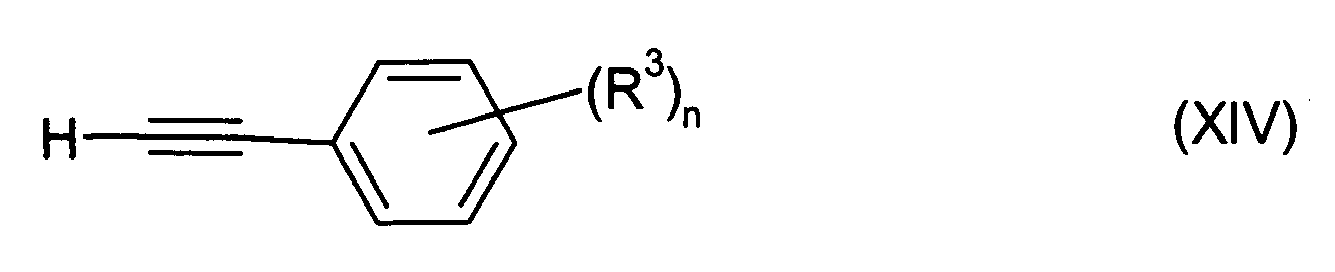

Das Phenylalkin (XIV) wird dabei in der Regel mit einer starken Base deprotoniert werden, wobei beispielsweise Grignard- oder Organolithiumverbindungen geeignet sind. Aber auch die Verwendung von Alkalimetall-Amid-Basen, wie zum Beispiel Lithiumdiisopropylamid oder Lithiumhexamethyldisilazid, Alkalimetallalkoholaten, wie zum Beispiel Kalium-t-butylat, oder anderen starken organischen wie anorganischen Basen ist denkbar. Umsetzungen von Alkinen mit Ketonen bzw. Aldehyden unter basischen Bedingungen sind an zahlreichen Stellen in der Literatur beschrieben, z.B.:
Analog zur Darstellung der Verbindungen (III') können Phenylalkine (XIV) durch Reaktion von Phenylverbindungen (V) mit Acetylen unter Sonogashira-Bedingungen erhalten werden. Bei der Umsetzung kann als Acetylenäquivalent auch ein Ethinylsilan zum Einsatz kommen, das einem mono-geschützten Acetylen entspricht und nach der Umsetzung mit Verbindung (V) wie in
Analogously to the preparation of the compounds (III '), phenylalkynes (XIV) can be obtained by reaction of phenyl compounds (V) with acetylene under Sonogashira conditions. In the reaction can be used as acetylene equivalent and an ethynyl silane, which corresponds to a mono-protected acetylene and after the reaction with compound (V) as in
Je nach Art der Reste R4 und R5 sind Reaktionssequenzen zum Aufbau der Verbindungen (III') möglich, die diese Reste gleichzeitig oder stufenweise als Nukleophile durch Addition an die CO-Doppelbindung von beispielsweise Phenylpropargylestem oder äquivalenten Substraten der Formel (XVI) einführen,


Für den Fall, dass die Reste R4 und R5 gleich sind, können sie in einem Schritt eingeführt werden, beispielsweise durch Einwirken von mindestens zwei Moläquivalenten einer Organometallverbindung M+(R4)- auf einen entsprechenden Propargylester (XVI), wobei Alkylester (Y = Alkoxy), Haloalkylester (Y = Haloalkoxy), Arylester (Y = Aryloxy) oder jeder andere Ester zum Einsatz kommen kann.In the case that the radicals R 4 and R 5 are the same, they can be introduced in one step, for example by the action of at least two molar equivalents of an organometallic compound M + (R 4 ) - on a corresponding propargyl ester (XVI), wherein alkyl esters ( Y = alkoxy), haloalkyl (Y = haloalkoxy), aryl (Y = aryloxy) or any other ester can be used.
Das Metallkation M+ der Organometallverbindung kann je nach den gewählten Reaktionsbedingungen unterschiedlich sein, bevorzugt sind aber Kationen von Alkalimetallen, wie Natrium und Lithium, oder Kationen von Erdalkalimetallen, wie Magnesium, jeweils in ihren stabilsten Oxidationsstufen.
Für den Fall, dass die Reste R4 und R5 verschieden sind, sollte das Keton bzw. der Aldehyd (XVII) als Zwischenstufe des Prozesses isolierbar sein. Dies gelingt bei richtiger Wahl der Reaktionsbedingungen, des Restes Y sowie der Organometallspezies M+(R4)- gegebenenfalls unter Verwendung eines geeigneten Katalysators.
Aus der Literatur stehen mehrere Optionen für derartige Umsetzungen zur Verfügung. So können zum Beispiel nach
Alternativ können auch N-Methoxy-N-methylamide (XVI; Y = -N(OMe)Me) mit Organometallverbindungen wie Grignardverbindungen oder Hydridreagenzien wie Lithiumaluminiumhydrid umgesetzt werden, um zur Zwischenstufe (XVII) zu gelangen (siehe
In the event that the radicals R 4 and R 5 are different, the ketone or the aldehyde (XVII) should be isolatable as an intermediate of the process. This is possible with proper choice of the reaction conditions, the radical Y and the organometallic species M + (R 4 ) - optionally using a suitable catalyst.
From the literature, several options are available for such conversions. For example, after
Alternatively, N-methoxy-N-methylamides (XVI; Y = -N (OMe) Me) may also be reacted with organometallic compounds such as Grignard compounds or hydride reagents such as lithium aluminum hydride to afford intermediate (XVII) (see
Die Herstellverfahren für die nach Herstellvariante (a) benötigten Verbindungen der Formel (II) unterscheiden sich je nach Art der Gruppe A. Die Natur der Gruppe Q sowie die mit ihr verbundenen Reste R1 beeinflussen die Reaktionen zur Herstellung der Verbindungen (II) in der Regel nicht.
Im Fall von A gleich (A1) kann zur Herstellung der Verbindung (II) (= Verbindung der Formel (IIa)) ein Aldehyd oder Keton der Formel (VII) mit Hydroxylamin oder einem seiner Salze, z. B.: Hydroxylaminhydrochlorid, umgesetzt werden (siehe Schema 1)

In the case of A equal to (A1), to prepare compound (II) (= compound of formula (IIa)), an aldehyde or ketone of formula (VII) may be reacted with hydroxylamine or one of its salts, e.g. B.: Hydroxylamine hydrochloride, are reacted (see Scheme 1)
Die Reaktion kann prinzipiell in den üblichen protischen wie auch aprotischen Lösemitteln sowohl unter Basen- als auch Säurekatalyse durchgeführt werden, wobei die Reaktionstemperatur vorzugsweise zwischen 20 °C und 150 °C liegt. Bevorzugt sind dabei Bedingungen mit kurzkettigen aliphatischen Alkoholen, wie beispielsweise Ethanol oder Propanol als Lösungsmittel, Natriumacetat als Katalysator sowie Rückflusstemperatur des jeweiligen Lösungsmittels als Reaktionstemperatur.The reaction can be carried out in principle in the usual protic as well as aprotic solvents both under base and acid catalysis, wherein the reaction temperature is preferably between 20 ° C and 150 ° C. Conditions with short-chain aliphatic alcohols, such as, for example, ethanol or propanol as solvent, sodium acetate as catalyst and reflux temperature of the particular solvent as reaction temperature are preferred.
Ist die Gruppe A gleich (A2) wird wie in Schema 2 dargestellt der Aldehyd- bzw. Ketonbaustein (VII) mit einem Hydrazin (XVIII) zur Verbindung (IIb) umgesetzt,

Für den Fall, dass die Gruppe A gleich (A3) oder (A4) ist, kann die Synthese des Bausteins (II) von Ketonen der Formel (XIX) ausgehen. Diese Ketone können mit Estern oder anderen Carbonsäurederivaten in 1,3-Diketone oder äquivalente, von 1,3-Diketonen abgeleitete Strukturen überführt werden. Eine Übersicht hierzu liefert beispielsweise Organic Reactions 1954, 8, Seite 59ff. So können beispielsweise Ketone der Formel (XIX) leicht mit N,N-Dialkylamid-Acetalen (XX) umgesetzt werden, wobei ein Aminoalkylidenketon der Formel (XI) ensteht. Deren Kondensation mit Hydrazin liefert die Pyrazolbausteine der Formel (IIc) (siehe Schema 3).

Die hier beschriebene Synthese der Bausteine (IIc), die ein Ausgangsmaterial für eine weitere Umsetzung nach Herstellvariante (a) darstellen, gehört zu den Standardverfahren der organischen Heterozyklenchemie und ist neben anderen Verfahren ausführlich beispielsweise
Die Umsetzung Der Pyrazole (IIc) gemäß Herstellvariante (a) liefert je nach sterischer wie elektronischer Natur der Reste Q, R8 und R9 Gemische bestehend aus erfindungsgemäßen Verbindungen der Formel (I), in denen die Gruppe A zum einen gleich (A3) und zum anderen gleich (A4) ist. Diese Gemische können im Allgemeinen durch übliche Trennverfahren der präparativen organischen Chemie, wie zum Beispiel Chromatographie, in ihre Einzelbestandteile aufgetrennt werden, wodurch diese rein erhalten werden können.The synthesis of the units (IIc) described here, which are a starting material for a further conversion according to preparation variant (a), is one of the standard methods of organic heterocyclic chemistry and is, for example, in detail in addition to other methods
The reaction of the pyrazoles (IIc) according to preparation variant (a) provides, depending on the steric and electronic nature of the radicals Q, R 8 and R 9 mixtures consisting of compounds of the formula (I) according to the invention, in which the group A is equal to (A3) and the other is equal to (A4). These mixtures can generally be separated into their individual constituents by customary separation processes of preparative organic chemistry, such as, for example, chromatography, so that they can be obtained purely.
Für den Fall, dass die Gruppe A der erfindungsgemäßen Verbindungen der allgemeinen Formel (I) gleich (A5) ist, können die für die Synthese der Verbindungen (I) nach Herstellvariante (a) benötigten Verbindungen der Formel (IId) in analoger Weise zu den Verbindungen (IIc) hergestellt werden. Schema 4 verdeutlicht dies.
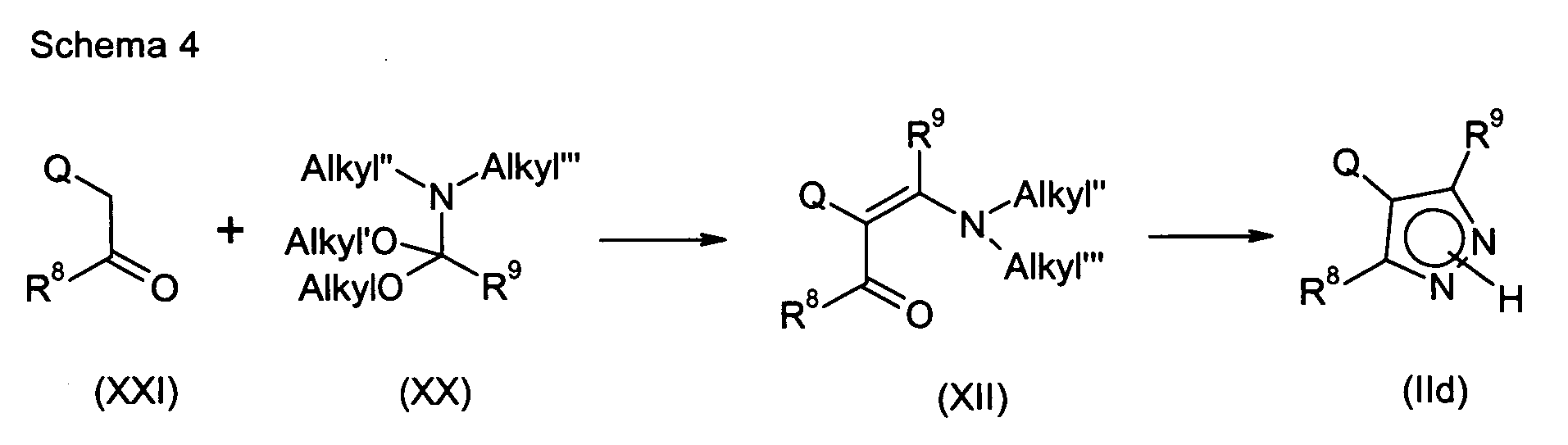
Der Unterschied im Vergleich zu Schema 3 ist dabei das Keton der Formel (XXI) als Ausgangsverbindung, welche mit demselben Reagenz (XX) zum regioisomeren Zwischenprodukt (XII) und dem regioisomeren Produkt (IId) führt.
Auch hier können bei der weiteren Umsetzung gemäß Herstellung von Verbindung (I) nach Variante (a) bei Ungleichheit von R8 und R9 Gemische auftreten, die im Allgemeinen durch übliche Trennverfahren aufzutrennen sind.The difference compared to Scheme 3 is the ketone of the formula (XXI) as starting compound, which leads with the same reagent (XX) to the regioisomeric intermediate (XII) and the regioisomeric product (IId).
Here, too, in the further reaction according to preparation of compound (I) according to variant (a) in the case of inequality of R 8 and R 9, mixtures may occur which are generally to be separated by customary separation processes.
Alternativ zu den in Schema 3 und Schema 4 beschriebenen Verfahren, die auf einem Aufbau des Pyrazolringsystems basieren, sind auch Synthesestrategien möglich, bei denen die aromatischen Ringverbindungen Q-H nach Überführung in Borsäurederivate (X) mit den Pyrazolen der Gruppen (A3) bis (A5) im Sinne einer übergangsmetallkatalysierten Kreuzkupplungsreaktion verknüpft werden. Beispielhaft ist dies in Analogie zu literaturbeschriebenen Reaktionen - siehe zum 
Sinnvollerweise ist der Pyrazolring vor der Kreuzkupplung mit einer Schutzgruppe (PG) zu versehen, die nach der Kreuzkupplung wieder abgespalten werden kann. Als Schutzgruppe eignet sich unter anderen eine Benzylgruppe, deren Abspaltung zum Beispiel hydrogenolytisch erfolgen kann.It makes sense to provide the pyrazole ring with a protective group (PG) before cross-coupling, which can be split off again after cross-coupling. As a protective group is, inter alia, a benzyl group, the removal of which can be done for example by hydrogenolysis.
Die hier beschriebenen Verfahren zur Synthese der erfindungsgemäßen Verbindungen der Formel (I) bauen die Zielmoleküle schrittweise aus einzelnen Bausteinen auf, wobei der letzte Schritt jeweils in der Knüpfung der propargylischen Bindung an der Gruppe A besteht (Herstellvariante (a)). Alternativ sind allerdings auch Syntheseverfahren möglich, in denen die Reihenfolge der Schritte, das heißt, die Reihenfolge der Bindungsbildung zwischen den einzelnen Bausteinen ausgetauscht ist. So kann als letzter Schritt beispielsweise auch die Bindung zwischen Dreifachbindung und Phenylring in Formel (I) geknüpft werden (Herstellvariante (b)).The methods described here for the synthesis of the compounds of the formula (I) according to the invention build up the target molecules stepwise from individual building blocks, the last step in each case in the formation of the propargylic bond to the group A (preparation variant (a)). Alternatively, however, synthetic methods are also possible in which the order of the steps, that is, the order of bond formation between the individual blocks is exchanged. Thus, as a last step, for example, the bond between triple bond and phenyl ring can be linked in formula (I) (preparation variant (b)).
Gemäß der Verfahrensvariante (b) werden ein Propargylderivat der Formel (IV) (= Verbindung (IV)) und ein Phenylderivat der Formel (V) (= Verbindung (V)), welches eine Abgangsgruppe X* trägt, miteinander umgesetzt. Als Abgangsgruppe kommt beispielsweise ein Halogenid, vorzugsweise Iodid oder Bromid, oder ein Sulfonat in Betracht. Die Reaktion der Verbindungen (IV) und (V) zur Verbindung (I), bei der die Knüpfung der Bindung zwischen dem endständigen C-Atom der Dreifachbindung und der Phenyleinheit erfolgt, kann unter den Bedingungen der Sonogashira-Reaktion oder einer analogen Umsetzung durchgeführt werden, wie es bereits oben für die analoge Umsetzung der Verbindungen (V) und (XI) beschrieben ist.
Der für die Synthesesequenz notwendige Baustein, die Verbindung der Formel (IV), kann ausgehend von der Verbindung (II) durch Umsetzung mit einem geeigneten Propargylbaustein (XXIV) hergestellt werden (siehe Schema 6),

The building block necessary for the synthesis sequence, the compound of the formula (IV), can be prepared starting from the compound (II) by reaction with a suitable propargyl building block (XXIV) (see Scheme 6),
Alternativ können für bestimmten Gruppen A = (A1) bis (A5) unterschiedliche Synthesewege zweckmäßig sein. Beispielsweise kann im Falle A = (A1) die Herstellung von Verbindung (IV), worin A = (A1), (= Verbindung (IVa)) ausgehend von dem Keton bzw. Aldehyd (VII) durch Kondensation mit einem geeigneten O-Propargyl-hydroxylamin (XXV) erfolgen (siehe Schema 7).

Hydroxylamine vom Typ (XXV) sind zahlreich in der Literatur beschrieben, zum Beispiel in
In Analogie zu der in Schema 7 dargestellten Synthesesequenz kann auch im Fall von A gleich (A2) verfahren werden. Statt der Hydroxylamineinheit wird hierbei jedoch jeweils eine Hydrazineinheit der Formel (XXVI) verwendet. Der zusätzliche Substituent R7 stört die Umsetzungen dabei nicht (siehe Schema 8).

Gemäß der Verfahrensvariante (c) werden Verbindungen (VI) und (VII) zur Verbindung (I), in der A eine Gruppe der Formel (A1) (= Verbindung (Ia)) bedeutet, umgesetzt. Bei dieser Variante wird somit im letzten Syntheseschritt die Struktureinheit A gebildet. Die für den Syntheseschritt benötigten Verbindungen (VI)
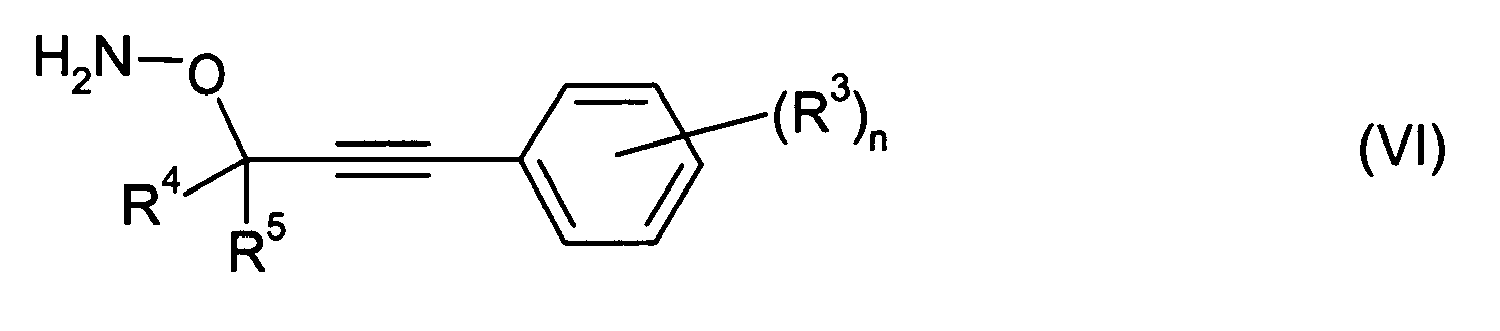
Ebenso kann die Verfahrensvariante (d) analog Variante (c) zur Herstellung von Verbindungen (I), worin A gleich (A2) ist, (= Verbindung (Ib)) genutzt werden. Dabei wird die Keto- oder Aldehyd-Verbindung (VI) mit dem Hydrazinderivat (VIII) umgesetzt.Likewise, process variant (d) can be used analogously to variant (c) for the preparation of compounds (I) in which A is (A2) (= compound (Ib)). there the keto or aldehyde compound (VI) is reacted with the hydrazine derivative (VIII).
Die für die Herstellvariante (b) benötigten Zwischenprodukte der Formel (IV) stellen für die Fälle, wenn A gleich (A3) bis (A5) bedeutet, die Verbindungen (IVc), (IVd) bzw. (IVe) dar. Letztere können gemäß dem allgemeinen Schema 6 aus den Pyrazolen (IIc) oder (IId) durch Reaktion mit einem geeigneten Propargylbaustein (XXIV) hergestellt werden (siehe Schema 9 und Schema 10).


Zur Herstellung der Verbindungen (I), d.h. speziell (Ic), (Id) und (Ie), in denen A die (A3), (A4) bzw. (A5) bedeutet, kann die Knüpfung der Bindung zwischen Dreifachbindung und Phenyleinheit beispielsweise durch Sonogashira-Reaktion oder durch eine analoge Umsetzung erfolgen.For the preparation of the compounds (I), ie especially (Ic), (Id) and (Ie) in which A is the (A3), (A4) or (A5), the linkage between the triple bond and the phenyl moiety can be formed, for example by Sonogashira reaction or by an analogous reaction.
Gemäß der Verfahrensvariante (e) werden Verbindungen (IX) und (X) zur Verbindung (I), in der A eine Gruppe der Formel (A3, (A4) oder (A5) bedeutet, (= Verbindung (Ic), (Id) bzw. (Ie)) umgesetzt. Als Abgangsgruppe X** in Verbindung (IX) eignet sich in der Regel ein Halogen, wie Brom oder Iod. Die Verbindung (IX) kann im Sinne einer übergangsmetallkatalysierten Kreuzkupplungsreaktion mit dem Borsäurederivat der Formel (X) in Analogie zu Schema 5 in die Zielverbindungen der Formel (I) überführt werden. Zur Herstellung der Phenylpropargylverbindungen (IX) kann man eine Reaktion von Verbindungen (III) mit Pyrazolen der Formel X**-A-H durchführen, wobei ein Austausch des aciden Wasserstoffatoms des Pyrazolrings durch den Rest der Verbindung (III) erfolgt.According to process variant (e), compounds (IX) and (X) become the compound (I) in which A is a group of the formula (A3, (A4) or (A5), (= compound (Ic), (Id) As leaving group X ** in compound (IX), a halogen, such as bromine or iodine, is generally suitable in the sense of a transition-metal-catalyzed cross-coupling reaction with the boric acid derivative of the formula (X) In analogy to Scheme 5, the target compounds of the formula (I) can be converted to prepare the phenylpropargyl compounds (IX) by reacting compounds (III) with pyrazoles of the formula X ** - AH, wherein an exchange of the acidic hydrogen atom of the Pyrazole rings by the rest of the compound (III) takes place.
Gemäß den Verfahrensvarianten (f) und (g) werden Verbindungen (VIII') und (XI) bzw. (XII) zur Verbindung (I), in der A eine Gruppe der Formel (A3) und/oder (A4) bzw. (A5) bedeutet, (= Verbindung (Ic) und/oder (Id) bzw. (Ie)) unter Aufbau des Pyrazolrings umgesetzt.
Geeignete Phenylpropargylhydrazine (VIII') sind beispielsweise in
Suitable phenylpropargylhydrazines (VIII ') are, for example, in
Die hier beschriebenen Syntheseverfahren werden im Allgemeinen durch die Reste R1 oder R3 nicht beeinträchtigt. Gegebenenfalls ist es jedoch sinnvoll in Abhängigkeit der konkret durchzuführenden Reaktion sowie der genauen Natur des Restes R1 bzw. R3, diese mit geeigneten Schutzgruppen zu versehen. Schutzgruppen, ihre Einführung als auch ihre Abspaltung sind hinreichend beschrieben in:
Darüberhinaus ist es möglich, die Reste R1 oder R3 nach Abschluss der hier beschriebenen Synthesesequenzen durch weitere Reaktionen zu modifizieren, wodurch neue, ebenfalls erfindungsgemäße Verbindungen der allgemeinen Formel (I) erhalten werden.The synthetic methods described herein are generally unaffected by the radicals R 1 or R 3 . Optionally, however, it makes sense depending on the specific reaction to be carried out and the exact nature of the radical R 1 or R 3 , to provide them with suitable protecting groups. Protective groups, their introduction as well as their splitting off are sufficiently described in:
Moreover, it is possible to modify the radicals R 1 or R 3 after completion of the synthesis sequences described herein by further reactions, whereby new, also inventive compounds of the general formula (I) are obtained.
Für die Herstellung von Enantiomeren der Verbindungen (I) kommen auch übliche Racemattrennungsmethoden in Frage (vgl. Handbücher der Stereochemie), z. B. im Anschluss an Verfahren zur Trennung von Gemischen in Diastereomere, z. B. physikalische Verfahren wie Kristallisation, Chromatographieverfahren, vor allem Säulenchromatographie und Hochdruckflüssigchromatographie, Destillation, gegebenenfalls unter reduziertem Druck , Extraktion und andere Verfahren, können verbleibende Gemische von Enantiomeren in der Regel durch chromatographische Trennung an chiralen Festphasen getrennt werden. Für präparative Mengen oder im industriellen Maßstab kommen Verfahren wie die Kristallisation diastereomerer Salze, die aus den Verbindungen (I) mit optisch aktiven Säuren und gegebenenfalls bei vorhandenen sauren Gruppen mit optisch aktiven Basen erhalten werden können, in Frage.For the preparation of enantiomers of the compounds (I) also customary Racemattrennungsmethoden in question (see manuals of stereochemistry), z. B. following procedures for the separation of mixtures into diastereomers, eg. As physical processes such as crystallization, chromatography, especially column chromatography and high pressure liquid chromatography, distillation, optionally under reduced pressure, extraction and other methods, remaining mixtures of enantiomers can be separated by chromatographic separation on chiral solid phases usually. For preparative amounts or on an industrial scale, methods such as the crystallization of diastereomeric salts which can be obtained from the compounds (I) with optically active acids and optionally with acid groups present with optically active bases are suitable.
Zur Racemattrennung durch Kristallisation diastereomerer Salze kommen als optisch aktive Säure z. B. Camphersulfonsäure, Camphersäure, Bromcamphersulfonsäure, Chinasäure, Weinsäure, Dibenzoylweinsäure und andere analoge Säure in Betracht; als optisch aktive Basen kommen z. B. Chinin, Cinchonin, Chinidin, Brucin, 1-Phenylethylamin und andere analoge Basen in Frage. Die Kristallisationen werden dann meist in wässrigen oder wässrig-organischen Lösungsmittel durchgeführt, wobei das Diastereomer mit der geringeren Löslichkeit gegebenenfalls nach Animpfen zunächst ausfällt. Das eine Enantiomer der Verbindung der Formel (I) wird danach aus dem ausgefällten Salz oder das andere aus dem Kristallisat durch Ansäuern bzw. mit Base freigesetzt.For racemate separation by crystallization of diastereomeric salts come as optically active acid z. Camphorsulfonic acid, camphorsic acid, bromocamphorsulfonic acid, quinic acid, tartaric acid, dibenzoyltartaric acid and other analogous acids; as optically active bases come z. Quinine, cinchonine, quinidine, brucine, 1-phenylethylamine and other analogous bases. The crystallizations are then usually carried out in aqueous or aqueous-organic solvents, wherein the diastereomer with the lower solubility, if appropriate after inoculation, first fails. The one enantiomer of the compound of formula (I) is then released from the precipitated salt or the other from the crystals by acidification or with base.
Zur Herstellung der Säureadditionssalze der Verbindungen der Formel (I) kommen folgende Säuren in Frage: Halogenwasserstoffsäuren wie Chlorwasserstoffsäure oder Bromwasserstoffsäure, weiterhin Phosphorsäure, Salpetersäure, Schwefelsäure, mono- oder bifunktionelle Carbonsäuren und Hydroxycarbonsäuren wie Essigsäure, Maleinsäure, Bernsteinsäure, Fumarsäure, Weinsäure, Citronensäure, Salicylsäure, Sorbinsäure oder Milchsäure, sowie Sulfonsäuren wie p-Toluolsulfonsäure oder 1,5-Naphtalindisulfonsäure. Die Säureadditionsverbindungen der Formel (I) können in einfacher Weise nach den üblichen Salzbildungsmethoden, z.B. durch Lösen einer Verbindung der Formel (I) in einem geeigneten organischen Lösungsmittel wie z.B. Methanol, Aceton, Methylenchlorid oder Benzol und Hinzufügen der Säure bei Temperaturen von 0 bis 100 °C erhalten werden und in bekannter Weise, z.B. durch Abfiltrieren, isoliert und gegebenfalls durch Waschen mit einem inerten organischen Lösemittel gereinigt werden.For the preparation of the acid addition salts of the compounds of formula (I), the following acids are suitable: hydrohalic acids such as hydrochloric acid or hydrobromic acid, furthermore phosphoric acid, nitric acid, sulfuric acid, mono- or bifunctional carboxylic acids and hydroxycarboxylic acids such as acetic acid, maleic acid, succinic acid, fumaric acid, tartaric acid, citric acid, Salicylic acid, sorbic acid or lactic acid, and sulfonic acids such as p-toluenesulfonic acid or 1,5-naphthalenedisulfonic acid. The acid addition compounds of the formula (I) can be prepared in a simple manner by the customary salt formation methods, for example by dissolving a compound of the formula (I) in a suitable organic solvent such as methanol, acetone, methylene chloride or benzene and adding the acid at temperatures from 0 to 100 ° C and in a known manner, for example by filtration, isolated and optionally purified by washing with an inert organic solvent.
Die Basenadditionssalze der Verbindungen der Formel (I) werden vorzugsweise in inerten polaren Lösungsmitteln wie z.B. Wasser, Methanol oder Aceton bei Temperaturen von 0 bis 100 °C hergestellt. Geeignete Basen zur Herstellung der erfindungsgemäßen Salze sind beispielsweise Alkalicarbonate, wie Kaliumcarbonat, Alkali- und Erdalkalihydroxide, z.B. NaOH oder KOH, Alkali- und Erdalkalihydride, z.B. NaH, Alkali- und Erdalalkoholate, z.B. Natriummethanolat oder Kalium-tert.-butylat, oder Ammoniak, Ethanolamin oder quartäres Ammoniumhydroxid der Formel [NRR'R"R"']+ OH-.The base addition salts of the compounds of formula (I) are preferably prepared in inert polar solvents such as water, methanol or acetone at temperatures of 0 to 100 ° C. Suitable bases for preparing the salts according to the invention are, for example, alkali metal carbonates, such as potassium carbonate, alkali metal and alkaline earth metal hydroxides, eg NaOH or KOH, alkali metal and alkaline earth metal hydrides, eg NaH, alkali metal and alkaline alcoholates, for example sodium methoxide or potassium tert-butoxide, or ammonia, Ethanolamine or quaternary ammonium hydroxide of the formula [NRR'R "R"'] + OH - .
Mit den in den vorstehenden Verfahrensvarianten bezeichneten "inerten Lösungsmitteln" sind jeweils Lösungsmittel gemeint, die unter den jeweiligen Reaktionsbedingungen inert sind, jedoch nicht unter beliebigen Reaktionsbedingungen inert sein müssen.By the term "inert solvents" denoted in the above process variants are meant in each case solvents which are inert under the respective reaction conditions, but need not be inert under any reaction conditions.
Eine Kollektion aus Verbindungen der Formel (I), die nach den obengenannten Verfahren synthetisiert werden können, können zusätzlich in parallelisierter Weise hergestellt werden, wobei dies in manueller, teilweise automatisierter oder vollständig automatisierter Weise geschehen kann. Dabei ist es möglich, sowohl die Reaktionsdurchführung, die Aufarbeitung oder die Reinigung der Produkte bzw. Zwischenstufen zu automatisieren. Insgesamt wird hierunter eine Vorgehensweise verstanden, wie sie beispielsweise durch
Zur parallelisierten Reaktionsdurchführung und Aufarbeitung können eine Reihe von im Handel erhältlichen Geräten verwendet werden wie sie beispielsweise von den Firmen Stem Corporation, Woodrolfe Road, Tollesbury, Essex, CM9 8SE, England oder H + P Labortechnik GmbH, Bruckmannring 28, 85764 Oberschleißheim, Deutschland angeboten werden. Für die parallelisierte Aufreinigung von Verbindungen (I) oder von bei der Herstellung anfallenden Zwischenprodukten stehen unter anderem Chromatographieapparaturen zur Verfügung, beispielsweise der Firma ISCO, Inc., 4700 Superior Street, Lincoln, NE 68504, USA. Die aufgeführten Apparaturen ermöglichen eine modulare Vorgehensweise, bei der die einzelnen Arbeitsschritte automatisiert sind, zwischen den Arbeitsschritten jedoch manuelle Operationen durchgeführt werden müssen. Dies kann durch den Einsatz von teilweise oder vollständig integrierten Automationssystemen umgangen werden, bei denen die jeweiligen Automationsmodule beispielsweise von Roboter bedient werden. Derartige Automationssysteme können zum Beispiel von der Firma Zymark Corporation, Zymark Center, Hopkinton, MA 01748, USA bezogen werden.For parallelized reaction performance and work-up, a variety of commercially available devices may be used, such as those available from Stem Corporation, Woodrolfe Road, Tollesbury, Essex, CM9 8SE, England or H + P Labortechnik GmbH, Bruckmannring 28, 85764 Oberschleissheim, Germany. Chromatography apparatuses are available for the parallelized purification of compounds (I) or of intermediates obtained during the preparation, for example the company ISCO, Inc., 4700 Superior Street, Lincoln, NE 68504, USA. The listed equipment allows a modular approach, in which the individual work steps are automated, but manual operations must be performed between the work steps. This can be circumvented by the use of partially or fully integrated automation systems in which the respective automation modules are operated, for example, by robots. Such automation systems may be obtained, for example, from Zymark Corporation, Zymark Center, Hopkinton, MA 01748, USA.
Neben den beschriebenen Methoden kann die Herstellung von Verbindungen der Formel (I) vollständig oder partiell durch festphasen-unterstützte Methoden erfolgen. Zu diesem Zweck werden einzelne Zwischenstufen oder alle Zwischenstufen der Synthese oder einer für die entsprechende Vorgehensweise angepaßten Synthese an ein Syntheseharz gebunden. Festphasen unterstützte Synthesemethoden sind in der Fachliteratur hinreichend beschrieben, z. B.:
Die Herstellung gemäß den hier beschriebenen Verfahren liefert Verbindungen der Formel (I) in Form von Substanzkollektionen oder -bibliotheken. Gegenstand der vorliegenden Erfindung sind daher auch Bibliotheken der Verbindungen der Formel (I), die mindestens zwei Verbindungen der Formel (I) enthalten, und deren Vorprodukte.The preparation according to the methods described herein provides compounds of formula (I) in the form of substance collections or libraries. The present invention therefore also relates to libraries of the compounds of the formula (I) containing at least two compounds of formula (I) and their precursors.
Die erfindungsgemäßen Verbindungen der Formel (I) und deren Salze, weisen eine ausgezeichnete herbizide Wirksamkeit gegen ein breites Spektrum wirtschaftlich wichtiger mono- und dikotyler Schadpflanzen auf. Auch schwer bekämpfbare perennierende Unkräuter, die aus Rhizomen, Wurzelstöcken oder anderen Dauerorganen austreiben, werden durch die Wirkstoffe gut erfaßt. Dabei ist es gleichgültig, ob die Substanzen im Vorsaat-, Vorauflauf- oder Nachauflaufverfahren ausgebracht werden.The compounds of the formula (I) according to the invention and their salts have an excellent herbicidal activity against a broad spectrum of economically important monocotyledonous and dicotyledonous harmful plants. Even difficult to control perennial weeds, which expel from rhizomes, rhizomes or other permanent organs, are well detected by the active ingredients. It does not matter whether the substances are applied in the pre-sowing, pre-emergence or postemergence process.
Im Einzelnen seien beispielhaft einige Vertreter der mono- und dikotylen Unkrautflora genannt, die durch die erfindungsgemäßen Verbindungen kontrolliert werden können, ohne dass durch die Nennung eine Beschränkung auf bestimmte Arten erfolgen soll. Auf der Seite der monokotylen Unkrautarten werden z.B. Agrostis, Alopecurus, Apera, Avena, Brachicaria, Bromus, Dactyloctenium, Digitaria, Echinochloa, Eleocharis, Eleusine, Festuca, Fimbristylis, Ischaemum, Lolium, Monochoria, Panicum, Paspalum, Phalaris, Phleum, Poa, Sagittaria, Scirpus, Setaria, Sphenoclea sowie Cyperusarten aus der annuellen Gruppe und auf seiten der perennierenden Spezies Agropyron, Cynodon, Imperata sowie Sorghum und auch ausdauernde Cyperusarten gut erfaßt.Specifically, by way of example, some representatives of the monocotyledonous and dicotyledonous weed flora can be mentioned, which can be controlled by the compounds according to the invention, without it being intended to restrict them to certain species. On the side of the monocotyledonous weeds, e.g. Agrostis, Alopecurus, Apera, Avena, Brachicaria, Bromus, Dactyloctenium, Digitaria, Echinochloa, Eleocharis, Eleusine, Festuca, Fimbristylis, Ishaemum, Lolium, Monochoria, Panicum, Paspalum, Phalaris, Phleum, Poa, Sagittaria, Scirpus, Setaria, Sphenoclea, and Cyperus species from the annuelle group and on the part of the perennial species Agropyron, Cynodon, Imperata and Sorghum and also perennial Cyperusarten well grasped.
Bei dikotylen Unkrautarten erstreckt sich das Wirkungsspektrum auf Arten wie z.B. Galium, Viola, Veronica, Lamium, Stellaria, Amaranthus, Sinapis, Ipomoea, Matricaria, Abutilon und Sida auf der annuellen Seite sowie Convolvulus, Cirsium, Rumex und Artemisia bei den perennierenden Unkräutern.
Herbizide Wirkung wird auch erreicht bei dikotylen Schadpflanzen wie Ambrosia, Anthemis, Carduus, Centaurea, Chenopodium, Cirsium, Convolvulus, Datura, Emex, Galeopsis, Galinsoga, Kochia, Lepidium, Lindernia, Papaver, Portlaca, Polygonum, Ranunculus, Rorippa, Rotala, Seneceio, Sesbania, Solanum, Sonchus, Taraxacum, Trifolium, Urtica und Xanthium.In dicotyledonous weed species, the spectrum of activity extends to species such as Galium, Viola, Veronica, Lamium, Stellaria, Amaranthus, Sinapis, Ipomoea, Matricaria, Abutilon and Sida on the annall side and Convolvulus, Cirsium, Rumex and Artemisia in perennial weeds.
Herbicidal activity is also achieved in dicotyledonous weeds such as Ambrosia, Anthemis, Carduus, Centaurea, Chenopodium, Cirsium, Convolvulus, Datura, Emex, Galeopsis, Galinsoga, Kochia, Lepidium, Lindernia, Papaver, Portlaca, Polygonum, Ranunculus, Rorippa, Rotala, Seneceio , Sesbania, Solanum, Sonchus, Taraxacum, Trifolium, Urtica and Xanthium.
Unter den spezifischen Kulturbedingungen im Reis vorkommende Unkräuter wie z.B. Sagittaria, Alisma, Eleocharis, Scirpus und Cyperus werden von den erfindungsgemäßen Wirkstoffen ebenfalls hervorragend bekämpft.Under the specific culture conditions, weeds occurring in rice such as e.g. Sagittaria, Alisma, Eleocharis, Scirpus and Cyperus are also combated by the active compounds according to the invention also excellent.
Werden die erfindungsgemäßen Verbindungen vor dem Keimen auf die Erdoberfläche appliziert, so wird entweder das Auflaufen der Unkrautkeimlinge vollständig verhindert oder die Unkräuter wachsen bis zum Keimblattstadium heran, stellen jedoch dann ihr Wachstum ein und sterben schließlich nach Ablauf von drei bis vier Wochen vollkommen ab. Bei Applikation der Wirkstoffe auf die grünen Pflanzenteile im Nachauflaufverfahren tritt ebenfalls sehr rasch nach der Behandlung ein drastischer Wachstumsstop ein und die Unkrautpflanzen bleiben in dem zum Applikationszeitpunkt vorhandenen Wachstumsstadium stehen oder sterben nach einer gewissen Zeit ganz ab, so dass auf diese Weise eine für die Kulturpflanzen schädliche Unkrautkonkurrenz sehr früh und nachhaltig beseitigt wird.If the compounds according to the invention are applied to the surface of the earth before germination, then either the emergence of the weed seedlings is completely prevented or the weeds grow up to the cotyledon stage, but then cease their growth and finally die off completely after a lapse of three to four weeks. Upon application of the active ingredients to the green parts of the plants postemergence also occurs very quickly after treatment, a drastic halt in growth and the weed plants remain in the existing stage of application growth stage or die after a certain time completely, so that in this way one for the crops harmful weed competition is eliminated very early and sustainably.
Obgleich die erfindungsgemäßen Verbindungen eine ausgezeichnete herbizide Aktivität gegenüber mono- und dikotylen Unkräutern aufweisen, werden Kulturpflanzen wirtschaftlich bedeutender Kulturen wie z.B. Weizen, Gerste, Roggen, Reis, Mais, Zuckerrübe, Soja, insbesondere Plantagenkulturen wie Ölpalme, Olive, Kokosnuss, Gummibaum, Zitrus, Ananas, Apfel, Birne, Kirsche, Baumwolle, Kaffee, Kakau, Wein und andere vergleichbare Obst und Plantagenkulturen nur unwesentlich oder gar nicht geschädigt. Die vorliegenden Verbindungen eignen sich aus diesen Gründen sehr gut zur selektiven Bekämpfung von unerwünschtem Pflanzenwuchs in landwirtschaftlichen Nutzpflanzungen inklusive Zierpflanzungen. Auch eignen sich die Wirkstoffe, gegebenenfalls in Kombination mit anderen Wirkstoffen für die Anwendung im Nichtkulturland, wie auf Wegen, Plätzen, Beeten, Rasenflächen, Bahndämmen, Industrieanlagen zur Bekämpfung von unerwünschtem Pflanzenwuchs.Although the compounds of the present invention have excellent herbicidal activity against mono- and dicotyledonous weeds, crops of economically important crops such as e.g. Wheat, barley, rye, rice, maize, sugar beet, soya, especially plantation crops such as oil palm, olive, coconut, gum, citrus, pineapple, apple, pear, cherry, cotton, coffee, cacao, wine and other comparable fruit and plantation crops or not damaged at all. For these reasons, the present compounds are very well suited for the selective control of undesired plant growth in agricultural crops, including ornamental plantings. Also, the active ingredients, optionally in combination with other drugs for use in non-crop land, such as trails, squares, beds, lawns, railway embankments, industrial plants to control undesired plant growth.
Darüberhinaus weisen die erfindungsgemäßen Substanzen hervorragende wachstumsregulatorische Eigenschaften bei Kulturpflanzen auf. Sie greifen regulierend in den pflanzeneigenen Stoffwechsel ein und können damit zur gezielten Beeinflussung von Pflanzeninhaltsstoffen und zur Ernteerleichterung wie z.B. durch Auslösen von Desikkation und Wuchsstauchung eingesetzt werden. Desweiteren eignen sie sich auch zur generellen Steuerung und Hemmung von unerwünschtem vegetativen Wachstum, ohne dabei die Pflanzen abzutöten. Eine Hemmung des vegetativen Wachstums spielt bei vielen mono- und dikotylen Kulturen eine große Rolle, da das Lagern hierdurch verringert oder völlig verhindert werden kann.In addition, the substances according to the invention have excellent growth-regulatory properties in crop plants. They regulate the plant's metabolism and can thus be targeted Influence of phytonutrients and to facilitate harvesting, such as triggered by desiccation and stunted growth. Furthermore, they are also suitable for the general control and inhibition of undesirable vegetative growth, without killing the plants. Inhibition of vegetative growth plays an important role in many monocotyledonous and dicotyledonous cultures, as storage can be reduced or completely prevented.
Aufgrund ihrer herbiziden und pflanzenwachstumsregulatorischen Eigenschaften können die Wirkstoffe auch zur Bekämpfung von Schadpflanzen in Kulturen von bekannten oder noch zu entwickelnden gentechnisch veränderten Pflanzen eingesetzt werden. Die transgenen Pflanzen zeichnen sich in der Regel durch besondere vorteilhafte Eigenschaften aus, beispielsweise durch Resistenzen gegenüber bestimmten Pestiziden, vor allem bestimmten Herbiziden, Resistenzen gegenüber Pflanzenkrankheiten oder Erregern von Pflanzenkrankheiten wie bestimmten Insekten oder Mikroorganismen wie Pilzen, Bakterien oder Viren. Andere besondere Eigenschaften betreffen z. B. das Erntegut hinsichtlich Menge, Qualität, Lagerfähigkeit, Zusammensetzung und spezieller Inhaltsstoffe. So sind transgene Pflanzen mit erhöhtem Stärkegehalt oder veränderter Qualität der Stärke oder solche mit anderer Fettsäurezusammensetzung des Emteguts bekannt.Due to their herbicidal and plant growth regulatory properties, the active compounds can also be used for controlling harmful plants in crops of known or yet to be developed genetically modified plants. The transgenic plants are usually characterized by particular advantageous properties, for example by resistance to certain pesticides, especially certain herbicides, resistance to plant diseases or pathogens of plant diseases such as certain insects or microorganisms such as fungi, bacteria or viruses. Other special properties relate to z. B. the crop in terms of quantity, quality, shelf life, composition and special ingredients. Thus, transgenic plants with increased starch content or altered quality of the starch or those with other fatty acid composition of Emteguts are known.
Bevorzugt ist die Anwendung der erfindungsgemäßen Verbindungen der Formel (I) oder deren Salze in wirtschaftlich bedeutenden transgenen Kulturen von Nutz-und Zierpflanzen, z. B. von Getreide wie Weizen, Gerste, Roggen, Hafer, Hirse, Reis, Maniok und Mais oder auch Kulturen von Zuckerrübe, Baumwolle, Soja, Raps, Kartoffel, Tomate, Erbse und anderen Gemüsesorten. Vorzugsweise können die Verbindungen der Formel (I) als Herbizide in Nutzpflanzenkulturen eingesetzt werden, welche gegenüber den phytotoxischen Wirkungen der Herbizide resistent sind bzw. gentechnisch resistent gemacht worden sind.
Herkömmliche Wege zur Herstellung neuer Pflanzen, die im Vergleich zu bisher vorkommenden Pflanzen modifizierte Eigenschaften aufweisen, bestehen beispielsweise in klassischen Züchtungsverfahren und der Erzeugung von Mutanten. Alternativ können neue Pflanzen mit veränderten Eigenschaften mit Hilfe gentechnischer Verfahren erzeugt werden (siehe z. B.
- gentechnische Veränderungen von Kulturpflanzen zwecks Modifikation der in den Pflanzen synthetisierten Stärke (z. B.
WO 92/11376 WO 92/14827 WO 91/19806 - transgene Kulturpflanzen, welche gegen bestimmte Herbizide vom Typ Glufosinate (vgl. z. B.
EP-A-0242236 EP-A-242246 WO 92/00377 EP-A-0257993 US-A-5013659 - transgene Kulturpflanzen, beispielsweise Baumwolle, mit der Fähigkeit Bacillus thuringiensis-Toxine (Bt-Toxine) zu produzieren, welche die Pflanzen gegen bestimmte Schädlinge resistent machen (
EP-A-0142924 EP-A-0193259 - transgene Kulturpflanzen mit modifizierter Fettsäurezusammensetzung (
WO 91/13972
Conventional ways of producing new plants which have modified properties in comparison to previously occurring plants consist, for example, in classical breeding methods and the production of mutants. Alternatively, new plants with altered properties can help genetic engineering processes are produced (see eg
- genetic modification of crops to modify the starch synthesized in the plants (eg.
WO 92/11376 WO 92/14827 WO 91/19806 - transgenic crops which are resistant to certain glufosinate-type herbicides (cf.
EP-A-0242236 EP-A-242246 WO 92/00377 EP-A-0257993 US-A-5013659 - Transgenic crops, such as cotton, capable of producing Bacillus thuringiensis toxins (Bt toxins) which render plants resistant to certain pests (
EP-A-0142924 EP-A-0193259 - Transgenic crops with modified fatty acid composition (
WO 91/13972
Zahlreiche molekularbiologische Techniken, mit denen neue transgene Pflanzen mit veränderten Eigenschaften hergestellt werden können, sind im Prinzip bekannt; siehe z.B.
Für derartige gentechnische Manipulationen können Nucleinsäuremoleküle in Plasmide eingebracht werden, die eine Mutagenese oder eine Sequenzveränderung durch Rekombination von DNA-Sequenzen erlauben. Mit Hilfe der obengenannten Standardverfahren können z. B. Basenaustausche vorgenommen, Teilsequenzen entfernt oder natürliche oder synthetische Sequenzen hinzugefügt werden. Für die Verbindung der DNA-Fragmente untereinander können an die Fragmente Adaptoren oder Linker angesetzt werden.For such genetic engineering, nucleic acid molecules can be introduced into plasmids that allow mutagenesis or sequence alteration by recombination of DNA sequences. With the aid of the abovementioned standard methods, z. For example, base substitutions are made, partial sequences are removed, or natural or synthetic sequences are added. For the connection of the DNA fragments with one another adapters or linkers can be attached to the fragments.
Die Herstellung von Pflanzenzellen mit einer verringerten Aktivität eines Genprodukts kann beispielsweise erzielt werden durch die Expression mindestens einer entsprechenden antisense-RNA, einer sense-RNA zur Erzielung eines Cosuppressionseffektes oder die Expression mindestens eines entsprechend konstruierten Ribozyms, das spezifisch Transkripte des obengenannten Genprodukts spaltet.The production of plant cells having a reduced activity of a gene product can be achieved, for example, by the expression of at least one corresponding antisense RNA, a sense RNA to obtain a co-suppression effect, or the expression of at least one appropriately engineered ribozyme which specifically cleaves transcripts of the above gene product.
Hierzu können zum einen DNA-Moleküle verwendet werden, die die gesamte codierende Sequenz eines Genprodukts einschließlich eventuell vorhandener flankierender Sequenzen umfassen, als auch DNA-Moleküle, die nur Teile der codierenden Sequenz umfassen, wobei diese Teile lang genug sein müssen, um in den Zellen einen antisense-Effekt zu bewirken. Möglich ist auch die Verwendung von DNA-Sequenzen, die einen hohen Grad an Homologie zu den codiereden Sequenzen eines Genprodukts aufweisen, aber nicht vollkommen identisch sind.For this purpose, DNA molecules may be used which comprise the entire coding sequence of a gene product, including any flanking sequences that may be present, as well as DNA molecules which comprise only parts of the coding sequence, which parts must be long enough to be present in the cells to cause an antisense effect. It is also possible to use DNA sequences which have a high degree of homology to the coding sequences of a gene product, but are not completely identical.
Bei der Expression von Nucleinsäuremolekülen in Pflanzen kann das synthetisierte Protein in jedem beliebigen Kompartiment der pflanzlichen Zelle lokalisiert sein. Um aber die Lokalisation in einem bestimmten Kompartiment zu erreichen, kann z. B. die codierende Region mit DNA-Sequenzen verknüpft werden, die die Lokalisierung in einem bestimmten Kompartiment gewährleisten. Derartige Sequenzen sind dem Fachmann bekannt (siehe beispielsweise
Die transgenen Pflanzenzellen können nach bekannten Techniken zu ganzen Pflanzen regeneriert werden. Bei den transgenen Pflanzen kann es sich prinzipiell um Pflanzen jeder beliebigen Pflanzenspezies handeln, d.h. sowohl monokotyle als auch dikotyle Pflanzen.The transgenic plant cells can be regenerated to whole plants by known techniques. The transgenic plants may in principle be plants of any plant species, i. both monocotyledonous and dicotyledonous plants.
So sind transgene Pflanzen erhältlich, die veränderte Eigenschaften durch Überexpression, Suppression oder Inhibierung homologer (= natürlicher) Gene oder Gensequenzen oder Expression heterologer (= fremder) Gene oder Gensequenzen aufweisen.Thus, transgenic plants are available which have altered properties by overexpression, suppression or inhibition of homologous (= natural) genes or gene sequences or expression of heterologous (= foreign) genes or gene sequences.
Vorzugsweise können die erfindungsgemäßen Verbindungen (I) in transgenen Kulturen eingesetzt werden, welche gegen Herbizide aus der Gruppe der Imidazolinone, Sulfonylharnstoffe, Glufosinate-ammonium oder Glyphosateisopropylammonium und analoge Wirkstoffe resistent sind.Preferably, the compounds of the invention (I) in transgenic Cultures are used which are resistant to herbicides from the group of imidazolinones, sulfonylureas, glufosinate-ammonium or Glyphosateisopropylammonium and analogues.
Bei der Anwendung der erfindungsgemäßen Wirkstoffe in transgenen Kulturen treten neben den in anderen Kulturen zu beobachtenden Wirkungen gegenüber Schadpflanzen oftmals Wirkungen auf, die für die Applikation in der jeweiligen transgenen Kultur spezifisch sind, beispielsweise ein verändertes oder speziell erweitertes Unkrautspektrum, das bekämpft werden kann, veränderte Aufwandmengen, die für die Applikation eingesetzt werden können, vorzugsweise gute Kombinierbarkeit mit den Herbiziden, gegenüber denen die transgene Kultur resistent ist, sowie Beeinflussung von Wuchs und Ertrag der transgenen Kulturpflanzen.In the application of the active compounds according to the invention in transgenic crops, in addition to the effects observed in other crops on harmful plants, effects which are specific for the application in the respective transgenic crop often occur, for example a modified or specially extended weed spectrum which can be controlled Application rates that can be used for the application, preferably good combinability with the herbicides to which the transgenic culture is resistant, and influencing growth and yield of the transgenic crops.
Gegenstand der Erfindung ist deshalb auch die Verwendung der erfindungsgemäßen Verbindungen (I) als Herbizide zur Bekämpfung von Schadpflanzen in transgenen Kulturpflanzen.The invention therefore also relates to the use of the compounds (I) according to the invention as herbicides for controlling harmful plants in transgenic crop plants.
Die erfindungsgemäße Verwendung zur Bekämpfung von Schadpflanzen oder zur Wachstumsregulierung von Pflanzen schließt auch den Fall ein, bei dem der Wirkstoff der Formel (I) oder dessen Salz erst nach der Ausbringung auf der Pflanze, in der Pflanze oder im Boden aus einer Vorläufersubstanz ("Prodrug") gebildet wird.The use according to the invention for controlling harmful plants or regulating the growth of plants also includes the case in which the active substance of the formula (I) or its salt is obtained from a precursor substance ("prodrug") only after application to the plant, in the plant or in the soil ") is formed.
Die erfindungsgemäßen Verbindungen können in Form von Spritzpulvern, emulgierbaren Konzentraten, versprühbaren Lösungen, Stäubemitteln oder Granulaten in den üblichen Zubereitungen angewendet werden. Gegenstand der Erfindung sind deshalb auch herbizide und pflanzenwachstumsregulierende Mittel, die Verbindungen der Formel (I) enthalten.The compounds according to the invention can be used in the form of wettable powders, emulsifiable concentrates, sprayable solutions, dusts or granules in the customary formulations. The invention therefore also provides herbicidal and plant growth-regulating agents which contain compounds of the formula (I).
Die Verbindungen der Formel (I) können auf verschiedene Art formuliert werden, je nachdem welche biologischen und/oder chemisch-physikalischen Parameter vorgegeben sind. Als Formulierungsmöglichkeiten kommen beispielsweise in Frage: Spritzpulver (WP), wasserlösliche Pulver (SP), wasserlösliche Konzentrate, emulgierbare Konzentrate (EC), Emulsionen (EW), wie Öl-in-Wasser- und Wasser-in-Öl-Emulsionen, versprühbare Lösungen, Suspensionskonzentrate (SC), Dispersionen auf Öl- oder Wasserbasis, ölmischbare Lösungen, Kapselsuspensionen (CS), Stäubemittel (DP), Beizmittel, Granulate für die Streu- und Bodenapplikation, Granulate (GR) in Form von Mikro-, Sprüh-, Aufzugs- und Adsorptionsgranulaten, wasserdispergierbare Granulate (WG), wasserlösliche Granulate (SG), ULV-Formulierungen, Mikrokapseln und Wachse.The compounds of the formula (I) can be formulated in various ways, depending on which biological and / or chemical-physical parameters are predetermined. Possible formulation options are, for example: wettable powder (WP), water-soluble powders (SP), water-soluble concentrates, emulsifiable concentrates (EC), emulsions (EW), such as oil-in-water and water-in-oil emulsions, sprayable solutions, suspension concentrates (SC), oil- or water-based dispersions, oil-miscible solutions, capsule suspensions (CS), Dusts (DP), mordants, granules for spreading and soil application, granules (GR) in the form of micro, spray, elevator and adsorption granules, water-dispersible granules (WG), water-soluble granules (SG), ULV formulations, microcapsules and waxes.
Diese einzelnen Formulierungstypen sind im Prinzip bekannt und werden beispielsweise beschrieben in:
Die notwendigen Formulierungshilfsmittel wie Inertmaterialien, Tenside, Lösungsmittel und weitere Zusatzstoffe sind ebenfalls bekannt und werden beispielsweise beschrieben in:
Spritzpulver sind in Wasser gleichmäßig dispergierbare Präparate, die neben dem Wirkstoff außer einem Verdünnungs- oder Inertstoff noch Tenside ionischer und/oder nichtionischer Art (Netzmittel, Dispergiermittel), z.B. polyoxyethylierte Alkylphenole, polyoxethylierte Fettalkohole, polyoxethylierte Fettamine, Fettalkoholpolyglykolethersulfate, Alkansulfonate, Alkylbenzolsulfonate, ligninsulfonsaures Natrium, 2,2'-dinaphthylmethan-6,6'-disulfonsaures Natrium, dibutylnaphthalin-sulfonsaures Natrium oder auch oleoylmethyltaurinsaures Natrium enthalten. Zur Herstellung der Spritzpulver werden die herbiziden Wirkstoffe beispielsweise in üblichen Apparaturen wie Hammermühlen, Gebläsemühlen und Luftstrahlmühlen feingemahlen und gleichzeitig oder anschließend mit den Formullerungshilfsmitteln vermischt.The necessary formulation auxiliaries, such as inert materials, surfactants, solvents and other additives are likewise known and are described, for example, in:
Injectable powders are preparations which are uniformly dispersible in water and contain surfactants of the ionic and / or nonionic type (wetting agents, dispersants), eg polyoxyethylated alkylphenols, polyoxethylated fatty alcohols, polyoxethylated fatty amines, fatty alcohol polyglycol ether sulfates, alkanesulfonates, alkylbenzenesulfonates, sodium lignosulfonate , 2,2'-dinaphthylmethane-6,6'-disulfonic acid sodium, dibutylnaphthalenesulfonate sodium or sodium oleoylmethyltaurine. To prepare the wettable powders are the herbicidal active ingredients for example, finely ground in conventional equipment such as hammer mills, blower mills and air jet mills and mixed simultaneously or subsequently with the Formullerungshilfsmitteln.
Emulgierbare Konzentrate werden durch Auflösen des Wirkstoffes in einem organischen Lösungsmittel z.B. Butanol, Cyclohexanon, Dimethylformamid, Xylol oder auch höhersiedenden Aromaten oder Kohlenwasserstoffen oder Mischungen der organischen Lösungsmittel unter Zusatz von einem oder mehreren Tensiden ionischer und/oder nichtionischer Art (Emulgatoren) hergestellt. Als Emulgatoren können beispielsweise verwendet werden: Alkylarylsulfonsaure Calzium-Salze wie Ca-dodecylbenzolsulfonat oder nichtionische Emulgatoren wie Fettsäurepolyglykolester, Alkylarylpolyglykolether, Fettalkoholpolyglykolether, Propylenoxid-Ethylenoxid-Kondensationsprodukte, Alkylpolyether, Sorbitanester wie z.B. Sorbitanfettsäureester oder Polyoxethylensorbitanester wie z.B. Polyoxyethylensorbitanfettsäureester.Emulsifiable concentrates are prepared by dissolving the active ingredient in an organic solvent, e.g. Butanol, cyclohexanone, dimethylformamide, xylene or higher-boiling aromatics or hydrocarbons or mixtures of organic solvents with the addition of one or more surfactants of ionic and / or nonionic type (emulsifiers). Examples of emulsifiers which can be used are: alkylarylsulfonic acid calcium salts such as calcium dodecylbenzenesulfonate or nonionic emulsifiers such as fatty acid polyglycol esters, alkylaryl polyglycol ethers, fatty alcohol polyglycol ethers, propylene oxide-ethylene oxide condensation products, alkyl polyethers, sorbitan esters such as e.g. Sorbitan fatty acid esters or polyoxethylenesorbitan esters such as e.g. Polyoxyethylene.
Stäubemittel erhält man durch Vermahlen des Wirkstoffes mit fein verteilten festen Stoffen, z.B. Talkum, natürlichen Tonen, wie Kaolin, Bentonit und Pyrophyllit, oder Diatomeenerde.Dusts are obtained by milling the active ingredient with finely divided solids, e.g. Talc, natural clays such as kaolin, bentonite and pyrophyllite, or diatomaceous earth.
Suspensionskonzentrate können auf Wasser- oder Ölbasis sein. Sie können beispielsweise durch Naß-Vermahlung mittels handelsüblicher Perlmühlen und gegebenenfalls Zusatz von Tensiden, wie sie z.B. oben bei den anderen Formulierungstypen bereits aufgeführt sind, hergestellt werden. Emulsionen, z.B. Öl-in-Wasser-Emulsionen (EW), lassen sich beispielsweise mittels Rührern, Kolloidmühlen und/oder statischen Mischern unter Verwendung von wäßrigen organischen Lösungsmitteln und gegebenenfalls Tensiden, wie sie z.B. oben bei den anderen Formulierungstypen bereits aufgeführt sind, herstellen.Suspension concentrates may be water or oil based. They can be prepared, for example, by wet grinding using commercially available bead mills and, if appropriate, addition of surfactants, as described, for example, in US Pat. are already listed above for the other formulation types. Emulsions, e.g. Oil-in-water (EW) emulsions may be prepared, for example, by means of stirrers, colloid mills and / or static mixers using aqueous organic solvents and optionally surfactants such as those described e.g. listed above for the other formulation types.
Granulate können entweder durch Verdüsen des Wirkstoffes auf adsorptionsfähiges, granuliertes Inertmaterial hergestellt werden oder durch Aufbringen von Wirkstoffkonzentraten mittels Klebemitteln, z.B. Polyvinylalkohol, polyacrylsaurem Natrium oder auch Mineralölen, auf die Oberfläche von Trägerstoffen wie Sand, Kaolinite oder von granuliertem Inertmaterial. Auch können geeignete Wirkstoffe in der für die Herstellung von Düngemittelgranulaten üblichen Weise - gewünschtenfalls in Mischung mit Düngemitteln - granuliert werden.Granules can either be prepared by spraying the active ingredient onto adsorptive, granulated inert material or by applying active substance concentrates by means of adhesives, for example polyvinyl alcohol, sodium polyacrylate or else mineral oils, to the surface of carriers such as sand, Kaolinite or granulated inert material. It is also possible to granulate suitable active ingredients in the manner customary for the production of fertilizer granules, if desired in admixture with fertilizers.
Wasserdispergierbare Granulate werden in der Regel nach den üblichen Verfahren wie Sprühtrocknung, Wirbelbett-Granulierung, Teller-Granulierung, Mischung mit Hochgeschwindigkeitsmischern und Extrusion ohne festes Inertmaterial hergestellt. Zur Herstellung von Teller-, Fließbett-, Extruder- und Sprühgranulate siehe z.B.
Für weitere Einzelheiten zur Formulierung von Pflanzenschutzmitteln siehe z.B.
Die agrochemischen Zubereitungen enthalten in der Regel 0,1 bis 99 Gew.-%, insbesondere 0,1 bis 95 Gew.-%, Wirkstoff der Formel (I). In Spritzputvern beträgt die Wirkstoffkonzentration z.B. etwa 10 bis 90 Gew.-%, der Rest zu 100 Gew.-% besteht aus üblichen Formulierungsbestandteilen. Bei emulgierbaren Konzentraten kann die Wirkstoffkonzentration etwa 1 bis 90, vorzugsweise 5 bis 80 Gew.-% betragen. Staubförmige Formulierungen enthalten 1 bis 30 Gew.-% Wirkstoff, vorzugsweise meistens 5 bis 20 Gew.-% an Wirkstoff, versprühbare Lösungen enthalten etwa 0,05 bis 80, vorzugsweise 2 bis 50 Gew.-% Wirkstoff. Bei wasserdispergierbaren Granulaten hängt der Wirkstoffgehalt zum Teil davon ab, ob die wirksame Verbindung flüssig oder fest vorliegt und welche Granulierhilfsmittel, Füllstoffe usw. verwendet werden. Bei den in Wasser dispergierbaren Granulaten liegt der Gehalt an Wirkstoff beispielsweise zwischen 1 und 95 Gew.-%, vorzugsweise zwischen 10 und 80 Gew.-%.The agrochemical preparations generally contain from 0.1 to 99% by weight, in particular from 0.1 to 95% by weight, of active compound of the formula (I). In spray powders, the drug concentration is e.g. about 10 to 90 wt .-%, the balance to 100 wt .-% consists of conventional formulation ingredients. For emulsifiable concentrates, the active ingredient concentration may be about 1 to 90, preferably 5 to 80 wt .-%. Dusty formulations contain 1 to 30 wt .-% of active ingredient, preferably usually 5 to 20 wt .-% of active ingredient, sprayable solutions contain about 0.05 to 80, preferably 2 to 50 wt .-% of active ingredient. In the case of water-dispersible granules, the active ingredient content depends, in part, on whether the active compound is liquid or solid and which granulating aids, fillers, etc. are used. In the case of the water-dispersible granules, the content of active ingredient is, for example, between 1 and 95% by weight, preferably between 10 and 80% by weight.
Daneben enthalten die genannten Wirkstofformulierungen gegebenenfalls die jeweils üblichen Haft-, Netz-, Dispergier-, Emulgier-, Penetrations-, Konservierungs-, Frostschutz- und Lösungsmittel, Füll-, Träger- und Farbstoffe, Entschäumer, Verdunstungshemmer und den pH-Wert und die Viskosität beeinflussende Mittel. Beispiele für Formulierungshilfsmittel sind unter anderem in "
Die Verbindungen der Formel (I) oder deren Salze können als solche oder in Form ihrer Zubereitungen (Formulierungen) mit anderen pestizid wirksamen Stoffen, wie z. B. Insektiziden, Akariziden, Nematiziden, Herbiziden, Fungiziden, Safenern, Düngemitteln und/oder Wachstumsregulatoren kombiniert eingesetzt werden, z. B. als Fertigformulierung oder als Tankmischungen. Die Kombinationsformulierungen können dabei auf Basis der obengenannten Formulierungen hergestellt werden, wobei die physikalischen Eigenschaften und Stabilitäten der zu kombinierenden Wirkstoffe zu berücksichtigen sind.
Als Kombinationspartner für die erfindungsgemäßen Wirkstoffe in Mischungsformulierungen oder im Tank-Mix sind beispielsweise bekannte, vorzugsweise herbizide Wirkstoffe, die auf einer Inhibition von beispielsweise Acetolactat-Synthase, Acetyl-Coenzym-A-Carboxylase, PS I, PS II, HPPDO, Phytoene-Desaturase, Protoporphyrinogen-Oxidase, Glutamine-Synthetase, Cellulosebiosynthese, 5-Enolpyruvylshikimat-3-phosphat-Synthetase beruhen, einsetzbar. Solche Verbindungen und auch andere einsetzbare Verbindungen mit teilweise unbekanntem oder anderem Wirkungsmechanismus sind z.B. in
acetochlor; acibenzolar-S-methyl; acifluorfen(-sodium); aclonifen; AD-67; AKH 7088, d.h. [[[1-[5-[2-Chloro-4-(trifluoromethyl)-phenoxy]-2-nitrophenyl]-2-methoxyethylidene]-amino]-oxy]-essigsäure und -essigsäuremethylester; alachlor; alloxydim(-sodium); ametryn; amicarbazone, amidochlor, amidosulfuron; aminopyralid; amitrol; AMS, d.h. Ammoniumsulfamat; ancimidol; anilofos; asulam; atrazin; aviglycine; azafenidin, azimsulfuron (DPX-A8947); aziprotryn; barban; BAS 516 H, d.h. 5-Fluor-2-phenyl-4H-3,1-benzoxazin-4-on; beflubutamid (UBH-509), benazolin(-ethyl); bencarbazone; benfluralin; benfuresate; benoxacor; bensulfuron(-methyl); bensulide; bentazone; benzfendizone; benzobicyclon, benzofenap; benzofluor; benzoylprop(-ethyl); benzthiazuron; bialaphos; bifenox; bispyribac(-sodium) (KIH-2023); borax; bromacil; bromobutide; bromofenoxim; bromoxynil; bromuron; buminafos; busoxinone; butachlor; butafenacil, butamifos; butenachlor (KH-218); buthidazole; butralin; butroxydim, butylate; cafenstrole (CH-900); carbetamide; carfentrazone(-ethyl); CDAA, d.h. 2-Chlor-N,N-di-2-propenylacetamid; CDEC, d.h. Diethyldithiocarbaminsäure-2-chlorallylester; chlomethoxyfen; chloramben; chlorazifop-butyl, chlorbromuron; chlorbufam; chlorfenac; chlorfenprop; chlorflurecol(-methyl); chlorflurenol(-methyl); chloridazon; chlorimuron(-ethyl); chlormequat(-chloride); chlornitrofen; chlorophthalim (MK-616); chlorotoluron; chloroxuron; chlorpropham; chlorsulfuron; chlorthal-dimethyl; chlorthiamid; chlortoluron, cinidon(-methyl und -ethyl), cinmethylin; cinosulfuron; clefoxydim, clethodim; clodinafop und dessen Esterderivate (z.B. clodinafoppropargyl); clofencet; clomazone; clomeprop; cloprop; cloproxydim; clopyralid; clopyrasulfuron(-methyl), cloquintocet(-mexyl); cloransulam(-methyl), cumyluron (JC 940); cyanamide; cyanazine; cycloate; cyclosulfamuron (AC 104); cycloxydim; cycluron; cyhalofop und dessen Esterderivate (z.B. Butylester, DEH-112); cyperquat; cyprazine; cyprazole; cyprosulfamide; daimuron; 2,4-D, 2,4-DB; dalapon; daminozide; dazomet; n-decanol; desmedipham; desmetryn; di-allate; dicamba; dichlobenil; dichlormid; dichlorprop(-P)-salze; diclofop und dessen Ester wie diclofop-methyl; diclofop-P(-methyl); diclosulam, diethatyl(-ethyl); difenoxuron; difenzoquat(-metilsulfate); diflufenican; diflufenzopyr(-sodium); dimefuron; dimepiperate, dimethachlor; dimethametryn; dimethazone; dimethenamid (SAN-582H); dimethenamide-P; dimethylarsinic acid; dimethipin; dimetrasulfuron, dinitramine; dinoseb; dinoterb; diphenamid; dipropetryn; diquat-salze; dithiopyr; diuron; DNOC; eglinazine-ethyl; EL 77, d.h. 5-Cyano-1-(1,1-dimethylethyl)-N-methyl-1 H-pyrazole-4-carboxamid; endothal; epoprodan, EPTC; esprocarb; ethalfluralin; ethametsulfuron-methyl; ethephon; ethidimuron; ethiozin; ethofumesate; ethoxyfen und dessen Ester (z.B. Ethylester, HN-252); ethoxysulfuron, etobenzanid (HW 52); F5231, d.h. N-[2-Chlor-4-fluor-5-[4-(3-fluorpropyl)-4,5-dihydro-5-oxo-1 H-tetrazol-1-yl]-phenyl]-ethansulfonamid; fenchlorazole(-ethyl); fenclorim; fenoprop; fenoxan, fenoxaprop und fenoxaprop-P sowie deren Ester, z.B. fenoxaprop-P-ethyl und fenoxaprop-ethyl; fenoxydim; fentrazamide, fenuron; ferrous sulfate; flamprop(-methyl oder -isopropyl oder -isopropyl-L); flamprop-M(-methyl oder - isopropyl); flazasulfuron; florasulam, fluazifop und fluazifop-P und deren Ester, z.B. fluazifop-butyl und fluazifop-P-butyl; fluazolate, flucarbazone(-sodium), flucetosulfuron; fluchloralin; flufenacet; flufenpyr(-ethyl); flumetralin; flumetsulam; flumeturon; flumiclorac(-pentyl), flumioxazin (S-482); flumipropyn; fluometuron, fluorochloridone, fluorodifen; fluoroglycofen(-ethyl); flupoxam (KNW-739); flupropacil (UBIC-4243); flupropanoate; flupyrsulfuron(-methyl)(-sodium); flurazole; flurenol(-butyl); fluridone; flurochloridone; fluroxypyr(-meptyl); flurprimidol, flurtamone; fluthiacet(-methyl) (KIH-9201); fluthiamide, fluxofenim; fomesafen; foramsulfuron, forchlorfenuron; fosamine; furilazole; furyloxyfen; gibberillic acid; glufosinate(-ammonium); glyphosate(-isopropylammonium); halosafen; halosulfuron(-methyl); haloxyfop und dessen Ester; haloxyfop-P (= R-haloxyfop) und dessen Ester; HC-252; hexazinone; imazamethabenz(-methyl); imazamethapyr, imazamox, imazapic, imazapyr; imazaquin und Salze wie das Ammoniumsalz; imazethamethapyr; imazethapyr; imazosulfuron; inabenfide; indanofan; indol-3-acetic acid; 4-indol-3-ylbutyric acid; iodosulfuron-methyl(-sodium); ioxynil; isocarbamid; isopropalin; isoproturon; isouron; isoxaben; isoxachlortole, isoxadifen(-ethyl); isoxaflutole, isoxapyrifop; karbutilate; lactofen; lenacil; linuron; Maleinsäurehydrazid (MH), MCPA; MCPB; mecoprop(-P); mefenacet; mefenpyr(-diethyl); mefluidid; mepiquat(-chloride); mesosulfuron(-methyl); mesotrione, metam; metamifop; metamitron; metazachlor; methabenzthiazuron; metham; methazole; methoxyphenone; methylarsonic acid; methyl-cyclopropene; methyldymron; methylisothiocyanate; methabenzthiazuron; metobenzuron; metobromuron; (alpha-)metolachlor; metosulam (XRD 511); metoxuron; metribuzin; metsulfuron-methyl; molinate; monalide; monocarbamide dihydrogensulfate; monolinuron; monuron; MT 128, d.h. 6-Chlor-N-(3-chlor-2-propenyl)-5-methyl-N-phenyl-3-pyridazinamin; MT 5950, d.h. N-[3-Chlor-4-(1-methylethyl)-phenyl]-2-methylpentanamid; naproanilide; napropamide; naptalam; NC 310, d.h. 4-(2,4-dichlorbenzoyl)-1-methyl-5-benzyloxypyrazol; neburon; nicosulfuron; nipyraclofen; nitralin; nitrofen; nitrophenolate mixture; nitrofluorfen; nonanoic acid; norflurazon; orbencarb; orthasulfamuron; oxabetrinil; oryzalin; oxadiargyl (RP-020630); oxadiazon; oxasulfuron, oxaziclomefone, oxyfluorfen; paclobutrazol; paraquat(-dichloride); pebulate; pelargonic acid, pendimethalin; penoxulam; pentachlorophenol; pentanochlor; pentoxazone, perfluidone; pethoxamid; phenisopham; phenmedipham; picloram; picolinafen, pinoxaden, piperophos; piributicarb; pirifenop-butyl; pretilachlor; primisulfuron(-methyl); probenazole; procarbazone-(sodium), procyazine; prodiamine; profluralin; profoxydim; prohexadione(-calcium); prohydrojasmon; proglinazine(-ethyl); prometon; prometryn; propachlor; propanil; propaquizafop; propazine; propham; propisochlor; propoxycarbazone(-sodium) (MKH-6561); n-propyl-dihydrojasmonate; propyzamide; prosulfalin; prosulfocarb; prosulfuron (CGA-152005); prynachlor; pyraclonil; pyraflufen(-ethyl) (ET-751); pyrasulfotole; pyrazolynate; pyrazon; pyrazosulfuron(-ethyl); pyrazoxyfen; pyribenzoxim, pyributicarb, pyridafol, pyridate; pyriftalid; pyriminobac(-methyl) (KIH-6127); pyrimisulfan (KIH-5996); pyrithiobac(-sodium) (KIH-2031); pyroxasulfone (KIH-485); pyroxofop und dessen Ester (z.B. Propargylester); pyroxulam; quinclorac; quinmerac; quinoclamine, quinofop und dessen Esterderivate, quizalofop und quizalofop-P und deren Esterderivate z.B. quizalofop-ethyl; quizalofop-P-tefuryl und -ethyl; renriduron; rimsulfuron (DPX-E 9636); S 275, d.h. 2-[4-Chlor-2-fluor-5-(2-propynyloxy)-phenyl]-4,5,6,7-tetrahydro-2H-indazol; secbumeton; sethoxydim; siduron; simazine; simetryn; sintofen; SN 106279, d.h. 2-[[7-[2-Chlor-4-(trifluor-methyl)-phenoxy]-2-naphthalenyl]-oxy]-propansäure und -methylester; sulcotrione, sulfentrazone (FMC-97285, F-6285); sulfazuron; sulfometuron(-methyl); sulfosate (ICI-A0224); sulfosulfuron, TCA; tebutam (GCP-5544); tebuthiuron; tecnacene; tembotrione; tefuryltrione; tepraloxydim, terbacil; terbucarb; terbuchlor; terbumeton; terbuthylazine; terbutryn; TFH 450, d.h. N,N-Diethyl-3-[(2-ethyl-6-methytphenyl)-sulfonyl]-1H-1,2,4-triazol-1-carboxamid; thenylchlor (NSK-850); thiafluamide, thiazafluron; thiazopyr (Mon-13200); thidiazimin (SN-24085); thidiazuron; thiencarbazone; thifensulfuron(-methyl); thiobencarb; Ti 35; tiocarbazil; topramezone; tralkoxydim; tri-allate; triasulfuron; triaziflam, triazofenamide; tribenuron(-methyl); triclopyr; tridiphane; trietazine; trifloxysulfuron; trifluralin; triflusulfuron und Ester (z.B. Methylester, DPX-66037); trimeturon; trinexapac; tritosulfuron, tsitodef; uniconazole; vernolate; WL 110547, d.h. 5-Phenoxy-1-[3-(trifluormethyl)-phenyl]-1H-tetrazol; D-489; LS 82-556; KPP-300; NC-324; NC-330; DPX-N8189; SC-0774; DOWCO-535; DK-8910; V-53482; PP-600 und MBH-001.The compounds of the formula (I) or salts thereof can be used as such or in the form of their formulations (formulations) with other pesticidally active substances, such as. As insecticides, acaricides, nematicides, herbicides, fungicides, safeners, fertilizers and / or growth regulators can be used in combination, eg. B. as a ready-made formulation or as tank mixes. The combination formulations can be prepared on the basis of the above-mentioned formulations, taking into account the physical properties and stabilities of the active ingredients to be combined.
As combination partners for the active compounds according to the invention in mixture formulations or in the tank mix are, for example, known, preferably herbicidal active ingredients which are based on an inhibition of, for example, acetolactate synthase, acetyl-coenzyme A carboxylase, PS I, PS II, HPPDO, phytoene desaturase , Protoporphyrinogen oxidase, glutamine synthetase, cellulose biosynthesis, 5-enolpyruvylshikimate-3-phosphate synthetase. Such compounds and other useful compounds with partially unknown or other mechanism of action are, for example, in
acetochlor; acibenzolar-S-methyl; acifluorfen (-sodium); aclonifen; AD-67; AKH 7088, ie methyl [[[1- [5- [2-chloro-4- (trifluoromethyl) phenoxy] -2-nitrophenyl] -2-methoxyethylidene] amino] oxy] acetic acid and acetic acid; alachlor; alloxydim (-sodium); ametryn; amicarbazone, amidochlor, amidosulfuron; aminopyralid; amitrol; AMS, ie ammonium sulfamate; ancimidol; anilofos; asulam; atrazine; aviglycine; azafenidin, azimsulfuron (DPX-A8947); aziprotryn; barban; BAS 516H, ie 5-fluoro-2-phenyl-4H-3,1-benzoxazin-4-one; beflubutamide (UBH-509), benazoline (-ethyl); bencarbazone; benfluralin; benfuresate; benoxacor; bensulfuron (-methyl); bensulide; bentazone; benzfendizone; benzobicyclone, benzofenap; benzofluor; benzoylprop (-ethyl); benzthiazuron; bialaphos; bifenox; bispyribac (-sodium) (KIH-2023); borax; bromacil; bromobutide; bromofenoxim; bromoxynil; bromuron; buminafos; busoxinone; butachlor; butafenacil, butamifos; butenachlor (KH-218); buthidazole; butraline; butroxydim, butylate; cafenstrole (CH-900); carbetamide; carfentrazone (-ethyl); CDAA, ie 2-chloro-N, N-di-2-propenylacetamide; CDEC, ie diethyldithiocarbamic acid 2-chloroallyl ester; chlomethoxyfen; chloramben; chlorazifop-butyl, chlorobromuron; chlorbufam; chlorfenac; chlorfenprop; chlorflurecol (-methyl); chlorflurenol (-methyl); chloridazon; chlorimuron (-ethyl); chlormequat (chlorides); chlornitrofen; chlorophthalim (MK-616); chlorotoluron; chloroxuron; chlorpropham; chlorsulfuron; chlorthal-dimethyl; chlorthiamid; chlorotoluron, cinidone (-methyl and -ethyl), cinmethylin; cinosulfuron; clefoxydim, clethodim; clodinafop and its ester derivatives (eg clodinafoppropargyl); clofencet; clomazone; clomeprop; cloprop; cloproxydim; clopyralid; clopyrasulfuron (-methyl), cloquintocet (-mexyl); cloransulam (-methyl), cumyluron (JC 940); cyanamide; cyanazine; cycloate; Cyclosulfamuron (AC 104); cycloxydim; cycluron; cyhalofop and its ester derivatives (eg, butyl ester, DEH-112); cyperquat; cyprazine; cyprazole; cyprosulfamide; daimuron; 2,4-D, 2,4-DB; dalapon; daminozide; dazomet; n-decanol; desmedipham; Desmetryn; di-allate; dicamba; dichlobenil; dichlormid; dichlorprop (-P) salts; diclofop and its esters such as diclofop-methyl; diclofop-P (methyl); diclosulam, diethatyl (-ethyl); difenoxuron; difenzoquat (-metilsulfate); diflufenican; diflufenzopyr (-sodium); dimefuron; dimepiperate, dimethachlor; dimethametryn; dimethazone; dimethenamid (SAN-582H); dimethenamide-P; dimethylarsinic acid; dimethipin; dimetrasulfuron, dinitramine; dinoseb; dinoterb; diphenamid; dipropetryn; diquat salts; dithiopyr; diuron; DNOC; eglinazine-ethyl; EL 77, ie 5-cyano-1- (1,1-dimethylethyl) -N-methyl-1H-pyrazole-4-carboxamide; endothal; epoprodan, EPTC; esprocarb; ethalfluralin; ethametsulfuron-methyl; ethephon; Ethidimuron; ethiozin; ethofumesate; ethoxyfen and its esters (eg ethyl ester, HN-252); ethoxysulfuron, etobenzanide (HW 52); F5231, ie N- [2-chloro-4-fluoro-5- [4- (3-fluoropropyl) -4,5-dihydro-5-oxo-1H-tetrazol-1-yl] -phenyl] -ethanesulfonamide; fenchlorazole (-ethyl); fenclorim; fenoprop; fenoxan, fenoxaprop and fenoxaprop-P and their esters, eg fenoxaprop-P-ethyl and fenoxaprop-ethyl; fenoxydim; fentrazamide, fenuron; ferrous sulfate; flamprop (-methyl or -isopropyl or -isopropyl-L); flamprop-M (-methyl or -isopropyl); flazasulfuron; florasulam, fluazifop and fluazifop-P and their esters, eg fluazifop-butyl and fluazifop-p-butyl; fluazolates, flucarbazone (-sodium), flucetosulfuron; fluchloralin; flufenacet; flufenpyr (-ethyl); flumetralin; flumetsulam; flumeturon; flumiclorac (pentyl), flumioxazine (S-482); flumipropyn; fluometuron, fluorochloridone, fluorodifen; fluoroglycofen (-ethyl); flupoxam (KNW-739); flupropacil (UBIC-4243); flupropanoate; flupyrsulfuron (-methyl) (- sodium); flurazole; flurenol (-butyl); fluridone; flurochloridone; fluroxypyr (-meptyl); flurprimidol, flurtamone; fluthiacet (-methyl) (KIH-9201); fluthiamide, fluxofenim; fomesafen; foramsulfuron, forchlorfenuron; fosamine; furilazole; furyloxyfen; gibberillic acid; glufosinate (-ammonium); glyphosate (-isopropylammonium); halo safen; halosulfuron (-methyl); haloxyfop and its esters; haloxyfop-P (= R-haloxyfop) and its esters; HC-252; hexazinone; imazamethabenz (-methyl); imazamethapyr, imazamox, imazapic, imazapyr; imazaquin and salts such as the ammonium salt; imazethamethapyr; imazethapyr; imazosulfuron; inabenfide; indanofan; indole-3-acetic acid; 4-indol-3-yl-butyric acid; iodosulfuron-methyl (-sodium); ioxynil; isocarbamid; isopropalin; isoproturon; isouron; isoxaben; isoxachlorotole, isoxadifen (-ethyl); isoxaflutole, isoxapyrifop; karbutilate; lactofen; lenacil; linuron; Maleic hydrazide (MH), MCPA; MCPB; mecoprop (-P); mefenacet; mefenpyr (diethyl); mefluidide; mepiquat (chlorides); mesosulfuron (-methyl); mesotrione, metam; metamifop; metamitron; metazachlor; methabenzthiazuron; metham; methazole; methoxyphenone; methylarsonic acid; methyl-cyclopropene; methyldymron; methylisothiocyanate; methabenzthiazuron; metobenzuron; metobromuron; (Alpha-) metolachlor; metosulam (XRD 511); metoxuron; metribuzin; metsulfuron-methyl; molinate; monalide; monocarbamide dihydrogen sulfates; monolinuron; monuron; MT 128, ie 6-chloro-N- (3-chloro-2-propenyl) -5-methyl-N-phenyl-3-pyridazineamine; MT 5950, ie N- [3-chloro-4- (1-methylethyl) phenyl] -2-methylpentanamide; naproanilide; napropamide; naptalam; NC 310, ie 4- (2,4-dichlorobenzoyl) -1-methyl-5-benzyloxypyrazole; neburon; nicosulfuron; nipyraclofen; nitralin; nitrofen; nitrophenolate mixture; nitrofluorfen; nonanoic acid; norflurazon; orbencarb; orthasulfamuron; oxabetrinil; oryzalin; oxadiargyl (RP-020630); oxadiazon; oxasulfuron, oxaziclomefone, oxyfluorfen; paclobutrazol; paraquat (dichlorides); pebulate; pelargonic acid, pendimethalin; penoxulam; pentachlorophenol; Pentanochlor; pentoxazone, perfluidone; pethoxamid; phenisopham; phenmedipham; picloram; picolinafen, pinoxaden, piperophos; piributicarb; pirifenop-butyl; pretilachlor; primisulfuron (-methyl); probenazole; procarbazone- (sodium), procyazine; prodi amines; profluralin; profoxydim; Prohexadione (-Calcium); prohydrojasmon; proglinazine (-ethyl); prometon; prometryne; propachlor; propanil; propaquizafop; propazine; propham; propisochlor; propoxycarbazone (-sodium) (MKH-6561); n-propyl dihydrojasmonate; Propyzamide; prosulfalin; prosulfocarb; prosulfuron (CGA-152005); prynachlor; pyraclonil; pyraflufen (-ethyl) (ET-751); pyrasulfotole; pyrazolynate; pyrazon; pyrazosulfuron (-ethyl); pyrazoxyfen; pyribenzoxime, pyributicarb, pyridafol, pyridate; pyriftalid; pyriminobac (-methyl) (KIH-6127); pyrimisulfan (KIH-5996); pyrithiobac (-sodium) (KIH-2031); pyroxasulfones (KIH-485); pyroxofop and its esters (eg propargyl esters); pyroxulam; quinclorac; quinmerac; quinoclamine, quinofop and its ester derivatives, quizalofop and quizalofop-P and their ester derivatives eg quizalofop-ethyl; quizalofop-P-tefuryl and -ethyl; renriduron; rimsulfuron (DPX-E 9636); S 275, ie 2- [4-chloro-2-fluoro-5- (2-propynyloxy) -phenyl] -4,5,6,7-tetrahydro-2H-indazole; secbumeton; sethoxydim; siduron; simazine; simetryn; sintofen; SN 106279, ie 2 - [[7- [2-chloro-4- (trifluoromethyl) phenoxy] -2-naphthalenyl] oxy] propanoic acid and methyl ester; sulcotrione, sulfentrazone (FMC-97285, F-6285); sulfazuron; sulfometuron (-methyl); sulfosate (ICI-A0224); sulfosulfuron, TCA; tebutam (GCP-5544); tebuthiuron; tecnacene; tembotrione; tefuryltrione; tepral oxydim, terbacil; terbucarb; terbuchlor; terbumeton; Terbuthylazine; terbutryn; TFH 450, ie, N, N-diethyl-3 - [(2-ethyl-6-methylphenyl) sulfonyl] -1H-1,2,4-triazole-1-carboxamide; thenylchlor (NSK-850); thiafluamide, thiazafluron; thiazopyr (Mon-13200); thidiazimin (SN-24085); thidiazuron; thiencarbazone; thifensulfuron (-methyl); thiobencarb; Ti 35; tiocarbazil; topramezone; tralkoxydim; tri-allate; triasulfuron; triaziflam, triazofenamide; tribenuron (-methyl); triclopyr; tridiphane; trietazine; trifloxysulfuron; trifluralin; triflusulfuron and esters (eg, methyl ester, DPX-66037); trimeturon; trinexapac; tritosulfuron, tsitodef; Uniconazole; vernolate; WL 110547, ie 5-phenoxy-1- [3- (trifluoromethyl) -phenyl] -1H-tetrazole; D-489; LS 82-556; KPP-300; NC-324; NC-330; DPX-N8189; SC-0774; Dowco-535; DK-8910; V-53482; PP-600 and MBH-001.
Von besonderem Interesse ist die selektive Bekämpfung von Schadpflanzen in Kulturen von Nutz- und Zierpflanzen. Obgleich die erfindungsgemäßen Verbindungen (I) bereits in vielen Kulturen sehr gute bis ausreichende Selektivität aufweisen, können prinzipiell in einigen Kulturen und vor allem auch im Falle von Mischungen mit anderen Herbiziden, die weniger selektiv sind, Phytotoxizitäten an den Kulturpflanzen auftreten. Diesbezüglich sind Kombinationen erfindungsgemäßer Verbindungen (I) von besonderem Interesse, welche die Verbindungen (I) bzw. deren Kombinationen mit anderen Herbiziden oder Pestiziden und Safenern enthalten. Die Safener, welche in einem antidotisch wirksamen Gehalt eingesetzt werden, reduzieren die phytotoxischen Nebenwirkungen der eingesetzten Herbizide/Pestizide, z. B. in wirtschaftlich bedeutenden Kulturen wie Getreide (Weizen, Gerste, Roggen, Mais, Reis, Hirse), Zuckerrübe, Zuckerrohr, Raps, Baumwolle und Soja, vorzugsweise Getreide. Folgende Gruppen von Verbindungen kommen beispielsweise als Safener für die Verbindungen (I) und deren Kombinationen mit weiteren Pestiziden in Frage:
- a) Verbindungen vom Typ der Dichlorphenylpyrazolin-3-carbonsäure, vorzugsweise Verbindungen wie 1-(2,4-Dichlorphenyl)-5-(ethoxycarbonyl)-5-methyl-2-pyrazolin-3-carbonsäureethylester (S1-1) ("Mefenpyr-diethyl", PM), und verwandte Verbindungen, wie sie in der
WO 91/07874 - b) Derivate der Dichlorphenylpyrazolcarbonsäure, vorzugsweise Verbindungen wie 1-(2,4-Dichlorphenyl)-5-methyl-pyrazol-3-carbonsäureethylester (S1-2), 1-(2,4-Dichlorphenyl)-5-isopropyl-pyrazol-3-carbonsäureethylester (S1-3), 1-(2,4-Dichlorphenyl)-5-(1,1-dimethyl-ethyl)pyrazol-3-carbonsäureethyl-ester (S1-4), 1-(2,4-Dichlorphenyl)-5-phenyl-pyrazol-3-carbonsäureethylester (S1-5) und verwandte Verbindungen, wie sie in
EP-A-333 131 EP-A-269 806 - c) Verbindungen vom Typ der Triazolcarbonsäuren, vorzugsweise Verbindungen wie Fenchlorazol(-ethylester), d.h. 1-(2,4-Dichlorphenyl)-5-trichlormethyl-(1H)-1,2,4-triazol-3-
carbonsäureethylester (S1-6), und verwandte VerbindungenEP-A-174 562 EP-A-346 620 - d) Verbindungen vom Typ der 5-Benzyl- oder 5-Phenyl-2-isoxazolin-3- carbonsäure, oder der 5,5-Diphenyl-2-isoxazolin-3-carbonsäure vorzugsweise Verbindungen wie
5-(2,4-Dichlorbenzyl)-2-isoxazolin-3-carbonsäureethylester (S1-7) oder 5-Phenyl-2-isoxazolin-3-carbonsäureethylester (S1-8) und verwandte Verbindungen, wie sie inWO 91/08202 WO-A-95/07897 - e) Verbindungen vom Typ der 8-Chinolinoxyessigsäure (S2), vorzugsweise (5-Chlor-8-chinolinoxy)-essigsäure-(1-methyl-hex-1-yl)-ester (Common name "Cloquintocet-mexyl" (S2-1) (siehe PM)
(5-Chlor-8-chinolinoxy)-essigsäure-(1,3-dimethyl-but-1-yl)-ester (S2-2), (5-Chlor-8-chinolinoxy)-essigsäure-4-allyl-oxy-butylester (S2-3), (5-Chlor-8-chinolinoxy)-essigsäure-1-allyloxy-prop-2-ylester (S2-4), (5-Chlor-8-chinolinoxy)-essigsäureethylester (S2-5), (5-Chlor-8-chinolinoxy)-essigsäuremethylester (S2-6), (5-Chlor-8-chinolinoxy)-essigsäureallylester (S2-7), (5-Chlor-8-chinolinoxy)-essigsäure-2-(2-propyliden-iminoxy)-1-ethylester (S2-8),
(5-Chlor-8-chinolinoxy)-essigsäure-2-oxo-prop-1-ylester (S2-9) und verwandte Verbindungen, wie sie inEP-A-86 750 EP-A-94 349 EP-A-191 736 EP-A-0 492 366 - f) Verbindungen vom Typ der (5-Chlor-8-chinolinoxy)-malonsäure, vorzugsweise Verbindungen wie (5-Chlor-8-chinolinoxy)-malonsäure-diethylester, (5-Chlor-8-chinolinoxy)-malonsäurediallylester,
(5-Chlor-8-chinolinoxy)-malonsäure-methyl-ethylester und verwandte Verbindungen, wie sie inEP-A-0 582 198 - g) Wirkstoffe vom Typ der Phenoxyessig- bzw. -propionsäurederivate bzw. der aromatischen Carbonsäuren, wie z.B. 2,4-Dichlorphenoxyessigsäure(ester) (2,4-D), 4-Chlor-2-methyl-phenoxy-propionester (Mecoprop), MCPA oder 3,6-Dichlor-2-methoxy-benzoesäure(ester) (Dicamba).
- h) Wirkstoffe vom Typ der Pyrimidine, die als bodenwirksame Safener in Reis angewendet werden, wie z. B. "Fenclorim" (PM) (= 4,6-Dichlor-2-phenylpyrimidin), das als Safener für Pretilachlor in gesätem Reis bekannt ist,
- i) Wirkstoffe vom Typ der Dichloracetamide, die häufig als Vorauflaufsafener (bodenwirksame Safener) angewendet werden, wie z. B. "Dichlormid" (PM) (= N,N-Diallyl-2,2-dichloracetamid), "R-29148" (= 3-Dichloracetyl-2,2,5-trimethyl-1,3-oxazolidin von der Firma Stauffer),
"Benoxacor" (PM) (= 4-Dichloracetyl-3,4-dihydro-3-methyl-2H-1,4-benzoxazin).
"PPG-1292" (= N-Allyl-N-[(1,3-dioxolan-2-yl)-methyl]-dichloracetamid von der Firma PPG Industries),
"DK-24" (= N-Allyl-N-[(allylaminocarbonyl)-methyl]-dichloracetamid von der Firma Sagro-Chem),
"AD-67" oder "MON 4660" (= 3-Dichloracetyl-1-oxa-3-aza-spiro[4,5]decan von der Firma Nitrokemia bzw. Monsanto),
"Diclonon" oder "BAS145138" oder "LAB145138" (= (= 3-Dichloracetyl-2,5,5-trimethyl-1,3-diazabicyclo[4.3.0]nonan von der Firma BASF) und "Furilazol" oder "MON 13900" (siehe PM) (= (RS)-3-Dichloracetyl-5-(2-furyl)-2,2-dimethyloxazolidin) - j) Wirkstoffe vom Typ der Dichloracetonderivate, wie z. B. "MG 191" (CAS-Reg. Nr. 96420-72-3) (= 2-Dichlormethyl-2-methyl-1,3-dioxolan von der Firma Nitrokemia), das als Safener für Mais bekannt ist,
- k) Wirkstoffe vom Typ der Oxyimino-Verbindungen, die als Saatbeizmittel bekannt sind, wie z. B. "Oxabetrinil" (PM) (= (Z)-1,3-Dioxolan-2-ylmethoxyimino(phenyl)acetonitril), das als Saatbeiz-Safener für Hirse gegen Schäden von Metolachlor bekannt ist,
"Fluxofenim" (PM) (= 1-(4-Chlorphenyl)-2,2,2-trifluor-1-ethanon-O-(1,3-dioxolan-2-ylmethyl)-oxim, das als Saatbeiz-Safener für Hirse gegen Schäden von Metolachlor bekannt ist, und
"Cyometrinil" oder "-CGA-43089" (PM) (= (Z)-
Cyanomethoxyimino(phenyl)acetonitril), das als Saatbeiz-Safener für Hirse gegen Schäden von Metolachlor bekannt ist, - l) Wirkstoffe vom Typ der Thiazolcarbonsäureester, die als Saatbeizmittel bekannt sind, wie z. B.
"Flurazol" (PM) (= 2-Chlor-4-trifluormethyl-1,3-thiazol-5-carbonsäurebenzylester), das als Saatbeiz-Safener für Hirse gegen Schäden von Alachlor und Metolachlor bekannt ist, - m) Wirkstoffe vom Typ der Naphthalindicarbonsäurederivate, die als Saatbeizmittel bekannt sind, wie z. B.
"Naphthalic anhydrid" (PM) (= 1,8-Naphthalindicarbonsäureanhydrid), das als Saatbeiz-Safener für Mais gegen Schäden von Thiocarbamatherbiziden bekannt ist, - n) Wirkstoffe vom Typ Chromanessigsäurederivate, wie z. B. "CL 304415" (CAS-Reg. Nr. 31541-57-8) (= 2-(4-Carboxy-chroman-4-yl)-essigsäure von der Firma American Cyanamid), das als Safener für Mais gegen Schäden von Imidazolinonen bekannt ist,
- o) Wirkstoffe, die neben einer herbiziden Wirkung gegen Schadpflanzen auch Safenerwirkung an Kulturpflanzen wie Reis aufweisen, wie z. B. "Dimepiperate" oder "MY-93" (PM) (= Piperidin-1-thiocarbonsäure-S-1-methyl-1-phenylethylester), das als Safener für Reis gegen Schäden des Herbizids Molinate bekannt ist,
"Daimuron" oder "SK 23" (PM) (= 1-(1-Methyl-1-phenylethyl)-3-p-tolylharnstoff), das als Safener für Reis gegen Schäden des Herbizids Imazosulfuron bekannt ist,
"Cumyluron" = "JC-940" (= 3-(2-Chlorphenylmethyl)-1-(1-methyl-1-phenylethyl)-harnstoff, sieheJP-A-60087254
"Methoxyphenon" oder "NK 049" (= 3,3'-Dimethyl-4-methoxy-benzophenon), das als Safener für Reis gegen Schäden einiger Herbizide bekannt ist, "CSB" (= 1-Brom-4-(chlormethylsulfonyl)-benzol) (CAS-Reg. Nr. 54091-06-4 von Kumiai), das als Safener gegen Schäden einiger Herbizide in Reis bekannt ist, - p) N-Acylsulfonamide der Formel (S3) und ihre Salze,

WO-A-97/45016 - q) Acylsulfamoylbenzoesäureamide der allgemeinen Formel (S4), gegebenenfalls auch in Salzform,

PCT/EP98/06097 - r) Verbindungen der Formel (S5),
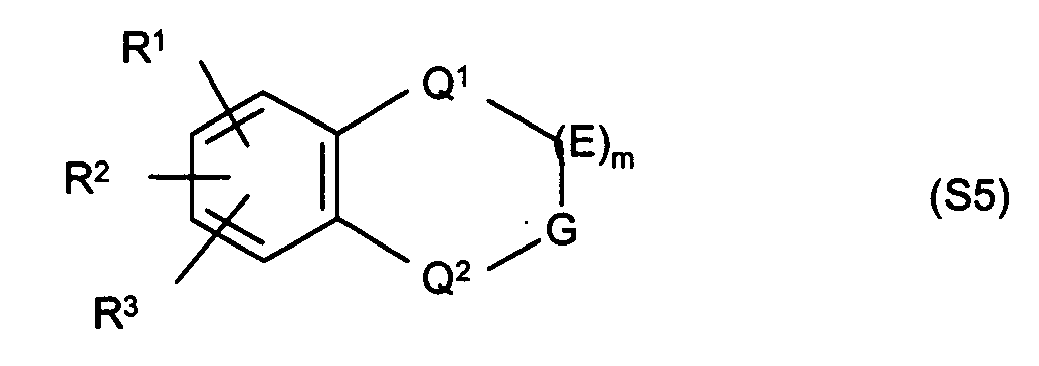
WO-A 98/13 361
- a) compounds of the type dichlorophenylpyrazoline-3-carboxylic acid, preferably compounds such as ethyl 1- (2,4-dichlorophenyl) -5- (ethoxycarbonyl) -5-methyl-2-pyrazoline-3-carboxylate (S1-1) ("Mefenpyr -diethyl ", PM), and related compounds as described in the
WO 91/07874 - b) derivatives of dichlorophenylpyrazolecarboxylic acid, preferably compounds such as ethyl 1- (2,4-dichlorophenyl) -5-methyl-pyrazole-3-carboxylate (S1-2), 1- (2,4-dichlorophenyl) -5-isopropyl-pyrazole-3-carboxylic acid ethyl ester (S1-3), 1- (2,4-dichlorophenyl) -5- (1,1-dimethyl-ethyl) -pyrazole-3- carboxylic acid ethyl ester (S1-4), 1- (2,4-dichlorophenyl) -5-phenyl-pyrazole-3-carboxylic acid ethyl ester (S1-5), and related compounds as described in U.S. Pat
EP-A-333,131 EP-A-269806 - c) compounds of the triazolecarboxylic acid type, preferably compounds such as fenchlorazole (ethyl ester), ie 1- (2,4-dichlorophenyl) -5-trichloromethyl- (1H) -1,2,4-triazole-3-one
carboxylic acid ethyl ester (S1-6), and related compoundsEP-A-174 562 EP-A-346 620 - d) compounds of the 5-benzyl- or 5-phenyl-2-isoxazoline-3-carboxylic acid type or of the 5,5-diphenyl-2-isoxazoline-3-carboxylic acid, preferably compounds such as
5- (2,4-dichlorobenzyl) -2-isoxazoline-3-carboxylic acid ethyl ester (S1-7) or 5-phenyl-2-isoxazoline-3-carboxylic acid ethyl ester (S1-8) and related compounds as described inWO 91/08202 WO-A-95/07897 - e) compounds of the 8-quinolinoxyacetic acid (S2) type, preferably (5-chloro-8-quinolinoxy) -acetic acid (1-methyl-hex-1-yl) ester (common name "cloquintocet-mexyl" (S2- 1) (see PM)
(5-Chloro-8-quinolinoxy) -acetic acid- (1,3-dimethyl-1-yl) -ester (S2-2), (5-chloro-8-quinolinoxy) -acetic acid-4-allyl-oxy butyl ester (S2-3), (5-chloro-8-quinolinoxy) -acetic acid 1-allyloxy-prop-2-yl ester (S2-4), (5-chloro-8-quinolinoxy) -acetic acid ethyl ester (S2-5 ), (5-chloro-8-quinolinoxy) -acetic acid methyl ester (S2-6), (5-chloro-8-quinolinoxy) -acetic acid allyl ester (S2-7), (5-chloro-8-quinolinoxy) -acetic acid-2 (2-propylidene-iminoxy) -1-ethyl ester (S2-8),
(5-chloro-8-quinolinoxy) -acetic acid 2-oxo-prop-1-yl ester (S2-9) and related compounds as described in U.S. PatEP-A-86,750 EP-A-94 349 EP-A-191 736 EP-A-0 492 366 - f) compounds of the (5-chloro-8-quinolinoxy) -malonic acid type, preferably compounds such as (5-chloro-8-quinolinoxy) -malonic acid diethyl ester, (5-chloro-8-quinolinoxy) -malonic acid diallyl ester,
(5-chloro-8-quinolinoxy) -malonic acid methyl ethyl ester and related compounds as described in U.S. PatEP-A-0 582 198 - g) Active substances of the phenoxyacetic or propionic acid derivatives or of the aromatic carboxylic acids, for example 2,4-dichlorophenoxyacetic acid (ester) (2,4-D), 4-chloro-2-methylphenoxypropionic ester (mecoprop) , MCPA or 3,6-dichloro-2-methoxy-benzoic acid (ester) (Dicamba).
- h) active substances of the pyrimidines type, which are used as soil-active safeners in rice, such as. "Fenclorim" (PM) (= 4,6-dichloro-2-phenylpyrimidine), known as safener for pretilachlor in seeded rice,
- i) active substances of the dichloroacetamide type, which are often used as pre-emergence safeners (soil-active safeners), e.g. B. "Dichlormid" (PM) (= N, N-diallyl-2,2-dichloroacetamide), "R-29148" (= 3-dichloroacetyl-2,2,5-trimethyl-1,3-oxazolidine from the company Stauffer)
"Benoxacor" (PM) (= 4-dichloroacetyl-3,4-dihydro-3-methyl-2H-1,4-benzoxazine).
"PPG-1292" (= N-allyl-N - [(1,3-dioxolan-2-yl) -methyl] -dichloroacetamide from PPG Industries),
"DK-24" (= N-allyl-N - [(allylamino-carbonyl) -methyl] -dichloroacetamide from Sagro-Chem),
"AD-67" or "MON 4660" (= 3-dichloroacetyl-1-oxa-3-aza-spiro [4,5] decane of the company Nitrokemia or Monsanto),
"Diclonone" or "BAS145138" or "LAB145138" (= (= 3-dichloroacetyl-2,5,5-trimethyl-1,3-diazabicyclo [4.3.0] nonane from BASF) and "furilazole" or "MON 13900 "(see PM) (= (RS) -3-dichloroacetyl-5- (2-furyl) -2,2-dimethyloxazolidine) - j) active substances of the type of dichloroacetone derivatives, such as. "MG 191" (CAS Reg. No. 96420-72-3) (= 2-dichloromethyl-2-methyl-1,3-dioxolane from Nitrokemia), which is known as safener for corn,
- k) active ingredients of the type of oxyimino compounds, known as seed dressings, such as. "Oxabetrinil" (PM) (= (Z) -1,3-dioxolan-2-ylmethoxyimino (phenyl) acetonitrile), which is known as millet safener for millet against damage by metolachlor,
"Fluxofenim" (PM) (= 1- (4-chlorophenyl) -2,2,2-trifluoro-1-ethanone-O- (1,3-dioxolan-2-ylmethyl) -oxime, which is used as a seed dressing safener for Millet is known against damage from metolachlor, and
"Cyometrinil" or "-CGA-43089" (PM) (= (Z) -
Cyanomethoxyimino (phenyl) acetonitrile), known as millet safener for millet against damage by metolachlor, - l) active substances of the type of Thiazolcarbonsäureester, which are known as seed dressing, such. B.
"Flurazole" (PM) (= 2-chloro-4-trifluoromethyl-1,3-thiazole-5-carboxylic acid benzyl ester), which is known as a seed safener for millet against damage by alachlor and metolachlor, - m) active substances of the naphthalenedicarboxylic acid derivative type known as seed dressing, such as e.g. B.
"Naphthalene anhydride" (PM) (= 1,8-naphthalenedicarboxylic anhydride), which is known as a seed safener for maize against thiocarbamate herbicide damage, - n) active substances of the type chroman acetic acid derivatives, such as. "CL 304415" (CAS Reg. No. 31541-57-8) (= 2- (4-carboxy-chroman-4-yl) -acetic acid from American Cyanamid), which acts as a safener for corn against damage known by imidazolinones,
- o) active substances which, in addition to a herbicidal activity against harmful plants, also have safener action on cultivated plants such as rice, such as, for example, "Dimepiperate" or "MY-93" (PM) (= piperidine-1-thiocarboxylic acid S-1-methyl-1-phenylethyl ester), which is known as a safener for rice against damage by the herbicide Molinate,
"Daimuron" or "SK 23" (PM) (= 1- (1-methyl-1-phenylethyl) -3-p-tolylurea), which is known as a safener for rice against damage of the herbicide imazosulfuron,
"Cumyluron" = "JC-940" (= 3- (2-chlorophenylmethyl) -1- (1-methyl-1-phenylethyl) urea, seeJP-A-60087254
"Methoxyphenone" or "NK 049" (= 3,3'-dimethyl-4-methoxy-benzophenone) known as safener for rice against damage of some herbicides, "COD" (= 1-bromo-4- (chloromethylsulfonyl) -benzene) (CAS Reg. No. 54091-06-4 of Kumiai), which is known as safener against damage of some herbicides in rice, - p) N-acylsulfonamides of the formula (S3) and their salts,
WO 97/45016 - q) acylsulfamoylbenzoic acid amides of the general formula (S4), if appropriate also in salt form,
PCT / EP98 / 06097 - r) compounds of the formula (S5),
WO-A 98/13361
Von besonderem Interesse sind unter den genannten Safenern sind (S1-1), (S1-9), (S2-1) und (S4-1). Einige der Safener sind bereits als Herbizide bekannt und entfalten somit neben der Herbizidwirkung bei Schadpflanzen zugleich auch Schutzwirkung bei den Kulturpflanzen.Of particular interest among the said safeners are (S1-1), (S1-9), (S2-1) and (S4-1). Some of the safeners are already known as herbicides and therefore, in addition to the herbicidal effect on harmful plants, also have a protective effect on the crop plants.
Die Gewichtsverhältnisse von Herbizid(mischung) zu Safener hängt im Allgemeinen von der Aufwandmenge an Herbizid und der Wirksamkeit des jeweiligen Safeners ab und kann innerhalb weiter Grenzen variieren, beispielsweise im Bereich von 200:1 bis 1:200, vorzugsweise 100:1 bis 1:100, insbesondere 20:1 bis 1:20. Die Safener können analog den Verbindungen (I) oder deren Mischungen mit weiteren Herbiziden/Pestiziden formuliert werden und als Fertigformulierung oder Tankmischung mit den Herbiziden bereitgestellt und angewendet werden.The weight ratio of herbicide (mixture) to safener generally depends on the application rate of herbicide and the effectiveness of the particular safener and can vary within wide limits, for example in the range from 200: 1 to 1: 200, preferably 100: 1 to 1: 100, especially 20: 1 to 1:20. The safeners can be formulated analogously to the compounds (I) or mixtures thereof with other herbicides / pesticides and as finished formulation or Tank mix with the herbicides provided and applied.
Zur Anwendung werden die in handelsüblicher Form vorliegenden Herbizid- oder Herbizid-Safener-Formulierungen gegebenenfalls in üblicher Weise verdünnt z.B. bei Spritzpulvern, emulgierbaren Konzentraten, Dispersionen und wasserdispergierbaren Granulaten mittels Wasser. Staubförmige Zubereitungen, Boden- bzw. Streugranulate sowie versprühbare Lösungen werden vor der Anwendung üblicherweise nicht mehr mit weiteren inerten Stoffen verdünnt.For use, the commercially available herbicidal or herbicidal safener formulations are optionally diluted in a conventional manner, e.g. for wettable powders, emulsifiable concentrates, dispersions and water-dispersible granules by means of water. Dust-like preparations, ground or scattered granules and sprayable solutions are usually no longer diluted with other inert substances before use.
Mit den äußeren Bedingungen wie Temperatur, Feuchtigkeit, der Art des verwendeten Herbizids, u.a. variiert die erforderliche Aufwandmenge der Verbindungen der Formel (I). Sie kann innerhalb weiter Grenzen schwanken, z.B. zwischen 0,001 und 10,0 kg/ha oder mehr Aktivsubstanz, vorzugsweise liegt sie jedoch zwischen 0,005 und 5 kg/ha.With the external conditions such as temperature, humidity, the type of herbicide used, u.a. varies the required application rate of the compounds of formula (I). It can vary within wide limits, e.g. between 0.001 and 10.0 kg / ha or more of active substance, but is preferably between 0.005 and 5 kg / ha.
In den folgenden Beispielen beziehen sich Mengenangaben (auch Prozentangaben) auf das Gewicht, sofern nichts anderes speziell angegeben ist. Wenn im Rahmen der Beschreibung und der Beispiele Bezeichnungen "R" und "S" für die absolute Konfiguration an einem Chiralitätszentrum der Stereoisomeren der Formel (I) angegeben ist, folgt diese der RS-Nomenklatur nach der Cahn-Ingold- Prelog-Regel, wenn nichts anderes näher definiert ist.In the following examples, quantities (including percentages) are by weight unless otherwise specified. If in the description and examples designations "R" and "S" for the absolute configuration at a chiral center of the stereoisomers of the formula (I) are given, this follows the RS nomenclature according to the Cahn-Ingold-Prelog rule, if nothing else is defined in more detail.
Nachfolgend werden einige Beispiele für Herstellungen von Verbindungen der allgemeinen Formel (I) näher beschrieben.Some examples of preparations of compounds of the general formula (I) are described in more detail below.
In den nachfolgenden und auch bereits genannten chemischen Formeln werden die üblichen chemischen Symbole verwendet. Aus Gründen der Übersichtlichkeit sind die Formeln teilweise in der üblichen chemischen Kurzschreibweise angegeben, d. h. die C-Atome des Grundgerüstes in den aromatischen Ringen und teilweise in den aliphatischen Teilen sind nicht mit dem Symbol "C" angegeben, sondern nur als Endpunkte der gezeichneten Einfach-, Doppel- und Dreifachbindungen erkennbar. Weiterhin sind die Wasserstoffatome und die C-H-Bindungen am Grundgerüst der aromatischen Ringe nicht extra angeben.In the following and also already mentioned chemical formulas the usual chemical symbols are used. For reasons of clarity, the formulas are given in part in the usual chemical abbreviation, ie the C atoms of the skeleton in the aromatic rings and partly in the aliphatic parts are not indicated by the symbol "C", but only as endpoints of the drawn simple , Double and triple bonds visible. Furthermore, the hydrogen atoms and the CH bonds on the skeleton of the aromatic rings are not specified separately.

3 g 3-(Methylthio)anilin wurden zu 15 ml 6 normaler Salzsäure gegeben und auf 0°C abgekühlt. Zu der entstandenen pastösen Masse wurden langsam 1,64 g Natriumnitrit gelöst in 5 ml Wasser gegeben, wobei die Temperatur nicht über 3°C stieg, und die Reaktionslösung 2 Stunden lang bei 0°C nachgerührt. Anschließend wurden langsam 7,87 g Kaliumiodid, gelöst in 4 ml Wasser, zugetropft, wobei die Temperatur nicht über 5°C stieg. Nach beendeter Zugabe ließ man die Reaktionslösung auf Raumtemperatur kommen und rührte noch 2 Stunden bei dieser Temperatur nach. Der Ansatz wurde in Eiswasser gegeben und dreimal mit Essigsäureethylester extrahiert. Die vereinigten organischen Extrakte wurden zur Entfärbung zweimal mit gesättigter Natriumthiosulfatlösung gewaschen, anschließend mit Magnesiumsulfat getrocknet und am Rotationsverdampfer eingeengt. Das so erhaltene Rohprodukt wurde säulenchromatographisch gereinigt (Kieselgel, Eluent: Heptan / Essigsäureethylester = 9 / 1).
Ausbeute an 1-lod-3-(methylthio)benzol: 3,67 g. 1H-NMR (CDCl3): δ (ppm) = 2,45 (s, 3H); 7,0 (t, 1 H); 7,2 (m, 1 H), 7,43 (m, 1 H), 7,58 (m, 1 H).3 g of 3- (methylthio) aniline was added to 15 ml of 6N hydrochloric acid and cooled to 0 ° C. To the resulting pasty mass slowly 1.64 g of sodium nitrite dissolved in 5 ml of water were added, the temperature did not rise above 3 ° C, and the reaction solution for 2 hours at 0 ° C stirred. Subsequently, 7.87 g of potassium iodide dissolved in 4 ml of water were slowly added dropwise, the temperature did not rise above 5 ° C. After completion of the addition, the reaction solution was allowed to come to room temperature and stirred for a further 2 hours at this temperature. The reaction was poured into ice-water and extracted three times with ethyl acetate. The combined organic extracts were washed for decolorization twice with saturated sodium thiosulfate solution, then dried with magnesium sulfate and concentrated on a rotary evaporator. The crude product thus obtained was purified by column chromatography (silica gel, eluent: heptane / ethyl acetate = 9/1).
Yield of 1-iodo-3- (methylthio) benzene: 3.67 g. 1 H-NMR (CDCl3): δ (ppm) = 2.45 (s, 3H); 7.0 (t, 1H); 7.2 (m, 1H), 7.43 (m, 1H), 7.58 (m, 1H).
92 mg Tetrakis(triphenylphosphin)palladium(0) und 30 mg Cul wurden unter Argonatmosphäre in einem Reaktionsgefäß vorgelegt und anschließend nacheinander 2 g 1-lod-3-(methylthio)benzol in 15 ml Dimethylformamid und 0,45 g Propargylalkohol in 5 ml Dimethylformamid zugegeben. Die entstandene Lösung wurde daraufhin mit 1,09 g Diisopropylethylamin versetzt und 20 Stunden lang bei Raumtemperatur gerührt. Nach beendeter Reaktion wurde mit Wasser versetzt und das Produkt dreimal mit Essigsäureethylester extrahiert. Die vereinigten organischen Extrakte wurden mit Wasser gewaschen, getrocknet und am Rotationsverdampfer eingeengt. Durch Säulenchromatographie (Kieselgel, Eluent: Heptan / Essigsäureethylester = 9 / 1) wurden 1,08 g 3-[3-(Methylthio)phenyl]-2-propin-1-ol erhalten. 1H-NMR (CDCl3): δ = 1,75 (t, 1 H); 2,45 (s, 3H); 4,5 (d, 2H); 7,0 (m, 3H); 7,32 (m, 1 H).92 mg of tetrakis (triphenylphosphine) palladium (0) and 30 mg of Cul were placed under argon atmosphere in a reaction vessel and then successively 2 g of 1-iodo-3- (methylthio) benzene in 15 ml of dimethylformamide and 0.45 g of propargyl alcohol in 5 ml of dimethylformamide added. The resulting solution was then treated with 1.09 g of diisopropylethylamine and stirred for 20 hours at room temperature. After completion of the reaction, water was added and the product was extracted three times with ethyl acetate. The combined organic extracts were washed with water, dried and concentrated on a rotary evaporator. Column chromatography (silica gel, eluent: heptane / ethyl acetate = 9/1) gave 1.08 g of 3- [3- (methylthio) phenyl] -2-propyn-1-ol. 1 H-NMR (CDCl 3): δ = 1.75 (t, 1 H); 2.45 (s, 3H); 4.5 (d, 2H); 7.0 (m, 3H); 7.32 (m, 1H).
1 g 3-[3-(Methylthio)phenyl]-2-propin-1-ol wurde in 10 ml Diethylether gelöst und mit 67 mg Pyridin versetzt. Nach Abkühlen auf 0°C wurde 0,61 g Phosphortribromid, das zuvor in 5 ml Diethylether gelöst wurde, langsam bei 0 bis 5°C zugetropft. Nach beendeter Zugabe wurde die Kühlung entfernt und noch einige Stunden bei Raumtemperatur nachgerührt. Anschließend wurde mit Wasser versetzt und das Produkt mit Diethylether mehrmals extrahiert. Die vereinigten Extrakte wurden über Magnesiumsulfat getrocknet, am Rotationsverdampfer eingengt und das so erhaltene Rohprodukt durch Säulenchromatographie (Kieselgel, Eluent: Heptan / Essigsäureethylester = 9 / 1) gereinigt.
Ausbeute: 1,32 g 1-(3-Brom-1-propin-1-yl)-3-(methylthio)benzol
1H-NMR (CDCl3): δ = 2,43 (s, 3H); 4,18 (s, 2H); 7,0 (m, 3H); 7,32 (m, 1 H).1 g of 3- [3- (methylthio) phenyl] -2-propyn-1-ol was dissolved in 10 ml of diethyl ether and admixed with 67 mg of pyridine. After cooling to 0 ° C., 0.61 g of phosphorus tribromide, previously dissolved in 5 ml of diethyl ether, was slowly added dropwise at 0 to 5 ° C. After completion of the addition, the cooling was removed and stirred for a few hours at room temperature. Subsequently, water was added and the product was extracted several times with diethyl ether. The combined extracts were dried over magnesium sulfate, concentrated on a rotary evaporator and the crude product thus obtained by column chromatography (silica gel, eluent: heptane / ethyl acetate = 9/1).
Yield: 1.32 g of 1- (3-bromo-1-propyn-1-yl) -3- (methylthio) benzene
1 H-NMR (CDCl 3): δ = 2.43 (s, 3H); 4.18 (s, 2H); 7.0 (m, 3H); 7.32 (m, 1H).
0,26 g 1-(3-Brom-1-propin-1-yl)-3-(methylthio)benzol wurden in 5 ml Acetonitril gelöst und nacheinander mit 0,15 g 4-Fluorbenzaldoxim und 0,35 g Cäsiumcarbonat versetzt. Bei der Zugabe von Cäsiumcarbonat entstand eine leichte Gasentwicklung. Es wurde 24 Stunden lang bei Raumtemperatur gerührt, anschließend der Ansatz filtriert, am Rotationsverdampfer eingeengt und säulenchromatographisch gereinigt (Kieselgel, Eluent: Heptan / Essigsäureethylester = 9 / 1).
Ausbeute: 0,21 g 4-Fluorbenzaldehyd O-{3-[3-(Methylthio)phenyl]-2-propin-1-yl}oxim 1H-NMR (CDCl3): δ = 2,42 (s, 3H); 4,98 (s, 2H); 7,05 (m, 2H); 7,2 (m, 3H); 7,35 (m, 1 H); 7,6 (m, 1 H); 8,13 (s, 1 H).0.26 g of 1- (3-bromo-1-propyn-1-yl) -3- (methylthio) benzene were dissolved in 5 ml of acetonitrile and treated successively with 0.15 g of 4-fluorobenzaldoxime and 0.35 g of cesium carbonate. The addition of cesium carbonate resulted in a slight evolution of gas. It was stirred for 24 hours at room temperature, then the batch was filtered, concentrated on a rotary evaporator and purified by column chromatography (silica gel, eluent: heptane / ethyl acetate = 9/1).
Yield: 0.21 g of 4-fluorobenzaldehyde O - {3- [3- (methylthio) phenyl] -2-propyn-1-yl} oxime 1 H-NMR (CDCl 3): δ = 2.42 (s, 3H ); 4.98 (s, 2H); 7.05 (m, 2H); 7.2 (m, 3H); 7.35 (m, 1H); 7.6 (m, 1H); 8.13 (s, 1H).

- a) 2-Methoxybenzaldehyd O-{3-[3-(Methylthio)phenyl]-2-propin-1-yl}oxim 0,53 g 1-(3-Brom-1-propin-1-yl)-3-(methylthio)benzol werden in 5 ml Acetonitril gelöst und nacheinander mit 0,3 g 2-Methoxybenzaldoxim und 0,65 g Cäsiumcarbonat versetzt. Bei der Zugabe von Cäsiumcarbonat entstand eine leichte Gasentwicklung. Nach Rühren über 14 Stunden bei 60°C wurde der Ansatz filtriert, am Rotationsverdampfer eingeengt und säulenchromatographisch gereinigt (Kieselgel, Eluent: Heptan / Essigsäureethylester = 9 / 1). Ausbeute: 0,36 g 2-Methoxybenzaldehyd O-{3-[3-(Methylthio)phenyl]-2-propin-1-yl}oxim. 1H-NMR (CDCl3): δ (ppm) = 2,43 (s, 3H); 3,83 (s, 3H); 4,98 (s, 2H); 6,88 (d, 1 H); 6,96 (t, 1 H); 7,2 (m, 3H); 7,37 (m, 2H); 7,81 (m, 1 H); 8,58 (s, 1 H).a) 2-Methoxybenzaldehyde O - {3- [3- (methylthio) phenyl] -2-propyn-1-yl} oxime 0.53 g of 1- (3-bromo-1-propyn-1-yl) -3- (Methylthio) benzene are dissolved in 5 ml of acetonitrile and treated successively with 0.3 g of 2-Methoxybenzaldoxim and 0.65 g of cesium carbonate. The addition of cesium carbonate resulted in a slight evolution of gas. After stirring for 14 hours at 60 ° C, the mixture was filtered, concentrated on a rotary evaporator and purified by column chromatography (silica gel, eluent: heptane / ethyl acetate = 9/1). Yield: 0.36 g of 2-methoxybenzaldehyde O - {3- [3- (methylthio) phenyl] -2-propyn-1-yl} oxime. 1 H-NMR (CDCl3): δ (ppm) = 2.43 (s, 3H); 3.83 (s, 3H); 4.98 (s, 2H); 6.88 (d, 1H); 6.96 (t, 1H); 7.2 (m, 3H); 7.37 (m, 2H); 7.81 (m, 1H); 8.58 (s, 1H).
- b) 2-Methoxybenzaldehyd O-{3-[3-(Methylsulfinyl)phenyl]-2-propin-1-yl}oxim und 2-Methoxybenzaldehyd O-{3-[3-(Methylsulfonyl)phenyl]-2-propin-1-yl}oximb) 2-Methoxybenzaldehyde O - {3- [3- (methylsulfinyl) phenyl] -2-propyn-1-yl} oxime and 2-methoxybenzaldehyde O - {3- [3- (methylsulfonyl) phenyl] -2-propyne 1-yl} oxime
0,2 g 2-Methoxybenzaldehyd O-{3-[3-(Methylthio)phenyl]-2-propin-1-yl}oxim wurden in 5 ml Dichlormethan gelöst und auf 0°C abgekühlt. Nach Zugabe von 0,66 g m-Chlorperbenzoesäure in einer Portion ließ man auf Raumtemperatur kommen und rührte 15 Stunden lang bei dieser Temperatur. Anschließend wurden weitere 55 mg m-Chlorperbenzoesäure zugegeben und wiederum 5 Stunden lang bei Raumtemperatur gerührt. Währenddessen wurde der Fortgang der Reaktion stetig durch Dünnschichtchromatographie verfolgt. Schließlich wurde der Ansatz filtriert, am Rotationsverdampfer eingeengt und durch Säulenchromatographie (Kieselgel, Eluent: Heptan / Essigsäureethylester = 4 / 1) aufgereinigt.
Ausbeute: 102 mg 2-Methoxybenzaldehyd O-{3-[3-(Methylsulfinyl)phenyl]-2-propin-1-yl}oxim [1H-NMR (CDCl3): δ (ppm) = 2,75 (s, 3H); 3,83 (s, 3H); 5,0 (s, 2H); 6,9 (d, 1 H); 6,96 (t, 1 H); 7,38 (m, 1 H); 7,5 (m, 1 H); 7,6 (m, 2H); 7,72 (s, 1 H); 7,81 (d, 1 H); 8,58 (s, 1 H)] und 97 mg 2-Methoxybenzaldehyd O-{3-[3-(Methylsulfonyl)phenyl]-2-propin-1-yl}oxim 1H-NMR (CDCl3): δ (ppm) = 3,05 (s, 3H); 3,83 (s, 3H); 5,0 (s, 2H); 6,9 (d, 1 H); 6,98 (t, 1 H); 7,38 (m, 1H); 7,53 (m, 1 H); 7,72 (m, 1H); 7,81 (m, 1 H); 7,88 (m, 1 H); 8,04 (s, 1 H); 8,58 (s, 1 H).0.2 g of 2-methoxybenzaldehyde O - {3- [3- (methylthio) phenyl] -2-propyn-1-yl} oxime was dissolved in 5 ml of dichloromethane and cooled to 0 ° C. After addition of 0.66 g of m-chloroperbenzoic acid in one portion was allowed to come to room temperature and stirred for 15 hours at this temperature. Subsequently, a further 55 mg of m-chloroperbenzoic acid were added and again stirred for 5 hours at room temperature. Meanwhile, the progress of the reaction was continuously monitored by thin layer chromatography. Finally, the batch was filtered, concentrated on a rotary evaporator and purified by column chromatography (silica gel, eluent: heptane / ethyl acetate = 4/1).
Yield: 102 mg of 2-methoxybenzaldehyde O - {3- [3- (methylsulfinyl) phenyl] -2-propyn-1-yl} oxime [1 H-NMR (CDCl3): δ (ppm) = 2.75 (s , 3H); 3.83 (s, 3H); 5.0 (s, 2H); 6.9 (d, 1H); 6.96 (t, 1H); 7.38 (m, 1H); 7.5 (m, 1H); 7.6 (m, 2H); 7.72 (s, 1H); 7.81 (d, 1H); 8.58 (s, 1 H)] and 97 mg of 2-methoxybenzaldehyde O - {3- [3- (methylsulfonyl) phenyl] -2-propyn-1-yl} oxime 1 H-NMR (CDCl3): δ ( ppm) = 3.05 (s, 3H); 3.83 (s, 3H); 5.0 (s, 2H); 6.9 (d, 1H); 6.98 (t, 1H); 7.38 (m, 1H); 7.53 (m, 1H); 7.72 (m, 1H); 7.81 (m, 1H); 7.88 (m, 1H); 8.04 (s, 1H); 8.58 (s, 1H).
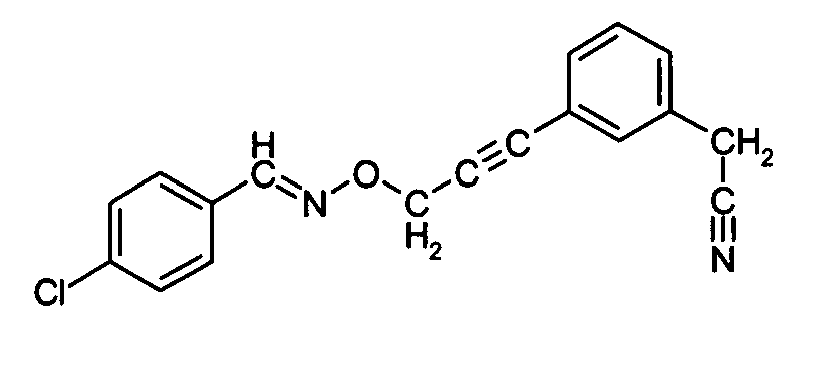
47 mg Tetrakis(triphenylphosphin)palladium(0) und 15 mg Cul wurden unter Argonatmosphäre in einem Reaktionsgefäß vorgelegt und anschließend nacheinander 1 g 3-lodphenylacetonitril in 8 ml Dimethylformamid und 0,23 g Propargylalkohol in 2 ml Dimethylformamid zugegeben. Die entstandene Lösung wurde mit 0,55 g Diisopropylethylamin versetzt und 20 Stunden lang bei Raumtemperatur gerührt. Nach beendeter Reaktion wurde mit Wasser versetzt und das Produkt dreimal mit Essigsäureethylester extrahiert. Die vereinigten organischen Extrakte wurden mit Wasser gewaschen, getrocknet und am Rotationsverdampfer eingeengt. Durch Säulenchromatographie (Kieselgel, Eluent: Heptan / Essigsäureethylester = 9 / 1) wurde 0,58 g 3-(3-Hydroxy-1-propin-1-yl)phenylacetonitril erhalten. 1H-NMR (CDCl3): δ (ppm) = 2,0 (br t, 1 H); 3,74 (s, 2H); 4,5 (d, 2H); 7,25 - 7,4 (m, 4H).47 mg of tetrakis (triphenylphosphine) palladium (0) and 15 mg of Cul were placed under argon atmosphere in a reaction vessel and then successively added 1 g of 3-iodophenylacetonitrile in 8 ml of dimethylformamide and 0.23 g of propargyl alcohol in 2 ml of dimethylformamide. The resulting solution was treated with 0.55 g of diisopropylethylamine and stirred for 20 hours at room temperature. After completion of the reaction, water was added and the product was extracted three times with ethyl acetate. The combined organic extracts were washed with water, dried and concentrated on a rotary evaporator. Column chromatography (silica gel, eluent: heptane / ethyl acetate = 9/1) gave 0.58 g of 3- (3-hydroxy-1-propyn-1-yl) phenylacetonitrile. 1 H-NMR (CDCl 3 ): δ (ppm) = 2.0 (br t, 1 H); 3.74 (s, 2H); 4.5 (d, 2H); 7.25 - 7.4 (m, 4H).
0,58 g 3-(3-Hydroxy-1-propin-1-yl)phenylacetonitril wurden in 7 ml Diethylether gelöst und mit 40 mg Pyridin versetzt. Nach Abkühlen auf 0°C wurde 0,37 g Phosphortribromid, das zuvor in 3 ml Diethylether gelöst wurde, so langsam zugetropft, dass die Temperatur der Reaktionslösung nicht über 5°C steigt. Nach beendeter Zugabe wurde die Kühlung entfernt und noch einige Stunden bei Raumtemperatur nachgerührt. Anschließend wurde mit Wasser versetzt und das Produkt mit Diethylether mehrmals extrahiert. Die vereinigten Extrakte wurden über Magnesiumsulfat getrocknet, am Rotationsverdampfer eingengt und das so erhaltene Rohprodukt durch Säulenchromatographie (Kieselgel, Eluent: Heptan / Essigsäureethylester = 9 / 1) gereinigt. Ausbeute: 0,65 g 3-(3-Brom-1-propin-1-yl)phenylacetonitril; 1H-NMR (CDCl3): δ (ppm) = 3,77 (s, 2H); 4,15 (s, 2H); 7,3 - 7,42 (m, 4H).0.58 g of 3- (3-hydroxy-1-propyn-1-yl) phenylacetonitrile were dissolved in 7 ml of diethyl ether and admixed with 40 mg of pyridine. After cooling to 0 ° C, 0.37 g of phosphorus tribromide, which was previously dissolved in 3 ml of diethyl ether, added dropwise so slowly that the temperature of the reaction solution does not rise above 5 ° C. Upon completion of the addition, the cooling was removed and left for a few hours Room temperature stirred. Subsequently, water was added and the product was extracted several times with diethyl ether. The combined extracts were dried over magnesium sulfate, concentrated on a rotary evaporator and the crude product thus obtained by column chromatography (silica gel, eluent: heptane / ethyl acetate = 9/1). Yield: 0.65 g of 3- (3-bromo-1-propyn-1-yl) phenylacetonitrile; 1 H-NMR (CDCl 3 ): δ (ppm) = 3.77 (s, 2H); 4.15 (s, 2H); 7.3-7.42 (m, 4H).
0,2 g 3-(3-Brom-1-propin-1-yl)phenylacetonitril wurden in 5 ml Acetonitril gelöst und nacheinander mit 0,17 g 4-Chlorbenzaldehydoxim und 0,28 g Cäsiumcarbonat versetzt. Nach 15 Stunden Rühren bei 60°C wurde der Ansatz filtriert, am Rotationsverdampfer eingeengt und säulenchromatographisch gereinigt (Kieselgel, Eluent: Heptan / Essigsäureethylester = 9 / 1). Ausbeute: 0,19 g 3-(3-{[(4-chlorbenzyliden)amino]oxy}-1-propin-1-yl)phenylacetonitril; 1H-NMR (CDCl3): δ (ppm) = 3,76 (s, 2H); 4,99 (s, 2H); 7,28 - 7,45 (m, 6H); 7,58 (m, 2H); 8,12 (s, 1 H).0.2 g of 3- (3-bromo-1-propyn-1-yl) phenylacetonitrile were dissolved in 5 ml of acetonitrile and treated successively with 0.17 g of 4-chlorobenzaldehyde oxime and 0.28 g of cesium carbonate. After 15 hours of stirring at 60 ° C, the mixture was filtered, concentrated on a rotary evaporator and purified by column chromatography (silica gel, eluent: heptane / ethyl acetate = 9/1). Yield: 0.19 g of 3- (3 - {[(4-chlorobenzylidene) amino] oxy} -1-propyn-1-yl) phenylacetonitrile; 1 H-NMR (CDCl3): δ (ppm) = 3.76 (s, 2H); 4.99 (s, 2H); 7.28 - 7.45 (m, 6H); 7.58 (m, 2H); 8.12 (s, 1H).


2 g 3-Methoxyphenylpropargylalkohol wurden in 20 ml Diethylether gelöst und mit 140 mg Pyridin versetzt. Nach Abkühlen auf 0°C wurde 1,3 g Phosphortribromid, gelöst in 5 ml Diethylether, langsam zugetropft, so dass die Temperatur in der Reaktionslösung nicht über 5°C stieg. Nach beendeter Zugabe wurde die Kühlung entfernt und über Nacht bei Raumtemperatur nachgerührt. Anschließend wurde mit Wasser versetzt und das Produkt mit Diethylether mehrmals extrahiert. Die vereinigten Extrakte wurden über Magnesiumsulfat getrocknet, am Rotationsverdampfer eingengt und das so erhaltene Rohprodukt durch Säulenchromatographie (Kieselgel, Eluent: Heptan / Essigsäureethylester = 9 / 1) gereinigt. Ausbeute: 2,51 g 1-(3-Brom-1-propin-1-yl)-3-(methoxy)benzol;
1H-NMR (CDCl3): δ (ppm) = 3,8 (s, 3H); 4,17 (s, 2H); 6,87 (m, 1 H); 6,98 (m, 1 H); 7,02 (m, 1 H); 7,21 (m, 1 H).2 g of 3-Methoxyphenylpropargylalkohol were dissolved in 20 ml of diethyl ether and treated with 140 mg of pyridine. After cooling to 0 ° C, 1.3 g of phosphorus tribromide, dissolved in 5 ml of diethyl ether, was slowly added dropwise so that the temperature in the reaction solution did not rise above 5 ° C. After completion of the addition, the cooling was removed and stirred overnight at room temperature. Subsequently, water was added and the product was extracted several times with diethyl ether. The combined extracts were dried over magnesium sulfate, concentrated on a rotary evaporator and the crude product thus obtained by column chromatography (silica gel, eluent: heptane / ethyl acetate = 9/1). Yield: 2.51 g of 1- (3-bromo-1-propyn-1-yl) -3- (methoxy) benzene;
1 H-NMR (CDCl3): δ (ppm) = 3.8 (s, 3H); 4.17 (s, 2H); 6.87 (m, 1H); 6.98 (m, 1H); 7.02 (m, 1H); 7.21 (m, 1H).
b) 0,2 g 3-(2,4-Difluorphenyl)-1 H-pyrazol wurden in 5 ml Acetonitril gelöst und zu 0,27 g 1-(3-Brom-1-propin-1-yl)-3-(methoxy)benzol gegeben. Die Lösung wurde mit 0,36 g Cäsiumcarbonat versetzt, wobei eine leichte Gasentwicklung entstand. Nach 16 Stunden Rühren bei 60°C wurde der Ansatz filtriert, am Rotationsverdampfer eingeengt und per HPLC gereinigt (Kieselgel RP-18, Eluent: 20% bis 100% Acetonitril in 0,05%iger wässeriger Trifluoressigsäure).
Ausbeute: 46 mg 5-(2,4-Difluorphenyl)-1-{3-[3-(methoxy)phenyl]-2-propin-1-yl}-1H-pyrazol [1H-NMR (CDCl3): δ (ppm) = 3,77 (s, 3H); 5,08 (s, 2H); 6,39 (d, 1 H); 6,82 bis 7,02 (m, 5H); 7,08 (m, 1 H); 7,47 (m, 1 H); 7,61 (d, 1 H)] und
226 mg 3-(2,4-Difluorphenyl)-1-{3-[3-(methoxy)phenyl]-2-propin-1-yl}-1 H-pyrazol 1H-NMR (CDCl3): δ (ppm) = 3,8 (s, 3H); 5,21 (s, 2H); 6,71 (d, 1 H); 6,85 - 6,95 (m, 3H); 7,0 (m, 1 H); 7,07 (m, 1 H); 7,21 (m, 1 H); 7,75 (d, 1 H); 7,99 (m, 1H)].b) 0.2 g of 3- (2,4-difluorophenyl) -1H-pyrazole were dissolved in 5 ml of acetonitrile and added to 0.27 g of 1- (3-bromo-1-propyn-1-yl) -3- (methoxy) benzene. The solution was mixed with 0.36 g of cesium carbonate, resulting in a slight evolution of gas. After 16 hours stirring at 60 ° C, the mixture was filtered, concentrated on a rotary evaporator and purified by HPLC (silica gel RP-18, eluent: 20% to 100% acetonitrile in 0.05% aqueous trifluoroacetic acid).
Yield: 46 mg of 5- (2,4-difluorophenyl) -1- {3- [3- (methoxy) phenyl] -2-propyn-1-yl} -1H-pyrazole [1 H-NMR (CDCl3): δ (ppm) = 3.77 (s, 3H); 5.08 (s, 2H); 6.39 (d, 1H); 6.82 to 7.02 (m, 5H); 7.08 (m, 1H); 7.47 (m, 1H); 7.61 (d, 1H)] and
226 mg of 3- (2,4-difluorophenyl) -1- {3- [3- (methoxy) phenyl] -2-propyn-1-yl} -1 H-pyrazole 1 H-NMR (CDCl3): δ ( ppm) = 3.8 (s, 3H); 5.21 (s, 2H); 6.71 (d, 1H); 6.85 - 6.95 (m, 3H); 7.0 (m, 1H); 7.07 (m, 1H); 7.21 (m, 1H); 7.75 (d, 1H); 7.99 (m, 1H)].
Die in den nachfolgenden Tabellen beschriebenen Verbindungen wurden gemäß den oder analog zu den oben beschriebenen Beispielen A1 bis A5 erhalten.The compounds described in the tables below were obtained according to or analogously to Examples A1 to A5 described above.
In den nachfolgenden Tabellen werden die üblichen chemischen Symbole verwendet. Aus Gründen der Übersichtlichkeit sind die Formeln vor jeder Tabelle in der üblichen chemischen Kurzschreibweise angegeben, d. h. die C-Atome des Grundgerüstes in den aromatischen Ringen und in der aliphatischen Kette sind nicht mit dem Symbol "C" angegeben, sondern nur als Endpunkte der gezeichneten Einfach-, Doppel- und Dreifachbindungen erkennbar. Weiterhin sind die Wasserstoffatome und die C-H-Bindungen am Grundgerüst der aromatischen Ringe nicht extra angeben.The following tables use the usual chemical symbols. For the sake of clarity, the formulas before each table are given in the usual chemical abbreviation; H. the C atoms of the backbone in the aromatic rings and in the aliphatic chain are not indicated by the symbol "C", but only as end points of the drawn single, double and triple bonds. Furthermore, the hydrogen atoms and the C-H bonds on the skeleton of the aromatic rings are not specified separately.
Außerdem werden folgende Abkürzungen in den Tabellen verwendet:
- c-Pr =
- Cyclopropyl
- c-Pent =
- Cyclopentyl
- (R1)m oder (R3)n =
- H bedeutet unsubstituierter Cyclus (n = 0)
- c-Pr =
- cyclopropyl
- c-Pent =
- cyclopentyl
- (R 1 ) m or (R 3 ) n =
- H means unsubstituted cycle (n = 0)
In der Spalte zu physikalische Daten ("Daten") der Tabellen bedeuten:
- "NMR" =
- Daten gemäß 1H-NMR-Spektum (1H-Kernresonanz-Daten) sind am Ende der Tabellen 1-7 in der Tabelle 8 angegeben.
- "LogP" =
- Verteilungskoeffizient in einem Zweiphasengemisch aus n-Octanol und Wasser. Daten sind am Ende der Tabellen 1-7 in der Tabelle 9 angegeben.


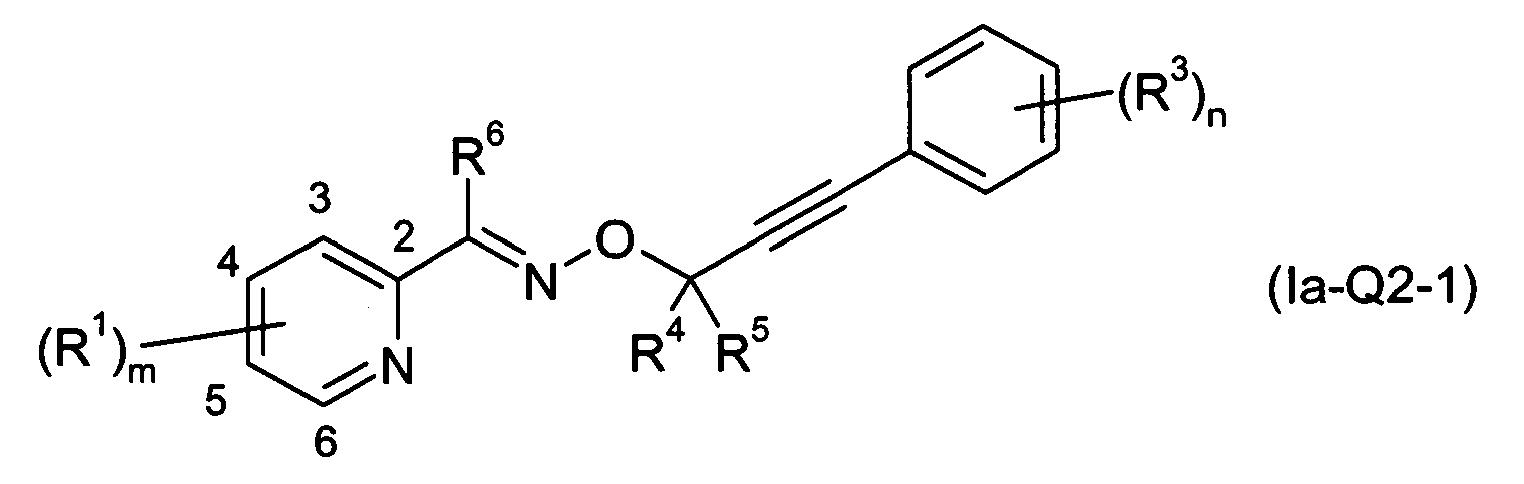
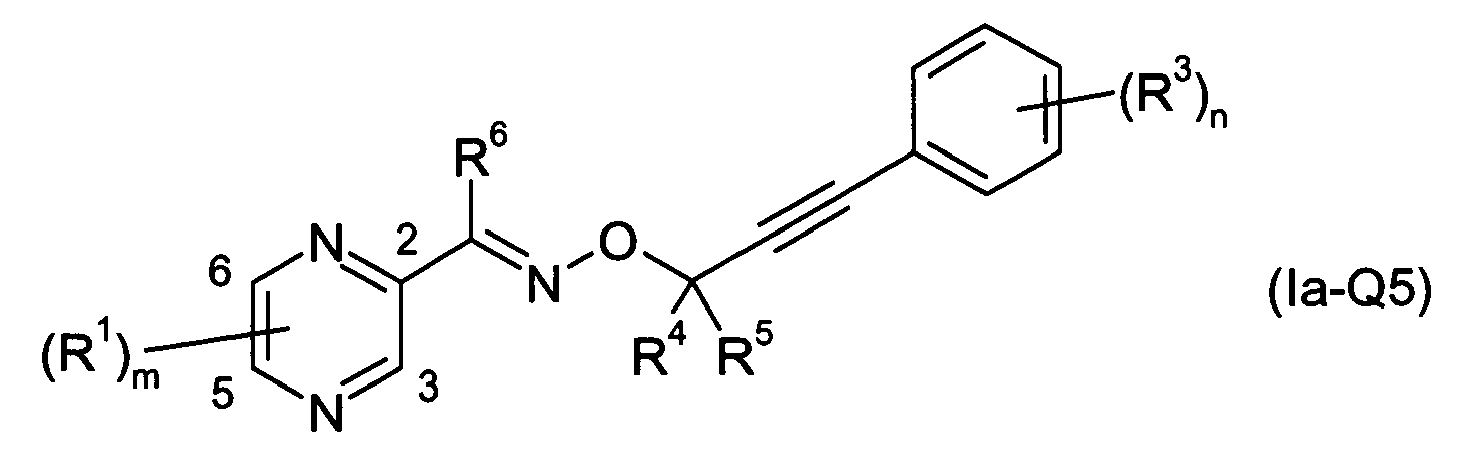
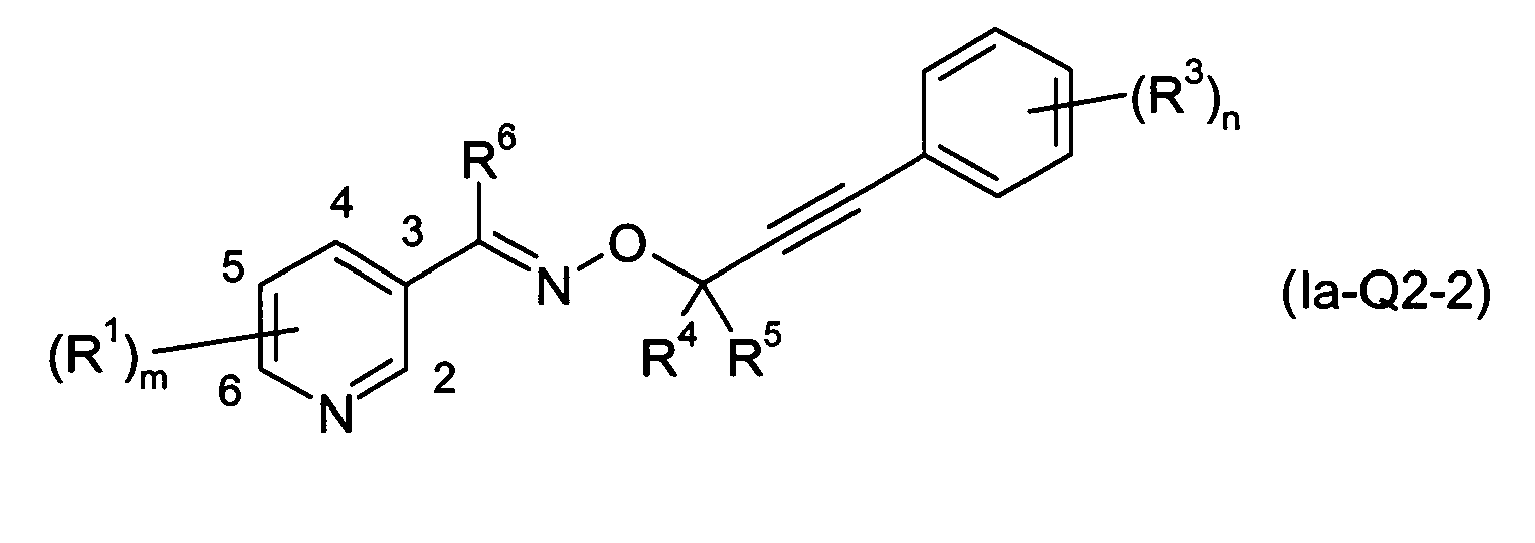


- "NMR" =
- Data according to 1 H-NMR spectrum ( 1 H nuclear magnetic resonance data) are given in Table 8 at the end of Tables 1-7.
- "LogP" =
- Partition coefficient in a two-phase mixture of n-octanol and water. Data are given in Table 9 at the end of Tables 1-7.
In der nachfolgenden Tabelle 9 sind log P-Daten zu den Beispielverbindungen aufgeführt.Table 9 below lists log P data for the example compounds.
Die log P-Daten wurden in Übereinstimmung mit der EEC Direktive 79/831, Anlage V.A8 (Annex V.A8) mittels HPLC (High Performance Liquid Chromatography) auf einer Umkehrphase-Säule (reversed-phase column) (C18) mit folgenden Methoden bestimmt:
Temperatur: 40°C; Mobile Phase: 0,1 % bzw. 0,06 %ige wässrige Ameisensäure oder 0,1 % wässriger Phosphorsäure und Acetonitril; linearer Gradient von 10% Acetonitril bis 90% bzw. 95 % Acetonitril. Die Kalibrierung wurde ausgeführt mit Hilfe unverzweigter Alkan-2-one (bestehend aus 3 bis 13 bzw.16 Kohlenstoff-Atomen) mit bekannten IogP-Werten (Bestimmung der IogP-Werte über die Retentionszeiten mittels linearer Interpolation zwischen zwei nachfolgenden Alkanonen).
Die lambda- max-Werte wurden bestimmt über die Maxima der chromatographischen Signale der UV-Spectren von 190 nm bis 400 bzw. 450 nm.
Temperature: 40 ° C; Mobile phase: 0.1% or 0.06% aqueous formic acid or 0.1% aqueous phosphoric acid and acetonitrile; linear gradient from 10% acetonitrile to 90% or 95% acetonitrile. The calibration was carried out using unbranched alkan-2-ones (consisting of 3 to 13 or 16 carbon atoms) with known IogP values (determination of the IogP values over the retention times by means of linear interpolation between two subsequent alkanones).
The lambda max values were determined over the maxima of the chromatographic signals of the UV spectrums from 190 nm to 400 or 450 nm.
a) Ein Stäubemittel wird erhalten, indem man 10 Gew.-Teile einer Verbindung der Formel (I) und 90 Gew.-Teile Talkum als Inertstoff mischt und in einer Schlagmühle zerkleinert.
b) Ein in Wasser leicht dispergierbares, benetzbares Pulver wird erhalten, indem man 25 Gewichtsteile einer Verbindung der Formel (I), 64 Gewichtsteile kaolinhaltigen Quarz als Inertstoff, 10 Gewichtsteile ligninsulfonsaures Kalium und 1 Gew.-Teil oleoylmethyltaurinsaures Natrium als Netz- und Dispergiermittel mischt und in einer Stiftmühle mahlt.
c) Ein in Wasser leicht dispergierbares Dispersionskonzentrat wird erhalten, indem man 20 Gewichtsteile einer Verbindung der Formel (I) mit 6 Gew.-Teilen Alkylphenolpolyglykolether (®Triton X 207), 3 Gew.-Teilen Isotridecanolpolyglykolether (8 EO) und 71 Gew.-Teilen paraffinischem Mineralöl (Siedebereich z.B. ca. 255 bis über 277 C) mischt und in einer Reibkugelmühle auf eine Feinheit von unter 5 Mikron vermahlt.
d) Ein emulgierbares Konzentrat wird erhalten aus 15 Gew.-Teilen einer Verbindung der Formel (I), 75 Gew.-Teilen Cyclohexanon als Lösungsmittel und 10 Gew.-Teilen oxethyliertes Nonylphenol als Emulgator.
e) Ein in Wasser dispergierbares Granulat wird erhalten indem man
f) Ein in Wasser dispergierbares Granulat wird auch erhalten, indem man 25 Gewichtsteile einer Verbindung der Formel (I), 5 " 2,2'-dinaphthylmethan-6,6'-disulfonsaures Natrium 2 " oleoylmethyltaurinsaures Natrium, 1 Gewichtsteil Polyvinylalkohol, 17 Gewichtsteile Calciumcarbonat und 50 " Wasser auf einer Kolloidmühle homogenisiert und vorzerkleinert, anschließend auf einer Perlmühle mahlt und die so erhaltene Suspension in einem Sprühturm mittels einer Einstoffdüse zerstäubt und trocknet.a) A dust is obtained by mixing 10 parts by weight of a compound of formula (I) and 90 parts by weight of talc as an inert material and comminuted in a hammer mill.
b) A wettable powder readily dispersible in water is obtained by mixing 25 parts by weight of a compound of formula (I), 64 parts by weight of kaolin-containing quartz as inert substance, 10 parts by weight of lignosulfonic acid potassium and 1 part by weight of oleoylmethyltaurine sodium as wetting and dispersing agent and grinded in a pin mill.
c) A dispersion concentrate which is readily dispersible in water is obtained by reacting 20 parts by weight of a compound of the formula (I) with 6 parts by weight of alkylphenol polyglycol ether (®Triton X 207), 3 parts by weight of isotridecanol polyglycol ether (8 EO) and 71% by weight. Parts of paraffinic mineral oil (boiling range, for example, about 255 to about 277 C) mixed and ground in a ball mill to a fineness of less than 5 microns.
d) An emulsifiable concentrate is obtained from 15 parts by weight of a compound of the formula (I), 75 parts by weight of cyclohexanone as solvent and 10 parts by weight of ethoxylated nonylphenol as emulsifier.
e) A water-dispersible granules are obtained by
f) A water-dispersible granules are also obtained by 25 parts by weight of a compound of formula (I), 5 "2,2'-dinaphthylmethane-6,6'-disulfonic acid sodium 2" oleoylmethyltaurine acid, 1 part by weight of polyvinyl alcohol, 17 parts by weight of calcium carbonate and 50 "water homogenized and pre-crushed on a colloid mill, then grinded on a bead mill and the resulting suspension is sprayed in a spray tower by means of a single-fluid nozzle and dried.
Samen bzw. Rhizomstücke von mono- und dikotylen Unkrautpflanzen wurden in Plastiktöpfen in sandiger Lehmerde ausgelegt und mit Erde abgedeckt. Die in Form von benetzbaren Pulvern oder Emulsionskonzentraten formulierten erfindungsgemäßen Verbindungen wurden dann als wäßrige Suspension bzw. Emulsion mit einer Wasseraufwandmenge von umgerechnet 600 bis 800 l/ha in unterschiedlichen Dosierungen auf die Oberfläche der Abdeckerde appliziert.Seeds or rhizome pieces of monocotyledonous and dicotyledonous weed plants were placed in sandy loam soil in plastic pots and covered with soil. The compounds according to the invention formulated in the form of wettable powders or emulsion concentrates were then applied to the surface of the cover soil as an aqueous suspension or emulsion having a water application rate of 600 to 800 l / ha in different dosages.
Nach der Behandlung wurden die Töpfe im Gewächshaus aufgestellt und unter guten Wachstumsbedingungen für die Unkräuter gehalten. Die optische Bonitur der Pflanzen- bzw. Auflaufschäden erfolgte nach dem Auflaufen der Versuchspflanzen nach einer Versuchszeit von 3 bis 4 Wochen im Vergleich zu unbehandelten Kontrollen. Wie die Testergebnisse zeigten, wiesen die erfindungsgemäßen Verbindungen eine gute herbizide Vorauflaufwirksamkeit gegen ein breites Spektrum von Ungräsern und Unkräutern auf. Beispielsweise zeigten die Beispiele 1.049, 1.050, 1.062, 1.063, 1.115, 1.128, 1.301, 3.086, 5.022, 5.040, 5.041, 5.053, 5.120, 5.121, 5.152, 5.177, 5.181, 5.189, 5.190 aus den Tabellen 1 bis 5 im Test sehr gute herbizide Wirkung gegen Schadpflanzen wie Echinochloa crus-galli, Setaria viridis, Stellaria media und Veronica persica im Vorauflaufverfahren bei einer Aufwandmenge von 1,28 kg oder weniger Aktivsubstanz pro Hektar.After the treatment, the pots were placed in the greenhouse and kept under good growth conditions for the weeds. The optical assessment of the plant damage and / or the emergence damage occurred after emergence of the test plants after a test time of 3 to 4 weeks in comparison to untreated controls. As the test results showed, the compounds according to the invention had a good herbicidal pre-emergence activity against a broad spectrum of grass weeds and weeds. For example, Examples 1049, 1050, 1062, 1063, 1,115, 1,128, 1,301, 3,086, 5,022, 5,040, 5,041, 5,053, 5,120, 5,121, 5,152, 5,177, 5,181, 5,189, 5,190 from Tables 1 to 5 in the test showed very much good herbicidal activity against harmful plants such as Echinochloa crus-galli, Setaria viridis, Stellaria media and Veronica persica pre-emergence at an application rate of 1.28 kg or less active ingredient per hectare.
Samen bzw. Rhizomstücke von mono- und dikotylen Unkräutern wurden in Plastiktöpfen in sandigem Lehmboden ausgelegt, mit Erde abgedeckt und im Gewächshaus unter guten Wachstumsbedingungen angezogen. Drei Wochen nach der Aussaat wurden die Versuchspflanzen im Dreiblattstadium behandelt. Die als Spritzpulver bzw. als Emulsionskonzentrate formulierten erfindungsgemäßen Verbindungen wurden in verschiedenen Dosierungen mit einer Wasseraufwandmenge von umgerechnet 600 bis 800 I/ha auf die grünen Pflanzenteile gesprüht. Nach ca. 3 bis 4 Wochen Standzeit der Versuchspflanzen im Gewächshaus unter optimalen Wachstumsbedingungen wurde die Wirkung der Präparate optisch im Vergleich zu unbehandelten Kontrollen bonitiert. Die erfindungsgemäßen Mittel wiesen auch im Nachauflauf eine gute herbizide Wirksamkeit gegen ein breites Spektrum wirtschaftlich wichtiger Ungräser und Unkräuter auf. Beispielsweise zeigten die Beispiele Nr. 1.006, 1.049, 1.050, 1.063, 1.115, 1.128, 1.157, 1.301, 3.022, 3.023, 3.086, 5.022, 5.040, 5.041, 5.053, 5.120, 5.121, 5.152, 5.177, 5.181, 5.185, 5.188, 5.189, 5.190, 6.077 aus den Tabellen 1 bis 6 sehr gute herbizide Wirkung gegen Schadpflanzen wie Echinochloa crus-galli, Setaria viridis, Abuthilon theophrasti, Amaranthus retroflexus und Veronica persica im Nachauflaufverfahren bei einer Aufwandmenge von 1,28 kg und weniger Aktivsubstanz pro Hektar.Seeds or rhizome pieces of monocotyledonous and dicotyledonous weeds were placed in sandy loam soil in plastic pots, covered with soil and grown in the greenhouse under good growth conditions. Three weeks after sowing, the test plants were treated at the trefoil stage. The compounds according to the invention formulated as wettable powders or as emulsion concentrates were applied to the green in various dosages with a water application rate of 600 to 800 l / ha Sprayed plant parts. After about 3 to 4 weeks of life of the test plants in the greenhouse under optimal growth conditions, the effect of the preparations was optically scored compared to untreated controls. The compositions according to the invention also exhibited a good herbicidal activity against a wide range of economically important weeds and weeds, even after the postemergence. For example, Examples Nos. 1,006, 1,049, 1,050, 1,063, 1,115, 1,128, 1,157, 1,301, 3,022, 3,023, 3,086, 5,022, 5,040, 5,041, 5,053, 5,120, 5,121, 5,152, 5,177, 5,181, 5,185, 5,188, 5.189, 5.190, 6.077 from Tables 1 to 6 very good herbicidal activity against harmful plants such as Echinochloa crus-galli, Setaria viridis, Abutilon theophrasti, Amaranthus retroflexus and Veronica persica postemergence at an application rate of 1.28 kg and less active ingredient per hectare.
In weiteren Versuchen im Gewächshaus wurden Samen einer größeren Anzahl von Kulturpflanzen und Unkräutern in sandigem Lehmboden ausgelegt und mit Erde abgedeckt. Ein Teil der Töpfe wurde sofort wie unter Abschnitt 1 beschrieben behandelt, die übrigen im Gewächshaus aufgestellt, bis die Pflanzen zwei bis drei echte Blätter entwickelt hatten und dann wie unter Abschnitt 2 beschrieben mit den erfindungsgemäßen Substanzen der Formel (I) in unterschiedlichen Dosierungen besprüht. Vier bis fünf Wochen nach der Applikation und Standzeit im Gewächshaus wurde mittels optischer Bonitur festgestellt, daß die erfindungsgemäßen Verbindungen zweikeimblättrige Kulturen wie z.B. Soja, Baumwolle, Raps, Zuckerrüben und Kartoffeln im Vor- und Nachauflaufverfahren selbst bei hohen Wirkstoffdosierungen ungeschädigt ließen. In der Regel schonten die Verbindungen bei geeigneten Aufwandmengen auch Gramineen-Kulturen wie z.B. Gerste, Weizen, Roggen, Sorghum, Mais oder Reis. Die Verbindungen der Formel (I) zeigten teilweise eine hohe Selektivität und eignen sich deshalb zur Bekämpfung von unerwünschten Pflanzenwuchs in landwirtschaftlichen Kulturen.In further experiments in the greenhouse, seeds of a larger number of crops and weeds were laid in sandy loam soil and covered with soil. A portion of the pots was immediately treated as described in Section 1, the rest were placed in the greenhouse until the plants had developed two to three real leaves and then sprayed as described in Section 2 with the compounds of formula (I) according to the invention in different dosages. Four to five weeks after application and service life in the greenhouse it was found by optical assessment that the compounds of the invention dicotyledonous crops such. Soy, cotton, oilseed rape, sugar beets and potatoes pre-emergence and post-emergence even with high doses of active ingredient undamaged. In general, the compounds at suitable application rates also protect graminaceous crops such as e.g. Barley, wheat, rye, sorghum, corn or rice. Some of the compounds of the formula (I) have a high selectivity and are therefore suitable for controlling undesired plant growth in agricultural crops.
Claims (10)


worin jeder der Reste Ra und Rb unabhängig voneinander für einen Rest aus der Gruppe, welche die Reste
wobei jeder der letztgenannten beiden Reste im Ring unsubstituiert oder durch einen oder mehrere Reste aus der Gruppe Halogen, CN, Nitro, (C1-C4)Alkyl, (C1-C4)Haloalkyl, (C1-C4)Alkoxy-(C1-C4)alkyl, (C1-C4)Alkoxy, (C1-C4)Haloalkoxy, (C1-C4)Alkylthio, (C1-C4)Alkylsulfinyl und (C1-C4)Alkylsulfonyl substituiert ist,
enthält, steht
oder
oder
worin Ra und Rb gemeinsam für eine (C2-C5)Alkylen-Kette, welche durch ein oder mehrere Heteroatome aus der Gruppe O und S unterbrochen sein kann und welche unsubstituiert oder durch einen oder mehrere (C1-C4)Alkylreste substituiert ist, stehen
oder
worin Ra und Rb gemeinsam mit dem N-Atom der Gruppe NRaRb für N-Phthalimido stehen,
worin R für Wasserstoff, (C1-C8)Alkyl, (C2-C8)Alkenyl oder (C2-C8)Alkinyl, wobei jeder der letztgenannten 3 Reste unsubstituiert oder durch einen oder mehrere Reste aus der Gruppe Halogen, (C1-C4)Alkoxy, (C1-C4)Haloalkoxy, (C1-C4)Alkoxy-(C1-C4)alkoxy und Phenyl, das unsubstituiert oder durch einen oder mehrere Reste aus der Gruppe Halogen, CN, Nitro, (C1-C4)Alkyl, (C1-C4)Haloalkyl, (C1-C4)Alkoxy-(C1-C4)alkyl, (C1-C4)Alkoxy, (C1-C4)Haloalkoxy, (C1-C4)Alkylthio, (C1-C4)Alkylsulfinyl und (C1-C4)Alkylsulfonyl substituiert ist, substituiert ist, steht,
worin jeder der Reste Ra und Rb in den letztgenannten beiden Formeln unabhängig voneinander für einen Rest aus der Gruppe, welche
enthält, steht oder
worin R für Wasserstoff, (C1-C6)Alkyl, (C1-C6)Haloalkyl oder (C3-C6)Cycloalkyl, wobei der Cycloalkylrest unsubstituiert oder durch einen oder mehrere Reste aus der Gruppe (C1-C4)Alkyl substituiert ist, steht,
worin
wobei in jedem der letztgenannten 5 Formeln R jeweils unabhängig voneinander von den anderen Resten R für Wasserstoff, (C1-C8)Alkyl, (C2-C8)Alkenyl oder (C2-C8)Alkinyl
oder für (C1-C8)Alkyl, das durch einen oder mehrere Reste aus der Gruppe Halogen, CN und (C1-C4)Alkoxy substituiert ist, steht,
wobei jeder der 7 letztgenannten Reste unsubstituiert oder durch einen oder mehrere Reste aus den Gruppen (G1a) bis (G1L) substituiert ist, enthaltend die Reste
wobei jeder der letztgenannten 2 Reste unsubstituiert oder durch einen oder mehrere Reste aus der Gruppe Halogen und (C1-C3)Alkyl substituiert ist,
wobei jeder der letztgenannten 2 Reste unsubstituiert oder durch einen oder mehrere Reste aus der Gruppe enthaltend Halogen, Hydroxy, (C1-C4)Alkyl, (C1-C4)Haloalkyl, (C1-C4)Alkoxy, (C1-C4)Haloalkoxy, (C1-C4)Alkylthio, [(C1-C4)Alkoxy]-carbonyl, [(C1-C4)Haloalkoxy]-carbonyl, R'R"N-CO-, worin jeder Rest R' und R" unabhängig voneinander H, (C1-C4)Alkyl oder (C1-C4)Haloalkyl bedeutet oder R' und R" gemeinsam mit dem N-Atom einen gesättigten oder ungesättigten heterocyclischen Ring mit 5 oder 6 Ringatomen, der neben dem N-Atom noch ein N-Atom oder Sauerstoffatom als Heteroatom enthalten kann, bedeuten, (C1-C4)Alkylsulfinyl und (C1-C4)Alkylsulfonyl substituiert ist,
enthält, steht oder
Ra und Rb gemeinsam für eine (C2-C5)Alkylen-kette, welche durch ein oder mehrere Heteroatome aus der Gruppe O und S unterbrochen sein kann und welche unsubstituiert oder durch einen oder mehrere (C1-C4)Alkylreste substituiert ist, stehen,
worin R für Wasserstoff, (C1-C8)Alkyl, (C2-C8)Alkenyl oder (C2-C8)Alkinyl, wobei jeder der letztgenannten 3 Reste unsubstituiert oder durch einen oder mehrere Reste aus der Gruppe Halogen, (C1-C4)Alkoxy, (C1-C4)Haloalkoxy, (C1-C4)Alkoxy-(C1-C4)alkoxy und Phenyl, das unsubstituiert oder durch einen oder mehrere Reste aus der Gruppe Halogen, CN, Nitro, (C1-C4)Alkyl, (C1-C4)Haloalkyl, (C1-C4)Alkoxy-(C1-C4)alkyl, (C1-C4)Alkoxy, (C1-C4)Haloalkoxy, (C1-C4)Alkylthio, (C1-C4)Alkylsulfinyl und (C1-C4)Alkylsulfonyl substituiert ist, substituiert ist, steht,
enthält, stehen oder
Ra und Rb gemeinsam für eine (C2-C5)Alkylen-kette, welche durch ein oder mehrere Heteroatome aus der Gruppe 0 und S unterbrochen sein kann und welche unsubstituiert oder durch einen oder mehrere (C1-C4)Alkylreste substituiert ist, stehen,
worin R für Wasserstoff, (C1-C6)Alkyl, (C1-C6)Haloalkyl oder (C3-C6)Cycloalkyl, wobei der Cycloalkylrest unsubstituiert oder durch einen oder mehrere (C1-C4)Alkylreste substituiert ist, steht,
worin R
steht,
wobei in jedem der letztgenannten 5 Formeln R jeweils unabhängig von den anderen Resten R für Wasserstoff, (C1-C8)Alkyl, (C2-C8)Alkenyl oder (C2-C8)Alkinyl oder für (C1-C8)Alkyl, das durch einen oder mehrere Reste aus der Gruppe Halogen, CN und (C1-C4)Alkoxy substituiert ist, steht,
zwei benachbarte Reste R1 gemeinsam eine (C2-C7)Alkylen- oder (C3-C7)Alkenylengruppe, welche durch 1, 2 oder 3 Heteroatome aus der Gruppe O, S und N unterbrochen sein kann und welche unsubstituiert oder durch einen oder mehrere Reste aus der Gruppe Halogen, CN, (C1-C4)Alkyl, (C1-C4)Haloalkyl und (C1-C4)Alkoxy substituiert ist, bedeuten,
wobei jeder der letztgenannten 2 Reste unsubstituiert oder durch einen oder mehrere Reste aus der Gruppe Halogen und (C1-C3)Alkyl substituiert ist,
wobei jeder der letztgenannten 2 Reste unsubstituiert oder durch einen oder mehrere Reste aus der Gruppe, welche die Reste
worin R für Wasserstoff, (C1-C8)Alkyl, (C2-C8)Alkenyl oder (C2-C8)Alkinyl, wobei jeder der letztgenannten 3 Reste unsubstituiert oder durch einen oder mehrere Reste aus der Gruppe Halogen, (C1-C4)Alkoxy, (C1-C4)Haloalkoxy, (C1-C4)Alkoxy-(C1-C4)alkoxy und Phenyl, das unsubstituiert oder durch einen oder mehrere Reste aus der Gruppe Halogen, CN, Nitro, (C1-C4)Alkyl, (C1-C4)Haloalkyl, (C1-C4)Alkoxy-(C1-C4)alkyl, (C1-C4)Alkoxy, (C1-C4)Haloalkoxy, (C1-C4)Alkylthio, (C1-C4)Alkylsulfinyl und (C1-C4)Alkylsulfonyl substituiert ist, substituiert ist, steht,
worin jeder der Reste Ra und Rb in den letztgenannten beiden Formeln jeweils unabhängig voneinander für einen Rest aus der Gruppe, welche die Reste
enthält, steht oder
Ra und Rb gemeinsam für eine (C2-C5)Alkylen-kette stehen, welche durch ein oder mehrere Heteroatome aus der Gruppe O und S unterbrochen sein kann und welche unsubstituiert oder durch einen oder mehrere (C1-C4)Alkylreste substituiert ist,
worin R für Wasserstoff, (C1-C8)Alkyl, (C2-C8)Alkenyl oder (C2-C8)Alkinyl,
oder für (C1-C8)Alkyl, das unsubstituiert oder durch einen oder mehrere Reste aus der Gruppe Halogen, CN, Hydroxy, (C1-C4)Alkoxy, (C1-C4)Haloalkoxy, (C1-C4)Alkoxy-(C1-C4)alkoxy, (C1-C4)Alkylamino und Di[(C1-C4)alkyl]-amino substituiert ist,
oder für [(C1-C8)Alkoxy]-carbonyl, das unsubstituiert oder durch einen oder mehrere Reste aus der Gruppe Halogen, CN, (C1-C4)Alkoxy, (C1-C4)Haloalkoxy, (C1-C4)Alkoxy-(C1-C4)alkoxy, (C1-C4)Alkylamino und Di[(C1-C4)alkyl]-amino substituiert ist,
oder für Phenyl oder Phenyl-(C1-C6)alkyl, wobei jeder der letztgenannten beiden Reste im Phenylring unsubstituiert oder durch einen oder mehrere Reste aus der Gruppe, welche die Reste
steht,
wobei jeder der letztgenannten beiden Reste im Ring unsubstituiert oder durch einen oder mehrere Reste aus der Gruppe Halogen, CN, Nitro, (C1-C4)Alkyl, (C1-C4)Haloalkyl, (C1-C4)Alkoxy-(C1-C4)alkyl, (C1-C4)Alkoxy, (C1-C4)Haloalkoxy, (C1-C4)Alkylthio, (C1-C4)Alkylsulfinyl und (C1-C4)Alkylsulfonyl substituiert ist,
enthält, steht
oder
oder
worin Ra und Rb gemeinsam für eine (C2-C5)Alkylen-kette, welche durch ein oder mehrere Heteroatome aus der Gruppe O und S unterbrochen sein kann und welche unsubstituiert oder durch einen oder mehrere (C1-C4)Alkylreste substituiert ist, stehen
oder
worin Ra und Rb gemeinsam mit dem N-Atom der Gruppe NRaRb für N-Phthalimido stehen,
worin R für Wasserstoff, (C1-C8)Alkyl, (C2-C8)Alkenyl oder (C2-C8)Alkinyl, wobei jeder der letztgenannten 3 Reste unsubstituiert oder durch einen oder mehrere Reste aus der Gruppe Halogen, (C1-C4)Alkoxy, (C1-C4)Haloalkoxy, (C1-C4)Alkoxy-(C1-C4)alkoxy und Phenyl, das unsubstituiert oder durch einen oder mehrere Reste aus der Gruppe Halogen, CN, Nitro, (C1-C4)Alkyl, (C1-C4)Haloalkyl, (C1-C4)Alkoxy-(C1-C4)alkyl, (C1-C4)Alkoxy, (C1-C4)Haloalkoxy, (C1-C4)Alkylthio, (C1-C4)Alkyisulfinyl und (C1-C4)Alkylsulfonyl substituiert ist, substituiert ist, steht,
worin jeder der Reste Ra und Rb in den letztgenannten 3 Formeln unabhängig voneinander für einen Rest aus der Gruppe, welche die Reste
enthält, steht oder
Ra und Rb gemeinsam für eine (C2-C5)Alkylen-Kette, welche durch ein oder mehrere Heteroatome aus der Gruppe O und S unterbrochen sein kann und welche unsubstituiert oder durch einen oder mehrere (C1-C4)Alkylreste substituiert ist, stehen,
worin R für Wasserstoff, (C1-C6)Alkyl, (C1-C6)Haloalkyl, [(C1-C8)Alkoxy]-carbonyl, [(C1-C8)Alkoxy]-oxalyl oder (C3-C6)Cycloalkyl, wobei der Cycloalkylrest unsubstituiert oder durch einen oder mehrere (C1-C4)Alkylreste substituiert ist, steht,
R für (C1-C8)Alkyl, das durch einen oder mehrere Reste aus der Gruppe Halogen, CN, Hydroxy, Carboxy, Amino, (C1-C6)Alkoxy, (C1-C6)Alkylthio, (C1-C6)Alkylsulfinyl, (C1-C6)Alkylsulfonyl, (C1-C6)Alkanoyl, (C1-C6)Haloalkanoyl, [(C1-C6)Alkoxy]-carbonyl, [(C1-C6)Haloalkoxy]-carbonyl, (C1-C6)Haloalkoxy, (C1-C4)Alkoxy-(C1-C4)alkoxy, (C1-C4)Alkylamino und Di[(C1-C4)alkyl]-amino substituiert ist, steht
oder
R für [(C1-C6)Alkyl]-carbonyl, [(C1-C6)Haloalkyl]-carbonyl steht oder
R für [(C1-C8)Alkoxy]-carbonyl, das unsubstituiert oder durch einen oder mehrere Reste aus der Gruppe Halogen, CN, (C1-C4)Alkoxy, (C1-C4)Haloalkoxy, (C1-C4)Alkoxy-(C1-C4)alkoxy, (C1-C4)Alkylamino und Di[(C1-C4)alkyl]-amino substituiert ist, steht oder
R für Mono- oder Di-[(C1-C8)alkyl]-aminocarbonyl, Mono- oder Di-[(C1-C8)alkanoyl]-aminocarbonyl, Mono- oder Di-[(C1-C8)alkylsulfonyl]-aminocarbonyl, N-[(C1-C8)Alkyl]-N-[(C1-C8)alkanoyl]-aminocarbonyl, N-[(C1-C8)Alkyl]-N-[(C1-C8)alkylsulfonyl]-aminocarbonyl, N-[(C1-C8)Alkanoyl]-N-[(C1-C8)alkylsulfonyl]-aminocarbonyl oder für einen Rest der Formel -C(=O)NR'R', worin die R' gemeinsam eine Alkylen-kette mit 2 bis 5 C-Atomen bilden, die noch durch ein Sauerstoff oder Stickstoffatom unterbrochen sein kann, steht oder
R für Mono- oder Di-[(C1-C8)alkyl]-aminothiocarbonyl, Mono- oder Di-[(C1-C8)alkanoyl]-aminothiocarbonyl, Mono- oder Di-[(C1-C8)alkylsulfonyl]-aminothiocarbonyl, N-[(C1-C8)Alkyl]-N-[(C1-C8)alkanoyl]-aminothiocarbonyl, N-[(C1-C8)Alkyl]-N-[(C1-C8)alkylsulfonyl]-aminothiocarbonyl, N-[(C1-C8)Alkanoyl]-N-[(C1-C8)alkylsulfonyl]-aminothiocarbonyl oder für einen Rest der Formel -C(S=)-NR'R', worin die R' gemeinsam eine Alkylen-Kette mit 2 bis 5 C-Atomen, die noch durch ein Sauerstoff oder Stickstoffatom unterbrochen sein kann, bilden, steht oder
R für Phenyl oder Phenyl-(C1-C6)alkyl, wobei jeder der letztgenannten beiden Reste im Phenylring unsubstituiert oder durch einen oder mehrere Reste aus der Gruppe Halogen, CN, Hydroxy, Nitro, (C1-C4)Alkyl, (C1-C4)Haloalkyl, (C1-C4)Alkoxy-(C1-C4)alkyl, (C1-C4)Alkoxy, (C1-C4)Haloalkoxy, (C1-C4)Alkylthio, [(C1-C4)Alkoxy]-carbonyl, [(C1-C4)Haloalkoxy]-carbonyl, R'R"N-CO-, worin jeder Rest R' und R" unabhängig voneinander H, (C1-C4)Alkyl oder (C1-C4)Haloalkyl bedeutet, (C1-C4)Alkylsulfinyl und (C1-C4)Alkylsulfonyl substituiert ist, steht,
worin R
für Wasserstoff, (C1-C8)Alkyl, (C2-C8)Alkenyl oder (C2-C8)Alkinyl oder für (C1-C8)Alkyl, das durch einen oder mehrere Reste aus der Gruppe Halogen, CN und (C1-C4)Alkoxy substituiert ist, steht oder
R für [(C1-C6)Alkyl]-carbonyl oder [(C1-C6)Haloalkyl]-carbonyl steht oder
R für [(C1-C8)Alkoxy]-carbonyl, das unsubstituiert oder durch einen oder mehrere Reste aus der Gruppe Halogen, CN, (C1-C4)Alkoxy, (C1-C4)Haloalkoxy, (C1-C4)Alkoxy-(C1-C4)alkoxy, (C1-C4)Alkylamino und Di[(C1-C4)alkyl]-amino substituiert ist, steht oder
R für Mono- oder Di-[(C1-C8)alkyl]-aminocarbonyl, Mono- oder Di-[(C1-C8)alkanoyl]-aminocarbonyl, Mono- oder Di-[(C1-C8)alkylsulfonyl]-aminocarbonyl, N-[(C1-C8)Alkyl]-N-[(C1-C8)alkanoyl]-aminocarbonyl, N-[(C1-C8)Alkyl]-N-[(C1-C8)alkylsulfonyl]-aminocarbonyl, N-[(C1-C8)Alkanoyl]-N-[(C1-C8)alkylsulfonyl]-aminocarbonyl oder für einen Rest der Formel -C(=O)NR'R', worin die R' gemeinsam eine Alkylen-kette mit 2 bis 5 C-Atomen bilden, die noch durch ein Sauerstoff oder Stickstoffatom unterbrochen sein kann, steht,
wobei in jedem der letztgenannten beiden Formeln R jeweils unabhängig voneinander für (C1-C8)Alkyl, (C2-C8)Alkenyl oder (C2-C8)Alkinyl oder für (C1-C8)Alkyl, das durch einen oder mehrere Reste aus der Gruppe Halogen, CN und (C1-C4)Alkoxy substituiert ist, steht,
wobei R für Wasserstoff, (C1-C8)Alkyl, (C2-C8)Alkenyl oder (C2-C8)Alkinyl oder für (C1-C8)Alkyl, das durch einen oder mehrere Reste aus der Gruppe Halogen, CN und (C1-C4)Alkoxy substituiert ist, oder für Phenyl, das durch einen oder mehrere Reste aus der Gruppe Halogen, CN, Nitro, Hydroxy, (C1-C4)Alkyl, (C1-C4)Haloalkyl, (C1-C4)Alkoxy, (C1-C4)Haloalkoxy, (C1-C4)Alkylthio, (C1-C4)Alkylsulfinyl, (C1-C4)Haloalkylsulfinyl, (C1-C4)Alkylsulfonyl und (C1-C4)Haloalkylsulfonyl substituiert ist, steht,
wobei jeder der Reste Ra und Rb unabhängig voneinander für Wasserstoff oder (C1-C6)Alkyl stehen,
wobei jeder der Reste Ra und Rb unabhängig voneinander für Wasserstoff, (C1-C6)Alkyl oder Phenyl, das unsubstituiert oder durch einen oder mehrere Reste aus der Gruppe Halogen, CN, Nitro, (C1-C4)Alkyl, (C1-C4)Haloalkyl, (C1-C4)Alkoxy-(C1-C4)alkyl, (C1-C4)Alkoxy, (C1-C4)Haloalkoxy, (C1-C4)Alkylthio, (C1-C4)Alkylsulfinyl und (C1-C4)Alkylsulfonyl substituiert ist, stehen,
wobei jeder der 7 letztgenannten Reste unsubstituiert oder durch einen oder mehrere Reste aus den Gruppen (G3a) bis (G3m) substituiert ist, enthaltend die Reste
wobei jeder der letztgenannten 3 Reste unsubstituiert oder durch einen oder mehrere Reste aus der Gruppe Halogen und (C1-C3)Alkyl substituiert ist,
wobei jeder der letztgenannten 2 Reste unsubstituiert oder durch einen oder mehrere Reste aus der Gruppe Halogen, Hydroxy, (C1-C4)Alkyl, (C1-C4)Haloalkyl, (C1-C4)Alkoxy, (C1-C4)Haloalkoxy, (C1-C4)Alkylthio, [(C1-C4)Alkoxy]-carbonyl, [(C1-C4)Haloalkoxy]-carbonyl, R'R"N-CO-, worin jeder Rest R' und R" unabhängig voneinander H, (C1-C4)Alkyl oder (C1-C4)Haloalkyl bedeutet oder R' und R" gemeinsam mit dem N-Atom einen gesättigten oder ungesättigten heterocyclischen Ring mit 5 oder 6 Ringatomen, der neben dem N-Atom noch ein N-Atom oder Sauerstoffatom als Heteroatom enthalten kann, bedeuten, (C1-C4)Alkylsulfinyl und (C1-C4)Alkylsulfonyl substituiert ist,
worin jeder der Reste Ra und Rb unabhängig voneinander für einen Rest aus der Gruppe, welche die Reste
oder
oder
worin Ra und Rb gemeinsam für eine (C2-C5)Alkylen-kette, welche durch ein oder mehrere Heteroatome aus der Gruppe O und S unterbrochen sein kann und welche unsubstituiert oder durch einen oder mehrere (C1-C4)Alkylreste substituiert ist, stehen
oder
worin Ra und Rb gemeinsam mit dem N-Atom der Gruppe NRaRb für N-Phthalimido stehen,
worin R für Wasserstoff, (C1-C8)Alkyl, (C2-C8)Alkenyl oder (C2-C8)Alkinyl, wobei jeder der letztgenannten 3 Reste unsubstituiert oder durch einen oder mehrere Reste aus der Gruppe Halogen, (C1-C4)Alkoxy, (C1-C4)Haloalkoxy, (C1-C4)Alkoxy-(C1-C4)alkoxy und Phenyl, das unsubstituiert oder durch einen oder mehrere Reste aus der Gruppe Halogen, CN, Nitro, (C1-C4)Alkyl, (C1-C4)Haloalkyl, (C1-C4)Alkoxy-(C1-C4)alkyl, (C1-C4)Alkoxy, (C1-C4)Haloalkoxy, (C1-C4)Alkylthio, (C1-C4)Alkylsulfinyl und (C1-C4)Alkylsulfonyl substituiert ist, substituiert ist, steht,
worin jeder der Reste Ra und Rb in den letztgenannten beiden Formeln jeweils unabhängig voneinander für einen Rest aus der Gruppe, welche die Reste
enthält, steht oder
Ra und Rb gemeinsam für eine (C2-C5)Alkylen-kette, welche durch ein oder mehrere Heteroatome aus der Gruppe O und S unterbrochen sein kann und welche unsubstituiert oder durch einen oder mehrere (C1-C4)Alkylreste substituiert ist, stehen,
worin R für Wasserstoff, (C1-C6)Alkyl, (C1-C6)Haloalkyl oder (C3-C6)Cycloalkyl, wobei der Cycloalkylrest unsubstituiert oder durch einen oder mehrere (C1-C4)Alkylreste substituiert ist, steht,
worin R für Wasserstoff, (C1-C8)Alkyl, (C2-C8)Alkenyl oder (C2-C8)Alkinyl steht
oder
R für (C1-C8)Alkyl, das unsubstituiert oder durch einen oder mehrere Reste aus der Gruppe Halogen, CN, Hydroxy, (C1-C4)Alkoxy, (C1-C4)Haloalkoxy, (C1-C4)Alkoxy-(C1-C4)alkoxy, (C1-C4)Alkylamino und Di[(C1-C4)alkyl]-amino substituiert ist, steht oder
R für [(C1-C8)Alkoxy]-carbonyl, das unsubstituiert oder durch einen oder mehrere Reste aus der Gruppe Halogen, CN, (C1-C4)Alkoxy, (C1-C4)Haloalkoxy, (C1-C4)Alkoxy-(C1-C4)alkoxy, (C1-C4)Alkylamino und Di[(C1-C4)alkyl]-amino substituiert ist, steht oder
R für Phenyl oder Phenyl-(C1-C6)alkyl, wobei jeder der letztgenannten beiden Reste im Phenylring unsubstituiert oder durch einen oder mehrere Reste aus der Gruppe Halogen, CN, Hydroxy, Nitro, (C1-C4)Alkyl, (C1-C4)Haloalkyl, (C1-C4)Alkoxy-(C1-C4)alkyl, (C1-C4)Alkoxy, (C1-C4)Haloalkoxy, (C1-C4)Alkylthio, [(C1-C4)Alkoxy]-carbonyl, [(C1-C4)Haloalkoxy]-carbonyl, R'R"N-CO-, worin jeder Rest R' und R" unabhängig voneinander H, (C1-C4)Alkyl oder (C1-C4)Haloalkyl bedeutet oder R' und R" gemeinsam mit dem N-Atom einen gesättigten oder ungesättigten heterocyclischen Ring mit 5 oder 6 Ringatomen, der neben dem N-Atom noch ein N-Atom oder Sauerstoffatom als Heteroatom enthalten kann, bedeuten, (C1-C4)Alkylsulfinyl und (C1-C4)Alkylsulfonyl substituiert ist, steht
oder
R für Si[(C1-C4)alkyl]3 steht,
wobei in jedem der letztgenannten 5 Formeln R jeweils unabhängig voneinander von den anderen Resten R für Wasserstoff, (C1-C8)Alkyl, (C2-C8)Alkenyl oder (C2-C8)Alkinyl oder für (C1-C8)Alkyl, das durch einen oder mehrere Reste aus der Gruppe Halogen, CN und (C1-C4)Alkoxy substituiert ist, steht,
zwei benachbarte Reste R3 gemeinsam eine (C2-C7)Alkylen- oder (C3-C7)Alkenylengruppe, welche durch 1, 2 oder 3 Heteroatome aus der Gruppe O, S und N unterbrochen sein kann und welche unsubstituiert oder durch einen oder mehrere Reste aus der Gruppe Halogen, CN, (C1-C4)Alkyl, (C1-C4)Haloalkyl und (C1-C4)Alkoxy substituiert ist, bedeuten,
wobei jeder der letztgenannten 3 Reste unsubstituiert oder durch einen oder mehrere Reste aus der Gruppe, welche die Reste
enthält, substituiert ist, bedeutet
oder
wobei jeder der letztgenannten 6 Reste unsubstituiert oder durch einen oder mehrere Reste aus der Gruppe, welche die Reste
Ra und Rb gemeinsam mit dem sie verbindenden N-Atom einen gesättigten oder teilweise ungesättigten (nicht aromatischen) heterocyclischen Rest mit 3 bis 7 Ringatomen, der neben dem N-Atom als Heteroringatom noch 1 oder 2 weitere Heteroringatome aus der Gruppe N, O und S enthalten kann und der unsubstitutiert oder durch einen oder mehrere Reste aus der Gruppe (C1-C3)Alkyl und Oxo substituiert ist.
substituiert ist,
enthält, substituiert ist, bedeutet,
wobei jeder der letztgenannten 3 Reste unsubstituiert oder durch einen oder mehrere Reste aus der Gruppe, welche die Reste
Ra und Rb gemeinsam mit dem sie verbindenden N-Atom einen gesättigten oder teilweise ungesättigten (nicht aromatischen) heterocyclischen Rest mit 3 bis 7 Ringatomen, der neben dem N-Atom als Heteroringatom noch 1 oder 2 weitere Heteroringatome aus der Gruppe N, O und S enthalten kann und der unsubstitutiert oder durch einen oder mehrere Reste aus der Gruppe (C1-C3)Alkyl und Oxo substituiert ist,
substituiert ist,
enthält, substituiert ist, bedeutet
oder
wobei jeder der letztgenannten 6 Reste unsubstituiert oder durch einen oder mehrere Reste aus der Gruppe, welche die Reste
Ra und Rb gemeinsam mit dem sie verbindenden N-Atom einen gesättigten oder teilweise ungesättigten (nicht aromatischen) heterocyclischen Rest mit 3 bis 7 Ringatomen, der neben dem N-Atom als Heteroringatom noch 1 oder 2 weitere Heteroringatome aus der Gruppe N, O und S enthalten kann und der unsubstitutiert oder durch einen oder mehrere Reste aus der Gruppe (C1-C3)Alkyl und Oxo substituiert ist,
substituiert ist,
enthält, substituiert ist, bedeutet
oder
worin R jeweils für (C1-C6)Alkyl, (C2-C6)Alkenyl, (C2-C6)Alkinyl,
wobei jeder der letztgenannten 3 Reste unsubstituiert oder durch einen oder mehrere Reste aus der Gruppe, welche die Reste
Ra und Rb gemeinsam mit dem sie verbindenden N-Atom einen gesättigten oder teilweise ungesättigten (nicht aromatischen) heterocyclischen Rest mit 3 bis 7 Ringatomen, der neben dem N-Atom als Heteroringatom noch 1 oder 2 weitere Heteroringatome aus der Gruppe N, O und S enthalten kann und der unsubstitutiert oder durch einen oder mehrere Reste aus der Gruppe (C1-C3)Alkyl und Oxo substituiert ist,
enthält, substituiert ist, steht
oder
worin R für Phenyl, Pyridyl, Phenoxy, (C3-C6)Cycloalkyl, (C5-C6)Cycloalkenyl oder einen gesättigten heterocyclischen Rest mit 3 bis 6 Ringatomen und 1 oder 2 Heteroringatomen aus der Gruppe N, O und S,
wobei jeder der letztgenannten 6 Reste unsubstituiert oder durch einen oder mehrere Reste aus der Gruppe, welche die Reste
substituiert ist,
enthält, substituiert ist, steht,
oder
worin jeder der Reste R* und R** unabhängig voneinander für Wasserstoff, (C1-C6)Alkyl, (C2-C6)Alkenyl oder (C2-C6)Alkinyl,
wobei jeder der letztgenannten 3 Reste unsubstituiert oder durch einen oder mehrere Reste aus der Gruppe, welche die Reste
Ra und Rb gemeinsam mit dem sie verbindenden N-Atom einen gesättigten oder teilweise ungesättigten (nicht aromatischen) heterocyclischen Rest mit 3 bis 7 Ringatomen, der neben dem N-Atom als Heteroringatom noch 1 oder 2 weitere Heteroringatome aus der Gruppe N, O und S enthalten kann und der unsubstitutiert oder durch einen oder mehrere Reste aus der Gruppe (C1-C3)Alkyl und Oxo substituiert ist,
substituiert ist,
enthält, substituiert ist, oder
für Phenyl, Pyridyl, Phenoxy, (C3-C6)Cycloalkyl, (C5-C6)Cycloalkenyl oder einen gesättigten heterocyclischen Rest mit 3 bis 6 Ringatomen und 1 oder 2 Heteroringatomen aus der Gruppe N, O und S,
wobei jeder der letztgenannten 6 Reste unsubstituiert oder durch einen oder mehrere Reste aus der Gruppe, welche die Reste
Ra und Rb gemeinsam mit dem sie verbindenden N-Atom einen gesättigten oder teilweise ungesättigten (nicht aromatischen) heterocyclischen Rest mit 3 bis 7 Ringatomen, der neben dem N-Atom als Heteroringatom noch 1 oder 2 weitere Heteroringatome aus der Gruppe N, O und S enthalten kann und der unsubstitutiert oder durch einen oder mehrere Reste aus der Gruppe (C1-C3)Alkyl und Oxo substituiert ist,
substituiert ist,
enthält, substituiert ist, steht,
oder worin R* und R** gemeinsam mit dem sie verbindenden N-Atom einen gesättigten oder teilweise ungesättigten (nicht aromatischen) heterocyclischen Rest mit 3 bis 7 Ringatomen, der neben dem N-Atom als Heteroringatom noch 1 oder 2 weitere Heteroringatome aus der Gruppe N, O und S enthalten kann und der unsubstitutiert oder durch einen oder mehrere Reste aus der Gruppe (C1-C3)Alkyl und Oxo substituiert ist, bilden, und
wobei jeder der letztgenannten 3 Reste unsubstituiert oder durch einen oder mehrere Reste aus der Gruppe, welche die Reste
enthält, substituiert ist,
wobei jeder der letztgenannten 6 Reste unsubstituiert oder durch einen oder mehrere Reste aus der Gruppe, welche die Reste
enthält, substituiert ist,
wobei jedes R in den letztgenannten 6 Formeln unabhängig von den anderen Resten R jeweils für (C1-C6)Alkyl, (C2-C6)Alkenyl oder (C2-C6)Alkinyl,
wobei jeder der letztgenannten 3 Reste unsubstituiert oder durch einen oder mehrere Reste aus der Gruppe, welche die Reste
enthält, substituiert ist, steht
oder
worin jedes R unabhängig von den anderen Resten R jeweils für Phenyl, Pyridyl, Phenoxy, (C3-C6)Cycloalkyl, (C5-C6)Cycloalkenyl oder einen gesättigten heterocyclischen Rest mit 3 bis 6 Ringatomen und 1 oder 2 Heteroringatomen aus der Gruppe N, O und S,
wobei jeder der letztgenannten 6 Reste unsubstituiert oder durch einen oder mehrere Reste aus der Gruppe, welche die Reste
enthält, substituiert ist, steht,
Wasserstoff, (C1-C6)Alkyl, (C2-C6)Alkenyl oder (C2-C6)Alkinyl,
wobei jeder der letztgenannten 3 Reste unsubstituiert oder durch einen oder mehrere Reste aus der Gruppe, welche die Reste
substituiert ist,
enthält, substituiert ist, oder
für Phenyl, Pyridyl, Phenoxy, (C3-C6)Cycloalkyl, (C5-C6)Cycloalkenyl oder einen gesättigten heterocyclischen Rest mit 3 bis 6 Ringatomen und 1 oder 2 Heteroringatomen aus der Gruppe N, O und S,
wobei jeder der letztgenannten 6 Reste unsubstituiert oder durch einen oder mehrere Reste aus der Gruppe, welche die Reste
wobei die R' gemeinsam mit dem sie verbindenden N-Atom einen gesättigten oder teilweise ungesättigten (nicht aromatischen) heterocyclischen Rest mit 3 bis 7 Ringatomen, der neben dem N-Atom als Heteroringatom noch 1 oder 2 weitere Heteroringatome aus der Gruppe N, O und S enthalten kann und der unsubstitutiert oder durch einen oder mehrere Reste aus der Gruppe (C1-C3)Alkyl und Oxo substituiert ist, bedeuten, substituiert ist, enthält, substituiert ist, steht,
oder worin R* und R** gemeinsam mit dem sie verbindenden N-Atom einen gesättigten oder teilweise ungesättigten (nicht aromatischen) heterocyclischen Rest mit 3 bis 7 Ringatomen, der neben dem N-Atom als Heteroringatom noch 1 oder 2 weitere Heteroringatome aus der Gruppe N, O und S enthalten kann und der unsubstitutiert oder durch einen oder mehrere Reste aus der Gruppe (C1-C3)Alkyl und Oxo substituiert ist, bilden,
enthalten, oder
wherein each of R a and R b is independently a radical selected from the group consisting of the radicals
wherein each of the latter two radicals is unsubstituted in the ring or by one or more radicals from the group halogen, CN, nitro, (C 1 -C 4 ) alkyl, (C 1 -C 4 ) haloalkyl, (C 1 -C 4 ) alkoxy (C 1 -C 4 ) alkyl, (C 1 -C 4 ) alkoxy, (C 1 -C 4 ) haloalkoxy, (C 1 -C 4 ) alkylthio, (C 1 -C 4 ) alkylsulfinyl and (C 1 -) C 4 ) alkylsulfonyl is substituted,
contains, stands
or
or
in which R a and R b together are a (C 2 -C 5 ) alkylene chain which may be interrupted by one or more heteroatoms from the group O and S and which are unsubstituted or substituted by one or more (C 1 -C 4 ) Alkyl radicals is substituted
or
wherein R a and R b together with the N atom of the group NR a R b represent N-phthalimido,
in which R is hydrogen, (C 1 -C 8 ) -alkyl, (C 2 -C 8 ) -alkenyl or (C 2 -C 8 ) -alkynyl, where each of the last-mentioned 3 radicals is unsubstituted or substituted by one or more radicals from the group consisting of halogen, (C 1 -C 4) alkoxy, (C 1 -C 4) haloalkoxy, (C 1 -C 4) alkoxy- (C 1 -C 4) alkoxy and phenyl which is unsubstituted or substituted by one or more radicals from the group halogen , CN, nitro, (C 1 -C 4 ) alkyl, (C 1 -C 4 ) haloalkyl, (C 1 -C 4 ) alkoxy (C 1 -C 4 ) alkyl, (C 1 -C 4 ) alkoxy, (C 1 -C 4 ) haloalkoxy, (C 1 -C 4 ) alkylthio, (C 1 -C 4 ) alkylsulfinyl and (C 1 -C 4 ) alkylsulfonyl is substituted,
wherein each of R a and R b in the latter two formulas independently represents a group selected from the group consisting of
contains, stands or
wherein R is hydrogen, (C 1 -C 6 ) alkyl, (C 1 -C 6 ) haloalkyl or (C 3 -C 6 ) cycloalkyl, where the cycloalkyl radical unsubstituted or by one or more radicals from the group (C 1 -C 4 ) alkyl is substituted,
wherein
wherein in each of the latter five formulas R are each independently of the other R radicals hydrogen, (C 1 -C 8 ) alkyl, (C 2 -C 8 ) alkenyl or (C 2 -C 8 ) alkynyl
or (C 1 -C 8 ) alkyl which is substituted by one or more radicals from the group consisting of halogen, CN and (C 1 -C 4 ) alkoxy,
wherein each of the last 7 radicals unsubstituted or substituted by one or more radicals from the groups (G 1 a) to (G 1 L) containing the radicals
wherein each of the last-mentioned 2 radicals is unsubstituted or substituted by one or more radicals from the group halogen and (C 1 -C 3 ) alkyl,
wherein each of the latter two radicals is unsubstituted or substituted by one or more radicals from the group consisting of halogen, hydroxy, (C 1 -C 4 ) alkyl, (C 1 -C 4 ) haloalkyl, (C 1 -C 4 ) alkoxy, (C 1 -C 4 ) haloalkoxy, (C 1 -C 4 ) alkylthio, [(C 1 -C 4 ) alkoxy] carbonyl, [(C 1 -C 4 ) haloalkoxy] carbonyl, R'R "N-CO- wherein each R 'and R "is independently H, (C 1 -C 4 ) alkyl or (C 1 -C 4 ) haloalkyl or R' and R" together with the N atom is a saturated or unsaturated heterocyclic ring 5 or 6 ring atoms which, in addition to the N atom, may also contain an N atom or oxygen atom as heteroatom, mean (C 1 -C 4 ) alkylsulfinyl and (C 1 -C 4 ) alkylsulfonyl,
contains, stands or
R a and R b together represent a (C 2 -C 5 ) alkylene chain which may be interrupted by one or more heteroatoms from the group O and S and which are unsubstituted or by one or more (C 1 -C 4 ) alkyl radicals is substituted,
in which R is hydrogen, (C 1 -C 8 ) -alkyl, (C 2 -C 8 ) -alkenyl or (C 2 -C 8 ) -alkynyl, where each of the last-mentioned 3 radicals is unsubstituted or substituted by one or more radicals from the group consisting of halogen, (C 1 -C 4) alkoxy, (C 1 -C 4) haloalkoxy, (C 1 -C 4) alkoxy- (C 1 -C 4) alkoxy and phenyl which is unsubstituted or substituted by one or more radicals from the group halogen , CN, nitro, (C 1 -C 4 ) alkyl, (C 1 -C 4 ) haloalkyl, (C 1 -C 4 ) alkoxy (C 1 -C 4 ) alkyl, (C 1 -C 4 ) alkoxy, (C 1 -C 4 ) haloalkoxy, (C 1 -C 4 ) alkylthio, (C 1 -C 4 ) alkylsulfinyl and (C 1 -C 4 ) alkylsulfonyl is substituted,
contains, stands or
R a and R b together represent a (C 2 -C 5 ) alkylene chain which may be interrupted by one or more heteroatoms from group 0 and S and which are unsubstituted or by one or more (C 1 -C 4 ) alkyl radicals is substituted,
wherein R is hydrogen, (C 1 -C 6 ) alkyl, (C 1 -C 6 ) haloalkyl or (C 3 -C 6 ) cycloalkyl, where the cycloalkyl radical is unsubstituted or substituted by one or more (C 1 -C 4 ) alkyl radicals is, stands,
wherein R
stands,
wherein in each of the latter five formulas R each independently of the other radicals R is hydrogen, (C 1 -C 8 ) alkyl, (C 2 -C 8 ) alkenyl or (C 2 -C 8 ) alkynyl or (C 1 -C 8 ) alkyl which is substituted by one or more radicals from the group consisting of halogen, CN and (C 1 -C 4 ) alkoxy,
two adjacent radicals R 1 together represent a (C 2 -C 7 ) alkylene or (C 3 -C 7 ) alkenylene group which may be interrupted by 1, 2 or 3 heteroatoms from the group O, S and N and which are unsubstituted or substituted by one or more radicals from the group halogen, CN, (C 1 -C 4 ) alkyl, (C 1 -C 4 ) haloalkyl and (C 1 -C 4 ) alkoxy is substituted, mean
wherein each of the last-mentioned 2 radicals is unsubstituted or substituted by one or more radicals from the group halogen and (C 1 -C 3 ) alkyl,
wherein each of the latter two radicals is unsubstituted or by one or more radicals from the group which represents the radicals
in which R is hydrogen, (C 1 -C 8 ) -alkyl, (C 2 -C 8 ) -alkenyl or (C 2 -C 8 ) -alkynyl, where each of the last-mentioned 3 radicals is unsubstituted or substituted by one or more radicals from the group consisting of halogen, (C 1 -C 4) alkoxy, (C 1 -C 4) haloalkoxy, (C 1 -C 4) alkoxy- (C 1 -C 4) alkoxy and phenyl which is unsubstituted or substituted by one or more radicals from the group halogen , CN, nitro, (C 1 -C 4 ) alkyl, (C 1 -C 4 ) haloalkyl, (C 1 -C 4 ) alkoxy (C 1 -C 4 ) alkyl, (C 1 -C 4 ) alkoxy, (C 1 -C 4 ) haloalkoxy, (C 1 -C 4 ) alkylthio, (C 1 -C 4 ) alkylsulfinyl and (C 1 -C 4 ) alkylsulfonyl is substituted,
wherein each of the radicals R a and R b in the latter two formulas each independently represents a radical from the group which represents the radicals
contains, stands or
R a and R b together represent a (C 2 -C 5 ) alkylene chain which may be interrupted by one or more heteroatoms from the group O and S and which are unsubstituted or substituted by one or more (C 1 -C 4 ) Substituted alkyl radicals,
wherein R is hydrogen, (C 1 -C 8 ) alkyl, (C 2 -C 8 ) alkenyl or (C 2 -C 8 ) alkynyl,
or (C 1 -C 8 ) alkyl which is unsubstituted or substituted by one or more radicals from the group halogen, CN, hydroxy, (C 1 -C 4 ) alkoxy, (C 1 -C 4 ) haloalkoxy, (C 1 - C 4 ) alkoxy- (C 1 -C 4 ) alkoxy, (C 1 -C 4 ) alkylamino and di [(C 1 -C 4 ) alkyl] amino,
or for [(C 1 -C 8 ) alkoxy] carbonyl which is unsubstituted or substituted by one or more radicals from the group halogen, CN, (C 1 -C 4 ) alkoxy, (C 1 -C 4 ) haloalkoxy, (C 1 -C 4 ) alkoxy- (C 1 -C 4 ) alkoxy, (C 1 -C 4 ) alkylamino and di [(C 1 -C 4 ) alkyl] amino,
or phenyl or phenyl- (C 1 -C 6 ) alkyl, wherein each of the latter two radicals is unsubstituted in the phenyl ring or by one or more radicals from the group comprising the radicals
stands,
wherein each of the latter two radicals is unsubstituted in the ring or by one or more radicals from the group halogen, CN, nitro, (C 1 -C 4 ) alkyl, (C 1 -C 4 ) haloalkyl, (C 1 -C 4 ) alkoxy (C 1 -C 4 ) alkyl, (C 1 -C 4 ) alkoxy, (C 1 -C 4 ) haloalkoxy, (C 1 -C 4 ) alkylthio, (C 1 -C 4 ) alkylsulfinyl and (C 1 -) C 4 ) alkylsulfonyl is substituted,
contains, stands
or
or
wherein R a and R b together are a (C 2 -C 5 ) alkylene chain which may be interrupted by one or more heteroatoms from the group O and S and which are unsubstituted or substituted by one or more (C 1 -C 4 ) Alkyl radicals is substituted
or
wherein R a and R b together with the N atom of the group NR a R b represent N-phthalimido,
in which R is hydrogen, (C 1 -C 8 ) -alkyl, (C 2 -C 8 ) -alkenyl or (C 2 -C 8 ) -alkynyl, where each of the last-mentioned 3 radicals is unsubstituted or substituted by one or more radicals from the group consisting of halogen, (C 1 -C 4) alkoxy, (C 1 -C 4) haloalkoxy, (C 1 -C 4) alkoxy- (C 1 -C 4) alkoxy and phenyl which is unsubstituted or substituted by one or more radicals from the group halogen , CN, nitro, (C 1 -C 4 ) alkyl, (C 1 -C 4 ) haloalkyl, (C 1 -C 4 ) alkoxy (C 1 -C 4 ) alkyl, (C 1 -C 4 ) alkoxy, (C 1 -C 4 ) haloalkoxy, (C 1 -C 4 ) alkylthio, (C 1 -C 4 ) alkylsulfinyl and (C 1 -C 4 ) alkylsulfonyl, is substituted,
wherein each of the radicals R a and R b in the last-mentioned 3 formulas independently represents a radical from the group which represents the radicals
contains, stands or
R a and R b together represent a (C 2 -C 5 ) alkylene chain, which may be interrupted by one or more heteroatoms from the group O and S and which are unsubstituted or by one or more (C 1 -C 4 ) alkyl radicals is substituted,
in which R represents hydrogen, (C 1 -C 6 ) -alkyl, (C 1 -C 6 ) -haloalkyl, [(C 1 -C 8 ) -alkoxy] -carbonyl, [(C 1 -C 8 ) -alkoxy] -oxalyl or ( C 3 -C 6 ) cycloalkyl, where the cycloalkyl radical is unsubstituted or substituted by one or more (C 1 -C 4 ) alkyl radicals,
R is (C 1 -C 8 ) alkyl which is represented by one or more radicals from the group halogen, CN, hydroxy, carboxy, amino, (C 1 -C 6 ) alkoxy, (C 1 -C 6 ) alkylthio, (C 1 -C 6 ) alkylsulfinyl, (C 1 -C 6 ) alkylsulfonyl, (C 1 -C 6 ) alkanoyl, (C 1 -C 6 ) haloalkanoyl, [(C 1 -C 6 ) alkoxy] carbonyl, [(C 1 -C 6) haloalkoxy] carbonyl, (C 1 -C 6) haloalkoxy, (C 1 -C 4) alkoxy- (C 1 -C 4) alkoxy, (C 1 -C 4) alkylamino and di [(C 1 -C 4 ) alkyl] amino substituted
or
R is [(C 1 -C 6 ) alkyl] carbonyl, [(C 1 -C 6 ) haloalkyl] carbonyl or
R is [(C 1 -C 8 ) alkoxy] carbonyl which is unsubstituted or substituted by one or more radicals from the group consisting of halogen, CN, (C 1 -C 4 ) alkoxy, (C 1 -C 4 ) haloalkoxy, (C 1 -C 4 ) alkoxy- (C 1 -C 4 ) alkoxy, (C 1 -C 4 ) alkylamino and di [(C 1 -C 4 ) alkyl] amino, or
R is mono- or di - [(C 1 -C 8 ) alkyl] aminocarbonyl, mono- or di - [(C 1 -C 8 ) alkanoyl] aminocarbonyl, mono- or di- [(C 1 -C 8 ) alkylsulfonyl] aminocarbonyl, N - [(C 1 -C 8 ) alkyl] -N - [(C 1 -C 8 ) alkanoyl] aminocarbonyl, N - [(C 1 -C 8 ) alkyl] -N- [ (C 1 -C 8 ) alkylsulfonyl] aminocarbonyl, N - [(C 1 -C 8 ) alkanoyl] -N - [(C 1 -C 8 ) alkylsulfonyl] aminocarbonyl or a radical of the formula -C (= O ) NR'R ', wherein the R' together form an alkylene chain having 2 to 5 carbon atoms, which may be interrupted by an oxygen or nitrogen atom, is or
R is mono- or di- [(C 1 -C 8 ) alkyl] aminothiocarbonyl, mono- or di- [(C 1 -C 8 ) alkanoyl] aminothiocarbonyl, mono- or di- [(C 1 -C 8 ) alkylsulfonyl] -aminothiocarbonyl, N - [(C 1 -C 8 ) alkyl] -N - [(C 1 -C 8 ) alkanoyl] aminothiocarbonyl, N - [(C 1 -C 8 ) alkyl] -N- [ (C 1 -C 8 ) alkylsulfonyl] aminothiocarbonyl, N - [(C 1 -C 8 ) alkanoyl] -N - [(C 1 -C 8 ) alkylsulfonyl] aminothiocarbonyl or a radical of the formula -C (S =) - NR'R ', in which the R' together form an alkylene chain having 2 to 5 C atoms, which may be interrupted by an oxygen or nitrogen atom, or
R is phenyl or phenyl- (C 1 -C 6 ) -alkyl, where each of the latter two radicals is unsubstituted in the phenyl ring or by one or more radicals from the group halogen, CN, hydroxy, nitro, (C 1 -C 4 ) alkyl, (C 1 -C 4 ) haloalkyl, (C 1 -C 4 ) alkoxy (C 1 -C 4 ) alkyl, (C 1 -C 4 ) alkoxy, (C 1 -C 4 ) haloalkoxy, (C 1 -C 4 ) alkylthio, [(C 1 -C 4 ) alkoxy] carbonyl, [(C 1 -C 4 ) haloalkoxy] carbonyl, R'R "N-CO-, wherein each R 'and R" are independently H , (C 1 -C 4 ) alkyl or (C 1 -C 4 ) haloalkyl, (C 1 -C 4 ) alkylsulfinyl and (C 1 -C 4 ) alkylsulfonyl,
wherein R
is hydrogen, (C 1 -C 8 ) alkyl, (C 2 -C 8 ) alkenyl or (C 2 -C 8 ) alkynyl or (C 1 -C 8 ) alkyl which is substituted by one or more radicals from the group halogen , CN and (C 1 -C 4 ) alkoxy, or
R is [(C 1 -C 6 ) alkyl] carbonyl or [(C 1 -C 6 ) haloalkyl] carbonyl or
R is [(C 1 -C 8 ) alkoxy] carbonyl which is unsubstituted or substituted by one or more radicals from the group consisting of halogen, CN, (C 1 -C 4 ) alkoxy, (C 1 -C 4 ) haloalkoxy, (C 1 -C 4 ) alkoxy- (C 1 -C 4 ) alkoxy, (C 1 -C 4 ) alkylamino and di [(C 1 -C 4 ) alkyl] amino, or
R is mono- or di - [(C 1 -C 8 ) alkyl] aminocarbonyl, mono- or di - [(C 1 -C 8 ) alkanoyl] aminocarbonyl, mono- or di- [(C 1 -C 8 ) alkylsulfonyl] aminocarbonyl, N - [(C 1 -C 8 ) alkyl] -N - [(C 1 -C 8 ) alkanoyl] aminocarbonyl, N - [(C 1 -C 8 ) alkyl] -N- [ (C 1 -C 8 ) alkylsulfonyl] aminocarbonyl, N - [(C 1 -C 8 ) alkanoyl] -N - [(C 1 -C 8 ) alkylsulfonyl] aminocarbonyl or for a Radical of the formula -C (OO) NR'R ', in which the R' together form an alkylene chain having 2 to 5 C atoms, which may be interrupted by an oxygen or nitrogen atom,
wherein in each of the latter two formulas R are each independently (C 1 -C 8 ) alkyl, (C 2 -C 8 ) alkenyl or (C 2 -C 8 ) alkynyl or (C 1 -C 8 ) alkyl, the is substituted by one or more radicals from the group halogen, CN and (C 1 -C 4 ) alkoxy,
wherein R is hydrogen, (C 1 -C 8 ) alkyl, (C 2 -C 8 ) alkenyl or (C 2 -C 8 ) alkynyl or (C 1 -C 8 ) alkyl which is substituted by one or more radicals from the Halogen, CN and (C 1 -C 4 ) alkoxy, or phenyl which is substituted by one or more radicals from the group consisting of halogen, CN, nitro, hydroxy, (C 1 -C 4 ) alkyl, (C 1 - C 4 ) haloalkyl, (C 1 -C 4 ) alkoxy, (C 1 -C 4 ) haloalkoxy, (C 1 -C 4 ) alkylthio, (C 1 -C 4 ) alkylsulfinyl, (C 1 -C 4 ) haloalkylsulfinyl, (C 1 -C 4 ) alkylsulfonyl and (C 1 -C 4 ) haloalkylsulfonyl is substituted,
wherein each of R a and R b is independently hydrogen or (C 1 -C 6 ) alkyl,
wherein each of R a and R b is independently hydrogen, (C 1 -C 6 ) alkyl or phenyl which is unsubstituted or substituted by one or more of halogen, CN, nitro, (C 1 -C 4 ) alkyl , (C 1 -C 4 ) haloalkyl, (C 1 -C 4 ) alkoxy- (C 1 -C 4 ) alkyl, (C 1 -C 4 ) alkoxy, (C 1 -C 4 ) haloalkoxy, (C 1 - C 4 ) alkylthio, (C 1 -C 4 ) alkylsulfinyl and (C 1 -C 4 ) alkylsulfonyl,
wherein each of the 7 latter radicals is unsubstituted or substituted by one or more radicals from the groups (G 3 a) to (G 3 m) containing the radicals
wherein each of the last-mentioned 3 radicals is unsubstituted or substituted by one or more radicals from the group halogen and (C 1 -C 3 ) alkyl,
wherein each of the latter two radicals is unsubstituted or substituted by one or more radicals from the group halogen, hydroxy, (C 1 -C 4 ) alkyl, (C 1 -C 4 ) haloalkyl, (C 1 -C 4 ) alkoxy, (C 1 -C 4 ) haloalkoxy, (C 1 -C 4 ) alkylthio, [(C 1 -C 4 ) alkoxy] carbonyl, [(C 1 -C 4 ) haloalkoxy] carbonyl, R'R "N-CO-, wherein each R 'and R "is independently H, (C 1 -C 4 ) alkyl or (C 1 -C 4 ) haloalkyl, or R' and R" together with the N atom is a saturated or unsaturated heterocyclic ring containing 5 or 6 ring atoms which, in addition to the N atom, may also contain an N atom or oxygen atom as heteroatom, mean (C 1 -C 4 ) alkylsulfinyl and (C 1 -C 4 ) alkylsulfonyl,
wherein each of R a and R b is independently a radical selected from the group consisting of the radicals
or
or
wherein R a and R b together are a (C 2 -C 5 ) alkylene chain which may be interrupted by one or more heteroatoms from the group O and S and which are unsubstituted or substituted by one or more (C 1 -C 4 ) Alkyl radicals is substituted
or
wherein R a and R b together with the N atom of the group NR a R b represent N-phthalimido,
in which R is hydrogen, (C 1 -C 8 ) -alkyl, (C 2 -C 8 ) -alkenyl or (C 2 -C 8 ) -alkynyl, where each of the last-mentioned 3 radicals is unsubstituted or substituted by one or more radicals from the group consisting of halogen, (C 1 -C 4) alkoxy, (C 1 -C 4) haloalkoxy, (C 1 -C 4) alkoxy- (C 1 -C 4) alkoxy and phenyl which is unsubstituted or substituted by one or more radicals from the group halogen , CN, nitro, (C 1 -C 4 ) alkyl, (C 1 -C 4 ) haloalkyl, (C 1 -C 4 ) alkoxy (C 1 -C 4 ) alkyl, (C 1 -C 4 ) alkoxy, (C 1 -C 4 ) haloalkoxy, (C 1 -C 4 ) alkylthio, (C 1 -C 4 ) alkylsulfinyl and (C 1 -C 4 ) alkylsulfonyl is substituted,
wherein each of the radicals R a and R b in the latter two formulas each independently represents a radical from the group which represents the radicals
contains, stands or
R a and R b together represent a (C 2 -C 5 ) alkylene chain which may be interrupted by one or more heteroatoms from the group O and S and which are unsubstituted or by one or more (C 1 -C 4 ) alkyl radicals is substituted,
wherein R is hydrogen, (C 1 -C 6 ) alkyl, (C 1 -C 6 ) haloalkyl or (C 3 -C 6 ) cycloalkyl, where the cycloalkyl radical is unsubstituted or substituted by one or more (C 1 -C 4 ) alkyl radicals is, stands,
wherein R is hydrogen, (C 1 -C 8 ) alkyl, (C 2 -C 8 ) alkenyl or (C 2 -C 8 ) alkynyl
or
R is (C 1 -C 8 ) -alkyl which is unsubstituted or substituted by one or more radicals from the group halogen, CN, hydroxy, (C 1 -C 4 ) -alkoxy, (C 1 -C 4 ) -haloalkoxy, (C 1 - C 4 ) alkoxy- (C 1 -C 4 ) alkoxy, (C 1 -C 4 ) alkylamino and di [(C 1 -C 4 ) alkyl] amino, or is
R is [(C 1 -C 8 ) alkoxy] carbonyl which is unsubstituted or substituted by one or more radicals from the group consisting of halogen, CN, (C 1 -C 4 ) alkoxy, (C 1 -C 4 ) haloalkoxy, (C 1 -C 4 ) alkoxy- (C 1 -C 4 ) alkoxy, (C 1 -C 4 ) alkylamino and di [(C 1 -C 4 ) alkyl] amino, or
R is phenyl or phenyl- (C 1 -C 6 ) -alkyl, where each of the latter two radicals is unsubstituted in the phenyl ring or by one or more radicals from the group halogen, CN, hydroxy, nitro, (C 1 -C 4 ) alkyl, (C 1 -C 4 ) haloalkyl, (C 1 -C 4 ) alkoxy (C 1 -C 4 ) alkyl, (C 1 -C 4 ) alkoxy, (C 1 -C 4 ) haloalkoxy, (C 1 -C 4 ) alkylthio, [(C 1 -C 4 ) alkoxy] carbonyl, [(C 1 -C 4 ) haloalkoxy] carbonyl, R'R "N-CO-, wherein each R 'and R" are independently H , (C 1 -C 4 ) alkyl or (C 1 -C 4 ) haloalkyl or R 'and R "together with the N atom is a saturated or unsaturated heterocyclic ring having 5 or 6 ring atoms, which in addition to the N-atom may contain an N atom or oxygen atom as the hetero atom, (C 1 -C 4 ) alkylsulfinyl and (C 1 -C 4 ) alkylsulfonyl is substituted
or
R is Si [(C 1 -C 4 ) alkyl] 3 ,
wherein in each of the latter five formulas R are each independently of the other R radicals hydrogen, (C 1 -C 8 ) alkyl, (C 2 -C 8 ) alkenyl or (C 2 -C 8 ) alkynyl or (C 1 C 8 ) alkyl which is substituted by one or more radicals from the group consisting of halogen, CN and (C 1 -C 4 ) alkoxy,
two adjacent radicals R 3 together form a (C 2 -C 7 ) alkylene or (C 3 -C 7 ) alkenylene group which may be interrupted by 1, 2 or 3 heteroatoms from the group O, S and N and which are unsubstituted or substituted by one or more radicals from the group halogen, CN, (C 1 -C 4 ) alkyl, (C 1 -C 4 ) haloalkyl and (C 1 -C 4 ) alkoxy is substituted, mean
wherein each of the last-mentioned 3 unsubstituted or by one or more radicals from the group which the radicals
contains, is substituted, means
or
wherein each of the last-mentioned 6 unsubstituted or by one or more radicals from the group which the radicals
R a and R b together with the N-atom connecting them represent a saturated or partially unsaturated (non-aromatic) heterocyclic radical having 3 to 7 ring atoms which, in addition to the N atom as hetero ring atom, contains 1 or 2 further hetero ring atoms from the group N, O and S may contain and unsubstituted or by one or more radicals from the group (C 1 -C 3 ) alkyl and oxo is substituted.
is substituted,
contains, is substituted, means
wherein each of the last-mentioned 3 unsubstituted or by one or more radicals from the group which the radicals
R a and R b together with the N-atom connecting them represent a saturated or partially unsaturated (non-aromatic) heterocyclic radical having 3 to 7 ring atoms which, in addition to the N atom as hetero ring atom, contains 1 or 2 further hetero ring atoms from the group N, O and S and which is unsubstituted or substituted by one or more radicals from the group (C 1 -C 3 ) alkyl and oxo,
is substituted,
contains, is substituted, means
or
wherein each of the last-mentioned 6 unsubstituted or by one or more radicals from the group which the radicals
R a and R b together with the N-atom connecting them represent a saturated or partially unsaturated (non-aromatic) heterocyclic radical having 3 to 7 ring atoms which, in addition to the N atom as hetero ring atom, contains 1 or 2 further hetero ring atoms from the group N, O and S may contain and unsubstituted or by one or more radicals from the group (C 1 -C 3 ) alkyl and oxo is substituted,
is substituted,
contains, is substituted, means
or
wherein each R is (C 1 -C 6 ) alkyl, (C 2 -C 6 ) alkenyl, (C 2 -C 6 ) alkynyl,
wherein each of the last-mentioned 3 unsubstituted or by one or more radicals from the group which the radicals
R a and R b together with the N-atom connecting them represent a saturated or partially unsaturated (non-aromatic) heterocyclic radical having 3 to 7 ring atoms which, in addition to the N atom as hetero ring atom, contains 1 or 2 further hetero ring atoms from the group N, O and S and which is unsubstituted or substituted by one or more radicals from the group (C 1 -C 3 ) alkyl and oxo,
contains, is substituted, stands
or
wherein R is phenyl, pyridyl, phenoxy, (C 3 -C 6 ) cycloalkyl, (C 5 -C 6 ) cycloalkenyl or a saturated heterocyclic radical having 3 to 6 ring atoms and 1 or 2 hetero ring atoms from the group N, O and S,
wherein each of the last-mentioned 6 unsubstituted or by one or more radicals from the group which the radicals
is substituted,
contains, is substituted, stands,
or
wherein each of R * and R ** is independently hydrogen, (C 1 -C 6 ) alkyl, (C 2 -C 6 ) alkenyl or (C 2 -C 6 ) alkynyl,
wherein each of the last-mentioned 3 unsubstituted or by one or more radicals from the group which the radicals
R a and R b together with the N-atom connecting them represent a saturated or partially unsaturated (non-aromatic) heterocyclic radical having 3 to 7 ring atoms which, in addition to the N atom as hetero ring atom, contains 1 or 2 further hetero ring atoms from the group N, O and S and which is unsubstituted or substituted by one or more radicals from the group (C 1 -C 3 ) alkyl and oxo,
is substituted,
contains, is substituted, or
phenyl, pyridyl, phenoxy, (C 3 -C 6 ) cycloalkyl, (C 5 -C 6 ) cycloalkenyl or a saturated heterocyclic radical having 3 to 6 ring atoms and 1 or 2 hetero ring atoms from the group consisting of N, O and S,
wherein each of the last-mentioned 6 unsubstituted or by one or more radicals from the group which the radicals
R a and R b together with the N-atom connecting them represent a saturated or partially unsaturated (non-aromatic) heterocyclic radical having 3 to 7 ring atoms which, in addition to the N atom as hetero ring atom, contains 1 or 2 further hetero ring atoms from the group N, O and S and which is unsubstituted or substituted by one or more radicals from the group (C 1 -C 3 ) alkyl and oxo,
is substituted,
contains, is substituted, stands,
or in which R * and R **, together with the N atom joining them, are a saturated or partially unsaturated (nonaromatic) heterocyclic radical having 3 to 7 ring atoms which, in addition to the N atom as hetero ring atom, contain 1 or 2 further hetero ring atoms from the group N, O and S can contain and which is unsubstituted or substituted by one or more radicals from the group (C 1 -C 3 ) alkyl and oxo, form, and
wherein each of the last-mentioned 3 unsubstituted or by one or more radicals from the group which the radicals
contains, is substituted,
wherein each of the last-mentioned 6 unsubstituted or by one or more radicals from the group which the radicals
contains, is substituted,
wherein each R in the latter six formulas independently of the other radicals R is (C 1 -C 6 ) alkyl, (C 2 -C 6 ) alkenyl or (C 2 -C 6 ) alkynyl,
wherein each of the last-mentioned 3 unsubstituted or by one or more radicals from the group which the radicals
contains, is substituted, stands
or
wherein each R independently of the other radicals R is in each case phenyl, pyridyl, phenoxy, (C 3 -C 6 ) cycloalkyl, (C 5 -C 6 ) cycloalkenyl or a saturated heterocyclic radical having 3 to 6 ring atoms and 1 or 2 hetero ring atoms the group N, O and S,
wherein each of the last-mentioned 6 unsubstituted or by one or more radicals from the group which the radicals
contains, is substituted, stands,
Hydrogen, (C 1 -C 6 ) alkyl, (C 2 -C 6 ) alkenyl or (C 2 -C 6 ) alkynyl,
wherein each of the last-mentioned 3 unsubstituted or by one or more radicals from the group which the radicals
is substituted,
contains, is substituted, or
phenyl, pyridyl, phenoxy, (C 3 -C 6 ) cycloalkyl, (C 5 -C 6 ) cycloalkenyl or a saturated heterocyclic radical having 3 to 6 ring atoms and 1 or 2 hetero ring atoms from the group consisting of N, O and S,
wherein each of the last-mentioned 6 unsubstituted or by one or more radicals from the group which the radicals
wherein the R 'together with the N-atom connecting them to a saturated or partially unsaturated (non-aromatic) heterocyclic radical having 3 to 7 ring atoms, in addition to the N-atom as a hetero ring atom, 1 or 2 further hetero ring atoms from the group N, O and S, which is unsubstituted or substituted by one or more radicals from the group (C 1 -C 3 ) alkyl and oxo, is, is substituted, contains, is substituted,
or in which R * and R **, together with the N atom joining them, are a saturated or partially unsaturated (nonaromatic) heterocyclic radical having 3 to 7 ring atoms which, in addition to the N atom as hetero ring atom, contain 1 or 2 further hetero ring atoms from the group N, O and S may contain and which is unsubstituted or substituted by one or more radicals from the group (C 1 -C 3 ) alkyl and oxo form,
contain, or
worin jeder der Reste Ra und Rb unabhängig voneinander für einen Rest aus der Gruppe, welche die Reste
wobei jeder der letztgenannten beiden Reste im Ring unsubstituiert oder durch einen oder mehrere Reste aus der Gruppe Halogen, (C1-C4)Alkyl, (C1-C4)Haloalkyl, (C1-C4)Alkoxy-(C1-C4)alkyl, (C1-C4)Alkoxy und (C1-C4)Haloalkoxy substituiert ist,
enthält, steht
oder
oder
worin Ra und Rb gemeinsam für eine (C2-C5)Alkylen-kette, welche durch ein Heteroatom aus der Gruppe O und S unterbrochen sein kann und welche unsubstituiert oder durch einen oder mehrere (C1-C4)Alkylreste substituiert ist, stehen,
worin R für Wasserstoff, (C1-C6)Alkyl, (C2-C6)Alkenyl oder (C2-C6)Alkinyl, wobei jeder der letztgenannten 3 Reste unsubstituiert oder durch einen oder mehrere Reste aus der Gruppe Halogen, (C1-C4)Alkoxy und Phenyl, das unsubstituiert oder durch einen oder mehrere Reste aus der Gruppe Halogen, (C1-C4)Alkyl, (C1-C4)Haloalkyl, (C1-C4)Alkoxy, (C1-C4)Alkylthio, (C1-C4)Alkylsulfinyl und (C1-C4)Alkylsulfonyl substituiert ist, substituiert ist,
worin jeder der Reste Ra und Rb in den letztgenannten beiden Formeln unabhängig voneinander für einen Rest aus der Gruppe, welche
enthält, steht oder
worin R für Wasserstoff, (C1-C4)Alkyl, (C1-C4)Haloalkyl oder (C3-C6)Cycloalkyl, wobei der Cycloalkylrest unsubstituiert oder durch einen oder mehrere (C1-C4)Alkylreste substituiert ist, steht,
steht,
vorzugsweise die Reste (C1-C4)Alkoxy und (C1-C4)Haloalkoxy,
wobei in jedem der letztgenannten 3 Formeln R jeweils unabhängig voneinander von den anderen Resten R für Wasserstoff, (C1-C6)Alkyl, (C2-C6)Alkenyl oder (C2-C6)Alkinyl
oder für (C1-C6)Alkyl, das durch einen oder mehrere Reste aus der Gruppe Halogen, CN und (C1-C4)Alkoxy substituiert ist,
steht,
wobei jeder der letztgenannten 2 Reste unsubstituiert oder durch einen oder mehrere Reste aus der Gruppe enthaltend Halogen, (C1-C4)Alkyl, (C1-C4)Haloalkyl, (C1-C4)Alkoxy, (C1-C4)Haloalkoxy, (C1-C4)Alkylthio, (C1-C4)Alkylsulfinyl und (C1-C4)Alkylsulfonyl substituiert ist,
wobei jeder der letztgenannten beiden Reste im Ring unsubstituiert oder durch einen oder mehrere Reste aus der Gruppe Halogen, (C1-C4)Alkyl, (C1-C4)Haloalkyl, (C1-C4)Alkoxy-(C1-C4)alkyl, (C1-C4)Alkoxy und (C1-C4)Haloalkoxy substituiert ist,
enthält, steht oder
Ra und Rb gemeinsam für eine (C2-C5)Alkylen-kette, welche ein Heteroatom aus der Gruppe O und S unterbrochen sein kann und welche unsubstituiert oder durch einen oder mehrere (C1-C3)Alkylreste substituiert ist, stehen,
worin R für Wasserstoff, (C1-C6)Alkyl, (C2-C6)Alkenyl oder (C2-C6)Alkinyl, wobei jeder der letztgenannten 3 Reste unsubstituiert oder durch einen oder mehrere Reste aus der Gruppe Halogen, (C1-C4)Alkoxy und Phenyl, das unsubstituiert oder durch einen oder mehrere Reste aus der Gruppe Halogen, (C1-C4)Alkyl, (C1-C4)Haloalkyl, (C1-C4)Alkoxy, (C1-C4)Alkylthio, (C1-C4)Alkylsulfinyl und (C1-C4)Alkylsulfonyl substituiert ist, substituiert ist, steht,
worin jeder der Reste Ra und Rb unabhängig voneinander für einen Rest aus der Gruppe, welche die Reste
enthält, steht oder
Ra und Rb gemeinsam für eine (C2-C5)Alkylen-kette, welche durch ein Heteroatom aus der Gruppe O und S unterbrochen sein kann und welche unsubstituiert oder durch einen oder mehrere (C1-C3)Alkylreste substituiert ist, stehen,
worin R für Wasserstoff, (C1-C4)Alkyl, (C1-C4)Haloalkyl oder (C3-C6)Cycloalkyl, wobei der Cycloalkylrest unsubstituiert oder durch einen oder mehrere (C1-C4)Alkylreste substituiert ist, steht,
steht,
wobei in jedem der letztgenannten 3 Formeln R jeweils unabhängig voneinander von den anderen Resten R für Wasserstoff, (C1-C6)Alkyl, (C2-C6)Alkenyl oder (C2-C6)Alkinyl oder für (C1-C6)Alkyl, das durch einen oder mehrere Reste aus der Gruppe Halogen, CN und (C1-C4)Alkoxy substituiert ist, steht,
zwei benachbarte Reste R1 gemeinsam eine (C2-C7)Alkylen- oder (C3-C7)Alkenylengruppe, welche durch 1 oder 2 Heteroatome aus der Gruppe O, S und N unterbrochen sein kann und welche unsubstituiert oder durch einen oder mehrere Reste aus der Gruppe Halogen, CN, (C1-C3)Alkyl, (C1-C3)Haloalkyl und (C1-C3)Alkoxy substituiert ist, bedeuten, und
wobei jeder der letztgenannten 2 Reste unsubstituiert oder durch einen oder mehrere Reste aus der Gruppe enthaltend Halogen, (C1-C4)Alkyl, (C1-C4)Haloalkyl, (C1-C4)Alkoxy, (C1-C4)Haloalkoxy, (C1-C4)Alkylthio, (C1-C4)Alkylsulfinyl und (C1-C4)Alkylsulfonyl substituiert ist, vorzugsweise Phenyl,
worin R für Wasserstoff, (C1-C6)Alkyl, (C2-C6)Alkenyl oder (C2-C6)Alkinyl, wobei jeder der letztgenannten 3 Reste unsubstituiert oder durch einen oder mehrere Reste aus der Gruppe Halogen, (C1-C4)Alkoxy und Phenyl, das unsubstituiert oder durch einen oder mehrere Reste aus der Gruppe Halogen, (C1-C4)Alkyl, (C1-C4)Haloalkyl, (C1-C4)Alkoxy, (C1-C4)Alkylthio, (C1-C4)Alkylsulfinyl und (C1-C4)Alkylsulfonyl substituiert ist, substituiert ist, steht,
worin jeder der Reste Ra und Rb unabhängig voneinander für einen Rest aus der Gruppe, welche die Reste
enthält, steht oder
Ra und Rb gemeinsam für eine (C2-C5)Alkylen-kette, welche durch ein Heteroatom aus der Gruppe O und S unterbrochen sein kann und welche unsubstituiert oder durch einen oder mehrere (C1-C3)Alkylreste substituiert ist, stehen,
wobei in jedem der letztgenannten 3 Formeln R jeweils unabhängig voneinander von den anderen Resten R für Wasserstoff, (C1-C6)Alkyl, (C2-C6)Alkenyl oder (C2-C6)Alkinyl
oder für (C1-C6)Alkyl, das durch einen oder mehrere Reste aus der Gruppe Halogen, CN und (C1-C4)Alkoxy substituiert ist, steht,
wobei jeder der letztgenannten beiden Reste im Ring unsubstituiert oder durch einen oder mehrere Reste aus der Gruppe Halogen, (C1-C4)Alkyl, (C1-C4)Haloalkyl, (C1-C4)Alkoxy-(C1-C4)alkyl, (C1-C4)Alkoxy und (C1-C4)Haloalkoxy substituiert ist,
enthält, steht
oder
oder
worin Ra und Rb gemeinsam für eine (C2-C5)Alkylen-kette, welche durch ein oder zwei Heteroatome aus der Gruppe O und S unterbrochen sein kann und welche unsubstituiert oder durch einen oder mehrere (C1-C3)Alkylreste substituiert ist, stehen
oder
worin Ra und Rb gemeinsam mit dem N-Atom der Gruppe NRaRb für N-Phthalimido stehen,
worin R für Wasserstoff, (C1-C6)Alkyl, (C2-C6)Alkenyl oder (C2-C6)Alkinyl, wobei jeder der letztgenannten 3 Reste unsubstituiert oder durch einen oder mehrere Reste aus der Gruppe Halogen, (C1-C4)Alkoxy und Phenyl, das unsubstituiert oder durch einen oder mehrere Reste aus der Gruppe Halogen, (C1-C4)Alkyl, (C1-C4)Haloalkyl, (C1-C4)Alkoxy, (C1-C4)Alkylthio, (C1-C4)Alkylsulfinyl und (C1-C4)Alkylsulfonyl substituiert ist, substituiert ist, steht
worin jeder der Reste Ra und Rb in den letztgenannten 3 Formeln unabhängig voneinander für einen Rest aus der Gruppe, welche die Reste
worin R für Wasserstoff, (C1-C4)Alkyl, (C1-C4)Haloalkyl oder (C3-C6)Cycloalkyl, wobei der Cycloalkylrest unsubstituiert oder durch einen oder mehrere (C1-C4)Alkylreste substituiert ist, steht,
steht,
für Wasserstoff, (C1-C6)Alkyl, (C2-C6)Alkenyl oder für (C1-C6)Alkyl, das durch einen oder mehrere Reste aus der Gruppe Halogen, CN und (C1-C4)Alkoxy substituiert ist, steht oder
R für [(C1-C4)Alkyl]-carbonyl oder [(C1-C4)Haloalkyl]-carbonyl steht oder
R für [(C1-C6)Alkoxy]-carbonyl, das unsubstituiert oder durch einen oder mehrere Reste aus der Gruppe Halogen, CN, (C1-C4)Alkoxy und (C1-C4)Haloalkoxy, substituiert ist, steht oder
R für Mono- oder Di-[(C1-C6)alkyl]-aminocarbonyl, Mono- oder Di-[(C1-C6)alkanoyl]-aminocarbonyl, Mono- oder Di-[(C1-C6)alkylsulfonyl]-aminocarbonyl, N-[(C1-C6)Alkyl]-N-[(C1-C6)alkanoyl]-aminocarbonyl, N-[(C1-C6)Alkyl]-N-[(C1-C6)alkylsulfonyl]-aminocarbonyl, N-[(C1-C6)Alkanoyl]-N-[(C1-C6)alkylsulfonyl]-aminocarbonyl oder für einen Rest der Formel -C(=O)NR'R', worin die R' gemeinsam eine Alkylen-kette mit 2 bis 5 C-Atomen bilden, die noch durch ein Sauerstoff oder Stickstoffatom unterbrochen sein kann, steht,
wobei in jedem der letztgenannten beiden Formeln R jeweils unabhängig voneinander für (C1-C6)Alkyl, (C2-C6)Alkenyl oder (C2-C6)Alkinyl oder für (C1-C6)Alkyl, das durch einen oder mehrere Reste aus der Gruppe Halogen, CN und (C1-C4)Alkoxy substituiert ist, steht,
wobei R für Wasserstoff, (C1-C6)Alkyl, (C2-C6)Alkenyl oder (C2-C6)Alkinyl oder für (C1-C6)Alkyl, das durch einen oder mehrere Reste aus der Gruppe Halogen, CN und (C1-C4)Alkoxy substituiert ist, oder für Phenyl, das durch einen oder mehrere Reste aus der Gruppe Halogen, CN, (C1-C4)Alkyl, (C1-C4)Haloalkyl, (C1-C4)Alkoxy, (C1-C4)Haloalkoxy, (C1-C4)Alkylthio, (C1-C4)Alkylsulfinyl, (C1-C4)Haloalkylsulfinyl, (C1-C4)Alkylsulfonyl und (C1-C4)Haloalkylsulfonyl substituiert ist, steht,
wobei jeder der Reste Ra und Rb unabhängig voneinander für Wasserstoff oder (C1-C4)Alkyl stehen,
wobei jeder der Reste Ra und Rb unabhängig voneinander für Wasserstoff, (C1-C4)Alkyl oder Phenyl, das unsubstituiert oder durch einen oder mehrere Reste aus der Gruppe Halogen, (C1-C4)Alkyl, (C1-C4)Haloalkyl, (C1-C4)Alkoxy, (C1-C4)Haloalkoxy, (C1-C4)Alkylthio, (C1-C4)Alkylsulfinyl und (C1-C4)Alkylsulfonyl substituiert ist, stehen,
wobei jeder der 7 letztgenannten Reste unsubstituiert oder durch einen oder mehrere Reste aus den Gruppen (G3a) bis (G3m) substituiert ist, enthaltend die Reste
wobei jeder der letztgenannten 2 Reste unsubstituiert oder durch einen oder mehrere Reste aus der Gruppe Halogen und (C1-C3)Alkyl substituiert ist,
wobei jeder der letztgenannten 2 Reste unsubstituiert oder durch einen oder mehrere Reste aus der Gruppe Halogen, (C1-C4)Alkyl, (C1-C4)Haloalkyl, (C1-C4)Alkoxy, (C1-C4)Haloalkoxy, (C1-C4)Alkylthlo, (C1-C4)Alkylsulfinyl und (C1-C4)Alkylsulfonyl substituiert ist,
worin jeder der Reste Ra und Rb unabhängig voneinander für einen Rest aus der Gruppe, welche die Reste
wobei jeder der letztgenannten beiden Reste im Ring unsubstituiert oder durch einen oder mehrere Reste aus der Gruppe Halogen, (C1-C4)Alkyl, (C1-C4)Haloalkyl, (C1-C4)Alkoxy-(C1-C4)alkyl, (C1-C4)Alkoxy und (C1-C4)Haloalkoxy substituiert ist,
enthält, steht oder
worin einer der Reste Ra und Rb wie oben definiert ist und der andere für Hydroxy oder (C1-C4)Alkoxy steht
oder
worin Ra und Rb gemeinsam für eine (C2-C5)Alkylen-kette, welche durch ein oder zwei Heteroatome aus der Gruppe O und S unterbrochen sein kann und welche unsubstituiert oder durch einen oder mehrere (C1-C3)Alkylreste substituiert ist, stehen, oder
worin R für Wasserstoff, (C1-C6)Alkyl, (C2-C6)Alkenyl oder (C2-C6)Alkinyl, wobei jeder der letztgenannten 3 Reste unsubstituiert oder durch einen oder mehrere Reste aus der Gruppe Halogen, (C1-C4)Alkoxy und Phenyl, das unsubstituiert oder durch einen oder mehrere Reste aus der Gruppe Halogen, (C1-C4)Alkyl, (C1-C4)Haloalkyl, (C1-C4)Alkoxy, (C1-C4)Alkylthio, (C1-C4)Alkylsulfinyl und (C1-C4)Alkylsulfonyl substituiert ist, substituiert ist, steht,
worin jeder der Reste Ra und Rb in den letztgenannten 2 Formeln unabhängig voneinander für einen Rest aus der Gruppe, welche die Reste
enthält, steht oder
worin R für Wasserstoff, (C1-C4)Alkyl, (C1-C4)Haloalkyl oder (C3-C6)Cycloalkyl, wobei der Cycloalkylrest unsubstituiert oder durch einen oder mehrere (C1-C4)Alkylreste substituiert ist, vorzugsweise für Wasserstoff oder (C1-C3)Alkyl steht,
steht,
wobei in jedem der letztgenannten 3 Formeln R jeweils unabhängig voneinander von den anderen Resten R für Wasserstoff, (C1-C6)Alkyl, (C2-C6)Alkenyl oder (C2-C6)Alkinyl oder für (C1-C6)Alkyl, das durch einen oder mehrere Reste aus der Gruppe Halogen, CN und (C1-C4)Alkoxy substituiert ist, steht,
zwei benachbarte Reste R3 gemeinsam eine (C2-C5)Alkylen- oder (C3-C5)Alkenylengruppe, welche durch 1, 2 oder 3 Heteroatome aus der Gruppe O, S und N unterbrochen sein kann und welche unsubstituiert oder durch einen oder mehrere Reste aus der Gruppe CN und (C1-C4)Alkyl substituiert ist, bedeuten und
wherein each of R a and R b is independently a radical selected from the group consisting of the radicals
wherein each of the latter two radicals unsubstituted in the ring or by one or more radicals from the group halogen, (C 1 -C 4 ) alkyl, (C 1 -C 4 ) haloalkyl, (C 1 -C 4 ) alkoxy (C 1 C 4 ) alkyl, (C 1 -C 4 ) alkoxy and (C 1 -C 4 ) haloalkoxy,
contains, stands
or
or
wherein R a and R b together represent a (C 2 -C 5 ) alkylene chain which may be interrupted by a heteroatom from the group O and S and which is unsubstituted or substituted by one or more (C 1 -C 4 ) alkyl radicals is, stand,
in which R is hydrogen, (C 1 -C 6 ) -alkyl, (C 2 -C 6 ) -alkenyl or (C 2 -C 6 ) -alkynyl, where each of the last-mentioned 3 radicals is unsubstituted or substituted by one or more radicals from the group consisting of halogen, (C 1 -C 4 ) alkoxy and phenyl which is unsubstituted or substituted by one or more radicals from the group halogen, (C 1 -C 4 ) alkyl, (C 1 -C 4 ) haloalkyl, (C 1 -C 4 ) alkoxy , (C 1 -C 4 ) alkylthio, (C 1 -C 4 ) alkylsulfinyl and (C 1 -C 4 ) alkylsulfonyl is substituted,
wherein each of R a and R b in the latter two formulas independently represents a group selected from the group consisting of
contains, stands or
wherein R is hydrogen, (C 1 -C 4 ) alkyl, (C 1 -C 4 ) haloalkyl or (C 3 -C 6 ) cycloalkyl, wherein the cycloalkyl radical is unsubstituted or substituted by one or more (C 1 -C 4 ) alkyl radicals is, stands,
stands,
preferably the radicals (C 1 -C 4 ) alkoxy and (C 1 -C 4 ) haloalkoxy,
wherein in each of the last-mentioned 3 formulas R are each independently of the other R radicals hydrogen, (C 1 -C 6 ) alkyl, (C 2 -C 6 ) alkenyl or (C 2 -C 6 ) alkynyl
or (C 1 -C 6 ) alkyl which is substituted by one or more radicals from the group consisting of halogen, CN and (C 1 -C 4 ) alkoxy,
stands,
wherein each of the last-mentioned 2 radicals is unsubstituted or substituted by one or more radicals from the group comprising halogen, (C 1 -C 4) alkyl, (C 1 -C 4) haloalkyl, (C 1 -C 4) alkoxy, (C 1 - C 4 ) haloalkoxy, (C 1 -C 4 ) alkylthio, (C 1 -C 4 ) alkylsulfinyl and (C 1 -C 4 ) alkylsulfonyl,
wherein each of the latter two radicals unsubstituted in the ring or by one or more radicals from the group halogen, (C 1 -C 4 ) alkyl, (C 1 -C 4 ) haloalkyl, (C 1 -C 4 ) alkoxy (C 1 C 4 ) alkyl, (C 1 -C 4 ) alkoxy and (C 1 -C 4 ) haloalkoxy,
contains, stands or
R a and R b together represent a (C 2 -C 5 ) alkylene chain which may be interrupted by a heteroatom from the group consisting of O and S and which is unsubstituted or substituted by one or more (C 1 -C 3 ) alkyl radicals, stand,
in which R is hydrogen, (C 1 -C 6 ) -alkyl, (C 2 -C 6 ) -alkenyl or (C 2 -C 6 ) -alkynyl, where each of the last-mentioned 3 radicals is unsubstituted or substituted by one or more radicals from the group consisting of halogen, (C 1 -C 4 ) alkoxy and phenyl which is unsubstituted or by one or more radicals from the group halogen, (C 1 -C 4 ) alkyl, (C 1 -C 4 ) haloalkyl, (C 1 -C 4 ) alkoxy, (C 1 -C 4 ) alkylthio, (C 1 C 4 ) alkylsulfinyl and (C 1 -C 4 ) alkylsulfonyl is substituted, is
wherein each of R a and R b is independently a radical selected from the group consisting of the radicals
contains, stands or
R a and R b together represent a (C 2 -C 5 ) alkylene chain which may be interrupted by a heteroatom from the group O and S and which is unsubstituted or substituted by one or more (C 1 -C 3 ) alkyl radicals , stand,
wherein R is hydrogen, (C 1 -C 4 ) alkyl, (C 1 -C 4 ) haloalkyl or (C 3 -C 6 ) cycloalkyl, wherein the cycloalkyl radical is unsubstituted or substituted by one or more (C 1 -C 4 ) alkyl radicals is, stands,
stands,
in each of the last-mentioned 3 formulas R each independently of the other R radicals hydrogen, (C 1 -C 6 ) alkyl, (C 2 -C 6 ) alkenyl or (C 2 -C 6 ) alkynyl or (C 1 C 6 ) alkyl which is substituted by one or more radicals from the group halogen, CN and (C 1 -C 4 ) alkoxy,
two adjacent radicals R 1 together represent a (C 2 -C 7 ) alkylene or (C 3 -C 7 ) alkenylene group, which may be interrupted by 1 or 2 heteroatoms from the group O, S and N and which are unsubstituted or by one or a plurality of radicals from the group halogen, CN, (C 1 -C 3 ) alkyl, (C 1 -C 3 ) haloalkyl and (C 1 -C 3 ) alkoxy is substituted, and
wherein each of the last-mentioned 2 radicals is unsubstituted or substituted by one or more radicals from the group comprising halogen, (C 1 -C 4) alkyl, (C 1 -C 4) haloalkyl, (C 1 -C 4) alkoxy, (C 1 - C 4 ) haloalkoxy, (C 1 -C 4 ) alkylthio, (C 1 -C 4 ) alkylsulfinyl and (C 1 -C 4 ) alkylsulfonyl, preferably phenyl,
in which R is hydrogen, (C 1 -C 6 ) -alkyl, (C 2 -C 6 ) -alkenyl or (C 2 -C 6 ) -alkynyl, where each of the last-mentioned 3 radicals is unsubstituted or substituted by one or more radicals from the group consisting of halogen, (C 1 -C 4 ) alkoxy and phenyl which is unsubstituted or substituted by one or more radicals from the group consisting of halogen, (C 1 -C 4 ) -alkyl, (C 1 -C 4 ) -haloalkyl, (C 1 -C 4 ) alkoxy, (C 1 -C 4 ) alkylthio, (C 1 -C 4 ) alkylsulfinyl and (C 1 -C 4 ) alkylsulfonyl is substituted,
wherein each of R a and R b is independently a radical selected from the group consisting of the radicals
contains, stands or
R a and R b together represent a (C 2 -C 5 ) alkylene chain which may be interrupted by a heteroatom from the group O and S and which is unsubstituted or substituted by one or more (C 1 -C 3 ) alkyl radicals , stand,
wherein in each of the last-mentioned 3 formulas R are each independently of the other R radicals hydrogen, (C 1 -C 6 ) alkyl, (C 2 -C 6 ) alkenyl or (C 2 -C 6 ) alkynyl
or (C 1 -C 6 ) -alkyl which is substituted by one or more radicals from the group consisting of halogen, CN and (C 1 -C 4 ) -alkoxy,
wherein each of the latter two radicals unsubstituted in the ring or by one or more radicals from the group halogen, (C 1 -C 4 ) alkyl, (C 1 -C 4 ) haloalkyl, (C 1 -C 4 ) alkoxy (C 1 C 4 ) alkyl, (C 1 -C 4 ) alkoxy and (C 1 -C 4 ) haloalkoxy,
contains, stands
or
or
in which R a and R b together are a (C 2 -C 5 ) alkylene chain which may be interrupted by one or two heteroatoms from the group O and S and which are unsubstituted or substituted by one or more (C 1 -C 3 ) Alkyl radicals is substituted
or
wherein R a and R b together with the N atom of the group NR a R b represent N-phthalimido,
in which R is hydrogen, (C 1 -C 6 ) -alkyl, (C 2 -C 6 ) -alkenyl or (C 2 -C 6 ) -alkynyl, where each of the last-mentioned 3 radicals is unsubstituted or substituted by one or more radicals from the group consisting of halogen, (C 1 -C 4 ) alkoxy and phenyl which is unsubstituted or substituted by one or more radicals from the group halogen, (C 1 -C 4 ) alkyl, (C 1 -C 4 ) haloalkyl, (C 1 -C 4 ) alkoxy , (C 1 -C 4 ) alkylthio, (C 1 -C 4 ) alkylsulfinyl and (C 1 -C 4 ) alkylsulfonyl, is substituted
wherein each of the radicals R a and R b in the last-mentioned 3 formulas independently represents a radical from the group which represents the radicals
wherein R is hydrogen, (C 1 -C 4 ) alkyl, (C 1 -C 4 ) haloalkyl or (C 3 -C 6 ) cycloalkyl, wherein the cycloalkyl radical is unsubstituted or substituted by one or more (C 1 -C 4 ) alkyl radicals is, stands,
stands,
is hydrogen, (C 1 -C 6 ) alkyl, (C 2 -C 6 ) alkenyl or (C 1 -C 6 ) alkyl which is substituted by one or more radicals from the group consisting of halogen, CN and (C 1 -C 4 ) Alkoxy is substituted, stands or
R is [(C 1 -C 4 ) alkyl] carbonyl or [(C 1 -C 4 ) haloalkyl] carbonyl or
R is [(C 1 -C 6 ) alkoxy] carbonyl, which is unsubstituted or substituted by one or more radicals from the group halogen, CN, (C 1 -C 4 ) alkoxy and (C 1 -C 4 ) haloalkoxy , stands or
R is mono- or di - [(C 1 -C 6 ) alkyl] aminocarbonyl, mono- or di - [(C 1 -C 6 ) alkanoyl] aminocarbonyl, mono- or di- [(C 1 -C 6 ) alkylsulfonyl] aminocarbonyl, N - [(C 1 -C 6 ) alkyl] -N - [(C 1 -C 6 ) alkanoyl] aminocarbonyl, N - [(C 1 -C 6 ) alkyl] -N- [ (C 1 -C 6 ) alkylsulfonyl] aminocarbonyl, N - [(C 1 -C 6 ) alkanoyl] -N - [(C 1 -C 6 ) alkylsulfonyl] aminocarbonyl or a radical of the formula -C (OO) NR'R ', in which the R' together form an alkylene chain having 2 to 5 C atoms, which may be interrupted by an oxygen or nitrogen atom,
wherein in each of the latter two formulas R are each independently (C 1 -C 6 ) alkyl, (C 2 -C 6 ) alkenyl or (C 2 -C 6 ) alkynyl or (C 1 -C 6 ) alkyl, the is substituted by one or more radicals from the group halogen, CN and (C 1 -C 4 ) alkoxy,
wherein R is hydrogen, (C 1 -C 6 ) alkyl, (C 2 -C 6 ) alkenyl or (C 2 -C 6 ) alkynyl or (C 1 -C 6 ) alkyl which is substituted by one or more radicals from the Group is halogen, CN and (C 1 -C 4 ) alkoxy substituted, or phenyl which is substituted by one or more radicals from the group halogen, CN, (C 1 -C 4 ) alkyl, (C 1 -C 4 ) haloalkyl , (C 1 -C 4 ) alkoxy, (C 1 -C 4 ) haloalkoxy, (C 1 -C 4 ) alkylthio, (C 1 -C 4 ) alkylsulfinyl, (C 1 -C 4 ) haloalkylsulfinyl, (C 1 - C 4 ) alkylsulfonyl and (C 1 -C 4 ) haloalkylsulfonyl is substituted,
wherein each of R a and R b is independently hydrogen or (C 1 -C 4 ) alkyl,
wherein each of R a and R b is independently hydrogen, (C 1 -C 4 ) alkyl or phenyl which is unsubstituted or substituted by one or more radicals from the group consisting of halogen, (C 1 -C 4 ) alkyl, (C 1 -C 4 ) haloalkyl, (C 1 -C 4 ) alkoxy, (C 1 -C 4 ) haloalkoxy, (C 1 -C 4 ) alkylthio, (C 1 -C 4 ) alkylsulfinyl and (C 1 -C 4 ) alkylsulfonyl is substituted,
wherein each of the 7 latter radicals is unsubstituted or substituted by one or more radicals from the groups (G 3 a) to (G 3 m) containing the radicals
wherein each of the last-mentioned 2 radicals is unsubstituted or substituted by one or more radicals from the group halogen and (C 1 -C 3 ) alkyl,
wherein each of the latter two radicals is unsubstituted or substituted by one or more radicals from the group halogen, (C 1 -C 4 ) alkyl, (C 1 -C 4 ) haloalkyl, (C 1 -C 4 ) alkoxy, (C 1 -C 4 ) haloalkoxy, (C 1 -C 4 ) alkylthio, (C 1 -C 4 ) alkylsulfinyl and (C 1 -C 4 ) alkylsulfonyl,
wherein each of R a and R b is independently a radical selected from the group consisting of the radicals
wherein each of the latter two radicals unsubstituted in the ring or by one or more radicals from the group halogen, (C 1 -C 4 ) alkyl, (C 1 -C 4 ) haloalkyl, (C 1 -C 4 ) alkoxy (C 1 C 4 ) alkyl, (C 1 -C 4 ) alkoxy and (C 1 -C 4 ) haloalkoxy,
contains, stands or
wherein one of R a and R b is as defined above and the other is hydroxy or (C 1 -C 4 ) alkoxy
or
in which R a and R b together are a (C 2 -C 5 ) alkylene chain which may be interrupted by one or two heteroatoms from the group O and S and which are unsubstituted or substituted by one or more (C 1 -C 3 ) Alkyl radicals substituted, are, or
wherein R is hydrogen, (C 1 -C 6 ) alkyl, (C 2 -C 6 ) alkenyl or (C 2 -C 6 ) alkynyl, each of the last-mentioned 3 unsubstituted or by one or more radicals from the Group halogen, (C 1 -C 4 ) alkoxy and phenyl which is unsubstituted or substituted by one or more radicals from the group halogen, (C 1 -C 4 ) alkyl, (C 1 -C 4 ) haloalkyl, (C 1 -C 4 ) alkoxy, (C 1 -C 4 ) alkylthio, (C 1 -C 4 ) alkylsulfinyl and (C 1 -C 4 ) alkylsulfonyl is substituted,
wherein each of the radicals R a and R b in the last-mentioned 2 formulas independently represents a radical from the group which represents the radicals
contains, stands or
wherein R is hydrogen, (C 1 -C 4 ) alkyl, (C 1 -C 4 ) haloalkyl or (C 3 -C 6 ) cycloalkyl, wherein the cycloalkyl radical is unsubstituted or substituted by one or more (C 1 -C 4 ) alkyl radicals is preferably hydrogen or (C 1 -C 3 ) alkyl,
stands,
wherein in each of the last-mentioned 3 formulas R are each independently of the other R radicals hydrogen, (C 1 -C 6 ) alkyl, (C 2 -C 6 ) alkenyl or (C 2 -C 6 ) alkynyl or (C 1 -C 6 ) -alkyl which is substituted by one or more radicals from the group consisting of halogen, CN and (C 1 -C 4 ) -alkoxy,
two adjacent radicals R 3 together form a (C 2 -C 5 ) alkylene or (C 3 -C 5 ) alkenylene group which may be interrupted by 1, 2 or 3 heteroatoms from the group O, S and N and which are unsubstituted or substituted by one or more radicals from the group CN and (C 1 -C 4 ) alkyl is substituted, and
Heteroatome aus der Gruppe N, O und S unterbrochen sein kann und welche unsubstituiert oder durch einen oder mehrere Reste aus der Gruppe Halogen und (C1-C4)Alkyl substituiert ist
bedeuten.
Heteroatoms from the group N, O and S may be interrupted and which is unsubstituted or substituted by one or more radicals from the group halogen and (C 1 -C 4 ) alkyl
mean.


Q-A-H (II)
worin Q und A wie in der herzustellenden Verbindung der Formel (I) definiert sind, mit einer Verbindung der Formel (III),
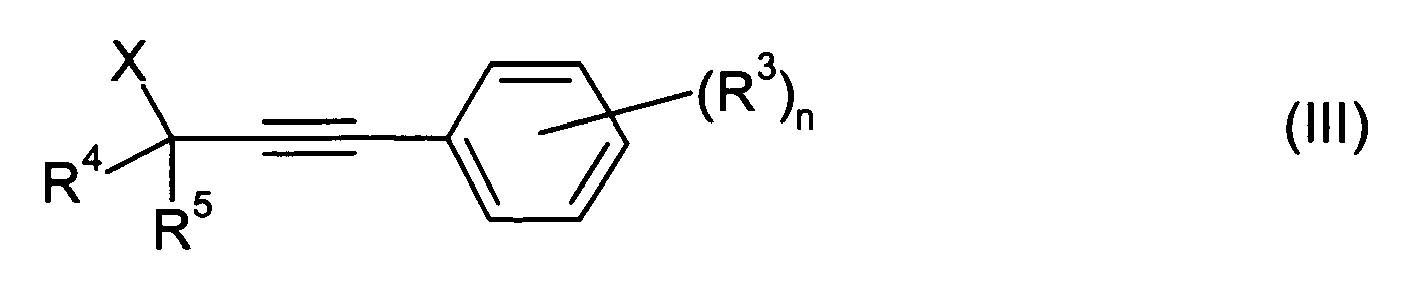


Q-CO-R6 (VII)
worin Q und R6 wie in der herzustellenden Verbindung der Formel (I) definiert sind, zur Verbindung der Formel (I) oder deren Salz, worin A eine Gruppe der Formel (A1)

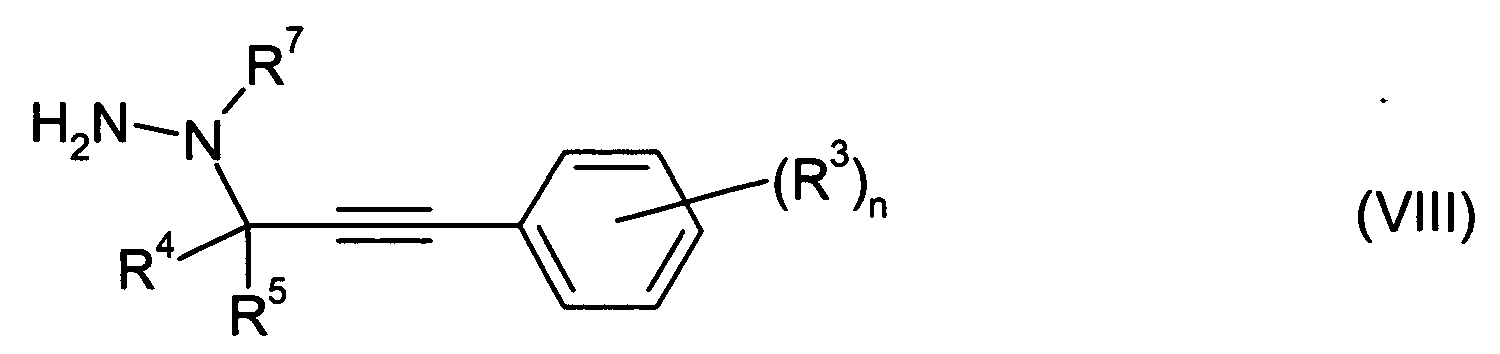
Q-CO-R6 (VII)
worin Q und R6 wie in der herzustellenden Verbindung der Formel (I) definiert sind, zur Verbindung der Formel (I) oder deren Salz, worin A eine Gruppe der Formel (A2)


Q-B(OH)2 (X)
worin Q wie in der herzustellenden Verbindung der Formel (I) definiert ist, unter Bedingungen einer Kreuzkupplung zur Verbindung der Formel (I) oder deren Salz, worin A die Gruppe der Formel (A3), (A4) oder (A5) bedeutet,





QAH (II)
wherein Q and A are as defined in the compound of formula (I) to be prepared, with a compound of formula (III),
Q-CO-R 6 (VII)
wherein Q and R 6 are as defined in the compound of formula (I) to be prepared, to the compound of formula (I) or its salt, wherein A is a group of formula (A1)
Q-CO-R 6 (VII)
wherein Q and R 6 are as defined in the compound of formula (I) to be prepared, to the compound of formula (I) or its salt, wherein A is a group of formula (A2)
QB (OH) 2 (X)
wherein Q is as defined in the compound of formula (I) to be prepared, under conditions of cross-coupling to the compound of formula (I) or its salt, where A is the group of formula (A3), (A4) or (A5),
Priority Applications (2)
| Application Number | Priority Date | Filing Date | Title |
|---|---|---|---|
| EP07013871A EP2017264A1 (en) | 2007-07-16 | 2007-07-16 | Substituted phenyl propargyl compounds, method for their manufacture and their use as herbicides and plant growth regulators |
| PCT/EP2008/005075 WO2009010156A2 (en) | 2007-07-16 | 2008-06-24 | Substituted phenylpropoargyl compounds, methods for the production thereof, and use of same as herbicides and plant growth regulators |
Applications Claiming Priority (1)
| Application Number | Priority Date | Filing Date | Title |
|---|---|---|---|
| EP07013871A EP2017264A1 (en) | 2007-07-16 | 2007-07-16 | Substituted phenyl propargyl compounds, method for their manufacture and their use as herbicides and plant growth regulators |
Publications (1)
| Publication Number | Publication Date |
|---|---|
| EP2017264A1 true EP2017264A1 (en) | 2009-01-21 |
Family
ID=38941848
Family Applications (1)
| Application Number | Title | Priority Date | Filing Date |
|---|---|---|---|
| EP07013871A Withdrawn EP2017264A1 (en) | 2007-07-16 | 2007-07-16 | Substituted phenyl propargyl compounds, method for their manufacture and their use as herbicides and plant growth regulators |
Country Status (2)
| Country | Link |
|---|---|
| EP (1) | EP2017264A1 (en) |
| WO (1) | WO2009010156A2 (en) |
Families Citing this family (9)
| Publication number | Priority date | Publication date | Assignee | Title |
|---|---|---|---|---|
| NZ601967A (en) | 2010-03-12 | 2015-03-27 | Omeros Corp | Pde10 inhibitors and related compositions and methods |
| NZ716494A (en) | 2014-04-28 | 2017-07-28 | Omeros Corp | Processes and intermediates for the preparation of a pde10 inhibitor |
| NZ716462A (en) | 2014-04-28 | 2017-11-24 | Omeros Corp | Optically active pde10 inhibitor |
| CN107530313A (en) | 2015-04-24 | 2018-01-02 | 奥默罗斯公司 | PDE10 inhibitor and compositions related and method |
| WO2017079678A1 (en) | 2015-11-04 | 2017-05-11 | Omeros Corporation | Solid state forms of a pde10 inhibitor |
| BR112020000959A2 (en) * | 2017-07-18 | 2020-07-14 | Bayer Cropscience Aktiengesellschaft | 5- (het-) substituted arylpyrazolamides and salts thereof and their use as herbicidal active substances |
| SG11202001684PA (en) | 2017-10-06 | 2020-03-30 | Forma Therapeutics Inc | Inhibiting ubiquitin specific peptidase 30 |
| ES2988920T3 (en) | 2018-05-17 | 2024-11-22 | Forma Therapeutics Inc | Fused bicyclic compounds useful as inhibitors of ubiquitin-specific peptidase 30 |
| PL3860989T3 (en) | 2018-10-05 | 2023-07-10 | Forma Therapeutics, Inc. | Fused pyrrolines which act as ubiquitin-specific protease 30 (usp30) inhibitors |
Citations (2)
| Publication number | Priority date | Publication date | Assignee | Title |
|---|---|---|---|---|
| EP0234045A2 (en) * | 1985-12-27 | 1987-09-02 | Nihon Nohyaku Co., Ltd. | A pyrazole oxime derivative and its production and use |
| EP0374839A1 (en) * | 1988-12-19 | 1990-06-27 | MITSUI TOATSU CHEMICALS, Inc. | 2-(4,6-Dimethoxy-2-pyrimidinyloxy)benzaldoximes, preparation processes thereof, herbicides containing the same, and herbicidal compositions containing the same along with other active ingredients |
-
2007
- 2007-07-16 EP EP07013871A patent/EP2017264A1/en not_active Withdrawn
-
2008
- 2008-06-24 WO PCT/EP2008/005075 patent/WO2009010156A2/en not_active Ceased
Patent Citations (2)
| Publication number | Priority date | Publication date | Assignee | Title |
|---|---|---|---|---|
| EP0234045A2 (en) * | 1985-12-27 | 1987-09-02 | Nihon Nohyaku Co., Ltd. | A pyrazole oxime derivative and its production and use |
| EP0374839A1 (en) * | 1988-12-19 | 1990-06-27 | MITSUI TOATSU CHEMICALS, Inc. | 2-(4,6-Dimethoxy-2-pyrimidinyloxy)benzaldoximes, preparation processes thereof, herbicides containing the same, and herbicidal compositions containing the same along with other active ingredients |
Also Published As
| Publication number | Publication date |
|---|---|
| WO2009010156A2 (en) | 2009-01-22 |
| WO2009010156A3 (en) | 2009-06-18 |
Similar Documents
| Publication | Publication Date | Title |
|---|---|---|
| EP1478628B1 (en) | 2-amino-4-bicyclyl amino-6h-1.3.5-triazines, method for the production and use thereof as herbicides and plant growth regulators | |
| DE102004054665A1 (en) | Substituted bicyclic and tricyclic pyrazole derivatives Methods for the preparation and use as herbicides and plant growth regulators | |
| DE102004054666A1 (en) | New substituted pyrazol-3-carboxamide derivatives useful to combat harmful plants and for growth regulation of plants | |
| WO2007003294A1 (en) | 3-[1-halo-1-aryl-methane-sulfonyl]- and 3-[1-halo-1-heteroaryl-methane-sulfonyl]-isoxazoline derivatives, method for the production thereof, and use of the same as herbicides and plant growth regulators | |
| WO2008080504A2 (en) | Substituted 1-(3-pyridinyl)pyrazole-4-yl acetic acids, method for the production thereof, and use thereof as herbicides and plant growth regulators | |
| DE10161765A1 (en) | Substituted phenyl derivatives | |
| EP1866287A2 (en) | Substituted pyrazolyl oxyphenyl derivatives used as herbicides | |
| WO2009010156A2 (en) | Substituted phenylpropoargyl compounds, methods for the production thereof, and use of same as herbicides and plant growth regulators | |
| EP1087948B1 (en) | 2,4-diamino-1,3,5-triazine, method for the production and use of the same as herbicides and plant growth regulators | |
| EP2121639A2 (en) | Substituted 2,4-diamino-1,3,5-triazines, methods for the production thereof, and use thereof as herbicides and plant growth regulators | |
| DE10135043A1 (en) | Substituted 3-heteroaryl (amino or oxy) pyrrolidin-2-ones, process for their preparation and use as herbicides or as plant growth regulators | |
| WO2001044208A1 (en) | 4,6-substituted 2-amino-1,3,5-triazine derivatives, a method for producing same and the use thereof as herbicides and plant growth regulators | |
| EP1163229A1 (en) | 2,4-diamino-1,3,5-triazines, method for producing them and their use as herbicides and plant growth regulators | |
| EP1303498A1 (en) | Substituted 2-amino-1,3,5-triazines, and the use thereof as herbicides and plant growth regulators | |
| WO2007118589A1 (en) | Substituted diamino-1,3,5,-triazines, methods for the production thereof, and use thereof as herbicides and plant growth regulators | |
| DE102006016885A1 (en) | With bicyclic radicals N-substituted diamino-1,3,5-triazines, processes for their preparation, preparations thereof and their use as herbicides and plant growth regulators | |
| DE19948450A1 (en) | Alkyl-amino-1,3,5-triazines, process for their preparation and use as herbicides and plant growth regulators | |
| WO2002081459A1 (en) | Alkyl-amino-1,3,5-triazines, method for their production and use thereof as herbicidal and plant growth controlling agents | |
| DE102005063066A1 (en) | New pyrazolyl-methylthio-pyridine N-oxide derivatives, useful as herbicides and plant-growth regulators, e.g. for inducing desiccation or reducing lodging | |
| DE10123845A1 (en) | 2,4-diamino-1,3,5-triazines, process for their preparation and use as herbicides and plant growth regulators |
Legal Events
| Date | Code | Title | Description |
|---|---|---|---|
| PUAI | Public reference made under article 153(3) epc to a published international application that has entered the european phase |
Free format text: ORIGINAL CODE: 0009012 |
|
| AK | Designated contracting states |
Kind code of ref document: A1 Designated state(s): AT BE BG CH CY CZ DE DK EE ES FI FR GB GR HU IE IS IT LI LT LU LV MC MT NL PL PT RO SE SI SK TR |
|
| AX | Request for extension of the european patent |
Extension state: AL BA HR MK RS |
|
| AKX | Designation fees paid | ||
| STAA | Information on the status of an ep patent application or granted ep patent |
Free format text: STATUS: THE APPLICATION IS DEEMED TO BE WITHDRAWN |
|
| 18D | Application deemed to be withdrawn |
Effective date: 20090722 |
|
| REG | Reference to a national code |
Ref country code: DE Ref legal event code: 8566 |