EP2017318A2 - Zubereitung für eine wässrige Dispersion zum chemisch-mechanischen Polieren, Verfahren zur Herstellung einer wässrigen Dispersion zum chemisch-mechanischen Polieren, wässrige Dispersion zum chemisch-mechanischen Polieren und Verfahren zum chemisch-mechanischen Polieren - Google Patents
Zubereitung für eine wässrige Dispersion zum chemisch-mechanischen Polieren, Verfahren zur Herstellung einer wässrigen Dispersion zum chemisch-mechanischen Polieren, wässrige Dispersion zum chemisch-mechanischen Polieren und Verfahren zum chemisch-mechanischen Polieren Download PDFInfo
- Publication number
- EP2017318A2 EP2017318A2 EP08157831A EP08157831A EP2017318A2 EP 2017318 A2 EP2017318 A2 EP 2017318A2 EP 08157831 A EP08157831 A EP 08157831A EP 08157831 A EP08157831 A EP 08157831A EP 2017318 A2 EP2017318 A2 EP 2017318A2
- Authority
- EP
- European Patent Office
- Prior art keywords
- aqueous dispersion
- chemical mechanical
- mechanical polishing
- composition
- mass
- Prior art date
- Legal status (The legal status is an assumption and is not a legal conclusion. Google has not performed a legal analysis and makes no representation as to the accuracy of the status listed.)
- Granted
Links
Images

Classifications
-
- C—CHEMISTRY; METALLURGY
- C09—DYES; PAINTS; POLISHES; NATURAL RESINS; ADHESIVES; COMPOSITIONS NOT OTHERWISE PROVIDED FOR; APPLICATIONS OF MATERIALS NOT OTHERWISE PROVIDED FOR
- C09K—MATERIALS FOR MISCELLANEOUS APPLICATIONS, NOT PROVIDED FOR ELSEWHERE
- C09K3/00—Materials not provided for elsewhere
- C09K3/14—Anti-slip materials; Abrasives
- C09K3/1454—Abrasive powders, suspensions and pastes for polishing
- C09K3/1463—Aqueous liquid suspensions
-
- H—ELECTRICITY
- H10—SEMICONDUCTOR DEVICES; ELECTRIC SOLID-STATE DEVICES NOT OTHERWISE PROVIDED FOR
- H10P—GENERIC PROCESSES OR APPARATUS FOR THE MANUFACTURE OR TREATMENT OF DEVICES COVERED BY CLASS H10
- H10P52/00—Grinding, lapping or polishing of wafers, substrates or parts of devices
-
- C—CHEMISTRY; METALLURGY
- C09—DYES; PAINTS; POLISHES; NATURAL RESINS; ADHESIVES; COMPOSITIONS NOT OTHERWISE PROVIDED FOR; APPLICATIONS OF MATERIALS NOT OTHERWISE PROVIDED FOR
- C09G—POLISHING COMPOSITIONS; SKI WAXES
- C09G1/00—Polishing compositions
- C09G1/02—Polishing compositions containing abrasives or grinding agents
-
- C—CHEMISTRY; METALLURGY
- C09—DYES; PAINTS; POLISHES; NATURAL RESINS; ADHESIVES; COMPOSITIONS NOT OTHERWISE PROVIDED FOR; APPLICATIONS OF MATERIALS NOT OTHERWISE PROVIDED FOR
- C09K—MATERIALS FOR MISCELLANEOUS APPLICATIONS, NOT PROVIDED FOR ELSEWHERE
- C09K3/00—Materials not provided for elsewhere
- C09K3/14—Anti-slip materials; Abrasives
-
- C—CHEMISTRY; METALLURGY
- C09—DYES; PAINTS; POLISHES; NATURAL RESINS; ADHESIVES; COMPOSITIONS NOT OTHERWISE PROVIDED FOR; APPLICATIONS OF MATERIALS NOT OTHERWISE PROVIDED FOR
- C09K—MATERIALS FOR MISCELLANEOUS APPLICATIONS, NOT PROVIDED FOR ELSEWHERE
- C09K3/00—Materials not provided for elsewhere
- C09K3/14—Anti-slip materials; Abrasives
- C09K3/1409—Abrasive particles per se
-
- H—ELECTRICITY
- H10—SEMICONDUCTOR DEVICES; ELECTRIC SOLID-STATE DEVICES NOT OTHERWISE PROVIDED FOR
- H10P—GENERIC PROCESSES OR APPARATUS FOR THE MANUFACTURE OR TREATMENT OF DEVICES COVERED BY CLASS H10
- H10P52/00—Grinding, lapping or polishing of wafers, substrates or parts of devices
- H10P52/40—Chemomechanical polishing [CMP]
- H10P52/403—Chemomechanical polishing [CMP] of conductive or resistive materials
Definitions
- the present invention relates to a chemical mechanical polishing aqueous dispersion preparation set, a method of preparing a chemical mechanical polishing aqueous dispersion, a chemical mechanical polishing aqueous dispersion, and a chemical mechanical polishing method.
- a chemical mechanical polishing aqueous dispersion used for chemical mechanical polishing normally contains abrasive grains as an abrasive agent.
- abrasive grains include inorganic particles such as fumed silica, colloidal silica, alumina, and cerium oxide, organic particles such as polymethyl methacrylate, organic-inorganic composite particles prepared by physically or chemically bonding inorganic particles and organic particles, and the like (see JP-A-2003-289055 , for example).
- a chemical mechanical polishing aqueous dispersion optionally contains various components such as an oxidizing agent, an organic acid, and a surfactant in addition to abrasive grains.
- a related-art chemical mechanical polishing aqueous dispersion has a problem in that abrasive grains aggregate during long-term storage due to poor dispersion stability of the abrasive grains, for example.
- a chemical mechanical polishing aqueous dispersion in which abrasive grains aggregate and precipitate affects chemical mechanical polishing performance.
- an interconnect portion may be polished to a large extent so that a depression referred to as dishing or erosion may occur.
- a surface defect referred to as a scratch or the like may also occur.
- a chemical mechanical polishing aqueous dispersion with constant quality cannot be provided if the abrasive grains aggregate.
- such a problem occurs to a large extent when providing a chemical mechanical polishing aqueous dispersion in a concentrated state. Therefore, an improvement has been desired.
- An object of the invention is to provide a method of preparing a chemical mechanical polishing aqueous dispersion which can reduce surface defects such as dishing, erosion, scratches, and fangs during planarization of a polishing target surface utilizing chemical mechanical polishing, and a chemical mechanical polishing aqueous dispersion preparation set which exhibits excellent long-term storage stability in a concentrated state.
- Fangs tend to occur when a metal layer is formed of copper or a copper alloy.
- the term “fang” refers to a groove-shaped defect which occurs in a semiconductor device due to chemical mechanical polishing at the interface between an area including a minute copper or copper alloy interconnect and an area other than the copper or copper alloy interconnect.
- a component contained in a chemical mechanical polishing aqueous dispersion when a component contained in a chemical mechanical polishing aqueous dispersion is non-uniformly accumulated at the interface between an area including a minute copper or copper alloy interconnect and an area other than the copper or copper alloy interconnect, an area around the interface may be polished to a large extent, whereby a fang may occur.
- abrasive grains contained in a chemical mechanical polishing aqueous dispersion are present at a high concentration near the interface between an area including a minute copper or copper alloy interconnect and an area (field area) other than the copper or copper alloy interconnect, the polishing rate locally increases at the interface, whereby an area around the interface may be polished to a large extent. This phenomenon is observed as a spike-shaped defect. This spike-shaped defect is referred to as a fang.
- Fangs occur due to various causes depending on the interconnect pattern.
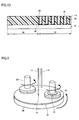
- the cause of fangs to be eliminated by the invention is described in detail below using a workpiece 100 shown in FIGS. 1A to 1D as an example.
- the workpiece 100 has a configuration including an insulating layer 12 in which interconnect depressions 20 (e.g., grooves) are formed, a barrier layer 14 provided to cover the surface of the insulating layer 12 and the bottom and the inner wall surface of the interconnect depressions 20, and a copper or copper alloy layer 16 which is provided in the interconnect depressions 20 and is formed on the barrier layer 14, these layers being stacked on a substrate 10.
- the workpiece 100 includes an area 22 in which minute copper or copper alloy interconnects are formed, and an area 24 in which minute copper or copper alloy interconnects are not formed. As shown in FIG 1A , a copper or copper alloy depression tends to be formed in the area 22 in which minute interconnects are formed.
- FIG. 1B shows a state after the copper or the copper alloy layer 16 has been subjected to chemical mechanical polishing until the barrier layer 14 is observed. A fang is not observed in this state.
- FIG 1C shows a state after the barrier layer 14 has been removed by chemical mechanical polishing until the insulating layer 12 is observed.
- a minute scratch 26 may occur as a result of chemical mechanical polishing at the interface between the area 22 in which minute copper or copper alloy interconnects are formed and the area 24 in which minute copper or copper alloy interconnects are not formed.
- FIG. 1D shows a state after the insulating layer 12 has been further removed by chemical mechanical polishing. As shown in FIG 1D , the minute scratch 26 has been enlarged to a groove-shaped fang 28.
- Such a fang may adversely affect the resulting semiconductor device and decrease yield.
- a chemical mechanical polishing aqueous dispersion preparation set comprising:
- the organic acid having two or more carbonyl groups may have a pKa value of three or less.
- the organic acid having two or more carbonyl groups may be at least one organic acid selected from maleic acid, quinolinic acid, and citric acid.
- the basic compound may be potassium hydroxide or ammonia.
- At least one of the first composition and the second composition may include benzotriazole.
- the chemical mechanical polishing aqueous dispersion preparation set may further include a third composition which includes at least an oxidizing agent.
- a method of preparing a chemical mechanical polishing aqueous dispersion comprising:
- the mass ratio (PA/OA) of the mass (PA) of the poly(meth)acrylic acid to the mass (OA) of the organic acid having two or more carbonyl groups included in the chemical mechanical polishing aqueous dispersion may be 0.2 to 5.0.
- the organic acid having two or more carbonyl groups may have a pKa value of three or less.
- the organic acid having two or more carbonyl groups may be at least one organic acid selected from maleic acid, quinolinic acid, and citric acid.
- the basic compound may be potassium hydroxide or ammonia.
- At least one of the first composition and the second composition may include benzotriazole.
- the first composition, the second composition, and a third composition which includes at least an oxidizing agent may be mixed to prepare the chemical mechanical polishing aqueous dispersion.
- a chemical mechanical polishing aqueous dispersion produced by the above-described method.
- a chemical mechanical polishing method comprising:
- the first composition and the second composition can be stored separately, aggregation of the colloidal silica contained in the first composition can be prevented. Specifically, a component that causes aggregation of the colloidal silica is eliminated from the first composition, and the pH of the first composition is adjusted to 8.0 to 11.0 by adding the basic compound. Therefore, the long-term stability of the colloidal silica can be ensured even if the first composition is concentrated.
- the pH of the second composition is adjusted to 1.0 to 5.0 by adding an organic acid having two or more carbonyl groups.
- a chemical mechanical polishing aqueous dispersion having a pH of 3.5 to 6.0 can be prepared by mixing the second composition with the first composition.
- a chemical mechanical polishing aqueous dispersion thus obtained prevents aggregation of colloidal silica, reduces surface defects such as dishing, erosion, and scratches when planarizing the polishing target surface, and reduces fangs.
- a first composition according to one embodiment of the invention includes colloidal silica having an average primary particle diameter of 15 to 40 nm and a basic compound.
- the first composition is preferably weakly alkaline (8.0 to 11.0 pH) from the viewpoint of ensuring the dispersion stability of the colloidal silica.
- weakly alkaline 8.0 to 11.0 pH
- Abrasive grains used in the first composition may be at least one type of abrasive grains selected from inorganic particles, organic particles, and organic-inorganic composite particles.
- Examples of the inorganic particles include silica, alumina, titania, zirconia, ceria, and the like.
- Examples of the silica include fumed silica, silica synthesized by a sol-gel method, colloidal silica, and the like.
- the fumed silica is obtained by reacting silicon chloride or the like with oxygen and water in a gaseous phase.
- the silica synthesized by the sol-gel method may be obtained by hydrolysis and/or condensation of an alkoxysilicon compound used as a raw material.
- the colloidal silica may be obtained by an inorganic colloid method using a raw material purified in advance, for example.
- organic particles examples include polyvinyl chloride, a styrene (co)polymer, a polyacetal, a polyester, a polyamide, a polycarbonate, an olefin (co)polymer, a phenoxy resin, an acrylic (co)polymer, and the like.
- examples of the olefin (co)polymer include polyethylene, polypropylene, poly-1-butene, poly-4-methyl-1-pentene, and the like.
- acrylic (co)polymer examples include polymethyl methacrylate and the like.
- the type, the configuration, and the like of the organic-inorganic composite particles are not particularly limited insofar as inorganic particles and organic particles as mentioned above are integrally formed in such a manner that the inorganic particles and the organic particles are not easily separated during chemical mechanical polishing.
- the organic-inorganic composite particles may have one of the following configurations (a) to (c), for example.
- the alkoxide compound of a metal or silicon As the alkoxide compound of a metal or silicon, the alkoxide compound mentioned with regard to the organic-inorganic composite particles (a) may be used.
- the abrasive grains used in the first composition are preferably at least one type of abrasive grains selected from silica, the organic particles, and the organic-inorganic composite particles mentioned above.
- the average particle diameter of the abrasive grains is preferably 5 to 1000 nm, more preferably 7 to 700 nm, and particularly preferably 10 to 500 nm. An excellent polished surface can be obtained at an appropriate polishing rate using the abrasive grains having an average particle diameter within this range.
- the average primary particle diameter of the silica is preferably 10 to 100 nm, and particularly preferably 15 to 40 nm.
- a further excellent polished surface can be obtained at an appropriate polishing rate using inorganic particles having an average primary particle diameter within this range.
- the inorganic particles include fumed silica, colloidal silica, silica synthesized by a sol-gel method, and the like. It is particularly preferable to use colloidal silica. Since the dispersion stability of the first composition can be improved using colloidal silica, surface defects (e.g., scratches) on the polishing target surface can be reduced so that a polished surface with excellent flatness can be obtained.
- the abrasive grains are added to the first composition in an amount of 2 to 30 mass%, and preferably 10 to 20 mass% based on the mass of the first composition.
- the basic compound used in the first composition prevents aggregation of the abrasive grains by maintaining the first composition in an alkaline state. If the pH of the first composition is set at 7.0 or less, the dispersion stability of the abrasive grains may deteriorate due to aggregation of the abrasive grains.
- Examples of the basic compound used in the first composition include an organic base and an inorganic base.
- Examples of the organic base include tetramethylammonium hydroxide, triethylamine, and the like.
- Examples of the inorganic base include ammonia, potassium hydroxide, and the like. Of these basic compounds, it is preferable to use ammonia or potassium hydroxide (inorganic base).
- dispersion medium examples include water, a mixed medium containing water and an alcohol, a mixed medium containing water and an organic solvent which is miscible with water, and the like. It is preferable to use water or a mixed medium containing water and an alcohol, with water being particularly preferable.
- the pH of the first composition is preferably 8.0 to 11.0, more preferably 9.0 to 11.0, and particularly preferably 9.0 to 10.0. If the pH of the first composition is lower than the above range, the abrasive grains aggregate and precipitate, thereby impairing the storage stability of the first composition. If the pH of the first composition is higher than the above range, the abrasive grains may be dissolved in the composition, whereby the properties of the composition may change during storage.
- an organic acid having two or more carbonyl groups (including poly(meth)acrylic acid) contained in a second composition may be added during preparation of the first composition.
- An organic acid having two or more carbonyl groups can be added during preparation of the first composition without causing a problem insofar as the pH of the first composition is within the above range.
- the first composition according to this embodiment may be prepared by adding poly(meth)acrylic acid in an amount of 0.1 to 5 mass%, and preferably 0.5 to 2 mass% based on the mass of the first composition to improve the dispersion stability of colloidal silica, and adjusting the pH of the first composition within the above range by adding the basic compound.
- the second composition according to this embodiment includes poly(meth)acrylic acid and an organic acid having two or more carbonyl groups other than poly(meth)acrylic acid.
- the second composition includes these acidic compounds, but preferably does not include the abrasive grains added to the first composition from the viewpoint of storage stability. Each component is described in detail below.
- the second composition contains poly(meth)acrylic acid.
- a chemical mechanical polishing aqueous dispersion having an excellent process margin i.e., the performance of an aqueous dispersion which prevents deterioration in the surface state of the polishing target surface even if chemical mechanical polishing is performed for a period of time greater than the optimum polishing time to a large extent
- Residual copper oxide can be removed while reducing copper dishing, erosion of an insulating layer, scratches, and fangs by adding the poly(meth)acrylic acid.
- the polyethylene glycol-reduced weight average molecular weight of the poly(meth)acrylic acid determined by gel permeation chromatography using water as an eluent is preferably 10,000 to 5,000,000, and more preferably 1,000,000 to 2,000,000.
- a chemical mechanical polishing aqueous dispersion having a further excellent process margin can be obtained using poly(meth)acrylic acid having a weight average molecular weight within this range.
- the poly(meth)acrylic acid is preferably added to the second composition in an amount of 0.1 to 5 mass%, and more preferably 0.5 to 2 mass% based on the mass of the second composition.
- a chemical mechanical polishing aqueous dispersion having an excellent process margin can be obtained by adding the poly(meth)acrylic acid in an amount within this range.
- an excellent process margin can be reliably achieved when the poly(meth)acrylic acid has a weight average molecular weight of 1,000,000 to 3,000,000 and is added in an amount of 0.5 to 2 mass% based on the mass of the second composition.
- An organic acid having two or more carbonyl groups other than the poly(meth)acrylic acid may be suitably added to the second composition.
- an organic acid having four or more carbon atoms is preferable.
- an aliphatic organic acid having four or more carbon atoms and an organic acid having a heterocyclic ring are preferable.
- an aliphatic polycarboxylic acid having four or more carbon atoms As the aliphatic organic acid having four or more carbon atoms, an aliphatic polycarboxylic acid having four or more carbon atoms, a hydroxyl acid having four or more carbon atoms, and the like are preferable.
- Specific examples of the aliphatic polycarboxylic acid having four or more carbon atoms include a divalent organic acid such as maleic acid, succinic acid, fumaric acid, glutaric acid, and adipic acid.
- Specific examples of the hydroxyl acid having four or more carbon atoms include citric acid, malic acid, tartaric acid, and the like.
- Examples of the organic acid having a heterocyclic ring include quinolinecarboxylic acid, pyridinecarboxylic acid, pyridinedicarboxylic acid, pyrazinecarboxylic acid, and the like.
- quinaldic acid e.g., 2-quinolinecarboxylic acid
- quinolinic acid e.g., 2,3-pyridinedicarboxylic acid
- a divalent organic acid e.g., maleic acid or citric acid
- a hydroxyl acid e.g., malic acid or malonic acid
- the organic acid having two or more carbonyl groups other than poly(meth)acrylic acid have a pKa value of three or less.
- the basic compound can be efficiently neutralized while reducing fangs to achieve excellent polishing properties by adding an organic acid having two or more carbonyl groups and having a pKa value of three or less.
- the organic acid having two or more carbonyl groups other than poly(meth)acrylic acid is preferably at least one organic acid selected from maleic acid, quinolinic acid, and citric acid. Such an organic acid accelerates a complex-forming reaction with copper when subjecting a copper or copper alloy layer to chemical mechanical polishing, whereby the polishing rate can be increased.
- the organic acid having two or more carbonyl groups is preferably added in an amount of 0.01 to 5 mass%, and more preferably 0.05 to 2 mass% based on the mass of the second composition.
- An excellent polished surface can be obtained at an appropriate polishing rate by adding the organic acid having two or more carbonyl groups in an amount within this range.
- the mass ratio (PA/OA) of the mass (PA) of the poly(meth)acrylic acid to the mass (OA) of the organic acid having two or more carbonyl groups other than the poly(meth)acrylic acid included in the chemical mechanical polishing aqueous dispersion is preferably 0.2 to 5.0, more preferably 0.5 to 3.0, and particularly preferably 0.5 to 1.5. This reduces scratches, dishing, fangs, and the like so that an excellent polished surface can be obtained.
- Examples of a counter cation contained in a poly(meth)acrylate include an ammonium ion, an alkylammonium ion, a potassium ion, and the like.
- An excellent process margin can be more reliably achieved when the poly(meth)acrylate is an ammonium salt of polyacrylic acid and added to the second composition in an amount of 0.5 to 2 mass%.
- Examples of a dispersion medium include water, a mixed medium containing water and an alcohol, a mixed medium containing water and an organic solvent which is miscible with water, and the like. It is preferable to use water or a mixed medium containing water and the alcohol, with water being particularly preferable.
- the pH of the second composition is preferably 1.0 to 5.0, more preferably 1.0 to 3.0, and particularly preferably 1.0 to 2.0. If the pH of the second composition is higher than 5.0, sufficient neutralization cannot be achieved when mixing the first composition and the second composition. Therefore, a chemical mechanical polishing aqueous dispersion obtained by mixing the first composition and the second composition has a pH in a basic region, whereby a pH region of 3.5 to 6.0 desired for polishing a polishing target surface cannot be achieved.
- At least one of the first composition and the second composition may further include a water-soluble polymer, benzotriazole or a benzotriazole derivative, a surfactant, an oxidizing agent, and the like.
- At least one of the first composition and the second composition may further include a water-soluble polymer.
- water-soluble polymer examples include an anionic polymer, a cationic polymer, an ampholytic polymer, a nonionic polymer, and the like.
- anionic polymer examples include polyvinyl alcohol and the like.
- cationic polymer examples include polyethylenimine, polyvinylpyrrolidone, and the like.
- ampholytic polymer examples include polyacrylamide and the like.
- nonionic polymer examples include polyethylene oxide, polypropylene oxide, and the like.
- the water-soluble polymer is added to the first composition in an amount of preferably 0.05 to 5 mass%, more preferably 0.1 to 3 mass%, and particularly preferably 0.5 to 2 mass% based on the mass of the first composition.
- the water-soluble polymer is added to the second composition in an amount of preferably 0.05 to 5 mass%, more preferably 0.1 to 3 mass%, and particularly preferably 0.5 to 2 mass% based on the mass of the second composition.
- At least one of the first composition and the second composition may further include benzotriazole or a benzotriazole derivative.
- benzotriazole derivative refers to a compound obtained by replacing at least one hydrogen atom of benzotriazole by a functional group such as a carboxyl group, a methyl group, an amino group, or a hydroxyl group.
- benzotriazole or the benzotriazole derivative
- benzotriazole methylbenzotriazole, 4-carboxybenzotriazole and its salt, 7-carboxybenzotriazole and its salt, benzotriazole butyl ester, 1-hydroxymethylbenzotriazole, 1-hydroxybenzotriazole, 1-(2,3-dihydroxypropyl)benzotriazole, 1-(2-hydroxyethyl)benzotriazole, 2-(benzotriazyl)ethanesulfonic acid and its salt, 1-(2-ethylhexylaminomethyl)benzotriazole, and the like are preferable.
- benzotriazole methylbenzotriazole, 4-carboxybenzotriazole and its salt, 7-carboxybenzotriazole and its salt, benzotriazole butyl ester, 1-hydroxymethylbenzotriazole, and 1-hydroxybenzotriazole are more preferable, with benzotriazole being most preferable.
- the benzotriazole or the benzotriazole derivative is added to the first composition in an amount of preferably 0.1 to 5 mass%, and more preferably 0.5 to 2 mass% based on the mass of the first composition.
- the benzotriazole or the benzotriazole derivative is added to the second composition in an amount of preferably 0.1 to 5 mass%, and more preferably 0.5 to 2 mass% based on the mass of the second composition.
- An excellent polished surface can be obtained at an appropriate polishing rate by adding the benzotriazole or the benzotriazole derivative in an amount within this range.
- an excellent polished surface can be obtained at an appropriate polishing rate in a well-balanced manner when the benzotriazole or the benzotriazole derivative is benzotriazole and is added to the first composition in an amount of 0.5 to 1.5 mass%.
- At least one of the first composition and the second composition may further include a surfactant.
- a cationic surfactant As the surfactant, a cationic surfactant, an anionic surfactant, an ampholytic surfactant, a nonionic surfactant, or the like may be used. It is preferable to use the anionic surfactant or the nonionic surfactant.
- anionic surfactant examples include a carboxylate, a sulfonate, a sulfate salt, a phosphate salt, a fluorine-containing surfactant, and the like.
- carboxylate examples include a fatty acid soap, an alkyl ether carboxylate, and the like.
- sulfonate examples include an alkylbenzenesulfonate, an alkylnaphthalenesulfonate, an alpha-olefin sulfonate, and the like.
- Examples of the sulfate salt include a higher alcohol sulfate salt, an alkyl ether sulfate, a polyoxyethylene alkyl phenyl ether sulfate, and the like.
- Examples of the phosphate salt include an alkyl phosphate salt and the like.
- Examples of the fluorine-containing surfactant include a perfluoroalkyl compound and the like. Among these anionic surfactants, the fluorine-containing surfactant is particularly preferable.
- nonionic surfactant examples include a polyethylene glycol type surfactant, acetylene glycol, an ethylene oxide addition product of acetylene glycol, an acetylene alcohol, and the like.
- the surfactant is preferably added to the first composition in an amount of 0.05 to 2 mass%, and more preferably 0.1 to 1 mass% based on the mass of the first composition.
- the surfactant is added to the second composition in an amount of preferably 0.01 to 5 mass%, more preferably 0.05 to 2 mass%, and particularly preferably 0.1 to 1 mass% based on the mass of the second composition.
- An appropriate surfactant may be selected depending on the type of the abrasive grains contained in the first composition.
- the abrasive grains are mainly silica
- these dispersants may be used either individually or in combination.
- At least one of the first composition and the second composition may further include an oxidizing agent.
- an oxidizing agent For example, it is difficult to polish the surface of a copper film since copper is a metal having high malleability and ductility.
- the oxidizing agent oxidizes the surface of the copper film and accelerates a complex-forming reaction with the polishing liquid component to create a brittle modified layer on the surface of the copper film, thereby allowing the copper film to be easily polished.
- Examples of the oxidizing agent include a persulfate, hydrogen peroxide, an inorganic acid, an organic peroxide, a polyvalent metal salt, and the like.
- Examples of the persulfate include ammonium persulfate, potassium persulfate, and the like.
- Examples of the inorganic acid include nitric acid, sulfuric acid, and the like.
- Examples of the organic peroxide include peracetic acid, perbenzoic acid, tert-butyl hydroperoxide, and the like.
- Examples of the polyvalent metal salt include a permanganic acid compound, a dichromic acid compound, and the like.
- examples of the permanganic acid compound include potassium permanganate and the like.
- Examples of the dichromic acid compound include potassium dichromate and the like.
- hydrogen peroxide hydrogen peroxide, the persulfate, and the inorganic acid are preferable, with hydrogen peroxide being particularly preferable.
- the oxidizing agent is preferably added to the first composition in an amount of 0.1 to 10 mass%, and more preferably 0.5 to 5 mass% based on the mass of the first composition.
- the oxidizing agent is preferably added to the second composition in an amount of 0.1 to 10 mass % , and more preferably 0.5 to 5 mass % based on the mass of the first composition.
- An excellent polished surface can be obtained at an appropriate polishing rate by adding the oxidizing agent in an amount within this range.
- the oxidizing agent may not be directly added to the first composition or the second composition according to this embodiment.
- a third composition containing the oxidizing agent may be separately provided, and the first composition, the second composition, and the third composition may be used as a chemical mechanical polishing aqueous dispersion preparation set.
- the function of the oxidizing agent may deteriorate due to the component added to the first composition or the second composition. In this case, deterioration in the function of the oxidizing agent can be prevented by separately providing the third composition containing the oxidizing agent.
- an appropriate polyvalent metal ion which promotes the function of hydrogen peroxide as the oxidizing agent or increases the polishing rate may be added to the chemical mechanical polishing aqueous dispersion.
- An excellent polished surface can be more reliably obtained at an appropriate polishing rate by adding hydrogen peroxide as the oxidizing agent in an amount of 0.01 to 5 mass%.
- FIG. 2 is a schematic view showing a chemical mechanical polishing apparatus.
- chemical mechanical polishing 200 is performed by bringing a top ring 42 that holds a semiconductor substrate 30 in contact with an abrasive cloth 38 while supplying a chemical mechanical polishing aqueous dispersion (slurry 36) from a slurry supply nozzle 32 and rotating a turntable 40 to which the abrasive cloth 38 is attached.
- slurry 36 chemical mechanical polishing aqueous dispersion
- FIG 2 also shows a water supply nozzle 34 and a dresser 44.
- the polishing load applied by the top ring 42 may be selected within the range of 10 to 1000 gf/cm 2 (0.98 to 98 kPa) (preferably 30 to 500 gf/cm 2 (2.94 to 49 kPa)).
- the rotational speed of the turntable 40 and the top ring 42 may be appropriately selected within the range of 10 to 400 rpm (preferably 30 to 150 rpm).
- the flow rate of the slurry 36 supplied from the slurry supply nozzle 32 may be selected within the range of 10 to 1,000 ml/min (preferably 50 to 400 ml/min).
- the polishing target surface may be subjected to chemical mechanical polishing using a chemical mechanical polishing aqueous dispersion obtained utilizing the chemical mechanical polishing aqueous dispersion preparation set according to this embodiment under predetermined polishing conditions using a commercially-available chemical mechanical polishing apparatus (e.g., "EPO-112" or “EPO-222” manufactured by Ebara Corporation, “LGP-510” or “LGP-552” manufactured by Lapmaster SFT Corporation, or "Mirra” manufactured by Applied Materials, Inc.).
- a commercially-available chemical mechanical polishing apparatus e.g., "EPO-112" or “EPO-222” manufactured by Ebara Corporation, "LGP-510” or “LGP-552” manufactured by Lapmaster SFT Corporation, or "Mirra” manufactured by Applied Materials, Inc.
- a chemical mechanical polishing aqueous dispersion may be prepared using a chemical mechanical polishing aqueous dispersion preparation set according to one embodiment of the invention by mixing a first composition, a second composition, and an optional third composition containing an oxidizing agent of the chemical mechanical polishing aqueous dispersion preparation set.
- the compositions may be mixed by the methods as follows.
- compositions may be mixed in advance in a tank or a supply line.
- the dispersion medium is mixed in advance with each composition.
- the pH of the chemical mechanical polishing aqueous dispersion prepared by the above-described mixing methods (1) to (3) is preferably 3.5 to 6.0, and more preferably 3.5 to 5.0.
- the material for the barrier metal film include tantalum, titanium, tantalum nitride, titanium nitride, and the like.
- the material for the insulating film include silicon oxide (SiO 2 and the like.
- the mass ratio (PA/OA) of the mass (PA) of the poly(meth)acrylic acid to the mass (OA) of the organic acid having two or more carbonyl groups other than the poly(meth)acrylic acid included in the chemical mechanical polishing aqueous dispersion is preferably 0.2 to 5.0, more preferably 0.5 to 3.0, and particularly preferably 0.5 to 1.5. This reduces scratches, dishing, fangs, and the like so that an excellent polished surface can be obtained.
- the chemical mechanical polishing aqueous dispersion preparation set according to this embodiment may be applied to a wide range of chemical mechanical polishing tasks for producing semiconductor devices.
- the chemical mechanical polishing aqueous dispersion preparation set according to this embodiment may be suitably applied to a damascene interconnect formation process using copper as an interconnect material.
- a barrier metal layer is formed on an insulating film (including grooves) in which grooves are formed corresponding to interconnects.
- a step of removing unnecessary copper (first polishing step), a step of removing the barrier metal outside the grooves (second polishing step), and a step of polishing the insulating film to some extent (third polishing step) are performed to obtain planar damascene interconnects.
- the chemical mechanical polishing aqueous dispersion preparation set according to this embodiment may be applied to the first to third polishing steps.
- copper used herein refers to pure copper and an alloy of copper and aluminum, silicon, or the like having a copper content of 95 mass% or more.
- carrier metal used herein refers to a barrier metal formed of tantalum, tantalum nitride, titanium, titanium nitride, tungsten nitride, or the like.
- a flask was charged with 75 parts by mass of 25 mass% aqueous ammonia, 40 parts by mass of ion-exchanged water, 165 parts by mass of ethanol, and 30 parts by mass of tetraethoxysilane.
- the mixture was heated to 80°C with stirring at a rotational speed of 180 rpm. After stirring the mixture at 80°C for two hours, the mixture was cooled to room temperature. An alcohol dispersion of colloidal silica particles was thus obtained.
- An operation of removing the alcohol from the dispersion maintained at 80°C using a rotary evaporator while adding ion-exchanged water was repeated several times.
- An aqueous dispersion containing 20 mass% of colloidal silica particles C1 was thus prepared.
- the average primary particle diameter, the average secondary particle diameter, and the average degree of association of the colloidal silica particles C1 contained in the aqueous dispersion were respectively 35 nm, 70 nm, and 2.0.
- the average primary particle diameter of the colloidal silica particles C1 prepared in "(a) Preparation of aqueous dispersion containing colloidal silica particles C1” was measured using a transmission electron microscope (TEM) ("H-7500” manufactured by Hitachi Ltd.).
- the average secondary particle diameter of the colloidal silica particles C1 was measured using a dynamic light scattering particle size analyzer ("LB550" manufactured by Horiba Ltd.).
- Aqueous dispersions respectively containing colloidal silica particles C2 to C4 shown in Table 1 were prepared in the same manner as in "(a) Preparation of aqueous dispersion containing colloidal silica particles C1", except for changing the amounts of 25 mass% aqueous ammonia, ethanol, and tetraethoxysilane.
- Colloidal silica (“PL-2”, “PL-3”, or “PL-3H” manufactured by Fuso Chemical Co., Ltd.) was respectively dispersed in ion-exchanged water using an ultrasonic dispersion machine. The dispersions were filtered through a filter with a pore size of 5 micrometers to prepare aqueous dispersions respectively containing colloidal silica particles C5 to C7 shown in Table 1.
- a flask was charged with 90 parts by mass of methyl methacrylate, 5 parts by mass of methoxy polyethylene glycol methacrylate ("NK Ester M-90G #400" manufactured by Shin-Nakamura Chemical Co., Ltd.), 5 parts by mass of 4-vinylpyridine, 2 parts by mass of an azo initiator ("V50" manufactured by Wako Pure Chemical Industries, Ltd.), and 400 parts by mass of ion-exchanged water.
- the mixture was heated to 70°C with stirring in a nitrogen gas atmosphere. The mixture was stirred at 70°C for six hours.
- the reaction mixture was diluted with ion-exchanged water to obtain an aqueous dispersion containing 10 mass% of polymethyl methacrylate particles having a functional group containing a cation of an amino group and a polyethylene glycol chain, and having an average particle diameter of 150 nm.
- the polymerization yield was 95 %.
- a flask was charged with 100 parts by mass of the aqueous dispersion. After the addition of 1 part by mass of methyltrimethoxysilane, the mixture was stirred at 40°C for two hours. The pH of the mixture was adjusted to 2.0 by adding a 1N nitric acid aqueous solution to obtain an aqueous dispersion containing surface-treated organic particles. The zeta potential of the surface-treated organic particles contained in the aqueous dispersion was +17 mV.
- Colloidal silica particles (“Snowtex O” manufactured by Nissan Chemical Industries, Ltd., average primary particle diameter: 12 nm) were dispersed in water. The pH of the mixture was adjusted by adding a 1N potassium hydroxide aqueous solution to obtain an aqueous dispersion (pH: 8.0) containing 10 mass% of the colloidal silica particles. The zeta potential of the colloidal silica particles contained in the aqueous dispersion was -40 mV.
- the organic-inorganic composite particles contained in the aqueous dispersion were observed using a scanning electron microscope. It was found that the silica particles adhered to 80% of the surface of the polymethyl methacrylate particles.
- a flask was charged with 90 parts by mass of methyl methacrylate, 10 parts by mass of styrene, 5 parts by mass of acrylic acid, 2 parts by mass of ammonium persulfate, 0.1 parts by mass of a surfactant, and 400 parts by mass of ion-exchanged water.
- the mixture was heated to 70°C with stirring in a nitrogen gas atmosphere, and polymerized for eight hours until the polymerization conversion rate reached approximately 100%.
- An aqueous dispersion containing organic particles (average particle diameter: 150 nm) formed of a polymethacrylate-styrene polymer having a carboxyl group was thus obtained.
- the aqueous dispersion was diluted with water to obtain an aqueous dispersion in which the content of the organic particles was adjusted to 10 mass%.
- the aqueous solution was neutralized by slowly adding 25 mass% aqueous ammonia to prepare an aqueous solution (pH: 7.5) containing 5 mass% of polyacrylate (ammonium polyacrylate having a weight average molecular weight (Mw) of 10,000).
- Aqueous solutions respectively containing 5 mass% of ammonium polyacrylate P2, 5 mass% of polyacrylic acid P3, and 5 mass% of polyacrylic acid P4 were prepared in the same manner as in (a), except for changing the amount of ammonium persulfate and the type of neutralizer as shown in Table 2.
- TABLE 2 Poly(meth)acrylate P1 P2 P3 P4 Amount of ammonium persulfate (g) 10 1 5 1 Neutralizer a a - - Weight average molecular weight (Mw) 10,000 1,200,000 550,000 1,200,000 Counter cation NH 4 + NH 4 + - - a; 25mass mass% aqueous ammonia
- a porous polyurethane polishing pad (“IC1000” manufactured by Nitta Haas Inc.) was installed in a chemical mechanical polishing apparatus ("Mirra” manufactured by Applied Materials, Inc.,).
- a polishing rate measurement substrate was polished for one minute under polishing conditions given below while supplying a chemical mechanical polishing aqueous dispersion described later. The polishing rate was calculated by a method given below.
- supply rate of the chemical mechanical polishing aqueous dispersion refers to the total amount of the chemical mechanical polishing aqueous dispersion supplied per unit time.
- the thickness of the copper film or the tantalum nitride film was measured after polishing using an electric conduction type thickness measurement device ("OmniMap RS75" manufactured by KLA-Tencor Corporation).
- the polishing rate was calculated from the reduction in thickness due to chemical mechanical polishing and the polishing time.
- the thickness of the PETEOS film or the BD film was measured after polishing using an optical interference type thickness measurement device ("Nanospec 6100" manufactured by Nanometrics Japan Ltd.). The polishing rate was calculated from the reduction in thickness due to chemical mechanical polishing and the polishing time.
- An insulating layer (composite film of PETEOS film (thickness: 500 angstroms) and BD film (thickness: 4500 angstroms)) having a groove pattern (depth: 1 micrometer) was stacked on the surface of a silicon substrate to a thickness of 5000 angstroms.
- a conductive barrier layer (TaN film) having a thickness of 250 angstroms was formed on the surface of the insulating layer.
- a metal layer (Cu layer) having a thickness of 1.1 micrometers was then deposited in the grooves covered with the TaN film by sputtering and plating.
- polishing time minute ⁇ ( thickness of barrier layer angstrom ) / ( polishing rate of barrier layer ( tantalum nitride ) calculated in " 5.2.1. Evaluation of polishing rate " ) + ( thickness of PETEOS film ( 500 angstroms ) ) / ( polishing rate of PETEOS film calculated in " 5.2.1. Evaluation of polishing rate " ) + ( thickness of BD film 200 angstroms ) / ( polishing rate of BD film calculated in " 5.2.1. Evaluation of polishing rate " )
- Dishing occurring in the interconnects (100 micrometers) on the polished surface was evaluated using a stylus profilometer ("HRP240" manufactured by KLA-Tencor Corporation).
- the term “dishing” used herein refers to the distance (difference in height) between the upper side (plane formed by the insulating layer or the conductive barrier layer) of the wafer and the lowest portion of the interconnect.
- a fang occurring in the interconnects (100 micrometers) on the wafer fabricated in (a) was evaluated using a stylus profilometer ("HRP240" manufactured by KLA-Tencor Corporation).
- the term “fang” used herein refers to a hollow portion formed in the insulating layer or the conductive barrier layer at the interface between the insulating layer or the conductive barrier layer of the wafer and the interconnect. The smaller the depth of the fang, the higher the interconnect planarization performance.
- the pH of the mixture was adjusted to 9.2 by adding potassium hydroxide.
- the mixture was filtered through a filter having a pore size of 1 micrometer to obtain an aqueous dispersion (A) containing 18 mass% of colloidal silica.
- the colloidal silica in the aqueous dispersion (A) was uniformly dispersed.
- the average particle diameter of the colloidal silica in the aqueous dispersion (A) was 139 nm.
- the aqueous dispersion (A) and the aqueous solution (B) prepared as described above were mixed in equal amounts (mass).
- a dispersion medium was added to the mixture so that a specific dilution ratio was reached.
- a 30 mass% hydrogen peroxide aqueous solution in such an amount that the content of hydrogen peroxide in the resulting chemical mechanical polishing aqueous dispersion was 0.5 mass%, was added to the mixture to prepare a chemical mechanical polishing aqueous dispersion.
- the pH of the chemical mechanical polishing aqueous dispersion thus prepared was 3.6.
- a polishing rate measurement substrate was polished using the chemical mechanical polishing aqueous dispersion, and the polishing rate was calculated. The results are shown in Table 3.
- the aqueous dispersion (A) and the aqueous solution (B) prepared as described above were allowed to stand for six months in a thermostat bath at 25°C in an airtight container.
- the colloidal silica C2 in the aqueous dispersion (A) which had been allowed to stand for six months was uniformly dispersed.
- the pH of the aqueous dispersion (A) was 9.2.
- the average particle diameter of the colloidal silica C2 was 140 nm.
- the aqueous solution (B) which had been allowed to stand for six months was a homogeneous solution.
- the pH of the aqueous solution (B) was 3.5.
- the polishing performance for various films was evaluated in the same manner as in 5.3.1 (c) using the aqueous dispersion (A) and the aqueous solution (B) which had been allowed to stand for six months.
- the results are shown in Table 3.
- the pH of the chemical mechanical polishing aqueous dispersion prepared using the aqueous dispersion (A) and the aqueous solution (B) which had been allowed to stand for six months was 5.3.
- the average particle diameter of the particles contained in the chemical mechanical polishing aqueous dispersion was 163 nm.
- the aqueous dispersion (A) and the aqueous solution (B) were mixed in equal amounts (mass) to prepare a chemical mechanical polishing aqueous dispersion (A+B).
- the chemical mechanical polishing aqueous dispersion (A+B) was allowed to stand for six months in a thermostat bath at 25°C in an airtight container. Precipitates were observed in the chemical mechanical polishing aqueous dispersion (A+B) which had been allowed to stand for six months (i.e., the chemical mechanical polishing aqueous dispersion was separated into two layers).
- the average particle diameter of the particles contained in the chemical mechanical polishing aqueous dispersion (A+B) was 270 nm.
- the pH of the chemical mechanical polishing aqueous dispersion (A+B) which had been allowed to stand for six months was 5.2.
- the polishing performance for various films was evaluated in the same manner as in 5.3.1 (c) using the chemical mechanical polishing aqueous dispersion (A+B) which had been allowed to stand for six months.
- the results are shown in Table 3.
- the chemical mechanical polishing aqueous dispersion (A+B) which had been allowed to stand for six months had a decreased polishing performance as compared with the chemical mechanical polishing aqueous dispersion of Example 1.
- Ion-exchanged water was added to the aqueous dispersion C2 containing colloidal silica prepared in 5.1.1 in such an amount that the content of the inorganic particles in the resulting composition was 18.5 mass%.
- the pH of the mixture was adjusted to 10.0 by adding potassium hydroxide.
- the mixture was filtered through a filter having a pore size of 1 micrometer to obtain an aqueous dispersion (C) containing 18.5 mass% of colloidal silica.
- the colloidal silica in the aqueous dispersion (C) was uniformly dispersed.
- the average particle diameter of the colloidal silica in the aqueous dispersion (C) was 45 nm.
- the aqueous dispersion (C) and the aqueous solution (D) prepared as described above were mixed in equal amounts (mass).
- a dispersion medium was added to the mixture so that a specific dilution ratio was reached.
- a 30 mass% hydrogen peroxide aqueous solution in such an amount that the content of hydrogen peroxide in the resulting chemical mechanical polishing aqueous dispersion was 0.2 mass%, was added to the mixture to prepare a chemical mechanical polishing aqueous dispersion.
- the pH of the chemical mechanical polishing aqueous dispersion thus prepared was 3.7.
- a polishing rate measurement substrate was polished using the chemical mechanical polishing aqueous dispersion, and the polishing rate was calculated. The results are shown in Table 4.
- the aqueous dispersion (C) and the aqueous solution (D) prepared as described above were allowed to stand for six months in a thermostat bath at 25°C in an airtight container.
- the colloidal silica in the aqueous dispersion (C) which had been allowed to stand for six months was uniformly dispersed.
- the pH of the aqueous dispersion (C) was 9.9.
- the average particle diameter of the colloidal silica was 46 nm.
- the aqueous solution (D) which had been allowed to stand for six months was a homogeneous solution.
- the pH of the aqueous solution (D) was 1.7.
- the polishing performance for various films was evaluated in the same manner as in 5.3.1 (c) using the aqueous dispersion (C) and the aqueous solution (D) which had been allowed to stand for six months.
- the pH of the chemical mechanical polishing aqueous dispersion prepared using the aqueous dispersion (C) and the aqueous solution (D) which had been allowed to stand for six months was 3.6.
- the average particle diameter of the colloidal silica was 80 nm. The results are shown in Table 4.
- the aqueous dispersion (C) and the aqueous solution (D) were mixed in equal amounts (mass) to prepare a chemical mechanical polishing aqueous dispersion (C+D).
- the chemical mechanical polishing aqueous dispersion (C+D) was allowed to stand for six months in a thermostat bath at 25°C in an airtight container. Precipitates were observed in the chemical mechanical polishing aqueous dispersion (C+D) which had been allowed to stand for six months (i.e., the chemical mechanical polishing aqueous dispersion was separated into two layers).
- the average particle diameter of the particles contained in the chemical mechanical polishing aqueous dispersion (C+D) was 180 nm.
- the polishing performance for various films was evaluated in the same manner as in 5.3.1 (c) using the chemical mechanical polishing aqueous dispersion (C+D) which had been allowed to stand for six months.
- the results are shown in Table 4.
- the chemical mechanical polishing aqueous dispersion (C+D) which had been allowed to stand for six months had a decreased polishing performance with respect to the surface properties of the polished surface.
- the pH of the chemical mechanical polishing aqueous dispersion (C+D) which had been allowed to stand for six months was 3.6.
- the pH of the mixture was adjusted to 10.3 by adding potassium hydroxide.
- aqueous dispersion (E) containing 10.8 mass% of colloidal silica.
- the colloidal silica in the aqueous dispersion (E) was uniformly dispersed.
- the average particle diameter of the colloidal silica in the aqueous dispersion (E) was 50 nm.
- Benzotriazole in an amount corresponding to 1.6 mass% was dissolved in ion-exchanged water.
- the mixture was stirred for 15 minutes.
- the pH of the mixture was adjusted to 1.6 by adding maleic acid.
- the mixture was filtered through a filter having a pore size of 0.5 micrometers to obtain an aqueous solution (F).
- the aqueous dispersion (E) and the aqueous solution (F) prepared as described above were mixed in equal amounts (mass).
- a dispersion medium was added to the mixture so that a specific dilution ratio was reached.
- a 30 mass% hydrogen peroxide aqueous solution in such an amount that the content of hydrogen peroxide in the resulting chemical mechanical polishing aqueous dispersion was 0.2 mass%, was added to the mixture to prepare a chemical mechanical polishing aqueous dispersion.
- the pH of the chemical mechanical polishing aqueous dispersion thus prepared was 3.6.
- a polishing rate measurement substrate was polished using the chemical mechanical polishing aqueous dispersion, and the polishing rate was calculated. The results are shown in Table 5.
- the aqueous dispersion (E) and the aqueous solution (F) prepared as described above were allowed to stand for six months in a thermostat bath at 25°C in an airtight container.
- the colloidal silica in the aqueous dispersion (E) which had been allowed to stand for six months was uniformly dispersed.
- the pH of the aqueous dispersion (E) was 9.9.
- the average particle diameter of the colloidal silica was 50 nm.
- the aqueous solution (F) which had been allowed to stand for six months was a homogeneous solution.
- the pH of the aqueous solution (F) was 1.6.
- the polishing performance for various films was evaluated in the same manner as in 5.3.1 (c) using the aqueous dispersion (E) and the aqueous solution (F) which had been allowed to stand for six months.
- the pH of the chemical mechanical polishing aqueous dispersion prepared using the aqueous dispersion (E) and the aqueous solution (F) which had been allowed to stand for six months was 3.5.
- the average particle diameter of the colloidal silica was 80 nm. The results are shown in Table 5.
- the aqueous dispersion (E) and the aqueous solution (F) were mixed in equal amounts (mass) to prepare a chemical mechanical polishing aqueous dispersion (E+F).
- the chemical mechanical polishing aqueous dispersion (E+F) was allowed to stand for six months in a thermostat bath at 25°C in an airtight container. Precipitates were observed in the chemical mechanical polishing aqueous dispersion (E+F) which had been allowed to stand for six months (i.e., the chemical mechanical polishing aqueous dispersion was separated into two layers).
- the average particle diameter of the particles contained in the chemical mechanical polishing aqueous dispersion (E+F) was 100 nm.
- the polishing performance for various films was evaluated in the same manner as in 5.3.1 (c) using the chemical mechanical polishing aqueous dispersion (E+F) which had been allowed to stand for six months.
- the results are shown in Table 5.
- the chemical mechanical polishing aqueous dispersion (E+F) which had been allowed to stand for six months had a decreased polishing performance with respect to the surface properties of the polished surface.
- the pH of the chemical mechanical polishing aqueous dispersion (E+F) which had been allowed to stand for six months was 3.5.
- the pH of the mixture was adjusted to 10.0 by adding potassium hydroxide.
- the mixture was filtered through a filter having a pore size of 1 micrometer to obtain an aqueous dispersion (G) containing 18.5 mass% of colloidal silica.
- the colloidal silica in the aqueous dispersion (G) was uniformly dispersed.
- the average particle diameter of the colloidal silica in the aqueous dispersion (G) was 110 nm.
- Citric acid in an amount corresponding to 0.1 mass% and benzotriazole in an amount corresponding to 0.8 mass% were dissolved in ion-exchanged water.
- the mixture was stirred for 15 minutes.
- the pH of the mixture was adjusted to 1.5 by adding maleic acid.
- the mixture was filtered through a filter having a pore size of 0.5 micrometers to obtain an aqueous solution (H).
- the aqueous dispersion (G) and the aqueous solution (H) prepared as described above were mixed in equal amounts (mass).
- a dispersion medium was added to the mixture so that a specific dilution ratio was reached.
- a 30 mass% hydrogen peroxide aqueous solution in such an amount that the content of hydrogen peroxide in the resulting chemical mechanical polishing aqueous dispersion was 0.2 mass%, was added to the mixture to prepare a chemical mechanical polishing aqueous dispersion.
- the pH of the chemical mechanical polishing aqueous dispersion thus prepared was 4.2.
- a polishing rate measurement substrate was polished using the chemical mechanical polishing aqueous dispersion, and the polishing rate was calculated. The results are shown in Table 6.
- the aqueous dispersion (G) and the aqueous solution (H) prepared as described above were allowed to stand for six months in a thermostat bath at 25°C in an airtight container.
- the colloidal silica in the aqueous dispersion (G) which had been allowed to stand for six months was uniformly dispersed.
- the pH of the aqueous dispersion (G) was 9.9.
- the average particle diameter of the colloidal silica was 115 nm.
- the aqueous solution (H) which had been allowed to stand for six months was a homogeneous solution.
- the pH of the aqueous solution (H) was 1.5.
- the polishing performance for various films was evaluated in the same manner as in 5.3.1 (c) using the aqueous dispersion (G) and the aqueous solution (H) which had been allowed to stand for six months.
- the pH of the chemical mechanical polishing aqueous dispersion prepared using the aqueous dispersion (G) and the aqueous solution (H) which had been allowed to stand for six months was 4.1.
- the average particle diameter of the colloidal silica was 100 nm. The results are shown in Table 6.
- the aqueous dispersion (G) and the aqueous solution (H) were mixed in equal amounts (mass) to prepare a chemical mechanical polishing aqueous dispersion (G+H).
- the chemical mechanical polishing aqueous dispersion (G+H) was allowed to stand for six months in a thermostat bath at 25°C in an airtight container. Precipitates were observed in the chemical mechanical polishing aqueous dispersion (G+H) which had been allowed to stand for six months (i.e., the chemical mechanical polishing aqueous dispersion was separated into two layers).
- the average particle diameter of the particles contained in the chemical mechanical polishing aqueous dispersion (G+H) was 300 nm.
- the polishing performance for various films was evaluated in the same manner as in 5.3.1 (c) using the chemical mechanical polishing aqueous dispersion (G+H) which had been allowed to stand for six months.
- the results are shown in Table 6.
- the chemical mechanical polishing aqueous dispersion (G+H) which had been allowed to stand for six months had a decreased polishing performance with respect to the surface properties of the polished surface.
- the pH of the chemical mechanical polishing aqueous dispersion (G+H) which had been allowed to stand for six months was 4.1.
- Example 4 Comparative Example 4 First composition Type G G + H Storage period: six months after preparation Storage period Immediately after preparation Six months after preparation Second composition Type H H Storage period Immediately after preparation Six months after preparation Polishing rate (angstrom/min) Copper layer 900 900 950 Tantalum nitride layer 650 650 500 PETEOS layer 800 800 650 BD layer 50 50 40 Number of scratches (per area) 0 0 10
- the mixture was filtered through a filter having a pore size of 1 micrometer to obtain an aqueous dispersion (I) containing the colloidal silica and the organic-inorganic composite particles.
- the colloidal silica in the aqueous dispersion (I) was uniformly dispersed.
- the average particle diameter of the particles contained in the aqueous dispersion (I) was 180 nm.
- Benzotriazole in an amount corresponding to 0.8 mass% was dissolved in ion-exchanged water.
- the mixture was stirred for 15 minutes.
- the pH of the mixture was adjusted to 2.1 by adding maleic acid.
- the mixture was filtered through a filter having a pore size of 0.5 micrometers to obtain an aqueous solution (J).
- the aqueous dispersion (I) and the aqueous solution (J) prepared as described above were mixed in equal amounts (mass).
- a dispersion medium was added to the mixture so that a specific dilution ratio was reached.
- a 30 mass% hydrogen peroxide aqueous solution in such an amount that the content of hydrogen peroxide in the resulting chemical mechanical polishing aqueous dispersion was 0.2 mass%, was added to the mixture to prepare a chemical mechanical polishing aqueous dispersion.
- the pH of the chemical mechanical polishing aqueous dispersion thus prepared was 5.8.
- a polishing rate measurement substrate was polished using the chemical mechanical polishing aqueous dispersion, and the polishing rate was calculated. The results are shown in Table 7.
- the aqueous dispersion (I) and the aqueous solution (J) prepared as described above were allowed to stand for six months in a thermostat bath at 25°C in an airtight container.
- the colloidal silica and the organic-inorganic composite particles in the aqueous dispersion (I) which had been allowed to stand for six months were uniformly dispersed.
- the pH of the aqueous dispersion (I) was 10.2.
- the average particle diameter of the particles contained in the aqueous dispersion (I) was 180 nm.
- the aqueous solution (J) which had been allowed to stand for six months was a homogeneous solution.
- the pH of the aqueous solution (J) was 2.1.
- the polishing performance for various films was evaluated in the same manner as in 5.3.1 (c) using the aqueous dispersion (I) and the aqueous solution (J) which had been allowed to stand for six months.
- the pH of the chemical mechanical polishing aqueous dispersion prepared using the aqueous dispersion (I) and the aqueous solution (J) which had been allowed to stand for six months was 5.7.
- the average particle diameter of the particles contained in the chemical mechanical polishing aqueous dispersion was 155 nm. The results are shown in Table 7.
- the aqueous dispersion (I) and the aqueous solution (J) were mixed in equal amounts (mass) to prepare a chemical mechanical polishing aqueous dispersion (I+J).
- the chemical mechanical polishing aqueous dispersion (I+J) was allowed to stand for six months in a thermostat bath at 25°C in an airtight container. Precipitates were observed in the chemical mechanical polishing aqueous dispersion (I+J) which had been allowed to stand for six months (i.e., the chemical mechanical polishing aqueous dispersion was separated into two layers).
- the average particle diameter of the particles contained in the chemical mechanical polishing aqueous dispersion (I+J) was 250 nm.
- the polishing performance for various films was evaluated in the same manner as in 5.3.1 (c) using the chemical mechanical polishing aqueous dispersion (I+J) which had been allowed to stand for six months.
- the results are shown in Table 7.
- the chemical mechanical polishing aqueous dispersion (I+J) which had been allowed to stand for six months had a decreased polishing performance with respect to the surface properties of the polished surface.
- the pH of the chemical mechanical polishing aqueous dispersion (I+J) which had been allowed to stand for six months was 5.7.
- the pH of the mixture was adjusted to 10.0 by adding potassium hydroxide.
- the mixture was filtered through a filter having a pore size of 1 micrometer to obtain an aqueous dispersion (K) containing the colloidal silica and the organic particles.
- the colloidal silica and the organic particles in the aqueous dispersion (K) were uniformly dispersed.
- the average particle diameter of the particles contained in the aqueous dispersion (K) was 150 nm.
- the aqueous dispersion (K) and the aqueous solution (L) prepared as described above were mixed in equal amounts (mass).
- a dispersion medium was added to the mixture so that a specific dilution ratio was reached.
- a 30 mass% hydrogen peroxide aqueous solution in such an amount that the content of hydrogen peroxide in the resulting chemical mechanical polishing aqueous dispersion was 0.5 mass%, was added to the mixture to prepare a chemical mechanical polishing aqueous dispersion.
- the pH of the chemical mechanical polishing aqueous dispersion thus prepared was 3.8.
- a polishing rate measurement substrate was polished using the chemical mechanical polishing aqueous dispersion, and the polishing rate was calculated. The results are shown in Table 8.
- the aqueous dispersion (K) and the aqueous solution (L) prepared as described above were allowed to stand for six months in a thermostat bath at 25°C in an airtight container.
- the colloidal silica and the organic particles in the aqueous dispersion (K) which had been allowed to stand for six months were uniformly dispersed.
- the pH of the aqueous dispersion (K) was 9.9.
- the average particle diameter of the particles contained in the aqueous dispersion (K) was 150 nm.
- the aqueous solution (L) which had been allowed to stand for six months was a homogeneous solution.
- the pH of the aqueous solution (L) was 1.5.
- the polishing performance for various films was evaluated in the same manner as in 5.3.1 (c) using the aqueous dispersion (K) and the aqueous solution (L) which had been allowed to stand for six months.
- the pH of the chemical mechanical polishing aqueous dispersion prepared using the aqueous dispersion (K) and the aqueous solution (L) which had been allowed to stand for six months was 3.6.
- the average particle diameter of the particles contained in the chemical mechanical polishing aqueous dispersion was 200 nm. The results are shown in Table 8.
- the aqueous dispersion (K) and the aqueous solution (L) were mixed in equal amounts (mass) to prepare a chemical mechanical polishing aqueous dispersion (K+L).
- the chemical mechanical polishing aqueous dispersion (K+L) was allowed to stand for six months in a thermostat bath at 25°C in an airtight container. Precipitates were observed in the chemical mechanical polishing aqueous dispersion (K+L) which had been allowed to stand for six months (i.e., the chemical mechanical polishing aqueous dispersion was separated into two layers).
- the average particle diameter of the particles contained in the chemical mechanical polishing aqueous dispersion (K+L) was 320 nm.
- the polishing performance for various films was evaluated in the same manner as in 5.3.1 (c) using the chemical mechanical polishing aqueous dispersion (K+L) which had been allowed to stand for six months.
- the results are shown in Table 8.
- the chemical mechanical polishing aqueous dispersion (K+L) which had been allowed to stand for six months had a decreased polishing performance with respect to the surface properties of the polished surface.
- the pH of the chemical mechanical polishing aqueous dispersion (K+L) which had been allowed to stand for six months was 3.5.
- An aqueous dispersion (W) containing 18.5 mass% of the colloidal silica C5 was obtained in the same manner as in Example 1, except for changing the components as shown in Table 13.
- the aqueous dispersion (W) and the aqueous solution (X) prepared as described above were mixed in equal amounts (mass).
- a dispersion medium was added to the mixture so that a specific dilution ratio was reached.
- a 30 mass% hydrogen peroxide aqueous solution in such an amount that the content of hydrogen peroxide in the resulting chemical mechanical polishing aqueous dispersion was 0.5 mass%, was added to the mixture to prepare a chemical mechanical polishing aqueous dispersion.
- the pH of the chemical mechanical polishing aqueous dispersion thus prepared was 5.3.
- a polishing rate measurement substrate was polished using the chemical mechanical polishing aqueous dispersion, and the polishing rate was calculated. The results are shown in Table 9.
- the aqueous dispersion (W) and the aqueous solution (X) prepared as described above were allowed to stand for six months in a thermostat bath at 25°C in an airtight container.
- the colloidal silica in the aqueous dispersion (W) which had been allowed to stand for six months was uniformly dispersed.
- the pH of the aqueous dispersion (W) was 10.2.
- the average particle diameter of the particles contained in the aqueous dispersion (W) was 45 nm.
- the aqueous solution (X) which had been allowed to stand for six months was a homogeneous solution.
- the pH of the aqueous solution (X) was 1.7.
- the polishing performance for various films was evaluated in the same manner as in 5.3.1 (c) using the aqueous dispersion (W) and the aqueous solution (X) which had been allowed to stand for six months.
- the pH of the chemical mechanical polishing aqueous dispersion prepared using the aqueous dispersion (W) and the aqueous solution (X) which had been allowed to stand for six months was 5.3.
- the average particle diameter of the particles contained in the chemical mechanical polishing aqueous dispersion was 70 nm. The results are shown in Table 9.
- the aqueous dispersion (W) and the aqueous solution (X) were mixed in equal amounts (mass) to prepare a chemical mechanical polishing aqueous dispersion (W+X).
- the chemical mechanical polishing aqueous dispersion (W+X) was allowed to stand for six months in a thermostat bath at 25°C in an airtight container. Precipitates were observed in the chemical mechanical polishing aqueous dispersion (W+X) which had been allowed to stand for six months (i.e., the chemical mechanical polishing aqueous dispersion was separated into two layers).
- the average particle diameter of the particles contained in the chemical mechanical polishing aqueous dispersion (W+X) was 460 nm.
- the polishing performance for various films was evaluated in the same manner as in 5.3.1 (c) using the chemical mechanical polishing aqueous dispersion (W+X) which had been allowed to stand for six months.
- the results are shown in Table 9.
- the chemical mechanical polishing aqueous dispersion (W+X) which had been allowed to stand for six months had a decreased polishing performance with respect to the surface properties of the polished surface.
- the pH of the chemical mechanical polishing aqueous dispersion (W+X) which had been allowed to stand for six months was 5.2.
- Example 7 Comparative Example 7 First composition Type W W W + X Storage period: six months after preparation Storage period Immediately after preparation Six months after preparation Second composition Type X X Storage period Immediately after preparation Six months after preparation Polishing rate (angstrom/min) Copper layer 530 530 530 Tantalum nitride layer 600 600 450 PETEOS layer 850 850 690 BD layer 50 50 50 Number of scratches (per area) 0 0 2
- aqueous dispersion (Y) containing 18.5 mass % of the colloidal silica C6 was obtained in the same manner as in Example 1, except for changing the components as shown in Table 13.
- the aqueous dispersion (Y) and the aqueous solution (Z) prepared as described above were mixed in equal amounts (mass).
- a dispersion medium was added to the mixture so that a specific dilution ratio was reached.
- a 30 mass% hydrogen peroxide aqueous solution in such an amount that the content of hydrogen peroxide in the resulting chemical mechanical polishing aqueous dispersion was 0.5 mass%, was added to the mixture to prepare a chemical mechanical polishing aqueous dispersion.
- the pH of the chemical mechanical polishing aqueous dispersion thus prepared was 3.9.
- a polishing rate measurement substrate was polished using the chemical mechanical polishing aqueous dispersion, and the polishing rate was calculated. The results are shown in Table 10.
- the aqueous dispersion (Y) and the aqueous solution (Z) prepared as described above were allowed to stand for six months in a thermostat bath at 25°C in an airtight container.
- the colloidal silica in the aqueous dispersion (Y) which had been allowed to stand for six months was uniformly dispersed.
- the pH of the aqueous dispersion (Y) was 10.5.
- the average particle diameter of the particles contained in the aqueous dispersion (Y) was 68 nm.
- the aqueous solution (Z) which had been allowed to stand for six months was a homogeneous solution.
- the pH of the aqueous solution (Z) was 1.6.
- the polishing performance for various films was evaluated in the same manner as in 5.3.1 (c) using the aqueous dispersion (Y) and the aqueous solution (Z) which had been allowed to stand for six months.
- the pH of the chemical mechanical polishing aqueous dispersion prepared using the aqueous dispersion (Y) and the aqueous solution (Z) which had been allowed to stand for six months was 3.9.
- the average particle diameter of the particles contained in the chemical mechanical polishing aqueous dispersion was 100 nm. The results are shown in Table 10.
- the aqueous dispersion (Y) and the aqueous solution (Z) were mixed in equal amounts (mass) to prepare a chemical mechanical polishing aqueous dispersion (Y+Z).
- the chemical mechanical polishing aqueous dispersion (Y+Z) was allowed to stand for six months in a thermostat bath at 25°C in an airtight container. Precipitates were observed in the chemical mechanical polishing aqueous dispersion (Y+Z) which had been allowed to stand for six months (i.e., the chemical mechanical polishing aqueous dispersion was separated into two layers).
- the average particle diameter of the particles contained in the aqueous dispersion (Y+Z) could not be measured since precipitation occurred to a large extent.
- the polishing performance for various films was evaluated in the same manner as in 5.3.1 (c) using the chemical mechanical polishing aqueous dispersion (Y+Z) which had been allowed to stand for six months.
- the results are shown in Table 9.
- the chemical mechanical polishing aqueous dispersion (Y+Z) which had been allowed to stand for six months had a decreased polishing performance with respect to the surface properties of the polished surface.
- the pH of the chemical mechanical polishing aqueous dispersion (Y+Z) which had been allowed to stand for six months was 3.8.
- compositions of the first compositions (A to L) and the second compositions (W to Z) used in Examples 1 to 8 and Comparative Examples 1 to 8 are summarized in Tables 11 to 13.
- TABLE 11 Composition A B C D E F Type Mass% Type Mass% Type Mass% Type Mass% Type Mass% Type Mass% Colloidal silica C2 18.0 C2 18.5 C1 0.8 C3 10.0 Organic-inorganic composite particles Organic particles Acidic compound P2 0.2 P1 0.5 P1 0.4 P3 2.0 P2 0.6 P4 0.8 Maleic acid 0.6 Quinolinic acid 0.1 Quinolinic acid 0.2 Maleic acid 1.1 Maleic acid 1.5 Basic compound KOH 0.35 KOH 0.6 KOH 0.5 Benzotriazole 0.8 0.8 1.6 pH 9.2 3.5 10.0 1.7 10.3 1.6 PA 1.30 1.20 2.00 PO 1.20 1.70 0.60 PA/PO 1.08 0.71 3.33 TABLE 12 Composition G H I J K L Type Mass% Type Mass% Type Mass% Type Mass% Colloidal silica C4 1
- Example 1 Example 2
- Example 3 Example 4
- Example 5 Example 6
- Example 7 PA/OA in chemical mechanical polishing aqueous dispersion 1.1 0.7 3.3 0.8 0.4 1.7 0.8 0.6 Evaluation of scratches (per area) 0 0 1 0 2 0 0 0 Evaluation of flatness Dishing Angstrom 30 50 120 80 150 100 80 90 Evaluation Good Good Fair Good Fair Fair Good Good Fang Angstrom 80 60 280 100 320 120 80 60 Evaluation Good Good Fair Good Fair Good Good Good Good Good
- the colloidal silica C2 in an amount equal to the amount of the colloidal silica C2 contained in the aqueous dispersion (A) prepared in 5.3.1 (a) was mixed with ammonium polyacrylate in an amount equal to the amount of the ammonium polyacrylate P2 contained in the aqueous dispersion (A).
- the pH of the mixture was adjusted to 3.5 by adding potassium hydroxide.
- the mixture was filtered through a filter having a pore size of 1 micrometer to obtain an aqueous dispersion (M) containing 18 mass% of colloidal silica.
- the colloidal silica in the aqueous dispersion (M) was uniformly dispersed.
- the average particle diameter of the colloidal silica in the aqueous dispersion (M) was 140 nm.
- Quinolinic acid in an amount equal to the amount of the quinolinic acid contained in the aqueous dispersion (B) prepared in 5.3.1 (b) was mixed with benzotriazole in an amount equal to the amount of the benzotriazole contained in the aqueous dispersion (B).
- the mixture was stirred for 15 minutes.
- the pH of the mixture was adjusted to 9.2 by adding potassium hydroxide.
- the mixture was filtered through a filter having a pore size of 0.5 micrometers to obtain an aqueous solution (N).
- An aqueous dispersion (O) containing 18.5 mass% of the colloidal silica C6 was obtained in the same manner as in Example 1, except for changing the components as shown in Table 16.
- the colloidal silica C6 in the aqueous dispersion (O) was uniformly dispersed.
- the average particle diameter of the colloidal silica C6 in the aqueous dispersion (O) was 68 nm.
- An aqueous solution (P) was obtained in the same manner as in Example 1, except for changing the components as shown in Table 16.
- the aqueous solution (P) did not contain poly(meth)acrylic acid.
- the aqueous dispersion (O) and the aqueous solution (P) prepared as described above were allowed to stand for six months in a thermostat bath at 25°C in an airtight container.
- the aqueous dispersion (O) and the aqueous solution (P) which had been allowed to stand for one week were mixed in equal amounts (mass).
- a dispersion medium was added to the mixture so that a specific dilution ratio was reached.
- the pH of the chemical mechanical polishing aqueous dispersion thus prepared was 5.3.
- aqueous dispersion (Q) (first composition) and an aqueous solution (R) were prepared in the same manner as in Comparative Example 10, except for changing the components as shown in Table 16.
- the pH of the aqueous dispersion (Q) (first composition) was 11.7.
- the aqueous dispersion (Q) (first composition) and the second composition (R) which had been allowed to stand for six months were mixed in equal amounts (mass) in a thermostat bath at 25°C in an airtight container. A dispersion medium was added to the mixture so that a specific dilution ratio was reached.
- aqueous dispersion (S) (first composition) and an aqueous solution (T) were prepared in the same manner as in Comparative Example 10, except for changing the components as shown in Table 16.
- the pH of the aqueous dispersion (S) (first composition) was 7.2.
- the aqueous dispersion (S) (first composition) and the second composition (T) which had been allowed to stand for six months were mixed in equal amounts (mass) in a thermostat bath at 25°C in an airtight container. A dispersion medium was added to the mixture so that a specific dilution ratio was reached.
- aqueous dispersion (U) (first composition) and an aqueous solution (V) were prepared in the same manner as in Comparative Example 10, except for changing the components as shown in Table 16.
- the pH of the aqueous solution (V) (second composition) was 6.2.
- the aqueous dispersion (U) (first composition) and the second composition (V) which had been allowed to stand for six months were mixed in equal amounts (mass) in a thermostat bath at 25°C in an airtight container. A dispersion medium was added to the mixture so that a specific dilution ratio was reached.
- Comparative Example 12 since the pH of the first composition was less than 8.0, aggregation of the abrasive grains in the first composition was observed six months after preparation. This makes it impossible to apply the chemical mechanical polishing aqueous dispersion of Comparative Example 12 due to poor storage stability.
- a chemical mechanical polishing aqueous dispersion preparation set including the first composition which includes colloidal silica and a basic compound and has a pH of 8.0 to 11.0 and a second composition which includes poly(meth)acrylic acid and an organic acid (preferably a compound having a pKa value of three or less or having a heterocyclic six-membered ring containing at least one nitrogen atom) having two or more carbonyl groups other than the poly(meth)acrylic acid and has a pH of 1.0 to 5.0.
- an organic acid preferably a compound having a pKa value of three or less or having a heterocyclic six-membered ring containing at least one nitrogen atom
- a chemical mechanical polishing aqueous dispersion preparation set including: a first composition which includes colloidal silica having an average primary particle diameter of 15 to 40 nm and a basic compound and has a pH of 8.0 to 11.0; and a second composition which includes poly(meth)acrylic acid and an organic acid having two or more carbonyl groups other than the poly(meth)acrylic acid and has a pH of 1.0 to 5.0.
Landscapes
- Chemical & Material Sciences (AREA)
- Organic Chemistry (AREA)
- Engineering & Computer Science (AREA)
- Materials Engineering (AREA)
- Mechanical Treatment Of Semiconductor (AREA)
- Finish Polishing, Edge Sharpening, And Grinding By Specific Grinding Devices (AREA)
Applications Claiming Priority (1)
| Application Number | Priority Date | Filing Date | Title |
|---|---|---|---|
| JP2007160892 | 2007-06-19 |
Publications (3)
| Publication Number | Publication Date |
|---|---|
| EP2017318A2 true EP2017318A2 (de) | 2009-01-21 |
| EP2017318A3 EP2017318A3 (de) | 2010-01-13 |
| EP2017318B1 EP2017318B1 (de) | 2012-05-30 |
Family
ID=39562293
Family Applications (1)
| Application Number | Title | Priority Date | Filing Date |
|---|---|---|---|
| EP08157831A Ceased EP2017318B1 (de) | 2007-06-19 | 2008-06-09 | Zubereitung für eine wässrige Dispersion zum chemisch-mechanischen Polieren, Verfahren zur Herstellung einer wässrigen Dispersion zum chemisch-mechanischen Polieren, wässrige Dispersion zum chemisch-mechanischen Polieren und Verfahren zum chemisch-mechanischen Polieren |
Country Status (6)
| Country | Link |
|---|---|
| US (1) | US8470195B2 (de) |
| EP (1) | EP2017318B1 (de) |
| JP (1) | JP5327427B2 (de) |
| KR (1) | KR101469994B1 (de) |
| CN (1) | CN101328399A (de) |
| TW (1) | TWI432563B (de) |
Cited By (2)
| Publication number | Priority date | Publication date | Assignee | Title |
|---|---|---|---|---|
| CN110524315A (zh) * | 2019-08-07 | 2019-12-03 | 大连理工大学 | 一种光学石英玻璃的绿色经济环保化学机械抛光方法 |
| EP3792327A1 (de) * | 2019-09-11 | 2021-03-17 | Fujimi Incorporated | Polierzusammensetzung, polierverfahren und verfahren zur herstellung eines halbleitersubstrats |
Families Citing this family (25)
| Publication number | Priority date | Publication date | Assignee | Title |
|---|---|---|---|---|
| JP4614981B2 (ja) * | 2007-03-22 | 2011-01-19 | Jsr株式会社 | 化学機械研磨用水系分散体および半導体装置の化学機械研磨方法 |
| KR101431299B1 (ko) * | 2007-03-26 | 2014-08-20 | 제이에스알 가부시끼가이샤 | 화학 기계 연마용 수계 분산체, 및 반도체 장치의 화학 기계 연마 방법 |
| WO2009031389A1 (ja) * | 2007-09-03 | 2009-03-12 | Jsr Corporation | 化学機械研磨用水系分散体およびその調製方法、化学機械研磨用水系分散体を調製するためのキット、ならびに半導体装置の化学機械研磨方法 |
| CN101933124B (zh) * | 2008-02-06 | 2012-07-04 | Jsr株式会社 | 化学机械研磨用水系分散体以及化学机械研磨方法 |
| JP5240478B2 (ja) * | 2008-02-18 | 2013-07-17 | Jsr株式会社 | 化学機械研磨用水系分散体および化学機械研磨方法 |
| KR101563023B1 (ko) * | 2008-02-18 | 2015-10-23 | 제이에스알 가부시끼가이샤 | 화학 기계 연마용 수계 분산체 및 화학 기계 연마 방법 |
| US8652350B2 (en) * | 2008-02-27 | 2014-02-18 | Jsr Corporation | Chemical mechanical polishing aqueous dispersion, chemical mechanical polishing method using the same, and method of recycling chemical mechanical polishing aqueous dispersion |
| JP5472585B2 (ja) | 2008-05-22 | 2014-04-16 | Jsr株式会社 | 化学機械研磨用水系分散体および化学機械研磨方法 |
| JP5361306B2 (ja) * | 2008-09-19 | 2013-12-04 | Jsr株式会社 | 化学機械研磨用水系分散体および化学機械研磨方法 |
| US8480920B2 (en) * | 2009-04-02 | 2013-07-09 | Jsr Corporation | Chemical mechanical polishing aqueous dispersion, method of preparing the same, chemical mechanical polishing aqueous dispersion preparation kit, and chemical mechanical polishing method |
| JP2010258418A (ja) * | 2009-04-02 | 2010-11-11 | Jsr Corp | 化学機械研磨用水系分散体調製用キットおよび化学機械研磨用水系分散体の調製方法 |
| JP5484782B2 (ja) * | 2009-04-30 | 2014-05-07 | 花王株式会社 | 研磨材スラリーの製造方法 |
| WO2011021599A1 (ja) | 2009-08-19 | 2011-02-24 | 日立化成工業株式会社 | Cmp研磨液及び研磨方法 |
| JP2011142284A (ja) * | 2009-12-10 | 2011-07-21 | Hitachi Chem Co Ltd | Cmp研磨液、基板の研磨方法及び電子部品 |
| CN102020975B (zh) * | 2010-07-21 | 2013-04-03 | 天津晶岭微电子材料有限公司 | 镁铝合金材料表面化学机械抛光液的制备方法 |
| JPWO2013021946A1 (ja) * | 2011-08-09 | 2015-03-05 | 株式会社フジミインコーポレーテッド | 化合物半導体研磨用組成物 |
| CN103173127B (zh) * | 2011-12-23 | 2016-11-23 | 安集微电子(上海)有限公司 | 一种用于硅通孔阻挡层平坦化的化学机械抛光液 |
| US9960050B2 (en) * | 2013-08-05 | 2018-05-01 | Taiwan Semiconductor Manufacturing Company Limited | Hard mask removal method |
| US10214663B2 (en) | 2014-08-11 | 2019-02-26 | St. Lawrence Nanotechnology | Chemical-mechanical polishing composition comprising organic/inorganic composite particles |
| WO2016170942A1 (ja) * | 2015-04-22 | 2016-10-27 | Jsr株式会社 | 化学機械研磨用処理組成物、化学機械研磨方法および洗浄方法 |
| SG10202100910UA (en) * | 2015-08-18 | 2021-03-30 | Ebara Corp | Substrate adsorption method, substrate holding apparatus, substrate polishing apparatus, elastic film, substrate adsorption determination method for substrate holding apparatus, and pressure control m |
| SG10201606197XA (en) | 2015-08-18 | 2017-03-30 | Ebara Corp | Substrate adsorption method, substrate holding apparatus, substrate polishing apparatus, elastic film, substrate adsorption determination method for substrate holding apparatus, and pressure control method for substrate holding apparatus |
| KR102709495B1 (ko) * | 2018-12-31 | 2024-09-25 | 주식회사 동진쎄미켐 | 화학-기계적 연마 입자 및 이를 포함하는 연마 슬러리 조성물 |
| JP2024533179A (ja) * | 2021-09-03 | 2024-09-12 | ケムパワー コーポレーション | 化学的平坦化用ツール |
| TWI873734B (zh) | 2022-07-29 | 2025-02-21 | 美商聖高拜陶器塑膠公司 | 用於進行材料移除操作之組成物及方法 |
Citations (1)
| Publication number | Priority date | Publication date | Assignee | Title |
|---|---|---|---|---|
| JP2003289055A (ja) | 2002-01-25 | 2003-10-10 | Jsr Corp | 半導体基板の化学機械研磨方法および化学機械研磨用水系分散体 |
Family Cites Families (54)
| Publication number | Priority date | Publication date | Assignee | Title |
|---|---|---|---|---|
| TW501197B (en) * | 1999-08-17 | 2002-09-01 | Hitachi Chemical Co Ltd | Polishing compound for chemical mechanical polishing and method for polishing substrate |
| TW534917B (en) * | 1999-11-22 | 2003-06-01 | Jsr Corp | Method of production of composited particle, composited particle produced by this method and aqueous dispersion for chemical mechanical polishing containing this composited particle, and its method of production |
| US6821897B2 (en) * | 2001-12-05 | 2004-11-23 | Cabot Microelectronics Corporation | Method for copper CMP using polymeric complexing agents |
| TW200303846A (en) * | 2002-02-06 | 2003-09-16 | Asahi Chemical Ind | Coating compositions for forming insulating thin films |
| JP2003313542A (ja) * | 2002-04-22 | 2003-11-06 | Jsr Corp | 化学機械研磨用水系分散体 |
| DE60322695D1 (de) * | 2002-04-30 | 2008-09-18 | Hitachi Chemical Co Ltd | Polierfluid und polierverfahren |
| TWI282360B (en) * | 2002-06-03 | 2007-06-11 | Hitachi Chemical Co Ltd | Polishing composition and polishing method thereof |
| US20040007690A1 (en) * | 2002-07-12 | 2004-01-15 | Cabot Microelectronics Corp. | Methods for polishing fiber optic connectors |
| JP4010903B2 (ja) * | 2002-08-02 | 2007-11-21 | Necエレクトロニクス株式会社 | 化学的機械的研磨用スラリー |
| US20040065021A1 (en) * | 2002-10-04 | 2004-04-08 | Yasuhiro Yoneda | Polishing composition |
| TW200424299A (en) * | 2002-12-26 | 2004-11-16 | Kao Corp | Polishing composition |
| US7044836B2 (en) * | 2003-04-21 | 2006-05-16 | Cabot Microelectronics Corporation | Coated metal oxide particles for CMP |
| JP4560278B2 (ja) * | 2003-05-09 | 2010-10-13 | Jsr株式会社 | 非化学機械研磨用水溶液、研磨剤セット及び半導体装置を製造する製造方法 |
| KR100698396B1 (ko) * | 2003-05-28 | 2007-03-23 | 히다치 가세고교 가부시끼가이샤 | 연마제 및 연마 방법 |
| TWI291987B (en) * | 2003-07-04 | 2008-01-01 | Jsr Corp | Chemical mechanical polishing aqueous dispersion and chemical mechanical polishing method |
| JP2005244123A (ja) | 2004-02-27 | 2005-09-08 | Fujimi Inc | 研磨用組成物 |
| US20060000808A1 (en) * | 2004-07-01 | 2006-01-05 | Fuji Photo Film Co., Ltd. | Polishing solution of metal and chemical mechanical polishing method |
| US20070218811A1 (en) * | 2004-09-27 | 2007-09-20 | Hitachi Chemical Co., Ltd. | Cmp polishing slurry and method of polishing substrate |
| KR100864996B1 (ko) * | 2004-09-28 | 2008-10-23 | 히다치 가세고교 가부시끼가이샤 | Cmp연마제 및 기판의 연마방법 |
| US20060096179A1 (en) * | 2004-11-05 | 2006-05-11 | Cabot Microelectronics Corporation | CMP composition containing surface-modified abrasive particles |
| JP2006179845A (ja) * | 2004-11-26 | 2006-07-06 | Fuji Photo Film Co Ltd | 金属用研磨液及び研磨方法 |
| EP1696011B1 (de) | 2005-02-23 | 2009-01-07 | JSR Corporation | Chemisch-mechanisches Polierverfahren |
| JP5110244B2 (ja) * | 2005-03-09 | 2012-12-26 | Jsr株式会社 | 化学機械研磨用水系分散体および化学機械研磨方法 |
| DE602006002900D1 (de) * | 2005-03-09 | 2008-11-13 | Jsr Corp | Wässrige Dispersion zum chemisch-mechanischen Polieren, Kit zu deren Herstellung und chemisch-mechanisches Polierverfahren |
| EP1702965A3 (de) * | 2005-03-17 | 2007-07-25 | FUJIFILM Corporation | Chemisch-mechanische Polierlösung für Metalloberflächen und Polierverfahren |
| US20060276041A1 (en) | 2005-05-17 | 2006-12-07 | Jsr Corporation | Chemical mechanical polishing aqueous dispersion, chemical mechanical polishing method, and kit for preparing chemical mechanical polishing aqueous dispersion |
| US20070037491A1 (en) * | 2005-08-12 | 2007-02-15 | Yuzhuo Li | Chemically modified chemical mechanical polishing pad, process of making a modified chemical mechanical polishing pad and method of chemical mechanical polishing |
| CN1919955A (zh) * | 2005-08-24 | 2007-02-28 | 捷时雅株式会社 | 化学机械研磨用水性分散质、配制该分散质的工具、化学机械研磨方法及半导体装置的制造方法 |
| JPWO2007026862A1 (ja) * | 2005-09-02 | 2009-03-12 | 株式会社フジミインコーポレーテッド | 研磨用組成物 |
| JP2007088302A (ja) * | 2005-09-22 | 2007-04-05 | Fujifilm Corp | 金属用研磨液及び化学的機械的研磨方法 |
| JP2007088258A (ja) * | 2005-09-22 | 2007-04-05 | Fujifilm Corp | 金属研磨液及びそれを用いる研磨方法 |
| US7842193B2 (en) * | 2005-09-29 | 2010-11-30 | Fujifilm Corporation | Polishing liquid |
| WO2007055278A1 (ja) * | 2005-11-11 | 2007-05-18 | Hitachi Chemical Co., Ltd. | 酸化ケイ素用研磨剤、添加液および研磨方法 |
| US8157877B2 (en) * | 2005-12-16 | 2012-04-17 | Jsr Corporation | Chemical mechanical polishing aqueous dispersion, chemical mechanical polishing method, and kit for preparing chemical mechanical polishing aqueous dispersion |
| EP1813656A3 (de) * | 2006-01-30 | 2009-09-02 | FUJIFILM Corporation | Flüssigkeit zum Polieren von Metallen und chemisch-mechanisches Polierverfahren damit |
| US20070176142A1 (en) * | 2006-01-31 | 2007-08-02 | Fujifilm Corporation | Metal- polishing liquid and chemical-mechanical polishing method using the same |
| JP2007214155A (ja) * | 2006-02-07 | 2007-08-23 | Fujifilm Corp | バリア用研磨液及び化学的機械的研磨方法 |
| KR101406642B1 (ko) * | 2006-04-03 | 2014-06-11 | 제이에스알 가부시끼가이샤 | 화학 기계 연마용 수계 분산체 및 화학 기계 연마 방법, 및화학 기계 연마용 수계 분산체를 제조하기 위한 키트 |
| JP5013732B2 (ja) * | 2006-04-03 | 2012-08-29 | Jsr株式会社 | 化学機械研磨用水系分散体、化学機械研磨方法、化学機械研磨用キット、および化学機械研磨用水系分散体を調製するためのキット |
| EP2071615B1 (de) * | 2006-10-06 | 2012-07-18 | JSR Corporation | Wässrige dispersion zum chemischen und mechanischen polieren und verfahren zum chemischen und mechanischen polieren von halbleiterbauelementen |
| JP2008181955A (ja) * | 2007-01-23 | 2008-08-07 | Fujifilm Corp | 金属用研磨液及びそれを用いた研磨方法 |
| US7820068B2 (en) * | 2007-02-21 | 2010-10-26 | Houghton Technical Corp. | Chemical assisted lapping and polishing of metals |
| JP2008235481A (ja) * | 2007-03-19 | 2008-10-02 | Nippon Chem Ind Co Ltd | 半導体ウエハ研磨用組成物、その製造方法、及び研磨加工方法 |
| JP4614981B2 (ja) * | 2007-03-22 | 2011-01-19 | Jsr株式会社 | 化学機械研磨用水系分散体および半導体装置の化学機械研磨方法 |
| KR101431299B1 (ko) * | 2007-03-26 | 2014-08-20 | 제이에스알 가부시끼가이샤 | 화학 기계 연마용 수계 분산체, 및 반도체 장치의 화학 기계 연마 방법 |
| JP2008277723A (ja) * | 2007-03-30 | 2008-11-13 | Fujifilm Corp | 金属用研磨液及び研磨方法 |
| WO2009031389A1 (ja) * | 2007-09-03 | 2009-03-12 | Jsr Corporation | 化学機械研磨用水系分散体およびその調製方法、化学機械研磨用水系分散体を調製するためのキット、ならびに半導体装置の化学機械研磨方法 |
| CN101933124B (zh) * | 2008-02-06 | 2012-07-04 | Jsr株式会社 | 化学机械研磨用水系分散体以及化学机械研磨方法 |
| JP5240478B2 (ja) * | 2008-02-18 | 2013-07-17 | Jsr株式会社 | 化学機械研磨用水系分散体および化学機械研磨方法 |
| KR101563023B1 (ko) * | 2008-02-18 | 2015-10-23 | 제이에스알 가부시끼가이샤 | 화학 기계 연마용 수계 분산체 및 화학 기계 연마 방법 |
| US8652350B2 (en) * | 2008-02-27 | 2014-02-18 | Jsr Corporation | Chemical mechanical polishing aqueous dispersion, chemical mechanical polishing method using the same, and method of recycling chemical mechanical polishing aqueous dispersion |
| JP5472585B2 (ja) * | 2008-05-22 | 2014-04-16 | Jsr株式会社 | 化学機械研磨用水系分散体および化学機械研磨方法 |
| JP5361306B2 (ja) * | 2008-09-19 | 2013-12-04 | Jsr株式会社 | 化学機械研磨用水系分散体および化学機械研磨方法 |
| US8480920B2 (en) * | 2009-04-02 | 2013-07-09 | Jsr Corporation | Chemical mechanical polishing aqueous dispersion, method of preparing the same, chemical mechanical polishing aqueous dispersion preparation kit, and chemical mechanical polishing method |
-
2008
- 2008-05-21 JP JP2008132955A patent/JP5327427B2/ja not_active Expired - Fee Related
- 2008-05-27 US US12/127,334 patent/US8470195B2/en not_active Expired - Fee Related
- 2008-06-09 EP EP08157831A patent/EP2017318B1/de not_active Ceased
- 2008-06-13 TW TW097122047A patent/TWI432563B/zh not_active IP Right Cessation
- 2008-06-17 CN CNA2008101266488A patent/CN101328399A/zh active Pending
- 2008-06-18 KR KR1020080057401A patent/KR101469994B1/ko not_active Expired - Fee Related
Patent Citations (1)
| Publication number | Priority date | Publication date | Assignee | Title |
|---|---|---|---|---|
| JP2003289055A (ja) | 2002-01-25 | 2003-10-10 | Jsr Corp | 半導体基板の化学機械研磨方法および化学機械研磨用水系分散体 |
Cited By (2)
| Publication number | Priority date | Publication date | Assignee | Title |
|---|---|---|---|---|
| CN110524315A (zh) * | 2019-08-07 | 2019-12-03 | 大连理工大学 | 一种光学石英玻璃的绿色经济环保化学机械抛光方法 |
| EP3792327A1 (de) * | 2019-09-11 | 2021-03-17 | Fujimi Incorporated | Polierzusammensetzung, polierverfahren und verfahren zur herstellung eines halbleitersubstrats |
Also Published As
| Publication number | Publication date |
|---|---|
| TWI432563B (zh) | 2014-04-01 |
| CN101328399A (zh) | 2008-12-24 |
| KR20080112126A (ko) | 2008-12-24 |
| JP2009027142A (ja) | 2009-02-05 |
| EP2017318A3 (de) | 2010-01-13 |
| JP5327427B2 (ja) | 2013-10-30 |
| US20080318427A1 (en) | 2008-12-25 |
| KR101469994B1 (ko) | 2014-12-05 |
| TW200900491A (en) | 2009-01-01 |
| US8470195B2 (en) | 2013-06-25 |
| EP2017318B1 (de) | 2012-05-30 |
Similar Documents
| Publication | Publication Date | Title |
|---|---|---|
| EP2017318B1 (de) | Zubereitung für eine wässrige Dispersion zum chemisch-mechanischen Polieren, Verfahren zur Herstellung einer wässrigen Dispersion zum chemisch-mechanischen Polieren, wässrige Dispersion zum chemisch-mechanischen Polieren und Verfahren zum chemisch-mechanischen Polieren | |
| EP2071615B1 (de) | Wässrige dispersion zum chemischen und mechanischen polieren und verfahren zum chemischen und mechanischen polieren von halbleiterbauelementen | |
| EP1700893B1 (de) | Wässrige Dispersion zum chemisch-mechanischen Polieren, Kit zu deren Herstellung und chemisch-mechanisches Polierverfahren | |
| CN101410956B (zh) | 化学机械研磨用水系分散体和化学机械研磨方法 | |
| CN100366694C (zh) | 化学机械抛光用水分散体及其用途和所用的水分散体材料 | |
| EP2533274B1 (de) | Wässrige dispersion zum chemischen und mechanischen polieren sowie verfahren zum chemischen und mechanischen polieren damit | |
| EP1696011B1 (de) | Chemisch-mechanisches Polierverfahren | |
| TWI441907B (zh) | Chemical machinery grinding water dispersions and chemical mechanical grinding methods | |
| US8480920B2 (en) | Chemical mechanical polishing aqueous dispersion, method of preparing the same, chemical mechanical polishing aqueous dispersion preparation kit, and chemical mechanical polishing method | |
| EP1386949B1 (de) | Verwendung einer wässrigen Dispersion zum chemisch-mechanischen Polieren und Verfahren zur Herstellung einer Halbleiteranordnung | |
| TWI384059B (zh) | A method for manufacturing an abrasive, a polishing method, and a semiconductor integrated circuit device for a semiconductor integrated circuit device | |
| US20110250756A1 (en) | Aqueous dispersion for chemical mechanical polishing, chemical mechanical polishing method, kit for chemical mechanical polishing, and kit for preparing aqueous dispersion for chemical mechanical polishing | |
| EP2123726A1 (de) | Wässrige Dispersion für chemisch-mechanisches Polieren, chemisch-mechanisches Polierverfahren und Kit zur Zubereitung einer wässrigen Dispersion für chemisch-mechanisches Polieren | |
| JP7073975B2 (ja) | 化学機械研磨用水系分散体 | |
| JPWO2010052990A1 (ja) | 研磨剤、研磨方法および半導体集積回路装置の製造方法 | |
| US20060278614A1 (en) | Polishing composition and method for defect improvement by reduced particle stiction on copper surface | |
| JP2021082645A (ja) | 化学機械研磨用組成物及び化学機械研磨方法 | |
| JP2010161201A (ja) | 化学機械研磨用水系分散体およびそれを用いた化学機械研磨方法、化学機械研磨用水系分散体の製造方法 | |
| JP5110244B2 (ja) | 化学機械研磨用水系分散体および化学機械研磨方法 | |
| JPWO2009028256A1 (ja) | 化学機械研磨用水系分散体調製用セットおよび化学機械研磨用水系分散体の調製方法 | |
| TWI906007B (zh) | 半導體製程用拋光組合物以及使用其的基板的製造方法 | |
| JP2006287002A (ja) | 化学機械研磨用水系分散体及び化学機械研磨方法 |
Legal Events
| Date | Code | Title | Description |
|---|---|---|---|
| PUAI | Public reference made under article 153(3) epc to a published international application that has entered the european phase |
Free format text: ORIGINAL CODE: 0009012 |
|
| PUAI | Public reference made under article 153(3) epc to a published international application that has entered the european phase |
Free format text: ORIGINAL CODE: 0009012 |
|
| AK | Designated contracting states |
Kind code of ref document: A2 Designated state(s): AT BE BG CH CY CZ DE DK EE ES FI FR GB GR HR HU IE IS IT LI LT LU LV MC MT NL NO PL PT RO SE SI SK TR |
|
| AX | Request for extension of the european patent |
Extension state: AL BA MK RS |
|
| PUAL | Search report despatched |
Free format text: ORIGINAL CODE: 0009013 |
|
| AK | Designated contracting states |
Kind code of ref document: A3 Designated state(s): AT BE BG CH CY CZ DE DK EE ES FI FR GB GR HR HU IE IS IT LI LT LU LV MC MT NL NO PL PT RO SE SI SK TR |
|
| AX | Request for extension of the european patent |
Extension state: AL BA MK RS |
|
| 17P | Request for examination filed |
Effective date: 20100712 |
|
| AKX | Designation fees paid |
Designated state(s): DE FR IT |
|
| 17Q | First examination report despatched |
Effective date: 20101118 |
|
| REG | Reference to a national code |
Ref country code: DE Ref legal event code: R079 Ref document number: 602008015988 Country of ref document: DE Free format text: PREVIOUS MAIN CLASS: C09K0003140000 Ipc: H01L0021321000 |
|
| GRAP | Despatch of communication of intention to grant a patent |
Free format text: ORIGINAL CODE: EPIDOSNIGR1 |
|
| RIC1 | Information provided on ipc code assigned before grant |
Ipc: C09K 3/14 20060101ALI20111005BHEP Ipc: C09G 1/02 20060101ALN20111005BHEP Ipc: H01L 21/321 20060101AFI20111005BHEP |
|
| GRAS | Grant fee paid |
Free format text: ORIGINAL CODE: EPIDOSNIGR3 |
|
| RIN1 | Information on inventor provided before grant (corrected) |
Inventor name: KUNITANI, EIICHIROU C/O JSR CORPORATION, Inventor name: SHIDA, HIROTAKA C/O JSR CORPORATION, Inventor name: UCHIKURA, KAZUHITO C/O JSR CORPORATION, |
|
| GRAA | (expected) grant |
Free format text: ORIGINAL CODE: 0009210 |
|
| RAP1 | Party data changed (applicant data changed or rights of an application transferred) |
Owner name: JSR CORPORATION |
|
| AK | Designated contracting states |
Kind code of ref document: B1 Designated state(s): DE FR IT |
|
| RIN2 | Information on inventor provided after grant (corrected) |
Inventor name: KUNITANI, EIICHIROU, Inventor name: UCHIKURA, KAZUHITO, Inventor name: SHIDA, HIROTAKA, |
|
| REG | Reference to a national code |
Ref country code: DE Ref legal event code: R096 Ref document number: 602008015988 Country of ref document: DE Effective date: 20120802 |
|
| PLBE | No opposition filed within time limit |
Free format text: ORIGINAL CODE: 0009261 |
|
| STAA | Information on the status of an ep patent application or granted ep patent |
Free format text: STATUS: NO OPPOSITION FILED WITHIN TIME LIMIT |
|
| 26N | No opposition filed |
Effective date: 20130301 |
|
| REG | Reference to a national code |
Ref country code: DE Ref legal event code: R097 Ref document number: 602008015988 Country of ref document: DE Effective date: 20130301 |
|
| REG | Reference to a national code |
Ref country code: FR Ref legal event code: PLFP Year of fee payment: 9 |
|
| REG | Reference to a national code |
Ref country code: FR Ref legal event code: PLFP Year of fee payment: 10 |
|
| REG | Reference to a national code |
Ref country code: FR Ref legal event code: PLFP Year of fee payment: 11 |
|
| PGFP | Annual fee paid to national office [announced via postgrant information from national office to epo] |
Ref country code: DE Payment date: 20180625 Year of fee payment: 11 |
|
| PGFP | Annual fee paid to national office [announced via postgrant information from national office to epo] |
Ref country code: FR Payment date: 20180620 Year of fee payment: 11 |
|
| PGFP | Annual fee paid to national office [announced via postgrant information from national office to epo] |
Ref country code: IT Payment date: 20180627 Year of fee payment: 11 |
|
| REG | Reference to a national code |
Ref country code: DE Ref legal event code: R119 Ref document number: 602008015988 Country of ref document: DE |
|
| PG25 | Lapsed in a contracting state [announced via postgrant information from national office to epo] |
Ref country code: IT Free format text: LAPSE BECAUSE OF NON-PAYMENT OF DUE FEES Effective date: 20190609 Ref country code: DE Free format text: LAPSE BECAUSE OF NON-PAYMENT OF DUE FEES Effective date: 20200101 |
|
| PG25 | Lapsed in a contracting state [announced via postgrant information from national office to epo] |
Ref country code: FR Free format text: LAPSE BECAUSE OF NON-PAYMENT OF DUE FEES Effective date: 20190630 |