EP2017589B1 - Appareil de pesage pour mesurer le poids des articles introduits le long d'une voie de traitement - Google Patents
Appareil de pesage pour mesurer le poids des articles introduits le long d'une voie de traitement Download PDFInfo
- Publication number
- EP2017589B1 EP2017589B1 EP08011910.0A EP08011910A EP2017589B1 EP 2017589 B1 EP2017589 B1 EP 2017589B1 EP 08011910 A EP08011910 A EP 08011910A EP 2017589 B1 EP2017589 B1 EP 2017589B1
- Authority
- EP
- European Patent Office
- Prior art keywords
- articles
- segment
- weighing apparatus
- scale
- conveyor
- Prior art date
- Legal status (The legal status is an assumption and is not a legal conclusion. Google has not performed a legal analysis and makes no representation as to the accuracy of the status listed.)
- Ceased
Links
- 238000005303 weighing Methods 0.000 title claims description 76
- 238000012545 processing Methods 0.000 title claims description 50
- 230000032258 transport Effects 0.000 claims description 22
- 230000033001 locomotion Effects 0.000 claims description 2
- 238000006073 displacement reaction Methods 0.000 claims 2
- 238000005096 rolling process Methods 0.000 claims 2
- 230000004913 activation Effects 0.000 claims 1
- 238000005259 measurement Methods 0.000 description 21
- 239000000463 material Substances 0.000 description 20
- 238000007789 sealing Methods 0.000 description 13
- 238000000034 method Methods 0.000 description 12
- 238000007639 printing Methods 0.000 description 10
- 238000011144 upstream manufacturing Methods 0.000 description 7
- 230000007423 decrease Effects 0.000 description 4
- 230000010355 oscillation Effects 0.000 description 4
- 230000008569 process Effects 0.000 description 4
- 230000004044 response Effects 0.000 description 4
- 230000000712 assembly Effects 0.000 description 3
- 238000000429 assembly Methods 0.000 description 3
- 239000000565 sealant Substances 0.000 description 3
- 230000006978 adaptation Effects 0.000 description 2
- 239000007864 aqueous solution Substances 0.000 description 2
- 238000004519 manufacturing process Methods 0.000 description 2
- 239000000853 adhesive Substances 0.000 description 1
- 230000001070 adhesive effect Effects 0.000 description 1
- 230000002411 adverse Effects 0.000 description 1
- 239000003242 anti bacterial agent Substances 0.000 description 1
- 239000004566 building material Substances 0.000 description 1
- 239000002131 composite material Substances 0.000 description 1
- 238000005520 cutting process Methods 0.000 description 1
- 230000003247 decreasing effect Effects 0.000 description 1
- 238000013461 design Methods 0.000 description 1
- 238000001514 detection method Methods 0.000 description 1
- 230000001627 detrimental effect Effects 0.000 description 1
- 230000009977 dual effect Effects 0.000 description 1
- 230000000694 effects Effects 0.000 description 1
- 239000010408 film Substances 0.000 description 1
- 230000000977 initiatory effect Effects 0.000 description 1
- 230000002452 interceptive effect Effects 0.000 description 1
- 238000012423 maintenance Methods 0.000 description 1
- 238000012986 modification Methods 0.000 description 1
- 230000004048 modification Effects 0.000 description 1
- 238000002360 preparation method Methods 0.000 description 1
- 230000009467 reduction Effects 0.000 description 1
- 238000004904 shortening Methods 0.000 description 1
- 239000000243 solution Substances 0.000 description 1
- 230000002195 synergetic effect Effects 0.000 description 1
- 239000010409 thin film Substances 0.000 description 1
- XLYOFNOQVPJJNP-UHFFFAOYSA-N water Substances O XLYOFNOQVPJJNP-UHFFFAOYSA-N 0.000 description 1
- -1 whether mailpieces Substances 0.000 description 1
- 239000002759 woven fabric Substances 0.000 description 1
Images







Classifications
-
- G—PHYSICS
- G01—MEASURING; TESTING
- G01G—WEIGHING
- G01G19/00—Weighing apparatus or methods adapted for special purposes not provided for in the preceding groups
- G01G19/002—Weighing apparatus or methods adapted for special purposes not provided for in the preceding groups for postal parcels and letters
- G01G19/005—Weighing apparatus or methods adapted for special purposes not provided for in the preceding groups for postal parcels and letters with electric or electronic computing means
-
- G—PHYSICS
- G01—MEASURING; TESTING
- G01G—WEIGHING
- G01G19/00—Weighing apparatus or methods adapted for special purposes not provided for in the preceding groups
- G01G19/02—Weighing apparatus or methods adapted for special purposes not provided for in the preceding groups for weighing wheeled or rolling bodies, e.g. vehicles
- G01G19/03—Weighing apparatus or methods adapted for special purposes not provided for in the preceding groups for weighing wheeled or rolling bodies, e.g. vehicles for weighing during motion
- G01G19/035—Weighing apparatus or methods adapted for special purposes not provided for in the preceding groups for weighing wheeled or rolling bodies, e.g. vehicles for weighing during motion using electrical weight-sensitive devices
-
- G—PHYSICS
- G01—MEASURING; TESTING
- G01G—WEIGHING
- G01G19/00—Weighing apparatus or methods adapted for special purposes not provided for in the preceding groups
- G01G19/40—Weighing apparatus or methods adapted for special purposes not provided for in the preceding groups with provisions for indicating, recording, or computing price or other quantities dependent on the weight
- G01G19/413—Weighing apparatus or methods adapted for special purposes not provided for in the preceding groups with provisions for indicating, recording, or computing price or other quantities dependent on the weight using electromechanical or electronic computing means
- G01G19/414—Weighing apparatus or methods adapted for special purposes not provided for in the preceding groups with provisions for indicating, recording, or computing price or other quantities dependent on the weight using electromechanical or electronic computing means using electronic computing means only
- G01G19/4148—Weighing apparatus or methods adapted for special purposes not provided for in the preceding groups with provisions for indicating, recording, or computing price or other quantities dependent on the weight using electromechanical or electronic computing means using electronic computing means only for controlling postal rate in articles to be mailed
-
- G—PHYSICS
- G07—CHECKING-DEVICES
- G07B—TICKET-ISSUING APPARATUS; FARE-REGISTERING APPARATUS; FRANKING APPARATUS
- G07B17/00—Franking apparatus
- G07B17/00459—Details relating to mailpieces in a franking system
- G07B17/00661—Sensing or measuring mailpieces
- G07B2017/00701—Measuring the weight of mailpieces
Definitions
- the present invention relates to apparatus for measuring weight, and, more particularly, to a new and useful apparatus for measuring article weight while optimizing the throughput of articles processed by a sheet handling/processing device.
- sheet material may include mailing envelopes, sheets of paper or cardstock, web material, woven fabric, composite laminates, etc.
- mailing machine which processes mailing envelopes (i.e., a form of sheet material) to apply postage indicia based upon mailpiece weight.
- Mailing machines perform a variety of operations including feeding, folding, inserting content material, sealing, weighing, and printing (i.e., printing the address information and postage indicia on the envelope). Generally, these steps are performed sequentially, i.e., serially, by various processing stations dedicated to the particular operation. Principle among these processing steps, are the weighing of the mailpiece and the printing of postage indicia based upon the mailpiece weight. That is, since the cost of mailing has historically been based upon the weight of the mailpiece, most conventional mailing machines will minimally include a weighing and printing station to perform these functions.
- the efficiency of a mailing machine is typically measured by the number of mailpieces (i.e., those of a conventional size such as number ten (10) mailing envelopes) processed per unit time.
- modern mailing machines are typically capable of processing one hundred (100) to one-hundred and thirty (130) mailpieces/minute depending upon the complexity of the mailpiece job run.
- the weight of a mailpiece is known, the requirement to weigh the mailpiece can be eliminated, hence the mailpieces can be processed more rapidly, e.g., two hundred and sixty (260) mailpieces per minute. If, however, each mailpiece must be weighed then processing occurs more slowly, e.g., at a rate of one hundred and thirty (130) mailpieces per minute.
- the processing speed is also impacted by the required spacing between mailpieces and ability to move one mailpiece independent of another. With respect to the spacing between mailpieces, it will be appreciated that mailpieces spaced in twelve inch (12") increments will take longer to process than mailpieces spaced at six inch (6') increments. While it is desirable to minimize the spacing between envelopes, the spatial relationships and size requirements imposed by the various processing stations imposes significant design limitations which tend to increase the required spacing.
- WO 02/272781 A1 describes a weighing system for weighing articles conveyed on a conveyor comprising at least a first and second belt unit.
- the weighing system comprises at least a first and second weighing cell supporting the first and second belt unit, respectively, and adapted to provide data of the weight of one or more articles being supported by said belt units.
- the system comprises a control system that comprises detecting means for providing data of at least the location of one or more edges of the article on the conveyor.
- a processor unit for processing data obtained from said detecting means and weighing cells and for determining at least a weight of the article(s) and storing said determining weight is provided.
- EP 0 953 828 A1 describes an apparatus for measuring weights of articles having different shapes and weights successively transported on a conveyer including first and second weighing conveyers having load cells to produce weight signals and photo-sensors arranged at inlets and outlets of the weighing conveyers for detecting passage of the articles to produce article detection signals.
- US 6 433 288 B1 describes a conveyor weighing unit for weighing objects transported along a conveyor.
- the conveyor is driven in a revolving manner over a weighing device.
- the weighing device includes two or more weighing platforms, each platform having a pre-defined platform length. Each weighing platform continuously weighs the conveyor belt section placed thereover and the object transported thereon.
- One or more adjacent weighing plateforms constitutes a weighing unit having a total platform length equal or greater than the object length to be weighed.
- the weighing platforms are operatively connected to a data processing unit, which receives and processes data from the weighing platforms, and based thereupon, determines the length and weight of the object.
- An accordingly appropriate number of adjacent platforms are selected having an added length at least equal to a length of the object to be weighed to thereby enable minimal spacing between adjacent objects and maximum operational capacity.
- Figs. 1a and 1b represent profile and plan views, respectively, of a prior art mailing machine 100 including a feeding station 102, a sealing station 104, a weighing station 106 and a printing station 108.
- the various stations 102, 104, 106, 108 are adapted to process mailpieces 110 ranging in size from (i) a post card size sheet (3.5 inches x 5 inches), (ii) conventional No.10-type envelopes for holding standard C- or Z- folded letter-size sheets of material, and (iii) even larger flats-type envelopes for containing standard unfolded sheet material. Consequently, the deck 106D of the weighing station 106 is configured to span a length sufficient to hold both envelope types.
- certain stations such as the sealing station 104 do not facilitate/permit the intermittent pausing of an envelope at any desired location but require that a mailpiece 110 be (i) positioned in advance of the station i.e., in queue awaiting the processing of other downstream stations or (ii) fully processed by the station.
- a mailpiece 110 it can be detrimental to the sealing operation for a moistening applicator or nozzle 104A (best seen in Fig. 1b ) to sit idly upon the flap (not shown) of the mailpieces 110.
- the transport of mailpieces 110 along the processing path PPH must be controlled to await the completion of the weighing operation before initiating the sealing operation, i.e., at the sealing station 104.
- the single belt 112 provides the motive force for transporting the mailpieces 110 across both stations 106, 108 (i.e., saving component, assembly and maintenance costs)
- the transport functions of both are integrally connected irrespective the processing speeds attainable by one or the other of the stations 106, 108. That is, an upstream mailpiece 110A cannot be weighed by the weigh station 106 until processing of the downstream mailpiece 110B is completed by the printing station 108, and vice versa.
- the deck 106D of the weighing station 106 also spans the length of the print station 108.
- a single structural platform is fabricated/machined to decrease manufacturing costs. While this adaptation may enable closer mailpiece spacing, it has the effect of decreasing throughput by increasing the time required to weigh a mailpiece. More specifically, the time required to weigh a mailpiece 110 is a function of the "settling time", or the time required for the station deck 106D to dampen oscillations induced by the introduction of a mailpiece 110. That is, an accurate reading of weight can only be obtained when oscillations induced by the mailpiece 110 (i.e., each time a mailpiece is loaded and removed from the deck 110D) is damped below a threshold value (i.e., amplitude).
- any additional or unnecessary mass will prolong the settling time, and, consequently, the time required to achieve an accurate weight measurement. Therefore, adaptations made to the weigh station 106 to incorporate a single elongated belt 112 or deck 106D can adversely impact the time to weigh a mailpiece 110, in addition to the processing throughput of the mailing machine 100.
- the following describes a weighing apparatus and method to measure the weight of articles fed along a processing path.
- the weighing apparatus includes multiple segments, i.e., a primary scale segment adapted to weigh articles of a first configuration, and at least one secondary scale segment adapted to cooperate with the primary segment to weigh articles of a second configuration.
- the articles of the second configuration are larger than those of the first configuration in at least one dimension or direction.
- a conveyor or transport means is provided to feed the articles to the scale segments.
- the conveyor may be controlled to momentarily pause the articles over each scale segment to obtain an accurate weight measurement.
- the inventive weighing apparatus and method for processing sheet material is described in the context of a mailing machine such as a DM 800, DM 900 and DM 1000 Model Mailing Machines produced by Pitney Bowes Inc., located in Stamford, State of Connecticut, USA, but nevertheless the invention may be employed in any sheet handling apparatus, mailpiece inserter and/or postage apparatus wherein sheet material, whether mailpieces, paper, card stock, laminates, or building material, is weighed-on-the-way® ("weigh-on-the-way" is a registered trademark of Pitney Bowes Inc., Stamford, CT. USA) for further processing.
- the necessity to weigh the sheet material may be required to determine how the sheet material will be subsequently processed.
- the weight of an envelope determines the value of the indicia printed for postage/delivery purposes.
- the weight of an article may determine which cutting blades will be needed to cut/shear the sheet material or which processing path the material will follow, i.e., downstream of the weighing apparatus.
- a weighing apparatus is provided to measure the weight of articles fed along a processing path.
- the weighing apparatus includes multiple segments, i.e., a primary scale segment adapted to weigh articles of a first configuration, and at least one secondary scale segment adapted to cooperate with the primary segment to weigh articles of a second configuration.
- the articles of the second configuration are larger than those of the first configuration in at least one dimension or direction.
- a conveyor or transport means is provided to feed the articles to the scale segments. The conveyor may be controlled to momentarily pause the articles over each scale segment to obtain an accurate weight measurement.
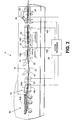
- a mailing machine 8 incorporates a weighing apparatus 10 (also referred to as a "weight measurement apparatus") according to the teachings of the present invention.
- the mailing machine 8 includes a feeder assembly 12 having a singulator section 14 and a sealing module 16 for processing mailpieces along a feed path (hereinafter referred to as the "processing path").
- the “processing path” is the path along which the sheet material is directed for processing, whether the sheet material is supported on a smooth deck, via rollers, nips, or belts.
- the singulator section 14 receives stacked mailpieces 20S and singulates/separates the lowermost mailpiece from the stack 20S. As the mailpieces 20 are driven along the processing path, the lowermost mailpieces 20 are shingled through a pair of belts 14a, 14b which, in cross section, define a shallow-V configuration. At the vertex formed by the belts 14a, 14b, a small gap enables a single mailpiece 20 to pass or separate from the mailpiece stack 20S.
- the single mailpiece 20 is then passed to the moistening/sealing module 16 wherein a blade 18 direct the underlying mailpiece flap (not shown) to a moistening applicator/nozzle 22 (depending upon the type of moistening/sealing module).
- a moistening applicator/nozzle 22 depending upon the type of moistening/sealing module.
- an aqueous solution including water and an anti-bacterial agent moistens the flap sealant (also not shown) to activate the adhesive contained therein.
- the mailpiece 20 passes between a pair of closing nips 24 to seal the flap against the body of the mailpiece envelope. While the closing nips 24 are shown immediately following the moistening applicator 22, the closing nips may be disposed at any downstream location.
- the system processor 26 which controls the various transport functions of the mailing machine 8, positions the mailpieces 20 immediately upstream or downstream of the applicator/nozzle 22. As such, idle contact of the flap sealant with the aqueous solution of the moistening/sealing module 16 is obviated.
- the mailpieces 20 are then conveyed to the weighing apparatus 10 for measuring delivery weight. That is, since the cost of delivery is typically based on mailpiece weight, the weighing apparatus 10 functions to rapidly and accurately measure mailpiece weight as the mailpiece continues along the processing path. Depending upon the configuration of the mailpiece, e.g., number ten (10) or flats-type, the mailpiece will come to rest on the deck 10D of the weighing apparatus 10. Vibrations, produced by accelerating and decelerating the mailpiece across the weighing apparatus, necessitate that the apparatus "settle-out" or achieve a threshold level of stability before generating or recording a weight measurement signal.
- the system processor 26 is responsive to the weight signal 10S and calculates the value of the indicia required for postage.
- the mailpieces 20 are transported to the print station 30 where the mailpieces 20 are urged upwardly against a platen to ensure a planar surface for printing.
- Print heads 32 extending through the platen, print the postage indicia on the envelope in addition to other symbology, e.g., one or two-dimensional barcodes, planet codes, or address information as may be required.
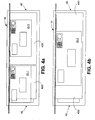
- Figs. 3 , 4a and 4b depict enlarged profile and plan views of the weighing apparatus 10.
- the weight measurement apparatus 10 comprises multiple segments 40, 42 including a primary scale segment 40, a secondary scale segment 42 and a conveyor means 44 for transporting mailpieces 20 to the scale segments 40, 42.
- the primary scale segment 40 is adapted to weigh mailpieces 20-1 of a first configuration (seen in Fig. 4a ) while the secondary scale segment 42 is adapted to cooperate with the primary segment to weigh mailpieces 20-2 of a second configuration (seen in Fig. 4b ).
- the conveyor means 44 includes first and second belt drive assemblies 46a, 46b associated with the primary and secondary scale segments 40, 42, respectively.
- belt drive assemblies 46a, 46b may be driven independently or in unison depending upon the operating mode of the weighing apparatus 10. Hence, mailpieces 20-1, 20-2 may be independently moved across the individual scale segments 40, 42 or moved in unison across both scale segments 40, 42. Furthermore, the belt drive assemblies 46a, 46b define drive surfaces which are substantially coplanar for driving the mailpieces smoothly from one scale segment 42 to the other scale segment 40.
- each of the scale segments 40, 42 is essentially identical, but for the size and/or the geometric shape of the respective decks 40D, 42D, it will be appreciated that the following description of the primary scale segment 40 is equally valid for and applicable to the secondary scale segment 42. Hence, for brevity of description, the primary scale segment 40 will be described in detail while reference to the secondary scale segment 42 will generally be limited to its spatial and geometric relationship relative to the primary scale segment 40.
- the primary scale segment 40 includes a substantially planar transport deck 40D disposed along the processing path PPH of the mailing machine 8.
- the deck 40D is mounted to support structure (not shown) surrounding a plurality of spring-biased rollers 50 which extend upwardly through slot-shaped openings in the deck 40D.
- the rollers 50 are supported by arms 52 which are pivotally mounted to a connecting base 54.
- the base 54 is mounted to and supported by a structure/system 56 capable of measuring deflections due to weight.
- a load cell may be interposed between the connecting base 54 and a stationary structural housing 58 of the mailing machine 8.
- the load cell may be implemented or replaced by a cantilever spring 60 may be affixed at each end to the base 54 and housing 58 while a strain gage 62 may be disposed on the face or surface of the cantilever spring 60.
- Mailpieces conveyed along the processing path PPH by the conveyor means 44 are decelerated and accelerated as they are (i) positioned on the deck 40D, (ii) held momentarily (i.e., until a weight measurement can be taken) and, (iii) once again, conveyed downstream to the print station (not shown in Fig. 3 ).
- the scale segments 40, 42 must await a "settling period" to ensure that an accurate weight measurement signal may be obtained and processed by the system processor 26.
- the deflection of the connecting base can be measured by the load cell or a strain gage (whichever weight measurement sensor is employed) and interpreted by the system processor 26.
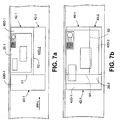
- the transport decks 40D, 42D of the primary and secondary scale segments 40, 42 are substantially coplanar, though the spring-biased rollers 50 enable a degree of skewing/compliance to accommodate variations in thickness from one mailpiece to another. While the decks 40D, 42D are substantially rectangular in shape and arranged in tandem order, the decks 40D, 42D may have other geometric shapes or be arranged in a variety of spatial relationships. For example, in Figs. 5a and 5b , the deck 42D' of a secondary scale segment 42' may be adjacent the deck 40D' of the primary scale segment 40' along two sides S1, S2 thereof.
- the deck 40D' of the primary scale segment 40' may be sized to accommodate mailpieces 20-1 of a first configuration, e.g., a type-ten letter envelope (seen in Fig. 5a ), while the dimension of the combined decks 40D', 42D' (shown in Fig. 5b ) associated with the primary and secondary scale segments 40', 42' is adapted to support a larger mailpiece 20-2 of a second configuration, e.g., a number ten (10) type letter envelope.
- the deck 42D" of a secondary scale segment 42' may partially circumscribe the deck 40D" of the primary scale segment 40' along three sides S1, S2 and S3 thereof.
- the periphery of the conventional letter-size envelope 20-1 is bounded by the deck 40D" of the primary scale segment 40".
- the larger flats-type letter envelope 20-2 is accommodated by the dimension of the combined decks 40D", 42D" (shown in Fig. 6b ) associated with the primary and secondary scale segments 40", 42".
- three decks 40D-1, 42D-1 and 42D-2 are associated with multiple scale segments 40-1, 42-1 and 42-2, respectively.
- the inventive weight measurement apparatus includes one primary scale segment 40-1 and a pair of secondary scale segments 42-1, 42-2, wherein one of the secondary scale segments 42-1 is disposed along a first side S1 of the primary scale segment 40-1 and another of the secondary scale segments 42-2 is disposed along a second side S2 of the primary scale segment 40-1.
- the inventive weight measurement apparatus 10 weighs mailpieces 20-1, 20-2 in one of at least two operating modes. These operating modes increase throughput efficiency while enabling the flexibility to weigh articles of varying size or shape.
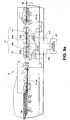
- the flow and spacing of mailpieces 20-1a, 20-1b, 20-1c, 20-1d, in a first operating mode is depicted in Figs. 8a and 8b .
- mailpieces 20-1a, 20-1b, 20-1c, 20-1d of a first configuration/size i.e., those employing number ten (10) letter-size envelopes, are closely-spaced to achieve a high throughput efficiency. i.e., in excess of two-hundred and forty (240) mailpieces per minute.
- the primary scale segment 40 weighs each of the mailpieces 20-1a, 20-1b, 20-1c, 20-1d traveling along the processing path PPH.
- the mailpieces 20-1b immediately upstream of the mailpiece 20-1a being weighed by the primary scale segment 20 is staged on the deck 42D of the secondary scale segment 42.
- the secondary scale segment 42 and its associated drive assembly 46b functions in the sole capacity of staging/preparing the next mailpiece 20-1b for weight measurement and the printing of postage indicia.
- the deflection of the primary scale segment 40 is issued, measured and converted by the system processor 26 to a weight signal 10S.
- the weight signal 10S is used to calculate a postage value needed for mailpiece carrier delivery.
- the postage indicia and other printed subject matter/symbology i.e., the destination, return address and barcode symbols, are printed at the print station 30.
- the secondary scale segment 42 is essentially non-functional in terms of its ability to measure the weight of mailpieces 20-1a, 20-1b, 20-1c, 20-1d
- the ability to stage mailpieces 20-1a, 20-1b, 20-1c, 20-1d greatly decreases the spacing X between processed mailpieces 20-1a, 20-1b, 20-1c, 20-1d and vastly increases throughput efficiency. That is, since a mailpiece 20-1b can be staged on the deck 42D of the secondary scale segment 42 immediately adjacent the forward or downstream mailpiece 20-1a, an additional mailpiece 20-1b can be interposed between the moistening/sealing station 16 and the primary scale segment 40. As such, by increasing the number of mailpieces processed along the processing path PPH from three (3) to four (4) (at the same time maintaining a constant transport velocity), throughput efficiency can be raised by significantly, e.g., thirty-three percent (33%).
- the primary and secondary scale segments 40, 42 cooperate to weigh mailpieces 20-2a, 20-2b, 20-2c of a larger size or different configuration.
- mailpieces 20-2a, 20-2b, 20-c of the second configuration e.g., mailpieces employing large flats-type envelopes
- the primary scale segment 40 can be optimally sized for use in the first operating mode i.e., accommodating a specific size/configuration mailpiece envelope
- the secondary scale segment 42 must be sufficiently large to accommodate mailpiece envelopes having multiple sizes.
- the size of the combined decks 40D, 42D must be sufficiently large to accommodate a variety of configurations.
- the multi-segment weight measurement apparatus 10 decreases the settling period or time required for accurate weight measurement.
- the single large transport deck required for processing mailpieces of various size produces a large material mass in a spring-mass vibratory system.
- the settling period which is a function of the resonant frequency and amplitude of the spring-mass system, is elongated as the material mass increases.
- Figure 10a depicts the resonant response of a prior art weighing device wherein vibrations V dampen over a settling period T 1 before an accurate weight measurement can be recorded.
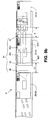
- FIG. 10b the resonant response of the multi-segment weighing apparatus 10 is depicted wherein vibrations V dampen over an abbreviated settling period T 2 due to the reduced mass of each of the scale segments 40, 42. That is, the time T 2 required for the amplitude of vibrations V to reach the threshold level TA diminishes such that T 2 is substantially less than T 1 . Furthermore, the time required to record a weigh measurement is reduced which also reduces the time that an article/mailpiece must remain stationary on the transport deck 40D, 42D. As a result, the processing time or throughput efficiency is increased.
- the method for processing sheet material includes the steps of (i) weighing mailpieces of a first configuration 20-1 on a primary scale segment 40, (ii) weighing mailpieces of a second configuration 20-2 on the primary and secondary scale segments 40, 42 such that the scale segments 40, 42 cooperate to weigh the mailpieces of the second configuration 20-2, and (iii) conveying the mailpieces of the first and second configurations 20-1, 20-2 along the processing path PPH to the respective scale segments depending upon which type of mailpiece is to be weighed.
- the step of conveying mailpieces 20-1, 20-2 is controlled by the system processor 26 depending upon the operating mode of the sheet handling apparatus or mailing machine 8. These steps include, in one operating mode: staging mailpieces of the first configuration 20-1 on the secondary scale segment 42, and conveying the articles from the secondary scale segment 42 to the primary scale segment 40 to be weighed. In another operating mode, the method includes the step of positioning articles of the second configuration 20-2 on the primary and secondary scale segments 40, 42 for being weighed jointly by the scale segments 40, 42.
- the inventive weighing apparatus 10 is shown having an upstream scale segment (i.e., segment 42) for staging articles/mailpieces in a first operating mode and for weighing larger articles/mailpieces in a second operating mode
- the weighing apparatus 10 of the present invention may be adapted such that either of the scale segments 40, 42, i.e., the upstream or downstream, may weigh and or stage articles/mailpieces. That is, for example, in a first operating mode, an upstream scale segment may be used to weigh a mailpiece having a first configuration while a downstream scale segment stages mailpieces in advance of the print station 30.
- both scale segments may cooperate to weigh mailpieces of a second (larger) configuration, a mailpiece spanning the combined length of both scale segments.
- the inventive weighing apparatus and method for processing sheet material increases productivity while flexibly accommodating articles/mailpieces of varied size and shape.
- the weighing apparatus may be adapted/controlled to weigh articles/mailpieces of a first configuration while staging articles/mailpieces to minimize the spacing therebetween and optimize throughput efficiency.
- the weighing apparatus may be adapted/controlled to weigh articles/mailpieces of a second configuration (i.e., the articles/mailpieces being generally larger than those processed in the other operating mode) by combining the capability of the various scale segments (whether the number of segments is two, three, four etc.).
- other benefits are derived such as a reduction in the settling time. As previously discussed, throughput can be improved by shortening the time required to achieve/accept a weight measurement value.
Landscapes
- Physics & Mathematics (AREA)
- Mathematical Physics (AREA)
- Engineering & Computer Science (AREA)
- Theoretical Computer Science (AREA)
- General Physics & Mathematics (AREA)
- Devices For Checking Fares Or Tickets At Control Points (AREA)
- Sorting Of Articles (AREA)
Claims (11)
- Appareil de pesage (10) pour mesurer le poids d'articles (20) acheminés le long d'un trajet de traitement (PPH) ; comprenant :un segment de balance primaire (40, 40', 40-1) adapté pour peser des articles d'une première configuration (20-1) ;au moins un segment de balance secondaire (42, 42', 42-1, 42-2) adapté pour coopérer avec le segment primaire pour peser des articles d'une deuxième configuration (20-2) ; etun transporteur (44) pour acheminer des articles des première et deuxième configurations le long du trajet de traitement (PPH) jusqu'aux segments de balance ;dans lequel le transporteur (44) comporte un segment de transporteur séparé (46a, 46b) pour chacun des segments de balance et dans lequel les segments de transporteur peuvent fonctionner indépendamment pour faire varier l'espacement relatif entre les articles (20) à mesure qu'ils sont acheminés le long du trajet de traitement ;dans lequel le segment de transporteur pour le segment de balance secondaire place les articles de la première configuration (20-1) sur le segment de balance secondaire (42, 42', 42-1, 42-2) et déplace les articles du segment de balance secondaire (42, 42', 42-1, 42-2) au segment de balance primaire (40, 40', 40-1) pour être pesés ; etdans lequel l'appareil de pesage est adapté pour peser des articles de la première configuration sur le segment de balance primaire tout en plaçant des articles sur le segment de balance secondaire afin de minimiser l'espacement entre eux et optimiser l'efficacité du débit.
- Appareil de pesage selon la revendication 1, dans lequel les articles de la deuxième configuration (20-2) ont au moins une dimension plus grande que celle des articles de la première configuration (20-1).
- Appareil de pesage selon la revendication 1 ou 2, dans lequel le transporteur transporte et positionne des articles de la deuxième configuration (20-2) sur les segments de balance primaire (40, 40', 40-1) et secondaire (42, 42', 42-1, 42-2) pour être pesés conjointement par les segments de balance (40, 40', 40-1 ; 42, 42', 42-1, 42-2).
- Appareil de pesage selon la revendication 1 ou 2, dans lequel, dans un mode de fonctionnement, le transporteur place des articles de la première configuration (20-1) sur le segment de balance secondaire (42, 42', 42-1, 42-2) et déplace les articles du segment de balance secondaire (42, 42', 42-1, 42-2) au segment de balance primaire (40,40', 40-1) pour être pesés et, dans un autre mode de fonctionnement, le transporteur transporte et positionne des articles de la deuxième configuration (20-2) sur les segments de balance primaire et secondaire (40, 40', 40-1 ; 42, 42', 42-1, 42-2) pour être pesés conjointement par les segments de balance.
- Appareil de pesage selon la revendication 1, dans lequel les segments de transporteur (46a, 46b) définissent une surface d'entraînement et dans lequel les surfaces d'entraînement de ceux-ci sont sensiblement coplanaires.
- Appareil de pesage selon la revendication 1 ou 5, dans lequel le segment de balance primaire (40, 40', 40-1) est en aval du segment de balance secondaire (42, 42', 42-1, 42-2).
- Appareil de pesage selon la revendication 1, 5 ou 6, dans lequel une plate-forme de transport (42D) du segment de balance secondaire (42) entoure une plate-forme de transport (40D) du segment de balance primaire (40).
- Appareil de pesage selon la revendication 1, 5 ou 6, dans lequel une plate-forme de transport (42D') du segment de balance secondaire (42') est adjacente à une plate-forme de transport (40D') du segment de balance primaire (40') sur au moins deux de ses côtés (S1, S2).
- Appareil de pesage selon l'une des revendications précédentes, dans lequel les articles acheminés le long du trajet de traitement (PPH) sont des envois postaux (20).
- Appareil de pesage selon l'une des revendications précédentes, dans lequel chacun des segments de balance (40, 40', 40-1 ; 42, 42', 42-1, 42-2) comporte :une plate-forme de transport (40D, 40D', 42D, 42D') ayant une pluralité d'éléments roulants (50) pour faciliter le déplacement des articles (20) le long d'une surface supérieure de la plate-forme ;une cellule de pesage se reliant à une surface inférieure de la plate-forme de transport (40D, 40D', 42D, 42D'), la cellule de pesage comprenant un moyen à ressort (60) pour supporter la plate-forme de transport (40D, 40D', 42D, 42D') et un moyen (62) pour mesurer le déplacement du ressort contre une force qui lui est imposée par le poids d'un article (20) ;une bande transporteuse ayant une surface de transport disposée sur la plate-forme de transport et opposée à celle-ci pour saisir des articles entre les éléments roulants (50) et la surface de transport,un moyen d'entraînement se reliant à la bande transporteuse et entraînant celle-ci, etun dispositif de commande permettant de commander l'activation et la vitesse du moyen d'entraînement.
- Appareil de pesage selon la revendication 10, dans lequel le moyen à ressort comporte un ressort en porte-à-faux (60) et le moyen de mesure comporte un extensomètre (62) monté sur une surface du ressort en porte-à-faux pour mesurer le déplacement sous contrainte du ressort.
Applications Claiming Priority (1)
| Application Number | Priority Date | Filing Date | Title |
|---|---|---|---|
| US11/824,670 US20090008859A1 (en) | 2007-07-02 | 2007-07-02 | Multi-segment weight measurement apparatus and method for processing sheet material |
Publications (3)
| Publication Number | Publication Date |
|---|---|
| EP2017589A2 EP2017589A2 (fr) | 2009-01-21 |
| EP2017589A3 EP2017589A3 (fr) | 2011-05-04 |
| EP2017589B1 true EP2017589B1 (fr) | 2019-05-08 |
Family
ID=39830232
Family Applications (1)
| Application Number | Title | Priority Date | Filing Date |
|---|---|---|---|
| EP08011910.0A Ceased EP2017589B1 (fr) | 2007-07-02 | 2008-07-02 | Appareil de pesage pour mesurer le poids des articles introduits le long d'une voie de traitement |
Country Status (3)
| Country | Link |
|---|---|
| US (1) | US20090008859A1 (fr) |
| EP (1) | EP2017589B1 (fr) |
| CN (1) | CN101339069B (fr) |
Families Citing this family (16)
| Publication number | Priority date | Publication date | Assignee | Title |
|---|---|---|---|---|
| US7750254B2 (en) * | 2007-12-14 | 2010-07-06 | Pitney Bowes Inc. | Self-adjusting support skis for weighing device |
| DE102010009431A1 (de) | 2010-02-24 | 2011-08-25 | Francotyp-Postalia GmbH, 16547 | Schnelle dynamische Waage und Verfahren zur Steuerung einer schnellen dynamischen Waage |
| US8621879B2 (en) * | 2010-03-05 | 2014-01-07 | Bosch Automotive Service Solutions Llc | Air conditioning system recharging method and apparatus |
| DE102011100176B4 (de) | 2011-05-02 | 2014-06-26 | Francotyp-Postalia Gmbh | Dynamische Waage mit mehreren Wägeschalen undVerfahren zum Betreiben der dynamischen Waage |
| EP2615584B1 (fr) * | 2012-01-10 | 2018-08-01 | Neopost Technologies | Dispositif pour peser des objets plats en mouvement |
| DE202015002361U1 (de) | 2014-06-16 | 2015-06-17 | Francotyp-Postalia Gmbh | Verbesserungen an einer dynamischen Waage mit mehreren Wägeschalen |
| DE102014211515A1 (de) | 2014-06-16 | 2015-12-17 | Francotyp-Postalia Gmbh | Wiegeverfahren, Anordnung zur Durchführung des Wiegeverfahrens sowie ein entsprechendes Computerprogramm und ein entsprechendes computerlesbares Speichermedium |
| CN107613822B (zh) * | 2015-04-17 | 2021-01-15 | 鲍尔公司 | 用于控制材料的连续片体的速度的方法和设备 |
| US10421111B2 (en) | 2015-04-17 | 2019-09-24 | Ball Corporation | Method and apparatus for controlling an operation performed on a continuous sheet of material |
| US10260934B2 (en) | 2016-02-10 | 2019-04-16 | Riyaz Esmail | Portable scale system |
| ITUA20163127A1 (it) * | 2016-05-04 | 2017-11-04 | Dini Argeo S R L | Bilancia con una pluralita' di celle di carico |
| CN108482761B (zh) * | 2018-03-21 | 2020-06-12 | 王成财 | 一种包装袋分段输送方法 |
| CN110631677B (zh) * | 2019-09-30 | 2025-01-24 | 山东西泰克仪器有限公司 | 滑板检重秤 |
| CN110697101B (zh) * | 2019-10-21 | 2021-06-01 | 常州中科绿塑环保科技有限公司 | 一种导电易降解塑料粒子分装调测设备 |
| CN112124901A (zh) * | 2020-10-12 | 2020-12-25 | 潍坊工商职业学院 | 一种机械设备故障定位及报警保护装置 |
| CN120553303B (zh) * | 2025-08-01 | 2025-11-04 | 杭州乾锦输送设备有限公司 | 一种智能仓储物流用动态称重方法及称重设备 |
Family Cites Families (15)
| Publication number | Priority date | Publication date | Assignee | Title |
|---|---|---|---|---|
| US3220547A (en) * | 1964-01-02 | 1965-11-30 | Econ O Post Corp | Mail sorting apparatus |
| JPS57144424A (en) * | 1981-03-03 | 1982-09-07 | Yamato Scale Co Ltd | High speed weighing device |
| CH652824A5 (fr) * | 1983-03-24 | 1985-11-29 | Hasler Freres Int Sa | Procede de pesage en continu de produits divises et dispositif pour la mise en oeuvre de ce procede. |
| US4742878A (en) * | 1986-09-19 | 1988-05-10 | Pitney Bowes Inc. | Weighing module |
| US4754822A (en) * | 1987-10-22 | 1988-07-05 | W. F. Altenpohl, Inc. | Repetitive weighing system for moving conveyor loads |
| US5109936A (en) * | 1989-06-28 | 1992-05-05 | Cahin Systems Corporation | Dynamic weight control system |
| US6940025B1 (en) * | 1994-12-27 | 2005-09-06 | Pitney Bowes Inc. | Method and apparatus for determining the mass of an article using a load cell |
| US5990422A (en) * | 1996-10-18 | 1999-11-23 | Shinko Denshi Company Limited | Apparatus for measuring weight and length of article |
| EP1056991A1 (fr) * | 1998-01-20 | 2000-12-06 | Marel HF. | Procede et dispositif de pesee |
| DE69809190T2 (de) * | 1998-05-01 | 2003-10-09 | Shinko Denshi Co. Ltd., Tokio/Tokyo | Vorrichtung zur Messung des Gewichtes von Artikeln |
| AU2001291644A1 (en) * | 2000-09-28 | 2002-04-08 | Crisplant A/S | A weighing system for a conveyor |
| JP2002263583A (ja) * | 2001-03-06 | 2002-09-17 | Matsushita Electric Ind Co Ltd | 郵便物区分システム用の郵便物チェッカー装置 |
| US6552278B2 (en) * | 2001-09-10 | 2003-04-22 | Weigh-Tronix Inc. | Multiple load sensing multi-load cell scale and method |
| US7279645B1 (en) * | 2006-05-12 | 2007-10-09 | Mettler-Toledo, Inc. | Multiple conveyor and scale weighing apparatus |
| DE102006041836B4 (de) * | 2006-09-04 | 2009-04-02 | Wipotec Wiege- Und Positioniersysteme Gmbh | Wägevorrichtung, insbesondere Wägezelle für eine Verbundwaage |
-
2007
- 2007-07-02 US US11/824,670 patent/US20090008859A1/en not_active Abandoned
-
2008
- 2008-07-02 EP EP08011910.0A patent/EP2017589B1/fr not_active Ceased
- 2008-07-02 CN CN200810127924.2A patent/CN101339069B/zh not_active Expired - Fee Related
Non-Patent Citations (1)
| Title |
|---|
| None * |
Also Published As
| Publication number | Publication date |
|---|---|
| CN101339069B (zh) | 2013-01-09 |
| CN101339069A (zh) | 2009-01-07 |
| US20090008859A1 (en) | 2009-01-08 |
| EP2017589A3 (fr) | 2011-05-04 |
| EP2017589A2 (fr) | 2009-01-21 |
Similar Documents
| Publication | Publication Date | Title |
|---|---|---|
| EP2017589A2 (fr) | Dispositif pour peser des articles de courrier | |
| EP2065686B2 (fr) | Système de mesure de poids à voies parallèles pour des dispositifs de manipulation de feuille | |
| US8148650B2 (en) | Mailing machine transport system with integral scale for weighing mail pieces where the contact force on the take away rollers is reduced to eliminate oscillations of the weighing platform | |
| US8178796B2 (en) | Mailing machine transport system including a guide to reduce the impact on the weighing device caused by the trailing edge of the mailpeice | |
| US6817608B2 (en) | Method and apparatus for stacking mailpieces in consecutive order | |
| US20110155010A1 (en) | Item handling system with printer alignment | |
| EP2238060B1 (fr) | Transport pour singulariser des articles | |
| EP2714422B1 (fr) | Tampon inter-machine pour système de fabrication de pièce de courrier | |
| US8544837B2 (en) | Vacuum roller assembly | |
| US7750254B2 (en) | Self-adjusting support skis for weighing device | |
| EP2428475A2 (fr) | Système pour contrôler une courroie de séparation dans un dispositif d'alimentation de courrier | |
| US8746688B2 (en) | Accumulator for a sheet handling system | |
| US8531699B2 (en) | Item transport system with pneumatic aligner | |
| US7866661B2 (en) | Sheet/page buffer for sheet handling apparatus | |
| EP2172408A2 (fr) | Système de transport d'articles avec module de diversion par soufflage d'air | |
| US12211355B2 (en) | Card processing and attaching system | |
| EP1728744B1 (fr) | Dispositif d'alimentation en feuilles avec platine | |
| EP2428476A2 (fr) | Système pour contrôler le transport de courrier dans un dispositif d'alimentation de courrier | |
| EP1728745B1 (fr) | Dispositif d'alimentation en feuilles | |
| US20110166695A1 (en) | System and method for producing and arranging sheet material for use in a mailpiece inserter | |
| GB2246117A (en) | Feeding sheets from piles |
Legal Events
| Date | Code | Title | Description |
|---|---|---|---|
| PUAI | Public reference made under article 153(3) epc to a published international application that has entered the european phase |
Free format text: ORIGINAL CODE: 0009012 |
|
| AK | Designated contracting states |
Kind code of ref document: A2 Designated state(s): AT BE BG CH CY CZ DE DK EE ES FI FR GB GR HR HU IE IS IT LI LT LU LV MC MT NL NO PL PT RO SE SI SK TR |
|
| AX | Request for extension of the european patent |
Extension state: AL BA MK RS |
|
| PUAL | Search report despatched |
Free format text: ORIGINAL CODE: 0009013 |
|
| AK | Designated contracting states |
Kind code of ref document: A3 Designated state(s): AT BE BG CH CY CZ DE DK EE ES FI FR GB GR HR HU IE IS IT LI LT LU LV MC MT NL NO PL PT RO SE SI SK TR |
|
| AX | Request for extension of the european patent |
Extension state: AL BA MK RS |
|
| 17P | Request for examination filed |
Effective date: 20111026 |
|
| AKX | Designation fees paid |
Designated state(s): DE FR GB |
|
| 17Q | First examination report despatched |
Effective date: 20151125 |
|
| GRAP | Despatch of communication of intention to grant a patent |
Free format text: ORIGINAL CODE: EPIDOSNIGR1 |
|
| INTG | Intention to grant announced |
Effective date: 20181207 |
|
| GRAS | Grant fee paid |
Free format text: ORIGINAL CODE: EPIDOSNIGR3 |
|
| RAP1 | Party data changed (applicant data changed or rights of an application transferred) |
Owner name: PITNEY BOWES, INC. |
|
| GRAA | (expected) grant |
Free format text: ORIGINAL CODE: 0009210 |
|
| AK | Designated contracting states |
Kind code of ref document: B1 Designated state(s): DE FR GB |
|
| REG | Reference to a national code |
Ref country code: GB Ref legal event code: FG4D |
|
| REG | Reference to a national code |
Ref country code: DE Ref legal event code: R096 Ref document number: 602008059977 Country of ref document: DE |
|
| REG | Reference to a national code |
Ref country code: DE Ref legal event code: R097 Ref document number: 602008059977 Country of ref document: DE |
|
| PLBE | No opposition filed within time limit |
Free format text: ORIGINAL CODE: 0009261 |
|
| STAA | Information on the status of an ep patent application or granted ep patent |
Free format text: STATUS: NO OPPOSITION FILED WITHIN TIME LIMIT |
|
| 26N | No opposition filed |
Effective date: 20200211 |
|
| PGFP | Annual fee paid to national office [announced via postgrant information from national office to epo] |
Ref country code: FR Payment date: 20200727 Year of fee payment: 13 Ref country code: GB Payment date: 20200727 Year of fee payment: 13 Ref country code: DE Payment date: 20200729 Year of fee payment: 13 |
|
| REG | Reference to a national code |
Ref country code: DE Ref legal event code: R119 Ref document number: 602008059977 Country of ref document: DE |
|
| GBPC | Gb: european patent ceased through non-payment of renewal fee |
Effective date: 20210702 |
|
| PG25 | Lapsed in a contracting state [announced via postgrant information from national office to epo] |
Ref country code: GB Free format text: LAPSE BECAUSE OF NON-PAYMENT OF DUE FEES Effective date: 20210702 Ref country code: DE Free format text: LAPSE BECAUSE OF NON-PAYMENT OF DUE FEES Effective date: 20220201 |
|
| PG25 | Lapsed in a contracting state [announced via postgrant information from national office to epo] |
Ref country code: FR Free format text: LAPSE BECAUSE OF NON-PAYMENT OF DUE FEES Effective date: 20210731 |