EP2017754B1 - Schéma de raccord en parallèle insensible à l'obliquité de données - Google Patents
Schéma de raccord en parallèle insensible à l'obliquité de données Download PDFInfo
- Publication number
- EP2017754B1 EP2017754B1 EP08252246.7A EP08252246A EP2017754B1 EP 2017754 B1 EP2017754 B1 EP 2017754B1 EP 08252246 A EP08252246 A EP 08252246A EP 2017754 B1 EP2017754 B1 EP 2017754B1
- Authority
- EP
- European Patent Office
- Prior art keywords
- join
- data set
- skew
- value
- occurrence frequency
- Prior art date
- Legal status (The legal status is an assumption and is not a legal conclusion. Google has not performed a legal analysis and makes no representation as to the accuracy of the status listed.)
- Active
Links
Images

Classifications
-
- G—PHYSICS
- G06—COMPUTING OR CALCULATING; COUNTING
- G06F—ELECTRIC DIGITAL DATA PROCESSING
- G06F16/00—Information retrieval; Database structures therefor; File system structures therefor
- G06F16/20—Information retrieval; Database structures therefor; File system structures therefor of structured data, e.g. relational data
- G06F16/24—Querying
- G06F16/245—Query processing
- G06F16/2455—Query execution
- G06F16/24553—Query execution of query operations
- G06F16/24558—Binary matching operations
- G06F16/2456—Join operations
Definitions
- MPP Massively Parallel Processing
- BI Business Intelligence
- EDW Enterprise Data Warehouse
- the data a set of relational tables
- CPU central processing units
- MPP systems apply the divide-and-conquer approach of evenly distributing the data among the available processors and then performing the intended operation in parallel, instead of performing the operation serially.
- join operation One of the basic and most common database operations is the join between two relational tables.
- the join operator combines the records from both tables based on a matching criterion between columns in the tables. For example, the table LINEITEM can be joined to table PRODUCT by matching product_id columns on both tables to get a set of all line items with their product information.
- the join operation is often the most computationally expensive operation in the query execution tree, and its performance dictates the overall performance of the query.
- the system partitions the data stream from both tables based on the value of the join column (product_id in the example above). That is, all records that have the same value of the join column from either table, or child, of the join are guaranteed to be sent to the same central processing unit (CPU). Hence, all join matches can be found locally in each CPU and independently of the other CPUs.
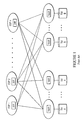
- Figure 1 is a block diagram of how the join operation is parallelized using a partition-by-value scheme.
- Data from both sides of the join (Table A and Table B along the bottom of figure 1 ) is read and redistributed to the n join instances (along the top of figure 1 ).
- Each join instance is running as part of an Executor Server Process (ESP) hosted on a separate CPU in the MPP system.
- ESP Executor Server Process
- the data is repartitioned based on the value of the join column(s) to ensure the correctness of the parallel join result.
- the hash value of the join column(s) is used to select the join instance.
- the skew problem is exceptionally important for MPP systems because the larger the system is, the more likely it will suffer from data skew problems. For example, a value that occurs in 11% of the records of a large table will slow down its join operations on an 8-way system by 2X, while the same task will slow down by 30X on a 256-way MPP system.
- the document describes a parallel algorithm in which high and low skew data are distributed to different, disjoint set of CPUs, while according to the present invention, first the low-skew data are distributed to a plurality of CPUs and then the high-skew data are distributed to the same CPUs, i.e. the present invention is based on a serial distribution algorithm.
- FIG. 3 - FIG. 6 and the following description depict specific examples to teach those skilled in the art how to make and use the best mode of the invention. For the purpose of teaching inventive principles, some conventional aspects have been simplified or omitted. Those skilled in the art will appreciate variations from these examples that fall within the scope of the invention. Those skilled in the art will appreciate that the features described below can be combined in various ways to form multiple variations of the invention. As a result, the invention is not limited to the specific examples described below, but only by the claims and their equivalents.
- a skew-insensitive parallel join scheme has been devised.
- the parallel join scheme uses the column values to partition only the records that have non-skewed values, while using a different distribution scheme to uniformly distribute records with skewed values.
- the first step is to categorize the data into a high-skew data set and a low-skew data set.
- a different distribution scheme is applied to each data set.
- the high-skew data set consists of any row in the join input data that has a join column value with relatively high occurrence frequency.
- the low-skew data set consists of the rest of the rows.
- the parallel join scheme handles low-skew data in a manner identical to the partition-by-value scheme, i.e. data is redistributed based on the hash values of the join column(s) on both side of the join operator.
- High-skew data is handled differently than the low-skew data.
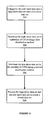
- Figure 3 is a flow chart for a parallel join scheme in an example embodiment of the invention.
- the join input data is categorized into a high-skew data set and a low-skew data set.
- the high skew data set is distributed to a plurality of CPUs using a first distribution method.
- the low skew data set is distributed to the plurality of CPUs using a second distribution method.
- the high skew data set and the low skew data set are processed by the plurality of CPUs to create a joined data set.
- the parallel join scheme handles the high-skew data set as follows. At the skewed side of the join, rows that belong to the high-skew set are distributed to the join instances using a uniform distribution scheme, for example round robin or random. On the non-skewed side of the join, rows that match the high-skew set are replicated to all join instances. By uniformly distributing the high-skew data set from the skewed side, the algorithm achieves uniform distribution of tasks to the join instances. By replicating the matching rows from the non-skewed side of the join, it ensures that these rows will be present in any join instance selected by the uniform distribution of the corresponding rows from the skewed side. The additional cost of data replication is small since the algorithm only replicates matching rows on the non skewed side.
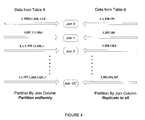
- FIG. 4 The application of the parallel join scheme to joins on skewed values is demonstrated in figure 4 .
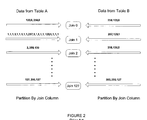
- This is the identical join example as the one presented earlier ( Fig.2 ) with the exception that the parallel join scheme has been used.
- the skewed values on the left side of the join are uniformly distributed among all join instances.
- the matching rows on the right side of the join (in this case one row) are replicated to all join instances.
- the parallel join scheme has two components; skewed value detection and skewed value processing.
- the query optimizer examines each join operator in the query plan to determine the high-skew data sets.
- both high-skew and low-skew data sets are distributed and processed in a manner that achieves task uniformity among the processing units with minimal overhead.
- Skewed values detection may be performed in the query optimization phase. Detecting skew during the query optimization phase, instead of at runtime, creates a number of advantages. Detecting skew during the query optimization phase eliminates runtime false alarms such as data being temporally skewed as a result of sort order or partial sort order. Such order may also prevent or delay skew detection at runtime if the skewed values appeared late in the sort order. Detecting skew during the query optimization phase also allows for a single set of join instances, without the need to reroute records across the join instances. Detecting skew during the query optimization phase allows better pipelining because the operators know what to do in advance. When skew is determined during runtime, expensive recovery steps are required when skew is detected.
- the query optimizer relies on table statistics for estimating row cardinality and cost of each operator in the query execution plan. Statistics are gathered after data load or whenever the data in the tables has changed substantially via insert, update, or delete operations. Statistics may be stored in metadata tables and retrieved at query compile time by the optimizer. In order to enable the optimizer to detect skewed values, the statistics gathering operation needs to capture and store all column values that have high occurrence frequencies. We will refer to these values as the most frequent values (MFVs). The corresponding frequencies of the MFVs need to be captured as well.
- MFVs most frequent values
- the query optimizer retrieves the table column statistics, including the list of MFVs and their frequencies, for all columns that are involved in any join predicate in the query. During the optimization process, the optimizer propagates this list, as part of the column statistics, and adjusts it throughout the query plan tree. Since a join may occur between intermediate query results as well as base tables, it is necessary to compute the MFVs frequencies at each step in the join tree.
- the total join result cardinality is also computed using the statistics from both of the join children.
- the optimizer proceeds in computing the skewed values list (SVL) for each of the join children.
- the SVL is a subset of the MFVs with occurrence frequencies exceeding a certain threshold, which will be referred to as the skew sensitivity threshold (SST).
- the threshold may be chosen such that values over the threshold are the only values capable of significantly distorting the uniform data distribution.
- the skew sensitivity threshold (SST) for a join child is calculated as approximately the child cardinality divided by the number of CPUs the data will be distributed to.
- the adjustment factor X can be set as a fractional value to reduce the skew sensitivity threshold, thereby causing more data to be selected as skewed.
- the adjustment factor X can be set as a value larger than one to increase the skew sensitivity threshold, thereby causing less data to be selected as skewed.
- the number of such skewed values cannot exceed a few hundred and, hence, can be easily stored and retrieved with minimal overhead.
- the SVL for a join child can be chosen as the subset of the child MFVs that has join result frequency exceeding a fraction of the total join result cardinality divided by the number of CPUs the data will be distributed to.
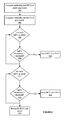
- Figure 5 is a flow chart illustrating one embodiment for creating the skewed value list for child1 and child2 (SVL1 and SVL2) in an example embodiment of the invention.
- the cardinality and most frequent values of child1 and child2 are computed.
- the cardinality and most frequent values of the join results are computed.
- a loop occurs where each most frequent value (MFV) in child1 is examined.
- the occurrence frequency of each MFV is compared to a threshold. When the occurrence frequency of the MFV is greater than the threshold the MFV is inserted into the first skewed value list (SVL1) in step 510. When the occurrence frequency of the MFV is less than the threshold flow returns to step 506.
- step 512 After each MFV in child1 has been examined, flow continues at step 512.
- a loop occurs where each most frequent value (MFV) in child2 is examined.
- the occurrence frequency of each MFV is compared to a threshold. When the occurrence frequency of the MFV is greater than the threshold the MFV is inserted into the second skewed value list (SVL2) in step 516. When the occurrence frequency of the MFV is less than the threshold flow returns to step 512.
- step 518 SLV1 and SLV2 are reconciled.
- the optimizer When choosing the plan for a particular join, the optimizer will examine the statistics for each of the join children. The optimizer will choose the standard partition-by-value scheme if statistics show no significant skew (i.e. both SVL1 and SVL2 are empty). On the other hand if skew is detected (i.e. either SVL1 or SVL2 is not empty), then the optimizer will insert a special distribution operator between the join and each of its children. Without loss of generality let us assume that the skewed values are detected on the left child. The left child skew list, SVL1, is then propagated to the left distribution operator as a list of special values to be uniformly distributed using a random or round-robin approach.
- the processing of skewed values at runtime is performed by the special distribution operators introduced during skew detection. Following the conventions used in skew detection, the operator on the left side of the join treats the values from SVL1 as skewed values from its side, and those in SVL2 as values that are matched by skewed values from the right side. Conversely, the distribution operator on the right side treats the values in SVL2 as skewed values from its side, and values from SVL1 as values that match skewed values on the left side.
- skewed values will be found on only one side of the join.
- a join column might be customer_id, joining a large fact table, ORDERS, where 20% of the rows have the value 'Unknown', but only one row in the dimension table CUSTOMER has that matching value.
- the distribution operator on the left which by convention processes the larger table, need be concerned only with skewed values from its own side of the join.
- the distribution operator on the right side need be concerned only with skewed values from the other side of the join.
- the runtime handling of skewed and non-skewed values is as follows.
- the left distribution operator builds a hash table of the skewed values from SVL1.
- the join column value is checked using this hash table. If the value is found then the record is sent to any of the CPUs using a uniform distribution scheme, for example round-robin or random. In this way, these rows are evenly distributed despite their skewed partitioning values. If the value is not found among the skewed values then the record is sent to the CPU assigned for this particular value based on the standard partition-by-value scheme.
- the overhead of detecting whether the row has a skewed value is minimal because the intermediate hash value obtained in the standard hashing scheme is used.
- the hash table is built such that non-skewed rows can be confirmed with one hash-table probe.
- the cost of detecting skewed rows can be easily controlled by increasing the size of the hash table as needed (recall that the number of skewed values cannot exceed a few hundred).
- the right distribution operator builds a hash table of the same set of skewed values, SVL1.
- records that have values matching skewed values from the hash table are replicated to all CPUs.
- this is necessary because the matching records on the left side were not partitioned-by-value but rather uniformly distributed and, hence, the right child distribution operator has no knowledge of the location of the matching records.
- the location of the matching records from the left side may be sent to the right child distribution operator.
- the records that have values matching skewed values from the hash table are replicated only to the CPU that received the skewed value.
- rows that have no matches in the skewed values table are partitioned based on the standard partition-by-value scheme. These records will find their matches since the matching left child records were partitioned identically.
- each distribution operator can build two hash tables: one for the skewed values from its side of the join (for the left side this is SVL1 and for the right side this is SVL2) and one for the skewed values from the other side (SVL2 for left, SVL1 for right). Then each distribution operator checks incoming rows against the table of its own side's skewed values and uniformly distributes those matching. Otherwise, the record is checked against the table of skewed values from the other side and the matches are replicated. Unmatched rows are distributed based on the join column(s) values. The handling of skew on both sides of the join is illustrated in Fig. 6 .
- Figure 6 is a flow chart illustrating one embodiment for distributing row data to the different join instances with skew on both sides of the join in an example embodiment of the invention.
- the input row is received.
- the skewed value list (SVL) for the current side is searched to determine if the column(s) value is present.
- the column value is distributed to one of the CPUs using a uniform distribution scheme in step 606.
- the skewed value list (SVL) for the other side is searched to determine if the column(s) value is present.
- the column value is replicated to all join instance or nodes in step 610.
- the column(s) value is not present, flow continues to step 612.
- the column(s) value is distributed to a CPU using a partitioning based distribution scheme.
Landscapes
- Engineering & Computer Science (AREA)
- Theoretical Computer Science (AREA)
- Computational Linguistics (AREA)
- Data Mining & Analysis (AREA)
- Databases & Information Systems (AREA)
- Physics & Mathematics (AREA)
- General Engineering & Computer Science (AREA)
- General Physics & Mathematics (AREA)
- Information Retrieval, Db Structures And Fs Structures Therefor (AREA)
- Multi Processors (AREA)
Claims (8)
- Procédé de création d'un ensemble de données jointes dans un système informatique comportant une pluralité d'unités de traitement centrales connectées entre elles (CPUs) et une mémoire stockant un ensemble de données d'entrée jointes, les étapes du procédé comprenant :- le classement (302) de l'ensemble de données d'entrée jointes en un ensemble de données à effet d'obliqueté élevé et un ensemble de données à effet d'obliqueté faible (302) pendant une phase d'optimisation de requête, l'ensemble de données à effet d'obliqueté élevé comprenant des rangées dans l'ensemble de données d'entrée jointes présentant une valeur de rangée jointe ayant une fréquence d'occurrence supérieure à une fréquence d'occurrence d'une valeur de rangée jointe pour les rangées de l'ensemble de données à effet d'obliqueté faible, et l'ensemble de données à effet d'obliqueté faible consistant dans le reste des rangées ;- au moment de l'exécution de la requête, la distribution de l'ensemble de données à effet d'obliqueté faible parmi la pluralité de CPUs, à l'aide d'un premier procédé de distribution (306), le premier procédé de distribution (306) étant un schéma de partition par valeur ;- au moment de l'exécution de la requête, la distribution de l'ensemble de données à effet d'obliqueté élevé parmi la pluralité de CPUs à l'aide d'un deuxième procédé de distribution (304), le deuxième procédé de distribution (304) étant un schéma de distribution uniforme ;dans lequel la pluralité de CPUs traite l'ensemble de données à effet d'obliqueté élevé et l'ensemble de données à effet d'obliqueté faible pour créer l'ensemble de données d'entrée jointes (308).
- Procédé selon la revendication 1, dans lequel les données à effet d'obliqueté élevé sont classées en comparant une fréquence d'occurrence d'une valeur de rangée jointe avec une valeur seuil, le seuil de sensibilité d'effet d'obliqueté étant calculé par SST = (CC/#CPU)*X, où CC est la cardinalité enfant, #CPU est le nombre de CPUs vers lesquels les données seront distribuées, et X est un facteur de réglage.
- Procédé selon la revendication 1, dans lequel le classement de l'ensemble de données d'entrée jointes comprend en outre :le calcul d'une cardinalité et d'un ensemble de valeurs les plus fréquentes, MFV1, pour un premier tableau join de la jointure (502) ;le calcul d'une cardinalité et d'un ensemble de valeurs les plus fréquentes, MFV2, pour un deuxième tableau join de la jointure (502) ;le calcul d'une cardinalité et d'un ensemble de valeurs les plus fréquentes pour un résultat de jointure (504) ;la comparaison d'une fréquence d'occurrence de chacune des MFV1 avec un seuil (508) ;lorsque la fréquence d'occurrence est supérieure au seuil (510), l'insertion de la MFV1 dans une première liste de valeurs à effet oblique (SVL1) ;la comparaison d'une fréquence d'occurrence de chacune des MFV2 avec un seuil (512) ; etlorsque la fréquence d'occurrence est supérieure au seuil (516), l'insertion de la MFV2 dans une deuxième liste de valeurs à effet oblique (SVL2) ;la conciliation de SVL1 avec SVL2 (518).
- Procédé selon la revendication 3, dans lequel la conciliation de SVL1 avec SVL2 comprend en outre :l'examen de SVL1 et de SVL2 quant à des valeurs en double ;lorsqu'une valeur en double est détectée,comparaison de la fréquence d'occurrence de la valeur en double dans SVL1 avec la fréquence d'occurrence de la valeur en double SVL2 ; etsuppression de la valeur en double présentant la fréquence d'occurrence la plus faible à partir de sa liste de valeurs à effet d'obliqueté.
- Procédé selon la revendication 1, dans lequel le deuxième procédé de distribution comprend :la distribution de rangées, à partir d'un premier côté de la jointure appartenant à l'ensemble de données à effet d'obliqueté élevé, sur une instance de jointure à l'aide d'un schéma de distribution uniforme (606) ;la reproduction de rangées, sur un deuxième côté de la jointure, correspondant à l'ensemble de données à effet d'obliqueté élevé à partir du premier côté de la jointure, vers toutes les instances de jointure (610) ;la distribution de rangées, à partir du deuxième côté de la jointure, appartenant à l'ensemble de données à effet d'obliqueté élevé, sur une instance de jointure à l'aide d'un schéma de distribution uniforme (606), etla reproduction de rangées, sur le premier côté de la jointure, correspondant à l'ensemble de données à effet d'obliqueté élevé à partir du deuxième côté de la jointure, vers toutes les instances de jointure.
- Produit logiciel informatique comprenant un support lisible par un processeur, le support comportant un code stocké sur ce dernier, lequel, lorsqu'il est exécuté par le processeur, met en oeuvre un procédé comprenant :- le classement (302) de l'ensemble de données d'entrée jointes en un ensemble de données à effet d'obliqueté élevé et un ensemble de données à effet d'obliqueté faible (302) pendant une phase d'optimisation de requête, l'ensemble de données à effet d'obliqueté élevé comprenant des rangées dans l'ensemble de données d'entrée jointes présentant une valeur de rangée jointe avec une fréquence d'occurrence supérieure à une fréquence d'occurrence d'une valeur de rangée jointe pour les rangées de l'ensemble de données à effet d'obliqueté faible, et l'ensemble de données à effet d'obliqueté faible consistant en le reste des rangées ;- au moment de l'exécution de la requête, la distribution de l'ensemble de données à effet d'obliqueté faible parmi la pluralité de CPUs, à l'aide d'un premier procédé de distribution (304), le premier procédé de distribution (304) étant un schéma de partition par valeur ;- au moment de l'exécution de la requête, la distribution de l'ensemble de données à effet d'obliqueté élevé parmi la pluralité de CPUs à l'aide d'un deuxième procédé de distribution (306), le deuxième procédé de distribution (306) étant un schéma de distribution uniforme ;dans lequel la pluralité de CPUs traite l'ensemble de données à effet d'obliqueté élevé et l'ensemble de données à effet d'obliqueté faible pour créer l'ensemble de données d'entrée jointes (308).
- Produit logiciel informatique selon la revendication 6, dans lequel les données à effet d'obliqueté élevé sont classées en comparant une fréquence d'occurrence d'une valeur de rangée jointe avec une valeur seuil, le seuil de sensibilité d'effet d'obliqueté étant calculé par SST = (CC/#CPU)*X, où CC est la cardinalité enfant, #CPU est le nombre de CPUs vers lesquels les données seront distribuées, et X est un facteur de réglage.
- Produit logiciel informatique selon la revendication 6, dans lequel le classement de l'ensemble de données d'entrée jointes comprend en outre :le calcul d'une cardinalité et d'un ensemble de valeurs les plus fréquentes, MFV1, pour un premier tableau joint de la jointure (502) ;le calcul d'une cardinalité et d'un ensemble de valeurs les plus fréquentes, MFV2, pour un deuxième tableau joint de la jointure (502) ;le calcul d'une cardinalité et d'un ensemble de valeurs les plus fréquentes pour un résultat de jointure (504) ;la comparaison d'une fréquence d'occurrence de chacune des MFV1 avec un seuil (508) ;lorsque la fréquence d'occurrence est supérieure au seuil (510), l'insertion de la MFV1 dans une première liste de valeurs à effet oblique (SVL1) ;la comparaison d'une fréquence d'occurrence de chacune des MFV2 avec un seuil (514) ; etlorsque la fréquence d'occurrence est supérieure au seuil (516), l'insertion de la MFV2 dans une deuxième liste de valeurs à effet oblique (SVL2) ;la conciliation de SVL1 avec SVL2 (518).
Applications Claiming Priority (1)
| Application Number | Priority Date | Filing Date | Title |
|---|---|---|---|
| US11/780,843 US8799272B2 (en) | 2007-07-20 | 2007-07-20 | Data skew insensitive parallel join scheme |
Publications (3)
| Publication Number | Publication Date |
|---|---|
| EP2017754A2 EP2017754A2 (fr) | 2009-01-21 |
| EP2017754A3 EP2017754A3 (fr) | 2009-11-11 |
| EP2017754B1 true EP2017754B1 (fr) | 2016-04-06 |
Family
ID=39885125
Family Applications (1)
| Application Number | Title | Priority Date | Filing Date |
|---|---|---|---|
| EP08252246.7A Active EP2017754B1 (fr) | 2007-07-20 | 2008-07-02 | Schéma de raccord en parallèle insensible à l'obliquité de données |
Country Status (2)
| Country | Link |
|---|---|
| US (2) | US8799272B2 (fr) |
| EP (1) | EP2017754B1 (fr) |
Families Citing this family (38)
| Publication number | Priority date | Publication date | Assignee | Title |
|---|---|---|---|---|
| US8078610B2 (en) * | 2008-03-26 | 2011-12-13 | Teradata Us, Inc. | Optimization technique for dealing with data skew on foreign key joins |
| US8131711B2 (en) * | 2008-05-22 | 2012-03-06 | Teradata Corporation | System, method, and computer-readable medium for partial redistribution, partial duplication of rows of parallel join operation on skewed data |
| US7941424B2 (en) * | 2008-05-30 | 2011-05-10 | Teradata Us, Inc. | System, method, and computer-readable medium for dynamic detection and management of data skew in parallel join operations |
| US8140522B2 (en) * | 2008-08-12 | 2012-03-20 | International Business Machines Corporation | Method, apparatus, and computer program product for adaptive query parallelism partitioning with look-ahead probing and feedback |
| US8150836B2 (en) * | 2008-08-19 | 2012-04-03 | Teradata Us, Inc. | System, method, and computer-readable medium for reducing row redistribution costs for parallel join operations |
| US8099409B2 (en) * | 2008-09-03 | 2012-01-17 | Teradata Us, Inc. | System, method, and computer-readable medium for duplication optimization for parallel join operations on similarly large skewed tables |
| US8533129B2 (en) * | 2008-09-16 | 2013-09-10 | Yahoo! Inc. | Efficient data layout techniques for fast machine learning-based document ranking |
| US8195644B2 (en) | 2008-10-06 | 2012-06-05 | Teradata Us, Inc. | System, method, and computer-readable medium for optimization of multiple parallel join operations on skewed data |
| US8234268B2 (en) * | 2008-11-25 | 2012-07-31 | Teradata Us, Inc. | System, method, and computer-readable medium for optimizing processing of distinct and aggregation queries on skewed data in a database system |
| US8510280B2 (en) * | 2009-06-30 | 2013-08-13 | Teradata Us, Inc. | System, method, and computer-readable medium for dynamic detection and management of data skew in parallel join operations |
| US9020910B2 (en) * | 2010-01-13 | 2015-04-28 | International Business Machines Corporation | Storing tables in a database system |
| EP2553604A4 (fr) * | 2010-03-30 | 2017-02-15 | Hewlett-Packard Enterprise Development LP | Système et procédé pour jointures externes sur un système de gestion de bases de données parallèles |
| US8868545B2 (en) * | 2011-12-29 | 2014-10-21 | Teradata Us, Inc. | Techniques for optimizing outer joins |
| GB2508223A (en) | 2012-11-26 | 2014-05-28 | Ibm | Estimating the size of a joined table in a database |
| GB2508603A (en) | 2012-12-04 | 2014-06-11 | Ibm | Optimizing the order of execution of multiple join operations |
| US20140214886A1 (en) | 2013-01-29 | 2014-07-31 | ParElastic Corporation | Adaptive multi-client saas database |
| US9311359B2 (en) | 2013-01-30 | 2016-04-12 | International Business Machines Corporation | Join operation partitioning |
| US9317548B2 (en) | 2013-01-30 | 2016-04-19 | International Business Machines Corporation | Reducing collisions within a hash table |
| US9171043B2 (en) * | 2013-01-31 | 2015-10-27 | International Business Machines Corporation | Dynamically determining join order |
| US9367556B2 (en) | 2013-06-14 | 2016-06-14 | International Business Machines Corporation | Hashing scheme using compact array tables |
| US9471710B2 (en) | 2013-06-14 | 2016-10-18 | International Business Machines Corporation | On-the-fly encoding method for efficient grouping and aggregation |
| US9305074B2 (en) * | 2013-06-19 | 2016-04-05 | Microsoft Technology Licensing, Llc | Skew-aware storage and query execution on distributed database systems |
| US9465840B2 (en) * | 2014-03-14 | 2016-10-11 | International Business Machines Corporation | Dynamically indentifying and preventing skewed partitions in a shared-nothing database |
| US9672248B2 (en) | 2014-10-08 | 2017-06-06 | International Business Machines Corporation | Embracing and exploiting data skew during a join or groupby |
| US10303654B2 (en) * | 2015-02-23 | 2019-05-28 | Futurewei Technologies, Inc. | Hybrid data distribution in a massively parallel processing architecture |
| US10650011B2 (en) | 2015-03-20 | 2020-05-12 | International Business Machines Corporation | Efficient performance of insert and point query operations in a column store |
| US10303791B2 (en) | 2015-03-20 | 2019-05-28 | International Business Machines Corporation | Efficient join on dynamically compressed inner for improved fit into cache hierarchy |
| US9922064B2 (en) | 2015-03-20 | 2018-03-20 | International Business Machines Corporation | Parallel build of non-partitioned join hash tables and non-enforced N:1 join hash tables |
| US10831736B2 (en) | 2015-03-27 | 2020-11-10 | International Business Machines Corporation | Fast multi-tier indexing supporting dynamic update |
| US10108653B2 (en) | 2015-03-27 | 2018-10-23 | International Business Machines Corporation | Concurrent reads and inserts into a data structure without latching or waiting by readers |
| US10545965B2 (en) | 2015-09-25 | 2020-01-28 | Microsoft Technology Licensing, Llc | Data skew finding and analysis |
| CN106815258B (zh) * | 2015-11-27 | 2020-01-17 | 华为技术有限公司 | 一种数据存储方法和协调节点 |
| US10698732B2 (en) | 2016-07-19 | 2020-06-30 | Sap Se | Page ranking in operating system virtual pages in hybrid memory systems |
| US10783146B2 (en) | 2016-07-19 | 2020-09-22 | Sap Se | Join operations in hybrid main memory systems |
| US11977484B2 (en) | 2016-07-19 | 2024-05-07 | Sap Se | Adapting in-memory database in hybrid memory systems and operating system interface |
| US11010379B2 (en) * | 2017-08-15 | 2021-05-18 | Sap Se | Increasing performance of in-memory databases using re-ordered query execution plans |
| US10713096B2 (en) * | 2018-10-18 | 2020-07-14 | Beijing Jingdong Shangke Information Technology Co., Ltd. | System and method for handling data skew at run time |
| WO2023132917A1 (fr) * | 2022-01-05 | 2023-07-13 | Jpmorgan Chase Bank, N.A. | Procédé et système pour faciliter une résolution d'entité distribuée |
Family Cites Families (8)
| Publication number | Priority date | Publication date | Assignee | Title |
|---|---|---|---|---|
| US5121494A (en) * | 1989-10-05 | 1992-06-09 | Ibm Corporation | Joining two database relations on a common field in a parallel relational database field |
| US5873074A (en) | 1997-04-18 | 1999-02-16 | Informix Software, Inc. | Applying distinct hash-join distributions of operators to both even and uneven database records |
| US6112198A (en) | 1997-06-30 | 2000-08-29 | International Business Machines Corporation | Optimization of data repartitioning during parallel query optimization |
| US5987468A (en) * | 1997-12-12 | 1999-11-16 | Hitachi America Ltd. | Structure and method for efficient parallel high-dimensional similarity join |
| US7203685B2 (en) * | 2003-12-11 | 2007-04-10 | International Business Machines Corporation | Apparatus and method for estimating cardinality when data skew is present |
| US20050131893A1 (en) * | 2003-12-15 | 2005-06-16 | Sap Aktiengesellschaft | Database early parallelism method and system |
| US20080183684A1 (en) * | 2007-01-26 | 2008-07-31 | Bestgen Robert J | Caching an Access Plan for a Query |
| US8078610B2 (en) * | 2008-03-26 | 2011-12-13 | Teradata Us, Inc. | Optimization technique for dealing with data skew on foreign key joins |
-
2007
- 2007-07-20 US US11/780,843 patent/US8799272B2/en active Active
-
2008
- 2008-07-02 EP EP08252246.7A patent/EP2017754B1/fr active Active
-
2012
- 2012-01-23 US US13/356,056 patent/US9348869B2/en active Active
Also Published As
| Publication number | Publication date |
|---|---|
| EP2017754A3 (fr) | 2009-11-11 |
| US20120117055A1 (en) | 2012-05-10 |
| US8799272B2 (en) | 2014-08-05 |
| US20090024568A1 (en) | 2009-01-22 |
| US9348869B2 (en) | 2016-05-24 |
| EP2017754A2 (fr) | 2009-01-21 |
Similar Documents
| Publication | Publication Date | Title |
|---|---|---|
| US8799272B2 (en) | Data skew insensitive parallel join scheme | |
| US8812484B2 (en) | System and method for outer joins on a parallel database management system | |
| CN113711197B (zh) | 查询计划中自适应聚合操作符和属性的放置 | |
| US20260099503A1 (en) | Interactive identification of similar sql queries | |
| US10691646B2 (en) | Split elimination in mapreduce systems | |
| US20080263001A1 (en) | System and method for automating data partitioning in a parallel database | |
| WO2016107497A1 (fr) | Procédé et appareil de tri évolutif d'ensemble de données | |
| Kunft et al. | BlockJoin: Efficient Matrix Partitioning Through Joins. | |
| Herschel et al. | Scalable iterative graph duplicate detection | |
| Moharram et al. | Optimizing ADWIN for steady streams | |
| Mohamed et al. | Hash semi cascade join for joining multi-way map reduce | |
| US10678811B2 (en) | Inter-table parallel refresh maximizer | |
| Gawwad et al. | Frequent itemset mining for big data using greatest common divisor technique | |
| Nikitopoulos et al. | Parallel and distributed processing of reverse top-k queries | |
| CN119149811A (zh) | 一种规则引擎处理方法及系统 | |
| Saleem | Storage, indexing, query processing, and benchmarking in centralized and distributed RDF engines: a survey | |
| Khafagy | Indexed map-reduce join algorithm | |
| US8005820B2 (en) | Optimizing the processing of in-list rows | |
| US7752612B2 (en) | Method, apparatus and program storage device for determining an optimal number of tasks during reorganization of a database system with memory and processor constraints | |
| JP2836103B2 (ja) | 関係データベースの限定述語処理方法 | |
| Kurunji et al. | Optimizing aggregate query processing in cloud data warehouses | |
| Asiri et al. | Non-recursive approach for sort-merge join operation | |
| Sugiura et al. | Grouping methods for pattern matching in probabilistic data streams | |
| Prakash et al. | Fin Algorithm for Generating Frequent Itemset in Big Data | |
| Adhikari et al. | Synthesizing Exceptional Patterns in Different Data Sources |
Legal Events
| Date | Code | Title | Description |
|---|---|---|---|
| PUAI | Public reference made under article 153(3) epc to a published international application that has entered the european phase |
Free format text: ORIGINAL CODE: 0009012 |
|
| AK | Designated contracting states |
Kind code of ref document: A2 Designated state(s): AT BE BG CH CY CZ DE DK EE ES FI FR GB GR HR HU IE IS IT LI LT LU LV MC MT NL NO PL PT RO SE SI SK TR |
|
| AX | Request for extension of the european patent |
Extension state: AL BA MK RS |
|
| PUAL | Search report despatched |
Free format text: ORIGINAL CODE: 0009013 |
|
| AK | Designated contracting states |
Kind code of ref document: A3 Designated state(s): AT BE BG CH CY CZ DE DK EE ES FI FR GB GR HR HU IE IS IT LI LT LU LV MC MT NL NO PL PT RO SE SI SK TR |
|
| AX | Request for extension of the european patent |
Extension state: AL BA MK RS |
|
| 17P | Request for examination filed |
Effective date: 20100511 |
|
| AKX | Designation fees paid |
Designated state(s): DE FR GB |
|
| 17Q | First examination report despatched |
Effective date: 20120727 |
|
| GRAP | Despatch of communication of intention to grant a patent |
Free format text: ORIGINAL CODE: EPIDOSNIGR1 |
|
| INTG | Intention to grant announced |
Effective date: 20151006 |
|
| GRAS | Grant fee paid |
Free format text: ORIGINAL CODE: EPIDOSNIGR3 |
|
| GRAA | (expected) grant |
Free format text: ORIGINAL CODE: 0009210 |
|
| AK | Designated contracting states |
Kind code of ref document: B1 Designated state(s): DE FR GB |
|
| REG | Reference to a national code |
Ref country code: GB Ref legal event code: FG4D |
|
| REG | Reference to a national code |
Ref country code: DE Ref legal event code: R096 Ref document number: 602008043285 Country of ref document: DE |
|
| RAP2 | Party data changed (patent owner data changed or rights of a patent transferred) |
Owner name: HEWLETT PACKARD ENTERPRISE DEVELOPMENT L.P. |
|
| REG | Reference to a national code |
Ref country code: DE Ref legal event code: R081 Ref document number: 602008043285 Country of ref document: DE Owner name: HEWLETT PACKARD ENTERPRISE DEVELOPMENT LP, HOU, US Free format text: FORMER OWNER: HEWLETT PACKARD DEVELOPMENT COMPANY, L.P., HOUSTON, TEX., US |
|
| REG | Reference to a national code |
Ref country code: DE Ref legal event code: R097 Ref document number: 602008043285 Country of ref document: DE |
|
| PLBE | No opposition filed within time limit |
Free format text: ORIGINAL CODE: 0009261 |
|
| STAA | Information on the status of an ep patent application or granted ep patent |
Free format text: STATUS: NO OPPOSITION FILED WITHIN TIME LIMIT |
|
| 26N | No opposition filed |
Effective date: 20170110 |
|
| GBPC | Gb: european patent ceased through non-payment of renewal fee |
Effective date: 20160706 |
|
| PG25 | Lapsed in a contracting state [announced via postgrant information from national office to epo] |
Ref country code: FR Free format text: LAPSE BECAUSE OF NON-PAYMENT OF DUE FEES Effective date: 20160801 |
|
| REG | Reference to a national code |
Ref country code: FR Ref legal event code: ST Effective date: 20170331 |
|
| PG25 | Lapsed in a contracting state [announced via postgrant information from national office to epo] |
Ref country code: GB Free format text: LAPSE BECAUSE OF NON-PAYMENT OF DUE FEES Effective date: 20160706 |
|
| REG | Reference to a national code |
Ref country code: DE Ref legal event code: R079 Ref document number: 602008043285 Country of ref document: DE Free format text: PREVIOUS MAIN CLASS: G06F0017300000 Ipc: G06F0016000000 |
|
| REG | Reference to a national code |
Ref country code: DE Ref legal event code: R082 Ref document number: 602008043285 Country of ref document: DE Representative=s name: HL KEMPNER PATENTANWALT, RECHTSANWALT, SOLICIT, DE Ref country code: DE Ref legal event code: R081 Ref document number: 602008043285 Country of ref document: DE Owner name: HEWLETT PACKARD ENTERPRISE DEVELOPMENT LP, SPR, US Free format text: FORMER OWNER: HEWLETT PACKARD ENTERPRISE DEVELOPMENT LP, HOUSTON, TEX., US Ref country code: DE Ref legal event code: R082 Ref document number: 602008043285 Country of ref document: DE Representative=s name: MARKS & CLERK (LUXEMBOURG) LLP, LU Ref country code: DE Ref legal event code: R082 Ref document number: 602008043285 Country of ref document: DE Representative=s name: HL KEMPNER PATENTANWAELTE, SOLICITORS (ENGLAND, DE Ref country code: DE Ref legal event code: R082 Ref document number: 602008043285 Country of ref document: DE Representative=s name: HL KEMPNER PARTG MBB, DE |
|
| REG | Reference to a national code |
Ref country code: DE Ref legal event code: R082 Ref document number: 602008043285 Country of ref document: DE Representative=s name: HL KEMPNER PATENTANWALT, RECHTSANWALT, SOLICIT, DE Ref country code: DE Ref legal event code: R082 Ref document number: 602008043285 Country of ref document: DE Representative=s name: HL KEMPNER PATENTANWAELTE, SOLICITORS (ENGLAND, DE Ref country code: DE Ref legal event code: R082 Ref document number: 602008043285 Country of ref document: DE Representative=s name: HL KEMPNER PARTG MBB, DE |
|
| PGFP | Annual fee paid to national office [announced via postgrant information from national office to epo] |
Ref country code: DE Payment date: 20250728 Year of fee payment: 18 |