EP2017761A2 - Malware-Scanner für RFID-Etiketten - Google Patents
Malware-Scanner für RFID-Etiketten Download PDFInfo
- Publication number
- EP2017761A2 EP2017761A2 EP08011299A EP08011299A EP2017761A2 EP 2017761 A2 EP2017761 A2 EP 2017761A2 EP 08011299 A EP08011299 A EP 08011299A EP 08011299 A EP08011299 A EP 08011299A EP 2017761 A2 EP2017761 A2 EP 2017761A2
- Authority
- EP
- European Patent Office
- Prior art keywords
- data
- malware
- tag
- rfid
- file
- Prior art date
- Legal status (The legal status is an assumption and is not a legal conclusion. Google has not performed a legal analysis and makes no representation as to the accuracy of the status listed.)
- Withdrawn
Links
Images
Classifications
-
- G—PHYSICS
- G06—COMPUTING OR CALCULATING; COUNTING
- G06F—ELECTRIC DIGITAL DATA PROCESSING
- G06F21/00—Security arrangements for protecting computers, components thereof, programs or data against unauthorised activity
- G06F21/50—Monitoring users, programs or devices to maintain the integrity of platforms, e.g. of processors, firmware or operating systems
- G06F21/57—Certifying or maintaining trusted computer platforms, e.g. secure boots or power-downs, version controls, system software checks, secure updates or assessing vulnerabilities
-
- G—PHYSICS
- G06—COMPUTING OR CALCULATING; COUNTING
- G06F—ELECTRIC DIGITAL DATA PROCESSING
- G06F21/00—Security arrangements for protecting computers, components thereof, programs or data against unauthorised activity
- G06F21/50—Monitoring users, programs or devices to maintain the integrity of platforms, e.g. of processors, firmware or operating systems
- G06F21/55—Detecting local intrusion or implementing counter-measures
- G06F21/56—Computer malware detection or handling, e.g. anti-virus arrangements
Definitions
- RFID tags In the field of RFID technology, a new category of threats has arisen wherein 'hackers' or criminals cause valid RFID tags to behave in unexpected (and generally malicious) manners.
- computer-bound or mobile RFID readers query RFID tags for their unique identifier or on-tag data, which often serves as a database key or launches some real-world activity. For example, when an RFID reader at a supermarket checkout counter reads the tag on a product, the software driving it could add the item scanned to the list of the customer's purchases, tallying up the total after all products have been scanned.
- an RFID tag can be (intentionally) infected with a virus and this virus can infect a backend database used by the RFID software. From there it can be easily spread to other RFID tags.
- Some airports are planning to expedite baggage handling by attaching RFID-augmented labels to the suitcases as they are checked in. This makes the labels easier to read at greater distances than the current bar-coded baggage labels.
- a malicious traveler who attaches a tiny RFID tag, pre-initialized with a virus, to a random person's suitcase before the person checks it in.
- the baggage-handling system's RFID reader scans the suitcase at a Y-junction in the conveyor-belt system to determine where to route it, the tag responds with the RFID virus, which could infect the airport's baggage database. Then, all RFID tags produced as new passengers check in later in the day may also be infected.
- the general outline of the problem is that when an unsuspecting reader scans an infected tag, there is a danger of the tag exploiting a vulnerability in the system's middleware to cause unwanted actions to occur, which may include infecting the database.
- RFID malware Malware is short for malicious software, whose main purpose is to break into and disrupt computer systems.
- RFID malware is malware that is transmitted and executed via an RFID tag.
- RFID exploit is malicious RFID tag data that 'exploits' some part of the RFID system that encounters it.
- RFID systems are susceptible to hacker attacks, just like conventional computing systems. When an RFID reader scans a tag, it expects to get back information in a certain format. However, a malicious person can write carefully crafted data whose format and content is so unexpected that it can corrupt the RFID reader's software and potentially its database as well.
- An RFID worm is an RFID-based exploit that abuses a network connection to achieve self-replication.
- RFID worms may propagate by exploiting online RFID services, but can also spread via RFID tags.
- the RFID worm code causes unsuspecting RFID servers to download and execute some file from a remote location. This file then proceeds to compromise the RFID middleware server in the same fashion as most Internet-based malware.
- the worm infected RFID software can then 'infect' new RFID tags by overwriting their data with a copy of the RFID worm code.
- An RFID virus is an RFID-based exploit that autonomously self-replicates its code to new RFID tags, without requiring a network connection.
- RFID technology presents a vulnerability to an enterprise as it allows an RFID virus to circumvent traditional defenses against traditional virus entry points (e.g., firewalls, email scanners).
- RFID viruses may or may not have a payload, which modifies or disrupts the workings of the back-end RFID system. Once the newly-infected RFID tags are sent on their way, they infect other RFID systems (assuming use of the same software system). These RFID systems then infect other RFID tags, which infect other RFID software systems, etc.
- RFID middleware systems generally use a database to store information that is read from tags and written to them. If the middleware does not treat the data read from the tag correctly, it may be possible to cause the database to execute SQL code that is stored on the tag. This is known as 'SQL injection'.
- the tag's data should not be interpreted as code, but programming errors in the middleware may make it possible. If the middleware inserts the data in an SQL query, without escaping it properly, the data can modify the query. Usually, this involves including a quote in the data, which is interpreted by the SQL parser as ending a section of data and starting the next section of code. The data following the quote is then interpreted as code.
- the code that ties the RFID reader interface to the middleware is likely to be written in a low-level language such as C or C++. A system executing any code written in such a language may be vulnerable to buffer overflows.
- RFID tags with their limited memory could cause a buffer overflow, but this may still be possible if the middleware expects to read only small amounts of data.
- Most RFID tags include information on the amount of memory they contain. If an RFID reader uses this information to determine the amount of data to read, it may read more data than expected, causing its buffer to overflow. Simply using fixed-size tags is not sufficient to prevent buffer overflows, as attackers may introduce unauthorized tags.
- the invention provides a system and method as defined in the independent claims for providing the capability to detect malware and isolate it from an RFID system.
- data stored on an RFID tag is read and scanned to detect malware in the data.
- the data is scanned for executable code, SQL, a mismatch between expected or declared and actual format and/or data length, and for rule-based data defined by a set of rules, to determine the presence of said possible malware.
- any suspected malware is detected, then the data is stored in a quarantine file in reader memory.
- the data isolated in the quarantine file may be flagged with a corrupted-tag indicator to indicate the presence of suspected said malware, or a corrupted-tag indicator may be stored in the quarantine file in lieu of the data read from the tag.
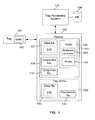
- Figure 1 is a diagram showing an exemplary RFID reader incorporating a virus scanner in accordance with the present system
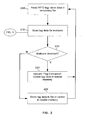
- Figure 2 is a flowchart showing an exemplary set of steps performed in one embodiment of the present system.
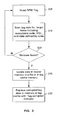
- Figure 3 is flowchart showing an exemplary set of steps performed in detecting malware, in one embodiment of the present system.
- FIG 1 is a diagram showing an exemplary RFID reader 103 incorporating a malware scanner in accordance with the present system.
- the system in which the present malware scanner operates includes a reader 103, an RFID tag 101 containing data stored therein, and an optional tag processing system 115, which may be middleware containing the logic for a particular RFID application, or a backend database system (e.g., Oracle, SQL Server, Postgres, MySQL) for storing tag data. If present, tag data that has been scanned and found to be free of malware may be stored in database 109.
- a backend database system e.g., Oracle, SQL Server, Postgres, MySQL
- RFID reader 103 includes reader main memory 111 and optional tag cache memory 106, both of which are collectively referred to herein as "reader memory”.
- reader main memory 111 includes malware scanner (software) 104, temporary file (or other temporary data storage area) 110, quarantine file 108, and a data file 107 for storing tag data that has been scanned for malware.
- a 'tag corrupted' indicator 115 may be stored in data file 107 to indicate the presence of suspected malware in data 102 read from tag 101.
- the tag corrupted indicator 115 may either replace the suspected malware-containing data in file 107, or the indicator 115 may be stored in file 107 in addition to the data read from tag 101.
- reader 103 includes tag cache memory 106, which may contain quarantine file 112 and data file 113, which respectively replace quarantine file 108 and data file 107.
- tag corrupted indicator 115 may be stored in data file 113 to indicate the presence of suspected malware in data 102 read from tag 101.
- the tag corrupted indicator 115 may either replace the suspected malware-containing data in file 113, or the indicator 115 may be stored in file 113 in addition to the data read from tag 101.
- FIG. 2 is a flowchart showing an exemplary set of steps performed in one embodiment of the present system.
- reader 103 reads an RFID tag and, in one embodiment, stores the data in a temporary file 110 in reader memory 111 or 106.
- reader 103 scans the tag data stored in file 110 for malware, as described below in detail with respect to Figure 3 . If any suspected malware is detected in the stored data [step 215], then the tag data is isolated in reader memory in a quarantine file 108 or 112 in respective tag memory 111 or tag cache memory 106, at step 220.
- a 'tag corrupted' indicator with tag identification information, either replaces the corrupted tag data, or is stored, in addition to the data read from tag 101, in memory 111 or in tag cache 106 along with the tag data 102. If the tag data is found to be free of malware, then, at step 225, the data is stored in data file 107, or in data file 113 in tag cache memory 106, if present. Tag processing resumes at step 225 when the next tag is read.
- FIG. 3 is flowchart showing an exemplary set of steps performed in detecting malware, in one embodiment of the present system.
- reader 103 reads data 102 stored in an RFID tag 101.
- the data 102 is then scanned for target items including executable code, SQL, a memory or format mismatch, and data defined by rules 114.
- malware scanner software 104 does not transfer that tag data from the tag to other readers or other system components, but instead, quarantines (isolates) the data/detected malware in reader memory. Malware may also present itself as a mismatch between (a) the expected tag data format or length or the declared tag format or length, and (b) the actual tag data format or length. Such mismatches can inadvertently or purposefully cause a buffer overflow in a downstream system (a 'buffer overflow exploit').
- step 320 if no malware is detected, then tag processing continues with the next tag to be read. If malware is detected at step 320, then, at step 325, the data containing detected malware may be quarantined and/or modified, in quarantine file 108 in reader memory 111 or in file 112 in tag cache memory 106, to prevent execution of the malware. At step 330, corrupted tag data in memory or tag cache may optionally be flagged with a 'tag corrupted' indicator 115 or the like.
Landscapes
- Engineering & Computer Science (AREA)
- Computer Security & Cryptography (AREA)
- Computer Hardware Design (AREA)
- General Engineering & Computer Science (AREA)
- Software Systems (AREA)
- Theoretical Computer Science (AREA)
- General Physics & Mathematics (AREA)
- Physics & Mathematics (AREA)
- Health & Medical Sciences (AREA)
- General Health & Medical Sciences (AREA)
- Virology (AREA)
- Storage Device Security (AREA)
- Information Retrieval, Db Structures And Fs Structures Therefor (AREA)
- Automatic Analysis And Handling Materials Therefor (AREA)
Applications Claiming Priority (1)
| Application Number | Priority Date | Filing Date | Title |
|---|---|---|---|
| US11/766,621 US20080022160A1 (en) | 2005-12-30 | 2007-06-21 | Malware scanner for rfid tags |
Publications (2)
| Publication Number | Publication Date |
|---|---|
| EP2017761A2 true EP2017761A2 (de) | 2009-01-21 |
| EP2017761A3 EP2017761A3 (de) | 2009-02-11 |
Family
ID=39876254
Family Applications (1)
| Application Number | Title | Priority Date | Filing Date |
|---|---|---|---|
| EP08011299A Withdrawn EP2017761A3 (de) | 2007-06-21 | 2008-06-20 | Malware-Scanner für RFID-Etiketten |
Country Status (2)
| Country | Link |
|---|---|
| US (1) | US20080022160A1 (de) |
| EP (1) | EP2017761A3 (de) |
Cited By (1)
| Publication number | Priority date | Publication date | Assignee | Title |
|---|---|---|---|---|
| CN108363925A (zh) * | 2018-03-16 | 2018-08-03 | 北京奇虎科技有限公司 | 网页挖矿脚本的识别方法及装置 |
Families Citing this family (19)
| Publication number | Priority date | Publication date | Assignee | Title |
|---|---|---|---|---|
| WO2009003059A1 (en) * | 2007-06-25 | 2008-12-31 | Google Inc. | Zero-hour quarantine of suspect electronic messages |
| US10977965B2 (en) | 2010-01-29 | 2021-04-13 | Avery Dennison Retail Information Services, Llc | Smart sign box using electronic interactions |
| EP3133579B1 (de) | 2010-01-29 | 2020-03-04 | Avery Dennison Corporation | Intelligente schilderbox mit elektronischen interaktionen |
| EP2751979B1 (de) | 2011-09-01 | 2020-02-26 | Avery Dennison Corporation | System und verfahren für konsumentenverfolgung |
| EP2756438B1 (de) * | 2011-09-13 | 2020-11-11 | Facebook, Inc. | Software-kryptoprozessor |
| US8630908B2 (en) | 2011-11-02 | 2014-01-14 | Avery Dennison Corporation | Distributed point of sale, electronic article surveillance, and product information system, apparatus and method |
| US20140207136A1 (en) * | 2012-05-04 | 2014-07-24 | St. Jude Medical, Inc. | Multiple staggered electrodes connected via flexible joints |
| WO2014039089A1 (en) | 2012-09-10 | 2014-03-13 | Avery Dennison Corporation | Method for preventing unauthorized diversion of nfc tags |
| EP3214572B1 (de) * | 2012-10-18 | 2020-01-29 | Avery Dennison Corporation | System und vorrichtung für nfc-sicherheit |
| US9767329B2 (en) | 2012-11-19 | 2017-09-19 | Avery Dennison Retail Information Services, Llc | NFC tags with proximity detection |
| JP6259601B2 (ja) * | 2013-07-25 | 2018-01-10 | 任天堂株式会社 | 情報処理装置、情報処理システム、情報処理方法及びコンピュータプログラム |
| US9477603B2 (en) | 2013-09-05 | 2016-10-25 | Facebook, Inc. | System and method for partitioning of memory units into non-conflicting sets |
| US9983894B2 (en) | 2013-09-25 | 2018-05-29 | Facebook, Inc. | Method and system for providing secure system execution on hardware supporting secure application execution |
| US10049048B1 (en) | 2013-10-01 | 2018-08-14 | Facebook, Inc. | Method and system for using processor enclaves and cache partitioning to assist a software cryptoprocessor |
| US9747450B2 (en) | 2014-02-10 | 2017-08-29 | Facebook, Inc. | Attestation using a combined measurement and its constituent measurements |
| US9734092B2 (en) | 2014-03-19 | 2017-08-15 | Facebook, Inc. | Secure support for I/O in software cryptoprocessor |
| US10241856B2 (en) * | 2016-09-09 | 2019-03-26 | Oracle International Corporation | Memory quarantine |
| CN110086827B (zh) * | 2019-05-14 | 2021-11-02 | 重庆商勤科技有限公司 | 一种sql注入校验方法、服务器以及系统 |
| US12481567B2 (en) | 2023-02-28 | 2025-11-25 | Oracle International Corporation | System and method of providing system availability by preventing software crash due to recovery failure |
Family Cites Families (72)
| Publication number | Priority date | Publication date | Assignee | Title |
|---|---|---|---|---|
| US3842350A (en) * | 1972-12-26 | 1974-10-15 | Gen Electric | Combined land line and satellite communication switching system |
| GB1558678A (en) * | 1975-08-14 | 1980-01-09 | Nippon Electric Co | Fm-to am or am-to-am carrier converters |
| GB2197107B (en) * | 1986-11-03 | 1990-12-12 | Mars Inc | Data-storing devices |
| DE69316958T2 (de) * | 1992-11-06 | 1998-08-13 | Texas Instruments Deutschland | Anordnung für Multi-Abfrage, Datenkommunikation und Antwort |
| CA2103288C (en) * | 1992-11-18 | 2004-08-17 | Michael John Camille Marsh | Detection of multiple articles |
| US5751220A (en) * | 1995-07-14 | 1998-05-12 | Sensormatic Electronics Corporation | Synchronized network of electronic devices including back-up master units |
| US6078251A (en) * | 1996-03-27 | 2000-06-20 | Intermec Ip Corporation | Integrated multi-meter and wireless communication link |
| US5929779A (en) * | 1996-05-31 | 1999-07-27 | Lucent Technologies Inc. | Read/write protocol for radio frequency identification tags |
| US5745037A (en) * | 1996-06-13 | 1998-04-28 | Northrop Grumman Corporation | Personnel monitoring tag |
| US5887176A (en) * | 1996-06-28 | 1999-03-23 | Randtec, Inc. | Method and system for remote monitoring and tracking of inventory |
| US5777561A (en) * | 1996-09-30 | 1998-07-07 | International Business Machines Corporation | Method of grouping RF transponders |
| AU5426298A (en) * | 1996-10-17 | 1998-05-11 | Pinpoint Corporation | Article tracking system |
| US6107910A (en) * | 1996-11-29 | 2000-08-22 | X-Cyte, Inc. | Dual mode transmitter/receiver and decoder for RF transponder tags |
| US5952922A (en) * | 1996-12-31 | 1999-09-14 | Lucent Technologies Inc. | In-building modulated backscatter system |
| US5920261A (en) * | 1996-12-31 | 1999-07-06 | Design Vision Inc. | Methods and apparatus for tracking and displaying objects |
| US6142339A (en) * | 1998-01-16 | 2000-11-07 | 1263152 Ontario Inc. | Aerosol dispensing device |
| US6539422B1 (en) * | 1998-05-04 | 2003-03-25 | Intermec Ip Corp. | Automatic data collection device having a network communications capability |
| EP0993652B1 (de) * | 1998-05-05 | 2006-10-11 | Koninklijke Philips Electronics N.V. | Datenträger mit korrekturmöglichkeiten und verbesserter spannungsbegrenzungsmöglichkeit |
| US6420961B1 (en) * | 1998-05-14 | 2002-07-16 | Micron Technology, Inc. | Wireless communication systems, interfacing devices, communication methods, methods of interfacing with an interrogator, and methods of operating an interrogator |
| US6509828B2 (en) * | 1998-07-30 | 2003-01-21 | Prc Inc. | Interrogating tags on multiple frequencies and synchronizing databases using transferable agents |
| US6192222B1 (en) * | 1998-09-03 | 2001-02-20 | Micron Technology, Inc. | Backscatter communication systems, interrogators, methods of communicating in a backscatter system, and backscatter communication methods |
| US6182214B1 (en) * | 1999-01-08 | 2001-01-30 | Bay Networks, Inc. | Exchanging a secret over an unreliable network |
| US6317027B1 (en) * | 1999-01-12 | 2001-11-13 | Randy Watkins | Auto-tunning scanning proximity reader |
| US6677852B1 (en) * | 1999-09-22 | 2004-01-13 | Intermec Ip Corp. | System and method for automatically controlling or configuring a device, such as an RFID reader |
| US6259367B1 (en) * | 1999-09-28 | 2001-07-10 | Elliot S. Klein | Lost and found system and method |
| US7411921B2 (en) * | 1999-10-21 | 2008-08-12 | Rf Technologies, Inc. | Method and apparatus for integrating wireless communication and asset location |
| DE60023561T2 (de) * | 1999-12-03 | 2006-07-27 | Tagsys S.A. | Elektronisches etikettenlesesystem |
| US6496806B1 (en) * | 1999-12-16 | 2002-12-17 | Samsys Technologies Inc. | Method and system for tracking clustered items |
| US6617962B1 (en) * | 2000-01-06 | 2003-09-09 | Samsys Technologies Inc. | System for multi-standard RFID tags |
| US20030055667A1 (en) * | 2000-02-23 | 2003-03-20 | Flavio Sgambaro | Information system and method |
| US6307517B1 (en) * | 2000-06-13 | 2001-10-23 | Applied Wireless Identifications Group, Inc. | Metal compensated radio frequency identification reader |
| US20020036569A1 (en) * | 2000-08-14 | 2002-03-28 | Martin Philip John | Tag and receiver systems |
| US7035932B1 (en) * | 2000-10-27 | 2006-04-25 | Eric Morgan Dowling | Federated multiprotocol communication |
| US6526264B2 (en) * | 2000-11-03 | 2003-02-25 | Cognio, Inc. | Wideband multi-protocol wireless radio transceiver system |
| US6717516B2 (en) * | 2001-03-08 | 2004-04-06 | Symbol Technologies, Inc. | Hybrid bluetooth/RFID based real time location tracking |
| US7155011B2 (en) * | 2001-03-13 | 2006-12-26 | Victor Company Of Japan, Limited | Encryption method, decryption method, and recording and reproducing apparatus |
| US7303120B2 (en) * | 2001-07-10 | 2007-12-04 | American Express Travel Related Services Company, Inc. | System for biometric security using a FOB |
| US7367020B2 (en) * | 2001-07-27 | 2008-04-29 | Raytheon Company | Executable radio software system and method |
| DE60236094D1 (de) * | 2001-08-13 | 2010-06-02 | Univ R | Systeme und Verfahren zur Verschlüsselung auf Identitätsbasis und damit zusammenhängende kryptografische Techniken |
| US6843415B2 (en) * | 2002-01-11 | 2005-01-18 | Sap Atkiengesellschaft | Event-based communication in a distributed item tracking system |
| US7565108B2 (en) * | 2002-03-26 | 2009-07-21 | Nokia Corporation | Radio frequency identification (RF-ID) based discovery for short range radio communication with reader device having transponder functionality |
| US7075412B1 (en) * | 2002-05-30 | 2006-07-11 | Thingmagic L.L.C. | Methods and apparatus for operating a radio device |
| CN100534026C (zh) * | 2002-06-26 | 2009-08-26 | 诺基亚有限公司 | 基于蓝牙rf的rf标记读/写站 |
| US7091860B2 (en) * | 2002-08-08 | 2006-08-15 | Neology, Inc. | Multi-frequency identification device |
| US7274909B2 (en) * | 2002-10-31 | 2007-09-25 | Nokia Corporation | Method and system for selecting data items for service requests |
| US7066388B2 (en) * | 2002-12-18 | 2006-06-27 | Symbol Technologies, Inc. | System and method for verifying RFID reads |
| US7023341B2 (en) * | 2003-02-03 | 2006-04-04 | Ingrid, Inc. | RFID reader for a security network |
| US7571321B2 (en) * | 2003-03-14 | 2009-08-04 | Voltage Security, Inc. | Identity-based-encryption messaging system |
| US7243849B2 (en) * | 2003-04-07 | 2007-07-17 | Silverbrook Research Pty Ltd | Handheld coded data reader |
| US6903656B1 (en) * | 2003-05-27 | 2005-06-07 | Applied Wireless Identifications Group, Inc. | RFID reader with multiple antenna selection and automated antenna matching |
| US20050036620A1 (en) * | 2003-07-23 | 2005-02-17 | Casden Martin S. | Encryption of radio frequency identification tags |
| US20050116813A1 (en) * | 2003-08-19 | 2005-06-02 | Ramesh Raskar | Radio and optical identification tags |
| US7148803B2 (en) * | 2003-10-24 | 2006-12-12 | Symbol Technologies, Inc. | Radio frequency identification (RFID) based sensor networks |
| US7026935B2 (en) * | 2003-11-10 | 2006-04-11 | Impinj, Inc. | Method and apparatus to configure an RFID system to be adaptable to a plurality of environmental conditions |
| US20050105600A1 (en) * | 2003-11-14 | 2005-05-19 | Okulus Networks Inc. | System and method for location tracking using wireless networks |
| US7197279B2 (en) * | 2003-12-31 | 2007-03-27 | Wj Communications, Inc. | Multiprotocol RFID reader |
| US7639806B2 (en) * | 2004-03-24 | 2009-12-29 | Iowa State University Research Foundation, Inc. | Fingerprinting digital devices using electromagnetic characteristics of their communications |
| US7548153B2 (en) * | 2004-07-09 | 2009-06-16 | Tc License Ltd. | Multi-protocol or multi-command RFID system |
| US7667575B2 (en) * | 2004-07-30 | 2010-02-23 | Reva Systems Corporation | Location virtualization in an RFID system |
| JP2006060310A (ja) * | 2004-08-17 | 2006-03-02 | Fujitsu Ltd | リーダライタ及びrfidシステム |
| US7375616B2 (en) * | 2004-09-08 | 2008-05-20 | Nokia Corporation | Electronic near field communication enabled multifunctional device and method of its operation |
| US7378967B2 (en) * | 2004-09-09 | 2008-05-27 | The Gillette Company | RFID tag sensitivity |
| US7533131B2 (en) * | 2004-10-01 | 2009-05-12 | Webroot Software, Inc. | System and method for pestware detection and removal |
| US7357299B2 (en) * | 2004-10-12 | 2008-04-15 | Aristocrat Technologies, Inc. | Method and apparatus for synchronization of proximate RFID readers in a gaming environment |
| US20060143439A1 (en) * | 2004-12-06 | 2006-06-29 | Xpaseo | Method and system for sensor data management |
| US7546089B2 (en) * | 2004-12-23 | 2009-06-09 | Triquint Semiconductor, Inc. | Switchable directional coupler for use with RF devices |
| US20060238305A1 (en) * | 2005-04-21 | 2006-10-26 | Sean Loving | Configurable RFID reader |
| US7898391B2 (en) * | 2005-07-01 | 2011-03-01 | Trimble Navigation Limited | Multi-reader coordination in RFID system |
| US7425888B2 (en) * | 2005-07-29 | 2008-09-16 | Symbol Technologies, Inc. | Methods for optimizing communications between an RFID reader and a tag population using non-sequential masking |
| US20070205871A1 (en) * | 2006-03-01 | 2007-09-06 | Joshua Posamentier | RFID tag clock synchronization |
| US7868761B2 (en) * | 2006-10-31 | 2011-01-11 | Neocatena Networks Inc. | RFID security system and method |
| US8294554B2 (en) * | 2006-12-18 | 2012-10-23 | Radiofy Llc | RFID location systems and methods |
-
2007
- 2007-06-21 US US11/766,621 patent/US20080022160A1/en not_active Abandoned
-
2008
- 2008-06-20 EP EP08011299A patent/EP2017761A3/de not_active Withdrawn
Cited By (1)
| Publication number | Priority date | Publication date | Assignee | Title |
|---|---|---|---|---|
| CN108363925A (zh) * | 2018-03-16 | 2018-08-03 | 北京奇虎科技有限公司 | 网页挖矿脚本的识别方法及装置 |
Also Published As
| Publication number | Publication date |
|---|---|
| US20080022160A1 (en) | 2008-01-24 |
| EP2017761A3 (de) | 2009-02-11 |
Similar Documents
| Publication | Publication Date | Title |
|---|---|---|
| US20080022160A1 (en) | Malware scanner for rfid tags | |
| Rieback et al. | RFID malware: Design principles and examples | |
| Rieback et al. | Is your cat infected with a computer virus? | |
| US7797743B2 (en) | File conversion in restricted process | |
| US11811811B1 (en) | File scanner to detect malicious electronic files | |
| Aycock | Computer viruses and malware | |
| US8307435B1 (en) | Software object corruption detection | |
| US8261344B2 (en) | Method and system for classification of software using characteristics and combinations of such characteristics | |
| JP5961183B2 (ja) | 文脈上の確からしさ、ジェネリックシグネチャ、および機械学習法を用いて悪意のあるソフトウェアを検出する方法 | |
| US7868761B2 (en) | RFID security system and method | |
| Vaidya et al. | Security issues in language-based software ecosystems | |
| KR100992434B1 (ko) | 확장자를 위장한 파일을 탐지하는 방법 및 그 장치 | |
| US8327439B2 (en) | System, method and computer program product for identifying functions in computer code that control a behavior thereof when executed | |
| EP3800570A1 (de) | Verfahren und systeme zur genetischen malware-analyse und -klassifizierung unter verwendung von code-wiederverwendungsmustern | |
| US12147537B2 (en) | Automated identification of malware families based on shared evidences | |
| Saha et al. | Adapt it! automating apt campaign and group attribution by leveraging and linking heterogeneous files | |
| Andronio | Heldroid: Fast and efficient linguistic-based ransomware detection | |
| US7730540B1 (en) | Method for scanning protected components of electronic messages | |
| So et al. | Securing RFID applications: issues, methods, and controls | |
| US9858557B2 (en) | Transaction terminal malware detection and prevention | |
| Alhazmi | A robust and dynamic malware detection and classification model using behavioral-based analysis and BERT technique | |
| KR101989509B1 (ko) | 전자메일 가공 시스템 및 방법 | |
| Wressnegger et al. | From malware signatures to anti-virus assisted attacks | |
| US7698742B1 (en) | Method and apparatus for scanning exclusively locked files | |
| Barbarin-Renvoise et al. | How and why do ransomwares escape the notice of some security tools? |
Legal Events
| Date | Code | Title | Description |
|---|---|---|---|
| PUAI | Public reference made under article 153(3) epc to a published international application that has entered the european phase |
Free format text: ORIGINAL CODE: 0009012 |
|
| PUAL | Search report despatched |
Free format text: ORIGINAL CODE: 0009013 |
|
| AK | Designated contracting states |
Kind code of ref document: A2 Designated state(s): AT BE BG CH CY CZ DE DK EE ES FI FR GB GR HR HU IE IS IT LI LT LU LV MC MT NL NO PL PT RO SE SI SK TR |
|
| AX | Request for extension of the european patent |
Extension state: AL BA MK RS |
|
| AK | Designated contracting states |
Kind code of ref document: A3 Designated state(s): AT BE BG CH CY CZ DE DK EE ES FI FR GB GR HR HU IE IS IT LI LT LU LV MC MT NL NO PL PT RO SE SI SK TR |
|
| AX | Request for extension of the european patent |
Extension state: AL BA MK RS |
|
| AKX | Designation fees paid | ||
| REG | Reference to a national code |
Ref country code: DE Ref legal event code: 8566 |
|
| STAA | Information on the status of an ep patent application or granted ep patent |
Free format text: STATUS: THE APPLICATION IS DEEMED TO BE WITHDRAWN |
|
| 18D | Application deemed to be withdrawn |
Effective date: 20090812 |