EP2017877A2 - Elément de support sur lequel est appliqué un matériau contenant du mercure, destiné à être installé dans une lampe à décharge, son procédé de fabrication et lampe à décharge dotée d'un tel élément de support - Google Patents
Elément de support sur lequel est appliqué un matériau contenant du mercure, destiné à être installé dans une lampe à décharge, son procédé de fabrication et lampe à décharge dotée d'un tel élément de support Download PDFInfo
- Publication number
- EP2017877A2 EP2017877A2 EP08160480A EP08160480A EP2017877A2 EP 2017877 A2 EP2017877 A2 EP 2017877A2 EP 08160480 A EP08160480 A EP 08160480A EP 08160480 A EP08160480 A EP 08160480A EP 2017877 A2 EP2017877 A2 EP 2017877A2
- Authority
- EP
- European Patent Office
- Prior art keywords
- carrier element
- discharge lamp
- recess
- containing material
- depression
- Prior art date
- Legal status (The legal status is an assumption and is not a legal conclusion. Google has not performed a legal analysis and makes no representation as to the accuracy of the status listed.)
- Withdrawn
Links
- 239000000463 material Substances 0.000 title claims abstract description 81
- 238000004519 manufacturing process Methods 0.000 title claims abstract description 7
- QSHDDOUJBYECFT-UHFFFAOYSA-N mercury Chemical compound [Hg] QSHDDOUJBYECFT-UHFFFAOYSA-N 0.000 title abstract description 38
- 229910052753 mercury Inorganic materials 0.000 title abstract description 36
- 239000000843 powder Substances 0.000 claims abstract description 9
- 238000000034 method Methods 0.000 claims abstract description 7
- 229910052751 metal Inorganic materials 0.000 claims description 8
- 239000002184 metal Substances 0.000 claims description 8
- 238000000576 coating method Methods 0.000 description 13
- 239000011248 coating agent Substances 0.000 description 12
- 230000006835 compression Effects 0.000 description 4
- 238000007906 compression Methods 0.000 description 4
- 238000003825 pressing Methods 0.000 description 3
- 230000007704 transition Effects 0.000 description 3
- 238000010276 construction Methods 0.000 description 2
- 230000001419 dependent effect Effects 0.000 description 2
- 229910001069 Ti alloy Inorganic materials 0.000 description 1
- DNXNYEBMOSARMM-UHFFFAOYSA-N alumane;zirconium Chemical compound [AlH3].[Zr] DNXNYEBMOSARMM-UHFFFAOYSA-N 0.000 description 1
- 230000007613 environmental effect Effects 0.000 description 1
- 239000011521 glass Substances 0.000 description 1
- 229910001385 heavy metal Inorganic materials 0.000 description 1
- 230000001771 impaired effect Effects 0.000 description 1
- DIKKUZBQLHOPIS-UHFFFAOYSA-N mercury titanium Chemical compound [Ti].[Ti].[Ti].[Hg] DIKKUZBQLHOPIS-UHFFFAOYSA-N 0.000 description 1
- 238000002156 mixing Methods 0.000 description 1
- 238000000926 separation method Methods 0.000 description 1
- 238000007493 shaping process Methods 0.000 description 1
Images


Classifications
-
- H—ELECTRICITY
- H01—ELECTRIC ELEMENTS
- H01J—ELECTRIC DISCHARGE TUBES OR DISCHARGE LAMPS
- H01J61/00—Gas-discharge or vapour-discharge lamps
- H01J61/02—Details
- H01J61/24—Means for obtaining or maintaining the desired pressure within the vessel
- H01J61/28—Means for producing, introducing, or replenishing gas or vapour during operation of the lamp
-
- H—ELECTRICITY
- H01—ELECTRIC ELEMENTS
- H01J—ELECTRIC DISCHARGE TUBES OR DISCHARGE LAMPS
- H01J61/00—Gas-discharge or vapour-discharge lamps
- H01J61/02—Details
- H01J61/24—Means for obtaining or maintaining the desired pressure within the vessel
- H01J61/26—Means for absorbing or adsorbing gas, e.g. by gettering; Means for preventing blackening of the envelope
-
- H—ELECTRICITY
- H01—ELECTRIC ELEMENTS
- H01J—ELECTRIC DISCHARGE TUBES OR DISCHARGE LAMPS
- H01J7/00—Details not provided for in the preceding groups and common to two or more basic types of discharge tubes or lamps
- H01J7/14—Means for obtaining or maintaining the desired pressure within the vessel
- H01J7/18—Means for absorbing or adsorbing gas, e.g. by gettering
- H01J7/186—Getter supports
-
- H—ELECTRICITY
- H01—ELECTRIC ELEMENTS
- H01J—ELECTRIC DISCHARGE TUBES OR DISCHARGE LAMPS
- H01J7/00—Details not provided for in the preceding groups and common to two or more basic types of discharge tubes or lamps
- H01J7/14—Means for obtaining or maintaining the desired pressure within the vessel
- H01J7/20—Means for producing, introducing, or replenishing gas or vapour during operation of the tube or lamp
Definitions
- the invention relates to a carrier element on which a Hg-containing material is designed for attachment in a discharge lamp, and to a method for producing such a carrier element. Furthermore, the invention relates to a discharge lamp with such a carrier element.
- the introduction of mercury in discharge lamps, in particular low-pressure discharge lamps, is known and can be done, for example, with a metal strip, which is coated accordingly.
- a low-pressure discharge lamp in which a carrier element, which is plate-like, is arranged in a discharge vessel of the lamp and in particular is fastened, for example, to an electrode frame.
- the carrier element is surface-coated and has, on the one hand, a coating with an Hg-containing material and, on the other hand, a coating with a getter material.
- the two coatings are separated from each other.
- the support member may be a substantially flat plate or even an angled formed plate.
- An inventive carrier element is designed for attachment in a discharge lamp and is also provided with a Hg-containing material.
- the carrier element has at least one recess in which the Hg-containing material is arranged.
- a specific shaping of the carrier element is thus carried out in such a way that at least one depression defining a specific volume is provided, whereby a spatially concentrated and thus locally focused attachment of the Hg material is made possible. It is thus no longer carried out a surface coating of the support member but a volume coating. By this configuration, a much more precise dosage and attachment of the Hg-containing material and thus also the mercury concentration can be carried out on the support element.
- such a volume coating also ensures the attachment of very small amounts of mercury. As a result, superfluous and unnecessary addition of mercury can be avoided and nevertheless the high functionality can be ensured. Moreover, in such a configuration of the carrier element with at least one depression, in which the Hg-containing material is arranged, no longer subject to the fluctuations in the application of the powder with a screw vibration system. The volume to be replenished is very constant and precise.
- the Hg-containing material is formed exclusively in the recess.
- the surfaces running around the depression and also the other surfaces of the support element outside the depression are free of mercury material.
- the Hg concentration and thus the dosage can thus also the local and thus locally focusable Attachment of the Hg material can be ensured.
- a recess is formed as a groove.
- geometric structures such as trenches are provided as depressions, which can be filled at least partially with the Hg-containing material.
- Such a groove may have a straight course.
- an elongated structure of a groove may also be curved at least in some areas. Under a curvature is understood both a continuous arcuate design as well as a square construction.
- the groove may be formed transversely, longitudinally or obliquely.
- such a groove formed as a groove can be designed square or corner-free.
- a cross-sectionally rectangular or U-shaped construction can be predetermined.
- a V-shaped cross-sectional shape may also be provided.
- a hole-like or cup-like structure may also be provided.
- such an embodiment is designed like a blind hole, which means that the hole is not continuous but closed at the bottom.
- at least two depressions can be provided in the carrier element be.
- the attachment of such a plurality of depressions may be provided distributed arbitrarily on the support element. However, it may also be provided an ordered arrangement with, for example, equidistant positioning.
- a well is completely filled with Hg-containing material.
- the amount of Hg for a carrier element can be dosed with particular accuracy. Since very precisely the volume of a depression can be specified, can also be traced very accurately by such a complete filling of the depression, which amount of mercury is present.
- the filling of a recess with Hg-containing material is provided so that the material is flat and flush with the surface surrounding the recess on the upper surface of the support element is formed.
- the complete filling of the recess with Hg-containing material is given prior to the compression of the material and after pressing the top of the material is lowered in the recess relative to the level of the surface of the support member. It can also be provided that the complete filling is formed after the pressing and thus is virtually a step-free transition with the surface of the carrier element surrounding the depression.
- getter material is arranged in the depression.
- both Hg-containing material and getter material is provided.
- the Hg-containing material is a powder, which is introduced in particular into the recess and then pressed into the recess. Only the Hg-containing material in the depression is exposed to such compression.
- the Hg-containing material which may also be applied to the other surfaces of the carrier element during production is not compressed and, after the Hg-containing material has been pressed, is removed from these surfaces in a depression, in particular suctioned off. As a result, the desired Hg-free realization of the surfaces of the carrier element can be achieved.
- the carrier element is preferably formed of metal and preferably designed as a plate-like part. It can also be called a metal band.
- the amount of mercury can be metered depending on the concentration of mercury in the material formed in the depression and / or on the number of depressions and / or on the volume of at least one depression.
- the amount of mercury provided per carrier element can be set very precisely and, in particular, also the introduction of expresses small amounts of mercury easily and precisely done.
- At least one further depression is provided in which Hg-free material, in particular getter material, is formed.
- the carrier element in such an embodiment thus comprises at least one depression in which Hg-containing material is arranged, and at least one further depression in which no mercury material is contained.
- Another aspect of the invention relates to a discharge lamp having a discharge vessel and at least one electrode disposed therein, and a carrier element according to the invention or an advantageous embodiment thereof, wherein the carrier element is arranged in the discharge vessel.
- the discharge lamp is designed as a low-pressure discharge lamp. Both discharge lamps with only one electrode, for example a lamp filament, and discharge lamps with two electrodes can be provided. In particular, therefore, it is also possible to provide fluorescent lamps which have a rod-shaped or even a discharge vessel which is bent or curved at least at one point.
- the amount of mercury can be metered very accurately and in particular also be formed with a relatively small amount, whereby the functionality and in particular the environmental friendliness the lamp can be improved because it has a lower amount of heavy metal.
- the carrier element is arranged on an electrode frame of the discharge lamp.
- the carrier element is arranged on a power supply of the electrode frame.
- a power supply is provided for holding the electrode and is electrically connected to the outside with the electrical Kotaktmaschineen the discharge lamp.
- the carrier element is arranged on a central support of the electrode frame.
- a central support is in particular provided to hold a cap, which is preferably designed as a ring-like hollow body. Such a cap surrounds an electrode arranged in the discharge vessel. This is especially provided for example in fluorescent lamps.
- the electrode thus extends in the tubular hollow body which forms the cap and which is arranged on the central support.
- the carrier element in particular represents this cap.
- Carrier element and cap are thus a component, which is thus designed to be multifunctional. This space can be saved and the reduction of the components of a discharge lamp can be achieved.
- a carrier according to the invention for producing a Hg-containing material having carrier element which can be provided and used for a discharge lamp, at least one is in the carrier element Formed recess in which the Hg-containing material is filled.
- the Hg-containing material is distributed on the carrier element as a powder and pressed only the material located in the recess after filling into the recess.
- the Hg-containing material located outside the depression is removed after the compression of the Hg-containing material contained in the depression, in particular suctioned off.
- a vibration system may be provided. The metered amount of the powder is now dependent on the volume of the depression in the metal strip and is no longer subject to the fluctuations of the vibration system. The volume to be replenished is known exactly, and therefore the concentration dimensioning of the mercury per carrier element is very constant. Depending on the depth and width of the depression, the amount of mercury is fixed because the mercury concentration in the powder can be made very accurately.
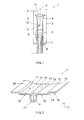
- Fig. 1 is a schematic sectional view of a section of a mercury vapor low pressure discharge lamp designed as a discharge lamp 1 is shown.
- the discharge lamp 1 comprises a tubular discharge vessel 2, which may be rod-shaped, U-shaped or also bent several times. The ends of the discharge vessel 2 are sealed gas-tight.
- An electrode frame 3 of the discharge lamp 1 extends from one end 4 of the discharge lamp 1 into the discharge space 5 formed in the interior of the discharge vessel 2.
- the electrode frame 3 comprises a glass base 6 whose extended edge 7 is fused to the end 4 of the discharge vessel 2 in a gastight manner.
- the electrode frame 3 has two separate power supply lines 8 and 9, which are provided for holding an electrode 10 designed as a lamp filament.
- a carrier element 11 is arranged in the discharge space 5 of the discharge lamp 1.
- the support member 11 is in the embodiment shown according to Fig. 1 attached to the power supply 8.
- the carrier element 11 is in Fig. 1 shown schematically.
- At least one recess 12 is formed on the carrier element 11 in which Hg-containing material is arranged.
- the carrier element 11 may also have a plurality of such recesses 12, which may be geometrically the same or different.
- the carrier element 11 is designed as a metal band and formed in a first approximation plate-like.
- an in Fig. 1 not shown cap for the electrode 10 is provided, this cap is designed as a tube-like hollow body which surrounds the electrode 10.
- a coaxial arrangement is provided.
- the support member 11 at the same time represent this cap.
- the cap is in particular arranged positionally accurate with a rod-shaped central support (not shown), this center support being assigned to the electrode frame 3 as an additional component to the power supply lines 8 and 9. It can also be provided that the carrier element 11 is attached to said central support on which the cap is arranged.
- a first embodiment of the support member 11 is shown in a perspective view in a partial section.
- the plate-like structure of the formed as a metal strip support member 11 can be seen.
- In about the middle of the recess 12 is designed as a groove or trench, which extends over the entire Width b1 of the support member 11 extends.
- the recess 12 has a width w1 and depth t1. In the embodiment shown, the depth t1 is greater than the width w1. In principle, it is preferred if the geometry of the recess 12 is designed so that the width w1 is less than or equal to the depth t1. However, it can also be provided that the width w1 is slightly greater than the depth t1.
- a volume coating is provided by the configuration of the carrier element 11. This means that lying outside the recess 12 surfaces in the form of the tops 15 and in the form of the lower sides 16 of the support member 11 are free of mercury. A surface coating is therefore not given on the carrier element 11.
- the support member 11 stages 13 and 14, whereby a comparison is given to the depth t1 relatively low level difference.
- these steps 13 and 14 can not be formed and are not essential to the invention.
- FIG. 2 An in Fig. 2 shown and formed by the relatively far apart stages 13 and 14 lowering of portions of the support member 11 in comparison to other portions, in the context of the invention is not as a depression as defined by the configuration of the recess 12 understood.
- the gradations 13 and 14 in the y-direction represent a significantly lower degree compared to the spacing between the two stages 13 and 14 in the x-direction.
- Such level variations with significantly larger dimensions in the x-direction in comparison to them in the y-direction are no more than depressions in the sense of this application to be considered.
- the recess 12 in a longitudinal sectional view of a corner-free and substantially U-shaped design.
- This groove or this trench of the recess 12 is completely filled in the embodiment shown with Hg-containing material 17.
- the Hg-containing material 17 also includes getter material around the exemplary embodiment. In the recess 12 thus both mercury and getter material is mixed.
- getter material for example, a zirconium aluminum getter can be provided.
- the mercury-containing material may be a mercury-titanium alloy.
- the volume can also be determined very precisely, and therefore the amount of mercury can also be metered very precisely. Since the mercury concentration in the material 17 is usually known per unit of quantity, the mercury concentration of the carrier element 11 can thus be metered very precisely, depending on the volume of the depression 12. Depending on the concentration of mercury in the material 17 and / or the number of depressions 12 in the carrier element 11 and / or the volume, at least one depression can be achieved 12 dose very accurately and it can also be very small amounts of mercury thus adjusted accurately.
- support member 11 is prepared so that initially provided as a metal strip support member 11 as shown in FIG Fig. 2 is formed. In particular, a bend with respect to the production of the trench for the recess 12 is performed. In the following, the powdered Hg-containing material 17, which in the exemplary embodiment also has getter material, is then distributed on the carrier element 11. In particular, a filling into the depression 12 is performed. This is done via a vibration system, wherein subsequent to the application to the support member 11, a compression of the material 17 takes place exclusively in the recess 12. After this pressing of the local area, the remainder of the remaining material remaining on the upper sides 15 of the material 17, which has just not been pressed there, is subsequently sucked off. At the in Fig. 2 carrier element 11 shown are the tops 15 and the lower sides 16 thus free of mercury-containing material and also free of the getter material.
- a further embodiment of a support member 11 is shown in a perspective view.
- a groove 12 formed as a recess 12 is shown, which has no U-shaped shape in cross-section, but is widened towards the bottom and shows a bulbous structure. This is achieved by a flattening of the support member 11 with rollers.
- the recess 12 has a width w2 which is smaller than a width w3 in the recess 12.
- the depressions 12 in the Fig. 2 and 3 are formed as elongated rectilinear grooves. However, it may also be provided a non-linear course.
- Fig. 6 is a further embodiment of a support member 11 is shown in a plan view, wherein only the cutout of the support member 11 is shown, in which a plurality of recesses 20, 21, 22 and 23 is formed.
- the recesses 20 to 23 are not designed as elongated grooves or the like, but as blind holes. As shown in Fig. 6 these recesses 20 to 23 have a corner-free, and in particular round hole structure.
- a further embodiment of a support member 11 is shown, which in contrast to the illustration according to FIG Fig. 6 a plurality of recesses 20 to 23, which have no round geometry in a plan view from above, but this is angular, in particular quadrangular.
- Fig. 8 an embodiment is shown in which, in contrast to the plan view in Figs 6 and 7 only two recesses 20 and 21 are provided, which show an oval geometry in a plan view.
- Fig. 9 is a further schematic representation of a support member 11 is shown in a plan view in which two recesses 12 are shown, which are formed as elongated grooves and spaced and are provided parallel to each other.
- the depressions 12 in Fig. 9 For example, according to the embodiments in Fig. 2 or 3 be provided. Both recesses 12 may be the same or differently designed in dimensions and / or geometry.
- the depth t1 can also be 1 mm or even more. These are merely exemplary values, which may be larger or smaller. In particular, can be done by the design of the wells 12, the very exact dosage of the amount of mercury, which per carrier element 11 may be less than or equal to 4 mg. In particular, very small amounts of mercury less than or equal to 1 mg can be dosed very accurately.
Landscapes
- Discharge Lamp (AREA)
- Manufacture Of Electron Tubes, Discharge Lamp Vessels, Lead-In Wires, And The Like (AREA)
- Common Detailed Techniques For Electron Tubes Or Discharge Tubes (AREA)
Applications Claiming Priority (1)
| Application Number | Priority Date | Filing Date | Title |
|---|---|---|---|
| DE102007033878A DE102007033878A1 (de) | 2007-07-20 | 2007-07-20 | Trägerelement, an welchem ein Hg-haltiges Material zur Anbringung in einer Entladungslampe ausgebildet ist, sowie ein Verfahren zu dessen Herstellung und eine Entladungslampe mit einem derartigen Trägerelement |
Publications (2)
| Publication Number | Publication Date |
|---|---|
| EP2017877A2 true EP2017877A2 (fr) | 2009-01-21 |
| EP2017877A3 EP2017877A3 (fr) | 2010-01-06 |
Family
ID=39884413
Family Applications (1)
| Application Number | Title | Priority Date | Filing Date |
|---|---|---|---|
| EP08160480A Withdrawn EP2017877A3 (fr) | 2007-07-20 | 2008-07-16 | Elément de support sur lequel est appliqué un matériau contenant du mercure, destiné à être installé dans une lampe à décharge, son procédé de fabrication et lampe à décharge dotée d'un tel élément de support |
Country Status (4)
| Country | Link |
|---|---|
| US (1) | US20090021163A1 (fr) |
| EP (1) | EP2017877A3 (fr) |
| CA (1) | CA2638082A1 (fr) |
| DE (1) | DE102007033878A1 (fr) |
Families Citing this family (1)
| Publication number | Priority date | Publication date | Assignee | Title |
|---|---|---|---|---|
| DE102007033879A1 (de) * | 2007-07-20 | 2009-01-22 | Osram Gesellschaft mit beschränkter Haftung | Trägerelement, an welchem ein Hg-haltiges Material zur Anbringung in eine Entladungslampe ausgebildet ist, und Entladungslampe mit einem derartigen Trägerelement |
Citations (1)
| Publication number | Priority date | Publication date | Assignee | Title |
|---|---|---|---|---|
| WO1998014983A1 (fr) | 1996-09-30 | 1998-04-09 | Patent-Treuhand-Gesellschaft für elektrische Glühlampen mbH | Lampe a decharge basse pression |
Family Cites Families (10)
| Publication number | Priority date | Publication date | Assignee | Title |
|---|---|---|---|---|
| JPS50152573A (fr) * | 1974-05-28 | 1975-12-08 | ||
| JPS5717351B2 (fr) * | 1974-05-28 | 1982-04-10 | ||
| JPS5194757A (en) * | 1975-02-19 | 1976-08-19 | Hodenkanheno suiginfunyuhoho | |
| JPS51132074A (en) * | 1975-04-02 | 1976-11-16 | Toshiba Corp | Mercury emitting mechanism |
| JPS5438681A (en) * | 1977-09-02 | 1979-03-23 | Toshiba Corp | Low-tension mercury vapor discharge lamp |
| IT1227338B (it) * | 1988-09-12 | 1991-04-08 | Getters Spa | Nastro getter atto ad emettere vapori di mercurio, utilizzabile nella formazione di catodi freddi per lampade fluorescenti. |
| JP2858803B2 (ja) * | 1989-08-21 | 1999-02-17 | 株式会社日立製作所 | 低圧放電灯 |
| US6518701B1 (en) * | 2000-03-24 | 2003-02-11 | Osram Sylvania Inc. | Mercury capsule for use in a fluorescent lamp |
| JP3681978B2 (ja) * | 2000-12-19 | 2005-08-10 | 株式会社巴川製紙所 | 光反射板および反射型液晶表示装置 |
| KR100485509B1 (ko) * | 2002-12-03 | 2005-04-27 | 주식회사 세종소재 | 램프용 게터 |
-
2007
- 2007-07-20 DE DE102007033878A patent/DE102007033878A1/de not_active Withdrawn
-
2008
- 2008-07-16 EP EP08160480A patent/EP2017877A3/fr not_active Withdrawn
- 2008-07-18 CA CA002638082A patent/CA2638082A1/fr not_active Abandoned
- 2008-07-21 US US12/219,341 patent/US20090021163A1/en not_active Abandoned
Patent Citations (1)
| Publication number | Priority date | Publication date | Assignee | Title |
|---|---|---|---|---|
| WO1998014983A1 (fr) | 1996-09-30 | 1998-04-09 | Patent-Treuhand-Gesellschaft für elektrische Glühlampen mbH | Lampe a decharge basse pression |
Also Published As
| Publication number | Publication date |
|---|---|
| DE102007033878A1 (de) | 2009-01-22 |
| CA2638082A1 (fr) | 2009-01-20 |
| US20090021163A1 (en) | 2009-01-22 |
| EP2017877A3 (fr) | 2010-01-06 |
Similar Documents
| Publication | Publication Date | Title |
|---|---|---|
| EP2946442B1 (fr) | Borne de connecteur | |
| EP1009013A2 (fr) | Lampe munie d'un culot sans ciment | |
| DE19801540C2 (de) | Gefederte Fühlerbaugruppe | |
| DE2414790A1 (de) | Kristall-oszillator | |
| DE2616767B2 (de) | Mehrfach-Bukkal-Röhrchen | |
| DE10158384A1 (de) | Stecker | |
| EP2017877A2 (fr) | Elément de support sur lequel est appliqué un matériau contenant du mercure, destiné à être installé dans une lampe à décharge, son procédé de fabrication et lampe à décharge dotée d'un tel élément de support | |
| EP1147535B1 (fr) | Lampe a decharge comportant un porte-electrode | |
| AT510474B1 (de) | Lötverbindung | |
| EP2017876A1 (fr) | Elément de support sur lequel un matériau contenant du HG destiné à être installé dans une lampe à décharge est développé et lampe à décharge dotée d'un tel élément de support | |
| EP1771915B1 (fr) | Corps de base pour un filtre yig ou un oscillateur yig | |
| WO2001035442A1 (fr) | Lampe a decharge avec support d'electrode | |
| WO2021164800A1 (fr) | Élément de contact électrique | |
| DE10342534B4 (de) | Vorrichtung zum Verdichten und/oder Verschweißen von elektrischen Leitern | |
| DE10256389A1 (de) | Metallhalogenidlampe mit keramischem Entladungsgefäß | |
| DE10059534C1 (de) | Elektrisches Bauelement, Anordnung des Bauelements und Verfahren zur Herstellung der Anordnung | |
| DE20018012U1 (de) | Endstopfen zum Anschrauben von Sprossen an Abstandhalterrahmen von insbesondere Isolierglasscheiben | |
| EP2618430A1 (fr) | Elément de liaison électrique ainsi que composite d'un élément de liaison électrique équipé d'un composant | |
| DE4313619C2 (de) | Entladungsröhre | |
| DE4226977A1 (de) | Verfahren zur Errichtung von Bauwerkswänden, Bauwerkswand, Bausatz zur Herstellung einer Bauwerkswand, sowie Montagehilfe für die Errichtung einer Bauwerkswand | |
| DE102005007727A1 (de) | Flache fluoreszierende Lampe für Displayvorrichtungen | |
| WO1997005647A1 (fr) | Bande metallique, notamment bande d'acier, utilisee pour produire des ecrans a monter dans des lampes a decharge basse pression | |
| DE10306066B4 (de) | Elektrode für einen Gaslaser | |
| DE202004002700U1 (de) | Viertelbare Tablette | |
| DE19855703B4 (de) | Anordnung zur Montage eines Erdungsbleches zur Erdung von einzelnen Bauteilen |
Legal Events
| Date | Code | Title | Description |
|---|---|---|---|
| PUAI | Public reference made under article 153(3) epc to a published international application that has entered the european phase |
Free format text: ORIGINAL CODE: 0009012 |
|
| AK | Designated contracting states |
Kind code of ref document: A2 Designated state(s): AT BE BG CH CY CZ DE DK EE ES FI FR GB GR HR HU IE IS IT LI LT LU LV MC MT NL NO PL PT RO SE SI SK TR |
|
| AX | Request for extension of the european patent |
Extension state: AL BA MK RS |
|
| PUAL | Search report despatched |
Free format text: ORIGINAL CODE: 0009013 |
|
| AK | Designated contracting states |
Kind code of ref document: A3 Designated state(s): AT BE BG CH CY CZ DE DK EE ES FI FR GB GR HR HU IE IS IT LI LT LU LV MC MT NL NO PL PT RO SE SI SK TR |
|
| AX | Request for extension of the european patent |
Extension state: AL BA MK RS |
|
| RIC1 | Information provided on ipc code assigned before grant |
Ipc: H01J 7/20 20060101ALI20091201BHEP Ipc: H01J 7/18 20060101ALI20091201BHEP Ipc: H01J 61/28 20060101ALI20091201BHEP Ipc: H01J 61/26 20060101AFI20091201BHEP |
|
| AKY | No designation fees paid | ||
| STAA | Information on the status of an ep patent application or granted ep patent |
Free format text: STATUS: THE APPLICATION IS DEEMED TO BE WITHDRAWN |
|
| 18D | Application deemed to be withdrawn |
Effective date: 20100707 |
|
| REG | Reference to a national code |
Ref country code: DE Ref legal event code: 8566 |