EP2017980A1 - Récepteur de champ électrique optique, récepteur de signal multi-niveau optique et système de transmission optique - Google Patents
Récepteur de champ électrique optique, récepteur de signal multi-niveau optique et système de transmission optique Download PDFInfo
- Publication number
- EP2017980A1 EP2017980A1 EP06732529A EP06732529A EP2017980A1 EP 2017980 A1 EP2017980 A1 EP 2017980A1 EP 06732529 A EP06732529 A EP 06732529A EP 06732529 A EP06732529 A EP 06732529A EP 2017980 A1 EP2017980 A1 EP 2017980A1
- Authority
- EP
- European Patent Office
- Prior art keywords
- optical
- signal
- symbol
- field
- delayed
- Prior art date
- Legal status (The legal status is an assumption and is not a legal conclusion. Google has not performed a legal analysis and makes no representation as to the accuracy of the status listed.)
- Withdrawn
Links
Images











Classifications
-
- H—ELECTRICITY
- H04—ELECTRIC COMMUNICATION TECHNIQUE
- H04B—TRANSMISSION
- H04B10/00—Transmission systems employing electromagnetic waves other than radio-waves, e.g. infrared, visible or ultraviolet light, or employing corpuscular radiation, e.g. quantum communication
- H04B10/60—Receivers
- H04B10/66—Non-coherent receivers, e.g. using direct detection
- H04B10/67—Optical arrangements in the receiver
- H04B10/671—Optical arrangements in the receiver for controlling the input optical signal
- H04B10/672—Optical arrangements in the receiver for controlling the input optical signal for controlling the power of the input optical signal
-
- H—ELECTRICITY
- H04—ELECTRIC COMMUNICATION TECHNIQUE
- H04B—TRANSMISSION
- H04B10/00—Transmission systems employing electromagnetic waves other than radio-waves, e.g. infrared, visible or ultraviolet light, or employing corpuscular radiation, e.g. quantum communication
- H04B10/60—Receivers
- H04B10/66—Non-coherent receivers, e.g. using direct detection
- H04B10/69—Electrical arrangements in the receiver
-
- H—ELECTRICITY
- H04—ELECTRIC COMMUNICATION TECHNIQUE
- H04L—TRANSMISSION OF DIGITAL INFORMATION, e.g. TELEGRAPHIC COMMUNICATION
- H04L7/00—Arrangements for synchronising receiver with transmitter
- H04L7/0008—Synchronisation information channels, e.g. clock distribution lines
-
- H—ELECTRICITY
- H04—ELECTRIC COMMUNICATION TECHNIQUE
- H04L—TRANSMISSION OF DIGITAL INFORMATION, e.g. TELEGRAPHIC COMMUNICATION
- H04L7/00—Arrangements for synchronising receiver with transmitter
- H04L7/0075—Arrangements for synchronising receiver with transmitter with photonic or optical means
Definitions
- Non-Patent Document 1 discloses QPSK (Quadrature Phase Shift Keying) that performs quaternary phase shift keying and Kenro Sekine, Nobuhiko Kikuchi, Shinya Sasaki, Shigenori Hayase and Chie Hasegawa, "Proposal and Demonstration of 10-Gsymbol/sec 16-ary (40 Gbits/s) Optical Modulation / Demodulation Scheme", paper We3.4.5, ECOC 2004, 2004 (Non-Patent Document 2) discloses 16-level amplitude and phase modulation that is a combination of quaternary amplitude shift keying and quaternary phase shift keying.
- QPSK Quadrature Phase Shift Keying
- FIGS. 1(A) to (D) show features of various modulation schemes in the prior art applicable to optical transmission, wherein a signal point (complex representation of the optical field at the decision timing) of optical modulation is plotted on a complex plane (IQ plane).
- IQ plane complex plane
- FIG. 1(C) shows 16-level quadrature amplitude modulation (16QAM) widely being used in wireless communication.
- the 16QAM which has signal points arranged in a grid shape, can transmit 4-bit signal at 1 symbol.
- a value of the upper 2 bits (11xx, 10xx, 01xx, 00xx) is represented on a Q-axis coordinate and a value of the lower 2 bits (xx11, xx10, xx01, xx00) is represented on an I-axis coordinate. Since the arrangement of the signal points makes a signal point distance large, it has been known that receiver sensitivity is high. However, an implementation example in a field of the optical communication has not yet been reported.
- FIG. 1(D) shows a 16-level amplitude and phase modulation (16APSK) where signal points of a binary amplitude shift keying and signal points of a 8-level phase shift keying are arranged in a concentric circular shape and
- FIG. 1(E) shows a relationship between the amplitude and phase.
- the receiver becomes complicated as the number of multilevel increases. Further, if the number of multilevel increases, an inter-symbol interference in optical delayed demodulation for demodulating phase components increases, resulting in a problem that characteristics, such as receiver sensitivity, are rapidly degraded.
- an optical signal receiving end or an optical repeater should have optical dispersion compensators for compensating the chromatic dispersion in a transmission line.
- the tunable chromatic dispersion compensator has many problems to be solved, such as the size, complexity, cost, control speed, and the like of the device.
- an electrical adaptive equalizer such as a feed-forward equalizer (FEE) or a decision-feedback equalizer (DFE)
- FEE feed-forward equalizer
- DFE decision-feedback equalizer
- MSE most likelihood sequence estimator
- the chromatic dispersion compensation in the electric stage according to the prior art is incomplete because only an eye opening of a received optical waveform is enlarged. For this reason, the compensation effect is still not sufficient because it can effectively expand the chromatic dispersion tolerance of the receiver to 1.5 to 2 times, for example, and extend the transmission distance of 40 Gbit/s signals to just 10 km in the standard optical fiber transmission.
- the coherent optical field receiving system should have a local laser 130 having approximately the same wavelength as a transmitting laser.
- An output light (local light) 132 from the laser 130 is split into two local lights 132-1 and 132-2 by an optical splitter 102 and then input to the coherent optical field receivers 135-1 and 135-2, respectively.
- the coherent optical field receiver 135-1 includes an optical phase diversity circuit 136 and a digital signal processor 141.
- the optical phase diversity circuit 136 generates an I (in-phase) component output light 137 and a Q (quadrature-phase) component output light 138 from a local light 132-1 and a P polarization component 133 of the input optical multilevel signal.
- the I (in-phase) component output light 137 is in-phase component between the local light and the optical multilevel signal.
- the Q (quadrature-phase) component output light 138 is quadrature-phase component between the local light and the optical multilevel signal.
- the I component output light 137 is supplied to a balanced optical receiver 105-1 and the Q component output light 138 is supplied to a balanced optical receiver 105-2.
- Analog electric signals output from the balanced optical receivers 105-1 and 105-2 are time-sampled by A/D converters 106-1 and 106-2, respectively, and then converted into digital signals.
- the optical field of a received signal is defined as r(n)exp( ⁇ (n)) and the optical field of the local lights 132-1 and 132-2 is marked by exp(- ⁇ (n)).
- r represents the amplitude of the optical field
- ⁇ represents the phase of the optical field
- n represents sampling timing and it is assumed that the amplitude of the local light 132 is a constant value "1".
- ⁇ (n) represents phase fluctuation which is generated by phase noise inherently included in the laser or by the difference of optical frequency between the local light and the signal light.
- the transmitting laser of a transmitter side also has the phase noise, the phase noise is disregarded for simplification in the following explanation.
- Each of the balanced optical receivers 105-1 and 105-2 performs homodyne detection of the input optical multilevel signal with the local light and outputs the in-phase component and the quadrature-phase component of the optical field of the input optical multilevel signal on the basis of the local light.
- ⁇ '(n) ⁇ (n) + ⁇ (n) and all the constants, such as conversion efficiency and the like, are "1".
- the received optical multilevel signal is multilevel-modulated in the 16-level quadrature amplitude modulation (16QAM) as shown in FIG. 1(C) .
- the symbol decision circuit 143 judges with high accuracy which symbol is transmitted by comparing the I and Q components output from each digital signal processor 141 with the signal constellation shown in FIG. 1C and output a reconstructed multilevel digital signal 144.
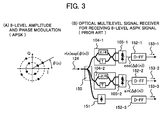
- FIG. 3(B) shows a configuration of the optical multilevel signal receiver for receiving the amplitude and phase modulation light, as disclosed by Non-Patent Document 2.
- FIG. 3(A) shows an example of an 8-level amplitude and phase modulation light (8APSK) where 8 signal points having quaternary phase and binary amplitude are arranged on a concentric circle.
- 8APSK 8-level amplitude and phase modulation light
- a differential coding is generally used for modulating the phase components.
- each symbol transmits 3-bit information by correlating each symbol to a binary value amplitude and a quaternary value phase in which phase difference with its just previous symbol is any one of 0, ⁇ /2, ⁇ , - ⁇ /2.
- Each of the optical delayed demodulators 104-1 and 104-2 includes a first optical path that generates a delay of a symbol time T to the input signal and a second optical path that has a - ⁇ /4 optical phase shifter or a + ⁇ /4 optical phase shifter and converts the phase modulation components into the optical intensity signals by interfering a state (symbol) of a received optical signal with a symbol received previously by time T.
- the intensity of light output from the optical delayed demodulator 104-1 having the + ⁇ /4 optical phase shifter is large when the phase difference between a received symbol and a symbol just before the symbol is 0 or + ⁇ /2 and is small when the phase difference between a received symbol and a symbol just before the symbol is - ⁇ /2 or ⁇ .
- the output light of the optical delayed demodulator 104-1 is received by the balanced optical receiver 105-1 and the output of the balanced optical receiver 105-1 is binary-decided by a binary decision circuit 152-1, making it possible to obtain a binary reconstructed digital signal 153-2 corresponding to 1 bit.
- FIG. 4 shows a receiver for receiving binary phase shift keying light that is disclosed in S Calabro, "Improved Detection of Differential Phase Shift Keying Through Multi-symbol Phase Estimation", proc. ECOC' 05, We4P 118, 25-29 September 2005, Glasgow, Scotland, 2005 (Non-Patent Document 4).
- the receiver In order to receive an optical signal 159 input from a binary differential phase shift keying (DPSK) with high sensitivity, the receiver adopts a decision feedback scheme which is used in wireless communication.
- the input signal is branched into two optical signals and then input to the optical delayed demodulators 104-1 and 104-2.
- the optical delayed demodulators 104-1 and 104-2 include a first optical path that imparts the delay of the symbol time T to the input signal and a second optical path that has an optical phase shifter having a phase angle of 0 or a ⁇ /2 optical phase shifter.
- the output cos( ⁇ (n)) value of the balanced optical receiver 105-1 corresponds to the differential phase shift keying ⁇ .
- the output cos( ⁇ (n)) value of the balanced optical receiver 105-1 becomes a value corresponding to an information value of the DPSK signal.
- the receiver shown in FIG. 4 adopts a decision-feedback scheme.
- the differential phase shift keying components (“0" or " ⁇ ") are canceled by multiplying the phase difference information cos ⁇ (n-1) and sin ⁇ (n-1) of the just previous symbol by the binary digital information output from the binary decision circuit 152 by using delay circuits 157-1 and 157-2 and multipliers 158-1 and 158-2, thereby extracting only the error components.
- the above binary phase shift keying optical receiver has structural symmetry, it can be relatively easily expanded so as to receive the quaternary differential phase shift keying signal. However, it is difficult to expand to receiving optical multilevel signals of four levels or more due to the combination of the phase modulation and the amplitude modulation.
- Non-Patent Document1
- the coherent optical field receiving system requires the local laser 130 whose wavelength approximately meets the received light, there is a problem that wavelength management is complicated.
- the coherent optical field receiving system can receive the input optical signal even when the polarization state is fluctuated. In this case, there is a big problem in a practical use that the size of the hardware of the receiver becomes large because extra optical parts such as the polarization splitter 131 or the optical splitter 102 and the like are required.
- the optical multilevel signal receiver described in FIG. 3 or the multilevel phase modulation receiver of the decision-feedback type described in FIG. 4 performs only the binary decision on the intensity of the received signal and the relative phase difference, but cannot detect all the information of the optical field, for example, the combination of the amplitude value and the absolute phase value that are required to decide the 16QAM signal in FIG. 1(C) .
- the optical delayed demodulator used for these schemes is designed to detect the intensity signal variable depending on the relative phase difference between two consecutive symbols on a time axis and it cannot detect the absolute phase of each symbol.
- the optical delayed demodulator cannot perform the 8-level detection of the relative phase difference and the like that is required to decide the 16 APSK signal in FIG. 1(D) .
- the coherent optical field receiver has advantage as to this problem.
- the incoherent type receiver such as the optical multilevel signal receiver described in FIG. 3 or the decision-feedback type multilevel phase modulation receiver described in FIG. 4 , has a structure that combines the binary decision of the received signal intensity and the binary decision of the relative phase difference. Accordingly, N pairs of receivers are required in principle when the number of multilevels of the symbol is increased by the N-th power of 2, such that the configuration of the receiver is complicated.
- each of the delay time T of the optical delayed demodulator and the sampling time of the A/D converter is made 1/2f or less (f is peak frequency component of the input optical signal) so as to satisfy the Niquist Theorem.
- ⁇ (n) ⁇ (n) - ⁇ (n-1).
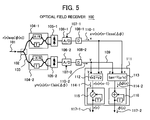
- the n-th received symbol information and (n-1)-th received symbol information just before the n-th received symbol information coexist in the electrical received signals 110-1 and 110-2.
- these signals are input to the field processing unit 111 to eliminate the (n-1)-th received symbol information just before the n-th received symbol information, so that only the n-th received symbol information is extracted and output as reconstructed optical field signals 117-1 and 117-2.
- the reconstructed optical field signal 117-1 represents field amplitude r(n) and the reconstructed optical field signal 117-2 represents a phase angle ⁇ (n).
- the field processing unit 111 comprises a square root processor 112 for calculating the amplitude r(n)r(n-1) of the delayed demodulation signal from the electrical received signals 110-1 and 110-2, an inverse tangent circuit 113 for calculating the phase difference ⁇ (n) of the delayed demodulation signals from the electrical received signals 110-1 and 110-2, a delayed divider 115 connected to the square root processor 112, and a delayed adder 116 connected to the inverse tangent circuit 113.
- the delayed divider 115 outputs the reconstructed optical field signal 117-1 that represents the field amplitude r(n) of the received symbol, by eliminating the amplitude r(n-1) component of the just previous received symbol from the amplitude r(n)r(n-1).
- the delayed adder 116 outputs the reconstructed optical field signal 117-2 that represents the phase angle ⁇ (n) of the received symbol, by eliminating the phase component ⁇ (n-1) of the just previous received symbol from the phase difference ⁇ (n).
- the optical field receiver shown in the FIG. 5 can configure an optical multilevel signal receiver by connecting a multilevel symbol decision circuit for deciding bit values corresponding to the reconstructed optical field signal r(n) and ⁇ (n) to a subsequent stage of the field processing unit 111. Further, the optical field receiver can configure the optical field receiver and the optical multilevel signal receiver capable of compensating perfectly the degradation of the signal caused by chromatic dispersion and the like, by setting the delay time and sampling time of the optical delayed demodulators 104-1 and 104-2 so as to be 1/2 or less of the symbol time T and by providing with a compensation processor for compensating the reconstructed optical field signals with an inverse characteristic of a transfer function of the transmission line.
- FIG. 6 is a view for explaining an operation timing of the optical field receiver according to the first embodiment.
- the A/D converters 106-1 and 106-2 convert the output signals of the balanced optical receivers 105-1 and 105-2 at a predetermined period and timing that are decided by sampling clock 107-1 and 107-2, respectively.
- FIG. 6(A) shows a change in the electrical received signal 110-1 (x component) and the electrical received signal 110-2 (y component) that are input to the field processing unit 111.
- FIG. 6(B) shows a change in the reconstructed field signal 117-1 (amplitude component r) and the reconstructed field signal 117-2 (phase component ⁇ ) that are output from the field processing unit 111.
- the received signals are sampled at timing of the center of each symbol period by conforming the frequency of the sampling clock to the symbol rate of the received optical multilevel signal.
- the square root processor 112 cancels a cos term and a sin term by computing a square root of a square sum of the input signals x and y at the symbol period to output a signal 114-1 that represents the sum r(n)r(n-1) of amplitudes.
- the inverse tangent circuit 113 outputs a signal 114-2 that represents the phase difference (for example, - ⁇ ⁇ ⁇ ⁇ ) of complex signals (hereinafter, referred to as "delayed demodulation signal”) using the input signals x and y as quadrature-phase components by computing the inverse tangent tan-1(y/x) of the input signals x and y.
- the amplitude r(n) of the received symbol can be calculated in the delayed divider 115, by dividing the sum r(n)r(n-1) of amplitudes output from the square root processor 112 by the amplitude r(n-1) of the just previous symbol.
- the phase angle ⁇ (n) of the received symbol can be calculated in the delayed adder, by adding the phase ⁇ (n-1) of the just previous symbol to the ⁇ (n) output from the square root processor 112.
- the optical field information representing the amplitude value and the phase angle can be extracted from the input optical signal 101 by using the optical delayed demodulation type optical receiver which is an incoherent receiver.
- connection types such as a connection between optical parts by an optical fiber, a connection between optical parts by a bulk optical device with spatial beam, and a connection between optical parts by a waveguide between integrated optical parts can be adopted.
- the optical delayed demodulator 104 and the balanced optical receiver 105 as shown in FIG. 5 , as the amplitude of the output signal from the demodulator is doubled, unnecessary DC-component can be advantageously eliminated.
- a standard optical intensity detector may be applied.
- Delay adjusting circuits 108-1 and 108-2 conforms the processing timings of the x component and y component by conforming the signal propagation time into two signal paths between the optical branching circuit 102 and the field processing unit 111. For example, this can be realized by a buffer circuit. However, when a circuit configuration where the lengths of two signal paths can conform to each other in a manufacturing step is adopted, the delay adjusting circuits 108-1 and 108-2 can be omitted. Further, instead of using the delay adjusting circuits 108-1 and 108-2, the relative phase of the x component and y component can be controlled by another method, for example, by the timing of supplying the sampling clocks 107-1 and 107-2 to the A/D converters 106-1 and 106-2.
- the digital delay adjusting circuits 108-1 (108-2) are located after the A/D converters 106-1 (106-2), the circuit may be configured so that an analog delayed line is used as the delay adjusting circuit and the A/D converter 106 is located after the delay adjusting circuit. Further, by omitting the A/D converter 106, a part or all of the processing functions of the field processing unit 111 can be realized by the analog circuit.
- the Cartesian coordinates (I(n), Q(n)) processing type processor can be applied as the field processing unit 111.
- a coordinate transformer can be used, if necessary.
- the function of the field processing unit 111 can be realized by, for example, FPGA, ASIC, DSP, or a processor that can reconfigure its function.
- the processing procedure or method to be performed in the field processing unit 111 may include numerous kinds of variations or an approximation computation method depending on the object, which are different from the embodiment.
- previously calculated output value may be stored in a memory in association with the different input signal values, so that the processing result is obtained in a table lookup manner in accordance with the input signal values.
- AGC automatic gain controller
- FIG. 8 is a second embodiment of the present invention and shows an optical multilevel signal receiver using the optical field receiver 100 shown in FIG. 5 .
- these noises for example, phase fluctuation
- these noises become a fluctuation factor of the optical field phase reconstructed in the optical field receiver.
- optical multilevel signal 123 including the phase fluctuation ⁇ (n) is received, the second embodiment can eliminate the influence of the phase fluctuation ⁇ (n) from the reconstructed multilevel digital signal.
- the received optical multilevel signal 123 is processed in the optical field receiver that includes the optical branching circuit 102, the optical delayed demodulators 104(104-1 and 104-2), the balanced optical receivers 105(105-1 and 105-2), the A/D converters 106(106-1 and 106-2), the delay adjusting circuits 108(108-1 and 108-2), and the field processing unit 111, which is the same as the configuration of FIG. 1 .
- the reconstructed field signal 117-1 representing the amplitude component r(n) and the reconstructed field signal 117-2 representing the phase component ⁇ '(n) subjected to the influence of the phase fluctuation ⁇ (n) are output from the field processing unit 111.
- These reconstructed field signals 117-1 and 117-2 are input to a symbol decision unit 176 that does not depend on the phase fluctuation.
- the symbol decision unit 176 includes a symbol decision circuit 143, a phase fluctuation estimator 174, delayed circuits 157-1 and 157-2, and a subtractor 171.
- the symbol decision circuit 143 is input with the reconstructed field signal 117-1(amplitude component r(n)) and the reconstructed field signal 172 (phase component ⁇ (n)) where the phase fluctuation component ⁇ (n) is eliminated from the reconstructed field signal 117-2 by a decision feedback to be described below, such that the symbol decision results are output as a reconstructed multilevel digital signal 144.
- phase modulation interval is an unequal interval like the 16QAMsignal
- four corner signal points where the amplitudes are at the maximum for example, only the phase angles of "1111", “0000”, “1100”, and "0011” which are points shown in FIG. 1 are extracted and these phase angles are input to the four times circuit to be averaged, such that the phase fluctuation component can be estimated as in the above-mentioned description.
- the deviation quantity amount is the phase fluctuation.
- other known methods in the field of the wireless communication may be applied.
- a minimum distance rule is applied to the decision of the received symbol, in the field of wireless communication
- other known symbol decision methods which are used for the multilevel signal
- MLSE that first decides any one of the phase and the amplitude radius and uses the field state of the plural consecutive symbols
- most likelihood decision Viterbi decoding
- soft-decision FEC Forward Error Correction
- trellis encoding/decoding process and the like.
- FIG. 10A shows the transmission optical field
- FIG. 10B shows the symbol (signal point) arrangement of the 16QAM signal.
- the symbol of two corners "1111” and "0000”, which is in mutually symmetrical positions is used as the previously known data to transmit the previously known data pattern consisting of five symbols "1111", "0000", “1111", “0000”, and "0000" ahead of the user information. Since these symbols are amplitude-modulated, even though the amplitude value of a first symbol is not clear, the amplitude of the reconstructed optical field becomes a constant value after a second symbol as shown in FIG. 10 . Therefore, at the receive side, it is preferable to correct the reconstructed optical field intensity so that the amplitude value after the second symbol becomes a radius of the symbol "1111” and "0000” in the 16QAM signal.
- the initial phase can be decided without succeeding the same code as the fourth and fifth symbols of FIG. 10(C) .
- the optical field receiver of the present invention can be applied with other known methods in the field of communication other than the above-mentioned methods of solution.
- it can be permitted to use a technology, such as differential modulation, that periodically or intermittently inserts the reference signal having the previously known phase angle or the amplitude value within the transmission signal and does not require the decision of the initial phase or the initial amplitude.
- it can be permitted to adjust the initial phase or amplitude from the statistical distribution of the reconstructed signal points in an adaptive learning way so that a normal receiver can be performed.
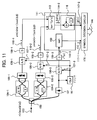
- FIG. 11 is a third embodiment of the optical field receiver of the present invention and shows the optical multilevel signal receiver of the configuration that adds the optical intensity receiving function and the clock extraction function.
- the input optical multilevel signal 123 is divided into three optical signals in the optical branching circuit 150.
- the first and second optical signals are input to the optical delayed demodulators 104-1 and 104-2, respectively and the third optical signal is input to the optical intensity receiver 151.
- the outputs of the optical delayed detectors 104-1 and 104-2 are converted into electric signals in the balanced optical receivers 105 (105-1 and 105-2), such as in FIG.
- the output signal 110-3 of the delay adjusting circuit 108-3 shows a squared value r(n) ⁇ 2 of intensity r(n) of the nth symbol.
- the amplitude value r(n) of the n-th symbol can be obtained by processing the square root of the output signal 110-3 from the delay adjusting circuit 108-3 in the square root circuit 160 installed in the field processing unit 111.
- the outputs of the A/D converters 106-1 and 106-2 are input to re-sampling circuits 192-1 and 192-2 via the delay adjusting circuits 108-1 and 108-2, respectively.
- Each re-sampling circuit performs interpolation of the input data series by using the Niquist Theorem, making it possible to reconstruct the sampling points at any timing.
- the re-sampling is performed so that the sampling points are positioned at the center of each symbol period.
- the sampling timing can be adjusted, for example, using a discrimination circuit of data transition points or a detector of peak points of an eye opening.
- FIG. 13 is a fifth embodiment of the present invention and shows the optical multilevel signal receiver for the optical APSK signal.
- the optical multilevel signal receiver of the fifth embodiment differentially detects the optical APSK signal 124 in the optical delayed demodulators 104-1 and 104-2 and inputs the output signal of the delay adjusting circuit 108-1 and 108-2 to the automatic gain controllers (AGC) 195-1 and 195-2, such that the average intensity is normalized to be constant. Even when the received intensity of the input optical signal 124 is fluctuated, the received characteristics can be stabilized by installing the AGCs 195-1 and 195-2.
- AGC automatic gain controllers
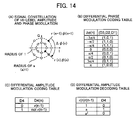
- the magnitude of r(n)r(n-1) obtained at the receiver side may be three of "1", "a", and "a-2" as shown in the decoding table for the differential amplitude modulation of FIG. 14(D) .
- the case where the amplitude is "a” is only the case where the n-th symbol and the just previous (n-1)-th symbol are different. Therefore, it can be decided that when the amplitude is "a", the information bit D4 is "1" and in other cases, the information bit D4 is "0".
- the differential detection of phase and amplitude has an effect of preventing the error propagation and can be applied for receiving the APSK signal in the present invention. Even in the QAM signal, the method modulating the differential phase by 2 bits by using rotational symmetry four times is known, which can be applied to the present invention.
- FIG. 15 is a sixth embodiment of the present invention and shows the optical multilevel signal receiver for N-level optical phase modulation signal.
- the amplitude decision of the received light is not needed and the square root processor 112 and the delayed divider 115 can be omitted from the field processing unit 111 shown in FIG. 13 , such that only the inverse tangent circuit 113 remains.
- the influence of the phase fluctuation is reduced by using the decision-feedback circuit shown in FIGS. 8 and 9 , making it possible to improve the receiver sensitivity.
- the sixth embodiment approximates the receiver for the binary phase shift keying light according to the prior art shown in FIG. 4
- the received signal is not limited to the binary phase shift keying signal and the binary decision circuit 152, which is the symbol decision circuit, is input with cos( ⁇ (n)) output from the balanced optical receiver 105-1. Therefore, the receiver according to the prior art does not generate the inter-symbol phase difference ⁇ (n) on the basis of the x and y components of the complex signal output from the balanced optical receiver, and does not decide the digital value of the received symbol by the ⁇ (n) value, unlike the sixth embodiment. According to the present embodiment, even when receiving the multilevel phase modulation signal of two levels or more, the digital value of the received symbol can be easily decided by using the ⁇ (n) value generated in the field processing unit 111.
- FIG. 16 is a seventh embodiment of the present invention and shows a full-fledged optical field receiver 200 receiving the whole information owned by the optical field.
- the full-fledged optical field receiver 200 shown in FIG. 16 is different from the sixth embodiment and receives the whole information owned by the optical field by directly sampling the optical field of the input optical signal 101 at a double speed of the symbol rate.
- the operation from optical delayed demodulators 204-1 and 204-2 to the optical field processing unit 111 approximates the first embodiment.
- the compensation process on the field signals 117-1 and 117-2 output from the field processing unit 111 is performed in the field compensator 202 and the field signals 203-1 and 203-2 after the compensation are used as the output of the optical multilevel signal receiver.
- FIGS. 17(A) and 17(B) each shows the electrical received signals x and y, the reconstructed field signal r(n), and the sampling timing of ⁇ (n).
- n and n-1 are not the symbol number, but represent a sequence of a time series sample of a T/2 interval.
- the optical delayed demodulation is performed between the received symbols deviating from a half symbol on a time axis. As a result, as shown in FIG. 17(B) , the field information can be sequentially obtained for each half symbol as the reconstructed field signal.
- the optical delayed demodulator according to the prior art is to obtain the relative phase information between the entire symbols, as in the seventh embodiment, there is no need to perform the optical delayed demodulation in the delay time difference of the symbol length or less.
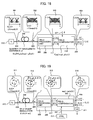
- FIG. 18 is a view for explaining the case where the full-fledged optical field receiver 200 according to the seventh embodiment is applied for compensating the degradation of the optical multilevel signal due to the chromatic dispersion in the transmission line.
- a transmission optical field 204 from an optical multilevel signal transmitter 210 has three-level amplitude level as in a box 501 where an amplitude eye pattern is shown.
- the waveform degradation according to chromatic dispersion ⁇ is induced in the optical field 204 and the amplitude eye pattern of the optical field received by the multilevel signal receiver 200 is significantly degraded as shown in a box 502.
- the chromatic dispersion of the transmission line 206 which is linear degradation represented by a transfer function exp(-j ⁇ 2) has an influence on the transmission optical field 204.
- the output 117 (r(n) and ⁇ (n)) of the field processing unit 208 is supplied to the field compensator 202 and is compensated by the transfer function exp(-j ⁇ 2) having an inverse characteristic to the transfer function of the transmission line 205.
- This compensation is a process of the frequency domain and can be realized by processing FFT or convolution process.
- the optical compensator 202 can dynamically change the transfer function by setting the compensation quantity ⁇ from the outside through the compensation quantity input terminal 207.
- the above-mentioned perfect compensation can be applied to any degradation as far as the waveform degradation induced in the received signal is linear. Therefore, for example, the bandwidth limitation of the optical transmitter or the receiver, the narrow band optical filtering, the influence of the filter ripple and the like can be compensated by the field compensator 202.
- the field compensator 202 In order to compensate the degradation of the above-mentioned received signal, although it is preferable to configure the field compensator 202 as the digital processor, it can be permitted to configure the field compensator 202 as FPGA or DSP likewise other processors. Also, in the field compensator 202, in order to save power consumption or processing capability according to the degree of degradation of the received signal, a portion of the compensation process can be omitted and when the factors of the signal degradation are complicated, it can be permitted so that the degree of influence selectively performs the compensation mode corresponding to the degradation factor that gives the greatest influence, and plural compensation modes can be performed redundantly.
- the sampling interval of the A/D converter 106 and the delay time of the optical delayed demodulator 104 is 1/2 of the symbol length
- the sampling frequency is required as two times or more of the peak frequency component of the signal from Nyquist Theorem. Therefore, when the transmission signal includes the higher speed modulation component than the symbol rate, the higher speed sampling is needed. In contrast, when an effective band of the optical field is low like duobinary signal, the sampling rate can be reduced.
- the optical signal subjected to RZ modulation includes the intensity modulation component of the same frequency as the symbol rate, if the sampling speed meets T/2, the intensity of the output signal can be constant by return. For this reason, when receiving the optical signal subjected to the RZ modulation, there is a need to increase the sampling speed to be slightly higher than T/2.
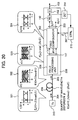
- FIG. 19 is a modified example of the above-mentioned full-fledged optical field receiver 200 and shows a configuration an adaptive compensation type optical field receiver suitable for the compensation of the self-phase modulation effect that is a kind of the non-linear effect generated in the optical fiber.
- the perfect field information since the perfect field information is not needed, it can be permitted to apply other types of optical field receivers described in the first to sixth embodiments as the adaptive compensation type.
- an optical multilevel signal transmitter 210 sends out the 8-level APSK signal to the optical fiber.
- the signal constellation of the transmission optical field 204 has a form that quaternary signal points are radially arranged on the concentric circle having the binary amplitude.
- the signal point on an outer side concentric circle rotates larger than the signal point on an inside concentric circle so that the deviations occur on the signal constellation at the inner circle and the outer circle.
- the self-phase modulation effect is a non-linear effect.
- the influence can be eliminated by an inverse operator exp(-j a r(n) ⁇ 2) by multiplying by the received signal.
- the phase signal ⁇ j (n) is input to a four-times multiplication circuit 211 to extract the deviation component and inputs the deviation component to a deviation minimizing controller 212.
- the deviation minimizing controller 212 automatically controls the value of the compensation quantity a, which is given to the compensation quantity input terminal 207 of the field compensator 202, so as to minimize the error of the field signal after the compensation output from the field compensator 202, thereby realize the adaptive compensation.
- the APSK signal consists of the quaternary phase shift keying and the binary phase shift keying
- the phase of the output signal becomes always a constant value.
- the adaptive compensation is performed so as to minimize the deviation component, such that the signal constellation of the field signal 203 output from the field compensation circuit 202 can always be modified to be optimally arranged.
- the signal degradation due to the self-phase modulation effect also occurs even in the optical signal other than the APSK signal, such that the adaptive compensation type optical field receiver according to the present invention can be applied to other modulation schemes.
- FIG. 20 shows the embodiment that applies the full-fledged optical field receiver 200 according to the present invention to the chromatic dispersion compensation of the binary intensity modulation signal.
- the standard binary modulation is used in a state where space level optical intensity having extinction ratio of about 10dB is low. If the extinction ratio is about 10dB, since the field amplitude ratio is about 3, a signal level does not cause any problem in the operation of the optical field receiver 200 of the present invention. However, when the extinction ratio is very high (for example, about 20dB) or the optical intensity of the sampling point decreases to about zero by the waveform degradation occurring in the optical fiber transmission line, the optical field receiver 200 cannot be normally operated. In order to normally operate the optical field receiver 200 when the extinction ratio is very high, the ninth embodiment intentionally sets the spatial level to be high, thereby degrading the extinction ratio.
- the optical field 205 received by the optical field receiver 200 is significantly degraded as shown in a box 522 by means of the influence of the chromatic dispersion of the optical fiber.
- the sampling point of the reconstructed optical field signal 117 shown in a box 523 deviates from the center of the symbol as shown by a white circle and is set to timing of 25% and 75% of the symbol width, such that it is unlikely to make the sampled optical field intensity zero.
- the field signal where the influence of the chromatic dispersion is compensated can be obtained as shown in a box 524 by processing the transfer function of the inverse characteristic to the chromatic dispersion in the field compensator 202.
- the amplitude signal r j (n) is input to the re-sampling circuit 192 and the sample value of the center of the symbol waveform is decided in the binary decision circuit 152, thereby obtaining the reconstructed binary digital signal 153.
- the output of the re-sampling circuit 192 is branched into an eye opening detector 214 and the size of the eye opening of the signal after the field compensation is detected in the eye opening detector 214. The detection results of the eye opening are input to the controller 215 and the controller 215 controls the compensation quantity ⁇ of the field compensator 202 so that the value of the eye opening is maximized, thereby realizing the adaptive dispersion compensation.
- the full-fledged optical field receiver according to the present invention functions just like the coherent receiver and can dynamically and infinitely compensate the chromatic dispersion according to the operation process by the electric circuit.
- the full-fledged optical field receiver according to the present invention can be applied for receiving various optical signals, such as the binary intensity modulation light other than the multilevel signal, the duobinary signal, the binary phase shift keying signal, and the like.
- the chromatic dispersion compensator is not needed and the optical transmission distance can be remarkably expanded.
- the extinction ratio of the RZ modulation falls and the original signal waveform can be reconstructed by delaying the sampling timing.
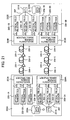
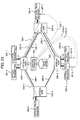
- FIG. 21 shows a first embodiment of a wavelength multiplexing optical transmission system to which the optical field receiver according to the present invention is applied.
- a wavelength multiplexing transmission equipment 220A includes optical transmitters 226-1A to 226-3A connected to a wavelength division multiplexer 223A and an optical field receiver 200-1A to 200-3A according to the present invention connected to a wavelength division demultiplexer 224A.
- a wavelength multiplexing transmission equipment 220B includes optical transmitters 226-1B to 226-3B connected to a wavelength division multiplexer 223B and an optical field receiver 200-1B to 200-3B according to the present invention connected to a wavelength division demultiplexer 224B.
- the wavelength multiplexing transmission equipments 220A and 220B are connected to each other by an upstream optical transmission line and a downstream optical transmission line.
- the upstream optical transmission line includes optical fibers 206-1 to 206-3 and optical amplifiers 225-1 and 225-2 and the downstream optical transmission line includes optical fibers 206-4 to 206-6 and optical amplifiers 225-3 and 225-4.
- the optical transmitters 226-1A to 226-3A of the wavelength multiplexing transmission equipment 220A transmit the optical signals at each of different wavelengths ⁇ 1 to ⁇ 3. These optical signals is multiplexed in the wavelength division multiplexer 223A and then output to the upstream optical transmission line and are demultiplexed for each wavelength in the wavelength division demultiplexer 224B of the opposing optical transmission equipment 220B and is input to the optical field receivers 200-1B to 200-3B.
- the optical transmitters 226-1B to 226-3B of the wavelength multiplexing transmission equipment 220B transmits the optical signal at each of different wavelengths ⁇ 1 to ⁇ 3.
- optical signals are multiplexed in the wavelength division multiplexer 223B and are output to the downstream optical transmission line and are demultiplexed for each wavelength in the wavelength division demultiplexer 224A of the optical transmission equipment 220A and are input to the optical field receivers 200-1A and 200-3A.
- the multiplexed different optical wavelength can be permitted in the upstream transmission line and the downstream optical transmission line.
- the wavelength multiplexing transmission equipment 220A(220B) includes a node controller 221A(221B) and a database 222A(222B). Although the optical transmitters 226-1A to 2226-3A(226-1B to 226-3B) and the optical field receivers 200-1A to 200-3A(200-1B to 200-3B) receives the transmission data from the outside and outputs the received data to the outside, it is omitted in the drawings.
- the data base 222A(222B) stores a data table showing the chromatic dispersion quantity of each optical fiber that forms the optical transmission line corresponding to the received wavelengths ⁇ 1 to ⁇ 3.
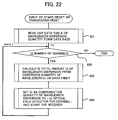
- FIG. 22 shows a flow chart of a routine of a compensation quantity setting table that is performed in the node controller 221A(221B).
- the routine is performed when starting and resetting the wavelength multiplexing transmission equipment or resetting the transmitter and receiver 226(226-1A to 226-3A) and 200(200-1A to 200-3A).
- the node controller 221A reads the chromatic dispersion quantity data table from the database 222A and sets parameter i for specifying a wavelength channel to an initial value "1" (step 601).
- the optical field receivers 200-1A to 200-3A do not need the adaptive control because it can estimate the chromatic dispersion compensation quantity from starting with high precision.
- the optical field receivers can be transited to an optimal control state at a short time and can prevent the malfunction.
- FIG. 23 shows one embodiment of an optical network that includes plural optical add drop multiplexers (ADMs) 230-1 to 230-4 using the optical field receiver according to the present invention.
- the optical add-drop multiplexers 230-1 to 230-4 are connected in a ring shape in the optical fiber transmission lines 206-1 to 206-4.
- the optical signal path may be dynamically changed.
- the dispersion compensation quantity in the optical receiver 200 receiving the influence of the path change is optimized by the control console 231 connected to the optical add-drop multiplexer 230-1.
- Reference numeral 222 is a database 222 that records the chromatic dispersion value for each wavelength over the whole optical fiber configuring the network.
- the control console 231 accesses the database 222 to calculate a total of the chromatic dispersion value according to a new optical signal path and the used wavelength and delivers a total of the calculated chromatic dispersion value as the chromatic compensation quantity to the optical receiver 200(200-1 to 200-3) connected to the optical add drop multiplexers 230-2 to 230-4 that is an end of the new path via a network.
- the optical signal of wavelength ⁇ 3 output from the optical transmitter 200-3 is input to the optical add drop multiplexer 230-4 and reaches the optical field receiver 200-3, which is connected to the optical add-drop multiplexer 230-3, through three optical fiber transmission lines 206-1 to 206-3 along the optical path 232-3.
- the control console 231 reads the chromatic dispersion quantity of the optical fiber transmission lines 206-1 to 206-3 corresponding to the wavelength ⁇ 3 from the database 222 and informs the optical field receiver 200-3 at the communication path 233-3 shown by a dotted line of the setting signal of the decided compensation quantity from the sum of the chromatic dispersion quantity.
- the compensation quantity setting signal is input to the compensation quantity setting terminal 207-3, such that the optimal dispersion compensation value is set to the field compensator 202 of the optical field receiver 200-3.
- the stop time of communication can remarkably be reduced.
- the precision of the dispersion compensation value set from the control console is not sufficient, as explained in the tenth embodiment , it can be permitted to optimize the value as the initial value by the adaptive control.
- FIG. 24 shows another embodiment of the optical multilevel signal receiver to which the optical field receiver according to the present invention is applied.
- the optical delayed demodulator 201-1 and 202-2 of the full-fledged optical field receiver described in FIG. 16 receives the optical multilevel signal 123 and inputs the output of the field processing unit 111 to the field compensator 202 and inputs the field signals 203-1 and 203-2 after the field compensation to the symbol decision circuit 176 that does not depend on the phase fluctuation to eliminate the phase fluctuation component and perform the symbol decision of the multilevel signal.
- the symbol decision circuit or the equalizer such as FFE, DFE and the like, the error correction circuit and the like are connected to the subsequent stage of the optical field receiver, making it possible to configure the high-function optical multilevel modulation signal receiver.
- FIG. 25 shows another embodiment of the optical multilevel signal receiver to which the optical field receiver according to the present invention is applied.
- the signal 203-1 showing the amplitude component r i (n) is directly input to the symbol decision circuit 176 that does not depend on the phase fluctuation and the signal 203-2 showing the phase component ⁇ i (n)is input to the delayed demodulator 234 of the electric region to supply the differential phase signal ⁇ (n) output from the delayed demodulator 234 to the symbol decision circuit 176 that does not depend on the phase fluctuation.
- the phase component ⁇ i(n) is input to the delayed demodulator 234 of the electric region to calculate the differential phase signal ⁇ (n) and apply the calculated differential phase signal to the symbol decision, making it possible to eliminate the influence of the phase fluctuation.
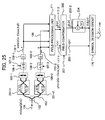
- FIG. 26 is a fourteenth embodiment of the present invention and shows an optical multilevel signal receiver to which the interleave sampling is applied.
- optical delayed demodulators 104-1 and 104-2 instead of the optical delayed demodulators 104-1 and 104-2, optical delayed demodulators 244-1 and 244-2 of delayed quantity 3T is used and each of three A/D converters 106-1A to 106-3A and 106-1B to 106-3B is connected to the balanced optical receiver 105-1 and 105-2 to input three pairs of A/D converting outputs "x1, y1", “x2, y2", and "x3, y3", which are symmetrical with each other, to the field processing units 111-1 to 111-3, respectively.
- the outputs signals 117-1 to 117-3 of the field processing units 111-1 to 111-3 are input to each of the symbol decision circuits 176-1 to 176-3 that does not depend on the phase fluctuation.
- the circuit speed required for the symbol decision can be reduced 1/3 by performing the interleave operation of the three symbol decision circuits.
- Reference numeral 240 is a division clock source that generates a clock whose frequency is 1/3T in synchronization with the received symbol timing and uses the delayed circuit 157 of the delay time T and 2T, thereby generating a three-phase clock signal series having the phase difference of the symbol time T.
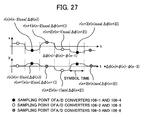
- the delayed demodulation signals output from the balanced optical receivers 105-1 and 105-2 are interleaved and sampled into three series on a time axis in these three pairs of A/D converters as shown in a black circle, a double circle, and a white circle in FIG. 27 .
- the field processing units 111-1 to 111-3 can perform the reconstructed process of the optical field independently from each other.
- the reconstructed optical field signals 117-1 to 117-3 perform the removal of the phase fluctuation and the symbol decision by the individual symbol decision circuits 176-1 to 176-3.
- a three-series digital signals output from the symbol decision circuits 176-1 to 176-3 are multiplexed in the multiplexing circuit 243 and are output as the reconstructed multilevel digital signal 144.
- three-series signal points (a black circle, a double circle, a white circle of FIG. 26 ) interleaved on the time axis are individually processed in the field processing units 111-1 to 111-3, such that they are supplied to the symbol decision circuits 176-1 and 176-3 without being correlated with each other, making it possible to generate the errors in the phase or amplitude.
- the reconstructed optical field signals 117-1 to 117-3 are branched into the field synchronization circuit 241 and average amplitude and an average phase of the same signal point are compared with each other and the difference is supplied to the symbol decision circuits 176-1 and 176-3 as the correction signal 242.
- Each symbol decision circuit 176 performs the normalization of the input signal amplitude and the correction of the reference phase so that the amplitudes and reference phases of the three-series output signal always conform to each other according to the correction signal. Instead of imparting the correction signal 242 to the symbol decision circuit 176, the correction signal 242 is supplied to the field processing units 111-1 to 11-3 such that the each field processing unit 111-1 to 111-3 can be permitted to correct the each output signal (reconstructed optical field signal) 117-1 to 117-3.
- the interleave number or the sampling speed can be optionally selected.
- the interleave sampling of the interleave number 2 is performed in the full-fledged optical field receiver 200 shown in FIG. 16 , it can be permitted to make the delay time of the optical delayed demodulators 201-1 and 201-2 T and to make the sampling speed 1/T.
- the optical field receiver of the present invention uses the optical delayed demodulator, it does not depend on the polarization state of the input light and does not need the local laser. Since the optical multilevel receiver shown in the embodiment can directly reconstruct the two-dimensional coordinate information of the optical signal points in the field processing unit that processes the output signal of the optical delayed demodulator, the multilevel symbols can be decided in a lump in the symbol decision circuit connected to the field processing unit and the optical multilevel receiver having a large multilevel number, such as 32 levels, 64 levels of high transmission efficiency and the like, can be realized by a relative small hardware.
- the adaptive receiver since the field processing or the multilevel decision can be performed by the electric digital circuit, the adaptive receiver according to the degradation factors, such as the loss of the transmission line, the SN ratio of the signal and the like can be easily realized.
- the adaptive dispersion compensation which can perfectly compensate theoretically the linear transmission degradation, such as the chromatic dispersion or the narrow-band filtering and the like, and dynamically change the compensation contents, can be realized.
- the present invention can also be applied to optical field waveform measuring equipment or optical spatial transmission equipment and the like, for example.
- the multilevel signal transmission in the wireless communication field and the optical communication field to which the present invention is applied are different in the technology as described below.
- the present invention can be applied to the multilevel modulation signal receiver of high transmission efficiency in the optical communication field.
Landscapes
- Physics & Mathematics (AREA)
- Electromagnetism (AREA)
- Engineering & Computer Science (AREA)
- Computer Networks & Wireless Communication (AREA)
- Signal Processing (AREA)
- Optical Communication System (AREA)
Applications Claiming Priority (1)
| Application Number | Priority Date | Filing Date | Title |
|---|---|---|---|
| PCT/JP2006/309498 WO2007132503A1 (fr) | 2006-05-11 | 2006-05-11 | Récepteur de champ électrique optique, récepteur de signal multi-niveau optique et système de transmission optique |
Publications (2)
| Publication Number | Publication Date |
|---|---|
| EP2017980A1 true EP2017980A1 (fr) | 2009-01-21 |
| EP2017980A4 EP2017980A4 (fr) | 2013-01-16 |
Family
ID=38693606
Family Applications (1)
| Application Number | Title | Priority Date | Filing Date |
|---|---|---|---|
| EP06732529A Withdrawn EP2017980A4 (fr) | 2006-05-11 | 2006-05-11 | Récepteur de champ électrique optique, récepteur de signal multi-niveau optique et système de transmission optique |
Country Status (5)
| Country | Link |
|---|---|
| US (1) | US8873968B2 (fr) |
| EP (1) | EP2017980A4 (fr) |
| JP (1) | JP4791536B2 (fr) |
| CN (1) | CN101438517B (fr) |
| WO (1) | WO2007132503A1 (fr) |
Cited By (6)
| Publication number | Priority date | Publication date | Assignee | Title |
|---|---|---|---|---|
| EP2230782A1 (fr) | 2009-03-19 | 2010-09-22 | Alcatel Lucent | Surveillance des distorsions non linéaires d'un système de transmission par fibres optiques |
| EP2343841A1 (fr) * | 2010-01-08 | 2011-07-13 | Fujitsu Limited | Dispositif de réception de lumière et procédé de réception de lumière |
| EP2562945A1 (fr) * | 2011-08-24 | 2013-02-27 | Ciena Corporation | Systèmes de récupération optique à court terme et procédés pour des récepteurs optiques cohérents |
| US8472807B2 (en) | 2008-11-28 | 2013-06-25 | Hitachi, Ltd. | Optical field transmitter and optical transmission system |
| EP2678956A4 (fr) * | 2011-02-25 | 2015-03-18 | Nec Lab America Inc | Bruit de battement de signal à signal numérique pour système de réception cohérent sans filtre |
| CN114024662A (zh) * | 2021-12-21 | 2022-02-08 | 渔翁信息技术股份有限公司 | 随机数发生器 |
Families Citing this family (47)
| Publication number | Priority date | Publication date | Assignee | Title |
|---|---|---|---|---|
| US9312964B2 (en) * | 2006-09-22 | 2016-04-12 | Alcatel Lucent | Reconstruction and restoration of an optical signal field |
| CN101507149B (zh) | 2006-09-26 | 2011-12-28 | 株式会社日立制作所 | 光场接收器以及光传输系统 |
| JP4303760B2 (ja) | 2007-02-16 | 2009-07-29 | 富士通株式会社 | Ad変換制御装置、光受信装置および光受信方法 |
| US8265489B2 (en) | 2007-11-09 | 2012-09-11 | Hitachi, Ltd. | Optical field transmitter and optical field transmission system |
| JP2009218837A (ja) * | 2008-03-10 | 2009-09-24 | Fujitsu Ltd | 光受信装置および光受信方法 |
| JP5136236B2 (ja) * | 2008-06-19 | 2013-02-06 | 富士通株式会社 | 光受信装置 |
| JP5417810B2 (ja) * | 2008-11-17 | 2014-02-19 | 横河電機株式会社 | 光測定装置及び光測定方法 |
| US8166365B2 (en) * | 2008-12-03 | 2012-04-24 | Ciena Corporation | Cycle slip location and correction |
| JP5326584B2 (ja) * | 2009-01-09 | 2013-10-30 | 富士通株式会社 | 遅延処理装置,信号増幅装置,光電変換装置,アナログ/デジタル変換装置,受信装置および受信方法 |
| WO2010082344A1 (fr) * | 2009-01-16 | 2010-07-22 | 三菱電機株式会社 | Système de modulation/démodulation de lumière, système de transmission de lumière et procédé de modulation/démodulation de lumière |
| WO2010082339A1 (fr) * | 2009-01-16 | 2010-07-22 | 三菱電機株式会社 | Système de transfert optique, appareil émetteur et appareil récepteur |
| JP5407403B2 (ja) * | 2009-02-18 | 2014-02-05 | 富士通株式会社 | 信号処理装置および光受信装置 |
| CN102318306A (zh) * | 2009-03-02 | 2012-01-11 | 株式会社日立制作所 | 光多值传输系统 |
| US8929750B2 (en) * | 2009-05-18 | 2015-01-06 | Nippon Telegraph And Telephone Corporation | Signal generating circuit, optical signal transmitting apparatus, signal receiving circuit, method for establishing optical signal synchronization, and optical signal synchronization system |
| US8478136B2 (en) * | 2009-10-02 | 2013-07-02 | Eye Diagram2 Ip, Llc | Electronic compensation of nonlinearity in optical communication |
| GB2474882B (en) * | 2009-10-29 | 2014-04-09 | Tgs Geophysical Company Uk Ltd | Signal processing |
| US9100126B2 (en) | 2009-11-24 | 2015-08-04 | Nec Corporation | Optical reception device and optical reception control method |
| CN102696189A (zh) * | 2010-01-07 | 2012-09-26 | 株式会社日立制作所 | 光传送系统 |
| JP5482273B2 (ja) * | 2010-02-12 | 2014-05-07 | 富士通株式会社 | 光受信器 |
| US8401389B2 (en) * | 2010-03-12 | 2013-03-19 | Fujitsu Limited | Method and system for compensating for optical dispersion in an optical signal |
| JPWO2011125964A1 (ja) * | 2010-04-06 | 2013-07-11 | 日本電気株式会社 | 光送受信システムおよび光送受信システムにおけるタイミング抽出方法 |
| EP2381593B1 (fr) * | 2010-04-21 | 2014-06-25 | Alcatel Lucent | Réglage de la puissance de composants de quadrature et en phase dans un récepteur optique cohérent |
| JP5737874B2 (ja) * | 2010-07-06 | 2015-06-17 | 日本オクラロ株式会社 | 復調器及び光送受信機 |
| WO2012004890A1 (fr) | 2010-07-09 | 2012-01-12 | 株式会社日立製作所 | Récepteur optique et système de transmission optique |
| JP5578360B2 (ja) * | 2010-09-14 | 2014-08-27 | ソニー株式会社 | 受信装置および方法、並びにプログラム |
| US8620166B2 (en) * | 2011-01-07 | 2013-12-31 | Raytheon Bbn Technologies Corp. | Holevo capacity achieving joint detection receiver |
| JP5707981B2 (ja) * | 2011-01-31 | 2015-04-30 | 富士通株式会社 | サンプリングクロック同期装置、ディジタルコヒーレント受信装置およびサンプリングクロック同期方法 |
| WO2012144108A1 (fr) * | 2011-04-21 | 2012-10-26 | 日本電気株式会社 | Procédé de réception optique et récepteur optique |
| JP5824883B2 (ja) * | 2011-06-06 | 2015-12-02 | 富士通株式会社 | 受信機及び相互位相変調緩和方法 |
| US8824501B2 (en) * | 2011-09-16 | 2014-09-02 | Alcatel Lucent | Performance enhancement through optical variants |
| US8977136B2 (en) * | 2011-12-19 | 2015-03-10 | Technion Research And Development Foundation Ltd. | Carrier phase estimation for optically coherent QPSK based on wiener-optimal and adaptive multi-symbol delay detection (MSDD) |
| JP2014013965A (ja) * | 2012-07-03 | 2014-01-23 | Hitachi Ltd | 偏波多値信号光受信装置、偏波多値信号光送信装置および偏波多値信号光伝送装置 |
| US20140241722A1 (en) * | 2013-02-25 | 2014-08-28 | Alcatel-Lucent Usa Inc. | PDM-(M) Ask Optical Systems And Methods For Metro Network Applications |
| CN105103508A (zh) * | 2013-03-30 | 2015-11-25 | 中兴通讯股份有限公司 | 从正交相移键控调制光信号恢复数据 |
| JP6396016B2 (ja) * | 2013-12-05 | 2018-09-26 | 株式会社日立製作所 | 光受信器および光信号受信方法 |
| JP2015122632A (ja) * | 2013-12-24 | 2015-07-02 | 富士通株式会社 | 光通信受信装置 |
| WO2016018966A1 (fr) * | 2014-07-29 | 2016-02-04 | Corning Incorporated | Démultiplexage par répartition de mode tout optique |
| GB2546279B (en) * | 2016-01-12 | 2019-08-21 | Phoelex Ltd | An optical apparatus |
| US10637692B2 (en) * | 2017-09-26 | 2020-04-28 | Micron Technology, Inc. | Memory decision feedback equalizer |
| JP6627927B1 (ja) * | 2018-07-24 | 2020-01-08 | Nttエレクトロニクス株式会社 | 位相変動補償装置、位相変動補償方法及び通信装置 |
| US10511388B1 (en) * | 2018-08-10 | 2019-12-17 | Fujitsu Limited | Reducing variance in reach of WDM channels in an optical network |
| CN110932782B (zh) * | 2019-12-27 | 2022-06-24 | 裕太微电子股份有限公司 | 一种光纤传输标准的自适应系统及自适应方法 |
| KR102404946B1 (ko) * | 2021-03-24 | 2022-06-02 | 연세대학교 산학협력단 | 위상 변조 신호 왜곡을 보상하는 광 수신 장치 및 방법 |
| JP7679876B2 (ja) * | 2021-04-28 | 2025-05-20 | 日本電信電話株式会社 | アナログ・デジタル変換方法およびアナログ・デジタル変換器 |
| US12308049B2 (en) * | 2023-06-26 | 2025-05-20 | Macronix International Co., Ltd. | Decision feedback equalization in semiconductor devices |
| CN117375708B (zh) * | 2023-09-27 | 2024-03-19 | 威海激光通信先进技术研究院 | 基于光纤耦合的空间二维偏角测量通信一体化实现方法 |
| CN119002361B (zh) * | 2024-08-22 | 2025-05-16 | 山东山晔智能装备有限公司 | 直线行驶控制系统、控制方法及耕作装置 |
Family Cites Families (8)
| Publication number | Priority date | Publication date | Assignee | Title |
|---|---|---|---|---|
| US5432819A (en) * | 1994-03-09 | 1995-07-11 | Martin Marietta Corporation | DPSK communications with Doppler compensation |
| US6064507A (en) * | 1996-06-17 | 2000-05-16 | Trw Inc. | High speed differential optoelectronic receiver |
| JP3857099B2 (ja) * | 2001-10-09 | 2006-12-13 | 株式会社アドバンテスト | データ伝送装置、光電変換回路、及び試験装置 |
| EP1523817B1 (fr) * | 2002-07-11 | 2007-02-14 | Koninklijke Philips Electronics N.V. | Circuit recepteur optique |
| US20040141222A1 (en) | 2002-11-01 | 2004-07-22 | Communications Res. Lab., Ind. Admin. Inst. | Optical phase multi-level modulation method and apparatus, and error control method |
| US6798557B1 (en) * | 2003-05-22 | 2004-09-28 | Lucent Technologies Inc. | Direct optical N-state phase shift keying |
| JP4516501B2 (ja) * | 2005-08-25 | 2010-08-04 | 富士通オプティカルコンポーネンツ株式会社 | Dqpsk光受信回路 |
| US7623796B2 (en) * | 2006-02-27 | 2009-11-24 | Alcatel-Lucent Usa Inc. | Data-aided multi-symbol phase estimation for optical differential multilevel phase-shift keying signals |
-
2006
- 2006-05-11 CN CN2006800545488A patent/CN101438517B/zh not_active Expired - Fee Related
- 2006-05-11 US US12/300,212 patent/US8873968B2/en not_active Expired - Fee Related
- 2006-05-11 JP JP2008515391A patent/JP4791536B2/ja not_active Expired - Fee Related
- 2006-05-11 EP EP06732529A patent/EP2017980A4/fr not_active Withdrawn
- 2006-05-11 WO PCT/JP2006/309498 patent/WO2007132503A1/fr not_active Ceased
Cited By (11)
| Publication number | Priority date | Publication date | Assignee | Title |
|---|---|---|---|---|
| US8472807B2 (en) | 2008-11-28 | 2013-06-25 | Hitachi, Ltd. | Optical field transmitter and optical transmission system |
| EP2230782A1 (fr) | 2009-03-19 | 2010-09-22 | Alcatel Lucent | Surveillance des distorsions non linéaires d'un système de transmission par fibres optiques |
| EP2343841A1 (fr) * | 2010-01-08 | 2011-07-13 | Fujitsu Limited | Dispositif de réception de lumière et procédé de réception de lumière |
| US8649685B2 (en) | 2010-01-08 | 2014-02-11 | Fujitsu Limited | Light receiving device and light receiving method |
| US8942574B2 (en) | 2010-01-08 | 2015-01-27 | Fujitsu Limited | Light receiving device and light receiving method |
| EP2678956A4 (fr) * | 2011-02-25 | 2015-03-18 | Nec Lab America Inc | Bruit de battement de signal à signal numérique pour système de réception cohérent sans filtre |
| EP2562945A1 (fr) * | 2011-08-24 | 2013-02-27 | Ciena Corporation | Systèmes de récupération optique à court terme et procédés pour des récepteurs optiques cohérents |
| US9100116B2 (en) | 2011-08-24 | 2015-08-04 | Ciena Corporation | Short-term optical recovery systems and methods for coherent optical receivers |
| US10958338B2 (en) | 2011-08-24 | 2021-03-23 | Ciena Corporation | Short-term optical recovery systems and methods for coherent optical receivers |
| CN114024662A (zh) * | 2021-12-21 | 2022-02-08 | 渔翁信息技术股份有限公司 | 随机数发生器 |
| CN114024662B (zh) * | 2021-12-21 | 2022-05-24 | 渔翁信息技术股份有限公司 | 随机数发生器 |
Also Published As
| Publication number | Publication date |
|---|---|
| US8873968B2 (en) | 2014-10-28 |
| US20090208224A1 (en) | 2009-08-20 |
| CN101438517A (zh) | 2009-05-20 |
| CN101438517B (zh) | 2012-09-05 |
| EP2017980A4 (fr) | 2013-01-16 |
| WO2007132503A1 (fr) | 2007-11-22 |
| JP4791536B2 (ja) | 2011-10-12 |
| JPWO2007132503A1 (ja) | 2009-09-17 |
Similar Documents
| Publication | Publication Date | Title |
|---|---|---|
| EP2017980A1 (fr) | Récepteur de champ électrique optique, récepteur de signal multi-niveau optique et système de transmission optique | |
| EP2071747B1 (fr) | Récepteur de champ électrique optique et système de transmission optique | |
| US8913901B2 (en) | System and method for blind equalization and carrier phase recovery in a quadrature amplitude modulated system | |
| US7315575B2 (en) | Equalization strategy for dual-polarization optical transport system | |
| Winzer et al. | Spectrally efficient long-haul optical networking using 112-Gb/s polarization-multiplexed 16-QAM | |
| US8805188B2 (en) | Polarization-multiplexed optical transmission system, polarization-Multiplexed optical transmitter, and polarization-multiplexed optical receiver | |
| US8855503B2 (en) | Optical receiver and optical transmission system | |
| US11387929B1 (en) | Systems and methods for carrier phase recovery | |
| US20110002689A1 (en) | Optical ofdm receiver, optical transmission system, subcarrier separation circuit, and subcarrier separation method | |
| US20120045208A1 (en) | Coherent receiver | |
| US8335440B2 (en) | Method, system, and apparatus for blind equalization of BPSK signals | |
| US8750442B2 (en) | Digital receiver and waveform compensation method | |
| EP2622810A1 (fr) | Égaliseur adaptatif avec détection asynchrone et générateur de signal d'inhibition | |
| WO2011125964A1 (fr) | Système d'émission/réception de lumière et procédé d'extraction de temporisation dans un système d'émission/réception de lumière | |
| KR101322929B1 (ko) | Dqpsk 변조를 근거한 위상차의 모니터 및 제어 방법 및 장치 | |
| JP5657168B2 (ja) | 偏波推定器、偏波分離器、光受信器、偏波推定方法、および、偏波分離方法 | |
| Sun et al. | Timing synchronization in coherent optical transmission systems | |
| EP3110043A1 (fr) | Estimation de phase de porteuse au niveau d'un récepteur optique cohérent | |
| Noé et al. | Advances in coherent optical modems and 16-QAM transmission with feedforward carrier recovery | |
| da Silva Ferreira | Advanced Digital Signal Processing for Flexible Optical Access Networks | |
| WO2014146708A1 (fr) | Appareil de récupération du rythme |
Legal Events
| Date | Code | Title | Description |
|---|---|---|---|
| PUAI | Public reference made under article 153(3) epc to a published international application that has entered the european phase |
Free format text: ORIGINAL CODE: 0009012 |
|
| 17P | Request for examination filed |
Effective date: 20081204 |
|
| AK | Designated contracting states |
Kind code of ref document: A1 Designated state(s): AT BE BG CH CY CZ DE DK EE ES FI FR GB GR HU IE IS IT LI LT LU LV MC NL PL PT RO SE SI SK TR |
|
| AX | Request for extension of the european patent |
Extension state: AL BA HR MK YU |
|
| RAP1 | Party data changed (applicant data changed or rights of an application transferred) |
Owner name: HITACHI, LTD. |
|
| DAX | Request for extension of the european patent (deleted) | ||
| A4 | Supplementary search report drawn up and despatched |
Effective date: 20121217 |
|
| RIC1 | Information provided on ipc code assigned before grant |
Ipc: H04B 10/50 20130101AFI20121218BHEP Ipc: H04B 10/40 20130101ALI20121218BHEP Ipc: H04B 10/43 20130101ALI20121218BHEP Ipc: H04B 10/60 20130101ALI20121218BHEP Ipc: H04B 10/11 20130101ALI20121218BHEP |
|
| STAA | Information on the status of an ep patent application or granted ep patent |
Free format text: STATUS: THE APPLICATION HAS BEEN WITHDRAWN |
|
| 18W | Application withdrawn |
Effective date: 20160427 |