EP2018008A1 - Verfahren und System zur Verringerung von Nachrichteninstanzen - Google Patents
Verfahren und System zur Verringerung von Nachrichteninstanzen Download PDFInfo
- Publication number
- EP2018008A1 EP2018008A1 EP08159351A EP08159351A EP2018008A1 EP 2018008 A1 EP2018008 A1 EP 2018008A1 EP 08159351 A EP08159351 A EP 08159351A EP 08159351 A EP08159351 A EP 08159351A EP 2018008 A1 EP2018008 A1 EP 2018008A1
- Authority
- EP
- European Patent Office
- Prior art keywords
- message
- wtru
- wtrus
- sib
- transmission schedule
- Prior art date
- Legal status (The legal status is an assumption and is not a legal conclusion. Google has not performed a legal analysis and makes no representation as to the accuracy of the status listed.)
- Withdrawn
Links
Images
Classifications
-
- H—ELECTRICITY
- H04—ELECTRIC COMMUNICATION TECHNIQUE
- H04L—TRANSMISSION OF DIGITAL INFORMATION, e.g. TELEGRAPHIC COMMUNICATION
- H04L12/00—Data switching networks
- H04L12/02—Details
- H04L12/16—Arrangements for providing special services to substations
- H04L12/18—Arrangements for providing special services to substations for broadcast or conference, e.g. multicast
- H04L12/189—Arrangements for providing special services to substations for broadcast or conference, e.g. multicast in combination with wireless systems
-
- H—ELECTRICITY
- H04—ELECTRIC COMMUNICATION TECHNIQUE
- H04W—WIRELESS COMMUNICATION NETWORKS
- H04W4/00—Services specially adapted for wireless communication networks; Facilities therefor
- H04W4/06—Selective distribution of broadcast services, e.g. multimedia broadcast multicast service [MBMS]; Services to user groups; One-way selective calling services
-
- H—ELECTRICITY
- H04—ELECTRIC COMMUNICATION TECHNIQUE
- H04W—WIRELESS COMMUNICATION NETWORKS
- H04W4/00—Services specially adapted for wireless communication networks; Facilities therefor
- H04W4/06—Selective distribution of broadcast services, e.g. multimedia broadcast multicast service [MBMS]; Services to user groups; One-way selective calling services
- H04W4/08—User group management
-
- H—ELECTRICITY
- H04—ELECTRIC COMMUNICATION TECHNIQUE
- H04W—WIRELESS COMMUNICATION NETWORKS
- H04W4/00—Services specially adapted for wireless communication networks; Facilities therefor
- H04W4/12—Messaging; Mailboxes; Announcements
-
- H—ELECTRICITY
- H04—ELECTRIC COMMUNICATION TECHNIQUE
- H04W—WIRELESS COMMUNICATION NETWORKS
- H04W48/00—Access restriction; Network selection; Access point selection
- H04W48/08—Access restriction or access information delivery, e.g. discovery data delivery
- H04W48/12—Access restriction or access information delivery, e.g. discovery data delivery using downlink control channel
-
- H—ELECTRICITY
- H04—ELECTRIC COMMUNICATION TECHNIQUE
- H04W—WIRELESS COMMUNICATION NETWORKS
- H04W76/00—Connection management
- H04W76/40—Connection management for selective distribution or broadcast
Definitions
- the present invention relates to the field of wireless communications. More particularly, the present invention relates to messaging within wireless transmission systems.
- Broadcast messages are transmitted at a specific time, on a specific channel, with a specific channelization code. Broadcast messages are only retransmitted if there is a problem with the robustness of delivery or timing (i.e., devices typically want to receive a message while being in the right place at the right time). Broadcast messages, however, are often transmitted over large geographical regions and therefore encompass a large number of cells. For this reason, broadcasting messages is only efficient where there will be a large number of users receiving the message.
- Multicasting where messages are sent to a predetermined number of users, involves limited receivers and selective transmissions to each of the targeted receivers.
- multiple instances of the same data i.e., message
- transmitting multiple instances of the same message is not an efficient use of radio resources. That is, with prior art multicast transmissions, messages and their associated pointers have a one-to-one correspondence which leads to multiple transmissions of the same message.
- Another approach is to assign a group identifier to a number of devices.
- the group identifier reduces one-to-one correspondence between messages and pointers and allows a single instance of a message to be received by each device having the assigned identifier.
- the group identifier approach is efficient only where there is prior knowledge of the devices that should form the group and the group identifier is expected to be used a number of times over a period of time.
- the group identifier must be established in the devices via offline or online programming, it is not an efficient means of ad hoc (ad hoc with respect to at least the wireless network) message delivery. That is, a group page from an email source may indeed be a repeating group, but the RF network will not have a priori knowledge of the repeating group.
- the present invention is a method and system for transmitting messages with reduced message instances. A determination is made as to whether there are multiple WTRUs identified for receipt of the same message. If so, a single instance of the message may be transmitted for all of the receiving WTRUs.
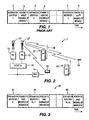
- Figure 1 is a diagram illustrating a framed time sequence having a one-to-one correspondence between messages and pointers for a plurality of WTRUs receiving the same message in accordance with the prior art.
- FIG. 2 is a diagram showing a mobile network in which multiple WTRUs receive messages in accordance with the present invention.
- Figure 3 is a diagram illustrating a framed time sequence wherein only a single instance of a message is transmitted despite the message being identified for delivery to a plurality of destination identifiers in accordance with the present invention.
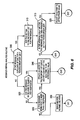
- Figure 4 is a diagram for more efficiently processing destination identifiers and pointers contained within a framed time sequence.
- FIG 5 is a variation of the diagram shown in Figure 4 wherein messages are included directly in the SIBs.
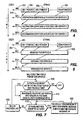
- Figure 6 is a flow chart illustrating method steps implemented by a message arrival analysis routine in accordance with a preferred embodiment of the present invention.
- Figure 7 is a flow chart illustrating method steps for periodically checking to see if there is a recipient list that has been in a multicast queue past a predetermined hold time in accordance with a preferred embodiment of the present invention.
- a wireless transmit/receive unit may have a transmit-only, a receive-only or a transmit and receive capability.
- An example would be a standard pager, which can receive but not transmit messages.
- a receive ability is important to the receipt of messages, in which case the particular unit would have at least a wireless receive function.
- a WTRU capable of both transmission and reception can generally be used to receive one-way messages. Therefore, for purposes of describing the invention, a WTRU may be any device capable of receiving and/or transmitting data in a wireless environment.
- FIG. 1 a diagram illustrating the manner in which multicast messages are transmitted according to the prior art is shown.
- a plurality of WTRUs 2, 4, 5 are identified, using unique destination identifiers, for receipt of the same message, message 1.
- message 1 a separate instance of the message 1 is provided for each WTRU (see WTRU 2 and pointer 6, WTRU 4 and pointer 8, and WTRU 5 and pointer 9). Consequently, in Figure 1 , there is a one-to-one correspondence between messages and pointers.
- destination identifiers are coordinated so that only a single instance of a message is used where the same message is being sent to more than one destination identifier (i.e. to more than one WTRU(s), depending on whether the destination identifier is associated with a single WTRU or a plurality ofWTRUs).
- the mobile network 11 includes multiple base stations 12, 13 which are responsive to a radio network controller (RNC) 14, through one or more Node Bs 15.
- RNC radio network controller
- a plurality of WTRUs 21-24 receive messages transmitted from the network.
- the base stations 12, 13 transmit and receive signals via antennas 27.
- the WTRUs 21-24 have receivers or transceivers which receive the signals from the base stations 12, 13 (e.g., via antenna 28 of WTRU 21).
- the WTRUs 21-24 can be any of a number of devices supported by the system, such as a cell phone, pager, Blackberry TM device, or a computer with a modem connection.
- the base stations 12, 13 are controlled by RNC 14, which performs various network supervisory and communications functions.
- the base stations 12, 13 provide transmit functions and signals that are transmitted to the WTRUs 21-24 within a respective cell or transmission area.
- a receive function is provided by each WTRU's RF stage in order to receive signals transmitted by the base stations 12, 13.
- each WTRU has both transmit and receive functions, permitting the WTRUs 21-24 to transmit data in an uplink and receive data in a downlink.
- WTRUs 21 and 22 the network will refrain from transmitting a plurality of instances of the same message. Instead, WTRUs 21 and 22 will be provided with message pointers that point to the same message. Each message pointer specifies a particular physical channel and time on/at which the message will be available.
- the network may detect such occurrences by evaluating a recipient list of a particular message and determining whether there are multiple WTRUs identified for receipt of a single message.
- WTRUs identified as being identified for receipt of a single message may be tracked using a message address status.
- the message address status may be WTRU specific and indicates whether a particular WTRU belongs to a group of WTRUs identified for receipt of the same message. Where there are multiple WTRUs (21 and 22) identified for receipt of the same message, a single instance of the message is transmitted to all of the receiving WTRUs.
- Other methods of determining and identifying which WTRUs are identified for receipt of the same message and are thus candidates for reduced message instances are within the scope of the invention and may be implemented as desired. Examples of such methods are described below.
- Figure 3 is a diagram of an ordered frame having a timing sequence 40 showing a single instance of a message, message M, being transmitted to a plurality of destination identifiers 42, 44, and 46.
- the destination identifiers 42, 44, and 46 may each be associated with one or more WTRUs.
- message "M" has been identified for delivery to the WTRU(s) associated with destination identifiers 42, 44, and 46. That is, rather than providing multiple instances of message M, a single instance is provided thereby optimizing system resources.
- the message must occur in a fashion such that all of the WTRUs that are receiving the message will be able to receive the message during its transmission.
- the message transmission must be later than the last destination identifier time of transmission, and with sufficient time delay for every WTRU to prepare for the reception of the message.
- a pointer to a specific message may occur with any number of destination identifiers, and there may be intervening messages going to other WTRUs, as desired.
- one or more of the destination identifiers may actually be a group identifier of a number of WTRUs in a manner known to those skilled in the art of wireless technology.
- the determination of when it is feasible to use the same message multiple times according to the present invention may be refined and adapted, as desired. That is, the determination may be implemented in a variety of embodiments.
- the source of the messages can be programmed to associate multiple receiving WTRUs with the same message.
- the wireless network receives such a message it compares the recipient list against the coverage areas it has for them. Because of different locations or network affiliations it may be necessary to split the message and recipients into distinct transmissions. However if two or more of the receiving WTRUs are capable of receiving the same identification transmission and subsequently the same message transmission, then the solution of the present invention may be utilized.
- a second embodiment where messages and data concerning receiving WTRUs enter a wireless network individually, many types of messages can tolerate some delay in delivery without adverse effects.
- the system compares messages over some fraction of these allowable delay times for duplications. This can often be done with minimal calculations through such techniques as hashing functions.
- duplications are detected, a check is done to determine if any of the duplicated messages may be transmitted in a single transmission. If so, pointers that point to a single instance of a duplicated message is provided for the WTRUs identified for receipt of the duplicated message.
- a wireless system may include an entity for monitoring transmissions to WTRUs.
- the entity establishes a likelihood factor concerning whether certain groups of WTRUs receive transmissions of the same messages.
- the reception of a message for one of these WTRUs triggers a delay and search for duplications of the message for other devices before transmission thereof. If duplications are detected, a single instance of the message is transmitted. Otherwise, separate instances of the message are transmitted to each of the receiving WTRUs.
- a wireless system is preprogrammed to watch for specific device identifier groups and checks for duplication of messages to the individuals within these groups. If duplications are detected, a single instance of the message is transmitted. Otherwise, separate instances of the message are transmitted to each of the receiving WTRUs.
- the destination identifiers and pointers identified in Figure 3 are signaled on the broadcast common control channel (BCCH) or an equivalent logical control channel broadcast to all users of the cell.
- BCCH broadcast common control channel
- the BCCH or equivalent logical control channel is mapped to a broadcast transport channel (BCH) or an equivalent broadcast transport channel that is applied to the primary common control physical channel (PCCPCH).
- PCCPCH primary common control physical channel
- the BCCH or an equivalent logical control channel can be mapped to a forward access channel (FACH) that is applied to the secondary common control physical channel (SCCPCH).
- FACH forward access channel
- a WTRU must check the entire timing sequence 40 to determine whether there is a message for them.
- SIB System Information Blocks
- the destination identifiers and pointers are associated with particular SIBs thereby allowing WTRU(s) to simply determine which individual SIB they should read in order to receive a message. That is, the list of destination identifiers and pointers can be relatively large. To avoid having a WTRU check each destination identifier and pointer contained within a timing sequence (such as timing sequence 40), the SIB information can be segmented into multiple independent transmissions. Alternatively, it is also possible to separate different classifications of destination identifiers and pointers into multiple SIBs.
- WTRUs may determine which SIB to read from a master information block (MIB) that identifies the scheduling of individual SIBs. That is, in this embodiment, instead of a WTRU checking all of the destination identifiers and pointers contained within a particular timing sequence (such as timing sequence 40), the WTRU may simply check the MIB to quickly determine the appropriate destination identifier and pointer (which are contained in the SIB). The destination identifiers and pointers are therefore associated with a particular SIB. Users may then only acquire SIBs for which services these users are associated with.
- MIB master information block
- FIG. 4 a MIB 502 including pointers 504, 506, and 508 is shown.
- the MIB may be unique for each cell. Therefore, each time a WTRU enters a cell, they will read the MIB. By reading the MIB 502 the WTRU is informed of where to find their SIB. The SIB informs the WTRU at which time interval the WTRU's destination identifier and pointer will be presented. It should also be noted that the destination identifier and pointer may be updated periodically. For example, in the case of stock quotes, a new message may be transmitted every 10 minutes. In that case, the WTRU will read the SIB every 10 minutes to receive the updated information, but does not have to read the MIB. This is because the MIB will not change unless the actual scheduling of the destination identifiers and pointers changes.
- the MIB 502 includes pointers 504, 506, and 508 which point to SIB1 SIB2, and SIBN, respectively.
- a WTRU subscribing to service A reads the MIB, and is directed to SIB1 510. From reading SIB1 510, the WTRU reads the destination identifiers and pointers for service A 512. The WTRU may then retrieve messages for service A. In this embodiment, any number of WTRUs may be associated with the destination identifiers for service A (i.e. all of the users subscribing to service A).
- WTRUs that subscribe to service A by reading the MIB and the SIB, are directed to a single instance of whatever message is being transmitted as part of service A.
- WTRUs associated with services B and X may similarly be directed to single instances of messages transmitted pursuant to those services.
- a WTRU reads the MIB as before, but here an extra step is eliminated because when the WTRU obtains its SIB it has an actual message.
- This also enables a single instance of the message to be transmitted for multiple WTRUs. That is, each WTRU reads MIB 601 and is directed to SIB1 604 which includes a single instance of the message 602 currently being transmitted for service A.
- a generic message pointer such as a pointer to a message indicating availability of a more specific type of message.
- the user can then, either by preconfiguration or by selection at the time of receipt of the generic message, choose to receive the specific type message.
- the selection can be made to inform the network that the WTRU will receive the message, or the selection can be passive, allowing the WTRU to respond to the more specific message.
- a user entering a commercial space may be offered commercial information such that the user may elect to receive the commercial information.
- Figure 6 is a flow chart illustrating method steps implemented by a message arrival analysis routine in accordance with a preferred embodiment of the present invention.
- a message arrival analysis routine When a message arrives, a determination is made as to whether the message is a duplicate of one for a pending recipient list (step 305).
- step 305 If the determination of step 305 yields a positive result, the WTRU(s) are added to the recipient list for the message (step 310). In step 315, a determination is made as to whether the maximum hold time for this instance is less than that presently set for the recipient list. If it is, the hold time is adjusted to an appropriate value (step 320).
- step 305 determines whether the message can be delayed to search for other recipients (step 325). If the message can not be delayed to search for other recipients, a determination is made as to whether the message is being sent to more than one recipient (step 330). If the message is not being sent to more than one recipient, the message is scheduled for normal delivery (step 335). If the message is being sent to more than one recipient, or it is determined that the message can be delayed to search for other recipients, an entry is created in the recipient list queue, one or more WTRUs are added, and the hold time is set to an appropriate value (step 340).
- Figure 7 is a flow chart illustrating method steps for periodically checking to see if there is a recipient list that has been in a multicast queue past a predetermined hold time in accordance with a preferred embodiment of the present invention.
- the WTRUs on the recipient list are segregated into groups in the same data delivery coverage areas (step 410).
- a determination is then made as to whether there is another group to send (step 415). If there is another group to send, the transmission of WTRU identifiers, message pointer and one instance of the message is scheduled (step 420). If there is not another group to send, the recipient list is deleted (step 425).
Landscapes
- Engineering & Computer Science (AREA)
- Computer Networks & Wireless Communication (AREA)
- Signal Processing (AREA)
- Multimedia (AREA)
- Mobile Radio Communication Systems (AREA)
- Data Exchanges In Wide-Area Networks (AREA)
- Telephonic Communication Services (AREA)
- Small-Scale Networks (AREA)
Applications Claiming Priority (2)
| Application Number | Priority Date | Filing Date | Title |
|---|---|---|---|
| US37871802P | 2002-05-06 | 2002-05-06 | |
| EP03731087A EP1502461A4 (de) | 2002-05-06 | 2003-05-02 | Verfahren und system zur verringerung von nachrichteninstanzen |
Related Parent Applications (1)
| Application Number | Title | Priority Date | Filing Date |
|---|---|---|---|
| EP03731087A Division EP1502461A4 (de) | 2002-05-06 | 2003-05-02 | Verfahren und system zur verringerung von nachrichteninstanzen |
Publications (1)
| Publication Number | Publication Date |
|---|---|
| EP2018008A1 true EP2018008A1 (de) | 2009-01-21 |
Family
ID=29420432
Family Applications (2)
| Application Number | Title | Priority Date | Filing Date |
|---|---|---|---|
| EP08159351A Withdrawn EP2018008A1 (de) | 2002-05-06 | 2003-05-02 | Verfahren und System zur Verringerung von Nachrichteninstanzen |
| EP03731087A Withdrawn EP1502461A4 (de) | 2002-05-06 | 2003-05-02 | Verfahren und system zur verringerung von nachrichteninstanzen |
Family Applications After (1)
| Application Number | Title | Priority Date | Filing Date |
|---|---|---|---|
| EP03731087A Withdrawn EP1502461A4 (de) | 2002-05-06 | 2003-05-02 | Verfahren und system zur verringerung von nachrichteninstanzen |
Country Status (14)
| Country | Link |
|---|---|
| US (2) | US7298713B2 (de) |
| EP (2) | EP2018008A1 (de) |
| JP (3) | JP2006511981A (de) |
| KR (3) | KR101013042B1 (de) |
| CN (1) | CN1849831A (de) |
| AU (1) | AU2003241355B8 (de) |
| BR (1) | BR0309900A (de) |
| CA (1) | CA2484259A1 (de) |
| GE (1) | GEP20084282B (de) |
| IL (1) | IL164985A0 (de) |
| MX (1) | MXPA04011050A (de) |
| NO (1) | NO20045290L (de) |
| TW (3) | TWI259013B (de) |
| WO (1) | WO2003096717A1 (de) |
Cited By (1)
| Publication number | Priority date | Publication date | Assignee | Title |
|---|---|---|---|---|
| US20240080644A1 (en) * | 2021-05-09 | 2024-03-07 | Huawei Technologies Co., Ltd. | System information si transmission method and apparatus |
Families Citing this family (36)
| Publication number | Priority date | Publication date | Assignee | Title |
|---|---|---|---|---|
| US8321542B1 (en) | 2000-05-05 | 2012-11-27 | Ipr Licensing, Inc. | Wireless channel allocation in a base station processor |
| US6804528B1 (en) * | 2000-11-03 | 2004-10-12 | Lucent Technologies, Inc. | Apparatus and method for use in the multicast of traffic data in wireless multiple access communications systems |
| CA2484259A1 (en) * | 2002-05-06 | 2003-11-20 | Interdigital Technology Corporation | Method and system for reducing message instances |
| KR100703380B1 (ko) * | 2003-05-14 | 2007-04-03 | 삼성전자주식회사 | 멀티미디어 브로드캐스트/멀티캐스트 서비스를 지원하기 위한 제어정보 송수신 장치 및 방법 |
| KR100521033B1 (ko) * | 2003-05-21 | 2005-10-11 | 엘지전자 주식회사 | 메시지 릴레이 전송 방법 |
| TWI526022B (zh) | 2003-07-16 | 2016-03-11 | 內數位科技公司 | 無線通信系統網路管理實體間轉移資料之方法及裝置 |
| GB0400255D0 (en) * | 2004-01-07 | 2004-02-11 | Samsung Electronics Co Ltd | Radio messages |
| US7636331B2 (en) * | 2004-04-19 | 2009-12-22 | Lg Electronic Inc. | Transmission of control information in wireless communication system |
| US7584397B2 (en) | 2004-06-10 | 2009-09-01 | Interdigital Technology Corporation | Method and apparatus for dynamically adjusting data transmission parameters and controlling H-ARQ processes |
| US8675631B2 (en) * | 2005-03-10 | 2014-03-18 | Qualcomm Incorporated | Method and system for achieving faster device operation by logical separation of control information |
| DE102005041273B4 (de) * | 2005-08-31 | 2014-05-08 | Intel Mobile Communications GmbH | Verfahren zum rechnergestützten Bilden von Systeminformations-Medium-Zugriffs-Steuerungs-Protokollnachrichten, Medium-Zugriffs-Steuerungs-Einheit und Computerprogrammelement |
| US8817737B2 (en) * | 2005-10-31 | 2014-08-26 | Lg Electronics Inc. | Method of transmitting and receiving data in a mobile communication network |
| EP1943777B1 (de) | 2005-10-31 | 2016-07-20 | LG Electronics Inc. | Verfahren zum verarbeiten von steuerinformationen in einem drahtlosen mobilkommunikationssystem |
| JP4818371B2 (ja) * | 2005-10-31 | 2011-11-16 | エルジー エレクトロニクス インコーポレイティド | 無線移動通信システムにおける制御情報の処理方法 |
| EP1949562B1 (de) * | 2005-10-31 | 2016-11-16 | LG Electronics Inc. | Verfahren zum senden eines messberichts in einem drahtlosen mobilen kommunikationssystem |
| BRPI0617783A2 (pt) | 2005-10-31 | 2011-08-09 | Lg Electronics Inc | método de transmissão e recepção de informação de acesso por rádio em um sistema de comunicações móvel sem fio |
| US7623607B2 (en) | 2005-10-31 | 2009-11-24 | Qualcomm Incorporated | Methods and apparatus for determining timing in a wireless communication system |
| EP1799003B1 (de) | 2005-12-13 | 2010-02-17 | Panasonic Corporation | Zuordnung von Broadcast System Informationen zu Transportkanälen in einem mobilen Kommunikationssystem |
| US8948329B2 (en) | 2005-12-15 | 2015-02-03 | Qualcomm Incorporated | Apparatus and methods for timing recovery in a wireless transceiver |
| GB0606692D0 (en) * | 2006-04-03 | 2006-05-10 | Vodafone Plc | Telecommunications networks |
| US8000326B2 (en) * | 2007-02-01 | 2011-08-16 | Qualcomm Incorporated | Method and apparatus for fragmenting a control message in wireless communication system |
| US8457093B2 (en) | 2007-03-14 | 2013-06-04 | Qualcomm Incorporated | Scheduling of dynamic broadcast channel |
| US8135018B1 (en) | 2007-03-29 | 2012-03-13 | Qurio Holdings, Inc. | Message propagation in a distributed virtual world |
| KR100914882B1 (ko) * | 2007-04-02 | 2009-08-31 | 삼성전자주식회사 | 무선통신 시스템에서 네트워크 검색 방법 |
| US8116323B1 (en) | 2007-04-12 | 2012-02-14 | Qurio Holdings, Inc. | Methods for providing peer negotiation in a distributed virtual environment and related systems and computer program products |
| US9282503B2 (en) * | 2007-04-27 | 2016-03-08 | Blackberry Limited | Apparatus and method for handling broadcast system information in telecommunications system user equipment |
| US8000328B1 (en) | 2007-05-22 | 2011-08-16 | Qurio Holdings, Inc. | Filtering messages in a distributed virtual world based on virtual space properties |
| US7814154B1 (en) | 2007-06-26 | 2010-10-12 | Qurio Holdings, Inc. | Message transformations in a distributed virtual world |
| KR100912300B1 (ko) * | 2007-12-06 | 2009-08-17 | 한국전자통신연구원 | 무선통신 시스템 기지국의 시스템 정보 전송 시스템 및방법 |
| US8489084B2 (en) * | 2008-03-31 | 2013-07-16 | At&T Mobility Ii Llc | Over the air programming via cellular broadcast |
| US8144712B2 (en) | 2008-08-07 | 2012-03-27 | Motorola Mobility, Inc. | Scheduling grant information signaling in wireless communication system |
| US8260873B1 (en) * | 2008-10-22 | 2012-09-04 | Qurio Holdings, Inc. | Method and system for grouping user devices based on dual proximity |
| JP5314160B2 (ja) * | 2008-12-23 | 2013-10-16 | テレフオンアクチーボラゲット エル エム エリクソン(パブル) | 無線リソースの2次利用に関する方法及び装置 |
| CN102668449A (zh) * | 2009-11-13 | 2012-09-12 | 瑞典爱立信有限公司 | 用于移动终端的多方通信 |
| TWI511543B (zh) * | 2010-12-20 | 2015-12-01 | Univ Hungkuang | 用於改善最差等待時間的工作劃分方法及系統 |
| US9143984B2 (en) * | 2012-04-13 | 2015-09-22 | Intel Corporation | Mapping of enhanced physical downlink control channels in a wireless communication network |
Citations (3)
| Publication number | Priority date | Publication date | Assignee | Title |
|---|---|---|---|---|
| US5465391A (en) * | 1991-08-29 | 1995-11-07 | Nokia Telecommunications Oy | Method for setting up a group call in a cellular radio system |
| US5621798A (en) * | 1995-04-18 | 1997-04-15 | Intel Corporation | Method and apparatus for cooperative messaging |
| US6157815A (en) * | 1994-09-30 | 2000-12-05 | Qualcomm Incorporated | Method and apparatus for providing broadcast messages in a communications network |
Family Cites Families (21)
| Publication number | Priority date | Publication date | Assignee | Title |
|---|---|---|---|---|
| WO1991003037A1 (en) | 1989-08-21 | 1991-03-07 | Motorola, Inc. | Selective call signalling system |
| FI97517C (fi) | 1993-09-06 | 1996-12-27 | Nokia Mobile Phones Ltd | Pakettidatan siirto digitaalisessa solukkoverkossa |
| US5956648A (en) | 1997-03-12 | 1999-09-21 | G/Tracker Technologies Llc | Trunked radio monitoring system |
| US6314292B1 (en) | 1997-08-15 | 2001-11-06 | Nortel Networks Limited | Method and apparatus for enhanced call setup |
| FI107097B (fi) | 1997-09-24 | 2001-05-31 | Nokia Networks Oy | Kohdistettu yleislähetys radioverkossa |
| JP2000138966A (ja) | 1998-10-29 | 2000-05-16 | Matsushita Electric Ind Co Ltd | 電子新聞通信システムに用いる基地局装置及び移動局装置 |
| US6690938B1 (en) | 1999-05-06 | 2004-02-10 | Qualcomm Incorporated | System and method for reducing dropped calls in a wireless communications network |
| US6628946B1 (en) * | 1999-05-20 | 2003-09-30 | Telefonaktiebolaget Lm Ericsson (Publ) | Method and apparatus for broadcasting system information in a cellular communications network |
| US6122483A (en) | 1999-06-28 | 2000-09-19 | Nortel Networks Limited | Method and apparatus for multicast messaging in a public satellite network |
| JP3704003B2 (ja) | 1999-08-16 | 2005-10-05 | 株式会社東芝 | 無線基地局装置、無線端末装置及び情報通信方法 |
| JP3657838B2 (ja) | 2000-02-02 | 2005-06-08 | 株式会社エヌ・ティ・ティ・ドコモ | 無線基地局選択方法、マルチキャスト方法、無線基地局及び無線端末 |
| JP2001236273A (ja) | 2000-02-23 | 2001-08-31 | Hitachi Ltd | 宛先属性によるメッセージ伝達方法 |
| US7254409B2 (en) * | 2000-04-14 | 2007-08-07 | Ntt Docomo, Inc. | Multicast service providing system, multicast service providing method, information distributor, radio terminal, and radio base station |
| US20030005074A1 (en) * | 2000-04-25 | 2003-01-02 | Herz Frederick S.M. | Method of combining shared buffers of continuous digital media data with media delivery scheduling |
| US6553228B1 (en) | 2000-06-26 | 2003-04-22 | Motorola, Inc. | Method and apparatus for distributing processing load for decoding paging messages in a radio communication system |
| US6633765B1 (en) * | 2000-08-28 | 2003-10-14 | Qualcomm, Incorporated | Method and apparatus for performing coverage control for multicast services in a wireless network |
| US6804528B1 (en) * | 2000-11-03 | 2004-10-12 | Lucent Technologies, Inc. | Apparatus and method for use in the multicast of traffic data in wireless multiple access communications systems |
| US6557815B1 (en) * | 2000-12-05 | 2003-05-06 | University Of Northern Iowa Research Foundation | Universal mounting bracket for laser targeting and feedback system |
| US20040213239A1 (en) * | 2000-12-15 | 2004-10-28 | Lin Xinming A. | Implementation of IP multicast on ATM network with EMCON links |
| US6839565B2 (en) * | 2002-02-19 | 2005-01-04 | Nokia Corporation | Method and system for a multicast service announcement in a cell |
| CA2484259A1 (en) * | 2002-05-06 | 2003-11-20 | Interdigital Technology Corporation | Method and system for reducing message instances |
-
2003
- 2003-05-02 CA CA002484259A patent/CA2484259A1/en not_active Abandoned
- 2003-05-02 EP EP08159351A patent/EP2018008A1/de not_active Withdrawn
- 2003-05-02 EP EP03731087A patent/EP1502461A4/de not_active Withdrawn
- 2003-05-02 WO PCT/US2003/013876 patent/WO2003096717A1/en not_active Ceased
- 2003-05-02 MX MXPA04011050A patent/MXPA04011050A/es active IP Right Grant
- 2003-05-02 JP JP2004504539A patent/JP2006511981A/ja not_active Ceased
- 2003-05-02 CN CNA038103028A patent/CN1849831A/zh active Pending
- 2003-05-02 KR KR1020057017454A patent/KR101013042B1/ko not_active Expired - Fee Related
- 2003-05-02 TW TW092112172A patent/TWI259013B/zh not_active IP Right Cessation
- 2003-05-02 BR BR0309900-8A patent/BR0309900A/pt not_active IP Right Cessation
- 2003-05-02 TW TW093103246A patent/TW200501761A/zh unknown
- 2003-05-02 KR KR1020047017830A patent/KR100752560B1/ko not_active Expired - Fee Related
- 2003-05-02 KR KR1020067012756A patent/KR20060082085A/ko not_active Withdrawn
- 2003-05-02 AU AU2003241355A patent/AU2003241355B8/en not_active Ceased
- 2003-05-02 TW TW095115400A patent/TW200711485A/zh unknown
- 2003-05-02 GE GEAP20038528A patent/GEP20084282B/en unknown
- 2003-05-02 US US10/428,962 patent/US7298713B2/en not_active Expired - Fee Related
-
2004
- 2004-11-02 IL IL16498504A patent/IL164985A0/xx unknown
- 2004-12-02 NO NO20045290A patent/NO20045290L/no unknown
-
2005
- 2005-09-27 JP JP2005280529A patent/JP4134130B2/ja not_active Expired - Fee Related
-
2007
- 2007-08-06 JP JP2007204616A patent/JP2007306624A/ja active Pending
- 2007-11-19 US US11/942,350 patent/US20080062905A1/en not_active Abandoned
Patent Citations (3)
| Publication number | Priority date | Publication date | Assignee | Title |
|---|---|---|---|---|
| US5465391A (en) * | 1991-08-29 | 1995-11-07 | Nokia Telecommunications Oy | Method for setting up a group call in a cellular radio system |
| US6157815A (en) * | 1994-09-30 | 2000-12-05 | Qualcomm Incorporated | Method and apparatus for providing broadcast messages in a communications network |
| US5621798A (en) * | 1995-04-18 | 1997-04-15 | Intel Corporation | Method and apparatus for cooperative messaging |
Cited By (1)
| Publication number | Priority date | Publication date | Assignee | Title |
|---|---|---|---|---|
| US20240080644A1 (en) * | 2021-05-09 | 2024-03-07 | Huawei Technologies Co., Ltd. | System information si transmission method and apparatus |
Also Published As
| Publication number | Publication date |
|---|---|
| BR0309900A (pt) | 2005-03-08 |
| EP1502461A1 (de) | 2005-02-02 |
| JP2006511981A (ja) | 2006-04-06 |
| AU2003241355B8 (en) | 2009-08-06 |
| US20080062905A1 (en) | 2008-03-13 |
| CN1849831A (zh) | 2006-10-18 |
| KR20060082085A (ko) | 2006-07-14 |
| KR20040106476A (ko) | 2004-12-17 |
| IL164985A0 (en) | 2005-12-18 |
| KR100752560B1 (ko) | 2007-08-29 |
| NO20045290L (no) | 2005-02-07 |
| KR20050096207A (ko) | 2005-10-05 |
| JP2006074813A (ja) | 2006-03-16 |
| CA2484259A1 (en) | 2003-11-20 |
| TWI259013B (en) | 2006-07-21 |
| TW200501761A (en) | 2005-01-01 |
| MXPA04011050A (es) | 2005-02-14 |
| US7298713B2 (en) | 2007-11-20 |
| JP4134130B2 (ja) | 2008-08-13 |
| TW200307474A (en) | 2003-12-01 |
| TW200711485A (en) | 2007-03-16 |
| US20040002342A1 (en) | 2004-01-01 |
| EP1502461A4 (de) | 2005-06-22 |
| JP2007306624A (ja) | 2007-11-22 |
| KR101013042B1 (ko) | 2011-02-14 |
| AU2003241355B2 (en) | 2006-07-06 |
| WO2003096717A1 (en) | 2003-11-20 |
| AU2003241355A1 (en) | 2003-11-11 |
| GEP20084282B (en) | 2008-01-10 |
Similar Documents
| Publication | Publication Date | Title |
|---|---|---|
| AU2003241355B2 (en) | Method and system for reducing message instances | |
| US6804528B1 (en) | Apparatus and method for use in the multicast of traffic data in wireless multiple access communications systems | |
| US20030022683A1 (en) | Method for transmitting multicast messages in a radio system, and correspondingly designed radio system, transmitter and receiver | |
| WO2008053686A1 (en) | Wireless communication base station device and wireless communication method | |
| US6128472A (en) | Expanding a two-way paging system for high inbound traffic from stationary sites | |
| EP1275266B1 (de) | Mehradressfunkrufnachrichten in einem kommunikationssystem | |
| EP1887810B1 (de) | Funkkommunikationssystem und Funknetz | |
| MX2007009461A (es) | Transmision de informacion de control de acuerdo con grupo de servicios en un sistema de comunicacion movil. | |
| US6671515B1 (en) | Method and apparatus for selecting communication cells in a wireless communication system | |
| RU2307480C2 (ru) | Способ передачи информации к группе станций радиосвязи | |
| AU2006225249A1 (en) | Method and system for reducing message instances | |
| WO2002102099A2 (en) | Transmission of a sms cell broadcast message in a cellular communications network infrastructure | |
| HK1092000A (en) | Method and system for reducing message instances | |
| US8271012B2 (en) | Method and apparatus for multi-casting useful information in a radio communication system | |
| US20210297986A1 (en) | Method and device of transmitting information and base station | |
| EP1851906B1 (de) | Verfahren zur bestimmung von erfolgreichem empfang bei einem mobilen endgerät | |
| CN102355630B (zh) | 管理多点播送服务的方法 | |
| JP2003152637A (ja) | 移動通信システム |
Legal Events
| Date | Code | Title | Description |
|---|---|---|---|
| PUAI | Public reference made under article 153(3) epc to a published international application that has entered the european phase |
Free format text: ORIGINAL CODE: 0009012 |
|
| 17P | Request for examination filed |
Effective date: 20080630 |
|
| AC | Divisional application: reference to earlier application |
Ref document number: 1502461 Country of ref document: EP Kind code of ref document: P |
|
| AK | Designated contracting states |
Kind code of ref document: A1 Designated state(s): AT BE BG CH CY CZ DE DK EE ES FI FR GB GR HU IE IT LI LU MC NL PT RO SE SI SK TR |
|
| AX | Request for extension of the european patent |
Extension state: AL LT LV MK |
|
| 17Q | First examination report despatched |
Effective date: 20090729 |
|
| AKX | Designation fees paid |
Designated state(s): AT BE BG CH CY CZ DE DK EE ES FI FR GB GR HU IE IT LI LU MC NL PT RO SE SI SK TR |
|
| RAP1 | Party data changed (applicant data changed or rights of an application transferred) |
Owner name: INTERDIGITAL TECHNOLOGY CORPORATION |
|
| STAA | Information on the status of an ep patent application or granted ep patent |
Free format text: STATUS: THE APPLICATION IS DEEMED TO BE WITHDRAWN |
|
| 18D | Application deemed to be withdrawn |
Effective date: 20151201 |