EP2018079B1 - Verfahren zur Signalverarbeitung in einer Hörhilfe - Google Patents
Verfahren zur Signalverarbeitung in einer Hörhilfe Download PDFInfo
- Publication number
- EP2018079B1 EP2018079B1 EP08104471A EP08104471A EP2018079B1 EP 2018079 B1 EP2018079 B1 EP 2018079B1 EP 08104471 A EP08104471 A EP 08104471A EP 08104471 A EP08104471 A EP 08104471A EP 2018079 B1 EP2018079 B1 EP 2018079B1
- Authority
- EP
- European Patent Office
- Prior art keywords
- coefficient set
- correlation
- function
- coefficient
- storage unit
- Prior art date
- Legal status (The legal status is an assumption and is not a legal conclusion. Google has not performed a legal analysis and makes no representation as to the accuracy of the status listed.)
- Active
Links
Images


Classifications
-
- H—ELECTRICITY
- H04—ELECTRIC COMMUNICATION TECHNIQUE
- H04R—LOUDSPEAKERS, MICROPHONES, GRAMOPHONE PICK-UPS OR LIKE ACOUSTIC ELECTROMECHANICAL TRANSDUCERS; ELECTRIC HEARING AIDS; PUBLIC ADDRESS SYSTEMS
- H04R25/00—Electric hearing aids
- H04R25/40—Arrangements for obtaining a desired directivity characteristic
- H04R25/407—Circuits for combining signals of a plurality of transducers
-
- H—ELECTRICITY
- H04—ELECTRIC COMMUNICATION TECHNIQUE
- H04R—LOUDSPEAKERS, MICROPHONES, GRAMOPHONE PICK-UPS OR LIKE ACOUSTIC ELECTROMECHANICAL TRANSDUCERS; ELECTRIC HEARING AIDS; PUBLIC ADDRESS SYSTEMS
- H04R2225/00—Details of deaf aids covered by H04R25/00, not provided for in any of its subgroups
- H04R2225/41—Detection or adaptation of hearing aid parameters or programs to listening situation, e.g. pub, forest
-
- H—ELECTRICITY
- H04—ELECTRIC COMMUNICATION TECHNIQUE
- H04R—LOUDSPEAKERS, MICROPHONES, GRAMOPHONE PICK-UPS OR LIKE ACOUSTIC ELECTROMECHANICAL TRANSDUCERS; ELECTRIC HEARING AIDS; PUBLIC ADDRESS SYSTEMS
- H04R25/00—Electric hearing aids
- H04R25/50—Customised settings for obtaining desired overall acoustical characteristics
- H04R25/505—Customised settings for obtaining desired overall acoustical characteristics using digital signal processing
Definitions
- the invention relates to a method for processing input signals in a hearing aid and to a device for a hearing aid for processing input signals.
- modern signal processing methods can include so-called blind source separation (or, in short, BSS), wherein a plurality of acoustic sources are decomposed into individual signals.
- BSS blind source separation
- two or more microphones can record the acoustic environment and provide corresponding input signals for further processing.
- a classification of the input signal or the input signals is known, wherein an assignment of the actual acoustic situation takes place on the basis of classification variables, such as the input signal level or the number of detected acoustic sources.
- the source separation can then according to the determined signal situation be adapted to provide the user of the hearing aid an optimal output signal.
- a method for blind source separation may include filtering two input signals to produce two output signals and determining a so-called cross-correlation, also short correlation, of the two output signals.
- the filters are adjusted until the correlation reaches a minimum, which then corresponds to a maximum separation of the output signals.
- the filtering is usually done using a set of coefficients that includes at least one coefficient.
- a set of coefficients for example in the form of a scalar, a vector, or a die, then serves to filter the corresponding input signal.
- a source separation may reach a local minimum of correlation, although an absolute minimum exists.
- the source separation then erroneously concludes that maximum separation already takes place and omits a substantial change in the set of coefficients.
- a frozen source separation can not change the set of coefficients further, although the correlation has not yet reached an absolute minimum and thus the source separation is not yet complete.
- a further source separation may take place, for example a second source separation or a so-called shadow source separation, which is constantly reset in order to avoid freezing of this further source separation. If such further source separation determines a smaller correlation than the main source separation, for example a first source separation that is not regularly reset, this may be an indication that the main source separation is frozen to a local minimum.
- the coefficient set of the main source separation may be replaced, at least in part, by the set of coefficients of the second source separation.
- the disadvantage here is that the further source separation since its last reset or initialization until the achievement of a smaller correlation than the main source separation, the little has adapted the corresponding set of coefficients. Since this insufficiently adapted set of coefficients then determines the set of coefficients of the main source separation, the main source separation here can give unsatisfactory results.
- a signal separation apparatus in which a first and a second signal of the signal sources originate from two systems which are transmitted to a receiving device provided with two receiving devices.
- the first and second signals interfere with each other during their transmission through a transmission channel section due to crosstalk.
- the two signals are received by the two input devices of the receiving device.
- the signal separation device has a signal separation section and an evaluation function calculation section.
- the signal separation section has six filter devices with variable branch coefficients.
- the evaluation function calculation section has first and second autocorrelation calculation means and minimum value determination means for determining a minimum value.
- a method for generating stereo signals for separate sources and a corresponding acoustic system is known.
- a blind source separation of at least two microphone signals for obtaining transfer functions of filters of a first filter device is performed.
- transfer functions of filters of a second filter device are determined with the aid of the transfer function of the filters of the first filter device.
- the two microphone signals are each filtered with at least two filters of the second filter device.
- the EP-A-1 748 427 shows an apparatus and a corresponding method for processing two input signals, wherein the input signals are dependent on an acoustic signal, wherein the apparatus comprises a processing unit which continuously determines two first output signals from the two input signals with a first set of coefficients and the two input signals a second set of coefficients two second output signals continuously determined. Furthermore, an optimization of the separation matrix by exploiting the independence of the output signals is shown.
- the EP-A-1 748 588 shows an apparatus and a corresponding method for processing two input signals, in which the input signals for signal separation are divided into n circuits. However, the separated signals are only calculated by DSP1, DSP2 - DSPn perform only learning steps to determine the separation matrix with respect to individual frequency ranges.
- a method of processing two input signals in a hearing aid comprising the steps of: a first source separation, wherein two of the two input signals having a first set of coefficients first output signals and a first correlation of the first two output signals are continuously determined, and wherein the first set of coefficients is determined continuously in dependence on the first correlation; a second source separation, wherein from the two input signals with a second set of coefficients two second output signals and a second correlation of the two second output signals are continuously determined, and wherein the second set of coefficients is continuously determined in dependence on the second correlation; comparing the first correlation with the second correlation and changing the first set of coefficients in response to the second set of coefficients when the second correlation is less than the first correlation, the method further comprising changing the second set of coefficients in response to the first set of coefficients when resetting the second set of coefficients second source separation.
- a device for processing two acoustic signal-dependent input signals in a hearing aid, the device having a processing unit which, from the two input signals having a first set of coefficients, two first output signals and a first correlation of the first two Output signals continuously determined and continuously determines the first set of coefficients in dependence on the first correlation and continuously determined from the two input signals with a second set of coefficients two second output signals and a second correlation of the two second output signals and continuously determines the second set of coefficients in dependence of the second correlation, wherein the processing unit the first set of coefficients in response to the second set of coefficients changes when the second correlation is smaller than the first correlation, and wherein the processing unit resets the second set of coefficients in response to the first set of coefficients.
- the method according to the invention and the device according to the invention have the advantage that, when reset, the second source separation can start with a set of coefficients which is dependent on the first coefficient set of the first source separation. In this case, after the reset, the second source separation can fall back on a set of coefficients which may already advantageously include an adaptation.
- This adaptation can be contained by the first source separation in the first set of coefficients.
- the second source separation can therefore omit the part of an adaptation which has already been considered in the corresponding first set of coefficients, and can advantageously achieve a corresponding adaptation more quickly.
- the first set of coefficients of the first source separation is then changed as a function of the second set of coefficients of the second source separation, the first set of coefficients can already have a substantially increased adaptation and thus lead to a satisfactory result for the user of the hearing aid ,
- the method comprises storing the first set of coefficients.
- This storage can take place as a function of a temporal change of the first correlation.
- the first set of coefficients can be stored if the first correlation is only slight within a first time span, wherein the first time span can be in a range of 1 second to 10 seconds.
- a slight variation of the first correlation may be present if the Correlation does not vary more than 30%, not more than 10% or not more than 5% by one value.
- an advantageous first set of coefficients may be stored and then available at the time of resetting the second source separation to correspondingly change the second coefficient set depending on the stored first set of coefficients.
- Advantageous first coefficient sets can thus also be stored if the first correlation changes little in time.
- a slight temporal change of the first correlation can be an indication that the first source separation provides a satisfactory result and, according to the respective acoustic signal situation, performs optimal source separation.
- the first coefficient set may be stored in a memory unit of a group of memory units, wherein the selection of the memory unit is effected as a function of a signal situation. This allows different first coefficient sets to be stored for several signal situations.
- At least two first sets of coefficients for a signal situation are stored in the storage units of the storage unit group.
- at least two predetermined sets of coefficients can be retrieved from the memory units as a function of the signal situation, and the first set of coefficients is changed as a function of the predetermined coefficient sets.
- that predetermined coefficient set is determined for which a change of the first set of coefficients results in a minimum first correlation.
- a set of coefficients sets are advantageously available for a signal situation, from which one set of coefficients can be selected, for example by a comparison of the respectively resulting correlation, which results in a minimal correlation and thus an optimal separation performance.
- the resetting of the second source separation takes place after a second period of time has elapsed.
- a second time period are time periods in a range of 10 milliseconds to 10 seconds.
- the second source separation is reset after a second time lapse. Furthermore, at least two first sets of coefficients for a signal situation are stored in the storage units of the storage unit group. Thus, at least two predetermined sets of coefficients can be retrieved from the memory units depending on the signal situation, and the second set of coefficients is changed during the reset depending on the retrieved coefficient sets. Furthermore, the retrieved coefficient set is determined for which a change of the second set of coefficients results in a minimum second correlation.
- a number of sets of coefficients are advantageously available for a signal situation, from which one set of coefficients can be selected, for example by a comparison of the respective resulting correlation, which results in a minimal correlation and thus an optimum separation performance.
- the second source separation is reset after a lapse of a second time period and the second coefficient set is changed during the reset in response to a predetermined set of coefficients.
- the predetermined coefficient set is retrieved in response to a signal situation from a storage unit of the group of storage units.
- the second source separation can also be reset in accordance with the signal situation. In this case, therefore, the second source separation in each case can fall back on a set of output coefficients corresponding optimally to the actual signal situation after the reset.
- At least one of the following classification quantities is determined: a level of an input signal, a level of an output signal, a distribution of the levels, a power spectrum, or a spatial position of a source of one of the input signals.
- the signal situation can then be determined in accordance with at least one of these classification variables.
- the method comprises a third source separation, wherein two third output signals and one third correlation of the two third output signals are continuously determined from the two input signals with a third coefficient set, the third coefficient set being determined continuously as a function of the third correlation wherein the first correlation is compared with the third correlation and wherein the first coefficient set is changed if the third correlation is smaller than the first correlation.
- the third source separation can be reset with a universal output coefficient set, it provides a third correlation that is independent of the signal situation and the coefficient sets already adopted.
- the third source separation is not susceptible to freezing, which may be in specific combinations with the first and second set of coefficients and / or one corresponding signal situation may arise.
- the first source separation can then advantageously be reset and the first coefficient set can be set as a function of the third coefficient set.
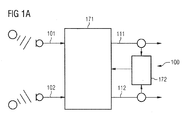
- Fig. 1A shows a schematic representation of a source separation 100.
- One or more acoustic sources emit acoustic signals. These acoustic signals are picked up by microphones that provide a first input signal 101 and a second input signal 102.
- a first filter module 171 receives the first input signal 101 and the second input signal 102 to produce a first output signal 111 and another first output signal 112.
- a correlation module 172 determines from the first output signal 101 and from the further first output signal 112 a first correlation of the two first output signals 111, 112. The result of the correlation module 172 is fed back to the filter module 171, so that the filter module 171 internal filters, for example in the form of a set of coefficients , modified accordingly to achieve a minimization of the first correlation of the two first output signals 111, 112. If the source separation 100 has reached an absolute minimum of the correlation, then the output signals 101, 112 have a minimal correlation and are thus maximally separated.
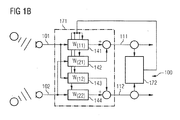
- Fig. 1B shows a further schematic representation of the source separation 100, taking into account details.
- Acoustic sources generate acoustic signals that are picked up by microphones and provided to the filter module 171 in the form of the first input signal 101 and the second input signal 102.
- the filter module 171 in this case has a first filter 141, a second filter 142, a third filter 143 and a fourth filter 144.
- the first input signal 101 is thereby provided to the first filter 141 and the third filter 143.
- the second input signal 102 is provided to the second filter 142 and the fourth filter 144.
- the filters 141, 142, 143, 144 may be characterized by filter coefficients, or a filter coefficient set, such as the filter coefficients w ij .
- the correlation module 172 determines the correlation of the two first output signals 111, 112 and controls the filters 141, 142, 143, 144 accordingly, so that a corresponding minimum of the correlation is sought.
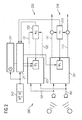
- Fig. 2 shows a schematic representation of a first source separation in conjunction with a second source separation according to a first embodiment of the present invention.
- Sound sources generate acoustic signals that are picked up by microphones.
- two microphones provide the first input signal 101 and the second input signal 102 to both a first source separation 210 and a second source separation 220.
- the first source separation 210 comprises a filter module 211 and a correlation module 212.
- the filter module 211 generates from the first input signal 101 and the second input signal 102 by means of a first set of coefficients W 1 a first output signal 111 and a further first output signal 112.
- the correlation module 212 continuously determines one first correlation ⁇ 1 from the two first output signals 111, 112, which is used to modify the first set of coefficients W 1 so that the first correlation ⁇ 1 is minimized and thus the two first output signals 111, 112 are maximally separated.
- a second source separation 220 comprises a filter module 221 and a correlation module 222.
- the filter module 221 generates from the first input signal 101 and the second input signal 102 by means of a second set of coefficients W 2 a second output signal 121 and a further second output signal 122.
- the correlation module 222 continuously determines one second correlation ⁇ 2 from the two second output signals 121, 122, which is used to modify the second set of coefficients W 2 such that the second correlation ⁇ 2 is minimized and so the two second output signals 121, 122 are maximally separated.
- a comparison module 241 compares the first correlation ⁇ 1 with the second correlation ⁇ 2 . If the second correlation ⁇ 2 is smaller than the first correlation ⁇ 1 , the comparison module 241 changes the second set of coefficients W 2 as a function of the first set of coefficients W 1 .
- the comparison module 241 can refer to stored coefficient sets W 1 A , W 1 B , etc., which are stored in a storage unit group 243.
- the coefficient sets W 1 A , W 1 B , etc. stored in the storage unit group 243 may be in respective different signal situations depending on the first set of coefficients W 1 .
- it may be provided to store an adapted coefficient set W 1 in a first signal situation "A" as a coefficient set W 1 A in the storage unit group 243.
- it can be provided to store the first coefficient set W 1 in a second signal situation "B" as coefficient set W 1 B in the storage unit group 243, and so on.
- the comparison module 241 may fall back for a signal situation that is stored in a memory unit group 243 are.
- the coefficient sets W 1 A1, W be 1 A2, ..., W 1 B1, W 1 B2, ... Kings-nen stored again in the storage unit group 243, and, for example, at a only slight change in the corresponding correlation stored there become.
- it may be provided to store a plurality of adapted coefficient sets W 1 in a first signal situation "A" as coefficient sets W 1 Al , W 1 A2 ,... In the memory unit group 243.
- a number of coefficient sets W 1 are available for a signal situation, from which then that set of coefficients W 1 can be selected for which a minimum first correlation, and thus an optimal separation performance results.
- the hearing aid known acoustic signal situations "A”, "B”, etc. which are to be modeled on situations of daily life, can be assigned, for example, on the basis of corresponding classification variables of an actual signal situation.
- a determined classification size does not necessarily have to be identical to a classification variable of the known signal situations, but it can be provided, for example, bandwidths and tolerances for the respective classification variables. Examples of known acoustic signal situations "A”, "B", etc.
- Signal components can be the output signals, the input signals or generated from a further decomposition or separation of the input signals and / or output signals.
- a signal component a signal-to-noise ratio, a power spectrum, a level, a number of signal components, a further classification variable and / or the signal situation, a further device and / or a further method may be provided in the hearing aid.
- the comparison module 241 can also assign a corresponding signal situation, and use one of the coefficient sets W 1 A , W 1 B , etc. stored in the storage unit group 243 to change the first set of coefficients W 1 .
- the comparison module 241 can determine a corresponding signal situation, or receive the correspondingly determined signal situation from a further module, a method or from a further device.
- the storage unit group 243 stores only one set of coefficients as a function of the first set of coefficients W 1 .
- the storage unit group 243 may be replaced with a single storage unit.
- a timer module 244 resets the second source separation 220 after the lapse of a certain period of time, for example after the lapse of a second period of time, in which the timer module 244 sets the second coefficient set W 2 as a function of a first set of coefficients W 1 A , W 1 B , etc. sets.
- the timer module 244 may, according to the current signal situation, select a first coefficient set W 1 from the storage unit group 243, and then reset the second source separation 220 by a corresponding setting of the second set of coefficients W 2 .
- the timer module 244 can take over a complete set of coefficients W 1 A , W 1 B , etc.
- the second set of coefficients W 2 is also changed as a function of a plurality of stored sets of coefficients W 1 A1 , W 1 A2 ,... For a signal situation.
- a number of coefficient sets W 1 are available for a signal situation, from which then the coefficient set W 1 can be selected, for which a minimum second correlation, and thus an optimum separation power, results.
- the second source separation 220 is thereby reset with a set of coefficients already adapted and / or adapted to a current signal situation.
- the second source separation 220 can thus advantageously already begin with an at least partially adapted set of coefficients.
- the second source separation 220 can perform source separation more quickly, and the corresponding second correlation ⁇ 2 can fall faster below the first correlation ⁇ 1 when the first source separation 210 freezes, and the first source separation can thus advantageously be reset more quickly respond more quickly to a disadvantageous freeing of the first source separation 210.
- the first set of coefficients W 1 as a function of a second set of coefficients W 2 can be set, wherein the second set of coefficients W 2 at this time can advantageously have an already more advanced adaptation.
- the first source separation 210 may include a first at least partially adapted one Coefficient set W 1 , and thus can more quickly provide a satisfactory output signal and result to the user of the hearing aid.
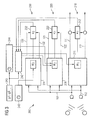
- Fig. 3 shows a first source separation, a second source separation, and a third source separation according to a second embodiment of the present invention.
- the first source separation 210, the second source separation 220, as well as the first timer module 244 and the storage unit group 243 have already been described in connection with FIG Fig. 2 described, and are executed according to this second embodiment.
- a third source separation 230 is further provided.
- the third source separation 230 in this case comprises a third filter module 231 and a third correlation module 232.
- the filter module 231 generates from the first input signal 101 and the second input signal 102 by means of a third coefficient set W 3, a third output signal 131 and a further third output signal 132.
- the correlation module 232 continuously determines a third correlation ⁇ 3 from the two third output signals 131, 132, which is used to modify the third coefficient set W 3 so that the third correlation ⁇ 3 is minimized and so the two third output signals 131, 132 are maximally separated.
- a further timer module 245 is provided which, after a certain period of time, for example a third period of time has elapsed, resets the third source separation 230 by setting the third coefficient set W 3 to an output coefficient set.
- the first correlation ⁇ 1 , the second correlation ⁇ 2 and the third correlation ⁇ 3 which compares the first correlation ⁇ 1 with the second correlation ⁇ 2 , are fed to a further comparison module 242.
- the further comparison module 242 may use the first correlation ⁇ 1 with the third correlation ⁇ 3 and / or compare the second correlation ⁇ 2 with the third correlation ⁇ 3 . If the second correlation ⁇ 2 is smaller than the first correlation ⁇ 1 , then the further comparison module 242 changes the second coefficient set W 2 as a function of the first set of coefficients W 1 , as described in connection with FIG FIG. 2 already described. According to this embodiment, however, a possible freezing of the second source separation can be intercepted in an advantageous manner.
- the third correlation ⁇ 3 is smaller than the first correlation ⁇ 1 and / or the third correlation ⁇ 3 is smaller than the second correlation ⁇ 2 , this can be an indication that the second source separation 220 is frozen. Furthermore, it may also be the case that the first source separation 210 is frozen. Since the third source separation 230 can be reset with a universal output coefficient set, this provides a third correlation ⁇ 3 , which is independent of the signal situation and the already adapted coefficient sets. In such a case, the first source separation can then advantageously be reset and the first coefficient set can be set as a function of the third coefficient set. Furthermore, the same can also be done for the second source separation 220.
- modules such as filter modules 211, 221, 231, correlation modules 212, 222, 232, comparison modules 241, 242, and / or timer modules 244, 245 may be implemented as discrete circuits as well Processes, for example as a thread or task, in a microprocessor, in a signal processor, or in an integrated process block, expire.
- Fig. 4 shows a hearing aid according to a third embodiment of the present invention.
- the hearing aid 400 has a first microphone 401 and a second microphone 402.
- the first microphone 401 sets the first input signal 101 to a Processing unit 403 available.
- the second microphone 402 provides the second input signal 102 to the processing unit 403.
- the processing unit 403 processes the first input signal 101 and the second input signal 102 to provide an output signal 404 to a speaker 405 for output.
- the processing unit 403 may comprise at least two source separations, a comparison module, a timer module, and a storage unit group as described in connection with the first and second embodiments of the present invention.
- the hearing aid 400 can be integrated in a hearing device, which the user carries, for example, in the ear canal, behind the ear, or else in an external unit as a portable device.
- a spatial distance of the two microphones is at least a minimum distance, which ensures a reliable source separation.
- the two microphones 401, 402 may be arranged in the hearing aid 400 up to approximately 20 mm, up to approximately 10 mm, up to approximately 4 mm or up to approximately 2 mm apart.
- Fig. 5 shows another hearing aid 410 according to a fourth embodiment of the present invention.
- the further hearing aid 410 has the microphones 401 and 402, the first microphone 401 providing the first input signal 101 and the second microphone 402 providing the second input signal 102 to a further processing unit 430.
- the further processing unit 430 processes the first input signal 101 and the second input signal 102 to provide the output signal 404 to the speaker 405 for output.
- the further processing unit 430 comprises a process unit 440 comprising processes or modules, such as a first module 441, a second module 442, a third module 443, etc.
- the modules 441, 442, 443 may, for example a source separation, a comparison module, a timer module, a filter module, and / or a correlation module comprise, as in connection with the in the FIGS. 2 to 4 described Embodiments of the present invention have been set forth.
- the further processing unit 430 further comprises a storage unit group 450, which the process unit 440 can access, for example, to store and retrieve at least one set of coefficients, as described in connection with FIG Figures 2 and 3 has been described.
- Fig. 6A shows a flowchart of a first module according to a fifth embodiment of the present invention.
- a correlation ⁇ 1 is queried.
- the correlation ⁇ i can correspond to the first correlation ⁇ 1 , the second correlation ⁇ 2 and / or the third correlation ⁇ 3 , as described in connection with the preceding figures and embodiments.
- a bifurcation 612 it is determined whether the correlation ⁇ i is minimal. For this purpose, previous values of the correlation ⁇ i can be used for comparison.
- the loop continues with step 611 to detect a changing correlation ⁇ i .
- the correlation ⁇ i by a corresponding change in the signal situation and / or the input signals, rise again and thus reach a minimum.
- the coefficient set W i is changed in a step 613.
- the set of coefficients W i can correspond to the first set of coefficients W 1 , the second set of coefficients W 2 or the third set of coefficients W 3 , as described in connection with FIG Figures 2 and 3 have been described.
- the change of the coefficient set C changes the filtering of the input signals and can thus cause a change of the output signals and / or the correlation ⁇ i .
- the loop is continued with step 611.
- the process, method, or module according to this embodiment corresponds to source separation while minimizing correlation.
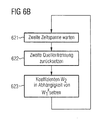
- the Fig. 6B shows a module according to a sixth embodiment of the present invention.
- a period of time such as the second time period
- the process continues to step 622 where the second source separation is reset.
- the resetting of the second source separation initiates the setting of the coefficients W 2 in response to a W 1 X (623).
- the W 1 X correspond to first coefficient sets for different signal situations X.
- the module then loops back to step 621 to wait again for the second time period.
- the second source separation is periodically reset after the lapse of the second time period by setting the second coefficient set W 2 of the second source separation in response to a W 1 X.
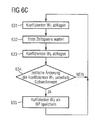
- Fig. 6C shows a flowchart of a module according to a seventh embodiment of the present invention.
- a first step 631 the coefficients W 1 are queried.
- the coefficients W 1 correspond to the first set of coefficients.
- a second step 632 the first period of time is waited for. This is followed, in a second query step 633, by a renewed interrogation of the coefficient set W 1 .
- a bifurcation 634 it is determined whether the temporal change of the first set of coefficients W 1 is below a threshold within the first time period.
- This threshold value may, for example, correspond to a characteristic threshold which delimits an adapted coefficient set W 1 from an unadapted set of coefficients W 1 . If the temporal change of the first set of coefficients W 1 is below the threshold value, it can thus be established, for example, that the current set of coefficients W 1 corresponds to a well-adapted set of coefficients for a specific signal situation. On this can in a following step 635, the corresponding first set of coefficients W 1 are stored as a set of coefficients for the corresponding signal situation. If the temporal change of the coefficients W 1 is not below the threshold value, the process is continued with a renewed interrogation of the coefficients W 1 (631).
- the module according to this embodiment may further include step 631 in buffering the coefficient set W 1 to W 1 1 for comparing the buffered set of coefficients with the coefficient set determined in step 633 W, or to determine a temporal change in the coefficient set. Further, the module according to the seventh embodiment of the present invention may correspond to setting the coefficient sets in the group of memory units for corresponding signal situations.
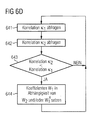
- FIG. 10 is a flowchart of a process according to an eighth embodiment of the present invention.
- FIG. In a first step 641, the first correlation ⁇ 1 is queried. Subsequently, in a second step 642, the second correlation ⁇ 2 is interrogated. In a subsequent bifurcation 443, the first correlation ⁇ 1 is compared with the second correlation ⁇ 2 . If the second correlation ⁇ 2 is smaller than the first correlation ⁇ 1 , the first coefficient set C is set in a following step 644 as a function of the second coefficient set W 2 and / or a stored coefficient set W 1 X , corresponding to a determined current signal situation X.
- a part or all of the coefficients of the second coefficient set W 2 can first determine the corresponding coefficients of the first set of coefficients W 1 .
- the remaining coefficients of the first coefficient set W 1 can then optionally be supplemented according to a stored set of coefficients W 1 X.
- the first source separation with a start coefficient set which is not frozen on the one hand in a local minimum and on the other hand has optimally adapted, the respective signal situation X corresponding start coefficients.
- the process continues with querying the first correlation (641).
- the modules may be described modules or processes that are executed in the processing unit of a hearing aid according to the invention.
- a corresponding processing unit 430 is shown, which represents a process unit for executing a plurality of processes or modules (440 et seq.).
Landscapes
- Health & Medical Sciences (AREA)
- General Health & Medical Sciences (AREA)
- Neurosurgery (AREA)
- Otolaryngology (AREA)
- Physics & Mathematics (AREA)
- Engineering & Computer Science (AREA)
- Acoustics & Sound (AREA)
- Signal Processing (AREA)
- Circuit For Audible Band Transducer (AREA)
- Stereophonic System (AREA)
- Selective Calling Equipment (AREA)
- Electrophonic Musical Instruments (AREA)
Applications Claiming Priority (1)
| Application Number | Priority Date | Filing Date | Title |
|---|---|---|---|
| DE102007033877A DE102007033877B3 (de) | 2007-07-20 | 2007-07-20 | Verfahren zur Signalverarbeitung in einer Hörhilfe |
Publications (2)
| Publication Number | Publication Date |
|---|---|
| EP2018079A1 EP2018079A1 (de) | 2009-01-21 |
| EP2018079B1 true EP2018079B1 (de) | 2010-04-07 |
Family
ID=39864930
Family Applications (1)
| Application Number | Title | Priority Date | Filing Date |
|---|---|---|---|
| EP08104471A Active EP2018079B1 (de) | 2007-07-20 | 2008-06-19 | Verfahren zur Signalverarbeitung in einer Hörhilfe |
Country Status (5)
| Country | Link |
|---|---|
| US (1) | US8515107B2 (da) |
| EP (1) | EP2018079B1 (da) |
| AT (1) | ATE463936T1 (da) |
| DE (2) | DE102007033877B3 (da) |
| DK (1) | DK2018079T3 (da) |
Families Citing this family (4)
| Publication number | Priority date | Publication date | Assignee | Title |
|---|---|---|---|---|
| DE102008053458A1 (de) * | 2008-10-28 | 2010-04-29 | Siemens Medical Instruments Pte. Ltd. | Hörvorrichtung mit spezieller Situationserkennungseinheit und Verfahren zum Betreiben einer Hörvorrichtung |
| JP5903758B2 (ja) | 2010-09-08 | 2016-04-13 | ソニー株式会社 | 信号処理装置および方法、プログラム、並びにデータ記録媒体 |
| JP5604275B2 (ja) * | 2010-12-02 | 2014-10-08 | 富士通テン株式会社 | 相関低減方法、音声信号変換装置および音響再生装置 |
| DE102013209062A1 (de) * | 2013-05-16 | 2014-11-20 | Siemens Medical Instruments Pte. Ltd. | Logik-basiertes binaurales Beam-Formungssystem |
Family Cites Families (8)
| Publication number | Priority date | Publication date | Assignee | Title |
|---|---|---|---|---|
| EP1125405A1 (de) * | 1998-10-27 | 2001-08-22 | Siemens Aktiengesellschaft | Signaltrennungsverfahren und -anordnung für nichtlineare mischungen unbekannter signale |
| JP3454190B2 (ja) * | 1999-06-09 | 2003-10-06 | 三菱電機株式会社 | 雑音抑圧装置および方法 |
| JP2001053654A (ja) * | 1999-08-16 | 2001-02-23 | Matsushita Electric Ind Co Ltd | 信号分離装置、信号分離方法及び記録媒体 |
| JP3566158B2 (ja) * | 1999-12-07 | 2004-09-15 | 三菱電機株式会社 | エコーキャンセラ装置 |
| US7257231B1 (en) * | 2002-06-04 | 2007-08-14 | Creative Technology Ltd. | Stream segregation for stereo signals |
| DE102004053790A1 (de) | 2004-11-08 | 2006-05-18 | Siemens Audiologische Technik Gmbh | Verfahren zur Erzeugung von Stereosignalen für getrennte Quellen und entsprechendes Akustiksystem |
| JP4675177B2 (ja) * | 2005-07-26 | 2011-04-20 | 株式会社神戸製鋼所 | 音源分離装置,音源分離プログラム及び音源分離方法 |
| JP2007034184A (ja) * | 2005-07-29 | 2007-02-08 | Kobe Steel Ltd | 音源分離装置,音源分離プログラム及び音源分離方法 |
-
2007
- 2007-07-20 DE DE102007033877A patent/DE102007033877B3/de not_active Expired - Fee Related
-
2008
- 2008-06-19 AT AT08104471T patent/ATE463936T1/de active
- 2008-06-19 DE DE502008000515T patent/DE502008000515D1/de active Active
- 2008-06-19 EP EP08104471A patent/EP2018079B1/de active Active
- 2008-06-19 DK DK08104471.1T patent/DK2018079T3/da active
- 2008-07-17 US US12/218,710 patent/US8515107B2/en active Active
Also Published As
| Publication number | Publication date |
|---|---|
| DE502008000515D1 (de) | 2010-05-20 |
| DE102007033877B3 (de) | 2009-02-05 |
| DK2018079T3 (da) | 2010-08-02 |
| ATE463936T1 (de) | 2010-04-15 |
| EP2018079A1 (de) | 2009-01-21 |
| US20090022344A1 (en) | 2009-01-22 |
| US8515107B2 (en) | 2013-08-20 |
Similar Documents
| Publication | Publication Date | Title |
|---|---|---|
| EP3451705B1 (de) | Verfahren und vorrichtung zum schnellen erkennen der eigenen stimme | |
| EP1379102B1 (de) | Richtungshören bei binauraler Hörgeräteversorgung | |
| EP1912471B1 (de) | Verarbeitung eines Eingangssignals in einer Hörhilfe | |
| EP2840809B1 (de) | Steuerung der effektstärke eines binauralen direktionalen mikrofons | |
| EP1360870A2 (de) | Verfahren zum betrieb eines hörgerätesystems sowie hörgerätesystem | |
| DE102006027673A1 (de) | Signaltrenner, Verfahren zum Bestimmen von Ausgangssignalen basierend auf Mikrophonsignalen und Computerprogramm | |
| EP2620940A1 (de) | Verfahren und Hörvorrichtung zum Schätzen eines Bestandteils der eigenen Stimme | |
| WO2003052746A2 (de) | Verfahren und vorrichtung zur unterdrückung von periodischen störsignalen | |
| DE102007033877B3 (de) | Verfahren zur Signalverarbeitung in einer Hörhilfe | |
| EP2200341B1 (de) | Verfahren zum Betrieb eines Hörhilfegerätes sowie Hörhilfegerät mit einer Quellentrennungseinrichtung | |
| EP2254354A1 (de) | Verfahren zur Akklimatisierung einer programmierbaren Hörvorrichtung und zugehörige Hörvorrichtung | |
| DE102007035171A1 (de) | Verfahren zum Anpassen eines Hörgeräts mit Hilfe eines perzeptiven Modells | |
| DE102014218672B3 (de) | Verfahren und Vorrichtung zur Rückkopplungsunterdrückung | |
| EP1503612A2 (de) | Hörhilfegerät sowie Verfahren zum Betrieb eines Hörhilfegerätes mit einem Mikrofonsystem, bei dem unterschiedliche Richtcharakteristiken einstellbar sind | |
| DE102006047983A1 (de) | Verarbeitung eines Eingangssignals in einem Hörgerät | |
| EP2590437B1 (de) | Periodisches Adaptieren einer Rückkopplungsunterdrückungseinrichtung | |
| DE102019201879B3 (de) | Verfahren zum Betrieb eines Hörsystems und Hörsystem | |
| EP3048813B1 (de) | Verfahren und vorrichtung zur rauschunterdrückung basierend auf inter-subband-korrelation | |
| DE102024205358B4 (de) | Verfahren zur Rauschunterdrückung in einem Hörinstrument | |
| DE102007010601A1 (de) | Hörsystem mit verteilter Signalverarbeitung und entsprechendes Verfahren | |
| WO2022175349A2 (de) | Verfahren und anordnung zur signalverarbeitung | |
| EP0644527B1 (de) | Mobilfunkendgerät | |
| EP4482174A1 (de) | Verfahren zum ermitteln einer aktivität einer eigenstimme eines trägers eines hörgerätes, hörgerät und hörgerätesystem | |
| DE102016206327A1 (de) | Verfahren zum Übertragen eines Audiosignals von einem Sender zu einem Empfänger | |
| EP2111059A2 (de) | Verfahren zur Bestimmung einer Zeitkonstante des Gehörs und Verfahren zum Einstellen einer Hörvorrichtung |
Legal Events
| Date | Code | Title | Description |
|---|---|---|---|
| PUAI | Public reference made under article 153(3) epc to a published international application that has entered the european phase |
Free format text: ORIGINAL CODE: 0009012 |
|
| 17P | Request for examination filed |
Effective date: 20081125 |
|
| AK | Designated contracting states |
Kind code of ref document: A1 Designated state(s): AT BE BG CH CY CZ DE DK EE ES FI FR GB GR HR HU IE IS IT LI LT LU LV MC MT NL NO PL PT RO SE SI SK TR |
|
| AX | Request for extension of the european patent |
Extension state: AL BA MK RS |
|
| AKX | Designation fees paid |
Designated state(s): AT BE BG CH CY CZ DE DK EE ES FI FR GB GR HR HU IE IS IT LI LT LU LV MC MT NL NO PL PT RO SE SI SK TR |
|
| GRAP | Despatch of communication of intention to grant a patent |
Free format text: ORIGINAL CODE: EPIDOSNIGR1 |
|
| GRAS | Grant fee paid |
Free format text: ORIGINAL CODE: EPIDOSNIGR3 |
|
| GRAA | (expected) grant |
Free format text: ORIGINAL CODE: 0009210 |
|
| AK | Designated contracting states |
Kind code of ref document: B1 Designated state(s): AT BE BG CH CY CZ DE DK EE ES FI FR GB GR HR HU IE IS IT LI LT LU LV MC MT NL NO PL PT RO SE SI SK TR |
|
| REG | Reference to a national code |
Ref country code: GB Ref legal event code: FG4D Free format text: NOT ENGLISH |
|
| REG | Reference to a national code |
Ref country code: CH Ref legal event code: EP Ref country code: CH Ref legal event code: NV Representative=s name: SIEMENS SCHWEIZ AG |
|
| REG | Reference to a national code |
Ref country code: IE Ref legal event code: FG4D Free format text: LANGUAGE OF EP DOCUMENT: GERMAN |
|
| REF | Corresponds to: |
Ref document number: 502008000515 Country of ref document: DE Date of ref document: 20100520 Kind code of ref document: P |
|
| REG | Reference to a national code |
Ref country code: NL Ref legal event code: VDEP Effective date: 20100407 |
|
| REG | Reference to a national code |
Ref country code: DK Ref legal event code: T3 |
|
| PG25 | Lapsed in a contracting state [announced via postgrant information from national office to epo] |
Ref country code: SI Free format text: LAPSE BECAUSE OF FAILURE TO SUBMIT A TRANSLATION OF THE DESCRIPTION OR TO PAY THE FEE WITHIN THE PRESCRIBED TIME-LIMIT Effective date: 20100407 |
|
| LTIE | Lt: invalidation of european patent or patent extension |
Effective date: 20100407 |
|
| REG | Reference to a national code |
Ref country code: IE Ref legal event code: FD4D |
|
| PG25 | Lapsed in a contracting state [announced via postgrant information from national office to epo] |
Ref country code: NL Free format text: LAPSE BECAUSE OF FAILURE TO SUBMIT A TRANSLATION OF THE DESCRIPTION OR TO PAY THE FEE WITHIN THE PRESCRIBED TIME-LIMIT Effective date: 20100407 Ref country code: LT Free format text: LAPSE BECAUSE OF FAILURE TO SUBMIT A TRANSLATION OF THE DESCRIPTION OR TO PAY THE FEE WITHIN THE PRESCRIBED TIME-LIMIT Effective date: 20100407 Ref country code: ES Free format text: LAPSE BECAUSE OF FAILURE TO SUBMIT A TRANSLATION OF THE DESCRIPTION OR TO PAY THE FEE WITHIN THE PRESCRIBED TIME-LIMIT Effective date: 20100718 Ref country code: SE Free format text: LAPSE BECAUSE OF FAILURE TO SUBMIT A TRANSLATION OF THE DESCRIPTION OR TO PAY THE FEE WITHIN THE PRESCRIBED TIME-LIMIT Effective date: 20100407 Ref country code: NO Free format text: LAPSE BECAUSE OF FAILURE TO SUBMIT A TRANSLATION OF THE DESCRIPTION OR TO PAY THE FEE WITHIN THE PRESCRIBED TIME-LIMIT Effective date: 20100707 |
|
| PG25 | Lapsed in a contracting state [announced via postgrant information from national office to epo] |
Ref country code: FI Free format text: LAPSE BECAUSE OF FAILURE TO SUBMIT A TRANSLATION OF THE DESCRIPTION OR TO PAY THE FEE WITHIN THE PRESCRIBED TIME-LIMIT Effective date: 20100407 Ref country code: HR Free format text: LAPSE BECAUSE OF FAILURE TO SUBMIT A TRANSLATION OF THE DESCRIPTION OR TO PAY THE FEE WITHIN THE PRESCRIBED TIME-LIMIT Effective date: 20100407 Ref country code: IS Free format text: LAPSE BECAUSE OF FAILURE TO SUBMIT A TRANSLATION OF THE DESCRIPTION OR TO PAY THE FEE WITHIN THE PRESCRIBED TIME-LIMIT Effective date: 20100807 Ref country code: LV Free format text: LAPSE BECAUSE OF FAILURE TO SUBMIT A TRANSLATION OF THE DESCRIPTION OR TO PAY THE FEE WITHIN THE PRESCRIBED TIME-LIMIT Effective date: 20100407 |
|
| BERE | Be: lapsed |
Owner name: SIEMENS AUDIOLOGISCHE TECHNIK G.M.B.H. Effective date: 20100630 |
|
| PG25 | Lapsed in a contracting state [announced via postgrant information from national office to epo] |
Ref country code: PL Free format text: LAPSE BECAUSE OF FAILURE TO SUBMIT A TRANSLATION OF THE DESCRIPTION OR TO PAY THE FEE WITHIN THE PRESCRIBED TIME-LIMIT Effective date: 20100407 Ref country code: CY Free format text: LAPSE BECAUSE OF FAILURE TO SUBMIT A TRANSLATION OF THE DESCRIPTION OR TO PAY THE FEE WITHIN THE PRESCRIBED TIME-LIMIT Effective date: 20100609 |
|
| PG25 | Lapsed in a contracting state [announced via postgrant information from national office to epo] |
Ref country code: MC Free format text: LAPSE BECAUSE OF NON-PAYMENT OF DUE FEES Effective date: 20100630 Ref country code: EE Free format text: LAPSE BECAUSE OF FAILURE TO SUBMIT A TRANSLATION OF THE DESCRIPTION OR TO PAY THE FEE WITHIN THE PRESCRIBED TIME-LIMIT Effective date: 20100407 Ref country code: IE Free format text: LAPSE BECAUSE OF FAILURE TO SUBMIT A TRANSLATION OF THE DESCRIPTION OR TO PAY THE FEE WITHIN THE PRESCRIBED TIME-LIMIT Effective date: 20100407 |
|
| PLBE | No opposition filed within time limit |
Free format text: ORIGINAL CODE: 0009261 |
|
| STAA | Information on the status of an ep patent application or granted ep patent |
Free format text: STATUS: NO OPPOSITION FILED WITHIN TIME LIMIT |
|
| PG25 | Lapsed in a contracting state [announced via postgrant information from national office to epo] |
Ref country code: RO Free format text: LAPSE BECAUSE OF FAILURE TO SUBMIT A TRANSLATION OF THE DESCRIPTION OR TO PAY THE FEE WITHIN THE PRESCRIBED TIME-LIMIT Effective date: 20100407 Ref country code: CZ Free format text: LAPSE BECAUSE OF FAILURE TO SUBMIT A TRANSLATION OF THE DESCRIPTION OR TO PAY THE FEE WITHIN THE PRESCRIBED TIME-LIMIT Effective date: 20100407 Ref country code: SK Free format text: LAPSE BECAUSE OF FAILURE TO SUBMIT A TRANSLATION OF THE DESCRIPTION OR TO PAY THE FEE WITHIN THE PRESCRIBED TIME-LIMIT Effective date: 20100407 |
|
| 26N | No opposition filed |
Effective date: 20110110 |
|
| PG25 | Lapsed in a contracting state [announced via postgrant information from national office to epo] |
Ref country code: IT Free format text: LAPSE BECAUSE OF FAILURE TO SUBMIT A TRANSLATION OF THE DESCRIPTION OR TO PAY THE FEE WITHIN THE PRESCRIBED TIME-LIMIT Effective date: 20100407 |
|
| PG25 | Lapsed in a contracting state [announced via postgrant information from national office to epo] |
Ref country code: MT Free format text: LAPSE BECAUSE OF FAILURE TO SUBMIT A TRANSLATION OF THE DESCRIPTION OR TO PAY THE FEE WITHIN THE PRESCRIBED TIME-LIMIT Effective date: 20100407 |
|
| PG25 | Lapsed in a contracting state [announced via postgrant information from national office to epo] |
Ref country code: GR Free format text: LAPSE BECAUSE OF FAILURE TO SUBMIT A TRANSLATION OF THE DESCRIPTION OR TO PAY THE FEE WITHIN THE PRESCRIBED TIME-LIMIT Effective date: 20100708 |
|
| PG25 | Lapsed in a contracting state [announced via postgrant information from national office to epo] |
Ref country code: BE Free format text: LAPSE BECAUSE OF NON-PAYMENT OF DUE FEES Effective date: 20100630 |
|
| PG25 | Lapsed in a contracting state [announced via postgrant information from national office to epo] |
Ref country code: BG Free format text: LAPSE BECAUSE OF FAILURE TO SUBMIT A TRANSLATION OF THE DESCRIPTION OR TO PAY THE FEE WITHIN THE PRESCRIBED TIME-LIMIT Effective date: 20100407 Ref country code: LU Free format text: LAPSE BECAUSE OF NON-PAYMENT OF DUE FEES Effective date: 20100619 Ref country code: HU Free format text: LAPSE BECAUSE OF FAILURE TO SUBMIT A TRANSLATION OF THE DESCRIPTION OR TO PAY THE FEE WITHIN THE PRESCRIBED TIME-LIMIT Effective date: 20101008 Ref country code: PT Free format text: LAPSE BECAUSE OF FAILURE TO SUBMIT A TRANSLATION OF THE DESCRIPTION OR TO PAY THE FEE WITHIN THE PRESCRIBED TIME-LIMIT Effective date: 20100907 |
|
| PG25 | Lapsed in a contracting state [announced via postgrant information from national office to epo] |
Ref country code: TR Free format text: LAPSE BECAUSE OF FAILURE TO SUBMIT A TRANSLATION OF THE DESCRIPTION OR TO PAY THE FEE WITHIN THE PRESCRIBED TIME-LIMIT Effective date: 20100407 |
|
| PG25 | Lapsed in a contracting state [announced via postgrant information from national office to epo] |
Ref country code: BG Free format text: LAPSE BECAUSE OF FAILURE TO SUBMIT A TRANSLATION OF THE DESCRIPTION OR TO PAY THE FEE WITHIN THE PRESCRIBED TIME-LIMIT Effective date: 20100707 |
|
| REG | Reference to a national code |
Ref country code: AT Ref legal event code: MM01 Ref document number: 463936 Country of ref document: AT Kind code of ref document: T Effective date: 20130619 |
|
| PG25 | Lapsed in a contracting state [announced via postgrant information from national office to epo] |
Ref country code: AT Free format text: LAPSE BECAUSE OF NON-PAYMENT OF DUE FEES Effective date: 20130619 |
|
| REG | Reference to a national code |
Ref country code: DE Ref legal event code: R082 Ref document number: 502008000515 Country of ref document: DE Representative=s name: FDST PATENTANWAELTE FREIER DOERR STAMMLER TSCH, DE |
|
| REG | Reference to a national code |
Ref country code: DE Ref legal event code: R082 Ref document number: 502008000515 Country of ref document: DE Representative=s name: FDST PATENTANWAELTE FREIER DOERR STAMMLER TSCH, DE Ref country code: DE Ref legal event code: R081 Ref document number: 502008000515 Country of ref document: DE Owner name: SIVANTOS GMBH, DE Free format text: FORMER OWNER: SIEMENS AUDIOLOGISCHE TECHNIK GMBH, 91058 ERLANGEN, DE |
|
| REG | Reference to a national code |
Ref country code: FR Ref legal event code: PLFP Year of fee payment: 9 |
|
| REG | Reference to a national code |
Ref country code: FR Ref legal event code: PLFP Year of fee payment: 10 |
|
| REG | Reference to a national code |
Ref country code: FR Ref legal event code: PLFP Year of fee payment: 11 |
|
| PGFP | Annual fee paid to national office [announced via postgrant information from national office to epo] |
Ref country code: GB Payment date: 20240620 Year of fee payment: 17 |
|
| PGFP | Annual fee paid to national office [announced via postgrant information from national office to epo] |
Ref country code: DE Payment date: 20240617 Year of fee payment: 17 |
|
| PGFP | Annual fee paid to national office [announced via postgrant information from national office to epo] |
Ref country code: DK Payment date: 20240620 Year of fee payment: 17 |
|
| PGFP | Annual fee paid to national office [announced via postgrant information from national office to epo] |
Ref country code: FR Payment date: 20240621 Year of fee payment: 17 |
|
| PGFP | Annual fee paid to national office [announced via postgrant information from national office to epo] |
Ref country code: CH Payment date: 20240701 Year of fee payment: 17 |
|
| REG | Reference to a national code |
Ref country code: DE Ref legal event code: R119 Ref document number: 502008000515 Country of ref document: DE |
|
| REG | Reference to a national code |
Ref country code: CH Ref legal event code: H13 Free format text: ST27 STATUS EVENT CODE: U-0-0-H10-H13 (AS PROVIDED BY THE NATIONAL OFFICE) Effective date: 20260127 |
|
| REG | Reference to a national code |
Ref country code: DK Ref legal event code: EBP Effective date: 20250630 |
|
| GBPC | Gb: european patent ceased through non-payment of renewal fee |
Effective date: 20250619 |
|
| PG25 | Lapsed in a contracting state [announced via postgrant information from national office to epo] |
Ref country code: GB Free format text: LAPSE BECAUSE OF NON-PAYMENT OF DUE FEES Effective date: 20250619 |
|
| PG25 | Lapsed in a contracting state [announced via postgrant information from national office to epo] |
Ref country code: DE Free format text: LAPSE BECAUSE OF NON-PAYMENT OF DUE FEES Effective date: 20260101 |
|
| PG25 | Lapsed in a contracting state [announced via postgrant information from national office to epo] |
Ref country code: FR Free format text: LAPSE BECAUSE OF NON-PAYMENT OF DUE FEES Effective date: 20250630 |
|
| PG25 | Lapsed in a contracting state [announced via postgrant information from national office to epo] |
Ref country code: CH Free format text: LAPSE BECAUSE OF NON-PAYMENT OF DUE FEES Effective date: 20250630 |