EP2018712B1 - Attribution de puissance dépendant de la charge de trafic dans un réseau de communication sans fil multi-utilisateur avec une progammation équitable proportionelle dans le domaine temporel et de fréquence - Google Patents
Attribution de puissance dépendant de la charge de trafic dans un réseau de communication sans fil multi-utilisateur avec une progammation équitable proportionelle dans le domaine temporel et de fréquence Download PDFInfo
- Publication number
- EP2018712B1 EP2018712B1 EP06733313.8A EP06733313A EP2018712B1 EP 2018712 B1 EP2018712 B1 EP 2018712B1 EP 06733313 A EP06733313 A EP 06733313A EP 2018712 B1 EP2018712 B1 EP 2018712B1
- Authority
- EP
- European Patent Office
- Prior art keywords
- power allocation
- channel
- threshold
- user
- chunk
- Prior art date
- Legal status (The legal status is an assumption and is not a legal conclusion. Google has not performed a legal analysis and makes no representation as to the accuracy of the status listed.)
- Expired - Lifetime
Links
Images

Classifications
-
- H—ELECTRICITY
- H04—ELECTRIC COMMUNICATION TECHNIQUE
- H04W—WIRELESS COMMUNICATION NETWORKS
- H04W52/00—Power management, e.g. Transmission Power Control [TPC] or power classes
- H04W52/04—Transmission power control [TPC]
- H04W52/30—Transmission power control [TPC] using constraints in the total amount of available transmission power
- H04W52/34—TPC management, i.e. sharing limited amount of power among users or channels or data types, e.g. cell loading
- H04W52/343—TPC management, i.e. sharing limited amount of power among users or channels or data types, e.g. cell loading taking into account loading or congestion level
-
- H—ELECTRICITY
- H04—ELECTRIC COMMUNICATION TECHNIQUE
- H04W—WIRELESS COMMUNICATION NETWORKS
- H04W72/00—Local resource management
- H04W72/12—Wireless traffic scheduling
- H04W72/1263—Mapping of traffic onto schedule, e.g. scheduled allocation or multiplexing of flows
Definitions
- the present invention relates to a communication method and apparatus, and in particular to a scheduling method for multi-user wireless communication networks.
- Multi-user wireless communication networks are being used to an increasing degree and offer an increasing number of services.
- Such networks include Orthogonal Frequency Division Multiplex (OFDM) and Orthogonal Frequency Division Multiple Access (OFDMA) systems.
- OFDM Orthogonal Frequency Division Multiplex
- OFDMA Orthogonal Frequency Division Multiple Access
- Orthogonal Frequency Division Multiplex based communication systems.
- OFDM Orthogonal Frequency Division Multiplex
- a number of users share one symbol to provide multiple access.
- the available transmission bandwidth is divided into a set of narrowband subcarriers.
- a set of neighbouring subcarriers which is the minimum allocated radio resource, is often referred to as a chunk.
- OFDMA Orthogonal Frequency Division Multiple Access
- different subcarriers can be allocated to different users so as to provide a flexible multi-user access scheme.
- adaptive resource allocation techniques are used.
- packet data streams to a number of active users are multiplexed on a common bandwidth.
- Each user must estimate and (or) report the signal to interference and interference ratio (SINR) for its potentially used spectrum.
- SINR signal to interference and interference ratio
- US patent 6 807 426 proposes a fair scheduling scheme to apply a variety of combinations of channel condition metrics and user fairness metrics which has been used for WCDMA systems.
- a sequential scheduler is proposed, that is, first one user selects its active subcarriers/chunks and then the other users can select among the ones that are left.
- the sequential scheduler is complicated and rather slow. Users can be divided into classes to assign different priorities to users.
- US patent 6 947 748 proposes subcarrier/chunk selection in which each of multiple subscribers measure channel and interference information for subcarriers based on pilot symbols received from a base station.
- the base station allocates subcarriers to each subscriber based on the channel and interference information. This allocation scheme has not taken fairness and coverage performance into consideration.
- the frequency domain adaptation methods outlined above are subject to constraints on total power, bit error rate and proportionality among user data rates.
- the multi-user diversity and frequency diversity results from adaptive subcarrier/chunk allocation.
- adaptive power allocation in the frequency domain can also enhance system performance by means of frequency diversity.
- the subcarrier/chunk allocation and power control schemes currently used or proposed have the following
- control unit for use in a multi-user wireless communications network such as an OFDM based communication system, said control unit comprising a processor and a computer program, for controlling resource allocation in the network, said control unit being characterized in that it is arranged to perform resource allocation in the network according to the following:
- the object is also achieved by a method of allocating resources in multi-user wireless communications network such as an OFDM based communication system, performing the following steps:
- a computer program product comprising computer-readable code means, which, when run in a processor in multi-user wireless communications network such as an OFDM based communication system causes the processor to control the resource allocation in the multi-user communications network by
- the purpose of the channel-dependent power allocation is to allocate the power among different chunks.
- the channel-dependent power allocation can also allocate the power among different streams in spatial-domain.
- the channel-dependent power allocation scheme may be, for example, an on/off power allocation scheme as the channel-dependent power allocation scheme, or a water-filling based algorithm as the channel-dependent power allocation scheme.
- the load-switched frequency domain processing according to the invention includes a serialized frequency domain processing, which provides good performance in capacity, coverage and fairness, and which reduces computation complexity especially for heavy traffic loads, without losing system performance.
- the proportional fair scheduling in both the time and the frequency domain is an extension of the proportional fair (PF) scheduling in the frequency domain.
- the PFTF scheduler maintains resource fairness by providing a fair sharing of transmission time on each chunk proportional to the past throughputs of each user individually, over a fixed window length.
- the chunk-wise independent scheduler used according to the invention is less complicated than the sequential frequency-domain scheduler.
- the main difference between the PFTF and the PF proposed in US 6 807 426 is that PF is done per OFDM frame with the same granularity of throughput measurement whereas PFTF treats the chunks as independent series scheduling units but update throughput measurement per OFDM frames. If T k (n) is taken as a common value for all users the PFTF could be the maximum SNR scheduling scheme.
- the traffic load based power control according to the invention will reduce computation complexity, especially in cases of heavy traffic load.
- step S3 If the traffic load is above the threshold, in step S3, a fixed power allocation is adopted regardless of the channel's condition, which allocates the total power among all subcarriers uniformly. If the traffic load is below the threshold, in step S4 a channel-dependent power allocation scheme is applied to all the active users in order to increase the frequency diversity gain.
- the channel-dependent power allocation scheme could be set on or off for each chunk as will be discussed in more detail below. From each of step S3 and S4 the procedure continues with step S5.
- step S5 link adaptation is worked for data related to each user.
- the link adaptation includes selection of Modulation and Coding Scheme (MCS) and other functions.
- MCS Modulation and Coding Scheme
- the PFTF scheduling performed in step S1 requires two inputs. One is the correctly transmitted bit-rate for each user, updated per frame. The other one is the channel quality measurements per chunk for each user. Compared to the traditional PF scheduler more dense channel quality measurements are required. PFTF implements the multi-user scheduler chunk-by-chunk, which means that the decision for each chunk is independent of the other chunks, in contrast to the sequential frequency-domain scheduler.
- the proportional fair scheduling in both time and frequency domain (PFTF) applied according to the invention is an extension of proportional fair scheduling in the frequency domain.
- the PFTF scheduler maintains resource fairness according to a fair metric of information transmission capability estimation of the link between the access-point and each user in proportion to the past throughputs of users over a fixed window length.
- the information transmission capability is estimated based on the channel quality (CQ) feedback from each user, while the past throughput per user can be collected either in the access-point or in the UE.
- CQ channel quality
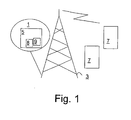
- the control unit 5 obtains a parameter Ri,k(n) which may be requested data rate or one or more other estimated parameters, for example estimated SNR or delay, on chunk n for user i , which is supportable by its current channel quality.
- the scheduler assigns the time-frequency chunk n to the user i, which has the largest ratio R i , k n T k n where T k (n) is average throughput or other measured parameter of chunk n for user number k in a past window.
- Load switched power allocation is performed as follows: If the traffic load is above a threshold a fixed power allocation is adopted regardless of the channel condition of each channel. The power is allocated to all subcarriers uniformly. The fixed power allocation has the smallest computation complexity O(1). If the traffic load is lower than the threshold a channel-dependent power allocation scheme is adopted in order to increase the frequency diversity gain.
- the basic principle is based on the fact that both channel-dependent scheduling and power allocation can be used to achieve multi-user diversity and frequency diversity gain for the system. Therefore, if sufficient multi-user diversity gain has already been achieved by scheduling, only a small improvement can be achieved by power allocation. Since the improvement that can be achieved by power allocation is very small, power allocation is preferably not used in this case.
- the frequency domain scheduling (for example, PFTF) achieves a better performance if more users are scheduled at the same time since this enables more diversity gain.
- the power allocation scheme according to the invention could be channel dependent or channel independent.
- Channel independent power allocation scheme could be to allocate equal power to all chunks.
- Channel dependent power allocation schemes desire to achieve better performance, for example, better capacity, based on the known channel information and the quality model.
- a channel dependent power allocation scheme that could be used is multi-user on/off power allocation, where the chunks set "on" per user have the same flat power distribution.
- the power P i is allocated to the used chunk n of user i to obtain the maximum throughput for user i.f (•) is a mapping function of SNR to throughput that is, to obtain the maximum throughput for user i the power P i is allocated to all the selected chunks of user I by means of an on/off scheme.
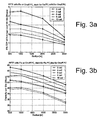
- Figures 3a and 3b show results of a simulation of the inventive method performed with the following assumptions:
- Fig. 3a shows PFTF with fix power control and on/off power control, for 2, 4, 6, 8 and 10 calls, respectively.
- the x axis represents the radius, ranging from 500 meters to 3000 meters, and the y axis represents 5% CDF of average user (at the cell edge) bit rate in Mb/s.
- the x axis represents the radius, ranging from 500 meters to 3000 meters, and the y axis represents the capacity per site in Mb/s.
- on/off power allocation is preferable for use together with PFTF when the number of offered calls is small. For example, comparing the cell throughput at a cell radius of 2000 meters, on/of power control has about 4% gain over fix power control. As the number of offered calls increases the additional gain of using on/off power allocation compared to fix power allocation is reduced. Therefore, it may be advantageous to use fix power allocation together with PFTF to reduce computation complexity.
Landscapes
- Engineering & Computer Science (AREA)
- Computer Networks & Wireless Communication (AREA)
- Signal Processing (AREA)
- Mobile Radio Communication Systems (AREA)
Claims (20)
- Unité de commande (5) destinée à être utilisée dans un système de communication à base de multiplexage par répartition orthogonale de la fréquence, OFDM (1), ladite unité de commande (5) comprenant un processeur (8) et un programme informatique (9), pour commander une affectation de ressources dans le réseau, ladite unité de commande étant caractérisée en ce qu'elle est agencée de manière à mettre en oeuvre une affectation de ressources dans le réseau (1) selon les étapes ci-dessous consistant à :- mettre en oeuvre (s1) une planification équitable proportionnelle dans le domaine temporel et le domaine fréquentiel, sur la base du débit binaire correctement transmis pour chaque utilisateur mis à jour par trame et des mesures de qualité de canal pour chaque segment par utilisateur ; et- mettre en oeuvre une affectation de puissance de la manière suivante :si la charge de trafic est supérieure à un seuil : adopter (s2, s3) une affectation de puissance fixe, quelle que soit l'état de canal de chaque canal, dans lequel la puissance est affectée à toutes les sous-porteuses uniformément ; etsi la charge de trafic est inférieure au seuil, adopter (s2, s4) un schéma d'affectation de puissance dépendant du canal.
- Unité de commande selon la revendication 1, agencée de manière à déterminer le seuil pour une situation donnée.
- Unité de commande selon la revendication 1, agencée de manière à obtenir le seuil à partir d'une unité de mémoire (9).
- Unité de commande selon la revendication 1 ou 2, agencée de manière à déterminer le seuil sur la base du seuil d'indicateur CQI, ou de ses informations mutuelles connexes ou de son débit mutuel connexe.
- Unité de commande selon l'une quelconque des revendications précédentes, agencée de manière à affecter, à un premier utilisateur, un segment temps-fréquence n présentant le rapport le plus élevé :

où Tk(n) correspond au débit moyen ou à un autre paramètre mesuré du segment n pour un nombre d'utilisateurs k dans une fenêtre antérieure. - Unité de commande selon l'une quelconque des revendications précédentes, agencée de manière à utiliser un schéma d'activation / désactivation d'affectation de puissance en tant que le schéma d'affectation de puissance dépendant du canal.
- Unité de commande selon l'une quelconque des revendications précédentes, agencée de manière à utiliser un algorithme basé sur le remplissage d'eau en tant que le schéma d'affectation de puissance dépendant du canal.
- Procédé d'affectation de ressources dans un système de communication à base de multiplexage par répartition orthogonale de la fréquence, OFDM, comprenant les étapes ci-dessous consistant à :- mettre en oeuvre (s1) une planification équitable proportionnelle dans le domaine temporel et le domaine fréquentiel, sur la base du débit binaire correctement transmis pour chaque utilisateur mis à jour par trame et des mesures de qualité de canal pour chaque segment par utilisateur ; et- mettre en oeuvre une affectation de puissance de la manière suivante :si la charge de trafic est supérieure à un seuil : adopter (s2, s3) une affectation de puissance fixe, quelle que soit l'état de canal de chaque canal, dans lequel la puissance est affectée à toutes les sous-porteuses uniformément ; etsi la charge de trafic est inférieure au seuil, adopter (s2, s4) un schéma d'affectation de puissance dépendant du canal.
- Procédé selon la revendication 8, comprenant en outre l'étape consistant à déterminer le seuil sur la base du nombre d'utilisateurs actifs desservis dans le domaine fréquentiel.
- Procédé selon la revendication 8, comprenant en outre l'étape consistant à déterminer le seuil sur la base du seuil d'indicateur CQI, ou de ses informations mutuelles connexes ou de son débit mutuel connexe.
- Procédé selon la revendication 8, comprenant en outre l'étape consistant à obtenir la valeur de seuil à partir d'une mémoire.
- Procédé selon l'une quelconque des revendications 8 à 10, comprenant l'étape consistant à affecter, à un premier utilisateur, un segment temps-fréquence n présentant le rapport le plus élevé

où Tk(n) correspond au débit moyen ou à un autre paramètre mesuré du segment n pour un nombre d'utilisateurs k dans une fenêtre antérieure. - Procédé selon l'une quelconque des revendications 8 à 11, dans lequel le schéma d'affectation de puissance dépendant du canal est un schéma d'activation / désactivation d'affectation de puissance.
- Procédé selon l'une quelconque des revendications précédentes, dans lequel le schéma d'affectation de puissance dépendant du canal est un algorithme basé sur le remplissage d'eau.
- Produit-programme informatique (9) comprenant un moyen de code lisible par ordinateur, qui, lorsqu'il est exécuté dans un processeur (8) au sein d'un système de communication à base de multiplexage par répartition orthogonale de la fréquence, OFDM (1), amène le processeur à commander l'affectation de ressources dans le réseau de communication multiutilisateur par- la mise en oeuvre (s1) d'une planification équitable proportionnelle dans le domaine temporel et le domaine fréquentiel, sur la base du débit binaire correctement transmis pour chaque utilisateur mis à jour par trame et des mesures de qualité de canal pour chaque segment par utilisateur ; et- la mise en oeuvre d'une affectation de puissance de la manière suivante :si la charge de trafic est supérieure à un seuil : adopter (s2, s3) une affectation de puissance fixe, quelle que soit l'état de canal de chaque canal, dans lequel la puissance est affectée à toutes les sous-porteuses uniformément ; etsi la charge de trafic est inférieure au seuil, adopter (s2, s4) un schéma d'affectation de puissance dépendant du canal.
- Produit-programme informatique selon la revendication 15, agencé de manière à déterminer le seuil sur la base du nombre d'utilisateurs actifs desservis dans le domaine fréquentiel.
- Produit-programme informatique selon la revendication 15, agencé de manière à déterminer le seuil sur la base du seuil d'indicateur CQI, ou de ses informations mutuelles connexes ou de son débit mutuel connexe.
- Produit-programme informatique selon l'une quelconque des revendications 15 à 17, agencé de manière à affecter, à un premier utilisateur, un segment temps-fréquence n présentant le rapport le plus élevé

où Tk(n) correspond au débit moyen ou à un autre paramètre mesuré du segment n pour un nombre d'utilisateurs k dans une fenêtre antérieure. - Produit-programme informatique selon l'une quelconque des revendications 15 à 18, agencé de manière à utiliser un schéma d'activation / désactivation d'affectation de puissance en tant que le schéma d'affectation de puissance dépendant du canal.
- Produit-programme informatique selon l'une quelconque des revendications 15 à 19, agencé de manière à utiliser un algorithme basé sur le remplissage d'eau en tant que le schéma d'affectation de puissance dépendant du canal.
Applications Claiming Priority (1)
| Application Number | Priority Date | Filing Date | Title |
|---|---|---|---|
| PCT/SE2006/000457 WO2007120085A1 (fr) | 2006-04-18 | 2006-04-18 | attribution de puissance dépendant de la charge de trafic dans un réseau de communication sans fil multi-utilisateur avec une programmation équitable proportionnelle dans le domaine temporel et de fréquence |
Publications (3)
| Publication Number | Publication Date |
|---|---|
| EP2018712A1 EP2018712A1 (fr) | 2009-01-28 |
| EP2018712A4 EP2018712A4 (fr) | 2010-09-15 |
| EP2018712B1 true EP2018712B1 (fr) | 2015-02-11 |
Family
ID=38609769
Family Applications (1)
| Application Number | Title | Priority Date | Filing Date |
|---|---|---|---|
| EP06733313.8A Expired - Lifetime EP2018712B1 (fr) | 2006-04-18 | 2006-04-18 | Attribution de puissance dépendant de la charge de trafic dans un réseau de communication sans fil multi-utilisateur avec une progammation équitable proportionelle dans le domaine temporel et de fréquence |
Country Status (5)
| Country | Link |
|---|---|
| US (1) | US20090296574A1 (fr) |
| EP (1) | EP2018712B1 (fr) |
| CN (1) | CN101421938B (fr) |
| TW (1) | TW200803229A (fr) |
| WO (1) | WO2007120085A1 (fr) |
Families Citing this family (27)
| Publication number | Priority date | Publication date | Assignee | Title |
|---|---|---|---|---|
| JP4812532B2 (ja) * | 2006-06-16 | 2011-11-09 | 株式会社エヌ・ティ・ティ・ドコモ | 移動局装置および基地局装置並びに下りリソース割り当て方法 |
| CN101507342A (zh) * | 2006-08-15 | 2009-08-12 | 艾利森电话股份有限公司 | 用于多蜂窝无线通信系统中调度资源与避免干扰的方法及设备 |
| US8244292B2 (en) * | 2007-02-23 | 2012-08-14 | Samsung Electronics Co., Ltd | Apparatus and method for power distribution by frequency allocation in multi-frequency allocation broadband wireless communication system |
| EP2523361B1 (fr) * | 2007-12-20 | 2017-03-22 | Sony Corporation | Affectation de puissance de transmission améliorée pour systèmes MIMO à multiplexage multiporteur adaptatif |
| US8472967B2 (en) | 2008-02-01 | 2013-06-25 | Qualcomm Incorporated | Allocating transmit power among two or more carriers assigned to a wireless communication device |
| JP4955614B2 (ja) * | 2008-06-25 | 2012-06-20 | 京セラ株式会社 | 無線通信装置および無線通信方法 |
| CN101321005B (zh) * | 2008-06-26 | 2012-01-25 | 华为技术有限公司 | 多数据流传输功率的分配方法和装置 |
| TWI385972B (zh) * | 2009-09-04 | 2013-02-11 | Chunghwa Telecom Co Ltd | Mobile network traffic load simulation system and its method |
| CN101720123B (zh) * | 2009-12-02 | 2012-10-17 | 华为技术有限公司 | 信道功率偏置设置方法、装置、及基站 |
| EP2398285B1 (fr) | 2010-06-18 | 2016-11-16 | Alcatel Lucent | Économie d'énergie |
| CN102316572B (zh) * | 2010-07-01 | 2015-08-12 | 中兴通讯股份有限公司 | 一种基于功率控制的干扰抑制方法及系统 |
| US8626227B2 (en) * | 2010-12-13 | 2014-01-07 | Fujitsu Limited | Method and system for power allocation in a transmission system |
| BR112013020871A2 (pt) | 2011-02-17 | 2016-09-27 | Telefonica Sa | método e entidade de rede para a programação de recursos de rádio nas redes de comunicações móveis |
| CN103548286A (zh) | 2011-04-13 | 2014-01-29 | 爱立信(中国)通信有限公司 | 用于无线系统中的功率分配的方法和基站 |
| KR20130065155A (ko) * | 2011-12-09 | 2013-06-19 | 삼성전자주식회사 | 이동통신 시스템에서 주파수 할당 운용 방법 및 장치 |
| CN104025686A (zh) | 2012-01-06 | 2014-09-03 | 惠普发展公司,有限责任合伙企业 | 无线接入点分配 |
| US9078224B2 (en) | 2013-01-03 | 2015-07-07 | Nokia Solutions And Networks Oy | Downlink power control using relative load |
| WO2014191704A1 (fr) | 2013-05-29 | 2014-12-04 | Toshiba Research Europe Limited | Contrôleur pour allouer des blocs de ressources radio et/ou de la puissance à des dispositifs d'utilisateur situés dans des cellules d'un réseau cellulaire |
| EP3042529B1 (fr) | 2013-09-04 | 2020-04-01 | LG Electronics Inc. | Procédé et appareil de commande de puissance de liaison montante dans un système de communication sans fil |
| CN105101281A (zh) * | 2014-05-16 | 2015-11-25 | 中兴通讯股份有限公司 | 性能数据处理方法及装置 |
| WO2016054525A1 (fr) | 2014-10-03 | 2016-04-07 | Interdigital Patent Holdings, Inc. | Systèmes et procédés d'entrelacement et de modulation multi-utilisateur |
| CN104868985B (zh) * | 2015-03-15 | 2018-03-13 | 西安电子科技大学 | 基于比例公平的认知ofdm网络中的资源分配方法 |
| CN107371247B (zh) * | 2016-05-13 | 2019-09-17 | 电信科学技术研究院 | 一种资源调度方法和设备 |
| EP3501223B1 (fr) * | 2016-08-30 | 2022-06-22 | Huawei Technologies Duesseldorf GmbH | Appareil et procédé pour l'attribution des ressources radio |
| US10459517B2 (en) * | 2017-03-31 | 2019-10-29 | Qualcomm Incorporated | System and methods for scheduling software tasks based on central processing unit power characteristics |
| CN116456468A (zh) * | 2022-01-07 | 2023-07-18 | 中移(成都)信息通信科技有限公司 | 模型训练方法、装置、资源分配方法、电子设备及介质 |
| WO2024167980A1 (fr) * | 2023-02-07 | 2024-08-15 | Nanotronix Computing Inc. | Systèmes et procédés pour améliorer un point de fibre à bâtiment/distribution (fttb/dp) |
Family Cites Families (8)
| Publication number | Priority date | Publication date | Assignee | Title |
|---|---|---|---|---|
| EP1142154B1 (fr) * | 1998-12-18 | 2004-10-06 | Nokia Corporation | Procede de commande d'une charge de trafic dans un reseau de telecommunications |
| US6985739B2 (en) * | 2000-12-15 | 2006-01-10 | Telefonaktiebolaget Lm Ericsson (Publ) | Admission and congestion control in a CDMA-based mobile radio communications system |
| US6807426B2 (en) | 2001-04-12 | 2004-10-19 | Qualcomm Incorporated | Method and apparatus for scheduling transmissions in a communication system |
| US6751187B2 (en) * | 2001-05-17 | 2004-06-15 | Qualcomm Incorporated | Method and apparatus for processing data for transmission in a multi-channel communication system using selective channel transmission |
| US7020110B2 (en) * | 2002-01-08 | 2006-03-28 | Qualcomm Incorporated | Resource allocation for MIMO-OFDM communication systems |
| JP2004297284A (ja) * | 2003-03-26 | 2004-10-21 | Matsushita Electric Ind Co Ltd | 通信端末装置及び無線通信方法 |
| CN100369524C (zh) * | 2004-08-10 | 2008-02-13 | 大唐移动通信设备有限公司 | 一种cdma系统上行包调度方法 |
| KR100974326B1 (ko) * | 2004-10-28 | 2010-08-05 | 삼성전자주식회사 | 직교 주파수 분할 다중 접속 방식을 사용하는 통신시스템에서 동적 자원 할당 장치 및 방법 |
-
2006
- 2006-04-18 EP EP06733313.8A patent/EP2018712B1/fr not_active Expired - Lifetime
- 2006-04-18 CN CN200680054248XA patent/CN101421938B/zh not_active Expired - Fee Related
- 2006-04-18 US US12/297,554 patent/US20090296574A1/en not_active Abandoned
- 2006-04-18 WO PCT/SE2006/000457 patent/WO2007120085A1/fr not_active Ceased
-
2007
- 2007-04-18 TW TW096113663A patent/TW200803229A/zh unknown
Non-Patent Citations (1)
| Title |
|---|
| JIHO JANG ET AL: "Transmit power adaptation for multiuser OFDM systems", IEEE JOURNAL ON SELECTED AREAS IN COMMUNICATIONS, IEEE SERVICE CENTER, PISCATAWAY, US, vol. 21, no. 2, 1 February 2003 (2003-02-01), pages 171 - 178, XP003014253, ISSN: 0733-8716, DOI: 10.1109/JSAC.2002.807348 * |
Also Published As
| Publication number | Publication date |
|---|---|
| WO2007120085A1 (fr) | 2007-10-25 |
| CN101421938A (zh) | 2009-04-29 |
| CN101421938B (zh) | 2012-11-28 |
| US20090296574A1 (en) | 2009-12-03 |
| EP2018712A4 (fr) | 2010-09-15 |
| TW200803229A (en) | 2008-01-01 |
| EP2018712A1 (fr) | 2009-01-28 |
Similar Documents
| Publication | Publication Date | Title |
|---|---|---|
| US20090296574A1 (en) | Traffic load dependent power allocation in multi user wireless communication network with proportional fair scheduling in time and frequency domain | |
| KR100974326B1 (ko) | 직교 주파수 분할 다중 접속 방식을 사용하는 통신시스템에서 동적 자원 할당 장치 및 방법 | |
| JP4991833B2 (ja) | マルチセル無線通信システムにおける動的リソース配分方法および装置 | |
| EP2533444B1 (fr) | Dispositif de communication radio et procédé de communication radio | |
| EP2271031B1 (fr) | Indicateur de qualité du canal pour un canal de temps, fréquence et spatial dans un réseau d'accès radio terrestre | |
| US8467731B2 (en) | Radio resource scheduling for intra-system interference coordination in wireless communication systems | |
| EP2237441B1 (fr) | Procédé et appareil de contrôle de transmissions dans un système de communications | |
| US8824406B2 (en) | Adaptive scheduling data transmission based on the transmission power and the number of physical resource blocks | |
| US7760751B2 (en) | System for supporting consecutive and distributed subcarrier channels in OFDMA networks | |
| CN103068057B (zh) | 终端装置及其通信方法、基站及其通信方法、通信系统 | |
| JP4885971B2 (ja) | 基地局装置 | |
| JP2011512728A (ja) | セル間干渉を軽減するための方法およびシステム | |
| CN101227695A (zh) | 一种小区通信资源分配方法与装置 | |
| Kukade et al. | Optimal performance of resource allocation in LTE-A for heterogeneous cellular network | |
| Yildiz et al. | A novel mobility aware downlink scheduling algorithm for LTE-A networks | |
| Hosein | On the optimal scheduling of uplink resources in OFDMA-based wireless networks | |
| Bohge et al. | Multi-user OFDM system performance subject to control channel reliability in a multi-cell environment | |
| CN116318289B (zh) | 一种用于mu-mimo系统的空时频三维资源分配方法 | |
| Nascimento et al. | Jointly cross-layer scheduling and dynamic resource allocation for RT and NRT traffic types for IEEE802. 16e | |
| Ki et al. | Downlink packet scheduling with minimum throughput guarantee in TDD-OFDMA cellular network | |
| Alotaibi et al. | Packet scheduling bandwidth type-based mechanism for lte | |
| KR101085600B1 (ko) | 셀룰러 기반의 mc-cdma 시스템에서 주파수 대역과 코드 할당 방법 및 기지국 장치 | |
| HK40018199A (en) | Radio communication apparatus and radio communication method | |
| HK40018199B (en) | Radio communication apparatus and radio communication method | |
| Hosein | Supporting both consecutive and distributed subcarrier channels in OFDMA networks |
Legal Events
| Date | Code | Title | Description |
|---|---|---|---|
| PUAI | Public reference made under article 153(3) epc to a published international application that has entered the european phase |
Free format text: ORIGINAL CODE: 0009012 |
|
| 17P | Request for examination filed |
Effective date: 20080904 |
|
| AK | Designated contracting states |
Kind code of ref document: A1 Designated state(s): AT BE BG CH CY CZ DE DK EE ES FI FR GB GR HU IE IS IT LI LT LU LV MC NL PL PT RO SE SI SK TR |
|
| AX | Request for extension of the european patent |
Extension state: AL BA HR MK YU |
|
| A4 | Supplementary search report drawn up and despatched |
Effective date: 20100813 |
|
| 17Q | First examination report despatched |
Effective date: 20120215 |
|
| DAX | Request for extension of the european patent (deleted) | ||
| REG | Reference to a national code |
Ref country code: DE Ref legal event code: R079 Ref document number: 602006044452 Country of ref document: DE Free format text: PREVIOUS MAIN CLASS: H04B0007005000 Ipc: H04W0052340000 |
|
| GRAP | Despatch of communication of intention to grant a patent |
Free format text: ORIGINAL CODE: EPIDOSNIGR1 |
|
| GRAJ | Information related to disapproval of communication of intention to grant by the applicant or resumption of examination proceedings by the epo deleted |
Free format text: ORIGINAL CODE: EPIDOSDIGR1 |
|
| GRAP | Despatch of communication of intention to grant a patent |
Free format text: ORIGINAL CODE: EPIDOSNIGR1 |
|
| RIC1 | Information provided on ipc code assigned before grant |
Ipc: H04W 72/12 20090101ALI20140828BHEP Ipc: H04W 52/34 20090101AFI20140828BHEP |
|
| INTG | Intention to grant announced |
Effective date: 20140911 |
|
| INTG | Intention to grant announced |
Effective date: 20140922 |
|
| GRAS | Grant fee paid |
Free format text: ORIGINAL CODE: EPIDOSNIGR3 |
|
| GRAA | (expected) grant |
Free format text: ORIGINAL CODE: 0009210 |
|
| RAP1 | Party data changed (applicant data changed or rights of an application transferred) |
Owner name: TELEFONAKTIEBOLAGET L M ERICSSON (PUBL) |
|
| AK | Designated contracting states |
Kind code of ref document: B1 Designated state(s): AT BE BG CH CY CZ DE DK EE ES FI FR GB GR HU IE IS IT LI LT LU LV MC NL PL PT RO SE SI SK TR |
|
| REG | Reference to a national code |
Ref country code: GB Ref legal event code: FG4D |
|
| REG | Reference to a national code |
Ref country code: CH Ref legal event code: EP |
|
| REG | Reference to a national code |
Ref country code: IE Ref legal event code: FG4D |
|
| REG | Reference to a national code |
Ref country code: AT Ref legal event code: REF Ref document number: 710249 Country of ref document: AT Kind code of ref document: T Effective date: 20150315 |
|
| REG | Reference to a national code |
Ref country code: DE Ref legal event code: R096 Ref document number: 602006044452 Country of ref document: DE Effective date: 20150326 |
|
| REG | Reference to a national code |
Ref country code: NL Ref legal event code: VDEP Effective date: 20150211 |
|
| REG | Reference to a national code |
Ref country code: AT Ref legal event code: MK05 Ref document number: 710249 Country of ref document: AT Kind code of ref document: T Effective date: 20150211 |
|
| REG | Reference to a national code |
Ref country code: LT Ref legal event code: MG4D |
|
| PG25 | Lapsed in a contracting state [announced via postgrant information from national office to epo] |
Ref country code: SE Free format text: LAPSE BECAUSE OF FAILURE TO SUBMIT A TRANSLATION OF THE DESCRIPTION OR TO PAY THE FEE WITHIN THE PRESCRIBED TIME-LIMIT Effective date: 20150211 Ref country code: FI Free format text: LAPSE BECAUSE OF FAILURE TO SUBMIT A TRANSLATION OF THE DESCRIPTION OR TO PAY THE FEE WITHIN THE PRESCRIBED TIME-LIMIT Effective date: 20150211 Ref country code: ES Free format text: LAPSE BECAUSE OF FAILURE TO SUBMIT A TRANSLATION OF THE DESCRIPTION OR TO PAY THE FEE WITHIN THE PRESCRIBED TIME-LIMIT Effective date: 20150211 Ref country code: LT Free format text: LAPSE BECAUSE OF FAILURE TO SUBMIT A TRANSLATION OF THE DESCRIPTION OR TO PAY THE FEE WITHIN THE PRESCRIBED TIME-LIMIT Effective date: 20150211 |
|
| PG25 | Lapsed in a contracting state [announced via postgrant information from national office to epo] |
Ref country code: GR Free format text: LAPSE BECAUSE OF FAILURE TO SUBMIT A TRANSLATION OF THE DESCRIPTION OR TO PAY THE FEE WITHIN THE PRESCRIBED TIME-LIMIT Effective date: 20150512 Ref country code: NL Free format text: LAPSE BECAUSE OF FAILURE TO SUBMIT A TRANSLATION OF THE DESCRIPTION OR TO PAY THE FEE WITHIN THE PRESCRIBED TIME-LIMIT Effective date: 20150211 Ref country code: AT Free format text: LAPSE BECAUSE OF FAILURE TO SUBMIT A TRANSLATION OF THE DESCRIPTION OR TO PAY THE FEE WITHIN THE PRESCRIBED TIME-LIMIT Effective date: 20150211 Ref country code: LV Free format text: LAPSE BECAUSE OF FAILURE TO SUBMIT A TRANSLATION OF THE DESCRIPTION OR TO PAY THE FEE WITHIN THE PRESCRIBED TIME-LIMIT Effective date: 20150211 Ref country code: IS Free format text: LAPSE BECAUSE OF FAILURE TO SUBMIT A TRANSLATION OF THE DESCRIPTION OR TO PAY THE FEE WITHIN THE PRESCRIBED TIME-LIMIT Effective date: 20150611 |
|
| PG25 | Lapsed in a contracting state [announced via postgrant information from national office to epo] |
Ref country code: SK Free format text: LAPSE BECAUSE OF FAILURE TO SUBMIT A TRANSLATION OF THE DESCRIPTION OR TO PAY THE FEE WITHIN THE PRESCRIBED TIME-LIMIT Effective date: 20150211 Ref country code: RO Free format text: LAPSE BECAUSE OF FAILURE TO SUBMIT A TRANSLATION OF THE DESCRIPTION OR TO PAY THE FEE WITHIN THE PRESCRIBED TIME-LIMIT Effective date: 20150211 Ref country code: DK Free format text: LAPSE BECAUSE OF FAILURE TO SUBMIT A TRANSLATION OF THE DESCRIPTION OR TO PAY THE FEE WITHIN THE PRESCRIBED TIME-LIMIT Effective date: 20150211 Ref country code: EE Free format text: LAPSE BECAUSE OF FAILURE TO SUBMIT A TRANSLATION OF THE DESCRIPTION OR TO PAY THE FEE WITHIN THE PRESCRIBED TIME-LIMIT Effective date: 20150211 Ref country code: CZ Free format text: LAPSE BECAUSE OF FAILURE TO SUBMIT A TRANSLATION OF THE DESCRIPTION OR TO PAY THE FEE WITHIN THE PRESCRIBED TIME-LIMIT Effective date: 20150211 |
|
| REG | Reference to a national code |
Ref country code: DE Ref legal event code: R097 Ref document number: 602006044452 Country of ref document: DE |
|
| PG25 | Lapsed in a contracting state [announced via postgrant information from national office to epo] |
Ref country code: MC Free format text: LAPSE BECAUSE OF FAILURE TO SUBMIT A TRANSLATION OF THE DESCRIPTION OR TO PAY THE FEE WITHIN THE PRESCRIBED TIME-LIMIT Effective date: 20150211 Ref country code: PL Free format text: LAPSE BECAUSE OF FAILURE TO SUBMIT A TRANSLATION OF THE DESCRIPTION OR TO PAY THE FEE WITHIN THE PRESCRIBED TIME-LIMIT Effective date: 20150211 Ref country code: LU Free format text: LAPSE BECAUSE OF FAILURE TO SUBMIT A TRANSLATION OF THE DESCRIPTION OR TO PAY THE FEE WITHIN THE PRESCRIBED TIME-LIMIT Effective date: 20150418 |
|
| REG | Reference to a national code |
Ref country code: CH Ref legal event code: PL |
|
| PLBE | No opposition filed within time limit |
Free format text: ORIGINAL CODE: 0009261 |
|
| STAA | Information on the status of an ep patent application or granted ep patent |
Free format text: STATUS: NO OPPOSITION FILED WITHIN TIME LIMIT |
|
| PG25 | Lapsed in a contracting state [announced via postgrant information from national office to epo] |
Ref country code: IT Free format text: LAPSE BECAUSE OF FAILURE TO SUBMIT A TRANSLATION OF THE DESCRIPTION OR TO PAY THE FEE WITHIN THE PRESCRIBED TIME-LIMIT Effective date: 20150211 |
|
| 26N | No opposition filed |
Effective date: 20151112 |
|
| REG | Reference to a national code |
Ref country code: IE Ref legal event code: MM4A |
|
| PG25 | Lapsed in a contracting state [announced via postgrant information from national office to epo] |
Ref country code: CH Free format text: LAPSE BECAUSE OF NON-PAYMENT OF DUE FEES Effective date: 20150430 Ref country code: LI Free format text: LAPSE BECAUSE OF NON-PAYMENT OF DUE FEES Effective date: 20150430 |
|
| REG | Reference to a national code |
Ref country code: FR Ref legal event code: ST Effective date: 20151231 |
|
| PG25 | Lapsed in a contracting state [announced via postgrant information from national office to epo] |
Ref country code: FR Free format text: LAPSE BECAUSE OF NON-PAYMENT OF DUE FEES Effective date: 20150430 Ref country code: SI Free format text: LAPSE BECAUSE OF FAILURE TO SUBMIT A TRANSLATION OF THE DESCRIPTION OR TO PAY THE FEE WITHIN THE PRESCRIBED TIME-LIMIT Effective date: 20150211 |
|
| PG25 | Lapsed in a contracting state [announced via postgrant information from national office to epo] |
Ref country code: IE Free format text: LAPSE BECAUSE OF NON-PAYMENT OF DUE FEES Effective date: 20150418 |
|
| PG25 | Lapsed in a contracting state [announced via postgrant information from national office to epo] |
Ref country code: BE Free format text: LAPSE BECAUSE OF FAILURE TO SUBMIT A TRANSLATION OF THE DESCRIPTION OR TO PAY THE FEE WITHIN THE PRESCRIBED TIME-LIMIT Effective date: 20150211 |
|
| PG25 | Lapsed in a contracting state [announced via postgrant information from national office to epo] |
Ref country code: HU Free format text: LAPSE BECAUSE OF FAILURE TO SUBMIT A TRANSLATION OF THE DESCRIPTION OR TO PAY THE FEE WITHIN THE PRESCRIBED TIME-LIMIT; INVALID AB INITIO Effective date: 20060418 Ref country code: BG Free format text: LAPSE BECAUSE OF FAILURE TO SUBMIT A TRANSLATION OF THE DESCRIPTION OR TO PAY THE FEE WITHIN THE PRESCRIBED TIME-LIMIT Effective date: 20150211 |
|
| PG25 | Lapsed in a contracting state [announced via postgrant information from national office to epo] |
Ref country code: CY Free format text: LAPSE BECAUSE OF FAILURE TO SUBMIT A TRANSLATION OF THE DESCRIPTION OR TO PAY THE FEE WITHIN THE PRESCRIBED TIME-LIMIT Effective date: 20150211 |
|
| PG25 | Lapsed in a contracting state [announced via postgrant information from national office to epo] |
Ref country code: PT Free format text: LAPSE BECAUSE OF FAILURE TO SUBMIT A TRANSLATION OF THE DESCRIPTION OR TO PAY THE FEE WITHIN THE PRESCRIBED TIME-LIMIT Effective date: 20150611 |
|
| PG25 | Lapsed in a contracting state [announced via postgrant information from national office to epo] |
Ref country code: TR Free format text: LAPSE BECAUSE OF FAILURE TO SUBMIT A TRANSLATION OF THE DESCRIPTION OR TO PAY THE FEE WITHIN THE PRESCRIBED TIME-LIMIT Effective date: 20150211 |
|
| PGFP | Annual fee paid to national office [announced via postgrant information from national office to epo] |
Ref country code: DE Payment date: 20220427 Year of fee payment: 17 |
|
| REG | Reference to a national code |
Ref country code: DE Ref legal event code: R119 Ref document number: 602006044452 Country of ref document: DE |
|
| PG25 | Lapsed in a contracting state [announced via postgrant information from national office to epo] |
Ref country code: DE Free format text: LAPSE BECAUSE OF NON-PAYMENT OF DUE FEES Effective date: 20231103 |
|
| PGFP | Annual fee paid to national office [announced via postgrant information from national office to epo] |
Ref country code: GB Payment date: 20240429 Year of fee payment: 19 |
|
| GBPC | Gb: european patent ceased through non-payment of renewal fee |
Effective date: 20250418 |
|
| PG25 | Lapsed in a contracting state [announced via postgrant information from national office to epo] |
Ref country code: GB Free format text: LAPSE BECAUSE OF NON-PAYMENT OF DUE FEES Effective date: 20250418 |