EP2019111A1 - Auf Fulven-Komplexen basierende Katalysatorkomponenten - Google Patents
Auf Fulven-Komplexen basierende Katalysatorkomponenten Download PDFInfo
- Publication number
- EP2019111A1 EP2019111A1 EP07290934A EP07290934A EP2019111A1 EP 2019111 A1 EP2019111 A1 EP 2019111A1 EP 07290934 A EP07290934 A EP 07290934A EP 07290934 A EP07290934 A EP 07290934A EP 2019111 A1 EP2019111 A1 EP 2019111A1
- Authority
- EP
- European Patent Office
- Prior art keywords
- ligand
- metallic
- mmol
- polymerisation
- catalyst system
- Prior art date
- Legal status (The legal status is an assumption and is not a legal conclusion. Google has not performed a legal analysis and makes no representation as to the accuracy of the status listed.)
- Withdrawn
Links
- 0 *C(c1ccccc1)=C1C(C(c2ccccc2)=O)=CC=C1 Chemical compound *C(c1ccccc1)=C1C(C(c2ccccc2)=O)=CC=C1 0.000 description 1
Images

Classifications
-
- C—CHEMISTRY; METALLURGY
- C07—ORGANIC CHEMISTRY
- C07F—ACYCLIC, CARBOCYCLIC OR HETEROCYCLIC COMPOUNDS CONTAINING ELEMENTS OTHER THAN CARBON, HYDROGEN, HALOGEN, OXYGEN, NITROGEN, SULFUR, SELENIUM OR TELLURIUM
- C07F13/00—Compounds containing elements of Groups 7 or 17 of the Periodic Table
- C07F13/005—Compounds without a metal-carbon linkage
-
- C—CHEMISTRY; METALLURGY
- C07—ORGANIC CHEMISTRY
- C07F—ACYCLIC, CARBOCYCLIC OR HETEROCYCLIC COMPOUNDS CONTAINING ELEMENTS OTHER THAN CARBON, HYDROGEN, HALOGEN, OXYGEN, NITROGEN, SULFUR, SELENIUM OR TELLURIUM
- C07F15/00—Compounds containing elements of Groups 8, 9, 10 or 18 of the Periodic Table
- C07F15/04—Nickel compounds
- C07F15/045—Nickel compounds without a metal-carbon linkage
Definitions
- the present invention discloses catalyst components based on hydroxyl-carbonyl fulvene ligands their method of preparation and their use in the polymerisation of olefins.
- ligands have been described in literature, some of which were tested in complexation with metals but none of them have been used as catalysts for the polymerisation of ethylene or alpha-olefins.
- Some ligands are described for example in Lloyd and Preston ( D. Lloyd, N.W. Preston, J. Chem. Soc. C, 1969, 2464-2469 .) or by Linn and Sharkey ( W.J. Linn, W.G. Sharkey J. Am. Chem. Soc. 1957, 79, 4970-2 .) or in Snyder et al. ( C.A. Snyder, J.P. Selegue, N.C. Tice, C.E. Wallace. M.T. Blankenbuehler, S.
- the present invention reaches, at least partially, any one of those aims.
- the present invention discloses a method for preparing a metallic complex that comprises the steps of:
- reaction is carried out in a polar solvent such as tetrahydrofuran (THF) preferably at room temperature.
- a polar solvent such as tetrahydrofuran (THF) preferably at room temperature.
- R is selected from alkyl, unsubstituted or substituted phenyl (Ph), CPh2 wherein Ph may be substituted or not, or the R groups include heteroatom-containing units. More preferably R is a bulky alkyl such as t-butyl or bulkier or contains furan units. Most preferably R is t-butyl or furan.
- the ligand is deprotonated.
- the deprotonation reaction is carried out before metallation by addition of a base.
- deprotonation is achieved by addition of one equivalent of NaH to the neutral ligand with liberation of hydrogen.
- Y is H or Na, more preferably it is Na.
- M is CrII, CrIII or Ni, more preferably, it is CrII or CrIII, most preferably it is CrIII.
- Z is halogen or acetate, more preferably, it is CI.
- metallic complexes can be formed, one where the metal is coordinated to one ligand and one where the metal is coordinated to two ligands.
- the relative amounts of each ligand and metal unit depend upon the nature of ligand and of the metal. The amount of ligand must therefore be of at least one equivalent of ligand per metallic equivalent.
- the metal is coordinated to two ligands.
- the present invention further discloses an active catalyst system comprising the metallic complex and an activating agent having an ionising action.
- the activating agent can be an aluminium alkyl represented by formula AIR + n X 3-n wherein R + is an alkyl having from 1 to 20 carbon atoms and X is a halogen.
- the preferred alkylating agents are triisobutyl aluminium (TIBAL) or triethyl aluminium (TEAL).
- it is an aluminoxane and comprise oligomeric linear and/or cyclic alkyl aluminoxanes represented by formula for oligomeric, linear aluminoxanes and by formula for oligomeric, cyclic aluminoxane, wherein n is 1-40, preferably 10-20, m is 3-40, preferably 3-20 and R* is a C 1 -C 8 alkyl group and preferably methyl.
- the amount of activating is selected to give an AI/M ratio of from 100 to 3000, preferably of about 1000.
- Suitable boron-containing activating agents may comprise a triphenylcarbenium boronate such as tetrakis-pentafluorophenyl-borato-triphenylcarbenium as described in EP-A-0427696 , or those of the general formula [L'-H] + [B Ar 1 Ar 2 X 3 X 4 ]- as described in EP-A-0277004 (page 6, line 30 to page 7, line 7).
- the amount of boron -containing activating agent is selected to give B/M ratio of from 0.5 to 5, preferably of about 1.
- the preferred activating agent is methylaluminoxane (MAO).
- the metallic complex may be deposited on a conventional support impregnated with an activating agent.
- the conventional support is silica impregnated with methylaluminoxane (MAO).
- MAO methylaluminoxane
- it can be an activating support such as fluorinated alumina silica.
- the present invention further discloses a method for preparing an active catalyst system that comprises the steps of:
- the catalyst component is deposited on a support impregnated with an activating agent or on an activating support.
- the scavenger may be selected from triethylaluminium, triisobutylaluminum, tris-n-octylaluminium, tetraisobutyldialuminoxane or diethyl zinc.
- the active catalyst system is used in the oligomerisation and in the polymerisation of ethylene and alpha-olefins.
- the present invention discloses a method for the oligomerisation or the homo- or copolymerisation of ethylene and alpha-olefins that comprises the steps of:
- the pressure in the reactor can vary from 0.5 to 60 bars, preferably from 15 to 45 bars.
- the productivity of the catalyst system increases with increasing pressure.
- the polymerisation temperature can range from 10 to 100°C, preferably from 30 to 55°C.
- the productivity of the catalyst system decreases with increasing temperature.
- Most preferred polymerisation is carried out at a temperature of from 30 to 55 °C and at a pressure of from 24 to 45 bars.
- the monomer and optional comonomer are selected from ethylene, propylene or 1-hexene.
- the present invention also discloses the polymers obtained with the new catalyst systems.
- the ligands were prepared following the methods similar to those described for example in Lloyd and Preston ( D. Lloyd, N.W. Preston, J. Chem. Soc. C, 1969, 2464-2469 .) or by Linn and Sharkey ( W.J. Linn, W.G. Sharkey J. Am. Chem. Soc. 1957, 79, 4970-2 .) or in Snyder et al. ( C.A. Snyder, J.P. Selegue, N.C. Tice, C.E. Wallace. M.T. Blankenbuehler, S. Parkin, K.D.E. Allen, R.T. Beck, J. Am. Chem. Soc. 2005, 127, 15010-11 .) or in Dong et al. ( Y.B. Dong, Y. Geng, J.P. Ma and R.Q. Huang, Inorg. Chem. 2005, 44, 1693-1703 .)
- Cyclopentadienyl lithium was prepared from 14.5 mmol of just distilled cyclopentadiene and 14.5 mmol of butyl lithium.
- a solution of 1.170 g (9.7 mmol) of trimethylacetyle chloride in 20 mL of anhydrous ether was added dropwise to a solution of 14.7 mmol of cyclopentadienyl lithium in 20 mL of anhydrous ether, at a temperature of 0 °C.
- the yellow mixture was placed under stirring overnight at room temperature (about 25 °C).
- the solvent was evaporated under vacuum and the remaining solid was treated with 20 mL of an acid HCl solution (5% in water) overnight.
- the product was extracted with 20 mL of ethyl acetate, purified on silica gel (CH 2 Cl 2 /heptane, 1:1) and dried on MgSO 4 to afford 440 mg of yellow solid with a yield of 39%.
- Cyclopentadienyl lithium was prepared from 14.5 mmol of just distilled cyclopentadiene and 14.5 mmol of butyl lithium.
- a solution of 1.422 g (9.7 mmol) of cyclohexane carbonyl chloride in 20 mL of anhydrous ether was added dropwise to a solution of 14.7 mmol of cyclopentadienyl lithium in 20 mL of anhydrous ether, at a temperature of 0 °C.
- the dark brown mixture was placed under stirring overnight at room temperature (about 25 °C).
- the solvent was evaporated under vacuum and the remaining solid was treated with 20 mL of an acid HCl solution (5% in water) overnight.
- the product was extracted with 20 mL of ethyl acetate, purified on silica gel (CH 2 Cl 2 /heptane, 90/10 AIT flash chromatography) and dried on MgSO 4 to afford 974 mg of yellow solid with a yield of 70%.
- Cyclopentadienyl lithium was prepared from 14.5 mmol of just distilled cyclopentadiene and 14.5 mmol of butyl lithium.
- a solution of 1.363 g (9.7 mmol) of benzoyl chloride in 20 mL of anhydrous ether was added dropwise to a solution of 14.7 mmol of cyclopentadienyl lithium in 20 mL of anhydrous ether, at a temperature of 0 °C.
- the yellow mixture was placed under stirring overnight at room temperature (about 25 °C).
- the solvent was evaporated under vacuum and the remaining solid was treated with 20 mL of an acid HCl solution (5% in water) overnight.
- the product was extracted with 20 mL of ethyl acetate, purified on silica gel (CH 2 Cl 2 /heptane, 70/30 AIT flash chromatography) and dried on MgSO 4 to afford 1084 mg of yellow solid with a yield of 81.5%.
- the ligand was characterised as follows.
- Cyclopentadienyl lithium was prepared from 14.5 mmol of just distilled cyclopentadiene and 14.5 mmol of butyl lithium.
- a solution of 1.908 g (9.7 mmol) of 4-tertbutylbenzoyl chloride in 20 mL of anhydrous ether was added dropwise to a solution of 14.7 mmol of cyclopentadienyl lithium in 20 mL of anhydrous ether, at a temperature of 0 °C.
- the yellow mixture was placed under stirring overnight at room temperature (about 25 °C).
- the solvent was evaporated under vacuum and the remaining solid was treated with 20 mL of an acid HCl solution (5% in water) overnight.
- the product was extracted with 20 mL of ethyl acetate, purified on silica gel (CH 2 Cl 2 /heptane, 70/30 AIT flash chromatography) and dried on MgSO 4 to afford 1416 mg of yellow solid with a yield of 75.5%.
- the ligand was characterised as follows.
- Cyclopentadienyl lithium was prepared from 14.5 mmol of just distilled cyclopentadiene and 14.5 mmol of butyl lithium.
- a solution of 4.409 g (9.7 mmol) of diphenylacetyl chloride in 20 mL of anhydrous ether was added dropwise to a solution of 14.7 mmol of cyclopentadienyl lithium in 20 mL of anhydrous ether, at a temperature of 0 °C.
- the yellow mixture was placed under stirring overnight at room temperature (about 25 °C).
- the solvent was evaporated under vacuum and the remaining solid was treated with 20 mL of an acid HCl solution (5% in water) overnight.
- the product was extracted with 20 mL of ethyl acetate, purified on silica gel (CH 2 Cl 2 /heptane, 1:1) and dried on MgSO 4 to afford 1130 mg of yellow solid with a yield of 51%.
- Crystals were obtaioned by slow evaporation of a saturated solution of ligand in THF.
- ligand F 1-4-methoxybenzoyl-6-hydroxy-6-4-methoxyphenylfulvene.
- Cyclopentadienyl lithium was prepared from 14.5 mmol of just distilled cyclopentadiene and 14.5 mmol of butyl lithium.
- a solution of 1.655 g (9.7 mmol) of 4-methoxybenzoyl chloride in 20 mL of anhydrous ether was added dropwise to a solution of 14.7 mmol of cyclopentadienyl lithium in 20 mL of anhydrous ether, at a temperature of 0 °C.
- the yellow mixture was placed under stirring overnight at room temperature (about 25 °C).
- the solvent was evaporated under vacuum and the remaining solid was treated with 20 mL of an acid HCl solution (5% in water) overnight.
- the product was extracted with 20 mL of ethyl acetate, purified on silica gel (Et 2 O/heptane, 70/30 AIT flash chromatography) and dried on MgSO 4 to afford 1040 mg of yellow solid with a yield of 64%.
- the ligand was characterised as follows.
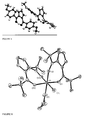
- Crystals were obtained by slow evaporation of a satrated solution of ligand in THF.
- the crystal structure is diplayed in Figure 4 and the ligand is characterised as follows.
- Cyclopentadienyl lithium was prepared from 14.5 mmol of just distilled cyclopentadiene and 14.5 mmol of butyl lithium.
- a solution of 2.230 g (9.7 mmol) of 3,4,5-trimethoxybenzoyl chloride in 20 mL of anhydrous ether was added dropwise to a solution of 14.5 mmol of cyclopentadienyl lithium in 20 mL of anhydrous ether, at a temperature of 0 °C.
- the yellow mixture was placed under stirring overnight at room temperature (about 25 °C).
- the solvent was evaporated under vacuum and the remaining solid was treated with 20 mL of an acid HCl solution (5% in water) overnight.
- the product was extracted with 20 mL of ethyl acetate, purified on silica gel (Ether 100%) and dried on MgSO 4 to afford 614 mg of yellow solid with a yield of 28%.
- Cyclopentadienyl lithium was prepared from 14.5 mmol of just distilled cyclopentadiene and 14.5 mmol of butyl lithium.
- a solution of 1.264 g (9.7 mmol) of 2-furoyl chloride in 20 mL of anhydrous ether was added dropwise to a solution of 14.7 mmol of cyclopentadienyl lithium in 20 mL of anhydrous ether, at a temperature of 0 °C.
- the orange mixture was placed under stirring overnight at room temperature (about 25 °C).
- the solvent was evaporated under vacuum and the remaining solid was treated with 20 mL of an acid HCl solution (5% in water) overnight.
- the product was extracted with 20 mL of ethyl acetate, purified on silica gel (Et 2 O/heptane, 70/30 AIT flash chromatography) and dried on MgSO 4 to afford 260 mg of yellow solid with a yield of 21%.
- Cyclopentadienyl lithium was prepared from 14.5 mmol of just distilled cyclopentadiene and 14.5 mmol of butyl lithium.
- a solution of 1.950 g (9.81 mmol) of O-acetylsalicyloyl chloride in 20 mL of anhydrous ether was added dropwise to a solution of 14.7 mmol of cyclopentadienyl lithium in 20 mL of anhydrous ether, at a temperature of 0 °C.
- the dark brown mixture was placed under stirring overnight at room temperature (about 25 °C).
- the solvent was evaporated under vacuum and the remaining solid was treated with 20 mL of an acid HCl solution (5% in water) overnight.
- the product was extracted with 20 mL of ethyl acetate, purified on silica gel (Ether/heptane, 2:1) and dried on MgSO 4 to afford 350 mg of yellow solid with a yield of 18%.
- Chromium complexes Chromium complexes.
- Ni(OAc) 2 / ligand A complex Ni(OAc) 2 / ligand A complex.
- Ni(OAc) 2 / ligand E complex Ni(OAc) 2 / ligand E complex.
- Ligand A was first deprotonated with NaH.
- the complex was recrystallised by slow evaporation of a saturated solution of the complex in toluene.
- the crytals obtained were suitable for X-Ray analysis. Anal. Cald for C 34 H 50 O 5 ClCr: C: 65.21, H: 8.05, found C: 64.83, H: 8.15.
- the complex crystallises in a triclinic environment with space group P-1.
- the chromium atom is coordinated to 2 molecules of bidentate fulvene of LX type each being coordinated by its 2 oxygen atoms.
- the chromium atom is further coordinated by a chlorine atom and a THF molecule. This can be seen in Figure 5 .
- the complex is characterised as follows.
- Ligand H was first deprotonated with NaH.
- the metallic catalyst component were activated with 3.25 mL of methylaluminoxane (MAO)(30% in toluene). The solution was stirred for 5 minutes and then diluted with 1.75 mL of toluene. The reactor was dried under nitrogen at a temperature of 110 °C for a period of time of 30 minutes. The reactor was brought to a polymerisation temperature of 35 °C and 50 mL of toluene were added to the reactor under nitrogen. A scavenger solution consisting of 1 mL of MAO (30% in toluene) and 4 mL of toluene was added to the reactor and the solution was stirred for a few minutes. The solution of activated catalyst was added to the reactor under nitrogen.
- MAO methylaluminoxane
- the activity of the unsupported CrCl 3 / ligand A- catalyst system was evaluated in heptane. There was not a selective amount of ethylene present in the polyethylene.
- the polymerisation conditions were as follows:
- the reactor was dried under nitrogen for a period of time of 30 minutes and at a temperature of 90 °C. 50 mL of heptane were then introduced into the reactor with 100 mL of scavenger, MAO (30 %) diluted in 5 mL of heptane, at a temperature of 25 °C. 50 mg of silica, containing about 2.5 ⁇ mol of activated catalyst (50 ⁇ mol Cr /g SiO2 ) were introduced into the reactor with 5 mL of heptane.
- the polymerisation reaction was carried out at a temperature of 25 °C under an ethylene pressure of 45 bars and for a period of time of 1 hour for conditions 1 and 2. The results are displayed in Table VI. TABLE VI.
- the complexation time was of 12 hours.
Landscapes
- Chemical & Material Sciences (AREA)
- Organic Chemistry (AREA)
- Catalysts (AREA)
- Organic Low-Molecular-Weight Compounds And Preparation Thereof (AREA)
- Low-Molecular Organic Synthesis Reactions Using Catalysts (AREA)
Priority Applications (9)
| Application Number | Priority Date | Filing Date | Title |
|---|---|---|---|
| EP07290934A EP2019111A1 (de) | 2007-07-24 | 2007-07-24 | Auf Fulven-Komplexen basierende Katalysatorkomponenten |
| PCT/EP2008/059280 WO2009013194A2 (en) | 2007-07-24 | 2008-07-16 | Catalyst components based on fulvene complexes |
| US12/670,185 US8530592B2 (en) | 2007-07-24 | 2008-07-16 | Catalyst components based on fulvene complexes |
| DE602008004349T DE602008004349D1 (de) | 2007-07-24 | 2008-07-16 | Auf fulven-komplexen basierende katalysatorkomponenten |
| EP08786176A EP2167518B1 (de) | 2007-07-24 | 2008-07-16 | Auf fulven-komplexen basierende katalysatorkomponenten |
| DK08786176.1T DK2167518T3 (da) | 2007-07-24 | 2008-07-16 | Katalysatorkomponenter baseret på fulvenkomplekser |
| CN200880100330.0A CN101765604B (zh) | 2007-07-24 | 2008-07-16 | 基于富烯络合物的催化剂组分 |
| KR1020107001607A KR101222277B1 (ko) | 2007-07-24 | 2008-07-16 | 풀벤 착물 기재의 촉매 성분 |
| AT08786176T ATE494294T1 (de) | 2007-07-24 | 2008-07-16 | Auf fulven-komplexen basierende katalysatorkomponenten |
Applications Claiming Priority (1)
| Application Number | Priority Date | Filing Date | Title |
|---|---|---|---|
| EP07290934A EP2019111A1 (de) | 2007-07-24 | 2007-07-24 | Auf Fulven-Komplexen basierende Katalysatorkomponenten |
Publications (1)
| Publication Number | Publication Date |
|---|---|
| EP2019111A1 true EP2019111A1 (de) | 2009-01-28 |
Family
ID=38709665
Family Applications (2)
| Application Number | Title | Priority Date | Filing Date |
|---|---|---|---|
| EP07290934A Withdrawn EP2019111A1 (de) | 2007-07-24 | 2007-07-24 | Auf Fulven-Komplexen basierende Katalysatorkomponenten |
| EP08786176A Not-in-force EP2167518B1 (de) | 2007-07-24 | 2008-07-16 | Auf fulven-komplexen basierende katalysatorkomponenten |
Family Applications After (1)
| Application Number | Title | Priority Date | Filing Date |
|---|---|---|---|
| EP08786176A Not-in-force EP2167518B1 (de) | 2007-07-24 | 2008-07-16 | Auf fulven-komplexen basierende katalysatorkomponenten |
Country Status (8)
| Country | Link |
|---|---|
| US (1) | US8530592B2 (de) |
| EP (2) | EP2019111A1 (de) |
| KR (1) | KR101222277B1 (de) |
| CN (1) | CN101765604B (de) |
| AT (1) | ATE494294T1 (de) |
| DE (1) | DE602008004349D1 (de) |
| DK (1) | DK2167518T3 (de) |
| WO (1) | WO2009013194A2 (de) |
Cited By (1)
| Publication number | Priority date | Publication date | Assignee | Title |
|---|---|---|---|---|
| EP2295420A1 (de) * | 2009-09-11 | 2011-03-16 | Total Petrochemicals France | Carbonylamino-Fulven-Verbindungen und ihre Verwendung als Liganden von nickelbasierten Katalysatoren zur Herstellung von isotaktischem Polystyrol |
Families Citing this family (1)
| Publication number | Priority date | Publication date | Assignee | Title |
|---|---|---|---|---|
| CN109734567B (zh) * | 2019-01-16 | 2021-11-09 | 山东师范大学 | 一类光功能化富烯配体及硼配合物与应用 |
Family Cites Families (3)
| Publication number | Priority date | Publication date | Assignee | Title |
|---|---|---|---|---|
| TW420693B (en) * | 1997-04-25 | 2001-02-01 | Mitsui Chemicals Inc | Olefin polymerization catalysts, transition metal compounds, and <alpha>-olefin/conjugated diene copolymers |
| BR9813196A (pt) * | 1997-11-07 | 2000-08-29 | Bayer Ag | Processo para preparação de complexos metálicos de fulvenos |
| EP1997834A1 (de) * | 2007-05-29 | 2008-12-03 | Borealis Technology Oy | Katalysatoren |
-
2007
- 2007-07-24 EP EP07290934A patent/EP2019111A1/de not_active Withdrawn
-
2008
- 2008-07-16 US US12/670,185 patent/US8530592B2/en not_active Expired - Fee Related
- 2008-07-16 DE DE602008004349T patent/DE602008004349D1/de active Active
- 2008-07-16 CN CN200880100330.0A patent/CN101765604B/zh not_active Expired - Fee Related
- 2008-07-16 EP EP08786176A patent/EP2167518B1/de not_active Not-in-force
- 2008-07-16 AT AT08786176T patent/ATE494294T1/de active
- 2008-07-16 WO PCT/EP2008/059280 patent/WO2009013194A2/en not_active Ceased
- 2008-07-16 KR KR1020107001607A patent/KR101222277B1/ko not_active Expired - Fee Related
- 2008-07-16 DK DK08786176.1T patent/DK2167518T3/da active
Non-Patent Citations (1)
| Title |
|---|
| DONG, YU-BIN ET AL: "New Ag(I) inorganic-organic coordination polymers and M(II) (M = Co(II) and Mn(II)) molecular complexes generated from a new type of fulvene ligand", DALTON TRANSACTIONS , (22), 4324-4330 CODEN: DTARAF; ISSN: 1477-9226, 2003, XP002460278 * |
Cited By (1)
| Publication number | Priority date | Publication date | Assignee | Title |
|---|---|---|---|---|
| EP2295420A1 (de) * | 2009-09-11 | 2011-03-16 | Total Petrochemicals France | Carbonylamino-Fulven-Verbindungen und ihre Verwendung als Liganden von nickelbasierten Katalysatoren zur Herstellung von isotaktischem Polystyrol |
Also Published As
| Publication number | Publication date |
|---|---|
| WO2009013194A2 (en) | 2009-01-29 |
| EP2167518B1 (de) | 2011-01-05 |
| KR20100027232A (ko) | 2010-03-10 |
| CN101765604B (zh) | 2013-06-05 |
| US20110034653A1 (en) | 2011-02-10 |
| US8530592B2 (en) | 2013-09-10 |
| WO2009013194A3 (en) | 2009-03-26 |
| DE602008004349D1 (de) | 2011-02-17 |
| DK2167518T3 (da) | 2011-03-14 |
| CN101765604A (zh) | 2010-06-30 |
| KR101222277B1 (ko) | 2013-01-15 |
| ATE494294T1 (de) | 2011-01-15 |
| EP2167518A2 (de) | 2010-03-31 |
Similar Documents
| Publication | Publication Date | Title |
|---|---|---|
| Britovsek et al. | Bis (imino) pyridyl iron and cobalt complexes: the effect of nitrogen substituents on ethylene oligomerisation and polymerisation | |
| Lozana et al. | Dinuclear nickel (II) and palladium (II) complexes in combination with different co-catalysts as highly active catalysts for the vinyl/addition polymerization of norbornene | |
| Britovsek et al. | Cationic 2, 6-bis (imino) pyridine iron and cobalt complexes: Synthesis, structures, ethylene polymerisation and ethylene/polar monomer co-polymerisation studies | |
| Herskovics-Korine et al. | Bis (trimethylsilyl) benzamidinate zirconium dichlorides. Active catalysts for ethylene polymerization | |
| Sun et al. | 2-(1-(Arylimino) ethyl)-8-arylimino-5, 6, 7-trihydroquinolylcobalt dichloride: Synthesis and polyethylene wax formation | |
| Bott et al. | Monocyclopentadienyl phenoxy-imine and phenoxy-amine complexes of titanium and zirconium and their application as catalysts for 1-alkene polymerisation | |
| Gao et al. | Chromium complexes supported by phenanthrene-imine derivative ligands: synthesis, characterization and catalysis on isoprene cis-1, 4 polymerization | |
| Zhang et al. | Ni (II) and Fe (II) complexes based on bis (imino) aryl pincer ligands: synthesis, structural characterization and catalytic activities | |
| EP1590377B1 (de) | Polymerisationskatalysatoren, organische übergangsmetallverbindungen, verfahren zur herstellung von polyolefinen | |
| Gamble et al. | Isocyanide ligands in Tp'(CO) 2IMo (CNR) complexes [Tp'= hydridotris (pyrazolyl) borate] as precursors to aminocarbyne,. eta. 2-iminoacyl, and. eta. 2-vinyl ligands | |
| Avent et al. | Synthesis, structures, characterization, dynamic behavior, and reactions of novel late transition metal (II) 1-azaallyls | |
| Hsu et al. | Zirconium complexes incorporated with asymmetrical tridentate pincer type mono-and di-anionic pyrrolyl ligands: mechanism and reactivity as catalytic precursors | |
| EP1994040B1 (de) | Polymerisierung von ethylen und alpha-olefinen mit phosphino-iminophenol-komplexen | |
| EP2167518B1 (de) | Auf fulven-komplexen basierende katalysatorkomponenten | |
| EP1925623A1 (de) | Polymerisation von Alpha-Olefinen mit Pyrrol-Iminophenolkomplexen | |
| Duan et al. | Trichlorozirconium η 2-hydrazonides: Synthesis, characterization and their catalytic behavior toward ethylene polymerization | |
| EP2167517B1 (de) | Katalysatorsysteme auf grundlage von carbonylamino-fulvenen | |
| WO2011156921A2 (en) | Catalyst ligands, catalytic ligand complexes and polymerization processes using same | |
| EP1746112A1 (de) | Polymerisationskatalysator auf Basis von Monooximliganden | |
| WO2007113168A1 (en) | Catalyst components based on ferrocenyl complexes used for olefin polymerisation | |
| EP1982975A1 (de) | Polymerisation von Ethylen und Alpha-Olefinen mit Katalysatorsystemen auf Basis von BINAM-abgeleiteten Liganden | |
| EP1754723A1 (de) | Single-site Katalysatorsystem mit Skorpionatstruktur | |
| Bailey et al. | Palladium complexes of 6-aminofulvene-2-aldiminate (AFA) ligands | |
| EP1746111A1 (de) | Polymerisationskatalysatorsystem basiert auf Dioxim-Liganden | |
| Redshaw et al. | George JP Britovsek, Vernon C. Gibson,* Brian S. Kimberley, b Sergio Mastroianni |
Legal Events
| Date | Code | Title | Description |
|---|---|---|---|
| PUAI | Public reference made under article 153(3) epc to a published international application that has entered the european phase |
Free format text: ORIGINAL CODE: 0009012 |
|
| AK | Designated contracting states |
Kind code of ref document: A1 Designated state(s): AT BE BG CH CY CZ DE DK EE ES FI FR GB GR HU IE IS IT LI LT LU LV MC MT NL PL PT RO SE SI SK TR |
|
| AX | Request for extension of the european patent |
Extension state: AL BA HR MK RS |
|
| AKX | Designation fees paid | ||
| REG | Reference to a national code |
Ref country code: DE Ref legal event code: 8566 |
|
| STAA | Information on the status of an ep patent application or granted ep patent |
Free format text: STATUS: THE APPLICATION IS DEEMED TO BE WITHDRAWN |
|
| 18D | Application deemed to be withdrawn |
Effective date: 20090729 |