EP2019159B1 - Raffrolloband - Google Patents
Raffrolloband Download PDFInfo
- Publication number
- EP2019159B1 EP2019159B1 EP07116146A EP07116146A EP2019159B1 EP 2019159 B1 EP2019159 B1 EP 2019159B1 EP 07116146 A EP07116146 A EP 07116146A EP 07116146 A EP07116146 A EP 07116146A EP 2019159 B1 EP2019159 B1 EP 2019159B1
- Authority
- EP
- European Patent Office
- Prior art keywords
- tape
- threads
- loop
- roman
- web
- Prior art date
- Legal status (The legal status is an assumption and is not a legal conclusion. Google has not performed a legal analysis and makes no representation as to the accuracy of the status listed.)
- Not-in-force
Links
Images
Classifications
-
- D—TEXTILES; PAPER
- D04—BRAIDING; LACE-MAKING; KNITTING; TRIMMINGS; NON-WOVEN FABRICS
- D04D—TRIMMINGS; RIBBONS, TAPES OR BANDS, NOT OTHERWISE PROVIDED FOR
- D04D9/00—Ribbons, tapes, welts, bands, beadings, or other decorative or ornamental strips, not otherwise provided for
-
- D—TEXTILES; PAPER
- D03—WEAVING
- D03D—WOVEN FABRICS; METHODS OF WEAVING; LOOMS
- D03D1/00—Woven fabrics designed to make specified articles
- D03D1/06—Curtain heading tapes
-
- D—TEXTILES; PAPER
- D03—WEAVING
- D03D—WOVEN FABRICS; METHODS OF WEAVING; LOOMS
- D03D1/00—Woven fabrics designed to make specified articles
- D03D1/08—Ladder tapes
-
- D—TEXTILES; PAPER
- D03—WEAVING
- D03D—WOVEN FABRICS; METHODS OF WEAVING; LOOMS
- D03D15/00—Woven fabrics characterised by the material, structure or properties of the fibres, filaments, yarns, threads or other warp or weft elements used
- D03D15/50—Woven fabrics characterised by the material, structure or properties of the fibres, filaments, yarns, threads or other warp or weft elements used characterised by the properties of the yarns or threads
- D03D15/567—Shapes or effects upon shrinkage
-
- E—FIXED CONSTRUCTIONS
- E06—DOORS, WINDOWS, SHUTTERS, OR ROLLER BLINDS IN GENERAL; LADDERS
- E06B—FIXED OR MOVABLE CLOSURES FOR OPENINGS IN BUILDINGS, VEHICLES, FENCES OR LIKE ENCLOSURES IN GENERAL, e.g. DOORS, WINDOWS, BLINDS, GATES
- E06B9/00—Screening or protective devices for wall or similar openings, with or without operating or securing mechanisms; Closures of similar construction
- E06B9/24—Screens or other constructions affording protection against light, especially against sunshine; Similar screens for privacy or appearance; Slat blinds
- E06B9/26—Lamellar or like blinds, e.g. venetian blinds
- E06B9/262—Lamellar or like blinds, e.g. venetian blinds with flexibly-interconnected horizontal or vertical strips; Concertina blinds, i.e. upwardly folding flexible screens
-
- E—FIXED CONSTRUCTIONS
- E06—DOORS, WINDOWS, SHUTTERS, OR ROLLER BLINDS IN GENERAL; LADDERS
- E06B—FIXED OR MOVABLE CLOSURES FOR OPENINGS IN BUILDINGS, VEHICLES, FENCES OR LIKE ENCLOSURES IN GENERAL, e.g. DOORS, WINDOWS, BLINDS, GATES
- E06B9/00—Screening or protective devices for wall or similar openings, with or without operating or securing mechanisms; Closures of similar construction
- E06B9/24—Screens or other constructions affording protection against light, especially against sunshine; Similar screens for privacy or appearance; Slat blinds
- E06B9/26—Lamellar or like blinds, e.g. venetian blinds
- E06B9/262—Lamellar or like blinds, e.g. venetian blinds with flexibly-interconnected horizontal or vertical strips; Concertina blinds, i.e. upwardly folding flexible screens
- E06B2009/2627—Cellular screens, e.g. box or honeycomb-like
Definitions
- the present invention relates to a Roman shade, consisting of a polymer fabric tape of stretched and fixed warp threads and weft threads and formed on one side of the fabric tape, spaced apart in the longitudinal direction of the fabric strip, parallel to the weft threads extending loop webs.
- Such Raffrollobs are known.
- the loops consist of warp threads, which are tied off on the knitting needle side.
- the loop thus formed lies flat with its loop web on the fabric tape. Due to this production, the edges of the fabric band in the region of the formed loops have constrictions or protruding turning points. Since the loop webs of the known Roman blinds lie flat on the tape, the threading of a drawstring is made difficult by the loops. In addition, the constrictions or protruding turning points of the loops impair the visual appearance and make it difficult to sew the Roman blind to the Roman blind.
- the present invention is based on the object to eliminate the above disadvantages of the known Roman blinds, so that the threading of the drawstring facilitates and in particular the entire operability of the finished Roman blind is improved.
- the loop webs consist of at least one web thread formed by a weft thread and the fabric tape has a greater degree of shrinkage than the web webs forming the loop webs, so that they are erected relative to the surface of the fabric tape.
- the individual loop webs are formed by lowering the base warp threads of the fabric tape and in this process the weft threads are tied with the canted threads. This is the non-hardened part of Weft threads freely over the surface of the fabric tape and the exposed weft threads can be used for the formation of the loop or the loop web by forming a first flat-lying loop web.
- the fabric of the fabric tape is treated by heat-setting in such a way that it has shrunk to a greater extent than the web threads of the loop web, which have likewise been subjected to a heat-setting process. This ensures that the longer after fixing web threads of the loop webs upright from the belt surface.
- the web threads of the loop webs are tensile strength woven and can not be torn out of the base fabric of the fabric tape in normal train.
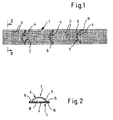
- a Roman blind band consists of a fabric band 1 of warp threads 2 and weft threads 3.
- the warp threads 2 and the weft threads 3 are made of a polymer material and are aftertreated by stretching and subsequent fixing.
- the stretching serves to improve the mechanical properties of the threads, in particular the improvement of the fiber strength.
- orientation of the molecules in the fiber direction and an increase in crystallinity occur.
- the macromolecules are more or less in the direction of the yarn axis.
- the chain molecules want to return to their rectilinear shape, ie the tissue structure is not dimensionally stable. Now, when the tissue, ie the individual threads, heat treated, the macromolecules can enter new anchorages and hold on cooling on this form. As a result, the entire tissue is dimensionally stable.
- the warp threads 2 are lowered during the weaving process so that the weft threads 3, which are not set, lie freely over the surface of the fabric strip 1 and form a loop web 4.
- the loop web 4 may consist of at least one or more threads, d. H. Steg threads 5 exist.
- the weaving process is continued.
- the web threads 5 removed from the weft threads 3 leave no gaps in the fabric (of the fabric tape 1) to form the loop web 4, thereby achieving a uniform fabric image, since the fabric tape 1 is thus uniformly woven throughout.
- the weft threads 3 forming the web threads 5 do not lie over the entire width of the fabric tape 1 freely above the base surface, but that a web-free edge is provided on both sides of the loop web 4 Edge region 6 is formed.
- the finished woven fabric tape 1 is then fixed with the loop webs 4 resting on one side, in particular by heat setting, in such a way that the fabric tape 1 has a greater degree of shrinkage than the threads 5 of the loop webs 4, so that after fixation 5 straighten threads against the surface of the fabric strip 1 and form a loop 7, which encloses a passage opening 8.
- the warp threads 2 of the fabric strip 1 have a diameter of 0.15 mm in the edge region 6 and a diameter of 0 in the remaining region of the fabric strip 1, the diameter of the webbing 1 forming the loop 7 being greater than the width dimension. 12 mm.
- the warp threads 2 of the fabric tape 1 are shrunk in the edge region 6 and in the remaining area they have a residual shrinkage of about 20%.
- the weft threads 3 have a residual shrinkage of about 10%, so that the weft threads 3 of the fabric tape 1 are shrunk more strongly than the web threads 5 with a residual shrinkage of about 20%.
- the weft threads 3 of the fabric tape 1 preferably have a diameter of 0.15 mm.
- An advantage of the Roman blind band according to the invention is that the weft threads 3 of the fabric tape 1 removed web threads 5, which form the loop 7 leave no gaps in the background fabric.
- the invention requires Weaving technique that the loops 7 are tensile and can not be pulled out of the fabric of the fabric band 1 in normal train. Since on both sides of the loops 7, the fabric band 1 has a continuous fabric structure without constrictions or protruding reversal points, an optical advantage is achieved and also the Roman blind band according to the invention can be easily sewn on a substrate. Also, according to the invention, the two longitudinal edge portions 6 of the Roman blind band are equally strong and there are no thickening.
- the loops 7 are erected and include a passage opening 8, a threading of drawstrings can be considerably simplified after sewing the Roman blind tape on the Roman shade, so that time and cost can be saved during assembly.
- the fixation of Raffrollo bandes invention is such that at a later ironing no more delay can occur.
- the fabric tape 1 are coated on the side facing away from the loops 7 side with a heat sealable adhesive layer 9, in particular from a powder adhesive, so that the Roman blind tape according to the invention can be prefixed to the pad by ironing.
- Another advantage of the Roman blind tape according to the invention is that the Roman blind can be much easier opened and closed by the upstanding loops 7, since the running inside the loops 7 pull cord undergoes no hindrance.
Landscapes
- Engineering & Computer Science (AREA)
- Textile Engineering (AREA)
- Structural Engineering (AREA)
- Architecture (AREA)
- Civil Engineering (AREA)
- Woven Fabrics (AREA)
- Curtains And Furnishings For Windows Or Doors (AREA)
- Knitting Of Fabric (AREA)
- Decoration Of Textiles (AREA)
- Organic Insulating Materials (AREA)
- Adhesive Tapes (AREA)
Description
- Die vorliegende Erfindung betrifft ein Raffrolloband, bestehend aus einem Polymer-Gewebeband aus gestreckten und fixierten Kettfäden und Schussfäden sowie aus auf einer Seite des Gewebebandes ausgebildeten, zueinander in Längsrichtung des Gewebebandes beabstandeten, parallel zu den Schussfäden verlaufenden Schlaufenstegen.
- Derartige Raffrollobänder sind bekannt. Bei diesen bekannten Raffrollobändern bestehen die Schlaufen aus Kettfäden, die an der Wirknadelseite abgebunden sind. Die so gebildete Schlaufe liegt allerdings mit ihrem Schlaufensteg flach auf dem Gewebeband auf. Auf Grund dieser Herstellung besitzen die Kanten des Gewebebandes im Bereich der ausgebildeten Schlaufen Verengungen oder aber herausstehende Umkehrpunkte. Da die Schlaufenstege der bekannten Raffrollobänder flach auf dem Band aufliegen, ist das Einfädeln einer Zugkordel durch die Schlaufen erschwert. Zudem beeinträchtigen die Verengungen bzw. herausstehenden Umkehrpunkte der Schlaufen das optische Erscheinungsbild und erschweren das Annähen des Raffrollobandes an dem Raffrollo.
- Der vorliegenden Erfindung liegt die Aufgabe zu Grunde, die vorstehenden Nachteile der bekannten Raffrollobänder zu beseitigen, so dass das Einfädeln des Zugbandes erleichtert und insbesondere die gesamte Bedienbarkeit des fertigen Raffrollos verbessert wird.
- Erfindungsgemäß wird dies dadurch erreicht, dass die Schlaufenstege aus mindestens einem von einem Schussfaden gebildeten Stegfaden bestehen und das Gewebeband einen größeren Schrumpfungsgrad besitzt als die die Schlaufenstege bildenden Stegfäden, so dass diese gegenüber der Oberfläche des Gewebebandes aufgerichtet sind. Die einzelnen Schlaufenstege werden dadurch gebildet, dass die Grundkettfäden des Gewebebandes abgesenkt und in diesem Prozess die Schussfäden mit den Kantfäden abgebunden werden. Hierdurch liegt der nicht abgebundene Teil der Schussfäden frei über der Oberfläche des Gewebebandes und die freiliegenden Schussfäden können für die Bildung der Schlaufe bzw. des Schlaufenstegs verwendet werden, indem sie einen zunächst flach aufliegenden Schlaufensteg bilden. Erfindungsgemäß ist das Gewebe des Gewebebandes durch eine Thermofixierung derart behandelt, dass es stärker geschrumpft ist als die Stegfäden des Schlaufenstegs, die ebenfalls einem Thermofixierungsprozess unterworfen worden sind. Hierdurch wird erreicht, dass die nach der Fixierung längeren Stegfäden der Schlaufenstege sich von der Bandoberfläche aufrichten. Bei dem erfindungsgemäßen Raffrollo band sind die Stegfäden der Schlaufenstege zugfest gewebt und können nicht aus dem Grundgewebe des Gewebebandes bei normalem Zug herausgerissen werden.
- Vorteilhafte Ausführungen der Erfindung sind in den Unteransprüchen enthalten.
- An Hand des in den beiliegenden Zeichnungen dargestellten erfindungsgemäßen Raffrollo bandes wird die Erfindung näher erläutert. Es zeigen:
- Fig. 1
- eine Aufsicht auf ein erfindungsgemäßes Raffrollo band und
- Fig. 2
- eine Seitenansicht des erfindungsgemäßen Raffrollo bandes im Schnitt gemäß 11-11 in
Fig. 1 . - Wie sich aus
Fig. 1 ergibt, besteht ein erfindungsgemäßes Raffrollo band aus einem Gewebeband 1 aus Kettfäden 2 und Schussfäden 3. Die Kettfäden 2 und die Schussfäden 3 bestehen aus einem Polymerwerkstoff und sind durch ein Verstrecken und ein anschließendes Fixieren nachbehandelt. Das Verstrecken dient zur Verbesserung der mechanischen Eigenschaften der Fäden, und zwar insbesondere der Verbesserung der Faserfestigkeit. Durch das Verstrecken erfolgt eine Orientierung der Moleküle in Faserrichtung und ein Anstieg der Kristallinität. In den Fasern eines Garnes liegen die Makromoleküle mehr oder weniger in Richtung der Garnachse. Beim Weben wird das gerade Garn mechanisch in eine Bogenform gezwungen. Die Kettenmoleküle wollen jedoch wieder in ihre geradlinige Form zurück, d. h. die Gewebestruktur ist nicht formstabil. Wird nun das Gewebe, d. h. die einzelnen Fäden, wärmebehandelt, können die Makromoleküle neue Verankerungen eingehen und halten beim Abkühlen an dieser Form fest. Hierdurch wird das gesamte Gewebe formstabil. - Erfindungsgemäß ist nun vorgesehen, dass beim Webprozess die Kettfäden 2 abgesenkt werden, so dass die Schussfäden 3, die nicht abgebunden werden, frei über der Oberfläche des Gewebebandes 1 liegen und einen Schlaufensteg 4 bilden. Der Schlaufensteg 4 kann aus mindestens einem oder mehreren Fäden, d. h. Stegfäden 5 bestehen. Nach der Ausbildung dieses Schlaufensteges 4 wird der Webprozess fortgesetzt. Erfindungsgemäß wird dadurch erreicht, dass die den Schussfäden 3 entnommenen Stegfäden 5 zur Bildung des Schlaufensteges 4 keine Lücken im Gewebe (des Gewebebandes 1) hinterlassen und hierdurch ein gleichmäßiges Gewebebild erreicht wird, da somit das Gewebeband 1 durchgehend gleichmäßig gewebt ist. Die Ausbildung der Schlaufenstege 4 erfolgt in regelmäßigen Abständen entlang der Längsrichtung des Gewebebandes 1. Weiterhin ist vorgesehen, dass die die Stegfäden 5 bildenden Schussfäden 3 nicht über die gesamte Breite des Gewebebandes 1 frei über der Grundfläche liegen, sondern dass beidseitig des Schlaufensteges 4 ein stegfreier Kantenbereich 6 ausgebildet ist.
- Erfindungsgemäß wird nun das fertig gewebte Gewebeband 1 mit den auf einer Seite aufliegenden Schlaufenstegen 4 fixiert, insbesondere durch eine Thermofixierung, und zwar derart, dass das Gewebeband 1 einen größeren Schrumpfungsgrad besitzt als die Fäden 5 der Schlaufenstege 4, so dass nach der Fixierung sich diese Fäden 5 gegenüber der Oberfläche des Gewebebandes 1 aufrichten und eine Schlaufe 7 ausbilden, die eine Durchtrittsöffnung 8 umschließt. Somit besitzen die die Schlaufe 7 bildenden Stegfäden 5 ein größeres Längenmaß als das darunter liegende Breitenmaß des Gewebebandes 1. Die Kettfäden 2 des Gewebebandes 1 besitzen im Kantenbereich 6 einen Durchmesser von 0,15 mm und im übrigen Bereich des Gewebebandes 1 einen Durchmesser von 0,12 mm. Zudem sind die Kettfäden 2 des Gewebebandes 1 im Kantenbereich 6 ausgeschrumpft und im übrigen Bereich besitzen sie einen Restschrumpf von ca. 20 %. Die Schussfäden 3 besitzen einen Restschrumpf von ca. 10 %, so dass die Schussfäden 3 des Gewebebandes 1 stärker geschrumpft sind als die Stegfäden 5 mit einem Restschrumpf von ca. 20 %. Die Schussfäden 3 des Gewebebandes 1 besitzen vorzugsweise einen Durchmesser von 0,15 mm.
- Vorteilhaft bei dem erfindungsgemäßen Raffrollo band ist, dass die den Schussfäden 3 des Gewebebandes 1 entnommenen Stegfäden 5, die die Schlaufe 7 bilden, keine Lücken im Grundgewebe hinterlassen. Zudem bedingt die erfindungsgemäße Webtechnik, dass die Schlaufen 7 zugfest sind und nicht aus dem Gewebe des Gewebebandes 1 bei normalem Zug herausgerissen werden können. Da beidseitig der Schlaufen 7 das Gewebeband 1 eine durchgehende Gewebestruktur ohne Verengungen oder herausstehende Umkehrpunkte aufweist, wird ein optischer Vorteil erreicht und zudem kann das erfindungsgemäße Raffrollo band leichter auf einer Unterlage vernäht werden. Auch sind erfindungsgemäß die beiden Längskantenbereiche 6 des Raffrollo bandes gleich stark ausgebildet und es sind keinerlei Verdickungen vorhanden. Indem erfindungsgemäß die Schlaufen 7 aufgerichtet sind und eine Durchtrittsöffnung 8 umfassen, kann ein Einfädeln von Zugkordeln nach dem Vernähen des Raffrollo bandes auf dem Raffrollo erheblich vereinfacht werden, so dass somit Zeit und Kosten bei der Montage gespart werden. Zudem ist die Fixierung des erfindungsgemäßen Raffrollo bandes derart, dass bei einem späteren Bügeln kein Verzug mehr entstehen kann.
- Weiterhin ist es erfindungsgemäß zweckmäßig, wenn das Gewebeband 1 auf der von den Schlaufen 7 abgekehrten Seite mit einem heißsiegelfähigen Kleberschicht 9, insbesondere aus einem Pulverkleber beschichtet sind, so dass das erfindungsgemäße Raffrollo band auf die Unterlage durch Aufbügeln vorfixiert werden kann.
- Ein weiterer Vorteil des erfindungsgemäßen Raffrollo bandes besteht darin, dass das Raffrollo sich durch die aufstehenden Schlaufen 7 wesentlich leichter öffnen und Schließen lässt, da die innerhalb der Schlaufen 7 verlaufende Zugkordel keine Behinderung erfährt.
Claims (8)
- Raffrolloband, bestehend aus einem Polymer-Gewebeband (1) aus verstreckten und fixierten Kettfäden (2) und Schussfäden (3) sowie aus auf einer Seite des Gewebebandes (1) ausgebildeten, zueinander in Längsrichtung des Gewebebandes (1) beabstandeten, parallel zu den Schussfäden (3) verlaufenden Schlaufenstegen (4),
dadurch gekennzeichnet, dass dieSchlaufenstege(4)aus mindestens einem von einem Schussfaden (3) gebildeten Stegfaden (5) bestehen und das Gewebeband (1) einen größeren Schrumpfungsgrad besitzt als die die Schlaufenstege (4) bildenden Stegfäden (5), so dass diese gegenüber der Oberfläche des Gewebebandes (1) aufgerichtet sind und eine Durchtrittsöffnung (8) einer Schlaufe (7) umschließen. - Raffrolloband nach Anspruch 1,
dadurch gekennzeichnet, dass die Schlaufenstegbreite geringer ist als die Breite des Gewebebandes (1), so dass beidseitig der Schlaufe (7) eine Nähkante (6) in Längsrichtung des Gewebebandes (1) verläuft. - Raffrolloband nach Anspruch 1 oder 2,
dadurch gekennzeichnet, dass das Gewebe des Gewebebandes (1) im Bereich der Schlaufen (7) durchgewebt ist. - Raffrolloband nach einem der Ansprüche 1 bis 3,
dadurch gekennzeichnet, dass die Kettfäden (2) im Kantenbereich (6) des Gewebebandes (1) einen Durchmesser von 0,15 mm und im übrigen Bereich des Gewebebandes (1) einen Durchmesser von 0,12 mm besitzen. - Raffrolloband nach einem der Ansprüche 1 bis 4,
dadurch gekennzeichnet, dass die Kettfäden (2) im Kantenbereich (6) des Gewebebandes (1) ausgeschrumpft sind und im übrigen Bereich einen Restschrumpf von ca. 20 % besitzen. - Raffrolloband nach einem der Ansprüche 1 bis 5,
dadurch gekennzeichnet, dass die Schussfäden (3) einen Restschrumpf von ca. 10 % besitzen. - Raffrolloband nach einem der Ansprüche 1 bis 6,
dadurch gekennzeichnet, dass die Schussfäden (3) einen Durchmesser von 0,15 mm besitzen. - Raffrolloband nach einem der Ansprüche 1 bis 7,
dadurch gekennzeichnet, dass das Gewebeband (1) auf seiner den Schlaufen (7) abgekehrten Seite eine Schicht (9) aus einem heißsiegelfähigen Kleber aufweist.
Applications Claiming Priority (1)
| Application Number | Priority Date | Filing Date | Title |
|---|---|---|---|
| DE202007010465U DE202007010465U1 (de) | 2007-07-25 | 2007-07-25 | Raffrolloband |
Publications (2)
| Publication Number | Publication Date |
|---|---|
| EP2019159A1 EP2019159A1 (de) | 2009-01-28 |
| EP2019159B1 true EP2019159B1 (de) | 2009-11-11 |
Family
ID=39185367
Family Applications (1)
| Application Number | Title | Priority Date | Filing Date |
|---|---|---|---|
| EP07116146A Not-in-force EP2019159B1 (de) | 2007-07-25 | 2007-09-11 | Raffrolloband |
Country Status (4)
| Country | Link |
|---|---|
| EP (1) | EP2019159B1 (de) |
| AT (1) | ATE448341T1 (de) |
| DE (2) | DE202007010465U1 (de) |
| ES (1) | ES2332385T3 (de) |
Families Citing this family (5)
| Publication number | Priority date | Publication date | Assignee | Title |
|---|---|---|---|---|
| GB2472974A (en) * | 2009-08-13 | 2011-03-02 | Bowmer Bond | Multi-layer fabric with arched salient yarns for attachment |
| US10221506B2 (en) | 2010-02-26 | 2019-03-05 | Sanko Tekstil Isletmeleri San. Ve Tic. A.S. | Method of making woven fabric that performs like a knitted fabric |
| JP5928069B2 (ja) * | 2012-03-28 | 2016-06-01 | トヨタ紡織株式会社 | 織物 |
| DE102013112094A1 (de) * | 2013-11-04 | 2015-05-07 | Julius Boos Jr. Gmbh & Co. Kg | Tragband für Rafflamellenstores, Herstellungsverfahren für ein Tragband sowie Vorrichtung zur Verwendung in einem solchen Herstellungsverfahren |
| CN117125256B (zh) * | 2023-08-28 | 2026-03-03 | 北京空间机电研究所 | 一种盘缝带伞中部收口装置及方法 |
Family Cites Families (5)
| Publication number | Priority date | Publication date | Assignee | Title |
|---|---|---|---|---|
| DE4111436A1 (de) * | 1991-04-09 | 1992-10-15 | Straehle & Hess | Textiles befestigungsband, insbesondere fuer polsterteile |
| CH686972A5 (de) * | 1993-07-01 | 1996-08-15 | Huber & Co Ag Bandfabrik | Lamellentragband fuer Rafflamellenstores. |
| DE29708970U1 (de) * | 1997-05-21 | 1997-10-23 | Gustav Gerster GmbH & Co., 88400 Biberach | Ringband |
| DE10100484A1 (de) * | 2001-01-08 | 2002-07-11 | Gerd Haiber | Thermoschrumpfband |
| DE202005011982U1 (de) * | 2005-07-30 | 2005-10-13 | August Bünger Bob-Textilwerk GmbH & Co. K.G. | Raffrollo |
-
2007
- 2007-07-25 DE DE202007010465U patent/DE202007010465U1/de not_active Expired - Lifetime
- 2007-09-11 AT AT07116146T patent/ATE448341T1/de active
- 2007-09-11 EP EP07116146A patent/EP2019159B1/de not_active Not-in-force
- 2007-09-11 ES ES07116146T patent/ES2332385T3/es active Active
- 2007-09-11 DE DE502007001986T patent/DE502007001986D1/de active Active
Also Published As
| Publication number | Publication date |
|---|---|
| DE502007001986D1 (de) | 2009-12-24 |
| ES2332385T3 (es) | 2010-02-03 |
| DE202007010465U1 (de) | 2008-03-13 |
| EP2019159A1 (de) | 2009-01-28 |
| ATE448341T1 (de) | 2009-11-15 |
Similar Documents
| Publication | Publication Date | Title |
|---|---|---|
| DE2520209B2 (de) | Langsieb für Langsiebpapiermaschinen | |
| DE112007002644T5 (de) | Das Rollo eines durch Weben verbundenen Rollos | |
| DE3529418C1 (en) | Blind web of a slatted blind and method of manufacturing it | |
| EP2019159B1 (de) | Raffrolloband | |
| EP0116916A2 (de) | Rundschlinge, daraus gebildete Stroppe oder daraus gebildete Rundschlingenmatte | |
| WO2000024953A1 (de) | Frottier- oder velourstoff und verfahren zu dessen herstellung | |
| DE3147115A1 (de) | Spiralgliederband und verfahren zu dessen herstellung | |
| DE2508732A1 (de) | Gurtband fuer sicherheitsgurte | |
| DE102018005688A1 (de) | Biegsames Kederband mit einer gewebten Kederfahne und einem Keder in Form einer eingewebten geflochtenen Kederschnur | |
| DE1535788A1 (de) | Gezogenes Samtgewebe und Verfahren zur Herstellung desselben | |
| WO2006063599A1 (de) | Material zur herstellung eines stützverbandes | |
| EP3877577A1 (de) | Gewebe, insbesondere zur verwendung als sicht- und/oder blendschutz, und verfahren zur herstellung eines erfindungsgemässen gewebes | |
| DE102005022505B4 (de) | Rollobahn | |
| DE3413258C2 (de) | ||
| DE202008017468U1 (de) | In Schussrichtung elastisches Gewebe in Dreherbindung | |
| AT501362B1 (de) | Faltbare textile maschenware | |
| EP0226971A2 (de) | Mitläufergewebe | |
| DE202018003229U1 (de) | Biegsames Kederband mit einer gewebten Kederfahne und einem Keder in Form einer geflochtenen, durch einen Hilfsfaden angebundenen Kederschnur | |
| DE102014010038A1 (de) | Flächengefüge, Scharnier und Abdeckung mit einem derartigen Flächengefüge | |
| DE60312585T2 (de) | Zierband | |
| DE3217717C2 (de) | ||
| DE10100484A1 (de) | Thermoschrumpfband | |
| DE8415177U1 (de) | Hochziehbarer fensterbehang, wie faltrollo oder wolkenstore | |
| DE10033210B4 (de) | Material zur Herstellung eines Stützverbandes und Verfahren zur Herstellung des Materials | |
| EP2868462B1 (de) | Tragband für Rafflamellenstores, Herstellungsverfahren für ein Tragband sowie Vorrichtung zur Verwendung in einem solchen Herstellungsverfahren |
Legal Events
| Date | Code | Title | Description |
|---|---|---|---|
| PUAI | Public reference made under article 153(3) epc to a published international application that has entered the european phase |
Free format text: ORIGINAL CODE: 0009012 |
|
| AK | Designated contracting states |
Kind code of ref document: A1 Designated state(s): AT BE BG CH CY CZ DE DK EE ES FI FR GB GR HU IE IS IT LI LT LU LV MC MT NL PL PT RO SE SI SK TR |
|
| AX | Request for extension of the european patent |
Extension state: AL BA HR MK RS |
|
| 17P | Request for examination filed |
Effective date: 20090407 |
|
| GRAP | Despatch of communication of intention to grant a patent |
Free format text: ORIGINAL CODE: EPIDOSNIGR1 |
|
| AKX | Designation fees paid |
Designated state(s): AT BE BG CH CY CZ DE DK EE ES FI FR GB GR HU IE IS IT LI LT LU LV MC MT NL PL PT RO SE SI SK TR |
|
| GRAS | Grant fee paid |
Free format text: ORIGINAL CODE: EPIDOSNIGR3 |
|
| GRAA | (expected) grant |
Free format text: ORIGINAL CODE: 0009210 |
|
| AK | Designated contracting states |
Kind code of ref document: B1 Designated state(s): AT BE BG CH CY CZ DE DK EE ES FI FR GB GR HU IE IS IT LI LT LU LV MC MT NL PL PT RO SE SI SK TR |
|
| REG | Reference to a national code |
Ref country code: GB Ref legal event code: FG4D Free format text: NOT ENGLISH |
|
| REG | Reference to a national code |
Ref country code: CH Ref legal event code: EP |
|
| REG | Reference to a national code |
Ref country code: IE Ref legal event code: FG4D |
|
| REF | Corresponds to: |
Ref document number: 502007001986 Country of ref document: DE Date of ref document: 20091224 Kind code of ref document: P |
|
| REG | Reference to a national code |
Ref country code: ES Ref legal event code: FG2A Ref document number: 2332385 Country of ref document: ES Kind code of ref document: T3 |
|
| NLV1 | Nl: lapsed or annulled due to failure to fulfill the requirements of art. 29p and 29m of the patents act | ||
| LTIE | Lt: invalidation of european patent or patent extension |
Effective date: 20091111 |
|
| PG25 | Lapsed in a contracting state [announced via postgrant information from national office to epo] |
Ref country code: SE Free format text: LAPSE BECAUSE OF FAILURE TO SUBMIT A TRANSLATION OF THE DESCRIPTION OR TO PAY THE FEE WITHIN THE PRESCRIBED TIME-LIMIT Effective date: 20091111 Ref country code: PT Free format text: LAPSE BECAUSE OF FAILURE TO SUBMIT A TRANSLATION OF THE DESCRIPTION OR TO PAY THE FEE WITHIN THE PRESCRIBED TIME-LIMIT Effective date: 20100311 Ref country code: LT Free format text: LAPSE BECAUSE OF FAILURE TO SUBMIT A TRANSLATION OF THE DESCRIPTION OR TO PAY THE FEE WITHIN THE PRESCRIBED TIME-LIMIT Effective date: 20091111 Ref country code: FI Free format text: LAPSE BECAUSE OF FAILURE TO SUBMIT A TRANSLATION OF THE DESCRIPTION OR TO PAY THE FEE WITHIN THE PRESCRIBED TIME-LIMIT Effective date: 20091111 Ref country code: IS Free format text: LAPSE BECAUSE OF FAILURE TO SUBMIT A TRANSLATION OF THE DESCRIPTION OR TO PAY THE FEE WITHIN THE PRESCRIBED TIME-LIMIT Effective date: 20100311 |
|
| PG25 | Lapsed in a contracting state [announced via postgrant information from national office to epo] |
Ref country code: LV Free format text: LAPSE BECAUSE OF FAILURE TO SUBMIT A TRANSLATION OF THE DESCRIPTION OR TO PAY THE FEE WITHIN THE PRESCRIBED TIME-LIMIT Effective date: 20091111 Ref country code: PL Free format text: LAPSE BECAUSE OF FAILURE TO SUBMIT A TRANSLATION OF THE DESCRIPTION OR TO PAY THE FEE WITHIN THE PRESCRIBED TIME-LIMIT Effective date: 20091111 Ref country code: CY Free format text: LAPSE BECAUSE OF FAILURE TO SUBMIT A TRANSLATION OF THE DESCRIPTION OR TO PAY THE FEE WITHIN THE PRESCRIBED TIME-LIMIT Effective date: 20091111 Ref country code: SI Free format text: LAPSE BECAUSE OF FAILURE TO SUBMIT A TRANSLATION OF THE DESCRIPTION OR TO PAY THE FEE WITHIN THE PRESCRIBED TIME-LIMIT Effective date: 20091111 |
|
| REG | Reference to a national code |
Ref country code: IE Ref legal event code: FD4D |
|
| PG25 | Lapsed in a contracting state [announced via postgrant information from national office to epo] |
Ref country code: EE Free format text: LAPSE BECAUSE OF FAILURE TO SUBMIT A TRANSLATION OF THE DESCRIPTION OR TO PAY THE FEE WITHIN THE PRESCRIBED TIME-LIMIT Effective date: 20091111 Ref country code: IE Free format text: LAPSE BECAUSE OF FAILURE TO SUBMIT A TRANSLATION OF THE DESCRIPTION OR TO PAY THE FEE WITHIN THE PRESCRIBED TIME-LIMIT Effective date: 20091111 Ref country code: RO Free format text: LAPSE BECAUSE OF FAILURE TO SUBMIT A TRANSLATION OF THE DESCRIPTION OR TO PAY THE FEE WITHIN THE PRESCRIBED TIME-LIMIT Effective date: 20091111 Ref country code: BG Free format text: LAPSE BECAUSE OF FAILURE TO SUBMIT A TRANSLATION OF THE DESCRIPTION OR TO PAY THE FEE WITHIN THE PRESCRIBED TIME-LIMIT Effective date: 20100211 Ref country code: DK Free format text: LAPSE BECAUSE OF FAILURE TO SUBMIT A TRANSLATION OF THE DESCRIPTION OR TO PAY THE FEE WITHIN THE PRESCRIBED TIME-LIMIT Effective date: 20091111 |
|
| PG25 | Lapsed in a contracting state [announced via postgrant information from national office to epo] |
Ref country code: SK Free format text: LAPSE BECAUSE OF FAILURE TO SUBMIT A TRANSLATION OF THE DESCRIPTION OR TO PAY THE FEE WITHIN THE PRESCRIBED TIME-LIMIT Effective date: 20091111 Ref country code: CZ Free format text: LAPSE BECAUSE OF FAILURE TO SUBMIT A TRANSLATION OF THE DESCRIPTION OR TO PAY THE FEE WITHIN THE PRESCRIBED TIME-LIMIT Effective date: 20091111 |
|
| PLBE | No opposition filed within time limit |
Free format text: ORIGINAL CODE: 0009261 |
|
| STAA | Information on the status of an ep patent application or granted ep patent |
Free format text: STATUS: NO OPPOSITION FILED WITHIN TIME LIMIT |
|
| 26N | No opposition filed |
Effective date: 20100812 |
|
| PG25 | Lapsed in a contracting state [announced via postgrant information from national office to epo] |
Ref country code: GR Free format text: LAPSE BECAUSE OF FAILURE TO SUBMIT A TRANSLATION OF THE DESCRIPTION OR TO PAY THE FEE WITHIN THE PRESCRIBED TIME-LIMIT Effective date: 20100212 |
|
| BERE | Be: lapsed |
Owner name: PORSCHEN G.M.B.H. & CO. KG Effective date: 20100930 |
|
| PG25 | Lapsed in a contracting state [announced via postgrant information from national office to epo] |
Ref country code: MC Free format text: LAPSE BECAUSE OF NON-PAYMENT OF DUE FEES Effective date: 20100930 |
|
| PG25 | Lapsed in a contracting state [announced via postgrant information from national office to epo] |
Ref country code: BE Free format text: LAPSE BECAUSE OF NON-PAYMENT OF DUE FEES Effective date: 20100930 |
|
| PG25 | Lapsed in a contracting state [announced via postgrant information from national office to epo] |
Ref country code: MT Free format text: LAPSE BECAUSE OF FAILURE TO SUBMIT A TRANSLATION OF THE DESCRIPTION OR TO PAY THE FEE WITHIN THE PRESCRIBED TIME-LIMIT Effective date: 20091111 |
|
| REG | Reference to a national code |
Ref country code: CH Ref legal event code: PL |
|
| GBPC | Gb: european patent ceased through non-payment of renewal fee |
Effective date: 20110911 |
|
| PG25 | Lapsed in a contracting state [announced via postgrant information from national office to epo] |
Ref country code: CH Free format text: LAPSE BECAUSE OF NON-PAYMENT OF DUE FEES Effective date: 20110930 Ref country code: LI Free format text: LAPSE BECAUSE OF NON-PAYMENT OF DUE FEES Effective date: 20110930 |
|
| PG25 | Lapsed in a contracting state [announced via postgrant information from national office to epo] |
Ref country code: GB Free format text: LAPSE BECAUSE OF NON-PAYMENT OF DUE FEES Effective date: 20110911 |
|
| PG25 | Lapsed in a contracting state [announced via postgrant information from national office to epo] |
Ref country code: LU Free format text: LAPSE BECAUSE OF NON-PAYMENT OF DUE FEES Effective date: 20100911 Ref country code: HU Free format text: LAPSE BECAUSE OF FAILURE TO SUBMIT A TRANSLATION OF THE DESCRIPTION OR TO PAY THE FEE WITHIN THE PRESCRIBED TIME-LIMIT Effective date: 20100512 Ref country code: NL Free format text: LAPSE BECAUSE OF FAILURE TO SUBMIT A TRANSLATION OF THE DESCRIPTION OR TO PAY THE FEE WITHIN THE PRESCRIBED TIME-LIMIT Effective date: 20091111 |
|
| PG25 | Lapsed in a contracting state [announced via postgrant information from national office to epo] |
Ref country code: TR Free format text: LAPSE BECAUSE OF FAILURE TO SUBMIT A TRANSLATION OF THE DESCRIPTION OR TO PAY THE FEE WITHIN THE PRESCRIBED TIME-LIMIT Effective date: 20091111 |
|
| PGFP | Annual fee paid to national office [announced via postgrant information from national office to epo] |
Ref country code: FR Payment date: 20120926 Year of fee payment: 6 Ref country code: IT Payment date: 20120914 Year of fee payment: 6 |
|
| PGFP | Annual fee paid to national office [announced via postgrant information from national office to epo] |
Ref country code: ES Payment date: 20121004 Year of fee payment: 6 |
|
| REG | Reference to a national code |
Ref country code: AT Ref legal event code: MM01 Ref document number: 448341 Country of ref document: AT Kind code of ref document: T Effective date: 20120911 |
|
| PG25 | Lapsed in a contracting state [announced via postgrant information from national office to epo] |
Ref country code: AT Free format text: LAPSE BECAUSE OF NON-PAYMENT OF DUE FEES Effective date: 20120911 |
|
| REG | Reference to a national code |
Ref country code: FR Ref legal event code: ST Effective date: 20140530 |
|
| PG25 | Lapsed in a contracting state [announced via postgrant information from national office to epo] |
Ref country code: IT Free format text: LAPSE BECAUSE OF NON-PAYMENT OF DUE FEES Effective date: 20130911 Ref country code: FR Free format text: LAPSE BECAUSE OF NON-PAYMENT OF DUE FEES Effective date: 20130930 |
|
| REG | Reference to a national code |
Ref country code: ES Ref legal event code: FD2A Effective date: 20141007 |
|
| PG25 | Lapsed in a contracting state [announced via postgrant information from national office to epo] |
Ref country code: ES Free format text: LAPSE BECAUSE OF NON-PAYMENT OF DUE FEES Effective date: 20130912 |
|
| PGFP | Annual fee paid to national office [announced via postgrant information from national office to epo] |
Ref country code: DE Payment date: 20210331 Year of fee payment: 14 |
|
| REG | Reference to a national code |
Ref country code: DE Ref legal event code: R119 Ref document number: 502007001986 Country of ref document: DE |
|
| PG25 | Lapsed in a contracting state [announced via postgrant information from national office to epo] |
Ref country code: DE Free format text: LAPSE BECAUSE OF NON-PAYMENT OF DUE FEES Effective date: 20220401 |