EP2019539A2 - Informationsverarbeitungsvorrichtung - Google Patents
Informationsverarbeitungsvorrichtung Download PDFInfo
- Publication number
- EP2019539A2 EP2019539A2 EP08004279A EP08004279A EP2019539A2 EP 2019539 A2 EP2019539 A2 EP 2019539A2 EP 08004279 A EP08004279 A EP 08004279A EP 08004279 A EP08004279 A EP 08004279A EP 2019539 A2 EP2019539 A2 EP 2019539A2
- Authority
- EP
- European Patent Office
- Prior art keywords
- key
- pressed
- power key
- mobile phone
- information processing
- Prior art date
- Legal status (The legal status is an assumption and is not a legal conclusion. Google has not performed a legal analysis and makes no representation as to the accuracy of the status listed.)
- Withdrawn
Links
- 230000010365 information processing Effects 0.000 title claims abstract description 33
- 230000004044 response Effects 0.000 claims abstract description 15
- 238000000034 method Methods 0.000 description 29
- 230000006870 function Effects 0.000 description 12
- 230000007257 malfunction Effects 0.000 description 12
- 230000005540 biological transmission Effects 0.000 description 11
- 230000005236 sound signal Effects 0.000 description 7
- 238000005516 engineering process Methods 0.000 description 4
- 238000006243 chemical reaction Methods 0.000 description 3
- 230000007246 mechanism Effects 0.000 description 3
- 238000010586 diagram Methods 0.000 description 2
- 238000001228 spectrum Methods 0.000 description 2
- 230000001427 coherent effect Effects 0.000 description 1
- 238000004891 communication Methods 0.000 description 1
- 239000004973 liquid crystal related substance Substances 0.000 description 1
Images



Classifications
-
- H—ELECTRICITY
- H04—ELECTRIC COMMUNICATION TECHNIQUE
- H04M—TELEPHONIC COMMUNICATION
- H04M1/00—Substation equipment, e.g. for use by subscribers
- H04M1/66—Substation equipment, e.g. for use by subscribers with means for preventing unauthorised or fraudulent calling
-
- H—ELECTRICITY
- H04—ELECTRIC COMMUNICATION TECHNIQUE
- H04M—TELEPHONIC COMMUNICATION
- H04M1/00—Substation equipment, e.g. for use by subscribers
- H04M1/72—Mobile telephones; Cordless telephones, i.e. devices for establishing wireless links to base stations without route selection
- H04M1/724—User interfaces specially adapted for cordless or mobile telephones
- H04M1/72403—User interfaces specially adapted for cordless or mobile telephones with means for local support of applications that increase the functionality
-
- H—ELECTRICITY
- H04—ELECTRIC COMMUNICATION TECHNIQUE
- H04M—TELEPHONIC COMMUNICATION
- H04M1/00—Substation equipment, e.g. for use by subscribers
- H04M1/02—Constructional features of telephone sets
- H04M1/0202—Portable telephone sets, e.g. cordless phones, mobile phones or bar type handsets
- H04M1/0206—Portable telephones comprising a plurality of mechanically joined movable body parts, e.g. hinged housings
- H04M1/0208—Portable telephones comprising a plurality of mechanically joined movable body parts, e.g. hinged housings characterized by the relative motions of the body parts
- H04M1/0235—Slidable or telescopic telephones, i.e. with a relative translation movement of the body parts; Telephones using a combination of translation and other relative motions of the body parts
- H04M1/0237—Sliding mechanism with one degree of freedom
-
- H—ELECTRICITY
- H04—ELECTRIC COMMUNICATION TECHNIQUE
- H04M—TELEPHONIC COMMUNICATION
- H04M1/00—Substation equipment, e.g. for use by subscribers
- H04M1/02—Constructional features of telephone sets
- H04M1/23—Construction or mounting of dials or of equivalent devices; Means for facilitating the use thereof
- H04M1/236—Construction or mounting of dials or of equivalent devices; Means for facilitating the use thereof including keys on side or rear faces
Definitions
- the present invention relates to information processing apparatuses and, more particularly, to an information processing apparatus capable of controlling the operation involved in a key operation.
- Users typically carry mobile phones with them always. For example, users have the mobile phones in their pockets to carry them. If any operation keys or switches of the mobile phones are pressed while being carried, the mobile phones can malfunction.
- Japanese Unexamined Patent Application Publication No. 2-44843 discloses a technology for preventing malfunction of a flip mobile phone if any foreign body is caught between the main body of the mobile phone and the flipper thereof.
- Japanese Unexamined Patent Application Publication No. 2-44843 can prevent the mobile phone from malfunctioning if any foreign body is caught between the main body of the mobile phone and the flipper thereof, it is not possible to apply the technology to another mobile phone, such as a slide mobile phone in which the operation keys are exposed outside.
- an information processing apparatus includes a determination unit configured to determine whether or not a second key provided on a body is pressed if a first key provided on the body is pressed and a control unit configured to control so as to disable the first key and inhibit an operation in response to an operation with the first key if it is determined by the determination unit that the second key provided on the body is pressed.
- a slide information processing apparatus includes a first body, a second body, a guide member, the first body and the second body being slidable on one another via the guide member, a determination unit configured to determine whether or not a second key provided on the second body is pressed if a first key provided on the second body is pressed, and a control unit configured to control so as to disable the first key and inhibit an operation in response to an operation with the first key if it is determined by the determination unit that the second key provided on the second body is pressed.
- a slide information processing apparatus includes a first body, a second body, a guide member, the first body and the second body being slidable on one another via the guide member, a determination unit configured to determine whether or not the information processing apparatus is in a first state if a first key provided on the second body is pressed, and a control unit configured to control so as to disable the first key and inhibit an operation in response to an operation with the first key if it is determined by the determination unit that the information processing apparatus is in the first state in a case where the first key is pressed for a longer time.
- Figs. 1A and 1B are external views of a slide mobile phone 1 to which an information processing apparatus according to an embodiment of the present invention is applicable.
- the slide mobile phone 1 has a first body 11 and a second body 12.
- the second body 12 is provided so as to be slidable on the first body 11 via a guide unit (guide member) (not shown) in the direction indicated by an X arrow.
- Fig. 1A is an external front view of the slide mobile phone 1 in a closed state where the first body 11 is overlaid with second body 12.
- Fig. 1B is an external side view of the slide mobile phone 1 in the closed state where the first body 11 is overlaid with the second body 12.
- the second body 12 is substantially flat.
- a main display 13, such as a liquid crystal display, is provided in the central portion on the surface of the second body 12 in Fig. 1A .
- Second operation keys 14 serving as sub-operation keys are provided in the lower portion on the surface of the second body 12 in Fig. 1A .
- a user can use the second operation keys 14 to input various instructions.
- the second operation keys 14 include various operation keys, such as a call key, an end-power key, a clear key, and an e-mail key.
- the second body 12 also has four keys arranged in a cross shape and a determination key provided as the second operation keys 14.
- the user can operate the keys arranged in the cross shape horizontally or vertically to move the active cursor horizontally or vertically. Specifically, for example, the user can operate the keys arranged in the cross shape to perform various operations including scroll up or down of a telephone directory or an e-mail list, turning of the pages of a simple Web page, or feeding of images on the main display 13 provided on the second body 12.
- the user can press the determination key to determine various functions. For example, when a desired telephone number is selected from multiple telephone numbers in the telephone directory displayed in the main display 13 in response to a user's operation of any of the keys arranged in a cross shape and the determination key is pressed toward the inner part of the second body 12, the selected telephone number is determined and the determined telephone number is called.
- the second body 12 further has the e-mail key at the left side of the keys arranged in a cross shape and the determination key.
- the user can enable a function of transmitting and receiving a mail by pressing the e-mail key toward the inner part of the second body 12.
- a browser key is provided at the right side of the keys arranged in a cross shape and the determination key. The user can browse data in a Web page by pressing the browser key toward the inner part of the second body 12.
- a speaker 15 is provided at a certain position near the upper end on the surface of the second body 12 in Fig. 1A .
- the provision of the speaker 15 allows the user to perform audio communication.
- the second body 12 has a side key 16 used for operating the slide mobile phone 1.
- Magnetic sensors 17a, 17b, and 17c are provided at certain positions in the inner parts of the first body 11 and the second body 12.
- the magnetic sensors 17a, 17b, and 17c are used to detect states of the slide mobile phone 1 (a state where the second body 12 is at a closed position and a state where the second body 12 is at an open position).
- the state where the second body 12 is at the closed position is hereinafter referred to as a closed state and the state where the second body 12 is at the open position is hereinafter referred to as an open state.
- the first body 11 and the second body 12 have locking mechanisms (not shown) used for locking the first body 11 and the second body 12 at the open position or the closed position when the second body 12 is slid via the guide unit (guide member) (not shown).
- the positions of the locking mechanisms match with the positions where the magnetic sensors 17b and 17c are provided.
- the locking mechanisms have, for example, a structure in which the first body 11 is mechanically engaged with the second body 12. If the user applies a pressure higher than a predetermined reference value to cause the slide operation, the locking state is released to allow the second body 12 to easily slide on the first body 11.
- a transmitter-receiver antenna (an antenna 31 shown in Fig. 3 described below) is provided at a certain position inside the slide mobile phone 1. Radio waves are transmitted to and received from a base station (not shown) through the built-in antenna.
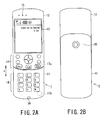
- Figs. 2A and 2B are other external views of the slide mobile phone 1 to which the information processing apparatus according to the present embodiment of the present invention is applicable.
- Fig. 2A is an external front view of the slide mobile phone 1 in a state where the second body 12 in Fig. 1A is slid longitudinally (in the X direction) to be locked at the open position.
- Fig. 2B is an external rear view of the slide mobile phone 1 in the state where the second body 12 in Fig. 1A is slid longitudinally to be locked at the open position.
- the first body 11 is substantially flat, like the second body 12.
- First operation keys 18 serving as main operation keys are provided in the lower portion on the surface of the first body 11 in Fig. 2A .
- the user can use the first operation keys 18 to input various instructions.
- the first operation keys 18 include numeric keys from "0" to "9".
- the first body 11 also has a microphone 19 provided at the lower side of the first operation keys 18.
- the microphone 19 is used to collect the voice of the user during talking.
- the first body 11 has a battery pack (not shown) provided at the rear side thereof. When the end-power key is turned on, power is supplied from the battery pack to each circuit to activate the slide mobile phone 1. As shown in Fig. 2B , the first body 11 in Fig. 2A has a CCD camera 20 on the rear surface thereof. The CCD camera 20 captures an image of a desired object.
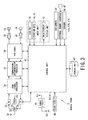
- Fig. 3 is a block diagram illustrating an example of the internal configuration of the slide mobile phone 1 to which the information processing apparatus according to the present embodiment of the present invention is applicable.
- the antenna 31 receives a radio signal transmitted from the base station (not shown) and supplies the received radio signal to a receiver circuit (RX) 33 through an antenna duplexer (DUP) 32.
- the receiver circuit 33 mixes the received radio signal with a local oscillator signal supplied from a frequency synthesizer (SYN) 34 to down-convert the radio signal into an intermediate-frequency signal (frequency conversion).
- the receiver circuit 33 performs quadrature demodulation to the down-converted intermediate-frequency signal to output a reception baseband signal.
- the frequency of the local oscillator signal generated by the frequency synthesizer 34 is instructed with a control signal SYC supplied from a control unit 41.
- the reception baseband signal is supplied from the receiver circuit 33 to a CDMA signal processor 36.
- the CDMA signal processor 36 is provided with a RAKE receiver (not shown).
- the RAKE receiver despreads each path included in the reception baseband signal with a spread code (that is, the same spread code as that of the spread reception signal).
- the signal of each path that is despread is subjected to phase adjustment and, then, is subjected to coherent RAKE combination.
- Data series subjected to the RAKE combination is subjected to deinterleave and channel decoding (error correction decoding) and, then, is subjected to binary determination, thereby generating reception packet data in a predetermined transmission format.
- the reception packet data is supplied to a compression-decompression processor 37.
- the compression-decompression processor 37 is, for example, a DSP.
- the compression-decompression processor 37 separates the reception packet data supplied from the CDMA signal processor 36 for every medium with a demultiplexer (not shown) and decodes the separated reception packet data. For example, in a talk mode, the compression-decompression processor 37 decodes audio data corresponding to a voice included in the reception packet data by speech codec. If the reception packet data includes moving image data, for example, in a videophone mode, the compression-decompression processor 37 decodes the moving image data by video codec. If the reception packet data is download content, the compression-decompression processor 37 decompresses the download content and supplies the decompressed download content to the control unit 41.
- a digital audio signal resulting from the decoding is supplied to a PCM CODEC 38.
- the PCM CODEC 38 performs PCM decoding to the digital audio signal supplied from the compression-decompression processor 37 and supplies an analog audio signal resulting from the PCM decoding to a reception amplifier 39.
- the analog audio signal is amplified by the reception amplifier 39 and is output from the speaker 15.
- the digital moving image signal decoded by the video codec in the compression-decompression processor 37 is supplied to the control unit 41.
- the control unit 41 displays a moving image based on the digital moving image signal supplied from the compression-decompression processor 37 in the main display 13 via a video RAM (for example, a VRAM) (not shown).
- the control unit 41 may display a moving image based on moving image data captured by the CCD camera 20 in the main display 13 via the video RAM (not shown), in addition to the moving image based on the received moving image data.
- the compression-decompression processor 37 supplies the e-mail to the control unit 41.
- the control unit 41 stores the e-mail supplied from the compression-decompression processor 37 in a storage unit 42.
- the control unit 41 reads out the e-mail stored in the storage unit 42 in response to a user's operation with any of the first operation keys 18 and the second operation keys 14, which serve as an input unit, and displays the readout e-mail in the main display 13.
- An voice signal (analog audio signal) of a speaker (user) received by the microphone 19 in the talk mode is amplified by a transmission amplifier 40 to an appropriate level and is subjected to PCM coding by the PCM CODEC 38.
- a digital audio signal resulting from the PCM coding is supplied to the compression-decompression processor 37.
- a moving image signal supplied from the CCD camera 20 is digitized by the control unit 41 and is supplied to the compression-decompression processor 37.
- an e-mail, which is text data, created in the control unit 41 is also supplied to the compression-decompression processor 37.
- the compression-decompression processor 37 encodes and compresses the digital audio signal supplied from the PCM CODEC 38 in a format corresponding to a predetermined transmission data rate to generate audio data.
- the compression-decompression processor 37 encodes and compresses the digital moving image signal supplied from the control unit 41 to generate moving image data.
- the compression-decompression processor 37 multiplexes the audio data or the moving image data in a predetermined transmission format with a demultiplexer (not shown), packetizes the multiplexed audio data or moving image data, and supplies the transmission packet data after the packetization to the CDMA signal processor 36.
- the compression-decompression processor 37 also multiplexes the e-mail supplied from the control unit 41 into transmission packet data.
- the CDMA signal processor 36 spectrum-spreads the transmission packet data supplied from the compression-decompression processor 37 with a spread code allocated to the transmission channel and supplies the output signal resulting from the spread spectrum processing to a transmitter circuit (TX) 35.
- the transmitter circuit 35 modulates the signal resulting from the spread spectrum processing in a digital modulation format, such as QPSK.
- the transmitter circuit 35 mixes the transmission signal resulting from the digital modulation with a local oscillator signal generated by the frequency synthesizer 34 to up-convert the transmission signal into a radio signal (frequency conversion).
- the transmitter circuit 35 RF-amplifies the radio signal resulting from the up-conversion so as to yield a transmission power level indicated by the control unit 41.
- the RF-amplified radio signal is supplied to the antenna 31 through the antenna duplexer 32 and is transmitted to the base station (not shown) from the antenna 31.
- the slide mobile phone 1 is also provided with an external memory interface 46.
- the external memory interface 46 has a slot from which a memory card 47 is detachable.
- the memory card 47 is a flash memory card, such as a NAND flash memory card or NOR flash memory card.
- a variety of data, such as image data, audio data, and music data, can be written in or read out from the memory card 47 through a 10-pin terminal.
- the control unit 41 includes, for example, a CPU, a ROM, and a RAM.
- the CPU executes a variety of processing in accordance with programs stored in the ROM or various application programs loaded from the storage unit 42 into the RAM.
- the CPU generates various control signals and supplies the generated control signals to the components in the slide mobile phone 1 in order to control the entire slide mobile phone 1.
- the RAM stores data necessary for the CPU to execute the variety of processing.
- the storage unit 42 is, for example, a flash memory device, which is an electronically erasable and programmable read only memory, or an HDD.
- the storage unit 42 stores the various application programs executed by the CPU in the control unit 41 or various data groups.
- a power circuit 44 generates a predetermined power supply voltage Vcc on the basis of an output from a battery 43 and supplies the generated power supply voltage Vcc to the circuits in the slide mobile phone 1.
- the slide mobile phone 1 is further provided with a clock circuit 45 for accurately measuring the current time.
- Fig. 4 is a flowchart showing an example of a controlling process of enabling or disabling the end-power key in the slide mobile phone 1 shown in Fig. 3 .
- the controlling process of enabling or disabling the end-power key is started when the user presses the end-power key in the second operation keys 14 or when any external pressure is applied to the slide mobile phone 1 with being put in the pocket or bag of the user to unintentionally press the end-power key.
- Step S1 the control unit 41 determines whether the end-power key in the second operation keys 14 is pressed.
- the control unit 41 waits until the control unit 41 determines that the end-power key in the second operation keys 14 is pressed.
- the control unit 41 determines that the end-power key in the second operation keys 14 is pressed, when the user presses the end-power key in the second operation keys 14 or when any external pressure is applied to the slide mobile phone 1 with being put in the pocket or bag of the user to unintentionally press the end-power key.
- the control unit 41 cannot determine whether the user presses the end-power key in the second operation keys 14 or whether any external pressure is applied to the slide mobile phone 1 with being put in the pocket or bag of the user to unintentionally press the end-power key only on the basis of the determination of whether the end-power key in the second operation keys 14 is pressed. In the latter case, it is normally supposed that the external pressure is also applied to another operation key that is provided on the surface of the second body 12 and that has the same height as that of the end-power key, in addition to the end-power key in the second operation keys 14 (that is, a state where the multiple keys are pressed). Accordingly, the control unit 41 also determines whether another operation key is concurrently pressed when the end-power key is pressed.
- control unit 41 determines that another operation key is concurrently pressed when the end-power key is pressed, the control unit 41 recognizes that the end-power key is unintentionally pressed, as in the latter case. If the control unit 41 determines that another operation key is not concurrently pressed when the end-power key is pressed, the control unit 41 recognizes that the user presses the end-power key in the second operation keys 14.
- Step S2 the control unit 41 determines whether any operation key other than the end-power key in the second operation keys 14 is pressed. In other words, the control unit 41 determines whether the end-power key is unintentionally pressed or whether the user presses the end-power key in the second operation keys 14.
- Step S3 the control unit 41 recognizes that any external pressure is applied to the slide mobile phone 1 with being put in the pocket or bag of the user to unintentionally press the end-power key and disables the end-power key. Accordingly, it is possible to disable the function of the end-power key in the second operation keys 14 as the power key and to inhibit the on-operation or off-operation of the end-power key as the power key when any external pressure is applied to the slide mobile phone 1 with being put in the pocket or bag of the user to unintentionally press the end-power key. Consequently, even if the operation keys are exposed outside, like the second operation keys 14 on the second body 12, it is possible to preferably prevent any malfunction unintended by the user.
- Step S3 After the control unit 41 disables the end-power key in Step S3, the process goes back to Step S1 to repeat the steps subsequent to Step S1. Accordingly, even if a similar situation repeatedly occurs, it is possible to disable the function of the end-power key in the second operation keys 14 as the power key to preferably prevent any malfunction unintended by the user.
- Step S4 the control unit 41 recognizes that the end-power key in the second operation keys 14 is pressed and enables the end-power key to turn on or off the end-power key as the power key. Accordingly, the end-power key is turned on or off as the normal power key in response to a user's operation with the second operation keys 14.
- Step S4 After the control unit 41 enables the end-power key in Step S4, the process goes back to Step S1 to repeat the steps subsequent to Step S1.
- the slide mobile phone 1 in which the second body 12 is provided so as to be slidable on the first body 11 via the guide unit (not shown), it is determined whether any operation key other than the end-power key in the second operation keys 14 provided on the second body 12 is pressed when, for example, the end-power key in the second operation keys 14 provided on the second body 12 is pressed. If it is determined that any operation key other than the end-power key in the second operation keys 14 provided on the second body 12 is pressed, the end-power key can be disabled to inhibit the end-power key from operating in response to a user's operation of the end-power key.
- the function of the end-power key in the second operation keys 14 as the power key can be disabled to inhibit the on-operation or off-operation of the end-power key as the power key when any external pressure is applied to the slide mobile phone 1 with being put in the pocket or bag of the user to unintentionally press the end-power key. Consequently, it is possible to preferably prevent any malfunction unintended by the user even if the operation keys are exposed outside, like the second operation keys 14 provided on the second body 12. As a result, it is possible to improve the user-friendliness of the slide mobile phone 1.
- the present invention is not limited to such a case and is applicable to all the operation keys on the surface of the second body 12.
- the present invention is applicable to another operation key, such as the call key, in the second operation keys 14.
- the slide mobile phone 1 cannot be undesirably turned on or off despite the fact that the user intentionally presses the end-power key. Accordingly, it may be determined whether any operation key other than the end-power key in the second operation keys 14 is pressed after a predetermined time (for example, two to three seconds) elapsed since the end-power key is pressed so that it can be accurately determined whether the user presses the end-power key in the second operation keys 14 or whether any external pressure is applied to the slide mobile phone 1 with being put in the pocket or bag of the user to unintentionally press the end-power key.
- a predetermined time for example, two to three seconds
- Fig. 5 is a flowchart showing another example of the controlling process of enabling or disabling the end-power key in the slide mobile phone 1 shown in Fig. 3 . Since Steps S11 and S13 to S15 in Fig. 5 are similar to Steps S1 to S4 in Fig. 4 , a description of Steps S11 and S13 to S15 in Fig. 5 is omitted herein.
- Step S12 the control unit 41 determines whether a predetermined time (for example, two to three seconds) set in advance by the clock circuit 45 elapsed.
- the control unit 41 waits until the control unit 41 determines that the predetermined time (for example, two to three seconds) set in advance elapsed. If the control unit 41 determines in Step S12 that the predetermined time (for example, two to three seconds) set in advance elapsed, the process goes to Step S13 to repeat the steps subsequent to Step S13.
- Step S13 the control unit 41 determines whether any operation key other than the end-power key in the second operation keys 14 is pressed.
- the end-power key in the second operation keys 14 it can be accurately determined whether the user presses the end-power key in the second operation keys 14 or whether any external pressure is applied to the slide mobile phone 1 with being put in the pocket or bag of the user to unintentionally press the end-power key by determining whether any operation key other than the end-power key in the second operation keys 14 is pressed after a predetermined time (for example, two to three seconds) elapsed. Consequently, it is possible to preferably prevent any malfunction unintended by the user even if the operation keys are exposed outside, like the second operation keys 14 provided on the second body 12. As a result, it is possible to further improve the user-friendliness of the slide mobile phone 1.
- a predetermined time for example, two to three seconds
- any operation key other than the end-power key in the second operation keys 14 is pressed when the power key is turned on or off.
- the slide mobile phone 1 is usually put in a pocket or bag of the user in the closed state, instead of the open state.
- the end-power key since it is supposed that the user is using the slide mobile phone 1 when the slide mobile phone 1 is in the open state, the end-power key may be turned on or off as the power key. Accordingly, if it is determined that the end-power key is pressed, the magnetic sensors 17a to 17c may be used to determine whether the slide mobile phone 1 is in the closed state. If it is determined that the slide mobile phone 1 is in the closed state, it is determined whether any operation key other than the end-power key in the second operation keys 14 is pressed.
- the end-power key is immediately turned on or off as the power key. With this method, it is possible to preferably prevent any malfunction unintended by the user. As a result, it is possible to further improve the user-friendliness of the slide mobile phone 1.
- a controlling process of enabling or disabling the end-power key by using the above method will now be described with reference to Fig. 6 .
- Fig. 6 is a flowchart showing another example of the controlling process of enabling or disabling the end-power key in the slide mobile phone 1 shown in Fig. 3 . Since Steps S21 and S23 to S25 in Fig. 6 are similar to Steps S1 to S4 in Fig. 4 , a description of Steps S21 and S23 to S25 in Fig. 6 is omitted herein.
- Step S21 if the control unit 41 determines in Step S21 that the end-power key in the second operation keys 14 is pressed, then in Step S22, the control unit 41 uses the magnetic sensors 17a to 17c to determine whether the slide mobile phone 1 is in the closed state. If the control unit 41 determines in Step S22 that the slide mobile phone 1 is in the closed state, the process goes to Step S23 to repeat the steps subsequent to Step S23.
- Step S22 If the control unit 41 determines in Step S22 that the slide mobile phone 1 is not in the closed state (that is, the slide mobile phone 1 is in the open state), the control unit 41 recognizes that the user is using the slide mobile phone 1. In this case, the process skips Step S23. In Step S25, the control unit 41 recognizes that the user presses the end-power key in the second operation keys 14 and enables the end-power key to turn on or off the end-power key as the power key. Accordingly, the end-power key is immediately turned on or off as the normal power key in response to a user's operation with the second operation keys 14.
- Step S25 After the control unit 41 enables the end-power key in Step S25, the process goes back to Step S21 to repeat the steps subsequent to Step S21.
- the function of the end-power key as the power key can be disabled to inhibit the on-operation or off-operation of the end-power key as the power key only if the slide mobile phone 1 is in the closed state even when the operation keys are exposed outside, like the second operation keys 14 on the second body 12. Consequently, it is possible to preferably prevent any malfunction unintended by the user. In addition, it is possible to immediately turn on or off the end-power key as the normal power key in response to a user's operation with the second operation keys 14 when the user is using the slide mobile phone 1. As a result, it is possible to further improve the user-friendliness of the slide mobile phone 1.
- the slide mobile phone 1 can receive an incoming call from another mobile phone even when the slide mobile phone 1 is in the closed state and the user can talk by using the slide mobile phone 1.
- the user possibly presses the end-power key to terminate the talking even when the slide mobile phone 1 is in the closed state. Accordingly, simply disabling the end-power key because the slide mobile phone 1 is in the closed state prevents the user from terminating the talking. If any external pressure is applied to the slide mobile phone 1 with being put in the pocket or bag of the user to unintentionally press the end-power key, it is supposed that the end-power key is continuously pressed for a longer time because of the external pressure.
- the slide mobile phone 1 when the slide mobile phone 1 is in the closed state, it may be determined whether the end-power key is pressed for a longer time (long depression) or for a shorter time (short depression). If it is determined that the end-power key is pressed for a longer time (long depression), the function of the end-power key as the power key may be disabled to inhibit the on-operation or off-operation of the end-power key as the power key. If it is determined that the end-power key is pressed for a shorter time (short depression), the function of the end-power key as the end key may be enabled to terminate the call as the end key.
- a controlling process of enabling or disabling the end-power key by using the above method will now be described with reference to Fig. 7 .
- Fig. 7 is a flowchart showing another example of the controlling process of enabling or disabling the end-power key in the slide mobile phone 1 shown in Fig. 3 . Since Steps S31, S32, S34, and S37 in Fig. 7 are similar to Steps S21 to S22 and Steps S24 to S25 in Fig. 6 , a description of Steps S31, S32, S34, and S37 in Fig. 7 is omitted herein.
- Step S33 the control unit 41 recognizes that the user is using the slide mobile phone 1 and uses the clock circuit 45 to determine whether the end-power key is pressed for a longer time (long depression).
- the short depression means that one operation key is continuously pressed for a predetermined time (for example, for one second) set in advance.
- the long depression means that one operation key is continuously pressed for a predetermined time (for example, three seconds) set in advance so as to be longer than the time set for the short depression.
- Step S34 the control unit 41 enables the end-power key and turns on or off the power key. Then, the process goes back to Step S31 to repeat the steps subsequent to Step S31.
- Step S35 the control unit 41 enables the end-power key that functions as the end key to terminate the call. Then, the process goes back to Step S31 to repeat the steps subsequent to Step S31.
- Step S36 the control unit 41 uses the clock circuit 45 to determine whether the end-power key is pressed for a longer time (long depression).
- Step S36 If the control unit 41 determines in Step S36 that the slide mobile phone 1 is not pressed for a longer time (the slide mobile phone 1 is pressed for a shorter time (short depression)), the control unit 41 recognizes that the user is using the slide mobile phone 1 for talking. Then, in Step S35, the control unit 41 enables the end-power key that functions as the end key to terminate the call. Then, the process goes back to Step S31 to repeat the steps subsequent to Step S31.
- the end-power key can function as the end key to terminate the call. Consequently, it is possible to preferably prevent any malfunction unintended by the user and to further improve the user-friendliness of the slide mobile phone 1.
- Step S36 If the control unit 41 determines in Step S36 that the end-power key is pressed for a longer time (long depression), the control unit 41 recognizes that any external pressure is applied to the slide mobile phone 1 with being put in the pocket or bag of the user to unintentionally press the end-power key. Then, in Step S37, the control unit 41 disables the end-power key.
- slide mobile phone 1 is explicitly described as the mobile phone in which the operation keys are exposed outside in the embodiments of the present invention, the present invention is not limited to such a case and is applicable to a linear mobile phone or a foldable mobile phone.
- the present invention is applicable to a PDA, a personal computer, a portable game machine, a portable music player, a portable moving image player, or another information processing apparatus, in addition to the slide mobile phone 1.
Landscapes
- Engineering & Computer Science (AREA)
- Signal Processing (AREA)
- Human Computer Interaction (AREA)
- Computer Networks & Wireless Communication (AREA)
- Computer Security & Cryptography (AREA)
- Telephone Set Structure (AREA)
- Telephone Function (AREA)
- Input From Keyboards Or The Like (AREA)
Applications Claiming Priority (1)
| Application Number | Priority Date | Filing Date | Title |
|---|---|---|---|
| JP2007191019A JP4823163B2 (ja) | 2007-07-23 | 2007-07-23 | 情報処理装置 |
Publications (1)
| Publication Number | Publication Date |
|---|---|
| EP2019539A2 true EP2019539A2 (de) | 2009-01-28 |
Family
ID=39929861
Family Applications (1)
| Application Number | Title | Priority Date | Filing Date |
|---|---|---|---|
| EP08004279A Withdrawn EP2019539A2 (de) | 2007-07-23 | 2008-03-07 | Informationsverarbeitungsvorrichtung |
Country Status (4)
| Country | Link |
|---|---|
| US (1) | US8577428B2 (de) |
| EP (1) | EP2019539A2 (de) |
| JP (1) | JP4823163B2 (de) |
| CN (1) | CN101355597A (de) |
Families Citing this family (13)
| Publication number | Priority date | Publication date | Assignee | Title |
|---|---|---|---|---|
| US8064973B2 (en) * | 2007-12-20 | 2011-11-22 | Nokia Corporation | Electronic device with integrated slide |
| CN102017419A (zh) * | 2008-02-28 | 2011-04-13 | Nxp股份有限公司 | 频率合成 |
| USD597516S1 (en) * | 2008-03-04 | 2009-08-04 | Pantech & Curitel Communications, Inc. | Mobile communication terminal |
| TWD133920S1 (zh) * | 2008-09-05 | 2010-03-21 | 宏達國際電子股份有限公司 | 手持式電子裝置 |
| USD611444S1 (en) * | 2008-09-19 | 2010-03-09 | Motorola, Inc. | Communication device |
| USD610114S1 (en) * | 2008-09-19 | 2010-02-16 | Motorola, Inc. | Communication device |
| USD611923S1 (en) * | 2009-05-06 | 2010-03-16 | Htc Corporation | Handheld electronic device |
| USD632664S1 (en) * | 2009-12-15 | 2011-02-15 | Sony Ericsson Mobile Communications Ab | Mobile phone |
| USD633889S1 (en) * | 2010-01-07 | 2011-03-08 | Chi Mei Communication Systems, Inc. | Mobile phone |
| CN102933395B (zh) | 2010-06-04 | 2015-03-25 | 兄弟工业株式会社 | 手持式打印机 |
| CN102368209A (zh) * | 2011-09-17 | 2012-03-07 | 北京迈凯互动网络科技有限公司 | 移动设备音频控制装置和计算机控制移动设备的系统 |
| USD676010S1 (en) * | 2011-11-07 | 2013-02-12 | Kyocera Corporation | Portable terminal |
| JP6635894B2 (ja) * | 2016-07-25 | 2020-01-29 | シャープ株式会社 | 電子機器および電源制御方法 |
Citations (1)
| Publication number | Priority date | Publication date | Assignee | Title |
|---|---|---|---|---|
| JPH0244843A (ja) | 1988-06-13 | 1990-02-14 | Motorola Inc | 携帯型無線電話機 |
Family Cites Families (8)
| Publication number | Priority date | Publication date | Assignee | Title |
|---|---|---|---|---|
| GB2243117B (en) * | 1990-04-20 | 1994-04-20 | Technophone Ltd | Portable radio telephone |
| US5812954A (en) * | 1995-11-27 | 1998-09-22 | Nokia Mobile Phones Ltd. | Mobile telephone power key lock function |
| US6073027A (en) * | 1996-08-29 | 2000-06-06 | Bellsouth Corporation | Portable radiotelephone with sliding cover and automatic antenna extension |
| GB2404630B (en) * | 2003-08-07 | 2006-09-27 | Research In Motion Ltd | Cover plate for a mobile device having a push-through dial keypad |
| JP2006005823A (ja) | 2004-06-21 | 2006-01-05 | Kyowa Metal Work Co Ltd | 文字入力装置 |
| JP2006134012A (ja) | 2004-11-05 | 2006-05-25 | Olympus Corp | 携帯情報端末 |
| JP2006269046A (ja) | 2005-02-22 | 2006-10-05 | Matsushita Electric Ind Co Ltd | データ処理装置および方法 |
| US7786901B2 (en) * | 2007-04-03 | 2010-08-31 | Motorola, Inc. | Key press registration in an electronic device with moveable housings |
-
2007
- 2007-07-23 JP JP2007191019A patent/JP4823163B2/ja not_active Expired - Fee Related
- 2007-11-30 US US11/998,515 patent/US8577428B2/en not_active Expired - Fee Related
-
2008
- 2008-03-07 EP EP08004279A patent/EP2019539A2/de not_active Withdrawn
- 2008-03-10 CN CNA2008100852839A patent/CN101355597A/zh active Pending
Patent Citations (1)
| Publication number | Priority date | Publication date | Assignee | Title |
|---|---|---|---|---|
| JPH0244843A (ja) | 1988-06-13 | 1990-02-14 | Motorola Inc | 携帯型無線電話機 |
Also Published As
| Publication number | Publication date |
|---|---|
| US20090029746A1 (en) | 2009-01-29 |
| JP2009026211A (ja) | 2009-02-05 |
| JP4823163B2 (ja) | 2011-11-24 |
| CN101355597A (zh) | 2009-01-28 |
| US8577428B2 (en) | 2013-11-05 |
Similar Documents
| Publication | Publication Date | Title |
|---|---|---|
| US8577428B2 (en) | Information processing apparatus | |
| US7515705B2 (en) | Folding type portable terminal | |
| US7672700B2 (en) | Portable information terminal | |
| US7612766B2 (en) | Portable terminal device | |
| KR100576523B1 (ko) | 듀얼모드 단말기에서 모드를 전환하기 위한 장치 및 방법 | |
| US8301199B2 (en) | Mobile apparatus | |
| US8437785B2 (en) | Communication apparatus and method of displaying received e-mail in communication apparatus | |
| JP5217371B2 (ja) | 携帯電話機 | |
| US8326367B2 (en) | Foldable image processing apparatus | |
| JP2007274727A (ja) | 携帯端末 | |
| US8112031B2 (en) | Information processing apparatus | |
| US20100043007A1 (en) | Mobile apparatus, a method of controlling a rate of occupation of a resource of a cpu | |
| JP5458726B2 (ja) | 携帯端末、送信回路、および送信電力制御方法 | |
| JP5369619B2 (ja) | 情報処理装置 | |
| JP5267326B2 (ja) | 情報処理装置 | |
| JP5315867B2 (ja) | 通信端末 | |
| JP5434049B2 (ja) | 携帯端末 | |
| US8041382B2 (en) | Cellular phone | |
| JP2009188928A (ja) | 携帯端末装置 | |
| JP2004120245A (ja) | 携帯電話端末 | |
| JP2009157741A (ja) | 情報処理装置 | |
| JP5163503B2 (ja) | 携帯端末装置 | |
| JP2008067226A (ja) | 携帯端末装置 | |
| JP2009025985A (ja) | 入力装置および入力方法 | |
| KR20050101803A (ko) | 휴대용 무선단말기의 메모리를 갖는 이어 마이크로폰 장치및 그 운용 방법 |
Legal Events
| Date | Code | Title | Description |
|---|---|---|---|
| PUAI | Public reference made under article 153(3) epc to a published international application that has entered the european phase |
Free format text: ORIGINAL CODE: 0009012 |
|
| 17P | Request for examination filed |
Effective date: 20080307 |
|
| AK | Designated contracting states |
Kind code of ref document: A2 Designated state(s): AT BE BG CH CY CZ DE DK EE ES FI FR GB GR HR HU IE IS IT LI LT LU LV MC MT NL NO PL PT RO SE SI SK TR |
|
| AX | Request for extension of the european patent |
Extension state: AL BA MK RS |
|
| STAA | Information on the status of an ep patent application or granted ep patent |
Free format text: STATUS: THE APPLICATION HAS BEEN WITHDRAWN |
|
| 18W | Application withdrawn |
Effective date: 20090203 |