EP2020143B1 - Contrôle de cellule dynamique par synthèse de modèle de rayonnement d'antenne - Google Patents
Contrôle de cellule dynamique par synthèse de modèle de rayonnement d'antenne Download PDFInfo
- Publication number
- EP2020143B1 EP2020143B1 EP07750974.3A EP07750974A EP2020143B1 EP 2020143 B1 EP2020143 B1 EP 2020143B1 EP 07750974 A EP07750974 A EP 07750974A EP 2020143 B1 EP2020143 B1 EP 2020143B1
- Authority
- EP
- European Patent Office
- Prior art keywords
- feed signals
- radiation pattern
- varying
- antenna radiation
- parameters
- Prior art date
- Legal status (The legal status is an assumption and is not a legal conclusion. Google has not performed a legal analysis and makes no representation as to the accuracy of the status listed.)
- Not-in-force
Links
Images


Classifications
-
- H—ELECTRICITY
- H04—ELECTRIC COMMUNICATION TECHNIQUE
- H04W—WIRELESS COMMUNICATION NETWORKS
- H04W16/00—Network planning, e.g. coverage or traffic planning tools; Network deployment, e.g. resource partitioning or cells structures
- H04W16/24—Cell structures
- H04W16/28—Cell structures using beam steering
Definitions
- the present invention relates generally to wireless communication systems, and more particularly to dynamic cell control.
- Cell control i.e., cell blossoming, cell wilting or cell breathing
- Cell control is one of the key network optimization processes aiming to improve network performances.
- a cell wilting is a network gradually reduces a cell's coverage to take it out of service for maintenance without causing dropped calls.
- Cell blossom is adding a new cell into the network by gradually increasing its coverage without overloading active terminals.
- Cell breathing is used to dynamically shuffle users among cells to help better balance traffics among the cells.
- a conventional cell control method employs forward power control. For example, given a total power allocated for a round of traffic, the coverage radian can be estimated based on a path loss, which, in turn, is mainly determined by following factors: base transceiver station (BTS) height, carrier frequency, morphology of the coverage area, and terminal heights. If the coverage needs be reduced (cell wilting or breathe), the network may reduce the power allocated for the traffic. The amount of power reduction can be estimated from the relationship of transmitter power vs. coverage radian. The transmitter power vs. coverage radian relationship can be established theoretically or experimentally. The cell control via forward power control needs be carried out synchronically among multiple cells in a cluster to avoid leaving coverage holes in the coverage area. This makes the network system design complicated.
- BTS base transceiver station
- WO 01/24385 discloses a method for wireless communications wherein a base station transmits a signal to a subscriber station through a signal beam that sweeps through the coverage area of the base station.
- the base station may alter the beam sweep speed or the shape of the beam's radiation pattern over time to maximize system efficiency and capacity.
- WO 99/60659 discloses controlling a radiation pattern dynamically based on the number of users serviced by the sectors of a multi-sector base station.
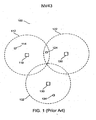
- FIG. 1 illustrates conventional cells with omni-directional coverage area in a wireless network 100.
- Base transceiver stations (BTSs) 110,120 and 130 cover omni-directional areas 112,122 and 132, respectively.
- Terminals 114 and 134 are in the omni-directional areas 112 and 132, respectively, and therefore served by the BTSs 110 and 130, respectively.
- a terminal 124 is in an overlapping area of the omni-directional areas 112 and 122, and therefore can be served by both BTSs 110 and 120.
- cell control may be achieved through varying forward transmission power. But the shape of the coverage areas 112,122 and 132 are always circular. Varying forward transmission power results only in diameter changes of the circular coverage areas 112,122 and 132. When neighboring cells require different coverage areas, diameter change is apparently less efficient to have all the areas covered.
- FIG. 2A and 2B illustrate cells with antenna radiation pattern synthesis in a wireless network 200 according to an embodiment of the present invention.
- cell coverage areas 210, 220 and 230 are provided by corresponding BTSs (not shown), respectively, through antenna radiation pattern synthesis.
- Angle spans 215, 225 and 235 represent the radiation pattern spanning of the coverage areas 210, 220 and 230, respectively. Assuming each coverage area 210, 220 or 230 has approximately equal amount of traffic loads, then the radiation patterns span an equal 120° in an azimuth plane, i.e., the three coverage areas 210,220 and 230 are approximately equal in shape and size.
- coverage areas 250, 260 and 270 in a wireless network 240 are of different sizes.
- Angle spans 255, 265 and 275 represent radiation pattern spanning of the coverage areas 250, 260 and 270, respectively.
- Angle spans 255 and 265 are equally at 150°, and angle span 275 is at 60°. Therefore, the coverage area 330 is significantly smaller than the coverage areas 250 and 260. In this case, traffic density in coverage area 270 is higher than in other two coverage areas 250 and 260.
- Antenna radiation pattern synthesis is more achievable in a BTS with multiple antennas.
- traffics are received and sent through beamformings.
- the BTS antenna array will beamform them via either maximum ratio combining (MRC) or equal gain combining (EGC), or log likely-hood (LLC) combining or any other combining schemes.
- MRC maximum ratio combining
- ECG equal gain combining
- LLC log likely-hood
- BTS needs to send the traffic to a large designated coverage area. This can be achieved by synthesizing a radiation pattern that covers the desired area. For example, as shown in Fig. 1 , if the desired coverage area is a circle with the BTS in the center, the synthesized BTS antenna radiation pattern for broadcast messages will be an omni-directional.
- parameters such as magnitudes and phases of the BTS's feed signals need to be set in such a way that the difference between the resulted (synthesized) pattern and a desired radiation pattern is minimized.
- ⁇ is a wave length of the signal
- an omni-directional radiation pattern can be achieved by setting the same magnitude and phase for all feed signals.
- a radiation pattern spanning 120° in the azimuth plane, as shown in FIG. 2A can be achieved with the feed signals that have the same magnitude but different phases as follows:
- a radiation pattern spanning 40° in the azimuth plane, as shown in FIG. 2B can be achieved with the feed signals that have the same magnitude and the following phases:
- the antenna radiation pattern synthesis follows the general practice of optimization procedure, and all techniques used in optimization can be readily used here. A difference is that the optimization objective is the desired radiation pattern.
- some optimization constraints may also be added. For example, it may be required that all antennas have the same output power. This would make the feed signals for all antennas have the same magnitude. Another example of adding constraints is that the gain ripple of the synthesized pattern needs be less than certain threshold.
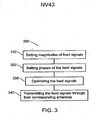
- FIG. 3 is a flow chart 300 illustrating steps taken to synthesize antenna radiation patterns in more generic terms according to the embodiment of the present invention.
- the BTS In order to synthesize a desired antenna radiation pattern by a multi-antenna BTS, the BTS first sets magnitudes of feed signals based on prior knowledge in step 310. Then it is followed by phase setting on the feed signals also according to prior knowledge in step 320. These feed signals may be optimized, such as adding output power constraints, in step 330. Finally the adjusted feed signals are transmitted through their corresponding antennas in step 340. Note that the magnitudes and phases of the feed signals of each antenna element can be set in a baseband, radio frequency (RF) or a combination of the both.
- RF radio frequency
- the antenna radiation pattern synthesis method may be combined with the forward power control method to control cell coverage areas.
- Forward power allocation determines the coverage along radian while the antenna radiation pattern determines the coverage in the angular dimension.
- cell coverage area may be shaped the in two dimensions. This will considerably improve the cell control.
- a first application is traffic balances.
- the dynamic traffic control is used to better balance the traffics among cells.
- the cell control needs to be dynamic and in real time.
- the traffics are monitored for all cells, and if unbalanced traffics are detected, the over loaded cell will reduce its cell coverage along radian or angular or both, and the under loaded cells will increase its cell coverage along radian or angular or both.
- the coverage change along radian is done through power control, while the coverage change along angular is done through radiation pattern synthesis.
- a second application is cell wilt.
- the cell control can be used to wilt cells out for the purpose of maintenance or repair.
- a third application is cell blossom.
- the cell control can be used to add new cells into the network.
- a fourth application is network planning.
- the antenna radiation pattern synthesis can help to improve the cell planning. After an initial cell planning and testing, some coverage holes in the coverage area may be discovered. The coverage holes can be covered up by tweaking the radiation patterns through antenna radiation pattern synthesis.
- a fifth application is cell splitting.
- the cell control can be used for the purpose of dynamic cell splitting.
- Dynamic cell splitting is done through antenna radiation pattern synthesis. For example, if the cell needs to be split into two virtual smaller cells, one could synthesize a radiation pattern that has two distinctive beams (split pattern) that their aggregated beam pattern covers the original coverage area. Each beam covers a sub-region of the original coverage area. The resource assigned for these two sub-regions could be the same or different.
- Splitting cells via split radiation beams is a technique used to improve frequency reuse within cell and among cells. For example, if a 120° cell is split into two 60° cells, the same spectrum can be used twice within the cell, one for terminals in one beam, and the other for terminals in the other beam.
- the cell splitting is dynamic and in real time, varying with time and traffic condition.
- a sixth application is diversity.
- the antenna radiation pattern synthesis can be used for the purpose of diversity.
- a BTS synthesizes two radiation patterns that are different in spatial characteristics (like different DOA) and send and receive the same messages via both the radiation patterns.
- one copy of the message may be faded out. But chances that the two copies of the messages are faded out at the same time are small, so a terminal has a better chance to detect one good copy of the message.
- a seventh application is antenna reuse and carrier overlay.
- the antenna radiation pattern synthesis it is possible to use the same set of antennas for multiple coverage areas. For example, an initial 120° coverage area is running out its capacity, and the wireless network needs to overlay the initial cell with another carrier.
- One way to do this is to synthesize a 60° antenna radiation pattern for the initial carrier and a 60° radiation pattern for the new carrier. These two 60° radiation patterns have their bore sights separated by 60° and cover the original 120° coverage area.
- Benefits of antenna radiation pattern synthesis in this case include that the same antennas are reused, and since the two carriers are not overlapped in space, there will be less hand off between these two carriers, resulting in better overall performance.
Landscapes
- Engineering & Computer Science (AREA)
- Computer Networks & Wireless Communication (AREA)
- Signal Processing (AREA)
- Mobile Radio Communication Systems (AREA)
Claims (15)
- Procédé de contrôle de cellule dans un réseau sans fil, le procédé comportant :l'étape consistant à mettre en oeuvre une première station d'émission-réception de base, BTS, avec une première pluralité d'antennes recevant une première pluralité de signaux d'alimentation et une seconde pluralité de signaux d'alimentation ; etl'étape consistant à faire varier une première pluralité de paramètres de la première pluralité de signaux d'alimentation en fonction d'une première pluralité de critères prédéterminés à des fins de synthèse d'un premier diagramme de rayonnement d'antenne, dans lequel une première zone de couverture de la première BTS couverte par le premier diagramme de rayonnement d'antenne est ajustée ; caractérisé en ce que le procédé comporte par ailleurs :l'étape consistant à faire varier une seconde pluralité de paramètres de la seconde pluralité de signaux d'alimentation en fonction d'une seconde pluralité de critères prédéterminés à des fins de synthèse d'un second diagramme de rayonnement d'antenne, dans lequel une seconde zone de couverture de la première BTS couverte par le second diagramme de rayonnement d'antenne est ajustée ;dans lequel les première et seconde zones de couverture se chevauchent l'une l'autre, et dans lequel un message est transmis à un terminal par le biais à la fois des premier et second diagrammes de rayonnement.
- Procédé selon la revendication 1, dans lequel la première pluralité de paramètres comprend les amplitudes et les phases de la première pluralité de signaux d'alimentation ; et la seconde pluralité de paramètres comprend les amplitudes et les phases de la seconde pluralité de signaux d'alimentation.
- Procédé selon la revendication 2, comportant par ailleurs l'étape consistant à régler la première pluralité de signaux d'alimentation selon la même amplitude prédéterminée.
- Procédé selon la revendication 1, comportant par ailleurs l'étape consistant à régler une ondulation de gain du premier diagramme de rayonnement d'antenne pour qu'elle soit inférieure à un seuil prédéterminé.
- Procédé selon la revendication 1, dans lequel l'étape consistant à faire varier la première pluralité de paramètres a lieu quand les signaux d'alimentation de la première pluralité de signaux d'alimentation se trouvent dans une bande de base.
- Procédé selon la revendication 1, dans lequel l'étape consistant à faire varier la première pluralité de paramètres a lieu quand les signaux d'alimentation de la première pluralité de signaux d'alimentation se trouvent dans des radiofréquences.
- Procédé selon la revendication 1, dans lequel l'étape consistant à faire varier la première pluralité de paramètres a lieu quand les signaux d'alimentation d'un premier groupe de la première pluralité de signaux d'alimentation se trouvent dans une bande de base et quand les signaux d'alimentation d'un second groupe de la première pluralité de signaux d'alimentation se trouvent dans des radiofréquences.
- Procédé selon la revendication 1, comportant par ailleurs :l'étape consistant à contrôler un volume de trafic dans la première zone de couverture ; etl'étape consistant à faire varier les paramètres de la première pluralité de signaux d'alimentation en fonction du volume de trafic,dans lequel la zone de couverture du premier diagramme de rayonnement d'antenne se rétrécit quand le trafic est surchargé, et la zone de couverture du premier diagramme de rayonnement d'antenne s'agrandit quand le trafic est réduit.
- Procédé selon la revendication 1, comportant par ailleurs l'étape consistant à faire varier une puissance d'émetteur de la première BTS.
- Procédé selon la revendication 9, comportant par ailleurs l'étape consistant à faire diminuer la première pluralité de signaux d'alimentation en faisant varier la première pluralité de paramètres et en faisant varier la puissance d'émetteur, dans lequel une cellule couverte par la première BTS est progressivement éradiquée.
- Procédé selon la revendication 9, comportant par ailleurs l'étape consistant à faire s'épanouir la première pluralité de signaux d'alimentation en faisant varier la première pluralité de paramètres et en faisant varier la puissance d'émetteur, dans lequel une nouvelle cellule est ajoutée.
- Procédé selon la revendication 1, comportant par ailleurs :l'étape consistant à détecter un ou plusieurs trous de couverture dans la première zone de couverture ; etl'étape consistant à spécifier la première pluralité de critères prédéterminés,dans lequel les trous de couverture sont couverts après avoir fait varier lesdits un ou plusieurs paramètres de la première pluralité de signaux d'alimentation en fonction de la première pluralité de critères prédéterminés.
- Procédé selon la revendication 1, dans lequel le premier diagramme de rayonnement d'antenne comprend deux ou plusieurs sous-régions formées par deux ou plusieurs diagrammes de rayonnement d'antenne, respectivement, qui sont synthétisés par la première pluralité de signaux d'alimentation.
- Procédé selon la revendication 1, comportant par ailleurs :l'étape consistant à mettre en oeuvre une seconde BTS avec une seconde pluralité d'antennes recevant une seconde pluralité de signaux d'alimentation, respectivement ; etl'étape consistant à faire varier une seconde pluralité de paramètres de la seconde pluralité de signaux d'alimentation en fonction d'une seconde pluralité de critères prédéterminés à des fins de synthèse d'un second diagramme de rayonnement d'antenne,dans lequel les zones de couverture des premier et second diagrammes de rayonnement d'antenne sont ajustés sensiblement l'un à côté de l'autre.
- Système de communication sans fil comportant :un moyen permettant de mettre en oeuvre une première station d'émission-réception de base, BTS, avec une première pluralité d'antennes recevant une première pluralité de signaux d'alimentation et une seconde pluralité de signaux d'alimentation ; etun moyen permettant de faire varier une première pluralité de paramètres de la première pluralité de signaux d'alimentation en fonction d'une première pluralité de critères prédéterminés à des fins de synthèse d'un premier diagramme de rayonnement d'antenne, dans lequel une première zone de couverture de la première BTS couverte par le premier diagramme de rayonnement d'antenne est ajustée ; caractérisé en ce que le système comporte par ailleurs :un moyen permettant de faire varier une seconde pluralité de paramètres de la seconde pluralité de signaux d'alimentation en fonction d'une seconde pluralité de critères prédéterminés à des fins de synthèse d'un second diagramme de rayonnement d'antenne, dans lequel une seconde zone de couverture de la première BTS couverte par le second diagramme de rayonnement d'antenne est ajustée ;dans lequel les première et seconde zones de couverture se chevauchent l'une l'autre, et dans lequel un message est transmis à un terminal par le biais à la fois des premier et second diagrammes de rayonnement.
Applications Claiming Priority (3)
| Application Number | Priority Date | Filing Date | Title |
|---|---|---|---|
| US80831806P | 2006-05-24 | 2006-05-24 | |
| US11/705,239 US20070275761A1 (en) | 2006-05-24 | 2007-02-12 | Dynamic cell control through antenna radiation pattern synthesis |
| PCT/US2007/004177 WO2007139600A2 (fr) | 2006-05-24 | 2007-02-13 | Contrôle de cellule dynamique par synthèse de modèle de rayonnement d'antenne |
Publications (3)
| Publication Number | Publication Date |
|---|---|
| EP2020143A2 EP2020143A2 (fr) | 2009-02-04 |
| EP2020143A4 EP2020143A4 (fr) | 2013-03-27 |
| EP2020143B1 true EP2020143B1 (fr) | 2014-07-23 |
Family
ID=38750149
Family Applications (1)
| Application Number | Title | Priority Date | Filing Date |
|---|---|---|---|
| EP07750974.3A Not-in-force EP2020143B1 (fr) | 2006-05-24 | 2007-02-13 | Contrôle de cellule dynamique par synthèse de modèle de rayonnement d'antenne |
Country Status (3)
| Country | Link |
|---|---|
| US (1) | US20070275761A1 (fr) |
| EP (1) | EP2020143B1 (fr) |
| WO (1) | WO2007139600A2 (fr) |
Families Citing this family (7)
| Publication number | Priority date | Publication date | Assignee | Title |
|---|---|---|---|---|
| JP5209780B2 (ja) * | 2008-03-27 | 2013-06-12 | テレフオンアクチーボラゲット エル エム エリクソン(パブル) | Tdd通信システム内のアップリンク電力制御 |
| US8903454B2 (en) * | 2011-11-07 | 2014-12-02 | Alcatel Lucent | Base station and radio unit for creating overlaid sectors with carrier aggregation |
| US20130303145A1 (en) * | 2012-05-10 | 2013-11-14 | Eden Rock Communications, Llc | Method and system for auditing and correcting cellular antenna coverage patterns |
| CN103841567B (zh) * | 2012-11-26 | 2017-11-21 | 中国移动通信集团广东有限公司 | 一种获取基站的多边形区域的方法和基站 |
| US9832652B1 (en) * | 2013-11-12 | 2017-11-28 | Sprint Spectrum L.P. | Methods and systems for managing coverage area changes using base station signaling |
| CN106777601A (zh) * | 2016-12-02 | 2017-05-31 | 中国船舶重工集团公司第七二四研究所 | 基于mift与qp算法相结合的平面阵列天线方向图综合方法 |
| US10334454B2 (en) * | 2017-05-11 | 2019-06-25 | Intel Corporation | Multi-finger beamforming and array pattern synthesis |
Family Cites Families (8)
| Publication number | Priority date | Publication date | Assignee | Title |
|---|---|---|---|---|
| US6236866B1 (en) | 1998-05-15 | 2001-05-22 | Raytheon Company | Adaptive antenna pattern control for a multiple access communication system |
| US6782277B1 (en) * | 1999-09-30 | 2004-08-24 | Qualcomm Incorporated | Wireless communication system with base station beam sweeping |
| GB2361385A (en) * | 2000-04-12 | 2001-10-17 | Queen Mary & Westfield College | Intelligent control of radio resorces in a wireless network |
| US6400335B1 (en) * | 2000-08-09 | 2002-06-04 | Lucent Technologies Inc. | Dynamic load sharing system and method using a cylindrical antenna array |
| EP1336260A4 (fr) * | 2000-11-24 | 2009-01-21 | Sk Telecom Co Ltd | Appareil de distribution/combinaison d'un faisceau multiple dans un systeme de communication mobile |
| US7136655B2 (en) * | 2002-11-21 | 2006-11-14 | Bandspeed, Inc. | Method and apparatus for coverage and throughput enhancement in a wireless communication system |
| US20040166902A1 (en) * | 2003-01-21 | 2004-08-26 | Dan Castellano | Method and system for reducing cell interference using advanced antenna radiation pattern control |
| US20050272472A1 (en) * | 2004-05-27 | 2005-12-08 | Interdigital Technology Corporation | Wireless communication method and system for forming three-dimensional control channel beams and managing high volume user coverage areas |
-
2007
- 2007-02-12 US US11/705,239 patent/US20070275761A1/en not_active Abandoned
- 2007-02-13 EP EP07750974.3A patent/EP2020143B1/fr not_active Not-in-force
- 2007-02-13 WO PCT/US2007/004177 patent/WO2007139600A2/fr not_active Ceased
Also Published As
| Publication number | Publication date |
|---|---|
| EP2020143A2 (fr) | 2009-02-04 |
| WO2007139600A3 (fr) | 2008-10-16 |
| EP2020143A4 (fr) | 2013-03-27 |
| WO2007139600A2 (fr) | 2007-12-06 |
| US20070275761A1 (en) | 2007-11-29 |
Similar Documents
| Publication | Publication Date | Title |
|---|---|---|
| US5596329A (en) | Base station antenna arrangement | |
| US5771017A (en) | Base station antenna arrangement | |
| US5576717A (en) | Base station antenna arrangement | |
| US5602555A (en) | Base station antenna arrangement | |
| US5714957A (en) | Base station antenna arrangement | |
| US5565873A (en) | Base station antenna arrangement | |
| US5666123A (en) | Base station antenna arrangement | |
| US5966094A (en) | Base station antenna arrangement | |
| AU714146B2 (en) | Wide antenna lobe | |
| EP2020143B1 (fr) | Contrôle de cellule dynamique par synthèse de modèle de rayonnement d'antenne | |
| US20040166902A1 (en) | Method and system for reducing cell interference using advanced antenna radiation pattern control | |
| US6038459A (en) | Base station antenna arrangement | |
| JP2003060423A (ja) | スマートアンテナアレイ | |
| WO1996017486A1 (fr) | Systeme d'antennes directionnelles | |
| JPH0779475A (ja) | 基地局アンテナ・アレンジメント | |
| SE517197C2 (sv) | Adaptiv sektorindelning | |
| US5570098A (en) | Base station antenna arrangement | |
| WO2002015326A2 (fr) | Optimisation d'une antenne intelligente par basculement de faisceau | |
| GB2281008A (en) | Base station antenna arrangement | |
| CA2216365C (fr) | Methodes d'orthogonalisations pour l'elimination du rayonnement zero du diagramme de gain d'antenne | |
| Xuehong et al. | Research on the adaptive array in CDMA system | |
| CN101227214A (zh) | 一种码分多址系统的组网方法 |
Legal Events
| Date | Code | Title | Description |
|---|---|---|---|
| PUAI | Public reference made under article 153(3) epc to a published international application that has entered the european phase |
Free format text: ORIGINAL CODE: 0009012 |
|
| 17P | Request for examination filed |
Effective date: 20080825 |
|
| AK | Designated contracting states |
Kind code of ref document: A2 Designated state(s): AT BE BG CH CY CZ DE DK EE ES FI FR GB GR HU IE IS IT LI LT LU LV MC NL PL PT RO SE SI SK TR |
|
| AX | Request for extension of the european patent |
Extension state: AL BA HR MK RS |
|
| DAX | Request for extension of the european patent (deleted) | ||
| REG | Reference to a national code |
Ref country code: DE Ref legal event code: R079 Ref document number: 602007037780 Country of ref document: DE Free format text: PREVIOUS MAIN CLASS: H04M0001000000 Ipc: H04W0016280000 |
|
| A4 | Supplementary search report drawn up and despatched |
Effective date: 20130225 |
|
| RIC1 | Information provided on ipc code assigned before grant |
Ipc: H04W 16/28 20090101AFI20130219BHEP |
|
| GRAP | Despatch of communication of intention to grant a patent |
Free format text: ORIGINAL CODE: EPIDOSNIGR1 |
|
| INTG | Intention to grant announced |
Effective date: 20140220 |
|
| GRAS | Grant fee paid |
Free format text: ORIGINAL CODE: EPIDOSNIGR3 |
|
| GRAA | (expected) grant |
Free format text: ORIGINAL CODE: 0009210 |
|
| AK | Designated contracting states |
Kind code of ref document: B1 Designated state(s): AT BE BG CH CY CZ DE DK EE ES FI FR GB GR HU IE IS IT LI LT LU LV MC NL PL PT RO SE SI SK TR |
|
| REG | Reference to a national code |
Ref country code: GB Ref legal event code: FG4D |
|
| REG | Reference to a national code |
Ref country code: CH Ref legal event code: EP |
|
| REG | Reference to a national code |
Ref country code: IE Ref legal event code: FG4D |
|
| REG | Reference to a national code |
Ref country code: AT Ref legal event code: REF Ref document number: 679435 Country of ref document: AT Kind code of ref document: T Effective date: 20140815 |
|
| REG | Reference to a national code |
Ref country code: DE Ref legal event code: R096 Ref document number: 602007037780 Country of ref document: DE Effective date: 20140904 |
|
| REG | Reference to a national code |
Ref country code: AT Ref legal event code: MK05 Ref document number: 679435 Country of ref document: AT Kind code of ref document: T Effective date: 20140723 |
|
| REG | Reference to a national code |
Ref country code: NL Ref legal event code: VDEP Effective date: 20140723 |
|
| REG | Reference to a national code |
Ref country code: LT Ref legal event code: MG4D |
|
| PG25 | Lapsed in a contracting state [announced via postgrant information from national office to epo] |
Ref country code: LT Free format text: LAPSE BECAUSE OF FAILURE TO SUBMIT A TRANSLATION OF THE DESCRIPTION OR TO PAY THE FEE WITHIN THE PRESCRIBED TIME-LIMIT Effective date: 20140723 Ref country code: BG Free format text: LAPSE BECAUSE OF FAILURE TO SUBMIT A TRANSLATION OF THE DESCRIPTION OR TO PAY THE FEE WITHIN THE PRESCRIBED TIME-LIMIT Effective date: 20141023 Ref country code: GR Free format text: LAPSE BECAUSE OF FAILURE TO SUBMIT A TRANSLATION OF THE DESCRIPTION OR TO PAY THE FEE WITHIN THE PRESCRIBED TIME-LIMIT Effective date: 20141024 Ref country code: SE Free format text: LAPSE BECAUSE OF FAILURE TO SUBMIT A TRANSLATION OF THE DESCRIPTION OR TO PAY THE FEE WITHIN THE PRESCRIBED TIME-LIMIT Effective date: 20140723 Ref country code: ES Free format text: LAPSE BECAUSE OF FAILURE TO SUBMIT A TRANSLATION OF THE DESCRIPTION OR TO PAY THE FEE WITHIN THE PRESCRIBED TIME-LIMIT Effective date: 20140723 Ref country code: PT Free format text: LAPSE BECAUSE OF FAILURE TO SUBMIT A TRANSLATION OF THE DESCRIPTION OR TO PAY THE FEE WITHIN THE PRESCRIBED TIME-LIMIT Effective date: 20141124 Ref country code: FI Free format text: LAPSE BECAUSE OF FAILURE TO SUBMIT A TRANSLATION OF THE DESCRIPTION OR TO PAY THE FEE WITHIN THE PRESCRIBED TIME-LIMIT Effective date: 20140723 |
|
| PG25 | Lapsed in a contracting state [announced via postgrant information from national office to epo] |
Ref country code: AT Free format text: LAPSE BECAUSE OF FAILURE TO SUBMIT A TRANSLATION OF THE DESCRIPTION OR TO PAY THE FEE WITHIN THE PRESCRIBED TIME-LIMIT Effective date: 20140723 Ref country code: CY Free format text: LAPSE BECAUSE OF FAILURE TO SUBMIT A TRANSLATION OF THE DESCRIPTION OR TO PAY THE FEE WITHIN THE PRESCRIBED TIME-LIMIT Effective date: 20140723 Ref country code: IS Free format text: LAPSE BECAUSE OF FAILURE TO SUBMIT A TRANSLATION OF THE DESCRIPTION OR TO PAY THE FEE WITHIN THE PRESCRIBED TIME-LIMIT Effective date: 20141123 Ref country code: LV Free format text: LAPSE BECAUSE OF FAILURE TO SUBMIT A TRANSLATION OF THE DESCRIPTION OR TO PAY THE FEE WITHIN THE PRESCRIBED TIME-LIMIT Effective date: 20140723 Ref country code: NL Free format text: LAPSE BECAUSE OF FAILURE TO SUBMIT A TRANSLATION OF THE DESCRIPTION OR TO PAY THE FEE WITHIN THE PRESCRIBED TIME-LIMIT Effective date: 20140723 Ref country code: PL Free format text: LAPSE BECAUSE OF FAILURE TO SUBMIT A TRANSLATION OF THE DESCRIPTION OR TO PAY THE FEE WITHIN THE PRESCRIBED TIME-LIMIT Effective date: 20140723 |
|
| REG | Reference to a national code |
Ref country code: DE Ref legal event code: R097 Ref document number: 602007037780 Country of ref document: DE |
|
| PG25 | Lapsed in a contracting state [announced via postgrant information from national office to epo] |
Ref country code: RO Free format text: LAPSE BECAUSE OF FAILURE TO SUBMIT A TRANSLATION OF THE DESCRIPTION OR TO PAY THE FEE WITHIN THE PRESCRIBED TIME-LIMIT Effective date: 20140723 Ref country code: DK Free format text: LAPSE BECAUSE OF FAILURE TO SUBMIT A TRANSLATION OF THE DESCRIPTION OR TO PAY THE FEE WITHIN THE PRESCRIBED TIME-LIMIT Effective date: 20140723 Ref country code: EE Free format text: LAPSE BECAUSE OF FAILURE TO SUBMIT A TRANSLATION OF THE DESCRIPTION OR TO PAY THE FEE WITHIN THE PRESCRIBED TIME-LIMIT Effective date: 20140723 Ref country code: SK Free format text: LAPSE BECAUSE OF FAILURE TO SUBMIT A TRANSLATION OF THE DESCRIPTION OR TO PAY THE FEE WITHIN THE PRESCRIBED TIME-LIMIT Effective date: 20140723 Ref country code: IT Free format text: LAPSE BECAUSE OF FAILURE TO SUBMIT A TRANSLATION OF THE DESCRIPTION OR TO PAY THE FEE WITHIN THE PRESCRIBED TIME-LIMIT Effective date: 20140723 Ref country code: CZ Free format text: LAPSE BECAUSE OF FAILURE TO SUBMIT A TRANSLATION OF THE DESCRIPTION OR TO PAY THE FEE WITHIN THE PRESCRIBED TIME-LIMIT Effective date: 20140723 |
|
| PLBE | No opposition filed within time limit |
Free format text: ORIGINAL CODE: 0009261 |
|
| STAA | Information on the status of an ep patent application or granted ep patent |
Free format text: STATUS: NO OPPOSITION FILED WITHIN TIME LIMIT |
|
| PG25 | Lapsed in a contracting state [announced via postgrant information from national office to epo] |
Ref country code: BE Free format text: LAPSE BECAUSE OF NON-PAYMENT OF DUE FEES Effective date: 20150228 |
|
| 26N | No opposition filed |
Effective date: 20150424 |
|
| REG | Reference to a national code |
Ref country code: DE Ref legal event code: R119 Ref document number: 602007037780 Country of ref document: DE |
|
| PG25 | Lapsed in a contracting state [announced via postgrant information from national office to epo] |
Ref country code: LU Free format text: LAPSE BECAUSE OF FAILURE TO SUBMIT A TRANSLATION OF THE DESCRIPTION OR TO PAY THE FEE WITHIN THE PRESCRIBED TIME-LIMIT Effective date: 20150213 |
|
| REG | Reference to a national code |
Ref country code: CH Ref legal event code: PL |
|
| GBPC | Gb: european patent ceased through non-payment of renewal fee |
Effective date: 20150213 |
|
| PG25 | Lapsed in a contracting state [announced via postgrant information from national office to epo] |
Ref country code: MC Free format text: LAPSE BECAUSE OF FAILURE TO SUBMIT A TRANSLATION OF THE DESCRIPTION OR TO PAY THE FEE WITHIN THE PRESCRIBED TIME-LIMIT Effective date: 20140723 Ref country code: LI Free format text: LAPSE BECAUSE OF NON-PAYMENT OF DUE FEES Effective date: 20150228 Ref country code: CH Free format text: LAPSE BECAUSE OF NON-PAYMENT OF DUE FEES Effective date: 20150228 |
|
| REG | Reference to a national code |
Ref country code: IE Ref legal event code: MM4A |
|
| REG | Reference to a national code |
Ref country code: FR Ref legal event code: ST Effective date: 20151030 |
|
| PG25 | Lapsed in a contracting state [announced via postgrant information from national office to epo] |
Ref country code: SI Free format text: LAPSE BECAUSE OF FAILURE TO SUBMIT A TRANSLATION OF THE DESCRIPTION OR TO PAY THE FEE WITHIN THE PRESCRIBED TIME-LIMIT Effective date: 20140723 |
|
| PG25 | Lapsed in a contracting state [announced via postgrant information from national office to epo] |
Ref country code: GB Free format text: LAPSE BECAUSE OF NON-PAYMENT OF DUE FEES Effective date: 20150213 Ref country code: IE Free format text: LAPSE BECAUSE OF NON-PAYMENT OF DUE FEES Effective date: 20150213 Ref country code: DE Free format text: LAPSE BECAUSE OF NON-PAYMENT OF DUE FEES Effective date: 20150901 |
|
| PG25 | Lapsed in a contracting state [announced via postgrant information from national office to epo] |
Ref country code: FR Free format text: LAPSE BECAUSE OF NON-PAYMENT OF DUE FEES Effective date: 20150302 |
|
| PG25 | Lapsed in a contracting state [announced via postgrant information from national office to epo] |
Ref country code: BE Free format text: LAPSE BECAUSE OF FAILURE TO SUBMIT A TRANSLATION OF THE DESCRIPTION OR TO PAY THE FEE WITHIN THE PRESCRIBED TIME-LIMIT Effective date: 20140723 |
|
| PG25 | Lapsed in a contracting state [announced via postgrant information from national office to epo] |
Ref country code: HU Free format text: LAPSE BECAUSE OF FAILURE TO SUBMIT A TRANSLATION OF THE DESCRIPTION OR TO PAY THE FEE WITHIN THE PRESCRIBED TIME-LIMIT; INVALID AB INITIO Effective date: 20070213 |
|
| PG25 | Lapsed in a contracting state [announced via postgrant information from national office to epo] |
Ref country code: TR Free format text: LAPSE BECAUSE OF FAILURE TO SUBMIT A TRANSLATION OF THE DESCRIPTION OR TO PAY THE FEE WITHIN THE PRESCRIBED TIME-LIMIT Effective date: 20140723 |