EP2020262A1 - Catalyseur de purification de gaz d'échappement et sa méthode de production - Google Patents
Catalyseur de purification de gaz d'échappement et sa méthode de production Download PDFInfo
- Publication number
- EP2020262A1 EP2020262A1 EP07738569A EP07738569A EP2020262A1 EP 2020262 A1 EP2020262 A1 EP 2020262A1 EP 07738569 A EP07738569 A EP 07738569A EP 07738569 A EP07738569 A EP 07738569A EP 2020262 A1 EP2020262 A1 EP 2020262A1
- Authority
- EP
- European Patent Office
- Prior art keywords
- exhaust gas
- platinum
- purifying catalyst
- composite oxide
- aluminum
- Prior art date
- Legal status (The legal status is an assumption and is not a legal conclusion. Google has not performed a legal analysis and makes no representation as to the accuracy of the status listed.)
- Withdrawn
Links
Images
Classifications
-
- B—PERFORMING OPERATIONS; TRANSPORTING
- B01—PHYSICAL OR CHEMICAL PROCESSES OR APPARATUS IN GENERAL
- B01J—CHEMICAL OR PHYSICAL PROCESSES, e.g. CATALYSIS OR COLLOID CHEMISTRY; THEIR RELEVANT APPARATUS
- B01J23/00—Catalysts comprising metals or metal oxides or hydroxides, not provided for in group B01J21/00
- B01J23/38—Catalysts comprising metals or metal oxides or hydroxides, not provided for in group B01J21/00 of noble metals
- B01J23/54—Catalysts comprising metals or metal oxides or hydroxides, not provided for in group B01J21/00 of noble metals combined with metals, oxides or hydroxides provided for in groups B01J23/02 - B01J23/36
- B01J23/56—Platinum group metals
- B01J23/58—Platinum group metals with alkali- or alkaline earth metals
-
- B—PERFORMING OPERATIONS; TRANSPORTING
- B01—PHYSICAL OR CHEMICAL PROCESSES OR APPARATUS IN GENERAL
- B01J—CHEMICAL OR PHYSICAL PROCESSES, e.g. CATALYSIS OR COLLOID CHEMISTRY; THEIR RELEVANT APPARATUS
- B01J21/00—Catalysts comprising the elements, oxides, or hydroxides of magnesium, boron, aluminium, carbon, silicon, titanium, zirconium, or hafnium
- B01J21/005—Spinels
-
- B—PERFORMING OPERATIONS; TRANSPORTING
- B01—PHYSICAL OR CHEMICAL PROCESSES OR APPARATUS IN GENERAL
- B01J—CHEMICAL OR PHYSICAL PROCESSES, e.g. CATALYSIS OR COLLOID CHEMISTRY; THEIR RELEVANT APPARATUS
- B01J23/00—Catalysts comprising metals or metal oxides or hydroxides, not provided for in group B01J21/00
- B01J23/002—Mixed oxides other than spinels, e.g. perovskite
-
- B—PERFORMING OPERATIONS; TRANSPORTING
- B01—PHYSICAL OR CHEMICAL PROCESSES OR APPARATUS IN GENERAL
- B01J—CHEMICAL OR PHYSICAL PROCESSES, e.g. CATALYSIS OR COLLOID CHEMISTRY; THEIR RELEVANT APPARATUS
- B01J23/00—Catalysts comprising metals or metal oxides or hydroxides, not provided for in group B01J21/00
- B01J23/005—Spinels
-
- B—PERFORMING OPERATIONS; TRANSPORTING
- B01—PHYSICAL OR CHEMICAL PROCESSES OR APPARATUS IN GENERAL
- B01J—CHEMICAL OR PHYSICAL PROCESSES, e.g. CATALYSIS OR COLLOID CHEMISTRY; THEIR RELEVANT APPARATUS
- B01J35/00—Catalysts, in general, characterised by their form or physical properties
- B01J35/19—Catalysts containing parts with different compositions
-
- B—PERFORMING OPERATIONS; TRANSPORTING
- B01—PHYSICAL OR CHEMICAL PROCESSES OR APPARATUS IN GENERAL
- B01J—CHEMICAL OR PHYSICAL PROCESSES, e.g. CATALYSIS OR COLLOID CHEMISTRY; THEIR RELEVANT APPARATUS
- B01J37/00—Processes, in general, for preparing catalysts; Processes, in general, for activation of catalysts
- B01J37/04—Mixing
-
- B—PERFORMING OPERATIONS; TRANSPORTING
- B01—PHYSICAL OR CHEMICAL PROCESSES OR APPARATUS IN GENERAL
- B01D—SEPARATION
- B01D2255/00—Catalysts
- B01D2255/10—Noble metals or compounds thereof
- B01D2255/102—Platinum group metals
- B01D2255/1021—Platinum
-
- B—PERFORMING OPERATIONS; TRANSPORTING
- B01—PHYSICAL OR CHEMICAL PROCESSES OR APPARATUS IN GENERAL
- B01D—SEPARATION
- B01D2255/00—Catalysts
- B01D2255/40—Mixed oxides
-
- B—PERFORMING OPERATIONS; TRANSPORTING
- B01—PHYSICAL OR CHEMICAL PROCESSES OR APPARATUS IN GENERAL
- B01J—CHEMICAL OR PHYSICAL PROCESSES, e.g. CATALYSIS OR COLLOID CHEMISTRY; THEIR RELEVANT APPARATUS
- B01J2523/00—Constitutive chemical elements of heterogeneous catalysts
Definitions
- the present invention relates to an exhaust gas-purifying catalyst and method of manufacturing the same.
- a three-way catalyst with precious metal such as platinum supported by an inorganic oxide such as ceria or alumina has been widely used.
- the precious metal plays the role in promoting the reduction of nitrogen oxides and the oxidations of carbon monoxide and hydrocarbons.
- the inorganic oxide plays the roles in increasing the specific surface area of the precious metal and suppressing the sintering of the precious metal by dissipating heat generated by the reactions.
- the automotive vehicle is required to decrease the carbon dioxide emission in order to suppress the global warming. For these reasons, occasions when the supply of fuel to the engine is cut off in the state that the exhaust gas-purifying catalyst is heated to high temperatures are increasing.
- the exhaust gas-purifying catalyst is used at temperatures higher than in the past, and occasions when exposed to an atmosphere excessive in oxygen at high temperatures are increasing. For that, in order to provide the exhaust gas-purifying catalyst that delivers a sufficient performance even when used under such a condition, research and development are actively carried out.
- JP-A 5-168926 (KOKAI), JP-B 6-75675 (KOUKOKU), and JP-A 2000-169148 (KOKAI) describe improving the heat stability of ceria.
- JP-A 5-168926 (KOKAI) describes an exhaust gas-purifying catalyst containing an element of platinum group, activated alumina, cerium oxide, barium compound and zirconium compound.
- JP-B 6-75675 (KOUKOKU) describes an exhaust gas-purifying catalyst in which a catalyst-supporting layer contains cerium oxide, zirconium oxide and catalytic metal, and at least parts of cerium oxide and zirconium oxide are present as a composite oxide or a solid solution.
- JP-A 2000-169148 (KOKAI) describes a cerium-based composite oxide represented as the general formula: Ce 1-(a+b) Zr a Y b O 2-b/2 .
- JP-A 10-358 (KOKAI) and JP-A 2001-129399 (KOKAI) describe making platinum present as platinum composite oxide to suppress the sintering of platinum.
- JP-A 10-358 (KOKAI) describes an exhaust gas-purifying catalyst using a high heat-resistant composite oxide that contains platinum and at least one element selected from alkaline-earth metal elements or group IIIA elements.
- JP-A 2001-129399 (KOKAI) describes an exhaust gas-purifying catalyst that includes a platinum composite oxide layer containing platinum and alkaline-earth metal element on an inorganic oxide support, in which a layer of oxide of metal X, which is at least one element selected from Mg, Ca, Sr, Ba, La and Ce, is interposed therebetween.
- An object of the present invention is to provide an exhaust gas-purifying catalyst that is less prone to cause a decrease in its activity even when used at high temperatures in an atmosphere whose oxygen concentration is high.
- an exhaust gas-purifying catalyst comprising a composite oxide of alkaline-earth metal and aluminum, and platinum, at least a part of the composite oxide and at least a part of the platinum forming a solid solution.
- an exhaust gas-purifying catalyst comprising making oxide particles including only alkaline-earth metal as metal element support platinum, preparing a mixture of an aluminum compound and the oxide particles supporting platinum, and firing the mixture in an oxidizing atmosphere to obtain a solid solution including a composite oxide of alkaline-earth metal and aluminum and platinum.
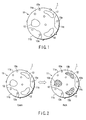
- FIG. 1 is a view schematically showing an exhaust gas-purifying catalyst according to an embodiment of the present invention.
- the exhaust gas-purifying catalyst is a pellet catalyst prepared by agglomerating particles, one particle of which is shown in FIG. 1 .
- the exhaust gas-purifying catalyst is used under high temperature conditions, for example, at 1,000°C to 1,200°C.
- the exhaust gas-purifying catalyst 1 shown in FIG. 1 includes a support 11 and platinum 13a supported thereby.
- the support includes oxides 11a and 11b and a compound or composition 11b.
- the oxide 11a is a composite oxide of alkaline-earth metal and aluminum.
- the alkaline-earth metal for example, magnesium and calcium can be used.
- the crystal structure of the oxide 11a is, for example, spinel structure.
- the compound or composition 11b is an oxide including only alkaline-earth metal as metal element, a hydroxide including only alkaline-earth metal as metal element, a carbonate including only alkaline-earth metal as metal element, or a mixture including two or more of them.
- the compound or composition 11b is an oxide including only one element as metal element, a hydroxide including only one element as metal element, a carbonate including only one element as metal element, or a mixture of two or more of them including only one element as metal element.
- the alkaline-earth element included in the compound or composition 11b is the same as the alkaline-earth element included in the oxide 11a.
- the support 11 may not include the compound or composition 11b.
- the oxide 11c is alumina.
- the support may not include the oxide 11c.
- the above-described composite oxide and platinum form solid solution 12.
- the solid solution 12 has a composition, for example, represented by a chemical formula: (A,Pt)Al 2 O 4 or A(Al,Pt) 2 O 4 in which the symbol "A" indicates alkaline-earth metal.
- the exhaust gas-purifying catalyst 1 exhibits a reversible change in state when a composition of an atmosphere is changed under high temperature conditions. This will be described with reference to FIG. 2 .
- FIG. 2 is a view schematically showing a state change that the oxide particle contained in the material shown in FIG. 1 exhibits under high temperature conditions.
- the state indicated as "Lean” shows the state that the exhaust gas-purifying catalyst 1 exhibits when exposed to an atmosphere with a high oxygen concentration under high temperature conditions such as temperature conditions of 1,000°C to 1,200°C, for example, when the fuel supply to an engine is cut off.
- the state indicated as “Rich” shows the state that the exhaust gas-purifying catalyst 1 exhibits when exposed to an atmosphere with a low oxygen concentration under high temperature conditions such as temperature conditions of 1,000°C to 1,200°C, for example, when an abundance of fuel is continuously supplied to an engine.
- the state indicated as "Lean” in FIG. 2 corresponds to the state described with reference to FIG. 1 .
- at least a part of the platinum 13a may be oxidized; in other words, its oxidation number may be increased.
- the platinum 13a mainly contributes to the activity of the exhaust gas-purifying catalyst 1, while the platinum in the composite oxide 12 hardly contributes to the activity.
- a concentration of offensive components such as nitrogen oxides, carbon monoxide, hydrocarbons, and the like in the exhaust gas, that is, an offensive component concentration in an atmosphere is relatively low.
- the exhaust gas-purifying catalyst 1 delivers a sufficient performance.
- the exhaust gas-purifying catalyst 1 causes a change from the state indicated as "Lean” to the state indicated as "Rich”. Specifically, platinum is precipitated out of the solid solution 12, and the precipitated platinum forms the platinum 13b on the surface of the solid solution 12.
- the offensive component concentration in the exhaust gas is relatively high. That is, during the period corresponding to the state indicated as "Rich”, the exhaust gas purifying catalyst 1 is required to be higher in activity as compared to the period corresponding to the state indicated as "Lean”.
- the platinum 13b is much smaller in size than the platinum 13a.
- the size of the platinum 13b is several nanometers or less, while the size of the platinum 13a is several tens of nanometers.
- the exhaust gas-purifying catalyst 1 in the state indicated as "Rich” is higher in activity than the exhaust gas-purifying catalyst 1 in the state indicated as "Lean”. Therefore, the exhaust gas-purifying catalyst 1 delivers a sufficient performance even when the offensive component concentration in the exhaust gas is high.
- the exhaust gas-purifying catalyst 1 in the state indicated as “Rich” causes a change to the state indicated as “Lean” when the oxygen concentration in the atmosphere increases under the high temperature conditions. That is, the platinum 13b and the composite oxides form the solid solution.
- the exhaust gas-purifying catalyst 1 causes a reversible change in state.
- the exhaust gas-purifying catalyst 1 forms the ultrafine precious metals 13b on the surfaces of the solid solution 12 every time it causes the change from the state indicated as "Lean” to the state indicated as “Rich”. Therefore, this state is recovered by the change from the state indicated as "Rich” to the state indicated as "Lean” and its reverse change. Since an automotive vehicle changes the oxygen concentration in the exhaust gas at relatively close intervals, the exhaust gas-purifying catalyst 1 always exhibits a high activity to deriver a sufficient performance when exposed to a low oxygen concentration atmosphere at high temperatures.
- the platinum 13a contributes to the activity of the exhaust gas-purifying catalyst 1 regardless of the composition of the atmosphere and temperature. Therefore, the exhaust gas-purifying catalyst 1 delivers a sufficient performance not only when exposed to a high oxygen concentration atmosphere at high temperatures, but also when used for the first time or used under low temperature conditions.
- the exhaust gas-purifying catalyst 1 makes the platinum 13b and the composite oxide form the solid solution as described above.
- the exhaust gas-purifying catalyst 1 is low in the evaporation loss of precious metal in the high oxygen concentration atmosphere.
- an atomic ratio of aluminum with respect to alkaline-earth metal is set, for example, within a range of 1 to 12.
- a proportion of the composite oxide in the support 11 is small.
- a proportion of the solid solution 12 in the exhaust gas-purifying catalyst 1 is small. Therefore, in this case, the sintering of platinum is prone to occur.
- the precious metal content of the exhaust gas-purifying catalyst 1 is set, for example, within a range of 0.01% to 10% by weight, and typically within a range of 0.1% to 5% by weight.
- the platinum content is small, a sufficient catalytic activity may not be achieved.
- the platinum content is large, the sintering of platinum may be prone to occur.
- the proportion of platinum forming a solid solution with respect to whole the platinum supported by the exhaust gas-purifying catalyst 1 (hereinafter referred to as a "solid solution-forming ratio") is set, for example, within a range of 10% to 80%.
- the solid solution-forming ratio is small, the effect of suppressing the decrease in activity due to the sintering of platinum may be insufficient.
- the solid solution-forming ratio is large, the initial activity may be insufficient.
- the exhaust gas-purifying catalyst 1 can be manufactured, for example, by the following method.
- powder of alkaline-earth metal oxide is prepared and made into slurry.
- water is used as the dispersion medium, for example.
- a solution of platinum salt is added to the slurry, and the resultant mixture is filtrated.
- drying and firing of the filter cake are carried out sequentially.
- the firing temperature is set, for example, within a range of 300°C to 800°C, and typically at about 500°C. In this way, platinum is loaded onto the alkaline-earth metal oxide powder.
- the alkaline-earth metal oxide powder supporting platinum is mixed with an aluminum compound.
- the alkaline-earth metal oxide powder supporting platinum is added to a liquid containing an aluminum compound.
- the slurry is heated so as to sufficiently remove liquid.
- the aluminum compound is loaded onto the alkaline-earth metal oxide powder.
- the aluminum compound or the liquid containing the aluminum compound for example, salts of aluminum and inorganic acid, salts of aluminum and organic acid, alumina sol, aluminum hydroxide and alumina can be used.
- the above-described oxide is fired in an oxidizing atmosphere.
- the firing temperature is set, for example, within a range of 600°C to 1,100°C.
- the firing produces the composite oxide of the alkaline-earth metal and aluminum and further produces the solid solution of the composite oxide and platinum.
- the powder obtained by the firing is subjected to compression molding, and the molded product is crushed when needed.
- the exhaust gas-purifying catalyst 1 in the form of pellet is obtained.
- a composite oxide of alkaline-earth metal and aluminum is less prone to produce a solid solution with platinum.
- platinum when platinum is loaded on the composite oxide of alkaline-earth metal and aluminum, and the resultant product is fired in an oxidizing atmosphere, they cannot form solid solution.
- platinum is loaded on the alkaline-earth metal oxide powder, then, the aluminum compound is further loaded thereto, and thereafter, the resultant product is fired in an oxidizing atmosphere.
- platinum due to the strong interaction with the alkaline-earth metal oxide, platinum can be present as ion at or almost at the temperature over which the alkaline-earth metal and aluminum can form the composite oxide.
- the composite oxide of alkaline-earth metal and aluminum can form solid solution with platinum.
- the exhaust gas-purifying catalyst 1 is a pellet catalyst
- the exhaust gas-purifying catalyst 1 can be made in various forms.
- the exhaust gas-purifying catalyst 1 may be a monolith catalyst.
- MgO magnesium oxide
- deionized water 50g of magnesium oxide (MgO) powder with a specific surface area of 60 m 2 /g is weighed and added to 500 mL of deionized water. After well dispersing the MgO powder in the deionized water by 10 minutes of ultrasonic agitation, a solution of dinitrodiamine platinum nitrate was added to the slurry. The concentration and amount of the dinitrodiamine platinum nitrate solution were adjusted such that the platinum content in the exhaust gas-purifying catalyst as the final product would be 0.5% by weight.
- MgO magnesium oxide
- the slurry was filtrated under suction.
- the filtrate was subjected to inductively coupled plasma (ICP) spectrometry. As a result, it was revealed that the filter cake contained almost the entire platinum in the slurry.
- ICP inductively coupled plasma
- the filter cake was dried at 110°C for 12 hours. Then, it was fired in the atmosphere at 500°C for 1 hour. Thus, the MgO powder was loaded with platinum.
- aluminum nitrate was dissolved into 1,600 mL of deionized water. Then, 50g of the MgO powder supporting platinum was weighed and added into the aqueous solution of aluminum nitrate. Note that the concentration of the aqueous solution of aluminum nitrate was adjusted such that the atomic ratio of magnesium to aluminum would be 1:2.
- aqueous ammonia solution prepared by dissolving 152g ammonia (NH 3 ) into 500 mL of deionized water. After filtrating it under suction, the filter cake was dried at 110°C. Thus, the MgO powder supporting platinum was further loaded with an aluminum compound.
- the MgO powder supporting platinum and the aluminum compound was calcined in the atmosphere at 300°C for 3 hours.
- the calcined product was crushed a mortar and fired in the atmosphere at 800°C for 3 hours. This produced a composite oxide of magnesium and aluminum, and further produced the solid solution of the composite oxide and platinum.
- Example (1) the exhaust gas-purifying catalyst in the form of pellet having a particle size of about 0.5 mm to about 1.0 mm.
- the exhaust gas-purifying catalyst is referred to as "sample (1)".
- Boehmite was dispersed in to 1,000 mL of deionized water. Subsequently, 50g of the MgO powder, which was loaded with platinum by the same method as described for sample (1), was weighed and added to the dispersion. Note that the concentration of boehmite in the dispersion was adjusted such that atomic ratio of magnesium to aluminum would be 1:2. Thereafter, the dispersion was heated to remove water therefrom. Thus, the MgO powder supporting platinum was further loaded with an aluminum compound.
- an exhaust gas-purifying catalyst was manufactured by the same method as described for sample (1) except that the MgO powder loaded with platinum and the aluminum compound by the above-described method was used.
- the exhaust gas-purifying catalyst is referred to as "sample (2)".
- the powder was subjected to an X-ray diffraction analysis as described for sample (1). As a result, it was revealed that the composite oxide had the chemical formula represented by MgAl 2 O 4 and the crystal structure thereof was Spinel structure. Further the solid solution-forming ratio was determined by the same method as described for sample (1). As a result, it was revealed that the solid solution-forming ratio was 50%.
- ⁇ -alumina was dispersed in to 1,000 mL of deionized water. Subsequently, 50g of the MgO powder, which was loaded with platinum by the same method as described for sample (1), was weighed and added to the dispersion. Note that the concentration of alumina in the dispersion was adjusted such that atomic ratio of magnesium to aluminum would be 1:2. Thereafter, the dispersion was heated to remove water therefrom. Thus, the MgO powder supporting platinum was further loaded with an aluminum compound.
- an exhaust gas-purifying catalyst was manufactured by the same method as described for sample (1) except that the MgO powder loaded with platinum and the aluminum compound by the above-described method was used.
- the exhaust gas-purifying catalyst is referred to as "sample (3)".
- the powder was subjected to an X-ray diffraction analysis as described for sample (1). As a result, it was revealed that the composite oxide had the chemical formula represented by MgAl 2 O 4 and the crystal structure thereof was Spinel structure. Further the solid solution-forming ratio was determined by the same method as described for sample (1). As a result, it was revealed that the solid solution-forming ratio was 20%.
- the slurry was filtrated under suction. As a result of subjecting the filtrate to ICP spectrometry, it was revealed that the filter cake contained almost the entire platinum in the slurry.
- the filter cake was dried at 110°C for 12 hours. Then, it was fired in the atmosphere at 500°C for 1 hour. Thus, the CaO powder was loaded with platinum.
- aqueous ammonia solution prepared by dissolving 109g ammonia (NH 3 ) into 500 mL of deionized water. After filtrating it under suction, the filter cake was dried at 110°C. Thus, the CaO powder supporting platinum was further loaded with an aluminum compound.
- the CaO powder supporting platinum and the aluminum compound was calcined in the atmosphere at 300°C for 3 hours.
- the calcined product was crushed using a mortar and fired in the atmosphere at 800°C for 3 hours. This produced a composite oxide of calcium and aluminum, and further produced the solid solution of the composite oxide and platinum.
- example (4) the exhaust gas-purifying catalyst in the form of pellet having a particle size of about 0.5 mm to about 1.0 mm.
- the exhaust gas-purifying catalyst is referred to as "sample (4)".
- the slurry was filtrated under suction. As a result of subjecting the filtrate to ICP spectrometry, it was revealed that the filter cake contained almost the entire platinum in the slurry.
- the filter cake was dried at 110°C for 12 hours. Then, it was fired in the atmosphere at 500°C for 1 hour. Thus, the MeAl 2 O 4 powder was loaded with platinum.
- the MgAl 2 O 4 powder supporting platinum was crushed using a mortar. Subsequently, it was fired in the atmosphere at 800°C for 3 hours.
- Example (5) the exhaust gas-purifying catalyst in the form of pellet having a particle size of about 0.5 mm to about 1.0 mm.
- the exhaust gas-purifying catalyst is referred to as "sample (5)".
- alumina (Al 2 O 3 ) powder with a specific surface area of 100 m 2 /g is weighed and added to 500 mL of deionized water. After well dispersing the Al 2 O 3 powder in the deionized water by 10 minutes of ultrasonic agitation, a solution of dinitrodiamine platinum nitrate was added to the slurry. The concentration and amount of the dinitrodiamine platinum nitrate solution were adjusted such that the platinum content in the exhaust gas-purifying catalyst as the final product would be 0.5% by weight.
- the slurry was filtrated under suction. As a result of subjecting the filtrate to ICP spectrometry, it was revealed that the filter cake contained almost the entire platinum in the slurry.
- the filter cake was dried at 110°C for 12 hours. Then, it was fired in the atmosphere at 500°C for 1 hour. Thus, the Al 2 O 3 powder was loaded with platinum.
- example (6) the exhaust gas-purifying catalyst in the form of pellet having a particle size of about 0.5 mm to about 1.0 mm.
- the exhaust gas-purifying catalyst is referred to as "sample (6)".
- each sample was set in a flow-type endurance test apparatus, and a gas containing nitrogen as a main component was made to flow through the catalyst bed at a flow rate of 100 mL/minute for 30 hours.
- the temperature of the catalyst bed was held at 1,050°C.
- a lean gas prepared by adding oxygen to nitrogen at a concentration of 5% and a rich gas prepared by adding carbon monoxide to nitrogen at a concentration of 10% were used, and these gases were switched at intervals of 5 minutes.
- each sample was set in an atmospheric fixed bed flow reactor. Then, the temperature of the catalyst bed was raised from 100° to 500°C at the temperature increase rate of 12 °C/minute and its exhaust gas-purifying ratio was continuously measured while a model gas was made to flow through the catalyst bed.
- the model gas the gas containing equivalent amounts of oxidizing components (oxygen and nitrogen oxides) and reducing components (carbon monoxide, hydrocarbons and hydrogen), which were adjusted stoichiometrically, was used. The results are summarized in the table below.
- the column denoted by “50% purifying temperature” shows the lowest temperature of the catalyst bed at which 50% or more of each component contained in the model gas was purified.
- the columns denoted by “HC” and “NO x " show "50% purifying temperature” for hydrocarbons and nitrogen oxides, respectively.
- the samples (1) to (4) could purify the model gas at lower temperatures as compared with the samples (5) and (6). This result revealed that the samples (1) to (4) were excellent in endurance as compared with the samples (5) and (6).
Landscapes
- Chemical & Material Sciences (AREA)
- Engineering & Computer Science (AREA)
- Materials Engineering (AREA)
- Organic Chemistry (AREA)
- Chemical Kinetics & Catalysis (AREA)
- Catalysts (AREA)
- Exhaust Gas Treatment By Means Of Catalyst (AREA)
Applications Claiming Priority (2)
| Application Number | Priority Date | Filing Date | Title |
|---|---|---|---|
| JP2006095392A JP4435750B2 (ja) | 2006-03-30 | 2006-03-30 | 排ガス浄化用触媒及びその製造方法 |
| PCT/JP2007/055099 WO2007122917A1 (fr) | 2006-03-30 | 2007-03-14 | Catalyseur de purification de gaz d'échappement et sa méthode de production |
Publications (2)
| Publication Number | Publication Date |
|---|---|
| EP2020262A1 true EP2020262A1 (fr) | 2009-02-04 |
| EP2020262A4 EP2020262A4 (fr) | 2012-07-25 |
Family
ID=38624828
Family Applications (1)
| Application Number | Title | Priority Date | Filing Date |
|---|---|---|---|
| EP07738569A Withdrawn EP2020262A4 (fr) | 2006-03-30 | 2007-03-14 | Catalyseur de purification de gaz d'échappement et sa méthode de production |
Country Status (6)
| Country | Link |
|---|---|
| US (1) | US8097556B2 (fr) |
| EP (1) | EP2020262A4 (fr) |
| JP (1) | JP4435750B2 (fr) |
| CN (1) | CN101410179B (fr) |
| WO (1) | WO2007122917A1 (fr) |
| ZA (1) | ZA200807664B (fr) |
Cited By (1)
| Publication number | Priority date | Publication date | Assignee | Title |
|---|---|---|---|---|
| EP2011570A4 (fr) * | 2006-04-21 | 2012-07-25 | Cataler Corp | Catalyseur d'épuration de gaz d'échappement, procédé de récupération d'un catalyseur d'épuration de gaz d'échappement, et système de catalyseur pour l'épuration de gaz d'échappement |
Families Citing this family (5)
| Publication number | Priority date | Publication date | Assignee | Title |
|---|---|---|---|---|
| US8954478B2 (en) * | 2010-09-28 | 2015-02-10 | Yiftach Shoolman | Systems, methods, and media for managing RAM resources for in-memory NoSQL databases |
| DE102011107702A1 (de) * | 2011-07-14 | 2013-01-17 | Sasol Germany Gmbh | Verfahren zur Herstellung von Kompositen aus Aluminiumoxid und Cer-/Zirkonium-Mischoxiden |
| JP2017070912A (ja) * | 2015-10-08 | 2017-04-13 | 株式会社キャタラー | 排ガス浄化用触媒 |
| KR102024933B1 (ko) * | 2017-01-26 | 2019-09-24 | 한국전자통신연구원 | 동적 생성된 메타데이터를 이용한 영상 콘텐츠 콘텍스트 변이 추적 장치 및 방법 |
| US10433019B2 (en) * | 2017-12-19 | 2019-10-01 | Rovi Guides, Inc. | Systems and methods for adaptive storage and scheduling of media assets |
Family Cites Families (18)
| Publication number | Priority date | Publication date | Assignee | Title |
|---|---|---|---|---|
| US3904553A (en) * | 1973-08-20 | 1975-09-09 | Corning Glass Works | Thermally stable composite base metal oxide catalysts |
| US4049582A (en) * | 1975-03-26 | 1977-09-20 | Atlantic Richfield Company | Method for producing a supported catalyst |
| US4440874A (en) * | 1982-04-14 | 1984-04-03 | Engelhard Corporation | Catalyst composition and method for its manufacture |
| JPH0675675B2 (ja) | 1986-11-04 | 1994-09-28 | トヨタ自動車株式会社 | 排気ガス浄化用触媒 |
| JPH0675675A (ja) | 1991-06-24 | 1994-03-18 | Mitsubishi Electric Corp | キーボード |
| JP2581872B2 (ja) | 1992-05-15 | 1997-02-12 | エヌ・イーケムキャット株式会社 | 耐熱性に優れた内燃機関排気ガス浄化用触媒及びその製造方法 |
| JPH09928A (ja) * | 1995-06-23 | 1997-01-07 | Ngk Insulators Ltd | 排ガス浄化用の低温着火性触媒組成物及び低温着火性触媒体並びにこれらを利用した排ガス浄化装置及び排ガス浄化方法 |
| JP3304771B2 (ja) * | 1995-07-20 | 2002-07-22 | トヨタ自動車株式会社 | 排ガス浄化用触媒 |
| JP2816669B2 (ja) | 1996-06-19 | 1998-10-27 | 吉亮 松尾 | 食品破砕装置 |
| DE69728341T2 (de) * | 1996-10-07 | 2004-12-30 | Kabushiki Kaisha Toyota Chuo Kenkyusho | Verbundoxid, Verbundoxidträger und Katalysator |
| US6165429A (en) * | 1997-01-10 | 2000-12-26 | Toyota Jidosha Kabushiki Kaisha | Exhaust gas purifying catalyst and exhaust gas purifying method |
| JP2000169148A (ja) | 1998-12-02 | 2000-06-20 | Daihatsu Motor Co Ltd | セリウム系複合酸化物 |
| JP3575307B2 (ja) * | 1998-12-28 | 2004-10-13 | トヨタ自動車株式会社 | 排ガス浄化用触媒及びその製造方法 |
| JP3757715B2 (ja) | 1999-11-09 | 2006-03-22 | トヨタ自動車株式会社 | 排気ガス浄化用触媒 |
| JP2003072262A (ja) * | 2001-09-03 | 2003-03-12 | Motoji Fujimoto | 付箋帳 |
| EP1316354A1 (fr) * | 2001-11-30 | 2003-06-04 | OMG AG & Co. KG | Catalyseur pour la réduction d'oxydes d'azote dans le gaz d'échappement de moteurs à mélange pauvre |
| JP4959129B2 (ja) * | 2004-02-16 | 2012-06-20 | 株式会社キャタラー | 排ガス浄化用触媒 |
| JP5216189B2 (ja) * | 2005-12-22 | 2013-06-19 | 株式会社キャタラー | 排ガス浄化用触媒 |
-
2006
- 2006-03-30 JP JP2006095392A patent/JP4435750B2/ja not_active Expired - Fee Related
-
2007
- 2007-03-14 CN CN2007800104988A patent/CN101410179B/zh not_active Expired - Fee Related
- 2007-03-14 EP EP07738569A patent/EP2020262A4/fr not_active Withdrawn
- 2007-03-14 WO PCT/JP2007/055099 patent/WO2007122917A1/fr not_active Ceased
-
2008
- 2008-09-04 US US12/204,647 patent/US8097556B2/en not_active Expired - Fee Related
- 2008-09-05 ZA ZA200807664A patent/ZA200807664B/xx unknown
Cited By (1)
| Publication number | Priority date | Publication date | Assignee | Title |
|---|---|---|---|---|
| EP2011570A4 (fr) * | 2006-04-21 | 2012-07-25 | Cataler Corp | Catalyseur d'épuration de gaz d'échappement, procédé de récupération d'un catalyseur d'épuration de gaz d'échappement, et système de catalyseur pour l'épuration de gaz d'échappement |
Also Published As
| Publication number | Publication date |
|---|---|
| JP4435750B2 (ja) | 2010-03-24 |
| CN101410179B (zh) | 2011-08-31 |
| EP2020262A4 (fr) | 2012-07-25 |
| ZA200807664B (en) | 2009-08-26 |
| CN101410179A (zh) | 2009-04-15 |
| WO2007122917A1 (fr) | 2007-11-01 |
| US8097556B2 (en) | 2012-01-17 |
| US20090011932A1 (en) | 2009-01-08 |
| JP2007268371A (ja) | 2007-10-18 |
Similar Documents
| Publication | Publication Date | Title |
|---|---|---|
| US8187996B2 (en) | Exhaust gas-purifying catalyst | |
| CN1134297C (zh) | 含有储氧组分的催化剂组合物 | |
| EP2039426A1 (fr) | Catalyseur de purification de gaz d'échappement | |
| EP0692302B1 (fr) | Catalyseur et procédé pour la purification de gaz d'échappement | |
| EP1810738B1 (fr) | Catalyseur pour épurer des gaz d'échappement | |
| US20100298132A1 (en) | Exhaust gas-purifying catalyst | |
| US8097556B2 (en) | Exhaust gas-purifying catalyst and method of manufacturing the same | |
| EP1810749B1 (fr) | Catalyseur de purification de gaz d échappement | |
| US8133839B2 (en) | Exhaust gas-purifying catalyst | |
| US9073048B2 (en) | Exhaust gas-purifying catalyst and method of manufacturing the same | |
| JP2006341152A (ja) | 触媒担体及び排ガス浄化触媒の製造方法 | |
| JP2006341176A (ja) | 触媒担体及び排ガス浄化触媒の製造方法 | |
| JPH08117603A (ja) | 排ガス浄化用アルデヒド分解触媒 | |
| JP2003170046A (ja) | 排ガス浄化用触媒及び排ガス浄化方法 |
Legal Events
| Date | Code | Title | Description |
|---|---|---|---|
| PUAI | Public reference made under article 153(3) epc to a published international application that has entered the european phase |
Free format text: ORIGINAL CODE: 0009012 |
|
| 17P | Request for examination filed |
Effective date: 20080902 |
|
| AK | Designated contracting states |
Kind code of ref document: A1 Designated state(s): AT BE BG CH CY CZ DE DK EE ES FI FR GB GR HU IE IS IT LI LT LU LV MC MT NL PL PT RO SE SI SK TR |
|
| AX | Request for extension of the european patent |
Extension state: AL BA HR MK RS |
|
| RAP1 | Party data changed (applicant data changed or rights of an application transferred) |
Owner name: CATALER CORPORATION |
|
| A4 | Supplementary search report drawn up and despatched |
Effective date: 20120626 |
|
| RIC1 | Information provided on ipc code assigned before grant |
Ipc: B01J 21/00 20060101ALI20120620BHEP Ipc: B01J 23/58 20060101ALI20120620BHEP Ipc: B01J 37/08 20060101ALI20120620BHEP Ipc: B01J 35/00 20060101ALI20120620BHEP Ipc: B01J 23/00 20060101ALI20120620BHEP Ipc: B01J 23/42 20060101AFI20120620BHEP Ipc: B01J 37/04 20060101ALI20120620BHEP Ipc: B01D 53/94 20060101ALI20120620BHEP |
|
| DAX | Request for extension of the european patent (deleted) | ||
| 17Q | First examination report despatched |
Effective date: 20130318 |
|
| STAA | Information on the status of an ep patent application or granted ep patent |
Free format text: STATUS: THE APPLICATION IS DEEMED TO BE WITHDRAWN |
|
| 18D | Application deemed to be withdrawn |
Effective date: 20141001 |