EP2021283B1 - Gel mecaniquement reversible - Google Patents
Gel mecaniquement reversible Download PDFInfo
- Publication number
- EP2021283B1 EP2021283B1 EP07748672.8A EP07748672A EP2021283B1 EP 2021283 B1 EP2021283 B1 EP 2021283B1 EP 07748672 A EP07748672 A EP 07748672A EP 2021283 B1 EP2021283 B1 EP 2021283B1
- Authority
- EP
- European Patent Office
- Prior art keywords
- gel
- liquid
- species
- cells
- silanol
- Prior art date
- Legal status (The legal status is an assumption and is not a legal conclusion. Google has not performed a legal analysis and makes no representation as to the accuracy of the status listed.)
- Not-in-force
Links
- 230000002441 reversible effect Effects 0.000 title claims description 25
- 125000002887 hydroxy group Chemical group [H]O* 0.000 claims description 86
- VYPSYNLAJGMNEJ-UHFFFAOYSA-N Silicium dioxide Chemical compound O=[Si]=O VYPSYNLAJGMNEJ-UHFFFAOYSA-N 0.000 claims description 81
- 239000007788 liquid Substances 0.000 claims description 77
- SCPYDCQAZCOKTP-UHFFFAOYSA-N silanol Chemical compound [SiH3]O SCPYDCQAZCOKTP-UHFFFAOYSA-N 0.000 claims description 55
- 238000000034 method Methods 0.000 claims description 46
- 230000008569 process Effects 0.000 claims description 30
- BLRPTPMANUNPDV-UHFFFAOYSA-N Silane Chemical compound [SiH4] BLRPTPMANUNPDV-UHFFFAOYSA-N 0.000 claims description 29
- 229910000077 silane Inorganic materials 0.000 claims description 29
- 125000005372 silanol group Chemical group 0.000 claims description 27
- 239000000725 suspension Substances 0.000 claims description 15
- XLYOFNOQVPJJNP-UHFFFAOYSA-N water Substances O XLYOFNOQVPJJNP-UHFFFAOYSA-N 0.000 claims description 14
- 239000000126 substance Substances 0.000 claims description 13
- 239000004721 Polyphenylene oxide Substances 0.000 claims description 12
- 229920000570 polyether Polymers 0.000 claims description 12
- 230000003301 hydrolyzing effect Effects 0.000 claims description 11
- 239000003607 modifier Substances 0.000 claims description 11
- 229910021485 fumed silica Inorganic materials 0.000 claims description 10
- 238000012258 culturing Methods 0.000 claims description 9
- 102000004169 proteins and genes Human genes 0.000 claims description 6
- 108090000623 proteins and genes Proteins 0.000 claims description 5
- 230000008827 biological function Effects 0.000 claims description 2
- 239000000499 gel Substances 0.000 description 211
- 241000894007 species Species 0.000 description 99
- 210000004027 cell Anatomy 0.000 description 89
- 239000000377 silicon dioxide Substances 0.000 description 50
- 229910052681 coesite Inorganic materials 0.000 description 42
- 229910052906 cristobalite Inorganic materials 0.000 description 42
- 229910052682 stishovite Inorganic materials 0.000 description 42
- 229910052905 tridymite Inorganic materials 0.000 description 42
- IYMAXBFPHPZYIK-BQBZGAKWSA-N Arg-Gly-Asp Chemical compound NC(N)=NCCC[C@H](N)C(=O)NCC(=O)N[C@@H](CC(O)=O)C(O)=O IYMAXBFPHPZYIK-BQBZGAKWSA-N 0.000 description 35
- 239000002202 Polyethylene glycol Substances 0.000 description 30
- 229920001223 polyethylene glycol Polymers 0.000 description 30
- 108010037362 Extracellular Matrix Proteins Proteins 0.000 description 26
- 102000010834 Extracellular Matrix Proteins Human genes 0.000 description 26
- 210000002744 extracellular matrix Anatomy 0.000 description 26
- 239000000203 mixture Substances 0.000 description 20
- 239000003446 ligand Substances 0.000 description 19
- 238000001879 gelation Methods 0.000 description 16
- BOTDANWDWHJENH-UHFFFAOYSA-N Tetraethyl orthosilicate Chemical compound CCO[Si](OCC)(OCC)OCC BOTDANWDWHJENH-UHFFFAOYSA-N 0.000 description 12
- 238000004113 cell culture Methods 0.000 description 11
- 229910052739 hydrogen Inorganic materials 0.000 description 11
- 239000001257 hydrogen Substances 0.000 description 11
- 239000000243 solution Substances 0.000 description 11
- 210000001519 tissue Anatomy 0.000 description 11
- QTBSBXVTEAMEQO-UHFFFAOYSA-N Acetic acid Chemical compound CC(O)=O QTBSBXVTEAMEQO-UHFFFAOYSA-N 0.000 description 9
- 238000006243 chemical reaction Methods 0.000 description 9
- 210000000130 stem cell Anatomy 0.000 description 9
- 125000004429 atom Chemical group 0.000 description 8
- 239000002245 particle Substances 0.000 description 8
- 238000012604 3D cell culture Methods 0.000 description 7
- 238000013019 agitation Methods 0.000 description 7
- 239000011260 aqueous acid Substances 0.000 description 7
- 229920000669 heparin Polymers 0.000 description 7
- 229960002897 heparin Drugs 0.000 description 7
- 229920000642 polymer Polymers 0.000 description 7
- -1 anthracyl Chemical group 0.000 description 6
- 230000015572 biosynthetic process Effects 0.000 description 6
- 238000004132 cross linking Methods 0.000 description 6
- 230000007062 hydrolysis Effects 0.000 description 6
- 238000006460 hydrolysis reaction Methods 0.000 description 6
- 239000000463 material Substances 0.000 description 6
- YBYRMVIVWMBXKQ-UHFFFAOYSA-N phenylmethanesulfonyl fluoride Chemical compound FS(=O)(=O)CC1=CC=CC=C1 YBYRMVIVWMBXKQ-UHFFFAOYSA-N 0.000 description 6
- 108090000765 processed proteins & peptides Proteins 0.000 description 6
- 230000007704 transition Effects 0.000 description 6
- CXCHEKCRJQRVNG-UHFFFAOYSA-N 2,2,2-trifluoroethanesulfonyl chloride Chemical compound FC(F)(F)CS(Cl)(=O)=O CXCHEKCRJQRVNG-UHFFFAOYSA-N 0.000 description 5
- HTTJABKRGRZYRN-UHFFFAOYSA-N Heparin Chemical compound OC1C(NC(=O)C)C(O)OC(COS(O)(=O)=O)C1OC1C(OS(O)(=O)=O)C(O)C(OC2C(C(OS(O)(=O)=O)C(OC3C(C(O)C(O)C(O3)C(O)=O)OS(O)(=O)=O)C(CO)O2)NS(O)(=O)=O)C(C(O)=O)O1 HTTJABKRGRZYRN-UHFFFAOYSA-N 0.000 description 5
- 239000002253 acid Substances 0.000 description 5
- 108010072041 arginyl-glycyl-aspartic acid Proteins 0.000 description 5
- 238000003556 assay Methods 0.000 description 5
- 239000006143 cell culture medium Substances 0.000 description 5
- 239000001963 growth medium Substances 0.000 description 5
- 235000015097 nutrients Nutrition 0.000 description 5
- 102000012422 Collagen Type I Human genes 0.000 description 4
- 108010022452 Collagen Type I Proteins 0.000 description 4
- 238000005033 Fourier transform infrared spectroscopy Methods 0.000 description 4
- 125000003277 amino group Chemical group 0.000 description 4
- 230000010261 cell growth Effects 0.000 description 4
- 239000006285 cell suspension Substances 0.000 description 4
- 230000008859 change Effects 0.000 description 4
- 229940096422 collagen type i Drugs 0.000 description 4
- 238000009833 condensation Methods 0.000 description 4
- 230000005494 condensation Effects 0.000 description 4
- 238000002474 experimental method Methods 0.000 description 4
- 238000001914 filtration Methods 0.000 description 4
- 150000004676 glycans Chemical class 0.000 description 4
- 239000002953 phosphate buffered saline Substances 0.000 description 4
- 229920001282 polysaccharide Polymers 0.000 description 4
- 239000005017 polysaccharide Substances 0.000 description 4
- 239000006228 supernatant Substances 0.000 description 4
- WYTZZXDRDKSJID-UHFFFAOYSA-N (3-aminopropyl)triethoxysilane Chemical compound CCO[Si](OCC)(OCC)CCCN WYTZZXDRDKSJID-UHFFFAOYSA-N 0.000 description 3
- LFQSCWFLJHTTHZ-UHFFFAOYSA-N Ethanol Chemical compound CCO LFQSCWFLJHTTHZ-UHFFFAOYSA-N 0.000 description 3
- PEDCQBHIVMGVHV-UHFFFAOYSA-N Glycerine Chemical compound OCC(O)CO PEDCQBHIVMGVHV-UHFFFAOYSA-N 0.000 description 3
- VEXZGXHMUGYJMC-UHFFFAOYSA-N Hydrochloric acid Chemical compound Cl VEXZGXHMUGYJMC-UHFFFAOYSA-N 0.000 description 3
- KWYUFKZDYYNOTN-UHFFFAOYSA-M Potassium hydroxide Chemical compound [OH-].[K+] KWYUFKZDYYNOTN-UHFFFAOYSA-M 0.000 description 3
- HEMHJVSKTPXQMS-UHFFFAOYSA-M Sodium hydroxide Chemical compound [OH-].[Na+] HEMHJVSKTPXQMS-UHFFFAOYSA-M 0.000 description 3
- ZMANZCXQSJIPKH-UHFFFAOYSA-N Triethylamine Chemical compound CCN(CC)CC ZMANZCXQSJIPKH-UHFFFAOYSA-N 0.000 description 3
- 235000011054 acetic acid Nutrition 0.000 description 3
- 125000005370 alkoxysilyl group Chemical group 0.000 description 3
- 125000000217 alkyl group Chemical group 0.000 description 3
- 125000003118 aryl group Chemical group 0.000 description 3
- 210000003850 cellular structure Anatomy 0.000 description 3
- KRKNYBCHXYNGOX-UHFFFAOYSA-N citric acid Chemical compound OC(=O)CC(O)(C(O)=O)CC(O)=O KRKNYBCHXYNGOX-UHFFFAOYSA-N 0.000 description 3
- 239000000306 component Substances 0.000 description 3
- 239000008367 deionised water Substances 0.000 description 3
- 229910021641 deionized water Inorganic materials 0.000 description 3
- 230000006870 function Effects 0.000 description 3
- 125000000524 functional group Chemical group 0.000 description 3
- 239000003102 growth factor Substances 0.000 description 3
- 238000001727 in vivo Methods 0.000 description 3
- 238000010348 incorporation Methods 0.000 description 3
- 108010082117 matrigel Proteins 0.000 description 3
- 150000007524 organic acids Chemical class 0.000 description 3
- 102000004196 processed proteins & peptides Human genes 0.000 description 3
- 239000000047 product Substances 0.000 description 3
- 230000007480 spreading Effects 0.000 description 3
- 238000003892 spreading Methods 0.000 description 3
- 150000003573 thiols Chemical class 0.000 description 3
- 239000003104 tissue culture media Substances 0.000 description 3
- 238000003260 vortexing Methods 0.000 description 3
- HZAXFHJVJLSVMW-UHFFFAOYSA-N 2-Aminoethan-1-ol Chemical compound NCCO HZAXFHJVJLSVMW-UHFFFAOYSA-N 0.000 description 2
- 238000012605 2D cell culture Methods 0.000 description 2
- VHUUQVKOLVNVRT-UHFFFAOYSA-N Ammonium hydroxide Chemical compound [NH4+].[OH-] VHUUQVKOLVNVRT-UHFFFAOYSA-N 0.000 description 2
- 102000004127 Cytokines Human genes 0.000 description 2
- 108090000695 Cytokines Proteins 0.000 description 2
- OFOBLEOULBTSOW-UHFFFAOYSA-N Malonic acid Chemical compound OC(=O)CC(O)=O OFOBLEOULBTSOW-UHFFFAOYSA-N 0.000 description 2
- 102000002274 Matrix Metalloproteinases Human genes 0.000 description 2
- 108010000684 Matrix Metalloproteinases Proteins 0.000 description 2
- NBIIXXVUZAFLBC-UHFFFAOYSA-N Phosphoric acid Chemical compound OP(O)(O)=O NBIIXXVUZAFLBC-UHFFFAOYSA-N 0.000 description 2
- 229910007156 Si(OH)4 Inorganic materials 0.000 description 2
- 229910002808 Si–O–Si Inorganic materials 0.000 description 2
- 238000005411 Van der Waals force Methods 0.000 description 2
- 230000009471 action Effects 0.000 description 2
- 229940072056 alginate Drugs 0.000 description 2
- 229920000615 alginic acid Polymers 0.000 description 2
- 235000011114 ammonium hydroxide Nutrition 0.000 description 2
- 239000012620 biological material Substances 0.000 description 2
- 230000021164 cell adhesion Effects 0.000 description 2
- 238000005119 centrifugation Methods 0.000 description 2
- 150000001875 compounds Chemical class 0.000 description 2
- 238000004624 confocal microscopy Methods 0.000 description 2
- 230000008878 coupling Effects 0.000 description 2
- 238000010168 coupling process Methods 0.000 description 2
- 238000005859 coupling reaction Methods 0.000 description 2
- 125000004122 cyclic group Chemical group 0.000 description 2
- 230000004069 differentiation Effects 0.000 description 2
- XBDQKXXYIPTUBI-UHFFFAOYSA-N dimethylselenoniopropionate Natural products CCC(O)=O XBDQKXXYIPTUBI-UHFFFAOYSA-N 0.000 description 2
- LOKCTEFSRHRXRJ-UHFFFAOYSA-I dipotassium trisodium dihydrogen phosphate hydrogen phosphate dichloride Chemical compound P(=O)(O)(O)[O-].[K+].P(=O)(O)([O-])[O-].[Na+].[Na+].[Cl-].[K+].[Cl-].[Na+] LOKCTEFSRHRXRJ-UHFFFAOYSA-I 0.000 description 2
- 239000003814 drug Substances 0.000 description 2
- 238000005516 engineering process Methods 0.000 description 2
- 239000007789 gas Substances 0.000 description 2
- 230000012010 growth Effects 0.000 description 2
- 229920000587 hyperbranched polymer Polymers 0.000 description 2
- 238000000338 in vitro Methods 0.000 description 2
- 230000003993 interaction Effects 0.000 description 2
- 210000004962 mammalian cell Anatomy 0.000 description 2
- 239000011159 matrix material Substances 0.000 description 2
- BDAGIHXWWSANSR-UHFFFAOYSA-N methanoic acid Natural products OC=O BDAGIHXWWSANSR-UHFFFAOYSA-N 0.000 description 2
- 230000004048 modification Effects 0.000 description 2
- 238000012986 modification Methods 0.000 description 2
- 229920005615 natural polymer Polymers 0.000 description 2
- 231100000252 nontoxic Toxicity 0.000 description 2
- 230000003000 nontoxic effect Effects 0.000 description 2
- 210000000963 osteoblast Anatomy 0.000 description 2
- 239000008188 pellet Substances 0.000 description 2
- WXZMFSXDPGVJKK-UHFFFAOYSA-N pentaerythritol Chemical compound OCC(CO)(CO)CO WXZMFSXDPGVJKK-UHFFFAOYSA-N 0.000 description 2
- 230000000704 physical effect Effects 0.000 description 2
- 230000035479 physiological effects, processes and functions Effects 0.000 description 2
- 239000002243 precursor Substances 0.000 description 2
- 230000009467 reduction Effects 0.000 description 2
- 238000000518 rheometry Methods 0.000 description 2
- 230000011664 signaling Effects 0.000 description 2
- 229910002027 silica gel Inorganic materials 0.000 description 2
- 239000000741 silica gel Substances 0.000 description 2
- 230000001954 sterilising effect Effects 0.000 description 2
- UCSJYZPVAKXKNQ-HZYVHMACSA-N streptomycin Chemical compound CN[C@H]1[C@H](O)[C@@H](O)[C@H](CO)O[C@H]1O[C@@H]1[C@](C=O)(O)[C@H](C)O[C@H]1O[C@@H]1[C@@H](NC(N)=N)[C@H](O)[C@@H](NC(N)=N)[C@H](O)[C@H]1O UCSJYZPVAKXKNQ-HZYVHMACSA-N 0.000 description 2
- 210000003518 stress fiber Anatomy 0.000 description 2
- 235000000346 sugar Nutrition 0.000 description 2
- 230000004083 survival effect Effects 0.000 description 2
- 238000003786 synthesis reaction Methods 0.000 description 2
- 238000012360 testing method Methods 0.000 description 2
- 238000001665 trituration Methods 0.000 description 2
- 230000035899 viability Effects 0.000 description 2
- WCWOEQFAYSXBRK-FPRJBGLDSA-N (2r,3r,4s,5r,6r)-2-amino-6-(hydroxymethyl)oxane-3,4,5-triol Chemical compound N[C@@H]1O[C@H](CO)[C@H](O)[C@H](O)[C@H]1O WCWOEQFAYSXBRK-FPRJBGLDSA-N 0.000 description 1
- OSWFIVFLDKOXQC-UHFFFAOYSA-N 4-(3-methoxyphenyl)aniline Chemical compound COC1=CC=CC(C=2C=CC(N)=CC=2)=C1 OSWFIVFLDKOXQC-UHFFFAOYSA-N 0.000 description 1
- FHVDTGUDJYJELY-UHFFFAOYSA-N 6-{[2-carboxy-4,5-dihydroxy-6-(phosphanyloxy)oxan-3-yl]oxy}-4,5-dihydroxy-3-phosphanyloxane-2-carboxylic acid Chemical compound O1C(C(O)=O)C(P)C(O)C(O)C1OC1C(C(O)=O)OC(OP)C(O)C1O FHVDTGUDJYJELY-UHFFFAOYSA-N 0.000 description 1
- NIXOWILDQLNWCW-UHFFFAOYSA-M Acrylate Chemical compound [O-]C(=O)C=C NIXOWILDQLNWCW-UHFFFAOYSA-M 0.000 description 1
- NLXLAEXVIDQMFP-UHFFFAOYSA-N Ammonium chloride Substances [NH4+].[Cl-] NLXLAEXVIDQMFP-UHFFFAOYSA-N 0.000 description 1
- 238000009020 BCA Protein Assay Kit Methods 0.000 description 1
- 229920002101 Chitin Polymers 0.000 description 1
- 229920001661 Chitosan Polymers 0.000 description 1
- 239000004971 Cross linker Substances 0.000 description 1
- FBPFZTCFMRRESA-FSIIMWSLSA-N D-Glucitol Natural products OC[C@H](O)[C@H](O)[C@@H](O)[C@H](O)CO FBPFZTCFMRRESA-FSIIMWSLSA-N 0.000 description 1
- FBPFZTCFMRRESA-JGWLITMVSA-N D-glucitol Chemical compound OC[C@H](O)[C@@H](O)[C@H](O)[C@H](O)CO FBPFZTCFMRRESA-JGWLITMVSA-N 0.000 description 1
- WQZGKKKJIJFFOK-QTVWNMPRSA-N D-mannopyranose Chemical compound OC[C@H]1OC(O)[C@@H](O)[C@@H](O)[C@@H]1O WQZGKKKJIJFFOK-QTVWNMPRSA-N 0.000 description 1
- 229920002307 Dextran Polymers 0.000 description 1
- 108050001049 Extracellular proteins Proteins 0.000 description 1
- 238000001157 Fourier transform infrared spectrum Methods 0.000 description 1
- 206010027476 Metastases Diseases 0.000 description 1
- NQTADLQHYWFPDB-UHFFFAOYSA-N N-Hydroxysuccinimide Chemical compound ON1C(=O)CCC1=O NQTADLQHYWFPDB-UHFFFAOYSA-N 0.000 description 1
- GRYLNZFGIOXLOG-UHFFFAOYSA-N Nitric acid Chemical compound O[N+]([O-])=O GRYLNZFGIOXLOG-UHFFFAOYSA-N 0.000 description 1
- 229910003849 O-Si Inorganic materials 0.000 description 1
- 229910003872 O—Si Inorganic materials 0.000 description 1
- 229930182555 Penicillin Natural products 0.000 description 1
- JGSARLDLIJGVTE-MBNYWOFBSA-N Penicillin G Chemical compound N([C@H]1[C@H]2SC([C@@H](N2C1=O)C(O)=O)(C)C)C(=O)CC1=CC=CC=C1 JGSARLDLIJGVTE-MBNYWOFBSA-N 0.000 description 1
- 108010067787 Proteoglycans Proteins 0.000 description 1
- 102000016611 Proteoglycans Human genes 0.000 description 1
- 229910007157 Si(OH)3 Inorganic materials 0.000 description 1
- 101710172711 Structural protein Proteins 0.000 description 1
- 239000007983 Tris buffer Substances 0.000 description 1
- 238000000333 X-ray scattering Methods 0.000 description 1
- 239000003929 acidic solution Substances 0.000 description 1
- 150000007513 acids Chemical class 0.000 description 1
- 239000013543 active substance Substances 0.000 description 1
- 239000000654 additive Substances 0.000 description 1
- 230000002776 aggregation Effects 0.000 description 1
- 238000004220 aggregation Methods 0.000 description 1
- 235000010443 alginic acid Nutrition 0.000 description 1
- 125000003545 alkoxy group Chemical group 0.000 description 1
- 229910000147 aluminium phosphate Inorganic materials 0.000 description 1
- 150000001412 amines Chemical group 0.000 description 1
- 125000004103 aminoalkyl group Chemical group 0.000 description 1
- 239000000908 ammonium hydroxide Substances 0.000 description 1
- 239000003242 anti bacterial agent Substances 0.000 description 1
- 229940088710 antibiotic agent Drugs 0.000 description 1
- 238000000149 argon plasma sintering Methods 0.000 description 1
- 230000008901 benefit Effects 0.000 description 1
- 230000004071 biological effect Effects 0.000 description 1
- 238000006664 bond formation reaction Methods 0.000 description 1
- 229910052794 bromium Inorganic materials 0.000 description 1
- 239000000872 buffer Substances 0.000 description 1
- 238000006555 catalytic reaction Methods 0.000 description 1
- 230000024245 cell differentiation Effects 0.000 description 1
- 230000012292 cell migration Effects 0.000 description 1
- 230000004663 cell proliferation Effects 0.000 description 1
- 230000035289 cell-matrix adhesion Effects 0.000 description 1
- 210000003570 cell-matrix junction Anatomy 0.000 description 1
- 230000001413 cellular effect Effects 0.000 description 1
- 239000001913 cellulose Substances 0.000 description 1
- 229920002678 cellulose Polymers 0.000 description 1
- 229940045110 chitosan Drugs 0.000 description 1
- 229910052801 chlorine Inorganic materials 0.000 description 1
- 235000015165 citric acid Nutrition 0.000 description 1
- 239000002131 composite material Substances 0.000 description 1
- 238000000942 confocal micrograph Methods 0.000 description 1
- 238000005138 cryopreservation Methods 0.000 description 1
- 210000004748 cultured cell Anatomy 0.000 description 1
- 230000003436 cytoskeletal effect Effects 0.000 description 1
- 230000003013 cytotoxicity Effects 0.000 description 1
- 231100000135 cytotoxicity Toxicity 0.000 description 1
- 239000000412 dendrimer Substances 0.000 description 1
- 229920000736 dendritic polymer Polymers 0.000 description 1
- 229940009976 deoxycholate Drugs 0.000 description 1
- KXGVEGMKQFWNSR-LLQZFEROSA-N deoxycholic acid Chemical compound C([C@H]1CC2)[C@H](O)CC[C@]1(C)[C@@H]1[C@@H]2[C@@H]2CC[C@H]([C@@H](CCC(O)=O)C)[C@@]2(C)[C@@H](O)C1 KXGVEGMKQFWNSR-LLQZFEROSA-N 0.000 description 1
- 230000001419 dependent effect Effects 0.000 description 1
- 230000001627 detrimental effect Effects 0.000 description 1
- 238000011161 development Methods 0.000 description 1
- 230000018109 developmental process Effects 0.000 description 1
- 238000009792 diffusion process Methods 0.000 description 1
- 238000007865 diluting Methods 0.000 description 1
- 238000010790 dilution Methods 0.000 description 1
- 239000012895 dilution Substances 0.000 description 1
- 239000000539 dimer Substances 0.000 description 1
- 239000006185 dispersion Substances 0.000 description 1
- 238000009826 distribution Methods 0.000 description 1
- 229940079593 drug Drugs 0.000 description 1
- 238000009509 drug development Methods 0.000 description 1
- 238000007877 drug screening Methods 0.000 description 1
- 238000002296 dynamic light scattering Methods 0.000 description 1
- 210000002919 epithelial cell Anatomy 0.000 description 1
- 125000001495 ethyl group Chemical group [H]C([H])([H])C([H])([H])* 0.000 description 1
- 230000002349 favourable effect Effects 0.000 description 1
- 210000002950 fibroblast Anatomy 0.000 description 1
- 239000000945 filler Substances 0.000 description 1
- 229910052731 fluorine Inorganic materials 0.000 description 1
- 235000019253 formic acid Nutrition 0.000 description 1
- 238000009472 formulation Methods 0.000 description 1
- 238000007306 functionalization reaction Methods 0.000 description 1
- 229930182830 galactose Natural products 0.000 description 1
- 239000007863 gel particle Substances 0.000 description 1
- 230000005484 gravity Effects 0.000 description 1
- 125000001188 haloalkyl group Chemical group 0.000 description 1
- 229910052736 halogen Inorganic materials 0.000 description 1
- 150000002367 halogens Chemical class 0.000 description 1
- 238000003306 harvesting Methods 0.000 description 1
- 125000004051 hexyl group Chemical group [H]C([H])([H])C([H])([H])C([H])([H])C([H])([H])C([H])([H])C([H])([H])* 0.000 description 1
- 239000008240 homogeneous mixture Substances 0.000 description 1
- 239000000017 hydrogel Substances 0.000 description 1
- 125000004435 hydrogen atom Chemical group [H]* 0.000 description 1
- XLYOFNOQVPJJNP-UHFFFAOYSA-M hydroxide Chemical compound [OH-] XLYOFNOQVPJJNP-UHFFFAOYSA-M 0.000 description 1
- 150000001261 hydroxy acids Chemical class 0.000 description 1
- 238000003384 imaging method Methods 0.000 description 1
- 238000010874 in vitro model Methods 0.000 description 1
- 238000011065 in-situ storage Methods 0.000 description 1
- 239000003999 initiator Substances 0.000 description 1
- 238000011835 investigation Methods 0.000 description 1
- 229910052740 iodine Inorganic materials 0.000 description 1
- 230000002427 irreversible effect Effects 0.000 description 1
- FZWBNHMXJMCXLU-BLAUPYHCSA-N isomaltotriose Chemical compound O[C@@H]1[C@@H](O)[C@H](O)[C@@H](CO)O[C@@H]1OC[C@@H]1[C@@H](O)[C@H](O)[C@@H](O)[C@@H](OC[C@@H](O)[C@@H](O)[C@H](O)[C@@H](O)C=O)O1 FZWBNHMXJMCXLU-BLAUPYHCSA-N 0.000 description 1
- 125000001449 isopropyl group Chemical group [H]C([H])([H])C([H])(*)C([H])([H])[H] 0.000 description 1
- 125000005647 linker group Chemical group 0.000 description 1
- 238000009630 liquid culture Methods 0.000 description 1
- 239000012705 liquid precursor Substances 0.000 description 1
- 238000011068 loading method Methods 0.000 description 1
- 229920002521 macromolecule Polymers 0.000 description 1
- 125000005439 maleimidyl group Chemical group C1(C=CC(N1*)=O)=O 0.000 description 1
- 238000004519 manufacturing process Methods 0.000 description 1
- 230000007246 mechanism Effects 0.000 description 1
- 239000002609 medium Substances 0.000 description 1
- 210000002901 mesenchymal stem cell Anatomy 0.000 description 1
- 230000009401 metastasis Effects 0.000 description 1
- 125000002496 methyl group Chemical group [H]C([H])([H])* 0.000 description 1
- BFXIKLCIZHOAAZ-UHFFFAOYSA-N methyltrimethoxysilane Chemical compound CO[Si](C)(OC)OC BFXIKLCIZHOAAZ-UHFFFAOYSA-N 0.000 description 1
- 238000013508 migration Methods 0.000 description 1
- 150000007522 mineralic acids Chemical class 0.000 description 1
- 230000004001 molecular interaction Effects 0.000 description 1
- 150000002772 monosaccharides Chemical class 0.000 description 1
- 238000000465 moulding Methods 0.000 description 1
- 125000001624 naphthyl group Chemical group 0.000 description 1
- 229910017604 nitric acid Inorganic materials 0.000 description 1
- 238000010534 nucleophilic substitution reaction Methods 0.000 description 1
- 229920001542 oligosaccharide Polymers 0.000 description 1
- 150000002482 oligosaccharides Chemical class 0.000 description 1
- 210000000056 organ Anatomy 0.000 description 1
- 230000001582 osteoblastic effect Effects 0.000 description 1
- 230000037361 pathway Effects 0.000 description 1
- 238000000059 patterning Methods 0.000 description 1
- 229940049954 penicillin Drugs 0.000 description 1
- 125000001997 phenyl group Chemical group [H]C1=C([H])C([H])=C(*)C([H])=C1[H] 0.000 description 1
- 229920000962 poly(amidoamine) Polymers 0.000 description 1
- 229920005862 polyol Polymers 0.000 description 1
- 150000003077 polyols Chemical class 0.000 description 1
- 238000002360 preparation method Methods 0.000 description 1
- 239000011164 primary particle Substances 0.000 description 1
- 230000002062 proliferating effect Effects 0.000 description 1
- 235000019260 propionic acid Nutrition 0.000 description 1
- 125000001436 propyl group Chemical group [H]C([*])([H])C([H])([H])C([H])([H])[H] 0.000 description 1
- IUVKMZGDUIUOCP-BTNSXGMBSA-N quinbolone Chemical compound O([C@H]1CC[C@H]2[C@H]3[C@@H]([C@]4(C=CC(=O)C=C4CC3)C)CC[C@@]21C)C1=CCCC1 IUVKMZGDUIUOCP-BTNSXGMBSA-N 0.000 description 1
- 230000005855 radiation Effects 0.000 description 1
- 239000011541 reaction mixture Substances 0.000 description 1
- 230000008929 regeneration Effects 0.000 description 1
- 238000011069 regeneration method Methods 0.000 description 1
- 238000011160 research Methods 0.000 description 1
- 238000000926 separation method Methods 0.000 description 1
- 230000007781 signaling event Effects 0.000 description 1
- 150000004756 silanes Chemical class 0.000 description 1
- 150000004819 silanols Chemical class 0.000 description 1
- 229910002028 silica xerogel Inorganic materials 0.000 description 1
- RMAQACBXLXPBSY-UHFFFAOYSA-N silicic acid Chemical compound O[Si](O)(O)O RMAQACBXLXPBSY-UHFFFAOYSA-N 0.000 description 1
- 125000003808 silyl group Chemical group [H][Si]([H])([H])[*] 0.000 description 1
- 238000000235 small-angle X-ray scattering Methods 0.000 description 1
- 239000012064 sodium phosphate buffer Substances 0.000 description 1
- 239000012703 sol-gel precursor Substances 0.000 description 1
- 239000007787 solid Substances 0.000 description 1
- 239000000600 sorbitol Substances 0.000 description 1
- 238000010186 staining Methods 0.000 description 1
- 238000010561 standard procedure Methods 0.000 description 1
- 238000011146 sterile filtration Methods 0.000 description 1
- 238000004659 sterilization and disinfection Methods 0.000 description 1
- 238000003860 storage Methods 0.000 description 1
- 229960005322 streptomycin Drugs 0.000 description 1
- 239000000758 substrate Substances 0.000 description 1
- 150000005846 sugar alcohols Chemical class 0.000 description 1
- 150000008163 sugars Chemical class 0.000 description 1
- 229920001059 synthetic polymer Polymers 0.000 description 1
- KEBMUYGRNKVZOX-UHFFFAOYSA-N tetra(propan-2-yl)silane Chemical group CC(C)[Si](C(C)C)(C(C)C)C(C)C KEBMUYGRNKVZOX-UHFFFAOYSA-N 0.000 description 1
- REWDXIKKFOQRID-UHFFFAOYSA-N tetrabutylsilane Chemical compound CCCC[Si](CCCC)(CCCC)CCCC REWDXIKKFOQRID-UHFFFAOYSA-N 0.000 description 1
- VCZQFJFZMMALHB-UHFFFAOYSA-N tetraethylsilane Chemical group CC[Si](CC)(CC)CC VCZQFJFZMMALHB-UHFFFAOYSA-N 0.000 description 1
- 125000003698 tetramethyl group Chemical group [H]C([H])([H])* 0.000 description 1
- INPZSKMAWFGEOP-UHFFFAOYSA-N tetrapropylsilane Chemical group CCC[Si](CCC)(CCC)CCC INPZSKMAWFGEOP-UHFFFAOYSA-N 0.000 description 1
- 230000001225 therapeutic effect Effects 0.000 description 1
- 238000012546 transfer Methods 0.000 description 1
- CPUDPFPXCZDNGI-UHFFFAOYSA-N triethoxy(methyl)silane Chemical compound CCO[Si](C)(OCC)OCC CPUDPFPXCZDNGI-UHFFFAOYSA-N 0.000 description 1
- BJDLPDPRMYAOCM-UHFFFAOYSA-N triethoxy(propan-2-yl)silane Chemical compound CCO[Si](OCC)(OCC)C(C)C BJDLPDPRMYAOCM-UHFFFAOYSA-N 0.000 description 1
- 239000013638 trimer Substances 0.000 description 1
- LENZDBCJOHFCAS-UHFFFAOYSA-N tris Chemical compound OCC(N)(CO)CO LENZDBCJOHFCAS-UHFFFAOYSA-N 0.000 description 1
- 238000005406 washing Methods 0.000 description 1
- 229920003169 water-soluble polymer Polymers 0.000 description 1
Images



Classifications
-
- C—CHEMISTRY; METALLURGY
- C08—ORGANIC MACROMOLECULAR COMPOUNDS; THEIR PREPARATION OR CHEMICAL WORKING-UP; COMPOSITIONS BASED THEREON
- C08G—MACROMOLECULAR COMPOUNDS OBTAINED OTHERWISE THAN BY REACTIONS ONLY INVOLVING UNSATURATED CARBON-TO-CARBON BONDS
- C08G77/00—Macromolecular compounds obtained by reactions forming a linkage containing silicon with or without sulfur, nitrogen, oxygen or carbon in the main chain of the macromolecule
- C08G77/42—Block-or graft-polymers containing polysiloxane sequences
- C08G77/46—Block-or graft-polymers containing polysiloxane sequences containing polyether sequences
-
- C—CHEMISTRY; METALLURGY
- C01—INORGANIC CHEMISTRY
- C01B—NON-METALLIC ELEMENTS; COMPOUNDS THEREOF; METALLOIDS OR COMPOUNDS THEREOF NOT COVERED BY SUBCLASS C01C
- C01B33/00—Silicon; Compounds thereof
- C01B33/113—Silicon oxides; Hydrates thereof
- C01B33/12—Silica; Hydrates thereof, e.g. lepidoic silicic acid
- C01B33/14—Colloidal silica, e.g. dispersions, gels, sols
-
- C—CHEMISTRY; METALLURGY
- C01—INORGANIC CHEMISTRY
- C01B—NON-METALLIC ELEMENTS; COMPOUNDS THEREOF; METALLOIDS OR COMPOUNDS THEREOF NOT COVERED BY SUBCLASS C01C
- C01B33/00—Silicon; Compounds thereof
- C01B33/113—Silicon oxides; Hydrates thereof
- C01B33/12—Silica; Hydrates thereof, e.g. lepidoic silicic acid
- C01B33/16—Preparation of silica xerogels
- C01B33/163—Preparation of silica xerogels by hydrolysis of organosilicon compounds, e.g. ethyl orthosilicate
-
- C—CHEMISTRY; METALLURGY
- C08—ORGANIC MACROMOLECULAR COMPOUNDS; THEIR PREPARATION OR CHEMICAL WORKING-UP; COMPOSITIONS BASED THEREON
- C08G—MACROMOLECULAR COMPOUNDS OBTAINED OTHERWISE THAN BY REACTIONS ONLY INVOLVING UNSATURATED CARBON-TO-CARBON BONDS
- C08G77/00—Macromolecular compounds obtained by reactions forming a linkage containing silicon with or without sulfur, nitrogen, oxygen or carbon in the main chain of the macromolecule
- C08G77/48—Macromolecular compounds obtained by reactions forming a linkage containing silicon with or without sulfur, nitrogen, oxygen or carbon in the main chain of the macromolecule in which at least two but not all the silicon atoms are connected by linkages other than oxygen atoms
- C08G77/50—Macromolecular compounds obtained by reactions forming a linkage containing silicon with or without sulfur, nitrogen, oxygen or carbon in the main chain of the macromolecule in which at least two but not all the silicon atoms are connected by linkages other than oxygen atoms by carbon linkages
Definitions
- the present invention relates to a mechanically reversible gel and to a process for making it.
- the existing 3-D cell culture systems are mainly based on photo-crosslinkable acrylate-based polymers, self-assembled peptides, and matrix-metalloproteinase (MMP) degradable systems. New systems continued to be developed, reflecting the keen interest in this field. However, none of these systems possess the property of reversible gelation.
- MMP matrix-metalloproteinase
- WO 2004/018360 A1 pertians to siliceous materials prepared by adding one or more additives, including water soluble polymers, and derivatives thereof, to sols containing tetraalkoxysilanes derived from polyols.
- WO 97/45367 A1 describes a delivery device comprising controllably dissolvable silica-xerogel into which structure a biologically active agent is incorporated.
- a process for making a gel comprising combining a silanol species comprising at least two silanol groups per molecule and a hydrophilic hydroxyl species comprising from 3 to 10 hydroxyl groups per molecule.
- the process may additionally comprise one or both of the steps of:
- the process may comprise combining the hydrophilic hydroxyl species with a particulate modifier prior to the step of combining the silanol species with the hydroxyl species.
- the particulate modifier may comprise silica, e.g. fumed silica.
- the fumed silica may be surface modified. It may be surface modified to introduce for example amine groups, peptide groups or some other type of group or mixture thereof.
- the silane may have between 2 and 10 hydrolysable groups per molecule.
- the silane may be a sol-gel precursor.
- the hydrolysable groups may be alkoxylsilyl groups.
- the silane may for example comprise a tetraalkoxysilane.
- the silanol species may be a monomeric species. In this case it may have between 2 and 4 silanol groups per molecule. It may be an oligomeric or polymeric species. In this case it may have at least 3 silanol groups per molecule, but may have many more (e.g. between 3 and 100, or even between 3 and 1000 or more) silanol groups per molecule, depending on the degree of polymerisation.
- the hydroxyl species comprises between 3 and 10 hydroxyl groups per molecule.
- the hydroxyl species may comprise a hydrophilic chain. It may be a long chain hydrophilic hydroxyl species. The chain may be at least 10 atoms long, or at least 20, 50 or 100 atoms long, or between 10 and 1000 atoms long. At least two of the hydroxyl groups in each molecule of the hydroxyl species may be endgroups of the molecule.
- the hydroxyl species may be a branched chain species. Each branch may have a hydroxl endgroup, or some branches may have hydroxyl endgroups and some may not have hydroxyl endgroups.
- the hydroxyl species may comprise a polyether chain, for example a branched polyether chain.
- the invention also provides a gel made by the process of the first aspect.
- the product of the process of the first aspect may be a gel which is suitable for culturing cells.
- the gel comprises hydrophilic chains comprising associative groups which can associate reversibly, whereby the gel is capable of being converted to a liquid by application of a mechanical shear force and the liquid is capable of being converted to the gel in the absence of said mechanical shear force.
- the associative groups may comprise, or may be, OH groups.
- the gel may additionally comprise water. It may contain cells and/or ECM.
- a gel for culturing cells comprising hydrophilic chains comprising associative groups which can associate reversibly, and said gel being made from a silanol species comprising at least two silanol groups per molecule and a hydrophilic hydroxyl species comprising at least two hydroxyl groups per molecule as a mechanically reversible gel, wherein the gel is converted to a liquid by application of a mechanical shear force and the liquid is capable of being converted to the gel in the absence of said mechanical shear force.
- the gel may be a gel according to the second aspect of the invention, and/or a gel made according to the first aspect of the invention.
- said use is a use wherein the gel is used for incorporating a substance by:
- said use is a use wherein the gel is used for releasing cells by:
- the proportion of liquid in the combined liquid and gel may be greater than 25% v/v, or greater than 50% v/v.
- the liquid may be an aqueous liquid. It may be water. It may be a culture medium for the cells.
- the suspension of the cells in the liquid may also comprise particles of the gel.
- the method may additionally comprise the step of removing the particles of the gel from the liquid. This step may comprise straining or filtering the suspension. It may for example comprise straining the suspension through a 100 micron ( ⁇ m) cell strainer to separate the particles of the gel from the liquid.
- a substance into a gel made from a silanol species comprising at least two silanol groups per molecule and a hydrophilic hydroxyl species comprising at least two hydroxyl groups per molecule comprising:
- the substance may comprise cells and/or ECM and/or proteins and/or other molecules with biological function.
- the present invention relates to a mechanically reversible gel for 3-dimensional cell culture and tissue engineering applications.
- the gel comprises species which can associate (or aggregate) in order to form a gel. Under the influence of a mechanical shear force the gel can be converted to a liquid.
- the association of the species comprised by the gel may be reversible.
- application of a sufficient mechanical shear force may cause reversion of the aggregation, thereby allowing the species to move relative to each other and thereby cause the gel to convert to a liquid.
- the inventors hypothesise that the association of the species is at least partially due to Van der Waals forces or hydrogen bonding. These lead to relatively weak association of the species, which can be disrupted by moderate shear forces.
- On removal of the shear force, or on reduction of the shear force to a level which is insufficient to maintain the liquid state the association of the species may be reestablished, leading to conversion of the liquid to the gel.
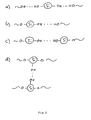
- Fig. 1 illustrates this diagrammatically.
- the associative groups X are located at the ends of the chains.
- the X groups associate with similar groups on neighbouring molecules. This leads to a loose crosslinking to form a gel network.
- the crosslinking in this case may be a physical crosslinking or association, for example due to hydrogen bonding, van der Waals attractions.
- Application of sufficient mechanical shear causes rupture of the association of the X groups, thereby disrupting the loose crosslinking and thereby leading to formation of a liquid state in which the molecules can move relative to each other. Removal of the shear force allows the association of the X groups to reform, leading to reformation of the crosslinks (which may be physical crosslinks) and reversion to a gel state.
- the associative groups of the silanol species are silanol groups which may be derived from hydrolysis of a silane.
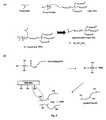
- Fig. 2 illustrates several types of association that may be present in the gel.
- the silanol species represented by Si in a circle may be monomeric, oligomeric or polymeric.
- hydrolysis of a tetralkoxysilane may produce Si(OH) 4 (or partially or fully deprotonated derivatives thereof), oligomers thereof (e.g. (Si(OH) 3 ) 2 O, (HO) 3 Si-O-Si(OH) 2 )-O-Si(OH) 3 ) etc.), and polymers and/or crosslinked networks.
- crosslinked networks may represent silica-like structures.
- the silanol species will contain at least two silanol groups, and may contain many more.
- the silica-like crosslinked structures depending on the degree of polymerisation, there may be hundreds, thousands or more silanol groups per macromolecule.
- the structures shown in Fig. 2 include:
- the present invention provides a process for making a gel as described above.
- the process comprises combining a silanol species comprising at least two silanol groups per molecule and a hydrophilic hydroxyl species comprising from 3 to 10 hydroxyl groups per molecule.
- the process may additionally comprise one or both of the steps of:
- the silanol species may be a monomeric species. In this case it may have between 2 and 4 (e.g. 2, 3 or 4) silanol groups per molecule. It may be an oligomeric or polymeric species. In this case it may have at least 3 silanol groups per molecule, but may have many more (e.g. between 3 and 100, or even between 3 and 1000 or more) silanol groups per molecule, depending on the degree of polymerisation.
- Si(OH) 4 (which may be formed by hydrolysis of a tetraalkoxysilane) may polymerise or oligomerise. It may form dimers, trimers, tetramers etc. It may form linear, branched and/or crosslinked structures.
- silanol groups are characterised by having a plurality of silanol groups. If crosslinked, the structures may have silica-like structures.
- the silanol species may be soluble in water or it may be insoluble in water, or it may be sparingly soluble in water.
- the silanol species may comprise any two or more of the structures described above, for example it may comprise monomeric silanol species together with one or more oligomeric silanol species optionally with different degrees of polymerisation.
- the (or each) silanol species may have a degree of polymerisation of between 1 and 100 or more, or between 1 and 50, 1 and 20, 1 and 10, 1 and 5, 2 and 100, 5 and 100, 10 and 100, 50 and 100, 5 and 50, 5 and 20 or 5 and 10, e.g. 1, 2, 3, 4, 5, 6, 7, 8, 9, 10, 15, 20, 25, 30, 35, 40, 45, 50, 60, 70, 80, 90 or 100.
- the silane from which the silanol is made may have between 2 and 10 hydrolysable groups per molecule. It may be monomeric. It may be oligomeric. It may have 2-4 hydrolysable groups, or 2-6, 4-10 or 3-8 hydrolysable groups, e.g. 2, 3, 4, 5, 6, 7, 8, 9 or 10 hydrolysable groups. It may also, optionally, have one or more non-hydrolysable groups per molecule. These may be alkyl groups (e.g.
- C1-C12, or C1 to C6, or C1 to C4 alkyl all of which may be either straight chain or branched, for example methyl, ethyl, propyl, isopropyl, hexyl
- aryl groups e.g. C6 to C14 aryl, or C6 to C10 aryl, such as phenyl, naphthyl, anthracyl
- functional groups or functional alkyl groups may be for example amino- or halo-alkyl (e.g. aminopropyl or halopropyl) groups.
- the halogen in this case may be F, Cl, Br or I.
- the hydrolysable groups may be alkoxylsilyl groups, or may be oximosilyl groups or may be alkanoyloxysilyl (e.g. acetoxysilyl) groups or may be benzamidosilyl groups or may be enoloxysilyl groups or may be some other type of hydrolysable silyl group, or may have a mixture of different such hydrolysable groups.
- the silane may for example comprise a tetraalkoxysilane. It may be tetramethyl, tetraethyl, tetrapropyl, tetraisopropyl or tetrabutyl silane. It may be a trialkoxylsilane, e.g. methyltrimethoxysilane, methyltriethoxysilane, isopropyltriethoxysilane, aminopropyltriethoxysilane.
- the step of hydrolysing the silane may comprise exposing the silane to an acidic solution containing water. It may be an aqueous acid.
- the aqueous acid may be an organic acid, e.g. acetic acid, propionic acid, formic acid, citric acid and malonic acid or may be an inorganic acid, e.g. sulfuric, hydrochloric acid, nitric acid, phosphoric acid.
- the concentration of the acid may be between 0.001 and 1M, at least in part depending on the nature (particularly the pKa) of the acid, or between 0.01 and 1, 0.1 and 1, 0.001 and 0.1, 0.001 and 0.01 or 0.01 and 0.1M.
- the pH of the aqueous acid may be between 1 and 4, or 1 to 3, 1 to 2, 2 to 4, 3 to 4 or 2 to 3, e.g. 1, 15, 2,2.5, 3, 3.4 or 4.
- the hydrolysis may be for sufficient time for the silane to hydrolyse to the extent that the products are soluble in the aqueous acid. It may be for between 1 minute and 12 hours, or 30 minutes to 12 hours, 1 to 12, 2 to 12 or 6 to 12 hours, or 1 to 60, 1 to 30, 1 to 10, 1 to 5, 5 to 60, 10 to 60 or 30 to 60 minutes, e.g. 1, 2, 3, 4, 5, 10, 15, 20, 25, 30, 40 or 50 minutes, or 1, 1.5, 2, 2.5, 3, 4, 5, 6, 7, 8, 9, 10, 11 or 12 hours.
- hydrolysis is at room temperature, but may be at any suitable temperature between 5 and 50°C, or 5 to 30, 5 to 25, 5 to 20, 5 to 15, 5 to 10, 10 to 50, 20 to 50,30 to 50, 10 to 30 or 15 to 25°C, e.g. 5, 10, 15, 20, 25, 30, 35, 40, 45 or 50°C or more.
- a tetraalkoxysilane is hydrolysed in an aqueous organic acid.
- the ratio of tetraalkoxysilane to organic acid may be between 1:2 and 1:20 on a volume basis, or 1:2 and 1:10, 1:2 and 1:5, 1:5 and 1:20, 1:10 and 1:20, 1:5 and 1:15, 1:5 and 1:10 or 1:8 and 1:10, e.g. 1:2, 1:3, 1:4, 1:5, 1:6, 1:7, 1:8, 1:9, 1:10,1:11,1:12,1:13,1:14, 1:15,1:16, W7,1:18,1:19 or 1:20.
- the hydroxyl species comprises between 3 and 10 hydroxyl groups per molecule, or between 3 and 8, 3 and 6 or 3 and 5, e.g. 3, 4, 5, 6, 7, 8, 9 or 10.
- the hydroxyl species may comprise a hydrophilic chain. It may be a long chain hydrophilic hydroxyl species.
- the chain may be at least 10 atoms long, or at least 15,20,25,30,35, 40, 45, 50, 60, 70, 80, 90 or 100 atoms long, or between 10 and 1000 atoms long or 10 to 500, 10 to 100, 10 to 50, 50 to 1000, 100 to 1000, 200 to 1000, 500 to 1000, 50 to 500 or 100 to 500 atoms long, e.g.
- hydroxyl groups in each molecule of the hydroxyl species may be endgroups of the molecule.
- the hydroxyl species may be a branched chain species. Each branch may have a hydroxyl endgroup, or some branches may have hydroxyl endgroups and some may not have hydroxyl endgroups.
- the endgroup of each branch is a hydroxyl group.
- the hydroxyl species may comprise a polyether chain, for example a branched polyether chain.
- the hydroxyl species is a branched (e.g. 4 arm) polyether having hydroxyl groups at the end of each arm.
- the molecular weight of the hydroxyl species may be between 500 and 50000 or between 500 and 10000, 500 and 5000, 500 and 1000, 1000 and 50000, 10000 and 50000, 20000 and 50000 or 1000 and 10000, e.g.
- the molecular weight per silanol, or per branch may be between 200 and 20000, or between 500 and 20000, 1000 and 20000, 5000 and 20000, 10000 and 20000, 200 and 10000, 200 and 2000, 100 and 1000, 200 and 500, 500 and 5000, 1000 and 5000 or 500 and 2000, e.g.
- the branches may be the same length, or may be similar length, or may be different lengths. Some of the branches may be the same or similar lengths and some may be different lengths.
- the hydroxyl species may comprise PEG, or some other hydroxyl-containing polymers such as a polysaccharide. It may be a natural polymer. It may be a synthetic polymer. It may be a modified natural polymer.
- An alkoxyfunctional polymer may be used in place of a hydroxyl containing polymer.
- the process may comprise hydrolysing the alkoxy groups of the polymer. This may be performed prior to exposing to the silanol species, or it may be conducted in situ. It may occur at the same time as interaction with the silanol species.
- the process may comprise combining the hydrophilic hydroxyl species with a particulate modifier prior to the step of combining the silanol species with the hydroxyl species.
- the particulate modifier may comprise silica, e.g. fumed silica.
- the fumed silica may be surface modified. It may be surface modified to introduce for example amine groups, peptide groups or some other type of group or mixture thereof. Thus hydrogen bonding can couple the hydrophilic hydroxyl species to particles of the silica.
- the silica may be in the form of fumed silica, which has very small primary particles.
- silica particles have a large number of silanols on the surface, and therefore are capable of hydrogen bonding to several molecules of the hydrophilic hydroxyl species.
- the silica may optionally be surface modified silica. It may have amine groups, peptide groups or other functional groups on the surface thereof.
- the functional groups on the surface of the particulate modifier may be hydrogen bonding groups.
- the particulate modifier may modify the physical properties of the gel. It may be regarded as a filler.
- Other well known particulate modifiers may be used e.g. cellulose or polysaccharides such as alginate, heparin, chitosan, chitin.
- Compounds containing hydroxyl groups may be introduced to modify the chemical and physical properties of the gel.
- ethanolamine may be added prior to the base-catalyzed condensation of PEG and hydrolyzed TEOS so as to introduce amine functionality into the gel and thereby make it more hydrophilic.
- the PEG-Si02 gel could also be functionalized by various silanes.
- Other modifying compounds include hydroxy-acids, monosaccharides, oligosaccharides, polysaccharides and peptides. These may be used to modify the hydroxyl species before the formation of the gel, or may be used to modify the gel after the hydroxyl species is combined with the silanol species.
- the ratio of hydroxyl species to silanol species may be between 1:5 and 1:1 on a volume basis, or between 1:5 and 1:2, 1:5 and 1:3, 15 and 1:4, 1:4 and 1:1, 1:3 and 1:1, 1:2 and 1:1, 1:4 and 1:2 or 1:2 and 1:1.5, e.g. 1:1, 1:1.5, 3:5, 1:2, 1:2.5, 1:3, 1:3.5, 1:4, 1:4.5 or 1:5.
- the ratio may some other ratio, depending on the functionality of the silanol species and of the hydroxyl species, and the concentration of the silanol species.
- the resulting mixture may be agitated, e.g. stirred, vortexed, swirled, shaken, sonicated. It may be agitated until it is visually homogeneous. It may then be sterilised. This may be achieved by filtration, preferably sterile filtration, through a sterilising filter, e.g. 0.45, 0.2 or 0.11 micron ( ⁇ m) filter. Alternatively, or additionally, it may be sterilised by UV radiation or some other type of sterilisation.
- a sterilising filter e.g. 0.45, 0.2 or 0.11 micron ( ⁇ m) filter.
- the mixture may be pH adjusted.
- the adjustment may comprise adding a base, or a buffer, sufficient to achieve the desired pH.
- the base may be for example a hydroxide (e.g. sodium hydroxide or potassium hydroxide or ammonium hydroxide).
- the adjustment may be to a pH at which gelation occurs. It may be to a pH at which the silanol species can gel.
- the adjustment may be to a basic pH. It may be to a pH of between 6 and 10, or 6 to 9, 7 to 9, 7 to 10, 7.5 to 10, 7.5 to 9, 7 to 7.4, 7.1 to 9 or 7.1 to 8, e.g. 6, 6.5, 7, 7.1, 7.2, 7.3, 7.4, 7.5, 7.6, 7.7, 7.8, 7.9, 8, 8.5, 9, 9.5 or 10.
- a gel may be formed.
- the standing may be with no agitation, or with very mild agitation. Any agitation should be sufficiently gentle to permit formation of the gel.
- the standing may be for at least 1 hour, or at least 2, 3, 4, 5, 6, 9, 12, 15, 18 or 24 hours, or 1 to 48 hours, or 1 to 36, 1 to 24, 1 to 18, 1 to 12, 6 to 48, 12 to 48, 24 to 48, 6 to 24, 6 to 18 or 18 to 24 hours, e.g. 1, 2, 3, 4, 5, 6, 9, 12, 15, 18, 21, 24, 30, 36,42 or 48 hours.
- the gel of the present invention comprises hydrophilic chains which comprise associative groups. As described above, these groups can associate reversibly. Thus when the groups are associated, the associations form reversible crosslinks, and the gel is in a gel form.
- the gel is capable of being converted to a liquid form by application of a mechanical shear force sufficient to rupture at least some of the reversible crosslinks. On removal of the mechanical shear force, or on reduction of the mechanical shear force to below a threshold level, the liquid is capable of being converted to the gel, as the reversible crosslinks reform.
- the conversion of the liquid to the gel may take between 10s and 1 hour, or between 30s and 1 hour, 1 minute and 1 hour, 5 minutes and 1 hour, 10 minutes and 1 hour, 30 minutes and 1 hour, 10s and 30 minutes, 10s and 10 minutes, 10s and 1 minute, 10 and 30s, 1 and 30 minutes, 1 and 10 minutes, 1 and 5 minutes or 5 and 20 minutes, e.g. 10, 15, 20, 25, 30, 35, 40, 45, 50 or 55s, or 1, 2, 3, 4, 5, 6, 7, 8, 9, 10, 15, 20, 25, 30, 35, 40, 45, 50 or 55 minutes or 1 hour, or may take more than 1 hour. These times may be dependent on temperature. They may apply at a temperature of between 10 and 30°C, or between 10 and 20, 20 and 30 or 15 and 25°C, e.g. 10, 15, 20, 25 or 30°C.
- the associative groups may be along the hydrophilic chains, or they may be at the ends of the hydrophilic chains, or some may be at the end of a hydrophilic chain and some may be along the chain (i.e. not at an end).
- the associative groups may be derived from a silane comprising at least two hydrolysable groups per molecule as described above.
- the silane may have between 2 and 10 hydrolysable groups per molecule or between 2 and 6, 2 and 4, 4 and 10 or 6 and 10, e.g. 2, 3, 4, 5, 6, 7, 8, 9 or 10.
- the hydrolysable groups may be alkoxylsilyl groups or other groups as described earlier.
- a gel for culturing cells comprising hydrophilic chains comprising associative groups at the ends of said chains, wherein said groups can associate reversibly, whereby the gel is capable of being converted to a liquid by application of a mechanical shear force and the liquid is capable of being converted to the gel in the absence of said mechanical shear force.
- a gel for culturing cells comprising hydrophilic chains comprising associative groups derived from hydrolysis of a tetraalkoxysilane, said groups being at the ends of said chains, wherein said groups can associate reversibly, whereby the gel is capable of being converted to a liquid by application of a mechanical shear force and the liquid is capable of being converted to the gel in the absence of said mechanical shear force.
- the hydrophilic chains may be polyether chains. They may be branched. They may be branched polyether chains. They may have between 2 and 20 endgroups or more, or between 2 and 10,2 and 6, 3 and 20, 6 and 20 or 10 and 20, e.g. 2, 3, 4, 5, 6, 7, 8, 9, 10, 11, 12, 13, 14, 15, 16, 17, 18, 19 or 20 endgroups.
- the hydrophilic chains may in some embodiments comprise hyperbranched polymers, hyperbranched oligomers, starburst dendrimers or some other branched structure.
- the gel may additionally comprise water. In some embodiments it may be a hydrogel. It may contain cells and/or ECM. The cells and/or ECM may be capable of being released from the gel by conversion of the gel to a liquid by means of mechanical action.
- a gel for culturing cells comprising:
- the gel of the present invention may be suitable for culturing cells.
- the gel may optionally comprise nutrients and other required materials for the cells, and may provide an environment capable of sustaining cell growth.
- the cells, once cultured in the gel, may be released therefrom by mechanical action.
- the invention also provides a method for releasing cells from a gel comprising the cells, where the gel is as described above.
- the method comprises combining the gel with a liquid, and applying sufficient mechanical shear to the combined liquid and gel to form a suspension of the cells in the liquid.
- the proportion of liquid in the combined liquid and gel may be greater than 25% v/v, or greater than 30, 35, 40, 45, 50, 55, 60, 65, 70, 75, 80,.85, 90 or 95% v/v, or may be between 25 and 95%, or 25 to 80, 25 to 60, 25 to 50, 30 to 95, 40 to 95, 50 to 95, 60 to 95, 30 to 80, 40 to 80, 50 to 80, 30 to 70 or 40 to 60%, e.g. 25, 30, 35, 40, 45, 50, 55, 60, 65, 70, 75, 80, 85, 90 or 95%, or in some instances may be more than 95%.
- the liquid may be an aqueous liquid. It may be a culture medium for the cells. It may be a solution of nutrients in water.
- the suspension of the cells in the liquid may also comprise particles of the gel, which are formed by partial disintegration of the gel.
- the method may additionally comprise the step of removing the particles of the gel from the liquid. This step may comprise straining or filtering the suspension. It may for example comprise staining the suspension through a 100 micron ( ⁇ m) cell strainer to separate the particles of the gel from the liquid.
- the cell strainer, or filter cutoff may be greater than the cell diameter. It may be for example greater than 10, 25, 50, 100, 150 or 200 microns ( ⁇ m), or between 10 and 200, 10 and 100, 10 and 50, 20 and 200, 50 and 200, 100 and 200 or 50 and 150 microns ( ⁇ m), e.g.
- the straining or filtering may be conducted under gravity, or under mild suction or mild pressure in order to accelerate the passage of the suspension through the strainer or filter.
- One embodiment of the gel of the present invention comprises polyethylene glycol combined with a hydrolysed silane. This is referred to herein as "PEG-SiO 2 ", although it should be recognised that the structure of the hydrolysed silane may comprise silica-like structures, orthosilicic acid like structures and other structures as described earlier.
- the inventors have developed a polymer-silica composite gel with mechanically reversible rheological properties for 3-dimensional (3-D) cell culture and tissue engineering.
- This gel was formed by the base-catalyzed reaction between 4-arm polyethylene glycol (PEG) and hydrolyzed tetraethylorthosilicate (TEOS), which resulted in a condensed PEO-SiO 2 network.
- PEG-SiO 2 gel has a unique property of reversible gelation. It was liquefied when vortexed to allow for ligands and cells to be added, and was able to reset into a gel in a matter of minutes.
- the liquid-gel setting time could be tailored by varying the gel composition.
- the gel was robust and strong, and could be picked up and manipulated. It was insoluble, yet porous enough for cell culture media, nutrients and gases to diffuse through it.
- An advantage of this gel over existing gels for 3-D cell culture is its unique reversible gelation property.
- the PEG-SiO 2 may liquefy when vortexed to allow ligands and cells to be added, and reset into a gel in a short space of time, for example a few minutes.
- hMSC human mesenchymal stem cell
- MC-3T3 is a mouse pre-osteoblastic cell line. The viability of MC-3T3 cells in gels with and without incorporated extracellular matrix (ECM) was also established. Due to the unique liquefaction property of the gel of the invention, cells could be passaged without trypsinization.
- the culture media or phosphate-buffered saline can be added, and gentle agitation will cause the gel to disintegrate irreversibly to release the cells, cell aggregates or tissue structures.Cellular structures and ECM could also be harvested in this manner.
- the PEG-SiO 2 gel was bioinert, and could be easily functionalized with the desired type of ligand for the adhesion and signalling of specific cell types.
- the present invention is based on thixotropy and reversible gelation.
- the gelation mechanism is believed to involve the reestablishment of Van der Waals forces, and is not believed to involve any chemical reaction.
- the gel of the present invention has a unique reversible gelation property. It is liquefied when vortexed to allow ligands and cells to be added, but is able to reset into a gel in a short space of time, e.g. several minutes.
- the liquid-gel setting time may be tailored by varying the composition of the PEG-SiO 2 gel, which is manipulated in advance during the manufacturing process.
- the culture media or phosphate-buffered saline can be added, and gentle agitation will cause the gel to disintegrate irreversibly to release the cells, cell aggregates or tissue structures.
- the gel of the present invention may be marketed in the form of a preformed gel, unlike most existing systems which are marketed in the form of liquid precursors. It is convenient to use since the protocol simply involves the vortexing of the gel prior to adding the cell suspension.
- the gel components PEG and SiO 2
- This is different from gels derived from biological materials, such as Matrigel or collagen Type I, where signalling events due to the biological component may occur, and would vary depending on the type of stem cell.
- biological materials such as Matrigel or collagen Type I
- signalling events due to the biological component may occur and would vary depending on the type of stem cell.
- the gel presented herein provides an inert rheological platform upon which biosignals can be presented in a customized fashion.
- the gelation phenomenon was based on molecular interactions involving covalent bond formation or ionic interactions, induced by crosslinking reactions or a change in the ionic strength of the gel precursor.
- the present system is based on thixotropy and reversible gelation.
- the liquid-gel setting time could be tailored by using different concentrations of PEG-SiO 2 in the material. Addition of a sufficient quantity of a liquid culture media and gentle agitation can cause the gel to disintegrate to release the cells. This disintegration may be irreversible. This would facilitate the harvesting of cellular structures and ECM. This unique 'liquefaction property' could also allow cells to be passaged without trypsinization.
- the PEG-SiO 2 gel may be especially attractive for application towards stem cell technology.
- the culture of stem cells calls for the provision of signals to either maintain the cells in a multipotent state or nudge it along a particular differentiation pathway. Since PEG and SiO 2 are not naturally present in the mammalian physiology, the PEG-SiO 2 gel is not likely to signal for either the differentiated or undifferentiated state. This would be in contrast to gels derived from biological materials, such as collagen Type I or Matrigel, which would almost certainly affect the stem cell culture depending on the cell type.
- the general concept of a 'rheology controlled', mechanically reversible gel might be widely applied for 3-D culture systems. While in some embodiments the present gel is based on PEG-SiO 2 , other gel compositions may exist to provide for the mechanically reversible rheological property described.
- the present experiment used 4-armed PEG with MW about 2000, with equal length arms in which the arms are joined by pentaerythritol C(CH 2 OH) 4 .
- the 4-arm PEG was sterile filtered through a 0.45- ⁇ m filter, and vortexed with fumed silica (FS, Cab-osil M5, Sigma, USA) until a homogeneous mixture was obtained.
- FS loadings 0, 5, 10 and 15 wt% were used.
- the mixture was sterile filtered through a 0.20 or 0.45 ⁇ m filter for cell culture experiments.
- Ammonia solution (25-35%) was added to the mixture until the final pH was about 7.4.
- a gel was formed on standing overnight with the container covered. The gel was washed in deionized water with 1% penicillin/streptomycin (antibiotics) to remove ethanol before use. The gel formed a particulate suspension in water, which was collected by centrifuging at 300-1000 rcf .
- FTIR Fourier-transform infrared
- 4-arm PEG could be coupled to tresyl chloride by nucleophilic substitution. Ligands containing amino groups could then be coupled to the activated 4-arm PEG, resulting in the final ligand-modified 4-arm PEG. This ligand-modified PEG was next combined with 10% v/v unmodified 4-arm PEG and hydrolyzed TEOS, and the pH was increased to catalyze the gel formation ( Figure 3a ).
- 4-arm PEG was activated with tresyl chloride using standard methods. Tresyl chloride-activated 4-arm PEG was dissolved and stored in 1 mM HCl prior to use.
- 0.1126 g of 1-amino-1-deoxy- ⁇ -D-galactose was dissolved in 15 mL of pH 8.5 PBS.
- 10 mL of tresyl chloride activated 4-arm PEG was added. The reaction mixture was stirred for 22 h at 4° C and stored at 4° C.
- RGD arg-gly-asp
- 75 ⁇ L of RGD solution was dissolved in 1.425 mL of pH 8.5 PBS.
- 1 mL of tresyl chloride activated 4-arm PEG was added.
- PEG-VS polyethyleneglycol-vinyl sulfone
- RGD 1 mg/ml
- cysteine-heparin 33.2 mg/ml
- MAL-PEG-MAL maleimide-polyethyleneglycol-maleimide (10.8 mg/ml) was combined with RGD (4mg/ml) in a ratio of 1.22:1 by volume.
- RGD 4mg/ml
- cysteine-alginate 7.35 mg/ml
- ECM from MC-3T3, an osteoblast cell line was isolated according to methods in literature. Briefly, a solution of 1 mM of phenylmethanesulfonyl fluoride (PMSF) and 0.5% deoxycholate in pH 8 TRIS buffer was used to lyse MC-3T3 cells that had been grown to confluency for 1 week. A solution containing 0.02% DNASE I and PMSF was then introduced to remove the genetic material. The ECM was detached and suspended using deionized water, and washed by centrifugation. To incorporate ECM in the gel, the ECM was pelleted at 500 rcf, 4°C for 5 min.
- PMSF phenylmethanesulfonyl fluoride
- cells were cultured in the RGD- and heparin-modified PEG-SiO 2 gels and ECM-incorporated gels for 1 week before performing the live-dead assays.
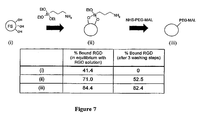
- FS was first modified using aminopropyltriethoxysilane (APTS) so as to replace the free OH groups on fumed silica ( Figure 7(i) ) with NH 2 groups ( Figure 7(ii) ).
- Ligands such as RGD were then coupled to the modified fumed silica using N-hydroxysuccinimide polyethylene glycol maleimidyl (NHS-PEG-MAL) ( Figure 7(iii) ).
- 525 mg of the NH 2 -modified FS were added to a solution of NHS-PEG-MAL (3.3 mg/mL) in pH 6 sodium phosphate buffer, and the mixture was vortexed for 2 h. The reaction suspension was centrifuged at 5000 rpm for 10 min.
- the pellet was redispersed in 50 ⁇ L of RGD solution (1 mg/mL), and vortexed overnight.
- the RGD concentration in the supernatant was measured using the BCA Protein Assay Kit (Pierce, Rockford, IL).
- BCA Protein Assay Kit Pierce, Rockford, IL
- To wash the particles with adsorbed RGD the pellet was redispersed in 50 ⁇ L of deionized water, and centrifuged at 4000 rpm for 10 min. The supernatant RGD concentration was measured and reported as the first wash. The redispersion and centrifugation steps were repeated to obtain the supernatant RGD concentrations for the second and third washes.
- the percentage of bound RGD after the three washes was obtained by subtracting the combined supernatant RGD concentrations for the first, second and third washes from the concentration of bound RGD (in equilibrium with RGD solution), and expressed as a percentage of the initial RGD concentration.
- the results are shown in the Table of Fig. 7 .
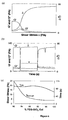
- the PEG-SiO 2 gel has additional FTIR peaks at 800-1500 cm -1 and 2800-3000 cm -1 attributed to 4-arm PEG and its CH 2 groups, respectively ( Figure 4b ). Both samples showed FTIR peaks due to residual OH groups present in the silica (960 cm -1 and 3500-4000 cm -1 ), SiO-H stretching of free silanol groups (3745 cm -1 ), and Si-O-Si stretching (1091 cm -1 ).
- ECM isolated from cultured cells provided a rich source of matrix molecules and growth factors. Incorporation of ECM into the PEG-SiO 2 gel would combine the favorable biological activity of the former with the processability of the latter. It was shown that the ECM isolated from an MC-3T3 cell line could be uniformly dispersed in the PEO-SiO 2 gel by simply vortexing for a short period of time. Subsequent separation of the ECM was prevented by the increasing viscosity of the gel. MC-3T3 cells that were cultured in the gel maintained their viability ( Figures 5f-g ).
- the PEG-SiO 2 formulation described herein provided the inert rheological platform upon which biosignals could be presented in a customized fashion, so as to favorably support the growth of desired cell types.
- arg-gly-asp (RGD) sequence heparin and ECM isolated from a cell line, other cell adhesion peptides, signalling molecules, ECM components (e.g. structural proteins, proteoglycans and growth factors) and cellular sources of cytokines (e.g. platelets and transfected cell lines) could be presented on the PEG-SiO 2 gel.
- the inventors have developed a gel based on 4-arm PEG and SiO 2 with mechanically reversible rheological properties. This gel was shown to be suitable for in vitro 3-D cell culture, and promising for tissue engineering applications.
- the gel was robust and porous. It was bioinert, and ligands (e.g. RGD) and/or proteins (e.g. ECM, growth factors and platelets) might be added so that the gel could more favorably support the growth of the desired cell type.
- ligands e.g. RGD
- proteins e.g. ECM, growth factors and platelets
- the PEG-SiO 2 gel demonstrated a unique property of reversible gelation. It could be liquefied when vortexed to allow ligands and cells to be added, and would reset into a gel after several minutes. Due to its liquefaction property, cells could also be passaged without trypsinization, and cellular structures and ECM could be easily harvested. Live-dead assays and confocal microscopy have indicated hMSC survival and 3-D spreading after 1 week in gels containing RGD ligands, indicating that this new material was non-toxic and supported cell growth. The biocompatibility and convenience of use of this mechanically reversible gel would greatly facilitate 3-D cell culture and fundamental studies of cell behavior in a more biologically relevant environment.
Landscapes
- Chemical & Material Sciences (AREA)
- Organic Chemistry (AREA)
- Dispersion Chemistry (AREA)
- Medicinal Chemistry (AREA)
- Polymers & Plastics (AREA)
- Chemical Kinetics & Catalysis (AREA)
- Health & Medical Sciences (AREA)
- Inorganic Chemistry (AREA)
- Apparatus Associated With Microorganisms And Enzymes (AREA)
- Micro-Organisms Or Cultivation Processes Thereof (AREA)
- Compositions Of Macromolecular Compounds (AREA)
- Silicon Polymers (AREA)
- Materials For Medical Uses (AREA)
Claims (19)
- Procédé pour fabriquer un gel mécaniquement réversible comprenant des chaînes hydrophiles comprenant des groupes associatifs qui peuvent s'associer de manière réversible, dans lequel le gel est apte à être converti en un liquide par application d'une force de cisaillement mécanique et le liquide est apte à être converti en gel en l'absence de ladite force de cisaillement mécanique, ledit procédé comportant l'étape consistant à combiner une espèce silanol comprenant au moins deux groupes silanol par molécule et une espèce hydroxyle hydrophile comprenant de 3 à 10 groupes hydroxyle par molécule.
- Procédé selon la revendication 1, comportant en outre l'étape consistant à hydrolyser un silane pour former l'espèce silanol, ledit silane ayant au moins deux groupes hydrolysables par molécule.
- Procédé selon la revendication 2, dans lequel le silane comporte un tétraalcoxysilane.
- Procédé selon l'une quelconque des revendications 1 à 3, comportant de plus l'étape consistant à combiner l'espèce hydroxyle hydrophile avec un agent modificateur de particules avant l'étape de combinaison de l'espèce silanol avec l'espèce hydroxyle.
- Procédé selon la revendication 4, dans lequel l'agent modificateur de particules comporte de la silice sublimée.
- Procédé selon l'une quelconque des revendications 1 à 5, comportant de plus l'ajustement du pH à une valeur comprise entre 6 et 9 après l'étape de combinaison.
- Procédé selon l'une quelconque des revendications 1 à 6, dans lequel au moins deux des groupes hydroxyles dans chaque molécule sont des groupes terminaux de la molécule.
- Procédé selon l'une quelconque des revendications 1 à 7, dans lequel l'espèce hydroxyle comprend une chaîne polyéther.
- Procédé selon la revendication 8, dans lequel la chaîne polyéther est une chaîne polyéther ramifiée.
- Gel résultant du procédé selon l'une quelconque des revendications 1 à 9.
- Gel selon la revendication 10, comportant de plus de l'eau.
- Gel selon la revendication 10 ou 11, ledit gel contenant des cellules et/ou une matrice extracellulaire (ECM).
- Utilisation d'un gel pour mettre en culture des cellules, ledit gel comprenant des chaînes hydrophiles comprenant des groupes associatifs qui peuvent s'associer de manière réversible, et ledit gel étant fabriqué à partir d'une espèce silanol comprenant au moins deux groupes silanol par molécule et une espèce hydroxyle hydrophile comprenant au moins deux groupes hydroxyle par molécule en tant que gel mécaniquement réversible, dans lequel le gel est converti en un liquide par application d'une force de cisaillement mécanique et le liquide est apte à être converti en gel en l'absence de ladite force de cisaillement mécanique.
- Utilisation selon la revendication 13, dans laquelle le gel est le gel selon l'une quelconque des revendications 10 à 12 et/ou est préparé selon le procédé selon l'une quelconque des revendications 1 à 9.
- Utilisation selon la revendication 13 ou 14, dans laquelle le gel est utilisé pour incorporer une substance en :• fournissant ledit gel,• appliquant un cisaillement mécanique suffisant audit gel pour convertir le gel en un liquide,• combiner le liquide avec la substance, et• permettre au liquide de se reposer avec un cisaillement mécanique insuffisant pour le maintenir sous forme liquide pendant un temps suffisant pour que le liquide redevienne un gel.
- Utilisation selon la revendication 13 ou 14, dans laquelle le gel est utilisé pour libérer des cellules en :• combinant le gel avec un liquide, et• appliquant un cisaillement mécanique suffisant au liquide et au gel combinés pour former une suspension des cellules dans le liquide.
- Procédé pour libérer des cellules à partir d'un gel fabriqué à partir d'une espèce silanol comprenant au moins deux groupes silanol par molécule et une espèce hydroxyle hydrophile comprenant au moins deux groupes hydroxyle par molécule, ledit gel comportant les cellules et ledit procédé comportant les étapes consistant à :• combiner le gel avec un liquide, et• appliquer un cisaillement mécanique suffisant au liquide et au gel combinés pour former une suspension des cellules dans le liquide.
- Procédé pour incorporer une substance dans un gel fabriqué à partir d'une espèce silanol comprenant au moins deux groupes silanol par molécule et une espèce hydroxyle hydrophile comprenant au moins deux groupes hydroxyle par molécule, le procédé comportant les étapes consistant à :• fournir ledit gel,• appliquer un cisaillement mécanique suffisant audit gel pour convertir le gel en un liquide,• combiner le liquide avec la substance, et• permettre au liquide de se reposer avec un cisaillement mécanique insuffisant pour le maintenir sous forme liquide pendant un temps suffisant pour que le liquide redevienne un gel.
- Procédé selon la revendication 18, dans lequel la substance comporte des cellules et/ou une ECM et/ou des protéines et/ou d'autres molécules ayant une fonction biologique.
Applications Claiming Priority (2)
| Application Number | Priority Date | Filing Date | Title |
|---|---|---|---|
| US79737506P | 2006-05-04 | 2006-05-04 | |
| PCT/SG2007/000127 WO2007129991A1 (fr) | 2006-05-04 | 2007-05-04 | Gel mecaniquement reversible |
Publications (3)
| Publication Number | Publication Date |
|---|---|
| EP2021283A1 EP2021283A1 (fr) | 2009-02-11 |
| EP2021283A4 EP2021283A4 (fr) | 2010-07-07 |
| EP2021283B1 true EP2021283B1 (fr) | 2015-07-08 |
Family
ID=38668015
Family Applications (1)
| Application Number | Title | Priority Date | Filing Date |
|---|---|---|---|
| EP07748672.8A Not-in-force EP2021283B1 (fr) | 2006-05-04 | 2007-05-04 | Gel mecaniquement reversible |
Country Status (4)
| Country | Link |
|---|---|
| US (1) | US8450105B2 (fr) |
| EP (1) | EP2021283B1 (fr) |
| JP (1) | JP5185258B2 (fr) |
| WO (1) | WO2007129991A1 (fr) |
Families Citing this family (17)
| Publication number | Priority date | Publication date | Assignee | Title |
|---|---|---|---|---|
| US9308511B2 (en) | 2009-10-14 | 2016-04-12 | Arizona Board Of Regents, A Body Corporate Of The State Of Arizona Acting For And On Behalf Of Arizona State University | Fabricating porous materials using thixotropic gels |
| US9242900B2 (en) | 2009-12-01 | 2016-01-26 | Arizona Board Of Regents, A Body Corporate Of The State Of Arizona Acting For And On Behalf Of Arizona State University | Porous geopolymer materials |
| DE102010002356A1 (de) * | 2010-02-25 | 2011-08-25 | Evonik Degussa GmbH, 45128 | Zusammensetzungen von mit oligomeren Siloxanolen funktionalisierten Metalloxiden und deren Verwendung |
| WO2012018890A2 (fr) | 2010-08-06 | 2012-02-09 | Arizona Board Of Regents For And On Behalf Of Arizona State University | Fabrication de matériaux poreux faisant appel à des gels composites inorganiques-organiques interpénétrés |
| FI123988B (fi) | 2010-10-27 | 2014-01-31 | Upm Kymmene Corp | Soluviljelymateriaali |
| CA2827559A1 (fr) | 2011-02-22 | 2012-08-30 | Regents Of The University Of Minnesota | Biomateriaux encapsules dans de la silice |
| KR102060844B1 (ko) | 2011-09-21 | 2019-12-30 | 아리조나 보드 오브 리전트스, 아리조나주의 아리조나 주립대 대행법인 | 지오폴리머 수지 재료, 지오폴리머 재료, 및 그에 의해 제조된 재료 |
| WO2013070778A1 (fr) * | 2011-11-07 | 2013-05-16 | Regents Of The University Of Minnesota | Compositions formant une matrice de silice, matières formées avec celles-ci et leurs procédés d'utilisation |
| FI125965B (en) | 2012-09-25 | 2016-04-29 | Upm Kymmene Corp | Three-dimensional cell culture |
| US9534236B2 (en) | 2013-03-08 | 2017-01-03 | Regents Of The University Of Minnesota | Membranes for wastewater-generated energy and gas |
| US10170759B2 (en) | 2013-06-21 | 2019-01-01 | Arizona Board Of Regents On Behalf Of Arizona State University | Metal oxides from acidic solutions |
| TWI512101B (zh) * | 2013-11-19 | 2015-12-11 | Univ Nat Taiwan | 三維細胞培養結構及其製造方法 |
| US10926241B2 (en) | 2014-06-12 | 2021-02-23 | Arizona Board Of Regents On Behalf Of Arizona State University | Carbon dioxide adsorbents |
| US10035719B2 (en) | 2014-10-15 | 2018-07-31 | Regents Of The University Of Minnesota | System and membrane for wastewater-generated energy and gas |
| US11390835B2 (en) * | 2015-05-08 | 2022-07-19 | University Of Florida Research Foundation, Inc. | Growth media for three-dimensional cell culture |
| US10829382B2 (en) | 2017-01-20 | 2020-11-10 | Skysong Innovations | Aluminosilicate nanorods |
| US12329382B2 (en) | 2017-09-01 | 2025-06-17 | Arizona Board Of Regents On Behalf Of Arizona State University | Thixotropic biocompatible gel for live cell observation in cell computed tomography |
Family Cites Families (12)
| Publication number | Priority date | Publication date | Assignee | Title |
|---|---|---|---|---|
| US1234567A (en) * | 1915-09-14 | 1917-07-24 | Edward J Quigley | Soft collar. |
| US4148689A (en) * | 1976-05-14 | 1979-04-10 | Sanraku-Ocean Co., Ltd. | Immobilization of microorganisms in a hydrophilic complex gel |
| US4999397A (en) * | 1989-07-28 | 1991-03-12 | Dow Corning Corporation | Metastable silane hydrolyzates and process for their preparation |
| DK0906243T4 (da) | 1996-05-29 | 2009-06-08 | Delsitech Oy | Oplöselige oxider til biologiske anvendelser |
| US5948464A (en) * | 1996-06-19 | 1999-09-07 | Imra America, Inc. | Process of manufacturing porous separator for electrochemical power supply |
| RU2180671C2 (ru) * | 1997-07-15 | 2002-03-20 | Асахи Касеи Кабусики Кайся | Композиция алкоксисилан/органический полимер для использования в получении изолирующей тонкой пленки и ее применение |
| KR100212534B1 (ko) * | 1997-08-12 | 1999-08-02 | 이서봉 | 졸-겔 조성물 및 이로부터 제조된 고분자 이온 전도막 |
| WO2003102001A1 (fr) * | 2002-05-31 | 2003-12-11 | Mcmaster University | Silanes modifies par des polyols en tant que precurseurs de silice |
| EP1542926A1 (fr) | 2002-08-23 | 2005-06-22 | McMaster University | Procedes et composes destines a reguler la morphologie et le retrecissement de silice derivee de silanes a polyol modifie |
| EP1718564B1 (fr) * | 2004-02-27 | 2018-11-14 | DelSiTech Oy | Procede de préparation de sio2 derivée de sol-gel à biorésorption ajustable |
| JP4607522B2 (ja) * | 2004-08-31 | 2011-01-05 | 焼津水産化学工業株式会社 | 高分子複合体の製造方法及び該製造方法によって得られる高分子複合体、並びに該高分子複合体を用いた動物細胞の培養方法 |
| EP1962920A4 (fr) | 2005-12-01 | 2012-03-21 | Agency Science Tech & Res | Matrices extracellulaires reconstituees en trois dimensions servant d'echafaudage pour le genie tissulaire |
-
2007
- 2007-05-04 WO PCT/SG2007/000127 patent/WO2007129991A1/fr not_active Ceased
- 2007-05-04 EP EP07748672.8A patent/EP2021283B1/fr not_active Not-in-force
- 2007-05-04 US US12/299,199 patent/US8450105B2/en not_active Expired - Fee Related
- 2007-05-04 JP JP2009509500A patent/JP5185258B2/ja not_active Expired - Fee Related
Also Published As
| Publication number | Publication date |
|---|---|
| WO2007129991A1 (fr) | 2007-11-15 |
| JP5185258B2 (ja) | 2013-04-17 |
| JP2009535479A (ja) | 2009-10-01 |
| US8450105B2 (en) | 2013-05-28 |
| EP2021283A4 (fr) | 2010-07-07 |
| US20090305412A1 (en) | 2009-12-10 |
| EP2021283A1 (fr) | 2009-02-11 |
Similar Documents
| Publication | Publication Date | Title |
|---|---|---|
| US8450105B2 (en) | Mechanically reversible gel | |
| Monavari et al. | 3D printing of alginate dialdehyde-gelatin (ADA-GEL) hydrogels incorporating phytotherapeutic icariin loaded mesoporous SiO2-CaO nanoparticles for bone tissue engineering | |
| Papagiannopoulos et al. | Physicochemical properties of electrostatically crosslinked carrageenan/chitosan hydrogels and carrageenan/chitosan/Laponite nanocomposite hydrogels | |
| Pandey et al. | Sol–gel derived organic–inorganic hybrid materials: synthesis, characterizations and applications | |
| Shchipunov et al. | Hybrid polysaccharide− silica nanocomposites prepared by the sol− gel technique | |
| CN115028903B (zh) | 一种水凝胶及其制备方法和应用 | |
| EP3727488B1 (fr) | Hydrogels à base de constituants de plasma sanguin, procédé et utilisations correspondantes | |
| Cai et al. | Rheological characterization of novel carboxymethylated curdlan-silica hybrid hydrogels with tunable mechanical properties | |
| US20200010623A1 (en) | Disintegratable porous organometaloxide material | |
| CN107412877B (zh) | 一种磷酸钙/明胶复合材料纳米颗粒的制备方法及其应用 | |
| US9427408B2 (en) | Silica-matrix forming compositions, materials formed therefrom, and methods of using the same | |
| US20220411756A1 (en) | Extracellular matrices which can be used as scaffold for living cells | |
| Gong et al. | Preparation and characterization of a self‐crosslinking sodium alginate‐bioactive glass sponge | |
| Voss et al. | Non-destructive horseradish peroxidase immobilization in porous silica nanoparticles | |
| KR101068873B1 (ko) | 바이오마커가 고정된 실리카 나노입자를 함유하는 하이드로젤 및 그 제조방법 | |
| CN102558569B (zh) | 一种脂多糖胺阳离子聚合物及其制备方法和应用 | |
| Montheil et al. | Silylated biomolecules: Versatile components for bioinks | |
| CN107937443A (zh) | 一种适用于核酸转染的自组装纳米制剂及其制备与应用 | |
| CN116396476A (zh) | 一类末端为两性离子功能化的高度支化聚(β-氨基酯)及其制备方法和应用 | |
| CN104324372A (zh) | 新城疫弱毒苗o-2′-羟丙基三甲基氯化铵壳聚糖纳米粒缓释剂的制备方法 | |
| Maleki et al. | Diatom-Inspired Silicification Process for Development of Green Flexible Silica Composite Aerogels | |
| KR101982629B1 (ko) | 리튬 이온 전지 성능 개선을 위한 식물 유래 피로갈롤 작용기가 도입된 실리콘 음극재 바인더 및 그 제조방법 | |
| Abedini et al. | Thiolated gellan gum/polyethylene glycol diacrylate hydrogel containing secretome as a wound dressing: in vitro and in vivo studies | |
| CN116813381B (zh) | 一种生物陶瓷表面生物活性涂层及其制备方法 | |
| Michelina et al. | Synthesis and characterization of amorphous and hybrid materials obtained by sol-gel processing for biomedical applications |
Legal Events
| Date | Code | Title | Description |
|---|---|---|---|
| PUAI | Public reference made under article 153(3) epc to a published international application that has entered the european phase |
Free format text: ORIGINAL CODE: 0009012 |
|
| 17P | Request for examination filed |
Effective date: 20081118 |
|
| AK | Designated contracting states |
Kind code of ref document: A1 Designated state(s): AT BE BG CH CY CZ DE DK EE ES FI FR GB GR HU IE IS IT LI LT LU LV MC MT NL PL PT RO SE SI SK TR |
|
| AX | Request for extension of the european patent |
Extension state: AL BA HR MK RS |
|
| A4 | Supplementary search report drawn up and despatched |
Effective date: 20100604 |
|
| 17Q | First examination report despatched |
Effective date: 20110930 |
|
| DAX | Request for extension of the european patent (deleted) | ||
| GRAP | Despatch of communication of intention to grant a patent |
Free format text: ORIGINAL CODE: EPIDOSNIGR1 |
|
| INTG | Intention to grant announced |
Effective date: 20141107 |
|
| GRAS | Grant fee paid |
Free format text: ORIGINAL CODE: EPIDOSNIGR3 |
|
| GRAA | (expected) grant |
Free format text: ORIGINAL CODE: 0009210 |
|
| AK | Designated contracting states |
Kind code of ref document: B1 Designated state(s): AT BE BG CH CY CZ DE DK EE ES FI FR GB GR HU IE IS IT LI LT LU LV MC MT NL PL PT RO SE SI SK TR |
|
| REG | Reference to a national code |
Ref country code: GB Ref legal event code: FG4D |
|
| REG | Reference to a national code |
Ref country code: AT Ref legal event code: REF Ref document number: 735242 Country of ref document: AT Kind code of ref document: T Effective date: 20150715 Ref country code: CH Ref legal event code: EP |
|
| REG | Reference to a national code |
Ref country code: IE Ref legal event code: FG4D |
|
| REG | Reference to a national code |
Ref country code: DE Ref legal event code: R096 Ref document number: 602007042052 Country of ref document: DE |
|
| REG | Reference to a national code |
Ref country code: AT Ref legal event code: MK05 Ref document number: 735242 Country of ref document: AT Kind code of ref document: T Effective date: 20150708 |
|
| REG | Reference to a national code |
Ref country code: NL Ref legal event code: MP Effective date: 20150708 |
|
| REG | Reference to a national code |
Ref country code: LT Ref legal event code: MG4D |
|
| PG25 | Lapsed in a contracting state [announced via postgrant information from national office to epo] |
Ref country code: LV Free format text: LAPSE BECAUSE OF FAILURE TO SUBMIT A TRANSLATION OF THE DESCRIPTION OR TO PAY THE FEE WITHIN THE PRESCRIBED TIME-LIMIT Effective date: 20150708 Ref country code: GR Free format text: LAPSE BECAUSE OF FAILURE TO SUBMIT A TRANSLATION OF THE DESCRIPTION OR TO PAY THE FEE WITHIN THE PRESCRIBED TIME-LIMIT Effective date: 20151009 Ref country code: LT Free format text: LAPSE BECAUSE OF FAILURE TO SUBMIT A TRANSLATION OF THE DESCRIPTION OR TO PAY THE FEE WITHIN THE PRESCRIBED TIME-LIMIT Effective date: 20150708 Ref country code: FI Free format text: LAPSE BECAUSE OF FAILURE TO SUBMIT A TRANSLATION OF THE DESCRIPTION OR TO PAY THE FEE WITHIN THE PRESCRIBED TIME-LIMIT Effective date: 20150708 |
|
| PG25 | Lapsed in a contracting state [announced via postgrant information from national office to epo] |
Ref country code: SE Free format text: LAPSE BECAUSE OF FAILURE TO SUBMIT A TRANSLATION OF THE DESCRIPTION OR TO PAY THE FEE WITHIN THE PRESCRIBED TIME-LIMIT Effective date: 20150708 Ref country code: PT Free format text: LAPSE BECAUSE OF FAILURE TO SUBMIT A TRANSLATION OF THE DESCRIPTION OR TO PAY THE FEE WITHIN THE PRESCRIBED TIME-LIMIT Effective date: 20151109 Ref country code: AT Free format text: LAPSE BECAUSE OF FAILURE TO SUBMIT A TRANSLATION OF THE DESCRIPTION OR TO PAY THE FEE WITHIN THE PRESCRIBED TIME-LIMIT Effective date: 20150708 Ref country code: ES Free format text: LAPSE BECAUSE OF FAILURE TO SUBMIT A TRANSLATION OF THE DESCRIPTION OR TO PAY THE FEE WITHIN THE PRESCRIBED TIME-LIMIT Effective date: 20150708 Ref country code: PL Free format text: LAPSE BECAUSE OF FAILURE TO SUBMIT A TRANSLATION OF THE DESCRIPTION OR TO PAY THE FEE WITHIN THE PRESCRIBED TIME-LIMIT Effective date: 20150708 Ref country code: IS Free format text: LAPSE BECAUSE OF FAILURE TO SUBMIT A TRANSLATION OF THE DESCRIPTION OR TO PAY THE FEE WITHIN THE PRESCRIBED TIME-LIMIT Effective date: 20151108 |
|
| REG | Reference to a national code |
Ref country code: DE Ref legal event code: R097 Ref document number: 602007042052 Country of ref document: DE |
|
| REG | Reference to a national code |
Ref country code: FR Ref legal event code: PLFP Year of fee payment: 10 |
|
| PG25 | Lapsed in a contracting state [announced via postgrant information from national office to epo] |
Ref country code: EE Free format text: LAPSE BECAUSE OF FAILURE TO SUBMIT A TRANSLATION OF THE DESCRIPTION OR TO PAY THE FEE WITHIN THE PRESCRIBED TIME-LIMIT Effective date: 20150708 Ref country code: IT Free format text: LAPSE BECAUSE OF FAILURE TO SUBMIT A TRANSLATION OF THE DESCRIPTION OR TO PAY THE FEE WITHIN THE PRESCRIBED TIME-LIMIT Effective date: 20150708 Ref country code: DK Free format text: LAPSE BECAUSE OF FAILURE TO SUBMIT A TRANSLATION OF THE DESCRIPTION OR TO PAY THE FEE WITHIN THE PRESCRIBED TIME-LIMIT Effective date: 20150708 Ref country code: SK Free format text: LAPSE BECAUSE OF FAILURE TO SUBMIT A TRANSLATION OF THE DESCRIPTION OR TO PAY THE FEE WITHIN THE PRESCRIBED TIME-LIMIT Effective date: 20150708 Ref country code: CZ Free format text: LAPSE BECAUSE OF FAILURE TO SUBMIT A TRANSLATION OF THE DESCRIPTION OR TO PAY THE FEE WITHIN THE PRESCRIBED TIME-LIMIT Effective date: 20150708 |
|
| PLBE | No opposition filed within time limit |
Free format text: ORIGINAL CODE: 0009261 |
|
| STAA | Information on the status of an ep patent application or granted ep patent |
Free format text: STATUS: NO OPPOSITION FILED WITHIN TIME LIMIT |
|
| PG25 | Lapsed in a contracting state [announced via postgrant information from national office to epo] |
Ref country code: RO Free format text: LAPSE BECAUSE OF FAILURE TO SUBMIT A TRANSLATION OF THE DESCRIPTION OR TO PAY THE FEE WITHIN THE PRESCRIBED TIME-LIMIT Effective date: 20150708 |
|
| 26N | No opposition filed |
Effective date: 20160411 |
|
| PG25 | Lapsed in a contracting state [announced via postgrant information from national office to epo] |
Ref country code: SI Free format text: LAPSE BECAUSE OF FAILURE TO SUBMIT A TRANSLATION OF THE DESCRIPTION OR TO PAY THE FEE WITHIN THE PRESCRIBED TIME-LIMIT Effective date: 20150708 Ref country code: BE Free format text: LAPSE BECAUSE OF NON-PAYMENT OF DUE FEES Effective date: 20160531 |
|
| PG25 | Lapsed in a contracting state [announced via postgrant information from national office to epo] |
Ref country code: BE Free format text: LAPSE BECAUSE OF FAILURE TO SUBMIT A TRANSLATION OF THE DESCRIPTION OR TO PAY THE FEE WITHIN THE PRESCRIBED TIME-LIMIT Effective date: 20150708 Ref country code: LU Free format text: LAPSE BECAUSE OF FAILURE TO SUBMIT A TRANSLATION OF THE DESCRIPTION OR TO PAY THE FEE WITHIN THE PRESCRIBED TIME-LIMIT Effective date: 20160504 |
|
| REG | Reference to a national code |
Ref country code: CH Ref legal event code: PL |
|
| GBPC | Gb: european patent ceased through non-payment of renewal fee |
Effective date: 20160504 |
|
| PG25 | Lapsed in a contracting state [announced via postgrant information from national office to epo] |
Ref country code: CH Free format text: LAPSE BECAUSE OF NON-PAYMENT OF DUE FEES Effective date: 20160531 Ref country code: LI Free format text: LAPSE BECAUSE OF NON-PAYMENT OF DUE FEES Effective date: 20160531 |
|
| REG | Reference to a national code |
Ref country code: IE Ref legal event code: MM4A |
|
| REG | Reference to a national code |
Ref country code: FR Ref legal event code: PLFP Year of fee payment: 11 |
|
| PG25 | Lapsed in a contracting state [announced via postgrant information from national office to epo] |
Ref country code: IE Free format text: LAPSE BECAUSE OF NON-PAYMENT OF DUE FEES Effective date: 20160504 Ref country code: GB Free format text: LAPSE BECAUSE OF NON-PAYMENT OF DUE FEES Effective date: 20160504 |
|
| PG25 | Lapsed in a contracting state [announced via postgrant information from national office to epo] |
Ref country code: NL Free format text: LAPSE BECAUSE OF FAILURE TO SUBMIT A TRANSLATION OF THE DESCRIPTION OR TO PAY THE FEE WITHIN THE PRESCRIBED TIME-LIMIT Effective date: 20150708 |
|
| PGFP | Annual fee paid to national office [announced via postgrant information from national office to epo] |
Ref country code: DE Payment date: 20170426 Year of fee payment: 11 Ref country code: FR Payment date: 20170427 Year of fee payment: 11 |
|
| PG25 | Lapsed in a contracting state [announced via postgrant information from national office to epo] |
Ref country code: HU Free format text: LAPSE BECAUSE OF FAILURE TO SUBMIT A TRANSLATION OF THE DESCRIPTION OR TO PAY THE FEE WITHIN THE PRESCRIBED TIME-LIMIT; INVALID AB INITIO Effective date: 20070504 Ref country code: CY Free format text: LAPSE BECAUSE OF FAILURE TO SUBMIT A TRANSLATION OF THE DESCRIPTION OR TO PAY THE FEE WITHIN THE PRESCRIBED TIME-LIMIT Effective date: 20150708 |
|
| PG25 | Lapsed in a contracting state [announced via postgrant information from national office to epo] |
Ref country code: TR Free format text: LAPSE BECAUSE OF FAILURE TO SUBMIT A TRANSLATION OF THE DESCRIPTION OR TO PAY THE FEE WITHIN THE PRESCRIBED TIME-LIMIT Effective date: 20150708 Ref country code: MC Free format text: LAPSE BECAUSE OF FAILURE TO SUBMIT A TRANSLATION OF THE DESCRIPTION OR TO PAY THE FEE WITHIN THE PRESCRIBED TIME-LIMIT Effective date: 20150708 Ref country code: MT Free format text: LAPSE BECAUSE OF NON-PAYMENT OF DUE FEES Effective date: 20160531 |
|
| PG25 | Lapsed in a contracting state [announced via postgrant information from national office to epo] |
Ref country code: BG Free format text: LAPSE BECAUSE OF FAILURE TO SUBMIT A TRANSLATION OF THE DESCRIPTION OR TO PAY THE FEE WITHIN THE PRESCRIBED TIME-LIMIT Effective date: 20150708 |
|
| REG | Reference to a national code |
Ref country code: DE Ref legal event code: R119 Ref document number: 602007042052 Country of ref document: DE |
|
| PG25 | Lapsed in a contracting state [announced via postgrant information from national office to epo] |
Ref country code: DE Free format text: LAPSE BECAUSE OF NON-PAYMENT OF DUE FEES Effective date: 20181201 Ref country code: FR Free format text: LAPSE BECAUSE OF NON-PAYMENT OF DUE FEES Effective date: 20180531 |