EP2022874B1 - Kornorientiertes elektrostahlblech mit isolierendem film mit hoher zugfestigkeit und verfahren zum behandeln eines derartigen isolierenden films - Google Patents
Kornorientiertes elektrostahlblech mit isolierendem film mit hoher zugfestigkeit und verfahren zum behandeln eines derartigen isolierenden films Download PDFInfo
- Publication number
- EP2022874B1 EP2022874B1 EP07744083A EP07744083A EP2022874B1 EP 2022874 B1 EP2022874 B1 EP 2022874B1 EP 07744083 A EP07744083 A EP 07744083A EP 07744083 A EP07744083 A EP 07744083A EP 2022874 B1 EP2022874 B1 EP 2022874B1
- Authority
- EP
- European Patent Office
- Prior art keywords
- steel sheet
- phosphate
- insulating film
- grain
- oriented electrical
- Prior art date
- Legal status (The legal status is an assumption and is not a legal conclusion. Google has not performed a legal analysis and makes no representation as to the accuracy of the status listed.)
- Active
Links
Images



Classifications
-
- C—CHEMISTRY; METALLURGY
- C23—COATING METALLIC MATERIAL; COATING MATERIAL WITH METALLIC MATERIAL; CHEMICAL SURFACE TREATMENT; DIFFUSION TREATMENT OF METALLIC MATERIAL; COATING BY VACUUM EVAPORATION, BY SPUTTERING, BY ION IMPLANTATION OR BY CHEMICAL VAPOUR DEPOSITION, IN GENERAL; INHIBITING CORROSION OF METALLIC MATERIAL OR INCRUSTATION IN GENERAL
- C23C—COATING METALLIC MATERIAL; COATING MATERIAL WITH METALLIC MATERIAL; SURFACE TREATMENT OF METALLIC MATERIAL BY DIFFUSION INTO THE SURFACE, BY CHEMICAL CONVERSION OR SUBSTITUTION; COATING BY VACUUM EVAPORATION, BY SPUTTERING, BY ION IMPLANTATION OR BY CHEMICAL VAPOUR DEPOSITION, IN GENERAL
- C23C22/00—Chemical surface treatment of metallic material by reaction of the surface with a reactive liquid, leaving reaction products of surface material in the coating, e.g. conversion coatings, passivation of metals
- C23C22/05—Chemical surface treatment of metallic material by reaction of the surface with a reactive liquid, leaving reaction products of surface material in the coating, e.g. conversion coatings, passivation of metals using aqueous solutions
- C23C22/06—Chemical surface treatment of metallic material by reaction of the surface with a reactive liquid, leaving reaction products of surface material in the coating, e.g. conversion coatings, passivation of metals using aqueous solutions using aqueous acidic solutions with pH less than 6
- C23C22/07—Chemical surface treatment of metallic material by reaction of the surface with a reactive liquid, leaving reaction products of surface material in the coating, e.g. conversion coatings, passivation of metals using aqueous solutions using aqueous acidic solutions with pH less than 6 containing phosphates
-
- C—CHEMISTRY; METALLURGY
- C23—COATING METALLIC MATERIAL; COATING MATERIAL WITH METALLIC MATERIAL; CHEMICAL SURFACE TREATMENT; DIFFUSION TREATMENT OF METALLIC MATERIAL; COATING BY VACUUM EVAPORATION, BY SPUTTERING, BY ION IMPLANTATION OR BY CHEMICAL VAPOUR DEPOSITION, IN GENERAL; INHIBITING CORROSION OF METALLIC MATERIAL OR INCRUSTATION IN GENERAL
- C23C—COATING METALLIC MATERIAL; COATING MATERIAL WITH METALLIC MATERIAL; SURFACE TREATMENT OF METALLIC MATERIAL BY DIFFUSION INTO THE SURFACE, BY CHEMICAL CONVERSION OR SUBSTITUTION; COATING BY VACUUM EVAPORATION, BY SPUTTERING, BY ION IMPLANTATION OR BY CHEMICAL VAPOUR DEPOSITION, IN GENERAL
- C23C22/00—Chemical surface treatment of metallic material by reaction of the surface with a reactive liquid, leaving reaction products of surface material in the coating, e.g. conversion coatings, passivation of metals
- C23C22/05—Chemical surface treatment of metallic material by reaction of the surface with a reactive liquid, leaving reaction products of surface material in the coating, e.g. conversion coatings, passivation of metals using aqueous solutions
- C23C22/06—Chemical surface treatment of metallic material by reaction of the surface with a reactive liquid, leaving reaction products of surface material in the coating, e.g. conversion coatings, passivation of metals using aqueous solutions using aqueous acidic solutions with pH less than 6
- C23C22/07—Chemical surface treatment of metallic material by reaction of the surface with a reactive liquid, leaving reaction products of surface material in the coating, e.g. conversion coatings, passivation of metals using aqueous solutions using aqueous acidic solutions with pH less than 6 containing phosphates
- C23C22/08—Orthophosphates
- C23C22/22—Orthophosphates containing alkaline earth metal cations
-
- C—CHEMISTRY; METALLURGY
- C21—METALLURGY OF IRON
- C21D—MODIFYING THE PHYSICAL STRUCTURE OF FERROUS METALS; GENERAL DEVICES FOR HEAT TREATMENT OF FERROUS OR NON-FERROUS METALS OR ALLOYS; MAKING METAL MALLEABLE, e.g. BY DECARBURISATION OR TEMPERING
- C21D8/00—Modifying the physical properties of ferrous metals or ferrous alloys by deformation combined with, or followed by, heat treatment
- C21D8/12—Modifying the physical properties of ferrous metals or ferrous alloys by deformation combined with, or followed by, heat treatment during manufacturing of articles with special electromagnetic properties
- C21D8/1277—Modifying the physical properties of ferrous metals or ferrous alloys by deformation combined with, or followed by, heat treatment during manufacturing of articles with special electromagnetic properties involving a particular surface treatment
- C21D8/1283—Application of a separating or insulating coating
-
- C—CHEMISTRY; METALLURGY
- C21—METALLURGY OF IRON
- C21D—MODIFYING THE PHYSICAL STRUCTURE OF FERROUS METALS; GENERAL DEVICES FOR HEAT TREATMENT OF FERROUS OR NON-FERROUS METALS OR ALLOYS; MAKING METAL MALLEABLE, e.g. BY DECARBURISATION OR TEMPERING
- C21D8/00—Modifying the physical properties of ferrous metals or ferrous alloys by deformation combined with, or followed by, heat treatment
- C21D8/12—Modifying the physical properties of ferrous metals or ferrous alloys by deformation combined with, or followed by, heat treatment during manufacturing of articles with special electromagnetic properties
- C21D8/1277—Modifying the physical properties of ferrous metals or ferrous alloys by deformation combined with, or followed by, heat treatment during manufacturing of articles with special electromagnetic properties involving a particular surface treatment
- C21D8/1288—Application of a tension-inducing coating
-
- C—CHEMISTRY; METALLURGY
- C21—METALLURGY OF IRON
- C21D—MODIFYING THE PHYSICAL STRUCTURE OF FERROUS METALS; GENERAL DEVICES FOR HEAT TREATMENT OF FERROUS OR NON-FERROUS METALS OR ALLOYS; MAKING METAL MALLEABLE, e.g. BY DECARBURISATION OR TEMPERING
- C21D9/00—Heat treatment, e.g. annealing, hardening, quenching or tempering, adapted for particular articles; Furnaces therefor
- C21D9/46—Heat treatment, e.g. annealing, hardening, quenching or tempering, adapted for particular articles; Furnaces therefor for sheet metals
-
- C—CHEMISTRY; METALLURGY
- C22—METALLURGY; FERROUS OR NON-FERROUS ALLOYS; TREATMENT OF ALLOYS OR NON-FERROUS METALS
- C22C—ALLOYS
- C22C38/00—Ferrous alloys, e.g. steel alloys
- C22C38/02—Ferrous alloys, e.g. steel alloys containing silicon
-
- C—CHEMISTRY; METALLURGY
- C23—COATING METALLIC MATERIAL; COATING MATERIAL WITH METALLIC MATERIAL; CHEMICAL SURFACE TREATMENT; DIFFUSION TREATMENT OF METALLIC MATERIAL; COATING BY VACUUM EVAPORATION, BY SPUTTERING, BY ION IMPLANTATION OR BY CHEMICAL VAPOUR DEPOSITION, IN GENERAL; INHIBITING CORROSION OF METALLIC MATERIAL OR INCRUSTATION IN GENERAL
- C23C—COATING METALLIC MATERIAL; COATING MATERIAL WITH METALLIC MATERIAL; SURFACE TREATMENT OF METALLIC MATERIAL BY DIFFUSION INTO THE SURFACE, BY CHEMICAL CONVERSION OR SUBSTITUTION; COATING BY VACUUM EVAPORATION, BY SPUTTERING, BY ION IMPLANTATION OR BY CHEMICAL VAPOUR DEPOSITION, IN GENERAL
- C23C22/00—Chemical surface treatment of metallic material by reaction of the surface with a reactive liquid, leaving reaction products of surface material in the coating, e.g. conversion coatings, passivation of metals
-
- C—CHEMISTRY; METALLURGY
- C23—COATING METALLIC MATERIAL; COATING MATERIAL WITH METALLIC MATERIAL; CHEMICAL SURFACE TREATMENT; DIFFUSION TREATMENT OF METALLIC MATERIAL; COATING BY VACUUM EVAPORATION, BY SPUTTERING, BY ION IMPLANTATION OR BY CHEMICAL VAPOUR DEPOSITION, IN GENERAL; INHIBITING CORROSION OF METALLIC MATERIAL OR INCRUSTATION IN GENERAL
- C23C—COATING METALLIC MATERIAL; COATING MATERIAL WITH METALLIC MATERIAL; SURFACE TREATMENT OF METALLIC MATERIAL BY DIFFUSION INTO THE SURFACE, BY CHEMICAL CONVERSION OR SUBSTITUTION; COATING BY VACUUM EVAPORATION, BY SPUTTERING, BY ION IMPLANTATION OR BY CHEMICAL VAPOUR DEPOSITION, IN GENERAL
- C23C22/00—Chemical surface treatment of metallic material by reaction of the surface with a reactive liquid, leaving reaction products of surface material in the coating, e.g. conversion coatings, passivation of metals
- C23C22/05—Chemical surface treatment of metallic material by reaction of the surface with a reactive liquid, leaving reaction products of surface material in the coating, e.g. conversion coatings, passivation of metals using aqueous solutions
- C23C22/06—Chemical surface treatment of metallic material by reaction of the surface with a reactive liquid, leaving reaction products of surface material in the coating, e.g. conversion coatings, passivation of metals using aqueous solutions using aqueous acidic solutions with pH less than 6
- C23C22/07—Chemical surface treatment of metallic material by reaction of the surface with a reactive liquid, leaving reaction products of surface material in the coating, e.g. conversion coatings, passivation of metals using aqueous solutions using aqueous acidic solutions with pH less than 6 containing phosphates
- C23C22/08—Orthophosphates
- C23C22/18—Orthophosphates containing manganese cations
- C23C22/188—Orthophosphates containing manganese cations containing also magnesium cations
-
- C—CHEMISTRY; METALLURGY
- C23—COATING METALLIC MATERIAL; COATING MATERIAL WITH METALLIC MATERIAL; CHEMICAL SURFACE TREATMENT; DIFFUSION TREATMENT OF METALLIC MATERIAL; COATING BY VACUUM EVAPORATION, BY SPUTTERING, BY ION IMPLANTATION OR BY CHEMICAL VAPOUR DEPOSITION, IN GENERAL; INHIBITING CORROSION OF METALLIC MATERIAL OR INCRUSTATION IN GENERAL
- C23C—COATING METALLIC MATERIAL; COATING MATERIAL WITH METALLIC MATERIAL; SURFACE TREATMENT OF METALLIC MATERIAL BY DIFFUSION INTO THE SURFACE, BY CHEMICAL CONVERSION OR SUBSTITUTION; COATING BY VACUUM EVAPORATION, BY SPUTTERING, BY ION IMPLANTATION OR BY CHEMICAL VAPOUR DEPOSITION, IN GENERAL
- C23C22/00—Chemical surface treatment of metallic material by reaction of the surface with a reactive liquid, leaving reaction products of surface material in the coating, e.g. conversion coatings, passivation of metals
- C23C22/05—Chemical surface treatment of metallic material by reaction of the surface with a reactive liquid, leaving reaction products of surface material in the coating, e.g. conversion coatings, passivation of metals using aqueous solutions
- C23C22/06—Chemical surface treatment of metallic material by reaction of the surface with a reactive liquid, leaving reaction products of surface material in the coating, e.g. conversion coatings, passivation of metals using aqueous solutions using aqueous acidic solutions with pH less than 6
- C23C22/07—Chemical surface treatment of metallic material by reaction of the surface with a reactive liquid, leaving reaction products of surface material in the coating, e.g. conversion coatings, passivation of metals using aqueous solutions using aqueous acidic solutions with pH less than 6 containing phosphates
- C23C22/08—Orthophosphates
- C23C22/20—Orthophosphates containing aluminium cations
-
- C—CHEMISTRY; METALLURGY
- C23—COATING METALLIC MATERIAL; COATING MATERIAL WITH METALLIC MATERIAL; CHEMICAL SURFACE TREATMENT; DIFFUSION TREATMENT OF METALLIC MATERIAL; COATING BY VACUUM EVAPORATION, BY SPUTTERING, BY ION IMPLANTATION OR BY CHEMICAL VAPOUR DEPOSITION, IN GENERAL; INHIBITING CORROSION OF METALLIC MATERIAL OR INCRUSTATION IN GENERAL
- C23C—COATING METALLIC MATERIAL; COATING MATERIAL WITH METALLIC MATERIAL; SURFACE TREATMENT OF METALLIC MATERIAL BY DIFFUSION INTO THE SURFACE, BY CHEMICAL CONVERSION OR SUBSTITUTION; COATING BY VACUUM EVAPORATION, BY SPUTTERING, BY ION IMPLANTATION OR BY CHEMICAL VAPOUR DEPOSITION, IN GENERAL
- C23C22/00—Chemical surface treatment of metallic material by reaction of the surface with a reactive liquid, leaving reaction products of surface material in the coating, e.g. conversion coatings, passivation of metals
- C23C22/73—Chemical surface treatment of metallic material by reaction of the surface with a reactive liquid, leaving reaction products of surface material in the coating, e.g. conversion coatings, passivation of metals characterised by the process
- C23C22/74—Chemical surface treatment of metallic material by reaction of the surface with a reactive liquid, leaving reaction products of surface material in the coating, e.g. conversion coatings, passivation of metals characterised by the process for obtaining burned-in conversion coatings
-
- H—ELECTRICITY
- H01—ELECTRIC ELEMENTS
- H01F—MAGNETS; INDUCTANCES; TRANSFORMERS; SELECTION OF MATERIALS FOR THEIR MAGNETIC PROPERTIES
- H01F1/00—Magnets or magnetic bodies characterised by the magnetic materials therefor; Selection of materials for their magnetic properties
- H01F1/01—Magnets or magnetic bodies characterised by the magnetic materials therefor; Selection of materials for their magnetic properties of inorganic materials
- H01F1/03—Magnets or magnetic bodies characterised by the magnetic materials therefor; Selection of materials for their magnetic properties of inorganic materials characterised by their coercivity
- H01F1/12—Magnets or magnetic bodies characterised by the magnetic materials therefor; Selection of materials for their magnetic properties of inorganic materials characterised by their coercivity of soft-magnetic materials
- H01F1/14—Magnets or magnetic bodies characterised by the magnetic materials therefor; Selection of materials for their magnetic properties of inorganic materials characterised by their coercivity of soft-magnetic materials metals or alloys
- H01F1/16—Magnets or magnetic bodies characterised by the magnetic materials therefor; Selection of materials for their magnetic properties of inorganic materials characterised by their coercivity of soft-magnetic materials metals or alloys in the form of sheets
- H01F1/18—Magnets or magnetic bodies characterised by the magnetic materials therefor; Selection of materials for their magnetic properties of inorganic materials characterised by their coercivity of soft-magnetic materials metals or alloys in the form of sheets with insulating coating
-
- H—ELECTRICITY
- H01—ELECTRIC ELEMENTS
- H01F—MAGNETS; INDUCTANCES; TRANSFORMERS; SELECTION OF MATERIALS FOR THEIR MAGNETIC PROPERTIES
- H01F1/00—Magnets or magnetic bodies characterised by the magnetic materials therefor; Selection of materials for their magnetic properties
- H01F1/01—Magnets or magnetic bodies characterised by the magnetic materials therefor; Selection of materials for their magnetic properties of inorganic materials
- H01F1/03—Magnets or magnetic bodies characterised by the magnetic materials therefor; Selection of materials for their magnetic properties of inorganic materials characterised by their coercivity
- H01F1/12—Magnets or magnetic bodies characterised by the magnetic materials therefor; Selection of materials for their magnetic properties of inorganic materials characterised by their coercivity of soft-magnetic materials
- H01F1/14—Magnets or magnetic bodies characterised by the magnetic materials therefor; Selection of materials for their magnetic properties of inorganic materials characterised by their coercivity of soft-magnetic materials metals or alloys
- H01F1/147—Alloys characterised by their composition
Definitions
- the present invention relates to grain-oriented electrical steel sheet having a chrome-free high tensile strength insulating film and to a method of treatment of an insulating film forming a chrome-free high tensile strength insulating film.
- the surface of grain-oriented electrical steel sheet is formed with an insulating film comprised of the two layers of a forsterite film called a "primary film” formed after cold rolling and decarburizing annealing during high temperature final annealing and a phosphate film formed by coating and baking a treatment solution mainly comprised of a phosphate etc. after the final annealing at the same time as the flattening.
- a primary film formed after cold rolling and decarburizing annealing during high temperature final annealing
- a phosphate film formed by coating and baking a treatment solution mainly comprised of a phosphate etc. after the final annealing at the same time as the flattening.
- the forsterite film plays an important role in improving the adhesion of the steel sheet and phosphate film.
- the phosphate film is a film required for imparting a high electrical insulating ability to the grain-oriented electrical steel sheet and reducing the eddy current loss to improve the watt loss.
- the above film is being asked to provide, in addition to an insulating ability, various properties such as adhesion, heat resistance, slip, and corrosion resistance.
- Japanese Patent Publication (A) No. 61-41778 discloses a method of coating a treatment solution containing superfine particles of colloidal silica having a particle size of 8 ⁇ m or less, a primary phosphate, and a chromate in specific ratios and baking it on to hold the tensile strength of the insulating film at a high tensile strength level and improve the lubricating ability of the film.
- Japanese Patent Publication (A) No. 11-71683 discloses the technology relating to grain-oriented electrical steel sheet having a high tensile strength mainly comprised of a phosphate, chromate, and colloidal silica having a glass transition point of 950 to 1200°C.
- Japanese Patent Publication (A) No. 54-143 737 discloses the method of baking a treatment solution containing colloidal silica in an amount, by SiO 2 , of 20 parts by weight, aluminum phosphate in an amount of 10 to 120 parts by weight, boric acid in an amount of 2 to 10 parts by weight, and one or more sulfates of Mg, Al, Fe, Co, Ni, and Zn in an amount of 4 to 40 parts by weight at a temperature of 300°C or more to form an insulating film.
- Japanese Patent Publication (A) No. 2000-178760 discloses technology relating to a surface treatment agent for grain-oriented electrical steel sheet containing, as an organic acid salt selected from Ca, Mn, Fe, Zn, Co, Ni, Cu, B, and Al, one or more organic acid salts selected from formates, acetates, oxalates, tartarates, lactates, citrates, succinates, and salicylates.
- organic acid salt selected from Ca, Mn, Fe, Zn, Co, Ni, Cu, B, and Al
- organic acid salts selected from formates, acetates, oxalates, tartarates, lactates, citrates, succinates, and salicylates.
- Japanese Patent Publication (A) No. 54-143 737 has the problem of a drop in the corrosion resistance due to the sulfate ions in sulfates.
- the technology disclosed in Japanese Patent Publication (A) No. 2000-178760 has a problem relating to solution stabilization, that is, discoloration due to organic acids in the organic acid salts. Further improvement is necessary.
- Japanese Patent Publication (A) No. 1-147074 discloses grain-oriented silicon steel sheet provided with an insulating film mainly comprised of a phosphate and colloidal silica in which local regions with large crystallinity degrees are formed.
- the insulating film of the grain-oriented silicon steel sheet disclosed in Japanese Patent Publication (A) No. 1-147074 has regions with large crystallinity degrees locally formed in the film, so effectively gives tensile strength to the steel sheet and as a result achieves a reduction in the watt loss.
- the adhesion of the insulating film is not evaluated.
- the adhesion of the insulating film is believed to be that of the conventional level.
- the insulating film disclosed in the above publication has room left for improvement.
- EP 1 085 108 A discloses assisting the phosphoric acid freed from the hydrogen phosphate in the first layer by adding free phosphoric acid to that first layer and, when adding free phosphoric acid in excess and the amount of phosphoric acid in the first layer becomes in excess, jointly using chromium oxide, thereby not only improving the corrosion resistance, but also preventing sticking at the time of stress-relief annealing by the excess phosphoric acid.
- the technology disclosed in the above publication requires a second layer mainly comprised of aluminum borate and takes note of the chemical affinity between free phosphoric acid and the second layer. It requires a layered structure comprised of a plurality of layers (first layer and second layer), so has the problem industrially of the cost becoming higher.
- the present invention has as its object the improvement of the properties of an insulating film formed on the surface of grain-oriented electrical steel sheet in the final step of the production of that sheet.
- the present invention has as its object to obtain grain-oriented electrical steel sheet having a high tensile strength insulating film remarkably superior in adhesion and various other film properties regardless of not containing any chrome compound.
- This object is solved by a grain-oriented electrical steel sheet as defined in claim 1 and a corresponding method as defined in claim 5.
- Preferred embodiments are defined in claims 2 to 4, 6 and 7, respectively.
- a grain-oriented electrical steel sheet having a usual forsterite film is used as the grain-oriented electrical steel sheet after final annealing.
- the grain-oriented electrical steel sheet after the final annealing is rinsed, stripped of the excess annealing separator, then pickled in a sulfuric acid bath etc., is further rinsed to clean and activate the surface, then is coated by the treatment solution of the present invention and dried and baked to form the insulating film.
- the insulating film of the present invention contains crystalline magnesium phosphate uniformly dispersed over the entire surface of the film. This point is a characterizing feature of the present invention.
- Crystalline magnesium phosphate is magnesium phosphate and magnesium hydrogen phosphate present in an orthorhombic, monoclinic, or other crystal form. It is expressed by chemical formula as Mg 2 P 2 O 7 or Mg 2 P 2 O 7 ⁇ H 2 O and can be easily measured by X-ray spectroanalysis.
- the magnesium in the magnesium phosphate contained by the insulating film of the present invention is not supplied from the treatment agent, but is supplied from the forsterite film called the "primary film" formed on the surface of the grain-oriented electrical steel sheet. This point is also a characterizing feature of the present invention.
- a forsterite film is a film of a basic compound mainly comprised of an inorganic substance expressed as Mg 2 SiO 4 and is formed on the surface of steel sheet in a state with fine crystals clustered together.
- the present invention achieves an improvement in the film properties by uniformly dispersing and forming crystalline magnesium phosphate between this forsterite film and an insulating film comprised of a phosphate and colloidal silica.
- Magnesium phosphate is produced in various crystal systems, but in the present invention, the monoclinic system, orthorhombic system, and hexagonal system are preferred. Among these, in particular the monoclinic system is preferred.
- the phosphate used for the insulating film of the present invention is preferably orthophosphate, metaphosphate, or pyrophosphate. Ultraphosphate, triphosphate, or tripolyphosphate is also possible, but other phosphates are low in water-proofness, so the corrosion resistance of the insulating film is degraded. Therefore, caution is required.
- the type of metal of the phosphate is preferably one or more selected from Ni, Co, Mn, Zn, Fe, Ba, and Al.
- the compound added to the insulating film treatment agent is preferably a hydrogen phosphate, carbonate, oxide, or hydroxide of the above metals.
- the solubility is low, so complete dissolution is not necessarily required. Even a dispersion or suspension state such as an emulsion or colloid is not a problem.
- a rust preventive agent, preservative, gloss agent, or other film aids and, further, additives such as silicates and lithium salts may be included in the insulating film.
- additives such as silicates and lithium salts may be included in the insulating film.
- phosphates may be used.
- magnesium phosphate may be added as the phosphate.
- the formation of the crystalline magnesium phosphate can be confirmed by using an X-ray diffraction apparatus to analyze the insulating film.
- the insulating film is a thin film of several ⁇ m thickness, so with a simple type X-ray diffraction apparatus, crystalline magnesium phosphate sometimes cannot be detected, but an ordinary X-ray diffraction apparatus, for example, RINT-2000 made by Rigaku etc. can detect it.
- the apparatus need not have a powerful X-ray source.
- the insulating film treatment agent used is characterized by containing not only a phosphate and colloidal silica, but also a phosphoric acid in a specific amount.
- the type or brand of the phosphoric acid used in the present invention is not particularly limited, but orthophosphoric acid, meta-phosphoric acid, or polyphosphoric acid is preferable. Depending on the combination with the phosphate, a phosphonate or acidic phosphate may be used.
- the "acidic phosphate” referred to in the present invention is comprised of phosphoric acid and caustic soda or another alkaline substance.
- the solution is in the acidic region.
- the alkaline substance rises in temperature or stabilizes and just phosphoric acid is produced. This may be used to replace the phosphoric acid used in the present invention.
- sodium primary phosphate etc. exhibiting acidity may be used.
- Sodium secondary phosphate in the substantially neutral region sometimes can be used depending on the combination with the phosphate used, but sodium tertiary phosphate dissolving in water and exhibiting an alkalinity etc. cannot be used.
- the amount of addition of phosphoric acid is limited to 2 to 50 parts by weight with respect to 100 parts by weight of the phosphate. The reason is that if the amount of addition is less than 2 parts by weight, the advantageous effect of the present invention is not sufficiently expressed and the corrosion resistance is liable to be degraded, while if over 50 parts by weight, the stability of the treatment solution will be degraded.
- the insulating film treatment agent used in the present invention preferably has a pH of 1 to 4 in range.
- the reason is that if the pH is less than 1, the acidity is too high and the steel sheet is liable to be corroded and degraded in corrosion resistance, while if over 4, the reactivity with forsterite becomes too low and the moisture adsorption resistance is degraded.
- a more preferable range of pH is 1 to 2.
- the pH may be adjusted by just the repair and amount of addition of the phosphoric acid, but may also be adjusted by using sulfuric acid or another inorganic acid, citric acid or another organic acid, tartaric acid, a buffer solution of sodium tartarate, etc.
- the colloidal silica used in the present invention is not particularly limited in particle size, but one of 5 to 50 nm size is preferable, while one of a particle size of 10 to 30 nm is more preferable.
- the colloidal silica added is preferably an acidic type, more particularly is preferably one treated with Al on its surface.
- the amount of the insulating film formed is limited to 2 to 7 g/m 2 . If the amount formed is less than 2 g/m 2 , obtaining a high tensile strength is difficult and, further, the insulating ability, corrosion resistance, etc. also drop. On the other hand, if over 7 g/m 2 , the coverage rate falls.
- the rate of blending of the colloidal silica and phosphate in the treatment agent used in the present invention is, converted to solid content, 40 to 67 parts by weight of colloidal silica to 100 parts by weight of phosphate.
- the amount blended is less than 40 parts by weight, the ratio of the colloidal silica is too small and the tensile strength effect is inferior, while if over 67 parts by weight, the effect of the phosphate as a binder is small and the film-forming ability deteriorates.
- the ratio of blending of the phosphoric acid is limited to 2 to 50 parts by weight with respect to 100 parts by weight of the phosphate. If the ratio blended is less than 2 parts by weight, the advantageous effects of the present invention are not obtained and the adhesion and film formability are degraded, while if over 50 parts by weight, the phosphoric acid becomes too great and the hygroscopicity becomes degraded.
- the phosphoric acid added has to undergo a chemical reaction with the forsterite to form magnesium phosphate, so the solids content in the treatment agent is limited to 15 to 35%.
- the content is 20 to 25%.
- the above insulating film treatment is applied to the grain-oriented electrical steel sheet containing C: 0.005% or less and Si: 2.5 to 7.0%, having an average crystal grain size of 1 to 10 mm, and having a deviation of crystal orientation with respect to the ideal orientation of (110)[001] in the rolling direction of an average value of 8° or less produced using the technology disclosed in Japanese Patent Publication (A) No. 7-268567 , the effect of further reducing the watt loss is obtained.
- phosphoric acid and chromic acid chemically react to bond and produce an insoluble compound, so in a conventional grain-oriented electrical steel sheet insulating film comprised of a phosphate, chromate, and colloidal silica, the chromate compound reacts with the phosphoric acid to produce an insoluble compound which makes the insulating film insoluble and improves the water-proofness of the film.
- the inventors engaged in repeated studies and as a result discovered that even without chromic acid, if further adding excess phosphoric acid separate from the phosphate, it is possible to improve the water-proofness and film-forming ability of the insulating film.
- the phosphoric acid and forsterite will react to form magnesium phosphate and form an insulating film with a high water-proofness.
- Magnesium phosphate is produced by the reaction of the magnesium derived from the forsterite and the phosphoric acid derived from the treatment agent, so is present between the forsterite and treatment agent and acts to improve the adhesion of the formed insulating film and forsterite.
- sample pieces of a width of 7 cm and length of 30 cm were cut out. These were rinsed and lightly pickled to remove the annealing separator remaining on the surface and leave the glass film, then the sample pieces were annealed by stress-relief annealing.
- sample pieces were coated with the phosphoric acid solutions of the formulations shown in Table 1 (insulating film treatment agents) to coating amounts of 4 g/m 2 , baked, then checked for the formation of crystalline magnesium phosphate by X-ray diffraction.
- Table 2 shows the results of evaluation of the film properties and the magnetic properties.
- Comparative Example 1 crystalline magnesium phosphate is not observed and the adhesion and corrosion resistance are inferior.
- FIG. 1 shows the X-ray diffraction chart of Example 1
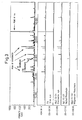
- FIG. 2 shows the X-ray diffraction chart of Example 2
- FIG. 3 shows the X-ray diffraction chart of Example 3
- FIG. 4 shows the X-ray diffraction chart of Comparative Example 1.
- the insulating film treatment agents used in Examples 1, 2, and 3 do not contain magnesium phosphate. Despite this, in the X-ray diffraction charts, the peaks of magnesium phosphate appear, so it was confirmed that crystalline magnesium phosphate was produced.
- sample pieces of a width of 7 cm and length of 30 cm were cut out. These were rinsed and lightly pickled to remove the annealing separator remaining on the surface and leave the glass film, then the sample pieces were annealed by stress-relief annealing.
- sample pieces were coated with the phosphoric acid solutions of the formulations shown in Table 3 (insulating film treatment agents) to coating amounts of 4 g/m 2 , baked, then evaluated for film properties and magnetic properties.
- Comparative Example 2 the amount of colloidal silica blended is too small, so the film tensile strength is inferior, while in Comparative Example 3, conversely the amount of colloidal silica blended is too large, so the adhesion is inferior.
- Comparative Example 4 the amount of the phosphoric acid blended is too small, so the advantageous effects of the present invention are not obtained and the corrosion resistance is inferior, while in Comparative Example 5, the amount of the phosphoric acid blended is too great, so greasiness is caused and the corrosion resistance becomes extremely poor.
- Comparative Example 6 phosphoric acid is not added and the treatment solution is too high in pH, so the advantageous effects of the present invention are not obtained and the adhesion is inferior, while in Comparative Example 7, the solids content of the treatment solution is too small, so again the advantageous effects of the present invention are not obtained and the adhesion is low.
- This steel sheet was heated by a heating rate of 400°C/sec to 850°C, then was decarburizing annealed, then was coated with an annealing separator and final annealed at 1200°C for 20 hours.
- test pieces were prepared by the same operation as in Examples 1 to 3.
- test pieces were coated by phosphate solutions of the formulations shown in Table 5 (insulating film treatment agents) to amounts of coating of 4 g/m 2 and baked, then were examined for the presence of crystalline magnesium phosphate by the same method as in Examples 1 to 3 and evaluated for film properties and magnetic properties. The results are shown in Table 6.
- Comparative Example 9 the treatment solution is too low in pH, the steel sheet is corroded, and the corrosion resistance is degraded, in Comparative Example 10, the colloidal silica is added in too great an amount, and, further, in Comparative Example 11, phosphoric acid is not added, so the advantageous effects of the present invention are not exhibited and each was inferior in adhesion.
- Cellotape® was adhered to the surface of steel sheets, the sheets were wrapped around tubes of diameters of 10 mm, 20 mm, and 30 mm, and the cellotape® was peeled off. The smallest diameter (mm) by which the film did not adhere at that time was used for the evaluation.
- 35°C 5% salt water was sprayed. After 5 hours elapsed, the surface was visually evaluated by a 10-point scoring system. 7 points or more were deemed passing.
- One side of a steel sheet was covered by masking tape, then the film was peeled off by alkaline treatment.
- the film tensile strength was calculated from the degree of bending of the steel sheet.
- insulating films containing crystalline magnesium phosphate formed using an insulating film treatment agent obtained by adding 40 to 67 parts by weight of colloidal silica and 2 to 50 parts by weight of phosphoric acid to 100 parts by weight of phosphate to obtain a total solids content of 15 to 30% are higher in tensile strength and superior in adhesion and corrosion resistance compared to the insulating films of the comparative examples and are remarkable in effect of improvement of magnetic properties.
- the present invention expands the applications for grain-oriented electrical steel sheet and has great industrial applicability.
Landscapes
- Chemical & Material Sciences (AREA)
- Engineering & Computer Science (AREA)
- Materials Engineering (AREA)
- Mechanical Engineering (AREA)
- Metallurgy (AREA)
- Organic Chemistry (AREA)
- General Chemical & Material Sciences (AREA)
- Chemical Kinetics & Catalysis (AREA)
- Physics & Mathematics (AREA)
- Crystallography & Structural Chemistry (AREA)
- Thermal Sciences (AREA)
- Manufacturing & Machinery (AREA)
- Electromagnetism (AREA)
- Power Engineering (AREA)
- Dispersion Chemistry (AREA)
- Chemical Treatment Of Metals (AREA)
- Soft Magnetic Materials (AREA)
- Manufacturing Of Steel Electrode Plates (AREA)
Claims (7)
- Kornorientiertes Elektrostahlblech mit einem Forsteritfilm auf seiner Oberfläche und einem chromfreien isolierenden Film mit hoher Zugfestigkeit auf der Oberfläche des Forsteritfilms, wobei der isolierende Film ein Phosphat und kolloidales Siliciumdioxid als Hauptbestandteile enthält und kristallines Magnesiumphosphat enthält, das gleichmäßig zwischen dem isolierenden Film und dem Forsteritfilm verteilt ist.
- Kornorientiertes Elektrostahlblech wie in Anspruch 1 beschrieben, dadurch gekennzeichnet, dass das kristalline Magnesiumphosphat eines oder beide aus monoklinem Magnesiumphosphat und orthorhombischem Magnesiumphosphat enthält und dass die Menge des isolierenden Films 2 bis 7 g/m2 beträgt.
- Kornorientiertes Elektrostahlblech wie in Anspruch 1 oder 2 beschrieben, dadurch gekennzeichnet, dass das Phosphat ein oder mehrere Phosphate von Ni, Co, Mn, Zn, Fe, Al und Ba umfasst.
- Kornorientiertes Elektrostahlblech wie in einem der Ansprüche 1 bis 3 beschrieben, dadurch gekennzeichnet, dass das Stahlblech kornorientiertes Elektrostahlblech ist, das 0,005 % oder weniger C und 2,5 bis 7,0 % Si enthält, eine durchschnittliche Kristallkorngröße von 1 bis 10 mm aufweist und eine Abweichung der Kristallorientierung, bezogen auf eine Idealorientierung von (110)[001] in der Walzrichtung, von durchschnittlich 8° oder weniger aufweist.
- Ein Verfahren zum Behandeln eines chromfreien isolierenden Films mit hoher Zugfestigkeit eines kornorientierten Elektrostahlblechs mit einem Forsteritfilm auf seiner Oberfläche, gekennzeichnet durch Beschichten, Trocknen und anschließendes Brennen auf der Oberfläche des komorientierten Elektrostahlblechs eines Behandlungsmittels, das ein Phosphat, kolloidales Siliciumdioxid und eine Phosphorsäure in einer Menge von 40 bis 67 Gewichtsteilen an kolloidalem Siliciumdioxid und 2 bis 50 Gewichtsteilen an Phosphorsäure, bezogen auf 100 Gewichtsteile an Phosphat, enthält und einen Gesamtfeststoffgehalt von 15 bis 35 % aufweist.
- Ein Verfahren zum Behandeln eines chromfreien isolierenden Films mit hoher Zugfestigkeit eines komorientierten Elektrostahlblechs wie in Anspruch 5 beschrieben, dadurch gekennzeichnet, dass das Phosphat eines oder mehrere der Phosphate von Ni, Co, Mn, Zn, Fe, Al und Ba umfasst.
- Ein Verfahren zum Behandeln eines chromfreien isolierenden Films mit hoher Zugfestigkeit eines kornorientierten Elektrostahlblechs wie in Anspruch 5 oder 6 beschrieben, dadurch gekennzeichnet, dass das Stahlblech 0,005 % oder weniger C und 2,5 bis 7,0 % Si enthält, eine durchschnittliche Kristallorientierung von 1 bis 10 mm aufweist und eine Abweichung der Kristallausrichtung, bezogen auf eine Idealorientierung von (110)[001] in der Walzrichtung, von durchschnittlich 8° oder weniger aufweist.
Priority Applications (1)
| Application Number | Priority Date | Filing Date | Title |
|---|---|---|---|
| PL07744083T PL2022874T3 (pl) | 2006-05-19 | 2007-05-18 | Teksturowana elektrotechniczna blacha stalowa mająca film izolacyjny o wysokiej wytrzymałości na rozciąganie i sposób obróbki filmu izolacyjnego |
Applications Claiming Priority (2)
| Application Number | Priority Date | Filing Date | Title |
|---|---|---|---|
| JP2006140689 | 2006-05-19 | ||
| PCT/JP2007/060649 WO2007136115A1 (ja) | 2006-05-19 | 2007-05-18 | 高張力絶縁被膜を有する方向性電磁鋼板及びその絶縁被膜処理方法 |
Publications (3)
| Publication Number | Publication Date |
|---|---|
| EP2022874A1 EP2022874A1 (de) | 2009-02-11 |
| EP2022874A4 EP2022874A4 (de) | 2011-05-04 |
| EP2022874B1 true EP2022874B1 (de) | 2012-07-25 |
Family
ID=38723425
Family Applications (1)
| Application Number | Title | Priority Date | Filing Date |
|---|---|---|---|
| EP07744083A Active EP2022874B1 (de) | 2006-05-19 | 2007-05-18 | Kornorientiertes elektrostahlblech mit isolierendem film mit hoher zugfestigkeit und verfahren zum behandeln eines derartigen isolierenden films |
Country Status (9)
| Country | Link |
|---|---|
| US (1) | US7998284B2 (de) |
| EP (1) | EP2022874B1 (de) |
| JP (1) | JP5026414B2 (de) |
| KR (1) | KR101061288B1 (de) |
| CN (1) | CN101443479B (de) |
| BR (1) | BRPI0712594B1 (de) |
| PL (1) | PL2022874T3 (de) |
| RU (1) | RU2407818C2 (de) |
| WO (1) | WO2007136115A1 (de) |
Cited By (2)
| Publication number | Priority date | Publication date | Assignee | Title |
|---|---|---|---|---|
| DE102017220721A1 (de) | 2017-11-20 | 2019-05-23 | Thyssenkrupp Ag | Optimierung des Stickstofflevels während der Haubenglühung III |
| DE102017220718A1 (de) | 2017-11-20 | 2019-05-23 | Thyssenkrupp Ag | Optimierung des Stickstofflevels während der Haubenglühung II |
Families Citing this family (44)
| Publication number | Priority date | Publication date | Assignee | Title |
|---|---|---|---|---|
| DE102008008781A1 (de) * | 2008-02-12 | 2009-08-20 | Thyssenkrupp Electrical Steel Gmbh | Verfahren zur Herstellung eines kornorientierten Elektrobands |
| JP4695722B2 (ja) | 2008-03-31 | 2011-06-08 | 新日本製鐵株式会社 | 方向性電磁鋼板及びその製造方法 |
| JP5309735B2 (ja) * | 2008-07-03 | 2013-10-09 | 新日鐵住金株式会社 | 絶縁被膜処理剤と該被膜処理剤を塗布した方向性電磁鋼板及びその絶縁被膜処理方法 |
| PL2366810T3 (pl) * | 2008-11-27 | 2019-12-31 | Nippon Steel Corporation | Blacha elektrotechniczna i sposób jej wytwarzania |
| JP5093411B2 (ja) * | 2010-07-23 | 2012-12-12 | 新日本製鐵株式会社 | 樹脂モールドされる積層鉄芯に使用される電磁鋼板及びその製造方法 |
| DE102010038038A1 (de) | 2010-10-07 | 2012-04-12 | Thyssenkrupp Electrical Steel Gmbh | Verfahren zum Erzeugen einer Isolationsbeschichtung auf einem kornorientierten Elektro-Stahlflachprodukt und mit einer solchen Isolationsbeschichtung beschichtetes Elektro-Stahlflachprodukt |
| JP5594437B2 (ja) * | 2011-09-28 | 2014-09-24 | Jfeスチール株式会社 | 方向性電磁鋼板およびその製造方法 |
| JP5447738B2 (ja) * | 2011-12-26 | 2014-03-19 | Jfeスチール株式会社 | 方向性電磁鋼板 |
| EP2799594B1 (de) * | 2011-12-28 | 2018-10-31 | JFE Steel Corporation | Gerichtetes elektromagnetisches stahlblech mit einer beschichtung und verfahren zur herstellung davon |
| DE102013208618A1 (de) * | 2013-05-10 | 2014-11-13 | Henkel Ag & Co. Kgaa | Chromfreie Beschichtung zur elektrischen Isolierung von kornorientiertem Elektroband |
| JP6156646B2 (ja) * | 2013-10-30 | 2017-07-05 | Jfeスチール株式会社 | 磁気特性および被膜密着性に優れる方向性電磁鋼板 |
| RU2556184C1 (ru) * | 2014-04-22 | 2015-07-10 | Общество с ограниченной ответственностью "Научно-технический центр "Компас" (ООО "НТЦ "Компас") | Состав для получения электроизоляционного покрытия |
| KR102177038B1 (ko) * | 2014-11-14 | 2020-11-10 | 주식회사 포스코 | 방향성 전기강판용 절연피막 조성물, 이를 이용하여 표면에 절연피막이 형성된 방향성 전기강판 및 이의 제조방법 |
| CN107109655B (zh) * | 2014-12-26 | 2022-04-08 | 日本制铁株式会社 | 电磁钢板 |
| WO2016158322A1 (ja) * | 2015-03-27 | 2016-10-06 | Jfeスチール株式会社 | 絶縁被膜付き方向性電磁鋼板およびその製造方法 |
| JP6323423B2 (ja) * | 2015-09-25 | 2018-05-16 | Jfeスチール株式会社 | 方向性電磁鋼板およびその製造方法 |
| EP3358041B1 (de) * | 2015-09-29 | 2021-03-24 | Nippon Steel Corporation | Kornorientiertes elektrostahlblech und verfahren zur herstellung des kornorientierten elektrostahlblechs |
| CN108699698B (zh) | 2016-03-03 | 2020-11-20 | 日产化学工业株式会社 | 含有苯基膦酸的二氧化硅溶胶及其用途 |
| CN109563626B (zh) * | 2016-09-13 | 2021-04-13 | 杰富意钢铁株式会社 | 带无铬绝缘张力被膜的取向性电磁钢板及其制造方法 |
| KR102243871B1 (ko) | 2016-10-18 | 2021-04-22 | 제이에프이 스틸 가부시키가이샤 | 방향성 전기 강판 및 방향성 전기 강판의 제조 방법 |
| CN109983158A (zh) * | 2016-10-31 | 2019-07-05 | 日本制铁株式会社 | 方向性电磁钢板 |
| US10968521B2 (en) | 2016-12-21 | 2021-04-06 | Jfe Steel Corporation | Grain-oriented electrical steel sheet and production method for grain-oriented electrical steel sheet |
| KR20190086531A (ko) | 2016-12-28 | 2019-07-22 | 제이에프이 스틸 가부시키가이샤 | 방향성 전기 강판, 변압기의 철심 및 변압기 그리고 변압기의 소음의 저감 방법 |
| JP6828820B2 (ja) * | 2017-07-13 | 2021-02-10 | 日本製鉄株式会社 | 方向性電磁鋼板、及び方向性電磁鋼板の製造方法 |
| RU2730823C1 (ru) * | 2017-07-13 | 2020-08-26 | Ниппон Стил Корпорейшн | Электротехнический стальной лист с ориентированной зеренной структурой |
| PL3653758T3 (pl) | 2017-07-13 | 2022-07-04 | Nippon Steel Corporation | Blacha cienka ze stali elektrotechnicznej o ziarnach zorientowanych |
| EP3653759B1 (de) | 2017-07-13 | 2024-09-25 | Nippon Steel Corporation | Kornorientiertes elektrostahlblech und verfahren zu seiner herstellung |
| EP3653753B8 (de) * | 2017-07-13 | 2024-09-25 | Nippon Steel Corporation | Kornorientiertes elektrostahlblech |
| WO2019117096A1 (ja) * | 2017-12-12 | 2019-06-20 | Jfeスチール株式会社 | 複層型電磁鋼板 |
| RU2740749C1 (ru) * | 2018-01-25 | 2021-01-20 | Ниппон Стил Корпорейшн | Лист из электротехнической стали с ориентированной зеренной структурой |
| RU2749507C1 (ru) * | 2018-02-06 | 2021-06-11 | ДжФЕ СТИЛ КОРПОРЕЙШН | Лист из электротехнической стали с фиксированным изоляционным покрытием и способ его изготовления |
| EP3778987A4 (de) * | 2018-03-28 | 2021-12-08 | Nippon Steel Corporation | Beschichtungsflüssigkeit zur bildung eines isolierenden beschichtungsfilms für kornorientierte elektromagnetische stahlbleche, verfahren zur herstellung von kornorientierten elektromagnetischen stahlblechen und kornorientierte elektromagnetische stahlbleche |
| WO2020088764A1 (de) | 2018-10-31 | 2020-05-07 | Thyssenkrupp Electrical Steel Gmbh | Verfahren zur herstellung eines kornorientierten stahlflachprodukts für elektromagnetische anwendungen, stahlflachprodukt für elektromagnetische anwendungen und transformator-kern-stapel hergestellt aus einem solchen stahlflachprodukt |
| WO2020149346A1 (ja) * | 2019-01-16 | 2020-07-23 | 日本製鉄株式会社 | 方向性電磁鋼板の製造方法 |
| RU2771036C1 (ru) * | 2019-01-16 | 2022-04-25 | Ниппон Стил Корпорейшн | Лист анизотропной электротехнической стали |
| EP3693496A1 (de) | 2019-02-06 | 2020-08-12 | Rembrandtin Lack GmbH Nfg.KG | Wässrige zusammensetzung zur beschichtung von kornorientiertem stahl |
| KR102709639B1 (ko) * | 2019-09-19 | 2024-09-26 | 닛폰세이테츠 가부시키가이샤 | 방향성 전자 강판 |
| WO2021084793A1 (ja) * | 2019-10-31 | 2021-05-06 | Jfeスチール株式会社 | 絶縁被膜付き電磁鋼板 |
| EP4026930A4 (de) * | 2019-10-31 | 2022-10-26 | JFE Steel Corporation | Elektromagnetisches stahlblech mit isolierbeschichtungsfilm |
| KR102371375B1 (ko) * | 2019-12-20 | 2022-03-04 | 주식회사 포스코 | 전기강판 절연 피막 조성물, 전기강판, 및 이의 제조 방법 |
| WO2022215714A1 (ja) * | 2021-04-06 | 2022-10-13 | 日本製鉄株式会社 | 方向性電磁鋼板及び絶縁被膜の形成方法 |
| US20240186039A1 (en) * | 2021-04-06 | 2024-06-06 | Nippon Steel Corporation | Grain-oriented electrical steel sheet and method for forming insulating coating |
| EP4321634A4 (de) * | 2021-04-06 | 2024-09-25 | Nippon Steel Corporation | Kornorientiertes elektromagnetisches stahlblech und verfahren zur herstellung eines isolierfilms |
| EP4350033A4 (de) * | 2021-05-28 | 2024-09-18 | Nippon Steel Corporation | Kornorientiertes elektromagnetisches stahlblech |
Family Cites Families (25)
| Publication number | Priority date | Publication date | Assignee | Title |
|---|---|---|---|---|
| US3720549A (en) * | 1970-09-23 | 1973-03-13 | Gen Electric | Insulating coating and method of making the same |
| BE789262A (fr) * | 1971-09-27 | 1973-01-15 | Nippon Steel Corp | Procede de formation d'un film isolant sur un feuillard d'acierau silicium oriente |
| US3996073A (en) * | 1974-10-11 | 1976-12-07 | Armco Steel Corporation | Insulative coating for electrical steels |
| US4032366A (en) * | 1975-05-23 | 1977-06-28 | Allegheny Ludlum Industries, Inc. | Grain-oriented silicon steel and processing therefor |
| JPS5328375A (en) | 1976-08-11 | 1978-03-16 | Fujitsu Ltd | Inspecting method |
| JPS54143737A (en) * | 1978-04-28 | 1979-11-09 | Kawasaki Steel Co | Formation of chromiummfree insulating top coating for directional silicon steel plate |
| JPS5934604B2 (ja) | 1980-06-19 | 1984-08-23 | 富士通株式会社 | 粉体回収装置 |
| JPS6141778A (ja) | 1984-08-02 | 1986-02-28 | Nippon Steel Corp | 張力付加性およびスベリ性の優れた方向性電磁鋼板の絶縁皮膜形成方法 |
| JPH01147074A (ja) * | 1987-12-02 | 1989-06-08 | Kawasaki Steel Corp | 歪取り焼鈍による特性劣化がない方向性けい素鋼板 |
| CN1039915C (zh) * | 1989-07-05 | 1998-09-23 | 新日本制铁株式会社 | 方向性电磁钢板上的绝缘皮膜成型方法 |
| JPH07268567A (ja) | 1994-03-31 | 1995-10-17 | Nippon Steel Corp | 極めて低い鉄損をもつ一方向性電磁鋼板 |
| JPH08239771A (ja) * | 1995-03-02 | 1996-09-17 | Nippon Steel Corp | 高張力絶縁被膜を有する方向性電磁鋼板とその絶縁被膜形成方法 |
| RU2098514C1 (ru) * | 1995-10-04 | 1997-12-10 | Акционерное общество закрытого типа "ФК" | Состав для получения электроизоляционного покрытия |
| JP3379061B2 (ja) | 1997-08-28 | 2003-02-17 | 新日本製鐵株式会社 | 高張力絶縁被膜を有する方向性電磁鋼板とその処理方法 |
| JP2000169972A (ja) * | 1998-12-04 | 2000-06-20 | Nippon Steel Corp | クロムを含まない方向性電磁鋼板用表面処理剤及びそれを用いた方向性電磁鋼板の製造方法 |
| JP2000178760A (ja) | 1998-12-08 | 2000-06-27 | Nippon Steel Corp | クロムを含まない表面処理剤及びそれを用いた方向性電磁鋼板の製造方法 |
| JP3482374B2 (ja) | 1999-09-14 | 2003-12-22 | 新日本製鐵株式会社 | 被膜特性に優れた方向性電磁鋼板およびその製造方法 |
| RU2176286C2 (ru) * | 2000-01-12 | 2001-11-27 | Закрытое акционерное общество "ФК" | Состав для получения электроизоляционного покрытия |
| JP3979004B2 (ja) * | 2000-12-11 | 2007-09-19 | Jfeスチール株式会社 | 方向性電磁鋼板の絶縁被膜形成方法 |
| US6758915B2 (en) * | 2001-04-05 | 2004-07-06 | Jfe Steel Corporation | Grain oriented electromagnetic steel sheet exhibiting extremely small watt loss and method for producing the same |
| JP4268344B2 (ja) * | 2001-04-12 | 2009-05-27 | Jfeスチール株式会社 | 加工性に優れる絶縁被膜付き電磁鋼板 |
| RU2209255C2 (ru) * | 2001-09-20 | 2003-07-27 | Закрытое акционерное общество "ФК" | Состав для получения электроизоляционного покрытия |
| JP4500005B2 (ja) * | 2003-05-20 | 2010-07-14 | 新日本製鐵株式会社 | 張力付与特性に優れた絶縁被膜を有する方向性電磁鋼板の製造方法及びその方法によって製造された方向性電磁鋼板 |
| JP2005240079A (ja) * | 2004-02-25 | 2005-09-08 | Jfe Steel Kk | 鉄損劣化率が小さい方向性電磁鋼板 |
| TWI270578B (en) * | 2004-11-10 | 2007-01-11 | Jfe Steel Corp | Grain oriented electromagnetic steel plate and method for producing the same |
-
2007
- 2007-05-18 US US12/227,205 patent/US7998284B2/en active Active
- 2007-05-18 BR BRPI0712594-1A patent/BRPI0712594B1/pt active IP Right Grant
- 2007-05-18 WO PCT/JP2007/060649 patent/WO2007136115A1/ja not_active Ceased
- 2007-05-18 EP EP07744083A patent/EP2022874B1/de active Active
- 2007-05-18 CN CN2007800177103A patent/CN101443479B/zh active Active
- 2007-05-18 PL PL07744083T patent/PL2022874T3/pl unknown
- 2007-05-18 JP JP2008516729A patent/JP5026414B2/ja active Active
- 2007-05-18 RU RU2008150392/02A patent/RU2407818C2/ru active
- 2007-05-18 KR KR1020087028089A patent/KR101061288B1/ko active Active
Cited By (2)
| Publication number | Priority date | Publication date | Assignee | Title |
|---|---|---|---|---|
| DE102017220721A1 (de) | 2017-11-20 | 2019-05-23 | Thyssenkrupp Ag | Optimierung des Stickstofflevels während der Haubenglühung III |
| DE102017220718A1 (de) | 2017-11-20 | 2019-05-23 | Thyssenkrupp Ag | Optimierung des Stickstofflevels während der Haubenglühung II |
Also Published As
| Publication number | Publication date |
|---|---|
| WO2007136115A1 (ja) | 2007-11-29 |
| BRPI0712594B1 (pt) | 2018-07-10 |
| JP5026414B2 (ja) | 2012-09-12 |
| EP2022874A4 (de) | 2011-05-04 |
| EP2022874A1 (de) | 2009-02-11 |
| BRPI0712594A2 (pt) | 2012-07-03 |
| CN101443479B (zh) | 2011-07-06 |
| RU2008150392A (ru) | 2010-06-27 |
| JPWO2007136115A1 (ja) | 2009-10-01 |
| CN101443479A (zh) | 2009-05-27 |
| KR20090009873A (ko) | 2009-01-23 |
| US20090233114A1 (en) | 2009-09-17 |
| KR101061288B1 (ko) | 2011-08-31 |
| US7998284B2 (en) | 2011-08-16 |
| RU2407818C2 (ru) | 2010-12-27 |
| PL2022874T3 (pl) | 2012-12-31 |
Similar Documents
| Publication | Publication Date | Title |
|---|---|---|
| EP2022874B1 (de) | Kornorientiertes elektrostahlblech mit isolierendem film mit hoher zugfestigkeit und verfahren zum behandeln eines derartigen isolierenden films | |
| KR102268306B1 (ko) | 방향성 전자 강판 | |
| US7850792B2 (en) | Grain-oriented electrical steel sheet having insulating film not containing chromium and insulating film agent of same | |
| KR102071515B1 (ko) | 방향성 전자 강판 및 방향성 전자 강판의 제조 방법 | |
| JP5309735B2 (ja) | 絶縁被膜処理剤と該被膜処理剤を塗布した方向性電磁鋼板及びその絶縁被膜処理方法 | |
| EP2180082A1 (de) | Behandlungsflüssigkeit zur isolierbeschichtung von kornorientiertem elektromagnetischem stahlblech und verfahren zur herstellung von kornorientiertem elektromagnetischem stahlblech mit isolierbeschichtung | |
| JP3482374B2 (ja) | 被膜特性に優れた方向性電磁鋼板およびその製造方法 | |
| JP2009052060A (ja) | 方向性電磁鋼板用絶縁被膜処理液および絶縁被膜付方向性電磁鋼板の製造方法 | |
| JP6682888B2 (ja) | 方向性電磁鋼板の絶縁被膜用処理剤、方向性電磁鋼板、及び、方向性電磁鋼板の絶縁被膜処理方法 | |
| JP5063902B2 (ja) | 方向性電磁鋼板とその絶縁被膜処理方法 | |
| CN112771203B (zh) | 无铬绝缘被膜形成用处理剂、带绝缘被膜的方向性电磁钢板及其制造方法 | |
| WO2023195517A1 (ja) | 方向性電磁鋼板及び絶縁被膜の形成方法 | |
| JP3276567B2 (ja) | 皮膜特性の優れる絶縁皮膜剤及びそれを用いた方向性電磁鋼板の製造方法 | |
| KR100544535B1 (ko) | 무그라스피막 방향성전기강판용 무크롬 절연피막제와 이를이용한 방향성 전기강판의 제조방법 | |
| EP4446464A1 (de) | Vorbehandlungsflüssigkeit und verfahren zur herstellung eines elektromagnetischen stahlblechs mit einem isolierfilm | |
| KR20250167081A (ko) | 방향성 전자 강판용 절연 피막 처리액 및 방향성 전자 강판의 제조 방법 | |
| KR20250167079A (ko) | 방향성 전자 강판용 절연 피막 처리액 및 방향성 전자 강판의 제조 방법 | |
| JP2025519892A (ja) | コーティング材料、コーティング材料から形成されたコーティングを有する方向性ケイ素鋼板およびその製造方法 | |
| KR20020018230A (ko) | 고타발성 방향성 전기강판용 내태키성 절연 코팅제 |
Legal Events
| Date | Code | Title | Description |
|---|---|---|---|
| PUAI | Public reference made under article 153(3) epc to a published international application that has entered the european phase |
Free format text: ORIGINAL CODE: 0009012 |
|
| 17P | Request for examination filed |
Effective date: 20081209 |
|
| AK | Designated contracting states |
Kind code of ref document: A1 Designated state(s): AT BE BG CH CY CZ DE DK EE ES FI FR GB GR HU IE IS IT LI LT LU LV MC MT NL PL PT RO SE SI SK TR |
|
| AX | Request for extension of the european patent |
Extension state: AL BA HR MK RS |
|
| RIN1 | Information on inventor provided before grant (corrected) |
Inventor name: YAMAZAKI, SHUICHIC/O NIPPON STEEL CORPORATION Inventor name: TAKAHASHI, FUMIAKIC/O NIPPON STEEL CORPORATION Inventor name: TAKEDA, KAZUTOSHIC/O NIPPON STEEL CORPORATION Inventor name: FUJII, HIROYASUC/O NIPPON STEEL CORPORATION Inventor name: ANDOU, FUMIKAZUC/O NIPPON STEEL CORPORATION |
|
| DAX | Request for extension of the european patent (deleted) | ||
| RBV | Designated contracting states (corrected) |
Designated state(s): DE FR GB PL |
|
| A4 | Supplementary search report drawn up and despatched |
Effective date: 20110404 |
|
| REG | Reference to a national code |
Ref country code: DE Ref legal event code: R079 Ref document number: 602007024189 Country of ref document: DE Free format text: PREVIOUS MAIN CLASS: C23C0022000000 Ipc: C23C0022740000 |
|
| GRAP | Despatch of communication of intention to grant a patent |
Free format text: ORIGINAL CODE: EPIDOSNIGR1 |
|
| RIC1 | Information provided on ipc code assigned before grant |
Ipc: H01F 1/18 20060101ALI20111123BHEP Ipc: C23C 22/18 20060101ALI20111123BHEP Ipc: C23C 22/20 20060101ALI20111123BHEP Ipc: C23C 22/74 20060101AFI20111123BHEP Ipc: C23C 22/22 20060101ALI20111123BHEP Ipc: C21D 8/12 20060101ALI20111123BHEP |
|
| GRAS | Grant fee paid |
Free format text: ORIGINAL CODE: EPIDOSNIGR3 |
|
| GRAA | (expected) grant |
Free format text: ORIGINAL CODE: 0009210 |
|
| RAP1 | Party data changed (applicant data changed or rights of an application transferred) |
Owner name: NIPPON STEEL CORPORATION |
|
| AK | Designated contracting states |
Kind code of ref document: B1 Designated state(s): DE FR GB PL |
|
| REG | Reference to a national code |
Ref country code: GB Ref legal event code: FG4D |
|
| REG | Reference to a national code |
Ref country code: DE Ref legal event code: R096 Ref document number: 602007024189 Country of ref document: DE Effective date: 20120920 |
|
| REG | Reference to a national code |
Ref country code: PL Ref legal event code: T3 |
|
| RAP2 | Party data changed (patent owner data changed or rights of a patent transferred) |
Owner name: NIPPON STEEL & SUMITOMO METAL CORPORATION |
|
| REG | Reference to a national code |
Ref country code: DE Ref legal event code: R082 Ref document number: 602007024189 Country of ref document: DE Representative=s name: VOSSIUS & PARTNER, DE Effective date: 20130227 Ref country code: DE Ref legal event code: R081 Ref document number: 602007024189 Country of ref document: DE Owner name: NIPPON STEEL & SUMITOMO METAL CORPORATION, JP Free format text: FORMER OWNER: NIPPON STEEL CORP., TOKIO/TOKYO, JP Effective date: 20130227 Ref country code: DE Ref legal event code: R082 Ref document number: 602007024189 Country of ref document: DE Representative=s name: VOSSIUS & PARTNER PATENTANWAELTE RECHTSANWAELT, DE Effective date: 20130227 |
|
| PLBE | No opposition filed within time limit |
Free format text: ORIGINAL CODE: 0009261 |
|
| STAA | Information on the status of an ep patent application or granted ep patent |
Free format text: STATUS: NO OPPOSITION FILED WITHIN TIME LIMIT |
|
| 26N | No opposition filed |
Effective date: 20130426 |
|
| REG | Reference to a national code |
Ref country code: DE Ref legal event code: R097 Ref document number: 602007024189 Country of ref document: DE Effective date: 20130426 |
|
| REG | Reference to a national code |
Ref country code: FR Ref legal event code: PLFP Year of fee payment: 10 |
|
| REG | Reference to a national code |
Ref country code: FR Ref legal event code: PLFP Year of fee payment: 11 |
|
| REG | Reference to a national code |
Ref country code: FR Ref legal event code: PLFP Year of fee payment: 12 |
|
| REG | Reference to a national code |
Ref country code: DE Ref legal event code: R082 Ref document number: 602007024189 Country of ref document: DE Representative=s name: VOSSIUS & PARTNER PATENTANWAELTE RECHTSANWAELT, DE Ref country code: DE Ref legal event code: R081 Ref document number: 602007024189 Country of ref document: DE Owner name: NIPPON STEEL CORPORATION, JP Free format text: FORMER OWNER: NIPPON STEEL & SUMITOMO METAL CORPORATION, TOKYO, JP |
|
| REG | Reference to a national code |
Ref country code: FR Ref legal event code: PLFP Year of fee payment: 17 |
|
| PGFP | Annual fee paid to national office [announced via postgrant information from national office to epo] |
Ref country code: GB Payment date: 20250327 Year of fee payment: 19 |
|
| PGFP | Annual fee paid to national office [announced via postgrant information from national office to epo] |
Ref country code: PL Payment date: 20250415 Year of fee payment: 19 Ref country code: DE Payment date: 20250402 Year of fee payment: 19 |
|
| PGFP | Annual fee paid to national office [announced via postgrant information from national office to epo] |
Ref country code: FR Payment date: 20250401 Year of fee payment: 19 |