EP2024367B1 - Tetrahydropyrrolopyrimidindione und ihre verwendung als inhibitoren der humanen neutrophilen elastase - Google Patents
Tetrahydropyrrolopyrimidindione und ihre verwendung als inhibitoren der humanen neutrophilen elastase Download PDFInfo
- Publication number
- EP2024367B1 EP2024367B1 EP07732669A EP07732669A EP2024367B1 EP 2024367 B1 EP2024367 B1 EP 2024367B1 EP 07732669 A EP07732669 A EP 07732669A EP 07732669 A EP07732669 A EP 07732669A EP 2024367 B1 EP2024367 B1 EP 2024367B1
- Authority
- EP
- European Patent Office
- Prior art keywords
- compound
- alkyl
- radical
- hydrogen
- mono
- Prior art date
- Legal status (The legal status is an assumption and is not a legal conclusion. Google has not performed a legal analysis and makes no representation as to the accuracy of the status listed.)
- Active
Links
- 0 *=C1C=CC=CC1 Chemical compound *=C1C=CC=CC1 0.000 description 34
- ARUDFVLSWFUUAS-UHFFFAOYSA-N CCCc1ccc(C(C2=C3CN(CC)C2=O)NC[N-]3(c2cc(C(F)(F)F)ccc2)=O)cc1 Chemical compound CCCc1ccc(C(C2=C3CN(CC)C2=O)NC[N-]3(c2cc(C(F)(F)F)ccc2)=O)cc1 ARUDFVLSWFUUAS-UHFFFAOYSA-N 0.000 description 1
- DUJBUNMQVFMUJI-UUWRZZSWSA-N CCN(CC(N1c2cc(C(F)(F)F)ccc2)=C2[C@@H](c(cc3)ccc3C#N)N(CCCCCN(C)CCCOc(cc3)ccc3Br)C1=O)C2=O Chemical compound CCN(CC(N1c2cc(C(F)(F)F)ccc2)=C2[C@@H](c(cc3)ccc3C#N)N(CCCCCN(C)CCCOc(cc3)ccc3Br)C1=O)C2=O DUJBUNMQVFMUJI-UUWRZZSWSA-N 0.000 description 1
- NTVANPVDYCPGMT-JOCHJYFZSA-N CCN(CC(N1c2cccc(C(F)(F)[FH+])c2)=C2[C@@H](c(cc3)ccc3C#N)N(CCCN)C1=O)C2=O Chemical compound CCN(CC(N1c2cccc(C(F)(F)[FH+])c2)=C2[C@@H](c(cc3)ccc3C#N)N(CCCN)C1=O)C2=O NTVANPVDYCPGMT-JOCHJYFZSA-N 0.000 description 1
- QIDHLCWGXHIQQY-XMMPIXPASA-N CCOC(C([C@@H](c(cc1)ccc1C#N)N1CC(OC(C)(C)C)=O)=C(C)N(c2cc(C(F)(F)F)ccc2)C1=O)=O Chemical compound CCOC(C([C@@H](c(cc1)ccc1C#N)N1CC(OC(C)(C)C)=O)=C(C)N(c2cc(C(F)(F)F)ccc2)C1=O)=O QIDHLCWGXHIQQY-XMMPIXPASA-N 0.000 description 1
- ZCPRZQFHOPUXOE-RUZDIDTESA-N CCOC(C([C@@H](c(cc1)ccc1C#N)N1CCCCCNC)=C(C)N(c2cc(C(F)(F)F)ccc2)C1=O)=O Chemical compound CCOC(C([C@@H](c(cc1)ccc1C#N)N1CCCCCNC)=C(C)N(c2cc(C(F)(F)F)ccc2)C1=O)=O ZCPRZQFHOPUXOE-RUZDIDTESA-N 0.000 description 1
- STJZMVIHXIXAKZ-UHFFFAOYSA-O CNc1ccc(C(C(C(N(CCCC[NH+](C)CCCOc2ccccc2)C2)=O)=C2N2c3cccc(C(F)(F)F)c3)NC2=O)cc1 Chemical compound CNc1ccc(C(C(C(N(CCCC[NH+](C)CCCOc2ccccc2)C2)=O)=C2N2c3cccc(C(F)(F)F)c3)NC2=O)cc1 STJZMVIHXIXAKZ-UHFFFAOYSA-O 0.000 description 1
- YAFPXPWKTPGCPO-GYOJGHLZSA-N CNc1ccc([C@H](C(C(N(CCCN(C)CCCN(CC(N2c3cc(C(F)(F)F)ccc3)=C3[C@@H](c(cc4)ccc4C#N)NC2=O)C3=O)C2)=O)=C2N2c3cc(C(F)(F)F)ccc3)NC2=O)cc1 Chemical compound CNc1ccc([C@H](C(C(N(CCCN(C)CCCN(CC(N2c3cc(C(F)(F)F)ccc3)=C3[C@@H](c(cc4)ccc4C#N)NC2=O)C3=O)C2)=O)=C2N2c3cc(C(F)(F)F)ccc3)NC2=O)cc1 YAFPXPWKTPGCPO-GYOJGHLZSA-N 0.000 description 1
- YVAWBCQPFVNLFX-RRHRGVEJSA-N C[N](CCCCN(CC(N1c2cc(C(F)(F)F)ccc2)=C2[C@@H](c(cc3)ccc3C#N)NC1=O)C2=O)(CCCOc1ccccc1)CCCOc1ccccc1 Chemical compound C[N](CCCCN(CC(N1c2cc(C(F)(F)F)ccc2)=C2[C@@H](c(cc3)ccc3C#N)NC1=O)C2=O)(CCCOc1ccccc1)CCCOc1ccccc1 YVAWBCQPFVNLFX-RRHRGVEJSA-N 0.000 description 1
Classifications
-
- C—CHEMISTRY; METALLURGY
- C07—ORGANIC CHEMISTRY
- C07D—HETEROCYCLIC COMPOUNDS
- C07D487/00—Heterocyclic compounds containing nitrogen atoms as the only ring hetero atoms in the condensed system, not provided for by groups C07D451/00 - C07D477/00
- C07D487/02—Heterocyclic compounds containing nitrogen atoms as the only ring hetero atoms in the condensed system, not provided for by groups C07D451/00 - C07D477/00 in which the condensed system contains two hetero rings
- C07D487/04—Ortho-condensed systems
-
- A—HUMAN NECESSITIES
- A61—MEDICAL OR VETERINARY SCIENCE; HYGIENE
- A61K—PREPARATIONS FOR MEDICAL, DENTAL OR TOILETRY PURPOSES
- A61K47/00—Medicinal preparations characterised by the non-active ingredients used, e.g. carriers or inert additives; Targeting or modifying agents chemically bound to the active ingredient
- A61K47/50—Medicinal preparations characterised by the non-active ingredients used, e.g. carriers or inert additives; Targeting or modifying agents chemically bound to the active ingredient the non-active ingredient being chemically bound to the active ingredient, e.g. polymer-drug conjugates
- A61K47/51—Medicinal preparations characterised by the non-active ingredients used, e.g. carriers or inert additives; Targeting or modifying agents chemically bound to the active ingredient the non-active ingredient being chemically bound to the active ingredient, e.g. polymer-drug conjugates the non-active ingredient being a modifying agent
- A61K47/54—Medicinal preparations characterised by the non-active ingredients used, e.g. carriers or inert additives; Targeting or modifying agents chemically bound to the active ingredient the non-active ingredient being chemically bound to the active ingredient, e.g. polymer-drug conjugates the non-active ingredient being a modifying agent the modifying agent being an organic compound
- A61K47/55—Medicinal preparations characterised by the non-active ingredients used, e.g. carriers or inert additives; Targeting or modifying agents chemically bound to the active ingredient the non-active ingredient being chemically bound to the active ingredient, e.g. polymer-drug conjugates the non-active ingredient being a modifying agent the modifying agent being an organic compound the modifying agent being also a pharmacologically or therapeutically active agent, i.e. the entire conjugate being a codrug
-
- A—HUMAN NECESSITIES
- A61—MEDICAL OR VETERINARY SCIENCE; HYGIENE
- A61P—SPECIFIC THERAPEUTIC ACTIVITY OF CHEMICAL COMPOUNDS OR MEDICINAL PREPARATIONS
- A61P1/00—Drugs for disorders of the alimentary tract or the digestive system
-
- A—HUMAN NECESSITIES
- A61—MEDICAL OR VETERINARY SCIENCE; HYGIENE
- A61P—SPECIFIC THERAPEUTIC ACTIVITY OF CHEMICAL COMPOUNDS OR MEDICINAL PREPARATIONS
- A61P1/00—Drugs for disorders of the alimentary tract or the digestive system
- A61P1/04—Drugs for disorders of the alimentary tract or the digestive system for ulcers, gastritis or reflux esophagitis, e.g. antacids, inhibitors of acid secretion, mucosal protectants
-
- A—HUMAN NECESSITIES
- A61—MEDICAL OR VETERINARY SCIENCE; HYGIENE
- A61P—SPECIFIC THERAPEUTIC ACTIVITY OF CHEMICAL COMPOUNDS OR MEDICINAL PREPARATIONS
- A61P11/00—Drugs for disorders of the respiratory system
-
- A—HUMAN NECESSITIES
- A61—MEDICAL OR VETERINARY SCIENCE; HYGIENE
- A61P—SPECIFIC THERAPEUTIC ACTIVITY OF CHEMICAL COMPOUNDS OR MEDICINAL PREPARATIONS
- A61P11/00—Drugs for disorders of the respiratory system
- A61P11/02—Nasal agents, e.g. decongestants
-
- A—HUMAN NECESSITIES
- A61—MEDICAL OR VETERINARY SCIENCE; HYGIENE
- A61P—SPECIFIC THERAPEUTIC ACTIVITY OF CHEMICAL COMPOUNDS OR MEDICINAL PREPARATIONS
- A61P11/00—Drugs for disorders of the respiratory system
- A61P11/06—Antiasthmatics
-
- A—HUMAN NECESSITIES
- A61—MEDICAL OR VETERINARY SCIENCE; HYGIENE
- A61P—SPECIFIC THERAPEUTIC ACTIVITY OF CHEMICAL COMPOUNDS OR MEDICINAL PREPARATIONS
- A61P11/00—Drugs for disorders of the respiratory system
- A61P11/08—Bronchodilators
-
- A—HUMAN NECESSITIES
- A61—MEDICAL OR VETERINARY SCIENCE; HYGIENE
- A61P—SPECIFIC THERAPEUTIC ACTIVITY OF CHEMICAL COMPOUNDS OR MEDICINAL PREPARATIONS
- A61P17/00—Drugs for dermatological disorders
- A61P17/06—Antipsoriatics
-
- A—HUMAN NECESSITIES
- A61—MEDICAL OR VETERINARY SCIENCE; HYGIENE
- A61P—SPECIFIC THERAPEUTIC ACTIVITY OF CHEMICAL COMPOUNDS OR MEDICINAL PREPARATIONS
- A61P35/00—Antineoplastic agents
-
- A—HUMAN NECESSITIES
- A61—MEDICAL OR VETERINARY SCIENCE; HYGIENE
- A61P—SPECIFIC THERAPEUTIC ACTIVITY OF CHEMICAL COMPOUNDS OR MEDICINAL PREPARATIONS
- A61P37/00—Drugs for immunological or allergic disorders
- A61P37/08—Antiallergic agents
-
- A—HUMAN NECESSITIES
- A61—MEDICAL OR VETERINARY SCIENCE; HYGIENE
- A61P—SPECIFIC THERAPEUTIC ACTIVITY OF CHEMICAL COMPOUNDS OR MEDICINAL PREPARATIONS
- A61P43/00—Drugs for specific purposes, not provided for in groups A61P1/00-A61P41/00
-
- C—CHEMISTRY; METALLURGY
- C07—ORGANIC CHEMISTRY
- C07D—HETEROCYCLIC COMPOUNDS
- C07D519/00—Heterocyclic compounds containing more than one system of two or more relevant hetero rings condensed among themselves or condensed with a common carbocyclic ring system not provided for in groups C07D453/00 or C07D455/00
Definitions
- This invention relates to heterocyclic compounds which are substituted 3,4,6,7-tetrahydro-1H-pyrrolo[3,4-d]pyrimidine-2,5-diones, and their use in therapy.
- HNE Human neutrophil elastase
- HNE has been implicated in the upregulation of IL-8 gene expression and also induces IL-8 release from the epithelial cells of the lung.
- both small molecule inhibitors and protein inhibitors of HNE inhibit the inflammatory response and the development of emphysema ( Wright, J. L. et al. Am. J. Respir. Crit. Care Med. 2002, 166, 954-960 ; Churg, A. et al. Am. J. Respir. Crit. Care Med. 2003, 168, 199-207 ).
- HNE may play a role both in matrix destruction and in amplifying inflammatory responses in chronic respiratory diseases where neutrophil influx is a characteristic feature.
- HNE is believed to play a role in several pulmonary diseases, including chronic obstructive pulmonary disease (COPD), cystic fibrosis (CF), acute respiratory distress syndrome (ARDS), pulmonary emphysema, pneumonia and lung fibrosis. It is also implicated in several cardiovascular diseases in which tissue remodelling is involved, for example, in heart failure and the generation of ischaemic tissue injury following acute myocardial infarction.
- COPD chronic bronchitis
- emphysema emphysema
- small-airway disease emphysema
- BAL bronchoalveolar leakage
- the major pathogenic determinant in COPD has long been considered to be the protease-anti-protease balance (also known as the 'elastase:anti-elastase hypothesis'), in which an imbalance of HNE and endogenous antiproteases such as ⁇ 1-antitrypsin ( ⁇ 1 -AT), Secretory leukocyte protease inhibitor (SLPI) and pre-elafin leads to the various inflammatory disorders of COPD.
- ⁇ 1-antitrypsin ⁇ 1-antitrypsin
- SLPI Secretory leukocyte protease inhibitor
- pre-elafin leads to the various inflammatory disorders of COPD.
- Individuals that have a genetic deficiency of the protease inhibitor ⁇ 1-antitrypsin develop emphysema that increases in severity over time ( Laurrell, C. B.; Erikkson, S Scand. J. Clin. Invest. 1963 15, 132-140 ).
- Multimeric ligands consist of multiple binding domains which are tethered together through a suitable scaffold. Hence individual binding domains are linked together into a single molecule, increasing the probability that the multimer will bind sequentially in a step-wise manner with multiple active sites resulting in high-affinity interactions (Handl, H. L. et al. Expert Opin. Ther. Targets 2004, 8 , 565-586; Han, Y. F. et al., Bioorg. Med. Chem. Letts. 1999, 7 , 2569-2575). Also, multiple binding interactions (either sequential or parallel) with relatively high off-rates can combine to yield an overall low off-rate for the multimeric ligand.
- a molecule consisting of a suitable linker and ligands may be expected to show advantage over the monomeric ligands alone in terms of potency and/or duration of action.
- Multimeric compounds are unlikely to be orally bioavailable (as predicted by Lipinski's "Rule of 5") which may be advantageous where an inhaled route of administration to the lungs is targeted, since even after inhaled administration, a large proportion of drug is likely to enter the GI tract.
- Such compounds may be expected to show reduced systemic exposure after inhalation administration and hence an improved toxicity profile over orally administered therapies.
- This invention provides novel compounds which are inhibitors of HNE, and are useful in the treatment of diseases or conditions in which HNE activity plays a part.
- the compounds of the invention may be used as monomers or, particularly in the case of topical pulmonary application by inhalation, in the form of multimers, such as dimers, covalently linked via a linker framework.
- the invention provides a compound of formula (I),: wherein
- the invention also includes a multimeric compound comprising two, three or four molecules of a compound of formula (I) above, covalently linked through a linker framework.
- Compounds of the invention may be useful in the treatment or prevention of diseases in which HNE is implicated, for example chronic obstructive pulmonary disease (COPD), chronic bronchitis, lung fibrosis, pneumonia, acute respiratory distress syndrome (ARDS), pulmonary emphysema, smoking-induced emphysema and cystic fibrosis.
- COPD chronic obstructive pulmonary disease
- ARDS acute respiratory distress syndrome
- pulmonary emphysema smoking-induced emphysema
- cystic fibrosis for example chronic obstructive pulmonary disease (COPD), chronic bronchitis, lung fibrosis, pneumonia, acute respiratory distress syndrome (ARDS), pulmonary emphysema, smoking-induced emphysema and cystic fibrosis.
- compositions comprising a compound of the invention and a pharmaceutically acceptable carrier or excipient; and (ii) the use of a compound of the invention for the manufacture of a medicament for the treatment or prevention of a disease or condition in which HNE is implicated.
- (C a -C b )alkyl wherein a and b are integers refers to a straight or branched chain alkyl radical having from a to b carbon atoms.
- a 1 and b is 6, for example, the term includes methyl, ethyl, n-propyl, isopropyl, n-butyl, isobutyl, sec-butyl, t-butyl, n-pentyl and n-hexyl.
- (C a -C b )alkenyl wherein a and b are integers refers to a straight or branched chain alkenyl moiety having from a to b carbon atoms having at least one double bond of either E or Z stereochemistry where applicable.
- a is 2 and b is 6, for example, the term includes, for example, vinyl, allyl, 1- and 2-butenyl and 2-methyl-2-propenyl.
- C a -C b alkynyl wherein a and b are integers refers to straight chain or branched chain hydrocarbon groups having from a to b carbon atoms and having in addition one triple bond.
- a 1 and b is 6, for example, the term includes for example, ethynyl (-C ⁇ CH), 1-propynyl, 1- and 2-butynyl, 2-methyl-2-propynyl, 2-pentynyl, 3-pentynyl, 4-pentynyl, 2-hexynyl, 3-hexynyl, 4-hexynyl and 5-hexynyl.
- divalent (C a -C b )alkylene radical wherein a and b are integers refers to a saturated hydrocarbon chain having from a to b carbon atoms and two unsatisfied valences.
- divalent (C a -C b )alkenylene radical wherein a and b are integers refers to a divalent hydrocarbon chain having from 2 to 6 carbon atoms, and at least one double bond.
- Carbocyclic refers to a mono-, bi- or tricyclic radical having up to 16 ring atoms, all of which are carbon, and includes aryl and cycloalkyl.
- cycloalkyl refers to a monocyclic saturated carbocyclic radical having from 3-8 carbon atoms and includes, for example, cyclopropyl, cyclobutyl, cyclopentyl, cyclohexyl, cycloheptyl and cyclooctyl.
- aryl refers to a mono-, bi- or tri-cyclic carbocyclic aromatic radical, and includes radicals having two monocyclic carbocyclic aromatic rings which are directly linked by a covalent bond.
- Illustrative of such radicals are phenyl, biphenyl and napthyl.
- heteroaryl refers to a mono-, bi- or tri-cyclic aromatic radical containing one or more heteroatoms selected from S, N and O, and includes radicals having two such monocyclic rings, or one such monocyclic ring and one monocyclic aryl ring, which are directly linked by a covalent bond.
- Illustrative of such radicals are thienyl, benzthienyl, furyl, benzfuryl, pyrrolyl, imidazolyl, benzimidazolyl, thiazolyl, benzthiazolyl, isothiazolyl, benzisothiazolyl, pyrazolyl, oxazolyl, benzoxazolyl, isoxazolyl, benzisoxazolyl, isothiazolyl, triazolyl, benztriazolyl, thiadiazolyl, oxadiazolyl, pyridinyl, pyridazinyl, pyrimidinyl, pyrazinyl, triazinyl, indolyl and indazolyl.
- heterocyclyl or “heterocyclic” or “heterocycloalkyl” includes “heteroaryl” as defined above, and in its non-aromatic meaning relates to a mono-, bi- or tri-cyclic non-aromatic radical containing one or more heteroatoms selected from S, N and O, and to groups consisting of a monocyclic non-aromatic radical containing one or more such heteroatoms which is covalently linked to another such radical or to a monocyclic carbocyclic radical.
- radicals are pyrrolyl, furanyl, thienyl, piperidinyl, imidazolyl, oxazolyl, isoxazolyl, thiazolyl, thiadiazolyl, pyrazolyl, pyridinyl, pyrrolidinyl, pyrimidinyl, morpholinyl, piperazinyl, indolyl, morpholinyl, benzfuranyl, pyranyl, isoxazolyl, benzimidazolyl, methylenedioxyphenyl, ethylenedioxyphenyl, maleimido and succinimido groups.
- substituted as applied to any moiety herein means substituted with up to four compatible substituents, each of which independently may be, for examples, (C 1 -C 6 )alkyl, cycloalkyl, (C 1 -C 6 )alkoxy, hydroxy, hydroxy(C 1 -C 6 )alkyl, mercapto, mercapto(C 1 -C 6 )alkyl, (C 1 -C 6 )alkylthio, phenyl, monocyclic heteroaryl having 5 or 6 ring atoms, halo (including fluoro, bromo and chloro), trifluoromethyl, trifluoromethoxy, nitro, nitrile (-CN), oxo, -COOH, -COOR A , -COR A , -SO 2 R A , -CONH 2 ; -SO 2 NH 2 , -CONHR A ,
- salt includes base addition, acid addition and quaternary salts.
- Compounds of the invention which are acidic can form salts, including pharmaceutically acceptable salts, with bases such as alkali metal hydroxides, e.g. sodium and potassium hydroxides; alkaline earth metal hydroxides e.g. calcium, barium and magnesium hydroxides; with organic bases e.g. N-methyl-D-glucamine, choline tris(hydroxymethyl)amino-methane, L-arginine, L-lysine, N-ethyl piperidine, dibenzylamine and the like.
- bases such as alkali metal hydroxides, e.g. sodium and potassium hydroxides; alkaline earth metal hydroxides e.g. calcium, barium and magnesium hydroxides; with organic bases e.g. N-methyl-D-glucamine, choline tris(hydroxymethyl)amino-methane, L-arginine, L-lysine, N-ethyl pipe
- hydrohalic acids such as hydrochloric or hydrobromic acids, sulphuric acid, nitric acid or phosphoric acid and the like
- organic acids e.g. with acetic, tartaric, succinic, fumaric, maleic, malic, salicylic, citric, methanesulphonic, p-toluenesulphonic, benzoic, benzenesunfonic, glutamic, lactic, and mandelic acids and the like.
- Those compounds (I) which have a basic nitrogen can also form quaternary ammonium salts with a pharmaceutically acceptable counter-ion such as chloride, bromide acaetate, formate, p-toluenesulfonate, succinate, hemi-succinate, naphthalene-bis sulfonate, methanesulfonate, xinafoate, and the like.
- a pharmaceutically acceptable counter-ion such as chloride, bromide acaetate, formate, p-toluenesulfonate, succinate, hemi-succinate, naphthalene-bis sulfonate, methanesulfonate, xinafoate, and the like.
- the atom D may be O or S, but O is currently preferred.
- the ring A is aryl or heteroaryl and may be any of those rings listed above as examples of aryl or heteroaryl, especially phenyl and monocyclic heteroaryl having 5 or 6 ring atoms. Specific examples include pyridyl, such as 2- and 3-pyridyl, or pyrimidinyl such as pyrimidin-2-yl, but presently it is preferred that A be phenyl.
- R 1 and R 2 may be selected from any of the substituent types for which they are defined in relation to formula (I), including hydrogen, halogen, nitro, cyano, C 1 -C 3 -alkyl, C 2 -C 3 -alkenyl, C 2 -C 3 -alkynyl, hydroxy or C 1 -C 3 -alkoxy or C 2 -C 3 -alkenyloxy.
- substitutuents include hydrogen, fluoro, chloro, bromo, cyano, methyl, methoxy and -C ⁇ CH.
- -AR 1 R 2 may be 4-cyanophenyl or 4-ethynylphenyl.
- R 3 and R 5 too may be selected from any of the substituent types for which they are defined in relation to formula (I), but in one currently preferred type of compound of the invention R 5 is hydrogen and R 3 is 3-trifluoromethyl, 3-chloro or 3-bromo.
- R and R 4 may vary widely; and are defined in relation to formula (I) as a radical of formula -[X] m -[Alk 1 ] p -[Q] n -[Alk 2 ] q -[X 1 ] k -Z. According to that definition, k, m, n, p and q may all be 0, and Z may be hydrogen, so that R or R 4 itself may be hydrogen. However, many other classes of R or R 4 substituent are encompassed by selecting different combinations of values for the variables.
- R or R 4 may be selected from C 1 -C 6 -alkyl, formyl, aminocarbonyl, mono- or di-C 1 -C 4 -alkylaminocarbonyl, C 3 -C 8 -cycloalkylcarbonyl, C 1 -C 6 -alkylcarbonyl, C 1 -C 6 -alkoxycarbonyl, N-(C 1 -C 4 -alkylsulfonyl)-aminocarbonyl, N-(C 1 -C 4 -alkylsulfonyl)-N-(C 1 -C 4 -alkyl)-aminocarbonyl, heteroaryl, heterocycloalkyl, heteroarylcarbonyl or heterocycloalkylcarbonyl; wherein C 1 -C 6 -alkyl, mono- and di-C 1 -C 4 -alkylaminocarbonyl, C 1 -C 6 -alkylcarbonyl, C 1
- R 4 and/or R is radical of formula -[X] m -[Alk 1 ] p -[Q] n -[Alk 2 ] q -[X 1 ] k -Z wherein m is 0, and k, p, n and q are each 1, Q is -N(R A ) or -N + (R A )(R B )-, and R A , R B Alk 1 , Alk 2 , X 1 and Z are as defined in relation to formula (I).
- X 1 may be, for example, -O-
- Z may be, for example optionally substituted phenyl or monocyclic hetroaryl, the latter having 5 or 6 ring atoms.
- one of R and R 4 may be hydrogen, while the other is a substitutent other than hydrogen
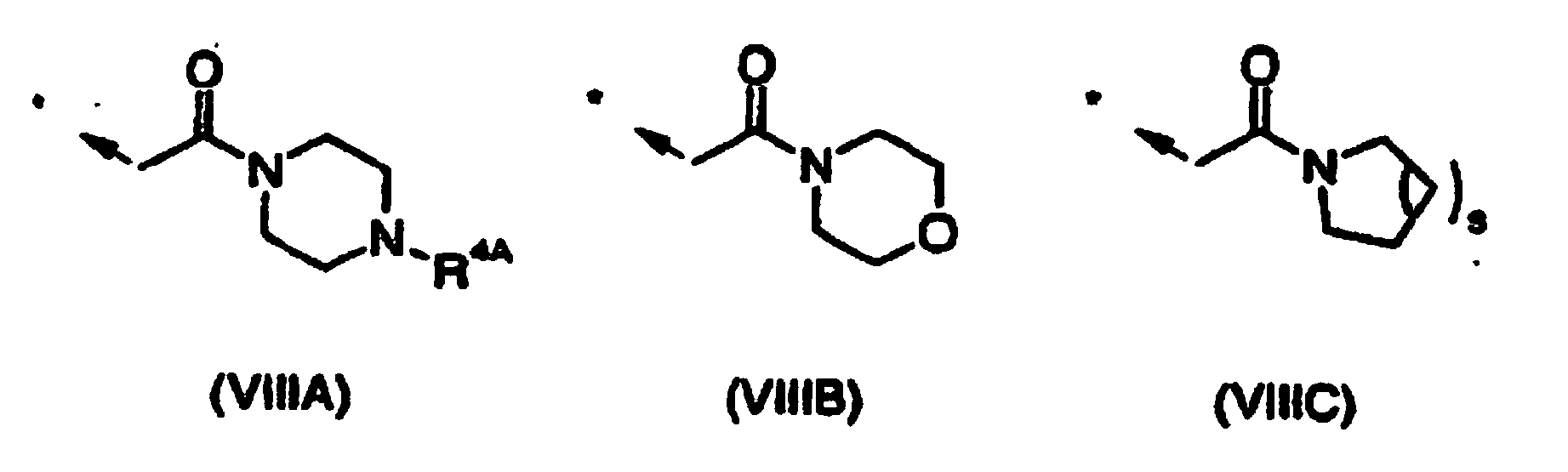
- R and R 4 groups have Formula (VIIIA), (VIIIB) or (VIIIC): wherein R 4A is hydrogen or C 1 -C 6 -alkyl, and s is 1 or 2.
- R and R 4 groups have Formula (IX) wherein
- R and R 4 groups are those selected from the following: wherein
- two, three orfour molecules of a monomeric compound of the invention are covalently linked through a linker framework. Since the linker framework need not play an active role in interacting with the HNE enzyme, its role is simply to allow binding contact between one or more of the monomeric elements and the enzyme. Hence a vast range of chemistries may be envisaged for the linker framework. Furthermore, the point of attachment of the monomeric elements to the linker framework may be selected according to the particular linker chemistry to be employed. Presently it is preferred that two, three or four of the monomeric molecules are linked to the linker framework via their respective nitrogen atoms shown in formula (I) as linked to R or R 4 .
- the said radical may be selected from, for example, the following:
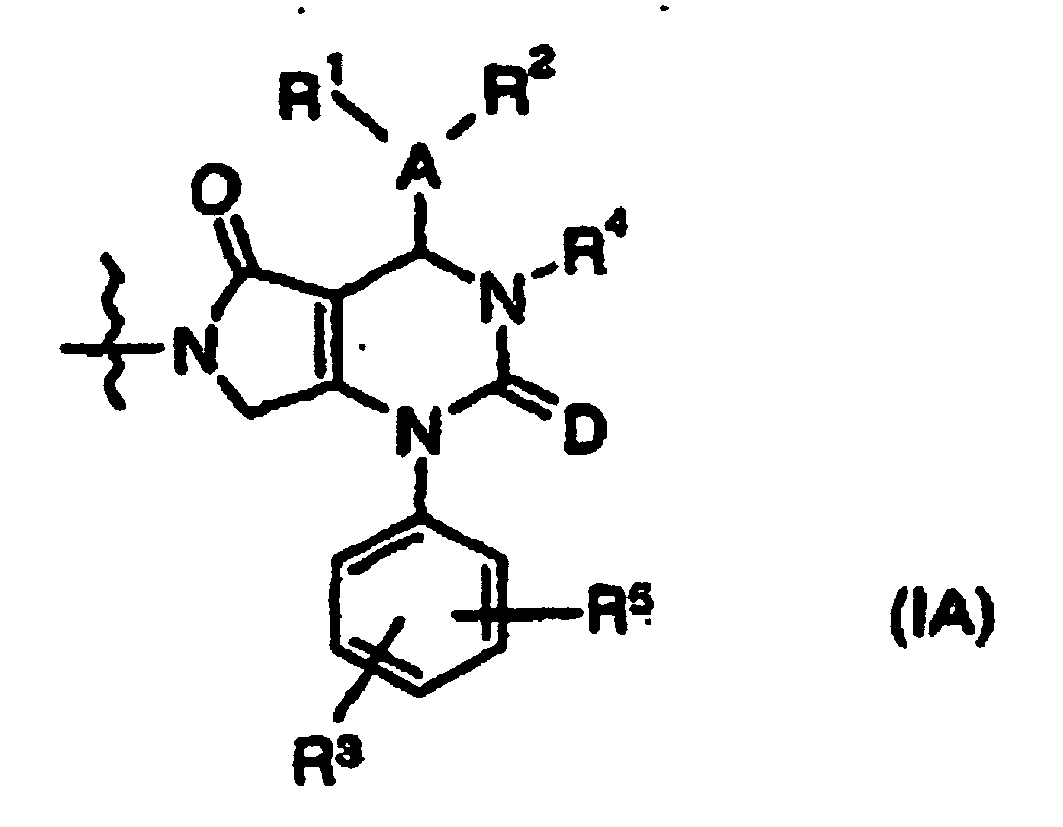
- one preferred subset of the multimers of the invention has the formula M-L-M 1 wherein L is a divalent linker radical, for example of the kinds discussed above as linker frameworks, and M and M 1 are each independently a radical of formula (IA) wherein D, A and R 1 -R 5 are as defined and discussed above:
- M and M 1 are the same.
- M-L-M 1 Another preferred subset of the multimers of the invention has the formula M-L-M 1 wherein L is a divalent linker radical for example of the kinds discussed above as linker frameworks, and M and M 1 , are each independently a radical of formula (IB) wherein D, A and R, R 1 , R 2 , R 3 and R 5 are as defined and discussed above:
- M and M 1 are the same.
- dimeric compounds of formula (IA) and (IB) include those of the Examples herein.
- the therapeutic utility of the present compounds is pertinent to any disease that is known to be at least partially mediated by the action of human neutrophil elastase.
- the present compounds may be beneficial in the treatment of chronic obstructive pulmonary disease (COPD), cystic fibrosis (CF), acute respiratory distress syndrome (ARDS), pulmonary emphysema, pneumonia and lung fibrosis.
- COPD chronic obstructive pulmonary disease
- CF cystic fibrosis
- ARDS acute respiratory distress syndrome
- pulmonary emphysema pulmonary emphysema
- pneumonia and lung fibrosis lung fibrosis.
- the present invention is also concerned with pharmaceutical formulations comprising, as an active ingredient, a compound of the invention.
- Other compounds may be combined with compounds of this invention for the prevention and treatment of inflammatory diseases of the lung.
- the present invention is also concerned with pharmaceutical compositions for preventing and treating inflammatory diseases of the lung comprising a therapeutically effective amount of a compound of the invention and one or more other therapeutic agents.
- Suitable therapeutic agents for a combination therapy with compounds of the invention include: (1) a corticosteroid, for example fluticasone or budesonide; (2) a ⁇ 2-adrenoreceptor agonist, for example salmeterol or formeterol; (3) a leukotriene modulator, for example montelukast or pranlukast; (4) anticholinergic agents, for example selective muscarinic-3 (M3) receptor antagonists such as tiotropium bromide; (5) phosphodiesterase-IV (PDE-IV) inhibitors, for example roflumilast or cilomilast; (6) an antitussive agent, such as codeine or dextramorphan; and (7) a non-steroidal anti-inflammatory agent (NSAID), for example ibuprofen or ketoprofen.
- a corticosteroid for example fluticasone or budesonide
- a ⁇ 2-adrenoreceptor agonist for example salmeter
- the weight ratio of the first and second active ingredients may be varied and will depend upon the effective dose of each ingredient. Generally, an effective dose of each will be used.
- prophylactic or therapeutic dose of a compound of the invention will, of course, vary with the nature of the severity of the condition to be treated and with the particular compound and its route of administration, and will generally be determined by clinical trial as required in the pharmaceutical art. It will also vary according to the age, weight and response of the individual patient. In general, the daily dose range will lie within the range of from about 0.001 mg to about 100 mg per kg body weight of a mammal, preferably 0.01 mg to about 50 mg per kg, and most preferably 0.1 to 10 mg per kg, in single or divided doses. On the other hand, it may be necessary to use dosages outside these limits in some cases.
- compositions which comprise a compound of the invention and a pharmaceutically acceptable carrier.
- composition is intended to encompass a product comprising the active ingredient(s), and the inert ingredient(s) (pharmaceutically acceptable excipients) that make up the carrier, as well as any product which results, directly or indirectly, from combination, complexation or aggregation of any two or more of the ingredients, or from dissociation of one or more of the ingredients, or from other types of reactions or interactions of one or more of the ingredients.
- the pharmaceutical compositions of the present invention encompass any composition made by admixing a compound of the invention, additional active ingredient(s), and pharmaceutically acceptable excipients.
- compositions of the present invention comprise a compound of the invention as an active ingredient or a pharmaceutically acceptable salt thereof, and may also contain a pharmaceutically acceptable carrier and optionally other therapeutic ingredients.
- pharmaceutically acceptable salts refers to salts prepared from pharmaceutically acceptable non-toxic bases or acids including inorganic bases or acids and organic bases or acids.
- any suitable route of administration may be employed for providing a mammal, especially a human, with an effective dosage of a compound of the present invention.
- the active compound may be administered by any convenient, suitable or effective route.
- Suitable routes of administration are know to those skilled in the art, and include oral, intravenous, rectal, parenteral, topical, ocular, nasal, buccal and pulmonary. Delivery by inhalation is preferred.
- compositions suitable for administration by inhalation are known, and may include carriers and/or diluents that are known for use in such compositions.
- the composition may contain 0.01-99% by weight of active compound.
- a unit dose comprises the active compound in an amount of 1 ⁇ g to 10 mg.
- the most suitable dosage level may be determined by any suitable method known to one skilled in the art. It will be understood, however, that the specific amount for any particular patient will depend upon a variety of factors, including the activity of the specific compound that is used, the age, body weight, diet, general health and sex of the patient, time of administration, the route of administration, the rate of excretion, the use of any other drugs, and the severity of the disease undergoing treatment.
- the active compound is preferably in the form of microparticles. They may be prepared by a variety of techniques, including spray-drying, freeze-drying and micronisation.
- a composition of the invention may be prepared as a suspension for delivery from a nebuliser or as an aerosol in a liquid propellant, for example for use in a pressurised metered dose inhaler (PMDI).
- PMDI pressurised metered dose inhaler
- Propellants suitable for use in a PMDI are known to the skilled person, and include CFC-12, HFA-134a, HFA-227, HCFC-22 (CCI2F2) and HFA-152 (CH4F2 and isobutane).
- a composition of the invention is in dry powder form, for delivery using a dry powder inhaler (DPI).
- DPI dry powder inhaler
- Microparticles for delivery by administration may be formulated with excipients that aid delivery and release.
- microparticles may be formulated with large carrier particles that aid flow from the DPI into the lung.
- Suitable carrier particles are known, and include lactose particles; they may have a mass median aerodynamic diameter of greater than 90 ⁇ m.
- a preferred composition is: Compound of the invention 24 mg / canister Lecithin, NF Liq. Conc, 1.2 mg / canister Trichlorofluoromethane, NF 4.025 g / canister Dichlorodifluoromethane, NF 12.15 g / canister.
- Compounds of the invention may be used in combination with other drugs that are used in the treatment/prevention/suppression or amelioration of the diseases or conditions for which present compounds are useful. Such other drugs may be administered, by a route and in an amount commonly used therefore, contemporaneously or sequentially with a compound of the invention.
- a pharmaceutical composition containing such other drugs in addition to the compound of the invention is preferred.
- the pharmaceutical compositions of the present invention include those that also contain one or more other active ingredients, in addition to a compound of the invention.
- Aerosol generation can be carried out using, for example, pressure-driven jet atomizers or ultrasonic atomizers, preferably using propellant-driven metered aerosols or propellant-free administration of micronized active compounds from, for example, inhalation capsules or other "dry powder" delivery systems.
- the active compounds may be dosed as described depending on the inhaler system used.
- the administration forms may additionally contain excipients, such as, for example, propellants (e.g. Frigen in the case of metered aerosols), surface-active substances, emulsifiers, stabilizers, preservatives, flavorings, fillers (e.g. lactose in the case of powder inhalers) or, if appropriate, further active compounds.
- the compounds of the present invention can be prepared according to the procedures of the following schemes and examples, using appropriate materials, and are further exemplified by the following specific examples. Moreover, by utilising the procedures described with the disclosure contained herein, one of ordinary skill in the art can readily prepare additional compounds of the present invention claimed herein. The compounds illustrated in the examples are not, however, to be construed as forming the only genus that is considered as the invention. The examples further illustrate details for the preparation of the compounds of the present invention. Those skilled in the art will readily understand that known variations of the conditions and processes of the following preparative procedures can be used to prepare these compounds.
- the compounds of the invention may be isolated in the form of their pharmaceutically acceptable salts, such as those described previously herein above.
- the free acid or base form corresponding to isolated salts can be generated by neutralisation with a suitable base or acid such as sodium hydroxide, potassium carbonate, acetic acid and hydrochloric acid and extraction of the liberated free acid or base into an organic solvent followed by evaporation.
- a suitable base or acid such as sodium hydroxide, potassium carbonate, acetic acid and hydrochloric acid
- the free form isolated in this manner can be further converted into another pharmaceutically acceptable salt by dissolution in an organic solvent followed by addition of the appropriate acid or base and subsequent evaporation, precipitation, or crystallisation.
- 'Isolute SPE Si cartridge' refers to a pre-packed polypropylene column containing unbonded activated silica with irregular particles with average size of 50 ⁇ m and nominal 60 ⁇ porosity.
- 'Isolute SCX-2 cartridge' refers to a pre-packed polypropylene column containing a non end-capped propylsulphonic acid functionalised silica strong cation exchange sorbent.
- 'Isolute Al-N cartridge' refers to a pre-packed polypropylene column containing neutral alumina with average particle size 50-200 ⁇ m and 120 ⁇ pore diameter.
- Micromass Platform LCT with a C18-reverse-phase column (100 ⁇ 3.0 mm Higgins Clipeus with 5 ⁇ m particle size), elution with A: water + 0.1 % formic acid; B: acetonitrile + 0.1 % formic acid.
- MS ionisation method Electrospray (positive ion)
- Example 23 A solution of Example 23 (130 mg, 0.117 mmol) in triethylamine (0.5 ml) and DMF (0.5 ml) was degassed before (trimethylsilyl)acetylene (34 ⁇ l, 0.235 mmol), copper (I) iodide (1.7 mg, 3 mol%) and bis(triphenylphosphine)palladium (II) chloride (8.4 mg, 5 mol%) were added then stirred and heated at 115°C under argon for 2 h. The cooled mixture was poured into dilute sulphuric acid (25 ml) and extracted with EtOAc (2 x 25 ml).
- Tetra-n-butylammonium fluoride solution (1 M in THF, 45 ⁇ l, 0.045 mmol) was added to a stirred solution of Intermediate 41 (45 mg, 0.043 mmol) in THF (2 ml) at RT.
- the solvent was removed in vacuo after 1.5 h, water (25 ml) added and extracted with EtOAc (2 x 25 ml). These extracts were washed with brine (10 ml) before the organic phase was isolated, dried (MgSO 4 ), filtered and concentrated in vacuo. Purification using an Isolute TM Si II cartridge, using a 0-10% MeOH in DCM gradient, gave a cream solid.
- Example 17 To a solution of Example 17 (50 mg, 0.055 mmol) in acetonitrile (2 ml) were added an excess of iodomethane (500 ⁇ L) and sodium hydrogen carbonate (14 mg, 0.16 mmol). The reaction mixture was stirred at RT for 18 h then evaporated in vacuo. The crude product was purified by HPLC System 1. The product containing fractions were combined and freeze dried.
- Example 40 was prepared from Intermediate 24 and (2-aminoethyl)trimethylammonium chloride hydrochloride by a similar method to that used in the synthesis of Example 38.
- Example 43 was prepared from Intermediate 40 using a procedure similar to that used in the synthesis of Example 39.
- Example 17 (6.28 g, 6.92 mmol) was dissolved in acetonitrile (100 ml) and a 30% solution of bromomethane in acetonitrile (60 ml) was added. The solution was heated at 80oC in a sealed metal tube. After 24 h the solvent was reduced to approximately half volume and then diluted with water. The solution was freeze-dried to give a cream solid.
- Example 17 150 mg, 0.165 mmol
- 2-bromoethanol 420 mg, 1.65 mmol
- acetonitrile 2 ml
- the volatiles were evaporated and the product was purified using HPLC System 3.
- Example 57 (956 mg, 0.998 mmol) was dissolved in acetonitrile (20 ml) and sodium tosylate (290 mg, 1.50 mmol) was added. The reaction mixture was heated at 80oC under argon for 17 h. After cooling, the solid was filtered off and the filtrate was evaporated. The product was purified on an Isolute TM Al-N cartridge (10 g) eluting with 0-6% MeOH in DCM, and obtained as a cream solid.
- Example 32 was passed through HPLC System 5. The pure fractions were combined and freeze-dried to give an off-white solid.
- Assays were performed in 96-well plates at a total assay volume of 100 ⁇ l.
- the final concentration of the enzyme human leukocyte elastase, Sigma E8140
- a peptide substrate (MeO-Suc-Ala-Ala-Pro-ValAMC, Calbiochem #324745) was used, at the final concentration of 100 ⁇ M.
- the final concentration of DMSO was 1 % in the assay buffer (0.05M Tris.HCl, pH 7.5, 0.1 M NaCl; 0.1 M CaCl2; 0.0005% brij-35).
- the enzymatic reaction was started by adding the enzyme.
- the enzymatic reaction was performed at RT and after 30mins stopped by adding 50 ⁇ l soybean trypsin inhibitor (Sigma T-9003) at a final concentration of 50 ⁇ g/well. Fluorescence was read on the FLEXstation (Molecular Devices) using 380 nm excitation and 460 nm emission filters. The potency of the compounds was determined from a concentration series of 10 concentrations in range from 1000 nM to 0.051 nM. The results are means of two independent experiments, each performed in duplicate.
- Assays were performed in 96-well plate at a total assay volume of 100 ⁇ l.
- the final concentration of the enzyme human leukocyte elastase, Sigma E8140
- Fluorescently labelled, solubilised elastin from bovine neck ligament (Molecular Probes, E-12056) was used at the final concentration of 15 ⁇ g/ml.
- the final concentration of DMSO was 2.5% in the assay buffer (0.1M Tris-HCL,pH8.0, containing 0.2mM sodium azide).
- the enzymatic reaction was started by adding the enzyme.
- the enzymatic reaction was performed at RT and read after 120 minutes. Fluorescence was read on the FLEXstation (Molecular Devices) using 485 nm excitation and 530 nm emission filters.
- the potency of the compounds was determined from a concentration series of 10 concentrations in range from 25000nM to 1nM. The results are means of two independent experiments, each performed in duplicate.
- Example 23 All compounds of the Examples except Example 23 had activities in in the range 1-50nM.
- Example 23 had an activity in the range 50-500nm.
- HNE human neutrophil elastase
- the vehicle used was 1% DMSO/Saline. Inhibitors were dissolved in 1% DMSO before the addition of 0.9% saline.
- the BALF was centrifuged at 1000 r.p.m. for 10 minutes in a centrifuge cooled to between 4 and 10°C. The supernatant was discarded and the cell pellet resuspended in 1 ml 0.1 % CETAB/PBS to lyse the cells. Cell lysates were frozen until spectrophotometric analysis for blood content could be made. Standards were prepared by making solutions of whole rat blood in 0.1% CETAB/PBS.
- a standard curve was constructed by measuring the OD (at 415nm) of different concentrations of blood in 0.1 % CETAB/PBS (30, 10, 7, 3, 1, 0.3, 0.1 ⁇ l/ml).
- the compounds of Examples 17, 18, 26, 27, 30, 32, 40, 41, 42, 43, 49, 59, 61, and 64 were tested in the above assay and were shown to be effective in reducing the quantity of blood haemorrhaged relative to control.
- the compound of Example 32 showed a statistically significant reduction in haemorrhage of 67% relative to control when administered at 30mg/kg it., 1 hour prior to HNE.
Landscapes
- Health & Medical Sciences (AREA)
- Chemical & Material Sciences (AREA)
- Organic Chemistry (AREA)
- Bioinformatics & Cheminformatics (AREA)
- Engineering & Computer Science (AREA)
- General Health & Medical Sciences (AREA)
- Veterinary Medicine (AREA)
- Medicinal Chemistry (AREA)
- Public Health (AREA)
- Pharmacology & Pharmacy (AREA)
- Life Sciences & Earth Sciences (AREA)
- Animal Behavior & Ethology (AREA)
- General Chemical & Material Sciences (AREA)
- Nuclear Medicine, Radiotherapy & Molecular Imaging (AREA)
- Chemical Kinetics & Catalysis (AREA)
- Pulmonology (AREA)
- Epidemiology (AREA)
- Immunology (AREA)
- Dermatology (AREA)
- Otolaryngology (AREA)
- Pharmaceuticals Containing Other Organic And Inorganic Compounds (AREA)
- Nitrogen Condensed Heterocyclic Rings (AREA)
- Nitrogen And Oxygen Or Sulfur-Condensed Heterocyclic Ring Systems (AREA)
Claims (36)
- Eine Verbindung der Formel (1):
 A Aryl oder Heteroaryl ist;D Sauerstoff oder Schwefel ist;R1, R2 und R3 jeweils unabhängig voneinander Wasserstoff, Halogen, Nitro, Cyano, C1-C6-Alkyl, C2-C6-Alkenyl, C2-C6-Alkynyl, Hydroxy oder C1-C6-Alkoxy oder C2-C6-Alkenyloxy sind,
wobei C1-C6-Alkyl und C1-C6-Alkoxy des Weiteren durch ein bis drei identische oder unterschiedliche Radikale substituiert werden können, die aus der Gruppe ausgewählt sind, die Halogen, Hydroxy und C1-C4-Alkoxy umfasst;R5 H ist; undR und R4 jeweils unabhängig voneinander ein Radikal der Formel -[X]m-[Alk1]p- [Q]n-[Alk2]q-[X1]k-Z darstellen, wobeik, m, n, p und q unabhängig voneinander 0 oder 1 sind;Alk1 und Alk2 jeweils unabhängig voneinander ein optional substituiertes C1-C6-Alkylen oder C2-C6-Alkenylen-Radikal darstellen, das optional eine Ether (-O-), Thioether (-S-) oder Amino (-NRA-) Verbindung enthält, wobei RA Wasserstoff oder C1-C3-Alkyl ist;Q (i) -O-, -S-, -S(=O)-, -S(=O)2-, -S+(RA)-, -N(RA)-, -N+(RA)(RB)-, -C(=O)-, -C(=O)O-, -OC(=O)-, -C(=O)NRA-, -NRAC(=O)-, -S(O2)NRA-, -NRAS(O2)-, -NRAC(=O)NRB-, -NRAC(=NRA)NRB-, -C(=NRD)NRE-, -NREC(=NRD)- darstellt, wobei RA, RB, RD und RE unabhängig voneinander Wasserstoff, C1-C6-Alkyl oder C3-C6 Cycloalkyl sind, oder RA und RB oder RD und RE zusammengenommen mit dem Stickstoff, an den sie angelagert sind, einen monozyklischen heterozyklischen Ring von 5 bis 7 Ringatomen bilden, der ein weiteres Heteroatom enthalten kann, das aus N, O und S ausgewählt ist, oder (ii) ein optional substituiertes, bivalentes mono- oder bizyklisches karbozyklisches oder heterozyklisches Radikal darstellt, das 3-6 Ringglieder aufweist;X -(C=O)-, -S(O2)-, -C(=O)O-, -(C=O)NRA- oder -S(O2)NRA- darstellt wobei RA Wasserstoff, C1-C6-Alkyl oder C3-C6-Cycloalkyl ist;X1 -O-, -S- oder -NH darstellt; undZ Wasserstoff oder ein optional substituiertes, mono- oder bizyklisches karbozyklisches oder heterozyklisches Radikal ist, das 3-6 Ringglieder umfasst, wobei "aryl" sich auf ein mono-, bi- oder trizyklisches karbozyklisches aromatisches Radikal bezieht, und Radikale umfasst, die zwei monozyklische karbozyklische aromatische Ringe aufweisen, die direkt durch eine kovalente Bindung verbunden sind, und "heteroaryl" sich auf ein mono-, bi- oder trizyklisches aromatisches Radikal bezieht, das ein oder mehr Heteroatome enthält, die aus S, N und O ausgewählt sind, und Radikale enthält, die zwei solche monozyklische Ringe aufweisen, oder einen solchen monozyklischen Ring und einen monozyklischen Arylring, die direkt durch eine kovalente Bindung verbunden sind. - Eine Verbindung gemäß Anspruch 1, wobei R1, R2 und R3 unabhängig voneinander jeweils Wasserstoff, Halogen, Nitro, Cyano, C1-C3-Alkyl, C2-C3-Alkenyl, C2-C3-Alkynyl, Hydroxy oder C1-C3-Alkoxy oder C2-C3-Alkenyloxy sind.
- Eine Verbindung gemäß Anspruch 1, wobei R1, R2 und R3 unabhängig voneinander jeweils Wasserstoff, Fluoro, Chloro, Bromo, Cyano, Methyl, Methoxy und -C≡CH sind.
- Eine Verbindung gemäß einem der vorherigen Ansprüche, wobei A Phenyl, Pyridyl oder Pyrimidinyl ist.
- Eine Verbindung gemäß einem der vorherigen Ansprüche, wobei eines von R1 und R2 Methyl, -C≡CH oder Cyano ist.
- Eine Verbindung gemäß Anspruch 1, wobei -AR1R2 4-Cyanophenyl oder 4-Ethynylphenyl ist.
- Eine Verbindung gemäß einem der vorherigen Ansprüche, wobei D O ist.
- Eine Verbindung gemäß einem der vorherigen Ansprüche, wobei R3 3-Trifluoromethyl, 3-Chloro oder 3-Bromo ist.
- Eine Verbindung gemäß einem der vorherigen Ansprüche wobei R4 und/oder R ein Radikal der Formel -[X]m-[Alk1]p- [Q]n-[Alk2]q-[X1]k-Z ist, wobei m 0 ist, k, p, n und q jeweils 1 sind, Q -N(RA) oder -N+(RA)(RB)- ist und RA, RB Alk1, Alk2, X1 und Z wie in Anspruch 1 definiert sind.
- Eine Verbindung gemäß Anspruch 9, wobei X1 -O- ist.
- Eine Verbindung gemäß Anspruch 9 oder Anspruch 10, wobei Z optional substituiertes Phenyl oder monozyklisches Heteroaryl ist; letzteres hat 5 oder 6 Ringatome.
- Eine Verbindung gemäß einem der Ansprüche 9 bis 11, wobei einer von R und R4 Wasserstoff ist.
- Eine Verbindung gemäß einem der Ansprüche 1 bis 8, wobei R oder R4 aus C1-C6-Alkyl, Formyl, Aminocarbonyl, Mono- oder Di-C1-C4-Alkylaminocarbonyl, C3-C8-Cycloalkylcarbonyl, C1-C6-Alkylcarbonyl, C1-C6-Alkoxycarbonyl, N-(C1-C4-Alkylsulfonyl)-Aminocarbonyl, N-(C1-C4-Alkylsulfonyl)-N-(C1-C4-Alkyl)-Aminocarbonyl, Heteroaryl, Heterocycloalkyl, Heteroarylcarbonyl oder Heterocycloalkylcarbonyl ausgewählt ist; wobei C1-C6-Alkyl, Mono- und Di-C1-C4-Alkylaminocarbonyl, C1-C6-Alkylcarbonyl, C1-C6-Alkoxycarbonyl, Heteroaryl und Heterocycloalkyl durch ein bis drei identische oder unterschiedliche Radikale substituiert werden können, die aus der Gruppe ausgewählt sind, die Aryl, Heteroaryl, Hydroxyl, C1-C4-Alkoxy, Hydroxycarbonyl, C1-C6-Alkoxycarbonyl, Aminocarbonyl, Mono und di-C1-C4-Alkylaminocarbonyl, Amino, Mono- und Di-C1-C4-Alkylamino, C1-C4-Alkylcarbonylamino, Cyano, N-(Mono- und Di-C1-C4-Alkylamino-C1-C4-Alkyl)-Aminocarbonyl, N-(C1-C4-Alkoxy-C1-C4-Alkyl)-Aminocarbonyl und Halogen umfasst.
- Eine Verbindung gemäß einem der Ansprüche 1 bis 8, wobei R und/oder R4 eine Gruppe der Formel (VIIIA) (VIIIB) oder (VIIIC) darstellt:
- Eine Verbindung gemäß einem der Ansprüche 1 bis 8, wobei R und/oder R4 eine Gruppe der Formel (IX) darstellt,
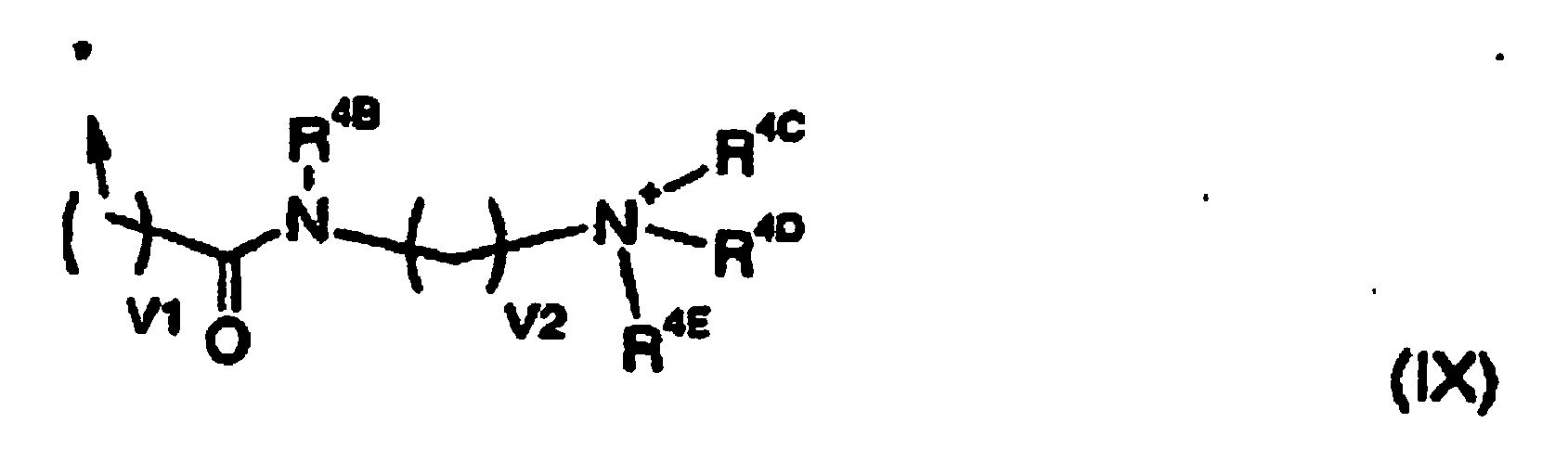 R4B Wasserstoff oder C1-C6-Alkyl ist;R4C, R4D, R4E jeweils C1-C6-Alkyl ist, und der Stickstoff, an den sie angelagert sind, quartär ist und positiv geladen ist; und zusätzlich können zwei beliebige von R4C, R4D, R4E verbunden sein, um einen Ring zu bilden, der optional ein zweites Heteroatom umfasst, das aus Sauerstoff oder Stickstoff ausgewählt ist;
odereines von R4C, R4D, R4E ein einsames Paar ist und die anderen Gruppen wie oben defniert sind, und der Stickstoff, an den sie angelagert sind, tertiär ist; undv1 und v2 jeweils unabhängig voneinander 0-5 sind. - Eine Verbindung gemäß einem der Ansprüche 1 bis 8, wobei R und/oder R4 eine Gruppe darstellt, die aus den Folgenden ausgewählt ist:

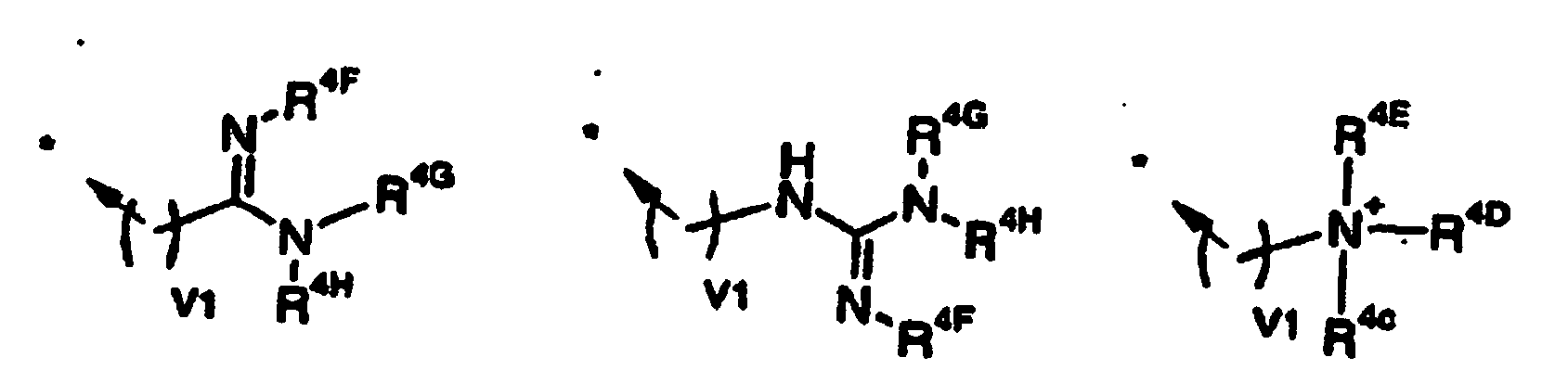
 R4B Wasserstoff oder C1-C6-Alkyl ist;R4C, R4D, R4E jeweils C1-C6-Alkyl sind, und der Stickstoff, an den sie angelagert sind, quartär ist und positiv geladen ist; und zusätzlich können jeweils zwei beliebige von R4C, R4D, R4E verbunden sein, um einen Ring zu bilden, der optional ein zweites Heteroatom umfasst, das aus Sauerstoff oder Stickstoff ausgewählt ist;
odereines von R4C, R4D, R4E ein einsames Paar ist und die anderen Gruppen wie oben defniert sind, und der Stickstoff, an den sie angelagert sind, tertiär ist;R4F und R4I unabhängig voneinander Wasserstoff oder C1-C6-Alkyl sind;R4G und R4H unabhängig voneinander Wasserstoff oder C1-C6-Alkyl sind, oder R4G und R4H zusammengenommen mit dem Stickstoff, an den sie angelagert sind, einen monozyklischen heterozyklischen Ring von 5 bis 7 Ringatomen bilden, der ein weiteres Heteroatom enthalten kann, das aus N, O und S ausgewählt ist; undv1 und v2 jeweils unabhängig voneinander 0-5 sind. - Eine Verbindung gemäß einem der Ansprüche 13 bis 16, wobei R oder R4, aber nicht beide, Wasserstoff ist.
- Eine Verbindung gemäß einem der Ansprüche 13 bis 16, wobei R oder R4, aber nicht beide, aus C1-C6-Alkyl, Formyl, Aminocarbonyl, Mono- oder Di-C1-C4-Alkylaminocarbonyl, C3-C8-Cycloalkylcarbonyl, C1-C6-Alkylcarbonyl, C1-C6-Alkoxycarbonyl, N-(C1-C4-Alkylsulfonyl)-Aminocarbonyl, N-(C1-C4-Alkylsulfonyl)-N-(C1-C4-Alkyl)-Aminocarbonyl, Heteroaryl, Heterocycloalkyl, Heteroarylcarbonyl oder Heterocycloalkylcarbonyl ausgewählt sind; wobei C1-C6-Alkyl, Mono- und Di-C1-C4-Alkylaminocarbonyl, C1-C6-Alkylcarbonyl, C1-C6-Alkoxycarbonyl, Heteroaryl und Heterocycloalkyl durch ein bis drei identische oder unterschiedliche Radikale substituiert werden können, die aus der Gruppe ausgewählt sind, die Aryl, Heteroaryl, Hydroxyl, C1-C4-Alkoxy, Hydroxycarbonyl, C1-C6-Alkoxycarbonyl, Aminocarbonyl, Mono und Di-C1-C4-Alkylaminocarbonyl, Amino, Mono- und Di-C1-C4-Alkylamino, C1-C4-Alkylcarbonylamino, Cyano, N-(Mono- und Di-C1-C4-Alkylamino-C1-C4-Alkyl)-Aminocarbonyl, N-(C1-C4-Alkoxy- C1-C4-Alkyl)-Aminocarbonyl und Halogen umfasst.
- Eine multimere Verbindung, die zwei, drei oder vier Moleküle einer Verbindung gemäß einem der Ansprüche 1 bis 16 umfasst, die durch ein Linker-Gerüst kovalent verbunden sind.
- Eine multimere Verbindung gemäß Anspruch 19, wobei zwei, drei oder vier Moleküle einer Verbindung gemäß einem der Ansprüche 1 bis 16 über ihre jeweiligen Stickstoffatome mit dem Linker-Gerüst verbunden sind, gezeigt in Formel (I) als mit R verbunden.
- Eine multimere Verbindung mit der Formel M-L-M1, wobei L ein bivalentes Linker-Radikal ist und M und M1 jeweils unabhängig voneinander ein Radikal der Formel (IA) sind, wobei D, A und R1 -R5 wie in einem der Ansprüche 1 bis 18 definiert sind:
- Eine multimere Verbindung gemäß Anspruch 19, wobei zwei, drei oder vier Moleküle gemäß Anspruch 7 über ihre jeweiligen Stickstoffatome mit dem Linker-Gerüst verbunden sind, gezeigt in Formel (I) als mit R4 verbunden.
- Eine multimere Verbindung mit der Formel M-L-M1, wobei L ein bivalentes Linker-Radikal ist und M und M1 jeweils unabhängig voneinander ein Radikal der Formel (IB) sind, wobei D, A und R, R1, R2, R3 und R5 wie in einem der Ansprüche 1 bis 18 definiert sind:

- Eine Verbindung gemäß 21 oder Anspruch 23, wobei M und M1 gleich sind.
- Eine Verbindung gemäß Anspruch 21, Anspruch 23 oder Anspruch 24, wobei das Linker-Gerüst oder Linker-Radikal L ein bivalentes geradkettiges, gesättigtes oder ungesättigtes Kohlenwasserstoffradikal mit 2 bis 12 Kohlenstoffatomen in der Kette ist, und wobei ein oder mehr Kohlenstoffe durch ein bivalentes monozyklisches oder bizyklisches karbozyklisches oder heterozyklisches Radikal ersetzt werden können, die 3 bis 7 Ringatome in dem oder jedem Ring aufweisen, oder durch -O-, -S-, -S(=O)-, -S(=O)2-, -C(=O)-, -N(RP)-, -N+(RP)(RQ)-, -C(=O)O-, -OC(=O)-, -C(=O)NRA-, -NRAC(=O)-, -S(O2)NRA-, -NRAS(O2)-, -NRAC(=O)NRB-, -NRAC(=NRA)NRB-, -C(=NRD)NRE- oder -NREC(=NRD)- ersetzt werden können, wobei RA, RB, RD und RE unabhängig voneinander Wasserstoff, C1-C6-Alkyl oder C3-C6-Cycloalkyl sind, und RP und RQ unabhängig voneinander Wasserstoff, C1-C6-Alkyl oder C3-C6-Cycloalkyl, HO-(C1-C6-Alkyl)-, RARBN-(C1-C6-Alkyl)- oder HOC(=O)-(C1-C6-Alkyl)- sind, oder RA und RB, oder RD und RE, oder RP und RQ zusammengenommen mit den Stickstoffen, an denen sie angelagert sind, einen monozyklischen heterozyklischen Ring von 5 bis 7 Ringatomen bilden, die ein weiteres Heteroatom enthalten können, das aus N, O und S ausgewählt ist.
- Eine Verbindung gemäß Anspruch 25, wobei wenn ein oder mehr ein oder mehr -(CH2)- Gruppen des Linker-Gerüsts oder Linker-Radikals L durch ein bivalentes monozyklisches oder bizyklisches karbozyklisches oder heterozyklisches Radikal ersetzt wird oder werden, ist das Radikal aus Folgenden ausgewählt:


- Eine Verbindung gemäß Anspruch 25, wobei das Linker-Gerüst oder Linker-Radikal L eine der folgenden Strukturen (A), (B),(C), (D) und (E) aufweist:
-(CH2)2-5-N(CH3)-(CH2)2-5- (A)
-(CH2)2-5-N+(CH3)2-(C2)2-5- (B)
-(CH2)2-5-NH-(O=NH)-NH-(CH2)2-5- (C)

- Eine Verbindung gemäß Anspruch 25, wobei das Linker-Gerüst oder Linker-Radikal L eine der folgenden Strukturen (G) und (E) aufweist:
-(CH2)1-2-CO-NH-(CH2)1-2-N(CH3)-(CH2)1-2-NH-CO-(CH2)1-2- (G)
-(CH2)1-2-CO-NH-(CH2)1-2-N+(CH3)2-(CH2)1-2-NH-CO-(CH2)1-2- (H)
- Eine Verbindung, die eine der folgenden Strukturen aufweist


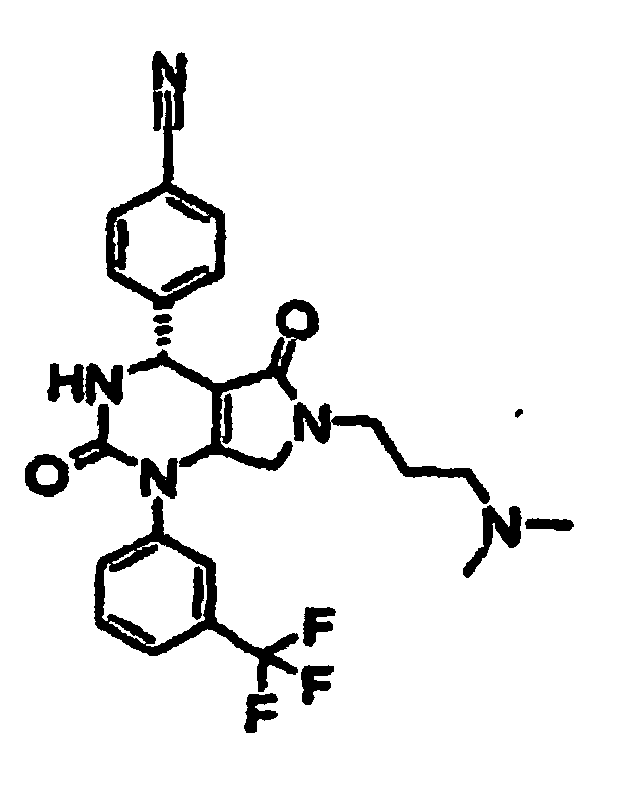


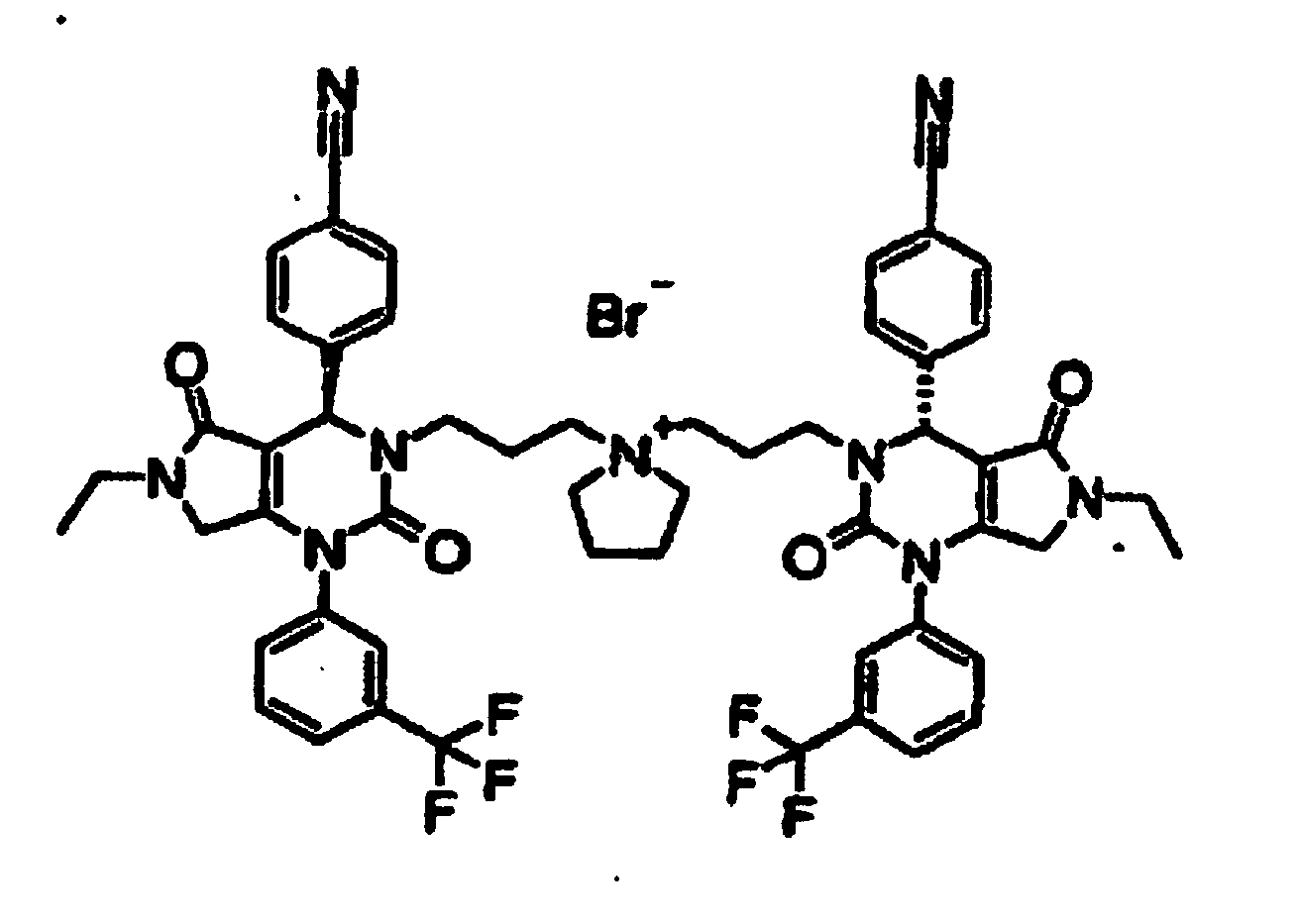

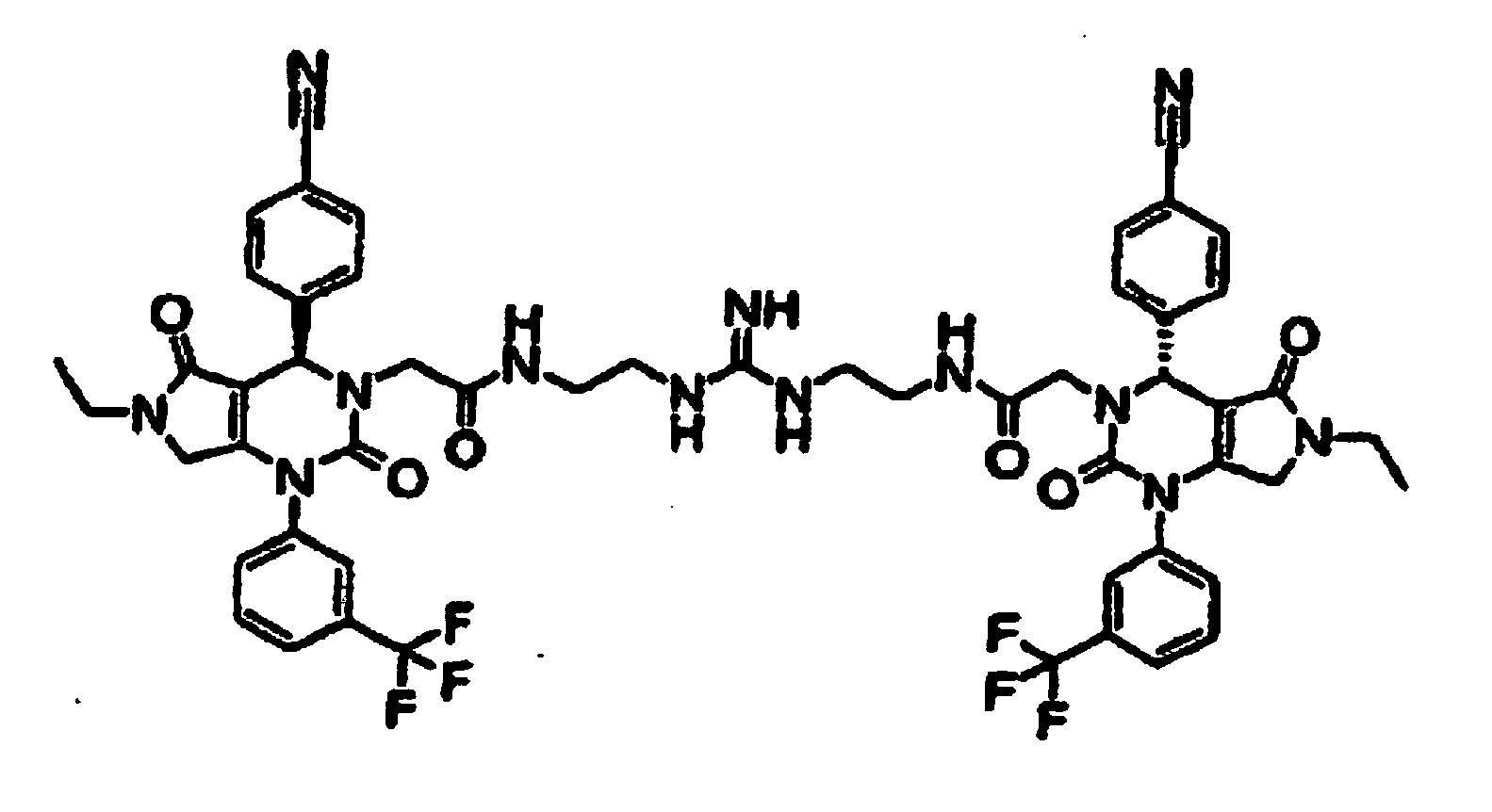


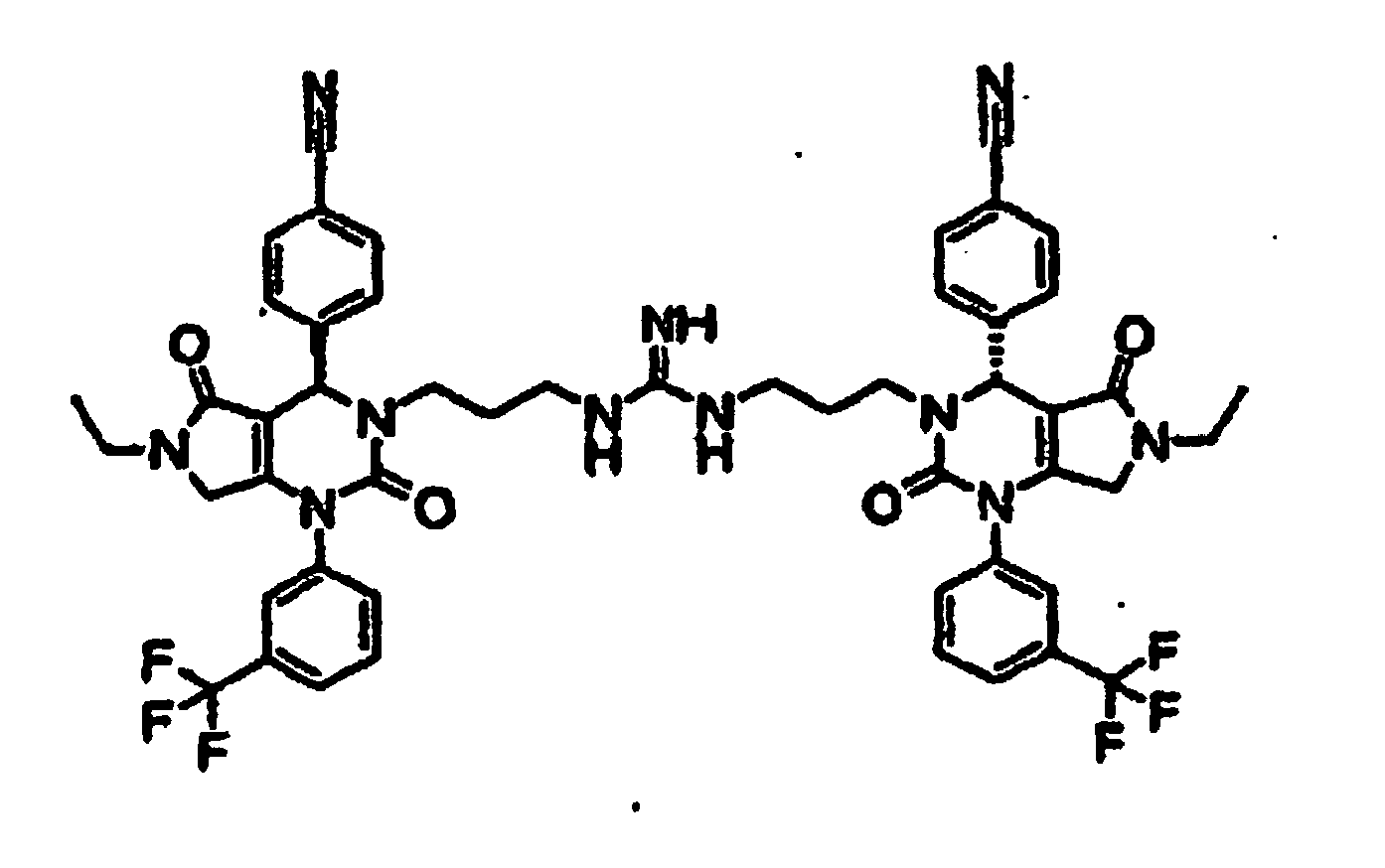


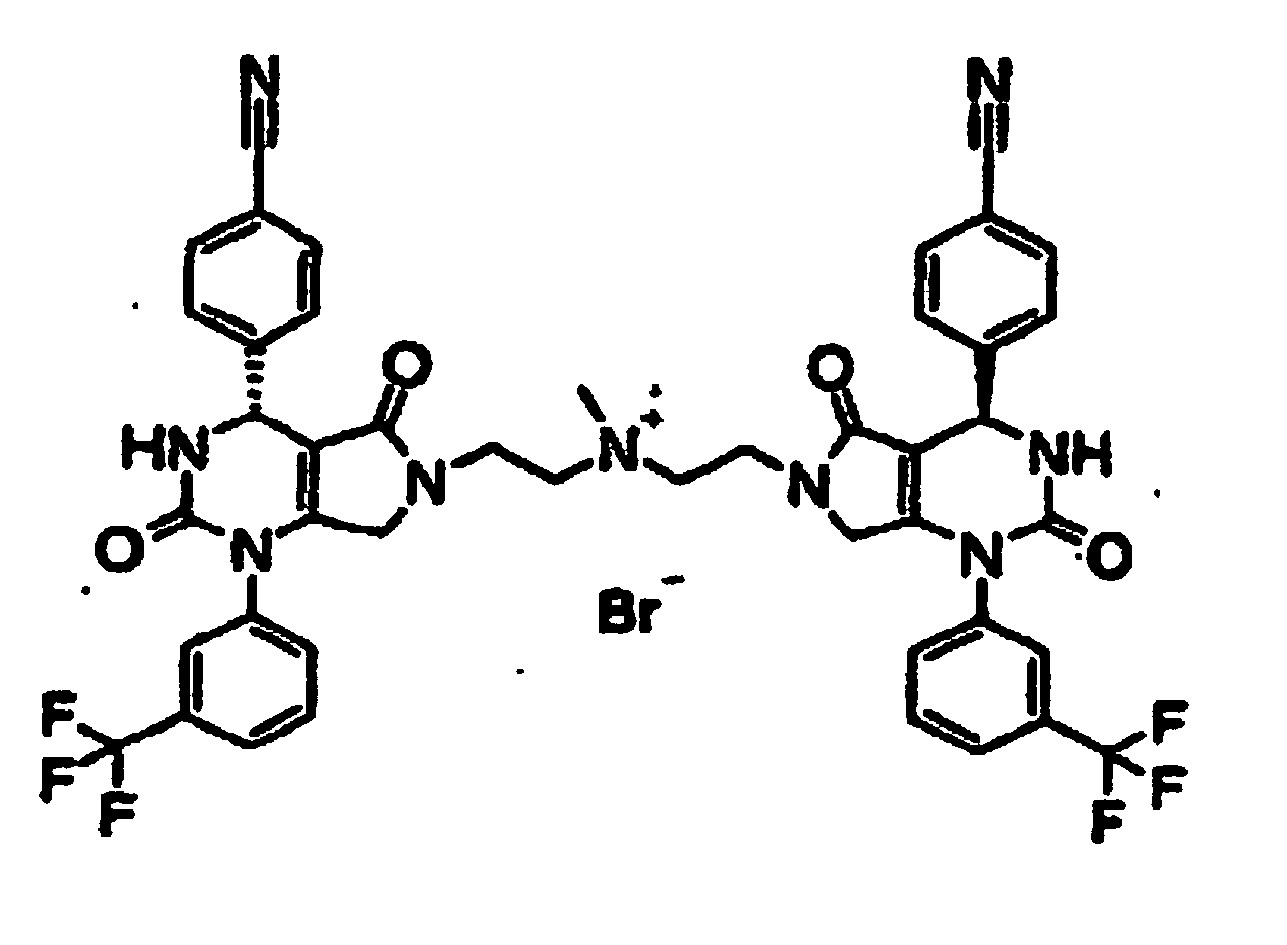


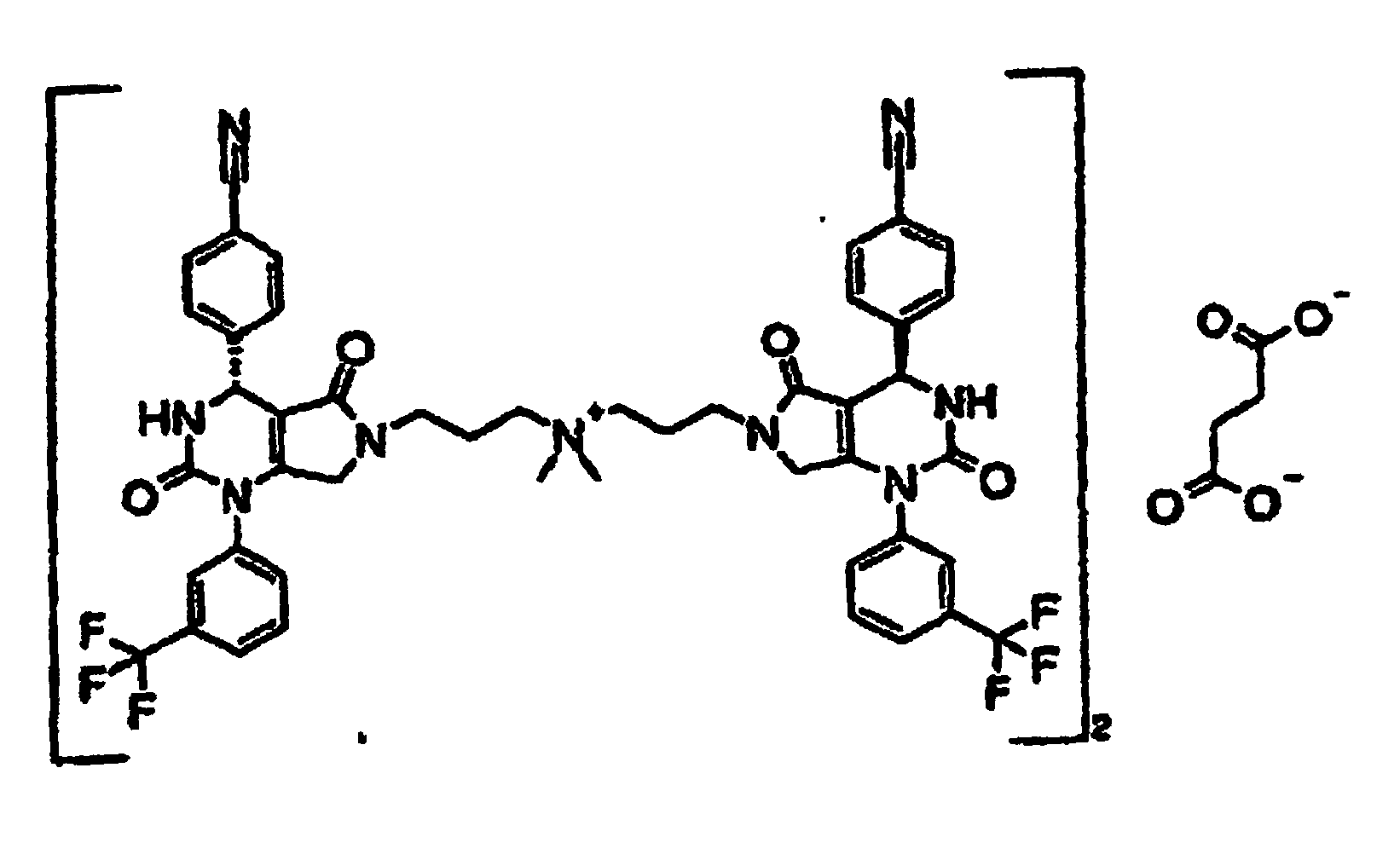


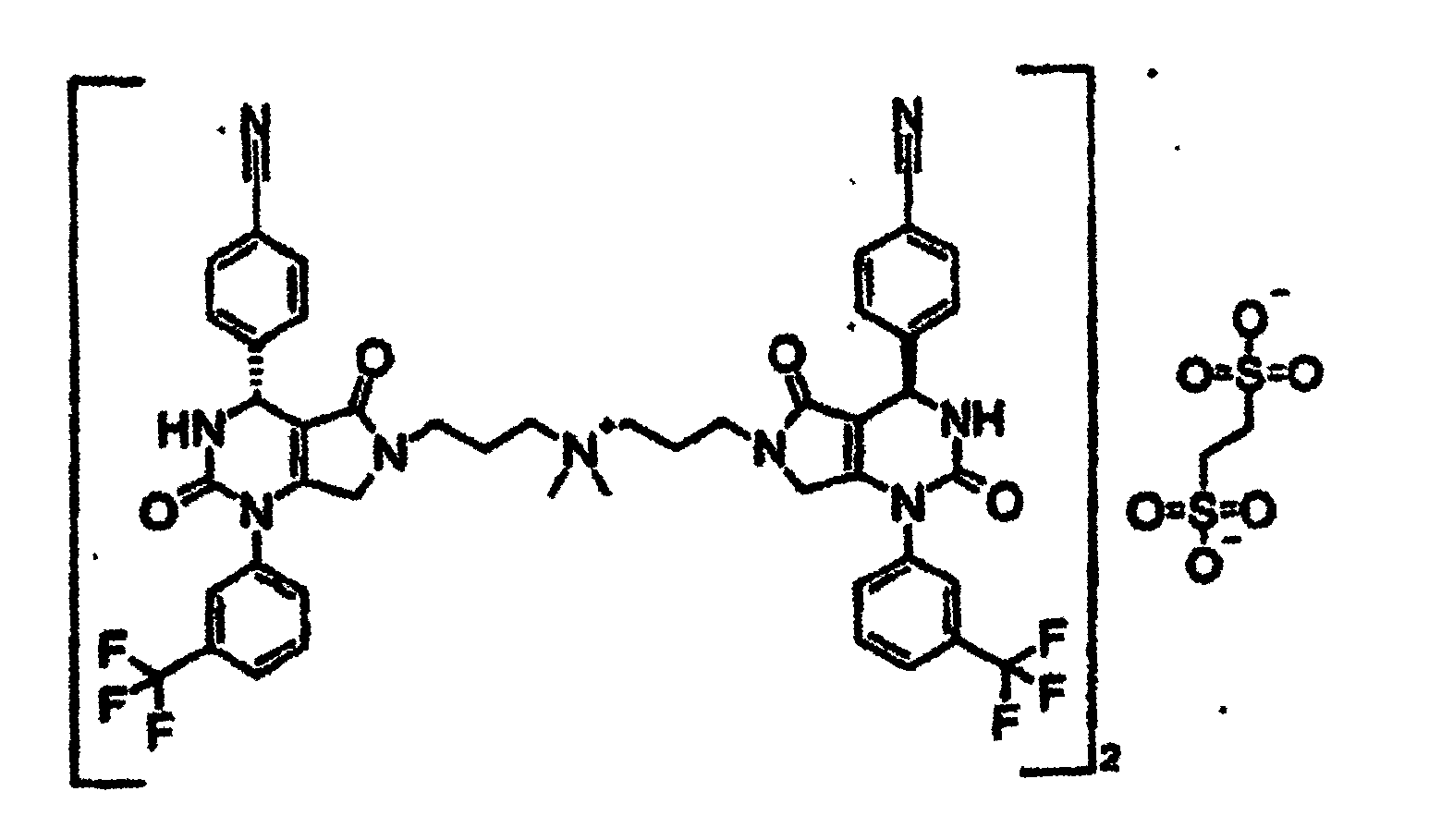


- Eine Verbindung gemäß einem der vorherigen Ansprüche in pharmazeutisch akzeptabler Salzform.
- Eine Verbindung gemäß Anspruch 19, die Formel (X), (Y) oder (Z) aufweist:


- Eine Verbindung gemäß einem der vorherigen Ansprüche, zur Verwendung in einer Therapie.
- Eine pharmazeutische Zusammensetzung, die eine Verbindung gemäß einem der Ansprüche 1 bis 31 und einen pharmazeutische akzeptablen Träger oder Hilfsstoff umfasst.
- Verwendung einer Verbindung gemäß einem der Ansprüche 1 bis 31 zur Fertigung eines Medikaments zur Anwendung bei der Behandlung der Prävention einer Erkrankung oder eines Krankheitszustands, bei der/dem HNE beteiligt ist.
- Verwendung gemäß Anspruch 34, wobei die Erkrankung oder der Krankheitszustand chronisch-obstruktive Lungenkrankheit (COPD), chronische Bronchitis, Lungenfibrose, Pneumonie, akutes Atemnotsyndrom (ARDS), Lungenemphysem, durch Rauchen induziertes Emphysem oder Mukoviszidose ist.
- Verwendung gemäß Anspruch 34, wobei die Erkrankung oder der Krankheitszustand Asthma, Rhinitis, Psoriasis, Dermatitis, (atopische und nicht atopische), Morbus Crohn, Colitis ulcerosa oder Reizkolon ist.
Priority Applications (3)
| Application Number | Priority Date | Filing Date | Title |
|---|---|---|---|
| SI200730423T SI2024367T1 (sl) | 2006-05-04 | 2007-05-03 | Tetrahidropirolopirimidinedioni in njihova uporaba kot äśloveĺ ki neutrofil elastazni inhibitorji |
| PL07732669T PL2024367T3 (pl) | 2006-05-04 | 2007-05-03 | Tetrahydropirolopirymidynodiony i ich zastosowanie jako inhibitory ludzkiej elastazy neutrofilowej |
| CY20101101119T CY1111437T1 (el) | 2006-05-04 | 2010-12-06 | Τετραϋδροπυρρολοπυριμιδινοδιονες και η χρηση τους ως αναστολεων της ανθρωπινης ουδετεροφιλης ελαστασης |
Applications Claiming Priority (3)
| Application Number | Priority Date | Filing Date | Title |
|---|---|---|---|
| GB0608844A GB0608844D0 (en) | 2006-05-04 | 2006-05-04 | Enzyme inhibitors |
| GB0612544A GB0612544D0 (en) | 2006-06-23 | 2006-06-23 | Enzyme inhibitors |
| PCT/GB2007/001638 WO2007129060A1 (en) | 2006-05-04 | 2007-05-03 | Tetrahydropyrrolopyrimidinediones and their use as human neutrophil elastase inhibitors |
Publications (2)
| Publication Number | Publication Date |
|---|---|
| EP2024367A1 EP2024367A1 (de) | 2009-02-18 |
| EP2024367B1 true EP2024367B1 (de) | 2010-09-08 |
Family
ID=38226415
Family Applications (1)
| Application Number | Title | Priority Date | Filing Date |
|---|---|---|---|
| EP07732669A Active EP2024367B1 (de) | 2006-05-04 | 2007-05-03 | Tetrahydropyrrolopyrimidindione und ihre verwendung als inhibitoren der humanen neutrophilen elastase |
Country Status (20)
| Country | Link |
|---|---|
| US (1) | US8957082B2 (de) |
| EP (1) | EP2024367B1 (de) |
| JP (1) | JP4999920B2 (de) |
| AT (1) | ATE480543T1 (de) |
| AU (1) | AU2007246889B2 (de) |
| BR (1) | BRPI0711169A2 (de) |
| CA (1) | CA2657956C (de) |
| CY (1) | CY1111437T1 (de) |
| DE (1) | DE602007009095D1 (de) |
| DK (1) | DK2024367T3 (de) |
| EA (1) | EA018061B1 (de) |
| IL (1) | IL194843A (de) |
| MX (1) | MX2008013996A (de) |
| NO (1) | NO20084502L (de) |
| NZ (1) | NZ572250A (de) |
| PL (1) | PL2024367T3 (de) |
| PT (1) | PT2024367E (de) |
| SI (1) | SI2024367T1 (de) |
| WO (1) | WO2007129060A1 (de) |
| ZA (1) | ZA200809250B (de) |
Families Citing this family (38)
| Publication number | Priority date | Publication date | Assignee | Title |
|---|---|---|---|---|
| SE0302486D0 (sv) | 2003-09-18 | 2003-09-18 | Astrazeneca Ab | Novel compounds |
| US8198288B2 (en) | 2006-05-04 | 2012-06-12 | Pulmagen Therapeutics (Inflammation) Limited | Tetrahydropyrrolopyrimidinediones and their use in therapy |
| DE602007009095D1 (de) | 2006-05-04 | 2010-10-21 | Pulmagen Therapeutics Inflamma | Tetrahydropyrrolopyrimidindione und ihre verwendung als inhibitoren der humanen neutrophilen elastase |
| WO2009013444A1 (en) * | 2007-07-25 | 2009-01-29 | Argenta Discovery Limited | Tetrahydropyrrolopyrimidinediones and their use as human neutrophil elastase inhibitors |
| TW200808771A (en) | 2006-05-08 | 2008-02-16 | Astrazeneca Ab | Novel compounds II |
| TW200808763A (en) | 2006-05-08 | 2008-02-16 | Astrazeneca Ab | Novel compounds I |
| EP2064184A1 (de) * | 2006-09-04 | 2009-06-03 | AstraZeneca AB | Als inhibitoren der neutrophilen-elastase geeignete multimere heterocyclische verbindung |
| EP2217591A4 (de) | 2007-11-06 | 2011-10-26 | Astrazeneca Ab | 2-pyrazinonderivate und ihre verwendung als inhibitoren neutrophiler elastase |
| WO2009060158A1 (en) * | 2007-11-07 | 2009-05-14 | Argenta Discovery Limited | 4- (4-cyanophenyl) -1- (3-trifluoromethylphenyl) -3,4, 6, 7-tetrahydro-1h-pyrrolo [3, 4- d] pyrimidine-2, 5-dione derivatives and their use as human neutrophil elastase inhibitors |
| WO2009060206A1 (en) * | 2007-11-07 | 2009-05-14 | Argenta Discovery Limited | 3,4,6,7-tetrahydro-1h-pyrrolo[3,4-d]pyrimidine-2,5-diones and their therapeutic use |
| GB0721866D0 (en) * | 2007-11-07 | 2007-12-19 | Argenta Discovery Ltd | Pharmaceutical compounds having dual activities |
| DE102008052013A1 (de) | 2008-10-17 | 2010-04-22 | Bayer Schering Pharma Aktiengesellschaft | 4-(4-Cyano-2-thioaryl)-dihydropyrimidinone und ihre Verwendung |
| CN101903356B (zh) | 2007-12-20 | 2013-05-22 | 拜耳知识产权有限责任公司 | 4-(4-氰基-2-硫代芳基)二氢嘧啶酮和它们的使用 |
| DE102007061766A1 (de) | 2007-12-20 | 2009-06-25 | Bayer Healthcare Ag | 4-(4-Cyano-2-thioaryl)-dihydropyrimidinone und ihre Verwendung |
| DE102008022521A1 (de) | 2008-05-07 | 2009-11-12 | Bayer Schering Pharma Aktiengesellschaft | 1,4-Diaryl-pyrimidopyridazin-2,5-dione und ihre Verwendung |
| GB0817429D0 (en) * | 2008-09-23 | 2008-10-29 | Argenta Discovery Ltd | Enzyme inhibitors |
| DE102009004197A1 (de) | 2009-01-09 | 2010-07-15 | Bayer Schering Pharma Aktiengesellschaft | Heterocyclisch anellierte Diaryldihydropyrimidin-Derivate und ihre Verwendung |
| CA2751054A1 (en) | 2009-01-30 | 2010-08-05 | Chiesi Farmaceutici S.P.A. | Dimeric pyrrolopyrimidinedione and its use in therapy of respiratory diseases |
| TW201036957A (en) | 2009-02-20 | 2010-10-16 | Astrazeneca Ab | Novel salt 628 |
| AU2010302420B2 (en) | 2009-10-02 | 2013-07-04 | Astrazeneca Ab | 2-pyridone compounds used as inhibitors of neutrophil elastase |
| GB201004178D0 (en) * | 2010-03-12 | 2010-04-28 | Pulmagen Therapeutics Inflamma | Enzyme inhibitors |
| GB201004179D0 (en) * | 2010-03-12 | 2010-04-28 | Pulmagen Therapeutics Inflamma | Enzyme inhibitors |
| DE102010030187A1 (de) | 2010-06-16 | 2011-12-22 | Bayer Schering Pharma Aktiengesellschaft | 4-Cyan-2-sulfonylphenyl)pyrazolyl-substituierte Pyridinone und Pyrazinone und ihre Verwendung |
| CA2848557A1 (en) * | 2011-09-14 | 2013-03-21 | Chiesi Farmaceutici S.P.A. | Tetrahydrotriazolopyrimidine derivatives as human neutrophil elastase inhibitors |
| US20140221335A1 (en) | 2013-02-06 | 2014-08-07 | Boehringer Ingelheim International Gmbh | Substituted bicyclic dihydropyrimidinones and their use as inhibitors of neutrophil elastase activity |
| US9115093B2 (en) | 2013-03-04 | 2015-08-25 | Boehringer Ingelheim International Gmbh | Substituted bicyclic dihydropyrimidinones and their use as inhibitors of neutrophil elastase activity |
| CN105873933A (zh) | 2013-12-16 | 2016-08-17 | 奇斯药制品公司 | 作为人中性白细胞弹性蛋白酶抑制剂的四氢三唑并嘧啶衍生物 |
| USRE47493E1 (en) | 2014-02-20 | 2019-07-09 | Boehringer Ingelheim International Gmbh | Substituted bicyclic dihydropyrimidinones and their use as inhibitors of neutrophil elastase activity |
| US9487528B2 (en) | 2014-06-09 | 2016-11-08 | Chiesi Farmaceutici S.P.A. | Compounds |
| US9440930B2 (en) * | 2014-07-31 | 2016-09-13 | Boehringer Ingelheim International Gmbh | Substituted bicyclic dihydropyrimidinones and their use as inhibitors of neutrophil elastase activity |
| US9290457B2 (en) | 2014-07-31 | 2016-03-22 | Boehringer Ingelheim International Gmbh | Substituted dihydropyrimidinones and their use as inhibitors of neutrophil elastase activity |
| US9657015B2 (en) * | 2014-07-31 | 2017-05-23 | Boehringer Ingelheim International Gmbh | Substituted bicyclic dihydropyrimidinones and their use as inhibitors of neutrophil elastase activity |
| US9475779B2 (en) * | 2014-07-31 | 2016-10-25 | Boehringer Ingelheim International Gmbh | Substituted bicyclic dihydropyrimidinones and their use as inhibitors of neutrophil elastase activity |
| US9458113B2 (en) * | 2014-07-31 | 2016-10-04 | Boehringer Ingelheim International Gmbh | Substituted bicyclic dihydropyrimidinones and their use as inhibitors of neutrophil elastase activity |
| KR20170129191A (ko) | 2015-03-18 | 2017-11-24 | 바이엘 파마 악티엔게젤샤프트 | (4s)-4-[4-사이아노-2-(메틸설폰일)페닐]-3,6-다이메틸-2-옥소-1-[3-(트라이플루오로메틸)페닐]-1,2,3,4-테트라하이드로 피리미딘-5-카보나이트릴의 생성 방법 |
| JP7672641B2 (ja) | 2019-09-17 | 2025-05-08 | メレオ バイオファーマ 4 リミテッド | 移植片拒絶反応、閉塞性細気管支炎症候群、及び移植片対宿主病の治療に使用するためのアルベレスタット |
| IL297211B2 (en) | 2020-04-16 | 2025-12-01 | Mereo Biopharma 4 Ltd | Methods involving neutrophil elastase inhibitor alvelestat for treating respiratory disease mediated by alpha-1 antitrypsin deficiency |
| KR20240090272A (ko) | 2021-10-20 | 2024-06-21 | 메레오 바이오파마 4 리미티드 | 섬유화 치료에 사용하기 위한 호중구 엘라스테이스 억제제 |
Family Cites Families (8)
| Publication number | Priority date | Publication date | Assignee | Title |
|---|---|---|---|---|
| GB9626643D0 (en) | 1996-12-21 | 1997-02-12 | Astra Pharma Prod | Compounds |
| PE107899A1 (es) | 1997-09-09 | 1999-11-17 | Glaxo Group Ltd | Derivados de pirrolopirrolona como inhibidores de elastasa leucocitaria |
| US6630476B2 (en) | 2000-07-07 | 2003-10-07 | Bristol-Myers Squibb Pharma Company | Pyrrolo [3,4-d] pyrimidines as corticotropin releasing factor (CRF) antagonists |
| WO2004024701A1 (en) * | 2002-09-10 | 2004-03-25 | Bayer Healthcare Ag | Heterocyclic derivatives |
| EP1546113B1 (de) | 2002-09-10 | 2013-05-01 | Bayer Intellectual Property GmbH | Pyrimidinonderivate als therapeutische mittel gegen aktute und chronische entzündliche, ischämische und verändernde prozesse |
| GB0502258D0 (en) * | 2005-02-03 | 2005-03-09 | Argenta Discovery Ltd | Compounds and their use |
| GB0520743D0 (en) * | 2005-10-12 | 2005-11-23 | Argenta Discovery Ltd | Compounds and their use |
| DE602007009095D1 (de) | 2006-05-04 | 2010-10-21 | Pulmagen Therapeutics Inflamma | Tetrahydropyrrolopyrimidindione und ihre verwendung als inhibitoren der humanen neutrophilen elastase |
-
2007
- 2007-05-03 DE DE602007009095T patent/DE602007009095D1/de active Active
- 2007-05-03 PL PL07732669T patent/PL2024367T3/pl unknown
- 2007-05-03 SI SI200730423T patent/SI2024367T1/sl unknown
- 2007-05-03 AU AU2007246889A patent/AU2007246889B2/en not_active Ceased
- 2007-05-03 MX MX2008013996A patent/MX2008013996A/es active IP Right Grant
- 2007-05-03 EP EP07732669A patent/EP2024367B1/de active Active
- 2007-05-03 PT PT07732669T patent/PT2024367E/pt unknown
- 2007-05-03 DK DK07732669.2T patent/DK2024367T3/da active
- 2007-05-03 AT AT07732669T patent/ATE480543T1/de active
- 2007-05-03 JP JP2009508463A patent/JP4999920B2/ja not_active Expired - Fee Related
- 2007-05-03 NZ NZ572250A patent/NZ572250A/en not_active IP Right Cessation
- 2007-05-03 BR BRPI0711169-0A patent/BRPI0711169A2/pt not_active IP Right Cessation
- 2007-05-03 WO PCT/GB2007/001638 patent/WO2007129060A1/en not_active Ceased
- 2007-05-03 EA EA200870391A patent/EA018061B1/ru not_active IP Right Cessation
- 2007-05-03 CA CA2657956A patent/CA2657956C/en not_active Expired - Fee Related
-
2008
- 2008-10-22 IL IL194843A patent/IL194843A/en not_active IP Right Cessation
- 2008-10-27 NO NO20084502A patent/NO20084502L/no unknown
- 2008-10-28 ZA ZA2008/09250A patent/ZA200809250B/en unknown
-
2010
- 2010-12-06 CY CY20101101119T patent/CY1111437T1/el unknown
-
2012
- 2012-04-17 US US13/449,045 patent/US8957082B2/en active Active
Also Published As
| Publication number | Publication date |
|---|---|
| BRPI0711169A2 (pt) | 2011-08-23 |
| PT2024367E (pt) | 2010-12-03 |
| SI2024367T1 (sl) | 2011-04-29 |
| MX2008013996A (es) | 2009-01-14 |
| JP2009535389A (ja) | 2009-10-01 |
| ZA200809250B (en) | 2010-02-24 |
| EA200870391A1 (ru) | 2009-06-30 |
| JP4999920B2 (ja) | 2012-08-15 |
| US8957082B2 (en) | 2015-02-17 |
| ATE480543T1 (de) | 2010-09-15 |
| CA2657956A1 (en) | 2007-11-15 |
| EA018061B1 (ru) | 2013-05-30 |
| HK1130794A1 (en) | 2010-01-08 |
| AU2007246889A1 (en) | 2007-11-15 |
| WO2007129060A1 (en) | 2007-11-15 |
| PL2024367T3 (pl) | 2011-05-31 |
| DK2024367T3 (da) | 2011-01-03 |
| IL194843A (en) | 2014-04-30 |
| AU2007246889B2 (en) | 2011-03-10 |
| CA2657956C (en) | 2015-01-06 |
| CY1111437T1 (el) | 2015-08-05 |
| NO20084502L (no) | 2008-11-26 |
| US20120202826A1 (en) | 2012-08-09 |
| DE602007009095D1 (de) | 2010-10-21 |
| IL194843A0 (en) | 2009-08-03 |
| EP2024367A1 (de) | 2009-02-18 |
| NZ572250A (en) | 2011-10-28 |
Similar Documents
| Publication | Publication Date | Title |
|---|---|---|
| EP2024367B1 (de) | Tetrahydropyrrolopyrimidindione und ihre verwendung als inhibitoren der humanen neutrophilen elastase | |
| WO2009013444A1 (en) | Tetrahydropyrrolopyrimidinediones and their use as human neutrophil elastase inhibitors | |
| US8198288B2 (en) | Tetrahydropyrrolopyrimidinediones and their use in therapy | |
| EP2545057B1 (de) | Pyrimidinderivate und ihre verwendung bei der behandlung von atemwegserkrankungen wie copd | |
| EP2545056B1 (de) | Pyrimidinderivate und ihre verwendung bei der behandlung von atemwegserkrankungen wie copd | |
| WO2007107706A2 (en) | Dimers of heterocyclic compounds for the treatment of copd | |
| WO2009060206A1 (en) | 3,4,6,7-tetrahydro-1h-pyrrolo[3,4-d]pyrimidine-2,5-diones and their therapeutic use | |
| WO2009060158A1 (en) | 4- (4-cyanophenyl) -1- (3-trifluoromethylphenyl) -3,4, 6, 7-tetrahydro-1h-pyrrolo [3, 4- d] pyrimidine-2, 5-dione derivatives and their use as human neutrophil elastase inhibitors | |
| WO2009037413A1 (en) | Dimers of 5- [ (4-cyanophenyl) sulfinyl] -6-methyl-2-oxo-1- [3- (trifluoromethyl)phenyl] -1,2-dihydropyridine-3-carboxamide as inhibitors of human neutrophil elastase for treating respiratory diseases | |
| CN101479270B (zh) | 四氢吡咯并嘧啶二酮及其作为人中性粒细胞弹性蛋白酶抑制剂的用途 | |
| HK1130794B (en) | Tetrahydropyrrolopyrimidinediones and their use as human neutrophil elastase inhibitors |
Legal Events
| Date | Code | Title | Description |
|---|---|---|---|
| PUAI | Public reference made under article 153(3) epc to a published international application that has entered the european phase |
Free format text: ORIGINAL CODE: 0009012 |
|
| 17P | Request for examination filed |
Effective date: 20081204 |
|
| AK | Designated contracting states |
Kind code of ref document: A1 Designated state(s): AT BE BG CH CY CZ DE DK EE ES FI FR GB GR HU IE IS IT LI LT LU LV MC MT NL PL PT RO SE SI SK TR |
|
| AX | Request for extension of the european patent |
Extension state: AL BA HR MK RS |
|
| GRAP | Despatch of communication of intention to grant a patent |
Free format text: ORIGINAL CODE: EPIDOSNIGR1 |
|
| DAX | Request for extension of the european patent (deleted) | ||
| GRAS | Grant fee paid |
Free format text: ORIGINAL CODE: EPIDOSNIGR3 |
|
| RAP1 | Party data changed (applicant data changed or rights of an application transferred) |
Owner name: PULMAGEN THERAPEUTICS (INFLAMMATION) LIMITED |
|
| GRAA | (expected) grant |
Free format text: ORIGINAL CODE: 0009210 |
|
| AK | Designated contracting states |
Kind code of ref document: B1 Designated state(s): AT BE BG CH CY CZ DE DK EE ES FI FR GB GR HU IE IS IT LI LT LU LV MC MT NL PL PT RO SE SI SK TR |
|
| REG | Reference to a national code |
Ref country code: GB Ref legal event code: FG4D |
|
| REG | Reference to a national code |
Ref country code: CH Ref legal event code: EP |
|
| REG | Reference to a national code |
Ref country code: IE Ref legal event code: FG4D |
|
| REF | Corresponds to: |
Ref document number: 602007009095 Country of ref document: DE Date of ref document: 20101021 Kind code of ref document: P |
|
| REG | Reference to a national code |
Ref country code: PT Ref legal event code: SC4A Free format text: AVAILABILITY OF NATIONAL TRANSLATION Effective date: 20101125 |
|
| REG | Reference to a national code |
Ref country code: RO Ref legal event code: EPE |
|
| REG | Reference to a national code |
Ref country code: NL Ref legal event code: T3 |
|
| REG | Reference to a national code |
Ref country code: SE Ref legal event code: TRGR |
|
| REG | Reference to a national code |
Ref country code: DK Ref legal event code: T3 |
|
| RAP2 | Party data changed (patent owner data changed or rights of a patent transferred) |
Owner name: PULMAGEN THERAPEUTICS (INFLAMMATION) LIMITED |
|
| REG | Reference to a national code |
Ref country code: ES Ref legal event code: FG2A Ref document number: 2356463 Country of ref document: ES Kind code of ref document: T3 Effective date: 20110408 |
|
| REG | Reference to a national code |
Ref country code: HU Ref legal event code: AG4A Ref document number: E009864 Country of ref document: HU |
|
| REG | Reference to a national code |
Ref country code: SK Ref legal event code: T3 Ref document number: E 8781 Country of ref document: SK |
|
| REG | Reference to a national code |
Ref country code: CH Ref legal event code: PFA Owner name: PULMAGEN THERAPEUTICS (INFLAMMATION) LIMITED Free format text: PULMAGEN THERAPEUTICS (INFLAMMATION) LIMITED#STOKE COURT#STOKE POGES SLOUGH SL2 4SY (GB) -TRANSFER TO- PULMAGEN THERAPEUTICS (INFLAMMATION) LIMITED#FULMER HALL WINDMILL ROAD#FULMER SLOUGH BERKSHIRE SL3 6HD (GB) |
|
| REG | Reference to a national code |
Ref country code: PL Ref legal event code: T3 |
|
| REG | Reference to a national code |
Ref country code: EE Ref legal event code: HE1A Ref document number: E005119 Country of ref document: EE |
|
| PLBE | No opposition filed within time limit |
Free format text: ORIGINAL CODE: 0009261 |
|
| STAA | Information on the status of an ep patent application or granted ep patent |
Free format text: STATUS: NO OPPOSITION FILED WITHIN TIME LIMIT |
|
| 26N | No opposition filed |
Effective date: 20110609 |
|
| REG | Reference to a national code |
Ref country code: DE Ref legal event code: R097 Ref document number: 602007009095 Country of ref document: DE Effective date: 20110609 |
|
| REG | Reference to a national code |
Ref country code: GB Ref legal event code: 732E Free format text: REGISTERED BETWEEN 20130822 AND 20130828 |
|
| REG | Reference to a national code |
Ref country code: DE Ref legal event code: R081 Ref document number: 602007009095 Country of ref document: DE Owner name: CHIESI FARMACEUTICI S.P.A., IT Free format text: FORMER OWNER: PULMAGEN THERAPEUTICS (INFLAMMATION) LTD., STOKE POGES, SLOUGH, GB Effective date: 20130801 Ref country code: DE Ref legal event code: R081 Ref document number: 602007009095 Country of ref document: DE Owner name: CHIESI FARMACEUTICI S.P.A., IT Free format text: FORMER OWNER: PULMAGEN THERAPEUTICS (INFLAMMATION) LTD., STOKE POGES, GB Effective date: 20130801 |
|
| REG | Reference to a national code |
Ref country code: CH Ref legal event code: PUE Owner name: CHIESI FARMACEUTICI S.P.A., IT Free format text: FORMER OWNER: PULMAGEN THERAPEUTICS (INFLAMMATION) LIMITED, GB |
|
| REG | Reference to a national code |
Ref country code: PT Ref legal event code: PC4A Owner name: CHIESI FARMACEUTICI S.P.A., IT Effective date: 20131107 |
|
| REG | Reference to a national code |
Ref country code: ES Ref legal event code: PC2A Owner name: CHIESI FAMACEUTICI S.P.A. Effective date: 20131118 |
|
| REG | Reference to a national code |
Ref country code: AT Ref legal event code: PC Ref document number: 480543 Country of ref document: AT Kind code of ref document: T Owner name: CHIESI FARMACEUTICI S.P.A., IT Effective date: 20131112 |
|
| REG | Reference to a national code |
Ref country code: EE Ref legal event code: GB1A Ref document number: E005119 Country of ref document: EE |
|
| REG | Reference to a national code |
Ref country code: NL Ref legal event code: SD Effective date: 20140116 |
|
| REG | Reference to a national code |
Ref country code: FR Ref legal event code: TP Owner name: CHIESI FARMACEUTICI S.P.A., IT Effective date: 20140109 |
|
| REG | Reference to a national code |
Ref country code: SI Ref legal event code: SP73 Owner name: CHIESI FARMACEUTICI S.P.A.; IT Effective date: 20140303 |
|
| REG | Reference to a national code |
Ref country code: HU Ref legal event code: GB9C Owner name: CHIESI FARMACEUTICI S.P.A., IT Free format text: FORMER OWNER(S): PULMAGEN THERAPEUTICS (INFLAMMATION) LIMITED, GB |
|
| REG | Reference to a national code |
Ref country code: SK Ref legal event code: PC4A Ref document number: E 8781 Country of ref document: SK Owner name: CHIESI FARMACEUTICI S.P.A., PARMA, IT Free format text: FORMER OWNER: PULMAGEN THERAPEUTICS (INFLAMMATION) LIMITED, BURNHAM, SLOUGH, GB Effective date: 20130509 Ref country code: SK Ref legal event code: TE4A Ref document number: E 8781 Country of ref document: SK Owner name: PULMAGEN THERAPEUTICS (INFLAMMATION) LIMITED, , GB Effective date: 20141021 |
|
| PGFP | Annual fee paid to national office [announced via postgrant information from national office to epo] |
Ref country code: BG Payment date: 20150601 Year of fee payment: 9 Ref country code: CH Payment date: 20150527 Year of fee payment: 9 Ref country code: MC Payment date: 20150422 Year of fee payment: 9 Ref country code: LT Payment date: 20150420 Year of fee payment: 9 Ref country code: SE Payment date: 20150528 Year of fee payment: 9 Ref country code: PT Payment date: 20150421 Year of fee payment: 9 Ref country code: RO Payment date: 20150424 Year of fee payment: 9 Ref country code: SK Payment date: 20150420 Year of fee payment: 9 Ref country code: FI Payment date: 20150528 Year of fee payment: 9 Ref country code: ES Payment date: 20150526 Year of fee payment: 9 Ref country code: SI Payment date: 20150421 Year of fee payment: 9 Ref country code: EE Payment date: 20150427 Year of fee payment: 9 Ref country code: LU Payment date: 20150602 Year of fee payment: 9 Ref country code: DK Payment date: 20150526 Year of fee payment: 9 Ref country code: CZ Payment date: 20150428 Year of fee payment: 9 Ref country code: CY Payment date: 20150422 Year of fee payment: 9 |
|
| PGFP | Annual fee paid to national office [announced via postgrant information from national office to epo] |
Ref country code: AT Payment date: 20150421 Year of fee payment: 9 Ref country code: PL Payment date: 20150421 Year of fee payment: 9 Ref country code: IE Payment date: 20150529 Year of fee payment: 9 Ref country code: NL Payment date: 20150526 Year of fee payment: 9 Ref country code: BE Payment date: 20150527 Year of fee payment: 9 Ref country code: HU Payment date: 20150427 Year of fee payment: 9 Ref country code: GR Payment date: 20150529 Year of fee payment: 9 Ref country code: LV Payment date: 20150421 Year of fee payment: 9 Ref country code: IS Payment date: 20150420 Year of fee payment: 9 |
|
| REG | Reference to a national code |
Ref country code: GR Ref legal event code: EP Ref document number: 20100402852 Country of ref document: GR Effective date: 20110119 |
|
| PGFP | Annual fee paid to national office [announced via postgrant information from national office to epo] |
Ref country code: MT Payment date: 20140429 Year of fee payment: 8 |
|
| REG | Reference to a national code |
Ref country code: FR Ref legal event code: PLFP Year of fee payment: 10 |
|
| PG25 | Lapsed in a contracting state [announced via postgrant information from national office to epo] |
Ref country code: BE Free format text: LAPSE BECAUSE OF NON-PAYMENT OF DUE FEES Effective date: 20160531 |
|
| REG | Reference to a national code |
Ref country code: LT Ref legal event code: MM4D Effective date: 20160503 |
|
| REG | Reference to a national code |
Ref country code: EE Ref legal event code: MM4A Ref document number: E005119 Country of ref document: EE Effective date: 20160531 |
|
| PG25 | Lapsed in a contracting state [announced via postgrant information from national office to epo] |
Ref country code: MT Free format text: LAPSE BECAUSE OF NON-PAYMENT OF DUE FEES Effective date: 20150531 Ref country code: LU Free format text: LAPSE BECAUSE OF NON-PAYMENT OF DUE FEES Effective date: 20160503 |
|
| REG | Reference to a national code |
Ref country code: CH Ref legal event code: PL |
|
| REG | Reference to a national code |
Ref country code: DK Ref legal event code: EBP Effective date: 20160531 |
|
| REG | Reference to a national code |
Ref country code: NL Ref legal event code: MM Effective date: 20160601 |
|
| REG | Reference to a national code |
Ref country code: AT Ref legal event code: MM01 Ref document number: 480543 Country of ref document: AT Kind code of ref document: T Effective date: 20160503 |
|
| PG25 | Lapsed in a contracting state [announced via postgrant information from national office to epo] |
Ref country code: CH Free format text: LAPSE BECAUSE OF NON-PAYMENT OF DUE FEES Effective date: 20160531 Ref country code: FI Free format text: LAPSE BECAUSE OF NON-PAYMENT OF DUE FEES Effective date: 20160503 Ref country code: CZ Free format text: LAPSE BECAUSE OF NON-PAYMENT OF DUE FEES Effective date: 20160503 Ref country code: RO Free format text: LAPSE BECAUSE OF NON-PAYMENT OF DUE FEES Effective date: 20160503 Ref country code: IS Free format text: LAPSE BECAUSE OF FAILURE TO SUBMIT A TRANSLATION OF THE DESCRIPTION OR TO PAY THE FEE WITHIN THE PRESCRIBED TIME-LIMIT Effective date: 20161201 Ref country code: CY Free format text: LAPSE BECAUSE OF NON-PAYMENT OF DUE FEES Effective date: 20160503 Ref country code: EE Free format text: LAPSE BECAUSE OF NON-PAYMENT OF DUE FEES Effective date: 20160531 Ref country code: SK Free format text: LAPSE BECAUSE OF NON-PAYMENT OF DUE FEES Effective date: 20160503 Ref country code: LI Free format text: LAPSE BECAUSE OF NON-PAYMENT OF DUE FEES Effective date: 20160531 Ref country code: LT Free format text: LAPSE BECAUSE OF NON-PAYMENT OF DUE FEES Effective date: 20160503 |
|
| REG | Reference to a national code |
Ref country code: GR Ref legal event code: ML Ref document number: 20100402852 Country of ref document: GR Effective date: 20161207 Ref country code: SK Ref legal event code: MM4A Ref document number: E 8781 Country of ref document: SK Effective date: 20160503 |
|
| REG | Reference to a national code |
Ref country code: IE Ref legal event code: MM4A |
|
| PG25 | Lapsed in a contracting state [announced via postgrant information from national office to epo] |
Ref country code: GR Free format text: LAPSE BECAUSE OF NON-PAYMENT OF DUE FEES Effective date: 20161207 Ref country code: NL Free format text: LAPSE BECAUSE OF NON-PAYMENT OF DUE FEES Effective date: 20160601 Ref country code: AT Free format text: LAPSE BECAUSE OF NON-PAYMENT OF DUE FEES Effective date: 20160503 Ref country code: PT Free format text: LAPSE BECAUSE OF NON-PAYMENT OF DUE FEES Effective date: 20161103 Ref country code: BG Free format text: LAPSE BECAUSE OF NON-PAYMENT OF DUE FEES Effective date: 20161130 Ref country code: LV Free format text: LAPSE BECAUSE OF NON-PAYMENT OF DUE FEES Effective date: 20160503 Ref country code: SE Free format text: LAPSE BECAUSE OF NON-PAYMENT OF DUE FEES Effective date: 20160504 |
|
| REG | Reference to a national code |
Ref country code: SI Ref legal event code: KO00 Effective date: 20170216 |
|
| PG25 | Lapsed in a contracting state [announced via postgrant information from national office to epo] |
Ref country code: HU Free format text: LAPSE BECAUSE OF NON-PAYMENT OF DUE FEES Effective date: 20160504 |
|
| REG | Reference to a national code |
Ref country code: FR Ref legal event code: PLFP Year of fee payment: 11 |
|
| PG25 | Lapsed in a contracting state [announced via postgrant information from national office to epo] |
Ref country code: SI Free format text: LAPSE BECAUSE OF NON-PAYMENT OF DUE FEES Effective date: 20160504 Ref country code: DK Free format text: LAPSE BECAUSE OF NON-PAYMENT OF DUE FEES Effective date: 20160531 Ref country code: IE Free format text: LAPSE BECAUSE OF NON-PAYMENT OF DUE FEES Effective date: 20160503 |
|
| PG25 | Lapsed in a contracting state [announced via postgrant information from national office to epo] |
Ref country code: PL Free format text: LAPSE BECAUSE OF NON-PAYMENT OF DUE FEES Effective date: 20160503 |
|
| REG | Reference to a national code |
Ref country code: FR Ref legal event code: PLFP Year of fee payment: 12 |
|
| PG25 | Lapsed in a contracting state [announced via postgrant information from national office to epo] |
Ref country code: ES Free format text: LAPSE BECAUSE OF NON-PAYMENT OF DUE FEES Effective date: 20160504 |
|
| REG | Reference to a national code |
Ref country code: ES Ref legal event code: FD2A Effective date: 20180627 |
|
| PG25 | Lapsed in a contracting state [announced via postgrant information from national office to epo] |
Ref country code: MC Free format text: LAPSE BECAUSE OF NON-PAYMENT OF DUE FEES Effective date: 20160531 |
|
| PG25 | Lapsed in a contracting state [announced via postgrant information from national office to epo] |
Ref country code: MT Free format text: LAPSE BECAUSE OF NON-PAYMENT OF DUE FEES Effective date: 20150503 |
|
| PGFP | Annual fee paid to national office [announced via postgrant information from national office to epo] |
Ref country code: DE Payment date: 20250529 Year of fee payment: 19 |
|
| PGFP | Annual fee paid to national office [announced via postgrant information from national office to epo] |
Ref country code: GB Payment date: 20250527 Year of fee payment: 19 |
|
| PGFP | Annual fee paid to national office [announced via postgrant information from national office to epo] |
Ref country code: FR Payment date: 20250526 Year of fee payment: 19 |
|
| PGFP | Annual fee paid to national office [announced via postgrant information from national office to epo] |
Ref country code: TR Payment date: 20250428 Year of fee payment: 19 |
|
| PGFP | Annual fee paid to national office [announced via postgrant information from national office to epo] |
Ref country code: IT Payment date: 20260305 Year of fee payment: 20 |