EP2024496B1 - ACIDES NUCLÉIQUES D'ORIGINE VÉGÉTALE ASSOCIÉS AUX pH CELLULAIRE ET LEURS UTILISATIONS - Google Patents
ACIDES NUCLÉIQUES D'ORIGINE VÉGÉTALE ASSOCIÉS AUX pH CELLULAIRE ET LEURS UTILISATIONS Download PDFInfo
- Publication number
- EP2024496B1 EP2024496B1 EP07718985.0A EP07718985A EP2024496B1 EP 2024496 B1 EP2024496 B1 EP 2024496B1 EP 07718985 A EP07718985 A EP 07718985A EP 2024496 B1 EP2024496 B1 EP 2024496B1
- Authority
- EP
- European Patent Office
- Prior art keywords
- plant
- nucleic acid
- cell
- sequence
- acid molecule
- Prior art date
- Legal status (The legal status is an assumption and is not a legal conclusion. Google has not performed a legal analysis and makes no representation as to the accuracy of the status listed.)
- Not-in-force
Links
- 150000007523 nucleic acids Chemical class 0.000 title claims description 128
- 102000039446 nucleic acids Human genes 0.000 title claims description 100
- 108020004707 nucleic acids Proteins 0.000 title claims description 100
- 230000001413 cellular effect Effects 0.000 title description 8
- 239000002773 nucleotide Substances 0.000 claims description 286
- 125000003729 nucleotide group Chemical group 0.000 claims description 285
- 241000196324 Embryophyta Species 0.000 claims description 229
- 108090000623 proteins and genes Proteins 0.000 claims description 151
- 210000004027 cell Anatomy 0.000 claims description 116
- 241000220317 Rosa Species 0.000 claims description 90
- 102000004169 proteins and genes Human genes 0.000 claims description 68
- 238000000034 method Methods 0.000 claims description 67
- 230000014509 gene expression Effects 0.000 claims description 61
- 230000009261 transgenic effect Effects 0.000 claims description 53
- 125000003275 alpha amino acid group Chemical group 0.000 claims description 52
- 240000006497 Dianthus caryophyllus Species 0.000 claims description 50
- 235000009355 Dianthus caryophyllus Nutrition 0.000 claims description 50
- 230000000694 effects Effects 0.000 claims description 38
- 108090000765 processed proteins & peptides Proteins 0.000 claims description 34
- 102000004196 processed proteins & peptides Human genes 0.000 claims description 32
- 210000003934 vacuole Anatomy 0.000 claims description 32
- 229920001184 polypeptide Polymers 0.000 claims description 30
- 230000000295 complement effect Effects 0.000 claims description 27
- 241000894007 species Species 0.000 claims description 27
- 229930002877 anthocyanin Natural products 0.000 claims description 24
- 235000010208 anthocyanin Nutrition 0.000 claims description 24
- 239000004410 anthocyanin Substances 0.000 claims description 24
- 150000004636 anthocyanins Chemical class 0.000 claims description 24
- 238000004519 manufacturing process Methods 0.000 claims description 23
- 241000735332 Gerbera Species 0.000 claims description 21
- 230000002068 genetic effect Effects 0.000 claims description 21
- 235000007516 Chrysanthemum Nutrition 0.000 claims description 20
- 102000004190 Enzymes Human genes 0.000 claims description 20
- 108090000790 Enzymes Proteins 0.000 claims description 20
- 230000000692 anti-sense effect Effects 0.000 claims description 19
- 230000037361 pathway Effects 0.000 claims description 19
- 230000001172 regenerating effect Effects 0.000 claims description 14
- 230000001131 transforming effect Effects 0.000 claims description 10
- 241000208181 Pelargonium Species 0.000 claims description 8
- 108091030071 RNAI Proteins 0.000 claims description 8
- 230000009368 gene silencing by RNA Effects 0.000 claims description 8
- 241000612153 Cyclamen Species 0.000 claims description 7
- 229930186364 cyclamen Natural products 0.000 claims description 7
- 235000013399 edible fruits Nutrition 0.000 claims description 7
- 241000218922 Magnoliophyta Species 0.000 claims description 6
- 230000002829 reductive effect Effects 0.000 claims description 6
- OKTJSMMVPCPJKN-UHFFFAOYSA-N Carbon Chemical compound [C] OKTJSMMVPCPJKN-UHFFFAOYSA-N 0.000 claims description 5
- 240000003936 Plumbago auriculata Species 0.000 claims description 5
- 241001112810 Streptocarpus Species 0.000 claims description 5
- 239000010439 graphite Substances 0.000 claims description 5
- 108020004999 messenger RNA Proteins 0.000 claims description 5
- 230000004952 protein activity Effects 0.000 claims description 5
- 230000002194 synthesizing effect Effects 0.000 claims description 4
- 235000013311 vegetables Nutrition 0.000 claims description 3
- 241000208152 Geranium Species 0.000 claims description 2
- 238000012258 culturing Methods 0.000 claims description 2
- 235000014571 nuts Nutrition 0.000 claims description 2
- 235000011449 Rosa Nutrition 0.000 claims 2
- 240000005250 Chrysanthemum indicum Species 0.000 claims 1
- 241000219322 Dianthus Species 0.000 claims 1
- 240000007377 Petunia x hybrida Species 0.000 description 180
- 239000013615 primer Substances 0.000 description 135
- 108020004414 DNA Proteins 0.000 description 130
- 101710169169 Polyprenol monophosphomannose synthase Proteins 0.000 description 86
- 239000002299 complementary DNA Substances 0.000 description 78
- 235000018102 proteins Nutrition 0.000 description 63
- 239000012634 fragment Substances 0.000 description 52
- 230000009466 transformation Effects 0.000 description 34
- 230000002441 reversible effect Effects 0.000 description 31
- 108091028043 Nucleic acid sequence Proteins 0.000 description 29
- 235000001014 amino acid Nutrition 0.000 description 29
- 239000013598 vector Substances 0.000 description 28
- 108091032973 (ribonucleotides)n+m Proteins 0.000 description 25
- 150000001413 amino acids Chemical class 0.000 description 25
- 238000009396 hybridization Methods 0.000 description 23
- 241000723353 Chrysanthemum Species 0.000 description 19
- ZHNUHDYFZUAESO-UHFFFAOYSA-N Formamide Chemical compound NC=O ZHNUHDYFZUAESO-UHFFFAOYSA-N 0.000 description 18
- 238000004458 analytical method Methods 0.000 description 18
- 101100020663 Neurospora crassa (strain ATCC 24698 / 74-OR23-1A / CBS 708.71 / DSM 1257 / FGSC 987) ppm-1 gene Proteins 0.000 description 16
- 239000013612 plasmid Substances 0.000 description 16
- 238000012216 screening Methods 0.000 description 16
- 238000002955 isolation Methods 0.000 description 15
- 210000001519 tissue Anatomy 0.000 description 15
- 230000003828 downregulation Effects 0.000 description 14
- 239000000047 product Substances 0.000 description 14
- 230000001105 regulatory effect Effects 0.000 description 14
- 239000000523 sample Substances 0.000 description 14
- 230000008859 change Effects 0.000 description 13
- 239000003795 chemical substances by application Substances 0.000 description 13
- 239000003086 colorant Substances 0.000 description 13
- 230000003321 amplification Effects 0.000 description 12
- 230000030279 gene silencing Effects 0.000 description 12
- 238000003780 insertion Methods 0.000 description 12
- 230000037431 insertion Effects 0.000 description 12
- 238000003199 nucleic acid amplification method Methods 0.000 description 12
- 241001287809 Nierembergia Species 0.000 description 11
- 239000000284 extract Substances 0.000 description 11
- CSNNHWWHGAXBCP-UHFFFAOYSA-L Magnesium sulfate Chemical compound [Mg+2].[O-][S+2]([O-])([O-])[O-] CSNNHWWHGAXBCP-UHFFFAOYSA-L 0.000 description 10
- 208000005652 acute fatty liver of pregnancy Diseases 0.000 description 10
- 238000006467 substitution reaction Methods 0.000 description 10
- 239000000872 buffer Substances 0.000 description 9
- 238000010276 construction Methods 0.000 description 9
- 239000012528 membrane Substances 0.000 description 9
- 238000005406 washing Methods 0.000 description 9
- 108091006112 ATPases Proteins 0.000 description 8
- 241000589155 Agrobacterium tumefaciens Species 0.000 description 8
- 241000234435 Lilium Species 0.000 description 8
- 108091034117 Oligonucleotide Proteins 0.000 description 8
- FAPWRFPIFSIZLT-UHFFFAOYSA-M Sodium chloride Chemical compound [Na+].[Cl-] FAPWRFPIFSIZLT-UHFFFAOYSA-M 0.000 description 8
- 238000007792 addition Methods 0.000 description 8
- 238000012217 deletion Methods 0.000 description 8
- 230000037430 deletion Effects 0.000 description 8
- 230000006870 function Effects 0.000 description 8
- 230000004927 fusion Effects 0.000 description 8
- 108091008146 restriction endonucleases Proteins 0.000 description 8
- 239000000243 solution Substances 0.000 description 8
- 238000000844 transformation Methods 0.000 description 8
- XLYOFNOQVPJJNP-UHFFFAOYSA-N water Substances O XLYOFNOQVPJJNP-UHFFFAOYSA-N 0.000 description 8
- 102000040650 (ribonucleotides)n+m Human genes 0.000 description 7
- 108020004635 Complementary DNA Proteins 0.000 description 7
- 241001632576 Hyacinthus Species 0.000 description 7
- 241000233855 Orchidaceae Species 0.000 description 7
- 241000405217 Viola <butterfly> Species 0.000 description 7
- 238000006243 chemical reaction Methods 0.000 description 7
- 210000001339 epidermal cell Anatomy 0.000 description 7
- 102000040430 polynucleotide Human genes 0.000 description 7
- 108091033319 polynucleotide Proteins 0.000 description 7
- 239000002157 polynucleotide Substances 0.000 description 7
- 150000003839 salts Chemical class 0.000 description 7
- 102000057290 Adenosine Triphosphatases Human genes 0.000 description 6
- 241000218993 Begonia Species 0.000 description 6
- 108010062650 Flavonoid 3',5'-hydroxylase Proteins 0.000 description 6
- 101000644564 Homo sapiens tRNA wybutosine-synthesizing protein 4 Proteins 0.000 description 6
- 241001495448 Impatiens <genus> Species 0.000 description 6
- 241000208125 Nicotiana Species 0.000 description 6
- HEMHJVSKTPXQMS-UHFFFAOYSA-M Sodium hydroxide Chemical compound [OH-].[Na+] HEMHJVSKTPXQMS-UHFFFAOYSA-M 0.000 description 6
- 244000047670 Viola x wittrockiana Species 0.000 description 6
- 235000004031 Viola x wittrockiana Nutrition 0.000 description 6
- 229930003935 flavonoid Natural products 0.000 description 6
- 150000002215 flavonoids Chemical class 0.000 description 6
- 235000017173 flavonoids Nutrition 0.000 description 6
- 229930190166 impatien Natural products 0.000 description 6
- 238000002493 microarray Methods 0.000 description 6
- 230000020477 pH reduction Effects 0.000 description 6
- 239000000049 pigment Substances 0.000 description 6
- 238000002360 preparation method Methods 0.000 description 6
- 102100020799 tRNA wybutosine-synthesizing protein 4 Human genes 0.000 description 6
- QKNYBSVHEMOAJP-UHFFFAOYSA-N 2-amino-2-(hydroxymethyl)propane-1,3-diol;hydron;chloride Chemical compound Cl.OCC(N)(CO)CO QKNYBSVHEMOAJP-UHFFFAOYSA-N 0.000 description 5
- 241000208328 Catharanthus Species 0.000 description 5
- 241001573881 Corolla Species 0.000 description 5
- 102000005927 Cysteine Proteases Human genes 0.000 description 5
- 108010005843 Cysteine Proteases Proteins 0.000 description 5
- 102000053602 DNA Human genes 0.000 description 5
- GCPYCNBGGPHOBD-UHFFFAOYSA-N Delphinidin Natural products OC1=Cc2c(O)cc(O)cc2OC1=C3C=C(O)C(=O)C(=C3)O GCPYCNBGGPHOBD-UHFFFAOYSA-N 0.000 description 5
- 240000007108 Fuchsia magellanica Species 0.000 description 5
- 241001316290 Gypsophila Species 0.000 description 5
- 241001091572 Kalanchoe Species 0.000 description 5
- 235000002637 Nicotiana tabacum Nutrition 0.000 description 5
- 235000002315 Rosa hybrid cultivar Nutrition 0.000 description 5
- 244000037691 Rosa hybrida Species 0.000 description 5
- 125000000539 amino acid group Chemical group 0.000 description 5
- 238000003556 assay Methods 0.000 description 5
- 238000009395 breeding Methods 0.000 description 5
- 230000001488 breeding effect Effects 0.000 description 5
- 210000000170 cell membrane Anatomy 0.000 description 5
- 230000000875 corresponding effect Effects 0.000 description 5
- 235000007242 delphinidin Nutrition 0.000 description 5
- FFNDMZIBVDSQFI-UHFFFAOYSA-N delphinidin chloride Chemical compound [Cl-].[O+]=1C2=CC(O)=CC(O)=C2C=C(O)C=1C1=CC(O)=C(O)C(O)=C1 FFNDMZIBVDSQFI-UHFFFAOYSA-N 0.000 description 5
- 230000001747 exhibiting effect Effects 0.000 description 5
- 239000000499 gel Substances 0.000 description 5
- 238000003209 gene knockout Methods 0.000 description 5
- 238000004128 high performance liquid chromatography Methods 0.000 description 5
- 229910052943 magnesium sulfate Inorganic materials 0.000 description 5
- 239000000463 material Substances 0.000 description 5
- 239000000203 mixture Substances 0.000 description 5
- 230000004048 modification Effects 0.000 description 5
- 238000012986 modification Methods 0.000 description 5
- 210000000056 organ Anatomy 0.000 description 5
- 210000003463 organelle Anatomy 0.000 description 5
- 102100025230 2-amino-3-ketobutyrate coenzyme A ligase, mitochondrial Human genes 0.000 description 4
- 108010087522 Aeromonas hydrophilia lipase-acyltransferase Proteins 0.000 description 4
- 241000219194 Arabidopsis Species 0.000 description 4
- HEDRZPFGACZZDS-UHFFFAOYSA-N Chloroform Chemical compound ClC(Cl)Cl HEDRZPFGACZZDS-UHFFFAOYSA-N 0.000 description 4
- 108091000080 Phosphotransferase Proteins 0.000 description 4
- 241000974974 Torenia sp. Species 0.000 description 4
- 241000722921 Tulipa gesneriana Species 0.000 description 4
- 239000002253 acid Substances 0.000 description 4
- 150000007513 acids Chemical class 0.000 description 4
- AVKUERGKIZMTKX-NJBDSQKTSA-N ampicillin Chemical compound C1([C@@H](N)C(=O)N[C@H]2[C@H]3SC([C@@H](N3C2=O)C(O)=O)(C)C)=CC=CC=C1 AVKUERGKIZMTKX-NJBDSQKTSA-N 0.000 description 4
- 229960000723 ampicillin Drugs 0.000 description 4
- 230000033228 biological regulation Effects 0.000 description 4
- 210000004899 c-terminal region Anatomy 0.000 description 4
- 238000012512 characterization method Methods 0.000 description 4
- 230000002596 correlated effect Effects 0.000 description 4
- 238000011161 development Methods 0.000 description 4
- 230000018109 developmental process Effects 0.000 description 4
- 238000005516 engineering process Methods 0.000 description 4
- 238000012226 gene silencing method Methods 0.000 description 4
- 238000000338 in vitro Methods 0.000 description 4
- 238000010369 molecular cloning Methods 0.000 description 4
- 102000020233 phosphotransferase Human genes 0.000 description 4
- 230000001850 reproductive effect Effects 0.000 description 4
- 238000011160 research Methods 0.000 description 4
- 238000003757 reverse transcription PCR Methods 0.000 description 4
- FSYKKLYZXJSNPZ-UHFFFAOYSA-N sarcosine Chemical compound C[NH2+]CC([O-])=O FSYKKLYZXJSNPZ-UHFFFAOYSA-N 0.000 description 4
- 238000012163 sequencing technique Methods 0.000 description 4
- 239000011780 sodium chloride Substances 0.000 description 4
- 230000021123 vacuolar acidification Effects 0.000 description 4
- 230000017260 vegetative to reproductive phase transition of meristem Effects 0.000 description 4
- 102000004899 14-3-3 Proteins Human genes 0.000 description 3
- FWMNVWWHGCHHJJ-SKKKGAJSSA-N 4-amino-1-[(2r)-6-amino-2-[[(2r)-2-[[(2r)-2-[[(2r)-2-amino-3-phenylpropanoyl]amino]-3-phenylpropanoyl]amino]-4-methylpentanoyl]amino]hexanoyl]piperidine-4-carboxylic acid Chemical compound C([C@H](C(=O)N[C@H](CC(C)C)C(=O)N[C@H](CCCCN)C(=O)N1CCC(N)(CC1)C(O)=O)NC(=O)[C@H](N)CC=1C=CC=CC=1)C1=CC=CC=C1 FWMNVWWHGCHHJJ-SKKKGAJSSA-N 0.000 description 3
- 241000605517 Alstroemeria sp. Species 0.000 description 3
- 241001083548 Anemone Species 0.000 description 3
- 102000053642 Catalytic RNA Human genes 0.000 description 3
- 108090000994 Catalytic RNA Proteins 0.000 description 3
- 241001523260 Chamelaucium Species 0.000 description 3
- 235000006295 Chrysanthemum sp Nutrition 0.000 description 3
- 241000974977 Chrysanthemum sp. Species 0.000 description 3
- 241000732800 Cymbidium Species 0.000 description 3
- 241001523681 Dendrobium Species 0.000 description 3
- 241001306121 Dracaena <Squamata> Species 0.000 description 3
- 244000039154 Erica Species 0.000 description 3
- 241000511009 Eustoma exaltatum subsp. russellianum Species 0.000 description 3
- 241000218218 Ficus <angiosperm> Species 0.000 description 3
- 241000597000 Freesia Species 0.000 description 3
- 241000190121 Geranium sp. Species 0.000 description 3
- 241000245654 Gladiolus Species 0.000 description 3
- 241000490472 Helianthus sp. Species 0.000 description 3
- 241000546188 Hypericum Species 0.000 description 3
- 235000017309 Hypericum perforatum Nutrition 0.000 description 3
- 241001635593 Lisianthius Species 0.000 description 3
- 241000208673 Lobelia sp. Species 0.000 description 3
- 244000070406 Malus silvestris Species 0.000 description 3
- 241000234479 Narcissus Species 0.000 description 3
- 108700026244 Open Reading Frames Proteins 0.000 description 3
- 241000133276 Osteospermum Species 0.000 description 3
- 241000736199 Paeonia Species 0.000 description 3
- 241001508789 Phalaenopsis sp. Species 0.000 description 3
- 101710118447 Plasma membrane ATPase Proteins 0.000 description 3
- 244000028344 Primula vulgaris Species 0.000 description 3
- 235000016311 Primula vulgaris Nutrition 0.000 description 3
- 238000002123 RNA extraction Methods 0.000 description 3
- 244000018676 Rosa sp Species 0.000 description 3
- 235000009791 Rosa sp Nutrition 0.000 description 3
- 241000605385 Ruscus Species 0.000 description 3
- 241000607059 Solidago Species 0.000 description 3
- 238000002105 Southern blotting Methods 0.000 description 3
- 241001312215 Spathiphyllum Species 0.000 description 3
- 241000960400 Torenia Species 0.000 description 3
- 235000012428 Verbena sp Nutrition 0.000 description 3
- 244000171418 Verbena sp Species 0.000 description 3
- 241000985592 Zantedeschia Species 0.000 description 3
- JLCPHMBAVCMARE-UHFFFAOYSA-N [3-[[3-[[3-[[3-[[3-[[3-[[3-[[3-[[3-[[3-[[3-[[5-(2-amino-6-oxo-1H-purin-9-yl)-3-[[3-[[3-[[3-[[3-[[3-[[5-(2-amino-6-oxo-1H-purin-9-yl)-3-[[5-(2-amino-6-oxo-1H-purin-9-yl)-3-hydroxyoxolan-2-yl]methoxy-hydroxyphosphoryl]oxyoxolan-2-yl]methoxy-hydroxyphosphoryl]oxy-5-(5-methyl-2,4-dioxopyrimidin-1-yl)oxolan-2-yl]methoxy-hydroxyphosphoryl]oxy-5-(6-aminopurin-9-yl)oxolan-2-yl]methoxy-hydroxyphosphoryl]oxy-5-(6-aminopurin-9-yl)oxolan-2-yl]methoxy-hydroxyphosphoryl]oxy-5-(6-aminopurin-9-yl)oxolan-2-yl]methoxy-hydroxyphosphoryl]oxy-5-(6-aminopurin-9-yl)oxolan-2-yl]methoxy-hydroxyphosphoryl]oxyoxolan-2-yl]methoxy-hydroxyphosphoryl]oxy-5-(5-methyl-2,4-dioxopyrimidin-1-yl)oxolan-2-yl]methoxy-hydroxyphosphoryl]oxy-5-(4-amino-2-oxopyrimidin-1-yl)oxolan-2-yl]methoxy-hydroxyphosphoryl]oxy-5-(5-methyl-2,4-dioxopyrimidin-1-yl)oxolan-2-yl]methoxy-hydroxyphosphoryl]oxy-5-(5-methyl-2,4-dioxopyrimidin-1-yl)oxolan-2-yl]methoxy-hydroxyphosphoryl]oxy-5-(6-aminopurin-9-yl)oxolan-2-yl]methoxy-hydroxyphosphoryl]oxy-5-(6-aminopurin-9-yl)oxolan-2-yl]methoxy-hydroxyphosphoryl]oxy-5-(4-amino-2-oxopyrimidin-1-yl)oxolan-2-yl]methoxy-hydroxyphosphoryl]oxy-5-(4-amino-2-oxopyrimidin-1-yl)oxolan-2-yl]methoxy-hydroxyphosphoryl]oxy-5-(4-amino-2-oxopyrimidin-1-yl)oxolan-2-yl]methoxy-hydroxyphosphoryl]oxy-5-(6-aminopurin-9-yl)oxolan-2-yl]methoxy-hydroxyphosphoryl]oxy-5-(4-amino-2-oxopyrimidin-1-yl)oxolan-2-yl]methyl [5-(6-aminopurin-9-yl)-2-(hydroxymethyl)oxolan-3-yl] hydrogen phosphate Polymers Cc1cn(C2CC(OP(O)(=O)OCC3OC(CC3OP(O)(=O)OCC3OC(CC3O)n3cnc4c3nc(N)[nH]c4=O)n3cnc4c3nc(N)[nH]c4=O)C(COP(O)(=O)OC3CC(OC3COP(O)(=O)OC3CC(OC3COP(O)(=O)OC3CC(OC3COP(O)(=O)OC3CC(OC3COP(O)(=O)OC3CC(OC3COP(O)(=O)OC3CC(OC3COP(O)(=O)OC3CC(OC3COP(O)(=O)OC3CC(OC3COP(O)(=O)OC3CC(OC3COP(O)(=O)OC3CC(OC3COP(O)(=O)OC3CC(OC3COP(O)(=O)OC3CC(OC3COP(O)(=O)OC3CC(OC3COP(O)(=O)OC3CC(OC3COP(O)(=O)OC3CC(OC3COP(O)(=O)OC3CC(OC3COP(O)(=O)OC3CC(OC3CO)n3cnc4c(N)ncnc34)n3ccc(N)nc3=O)n3cnc4c(N)ncnc34)n3ccc(N)nc3=O)n3ccc(N)nc3=O)n3ccc(N)nc3=O)n3cnc4c(N)ncnc34)n3cnc4c(N)ncnc34)n3cc(C)c(=O)[nH]c3=O)n3cc(C)c(=O)[nH]c3=O)n3ccc(N)nc3=O)n3cc(C)c(=O)[nH]c3=O)n3cnc4c3nc(N)[nH]c4=O)n3cnc4c(N)ncnc34)n3cnc4c(N)ncnc34)n3cnc4c(N)ncnc34)n3cnc4c(N)ncnc34)O2)c(=O)[nH]c1=O JLCPHMBAVCMARE-UHFFFAOYSA-N 0.000 description 3
- 150000001453 anthocyanidins Chemical class 0.000 description 3
- 238000013459 approach Methods 0.000 description 3
- 210000000081 body of the sternum Anatomy 0.000 description 3
- 230000030570 cellular localization Effects 0.000 description 3
- 238000010367 cloning Methods 0.000 description 3
- 238000004040 coloring Methods 0.000 description 3
- 150000001875 compounds Chemical class 0.000 description 3
- 230000001276 controlling effect Effects 0.000 description 3
- 230000007423 decrease Effects 0.000 description 3
- VHJLVAABSRFDPM-QWWZWVQMSA-N dithiothreitol Chemical compound SC[C@@H](O)[C@H](O)CS VHJLVAABSRFDPM-QWWZWVQMSA-N 0.000 description 3
- 238000004520 electroporation Methods 0.000 description 3
- 230000008124 floral development Effects 0.000 description 3
- 235000011389 fruit/vegetable juice Nutrition 0.000 description 3
- 230000001965 increasing effect Effects 0.000 description 3
- 230000001939 inductive effect Effects 0.000 description 3
- 229930027917 kanamycin Natural products 0.000 description 3
- 229960000318 kanamycin Drugs 0.000 description 3
- SBUJHOSQTJFQJX-NOAMYHISSA-N kanamycin Chemical compound O[C@@H]1[C@@H](O)[C@H](O)[C@@H](CN)O[C@@H]1O[C@H]1[C@H](O)[C@@H](O[C@@H]2[C@@H]([C@@H](N)[C@H](O)[C@@H](CO)O2)O)[C@H](N)C[C@@H]1N SBUJHOSQTJFQJX-NOAMYHISSA-N 0.000 description 3
- 229930182823 kanamycin A Natural products 0.000 description 3
- 230000004807 localization Effects 0.000 description 3
- 230000001404 mediated effect Effects 0.000 description 3
- 238000010208 microarray analysis Methods 0.000 description 3
- 239000002245 particle Substances 0.000 description 3
- 230000032361 posttranscriptional gene silencing Effects 0.000 description 3
- 230000008569 process Effects 0.000 description 3
- 230000009467 reduction Effects 0.000 description 3
- 108091092562 ribozyme Proteins 0.000 description 3
- 238000013518 transcription Methods 0.000 description 3
- 230000035897 transcription Effects 0.000 description 3
- 238000001086 yeast two-hybrid system Methods 0.000 description 3
- OWEGMIWEEQEYGQ-UHFFFAOYSA-N 100676-05-9 Natural products OC1C(O)C(O)C(CO)OC1OCC1C(O)C(O)C(O)C(OC2C(OC(O)C(O)C2O)CO)O1 OWEGMIWEEQEYGQ-UHFFFAOYSA-N 0.000 description 2
- 101150081540 ANS gene Proteins 0.000 description 2
- 241000589158 Agrobacterium Species 0.000 description 2
- 241001312221 Anthurium Species 0.000 description 2
- 101100298019 Arabidopsis thaliana AHA10 gene Proteins 0.000 description 2
- 235000005979 Citrus limon Nutrition 0.000 description 2
- 244000131522 Citrus pyriformis Species 0.000 description 2
- 108091026890 Coding region Proteins 0.000 description 2
- 108020004705 Codon Proteins 0.000 description 2
- 108010066133 D-octopine dehydrogenase Proteins 0.000 description 2
- 108091027757 Deoxyribozyme Proteins 0.000 description 2
- 241000974966 Dianthus sp. Species 0.000 description 2
- KCXVZYZYPLLWCC-UHFFFAOYSA-N EDTA Chemical compound OC(=O)CN(CC(O)=O)CCN(CC(O)=O)CC(O)=O KCXVZYZYPLLWCC-UHFFFAOYSA-N 0.000 description 2
- LFQSCWFLJHTTHZ-UHFFFAOYSA-N Ethanol Chemical compound CCO LFQSCWFLJHTTHZ-UHFFFAOYSA-N 0.000 description 2
- 241000221079 Euphorbia <genus> Species 0.000 description 2
- 108700024394 Exon Proteins 0.000 description 2
- 240000009088 Fragaria x ananassa Species 0.000 description 2
- 108700028146 Genetic Enhancer Elements Proteins 0.000 description 2
- 108700039691 Genetic Promoter Regions Proteins 0.000 description 2
- 206010020649 Hyperkeratosis Diseases 0.000 description 2
- GUBGYTABKSRVRQ-PICCSMPSSA-N Maltose Natural products O[C@@H]1[C@@H](O)[C@H](O)[C@@H](CO)O[C@@H]1O[C@@H]1[C@@H](CO)OC(O)[C@H](O)[C@H]1O GUBGYTABKSRVRQ-PICCSMPSSA-N 0.000 description 2
- 108090000301 Membrane transport proteins Proteins 0.000 description 2
- 102000003939 Membrane transport proteins Human genes 0.000 description 2
- BACYUWVYYTXETD-UHFFFAOYSA-N N-Lauroylsarcosine Chemical compound CCCCCCCCCCCC(=O)N(C)CC(O)=O BACYUWVYYTXETD-UHFFFAOYSA-N 0.000 description 2
- PXHVJJICTQNCMI-UHFFFAOYSA-N Nickel Chemical compound [Ni] PXHVJJICTQNCMI-UHFFFAOYSA-N 0.000 description 2
- 241000208135 Nicotiana sp. Species 0.000 description 2
- 108091005461 Nucleic proteins Proteins 0.000 description 2
- 240000007594 Oryza sativa Species 0.000 description 2
- 235000007164 Oryza sativa Nutrition 0.000 description 2
- 238000012408 PCR amplification Methods 0.000 description 2
- 241000207752 Petunia sp. Species 0.000 description 2
- 241000219843 Pisum Species 0.000 description 2
- 102000001253 Protein Kinase Human genes 0.000 description 2
- REFJWTPEDVJJIY-UHFFFAOYSA-N Quercetin Chemical compound C=1C(O)=CC(O)=C(C(C=2O)=O)C=1OC=2C1=CC=C(O)C(O)=C1 REFJWTPEDVJJIY-UHFFFAOYSA-N 0.000 description 2
- 108091034057 RNA (poly(A)) Proteins 0.000 description 2
- 240000004808 Saccharomyces cerevisiae Species 0.000 description 2
- 108010077895 Sarcosine Proteins 0.000 description 2
- 238000012300 Sequence Analysis Methods 0.000 description 2
- 108091027568 Single-stranded nucleotide Proteins 0.000 description 2
- 241001575049 Sonia Species 0.000 description 2
- 108091081024 Start codon Proteins 0.000 description 2
- 101710100170 Unknown protein Proteins 0.000 description 2
- 235000003095 Vaccinium corymbosum Nutrition 0.000 description 2
- 240000000851 Vaccinium corymbosum Species 0.000 description 2
- 235000017537 Vaccinium myrtillus Nutrition 0.000 description 2
- 240000006365 Vitis vinifera Species 0.000 description 2
- 235000014787 Vitis vinifera Nutrition 0.000 description 2
- 238000009825 accumulation Methods 0.000 description 2
- 230000004075 alteration Effects 0.000 description 2
- 229930014669 anthocyanidin Natural products 0.000 description 2
- 235000008758 anthocyanidins Nutrition 0.000 description 2
- 235000021028 berry Nutrition 0.000 description 2
- 235000013361 beverage Nutrition 0.000 description 2
- 230000006696 biosynthetic metabolic pathway Effects 0.000 description 2
- 230000000903 blocking effect Effects 0.000 description 2
- 235000021014 blueberries Nutrition 0.000 description 2
- 230000010001 cellular homeostasis Effects 0.000 description 2
- 239000007795 chemical reaction product Substances 0.000 description 2
- 239000003153 chemical reaction reagent Substances 0.000 description 2
- 238000003776 cleavage reaction Methods 0.000 description 2
- 239000013599 cloning vector Substances 0.000 description 2
- VEVZSMAEJFVWIL-UHFFFAOYSA-O cyanidin cation Chemical compound [O+]=1C2=CC(O)=CC(O)=C2C=C(O)C=1C1=CC=C(O)C(O)=C1 VEVZSMAEJFVWIL-UHFFFAOYSA-O 0.000 description 2
- 230000003247 decreasing effect Effects 0.000 description 2
- 230000029087 digestion Effects 0.000 description 2
- 239000012153 distilled water Substances 0.000 description 2
- 230000002222 downregulating effect Effects 0.000 description 2
- 230000007613 environmental effect Effects 0.000 description 2
- 210000002615 epidermis Anatomy 0.000 description 2
- 238000002474 experimental method Methods 0.000 description 2
- 238000000605 extraction Methods 0.000 description 2
- 229930002879 flavonoid pigment Natural products 0.000 description 2
- 150000004638 flavonoid pigments Chemical class 0.000 description 2
- HVQAJTFOCKOKIN-UHFFFAOYSA-N flavonol Natural products O1C2=CC=CC=C2C(=O)C(O)=C1C1=CC=CC=C1 HVQAJTFOCKOKIN-UHFFFAOYSA-N 0.000 description 2
- 235000011957 flavonols Nutrition 0.000 description 2
- 239000000796 flavoring agent Substances 0.000 description 2
- 235000019634 flavors Nutrition 0.000 description 2
- 235000013373 food additive Nutrition 0.000 description 2
- 239000002778 food additive Substances 0.000 description 2
- 238000010353 genetic engineering Methods 0.000 description 2
- 230000036541 health Effects 0.000 description 2
- 238000002744 homologous recombination Methods 0.000 description 2
- 230000006801 homologous recombination Effects 0.000 description 2
- 230000005764 inhibitory process Effects 0.000 description 2
- 230000003993 interaction Effects 0.000 description 2
- 150000002500 ions Chemical class 0.000 description 2
- 230000000670 limiting effect Effects 0.000 description 2
- KZMACGJDUUWFCH-UHFFFAOYSA-O malvidin Chemical compound COC1=C(O)C(OC)=CC(C=2C(=CC=3C(O)=CC(O)=CC=3[O+]=2)O)=C1 KZMACGJDUUWFCH-UHFFFAOYSA-O 0.000 description 2
- 108010083942 mannopine synthase Proteins 0.000 description 2
- 239000011159 matrix material Substances 0.000 description 2
- 238000002887 multiple sequence alignment Methods 0.000 description 2
- 230000007935 neutral effect Effects 0.000 description 2
- 239000002751 oligonucleotide probe Substances 0.000 description 2
- 230000036961 partial effect Effects 0.000 description 2
- 239000008363 phosphate buffer Substances 0.000 description 2
- 230000037039 plant physiology Effects 0.000 description 2
- 238000007747 plating Methods 0.000 description 2
- 238000003752 polymerase chain reaction Methods 0.000 description 2
- 230000001124 posttranscriptional effect Effects 0.000 description 2
- 125000002924 primary amino group Chemical group [H]N([H])* 0.000 description 2
- 108060006633 protein kinase Proteins 0.000 description 2
- 230000002797 proteolythic effect Effects 0.000 description 2
- 235000009566 rice Nutrition 0.000 description 2
- 229940043230 sarcosine Drugs 0.000 description 2
- 108700004121 sarkosyl Proteins 0.000 description 2
- 230000007017 scission Effects 0.000 description 2
- 229930000044 secondary metabolite Natural products 0.000 description 2
- 159000000000 sodium salts Chemical class 0.000 description 2
- 239000012536 storage buffer Substances 0.000 description 2
- 239000000126 substance Substances 0.000 description 2
- 230000001629 suppression Effects 0.000 description 2
- 101150065190 term gene Proteins 0.000 description 2
- 230000002103 transcriptional effect Effects 0.000 description 2
- 238000012546 transfer Methods 0.000 description 2
- 230000001052 transient effect Effects 0.000 description 2
- 230000010474 transient expression Effects 0.000 description 2
- 238000013519 translation Methods 0.000 description 2
- PADQINQHPQKXNL-LSDHHAIUSA-N (+)-dihydrokaempferol Chemical compound C1([C@@H]2[C@H](C(C3=C(O)C=C(O)C=C3O2)=O)O)=CC=C(O)C=C1 PADQINQHPQKXNL-LSDHHAIUSA-N 0.000 description 1
- CXQWRCVTCMQVQX-LSDHHAIUSA-N (+)-taxifolin Chemical compound C1([C@@H]2[C@H](C(C3=C(O)C=C(O)C=C3O2)=O)O)=CC=C(O)C(O)=C1 CXQWRCVTCMQVQX-LSDHHAIUSA-N 0.000 description 1
- MKEJTKXMLIOTOD-NAXRMXIQSA-N (2E,4E,6Z,8E)-9-(3,3-difluoro-2,6,6-trimethylcyclohexen-1-yl)-3,7-dimethylnona-2,4,6,8-tetraenoic acid Chemical compound C\C(\C=C\C1=C(C)C(F)(F)CCC1(C)C)=C\C=C\C(\C)=C\C(O)=O MKEJTKXMLIOTOD-NAXRMXIQSA-N 0.000 description 1
- JPFCOVZKLAXXOE-XBNSMERZSA-N (3r)-2-(3,5-dihydroxy-4-methoxyphenyl)-8-[(2r,3r,4r)-3,5,7-trihydroxy-2-(4-hydroxyphenyl)-3,4-dihydro-2h-chromen-4-yl]-3,4-dihydro-2h-chromene-3,5,7-triol Chemical compound C1=C(O)C(OC)=C(O)C=C1C1[C@H](O)CC(C(O)=CC(O)=C2[C@H]3C4=C(O)C=C(O)C=C4O[C@@H]([C@@H]3O)C=3C=CC(O)=CC=3)=C2O1 JPFCOVZKLAXXOE-XBNSMERZSA-N 0.000 description 1
- ZYECOAILUNWEAL-NUDFZHEQSA-N (4z)-4-[[2-methoxy-5-(phenylcarbamoyl)phenyl]hydrazinylidene]-n-(3-nitrophenyl)-3-oxonaphthalene-2-carboxamide Chemical compound COC1=CC=C(C(=O)NC=2C=CC=CC=2)C=C1N\N=C(C1=CC=CC=C1C=1)/C(=O)C=1C(=O)NC1=CC=CC([N+]([O-])=O)=C1 ZYECOAILUNWEAL-NUDFZHEQSA-N 0.000 description 1
- 108700020469 14-3-3 Proteins 0.000 description 1
- 101710112812 14-3-3 protein Proteins 0.000 description 1
- YEDFEBOUHSBQBT-UHFFFAOYSA-N 2,3-dihydroflavon-3-ol Chemical class O1C2=CC=CC=C2C(=O)C(O)C1C1=CC=CC=C1 YEDFEBOUHSBQBT-UHFFFAOYSA-N 0.000 description 1
- 102100038837 2-Hydroxyacid oxidase 1 Human genes 0.000 description 1
- 101150096316 5 gene Proteins 0.000 description 1
- NGYHUCPPLJOZIX-XLPZGREQSA-N 5-methyl-dCTP Chemical compound O=C1N=C(N)C(C)=CN1[C@@H]1O[C@H](COP(O)(=O)OP(O)(=O)OP(O)(O)=O)[C@@H](O)C1 NGYHUCPPLJOZIX-XLPZGREQSA-N 0.000 description 1
- 102100031792 Adipogenin Human genes 0.000 description 1
- 229920001817 Agar Polymers 0.000 description 1
- VJVQKGYHIZPSNS-FXQIFTODSA-N Ala-Ser-Arg Chemical compound C[C@H](N)C(=O)N[C@@H](CO)C(=O)N[C@H](C(O)=O)CCCN=C(N)N VJVQKGYHIZPSNS-FXQIFTODSA-N 0.000 description 1
- 241001504469 Anthus Species 0.000 description 1
- 241000978514 Antigonon Species 0.000 description 1
- 102000003669 Antiporters Human genes 0.000 description 1
- 108090000084 Antiporters Proteins 0.000 description 1
- 108700012669 Arabidopsis TT13 Proteins 0.000 description 1
- 101100244355 Arabidopsis thaliana AHA2 gene Proteins 0.000 description 1
- 241000596153 Babiana stricta Species 0.000 description 1
- 241000894006 Bacteria Species 0.000 description 1
- 108010078791 Carrier Proteins Proteins 0.000 description 1
- 241000132570 Centaurea Species 0.000 description 1
- 241000157281 Clitoria Species 0.000 description 1
- 241000233838 Commelina Species 0.000 description 1
- ZGERHCJBLPQPGV-ACZMJKKPSA-N Cys-Ser-Gln Chemical compound C(CC(=O)N)[C@@H](C(=O)O)NC(=O)[C@H](CO)NC(=O)[C@H](CS)N ZGERHCJBLPQPGV-ACZMJKKPSA-N 0.000 description 1
- 108020003215 DNA Probes Proteins 0.000 description 1
- 239000003155 DNA primer Substances 0.000 description 1
- 239000003298 DNA probe Substances 0.000 description 1
- 229920002307 Dextran Polymers 0.000 description 1
- 102100031780 Endonuclease Human genes 0.000 description 1
- 241000588724 Escherichia coli Species 0.000 description 1
- 108060002716 Exonuclease Proteins 0.000 description 1
- 108010010803 Gelatin Proteins 0.000 description 1
- 241001071795 Gentiana Species 0.000 description 1
- NKLRYVLERDYDBI-FXQIFTODSA-N Glu-Glu-Asp Chemical compound OC(=O)CC[C@H](N)C(=O)N[C@@H](CCC(O)=O)C(=O)N[C@@H](CC(O)=O)C(O)=O NKLRYVLERDYDBI-FXQIFTODSA-N 0.000 description 1
- CBEUFCJRFNZMCU-SRVKXCTJSA-N Glu-Met-Leu Chemical compound [H]N[C@@H](CCC(O)=O)C(=O)N[C@@H](CCSC)C(=O)N[C@@H](CC(C)C)C(O)=O CBEUFCJRFNZMCU-SRVKXCTJSA-N 0.000 description 1
- 102000000340 Glucosyltransferases Human genes 0.000 description 1
- 108010055629 Glucosyltransferases Proteins 0.000 description 1
- ZZJVYSAQQMDIRD-UWVGGRQHSA-N Gly-Pro-His Chemical compound NCC(=O)N1CCC[C@H]1C(=O)N[C@@H](Cc1cnc[nH]1)C(O)=O ZZJVYSAQQMDIRD-UWVGGRQHSA-N 0.000 description 1
- 241000214032 Hedysarum Species 0.000 description 1
- 235000011653 Hibiscus sp Nutrition 0.000 description 1
- RXVOMIADLXPJGW-GUBZILKMSA-N His-Asp-Glu Chemical compound [H]N[C@@H](CC1=CNC=N1)C(=O)N[C@@H](CC(O)=O)C(=O)N[C@@H](CCC(O)=O)C(O)=O RXVOMIADLXPJGW-GUBZILKMSA-N 0.000 description 1
- 108010033040 Histones Proteins 0.000 description 1
- 101000723543 Homo sapiens 14-3-3 protein theta Proteins 0.000 description 1
- 101000775466 Homo sapiens Adipogenin Proteins 0.000 description 1
- 244000267823 Hydrangea macrophylla Species 0.000 description 1
- 235000014486 Hydrangea macrophylla Nutrition 0.000 description 1
- 241001243937 Hypocalyptus Species 0.000 description 1
- 108091092195 Intron Proteins 0.000 description 1
- 235000021506 Ipomoea Nutrition 0.000 description 1
- 241000207783 Ipomoea Species 0.000 description 1
- TYYLDKGBCJGJGW-UHFFFAOYSA-N L-tryptophan-L-tyrosine Natural products C=1NC2=CC=CC=C2C=1CC(N)C(=O)NC(C(O)=O)CC1=CC=C(O)C=C1 TYYLDKGBCJGJGW-UHFFFAOYSA-N 0.000 description 1
- 241000532927 Lagerstroemia Species 0.000 description 1
- 241000245619 Larix sp. Species 0.000 description 1
- 241000219729 Lathyrus Species 0.000 description 1
- 241000522169 Lespedeza Species 0.000 description 1
- 241000208204 Linum Species 0.000 description 1
- YKIRNDPUWONXQN-GUBZILKMSA-N Lys-Asn-Gln Chemical compound C(CCN)C[C@@H](C(=O)N[C@@H](CC(=O)N)C(=O)N[C@@H](CCC(=O)N)C(=O)O)N YKIRNDPUWONXQN-GUBZILKMSA-N 0.000 description 1
- 241001300479 Macroptilium Species 0.000 description 1
- 108010052285 Membrane Proteins Proteins 0.000 description 1
- 102000018697 Membrane Proteins Human genes 0.000 description 1
- 241000521581 Millettia Species 0.000 description 1
- 108010074633 Mixed Function Oxygenases Proteins 0.000 description 1
- 102000008109 Mixed Function Oxygenases Human genes 0.000 description 1
- 241000122904 Mucuna Species 0.000 description 1
- 102000003505 Myosin Human genes 0.000 description 1
- 108060008487 Myosin Proteins 0.000 description 1
- 102000005604 Myosin Heavy Chains Human genes 0.000 description 1
- 108010084498 Myosin Heavy Chains Proteins 0.000 description 1
- 101100352580 Nicotiana plumbaginifolia PMA4 gene Proteins 0.000 description 1
- 239000004677 Nylon Substances 0.000 description 1
- 108020005187 Oligonucleotide Probes Proteins 0.000 description 1
- 101710116435 Outer membrane protein Proteins 0.000 description 1
- 108090000069 P-type ATPases Proteins 0.000 description 1
- 102000003697 P-type ATPases Human genes 0.000 description 1
- 102000035195 Peptidases Human genes 0.000 description 1
- 108091005804 Peptidases Proteins 0.000 description 1
- 241000219833 Phaseolus Species 0.000 description 1
- BQMFWUKNOCJDNV-HJWJTTGWSA-N Phe-Val-Ile Chemical compound [H]N[C@@H](CC1=CC=CC=C1)C(=O)N[C@@H](C(C)C)C(=O)N[C@@H]([C@@H](C)CC)C(O)=O BQMFWUKNOCJDNV-HJWJTTGWSA-N 0.000 description 1
- ISWSIDIOOBJBQZ-UHFFFAOYSA-N Phenol Chemical compound OC1=CC=CC=C1 ISWSIDIOOBJBQZ-UHFFFAOYSA-N 0.000 description 1
- 102000017343 Phosphatidylinositol kinases Human genes 0.000 description 1
- 108050005377 Phosphatidylinositol kinases Proteins 0.000 description 1
- OAICVXFJPJFONN-UHFFFAOYSA-N Phosphorus Chemical compound [P] OAICVXFJPJFONN-UHFFFAOYSA-N 0.000 description 1
- 241000218657 Picea Species 0.000 description 1
- 235000012570 Pinus sp Nutrition 0.000 description 1
- 101710086519 Plasma membrane ATPase 1 Proteins 0.000 description 1
- 108010021757 Polynucleotide 5'-Hydroxyl-Kinase Proteins 0.000 description 1
- 102000008422 Polynucleotide 5'-hydroxyl-kinase Human genes 0.000 description 1
- 229920001991 Proanthocyanidin Polymers 0.000 description 1
- 108010083204 Proton Pumps Proteins 0.000 description 1
- 102000006270 Proton Pumps Human genes 0.000 description 1
- 102000009609 Pyrophosphatases Human genes 0.000 description 1
- 108010009413 Pyrophosphatases Proteins 0.000 description 1
- ZVOLCUVKHLEPEV-UHFFFAOYSA-N Quercetagetin Natural products C1=C(O)C(O)=CC=C1C1=C(O)C(=O)C2=C(O)C(O)=C(O)C=C2O1 ZVOLCUVKHLEPEV-UHFFFAOYSA-N 0.000 description 1
- 108010092799 RNA-directed DNA polymerase Proteins 0.000 description 1
- 238000010240 RT-PCR analysis Methods 0.000 description 1
- 108020004511 Recombinant DNA Proteins 0.000 description 1
- 241000208422 Rhododendron Species 0.000 description 1
- HWTZYBCRDDUBJY-UHFFFAOYSA-N Rhynchosin Natural products C1=C(O)C(O)=CC=C1C1=C(O)C(=O)C2=CC(O)=C(O)C=C2O1 HWTZYBCRDDUBJY-UHFFFAOYSA-N 0.000 description 1
- 235000004789 Rosa xanthina Nutrition 0.000 description 1
- 241000109329 Rosa xanthina Species 0.000 description 1
- 235000012480 Solanum sp Nutrition 0.000 description 1
- QAOWNCQODCNURD-UHFFFAOYSA-L Sulfate Chemical compound [O-]S([O-])(=O)=O QAOWNCQODCNURD-UHFFFAOYSA-L 0.000 description 1
- 102000003673 Symporters Human genes 0.000 description 1
- 108090000088 Symporters Proteins 0.000 description 1
- 244000269722 Thea sinensis Species 0.000 description 1
- GQPQJNMVELPZNQ-GBALPHGKSA-N Thr-Ser-Trp Chemical compound C[C@H]([C@@H](C(=O)N[C@@H](CO)C(=O)N[C@@H](CC1=CNC2=CC=CC=C21)C(=O)O)N)O GQPQJNMVELPZNQ-GBALPHGKSA-N 0.000 description 1
- 241000120658 Tibouchina Species 0.000 description 1
- 108091023040 Transcription factor Proteins 0.000 description 1
- 102000040945 Transcription factor Human genes 0.000 description 1
- 108700019146 Transgenes Proteins 0.000 description 1
- 239000007983 Tris buffer Substances 0.000 description 1
- 235000004240 Triticum spelta Nutrition 0.000 description 1
- LUMQYLVYUIRHHU-YJRXYDGGSA-N Tyr-Ser-Thr Chemical compound [H]N[C@@H](CC1=CC=C(O)C=C1)C(=O)N[C@@H](CO)C(=O)N[C@@H]([C@@H](C)O)C(O)=O LUMQYLVYUIRHHU-YJRXYDGGSA-N 0.000 description 1
- FZADUTOCSFDBRV-RNXOBYDBSA-N Tyr-Tyr-Trp Chemical compound C([C@H](N)C(=O)N[C@@H](CC=1C=CC(O)=CC=1)C(=O)N[C@@H](CC=1C2=CC=CC=C2NC=1)C(O)=O)C1=CC=C(O)C=C1 FZADUTOCSFDBRV-RNXOBYDBSA-N 0.000 description 1
- 235000012429 Vaccinium sp Nutrition 0.000 description 1
- GVJUTBOZZBTBIG-AVGNSLFASA-N Val-Lys-Arg Chemical compound CC(C)[C@@H](C(=O)N[C@@H](CCCCN)C(=O)N[C@@H](CCCN=C(N)N)C(=O)O)N GVJUTBOZZBTBIG-AVGNSLFASA-N 0.000 description 1
- ZEBRMWPTJNHXAJ-JYJNAYRXSA-N Val-Phe-Met Chemical compound CC(C)[C@@H](C(=O)N[C@@H](CC1=CC=CC=C1)C(=O)N[C@@H](CCSC)C(=O)O)N ZEBRMWPTJNHXAJ-JYJNAYRXSA-N 0.000 description 1
- 241000219873 Vicia Species 0.000 description 1
- 241000700605 Viruses Species 0.000 description 1
- 241000219094 Vitaceae Species 0.000 description 1
- 244000272739 Vitis cinerea Species 0.000 description 1
- 235000009390 Vitis sp Nutrition 0.000 description 1
- 241000219096 Vitis sp. Species 0.000 description 1
- 230000002378 acidificating effect Effects 0.000 description 1
- 230000009471 action Effects 0.000 description 1
- 230000004913 activation Effects 0.000 description 1
- 125000002252 acyl group Chemical group 0.000 description 1
- 239000008272 agar Substances 0.000 description 1
- 239000011543 agarose gel Substances 0.000 description 1
- 150000003862 amino acid derivatives Chemical class 0.000 description 1
- 238000000137 annealing Methods 0.000 description 1
- 239000003963 antioxidant agent Substances 0.000 description 1
- 230000003078 antioxidant effect Effects 0.000 description 1
- 235000006708 antioxidants Nutrition 0.000 description 1
- 235000021016 apples Nutrition 0.000 description 1
- 108010062796 arginyllysine Proteins 0.000 description 1
- 108010047857 aspartylglycine Proteins 0.000 description 1
- 230000001580 bacterial effect Effects 0.000 description 1
- 239000013602 bacteriophage vector Substances 0.000 description 1
- 239000011324 bead Substances 0.000 description 1
- 235000016614 betalains Nutrition 0.000 description 1
- 230000008436 biogenesis Effects 0.000 description 1
- 230000015572 biosynthetic process Effects 0.000 description 1
- 239000006227 byproduct Substances 0.000 description 1
- 238000010804 cDNA synthesis Methods 0.000 description 1
- 238000010805 cDNA synthesis kit Methods 0.000 description 1
- 235000014633 carbohydrates Nutrition 0.000 description 1
- 150000001720 carbohydrates Chemical class 0.000 description 1
- 125000003178 carboxy group Chemical group [H]OC(*)=O 0.000 description 1
- 235000021466 carotenoid Nutrition 0.000 description 1
- 150000001747 carotenoids Chemical class 0.000 description 1
- 230000003915 cell function Effects 0.000 description 1
- 239000001913 cellulose Substances 0.000 description 1
- 229920002678 cellulose Polymers 0.000 description 1
- 238000001311 chemical methods and process Methods 0.000 description 1
- 238000004587 chromatography analysis Methods 0.000 description 1
- 238000010668 complexation reaction Methods 0.000 description 1
- 238000004590 computer program Methods 0.000 description 1
- 229920002770 condensed tannin Polymers 0.000 description 1
- 238000004624 confocal microscopy Methods 0.000 description 1
- 235000007336 cyanidin Nutrition 0.000 description 1
- XUJNEKJLAYXESH-UHFFFAOYSA-N cysteine Natural products SCC(N)C(O)=O XUJNEKJLAYXESH-UHFFFAOYSA-N 0.000 description 1
- 210000000805 cytoplasm Anatomy 0.000 description 1
- 230000001086 cytosolic effect Effects 0.000 description 1
- SUYVUBYJARFZHO-RRKCRQDMSA-N dATP Chemical compound C1=NC=2C(N)=NC=NC=2N1[C@H]1C[C@H](O)[C@@H](COP(O)(=O)OP(O)(=O)OP(O)(O)=O)O1 SUYVUBYJARFZHO-RRKCRQDMSA-N 0.000 description 1
- SUYVUBYJARFZHO-UHFFFAOYSA-N dATP Natural products C1=NC=2C(N)=NC=NC=2N1C1CC(O)C(COP(O)(=O)OP(O)(=O)OP(O)(O)=O)O1 SUYVUBYJARFZHO-UHFFFAOYSA-N 0.000 description 1
- HAAZLUGHYHWQIW-KVQBGUIXSA-N dGTP Chemical compound C1=NC=2C(=O)NC(N)=NC=2N1[C@H]1C[C@H](O)[C@@H](COP(O)(=O)OP(O)(=O)OP(O)(O)=O)O1 HAAZLUGHYHWQIW-KVQBGUIXSA-N 0.000 description 1
- NHVNXKFIZYSCEB-XLPZGREQSA-N dTTP Chemical compound O=C1NC(=O)C(C)=CN1[C@@H]1O[C@H](COP(O)(=O)OP(O)(=O)OP(O)(O)=O)[C@@H](O)C1 NHVNXKFIZYSCEB-XLPZGREQSA-N 0.000 description 1
- 238000004925 denaturation Methods 0.000 description 1
- 230000036425 denaturation Effects 0.000 description 1
- 230000001419 dependent effect Effects 0.000 description 1
- 238000013461 design Methods 0.000 description 1
- 238000001514 detection method Methods 0.000 description 1
- 101150020935 dfrA gene Proteins 0.000 description 1
- RAYJUFCFJUVJBB-UHFFFAOYSA-N dihydrokaempferol Natural products OC1Oc2c(O)cc(O)cc2C(=O)C1c3ccc(O)cc3 RAYJUFCFJUVJBB-UHFFFAOYSA-N 0.000 description 1
- XCGZWJIXHMSSQC-UHFFFAOYSA-N dihydroquercetin Natural products OC1=CC2OC(=C(O)C(=O)C2C(O)=C1)c1ccc(O)c(O)c1 XCGZWJIXHMSSQC-UHFFFAOYSA-N 0.000 description 1
- 238000010790 dilution Methods 0.000 description 1
- 239000012895 dilution Substances 0.000 description 1
- 241001493065 dsRNA viruses Species 0.000 description 1
- 238000001962 electrophoresis Methods 0.000 description 1
- 210000002889 endothelial cell Anatomy 0.000 description 1
- 230000007717 exclusion Effects 0.000 description 1
- 102000013165 exonuclease Human genes 0.000 description 1
- 239000004744 fabric Substances 0.000 description 1
- 238000001914 filtration Methods 0.000 description 1
- 229930003944 flavone Natural products 0.000 description 1
- 150000002213 flavones Chemical class 0.000 description 1
- 235000011949 flavones Nutrition 0.000 description 1
- 150000007946 flavonol Chemical class 0.000 description 1
- 150000002216 flavonol derivatives Chemical class 0.000 description 1
- 239000005454 flavour additive Substances 0.000 description 1
- 235000013305 food Nutrition 0.000 description 1
- 239000000576 food coloring agent Substances 0.000 description 1
- 235000013355 food flavoring agent Nutrition 0.000 description 1
- 230000037433 frameshift Effects 0.000 description 1
- 235000015203 fruit juice Nutrition 0.000 description 1
- 239000008273 gelatin Substances 0.000 description 1
- 229920000159 gelatin Polymers 0.000 description 1
- 235000019322 gelatine Nutrition 0.000 description 1
- 235000011852 gelatine desserts Nutrition 0.000 description 1
- 108010062584 glycollate oxidase Proteins 0.000 description 1
- 125000003147 glycosyl group Chemical group 0.000 description 1
- 235000021021 grapes Nutrition 0.000 description 1
- 238000000227 grinding Methods 0.000 description 1
- 238000003898 horticulture Methods 0.000 description 1
- 230000000640 hydroxylating effect Effects 0.000 description 1
- 238000001727 in vivo Methods 0.000 description 1
- 230000002779 inactivation Effects 0.000 description 1
- 238000011534 incubation Methods 0.000 description 1
- 238000007689 inspection Methods 0.000 description 1
- MWDZOUNAPSSOEL-UHFFFAOYSA-N kaempferol Natural products OC1=C(C(=O)c2cc(O)cc(O)c2O1)c3ccc(O)cc3 MWDZOUNAPSSOEL-UHFFFAOYSA-N 0.000 description 1
- 238000002372 labelling Methods 0.000 description 1
- 108010053156 lipid transfer protein Proteins 0.000 description 1
- 150000002632 lipids Chemical class 0.000 description 1
- 210000003712 lysosome Anatomy 0.000 description 1
- 230000001868 lysosomic effect Effects 0.000 description 1
- 230000002101 lytic effect Effects 0.000 description 1
- 238000010841 mRNA extraction Methods 0.000 description 1
- 238000012423 maintenance Methods 0.000 description 1
- 235000009584 malvidin Nutrition 0.000 description 1
- 239000003550 marker Substances 0.000 description 1
- 230000007246 mechanism Effects 0.000 description 1
- 230000037353 metabolic pathway Effects 0.000 description 1
- 229910021645 metal ion Inorganic materials 0.000 description 1
- 125000002496 methyl group Chemical group [H]C([H])([H])* 0.000 description 1
- 230000011987 methylation Effects 0.000 description 1
- 238000007069 methylation reaction Methods 0.000 description 1
- 244000005700 microbiome Species 0.000 description 1
- 238000007431 microscopic evaluation Methods 0.000 description 1
- 238000000329 molecular dynamics simulation Methods 0.000 description 1
- 238000012544 monitoring process Methods 0.000 description 1
- 239000000178 monomer Substances 0.000 description 1
- 238000002703 mutagenesis Methods 0.000 description 1
- 231100000350 mutagenesis Toxicity 0.000 description 1
- 231100000219 mutagenic Toxicity 0.000 description 1
- 230000003505 mutagenic effect Effects 0.000 description 1
- 230000035772 mutation Effects 0.000 description 1
- 230000003472 neutralizing effect Effects 0.000 description 1
- 229910052759 nickel Inorganic materials 0.000 description 1
- 230000031787 nutrient reservoir activity Effects 0.000 description 1
- 235000008935 nutritious Nutrition 0.000 description 1
- 229920001778 nylon Polymers 0.000 description 1
- 150000007524 organic acids Chemical class 0.000 description 1
- 235000005985 organic acids Nutrition 0.000 description 1
- 230000002018 overexpression Effects 0.000 description 1
- 238000001139 pH measurement Methods 0.000 description 1
- 239000003973 paint Substances 0.000 description 1
- 239000008188 pellet Substances 0.000 description 1
- 238000010647 peptide synthesis reaction Methods 0.000 description 1
- 229930015704 phenylpropanoid Natural products 0.000 description 1
- 150000002995 phenylpropanoid derivatives Chemical class 0.000 description 1
- 125000001095 phosphatidyl group Chemical group 0.000 description 1
- 230000026731 phosphorylation Effects 0.000 description 1
- 238000006366 phosphorylation reaction Methods 0.000 description 1
- 230000004962 physiological condition Effects 0.000 description 1
- 230000008121 plant development Effects 0.000 description 1
- 239000013600 plasmid vector Substances 0.000 description 1
- 101150023146 pmp1 gene Proteins 0.000 description 1
- 229920002401 polyacrylamide Polymers 0.000 description 1
- 101150028022 ppm1 gene Proteins 0.000 description 1
- 239000002243 precursor Substances 0.000 description 1
- 208000036335 preeclampsia/eclampsia 1 Diseases 0.000 description 1
- 239000002987 primer (paints) Substances 0.000 description 1
- 235000019833 protease Nutrition 0.000 description 1
- 210000001938 protoplast Anatomy 0.000 description 1
- 238000010298 pulverizing process Methods 0.000 description 1
- 238000005086 pumping Methods 0.000 description 1
- 238000000746 purification Methods 0.000 description 1
- 235000005875 quercetin Nutrition 0.000 description 1
- 229960001285 quercetin Drugs 0.000 description 1
- 230000002285 radioactive effect Effects 0.000 description 1
- 239000011535 reaction buffer Substances 0.000 description 1
- 239000011541 reaction mixture Substances 0.000 description 1
- 230000006798 recombination Effects 0.000 description 1
- 238000005215 recombination Methods 0.000 description 1
- 230000003362 replicative effect Effects 0.000 description 1
- 230000033458 reproduction Effects 0.000 description 1
- 230000004044 response Effects 0.000 description 1
- 230000035440 response to pH Effects 0.000 description 1
- 229920002477 rna polymer Polymers 0.000 description 1
- 230000009291 secondary effect Effects 0.000 description 1
- 230000009758 senescence Effects 0.000 description 1
- 238000002864 sequence alignment Methods 0.000 description 1
- 230000001743 silencing effect Effects 0.000 description 1
- 238000002415 sodium dodecyl sulfate polyacrylamide gel electrophoresis Methods 0.000 description 1
- 239000007790 solid phase Substances 0.000 description 1
- 238000001228 spectrum Methods 0.000 description 1
- 239000003381 stabilizer Substances 0.000 description 1
- 238000010561 standard procedure Methods 0.000 description 1
- 238000003860 storage Methods 0.000 description 1
- 235000021012 strawberries Nutrition 0.000 description 1
- 230000035882 stress Effects 0.000 description 1
- 239000000758 substrate Substances 0.000 description 1
- 229910021653 sulphate ion Inorganic materials 0.000 description 1
- 238000003786 synthesis reaction Methods 0.000 description 1
- 238000012360 testing method Methods 0.000 description 1
- LENZDBCJOHFCAS-UHFFFAOYSA-N tris Chemical compound OCC(N)(CO)CO LENZDBCJOHFCAS-UHFFFAOYSA-N 0.000 description 1
- 108010044292 tryptophyltyrosine Proteins 0.000 description 1
- 238000012800 visualization Methods 0.000 description 1
Images












Classifications
-
- C—CHEMISTRY; METALLURGY
- C07—ORGANIC CHEMISTRY
- C07K—PEPTIDES
- C07K14/00—Peptides having more than 20 amino acids; Gastrins; Somatostatins; Melanotropins; Derivatives thereof
- C07K14/415—Peptides having more than 20 amino acids; Gastrins; Somatostatins; Melanotropins; Derivatives thereof from plants
-
- C—CHEMISTRY; METALLURGY
- C12—BIOCHEMISTRY; BEER; SPIRITS; WINE; VINEGAR; MICROBIOLOGY; ENZYMOLOGY; MUTATION OR GENETIC ENGINEERING
- C12N—MICROORGANISMS OR ENZYMES; COMPOSITIONS THEREOF; PROPAGATING, PRESERVING, OR MAINTAINING MICROORGANISMS; MUTATION OR GENETIC ENGINEERING; CULTURE MEDIA
- C12N15/00—Mutation or genetic engineering; DNA or RNA concerning genetic engineering, vectors, e.g. plasmids, or their isolation, preparation or purification; Use of hosts therefor
- C12N15/09—Recombinant DNA-technology
- C12N15/63—Introduction of foreign genetic material using vectors; Vectors; Use of hosts therefor; Regulation of expression
- C12N15/79—Vectors or expression systems specially adapted for eukaryotic hosts
- C12N15/82—Vectors or expression systems specially adapted for eukaryotic hosts for plant cells, e.g. plant artificial chromosomes (PACs)
- C12N15/8241—Phenotypically and genetically modified plants via recombinant DNA technology
- C12N15/8242—Phenotypically and genetically modified plants via recombinant DNA technology with non-agronomic quality (output) traits, e.g. for industrial processing; Value added, non-agronomic traits
- C12N15/8243—Phenotypically and genetically modified plants via recombinant DNA technology with non-agronomic quality (output) traits, e.g. for industrial processing; Value added, non-agronomic traits involving biosynthetic or metabolic pathways, i.e. metabolic engineering, e.g. nicotine, caffeine
- C12N15/825—Phenotypically and genetically modified plants via recombinant DNA technology with non-agronomic quality (output) traits, e.g. for industrial processing; Value added, non-agronomic traits involving biosynthetic or metabolic pathways, i.e. metabolic engineering, e.g. nicotine, caffeine involving pigment biosynthesis
Definitions
- the present invention relates generally to the field of plant molecular biology and agents useful in the manipulation of plant physiological or biochemical properties. More particularly, the present invention provides genetic and proteinaceous agents capable of modulating or altering the level of acidity or alkalinity in a cell, group of cells, organelle, part or reproductive portion of a plant. Genetically altered plants, plant parts, progeny, subsequent generations and reproductive material including flowers or flowering parts having cells exhibiting an altered cellular pH compared to a non-genetically altered plant are also provided.
- cut-flower, ornamental and agricultural plant industries strive to develop new and different varieties of plants with features such as novel flower colors, better taste/flavor of fruits (e.g. grapes, apples, lemons, oranges) and berries (e.g. strawberries, blueberries), improved yield, longer life, more nutritious, novel colored seeds for use as proprietary tags, etc.
- fruits e.g. grapes, apples, lemons, oranges
- berries e.g. strawberries, blueberries
- improved yield longer life, more nutritious, novel colored seeds for use as proprietary tags, etc.
- plant byproduct industries which utilize plant parts value novel products which have the potential to impart altered characteristics to their products (e.g. juices, wine) such as, appearance, style, taste, smell and texture.
- vacuolar H + pumping ATPase vATPase
- V-PPase vacuolar pyrophosphatase
- Vacuoles have many different functions and different types of vacuoles may perform these different functions.
- vacuoles also opens complementary questions about vacuole generation and control of the vacuolar content.
- the studies devoted to finding an answer to this question are complicated by the fact that isolation and evacuolation of cells (protoplast isolation and culture) induces stress that results in changes in the nature of the vacuolar environment and content.
- Mutants in which the process of vacuolar genesis and/or the control of the internal vacuolar environment are affected are highly valuable to allow the study of these phenomena in intact cells in the original tissue. Mutants of this type are not well described in the literature. This has hampered research in this area.
- flavonoids are the most common and contribute a range of colors from yellow to red to blue.
- the flavonoid pigments are secondary metabolites of the phenylpropanoid pathway.
- the biosynthetic pathway for the flavonoid pigments is well established, ( Holton and Cornish, Plant Cell 7:1071-1083, 1995 ; Mol et al, Trends Plant Sci. 3: 212-217, 1998 ; Winkel-Shirley, Plant Physiol. 126:485-493, 2001a ; Winkel-Shirley, Plant Physiol. 127:1399-1404, 2001b , Tanaka et al, Plant Cell, Tissue and Organ Culture 80 (1):1-24, 2005 , Koes et al, Trends in Plant Science, May 2005 ).
- the flavonoid molecules that make the major contribution to flower or fruit color are the anthocyanins, which are glycosylated derivatives of anthocyanidins.
- Anthocyanins are generally localized in the vacuole of the epidermal cells of petals or fruits or the vacuole of the sub epidermal cells of leaves.
- Anthocyanins can be further modified through the addition of glycosyl groups, acyl groups and methyl groups.
- the final visible color of a flower or fruit is generally a combination of a number of factors including the type of anthocyanin accumulating, modifications to the anthocyanidin molecule, co-pigmentation with other flavonoids such as flavonols and flavones, complexation with metal ions and the pH of the vacuole.
- vacuolar pH is a factor in anthocyanin stability and color. Although a neutral to alkaline pH generally yields bluer anthocyanidin colors, these molecules are less stable at this pH.
- Vacuoles occupy a large part of the plant cell volume and play a crucial role in the maintenance of cell homeostasis.
- these organelles can approach 90% of the total cell volume, can store a large variety of molecules (ions, organic acids, sugar, enzymes, storage proteins and different types of secondary metabolites) and serve as reservoirs of protons and other metabolically important ions.
- Different transporters on the membrane of the vacuoles regulate the accumulation of solutes in this compartment and drive the accumulation of water producing the turgor of the cell.
- These structurally simple organelles play a wide range of essential roles in the life of a plant and this requires their internal environment to be tightly regulated.
- SEQ ID NO: Nucleotide and amino acid sequences are referred to by a sequence identifier number (SEQ ID NO:).
- the SEQ ID NOs: correspond numerically to the sequence identifiers ⁇ 400>1 (SEQ ID NO:1), ⁇ 400>2 (SEQ ID NO:2), etc.
- SEQ ID NO:1 sequence identifier 1
- SEQ ID NO:2 sequence identifier 2
- a summary of the sequence identifiers is provided in Table 1.
- a sequence listing is provided after the claims.
- the present invention provides a nucleic acid molecule derived, obtainable or from rose plants encoding a polypeptide having pH modulating or altering activity and to the use of the nucleic acid molecule and/or corresponding polypeptide to generate genetic agents or constructs or other molecules which manipulate the pH in a cell, groups of cells, organelles, parts or reproductions of a plant as described herein.
- the nucleic acid molecuels are used to manipulate vacuolar pH.
- Controlling the pH pathway, and optionally, together with manipulation of the anthocyanin pathway provides a powerful technique to generate altered colors or other traits such as taste or flavor, especially in rose, carnation, gerbera, chrysanthemum, lily, gypsophila, apple, begonia, Euphorbia, pansy, Nierembergia, lisianthus, grapevine, Kalanchoe, pelargonium, Impatiens, Catharanthus, cyclamen, Torenia, orchids, Petunia, iris, Fuchsia, lemons, oranges, grapes and berries (such as strawberries, blueberries).
- the present invention provides an isolated nucleic acid molecule comprising a sequence of nucleotides encoding or complementary to a sequence encoding a polypeptide having pH altering activity, or part of said nucleic acid molecule, wherein expression of said nucleic acid molecule alters the pH inside the vacuole of the cell, wherein the sequence of nucleotides is (a) as set forth in SEQ ID NO: 98 or a nucleotide sequence having at least 95% identity thereto after optimal alignment, or (b) encodes the amino acid sequence set forth in SEQ ID NO: 99 or an amino acid sequence having at least 95% identity thereto after optimal alignment.
- genetic agents and proteinaceous agents which increase or decrease the level of acidity or alkalinity in a plant cell.
- the ability to alter vacuolar pH enables manipulation of flower color.
- the agents include nucleic acid molecules such as cDNA and genomic DNA or parts or fragments thereof, antisense, sense or RNAi molecules or complexes comprising same, ribozymes, peptides and proteins.
- vacuolar pH is altered.
- nucleic acid molecules of the invention which comprise a sequence of nucleotides encoding or complementary to a sequence encoding a protein may exhibit a direct or indirect effect on cellular pH, and in particular vacuolar pH.
- nucleic acid is derived from rose plants.
- Levels of expression of the subject nucleic acid molecule to be manipulated or to be introduced into a plant cell alter cellular pH, and in the invention particularly vacuolar pH. This in turn permits flower color or taste or other characteristics to be manipulated.
- Genetically modified plants are provided exhibiting altered flower color or taste or other characteristics.
- Reference to genetically modified plants includes the first generation plant or plantlet as well as vegetative propagants and progeny and subsequent generations of the plant.
- Reference to a "plant” includes reference to plant parts including reproductive portions, seeds, flowers, stems, leaves, stalks, pollen and germ plasm, callus including immature and mature callus.
- a particular aspect described herein relates to down regulation of the pH modulating or altering genetic and proteinaceous agents capable of modulating or altering the level of acidity or alkalinity, leading to an increase in cellular, and in the invention particularly vacuolar, pH in a plant, resulting in bluer colored flowers in the plant.
- Cut flowers are also provided including severed stems containing flowers of the genetically altered plants or their progeny in isolated form or packaged for sale or arranged on display.
- nucleic acid molecule and polypeptide encoded thereby from rose is particularly contemplated herein together with a rose nucleic acid sequence or polypeptide in combination with sequences from plants such as gerbera, chrysanthemum and carnation.
- Nucleic acid sequences encoding polypeptides having pH modulating or altering activities have been identified, cloned and assessed.
- the recombinant genetic sequences described herein permit the modulation of expression of genes or nucleic acids encoding pH modulating or altering activities by, for example, de novo expression, over-expression, sense suppression, antisense inhibition, ribozyme, minizyme and DNAzyme activity, RNAi-induction or methylation-induction or other transcriptional or post-transcriptional silencing activities.
- RNAi-induction includes genetic molecules such as hairpin, short double stranded DNA or RNA, and partially double stranded DNAs or RNAs with one or two single stranded nucleotide over hangs.
- transgenic also includes vegetative propagants and progeny plants and plants from subsequent genetic manipulation and/or crosses thereof from the primary transgenic plants.
- an isolated nucleic acid molecule comprising a sequence of nucleotides encoding or complementary to a sequence encoding a pH modulating or altering gene or a polypeptide having pH modulating or altering activity alters or modulates pH inside the cell.
- the pH is altered in the vacuole.
- an isolated nucleic acid molecule derived from rose comprising a sequence of nucleotides encoding or complementary to a sequence encoding a pH modulating or altering gene or a polypeptide having pH modulating or altering activity alters or modulates pH inside the cell.
- the nucleic acid modulates vacuolar pH.
- the isolated nucleic acid molecule may comprise a sequence of nucleotides encoding or complementary to a sequence encoding a pH modulating or altering gene operably linked to a nucleic acid sequence comprising a sequence of nucleotides encoding or complementary to a sequence encoding an anthocyanin pathway gene.
- the isolated nucleic acid molecule may be derived from rose and comprise a sequence of nucleotides encoding or complementary to a sequence encoding a pH modulating or altering gene operably linked to a nucleic acid sequence comprising a sequence of nucleotides encoding or complementary to a sequence encoding an anthocyanin pathway gene.
- the isolated nucleic acid molecule is obtainable from rose and comprises a sequence of nucleotides encoding or complementary to a sequence encoding a pH modulating or altering gene operably linked to a nucleic acid sequence comprising a sequence of nucleotides encoding or complementary to a sequence encoding an anthocyanin pathway gene.
- Homologous nucleic acid molecules and proteins from chrysanthemum, gerbera and carnation are also contemplated.
- Reference to "derived” in relation to the nucleic acid molecule from rose or other plants means isolated directly from the plant, is obtainable from a plant, is obtained indirectly via a nucleic acid library in a virus, bacterium or other cell or was originally from the plant but is maintained by a different plant.
- nucleic acid molecule is meant a genetic sequence in a non-naturally occurring condition. Generally, this means isolated away from its natural state or synthesized or derived in a non-naturally-occurring environment. More specifically, it includes nucleic acid molecules formed or maintained in vitro, including genomic DNA fragments recombinant or synthetic molecules and nucleic acids in combination with heterologous nucleic acids. It also extends to the genomic DNA or cDNA or part thereof encoding pH modulating sequences or a part thereof in reverse orientation relative to its own or another promoter. It further extends to naturally occurring sequences following at least a partial purification relative to other nucleic acid sequences.
- genetic sequences is used herein in its most general sense and encompasses any contiguous series of nucleotide bases specifying directly, or via a complementary series of bases, a sequence of amino acids in a pH modulating protein.
- a sequence of amino acids may constitute a full-length pH modulating or altering enzyme such as is set forth in SEQ ID NO: 99 or an amino acid sequence having at least 50% similarity thereto such as SEQ ID NO: 2, 4 or 6, or an active truncated form thereof or may correspond to a particular region such as an N-terminal, C-terminal or internal portion of the enzyme.
- a genetic sequence may also be referred to as a sequence of nucleotides or a nucleotide sequence and includes a recombinant fusion of two or more sequences.
- the present invention provides an isolated nucleic acid molecule comprising a sequence of nucleotides encoding or complementary to a sequence encoding a polypeptide having pH altering activity, or part of said nucleic acid molecule, wherein expression of said nucleic acid molecule alters the pH inside the vacuole of the cell, wherein the sequence of nucleotides is (a) as set forth in SEQ ID NO: 98 or a nucleotide sequence having at least 95% identity thereto after optimal alignment, or (b) encodes the amino acid sequence set forth in SEQ ID NO: 99 or an amino acid sequence having at least 95% identity thereto after optimal alignment.
- the anthocyanin pathway genes optionally contemplated to be used in conjunction with the pH modulating or altering nucleic acids, set forth in SEQ ID NO:98 or 1, 3 or 5 or having at least about 50% similarity or identity thereto or capable of hybridizing to the sequence set forth in SEQ ID NO:98 or 1, 3 or 5 under low stringency conditions have been previously described, for example, patents and patent application for the families relating to PCT/AU92/00334 ; PCTAU96/00296 ; PCT/AU93/00127 ; PCT/AU97/00124 ; PCT/AU93/00387 ; PCT/AU93/00400 ; PCT/AU01/00358 ; PCT/AU03/00079 ; PCT/AU03/01111 and JP 2003-293121 .
- Table 1 provides a summary of the sequence identifiers.
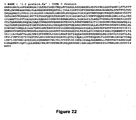
- the nucleotide and corresponding amino acid sequence of rose PPM1 is provided in Figures 21 and 22 and in SEQ ID NOs: 98 and 99, respectively.
- Homologous nucleic acids and proteins may be from chrysanthemum, gerbera and carnation.
- percentage identities encompassed by the present invention include at least about 75% or at least about 80% or at least about 85% or at least about 90% or above, such as about 95% or about 96% or about 97% or about 98% or about 99%, such as at least about 75%, 76%, 77%, 78, 79%, 80%, 81%, 82%, 83%, 84%, 85%, 86%, 87%, 88%, 89%, 90%, 91%, 92%, 93%, 94%, 95%, 96%, 97%, 98%, 99% or 100%.
- the present invention provides an isolated nucleic acid molecule comprising a nucleotide sequence or complementary nucleotide sequence as set forth in SEQ ID NO: 98 or having at least 95% identity thereto.
- a nucleic acid molecule may be capable of hybridizing to the sequence set forth in SEQ ID NO: 98 or complementary strands of either under low stringency conditions, wherein said nucleotide sequence encodes a polypeptide having pH modulating or altering activity.
- low stringency includes and encompasses from at least about 0% to at least about 15% v/v formamide and from at least about 1M to at least about 2 M salt for hybridization, and at least about 1 M to at least about 2 M salt for washing conditions.
- low stringency is from about 25-30°C to about 42°C. The temperature may be altered and higher temperatures used to replace the inclusion of formamide and/or to give alternative stringency conditions.
- Alternative stringency conditions may be applied where necessary, such as medium stringency, which includes and encompasses from at least about 16% v/v to at least about 30% v/v formamide and from at least about 0.5 M to at least about 0.9 M salt for hybridization, and at least about 0.5 M to at least about 0.9 M salt for washing conditions, or high stringency, which includes and encompasses from at least about 31% v/v to at least about 50% v/v formamide and from at least about 0.01 M to at least about 0.15 M salt for hybridization, and at least about 0.01 M to at least about 0.15 M salt for washing conditions.
- medium stringency which includes and encompasses from at least about 16% v/v to at least about 30% v/v formamide and from at least about 0.5 M to at least about 0.9 M salt for hybridization, and at least about 0.5 M to at least about 0.9 M salt for washing conditions
- high stringency which includes and encompasses from at least about 31% v/v to at least about 50% v/v form
- T m of a duplex DNA decreases by 1°C with every increase of 1% in the number of mismatch base pairs ( Bonner and Laskey, Eur. J. Biochem. 46: 83, 1974 ).
- Formamide is optional in these hybridization conditions. Accordingly, particularly preferred levels of stringency are defined as follows: low stringency is 6 x SSC buffer, 1.0% w/v SDS at 25-42°C; a moderate stringency is 2 x SSC buffer, 1.0% w/v SDS at a temperature in the range 20°C to 65°C; high stringency is 0.1 x SSC buffer, 0.1% w/v SDS at a temperature of at least 65°C.
- nucleic acid molecule comprising a sequence of nucleotides encoding or complementary to a sequence encoding an amino acid sequence as set forth in SEQ ID NO:99 or an amino acid sequence having at least 95% identity thereto.
- similarity includes exact identity between compared sequences at the nucleotide or amino acid level. Where there is non-identity at the nucleotide level, similarity includes differences between sequences which result in different amino acids that are nevertheless related to each other at the structural, functional, biochemical and/or conformational levels. Where there is non-identity at the amino acid level, similarity includes amino acids that are nevertheless related to each other at the structural, functional, biochemical and/or conformational levels. In a particularly preferred embodiment, nucleotide and sequence comparisons are made at the level of identity rather than similarity.
- references to describe sequence relationships between two or more polynucleotides or polypeptides include “reference sequence”, “comparison window”, “sequence similarity”, “sequence identity”, “percentage of sequence similarity”, “percentage of sequence identity”, “substantially similar” and “substantial identity”.
- a “reference sequence” is at least 12 but frequently 15 to 18 and often at least 25 or above, such as 30 monomer units, inclusive of nucleotides and amino acid residues, in length. Because two polynucleotides may each comprise (1) a sequence (i.e.
- sequence comparisons between two (or more) polynucleotides are typically performed by comparing sequences of the two polynucleotides over a "comparison window" to identify and compare local regions of sequence similarity.
- a “comparison window” refers to a conceptual segment of typically 12 contiguous residues that is compared to a reference sequence.
- the comparison window may comprise additions or deletions (i.e. gaps) of about 20% or less as compared to the reference sequence (which does not comprise additions or deletions) for optimal alignment of the two sequences.
- Optimal alignment of sequences for aligning a comparison window may be conducted by computerized implementations of algorithms (GAP, BESTFIT, FASTA, and TFASTA in the Wisconsin Genetics Software Package Release 7.0, Genetics Computer Group, 575 Science Drive Madison, WI, USA) or by inspection and the best alignment (i.e. resulting in the highest percentage homology over the comparison window) generated by any of the various methods selected.
- GAP Garnier et al
- Altschul et al Nucl. Acids Res. 25: 3389-3402, 1997
- a detailed discussion of sequence analysis can be found in Unit 19.3 of Ausubel et al, Current Protocols in Molecular Biology John Wiley & Sons Inc, 1994-1998, Chapter 15, 1998 .
- sequence similarity and “sequence identity” as used herein refers to the extent that sequences are identical or functionally or structurally similar on a nucleotide-by-nucleotide basis or an amino acid-by-amino acid basis over a window of comparison.
- a “percentage of sequence identity” is calculated by comparing two optimally aligned sequences over the window of comparison, determining the number of positions at which the identical nucleic acid base (e.g. A, T, C, G, I) or the identical amino acid residue (e.g.
- sequence identity will be understood to mean the "match percentage” calculated by the DNASIS computer program (Version 2.5 for windows; available from Hitachi Software engineering Co., Ltd., South San Francisco, California, USA) using standard defaults as used in the reference manual accompanying the software. Similar comments apply in relation to sequence similarity.
- nucleic acid sequences described herein also encompass oligonucleotides useful as genetic probes for amplification reactions or as antisense or sense molecules capable of regulating expression of the corresponding gene in a plant.
- Sense molecules include hairpin constructs, short double stranded DNAs and RNAs and partially double stranded DNAs and RNAs which one or more single stranded nucleotide over hangs.
- An antisense molecule as used herein may also encompass a genetic construct comprising the structural genomic or cDNA gene or part thereof in reverse orientation relative to its own or another promoter. It may also encompass a homologous genetic sequence.
- An antisense or sense molecule may also be directed to terminal or internal portions of the gene encoding a polypeptide having a pH modulating or altering activity or to combinations of the above such that the expression of the gene is reduced or eliminated.
- an oligonucleotide may have 5-50 nucleotides such as 5, 6, 7, 8, 9, 10, 11, 12, 13, 14, 15, 16, 17, 18, 19, 20, 21, 22, 23, 24, 25, 26. 27, 28, 29, 30, 31, 32, 33, 34, 35, 36, 37, 38, 39, 40, 41, 42, 43, 44. 45, 46, 47, 48, 49. 50, 51, 52, 53, 54. 55 and have substantial similarity to a part or region of a molecule with a nucleotide sequence set forth in SEQ ID NO:98.
- oligonucleotide hybridization Sambrook et al, Molecular Cloning: A Laboratory Manual, 2 ⁇ nd> edition, Cold Spring Harbor Laboratories, Cold Spring Harbor, NY, USA, 1989 ).
- Such an oligonucleotide is useful, for example, in screening for pH modulating or altering genetic sequences from various sources or for monitoring an introduced genetic sequence in a transgenic plant.
- the preferred oligonucleotide is directed to a conserved pH modulating or altering genetic sequence or a sequence conserved within a plant genus, plant species and/or plant variety.
- the oligonucleotide may correspond to the 5' or the 3' end of the nucleic acid modulating or altering pH sequences.
- the 5' end is considered herein to define a region substantially between the start codon of the structural gene to a centre portion of the gene
- the 3' end is considered herein to define a region substantially between the centre portion of the gene and the terminating codon of the structural gene. It is clear, therefore, that oligonucleotides or probes may hybridize to the 5' end or the 3' end or to a region common to both the 5' and the 3' ends.
- the nucleic acid molecules of the present invention may be used as probes.
- the nucleic acid sequences of the present invention encoding a pH modulating or altering proteins or various functional derivatives thereof may be used to reduce the level of an endogenous pH modulating or altering protein (e.g. via co-suppression or antisense- mediated suppression) or other post-transcriptional gene silencing (PTGS) processes including RNAi or alternatively the nucleic acid sequence encoding this enzyme or various derivatives or parts thereof is used in the sense or antisense orientation to reduce the level of a pH modulating or altering protein.
- PTGS post-transcriptional gene silencing
- the use of sense strands, double or partially single stranded such as constructs with hairpin loops is particularly useful in inducing a PTGS response.
- ribozymes, minizymes or DNAzymes could be used to inactivate target nucleic acid sequences.
- Still a further embodiment encompasses post-transcriptional inhibition to reduce translation into polypeptide material. Still yet another embodiment involves specifically inducing or removing methylation.
- Reference herein to the changing of a pH modulating or altering activity relates to an elevation or reduction in activity of up to 30% or more preferably of 30-50%, or even more preferably 50-75% or still more preferably 75% or greater above or below the normal endogenous or existing levels of activity. Such elevation or reduction may be referred to as modulation or alteration of a pH modulating protein. Often, modulation is at the level of transcription or translation of pH modulating or altering genetic sequences.
- the nucleic acids may be a ribonucleic acid or deoxyribonucleic acids, single or double stranded and linear or covalently closed circular molecules.
- the nucleic acid molecule is cDNA.
- Some nucleic acid molecules may hybridize under low, preferably under medium and most preferably under high stringency conditions with the nucleic acid molecules of the present invention and in particular to the sequence of nucleotides set forth in SEQ ID NO: 98 or a part or region thereof.
- nucleic acid molecule having a nucleotide sequence set forth in SEQ ID NO: 98 or to a molecule having at least 95% identity at the level of nucleotide or amino acid sequence to at least one or more regions of the sequence set forth in SEQ ID NO: 98 and wherein the nucleic acid encodes or is complementary to a sequence which encodes an enzyme having a pH modulating or altering activity. It should be noted, however, that nucleotide or amino acid sequences may have similarities below the above given percentages and yet still encode a pH modulating or altering activity.
- Nucleic acid molecules may be in the form of oligonucleotide primers or probes capable of hybridizing to a portion of the nucleic acid molecules contemplated above, and in particular those set forth in SEQ ID NO: 98, under low, particularly under medium and most particularly under high stringency conditions.
- the portion may correspond to the 5' or the 3' end of the gene.
- the 5' end is considered herein to define a region substantially between the start codon of the structural genetic sequence to a centre portion of the gene
- the 3' end is considered herein to define a region substantially between the centre portion of the gene and the terminating codon of the structural genetic sequence. It is clear, therefore, that oligonucleotides or probes may hybridize to the 5' end or the 3' end or to a region common to both the 5' and the 3' ends. All such probes are contemplated herein.
- gene is used in its broadest sense and includes cDNA corresponding to the exons of a gene. Accordingly, reference herein to a gene is to be taken to include:-
- gene is also used to describe synthetic or fusion molecules encoding all or part of an expression product.
- nucleic acid molecule and gene may be used interchangeably.
- the nucleic acid or its complementary form may encode the full-length enzyme or a part or derivative thereof.
- derivative is meant any single or multiple amino acid substitutions, deletions, and/or additions relative to the naturally occurring enzyme and which retains a pH modulating or altering activity.
- the nucleic acid includes the naturally occurring nucleotide sequence encoding a pH modulating or altering activity or may contain single or multiple nucleotide substitutions, deletions and/or additions to said naturally occurring sequence.
- the nucleic acid of the present invention or its complementary form may also encode a "part" of the pH modulating or altering protein, whether active or inactive, and such a nucleic acid molecule may be useful as an oligonucleotide probe, primer for polymerase chain reactions or in various mutagenic techniques, or for the generation of antisense molecules.
- Reference herein to a "part" of a nucleic acid molecule, nucleotide sequence or amino acid sequence preferably relates to a molecule which contains at least about 10 contiguous nucleotides or five contiguous amino acids, as appropriate.
- Amino acid insertional derivatives of the pH modulating or altering protein of the present invention include amino and/or carboxyl terminal fusions as well as intra-sequence insertions of single or multiple amino acids.
- Insertional amino acid sequence variants are those in which one or more amino acid residues are introduced into a predetermined site in the protein although random insertion is also possible with suitable screening of the resulting product.
- Deletional variants are characterized by the removal of one or more amino acids from the sequence.
- Substitutional amino acid variants are those in which at least one residue in the sequence has been removed and a different residue inserted in its place. Typical substitutions are those made in accordance with Table 2.
- the amino acids are generally replaced by other amino acids having like properties, such as hydrophobicity, hydrophilicity, electronegativity, bulky side chains and the like.
- Amino acid substitutions are typically of single residues.
- Amino acid insertions will usually be in the order of about 1-10 amino acid residues and deletions will range from about 1-20 residues.
- deletions or insertions are made in adjacent pairs, i.e. a deletion of two residues or insertion of two residues.
- amino acid variants referred to above may readily be made using peptide synthetic techniques well known in the art, such as solid phase peptide synthesis ( Merrifield, J. Am.Chem. Soc. 85:2149, 1964 ) and the like, or by recombinant DNA manipulations.Techniques for making substitution mutations at predetermined sites in DNA having known or partially known sequence are well known and include, for example, M1 3 mutagenesis. The manipulation of DNA sequence to produce variant proteins which manifest as substitutional, insertional or deletional variants are conveniently described, for example, in Sambrook et al, 1989 supra.
- recombinant or synthetic mutants and derivatives of the pH modulating or altering proteins described herein include single or multiple substitutions, deletions and/or additions of any molecule associated with the enzyme such as carbohydrates, lipids and/or proteins or polypeptides.
- analogs and “derivatives” also extend to any functional chemical equivalent of pH modulating or altering proteins and also to any amino acid derivative described above.
- reference to pH modulating or altering proteins herein includes reference to any functional mutant, derivative, part, fragment, homolog or analog thereof.
- nucleic acid sequences derived from rose are particularly exemplified herein since this represents a convenient source of material to date. However, one skilled in the art will immediately appreciate that similar sequences can be isolated from any number of sources such as other plants or certain microorganisms. All such nucleic acid sequences encoding directly or indirectly a pH modulating protein and falling within the scope of the claims are encompassed herein regardless of their source. Examples of other suitable sources of genes encoding pH modulating or altering proteins include, but are not limited to Liparieae. Plumbago spp, Rosa sp., Gerbera sp., Chrysanthemum sp..
- Dendranthema sp. lily, Gypsophila sp., Torenia sp., Petunia, sp., orchid, Cymbidium sp., Dendrobium sp., Phalaenopsis sp., cyclamen, Begonia sp., Iris sp., Alstroemeria sp., Anthu[eta]um sp., Catharanthus sp., Dracaena ap., Erica sp., Ficus sp., Freesia sp.. Fuchsia sp..
- Geranium sp. Gladiolus sp., Helianthus sp., Hyacinth sp., Hypericum sp., Impatiens sp., Iris sp., Chamelaucium sp., Kalanchoe sp., Lisianthus sp., Lobelia sp., Narcissus sp., Nierembergia sp., Ornithoglaum sp., Osteospermum sp., Paeonia sp., Pelargonium sp., Primrose sp., Ruscus sp., Saintpaulia sp., Solidago sp., Spathiphyllum sp., Tulip sp., Verbena sp., Viola sp., Zantedeschia sp. etcanenome , hyacinth, Liatrus sp., Viola sp.
- a nucleic acid sequence as described herein encoding a pH modulating or altering protein may be introduced into and expressed in a transgenic plant in either orientation thereby providing a means to modulate or alter the vacuolar pH by either reducing or eliminating endogenous or existing pH modulating or altering protein activity thereby allowing the vacuolar pH to increase.
- a particular effect is a visible effect of a shift to blue in the color of the anthocyanins and/or in the resultant flower color.
- Expression of the nucleic acid sequence in the plant may be constitutive, inducible or developmental and may also be tissue-specific.
- the word "expression" is used in its broadest sense to include production of RNA or of both RNA and protein. It also extends to partial expression of a nucleic acid molecule.
- the present invention thus provides a method for modulating the pH in a vacuole of a plant cell said method comprising
- a method for producing a transgenic flowering plant capable of synthesizing a pH modulating or altering protein may comprise stably transforming a cell of a suitable plant with a nucleic acid sequence which comprises a sequence of nucleotides encoding said pH modulating or altering proteins under conditions permitting the eventual expression of said nucleic acid sequence, regenerating a transgenic plant from the cell and growing said transgenic plant for a time and under conditions sufficient to permit the expression of the nucleic acid sequence.
- the transgenic plant may thereby produce non-indigenous pH modulating or altering proteins at elevated levels relative to the amount expressed in a comparable non-transgenic plant.
- the present invention provides a method for producing a transgenic plant or flowering plant capable of synthesizing a pH modulating or altering protein, said method comprising stably transforming a cell of a suitable plant with the nucleic acid molecule as defined in the above methods of the invention under conditions permitting the eventual expression of said nucleic acid molecule, regenerating a transgenic plant from the cell and growing said transgenic plant for a time and under conditions sufficient to permit the expression of the nucleic acid molecule.
- Another aspect of the invention contemplates a method for producing a transgenic plant with reduced indigenous or existing pH modulating or altering activity, said method comprising stably transforming a cell of a suitable plant with a nucleic acid molecule as defined in the above method of the invention, regenerating a transgenic plant from the cell and where necessary growing said transgenic plant under conditions sufficient to permit the expression of the nucleic acid.
- a method for producing a genetically modified plant with reduced indigenous or existing pH modulating or altering protein activity may comprise altering the pH modulating or altering gene through modification of the indigenous sequences via homologous recombination from an appropriately altered pH modulating or altering gene or derivative or part thereof introduced into the plant cell, and regenerating the genetically modified plant from the cell.
- Still another aspect contemplates a method for producing a genetically modified plant with reduced indigenous pH altering protein activity, said method comprising altering the pH by reducing expression of a gene encoding the indigenous pH altering protein by introduction of a nucleic acid molecule as defined in the above methods of the invention into the plant cell and regenerating the genetically modified plant from the cell.
- Yet another aspect provides a method for producing a transgenic plant capable of generating a pH altering protein, said method comprising stably transforming a cell of a suitable plant with the isolated nucleic acid molecule as defined in the above methods of the invention and regenerating a transgenic plant from the cell.
- an "indigenous” enzyme is one, which is native to or naturally expressed in a particular cell.
- a “non-indigenous” enzyme is an enzyme not native to the cell but expressed through the introduction of genetic material into a plant cell, for example, through a transgene.
- An “endogenous” enzyme is an enzyme produced by a cell but which may or may not be indigenous to that cell.
- nucleic acid molecule encoding a protein which alters pH is from rose.
- a method for producing a transgenic flowering plant exhibiting altered floral or inflorescence properties comprising stably transforming a cell of a suitable plant with a nucleic acid sequence as defined in the above methods of the invention, regenerating a transgenic plant from the cell and growing said transgenic plant for a time and under conditions sufficient to permit the expression of the nucleic acid sequence.
- inflorescence refers to the flowering part of a plant or any flowering system of more than one flower which is usually separated from the vegetative parts by an extended internode, and normally comprises individual flowers, bracts and peduncles, and pedicels. As indicated above, reference to a “transgenic plant” may also be read as a “genetically modified plant”.
- the method may comprise stably transforming a cell of a suitable plant with a nucleic acid sequence as defined in the above methods of the invention, regenerating a transgenic plant from the cell and growing said transgenic plant for a time and under conditions sufficient to alter the level of activity of the indigenous or existing pH modulating or altering proteins.
- the altered level would be less than the indigenous or existing level of pH modulating or altering activity in a comparable non-transgenic plant.
- reduction of the indigenous pH modulating protein activity may require the expression of the introduced nucleic acid sequence or its complementary sequence.
- expression of the introduced genetic sequence or its complement may not be required to achieve the desired effect: namely, a flowering plant exhibiting altered floral or inflorescence properties.
- a method for producing a flowering plant exhibiting altered floral or inflorescence properties comprising alteration of the pH modulating or altering gene through modification of the indigenous sequences via homologous recombination from an appropriately altered pH modulating or altering gene or derivative or part thereof as defined in the above methods of the invention introduced into the plant cell, and regenerating the genetically modified plant from the cell.
- the altered floral or inflorescence includes the production of different shades of blue or purple or red flowers or other colors, depending on the genotype and physiological conditions of the recipient plant.
- the target gene is from rose.
- a method for producing a transgenic plant capable of expressing a recombinant gene derived from rose encoding a pH modulating or altering protein or part thereof or which carries a nucleic acid sequence which is substantially complementary to all or a part of a mRNA molecule encoding a pH modulating or altering protein, said method comprising stably transforming a cell of a suitable plant with the isolated nucleic acid molecule comprising a sequence of nucleotides encoding, or complementary to a sequence encoding, a pH modulating or altering protein, as defined in the above methods of the invention, where necessary under conditions permitting the eventual expression of said isolated nucleic acid molecule, and regenerating a transgenic plant from the cell.
- the instant disclosure therefore, extends to all transgenic plants or parts or cells therefrom of transgenic plants or progeny of the transgenic plants containing all or part of the nucleic acid sequences of the present invention, or antisense forms thereof and/or any homologs or related forms thereof and, in particular, those transgenic plants which exhibit altered floral or inflorescence properties.
- the transgenic plants may contain an introduced nucleic acid molecule comprising a nucleotide sequence encoding or complementary to a sequence encoding a pH modulating or altering protein according to the claims.
- the nucleic acid would be stably introduced into the plant genome, although the present invention also extends to the introduction of a pH modulating or altering nucleotide sequence within an autonomously-replicating nucleic acid sequence such as a DNA or RNA virus capable of replicating within the plant cell.
- This aspect also extends to seeds from such transgenic plants. Such seeds, especially if colored, are useful as proprietary tags for plants. Any and all methods for introducing genetic material into plant cells including but not limited to Agrobacterium-mcdialtd transformation, biolistic particle bombardment etc. are encompassed herein.
- Extracts from transgenic plants or plant parts or cells therefrom of transgenic plants or progeny of the transgenic plants containing all or part of the nucleic acid sequences described herein and in particular rose may be used as a flavoring or food additive or health product or beverage or juice or coloring.
- Plant parts contemplated herein include, but are not limited to flowers, fruits, vegetables, nuts, roots, stems, leaves or seeds.
- the extracts may be derived from the plants or plant part or cells therefrom in a number of different ways including but not limited to chemical extraction or heat extraction or filtration or squeezing or pulverization.
- the plant, plant part or cells therefrom or extract can be utilized in any number of different ways such as for the production of a flavoring (e.g. a food essence), a food additive (e.g. a stabilizer, a colorant) a health product (e.g. an antioxidant, a tablet) a beverage (e.g. wine, spirit, tea) or a juice (e.g. fruit juice) or coloring (e.g. food coloring, fabric coloring, dye, paint, tint).
- a flavoring e.g. a food essence
- a food additive e.g. a stabilizer, a colorant
- a health product e.g. an antioxidant, a tablet
- a beverage e.g. wine, spirit, tea
- a juice e.g. fruit juice
- coloring e.g. food coloring, fabric coloring, dye, paint, tint
- recombinant forms of pH modulating or altering proteins such as from rose.
- the recombinant forms of the enzyme provide a source of material for research, for example, more active enzymes and may be useful in developing in vitro systems for production of colored compounds.
- a genetic construct has been used interchangeably throughout the specification and claims with the terms “fusion molecule”, “recombinant molecule”, “recombinant nucleotide sequence”.
- a genetic construct may include a single nucleic acid molecule comprising a nucleotide sequence encoding a single protein or may contain multiple open reading frames encoding two or more proteins. It may also contain a promoter operably linked to one or more of the open reading frames.
- a prokaryotic or eukaryotic organism carrying a genetic sequence encoding a pH modulating or altering proteins such as from rose extrachromasomally in plasmid form may be generated.
- a recombinant polypeptide comprising a sequence of amino acids as set forth in SEQ ID NO: 99 or an amino acid sequence having at least-about 50% similarity to SEQ ID NO: 99 or a derivative of said polypeptide.
- a “recombinant polypeptide” means a polypeptide encoded by a nucleotide sequence introduced into a cell directly or indirectly by human intervention or into a parent or other relative or precursor of the cell.
- a recombinant polypeptide may also be made using cell-free, in vitro transcription systems.
- the term “recombinant polypeptide” includes an isolated polypeptide or when present in a cell or cell preparation. It may also be in a plant or parts of a plant regenerated from a cell which produces said polypeptide.
- a “polypeptide” includes a peptide or protein and is encompassed by the term “enzyme”.
- the recombinant polypeptide may also be a fusion molecule comprising two or more heterologous amino acid sequences.
- a pH modulating or altering nucleic acid sequence 5 linked to a nucleic acid sequence involved in modulating or altering the anthocyanin pathway is also disclosed.
- nucleic acid molecule obtainable from rose which encodes a pH altering polypeptide in the manufacture of a plant with an altered pH compared to the pH in a non-manufactured plant of the same species.
- the vacuolar pH is altered.
- the invention provides the use of a nucleic acid molecule as defined in the above methods of the invention in the manufacture of a plant with an altered pH compared to the pH in a non-manufactured plant of the same species.
- Petunia hybrida cv. M1 x V30 flowers were harvested at developmental stages defined as follows:
- the Petunia hybrida lines used in the cDNA-AFLP screening were R27 (wild-type (wt)), W225 ( an1, frame-shift mutation in R27 background), R144 ( ph3 -V2068 transposon insertion in PN3 in R27 background), R147 ( ph4-X2058 transposon insertion in PH4 in R27 background) and R153 (ph5 transposon insertion in PH5 crossed into a R27 background). All lines have genetically identical background and to diminish differences in environmental conditions which could lead to differences in transcript levels, the plants were grown in a greenhouse adjacent to each other.
- the Petunia hybrida line M1 x V30 used in transformations experiments was an F1 hybrid of M1 ( AN1, AN2, AN4, PH4, PPM1, PPM2) crossed with line V30 ( AN1, AN2, AN4, PH4, PPM1, PPM2).
- Flowers of M1 x V30 are red-violet and generally accumulate anthocyanins based upon malvidin and low levels of the flavonol quercetin.
- a petunia petal cDNA library was prepared from R27 petals using standard methods as described in Holton et al, 1993 supra or Brugliera et al, 1994 supra or de Vetten N et al, 1997 supra.
- Transient expression assays were performed by particle bombardment of petunia petals as described previously (de Vetten et al, 1997 supra; Quattrocchio et al, Plant J. 13:475-488, 1998 .
- the pH of petal extracts was measured by grinding the petal limbs of two corollas in 6 mL distilled water. The pH was measured directly (within 1 min) with a normal pH electrode, to avoid that atmospheric CO 2 would alter pH of the extract
- HPLC analysis was as described in de Vetten et al, Plant Cell 11(8):1433-1444, 1999 .
- TLC analysis was as described in van Houwelingen et al, Plant J. 13(1):39-50, 1998 .
- RNA isolation and RT-PCR analysis were carried out as described by de Vetten et al. 1997 supra. Rapid amplification of cDNA (3') ends (RACE) was done as described by Frohman et al, PNAS 85: 8998-9002, 1988 .
- RACE Rapid amplification of cDNA (3') ends
- the petunia lines R27 (wt), W225 ( an1 - ), R144 ( ph3 - ), R147 ( ph4 - ) and R153 ( ph5 - ) were used in the cDNA-AFLP screening.
- Around 25 to 30 flower buds (flower developmental stage 5, 6) were harvested from each petunia line and stored at -70°C.
- Total RNA was extracted from 10 corollas according to Logemann et al, Anal Biochem. 163(1):16-20, 1987 .
- PolyA + RNA was then isolated from 500 micrograms of total RNA using oligo(dT) coupled to magnetic beads according to the PolyATract (Registered) System (PROMEGA) protocol.
- RNA was then used for synthesizing double stranded (ds) cDNA using the GIBCO-BRL Superscript II system. After synthesis of ds cDNAs, the cDNAs were phenol extracted (Sambrook et al, 2001 supra ) and the cDNA precipitated with the addition of salt and ethanol. The DNA pellet was then resuspended in 30 ⁇ L of distilled water.
- Restriction endonucleases Mse I (digests a 4 base recognition sequence) and Eco RI (digests a 6 base recognition sequence) were used for the template preparation for cDNA-AFLP analysis.
- the cDNAs were digested with both restriction endonucleases in combination with ligation of adapters (Mse A1 (SEQ ID NO:7) and Mse A2 (SEQ ID NO:8)) annealed to each other and EcoA1 (SEQ ID NO:14) and EcoA2 (SEQ ID NO:15) also annealed to each other to form respectively a PCR adaptor for the Mse I site and one for the Eco RI site) to the Mse I and Eco RI ends.
- adapters Mse A1 (SEQ ID NO:7) and Mse A2 (SEQ ID NO:8)
- Each "restriction-ligation" reaction was performed in a total volume of 50 ⁇ L which included 24 ⁇ L ds cDNA, 10 ⁇ L 5 x RL buffer (50mM Tris HAc pH7.5, 50mM MgAc, 250mM KAc, 25mM DTT, 250 ⁇ g/ ⁇ L BSA), 0.1 ⁇ L 100mM ATP, 5 units Mse I (New England Biolabs), 5 units Eco RI (New England Biolabs), 50 pmol Mse I adapter (Mse A1 and Mse A2) (SEQ ID NO:7 and 8) and 50pmol Eco RI adapter (EcoA1 and EcoA2) (SEQ ID NO:14 and 15).
- the adapters had previously been boiled for 2 minutes and then slowly allowed to cool to room temperature prior to their addition to the reaction.
- the "restriction-ligation” reaction was incubated for 4 hours at 37°C.
- cDNA templates Prior to amplification, cDNA templates were diluted 10-fold in water and then a volume of 10 ⁇ L was used in the first, non-radioactive, PCR amplification step with one nucleotide selective extension ( Eco RI+N, Mse I+N) primers (SEQ ID NO:10 to 13 and 16 to 19))(see Table 4) in a touch-down PCR program.
- the PCR cycle included a 94°C denaturation step followed by annealing step of 30 seconds at temperatures starting at 65°C and reducing in 0.7°C increments down to 56°C over 17 cycles followed by 18 cycles of 56°C for 30 sec and finally an elongation step at 72°C for 1 min.
- the Eco RI primers in the second PCR were radio-labeled with 33 P in a reaction which included 50ng primer, 5 ⁇ L 10x T4 kinase buffer, 10 ⁇ L 33 P-CTP, 24 ⁇ L water and 9 units T4 polynucleotide kinase.
- the reaction was incubated for 1 hour at 37°C, followed by inactivation of the T4 kinase by treatment at 65°C for 10 minutes.
- Primer No. Primer name Primer sequence (5' to 3') 20 708 Mse+AA GAT GAG TCC TGA GTA AAA 21 709 Mse+AC GAT GAG TCC TGA GTA AAC 22 710 Mse+AG GAT GAG TCC TGA GTA AAG 23 711 Mse+AT GAT GAG TCC TGA GTA AAT 24 712 Mse+CA GAT GAG TCC TGA GTA ACA 25 713 Mse+CC GAT GAG TCC TGA GTA ACC 26 714 Mse+CG GAT GAG TCC TGA GTA ACG 27 715 Mse+CT GAT GAG TCC TGA GTA ACT 28 716 Mse+GA GAT GAG TCC TGA GTA AGA 29 717 Mse+GC GAT GAG TCC TGA GTA AGC 30 718 Mse+GG GAT GAG TCC TGA GTA AGG 31 719 Mse+GT GAT GAG TCC TGA GTA A
- reaction products were analyzed by electrophorescing through a 5% denaturing polyacrylamide gel. After electrophoresis the gels were dried on a slab gel dryer and then exposed overnight. The radiolabeled signals of the reaction products were then detected using a Phosphor imager (Molecular Dynamics, Sunnyvale, CA, USA).
- micro-array hybridization petal tissue of developmental stage 5 of both wildtype (R27) and an1 - mutant line (W225) was used to isolate polyA + RNA according to protocol of the supplier (polyATtract mRNA Isolation System III, Promega). Microarrays were prepared and hybridized using conditions described by Verdonk et al, Phytochemistry 62: 997-1008, 2003 .
- nucleotide and deduced amino acid sequences of MACF55 are shown in SEQ ID NOs:1 and 2; MAC9F1 nucleotide and deduced amino acid sequences are shown in SEQ ID NOs:3 and 4; CAC16.5 nucleotide and deduced amino acid sequences are shown in SEQ ID NOs:5 and 6.
- MAC F55 PPM1 (SEQ ID NO:1)
- MAC 9F1 SEQ ID NO:3
- CAC 16.5 SEQ ID NO:5
- the MAC F55 clone codes for a plasma membrane ATPase ( PPM1, Petunia Plasma Membrane ATPase 1) (SEQ ID NO:1) and has a relatively high sequence identity with ATPase genes already isolated.
- PPM1 plasma membrane ATPase
- SEQ ID NO:1 Petunia Plasma Membrane ATPase 1
- AHA10 was described as having a specific effect on proanthocyanidin and vacuole biogenesis.
- the aha10 mutants characterized had decreased levels of proanthocyanidins in their seed coats and the seed coat endothelial cells displayed many small vacuoles rather than one central vacuole as observed in wild-type seeds.
- wild type petunia plants (V30 x M1) were transformed with two inverted repeat constructs: a 233 bp inverted repeat spanning from nucleotide 2937 to nucleotide 3170 of the PPM1 full size cDNA (SEQ ID NO:1) and a 499bp inverted repeat spanning from nucleotide 2671 to nucleotide 3170 of the PPM1 full size cDNA (SEQ ID NO:1), both under the control of the CaMV 35S promoter.
- a P. hybrida R27 petal cDNA library was hybridized with 32 P-labeled fragments of PPM1.
- the PPM1 fragment was generated using PCR amplification with first stand cDNA from RNA isolated from petunia petals as template and the primers #1702 (SEQ ID NO:52) and #1703 (SEQ ID NO:53).
- the full length PPM1 sequence was obtained using a double 5' Rapid Amplification of cDNA (5'/3'-RACE KIT 2 ND generation, Roche, USA) according to the manufacturer's protocols.
- Primers #1703 (SEQ ID NO:53), #1742 (SEQ ID NO:55) and #1832 (SEQ ID NO:61) were used for the first 5'-RACE whilst primers #1789 (SEQ ID NO:58), #1812 (SEQ ID NO:59) and #1831 (SEQ ID NO:60) were used for the second 5'-RACE.
- Two PPM1 cDNA fragments (A and B) were amplified using the following primers: A, #1703 (SEQ ID NO:53) and # 1702 (SEQ ID NO:52) and B, #1703 (SEQ ID NO:53) and #1750 (SEQ ID NO:56).
- the PCR products were then ligated into the vector pGemt-easy (Promega). Clones containing the correct insert were selected by PCR, digested with Eco RI and subsequently cloned into the Eco RI restriction site of the entry vector pDONR207(1) of the Gateway system (INVITROGEN).
- the inserts were translocated into pK7GWIWG2(I) and transformed into competent E .coli DH5 ⁇ cells.
- the primer combinations 35S promoter (#27) together with the pK7GWIWG2(I) intron reverse primer (#1777), and 35S terminator (#629) together with the intron forward primer (#1778) clones containing the insert in an inverted repeat arrangement were selected.
- PPM2 shows high homology with class II of plasma ATPase proteins containing PMA4 from Nicotiana and AHA2 from Arabidopsis for which plasma membrane localization in plant cells has been shown, as well as the capability of complementing pmp1 mutants in yeast and their regulation by 14.3.3 proteins ( Jahn et al. JBC, 277,6353-6358, 2002 ). TABLE 9 Primers used in amplification of PPM2 fragments. SEQ ID NO: PPM2 Direction Sequence (5' to 3') 102 1969 forward CTTGTTGACAGCACCAACAATG 103 1970 reverse CAAGGATCTATCGACACTCAACTTG
- the PPM-1 gene is intriguing because the possible involvement of a P-type ATPase in vacuolar acidification has never been proposed before. From preliminary analysis of PPM1 expression in Petunia, it was found that the gene is specifically expressed in the flower limb (nowhere else in the plant). Because petunia flowers mutated in AN1, PH3 or PH4 do not show any expression of PPM-1, and still look healthy, it is believed to think that the function of this specific gene is confined to the control of the vacuole environment, while it does not contribute to the regulation of the cytosolic pH. It is also possible that other members of the P-ATPase family are expressed in these same cells and control the proton gradient through the plasma membrane.
- P-ATPases are membrane associated proteins but in this specific case it is not expected that the PPM-1 protein would be localized on the plasma membrane as this would not explain its contribution to vacuolar pH control.
- a GFP fusion of the full-size PPM-1 cDNA was expressed in petunia cells (transient expression in flowers via particle bombardment) and its localization was visualized by confocal microscopy. The different cellular compartment and vacuolar types are identified by marker GFP fusions ( Di Sansebastiano et al, Plant 126, 78-86, 2001 ). The PPM-1 protein appeared to be localized on the tonoplast or in vesicles that later fuse to the central vacuole of the flower epidermal cells, which opens a new view of the role of these proteins in cellular homeostasis.
- PPM-1 expression construct The capability of a PPM-1 expression construct is also tested to complement the yeast Pma1 mutant missing the endogenous P-ATPase activity to make sure that PPM-1 encoded proteins has indeed P-ATPase activity.
- Phosphorylation of Thr947 has also been recognized as an important step in the regulation of the ATPase activity (Jahn et al, 2001, supra ) .
- the PH2 gene from petunia has been cloned and shown that this encodes a h/Ser protein kinase of which PPM-1 may directly or indirectly (e.g. via a cascade of protein kinases) be the target of this kinase.
- PPM-1 may directly or indirectly (e.g. via a cascade of protein kinases) be the target of this kinase.
- a full-size PPM-1 cDNA fused to a Hys-tag was expressed in wild type and in ph2 - petunia plants.
- the recombinant PPM-1 protein was purified from flower extracts using a nickel column, then visualized using SDS-PAGE and immunodetection with anti-ATPase and antiphosphothreonine antibodies. This, therefore, assists in reconstructing a new small part of this pH-controlling pathway.
- nucleotide and derived amino acid sequence of the clone MAC 9F1 do not show clear homology with any identified nucleic acid sequence or protein of known function, respectively.
- inverted repeats of 9F1 were expressed in petunia wild-type plants the silencing of the 9F1 endogenous gene resulted in blue flowers with increased flower extract pH.
- the inverted repeat 9F1 construct was introduced into Agrobacterium tumefaciens by electroporation and transfected into petunia via leaf disk transformation. Transformed plants were selected on MS plates containing 250 microgram/mL of kanamycin, and after rooting, were grown under normal greenhouse conditions.
- the cellular localization is defined by studying a GFP fusion in transient assay and look for possible interacting partners which are screened via yeast two hybrid screening of a cDNA library.
- An indication of the biochemical function of 9F1 also comes from the phenotype of plants overexpressing this gene.
- the nucleotide and derived amino acid sequence of the clone CAC16.5 is shown in SEQ ID NO:5 and 6, respectively.
- the predicted amino acid sequence shows relatively high homology with Cysteine Proteases. The localization of these enzymes is typically vacuolar and their activity is dependent on relatively low environmental pH.
- CAC16.5 An inverted repeat construct, pK7GWIWG2(I) CAC16.5 ( Figure 4 ), of CAC16.5 was prepared using primers described in Table 11 and the Gateway system as described above.
- the inverted repeat CAC16.5 construct was introduced into Agrobacterium tumefaciens by electroporation and transfected into petunia via leaf disk transformation. Transformed plants were selected on MS plates containing 250 microgram/mL of kanamycin, and after rooting, were grown in normal greenhouse conditions.
- cysteine proteases is the cleavage of a variety of other peptides
- a construct "bait" plasmid is constructed for yeast two hybrid screening in which the Cys25 residue in the active site of the CAC16.5 gene is mutated. This avoids the cleavage of the substrate when the two protein interact with each other and will allow to isolate the "prey" plasmid(s) containing the gene(s) that encodes for the target of CAC16.5.
- the characterization of the target of this proteolitic activity helps to further reconstruct the acidification pathway.
- vacuoles of the epidermal cells Detailed analysis of flowers from wild type, pH mutant and plants overexpressing regulators of the pH pathway has recently shown structural differences in the vacuoles of the epidermal cells. The most relevant difference involves the dimension and shape of the vacuoles in these cells and points towards a role of the PH genes in defining the height and width of vacuolar structure. Because the papillar shape of the cells in the corolla epidermis is peculiar to this tissue (to which this entire acidification pathway is restricted as shown by expression studies of the genes involved), it is speculated that the genes controlling acidity in the vacuolar lumen possibly also define the vacuole type (e.g. lytic or storage vacuole) and with it cell identity.
- vacuole type e.g. lytic or storage vacuole
- pH4 is a member of the MYB family of transcription factors that is expressed in the petal epidermis and that can physically interact with AN1 and JAF13. This indicates that AN1 is present in at least two distinct transcription complexes.
- One complex includes pH4 and activates a set of unknown target genes involved in vacuolar acidification, whereas another (pH4-independent) complex activates the structural anthocyanin genes.
- a Rose (cv. 'rote rose') petal cDNA library was constructed utilizing total RNA isolated from petals from developmental stages 1 to 3 rose buds and a ⁇ ZAP cDNA synthesis kit (Stratagene) according to procedures described above and those recommended by the manufacturer. A library of 3 x 10 5 pfu was thus constructed for isolation of a rose PPM1 cDNA clone.
- the PCR conditions used for labelling of the petunia PPM1 probe were as follows.
- Hybond-N(Amersham) membranes were used and treated according to the manufacture's instructions. Prior to hybridization, duplicate plaques lifts were washed in a prewash solution (50mM Tris-HCl, pH7.5, 1 M NaCl, 1 mM EDTA, 0.1% w/v sarcosine) at 65°C for 30 minutes. This was followed by washing in 0.4M sodium hydroxide at 65°C for 30 minutes, then in a solution of 0.2M Tris-HCl, pH 8.0, 0.1 x SSC, 0.1% w/v SDS at 65°C for 30 minutes and finally rinsed in 2 x SSC, 1.0% w/v SDS.
- a prewash solution 50mM Tris-HCl, pH7.5, 1 M NaCl, 1 mM EDTA, 0.1% w/v sarcosine
- Hybridization conditions included a prehybridization step at 37°Cfor 2-3 hr in Hybridization Buffer (5 x SSC, 30% v/v Formamide, 2% w/v Blocking Reagent, 0.1% w/v N-lauroylsarcosine (Sodium salt), 1% w/v SDS, 50mM Na-Phosphate Buffer (pH7.0)).
- Hybridization Buffer (5 x SSC, 30% v/v Formamide, 2% w/v Blocking Reagent, 0.1% w/v N-lauroylsarcosine (Sodium salt), 1% w/v SDS, 50mM Na-Phosphate Buffer (pH7.0)) with DIG labeled petunia PPM1 (SEQ ID NO:1) probe added.
- Hybridization was carried out overnight at 37°C. Subsequent to this the filters were washed in 5 X SSC/1% w/v SDS twice at 55°C for 1 hr each.
- the rose PPM1 nucleotide sequence (SEQ ID NO: 98) shared 72% identity with the petunia PPM1 nucleotide sequence (SEQ ID NO: 1)
- the deduced amino acid sequence of the rose PPM1 clone (SEQ ID NO: 99) shared 83% identity and 91% similarity with the deduced amino acid sequence of the petunia PPM1 clone (SEQ ID NO: 2).
- the deduced amino acid sequence of the rose PPM1 clone (SEQ ID NO: 99) when aligned with the petunia PPM1 sequence (SEQ ID NO:2) also contained the same 3 amino acid residues ("HTV") ( Figure 24 ) at the C-terminus which have been identified (International Patent Application PCT/AU2006/000451 ) as 'tell-tale' or typical of this class of P-ATPases.
- HTV 3 amino acid residues
- the rose PPM cDNA was used as a basis for construction of a plant transformation vector aimed at downregulation or gene knockout of rose PPM1 in rose petals. Knockout of rose PPM1 would thus lead to elevation of petal vacuolar pH and change of flower color, To achieve gene knockout a strategy aimed at production of dsRNA for rose PPM1 was used.
- a hairpin structure was engineered using 600bp of 5' sequence of the cDNA (SEQ ID NO: 98) and incorporated into a CaMV 35S:mas expression cassette in the binary vector pBinPLUS. This construct was named pSFL631 ( Figure 8 ). It was transferred into Agrobacterium tumefaciens preparatory to transformation of rose tissue according to the method described below.
- a further construct aimed at confining expression of the rose PPM1 knockout cassette to petal tissue is now in progress.
- One example of such a strategy will include the use of a rose CHS promoter (International Patent Application PCT/AU03/01111 ).
- Other genes of the anthocyanin biosynthetic pathway will be a useful source of promoters for limiting expression of a gene cassette to petals as desired.
- Manipulation of the sequences included in further constructs will be used to alter the specificity of (i) gene knockout or silencing, and (ii) gene expression, that is expression of the pH-modulating sequences which are typically configured, using technology such as RNAi, to downregulate or silence the target gene.
- pH-modulating sequences will include PPM1, MAC9F1 and CAC16.5 homologs from rose.
- An alternative plant transformation vector is produced by generating a hairpin structure using the sequence at the 3' end of the rose PPM-1 sequence (SEQ ID NO: 98). This would be more specific to the rose PPM-1 sequence without down-regulating other plasma ATPases that may be vital to plant or flower development.
- One example of such a strategy includes isolating the ⁇ 240bp Pst I/ Eco RI fragment from pRosePPM1 ( Figure 23 ) encompassing the 3' end of the cDNA clone.
- This fragment is then ligated with an ⁇ 5.9 kb Pst I/ Eco RI fragment of pKIWI101 containing a hybrid promoter consisting of a promoter region from CaMV 35S gene with enhancer elements from a promoter fragment of mannopine synthase (mas) gene of Agrobacterium tumefaciens and ⁇ 1.6kb terminator fragment from octopine synthase gene of A. tumefaciens ( Janssen and Gardner, Plant Molecular Biology, 14: 61-72, 1989 ; International Patent Application PCT/AU03/01111 ). Correct insertion of the fragment is established by restriction endonuclease analysis of plasmid DNA isolated from ampicillin-resistant transformants.
- the resulting plasmid is then linearised with Eco RI and the overhanging ends are repaired.
- the ⁇ 240bp Pst I/ Eco RI ends of the rosePPM1 fragment (described above) are also repaired and the resulting fragment is ligated with the blunt ends of the linearised plasmid. Correct insertion of the fragment in an antisense direction is established by restriction endonuclease analysis and sequencing of plasmid DNA isolated from ampicillin-resistant transformants.
- the ⁇ 2.4kb fragment containing 35S: sense 3' rosePPM1 / antisense 3' rosePPM1: ocs chimaeric gene contained is then released upon digestion with Xho I/ Xba I and the overhanging ends are repaired.
- the resulting 2.4kb fragment is isolated and ligated with Sma I ends of the binary vector pCGP1969 (International Patent Application PCT/AU03/01111 ) or other binary vector containing F3'5'H genes (International Patent Application PCT/AU03/01111 , International Patent Application PCT/JP2004/011958 ).
- the T-DNAs contained in the binary vector plasmids are introduced into Rosa hybrida cultivars such as but not limited to Kardinal, Soft Promise, Sonia, Medeo, Lavande via Agrobacterium- mediated transformation (International Patent Application PCT/AU03/01111 ; International Patent Application PCT/JP2004/011958 ) or other method known in the art.
- the 3' end of the rose PPM1 cDNA clone is amplified using primers such as rosePPM F1 (SEQ ID NO: 104) (incorporating Eco RI and Pst I recognition sites) and rose PPM1 R1 (SEQ ID NO: 107) (incorporating an Eco RI recognition site) or rosePPM F2 (SEQ ID NO: 105) (incorporating Eco RI and Pst I recognition sites) and rose PPM1 R1 (SEQ ID NO: 107) or rosePPM F3 (SEQ ID NO: 106) (incorporating E coRI and Pst I recognition sites) and rose PPM1 R1 (SEQ ID NO: 107) [Table 12].
- rosePPM F1 SEQ ID NO: 104
- rose PPM1 R1 SEQ ID NO: 107
- rosePPM F2 SEQ ID NO: 105
- rose PPM1 R1 SEQ ID NO: 107
- rosePPM F3 SEQ ID NO: 106
- PCR products are cloned into a cloning vector such as pCR2.1 (Invitrogen) and sequenced and compared to the nucleotide sequence of rosePPM1 (SEQ ID NO: 98) to ensure the correct product has been amplified.
- a cloning vector such as pCR2.1 (Invitrogen) and sequenced and compared to the nucleotide sequence of rosePPM1 (SEQ ID NO: 98) to ensure the correct product has been amplified.
- a fragment containing the rose PPM1 3' end is then released from the cloning vector using the restriction endonucleases Pst I and Eco RI and the resulting ⁇ 240 bp fragment is ligated with an ⁇ 5.9 kb Pst I/ Eco RI fragment of pKIWI101 containing a hybrid promoter consisting of a promoter region from CaMV 35S gene with enhancer elements from a promoter fragment of mannopine synthase (mas) gene of Agrobacterium tumefaciens and ⁇ 1.6kb terminator fragment from octopine synthase gene of A. tumefaciens (described above).
- the ⁇ 2.4kb fragment containing 35S: sense 3' rosePPM1 / antisense 3' rosePPM1: ocs chimaeric gene is released upon digestion with Xho I lXba I and the overhanging ends are repaired.
- the resulting 2.4kb fragment is isolated and ligated with Sma I ends of the binary vector pCGP1969 (International Patent Application PCT/AU03/01111 ) or other binary vector containing F3'5'H genes (International Patent Application PCT/AU03/0111I , International Patent Application PCT/JP2004/011958 ).
- the T-DNAs contained in the binary vector plasmids are introduced into Rosa hybrida cultivars such as but not limited to Kardinal, Soft Promise, Sonia, Medeo, Lavande via Agrobacterium-mediated transformation (International Patent Application PCT/AU03/01111 International Patent Application PCT/JP2004/011958 ) or other method known in the art.
- Screening for a carnation PPM1 cDNA could utilize either combined rose and petunia probes or individual probes. Initially, a rose PPM1 probe was used to screen a carnation cDNA library.
- the KC carnation petal cDNA library was subsequently titred, prior to screening for PPM1 sequences, at 1.95 x 10 5 pfu (total).
- a 25 mL Culture of XL1 Blue MRF' cells in 25mL LB supplemented with 250 ⁇ L 20% Maltose and 250 ⁇ L 1M MgSO 4 was incubated until OD 600 0.6-1. Cells were centrifuged at 4,000rpm for 10mins and then gently resuspended in 10mM MgSO 4 . The mixture was stored on ice.
- a 200 ⁇ L aliquot of the XL1 Blue MRF' cells was placed in a 12mL falcon tube with a10 ⁇ L aliquot of the diluted carnation petal cDNA library and incubated at 37°C for 15 minutes.
- Five mL of NZY top agar (held at 50°C) was then added and the contents were inverted gently to ensure no bubbles and then poured onto small (30mL) NZY plates pre-warmed at 42°C. These were incubated at room temperature for around 15 minutes and allowed to set. Plates were then inverted and incubated at 37°C overnight to allow plaques to form.
- the KC carnation petal cDNA library was plated at 40,000 pfu per plate over 12 large plates thus including 500,000 plaques in the primary screen.
- a 25 mL culture of XL1 Blue MRF' cells in 25mL LB supplemented with 250 ⁇ L 20% w/v maltose and 250 ⁇ L 1M MgSO 4 was incubated until OD 600 0.6-1.0 Cells were centrifuged at 4,000rpm (approx 3,000g) for 10mins in an eppendorf centrifuge and then gently resuspended in 10mM MgSO 4 and placed on ice An appropriate dilution of the library was made to generate 40,000pfu/10 ⁇ L per plate. Following the procedure outlined above 12 plates were generated for transfer to nylon membranes preparatory to screening for pH-modulating sequences such as PPM1, MAC9F1 and CAC16.5.
- the filters were transferred into prewash solution for 15 mins at 65°C and then into denaturing solution for 15 mins at room temperature and then into neutralising solution for 15 mins at room temperature.
- Filters were subjected to prehybridization (6 large per bottle) in 20mL of 20% w/v NEN hybridisation mix (low stringency) at 42°C for at least 1 hour before overnight hybridization at 42°C with a 32 P labeled rose PPM1 DNA probe generated using PCR.
- Low stringency washes were carried out as follows: 6 x SSC/1% w/v SDS 55°C for 1 hr x 2, 2 x SSC/1% w/v SDS 42°C for 40mins, 2 x SSC/1% w/v SDS 50°C for 20mins and 2 x SSC/1% w/v SDS 65°C for 30 minutes. Twenty-four putative positives were selected based on relative hybridization signal for secondary screening.
- the carnation PPM cDNA is used as a basis for construction of a plant transformation vectors aimed at down regulation or gene knockout of carnation PPM1 in carnation petals. Knockout of carnation PPM1 would thus lead to elevation of petal vacuolar pH and change in flower color.
- a strategy aimed at production of dsRNA for carnation PPM1 is used.
- a hairpin structure is engineered using the sequence of the cDNA from a region specific to the carnation PPM1 sequence and incorporated into both (i) constitutive, and (ii) petal-specific gene expression cassettes.
- CaMV 35S expression cassette (CaMV 35S promoter and terminator elements) and in the latter a petal specific promoter from carnation.
- a promoter from a carnation ANS gene is one example of a promoter for petal-specific expression which is used.
- the anthocyanin pathway genes provide a useful source of promoters for controlling petal-specific gene expression. However, such expression is not confined to the use of these promoters.
- dsRNA (RNAi) gene silencing constructs are based on a 500bp inverted repeat with an intervening 182bp intron all under the control of 35S promoter or a petal specific promoter such as that from a carnation ANS gene.
- the intron is cloned into pCGP1275 ( Figure 9 ) using Bam HI creating pCGP1275i.
- the sense carnation PPMI (carnPPM1) is then cloned into pCGP1275i using Xba I/ Bam HI creating pCGP1275i-s-carnPPM1.
- the antisense PPM1 is then cloned into pCGP1275i-s-carnPPM1 using Pst I/ Xba I creating pCGP3210 ( Figure 10 ).
- the carnPPM1/ANS cassette is cut out of pCGP3210 with Xho I (blunt) and ligated into the binary transformation vector pWTT2132 ( Figure 11 ) to create the binary transformation vector pCGP3211 ( Figure 12 )
- the carnPPM1/ANS cassette is again cut out of pCGP3210 Xho I (blunt) and ligated into pBinPLUS Kpn I (blunt) to create the binary transformation vector pCGP3215 ( Figure 13 ).
- the carnPPM1/ANS cassette is again cut out of pCGP3210 and ligated into pCGP2355 ( Figure 14 ) to create the binary transformation vector pCGP3217 ( Figure 15 )
- the carnation ANS intron is cloned into pCGP2756 ( Figure 16 ) using Bam HI creating pCGP2756i.
- the sense carnPPMI is cloned into pCGP2756i using Eco RI/ Bam HI creating pCGP2756i-s-carnPPM1.
- the antisense PPM1 is cloned into pCGP2756i-s-carnPPM1 using Sac I/ Xha I creating pCGP3212 ( Figure 17 ).
- the carnPPM1/ANS cassette will then be cut out of pCGP3212 with Pst I to be ligated into pWTT2132 to create the binary transformation vector pCGP3213 ( Figure 18 )
- the carnPPM1/ANS cassette is then cut out of pCGP3212 with Hind III ligated into pWTT2132 to create the binary transformation vector pCGP3214 ( Figure 19 ).
- the carnPPM1/ANS cassette is cut out of pCGP3212 with Hind III and ligated into pCGP2355 to create the binary transformation vector pCGP3216 ( Figure 20 ).
- transformation vectors generated above used to engineer pH-modulation in a number of different targets and tissues.
- expression of pH-modulating sequences such as silencing of carnation PPM1
- Targets for transformation include both carnations which produce delphinidin and those that do not.
- assessment of the efficacy of pH modulation is measured through measurement of pH and/or visualization of color change.
- Anthocyanins of an array of colors are produced in various species such as but not limited to Alstroemeria sp., Anthurium sp., Dracaena ap., Erica sp., Ficus sp., Freesia sp., Fuchsia sp., Gladiolus sp., Petunia sp., Plumbago sp., Vitis sp., Babiana stricta, Pinus sp., Picea sp., Larix sp., Phaseolus sp., Solanum sp., Vaccinium sp., Cyclamen sp., Iris sp., Pelargonium sp., Geranium sp., Pisum sp., Lathyrus sp., Clitoria sp., Catharanthus sp., Malvia sp., Mucuna sp., Vicia s
- pH-modulating polypeptides such as PPM1 (SEQ ID NO:2 or 98) MAC9F1 (SEQ ID NO:4) and CAC16.5 (SEQ ID NO:6) or other sequences identified as such is correlated with the occurrence of genes encoding these proteins. It is expected that such genes from other species would hybridize with petunia sequences such as PPM1 (SEQ ID NO:1), MAC9F1 (SEQ ID NO:3) and CAC16.5 (SEQ ID NO:5) or rose PPM1 (SEQ ID 98) under conditions of low stringency.
- PPM1 SEQ ID NO:2 or 98
- MAC9F1 SEQ ID NO:4
- CAC16.5 SEQ ID NO:6
- this DNA was isolated from a number of floral species and subjected to Southern analysis whereby fractionated DNA was transferred to a membrane and hybridized with (i) 32 P-labeled rose PPM1 (SEQ ID NO:98), Figure 5 or (ii) 32 P-labeled petunia MAC9F1 (SEQ ID NO:3) and petunia CAC16.5 (SEQ ID NO:5), Figures 6 and 7 , respectively. Therefore, the isolation of pH-modulating genes from other floral species is possible using petunia or rose probes from genes identified as encoding pH-modulating proteins.
- pH modulating cDNAs from the plants listed above and others is accomplished by the screening of respective petal cDNA libraries with SEQ ID NO:1 and/or 3 and/or 5 and/or 98 using low stringency hybridization conditions such as those described below or in the introduction of the instant specification.
- the isolation of pH modulating cDNA fragments are accomplished using the polymerase chain reaction using primers such as those listed in the Examples above or specifically designed degenerate primers.
- the amplification products are cloned into bacterial plasmid vectors and DNA fragments used as probes to screen respective cDNA libraries to isolate longer and full-length pH modulating cDNA clones.
- the functionality and specificity of the cDNA clones are ascertained using methods described in Examples described above.
- RNAi libraries include but are not limited to preparation of cDNA libraries from RNA isolated from petal tissue, screening the petal cDNA libraries using low stringency hybridization conditions using the labeled petunia or rose sequences (SEQ ID NO:1, 3, 5 and 98) as probes, sequencing the hybridizing purified cDNA clones and comparing these sequences and the deduced amino acid sequences with the petunia sequences (SEQ ID NO:1 to 6) or rose PPM1 sequence (SEQ ID NO: 98 and 99) and searching for any sequence identity and similarity, determining expression profiles of the isolated cDNA clones and selecting those that are preferentially expressed in petals, preparing gene constructs that allow for the specific sequence to be silenced in the plant using for example, antisense expression, co-suppression or RNAi expression.
- the plant of interest produces delphinidin (or its derivatives). This is achieved in one embodiment by expressing a Flavonoid 3', 5' hydroxylase ( F3'5'H ) sequence as described in International Patent Applications PCT/AU92/00334 and/or PCT/AU96/00296 and/or PCT/JP04/11958 and/or PCT/AU03/01111 .
- F3'5'H Flavonoid 3', 5' hydroxylase
- RNA Total RNA is isolated from the petal tissue of flowers using the method of Turpen and Griffith (BioTechniques 4: 11-15, 1986 ). Poly(A) + RNA is selected from the total RNA, using oligotex-dT (Trademark) (Qiagen) or by three cycles of oligo-dT cellulose chromatography ( Aviv and Leder, Proc. Natl. Acad. Sci. USA 69: 1408, 1972 ).
- ⁇ ZAPII/ Gigapack II Cloning kit (Stratagene, USA) ( Short et al, Nucl. Acids Res. 16: 7583-7600, 1988 ) is used to construct directional petal cDNA libraries in ⁇ ZAPII using around 5 ⁇ g of poly(A) + RNA isolated from petal as template.
- the packaged cDNA mixtures are plated at around 50,000 pfu per 15 cm diameter plate.
- the plates are incubated at 37°C for 8 hours, and the phage is eluted in 100 mM NaCl, 8 mM MgSO 4 , 50 mM Tris-HCl pH 8.0, 0.01% (w/v) gelatin (Phage Storage Buffer (PSB)) (Sambrook et al, 1989, supra ). Chloroform is added and the phages stored at 4°C as amplified libraries.
- PSB Phage Storage Buffer
- Helper phage R408 (Stratagene, USA) is used to excise pBluescript phagemids containing cDNA inserts from amplified ⁇ ZAPII or ⁇ ZAP cDNA libraries using methods described by the manufacturer.
- duplicate plaque lifts are washed in prewashing solution (50 mM Tris-HCl pH7.5, I M NaCl, 1 mM EDTA, 0.1% w/v sarcosine) at 65°C for 30 minutes; followed by washing in 0.4 M sodium hydroxide at 65°C for 30 minutes; then washed in a solution of 0.2 M Tris-HCl pH 8.0, 0.1 x SSC, 0.1% w/v SDS at 65°C for 30 minutes and finally rinsed in 2 x SSC, 1.0% w/v SDS.
- prewashing solution 50 mM Tris-HCl pH7.5, I M NaCl, 1 mM EDTA, 0.1% w/v sarcosine
- the membrane lifts from the petal cDNA libraries are hybridized with 32 P-labeled fragments of petunia PPM1 (SEQ ID NO:1) or petunia 9F1 (SEQ ID NO:3) or petunia CAC16.5 (SEQ ID NO:5) or rose PPM1 (SEQ ID NO:98).
- Hybridization conditions include a prehybridization step in 10% v/v formamide, 1 M NaCl, 10% w/v dextran sulphate, 1% w/v SDS at 42°C for at least 1 hour.
- the 32 P-labeled fragments (each at 1x10 6 cpm/mL) are then added to the hybridization solution and hybridization is continued at 42°C for a further 16 hours.
- the filters are then washed in 2 x SSC, 1% w/v SDS at 42°C for 2 x 1 hour and exposed to Kodak XAR film with an intensifying screen at -70°C for 16 hours.
- New pH modulating cDNA clones are identified based on nucleic acid and predicted amino acid sequence similarity to the petunia PPM1 (SEQ ID NO:1 and 2), MAC9F1 (SEQ ID NO:3 and 4 ) or CAC16.5 (SEQ ID NO:5 and 6) or rose PPM1 (SEQ ID NO:98 and 99).
- constructs containing one or more pH modulating sequences are introduced into such species.
- Such plants include but are not limited to pansy, Nierembergia, lisianthus, cultivars of grapevine, lily, Kalanchoe, pelargonium, Impatiens, Catharanthus, cyclamen, Torenia, orchids, Petunia, iris and Fuchsia.
- the above strategy is used to downregulate or silence pH modulating genes such as PPM1, MAC9F1 and CAC16.5 and their homologs in carnation, rose, gerbera, chrysanthemum and other floral species of commercial value.
- a strategy involves isolation of a homolog from the target species.
- the strategy is not confined to this approach as gene silencing technologies such as RNAi can be applied across species given conservation of appropriate sequences. Determination of whether such a strategy would be effective across species is determined through the isolation and characterization of homologs form a target species. Such characterization includes determination of the nucleotide sequence and subsequently the deduced amino acid sequence of pH-modulating genes such as PPM1, MAC9F1 and CAC16.5.
- a rose PPM1 sequence is, therefore, used to design effective pH-modulating gene silencing constructs for use in another species such as carnation, gerbera or chrysanthemum.
- Binary transformation vectors such as those described above, are used in plant transformation experiments to generate plants carrying the desired genes, in this case pH-modulating genes. It is in this fashion that the use of pH-modulating genes from petunia, rose and carnation to alter petal pH is intended and thus flower color in rose, carnation, gerbera, chrysanthemum and other floral species of commercial value.
Landscapes
- Health & Medical Sciences (AREA)
- Life Sciences & Earth Sciences (AREA)
- Genetics & Genomics (AREA)
- Chemical & Material Sciences (AREA)
- Engineering & Computer Science (AREA)
- Organic Chemistry (AREA)
- Biotechnology (AREA)
- Molecular Biology (AREA)
- Biochemistry (AREA)
- Zoology (AREA)
- Biophysics (AREA)
- General Engineering & Computer Science (AREA)
- General Health & Medical Sciences (AREA)
- Bioinformatics & Cheminformatics (AREA)
- Biomedical Technology (AREA)
- Wood Science & Technology (AREA)
- Physics & Mathematics (AREA)
- Microbiology (AREA)
- Cell Biology (AREA)
- Plant Pathology (AREA)
- Nutrition Science (AREA)
- Botany (AREA)
- Gastroenterology & Hepatology (AREA)
- Medicinal Chemistry (AREA)
- Proteomics, Peptides & Aminoacids (AREA)
- Breeding Of Plants And Reproduction By Means Of Culturing (AREA)
- Micro-Organisms Or Cultivation Processes Thereof (AREA)
Claims (22)
- Molécule d'acide nucléique isolée comprenant une séquence de nucléotides codant ou complémentaire d'une séquence codant pour un polypeptide ayant une activité de modification de pH, ou partie de ladite molécule d'acide nucléique, dans laquelle l'expression de ladite molécule d'acide nucléique modifie le pH à l'intérieur des vacuoles de la cellule, dans laquelle la séquence de nucléotides (a) est telle que mentionnée dans la SEQ ID n° 98 ou une séquence nucléotidique ayant au moins 95 % d'identité avec celle-ci après un alignement optimal, ou (b) code pour la séquence d'acides aminés mentionnée dans la SEQ ID n° 99 ou une séquence d'acides aminés ayant au moins 95 % d'identité avec celle-ci après un alignement optimal.
- Molécule d'acide nucléique isolée selon la revendication 1, comprenant la séquence nucléotidique mentionnée dans la SEQ ID n° 98.
- Molécule d'acide nucléique isolée selon la revendication 1 ou la revendication 2, codant pour la séquence d'acides aminés mentionnée dans la SEQ ID n° 99.
- Molécule d'acide nucléique isolée selon l'une quelconque des revendications 1 à 3, dans laquelle la séquence nucléotidique est dérivée des souches de rose, gerbera ou carnation.
- Molécule d'acide nucléique isolée selon l'une quelconque des revendications 1 à 4 fusionnée ou autrement associée à un gène codant pour un enzyme de la voie de l'anthocyane.
- Construction génétique comprenant une molécule d'acide nucléique liée en usage à un promoteur de sorte que soit produit lors de l'expression un transcrit d'ARNm qui soit sens ou antisens vis-à-vis d'une molécule d'acide nucléique selon l'une quelconque des revendications 1 à 5.
- Procédé de modulation du pH dans une vacuole d'une cellule végétale, ledit procédé comprenant les étapes consistant à :(i) introduire dans ladite cellule végétale ou dans un ascendant ou un parent de ladite cellule végétale une construction génétique comprenant une molécule d'acide nucléique liée en usage à un promoteur de sorte que soit produit lors de l'expression un transcrit d'ARNm qui soit sens ou antisens vis-à-vis d'une molécule d'acide nucléique comprenant une séquence de nucléotides codant ou complémentaire d'une séquence pour un polypeptide ayant une activité de modification de pH, dans lequel l'expression de ladite molécule d'acide nucléique modifie le pH à l'intérieur de la vacuole de la cellule,
dans lequel la séquence de nucléotides (a) est telle que mentionnée dans la SEQ ID n° 98 ou une séquence nucléotidique ayant au moins 75 % d'identité avec celle-ci après un alignement optimal ou (b) code pour la séquence d'acides aminés mentionnée dans la SEQ ID n° 99 ou une séquence d'acides aminés ayant au moins 75 % d'identité avec celle-ci après un alignement optimal ; et(ii) cultiver la cellule végétale ou la plante comprenant ladite cellule ou un ascendant ou un parent de ladite cellule dans des conditions permettant l'expression de la construction génétique. - Procédé selon la revendication 7, dans lequel la séquence de nucléotides (a) est telle que mentionnée dans la SEQ ID n° 98 ou une séquence nucléotidique ayant au moins 95 % d'identité avec celle-ci après un alignement optimal ou (b) code pour la séquence d'acides aminés mentionnée dans la SEQ ID n° 99 ou une séquence d'acides aminés ayant au moins 95 % d'identité avec celle-ci après un alignement optimal.
- Procédé selon la revendication 7, dans lequel la molécule d'acide nucléique isolée comprend la séquence mentionnée dans la SEQ ID n° 98.
- Procédé selon la revendication 7 ou la revendication 9, dans lequel la molécule d'acide nucléique isolée code pour la séquence d'acides aminés mentionnée dans la SEQ ID n° 99.
- Procédé selon l'une quelconque des revendications 7 à 10, dans lequel la séquence nucléotidique est dérivée des souches de rose, gerbera ou carnation.
- Procédé selon l'une quelconque des revendications 7 à 11, dans lequel la molécule d'acide nucléique isolée est fusionnée ou autrement associée à un gène codant pour un enzyme de la voie de l'anthocyane.
- Procédé de production d'une plante transgénique ou d'une plante à fleurs capable de synthétiser une protéine de modulation ou de modification de pH, ledit procédé comprenant la transformation stable d'une cellule d'une plante appropriée avec la molécule d'acide nucléique telle que définie dans l'une quelconque des revendications 7 à 12 dans des conditions permettant l'expression éventuelle de ladite molécule d'acide nucléique, la régénération d'une plante transgénique à partir de la cellule et la croissance de ladite plante transgénique pendant une période et dans des conditions suffisantes pour permettre l'expression de la molécule d'acide nucléique.
- Procédé de production d'une plante transgénique avec une activité de modulation ou de modification de pH indigène ou existante réduite, ledit procédé comprenant la transformation stable d'une cellule d'une plante appropriée par une molécule d'acide nucléique telle que définie dans l'une quelconque des revendications 7 à 12 et la régénération d'une plante transgénique à partir de la cellule et, lorsque cela s'avère nécessaire, la croissance de ladite plante transgénique dans des conditions suffisantes pour permettre l'expression de la molécule d'acide nucléique.
- Procédé de production d'une plante génétiquement modifiée avec une activité de protéine de modification de pH indigène réduite, ledit procédé comprenant la modification du pH par réduction de l'expression d'un gène codant pour la protéine de modification de pH indigène par introduction d'une molécule d'acide nucléique telle que définie dans l'une quelconque des revendications 7 à 12 dans la cellule végétale et la régénération de la plante génétiquement modifiée à partir de la cellule.
- Procédé selon la revendication 15, dans lequel la molécule d'acide nucléique est une construction antisens, sens ou ARNi spécifique à un gène de rose codant pour le polypeptide de modification de pH.
- Procédé de production d'une plante transgénique capable de générer une protéine de modification de pH, ledit procédé comprenant la transformation stable d'une cellule d'une plante appropriée par une molécule d'acide nucléique isolée selon l'une quelconque des revendications 7 à 12 et la régénération d'une plante transgénique à partir de la cellule.
- Plante transgénique ou cellule isolée, partie ou descendance de celle-ci qui comprend une molécule d'acide nucléique telle que définie dans l'une quelconque des revendications 1 à 5 et dans laquelle la plante, la cellule, la partie ou la descendance de plante présente un pH modifié dans une vacuole de la cellule ou des cellules de la plante, de la cellule, de la partie ou de la descendance de plante relative à la plante non transgénique, à la cellule, à la partie ou à la descendance de la plante.
- Partie de plante selon la revendication 18 choisie dans la liste constituée d'une fleur, d'un fruit, d'un légume, d'une noix, d'une racine, d'une souche, d'une feuille et d'une semence.
- Utilisation d'une molécule d'acide nucléique telle que définie dans l'une quelconque des revendications 7 à 12 dans la fabrication d'une plante avec un pH modifié en comparaison du pH dans une plante non fabriquée de la même espèce.
- Procédé, cellule isolée, plante, partie ou utilisation selon l'une quelconque des revendications 7 à 20, dans lesquels la plante ou la cellule végétale est ou provient d'une plante choisie dans la liste constituée des suivantes : Rosa spp, Dianthus spp, Chrysanthemum spp, Cyclamen spp, Iris spp, Pelargonium spp, Liparieae, Geranium spp, Saintpaulia spp, Plumbago spp et gerbera.
- Procédé, cellule isolée, plante, partie ou utilisation selon la revendication 21, dans lesquels la plante ou la cellule végétale est ou provient de la souche Rosa spp.
Applications Claiming Priority (2)
| Application Number | Priority Date | Filing Date | Title |
|---|---|---|---|
| AU2006902982A AU2006902982A0 (en) | 2006-06-01 | Nucleic acid molecules and uses therefor | |
| PCT/AU2007/000739 WO2007137345A1 (fr) | 2006-06-01 | 2007-05-28 | ACIDES NUCLÉIQUES D'ORIGINE VÉGÉTALE ASSOCIÉS AUX pH CELLULAIRE ET LEURS UTILISATIONS |
Publications (3)
| Publication Number | Publication Date |
|---|---|
| EP2024496A1 EP2024496A1 (fr) | 2009-02-18 |
| EP2024496A4 EP2024496A4 (fr) | 2009-06-24 |
| EP2024496B1 true EP2024496B1 (fr) | 2015-04-08 |
Family
ID=38778006
Family Applications (1)
| Application Number | Title | Priority Date | Filing Date |
|---|---|---|---|
| EP07718985.0A Not-in-force EP2024496B1 (fr) | 2006-06-01 | 2007-05-28 | ACIDES NUCLÉIQUES D'ORIGINE VÉGÉTALE ASSOCIÉS AUX pH CELLULAIRE ET LEURS UTILISATIONS |
Country Status (7)
| Country | Link |
|---|---|
| US (1) | US8629258B2 (fr) |
| EP (1) | EP2024496B1 (fr) |
| JP (1) | JP5322924B2 (fr) |
| CN (1) | CN101454447A (fr) |
| AU (1) | AU2007266323A1 (fr) |
| CA (1) | CA2653627A1 (fr) |
| WO (1) | WO2007137345A1 (fr) |
Families Citing this family (8)
| Publication number | Priority date | Publication date | Assignee | Title |
|---|---|---|---|---|
| WO2010124344A1 (fr) * | 2009-05-01 | 2010-11-04 | International Flower Developments Pty Ltd | Acides nucléiques végétaux associés au ph cellulaire et leurs utilisations |
| US9512188B2 (en) | 2010-07-12 | 2016-12-06 | The State Of Israel, Ministry Of Agriculture & Rural Development, Agricultural Research Organization (Aro) (Volcani Center) | Isolated polynucleotides and methods and plants using same for regulating plant acidity |
| NL2005620C2 (en) * | 2010-11-03 | 2012-05-07 | Vereniging Voor Christelijk Hoger Onderwijs | Plants with increased tolerance to metal ions. |
| CN102586275A (zh) * | 2012-01-19 | 2012-07-18 | 西南大学 | 白菜aha10基因家族及其应用 |
| CN102732546A (zh) * | 2012-05-18 | 2012-10-17 | 无锡天演生物技术有限公司 | 用于基因工程的载体、缓冲液及其使用方法 |
| EP3071022A1 (fr) * | 2013-11-18 | 2016-09-28 | Syngenta Participations AG | Fleur de pétunia présentant un nouveau schéma de pigmentation |
| CN112931200B (zh) * | 2021-01-05 | 2022-09-13 | 华中农业大学 | 一种利用石竹子叶的组织培养方法及其在石竹遗传转化中的应用 |
| CN113652390B (zh) * | 2021-09-22 | 2023-08-11 | 北京林业大学 | 一种紫薇原生质体的制备方法 |
Family Cites Families (23)
| Publication number | Priority date | Publication date | Assignee | Title |
|---|---|---|---|---|
| JPH05507415A (ja) | 1990-06-25 | 1993-10-28 | フロリヘネ ユアラップ ベスローテン フェンノートシャップ | バラ植物及びそれらの生産方法並びに遺伝的形質転換 |
| EP0582603A4 (en) | 1991-04-01 | 1995-09-27 | Florigene B V | Carnation plants and methods for their transformation and propagation |
| PL170326B1 (pl) | 1991-07-11 | 1996-11-29 | Int Flower Dev Pty Ltd | S posób wytwarzania rosliny transgenicznej PL |
| ES2196005T3 (es) | 1992-03-27 | 2003-12-16 | Int Flower Dev Pty Ltd | Secuencias geneticas que codifican enzimas de la ruta flavonoide con actividad flavonoide -3`-hidroxilasa y sus usos. |
| EP0656940B1 (fr) | 1992-07-30 | 2003-10-01 | INTERNATIONAL FLOWER DEVELOPMENTS Pty. Ltd. | Sequences genetiques codant les enzymes glycosyltransferases et leurs utilisations |
| JP3808498B2 (ja) | 1992-08-05 | 2006-08-09 | インターナショナル フラワー ディベロップメンツ プロプライアタリー リミテッド | フラボノールシンターゼ酵素をコードする遺伝子配列およびその用途 |
| EP0695361B2 (fr) | 1993-04-21 | 2009-11-11 | The University Court Of The University Of Edinburgh | Expression de genes heterologues selon un profil d'expression cible |
| AUPN298895A0 (en) | 1995-05-16 | 1995-06-08 | International Flower Developments Pty Ltd | Transgenic plants exhibiting altered flower colour and methods for producing same |
| JP3571817B2 (ja) * | 1995-08-04 | 2004-09-29 | キヤノン株式会社 | 液晶駆動用電源装置 |
| AUPN838696A0 (en) | 1996-03-01 | 1996-03-21 | Florigene Limited | Genetic sequences encoding flavonoid pathway enzymes and uses therefor |
| US6399106B1 (en) * | 1997-06-13 | 2002-06-04 | Konica Corporation | Method for maintaining freshness of cut flower |
| US6803500B1 (en) * | 1999-08-24 | 2004-10-12 | Suntory Limited | Genes encoding proteins regulating the pH of vacuoles |
| AUPQ659800A0 (en) | 2000-03-31 | 2000-04-20 | International Flower Developments Pty Ltd | Genetic sequences and uses therefor |
| CN101684161A (zh) | 2001-08-10 | 2010-03-31 | 阿赫姆生物系统公司 | 蛋白酶检测系统 |
| AR037699A1 (es) * | 2001-12-04 | 2004-12-01 | Monsanto Technology Llc | Maiz transgenico con fenotipo mejorado |
| AUPS017402A0 (en) | 2002-01-25 | 2002-02-14 | International Flower Developments Pty Ltd | Genetic sequences and uses therefor |
| DE10212892A1 (de) * | 2002-03-20 | 2003-10-09 | Basf Plant Science Gmbh | Konstrukte und Verfahren zur Regulation der Genexpression |
| JP2003293121A (ja) | 2002-04-05 | 2003-10-15 | Cluster Ion Beam Technology Kk | 蒸着材料供給手段を備えた蒸着用坩堝 |
| EP2292765B1 (fr) | 2002-08-30 | 2013-06-19 | Suntory Holdings Limited | Séquences du gène de la flavonoïde 3',5' hydroxylase et leurs utilisations |
| ATE527348T1 (de) | 2003-08-13 | 2011-10-15 | Suntory Holdings Ltd | Verfahren zur erzeugung einer rose mit veränderter farbe |
| US20060150283A1 (en) * | 2004-02-13 | 2006-07-06 | Nickolai Alexandrov | Sequence-determined DNA fragments and corresponding polypeptides encoded thereby |
| US20060015970A1 (en) | 2003-12-12 | 2006-01-19 | Cers, Inc. | Nucleotide sequences and polypeptides encoded thereby useful for modifying plant characteristics |
| JP5072828B2 (ja) * | 2005-04-04 | 2012-11-14 | フェレニギング フォール クリステリューク ホーゲル オンデルウィース ウェテンシャッペリューク オンデルツォイク エン パティエンテンツォーク | 液胞のpHと関連する植物遺伝子配列およびその使用 |
-
2007
- 2007-05-28 CN CNA2007800198097A patent/CN101454447A/zh active Pending
- 2007-05-28 CA CA002653627A patent/CA2653627A1/fr not_active Abandoned
- 2007-05-28 JP JP2009512368A patent/JP5322924B2/ja not_active Expired - Fee Related
- 2007-05-28 WO PCT/AU2007/000739 patent/WO2007137345A1/fr not_active Ceased
- 2007-05-28 AU AU2007266323A patent/AU2007266323A1/en not_active Abandoned
- 2007-05-28 US US12/303,091 patent/US8629258B2/en not_active Expired - Fee Related
- 2007-05-28 EP EP07718985.0A patent/EP2024496B1/fr not_active Not-in-force
Also Published As
| Publication number | Publication date |
|---|---|
| CN101454447A (zh) | 2009-06-10 |
| EP2024496A1 (fr) | 2009-02-18 |
| WO2007137345A1 (fr) | 2007-12-06 |
| US20090293144A1 (en) | 2009-11-26 |
| CA2653627A1 (fr) | 2007-12-06 |
| AU2007266323A1 (en) | 2007-12-06 |
| JP2009538604A (ja) | 2009-11-12 |
| EP2024496A4 (fr) | 2009-06-24 |
| US8629258B2 (en) | 2014-01-14 |
| JP5322924B2 (ja) | 2013-10-23 |
Similar Documents
| Publication | Publication Date | Title |
|---|---|---|
| US6774285B1 (en) | Nucleic acid sequences encoding flavonoid 3′-hydroxylase and methods of altering flower color therewith | |
| JP5002848B2 (ja) | フラボノイド3’,5’ヒドロキシラーゼ遺伝子配列およびその使用法 | |
| CN1836039B (zh) | 改变了花色的蔷薇的制造方法 | |
| US8629258B2 (en) | Plant nucleic acids associated with cellular pH and uses thereof | |
| JP6782450B2 (ja) | 青系花色を有するキクの作出方法 | |
| WO1994003606A1 (fr) | Sequences genetiques codant les synthetases de flavonol et leurs utilisations | |
| US20090217413A1 (en) | Plant genetic sequences associated with vacuolar ph and uses thereof | |
| EP2845901A1 (fr) | Nouveau gène de flavonoïde 3',5'-hydroxylase de campanule et son utilisation | |
| AU2006230803B2 (en) | Plant genetic sequences associated with vacuolar pH and uses thereof | |
| JP4596721B2 (ja) | 液胞のpHを制御する蛋白質をコードする遺伝子 | |
| US20120167246A1 (en) | PLANT NUCLEIC ACIDS ASSOCIATED WITH CELLULAR pH AND USES THEREOF | |
| AU2003254410B2 (en) | Flavonoid 3',5'hydroxylase gene sequences and uses therefor |
Legal Events
| Date | Code | Title | Description |
|---|---|---|---|
| PUAI | Public reference made under article 153(3) epc to a published international application that has entered the european phase |
Free format text: ORIGINAL CODE: 0009012 |
|
| 17P | Request for examination filed |
Effective date: 20081216 |
|
| AK | Designated contracting states |
Kind code of ref document: A1 Designated state(s): AT BE BG CH CY CZ DE DK EE ES FI FR GB GR HU IE IS IT LI LT LU LV MC MT NL PL PT RO SE SI SK TR |
|
| AX | Request for extension of the european patent |
Extension state: AL BA HR MK RS |
|
| A4 | Supplementary search report drawn up and despatched |
Effective date: 20090526 |
|
| 17Q | First examination report despatched |
Effective date: 20090923 |
|
| RAP1 | Party data changed (applicant data changed or rights of an application transferred) |
Owner name: SUNTORY HOLDINGS LIMITED Owner name: VERENIGING VOOR CHRISTELIJK HOGER ONDERWIJS, WETEN |
|
| DAX | Request for extension of the european patent (deleted) | ||
| GRAP | Despatch of communication of intention to grant a patent |
Free format text: ORIGINAL CODE: EPIDOSNIGR1 |
|
| GRAC | Information related to communication of intention to grant a patent modified |
Free format text: ORIGINAL CODE: EPIDOSCIGR1 |
|
| INTG | Intention to grant announced |
Effective date: 20140403 |
|
| INTG | Intention to grant announced |
Effective date: 20140410 |
|
| INTG | Intention to grant announced |
Effective date: 20140506 |
|
| GRAJ | Information related to disapproval of communication of intention to grant by the applicant or resumption of examination proceedings by the epo deleted |
Free format text: ORIGINAL CODE: EPIDOSDIGR1 |
|
| INTC | Intention to grant announced (deleted) | ||
| GRAP | Despatch of communication of intention to grant a patent |
Free format text: ORIGINAL CODE: EPIDOSNIGR1 |
|
| INTG | Intention to grant announced |
Effective date: 20141031 |
|
| GRAS | Grant fee paid |
Free format text: ORIGINAL CODE: EPIDOSNIGR3 |
|
| GRAA | (expected) grant |
Free format text: ORIGINAL CODE: 0009210 |
|
| AK | Designated contracting states |
Kind code of ref document: B1 Designated state(s): AT BE BG CH CY CZ DE DK EE ES FI FR GB GR HU IE IS IT LI LT LU LV MC MT NL PL PT RO SE SI SK TR |
|
| REG | Reference to a national code |
Ref country code: GB Ref legal event code: FG4D |
|
| REG | Reference to a national code |
Ref country code: CH Ref legal event code: EP |
|
| REG | Reference to a national code |
Ref country code: IE Ref legal event code: FG4D |
|
| REG | Reference to a national code |
Ref country code: AT Ref legal event code: REF Ref document number: 720606 Country of ref document: AT Kind code of ref document: T Effective date: 20150515 |
|
| REG | Reference to a national code |
Ref country code: DE Ref legal event code: R096 Ref document number: 602007040958 Country of ref document: DE Effective date: 20150521 |
|
| REG | Reference to a national code |
Ref country code: AT Ref legal event code: MK05 Ref document number: 720606 Country of ref document: AT Kind code of ref document: T Effective date: 20150408 |
|
| REG | Reference to a national code |
Ref country code: LT Ref legal event code: MG4D |
|
| PG25 | Lapsed in a contracting state [announced via postgrant information from national office to epo] |
Ref country code: PT Free format text: LAPSE BECAUSE OF FAILURE TO SUBMIT A TRANSLATION OF THE DESCRIPTION OR TO PAY THE FEE WITHIN THE PRESCRIBED TIME-LIMIT Effective date: 20150810 Ref country code: FI Free format text: LAPSE BECAUSE OF FAILURE TO SUBMIT A TRANSLATION OF THE DESCRIPTION OR TO PAY THE FEE WITHIN THE PRESCRIBED TIME-LIMIT Effective date: 20150408 Ref country code: ES Free format text: LAPSE BECAUSE OF FAILURE TO SUBMIT A TRANSLATION OF THE DESCRIPTION OR TO PAY THE FEE WITHIN THE PRESCRIBED TIME-LIMIT Effective date: 20150408 Ref country code: LT Free format text: LAPSE BECAUSE OF FAILURE TO SUBMIT A TRANSLATION OF THE DESCRIPTION OR TO PAY THE FEE WITHIN THE PRESCRIBED TIME-LIMIT Effective date: 20150408 |
|
| PG25 | Lapsed in a contracting state [announced via postgrant information from national office to epo] |
Ref country code: AT Free format text: LAPSE BECAUSE OF FAILURE TO SUBMIT A TRANSLATION OF THE DESCRIPTION OR TO PAY THE FEE WITHIN THE PRESCRIBED TIME-LIMIT Effective date: 20150408 Ref country code: IS Free format text: LAPSE BECAUSE OF FAILURE TO SUBMIT A TRANSLATION OF THE DESCRIPTION OR TO PAY THE FEE WITHIN THE PRESCRIBED TIME-LIMIT Effective date: 20150808 Ref country code: GR Free format text: LAPSE BECAUSE OF FAILURE TO SUBMIT A TRANSLATION OF THE DESCRIPTION OR TO PAY THE FEE WITHIN THE PRESCRIBED TIME-LIMIT Effective date: 20150709 Ref country code: LV Free format text: LAPSE BECAUSE OF FAILURE TO SUBMIT A TRANSLATION OF THE DESCRIPTION OR TO PAY THE FEE WITHIN THE PRESCRIBED TIME-LIMIT Effective date: 20150408 |
|
| REG | Reference to a national code |
Ref country code: CH Ref legal event code: PL |
|
| REG | Reference to a national code |
Ref country code: DE Ref legal event code: R097 Ref document number: 602007040958 Country of ref document: DE |
|
| PG25 | Lapsed in a contracting state [announced via postgrant information from national office to epo] |
Ref country code: IT Free format text: LAPSE BECAUSE OF FAILURE TO SUBMIT A TRANSLATION OF THE DESCRIPTION OR TO PAY THE FEE WITHIN THE PRESCRIBED TIME-LIMIT Effective date: 20150408 Ref country code: DK Free format text: LAPSE BECAUSE OF FAILURE TO SUBMIT A TRANSLATION OF THE DESCRIPTION OR TO PAY THE FEE WITHIN THE PRESCRIBED TIME-LIMIT Effective date: 20150408 Ref country code: MC Free format text: LAPSE BECAUSE OF FAILURE TO SUBMIT A TRANSLATION OF THE DESCRIPTION OR TO PAY THE FEE WITHIN THE PRESCRIBED TIME-LIMIT Effective date: 20150408 Ref country code: EE Free format text: LAPSE BECAUSE OF FAILURE TO SUBMIT A TRANSLATION OF THE DESCRIPTION OR TO PAY THE FEE WITHIN THE PRESCRIBED TIME-LIMIT Effective date: 20150408 Ref country code: LI Free format text: LAPSE BECAUSE OF NON-PAYMENT OF DUE FEES Effective date: 20150531 Ref country code: CH Free format text: LAPSE BECAUSE OF NON-PAYMENT OF DUE FEES Effective date: 20150531 |
|
| PLBE | No opposition filed within time limit |
Free format text: ORIGINAL CODE: 0009261 |
|
| STAA | Information on the status of an ep patent application or granted ep patent |
Free format text: STATUS: NO OPPOSITION FILED WITHIN TIME LIMIT |
|
| REG | Reference to a national code |
Ref country code: IE Ref legal event code: MM4A |
|
| PG25 | Lapsed in a contracting state [announced via postgrant information from national office to epo] |
Ref country code: PL Free format text: LAPSE BECAUSE OF FAILURE TO SUBMIT A TRANSLATION OF THE DESCRIPTION OR TO PAY THE FEE WITHIN THE PRESCRIBED TIME-LIMIT Effective date: 20150408 Ref country code: SK Free format text: LAPSE BECAUSE OF FAILURE TO SUBMIT A TRANSLATION OF THE DESCRIPTION OR TO PAY THE FEE WITHIN THE PRESCRIBED TIME-LIMIT Effective date: 20150408 Ref country code: RO Free format text: LAPSE BECAUSE OF NON-PAYMENT OF DUE FEES Effective date: 20150408 Ref country code: CZ Free format text: LAPSE BECAUSE OF FAILURE TO SUBMIT A TRANSLATION OF THE DESCRIPTION OR TO PAY THE FEE WITHIN THE PRESCRIBED TIME-LIMIT Effective date: 20150408 |
|
| 26N | No opposition filed |
Effective date: 20160111 |
|
| REG | Reference to a national code |
Ref country code: FR Ref legal event code: PLFP Year of fee payment: 10 |
|
| PG25 | Lapsed in a contracting state [announced via postgrant information from national office to epo] |
Ref country code: IE Free format text: LAPSE BECAUSE OF NON-PAYMENT OF DUE FEES Effective date: 20150528 |
|
| PG25 | Lapsed in a contracting state [announced via postgrant information from national office to epo] |
Ref country code: SI Free format text: LAPSE BECAUSE OF FAILURE TO SUBMIT A TRANSLATION OF THE DESCRIPTION OR TO PAY THE FEE WITHIN THE PRESCRIBED TIME-LIMIT Effective date: 20150408 |
|
| PG25 | Lapsed in a contracting state [announced via postgrant information from national office to epo] |
Ref country code: BE Free format text: LAPSE BECAUSE OF FAILURE TO SUBMIT A TRANSLATION OF THE DESCRIPTION OR TO PAY THE FEE WITHIN THE PRESCRIBED TIME-LIMIT Effective date: 20150408 |
|
| PG25 | Lapsed in a contracting state [announced via postgrant information from national office to epo] |
Ref country code: MT Free format text: LAPSE BECAUSE OF FAILURE TO SUBMIT A TRANSLATION OF THE DESCRIPTION OR TO PAY THE FEE WITHIN THE PRESCRIBED TIME-LIMIT Effective date: 20150408 |
|
| REG | Reference to a national code |
Ref country code: FR Ref legal event code: PLFP Year of fee payment: 11 |
|
| PG25 | Lapsed in a contracting state [announced via postgrant information from national office to epo] |
Ref country code: BG Free format text: LAPSE BECAUSE OF FAILURE TO SUBMIT A TRANSLATION OF THE DESCRIPTION OR TO PAY THE FEE WITHIN THE PRESCRIBED TIME-LIMIT Effective date: 20150408 Ref country code: HU Free format text: LAPSE BECAUSE OF FAILURE TO SUBMIT A TRANSLATION OF THE DESCRIPTION OR TO PAY THE FEE WITHIN THE PRESCRIBED TIME-LIMIT; INVALID AB INITIO Effective date: 20070528 |
|
| PG25 | Lapsed in a contracting state [announced via postgrant information from national office to epo] |
Ref country code: CY Free format text: LAPSE BECAUSE OF FAILURE TO SUBMIT A TRANSLATION OF THE DESCRIPTION OR TO PAY THE FEE WITHIN THE PRESCRIBED TIME-LIMIT Effective date: 20150408 Ref country code: SE Free format text: LAPSE BECAUSE OF FAILURE TO SUBMIT A TRANSLATION OF THE DESCRIPTION OR TO PAY THE FEE WITHIN THE PRESCRIBED TIME-LIMIT Effective date: 20150408 |
|
| PGFP | Annual fee paid to national office [announced via postgrant information from national office to epo] |
Ref country code: FR Payment date: 20170413 Year of fee payment: 11 Ref country code: GB Payment date: 20170524 Year of fee payment: 11 Ref country code: DE Payment date: 20170523 Year of fee payment: 11 |
|
| PG25 | Lapsed in a contracting state [announced via postgrant information from national office to epo] |
Ref country code: TR Free format text: LAPSE BECAUSE OF FAILURE TO SUBMIT A TRANSLATION OF THE DESCRIPTION OR TO PAY THE FEE WITHIN THE PRESCRIBED TIME-LIMIT Effective date: 20150408 |
|
| PG25 | Lapsed in a contracting state [announced via postgrant information from national office to epo] |
Ref country code: LU Free format text: LAPSE BECAUSE OF NON-PAYMENT OF DUE FEES Effective date: 20150528 |
|
| REG | Reference to a national code |
Ref country code: DE Ref legal event code: R119 Ref document number: 602007040958 Country of ref document: DE |
|
| GBPC | Gb: european patent ceased through non-payment of renewal fee |
Effective date: 20180528 |
|
| PG25 | Lapsed in a contracting state [announced via postgrant information from national office to epo] |
Ref country code: GB Free format text: LAPSE BECAUSE OF NON-PAYMENT OF DUE FEES Effective date: 20180528 Ref country code: FR Free format text: LAPSE BECAUSE OF NON-PAYMENT OF DUE FEES Effective date: 20180531 Ref country code: DE Free format text: LAPSE BECAUSE OF NON-PAYMENT OF DUE FEES Effective date: 20181201 |
|
| PGFP | Annual fee paid to national office [announced via postgrant information from national office to epo] |
Ref country code: NL Payment date: 20210415 Year of fee payment: 15 |
|
| REG | Reference to a national code |
Ref country code: NL Ref legal event code: MM Effective date: 20220601 |
|
| PG25 | Lapsed in a contracting state [announced via postgrant information from national office to epo] |
Ref country code: NL Free format text: LAPSE BECAUSE OF NON-PAYMENT OF DUE FEES Effective date: 20220601 |