EP2025411A1 - Appareil d'atomisation electrostatique - Google Patents
Appareil d'atomisation electrostatique Download PDFInfo
- Publication number
- EP2025411A1 EP2025411A1 EP07743850A EP07743850A EP2025411A1 EP 2025411 A1 EP2025411 A1 EP 2025411A1 EP 07743850 A EP07743850 A EP 07743850A EP 07743850 A EP07743850 A EP 07743850A EP 2025411 A1 EP2025411 A1 EP 2025411A1
- Authority
- EP
- European Patent Office
- Prior art keywords
- emitter electrode
- high voltage
- electrode
- discharge
- opposed
- Prior art date
- Legal status (The legal status is an assumption and is not a legal conclusion. Google has not performed a legal analysis and makes no representation as to the accuracy of the status listed.)
- Withdrawn
Links
Images


Classifications
-
- B—PERFORMING OPERATIONS; TRANSPORTING
- B05—SPRAYING OR ATOMISING IN GENERAL; APPLYING FLUENT MATERIALS TO SURFACES, IN GENERAL
- B05B—SPRAYING APPARATUS; ATOMISING APPARATUS; NOZZLES
- B05B5/00—Electrostatic spraying apparatus; Spraying apparatus with means for charging the spray electrically; Apparatus for spraying liquids or other fluent materials by other electric means
- B05B5/025—Discharge apparatus, e.g. electrostatic spray guns
-
- B—PERFORMING OPERATIONS; TRANSPORTING
- B03—SEPARATION OF SOLID MATERIALS USING LIQUIDS OR USING PNEUMATIC TABLES OR JIGS; MAGNETIC OR ELECTROSTATIC SEPARATION OF SOLID MATERIALS FROM SOLID MATERIALS OR FLUIDS; SEPARATION BY HIGH-VOLTAGE ELECTRIC FIELDS
- B03C—MAGNETIC OR ELECTROSTATIC SEPARATION OF SOLID MATERIALS FROM SOLID MATERIALS OR FLUIDS; SEPARATION BY HIGH-VOLTAGE ELECTRIC FIELDS
- B03C3/00—Separating dispersed particles from gases or vapour, e.g. air, by electrostatic effect
- B03C3/02—Plant or installations having external electricity supply
- B03C3/04—Plant or installations having external electricity supply dry type
- B03C3/12—Plant or installations having external electricity supply dry type characterised by separation of ionising and collecting stations
-
- B—PERFORMING OPERATIONS; TRANSPORTING
- B03—SEPARATION OF SOLID MATERIALS USING LIQUIDS OR USING PNEUMATIC TABLES OR JIGS; MAGNETIC OR ELECTROSTATIC SEPARATION OF SOLID MATERIALS FROM SOLID MATERIALS OR FLUIDS; SEPARATION BY HIGH-VOLTAGE ELECTRIC FIELDS
- B03C—MAGNETIC OR ELECTROSTATIC SEPARATION OF SOLID MATERIALS FROM SOLID MATERIALS OR FLUIDS; SEPARATION BY HIGH-VOLTAGE ELECTRIC FIELDS
- B03C3/00—Separating dispersed particles from gases or vapour, e.g. air, by electrostatic effect
- B03C3/34—Constructional details or accessories or operation thereof
- B03C3/38—Particle charging or ionising stations, e.g. using electric discharge, radioactive radiation or flames
- B03C3/383—Particle charging or ionising stations, e.g. using electric discharge, radioactive radiation or flames using radiation
-
- B—PERFORMING OPERATIONS; TRANSPORTING
- B03—SEPARATION OF SOLID MATERIALS USING LIQUIDS OR USING PNEUMATIC TABLES OR JIGS; MAGNETIC OR ELECTROSTATIC SEPARATION OF SOLID MATERIALS FROM SOLID MATERIALS OR FLUIDS; SEPARATION BY HIGH-VOLTAGE ELECTRIC FIELDS
- B03C—MAGNETIC OR ELECTROSTATIC SEPARATION OF SOLID MATERIALS FROM SOLID MATERIALS OR FLUIDS; SEPARATION BY HIGH-VOLTAGE ELECTRIC FIELDS
- B03C3/00—Separating dispersed particles from gases or vapour, e.g. air, by electrostatic effect
- B03C3/34—Constructional details or accessories or operation thereof
- B03C3/66—Applications of electricity supply techniques
- B03C3/68—Control systems therefor
-
- B—PERFORMING OPERATIONS; TRANSPORTING
- B05—SPRAYING OR ATOMISING IN GENERAL; APPLYING FLUENT MATERIALS TO SURFACES, IN GENERAL
- B05B—SPRAYING APPARATUS; ATOMISING APPARATUS; NOZZLES
- B05B5/00—Electrostatic spraying apparatus; Spraying apparatus with means for charging the spray electrically; Apparatus for spraying liquids or other fluent materials by other electric means
- B05B5/025—Discharge apparatus, e.g. electrostatic spray guns
- B05B5/057—Arrangements for discharging liquids or other fluent material without using a gun or nozzle
-
- B—PERFORMING OPERATIONS; TRANSPORTING
- B05—SPRAYING OR ATOMISING IN GENERAL; APPLYING FLUENT MATERIALS TO SURFACES, IN GENERAL
- B05B—SPRAYING APPARATUS; ATOMISING APPARATUS; NOZZLES
- B05B5/00—Electrostatic spraying apparatus; Spraying apparatus with means for charging the spray electrically; Apparatus for spraying liquids or other fluent materials by other electric means
- B05B5/08—Plant for applying liquids or other fluent materials to objects
- B05B5/10—Arrangements for supplying power, e.g. charging power
-
- B—PERFORMING OPERATIONS; TRANSPORTING
- B05—SPRAYING OR ATOMISING IN GENERAL; APPLYING FLUENT MATERIALS TO SURFACES, IN GENERAL
- B05B—SPRAYING APPARATUS; ATOMISING APPARATUS; NOZZLES
- B05B5/00—Electrostatic spraying apparatus; Spraying apparatus with means for charging the spray electrically; Apparatus for spraying liquids or other fluent materials by other electric means
- B05B5/16—Arrangements for supplying liquids or other fluent material
- B05B5/1691—Apparatus to be carried on or by a person or with a container fixed to the discharge device
Definitions
- the present invention relates to an electrostatically atomizing device for generating nanometer-size mist.
- the device comprises cooling means for cooling the emitter electrode and forming thereby condensed water on the emitter electrode, out of air moisture; and a controller for detecting a discharge current flowing between the electrodes and for controlling the cooling means in such a way so as to maintain the discharge current at a predetermined value, while keeping the discharge voltage applied between the emitter electrode and the opposed electrode at a predetermined value.
- an object of the present invention to provide an electrostatically atomizing device that allows generating a mist of nanometer-size charged minute particles, continuously and stably, by adjusting the discharge voltage instead of by controlling the amount of supplied liquid.
- the electrostatically atomizing device includes an emitter electrode, an opposed electrode disposed in an opposed relation to the emitter electrode, liquid supply means for supplying a liquid to the emitter electrode, and high voltage generating means for applying a high voltage across the emitter electrode and the opposed electrode.
- the liquid supplied onto the emitter electrode is electrostatically charged through application of the high voltage, as a result of which charged minute liquid particles are discharged from a discharge end of the emitter electrode.
- the device includes detecting means for detecting a discharge condition developed between the emitter electrode and the opposed electrode, and a controller for controlling the high voltage generating means to regulate its voltage output so as to maintain a predetermined discharge condition, based on detection results by the detecting means.
- the predetermined discharge condition is therefore a discharge condition under which a predetermined amount of nanometer-size charged minute particles are generated.
- the predetermined discharge condition is maintained at all times, whereby charged minute particles can be generated, continuously and stably, by adjusting the discharge voltage that is applied to the emitter electrode, without significantly affecting the amount of liquid supplied to the emitter electrode.
- the above-described predetermined discharge condition is determined on the basis of a discharge current flowing between the emitter electrode and the opposed electrode.
- the detecting means detects then the discharge current, and the controller, having been given a target value of the discharge current that defines the predetermined condition, performs feedback control of the high voltage generating means so that the detected current takes on the predetermined value.
- the electrostatically atomizing device further includes target value setting means for selecting the target value within a predetermined range. The amount of nanometer-size charged minute particles generated can be adjusted thereby.
- the target value range can be set to zero, i.e. to a value for which no discharge current is generated.
- the controller can set the voltage output of the high voltage generating means to zero and can stop the device by way of the target value setting means.
- the electrostatically atomizing device generates a mist of nanometer-scale negatively charged minute particles. Hence, releasing this mist into a target space allows deodorizing, sterilizing and decomposing substances that are present in that space.
- nanometer scale denotes a size from 3 nm to 100 nm.
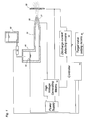
- an electrostatically atomizing device comprises an atomizing nozzle 10 having an emitter electrode 20 at the tip; an opposed electrode 30 disposed opposite the emitter electrode 20; a high voltage generating means 60 for applying high voltage between the emitter electrode 20 and the opposed electrode 30; and a controller 70 for controlling the value of the high voltage.
- a pressure tank 40 is connected to the rear end of the atomizing nozzle 10.
- a liquid such as water, stored in the pressurizing tank 40, is supplied via the atomizing nozzle 10 to a discharge end 21 at the tip of the emitter electrode 20.
- the pressure tank 40 constitutes a liquid supply means that supplies a liquid to the emitter electrode 20.
- the water supplied to the tip of the emitter electrode 20 forms droplets on account of surface tension.
- high voltage for instance a negative potential of -8 kV
- the droplets become thus electrostatically charged, and are discharged, from the tip of the emitter electrode, as a mist M of minute water particles negatively charged.
- Coulomb forces come into being between the water held at the tip of the emitter electrode 20 and the opposed electrode 30, whereupon a Taylor cone TC forms through local rising of the water surface.
- a pump 52 replenishes water to the pressure tank 40 from a replenishing tank 50.
- the water level in the pressure tank 40 is controlled to be kept constant at all times, to deliver a constant hydraulic head in the water supplied to the tip of the emitter electrode 20.
- a level sensor 42 is provided at the pressure tank 40.
- the controller 70 controls the pump 52 so as to keep constant at all times the water level detected by the level sensor 42.
- the atomizing nozzle 10 is formed as a tube.
- the leading end of the atomizing nozzle 10, which forms the emitter electrode 20, is a capillary tube.
- the inner diameter of the portion of the atomizing nozzle 10 that extends from the pressure tank 40, at the rear end, up to the emitter electrode 20, at the leading end, is set in such a manner so as to preclude capillarity, and in such a manner that hydraulic head acts on the water droplets supplied to the tip of the emitter electrode 20.
- the inner diameter of the atomizing nozzle 10 decreases gradually towards the leading end thereof, where the atomizing nozzle 10 forms a capillary tube. At the tip of the emitter electrode, the water is formed into droplet by the surface tension.
- the hydraulic head is set to a value that does not hinder formation of water droplets by surface tension.
- This hydraulic head acts on the Taylor cone TC formed through application of high voltage. It is found that, with water supplied to the emitter electrode 20, the discharge current flowing between the emitter electrode 20 and the opposed electrode 30 increases as the voltage applied between the two electrodes becomes greater. Keeping the discharge current at a predetermined value allows generating a predetermined amount of mist of nanometer-size charged minute particles. Specifically, the Taylor cone formed at the discharge end of the tip of the emitter electrode 20 expands, and the amount of charged minute particles increases, as the discharge current becomes larger.
- the present invention aims at generating stably a predetermined amount of mist of charged minute particles on the basis of the above relationship.
- the discharge voltage is adjusted in such a manner that the discharge current is kept at a predefined discharge condition, namely to a value set as a target value, to control thereby the generation of mist of charged minute particles in an amount prescribed by a target value.
- a discharge current detecting means 80 for detecting the discharge current flowing from the emitter electrode 20 into the opposed electrode 30, and for outputting the value of the discharge current to the controller 70, as illustrated in Fig. 1 .
- the controller 70 which is given a predetermined target value, sends to the high voltage generating means 60 a control output for adjusting the discharge voltage that is outputted by the high voltage generating means 60.
- the discharge voltage is changed through feedback control to match thereby the discharge current to the target value.
- the target value can be modified by a target value setting means 90, to adjust the generation amount of mist of charged minute particles that are discharged by the emitter electrode 20.
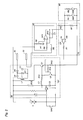
- Fig. 2 illustrates an electric circuit for realizing the above-described high voltage generating means 60, discharge current detecting means 80, controller 70 and target value setting means 90.
- the high voltage generating means 60 comprising a well-known isolated DC-DC converter, is provided with an isolation transformer and a switching element Q1.
- the switching element Q1 is connected in series to a resistor R12 and a primary winding L1 of an isolation transformer, between both ends of a DC power supply E.
- a voltage doubler rectifier circuit comprising diodes D1, D2 and capacitors C3, C4 is connected to a secondary winding L2 of the isolation transformer.
- An auxiliary winding L3 of the isolation transformer is connected in series to a resistor R13, between the base of the switching element Q1 and the connecting point of a capacitor C2 and a resistor R15 that is connected in series between the two ends of the DC power supply E.
- a switching element Q2 for control is connected between the base and the emitter of the switching element Q1.
- the base of the switching element Q2 is connected to the connecting point of the emitter of the switching element Q1 and the resistor R12, via a resistor R14.
- the output voltage of the high voltage generating means 60 i.e. the discharge voltage, is controlled by the control output of the controller 70.
- This control output is applied to the base of the switching element Q2, to change the timing at which the switching element Q2 switches on, and modify thereby the voltage induced in the secondary winding L2. That is, the voltage induced in the secondary winding L2 raises when the timing at which the switching element Q2 switches on is delayed. Conversely, the voltage induced in the secondary winding L2 drops when the timing at which the switching element Q2 switches on is brought forward.
- a switching element Q3, for operation stop is connected in parallel to the capacitor C2.
- High voltage can be generated by switching the switching element Q1 only when the switching element Q3 switches off through opening of a switch SW3 that is connected between the base-emitter. While the switching element Q3 is on and the switch SW3 is closed, the switching element Q1 is normally off. Therefore, the operation of the high voltage generating means is disabled.
- a control circuit (not shown) of an electric device (for instance, an air purifier, refrigerator or the like) installed in the electrostatically atomizing device of the present embodiment switches the switch SW3 on and off, i.e. switches between operation and stop of the high voltage generating means 60.
- the discharge current detecting means 80 is configured as a current-voltage converter using an op-amp OP1.
- a positive electrode of the DC power supply E via a resistor R9, and the opposed electrode 30, via a resistor R6.
- a reference current flowing from the DC power supply E via the resistor R9, and the discharge current flowing from the opposed electrode 30 via the resistor R6 are added into a current that flows into a resistor R10 connected between an output terminal and the inverting input terminal of the op-amp OP1.
- the output terminal of the op-amp OP1 outputs a detection voltage Vx that is directly proportional to the input current (discharge current) inputted to the inverting input terminal (see Fig. 3 ).
- a capacitor C1 is connected in parallel to the resistor R10, to speed up the response of the output voltage.
- a detection voltage (offset voltage), directly proportional to a reference voltage, is outputted also when the discharge current is zero, by inputting into the non-inverting input terminal of the op-amp OP1 a reference voltage resulting from dividing the power supply voltage of the DC power supply E by way of voltage-dividing resistors R7, R8.
- the controller 70 comprises a comparator CP that compares the detection voltage Vx, outputted by the discharge current detecting means 80, with a threshold voltage Vth that is a target value of the discharge current to be generated, and which results from dividing the power supply voltage of the DC power supply E by way of resistors R2 and R3.
- the comparator CP feeds the control output to the base of the switching element Q2 of the high voltage generating means 60, via a resistor R1.
- the detection voltage Vx exceeds the threshold voltage Vth and the output of the comparator CP reaches thus a high level, current flows into the base of the switching element Q2, and the switching-on timing of the switching element Q2 is brought forward.
- the switching-off timing in the switching element Q1 is brought forward, whereby the voltage induced at the secondary winding L2 drops. Accordingly, the output of the high voltage generating circuit 3 drops, and the discharge current is reduced.
- the detection voltage Vx is lower than the threshold voltage Vth and the output of the comparator CP reaches thus a low level, current ceases to flow from the controller 70 into the base of the switching element Q2 via the resistor R1.
- the switching-off timing of the switching element Q1 is delayed as a result, whereby the voltage induced at the secondary winding L2 rises. Accordingly, the output of the high voltage generating means 60 rises and the discharge current is increased.
- the controller 70 performs feedback control of the discharge voltage of the high voltage generating means 60 in such a manner so as to cancel the difference between the threshold voltage Vth and the detection voltage detected by the discharge current detecting means 80.
- a mist of a constant amount of charged minute particles can be generated stably by keeping the discharge current, flowing between the emitter electrode 20 and the opposed electrode 30, at the target value.
- the target value setting means 90 comprises a series circuit of a switch SW1 and a voltage-dividing resistor R4, and a series circuit of a switch SW2 and a voltage-dividing resistor R5. Each series circuit is connected in parallel to the voltage-dividing resistor R2 of the controller 70.
- the amount of charged minute water particles that is generated can be varied by selecting a target value of the discharge current within a predetermined range, i.e. by selecting the threshold voltage Vth that is inputted to the comparator CP, through a combination of switching-on and off of the switches SW1, SW2.
- the target value setting means 90 can set, as the threshold voltage Vth, a voltage no greater than above-described offset voltage (detection voltage applied to the comparator when the discharge current is zero), then the output of the comparator CP is a high-level output at all times, the switching element Q2 is normally on and the switching operation of the switching element Q1 can be prohibited, to stop thereby the high voltage generating means 60.
- the switching element Q3 and the switch SW3, for switching between operation and stop of the high voltage generating means 60 can be omitted, which allows reducing the number of components.
- Fig. 4 illustrates another embodiment of the electrostatically atomizing device of the present invention.
- the means used for supplying water to an emitter electrode 120 is herein a cooler that cools the emitter electrode 120 to condense thereon water out of surrounding air moisture.
- the electrostatically atomizing device of the present embodiment comprises the emitter electrode 120 and an opposed electrode 130 disposed opposite the emitter electrode 120.
- the opposed electrode 130 comprises a circular hole 132 formed on a substrate made of a conductive material.
- the inner peripheral edge of the circular hole stands at a predetermined distance from a discharge end 121 at the tip of the emitter electrode 120.
- the device comprises a high voltage generating means 160 and a cooler 140 coupled to the emitter electrode 120, for cooling the latter.
- the cooler 140 supplies water to the emitter electrode 120 by cooling the emitter electrode 120, to condense thereon water vapor that is present in the surrounding air.
- the high voltage generating means 160 applies a high voltage between the emitter electrode 120 and the opposed electrode 130, thereby electrostatically charging water on the emitter electrode 120 and causing the water to be atomized, out of the discharge end, in the form of charged minute particles.
- the cooler 140 comprises a Peltier module.
- the cooling side of the Peltier module is coupled to the end of the emitter electrode 120, on the opposite side to the discharge end 121. Applying a predetermined voltage to the thermoelectric elements of the Peltier module causes the emitter electrode to be cooled to a temperature not higher than then dew point of water.
- the Peltier module comprises a plurality of thermoelectric elements 143 connected in parallel between heat conductors 141, 142. The Peltier module cools the emitter electrode 120 at a cooling rate that is determined by a variable voltage applied by a cooling power supply circuit 40.
- One heat conductor 141 the one at the cooling side, is coupled to the emitter electrode 120, while the other heat conductor 142, the one at the heat-dissipating side, has formed thereon heat-dissipating fins 146.
- the Peltier module is provided with a thermistor 148 for detecting the temperature of the emitter electrode 120.
- the high voltage generating means 160 which is configured as in the above-described embodiment, applies a predetermined high voltage between the emitter electrode 120 and the opposed electrode 130 connected to ground.
- the high voltage generating means applies a negative or positive voltage (for instance, -4.6kV), to the emitter electrode 120.
- the electrostatically atomizing device of the present embodiment comprises a discharge current detecting means 180, a target value setting means 190 and a controller 170.
- the controller 170 adjusts also the cooling temperature of the emitter electrode 120, which is cooled by the Peltier module, by controlling a cooling circuit 150.
- the controller 170 is connected to a thermistor 148 and a temperature sensor 171 for detecting the temperature of the indoor environment. The controller 170 adjusts the temperature of the emitter electrode 120 in accordance with the environment temperature, to maintain thereby an adequate amount of condensed water on the emitter electrode 120.
- the discharge voltage is feedback-controlled, on the basis of detected discharge current, in such a manner that the discharge current takes on a target value, to allow thereby generating a mist of charged minute particles in an amount prescribed by a target value.
- a mist of an appropriate amount of charged minute particles can thus be generated stably without controlling rigorously the cooling temperature.
Landscapes
- Health & Medical Sciences (AREA)
- General Health & Medical Sciences (AREA)
- Toxicology (AREA)
- Engineering & Computer Science (AREA)
- Automation & Control Theory (AREA)
- Electrostatic Spraying Apparatus (AREA)
- Disinfection, Sterilisation Or Deodorisation Of Air (AREA)
Applications Claiming Priority (2)
| Application Number | Priority Date | Filing Date | Title |
|---|---|---|---|
| JP2006160174A JP4665839B2 (ja) | 2006-06-08 | 2006-06-08 | 静電霧化装置 |
| PCT/JP2007/060416 WO2007142022A1 (fr) | 2006-06-08 | 2007-05-22 | Appareil d'atomisation électrostatique |
Publications (2)
| Publication Number | Publication Date |
|---|---|
| EP2025411A1 true EP2025411A1 (fr) | 2009-02-18 |
| EP2025411A4 EP2025411A4 (fr) | 2011-04-27 |
Family
ID=38801285
Family Applications (1)
| Application Number | Title | Priority Date | Filing Date |
|---|---|---|---|
| EP07743850A Withdrawn EP2025411A4 (fr) | 2006-06-08 | 2007-05-22 | Appareil d'atomisation electrostatique |
Country Status (5)
| Country | Link |
|---|---|
| US (1) | US8448883B2 (fr) |
| EP (1) | EP2025411A4 (fr) |
| JP (1) | JP4665839B2 (fr) |
| TW (1) | TWI342802B (fr) |
| WO (1) | WO2007142022A1 (fr) |
Cited By (11)
| Publication number | Priority date | Publication date | Assignee | Title |
|---|---|---|---|---|
| EP2233212A1 (fr) * | 2009-03-26 | 2010-09-29 | Panasonic Electric Works Co., Ltd | Dispositif d'atomisation électrostatique |
| CN102413943A (zh) * | 2009-03-26 | 2012-04-11 | 松下电工株式会社 | 静电雾化装置及其制造方法 |
| EP2484984A1 (fr) * | 2009-03-27 | 2012-08-08 | Mitsubishi Electric Corporation | Appareil d'atomisation électrostatique, appareil, climatiseur et réfrigérateur |
| EP2620728A4 (fr) * | 2010-09-21 | 2013-07-31 | Panasonic Corp | Procédé de commande d'un dispositif d'atomisation, procédé de commande d'un dispositif de décharge et réfrigérateur |
| EP2612644A4 (fr) * | 2010-08-31 | 2014-01-22 | Daikin Ind Ltd | Dispositif de pulvérisation électrostatique |
| EP3006862A4 (fr) * | 2013-05-28 | 2016-06-15 | Panasonic Ip Man Co Ltd | Circuit de commande de refroidissement et dispositif d'atomisation électrostatique le comprenant |
| EP2962764A4 (fr) * | 2013-03-01 | 2016-11-02 | Sumitomo Chemical Co | Appareil de pulvérisation électrostatique et procédé de commande de courant pour appareil de pulvérisation électrostatique |
| WO2018137899A1 (fr) * | 2017-01-30 | 2018-08-02 | Clean Air Enterprise Ag | Électro-filtre |
| CN109641223A (zh) * | 2016-09-05 | 2019-04-16 | 住友化学株式会社 | 静电喷雾装置 |
| EP3612316B1 (fr) * | 2017-04-21 | 2023-05-10 | J. Wagner GmbH | Pulvérisateur électrostatique pour pulvériser des liquides |
| WO2023156457A1 (fr) * | 2022-02-15 | 2023-08-24 | Woco Gmbh & Co. Kg | Circuit de commande pour un électrofiltre |
Families Citing this family (15)
| Publication number | Priority date | Publication date | Assignee | Title |
|---|---|---|---|---|
| JP5104151B2 (ja) * | 2007-09-18 | 2012-12-19 | 東京エレクトロン株式会社 | 気化装置、成膜装置、成膜方法及び記憶媒体 |
| EP2062648B1 (fr) * | 2007-11-24 | 2019-06-19 | Robert Bosch GmbH | Séparateur électrostatique et procédé |
| JP5338077B2 (ja) * | 2008-01-22 | 2013-11-13 | ダイキン工業株式会社 | 静電噴霧装置 |
| JP2009268945A (ja) * | 2008-04-30 | 2009-11-19 | Panasonic Electric Works Co Ltd | 高圧発生装置及び静電霧化装置 |
| JP5368759B2 (ja) * | 2008-09-25 | 2013-12-18 | パナソニック株式会社 | 帯電微粒子水供給装置 |
| KR20110077030A (ko) * | 2009-01-19 | 2011-07-06 | 호치키 가부시키가이샤 | 분무 냉방 설비 및 분무 방법 |
| JP4743335B2 (ja) * | 2009-06-03 | 2011-08-10 | ダイキン工業株式会社 | 静電噴霧装置 |
| JP5654822B2 (ja) * | 2010-09-30 | 2015-01-14 | パナソニック株式会社 | 静電霧化装置 |
| JP5762872B2 (ja) * | 2011-07-29 | 2015-08-12 | 住友化学株式会社 | 静電噴霧装置 |
| EP2756123B1 (fr) * | 2011-09-14 | 2020-03-04 | Coloreel Group AB | Dispositif de revêtement pour revêtir un substrat allongé |
| JP6112130B2 (ja) * | 2015-03-25 | 2017-04-12 | トヨタ自動車株式会社 | 静電ノズル、吐出装置及び半導体モジュールの製造方法 |
| JP6587189B2 (ja) * | 2016-09-08 | 2019-10-09 | パナソニックIpマネジメント株式会社 | 電圧印加装置、及び放電装置 |
| CN111054530B (zh) * | 2019-12-09 | 2021-08-03 | 江苏大学 | 一种电极可自动调节的扇形静电感应雾化喷头 |
| CN111468295A (zh) * | 2020-04-15 | 2020-07-31 | 中国船舶重工集团公司第七0三研究所 | 一种离子风雾滴收集装置 |
| JP7519630B2 (ja) * | 2020-12-04 | 2024-07-22 | パナソニックIpマネジメント株式会社 | 放電装置 |
Family Cites Families (12)
| Publication number | Priority date | Publication date | Assignee | Title |
|---|---|---|---|---|
| US3281860A (en) * | 1964-11-09 | 1966-10-25 | Dick Co Ab | Ink jet nozzle |
| US3700169A (en) * | 1970-10-20 | 1972-10-24 | Environment One Corp | Process and appratus for the production of hydroelectric pulsed liquids jets |
| US5948483A (en) * | 1997-03-25 | 1999-09-07 | The Board Of Trustees Of The University Of Illinois | Method and apparatus for producing thin film and nanoparticle deposits |
| JPH11267552A (ja) | 1998-03-20 | 1999-10-05 | Nissan Motor Co Ltd | 静電塗装装置 |
| DE02744176T1 (de) | 2001-05-24 | 2005-01-13 | New Objective, Inc., Woburn | Verfahren und vorrichtung für elektrospray mit rückkopplungsregelung |
| JP2002355582A (ja) | 2001-05-31 | 2002-12-10 | Nissan Motor Co Ltd | 静電塗装装置 |
| AU2002234776A1 (en) * | 2002-03-01 | 2003-09-16 | Unilever Plc | Electrostatic spraying of a cosmetic composition |
| US20050244811A1 (en) * | 2003-12-15 | 2005-11-03 | Nano-Proprietary, Inc. | Matrix array nanobiosensor |
| US7022982B2 (en) | 2004-02-12 | 2006-04-04 | Agilent Technologies, Inc. | Ion source frequency feedback device and method |
| US7567420B2 (en) | 2004-04-08 | 2009-07-28 | Matsushita Electric Works, Ltd. | Electrostatically atomizing device |
| JP4329672B2 (ja) * | 2004-10-28 | 2009-09-09 | パナソニック電工株式会社 | 静電霧化装置 |
| JP4321435B2 (ja) * | 2004-10-26 | 2009-08-26 | パナソニック電工株式会社 | 静電霧化装置 |
-
2006
- 2006-06-08 JP JP2006160174A patent/JP4665839B2/ja not_active Expired - Fee Related
-
2007
- 2007-05-22 EP EP07743850A patent/EP2025411A4/fr not_active Withdrawn
- 2007-05-22 WO PCT/JP2007/060416 patent/WO2007142022A1/fr not_active Ceased
- 2007-05-22 US US12/303,533 patent/US8448883B2/en not_active Expired - Fee Related
- 2007-06-08 TW TW096120864A patent/TWI342802B/zh not_active IP Right Cessation
Cited By (23)
| Publication number | Priority date | Publication date | Assignee | Title |
|---|---|---|---|---|
| CN102413943B (zh) * | 2009-03-26 | 2014-11-12 | 松下电器产业株式会社 | 静电雾化装置及其制造方法 |
| CN101912830A (zh) * | 2009-03-26 | 2010-12-15 | 松下电工株式会社 | 静电雾化装置 |
| CN102413943A (zh) * | 2009-03-26 | 2012-04-11 | 松下电工株式会社 | 静电雾化装置及其制造方法 |
| US9101947B2 (en) | 2009-03-26 | 2015-08-11 | Panasonic Intellectual Property Management Co., Ltd. | Electrostatically atomizing device and method of manufacturing the same |
| US8317113B2 (en) | 2009-03-26 | 2012-11-27 | Panasonic Corporation | Electrostatic atomization device |
| EP2412442A4 (fr) * | 2009-03-26 | 2013-01-16 | Panasonic Corp | Appareil d'atomisation électrostatique et son procédé de fabrication |
| CN101912830B (zh) * | 2009-03-26 | 2013-07-31 | 松下电器产业株式会社 | 静电雾化装置 |
| EP2233212A1 (fr) * | 2009-03-26 | 2010-09-29 | Panasonic Electric Works Co., Ltd | Dispositif d'atomisation électrostatique |
| US8991203B2 (en) | 2009-03-27 | 2015-03-31 | Mitsubishi Electric Corporation | Electrostatic atomizing apparatus, appliance, air conditioner, and refrigerator |
| EP2484984A1 (fr) * | 2009-03-27 | 2012-08-08 | Mitsubishi Electric Corporation | Appareil d'atomisation électrostatique, appareil, climatiseur et réfrigérateur |
| EP2612644A4 (fr) * | 2010-08-31 | 2014-01-22 | Daikin Ind Ltd | Dispositif de pulvérisation électrostatique |
| EP2620728A4 (fr) * | 2010-09-21 | 2013-07-31 | Panasonic Corp | Procédé de commande d'un dispositif d'atomisation, procédé de commande d'un dispositif de décharge et réfrigérateur |
| EP2962764A4 (fr) * | 2013-03-01 | 2016-11-02 | Sumitomo Chemical Co | Appareil de pulvérisation électrostatique et procédé de commande de courant pour appareil de pulvérisation électrostatique |
| US9937507B2 (en) | 2013-03-01 | 2018-04-10 | Sumitomo Chemical Company, Limited | Electrostatic spraying apparatus, and current control method for electrostatic spraying apparatus |
| EP3006862A4 (fr) * | 2013-05-28 | 2016-06-15 | Panasonic Ip Man Co Ltd | Circuit de commande de refroidissement et dispositif d'atomisation électrostatique le comprenant |
| US10994292B2 (en) | 2016-09-05 | 2021-05-04 | Sumitomo Chemical Company, Limited | Electrostatic spraying device |
| CN109641223A (zh) * | 2016-09-05 | 2019-04-16 | 住友化学株式会社 | 静电喷雾装置 |
| EP3508277A4 (fr) * | 2016-09-05 | 2020-05-06 | Sumitomo Chemical Company, Limited | Dispositif de pulvérisation électrostatique |
| WO2018137899A1 (fr) * | 2017-01-30 | 2018-08-02 | Clean Air Enterprise Ag | Électro-filtre |
| US11311888B2 (en) | 2017-01-30 | 2022-04-26 | Clean Air Enterprise Ag | Electrostatic precipitator |
| EP3612316B1 (fr) * | 2017-04-21 | 2023-05-10 | J. Wagner GmbH | Pulvérisateur électrostatique pour pulvériser des liquides |
| US12076742B2 (en) | 2017-04-21 | 2024-09-03 | J. Wagner Gmbh | Electrostatic atomizer for liquids |
| WO2023156457A1 (fr) * | 2022-02-15 | 2023-08-24 | Woco Gmbh & Co. Kg | Circuit de commande pour un électrofiltre |
Also Published As
| Publication number | Publication date |
|---|---|
| TWI342802B (en) | 2011-06-01 |
| WO2007142022A1 (fr) | 2007-12-13 |
| TW200800408A (en) | 2008-01-01 |
| JP4665839B2 (ja) | 2011-04-06 |
| JP2007326057A (ja) | 2007-12-20 |
| US20090179093A1 (en) | 2009-07-16 |
| US8448883B2 (en) | 2013-05-28 |
| EP2025411A4 (fr) | 2011-04-27 |
Similar Documents
| Publication | Publication Date | Title |
|---|---|---|
| US8448883B2 (en) | Electrostatically atomizing device | |
| JP4329672B2 (ja) | 静電霧化装置 | |
| EP1733798B8 (fr) | Atomiseur électrostatique | |
| JP4329739B2 (ja) | 静電霧化装置 | |
| JP2004517714A (ja) | 静電噴霧装置 | |
| JP2006150334A (ja) | 静電霧化装置 | |
| US20120153055A1 (en) | Electrostatic atomization device | |
| US20090135539A1 (en) | Electrostatically atomizing device | |
| EP1964615B1 (fr) | Atomiseur electrostatique | |
| TWI760350B (zh) | 電壓施加裝置及放電裝置 | |
| US7983016B2 (en) | Electrostatically atomizing device | |
| CN101557879B (zh) | 静电雾化装置 | |
| HK1127704A (en) | Electrostatic atomizing apparatus | |
| JP5314368B2 (ja) | 静電霧化装置 | |
| JP5265997B2 (ja) | 静電霧化装置 | |
| JP4645528B2 (ja) | 静電霧化装置 | |
| HK1131091A (en) | Electrostatically atomizing device | |
| HK1131761B (en) | Electrostatic atomizer | |
| HK1121985B (en) | Electrostatically atomizing device | |
| AU2002243502A1 (en) | Electrostatic spray device | |
| HK1127316A1 (en) | Hot air blower |
Legal Events
| Date | Code | Title | Description |
|---|---|---|---|
| PUAI | Public reference made under article 153(3) epc to a published international application that has entered the european phase |
Free format text: ORIGINAL CODE: 0009012 |
|
| 17P | Request for examination filed |
Effective date: 20081202 |
|
| AK | Designated contracting states |
Kind code of ref document: A1 Designated state(s): AT BE BG CH CY CZ DE DK EE ES FI FR GB GR HU IE IS IT LI LT LU LV MC MT NL PL PT RO SE SI SK TR |
|
| AX | Request for extension of the european patent |
Extension state: AL BA HR MK RS |
|
| REG | Reference to a national code |
Ref country code: HK Ref legal event code: DE Ref document number: 1127704 Country of ref document: HK |
|
| A4 | Supplementary search report drawn up and despatched |
Effective date: 20110324 |
|
| 17Q | First examination report despatched |
Effective date: 20120124 |
|
| RAP1 | Party data changed (applicant data changed or rights of an application transferred) |
Owner name: PANASONIC CORPORATION |
|
| DAX | Request for extension of the european patent (deleted) | ||
| STAA | Information on the status of an ep patent application or granted ep patent |
Free format text: STATUS: THE APPLICATION IS DEEMED TO BE WITHDRAWN |
|
| 18D | Application deemed to be withdrawn |
Effective date: 20150303 |
|
| REG | Reference to a national code |
Ref country code: HK Ref legal event code: WD Ref document number: 1127704 Country of ref document: HK |