EP2025647A2 - Procédé de stockage ou de transport enfermant des granules d'immobilisation - Google Patents
Procédé de stockage ou de transport enfermant des granules d'immobilisation Download PDFInfo
- Publication number
- EP2025647A2 EP2025647A2 EP20080019390 EP08019390A EP2025647A2 EP 2025647 A2 EP2025647 A2 EP 2025647A2 EP 20080019390 EP20080019390 EP 20080019390 EP 08019390 A EP08019390 A EP 08019390A EP 2025647 A2 EP2025647 A2 EP 2025647A2
- Authority
- EP
- European Patent Office
- Prior art keywords
- pellets
- attachment prevention
- entrapping immobilization
- prevention filler
- filler
- Prior art date
- Legal status (The legal status is an assumption and is not a legal conclusion. Google has not performed a legal analysis and makes no representation as to the accuracy of the status listed.)
- Withdrawn
Links
- 239000008188 pellet Substances 0.000 title claims abstract description 193
- 238000000034 method Methods 0.000 title claims description 46
- 239000000945 filler Substances 0.000 claims abstract description 76
- 230000002265 prevention Effects 0.000 claims abstract description 75
- 230000003100 immobilizing effect Effects 0.000 claims abstract description 31
- 239000003795 chemical substances by application Substances 0.000 claims abstract description 27
- 244000005700 microbiome Species 0.000 claims abstract description 27
- XLYOFNOQVPJJNP-UHFFFAOYSA-N water Substances O XLYOFNOQVPJJNP-UHFFFAOYSA-N 0.000 claims abstract description 22
- 238000003860 storage Methods 0.000 claims abstract description 16
- 239000002245 particle Substances 0.000 claims description 22
- 239000007788 liquid Substances 0.000 claims description 16
- 239000000203 mixture Substances 0.000 claims description 10
- 125000004386 diacrylate group Chemical group 0.000 claims description 8
- 150000001252 acrylic acid derivatives Chemical class 0.000 claims description 5
- 239000011256 inorganic filler Substances 0.000 claims description 5
- 229910003475 inorganic filler Inorganic materials 0.000 claims description 5
- 238000005520 cutting process Methods 0.000 claims description 4
- 229920000642 polymer Polymers 0.000 claims description 4
- IAYPIBMASNFSPL-UHFFFAOYSA-N Ethylene oxide Chemical compound C1CO1 IAYPIBMASNFSPL-UHFFFAOYSA-N 0.000 claims description 3
- GOOHAUXETOMSMM-UHFFFAOYSA-N Propylene oxide Chemical compound CC1CO1 GOOHAUXETOMSMM-UHFFFAOYSA-N 0.000 claims description 3
- 230000000379 polymerizing effect Effects 0.000 claims description 3
- 238000005266 casting Methods 0.000 claims description 2
- 238000003892 spreading Methods 0.000 claims description 2
- 241000894006 Bacteria Species 0.000 description 23
- OKTJSMMVPCPJKN-UHFFFAOYSA-N Carbon Chemical compound [C] OKTJSMMVPCPJKN-UHFFFAOYSA-N 0.000 description 17
- 239000002994 raw material Substances 0.000 description 14
- 230000000694 effects Effects 0.000 description 13
- 230000001546 nitrifying effect Effects 0.000 description 12
- 238000006116 polymerization reaction Methods 0.000 description 11
- 239000010802 sludge Substances 0.000 description 11
- 238000004065 wastewater treatment Methods 0.000 description 10
- LYCAIKOWRPUZTN-UHFFFAOYSA-N Ethylene glycol Chemical compound OCCO LYCAIKOWRPUZTN-UHFFFAOYSA-N 0.000 description 8
- 239000002202 Polyethylene glycol Substances 0.000 description 8
- 229920001223 polyethylene glycol Polymers 0.000 description 8
- 239000000126 substance Substances 0.000 description 8
- NIXOWILDQLNWCW-UHFFFAOYSA-M Acrylate Chemical compound [O-]C(=O)C=C NIXOWILDQLNWCW-UHFFFAOYSA-M 0.000 description 7
- VYPSYNLAJGMNEJ-UHFFFAOYSA-N Silicium dioxide Chemical compound O=[Si]=O VYPSYNLAJGMNEJ-UHFFFAOYSA-N 0.000 description 7
- VTYYLEPIZMXCLO-UHFFFAOYSA-L Calcium carbonate Chemical compound [Ca+2].[O-]C([O-])=O VTYYLEPIZMXCLO-UHFFFAOYSA-L 0.000 description 6
- WOBHKFSMXKNTIM-UHFFFAOYSA-N Hydroxyethyl methacrylate Chemical compound CC(=C)C(=O)OCCO WOBHKFSMXKNTIM-UHFFFAOYSA-N 0.000 description 6
- XLOMVQKBTHCTTD-UHFFFAOYSA-N Zinc monoxide Chemical compound [Zn]=O XLOMVQKBTHCTTD-UHFFFAOYSA-N 0.000 description 6
- 239000000463 material Substances 0.000 description 6
- 239000003505 polymerization initiator Substances 0.000 description 6
- 238000004519 manufacturing process Methods 0.000 description 5
- USHAGKDGDHPEEY-UHFFFAOYSA-L potassium persulfate Chemical compound [K+].[K+].[O-]S(=O)(=O)OOS([O-])(=O)=O USHAGKDGDHPEEY-UHFFFAOYSA-L 0.000 description 5
- 238000001125 extrusion Methods 0.000 description 4
- WGCNASOHLSPBMP-UHFFFAOYSA-N hydroxyacetaldehyde Natural products OCC=O WGCNASOHLSPBMP-UHFFFAOYSA-N 0.000 description 4
- 238000003756 stirring Methods 0.000 description 4
- PEDCQBHIVMGVHV-UHFFFAOYSA-N Glycerine Chemical compound OCC(O)CO PEDCQBHIVMGVHV-UHFFFAOYSA-N 0.000 description 3
- 229910000019 calcium carbonate Inorganic materials 0.000 description 3
- STVZJERGLQHEKB-UHFFFAOYSA-N ethylene glycol dimethacrylate Substances CC(=C)C(=O)OCCOC(=O)C(C)=C STVZJERGLQHEKB-UHFFFAOYSA-N 0.000 description 3
- 239000010881 fly ash Substances 0.000 description 3
- NLYAJNPCOHFWQQ-UHFFFAOYSA-N kaolin Chemical compound O.O.O=[Al]O[Si](=O)O[Si](=O)O[Al]=O NLYAJNPCOHFWQQ-UHFFFAOYSA-N 0.000 description 3
- 230000001590 oxidative effect Effects 0.000 description 3
- 239000000454 talc Substances 0.000 description 3
- 229910052623 talc Inorganic materials 0.000 description 3
- 239000002351 wastewater Substances 0.000 description 3
- 239000011787 zinc oxide Substances 0.000 description 3
- 229920002818 (Hydroxyethyl)methacrylate Polymers 0.000 description 2
- MYWOJODOMFBVCB-UHFFFAOYSA-N 1,2,6-trimethylphenanthrene Chemical compound CC1=CC=C2C3=CC(C)=CC=C3C=CC2=C1C MYWOJODOMFBVCB-UHFFFAOYSA-N 0.000 description 2
- XFCMNSHQOZQILR-UHFFFAOYSA-N 2-[2-(2-methylprop-2-enoyloxy)ethoxy]ethyl 2-methylprop-2-enoate Chemical compound CC(=C)C(=O)OCCOCCOC(=O)C(C)=C XFCMNSHQOZQILR-UHFFFAOYSA-N 0.000 description 2
- RZVINYQDSSQUKO-UHFFFAOYSA-N 2-phenoxyethyl prop-2-enoate Chemical compound C=CC(=O)OCCOC1=CC=CC=C1 RZVINYQDSSQUKO-UHFFFAOYSA-N 0.000 description 2
- XOJWAAUYNWGQAU-UHFFFAOYSA-N 4-(2-methylprop-2-enoyloxy)butyl 2-methylprop-2-enoate Chemical compound CC(=C)C(=O)OCCCCOC(=O)C(C)=C XOJWAAUYNWGQAU-UHFFFAOYSA-N 0.000 description 2
- 239000005995 Aluminium silicate Substances 0.000 description 2
- QGZKDVFQNNGYKY-UHFFFAOYSA-O Ammonium Chemical compound [NH4+] QGZKDVFQNNGYKY-UHFFFAOYSA-O 0.000 description 2
- JOYRKODLDBILNP-UHFFFAOYSA-N Ethyl urethane Chemical compound CCOC(N)=O JOYRKODLDBILNP-UHFFFAOYSA-N 0.000 description 2
- UQSXHKLRYXJYBZ-UHFFFAOYSA-N Iron oxide Chemical compound [Fe]=O UQSXHKLRYXJYBZ-UHFFFAOYSA-N 0.000 description 2
- CSNNHWWHGAXBCP-UHFFFAOYSA-L Magnesium sulfate Chemical compound [Mg+2].[O-][S+2]([O-])([O-])[O-] CSNNHWWHGAXBCP-UHFFFAOYSA-L 0.000 description 2
- KWYHDKDOAIKMQN-UHFFFAOYSA-N N,N,N',N'-tetramethylethylenediamine Chemical compound CN(C)CCN(C)C KWYHDKDOAIKMQN-UHFFFAOYSA-N 0.000 description 2
- PNEYBMLMFCGWSK-UHFFFAOYSA-N aluminium oxide Inorganic materials [O-2].[O-2].[O-2].[Al+3].[Al+3] PNEYBMLMFCGWSK-UHFFFAOYSA-N 0.000 description 2
- 235000012211 aluminium silicate Nutrition 0.000 description 2
- TZCXTZWJZNENPQ-UHFFFAOYSA-L barium sulfate Chemical compound [Ba+2].[O-]S([O-])(=O)=O TZCXTZWJZNENPQ-UHFFFAOYSA-L 0.000 description 2
- IISBACLAFKSPIT-UHFFFAOYSA-N bisphenol A Chemical compound C=1C=C(O)C=CC=1C(C)(C)C1=CC=C(O)C=C1 IISBACLAFKSPIT-UHFFFAOYSA-N 0.000 description 2
- 239000000378 calcium silicate Substances 0.000 description 2
- 229910052918 calcium silicate Inorganic materials 0.000 description 2
- OSGAYBCDTDRGGQ-UHFFFAOYSA-L calcium sulfate Chemical compound [Ca+2].[O-]S([O-])(=O)=O OSGAYBCDTDRGGQ-UHFFFAOYSA-L 0.000 description 2
- OYACROKNLOSFPA-UHFFFAOYSA-N calcium;dioxido(oxo)silane Chemical compound [Ca+2].[O-][Si]([O-])=O OYACROKNLOSFPA-UHFFFAOYSA-N 0.000 description 2
- 239000004927 clay Substances 0.000 description 2
- 150000001875 compounds Chemical class 0.000 description 2
- UHESRSKEBRADOO-UHFFFAOYSA-N ethyl carbamate;prop-2-enoic acid Chemical class OC(=O)C=C.CCOC(N)=O UHESRSKEBRADOO-UHFFFAOYSA-N 0.000 description 2
- 238000005469 granulation Methods 0.000 description 2
- 230000003179 granulation Effects 0.000 description 2
- PBOSTUDLECTMNL-UHFFFAOYSA-N lauryl acrylate Chemical compound CCCCCCCCCCCCOC(=O)C=C PBOSTUDLECTMNL-UHFFFAOYSA-N 0.000 description 2
- 238000005259 measurement Methods 0.000 description 2
- 239000010445 mica Substances 0.000 description 2
- 229910052618 mica group Inorganic materials 0.000 description 2
- 239000012766 organic filler Substances 0.000 description 2
- 229920001451 polypropylene glycol Polymers 0.000 description 2
- 239000000843 powder Substances 0.000 description 2
- 238000010526 radical polymerization reaction Methods 0.000 description 2
- 239000000377 silicon dioxide Substances 0.000 description 2
- MXFQRSUWYYSPOC-UHFFFAOYSA-N (2,2-dimethyl-3-prop-2-enoyloxypropyl) prop-2-enoate Chemical class C=CC(=O)OCC(C)(C)COC(=O)C=C MXFQRSUWYYSPOC-UHFFFAOYSA-N 0.000 description 1
- ZODNDDPVCIAZIQ-UHFFFAOYSA-N (2-hydroxy-3-prop-2-enoyloxypropyl) 2-methylprop-2-enoate Chemical compound CC(=C)C(=O)OCC(O)COC(=O)C=C ZODNDDPVCIAZIQ-UHFFFAOYSA-N 0.000 description 1
- DDKMFQGAZVMXQV-UHFFFAOYSA-N (3-chloro-2-hydroxypropyl) 2-methylprop-2-enoate Chemical compound CC(=C)C(=O)OCC(O)CCl DDKMFQGAZVMXQV-UHFFFAOYSA-N 0.000 description 1
- PSGCQDPCAWOCSH-UHFFFAOYSA-N (4,7,7-trimethyl-3-bicyclo[2.2.1]heptanyl) prop-2-enoate Chemical compound C1CC2(C)C(OC(=O)C=C)CC1C2(C)C PSGCQDPCAWOCSH-UHFFFAOYSA-N 0.000 description 1
- VDYWHVQKENANGY-UHFFFAOYSA-N 1,3-Butyleneglycol dimethacrylate Chemical compound CC(=C)C(=O)OC(C)CCOC(=O)C(C)=C VDYWHVQKENANGY-UHFFFAOYSA-N 0.000 description 1
- OGBWMWKMTUSNKE-UHFFFAOYSA-N 1-(2-methylprop-2-enoyloxy)hexyl 2-methylprop-2-enoate Chemical compound CCCCCC(OC(=O)C(C)=C)OC(=O)C(C)=C OGBWMWKMTUSNKE-UHFFFAOYSA-N 0.000 description 1
- ZDQNWDNMNKSMHI-UHFFFAOYSA-N 1-[2-(2-prop-2-enoyloxypropoxy)propoxy]propan-2-yl prop-2-enoate Chemical compound C=CC(=O)OC(C)COC(C)COCC(C)OC(=O)C=C ZDQNWDNMNKSMHI-UHFFFAOYSA-N 0.000 description 1
- HGUFODBRKLSHSI-UHFFFAOYSA-N 2,3,7,8-tetrachloro-dibenzo-p-dioxin Chemical compound O1C2=CC(Cl)=C(Cl)C=C2OC2=C1C=C(Cl)C(Cl)=C2 HGUFODBRKLSHSI-UHFFFAOYSA-N 0.000 description 1
- ZDTLUUIYCAMIMQ-UHFFFAOYSA-N 2-(2-hydroxyethoxy)-1-methoxyethanol;2-methylprop-2-enoic acid Chemical compound CC(=C)C(O)=O.COC(O)COCCO ZDTLUUIYCAMIMQ-UHFFFAOYSA-N 0.000 description 1
- IAMASUILMZETHW-UHFFFAOYSA-N 2-(2-hydroxyethoxy)-1-phenoxyethanol;prop-2-enoic acid Chemical compound OC(=O)C=C.OCCOCC(O)OC1=CC=CC=C1 IAMASUILMZETHW-UHFFFAOYSA-N 0.000 description 1
- SMZOUWXMTYCWNB-UHFFFAOYSA-N 2-(2-methoxy-5-methylphenyl)ethanamine Chemical compound COC1=CC=C(C)C=C1CCN SMZOUWXMTYCWNB-UHFFFAOYSA-N 0.000 description 1
- NIXOWILDQLNWCW-UHFFFAOYSA-N 2-Propenoic acid Natural products OC(=O)C=C NIXOWILDQLNWCW-UHFFFAOYSA-N 0.000 description 1
- COORVRSSRBIIFJ-UHFFFAOYSA-N 2-[2-(2-hydroxyethoxy)ethoxy]-1-methoxyethanol;prop-2-enoic acid Chemical compound OC(=O)C=C.COC(O)COCCOCCO COORVRSSRBIIFJ-UHFFFAOYSA-N 0.000 description 1
- FIQBJLHOPOSODG-UHFFFAOYSA-N 2-[2-(2-methylprop-2-enoyloxy)ethoxycarbonyl]benzoic acid Chemical compound CC(=C)C(=O)OCCOC(=O)C1=CC=CC=C1C(O)=O FIQBJLHOPOSODG-UHFFFAOYSA-N 0.000 description 1
- HWSSEYVMGDIFMH-UHFFFAOYSA-N 2-[2-[2-(2-methylprop-2-enoyloxy)ethoxy]ethoxy]ethyl 2-methylprop-2-enoate Chemical compound CC(=C)C(=O)OCCOCCOCCOC(=O)C(C)=C HWSSEYVMGDIFMH-UHFFFAOYSA-N 0.000 description 1
- FWWXYLGCHHIKNY-UHFFFAOYSA-N 2-ethoxyethyl prop-2-enoate Chemical compound CCOCCOC(=O)C=C FWWXYLGCHHIKNY-UHFFFAOYSA-N 0.000 description 1
- GTELLNMUWNJXMQ-UHFFFAOYSA-N 2-ethyl-2-(hydroxymethyl)propane-1,3-diol;prop-2-enoic acid Chemical class OC(=O)C=C.OC(=O)C=C.OC(=O)C=C.CCC(CO)(CO)CO GTELLNMUWNJXMQ-UHFFFAOYSA-N 0.000 description 1
- OMIGHNLMNHATMP-UHFFFAOYSA-N 2-hydroxyethyl prop-2-enoate Chemical compound OCCOC(=O)C=C OMIGHNLMNHATMP-UHFFFAOYSA-N 0.000 description 1
- GWZMWHWAWHPNHN-UHFFFAOYSA-N 2-hydroxypropyl prop-2-enoate Chemical compound CC(O)COC(=O)C=C GWZMWHWAWHPNHN-UHFFFAOYSA-N 0.000 description 1
- CFVWNXQPGQOHRJ-UHFFFAOYSA-N 2-methylpropyl prop-2-enoate Chemical compound CC(C)COC(=O)C=C CFVWNXQPGQOHRJ-UHFFFAOYSA-N 0.000 description 1
- MTPJEFOSTIKRSS-UHFFFAOYSA-N 3-(dimethylamino)propanenitrile Chemical compound CN(C)CCC#N MTPJEFOSTIKRSS-UHFFFAOYSA-N 0.000 description 1
- WHNPOQXWAMXPTA-UHFFFAOYSA-N 3-methylbut-2-enamide Chemical compound CC(C)=CC(N)=O WHNPOQXWAMXPTA-UHFFFAOYSA-N 0.000 description 1
- ZEWLHMQYEZXSBH-UHFFFAOYSA-N 4-[2-(2-methylprop-2-enoyloxy)ethoxy]-4-oxobutanoic acid Chemical compound CC(=C)C(=O)OCCOC(=O)CCC(O)=O ZEWLHMQYEZXSBH-UHFFFAOYSA-N 0.000 description 1
- DBCAQXHNJOFNGC-UHFFFAOYSA-N 4-bromo-1,1,1-trifluorobutane Chemical compound FC(F)(F)CCCBr DBCAQXHNJOFNGC-UHFFFAOYSA-N 0.000 description 1
- UZDMJPAQQFSMMV-UHFFFAOYSA-N 4-oxo-4-(2-prop-2-enoyloxyethoxy)butanoic acid Chemical compound OC(=O)CCC(=O)OCCOC(=O)C=C UZDMJPAQQFSMMV-UHFFFAOYSA-N 0.000 description 1
- JTHZUSWLNCPZLX-UHFFFAOYSA-N 6-fluoro-3-methyl-2h-indazole Chemical compound FC1=CC=C2C(C)=NNC2=C1 JTHZUSWLNCPZLX-UHFFFAOYSA-N 0.000 description 1
- DXPPIEDUBFUSEZ-UHFFFAOYSA-N 6-methylheptyl prop-2-enoate Chemical compound CC(C)CCCCCOC(=O)C=C DXPPIEDUBFUSEZ-UHFFFAOYSA-N 0.000 description 1
- FIHBHSQYSYVZQE-UHFFFAOYSA-N 6-prop-2-enoyloxyhexyl prop-2-enoate Chemical compound C=CC(=O)OCCCCCCOC(=O)C=C FIHBHSQYSYVZQE-UHFFFAOYSA-N 0.000 description 1
- HRPVXLWXLXDGHG-UHFFFAOYSA-N Acrylamide Chemical compound NC(=O)C=C HRPVXLWXLXDGHG-UHFFFAOYSA-N 0.000 description 1
- 229920000049 Carbon (fiber) Polymers 0.000 description 1
- 229920000742 Cotton Polymers 0.000 description 1
- 241000192701 Microcystis Species 0.000 description 1
- 239000004677 Nylon Substances 0.000 description 1
- 239000006004 Quartz sand Substances 0.000 description 1
- 239000004113 Sepiolite Substances 0.000 description 1
- 229910052581 Si3N4 Inorganic materials 0.000 description 1
- GWEVSGVZZGPLCZ-UHFFFAOYSA-N Titan oxide Chemical compound O=[Ti]=O GWEVSGVZZGPLCZ-UHFFFAOYSA-N 0.000 description 1
- ZJCCRDAZUWHFQH-UHFFFAOYSA-N Trimethylolpropane Chemical compound CCC(CO)(CO)CO ZJCCRDAZUWHFQH-UHFFFAOYSA-N 0.000 description 1
- DAKWPKUUDNSNPN-UHFFFAOYSA-N Trimethylolpropane triacrylate Chemical compound C=CC(=O)OCC(CC)(COC(=O)C=C)COC(=O)C=C DAKWPKUUDNSNPN-UHFFFAOYSA-N 0.000 description 1
- OKKRPWIIYQTPQF-UHFFFAOYSA-N Trimethylolpropane trimethacrylate Chemical compound CC(=C)C(=O)OCC(CC)(COC(=O)C(C)=C)COC(=O)C(C)=C OKKRPWIIYQTPQF-UHFFFAOYSA-N 0.000 description 1
- 229910021536 Zeolite Inorganic materials 0.000 description 1
- ULQMPOIOSDXIGC-UHFFFAOYSA-N [2,2-dimethyl-3-(2-methylprop-2-enoyloxy)propyl] 2-methylprop-2-enoate Chemical compound CC(=C)C(=O)OCC(C)(C)COC(=O)C(C)=C ULQMPOIOSDXIGC-UHFFFAOYSA-N 0.000 description 1
- HVVWZTWDBSEWIH-UHFFFAOYSA-N [2-(hydroxymethyl)-3-prop-2-enoyloxy-2-(prop-2-enoyloxymethyl)propyl] prop-2-enoate Chemical compound C=CC(=O)OCC(CO)(COC(=O)C=C)COC(=O)C=C HVVWZTWDBSEWIH-UHFFFAOYSA-N 0.000 description 1
- XRMBQHTWUBGQDN-UHFFFAOYSA-N [2-[2,2-bis(prop-2-enoyloxymethyl)butoxymethyl]-2-(prop-2-enoyloxymethyl)butyl] prop-2-enoate Chemical compound C=CC(=O)OCC(COC(=O)C=C)(CC)COCC(CC)(COC(=O)C=C)COC(=O)C=C XRMBQHTWUBGQDN-UHFFFAOYSA-N 0.000 description 1
- OQHMGFSAURFQAF-UHFFFAOYSA-N [2-hydroxy-3-(2-methylprop-2-enoyloxy)propyl] 2-methylprop-2-enoate Chemical compound CC(=C)C(=O)OCC(O)COC(=O)C(C)=C OQHMGFSAURFQAF-UHFFFAOYSA-N 0.000 description 1
- KNSXNCFKSZZHEA-UHFFFAOYSA-N [3-prop-2-enoyloxy-2,2-bis(prop-2-enoyloxymethyl)propyl] prop-2-enoate Chemical class C=CC(=O)OCC(COC(=O)C=C)(COC(=O)C=C)COC(=O)C=C KNSXNCFKSZZHEA-UHFFFAOYSA-N 0.000 description 1
- RJDOZRNNYVAULJ-UHFFFAOYSA-L [O--].[O--].[O--].[O--].[O--].[O--].[O--].[O--].[O--].[O--].[F-].[F-].[Mg++].[Mg++].[Mg++].[Al+3].[Si+4].[Si+4].[Si+4].[K+] Chemical compound [O--].[O--].[O--].[O--].[O--].[O--].[O--].[O--].[O--].[O--].[F-].[F-].[Mg++].[Mg++].[Mg++].[Al+3].[Si+4].[Si+4].[Si+4].[K+] RJDOZRNNYVAULJ-UHFFFAOYSA-L 0.000 description 1
- 239000006230 acetylene black Substances 0.000 description 1
- WNROFYMDJYEPJX-UHFFFAOYSA-K aluminium hydroxide Chemical compound [OH-].[OH-].[OH-].[Al+3] WNROFYMDJYEPJX-UHFFFAOYSA-K 0.000 description 1
- 150000001412 amines Chemical class 0.000 description 1
- 229910000410 antimony oxide Inorganic materials 0.000 description 1
- 239000010425 asbestos Substances 0.000 description 1
- 229960000892 attapulgite Drugs 0.000 description 1
- 230000001580 bacterial effect Effects 0.000 description 1
- JRPBQTZRNDNNOP-UHFFFAOYSA-N barium titanate Chemical compound [Ba+2].[Ba+2].[O-][Ti]([O-])([O-])[O-] JRPBQTZRNDNNOP-UHFFFAOYSA-N 0.000 description 1
- 229910002113 barium titanate Inorganic materials 0.000 description 1
- AYJRCSIUFZENHW-DEQYMQKBSA-L barium(2+);oxomethanediolate Chemical compound [Ba+2].[O-][14C]([O-])=O AYJRCSIUFZENHW-DEQYMQKBSA-L 0.000 description 1
- 239000011324 bead Substances 0.000 description 1
- 239000000440 bentonite Substances 0.000 description 1
- 229910000278 bentonite Inorganic materials 0.000 description 1
- SVPXDRXYRYOSEX-UHFFFAOYSA-N bentoquatam Chemical compound O.O=[Si]=O.O=[Al]O[Al]=O SVPXDRXYRYOSEX-UHFFFAOYSA-N 0.000 description 1
- 230000015572 biosynthetic process Effects 0.000 description 1
- GBAOBIBJACZTNA-UHFFFAOYSA-L calcium sulfite Chemical compound [Ca+2].[O-]S([O-])=O GBAOBIBJACZTNA-UHFFFAOYSA-L 0.000 description 1
- 235000010261 calcium sulphite Nutrition 0.000 description 1
- 239000004917 carbon fiber Substances 0.000 description 1
- 238000006243 chemical reaction Methods 0.000 description 1
- 238000007796 conventional method Methods 0.000 description 1
- KBLWLMPSVYBVDK-UHFFFAOYSA-N cyclohexyl prop-2-enoate Chemical compound C=CC(=O)OC1CCCCC1 KBLWLMPSVYBVDK-UHFFFAOYSA-N 0.000 description 1
- 230000003247 decreasing effect Effects 0.000 description 1
- GDVKFRBCXAPAQJ-UHFFFAOYSA-A dialuminum;hexamagnesium;carbonate;hexadecahydroxide Chemical compound [OH-].[OH-].[OH-].[OH-].[OH-].[OH-].[OH-].[OH-].[OH-].[OH-].[OH-].[OH-].[OH-].[OH-].[OH-].[OH-].[Mg+2].[Mg+2].[Mg+2].[Mg+2].[Mg+2].[Mg+2].[Al+3].[Al+3].[O-]C([O-])=O GDVKFRBCXAPAQJ-UHFFFAOYSA-A 0.000 description 1
- 125000000118 dimethyl group Chemical group [H]C([H])([H])* 0.000 description 1
- HNPSIPDUKPIQMN-UHFFFAOYSA-N dioxosilane;oxo(oxoalumanyloxy)alumane Chemical compound O=[Si]=O.O=[Al]O[Al]=O HNPSIPDUKPIQMN-UHFFFAOYSA-N 0.000 description 1
- NJLLQSBAHIKGKF-UHFFFAOYSA-N dipotassium dioxido(oxo)titanium Chemical compound [K+].[K+].[O-][Ti]([O-])=O NJLLQSBAHIKGKF-UHFFFAOYSA-N 0.000 description 1
- 238000004090 dissolution Methods 0.000 description 1
- 238000010894 electron beam technology Methods 0.000 description 1
- 230000007613 environmental effect Effects 0.000 description 1
- SUPCQIBBMFXVTL-UHFFFAOYSA-N ethyl 2-methylprop-2-enoate Chemical compound CCOC(=O)C(C)=C SUPCQIBBMFXVTL-UHFFFAOYSA-N 0.000 description 1
- 239000006232 furnace black Substances 0.000 description 1
- 239000011521 glass Substances 0.000 description 1
- 239000005556 hormone Substances 0.000 description 1
- 229940088597 hormone Drugs 0.000 description 1
- 229910001701 hydrotalcite Inorganic materials 0.000 description 1
- 229960001545 hydrotalcite Drugs 0.000 description 1
- 229910052622 kaolinite Inorganic materials 0.000 description 1
- ZLNQQNXFFQJAID-UHFFFAOYSA-L magnesium carbonate Chemical compound [Mg+2].[O-]C([O-])=O ZLNQQNXFFQJAID-UHFFFAOYSA-L 0.000 description 1
- 239000001095 magnesium carbonate Substances 0.000 description 1
- 229910000021 magnesium carbonate Inorganic materials 0.000 description 1
- VTHJTEIRLNZDEV-UHFFFAOYSA-L magnesium dihydroxide Chemical compound [OH-].[OH-].[Mg+2] VTHJTEIRLNZDEV-UHFFFAOYSA-L 0.000 description 1
- 239000000347 magnesium hydroxide Substances 0.000 description 1
- 229910001862 magnesium hydroxide Inorganic materials 0.000 description 1
- 229910052943 magnesium sulfate Inorganic materials 0.000 description 1
- 235000019341 magnesium sulphate Nutrition 0.000 description 1
- 229910052751 metal Inorganic materials 0.000 description 1
- 239000002184 metal Substances 0.000 description 1
- VNWKTOKETHGBQD-UHFFFAOYSA-N methane Chemical compound C VNWKTOKETHGBQD-UHFFFAOYSA-N 0.000 description 1
- YDKNBNOOCSNPNS-UHFFFAOYSA-N methyl 1,3-benzoxazole-2-carboxylate Chemical compound C1=CC=C2OC(C(=O)OC)=NC2=C1 YDKNBNOOCSNPNS-UHFFFAOYSA-N 0.000 description 1
- CWQXQMHSOZUFJS-UHFFFAOYSA-N molybdenum disulfide Chemical compound S=[Mo]=S CWQXQMHSOZUFJS-UHFFFAOYSA-N 0.000 description 1
- 229910052982 molybdenum disulfide Inorganic materials 0.000 description 1
- 239000000178 monomer Substances 0.000 description 1
- 229920001778 nylon Polymers 0.000 description 1
- HMZGPNHSPWNGEP-UHFFFAOYSA-N octadecyl 2-methylprop-2-enoate Chemical compound CCCCCCCCCCCCCCCCCCOC(=O)C(C)=C HMZGPNHSPWNGEP-UHFFFAOYSA-N 0.000 description 1
- VTRUBDSFZJNXHI-UHFFFAOYSA-N oxoantimony Chemical compound [Sb]=O VTRUBDSFZJNXHI-UHFFFAOYSA-N 0.000 description 1
- RVTZCBVAJQQJTK-UHFFFAOYSA-N oxygen(2-);zirconium(4+) Chemical compound [O-2].[O-2].[Zr+4] RVTZCBVAJQQJTK-UHFFFAOYSA-N 0.000 description 1
- 238000012856 packing Methods 0.000 description 1
- 229910052625 palygorskite Inorganic materials 0.000 description 1
- 229920003023 plastic Polymers 0.000 description 1
- 239000004033 plastic Substances 0.000 description 1
- 229920000728 polyester Polymers 0.000 description 1
- 229920005650 polypropylene glycol diacrylate Polymers 0.000 description 1
- 229920002451 polyvinyl alcohol Polymers 0.000 description 1
- 229910052903 pyrophyllite Inorganic materials 0.000 description 1
- 238000007717 redox polymerization reaction Methods 0.000 description 1
- 239000011347 resin Substances 0.000 description 1
- 229920005989 resin Polymers 0.000 description 1
- 230000000717 retained effect Effects 0.000 description 1
- 229910052895 riebeckite Inorganic materials 0.000 description 1
- 238000000926 separation method Methods 0.000 description 1
- 229910052624 sepiolite Inorganic materials 0.000 description 1
- 235000019355 sepiolite Nutrition 0.000 description 1
- HQVNEWCFYHHQES-UHFFFAOYSA-N silicon nitride Chemical compound N12[Si]34N5[Si]62N3[Si]51N64 HQVNEWCFYHHQES-UHFFFAOYSA-N 0.000 description 1
- 229910021647 smectite Inorganic materials 0.000 description 1
- MUTNCGKQJGXKEM-UHFFFAOYSA-N tamibarotene Chemical compound C=1C=C2C(C)(C)CCC(C)(C)C2=CC=1NC(=O)C1=CC=C(C(O)=O)C=C1 MUTNCGKQJGXKEM-UHFFFAOYSA-N 0.000 description 1
- ISXSCDLOGDJUNJ-UHFFFAOYSA-N tert-butyl prop-2-enoate Chemical compound CC(C)(C)OC(=O)C=C ISXSCDLOGDJUNJ-UHFFFAOYSA-N 0.000 description 1
- OGIDPMRJRNCKJF-UHFFFAOYSA-N titanium oxide Inorganic materials [Ti]=O OGIDPMRJRNCKJF-UHFFFAOYSA-N 0.000 description 1
- 239000010455 vermiculite Substances 0.000 description 1
- 229910052902 vermiculite Inorganic materials 0.000 description 1
- 235000019354 vermiculite Nutrition 0.000 description 1
- 125000000391 vinyl group Chemical group [H]C([*])=C([H])[H] 0.000 description 1
- 229920002554 vinyl polymer Polymers 0.000 description 1
- 239000010456 wollastonite Substances 0.000 description 1
- 229910052882 wollastonite Inorganic materials 0.000 description 1
- 239000010457 zeolite Substances 0.000 description 1
- 235000014692 zinc oxide Nutrition 0.000 description 1
- BNEMLSQAJOPTGK-UHFFFAOYSA-N zinc;dioxido(oxo)tin Chemical compound [Zn+2].[O-][Sn]([O-])=O BNEMLSQAJOPTGK-UHFFFAOYSA-N 0.000 description 1
- 229910001928 zirconium oxide Inorganic materials 0.000 description 1
- GFQYVLUOOAAOGM-UHFFFAOYSA-N zirconium(iv) silicate Chemical compound [Zr+4].[O-][Si]([O-])([O-])[O-] GFQYVLUOOAAOGM-UHFFFAOYSA-N 0.000 description 1
Images





Classifications
-
- C—CHEMISTRY; METALLURGY
- C02—TREATMENT OF WATER, WASTE WATER, SEWAGE, OR SLUDGE
- C02F—TREATMENT OF WATER, WASTE WATER, SEWAGE, OR SLUDGE
- C02F3/00—Biological treatment of water, waste water, or sewage
- C02F3/02—Aerobic processes
- C02F3/10—Packings; Fillings; Grids
- C02F3/105—Characterized by the chemical composition
- C02F3/108—Immobilising gels, polymers or the like
-
- C—CHEMISTRY; METALLURGY
- C12—BIOCHEMISTRY; BEER; SPIRITS; WINE; VINEGAR; MICROBIOLOGY; ENZYMOLOGY; MUTATION OR GENETIC ENGINEERING
- C12N—MICROORGANISMS OR ENZYMES; COMPOSITIONS THEREOF; PROPAGATING, PRESERVING, OR MAINTAINING MICROORGANISMS; MUTATION OR GENETIC ENGINEERING; CULTURE MEDIA
- C12N11/00—Carrier-bound or immobilised enzymes; Carrier-bound or immobilised microbial cells; Preparation thereof
- C12N11/14—Enzymes or microbial cells immobilised on or in an inorganic carrier
-
- C—CHEMISTRY; METALLURGY
- C12—BIOCHEMISTRY; BEER; SPIRITS; WINE; VINEGAR; MICROBIOLOGY; ENZYMOLOGY; MUTATION OR GENETIC ENGINEERING
- C12N—MICROORGANISMS OR ENZYMES; COMPOSITIONS THEREOF; PROPAGATING, PRESERVING, OR MAINTAINING MICROORGANISMS; MUTATION OR GENETIC ENGINEERING; CULTURE MEDIA
- C12N11/00—Carrier-bound or immobilised enzymes; Carrier-bound or immobilised microbial cells; Preparation thereof
-
- C—CHEMISTRY; METALLURGY
- C12—BIOCHEMISTRY; BEER; SPIRITS; WINE; VINEGAR; MICROBIOLOGY; ENZYMOLOGY; MUTATION OR GENETIC ENGINEERING
- C12N—MICROORGANISMS OR ENZYMES; COMPOSITIONS THEREOF; PROPAGATING, PRESERVING, OR MAINTAINING MICROORGANISMS; MUTATION OR GENETIC ENGINEERING; CULTURE MEDIA
- C12N11/00—Carrier-bound or immobilised enzymes; Carrier-bound or immobilised microbial cells; Preparation thereof
- C12N11/02—Enzymes or microbial cells immobilised on or in an organic carrier
- C12N11/04—Enzymes or microbial cells immobilised on or in an organic carrier entrapped within the carrier, e.g. gel or hollow fibres
-
- C—CHEMISTRY; METALLURGY
- C12—BIOCHEMISTRY; BEER; SPIRITS; WINE; VINEGAR; MICROBIOLOGY; ENZYMOLOGY; MUTATION OR GENETIC ENGINEERING
- C12N—MICROORGANISMS OR ENZYMES; COMPOSITIONS THEREOF; PROPAGATING, PRESERVING, OR MAINTAINING MICROORGANISMS; MUTATION OR GENETIC ENGINEERING; CULTURE MEDIA
- C12N11/00—Carrier-bound or immobilised enzymes; Carrier-bound or immobilised microbial cells; Preparation thereof
- C12N11/02—Enzymes or microbial cells immobilised on or in an organic carrier
- C12N11/08—Enzymes or microbial cells immobilised on or in an organic carrier the carrier being a synthetic polymer
- C12N11/082—Enzymes or microbial cells immobilised on or in an organic carrier the carrier being a synthetic polymer obtained by reactions only involving carbon-to-carbon unsaturated bonds
- C12N11/087—Acrylic polymers
-
- C—CHEMISTRY; METALLURGY
- C12—BIOCHEMISTRY; BEER; SPIRITS; WINE; VINEGAR; MICROBIOLOGY; ENZYMOLOGY; MUTATION OR GENETIC ENGINEERING
- C12N—MICROORGANISMS OR ENZYMES; COMPOSITIONS THEREOF; PROPAGATING, PRESERVING, OR MAINTAINING MICROORGANISMS; MUTATION OR GENETIC ENGINEERING; CULTURE MEDIA
- C12N11/00—Carrier-bound or immobilised enzymes; Carrier-bound or immobilised microbial cells; Preparation thereof
- C12N11/02—Enzymes or microbial cells immobilised on or in an organic carrier
- C12N11/08—Enzymes or microbial cells immobilised on or in an organic carrier the carrier being a synthetic polymer
- C12N11/089—Enzymes or microbial cells immobilised on or in an organic carrier the carrier being a synthetic polymer obtained otherwise than by reactions only involving carbon-to-carbon unsaturated bonds
-
- Y—GENERAL TAGGING OF NEW TECHNOLOGICAL DEVELOPMENTS; GENERAL TAGGING OF CROSS-SECTIONAL TECHNOLOGIES SPANNING OVER SEVERAL SECTIONS OF THE IPC; TECHNICAL SUBJECTS COVERED BY FORMER USPC CROSS-REFERENCE ART COLLECTIONS [XRACs] AND DIGESTS
- Y02—TECHNOLOGIES OR APPLICATIONS FOR MITIGATION OR ADAPTATION AGAINST CLIMATE CHANGE
- Y02W—CLIMATE CHANGE MITIGATION TECHNOLOGIES RELATED TO WASTEWATER TREATMENT OR WASTE MANAGEMENT
- Y02W10/00—Technologies for wastewater treatment
- Y02W10/10—Biological treatment of water, waste water, or sewage
Definitions
- the present invention relates to entrapping immobilization pellets, a process for producing the same, and a method for storing or transporting the same. More particularly, the present invention relates to entrapping immobilization pellets that can be stored or transported inexpensively and easily without impairing wastewater treatment performance, a process for producing the same, a method for storing or transporting the same, and wastewater treatment equipment.
- Nitrifying bacteria contained in activated sludge used for wastewater treatment grow slower than common bacteria. In particular, in winter during which water temperatures are low, such nitrifying bacteria have only a small number of bacterial cells and thus exhibit significantly reduced nitrification activity. This also applies to microorganisms having the same properties as in nitrifying bacteria.
- wastewater nitrification performance of nitrifying bacteria has been improved by immobilizing activated sludge containing nitrifying bacteria to the surface of an attachment material such as quartz sand, activated carbon, or plastic to increase the concentration of nitrifying bacteria (see “ Water treatment by microorganism immobilization process: Pellet immobilization process, entrapping immobilization process, biologically activated carbon process,” published by NTS Inc. in 2000 ).
- the concentration of nitrifying bacteria cannot be sufficiently increased in attachment immobilization pellets in which microorganisms are attached to an attachment material, because the attached microorganisms are released from the material, or microorganisms differing from nitrifying bacteria as target microorganisms are attached to the material. Accordingly, wastewater has been treated at high speed with increased nitrification activity by producing entrapping immobilization pellets in which useful microorganisms such as nitrifying bacteria are entrapped and immobilized in an immobilizing agent, and packing a reaction tank with the entrapping immobilization pellets to increase the concentration of nitrifying bacteria.
- Entrapping immobilization pellets are produced by mixing activated sludge with an immobilizing agent such as a polymer compound to prepare a raw material liquid, and polymerizing the raw material liquid using a polymerization initiator to form a gel (for example, Japanese Patent No. 3,422,229 ).
- Entrapping immobilization pellets of microorganisms thus produced are stored or transported in a bag or case together with a slight small of water.
- the entrapping immobilization pellets are removed from the bag or case, introduced into a biological treatment tank, and used for wastewater treatment.
- an unpolymerized matter of the immobilizing agent may remain on the surface of entrapping immobilization pellets produced as described above (hereinafter referred to as pellets) depending on the production conditions.
- pellets entrapping immobilization pellets produced as described above
- the unpolymerized matter on the surface of the pellets often has adhesiveness to cause the pellets to adhere to each other, thereby forming a ball-like mass.
- the mass is introduced into a biological treatment tank and brought into contact with water, the pellets once made into a mass are separated only with difficulty and cannot exhibit their inherent pellet performance, disadvantageously.
- pellets when pellets are stored or transported, the pellets are introduced into a bag or case together with water to prevent the pellets from directly adhering to each other and forming a mass.
- a drawback in this method is much labor and high cost, because a bag or case for storing pellets has an increased volume and thus is bulky and has an increased weight.
- Another drawback in this method is that water introduced into a bag or case is rotted and produces offensive odor. For this reason, it has been demanded that pellets can be stored or transported without formation of a mass even if water is not introduced into a bag or case.
- An object of the present invention is to provide entrapping immobilization pellets that can be stored or transported easily and inexpensively without impairing their inherent pellet performance, a process for producing the same, a method for storing or transporting the same, and wastewater treatment equipment.
- entrapping immobilization pellets in which microorganisms are entrapped and immobilized in an immobilizing agent, the immobilizing agent comprising an attachment prevention filler for preventing attachment of the entrapping immobilization pellets.
- an attachment prevention filler is added when microorganisms are entrapped and immobilized in an immobilizing agent.
- the present inventors have known that it is difficult to adhere pellets to each other if a specific attachment prevention filler is added and polymerization is carried out during entrapping immobilization of microorganisms in an immobilizing agent, and the inventors have found a method for storing or transporting pellets without introduction of water based on this knowledge.
- pellets can be stored or transported easily and inexpensively without impairing their inherent pellet performance.
- the attachment prevention filler is preferably talc, fly ash, powdered activated carbon, or calcium carbonate.
- the entrapping immobilization pellets according to the first aspect wherein the attachment prevention filler is an inorganic filler.
- an organic filler is not preferably used for entrapping and immobilizing microorganisms in an immobilizing agent, because the organic filler is easily decomposed by microorganisms or the like and cannot exist as particles on the surface of the pellets.
- an inorganic filler is added when microorganisms are entrapped and immobilized.
- the inorganic filler can exist as particles on the surface of the pellets after polymerization without dissolution in the immobilizing agent, and can prevent the pellets from adhering to each other. Accordingly, pellets can be stored or transported easily and inexpensively without impairing their inherent pellet performance.
- the inorganic filler is preferably talc, fly ash, or calcium carbonate.
- the entrapping immobilization pellets according to the first or second aspect wherein the attachment prevention filler has an average particle size of 5 to 100 ⁇ m.
- the pellets adhere to each other only with difficulty when the attachment prevention filler has an average particle size of 5 to 100 ⁇ m. Accordingly, pellets can be stored or transported easily and inexpensively without impairing their inherent pellet performance.
- particles of the attachment prevention filler are too small and uniformly dispersed only with difficulty when the attachment prevention filler has an average particle size of less than 5 ⁇ m, and on the other hand, the area of the pellet surface in contact with the attachment prevention filler is small when the attachment prevention filler has an average particle size of more than 100 ⁇ m. Therefore, the attachment prevention filler immobilized on the pellets is easily dropped out, unfavorably, and the pellet strength tends to be decreased, unfavorably, because cracks easily occur in the pellets.
- the average particle size is a particle size of a sphere having the same volume as that of the attachment prevention filler.
- the entrapping immobilization pellets according to any one of the first to third aspects, wherein the attachment prevention filler has a concentration of 3 to 20 mass% based on the entrapping immobilization pellets.
- the present inventors have found that the pellets adhere to each other only with difficulty when the concentration of the attachment prevention filler is 3 to 20 mass%. Accordingly, pellets can be stored or transported easily and inexpensively without impairing their inherent pellet performance.
- the immobilizing agent comprises an acrylate derivative or diacrylate derivative of a polymer comprised of ethylene oxide and propylene oxide, and the acrylate derivative or diacrylate derivative has a molecular weight of 1,000 to 10,000.
- the attachment prevention filler is easily uniformly dispersed in the immobilizing agent.
- the attachment prevention filler is uniformly dispersed on the surface of the pellets. Accordingly, pellets adhere to each other only with difficulty, and can be stored or transported easily and inexpensively without impairing their inherent pellet performance.
- the entrapping immobilization pellets according to any one of the first to fifth aspects, wherein the attachment prevention filler is located on a part of the surface of the entrapping immobilization pellets.
- a large amount of the attachment prevention filler is located on a part of the surface of the entrapping immobilization pellets. Therefore, the pellets adhere to each other only with difficulty even if only a small amount of the attachment prevention filler is added. Accordingly, pellets can be stored or transported easily and inexpensively without impairing their inherent pellet performance.
- a process for producing the entrapping immobilization pellets of the sixth aspect comprising spreading in advance an attachment prevention filler over the internal surface of a forming container or over a forming sheet; casting a liquid mixture of at least microorganisms and an immobilizing agent on the attachment prevention filler; polymerizing the liquid mixture to prepare a formed product; and cutting the formed product into pellets.
- an attachment prevention filler can be located on a part of the surface of the pellets and immobilized. Accordingly, pellets can be stored or transported easily and inexpensively without impairing their inherent pellet performance.
- entrapping immobilization pellets are suitably produced by tube forming, drop granulation, sheet forming, or the like. Examples of the forming container or forming sheet include, but are not limited to, tube-shaped or block-shaped forming containers and sheet-shaped conveyors (such as belt conveyors) which can gel (or form) a liquid mixture.
- an eighth aspect of the present invention there is provided a method for storing or transporting the entrapping immobilization pellets of any one of the first to sixth aspects in a storage container, the method comprising storing or transporting the entrapping immobilization pellets without introducing water into the storage container.
- pellets can be stored or transported without introducing water into a bag or case, unlike a conventional storage or transportation method in which water is introduced into a bag or case.
- the present inventors have known that pellets obtained by polymerization after addition of a specific attachment prevention filler adhere to each other only with difficulty, and the inventors have found that pellets can be directly introduced alone into a bag or case for storage or transportation, even if water is not introduced thereinto. Accordingly, pellets can be stored or transported inexpensively and easily.
- wastewater treatment equipment in which the entrapping immobilization pellets of any one of the first to sixth aspects are used.
- the entrapping immobilization pellets of the present invention are used in wastewater treatment equipment. According to the ninth aspect, since the entrapping immobilization pellets of the present invention are introduced into a biological treatment tank, the biological treatment tank can be packed with microorganisms at a high concentration without impairing pellet performance, and wastewater can be efficiently treated.
- pellets can be stored or transported inexpensively and easily without impairing their inherent pellet performance.
- Fig. 1 is a view describing a first embodiment of the process for producing entrapping immobilization pellets of the present invention, in which an attachment prevention filler is dispersed in the whole pellets and the mixture is polymerized to form a gel.
- the attachment prevention filler has an average particle size of 5 to 100 ⁇ m and is added in an amount of 3 to 20 mass%.
- a polymerization initiator such as potassium persulfate is added to the raw material liquid I, and the mixture is polymerized (gelled) at a polymerization temperature of 15 to 40°C, and preferably 20 to 30°C, for a polymerization time of 1 to 60 minutes, and preferably 1.5 to 60 minutes. Then, the gelled pellet sheet is cut into about 3 mm-square angular pellets. The entrapping immobilization pellets of the present invention are thus produced.
- a polymerization initiator such as potassium persulfate
- activated sludge containing complex microorganisms such as nitrifying bacteria, denitrifying bacteria, or anaerobic ammonium oxidizing bacteria may be used.
- the activated sludge concentration is preferably 10,000 to 40,000 mg-ss/L.
- the microorganisms are not limited to activated sludge.
- microorganisms such as nitrifying bacteria, denitrifying bacteria, anaerobic ammonium oxidizing bacteria, BOD component oxidizing bacteria, bisphenol A decomposing bacteria, microcystis decomposing bacteria, PCB decomposing bacteria, dioxin decomposing bacteria, and environmental hormone decomposing bacteria may be used.
- attachment prevention filler examples include talc, plate-like alumina, kaolinite, Sillitin, Aktisil, a mica powder, a zinc oxide whisker, wollastonite, potassium titanate, a magnesium sulfate whisker, a calcium silicate whisker, mica, synthetic mica, a graphite powder, a carbon fiber, fly ash, powdered activated carbon, calcium carbonate, calcium sulfate, calcium sulfite, magnesium hydroxide, aluminum hydroxide, antimony oxide, zinc stannate, titanium oxide, zinc oxide, a silica powder, glass beads, diatomite, calcium silicate, attapulgite, asbestos, carbon black, acetylene black, furnace black, white carbon, pyrophyllite clay, silica, cotton, polyester, nylon, silicon nitride, molybdenum disulfide, iron oxide, basic magnesium carbonate, hydrotalcite, alumina, zirconium oxide, bentonite,
- the immobilizing agent may be a high-molecular-weight monomer, prepolymer, oligomer, or the like, but is not specifically limited.
- a polyethylene glycol polymer, a polyvinyl alcohol polymer, or the like is preferably used.
- a prepolymer having a molecular weight of 4,000 which contains ethylene oxide and propylene oxide at 7:3 and has a diacrylate as a terminal group may be preferably used.
- polyethylene glycol acrylate polyethylene glycol diacrylate, polyethylene glycol methacrylate, or the like may be used as the immobilizing agent.
- prepolymers may also be used:
- polymerization of the entrapping immobilization pellets is most appropriately radical polymerization using potassium persulfate, but may be polymerization using ultraviolet rays or electron beams or redox polymerization.
- radical polymerization using potassium persulfate potassium persulfate is preferably added in an amount of 0.001 to 0.25 mass%, and an amine polymerization accelerator is preferably added in an amount of 0.01 to 0.5 mass% as ⁇ -dimethylaminopropionitrile, N,N,N',N'-tetramethylethylenediamine, or the like.
- sheet forming is used as a method for forming entrapping immobilization pellets, but the method is not limited thereto.
- Tube forming, drop granulation, block forming, or the like may also be used.
- Figs. 2A to 2C are schematic views showing the main effect of conventional entrapping immobilization pellets 10.
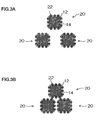
- Figs. 3A to 3B are schematic views showing the main effect of entrapping immobilization pellets 20 of the present invention.
- An attachment prevention filler 22 in the entrapping immobilization pellets 20 is not shown in Figs. 3A to 3B .
- an unpolymerized matter 12 exists on the surface of the conventional entrapping immobilization pellets 10 (hereinafter referred to as pellets 10) (the reference numeral 14 denotes a polymerized matter).
- the reference numeral 14 denotes a polymerized matter.
- the unpolymerized matter 12 remaining on the surface of the pellets 10 has adhesiveness.
- a plurality of the pellets 10... are brought into contact with each other as shown in Fig. 2B
- the unpolymerized matters 12, 12 on the surface of the pellets 10 are brought into contact with each other, and adhere to each other to form a ball-like mass 18 as shown in Fig. 2C .
- an attachment prevention filler 22 is dispersed and immobilized in an unpolymerized matter 12 on the surface of entrapping immobilization pellets 20 of the present invention (hereinafter referred to pellets 20).
- pellets 20 entrapping immobilization pellets 20 of the present invention
- the attachment prevention fillers 22, 22 on the pellets 20 are brought into contact with each other, or the attachment prevention filler 22 on one pellet is brought into contact with the unpolymerized matter 12 on another pellet, unlike conventional entrapping immobilization pellets.
- the attachment prevention filler 22 on the surface of the pellets 20 is immobilized by the unpolymerized matter 12 surrounding the filler, and thus is dropped out of the surface of the pellets 20 only with difficulty.
- FIGs. 4A to 4B are schematic views showing a method for storing entrapping immobilization a pellet, in which Fig. 4A is a view showing a method for storing conventional pellets 10 and Fig. 4B is a view showing a method for storing pellets 20 of the present invention.
- the conventional pellets 10 are dipped in water 32 in a storage case 30 and stored.
- the water 32 is rotted and produces offensive odor.
- an organic substance or an attached organic substance such as an unpolymerized matter 12
- the storage case 32 containing the pellets 10 and the water 32 is generally stored or transported in a low-temperature environment.
- the pellets 20 of the present invention are directly introduced into a storage case 30 into which water is not introduced and stored, because the pellets 20 adhere to each other only with difficulty even in a dry environment.
- water since water is not introduced into the storage tank 30, there is no increase in the volume or weight of the pellets 20 that can be stored in the storage tank 30, and it is not necessary to store the storage case 30 in a low temperature environment.
- efficiency in storing or transporting pellets can be drastically increased.
- the storage case 30 is preferably made of a resin, metal, vinyl, or the like, each of which does not react with pellets 20.
- the pellets 20 of the present invention are added to a biological treatment tank in a wastewater treatment system and used for biological treatment (for example, nitrification treatment) of raw water. Since the outlet of the biological treatment tank is provided with a screen, the pellets are prevented from being discharged and are retained in the biological treatment tank in a stable manner. Accordingly, a biological treatment tank to which the pellets 20 of the present invention are applied can maintain high biological treatment performance.
- pellets can be stored or transported inexpensively and easily without impairing their inherent pellet performance.
- This embodiment relates to a process for producing pellets in which an attachment prevention filler is located on a part of a part of the surface of the pellets.
- the present embodiment is the same as the first embodiment, except that the attachment prevention filler is located on a part of the pellets. Detailed description of the same parts is omitted.
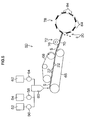
- Fig. 5 is a side view showing an outline of an apparatus 50 for producing entrapping immobilization pellets.
- Fig. 6 is a view describing an operation flow of the above-described pellet production process.
- the pellet production apparatus 50 comprises, as main components, a raw material tank 52 for storing a raw material, chemical tanks 54 and 62 for storing chemicals, a stirring and extrusion unit 60, belt conveyors 66 and 68, a slitting unit 76, and a cutting unit 78.
- the raw material tank 52 stores activated sludge or the like containing microorganisms.
- the chemical tank 54 stores an immobilizing agent or the like.
- the chemical tank 62 stores a polymerization initiator or the like.
- the belt conveyors 66 and 68 polymerize a raw material liquid II extruded from the stirring and extrusion unit 60 (see Fig. 6 ) while conveying the liquid to form a sheet.
- a predetermined amount of an attachment prevention filler 22 is spread over the surface of the belt conveyors 66 and 68. This may be realized, however not exclusively, by a method in which the attachment prevention filler 22 is attached to the belt conveyors 66 and 68 having adhesiveness to the extent that polymerization is not inhibited.
- the attachment prevention filler 22 is added to the surface of the pellet sheet S preferably in an amount of 3 to 20 mass%.
- activated sludge or the like in the raw material tank 52 and an immobilizing agent in the chemical tank 54 are mixed and, at the same time, fed to the stirring and extrusion unit 60 (raw material liquid II) by driving pumps 56 and 58.
- the raw material liquid II fed to the stirring and extrusion unit 60 is mixed with a polymerization initiator or the like fed from the other chemical tank 62 by a pump 64.
- the mixture was stirred and then extruded onto the running belt conveyor 66.
- the raw material liquid II is polymerized and gelled while being held and conveyed by the belt conveyors 66 and 68 over which the attachment prevention filler 22 is spread.
- the attachment prevention filler 22 is immobilized uniformly on the surface of the pellet sheet S in contact with the belt conveyors 66 and 68.
- the continuous pellet sheet S in which the attachment prevention filler 22 is dispersed on both sheet surfaces is formed in this manner.
- the pellet sheet S is extruded on a receiver plate 70 from the belt conveyor 66, and then slit into about 3 mm-wide lattices by a slitting unit 72 that is equipped with a circular blade 76 rotated in the conveying direction. Thereafter, the pellet sheet S is cut and pelletized into about 3 mm-square angular pellets 20 by a cutting unit 78 that is equipped with a rotary blade 84 perpendicular to the conveying direction.
- the pellets 20 of the present embodiment are produced in this manner.
- an attachment prevention filler is located on a part of a part of the pellet surface where the pellets are to adhere to each other, only a small amount of the attachment prevention filler added can prevent adhesion of the pellets to each other.
- the activated sludge, the immobilizing agent, and various amounts of the attachment prevention filler 22 (in which powdered activated carbon having an average particle size of 50 ⁇ m was used) shown in Table 1 were mixed to prepare a raw material liquid I. Then, the polymerization initiator shown in Table 1 was added to the raw material liquid I, the mixture was polymerized at a polymerization temperature of 20°C for 0.5 hour, and an about 10 cm-square pellet sheet S is formed. Next, the pellet sheet S was cut and divided to produce 1 cm-square substantially cubic entrapping immobilization pellets 20.
- the amount of the attachment prevention filler 22 added at this time was changed within the range of 0 to 20 mass% based on the mass of the pellets, and the relation between the amount of the attachment prevention filler and mutual adhesiveness of the pellets was evaluated.
- the tensile strength was 0.4 or less when the attachment prevention filler was added in an amount of 3 to 20 mass% based on the mass of the pellets; the tensile strength was reduced to 0.2 or less and almost constant when the attachment prevention filler was added in an amount of 5 to 20 mass%.
- Entrapping immobilization pellets 20 were produced in the same manner as in the above 1), except that an attachment prevention filler 22 (powdered activated carbon) was added in a fixed amount of 5 mass%, and the average particle size of the attachment prevention filler 22 was changed within the range of 3 to 100 ⁇ m.
- an attachment prevention filler 22 (powdered activated carbon) was added in a fixed amount of 5 mass%, and the average particle size of the attachment prevention filler 22 was changed within the range of 3 to 100 ⁇ m.
- the tensile strength was 0.4 or less when the attachment prevention filler had an average particle size of 3 to 100 ⁇ m; the tensile strength was reduced to 0.2 or less and almost constant when the attachment prevention filler had an average particle size of 5 to 100 ⁇ m.
- the tensile strength was considerably increased when the attachment prevention filler had an average particle size of more than 100 ⁇ m. This is presumably because the attachment prevention filler having an average particle size of more than 100 ⁇ m was easily dropped out from the surface of the pellets to cause the pellets to adhere to each other easily.
- the tensile strength was slightly increased when the attachment prevention filler had an average particle size of less than 5 ⁇ m. This is presumably because the attachment prevention filler having a too small average particle size is uniformly dispersed in the immobilizing agent only with difficulty and forms spheres easily, and mutual adhesiveness of the pellets is increased.
Landscapes
- Chemical & Material Sciences (AREA)
- Life Sciences & Earth Sciences (AREA)
- Engineering & Computer Science (AREA)
- Organic Chemistry (AREA)
- Zoology (AREA)
- Bioinformatics & Cheminformatics (AREA)
- Genetics & Genomics (AREA)
- Health & Medical Sciences (AREA)
- Wood Science & Technology (AREA)
- Microbiology (AREA)
- Biotechnology (AREA)
- Biochemistry (AREA)
- General Engineering & Computer Science (AREA)
- General Health & Medical Sciences (AREA)
- Biomedical Technology (AREA)
- Hydrology & Water Resources (AREA)
- General Chemical & Material Sciences (AREA)
- Biodiversity & Conservation Biology (AREA)
- Chemical Kinetics & Catalysis (AREA)
- Environmental & Geological Engineering (AREA)
- Water Supply & Treatment (AREA)
- Dispersion Chemistry (AREA)
- Inorganic Chemistry (AREA)
- Biological Treatment Of Waste Water (AREA)
- Immobilizing And Processing Of Enzymes And Microorganisms (AREA)
- Apparatus Associated With Microorganisms And Enzymes (AREA)
- Purification Treatments By Anaerobic Or Anaerobic And Aerobic Bacteria Or Animals (AREA)
- Preparation Of Compounds By Using Micro-Organisms (AREA)
Applications Claiming Priority (2)
| Application Number | Priority Date | Filing Date | Title |
|---|---|---|---|
| JP2005276630A JP2007082485A (ja) | 2005-09-22 | 2005-09-22 | 包括固定化担体、その製造方法、及び保管・輸送方法 |
| EP20060019366 EP1767497B1 (fr) | 2005-09-22 | 2006-09-15 | Granules d'immobilisation, procédé de production et méthode de stockage ou transport |
Related Parent Applications (1)
| Application Number | Title | Priority Date | Filing Date |
|---|---|---|---|
| EP20060019366 Division EP1767497B1 (fr) | 2005-09-22 | 2006-09-15 | Granules d'immobilisation, procédé de production et méthode de stockage ou transport |
Publications (2)
| Publication Number | Publication Date |
|---|---|
| EP2025647A2 true EP2025647A2 (fr) | 2009-02-18 |
| EP2025647A3 EP2025647A3 (fr) | 2009-04-22 |
Family
ID=37496807
Family Applications (2)
| Application Number | Title | Priority Date | Filing Date |
|---|---|---|---|
| EP20080019390 Withdrawn EP2025647A3 (fr) | 2005-09-22 | 2006-09-15 | Procédé de stockage ou de transport enfermant des granules d'immobilisation |
| EP20060019366 Not-in-force EP1767497B1 (fr) | 2005-09-22 | 2006-09-15 | Granules d'immobilisation, procédé de production et méthode de stockage ou transport |
Family Applications After (1)
| Application Number | Title | Priority Date | Filing Date |
|---|---|---|---|
| EP20060019366 Not-in-force EP1767497B1 (fr) | 2005-09-22 | 2006-09-15 | Granules d'immobilisation, procédé de production et méthode de stockage ou transport |
Country Status (7)
| Country | Link |
|---|---|
| US (1) | US20070062864A1 (fr) |
| EP (2) | EP2025647A3 (fr) |
| JP (1) | JP2007082485A (fr) |
| KR (1) | KR101293104B1 (fr) |
| CN (1) | CN1935692A (fr) |
| AT (1) | ATE431810T1 (fr) |
| DE (1) | DE602006006886D1 (fr) |
Cited By (1)
| Publication number | Priority date | Publication date | Assignee | Title |
|---|---|---|---|---|
| CN110683659A (zh) * | 2019-10-18 | 2020-01-14 | 长沙理工大学 | 一种农田退水的原位处理方法 |
Families Citing this family (9)
| Publication number | Priority date | Publication date | Assignee | Title |
|---|---|---|---|---|
| JP4284560B2 (ja) * | 2007-04-26 | 2009-06-24 | 株式会社日立プラントテクノロジー | 包括固定化担体の減容方法、包括固定化担体、水質浄化方法及び包括固定化担体の製造装置 |
| JP5105251B2 (ja) * | 2008-09-24 | 2012-12-26 | 株式会社日立プラントテクノロジー | 包括固定化担体及びその製造方法 |
| JP6646496B2 (ja) * | 2016-03-28 | 2020-02-14 | 太平洋セメント株式会社 | 水処理材及びその製造方法 |
| CA3085569A1 (fr) * | 2017-12-13 | 2019-06-20 | Toyo University | Support de maintien des bacteries anaerobies d'oxydation d'ammonium (anammox) pour utilisation dans le traitement des eaux usees, particule adherant aux bacteries anammox, et dispositif de traitement d'eaux useesutilisant ledit support |
| JP7053243B2 (ja) * | 2017-12-13 | 2022-04-12 | 東洋炭素株式会社 | 微生物固定化担体 |
| CN108191041A (zh) * | 2018-01-17 | 2018-06-22 | 温州大学 | 一种富镁生物填料及其制造方法 |
| JP2020103179A (ja) * | 2018-12-27 | 2020-07-09 | 学校法人 創価大学 | 遮光ゲル担体 |
| CN112897686B (zh) * | 2021-01-28 | 2022-08-02 | 海南天鸿市政设计股份有限公司 | 一种固定化活性污泥及其制备方法 |
| CN118289930B (zh) | 2024-06-06 | 2024-10-01 | 南京大学 | 基于二硫化钼复合材料的生物强效剂及其制备和应用 |
Citations (1)
| Publication number | Priority date | Publication date | Assignee | Title |
|---|---|---|---|---|
| JP3422229B2 (ja) | 1997-07-24 | 2003-06-30 | 日立プラント建設株式会社 | 包括固定化担体の製造方法及び装置 |
Family Cites Families (6)
| Publication number | Priority date | Publication date | Assignee | Title |
|---|---|---|---|---|
| US4663286A (en) * | 1984-02-13 | 1987-05-05 | Damon Biotech, Inc. | Encapsulation of materials |
| DE3617875C2 (de) * | 1985-06-28 | 1993-10-14 | Hitachi Plant Eng & Constr Co | Verfahren zum Immobilisieren von Mikroorganismen |
| US5980738A (en) * | 1995-10-04 | 1999-11-09 | Monsanta Company | Porous polymeric biosupports |
| JP3143412B2 (ja) * | 1997-01-14 | 2001-03-07 | 筒中プラスチック工業株式会社 | 流動床用微生物固定化担体 |
| EP1316533A3 (fr) * | 2001-12-03 | 2004-02-11 | Nisshinbo Industries, Inc. | Support résistant aux produits chimiques pour un bioréacteur ; procédé pour sa préparation et procédé pour son utilisation |
| JP2004065021A (ja) * | 2002-08-01 | 2004-03-04 | Mitsubishi Rayon Co Ltd | 微生物固定化担体及びこれを用いた排水処理方法 |
-
2005
- 2005-09-22 JP JP2005276630A patent/JP2007082485A/ja active Pending
-
2006
- 2006-09-13 US US11/519,828 patent/US20070062864A1/en not_active Abandoned
- 2006-09-15 DE DE200660006886 patent/DE602006006886D1/de active Active
- 2006-09-15 AT AT06019366T patent/ATE431810T1/de not_active IP Right Cessation
- 2006-09-15 EP EP20080019390 patent/EP2025647A3/fr not_active Withdrawn
- 2006-09-15 EP EP20060019366 patent/EP1767497B1/fr not_active Not-in-force
- 2006-09-18 KR KR20060090157A patent/KR101293104B1/ko not_active Expired - Fee Related
- 2006-09-20 CN CNA2006101543284A patent/CN1935692A/zh active Pending
Patent Citations (1)
| Publication number | Priority date | Publication date | Assignee | Title |
|---|---|---|---|---|
| JP3422229B2 (ja) | 1997-07-24 | 2003-06-30 | 日立プラント建設株式会社 | 包括固定化担体の製造方法及び装置 |
Non-Patent Citations (1)
| Title |
|---|
| "Water treatment by microorganism immobilization process: Pellet immobilization process, entrapping immobilization process, biologically activated carbon process", 2000, NTS INC. |
Cited By (1)
| Publication number | Priority date | Publication date | Assignee | Title |
|---|---|---|---|---|
| CN110683659A (zh) * | 2019-10-18 | 2020-01-14 | 长沙理工大学 | 一种农田退水的原位处理方法 |
Also Published As
| Publication number | Publication date |
|---|---|
| CN1935692A (zh) | 2007-03-28 |
| JP2007082485A (ja) | 2007-04-05 |
| KR101293104B1 (ko) | 2013-08-12 |
| EP1767497A1 (fr) | 2007-03-28 |
| EP1767497B1 (fr) | 2009-05-20 |
| DE602006006886D1 (de) | 2009-07-02 |
| US20070062864A1 (en) | 2007-03-22 |
| ATE431810T1 (de) | 2009-06-15 |
| KR20070033891A (ko) | 2007-03-27 |
| EP2025647A3 (fr) | 2009-04-22 |
Similar Documents
| Publication | Publication Date | Title |
|---|---|---|
| US20100209989A1 (en) | Entrapping immobilization pellets and process for producing the same | |
| US8227238B2 (en) | Apparatus for producing pellets containing entrapped and immobilized microorganisms | |
| EP1780271A1 (fr) | Granules immobilisées enfermant des bactéries anaérobiques ammonium-oxydantes et procédé de leur fabrication | |
| EP1767497B1 (fr) | Granules d'immobilisation, procédé de production et méthode de stockage ou transport | |
| EP0864540B1 (fr) | Méthode pour réaliser une réaction biocatalytique | |
| CN1740100B (zh) | 固定化微生物及其制造方法、采用其的反应装置 | |
| US6936446B2 (en) | Light weight medium for growing microorganisms | |
| EP1798283B1 (fr) | Procéssus de stockage et de production pour enfermer des granules d'immobilisation | |
| US7105337B2 (en) | Method of removing exogenous endocrine-disrupting chemical in water | |
| JP2003000237A (ja) | 包括固定化微生物担体及びその製造方法 | |
| JP3514360B2 (ja) | 固定化方法及び固定化担体 | |
| JPH0218910B2 (fr) | ||
| JPS6054790A (ja) | 水処理装置 | |
| JPH04176386A (ja) | 固定化微生物ペレットの再生方法 | |
| JPS61178093A (ja) | 汚水の処理方法 | |
| JP2004113996A (ja) | 水処理システム | |
| JPH0957290A (ja) | 微生物固定化担体を用いた廃水処理方法並びに該廃水処理方法に用いる微生物固定化用担体およびその製造方法 |
Legal Events
| Date | Code | Title | Description |
|---|---|---|---|
| PUAI | Public reference made under article 153(3) epc to a published international application that has entered the european phase |
Free format text: ORIGINAL CODE: 0009012 |
|
| AC | Divisional application: reference to earlier application |
Ref document number: 1767497 Country of ref document: EP Kind code of ref document: P |
|
| AK | Designated contracting states |
Kind code of ref document: A2 Designated state(s): AT BE BG CH CY CZ DE DK EE ES FI FR GB GR HU IE IS IT LI LT LU LV MC NL PL PT RO SE SI SK TR |
|
| PUAL | Search report despatched |
Free format text: ORIGINAL CODE: 0009013 |
|
| AK | Designated contracting states |
Kind code of ref document: A3 Designated state(s): AT BE BG CH CY CZ DE DK EE ES FI FR GB GR HU IE IS IT LI LT LU LV MC NL PL PT RO SE SI SK TR |
|
| RIN1 | Information on inventor provided before grant (corrected) |
Inventor name: AOYAMA, KOUTAROU Inventor name: ABE, NAOKI Inventor name: SUMINO, TATSUO |
|
| 17P | Request for examination filed |
Effective date: 20090602 |
|
| 17Q | First examination report despatched |
Effective date: 20090630 |
|
| AKX | Designation fees paid |
Designated state(s): DE FR GB |
|
| STAA | Information on the status of an ep patent application or granted ep patent |
Free format text: STATUS: THE APPLICATION IS DEEMED TO BE WITHDRAWN |
|
| 18D | Application deemed to be withdrawn |
Effective date: 20091111 |