EP2025876B1 - Joint de turbine et joint de sécurité associé d'un moteur à turbine à gaz et ensemble turbine associé - Google Patents
Joint de turbine et joint de sécurité associé d'un moteur à turbine à gaz et ensemble turbine associé Download PDFInfo
- Publication number
- EP2025876B1 EP2025876B1 EP20080252724 EP08252724A EP2025876B1 EP 2025876 B1 EP2025876 B1 EP 2025876B1 EP 20080252724 EP20080252724 EP 20080252724 EP 08252724 A EP08252724 A EP 08252724A EP 2025876 B1 EP2025876 B1 EP 2025876B1
- Authority
- EP
- European Patent Office
- Prior art keywords
- seal
- assembly
- face
- hydrostatic
- pressure
- Prior art date
- Legal status (The legal status is an assumption and is not a legal conclusion. Google has not performed a legal analysis and makes no representation as to the accuracy of the status listed.)
- Active
Links
Images

Classifications
-
- F—MECHANICAL ENGINEERING; LIGHTING; HEATING; WEAPONS; BLASTING
- F16—ENGINEERING ELEMENTS AND UNITS; GENERAL MEASURES FOR PRODUCING AND MAINTAINING EFFECTIVE FUNCTIONING OF MACHINES OR INSTALLATIONS; THERMAL INSULATION IN GENERAL
- F16J—PISTONS; CYLINDERS; SEALINGS
- F16J15/00—Sealings
- F16J15/16—Sealings between relatively-moving surfaces
- F16J15/34—Sealings between relatively-moving surfaces with slip-ring pressed against a more or less radial face on one member
-
- F—MECHANICAL ENGINEERING; LIGHTING; HEATING; WEAPONS; BLASTING
- F02—COMBUSTION ENGINES; HOT-GAS OR COMBUSTION-PRODUCT ENGINE PLANTS
- F02C—GAS-TURBINE PLANTS; AIR INTAKES FOR JET-PROPULSION PLANTS; CONTROLLING FUEL SUPPLY IN AIR-BREATHING JET-PROPULSION PLANTS
- F02C7/00—Features, components parts, details or accessories, not provided for in, or of interest apart form groups F02C1/00 - F02C6/00; Air intakes for jet-propulsion plants
- F02C7/28—Arrangement of seals
-
- F—MECHANICAL ENGINEERING; LIGHTING; HEATING; WEAPONS; BLASTING
- F16—ENGINEERING ELEMENTS AND UNITS; GENERAL MEASURES FOR PRODUCING AND MAINTAINING EFFECTIVE FUNCTIONING OF MACHINES OR INSTALLATIONS; THERMAL INSULATION IN GENERAL
- F16J—PISTONS; CYLINDERS; SEALINGS
- F16J15/00—Sealings
- F16J15/002—Sealings comprising at least two sealings in succession
- F16J15/008—Sealings comprising at least two sealings in succession with provision to put out of action at least one sealing; One sealing sealing only on standstill; Emergency or servicing sealings
-
- F—MECHANICAL ENGINEERING; LIGHTING; HEATING; WEAPONS; BLASTING
- F16—ENGINEERING ELEMENTS AND UNITS; GENERAL MEASURES FOR PRODUCING AND MAINTAINING EFFECTIVE FUNCTIONING OF MACHINES OR INSTALLATIONS; THERMAL INSULATION IN GENERAL
- F16J—PISTONS; CYLINDERS; SEALINGS
- F16J15/00—Sealings
- F16J15/44—Free-space packings
- F16J15/444—Free-space packings with facing materials having honeycomb-like structure
-
- F—MECHANICAL ENGINEERING; LIGHTING; HEATING; WEAPONS; BLASTING
- F16—ENGINEERING ELEMENTS AND UNITS; GENERAL MEASURES FOR PRODUCING AND MAINTAINING EFFECTIVE FUNCTIONING OF MACHINES OR INSTALLATIONS; THERMAL INSULATION IN GENERAL
- F16J—PISTONS; CYLINDERS; SEALINGS
- F16J15/00—Sealings
- F16J15/44—Free-space packings
- F16J15/447—Labyrinth packings
- F16J15/4472—Labyrinth packings with axial path
-
- F—MECHANICAL ENGINEERING; LIGHTING; HEATING; WEAPONS; BLASTING
- F05—INDEXING SCHEMES RELATING TO ENGINES OR PUMPS IN VARIOUS SUBCLASSES OF CLASSES F01-F04
- F05D—INDEXING SCHEME FOR ASPECTS RELATING TO NON-POSITIVE-DISPLACEMENT MACHINES OR ENGINES, GAS-TURBINES OR JET-PROPULSION PLANTS
- F05D2300/00—Materials; Properties thereof
- F05D2300/20—Oxide or non-oxide ceramics
- F05D2300/22—Non-oxide ceramics
- F05D2300/224—Carbon, e.g. graphite
Definitions
- the disclosure generally relates to gas turbine engines.
- a gas turbine engine typically maintains pressure differentials between various components during operation. These pressure differentials are commonly maintained by various configurations of seals.
- labyrinth seals oftentimes are used in gas turbine engines.
- labyrinth seals tend to deteriorate over time.
- a labyrinth seal can deteriorate due to rub interactions from thermal and mechanical growths, assembly tolerances, engine loads and maneuver deflections.
- rub interactions from thermal and mechanical growths, assembly tolerances, engine loads and maneuver deflections.
- such deterioration can cause increased flow consumption resulting in increased parasitic losses and thermodynamic cycle loss.
- GB 1 174 207 shows the technical features of the preamble of independent claim 1.
- hydrostatic face seals can be used at various locations of a gas turbine engine, such as in association with a low-pressure turbine.
- a hydrostatic seal is a seal that uses balanced opening and closing forces to maintain a desired separation between a seal face and a corresponding seal runner. Unanticipated pressure fluctuations and/or vibrations could cause undesired contact between the seal face and the corresponding seal runner that can cause damage to the seal, e.g., carbon fracture.
- a back-up seal can be provided that is integrated with one or more components forming the hydrostatic seal.
- seal assembly 10 incorporates a hydrostatic face seal 12 and a back-up seal 14 that are provided by a stationary stator assembly 16 and a rotating rotor assembly 18.
- stator assembly incorporates the seal face of the associated hydrostatic face seal, as well as one or more of the primary components of the back-up seal.
- rotor assembly incorporates the seal runner of the hydrostatic face seal and others of the primary components of the back-up seal.
- the stator assembly carries either the honeycomb lands or the knife edges, whereas the rotor carries the corresponding feature of the seal.
- the stator assembly incorporates the honeycomb lands and the rotor assembly incorporates the knife edges as will be described in detail.
- stator assembly 16 includes an arm 17 that extends from a mounting bracket 19.
- Mounting bracket 19 facilitates attachment, removal and/or position adjustment of the stator assembly.
- other embodiments may not incorporate mounting brackets for ease of installation and/or removal.
- Stator assembly 16 incorporates a carrier 20 that carries face seal 22, which is annular in shape. Face seal 22 includes a seal face 24, which is one of the seal-forming surfaces of the hydrostatic seal. Carrier 20 is axially translatable so that seal face 24 can move, with the carrier, away from or toward (e.g., into contact with) a seal runner 26 (which is the other of the seal-forming components of the hydrostatic seal) of rotor assembly 18.
- an anti-rotation lock 28 is provided to prevent circumferential displacement and to assist in aligning the seal carrier to facilitate axial translation.
- the biasing force of the biasing member can be selected to maintain a desired pressure differential between a high-pressure side (P HIGH ) and a low-pressure side (P LOW ) of the seal.
- Multiple biasing members may be spaced about the stator and carrier.
- a piston ring 32 is captured between opposing surfaces 34, 36 of the stator assembly and carrier, respectively, to control gas leakage between the arm of the stator assembly and the carrier.
- Surface 40 of the carrier mounts lands 42, 44 of the labyrinth-type back-up seal 14.
- the lands may be comprised of an abradable structure such as honeycomb.
- Corresponding knife edges 52, 54 of the labyrinth-type back-up seal are carried by the rotor assembly.
- rotor assembly 18 supports the seal runner 26, which is annular in shape.
- the rotor assembly includes an arm 56 that extends from a mounting bracket 58.
- Mounting bracket 58 facilitates attachment, removal and/or position adjustment of the rotor assembly.
- extension 60 The knife edges 52, 54 of the labyrinth-type back-up seal are supported by an annular extension 60 that extends from the arm of the rotor assembly.
- extension 60 assists in defining an intermediate-pressure cavity 62 that is located between the hydrostatic seal and the back-up seal.
- extension 60 can assist in preventing debris (e.g., debris that may by attributable to unintended damage of the hydrostatic seal) from passing beyond the back-up seal.
- intermediate-pressure cavity 62 typically exhibits P HIGH .
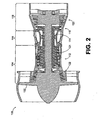
- FIG. 2 is a schematic diagram depicting an exemplary embodiment of a gas turbine engine, in which an embodiment of a hydrostatic face seal with integrated back-up seal can be used.
- engine 100 is configured as a turbofan that incorporates a fan 102, a compressor section 104, a combustion section 106 and a turbine section 108.
- FIG. 2 is configured as a turbofan, there is no intention to limit the concepts described herein to use with turbofans, as various other configurations of gas turbine engines can be used.
- Engine 100 is a dual spool engine that includes a high-pressure turbine 110 interconnected with a high-pressure compressor 112 via a shaft 114, and a low-pressure turbine 120 interconnected with a low-pressure compressor 122 via a shaft 124. It should also be noted that although various embodiments are described as incorporating hydrostatic face seals in low-pressure turbines, such seals are not limited to use with low-pressure turbines.
- low-pressure turbine 120 defines a primary gas flow path 130 along which multiple rotating blades (e.g., blade 132) and stationary vanes (e.g., vane 134) are located.
- the blades are mounted to turbine disks, the respective webs and bores of which extend into a high-pressure cavity 140.
- disk 142 includes a web 144 and a bore 146, each of which extends into cavity 140.
- a relatively lower-pressure cavity 148 is oriented between high-pressure cavity 140 and turbine hub 150, with a seal assembly 10 (described in detail before with respect to FIG. 1 ) being provided to maintain a pressure differential between the high-pressure cavity and the lower-pressure cavity.
- Seal assembly 10 incorporates a hydrostatic face seal 12 and a back-up seal 14 that are provided by a stator assembly 16 and a rotor assembly 18.
- the stator assembly is mounted to a non-rotating structure of the turbine, whereas the rotor assembly is mounted to a rotating structure.
- the rotor assembly is mounted to the low-pressure turbine hub 150.
- an intermediate-pressure cavity 151 is defined between hydrostatic face seal 12 and back-up seal 14.
- seal assembly 10 is provided as a removable assembly, the location of which can be adjusted axially and radially. As such, thrust balance trimming of engine 100 can be at least partially accommodated by altering the position of the seal assembly to adjust the volume of cavities 140 and 148
- the seal face intermittently contacts the seal runner.
- contact between the seal face and the seal runner can occur during sub-idle conditions and/or during transient conditions. That is, contact between the seal face and the seal runner is maintained until gas pressure in the high-pressure cavity is adequate to overcome the biasing force, thereby separating the seal face from the seal runner.
- the seal face and the seal runner should not contact each other.
- a material containing carbon can be used as a seal face material. It should be noted, however, that carbon can fracture or otherwise be damaged due to unintended contact (e.g., excessively forceful contact) between the seal face and the seal runner as may be caused by severe pressure fluctuations and/or vibrations, for example. It should also be noted that carbon may be susceptible to deterioration at higher temperatures. Therefore, carbon should be used in locations where predicted temperatures are not excessive such as in the low-pressure turbine. By way of example, use of such a material may not be appropriate, in some embodiments, in a high-pressure turbine.
- a nominal pressure differential exists between intermediate-pressure cavity 151 and lower-pressure cavity 148. That is, the pressure differential between the high-pressure cavity and the lower-pressure cavity is maintained, at least primarily, across the hydrostatic face seal 12.
- a failure mode of operation i.e., the hydrostatic seal fails
- the pressure of the high-pressure cavity 140 is depleted to a level lower than during the normal mode of operation but higher than that of intermediate cavity 151 during normal operation.
- the increase in pressure differential across the back-up seal 14 is due to the increased flow rate imposed on the back-up seal during failure of the primary seal.
- pressure in intermediate cavity 151 increases and a corresponding pressure differential is maintained, at least primarily, across the back-up seal 14.
Landscapes
- Engineering & Computer Science (AREA)
- General Engineering & Computer Science (AREA)
- Mechanical Engineering (AREA)
- Chemical & Material Sciences (AREA)
- Combustion & Propulsion (AREA)
- Turbine Rotor Nozzle Sealing (AREA)
- Sealing Using Fluids, Sealing Without Contact, And Removal Of Oil (AREA)
Claims (8)
- Ensemble de joint (10) pour un moteur à turbine à gaz comprenant ;
un ensemble de stator (16) et un ensemble de rotor (18) configurés pour se mettre en prise l'un avec l'autre de manière opérationnelle pour former un premier joint (12) et un second joint (14), dans lequel l'ensemble de stator (16) comprend un support (20), un joint facial (22) étant monté sur le support (20) de sorte que le support (20) positionne la face de joint (24) par rapport à la roue de joint (26) ;
le premier joint (12) étant fourni par un joint hydrostatique ayant une face de joint (24) et une roue de joint (26), dans lequel la roue de joint (26) est une portion de l'ensemble de rotor (18) ;
le second joint (14) étant fourni par un joint labyrinthe de sorte qu'en réponse à une défaillance du premier joint (12), le joint de renfort (14) maintient au moins une portion d'une pression différentielle établie par le premier joint (12) avant la défaillance ;
dans lequel le joint labyrinthe (14) comprend un cordon (42) et un couteau (52), le couteau (52) étant opérationnel pour interagir avec le cordon (42) afin de former le second joint (14), le cordon (42) étant supporté par l'ensemble de stator (16) et le couteau (52) étant supporté par l'ensemble de rotor (18), caractérisé en ce que l'ensemble de joint comprend une extension annulaire (60) qui s'étend à partir d'un bras de l'ensemble de rotor, laquelle extension annulaire (60) aide à définir une cavité de pression intermédiaire (62) qui est située entre le premier joint (12) et le second joint (14). - Ensemble selon la revendication 1, dans lequel le support (20) est opérationnel pour déplacer la face de joint (24) dans la direction axiale du moteur à turbine à gaz.
- Ensemble selon la revendication 1 ou 2, dans lequel chacun de l'ensemble de stator (16) et de l'ensemble de rotor (18) comprend une console de montage (17, 56) opérationnelle pour monter de façon amovible l'ensemble de stator (16) et l'ensemble de rotor (18), respectivement, à l'intérieur du moteur à turbine à gaz.
- Ensemble selon l'une quelconque des revendications précédentes, dans lequel le joint hydrostatique (12) est un joint pouvant être retiré, avec la face de joint (24) étant sollicitée vers une position de contact dans laquelle la face de joint (24) entre en contact avec la roue de joint (26).
- Ensemble selon la revendication 4, dans lequel l'ensemble de stator (16) comprend un organe de sollicitation (30) opérationnel pour solliciter la face de joint (24) vers la position de contact.
- Ensemble de turbine pour un moteur à turbine à gaz, comprenant une turbine (120) comportant un ensemble de joint selon la revendication 1.
- Ensemble de turbine selon la revendication 6, dans lequel la turbine (120) est une turbine basse pression.
- Ensemble selon l'une quelconque des revendications précédentes, dans lequel au moins une portion de la face de joint (24) configurée pour entrer en contact avec la roue de joint (26) est formée d'un matériau comprenant du carbone.
Applications Claiming Priority (3)
| Application Number | Priority Date | Filing Date | Title |
|---|---|---|---|
| US11/840,645 US8109716B2 (en) | 2007-08-17 | 2007-08-17 | Gas turbine engine systems involving hydrostatic face seals with anti-fouling provisioning |
| US11/840,636 US8109717B2 (en) | 2007-08-17 | 2007-08-17 | Gas turbine engine systems involving hydrostatic face seals with integrated back-up seals |
| US11/841,124 US8105021B2 (en) | 2007-08-20 | 2007-08-20 | Gas turbine engine systems involving hydrostatic face seals with integrated back-up seals |
Publications (3)
| Publication Number | Publication Date |
|---|---|
| EP2025876A2 EP2025876A2 (fr) | 2009-02-18 |
| EP2025876A3 EP2025876A3 (fr) | 2011-05-18 |
| EP2025876B1 true EP2025876B1 (fr) | 2012-05-23 |
Family
ID=39832369
Family Applications (1)
| Application Number | Title | Priority Date | Filing Date |
|---|---|---|---|
| EP20080252724 Active EP2025876B1 (fr) | 2007-08-17 | 2008-08-18 | Joint de turbine et joint de sécurité associé d'un moteur à turbine à gaz et ensemble turbine associé |
Country Status (1)
| Country | Link |
|---|---|
| EP (1) | EP2025876B1 (fr) |
Families Citing this family (1)
| Publication number | Priority date | Publication date | Assignee | Title |
|---|---|---|---|---|
| US11053797B2 (en) * | 2017-01-23 | 2021-07-06 | General Electric Company | Rotor thrust balanced turbine engine |
Family Cites Families (8)
| Publication number | Priority date | Publication date | Assignee | Title |
|---|---|---|---|---|
| US2545916A (en) * | 1947-08-19 | 1951-03-20 | Armstrong Siddeley Motors Ltd | Labyrinth packings, particularly for use in internal-combustion turbines |
| GB1174207A (en) * | 1968-05-30 | 1969-12-17 | Rolls Royce | Improvements in or relating to fluid flow machines |
| US4103899A (en) * | 1975-10-01 | 1978-08-01 | United Technologies Corporation | Rotary seal with pressurized air directed at fluid approaching the seal |
| US6676369B2 (en) * | 2002-03-26 | 2004-01-13 | General Electric Company | Aspirating face seal with axially extending seal teeth |
| WO2006004052A1 (fr) * | 2004-07-02 | 2006-01-12 | Nippon Pillar Packing Co., Ltd. | Joint mécanique |
| JP4336286B2 (ja) * | 2004-10-08 | 2009-09-30 | 日本ピラー工業株式会社 | 静圧形ノンコンタクトガスシール |
| US20070253809A1 (en) * | 2006-05-01 | 2007-11-01 | General Electric Company | Methods and apparatus for assembling gas turbine engines |
| US20080018054A1 (en) * | 2006-07-20 | 2008-01-24 | General Electric Company | Aspirating labyrinth seal |
-
2008
- 2008-08-18 EP EP20080252724 patent/EP2025876B1/fr active Active
Also Published As
| Publication number | Publication date |
|---|---|
| EP2025876A2 (fr) | 2009-02-18 |
| EP2025876A3 (fr) | 2011-05-18 |
Similar Documents
| Publication | Publication Date | Title |
|---|---|---|
| US8105021B2 (en) | Gas turbine engine systems involving hydrostatic face seals with integrated back-up seals | |
| EP2025875B1 (fr) | Joint de turbine et joint de sécurité d'un moteur à turbine à gaz | |
| US8167545B2 (en) | Self-balancing face seals and gas turbine engine systems involving such seals | |
| EP2025874B1 (fr) | Joint hydrostatique d'un moteur à turbine à gaz et moteur à turbine à gaz correspondant | |
| US7797941B2 (en) | Gas turbine engine systems involving hydrostatic face seals | |
| US20090051120A1 (en) | Gas Turbine Engine Systems Involving Hydrostatic Face Seals | |
| US7909335B2 (en) | Retractable compliant plate seals | |
| US8540479B2 (en) | Active retractable seal for turbo machinery and related method | |
| US8939715B2 (en) | Active tip clearance control for shrouded gas turbine blades and related method | |
| US6854736B2 (en) | Seal assembly for a rotary machine | |
| US20100078893A1 (en) | Active retractable seal for turbomachinery and related method | |
| EP1577504B1 (fr) | Joint d'étanchéité pour palier muni d'un dispositif de sécurité | |
| EP1852573A2 (fr) | Système de joint d'étanchéité pour turbine à gaz | |
| EP3002487B1 (fr) | Système d'étanchéité | |
| EP2233700B1 (fr) | Joints auto-équilibrants et systèmes de moteur de turbine à gaz impliquant de tels joints | |
| US9829007B2 (en) | Turbine sealing system | |
| EP2020542A1 (fr) | Ensemble hermétique | |
| US12270305B2 (en) | Seal assembly for a rotary machine | |
| JP5060035B2 (ja) | シールアセンブリおよびその製造方法 | |
| GB2540233A (en) | Seal arrangement | |
| EP2025876A2 (fr) | Joint de turbine et joint de sécurité associé d'un moteur à turbine à gaz et ensemble turbine associé | |
| EP2025877A2 (fr) | Joint hydrostatique d'un moteur à turbine à gaz et ensemble turbine associé | |
| CN113167126B (zh) | 非接触密封组件中的副密封 |
Legal Events
| Date | Code | Title | Description |
|---|---|---|---|
| PUAI | Public reference made under article 153(3) epc to a published international application that has entered the european phase |
Free format text: ORIGINAL CODE: 0009012 |
|
| AK | Designated contracting states |
Kind code of ref document: A2 Designated state(s): AT BE BG CH CY CZ DE DK EE ES FI FR GB GR HR HU IE IS IT LI LT LU LV MC MT NL NO PL PT RO SE SI SK TR |
|
| AX | Request for extension of the european patent |
Extension state: AL BA MK RS |
|
| PUAL | Search report despatched |
Free format text: ORIGINAL CODE: 0009013 |
|
| AK | Designated contracting states |
Kind code of ref document: A3 Designated state(s): AT BE BG CH CY CZ DE DK EE ES FI FR GB GR HR HU IE IS IT LI LT LU LV MC MT NL NO PL PT RO SE SI SK TR |
|
| AX | Request for extension of the european patent |
Extension state: AL BA MK RS |
|
| RIC1 | Information provided on ipc code assigned before grant |
Ipc: F02C 7/28 20060101ALI20110412BHEP Ipc: F16J 15/34 20060101ALI20110412BHEP Ipc: F16J 15/44 20060101ALI20110412BHEP Ipc: F01D 11/04 20060101ALI20110412BHEP Ipc: F01D 11/02 20060101AFI20110412BHEP |
|
| 17P | Request for examination filed |
Effective date: 20111116 |
|
| REG | Reference to a national code |
Ref country code: DE Ref legal event code: R079 Ref document number: 602008015831 Country of ref document: DE Free format text: PREVIOUS MAIN CLASS: F01D0011000000 Ipc: F01D0011020000 |
|
| AKX | Designation fees paid |
Designated state(s): DE GB |
|
| GRAP | Despatch of communication of intention to grant a patent |
Free format text: ORIGINAL CODE: EPIDOSNIGR1 |
|
| RIC1 | Information provided on ipc code assigned before grant |
Ipc: F01D 11/02 20060101AFI20120118BHEP Ipc: F16J 15/34 20060101ALI20120118BHEP Ipc: F02C 7/28 20060101ALI20120118BHEP Ipc: F16J 15/44 20060101ALI20120118BHEP Ipc: F01D 11/04 20060101ALI20120118BHEP |
|
| GRAS | Grant fee paid |
Free format text: ORIGINAL CODE: EPIDOSNIGR3 |
|
| GRAA | (expected) grant |
Free format text: ORIGINAL CODE: 0009210 |
|
| AK | Designated contracting states |
Kind code of ref document: B1 Designated state(s): DE GB |
|
| REG | Reference to a national code |
Ref country code: GB Ref legal event code: FG4D |
|
| REG | Reference to a national code |
Ref country code: DE Ref legal event code: R096 Ref document number: 602008015831 Country of ref document: DE Effective date: 20120726 |
|
| PLBE | No opposition filed within time limit |
Free format text: ORIGINAL CODE: 0009261 |
|
| STAA | Information on the status of an ep patent application or granted ep patent |
Free format text: STATUS: NO OPPOSITION FILED WITHIN TIME LIMIT |
|
| 26N | No opposition filed |
Effective date: 20130226 |
|
| REG | Reference to a national code |
Ref country code: DE Ref legal event code: R097 Ref document number: 602008015831 Country of ref document: DE Effective date: 20130226 |
|
| REG | Reference to a national code |
Ref country code: DE Ref legal event code: R082 Ref document number: 602008015831 Country of ref document: DE Representative=s name: SCHMITT-NILSON SCHRAUD WAIBEL WOHLFROM PATENTA, DE |
|
| REG | Reference to a national code |
Ref country code: DE Ref legal event code: R082 Ref document number: 602008015831 Country of ref document: DE Representative=s name: SCHMITT-NILSON SCHRAUD WAIBEL WOHLFROM PATENTA, DE Ref country code: DE Ref legal event code: R081 Ref document number: 602008015831 Country of ref document: DE Owner name: UNITED TECHNOLOGIES CORP. (N.D.GES.D. STAATES , US Free format text: FORMER OWNER: UNITED TECHNOLOGIES CORPORATION, HARTFORD, CONN., US |
|
| REG | Reference to a national code |
Ref country code: DE Ref legal event code: R081 Ref document number: 602008015831 Country of ref document: DE Owner name: RAYTHEON TECHNOLOGIES CORPORATION (N.D.GES.D.S, US Free format text: FORMER OWNER: UNITED TECHNOLOGIES CORP. (N.D.GES.D. STAATES DELAWARE), FARMINGTON, CONN., US Ref country code: DE Ref legal event code: R081 Ref document number: 602008015831 Country of ref document: DE Owner name: RTX CORPORATION (N.D.GES.D. STAATES DELAWARE),, US Free format text: FORMER OWNER: UNITED TECHNOLOGIES CORP. (N.D.GES.D. STAATES DELAWARE), FARMINGTON, CONN., US |
|
| P01 | Opt-out of the competence of the unified patent court (upc) registered |
Effective date: 20230519 |
|
| PGFP | Annual fee paid to national office [announced via postgrant information from national office to epo] |
Ref country code: DE Payment date: 20250724 Year of fee payment: 18 |
|
| PGFP | Annual fee paid to national office [announced via postgrant information from national office to epo] |
Ref country code: GB Payment date: 20250724 Year of fee payment: 18 |
|
| REG | Reference to a national code |
Ref country code: DE Ref legal event code: R081 Ref document number: 602008015831 Country of ref document: DE Owner name: RTX CORPORATION (N.D.GES.D. STAATES DELAWARE),, US Free format text: FORMER OWNER: RAYTHEON TECHNOLOGIES CORPORATION (N.D.GES.D.STAATES DELAWARE), ARLINGTON, VA, US |