EP2026955B1 - Matériau stratifié - Google Patents
Matériau stratifié Download PDFInfo
- Publication number
- EP2026955B1 EP2026955B1 EP07793949.4A EP07793949A EP2026955B1 EP 2026955 B1 EP2026955 B1 EP 2026955B1 EP 07793949 A EP07793949 A EP 07793949A EP 2026955 B1 EP2026955 B1 EP 2026955B1
- Authority
- EP
- European Patent Office
- Prior art keywords
- laminate
- resin
- acrylic
- sheet
- sheets
- Prior art date
- Legal status (The legal status is an assumption and is not a legal conclusion. Google has not performed a legal analysis and makes no representation as to the accuracy of the status listed.)
- Not-in-force
Links
Images






Classifications
-
- B—PERFORMING OPERATIONS; TRANSPORTING
- B29—WORKING OF PLASTICS; WORKING OF SUBSTANCES IN A PLASTIC STATE IN GENERAL
- B29C—SHAPING OR JOINING OF PLASTICS; SHAPING OF MATERIAL IN A PLASTIC STATE, NOT OTHERWISE PROVIDED FOR; AFTER-TREATMENT OF THE SHAPED PRODUCTS, e.g. REPAIRING
- B29C53/00—Shaping by bending, folding, twisting, straightening or flattening; Apparatus therefor
- B29C53/005—Shaping by bending, folding, twisting, straightening or flattening; Apparatus therefor characterised by the choice of material
-
- B—PERFORMING OPERATIONS; TRANSPORTING
- B29—WORKING OF PLASTICS; WORKING OF SUBSTANCES IN A PLASTIC STATE IN GENERAL
- B29C—SHAPING OR JOINING OF PLASTICS; SHAPING OF MATERIAL IN A PLASTIC STATE, NOT OTHERWISE PROVIDED FOR; AFTER-TREATMENT OF THE SHAPED PRODUCTS, e.g. REPAIRING
- B29C51/00—Shaping by thermoforming, i.e. shaping sheets or sheet like preforms after heating, e.g. shaping sheets in matched moulds or by deep-drawing; Apparatus therefor
- B29C51/002—Shaping by thermoforming, i.e. shaping sheets or sheet like preforms after heating, e.g. shaping sheets in matched moulds or by deep-drawing; Apparatus therefor characterised by the choice of material
-
- B—PERFORMING OPERATIONS; TRANSPORTING
- B29—WORKING OF PLASTICS; WORKING OF SUBSTANCES IN A PLASTIC STATE IN GENERAL
- B29C—SHAPING OR JOINING OF PLASTICS; SHAPING OF MATERIAL IN A PLASTIC STATE, NOT OTHERWISE PROVIDED FOR; AFTER-TREATMENT OF THE SHAPED PRODUCTS, e.g. REPAIRING
- B29C53/00—Shaping by bending, folding, twisting, straightening or flattening; Apparatus therefor
- B29C53/02—Bending or folding
- B29C53/04—Bending or folding of plates or sheets
-
- B—PERFORMING OPERATIONS; TRANSPORTING
- B32—LAYERED PRODUCTS
- B32B—LAYERED PRODUCTS, i.e. PRODUCTS BUILT-UP OF STRATA OF FLAT OR NON-FLAT, e.g. CELLULAR OR HONEYCOMB, FORM
- B32B27/00—Layered products comprising a layer of synthetic resin
- B32B27/06—Layered products comprising a layer of synthetic resin as the main or only constituent of a layer, which is next to another layer of the same or of a different material
- B32B27/08—Layered products comprising a layer of synthetic resin as the main or only constituent of a layer, which is next to another layer of the same or of a different material of synthetic resin
-
- B—PERFORMING OPERATIONS; TRANSPORTING
- B32—LAYERED PRODUCTS
- B32B—LAYERED PRODUCTS, i.e. PRODUCTS BUILT-UP OF STRATA OF FLAT OR NON-FLAT, e.g. CELLULAR OR HONEYCOMB, FORM
- B32B27/00—Layered products comprising a layer of synthetic resin
- B32B27/30—Layered products comprising a layer of synthetic resin comprising vinyl (co)polymers; comprising acrylic (co)polymers
-
- B—PERFORMING OPERATIONS; TRANSPORTING
- B32—LAYERED PRODUCTS
- B32B—LAYERED PRODUCTS, i.e. PRODUCTS BUILT-UP OF STRATA OF FLAT OR NON-FLAT, e.g. CELLULAR OR HONEYCOMB, FORM
- B32B27/00—Layered products comprising a layer of synthetic resin
- B32B27/30—Layered products comprising a layer of synthetic resin comprising vinyl (co)polymers; comprising acrylic (co)polymers
- B32B27/308—Layered products comprising a layer of synthetic resin comprising vinyl (co)polymers; comprising acrylic (co)polymers comprising acrylic (co)polymers
-
- B—PERFORMING OPERATIONS; TRANSPORTING
- B32—LAYERED PRODUCTS
- B32B—LAYERED PRODUCTS, i.e. PRODUCTS BUILT-UP OF STRATA OF FLAT OR NON-FLAT, e.g. CELLULAR OR HONEYCOMB, FORM
- B32B27/00—Layered products comprising a layer of synthetic resin
- B32B27/36—Layered products comprising a layer of synthetic resin comprising polyesters
-
- B—PERFORMING OPERATIONS; TRANSPORTING
- B32—LAYERED PRODUCTS
- B32B—LAYERED PRODUCTS, i.e. PRODUCTS BUILT-UP OF STRATA OF FLAT OR NON-FLAT, e.g. CELLULAR OR HONEYCOMB, FORM
- B32B3/00—Layered products comprising a layer with external or internal discontinuities or unevennesses, or a layer of non-planar shape; Layered products comprising a layer having particular features of form
-
- B—PERFORMING OPERATIONS; TRANSPORTING
- B32—LAYERED PRODUCTS
- B32B—LAYERED PRODUCTS, i.e. PRODUCTS BUILT-UP OF STRATA OF FLAT OR NON-FLAT, e.g. CELLULAR OR HONEYCOMB, FORM
- B32B38/00—Ancillary operations in connection with laminating processes
- B32B38/0012—Mechanical treatment, e.g. roughening, deforming, stretching
-
- B—PERFORMING OPERATIONS; TRANSPORTING
- B29—WORKING OF PLASTICS; WORKING OF SUBSTANCES IN A PLASTIC STATE IN GENERAL
- B29C—SHAPING OR JOINING OF PLASTICS; SHAPING OF MATERIAL IN A PLASTIC STATE, NOT OTHERWISE PROVIDED FOR; AFTER-TREATMENT OF THE SHAPED PRODUCTS, e.g. REPAIRING
- B29C51/00—Shaping by thermoforming, i.e. shaping sheets or sheet like preforms after heating, e.g. shaping sheets in matched moulds or by deep-drawing; Apparatus therefor
- B29C51/14—Shaping by thermoforming, i.e. shaping sheets or sheet like preforms after heating, e.g. shaping sheets in matched moulds or by deep-drawing; Apparatus therefor using multilayered preforms or sheets
-
- B—PERFORMING OPERATIONS; TRANSPORTING
- B32—LAYERED PRODUCTS
- B32B—LAYERED PRODUCTS, i.e. PRODUCTS BUILT-UP OF STRATA OF FLAT OR NON-FLAT, e.g. CELLULAR OR HONEYCOMB, FORM
- B32B2250/00—Layers arrangement
- B32B2250/03—3 layers
-
- B—PERFORMING OPERATIONS; TRANSPORTING
- B32—LAYERED PRODUCTS
- B32B—LAYERED PRODUCTS, i.e. PRODUCTS BUILT-UP OF STRATA OF FLAT OR NON-FLAT, e.g. CELLULAR OR HONEYCOMB, FORM
- B32B2250/00—Layers arrangement
- B32B2250/24—All layers being polymeric
-
- B—PERFORMING OPERATIONS; TRANSPORTING
- B32—LAYERED PRODUCTS
- B32B—LAYERED PRODUCTS, i.e. PRODUCTS BUILT-UP OF STRATA OF FLAT OR NON-FLAT, e.g. CELLULAR OR HONEYCOMB, FORM
- B32B2250/00—Layers arrangement
- B32B2250/40—Symmetrical or sandwich layers, e.g. ABA, ABCBA, ABCCBA
-
- B—PERFORMING OPERATIONS; TRANSPORTING
- B32—LAYERED PRODUCTS
- B32B—LAYERED PRODUCTS, i.e. PRODUCTS BUILT-UP OF STRATA OF FLAT OR NON-FLAT, e.g. CELLULAR OR HONEYCOMB, FORM
- B32B2307/00—Properties of the layers or laminate
- B32B2307/40—Properties of the layers or laminate having particular optical properties
- B32B2307/412—Transparent
-
- B—PERFORMING OPERATIONS; TRANSPORTING
- B32—LAYERED PRODUCTS
- B32B—LAYERED PRODUCTS, i.e. PRODUCTS BUILT-UP OF STRATA OF FLAT OR NON-FLAT, e.g. CELLULAR OR HONEYCOMB, FORM
- B32B2307/00—Properties of the layers or laminate
- B32B2307/50—Properties of the layers or laminate having particular mechanical properties
- B32B2307/554—Wear resistance
-
- B—PERFORMING OPERATIONS; TRANSPORTING
- B32—LAYERED PRODUCTS
- B32B—LAYERED PRODUCTS, i.e. PRODUCTS BUILT-UP OF STRATA OF FLAT OR NON-FLAT, e.g. CELLULAR OR HONEYCOMB, FORM
- B32B2307/00—Properties of the layers or laminate
- B32B2307/70—Other properties
- B32B2307/718—Weight, e.g. weight per square meter
-
- B—PERFORMING OPERATIONS; TRANSPORTING
- B32—LAYERED PRODUCTS
- B32B—LAYERED PRODUCTS, i.e. PRODUCTS BUILT-UP OF STRATA OF FLAT OR NON-FLAT, e.g. CELLULAR OR HONEYCOMB, FORM
- B32B2307/00—Properties of the layers or laminate
- B32B2307/70—Other properties
- B32B2307/738—Thermoformability
-
- B—PERFORMING OPERATIONS; TRANSPORTING
- B32—LAYERED PRODUCTS
- B32B—LAYERED PRODUCTS, i.e. PRODUCTS BUILT-UP OF STRATA OF FLAT OR NON-FLAT, e.g. CELLULAR OR HONEYCOMB, FORM
- B32B2419/00—Buildings or parts thereof
-
- B—PERFORMING OPERATIONS; TRANSPORTING
- B32—LAYERED PRODUCTS
- B32B—LAYERED PRODUCTS, i.e. PRODUCTS BUILT-UP OF STRATA OF FLAT OR NON-FLAT, e.g. CELLULAR OR HONEYCOMB, FORM
- B32B2479/00—Furniture
-
- B—PERFORMING OPERATIONS; TRANSPORTING
- B32—LAYERED PRODUCTS
- B32B—LAYERED PRODUCTS, i.e. PRODUCTS BUILT-UP OF STRATA OF FLAT OR NON-FLAT, e.g. CELLULAR OR HONEYCOMB, FORM
- B32B2605/00—Vehicles
- B32B2605/12—Ships
-
- Y—GENERAL TAGGING OF NEW TECHNOLOGICAL DEVELOPMENTS; GENERAL TAGGING OF CROSS-SECTIONAL TECHNOLOGIES SPANNING OVER SEVERAL SECTIONS OF THE IPC; TECHNICAL SUBJECTS COVERED BY FORMER USPC CROSS-REFERENCE ART COLLECTIONS [XRACs] AND DIGESTS
- Y10—TECHNICAL SUBJECTS COVERED BY FORMER USPC
- Y10T—TECHNICAL SUBJECTS COVERED BY FORMER US CLASSIFICATION
- Y10T156/00—Adhesive bonding and miscellaneous chemical manufacture
- Y10T156/10—Methods of surface bonding and/or assembly therefor
- Y10T156/1002—Methods of surface bonding and/or assembly therefor with permanent bending or reshaping or surface deformation of self sustaining lamina
- Y10T156/1043—Subsequent to assembly
- Y10T156/1044—Subsequent to assembly of parallel stacked sheets only
-
- Y—GENERAL TAGGING OF NEW TECHNOLOGICAL DEVELOPMENTS; GENERAL TAGGING OF CROSS-SECTIONAL TECHNOLOGIES SPANNING OVER SEVERAL SECTIONS OF THE IPC; TECHNICAL SUBJECTS COVERED BY FORMER USPC CROSS-REFERENCE ART COLLECTIONS [XRACs] AND DIGESTS
- Y10—TECHNICAL SUBJECTS COVERED BY FORMER USPC
- Y10T—TECHNICAL SUBJECTS COVERED BY FORMER US CLASSIFICATION
- Y10T428/00—Stock material or miscellaneous articles
- Y10T428/24—Structurally defined web or sheet [e.g., overall dimension, etc.]
- Y10T428/24628—Nonplanar uniform thickness material
-
- Y—GENERAL TAGGING OF NEW TECHNOLOGICAL DEVELOPMENTS; GENERAL TAGGING OF CROSS-SECTIONAL TECHNOLOGIES SPANNING OVER SEVERAL SECTIONS OF THE IPC; TECHNICAL SUBJECTS COVERED BY FORMER USPC CROSS-REFERENCE ART COLLECTIONS [XRACs] AND DIGESTS
- Y10—TECHNICAL SUBJECTS COVERED BY FORMER USPC
- Y10T—TECHNICAL SUBJECTS COVERED BY FORMER US CLASSIFICATION
- Y10T428/00—Stock material or miscellaneous articles
- Y10T428/24—Structurally defined web or sheet [e.g., overall dimension, etc.]
- Y10T428/24942—Structurally defined web or sheet [e.g., overall dimension, etc.] including components having same physical characteristic in differing degree
- Y10T428/2495—Thickness [relative or absolute]
-
- Y—GENERAL TAGGING OF NEW TECHNOLOGICAL DEVELOPMENTS; GENERAL TAGGING OF CROSS-SECTIONAL TECHNOLOGIES SPANNING OVER SEVERAL SECTIONS OF THE IPC; TECHNICAL SUBJECTS COVERED BY FORMER USPC CROSS-REFERENCE ART COLLECTIONS [XRACs] AND DIGESTS
- Y10—TECHNICAL SUBJECTS COVERED BY FORMER USPC
- Y10T—TECHNICAL SUBJECTS COVERED BY FORMER US CLASSIFICATION
- Y10T428/00—Stock material or miscellaneous articles
- Y10T428/24—Structurally defined web or sheet [e.g., overall dimension, etc.]
- Y10T428/24942—Structurally defined web or sheet [e.g., overall dimension, etc.] including components having same physical characteristic in differing degree
- Y10T428/2495—Thickness [relative or absolute]
- Y10T428/24967—Absolute thicknesses specified
-
- Y—GENERAL TAGGING OF NEW TECHNOLOGICAL DEVELOPMENTS; GENERAL TAGGING OF CROSS-SECTIONAL TECHNOLOGIES SPANNING OVER SEVERAL SECTIONS OF THE IPC; TECHNICAL SUBJECTS COVERED BY FORMER USPC CROSS-REFERENCE ART COLLECTIONS [XRACs] AND DIGESTS
- Y10—TECHNICAL SUBJECTS COVERED BY FORMER USPC
- Y10T—TECHNICAL SUBJECTS COVERED BY FORMER US CLASSIFICATION
- Y10T428/00—Stock material or miscellaneous articles
- Y10T428/26—Web or sheet containing structurally defined element or component, the element or component having a specified physical dimension
- Y10T428/269—Web or sheet containing structurally defined element or component, the element or component having a specified physical dimension including synthetic resin or polymer layer or component
-
- Y—GENERAL TAGGING OF NEW TECHNOLOGICAL DEVELOPMENTS; GENERAL TAGGING OF CROSS-SECTIONAL TECHNOLOGIES SPANNING OVER SEVERAL SECTIONS OF THE IPC; TECHNICAL SUBJECTS COVERED BY FORMER USPC CROSS-REFERENCE ART COLLECTIONS [XRACs] AND DIGESTS
- Y10—TECHNICAL SUBJECTS COVERED BY FORMER USPC
- Y10T—TECHNICAL SUBJECTS COVERED BY FORMER US CLASSIFICATION
- Y10T428/00—Stock material or miscellaneous articles
- Y10T428/31504—Composite [nonstructural laminate]
- Y10T428/31786—Of polyester [e.g., alkyd, etc.]
- Y10T428/31797—Next to addition polymer from unsaturated monomers
Definitions
- the present invention relates to a laminate material and the method by which it is produced. More particularly but not exclusively it relates to a laminate material having one or more internal layers of polyester resin, and its method of preparation and shaping.
- the invention relates to the technology of building materials.
- Glass is a very common such material. Although it has a number of advantages, transparency being an obvious one, it has a number of disadvantages. Glass is heavy, breakable and can be difficult to manufacture and to form. The problems associated with glass include the weight, lack of insulating and sound proofing properties.
- WO 2006/132875 discloses a multilayer optical body and methods of making such a body.
- the optical body includes an optical film including polyester, a first skin layer disposed on at least one side of the polyester optical film, and a strippable skin layer disposed on the first skin layer.
- the first skin layer includes a mixture of a polyacrylate and a second polymer.
- US 3,810,815 discloses a transparent laminate formed by diffusion bonding at least layer of acrylic resin sheet to a layer of polycarbonate resin in the presence of heat and pressure so as to form a clad polycarbonate.
- WO 00/29212 discloses a transparent thermoplastic resinous laminate film having at least 10 very thin layers of substantially uniform thickness. These layers are generally parallel, with the contiguous adjacent layers being of different transparent thermoplastic resinous materials of which one is a naphthalate-based polyester or copolyester resin, the contiguous adjacent layers differing in refractive index by at least about 0.03.
- US 3,707,434 discloses a rigidified plastic laminate having general utility as a sandwich panel.
- the laminate includes an outer sheet of an acrylic resin, a layer of polyester resin bonded to the acrylic sheet, the layer containing glass fibres and solid inert spheres distributed therethrough, with a co-mingled layer of a polyester resin bonded to the first layer, the second layer being a syntactic layer of a polyester resin containing hollow plastic spheres in a stressed condition.
- US 3,700,546 discloses a high impact thermoplastic sheet having at least one surface reinforced with a fiberglass and polyester resin composition, together with a method for producing such a product.
- the invention consists in a method of curving a planar laminate to form a laminate product having at least one curved area, comprising the steps of: providing a planar laminate; heating the laminate to a shaping temperature; shaping the laminate to the desired curvature; and cooling the laminate; characterised in that: the planar laminate comprises two or more sheets of an acrylic or PETG thermoplastic, or sheets including an acrylic or PETG thermoplastic, spaced by, but attaching to, an interposed thermoset polyester system, the interposed thermoset polyester system has an elongation at break greater than 150% and a glass transition temperature less than ambient temperature; the heating step involves concentrating heat in and onto a particular area of the planar laminate from both sides of the laminate, without heating the entire planar laminate, without producing any substantial degradation of the lamination or its component layers; and the shaping step involves shaping said area to the desired curvature.
- heating has been into the range of from 105°C to 120°C.
- polyester system has been prepared at least in part from (A) carboxylic acid(s) or dicarboxylic acid(s) with (B) a component or components providing (a) hydroxyl(s) and/or dihydroxyl(s).
- polyester system involves a co-reactive monomer.
- a preferred co-reactive monomer is styrene or a styrene derivative or analogue.
- the co-reactive monomer is styrene or a styrene analogue that is present in the polyester system in a quantity from 30-55% w/w and most preferably, if styrene, 35-45% w/w.
- the system when cured has an elongation at break greater than 170%.
- the unsaturated polyester resin containing ethylenic unsaturation is present in the range of from 45-70% w/w.
- the polyester system is or has been catalysed by free radical initiators, eg; a chemical initiator not reliant upon UV light.
- free radical initiators eg; a chemical initiator not reliant upon UV light.
- it can have been catalysed by a UV initiator of free radicals.
- the polyester system has included or includes a metal salt provider to speed gel time upon initiation.
- a metal salt provider to speed gel time upon initiation.
- a peroxide free radial initiator such as a MEKP is utilised (Methyl Ethyl Ketone Peroxide).
- the level of said metal salt promoter is of the same order of or is less than the level of inclusion of any such initiator.
- the level of any such initiator is no more than about 2% w/w of the system prior to the thermoset.
- the level of such an initiator is less than 1% w/w of the thermoset system.
- the lamination of the cursor laminate has involved the laying between the sheets, or the laying on one sheet and subsequent placement of the second sheet, of a liquid polyester system and thereafter allowing its thermoset.
- polyester resin system was a mix of:
- the polyester resin system was mixed in the temperature range 18 to 22°C (preferably about 20°C).
- the polyester resin system sets at temperature(s) in the range 20°C to 24°C (preferably 22°C).
- the polyester resin system was mixed at a humidity in the range 57% to 67% (preferably about 62%).
- the resin is allowed to thermoset as a result of chemical initiation and its exothermicity at a humidity in the range of from 57% to 75% (preferably 62% to 73%) (eg; about 67%).
- surface of the acrylic plastic which is to interface with the polyester system is a clean face, ie; free of release agents and/or migrating materials from any removed cover sheet.
- the surface of the sheets has been subjected to cleaning with a solvent.
- Preferably said sheets have had the surface thereof to be presented to the polyester system, prior to its thermoset, cleaned with isopropyl alcohol.
- said "without any substantial degradation" has involved some deformation of each layer but has not lead to any substantial detachment of the polyester system attachment to each said sheet.
- the interposed polyester system has remained non liquid, ie; has stretched, deformed, slipped and/or otherwise changed in shape without manifesting liquid characteristics, eg; as if it were a rubber or like material.
- thermoset polyester system is of an unsaturated polyester system containing ethylenic unsaturation that has been linked with a coreactive monomer.
- the polyester system is one which (without wishing to be limited to a theory) provides an attachment to each sheet as a result of either or both
- polyester system has thermoset to a non tacky form at its interface with the acrylic material and it is only where there is air access to the material that there is a residual tackiness.
- material has a pliable physical character at ambient temperatures.
- the polyester system includes one or more of pigmentation(s), fire retardant additive(s) and filler(s).
- the laminate is transparent.
- the acrylic sheet(s) have been mixed and/or cured at about 20°C and/or about 65% humidity.
- the polyester system may be at least 0.5 mm thick and can account for from 5% to 40% of overall laminate thickness.
- the polyester system layer is at least 1mm thick (preferably from 1 to 3 mms thick, eg; about 2 mm)
- the acrylic sheet(s) is (are) at least 0.5 mm thick. More preferably from 0.5 to 5 mm thick (eg; about 2 mm)
- the laminates can be symmetric as to pairing of the acrylic layers (thickness and/or material), or not. They can be asymmetric.
- the laminates can also, or instead, be symmetric three, five, seven or more layered panels, or not.
- a five layer laminate would have two polyester system layers.
- the laminate comprises:
- thermoset resin is an unsaturated polyester resin. More preferably the thermoset resin, prior to curing, is a solution of a polyester in a monomer. Preferably the cross linked bonding is between the monomer and unsaturated sites available for bonding in the thermoplastic layers.
- the monomer is styrene.
- the resin has 30-45% styrene content.
- the resin has an elongation at break of >150%; preferably it has an elongation at break of around 170%.
- the resin has a glass transition temperature less than ambient temperature.
- the styrene of the resin softens the surface of the thermoplastic layers allowing some degree of penetration of the resin into the thermoplastic layers.
- thermoplastic layers is polyethylene terphthalate glycol. In an alternative embodiment at least one or both of the thermoplastic layers is acrylic.
- thermoplastic layer(s) is/are acrylic there is cross linking between unsaturated methyl methacrylate in the acrylic with the styrene monomer of the resin.
- the resin has been catalysed by the addition of a free radical inhibitor; more preferably by the addition of a methylethyl ketone peroxide catalyst.
- the acrylic is Polymethyl methacrylate (PMMA) or poly(methyl 2-methylpropenoate); preferably it is SHINKOLITE(TM) acrylic from Mitsubishi Rayon Japan.
- thermoplastic layer(s) have a degree of styrene resistance; preferably a high degree of styrene resistance.
- thermoplastic layer(s) have a styrene resistant surface coating.
- thermoplastic sheet(s) may be treated with one or more of the following:
- thermoset resin may include or be treated with one or more of the following:
- the laminate product is substantially transparent with a TV (rating total visible light) close to 100%.
- thermoplastic sheet(s) is/are acrylic
- they have been mixed under the pour conditions of around 20°C temperature and around 65% humidity, and cured at around 20°C and around 65% humidity.
- the catalysted thermoset resin formed in the first step is an unsaturated polyester resin; more preferably of a polyester in styrene monomer.
- the resin has 30-45% by weight styrene content.
- the resin has an elongation at break of >150%.
- the resin has a glass transition temperature less than ambient temperature.
- the step of bonding includes cross linking between the thermoplastic layers and the styrene monomer of the resin.
- the step of bonding further includes softening of the surface of the thermoplastic layers by the styrene and a degree of penetration of the resin into the thermoplastic layers.
- thermoplastic layers are acrylic layers and the step of bonding includes cross linking between the styrene monomer of the resin with unsaturated methyl methacrylate sites of the acrylic.
- the method is a batch process and the step of inserting a layer of the resin between two thermoplastic layers comprises pouring liquid (prior to gelation or curing) resin between two supported thermoplastic sheets and allowing to cure.
- the method is a continuous process and the step of inserting a layer of the resin between two thermoplastic sheets comprises advancing a first sheet or layer of the resin through a laminating station where at least two of the thermoplastic layers contact the sheet or layer of resin.
- the resin is in a pre-gel state.
- the resin is in a gel-like state, at or near gelation of the resin.
- the resin is in a cured state and the step of advancing the resin may include heating the resin and/or one or both of the thermoplastic sheets to at least soften the resin and/or one or both of the thermoplastic sheets, prior to, or at about the same location as, or after, the laminating station.
- the step of heating the shaping region comprises applying heat to the shaping region from both a top surface of the laminate in the shaping region, and a bottom surface of the laminate in the shaping region.
- the conditions of the heating step including one or both of the shaping temperature and the duration of the heating, is/are not sufficient to result in annealing of any of the layers of the laminate in the heating region.
- the step of cooling the shaping region comprises allowing the laminate to cool to ambient temperature.
- the step of shaping the laminate comprises placing the substrate over a mould or template and applying pressure (which may simply be gravity) to one or more regions of the laminate adjacent the shaping region.
- pressure which may simply be gravity
- thermoset in respect of the polyester system encompasses a chemical initiated and/or UV light initiated polymerisation between the unsaturated polyester resin with its ethylenic unsaturation and the coreactive monomer(s).
- curving encompasses any mechanical manipulation of the precursor laminate that provides a three dimensional out come from the planar laminate eg; a curve of any shape, any bulge, any fold, etc. and includes part only of the overall precursor laminate sheet or all of it.
- the term "laminate” preferably refers to a planar or curved sheet where the outer sheets (eg; of thermoplastic) and the interposed material of the polyester system is substantially coextensive. In some applications however this need not be the case, i.e.; there can, if desired, be unmatching of the outer sheets with respect to each other and/or one or both of the outer sheets with respect to the extent of the interposed polyester system, eg; if desired, some parts of an overall laminate could have direct fixing of one outer sheet to the other whilst other regions thereof have the polyester system interposed between such sheets.
- the outer sheets eg; of thermoplastic
- forming refers to any process by which the shape of a sheet is altered and includes, but is not limited to, bending, shaping, stretching, compressing, curving or arching a sheet.
- styrene resistance refers to the ability of the thermoplastic sheet(s) to resist the corrosive effect/attack of styrene. It is likely to relate to the resistance of the sheet to solubilisation by or in styrene. Styrene is present for example in one preferred thermoplastic resin.
- transparency refers to allowing of light to pass through the glazing without causing distortion, loss of clarity, or altering light transmission.
- haze refers to dullness or cloudiness. This can occur due to incompatibility of a resin with the outer sheets. For example the inner surface of the sheet becomes stressed and can react by separating its surface, and in severe cases complete delamination.
- Elongation or “Elongation at break” is a standard measure for the amount a sample can stretch as a percentage of original length before it fails or breaks.
- Glass transition temperature in respect of the resin means the temperature at which a reversible change occurs in the resin to undergo a rather sudden transition from a hard, glassy, or brittle condition to a flexible or elastomeric condition.
- This invention relates to a method of curving a planar laminate to form a laminate product having at least one curved area.
- the laminate material comprises a layer of thermoset resin inserted between two or more thermoplastic sheets.
- the thermoplastic sheets are of acrylic, or polyethylene terphthalate glycol (P.E.T.G.).
- Figures 1 illustrate such a planar laminate, with outer sheets 1, of acrylic, or P.E.T.G. and an inner layer 2 of resin.
- the thickness of the laminate when complete can vary depending on the thickness of the resin inserted between the thermoplastic sheets and also to the number and thickness of thermoplastic sheets and resin employed.
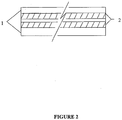
- Figure 2 illustrates such a multi-ply planar laminate.
- the laminate product has wide reaching applications as a result of the lightweight, extreme strength and formability of the laminate panel.
- the panel can be formed or worked to construct boat hulls, vehicle construction including monocoque assembly and outside panels, furniture, household appliances and a wide variety of manufactured goods. It should therefore be regarded as a construction and manufacturing material.
- the simplest embodiment of the laminate material is a single layer of thermoset polyester resin sandwiched between two layers of thermoplastic acrylic, or P.E.T.G. (as illustrated in Figure 1 ).
- One preferred method of preparing the planar laminate sheet is a continuously manufactured process by which the two sheets are brought together and injected with the unsaturated polyester resin at the correct temperature and humidity required for the resin curing process. The resin is bonded with the outer sheets.
- One alternative method of preparation is a batch process involving assembling the two outer sheets in a parallel arrangement in a jig or equivalent, and pouring or injecting the resin between the sheets.
- Another alternative is to manufacture the resin to the required thickness in sheet form, or in continuous form.
- the continuous resin can be then rolled and stored onto a drum ready for introduction to manufacturing process.
- the two outer thermoplastic sheets can be heated and pressed either side of the solidified resin (which may have been heated) to create a solid ply. The bonding between the resin and sheets must be controlled accordingly.
- the invention relates to a method of forming or shaping the laminate and the ability of the laminate to be formed. Once prepared the laminate is then heated to a temperature, at which the laminate can be formed or shaped, and then forming or shaping the laminate to a desired curvature and configuration.
- This invention includes the forming of a laminate in both single and complex curvatures.
- Figures 3a, b and c illustrate examples of possible bending arrangements.
- the outer sheets of the laminate can be of acrylic or P.E.T.G. sheeting.
- acrylic we mean a material composed of various clear, thermoplastic resins obtained from acrylic acid and its derivatives, and from raw natural sources such as petroleum and natural gas. moulded, and thermoformed.
- P.E.T.G. we mean glycol-modified terephthalate glycol.
- thermoset resin contains styrene.
- Sheets that have insufficient styrene resistance i.e. are likely to dissolve in or disintegrate upon contact with, styrene
- Standard acrylic plastic sheet is a more cost effective material with good optical properties, and less resistant to scratching in comparison to P.E.T.G. Further, the less cross linked the acrylic structure, the more suitable for the laminate as the free methyl methacrylate sites can cross link with the resin as discussed below.
- the laminate contains two (or more) layers of acrylic; or two (or more) layers of P.E.T.G.
- thermoset resins which are capable of bonding two thermoplastic sheets together.
- the resin suitable for the laminate must have the following characteristics -
- the styrene cross-links the polymer chains in a polymerisation process, to form a complex three-dimensional network. This is the curing process.
- An alternative monomer to styrene is methyl methacrylate. This is also within the scope of the invention.
- NC007 resin is a flexible, low viscosity, clear unsaturated polyester resin in styrene monomer. It is preferably prepromoted (i.e. pre-mixed together and batched prior to the introduction of the catalyst). We recommend that it should be gelled and cured with between 0.75 and 2% of a medium reactivity MEKP catalyst.
- MEKP Metal Ethyl Ketone Peroxide, a free radical initiator
- MEKP Metal Ethyl Ketone Peroxide, a free radical initiator
- NC007 typical liquid properties Viscosity @ 25°C 1.5 ps Gel time @ 25°C 1% MEKP 45 minutes Volatile content 36% Appearance Clear pale pink NC007 typical physical properties: % elongation at break 170% Tensile strength 3.2mPa
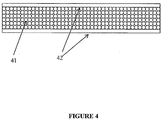
- the resin has an elongation percentage capacity of above 150%. This particular resin has an elongation at break of around 170%. It must be worked at between 105°C and 120°C. At these temperatures we observe increased malleability allowing the molecules to stretch, settle, and when cooled hold their elongation and adhesion to the sheet surface. This can be shown in Figures 4 and 5 .
- Figure 4 shows the laminate structure prior to forming including resin 41 and thermoplastic layers 42.
- thermoforming process which involves the heating of the finished product, bending or forming into any shape, and when cooled retains its form without delamination and loss of tensile strength is a surprising outcome.
- the controlled environment and the factors necessary to ensure that the forming process is successful allow the laminate product to change in molecular structure at exactly the right time and effect to produce a successful and different structural outcome.
- a catalyst is required to cure the resin. It acts as an initiator for curing the resin.
- the general catalyst type suitable for the laminate product is a free radical inhibitor, preferably a MEKP (methylethyl ketone peroxide catalyst).
- MEKP methylethyl ketone peroxide catalyst
- One catalyst we have used successfully is our F00826 coded Catalyst (MEKP 40%) QC. It is a MEKP catalyst, with the following components: Dimethyl phthalate/dipropylene glycol phlegmatiser 30-70% Methyl ethyl ketone peroxide 30% Methyl ethyl ketone 0-10% 2,4-pentanedione peroxide 0-10%
- SADT self-accelerating decomposition temperature
- Gel time refers to the point at which the catalyst and resin have crossed from an unstable liquid state to a state of at least semi hardness, or state of stability. If the early part of the curing or bonding (to the outer sheets) is disturbed then this could result in ultimate delamination. However, there is a time during the gel stage, before full cure, when the sheet may be manoeuvred, cut, and stored for a full cure time. It is important not to lift, bend or stress the sheet but rather to slide and manoeuvre the sheet along an aerated flat bed surface or flat belt feed table/conveyer.
- the set time - refers to the point in time in which catalyst and resin complete cure and full adhesion to the sheet surfaces has occurred.
- the time of complete cure and set will depend on the manufacturing process being used. By maximising the amount of catalyst and or accelerators and heating the NC007 system will dramatically accelerate the cure time. However whatever process is used a recommended period of 12 hours in storage prior to use.
- a batch process (e.g. using a jig to hold sheets in place), a continuous process whereby the resin is poured or inserted between the sheets in a manufacturing line or alternatively using three solid sheets (two thermoplastic with the resin) and placing in contact with heating.
- the batch process is illustrated in the Examples.
- an amount of resin is mixed with the corresponding amount of catalyst using a mechanically assisted paddle. It is stirred for 2minutes, allowed to stand for 2 minutes, or vibrated to allow excess air bubble removal.
- the formula is then poured directly into the cavity sample held within the cradle, a fine brass meshed funnel is used to further assist mixing and aiding in further removal of trapped air bubbles.
- FIG 12 One form of continuous process could be as illustrated in Figure 12 .
- the variants of this include using simply pre-mixed (still runny) resin; semi-set (jelly-like) resin and fully set resin which is then heated to soften and applied.
- the Figure illustrates a semi-set resin 121 and rolls of outer skin 122.
- the laminate proceeds through press rollers 123 to a mobile caterpillar pressure plate 124.
- An outer edge dam rubber or caterpillar rotating outer edge seal is optional (to prevent overflow of liquefied resin during manufacture).
- thermoplastic sheeting is supplied from the manufacturer with a protective plastic or paper. This can be on one or both side(s). It should be removed prior to laminate preparation.
- the bond between the resin is an important feature of the laminate product.
- the resin includes 30-45% styrene content.
- This styrene plays an important role in the preferred bond formation. Without being bound by the following theory we believe the presence of the styrene can soften the surfaces of the outer thermoplastic layers and allow some penetration of the resin. Further we believe it is able to cross link with the outer thermoplastic layers to create the bonding. For example with acrylic outer sheets, the styrene monomer of the resin is able to cross link with any residual methyl methacrylate sites of the acrylic.
- thermoforming or shaping process of the invention involves forming the flat laminate sheets into the desired shape by concentrating the required heat, in and onto a particular area rather than the system of having the whole sheet oven heated.
- a particular area of the sheet may be bent/shaped at a temperature which the acrylic, or P.E.T.G softens and the unsaturated polyester resin changes consistency such as will allow the panel or sheet to be formed into the desired shape.
- strip forming occurs via strip forming. This involves heating a sheet from one side, relying on one radiated heat source to pass through the entire sheet prior to bending.
- the temperature and time need to penetrate our ply sheet samples is critical as an undesired annealing process can take place if the temperature is too high for too long.
- the time and temperature required to penetrate our ply sheet with a single heat strip forming bar/heating from one side may result in an annealing effect of the heat exposed side of the sheet resulting in crazing, shattering or snapping the outer sheet to splitting the core ply and delamination during the forming process.
- For a particular laminate structure there will be a desired temperature and time period to bring about correct malleability and prevent an annealing of the sheet surface and delamination a and fault. It is therefore important to not exceed the correct forming temperature and time period.
- An optional mar coating can be used to enhance resistance to abrasive or chemical attack. While two-side coated laminate (i.e. on the outer sides of the laminate) provides maximum protection, one-sided coated laminate offers economical advantages for application where only one side of the sheet is exposed.
- thermoset resin we can include UV inhibitors within the thermoset resin in order to enhance the UV resistance of the laminate.
- the UV resistance enhances the properties of the laminate as a building material (by protecting what is inside the building) but also increases the longevity of the laminate itself.
- thermoplastic sheeting Both opaque and translucent laminates can be prepared by appropriate selection of the sheets.
- transparent thermoplastic sheeting can be used and we can tint or colour the thermo set resin as would be known by one skilled in the art.
- Colouring of the resin mix can be carried out with pigments. The choice of a suitable pigment material, even though only added at about 3% resin weight, must be carefully considered as it is easy to affect the curing reaction and degrade the final laminate by use of unsuitable pigments.
- fire retardant materials can be added to the thermoset resin 60, which is sandwiched between the outer thermoplastic sheets 42. It is likely a drop in transparency will be the result of this however.
- Fillers are often added in quantities up to 50% of the resin weight although such addition levels will affect the flexural and tensile strength of the laminate.
- the use of fillers can be beneficial in the laminating or casting of thick components where otherwise considerable exothermic heating can occur. Addition of certain fillers can also contribute to increasing the fire-resistance of the laminate.
- Example 1 one preferred formulation of laminate
- the sample pour can remain in upright in the jig during the cure process in a hot box.
- the entry hole used for the filling
- Post curing can be a matter of preparing the catalyst within the resin some time prior to the pour so as the gel time can be due at introduction to the cavity rather than the gel time being to long within the sheet on the table therefore slowing down production.
- the sheet should be at gel stage after five or so meters ready for cutting to length and storage. More catalyst and the heating of the sheet and resin during pour would speed up the cure time dramatically also.
- the acrylic, or P.E.T.G. sheeting provided as a sheet or roll without the protective coating, or used on one side only.
- the protective coating would be left on the outside of the laminate sheets (i.e. not on the side of the sheets in contact with the resin).
- NC007 resin is a dissolved styrene unsaturated Polyester Resin.
- Figure 9a illustrates the end view of the pour apparatus.
- the outer edge seal/dam rubber is made up of a closed cell pvc foam sealing tape 25 mm in width with a single adhesive side 91.
- 300mm x 300mm sample sheet (of acrylic or PETG) 92 is prepared and cleaned the tape is laid out and cut to length, protective tape removed from one side exposing the adhesive.
- the tape 91 is then placed adhesive side down around outer inside edge of the sheet 92. Joins in the tape 93 at the corners need to be sealed with Soudal High Tak sealant or equivalent polyester compatible sealant. Then Soudal High Tak sealant was applied to the exposed top surface of the pvc sealant tape giving adhesive seal for the top sheet.
- a gap 94 at the two top corners is essential for the filling of resin and escape of air.
- the dam rubber must be compatible with the resin formula, if not the resin will seep into the dam seal drawing resin away from the sheet along the outer edges, causing delamination as illustrated in Figure 10.
- Figure 10 shows delamination and air gap 98 due to resin soaking into the rubber dam seal 99.
- a jig apparatus 80 was prepared for use with all samples. This enabled the sheets 81 to be held parallel whilst the resin was poured from above.
- the jig was engineered from 15mm thick Acrylic sheet 81 and braced horizontally with 10mm ribbing 82 and held in place using nuts 83. It was important not to over-tighten the outer edge of the jig as a concave appearance will show on the final product resulting in visual distortion to the sample.
- styrene resistance of the outer thermoplastic sheeting is an important feature of the invention.
- Our preferred invention uses sheeting which has an inherent styrene resistance. However it is also possible to anneal the sheeting prior to incorporation into the laminate in order to impart styrene resistance.
- Table A relates to annealing Sample plates of Acrylic and PETG sheet sourced from various plastic sheet manufacturers, Samples sheet size, 3mm Thick x 150 long x 75mm wide, these where then cleaned with isopropyl-alcohol, placed into a cool oven on a flat non stick surface. Some samples were placed between sheets to prevent blistering or distortion. They were heated to the stated conditions and allowed to cool down over a period of 1 hour.
- One preferred laminate consisted of two opposite outer layers of 2mm acrylic sheet with an inner cavity barrier layer of 2mm resin formula, forming an overall 6mm sandwich or ply material for testing.
- the acrylic sheet used was Shinkolite (Mitsubishi Rayon Japan) though other suppliers can also provide suitable acrylics.
- the inner cavity material consisted of unsaturated polyester resin formula with 0.75 w/w (weight for weight) catalyst, e.g. 7.5 grams per litre of resin formula forming the said sandwich/ply sample, with an overall thickness of 6mm.
- Apparatus Flat bed fan oven with an internal flat floor layer of Teflon mesh to prevent possible adhesion of test product to oven interior, having also a sealed glass inspection door for viewing.
- Method Place sample face down onto the Teflon oven base, the preheated oven temperature being 110 °C, for a period of 10 - 12 minutes.
- sample sheet is then corner test lifted by a cotton-gloved hand.
- edge is at a stage of malleability the ply sheet is then removed by sliding a flat spatula underneath to prevent pre- distortion and unnecessary exaggerated movement.
- Forming method Various Formed structures of ply MDF sheet curvature were prepared prior to sheet extraction from oven to a bench top so there is limited chance of movement as the sheet is clamped and manipulated over the chosen shape. To maximize the stress and to identify failure point of the experiment, a 45° angle with various degrees of sharpness at curvature was used.
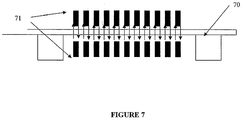
- the hot sheet was then directly placed over the mould and manipulated by hand to form and take the general shape of the mould, then at the latter stage clamped, secured and set in place to re cure. This is illustrated in Figure 7 .
- the heat source 71 is a double sided heat source applied to the laminate 70. Single sided heating is not ideal for our laminates.
Landscapes
- Engineering & Computer Science (AREA)
- Mechanical Engineering (AREA)
- Laminated Bodies (AREA)
- Blow-Moulding Or Thermoforming Of Plastics Or The Like (AREA)
- Lining Or Joining Of Plastics Or The Like (AREA)
Claims (13)
- Procédé de courbage d'un stratifié plan pour former un produit stratifié ayant au moins une zone courbée, comprenant les étapes consistant à :fournir un stratifié plan ;chauffer le stratifié à une température de mise en forme ;former le stratifié jusqu'à la courbure voulue ; etrefroidir le stratifié ;caractérisé en ce qui :le stratifié plan comprend deux ou plus de deux feuilles d'un acrylique ou d'un thermoplastique PETG, ou feuilles incluant un acrylique ou un thermoplastique PETG, espacées par un système polyester thermodurcissable interposé, mais attachées à celui-ci ;le système de polyester thermodurcissable interposé a un allongement à la rupture supérieur à 150 % et une température de transition vitreuse inférieure à la température ambiante ;l'étape de chauffage implique une concentration de chaleur dans et sur une zone particulière du stratifié plan à partir des deux côtés du stratifié, sans chauffer le stratifié plan entier, sans produire une quelconque dégradation important de la stratification ou de ses couches constituantes ; etl'étape de mise en forme implique la mise en forme de ladite zone jusqu'à la courbure voulue.
- Procédé selon la revendication 1, dans lequel ledit allongement à la rupture est supérieur à 170 %.
- Procédé selon la revendication 1, dans lequel ledit chauffage était dans la plage de 105 °C à 120 °C.
- Procédé selon la revendication 1 ou 2, dans lequel une ou les deux feuilles sont constituées d'un plastique acrylique ou au moins principalement d'un acrylique plastique.
- Procédé selon l'une quelconque des revendications 1 à 3, dans lequel ledit système de polyester a été préparé au moins en partie à partir (A) d'acide(s) carboxylique(s) ou d'acide(s) dicarboxylique(s) avec (B) un composant ou des composants fournissant (a) du ou des hydroxyles et/ou dihydroxyles.
- Procédé selon la revendication 5, dans lequel ledit système de polyester thermodurcissable implique un monomère co-réactif.
- Procédé selon la revendication 6, dans lequel le monomère co-réactif est un styrène ou un analogue de styrène qui est présent dans le système de polyester thermodurcissable selon une quantité de 30 à 55 % p/p.
- Procédé selon l'une quelconque des revendications précédentes, dans lequel le système de polyester thermodurcissable est une résine de polyester contenant une insaturation éthylénique présente dans la plage de 45 à 70 % p/p.
- Procédé selon l'une quelconque des revendications précédentes, dans lequel la stratification du stratifié implique la pose entre des feuilles plates, ou la pose sur une feuille plate et la mise en place ultérieure de la seconde feuille plate, d'un système de polyester liquide et de le laisser thermodurcir.
- Procédé selon la revendication 9, dans lequel le système de résine polyester thermodurcissable est un mélange de :45 à 70 % p/p d'une résine de polyester insaturée contenant une insaturation éthylénique,30 à 55 % p/p de styrène,moins de 2 % p/p de MEKP, etmoins de 2 % p/p d'un promoteur de sel métallique.
- Procédé selon l'une quelconque des revendications précédentes, dans lequel la surface du plastique acrylique d'un quelconque plastique acrylique qui sert d'interface avec le système de polyester est une face propre, c'est-à-dire ; exempte d'agents de séparation et/ou matériaux migrants provenant d'une quelconque feuille de couverture retirée.
- Procédé selon l'une quelconque des revendications précédentes dans lequel la couche de système de polyester thermodurcissable a une épaisseur d'au moins 0,5 mm et constitue 5 % à 40 % de l'épaisseur totale du stratifié.
- Procédé selon l'une quelconque des revendications précédentes, dans lequel le stratifié plan est un stratifié plan transparent comprenant deux ou plus de deux feuilles d'un thermoplastique transparent (identique ou différent), espacées par un système de polyester thermodurcissable transparent interposé, mais attachées à celui-ci ; dans lequel les couches thermoplastiques transparentes sont attachées au système de polyester par à la fois- une réticulation avec une quelconque insaturation libre dans le matériau acrylique,- solvatation de monomères libres du matériau acrylique,et dans lequel chaque couche thermoplastique transparente est un acrylique ou PETG.
Applications Claiming Priority (3)
| Application Number | Priority Date | Filing Date | Title |
|---|---|---|---|
| NZ54745206A NZ547452A (en) | 2006-05-23 | 2006-05-23 | Self supporting curved laminate made from acrylic thermoplastic and thermoset polyester |
| NZ55196306 | 2006-12-08 | ||
| PCT/NZ2007/000123 WO2007136282A2 (fr) | 2006-05-23 | 2007-05-22 | Matériau stratifié |
Publications (3)
| Publication Number | Publication Date |
|---|---|
| EP2026955A2 EP2026955A2 (fr) | 2009-02-25 |
| EP2026955A4 EP2026955A4 (fr) | 2012-06-13 |
| EP2026955B1 true EP2026955B1 (fr) | 2018-02-07 |
Family
ID=38723715
Family Applications (1)
| Application Number | Title | Priority Date | Filing Date |
|---|---|---|---|
| EP07793949.4A Not-in-force EP2026955B1 (fr) | 2006-05-23 | 2007-05-22 | Matériau stratifié |
Country Status (7)
| Country | Link |
|---|---|
| US (2) | US20100297403A1 (fr) |
| EP (1) | EP2026955B1 (fr) |
| JP (1) | JP4918645B2 (fr) |
| CN (1) | CN103552289B (fr) |
| AU (1) | AU2007252345B2 (fr) |
| CA (1) | CA2687792C (fr) |
| WO (1) | WO2007136282A2 (fr) |
Families Citing this family (9)
| Publication number | Priority date | Publication date | Assignee | Title |
|---|---|---|---|---|
| FR2939716B1 (fr) * | 2008-12-11 | 2012-11-16 | Essilor Int | Procede d'obtention d'une structure multicouche courbe. |
| US20140199525A1 (en) * | 2009-05-13 | 2014-07-17 | 3Form, Inc. | Structured-core laminate panels and methods of forming the same |
| EP2430251A4 (fr) | 2009-05-13 | 2016-01-27 | Hunter Douglas Ind Switzerland | Panneaux stratifiés à âme structurée et leurs procédés de façonnage |
| US9590463B2 (en) | 2011-09-22 | 2017-03-07 | Minebea Co., Ltd. | Vibration generator moving vibrator by magnetic field generated by coil and holder used in vibration-generator |
| FR3026982B1 (fr) * | 2014-10-14 | 2020-02-28 | Airbus Group Sas | Materiau composite multicouche thermoplastiques /thermodurcissables |
| BE1027265B1 (nl) * | 2018-06-05 | 2020-12-07 | Anheuser Busch Inbev Sa | Samengestelde transportcontainer voor dranken |
| WO2020140233A1 (fr) * | 2019-01-03 | 2020-07-09 | 京东方科技集团股份有限公司 | Film stratifié transparent, dispositif d'affichage et procédé de fabrication de film stratifié transparent |
| WO2021070632A1 (fr) | 2019-10-09 | 2021-04-15 | 帝人株式会社 | Procédé de production d'élément incurvé et corps stratifié de résine de polycarbonate à revêtement dur pour flexion thermique |
| IT202200011891A1 (it) * | 2022-06-06 | 2023-12-06 | Sicis Int Srl | Lastra multistrato laminata |
Citations (1)
| Publication number | Priority date | Publication date | Assignee | Title |
|---|---|---|---|---|
| WO2006092288A1 (fr) * | 2005-03-01 | 2006-09-08 | Cfs Germany Gmbh | Dispositif pour produire des barquettes d'emballage par emboutissage profond, comprenant une partie de formage inferieure refroidie |
Family Cites Families (28)
| Publication number | Priority date | Publication date | Assignee | Title |
|---|---|---|---|---|
| US2917783A (en) | 1954-10-21 | 1959-12-22 | Fed Tool Corp | Method for forming thermoplastic materials |
| GB1140743A (en) | 1966-03-19 | 1969-01-22 | Mealia Res And Dev Inc O | Improvements relating to the manufacture of windows |
| US3810815A (en) * | 1969-07-10 | 1974-05-14 | Mc Donnell Douglas Corp | Transparent laminate |
| US3707434A (en) * | 1970-11-30 | 1972-12-26 | Federal Huber Co | Rigidified resinous laminate |
| US3700546A (en) * | 1971-02-17 | 1972-10-24 | American Cyanamid Co | High impact weatherable rigidified structures |
| US3993828A (en) | 1973-02-16 | 1976-11-23 | Akzona Incorporated | Polyester, fiberglass-reinforced composite laminate |
| FR2325505A1 (fr) * | 1975-09-24 | 1977-04-22 | Altulor | Produit complexe stratifie de polyacrylate et polyester, son procede de fabrication et ses applications |
| DE2606569A1 (de) * | 1976-02-19 | 1977-08-25 | Degussa | Verfahren zur herstellung von beschussfesten verbund(glas)scheiben |
| FR2547768B1 (fr) | 1983-06-24 | 1986-01-10 | Ugine Kuhlmann | Materiau composite polymere thermoplastique allege polymere thermodurcissable et ses procedes de fabrication |
| FR2568568A1 (fr) * | 1984-08-01 | 1986-02-07 | Corning Glass Works | Perfectionnement a la fabrication de verres stratifies transparents polarisants et verres ainsi obtenus |
| US4936936A (en) * | 1988-08-30 | 1990-06-26 | E. I. Du Pont De Nemours And Company | Method of making thermoplastic acrylic polymer coated composite structure |
| US5055346A (en) * | 1988-08-30 | 1991-10-08 | Frank Rohrbacher | Thermoplastic acrylic polymer coated composite structure |
| FR2679044B1 (fr) | 1991-07-12 | 1994-06-10 | Corning Inc | Lentille ophtalmique composite. |
| JPH06149167A (ja) | 1992-11-09 | 1994-05-27 | Morinaga Kenchiku Sekkei Jimusho:Kk | 水壁ユニット |
| JPH06200643A (ja) | 1992-11-09 | 1994-07-19 | Morinaga Kenchiku Sekkei Jimusho:Kk | 水の壁構造体 |
| EP0622386B1 (fr) | 1993-04-26 | 1998-01-28 | Gencorp Inc. | Revêtements conductrices dans une moule |
| JP3011642B2 (ja) * | 1995-08-31 | 2000-02-21 | 信越ポリマー株式会社 | 熱硬化性樹脂組成物、それを用いてなる複合成形体及び押釦スイッチ用カバー部材 |
| FR2766198B1 (fr) * | 1997-07-15 | 2003-11-14 | Saint Gobain Vitrage | Vitrage plastique, notamment pour l'automobile et procede pour sa fabrication |
| FR2779990B1 (fr) * | 1998-06-19 | 2000-07-21 | Saint Gobain Vitrage | Vitrage en matiere plastique avec ajout de matiere plastique surmoule |
| US6475608B2 (en) * | 1998-11-16 | 2002-11-05 | Engelhard Corporation | Multi-layer iridescent films |
| US6558784B1 (en) * | 1999-03-02 | 2003-05-06 | Adc Composites, Llc | Composite footwear upper and method of manufacturing a composite footwear upper |
| US6291370B1 (en) | 1999-09-01 | 2001-09-18 | Harodite Industries, Inc. | Chopped fiberglass laminate for automotive headliners and method of fabrication |
| AU2002248272A1 (en) * | 2000-12-29 | 2002-07-30 | E.I. Du Pont De Nemours And Company | Alpha-methylene lactone homopolymer and copolymer compositions, sheets and articles made therefrom and the process for their manufacture |
| US6828011B2 (en) * | 2001-07-24 | 2004-12-07 | Cooper Technology Services, Llc | Moisture crosslinkable thermoplastics in the manufacture of vehicle weather strips |
| DE10136125A1 (de) * | 2001-07-26 | 2003-02-13 | Basell Polyolefine Gmbh | Schichtverbundmaterial sowie Verfahren zur Herstellung des Schichtverbundmaterials |
| US6476111B1 (en) | 2001-08-01 | 2002-11-05 | E. I Du Pont De Nemours And Company | Extrudable highly filled thermoplastic sheet composition |
| BR0201285C1 (pt) * | 2002-04-12 | 2004-10-19 | Luciano Alfredo Fusco | Painel decorado e respectivo processo de fabricação |
| US20060272766A1 (en) | 2005-06-03 | 2006-12-07 | Hebrink Timothy J | Optical bodies and method of making optical bodies including acrylate blend layers |
-
2007
- 2007-05-22 EP EP07793949.4A patent/EP2026955B1/fr not_active Not-in-force
- 2007-05-22 JP JP2009511975A patent/JP4918645B2/ja not_active Expired - Fee Related
- 2007-05-22 WO PCT/NZ2007/000123 patent/WO2007136282A2/fr not_active Ceased
- 2007-05-22 AU AU2007252345A patent/AU2007252345B2/en not_active Ceased
- 2007-05-22 CA CA 2687792 patent/CA2687792C/fr active Active
- 2007-05-22 CN CN201310298404.9A patent/CN103552289B/zh active Active
-
2010
- 2010-05-13 US US12/779,840 patent/US20100297403A1/en not_active Abandoned
-
2012
- 2012-12-19 US US13/720,722 patent/US9168693B2/en active Active
Patent Citations (1)
| Publication number | Priority date | Publication date | Assignee | Title |
|---|---|---|---|---|
| WO2006092288A1 (fr) * | 2005-03-01 | 2006-09-08 | Cfs Germany Gmbh | Dispositif pour produire des barquettes d'emballage par emboutissage profond, comprenant une partie de formage inferieure refroidie |
Also Published As
| Publication number | Publication date |
|---|---|
| JP4918645B2 (ja) | 2012-04-18 |
| CA2687792C (fr) | 2015-03-24 |
| WO2007136282A3 (fr) | 2008-01-24 |
| EP2026955A4 (fr) | 2012-06-13 |
| CN103552289B (zh) | 2016-01-20 |
| US20130105070A1 (en) | 2013-05-02 |
| US20100297403A1 (en) | 2010-11-25 |
| CA2687792A1 (fr) | 2008-11-29 |
| AU2007252345A1 (en) | 2007-11-29 |
| JP2009538242A (ja) | 2009-11-05 |
| US9168693B2 (en) | 2015-10-27 |
| CN103552289A (zh) | 2014-02-05 |
| WO2007136282A2 (fr) | 2007-11-29 |
| EP2026955A2 (fr) | 2009-02-25 |
| AU2007252345B2 (en) | 2012-06-14 |
Similar Documents
| Publication | Publication Date | Title |
|---|---|---|
| US9168693B2 (en) | Laminate material | |
| US9718996B2 (en) | Composition and method for temporarily fixing member using same | |
| JP5424644B2 (ja) | プリプレグおよびそれから調製された現場硬化された堅固な表面 | |
| TW201235188A (en) | Multilayered hardcoat film for injection molding, process for producing same, and process for producing injection-molded object using the multilayered hardcoat film | |
| TWI798747B (zh) | 塗佈膜 | |
| JP2010253740A (ja) | 真空成型用シート | |
| NZ547452A (en) | Self supporting curved laminate made from acrylic thermoplastic and thermoset polyester | |
| HK1127914A (en) | Laminate material | |
| HK1127914B (en) | Laminate material | |
| JP5651337B2 (ja) | 人造大理石成形品及び人造大理石成形品の製造方法 | |
| JP2001287313A (ja) | 複合材およびその製造方法 | |
| TW202402525A (zh) | 片材、物品、化妝片材、化妝材料及硬化性組合物 | |
| KR20160104633A (ko) | 라디칼 경화성 조성물, 플라스틱 시트, 플라스틱 시트 롤 및 성형물 | |
| JP6175338B2 (ja) | 光学積層体シートの製造方法 | |
| TW202233392A (zh) | 樹脂薄片之彎曲成形品之製造方法及彎曲成形品 | |
| JPH04166311A (ja) | 成形品の製造方法 | |
| JP2004338214A (ja) | 樹脂成形体の製造方法 | |
| KR20200046234A (ko) | 하드코팅층 형성용 조성물 및 이를 이용한 입체 형상 기재 | |
| JPS6134390B2 (fr) | ||
| JP2002070434A (ja) | 収納扉 | |
| KR101314832B1 (ko) | Eva 패턴층을 포함하는 하이그로시 데코시트 및 그 제조방법 | |
| WO2025182494A1 (fr) | Stratifié pour thermoformage et article comprenant ledit stratifié | |
| JPH0542930B2 (fr) | ||
| KR101573352B1 (ko) | 가구표면 마감재용 문양보호패널 및 그 제조방법 | |
| JPH09110952A (ja) | アクリルシートとの接着性に優れた熱硬化性樹脂組成物、複合材料および積層品 |
Legal Events
| Date | Code | Title | Description |
|---|---|---|---|
| PUAI | Public reference made under article 153(3) epc to a published international application that has entered the european phase |
Free format text: ORIGINAL CODE: 0009012 |
|
| 17P | Request for examination filed |
Effective date: 20081222 |
|
| AK | Designated contracting states |
Kind code of ref document: A2 Designated state(s): AT BE BG CH CY CZ DE DK EE ES FI FR GB GR HU IE IS IT LI LT LU LV MC MT NL PL PT RO SE SI SK TR |
|
| AX | Request for extension of the european patent |
Extension state: AL BA HR MK RS |
|
| DAX | Request for extension of the european patent (deleted) | ||
| REG | Reference to a national code |
Ref country code: HK Ref legal event code: DE Ref document number: 1127914 Country of ref document: HK |
|
| A4 | Supplementary search report drawn up and despatched |
Effective date: 20120511 |
|
| RIC1 | Information provided on ipc code assigned before grant |
Ipc: B29C 53/04 20060101ALI20120508BHEP Ipc: B32B 27/08 20060101ALI20120508BHEP Ipc: B32B 27/30 20060101ALI20120508BHEP Ipc: B29D 7/01 20060101ALI20120508BHEP Ipc: B29C 51/02 20060101ALI20120508BHEP Ipc: B32B 1/00 20060101AFI20120508BHEP Ipc: B32B 3/00 20060101ALI20120508BHEP Ipc: B29C 51/00 20060101ALI20120508BHEP Ipc: B32B 27/36 20060101ALI20120508BHEP |
|
| 17Q | First examination report despatched |
Effective date: 20160525 |
|
| GRAP | Despatch of communication of intention to grant a patent |
Free format text: ORIGINAL CODE: EPIDOSNIGR1 |
|
| INTG | Intention to grant announced |
Effective date: 20170331 |
|
| GRAJ | Information related to disapproval of communication of intention to grant by the applicant or resumption of examination proceedings by the epo deleted |
Free format text: ORIGINAL CODE: EPIDOSDIGR1 |
|
| GRAP | Despatch of communication of intention to grant a patent |
Free format text: ORIGINAL CODE: EPIDOSNIGR1 |
|
| INTC | Intention to grant announced (deleted) | ||
| INTG | Intention to grant announced |
Effective date: 20170911 |
|
| GRAS | Grant fee paid |
Free format text: ORIGINAL CODE: EPIDOSNIGR3 |
|
| GRAA | (expected) grant |
Free format text: ORIGINAL CODE: 0009210 |
|
| AK | Designated contracting states |
Kind code of ref document: B1 Designated state(s): AT BE BG CH CY CZ DE DK EE ES FI FR GB GR HU IE IS IT LI LT LU LV MC MT NL PL PT RO SE SI SK TR |
|
| REG | Reference to a national code |
Ref country code: GB Ref legal event code: FG4D |
|
| REG | Reference to a national code |
Ref country code: AT Ref legal event code: REF Ref document number: 968607 Country of ref document: AT Kind code of ref document: T Effective date: 20180215 Ref country code: CH Ref legal event code: EP |
|
| REG | Reference to a national code |
Ref country code: IE Ref legal event code: FG4D |
|
| REG | Reference to a national code |
Ref country code: DE Ref legal event code: R096 Ref document number: 602007053883 Country of ref document: DE |
|
| REG | Reference to a national code |
Ref country code: NL Ref legal event code: FP |
|
| REG | Reference to a national code |
Ref country code: AT Ref legal event code: MK05 Ref document number: 968607 Country of ref document: AT Kind code of ref document: T Effective date: 20180207 |
|
| PG25 | Lapsed in a contracting state [announced via postgrant information from national office to epo] |
Ref country code: ES Free format text: LAPSE BECAUSE OF FAILURE TO SUBMIT A TRANSLATION OF THE DESCRIPTION OR TO PAY THE FEE WITHIN THE PRESCRIBED TIME-LIMIT Effective date: 20180207 Ref country code: CY Free format text: LAPSE BECAUSE OF FAILURE TO SUBMIT A TRANSLATION OF THE DESCRIPTION OR TO PAY THE FEE WITHIN THE PRESCRIBED TIME-LIMIT Effective date: 20180207 Ref country code: LT Free format text: LAPSE BECAUSE OF FAILURE TO SUBMIT A TRANSLATION OF THE DESCRIPTION OR TO PAY THE FEE WITHIN THE PRESCRIBED TIME-LIMIT Effective date: 20180207 Ref country code: FI Free format text: LAPSE BECAUSE OF FAILURE TO SUBMIT A TRANSLATION OF THE DESCRIPTION OR TO PAY THE FEE WITHIN THE PRESCRIBED TIME-LIMIT Effective date: 20180207 |
|
| PG25 | Lapsed in a contracting state [announced via postgrant information from national office to epo] |
Ref country code: AT Free format text: LAPSE BECAUSE OF FAILURE TO SUBMIT A TRANSLATION OF THE DESCRIPTION OR TO PAY THE FEE WITHIN THE PRESCRIBED TIME-LIMIT Effective date: 20180207 Ref country code: GR Free format text: LAPSE BECAUSE OF FAILURE TO SUBMIT A TRANSLATION OF THE DESCRIPTION OR TO PAY THE FEE WITHIN THE PRESCRIBED TIME-LIMIT Effective date: 20180508 Ref country code: PL Free format text: LAPSE BECAUSE OF FAILURE TO SUBMIT A TRANSLATION OF THE DESCRIPTION OR TO PAY THE FEE WITHIN THE PRESCRIBED TIME-LIMIT Effective date: 20180207 Ref country code: BG Free format text: LAPSE BECAUSE OF FAILURE TO SUBMIT A TRANSLATION OF THE DESCRIPTION OR TO PAY THE FEE WITHIN THE PRESCRIBED TIME-LIMIT Effective date: 20180507 Ref country code: LV Free format text: LAPSE BECAUSE OF FAILURE TO SUBMIT A TRANSLATION OF THE DESCRIPTION OR TO PAY THE FEE WITHIN THE PRESCRIBED TIME-LIMIT Effective date: 20180207 Ref country code: SE Free format text: LAPSE BECAUSE OF FAILURE TO SUBMIT A TRANSLATION OF THE DESCRIPTION OR TO PAY THE FEE WITHIN THE PRESCRIBED TIME-LIMIT Effective date: 20180207 Ref country code: IS Free format text: LAPSE BECAUSE OF FAILURE TO SUBMIT A TRANSLATION OF THE DESCRIPTION OR TO PAY THE FEE WITHIN THE PRESCRIBED TIME-LIMIT Effective date: 20180607 |
|
| REG | Reference to a national code |
Ref country code: HK Ref legal event code: GR Ref document number: 1127914 Country of ref document: HK |
|
| PG25 | Lapsed in a contracting state [announced via postgrant information from national office to epo] |
Ref country code: RO Free format text: LAPSE BECAUSE OF FAILURE TO SUBMIT A TRANSLATION OF THE DESCRIPTION OR TO PAY THE FEE WITHIN THE PRESCRIBED TIME-LIMIT Effective date: 20180207 Ref country code: EE Free format text: LAPSE BECAUSE OF FAILURE TO SUBMIT A TRANSLATION OF THE DESCRIPTION OR TO PAY THE FEE WITHIN THE PRESCRIBED TIME-LIMIT Effective date: 20180207 |
|
| REG | Reference to a national code |
Ref country code: DE Ref legal event code: R097 Ref document number: 602007053883 Country of ref document: DE |
|
| PG25 | Lapsed in a contracting state [announced via postgrant information from national office to epo] |
Ref country code: DK Free format text: LAPSE BECAUSE OF FAILURE TO SUBMIT A TRANSLATION OF THE DESCRIPTION OR TO PAY THE FEE WITHIN THE PRESCRIBED TIME-LIMIT Effective date: 20180207 Ref country code: CZ Free format text: LAPSE BECAUSE OF FAILURE TO SUBMIT A TRANSLATION OF THE DESCRIPTION OR TO PAY THE FEE WITHIN THE PRESCRIBED TIME-LIMIT Effective date: 20180207 Ref country code: SK Free format text: LAPSE BECAUSE OF FAILURE TO SUBMIT A TRANSLATION OF THE DESCRIPTION OR TO PAY THE FEE WITHIN THE PRESCRIBED TIME-LIMIT Effective date: 20180207 |
|
| PLBE | No opposition filed within time limit |
Free format text: ORIGINAL CODE: 0009261 |
|
| REG | Reference to a national code |
Ref country code: CH Ref legal event code: PL |
|
| STAA | Information on the status of an ep patent application or granted ep patent |
Free format text: STATUS: NO OPPOSITION FILED WITHIN TIME LIMIT |
|
| 26N | No opposition filed |
Effective date: 20181108 |
|
| PG25 | Lapsed in a contracting state [announced via postgrant information from national office to epo] |
Ref country code: MC Free format text: LAPSE BECAUSE OF FAILURE TO SUBMIT A TRANSLATION OF THE DESCRIPTION OR TO PAY THE FEE WITHIN THE PRESCRIBED TIME-LIMIT Effective date: 20180207 |
|
| PG25 | Lapsed in a contracting state [announced via postgrant information from national office to epo] |
Ref country code: CH Free format text: LAPSE BECAUSE OF NON-PAYMENT OF DUE FEES Effective date: 20180531 Ref country code: LI Free format text: LAPSE BECAUSE OF NON-PAYMENT OF DUE FEES Effective date: 20180531 Ref country code: SI Free format text: LAPSE BECAUSE OF FAILURE TO SUBMIT A TRANSLATION OF THE DESCRIPTION OR TO PAY THE FEE WITHIN THE PRESCRIBED TIME-LIMIT Effective date: 20180207 |
|
| PG25 | Lapsed in a contracting state [announced via postgrant information from national office to epo] |
Ref country code: LU Free format text: LAPSE BECAUSE OF NON-PAYMENT OF DUE FEES Effective date: 20180522 |
|
| PG25 | Lapsed in a contracting state [announced via postgrant information from national office to epo] |
Ref country code: FR Free format text: LAPSE BECAUSE OF NON-PAYMENT OF DUE FEES Effective date: 20180531 |
|
| PG25 | Lapsed in a contracting state [announced via postgrant information from national office to epo] |
Ref country code: MT Free format text: LAPSE BECAUSE OF NON-PAYMENT OF DUE FEES Effective date: 20180522 |
|
| PG25 | Lapsed in a contracting state [announced via postgrant information from national office to epo] |
Ref country code: TR Free format text: LAPSE BECAUSE OF FAILURE TO SUBMIT A TRANSLATION OF THE DESCRIPTION OR TO PAY THE FEE WITHIN THE PRESCRIBED TIME-LIMIT Effective date: 20180207 |
|
| PG25 | Lapsed in a contracting state [announced via postgrant information from national office to epo] |
Ref country code: PT Free format text: LAPSE BECAUSE OF FAILURE TO SUBMIT A TRANSLATION OF THE DESCRIPTION OR TO PAY THE FEE WITHIN THE PRESCRIBED TIME-LIMIT Effective date: 20180207 Ref country code: HU Free format text: LAPSE BECAUSE OF FAILURE TO SUBMIT A TRANSLATION OF THE DESCRIPTION OR TO PAY THE FEE WITHIN THE PRESCRIBED TIME-LIMIT; INVALID AB INITIO Effective date: 20070522 |
|
| PGFP | Annual fee paid to national office [announced via postgrant information from national office to epo] |
Ref country code: IE Payment date: 20240531 Year of fee payment: 18 |
|
| PGFP | Annual fee paid to national office [announced via postgrant information from national office to epo] |
Ref country code: GB Payment date: 20240530 Year of fee payment: 18 |
|
| PGFP | Annual fee paid to national office [announced via postgrant information from national office to epo] |
Ref country code: DE Payment date: 20240624 Year of fee payment: 18 |
|
| PGFP | Annual fee paid to national office [announced via postgrant information from national office to epo] |
Ref country code: NL Payment date: 20240531 Year of fee payment: 18 |
|
| PGFP | Annual fee paid to national office [announced via postgrant information from national office to epo] |
Ref country code: BE Payment date: 20240531 Year of fee payment: 18 |
|
| PGFP | Annual fee paid to national office [announced via postgrant information from national office to epo] |
Ref country code: IT Payment date: 20240531 Year of fee payment: 18 |
|
| REG | Reference to a national code |
Ref country code: DE Ref legal event code: R119 Ref document number: 602007053883 Country of ref document: DE |
|
| REG | Reference to a national code |
Ref country code: NL Ref legal event code: MM Effective date: 20250601 |
|
| GBPC | Gb: european patent ceased through non-payment of renewal fee |
Effective date: 20250522 |
|
| REG | Reference to a national code |
Ref country code: BE Ref legal event code: MM Effective date: 20250531 |
|
| PG25 | Lapsed in a contracting state [announced via postgrant information from national office to epo] |
Ref country code: NL Free format text: LAPSE BECAUSE OF NON-PAYMENT OF DUE FEES Effective date: 20250601 |
|
| PG25 | Lapsed in a contracting state [announced via postgrant information from national office to epo] |
Ref country code: GB Free format text: LAPSE BECAUSE OF NON-PAYMENT OF DUE FEES Effective date: 20250522 |
|
| PG25 | Lapsed in a contracting state [announced via postgrant information from national office to epo] |
Ref country code: DE Free format text: LAPSE BECAUSE OF NON-PAYMENT OF DUE FEES Effective date: 20251202 Ref country code: IE Free format text: LAPSE BECAUSE OF NON-PAYMENT OF DUE FEES Effective date: 20250522 |
|
| PG25 | Lapsed in a contracting state [announced via postgrant information from national office to epo] |
Ref country code: BE Free format text: LAPSE BECAUSE OF NON-PAYMENT OF DUE FEES Effective date: 20250531 Ref country code: IT Free format text: LAPSE BECAUSE OF NON-PAYMENT OF DUE FEES Effective date: 20250522 |