EP2027536B1 - Auf qualität basierende diensteauswahl in einem peer-to-peer-netzwerk - Google Patents
Auf qualität basierende diensteauswahl in einem peer-to-peer-netzwerk Download PDFInfo
- Publication number
- EP2027536B1 EP2027536B1 EP07733023A EP07733023A EP2027536B1 EP 2027536 B1 EP2027536 B1 EP 2027536B1 EP 07733023 A EP07733023 A EP 07733023A EP 07733023 A EP07733023 A EP 07733023A EP 2027536 B1 EP2027536 B1 EP 2027536B1
- Authority
- EP
- European Patent Office
- Prior art keywords
- service
- quality
- mode
- selection
- providers
- Prior art date
- Legal status (The legal status is an assumption and is not a legal conclusion. Google has not performed a legal analysis and makes no representation as to the accuracy of the status listed.)
- Active
Links
Images


Classifications
-
- H—ELECTRICITY
- H04—ELECTRIC COMMUNICATION TECHNIQUE
- H04L—TRANSMISSION OF DIGITAL INFORMATION, e.g. TELEGRAPHIC COMMUNICATION
- H04L67/00—Network arrangements or protocols for supporting network services or applications
- H04L67/01—Protocols
- H04L67/10—Protocols in which an application is distributed across nodes in the network
- H04L67/104—Peer-to-peer [P2P] networks
-
- H—ELECTRICITY
- H04—ELECTRIC COMMUNICATION TECHNIQUE
- H04L—TRANSMISSION OF DIGITAL INFORMATION, e.g. TELEGRAPHIC COMMUNICATION
- H04L67/00—Network arrangements or protocols for supporting network services or applications
- H04L67/01—Protocols
- H04L67/02—Protocols based on web technology, e.g. hypertext transfer protocol [HTTP]
-
- H—ELECTRICITY
- H04—ELECTRIC COMMUNICATION TECHNIQUE
- H04L—TRANSMISSION OF DIGITAL INFORMATION, e.g. TELEGRAPHIC COMMUNICATION
- H04L67/00—Network arrangements or protocols for supporting network services or applications
- H04L67/01—Protocols
- H04L67/10—Protocols in which an application is distributed across nodes in the network
- H04L67/1001—Protocols in which an application is distributed across nodes in the network for accessing one among a plurality of replicated servers
-
- H—ELECTRICITY
- H04—ELECTRIC COMMUNICATION TECHNIQUE
- H04L—TRANSMISSION OF DIGITAL INFORMATION, e.g. TELEGRAPHIC COMMUNICATION
- H04L67/00—Network arrangements or protocols for supporting network services or applications
- H04L67/01—Protocols
- H04L67/10—Protocols in which an application is distributed across nodes in the network
- H04L67/1001—Protocols in which an application is distributed across nodes in the network for accessing one among a plurality of replicated servers
- H04L67/1004—Server selection for load balancing
- H04L67/1008—Server selection for load balancing based on parameters of servers, e.g. available memory or workload
-
- H—ELECTRICITY
- H04—ELECTRIC COMMUNICATION TECHNIQUE
- H04L—TRANSMISSION OF DIGITAL INFORMATION, e.g. TELEGRAPHIC COMMUNICATION
- H04L67/00—Network arrangements or protocols for supporting network services or applications
- H04L67/01—Protocols
- H04L67/10—Protocols in which an application is distributed across nodes in the network
- H04L67/1001—Protocols in which an application is distributed across nodes in the network for accessing one among a plurality of replicated servers
- H04L67/1029—Protocols in which an application is distributed across nodes in the network for accessing one among a plurality of replicated servers using data related to the state of servers by a load balancer
Definitions
- the present invention relates to a method of operating a computer network. It has particular utility in relation to peer-to-peer networks in which peers provide services to one another.
- One type of such dynamic service selection utilises clients' past experiences of the quality of service provided by different servers.
- data representing past experiences are shared by each client with other clients. Often, this sharing is achieved by having each client post data representing its experience to a shared database accessible to other clients.
- the present inventors have realised that the level of service in the network can be improved still further.
- a computer network comprising a plurality of devices interconnected via communication links, each of said devices having access to quality of service data indicating the quality of service provided by said plurality of devices, each of said devices being arranged in operation to respond to a service request by:
- said second mode of service selection involves taking said quality of service data into account so as to reduce the likelihood of said most favoured providers being selected. This provides an even more rapid adaptation to changing circumstances in the peer-to-peer network.
- said quality of service data comprises local quality of service data stores in each of said devices. This provides implementations which work well even when said communications links are unreliable and which can scale to large numbers of peers.
- each device reports, to other devices in said network, the quality of service received when adopting said second mode of service selection.
- This allows the adoption of a probabilistic mode of service selection to spread through the network more rapidly than would otherwise be the case, thus improving the overall level of service provided by the network.
- a computer network ( Figure 1 ) comprises a plurality of devices (A - L) which able to communicate via links (1-17).
- the devices are of different types including desktop computers (B, E, H, I, J, K, and L), laptop computers (C and F), and server computers (A, D and G).
- Each of these computers is supplied with conventional hardware and operating system software which enables them to run application programs and communicate with each other via the Internet.
- middleware which enables the computers both to overlay an application-level network on the Internet, to provide services to other computers on the network and to find and execute services on other computers in the network.
- middleware is NEXUS middleware as described in the paper 'NEXUS - resilient intelligent middleware' by Nima Kaveh and Robert Ghanea-Hercock published in BT Technology Journal, vol. 22 no. 3, July 2004 pp209-215 - the entire contents of which are hereby incorporated by reference.
- middleware such as IBM's WebSphere or BEA's WebLogic could be used.
- Each of the server computers has a hard disk or disk array which stores a plurality of video files, together with software for advertising the video service available to client computers in the network using the middleware.
- each server computer has a multi-rate video file playout program which, in response to a request from a client computer, can stream a video file to that client computer at one of a plurality of advertised playout rates (lower rates being consequent on the server playing out a more highly-compressed file).
- This programs are loaded into the server computers (A, D, and G) from CD-ROM 30.
- Each of the client computers has client software installed upon it which is executable to select a server computer to provide it with a streamed video file, and thereafter to cause the server computer to stream the video file to the client computer.
- the selection software takes the form of a selector agent program which maintains data structures which record the quality of service received from various server computers in the network and sends QoS reports to other client computers in the network.
- the software for the client computers is loaded from CD-ROM 32.
- the desktop computers (B, E, H, I, J, K, and L) are provided with both the client software and the server software and hence are able to display streamed video to their users and also able to stream video files to other computers in the network. Both sets of software are installed on the desktop computers from CD-ROM 34.
- FIG. 2 A data structure created and updated by the client software is illustrated in Figure 2 .
- the data structure is referred to as a 'quality register' and records information about the quality of the service experienced from server computers in the network.
- a single service selector agent might create and update a plurality of quality registers which all relate to the same service.
- each quality register ( Figure 2 ) has both a 'Name' field 40 and a 'Service Name' field 42.
- service parameter fields 44 which indicate parameters which specify to the server computer the task to be carried out.
- the service parameters include the playout rate, a parameter which, in effect, tells the server computer the degree of compression applied to the video.
- this service parameter and other service parameters will be written in an agreed interface language (should Web Services middleware be used, then the interface language would be Web Services Description Language (WSDL)).
- WSDL Web Services Description Language
- the next field(s) in the quality register are one or more context parameters 46. These parameters relate to external conditions which might affect the quality of the service being delivered.
- the context parameters include network utilisation.
- the selector agent is able to obtain this context parameter from a Web Service which reports the level of utilisation of the Internet in the region of the overlay network ( Figure 1 ).
- the next two fields 48, 50 hold different values in each of the quality registers relating to the same service.
- the two fields give specific values for the one or more service parameters 44 and one or more context parameters 46 which define a 'master problem' - that is to say a specific set of parameters which define a particular service provision problem.
- the master problem relates to provision of the video streaming service where the requested playout rate is 2000 kbits -1 , at a time when the network utilisation is 40%.
- the selector agent keeps track of the quality of video streaming service (and other services, not described here - but the principle of operation is the same) experienced by its host.
- a plurality of quality registers like those shown in Figure 2 might be created and maintained. Separate quality registers are created where necessary to reflect differences in the relationship between parameters and quality-of-service which occur for different ranges of parameters.
- the next two fields in the quality register are average local exploration QoS 52 and average remote exploration QoS 54. Both are initialised to zero. The first of these gives an indication of the level of service experienced when the device storing the quality register, having been faced with a task similar to the quality register's master problem, has selected a service provider speculatively - i.e. has selected a service provider in a way not determined by its prior experience of quality of service received from available service providers. The second field is a similar measure but is built up from the experiences of speculative selection reported by other service providers.
- the data structure then ends with a list of provider-specific summary quality of service records 56, one for each service provider that has previously provided service to the node.
- Each includes an indication of the service provider to which it relates (first column), a summary measure of the QoS experienced from that provider (second column) and a weight (third column) to be applied to the summary measure.
- first column an indication of the service provider to which it relates
- second column a summary measure of the QoS experienced from that provider
- a weight third column
- the service parameters can be thought of as the two co-ordinate axes of a two-dimensional 'problem space'.
- Each instance of service provision, and each quality register's master problem can be seen as a point in that two-dimensional problem space.
- the master problem can be seen to be located at position VS1 in the problem space illustrated in Figure 3 .
- each quality register takes account of and summarises examples of instances of service provision which are sufficiently similar to the master problem which characterises the quality register.
- the required degree of similarity is defined in this case as within a threshold Euclidean distance of the master problem. That Euclidean distance is calculated in the present case as:
- three master problems, VS1, VS2 and VS3 are defined in the problem space ( Figure 4 ). Each encompasses one or more service provision instances.
- the use of a plurality of quality registers allows regions in the problem space where the relationship between QoS, playout rate and network utilisation differs to be dealt with separately and therefore enables better usage of the resources of the network than might be achieved should a single list of all service experiences be maintained by each node.
- some providers might deliver highly-compressed streams while others focus on image quality and use correspondingly lower compression. When network bandwidth is limited and required playback rate is high, high-compression providers will deliver higher QoS because their compression algorithms are optimized for such a situation (e.g. MPEG4).
- a provider-specific service provision record ( Figure 5A ) may be generated by a selection agent in response to receiving a service from a service provider. This record will be included in a QoS report broadcast to other computers in the overlay network.
- the provider-specific service provision record lists the provider of the service 80, the playout rate and congestion level (which locate the instance of the service in the problem space), a level of service or QoS parameter 86 which is a quantitative measure of the quality of the service provided, and a flag indicating whether the client in this specific service instance was operating in an exploitative or exploratory mode (something which will be explained with reference to Figure 8 below).
- a non-specific service provision record ( Figure 5B ) is sent in some cases - this contains the same fields as those seen in the full service provision record, save for lacking an indication of the provider of the service.
- each client computer In response to receiving a request from its user for the provision of a streamed video, each client computer carries out the steps shown in Figure 6 .
- the request will specify one or more service parameters (playout rate has been explicitly described, but the request will obviously also have to identify the video to be streamed to the client), as well as one or more context parameters.
- the context parameter is network utilisation.
- the client program begins by interrogating 96 a web service 98 to find a current value of network utilisation.
- the client Having obtained details of the selected service provider, the client then processes 104 the task by invoking the video streaming service 106 on the selected service provider. More details concerning this step will be given below with reference to Figure 7 .
- the client program calculates 108 a measure of the received quality of service.
- the measure of quality might, for example, be a perception-based quality measure or a more basic measure such as response time, throughput, or accuracy.
- the output of the evaluation step 108 will be a provider-specific service provision record ( Figure 5A ) which is a single illustration of the relationship between QoS, one or more service parameters, and one or more context parameters.
- This provider-specific service provision record will be used to update 110 the summary QoS record relating to that provider in the quality register created or selected in then service selection step 100 (this selection and creation of a quality register will be explained in relation to Figure 8 below).
- An exponential decay is used in the current implementation of the system.
- w t + 1 ⁇ ⁇ w t ⁇ is given a value between 0 and 1 to control the rate at which the weight decays.
- q ( t ) is the current QoS experienced value for the service
- the inverse relationship between adaptability and weight ensures that quality records that are not based on a high number of service invocations and/or are not recent enough (i.e. subject to weight decay as explained above) are easier to modify than the ones based on a number of recent invocations. It addresses three needs that arise with the adaptive selection mechanism, and that cannot be addressed using a fixed adaptability update: Firstly, the selection mechanism needs different update speeds at different times. High adaptability is required in the initial, explorative stages of a system's operation, when new information should have strong impact on existing quality records. Later, however, low adaptability is preferable as it maintains the stability of the acquired service selection function. The use of a fixed adaptability would instead result in slow convergence in the exploration phase (due to the adaptability being too low) or lead to oscillations in the exploitation phase (due to adaptability being too high).
- the adaptive adaptability mechanism is very important in the case of provider overloading as it allows the selection function to converge into a stable configuration. This is because the selector that uses a particular provider most, has the highest weight for the associated record, and consequently the lowest adaptability.
- the (temporarily) low QoS received by both providers has much higher impact on the record held by the "intruding" selector, hence discouraging it from using the provider in the near future.
- a client-supplier relationship has formed, it will tend to persist.
- a test 112 is carried out to find whether the service selection in step 100 was made using an exploration strategy. If not, then the process moves onto QoS reporting as will be described below. However, if it is found that an exploration strategy was used, then one further update to the relevant quality register is made.
- Figure 7 shows how the processing seen in Figure 6 is divided between different devices and the two software modules on the client device (the retrieval of the context parameters is not shown, but it is to be understood that the values are retrieved from a context parameter provision service located on the client device which provides the context parameters to the consumer component).
- the client has a selector agent which maintains the quality registers and exploration QoS values and the like.
- the Consumer component on the client device sends the task request to the selector agent which then obtains a list of candidate services from a service discovery module (provided as part of the above mentioned middleware).
- the selector agent then makes its choice from amongst those candidates on the basis of its quality registers and exploration QoS values as will be explained below. Having made the selection, a call is made to the selected service to provide the video stream.
- the quality of the response is evaluated by the consumer, and used to update the quality register and possibly also the exploration QoS values maintained by the selector agent.
- Figure 8 shows the service selection step 100 of Figure 6 in more detail.
- a first test 150 finds whether a relevant quality register exists by:
- the a new quality register is created 151.
- a service provider is then selected 153 at random from the candidate service provider list generated by the service discovery mechanism. In that case, each candidate service provider is equally likely to be chosen.
- the average local exploration QoS value, Q exp l ⁇ o ⁇ r ⁇ e l ⁇ o ⁇ c ⁇ a ⁇ l is updated following each local exploration instance ( Figure 6 ; 112).
- the average remote exploration QoS value, Q exp l ⁇ o ⁇ r ⁇ e l ⁇ o ⁇ c ⁇ a ⁇ l is updated as described below in relation to Figure 11 .
- ⁇ is the report acceptance coefficient, reflecting how much weight the device's own experience is given in comparison to exploration reports received other devices in the network. This might, for example be set to 0.5.
- This decision 154 then involves finding whether the above-calculated average exploration QoS is greater than the highest QoS value in the provider-specific QoS records 56 included in the selected quality register. If that condition is met then the process moves onto a directed exploration service selection 156. If the condition is not met, then the process adopts an exploitation strategy which simply selects 158 the service provider identified in the QoS record 56 having the highest QoS value.
- a probabilistic choice between record-based selection (referred to as exploitation) and directed exploration is performed.
- the probabilistic choice is made using an adaptive exploration probability.
- the exploration probability is calculated using the difference between the register's highest provider-specific summary QoS value and the estimated exploration QoS, i.e., the difference between the mean QoS expected when exploitation is pursued vs. the mean QoS expected when exploration is pursued.
- QoS expected relative
- the decision in the second test in this alternative embodiment is then made randomly based on the probability p explore thus calculated.
- a decision to adopt the exploration strategy results in a service selection process which uses directed exploitation 156.
- a decision to adopt the exploitation strategy results in the best service provider according to the selected quality register being selected 158.
- Directed exploration is arranged such that the likelihood of a candidate service provider being selected is lower for those candidate service providers about which the quality register has most reliable QoS information.
- r i 1 1 + w i ⁇
- w i the weight of the register's record corresponding to service i
- ⁇ the exploration novelty preference.
- the weight w i is set to zero if the service does not have a corresponding record in the register.
- Figure 9 shows the probabilities of selection calculated in this way for the quality register values seen in Figure 2 . It will be seen that it is considerably more likely that an untried service provider will be selected. Of the already tried service providers, A is the most likely to be selected since the QoS record associated with A has a low weight associated with it.
- Reporting enables faster convergence and consequently results in a higher average QoS in the network, particularly in situations when the availability of services or their performance varies.
- Each client can adopt one of three reporting strategies - which strategy is adopted is configurable by the device user or a network administrator. In preferred embodiments all the devices in the network adopt a full reporting strategy.
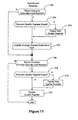
- the reporting step 116 begins with a test 170 to find the reporting strategy with which the device has been configured. If the strategy is one of not reporting QoS experiences, then the process simply ends 190. If the strategy is the non-specific reporting of QoS experiences, then the device broadcasts 172 a non-specific service record ( Figure 5B ) to all other devices in the network.
- a further test 174 is carried out to find whether the latest service provision (i.e. the one just processed - Figure 6 , 104) was by the device's current favourite provider (that is the one having the provider-specific summary QoS record with the highest QoS value). If it was, then the device broadcasts 176 a non-specific service provision record ( Figure 5B ). If it was not, then the device broadcasts 178 a specific service provision record ( Figure 5A ).
- a further test 206 is then carried out to find whether the QoS report contains a provider-specific QoS record. If there is no such record, then the report handling process ends 220.
- a test 208 is carried out to find whether a relevant QoS register exists (this test is identical to that described in relation to step 150 of Figure 8 above). If no relevant QoS register exists, then a new register is created 210 in which the service and context parameters included in the received record provide the master problem (the processing carried out is similar to that described in relation to step 151 of Figure 8 above).
- the QoS value from the record is then used to update 212 the relevant provider-specific summary QoS record in the quality register.
- the update process is identical to that described in relation to step 110 of Figure 6 above.
- the report handling procedure ( Figure 11 ) then ends 220.
- Full reports are equivalent in their information content to task processing records obtained by selectors themselves. They are consequently used to update a selector's register in exactly the same way as described in relation to the selection model update step 110 above.
- a peer-to-peer network operating in accordance with a service-oriented architecture is disclosed.
- the peers in the network request services from one another and each keep a record of the quality of service they receive from the other peers.
- the peers can operate in two modes of service provider selection. In a first mode, the selection is so as to favour service providers which have provided the peer with good service in the past. In a second mode, the selection is probabilistic and can therefore select service providers other than those that have provided good service in the past.
- Each device keeps track of the relative success of adopting the second mode of selection. By occasionally using the second mode of selection and adopting the second mode of selection more frequently should the relative success of adopting the second mode of selection rise, a more rapid adjustment by the network to changing network conditions is enabled. This leads to a better utilisation of the resources of the computers of the network than has hitherto been achieved.
- the invention finds particular application in distributed applications which dynamically select a Web Service to perform a function at run-time.
Landscapes
- Engineering & Computer Science (AREA)
- Computer Networks & Wireless Communication (AREA)
- Signal Processing (AREA)
- Computer Hardware Design (AREA)
- General Engineering & Computer Science (AREA)
- Computer And Data Communications (AREA)
Claims (6)
- Computernetz mit mehreren Vorrichtungen (A-L), die über Kommunikationsverbindungen (1-17) miteinander verbunden sind, wobei jede der Vorrichtungen (A-L) Zugriff auf Servicequalitätsdaten (56) hat, die die Servicequalität angeben, die von den mehreren Vorrichtungen (A-L) bereitgestellt wird, wobei jede der Vorrichtungen (A-L) dazu angeordnet ist, im Betrieb auf eine Serviceanfrage zu reagieren durch:Auswählen einer der anderen Vorrichtungen (A-L), um den angefragten Service bereitzustellen;Auffordern der ausgewählten Vorrichtung (A-L), den Service bereitzustellen;Überwachen der Servicequalität, die als Antwort auf die Anfrage bereitgestellt wird;Aktualisieren der Servicequalitätsdaten (56) als Antwort auf die überwachte Servicequalität;wobei jede Vorrichtung (A-L) imstande ist, zwei Serviceauswahlmodi durchzuführen, einen ersten Modus, der die Servicequalitätsdaten (56) verwendet, um einen oder mehrere bevorzugte Serviceprovider (A-L) auszuwählen, die in der Vergangenheit eine relativ hohe Servicequalität bereitgestellt haben, und einen zweiten Modus, in dem ein Serviceprovider aus den verfügbaren Serviceprovidern (A-L) probabilistisch ausgewählt wird, ohne die Serviceprovider (A-L) zu bevorzugen, die durch den ersten Auswahlmodus bevorzugt wurden;wobei das Computernetz dadurch gekennzeichnet ist, dass:das Netz die Aufschlussservicequalitätsdaten (52, 54) aufrechterhält, welche die Servicequalität angeben, die unter Verwendung des probabilistischen Serviceauswahlmodus erzielt wurde; undjede Vorrichtung (A-L) weiterhin dazu angeordnet ist, im Betrieb die Aufschlussservicequalitätsdaten (52, 54) und die Servicequalitätsdaten (56), die sich auf die bevorzugten Serviceprovider (A-L) beziehen, zu vergleichen und den zweiten Serviceauswahlmodus mit einer Wahrscheinlichkeit auszuwählen, welche zunimmt, wenn der Vergleich angibt, dass es wahrscheinlich ist, dass der zweite Modus Serviceprovider auswählt, die eine bessere Servicequalität als die bevorzugten Serviceprovider bieten.
- Computernetz nach Anspruch 1, wobei der zweite Serviceauswahlmodus das Berücksichtigen der Servicequalitätsdaten (56) beinhaltet, um die Wahrscheinlichkeit, dass die am meisten bevorzugten Provider ausgewählt werden, zu verringern.
- Computernetz nach Anspruch 1, wobei die Servicequälitätsdaten (56) die lokalen Servicequalitätsdatenspeicher in jeder der Vorrichtungen (A-L) umfassen.
- Computernetz nach Anspruch 1, wobei jede Vorrichtung (A-L) an andere Vorrichtungen (A-L) im Netz die erhaltene Servicequalität meldet, wenn sie den zweiten Serviceauswahlmodus übernimmt.
- Verfahren zum Betreiben eines Computernetzes mit mehreren Vorrichtungen (A-L), die über Kommunikationsverbindungen (1-17) miteinander verbunden sind, wobei jede der Vorrichtungen (A-L) Zugriff auf Servicequalitätsdaten (56) hat, die die Servicequalität angeben, die von den mehreren Vorrichtungen (A-L) bereitgestellt wird, wobei das Verfahren umfasst, dass jede der Vorrichtungen (A-L) auf eine empfangene Serviceanfrage antwortet durch:i) Auswählen einer der anderen Vorrichtungen (A-L), um den angefragten Service bereitzustellen;ii) Auffordern der ausgewählten Vorrichtung (A-L), den Service bereitzustellen;iii) Überwachen der Servicequalität, die als Antwort auf die Anfrage bereitgestellt wird; undiv) Aktualisieren der Servicequalitätsdaten (56) als Antwort auf die überwachte Servicequalität;wobei jede Vorrichtung (A-L) dazu imstande ist, zwei Serviceauswahlmodi durchzuführen, einen ersten Modus, der die Servicequalitätsdaten (56) verwendet, um einen oder mehrere bevorzugte Serviceprovider (A-L) auszuwählen, die in der Vergangenheit eine relativ hohe Servicequalität bereitgestellt haben, und einen zweiten Modus, in dem ein Serviceprovider aus den verfügbaren Serviceprovidern (A-L) probabilistisch ausgewählt wird, ohne die Serviceprovider (A-L) zu bevorzugen, die durch den ersten Auswahlmodus bevorzugt wurden;
wobei das Verfahren gekennzeichnet ist durch:die Aufrechterhaltung der Aufschlussservicequalitätsdaten (52, 54), welche die Servicequalität angeben, die unter Verwendung des probabilistischen Serviceauswahlmodus erzielt wurde; undden Serviceauswahlmodus-Auswahlschritt mit:Vergleichen der Aufschlussservicequalitätsdaten (52, 54) und der Servicequalitätsdaten (56), die sich auf die bevorzugten Serviceprovider (A-L) beziehen; undAuswählen des zweiten Serviceauswahlmodus mit einer Wahrscheinlichkeit welche zunimmt, wenn der Vergleich angibt, dass es wahrscheinlich ist, dass der zweite Modus Serviceprovider (A-L) auswählt, die eine bessere Servicequalität als die bevorzugten Serviceprovider (A-L) bieten. - Berechnungsvorrichtung (A-L) zur Verwendung in einem Netz mit mehreren Berechnungsvorrichtungen (A-L), die über Kommunikationsverbindungen miteinander verbunden sind, wobei die Berechnungsvorrichtung (A-L) dazu angeordnet ist, im Betrieb:eine Serviceanfrage zu empfangen; undauf eine Serviceanfrage zu antworten durch:i) Auswählen einer der anderen Vorrichtungen (A-L), um den angefragten Service bereitzustellen;ii) Auffordern der ausgewählten Vorrichtung (A-L), den Service bereitzustellen;iii) Überwachen der Servicequalität, die als Antwort auf die Anfrage bereitgestellt wird; undiv) Aktualisieren der Servicequalitätsdaten (56) als Antwort auf die überwachte Servicequalität;wobei die Berechnungsvorrichtung (A-L) dazu funktionsfähig ist, zwei Serviceauswahlmodi durchzuführen, einen ersten Modus, der die Servicequalitätsdaten (56) verwendet, um einen oder mehrere bevorzugte Serviceprovider (A-L) auszuwählen, die in der Vergangenheit eine relativ hohe Servicequalität bereitgestellt haben, und einen zweiten Modus, in dem ein Serviceprovider aus den verfügbaren Serviceprovidern (A-L) probabilistisch ausgewählt wird, ohne die Serviceprovider (A-L) zu bevorzugen, die durch den ersten Auswahlmodus bevorzugt wurden;wobei die Berechnungsvorrichtung (A-L) dadurch gekennzeichnet ist, dass:sie weiterhin dazu angeordnet ist, im Betrieb die Vorrichtung (A-L) zur Bereitstellung des Services auszuwählen durch:Aufrufen von Aufschlussservicequalitätsdaten (52, 54), die die Servicequalität angeben, die unter Verwendung des probabilistischen Serviceauswahlmodus erzielt wurde;Vergleichen der Aufschlussservicequalitätsdaten (52, 54) und der Servicequalitätsdaten (56), die sich auf die bevorzugten Serviceprovider (A-L) beziehen; undAuswählen des zweiten Serviceauswahlmodus mit einer Wahrscheinlichkeit, welche zunimmt, wenn der Vergleich angibt, dass es wahrscheinlich ist, dass der zweite Modus Serviceprovider (A-L) auswählt, die eine bessere Servicequalität als die bevorzugten Serviceprovider (A-L) bieten.
Priority Applications (1)
| Application Number | Priority Date | Filing Date | Title |
|---|---|---|---|
| EP07733023A EP2027536B1 (de) | 2006-06-13 | 2007-05-30 | Auf qualität basierende diensteauswahl in einem peer-to-peer-netzwerk |
Applications Claiming Priority (3)
| Application Number | Priority Date | Filing Date | Title |
|---|---|---|---|
| EP06253034 | 2006-06-13 | ||
| PCT/GB2007/002007 WO2007144567A2 (en) | 2006-06-13 | 2007-05-30 | Quality based service selection in a peer to peer network |
| EP07733023A EP2027536B1 (de) | 2006-06-13 | 2007-05-30 | Auf qualität basierende diensteauswahl in einem peer-to-peer-netzwerk |
Publications (2)
| Publication Number | Publication Date |
|---|---|
| EP2027536A2 EP2027536A2 (de) | 2009-02-25 |
| EP2027536B1 true EP2027536B1 (de) | 2012-07-11 |
Family
ID=37085533
Family Applications (1)
| Application Number | Title | Priority Date | Filing Date |
|---|---|---|---|
| EP07733023A Active EP2027536B1 (de) | 2006-06-13 | 2007-05-30 | Auf qualität basierende diensteauswahl in einem peer-to-peer-netzwerk |
Country Status (3)
| Country | Link |
|---|---|
| US (1) | US8244857B2 (de) |
| EP (1) | EP2027536B1 (de) |
| WO (1) | WO2007144567A2 (de) |
Families Citing this family (13)
| Publication number | Priority date | Publication date | Assignee | Title |
|---|---|---|---|---|
| DE602007004984D1 (de) * | 2006-06-13 | 2010-04-08 | British Telecomm | Peer-to-peer-meldesystem über reputation der dienstgüte |
| WO2010053418A1 (en) * | 2008-11-10 | 2010-05-14 | Telefonaktiebolaget Lm Ericsson (Publ) | Method and apparatus for enabling services and media in a communication network |
| KR101590972B1 (ko) * | 2009-12-24 | 2016-02-02 | 텔레콤 이탈리아 소시에떼 퍼 아찌오니 | 통신 네트워크에서의 전송 스케줄링 방법, 해당 통신 노드 및 컴퓨터 프로그램 생성물 |
| KR101446558B1 (ko) * | 2010-11-08 | 2014-10-01 | 닛본 덴끼 가부시끼가이샤 | 정보 처리 장치 |
| US20130031241A1 (en) * | 2011-07-29 | 2013-01-31 | Nico Schwan | Distributed service instantiation for information-centric networks |
| KR101980129B1 (ko) * | 2012-07-10 | 2019-05-20 | 한국전자통신연구원 | 관리 기능이 부여된 피투피 네트워크 시스템 |
| US8539286B1 (en) * | 2013-02-26 | 2013-09-17 | Roku, Inc. | Method and apparatus of error reporting |
| US9451047B1 (en) * | 2015-03-20 | 2016-09-20 | T-Mobile U.S.A., Inc. | Personalized quality of service comparison of wireless services |
| EP3278501B1 (de) * | 2015-03-31 | 2019-12-18 | British Telecommunications public limited company | Netzwerkbetrieb |
| US11336534B2 (en) | 2015-03-31 | 2022-05-17 | British Telecommunications Public Limited Company | Network operation |
| GB2541034A (en) | 2015-07-31 | 2017-02-08 | British Telecomm | Network operation |
| CN107547649A (zh) * | 2017-08-29 | 2018-01-05 | 中国民航大学 | 面向航空机场运行信息系统(aois)协同式的应急响应方法 |
| IT201900007038A1 (it) * | 2019-05-20 | 2020-11-20 | Sky Italia S R L | CDN Ranking |
Family Cites Families (25)
| Publication number | Priority date | Publication date | Assignee | Title |
|---|---|---|---|---|
| WO1993020511A1 (en) | 1992-03-31 | 1993-10-14 | Aggregate Computing, Inc. | An integrated remote execution system for a heterogenous computer network environment |
| US6314420B1 (en) | 1996-04-04 | 2001-11-06 | Lycos, Inc. | Collaborative/adaptive search engine |
| US6505248B1 (en) | 1999-03-24 | 2003-01-07 | Gte Data Services Incorporated | Method and system for monitoring and dynamically reporting a status of a remote server |
| US6765864B1 (en) | 1999-06-29 | 2004-07-20 | Cisco Technology, Inc. | Technique for providing dynamic modification of application specific policies in a feedback-based, adaptive data network |
| US6681247B1 (en) | 1999-10-18 | 2004-01-20 | Hrl Laboratories, Llc | Collaborator discovery method and system |
| EP1198146A1 (de) | 2000-10-13 | 2002-04-17 | TELEFONAKTIEBOLAGET LM ERICSSON (publ) | Verfahren und Vorrichtung zur Steuerung einer Verbindung in einem Kommunikationsnetz |
| US6970939B2 (en) | 2000-10-26 | 2005-11-29 | Intel Corporation | Method and apparatus for large payload distribution in a network |
| US6643639B2 (en) | 2001-02-07 | 2003-11-04 | International Business Machines Corporation | Customer self service subsystem for adaptive indexing of resource solutions and resource lookup |
| US6968334B2 (en) | 2001-05-15 | 2005-11-22 | Nokia Corporation | Method and business process to maintain privacy in distributed recommendation systems |
| RU2004111798A (ru) * | 2001-09-20 | 2005-05-10 | Сименс Акциенгезелльшафт (DE) | Способ выбора целесообразным образом используемого маршрута в маршрутизаторе для равномерного распределения в коммуникационной сети |
| US7113796B2 (en) * | 2002-01-18 | 2006-09-26 | Microsoft Corporation | Framework and method for QoS-aware resource discovery in mobile ad hoc networks |
| US20050060365A1 (en) | 2002-01-24 | 2005-03-17 | Robinson Scott L. | Context-based information processing |
| US7133368B2 (en) * | 2002-02-01 | 2006-11-07 | Microsoft Corporation | Peer-to-peer method of quality of service (QoS) probing and analysis and infrastructure employing same |
| US7133905B2 (en) | 2002-04-09 | 2006-11-07 | Akamai Technologies, Inc. | Method and system for tiered distribution in a content delivery network |
| US20030204602A1 (en) | 2002-04-26 | 2003-10-30 | Hudson Michael D. | Mediated multi-source peer content delivery network architecture |
| US7454520B2 (en) | 2002-11-20 | 2008-11-18 | Hewlett-Packard Development Company, L.P. | Method and apparatus for generating a routing table |
| US8332263B2 (en) * | 2002-12-19 | 2012-12-11 | Oracle International Corporation | System and method for configuring scoring rules and generating supplier performance ratings |
| US7305375B2 (en) | 2003-04-23 | 2007-12-04 | Hewlett-Packard Development Company, L.P. | Method and system for distributed remote resources |
| US7693122B2 (en) | 2003-08-21 | 2010-04-06 | Ntt Docomo, Inc. | Resource reservation in a wireless network with distributed medium access control |
| US20050080858A1 (en) | 2003-10-10 | 2005-04-14 | Microsoft Corporation | System and method for searching a peer-to-peer network |
| CA2566984A1 (en) | 2004-05-18 | 2005-12-01 | British Telecommunications Public Limited Company | Peer-to-peer networks |
| US8150936B2 (en) * | 2006-01-30 | 2012-04-03 | Emc Corporation | Methods and apparatus to manage shadow copy providers |
| DE602007004984D1 (de) | 2006-06-13 | 2010-04-08 | British Telecomm | Peer-to-peer-meldesystem über reputation der dienstgüte |
| WO2008038280A2 (en) * | 2006-09-28 | 2008-04-03 | Rayv Inc. | System and methods for peer-to-peer media streaming |
| US7852756B2 (en) | 2007-06-13 | 2010-12-14 | 02Micro International Limited | Network interface system with filtering function |
-
2007
- 2007-05-30 EP EP07733023A patent/EP2027536B1/de active Active
- 2007-05-30 WO PCT/GB2007/002007 patent/WO2007144567A2/en not_active Ceased
- 2007-05-30 US US12/302,937 patent/US8244857B2/en active Active
Also Published As
| Publication number | Publication date |
|---|---|
| WO2007144567A3 (en) | 2008-03-13 |
| WO2007144567A2 (en) | 2007-12-21 |
| US8244857B2 (en) | 2012-08-14 |
| EP2027536A2 (de) | 2009-02-25 |
| US20090254654A1 (en) | 2009-10-08 |
Similar Documents
| Publication | Publication Date | Title |
|---|---|---|
| EP2027536B1 (de) | Auf qualität basierende diensteauswahl in einem peer-to-peer-netzwerk | |
| EP2033086B1 (de) | Peer-to-peer-meldesystem über reputation der dienstgüte | |
| US10567303B2 (en) | System and method for routing service requests | |
| US10747592B2 (en) | Router management by an event stream processing cluster manager | |
| Renart et al. | Data-driven stream processing at the edge | |
| EP3796167B1 (de) | Routerverwaltung durch einen ereignisstromverarbeitungs-cluster-manager | |
| US8302100B2 (en) | System for balance distribution of requests across multiple servers using dynamic metrics | |
| US7730119B2 (en) | Sub-task processor distribution scheduling | |
| US10592578B1 (en) | Predictive content push-enabled content delivery network | |
| CN101854299A (zh) | 一种发布/订阅系统的动态负载平衡方法 | |
| WO2004110018A1 (en) | Content distribution overlay network for a peer to peer network | |
| US20060179059A1 (en) | Cluster monitoring system with content-based event routing | |
| Cheung et al. | Dynamic load balancing in distributed content-based publish/subscribe | |
| Sharma et al. | Managing QoS through prioritization in web services | |
| EP1569110A2 (de) | Ein Verfahren zur Verwaltung der Ausführung eines Prozesses basierend auf verfügbaren Diensten | |
| US11108666B2 (en) | Latency prediction and network message microtiming | |
| CN119363752A (zh) | 一种服务均衡方法、装置及设备 | |
| US8589539B2 (en) | Multipeer | |
| US20060179342A1 (en) | Service aggregation in cluster monitoring system with content-based event routing | |
| Kalogeraki et al. | Towards self-managing QoS-enabled peer-to-peer systems | |
| Giannakopoulos et al. | An Elastic and Scalable Topic-Based Pub/Sub System Using Deep Reinforcement Learning | |
| Čilić et al. | QoS-Aware Load Balancing in the Computing Continuum via Multi-Player Bandits | |
| CN121691340A (zh) | 自适应请求分配方法、装置、设备、介质和程序产品 | |
| Ganeshkumar et al. | An effective framework for improving performance of P2P network using efficient group formation mechanism |
Legal Events
| Date | Code | Title | Description |
|---|---|---|---|
| PUAI | Public reference made under article 153(3) epc to a published international application that has entered the european phase |
Free format text: ORIGINAL CODE: 0009012 |
|
| 17P | Request for examination filed |
Effective date: 20081110 |
|
| AK | Designated contracting states |
Kind code of ref document: A2 Designated state(s): AT BE BG CH CY CZ DE DK EE ES FI FR GB GR HU IE IS IT LI LT LU LV MC MT NL PL PT RO SE SI SK TR |
|
| AX | Request for extension of the european patent |
Extension state: AL BA HR MK RS |
|
| 17Q | First examination report despatched |
Effective date: 20090407 |
|
| RIN1 | Information on inventor provided before grant (corrected) |
Inventor name: SAFFRE, FABRICE, TRISTAN, PIERRE Inventor name: JAKOB, MICHAL Inventor name: HEALING, ALEXANDER, LAURENCE |
|
| DAX | Request for extension of the european patent (deleted) | ||
| REG | Reference to a national code |
Ref country code: DE Ref legal event code: R079 Ref document number: 602007023933 Country of ref document: DE Free format text: PREVIOUS MAIN CLASS: G06F0009460000 Ipc: H04L0029080000 |
|
| RIC1 | Information provided on ipc code assigned before grant |
Ipc: H04L 29/08 20060101AFI20111219BHEP |
|
| GRAP | Despatch of communication of intention to grant a patent |
Free format text: ORIGINAL CODE: EPIDOSNIGR1 |
|
| GRAS | Grant fee paid |
Free format text: ORIGINAL CODE: EPIDOSNIGR3 |
|
| GRAA | (expected) grant |
Free format text: ORIGINAL CODE: 0009210 |
|
| AK | Designated contracting states |
Kind code of ref document: B1 Designated state(s): AT BE BG CH CY CZ DE DK EE ES FI FR GB GR HU IE IS IT LI LT LU LV MC MT NL PL PT RO SE SI SK TR |
|
| REG | Reference to a national code |
Ref country code: GB Ref legal event code: FG4D |
|
| REG | Reference to a national code |
Ref country code: CH Ref legal event code: EP |
|
| REG | Reference to a national code |
Ref country code: AT Ref legal event code: REF Ref document number: 566622 Country of ref document: AT Kind code of ref document: T Effective date: 20120715 |
|
| REG | Reference to a national code |
Ref country code: IE Ref legal event code: FG4D |
|
| REG | Reference to a national code |
Ref country code: DE Ref legal event code: R096 Ref document number: 602007023933 Country of ref document: DE Effective date: 20120906 |
|
| REG | Reference to a national code |
Ref country code: NL Ref legal event code: VDEP Effective date: 20120711 |
|
| REG | Reference to a national code |
Ref country code: AT Ref legal event code: MK05 Ref document number: 566622 Country of ref document: AT Kind code of ref document: T Effective date: 20120711 |
|
| REG | Reference to a national code |
Ref country code: LT Ref legal event code: MG4D Effective date: 20120711 |
|
| PG25 | Lapsed in a contracting state [announced via postgrant information from national office to epo] |
Ref country code: AT Free format text: LAPSE BECAUSE OF FAILURE TO SUBMIT A TRANSLATION OF THE DESCRIPTION OR TO PAY THE FEE WITHIN THE PRESCRIBED TIME-LIMIT Effective date: 20120711 Ref country code: FI Free format text: LAPSE BECAUSE OF FAILURE TO SUBMIT A TRANSLATION OF THE DESCRIPTION OR TO PAY THE FEE WITHIN THE PRESCRIBED TIME-LIMIT Effective date: 20120711 Ref country code: LT Free format text: LAPSE BECAUSE OF FAILURE TO SUBMIT A TRANSLATION OF THE DESCRIPTION OR TO PAY THE FEE WITHIN THE PRESCRIBED TIME-LIMIT Effective date: 20120711 Ref country code: CY Free format text: LAPSE BECAUSE OF FAILURE TO SUBMIT A TRANSLATION OF THE DESCRIPTION OR TO PAY THE FEE WITHIN THE PRESCRIBED TIME-LIMIT Effective date: 20120711 Ref country code: BE Free format text: LAPSE BECAUSE OF FAILURE TO SUBMIT A TRANSLATION OF THE DESCRIPTION OR TO PAY THE FEE WITHIN THE PRESCRIBED TIME-LIMIT Effective date: 20120711 Ref country code: IS Free format text: LAPSE BECAUSE OF FAILURE TO SUBMIT A TRANSLATION OF THE DESCRIPTION OR TO PAY THE FEE WITHIN THE PRESCRIBED TIME-LIMIT Effective date: 20121111 |
|
| PG25 | Lapsed in a contracting state [announced via postgrant information from national office to epo] |
Ref country code: LV Free format text: LAPSE BECAUSE OF FAILURE TO SUBMIT A TRANSLATION OF THE DESCRIPTION OR TO PAY THE FEE WITHIN THE PRESCRIBED TIME-LIMIT Effective date: 20120711 Ref country code: SE Free format text: LAPSE BECAUSE OF FAILURE TO SUBMIT A TRANSLATION OF THE DESCRIPTION OR TO PAY THE FEE WITHIN THE PRESCRIBED TIME-LIMIT Effective date: 20120711 Ref country code: SI Free format text: LAPSE BECAUSE OF FAILURE TO SUBMIT A TRANSLATION OF THE DESCRIPTION OR TO PAY THE FEE WITHIN THE PRESCRIBED TIME-LIMIT Effective date: 20120711 Ref country code: GR Free format text: LAPSE BECAUSE OF FAILURE TO SUBMIT A TRANSLATION OF THE DESCRIPTION OR TO PAY THE FEE WITHIN THE PRESCRIBED TIME-LIMIT Effective date: 20121012 Ref country code: PT Free format text: LAPSE BECAUSE OF FAILURE TO SUBMIT A TRANSLATION OF THE DESCRIPTION OR TO PAY THE FEE WITHIN THE PRESCRIBED TIME-LIMIT Effective date: 20121112 Ref country code: PL Free format text: LAPSE BECAUSE OF FAILURE TO SUBMIT A TRANSLATION OF THE DESCRIPTION OR TO PAY THE FEE WITHIN THE PRESCRIBED TIME-LIMIT Effective date: 20120711 |
|
| PG25 | Lapsed in a contracting state [announced via postgrant information from national office to epo] |
Ref country code: NL Free format text: LAPSE BECAUSE OF FAILURE TO SUBMIT A TRANSLATION OF THE DESCRIPTION OR TO PAY THE FEE WITHIN THE PRESCRIBED TIME-LIMIT Effective date: 20120711 |
|
| PG25 | Lapsed in a contracting state [announced via postgrant information from national office to epo] |
Ref country code: EE Free format text: LAPSE BECAUSE OF FAILURE TO SUBMIT A TRANSLATION OF THE DESCRIPTION OR TO PAY THE FEE WITHIN THE PRESCRIBED TIME-LIMIT Effective date: 20120711 Ref country code: DK Free format text: LAPSE BECAUSE OF FAILURE TO SUBMIT A TRANSLATION OF THE DESCRIPTION OR TO PAY THE FEE WITHIN THE PRESCRIBED TIME-LIMIT Effective date: 20120711 Ref country code: CZ Free format text: LAPSE BECAUSE OF FAILURE TO SUBMIT A TRANSLATION OF THE DESCRIPTION OR TO PAY THE FEE WITHIN THE PRESCRIBED TIME-LIMIT Effective date: 20120711 Ref country code: ES Free format text: LAPSE BECAUSE OF FAILURE TO SUBMIT A TRANSLATION OF THE DESCRIPTION OR TO PAY THE FEE WITHIN THE PRESCRIBED TIME-LIMIT Effective date: 20121022 Ref country code: RO Free format text: LAPSE BECAUSE OF FAILURE TO SUBMIT A TRANSLATION OF THE DESCRIPTION OR TO PAY THE FEE WITHIN THE PRESCRIBED TIME-LIMIT Effective date: 20120711 |
|
| PLBE | No opposition filed within time limit |
Free format text: ORIGINAL CODE: 0009261 |
|
| STAA | Information on the status of an ep patent application or granted ep patent |
Free format text: STATUS: NO OPPOSITION FILED WITHIN TIME LIMIT |
|
| PG25 | Lapsed in a contracting state [announced via postgrant information from national office to epo] |
Ref country code: IT Free format text: LAPSE BECAUSE OF FAILURE TO SUBMIT A TRANSLATION OF THE DESCRIPTION OR TO PAY THE FEE WITHIN THE PRESCRIBED TIME-LIMIT Effective date: 20120711 Ref country code: SK Free format text: LAPSE BECAUSE OF FAILURE TO SUBMIT A TRANSLATION OF THE DESCRIPTION OR TO PAY THE FEE WITHIN THE PRESCRIBED TIME-LIMIT Effective date: 20120711 |
|
| 26N | No opposition filed |
Effective date: 20130412 |
|
| PG25 | Lapsed in a contracting state [announced via postgrant information from national office to epo] |
Ref country code: BG Free format text: LAPSE BECAUSE OF FAILURE TO SUBMIT A TRANSLATION OF THE DESCRIPTION OR TO PAY THE FEE WITHIN THE PRESCRIBED TIME-LIMIT Effective date: 20121011 |
|
| REG | Reference to a national code |
Ref country code: DE Ref legal event code: R097 Ref document number: 602007023933 Country of ref document: DE Effective date: 20130412 |
|
| PG25 | Lapsed in a contracting state [announced via postgrant information from national office to epo] |
Ref country code: MC Free format text: LAPSE BECAUSE OF FAILURE TO SUBMIT A TRANSLATION OF THE DESCRIPTION OR TO PAY THE FEE WITHIN THE PRESCRIBED TIME-LIMIT Effective date: 20120711 |
|
| REG | Reference to a national code |
Ref country code: CH Ref legal event code: PL |
|
| PG25 | Lapsed in a contracting state [announced via postgrant information from national office to epo] |
Ref country code: LI Free format text: LAPSE BECAUSE OF NON-PAYMENT OF DUE FEES Effective date: 20130531 Ref country code: CH Free format text: LAPSE BECAUSE OF NON-PAYMENT OF DUE FEES Effective date: 20130531 |
|
| REG | Reference to a national code |
Ref country code: IE Ref legal event code: MM4A |
|
| PG25 | Lapsed in a contracting state [announced via postgrant information from national office to epo] |
Ref country code: IE Free format text: LAPSE BECAUSE OF NON-PAYMENT OF DUE FEES Effective date: 20130530 |
|
| PG25 | Lapsed in a contracting state [announced via postgrant information from national office to epo] |
Ref country code: MT Free format text: LAPSE BECAUSE OF FAILURE TO SUBMIT A TRANSLATION OF THE DESCRIPTION OR TO PAY THE FEE WITHIN THE PRESCRIBED TIME-LIMIT Effective date: 20120711 |
|
| PG25 | Lapsed in a contracting state [announced via postgrant information from national office to epo] |
Ref country code: TR Free format text: LAPSE BECAUSE OF FAILURE TO SUBMIT A TRANSLATION OF THE DESCRIPTION OR TO PAY THE FEE WITHIN THE PRESCRIBED TIME-LIMIT Effective date: 20120711 |
|
| PG25 | Lapsed in a contracting state [announced via postgrant information from national office to epo] |
Ref country code: LU Free format text: LAPSE BECAUSE OF NON-PAYMENT OF DUE FEES Effective date: 20130530 Ref country code: HU Free format text: LAPSE BECAUSE OF FAILURE TO SUBMIT A TRANSLATION OF THE DESCRIPTION OR TO PAY THE FEE WITHIN THE PRESCRIBED TIME-LIMIT; INVALID AB INITIO Effective date: 20070530 |
|
| REG | Reference to a national code |
Ref country code: FR Ref legal event code: PLFP Year of fee payment: 10 |
|
| REG | Reference to a national code |
Ref country code: FR Ref legal event code: PLFP Year of fee payment: 11 |
|
| REG | Reference to a national code |
Ref country code: FR Ref legal event code: PLFP Year of fee payment: 12 |
|
| REG | Reference to a national code |
Ref country code: DE Ref legal event code: R079 Ref document number: 602007023933 Country of ref document: DE Free format text: PREVIOUS MAIN CLASS: H04L0029080000 Ipc: H04L0065000000 |
|
| P01 | Opt-out of the competence of the unified patent court (upc) registered |
Effective date: 20230623 |
|
| PGFP | Annual fee paid to national office [announced via postgrant information from national office to epo] |
Ref country code: DE Payment date: 20250423 Year of fee payment: 19 |
|
| PGFP | Annual fee paid to national office [announced via postgrant information from national office to epo] |
Ref country code: GB Payment date: 20250423 Year of fee payment: 19 |
|
| PGFP | Annual fee paid to national office [announced via postgrant information from national office to epo] |
Ref country code: FR Payment date: 20250423 Year of fee payment: 19 |