EP2028014A2 - Tête de ligne et appareil de formation d'images l'utilisant - Google Patents
Tête de ligne et appareil de formation d'images l'utilisant Download PDFInfo
- Publication number
- EP2028014A2 EP2028014A2 EP08014688A EP08014688A EP2028014A2 EP 2028014 A2 EP2028014 A2 EP 2028014A2 EP 08014688 A EP08014688 A EP 08014688A EP 08014688 A EP08014688 A EP 08014688A EP 2028014 A2 EP2028014 A2 EP 2028014A2
- Authority
- EP
- European Patent Office
- Prior art keywords
- light
- image
- positive lens
- lens
- line head
- Prior art date
- Legal status (The legal status is an assumption and is not a legal conclusion. Google has not performed a legal analysis and makes no representation as to the accuracy of the status listed.)
- Granted
Links
Images









Classifications
-
- B—PERFORMING OPERATIONS; TRANSPORTING
- B41—PRINTING; LINING MACHINES; TYPEWRITERS; STAMPS
- B41J—TYPEWRITERS; SELECTIVE PRINTING MECHANISMS, i.e. MECHANISMS PRINTING OTHERWISE THAN FROM A FORME; CORRECTION OF TYPOGRAPHICAL ERRORS
- B41J2/00—Typewriters or selective printing mechanisms characterised by the printing or marking process for which they are designed
- B41J2/435—Typewriters or selective printing mechanisms characterised by the printing or marking process for which they are designed characterised by selective application of radiation to a printing material or impression-transfer material
- B41J2/447—Typewriters or selective printing mechanisms characterised by the printing or marking process for which they are designed characterised by selective application of radiation to a printing material or impression-transfer material using arrays of radiation sources
- B41J2/45—Typewriters or selective printing mechanisms characterised by the printing or marking process for which they are designed characterised by selective application of radiation to a printing material or impression-transfer material using arrays of radiation sources using light-emitting diode [LED] or laser arrays
- B41J2/451—Special optical means therefor, e.g. lenses, mirrors, focusing means
-
- H—ELECTRICITY
- H04—ELECTRIC COMMUNICATION TECHNIQUE
- H04N—PICTORIAL COMMUNICATION, e.g. TELEVISION
- H04N1/00—Scanning, transmission or reproduction of documents or the like, e.g. facsimile transmission; Details thereof
- H04N1/04—Scanning arrangements, i.e. arrangements for the displacement of active reading or reproducing elements relative to the original or reproducing medium, or vice versa
- H04N1/19—Scanning arrangements, i.e. arrangements for the displacement of active reading or reproducing elements relative to the original or reproducing medium, or vice versa using multi-element arrays
- H04N1/191—Scanning arrangements, i.e. arrangements for the displacement of active reading or reproducing elements relative to the original or reproducing medium, or vice versa using multi-element arrays the array comprising a one-dimensional [1D] array
- H04N1/1911—Simultaneously or substantially simultaneously scanning picture elements on more than one main scanning line, e.g. scanning in swaths
- H04N1/1912—Scanning main scanning lines which are spaced apart from one another in the sub-scanning direction
-
- H—ELECTRICITY
- H04—ELECTRIC COMMUNICATION TECHNIQUE
- H04N—PICTORIAL COMMUNICATION, e.g. TELEVISION
- H04N1/00—Scanning, transmission or reproduction of documents or the like, e.g. facsimile transmission; Details thereof
- H04N1/04—Scanning arrangements, i.e. arrangements for the displacement of active reading or reproducing elements relative to the original or reproducing medium, or vice versa
- H04N1/12—Scanning arrangements, i.e. arrangements for the displacement of active reading or reproducing elements relative to the original or reproducing medium, or vice versa using the sheet-feed movement or the medium-advance or the drum-rotation movement as the slow scanning component, e.g. arrangements for the main-scanning
-
- H—ELECTRICITY
- H04—ELECTRIC COMMUNICATION TECHNIQUE
- H04N—PICTORIAL COMMUNICATION, e.g. TELEVISION
- H04N2201/00—Indexing scheme relating to scanning, transmission or reproduction of documents or the like, and to details thereof
- H04N2201/0077—Types of the still picture apparatus
- H04N2201/0082—Image hardcopy reproducer
Definitions
- the present invention relates to a line head and an image forming apparatus using the same and in particular, to a line head that forms an imaging spot row by projecting a light-emitting element row onto an irradiated surface using a microlens array and an image forming apparatus using the same.
- JP-A-2-4546 proposes an optical writing line head, in which a plurality of LED array chips are disposed in the LED array direction and the LED array of each LED array chip is projected onto a photoconductor in an enlarged manner by a positive lens disposed corresponding thereto such that images of light-emitting dots at the ends of the LED array chips adjacent on the photoconductor are formed adjacent to each other with the same pitch as a pitch between images of light-emitting dots of the same LED array chips, and an optical reading line head in which the optical path is oppositely set.
- JP-A-6-344596 proposes making the focal depth large by configuring a positive lens with two lenses in the same arrangement as disclosed in JP-A-2-4546 and making projected beams approximately parallel beams.
- JP-A-6-278314 proposes an optical writing line head in which LED array chips are disposed in two rows at distances therebetween, the repeat phase is shifted by a half period, and positive lens arrays are disposed in two rows in a condition where each positive lens corresponds to each LED array chip such that images of the light-emitting dot array on a photoconductor are aligned.
- the shading of an optical system becomes large, the light amount unevenness of the light-emitting dot pitch occur temporally even if the uniform image surface light amount is obtained in an early stage by adjusting the light amount for every light-emitting dot. This causes the image concentration unevenness.
- An advantage of some aspects of the invention is to make sure that unevenness caused by the positional deviation of light-emitting dot images does not occur in an optical writing line head, in which a plurality of light-emitting elements are arrayed in rows corresponding to each lens of a plurality of positive lens arrayed in a line shape, even if a writing surface moves in the optical axis direction.
- Another advantage of some aspects of the invention is to prevent concentration unevenness, which is caused by shading, between imaging spots formed by each lens.
- Still another advantage of some aspects of the invention is that it provides an image forming apparatus using such an optical writing line head and an optical reading line head in which the optical path is oppositely set.
- a line head includes: a positive lens system having two lenses with positive refractive power; a lens array in which a plurality of the positive lens systems are arrayed in a first direction; a light emitter array in which a plurality of light-emitting elements are arrayed on an object side of the lens array so as to correspond to the one positive lens system; and an aperture plate that forms an aperture diaphragm at the position of an object-side focal point of the positive lens system.
- An object-side surface of an object-side lens of the positive lens system is positioned close to the object-side focal point.
- the object-side surface of the object-side lens of the positive lens system be positioned within a range of ⁇ 10% of a total focal length of the positive lens system from the object-side focal point.
- the lenses may be configured to include a lens group.
- an image-side surface of the object-side lens of the two lenses may be a flat surface.
- the above lens is advantageous in that manufacturing becomes easy since only one surface of the object-side lens is formed as a curved surface.
- At least the object-side surface of the object-side lens of the positive lens system is a convex surface, and a portion including a surface apex of the convex surface is disposed to be hidden in an opening of the aperture plate.
- a distance from a front side principal plane of the image-side lens to a rear side principal plane of the object-side lens can be further increased.
- the angle of view can be made smaller, the effect of shading can be further reduced.
- the aperture plate may be configured by integrally forming a light shielding member on an object-side surface of the lens array.
- At least an image-side surface of an image-side lens of the positive lens system be a flat surface.
- the shape of the aperture diaphragm be a shape of restricting at least the aperture diameter in the first direction.
- the plurality of light-emitting elements form a plurality of light-emitting element rows arrayed in a second direction perpendicular to the first direction.
- the plurality of light-emitting elements be arrayed to form light emitter groups at distances therebetween in the first direction.
- the light-emitting elements be organic EL elements.
- the light-emitting elements be LEDs.
- an image forming apparatus includes: at least two image forming stations each of which has a charging unit, the line head described above, a developing unit, and a transfer unit disposed around an image carrier. Tandem-type image formation is performed by causing a transfer medium to pass through each station.
- a line head includes: a positive lens system having two lenses with positive refractive power; a lens array in which a plurality of the positive lens systems are arrayed in a first direction; a light receiver array in which a plurality of light-receiving elements are arrayed on an image side of the lens array so as to correspond to the one positive lens system; and an aperture plate that forms an aperture diaphragm at the position of an image-side focal point of the positive lens system.
- An image-side surface of an image-side lens of the positive lens system is positioned close to the image-side focal point.
- the positional deviation of read spots does not occur even if the position of a read surface shifts in the optical axis direction, and the effect of shading can be reduced by making small an angle of view of light incident on the positive lens system from the plurality of light-emitting elements. As a result, deterioration of a read image can be prevented.
- each positive lens system included in a lens array may be configured to include two lens groups with positive refractive power and may also be a composite lens system including the two lens groups (each of the lenses is configured to include a lens group with positive refractive power).
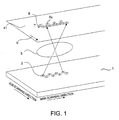
- Fig. 1 is a perspective view illustrating a portion corresponding to one microlens of a line head according to an embodiment of the invention.
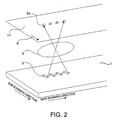
- Fig. 2 is a perspective view illustrating a portion corresponding to one microlens of a line head according to an embodiment of the invention.
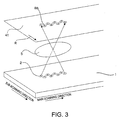
- Fig. 3 is a perspective view illustrating a portion corresponding to one microlens of a line head according to an embodiment of the invention.
- Fig. 4 is an explanatory view illustrating the correspondence relationship between a light emitter array and a microlens with minus optical magnification in an embodiment of the invention.
- Fig. 5 is an explanatory view illustrating an example of a memory table of a line buffer in which image data is stored.
- Fig. 6 is an explanatory view illustrating a state where imaging spots are formed on the same row in the main scanning direction by even-numbered light-emitting elements and odd-numbered light-emitting elements.
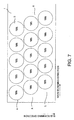
- Fig. 7 is an explanatory view schematically illustrating an example of a light emitter array used as a line head.
- Fig. 8 is an explanatory view illustrating the imaging position when output light of each light-emitting element is irradiated onto an exposure surface of an image carrier through a microlens in the configuration shown in Fig. 7 .
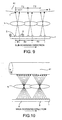
- Fig. 9 is an explanatory view illustrating a state of formation of imaging spots in the sub-scanning direction in Fig. 8 .
- Fig. 10 is an explanatory view illustrating an example where imaging spots are formed to be inverted in the main scanning direction of the image carrier in the case where a plurality of microlenses are arrayed.
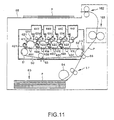
- Fig. 11 is a cross-sectional view schematically illustrating the entire configuration of a first example of an image forming apparatus, which uses an electrophotographic process, according to an embodiment of the invention.
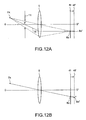
- Figs. 12A and 12B are views for explaining the basic principle in some embodiments according to the invention.
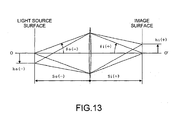
- Fig. 13 is a view illustrating the definition of reference numerals of parameters.
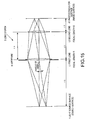
- Fig. 14 is a view illustrating an angle of view of an end light-emitting element when a lens system configured to include a first positive lens and a second positive lens is telecentric on the image side.
- Fig. 15 is a view illustrating the configuration in the case where an optical system according to an embodiment of the invention is formed by using a thin lens system.
- Fig. 16 is a perspective view illustrating a broken part of the configuration of an optical writing line head in the first example of the invention.
- Fig. 17 is a cross-sectional view taken along the sub-scanning direction of Fig. 16 .
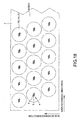
- Fig. 18 is a plan view illustrating the arrangement of a light emitter array and a microlens array in the case shown in Fig. 16 .
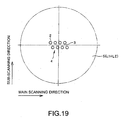
- Fig. 19 is a view illustrating the correspondence relationship between one microlens and a light emitter block corresponding thereto.
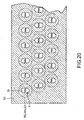
- Fig. 20 is a plan view illustrating an aperture plate disposed corresponding to a light emitter block of a light emitter array.
- Fig. 21 is a view illustrating an opening of an aperture plate with respect to one light emitter block.
- Fig. 22 is a view corresponding to Fig. 18 in the case of forming a light emitter block by arraying light-emitting elements in a shape of a long row in the main scanning direction and controlling emission of a part of the light-emitting elements.
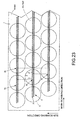
- Fig. 23 is a view illustrating an example where the number of light-emitting elements included in a light emitter block is increased so that rows of imaging spots adjacent on an image carrier are exposed to overlap each other.
- Fig. 24 is a cross-sectional view taken along the main scanning direction in the case where a microlens array is configured to include two microlens arrays.
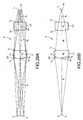
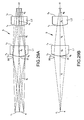
- Figs. 25A and 25B are cross-sectional views taken along the main scanning direction and the sub-scanning direction illustrating an optical system corresponding to one microlens in a first example.
- Figs. 26A and 26B are cross-sectional views taken along the main scanning direction and the sub-scanning direction illustrating an optical system corresponding to one microlens in a second example.
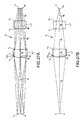
- Figs. 27A and 27B are cross-sectional views taken along the main scanning direction and the sub-scanning direction illustrating an optical system corresponding to one microlens in a third example.
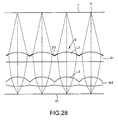
- Fig. 28 is a cross-sectional view taken along the main scanning direction in an example of integrally forming an aperture on an object-side surface of a first microlens array that forms a lens array of a microlens in the third example.
- Figs. 29A and 29B are cross-sectional views taken along the main scanning direction and the sub-scanning direction illustrating an optical system corresponding to one microlens in a fourth example.
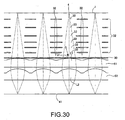
- Fig. 30 is a cross-sectional view taken along the main scanning direction in an example where a flare aperture plate is disposed apart from an aperture plate in an optical system of an optical writing line head according to an embodiment of the invention.
- Fig. 4 is an explanatory view illustrating the correspondence relationship between a light emitter array 1 and a microlens 5 with minus optical magnification in an embodiment of the invention.
- the line head according to the present embodiment, two rows of light-emitting elements correspond to one microlens 5.
- the microlens 5 is an imaging device with minus optical magnification (inverted imaging)
- the positions of the light-emitting elements are inverted in the main scanning direction and the sub-scanning direction. That is, in the configuration shown in Fig.
- even-numbered light-emitting elements 8, 6, 4, and 2 are arrayed on an upstream side (first row) in the movement direction of an image carrier and odd-numbered light-emitting elements 7, 5, 3, and 1 are arrayed on the downstream side (second row).
- a light-emitting element with a large number is arrayed at the head side in the main scanning direction.
- Figs. 1 to 3 are perspective views illustrating a portion corresponding to one microlens of the line head according to the present embodiment.
- an imaging spot 8a of an image carrier 41 corresponding to the odd-numbered light-emitting element 2 arrayed on the downstream side of the image carrier 41 is formed at the position inverted in the main scanning direction.
- 'R' refers to the movement direction of the image carrier 41.
- an imaging spot 8b of the image carrier 41 corresponding to the even-numbered light-emitting element 2 arrayed on the upstream side (first row) of the image carrier 41 is formed at the downstream position inverted in the sub-scanning direction.
- the positions of imaging spots from the head side correspond in order by numbers of the light-emitting elements 1 to 8. Accordingly, in this example, it can be seen that the imaging spots can be formed on the same row in the main scanning direction by adjusting the timing of formation of imaging spots in the sub-scanning direction of the image carrier.
- Fig. 5 is an explanatory view illustrating an example of a memory table 10 of a line buffer in which image data is stored.
- the memory table 10 shown in Fig. 5 stores the image data therein in a state where the numbers of the light-emitting elements shown in Fig. 4 are inverted in the main scanning direction.
- first image data 1, 3, 5, and 7 corresponding to the light-emitting elements on the upstream side (first row) of the image carrier 41 are first read among the image data stored in the memory table 10 of the line buffer to make the light-emitting elements emit light.
- second image data 2, 4, 6, and 8 corresponding to the light-emitting elements on the downstream side (second row) of the image carrier 41 stored in the memory address are read to make the light-emitting elements emit light.
- the imaging spots on the first row of the image carrier and the imaging spots on the second row are formed on the same row in the main scanning direction.
- Fig. 1 is a perspective view conceptually illustrating an example of forming imaging spots by reading image data at the timing shown in Fig. 5 .
- the light-emitting elements on the upstream side (first row) of the image carrier 41 are first made to emit light, forming imaging spots on the image carrier 41.
- the odd-numbered light-emitting elements on the downstream side (second row) of the image carrier 41 are made to emit light after the predetermined time T has passed, forming imaging spots on the image carrier.
- the imaging spots formed by the odd-numbered light-emitting elements are not formed at the positions indicated by 8a described in Fig. 2 , but formed at the positions indicated by 8 on the same row in the main scanning direction as shown in Fig. 6 .
- Fig. 7 is an explanatory view schematically illustrating the outline of an example of a light emitter array used as a line head.
- a plurality of light-emitting element rows 3 each of which has the plurality of light-emitting elements 2 arrayed in the main scanning direction are provided in the sub-scanning direction, such that a light emitter block 4 (refer to Fig. 4 ) is formed.
- two rows of light-emitting element rows 3 each of which has four light-emitting elements 2 arrayed in the main scanning direction are formed in the sub-scanning direction in the light emitter block 4 (refer to Fig. 4 ).
- the plurality of light emitter blocks 4 are disposed in the light emitter array 1, and each light emitter block 4 is disposed corresponding to the microlens 5.
- the plurality of microlenses 5 are provided in the main scanning direction and sub-scanning direction of the light emitter array 1 to thereby form a microlens array (MLA) 6.
- the MLAs 6 are arrayed in a state where the head positions thereof in the main scanning direction are shifted from each other in the sub-scanning direction.
- Such arrangement of the MLA 6 corresponds to a case in which the light-emitting elements are provided in the light emitter array 1 in a zigzag manner. In the example shown in Fig.
- the MLAs 6 are disposed in three rows in the sub-scanning direction, and unit blocks 4 corresponding to the positions of the three rows of MLAs 6 in the sub-scanning direction thereof are classified into a group A, a group B, and a group C for the convenience of explanation.
- the plurality of light-emitting elements 2 are disposed in the microlens 5 having minus optical magnification and the plurality of rows of lenses are arrayed in the sub-scanning direction
- Fig. 8 is an explanatory view illustrating the imaging position when output light of each light-emitting element 2 is irradiated onto an exposure surface of an image carrier through the microlens 5 in the configuration shown in Fig. 7 .
- the unit blocks 4 classified into the group A, the group B, and the group C are disposed in the light emitter array 1, as earlier described in Fig. 7 .
- Light-emitting element rows of each of the unit blocks 4 of the group A, group B, and group C are divided into an upstream side (first row) and a downstream side (second row) of the image carrier 41, and even-numbered light-emitting elements are assigned for the first row and odd-numbered light-emitting elements are assigned for the second row.
- imaging spots are formed at the positions of the image carrier 41 inverted in the main scanning direction and the sub-scanning direction by operating each light-emitting element 2 as already described with reference to Figs. 1 to 3 .
- the imaging spots are formed on the same row in the main scanning direction in the order of 1 to 8.
- the image carrier 41 is moved in the sub-scanning direction for a predetermined time to execute processing for the group B in the same manner.
- the image carrier 41 is moved in the sub-scanning direction for a predetermined time to execute processing for the group C.
- the imaging spots based on the input image data are formed on the same row in the main scanning direction in the order of 1 to 24.
- Fig. 9 is an explanatory view illustrating a state of formation of imaging spots in the sub-scanning direction in Fig. 8 .
- S is the movement speed of the image carrier 41
- d1 is a distance between light-emitting elements on the first and second rows of the group A
- d2 is a distance between a light-emitting element on the second row of the group A and a light-emitting element on the second row of the group B
- d3 is a distance between a light-emitting element on the second row of the group B and a light-emitting element on the second row of the group C
- T1 is a time until a light-emitting element on the first row emits light after emission of the light-emitting element on the second row of the group A
- T2 is a time taken when the imaging position by the light-emitting element on the second row of the group A moves to the imaging position of the light-emitting element on the second row of the group B
- T1 can be calculated as follows.
- T2 and T3 can also be calculated similarly by replacing d1 with d2 and d3.
- T ⁇ 1 ( d ⁇ 1 ⁇ ⁇ ) / S
- the light-emitting elements on the second row of the group B are made to emit light after the time T2 for which the light-emitting elements on the second row of the group A emit light. Then, the light-emitting elements on the second row of the group C are made to emit light after the time T3 has elapsed from the time T2.
- the light-emitting elements on the first row of each group emit light after the time T1 since the light-emitting elements on the second row emitted light.
- An image forming apparatus can be formed by using the above-described line head.
- the above-described line head can be used for a tandem-type color printer (image forming apparatus) that exposes four photoconductors to light with four line heads, forms images corresponding to four color at the same time, and transfers the images onto one intermediate transfer belt (intermediate transfer medium) having an endless shape.
- Fig. 11 is a longitudinal section side view illustrating an example of a tandem-type image forming apparatus that uses an organic EL element as a light-emitting element.
- the image forming apparatus In the image forming apparatus, four line heads 101K, 101C, 101M, and 101Y having the same configuration are arrayed at exposure positions of four corresponding photoconductor drums (image carriers) 41K, 41C, 41M, and 41Y having the same configuration.
- the image forming apparatus is configured as a tandem type image forming apparatus.
- the image forming apparatus includes a driving roller 51, a driven roller 52, a tension roller 53, and an intermediate transfer belt (intermediate transfer medium) 50 which is suspended by tension applied by the tension roller 53 and is driven to rotate in the direction (counterclockwise direction) indicated by the arrows shown in the drawing.
- the photoconductor drums 41K, 41C, 41M, and 41Y, which serve as four image carriers and each of which has a photosensitive layer on the outer peripheral surface thereof, are arrayed at predetermined gaps with respect to the intermediate transfer belt 50.
- the letters K, C, M, and Y appended to the ends of the reference numerals stand for black, cyan, magenta, and yellow, respectively, which indicate photoconductor drums for black, cyan, magenta, and yellow. The same is true for other members.
- the photoconductor drums 41K, 41C, 41M, and 41Y are driven to rotate in the direction (clockwise rotation) indicated by the arrow shown in the drawing in synchronization with the driving of the intermediate transfer belt 50.
- a developing unit 44 for applying toner, serving as a developing agent, onto an electrostatic latent image formed by the line head 101 (K, C, M, Y) in order to convert the image into a visible image (toner image)
- a primary transfer roller 45 (K, C, M, Y) serving as a transfer unit that sequentially transfer the toner image developed by the developer 44(K, C, M, Y) onto the intermediate transfer belt 50 which is an object to be primarily transferred
- a cleaner 46 K, C, M, Y
- cleaning unit that removes toner remaining on the surface of the photoconductor drum 41(K, C, M, Y).
- each line head 101 (K, C, M, Y) is provided such that the arrayed direction of the line head 101(K, C, M, Y) is aligned with a generating line of each photoconductor drum 41(K, C, M, Y).
- the peak wavelength of light emission energy of each line head 101 (K, C, M, Y) and the peak wavelength of sensitivity of each photoconductor drum 41(K, C, M, Y) are set to be approximately equal to each other.
- the developing unit 44 uses single-nonmagnetic-component toner as the developing agent, for example.
- the single-component developing agent is transported to a developing roller by a feeding roller, for example, the film thickness of the developing agent attached to the surface of the developing roller is regulated by a regulating blade, and the developing roller is brought into contact with or pressed against the photoconductor drum 41(K, C, M, Y) to cause the developing agent to be adhered thereto depending on the electrical potential level of the photoconductor drum 41(K, C, M, Y). A toner image is thus developed.
- the four toner images of black, cyan, magenta, and yellow generated by the four single-color toner image forming stations are primary-transferred sequentially onto the intermediate transfer belt 50 by a primary transfer bias applied to each of the primary transfer rollers 45(K, C, M, Y). Then, a full-color toner image generated by sequentially superimposing these single-color toner images on the intermediate transfer belt 50 is secondary-transferred onto a recording medium P, such as paper, by a secondary transfer roller 66.
- the secondary-transferred image is then fixed on the recording medium P after passing through a fixing roller pair 161 that is a fixing unit, and the recording medium P is ejected onto a paper discharging tray 68 provided at the top of the apparatus by a paper discharging roller pair 162.
- reference numeral 63 denotes a paper feeding cassette having a number of recording media P laminated and held thereon
- reference numeral 64 denotes a pick-up roller for feeding the recording media P from the paper feeding cassette 63 one by one.
- Reference numeral 65 denotes a gate roller pair for regulating the timing of feeding of the recording medium P to the secondary transfer portion of the secondary transfer roller 66
- reference numeral 66 is a secondary transfer roller 66 serving as a secondary transfer unit that forms a secondary transfer portion together with the intermediate transfer belt 50
- reference numeral 67 denotes a cleaning blade serving as a cleaning unit that removes toner remaining on the surface of the intermediate transfer belt 50 after the secondary transfer.
- the invention relates to an optical system of the above-described line head (optical writing line head). First, the principle will be described.
- Figs. 12A and 12B are views for explaining the basic principle of some embodiments according to the invention.
- Figs. 12A and 12B are views illustrating the relationship among an end light-emitting element 2x of a light-emitting element row which is disposed in the line shape in a line head, the microlens 5 which projects the light-emitting element row, and the photoconductor (image carrier) 41 onto which the light-emitting element row is projected.
- Fig. 12A shows a case in the invention
- Fig. 12B shows a case of a known example. In the known example shown in Fig.
- an imaging spot 8x which is an image on the photoconductor 41 of the end light-emitting element 2x is formed on a straight line passing through the end light-emitting element 2x and the microlens 5. Accordingly, when a surface of the photoconductor 41 which is an image surface moves forward or backward in the direction of a lens optical axis O-O' due to vibration of the photoconductor, for example, to thereby move to a position 41' of the drawing, the position of the imaging spot 8x on the photoconductor 41 moves to the position 8x' on the straight line. As a result, the positional deviation of the imaging spot occurs, and unevenness in the pitch between scanning lines drawn by relative movement of the imaging spot 8x in the sub-scanning direction occurs (pitch unevenness of imaging spots in the main scanning direction).
- an aperture diaphragm 11 is disposed at the position of a front side focal point F of the microlens 5 so as to be positioned on the same axis as the optical axis O-O', as shown in Fig. 12A .
- a main light beam 12 from the end light-emitting element 2x passes through the center of the aperture diaphragm 11, is refracted by the microlens 5, and then moves in parallel with the optical axis O-O'.
- the position of the imaging spot 8x on the photoconductor 41 becomes the position 8x' of the main light beam 12 after refraction at the microlens 5.
- the position of the photoconductor 41 changes forward or backward, the positional deviation of the imaging spot 8x does not occur.
- the pitch unevenness of the imaging spots 8x in the main scanning direction in the related art does not occur, and unevenness in the pitch between scanning lines drawn by movement of the imaging spots 8x in the sub-scanning direction does not occur.
- one positive lens system is disposed corresponding to the plurality of light-emitting elements, and an image is formed by projecting images (array of imaging spots) on rows of light-emitting elements onto a projected surface (photoconductor), the projection optical system is made to have a so-called telecentric configuration on an image side.
- the positional deviation of imaging spots does not occur even if the position of the projected surface (photoconductor) shifts in the optical axis direction, it is possible to prevent deterioration of an image formed.
- the aperture diaphragm 11 have a shape of restricting at least the aperture diameter in a direction (main scanning direction) in which the positional deviation of an off-axis imaging spot is a problem.
- a direction main scanning direction
- the aperture diaphragm 11 has a shape of restricting the aperture diameter in the main scanning direction.
- the aperture diaphragm 11 may have not only the shape of restricting the aperture diameter in the main scanning direction but also a shape of restricting the aperture diameter in the sub-scanning direction. That is, any opening shape of circular, elliptical, and rectangular shapes may be used.
- the microlens 5 is assumed to include one positive lens. However, it is more preferable that the microlens 5 be formed by using a lens system with positive refractive power where two positive lenses are disposed on the same axis from the point of view of the degree of freedom of aberration correction and the like.
- a clockwise direction is positive for an angle ⁇ measured from the optical axis O-O'
- an upper side is positive for an image height h measured from the optical axis O-O'
- a right side is positive for a distance in the direction of the optical axis O-O' measured from the thin lens.
- a lowercase letter 'o' after reference numeral means an object-side parameter
- a lowercase letter 'i' after reference numeral means an image-surface-side parameter.
- f total f 1 ⁇ f 2 / f 1 + f 2 - d 1
- d 1 of the expression (7) m is decreased as d 1 is increased in a condition of (f 1 + f 2 ) ⁇ d 1 .
- the lens distance d 1 is limited as expressed by the following expression (8) in order to make an image side telecentric. 0 ⁇ d 1 ⁇ f 2
- the diaphragm 11 be disposed on a front side focal plane of the lens system 5 configured to include two positive lenses L1 and L2 and the first positive lens L1 be disposed close to the diaphragm 11 so as to make the angle of view of the optical system small.
- the diaphragm 11 and the first positive lens L1 become close to a front side focal plane of the second positive lens L2, as shown in Fig. 15 .
- the diaphragm 11 be disposed at the front side focal position of the composite optical system configured to include the two positive lenses L1 and L2 in order to make the lens system 5 telecentric on the image side. Furthermore, from a result of the examination as the thin lens, it is possible to reduce the angle of view by disposing the first positive lens L1 and the diaphragm 11 so as to be close to each other. This can reduce an effect of shading. In a first example of specific number to be described later, a distance between a surface of the diaphragm 11 and an object-side surface of the first positive lens L1 is zero.
- a principal plane position changes with power distribution of an incidence surface (object-side surface) and an emission surface (image-surface-side surface).
- a rear side principal plane of the first positive lens L1 is positioned to be close to the incidence surface side, compared with a biconvex positive lens, by making the first positive lens L1 a plano-convex lens which is convex on the incidence surface, a distance between the rear side principal plane of the first positive lens L1 and the front side principal plane of the second positive lens L2 can be further increased.
- a lens formed surface (curved surface) of the first positive lens L1 is one, which is also advantageous in that manufacturing becomes easy.
- the first positive lens L1 is made as a plano-convex positive lens while maintaining the focal length thereof. Accordingly, a maximum angle of view is smaller than that in the first example.
- the distance between the rear side principal plane of the first positive lens L1 and the front side principal plane of the second positive lens L2 can be further increased by disposing the first positive lens L1 such that the incidence surface of the first positive lens L1 is hidden in the opening of the diaphragm 11, that is, by disposing the first positive lens L1 such that the apex of the incidence surface of the first positive lens L1 is closer to an object side than the surface of the diaphragm 11 (third example).
- the arrangement position of the diaphragm 11 is a front side focal position of the composite optical system configured to include the positive lenses L1 and L2, but the front side focal point is included in the first positive lens L1. Accordingly, in the case where parallel beams are incident from the image side, the beams are condensed into the first positive lens L1 and then become diverging beams that diverge from the condensing point. As a result, an angle of divergence is reduced on the incidence surface of the first positive lens L1 and the beams move toward the object side. Although an image seen from the object side of the condensing point (diverging light) is a virtual image, a surface on which the virtual image exists is a front side focal plane of the entire lens system. Thus, a configuration which is telecentric on the image side is obtained by disposing the diaphragm 11 on the front side focal plane.
- the angle of view of the optical system can be made small as long as the diaphragm 11 is disposed on the front side focal plane of the lens system 5 configured to include the two positive lenses L1 and L2.
- the shading phenomenon based on the fourth power of cosine rule can be reduced (fourth example).
- the configuration which is telecentric on the image side is realized by configuring a lens system with positive refractive power in which two positive lenses are disposed as the microlenses 5 on the same axis, positioning the front side focal point of the composite optical system near the incidence surface of the first positive lens L1, and disposing the aperture diaphragm 11 at the front side focal position. Accordingly, even if the position of the projected surface (photoconductor) 41 shifts in the optical axis direction, the positional deviation of an imaging spot does not occur and the shading phenomenon in which a decrease in the peripheral light amount becomes large according to the fourth power of cosine rule. As a result, the concentration unevenness of the imaging spots 8 on the light-emitting element row disposed in the line shape in the light emitter array 1 does not easily occur.
- the pitch unevenness of the imaging spots 8 in the main scanning direction in the related art does not occur and unevenness in the pitch between scanning lines drawn by movement of the imaging spots 8 in the sub-scanning direction does not occur.
- the concentration unevenness between the imaging spots 8 caused by the shading of the microlens 5 in the related art does not easily occur, and the concentration unevenness between scanning lines drawn by the movement of the imaging spots 8 in the sub-scanning direction does not easily occur.
- the front side focal position of the composite optical system configured to include the positive lenses L1 and L2 is positioned close to the incidence surface of the first positive lens L1.
- the incidence surface of the first positive lens L1 is positioned within ⁇ 10% of the total focal length f total of the composite optical system is assumed that the front side focal position of the composite optical system is positioned close to the incidence surface or in the neighborhood of the incidence surface.
- the light amount of the imaging spot 8x that is an image of the end light-emitting element 2x is necessarily reduced due to an effect of eclipse compared with the light amount of other imaging spots on the imaging spot row, in order to make a distance between the imaging spot 8x, which is an image of the end light-emitting element 2x on the light-emitting element row disposed in the line shape by the specific microlens 5, and the adjacent imaging spot 8x imaged by the adjacent microlens 5 equal to the pitch of imaging spot rows imaged by one microlens 5.
- a problem that the light amount of the imaging spot 8x which is an image of the end light-emitting element 2x is reduced can be solved by disposing the light emitter blocks 4 in the main scanning direction with a gap therebetween, disposing the light emitter blocks 4 in the sub-scanning direction, and disposing the microlens arrays 6 in the main scanning direction and the sub-scanning direction in a two-dimensional manner, in which the microlenses 5 are arrayed, corresponding to the array of the light emitter blocks 4 as shown in Figs. 1 to 10 .
- the projection optical system is configured to include two positive lens and is made to be telecentric on the image side and the incident surface of an object-side positive lens is disposed as close as possible to the aperture diaphragm.
- the aperture diaphragm 11 have a shape of restricting at least the aperture diameter in a direction (main scanning direction) in which the positional deviation of an off-axis imaging spot is a problem.
- a direction main scanning direction
- the aperture diaphragm 11 has a shape of restricting the aperture diameter in the main scanning direction.
- the aperture diaphragm 11 may have not only the shape of restricting the aperture diameter in the main scanning direction but also a shape of restricting the aperture diameter in the sub-scanning direction. That is, any opening shape of circular, elliptical, and rectangular shapes may be used.
- each of the positive lenses L1 and L2 which form the microlens 5 is configured to include one lens.
- a lens systems with positive refractive power in which two or more lenses are disposed on the same axis may also be used.
- the microlens 5 is an axially-symmetric lens system in which focal lengths and focal positions in the main scanning direction and the sub-scanning direction are equal to each other.
- a lens system that forms the microlens 5 may be an anamorphic lens system in which focal lengths and magnifications in the main scanning direction and the sub-scanning direction are different.
- the aperture diaphragm 11 is disposed to be telecentric on the image side in the main scanning direction (on a cross section in the main scanning direction) and a surface of the composite optical system closest to the object side is positioned close to the position (front side focal position of the composite optical system in the main scanning direction) of the aperture diaphragm 11.
- the optical system of the optical writing line head has been described.
- a plurality of light-receiving elements are arrayed in rows in the main scanning direction, one positive lens system is disposed corresponding to the plurality of light-receiving elements, and an image is read by back projecting images (array of read spots) on rows of light-receiving elements onto a read surface
- the projection optical system is configured to include two positive lens and is made to be telecentric on the object side and the incident surface of an image-side positive lens is disposed as close as possible to the aperture diaphragm.
- reference numeral 41 indicates a read surface and reference numeral 2x indicates an end light-receiving element in Figs. 12A and 15 , and the principle is the same as that in the optical system of the optical writing line head.
- Fig. 16 is a perspective view illustrating a broken part of the configuration of the optical writing line head in the example
- Fig. 17 is a cross-sectional view taken along the sub-scanning direction of Fig. 16
- Fig. 18 is a plan view illustrating the arrangement of a light emitter array and a microlens array in the case shown in Fig. 16
- Fig. 19 is a view illustrating the correspondence relationship between one microlens and a light emitter block corresponding thereto.
- two light-emitting element rows 3 in which four light-emitting elements 2 (organic EL elements in this example) are arrayed in the main scanning direction are formed in the sub-scanning direction to thereby form one light emitter block 4
- the plurality of light emitter blocks 4 are provided in the main scanning direction and the sub-scanning direction to thereby form the light emitter array 1
- the light emitter blocks 4 are arrayed in a zigzag manner in the sub-scanning direction by shifting the head positions thereof in the main scanning direction.
- the light emitter blocks 4 are disposed in three rows in the sub-scanning direction.
- Such a light emitter array 1 is formed on a rear surface of a glass substrate 20 and is driven by a driving circuit formed on the rear surface of the same glass substrate 20.
- the organic EL elements (light-emitting elements 2) of the rear surface of the glass substrate 20 are sealed with a sealing member 27.
- the glass substrate 20 is inserted into a socket 22 provided in a long case 21 and is fixed by a fixing bracket 24 after a back lid 23 is put on the glass substrate 20.
- Positioning pins 25 provided at both ends of the long case 21 are inserted into opposite positioning holes of a main body of an image forming apparatus and are fixed by screwing fixing screws to screw holes of the main body of the image forming apparatus through screw insertion holes 26 provided at both ends of the long case 21, such that an optical writing line head 101 is fixed at the predetermined position.
- an aperture plate 30 in which openings 31 ( Figs. 20 and 21 ) are provided so as to be aligned with the middle of each light emitter block 4 of the light emitter array 1 is disposed with a first spacer 71 interposed therebetween.
- a first microlens array 61 which uses the positive lens L1 as a constituent component such that the middle of each light emitter block 4 of the light emitter array 1 is aligned with the positive lens L1 is disposed with a second spacer 72 interposed therebetween.
- a second microlens array 62 which uses the positive lens L2 as a constituent component such that the middle of each light emitter block 4 of the light emitter array 1 is aligned with the positive lens L2 is disposed with a third spacer 73 interposed therebetween.
- a lens array of the microlens 5 which projects a light-emitting element row of each light emitter block 4 is formed by combination of the first microlens array 61 and the second microlens array 62.
- the aperture plate 30 is disposed so as to match the object-side (front side) focal position of the composite lens system configured to include the positive lens L1, which forms the first microlens array 61, and the positive lens L2, which forms the second microlens array 62, and the thicknesses of the first spacer 71, second spacer 72, and third spacer 73 are set such that the object-side focal point of the microlens 5 (positive lens L1 + positive lens L2) matches or is close to an object-side surface of the positive lens L1. Details of the aperture plate 30 are shown in Figs. 20 and 21 . Fig.
- Fig. 20 is a plan view illustrating the aperture plate 30 disposed corresponding to the light emitter block 4 of the light emitter array 1
- Fig. 21 is a view illustrating the opening 31 of the aperture plate 30 with respect to one light emitter block 4.
- the openings 31 are provided so as to be aligned with the middle (optical axis) of each microlens 5, which is configured to include the positive lens L1 and the positive lens L2, and the middle of the light emitter block 4.
- the shape of each opening 31 is an approximately elliptical shape of restricting the aperture diameter in the main scanning direction to be equal to or larger than that in the sub-scanning direction.
- any opening shape of circular, elliptical, and rectangular shapes may be used.
- the optical writing line head 101 that uses as the light-emitting elements 2 organic EL elements provided on the rear surface of the glass substrate 20 and uses light emitted toward the surface side of the glass substrate 20, that is, the optical writing line head 101 having a bottom emission arrangement has been described.
- an EL device or an LED in which the light-emitting elements 2 are disposed on the surface of the substrate may also be used.
- the light emitter array 1 is configured such that the light emitter block 4 is formed by providing the light-emitting element row 3, in which a plurality of light-emitting elements 2 are arrayed in the main scanning direction, in one or a plurality of rows in the sub-scanning direction and the microlens 5 is disposed corresponding to each light emitter block 4.
- the same light emitter block 4 as in the cases shown in Figs.
- Fig. 22 is a view corresponding to Fig. 18 in that case.
- each of the light emitter blocks 4 can be configured by disposing, as the light emitter array 1, a light-emitting element row 3' in the shape of a long row in which the light-emitting elements 2 are continuously disposed at small equal distances therebetween in the main scanning direction, making a control such that only a group of light-emitting elements 2' (expressed by ⁇ ) related to formation of the imaging spots 8 through the microlens 5 of the light-emitting element row 3' emits light, and making a control such that a group of light-emitting elements 2" (expressed by ⁇ ) existing between the groups of light-emitting elements 2' do not emit light.
- a group of light-emitting elements 2' expressed by ⁇
- the microlenses 5 are disposed in three rows in the main scanning direction, the light-emitting element rows 3' are formed in two rows in the sub-scanning direction so as to correspond to each row of the microlenses 5, the light-emitting elements 2 of the two light-emitting element rows 3' are disposed in the zigzag manner, and a control is made such that only four light-emitting elements 2' of each light-emitting element row 3' emit light and eight light-emitting elements 2" existing between two groups each having the four light-emitting elements 2' do not emit light.
- the imaging spots 8 arrayed in a line on the image carrier 41 are arrayed between the light emitter blocks 4 so as to be sufficiently adjacent to each other.
- the number and positions of the light-emitting elements 2 and 2' which form the light emitter block 4 may be set to have redundancy so that the imaging spots 8 overlap on the image carrier 41 between the light-emitting elements 2 and 2' which form the light emitter block 4. In this way, for example, even if concentration unevenness occurs in the imaging spots 8 which are images of the light-emitting elements 2 and 2' near the end of the light emitter block 4, the concentration unevenness can be corrected by making the imaging spots 8 overlap each other.
- Fig. 23 illustrates an example where the number of light-emitting elements 2' included in each light emitter block 4 is increased by one (light-emitting element 2a) so as to be '4 x 2' and rows of the imaging spots 8 arrayed in a line on the image carrier 41 by the adjacent microlenses 5 are exposed to overlap each other by one imaging spot 8 at the end in the case where the light emitter array 1 has the configuration shown in Fig. 22 .
- Fig. 23 illustrates a case in which the light-emitting elements 2a at the light emitter array 1 side overlap each other at opposite ends of the adjacent light emitter blocks 4 (light-emitting elements between dotted lines).
- the imaging magnification of the microlens 5 should be -1 for the right drawing.
- FIG. 24 is a cross-sectional view taken along the main scanning direction in the case ( Figs. 16 and 17 ) of configuring the array of the microlenses 5 by combining the first microlens array 61 and the second microlens array 62 such that the microlenses L1 and L2 are aligned on the same axis.
- the microlenses L1 and L2 are aligned on one side (object side) of the glass substrate 34 of each of the microlens arrays 61 and 62 and a lens surface portion 35 formed of a transparent resin is integrally formed, thereby configuring each of the microlenses L1 and L2.
- the toner can be simply cleaned. As a result, the cleaning efficiency is improved.
- Figs. 25A and 25B are cross-sectional views taken along the main scanning direction and the sub-scanning direction illustrating an optical system corresponding to one microlens 5 of the first example.
- the microlens 5 is a composite lens system configured to include the biconvex positive lens L1 and the biconvex positive lens L2
- the aperture plate 30 is disposed at the object side (front side) focal point of the composite lens system configured to include the biconvex positive lens L1 and the biconvex positive lens L2 so that the image side is telecentric, and the surface apex of an object-side lens surface (convex surface) of the biconvex positive lens L1 on the object side matches the object-side focal point.
- r 1 , r 2 , ... are radii of curvature (mm) of optical surfaces, d 1 , d 2 , ... are distances between optical surfaces (mm), n d1 , n d2 , ... are refractive indexes of d lines of transparent media, and ⁇ d1 , ⁇ d2 , ...are Abbe numbers of transparent media.
- r 1 , r 2 , ... also indicate optical surfaces.
- the optical surface r 1 is the light emitter block (object surface) 4, the optical surface r 2 is the opening 31 of the aperture plate 30, the optical surfaces r 3 and r 4 are object-side surface and image-side surface of the biconvex positive lens L1, the optical surfaces r 5 and r 6 are object-side surface and image-side surface of the biconvex positive lens L2, and the optical surface r 7 is the photoconductor (image surface) 41.
- the object-side surface of the biconvex positive lens L1 is an aspheric surface. Assuming that a distance from an optical axis is r, the aspheric shape is expressed by cr 2 /[1+ ⁇ 1-(1+K)c 2 r 2 ⁇ ]+ Ar 4 .
- K is a conic coefficient
- A is a fourth-order aspheric coefficient.
- K 3 and A 3 are conic coefficient and fourth-order aspheric coefficient of the object-side surface of the biconvex positive lens L1, respectively.
- Figs. 26A and 26B are cross-sectional views taken along the main scanning direction and the sub-scanning direction illustrating an optical system corresponding to one microlens 5 of the second example.
- the microlens 5 is a composite lens system configured to include the plano-convex lens L1 and the biconvex positive lens L2
- the aperture plate 30 is disposed at the object side (front side) focal point of the composite lens system configured to include the plano-convex lens L1 and the biconvex positive lens L2 so that the image side is telecentric
- the surface apex of an object-side lens surface (convex surface) of the plano-convex lens L1 matches the object-side focal point.
- the first positive lens L1 is made as a plano-convex positive lens while maintaining the focal length thereof. Accordingly, a maximum angle of view is smaller than that in the first example. In addition, a distance from the light emitter block 4 to the aperture plate 30 is adjusted so that an image formation state of an image surface is satisfied.
- the lens formation surface formed as the first microlens array 61 is formed as a single surface, which is advantageous in that manufacturing becomes easy.
- r 1 , r 2 , ... are radii of curvature (mm) of optical surfaces
- d 1 , d 2 , ... are distances between optical surfaces (mm)
- n d1 , n d2 , ... are refractive indexes of d lines of transparent media
- ⁇ d1 , ⁇ d2 , ... are Abbe numbers of transparent media.
- r 1 , r 2 , ... also indicate optical surfaces.
- the optical surface r 1 is the light emitter block (object surface) 4, the optical surface r 2 is the opening 31 of the aperture plate 30, the optical surfaces r 3 and r 4 are object-side surface and image-side surface of the plano-convex lens L1, the optical surfaces r 5 and r 6 are object-side surface and image-side surface of the biconvex positive lens L2, and the optical surface r 7 is the photoconductor (image surface) 41.
- the object-side surface of the plano-convex lens L1 is an aspheric surface.
- the aspheric shape is expressed by cr 2 /[1+ ⁇ 1-(1+K)c 2 r 2 ⁇ ]+Ar 4 .
- c is a curvature (1/r) on the optical axis
- K is a conic coefficient
- A is a fourth-order aspheric coefficient.
- K 3 and A 3 are conic coefficient and fourth-order aspheric coefficient of the object-side surface of the plano-convex lens L1, respectively.
- Figs. 27A and 27B are cross-sectional views taken along the main scanning direction and the sub-scanning direction illustrating an optical system corresponding to one microlens 5 of the third example.
- the microlens 5 where a glass substrate is not disposed on the emission side of the light-emitting element 2
- the microlens 5 is a composite lens system configured to include the plano-convex lens L1 and the biconvex positive lens L2
- the aperture plate 30 is disposed at the object side (front side) focal point of the composite lens system configured to include the plano-convex lens L1 and the biconvex positive lens L2 so that the image side is telecentric, and an object-side convex surface of the plano-convex lens L1 is hidden in the opening 31 of the aperture plate 30.
- the distance between a rear side principal plane of the plano-convex lens L1 and a front side principal plane of the biconvex positive lens L2 can be further increased by disposing the plano-convex lens L1 such that an incidence surface (convex surface) of the plano-convex lens L1 is closer to the object side than the surface of the aperture plate 30.
- the arrangement position of the aperture plate 30 is a front side focal position of the composite optical system configured to include the plano-convex lens L1 and the biconvex positive lens L2, but the front side focal point is included in the plano-convex lens L1.
- the beams are condensed into the plano-convex lens L1 and then become diverging beams that diverge from the condensing point.
- an angle of divergence is reduced on the incidence surface (convex surface) of the plano-convex lens L1 and the beams move toward the object side.
- a surface on which the virtual image exists is a front side focal plane of the entire lens system.
- r 1 , r 2 , ... are radii of curvature (mm) of optical surfaces, d 1 , d 2 , ... are distances between optical surfaces (mm), n d1 , n d2 , ... are refractive indexes of d lines of transparent media, and ⁇ d1 , ⁇ d2 , ...are Abbe numbers of transparent media.
- r 1 , r 2 , ... also indicate optical surfaces.
- the optical surface r 1 is the light emitter block (object surface) 4, the optical surface r 2 is the opening 31 of the aperture plate 30, the optical surfaces r 3 and r 4 are object-side surface and image-side surface of the plano-convex lens L1, the optical surfaces r 5 and r 6 are object-side surface and image-side surface of the biconvex positive lens L2, and the optical surface r 7 is the photoconductor (image surface) 41.
- the object-side surface of the plano-convex lens L1 is an aspheric surface.
- the aspheric shape is expressed by cr 2 /[1+ ⁇ 1-(1+K)c 2 r 2 ⁇ ]+Ar 4 .
- c is a curvature (1/r) on the optical axis
- K is a conic coefficient
- A is a fourth-order aspheric coefficient.
- K 3 and A 3 are conic coefficient and fourth-order aspheric coefficient of the object-side surface of the plano-convex lens L1, respectively.
- the aperture 30 can be integrally formed on a surface around the convex surface of the incidence surface of the first positive lens L1. That is, as shown in Fig. 28 , the aperture 30 can be integrally formed in the first microlens array 61 by selectively coating, for example, a light shielding film along a skirt portion (valley portion) between convex surfaces of the incidence surface of the first positive lens L1 on the object side of the first microlens array 61 in the lens array ( Figs. 16, 17 , and 24 ) of the microlens 5 formed by combination of the first microlens array 61 and the second microlens array 62.
- this example is more ideal in a point that the distance between the rear side principal plane of the first positive lens L1 and the front side principal plane of the second positive lens L2 can be made as large as possible and accordingly, an angle of view can be made smaller.
- Figs. 29A and 29B are cross-sectional views taken along the main scanning direction and the sub-scanning direction illustrating an optical system corresponding to one microlens 5 of the fourth example.
- the microlens 5 is a composite lens system configured to include the plano-convex lens L1 and the plano-convex lens L2
- the aperture plate 30 is disposed at the object side (front side) focal point of the composite lens system configured to include the plano-convex lens L1 and the plano-convex lens L2 so that the image side is telecentric
- an object-side convex surface of the plano-convex lens L1 is positioned to be slightly distant from the aperture plate 30 toward the object side.
- the surface apex of the object-side surface of the first positive lens L1 matches the object-side focal point of the composite lens system configured to include the first positive lens L1 and the second positive lens L2.
- the shading phenomenon in which a decrease in the peripheral light amount becomes large according to the fourth power of cosine rule becomes large according to the fourth power of cosine rule.
- the concentration unevenness of the imaging spots 8 on the light-emitting element row disposed in the line shape in the light emitter array 1 becomes difficult to occur.
- the entire image-side surface of the second microlens array 62 that forms the lens array of the microlens 5 can be made as a flat surface. Accordingly, for example, even if toner of a developer disperses to adhere to the flat surface of the microlens array when the microlens array is used as a microlens array of a line head of an image forming apparatus, the toner can be simply cleaned. As a result, the cleaning efficiency is improved.
- r 1 , r 2 , ... are radii of curvature (mm) of optical surfaces, d 1 , d 2 , ... are distances between optical surfaces (mm), n d1 , n d2 , ... are refractive indexes of d lines of transparent media, and ⁇ d1 , ⁇ d2 , ...are Abbe numbers of transparent media.
- r 1 , r 2 , ... also indicate optical surfaces.
- the optical surface r 1 is the light emitter block (object surface) 4, the optical surface r 2 is the opening 31 of the aperture plate 30, the optical surfaces r 3 and r 4 are object-side surface and image-side surface of the plano-convex lens L1, the optical surfaces r 5 and r 6 are object-side surface and image-side surface of the plano-convex lens L2, and the optical surface r 7 is the photoconductor (image surface) 41.
- both the object-side surfaces of the plano-convex lens L1 and plano-convex lens L2 are aspheric surfaces.
- the aspheric shape is expressed by cr 2 /[1+ ⁇ 1-(1+K)c 2 r 2 ⁇ ]+Ar 4 .
- c is a curvature (1/r) on the optical axis
- K is a conic coefficient
- A is a fourth-order aspheric coefficient.
- K 3 and A 3 are conic coefficient and fourth-order aspheric coefficient of the object-side surface of the plano-convex lens L1, respectively
- K 5 and A 5 are conic coefficient and fourth-order aspheric coefficient of the object-side surface of the plano-convex lens L2, respectively.
- Fig. 30 A cross-sectional view taken along the main scanning direction in one example of the case is shown in Fig. 30 .
- six flare aperture plates 32 are disposed in parallel with the aperture plate 30 at distances therebetween, and an opening 33 corresponding to the opening 31 of the aperture plate 30 is provided in each flare aperture plate 32.
- the aperture diaphragm in the embodiment of the invention means the opening 31 of the aperture plate 30 but does not mean the opening 33 of the flare aperture plate 32.
Landscapes
- Physics & Mathematics (AREA)
- Optics & Photonics (AREA)
- Health & Medical Sciences (AREA)
- General Health & Medical Sciences (AREA)
- Toxicology (AREA)
- Engineering & Computer Science (AREA)
- Multimedia (AREA)
- Signal Processing (AREA)
- Printers Or Recording Devices Using Electromagnetic And Radiation Means (AREA)
- Facsimile Heads (AREA)
Applications Claiming Priority (2)
| Application Number | Priority Date | Filing Date | Title |
|---|---|---|---|
| JP2007213530 | 2007-08-20 | ||
| JP2008130590A JP5136778B2 (ja) | 2007-08-20 | 2008-05-19 | ラインヘッド及びそれを用いた画像形成装置 |
Publications (3)
| Publication Number | Publication Date |
|---|---|
| EP2028014A2 true EP2028014A2 (fr) | 2009-02-25 |
| EP2028014A3 EP2028014A3 (fr) | 2009-08-12 |
| EP2028014B1 EP2028014B1 (fr) | 2011-01-26 |
Family
ID=40044045
Family Applications (1)
| Application Number | Title | Priority Date | Filing Date |
|---|---|---|---|
| EP08014688A Not-in-force EP2028014B1 (fr) | 2007-08-20 | 2008-08-19 | Tête de ligne et appareil de formation d'images l'utilisant |
Country Status (2)
| Country | Link |
|---|---|
| US (1) | US20090052943A1 (fr) |
| EP (1) | EP2028014B1 (fr) |
Cited By (2)
| Publication number | Priority date | Publication date | Assignee | Title |
|---|---|---|---|---|
| US8179416B2 (en) | 2009-02-13 | 2012-05-15 | Seiko Epson Corporation | Line head and image forming apparatus |
| US8194112B2 (en) * | 2009-01-19 | 2012-06-05 | Seiko Epson Corporation | Line head and image forming apparatus |
Families Citing this family (3)
| Publication number | Priority date | Publication date | Assignee | Title |
|---|---|---|---|---|
| US8089695B2 (en) * | 2007-09-27 | 2012-01-03 | Seiko Epson Corporation | Line head and image forming apparatus using the same |
| US8022975B2 (en) * | 2007-10-03 | 2011-09-20 | Seiko Epson Corporation | Line head and image forming apparatus using the same |
| JP7125010B2 (ja) * | 2018-10-16 | 2022-08-24 | コニカミノルタ株式会社 | 画像形成装置 |
Citations (3)
| Publication number | Priority date | Publication date | Assignee | Title |
|---|---|---|---|---|
| JPH024546A (ja) | 1988-06-21 | 1990-01-09 | Rohm Co Ltd | 光情報書込み装置および光情報検出装置ならびにその光学レンズ系の構造 |
| JPH06278314A (ja) | 1993-03-25 | 1994-10-04 | Kyocera Corp | 画像形成装置 |
| JPH06344596A (ja) | 1993-06-08 | 1994-12-20 | Kyocera Corp | 画像形成装置 |
Family Cites Families (7)
| Publication number | Priority date | Publication date | Assignee | Title |
|---|---|---|---|---|
| JP2771932B2 (ja) * | 1992-12-15 | 1998-07-02 | 大日本スクリーン製造株式会社 | マルチビーム記録装置 |
| US5469290A (en) * | 1994-06-06 | 1995-11-21 | Xerox Corporation | Two-element zoom lens for beam separation error correction |
| US5745296A (en) * | 1995-05-17 | 1998-04-28 | Asahi Kogaku Kogyo Kabushiki Kaisha | Multibeam recording device |
| JP2004070268A (ja) * | 2002-06-12 | 2004-03-04 | Nippon Sheet Glass Co Ltd | 正立等倍レンズアレイ |
| US20050179962A1 (en) * | 2004-02-13 | 2005-08-18 | Williamson James B. | Compact optical scanhead |
| US7432947B2 (en) * | 2005-05-25 | 2008-10-07 | Matsushita Electric Industrial Co., Ltd. | Apparatus and method of electrophotographic printing employing diffusive light sources and apparatus and method of scanning a document |
| JP5061445B2 (ja) * | 2005-09-26 | 2012-10-31 | 富士ゼロックス株式会社 | プリントヘッドの特性計測装置、および光量補正方法 |
-
2008
- 2008-08-19 EP EP08014688A patent/EP2028014B1/fr not_active Not-in-force
- 2008-08-19 US US12/194,391 patent/US20090052943A1/en not_active Abandoned
Patent Citations (3)
| Publication number | Priority date | Publication date | Assignee | Title |
|---|---|---|---|---|
| JPH024546A (ja) | 1988-06-21 | 1990-01-09 | Rohm Co Ltd | 光情報書込み装置および光情報検出装置ならびにその光学レンズ系の構造 |
| JPH06278314A (ja) | 1993-03-25 | 1994-10-04 | Kyocera Corp | 画像形成装置 |
| JPH06344596A (ja) | 1993-06-08 | 1994-12-20 | Kyocera Corp | 画像形成装置 |
Cited By (2)
| Publication number | Priority date | Publication date | Assignee | Title |
|---|---|---|---|---|
| US8194112B2 (en) * | 2009-01-19 | 2012-06-05 | Seiko Epson Corporation | Line head and image forming apparatus |
| US8179416B2 (en) | 2009-02-13 | 2012-05-15 | Seiko Epson Corporation | Line head and image forming apparatus |
Also Published As
| Publication number | Publication date |
|---|---|
| EP2028014A3 (fr) | 2009-08-12 |
| US20090052943A1 (en) | 2009-02-26 |
| EP2028014B1 (fr) | 2011-01-26 |
Similar Documents
| Publication | Publication Date | Title |
|---|---|---|
| US8089695B2 (en) | Line head and image forming apparatus using the same | |
| JP5182495B2 (ja) | ラインヘッド及びそれを用いた画像形成装置 | |
| JP5136778B2 (ja) | ラインヘッド及びそれを用いた画像形成装置 | |
| JP5196145B2 (ja) | ラインヘッド及びそれを用いた画像形成装置 | |
| CN101359212B (zh) | 行头以及使用该行头的图像形成装置 | |
| US8022975B2 (en) | Line head and image forming apparatus using the same | |
| US7787005B2 (en) | Print head and image forming device using the same | |
| EP2028014B1 (fr) | Tête de ligne et appareil de formation d'images l'utilisant | |
| US7719560B2 (en) | Line head and imaging apparatus incorporating the same | |
| US7733363B2 (en) | Line head and image forming device using the same | |
| US8194112B2 (en) | Line head and image forming apparatus | |
| EP2020293B1 (fr) | Tête à fil et appareil d'imagerie l'incorporant | |
| US8184140B2 (en) | Line head and image forming apparatus | |
| US8179416B2 (en) | Line head and image forming apparatus | |
| US8253767B2 (en) | Line head and image forming apparatus | |
| JP4930697B2 (ja) | ラインヘッド及びそれを用いた画像形成装置 | |
| JP2008105298A (ja) | ラインヘッド及びそれを用いた画像形成装置 | |
| JP2009202579A (ja) | ラインヘッド用レンズアレイ、ラインヘッドおよび画像形成装置 | |
| JP2009173005A (ja) | 露光ヘッド、画像形成装置 | |
| JP2010076390A (ja) | 露光ヘッドおよび画像形成装置 | |
| JP5088496B2 (ja) | ラインヘッド及びそれを用いた画像形成装置 | |
| JP2008105299A (ja) | ラインヘッド及びそれを用いた画像形成装置 | |
| JP2010162852A (ja) | ラインヘッドおよび画像形成装置 | |
| JP2010058420A (ja) | ラインヘッド、および画像形成装置 | |
| JP2010162849A (ja) | ラインヘッドおよび画像形成装置 |
Legal Events
| Date | Code | Title | Description |
|---|---|---|---|
| PUAI | Public reference made under article 153(3) epc to a published international application that has entered the european phase |
Free format text: ORIGINAL CODE: 0009012 |
|
| AK | Designated contracting states |
Kind code of ref document: A2 Designated state(s): AT BE BG CH CY CZ DE DK EE ES FI FR GB GR HR HU IE IS IT LI LT LU LV MC MT NL NO PL PT RO SE SI SK TR |
|
| AX | Request for extension of the european patent |
Extension state: AL BA MK RS |
|
| PUAL | Search report despatched |
Free format text: ORIGINAL CODE: 0009013 |
|
| AK | Designated contracting states |
Kind code of ref document: A3 Designated state(s): AT BE BG CH CY CZ DE DK EE ES FI FR GB GR HR HU IE IS IT LI LT LU LV MC MT NL NO PL PT RO SE SI SK TR |
|
| AX | Request for extension of the european patent |
Extension state: AL BA MK RS |
|
| 17P | Request for examination filed |
Effective date: 20100211 |
|
| AKX | Designation fees paid |
Designated state(s): DE FR GB |
|
| GRAP | Despatch of communication of intention to grant a patent |
Free format text: ORIGINAL CODE: EPIDOSNIGR1 |
|
| GRAS | Grant fee paid |
Free format text: ORIGINAL CODE: EPIDOSNIGR3 |
|
| GRAA | (expected) grant |
Free format text: ORIGINAL CODE: 0009210 |
|
| AK | Designated contracting states |
Kind code of ref document: B1 Designated state(s): DE FR GB |
|
| REG | Reference to a national code |
Ref country code: GB Ref legal event code: FG4D |
|
| REF | Corresponds to: |
Ref document number: 602008004704 Country of ref document: DE Date of ref document: 20110310 Kind code of ref document: P |
|
| REG | Reference to a national code |
Ref country code: DE Ref legal event code: R096 Ref document number: 602008004704 Country of ref document: DE Effective date: 20110310 |
|
| PLBE | No opposition filed within time limit |
Free format text: ORIGINAL CODE: 0009261 |
|
| STAA | Information on the status of an ep patent application or granted ep patent |
Free format text: STATUS: NO OPPOSITION FILED WITHIN TIME LIMIT |
|
| 26N | No opposition filed |
Effective date: 20111027 |
|
| REG | Reference to a national code |
Ref country code: DE Ref legal event code: R097 Ref document number: 602008004704 Country of ref document: DE Effective date: 20111027 |
|
| PGFP | Annual fee paid to national office [announced via postgrant information from national office to epo] |
Ref country code: DE Payment date: 20130814 Year of fee payment: 6 |
|
| PGFP | Annual fee paid to national office [announced via postgrant information from national office to epo] |
Ref country code: FR Payment date: 20130808 Year of fee payment: 6 Ref country code: GB Payment date: 20130814 Year of fee payment: 6 |
|
| REG | Reference to a national code |
Ref country code: DE Ref legal event code: R119 Ref document number: 602008004704 Country of ref document: DE |
|
| GBPC | Gb: european patent ceased through non-payment of renewal fee |
Effective date: 20140819 |
|
| REG | Reference to a national code |
Ref country code: FR Ref legal event code: ST Effective date: 20150430 |
|
| PG25 | Lapsed in a contracting state [announced via postgrant information from national office to epo] |
Ref country code: GB Free format text: LAPSE BECAUSE OF NON-PAYMENT OF DUE FEES Effective date: 20140819 Ref country code: DE Free format text: LAPSE BECAUSE OF NON-PAYMENT OF DUE FEES Effective date: 20150303 |
|
| PG25 | Lapsed in a contracting state [announced via postgrant information from national office to epo] |
Ref country code: FR Free format text: LAPSE BECAUSE OF NON-PAYMENT OF DUE FEES Effective date: 20140901 |