EP2028236B1 - Zusammensetzung, die J-Aggregate umfasst - Google Patents
Zusammensetzung, die J-Aggregate umfasst Download PDFInfo
- Publication number
- EP2028236B1 EP2028236B1 EP20070114880 EP07114880A EP2028236B1 EP 2028236 B1 EP2028236 B1 EP 2028236B1 EP 20070114880 EP20070114880 EP 20070114880 EP 07114880 A EP07114880 A EP 07114880A EP 2028236 B1 EP2028236 B1 EP 2028236B1
- Authority
- EP
- European Patent Office
- Prior art keywords
- support
- layer
- dendrimer molecules
- aggregates
- molecules
- Prior art date
- Legal status (The legal status is an assumption and is not a legal conclusion. Google has not performed a legal analysis and makes no representation as to the accuracy of the status listed.)
- Active
Links
Images




Classifications
-
- C—CHEMISTRY; METALLURGY
- C09—DYES; PAINTS; POLISHES; NATURAL RESINS; ADHESIVES; COMPOSITIONS NOT OTHERWISE PROVIDED FOR; APPLICATIONS OF MATERIALS NOT OTHERWISE PROVIDED FOR
- C09B—ORGANIC DYES OR CLOSELY-RELATED COMPOUNDS FOR PRODUCING DYES, e.g. PIGMENTS; MORDANTS; LAKES
- C09B67/00—Influencing the physical, e.g. the dyeing or printing properties of dyestuffs without chemical reactions, e.g. by treating with solvents grinding or grinding assistants, coating of pigments or dyes; Process features in the making of dyestuff preparations; Dyestuff preparations of a special physical nature, e.g. tablets, films
- C09B67/0097—Dye preparations of special physical nature; Tablets, films, extrusion, microcapsules, sheets, pads, bags with dyes
-
- B—PERFORMING OPERATIONS; TRANSPORTING
- B82—NANOTECHNOLOGY
- B82Y—SPECIFIC USES OR APPLICATIONS OF NANOSTRUCTURES; MEASUREMENT OR ANALYSIS OF NANOSTRUCTURES; MANUFACTURE OR TREATMENT OF NANOSTRUCTURES
- B82Y15/00—Nanotechnology for interacting, sensing or actuating, e.g. quantum dots as markers in protein assays or molecular motors
-
- B—PERFORMING OPERATIONS; TRANSPORTING
- B82—NANOTECHNOLOGY
- B82Y—SPECIFIC USES OR APPLICATIONS OF NANOSTRUCTURES; MEASUREMENT OR ANALYSIS OF NANOSTRUCTURES; MANUFACTURE OR TREATMENT OF NANOSTRUCTURES
- B82Y30/00—Nanotechnology for materials or surface science, e.g. nanocomposites
-
- C—CHEMISTRY; METALLURGY
- C09—DYES; PAINTS; POLISHES; NATURAL RESINS; ADHESIVES; COMPOSITIONS NOT OTHERWISE PROVIDED FOR; APPLICATIONS OF MATERIALS NOT OTHERWISE PROVIDED FOR
- C09B—ORGANIC DYES OR CLOSELY-RELATED COMPOUNDS FOR PRODUCING DYES, e.g. PIGMENTS; MORDANTS; LAKES
- C09B63/00—Lakes
-
- Y—GENERAL TAGGING OF NEW TECHNOLOGICAL DEVELOPMENTS; GENERAL TAGGING OF CROSS-SECTIONAL TECHNOLOGIES SPANNING OVER SEVERAL SECTIONS OF THE IPC; TECHNICAL SUBJECTS COVERED BY FORMER USPC CROSS-REFERENCE ART COLLECTIONS [XRACs] AND DIGESTS
- Y10—TECHNICAL SUBJECTS COVERED BY FORMER USPC
- Y10S—TECHNICAL SUBJECTS COVERED BY FORMER USPC CROSS-REFERENCE ART COLLECTIONS [XRACs] AND DIGESTS
- Y10S977/00—Nanotechnology
- Y10S977/70—Nanostructure
- Y10S977/701—Integrated with dissimilar structures on a common substrate
- Y10S977/707—Integrated with dissimilar structures on a common substrate having different types of nanoscale structures or devices on a common substrate
-
- Y—GENERAL TAGGING OF NEW TECHNOLOGICAL DEVELOPMENTS; GENERAL TAGGING OF CROSS-SECTIONAL TECHNOLOGIES SPANNING OVER SEVERAL SECTIONS OF THE IPC; TECHNICAL SUBJECTS COVERED BY FORMER USPC CROSS-REFERENCE ART COLLECTIONS [XRACs] AND DIGESTS
- Y10—TECHNICAL SUBJECTS COVERED BY FORMER USPC
- Y10S—TECHNICAL SUBJECTS COVERED BY FORMER USPC CROSS-REFERENCE ART COLLECTIONS [XRACs] AND DIGESTS
- Y10S977/00—Nanotechnology
- Y10S977/70—Nanostructure
- Y10S977/778—Nanostructure within specified host or matrix material, e.g. nanocomposite films
-
- Y—GENERAL TAGGING OF NEW TECHNOLOGICAL DEVELOPMENTS; GENERAL TAGGING OF CROSS-SECTIONAL TECHNOLOGIES SPANNING OVER SEVERAL SECTIONS OF THE IPC; TECHNICAL SUBJECTS COVERED BY FORMER USPC CROSS-REFERENCE ART COLLECTIONS [XRACs] AND DIGESTS
- Y10—TECHNICAL SUBJECTS COVERED BY FORMER USPC
- Y10S—TECHNICAL SUBJECTS COVERED BY FORMER USPC CROSS-REFERENCE ART COLLECTIONS [XRACs] AND DIGESTS
- Y10S977/00—Nanotechnology
- Y10S977/70—Nanostructure
- Y10S977/811—Of specified metal oxide composition, e.g. conducting or semiconducting compositions such as ITO, ZnOx
-
- Y—GENERAL TAGGING OF NEW TECHNOLOGICAL DEVELOPMENTS; GENERAL TAGGING OF CROSS-SECTIONAL TECHNOLOGIES SPANNING OVER SEVERAL SECTIONS OF THE IPC; TECHNICAL SUBJECTS COVERED BY FORMER USPC CROSS-REFERENCE ART COLLECTIONS [XRACs] AND DIGESTS
- Y10—TECHNICAL SUBJECTS COVERED BY FORMER USPC
- Y10S—TECHNICAL SUBJECTS COVERED BY FORMER USPC CROSS-REFERENCE ART COLLECTIONS [XRACs] AND DIGESTS
- Y10S977/00—Nanotechnology
- Y10S977/902—Specified use of nanostructure
- Y10S977/932—Specified use of nanostructure for electronic or optoelectronic application
- Y10S977/953—Detector using nanostructure
- Y10S977/957—Of chemical property or presence
-
- Y—GENERAL TAGGING OF NEW TECHNOLOGICAL DEVELOPMENTS; GENERAL TAGGING OF CROSS-SECTIONAL TECHNOLOGIES SPANNING OVER SEVERAL SECTIONS OF THE IPC; TECHNICAL SUBJECTS COVERED BY FORMER USPC CROSS-REFERENCE ART COLLECTIONS [XRACs] AND DIGESTS
- Y10—TECHNICAL SUBJECTS COVERED BY FORMER USPC
- Y10T—TECHNICAL SUBJECTS COVERED BY FORMER US CLASSIFICATION
- Y10T428/00—Stock material or miscellaneous articles
- Y10T428/249921—Web or sheet containing structurally defined element or component
- Y10T428/249994—Composite having a component wherein a constituent is liquid or is contained within preformed walls [e.g., impregnant-filled, previously void containing component, etc.]
Definitions
- the present invention relates to the field of nanotechnology, and relates, more particularly, to particular supramolecular assemblies of dyes, in particular of the cyanine family, called aggregates J. Particularly, the invention relates to a particular group comprising aggregates J.
- cyanines will include both cyanines and mero-cyanines and their derivatives, as defined in DM Sturmer published in the book "Chemistry of heterocyclic compounds: special topics", Volume 30, pp. 441-601, edited by A. Weissberger and BW Rossiter, 1977 (Wiley Interscience, New York) ), and examples of which are given respectively to Figures 2a and 2b, 3 , 9 and 10.
- the aggregates J are self-arrangements of cyanine molecules that form very ordered assemblages and whose structural organizations are of crystalline type.
- a description of aggregates J and their properties can be found in the article by H Kuhn et al. in a book titled "J-aggregates" by T. Kobayashi, ISBN 981-02-2737-X . Due to the almost flawless organization of aggregates J, they have remarkable properties. Thus, it has been observed that the irradiation of a two-dimensional monolayer of aggregates J causes the formation of an exciton which is capable of spreading throughout this monolayer at a high speed, typically 2 km / s, consistently and with extremely little energy loss.
- the invention also relates to a method for producing such an assembly.
- the different spectra show absorption or emission, depending on the incident or transmitted wavelength.
- the method essentially consists of depositing a model matrix on a mesoporous support and then disposing, on this matrix, the cyanine molecules to form the aggregate J.
- the first step is to have a mesoporous support.
- a nanostructured boehmite-based support based on nanostructured titanium oxide (TiO 2 ) or based on mesoporous indium-tin oxide (indium tin oxide: ITO) may be chosen. and nanoparticle.
- a coating of AIOOH nanoparticles containing 11% by weight of polyvinyl alcohol is deposited on a polyester sheet by means of a bar-coater.
- the coating is then dried and cured at 40 ° C.
- a coating of TiO 2 nanoparticles for example sold by Degussa under the reference P25, containing 4% by weight of polyvinyl alcohol, is deposited on a polyester sheet by means of a bar-coater.
- a coating of TiO 2 nanoparticles for example sold by Degussa under the reference P25, containing 4% by weight of polyvinyl alcohol, is deposited on a polyester sheet by means of a bar-coater.
- the BET average diameter of the pores must be greater than 1.5 nm in order to allow the dendrimer molecules to penetrate therein.
- BET Brunauer, Emmett and Teller who are the inventors of this method
- the support does not necessarily need a specific cleaning.
- a plasma activation step made it possible to improve the assembly of the dye molecules with J aggregates.
- a model matrix is made based on dendrimers, that is to say macromolecules each consisting of monomers that associate in a tree process around a central core multifunctional.
- the tree construction is carried out by repeating the same sequence of reactions until a new generation and an increasing number of identical branches are obtained at the end of each reaction cycle.
- the dendrimer After a few generations, the dendrimer generally takes a spherical shape, highly branched and multifunctionalized thanks to the many terminal functions present at the periphery.
- the various ramifications create within the molecular structure internal cavities, close to the heart.
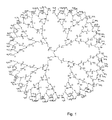
- An example of a dendrimer, the fourth generation ethylenediamine-core poly (amidoamine), called PAMAM G4 is represented in FIG. figure 1 .
- the dendrimers have the advantage of being monodisperse and of having a rigorously controlled structure, geometry and stoichiometry. Indeed, the reaction scheme of their preparation being clearly defined, each of the molecules of a given dendrimer is identical to another. For a defined dendrimer molecule, the number of functions (internal and peripheral), the charge density, area and volume occupied, the porosity of these nanomolecules are known. The table below gives some examples of dendrimers as well as some of their characteristics (theoretical properties).
- the diameter of the dendrimers varies depending on the generation. According to the dendrimer, the pore diameter of the support must be adapted to allow the dendrimer molecules to enter. It can be seen that for PAMAM G0 type dendrimers to be able to penetrate the pores, they must have a diameter greater than 1.5 nm. Although having few peripheral functions, these dendrimers nevertheless allow cyanines to self-arrange. If you want to use dendrimers of higher generation, the pores must be of average diameter greater than 1.5 nm. However, the dendrimers have a certain deformability and can therefore penetrate into pores whose diameter is smaller than their theoretical diameter. This remark is all the more valid for very deformable low-generation dendrimers.
- the highly branched molecule generally adopts a spherical shape whose deformability and flexibility of the internal branches is gradually reduced.
- a support whose pores are at least 1.5 nm, 4 nm and 6 nm can respectively receive PAMAM generation 1, 4 and 6. It is obviously necessary that a minimum of about twenty cyanine molecules can also penetrate the cyanines are much smaller (volume of a molecule about 0.8nm 3 for MYL 1) than the dendrimers, this condition is generally filled with pores in which dendrimers were able to enter.
- the dried nanocrystalline layers of AIOOH, TiO 2 or ITO mentioned in the preceding step are immersed, without cleaning treatment, for 18 hours, in an ethanolic solution of ethylenediamine-core poly (amidoamine) of generation 4 (PAMAM G4 ) of concentration 1.10 -4 M. Due to the interactions between the metal oxides contained in these layers and the many functional groups of PAMAM, it is effectively adsorbed on the surface of the mesoporous layer, including inside the pores.
- PAMAM G4 ethylenediamine-core poly (amidoamine) of generation 4
- the mesoporous layer containing the dendrimer is rinsed with pure ethanol to remove PAMAM molecules not bound to the surface of the support. Finally, it is dried under a stream of nitrogen.
- An assembly composed of a polyester support covered with a mesoporous layer based on metal oxide nanoparticles (AIOOH, TiO 2 or ITO) functionalized on the surface and in the mesopores by a dendrimer matrix of the PAMAM G4 type is thus obtained.
- the cyanine used to form the aggregate J is [5,5'-diphenyl-dibenzoxazolo N, N'-propylsulfonate] -9-ethyltrimethine cyanine (called MYLINE 1), shown in FIG. figure 3 . Since these cyanines are sensitive to light, it is essential to avoid exposing them to light, both during the preparation of the reagent and during the reaction.
- the cyanine is dissolved in acetone at a concentration of 7 ⁇ 10 -4 M. The mixture is stirred magnetically for 2 hours to ensure complete solubilization of the reagent.
- the proposed cyanine is negatively charged. Also, to allow him to interact with the PAMAM deposited on the support, it is possible to positively charge the latter. To do this, the support is previously immersed in an acidic solution, typically hydrochloric acid at pH 3.5 in order to protonate all the amine functions of PAMAM or only a part of them. The support thus activated is then immersed in the cyanine solution above, for a duration of between a few seconds and a few minutes. Then, the assembly containing the aggregate J is rinsed with pure acetone and is dried under a stream of nitrogen.
- an acidic solution typically hydrochloric acid at pH 3.5
- the adsorption time within the functionalized mesoporous matrices is greater than that applied to form aggregates J on planar supports (see Table 1). This can be explained by the fact that the time required for the cyanine molecules to diffuse and then self-assemble inside a mesopore plays an important role in the rate of formation of the J aggregate. diameter and the geometry of the pores, both of which greatly contribute to reducing the kinetics of diffusion of cyanines, the aggregation rate of these same cyanines in aggregate J within the mesoporous matrix is logically lower than on planar surfaces. It can nevertheless be noted that the adsorption times mentioned in the table for mesoporous supports are perfectly compatible with industrial processes of continuous type.
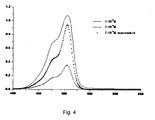
- the absorption spectrum of the molecule MYLINE 1 in solution and not aggregated is described figure 4 .
- the study of the spectrum in solution shows three peaks for cyanine MYLINE 1, at 479 nm, 506nm and 551 nm, described in the literature as respectively corresponding to the absorption peaks of the dimer, the monomer and a very low absorption maximum at 551 nm corresponding to traces of the preformed MYLINE 1 aggregate J in solution .
- the quality of the organization of the aggregates J formed is confirmed by the comparison of the wavelengths of fluorescence emission and absorption of the assembly obtained above.
- the absorption peak appears at a wavelength of 550 nm, whereas the emission peak appears at 557 nm (Table 1).
- This small difference is explained in particular by the fact that the fluorescence spectrum on TiO 2 shows a low intensity due to the electron transfer from the aggregate J to the TiO 2 , which also reduces the wavelength resolution. Nevertheless, it shows that the molecules are highly organized in aggregates J since these aggregates have emission spectra similar to those obtained in the Langmuir-Blodgett (resonance fluorescence) layers.
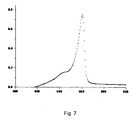
- An even better quality of aggregates J could be obtained (fwhm: 18nm) with shorter adsorption times (10min) on a nanocrystalline layer of TiO 2 with a thickness of about 3 ⁇ m ( figure 7 ; Table 1).
- the absorbance of aggregates J formed on mesoporous metal oxide layers is much higher.
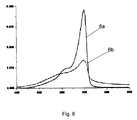
- the absorbances range from 0.7 to 2.4 (up to more than 20 times higher than the absorbance observed on planar supports, spectrum 5a to be compared to spectrum 6a).
- mesoporous layers used as a support to receive a layer of dendrimers.
- Other mesoporous metal oxides may be envisaged, such as SiO 2 , ⁇ -Al 2 O 3 , ZrO 2 , Ta 2 O 5 .
- nanoparticles of the TCO (transparent conductive oxide) type such as doped SnO 2 and ZnO, can also be used. In all cases, it is sufficient that the pore diameter is large enough to allow the molecules of dendrimers and at least 20 cyanine molecules to penetrate.
- the carrier must also have sufficient interactions with the dendrimers to adsorb to the surface.
- adsorption should here be interpreted broadly. Indeed, there are several kinds of adsorption. Physical adsorption or physisorption involves weak bonds, such as Van der Waals forces. In other cases, the adsorption involves significant binding energies. This is called chemical adsorption or chemisorption. The forces involved are of the same type as those involved in the formation of chemical bonds. The two types of interaction between the dendrimers and the support are possible.
- the possibility of covalently bonding the dendrimers on the support may be formed directly between the peripheral groups of the dendrimer and the reactive sites of the support and / or via crosslinking reactions between the dendrimer molecules.
- An example of such an attachment is, for example, the covalent attachment of poly (amidoamine) -organosilicone (PAMAMOS) type dendrimers on glass described in the article by PR Dvornic, Journal of Polymer Science, 2006, 44, 2255-2273 .
- PAMAMOS poly (amidoamine) -organosilicone
- the covalent attachment dendrimer can also be performed via the use of an intermediate layer of attachment between the support and the layer of dendrimers. An example of such an intermediate layer can be found in the article of M. Wells and RM Crooks, J. Am. Chem. Soc. 1996, 118, 3988-3989 .
- the different possibilities of adsorption and covalent attachment of the dendrimers make it possible to functionalize the mesoporous layers, in that they allow the subsequently deposited cyanines to self-arrange into J aggregates.
- PAMAM poly(ethylene glycol)
- Other dendrimers such as PAMAM G3.5, G4.5,..., Gm.5,... With carboxylic peripheral functions (COOH) or carboxylate functions (COO-), also form matrices allowing The essential characteristic that the molecule forming the model matrix must exhibit is that its outer surface, that is to say the one forming the interface with the reaction medium when it is on the support, must be defined and regular. It must, in addition, have a high density of peripheral functional groups to interact effectively with the support in order to be adsorbed or covalently bound to it, but also to interact with dye molecules and participate in their self-assembly. J aggregates. The nature and density of the functional groups within the dendrimer architecture, and the type of functional groups / dyes interaction will depend on the quality of the self-assembly and the resulting J aggregate.
- hyperbranched polymers whose molecular architecture is more irregular, are obtained by polymerization of multifunctional branched monomers ABn following a non-iterative process. While dendrimers are generally of limited size and monodisperse (by synthetic methods and by steric congestion phenomena), hyperbranched polymers are generally more polydispersed.
- hyperbranched polymers may also be suitable for the self-assembly of aggregates dyes insofar as part of the functional groups allows the adsorption or the covalent attachment of this molecule on the support, while another part of the hyperbranched structure of the polymer interacts with dye molecules and participates in their self-assembly.
- the nature and density of the functional groups within the architecture of the hyperbranched polymer, and the type of the interaction functional groups / dyes will depend on the quality of the self-assembly and the resulting aggregate J.
- the size of the hyperbranched polymer should also allow its incorporation into the mesoporous structure of the support. Main members of the family of macromolecules dendritic architecture hyperbranched polymers are therefore considered included in the use of the term dendrimer in the context of the present invention.
- the various dyes included in the definition of the cyanine family given above that is to say the cyanines, the mero-cyanines and their derivatives, are capable of self-arranging to form aggregates J on a model matrix as defined in the preceding paragraphs.
- the cyanine and the molecule forming the model matrix must be chosen in relation to each other so that the cyanine interacts with the functional groups present at the periphery of the model matrix, which implies, for example, a complementarity of electrical charges and a similarity of charge densities.
- the Myline 2 was used in anionic form, in solution in acetone at 7 ⁇ 10 -4 M.
- the PAMAM having been protonated, as described above, the model matrix is immersed for 10 to 60 minutes in the Myline solution. 2 and rinsed with acetone. Aggregate formation was observed, confirmed by the presence of an absorption peak at 583 nm. Comparing the absorbance of the Myline 2 aggregates J formed on the mesoporous TiO 2 layers with the absorbance of an aggregate monolayer J obtained on a planar gold layer (see patent application WO 2007/057356 above), this is higher (about 0.27 for an immersion time of 10 minutes on mesoporous TiO 2 while a maximum absorbance of 0.09 is observed on planar gold support).
- a cation-like cyanine can also self-arrange to form aggregates J on a negatively charged model template.
- a negatively charged dendrimer may, for example, be a generation PAMAM, Gm.5 with carboxylate peripheral functions.
- the method described above comprises a step of negatively charge the dendrimer molecules of the layer disposed on the support.
- this step may consist in deprotonating the dendrimer molecules by a reaction in a basic medium.
- the aggregates J produced according to the invention within mesoporous matrices can be directly used as light harvesting systems for solar devices and collectors, for interfaces for electron acceptor molecule detection. (as a measure of the reduction of the fluorescence emission of aggregates J).
Landscapes
- Chemical & Material Sciences (AREA)
- Engineering & Computer Science (AREA)
- Nanotechnology (AREA)
- Organic Chemistry (AREA)
- Crystallography & Structural Chemistry (AREA)
- Composite Materials (AREA)
- Life Sciences & Earth Sciences (AREA)
- General Physics & Mathematics (AREA)
- Materials Engineering (AREA)
- Physics & Mathematics (AREA)
- Chemical Kinetics & Catalysis (AREA)
- Health & Medical Sciences (AREA)
- Condensed Matter Physics & Semiconductors (AREA)
- General Health & Medical Sciences (AREA)
- Molecular Biology (AREA)
- Investigating, Analyzing Materials By Fluorescence Or Luminescence (AREA)
- Organic Low-Molecular-Weight Compounds And Preparation Thereof (AREA)
- Polyamides (AREA)
- Hybrid Cells (AREA)
- Compositions Of Macromolecular Compounds (AREA)
Claims (12)
- Komplex, gebildet von- einem Träger, der eine mesoporöse Schicht umfasst, deren Poren einen durchschnittlichen Durchmesser nach B.E.T. haben, der derart bemessen ist, dass er es Makromolekülen mit dendritischer Architektur erlaubt, dort einzudringen,- Makromolekülen mit dendritischer Architektur, die die Schicht funktionalisieren, zumindest in ihren Poren,- einer Schicht von Molekülen aus der Familie der Cyanine, die mit den Makromolekülen mit dendritischer Architektur interagieren und in J-Aggregaten organisiert sind.
- Komplex nach Anspruch 1, dadurch gekennzeichnet, dass die Schicht aus einem Werkstoff hergestellt ist, der aus AIOOH, TiO2. ITO, SiO2, γ-Al2O3, ZrO2, SnO2, ZnO, Ta2O5 ausgewählt ist oder auch auf der Basis von Nanopartikeln dotierter leitender Oxide.
- Komplex nach einem der Ansprüche 1 und 2, dadurch gekennzeichnet, dass der durchschnittliche Durchmesser nach B.E.T. der Poren der mesoporösen Schicht größer als 1,5 nm ist.
- Verfahren zur Herstellung eines Komplexes nach einem der vorangehenden Ansprüche, das die folgenden Schritte umfasst:i. Beschaffung eines Trägers, der eine mesoporöse Schicht umfasst, deren Poren einen durchschnittlichen Durchmesser nach B.E.T. haben, der derart bemessen ist, dass er es Makromolekülen mit dendritischer Architektur erlaubt, dort einzudringen,ii. Aufbringen auf den Träger einer Lösung von Makromolekülen mit dendritischer Architektur, die imstande sind, in die Poren des Trägers derart einzudringen, dass die Poren funktionalisiert werden können,iii. Bedecken des hergestellten Komplexes mit einer Cyaninlösung, die mit den Makromolekülen mit dendritischer Architektur reagiert, um sich selbst als J-Aggregate anzuordnen.
- Verfahren nach Anspruch 4, dadurch gekennzeichnet, dass es vor dem Schritt iii einen zusätzlichen Schritt umfasst, der darin besteht, die Makromoleküle mit dendritischer Architektur der auf den Träger aufgebrachten Schicht positiv zu laden.
- Verfahren nach Anspruch 5, dadurch gekennzeichnet, dass der zusätzliche Schritt darin besteht, die Makromoleküle mit dendritischer Architektur durch eine Reaktion in saurem Milieu zu protonieren.
- Verfahren nach Anspruch 4, dadurch gekennzeichnet, dass es vor dem Schritt iii einen zusätzlichen Schritt umfasst, der darin besteht, die Makromoleküle mit dendritischer Architektur der auf den Träger aufgebrachten Schicht negativ zu laden.
- Verfahren nach Anspruch 7, dadurch gekennzeichnet, dass der zusätzliche Schritt darin besteht, die Makromoleküle mit dendritischer Architektur durch eine Reaktion in basischem Milieu zu deprotonieren.
- Verfahren nach einem der Ansprüche 4 bis 8, dadurch gekennzeichnet, dass es nach dem Schritt ii einen Spülschritt umfasst, um die Makromoleküle mit dendritischer Architektur, die nicht am Träger haften, zu entfernen.
- Verfahren nach einem der Ansprüche 4 bis 9, dadurch gekennzeichnet, dass es nach dem Schritt iii einen Spülschritt umfasst, um die Cyanine, die nicht mit den Makromolekülen mit dendritischer Architektur reagiert haben, zu entfernen.
- Verfahren nach Anspruch 10, dadurch gekennzeichnet, dass die Schicht auf der Basis eines Werkstoffs hergestellt ist, der aus AIOOH, TiO2. ITO, SiO2, γ-Al2O3, ZrO2, SnO2, ZnO, Ta2O5 oder auch auf der Basis von Nanopartikeln dotierter transparenter leitender Oxide hergestellt ist.
- Verfahren nach einem der Ansprüche 4 bis 11, dadurch gekennzeichnet, dass die Makromoleküle mit dendritischer Architektur Ethylendiamin-core-poly(amidoamin) (PAMAM), in vorteilhafter Weise der Generation 1 bis 10, vorzugsweise der Generation 4 bis 10, sind.
Priority Applications (4)
| Application Number | Priority Date | Filing Date | Title |
|---|---|---|---|
| EP20070114880 EP2028236B1 (de) | 2007-08-23 | 2007-08-23 | Zusammensetzung, die J-Aggregate umfasst |
| DE200760008404 DE602007008404D1 (de) | 2007-08-23 | 2007-08-23 | Zusammensetzung, die J-Aggregate umfasst |
| AT07114880T ATE477305T1 (de) | 2007-08-23 | 2007-08-23 | Zusammensetzung, die j-aggregate umfasst |
| US12/197,377 US7824617B2 (en) | 2007-08-23 | 2008-08-25 | Assembly comprising J aggregates |
Applications Claiming Priority (1)
| Application Number | Priority Date | Filing Date | Title |
|---|---|---|---|
| EP20070114880 EP2028236B1 (de) | 2007-08-23 | 2007-08-23 | Zusammensetzung, die J-Aggregate umfasst |
Publications (2)
| Publication Number | Publication Date |
|---|---|
| EP2028236A1 EP2028236A1 (de) | 2009-02-25 |
| EP2028236B1 true EP2028236B1 (de) | 2010-08-11 |
Family
ID=39529345
Family Applications (1)
| Application Number | Title | Priority Date | Filing Date |
|---|---|---|---|
| EP20070114880 Active EP2028236B1 (de) | 2007-08-23 | 2007-08-23 | Zusammensetzung, die J-Aggregate umfasst |
Country Status (4)
| Country | Link |
|---|---|
| US (1) | US7824617B2 (de) |
| EP (1) | EP2028236B1 (de) |
| AT (1) | ATE477305T1 (de) |
| DE (1) | DE602007008404D1 (de) |
Families Citing this family (2)
| Publication number | Priority date | Publication date | Assignee | Title |
|---|---|---|---|---|
| CH703675B1 (fr) * | 2005-11-16 | 2012-03-15 | Suisse Electronique Microtech | Procédé de réalisation d'agrégats J. |
| EP2684839A1 (de) | 2012-07-13 | 2014-01-15 | CSEM Centre Suisse d'Electronique et de Microtechnique SA - Recherche et Développement | Mesoporöse Schicht mit J-Aggregaten |
Family Cites Families (3)
| Publication number | Priority date | Publication date | Assignee | Title |
|---|---|---|---|---|
| EP0967086B1 (de) | 1998-06-18 | 2001-03-21 | ILFORD Imaging Switzerland GmbH | Aufzeichnungsmaterialien für den Tintenstrahldruck |
| EP1244114A1 (de) | 2001-03-20 | 2002-09-25 | ILFORD Imaging Switzerland GmbH | Elektrisch aktive Filme |
| CH703675B1 (fr) | 2005-11-16 | 2012-03-15 | Suisse Electronique Microtech | Procédé de réalisation d'agrégats J. |
-
2007
- 2007-08-23 EP EP20070114880 patent/EP2028236B1/de active Active
- 2007-08-23 AT AT07114880T patent/ATE477305T1/de not_active IP Right Cessation
- 2007-08-23 DE DE200760008404 patent/DE602007008404D1/de active Active
-
2008
- 2008-08-25 US US12/197,377 patent/US7824617B2/en active Active
Also Published As
| Publication number | Publication date |
|---|---|
| US7824617B2 (en) | 2010-11-02 |
| US20090142230A1 (en) | 2009-06-04 |
| ATE477305T1 (de) | 2010-08-15 |
| DE602007008404D1 (de) | 2010-09-23 |
| EP2028236A1 (de) | 2009-02-25 |
Similar Documents
| Publication | Publication Date | Title |
|---|---|---|
| Imahori et al. | Chain length effect on the structure and photoelectrochemical properties of self-assembled monolayers of porphyrins on gold electrodes | |
| Micali et al. | From fractal to nanorod porphyrin J-aggregates. Concentration-induced tuning of the aggregate size | |
| EP2271438B1 (de) | Abdeckung eines substrats mit einer polymerfolie zu seiner stabilität in einem flüssigen medium | |
| EP2652533B1 (de) | Optisches element mit einem rissfreien aerogel | |
| EP3161883B1 (de) | Tandemzellen mit mehreren fäden | |
| EP2550679B1 (de) | PV-Module mit Antireflexionsschicht mit dispergierten Objekten mit Bereichen mit unterschiedlichem Brechungsindex | |
| WO2021130461A1 (fr) | Module photovoltaïque | |
| WO1999067181A1 (fr) | Procede de fabrication d'une electrode comportant un film d'oxyde de tungstene | |
| EP2028236B1 (de) | Zusammensetzung, die J-Aggregate umfasst | |
| WO2017103222A1 (fr) | Supports amplificateurs de contraste utilisant un materiau bidimensionnel | |
| EP2670884B1 (de) | Verfahren zur herstellung von metallnanopartikeln | |
| CA2681300C (fr) | Nanocristaux organiques luminescents pour la realisation de capteurs biologiques | |
| EP2708492B1 (de) | Mesoporöse Schicht mit J-Aggregaten und Herstellungsverfahren | |
| EP3815155A1 (de) | Fotovoltaikzelle und verfahren zur herstellung davon | |
| WO2010034936A1 (fr) | Revêtements anti-reflet comprenant des objets dispersés présentant deux domaines séparés ayant des indices de réfraction distincts | |
| EP1704607B1 (de) | P-n-hybridmaterial für einen anorganischen/organischen halbleiter, herstellungsverfahren dafür und fotovoltaikzelle damit | |
| WO2008125567A2 (fr) | Procédé de fabrication d'un élément de feutre graphitique métallise revêtu d'une façon homogène dans tout son volume d'un polymère organique conducteur | |
| EP1788036B1 (de) | Verfahren zur Herstellung von J-Aggregaten | |
| WO2020120922A1 (fr) | Matériau poreux fonctionnalisé et utilisation comme électrode de pseudo-supercondensateur | |
| FR2900848A1 (fr) | Procede de depot de film mince nanometrique sur un substrat | |
| EP2666747B1 (de) | Film aus halbkugelförmigen partikeln, verfahren zu seiner herstellung und verwendung | |
| EP1346260A1 (de) | Träger für ein zu belichtendes material | |
| CN101054007A (zh) | 有机染料和多金属氧酸盐自组装的有机-无机复合膜 | |
| WO2020002832A1 (fr) | Composition de polymère conducteur et son procédé de fabrication |
Legal Events
| Date | Code | Title | Description |
|---|---|---|---|
| PUAI | Public reference made under article 153(3) epc to a published international application that has entered the european phase |
Free format text: ORIGINAL CODE: 0009012 |
|
| AK | Designated contracting states |
Kind code of ref document: A1 Designated state(s): AT BE BG CH CY CZ DE DK EE ES FI FR GB GR HU IE IS IT LI LT LU LV MC MT NL PL PT RO SE SI SK TR |
|
| AX | Request for extension of the european patent |
Extension state: AL BA HR MK RS |
|
| 17P | Request for examination filed |
Effective date: 20090617 |
|
| AKX | Designation fees paid |
Designated state(s): AT BE BG CH CY CZ DE DK EE ES FI FR GB GR HU IE IS IT LI LT LU LV MC MT NL PL PT RO SE SI SK TR |
|
| GRAP | Despatch of communication of intention to grant a patent |
Free format text: ORIGINAL CODE: EPIDOSNIGR1 |
|
| GRAS | Grant fee paid |
Free format text: ORIGINAL CODE: EPIDOSNIGR3 |
|
| GRAA | (expected) grant |
Free format text: ORIGINAL CODE: 0009210 |
|
| RAP1 | Party data changed (applicant data changed or rights of an application transferred) |
Owner name: CSEM CENTRE SUISSE D'ELECTRONIQUE ET DE MICROTECHN |
|
| AK | Designated contracting states |
Kind code of ref document: B1 Designated state(s): AT BE BG CH CY CZ DE DK EE ES FI FR GB GR HU IE IS IT LI LT LU LV MC MT NL PL PT RO SE SI SK TR |
|
| REG | Reference to a national code |
Ref country code: GB Ref legal event code: FG4D Free format text: NOT ENGLISH |
|
| REG | Reference to a national code |
Ref country code: CH Ref legal event code: EP |
|
| REG | Reference to a national code |
Ref country code: IE Ref legal event code: FG4D Free format text: LANGUAGE OF EP DOCUMENT: FRENCH |
|
| REF | Corresponds to: |
Ref document number: 602007008404 Country of ref document: DE Date of ref document: 20100923 Kind code of ref document: P |
|
| REG | Reference to a national code |
Ref country code: CH Ref legal event code: NV Representative=s name: GLN GRESSET & LAESSER NEUCHATEL CABINET DE CONSEIL |
|
| REG | Reference to a national code |
Ref country code: NL Ref legal event code: VDEP Effective date: 20100811 |
|
| LTIE | Lt: invalidation of european patent or patent extension |
Effective date: 20100811 |
|
| PG25 | Lapsed in a contracting state [announced via postgrant information from national office to epo] |
Ref country code: LT Free format text: LAPSE BECAUSE OF FAILURE TO SUBMIT A TRANSLATION OF THE DESCRIPTION OR TO PAY THE FEE WITHIN THE PRESCRIBED TIME-LIMIT Effective date: 20100811 Ref country code: NL Free format text: LAPSE BECAUSE OF FAILURE TO SUBMIT A TRANSLATION OF THE DESCRIPTION OR TO PAY THE FEE WITHIN THE PRESCRIBED TIME-LIMIT Effective date: 20100811 Ref country code: FI Free format text: LAPSE BECAUSE OF FAILURE TO SUBMIT A TRANSLATION OF THE DESCRIPTION OR TO PAY THE FEE WITHIN THE PRESCRIBED TIME-LIMIT Effective date: 20100811 Ref country code: AT Free format text: LAPSE BECAUSE OF FAILURE TO SUBMIT A TRANSLATION OF THE DESCRIPTION OR TO PAY THE FEE WITHIN THE PRESCRIBED TIME-LIMIT Effective date: 20100811 |
|
| BERE | Be: lapsed |
Owner name: CSEM CENTRE SUISSE D'ELECTRONIQUE ET DE MICROTECH Effective date: 20100831 |
|
| PG25 | Lapsed in a contracting state [announced via postgrant information from national office to epo] |
Ref country code: SI Free format text: LAPSE BECAUSE OF FAILURE TO SUBMIT A TRANSLATION OF THE DESCRIPTION OR TO PAY THE FEE WITHIN THE PRESCRIBED TIME-LIMIT Effective date: 20100811 Ref country code: BG Free format text: LAPSE BECAUSE OF FAILURE TO SUBMIT A TRANSLATION OF THE DESCRIPTION OR TO PAY THE FEE WITHIN THE PRESCRIBED TIME-LIMIT Effective date: 20101111 Ref country code: CY Free format text: LAPSE BECAUSE OF FAILURE TO SUBMIT A TRANSLATION OF THE DESCRIPTION OR TO PAY THE FEE WITHIN THE PRESCRIBED TIME-LIMIT Effective date: 20100811 Ref country code: IS Free format text: LAPSE BECAUSE OF FAILURE TO SUBMIT A TRANSLATION OF THE DESCRIPTION OR TO PAY THE FEE WITHIN THE PRESCRIBED TIME-LIMIT Effective date: 20101211 Ref country code: PL Free format text: LAPSE BECAUSE OF FAILURE TO SUBMIT A TRANSLATION OF THE DESCRIPTION OR TO PAY THE FEE WITHIN THE PRESCRIBED TIME-LIMIT Effective date: 20100811 Ref country code: PT Free format text: LAPSE BECAUSE OF FAILURE TO SUBMIT A TRANSLATION OF THE DESCRIPTION OR TO PAY THE FEE WITHIN THE PRESCRIBED TIME-LIMIT Effective date: 20101213 |
|
| REG | Reference to a national code |
Ref country code: IE Ref legal event code: FD4D |
|
| PG25 | Lapsed in a contracting state [announced via postgrant information from national office to epo] |
Ref country code: GR Free format text: LAPSE BECAUSE OF FAILURE TO SUBMIT A TRANSLATION OF THE DESCRIPTION OR TO PAY THE FEE WITHIN THE PRESCRIBED TIME-LIMIT Effective date: 20101112 Ref country code: SE Free format text: LAPSE BECAUSE OF FAILURE TO SUBMIT A TRANSLATION OF THE DESCRIPTION OR TO PAY THE FEE WITHIN THE PRESCRIBED TIME-LIMIT Effective date: 20100811 Ref country code: LV Free format text: LAPSE BECAUSE OF FAILURE TO SUBMIT A TRANSLATION OF THE DESCRIPTION OR TO PAY THE FEE WITHIN THE PRESCRIBED TIME-LIMIT Effective date: 20100811 Ref country code: MC Free format text: LAPSE BECAUSE OF NON-PAYMENT OF DUE FEES Effective date: 20100831 |
|
| PG25 | Lapsed in a contracting state [announced via postgrant information from national office to epo] |
Ref country code: DK Free format text: LAPSE BECAUSE OF FAILURE TO SUBMIT A TRANSLATION OF THE DESCRIPTION OR TO PAY THE FEE WITHIN THE PRESCRIBED TIME-LIMIT Effective date: 20100811 Ref country code: IE Free format text: LAPSE BECAUSE OF FAILURE TO SUBMIT A TRANSLATION OF THE DESCRIPTION OR TO PAY THE FEE WITHIN THE PRESCRIBED TIME-LIMIT Effective date: 20100811 |
|
| PG25 | Lapsed in a contracting state [announced via postgrant information from national office to epo] |
Ref country code: IT Free format text: LAPSE BECAUSE OF FAILURE TO SUBMIT A TRANSLATION OF THE DESCRIPTION OR TO PAY THE FEE WITHIN THE PRESCRIBED TIME-LIMIT Effective date: 20100811 Ref country code: CZ Free format text: LAPSE BECAUSE OF FAILURE TO SUBMIT A TRANSLATION OF THE DESCRIPTION OR TO PAY THE FEE WITHIN THE PRESCRIBED TIME-LIMIT Effective date: 20100811 Ref country code: RO Free format text: LAPSE BECAUSE OF FAILURE TO SUBMIT A TRANSLATION OF THE DESCRIPTION OR TO PAY THE FEE WITHIN THE PRESCRIBED TIME-LIMIT Effective date: 20100811 Ref country code: EE Free format text: LAPSE BECAUSE OF FAILURE TO SUBMIT A TRANSLATION OF THE DESCRIPTION OR TO PAY THE FEE WITHIN THE PRESCRIBED TIME-LIMIT Effective date: 20100811 Ref country code: SK Free format text: LAPSE BECAUSE OF FAILURE TO SUBMIT A TRANSLATION OF THE DESCRIPTION OR TO PAY THE FEE WITHIN THE PRESCRIBED TIME-LIMIT Effective date: 20100811 |
|
| PLBE | No opposition filed within time limit |
Free format text: ORIGINAL CODE: 0009261 |
|
| STAA | Information on the status of an ep patent application or granted ep patent |
Free format text: STATUS: NO OPPOSITION FILED WITHIN TIME LIMIT |
|
| PG25 | Lapsed in a contracting state [announced via postgrant information from national office to epo] |
Ref country code: ES Free format text: LAPSE BECAUSE OF FAILURE TO SUBMIT A TRANSLATION OF THE DESCRIPTION OR TO PAY THE FEE WITHIN THE PRESCRIBED TIME-LIMIT Effective date: 20101122 |
|
| 26N | No opposition filed |
Effective date: 20110512 |
|
| PG25 | Lapsed in a contracting state [announced via postgrant information from national office to epo] |
Ref country code: BE Free format text: LAPSE BECAUSE OF NON-PAYMENT OF DUE FEES Effective date: 20100831 |
|
| REG | Reference to a national code |
Ref country code: DE Ref legal event code: R097 Ref document number: 602007008404 Country of ref document: DE Effective date: 20110512 |
|
| PG25 | Lapsed in a contracting state [announced via postgrant information from national office to epo] |
Ref country code: MT Free format text: LAPSE BECAUSE OF FAILURE TO SUBMIT A TRANSLATION OF THE DESCRIPTION OR TO PAY THE FEE WITHIN THE PRESCRIBED TIME-LIMIT Effective date: 20100811 |
|
| PG25 | Lapsed in a contracting state [announced via postgrant information from national office to epo] |
Ref country code: LU Free format text: LAPSE BECAUSE OF NON-PAYMENT OF DUE FEES Effective date: 20100823 Ref country code: HU Free format text: LAPSE BECAUSE OF FAILURE TO SUBMIT A TRANSLATION OF THE DESCRIPTION OR TO PAY THE FEE WITHIN THE PRESCRIBED TIME-LIMIT Effective date: 20110212 |
|
| PG25 | Lapsed in a contracting state [announced via postgrant information from national office to epo] |
Ref country code: TR Free format text: LAPSE BECAUSE OF FAILURE TO SUBMIT A TRANSLATION OF THE DESCRIPTION OR TO PAY THE FEE WITHIN THE PRESCRIBED TIME-LIMIT Effective date: 20100811 |
|
| REG | Reference to a national code |
Ref country code: CH Ref legal event code: PFA Owner name: CSEM CENTRE SUISSE D'ELECTRONIQUE ET DE MICROT, CH Free format text: FORMER OWNER: CSEM CENTRE SUISSE D'ELECTRONIQUE ET DE MICROTECHNIQUE SA - RECHERCHE ET DEVELOPPEMENT, CH |
|
| REG | Reference to a national code |
Ref country code: FR Ref legal event code: PLFP Year of fee payment: 10 |
|
| REG | Reference to a national code |
Ref country code: CH Ref legal event code: PFA Owner name: CSEM CENTRE SUISSE D'ELECTRONIQUE ET DE MICROT, CH Free format text: FORMER OWNER: CSEM CENTRE SUISSE D'ELECTRONIQUE ET DE MICROTECHNIQUE SA - RECHERCHE ET DEVELOPPEMENT, CH |
|
| REG | Reference to a national code |
Ref country code: FR Ref legal event code: PLFP Year of fee payment: 11 |
|
| REG | Reference to a national code |
Ref country code: FR Ref legal event code: PLFP Year of fee payment: 12 |
|
| REG | Reference to a national code |
Ref country code: CH Ref legal event code: NV Representative=s name: BOVARD SA NEUCHATEL CONSEILS EN PROPRIETE INTE, CH |
|
| PGFP | Annual fee paid to national office [announced via postgrant information from national office to epo] |
Ref country code: DE Payment date: 20250819 Year of fee payment: 19 |
|
| PGFP | Annual fee paid to national office [announced via postgrant information from national office to epo] |
Ref country code: GB Payment date: 20250825 Year of fee payment: 19 |
|
| PGFP | Annual fee paid to national office [announced via postgrant information from national office to epo] |
Ref country code: FR Payment date: 20250821 Year of fee payment: 19 |
|
| PGFP | Annual fee paid to national office [announced via postgrant information from national office to epo] |
Ref country code: CH Payment date: 20250901 Year of fee payment: 19 |
|
| REG | Reference to a national code |
Ref country code: CH Ref legal event code: R18 Free format text: ST27 STATUS EVENT CODE: U-0-0-R10-R18 (AS PROVIDED BY THE NATIONAL OFFICE) Effective date: 20260209 |
|
| REG | Reference to a national code |
Ref country code: CH Ref legal event code: R18 Free format text: ST27 STATUS EVENT CODE: U-0-0-R10-R18 (AS PROVIDED BY THE NATIONAL OFFICE) Effective date: 20260320 |