EP2028603B1 - Adapter für ein externes Speichermedium - Google Patents
Adapter für ein externes Speichermedium Download PDFInfo
- Publication number
- EP2028603B1 EP2028603B1 EP20070114578 EP07114578A EP2028603B1 EP 2028603 B1 EP2028603 B1 EP 2028603B1 EP 20070114578 EP20070114578 EP 20070114578 EP 07114578 A EP07114578 A EP 07114578A EP 2028603 B1 EP2028603 B1 EP 2028603B1
- Authority
- EP
- European Patent Office
- Prior art keywords
- adapter
- interface
- storage device
- data
- persistent storage
- Prior art date
- Legal status (The legal status is an assumption and is not a legal conclusion. Google has not performed a legal analysis and makes no representation as to the accuracy of the status listed.)
- Expired - Fee Related
Links
Images



Classifications
-
- G—PHYSICS
- G06—COMPUTING OR CALCULATING; COUNTING
- G06F—ELECTRIC DIGITAL DATA PROCESSING
- G06F21/00—Security arrangements for protecting computers, components thereof, programs or data against unauthorised activity
- G06F21/70—Protecting specific internal or peripheral components, in which the protection of a component leads to protection of the entire computer
- G06F21/78—Protecting specific internal or peripheral components, in which the protection of a component leads to protection of the entire computer to assure secure storage of data
-
- G—PHYSICS
- G06—COMPUTING OR CALCULATING; COUNTING
- G06F—ELECTRIC DIGITAL DATA PROCESSING
- G06F21/00—Security arrangements for protecting computers, components thereof, programs or data against unauthorised activity
- G06F21/70—Protecting specific internal or peripheral components, in which the protection of a component leads to protection of the entire computer
- G06F21/82—Protecting input, output or interconnection devices
- G06F21/85—Protecting input, output or interconnection devices interconnection devices, e.g. bus-connected or in-line devices
-
- G—PHYSICS
- G06—COMPUTING OR CALCULATING; COUNTING
- G06F—ELECTRIC DIGITAL DATA PROCESSING
- G06F3/00—Input arrangements for transferring data to be processed into a form capable of being handled by the computer; Output arrangements for transferring data from processing unit to output unit, e.g. interface arrangements
- G06F3/06—Digital input from, or digital output to, record carriers, e.g. RAID, emulated record carriers or networked record carriers
- G06F3/0601—Interfaces specially adapted for storage systems
- G06F3/0628—Interfaces specially adapted for storage systems making use of a particular technique
- G06F3/0638—Organizing or formatting or addressing of data
Definitions
- the present invention relates to an external storage medium adapter.
- the present invention relates to an external storage medium on which data can be stored in encrypted form. More particular, it relates to an external storage as described in European Patent application no. 06101719.0 filed by the same applicant as the present application.
- the external storage as described in this application no. 06101719.0 can store data in encrypted form together with access credentials which allow the decryption of the stored data.
- the external storage detects if it is disconnected from its host, and then a counter or timer starts and if an expiration criterion based on an expired time or a predefined number of counted events is met the access to the data is denied due to the fact that the data cannot be decrypted anymore since the access credentials which were stored on the external storage are deleted.
- data can securely be stored on the external storage because the access is not unlimited but will be made impossible after the expiration criterion is met.
- the unauthorized user cannot access the storage after the expiration criterion is met, e.g. after the expiration of a certain time. If this time is set sufficiently small (e.g. a few minutes) it is extremely unlikely that the data stored on this device can be accessed by a user for which the data are not intended.
- Fig. 1 schematically illustrates a configuration of an external storage as described in the previous European Patent application no. 06101719.0 .
- a "trusted host” data and access credentials can be written onto the storage module.
- data will be encrypted and stored on encrypted user data storage 27 after encryption of the data by the encryption engine 25.
- the credentials needed to encrypt data and decrypt the encrypted data are written into credential storage 24 by the trusted host.
- Connectivity detection module 22 detects when the storage is disconnected from the host and then the timer 23 starts to operate. As long as the expiration condition (the expiration of the time limit defined by the timer) is not met, any host other than the trusted host can access the encrypted data through using the credentials stored in credential storage 24. After expiration of the timer, however, the access credentials are deleted and access is not possible anymore.
- the expiration condition the expiration of the time limit defined by the timer
- US 2004/0143733 A1 discloses a mediator for the protection of data in storage devices over a network.
- the mediator connects over the network to one or more data clients and to one or more data storage devices, and provides secure storage of data for the data clients on the data storage devices.
- the mediator functions as a central point for the encryption of data from the data clients to be stored on the storage devices, as well as decryption of the encrypted data retrieved from the storage devices for delivery to the data clients.
- the mediator can handle multiple protocols, such as IP protocols, file service protocols, and block device protocols; multiple storage technologies such as Fiber Channel and Ethernet; and multiple services such as block, file, and database services.
- the mediator can also perform various fictions such as protocol translation.
- the mediator benefits from the fact that all storage devices, as well as data clients, are connected over a network, thereby allowing flexibility, expandability, and scalability of configurations without the limitations imposed by local interconnectivity. At the same time, however, the mediator provides secure virtual storage to data clients without requiting them to be involved in any of the encryption or decryption operations. In particular; data clients are not burdened with compulsory management of any keys used in the protection of stored data. As a result, the encryption/decryption of stored data can be optimized for security without concerns for key distribution.
- US 2003/0105967 A1 discloses an apparatus for encrypting data between a processor and a memory and a method thereof are disclosed.
- the processor includes: a module for encrypting an input data or decrypting an encrypted data; a key table for storing secret keys for data encryption/decryption; and a control unit for generating an index for the encrypting operation of the module.
- the memory includes: a memory cell array for storing data encrypted by the module of the processor; and a key state memory for storing the index generated in the control unit of the processor and used for the encryption of the input data.
- said identifiers for identifying credentials are unique or at least stochastically unique across all external storage medium adapters. This avoids a collision between credentials of different adapters.
- the operations buffer in one embodiment is also used to collect operations on blocks until it can be determined what kind of operation it is and on what file. After that, in the block/file mapping based embodiment, the adapter is able to contact the separate storage device on its file interface to read/write the file.
- credentials are added to said credential storage on the adapter by storing them as special files in either a specific location or with a specific name so that they can be identified by the encryption engine. This enables the writing of credentials without a specific dedicated command set. Normal mass storage device class commands can be used for writing credentials.
- an external storage medium adapter which together with a separate persistent memory which can be accessed through this adapter provides a functionality similar to the one of the external storage medium of the previous application, however, which overcomes the deficiency of the limited storage amount.
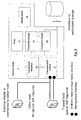
- This is achieved by providing a separation of the persistent memory from the encryption engine and credential management and storage as schematically illustrated in Fig. 2 .
- the persistent memory for storing the (encrypted) user data is kept in another device.
- the encryption engine and credential management which is provided in the external storage medium adapter in fact acts as an adapter or intermediary taking unencrypted data on one interface (on the left-hand side of Fig.
- Fig. 2 For reading the data which has been stored in the separate device which contains the persistent memory, the reverse operation is performed.
- different persistent memory devices can be used with the same adapter.
- the encryption engine encrypts the data to be written into the persistent storage by using the credentials (which may be one or more encryption keys) stored in credential storage 24 and then stores them into the persistent storage.
- the credentials may have been written to the external storage medium adapter using a "trusted host” as schematically illustrated in Fig. 2 , or they may have been downloaded into the credential storage 24 from a "credential provider” as described in the parallel European Patent application number 07114320.0 filed on August 14, 2007 , by the same applicant as the present one and titled “External Storage Medium”.
- the credentials may be loaded also into the credential storage 24 of the present embodiment.
- the external storage medium adapter further comprises a module (not shown in Fig. 2 ) for credential management which maintains a mapping between the data stored in the persistent storage and the corresponding credential(s) used to encrypt them.
- a module not shown in Fig. 2
- credential management which maintains a mapping between the data stored in the persistent storage and the corresponding credential(s) used to encrypt them.
- the same credential or key is used for all of the data on the persistent storage, however, according to a further embodiment different data may be encrypted using different credentials.
- the external storage medium adapter then performs a suitable credential management to identify which credential is to be used to encrypt or decrypt which data.
- the embodiments of the invention are related to an external storage medium shown in Fig. 1 and which is described in more detail in the already mentioned earlier European Patent application no. 06101719.0 and to which reference is made for a more detailed description of such an external storage medium.
- encrypted user data storage (27) and unencrypted user data storage (28) are kept outside of the Secure External Storage Medium shown in Fig. 1 .
- Such an embodiment forming an external storage medium adapter is schematically illustrated in Fig. 2 .
- the data in this embodiment is stored in a separate persistent storage outside the adapter.
- the interface (4) is used for communication between the External Storage Medium Adapter (2) and the Persistent Storage Device (3).
- the Interface (4) can be any kind of interface that is suitable to set-up communication between the devices. Suitable interfaces are for instance a direct mass storage media connection (such as USB) or a network based communication, where both devices are connected to the network. For the latter communication, according to one embodiment means to detect integrity violations are added.
- the Interface 4 is able to exchange these block numbers and the data stored at that block or the data to be stored at that block.
- the data between the persistent storage and the adapter via interface 4 is block based, and the access to the adapter from the host via the communication module 21 is block-based as well.
- the adapter "transparently" enables a block based access of the persistent storage.
- the persistent storage in this example may be of the "mass storage device class" which means that the access to the device is block based and not file-based.
- a file system may be provided on the host (not shown in Fig.
- FIG. 4 shows that the host (the computer which accesses the persistent storage through the adapter) performs a block based access on the adapter which then is "forwarded" as block based access to the persistent storage.
- the access in this example may e.g. be the mass storage device class interface of the USB interface, which is implemented in almost all modern computer systems.
- the persistent data storage comprises a metadata storage (33) which stores sufficient information to enable the external storage medium adapter to determine which credential can be used for encryption and decryption.
- This metadata may e.g. comprise an identifier which identifies a corresponding credential stored in credential storage 24 of the adapter. Using this identifier which is then transmitted together with the corresponding encrypted data from the persistent storage medium to the adapter the adapter can identify the credential to be used to decrypt the data.
- the adapter for that purpose performs a mapping between the credentials and their corresponding identifiers, and at the persistent storage the metadata are stored such that there is maintained a mapping between the blocks or files and the corresponding credential identifiers.
- the credentials in the adapter are named uniquely (or stochastically uniquely) across all adapters. This helps ensure that the persistent storage device is handled properly when used with different adapters.
- the term "stochastically unique" here means for example that the likelihood for two different credentials of different adapters having the same identifier is small, preferably sufficiently small to be negligible.
- a file based interface can be used as interface 4 in Fig. 3 .
- This enables the adapter to operate on the level of files and directories, identified by their names and their path through parent directories, instead of addressing blocks. Because the interface between the host and the adapter may still remain a block based interface, in this embodiment the directory structure is recreated inside the adapter.
- the block/file mapping component (292) performs this task. The operation of such an embodiment is schematically illustrated in Fig. 5 which shows a situation where the access from the host to the adapter is block-based and the access from the adapter to the persistent storage is file-based.
- Fig. 6 The operation of the block/file mapping is schematically illustrated in Fig. 6 .
- a translation or a "mapping" of the blocks to the corresponding files or directories As can be seen from Fig. 5 , this can be achieved by performing a suitable mapping between the blocks and the files/directories.
- a block-based request in this manner can be translated into a corresponding file-based request and vice versa.
- the mapping may be performed using one or more suitable tables which maintain the mapping.
- a persistent storage which requires a file-based access through an interface (the host-adapter interface) which is block-based.
- the host-adapter interface which is block-based.
- a mass storage device class interface which is available on almost all computers which may act as a host accessing the adapter
- a persistent storage which requires a file-based access, such as e.g. a network attached storage device (NAS) or any other devices requiring a file-based access.
- NAS network attached storage device
- the adapter generates a file system based on the mapping mentioned before.
- This file system (which may also be called “virtual file system” because from the host accessing the adapter it is not noticed) is then used to perform the file-based access through interface 4.
- the adapter (2) when the adapter (2) is connected to the persistent storage device (3), it first scans the directory structure on the persistent storage device. It then builds a virtual file system, which allows accessing of these files through a block based interface. The mapping between block address and position in a file is kept by the block/file mapping component (292). The mapping is available until the adapter is disconnected from the persistent storage device.
- the adapter for performing the task of creating and maintaining the virtual file system the adapter is provided with suitable components like a suitably programmed microprocessor and a storage for maintaining the necessary data for maintaining the file system.
- the access to the persistent storage is file-based and the access of the adapter from the host is block based.
- the corresponding file is looked up in the mapping to acquire the file from the persistent storage device.
- the credential used at time of encryption is to be looked up in the Encryption metadata storage (33).
- the credential is acquired from Credential storage (24) and the Encryption Engine performs decryption.
- the operations buffer (291) stores all write operations until the file system is in a consistent state again. As soon as this happens, the files touched by the write operation are updated on the persistent storage device. File update is encrypted with the appropriate credential and the Encryption metadata is updated accordingly. Triggers to detect file system consistency are e.g. certain time without write operations, write operation to certain blocks, e.g. those containing directory structures or file system tables or predefined files, or detaching the external medium adapter from the host. Buffering operations until file system is consistent is required to deduce from the write commands sent on the Block interface level, which file is meant to be written.
- the credential management in this embodiment may be performed like in the previous European Patent application no. 06101719.0 or like in the parallel application mentioned before and filed on August 14, 2007 at the European Patent Office and having the application number 07114320.0 .
- the adapter provides a user an interface through which he can monitor the file operations performed by the host computer on the persistent storage device via the adapter.
- the host computer belongs to company A
- the adapter belongs to a staff member of company B and may be e.g. a mobile phone or any similar device, and the persistent storage may also belong to company B.
- the staff member may through his mobile phone (the adapter) enable the user of the computer to download some file from the persistent storage via his mobile device using the decryption capability of the adapter.
- the owner of the mobile device may, however, wish to control what file the computer which belongs to company A downloads from the persistent storage (e.g. a harddisk) belonging to company B.
- the persistent storage e.g. a harddisk
- the mobile device (the adapter) is equipped with a user interface which is built based on the file system maintained inside the adapter and which enables the user of the mobile device (the adapter) to monitor the file operations performed by the host computer.
- the interface at the adapter may just resemble the interface which is provided to the user of the host computer.
- the interface may in one embodiment ask for each file operation the user of the adapter whether the operation is allowed or not. Depending on the response to this query the file operation is either performed or not performed.
- the persistent storage device connected to the adapter may be any mass storage device such as an USB stick, a SD card, or any storage medium like e.g. a harddisk or a CD or DVD.
- the interface through which the connection between the adapter and the persistent storage is established may be a USB interface, a LAN or WLAN connection, or any other interface or connection.
- the external storage medium adapter (2) is used without a separate persistent storage device. Instead the adapter has a storage (which needs not to be a persistent storage but can be a volatile storage) into which data can be written from the computer (the host) to which it is connected.
- a file system which is generated inside the adapter, similar to the embodiment described before. It can be said that this example is similar to the one described before, but that instead of the persistent storage outside the adapter there is provided a - persistent or non-persistent - storage inside the adapter which is accessed in a file-based manner. Therefore, like in the previous embodiment, there is performed a mapping between blocks and files/directories.
- the file system is built inside the adapter on top of the storage, and it is used to access the storage by translating block based access commands into file-based access commands like in the previous embodiment.
- the storage inside the adapter based on the file system provided inside has a file structure which provides an input file or input directory for writing data thereto and which in response to being written thereto is then encrypted and the encrypted file is then written into an output file or output directory.
- Data that has been written to the adapter e.g. into a certain directory, will be encrypted by using credentials and the encryption engine and can be retrieved via another directory (the "target location" or “output” directory) immediately after encryption has finished.
- this encrypted file can be written into a designated directory, from where it is decrypted and placed into a target (or output) directory.
- the adapter in this example therefore acts as an encryption/decryption dongle.
- the host accessing the adapter uses the block address based mass storage device interface but the storage access inside the adapter works on file level. In this way the adapter can be used by almost all hosts because almost all computers are equipped with a block address based mass storage device interface.
- the access to the storage inside the adapter is based on file-based access, which makes it possible to provide predefined source and/or target files/directories which can be used for encryption or decryption as described before.
- this example is the same as the one described before where the persistent storage was accessed with a file-based interface and the adapter was accessed with a block-based interface, except that the "persistent storage” is now located not separately outside the adapted but is located inside the adapter, that the persistent storage may also be a volatile storage, and that the file system created inside the adapted provides a "source location” and a "target location", the source location being for data to be encrypted or decrypted, and the target location being for writing thereto the data after encryption or decryption was performed.
- credentials are added to the Credential storage on the adapter by storing them as special files in either a specific location or with a specific name.
- the adapter has a file system generated inside it and there is performed a translation of a block-based access into a file based access using a block/file mapping.
- these files can be written to the adapter using the ordinary mass storage device class command set without the need of an extended command set.
- the thus written files may based on their location or based on their name be recognised, and the encryption engine may then use them directly or store them at first in the credential storage so that from there they are then used for encryption/decryption by the encryption engine.
- the invention may be implemented by a mobile phone or a mobile device which is suitably programmed to operate as an external storage medium adapter in accordance with one of the embodiments described before.
Landscapes
- Engineering & Computer Science (AREA)
- Computer Hardware Design (AREA)
- Theoretical Computer Science (AREA)
- Computer Security & Cryptography (AREA)
- Software Systems (AREA)
- Physics & Mathematics (AREA)
- General Engineering & Computer Science (AREA)
- General Physics & Mathematics (AREA)
- Storage Device Security (AREA)
- Information Retrieval, Db Structures And Fs Structures Therefor (AREA)
Claims (4)
- Ein externer Speichermediumadapter (2) zum Bilden eine Verbindung zwischen einem Computer und einer separaten persistenten Speichervorrichtung, wobei der externe Speichermediumadapter aufweist:ein erstes Interface zum Verbinden des Computers und zum Empfangen von Daten durch das Interface von dem Computer, welche in verschlüsselter Form auf der separaten persistenten Speichervorrichtung gespeichert werden sollen;ein zweites Interface (4) zum Verbinden des externen Speichermediumadapters mit der separaten persistenten Speichervorrichtung;eine Verschlüsselungsengine (25) zum Verschlüsseln von Daten, die von dem Computer empfangen wurden und die in verschlüsselter Form auf die persistente Speichervorrichtung geschrieben werden sollen, oder zum Entschlüsseln von Daten, die in entschlüsselter Form von der persistenten Speichervorrichtung unter Verwendung von einem oder mehreren Credentials abgerufen werden;einen Credentialspeicher (24) zum Speichern der ein oder mehreren Credentials, die verwendet werden, um die Daten zu verschlüsseln oder zu entschlüsseln, wobeider Adapter (2) ein Mapping zwischen einem Credential und seinem entsprechenden Identifier führt, wobei der Adapter so angepasst ist, dass zusätzlich zu den verschlüsselten Daten Metadaten auf die Speichervorrichtung geschrieben werden, wobei die Metadaten es ermöglichen, für die verschlüsselten Daten das Credential zu identifizieren, das von dem Adapter zu verwenden ist, um die verschlüsselten Daten zu entschlüsseln, wobeidas Interface (4) zum Verbinden des externen Speichermediumadapters mit der separaten persistenten Speichervorrichtumg ein filebasiertes Interface ist, undwobei das Interface zum Verbinden des externen Speichermediumadapters mit dem Computer ein blockbasiertes Interface ist und der Adapter aufweist:ein Mappingmodul (292), um Blocks auf Files zu mappen und umgekehrt, um auf die Files der persistenten Speichervorrichtung durch das filebasierte Interface zuzugreifen, das den Adapter mit dem persistenten Speicher verbindet, und zwar über das blockbasierte Interface, das den Adapter mit dem Computer verbindet, wobei der Adapter ferner aufweist:einen Einrichtung zum Scannen der Verzeichnisstruktur auf der persistenten Speichervorrichtung, wenn der Adapter mit der separaten persistenten Speichervorrichtung verbunden wird;eine Einrichtung zum Aufbau eines virtuellen Filesystems, wobei das virtuelle Filesystem erzeugt wird durch das Mappingmodul (292) innerhalb des Adapters, welcher die Verzeichnisstruktur innerhalb des Adapters wieder aufbaut, um auf Daten auf der separaten persistenten Speichervorrichtung über ein filebasiertes Interface zuzugreifen;ein Userinterface, das basierend auf dem Filesystem des Adapters dem Benutzer die auszuführende Fileoperation anzeigt, wobei das Userinterface des Adapters dem Benutzer die Möglichkeit liefert, eine Fileoperation, die durch den Computer angefordert wurde, zu bestätigen oder abzulehnen.
- Der Speichermediumadapter nach Anspruch 1, wobei die Identifiers zum Identifizieren von Credentials eindeutig oder zumindest stochastisch eindeutig über alle Speichermediumadapter sind.
- Der externe Speichermediumadapter nach einem der vorhergehenden Ansprüche, ferner aufweisend:einen Operationspuffer (291) zum Speichern aller Schreiboperationen bis festgestellt wird, dass das Filesystem erneut in einem konsistenten Zustand ist, und sobald dies passiert, die Files, die durch die Schreiboperationen tangiert wurden, auf der separaten persistenten Speichervorrichtung upgedatet werden.
- Der externe Speichermediumadapter nach Anspruch 3, wobei die Konsistenz des Filesystems detektiert wird basierend auf einem oder mehreren der folgenden Auslöser:eine bestimmte Zeit ohne Schreiboperationen;Schreiboperationen auf bestimmte Blöcke wie diejenigen, die Verzeichnisstrukturen oder Filesystemtabellen oder vordefinierte Files enthalten;Entfernen des externen Mediumadapters von dem Computer.
Priority Applications (1)
| Application Number | Priority Date | Filing Date | Title |
|---|---|---|---|
| EP20070114578 EP2028603B1 (de) | 2007-08-20 | 2007-08-20 | Adapter für ein externes Speichermedium |
Applications Claiming Priority (1)
| Application Number | Priority Date | Filing Date | Title |
|---|---|---|---|
| EP20070114578 EP2028603B1 (de) | 2007-08-20 | 2007-08-20 | Adapter für ein externes Speichermedium |
Publications (2)
| Publication Number | Publication Date |
|---|---|
| EP2028603A1 EP2028603A1 (de) | 2009-02-25 |
| EP2028603B1 true EP2028603B1 (de) | 2011-07-13 |
Family
ID=38792121
Family Applications (1)
| Application Number | Title | Priority Date | Filing Date |
|---|---|---|---|
| EP20070114578 Expired - Fee Related EP2028603B1 (de) | 2007-08-20 | 2007-08-20 | Adapter für ein externes Speichermedium |
Country Status (1)
| Country | Link |
|---|---|
| EP (1) | EP2028603B1 (de) |
Families Citing this family (2)
| Publication number | Priority date | Publication date | Assignee | Title |
|---|---|---|---|---|
| JP5505010B2 (ja) * | 2010-03-19 | 2014-05-28 | 富士通株式会社 | 記憶媒体アダプタ及びデータアクセス不能化方法 |
| US8839371B2 (en) * | 2010-08-26 | 2014-09-16 | Standard Microsystems Corporation | Method and system for securing access to a storage device |
Family Cites Families (5)
| Publication number | Priority date | Publication date | Assignee | Title |
|---|---|---|---|---|
| GB2372600B (en) * | 2001-02-27 | 2003-02-19 | 3Com Corp | Network area storage block and file aggregation |
| KR100445406B1 (ko) | 2001-11-30 | 2004-08-25 | 주식회사 하이닉스반도체 | 데이터 암호화 장치 및 그 방법 |
| US7873700B2 (en) * | 2002-08-09 | 2011-01-18 | Netapp, Inc. | Multi-protocol storage appliance that provides integrated support for file and block access protocols |
| US20040143733A1 (en) | 2003-01-16 | 2004-07-22 | Cloverleaf Communication Co. | Secure network data storage mediator |
| EP1821230B1 (de) | 2006-02-15 | 2008-08-13 | NTT DoCoMo, Inc. | Externes Speichermedium |
-
2007
- 2007-08-20 EP EP20070114578 patent/EP2028603B1/de not_active Expired - Fee Related
Also Published As
| Publication number | Publication date |
|---|---|
| EP2028603A1 (de) | 2009-02-25 |
Similar Documents
| Publication | Publication Date | Title |
|---|---|---|
| US7908489B2 (en) | Method for managing external storage devices | |
| US20040143733A1 (en) | Secure network data storage mediator | |
| US8335915B2 (en) | Encryption based security system for network storage | |
| EP2043073A1 (de) | Verfahren zur verschlüsselung und entschlüsselung gemeinsamer verschlüsselter dateien | |
| JP4728060B2 (ja) | ストレージ装置 | |
| US8261068B1 (en) | Systems and methods for selective encryption of operating system metadata for host-based encryption of data at rest on a logical unit | |
| US8966281B1 (en) | Systems and methods for accessing storage or network based replicas of encryped volumes with no additional key management | |
| US8170213B1 (en) | Methodology for coordinating centralized key management and encryption keys cached through proxied elements | |
| AU2016203740B2 (en) | Simultaneous state-based cryptographic splitting in a secure storage appliance | |
| US20070136606A1 (en) | Storage system with built-in encryption function | |
| US20100162002A1 (en) | Virtual tape backup arrangement using cryptographically split storage | |
| US7428642B2 (en) | Method and apparatus for data storage | |
| US9384149B2 (en) | Block-level data storage security system | |
| US20090055556A1 (en) | External storage medium adapter | |
| JP2009524153A (ja) | セキュリティ保護されたデジタルデータのアーカイビング及びアクセス監査システム及び方法 | |
| US8750519B2 (en) | Data protection system, data protection method, and memory card | |
| WO2010057151A2 (en) | Block-level data storage security system | |
| KR20210078437A (ko) | 안전한 중복 제거를 위한 방법, 장치, 및 시스템 | |
| CN109726575B (zh) | 一种数据加密方法及装置 | |
| CN110892403B (zh) | 安全地访问数据的方法 | |
| EP1388061A2 (de) | Auf verschlüsselung basierendes sicherheitssystem für die netzwerkspeicherung | |
| CN114186245A (zh) | 来自存储系统的加密密钥 | |
| EP1998270A1 (de) | Externe Speichervorrichtung | |
| EP2028603B1 (de) | Adapter für ein externes Speichermedium | |
| WO2004064350A2 (en) | System and method for secure network data storage |
Legal Events
| Date | Code | Title | Description |
|---|---|---|---|
| PUAI | Public reference made under article 153(3) epc to a published international application that has entered the european phase |
Free format text: ORIGINAL CODE: 0009012 |
|
| 17P | Request for examination filed |
Effective date: 20080926 |
|
| AK | Designated contracting states |
Kind code of ref document: A1 Designated state(s): AT BE BG CH CY CZ DE DK EE ES FI FR GB GR HU IE IS IT LI LT LU LV MC MT NL PL PT RO SE SI SK TR |
|
| AX | Request for extension of the european patent |
Extension state: AL BA HR MK RS |
|
| 17Q | First examination report despatched |
Effective date: 20090209 |
|
| AKX | Designation fees paid |
Designated state(s): DE GB |
|
| RBV | Designated contracting states (corrected) |
Designated state(s): AT BE BG CH CY CZ DE DK EE ES FI FR GB GR HU IE IS IT LI LT LU LV MC MT NL PL PT RO SE SI SK TR |
|
| RBV | Designated contracting states (corrected) |
Designated state(s): DE GB |
|
| GRAP | Despatch of communication of intention to grant a patent |
Free format text: ORIGINAL CODE: EPIDOSNIGR1 |
|
| GRAS | Grant fee paid |
Free format text: ORIGINAL CODE: EPIDOSNIGR3 |
|
| GRAA | (expected) grant |
Free format text: ORIGINAL CODE: 0009210 |
|
| AK | Designated contracting states |
Kind code of ref document: B1 Designated state(s): DE GB |
|
| REG | Reference to a national code |
Ref country code: GB Ref legal event code: FG4D |
|
| REG | Reference to a national code |
Ref country code: DE Ref legal event code: R096 Ref document number: 602007015739 Country of ref document: DE Effective date: 20110901 |
|
| PGFP | Annual fee paid to national office [announced via postgrant information from national office to epo] |
Ref country code: DE Payment date: 20110817 Year of fee payment: 5 Ref country code: GB Payment date: 20110817 Year of fee payment: 5 |
|
| PLBE | No opposition filed within time limit |
Free format text: ORIGINAL CODE: 0009261 |
|
| STAA | Information on the status of an ep patent application or granted ep patent |
Free format text: STATUS: NO OPPOSITION FILED WITHIN TIME LIMIT |
|
| 26N | No opposition filed |
Effective date: 20120416 |
|
| REG | Reference to a national code |
Ref country code: DE Ref legal event code: R097 Ref document number: 602007015739 Country of ref document: DE Effective date: 20120416 |
|
| GBPC | Gb: european patent ceased through non-payment of renewal fee |
Effective date: 20120820 |
|
| PG25 | Lapsed in a contracting state [announced via postgrant information from national office to epo] |
Ref country code: DE Free format text: LAPSE BECAUSE OF NON-PAYMENT OF DUE FEES Effective date: 20130301 Ref country code: GB Free format text: LAPSE BECAUSE OF NON-PAYMENT OF DUE FEES Effective date: 20120820 |
|
| REG | Reference to a national code |
Ref country code: DE Ref legal event code: R119 Ref document number: 602007015739 Country of ref document: DE Effective date: 20130301 |