EP2031160A2 - Schloss-Schlüsselkombination - Google Patents
Schloss-Schlüsselkombination Download PDFInfo
- Publication number
- EP2031160A2 EP2031160A2 EP08075698A EP08075698A EP2031160A2 EP 2031160 A2 EP2031160 A2 EP 2031160A2 EP 08075698 A EP08075698 A EP 08075698A EP 08075698 A EP08075698 A EP 08075698A EP 2031160 A2 EP2031160 A2 EP 2031160A2
- Authority
- EP
- European Patent Office
- Prior art keywords
- key
- thickness
- lock
- shank
- shaft
- Prior art date
- Legal status (The legal status is an assumption and is not a legal conclusion. Google has not performed a legal analysis and makes no representation as to the accuracy of the status listed.)
- Withdrawn
Links
- 230000004323 axial length Effects 0.000 claims abstract description 5
- 238000000034 method Methods 0.000 description 4
- 238000004519 manufacturing process Methods 0.000 description 2
- 210000000481 breast Anatomy 0.000 description 1
- 238000005553 drilling Methods 0.000 description 1
- 238000005516 engineering process Methods 0.000 description 1
- 238000005259 measurement Methods 0.000 description 1
- 230000033458 reproduction Effects 0.000 description 1
- 238000005070 sampling Methods 0.000 description 1
- 230000007704 transition Effects 0.000 description 1
Images
Classifications
-
- E—FIXED CONSTRUCTIONS
- E05—LOCKS; KEYS; WINDOW OR DOOR FITTINGS; SAFES
- E05B—LOCKS; ACCESSORIES THEREFOR; HANDCUFFS
- E05B19/00—Keys; Accessories therefor
- E05B19/0017—Key profiles
- E05B19/0023—Key profiles characterized by variation of the contact surface between the key and the tumbler pins or plates
-
- E—FIXED CONSTRUCTIONS
- E05—LOCKS; KEYS; WINDOW OR DOOR FITTINGS; SAFES
- E05B—LOCKS; ACCESSORIES THEREFOR; HANDCUFFS
- E05B27/00—Cylinder locks or other locks with tumbler pins or balls that are set by pushing the key in
- E05B27/0042—Cylinder locks or other locks with tumbler pins or balls that are set by pushing the key in with additional key identifying function, e.g. with use of additional key operated rotor-blocking elements, not of split pin tumbler type
Definitions
- the invention relates to a lock-key combination, with a cylinder core rotatably mounted in the lock cylinder housing into which a flat key can be inserted, which has profilings extending on the side surfaces in the longitudinal direction of the shaft, consisting of parallel profile grooves and elevations, the height of which is substantially perpendicular to the shaft longitudinal plane of at least one locking pin is scanned.
- the profiling of keys usually consists of profilings made continuously in the key shank.
- the lock cylinder of the cylinder core contains a granted key profile, which receives at least one key, within locking systems also different, different key profiles.
- the profiling in the keyway is usually continuous from front to back.
- key profile shafts allow, in particular with sufficient robustness, only a limited number of different key profile features, that is, codes on the side surfaces.
- the number of different profile features is important for the size and complexity of the realizable locking systems. In any case, it is desirable to increase the number of possible key or keyway profiles that can be realized on a key or in the lock cylinder.
- Key profiles have a limited safety value from the viewpoint of safety, in particular, the safety of scanning of lock cylinders and key security (security of keys against unauthorized craft or commercial imitation), because the shape from outside the lock cylinder recognizable and the unauthorized manufacture of key blanks is possible From the outside, this means that the key profile can be imitated here due to the design of the externally visible part of the key channel. It is theoretically easy possible to go to a lock cylinder as often as you like, to take the measurements and to work on the blank in peace and to rework each time until it fits.
- Another need to improve key security is to prevent end-to-end reworking of key profiles.
- the key located at the top in the locking system hierarchy is naturally the thinnest. The farther the key is located in the hierarchy level over the individual profiles to the central profiles, the thicker is the profile or the larger the cross section.
- the invention has for its object to further increase the key security and to prevent unauthorized reproductions, but at least greatly complicate.
- a lock-key combination with a cylinder core rotatably mounted in the lock cylinder housing into which a flat key is inserted, which on the side surfaces in the longitudinal direction of the shaft extending profiles, consisting of parallel profile grooves and - elevations, having their Height is scanned substantially perpendicular to the shaft longitudinal plane of at least one locking pin, characterized in that at least one of the side surfaces in a plurality in the longitudinal direction of the key shank adjacent sections is divided, which have over the axial length of this section a constant thickness of the key shank and that the thickness of the key shank of at least one of these sections is smaller than the thickness of the adjacent section.
- the thickness of the portion near the Reide and the thickness of the portion near the top of the key shank is equal and corresponds to the maximum thickness of the key shank.
- the inventive design of the key shank impedes unauthorized reworking of such a key, since the scanning areas on the key are not recognizable and thus the profile can not be subsequently manipulated.
- the position of the thickness transition can be selected differently from closure to closure in order to make it more difficult to spy the scan.
- the respective thickness range can be scanned in a known manner at least at one point by means of a pin, which ensures a perfect passage of the housing pins with the correct key, or releases the closing process from a recess introduced in the housing.
- the pattern key is usually measured in the thick area and manufactured according to these dimensions. Now, when this key is inserted into the core, the pin in the "thin area" of the core blocks the closing process.
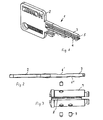
- the key 1 consists of the crayon 2 and the key shaft 3, which has the usual notches 4 on the key breast, which are scanned by tumblers.
- the side surfaces of the key shank have an essentially parallel grooves and elevations existing profile 5.
- the thickness of the key shank is the same over its axial longitudinal extent. The invention deviates from it.
- At least one of the side surfaces is divided into a plurality of juxtaposed in the longitudinal direction of the key shank portions 6, which have over the axial length of this section a constant thickness of the key shank, but the thickness of the key shank of at least one of these sections 6 'is smaller than that Thickness of the adjacent section 6 ".
- At least one locking pin 9 can now be provided in the cylinder core 7, which then interacts with one of the sections 6 ', 6 ". With a matching key, this locking pin compensates in a known manner at the parting plane between the cylinder core and the surrounding cylinder housing (not shown here) so that a closing operation can be carried out. Since the sections 6 'and 6 "extend over a certain axial length of the key shank, it can not be recognized at the key where the respective scanning takes place.
- the region or section of the key shank near the reide and near the tip have approximately the maximum key shank thickness, as is also the case according to the plan view FIG. 2 is recognizable.
Landscapes
- Lock And Its Accessories (AREA)
Abstract
Description
- Die Erfindung betrifft eine Schloss-Schlüsselkombination, mit einem im Schließzylindergehäuse drehbar angeordneten Zylinderkern, in den ein Flachschlüssel einführbar ist, der an den Seitenflächen in Längsrichtung des Schaftes verlaufende Profilierungen, bestehend aus parallel verlaufenden Profilnuten und - erhebungen, aufweist, wobei deren Höhe im Wesentlichen senkrecht zur Schaftlängsebene von mindestens einem Sperrstift abtastbar ist.
- Die Profilierung von Schlüsseln besteht üblicherweise aus durchgehend in den Schlüsselschaft gefertigten Profilierungen. Im Schließzylinder enthält der Zylinderkern ein eingeräumtes Schlüsselprofil, welches zumindestens ein Schlüssel-, innerhalb von Schließanlagen auch verschiedene, unterschiedliche Schlüsselprofile aufnimmt. Die Profilierung im Schlüsselkanal ist normalerweise durchgängig von vorn bis hinten vorhanden.
- Die üblicherweise verwendeten Querschnitte von Schlüssel-Profilschäften lassen insbesondere bei ausreichender Robustheit nur eine beschränkte Anzahl von unterschiedlichen Schlüsselprofilmerkmalen, also Codierungen an den Seitenflächen, zu.
- Die Zahl der verschiedenen Profilmerkmale ist von Bedeutung für die Größe und die Komplexität der realisierbaren Schließanlagen. Wünschenswert ist auf jeden Fall die Erhöhung der Zahl der möglichen, auf einem Schlüssel bzw. im Schließzylinder realisierbaren Schlüssel- bzw. Schlüsselkanal-Profile.
- Schlüsselprofile haben unter dem Gesichtspunkt der Sicherheit, insbesondere der Abtastsicherheit von Schließzylindern und der Schlüsselsicberheit (Sicherheit von Schlüsseln gegen unbefugte handwerkliche oder gewerbliche Nachahmung) einen beschränkten Sicherheitswert, weil die Formgebung von außerhalb des Schließzylinders erkennbar und die unbefugte Anfertigung von Schlüsselrohlingen möglich ist
Von außen heißt dabei, dass hier aufgrund der Gestaltung des von außen sichtbaren Teiles des Schlüsselkanals das Schlüsselprofil nachahmbar ist . Es ist theoretisch ohne weiteres möglich, beliebig oft zu einem Schließzylinder zu gehen, die Maße abzunehmen und in Ruhe den Rohling zu bearbeiten und jeweils wieder nachzubearbeiten, bis er paßt. - Eine Verschleierung des Schlüsselprofils also, die Nichterkennbarkeit von außerhalb, ist daher für die Erhöhung der Schlüsselsicherheit von großem Interesse.
- Ein weiterer Bedarf zur Verbesserung der Schlüsselsicherheit besteht darin, das durchgängige Nacharbeiten von Schlüsselprofilen zu verhindern.
- Bei der Realisierung von Schließanlagen über Schlüsselprofile ist in der Schließanlagenhierarchie der am weitesten oben angesiedelte Schlüssel naturgemäß der dünnste. Je weiter der Schlüssel in der Hierarchiestufe über die Einzelprofile weiter hin zu den Zentralprofilen angesiedelt ist, um so dicker ist das Profil bzw. um so größer der Querschnitt.
- In der Praxis ist der Mißbrauch zu beobachten, dass aus Schlüsseln mit großem Material- bzw. Profilquerschnitt ein übergeordnetes Profil durch mechanische Nacharbeit gefertigt wird, indem die beim übergeordneten Schlüssel nicht vorhandenen Profilmerkmale entfernt werden. Dies gelingt, da das Profil des übergeordneten in jedem Falle ein gemeinsames dünnstes aller in der Schließanlage verwendeten Schlüsselprofile ist.
Bei einiger Kenntnis der Schloßanlagentechnologie kann so aus vorhandenen untergeordneten Profilen (Schlüsseln) ein übergeordnetes, ggf. durch mehrmaliges Probieren in anderen Schließzylindern, durch Nacharbeiten gefertigt werden. Das Schlüsselprofil wird dabei auf seiner gesamten Länge angepaßt, - Die Erfindung liegt die Aufgabe zugrunde, die Schlüsselsicherheit weiter zu erhöhen und unberechtigte Nachanfertigungen zu verhindern, zumindest aber sehr zu erschweren.
- Gelöst wird diese Aufgabe erfindungsgemäß mit einer Schloss-Schlüsselkombination, mit einem im Schließzylindergehäuse drehbar angeordneten Zylinderkern, in den ein Flachschlüssel einführbar ist, der an den Seitenflächen in Längsrichtung des Schaftes verlaufende Profilierungen, bestehend aus parallel verlaufenden Profilnuten und - erhebungen, aufweist, wobei deren Höhe im Wesentlichen senkrecht zur Schaftlängsebene von mindestens einem Sperrstift abtastbar ist, dadurch, dass mindestens eine der Seitenflächen in mehrere in Längsrichtung des Schlüsselschaftes nebeneinander liegende Abschnitte unterteilt ist, die über die axiale Länge dieses Abschnittes eine gleichbleibende Dicke des Schlüsselschaftes aufweisen und dass die Dicke des Schlüsselschaftes mindestens eines dieser Abschnitte kleiner ist als die Dicke des benachbarten Abschnittes.
- Nach einer vorzugsweisen Ausgestaltung der Erfindung ist die Dicke des Abschnittes nahe der Reide und die Dicke des Abschnittes nahe der Spitze des Schlüsselschaftes gleich und entspricht der maximalen Dicke des Schlüsselschaftes.
- Die erfindungsgemäße Ausbildung des Schlüsselschaftes erschwert eine unerlaubte Nacharbeitung eines derartigen Schlüssels, da die Abtastungsbereiche am Schlüssel nicht erkennbar sind und somit das Profil nicht nachträglich manipuliert werden kann.
- Hinzukommt, dass durch die unterschiedlichen Dicken des Schlüsselschaftes die Position des Dickenüberganges unterschiedlich von Schließung zu Schließung gewählt werden kann, um das Ausspähen der Abtastung zu erschweren.
- Der jeweilige Dickenbereich kann in bekannter Weise mindestens an einer Stelle mittels eines Stiftes abgetastet werden, der bei korrektem Schlüssel ein einwandfreies Passieren der Gehäusestifte gewährleistet, bzw. den Schließvorgang aus einer im Gehäuse eingebrachten Vertiefung freigibt.
- Bei einer Nachanfertigung des Schlüssels, wird der Musterschlüssel üblicherweise im dicken Bereich gemessen und nach diesen Maßen gefertigt. Wird nun dieser Schlüssel in den Kern eingeführt blockiert der Stift im "Dünnbereich" des Kerns den Schließvorgang.
- Wird andererseits der Schlüssel im dünnen Bereich gemessen oder durch Manipulation dünn gefertigt, so wird dieser zu dünne Schlüssel im "Dickbereich" des Kernes den Stift nicht betätigen. Bei Verdrehen des Kernes wird der Gehäusestift in ein Fangloch eindringen und den Schließvorgang beenden.
- Der Vorteil der sich ergibt ist, dass im Gegensatz zu bekannten Abtastungsverfahren keine erkennbaren Abtastungsstellen auf dem Schlüssel erkennbar sind und somit ein Nachschlüssel nicht durch Bohrungen/Vertiefungen dergestalt manipuliert werden kann, damit anschließend eine erfolgreiche Schließung erfolgen kann.
- Die Erfindung soll nachfolgend unter Bezug auf die Zeichnungen näher erläutert werden.
- Dabei zeigt:
- Fig. 1
- eine perspektivische Ansicht eines erfindungsgemäßen Schlüssels,
- Fig. 2
- eine Aufsicht auf den Schlüssel und
- Fig. 3
- eine vereinfachte Darstellung des Zylinderkerns mit Abtaststiften.
- Wie aus den
Figuren 1 und 2 ersichtlich, besteht der Schlüssel 1 aus der Schlüsselreide 2 und dem Schlüsselschaft 3, der an der Schlüsselbrust die üblichen Kerben 4 aufweist, die von Zuhaltungen abgetastet werden.
Die Seitenflächen des Schlüsselschaftes weisen eine aus im Wesentlichen parallelen Nuten und Erhebungen bestehendes Profil 5 auf.
Üblicherweise ist die Dicke des Schlüsselschaftes über dessen axiale Längserstreckung gleich.
Die Erfindung weicht davon ab. - Hier nach ist mindestens eine der Seitenflächen in mehrere in Längsrichtung des Schlüsselschaftes nebeneinander liegende Abschnitte 6 unterteilt ist, die über die axiale Länge dieses Abschnittes eine gleichbleibende Dicke des Schlüsselschaftes aufweisen, wobei aber die Dicke des Schlüsselschaftes mindestens eines dieser Abschnitte 6' kleiner ist als die Dicke des benachbarten Abschnittes 6".
- Im Zylinderkern 7 kann nun mindestens ein Sperrstift 9 vorgesehen sein, der dann mit einem der Abschnitte 6', 6" zusammen wirkt. Bei passendem Schlüssel gleicht dieser Sperrstift in bekannter Weise an der Trennebene zwischen Zylinderkern und dem umgebenden - hier nicht dargestellten - Zylindergehäuse ab, so dass ein Schließvorgang ausgeführt werden kann.
Da sich die Abschnitte 6' und 6" über eine bestimmte axiale Länge des Schlüsselschaftes erstrecken, kann am Schlüssel nicht erkannt werden, wo die jeweilige Abtastung stattfindet. - Damit der Schlüssel im Schlüsselkanal 8 des Zylinderkernes 7 einwandfrei geführt wird, ist es vorteilhaft, wenn der Bereich oder Abschnitt des Schlüsselschaftes nahe der Reide und nahe der Spitze etwa die maximale Schlüsselschaftdicke aufweisen, wie dies auch aus der Aufsicht nach
Figur 2 erkennbar ist.
Claims (2)
- Schloss-Schlüsselkombination, mit einem im Schließzylindergehäuse drehbar angeordneten Zylinderkern, in den ein Flachschlüssel (1) einführbar ist, der an den Seitenflächen in Längsrichtung des Schaftes (3) verlaufende Profilierungen (5), bestehend aus parallel verlaufenden Profilnuten und - erhebungen, aufweist, wobei deren Höhe im Wesentlichen senkrecht zur Schaftlängsebene von mindestens einem Sperrstift (9) abtastbar ist,
dadurch gekennzeichnet,
dass mindestens eine der Seitenflächen in mehrere in Längsrichtung des Schlüsselschaftes nebeneinander liegende Abschnitte (6',6") unterteilt ist, die über die axiale Länge dieses Abschnittes eine gleichbleibende Dicke des Schlüsselschaftes aufweisen und
dass die Dicke des Schlüsselschaftes (3) mindestens eines dieser Abschnitte kleiner ist als die Dicke des benachbarten Abschnittes. - Schloss-Schlüsselkombination nach Anspruch 1,
dadurch gekennzeichnet,
dass die Dicke des Abschnittes nahe der Reide (2) und die Dicke des Abschnittes nahe der Spitze des Schlüsselschaftes gleich ist und der maximalen Dicke des Schlüsselschaftes entspricht.
Applications Claiming Priority (1)
| Application Number | Priority Date | Filing Date | Title |
|---|---|---|---|
| DE200710041964 DE102007041964B3 (de) | 2007-09-03 | 2007-09-03 | Schloss-Schlüsselkombination |
Publications (2)
| Publication Number | Publication Date |
|---|---|
| EP2031160A2 true EP2031160A2 (de) | 2009-03-04 |
| EP2031160A3 EP2031160A3 (de) | 2009-11-04 |
Family
ID=40227591
Family Applications (1)
| Application Number | Title | Priority Date | Filing Date |
|---|---|---|---|
| EP08075698A Withdrawn EP2031160A3 (de) | 2007-09-03 | 2008-08-11 | Schloss-Schlüsselkombination |
Country Status (2)
| Country | Link |
|---|---|
| EP (1) | EP2031160A3 (de) |
| DE (1) | DE102007041964B3 (de) |
Cited By (1)
| Publication number | Priority date | Publication date | Assignee | Title |
|---|---|---|---|---|
| EP2078807A3 (de) * | 2008-01-10 | 2015-05-06 | Aug. Winkhaus GmbH & Co. KG | Schlüssel für einen Schließzylinder |
Citations (2)
| Publication number | Priority date | Publication date | Assignee | Title |
|---|---|---|---|---|
| DE19515129A1 (de) | 1995-04-25 | 1996-10-31 | Ikon Praezisionstechnik | Schließzylinder |
| EP0953699A2 (de) | 1998-04-04 | 1999-11-03 | EVVA-Werk Spezialerzeugung von Zylinder- und Sicherheitsschlössern Gesellschaft m.b.H. & Co. Kommanditgesellschaft | Schliesszylinder mit zugeordnetem Flachschlüssel im variablen Stufenprofil |
Family Cites Families (5)
| Publication number | Priority date | Publication date | Assignee | Title |
|---|---|---|---|---|
| AT371880B (de) * | 1980-09-25 | 1983-08-10 | Evva Werke | Flachschluessel |
| DE3521530A1 (de) * | 1985-06-15 | 1986-12-18 | Fa. Wilhelm Karrenberg, 5620 Velbert | Schluessel fuer schliesszylinder |
| AT405668B (de) * | 1995-02-01 | 1999-10-25 | Evva Werke | Flachschlüssel für zylinderschloss |
| DE19548426C2 (de) * | 1995-12-22 | 2003-12-11 | Schliesanlagen Gmbh Pfaffenhai | Zylinderschloß für Schließanlagen |
| DE102005058549B4 (de) * | 2005-12-08 | 2018-04-26 | Audi Ag | Schlüssel und Schließeinrichtung mit einem Schlüssel |
-
2007
- 2007-09-03 DE DE200710041964 patent/DE102007041964B3/de not_active Expired - Fee Related
-
2008
- 2008-08-11 EP EP08075698A patent/EP2031160A3/de not_active Withdrawn
Patent Citations (2)
| Publication number | Priority date | Publication date | Assignee | Title |
|---|---|---|---|---|
| DE19515129A1 (de) | 1995-04-25 | 1996-10-31 | Ikon Praezisionstechnik | Schließzylinder |
| EP0953699A2 (de) | 1998-04-04 | 1999-11-03 | EVVA-Werk Spezialerzeugung von Zylinder- und Sicherheitsschlössern Gesellschaft m.b.H. & Co. Kommanditgesellschaft | Schliesszylinder mit zugeordnetem Flachschlüssel im variablen Stufenprofil |
Cited By (1)
| Publication number | Priority date | Publication date | Assignee | Title |
|---|---|---|---|---|
| EP2078807A3 (de) * | 2008-01-10 | 2015-05-06 | Aug. Winkhaus GmbH & Co. KG | Schlüssel für einen Schließzylinder |
Also Published As
| Publication number | Publication date |
|---|---|
| DE102007041964B3 (de) | 2009-02-26 |
| EP2031160A3 (de) | 2009-11-04 |
Similar Documents
| Publication | Publication Date | Title |
|---|---|---|
| EP0008310B1 (de) | Zylinderschloss mit Wende-Flachschlüssel | |
| DE102008045739B4 (de) | Schließzylindersystem | |
| EP1607553B1 (de) | Schliesszylinder | |
| EP2305926B1 (de) | Schließvorrichtung bestehend aus einem Schließzylinder und einem dazu passenden Schlüssel | |
| CH638585A5 (de) | Schliessanlage mit einer vielzahl voneinander abweichender schliessungsmoeglichkeiten. | |
| EP2454429B1 (de) | Schliessvorrichtung | |
| DE102010012261B4 (de) | Schließsystem | |
| EP1712714B1 (de) | Kombination eines Flachschlüssels und eines Zylinderschlosses | |
| EP1333136B1 (de) | Schliesszylinder | |
| DE3021334C2 (de) | ||
| EP2792822A2 (de) | Kodierung über Sperrbalken | |
| EP2031160A2 (de) | Schloss-Schlüsselkombination | |
| DE19515129A1 (de) | Schließzylinder | |
| EP1333135B1 (de) | Schliesszylinder | |
| AT392506B (de) | Zylinderschloss und zugehoeriger flachschluessel | |
| DE102009037682B4 (de) | Schließzylinder | |
| EP3428371B1 (de) | Schliesskern, schliesszylinder, schliessvorrichtung und zylinderschloss sowie verfahren hierzu | |
| EP2025839B1 (de) | Schloss-Schlüsselkombination | |
| EP0937843B1 (de) | Drehschliesszylinder für ein Sicherheitsschloss | |
| DE3521530A1 (de) | Schluessel fuer schliesszylinder | |
| EP1746226B1 (de) | Schlüssel | |
| DE102005030408B3 (de) | Zylinderschloss | |
| EP2388416A2 (de) | Profilzylinderschlüssel | |
| EP1577469A2 (de) | Schlüssel | |
| AT407547B (de) | Flachschlüssel und zylinderschloss |
Legal Events
| Date | Code | Title | Description |
|---|---|---|---|
| PUAI | Public reference made under article 153(3) epc to a published international application that has entered the european phase |
Free format text: ORIGINAL CODE: 0009012 |
|
| AK | Designated contracting states |
Kind code of ref document: A2 Designated state(s): AT BE BG CH CY CZ DE DK EE ES FI FR GB GR HR HU IE IS IT LI LT LU LV MC MT NL NO PL PT RO SE SI SK TR |
|
| AX | Request for extension of the european patent |
Extension state: AL BA MK RS |
|
| PUAL | Search report despatched |
Free format text: ORIGINAL CODE: 0009013 |
|
| AK | Designated contracting states |
Kind code of ref document: A3 Designated state(s): AT BE BG CH CY CZ DE DK EE ES FI FR GB GR HR HU IE IS IT LI LT LU LV MC MT NL NO PL PT RO SE SI SK TR |
|
| AX | Request for extension of the european patent |
Extension state: AL BA MK RS |
|
| 17P | Request for examination filed |
Effective date: 20091029 |
|
| 17Q | First examination report despatched |
Effective date: 20100127 |
|
| GRAP | Despatch of communication of intention to grant a patent |
Free format text: ORIGINAL CODE: EPIDOSNIGR1 |
|
| AKX | Designation fees paid |
Designated state(s): AT BE BG CH CY CZ DE DK EE ES FI FR GB GR HR HU IE IS IT LI LT LU LV MC MT NL NO PL PT RO SE SI SK TR |
|
| AXX | Extension fees paid |
Extension state: RS Payment date: 20100310 Extension state: MK Payment date: 20100310 Extension state: BA Payment date: 20100310 Extension state: AL Payment date: 20100310 |
|
| GRAS | Grant fee paid |
Free format text: ORIGINAL CODE: EPIDOSNIGR3 |
|
| GRAL | Information related to payment of fee for publishing/printing deleted |
Free format text: ORIGINAL CODE: EPIDOSDIGR3 |
|
| STAA | Information on the status of an ep patent application or granted ep patent |
Free format text: STATUS: THE APPLICATION IS DEEMED TO BE WITHDRAWN |
|
| 18D | Application deemed to be withdrawn |
Effective date: 20100908 |