EP2031850A2 - System und Verfahren zum automatischen Rückruf mithilfe von Verfügbarkeitsinformationen - Google Patents
System und Verfahren zum automatischen Rückruf mithilfe von Verfügbarkeitsinformationen Download PDFInfo
- Publication number
- EP2031850A2 EP2031850A2 EP08102679A EP08102679A EP2031850A2 EP 2031850 A2 EP2031850 A2 EP 2031850A2 EP 08102679 A EP08102679 A EP 08102679A EP 08102679 A EP08102679 A EP 08102679A EP 2031850 A2 EP2031850 A2 EP 2031850A2
- Authority
- EP
- European Patent Office
- Prior art keywords
- called party
- call
- call back
- status
- availability
- Prior art date
- Legal status (The legal status is an assumption and is not a legal conclusion. Google has not performed a legal analysis and makes no representation as to the accuracy of the status listed.)
- Ceased
Links
- 238000000034 method Methods 0.000 title claims abstract description 21
- 230000000977 initiatory effect Effects 0.000 claims abstract description 23
- 239000002131 composite material Substances 0.000 claims description 6
- 230000004044 response Effects 0.000 claims 2
- TVYLLZQTGLZFBW-ZBFHGGJFSA-N (R,R)-tramadol Chemical compound COC1=CC=CC([C@]2(O)[C@H](CCCC2)CN(C)C)=C1 TVYLLZQTGLZFBW-ZBFHGGJFSA-N 0.000 description 16
- 238000004891 communication Methods 0.000 description 9
- 238000012545 processing Methods 0.000 description 8
- 230000001413 cellular effect Effects 0.000 description 4
- 239000003795 chemical substances by application Substances 0.000 description 4
- 235000006508 Nelumbo nucifera Nutrition 0.000 description 1
- 240000002853 Nelumbo nucifera Species 0.000 description 1
- 235000006510 Nelumbo pentapetala Nutrition 0.000 description 1
- 230000009471 action Effects 0.000 description 1
- 239000008186 active pharmaceutical agent Substances 0.000 description 1
- 230000008901 benefit Effects 0.000 description 1
- 230000008859 change Effects 0.000 description 1
- 238000004883 computer application Methods 0.000 description 1
- 230000007812 deficiency Effects 0.000 description 1
- 230000001934 delay Effects 0.000 description 1
- 230000001419 dependent effect Effects 0.000 description 1
- 238000005516 engineering process Methods 0.000 description 1
- 238000011156 evaluation Methods 0.000 description 1
- 230000006870 function Effects 0.000 description 1
- 238000012986 modification Methods 0.000 description 1
- 230000004048 modification Effects 0.000 description 1
- 238000012806 monitoring device Methods 0.000 description 1
Images

Classifications
-
- H—ELECTRICITY
- H04—ELECTRIC COMMUNICATION TECHNIQUE
- H04M—TELEPHONIC COMMUNICATION
- H04M3/00—Automatic or semi-automatic exchanges
- H04M3/42—Systems providing special services or facilities to subscribers
- H04M3/42195—Arrangements for calling back a calling subscriber
-
- H—ELECTRICITY
- H04—ELECTRIC COMMUNICATION TECHNIQUE
- H04L—TRANSMISSION OF DIGITAL INFORMATION, e.g. TELEGRAPHIC COMMUNICATION
- H04L65/00—Network arrangements, protocols or services for supporting real-time applications in data packet communication
- H04L65/40—Support for services or applications
-
- H—ELECTRICITY
- H04—ELECTRIC COMMUNICATION TECHNIQUE
- H04M—TELEPHONIC COMMUNICATION
- H04M3/00—Automatic or semi-automatic exchanges
- H04M3/42—Systems providing special services or facilities to subscribers
- H04M3/42365—Presence services providing information on the willingness to communicate or the ability to communicate in terms of media capability or network connectivity
- H04M3/42374—Presence services providing information on the willingness to communicate or the ability to communicate in terms of media capability or network connectivity where the information is provided to a monitoring entity such as a potential calling party or a call processing server
-
- H—ELECTRICITY
- H04—ELECTRIC COMMUNICATION TECHNIQUE
- H04L—TRANSMISSION OF DIGITAL INFORMATION, e.g. TELEGRAPHIC COMMUNICATION
- H04L51/00—User-to-user messaging in packet-switching networks, transmitted according to store-and-forward or real-time protocols, e.g. e-mail
- H04L51/04—Real-time or near real-time messaging, e.g. instant messaging [IM]
-
- H—ELECTRICITY
- H04—ELECTRIC COMMUNICATION TECHNIQUE
- H04M—TELEPHONIC COMMUNICATION
- H04M2201/00—Electronic components, circuits, software, systems or apparatus used in telephone systems
- H04M2201/10—Logic circuits
-
- H—ELECTRICITY
- H04—ELECTRIC COMMUNICATION TECHNIQUE
- H04M—TELEPHONIC COMMUNICATION
- H04M2201/00—Electronic components, circuits, software, systems or apparatus used in telephone systems
- H04M2201/18—Comparators
-
- H—ELECTRICITY
- H04—ELECTRIC COMMUNICATION TECHNIQUE
- H04M—TELEPHONIC COMMUNICATION
- H04M2207/00—Type of exchange or network, i.e. telephonic medium, in which the telephonic communication takes place
- H04M2207/20—Type of exchange or network, i.e. telephonic medium, in which the telephonic communication takes place hybrid systems
-
- H—ELECTRICITY
- H04—ELECTRIC COMMUNICATION TECHNIQUE
- H04M—TELEPHONIC COMMUNICATION
- H04M3/00—Automatic or semi-automatic exchanges
- H04M3/42—Systems providing special services or facilities to subscribers
- H04M3/42314—Systems providing special services or facilities to subscribers in private branch exchanges
Definitions
- the present invention relates in general to communication systems, and more particularly to a system and method for initiating automatic call back using availability information.
- ACB Automatic Callback
- a caller presented with a busy or no answer condition can request that a call to the busy called party be initiated the next time the called party is available at his/her telephone (e.g. when the called party next places his/her telephone on hook).
- ACB feature activated, the calling party's telephone provides a special indication (e.g. a special ring which may or may not be complemented by a display message) to indicate that the called back party is available. The calling party then goes off hook, or gives some other indication to the PBX or CO, and the call to the called party is automatically attempted.
- the traditional ACB feature suffers from a number of drawbacks.
- the indication of availability provided to the PBX or CO is very coarse.
- a user may be 'available' for an urgent call notwithstanding that the user's phone has not gone off hook in a while.
- an urgent call may go unanswered for a long period of time while the PBX or CO awaits the coarse indication of availability (i.e. the called party's telephone going off and then on hook).
- the mere fact that a user's phone is on hook does not necessarily mean that the user is available to receive calls. The user may be dealing with others in the room, or conducting other business.
- the ACB feature was developed at a time when portable wireless devices were not common. Portable devices exacerbate the drawbacks discussed above.
- PBX features are known in the art for addressing the problem of an absent or busy user, such as call forwarding, voice mail, cellular twinning, presence and availability, and context-aware and 'hypothetical' call processing.
- call forwarding a user can route calls to telephones that are near him/her when away from his/her primary extension.
- call forwarding does not discriminate between urgent and routine incoming calls.
- a user might be involved in a business meeting with important visitors and therefore not wish to be disturbed by routine calls.
- a calling party With voice mail, a calling party is provided wit h the option of leaving a voice mail message for a busy called party. However, this may not be an adequate solution for urgent calls.
- Presence services are an emerging technology that provide information of user's availability and capabilities. Such presence services are primarily used for providing availability information of one or more users to another user of a system. This availability information includes an indication of availability or willingness of the user to engage in immediate communication.
- Microsoft ® Live Communication Server may be configured to provide availability indicators in desktop computer applications or smart telephony device applications such that a user is provided with availability information of another user, prior to initiating communication, such as making a telephone call.
- LCS Live Communication Server
- IM systems require the user to manually set his/her availability. Errors are known to occur when a busy user neglects to continually update his/her availability status indicator. Even in implementations in which the user's status may be set automatically (e.g.
- an automatic call back (ACB) feature takes advantage of information furnished by presence and availability systems to improve the function of the ACB feature such that callback is initiated only when user availability is such that a user will actually accept an incoming call.
- One embodiment uses traditional PBX call processing in conjunction with an IM (Instant Messaging) availability system.
- IM Instant Messaging
- embodiments are contemplated using SIP or other IP telephony client with traditional IM and SIMPLE (SIP for Instant Messaging and Presence Leveraging Extensions) presence servers.
- IM Instant Messaging
- SIMPLE Session Messaging and Presence Leveraging Extensions
- the alternate numbers may be stored and indexed by availability status associated with a speed dial feature. Also, the called party may be notified by a special tone or display that a more intrusive endpoint is being called.
- Figure 1 is a simplified representation of a communication system for implementing a method for initiating calls using availability information, according to one embodiment of the present invention
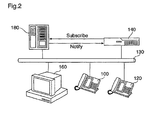
- FIG 2 is a simplified representation of the system of Figure 1 configured such that the automatic call back (ACB) feature subscribes to a presence service; and
- ACB automatic call back
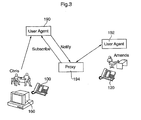
- Figure 3 is a schematic illustration of system for implementing a method for initiating calls using availability information, according to an alternative embodiment.
- Figure 1 showing a communication system 80 for implementing a method for initiating automatic call back (ABC) using availability information, according to an exemplary embodiment.
- a first telephone device 100 of a first user (Chris) and a second telephone device 120 of a second user (Amanda) are both connected via a local area network 130 to a telephony switch 140 that is responsible for telephony connections between the first telephone device 100 and the second telephone device 120, as well as outside connections over the PSTN.
- a telephony switch 140 that is responsible for telephony connections between the first telephone device 100 and the second telephone device 120, as well as outside connections over the PSTN.
- the first telephone device 100 is associated with a PC 160 having software for integrating with the telephony switch 140 over LAN 130 (or directly connected to telephony device 100 using suitable APIs) to provide an interface for controlling collaborative communication features of the device 120 and PC 160 (e.g. Microsoft ® Office Communicator).
- the user Chris at telephone device 100 uses PC 160 to activate features and specify preferences.
- a router 165 connects the LAN 130 to the Internet 170 in a conventional manner.
- the Internet 170 may be connected to a wireless network 175 for communication with a cellular telephone 177, for having an alternate number for contacting Chris.
- Chris may be contacted at home by routing calls over the PSTN to a further alternate number that is mapped to Chris' home telephone 179.
- a presence server 180 (e.g. Microsoft ® LCS, Lotus ® SameTime, etc.) provides presence status information to the telephone devices 100 and 120 and/or the software client on PC 160 relating to the availability of the users. It will be appreciated by those skilled in the art that the presence server 180 provides presence information by monitoring devices and applications to determine a user's presence. For the purpose of simplicity, only two telephone devices, the first telephone device 100 of Chris and the second telephone device 120 of Amanda, are shown. It will be appreciated that many other telephone devices and additional PCs can be connected to the LAN 130. It will also be appreciated that the telephony switch 140 can be any switch that handles connections between telephone devices.
- a database memory 185 may also be provided for storing availability user feature selection information, as described in greater detail below.
- the first telephone device 100 is a desk telephone connected to the telephony switch 140.
- the second telephone device 120 is a desk telephone locally connected to the telephony switch 140 via LAN 130.
- the second telephone device 120 may be remotely located and connected to the telephony switch 140 over the Internet, via a VPN connection, or the like.
- the LAN 130 may be replaced by any suitable communications network, including the Internet, corporate Intranet, cellular network, etc.
- the ACB feature implemented by call control of PBX 140 subscribes to the presence server 180 via, for example, SIP SIMPLE, as shown in the schematic illustration of Figure 2 .
- the presence server 180 (or multiple presence servers) return availability information to PBX 140 in the form of a status message such as "In the Office", "Busy", "in a Meeting” etc., at predetermined intervals.
- the ACB feature implemented by PBX 140 evaluates each returned status message according to the contents of a list maintained within PBX 140, or alternatively in memory 185, of compatible availability states for which the user is available to answer a call.
- the ACB feature determines from its evaluation of the list of status messages that the user's availability is compatible with the making of a call, the ACB feature is executed in the usual manner by PBX 140 to present Amanda with the option of initiating an automatic call back to Chris.
- Figures 1 and 2 includes only a single presence server 180, it is contemplated that multiple presence servers may be utilized, each capable of maintaining presence information about Chris.
- the PBX 140 may subscribe to any or all of these servers and receive notifications of Chris' availability status from respective servers.
- the ACB feature may compose the plurality of status indicators into a composite status indicator from which to make a feature implementation decision.
- a variety of methods can be used, such as: all status indicators must be compatible with availability, at least one status indicator must be compatible with availability, the majority of status indicators must be compatible with availability, etc.
- the ACB feature implemented by PBX 140 also evaluates the features that Chris has selected on his telephone 100. These features can be provided in a list within the presence server 180, stored in database memory 185, etc. The feature compatibility information may be placed in the presence server by the PBX 140 or by another computer, such as user PC 160. In this configuration, the ACB feature will only be initiated if both Chris's current availability status and his selected features are compatible with him answering a call.
- Figures 1 and 2 includes separate a presence server 180 and PBX 140, it is contemplated the presence service may be integrated into PBX 140, and configured to respond to a particular transaction protocol by supplying either or both of Chris' status and feature compatibility information to the ACB feature.
- a particular transaction protocol by supplying either or both of Chris' status and feature compatibility information to the ACB feature.
- SIP Subscribe/Notify methods wherein a user can subscribe to this type of information and as a result immediately receive a notification containing the information.
- implementation of the ACB feature may be based on feature compatibility but not presence information.
- PBX 140 In the embodiments discussed above with reference to Figures 1 and 2 , Amanda is served by a traditional PBX 140. However, in the case of VoIP, using SIP terminology, Amanda is served by a User Agent (UA) which administers her phone 120 and a Proxy (or Proxy Agent) which handles, inter alia, feature creation.
- UA User Agent
- Proxy Proxy Agent
- the ACB feature may be implemented on either the proxy or the UA and operates similar to the ACB implemented in PBX 140 by subscribing to Chris' availability status on the presence server 180. Likewise, Chris' feature status may be obtained from the presence server 180 or by using a transaction protocol on the proxy or UA supporting him.
- FIG 3 shows the case in which both Chris and Amanda have access to a presence enabled telephony system as set forth in US 20040037396 , discussed above.
- Both Chris and Amanda are represented by User Agents 190 and 192, and a Proxy 194 (only a single shared Proxy 194 is illustrated, although Chris and Amanda may have separate proxies).
- session initiation is effected dependent on Chris' context, as described in US 20040037396 .
- Chris' UA 190 may offer an ACB feature to Amanda. If she accepts this feature then her UA 192 sends a hypothetical INVITE message as described in US 20040037396 . The pending ACB feature then waits to receive a notification that Chris is available. When this arrives, the ACB feature then proposes initiation of a callback call to Amanda.
Landscapes
- Engineering & Computer Science (AREA)
- Signal Processing (AREA)
- Multimedia (AREA)
- Computer Networks & Wireless Communication (AREA)
- Telephonic Communication Services (AREA)
- Exchange Systems With Centralized Control (AREA)
- Computer And Data Communications (AREA)
Applications Claiming Priority (1)
| Application Number | Priority Date | Filing Date | Title |
|---|---|---|---|
| US11/766,368 US8189759B2 (en) | 2007-06-21 | 2007-06-21 | System and method for automatic call back using availability information |
Publications (2)
| Publication Number | Publication Date |
|---|---|
| EP2031850A2 true EP2031850A2 (de) | 2009-03-04 |
| EP2031850A3 EP2031850A3 (de) | 2009-03-18 |
Family
ID=40136494
Family Applications (1)
| Application Number | Title | Priority Date | Filing Date |
|---|---|---|---|
| EP08102679A Ceased EP2031850A3 (de) | 2007-06-21 | 2008-03-17 | System und Verfahren zum automatischen Rückruf mithilfe von Verfügbarkeitsinformationen |
Country Status (4)
| Country | Link |
|---|---|
| US (1) | US8189759B2 (de) |
| EP (1) | EP2031850A3 (de) |
| CN (1) | CN101330541B (de) |
| CA (1) | CA2625724C (de) |
Cited By (2)
| Publication number | Priority date | Publication date | Assignee | Title |
|---|---|---|---|---|
| CN103581858A (zh) * | 2013-11-22 | 2014-02-12 | 中国联合网络通信集团有限公司 | 一种控制空口资源的方法及系统 |
| US9160856B2 (en) | 2010-09-22 | 2015-10-13 | Metaswitch Networks Ltd | Processing telephone calls |
Families Citing this family (64)
| Publication number | Priority date | Publication date | Assignee | Title |
|---|---|---|---|---|
| US8837465B2 (en) | 2008-04-02 | 2014-09-16 | Twilio, Inc. | System and method for processing telephony sessions |
| EP2266269B1 (de) | 2008-04-02 | 2019-01-02 | Twilio Inc. | System und verfahren zum verarbeiten von telefoniesitzungen |
| US7814221B1 (en) | 2008-06-13 | 2010-10-12 | West Corporation | Real-time streaming protocol gateway and proxy for serving and caching static media over a low bandwidth connection |
| US8311837B1 (en) | 2008-06-13 | 2012-11-13 | West Corporation | Mobile voice self service system |
| US8838455B1 (en) | 2008-06-13 | 2014-09-16 | West Corporation | VoiceXML browser and supporting components for mobile devices |
| US8644803B1 (en) | 2008-06-13 | 2014-02-04 | West Corporation | Mobile contacts outdialer and method thereof |
| US8296148B1 (en) | 2008-06-13 | 2012-10-23 | West Corporation | Mobile voice self service device and method thereof |
| US9736207B1 (en) | 2008-06-13 | 2017-08-15 | West Corporation | Passive outdial support for mobile devices via WAP push of an MVSS URL |
| EP2335402A4 (de) | 2008-10-01 | 2013-04-24 | Twilio Inc | Telefonie-web-ereignis-system und verfahren |
| JP5671484B2 (ja) | 2009-03-02 | 2015-02-18 | トゥイリオ インコーポレイテッドTwilio Inc. | マルチテナント電話ネットワークのための方法およびシステム |
| US8594296B2 (en) * | 2009-05-20 | 2013-11-26 | Microsoft Corporation | Multimodal callback tagging |
| US9210275B2 (en) | 2009-10-07 | 2015-12-08 | Twilio, Inc. | System and method for running a multi-module telephony application |
| WO2011068397A2 (en) * | 2009-12-04 | 2011-06-09 | Mimos Berhad | Method of performing automatic callback notifier on reversed missed calls through network based enablers. |
| US9055165B2 (en) | 2010-04-08 | 2015-06-09 | Nec Corporation | Communication system for establishing a telephone call or a data communication |
| US9459926B2 (en) | 2010-06-23 | 2016-10-04 | Twilio, Inc. | System and method for managing a computing cluster |
| US9338064B2 (en) | 2010-06-23 | 2016-05-10 | Twilio, Inc. | System and method for managing a computing cluster |
| US9459925B2 (en) | 2010-06-23 | 2016-10-04 | Twilio, Inc. | System and method for managing a computing cluster |
| US9590849B2 (en) | 2010-06-23 | 2017-03-07 | Twilio, Inc. | System and method for managing a computing cluster |
| US20120208495A1 (en) | 2010-06-23 | 2012-08-16 | Twilio, Inc. | System and method for monitoring account usage on a platform |
| US8838707B2 (en) | 2010-06-25 | 2014-09-16 | Twilio, Inc. | System and method for enabling real-time eventing |
| US8543654B2 (en) * | 2010-12-17 | 2013-09-24 | Microsoft Corporation | Contextual conversation framework |
| US8649268B2 (en) | 2011-02-04 | 2014-02-11 | Twilio, Inc. | Method for processing telephony sessions of a network |
| US9648006B2 (en) | 2011-05-23 | 2017-05-09 | Twilio, Inc. | System and method for communicating with a client application |
| US20140044123A1 (en) | 2011-05-23 | 2014-02-13 | Twilio, Inc. | System and method for real time communicating with a client application |
| US9398622B2 (en) | 2011-05-23 | 2016-07-19 | Twilio, Inc. | System and method for connecting a communication to a client |
| US9336500B2 (en) | 2011-09-21 | 2016-05-10 | Twilio, Inc. | System and method for authorizing and connecting application developers and users |
| US10182147B2 (en) | 2011-09-21 | 2019-01-15 | Twilio Inc. | System and method for determining and communicating presence information |
| US9495227B2 (en) | 2012-02-10 | 2016-11-15 | Twilio, Inc. | System and method for managing concurrent events |
| US20130304928A1 (en) | 2012-05-09 | 2013-11-14 | Twilio, Inc. | System and method for managing latency in a distributed telephony network |
| US9240941B2 (en) | 2012-05-09 | 2016-01-19 | Twilio, Inc. | System and method for managing media in a distributed communication network |
| US9602586B2 (en) | 2012-05-09 | 2017-03-21 | Twilio, Inc. | System and method for managing media in a distributed communication network |
| US9247062B2 (en) | 2012-06-19 | 2016-01-26 | Twilio, Inc. | System and method for queuing a communication session |
| US8971934B2 (en) | 2012-06-29 | 2015-03-03 | Intel Corporation | Mechanism for facilitating dynamic real-time customization of messaging for computing systems |
| US8737962B2 (en) | 2012-07-24 | 2014-05-27 | Twilio, Inc. | Method and system for preventing illicit use of a telephony platform |
| US8948356B2 (en) | 2012-10-15 | 2015-02-03 | Twilio, Inc. | System and method for routing communications |
| US8938053B2 (en) | 2012-10-15 | 2015-01-20 | Twilio, Inc. | System and method for triggering on platform usage |
| US9253254B2 (en) | 2013-01-14 | 2016-02-02 | Twilio, Inc. | System and method for offering a multi-partner delegated platform |
| US9282124B2 (en) * | 2013-03-14 | 2016-03-08 | Twilio, Inc. | System and method for integrating session initiation protocol communication in a telecommunications platform |
| US9225840B2 (en) | 2013-06-19 | 2015-12-29 | Twilio, Inc. | System and method for providing a communication endpoint information service |
| US9240966B2 (en) | 2013-06-19 | 2016-01-19 | Twilio, Inc. | System and method for transmitting and receiving media messages |
| US9483328B2 (en) | 2013-07-19 | 2016-11-01 | Twilio, Inc. | System and method for delivering application content |
| US9338018B2 (en) | 2013-09-17 | 2016-05-10 | Twilio, Inc. | System and method for pricing communication of a telecommunication platform |
| US9274858B2 (en) | 2013-09-17 | 2016-03-01 | Twilio, Inc. | System and method for tagging and tracking events of an application platform |
| US9137127B2 (en) | 2013-09-17 | 2015-09-15 | Twilio, Inc. | System and method for providing communication platform metadata |
| US9553799B2 (en) | 2013-11-12 | 2017-01-24 | Twilio, Inc. | System and method for client communication in a distributed telephony network |
| US9325624B2 (en) | 2013-11-12 | 2016-04-26 | Twilio, Inc. | System and method for enabling dynamic multi-modal communication |
| US9344573B2 (en) | 2014-03-14 | 2016-05-17 | Twilio, Inc. | System and method for a work distribution service |
| CN103916538A (zh) * | 2014-03-24 | 2014-07-09 | 小米科技有限责任公司 | 通话控制方法及相关装置 |
| US9226217B2 (en) | 2014-04-17 | 2015-12-29 | Twilio, Inc. | System and method for enabling multi-modal communication |
| US9246694B1 (en) | 2014-07-07 | 2016-01-26 | Twilio, Inc. | System and method for managing conferencing in a distributed communication network |
| US9774687B2 (en) | 2014-07-07 | 2017-09-26 | Twilio, Inc. | System and method for managing media and signaling in a communication platform |
| US9516101B2 (en) | 2014-07-07 | 2016-12-06 | Twilio, Inc. | System and method for collecting feedback in a multi-tenant communication platform |
| US9251371B2 (en) | 2014-07-07 | 2016-02-02 | Twilio, Inc. | Method and system for applying data retention policies in a computing platform |
| US9363301B2 (en) | 2014-10-21 | 2016-06-07 | Twilio, Inc. | System and method for providing a micro-services communication platform |
| US9477975B2 (en) | 2015-02-03 | 2016-10-25 | Twilio, Inc. | System and method for a media intelligence platform |
| US10419891B2 (en) | 2015-05-14 | 2019-09-17 | Twilio, Inc. | System and method for communicating through multiple endpoints |
| US9948703B2 (en) | 2015-05-14 | 2018-04-17 | Twilio, Inc. | System and method for signaling through data storage |
| US10659349B2 (en) | 2016-02-04 | 2020-05-19 | Twilio Inc. | Systems and methods for providing secure network exchanged for a multitenant virtual private cloud |
| CN107370894B (zh) * | 2016-05-12 | 2021-08-13 | 中兴通讯股份有限公司 | 呼叫状态的通知方法、装置及系统 |
| US10686902B2 (en) | 2016-05-23 | 2020-06-16 | Twilio Inc. | System and method for a multi-channel notification service |
| US10063713B2 (en) | 2016-05-23 | 2018-08-28 | Twilio Inc. | System and method for programmatic device connectivity |
| US10348892B2 (en) | 2016-06-15 | 2019-07-09 | International Business Machines Corporation | Scheduling telephone calls |
| CN108616862A (zh) * | 2017-01-16 | 2018-10-02 | 中兴通讯股份有限公司 | 一种快速呼通方法和装置 |
| US10938985B2 (en) | 2018-11-27 | 2021-03-02 | International Business Machines Corporation | Contextual preferred response time alert |
Citations (5)
| Publication number | Priority date | Publication date | Assignee | Title |
|---|---|---|---|---|
| US6160881A (en) * | 1996-09-19 | 2000-12-12 | Siemens Information And Communication Networks, Inc. | System and method for integrating electronic entry systems with telecommunication systems |
| WO2002071706A1 (en) | 2001-03-01 | 2002-09-12 | Pilgrim Telephone, Inc. | Apparatus and method for network-initiated real-time multi-party communications |
| US20040037396A1 (en) | 2002-08-12 | 2004-02-26 | Gray Thomas A. | Generation of availability indicators from call control policies for presence enabled telephony system |
| US20050100157A1 (en) | 2002-08-12 | 2005-05-12 | Gray Thomas A. | Context aware call handling system |
| US20060003745A1 (en) * | 2004-05-26 | 2006-01-05 | Qualcomm Incorporated | Apparatus, system, and method for providing voicemail service using presence status in packet data messaging system |
Family Cites Families (13)
| Publication number | Priority date | Publication date | Assignee | Title |
|---|---|---|---|---|
| US4166929A (en) * | 1978-02-17 | 1979-09-04 | Bell Telephone Laboratories, Incorporated | Interoffice callback arrangement |
| US5812865A (en) * | 1993-12-03 | 1998-09-22 | Xerox Corporation | Specifying and establishing communication data paths between particular media devices in multiple media device computing systems based on context of a user or users |
| US5995848A (en) * | 1997-07-21 | 1999-11-30 | Telefonaktiebolaget Lm Ericsson | System and method of completing calls to busy mobile subscribers in a radio telecommunications network |
| US6546096B1 (en) * | 1999-08-25 | 2003-04-08 | Siemens Information And Communication Networks, Inc. | Proximity detector for initiating automatic callback |
| US20020085701A1 (en) * | 2000-10-30 | 2002-07-04 | Parsons Eric W. | Method and system for providing unified communication management based on presence information |
| US6810260B1 (en) * | 2000-11-21 | 2004-10-26 | Telefonaktiebolaget Lm Ericsson | Method and apparatus for automated call-back subscriber service |
| AU2002239391A1 (en) * | 2000-11-30 | 2002-06-11 | Message Machines, Inc. | Systems and methods for routing messages to communications devices |
| US7221945B2 (en) * | 2002-05-03 | 2007-05-22 | Leapstone Systems, Inc. | System and method for establishing and controlling access to network resources |
| US7680259B2 (en) * | 2004-01-12 | 2010-03-16 | At&T Intellectual Property, I,L.P. | Rule-based intelligent call forwarding |
| EP1619864A1 (de) * | 2004-07-23 | 2006-01-25 | Hewlett-Packard Development Company, L.P. | Anzeige an Anrufer von Anwesenheitsinformation des angerufenen Teilnehmers |
| US20060123116A1 (en) * | 2004-12-02 | 2006-06-08 | Matsushita Electric Industrial Co., Ltd. | Service discovery using session initiating protocol (SIP) |
| US7594020B2 (en) * | 2005-05-31 | 2009-09-22 | Microsoft Corporation | Re-establishing a connection for an application layer via a service layer |
| US8649485B2 (en) * | 2005-12-28 | 2014-02-11 | Sap Ag | System and method for automated connection triggered by availability status |
-
2007
- 2007-06-21 US US11/766,368 patent/US8189759B2/en active Active
-
2008
- 2008-03-13 CA CA2625724A patent/CA2625724C/en active Active
- 2008-03-17 EP EP08102679A patent/EP2031850A3/de not_active Ceased
- 2008-06-23 CN CN200810125249XA patent/CN101330541B/zh not_active Expired - Fee Related
Patent Citations (5)
| Publication number | Priority date | Publication date | Assignee | Title |
|---|---|---|---|---|
| US6160881A (en) * | 1996-09-19 | 2000-12-12 | Siemens Information And Communication Networks, Inc. | System and method for integrating electronic entry systems with telecommunication systems |
| WO2002071706A1 (en) | 2001-03-01 | 2002-09-12 | Pilgrim Telephone, Inc. | Apparatus and method for network-initiated real-time multi-party communications |
| US20040037396A1 (en) | 2002-08-12 | 2004-02-26 | Gray Thomas A. | Generation of availability indicators from call control policies for presence enabled telephony system |
| US20050100157A1 (en) | 2002-08-12 | 2005-05-12 | Gray Thomas A. | Context aware call handling system |
| US20060003745A1 (en) * | 2004-05-26 | 2006-01-05 | Qualcomm Incorporated | Apparatus, system, and method for providing voicemail service using presence status in packet data messaging system |
Cited By (3)
| Publication number | Priority date | Publication date | Assignee | Title |
|---|---|---|---|---|
| US9160856B2 (en) | 2010-09-22 | 2015-10-13 | Metaswitch Networks Ltd | Processing telephone calls |
| CN103581858A (zh) * | 2013-11-22 | 2014-02-12 | 中国联合网络通信集团有限公司 | 一种控制空口资源的方法及系统 |
| CN103581858B (zh) * | 2013-11-22 | 2017-06-13 | 中国联合网络通信集团有限公司 | 一种控制空口资源的方法及系统 |
Also Published As
| Publication number | Publication date |
|---|---|
| EP2031850A3 (de) | 2009-03-18 |
| CN101330541B (zh) | 2012-10-03 |
| CA2625724A1 (en) | 2008-12-21 |
| US20080317232A1 (en) | 2008-12-25 |
| CN101330541A (zh) | 2008-12-24 |
| CA2625724C (en) | 2011-10-18 |
| US8189759B2 (en) | 2012-05-29 |
Similar Documents
| Publication | Publication Date | Title |
|---|---|---|
| CA2625724C (en) | System and method for automatic call back using availability information | |
| EP1670198B1 (de) | Ratschlag für Benachrichtung in anwesenheitsbewussten Netzen | |
| US7330721B2 (en) | Method and system for supporting non-intrusive and effective voice communication among mobile users | |
| CA2618364C (en) | System and method for call initiation using availability information | |
| EP1672896B1 (de) | Bereitstellung von kundenspezifischen Nachrichten an Anrufer von nicht erreichbaren angerufenen Teilnehmern | |
| EP1551163A2 (de) | Präsenz-basierte Verkehrsleitung in einer Kommunikationsnetzwerkumgebung | |
| JP2000101636A (ja) | 互換性のないアドレスフォ―マットで通信するシステム | |
| WO2004080017A1 (en) | System and method for presence enabled e-mail delivery | |
| WO2005109844A2 (en) | Enhanced call pickup | |
| US8189755B2 (en) | Call urgency screening | |
| US20080069331A1 (en) | Apparatus and method for intelligent call waiting |
Legal Events
| Date | Code | Title | Description |
|---|---|---|---|
| PUAI | Public reference made under article 153(3) epc to a published international application that has entered the european phase |
Free format text: ORIGINAL CODE: 0009012 |
|
| PUAL | Search report despatched |
Free format text: ORIGINAL CODE: 0009013 |
|
| AK | Designated contracting states |
Kind code of ref document: A2 Designated state(s): AT BE BG CH CY CZ DE DK EE ES FI FR GB GR HR HU IE IS IT LI LT LU LV MC MT NL NO PL PT RO SE SI SK TR |
|
| AX | Request for extension of the european patent |
Extension state: AL BA MK RS |
|
| AK | Designated contracting states |
Kind code of ref document: A3 Designated state(s): AT BE BG CH CY CZ DE DK EE ES FI FR GB GR HR HU IE IS IT LI LT LU LV MC MT NL NO PL PT RO SE SI SK TR |
|
| AX | Request for extension of the european patent |
Extension state: AL BA MK RS |
|
| 17Q | First examination report despatched |
Effective date: 20090918 |
|
| 17P | Request for examination filed |
Effective date: 20090826 |
|
| AKX | Designation fees paid |
Designated state(s): DE FR GB |
|
| STAA | Information on the status of an ep patent application or granted ep patent |
Free format text: STATUS: THE APPLICATION HAS BEEN REFUSED |
|
| 18R | Application refused |
Effective date: 20131119 |