EP2031897A2 - Verfahren zur Herstellung von Hörgerätemuscheln - Google Patents
Verfahren zur Herstellung von Hörgerätemuscheln Download PDFInfo
- Publication number
- EP2031897A2 EP2031897A2 EP08162182A EP08162182A EP2031897A2 EP 2031897 A2 EP2031897 A2 EP 2031897A2 EP 08162182 A EP08162182 A EP 08162182A EP 08162182 A EP08162182 A EP 08162182A EP 2031897 A2 EP2031897 A2 EP 2031897A2
- Authority
- EP
- European Patent Office
- Prior art keywords
- shell
- offset
- patch
- value
- algorithm
- Prior art date
- Legal status (The legal status is an assumption and is not a legal conclusion. Google has not performed a legal analysis and makes no representation as to the accuracy of the status listed.)
- Withdrawn
Links
Images

Classifications
-
- H—ELECTRICITY
- H04—ELECTRIC COMMUNICATION TECHNIQUE
- H04R—LOUDSPEAKERS, MICROPHONES, GRAMOPHONE PICK-UPS OR LIKE ACOUSTIC ELECTROMECHANICAL TRANSDUCERS; ELECTRIC HEARING AIDS; PUBLIC ADDRESS SYSTEMS
- H04R25/00—Electric hearing aids
- H04R25/65—Housing parts, e.g. shells, tips or moulds, or their manufacture
- H04R25/652—Ear tips; Ear moulds
-
- H—ELECTRICITY
- H04—ELECTRIC COMMUNICATION TECHNIQUE
- H04R—LOUDSPEAKERS, MICROPHONES, GRAMOPHONE PICK-UPS OR LIKE ACOUSTIC ELECTROMECHANICAL TRANSDUCERS; ELECTRIC HEARING AIDS; PUBLIC ADDRESS SYSTEMS
- H04R25/00—Electric hearing aids
- H04R25/65—Housing parts, e.g. shells, tips or moulds, or their manufacture
- H04R25/658—Manufacture of housing parts
-
- Y—GENERAL TAGGING OF NEW TECHNOLOGICAL DEVELOPMENTS; GENERAL TAGGING OF CROSS-SECTIONAL TECHNOLOGIES SPANNING OVER SEVERAL SECTIONS OF THE IPC; TECHNICAL SUBJECTS COVERED BY FORMER USPC CROSS-REFERENCE ART COLLECTIONS [XRACs] AND DIGESTS
- Y10—TECHNICAL SUBJECTS COVERED BY FORMER USPC
- Y10T—TECHNICAL SUBJECTS COVERED BY FORMER US CLASSIFICATION
- Y10T29/00—Metal working
- Y10T29/49—Method of mechanical manufacture
- Y10T29/4957—Sound device making
- Y10T29/49572—Hearing aid component making
Definitions
- the present invention is directed to a method for manufacturing hearing aid shells in order to reduce surface distortions and to provide an adaptive shell surface modification to improve fit.
- a rapid shell modelling (RSM) process is often utilized in which a three-dimensional model of the patient's ear canal is computed from a scanned ear canal impression.
- RSM rapid shell modelling
- Such a model can be further manipulated by using sophisticated geometrical algorithms to obtain the finished hearing aid shell that can be produced in a matter of minutes.
- the production of a shell from a computer model can be achieved, e.g., by laser sintering in which a laser fuses liquid material into a solid in layers based on the shell model.
- this process (and other 3D manufacturing technologies) can create artefacts on the shell that must be removed.
- One of the steps in the manufacturing of such a hearing aid shell is a tumbling and buffing procedure (involving subjecting the shell to a barrage of fine pebbles) to smooth the shell surface which thereby makes the hearing aid fit more precise and improves comfort for the wearer.
- Both tumbling and buffing remove a thin layer of material from shells-however, this removal can also compromise the surface integrity of the shell.
- the shell surface is constructed with a constant offset in order to compensate for the erosion of the shell material during the tumbling process.
- tumbling and buffing cause more material to be removed from the shell areas with high curvatures, because the tumbling media creates more impact to such areas.
- the result is that the shell geometry gets distorted, and therefore the shell does not fit well into the customer's ear.
- the invention is directed to a method for manufacturing a hearing aid shell, comprising: dividing a surface of the shell into a number of predefined patches; calculating a Gaussian curvature value for each predefined patch; determining a variable offset value for each of a respective patch for a new surface, the offset value of an isosurface function being dependent on the calculated curvature value; calculating the new surface for the shell at the determined offset values; and physically creating the hearing aid shell with the new calculated surface prior to a tumbling or buffing operation.
- the invention is also directed to a computer system having a processor, user interface (input and output), a memory, and algorithms that are stored in the memory and executed on the processor for implementing the method.
- the computer algorithms for producing the shell model can be stored on a computer readable media, such as a CD-ROM, tape, or server storage.
- the method for manufacturing the shell surface is pre-distorted by offsetting it by an isosurface function.
- the isosurface function is directly related to the principle curvatures of the surface in order to compensate for the more aggressive tumbling of zones with high curvature.
- the modifications are performed mathematically on a virtual 3-D data representation on the shell prior to the shell actually being produced.
- An appertaining system for implementing the method is further provided.
- the shell surface is pre-distorted by offsetting it by an isosurface function which is directly related to the principle curvatures of the surface in order to compensate for the more aggressive tumbling of zones with high curvature.
- an isosurface function which is directly related to the principle curvatures of the surface in order to compensate for the more aggressive tumbling of zones with high curvature.
- Figure 1 illustrates a basic hearing aid shell 10 having regions with varying degrees of curvature. This figures shows an area of the shell with a low positive curvature 20, an area with a high positive curvature 22, and an area with a high negative curvature 24.
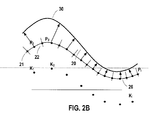
- the shell surface 21 is divided into small patches P 1 -P i (in a preferred embodiment, the patches having an area of approximately 2mm 2 , although any workable size could be used) and the respective Gaussian curvatures K 1 -K ⁇ are derived for each patch P 1 -P i .
- a surface offset Q i of each patch P 1 -P i is then determined by a constant offset C and a variable offset f(K i ), which is a function of the Gaussian curvature of the patch:
- Q j C + f K j
- This formula describes the necessary amount of the surface offset, depending on the surface curvature. It includes the concave (K is negative) and convex (K is positive) areas. The function of K reflects the erosion of the shell material form areas with various K values during tumbling.
- the formula includes the constant offset C and curvature-dependant offset f(K).
- curvature as used herein is well known in the art (see, e.g., Barrett O'Nell Elementary Differential Geometry. Academic Press NY and London 1966. Page 310-317, on Gaussian curvature ).
- the principal directions k are the eigenvectors of the principal Gaussian curvatures. They refer to the local orientation of the principal Gaussian curvatures, and the normal vector n can be used to identify the direction for compensation. Additionally, the shape index may be used to determined the generalized concavity and convexity and what manufacturing corrective measures are implemented. When the software, based on the curvature computation, identifies a region that is concave, then no additional material is added to this region. In the convex areas however, compensatory material is added to address the susceptibility of these localized patched regions to surface modification during tumbling.
- FIG. 2B illustrates the newly-created outer surface 30.
- This new outer surface 30 is formed by the curvature-dependent offset Q of the initial patches P 1 -P i of the surface.
- the distance from the shell surface 21 to the new outer surface 30 is greater in areas of high positive curvature 22, less in areas of low positive curvature 20, and even less in areas of negative curvature 26.
- the triangular patches of the region are selected and the normals of triangles or quadrilaterals (combined triangles) in this region are extended by a defined displacement (e.g., ⁇ 0.1-0.3 mm).
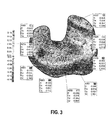
- Figure 3 illustrates the material that is lost as a result of tumbling.
- the regions indicated with a higher negative D value indicate areas in which a greater material removal results from tumbling. These regions represent potential low fit areas that should be corrected.
- the software model can provide for adapting a new outer surface 30 prior to tumbling to ensure the integrity of the post-tumbled finished surface.
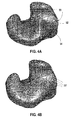
- Figure 4A illustrates a conformable region 34 with a high propensity for material loss during tumbling.
- a mesh 32 defines a surface of the original impression prior to tumbling and provides control points 33 that allow for material correction.
- the control points are generated based on stereolithography (STL) files of the shell.
- control points 33' are illustrated (actually, all of the intersection points lacking a small white square) that are to be moved in a normal direction in order to accomplish the objective of preserving the surface integrity of the shell.
- the shape in the defined region (based of the principal curvatures) is preserved.
- the software of the inventive method can implement templates of these high distortable regions to allow adaptive modifications during modeling above and beyond the curvature-based modifications.
- a system for implementing the above method is further provided, in which a computer system has a processor, user interface (input and output), a memory, and algorithms that are stored in the memory and executed on the processor.
- the algorithms are used to transform the initial shell model into the final shell model that is to be produced based on the above algorithms.
- the computer system has an input for entering the initial shell model, and an output for sending the final shell model to a device that can actually produce the shell model.
- the computer algorithms for producing the shell model can be stored on a computer readable media, such as a CD-ROM, tape, or server storage.
- the present invention may be described in terms of functional block components and various processing steps. Such functional blocks may be realized by any number of hardware and/or software components configured to perform the specified functions.
- the present invention may employ various integrated circuit components, e.g., memory elements, processing elements, logic elements, look-up tables, and the like, which may carry out a variety of functions under the control of one or more microprocessors or other control devices.
- the elements of the present invention are implemented using software programming or software elements the invention may be implemented with any programming or scripting language such as C, C++, Java, assembler, or the like, with the various algorithms being implemented with any combination of data structures, objects, processes, routines or other programming elements.
- the present invention could employ any number of conventional techniques for electronics configuration, signal processing and/or control, data processing and the like.
- the word mechanism is used broadly and is not limited to mechanical or physical embodiments, but can include software routines in conjunction with processors, etc.
Landscapes
- Engineering & Computer Science (AREA)
- Manufacturing & Machinery (AREA)
- Health & Medical Sciences (AREA)
- General Health & Medical Sciences (AREA)
- Neurosurgery (AREA)
- Otolaryngology (AREA)
- Physics & Mathematics (AREA)
- Acoustics & Sound (AREA)
- Signal Processing (AREA)
- Fishing Rods (AREA)
Applications Claiming Priority (1)
| Application Number | Priority Date | Filing Date | Title |
|---|---|---|---|
| US11/846,103 US20090063107A1 (en) | 2007-08-28 | 2007-08-28 | Manufacturing Process of Hearing Aid Shells With Reduced Surface Distortions and Adaptive Shell Surface Modification to Improve Fit and Appertaining System |
Publications (2)
| Publication Number | Publication Date |
|---|---|
| EP2031897A2 true EP2031897A2 (de) | 2009-03-04 |
| EP2031897A3 EP2031897A3 (de) | 2010-12-22 |
Family
ID=40079597
Family Applications (1)
| Application Number | Title | Priority Date | Filing Date |
|---|---|---|---|
| EP08162182A Withdrawn EP2031897A3 (de) | 2007-08-28 | 2008-08-11 | Verfahren zur Herstellung von Hörgerätemuscheln |
Country Status (2)
| Country | Link |
|---|---|
| US (1) | US20090063107A1 (de) |
| EP (1) | EP2031897A3 (de) |
Cited By (1)
| Publication number | Priority date | Publication date | Assignee | Title |
|---|---|---|---|---|
| WO2016037634A1 (en) * | 2014-09-08 | 2016-03-17 | Sonova Ag | A method for producing a hearing device shell, a hearing device shell and a hearing device |
Families Citing this family (1)
| Publication number | Priority date | Publication date | Assignee | Title |
|---|---|---|---|---|
| US9460238B2 (en) * | 2012-09-11 | 2016-10-04 | Apple Inc. | Methodology for determining an improved form of headphones |
Family Cites Families (9)
| Publication number | Priority date | Publication date | Assignee | Title |
|---|---|---|---|---|
| JP3054108B2 (ja) * | 1997-08-15 | 2000-06-19 | 理化学研究所 | 自由曲面の測定データ合成方法 |
| US7050876B1 (en) * | 2000-10-06 | 2006-05-23 | Phonak Ltd. | Manufacturing methods and systems for rapid production of hearing-aid shells |
| ES2378060T3 (es) * | 2001-03-02 | 2012-04-04 | 3Shape A/S | Procedimiento para modelar piezas auriculares personalizadas |
| EP1246507A1 (de) * | 2001-03-26 | 2002-10-02 | Widex A/S | Hörgerät mit Abdichtungsring |
| US20020196954A1 (en) * | 2001-06-22 | 2002-12-26 | Marxen Christopher J. | Modeling and fabrication of three-dimensional irregular surfaces for hearing instruments |
| US7230616B2 (en) * | 2002-07-31 | 2007-06-12 | International Business Machines Corporation | Bi-level iso-surface compression |
| US7308328B2 (en) * | 2003-05-15 | 2007-12-11 | Siemens Medical Solutions Usa, Inc. | Synchronized processing of ear shells for hearing aids |
| US20050088435A1 (en) * | 2003-10-23 | 2005-04-28 | Z. Jason Geng | Novel 3D ear camera for making custom-fit hearing devices for hearing aids instruments and cell phones |
| JP4892480B2 (ja) * | 2004-07-23 | 2012-03-07 | 3シェイプ・アクティーゼルスカブ | 適応三次元走査 |
-
2007
- 2007-08-28 US US11/846,103 patent/US20090063107A1/en not_active Abandoned
-
2008
- 2008-08-11 EP EP08162182A patent/EP2031897A3/de not_active Withdrawn
Non-Patent Citations (1)
| Title |
|---|
| BARRETT O'NELL: "Elementary Differential Geometry", 1966, ACADEMIC PRESS, pages: 310 - 317 |
Cited By (1)
| Publication number | Priority date | Publication date | Assignee | Title |
|---|---|---|---|---|
| WO2016037634A1 (en) * | 2014-09-08 | 2016-03-17 | Sonova Ag | A method for producing a hearing device shell, a hearing device shell and a hearing device |
Also Published As
| Publication number | Publication date |
|---|---|
| EP2031897A3 (de) | 2010-12-22 |
| US20090063107A1 (en) | 2009-03-05 |
Similar Documents
| Publication | Publication Date | Title |
|---|---|---|
| EP2056734B1 (de) | System und verfahren zur modellierung einer interproximalen zahnreduktion | |
| US9652889B2 (en) | Image processing method | |
| EP1356709B1 (de) | Herstellungsverfahren und system zur schnellen erzeugung von hörhilfegerätschale | |
| Starly et al. | Direct slicing of STEP based NURBS models for layered manufacturing | |
| EP3161800B1 (de) | Additive glättung von scharfen konkaven kanten auf gestalteten 3d-druckbaren polygonalen maschenmodellen | |
| US7447556B2 (en) | System comprising an automated tool and appertaining method for hearing aid design | |
| US7801708B2 (en) | Method and apparatus for the rigid and non-rigid registration of 3D shapes | |
| US20020196954A1 (en) | Modeling and fabrication of three-dimensional irregular surfaces for hearing instruments | |
| US10598962B2 (en) | Method for manufacturing a spectacle frame adapted to a spectacle wearer | |
| CN110796735B (zh) | Nurbs曲面有限元板壳网格划分方法及计算机实现系统 | |
| CN110688709B (zh) | 一种基于工件点云模型的蒙皮工艺模型修正方法 | |
| WO2000019930A1 (en) | Creating a positive mold of a patient's dentition for use in forming an orthodontic appliance | |
| CN115130253A (zh) | 产生用于生成对象的平滑曲面的细化控制网格 | |
| US20200273246A1 (en) | Graphical modelling by smoothing polyhedral meshes with multi-sided patches | |
| EP2031897A2 (de) | Verfahren zur Herstellung von Hörgerätemuscheln | |
| Qiu et al. | An efficient and collision-free hole-filling algorithm for orthodontics | |
| EP1909537A2 (de) | Schnittsystem und Verfahren für ellipsenförmige Linien zum Entwurf einer Hörhilfegerätemuschel | |
| JP6388489B2 (ja) | 表面加工用データ作成方法および装置 | |
| CN117911644A (zh) | 牙齿三维数字模型邻接面的重建方法 | |
| CN111667581B (zh) | 3d模型的处理方法、装置、设备及存储介质 | |
| US20250259396A1 (en) | Geometry-independent design with native mesh surface formation and variable component-conformity | |
| EP2023662A1 (de) | System mit einem automatisierten Werkzeug und dazugehöriges Verfahren zur Entwicklung von Hörhilfen | |
| Beşdok et al. | Analysing detail preserving capabilities of bilateral, laplacian and taubin mesh filtering methods | |
| EP1793348A2 (de) | Verfahren und Vorrichtung für schnelle und effiziente Netzvereinfachung | |
| Babu et al. | Triangular mesh generation over an arbitrary two dimensional domain by hybrid advancing front technique |
Legal Events
| Date | Code | Title | Description |
|---|---|---|---|
| PUAI | Public reference made under article 153(3) epc to a published international application that has entered the european phase |
Free format text: ORIGINAL CODE: 0009012 |
|
| AK | Designated contracting states |
Kind code of ref document: A2 Designated state(s): AT BE BG CH CY CZ DE DK EE ES FI FR GB GR HR HU IE IS IT LI LT LU LV MC MT NL NO PL PT RO SE SI SK TR |
|
| AX | Request for extension of the european patent |
Extension state: AL BA MK RS |
|
| PUAL | Search report despatched |
Free format text: ORIGINAL CODE: 0009013 |
|
| AK | Designated contracting states |
Kind code of ref document: A3 Designated state(s): AT BE BG CH CY CZ DE DK EE ES FI FR GB GR HR HU IE IS IT LI LT LU LV MC MT NL NO PL PT RO SE SI SK TR |
|
| AX | Request for extension of the european patent |
Extension state: AL BA MK RS |
|
| 17P | Request for examination filed |
Effective date: 20110617 |
|
| AKX | Designation fees paid |
Designated state(s): AT BE BG CH CY CZ DE DK EE ES FI FR GB GR HR HU IE IS IT LI LT LU LV MC MT NL NO PL PT RO SE SI SK TR |
|
| STAA | Information on the status of an ep patent application or granted ep patent |
Free format text: STATUS: THE APPLICATION IS DEEMED TO BE WITHDRAWN |
|
| 18D | Application deemed to be withdrawn |
Effective date: 20130301 |