EP2033400B1 - Procédé et arrangement pour assurer la cohérence des préfixes parmi plusieurs routeurs mobiles - Google Patents
Procédé et arrangement pour assurer la cohérence des préfixes parmi plusieurs routeurs mobiles Download PDFInfo
- Publication number
- EP2033400B1 EP2033400B1 EP06748049A EP06748049A EP2033400B1 EP 2033400 B1 EP2033400 B1 EP 2033400B1 EP 06748049 A EP06748049 A EP 06748049A EP 06748049 A EP06748049 A EP 06748049A EP 2033400 B1 EP2033400 B1 EP 2033400B1
- Authority
- EP
- European Patent Office
- Prior art keywords
- mobile router
- prefix
- specific information
- home agent
- mobile
- Prior art date
- Legal status (The legal status is an assumption and is not a legal conclusion. Google has not performed a legal analysis and makes no representation as to the accuracy of the status listed.)
- Not-in-force
Links
- 238000000034 method Methods 0.000 title claims abstract description 116
- 238000012360 testing method Methods 0.000 claims abstract description 229
- 238000004891 communication Methods 0.000 claims abstract description 72
- 230000002427 irreversible effect Effects 0.000 claims description 37
- 230000027455 binding Effects 0.000 claims description 36
- 238000009739 binding Methods 0.000 claims description 36
- 230000007246 mechanism Effects 0.000 description 40
- 239000003795 chemical substances by application Substances 0.000 description 39
- 230000004044 response Effects 0.000 description 33
- 230000001960 triggered effect Effects 0.000 description 28
- 101150105005 MNP1 gene Proteins 0.000 description 18
- 101100184488 Schizosaccharomyces pombe (strain 972 / ATCC 24843) mrpl12 gene Proteins 0.000 description 18
- 101100316510 Schizosaccharomyces pombe (strain 972 / ATCC 24843) usb1 gene Proteins 0.000 description 18
- 239000000243 solution Substances 0.000 description 18
- 230000008901 benefit Effects 0.000 description 13
- 238000004422 calculation algorithm Methods 0.000 description 12
- 230000008569 process Effects 0.000 description 9
- 238000012986 modification Methods 0.000 description 8
- 230000004048 modification Effects 0.000 description 8
- 238000012546 transfer Methods 0.000 description 8
- 239000003637 basic solution Substances 0.000 description 6
- 230000000737 periodic effect Effects 0.000 description 5
- 230000010076 replication Effects 0.000 description 5
- 101100243367 Phlebia radiata mnp2 gene Proteins 0.000 description 4
- 230000009286 beneficial effect Effects 0.000 description 4
- 230000011664 signaling Effects 0.000 description 4
- 238000003860 storage Methods 0.000 description 4
- 230000006978 adaptation Effects 0.000 description 3
- 238000004364 calculation method Methods 0.000 description 3
- 230000008859 change Effects 0.000 description 3
- 238000009795 derivation Methods 0.000 description 3
- 238000009826 distribution Methods 0.000 description 3
- 238000005516 engineering process Methods 0.000 description 3
- 230000006870 function Effects 0.000 description 3
- 230000009471 action Effects 0.000 description 2
- 238000013459 approach Methods 0.000 description 2
- 230000001419 dependent effect Effects 0.000 description 2
- 230000000694 effects Effects 0.000 description 2
- 239000000284 extract Substances 0.000 description 2
- 238000010295 mobile communication Methods 0.000 description 2
- 238000002360 preparation method Methods 0.000 description 2
- 230000003362 replicative effect Effects 0.000 description 2
- 230000001360 synchronised effect Effects 0.000 description 2
- 230000002123 temporal effect Effects 0.000 description 2
- TVZRAEYQIKYCPH-UHFFFAOYSA-N 3-(trimethylsilyl)propane-1-sulfonic acid Chemical compound C[Si](C)(C)CCCS(O)(=O)=O TVZRAEYQIKYCPH-UHFFFAOYSA-N 0.000 description 1
- 230000002776 aggregation Effects 0.000 description 1
- 238000004220 aggregation Methods 0.000 description 1
- 238000004458 analytical method Methods 0.000 description 1
- 238000010420 art technique Methods 0.000 description 1
- 238000012790 confirmation Methods 0.000 description 1
- 230000001934 delay Effects 0.000 description 1
- 238000001514 detection method Methods 0.000 description 1
- 230000009977 dual effect Effects 0.000 description 1
- 230000003993 interaction Effects 0.000 description 1
- 238000005259 measurement Methods 0.000 description 1
- 238000013508 migration Methods 0.000 description 1
- 230000005012 migration Effects 0.000 description 1
- 230000008447 perception Effects 0.000 description 1
- 230000002265 prevention Effects 0.000 description 1
- 238000012545 processing Methods 0.000 description 1
- 230000001012 protector Effects 0.000 description 1
- 238000011084 recovery Methods 0.000 description 1
- 230000001105 regulatory effect Effects 0.000 description 1
- 238000012827 research and development Methods 0.000 description 1
- 230000003068 static effect Effects 0.000 description 1
- 238000012795 verification Methods 0.000 description 1
Images



Classifications
-
- H—ELECTRICITY
- H04—ELECTRIC COMMUNICATION TECHNIQUE
- H04L—TRANSMISSION OF DIGITAL INFORMATION, e.g. TELEGRAPHIC COMMUNICATION
- H04L12/00—Data switching networks
- H04L12/66—Arrangements for connecting between networks having differing types of switching systems, e.g. gateways
-
- H—ELECTRICITY
- H04—ELECTRIC COMMUNICATION TECHNIQUE
- H04L—TRANSMISSION OF DIGITAL INFORMATION, e.g. TELEGRAPHIC COMMUNICATION
- H04L61/00—Network arrangements, protocols or services for addressing or naming
- H04L61/50—Address allocation
- H04L61/5084—Providing for device mobility
-
- H—ELECTRICITY
- H04—ELECTRIC COMMUNICATION TECHNIQUE
- H04W—WIRELESS COMMUNICATION NETWORKS
- H04W8/00—Network data management
- H04W8/26—Network addressing or numbering for mobility support
-
- H—ELECTRICITY
- H04—ELECTRIC COMMUNICATION TECHNIQUE
- H04L—TRANSMISSION OF DIGITAL INFORMATION, e.g. TELEGRAPHIC COMMUNICATION
- H04L61/00—Network arrangements, protocols or services for addressing or naming
- H04L61/50—Address allocation
- H04L61/5061—Pools of addresses
-
- H—ELECTRICITY
- H04—ELECTRIC COMMUNICATION TECHNIQUE
- H04W—WIRELESS COMMUNICATION NETWORKS
- H04W48/00—Access restriction; Network selection; Access point selection
- H04W48/02—Access restriction performed under specific conditions
-
- H—ELECTRICITY
- H04—ELECTRIC COMMUNICATION TECHNIQUE
- H04W—WIRELESS COMMUNICATION NETWORKS
- H04W80/00—Wireless network protocols or protocol adaptations to wireless operation
- H04W80/04—Network layer protocols, e.g. mobile IP [Internet Protocol]
-
- H—ELECTRICITY
- H04—ELECTRIC COMMUNICATION TECHNIQUE
- H04W—WIRELESS COMMUNICATION NETWORKS
- H04W84/00—Network topologies
- H04W84/005—Moving wireless networks
-
- H—ELECTRICITY
- H04—ELECTRIC COMMUNICATION TECHNIQUE
- H04W—WIRELESS COMMUNICATION NETWORKS
- H04W88/00—Devices specially adapted for wireless communication networks, e.g. terminals, base stations or access point devices
- H04W88/08—Access point devices
Definitions
- the present invention relates to a method and an arrangement in communication systems utilising network mobility.
- the present invention relates to moving networks comprising a plurality of mobile routers.
- a first example relates to a mobile communication node moving and therefore need to change its access point to the fixed network from a first access point of a first Wireless Local Area Network (WLAN) to a second access point of a second WLAN.
- WLAN Wireless Local Area Network
- a second example of mobility involves not just a moving communication node, but also a whole network which is moving.
- the mobile communication node may be fixed relative the moving network, or alternatively, is in relative motion also with regards to the moving network.
- An examples of a moving network is a local network within a transport vehicle (e.g.
- the moving network will typically comprise communication nodes, including user equipment (UE) with communication abilities, such as laptops, mobile phones, PDAs (Personal Digital Assistants), game pads etc. Also equipment not associated to a human user such as vending machines, ATMs, the transport vehicle itself and other types of machinery may be provided with communication means and part of the moving network.
- the communication nodes communicate via wireless or wireline means with a router (or more) within the transport vehicle, such that all communication destined to an external address will pass via the router.
- a moving network may also be e.g. a Personal Area Network (PAN), wherein a PAN comprises all communication devices associated with a user and situated within short range radio communication distance form each other.
- PAN Personal Area Network
- Moving networks is in IPv6 referred to as NEtwork MObility (NEMO) and described in " The Network Mobility (NEMO) Basic Support Protocol", by Devarapalli et al, RFC 3963, January 2005 .
- the protocol is an extension of Mobile IPv6 and allows session continuity for every communication node (or communication device) in the moving network as the network moves. It allows a mobile router (MR) to maintain a stable network prefix for a moving network, the Mobile Network Prefix, MNP, even as the mobile router changes its, and thus the moving network's, point of attachment to a fixed network infrastructure.
- the Mobile Network Prefix will in the following be refereed to as the prefix.
- the prefix stability is achieved by making a Home Agent (HA) a fixed point of presence, for the MR and maintaining connectivity between the HA and the MR through a bi-directional tunnel, which is similar to the handling of a moving communication node according to Mobile IPv6.
- the prefix is allocated from an address range of the home network, i.e. the subnet to which the HA is attached, and can thus remain the same even as the MR and its network moves.
- the MR attaches to a network in a new location, it acquires a new care-of address, but the MRs home address and prefix are unchanged.
- the communication nodes belonging to the moving network that moves along with the mobile router (or routers) are called Mobile Network Nodes (MNNs).
- MNNs Mobile Network Nodes
- the prior art NEMO basic support protocol allows only a single care-of address to be registered in the HA for a certain MR at any one time. Multiple simultaneous care-of addresses are not allowed and thus multiple simultaneous accesses and MR-HA tunnels are not possible for a MR.
- the NEMO basic support protocol assumes that the MR is preconfigured with the prefix that is allocated to the MR out of the address range of the home network (or other prefix range supported by the HA).
- the MR and the HA uses a regular routing protocol on its mutual "link", i.e. in between each other in the MR-HA tunnel.
- the HA is not provided with the ability to handle announcement of prefixes that are being used by "active" MRs (i.e. MRs that have valid bindings in the HA). This is instead handled automatically by the routing protocol in the regular manner.
- MRs may be advantageous in that they provide several external accesses to the moving network, possibly using several different access technologies. There are several reasons motivating why support for simultaneous usage of several accesses is beneficial in this scenario, including e.g. robustness, increased aggregated bandwidth and different application/user requirements/preferences.
- the MRs belonging to the same moving network, and sharing the same HA should preferably be assigned the same prefix.
- Mobile IPv6 and the NEMO basic support protocol do not prevent MRs sharing the same prefix, there is no explicitly support for this either. This lack of support may give rise to an uncontrolled prefix- situation with potential problems of inconsistent routing tables and malfunctioning routing.
- router advertisements are extended with addressing information, the home address (HoA) and care-of address (CoA), of the sending MR.
- a MR gathers information about its neighboring MRs by listening to router advertisements and collecting the addressing information associated with each identified neighbor MR.
- the retrieved addressing information is "authenticated" through the return routability test according to Mobile IPv6.
- the security will be low.
- the system will for example be vulnerable to attacks.
- An attacker could first find out CoA and HoA of another MR (which may be located anywhere) and then announce these parameters in a false router advertisement. Listening MRs would not be able to detect that the information is false, since the return routability test would succeed.
- the neighbor MRs as well as their respective HAs would be fooled by the attacker.
- the solution is based on a token that is associated with a prefix.
- the MR that "owns” the prefix generates the token and sends it to the HA in the Binding Update message (BU) and then includes it in its Router Advertisements. If another MR subsequently sends a BU with the same prefix in the Mobile Network Prefix option it has to include the token associated with the prefix (assumedly received in a Router Advertisement from the "owner" of the prefix).
- the HA compares the prefix and token with the ones it has previously stored and if they match, the MR is accepted as a "borrower" of the prefix. If the MR fails to supply this token or supplies another token, the HA will not accept the MR as a "borrower" of the prefix.
- the object of the present invention is to provide a method, system and programs that overcomes the drawbacks of the prior art techniques. This is achieved by the method and arrangements as defined in the independent claims.
- the method according to the invention utilises a local connectivity test to determine if a MR should be allowed to use a certain prefix.
- a first mobile router and at least a second mobile router are assigned to a home agent.
- the first mobile router belongs to a moving network and is assigned a first prefix.
- the method according to the invention utilises a local connectivity test to determine if the second mobile router belongs to the same moving network as the first mobile router.
- the first mobile router derive MR specific information which is shared with the other mobile routers in the moving network.
- the MR specific information should be included in messages confined to the moving network, i.e. link-local messages.
- the second mobile router for example in a process requesting to be assigned, or re-assigned, a prefix from the home agent, forwards the MR specific information to the home agent.
- the home agent can determine whether the second mobile router belongs to the same moving network as the first mobile router already using the prefix. If so, the home agent can allow the second mobile router to use the requested prefix. Alternatively a home agent may initiate a local connectivity test according to the above, without a prior request from a mobile router of a prefix assignment, for the purpose of checking the prefix consistency of the mobile routers in a moving network.
- the home agent may further determine if the age of the MR specific information is within a pre-determined time limit.
- the MR specific information that is derived by the mobile routers in the network is preferably based on the unique one-time data, which has been sent to each mobile router from the second mobile router and the unique shared secrets, which previously have been established between the home agent and each mobile router.
- the shared secrets are stored by the home agent as part of the data relating to each mobile router, and respective shared secret and the unique one-time data are retrieved for the comparison with the MR specific information.
- a plurality of mobile routers belong to the same moving network and a first subset of the plurality of mobile routers are assigned the same first prefix.
- the embodiment comprises the steps of:
- the first mobile router derives the MR specific information by performing an irreversible operation on the shared secret.
- the home agent performs an irreversible operation on the same shared secret stored at the home agent and the unique one-time data and compares the result of the corresponding irreversible operation with the received MR specific information.
- the first mobile router provides the MR specific information with an age indicator, from which the home agent can determine the age of the MR specific information.
- the mobile router provides gateway services in a moving network and comprises external communication means for providing communication with a home agent and local communication means for providing communication with other mobile routers in the moving network.
- the mobile router comprises a processor in connection with the external communication means, the local communication means and a memory module.
- the processor is adapted to, via the external communication means establish a shared secret with a home agent and to store the shared secret in a memory module and further adapted to receive a unique one-time data, via the local communication means.
- a module in the processor is adapted for generating MR specific information based at least on a shared secret retrieved from the memory module and the unique one-time data
- a message handling module is adapted for including the MR specific information in link-local messages, and distributing said messages via the local communication means.
- the processor may further comprise an age indicator module, adapted to provide the MR specific information with an age indicator.
- the MR specific information generating module is adapted to perform an irreversible operation on an unique one-time data and a shared secret.
- the home agent is adapted for administering prefixes for a plurality of mobile routers in a moving network, among with other tasks associated with a home agent.
- the home agent comprises communication means for providing communication with the plurality of mobile routers.
- the home agent comprises means for establishing shared secrets with at least a first mobile router, means to store the shared secret(s) of respective mobile routers, means for generating unique one-time data and sending the unique one-time data to the second mobile router via the communication means, and means for receiving MR specific information from a second mobile router via the communication means.
- the home agent is adapted for, and comprises means for, comparing received MR specific information associated with a first mobile router, but received from a second mobile router, with data generated using the stored shared secret of the second mobile router and the unique one-time data.
- the home agent may further be provided with means for extracting age information from MR specific information and to check if the age of MR specific information is within a predetermined time limit.
- prefix consistency can be assured among multiple mobile routers in a moving network and multiple mobile routers may share the same prefix.
- the invention allows/enables the home agent to ensure that a shared prefix is assigned only to mobile routers connected to the same link ((i.e. to the same moving network). The invention thereby prevents that routing inconsistencies arise due to inconsistent prefix assignment. Thanks to the invention also the temporal properties of the shared prefixes can be addressed.
- One advantage afforded by the invention relates to security, especially fraud prevention. Basing the MR specific information on the unique shared secret assures that a malicious node cannot produce false MR specific information, allegedly pertaining to another MR, and have this false MR specific information accepted by the HA. Furthermore, the age indicator, or alternatively the unique one-time data, makes replaying of MR specific information useless
- Another advantage with the present invention is that it can be implemented without significant delay to the BU process.
- a further advantage is that the invention can be made to work with the current NEMO basic support protocol (i.e. without changes to the existing messages) Alternatively, an upgraded, but backwards compatible, protocol is introduced.
- a still further advantage is that embodiments of the invention can be made to work in moving networks where the layer 1/layer 2 media do not allow all MRs to hear each other directly.
- VAN Vehicle Area Network
- PAN Personal Area Network
- a VAN which consists of an internal network 105 within a public transportation vehicle 110 (e.g. bus, train, airplane).
- the internal network within the vehicle is for example a switched Ethernet with both Ethernet ports and WLAN access points 115 deployed.
- the internal network 105 has multiple Mobile Routers (MRs), MR2 120 and MR1 125, which act as gateways for external communication for all nodes, the MNNs 116, 117, inside the vehicle.
- the MRs are typically dedicated routing equipment, but may also offer other services to the MNN.
- the MRs are also responsible for mobility management for the entire network, i.e. mobility management is totally transparent to the nodes entering the vehicle. This means that there are no new requirements on the client nodes (a.k.a.
- the MRs share the same home agent, HA, 130 in the home network 150 and the same prefix from the address range of the home network. This facilitates their shared responsibility for the mobility management of the moving network. For instance, using one and the same HA 130 simplifies administration and sharing the same prefix avoids the problem of synchronizing source address selection and router selection. Given these advantages of sharing the same prefix in the same moving network, it must be assured that a prefix does not occur in more than one moving network in a system. If the same prefix were to be used in different moving networks inconsistent routing tables and severe routing problems would occur.
- a reason for having multiple MRs may be to provide several external accesses to the VAN, possibly using several different access technologies.
- there are two MRs in the VAN providing external access via the three different access technologies GPRS 135 , WCDMA 140, and satellite 145.
- GPRS 135 the three different access technologies
- WCDMA 140 the three different access technologies
- satellite 145 the three different access technologies
- Several of these accesses can be available at the same time depending on for instance coverage and operator policies.
- support for simultaneous usage of several accesses is beneficial in this scenario, including e.g. robustness, increased aggregated bandwidth and different application/user requirements/preferences.
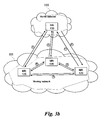
- FIG. 1 illustrates the home network 150 comprising the home agent 130 that the MRs 120, 125 are communicating with.
- the communication is typically via an IP network 155.
- the MRs will need to setup one tunnel to the home agent for each available external access.
- the example in the figure shows three tunnels, indicated with thick solid lines, from the MRs 120, 125 to the home agent 130, two from the MR1, tunnels 160 and 165 via WCDMA and satellite accesses, respectively, and one tunnel 170 from MR2 via GPRS access.
- a Personal Area Network (PAN) 205 with multiple mobile routers (MRs) is illustrated in FIG. 2 .
- the MRs 220, 225, that provide the external access to the PAN 205 may for example be a mobile phone communicating with WCDMA 240 or a laptop PC communicating with WLAN 235. These accesses may be available at the same time.
- the benefits of having multiple MRs and multiple external accesses are more or less the same as in the VAN with multiple MRs scenario.
- the PAN can for instance be the gadgets/devices that the user is carrying with him/her for example a PDA 275 and a digital camera 280, or the network within the user's personal car.
- the PAN 205 typically consists of a switched Ethernet network based on for instance BluetoothTM running the PAN profile.
- the MRs act as routers within the PAN as well as for external network access.
- the MRs are also responsible for mobility management of the moving network, i.e. the PAN 205.
- the MRs in the PAN share the same HA 230 and the same prefix from the address range of their home network.
- the MRs are communicating with the home agent 230 deployed in the home network 250, typically via an IP network 255.
- the MRs need to setup a tunnel to the home agent for each available external access.
- the example in FIG. 2 shows two tunnels from the PAN to the home agent, via WCDMA 260 and WLAN 262 accesses.
- the NEMO basic support protocol has as described in the background section no specific support for multiple MRs or multiple mobile router-home agent tunnels.
- the method and arrangement according to the present invention extends the scope and mechanisms to encompass and support multiple MRs.
- the MRs of a moving network are assumed to share the same HA, in order to simplify administration, and the same prefix, in order to avoid the problem of synchronizing source address selection and router selection.
- the NEMO basic support protocol does not prevent two MRs from having the same prefix, there is no explicit support for this either. Therefore, in view of the problems associated with such scenarios, using the NEMO basic support protocol for MRs sharing the same prefix may result in serious malfunctioning.
- a packet destined for MNN X, connected to moving network ⁇ via MR A, may instead be routed to moving network ⁇ via MR B, because MR A and MR B share the same prefix on which the routing is based.
- a reasonable level of security should be integrated in the procedure - it should for instance not be possible (at least not without a great effort) for a malicious node to make the same prefix be assigned to MRs that are not connected to the same moving network. Note, however, that each MR is assumed to have a trust relation with its HA and secure communication with its HA. Secure procedures, e.g. IPsec, is provided for in MIPv6 and thus for the NEMO basic support protocol.
- the mechanism providing this feature requires as little additional configuration as possible, in the involved nodes i.e. MRs and HAs.
- the invention provides mechanisms to extend the NEMO Basic Support protocol to support dynamic assignment of prefixes to MRs, instead of relying solely on prefixes that are preconfigured in the MRs.
- MR2 and MR1 Assume a scenario with at least two MRs, MR2 and MR1, and their mutual HA.
- the HA has already assigned a prefix, prefix P, to MR1, when MR2 sends a BU to the HA, requesting to be assigned a prefix.
- prefix P the HA should verify that MR2 and MR1 are connected to a common moving network before it accepts to assign prefix P to MR2.
- the HA needs to ensure that the MR2 and MR1 belong to the same moving network by performing a local connectivity test.
- the HA authenticates the MRs and verify that they are legitimate nodes in the communication system for example by an IKE/IPsec-procedure.
- IKE/IPsec-procedure does not prevent possible fraud, malicious attacks, and errors by mistake originating from that MRs incorrectly are treated by the HA as belonging to the same moving network. This is prevented, or at least rendered more difficult, by the method of the invention, ensuring that a MRs sharing the same prefix P, belong to the same moving network.
- 3b comprises the steps of: 305: Establishing unique shared secrets between a plurality of MRs, in FIG. 3b exemplified with MR 125 and MR 126, in the moving network 105 and the HA 130 (messages A).
- the shared secret is established during an authentication process of the MR towards the HA.
- the shared secret is preconfigured, or derived from preconfigured data.
- the shared secrets are unique for each MR, and stored by the HA and the respective MR.
- the MRs 125, 126 are assigned prefixes, which are stored by the respective MRs and the HA 130.
- shared secrets are established between all MRs belonging to the moving network and the HA.
- the MRs 125, 126 derive MR specific information at least partly based on their respective shared secret.
- 315 Sharing of MR specific information between MRs of the same moving network (messages B).
- the sharing of the MR specific information should be via a message confined to the moving network, hereinafter referred to as a link-local message.
- the link-local message may for example be in the form of a broadcasted or multicast advertisement information message or a unicast link-local message dedicated for a certain receiving MR.
- the link-local message or the MR specific information should comprise timing information, an age indicator, or be sent in a manner that makes it possible to derive an age indicator, to verify the age of the MR specific information.
- the MR 120 requesting a prefix may be new to the moving network, or alternatively is established on the moving network, but wants to change/update its prefix.
- the MR 120 may include a prefix preference in the request message, or a prefix may be suggested by the HA 130.
- the prefix may be pre-configured in the MR 120 and/or the HA 130.
- the term "requested prefix" should be understood to encompass all these alternatives, and not restricted to the case of the MR 120 explicitly requesting a specific prefix.
- the MR 120 requesting a prefix forwards shared MR specific information from another MR 125 or other MRs 125, 126 to the HA 130.
- the forwarding in association with the request may be comprised in the BU-message (message C) or in separate message or messages.
- the HA 130 compares data generated using the in the HA stored shared secret with the forwarded MR specific information, or data derived from it, for each MR 125, 126, to determine if the forwarded MR specific information originates from the respective MR, which indicates that the requesting MR 120 belongs to the same moving network 105 as MR 125 and 126, i.e. local connectivity.
- the HA determines if the shared information is recent, i.e.
- the HA 130 verifies that the forwarded information comprises MR specific information from all MRs sharing a requested prefix, referred to as completeness or that the MR specific information is complete. 335: If verified in step 330 that the MR specific information originate from the claimed MR(s), and that the information is recent and complete, the HA 130 considers the MR 120 requesting the prefix as belonging to the same moving network and allows the MR 120 requesting the prefix to have the requested prefix assigned. If not, the MR 120 is not allowed to have the requested prefix assigned, and possibly is assigned another prefix. The verification result is communicated from the HA 130 to the MR 120 (message D).
- the method may comprise an optional step 322 of: 322:
- the HA 130 controls if the requested prefix is used by any other MR 125, 126. If so, the steps 325-335 are performed. If not, the HA 130 assigns the requested prefix to MR 120.
- the shared secret may, as indicated above, be preconfigured, generated, derived or conveyed - as long as the net result is that the MR and the HA shares a piece of secret data, Dss, that can be used as the basis for the local connectivity test.
- a simple way to provided a shared secret is to have Dss preconfigured in the MR and in the HA. This is uncomplicated, but involves manual configuration. Automatic methods are generally preferable.
- a MR always has a security relation with its HA that is used to authenticate the two nodes to each other and to secure the NEMO signaling between them.
- This security relation can be leveraged in various ways.
- this shared secret can be used also as Dss. More preferable, is to derive D ss from the shared secret instead of using the shared secret directly. Deriving D ss from the shared secret may involve performing a one-way hash function on the shared secret, possibly together with some additional data.
- This additional data may be an identity or an address associated with either the MR or the HA, or it may be a random number, a nonce, generated by the HA and transferred to the MR (or generated by the MR and transferred to the HA), e.g. a nonce produced and transferred during the IKE procedure for IPsec SA establishment or a new nonce transferred in the Binding Acknowledgement message (BA) (or the BU) during the Binding Update procedure, e.g. in a new mobility option.
- BA Binding Acknowledgement message
- Another possibility to leverage the MR-HA security relation is to use one of the session keys for the MR-HA IPsec SAs as D ss or derive D ss from such a session key.
- An automatic method that allows the MR and the HA to independently generate/derive D ss , e.g. by leveraging the existing MR-HA security relation is preferable. Thereby both configuration and protocol extensions are avoided.
- the link-local message For the sharing of MR specific information in step 315 different measures can be taken to ensure that the link-local message is not conveyed outside the local link, i.e. outside the moving network.
- the Hop Limit field in the IPv6 header of the link-local message should be set to 0 or 1 in order to ensure that the message is not conveyed outside the moving network. It is mandated that a MR does not knowingly attempt to send a local connectivity test message to an off-link destination. For further assurance it is preferable that the address information is a link-local address.
- the Time-To-Live (TTL) field in the IPv4 header should be set to 0 or 1.
- the Hop Limit or TTL field As an alternative to setting the Hop Limit or TTL field to 0 or 1, it could be set to 255 (i.e. its maximum value) in the link-local message. In that case, if an MR receives a link-local message (sharing MR specific information) with a Hop Limit or TTL field with another value than 255 (which would indicate that the message has traversed a router), it should discard the message and possibly respond with a rejection or failure indication.
- a second embodiment of the method according to the invention is described with reference to FIG. 4a-b and is relevant to the scenarios outlined with reference to FIG. 1 and 2 , involving MR2 120 and MR1 125 and their mutual HA 130.
- a secure assignment of a common prefix for at least two MRs in the same moving network is addressed.
- the NEMO basic support protocol assumes that a MR is preconfigured with the prefix that is allocated to the MR from the address range of the home network (or other prefix range served by the HA).
- the HA may also be preconfigured with the MR's prefix, but as an optional alternative, it may instead retrieve this information from a Binding Update (BU) sent from the MR, provided that the MR includes this prefix in the Mobile Network Prefix Option specified in the NEMO basic support protocol.
- BU Binding Update
- a more flexible approach is used that allows the HA to dynamically allocate a prefix to the MR.
- the HA may still be configured to assign a certain prefix, or one out of a set of prefixes, to a certain MR and the MR may still be configured with a preferred prefix that it expects the HA to assign, but the actual prefix assignment is performed dynamically through a binding update/binding acknowledge (BU/BA) exchange, or possibly other messages.
- BU/BA binding update/binding acknowledge
- the MR may include its preferred prefix in the BU, but the HA is not obliged to fulfill the MR's preference and may assign another prefix to the MR.
- the MR may use the Mobile Network Prefix Option specified in the NEMO basic support protocol in order to convey its preferred prefix(es) to the HA.
- a new flag may be introduced in the BU to indicate this option. It would also be possible to specify a new option for "preferred prefix" that is distinguished from the existing Mobile Network Prefix Option.
- the flag indicating dynamic prefix assignment is not needed, since the presence of the new option in the BU implicitly indicates to the HA that dynamic prefix assignment is to be used (provided that a MR needing dynamic prefix assignment always includes the new option in the BU, either to indicate a preferred prefix or using a reserved value to indicate 'no preferred prefix').
- the MR may include its preferred prefix in the Mobile Network Prefix Option, but without using a new flag. Instead the HA would have configuration data that allows it to distinguish MRs with fixed and dynamically assigned prefixes. Using the same kind of prefix assignment, e.g.
- the HA includes the dynamically assigned prefix in the BA (or possibly in a new type of message). If the MR has indicated a preferred prefix, or if the preferred prefix is preconfigured in the HA, then the HA may omit the prefix in the BA. The MR would interpret a BA without a prefix (and without an error indication) as an assignment of the preferred prefix.
- the shared secret is exemplified with the use of a random sequence, a nonce, although other types of shared secrets may be used.
- the derivation of MR specific information, sharing and forwarding of the MR specific information etc, is triggered by an action of the HA. The procedure can therefore be seen, and will be referred to, as a triggered local connectivity test.
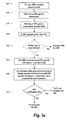
- the method according to the second embodiment of the invention is illustrated in the flowchart of FIG. 4a , and in the message scheme of FIG 4b .
- the numbers in parenthesis are the corresponding steps of the basic method.
- the method according to the second embodiment comprises the steps and sub-steps of: 405 (305): Assigning prefix P and establishing a shared secret MR1 125-HA 130: 405:1 MR1 125 issues a BU to the HA 130 to be assigned a prefix, possibly including an implicit or explicit request to be assigned the specific prefix P ( message A1 ).
- HA 130 is provided with an address to MR1, preferably an IP address, to be used for possible future local connectivity tests, denoted address c-test-MR1 .
- a BA the HA 130 explicitly or implicitly assigns prefix P to MR1 125 ( message A2 ).
- the HA also assigns a unique shared secret, typically a nonce, denoted non ceMr1 , to MR1 125, e.g. by including the nonce together with the prefix in the BA.
- a preferred way to include the nonce in the BA is to use a new (backwards compatible) mobility option.
- the nonce is to be used in possible future local connectivity tests. 405:3
- the HA 130 stores prefix P, nonce MR1 and address c-test-MR1 associated with MR1 125.
- 410 (320): Another MR, MR2, requests the HA to assign a prefix to the MR2: Subsequently the HA 130 receives a request from MR2 120 to have a prefix assigned ( message C1 ) . MR2 120 may explicitly indicate that it prefers prefix P or the HA 130 may suggest prefix P, deduced from configuration data. 415: The HA determines which other MR(s), if any, that have already been assigned the requested prefix, prefix P. In this example the HA determines that MR1 125 is the only other MR currently using the requested prefix, prefix P. The HA 130 then requests MR2 120 to perform a local connectivity test towards MR1 125 (message C2).
- the HA 130 sends a unique one-time data, typically a second nonce, denoted nonce c-test , to MR2 120 together with address c-test-MR1 .
- MR2 120 sends a "local connectivity test message" to MR1 125, addressed to address c-test-MR1 , comprising nonce c-test ( message B1 ).
- the local connectivity test message should be a link-local message complying with the previously described properties of such messages.
- MR1 125 Derive MR specific information at least partly based on the shared secret ( nonce MR1 ): Assuming that the local connectivity test message is received with the correct destination address, MR1 125 performs an irreversible operation on nonce MR1 and nonce c-test .
- 430 Sharing of MR specific information: MR1 125 responds to the local connectivity test message by sending the result of the irreversible operation, denoted irreversible-op-result MR1-c-test , to MR2 120 ( message B2 ). Also this message is a link-local message.
- 435 Forwarding of shared MR specific information to the HA: MR2 120 forwards irreversible-op-result MR1-c-test to the HA 130 (message C3).
- 440 (330): The HA verifies origin, recentness and completeness of the MR specific information by comparing with stored information associated with MR1 or by comparing with data generated using stored information associated with MR1: The HA 130, knowing both nonce MR1 and nonce c-test , verifies that irreversible-op-result MR1-C-test is correct by performing the same irreversible operation on nonce MR1 and nonce c-test as performed by MR1 125 in step 425.
- the irreversible-op-result MR1-c-test is ensured in that the procedure is triggered by the HA (step 415), including the unique one-time data, nonce c-test .
- the irreversible-op-result MR1-c-test also serves as an age indicator.
- the HA may for example start a timer when the nonce c-test is generated, or sent, to MR2 120 (step 415, message C2 ), and in the comparing step 440 determine if the irreversible-op-result MR1-c-test was received within a pre-determined time limit.
- the irreversible operation utilized in step 425 to derive the MR specific information, the irreversible-op-result MR1-c-test , and in step 440 to verify the origin of the MR specific information, should here be interpreted as an operation as such for example a specific algorithm, not including the parameters used by the operation.
- the irreversible operation should be so designed that a specific input parameter, or set of parameters, will always yield the same result, whereas another input parameter, or parameters, will yield another result (or at least with very low probability yield the same result) and wherein the input parameter is not derivable from the result.
- Such irreversible operations are known in the art.
- Suitable irreversible operations include, but are not limited to: a hash operation like MD5 or SHA-1 e.g. computed over nonce MR1 concatenated with nonce c-test (and possibly concatenated with another fixed string or padding if required by the operation). If the irreversible operation requires a secret key, then nonce MR1 may be used as the secret key. Other secret key alternatives include the pre-shared secret on which the MR1-HA security relation is based (if such a pre-shared secret is used) or a key derived from this pre-shared secret. As will be further discussed below, the irreversible configuration may be pre-configured, agreed upon during the authentication procedure between the MR and the HA, or communicated in some other secure manner. Alternatively the MR and the HA is provided with a plurality of different algorithms irreversible operations and an indication of which to use/has been used is included in the link-local messages.
- a hash operation like MD5 or SHA-1 e.g. computed
- the nonce, nonce MR1 sent from the HA to MR1 in step 405 must be kept a secret shared by only MR1 and the HA. Otherwise it would be possible for any node that has gained access to the nonce to impersonate MR1 during a local connectivity test. This means that the assignment of the nonce also must be performed in a secure way. There are several ways to achieve this.
- IPsec protection including message authentication, integrity protection and encryption
- IPsec protection of the BU/BA exchange is mandated in the previously cited "Mobility support in IPv6" and in " Using IPsec to Protect Mobile IPv6 Signaling Between Mobile Nodes and Home Agents" by J. Arkko et al., RFC 3776, June 2004 .
- the only required protection is message authentication and integrity protection.
- Other types of protection, e.g. encryption are optional.
- MR1 and the HA must, in addition to the IPsec protection mandated in the above cited documents, encrypt the BU/BA exchange. This is easily achieved since the security relation that the session keys are based on (for message authentication, integrity protection as well as encryption) is already in place.
- the MR2 instead of the HA, may generate the unique one-time data, i.e. the nonce c-test parameter.
- the nonce c-test parameter is used exactly as in the described variant of the procedure.
- MR2 must however send nonce c-test together with the test result to the HA, so that the HA can verify that the result is actually produced by MR1.
- the local connectivity test address denoted address c-test-MR1 , provided by the MR1 in step 405:1 must be associated with an interface of MR1, on which the concerned prefix P is to be announced, i.e. an interface towards the moving network of MR1 (i.e. it cannot be the care-of address of MR1).
- the address may e.g. be included in the BU (message 1 ).
- the local connectivity test address should preferably be a link-local address.
- MR1 supplies only the non-prefix part of the address, i.e. interface identifier in IPv6 (details regarding the IPv4 case will be further discussed below.
- the actual local connectivity test address is then formed by appending the non-prefix part to the assigned prefix.
- the preferred way to include the local connectivity test address (or its non-prefix part) in the BU is to use a new (backwards compatible) mobility option.
- link-local message "local connectivity test message” sent by MR2 to MR1 in step 420 the measures previously described concerning link-local messages should be taken to ensure that the message is not conveyed outside the local link. For further assurance it is preferable that address c-test-MR1 is a link-local address.
- MR1 If MR1 receives a local connectivity test message with another destination address then address c-test-MR1 , it should discard the message and possibly respond with a rejection or failure indication.
- the above described embodiment can be extended to also encompass more than two MRs belonging to the same moving network and sharing the same prefix P. If more than one MR have already been assigned a requested prefix, the connectivity test has to be performed successfully towards each of them before the HA accepts to assign the same prefix to yet a MR. However, even though steps 420 to 430 ( message B1 and message B2 ) have to be executed multiple times (once for each MR that has already been assigned the requested prefix), the messages of steps 415 and 435 ( message C2 and message C3 ) only have to be exchanged once between the HA and MR2.
- the HA can include nonce c-test and address c-test-MRx parameters for all the concerned MRs in a single message and similarly MR2 can include the irreversible-op-result MR1-c-test parameters for all the concerned MRs in a single message. It is even possible to reuse the same nonce c-test parameter for all the local connectivity tests.
- the described embodiment does, in addition to fulfill the requirements of facilitating the use of multiple MRs in a moving network, have the advantages that it is independent of the authentication mechanism used between the MR and the HA.
- the basic way to apply the local connectivity test according to this embodiment is, as previously described, in combination with a Binding Update procedure in order to ensure that a prefix is not assigned to a MR that is not connected to the same moving network as the other (possible) MRs that have already been assigned the prefix.
- the HA could then at any time request a MR to perform a local connectivity test towards the other MRs sharing the same prefix and/or, if desired, to further other MRs.
- the messages and mechanisms used in this process would be the same as previously described when the local connectivity test is applied in conjunction with a Binding Update procedure. That is, a stand-alone local connectivity test would consist of messages C2 , B1 , B2 and C3 in FIG. 4b , and the parameters nonce MR1 (i.e. the long-lived nonce), nonce c-test (i.e. the one-time nonce) and the local connectivity test address would be used as before.
- the initial preparation, or "bootstrapping", for the test i.e.
- the "triggered" local connectivity test may be adapted also to take into account that a MR may be connected to more than one moving network, via different interfaces, simultaneously, i.e. that it may be multi-homed in terms of moving network attachments. Such a multi-homed MR will have more than one prefix assigned and it will use different prefixes in its different moving networks.
- a HA needs to know to which prefix(es) the test result pertains. That is, the HA needs to know which prefix(es) the multi-homed MR is using in the moving network where the local connectivity test was performed.
- MR A being multi-homed with interfaces in two different moving networks.
- MNP1 prefix MNP1
- MNP2 prefix MNP2
- MR B connects to the moving network where MR A is using MNP1 and sends a BU to its HA (which it has in common with MR A), requesting to have prefix MNP1 assigned.
- the HA asks MR B to perform a local connectivity test towards MR A and MR B sends a local connectivity test message to MR A. If the result that MR A returns would have pertained to all of its assigned prefixes, then MR A could have generated and returned a result in the manner previously described.
- MR A since MR A is only using one of its two prefixes in the moving network where the local connectivity test is performed, such a regular response would not suffice.
- MR A has to somehow indicate which of its prefixes that the response pertains to.
- MR A modifies the nonce c-test parameter using MNP1 before generating and returning the irreversible-op-result MR-A-c-test parameter.
- MR A includes a list of the concerned prefixes, in this example only MNP1.
- MR B forwards the result, including the prefix list, to the HA.
- the HA receives the test result, it knows from the included prefix list which prefix(es) the test result is relevant for.
- the HA also uses the prefix list to modify the nonce c-test parameter in the same way as MR A before verifying the irreversible-op-result MR-A-c-test parameter.
- the HA can accept to assign MNP1 to MR B (provided that the irreversible-op-result MR-A-c-test parameter was successfully verified). If, on the other hand, the returned result message would have included MNP2, but not MNP1, then the HA would not have accepted to assign MNP1 to MR B.
- the prefix concatenation is shorter than the nonce c-test parameter, it is prepended or appended with a number of bits set to zero, so that the length matches the length of the nonce c-test parameter, before the XOR operation is performed. If the prefix concatenation is longer than the nonce c-test parameter, the nonce c-test parameter may instead be extended in the same way. However, if changing the length of the nonce c-test parameter is to be avoided, then the prefix concatenation could instead be hashed (using the appropriate padding or truncation of the hash result if needed) into the same length as the nonce c-test parameter before the XOR operation.
- This alternative embodiment is beneficial when more than one MR is already using the prefix when the local connectivity test is to be performed.
- the example scenario is extended with a third MR, MR3.
- MR3 has already assigned the prefix to MR3, in addition to MR1, when MR2 sends its BU to the HA.
- the basic variant of the local connectivity test states that when multiple MRs are to be tested, MR2 has to exchange unicast test/result messages with each of MRs to be tested, whereas a single message exchange is enough between the HA and MR2 in order to request the tests and return their results.
- the multiple unicast message exchanges between MR2 and the other MRs is replaced be a simplified message exchange consisting of a single multicast test message from MR2 followed by unicast response messages from the MRs receiving the test message.
- the nonce c-test parameter may be generated by either the HA (as in the basic variant) or MR2 (as in the variation described above). The same nonce c-test is used in the test towards all the MRs.
- MR2 When MR2 receives the responses from the other MRs, i.e. MR1 and MR3 in the extended example, it is preferable that MR2 can explicitly match the responses with the multicast test message (although confusion is unlikely given that the responses are unicast and that MR2 is unlikely to have more than one local connectivity test ongoing simultaneously).
- Explicit matching could be achieved by a unique transaction identifier that is included both in the test message and in the responses.
- Such a transaction identifier could be e.g. a sequence number generated by MR2 (and copied by MR1 and MR3 into the response messages) or the nonce c-test parameter (in which case MR1 and MR3 would return nonce c-test in their response messages). If nonce c-test is used as a transaction identifier, it effectively has dual purposes, both as a replay protector and as a transaction identifier.
- MR2 collects all test results from the response messages it receives (i.e. from MR1 and MR3) and sends them in a single message to the HA.
- an identity of the generating MR has to be associated with each test result.
- the home address of a MR is used as this identity, but it is also possible to use the local connectivity test address (i.e. preferably the link-local address) of the MR or another type of identity, e.g. a NAI, that the MR uses in its MR-HA security relation.
- MR2 could extract this address from the source address field of the IP header of the response message (provided that MR1 and MR3 use their respective local connectivity test addresses as the source address of the response message). Otherwise, MR1 and MR3 have to include their respective identity in the response messages. In either case MR2 has to include the identities of MR1 and MR3 associated with the test results from MR1 and MR3 in the message to the HA. Preferably MR1 and MR3 provides their home addresses as identification in their response messages and MR2 includes these home addresses in the message to the HA.
- a MR does not have to provide the HA with a local connectivity test address in the BU, as described in the basic variant of the test.
- MR2 may repeat the multicast test message several times for redundancy within a certain time period Tp.
- the unicast response messages could be sent reliably or unreliably.
- Reliable sending could utilize, e.g. TCP or a retransmission mechanism designed into the test itself. In the latter case the sender repeats the response message until an acknowledgement is received.
- TCP Transmission Control Protocol
- a MR should ignore any test message that is received within a time period Tp after an identical test message on which the MR has already reacted. If unreliable responses are used a MR should respond to all received test messages.
- the MRs receiving the multicast test message may use a (short) random delay before sending the unicast response message in order to avoid collisions with response messages from other MRs.
- a MR may omit the random delay if it knows/believes that there are no other MRs in the moving network than itself and the MR sending the multicast test message.
- Advantages of this variation include speed and resource efficiency, both due to that multiple sequential unicast messages are replaced by a single multicast message. Additional advantages are that no local connectivity test address is needed (unless it is used as MR identification) and that the HA does not have to list the MRs to be tested when asking MR1 to perform the tests.
- a third embodiment of the invention utilizes an advertisement mechanism for sharing the MR specific information between MRs in the moving network.
- the advertisement mechanism utilizes a broadcasted, or multicast, message, and therefore this embodiment will be referred to as broadcast local connectivity test.
- broadcast local connectivity test By the advertisement mechanism, a MR can announce its presence to other MRs in the moving network, thus indicating local connectivity between the MRs, in a way that can be retroactively verified by the HA.
- the relationship between the MR and the HA consists of a shared secret that is mutually known by the two nodes.
- the shared secret may be preconfigured (or derived from preconfigured data), provided to the MR by the HA, provided to the HA by the MR or mutually derived, e.g. during an authentication procedure, between the MR and the HA, as described above.
- the shared secret is exemplified with a shared secret data, D ss .
- the MR uses the D ss to generate advertisement information that it broadcasts or multicasts to other MRs in the local network.
- the advertisement information changes periodically or with each advertisement message.
- Another MR receiving the advertisement information can present it to the HA (that it has in common with the originator of the information) to provide evidence of local connectivity to the MR that originated the advertisement information.
- the HA can verify that the presented advertisement information originates from the claimed MR as well as deduce its recentness. Provided that the originator of the advertisement information is indeed the claimed MR and provided that the information is recent enough, the HA accepts it as an indication of local connectivity between the MR presenting the advertisement information and the MR that originated it.
- the method according to the third embodiment of the invention is illustrated in the flowchart of FIG. 5a , and in the message scheme of FIG. 5b .
- the numbers in parenthesis are the corresponding steps of the basic method.
- the method according to the second embodiment comprises the steps and sub-steps of: 505 (305): Assigning prefixes and establishing shared secrets between the MRs 125, 126 and the HA 130.
- the substeps 505:1-3 are repeated for each MR in the moving network: 505:1
- the MR issues a BU to the HA 130 to be assigned a prefix ( messages A1 ).
- 505:2 In a BA the HA 130 explicitly or implicitly assigns the prefix to the MR ( messages A2 ).
- the HA 130 and the MR establish the shared secret data D ss (unless it is preconfigured).
- the D ss is to be used in possible future local connectivity tests.
- 505:3 The HA 130 stores the D ss and the prefix, associated with the MR.
- the advertisement information should further comprise an identity associated with the MR and an age indicator, which can be used to asses the age of the MR specific information.
- an age indicator which can be used to asses the age of the MR specific information.
- 515 Sharing of MR specific information between the MRs of the same moving network, by each MR broadcasting or multicasting its advertisement information in link-local messages to the other MRs ( messages B ). Alternatives for the broadcasting/multicasting procedure will be given below.
- 520 A MR 120 requests ( message C1 ) the HA 130 to be assigned a prefix, or to be reassigned a prefix, in a BU. Note that the term "requests" should be interpreted as previously explained in conjunction with step 320 of the first embodiment.
- 525 (25): The MR 120 requesting a prefix forwards shared MR specific information from another MR 125 or other MRs 125, 126 to the HA 130.
- the forwarding in association with the request may be comprised in the BU-message ( message C1 ) or in a separate message or messages.
- the HA further analyses recentness of the forwarded MR specific information by extracting the age indicator(s) comprised in, or derivable from, the relevant MR specific information. Additionally the HA verifies that the forwarded information comprises MR specific information from all MRs sharing the same prefix as the HA 130 is considering to assign to the MR 120, referred to as completeness. 535 (335): If verified in step 530 that the specific MR information originate from the claimed MRs, and also recentness and completeness are verified, the HA accepts the BU and assigns (or reassigns) the requested prefix to the MR by returning a BA ( message D1 ).
- the HA may assign an alternative prefix to the MR by returning a BA including the alternative prefix.
- the HA may reject the BU by sending a BA indicating that the BU was rejected.
- the steps do not have to be taken at the same time.
- the step of authenticating and/or establishing a D ss for each MR can preferably be done when each MR first appears on the moving network, the steps of advertising, or sharing MR specific information (step 515) is preferably performed at regular intervals, and the steps of assigning a prefix to another MR (steps 520-535) is taken on demand.
- the advertisement information is an important element in the broadcast local connectivity test, i.e. the information that a MR distributes to other MRs in order to announce its presence and which can be verified by the HA.
- the advertisement information must contain an identity associated with the MR and a piece of data, the age indicator, that the HA can use to assess the age of the information.
- the MR identity should be an identity that the HA knows, preferably the one that the MR uses when authenticating itself to the HA, e.g. the MR's home address or a Network Access Identifier, NAI.
- the information may be signed using D ss as the key (or a key derived from Dss), which means that a digital signature is included too, or protected by a message authentication code, MAC, that ensures source integrity for the information, i.e. which proves to the HA that the advertisement information indeed originates from the MR whose identity is included in the information.
- D ss the key
- MAC message authentication code
- a MR could include the advertisement period, i.e. the time interval between two consecutive advertisement messages, that the MR is using, or the advertisement information update period, i.e. the period with which the advertisement information (in particular the age indicator) is updated.
- the advertisement period i.e. the time interval between two consecutive advertisement messages
- the advertisement information update period i.e. the period with which the advertisement information (in particular the age indicator) is updated.
- This may be useful to the HA when it assesses the recentness of the advertisement information. It is preferred to keep this as an optional data field in the advertisement information. That way it can be used by implementers, users, organizations and/or operators, who feel a need for such flexibility, whereas those who are satisfied with pre-configuration in the HA can omit the data field and thereby keep the advertisement information somewhat smaller and the implementation somewhat simpler.
- prefix(es) that is/are relevant for the advertisement information is however not required to allow the HA to verify the advertisement information, since the HA already knows which prefix(es) that is/are assigned to each of the MRs that are registered in the HA.
- Other MRs receiving the advertisement information know from the router advertisements what prefix(es) the MR is using, but could potentially benefit from knowing which of these prefixes that the advertisement information pertains to (in case they are not all the same). It is also useful if the MR originating the advertisement information is multi-homed, having interfaces in more than one moving network, and is using different prefixes in the different moving networks.
- the HA needs to know which prefix(es) the advertisement information pertains to, in order to be able to verify local connectivity to the relevant interface of the multi-homed MR.
- MR A being multi-homed with interfaces in two different moving networks. In one moving network it is using prefix MNP1 and in the other moving network it is using prefix. MNP2.
- MR B connects to one of MR A's moving networks and sends a BU to its HA (which it has in common with MR A), requesting to have prefix MNP1 assigned.
- MR B includes advertisement received from MR A in the BU, so that the HA can verify the local connectivity between MR B and MR A.
- the HA needs to know which prefix the advertisement information from MR A pertains to in order to determine whether it can accept to assign MNP1 to MR B. If the advertisement information pertains to MNP1, indicating that MR A is using MNP1 in the moving network of MR B, then the HA can accept to assign MNP1 to MR B. But if the advertisement information pertains only to MNP2 and not to MNP1, indicating that MR A is using MNP1 in another moving network, then the HA will not accept to assign MNP1 to MR B.
- including the relevant prefix(es) in the advertisement information may be more beneficial in moving networks where the layer 1 and layer 2 media do not allow all MRs to hear each other directly.
- An age indicator may be provided in step 510, by using signed timestamps, where the timestamp indicates the time that has passed since the last time the MR performed a Binding Update procedure or since the prefix was assigned. If the timestamp indicates the time since the prefix was assigned, the timestamp must be accompanied by the concerned prefix and there may be more than one such timestamp-prefix pairs in the advertisement information, since the MR may be assigned more than one prefix.
- a digital signature or a MAC is used to prove to the HA that the originator of the advertisement information is actually the MR whose identity is included in the information.
- the signature or MAC is preferably computed over the entire advertisement information using D ss (or a key derived from D ss ) as the signing/integrity key.
- the HA When the HA receives the advertisement information (step 525), it first extracts the included MR identity in order to find the relevant D ss . Using the D ss the HA then verifies the digital signature or MAC in order to authenticate the originator of the advertisement information and in order to verify that the information has not been altered since it left its originator. If this is successful, the HA knows that at the time the advertisement information was sent from its originator, as indicated by the included timestamp(s), there was local connectivity between the sending and the receiving MR. Since this is not proof of current local connectivity, a maximum age, T max-age , of the local connectivity proof must be defined or pre-determined, that the HA accepts in order to allow the two MRs to share the same prefix.
- the HA then checks the timestamp(s) to determine whether the advertisement information is recent enough.
- the HA would accept a timestamp no older than T max - age , where T max-age must be greater than the advertisement period the MR is using.
- T max-age may be a fixed preconfigured value, in which case the MR may use any advertisement period that is smaller than T max-age (with a certain margin).
- the MR does not even have to use a consistent advertisement period. It may use a variable time interval between its advertisements, as long as the time interval between two consecutive advertisements does not exceed T max-age (with a certain margin).
- T max-age may not be a fixed preconfigured value in the HA.
- the MR may have a fixed advertisement period that it includes in the advertisement information (or a variable advertisement period whose maximum value is included in the advertisement information). Then the HA would dynamically set T max-age to a value that is (slightly) greater than the advertisement period indicated in the received advertisement information.
- the margin between T max-age and the advertisement period is chosen in relation to the accuracy of the synchronization that can be expected between the MR and the HA. Hence, the HA may choose a greater T max-age value the longer time that has elapsed since the timer was restarted, since the time measurement discrepancy due to synchronization inaccuracy grows with time.
- the HA determines that the advertisement information is recent enough, the local connectivity test towards the MR that originated the information is deemed successful. If the local connectivity tests towards all MRs that are currently using the concerned prefix(es) are successful, the HA accepts to assign the concerned prefix(es) to the MR (i.e. the MR that sent the BU to the HA) and returns a BA to the MR indicating the success.
- the HA does not accept to assign the requested prefix(es) for which the test failed.
- the HA may either reject the Binding Update (indicating the failure in a BA) or choose to assign one or more alternative prefix(es) to the MR (indicated in a BA).
- the HA In order to be able to determine the age of received advertisement information, the HA must maintain a timer corresponding to each of the timers running in the MRs that are registered in the MR. At each Binding Update procedure (or alternatively at each prefix assignment) the HA must restart the appropriate timer, as must the concerned MR, so that the corresponding timers in HA and the MR are synchronized. "Timer” should here be interpreted in a general sense. It would e.g. suffice to record the current time when the "timer" is to be started/restarted and subtract this recorded value from the current time when the "timer" is read.
- a variant of the timestamp method is to use sequence numbers instead, which, like the timers above, are restarted when the MR performs a Binding Update procedure or when a prefix is assigned.
- P inc such a sequence number, S
- T S ⁇ P inc .
- the fixed increment period, P inc may be preconfigured in the HA or included in the advertisement information, associated with S.
- the MR is then free to use any fixed or variable advertisement period, T adv , that fulfils T adv ⁇ P inc .
- One may also choose to set P inc T adv , consequently requiring a fixed advertisement period, T adv .
- the fixed advertisement period would then have to be preconfigured in the HA or included in the advertisement information (instead of the increment period, P inc ).
- P inc the increment period
- the timestamp/sequence number method is preferred embodiment over the alternative methods described below.
- the timestamps have the advantage that it allows the MR to have a flexible advertisement period (as long as it does not exceed some maximum value) and still have the timestamp convey accurate time information.
- the sequence numbers allow flexible advertisement periods only if the fixed increment period is independent of the advertisement period (as long as the advertisement period does not exceed the increment period). But then the time resulting from multiplying the sequence number by the increment period, i.e. S ⁇ P inc , will not represent the time when the advertisement information was sent, but instead the time when the sequence number was last incremented before the advertisement information was sent.
- a simple format of a timestamp could be e.g. an integer representing the number seconds since the timer was restarted.
- a further alternative for the age indicator in the advertisement information is to use hash chains.
- the hash chain method like the signed sequence number method, requires a fixed period when the next "link" in the chain is calculated, i.e. when h n is recalculated to h n+1 . This fixed period is denoted “recalculation period”, P recalc .
- P recalc has to be known to the HA and may be either preconfigured in the HA or included in the advertisement information, associated with the hash chain value.
- the HA When the HA receives advertisement information containing a hash chain value, it knows the time that has elapsed since the hash chain was initialized (e.g. because the HA has recorded that time). Dividing the elapsed time by the recalculation period, P recalc , indicates to the HA the expected value of the hash chain value index, e.g. k (i.e. the latest hash chain value is expected to be h k ). In order to verify the hash chain value the HA then calculates h k and compares it with the hash chain value in the received advertisement information.
- the HA may also calculate h k-1 and/or h k+1 , especially if the elapsed time indicates that the MR should be close to either the beginning or the end of a recalculation period. If the hash chain value in the received advertisement information matches h k (or possibly h k-1 or h k+1 ), this indicates two things to the HA:
- the local connectivity test is successful. If none of the hash chain values that the HA can accept matches the hash chain value in the received advertisement information, the local connectivity test has failed.
- the MR may include the hash chain value index in the advertisement information, associated with the hash chain value itself (i.e. if the hash chain value is h k , then the index k would also be included in the advertisement information).
- This variant of the hash chain is quite similar to the signed sequence number method. The sequence number is there in both methods, but in the hash chain method the hash chain value, instead of the digital signature or MAC, authenticates the originating MR. It would even be possible to include a timestamp in the advertisement information to provide the age indication and let the hash chain value authenticate the originating MR (thus making it similar to the signed timestamp method).
- the fixed recalculation period, P recalc may be preconfigured in the HA or included in the advertisement information, associated with the hash chain value.
- the MR is then free to use any fixed or variable advertisement period, T adv , that fulfils T adv ⁇ P recalc .
- P recalc T adv , consequently requiring a fixed advertisement period, T adv .
- the fixed advertisement period would then have to be preconfigured in the HA or included in the advertisement information (instead of the recalculation period, P recalc ).
- the age indicator in the advertisement information is to use irreversible pseudo random number sequences.
- Such a pseudo random number sequence should have the properties that even if one knows one passed value, a few passed values or even all passed values in the sequence one should not be able to calculate the secret seed that the pseudo random number sequence was initialized with. Neither should this allow you to calculate any of the future values in the sequence.
- the irreversible pseudo random number sequence method is equivalent to the hash chain method with the hash chain replaced by the pseudo random number sequence. Thus, the details described above are relevant also for the irreversible pseudo random number sequence method.
- the advertisement information may be protected by a digital signature or a MAC, preferably computed over the entire advertisement information using Dss (or a key derived from D ss ) as the signing/integrity key.
- the MR and the HA could still remain synchronized in terms of the reference for the age indicator if the HA transfers a sequence number to the MR in the BA (e.g. in a new mobility option), which sequence number would act as a reference to that particular Binding Update procedure. This sequence number would then be included in the advertisement information, associated with the age indicator, to provide an explicit indication of which Binding Update procedure the originating MR is using as reference for the age indicator.
- the advertisement information is distributed to other MRs through periodic broadcast or multicast messages on the local link (i.e. confined to the moving network), in step 515.
- An attractive alternative is to integrate the advertisement information in the regular IPv6 router advertisements (see T. Narten et al., "Neighbor Discovery for IP Version 6 (IPv6)", RFC 2461, December 1998 ) which are anyway periodically broadcast by all MRs (and all other IPv6 routers) to announce their presence and their properties. The information could easily be included in a new option field.
- Backwards compatibility with MNNs is not a problem. According to RFC 2461 all nodes must silently ignore any options they do not recognize in a received IPv6 router advertisement.
- Another alternative is to use a new dedicated message that is multicast to an all-MR multicast group.
- a reason for choosing this alternative could be if the regular router advertisement period is regarded as too long for the purpose of a local connectivity test.
- a MR should not send or forward a message containing advertisement information beyond the local link that forms the moving network.
- the same rule as those set forth to the "link-local message" (step 315 of FIG. 3a ) should apply also to the message distributing the advertisement information.
- the control can be given to the HA.
- the HA would then include the advertisement period and/or advertisement information update period that it wants the MR to use in the BA.
- the HA could indicate to the MR that it should use:
- a MR that is about to send a BU can be given a more active role. Instead of relying on the regular advertisement messages the MR that is about to send a BU sends a multicast message to the other MRs (addressed to a multicast group for all MRs or the existing multicast group for all routers), requesting them to immediately send an advertisement message.
- the MR may possibly repeat the multicast message for increased robustness.
- the MRs receiving the triggering multicast message may use a (short) random delay before sending the requested advertisement information in order to avoid collisions with advertisement messages from other MRs. A MR may omit the random delay if it knows/believes that there are no other MRs in the moving network than itself and the MR sending the triggering message.
- the regular periodic advertisement are essentially not needed, although it is quite possible to use both periodic advertisements and triggered advertisements in combination.
- IPv6 router advertisements are used as the advertisement messages, then these combined mechanisms are already in place in the form of periodic (unsolicited) broadcast router advertisements and solicited router advertisements.
- Eliminating the regular periodic advertisements and relying solely on triggered advertisements has the further advantage that it relieves the network from the load caused by the regular advertisement messages or, if IPv6 router advertisements are used as the advertisement messages, reduces the network load by reducing the size of the IPv6 router advertisements. In such case it would also be possible to use unicast triggered advertisement messages, which are sent only to the MR that sent the triggering message, instead of broadcast or multicast messages.
- the age indicator in the advertisement information provides both recentness indication and replay protection. However, if triggered advertisements are used (as described above), then both these purposes can be served by a nonce generated by the MR sending the triggering message.
- a triggering MR would include the nonce in the triggering message and a triggered MR would include the received nonce in the advertisement information in the triggered advertisement message. This indicates to the triggering MR that the advertisement message was indeed triggered by the triggering MR and that it thus is recent.
- the nonce would be covered by the digital signature/MAC that authenticates the source and protects the integrity of the rest of the advertisement information. This proves to the HA that the claimed MR has actually generated the advertisement information.
- the HA Leveraging the MR-HA security relation, the HA trusts the triggering MR to generate a unique nonce and to only provide advertisement information that the triggering MR knows (from the matching nonce) to be recent. Hence, the nonce provides recentness indication and replay protection also from the HA's perspective. When this variation is used it may be preferable to use unicast triggered advertisement messages, since the information in the message is anyway not useful for a MR that has not generated the nonce.
- the purpose of the advertisement information is that a MR that wants to perform a Binding Update procedure and be assigned (or reassigned) a certain prefix should be able to provide the HA with advertisement information the MR has received from other MRs announcing the same prefix in order to prove local connectivity to these routers.
- the preferable way to do this is to include the concerned advertisement information in the BU message, e.g. in a new mobility option, resulting in the described message sequence as illustrated in FIG. 5b .
- An alternative that keeps the present BU format unchanged, even with regards to the existing mobility options, is to use separate messages for a request-response transaction that would convey the advertisement information to the HA as illustrated in FIG 5c .
- the HA 130 On reception of a BU (message C'1) the HA 130 would send an Advertisement Information Request message (message C'2) to the MR 120, which would respond with an Advertisement Information Response message ( message C'3 ) containing the requested advertisement information, the MR specific information.
- This alternative has the disadvantages that it adds a roundtrip to the Binding Update procedure and that two completely new messages are introduced.
- Layer 1 and layer 2 media for IP based Local Area Networks comes in a variety of shapes and more are in the makings. Some of these media have, or may potentially have, the property that all nodes, in particular all MRs, in the layer 2 network cannot necessarily hear each other directly, e.g. because they are out of each other's radio range.
- the broadcast embodiment of the present invention will need some adaptation due to that, the broadcast/multicast advertisement information will not always reach all MRs, even though they may belong to the same IP subnet. Therefore, additional mechanisms are needed to enable the embodiment to work also in moving networks with this property.
- the additional mechanisms include a replication mechanism, which allows MRs to replicate and retransmit each other's advertisement information, so that all MRs' advertisement information will eventually reach all MRs in the moving network.
- a MR can replicate advertisement information either by simply retransmitting (broadcasting or multicasting) any valid advertisement information message (whether this is a Router Advertisement or dedicated type of message) that it receives or by including in its own regular advertisement information messages the latest valid advertisement information that it has received from each other MR.
- Valid advertisement information message means an advertisement information message that the MR has not replicated before.
- the latest valid advertisement information refers to the latest received advertisement information concerning a certain originating MR that is not older than one advertisement period (according to a preconfigured advertisement period or as indicated in the received advertisement information) measured from when the MR received the information and that the MR has not replicated before. That is, if the MR received the latest advertisement information concerning a certain originating MR more than one advertisement period ago (referring to the advertisement period pertaining to the received advertisement information), this advertisement information should preferably not be replicated in the MR's own advertisement information message. Nor should the MR replicate advertisement information that it has already replicated, regardless of its age. How a MR can avoid replicating advertisement information that the MR has already replicated is described below.
- each piece of advertisement information could be provided with an associated sequence number. Together with the MR identity in the advertisement information the sequence number makes the piece of advertisement information unique within a time period representing many advertisement periods (depending on the number of bits that are used for the sequence number). Through temporary caching of the unique identifier consisting of the combination of MR identity and sequence number, a MR should make sure not to replicate any piece of advertisement information that it has recently already replicated.
- a MR could temporarily cache an "advertisement information identifier" consisting of e.g. the age-indicating piece of data together with the MR identity in the advertisement information or the entire advertisement information or a digest of the advertisement information.
- advertisement information is replicated through inclusion in the MR's own regular advertisement information messages, there should preferably be stricter rules for the advertisement periods (and for the advertisement information update periods) than was previously described. Unrestricted flexibility should preferably not be allowed, if the HA is going to be able to efficiently use these time periods in its calculations of the recentness of advertisement information. Fixed, preconfigured time periods is an alternative, but some flexibility may still be allowed, when allowed by the solution in general, however preferably within more restrictive bounds.
- the prefix(es) that a piece of advertisement information pertains to may be included in the advertisement information.
- including the relevant prefix(es) in the advertisement information may be more useful than in other types of moving networks. Including the relevant prefix(es) in the advertisement information is therefore preferable in a moving network where the MRs replicate advertisement information.
- the reason is that a MR that receives only replicated advertisement information from a certain originating MR, but no Router Advertisements from the same originating MR (or possibly receives the Router Advertisements but cannot associate it with the replicated advertisement information), then the MR will not be able to deduce which prefix(es) the advertisement information pertains to, unless this/these prefix(es) is/are included in the advertisement information.
- the method according to the invention may be extended and varied, for example to adapt to different protocols. Examples of such extensions and variations, representing different embodiments of the invention will be given below.
- the BU/BA messages can be used as currently specified in the NEMO basic support protocol without modifications.
- the message by which the HA requests a MR to perform a local connectivity test towards another MR ( message C2 in FIG. 4b ) and the message in which the MR returns the result from the local connectivity test ( message C3 in FIG. 4b ) are however completely new messages, as well as the local connectivity test message ( message B1 in FIG. 4b ) and its corresponding response message ( message B2 in FIG 4b ) that are used between the MRs.
- the message that the HA uses to request advertisement information ( message C'2 in FIG. 5c ) and its corresponding response message ( message C'3 in FIG. 5c ) are completely new messages.
- Hybrid variants of the triggered local connectivity test embodiment with statically assigned prefixes, but dynamically generated local connectivity test addresses, or configured local connectivity test addresses, but dynamically assigned prefixes are of course also conceivable.
- a MR When a MR requests its HA to have a certain prefix assigned, e.g. using a BU or a new type of message, it may provide one or more alternative prefix(es) to the preferred one. If the HA cannot accept to assign the preferred prefix to the MR, it would preferably assign one of the indicated alternative prefixes instead.
- the alternative prefixes may be provided in the form of a list of prefixes in order of preference. It would also be possible to let the MR simply supply a number of prefixes without internal order of preference (not even a single preferred one) and leave the choice entirely to the HA.
- One such flexibility measure is the ability to use different algorithms for the digital signatures, irreversible operations, MACs, hash operations and/or pseudo random number sequences in the solution.
- the HA could indicate in the BA, i.e. in step 305 in FIG. 3a , when the MR is prepared for future local connectivity tests, which algorithm(s) that should be used for the relevant functions, if other than default algorithms.
- an algorithm indication for the irreversible operation is included in the message that the HA uses to request the local connectivity test ( message C2 in FIG. 4b ) and then forwarded in the local connectivity test message ( message B1 in FIG. 4b ) to the MR that is to perform the irreversible operation.
- the HA could indicate the length that should be used for nonces, keys, signatures and/or MACs that are used in the solution.
- the MR suggests algorithms, and possibly nonce/key/signature/MAC sizes, in the BU (in step 305 in FIG. 3a ) and the HA acknowledges these suggestions, selects a subset of them, or dictates alternative choices in the BA.
- An example of increasing the flexibility in the triggered local connectivity test embodiment is the ability to use different algorithms for the irreversible operation performed on the two nonces involved in the local connectivity test.
- the HA could associate with nonce MR1 an indication of what algorithm to be used when performing the irreversible operation on nonce MR1 and nonce c-test .
- this algorithm indication could equally well be associated with nonce c-test .
- the MR may transfer a full local connectivity test address for each prefix to the HA or a single interface identifier which is appended to the respective prefixes to form the complete local connectivity test addresses. If the MR uses multiple interfaces in the moving network, it may also transfer one interface identifier for each prefix (and then some prefixes may share interface identifier, whereas other prefixes do not).
- the HA would assess the need for a local connectivity test for each prefix separately and the local connectivity tests would be executed accordingly. However, irrespective of the number of prefixes involved, a MR would only have to perform the local connectivity test once towards another particular MR. That is, if a MR confirms local connectivity towards another MR, this confirmation is valid for all the prefixes that the two MRs may share. An exception to this is when the above described extensions for multi-homed MRs are used in the triggered local connectivity test embodiment.
- the HA could monitor the traffic arriving through MR tunnels or about to enter an MR tunnel and filter and discard local connectivity test messages ( message B1 in FIG. 4b ) and their response messages ( message B2 in FIG. 4b ).
- the HA can identify them by looking for the particular port number(s) that they use.
- the messages could also be transferred as new message types in the MIPv6 (and NEMO) mobility header (which is an IPv6 extension header), i.e. using new mobility header type values.
- the HA would then look for these mobility header type values.
- Another possibility would be to transfer the messages as IPv6 extension headers, in which case the HA would look for the particular next header field value(s) indicating these extension headers.
- the basic solution was described in conjunction with the NEMO basic support protocol, which is defined only for IPv6.
- the principles and mechanisms of the NEMO basic support protocol, as well as the basic solution of this invention can be generalized to work also in an IPv4 environment.
- the protocol should be specified in terms of extensions to Mobile IPv4 (MIPv4) as described in C. Perkins et al., "IP Mobility Support for IPv4", RFC 3344, August 2002 , instead of extensions to MIPv6.
- MIPv4 Mobile IPv4
- the mechanisms that are currently being worked on in the IETF to allow MIPv6 to run across IPv4 networks may be utilized or generalized to allow the current IPv6 based NEMO Basic Support protocol to run across IPv4 networks.
- IPv4 For the basic solution of this invention generalization to IPv4 implies certain minor modifications. All addresses and prefixes that are involved have to be IPv4 addresses and prefixes instead of IPv6. This includes e.g. the MR home address, in case the home address is used as the MR identity in the advertisement information, prefixes that are assigned, configured and/or included in the advertisement information.
- One example of a required modification is when a MR provides the HA with a non-link-local IPv4 local connectivity test address, the prefix, and thus the length of the prefix, of the address is not yet known. To handle this situation the following procedure may be used.
- the MR supplies a string of 32 bits, from which the last part of the address will be taken. As soon as the prefix has been assigned, the prefix replaces a corresponding number of bits at the beginning of the bit string, in order to form the complete IPv4 local connectivity test address. Both the HA and the MR performs this operation. If the MR has a statically assigned prefix, this procedure is not needed, since both the prefix and the length of the prefix are known beforehand. Thus, the MR can transfer either the complete IPv4 local connectivity test address or its non-prefix part to the HA, unless the IPv4 local connectivity test address is configured in the HA.
- the HA is configured with a string of 32 bits, of which some initial bits are replaced by a later assigned prefix, as described above.
- a MR may supply the preferred length (or lengths) of the alternative prefix that the HA may assign, in case the local connectivity test fails (or the HA for some other reason does not accept to assign the preferred prefix to a MR).
- IPv4 environment may also affect the choice of distribution mechanism for the advertisement information. If router advertisement messages are used to distribute advertisement information, IPv4 router advertisements may simply replace the IPv6 router advertisements. However, the IPv4 router advertisement message does not have the inherent extensibility that the IPv6 router advertisement message has. Hence, integrating the advertisement information in the router advertisement is a much less attractive alternative in the IPv4 case (thus pointing in favor of dedicated multicast messages).
- IPv4-to-IPv6 migration mechanisms or one of the available approaches for running MIPv6 over IPv4 networks is used for the MR-HA tunnel, then the NEMO Basic Support protocol as such does not have to be adapted to the IPv4 environment. Only the assigned prefix(es) and the addresses that are used internally in the IPv4 based moving network have to be changed to IPv4 prefix(es) and addresses.
- the local connectivity test can be used as previously described and there is no impact from the routing protocol option.
- the prefix is preconfigured in the MR, then a simple solution is to mandate that the prefix is configured (and associated with the concerned MR) in the HA too (such configuration is an available option anyway). Then the local connectivity test can be used as previously described.
- the HA does not know which prefix a MR will be using when a BU is received from the MR. This causes a problem, because the HA does not know which the other MRs are that may be sharing the same prefix as the concerned MR and to which MRs local connectivity should be proven.
- a way to handle the situation in the broadcast local connectivity test embodiment is that the MR supplies the advertisement information that it has received from other MRs using the same prefix or, more preferably, from all other MRs in the moving network, as described in the basic solution.
- the HA accepts the BU without checking the advertisement information, since it yet does not know what to require from the received advertisement information.
- the MR and the HA start using the routing protocol through the tunnel. At that point the HA becomes aware of the prefix that the MR is using.
- the HA When the HA is aware of the prefix of the MR, it can examine the advertisement information supplied by the concerned MR and check whether it indicates local connectivity to the required MR(s) (i.e. whether completeness can be verified). If the HA finds that this is the case, nothing more needs to be done.
- the HA can, after becoming aware of the prefix(es) of the MR, initiate a local connectivity test as previously described. If local connectivity to the required MR(s) can be verified (i.e. if completeness is verified), then nothing more needs to be done.
- the HA should take actions to resolve the situation. This applies to both the triggered local connectivity test embodiment and the broadcast local connectivity test embodiment.
- the HA then has several alternative options for how to deal with the situation:
- the (less preferable) dedicated messages described in conjunction with FIG. 5c i.e. messages C '2 and C '3 in FIG. 5c
- the HA will accept a regular BU/BA exchange and then, after getting to know the prefix the MR is using via the routing protocol, request the advertisement information from the MR.
- the HA controls and coordinates the involved procedures to the extent possible. Therefore it is natural that the HA generates the (relatively) long-lived nonce in the triggered local connectivity test embodiment (i.e. nonce MR1 in the example above) and assigns it to the MRs for future local connectivity tests. This is, however, not the only way to generate and assign the nonce.
- An alternative variant is to let the MR generate the long-lived nonce and send it to the HA in the BU. It is also possible to let the MR and the HA each supply a part of the nonce or parts of the input to a common nonce generation process. Any data supplied by the MR would be transferred to the HA in the BU and any data supplied by the HA would be transferred to the MR in the BA. The requirement is that the MR and the HA after the BU/BA exchange share a common secret piece of data to be used as the (relatively) long-lived nonce (i.e. nonce MR1 in the example) in future local connectivity tests.
- a rather radical variation of the triggered local connectivity test embodiment would be to replace the previously described test mechanism with a generic authentication relay mechanism, leveraging the existing MR-HA authentication mechanism (i.e. the authentication mechanism that is used in conjunction with the MR-HA security relation). That is, the HA would authenticate MR1 via MR2 (MR1 and MR2 being the MRs previously used to exemplify the triggered local connectivity test embodiment), using a generic authentication relay mechanism in MR2.
- the basic way to apply the local connectivity test is, as previously described, in combination with a Binding Update procedure in order to ensure that a prefix is not assigned to a MR that is not connected to the same moving network as the other (possible) MRs that have already been assigned the prefix.
- the HA could then at any time request a MR to perform a local connectivity test towards the other MRs sharing the same prefix (and if desired to any other MR too).
- the messages and mechanisms used in this process would be the same as previously described when the local connectivity test is applied in conjunction with a Binding Update procedure. That is, a stand-alone local connectivity test would consist of messages C2 , B1 , B2 , C3 in FIG. 4b and the parameters nonce MR1 (i.e. the long-lived nonce), nonce c-test (i.e. the one-time nonce) and the local connectivity test address would be used as before.
- the initial preparation, or "bootstrapping" for the test i.e. when the HA and a MR exchange long-lived nonce and local connectivity test address (messages A1 and A2 in FIG. 4b ) is however still assumed to be done in conjunction with a Binding Update procedure (unless dedicated messages are used for this exchange or unless the long-lived nonce and the local connectivity test address can be derived without an explicit data exchange as previously described).
- the HA requests the desired advertisement information (e.g. advertisement information originating from all the MRs in a moving network or only from MRs supporting a certain prefix or even from one or more specific MR(s)) from a MR, using a dedicated Advertisement Information Request message, e.g. message C'2 in FIG. 5c .
- the MR then returns to the HA the most recently received advertisement information from each of the concerned MRs in a dedicated Advertisement Information Response message, e.g. message C'3 in FIG. 5c .
- FIG. 6a and FIG. 6b Arrangements according to the present invention in a mobile router and a home agent, suitable for effectuating the above described embodiments is schematically illustrated in FIG. 6a and FIG. 6b , respectively.
- the modules and blocks according to the present invention are to be regarded as functional parts of the MR and not necessarily as physical objects by themselves.
- the modules and blocks are preferably at least partly implemented as software code means, to be adapted to effectuate the method according to the invention.
- the term “comprising” does primarily refer to a logical structure and the term “connected” should here be interpreted as links between functional parts and not necessarily physical connections. However, depending on the chosen implementation, certain modules may be realized as physically distinctive objects in a receiving or sending device.
- the MR 600 comprises external communication means 605, for example radio communication means, which provides the necessary functionalities for communication with WLAN, GPRS or WCDMA, for example.
- the external communication means 605 are adapted to the communication technique in question, which may be wireless or wireline, and is well known by the skilled person.
- the MR 600 is further provided with local communication means 610 adapted to provide the communication with the other nodes of the moving network. This communication can be wireline, for example Ethernet, or wireless for example WLAN or BluetoothTM.
- the MR 600 comprises a processor 615, in connection with the external communication means 605 and the local communication means 610, and a memory module 635.
- the processor 615 is adapted to, via the external communication means 605, receive a shared secret from a HA, and to store the shared secret in the memory module 635. Alternatively, the processor 615 is adapted to generate a, or use a preconfigured, shared secret, mutually with, and in communication with, the HA.
- the processor 615 comprises a module 620 adapted for generating MR specific information based on the shared secret retrieved from the memory module 635, and a message handling module 625 adapted for including the MR specific information in link-local messages.
- the link-local messages are distributed in the moving network via the local communication means 610.
- the processor 615 is provided with an age indicator 630, which provides the link-local message or the MR specific information with a time-stamp, sequence number, or hash chain value in order to make it possible for a HA to determine the recentness of the MR specific information.
- the home agent, HA, 650 comprises communication means 655 for communication with a plurality of MRs, for example radio communication means, which provides the necessary functionalities for communication with WLAN, GPRS or WCDMA, and processing means 660.
- the HA 600 is further provided with a module for establishing shared secrets 662 with at least a first mobile router, a storage module 665 to store the shared secret(s) of respective mobile routers, and a module for receiving MR specific information 670 in connection with the communication means 655 and adapted for receiving MR specific information, relating to a first MR, but received from a second MR.
- a comparing module 675 is in connection with the storage module 665 and the MR specific information receiving module 670 and comprises means for comparing received MR specific information associated with a first mobile router with data generated using the stored shared secret retrieved from the storage module 665.
- the home agent may further be provided with means for extracting age information from MR specific information and to check if the age of MR specific information is within a predetermined time limit.
- the HA 650 is provided with a module that generates unique one-time data 680.
- the comparing module 675 may in this embodiment be adapted to perform an irreversible operation on a stored shared secret and the unique one-time data retrieved from the storage module 665 and to compare the result with data from received MR specific information.
- the method according to the present invention may be implemented, at least in parts, by means of program products or program module products comprising the software code means for performing the steps of the method.
- the program products are preferably executed on a plurality of entities within a network.
- the program is distributed and loaded from a computer usable medium, such as a USB-memory, a CD, or transmitted over the air, or downloaded from Internet, for example.
Landscapes
- Engineering & Computer Science (AREA)
- Computer Networks & Wireless Communication (AREA)
- Signal Processing (AREA)
- Databases & Information Systems (AREA)
- Mobile Radio Communication Systems (AREA)
- Data Exchanges In Wide-Area Networks (AREA)
Claims (22)
- Procédé destiné à mettre en oeuvre un test de connectivité locale entre un premier routeur mobile (125) et un second routeur mobile (120) affecté à un agent nominal (130), dans lequel le premier routeur mobile (125) appartient à un réseau en mouvement (105) et se voit attribuer un premier préfixe, le procédé étant caractérisé en ce qu'il comporte les étapes ci-dessous consistant à et dans lesquelles :- établir (305) un secret partagé entre le premier routeur mobile (125) dans le réseau en mouvement (105) et l'agent nominal (130) ;- l'agent nominal (130) fournit (415) au second routeur mobile (120) des données uniques à usage unique;- le second routeur mobile (120) envoie (420) les données uniques à usage unique au premier routeur mobile (125) dans un message de liaison locale confiné au réseau en mouvement ;- le premier routeur mobile (125) dérive (310, 425) des informations spécifiques au premier routeur mobile (125), ci-après appelées informations spécifiques au routeur MR, dans lesquelles les informations spécifiques au routeur MR reçoivent un résultat calculé basé, au moins en partie, sur le secret partagé et les données uniques à usage unique ;- le premier routeur mobile (125) partage (315) les informations spécifiques au routeur MR avec le second routeur mobile (120) dans un message de liaison locale confiné au réseau en mouvement ;- le second routeur mobile (120) achemine (325) lesdites informations spécifiques au routeur MR à l'agent nominal (130) ; et- l'agent nominal (130) détermine si les informations spécifiques au routeur MR reçues proviennent du premier routeur mobile (125), en comparant (330) les informations spécifiques au routeur MR reçues à des informations précédemment stockées associées aux données uniques à usage unique et au secret partagé entre le premier routeur mobile (125) et l'agent nominal (130), ou à des données générées en utilisant des informations précédemment stockées associées aux données uniques à usage unique et au secret partagé entre le premier routeur mobile (125) et l'agent nominal (130).
- Procédé selon la revendication 1, dans lequel, au cours de l'étape de comparaison (330), l'agent nominal (130) détermine en outre si l'âge des informations spécifiques au routeur MR se situe dans une limite temporelle prédéterminée.
- Procédé selon la revendication 2, dans lequel le test de connectivité locale est associé à une demande de préfixe du second routeur mobile (120) à l'agent nominal (130), et le second routeur mobile (120) est autorisé à se voir affecter, ou réaffecter, le premier préfixe uniquement lorsqu'une connectivité locale entre le premier (125) routeur mobile et le second (120) routeur mobile, est indiquée, et que les informations spécifiques au routeur MR se situent dans une limite temporelle prédéterminée.
- Procédé selon la revendication 1, dans lequel une pluralité de routeurs mobiles appartient au même réseau en mouvement et un premier sous-ensemble de la pluralité de routeurs mobiles (125, 126) se voit affecter le même premier préfixe;- au cours de l'étape d'établissement (305), des secrets partagés uniques sont établis entre l'agent nominal (130) et chaque routeur de la pluralité de routeurs mobiles (125,126);- au cours de l'étape de calcul (310) chaque routeur du premier sous-ensemble de routeurs mobiles (125, 126) dérive des informations respectives spécifiques au routeur MR ;- au cours de l'étape de partage (315), les routeurs mobiles (125, 126) dans le premier sous-ensemble de routeurs mobiles (125, 126) partagent leurs informations respectives spécifiques au routeur MR avec le second routeur mobile (120) ;- au cours de l'étape d'acheminement (325), le second routeur mobile achemine des informations spécifiques au routeur MR à partir d'au moins le premier sous-ensemble de routeurs mobiles (125, 126) ; et- au cours de l'étape de comparaison (330), l'agent nominal (130) permet au second routeur mobile (120) de se voir affecter le premier préfixe, uniquement lorsqu'une connectivité locale est vérifiée entre le second routeur mobile (120) et la totalité des routeurs mobiles (125, 126) du premier sous-ensemble de routeurs mobiles, et que l'âge de l'ensemble des informations spécifiques au routeur MR se situe dans une limite temporelle prédéterminée.
- Procédé selon l'une quelconque des revendications 3 à 4, dans lequel la demande du second routeur mobile, concernant un préfixe, est incluse dans un message de mise à jour d'association, BU, envoyé à l'agent nominal (130).
- Procédé selon l'une quelconque des revendications 3 à 5, comprenant en outre une étape consistant à déterminer si le préfixe demandé par le second routeur mobile (120) est identique au premier préfixe, et les étapes d'acheminement (325), de comparaison (330) et d'autorisation (335) sont mises en oeuvre uniquement lorsque le préfixe demandé est identique au premier préfixe.
- Procédé selon l'une quelconque des revendications 2 à 6, dans lequel les informations spécifiques au routeur MR comportent un indicateur d'âge, à partir duquel l'agent nominal peut déterminer l'âge des informations spécifiques au routeur MR
- Procédé selon l'une quelconque des revendications 1 à 7, dans lequel l'étape d'établissement du secret partagé (305 ; 405) comprend en outre les sous-étapes ci-dessous dans lesquelles :- le premier routeur mobile (125) fournit (405:1) à l'agent nominal (130) une adresse associée au premier routeur mobile ; et- l'agent nominal (130) stocke (405:2) le secret partagé et l'adresse associée au premier routeur mobile (125) ; et- l'étape consistant à fournir au second routeur mobile (120) des données uniques à usage unique consiste en outre à fournir au second routeur mobile l'adresse associée au premier routeur mobile (125).
- Procédé selon l'une quelconque des revendications 1 à 16, dans lequel l'étape de calcul des informations spécifiques au routeur MR (425) comprend une étape dans laquelle le premier routeur mobile (125) met en oeuvre une opération irréversible sur au moins le secret partagé et les données uniques à usage unique ; et
l'étape de comparaison (330, 440, 445) comprend une étape dans laquelle l'agent nominal (130) met en oeuvre une opération irréversible correspondante sur au moins le secret partagé stocké et les données uniques à usage unique, et compare le résultat de l'opération irréversible correspondante aux informations spécifiques au routeur MR reçues. - Procédé selon l'une quelconque des revendications 1 à 9, dans lequel les données uniques à usage unique sont générées par l'agent nominal (130) à chaque occurrence de test de connectivité locale et dans lequel l'âge des informations spécifiques au routeur MR se réfère à la période de temps entre la génération des données uniques à usage unique, ou la fourniture des données uniques à usage unique au second routeur mobile, et la réception, par l'agent nominal, des informations spécifiques au routeur MR associées aux données uniques à usage unique.
- Routeur mobile (600) apte à fournir des services de passerelle dans un réseau en mouvement (105), le routeur mobile (600) comprenant un moyen de communication externe (605) apte à fournir une communication avec un agent nominal (130), et un moyen de communication local (610) apte à fournir une communication avec d'autres routeurs mobiles dans le réseau en mouvement, le routeur mobile (600) étant caractérisé en ce qu'il comporte :- un processeur (615) en connexion avec le moyen de communication externe (605) et le moyen de communication local (610), et un module de mémoire (635), le processeur étant apte à, via le moyen de communication externe (605), établir un secret partagé avec un agent nominal (130), et à stocker le secret partagé dans le module de mémoire (635) et étant en outre apte à recevoir des données uniques à usage unique, via le moyen de communication local (610) ;- un module apte à générer des informations spécifiques au routeur mobile, MR, (620), sur la base d'au moins le secret partagé récupéré à partir du module de mémoire (635) et des données uniques à usage unique ; et- un module de traitement de message (625) apte à inclure les informations spécifiques au routeur MR dans des messages de liaison locale confinés au réseau en mouvement, et à distribuer lesdits messages via le moyen de communication local (610).
- Routeur mobile selon la revendication 11, comprenant en outre un module d'indicateur d'âge (630), apte à fournir les informations spécifiques au routeur MR avec un indicateur d'âge.
- Routeur mobile selon la revendication 12, dans lequel le module d'indicateur d'âge (630) est apte à fournir une estampille temporelle, un numéro de séquence, ou une chaîne de valeur de hachage aux informations spécifiques au routeur MR
- Routeur mobile selon la revendication 11, dans lequel le processeur (615) est en outre apte à générer des informations spécifiques au routeur MR en mettant en oeuvre une opération irréversible sur au moins le secret partagé et les données uniques à usage unique.
- Routeur mobile selon la revendication 14, dans lequel l'opération irréversible du routeur mobile correspond à une opération irréversible résidant dans l'agent nominal (130), et le processeur (615) est apte à recevoir une procédure d'opération irréversible en provenance d'un agent nominal (130) via le moyen de communication externe (605).
- Routeur mobile selon la revendication 15, dans lequel le routeur mobile est apte à recevoir et à stocker, ou a été préconfiguré avec, un ensemble de différentes opérations irréversibles, et le routeur mobile est apte à recevoir, à partir d'un agent nominal (130), des instructions indiquant quelle opération irréversible, sur l'ensemble des opérations irréversibles différentes, doit être utilisée dans une génération de données spécifiques au routeur MR.
- Routeur mobile selon l'une quelconque des revendications 11 à 16, dans lequel le processeur (615) est en outre apte à recevoir des informations spécifiques au routeur MR en provenance d'au moins un autre routeur mobile via le moyen de communication local (610) et à acheminer les informations spécifiques au routeur MR à un agent nominal via le moyen de communication externe.
- Routeur mobile selon la revendication 17, dans lequel le processeur (615) est en outre apte à recevoir des données uniques à usage unique et des informations d'adressage via le moyen de communication externe (605), et à acheminer les données uniques à usage unique vers un routeur mobile spécifié dans les informations d'adressage via le moyen de communication local (610).
- Routeur mobile selon l'une quelconque des revendications 11 à 18, dans lequel le module de traitement de message (625) est apte à inclure des informations spécifiques au routeur MR dans des messages diffusés ou multi-diffusés.
- Agent nominal (130) apte à administrer des préfixes pour une pluralité de routeurs mobiles dans un réseau en mouvement (105), l'agent nominal (130) comprenant un moyen de communication apte à fournir une communication avec la pluralité de routeurs mobiles, l'agent nominal (130) étant caractérisé en ce qu'il comporte :- un moyen pour établir des secrets partagés avec au moins un premier routeur mobile (130) et pour stocker le secret partagé de routeurs mobiles respectifs ;- un moyen pour générer des données uniques à usage unique et pour envoyer les données uniques à usage unique à un second routeur mobile via le moyen de communication ;- un moyen pour recevoir des informations spécifiques au routeur mobile, MR, à partir du second routeur mobile via le moyen de communication, les informations spécifiques au routeur MR étant connexes au premier routeur mobile et ayant été partagées entre le premier routeur mobile et le second routeur mobile dans un message de liaison locale confiné au réseau en mouvement ; et- un moyen pour comparer les informations spécifiques au routeur MR reçues connexes au premier routeur mobile à des données générées à l'aide du secret partagé stocké du premier routeur mobile.
- Agent nominal (130) selon la revendication 20, comprenant en outre un moyen pour extraire des informations d'âge à partir des informations spécifiques au routeur MR et pour vérifier si l'âge des informations spécifiques au routeur MR se situe dans une limite temporelle prédéterminée.
- Agent nominal (130) selon l'une quelconque des revendications 20 à 21, comprenant en outre un moyen pour mettre en oeuvre une opération irréversible sur au moins le secret partagé et les données uniques à usage unique, et dans lequel le moyen de comparaison est apte à comparer le résultat de l'opération irréversible aux informations spécifiques au routeur MR reçues.
Applications Claiming Priority (1)
| Application Number | Priority Date | Filing Date | Title |
|---|---|---|---|
| PCT/SE2006/050210 WO2007149024A1 (fr) | 2006-06-20 | 2006-06-20 | Procédé et arrangement pour assurer la cohérence des préfixes parmi plusieurs routeurs mobiles |
Publications (3)
| Publication Number | Publication Date |
|---|---|
| EP2033400A1 EP2033400A1 (fr) | 2009-03-11 |
| EP2033400A4 EP2033400A4 (fr) | 2011-03-02 |
| EP2033400B1 true EP2033400B1 (fr) | 2011-12-21 |
Family
ID=38833671
Family Applications (1)
| Application Number | Title | Priority Date | Filing Date |
|---|---|---|---|
| EP06748049A Not-in-force EP2033400B1 (fr) | 2006-06-20 | 2006-06-20 | Procédé et arrangement pour assurer la cohérence des préfixes parmi plusieurs routeurs mobiles |
Country Status (4)
| Country | Link |
|---|---|
| US (1) | US8155029B2 (fr) |
| EP (1) | EP2033400B1 (fr) |
| AT (1) | ATE538581T1 (fr) |
| WO (1) | WO2007149024A1 (fr) |
Families Citing this family (28)
| Publication number | Priority date | Publication date | Assignee | Title |
|---|---|---|---|---|
| GB2443863B (en) * | 2006-10-30 | 2011-05-11 | Hewlett Packard Development Co | Method and system for generating data transaction id |
| EP2095596B1 (fr) | 2006-12-19 | 2010-03-10 | Telefonaktiebolaget LM Ericsson (PUBL) | Gestion de l'accès utilisateur dans un réseau de communication |
| US7760767B2 (en) * | 2007-01-05 | 2010-07-20 | Apple Inc. | Wide area peer-to-peer synching in a decentralized environment |
| FR2926427B1 (fr) * | 2008-01-16 | 2012-12-28 | Alstom Transport Sa | Architecture de communication ip entre le sol et un vehicule |
| CN101448237B (zh) * | 2008-02-02 | 2011-08-10 | 中兴通讯股份有限公司 | 移动ip中家乡链路的发现方法 |
| FR2934109B1 (fr) * | 2008-07-16 | 2011-04-08 | Peugeot Citroen Automobiles Sa | Vehicule communicant |
| CN101662423A (zh) * | 2008-08-29 | 2010-03-03 | 中兴通讯股份有限公司 | 单一地址反向传输路径转发的实现方法及装置 |
| JP5324665B2 (ja) | 2008-12-17 | 2013-10-23 | インターデイジタル パテント ホールディングス インコーポレイテッド | ダイレクトリンク通信のための拡張されたセキュリティ |
| GB0901082D0 (en) * | 2009-01-22 | 2009-03-11 | Univ Edinburgh | Communication subnetworks |
| US8688517B2 (en) * | 2009-02-13 | 2014-04-01 | Cfph, Llc | Method and apparatus for advertising on a mobile gaming device |
| US8838473B2 (en) * | 2009-02-25 | 2014-09-16 | Microsoft Corporation | Services advertisement in a wireless mesh |
| US8976795B2 (en) | 2009-02-25 | 2015-03-10 | Microsoft Corporation | Gateway advertisement in a wireless mesh |
| US9491036B2 (en) * | 2010-03-18 | 2016-11-08 | Qualcomm Incorporated | Method and apparatus for facilitating prefix allocation and advertisement or delegation |
| US8599845B2 (en) * | 2010-04-07 | 2013-12-03 | Fujitsu Limited | Software-assisted VLAN aging timer scheme for distributed switching systems |
| KR101240708B1 (ko) * | 2010-11-30 | 2013-03-11 | 경희대학교 산학협력단 | 6LoWPAN기반의 무선 센서 네트워크에서 디바이스의 이동성을 지원하는 방법 |
| WO2012140308A1 (fr) * | 2011-04-13 | 2012-10-18 | Nokia Corporation | Procédé et appareil de délivrance de billets sur la base d'une identité |
| FR2975851B1 (fr) * | 2011-05-24 | 2013-07-05 | Airbus Operations Sas | Methode de transmission sur la liaison montante d'un aeronef. |
| CN104247335A (zh) * | 2011-12-20 | 2014-12-24 | 英特尔公司 | 限制向ipv6网络中的本地区域传输数据的方法和装置 |
| FR2987540B1 (fr) * | 2012-02-28 | 2016-05-13 | Commissariat Energie Atomique | Methode et systeme de gestion de la mobilite d'un reseau mobile |
| CN104380664B (zh) * | 2012-04-13 | 2017-08-04 | 华为技术有限公司 | 路由器之间内容表同步 |
| US9756036B2 (en) * | 2012-06-15 | 2017-09-05 | Nokia Technologies Oy | Mechanisms for certificate revocation status verification on constrained devices |
| US9942330B2 (en) * | 2013-04-19 | 2018-04-10 | Extreme Networks, Inc. | Session manager anti-looping |
| US9191209B2 (en) | 2013-06-25 | 2015-11-17 | Google Inc. | Efficient communication for devices of a home network |
| US9531704B2 (en) | 2013-06-25 | 2016-12-27 | Google Inc. | Efficient network layer for IPv6 protocol |
| WO2016131482A1 (fr) * | 2015-02-18 | 2016-08-25 | Telefonaktiebolaget Lm Ericsson (Publ) | Établissement et gestion d'identités destinées à des dispositifs contraints |
| DE102017120505A1 (de) * | 2016-09-12 | 2018-03-15 | Hyundai Motor Company | System zur Verifikation einer unregistrierten Vorrichtung basierend auf Informationen eines Ethernet-Switchs und Verfahren für dasselbige |
| FR3057132A1 (fr) * | 2016-10-04 | 2018-04-06 | Orange | Procede d'authentification mutuelle entre un equipement utilisateur et un reseau de communication |
| CN112153669B (zh) | 2019-06-28 | 2023-03-10 | 华为技术有限公司 | 数据传输方法、装置及设备 |
Family Cites Families (5)
| Publication number | Priority date | Publication date | Assignee | Title |
|---|---|---|---|---|
| US5369705A (en) * | 1992-06-03 | 1994-11-29 | International Business Machines Corporation | Multi-party secure session/conference |
| US7552234B2 (en) * | 2003-02-11 | 2009-06-23 | Cisco Technology, Inc. | Arrangement for establishing a bidirectional tunnel between a mobile router and a correspondent node |
| DE60336464D1 (de) * | 2003-08-06 | 2011-05-05 | Motorola Inc | Verfahren zur validierten Kommunikation |
| US7039035B2 (en) * | 2003-11-10 | 2006-05-02 | Cisco Technology, Inc. | Arrangement in an access router for optimizing mobile router connections based on delegated network prefixes |
| US20060274695A1 (en) * | 2005-06-03 | 2006-12-07 | Nokia Corporation | System and method for effectuating a connection to a network |
-
2006
- 2006-06-20 AT AT06748049T patent/ATE538581T1/de active
- 2006-06-20 EP EP06748049A patent/EP2033400B1/fr not_active Not-in-force
- 2006-06-20 WO PCT/SE2006/050210 patent/WO2007149024A1/fr not_active Ceased
- 2006-06-20 US US12/305,757 patent/US8155029B2/en active Active
Also Published As
| Publication number | Publication date |
|---|---|
| WO2007149024A1 (fr) | 2007-12-27 |
| US8155029B2 (en) | 2012-04-10 |
| EP2033400A4 (fr) | 2011-03-02 |
| ATE538581T1 (de) | 2012-01-15 |
| EP2033400A1 (fr) | 2009-03-11 |
| US20100238811A1 (en) | 2010-09-23 |
Similar Documents
| Publication | Publication Date | Title |
|---|---|---|
| EP2033400B1 (fr) | Procédé et arrangement pour assurer la cohérence des préfixes parmi plusieurs routeurs mobiles | |
| Zapata et al. | Securing ad hoc routing protocols | |
| Perkins | IP mobility support for IPv4 | |
| Luo et al. | Ubiquitous and robust authentication services for ad hoc wireless networks | |
| US7376101B2 (en) | Secure candidate access router discovery method and system | |
| Perkins et al. | Route optimization for mobile IP | |
| Yang et al. | Securing a wireless world | |
| Perkins | Rfc3344: Ip mobility support for ipv4 | |
| CN1539106B (zh) | 互联网协议的模块化鉴权和授权方法和系统 | |
| JP4625125B2 (ja) | マルチ鍵暗号化生成アドレスを用いたセキュアなアドレスプロキシ | |
| US20050195814A1 (en) | Mobile node, an ad hoc network routing controlling method and an ad hoc network system | |
| Deng et al. | Defending against redirect attacks in mobile IP | |
| CN101965722A (zh) | 安全性关联的重新建立 | |
| CN101176328B (zh) | 用于保护前缀范围绑定更新的安全的系统、关联方法和设备 | |
| JP4824086B2 (ja) | 無線分散システムの認証方法 | |
| CN101330438B (zh) | 一种节点间安全通信的方法及系统 | |
| EP1914960B1 (fr) | Procédé de transmission de messages DHCP | |
| CN101138199A (zh) | 网络管理方法和网络管理设备 | |
| US8819790B2 (en) | Cooperation method and system between send mechanism and IPSec protocol in IPV6 environment | |
| CN101569160B (zh) | 用于传输dhcp消息的方法 | |
| Haverinen et al. | Authentication and key generation for mobile IP using GSM authentication and roaming | |
| Venkatraman et al. | An optimized inter-router authentication scheme for ad hoc networks | |
| JPWO2008114496A1 (ja) | パケット通信装置 | |
| Gilaberte et al. | IP addresses configuration in spontaneous networks. | |
| Rathi et al. | A Secure and Fault tolerant framework for Mobile IPv6 based networks |
Legal Events
| Date | Code | Title | Description |
|---|---|---|---|
| PUAI | Public reference made under article 153(3) epc to a published international application that has entered the european phase |
Free format text: ORIGINAL CODE: 0009012 |
|
| 17P | Request for examination filed |
Effective date: 20090107 |
|
| AK | Designated contracting states |
Kind code of ref document: A1 Designated state(s): AT BE BG CH CY CZ DE DK EE ES FI FR GB GR HU IE IS IT LI LT LU LV MC NL PL PT RO SE SI SK TR |
|
| AX | Request for extension of the european patent |
Extension state: AL BA HR MK RS |
|
| A4 | Supplementary search report drawn up and despatched |
Effective date: 20110127 |
|
| GRAP | Despatch of communication of intention to grant a patent |
Free format text: ORIGINAL CODE: EPIDOSNIGR1 |
|
| RIC1 | Information provided on ipc code assigned before grant |
Ipc: H04L 12/28 20060101ALI20110527BHEP Ipc: H04L 29/12 20060101ALI20110527BHEP Ipc: H04L 29/06 20060101AFI20110527BHEP |
|
| GRAS | Grant fee paid |
Free format text: ORIGINAL CODE: EPIDOSNIGR3 |
|
| GRAA | (expected) grant |
Free format text: ORIGINAL CODE: 0009210 |
|
| AK | Designated contracting states |
Kind code of ref document: B1 Designated state(s): AT BE BG CH CY CZ DE DK EE ES FI FR GB GR HU IE IS IT LI LT LU LV MC NL PL PT RO SE SI SK TR |
|
| DAX | Request for extension of the european patent (deleted) | ||
| REG | Reference to a national code |
Ref country code: GB Ref legal event code: FG4D |
|
| REG | Reference to a national code |
Ref country code: CH Ref legal event code: EP |
|
| REG | Reference to a national code |
Ref country code: AT Ref legal event code: REF Ref document number: 538581 Country of ref document: AT Kind code of ref document: T Effective date: 20120115 |
|
| REG | Reference to a national code |
Ref country code: IE Ref legal event code: FG4D |
|
| REG | Reference to a national code |
Ref country code: DE Ref legal event code: R096 Ref document number: 602006026542 Country of ref document: DE Effective date: 20120301 |
|
| REG | Reference to a national code |
Ref country code: NL Ref legal event code: T3 |
|
| PG25 | Lapsed in a contracting state [announced via postgrant information from national office to epo] |
Ref country code: LT Free format text: LAPSE BECAUSE OF FAILURE TO SUBMIT A TRANSLATION OF THE DESCRIPTION OR TO PAY THE FEE WITHIN THE PRESCRIBED TIME-LIMIT Effective date: 20111221 |
|
| LTIE | Lt: invalidation of european patent or patent extension |
Effective date: 20111221 |
|
| PG25 | Lapsed in a contracting state [announced via postgrant information from national office to epo] |
Ref country code: SE Free format text: LAPSE BECAUSE OF FAILURE TO SUBMIT A TRANSLATION OF THE DESCRIPTION OR TO PAY THE FEE WITHIN THE PRESCRIBED TIME-LIMIT Effective date: 20111221 Ref country code: GR Free format text: LAPSE BECAUSE OF FAILURE TO SUBMIT A TRANSLATION OF THE DESCRIPTION OR TO PAY THE FEE WITHIN THE PRESCRIBED TIME-LIMIT Effective date: 20120322 Ref country code: LV Free format text: LAPSE BECAUSE OF FAILURE TO SUBMIT A TRANSLATION OF THE DESCRIPTION OR TO PAY THE FEE WITHIN THE PRESCRIBED TIME-LIMIT Effective date: 20111221 Ref country code: SI Free format text: LAPSE BECAUSE OF FAILURE TO SUBMIT A TRANSLATION OF THE DESCRIPTION OR TO PAY THE FEE WITHIN THE PRESCRIBED TIME-LIMIT Effective date: 20111221 |
|
| PG25 | Lapsed in a contracting state [announced via postgrant information from national office to epo] |
Ref country code: BE Free format text: LAPSE BECAUSE OF FAILURE TO SUBMIT A TRANSLATION OF THE DESCRIPTION OR TO PAY THE FEE WITHIN THE PRESCRIBED TIME-LIMIT Effective date: 20111221 Ref country code: CY Free format text: LAPSE BECAUSE OF FAILURE TO SUBMIT A TRANSLATION OF THE DESCRIPTION OR TO PAY THE FEE WITHIN THE PRESCRIBED TIME-LIMIT Effective date: 20111221 |
|
| PG25 | Lapsed in a contracting state [announced via postgrant information from national office to epo] |
Ref country code: EE Free format text: LAPSE BECAUSE OF FAILURE TO SUBMIT A TRANSLATION OF THE DESCRIPTION OR TO PAY THE FEE WITHIN THE PRESCRIBED TIME-LIMIT Effective date: 20111221 Ref country code: CZ Free format text: LAPSE BECAUSE OF FAILURE TO SUBMIT A TRANSLATION OF THE DESCRIPTION OR TO PAY THE FEE WITHIN THE PRESCRIBED TIME-LIMIT Effective date: 20111221 Ref country code: SK Free format text: LAPSE BECAUSE OF FAILURE TO SUBMIT A TRANSLATION OF THE DESCRIPTION OR TO PAY THE FEE WITHIN THE PRESCRIBED TIME-LIMIT Effective date: 20111221 Ref country code: BG Free format text: LAPSE BECAUSE OF FAILURE TO SUBMIT A TRANSLATION OF THE DESCRIPTION OR TO PAY THE FEE WITHIN THE PRESCRIBED TIME-LIMIT Effective date: 20120321 Ref country code: IS Free format text: LAPSE BECAUSE OF FAILURE TO SUBMIT A TRANSLATION OF THE DESCRIPTION OR TO PAY THE FEE WITHIN THE PRESCRIBED TIME-LIMIT Effective date: 20120421 |
|
| PG25 | Lapsed in a contracting state [announced via postgrant information from national office to epo] |
Ref country code: PL Free format text: LAPSE BECAUSE OF FAILURE TO SUBMIT A TRANSLATION OF THE DESCRIPTION OR TO PAY THE FEE WITHIN THE PRESCRIBED TIME-LIMIT Effective date: 20111221 Ref country code: RO Free format text: LAPSE BECAUSE OF FAILURE TO SUBMIT A TRANSLATION OF THE DESCRIPTION OR TO PAY THE FEE WITHIN THE PRESCRIBED TIME-LIMIT Effective date: 20111221 Ref country code: PT Free format text: LAPSE BECAUSE OF FAILURE TO SUBMIT A TRANSLATION OF THE DESCRIPTION OR TO PAY THE FEE WITHIN THE PRESCRIBED TIME-LIMIT Effective date: 20120423 |
|
| REG | Reference to a national code |
Ref country code: AT Ref legal event code: MK05 Ref document number: 538581 Country of ref document: AT Kind code of ref document: T Effective date: 20111221 |
|
| PLBE | No opposition filed within time limit |
Free format text: ORIGINAL CODE: 0009261 |
|
| STAA | Information on the status of an ep patent application or granted ep patent |
Free format text: STATUS: NO OPPOSITION FILED WITHIN TIME LIMIT |
|
| PG25 | Lapsed in a contracting state [announced via postgrant information from national office to epo] |
Ref country code: DK Free format text: LAPSE BECAUSE OF FAILURE TO SUBMIT A TRANSLATION OF THE DESCRIPTION OR TO PAY THE FEE WITHIN THE PRESCRIBED TIME-LIMIT Effective date: 20111221 |
|
| 26N | No opposition filed |
Effective date: 20120924 |
|
| PG25 | Lapsed in a contracting state [announced via postgrant information from national office to epo] |
Ref country code: IT Free format text: LAPSE BECAUSE OF FAILURE TO SUBMIT A TRANSLATION OF THE DESCRIPTION OR TO PAY THE FEE WITHIN THE PRESCRIBED TIME-LIMIT Effective date: 20111221 |
|
| REG | Reference to a national code |
Ref country code: DE Ref legal event code: R097 Ref document number: 602006026542 Country of ref document: DE Effective date: 20120924 |
|
| PG25 | Lapsed in a contracting state [announced via postgrant information from national office to epo] |
Ref country code: AT Free format text: LAPSE BECAUSE OF FAILURE TO SUBMIT A TRANSLATION OF THE DESCRIPTION OR TO PAY THE FEE WITHIN THE PRESCRIBED TIME-LIMIT Effective date: 20111221 Ref country code: MC Free format text: LAPSE BECAUSE OF NON-PAYMENT OF DUE FEES Effective date: 20120630 |
|
| REG | Reference to a national code |
Ref country code: CH Ref legal event code: PL |
|
| REG | Reference to a national code |
Ref country code: CH Ref legal event code: PL |
|
| REG | Reference to a national code |
Ref country code: IE Ref legal event code: MM4A |
|
| REG | Reference to a national code |
Ref country code: FR Ref legal event code: ST Effective date: 20130228 |
|
| PG25 | Lapsed in a contracting state [announced via postgrant information from national office to epo] |
Ref country code: CH Free format text: LAPSE BECAUSE OF NON-PAYMENT OF DUE FEES Effective date: 20120630 Ref country code: LI Free format text: LAPSE BECAUSE OF NON-PAYMENT OF DUE FEES Effective date: 20120630 Ref country code: IE Free format text: LAPSE BECAUSE OF NON-PAYMENT OF DUE FEES Effective date: 20120620 Ref country code: FR Free format text: LAPSE BECAUSE OF NON-PAYMENT OF DUE FEES Effective date: 20120702 Ref country code: ES Free format text: LAPSE BECAUSE OF FAILURE TO SUBMIT A TRANSLATION OF THE DESCRIPTION OR TO PAY THE FEE WITHIN THE PRESCRIBED TIME-LIMIT Effective date: 20120401 |
|
| PG25 | Lapsed in a contracting state [announced via postgrant information from national office to epo] |
Ref country code: FI Free format text: LAPSE BECAUSE OF FAILURE TO SUBMIT A TRANSLATION OF THE DESCRIPTION OR TO PAY THE FEE WITHIN THE PRESCRIBED TIME-LIMIT Effective date: 20111221 |
|
| PG25 | Lapsed in a contracting state [announced via postgrant information from national office to epo] |
Ref country code: TR Free format text: LAPSE BECAUSE OF FAILURE TO SUBMIT A TRANSLATION OF THE DESCRIPTION OR TO PAY THE FEE WITHIN THE PRESCRIBED TIME-LIMIT Effective date: 20111221 |
|
| PG25 | Lapsed in a contracting state [announced via postgrant information from national office to epo] |
Ref country code: LU Free format text: LAPSE BECAUSE OF NON-PAYMENT OF DUE FEES Effective date: 20120620 |
|
| PG25 | Lapsed in a contracting state [announced via postgrant information from national office to epo] |
Ref country code: HU Free format text: LAPSE BECAUSE OF FAILURE TO SUBMIT A TRANSLATION OF THE DESCRIPTION OR TO PAY THE FEE WITHIN THE PRESCRIBED TIME-LIMIT Effective date: 20060620 |
|
| PGFP | Annual fee paid to national office [announced via postgrant information from national office to epo] |
Ref country code: NL Payment date: 20180626 Year of fee payment: 13 |
|
| PGFP | Annual fee paid to national office [announced via postgrant information from national office to epo] |
Ref country code: GB Payment date: 20180627 Year of fee payment: 13 Ref country code: DE Payment date: 20180627 Year of fee payment: 13 |
|
| REG | Reference to a national code |
Ref country code: DE Ref legal event code: R119 Ref document number: 602006026542 Country of ref document: DE |
|
| REG | Reference to a national code |
Ref country code: NL Ref legal event code: MM Effective date: 20190701 |
|
| GBPC | Gb: european patent ceased through non-payment of renewal fee |
Effective date: 20190620 |
|
| PG25 | Lapsed in a contracting state [announced via postgrant information from national office to epo] |
Ref country code: DE Free format text: LAPSE BECAUSE OF NON-PAYMENT OF DUE FEES Effective date: 20200101 Ref country code: NL Free format text: LAPSE BECAUSE OF NON-PAYMENT OF DUE FEES Effective date: 20190701 Ref country code: GB Free format text: LAPSE BECAUSE OF NON-PAYMENT OF DUE FEES Effective date: 20190620 |