EP2034449B1 - Gebühreneinholsystem, parkverwaltungseinrichtung und einrichtung in einem fahrzeug - Google Patents
Gebühreneinholsystem, parkverwaltungseinrichtung und einrichtung in einem fahrzeug Download PDFInfo
- Publication number
- EP2034449B1 EP2034449B1 EP07745519.4A EP07745519A EP2034449B1 EP 2034449 B1 EP2034449 B1 EP 2034449B1 EP 07745519 A EP07745519 A EP 07745519A EP 2034449 B1 EP2034449 B1 EP 2034449B1
- Authority
- EP
- European Patent Office
- Prior art keywords
- parking
- vehicle
- random number
- vehicle mounted
- information
- Prior art date
- Legal status (The legal status is an assumption and is not a legal conclusion. Google has not performed a legal analysis and makes no representation as to the accuracy of the status listed.)
- Ceased
Links
Images



Classifications
-
- G—PHYSICS
- G07—CHECKING-DEVICES
- G07B—TICKET-ISSUING APPARATUS; FARE-REGISTERING APPARATUS; FRANKING APPARATUS
- G07B15/00—Arrangements or apparatus for collecting fares, tolls or entrance fees at one or more control points
- G07B15/02—Arrangements or apparatus for collecting fares, tolls or entrance fees at one or more control points taking into account a variable factor such as distance or time, e.g. for passenger transport, parking systems or car rental systems
-
- G—PHYSICS
- G06—COMPUTING OR CALCULATING; COUNTING
- G06Q—INFORMATION AND COMMUNICATION TECHNOLOGY [ICT] SPECIALLY ADAPTED FOR ADMINISTRATIVE, COMMERCIAL, FINANCIAL, MANAGERIAL OR SUPERVISORY PURPOSES; SYSTEMS OR METHODS SPECIALLY ADAPTED FOR ADMINISTRATIVE, COMMERCIAL, FINANCIAL, MANAGERIAL OR SUPERVISORY PURPOSES, NOT OTHERWISE PROVIDED FOR
- G06Q20/00—Payment architectures, schemes or protocols
- G06Q20/08—Payment architectures
- G06Q20/14—Payment architectures specially adapted for billing systems
-
- G—PHYSICS
- G06—COMPUTING OR CALCULATING; COUNTING
- G06Q—INFORMATION AND COMMUNICATION TECHNOLOGY [ICT] SPECIALLY ADAPTED FOR ADMINISTRATIVE, COMMERCIAL, FINANCIAL, MANAGERIAL OR SUPERVISORY PURPOSES; SYSTEMS OR METHODS SPECIALLY ADAPTED FOR ADMINISTRATIVE, COMMERCIAL, FINANCIAL, MANAGERIAL OR SUPERVISORY PURPOSES, NOT OTHERWISE PROVIDED FOR
- G06Q50/00—Information and communication technology [ICT] specially adapted for implementation of business processes of specific business sectors, e.g. utilities or tourism
- G06Q50/40—Business processes related to the transportation industry
-
- G—PHYSICS
- G07—CHECKING-DEVICES
- G07F—COIN-FREED OR LIKE APPARATUS
- G07F17/00—Coin-freed apparatus for hiring articles; Coin-freed facilities or services
- G07F17/24—Coin-freed apparatus for hiring articles; Coin-freed facilities or services for parking meters
-
- H—ELECTRICITY
- H04—ELECTRIC COMMUNICATION TECHNIQUE
- H04W—WIRELESS COMMUNICATION NETWORKS
- H04W4/00—Services specially adapted for wireless communication networks; Facilities therefor
- H04W4/24—Accounting or billing
-
- H—ELECTRICITY
- H04—ELECTRIC COMMUNICATION TECHNIQUE
- H04W—WIRELESS COMMUNICATION NETWORKS
- H04W4/00—Services specially adapted for wireless communication networks; Facilities therefor
- H04W4/80—Services using short range communication, e.g. near-field communication [NFC], radio-frequency identification [RFID] or low energy communication
-
- G—PHYSICS
- G06—COMPUTING OR CALCULATING; COUNTING
- G06Q—INFORMATION AND COMMUNICATION TECHNOLOGY [ICT] SPECIALLY ADAPTED FOR ADMINISTRATIVE, COMMERCIAL, FINANCIAL, MANAGERIAL OR SUPERVISORY PURPOSES; SYSTEMS OR METHODS SPECIALLY ADAPTED FOR ADMINISTRATIVE, COMMERCIAL, FINANCIAL, MANAGERIAL OR SUPERVISORY PURPOSES, NOT OTHERWISE PROVIDED FOR
- G06Q2240/00—Transportation facility access, e.g. fares, tolls or parking
Definitions
- the present invention relates to a fee collection system for automatically levying a car park fee, a car park management apparatus, and a vehicle mounted device.
- the above described conventional car park is provided with barriers at the entrances and exits of the car park, and it is possible to enter into the car park by raising the barrier upon receipt of a car parking ticket at the entrance, while at the exit, the barrier is raised if a car parking fee is paid, and the car park can then be left.
- a car park is generally constructed surrounded by railings and walls etc., so that it is not possible to get in or out of the car park except by way of the entrances and exits.
- EP1898360 A1 which has been published after the priority date of the present application, discloses a system for collecting parking fees comprising a plurality of antennas and a plurality of parking spaces, wherein one of the antennas is allocated to one parking area. Additionally, a plurality of vehicle mounted devices are provided. One central computer is suitable for exchanging information with the vehicle mounted devices.
- the present invention has been conceived in view of the above described problems, and an object of the invention is to provide a fee collection system, car park management apparatus, and vehicle mounted device that can do away with the need to construct barriers and enclosures, etc., and reliably levy a car parking fee.
- antennas are provided in correspondence with car parking regions, and when a vehicle mounted device receives an enquiry signal emitted from an antenna it is detected that the vehicle is parked in the car parking region. Further, when it is detected that a vehicle is parked, information relating to the vehicle is transmitted from the vehicle mounted device to the car park management apparatus, and so it becomes possible for the car park management apparatus to carry out management by correlating the information relating to the vehicle with the parking start time. In this way, it becomes possible to automatically levy a parking fee in accordance with usage time of a vehicle fitted with the vehicle-mounted device.
- the authentication information is transmitted to the vehicle mounted device, it is possible to issue an alarm to the effect that car park fee collection has been carried out normally to the surrounding area, for example, by displaying this authentication information on a display section of the vehicle mounted device.
- a random number is transmitted from the car park management apparatus to the vehicle mounted devices, and this random number is also transmitted to a terminal unit together with identification information for the vehicle mounted device, which means, for example, that an attendant can easily confirm whether or not levying of a fee has been performed correctly by comparing the random number displayed on the terminal unit they are carrying with the random number displayed on the vehicle mounted devices. Also, by using an unpredictable random number as the authentication information it is possible to prevent fraudulent behavior such as displaying authentication information in advance on the vehicle mounted devices.
- the claimed invention by displaying the random numbers in vehicle mounted devices that have received a random number, it is made possible to notify the fact that parking fees have been levied normally to the surrounding area by displaying the random number etc. At this time, in vehicle mounted devices for which levying of car parking fee is carried out normally, the same random number is displayed, and so it becomes possible to easily specify vehicle mounted devices, in other words vehicles, for which a parking fee has not been levied normally.
- authentication information is displayed on a display section, it is made possible to issue an alarm to the surrounding area of being under the supervision of the car parking management device.
- a lighting section is flashed at a timing corresponding to the authentication information, and it is made possible to issue an alarm to the surrounding area of being under the supervision of the car park management apparatus.
- the effect is achieved of making it possible to reliably levy a car parking fee, as well' as being able to do away with installing barriers and fences etc.
- Fig. 1 is an overall structural drawing of the fee collection system.
- a plurality of car parking regions 3a, 3b, 3c are provided in a parking area 2 of a car park 1 of this embodiment (in the following, when indicating all of the parking areas, the reference numeral "3" will be assigned, and when indicating each parking area reference numerals "3a", “3b” etc. will be assigned. The same applies to other structural elements.).
- Antenna units 4a, 4b, 4c, are respectively provided in each of the car parking regions 3.
- the antenna units 4 are attached to stanchions installed close to the vehicle parking regions 3.
- regions where wireless communication with the antenna units 4 is possible are substantially aligned with the vehicle parking regions 3.
- a wireless communication possible region of the antenna units 4 is substantially aligned with a parking space for a single vehicle, which is set to a length of 4 m and a width of 3 m, as shown in Fig. 2 .
- each antenna unit 4 is comprised of an antenna section 7, a communication processing section 8 and a control section 9.
- the antenna section 7 is provided with a transmit antenna and a receive antenna.
- the communication processing section 8 has structural elements required to perform general communication processing, such as a band pass filter, amplifier, modulator, oscillator, packet switching unit etc.
- the control section 9 functions as part of a car park management apparatus 5, which will be described later, and comprises, for example, a CPU 11 and clock 12, and a communication module 13 for carrying out communication with the car park management apparatus 5 via an information transmission medium 6.
- the car park management apparatus 5 comprises a communication module 15 for performing communication with the antenna sections 4 via the information transmission medium 6, a storage section 16, a clock 17, a control section 18 and a communication section 19 for performing communication with a terminal unit 40 carried by an attendant A of the car park 1.
- Fig. 5 is a block diagram showing the schematic structure of the vehicle-mounted device.
- the vehicle mounted device 20 comprises, as its main structural components, a power supply circuit 23 connected to a vehicle power supply 21 and an internal battery 22, a storage device 25 for storing various information, a control section 26, a communication section 27 for carrying out communication with the antenna unit 4, a display section 28, a notification section 29 such as buzzer or LED, an IC card insertion section 30 into which an IC card is inserted, and an IC card interface 31 provided in the IC card insertion section 30.
- the power supply circuit 23 mainly control a voltage supplied from the vehicle power supply 21 to a voltage adopted in the vehicle mounted device 20, and supplies this voltage to each of the sections constituting the vehicle mounted device 20.
- the internal battery 22 is provided so as to be able to ensure electrical power to an extent to permit communication, even if the supply of power from the vehicle power supply 21 is cut off.
- Various information that is necessary for the charging process, which will be described later, is held in the storage device 25, such as car owner information, vehicle information including type of vehicle information, balance information read out from an IC card, and card information etc.
- An IC card to be inserted into the IC card insertion section 30 is, for example, a contact type IC card, and is internally fitted with an IC chip such as a flash memory or an MPU.
- IC chip such as a flash memory or an MPU.
- card information such as a card ID number, a balance and usage history are stored in this IC card.
- Information stored in the IC card can be written or read by the control section 26 via the IC card interface 31.
- the control section 26 reads out IC card information and a balance that are stored in the IC card via the IC card interface 31 and writes this information to the storage device 25, and temporarily (for example, for about 10 seconds) displays the balance on the display section 28. Also, the control section 26 causes operation of the notification section 29 in order to notify normal operation to the user when it has been possible to read information normally from the IC card. In this way, if the notification section 29 is a buzzer, for example, the buzzer is sounded, or if the notification section 29 is an LED or the like the LED is lit, to give notification of the fact that the situation is normal.
- the control section 26 causes display of indication that there is an error on the display section 28, and by causing operation of the notification section 29 notifies the fact that there is an error to the user, and then prompts for the IC card to be inserted again.
- the appearance the notification by the notification section 29 takes can be different for normal operation and for abnormal operation.
- a vehicle 50a will be described as an example.
- the vehicle-mounted device 20 of the vehicle 50a receives an enquiry signal transmitted from the antenna unit 4a (step SA1 in Fig. 6 ).
- This enquiry signal includes time information.
- the vehicle-mounted device 20 transmits a response signal to the antenna unit 4a upon receipt of this enquiry signal (step SA2 in Fig 6 ).
- This response signal contains information for specifying the vehicle or the owner of the vehicle (referred to in the following as vehicle mounted device ID) and time information.
- the antenna unit 4a Upon receipt of this response signal, the antenna unit 4a transmits the response signal to the car park management apparatus 5.
- the control unit 18 of the car park management apparatus 5 correlates the vehicle mounted device ID, the time information and writes them to the storage device 16 upon receipt of the response signal from the antenna unit 4 (step SA3 in Fig. 6 ).
- the control section 18 generates a random number (authentication information) by encrypting the time information received from the antenna unit 4a and identification information for the vehicle parking region 3a are in which the vehicle 50a is parked, using an encryption key (step SA4 in Fig 6 ).
- control section 18 reads out a parking fee corresponding to an initial 30 minutes from a charge table stored in the storage device 16 (step SA5 in Fig. 6 ).
- the parking fee and the random number are then transmitted via the antenna unit 4a to the vehicle-mounted device 20 of the vehicle 50a (step SA6 in Fig 6 ).
- control section 18 of the car park management apparatus 5 correlates this random number with information for specifying the vehicle 50a (referred to as "vehicle identification information" in the following) and transmits them via the communication section 19 to the terminal unit 40 being carried by the attendant A of the car park 1 (step SA7 in Fig 6 ).
- vehicle identification information is assumed to be a number plate of the vehicle 50a or identification information of the vehicle parking region 3a, for example.
- the terminal unit 40 displays received information (step SA8 in Fig. 6 ).
- the control section 26 of the vehicle mounted device 20 displays the random number (step SA9 in Fig.6 ), and also subtracts a fee of a fixed charge from a balance stored in an IC card and updates and stores this remaining balance as the balance of the IC card (step SA10 in Fig. 6 ).
- the control section 26 reads the balance after update from the IC card and updates the IC card balance stored in the storage device 25, and also causes operation of the alarm notification section 29 to issue an alarm indicating that fee collection for the initial 30 minutes has been completed normally to the user (step SA11 in Fig. 6 ). Further, the control section 26 receives authorization data from the IC card (step SA12 in Fig. 6 ), and correlates the vehicle-mounted device ID with the authorization data for transmission to the antenna section 4a (step SA13 in Fig. 6 ).
- the authorization data is information for issuing an alarm indicating the fact that fee collection has been executed normally to the parking management device 5.
- the antenna section 4a correlates the vehicle mounted device ID and the authorization data and transmits to the parking management device 5. In this way it is possible for the parking management device 5 to confirm that charge processing has been carried out normally.
- the parking management device 5 clocks the parking time for the vehicle 50a and executes charging processing every time the parking time reaches 30 minutes based on time information stored in the storage section 16 (refer to Fig 4 ). Specifically, a parking charge corresponding to the parking time is read out from the charge table, and this parking fee is transmitted to the vehicle mounted device 20 of the vehicle 50a via the antenna unit 4a. In this way, the above described IC card balance update and storing is carried out by the vehicle mounted device 20, and when this balance update processing has been carried out normally, authorization data is transmitted via the antenna section 4a to the parking management device 5.
- an attendant A of the car park 1 regularly patrols the parking area 2 to respectively confirm whether or not a random number being displayed on the display section 28 of the vehicle mounted device 20 fitted to each vehicle matches with a random number being displayed on the terminal unit 40 the attendant A is carrying. If the two match in this way it is determined that charging processing has been carried out normally. On the other hand, if the two do not match it is determined that the vehicle is an illegal vehicle, namely that charging processing has not been carried out normally, and levying of a parking fee after the fact is carried out by storing the number plate of the vehicle etc.
- the control unit 26 of the vehicle mounted device 20 to erase display of the random number on the display section 28. In this way, it is possible for the attendant A to easily ascertain that charge processing has not been carried out normally from the fact that there is no display on the display section 28.
- the antenna units 4 are provided in correspondence with the vehicle parking areas 3, and transfer of information is realized between the vehicle mounted devices 20 and the parking management device 5 by means of the antenna units 4, to carry out processing relating to fee collection for parking fees.
- the antenna units 4 In this way, there is no longer any need for barriers or the like at entrances and exits of the parking areas, as there was with the related art, and it becomes possible to reduce installation costs.
- there is no longer any need to enclose the parking area with railings or walls it is possible to improve the usage environment by not giving a feeling of being closed in to users, as is the case with a conventional car park.
- a random number is transmitted from the parking management device 5 to the vehicle mounted device 20, which means that an attendant A of the car park 1 can specify vehicles for which fee collection has not been carried out normally by confirming whether or not the random number displayed on the display section 28 of the vehicle mounted device 20 is correct. In this way, it is possible to reliably carry out parking fee collection.
- communication between the vehicle mounted device 20 and the parking management device 5 has been carried out via the antenna unit 4, as shown in Fig. 6 , but it is also possible, as shown in Fig. 7 , to carry out communication between the vehicle mounted device 20 and the parking management device 5 by means of a wide area communication network, such as a mobile communication network.
- a wide area communication network such as a mobile communication network.
- the vehicle mounted device 20 when the vehicle mounted device 20 has received an enquiry signal from the antenna unit 4, it is automatically connected to the parking management device 5, and transfer of predetermined information relating to fee collection is carried out with the parking management device 5.
- only the manner of communication between the parking management device 5 and the vehicle-mounted device 20 is different, and the information exchanged between the two is the same as described above.
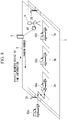
- the fee collection system is different from the fee collection system of the present invention described above in that instead of the antenna units 4, an entrance antenna unit 35 and exit antenna unit 36 are respectively provided at the entrance and exit of the parking area.
- the fee collection system will be described below, omitting description of points that are common to the system of the present invention and focusing only on points of difference.
- the entrance antenna unit 35 is provided at the entrance to the parking area, and the exit antenna unit 36 is provided at the exit of the parking area.
- the structure of the entrance antenna unit 35 and the exit antenna unit 36 is the same as the above described antenna unit 4.
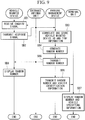
- the vehicle-mounted device 20 of the vehicle 50a receives an enquiry signal transmitted from the entrance antenna unit 35 (step SB1 in Fig. 9 ).
- This enquiry signal includes time information.
- the vehicle-mounted device 20 transmits a response signal to the entrance antenna unit 35 upon receipt of this enquiry signal (step SB2 in Fig 9 ).
- Vehicle mounted device ID vehicle mounted device identification information
- time information are included in this response signal.
- the entrance antenna unit 35 Upon receipt of the response signal, the entrance antenna unit 35 transmits the response signal to the parking management device 5.
- the control unit 18 of the parking management device 5 correlates the vehicle mounted device ID and the time information and writes them to the storage device 16 upon receipt of the response signal from the entrance antenna unit 35 (step SB3 in Fig. 9 )
- the control section 18 generates a random number (authentication information) by encrypting the time information received from the entrance antenna unit 35 using an encryption key (step SB4 in Fig. 9 ).
- the random number is then transmitted to the vehicle mounted device 20 via the entrance antenna unit 35 (step SB5 in Fig. 9 ).
- control section 18 of the parking management device 5 correlates this random number with vehicle identification information, and transmits them via the communication section 19 to the terminal unit 40 being carried by the attendant A of the parking area 1 (step SB6 in Fig. 9 ).
- the terminal unit 40 displays received information (step SB7 in Fig. 9 ).
- the control section 26 of the vehicle mounted device 20 displays this random number of the display section 28 (step SB8 in Fig. 9 ). If the driver of the vehicle confirms that the random number is displayed on the display section 28, the vehicle enters the parking area 2, parks in an arbitrary vehicle parking region 3a, and gets out of the vehicle.
- an attendant A of the car park 1 regularly patrols the parking area 2 to confirm whether or not a random number being displayed on the display section 28 of the vehicle mounted device 20 matches with a random number being displayed on the terminal unit 40 the attendant is carrying. If the two match in this way it is determined that charging processing has been carried out normally. On the other hand, if the two do not match it is determined that the vehicle is an illegally- parked vehicle, namely that charging processing has not been carried out normally, and levying of a parking fee after the fact is carried out by the attendant A storing the number plate of the vehicle etc.
- the driver moves the vehicle 50a into a region where communication with the exit antenna unit 36 is possible.
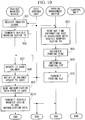
- the exit antenna unit 36 emits an inquiry signal, and upon receipt of this enquiry signal (step SC1 in Fig 10 ) the vehicle mounted device 20 transmits a vehicle mounted device ID to the exit antenna unit 36 (step SC2 in Fig. 10 ).
- the exit antenna unit 36 then transmits the received vehicle mounted device ID to the parking management device 5.
- time information that is associated with this vehicle-mounted device ID, namely the parking start time of the vehicle, is read out (step SC3 in Fig. 10 ), and a parking time is calculated from this time and the current time (step SC4 in Fig. 10 ).
- a parking fee for the parking time is determined (step SC5 in Fig. 10 ). This parking fee is then transmitted to the vehicle-mounted device 20 via the exit antenna unit 36 (step SC6 in Fig. 10 ).
- control section 26 of the vehicle mounted device 20 receives this parking fee, a fixed rate fee is deducted from the balance stored in the IC card, and this balance is updated and stored in the IC card as a new balance (step SC7 in Fig. 10 ).
- the control section 26 reads the balance after update from the IC card and updates the IC card balance stored in the storage device 25, and also causes operation of the alarm notification section 29 to issue an alarm indicating that collection of a parking fee has been completed normally to the user (step SC8 in Fig. 10 ). Further, the control section 26 receives authorization data from the IC card (step SC9 in Fig.
- the exit antenna unit 36 correlates the vehicle mounted device ID and the authorization data and transmits to the parking management device 5. In this way, it is possible for the parking management device 5 to confirm that charge processing has been carried out normally.
- the fee collection device it is sufficient to have two antenna units, namely the entrance antenna unit 35 and the exit antenna unit 36, which means that it becomes possible to significantly reduce the number of structural components of the fee collection system. It is possible in this way to reduce the installation costs.
- the parking management device 5 periodically detects vehicles, among the vehicles for which authorization data has not been received, whose parking time has reached a predetermined time (for example, 24 hours), and considers these vehicles to be illegal vehicles and transmits their vehicle identification information to the terminal unit 40 of the Attendant A. In this way, even in the event that a vehicle leaves the parking area 2 without paying a parking fee, since the identification information for each vehicle is stored in the parking management device 5 it is possible to levy a parking fee after the fact.
- a predetermined time for example, 24 hours
- the parking fee collection system of this embodiment differs in that communication between the vehicle mounted device 20 and the parking management device 5 is carried out directly via the wide area communication network, and entry into or departure from the car parking region 3 is detected according to whether or not an inquiry signal has been received from the antenna unit 4.
- the structure of this embodiment is substantially the same as the system structure shown in Fig. 7 , so description will be given with reference to Fig. 7 .
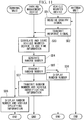
- the vehicle mounted device 20 of the vehicle 50a receives an enquiry signal transmitted from the antenna unit 4a (step SD1 in Fig. 11 ).
- This enquiry signal includes time information.
- the vehicle mounted device 20 is connected to the parking management device 5 via the mobile communication network upon receipt of this enquiry signal, and transmits a response signal (step SD2 in Fig 11 ). Vehicle mounted device ID and time information received from the antenna unit 4a, for example, are contained in this response signal.
- the control unit 18 of the parking management device 5 correlates the vehicle mounted device ID and the time information and writes them to the storage device 16, upon receipt of the response signal via the mobile communication network (step SD3 in Fig. 11 ) .
- the control section 18 generates a random number (authentication information) by encrypting this time information using an encryption key (step SD4 in Fig 11 ).
- the random number is then transmitted to the vehicle-mounted device 20 via the mobile communication network (step SD5 in Fig. 11 ).
- the vehicle-mounted device 20 displays the received random number of a display section 28 (step SD6 in Fig. 11 ).
- control section 18 of the parking management device 5 correlates this random number with vehicle identification information, and transmits them via the mobile communication network to the terminal unit 40 being carried by the attendant A of the car park 1 (step SD7 in Fig 11 ).
- the terminal unit 40 displays received information (step SD8 in Fig. 11 ).
- the vehicle-mounted device 20 enters a state where it cannot receive an inquiry signal from the antenna section 4a.
- the vehicle mounted device 20 Upon detecting that it is no longer possible to receive the inquiry signal from the antenna unit 4a (step SE1 in Fig. 12 ), the vehicle mounted device 20 is connected to the parking management device 5 via the mobile communication network, and transmits a vehicle mounted device ID to the vehicle management device 5 (step SE2 in Fig. 12 ).
- the parking management device 5 receives the vehicle mounted device ID, time information that is associated with this vehicle mounted device ID, namely the parking start time of the vehicle, is read out (step SE3 in Fig.
- step SE4 in Fig. 12 a parking time is calculated from this time and the current time (step SE4 in Fig. 12 ). Then, referring to a charge table, a parking fee for the parking time is determined (step SE5 in Fig. 12 ). This parking fee information is then transmitted to the vehicle-mounted device 20 (step SE6 in Fig. 12 ).
- control section 26 of the vehicle mounted device 20 receives this parking fee from the parking management device 5, a fixed rate fee is deducted from the balance stored in the IC card, and this balance is updated and stored in the IC card as a new balance (step SE7 in Fig. 12 ).
- the control section 26 reads the balance after update from the IC card and updates the IC card balance stored in the storage device 25, and also causes operation of the alarm notification section 29 to issue an alarm indicating that collection of a parking fee has been completed normally to the user (step SE8 in Fig. 12 ). Further, the control section 26 receives authorization data from the IC card (step SE9 in Fig. 12 ), and correlates the vehicle-mounted device ID with the authorization data for transmission to the parking management device 5 (step SE10 in Fig. 12 ). In this way it is possible for the parking management device 5 to confirm that charge processing has been carried out normally.
- antenna units 4 are provided corresponding to the vehicle parking regions 3, and it is possible to easily determine vehicles entering or leaving the vehicle parking area 3 from whether or not it is possible to receive an enquiry signal from the antenna units 4. Also, processing related to fee collection for parking fees is realized by directly exchanging information between vehicle mounted device 20 and the parking management device 5.
- entry into the vehicle parking region 3 is detected using the fact that an inquiry signal is received from the antenna unit 4, and also departure from the vehicle parking region 3 is detected using the fact that an enquiry signal can no longer be received from the antenna unit 4.
- this method it is possible to detect entry into and departure out of the vehicle parking region 3 based on position information, as described in the following.
- the vehicle mounted device 20 is equipped with a GPS receiver, and map information of the parking area 2 is stored in the storage device 25.
- the control section 26 of the vehicle mounted device 20 detects entry into the parking area 2 when current position acquired using the GPS receiver matches map information of the parking area stored in the storage device 25, and detects leaving of the parking area 2 when the current position is out of the parking area 2.
- the antenna unit 4 installed in each vehicle parking region 3 is no longer required. It is possible in this way to further reduce the installation costs.
- the random number is periodically updated. By periodically updating the random number in this way, it is possible to strengthen supervision of illegal vehicles for which fee collection is not carried out normally.
- the same random number is periodically transmitted simultaneously to the vehicle mounted devices 20 of all vehicles under the supervision of the parking management device 5. In this way, for vehicles for which fee collection has been carried out normally, the same random number is displayed on the vehicle mounted device 20, and so it is possible to easily specify illegal vehicles without the attendant A having to compare random numbers displayed on the terminal unit 40. In this case, it is also possible to not transmit the random number to the terminal unit 40.
Landscapes
- Business, Economics & Management (AREA)
- Physics & Mathematics (AREA)
- General Physics & Mathematics (AREA)
- Accounting & Taxation (AREA)
- Finance (AREA)
- Engineering & Computer Science (AREA)
- Strategic Management (AREA)
- Theoretical Computer Science (AREA)
- Signal Processing (AREA)
- Economics (AREA)
- Computer Networks & Wireless Communication (AREA)
- General Business, Economics & Management (AREA)
- Health & Medical Sciences (AREA)
- Development Economics (AREA)
- General Health & Medical Sciences (AREA)
- Human Resources & Organizations (AREA)
- Marketing (AREA)
- Primary Health Care (AREA)
- Tourism & Hospitality (AREA)
- Devices For Checking Fares Or Tickets At Control Points (AREA)
- Management, Administration, Business Operations System, And Electronic Commerce (AREA)
Claims (6)
- Gebührensammelvorrichtung, aufweisend:Antennen (4a, 4b, 4c), die korrespondierend zu einer Vielzahl von Fahrzeugparkbereichen (3), die in einem Parkgebiet vorgesehen sind, zum Emittieren eines Anfragesignals zu den Fahrzeugparkbereichen vorgesehen sind,eine Terminaleinheit (40), die konfiguriert ist, um durch einen Aufseher des Parkplatzes ausgeführt zu werden; undeine Parkverwaltungsvorrichtung (5) zum Austauschen von Informationen mit fahrzeugmontierten Vorrichtungen (20) von in den Fahrzeugparkbereichen geparkten Fahrzeugen, wobeidie Parkverwaltungsvorrichtung (5) konfiguriert ist, um Informationen bezogen auf die Fahrzeuge mit einer Parkbeginnzeit zu korrelieren und zu speichern, und um Parkgebühren zu vorbestimmten Zeitintervallen zu erheben, wenn Informationen bezogen auf die Fahrzeuge empfangen sind, die von den fahrzeugmontierten Vorrichtungen (20), die das Anfragesignal empfangen haben, übertragen sind,dadurch gekennzeichnet, dassdie Parkverwaltungsvorrichtung (5) ferner konfiguriert ist, um eine Zufallszahl als Authentifizierungsinformationen, die anzeigen, dass eine Parkgebühr normal erhoben worden ist, periodisch zu erzeugen, und um zum Anzeigen in den fahrzeugmontierten Vorrichtungen die Zufallszahl an die fahrzeugmontierten Vorrichtungen (20) der Fahrzeuge, für welche eine Parkgebühr normal erhoben worden ist, periodisch zu übertragen, unddie Parkverwaltungsvorrichtung (5) ferner konfiguriert ist, um die Zufallszahl mit Informationen zum Identifizieren der fahrzeugmontierten Vorrichtungen (20) zu korrelieren, und um die korrelierten Informationen zu der Terminaleinheit (40) zu übertragen, unddie Terminaleinheit (40) konfiguriert ist, um die von der Parkverwaltungsvorrichtung (5) empfangene Zufallszahl anzuzeigen.
- Gebührensammelvorrichtung nach Anspruch 1, wobei ein Pfosten in der Nähe der Fahrzeugparkbereiche angeordnet ist, und die Antennen (4) an dem Pfosten angebracht sind, so dass sie im Wesentlichen ihre eigenen drahtlosen Kommunikationsbereiche mit den Fahrzeugparkbereichen ausrichten.
- Gebührensammelvorrichtung nach Anspruch 1 oder 2, so konfiguriert, dass Informationen zwischen den fahrzeugmontierten Vorrichtungen (20) und der Parkverwaltungsvorrichtung (5) mittels der Antennen (4) ausgetauscht werden können.
- Gebührensammelvorrichtung nach einem der Ansprüche 1 bis 3, so konfiguriert, dass Informationen zwischen den fahrzeugmontierten Vorrichtungen (20) und der Parkverwaltungsvorrichtung (5) mittels eines Weitverkehrskommunikationsnetzwerks ausgetauscht werden können.
- Gebührensammelsystem, aufweisend:
die Gebührensammelvorrichtung nach einem der Ansprüche 1 bis 4, und zumindest eine fahrzeugmontierte Vorrichtung (20), wobei jede der fahrzeugmontierten Vorrichtungen (20) aufweist:einen Kommunikationsabschnitt (27) zum Empfangen der von der Parkverwaltungsvorrichtung (5) übertragenen Zufallszahl; undeinen Anzeigeabschnitt (28) zum Anzeigen der Zufallszahl, wenn die Zufallszahl durch den Kommunikationsabschnitt (27) empfangen ist. - Gebührensammelsystem, aufweisend:
die Gebührensammelvorrichtung nach einem der Ansprüche 1 bis 4, und zumindest eine fahrzeugmontierte Vorrichtung (20), wobei jede der fahrzeugmontierten Vorrichtungen (20) aufweist:einen Kommunikationsabschnitt (27) zum Empfangen der von der Parkverwaltungsvorrichtung (5) übertragenen Zufallszahl; undeinen Beleuchtungsabschnitt, der konfiguriert ist, um zu einer Zeitsteuerung korrespondierend zu der Zufallszahl beleuchtet zu werden, wenn die Zufallszahl durch den Kommunikationsabschnitt (27) empfangen ist.
Applications Claiming Priority (2)
| Application Number | Priority Date | Filing Date | Title |
|---|---|---|---|
| JP2006179786A JP2008009733A (ja) | 2006-06-29 | 2006-06-29 | 料金収受システム、駐車管理装置、及び車載器 |
| PCT/JP2007/062317 WO2008001648A1 (en) | 2006-06-29 | 2007-06-19 | Fee collection system, parking management device, and in-vehicle device |
Publications (3)
| Publication Number | Publication Date |
|---|---|
| EP2034449A1 EP2034449A1 (de) | 2009-03-11 |
| EP2034449A4 EP2034449A4 (de) | 2010-11-03 |
| EP2034449B1 true EP2034449B1 (de) | 2018-08-22 |
Family
ID=38845416
Family Applications (1)
| Application Number | Title | Priority Date | Filing Date |
|---|---|---|---|
| EP07745519.4A Ceased EP2034449B1 (de) | 2006-06-29 | 2007-06-19 | Gebühreneinholsystem, parkverwaltungseinrichtung und einrichtung in einem fahrzeug |
Country Status (7)
| Country | Link |
|---|---|
| EP (1) | EP2034449B1 (de) |
| JP (1) | JP2008009733A (de) |
| KR (1) | KR101024778B1 (de) |
| CN (1) | CN101473354B (de) |
| AU (1) | AU2007264479A1 (de) |
| MY (1) | MY149199A (de) |
| WO (1) | WO2008001648A1 (de) |
Families Citing this family (18)
| Publication number | Priority date | Publication date | Assignee | Title |
|---|---|---|---|---|
| JP5173482B2 (ja) * | 2008-02-25 | 2013-04-03 | 三菱重工業株式会社 | 車両課金システム及び車両課金方法 |
| GB2470949A (en) * | 2009-06-12 | 2010-12-15 | Rafael Contessa | Subscriber identification system |
| JP5589415B2 (ja) * | 2010-02-03 | 2014-09-17 | 株式会社デンソー | 車載通信装置 |
| CN104282168B (zh) * | 2013-07-05 | 2017-09-01 | 国民技术股份有限公司 | 停车管理方法、装置及系统 |
| CN103473817B (zh) * | 2013-08-29 | 2015-09-09 | 无锡普智联科高新技术有限公司 | 基于双功能车载标签的收费系统及其方法 |
| JP6270517B2 (ja) | 2014-02-05 | 2018-01-31 | 株式会社ぐるなび | 認証処理システム,認証処理サーバ及び認証処理方法 |
| SG11201702124PA (en) * | 2014-09-19 | 2017-04-27 | Mitsubishi Heavy Ind Mechatronics Systems Ltd | Onboard system and monitoring system |
| CN205880943U (zh) * | 2015-12-07 | 2017-01-11 | 山东爱泊客网络科技有限公司 | 一种可实现手机开门的门禁系统 |
| CN107292793A (zh) * | 2016-10-19 | 2017-10-24 | 青岛松立软件信息技术股份有限公司 | 城市区域停车场静态交通管理平台 |
| KR102529903B1 (ko) | 2016-12-14 | 2023-05-08 | 현대자동차주식회사 | 차량의 위치 추정 장치 및 방법 |
| JP7008915B2 (ja) * | 2017-05-18 | 2022-01-25 | 楽天グループ株式会社 | 出庫判定装置、携帯端末、サーバ装置、出庫判定システム、出庫判定方法及び出庫判定プログラム |
| JP6532968B1 (ja) * | 2018-01-29 | 2019-06-19 | ソフトバンク株式会社 | 駐車管理装置、センサデバイス、駐車管理システム、駐車管理方法およびプログラム |
| CN108846906B (zh) * | 2018-06-04 | 2021-07-30 | 西安艾润物联网技术服务有限责任公司 | 停车管理方法、系统及计算机可读存储介质 |
| CN110085036A (zh) * | 2019-05-30 | 2019-08-02 | 捷德(中国)信息科技有限公司 | 一种套牌识别方法、车牌拆卸识别方法和电子车牌 |
| JP7557336B2 (ja) * | 2020-10-21 | 2024-09-27 | 株式会社Nttドコモ | 報酬提示装置 |
| CN119181141A (zh) * | 2021-04-16 | 2024-12-24 | 西安艾润物联网技术服务有限责任公司 | 基于数字货币收取停车费的停车管理系统 |
| CN114220183A (zh) * | 2021-12-23 | 2022-03-22 | 北京万集科技股份有限公司 | 停车收费方法、系统、车载单元及电子收费天线 |
| WO2025173176A1 (ja) * | 2024-02-15 | 2025-08-21 | 三菱重工機械システム株式会社 | 車載器および車載器の制御方法 |
Family Cites Families (11)
| Publication number | Priority date | Publication date | Assignee | Title |
|---|---|---|---|---|
| NO984981D0 (no) * | 1998-08-21 | 1998-10-26 | Isi Park As | Myntfritt parkeringssystem |
| JP2001167300A (ja) | 1999-12-10 | 2001-06-22 | Matsushita Electric Ind Co Ltd | 駐車料金収受システムとその料金収受方法 |
| JP2001243510A (ja) * | 2000-02-25 | 2001-09-07 | Matsushita Electric Ind Co Ltd | 駐車場料金自動徴収システム |
| JP3570500B2 (ja) * | 2000-06-14 | 2004-09-29 | 日本電気株式会社 | アンテナ装置、並びにそれを用いる自動料金収受システムおよび自動料金収受方法 |
| CA2437722A1 (en) * | 2001-02-07 | 2002-08-15 | Vehiclesense, Inc. | Parking management systems |
| US6559776B2 (en) * | 2001-02-15 | 2003-05-06 | Yoram Katz | Parking status control system and method |
| JP2003256892A (ja) * | 2002-02-28 | 2003-09-12 | Pioneer Electronic Corp | 駐車料金精算システムおよび方法 |
| JP2004348321A (ja) * | 2003-05-21 | 2004-12-09 | Matsushita Electric Ind Co Ltd | 無線決済システム |
| JP4509640B2 (ja) * | 2004-04-28 | 2010-07-21 | 三菱電機株式会社 | 駐車場管理システム及び車両駐車位置特定方法 |
| JP2006072728A (ja) * | 2004-09-02 | 2006-03-16 | Nec Corp | 駐車場管理装置、駐車場管理システム、駐車場管理方法、駐車場管理サーバ、精算装置、店舗端末および携帯端末 |
| NL1032040C2 (nl) * | 2006-06-21 | 2007-12-27 | Flo Solutions B V | Systeem voor parkeertijdregistratie en -betaling. |
-
2006
- 2006-06-29 JP JP2006179786A patent/JP2008009733A/ja active Pending
-
2007
- 2007-06-19 WO PCT/JP2007/062317 patent/WO2008001648A1/ja not_active Ceased
- 2007-06-19 CN CN2007800229536A patent/CN101473354B/zh not_active Expired - Fee Related
- 2007-06-19 EP EP07745519.4A patent/EP2034449B1/de not_active Ceased
- 2007-06-19 KR KR1020087030456A patent/KR101024778B1/ko active Active
- 2007-06-19 AU AU2007264479A patent/AU2007264479A1/en not_active Abandoned
- 2007-06-19 MY MYPI20085115A patent/MY149199A/en unknown
Non-Patent Citations (1)
| Title |
|---|
| None * |
Also Published As
| Publication number | Publication date |
|---|---|
| EP2034449A1 (de) | 2009-03-11 |
| CN101473354A (zh) | 2009-07-01 |
| KR101024778B1 (ko) | 2011-03-24 |
| MY149199A (en) | 2013-07-31 |
| CN101473354B (zh) | 2011-09-28 |
| EP2034449A4 (de) | 2010-11-03 |
| KR20090018128A (ko) | 2009-02-19 |
| WO2008001648A1 (en) | 2008-01-03 |
| JP2008009733A (ja) | 2008-01-17 |
| AU2007264479A1 (en) | 2008-01-03 |
| HK1129478A1 (en) | 2009-11-27 |
Similar Documents
| Publication | Publication Date | Title |
|---|---|---|
| EP2034449B1 (de) | Gebühreneinholsystem, parkverwaltungseinrichtung und einrichtung in einem fahrzeug | |
| KR100423779B1 (ko) | 과금장치 | |
| KR101368109B1 (ko) | 요금 징수 시스템 | |
| JP2003526854A (ja) | 料金の自動課金システム | |
| US20040153401A1 (en) | Dual toll system | |
| CN102652323B (zh) | 车载器以及收费系统 | |
| KR20090018129A (ko) | 요금 징수 시스템 | |
| EP1805718B1 (de) | Drahtloses gebührensammelsystem | |
| KR19990022061A (ko) | 설비에서 원격 통신을 위한 차량장착 장치 및 시스템 | |
| JP2001052217A (ja) | 料金収受システム、料金収受方法および車載器 | |
| US7034715B2 (en) | Devices and methods for simplifying OCR -based enforcement in automatic toll systems | |
| KR20070091704A (ko) | 주차 관리 시스템 및 방법 | |
| JP2004145717A (ja) | 駐車場管理システム | |
| HK1129478B (en) | Fee collection system and fee collection device | |
| JP2008009732A (ja) | 車載器 | |
| JP3175594B2 (ja) | 車載用通信装置のデータ通信方法及び車載用通信装置 | |
| HK1129476A (en) | Toll collection system | |
| HK1173831B (en) | Toll collection system | |
| HK1173255B (en) | Vehicle-mounted device and toll collection system | |
| WO2015087363A1 (en) | Payment system for occupying parking stalls and related process |
Legal Events
| Date | Code | Title | Description |
|---|---|---|---|
| PUAI | Public reference made under article 153(3) epc to a published international application that has entered the european phase |
Free format text: ORIGINAL CODE: 0009012 |
|
| 17P | Request for examination filed |
Effective date: 20081219 |
|
| AK | Designated contracting states |
Kind code of ref document: A1 Designated state(s): AT BE BG CH CY CZ DE DK EE ES FI FR GB GR HU IE IS IT LI LT LU LV MC MT NL PL PT RO SE SI SK TR |
|
| AX | Request for extension of the european patent |
Extension state: AL BA HR MK RS |
|
| DAX | Request for extension of the european patent (deleted) | ||
| RBV | Designated contracting states (corrected) |
Designated state(s): DE GB |
|
| A4 | Supplementary search report drawn up and despatched |
Effective date: 20101005 |
|
| 17Q | First examination report despatched |
Effective date: 20161109 |
|
| GRAP | Despatch of communication of intention to grant a patent |
Free format text: ORIGINAL CODE: EPIDOSNIGR1 |
|
| INTG | Intention to grant announced |
Effective date: 20180309 |
|
| GRAS | Grant fee paid |
Free format text: ORIGINAL CODE: EPIDOSNIGR3 |
|
| GRAA | (expected) grant |
Free format text: ORIGINAL CODE: 0009210 |
|
| AK | Designated contracting states |
Kind code of ref document: B1 Designated state(s): DE GB |
|
| REG | Reference to a national code |
Ref country code: GB Ref legal event code: FG4D |
|
| REG | Reference to a national code |
Ref country code: DE Ref legal event code: R096 Ref document number: 602007055843 Country of ref document: DE |
|
| REG | Reference to a national code |
Ref country code: DE Ref legal event code: R097 Ref document number: 602007055843 Country of ref document: DE |
|
| PLBE | No opposition filed within time limit |
Free format text: ORIGINAL CODE: 0009261 |
|
| STAA | Information on the status of an ep patent application or granted ep patent |
Free format text: STATUS: NO OPPOSITION FILED WITHIN TIME LIMIT |
|
| 26N | No opposition filed |
Effective date: 20190523 |
|
| PGFP | Annual fee paid to national office [announced via postgrant information from national office to epo] |
Ref country code: DE Payment date: 20230502 Year of fee payment: 17 |
|
| PGFP | Annual fee paid to national office [announced via postgrant information from national office to epo] |
Ref country code: GB Payment date: 20230427 Year of fee payment: 17 |
|
| REG | Reference to a national code |
Ref country code: DE Ref legal event code: R119 Ref document number: 602007055843 Country of ref document: DE |
|
| GBPC | Gb: european patent ceased through non-payment of renewal fee |
Effective date: 20240619 |
|
| PG25 | Lapsed in a contracting state [announced via postgrant information from national office to epo] |
Ref country code: DE Free format text: LAPSE BECAUSE OF NON-PAYMENT OF DUE FEES Effective date: 20250101 |
|
| PG25 | Lapsed in a contracting state [announced via postgrant information from national office to epo] |
Ref country code: GB Free format text: LAPSE BECAUSE OF NON-PAYMENT OF DUE FEES Effective date: 20240619 |