EP2034629A1 - Verfahren, Computerprogramm und System zur Tickersynchronisation von Knoten in einem drahtlosen Multihop-Netzwerk - Google Patents
Verfahren, Computerprogramm und System zur Tickersynchronisation von Knoten in einem drahtlosen Multihop-Netzwerk Download PDFInfo
- Publication number
- EP2034629A1 EP2034629A1 EP07017409A EP07017409A EP2034629A1 EP 2034629 A1 EP2034629 A1 EP 2034629A1 EP 07017409 A EP07017409 A EP 07017409A EP 07017409 A EP07017409 A EP 07017409A EP 2034629 A1 EP2034629 A1 EP 2034629A1
- Authority
- EP
- European Patent Office
- Prior art keywords
- node
- tick
- synchronization
- round
- frame
- Prior art date
- Legal status (The legal status is an assumption and is not a legal conclusion. Google has not performed a legal analysis and makes no representation as to the accuracy of the status listed.)
- Withdrawn
Links
- 238000000034 method Methods 0.000 title claims abstract description 72
- 238000004590 computer program Methods 0.000 title claims abstract description 6
- 235000008694 Humulus lupulus Nutrition 0.000 claims abstract description 15
- 230000005540 biological transmission Effects 0.000 claims description 59
- 238000012545 processing Methods 0.000 description 24
- 230000001360 synchronised effect Effects 0.000 description 20
- 241000238876 Acari Species 0.000 description 9
- 238000004422 calculation algorithm Methods 0.000 description 8
- 238000004891 communication Methods 0.000 description 5
- 230000001934 delay Effects 0.000 description 4
- 238000012546 transfer Methods 0.000 description 4
- 230000001960 triggered effect Effects 0.000 description 4
- 230000001419 dependent effect Effects 0.000 description 2
- 238000010586 diagram Methods 0.000 description 2
- 238000009792 diffusion process Methods 0.000 description 2
- 230000000694 effects Effects 0.000 description 2
- 230000006855 networking Effects 0.000 description 2
- 230000002411 adverse Effects 0.000 description 1
- 238000004364 calculation method Methods 0.000 description 1
- 238000006243 chemical reaction Methods 0.000 description 1
- 125000004122 cyclic group Chemical group 0.000 description 1
- 230000001351 cycling effect Effects 0.000 description 1
- 238000013461 design Methods 0.000 description 1
- 238000001514 detection method Methods 0.000 description 1
- 238000005516 engineering process Methods 0.000 description 1
- 238000002474 experimental method Methods 0.000 description 1
- 230000004927 fusion Effects 0.000 description 1
- 238000005192 partition Methods 0.000 description 1
- 230000001902 propagating effect Effects 0.000 description 1
- 239000000523 sample Substances 0.000 description 1
- 230000006641 stabilisation Effects 0.000 description 1
- 238000011105 stabilization Methods 0.000 description 1
- 238000007619 statistical method Methods 0.000 description 1
Images




Classifications
-
- H—ELECTRICITY
- H04—ELECTRIC COMMUNICATION TECHNIQUE
- H04B—TRANSMISSION
- H04B7/00—Radio transmission systems, i.e. using radiation field
- H04B7/24—Radio transmission systems, i.e. using radiation field for communication between two or more posts
- H04B7/26—Radio transmission systems, i.e. using radiation field for communication between two or more posts at least one of which is mobile
- H04B7/2662—Arrangements for Wireless System Synchronisation
- H04B7/2671—Arrangements for Wireless Time-Division Multiple Access [TDMA] System Synchronisation
- H04B7/2678—Time synchronisation
- H04B7/2687—Inter base stations synchronisation
- H04B7/2696—Over the air autonomous synchronisation, e.g. by monitoring network activity
-
- H—ELECTRICITY
- H04—ELECTRIC COMMUNICATION TECHNIQUE
- H04W—WIRELESS COMMUNICATION NETWORKS
- H04W56/00—Synchronisation arrangements
- H04W56/001—Synchronization between nodes
- H04W56/0015—Synchronization between nodes one node acting as a reference for the others
-
- H—ELECTRICITY
- H04—ELECTRIC COMMUNICATION TECHNIQUE
- H04J—MULTIPLEX COMMUNICATION
- H04J3/00—Time-division multiplex systems
- H04J3/02—Details
- H04J3/06—Synchronising arrangements
- H04J3/0635—Clock or time synchronisation in a network
- H04J3/0679—Clock or time synchronisation in a network by determining clock distribution path in a network
Definitions
- the present invention relates to methods for the tick synchronization of a node of a wireless multi-hop network with at least one other node of said multi-hop network and a system for the tick synchronization of nodes in a multi-hop network. Moreover, the present invention relates to methods for the time synchronization of a node of a wireless multi-hop network
- tick synchronization There is a difference between tick synchronization and time synchronization.
- time synchronization two pieces of information are needed: a reference point in time and a clock value, which are both updated periodically.
- Tick synchronization is concerned with establishing reference points in time only - also called reference ticks - among the nodes of a network. Different from time synchronization, no clock values are exchanged. Tick synchronization is sufficient, e.g. for network-wide medium slotting, where only common reference points in time are required.
- time synchronization can be achieved by one exchange of a clock value among the nodes of a network, referring to a reference point in time.
- Time synchronization is a crucial aspect for the operation of distributed systems in general, and of ad hoc networks in particular.
- Ad hoc networks form dynamically, and consist e.g. of a set of small, low power nodes communicating via radio links.
- Network-wide accurate time in ad hoc networks enables many distributed applications like e.g. data fusion in wireless sensor networks, networked control systems, duty cycling in wireless sensor networks, and multi-hop medium slotting in wireless ad hoc networks.
- the structure of the network is determined and stored. Afterwards, a tree for performing the synchronization is calculated and the synchronization is performed according to the structure given in the tree. However, if the topology of the network changes, when e.g. one node moves, the tree structure needs to be newly calculated.
- each node of the network synchronizes with all nodes in the vicinity of this node. This however, can lead to high complexity and very long synchronization times as the size of the network increases. Moreover, the susceptibility for collisions in dense networks adversely affects the operability this synchronization method.
- RBS Reference Broadcast Synchronization
- OSDI 2002 Operating Systems Design and Implementation
- the Timing-Sync Protocol for Sensor Networks ( S. Ganeriwal, R. Kumar, M. B. Srivastava: Timing-sync Protocol for Sensor Networks, SenSys'03, Los Angeles, CA, USA, November 5-7, 2003 ) performs iterative sender-receiver synchronization w. r. t. one reference node, using late time-stamping.
- the protocol works in two phases. In the level discovery phase, reference node election and establishment of a hierarchical network structure by means of a global broadcast take place. In the (re-) synchronization phase, all nodes along this hierarchy perform a pair wise synchronization by handshakes. As shown experimentally, TPSN achieves very high average accuracy. The use of handshakes provides some protection against frame collisions and node failures.
- TSP Tiny-Sync Protocol
- M. L. Sichitiu, C. Veerarittiphan Simple, Accurate Time Synchronization for Wireless Networks, Proceedings of the IEEE Wireless Communications and Networking Conference (WCNC 2003), New Orleans, LA, USA, pp. 1266-1273, 2003
- WSP Tiny-Sync Protocol
- two nodes Based on collected data points, two nodes can estimate their clock offset and their clock skew within deterministic bounds.
- a (logically) hierarchical topology that determines all pairs of nodes to be synchronized has to be established. This and a high convergence delay restrict the applicability of TSP in case of node mobility.
- TDP The Time-Diffusion Protocol
- W. Su, I. Akyildiz: Time-Diffusion Synchronization Protocols for Sensor Networks, IEEE/ACM Transactions on Networking, Vol. 13, No. 2, pp. 384-397, April 2005 is a collection of many protocols that together achieve network-wide time synchronization in mobile ad hoc networks with high accuracy.
- TDP resynchronizes all network nodes periodically. Each period starts with the reelection of master nodes, which then repeatedly diffuse timing information that is forwarded by diffused-leader nodes. Since master nodes are reelected in each period, TDP is robust against topology changes. However, both communication complexity and convergence delay are high.
- a wireless ad hoc network is a computer network in which the nodes communicate via radio links.
- the network is called ad hoc because it forms dynamically, without infrastructure, from a set of nodes with matching communication facilities.
- a method for tick-synchronizing a node of a wireless multi-hop network with at least one other node of said multi-hop network, said network comprising a plurality of nodes being arbitrarily connected comprising the steps of:
- said node receiving said synchronization tick frame from a node is within transmission range of said node sending said synchronization tick frame.
- Said network may form dynamically, and consist e.g. of a set of small, low power nodes communicating via radio links. For example, nodes within transmission range of each other may be connected via such radio links and communicate with each other.
- a reference tick may be a point in time to which all nodes in said network are synchronized. For network-wide medium slotting, e.g., it is not necessary that the clocks of the nodes in the network are synchronized. More in detail, the nodes in particular synchronize to ticks sent by the master node without exchanging clock values of these ticks. The boundaries of transmission slots for transmission of data are then defined relative to these determined ticks.
- the determined node reference tick t syncNnode may in particular be a good estimate for said master reference tick t syncMaster and can be used for tick-synchronizing said node.
- a round is in particular determined by the transmission of a synchronization tick frame from one node to at least one other node.
- said synchronization tick frame comprises at least one bit and said at least one bit is encoded with a black burst during transmission.
- said step of receiving comprises performing a clear channel assessment, which detects whether the transmission medium is busy.
- said step of receiving comprises detecting the energy level on the transmission medium.
- the value of said at least one bit of said synchronization tick frame may be determined only on the basis of the detected energy level on the transmission medium. In particular, no decoding of frame preambles, headers or contents is necessary.
- said synchronization tick frame is generated by a master node and said master reference tick t syncMaster is the point in time of at which said master node sent said synchronization tick frame.
- Said network may have a maximal diameter of n hopsMax hops and said synchronization tick frame contains at least as many bits to binarily code n hopsMax .
- One hop may be defined as the transmission of a packet or frame from one node to another in the network.
- n round equals (n hops - 1).
- the method may further comprise the steps of:
- said synchronization tick frame is sent to all nodes within transmission range.
- said node reference tick t syncNode is determined using the following formula:
- the method may further comprise the step of determining whether said node has already received a synchronization tick frame in said synchronization phase.
- said network is a wireless ad-hoc network.
- Ad hoc networks may form dynamically, and consist e.g. of a set of small, low power nodes communicating via radio links.
- ad hoc networks are in particular not dependent of a given or predefined infrastructure.
- a method for time-synchronizing a node of a wireless multi-hop network with at least one other node of said multi-hop network comprising the steps of the method for tick synchronizing a node as described above, wherein said method further comprises the step of receiving a clock value referring to a reference point in time.
- said method further comprises the step of sending said clock value referring to a reference point in time.
- a method for tick-synchronizing a node of a wireless multi-hop network with at least one other node of said multi-hop network, said network comprising a plurality of nodes being arbitrarily connected comprising the steps of:
- Preferably said synchronization tick frame is sent to all nodes within transmission range.
- said steps may be performed periodically, in particular by setting a timer.
- a method for time-synchronizing a node of a wireless multi-hop network with at least one other node of said multi-hop network comprising the steps of the method for tick synchronizing a node as described above, wherein said method further comprises the step of sending said clock value referring to a reference point in time.
- a computer-program product comprising computer readable instructions, which when loaded and run in a computer system and/or computer network system, cause the computer system and/or the computer network system to perform a method as described.
- a system comprising: a first node and a second node, said first node being connected with said second node, said first node having circuitry for generating a synchronization tick frame, said synchronization tick frame containing a round number, said round number n round representing the number of hops said synchronization tick frame has performed since its generation and circuitry for sending said synchronization tick frame to said second node; said second node having circuitry for receiving a synchronization tick frame from a node, said synchronization tick frame containing a round number, said round number n round representing the number of hops n hops said synchronization tick frame has performed since its, circuitry for determining a node reference tick t syncNode corresponding to a master reference tick t syncMaster using said predetermined round number and the start time t rxTick of receipt of said synchronization tick frame in said node, and having circuitry for using said determined node reference tick for tick-synchronizing said no
- Said nodes may comprise a transceiver for receiving and sending information packets or frames and a processor for processing information.
- Fig. 1 shows an exemplary network according to a preferred embodiment of the present invention.
- Network 10 comprises nodes N1 to N14 which are connected by edges E.
- the network 10 shown in Fig. 1 nodes which are within transmission range of each other are connected.
- the network is a multi-hop network, which means that a packet which is to be transmitted via said network 10 is transmitted via a plurality of intermediate nodes on its way from the starting or sending node to the receiving or destination node.
- the network shown in Fig. 1 has a maximum hop count of five. This is the maximal number of hops a packet needs to perform during transmission from an arbitrary sending node to an arbitrary receiving node in the network shown in Fig. 1 . In the present case, this would e.g. be the transmission of a packet from node N14 to node N6.
- a maximum network diameter n hopsMax is defined. This is a number of hops, the maximal hop count shall not exceed.
- maximum network diameter n hopsMax is defined as 6 hops.
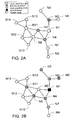
- FIG. 2A to 2D show the network of Fig. 1 at different stages of one synchronization phase of the network. It is to be noted that a synchronization phase is performed periodically in the network.
- Tick synchronization is concerned with establishing reference points in time only - also called reference ticks - among the nodes of a network. Different from time synchronization, no clock values are exchanged. Tick synchronization is sufficient, e.g. for network-wide medium slotting, where only common reference points in time are required. For time synchronization, two pieces of information are needed: a reference point in time and a clock value, which are both updated periodically. Based on tick synchronization, time synchronization can be achieved by one exchange of a clock value among the nodes of a network, referring to a reference point in time. Thus, the present invention may also be applicable in cases where time synchronization is required.
- a master node starts a synchronization phase.
- node N1 performs the role of a master node.
- This node is, therefore, marked as a square.
- the other nodes are marked with circles.
- a node colored black is a node for which the tick synchronization in the current synchronization phase is finished.
- a node colored white is a node which is still awaiting a synchronization tick frame, i.e. a node which has node yet received any synchronization information in the current synchronization phase.
- a node marked hatched is a node which has received a synchronization tick frame in the current round. Only nodes which received for the first time a synchronization tick frame in the current round are marked hatched. Nodes which have already in a previous round received a synchronization tick frame are already synchronized and, therefore, marked black. Nodes marked dotted are nodes sending a synchronization tick frame in the current round. A legend indicating the marking of the nodes is given on the top left of Fig. 2A .
- Node N1 acting as master node broadcasts a synchronization tick frame carrying a round number ( Fig. 2A ).
- the round number n round is zero for the tick frame generated by master node N1.
- Master node N1 sends the tick frame to all nodes within transmission range. In the shown network, these are nodes N2, N3 and N4.
- the synchronization tick frame comprises a plurality of bits and details thereof will be described later with reference to Fig. 6 .
- Nodes N2, N3 and N4 upon receiving the tick frame sent by node N1, derive the round number n round contained in the tick frame and detect the local node time t rxTick at which the tick frame was received. In particular, the local time at which the first bit of the tick frame was received is recorded. Since the round number n round is zero in the present round, the receiving nodes conclude that this tick frame has been sent by the master node. From the tick frame reception time t rxTick in the respective node and the round number, the receiving node can estimate the time at which the tick frame was sent by the master node. Details of this calculation will be given later.
- the tick frame will be transmitted to nodes N1, N5 and N6.
- nodes N5 and N6 a similar processing takes place as done in the previous round e.g. in node N2. This means that the round number is extracted from the received tick frame and together with the tick frame reception time in this node. With this information, the time, when the original tick frame was sent by master node N1 can be determined.
- node N1 a different processing takes place. As node N1 is already synchronized, the received tick frame is discarded.
- node N3 sends a tick frame containing an incremented round number to nodes N1, N4, N8 and N11
- node N4 sends a respective tick frame to nodes N1, N3, N7 and N8.
- nodes N1, N3 and N4 are already synchronized, these nodes discard the received tick frames.
- Nodes N7 and N8 have not yet been synchronized and therefore process the received tick frame.
- N8 receives a tick frame containing the same information from two nodes, i.e. N3 and N4.
- two tick frames collide.
- the tick frames are protected against such a collision and therefore are not corrupted when sent simultaneously or almost simultaneously. Details of the collision protection will be discussed later.
- a round is the part of the synchronization phase when a synchronization tick frame is sent from one node to another.
- the start time of the synchronization phase i.e. the time when the master node sent the first bit of the synchronization tick frame, as a reference tick or master reference tick for all nodes of the network can be estimated. It is to be noted that the synchronization phase always terminates after n hopsMax rounds. If the network diameter is smaller than n hopsMax or if the master node is not located at the network border, no tick frames are sent in the final round(s) anymore. In the scenario in Figs. 2A to 2D , tick frames are sent in rounds 0 through 3, but not in rounds 4 and 5.
- Fig. 3 shows a flow chart of the processing in one node of the network not acting as master node during the synchronization phase.
- the node is put into synchronization mode by e.g. setting a timer and the processing starts.
- step S10 a query is performed, whether the synchronization phase is completed.
- the end of the synchronization phase can e.g. be determined by setting a timer which expires after a predetermined time t endSyncPhase . If the synchronization phase is completed (YES in step S10), the synchronization process ends, and the operation mode of the node changes to normal transmission mode for the transmission of data.
- step S10 the node queries whether a tick frame was received (step S11). If no tick frame was received (NO in step S11), the query is performed again.
- step S11 If a tick frame was received (YES in step S11), a query is performed whether the respective node already received another tick frame during this synchronization phase (step S12). If the node already received another tick frame during this synchronization phase (YES in step S12), the respective node already received the necessary synchronization information and the newly received tick frame is discarded (step S14). The processing then returns to step S10.
- step S12 If, however, the node has not yet received a tick frame (NO in step S12), the round number contained in the received tick frame is determined (step S16). Afterwards, the node reference tick is calculated in step S18 by using the determined round number and the time when the tick frame was received in the respective node.
- step S20 If there are no more nodes to be tick-synchronized (NO in step S20), processing returns to step S10. If, however, there are more nodes to be tick-synchronized (YES in step S20), the round number is incremented (step S22) and the node now itself sends the tick frame with the incremented round number to all nodes within transmission range (step S24), thus starting a new round. Afterwards, processing returns to step S10.
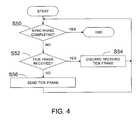
- Fig. 4 shows a flow chart of the processing in one node of the network acting as master node during the synchronization phase.
- the node is put into synchronization mode by e.g. setting a timer and the processing starts.
- a query is performed, whether the synchronization phase is completed.
- the end of the synchronization phase can e.g. be determined by setting a timer which expires after a predetermined time t endSyncPhase . If the synchronization phase is completed (YES in step S50), the synchronization process ends, and the operation mode of the node changes to normal transmission mode for the transmission of data.
- step S50 the node queries whether a tick frame was received (step S52). This can occur during the synchronization process as described above. If a tick frame was received (YES in step S52), the received tick frame is discarded (step S54), as the respective node is the master node and is already synchronized. The processing then returns to step S50.
- step S52 the master node sends a synchronization tick frame to all nodes within transmission range (step S56).
- the time t syncMaster at which the tick frame is sent represents the tick to which all nodes in the network will be synchronized. This tick frame preferably carries round number zero. Afterwards, the processing returns to step S50.
- the round number is transmitted with the synchronization tick frame.
- no specific time information is transmitted to the nodes. From the information received in the synchronization tick frame, i.e. the round number and the time of receipt in the node, the node can determine a good estimate of a reference point in time. Said reference point in time corresponding to t syncMaster .
- n hopsMax integer; /* maximum network diameter (2)
- d macroSlot duration; /* duration of a macro slot (3)
- d round duration; /* duration of a round (4)
- var n round integer; /* round of first tick reception (5)
- t txTick time; /* last tick transmission time (6)
- t rxTick time; /* last tick reception time (7)
- t endSyncPhase time; /* end of the current sync phase (8) clock t local ; /* local time (9) timer timer txTick ; /* next tick frame transmission (10) timer macroSlot ; /* begin of the next macro slot
- Lines (11)-(20) list the part of the algorithm that is executed by the master node. In lines (11)-(12), the required initializations are shown. While the parameters in line (11) are constants and determined offline during network configuration, timer macroSlot is set dynamically when the node becomes master node. The when-clauses shown in lines (13) and (19) are used to define interrupt routines, i.e. routines that are executed when the specified interrupt event occurs. In line (13), this is a timer event; the interrupt in line (19) is triggered by the network adapter due to a tick frame reception. At the beginning of every macro slot (timer event in line (13)), the master has to initiate a synchronization phase by broadcasting a tick frame with round number zero (line (15)). The end of the sync phase is determined in line (16), and the timer for the beginning of the next macro slot set in line (17).
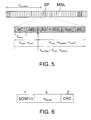
- Fig. 5 shows schematic view of the structure and timing of synchronization phases and information transmission phases according to a preferred embodiment of the present invention.
- the transmission medium is divided into global macro slots of fixed length d macroSlot .
- Each macro slot is subdivided into a leading synchronization phase SP of fixed length, and a sequence of micro slots MSL that can be used for the transmission of regular data frames.
- the length of macro slots is bounded by the required tick precision d offsetMax and the maximal clock skew r clockSkewMax .
- Fig. 5 also shows the structure and timing of the synchronization phase.
- a synchronization phase is subdivided into rounds R0 to R5 of fixed duration d round , where the number of rounds is n hopsMax - 1. In a preferred embodiment, rounds are incrementally numbered, starting with zero.
- the length of the synchronization phase d syncPhase is d round * n hopsMax .
- Fig. 6 shows a schematic view of an expemplary synchronization tick frame according to a preferred embodiment of the present invention.
- CRC cyclic redundancy check
- the numbers above the box in Fig. 6 indicate the number of bits used for each field in the synchronization tick frame.
- n hopsMax ⁇ log 2 ⁇ n hopsMax ⁇
- tick frames be as short as possible, because bit times are significantly longer than usual.
- the duration of a black burst is needed, which is preferably a physical frame or a frame which is transmitted over the physical layer, in particular, consisting of preamble, start-of-frame, and MAC frame (media access control frame), even if the contents is not needed.
- MAC frame media access control frame
- the structure of the physical frame may be different depending on the type of the base transmission technology used.
- a tick frame is a specialized synchronization frame that is protected against collisions and carries synchronization data.
- tick frames and in particular the single bits of a tick frame, are preferably encoded using black bursts.
- Black burst frames are transmitted without prior clear channel assessment (CCA), i.e. without carrier sensing. Different from regular data frames, their contents is irrelevant, which protects them against collisions. However, the length of a black burst can be determined and used for encoding purposes.
- CCA clear channel assessment
- the transceiver in a node is configured to perform clear channel assessment preferably based only on the energy level on the medium, without having to decode frame preambles. Alternatively, other methods of clear channel assessment may be envisaged. This way, it is possible to receive black bursts correctly even if multiple transmissions collide, destroying preamble, header, and payload.
- black bursts are insensitive to interference, they are affected by length changes, which may occur when black burst transmissions overlap. However, this problem may be avoided if black bursts are sent at predefined points in time, assuming that all nodes are tick synchronized with a maximal offset d offsetMax .
- black bursts of equal length are used to encode tick frames including synchronization data.
- "1" is encoded as a black burst transmission
- "0” is encoded as no black burst transmission.
- the tick can be forwarded after the respective node has received the entire tick frame and after the tick frame has been processed during the time d tickProcessing in the node.
- d round denotes the round duration, a constant configuration parameter that should be greater than tick frame creation delay and send delay together.
- tick synchronization method it is not necessary that the clocks of the nodes in the network are synchronized. More in detail, the nodes in particular synchronize to ticks sent by the master node without exchanging clock values of these ticks. In fact, as described above, only the respective round number, however, no clock value is transmitted with the tick frame. The boundaries of transmission slots for transmission of data are then defined relative to these determined ticks.
- clock values referring to reference ticks may be exchanged, thereby achieving time synchronization.
- it may be sufficient to exchange one clock value referring to a reference point in time among the nodes of the network.
- Such a reference point in time may be the time when the master reference tick was sent by the master node.
- the estimated value t syncNode calculated with the use of the above formula contains an error d tickOffset for which an upper bound can be determined. Therefore, the synchronization tick can be estimated in each node with a known accuracy.
- tick accuracy with a deterministic time bound is desired.
- message transfer delay There are several sources of message transfer delay, which may contribute to inaccuracy:
- All delays are composed of a fixed minimal delay and a variable delay jitter (possibly zero).
- the fixed minimal delay can be determined in advance, e.g. by counting instruction cycles or by dividing frame length by transmission rate. If considered properly, it does not affect tick accuracy. However, delay jitter contributes to inaccuracy and must be kept as small as possible.
- FIG. 7 A schematic view of delays of a message transfer is shown in Fig. 7 .
- tick frame creation can be performed well ahead of the next scheduled transmission, which occurs at a predefined point in time; therefore, d creation has no effect on tick accuracy.
- tick frames preferably comprise of a sequence of black bursts. Since black bursts are transmitted without prior carrier sensing, d access is the (constant) duration of the blind period caused by switching the transceiver to send mode.
- a source of delay jitter is d prop , which depends on signal propagation speed and node distance. In ad hoc networks, this distance is typically well below 100m. With electromagnetic signals propagating through air at the speed of light, the maximal value of d prop is 0.3 ⁇ s, which is negligible.
- Another source of delay jitter is d rxProc , caused by creating and processing a hardware interrupt.
- tick frame transmission can be started on schedule at t 1 , tick frame arrival begins at t 2 , and the tick frame is completely received and processed at t 3 (see Fig. 7 ).
- the tick synchronization method described above not only receives the entire tick frame, but also records the start time of frame arrival.
- the hardware mechanism exploited for this purpose is preferably clear channel assessment (CCA), creating a hardware interrupt as soon as the channel is detected busy. This means that the start time of tick frame arrival is recorded at time t 2 ' (see Fig. 7 ).
- the worst case bound d offsetMax depends on the resynchronization period, which in the present case is equal to the macro slot length d macroSlot .
- the clock skew also referred to as clock drift
- C A the frequencies of a clock C A relative to another clock C B . If C B is a perfect clock at real time t, the frequency of this clock is 1.
- the described method has low complexity in terms of communication, computation, and storage. Communication complexity depends linearly on maximum network diameter - to establish a reference tick, n hopsMax tick frames are exchanged.
Landscapes
- Engineering & Computer Science (AREA)
- Computer Networks & Wireless Communication (AREA)
- Signal Processing (AREA)
- Mobile Radio Communication Systems (AREA)
- Synchronisation In Digital Transmission Systems (AREA)
- Small-Scale Networks (AREA)
Priority Applications (4)
| Application Number | Priority Date | Filing Date | Title |
|---|---|---|---|
| EP07017409A EP2034629A1 (de) | 2007-09-05 | 2007-09-05 | Verfahren, Computerprogramm und System zur Tickersynchronisation von Knoten in einem drahtlosen Multihop-Netzwerk |
| PCT/EP2008/004692 WO2009030292A1 (en) | 2007-09-05 | 2008-06-11 | Method, computer program product and system for the tick synchronization of nodes in a wireless multi-hop network |
| AT08759197T ATE522989T1 (de) | 2007-09-05 | 2008-06-11 | Verfahren, computerprogrammprodukt und system zur tick-synchronisation von knoten in einem drahtlosen mehrstreckennetzwerk. |
| EP08759197A EP2195949B1 (de) | 2007-09-05 | 2008-06-11 | Verfahren, computerprogrammprodukt und system zur tick-synchronisation von knoten in einem drahtlosen mehrstreckennetzwerk. |
Applications Claiming Priority (1)
| Application Number | Priority Date | Filing Date | Title |
|---|---|---|---|
| EP07017409A EP2034629A1 (de) | 2007-09-05 | 2007-09-05 | Verfahren, Computerprogramm und System zur Tickersynchronisation von Knoten in einem drahtlosen Multihop-Netzwerk |
Publications (1)
| Publication Number | Publication Date |
|---|---|
| EP2034629A1 true EP2034629A1 (de) | 2009-03-11 |
Family
ID=38698216
Family Applications (2)
| Application Number | Title | Priority Date | Filing Date |
|---|---|---|---|
| EP07017409A Withdrawn EP2034629A1 (de) | 2007-09-05 | 2007-09-05 | Verfahren, Computerprogramm und System zur Tickersynchronisation von Knoten in einem drahtlosen Multihop-Netzwerk |
| EP08759197A Not-in-force EP2195949B1 (de) | 2007-09-05 | 2008-06-11 | Verfahren, computerprogrammprodukt und system zur tick-synchronisation von knoten in einem drahtlosen mehrstreckennetzwerk. |
Family Applications After (1)
| Application Number | Title | Priority Date | Filing Date |
|---|---|---|---|
| EP08759197A Not-in-force EP2195949B1 (de) | 2007-09-05 | 2008-06-11 | Verfahren, computerprogrammprodukt und system zur tick-synchronisation von knoten in einem drahtlosen mehrstreckennetzwerk. |
Country Status (3)
| Country | Link |
|---|---|
| EP (2) | EP2034629A1 (de) |
| AT (1) | ATE522989T1 (de) |
| WO (1) | WO2009030292A1 (de) |
Cited By (7)
| Publication number | Priority date | Publication date | Assignee | Title |
|---|---|---|---|---|
| WO2013149886A1 (de) * | 2012-04-02 | 2013-10-10 | Rohde & Schwarz Gmbh & Co. Kg | Verfahren zur integration von netzteilnehmern in ein ad-hoc-netzwerk und zugehöriges ad-hoc-netzwerk |
| WO2014188604A1 (ja) * | 2013-05-24 | 2014-11-27 | 富士通株式会社 | 通信方法、システム、および通信プログラム |
| WO2015126577A1 (en) * | 2014-02-21 | 2015-08-27 | Landis+Gyr Innovations, Inc. | Clock drift compensation in a time synchronous channel hopping network |
| WO2017107261A1 (zh) * | 2015-12-24 | 2017-06-29 | 中国科学院沈阳自动化研究所 | 基于ptp协议的多跳无线回程网络时间同步误差补偿方法 |
| CN110933096A (zh) * | 2019-12-05 | 2020-03-27 | 北京邮电大学 | 软件定义的网络授时系统及授时方法 |
| CN114584246A (zh) * | 2022-03-01 | 2022-06-03 | 四川九洲电器集团有限责任公司 | 基于fpga的无线自组网时间同步方法、系统及介质 |
| WO2024124797A1 (zh) * | 2022-12-12 | 2024-06-20 | 深圳市汇川技术股份有限公司 | 无线网络节点同步方法、系统、设备及可读存储介质 |
Families Citing this family (5)
| Publication number | Priority date | Publication date | Assignee | Title |
|---|---|---|---|---|
| US10159108B2 (en) * | 2015-04-10 | 2018-12-18 | Motorola Mobility Llc | DRX handling in LTE license assisted access operation |
| US10820290B2 (en) | 2018-08-13 | 2020-10-27 | At&T Intellectual Property I, L.P. | Over the air synchronization by means of a protocol in a next generation wireless network |
| US11064449B2 (en) | 2019-08-16 | 2021-07-13 | At&T Intellectual Property I, L.P. | Over the air synchronization of network nodes |
| CN114729980B (zh) | 2019-12-03 | 2025-06-17 | 洛克达股份有限公司 | 用于改进定位网络的弹性的方法和装置 |
| CN114257659B (zh) * | 2021-12-27 | 2023-09-19 | 江苏加信智慧大数据研究院有限公司 | 一种设备在线的验证方法 |
Citations (2)
| Publication number | Priority date | Publication date | Assignee | Title |
|---|---|---|---|---|
| US20020019951A1 (en) * | 2000-08-02 | 2002-02-14 | Masahito Kubo | Timer adjusting system |
| WO2006067271A1 (en) * | 2004-12-22 | 2006-06-29 | Mikko Kohvakka | Energy efficient wireless sensor network, node devices for the same and a method for arranging communications in a wireless sensor network |
Family Cites Families (2)
| Publication number | Priority date | Publication date | Assignee | Title |
|---|---|---|---|---|
| US7409022B2 (en) | 2004-10-01 | 2008-08-05 | Mitsubishi Electric Research Laboratories, Inc. | Synchronizing clocks in wireless personal area networks |
| EP1815650B1 (de) | 2004-11-25 | 2009-03-18 | Fraunhofer-Gesellschaft zur Förderung der angewandten Forschung e.V. | Verfahren zur synchronisation und datenuebertragung |
-
2007
- 2007-09-05 EP EP07017409A patent/EP2034629A1/de not_active Withdrawn
-
2008
- 2008-06-11 EP EP08759197A patent/EP2195949B1/de not_active Not-in-force
- 2008-06-11 WO PCT/EP2008/004692 patent/WO2009030292A1/en not_active Ceased
- 2008-06-11 AT AT08759197T patent/ATE522989T1/de not_active IP Right Cessation
Patent Citations (2)
| Publication number | Priority date | Publication date | Assignee | Title |
|---|---|---|---|---|
| US20020019951A1 (en) * | 2000-08-02 | 2002-02-14 | Masahito Kubo | Timer adjusting system |
| WO2006067271A1 (en) * | 2004-12-22 | 2006-06-29 | Mikko Kohvakka | Energy efficient wireless sensor network, node devices for the same and a method for arranging communications in a wireless sensor network |
Non-Patent Citations (4)
| Title |
|---|
| AAKVAAG N ET AL: "Timing and Power Issues in Wireless Sensor Networks — An Industrial Test Case", PARALLEL PROCESSING, 2005. ICPP 2005 WORKSHOPS. INTERNATIONAL CONFERENCE WORKSHOPS ON OSLO, NORWAY 14-17 JUNE 2005, PISCATAWAY, NJ, USA,IEEE, 14 June 2005 (2005-06-14), pages 419 - 426, XP010820995, ISBN: 0-7695-2381-1 * |
| J. ELSON, L. GIROD, D. ESTRIN: "Reference Broadcast synchronization (RBS): Fine grained network time synchronization using reference broadcast", PROCEEDINGS OF THE FIFTH SYMPOSIUM ON OPERATING DESIGN AND IMPLEMENTATION (OSDI), December 2002 (2002-12-01), Boston; MA, USA, pages 1 - 17, XP002459887 * |
| MAVRONICOLAS M ED - INSTITUTE OF ELECTRICAL AND ELECTRONICS ENGINEERS: "An upper and a lower bound for tick synchronization", 2 December 1992, PROCEEDINGS OF THE REAL TIME SYSTEMS SYMPOSIUM. PHOENIX, DEC. 2 - 4, 1992, LOS ALAMITOS, IEEE COMP. SOC. PRESS, US, PAGE(S) 246-255, ISBN: 0-8186-3195-3, XP010031277 * |
| S. GANERIWAL, R. KUMAR, M. B. SRIVASTAVA: "Timing-sync Protocol for sensor networks", PROCEEDINGS OF SENSYS, 3 November 2003 (2003-11-03), Los Angeles, Ca, USA, XP002459888 * |
Cited By (14)
| Publication number | Priority date | Publication date | Assignee | Title |
|---|---|---|---|---|
| WO2013149886A1 (de) * | 2012-04-02 | 2013-10-10 | Rohde & Schwarz Gmbh & Co. Kg | Verfahren zur integration von netzteilnehmern in ein ad-hoc-netzwerk und zugehöriges ad-hoc-netzwerk |
| US9609606B2 (en) | 2012-04-02 | 2017-03-28 | Rohde & Schwarze GmbH & Co. KG | Method for integrating network subscribers into an ad-hoc network and an associated ad-hoc network |
| WO2014188604A1 (ja) * | 2013-05-24 | 2014-11-27 | 富士通株式会社 | 通信方法、システム、および通信プログラム |
| JP5971412B2 (ja) * | 2013-05-24 | 2016-08-17 | 富士通株式会社 | 通信方法、システム、および通信プログラム |
| WO2015126577A1 (en) * | 2014-02-21 | 2015-08-27 | Landis+Gyr Innovations, Inc. | Clock drift compensation in a time synchronous channel hopping network |
| US9602270B2 (en) | 2014-02-21 | 2017-03-21 | Landis+Gyr Innovations, Inc. | Clock drift compensation in a time synchronous channel hopping network |
| WO2017107261A1 (zh) * | 2015-12-24 | 2017-06-29 | 中国科学院沈阳自动化研究所 | 基于ptp协议的多跳无线回程网络时间同步误差补偿方法 |
| CN106921456A (zh) * | 2015-12-24 | 2017-07-04 | 中国科学院沈阳自动化研究所 | 基于ptp协议的多跳无线回程网络时间同步误差补偿方法 |
| CN106921456B (zh) * | 2015-12-24 | 2018-06-19 | 中国科学院沈阳自动化研究所 | 基于ptp协议的多跳无线回程网络时间同步误差补偿方法 |
| US10056999B2 (en) | 2015-12-24 | 2018-08-21 | Shenyang Institute Of Automation, Chinese Academy Of Sciences | Time synchronization error compensation method for multi-hop wireless backhaul network based on PTP |
| CN110933096A (zh) * | 2019-12-05 | 2020-03-27 | 北京邮电大学 | 软件定义的网络授时系统及授时方法 |
| CN114584246A (zh) * | 2022-03-01 | 2022-06-03 | 四川九洲电器集团有限责任公司 | 基于fpga的无线自组网时间同步方法、系统及介质 |
| CN114584246B (zh) * | 2022-03-01 | 2023-08-15 | 四川九洲电器集团有限责任公司 | 基于fpga的无线自组网时间同步方法、系统及介质 |
| WO2024124797A1 (zh) * | 2022-12-12 | 2024-06-20 | 深圳市汇川技术股份有限公司 | 无线网络节点同步方法、系统、设备及可读存储介质 |
Also Published As
| Publication number | Publication date |
|---|---|
| WO2009030292A1 (en) | 2009-03-12 |
| ATE522989T1 (de) | 2011-09-15 |
| EP2195949A1 (de) | 2010-06-16 |
| EP2195949B1 (de) | 2011-08-31 |
Similar Documents
| Publication | Publication Date | Title |
|---|---|---|
| EP2195949B1 (de) | Verfahren, computerprogrammprodukt und system zur tick-synchronisation von knoten in einem drahtlosen mehrstreckennetzwerk. | |
| US9673858B2 (en) | Fast frequency-hopping schedule recovery | |
| CN108809356B (zh) | 一种基于tdma技术跳频组网的实现方法 | |
| US20100034191A1 (en) | Method and system for time synchronization in a sensor network | |
| EP2015477B1 (de) | TDMA-Kommunikationssystem mit Konfigurationsbake und zugehöriges Verfahren | |
| EP1976164B1 (de) | Mobiles TDMA-Ad-hoc-Netzwerk (MANET) mit Synchronisierung und Verfolgung zweiter Ordnung | |
| US9054822B2 (en) | Method and system for synchronization of time-slotted barrage relay networks | |
| EP1845669A1 (de) | Adaptives Kommunikationsprotokoll für drahtlose Netzwerke | |
| KR20090033381A (ko) | 애드-혹 네트워크를 위한 이웃 간접 확인응답 알고리즘(NbIA)을 가지는 TDMA 채널 접근 스케줄링 | |
| KR20000029996A (ko) | 매체접근제어프로토콜을최적화하는방법및그장치 | |
| CN1719781A (zh) | 一种Ad hoc网络TDMA时隙同步方法 | |
| Gotzhein et al. | Black Burst Synchronization (BBS)–A protocol for deterministic tick and time synchronization in wireless networks | |
| Bhandari et al. | Prioritized clock synchronization for event critical applications in wireless IoT networks | |
| Rahamatkar et al. | A reference based, tree structured time synchronization approach and its analysis in WSN | |
| Sun et al. | Distributed clock synchronization with application of D2D communication without infrastructure | |
| Roche | Time synchronization in wireless networks | |
| Gotzhein et al. | Decentralized tick synchronization for multi-hop medium slotting in wireless ad hoc networks using black bursts | |
| KR20100006314A (ko) | 무선 센서 네트워크에서 다중 채널을 통한 데이터 송수신방법 | |
| Christmann et al. | Multi-hop clock synchronization in wireless ad-hoc networks | |
| US7813382B2 (en) | Method and system for time synchronization in communication networks | |
| Rahamatkar et al. | An approach towards lightweight, reference based, tree structured time synchronization in WSN | |
| Zhao et al. | Slot synchronization in ad hoc networks based on frequency hopping synchronization | |
| Chen et al. | Synchronization considerations for real-time wireless sensor and actuator networks | |
| US20120057469A1 (en) | Data transfer in large network in efficient manner. | |
| CN121815394A (zh) | 一种无线自组网络时间同步方法、装置、系统及通信设备 |
Legal Events
| Date | Code | Title | Description |
|---|---|---|---|
| PUAI | Public reference made under article 153(3) epc to a published international application that has entered the european phase |
Free format text: ORIGINAL CODE: 0009012 |
|
| 17P | Request for examination filed |
Effective date: 20070913 |
|
| AK | Designated contracting states |
Kind code of ref document: A1 Designated state(s): AT BE BG CH CY CZ DE DK EE ES FI FR GB GR HU IE IS IT LI LT LU LV MC MT NL PL PT RO SE SI SK TR |
|
| AX | Request for extension of the european patent |
Extension state: AL BA HR MK RS |
|
| AKX | Designation fees paid | ||
| STAA | Information on the status of an ep patent application or granted ep patent |
Free format text: STATUS: THE APPLICATION IS DEEMED TO BE WITHDRAWN |
|
| 18D | Application deemed to be withdrawn |
Effective date: 20090912 |
|
| REG | Reference to a national code |
Ref country code: DE Ref legal event code: 8566 |