EP2034793A1 - Weiterleitung von Standortdaten in Telekommunikationsnetzwerken - Google Patents
Weiterleitung von Standortdaten in Telekommunikationsnetzwerken Download PDFInfo
- Publication number
- EP2034793A1 EP2034793A1 EP07116054A EP07116054A EP2034793A1 EP 2034793 A1 EP2034793 A1 EP 2034793A1 EP 07116054 A EP07116054 A EP 07116054A EP 07116054 A EP07116054 A EP 07116054A EP 2034793 A1 EP2034793 A1 EP 2034793A1
- Authority
- EP
- European Patent Office
- Prior art keywords
- location information
- server
- terminal
- client
- current position
- Prior art date
- Legal status (The legal status is an assumption and is not a legal conclusion. Google has not performed a legal analysis and makes no representation as to the accuracy of the status listed.)
- Withdrawn
Links
- 238000000034 method Methods 0.000 claims abstract description 24
- 238000013475 authorization Methods 0.000 claims description 9
- 238000012546 transfer Methods 0.000 claims description 6
- 238000012545 processing Methods 0.000 claims description 5
- 238000004891 communication Methods 0.000 claims description 3
- 238000004590 computer program Methods 0.000 claims description 2
- 230000003993 interaction Effects 0.000 description 3
- 230000007246 mechanism Effects 0.000 description 3
- 238000010586 diagram Methods 0.000 description 2
- 230000006870 function Effects 0.000 description 2
- 230000000295 complement effect Effects 0.000 description 1
- 235000019800 disodium phosphate Nutrition 0.000 description 1
- 238000005516 engineering process Methods 0.000 description 1
- 229910044991 metal oxide Inorganic materials 0.000 description 1
- 150000004706 metal oxides Chemical class 0.000 description 1
- 238000012986 modification Methods 0.000 description 1
- 230000004048 modification Effects 0.000 description 1
- 230000008569 process Effects 0.000 description 1
- 230000002040 relaxant effect Effects 0.000 description 1
- 230000004044 response Effects 0.000 description 1
- 239000004065 semiconductor Substances 0.000 description 1
Images

Classifications
-
- H—ELECTRICITY
- H04—ELECTRIC COMMUNICATION TECHNIQUE
- H04W—WIRELESS COMMUNICATION NETWORKS
- H04W8/00—Network data management
- H04W8/02—Processing of mobility data, e.g. registration information at HLR [Home Location Register] or VLR [Visitor Location Register]; Transfer of mobility data, e.g. between HLR, VLR or external networks
- H04W8/08—Mobility data transfer
- H04W8/10—Mobility data transfer between location register and external networks
-
- H—ELECTRICITY
- H04—ELECTRIC COMMUNICATION TECHNIQUE
- H04W—WIRELESS COMMUNICATION NETWORKS
- H04W64/00—Locating users or terminals or network equipment for network management purposes, e.g. mobility management
Definitions
- the invention is related to the area of location based services.
- the invention is related to methods for the transferring of Location Information (LI) of a mobile terminal from an access network (where the mobile node is attached to) to a server in the home network of the mobile terminal.
- LI Location Information
- Wireless networks like e.g. wireless local area network (WLAN) are being deployed in public places by a diverse set of operators.
- the home network may need to know the current location of the user in order to enable location-aware billing, location-aware authorization and location-aware services.
- WLAN wireless local area network
- Enabling location-aware billing, location-aware authorization, location-aware services, etc. requires that an AAA (authentication, authorization and accounting) Home Server is able to get the location of a mobile node (MN) dynamically.
- AAA authentication, authorization and accounting
- the location information is sent together with the identity of the user from the network access server (NAS, located for example in a visitor network) to the AAA home server of the user per value during the initial network attachment. That is, the AAA home server acquires a literal location object describing the location of a device.
- the AAA server may also request location information dynamically at a later stage via the RADIUS (remote authentication dial in user service) or Diameter protocol.
- RADIUS remote authentication dial in user service
- Diameter protocol Diameter protocol
- the HTTP enabled location delivery (HELD) protocol is a XML based application-layer protocol that is independent of the session-layer and is build on top of HTTP, TCP etc.
- a location may be retrieved from a location information server (LIS) by-value, and alternatively, the device may request that the LIS provides a location reference in the form of a location URI (Uniform Resource Indentifier) or a set of location URIs, allowing the device to distribute its location information by-reference.
- the LIS is an entity that is capable of determining the location of a terminal in the network and providing the location information.
- the HELD protocol when used in combination with RADIUS/Diameter would allow relaxing the above mentioned constraints of the Radius/Diameter protocol, by for example sending location information request from the AAA server to the LIS to retrieve the location information of a device utilising the HELD protocol and a location reference.
- the HELD protocol cannot be used without an appropriate identifier of the terminal or user in order to determine the location of a terminal.
- the AAA Home Server may use a Chargeable-User-Identity (CUI) as an alias or handle to the user's unique identity to maintain the user's anonymity.
- CCI Chargeable-User-Identity
- the HELD protocol does not support the use of the Chargeable-User-Identity as an identification method for a terminal.
- the present invention provides methods for providing location information to an AAA home server that overcome the above problems.
- a method comprising:
- a server comprising:
- a client comprising:
- a location information server comprising:
- a computer program product including a program comprising software code portions for performing, when the program is run on a processing device, a method as defined above.
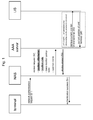
- Fig. 1 is an example of a message exchange for delivering location information during the network access authentication and authorization procedure.
- the Network Access Server Upon a network authentication request (S1) from an access network client (terminal), the Network Access Server (NAS) submits a RADIUS/Diameter Access-Request message (S2) to the AAA server that contains location information attributes among other required attributes.
- S1 network authentication request
- the NAS that serves as the AAA client and the AAA server have agreed to exchange the LbyR during network access authentication and authorization process
- the NAS may send the LbyR without the server explicitly asking for it if an out-of-band agreement between the two networks exist.
- the AAA server may also ask for the reference some time later after evaluating the user's privacy policies.
- the access request message shown in Fig. 2 includes Location-Information, Location-Data, Basic-Location-Policy-Rules and Operator-Name Attributes.
- the LbyR is included in the Location-Data-Attribute.
- the LbyR can contain any information that could be used to identify the terminal.
- the LbyR can be based on an HTTP, HTTPS or SIP schema. Some examples are:
- the AAA server sends an access-accept message to the NAS (S3) and the NAS sends an authentication success message to the terminal (S4).
- the AAA server can then retrieve the current position of the terminal via HTTP (for example the HELD protocol), SIP (or any other protocol depending on the provided location reference) from the LIS (S5, S6), as described above.
- HTTP for example the HELD protocol
- SIP or any other protocol depending on the provided location reference
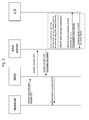
- Fig. 2 shows a deployment scenario where operator networks are targeted that already use a form of "virtual identifier" that can be utilized as a location reference.
- a CUI Chargeable-User-Identity
- a CUI can be used to retrieve information (e.g. location information) about a terminal from e.g. the LIS.
- the CUI is a unique identity provided by the home network that acts as an alias or handle to the real user identity but provides user anonymity. Thus, the identity of the user can be hidden from the access network (and intermediate AAA broker networks).
- the message exchange starts with the terminal attaching to the network and starting the network access authentication procedure (step S7).
- step S9 it is indicated that the CUI mechanism (or any other type of identifier used as alias of handle for the user identity) is supported by allowing the AAA server to provide the Chargeable-User-Identity to the NAS in the Access-Accept.
- the NAS and the LIS are afterwards able to correlate the CUI with the terminal.
- the network access authentication procedure is concluded with step S10. Later, when the AAA server needs to learn the location of the terminal it issues a request to the LIS with step S11, which could be for example a request using the HELD protocol.
- step S11 e.g. done via the HELD protocol
- the CUI is added as a parameter in the identity extensions.
- the LIS receiving the request can then use the CUI to retrieve the location information of the terminal. When it obtained the location it provides a response in message S12.
- no other nodes are able to inspect the user's location information providing superior security compared to the delivery via RADIUS or Diameter where intermediate AAA proxies or brokers are able to observe the exchange due to the lack of end-to-end security capabilities in today's AAA protocols.
- a terminal/user identifier e.g. the CUI
- an extension is necessary to the schema specified in the HELD-IDENTITY-EXTENSIONS [I-D.winterbottom-geopriv-held-identity-extensions] document.
- Such an extension could be as shown in the following:
- Fig. 3 is a block diagram of a system according to an aspect of the present invention.
- the system 60 comprises a server 30, a client 40 and a location information server 50.
- the server 30 comprises a transceiver 31 in order to receive messages from the client 40, e.g. the NAS, like e.g. an access request message, and to request information from the client.
- the server 30 further comprises an accessing/retrieving unit 32 that uses the location information to access a location information server 50 and to retrieve the current position of a terminal.
- the client 40 comprises an obtaining unit 41 for obtaining location information about a terminal from the location information server 50 and a transferring unit 42 for transferring the obtained location information to the server 30.
- the location information server 50 comprises a transceiver 51 for sending location information about a terminal to a client 40.
- the location information is stored a data base 52.
- the data base 52 stores location information about a plurality of terminals in the network associated with an identity of the terminals.
- the location information server 50 further comprises an access unit 53 which can be accessed by a server 30 in order to retrieve a current position of a terminal based on the location information. Then, the access unit 53 forwards the current position of a terminal to the server 30.
- the processing of all components comprised in the server 30, the client 40, and the location information server 50 is either controlled by a central processing unit (CPU) or by separate processing units, respectively, e.g. DSPs or the like, that are not shown in Fig. 3 .
- CPU central processing unit
- DSPs separate processing units
- the server, the client, and the location information server may comprise further units that are necessary for their operation as server, client, and location information server, respectively. However, a description of these units is omitted in this specification.
- the arrangement of the functional blocks of the network devices is not construed to limit the invention, and the functions may be performed by one block or further split into sub-blocks.
Landscapes
- Engineering & Computer Science (AREA)
- Databases & Information Systems (AREA)
- Computer Networks & Wireless Communication (AREA)
- Signal Processing (AREA)
- Mobile Radio Communication Systems (AREA)
Priority Applications (2)
| Application Number | Priority Date | Filing Date | Title |
|---|---|---|---|
| EP07116054A EP2034793A1 (de) | 2007-09-10 | 2007-09-10 | Weiterleitung von Standortdaten in Telekommunikationsnetzwerken |
| PCT/EP2008/061230 WO2009033954A1 (en) | 2007-09-10 | 2008-08-27 | Location information delivery in telecommunicattion networks |
Applications Claiming Priority (1)
| Application Number | Priority Date | Filing Date | Title |
|---|---|---|---|
| EP07116054A EP2034793A1 (de) | 2007-09-10 | 2007-09-10 | Weiterleitung von Standortdaten in Telekommunikationsnetzwerken |
Publications (1)
| Publication Number | Publication Date |
|---|---|
| EP2034793A1 true EP2034793A1 (de) | 2009-03-11 |
Family
ID=39111654
Family Applications (1)
| Application Number | Title | Priority Date | Filing Date |
|---|---|---|---|
| EP07116054A Withdrawn EP2034793A1 (de) | 2007-09-10 | 2007-09-10 | Weiterleitung von Standortdaten in Telekommunikationsnetzwerken |
Country Status (2)
| Country | Link |
|---|---|
| EP (1) | EP2034793A1 (de) |
| WO (1) | WO2009033954A1 (de) |
Cited By (2)
| Publication number | Priority date | Publication date | Assignee | Title |
|---|---|---|---|---|
| WO2010111016A1 (en) * | 2009-03-26 | 2010-09-30 | Andrew Llc | System and method for managing created location contexts in a location server |
| CN102036162A (zh) * | 2009-09-24 | 2011-04-27 | 中兴通讯股份有限公司 | 一种定位系统、方法及终端 |
Citations (4)
| Publication number | Priority date | Publication date | Assignee | Title |
|---|---|---|---|---|
| US20020160766A1 (en) * | 2001-04-27 | 2002-10-31 | Portman Eric A. | Location-based services |
| US20030055964A1 (en) * | 2001-09-18 | 2003-03-20 | Ramin Rezaiifar | Method and apparatus for service authorization in a communication system |
| US20050272440A1 (en) * | 2003-01-10 | 2005-12-08 | Huawei Technologies Co., Ltd. | Method of providing location service for WLAN user |
| US20060153172A1 (en) * | 2005-01-07 | 2006-07-13 | Oki Electric Industry Co., Ltd. | Emergency call system and emergency call method |
-
2007
- 2007-09-10 EP EP07116054A patent/EP2034793A1/de not_active Withdrawn
-
2008
- 2008-08-27 WO PCT/EP2008/061230 patent/WO2009033954A1/en not_active Ceased
Patent Citations (4)
| Publication number | Priority date | Publication date | Assignee | Title |
|---|---|---|---|---|
| US20020160766A1 (en) * | 2001-04-27 | 2002-10-31 | Portman Eric A. | Location-based services |
| US20030055964A1 (en) * | 2001-09-18 | 2003-03-20 | Ramin Rezaiifar | Method and apparatus for service authorization in a communication system |
| US20050272440A1 (en) * | 2003-01-10 | 2005-12-08 | Huawei Technologies Co., Ltd. | Method of providing location service for WLAN user |
| US20060153172A1 (en) * | 2005-01-07 | 2006-07-13 | Oki Electric Industry Co., Ltd. | Emergency call system and emergency call method |
Cited By (5)
| Publication number | Priority date | Publication date | Assignee | Title |
|---|---|---|---|---|
| WO2010111016A1 (en) * | 2009-03-26 | 2010-09-30 | Andrew Llc | System and method for managing created location contexts in a location server |
| US8391884B2 (en) | 2009-03-26 | 2013-03-05 | Andrew Llc | System and method for managing created location contexts in a location server |
| CN102036162A (zh) * | 2009-09-24 | 2011-04-27 | 中兴通讯股份有限公司 | 一种定位系统、方法及终端 |
| EP2469798A4 (de) * | 2009-09-24 | 2014-02-19 | Zte Corp | System, verfahren, server und endgerät zur ortung |
| US8965396B2 (en) | 2009-09-24 | 2015-02-24 | Zte Corporation | Location system, method, server and terminal |
Also Published As
| Publication number | Publication date |
|---|---|
| WO2009033954A1 (en) | 2009-03-19 |
Similar Documents
| Publication | Publication Date | Title |
|---|---|---|
| KR101073282B1 (ko) | 사용자 평면 기반 위치 서비스(lcs) 시스템, 방법 및장치 | |
| JP5357222B2 (ja) | 通信システムにおいてユーザの真の識別情報を隠す方法とシステム | |
| US9396466B2 (en) | Account linkage in machine-to-machine scenarios | |
| US7644163B2 (en) | Plug and play mobile services | |
| CN108496380B (zh) | 服务器和存储介质 | |
| JP4188912B2 (ja) | 通信システムにおける移動装置に関する情報要求のサポート | |
| CN104247505A (zh) | 用于利用anqp服务器能力增强andsf的系统和方法 | |
| JP2004506359A (ja) | Umtsにおけるローミングサポート方法及びシステム | |
| WO2006067264A1 (en) | Content sharing in a communication system | |
| CN102648643A (zh) | 无线接入点 | |
| EP2034793A1 (de) | Weiterleitung von Standortdaten in Telekommunikationsnetzwerken | |
| JP4579592B2 (ja) | 情報提供サービスシステムおよび方法 | |
| JP2010278867A (ja) | 加入者情報アクセス方法、加入者情報アクセスシステムとそのサーバ装置 | |
| KR20170019981A (ko) | 통화 및 웹 서비스의 연동방법 및 이를 위한 통신서버 | |
| CN102065399A (zh) | 一种基于未认证set终端实现紧急定位的方法及系统 | |
| US20160234685A1 (en) | Methods and Devices for Processing Identification Information | |
| CN100531034C (zh) | 一种分发用于接入网络的一次性密码的方法 | |
| JP5122051B2 (ja) | ネットワーク内の複数の移動ノードを管理するための方法および装置 | |
| KR100392377B1 (ko) | 이동통신 시스템의 착신 서비스를 위한 가입자 데이터자동 등록 방법 | |
| CN100394811C (zh) | 基于用户平面的位置服务系统、方法和设备 | |
| KR102148205B1 (ko) | 착신 그룹의 서비스 상태 제어 시스템 및 그 방법 | |
| WO2025057211A1 (en) | Method and system for managing service requests in a network | |
| KR20060009562A (ko) | 폰 콘텐츠 다운로드 방법 | |
| Liu | Fulfillment of G-8000 Vendor-Specific Attributes Based on RADIUS Server | |
| HK1088764B (en) | User plane-based location services (lcs) system, method and apparatus |
Legal Events
| Date | Code | Title | Description |
|---|---|---|---|
| PUAI | Public reference made under article 153(3) epc to a published international application that has entered the european phase |
Free format text: ORIGINAL CODE: 0009012 |
|
| AK | Designated contracting states |
Kind code of ref document: A1 Designated state(s): AT BE BG CH CY CZ DE DK EE ES FI FR GB GR HU IE IS IT LI LT LU LV MC MT NL PL PT RO SE SI SK TR |
|
| AX | Request for extension of the european patent |
Extension state: AL BA HR MK RS |
|
| STAA | Information on the status of an ep patent application or granted ep patent |
Free format text: STATUS: THE APPLICATION HAS BEEN WITHDRAWN |
|
| 18W | Application withdrawn |
Effective date: 20090907 |
|
| 17P | Request for examination filed |
Effective date: 20090904 |