EP2036492A1 - Electrode médicale - Google Patents
Electrode médicale Download PDFInfo
- Publication number
- EP2036492A1 EP2036492A1 EP08161166A EP08161166A EP2036492A1 EP 2036492 A1 EP2036492 A1 EP 2036492A1 EP 08161166 A EP08161166 A EP 08161166A EP 08161166 A EP08161166 A EP 08161166A EP 2036492 A1 EP2036492 A1 EP 2036492A1
- Authority
- EP
- European Patent Office
- Prior art keywords
- patient
- contact element
- medical electrode
- body surface
- region
- Prior art date
- Legal status (The legal status is an assumption and is not a legal conclusion. Google has not performed a legal analysis and makes no representation as to the accuracy of the status listed.)
- Withdrawn
Links
Images


Classifications
-
- A—HUMAN NECESSITIES
- A61—MEDICAL OR VETERINARY SCIENCE; HYGIENE
- A61B—DIAGNOSIS; SURGERY; IDENTIFICATION
- A61B5/00—Measuring for diagnostic purposes; Identification of persons
- A61B5/24—Detecting, measuring or recording bioelectric or biomagnetic signals of the body or parts thereof
- A61B5/25—Bioelectric electrodes therefor
- A61B5/251—Means for maintaining electrode contact with the body
-
- A—HUMAN NECESSITIES
- A61—MEDICAL OR VETERINARY SCIENCE; HYGIENE
- A61B—DIAGNOSIS; SURGERY; IDENTIFICATION
- A61B5/00—Measuring for diagnostic purposes; Identification of persons
- A61B5/68—Arrangements of detecting, measuring or recording means, e.g. sensors, in relation to patient
- A61B5/6801—Arrangements of detecting, measuring or recording means, e.g. sensors, in relation to patient specially adapted to be attached to or worn on the body surface
- A61B5/683—Means for maintaining contact with the body
- A61B5/6832—Means for maintaining contact with the body using adhesives
- A61B5/6833—Adhesive patches
-
- A—HUMAN NECESSITIES
- A61—MEDICAL OR VETERINARY SCIENCE; HYGIENE
- A61B—DIAGNOSIS; SURGERY; IDENTIFICATION
- A61B2562/00—Details of sensors; Constructional details of sensor housings or probes; Accessories for sensors
- A61B2562/02—Details of sensors specially adapted for in-vivo measurements
Definitions
- the invention relates to a medical electrode according to claim 1.
- medical electrodes in particular disposable electrodes, are known for detecting and transmitting electrical pulses from the body surface of a patient to an electrical pulse processing device.
- Deduction of the electrical impulses from the body surface of a patient is dependent on both the position of the electrode and good electrical contact of the electrode with the body surface of the patient.
- the patient's skin is usually previously cleaned with alcohol to remove dirt and cutaneous fat.
- multiple repositioning of the medical electrodes is sometimes required until the electrical pulses of the required signal strength are obtained.
- the electrode once applied, must be removed to be reattached to another position.
- Each new position of the electrode causes a reduction in adhesiveness. Reduced adhesion of the medical electrodes can lead to unintentional release, for example during a medical operation, and thus to interruption of the monitoring of the electrical pulse processing device.
- patients are covered with sterile material during an operation, which also makes it more difficult or impossible to exchange medical electrodes.
- the object of the present invention is to provide a medical electrode, which allows a simple and inexpensive handling in the preparation of the operational readiness.
- the object according to the invention is achieved by a medical electrode having the features of claim 1.
- the invention proposes a medical electrode for detecting and transmitting electrical pulses from the body surface of a patient to an electrical pulse processing device comprising a contact element having a conductive region for making contact with the body surface of the patient and one at the bottom of the contact element having trained and adjacent to the conductive region first adhesive region for positioning the contact element on the body surface of the patient.
- the medical electrode according to the invention comprises a fastening element with a second adhesive region formed on its underside for fastening the contact element on the body surface of the patient.
- the fastening element is arranged concentrically with respect to the contact element.
- the contact element in the search for an optimal position of the medical electrode on the body surface of the patient in a first step by connecting the formed on the contact element first adhesive area with the body surface of the patient, the contact element can be attached to the body surface and removable from this is before, in a further step in a final position, the contact element is fixed by the connection of the formed on the fastener second adhesive region with the body surface of the patient.
- the contact element can be easily detached from the body surface of the patient for a required repositioning and fixed stably for final positioning.
- the second adhesive area advantageously has a protective cover which can be removed before use, which is removed only before a final positioning of the electrode.
- the contact element and the fastening element can each be formed in one piece.
- advantageously only the contact element is positioned before the fastening element is connected to the contact element in the final position of the medical electrode according to the invention such that at least by a connection of the second adhesion region with the body surface of the patient, the contact element is fixed accordingly on the body surface.
- the fastening element of the medical electrode according to the invention is perforated at a defined number of geometrically distributed points, wherein at least a part of the points form an outer edge with at least one inner fastening element and the points are perforated such that the at least one inner Fastener of the fastener is detachable.
- the user can advantageously be provided with at least two medical electrodes of different sizes, the user being able to produce the respective required electrode size in a simple and fast manner.
- An advantage of this preferred embodiment is also that in clinical practice, only one product must be stored for use in at least two patients of different sizes.
- the second adhesive area formed on the fastening element can Have recesses.
- the recesses allow better handling of the medical electrode according to the invention in a final positioning.
- the second adhesive region of the fastening element can be subdivided into separate adhesion regions in a further preferred embodiment.
- each individual adhesive area may have a separate protective film.
- the individual adhesive areas can be connected separately to the body surface of the patient.
- FIG. 1 a medical electrode of the prior art is shown.
- a contact element 1 is fixedly connected to a fastening element 2 by means of a base film 14.
- the fastening element 2 fixes the contact element 1 on the body surface of a patient.
- the fastening element 2 has an adhesion region 5 formed on the underside of a carrier 17, which fixes the contact element 1 on the skin surface of the patient.
- a conductive region 3 enriched in particular with a hydrogel 8 serves to detect electrical impulses from the body surface of the patient. Via a conductive material 4 of the contact element 1 , the electrical impulses are forwarded to a device processing the electrical impulses (not shown).
- a contact element 1 comprises a conductive material 4 for passing electrical impulses to an electrical impulse processing device (not shown), a conductive area 3 for making contact with the body surface of a patient, and a first adhesion area 6 adjacent to the conductive area 3 Positioning of the contact element 1 on the body surface of the patient.
- the conductive region 3 is enriched with a layer of hydrogel 8.
- the electrical impulses are indicated by the figure in the picture FIG. 2 Detected conductive area 3 of the body surface of the patient and passed over the conductive material 4 and a cable to the electrical impulse processing device (not shown).
- the conductive material 4 may consist of steel and silver chloride. In a particularly preferred embodiment, the conductive material 4 is made of carbon.
- the cable for connection to the electrical impulse processing device can with the Contact element 1 to be connected via a welded joint.
- the medical electrode according to the invention comprises a fastening element 2 with a second adhesive region 7 formed on the underside of the fastening element 2 for fastening the contact element 1 on the body surface of the patient.
- the contact element 1 is arranged in the center of the medical electrode according to the invention.
- the fastening element 2 is arranged concentrically with respect to the contact element 1 .
- the fastening element 2 is connected to the contact element 1 by a carrier 17 and preferably a base film 14.
- the first adhesive region 6 and at a radial distance to the second adhesive region 7 are formed.
- the carrier 17 is advantageously made of a foamed or textile material, for example of paving material.
- the first adhesive region 6 and the second adhesive region 7 are arranged at a spatial distance from each other, wherein at least the second adhesive region 7 is covered with a protective cover 9 '.
- the contact element 1 of the medical electrode can advantageously be positioned on the body surface of the patient in an optimal discharge position of electrical pulses from the body surface of a patient in a first step and in finding a discharge position with a sufficiently high signal strength the electrical impulses are finally fixed on the body surface of the patient in a second step.
- the first adhesion region 6 is stressed during the positioning phase, whereas the second adhesion region 7 is only applied during the fixing phase.
- both the first adhesive region 6 and the second adhesive region 7 each have a protective cover 9 and 9 ', wherein the protective cover 9 is designed with a grip region 15.
- the gripping region 15 allows a quick exposure of the first adhesive region 6.
- the protective cover 9 ' may be formed extended to the fastening element 2 on at least one side, whereby this extension advantageously forms a grip region 15'.
- the first adhesive region 6 has a smaller area compared to the second adhesive region 7.
- the contact element 1 can be easily removed again by detaching the first adhesive region 6 from the body surface of the patient and attached to another site on the body surface of the patient become.
- the contact element 1 can be stably fixed by connecting the second adhesive area 7 to the body surface of the patient.
- FIGS. 3A and 3B show a second embodiment of the medical electrode according to the invention.
- the contact element 1 and the fastening element 2 are each formed in one piece. Both the contact element 1 and the fastening element 2 preferably have a circular base area.
- the contact element 1 a concentrically arranged around the conductive material 4 carrier 17, which preferably consists of a foamed or textile material.
- the conductive region 3 is also as in the embodiment of FIG. 2 enriched with a layer of hydrogel 8.
- the first adhesive region 6 is formed.
- the carrier 17 and a base film 14 stabilize the contact element 1 in particular the layer hydrogel 8 of the conductive region 3.
- the fastening element 2 comprises a carrier 17 and a base film 14.
- the underside of the base film 14 is divided into two regions.
- a first region forms a connecting region 16, while a second region is preferably connected to a carrier 17 stabilizing the fastening element 2 .
- the second adhesive region 7 is formed on the underside of the carrier 17, the second adhesive region 7 is formed.
- the adhesive region 7 can also be provided directly on the underside of the base film 14 (not shown).
- the connection region 16 connects the fastening element 2 in the fixing phase with the upper side of the contact element 1 .
- FIG. 4 shows an alternative embodiment of the electrode according to the invention in a view from below.
- the second adhesive region 7 of the fastening element 2 is provided in this embodiment with a lateral recess 13.
- the recess 13 allows easy handling of the fastener 2 , for example, in the final fixation of the contact element 1 on the body surface of the patient during the fixation phase.
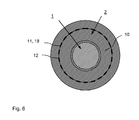
- FIG. 6 shows the fastener 2 of the medical electrode according to the invention in a further embodiment.
- the fastener 2 is perforated at a defined number of geometrically distributed points 12, wherein at least a portion of the points 12 form an outer edge 11 of at least one inner fastener 10 and the points 12 are perforated such that the at least one inner fastener 10 extends from the fastener 2 is detachable.
- the inventive medical Electrode of appropriate size, according to the size of the patient, can be made quickly and easily before start-up.
- the inner fastener 10 is for this purpose detached from the fastener 2 .
- the fastening element 2 is designed with a preferably perforated separating region 18, which forms the outer edge 11 of the inner fastening element 10. This allows easy detachment of the inner fastening element 10 from the fastening element 2 .
- the inner fastening element 10 forms part of the base surface of the fastening element 2 .
- the medical electrode according to the invention is used with the complete surface of the fastening element 2 , whereas for smaller patients, such as children, the medical electrode according to the invention is used with the base surface of the inner fastening element 10.
Landscapes
- Life Sciences & Earth Sciences (AREA)
- Health & Medical Sciences (AREA)
- Medical Informatics (AREA)
- Biophysics (AREA)
- Pathology (AREA)
- Engineering & Computer Science (AREA)
- Biomedical Technology (AREA)
- Heart & Thoracic Surgery (AREA)
- Physics & Mathematics (AREA)
- Molecular Biology (AREA)
- Surgery (AREA)
- Animal Behavior & Ethology (AREA)
- General Health & Medical Sciences (AREA)
- Public Health (AREA)
- Veterinary Medicine (AREA)
- Electrotherapy Devices (AREA)
Applications Claiming Priority (1)
| Application Number | Priority Date | Filing Date | Title |
|---|---|---|---|
| DE102007044020A DE102007044020A1 (de) | 2007-09-14 | 2007-09-14 | Medizinische Elektrode |
Publications (1)
| Publication Number | Publication Date |
|---|---|
| EP2036492A1 true EP2036492A1 (fr) | 2009-03-18 |
Family
ID=40134085
Family Applications (1)
| Application Number | Title | Priority Date | Filing Date |
|---|---|---|---|
| EP08161166A Withdrawn EP2036492A1 (fr) | 2007-09-14 | 2008-07-25 | Electrode médicale |
Country Status (3)
| Country | Link |
|---|---|
| US (1) | US20090076583A1 (fr) |
| EP (1) | EP2036492A1 (fr) |
| DE (1) | DE102007044020A1 (fr) |
Families Citing this family (2)
| Publication number | Priority date | Publication date | Assignee | Title |
|---|---|---|---|---|
| DE102007044019A1 (de) * | 2007-09-14 | 2009-04-09 | Dräger Medical AG & Co. KG | Medizinische Elektrode |
| KR102345190B1 (ko) * | 2017-03-16 | 2021-12-30 | 후쿠다 덴시 가부시키가이샤 | 생체용 전극 시트 |
Citations (6)
| Publication number | Priority date | Publication date | Assignee | Title |
|---|---|---|---|---|
| DE7132867U (de) * | 1971-08-28 | 1973-02-08 | Philips Nv | Korperelektrode |
| WO2000009202A1 (fr) * | 1998-08-11 | 2000-02-24 | Conmed Corporation | Electrode biomedicale avec lignes de perforation |
| EP1078595A2 (fr) * | 1999-08-24 | 2001-02-28 | Cas Medical Systems, Inc. | Electrode jetable pour nouveau-né adaptée pour l'utilisation en milieu humide |
| EP1541190A1 (fr) * | 2003-12-09 | 2005-06-15 | Ambu A/S | Eléctrode éléctromedicale avec une connection de câble amovible |
| US7079884B1 (en) * | 2003-12-19 | 2006-07-18 | Epstein Stephen T | Biomedical electrode having a mating configuration and its associated method of application to the body |
| US7215989B1 (en) * | 2004-03-15 | 2007-05-08 | Burks Jonathan W | Multiple electrode assembly |
Family Cites Families (2)
| Publication number | Priority date | Publication date | Assignee | Title |
|---|---|---|---|---|
| US3972329A (en) * | 1974-11-25 | 1976-08-03 | Kaufman John George | Body electrode for electro-medical use |
| DE8624683U1 (de) * | 1986-09-15 | 1986-10-30 | Müller-Wickop, Jürgen, Dr., 2000 Hamburg | Scheibenförmiges Sensorelement für Elektrokardiogramme |
-
2007
- 2007-09-14 DE DE102007044020A patent/DE102007044020A1/de not_active Withdrawn
-
2008
- 2008-07-25 EP EP08161166A patent/EP2036492A1/fr not_active Withdrawn
- 2008-09-12 US US12/209,352 patent/US20090076583A1/en not_active Abandoned
Patent Citations (6)
| Publication number | Priority date | Publication date | Assignee | Title |
|---|---|---|---|---|
| DE7132867U (de) * | 1971-08-28 | 1973-02-08 | Philips Nv | Korperelektrode |
| WO2000009202A1 (fr) * | 1998-08-11 | 2000-02-24 | Conmed Corporation | Electrode biomedicale avec lignes de perforation |
| EP1078595A2 (fr) * | 1999-08-24 | 2001-02-28 | Cas Medical Systems, Inc. | Electrode jetable pour nouveau-né adaptée pour l'utilisation en milieu humide |
| EP1541190A1 (fr) * | 2003-12-09 | 2005-06-15 | Ambu A/S | Eléctrode éléctromedicale avec une connection de câble amovible |
| US7079884B1 (en) * | 2003-12-19 | 2006-07-18 | Epstein Stephen T | Biomedical electrode having a mating configuration and its associated method of application to the body |
| US7215989B1 (en) * | 2004-03-15 | 2007-05-08 | Burks Jonathan W | Multiple electrode assembly |
Also Published As
| Publication number | Publication date |
|---|---|
| US20090076583A1 (en) | 2009-03-19 |
| DE102007044020A1 (de) | 2009-04-09 |
Similar Documents
| Publication | Publication Date | Title |
|---|---|---|
| DE69629498T2 (de) | Vorrichtung mit einziehbarer chirurgischer klinge | |
| DE4008497A1 (de) | Knochenplatte mit positionierteil | |
| EP2036493A1 (fr) | Dimension variable électrode médicale avec une zone de toucher | |
| DE69303543T2 (de) | Hilfsvorrichtung zum Anbringen eines externen Urinsammel- katheters und Urinsammelvorrichtung mit der Hilfsvorrichtung | |
| DE69817664T2 (de) | Chirurgischer Retraktor | |
| EP1393685A1 (fr) | Porte-lame de scalpel et scalpel | |
| DE102007042257A1 (de) | Verfahren zur schrittweisen oder kontinuierlichen Herstellung von biomedizinischen Mehrfachelektroden zur Einmalverwendung und aus diesen gebildetes Elektrodensystem | |
| EP0195451B1 (fr) | Electrode de mesure de signaux physiologiques | |
| DE202009008872U1 (de) | Fußchirurgie-Knochenplatte | |
| DE102007044020A1 (de) | Medizinische Elektrode | |
| DE3903974C2 (fr) | ||
| DE102008029632A1 (de) | Verbindungsmechanismus | |
| DE2909071A1 (de) | Epikutantestpflaster | |
| DE112017006589T5 (de) | Medizinische Vorrichtung | |
| DE60301776T2 (de) | Blutgefässmesser | |
| DE112012003917T5 (de) | Mit einer Feder selbstsperrende Spritze | |
| DE102005039147B3 (de) | Nagelkorrekturspange sowie Werkzeug zur Anbringung einer solchen Spange an einem Nagel, insbesondere einem Fußnagel | |
| EP2818159A1 (fr) | Dispositif doté d'un système thérapeutique transdermique, d'une aide au positionnement et d'une aide à la pénétration | |
| DE10164742B4 (de) | Produkt zum Befestigen von Kanülen, Schläuchen oder Elektroden | |
| DE10347303B4 (de) | Wiederverwendbare Elektrodeneinheit für ein medizinisches Gerät | |
| DE3430315C2 (fr) | ||
| DE102017128313B4 (de) | Pflasteranordnung | |
| DE102010010854A1 (de) | Haltevorrichtung für Blutampullen | |
| DE102018114213A1 (de) | Zahnimplantat mit mehreren Implantatteilen | |
| DE3528258A1 (de) | Augenimplantat |
Legal Events
| Date | Code | Title | Description |
|---|---|---|---|
| PUAI | Public reference made under article 153(3) epc to a published international application that has entered the european phase |
Free format text: ORIGINAL CODE: 0009012 |
|
| AK | Designated contracting states |
Kind code of ref document: A1 Designated state(s): AT BE BG CH CY CZ DE DK EE ES FI FR GB GR HR HU IE IS IT LI LT LU LV MC MT NL NO PL PT RO SE SI SK TR |
|
| AX | Request for extension of the european patent |
Extension state: AL BA MK RS |
|
| STAA | Information on the status of an ep patent application or granted ep patent |
Free format text: STATUS: THE APPLICATION HAS BEEN WITHDRAWN |
|
| 18W | Application withdrawn |
Effective date: 20090403 |