EP2037639A2 - Dispositifs et procédés pour la rupture locale dans une passerelle dans un réseau de service d'accès - Google Patents
Dispositifs et procédés pour la rupture locale dans une passerelle dans un réseau de service d'accès Download PDFInfo
- Publication number
- EP2037639A2 EP2037639A2 EP08161443A EP08161443A EP2037639A2 EP 2037639 A2 EP2037639 A2 EP 2037639A2 EP 08161443 A EP08161443 A EP 08161443A EP 08161443 A EP08161443 A EP 08161443A EP 2037639 A2 EP2037639 A2 EP 2037639A2
- Authority
- EP
- European Patent Office
- Prior art keywords
- traffic
- gateway
- different
- switch
- operator
- Prior art date
- Legal status (The legal status is an assumption and is not a legal conclusion. Google has not performed a legal analysis and makes no representation as to the accuracy of the status listed.)
- Withdrawn
Links
Images



Classifications
-
- H—ELECTRICITY
- H04—ELECTRIC COMMUNICATION TECHNIQUE
- H04L—TRANSMISSION OF DIGITAL INFORMATION, e.g. TELEGRAPHIC COMMUNICATION
- H04L12/00—Data switching networks
- H04L12/28—Data switching networks characterised by path configuration, e.g. LAN [Local Area Networks] or WAN [Wide Area Networks]
- H04L12/46—Interconnection of networks
- H04L12/4633—Interconnection of networks using encapsulation techniques, e.g. tunneling
-
- H—ELECTRICITY
- H04—ELECTRIC COMMUNICATION TECHNIQUE
- H04W—WIRELESS COMMUNICATION NETWORKS
- H04W8/00—Network data management
- H04W8/02—Processing of mobility data, e.g. registration information at HLR [Home Location Register] or VLR [Visitor Location Register]; Transfer of mobility data, e.g. between HLR, VLR or external networks
- H04W8/08—Mobility data transfer
- H04W8/082—Mobility data transfer for traffic bypassing of mobility servers, e.g. location registers, home PLMNs or home agents
-
- H—ELECTRICITY
- H04—ELECTRIC COMMUNICATION TECHNIQUE
- H04W—WIRELESS COMMUNICATION NETWORKS
- H04W80/00—Wireless network protocols or protocol adaptations to wireless operation
- H04W80/04—Network layer protocols, e.g. mobile IP [Internet Protocol]
-
- H—ELECTRICITY
- H04—ELECTRIC COMMUNICATION TECHNIQUE
- H04W—WIRELESS COMMUNICATION NETWORKS
- H04W88/00—Devices specially adapted for wireless communication networks, e.g. terminals, base stations or access point devices
- H04W88/16—Gateway arrangements
Definitions
- a local breakout function or device can be implemented in a gateway such as an access service network gateway, ASN GW, e.g. of worldwide interoperability of microwave access, WiMAX.
- ASN GW access service network gateway
- WiMAX standardization is based on mobile internet protocol version 4 or 6, Mobile IPv4/IPv6, where user traffic goes via a home agent, HA, through a mobile IP, MIP, tunnel.
- WiMAX Forum standardization all user traffic, Internet domain or operator's domain, will go through connectivity service network, CSN, home agent, HA. From an operator's point of view, user traffic can be divided in e.g. two categories such as Internet service domain and operator's service domain. Most of the Internet domain traffic may be assigned a best effort, BE, traffic class and may perhaps be charged with a flat rate monthly fee.
- the Internet domain traffic may for example include one or more of video on demand, GTalk, SKYPE, Internet browsing, peer to peer, any P2P, traffic and so on.
- Traffic to operator's domain in the following also designated as operator services traffic or control traffic, may be mainly for operator specific services such as: multicast/broadcast service, Internet Protocol Television, IPTV, service, IP multimedia subsystem, IMS, push services, etc.
- An operator may provide differentiated quality of service, QoS, and charging to calculate the revenue for its services.
- a routing of some traffic such as Internet traffic (e.g., best effort & flat rate) can be controlled so as to bypass a home agent.
- Internet traffic e.g., best effort & flat rate
- a local breakout can be provided in a gateway, e.g. of an access service network, allowing to optimise the routing of data traffic or user traffic such as Internet data traffic.
- IP traffic Internet traffic
- IP traffic usually does not need a proper handover for internet or internet protocol type of services because internet applications may be able to recover from packet loss and even from a change of IP addresses, e.g. if mapping in network address port translation, NAPT, expires.
- Operators may prefer to have some level of service control to discriminate and control operator domain services for its own revenue generation.
- a system comprising a device as defined above.
- an apparatus is configured to receive traffic of different traffic types, and to route the different traffic types to different paths or networks so as to provide a local breakout function or device, the different traffic types comprising internet service domain traffic and operator's service domain traffic.
- the apparatus may e.g. be a gateway or a device, module or chip of a gateway or another device, an access service network gateway, a worldwide interoperability of microwave access, WiMAX gateway, and/or may comprise at least one of a switch configured to switch incoming traffic to internet service domain traffic path or operator's service domain traffic path, a data path function, a foreign agent, and a network address translation function or network address port translation function.
- the switch may e.g. be at least one of a layer 3 switch and a public or private switch, and/or may be provided between the data path function or a gateway input, and the foreign agent or other traffic tunnel end point.
- a method may comprise, receiving traffic of different traffic types, routing the different traffic types to different paths or networks so as to provide a local breakout, the different traffic types comprising internet service domain traffic and operator's service domain traffic.
- Local breakout rules e.g., detecting and switching rules
- Local breakout rules may e.g. be transferred between access service network gateways if a breakout point is re-anchored. Local breakout rules may be provisioned into access service network gateway with authorization or dynamically with policy control or using operation and maintenance provisioning.
- a permission to allow local break-out can be provided by operation and maintenance, O&M, or can be sent to the ASN-GW with authorization or pushed dynamically.
- a computer program product may include a program comprising software code portions for performing, when the program is run on a processing device, any of the steps of the method mentioned above.
- a computer readable medium may store such a computer program product.
- an apparatus may comprise means for receiving traffic of different traffic types, and means for routing the different traffic types to different paths or networks, the different traffic types comprising internet service domain traffic and operator's service domain traffic.
- a module including means for performing any of the steps of the methods as defined above.
- Fig. 1 shows an example embodiment of a WiMAX architecture which may incorporate features and embodiments of the invention.
- EAP Extensible_Authentication_Protocol
- EAP methods Example of methods are listed e.g. in http://en.wikipedia.org/wiki/Extensible_Authentication_Protocol.
- a mobile station MS 1 or subscriber station SS 1 may communicate with an access service network, ASN, 2 via an interface or reference point R1.
- the access service network 2 may include one or more base stations BS 3, 4 and one or more access service network gateways, ASN-GWs, 5, 6, e.g. gateway 6, which may contain foreign agent, FA, functionality.
- the access service network ASN 2 may communicate with another access service network 7 via interfaces (or reference points) R4, R8, and with a connectivity service network, CSN, 8 of a network service provider, NSP, via interface (reference point) R3.
- the connectivity service network, CSN, 8 of the network service provider, NSP further includes a home agent, HA, 9 and a function, module, device for authentication, authorization and accounting, AAA 10.
- the connectivity service network, CSN, 8 of a network service provider, NSP may communicate with another connectivity service network, CSN, 11 of another operator via interface or reference point R5.
- the connecting lines in Fig. 1 represent NRM, Network Reference Model, reference points. Note: R7/R8 reference points are not normative in WiMAX Forum Release 1 standard and may also be omitted or replaced by other interactions or connections in the embodiments.
- Mobile IP and AAA may be handled via R3 between ASN 2 and CSN 8.
- the user plane, UP may use generic routing encapsulation protocol, GRE, and the control plane, CP, may use WiMAX control protocol on top of user datagram protocol, UDP, and internet protocol, IP.
- the BS and MS/SS elements shown in the drawings may include functionality of 802.16d, 802.16e, 802.16g, as certified by WiMAX forum, WMF.
- WiMAX there are defined different types of basic network architectures and the detailed solutions in the different cases will be described in the following.
- Embodiments of the present invention may be used with a WiMAX, Worldwide Interoperability for Microwave Access, structure.
- WiMAX Worldwide Interoperability for Microwave Access
- the present invention is not limited to WiMAX and may also be used with any other types of access or transport technologies.
- WiMAX architecture may use Mobile IP, MIP, for CSN-anchored mobility across reference point R3.
- terminal data user traffic that is data traffic outgoing from the terminal 1 uses IP address that points to the MIP HA 9.
- MIP HA 9 points to the MIP HA 9.
- HA 9 which intercepts it, wraps it into a tunnel and forwards to FA located in, e.g., ASN-GW 6.
- Mobile IP is also explained in "http://en.wikipedia.org/wiki/Mobile_IP".
- CMIP Client MIP
- PMIP proxy MIP
- MIP Home Agent HA
- MIP control signalling or other control/configuration signalling between MS and CSN.
- operator is hosting some services behind HA, obviously the resulting traffic also will go, in accordance with one, more or all of the embodiments of the invention, via the MIP HA 9.
- ASN-GW has to perform network address and port translation, NAPT, between the address allocated to MIP by HA (or other network element) and the address that is used in the Internet to route the traffic for the terminal directly to ASN-GW.
- NAPT network address translation
- Network address translation is described e.g. in "http://en.wikipedia.org/wiki/ Network_address_translation", and port address translation in "http://en.wikipedia.org/wiki/Port_address_translation”.
- the home agent may be dimensioned only for control signalling and e.g. possible operator services resulting in lower costs, speedy functioning and reliability of the MIP HAs.
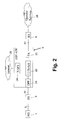
- Fig. 2 shows an embodiment and details of the access service network gateway 6 according to an implementation.
- the mobile station 1 may be connected to the base station 3 via reference point or interface R1.
- the base station 3 may be connected to the gateway 6 of the access services network via reference point or interface R6.
- the access services network gateway 6 provides connection or access to and/or from Internet 25 using data or IP traffic, and to the home agent 9 e.g. via reference point R3.
- the home agent 9 may provide access to e.g. operator services 26.
- access provisioning via HA can be bi-directional, or only in one direction, e.g., downlink - from server to MS/SS.
- the gateway 6 comprises at least one of a data path function, DPF, 21, a switch 22, and in case local breakout is done in anchor ASN-GW, foreign agent, FA, 23, and a network address and port translation, NAPT, function or unit 24 for network address and/or port translation between internet addresses and network addresses/ports.
- the switch (unit or function) 22 may be a layer 3, L3, switch and may be implemented, in an embodiment, as a public/private destination IP address switch, e.g., simple IP routing functionality.
- the L3 switch 22 allows a local breakout which means that part or optionally all IP-based or data traffic such as all Internet traffic (e.g. best effort, BE) can breakout in ASN-GW 6 via switch 22 to or from NAPT 24 or internet 25. Operator services e.g. from services 26 may still be delivered or requested via HA 9 and therefore do not break out at switch 22. Note that no MIP HA is needed for PMIP terminals and then all traffic can break-out locally in ASN-GW.
- IP-based or data traffic such as all Internet traffic (e.g. best effort, BE) can breakout in ASN-GW 6 via switch 22 to or from NAPT 24 or internet 25.
- Operator services e.g. from services 26 may still be delivered or requested via HA 9 and therefore do not break out at switch 22. Note that no MIP HA is needed for PMIP terminals and then all traffic can break-out locally in ASN-GW.
- ASN-GW 6 can switch all uplink Internet IP traffic (from MS) directly to the Internet. However, if the source address in outgoing IP packets uses IP address allocated from the addressing space of MIP HA, downlink traffic (towards MS) will always be routed from the server to MIP HA and only then be tunnelled towards MS via ASN-GW. This routing is called triangular routing.
- NAPT 24 can be an optional feature for ASN-GW 6 to prevent triangular routing for bypassing HA for downlink traffic.
- HoA can be allocated by two different home CSN networks. Similarly, an operator can choose to segment own network and reuse private addressing for terminals with HA in different segments.
- the NAPT functionality in ASN GW 6 can also support the use of overlapping home IP addresses, HoA. In case of external NAPT, tunnelling is needed between ASN-GW L3 Switch 22 and NAPT to map public and private destination address.
- an external NAPT function uniquely maps a terminal to a (public) IP address and port. Therefore unique connections between ASN-GW and external NAPT function have to be setup, e.g., using L2 VLANs or L3 tunnels or routing traffic via separate NAPT boxes for different users using the same HoA.
- ASN-GW 6 has to assure that no two users using the same IP HoA will share the same, e.g., L2 VLAN tag and external NAPT function has to assure that no two packets with identical HoA and separate L2 VLAN tags or L3 tunnels are treated as originated by one node.
- HA 9 is still needed for C-MIP MS IP configuration, thus HA 9 becomes C-Plane element used only at network entry and MIP registration renewal times.
- the described embodiments increase the value added by ASN-GW 6, and move the GW functionality from HA 9 to ASN-GW 6. Hence the dimensioning requirements of MIP HA 9 are decreased.
- This implementation embodiment removes R3 mobility management, MM, from user plane, U-Plane, for Internet traffic but preserves R3 MM for operator's (e.g. packet loss and address change-sensitive) services.
- Internet applications typically recover from packet loss and even a change of IP addresses (if mapping in NAPT expires).
- the embodiments provide full R4 and R6 ASN mobility.
- ASN Re-anchoring is a routing optimization step, not a must for mobility, and may optionally be provided in one or more of the embodiments.
- the embodiments optionally provide full R3 mobility management for operator's service traffic.
- R3 mobility implies change of NAPT, which is equivalent to expired NAPT mapping.
- PMIP terminals may operate even without MIP which means change of IP address (CSN Anchor) with each re-anchoring.
- CSN Anchor change of IP address
- Context information of local breakout context is part of information stored for idle terminal in the network (e.g. in paging controller / location register).
- relevant context is stored into location register/paging controller.
- the break out rules are optionally also included in this stored context.
- publicly routable IP addresses are transmitted in ASN-GW 6 with local breakout.
- discrimination is based on rules: public-private addressing space or IP 5-tuple ranges (source IP address, destination IP address, protocol, source port, destination port) or a subset of it.
- the rules can be based also on other fields of the IP packet or higher protocols.
- operator domain addresses are fed into MIP tunnel.
- the data path function, DPF feeds data to the foreign agent, FA, which is the entry point of the MIP tunnel.
- the switch or switch function is provided between the DP and FA functions. Thus it is the switch that switches data to FA or local breakout interface, or in principle also to other domains.
- the terminal-bound traffic arriving at NAPT or FA is combined and fed to the correct DPF for the terminal.
- L3 switch 22 does not do any packet inspection in some of the embodiments but may do so in other embodiments. In most cases, the switch 22 makes a check and routing decision to identify/distinguish between Internet traffic and operator traffic.
- the L3 switch 22 can be logically located between data path function (DPF) 21 and FA function. This arrangement will allow reusing existing DPF and FA functionalities to maximum extent.
- DPF data path function
- break out rules On top of the break out rules also indication of local break out being allowed for a subscription, or for all users has to be present in ASN-GW. Permission to allow local break-out can be provided by operation and maintenance, O&M, or can be sent to the ASN-GW 6 with authorization.
- a permission of local break out can be signaled in an authorization message from a visited authentication, authorization and accounting server, V-AAA, to the ASN-GW 6. Alternatively, it can be also signaled from home AAA.
- Breaks out are only allowed in HA 9 and never in ASN-GW 6 if roaming agreement does not allow it or break out is not supported in the visited domain.
- a break out can take place in ASN-GW 6 if roaming agreement allows it, or if authorization from home AAA allows it.
- Rules describing which flows are allowed or forced to break-out from ASN, e.g. from gateway 6 to NAPT 24 or Internet 25, can be pre-configured with O&M or be part of user specific profile arriving with authorization.
- Information about local breakout permission and specific breakout rules can optionally also be signaled between ASN-GWs in case of R3 re-anchoring, e.g. in case of Mobile IP handover.
- ASN-GW If break out at local ASN-GW is allowed and lawful intercept is requested local breakout in ASN-GW is performed only if ASN-GW supports lawful intercept functionality to prevent bypassing lawful intercept functionality in HA.
- a NAPT like function is performed for break out traffic that uniquely maps IP flows of a terminal to a (public) IP address and port Terminal is identified by either or combination of HoA (if unique), MS MAC (L2) address, Data Path ID, subscription ID, Network Access Identifier NAI.
- the NAPT functionality is provided and executed in ASN-GW 6. If the NAPT functionality is provided externally, a MS-unique tunnel has to be used between ASN-GW 6 and an external network address translation, NAT, network element.
- Fig. 3 shows an embodiment of switch 22 as provided in Fig. 2 .
- the switch 22 provides switching in uplink direction.
- the switch 22 also works in the other direction as well. It combines the traffic destined for MS in the downlink direction.
- the switch 22 is adapted to receive at an input combined Internet traffic and operator traffic which may e.g. be generated by MS 1.
- a detecting unit 30 of the switch 22 is able to receive and distinguish between the Internet traffic and the operator traffic, and is configured to control a switching unit 32 so as to divide the traffic into the Internet traffic which is supplied to a translation function or device 33 such as NAPT 24 or directly to the IP host indicated by the address when no translation is required, and into the operator traffic which is supplied to a foreign agent or home agent 32 which may correspond to the foreign agent 23 or the home agent 9 of Fig. 2 .
- the switch 22 functionality In the downlink, towards the MS, the switch 22 functionality combines/aggregates relevant traffic flows towards the MS.
- Fig. 4 shows a method in accordance with one, more or all of the embodiments of the invention.
- a decision function or step 40 is executed for checking whether the traffic or traffic type is an operator traffic or control traffic such as mobile IP, MIP, control traffic. If so, a step or function 41 is executed in which the traffic is sent or routed to a foreign agent, e.g. foreign agent 9 of Fig. 1 or 23 of Fig. 2 , or is directly routed to a home agent, e.g. home agent 9 of Fig. 1 or 2 .
- a foreign agent e.g. foreign agent 9 of Fig. 1 or 23 of Fig. 2
- a home agent e.g. home agent 9 of Fig. 1 or 2 .
- the traffic type is checked by a decision function or step 42 which checks whether the traffic or traffic type is a traffic for the internet domain or internet services domain.
- the decision function or step 42 may check whether the traffic is an IP-based traffic. If the function or step 42 detects that the traffic or traffic type is a traffic for the internet domain or internet services domain, the traffic is switched or forwarded to a step or function 43 in which the IP-based traffic is translated by a network address translation or network address port translation function, or may also be directly sent or routed, in case no address translation is needed or because of other reasons, to an IP host indicated by the address included in the traffic such as in IP packets of the IP-based traffic.
- the traffic may be routed, in a step or function 44, to other destination as appropriate.
- Advantages of one or more of the embodiments include one or more of the following: a good and efficient or optimal routing for internet traffic from ASN gateway, GW, a reduction or incorporation of Mobile IP HA into the control plane element, C-Plane element, the home agent no longer needing to handle any, or at least less, user traffic in such a case.
- the logical and physical architecture for operator's services can be preserved.
- An operator business case
- An operator can provide e.g. flat-rate and best effort quality of service, BE QoS, Internet service to users.
- a service control for third party applications is available (restriction of available resource per aggregation point). Even if R3 Mobility management should not work for internet traffic because of local breakout, mobility is provided in ASN (R4 and R6) and in addition Internet applications typically recover from the change of IP addresses.
- a mobile terminal or station may for example be any kind of a wireless communication device, e.g. personal computers, mobile phones or the like, irrespective of a specific standard to which these conform.
- Method steps likely to be implemented by hardware or as software code portions and being run using a processor at one of the devices, e.g. mobile station or network element, may be software code independent and can be specified using any programming language as long as the functionality defined by the method steps is preserved.
- any method step is suitable to be implemented as software or by hardware without changing the idea of the present invention in terms of the functionality implemented.
- Method steps and/or devices likely to be implemented as hardware components at one of the devices, e.g. network element or mobile station are hardware independent and can be implemented using any hardware technology or any hybrids of these, such as MOS (Metal Oxide Semiconductor), CMOS (Complementary MOS), using for example ASIC (Application Specific Integrated Circuit) components or DSP (Digital Signal Processor) components, as an example.
- Devices can be implemented as individual devices, or may be implemented in a distributed fashion throughout the system, as long as the functionality of the device/system is preserved.
- Respective elements e.g. deciding unit, switching unit, etc. according to certain embodiments can be implemented by any known means, either in hardware (DSP, microprocessor, microcontroller, ASIC, FPGA, etc) and/or software, respectively, as long as it is adapted to perform the described functions of the respective parts.
- the computer program instructions may be stored in or loaded onto a computer or other programmable apparatus or hardware to produce a device such as a gateway or a switch that the instructions which execute on the computer or other programmable apparatus create means for implementing the functions described.
- the computer program instructions may also be stored in a computer-readable memory.
- the computer program instructions may also be loaded onto a computer or other programmable apparatus to cause steps to be performed in the device or computer.
- a computer program product may include a computer-readable storage medium which may e.g. a non-volatile memory.
- Computer-readable program code portions may be embodied in the computer-readable storage medium so as to carry out the functions or steps of embodiments of the invention
Landscapes
- Engineering & Computer Science (AREA)
- Computer Networks & Wireless Communication (AREA)
- Signal Processing (AREA)
- Mobile Radio Communication Systems (AREA)
- Data Exchanges In Wide-Area Networks (AREA)
- Telephonic Communication Services (AREA)
Applications Claiming Priority (1)
| Application Number | Priority Date | Filing Date | Title |
|---|---|---|---|
| US11/898,585 US20090073995A1 (en) | 2007-09-13 | 2007-09-13 | Devices and methods for local breakout in a gateway of an access service network |
Publications (2)
| Publication Number | Publication Date |
|---|---|
| EP2037639A2 true EP2037639A2 (fr) | 2009-03-18 |
| EP2037639A3 EP2037639A3 (fr) | 2009-09-16 |
Family
ID=40087986
Family Applications (1)
| Application Number | Title | Priority Date | Filing Date |
|---|---|---|---|
| EP08161443A Withdrawn EP2037639A3 (fr) | 2007-09-13 | 2008-07-30 | Dispositifs et procédés pour la rupture locale dans une passerelle dans un réseau de service d'accès |
Country Status (3)
| Country | Link |
|---|---|
| US (1) | US20090073995A1 (fr) |
| EP (1) | EP2037639A3 (fr) |
| CN (1) | CN101388845A (fr) |
Cited By (6)
| Publication number | Priority date | Publication date | Assignee | Title |
|---|---|---|---|---|
| WO2009132139A1 (fr) * | 2008-04-24 | 2009-10-29 | Qualcomm Incorporated | Schéma d'accès ip local |
| GB2472866A (en) * | 2009-08-21 | 2011-02-23 | Samsung Electronics Co Ltd | Determining the access rights of a wireless communication unit to use a selected internet protocol traffic offload route |
| WO2011058511A1 (fr) * | 2009-11-10 | 2011-05-19 | Nokia Corporation | Procédé et appareil destinés à une rupture du trafic des communications |
| GB2482449A (en) * | 2009-08-21 | 2012-02-01 | Samsung Electronics Co Ltd | Determining that a location of a requesting wireless communication unit supports SIPTO and that the network operator allows break out to using SIPTO |
| GB2491049A (en) * | 2012-07-10 | 2012-11-21 | Samsung Electronics Co Ltd | Determining that selected IP traffic offload is allowed for routing IP data between an external packet data network and a wireless communication unit |
| WO2022154798A1 (fr) * | 2021-01-15 | 2022-07-21 | Nokia Solutions And Networks Oy | Dérivation locale pour calcul de bord à accès multiple à l'aide d'un support dédié |
Families Citing this family (20)
| Publication number | Priority date | Publication date | Assignee | Title |
|---|---|---|---|---|
| EP2040432A1 (fr) * | 2007-09-18 | 2009-03-25 | Nokia Siemens Networks Oy | Séparation locale en cas d'itinérance WiMAX |
| US8264961B2 (en) * | 2007-10-18 | 2012-09-11 | Futurewei Technologies, Inc. | Synchronization and macro diversity for MCBCS |
| WO2009057296A1 (fr) * | 2007-11-02 | 2009-05-07 | Panasonic Corporation | Terminal mobile, nœud de réseau, et nœud de gestion de transfert de paquets |
| US8837491B2 (en) | 2008-05-27 | 2014-09-16 | Glue Networks | Regional virtual VPN |
| US9319300B2 (en) | 2008-12-09 | 2016-04-19 | Glue Networks, Inc. | Systems and methods for determining endpoint configurations for endpoints of a virtual private network (VPN) and deploying the configurations to the endpoints |
| BRPI0924982A2 (pt) * | 2009-04-10 | 2016-01-12 | Huawei Tech Co Ltd | método, aparelho e sistema para handover |
| CN101668010A (zh) * | 2009-09-22 | 2010-03-10 | 中兴通讯股份有限公司 | WiMAX系统中多接口数据流负荷分担的方法及装置 |
| CN102036325B (zh) * | 2009-09-28 | 2013-06-05 | 华为终端有限公司 | 一种建立或修改本地ip接入承载的方法和设备 |
| CN101765218B (zh) * | 2009-12-23 | 2012-10-03 | 华为技术有限公司 | 数据传输方法及相关设备和系统 |
| CN101808101B (zh) * | 2010-04-20 | 2013-01-09 | 华为技术有限公司 | 子网间的通信方法、装置及系统 |
| EP2883384B1 (fr) | 2012-08-10 | 2019-10-16 | iBasis, Inc. | Réduction de trafic de signalisation dans des systèmes de communications mobiles |
| US9788188B2 (en) | 2012-12-14 | 2017-10-10 | Ibasis, Inc. | Method and system for hub breakout roaming |
| US9760528B1 (en) | 2013-03-14 | 2017-09-12 | Glue Networks, Inc. | Methods and systems for creating a network |
| US9928082B1 (en) | 2013-03-19 | 2018-03-27 | Gluware, Inc. | Methods and systems for remote device configuration |
| CN106465093B (zh) * | 2015-02-13 | 2020-01-17 | 华为技术有限公司 | 移动性管理的方法、装置及系统 |
| US9785412B1 (en) | 2015-02-27 | 2017-10-10 | Glue Networks, Inc. | Methods and systems for object-oriented modeling of networks |
| WO2017183658A1 (fr) * | 2016-04-22 | 2017-10-26 | Ricoh Company, Ltd. | Appareil de réseau, appareil d'entrée et de sortie, et programme |
| US10470031B2 (en) | 2016-05-20 | 2019-11-05 | Ibasis, Inc. | Voice over IMS roaming gateway |
| CN112449751B (zh) * | 2019-06-28 | 2022-08-26 | 华为云计算技术有限公司 | 一种数据传输方法、交换机及站点 |
| CN113014680B (zh) * | 2019-12-19 | 2024-04-19 | 中兴通讯股份有限公司 | 一种宽带接入的方法、装置、设备和存储介质 |
Citations (1)
| Publication number | Priority date | Publication date | Assignee | Title |
|---|---|---|---|---|
| EP1515574A1 (fr) * | 2003-09-15 | 2005-03-16 | BRITISH TELECOMMUNICATIONS public limited company | Système de télécommunications qui inclut deux réseaux |
Family Cites Families (13)
| Publication number | Priority date | Publication date | Assignee | Title |
|---|---|---|---|---|
| US7778260B2 (en) * | 1998-10-09 | 2010-08-17 | Netmotion Wireless, Inc. | Method and apparatus for providing mobile and other intermittent connectivity in a computing environment |
| US6856624B2 (en) * | 2001-02-21 | 2005-02-15 | Alcatel | Temporary unique private address |
| US20030074473A1 (en) * | 2001-10-12 | 2003-04-17 | Duc Pham | Scalable network gateway processor architecture |
| US20070208864A1 (en) * | 2002-10-21 | 2007-09-06 | Flynn Lori A | Mobility access gateway |
| US7230951B2 (en) * | 2003-04-16 | 2007-06-12 | Nortel Networks Limited | Policy based mobile IP |
| US7453852B2 (en) * | 2003-07-14 | 2008-11-18 | Lucent Technologies Inc. | Method and system for mobility across heterogeneous address spaces |
| US7852838B2 (en) * | 2005-12-13 | 2010-12-14 | Motorola Mobility, Inc. | Method and apparatus for selectively redirecting session control for an internet protocol multimedia subsystem |
| US8320309B2 (en) * | 2006-04-25 | 2012-11-27 | Telefonaktiebolaget Lm Ericsson (Publ) | IP mobility within a communication system |
| US7633904B2 (en) * | 2006-05-19 | 2009-12-15 | Intel Corporation | Wireless access network and method for handover of mobile terminals in idle mode |
| US7742487B2 (en) * | 2006-08-22 | 2010-06-22 | Embarq Holdings Company Llc | System and method for integrated service access |
| US8929360B2 (en) * | 2006-12-07 | 2015-01-06 | Cisco Technology, Inc. | Systems, methods, media, and means for hiding network topology |
| WO2008110215A1 (fr) * | 2007-03-15 | 2008-09-18 | Telefonaktiebolaget Lm Ericsson (Publ) | Procédé et appareil pour réaliser un branchement local dans un réseau mobile |
| US8971887B2 (en) * | 2007-07-20 | 2015-03-03 | General Motors Llc | Service provider initiated access network selection |
-
2007
- 2007-09-13 US US11/898,585 patent/US20090073995A1/en not_active Abandoned
-
2008
- 2008-07-30 EP EP08161443A patent/EP2037639A3/fr not_active Withdrawn
- 2008-09-02 CN CNA2008102124906A patent/CN101388845A/zh active Pending
Patent Citations (1)
| Publication number | Priority date | Publication date | Assignee | Title |
|---|---|---|---|---|
| EP1515574A1 (fr) * | 2003-09-15 | 2005-03-16 | BRITISH TELECOMMUNICATIONS public limited company | Système de télécommunications qui inclut deux réseaux |
Non-Patent Citations (1)
| Title |
|---|
| "3rd Generation Partnership Project; Technical Specification Group Services and System Aspects; 3GPP System Architecture Evolution: Report on Technical Options and Conclusions (Release 7)", 3GPP STANDARD; 3GPP TR 23.882, 3RD GENERATION PARTNERSHIP PROJECT (3GPP), MOBILE COMPETENCE CENTRE ; 650, ROUTE DES LUCIOLES ; F-06921 SOPHIA-ANTIPOLIS CEDEX ; FRANCE, no. V1.11.0, 1 July 2007 (2007-07-01), pages 1 - 211, XP050364123 * |
Cited By (15)
| Publication number | Priority date | Publication date | Assignee | Title |
|---|---|---|---|---|
| EP2701412A1 (fr) * | 2008-04-24 | 2014-02-26 | Qualcomm Incorporated | Schéma d'accès IP local |
| EP3462784A1 (fr) * | 2008-04-24 | 2019-04-03 | Qualcomm Incorporated | Schéma d'accès ip local |
| US10251114B2 (en) | 2008-04-24 | 2019-04-02 | Qualcomm Incorporated | Local IP access scheme |
| WO2009132139A1 (fr) * | 2008-04-24 | 2009-10-29 | Qualcomm Incorporated | Schéma d'accès ip local |
| US8856387B2 (en) | 2008-04-24 | 2014-10-07 | Qualcomm Incorporated | Local IP access scheme |
| GB2482449A (en) * | 2009-08-21 | 2012-02-01 | Samsung Electronics Co Ltd | Determining that a location of a requesting wireless communication unit supports SIPTO and that the network operator allows break out to using SIPTO |
| GB2482449B (en) * | 2009-08-21 | 2013-05-08 | Samsung Electronics Co Ltd | Network elements, integrated circuits and methods for routing control |
| GB2472866B (en) * | 2009-08-21 | 2013-05-08 | Samsung Electronics Co Ltd | Network elements, integrated circuits and methods for routing control |
| EP2468043A4 (fr) * | 2009-08-21 | 2016-10-12 | Samsung Electronics Co Ltd | Eléments de réseau, circuits intégrés et procédés de commande de routage |
| US9887909B2 (en) | 2009-08-21 | 2018-02-06 | Samsung Electronics Co., Ltd. | Network elements, integrated circuits and methods for routing control |
| GB2472866A (en) * | 2009-08-21 | 2011-02-23 | Samsung Electronics Co Ltd | Determining the access rights of a wireless communication unit to use a selected internet protocol traffic offload route |
| WO2011058511A1 (fr) * | 2009-11-10 | 2011-05-19 | Nokia Corporation | Procédé et appareil destinés à une rupture du trafic des communications |
| GB2491049B (en) * | 2012-07-10 | 2013-10-23 | Samsung Electronics Co Ltd | Network elements, integrated circuits and methods for routing control |
| GB2491049A (en) * | 2012-07-10 | 2012-11-21 | Samsung Electronics Co Ltd | Determining that selected IP traffic offload is allowed for routing IP data between an external packet data network and a wireless communication unit |
| WO2022154798A1 (fr) * | 2021-01-15 | 2022-07-21 | Nokia Solutions And Networks Oy | Dérivation locale pour calcul de bord à accès multiple à l'aide d'un support dédié |
Also Published As
| Publication number | Publication date |
|---|---|
| EP2037639A3 (fr) | 2009-09-16 |
| US20090073995A1 (en) | 2009-03-19 |
| CN101388845A (zh) | 2009-03-18 |
Similar Documents
| Publication | Publication Date | Title |
|---|---|---|
| EP2037639A2 (fr) | Dispositifs et procédés pour la rupture locale dans une passerelle dans un réseau de service d'accès | |
| US8934453B1 (en) | Offloading mobile traffic from a mobile core network | |
| US8942112B2 (en) | System and method for providing selective mobility invocation in a network environment | |
| US7808961B2 (en) | Radio communication system and radio communication method | |
| US7885248B2 (en) | System and method for traffic localization | |
| JP4620050B2 (ja) | パケットデータ通信 | |
| US9614656B2 (en) | Providing in-line services through radio access network resources under control of a mobile packet core in a network environment | |
| US10764088B2 (en) | Communication system, communication apparatus, communication method, terminal, non-transitory medium | |
| US20120069797A1 (en) | Method for a communication node with a plurality of communication interfaces to notify dynamic path setup and associates apparatus thereof | |
| US8879504B2 (en) | Redirection method, redirection system, mobile node, home agent, and proxy node | |
| AU2013328675B2 (en) | Method and apparatus for establishing and using PDN connections | |
| FI106503B (fi) | IP-liikkuvuusmekanismi pakettiradioverkkoa varten | |
| EP1921818A2 (fr) | Système de gestion de mobilité et procédé de réseau de protocole Internet mobile | |
| CN102695236A (zh) | 一种数据路由方法及系统 | |
| CN101330723A (zh) | 演进网络中隧道的建立方法及系统 | |
| CN102625305B (zh) | 接入演进分组系统的方法及系统 | |
| US8320309B2 (en) | IP mobility within a communication system | |
| WO2012146291A1 (fr) | Nom de point d'accès local destiné à être utilisé pour accéder à des réseaux de données de paquet | |
| US8086210B2 (en) | Flow based layer 2 handover mechanism for mobile node with multi network interfaces | |
| CN1939029B (zh) | 用于ip移动网的路由方法、系统和对应网络 | |
| CN102347892B (zh) | 一种网络设备获取用户接入信息的方法及系统 | |
| WO2018206101A1 (fr) | Critères de sélection en vue de destinations de données (non ip) | |
| JP4802238B2 (ja) | ローカルネットワーク相互接続における移動端末に対してネットワークに基づくトンネルを設定する方法 | |
| CN102740401B (zh) | 一种通过可信任的固网接入移动核心网络的方法和系统 | |
| Seite et al. | Network Working Group H. Chan (Ed.) Internet-Draft Huawei Technologies (more Intended status: Informational co-authors on P. 17) Expires: February 3, 2014 D. Liu China Mobile |
Legal Events
| Date | Code | Title | Description |
|---|---|---|---|
| PUAI | Public reference made under article 153(3) epc to a published international application that has entered the european phase |
Free format text: ORIGINAL CODE: 0009012 |
|
| AK | Designated contracting states |
Kind code of ref document: A2 Designated state(s): AT BE BG CH CY CZ DE DK EE ES FI FR GB GR HR HU IE IS IT LI LT LU LV MC MT NL NO PL PT RO SE SI SK TR |
|
| AX | Request for extension of the european patent |
Extension state: AL BA MK RS |
|
| PUAL | Search report despatched |
Free format text: ORIGINAL CODE: 0009013 |
|
| AK | Designated contracting states |
Kind code of ref document: A3 Designated state(s): AT BE BG CH CY CZ DE DK EE ES FI FR GB GR HR HU IE IS IT LI LT LU LV MC MT NL NO PL PT RO SE SI SK TR |
|
| AX | Request for extension of the european patent |
Extension state: AL BA MK RS |
|
| 17P | Request for examination filed |
Effective date: 20090909 |
|
| AKX | Designation fees paid |
Designated state(s): AT BE BG CH CY CZ DE DK EE ES FI FR GB GR HR HU IE IS IT LI LT LU LV MC MT NL NO PL PT RO SE SI SK TR |
|
| 17Q | First examination report despatched |
Effective date: 20100628 |
|
| STAA | Information on the status of an ep patent application or granted ep patent |
Free format text: STATUS: THE APPLICATION IS DEEMED TO BE WITHDRAWN |
|
| 18D | Application deemed to be withdrawn |
Effective date: 20130201 |