EP2037643A1 - Procédé de transmission d'une information électronique dans un réseau de transport - Google Patents
Procédé de transmission d'une information électronique dans un réseau de transport Download PDFInfo
- Publication number
- EP2037643A1 EP2037643A1 EP08013729A EP08013729A EP2037643A1 EP 2037643 A1 EP2037643 A1 EP 2037643A1 EP 08013729 A EP08013729 A EP 08013729A EP 08013729 A EP08013729 A EP 08013729A EP 2037643 A1 EP2037643 A1 EP 2037643A1
- Authority
- EP
- European Patent Office
- Prior art keywords
- message
- original message
- original
- protected
- sender
- Prior art date
- Legal status (The legal status is an assumption and is not a legal conclusion. Google has not performed a legal analysis and makes no representation as to the accuracy of the status listed.)
- Withdrawn
Links
- 238000000034 method Methods 0.000 title claims abstract description 32
- 230000005540 biological transmission Effects 0.000 claims description 5
- 238000011144 upstream manufacturing Methods 0.000 claims description 2
- 238000012432 intermediate storage Methods 0.000 claims 1
- 238000012795 verification Methods 0.000 abstract 1
- 230000032258 transport Effects 0.000 description 16
- 230000008569 process Effects 0.000 description 5
- 238000012546 transfer Methods 0.000 description 4
- 238000012790 confirmation Methods 0.000 description 3
- 238000012360 testing method Methods 0.000 description 2
- 230000009471 action Effects 0.000 description 1
- 230000007123 defense Effects 0.000 description 1
- 238000001514 detection method Methods 0.000 description 1
- 238000010586 diagram Methods 0.000 description 1
- 238000005516 engineering process Methods 0.000 description 1
- 238000011156 evaluation Methods 0.000 description 1
- 238000012545 processing Methods 0.000 description 1
- 230000009466 transformation Effects 0.000 description 1
- 230000001131 transforming effect Effects 0.000 description 1
- 230000007704 transition Effects 0.000 description 1
Images




Classifications
-
- H—ELECTRICITY
- H04—ELECTRIC COMMUNICATION TECHNIQUE
- H04L—TRANSMISSION OF DIGITAL INFORMATION, e.g. TELEGRAPHIC COMMUNICATION
- H04L51/00—User-to-user messaging in packet-switching networks, transmitted according to store-and-forward or real-time protocols, e.g. e-mail
- H04L51/21—Monitoring or handling of messages
- H04L51/212—Monitoring or handling of messages using filtering or selective blocking
Definitions
- the invention relates to a method for transmitting an electronic message in a transport network.
- header elements are used to carry auxiliary information.
- This auxiliary information includes, among other things, sender address, recipient address, date / time as well as in military / security environments also priority levels, validity period, alternative recipients and VS classification level.
- the HEs are coded and transmitted differently depending on the protocol used.
- the information contained in the header is openly accessible, as additional HEs must be added during the transport process, e.g. Trace information of the processing message transfer agents (MTA).
- MTA processing message transfer agents
- the transport network T is subdivided into two partial areas T1, T2 with different degrees of classification by VS or different security regulations.
- the left portion T1 is that of higher confidentiality rating compared to the right portion T2.
- special gateways G are used. These gateways rate the individual messages and If necessary, transfer these to the other security area. The decision whether a message is transmitted in the other area is made on the basis of the HE of the respective message.
- Sender S writes an electronic message N1 and addresses recipient E.
- Selected HEs are specified by him, e.g. Subject or VS rating.
- the sender has the option of encrypting the message body for the recipient E or digitally signing the message. For digital signature and encryption already established methods such as S / MIME or PGP are used.
- the transport system T transmits the message based on the address information in the HE to the gateway G.
- the rating is based on the VS rating included in the header of the message. If the HE corresponds to the defined security policy, the message is transferred to the other security area T2, otherwise we reject the message at the gateway.
- the message is transported by the transport system in the other area to the receiver E.
- the problem with this method is the fact that the authenticity of the HE is not guaranteed and manipulation of the HE can not be detected. If e.g. While manipulating the HE "VS rating" level during transport, it is possible for confidential messages to enter the open area, contrary to the prevailing security policy.
- the invention is based on the object of providing a method for transmitting electronic messages on the basis of the applicable standards, with which the authenticity of the HE can be ensured.
- the genuineness of the HE is ensured by obtaining a subsequent authenticity confirmation of the sender. This is achieved by transforming the HE of the original message into a new message, the contents of the new message being protected by methods known per se for encryption and optionally digital signature. If the sender confirms the authenticity of the transmitted data, the underlying HE of the original message is also confirmed.
- the sender who sends the message and is later requested to confirm the authenticity of the message can be both the mail server (MTA Message Transfer Agent) and the client of the MTA, ie the author of the message. which first forwards the message to the MTA.
- the existing system of transmitter, network and receiver is extended by an auditor, which forwards the original message only after confirmation of authenticity by the sender.
- the auditor is connected upstream of the gateway.
- the examiner can be technically in the Gateway to be integrated. An examination at the gateway and possibly forwarding to the recipient takes place only after the examiner has confirmed the authenticity of the HE.
- the original message is a fingerprint, so a feature that uniquely identifies the message generated, which is also returned to the sender.
- the fingerprint may e.g. derived from the message, in particular by forming the hash value. Alternatively, a random number can be generated - completely independent of the message. To confirm the authenticity of the HE, it is sufficient that the sender only sends back this fingerprint to the examiner. Using the fingerprint, it is possible for the examiner to identify the original message.
- the method according to the invention can be used for spam defense.
- the certificate of authenticity is obtained from the sending MTA.
- Each MTA stores the message IDs of the messages it has sent and confirms them on request.
- Fig. 2 The environment of use for the process according to the invention is in Fig. 2 shown.
- the examiner P was additionally introduced. He has the task to obtain the authentication for the original message N1 and cache them. Since examiner P and gateway G can be implemented in one instance, an evaluation can be carried out in the gateway G on the basis of the confirmed HE.
- Sender S writes an electronic message N1 and addresses recipient E. Selected HEs are specified by him, e.g. Subject or VS rating.
- the sender has the option of encrypting the message body for the recipient E or digitally signing the message. For digital signature and encryption already established methods such as S / MIME or PGP are used.
- the transport system T transmits the message N1 based on the address information to the examiner P.
- the examiner P receives the message N1.
- a hash value [H] is formed over the entire message N1 (using common methods, eg MD5). This hash value is much shorter (eg 1024 bits) than the message itself and is unique to this one message, so this hash value H can be used as a key element to store the message.
- the relevant HEs are transformed in a natural, human-readable form into the message body of a new, second message N2. Both the HE to be authenticated and the HE required by the acknowledgment to uniquely identify the source message are transformed.
- the following table shows the HEs that will be included in the second message and their purpose in the process: Use for: HE Identification of the message receiver " transmission time " Message ID " message size " Number of attachments authentication Security classification " priority level " period of validity
- the hash value H generated in step 2A is adopted in the message text.
- the second message N2 is now encrypted for the sender S of the original message N1.
- This encryption for S ensures that only S can authenticate the original message N1, since only he and the verifier P know the corresponding hash value H.
- the message N2 can be provided with a digital signature in addition to the encryption.
- the original message N1 is stored with the hash value H at the examiner P.
- the hash value H is used as a key criterion to the message N1 to be able to find again. For filing, the time of filing is also saved.
- the second message N2 is transmitted by means of the transport system T to the transmitter S.
- the author of the original message N1 himself is involved in the process to confirm the authenticity of the HE.
- the sender S of the original message N1 receives the second message N2 and decrypts the message body.
- the sender S now compares the displayed message body, which contains the transformed HE from the original message N1, with the message N1 originally sent by him.
- transmitter S comes to the conclusion that the HEs submitted to him are correct, he can confirm their authenticity by sending the hash value H to the examiner P. For this purpose, it generates a further, third message N3 (usually by the function "responses" to message N2) and addresses the verifier P. It is sufficient here to adopt the hash value H in the new message N3. Further elements are not necessary since the hash value H uniquely identifies the original message.
- the sender S transmits the third message N3 to the transport system T for transmission to the examiner P.
- the verifier P receives the third message N3 with the authentication of S.
- the third message N3 can optionally be provided with a digital signature. If this is the case, then this signature can now be checked and the test result evaluated.
- the hash value H is extracted from the third message N3. By encrypting the message N2, which contained the hash value H, it is sufficiently ensured that only the sender S can have authenticated. With the help of the hash value H, the original message N1 is now determined from the storage.
- the original message N1 is forwarded to the gateway G, which can now make its check based on confirmed HE before it is forwarded to the receiver E after a successful check.
- the authenticity level of the message N1 confirmed as true was lower than the maximum permissible degree of confidentiality according to the applicable security policy, so that the message N1 can pass from the secure area T1 of the transport network to the open area T2 of the transport network.
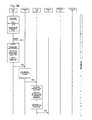
- Fig. 4 shows the sequence of the method according to the invention with assumed manipulation of the message to be transmitted.
- the classified as confidential message N1 is to be sent from the confidential area T1 in the open area T2 of the transport network T.
- a manipulation of the HE of the message takes place, in which the degree of confidentiality is reduced.
- the manipulated message is labeled N1 *. It exists thus the risk that the confidential information on the gateway G in the open area T2 arrives.
- the verifier P sends the acknowledgment request N2 to the sender S.
- the sender S determines a deviation between the HE of the message N1 as laid down in the message N2 with the HE of the message N1 originally sent by him. The manipulation is thus recognized. Since the verifier P receives no acknowledgment from the sender S on his acknowledgment request N2, the message N1 * manipulated with him will not be forwarded.
Landscapes
- Engineering & Computer Science (AREA)
- Computer Networks & Wireless Communication (AREA)
- Signal Processing (AREA)
- Data Exchanges In Wide-Area Networks (AREA)
- Information Transfer Between Computers (AREA)
Applications Claiming Priority (1)
| Application Number | Priority Date | Filing Date | Title |
|---|---|---|---|
| DE102007043892A DE102007043892A1 (de) | 2007-09-14 | 2007-09-14 | Verfahren zur Übermittlung einer elektronischen Nachricht in einem Transportnetzwerk |
Publications (1)
| Publication Number | Publication Date |
|---|---|
| EP2037643A1 true EP2037643A1 (fr) | 2009-03-18 |
Family
ID=39967094
Family Applications (1)
| Application Number | Title | Priority Date | Filing Date |
|---|---|---|---|
| EP08013729A Withdrawn EP2037643A1 (fr) | 2007-09-14 | 2008-07-31 | Procédé de transmission d'une information électronique dans un réseau de transport |
Country Status (3)
| Country | Link |
|---|---|
| US (1) | US20090077372A1 (fr) |
| EP (1) | EP2037643A1 (fr) |
| DE (1) | DE102007043892A1 (fr) |
Families Citing this family (2)
| Publication number | Priority date | Publication date | Assignee | Title |
|---|---|---|---|---|
| US8499045B2 (en) * | 2009-02-27 | 2013-07-30 | Research In Motion Limited | Systems and methods for protecting header fields in a message |
| GB201815120D0 (en) * | 2018-09-17 | 2018-10-31 | Sec Dep For Foreign And Commonwealth Affairs | A method and device for transferring electronic information |
Citations (2)
| Publication number | Priority date | Publication date | Assignee | Title |
|---|---|---|---|---|
| US20050210106A1 (en) * | 2003-03-19 | 2005-09-22 | Cunningham Brian D | System and method for detecting and filtering unsolicited and undesired electronic messages |
| US20050251861A1 (en) * | 2004-05-04 | 2005-11-10 | Brian Cunningham | System and method for preventing delivery of unsolicited and undesired electronic messages by key generation and comparison |
Family Cites Families (4)
| Publication number | Priority date | Publication date | Assignee | Title |
|---|---|---|---|---|
| IL145631A0 (en) * | 1999-03-31 | 2002-06-30 | British Telecomm | Server computer for guaranteeing files integrity |
| US20030028587A1 (en) * | 2001-05-11 | 2003-02-06 | Driscoll Michael C. | System and method for accessing and storing data in a common network architecture |
| US7535905B2 (en) * | 2004-03-31 | 2009-05-19 | Microsoft Corporation | Signing and validating session initiation protocol routing headers |
| DE102004046847A1 (de) * | 2004-09-27 | 2006-04-13 | Giesecke & Devrient Gmbh | System, Verfahren und tragbarer Datenträger zur Erzeugung einer digitalen Signatur |
-
2007
- 2007-09-14 DE DE102007043892A patent/DE102007043892A1/de not_active Withdrawn
-
2008
- 2008-07-31 EP EP08013729A patent/EP2037643A1/fr not_active Withdrawn
- 2008-09-12 US US12/209,785 patent/US20090077372A1/en not_active Abandoned
Patent Citations (2)
| Publication number | Priority date | Publication date | Assignee | Title |
|---|---|---|---|---|
| US20050210106A1 (en) * | 2003-03-19 | 2005-09-22 | Cunningham Brian D | System and method for detecting and filtering unsolicited and undesired electronic messages |
| US20050251861A1 (en) * | 2004-05-04 | 2005-11-10 | Brian Cunningham | System and method for preventing delivery of unsolicited and undesired electronic messages by key generation and comparison |
Non-Patent Citations (2)
| Title |
|---|
| ALLMAN SENDMAIL E ET AL: "DomainKeys Identified Mail Signatures (DKIM); draft-ietf-dkim-base-01.txt", IETF STANDARD-WORKING-DRAFT, INTERNET ENGINEERING TASK FORCE, IETF, CH, vol. dkim, no. 1, 13 April 2006 (2006-04-13), XP015044953, ISSN: 0000-0004 * |
| KRAWCZYK IBM M BELLARE UCSD R CANETTI IBM H: "HMAC: Keyed-Hashing for Message Authentication; rfc2104.txt", IETF STANDARD, INTERNET ENGINEERING TASK FORCE, IETF, CH, 1 February 1997 (1997-02-01), XP015007888, ISSN: 0000-0003 * |
Also Published As
| Publication number | Publication date |
|---|---|
| US20090077372A1 (en) | 2009-03-19 |
| DE102007043892A1 (de) | 2009-03-19 |
Similar Documents
| Publication | Publication Date | Title |
|---|---|---|
| DE3303846C2 (fr) | ||
| EP3949309B1 (fr) | Certificat digital et méthode sécure pour fournier une clé publique | |
| DE202006020965U1 (de) | Kommunikationssystem zum Bereitstellen der Lieferung einer E-Mail-Nachricht | |
| DE102009031817A1 (de) | Verfahren zur Ausstellung, Überprüfung und Verteilung von digitalen Zertifikaten für die Nutzung in Public-Key-Infrastrukturen | |
| EP2037643A1 (fr) | Procédé de transmission d'une information électronique dans un réseau de transport | |
| DE102021202075A1 (de) | Verfahren zur Validierung von Nachrichten | |
| EP1865675A1 (fr) | Procédé et système destinés au filtrage des messages électroniques | |
| DE102012106177A1 (de) | Sicheres Übertragungsverfahren | |
| EP3554001B1 (fr) | Procédé de transfert sécurisé et procédé d'échange bidirectionnel sécurisé des paquets de données électroniques dans un réseau | |
| DE112006001552T5 (de) | Verfahren und Server zur Authentifizierung der Absender von E-Mails und Mitteilung von Austauschinformationen | |
| EP1944928A2 (fr) | Procédé et système destinés à l'échange sécurisé d'une information par courrier électronique | |
| EP2945323B1 (fr) | Procédé pour un agent de transfert de messages destiné à transmettre un message électronique d'un expéditeur à un destinataire | |
| DE102022112839B4 (de) | Kommunikationssystem, Verfahren und Computerprogrammprodukt zur Bereitstellung von Dokumenten von einem oder mehreren Absendern an mindestens einen Empfänger | |
| EP3754931B1 (fr) | Procédé de transmission de données à fiabilité de manipulation | |
| WO2012007322A1 (fr) | Procédé pour envoyer un courriel | |
| DE102023110882A1 (de) | Übermitteln eines digitalen Nutzungsschlüssels für ein Kraftfahrzeug | |
| DE102013108472B4 (de) | Verfahren und Vorrichtung zum elektronischen Integritätsschutz | |
| WO2020007613A1 (fr) | Système de cryptage pour environnements non sécurisés | |
| DE102014103401B4 (de) | Verfahren, Vorrichtungen und System zur Sicherung einer Übertragung von elektronischen Nachrichten | |
| DE102009000302A1 (de) | Verfahren zum Erzeugen einer authentifizierbaren E-Mail | |
| DE102018203143A1 (de) | Verfahren zum Versenden und Verfahren zum Überprüfen von wenigstens zwei unter Verwendung eines Schlüssels authentifizierten Datenblöcken | |
| EP2410702A1 (fr) | Procédé de transmission d'une information électronique à travers un système de communication et système de communication correspondant | |
| EP1908253A1 (fr) | Procede et systeme pour transmettre un message et generateur de cles approprie a cet effet | |
| WO2005013551A1 (fr) | Procede et systeme de securite destines a identifier une identite d'abonne non falsifiee aupres d'un destinataire | |
| DE10357325A1 (de) | Verfahren und System zur Verifizierung einer E-Mail-Übertragung |
Legal Events
| Date | Code | Title | Description |
|---|---|---|---|
| PUAI | Public reference made under article 153(3) epc to a published international application that has entered the european phase |
Free format text: ORIGINAL CODE: 0009012 |
|
| AK | Designated contracting states |
Kind code of ref document: A1 Designated state(s): AT BE BG CH CY CZ DE DK EE ES FI FR GB GR HR HU IE IS IT LI LT LU LV MC MT NL NO PL PT RO SE SI SK TR |
|
| AX | Request for extension of the european patent |
Extension state: AL BA MK RS |
|
| 17Q | First examination report despatched |
Effective date: 20090922 |
|
| 17P | Request for examination filed |
Effective date: 20090820 |
|
| AKX | Designation fees paid |
Designated state(s): DE ES FR GB IT |
|
| STAA | Information on the status of an ep patent application or granted ep patent |
Free format text: STATUS: THE APPLICATION IS DEEMED TO BE WITHDRAWN |
|
| 18D | Application deemed to be withdrawn |
Effective date: 20100203 |