EP2037719A2 - Dispositif de communication, son système de communication, et procédé de configuration de communication correspondant - Google Patents
Dispositif de communication, son système de communication, et procédé de configuration de communication correspondant Download PDFInfo
- Publication number
- EP2037719A2 EP2037719A2 EP08164171A EP08164171A EP2037719A2 EP 2037719 A2 EP2037719 A2 EP 2037719A2 EP 08164171 A EP08164171 A EP 08164171A EP 08164171 A EP08164171 A EP 08164171A EP 2037719 A2 EP2037719 A2 EP 2037719A2
- Authority
- EP
- European Patent Office
- Prior art keywords
- communication device
- function
- communication
- access point
- setting information
- Prior art date
- Legal status (The legal status is an assumption and is not a legal conclusion. Google has not performed a legal analysis and makes no representation as to the accuracy of the status listed.)
- Withdrawn
Links
Images


Classifications
-
- H—ELECTRICITY
- H04—ELECTRIC COMMUNICATION TECHNIQUE
- H04W—WIRELESS COMMUNICATION NETWORKS
- H04W60/00—Affiliation to network, e.g. registration; Terminating affiliation with the network, e.g. de-registration
-
- H—ELECTRICITY
- H04—ELECTRIC COMMUNICATION TECHNIQUE
- H04W—WIRELESS COMMUNICATION NETWORKS
- H04W12/00—Security arrangements; Authentication; Protecting privacy or anonymity
- H04W12/03—Protecting confidentiality, e.g. by encryption
-
- H—ELECTRICITY
- H04—ELECTRIC COMMUNICATION TECHNIQUE
- H04W—WIRELESS COMMUNICATION NETWORKS
- H04W84/00—Network topologies
- H04W84/02—Hierarchically pre-organised networks, e.g. paging networks, cellular networks, WLAN [Wireless Local Area Network] or WLL [Wireless Local Loop]
- H04W84/10—Small scale networks; Flat hierarchical networks
- H04W84/12—WLAN [Wireless Local Area Networks]
-
- H—ELECTRICITY
- H04—ELECTRIC COMMUNICATION TECHNIQUE
- H04W—WIRELESS COMMUNICATION NETWORKS
- H04W88/00—Devices specially adapted for wireless communication networks, e.g. terminals, base stations or access point devices
- H04W88/02—Terminal devices
-
- H—ELECTRICITY
- H04—ELECTRIC COMMUNICATION TECHNIQUE
- H04W—WIRELESS COMMUNICATION NETWORKS
- H04W88/00—Devices specially adapted for wireless communication networks, e.g. terminals, base stations or access point devices
- H04W88/02—Terminal devices
- H04W88/06—Terminal devices adapted for operation in multiple networks or having at least two operational modes, e.g. multi-mode terminals
Definitions
- the present invention contains subject matter related to Japanese Patent Application JP 2007-239312 filed in the Japanese Patent Office on September 14, 2007.
- the present invention relates to a communication device having a radio communication function, a communication system thereof, and a communication setting method thereof.
- Wireless LAN connectable devices include printers and digital cameras that correspond to wireless LAN.
- a visual audio system that allows the user to watch and listen to television broadcasts regardless where he or she is, namely that has place shift function has been commercialized with a name of location free (registered trademark of Sony Corporation).
- the minimum structure of the place shift visual audio system is a base station that is a content transmitting device disposed in the user's house and a receiving device that provides a video and an audio to him or her who watches and listens to them (these devices are also referred to as a location free player or a client).
- the user can watch and listen to a television broadcast program that is on air in any room of the house using a wireless communication function of the base station in real time. If a device such as a DVD recorder or a hard disk recorder is connected to the base station, a video and an audio reproduced by the device can be wirelessly (radio) transmitted.
- the television broadcast program received by the base station is converted into a digital signal.
- Video and audio are compressed by Moving Picture Experts Group phase 2 (MPEG2), Advanced Video Coding (AVC) (H. 264), or MPEG4 and Advanced Audio Coding (AAC), MPEG audio, or the like, respectively, in real time.
- the compressed data are retransmitted through the Internet.
- the user can watch and listen to a video and an audio with a receiving device that decompresses the received compressed data anywhere outside the house or in a foreign country.
- Receiving devices include mobile devices such as portable game machines, Personal Digital Assistants (PDAs), note type personal computers (hereinafter sometimes referred to as note PCs), portable liquid crystal monitors, and portable phones (in which appropriate application software has been installed).
- PDAs Personal Digital Assistants
- note PCs note type personal computers
- portable liquid crystal monitors portable phones
- portable phones in which appropriate application software has been installed.
- TV box trademark of Sony Corporation
- the user can watch and listen to the broadcast program with an ordinary television receiver.
- the base station functions as an access point and the receiving device is connected as a client (called the station) to the base station on wireless LAN.
- the base station is connected to the Internet through a router and a broadband modem.
- the connection point to the Internet in the house may be apart from the base station, it may be difficult to connect them with a cable.
- the base station has a switch that switches the build-in LAN function from the access point to the station.
- wireless LAN is an infrastructure.
- these settings include searching for Service Set Identifier (SSID) (input of an SSID character string in the case of stealth), selection of an encryption system, input of an encryption key character string). These operations are very bothersome and complicated.
- SSID Service Set Identifier
- SSID is a character string that is set to each access point and that identifies a party of wireless LAN. When the same SSID is set to an access point and a station or both to stations, they can communicate with each other.
- SSID is standardized as Institute of Electrical and Electronics Engineers (IEEE) 802.11.
- IEEE 802.11 describes Wired Equivalent Privacy (WEP) as an encrypting function. As an encryption system that compensates vulnerabilities of WEP, Temporal Key Integrity Protocol has been standardized.
- Patent Document 1 describes a method of setting connection setting information of wireless LAN.
- Patent Document 2 describes a simple setting method of copying connection setting information of a personal computer using a cable (eg, Universal Serial Bus (USB) cable).
- a cable eg, Universal Serial Bus (USB) cable.
- Patent Document 1 is a method of allowing a station to communicate with an access point. If a new communication device (eg, base station) is allowed to communicate with wireless LAN that has been formed, it is difficult to apply this method. In other words, if a device (eg, a base station) does not have an input device (eg, keyboard, GUI), it is necessary to set connection setting information without necessity of an input device.
- a new communication device eg, base station
- an input device eg, keyboard, GUI
- a communication device e.g, connection setting information for radio communication
- a communication setting method that allow setting information (eg, connection setting information for radio communication) that has been set to a communication terminal included in a radio network to be captured by a temporary radio connection with a simplified user's work that does not include a cable connection work.
- a communication device includes a radio communication section and a switching section.
- the switching section switches a function between a station function and an access point function.
- the communication device is connected to another communication device contained in a radio communication network through the radio communication section.
- the communication device receives connection setting information from the other communication device through the communication section.
- the connection setting information has been set to the communication section.
- the communication device stores the received connection setting information. After the function of the communication device has been switched from the access point function to the station function, the communication device is connected to the radio communication network containing the other communication device based on the stored connection setting information.
- a communication system includes an access point, a first communication device, and a second communication device.
- a first communication device is radio-connected to the access point.
- a second communication device has a section which switches a function of the second communication device between a station function and an access point function.
- the first communication device is connected to the second communication device through a radio communication section.
- the second communication device receives connection setting information from the first communication device.
- the connection setting information has been set to the first communication device.
- the second communication device stores the received connection setting information. After the function of the second communication device has been switched from the access point function to the station function, the second communication device is connected to the radio communication network based on the stored connection setting information.
- the function of the second communication device is switched to the access point function.
- the first communication device is connected to the second communication device, whose function has been switched to the access point function, through a radio communication section.
- the second communication device receives connection setting information from the first communication device.
- the connection setting information has been set to the first communication device.
- the second communication device store the received connection setting information. After the function of the second communication device has been switched from the access point function to the station function, the second communication device is connected to the radio communication network based on the stored connection setting information.
- the communication device whose function is switched from the access point function and the station function does not have an input device.
- the communication device when the communication device is connected to the radio communication network, the communication device checks whether or not it has been correctly connected to the radio communication network.
- the function of the communication device is returned from the access point function to the station function after the communication device has received a restart request or a predetermined time has elapsed.
- a wireless LAN connectable device is temporarily switched to an access point state. Connection setting information that has been set to a station connected to a radio network is directly captured from the station. The wireless LAN connectable device can communicate with the radio network based on the setting information. Thus, according to an embodiment of the present invention, the user can easily set connection setting information for radio communication without necessity of a cable.
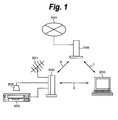
- Fig. 1 shows an overall structure of a radio communication system according to an embodiment of the present invention.
- An access point set forth in the claims corresponds to an access point 100 connected to the Internet 400.
- a first communication device radio-connected to the access point of the claims corresponds to a note PC 200.
- a second communication device having means for switching a function between a station function and an access point function of the claims corresponds to a base station 300.
- the note PC 200 is connected to the base station 300 through radio communication means.
- the base station 300 receives connection setting information that has been set to the note PC 200.
- the base station 300 stores the received connection setting information. After the base station 300 has been switched from the access point function to the station function, the base station 300 is connected to the access point 100 based on the connection setting information that has been stored.
- connection setting information necessary for connecting the base station 300 to the access point 100 on wireless LAN can be set to the base station 300 without necessity of a cable connected between the base station 300 and the note PC 200.
- a personal computer eg, note PC 200
- the base station 300 that is location free is connected to the access point 100 by radio communication.
- software called location free player it functions as a receiving device for the base station 300.
- a television antenna 301 Connected to the base station 300 is a television antenna 301 such that the base station 300 can receive television broadcasts (eg, analog television broadcasts).
- Television broadcasts that the base station 300 may receive as broadcast content include satellite digital broadcasts, terrestrial digital broadcasts, cable television broadcasts, and Internet television broadcasts besides analog television broadcasts.
- the recorder 302 uses a record medium, examples of which include a hard disk, a semiconductor memory, and an optical disc, and can record a broadcast program of a user's desired channel and reproduce it and a recorded video material.
- the note PC 200 that functions as a receiving device can remotely control selecting of a broadcast program of a channel that the base station 300 transmits and recording/reproducing operations and channel selecting operation of the base station 300.
- Connected to the base station 300 is for example an AV mouse 303.
- the note PC 200 can remotely control the operation of the recorder 302 through the AV mouse 303. If a display device instead of the recorder 302 is connected to the base station 300, the user can watch and listen to a video and an audio reproduced by the recorder 302 on the display device.
- the user can watch and listen to content of a television broadcast received and demodulated by the base station 300 or content reproduced from the recorder 302 with the note PC 200 through wireless LAN paths indicated by arrows 1 and 2.
- the broadcast content is compression-encoded and transmitted to the Internet 400 through the access point 100.
- ISP Internet service provider
- a global IP address of the ISP is assigned to the access point 100.
- a TV box is used.
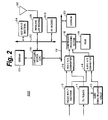
- a television signal received by the television antenna 301 is supplied to a tuner 11.
- An example of the tuner 11 is an analog television tuner.
- the tuner 11 demodulates the television signal into a video signal.
- the video signal is converted into a digital video signal by a video A/D converter 12.
- An audio intermediate frequency signal extracted from the tuner 11 is supplied to an audio demultiplexing circuit 13.
- the audio demultiplexing circuit 13 demodulates the audio intermediate frequency signal into an analog audio signal.
- the analog audio signal is converted into a digital audio signal by an audio A/D converter 14.
- the digital video signal and the digital audio signal are supplied to a compression processing section 15.
- the compression processing section 15 performs a compression-encoding process for the digital video signal and the digital audio signal. Examples of compression-encoding include MPEG2, MPEG4, Advanced Video Coding (AVC), AAC, MPEG audio, and VC-1.
- AVC Advanced Video Coding
- AAC MPEG audio
- VC-1 Video Coding-1
- the base station 300 has a composite video (or component video) input section 17 through which an analog video signal can be input from the external recorder 302.
- a video signal can be input from a Communication Satellite (CS) tuner, a cable television (CATV) tuner, a digital terrestrial wave tuner, an imaging device, a Digital Versatile Disc (DVD) player, or a video deck to the base station 300.
- CS Communication Satellite
- CATV cable television
- DVD Digital Versatile Disc
- the video signal supplied from the video input section 17 is converted into a digital video signal by the video A/D converter 12.
- the analog audio signal supplied from the video input section 17 is converted into a digital audio signal by the audio A/D converter 14.
- the digital video signal and the digital audio signal are compression-encoded by the compression-processing section 15.
- Compressed data that are output from the compression processing section 15 is supplied to a local bus 18.
- a controlling section 19 Connected to the local bus 18 are a controlling section 19 and an Electrical Erasable Programmable ROM (EEPROM) 20 that is a nonvolatile memory.
- EEPROM Electrical Erasable Programmable ROM
- the EEPROM 20 stores, for example, wireless LAN connection setting information (ie, information of an SSID character string, an encryption system, an encryption key character string of the access point 100).
- the EEPROM 20 stores information of a broadcast channel that has been selected immediately before the main power of the base station 300 is turned off. After the main power of the base station 300 is turned on, the broadcast signal of the channel that had been selected immediately before the power was turned off can be selected.
- the EEPROM 20 stores data with respect to the remote controller, the data having been distributed from a predetermined site on the Internet.
- the controlling section 19 is composed of a Central Processing Unit (CPU), a Read Only Memory (ROM) that stores a control program, and a Random Access Memory (RAM) that stores various types of data. Connected also to the controlling section 19 is a Synchronous Dynamic Random Access Memory (SDRAM). If necessary, the controlling section 19 reads a program and data from the ROM and controls each section of the base station 300 with the RAM used as a work memory.
- CPU Central Processing Unit
- ROM Read Only Memory
- RAM Random Access Memory
- SDRAM Synchronous Dynamic Random Access Memory
- the wireless LAN module 25 includes a transmitting section and a receiving section.
- the wireless LAN module 25 performs a transmitting process and a receiving process based on a predetermined communication protocol.
- the wireless LAN module 25 of the base station 300 corresponds, for example, to three standards of IEEE 802.11b/g/a as wireless LAN systems.
- Supplied to the AV mouse 303 is a remote control signal received by the wireless LAN module 25.
- the operation of the recorder 302 is controlled through the AV mouse 303.
- the base station 300 If the registration mode switch is pressed, as will be described later, the base station 300 operates in the access point mode for a predetermined time (eg, 5 minutes). After a predetermined time has elapsed, or if the base station 300 is restarted, it returns to the station mode. In the access point mode, the base station 300 operates on the basis of a fixed SSID including a predetermined character string (eg, "LocationFree"), a fixed encryption system (eg, WEP 64 bits), and an encryption key character string calculated from the SSID by a predetermined calculation formula (eg, hash function).
- a predetermined character string eg, "LocationFree”
- WEP 64 bits eg, WEP 64 bits
- an encryption key character string calculated from the SSID by a predetermined calculation formula eg, hash function
- Compression-encoded data compressed by the compression processing section 15 of the base station 300 are a television signal that is output from the tuner 11 or a video signal that is supplied to the video input section 17.
- the compression-encoded data are transmitted to the access point 100 through the wireless LAN module 25 and a signal transmitted from the access point 100 is received by the note PC 200.
- the base station 300 receives a control signal (eg, channel selection command) from the receiving device through the wireless LAN module 25 and supplies the received control signal to the controlling section 19.
- the recorder 302 is controlled through the AV mouse 303.
- the controlling section 19 selects one of the output signal of the tuner 11 and the video signal from the video input section 17. In addition, the controlling section 19 selects a channel from the output signal of the tuner 11. The broadcast signal of the selected channel or the video signal is compression-encoded by the compression processing section 15. The compression-encoded data are transmitted through the controlling section 19, the wireless LAN module 25, and the antenna 26. As a result, the user can watch and listen to a television broadcast or a video of the video signal with the note PC 200 on wireless LAN.
- the note PC 200 that functions as a receiving device will be described.
- the note PC 200 has a CPU 31, a ROM 32 that stores a program (eg, software for a player), a RAM 33 that functions as a work memory of the CPU 31, an EEPROM 34 that stores setting information of wireless LAN, a key input section 35 that is composed of a keyboard and a key detecting section, a display section 36 that is composed of a display controlling section and a liquid crystal display, a wireless LAN module 37, and an antenna 38.
- These structural elements are mutually connected to each other through a bus 39.
- the wireless LAN module 37 of the note PC 200 corresponds to three standards of IEEE 802.11b/g/a.
- the note PC 200 receives compression-encoded data from the base station 300 through the access point 100.
- the compression-encoded data are data of which a television signal of a channel selected by the tuner 11 of the base station 300 or data of which a video signal supplied to the video input section 17 has been compression-encoded.
- the compression-encoded data received by the wireless LAN module 37 are decompressed by a software process and output and reproduced through a D/A converter (not shown).
- a D/A converter not shown.
- connection setting information for radio communication with the access point 100 is set to the base station 300.
- the connection setting information is obtained from the note PC 200 on wireless LAN.
- the base station 300 is connected to the access point 100 on wireless LAN.
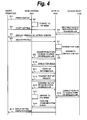
- a communication setting method of connecting a base station 300 to an access point 100 includes step S2 of switching the function of the base station 300 to the access point function; step S9 of connecting the note PC 200 to the base station 300, whose function has been switched to the access point function, through radio communication means, step S11 of causing the base station 300 to receive connection setting information from the note PC 200, the connection setting information having been set to the note PC 200, and storing the received connection setting information, and step S14 of connecting the base station 300 to the radio communication network based on the stored connection setting information after the function of the base station 300 has been switched from the access point function to the station function.
- dotted arrows opposite to solid arrows represent processes response to actions.
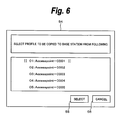
- Fig. 5 and Fig. 6 show exemplary screens displayed on the display section 36 of the note PC 200.
- the base station 300 changes to the access point mode (at step S2).
- the base station 300 operates on the basis of a fixed SSID including a predetermined character string (eg, LocationFree), a fixed encryption system (eg, WEP 64 bits), and an encryption key character string calculated from the SSID by a predetermined calculation formula (eg, hash function).
- the SSID, the encryption system, and the calculation formula have been set to the base station 300.
- the SSID, WEP, encryption key, and so forth are indicated at a part of the case of the device.
- the display section of the note PC 200 displays a setting start screen 51.
- the setting start screen 51 indicates connection setting information (ie, SSID, encryption system, encryption key) with which the note PC 200 and the access point 100 are connected on wireless LAN.
- connection setting information ie, SSID, encryption system, encryption key
- the setting start screen 51 indicates a setting start button 52 and a cancel button 53.
- step S3 the user clicks the setting start button 52 on the setting start screen 51, for example, with a mouse.
- the note PC 200 stores information necessary for connecting itself to the access point 100 on wireless LAN to the EEPROM 34 that is a nonvolatile memory.
- step S4 the note PC 200 is disconnected from the access point 100 on wireless LAN.
- the note PC 200 displays a profile selection screen 54 as a GUI (at step S5).
- the user selects a desired wireless profile (eg, "01: Accesspoint-001") from those that are being displayed and then presses a selection button 55 to confirm the selected wireless profile (at step S6).
- the profile selection screen 54 also indicates a cancel button 56. If the user clicks the cancel button 56 with the mouse, he or she can cancel the processes.
- a plurality of wireless profiles indicated on the profile selection screen 54 are connection information of access points to which the note PC 200 has been connected.
- the note PC 200 searches for the SSID of the base station 300 that is operating in the access point mode, extracts the SSID that contains a predetermined character string (eg, LocationFree) from an obtained list, and creates an SSID list.
- a predetermined character string eg, LocationFree
- encryption key character strings of the individual SSIDs of the SSID list are generated by a predetermined calculation formula (eg, hash function). This calculation formula is shared only by the note PC 200 and the base station 300. Instead, the user may input an SSID and an encryption key character string with the keyboard of the note PC 200.
- the note PC 200 tries to connect itself to access points with generated encryption keys of the individual items of the extracted SSID list (at step S9). If the note PC 200 has succeeded in connecting itself to an access point, the flow advances to step S10. At step S10, it is checked whether or not the connected access point is a base station on which the registration mode switch has been pressed. In other words, it is checked whether or not the SSID of the note PC 200 is the same as that of the access point, namely to check whether or not the note PC 200 is being connected to an irrelevant access point. For example, the note PC 200 transmits a broadcast packet to the base station 300 and checks for it based on response information received therefrom.
- an encryption key may be generated based on the obtained SSID and the base station 300 and the note PC 200 may be connected based on the generated encryption key on wireless LAN. In this case, the mode confirmation process at step S10 is not performed.
- step S10 If the checked result at step S10 denotes that the connected base station is one on which the registration mode switch has been pressed, the flow advances to step S11.
- the note PC 200 transmits connection setting information (ie, SSID and encryption key) necessary for wireless LAN connection with the access point 100 to the base station 300 and stores the received connection setting information to a nonvolatile memory (EEPROM 20).
- connection setting information ie, SSID and encryption key
- the note PC 200 transmits a restart request to the base station 300.
- the base station 300 receives the restart request, it performs a restart process.
- the note PC 200 disconnects itself from the base station 300 on wireless LAN. Instead of the restart request, the base station 300 may restart by a timer operation.
- the base station 300 After the base station 300 has restarted, it changes from the access point mode to the station mode and connects itself to the access point 100 based on the connection setting information stored in the nonvolatile memory on wireless LAN (at step S14). Thereafter, the note PC 200 connects itself to the access point 100 on wireless LAN (at step S15). At step S16, the note PC 200 performs communication check through the access point 100 (at step S16). When the result of the communication check is correct (at step S16), the flow advances to step S17. At step S17, the note PC 200 displays a setting completion screen that informs the user that the setting has been complete. For example, the note PC 200 transmits a broadcast packet. When the note PC 200 has received a response from the base station 300, the note PC 200 determines that it has succeeded in connecting itself to the access point 100.
- license information, user registration information, or the like of a web service besides setting information of radio communication may be copied from a device having an input device and a display device to a device that does have them.
- GUI screens are exemplary. Thus, other screens may be used.
Landscapes
- Engineering & Computer Science (AREA)
- Computer Networks & Wireless Communication (AREA)
- Signal Processing (AREA)
- Computer Security & Cryptography (AREA)
- Mobile Radio Communication Systems (AREA)
- Small-Scale Networks (AREA)
Applications Claiming Priority (1)
| Application Number | Priority Date | Filing Date | Title |
|---|---|---|---|
| JP2007239312A JP4442667B2 (ja) | 2007-09-14 | 2007-09-14 | 通信装置、通信システムおよび通信設定方法 |
Publications (2)
| Publication Number | Publication Date |
|---|---|
| EP2037719A2 true EP2037719A2 (fr) | 2009-03-18 |
| EP2037719A3 EP2037719A3 (fr) | 2013-03-27 |
Family
ID=40139347
Family Applications (1)
| Application Number | Title | Priority Date | Filing Date |
|---|---|---|---|
| EP08164171A Withdrawn EP2037719A3 (fr) | 2007-09-14 | 2008-09-11 | Dispositif de communication, son système de communication, et procédé de configuration de communication correspondant |
Country Status (3)
| Country | Link |
|---|---|
| US (1) | US8259650B2 (fr) |
| EP (1) | EP2037719A3 (fr) |
| JP (1) | JP4442667B2 (fr) |
Families Citing this family (20)
| Publication number | Priority date | Publication date | Assignee | Title |
|---|---|---|---|---|
| JP5246112B2 (ja) * | 2009-09-07 | 2013-07-24 | ブラザー工業株式会社 | 無線通信装置とコンピュータプログラム |
| JP5257306B2 (ja) * | 2009-09-11 | 2013-08-07 | ブラザー工業株式会社 | 無線通信装置とコンピュータプログラム |
| US8667148B1 (en) * | 2010-10-04 | 2014-03-04 | Netblazr Inc. | Minimal effort network subscriber registration |
| JP5644639B2 (ja) * | 2011-03-31 | 2014-12-24 | 富士通株式会社 | プログラム、システムおよび連携方法 |
| JP5842362B2 (ja) * | 2011-03-31 | 2016-01-13 | 富士通株式会社 | プログラム、情報通信機器および連携方法 |
| US9258704B2 (en) * | 2012-06-27 | 2016-02-09 | Advanced Messaging Technologies, Inc. | Facilitating network login |
| KR101641975B1 (ko) * | 2012-08-09 | 2016-07-22 | 엘지전자 주식회사 | 무선 통신시스템에서 스테이션의 하향링크 신호 수신 방법 |
| KR102025754B1 (ko) | 2012-11-01 | 2019-09-26 | 삼성전자주식회사 | 와이파이 네트워크를 이용한 디바이스 연결 시스템 및 방법 |
| CN103974391A (zh) * | 2013-02-04 | 2014-08-06 | 华为终端有限公司 | 一种设备唤醒方法及装置 |
| US20150373538A1 (en) * | 2013-03-15 | 2015-12-24 | Mivalife Mobile Technology, Inc. | Configuring Secure Wireless Networks |
| JP6344893B2 (ja) * | 2013-07-19 | 2018-06-20 | キヤノン株式会社 | 通信装置、通信方法およびプログラム |
| TWI508609B (zh) * | 2014-01-08 | 2015-11-11 | 晶睿通訊股份有限公司 | 無線網路設定方法與無線網路系統 |
| US10360362B2 (en) * | 2014-04-30 | 2019-07-23 | Qualcomm Incorporated | Apparatuses and methods for fast onboarding an internet-enabled device |
| JP2015220668A (ja) * | 2014-05-20 | 2015-12-07 | 本田技研工業株式会社 | 車載通信装置 |
| CN104703295A (zh) * | 2015-03-30 | 2015-06-10 | 小米科技有限责任公司 | 网络接入方法及装置 |
| JP2017034560A (ja) * | 2015-08-04 | 2017-02-09 | セイコーエプソン株式会社 | 無線通信装置、無線通信方法及びプログラム |
| US10542569B2 (en) * | 2015-08-06 | 2020-01-21 | Tmrw Foundation Ip S. À R.L. | Community-based communication network services |
| DE102017119589A1 (de) * | 2017-08-25 | 2019-02-28 | Vorwerk & Co. Interholding Gmbh | Verfahren zum Verbinden eines Haushaltsgerätes mit einem drahtlosen Heimnetzwerk |
| JP6605075B2 (ja) * | 2018-05-23 | 2019-11-13 | キヤノン株式会社 | 情報処理装置、制御方法およびプログラム |
| JP2020074514A (ja) * | 2019-10-16 | 2020-05-14 | キヤノン株式会社 | 情報処理装置、制御方法および設定プログラム |
Citations (3)
| Publication number | Priority date | Publication date | Assignee | Title |
|---|---|---|---|---|
| JP2007036733A (ja) | 2005-07-27 | 2007-02-08 | Sony Corp | 通信システム、通信装置、通信方法、通信制御方法、通信制御プログラム、及びプログラム記憶媒体 |
| JP2007074556A (ja) | 2005-09-08 | 2007-03-22 | Canon Inc | 通信装置及び通信システムとその制御方法 |
| JP2007239312A (ja) | 2006-03-09 | 2007-09-20 | Nihon Kagaku Sangyo Co Ltd | 小屋裏換気部材 |
Family Cites Families (8)
| Publication number | Priority date | Publication date | Assignee | Title |
|---|---|---|---|---|
| JP3888130B2 (ja) * | 2001-11-01 | 2007-02-28 | セイコーエプソン株式会社 | 無線ネットワークのステーション |
| EP1646930A2 (fr) * | 2003-07-22 | 2006-04-19 | PCTEL, Inc. | Systeme et procede d'activation d'un reseau local d'entreprise sans fil (lan) |
| US20050130647A1 (en) * | 2003-10-22 | 2005-06-16 | Brother Kogyo Kabushiki Kaisha | Wireless lan system, communication terminal and communication program |
| JP4032354B2 (ja) | 2004-01-21 | 2008-01-16 | ソニー株式会社 | 通信システム、通信装置及び方法並びにプログラム |
| KR100827105B1 (ko) * | 2004-02-13 | 2008-05-02 | 삼성전자주식회사 | 광대역 무선 통신 시스템에서 고속 레인징을 통한 빠른핸드오버 수행 방법 및 장치 |
| US8051463B2 (en) * | 2004-08-18 | 2011-11-01 | Broadcom Corporation | Method and system for distribution of configuration information among access points in a wireless local area network (WLAN) across a distribution system (DS) |
| JP2007036734A (ja) | 2005-07-27 | 2007-02-08 | Sony Corp | 通信システム、通信装置、通信方法、通信制御方法、通信制御プログラム、及びプログラム記憶媒体 |
| JP4215073B2 (ja) * | 2006-06-19 | 2009-01-28 | セイコーエプソン株式会社 | 無線ネットワークに接続されるステーション、無線ネットワークにステーションを参加させる方法、およびプログラム |
-
2007
- 2007-09-14 JP JP2007239312A patent/JP4442667B2/ja not_active Expired - Fee Related
-
2008
- 2008-09-11 EP EP08164171A patent/EP2037719A3/fr not_active Withdrawn
- 2008-09-12 US US12/283,603 patent/US8259650B2/en not_active Expired - Fee Related
Patent Citations (3)
| Publication number | Priority date | Publication date | Assignee | Title |
|---|---|---|---|---|
| JP2007036733A (ja) | 2005-07-27 | 2007-02-08 | Sony Corp | 通信システム、通信装置、通信方法、通信制御方法、通信制御プログラム、及びプログラム記憶媒体 |
| JP2007074556A (ja) | 2005-09-08 | 2007-03-22 | Canon Inc | 通信装置及び通信システムとその制御方法 |
| JP2007239312A (ja) | 2006-03-09 | 2007-09-20 | Nihon Kagaku Sangyo Co Ltd | 小屋裏換気部材 |
Also Published As
| Publication number | Publication date |
|---|---|
| JP4442667B2 (ja) | 2010-03-31 |
| US20090073923A1 (en) | 2009-03-19 |
| EP2037719A3 (fr) | 2013-03-27 |
| US8259650B2 (en) | 2012-09-04 |
| JP2009071682A (ja) | 2009-04-02 |
Similar Documents
| Publication | Publication Date | Title |
|---|---|---|
| US8259650B2 (en) | Communication device connectable to an access point based on setting information wirelessly provided from another device, a system having such communication device, and a method utilizing such communication device | |
| KR101183005B1 (ko) | 정보 처리 시스템, 기록 장치, 통신 장치, 정보 처리 방법, 및 프로그램이 기록된 컴퓨터 판독가능한 기록 매체 | |
| CN100401772C (zh) | 信息处理系统、信息处理设备和方法 | |
| US20080282288A1 (en) | Remote control unit and remotely operating method | |
| KR20040111658A (ko) | 정보 처리 시스템, 정보 처리 장치 및 정보 처리 방법 | |
| JP2004336723A (ja) | 端末装置、センタ装置、通信システム、端末装置の制御方法、センタ装置の制御方法、端末装置制御プログラム、センタ装置制御プログラム、および該プログラムを記録した記録媒体 | |
| US20250106459A1 (en) | Data processing method based on dvb, dvb device, and readable storage medium | |
| JP2009065305A (ja) | 端末連携継続視聴システム、端末、サーバ、方法 | |
| JP4872431B2 (ja) | 電子機器制御システム | |
| EP2160023B1 (fr) | Appareil de réception de diffusion capable de communiquer avec un appareil externe et procédé d'utilisation du contenu | |
| US20050212687A1 (en) | Control system, controlling device, control method, and program | |
| KR101128237B1 (ko) | 정보 송수신 시스템, 정보 송신 장치, 정보 수신 장치, 및정보 송수신 방법 | |
| JP6302062B2 (ja) | 電子機器及び方法及びプログラム | |
| JP2008278231A (ja) | コンテンツ送信装置、コンテンツ受信装置およびコンテンツ送受信システム | |
| JP2007081816A (ja) | 放送受信装置、放送受信方法、放送受信プログラム及びその記録媒体 | |
| KR20060095044A (ko) | 영상기기 제어 시스템 및 그를 이용한 영상기기 제어 방법 | |
| JP5709555B2 (ja) | デジタル放送受信装置及び情報処理方法 | |
| US20090141185A1 (en) | Broadcast receiving apparatus and method for switching channel thereof | |
| JP4448107B2 (ja) | 情報処理装置および方法、記録媒体、並びにプログラム | |
| US20150003340A1 (en) | Information processing apparatus and information processing method | |
| JP2004336731A (ja) | 端末装置、センタ装置、通信システム、端末装置の制御方法、センタ装置の制御方法、端末装置制御プログラム、センタ装置制御プログラム、および該プログラムを記録した記録媒体 | |
| JP2006325230A (ja) | 情報処理装置および方法、記録媒体、並びにプログラム | |
| JP2006311601A (ja) | 情報処理装置および方法、記録媒体、並びにプログラム | |
| WO2013071503A1 (fr) | Procédé pour effectuer une commande d'horaire de programme de diffusion par l'intermédiaire d'un dispositif électronique et appareils associés | |
| JP2007150429A (ja) | 情報処理装置および方法、並びにプログラム |
Legal Events
| Date | Code | Title | Description |
|---|---|---|---|
| PUAI | Public reference made under article 153(3) epc to a published international application that has entered the european phase |
Free format text: ORIGINAL CODE: 0009012 |
|
| AK | Designated contracting states |
Kind code of ref document: A2 Designated state(s): AT BE BG CH CY CZ DE DK EE ES FI FR GB GR HR HU IE IS IT LI LT LU LV MC MT NL NO PL PT RO SE SI SK TR |
|
| AX | Request for extension of the european patent |
Extension state: AL BA MK RS |
|
| PUAL | Search report despatched |
Free format text: ORIGINAL CODE: 0009013 |
|
| AK | Designated contracting states |
Kind code of ref document: A3 Designated state(s): AT BE BG CH CY CZ DE DK EE ES FI FR GB GR HR HU IE IS IT LI LT LU LV MC MT NL NO PL PT RO SE SI SK TR |
|
| AX | Request for extension of the european patent |
Extension state: AL BA MK RS |
|
| RIC1 | Information provided on ipc code assigned before grant |
Ipc: H04W 88/00 20090101AFI20130218BHEP |
|
| 17P | Request for examination filed |
Effective date: 20130925 |
|
| RBV | Designated contracting states (corrected) |
Designated state(s): AT BE BG CH CY CZ DE DK EE ES FI FR GB GR HR HU IE IS IT LI LT LU LV MC MT NL NO PL PT RO SE SI SK TR |
|
| AKX | Designation fees paid |
Designated state(s): AT BE BG CH CY CZ DE DK EE ES FI FR GB GR HR HU IE IS IT LI LT LU LV MC MT NL NO PL PT RO SE SI SK TR |
|
| STAA | Information on the status of an ep patent application or granted ep patent |
Free format text: STATUS: THE APPLICATION HAS BEEN WITHDRAWN |
|
| 18W | Application withdrawn |
Effective date: 20150115 |