EP2038236B1 - Structures poreuses en nid d'abeilles en céramique à faible fissuration - Google Patents
Structures poreuses en nid d'abeilles en céramique à faible fissuration Download PDFInfo
- Publication number
- EP2038236B1 EP2038236B1 EP07796574.7A EP07796574A EP2038236B1 EP 2038236 B1 EP2038236 B1 EP 2038236B1 EP 07796574 A EP07796574 A EP 07796574A EP 2038236 B1 EP2038236 B1 EP 2038236B1
- Authority
- EP
- European Patent Office
- Prior art keywords
- cordierite
- cte
- ratio
- honeycomb
- mor
- Prior art date
- Legal status (The legal status is an assumption and is not a legal conclusion. Google has not performed a legal analysis and makes no representation as to the accuracy of the status listed.)
- Active
Links
Images





Classifications
-
- B—PERFORMING OPERATIONS; TRANSPORTING
- B01—PHYSICAL OR CHEMICAL PROCESSES OR APPARATUS IN GENERAL
- B01J—CHEMICAL OR PHYSICAL PROCESSES, e.g. CATALYSIS OR COLLOID CHEMISTRY; THEIR RELEVANT APPARATUS
- B01J35/00—Catalysts, in general, characterised by their form or physical properties
- B01J35/50—Catalysts, in general, characterised by their form or physical properties characterised by their shape or configuration
- B01J35/56—Foraminous structures having flow-through passages or channels, e.g. grids or three-dimensional [3D] monoliths
- B01J35/57—Honeycombs
-
- C—CHEMISTRY; METALLURGY
- C04—CEMENTS; CONCRETE; ARTIFICIAL STONE; CERAMICS; REFRACTORIES
- C04B—LIME, MAGNESIA; SLAG; CEMENTS; COMPOSITIONS THEREOF, e.g. MORTARS, CONCRETE OR LIKE BUILDING MATERIALS; ARTIFICIAL STONE; CERAMICS; REFRACTORIES; TREATMENT OF NATURAL STONE
- C04B35/00—Shaped ceramic products characterised by their composition; Ceramics compositions; Processing powders of inorganic compounds preparatory to the manufacturing of ceramic products
- C04B35/01—Shaped ceramic products characterised by their composition; Ceramics compositions; Processing powders of inorganic compounds preparatory to the manufacturing of ceramic products based on oxide ceramics
- C04B35/16—Shaped ceramic products characterised by their composition; Ceramics compositions; Processing powders of inorganic compounds preparatory to the manufacturing of ceramic products based on oxide ceramics based on silicates other than clay
- C04B35/18—Shaped ceramic products characterised by their composition; Ceramics compositions; Processing powders of inorganic compounds preparatory to the manufacturing of ceramic products based on oxide ceramics based on silicates other than clay rich in aluminium oxide
- C04B35/195—Alkaline earth aluminosilicates, e.g. cordierite or anorthite
-
- B—PERFORMING OPERATIONS; TRANSPORTING
- B01—PHYSICAL OR CHEMICAL PROCESSES OR APPARATUS IN GENERAL
- B01J—CHEMICAL OR PHYSICAL PROCESSES, e.g. CATALYSIS OR COLLOID CHEMISTRY; THEIR RELEVANT APPARATUS
- B01J35/00—Catalysts, in general, characterised by their form or physical properties
- B01J35/60—Catalysts, in general, characterised by their form or physical properties characterised by their surface properties or porosity
-
- B—PERFORMING OPERATIONS; TRANSPORTING
- B01—PHYSICAL OR CHEMICAL PROCESSES OR APPARATUS IN GENERAL
- B01J—CHEMICAL OR PHYSICAL PROCESSES, e.g. CATALYSIS OR COLLOID CHEMISTRY; THEIR RELEVANT APPARATUS
- B01J35/00—Catalysts, in general, characterised by their form or physical properties
- B01J35/60—Catalysts, in general, characterised by their form or physical properties characterised by their surface properties or porosity
- B01J35/66—Pore distribution
-
- C—CHEMISTRY; METALLURGY
- C04—CEMENTS; CONCRETE; ARTIFICIAL STONE; CERAMICS; REFRACTORIES
- C04B—LIME, MAGNESIA; SLAG; CEMENTS; COMPOSITIONS THEREOF, e.g. MORTARS, CONCRETE OR LIKE BUILDING MATERIALS; ARTIFICIAL STONE; CERAMICS; REFRACTORIES; TREATMENT OF NATURAL STONE
- C04B38/00—Porous mortars, concrete, artificial stone or ceramic ware; Preparation thereof
- C04B38/0006—Honeycomb structures
-
- B—PERFORMING OPERATIONS; TRANSPORTING
- B01—PHYSICAL OR CHEMICAL PROCESSES OR APPARATUS IN GENERAL
- B01J—CHEMICAL OR PHYSICAL PROCESSES, e.g. CATALYSIS OR COLLOID CHEMISTRY; THEIR RELEVANT APPARATUS
- B01J2235/00—Indexing scheme associated with group B01J35/00, related to the analysis techniques used to determine the catalysts form or properties
- B01J2235/15—X-ray diffraction
-
- B—PERFORMING OPERATIONS; TRANSPORTING
- B01—PHYSICAL OR CHEMICAL PROCESSES OR APPARATUS IN GENERAL
- B01J—CHEMICAL OR PHYSICAL PROCESSES, e.g. CATALYSIS OR COLLOID CHEMISTRY; THEIR RELEVANT APPARATUS
- B01J2235/00—Indexing scheme associated with group B01J35/00, related to the analysis techniques used to determine the catalysts form or properties
- B01J2235/30—Scanning electron microscopy; Transmission electron microscopy
-
- B—PERFORMING OPERATIONS; TRANSPORTING
- B01—PHYSICAL OR CHEMICAL PROCESSES OR APPARATUS IN GENERAL
- B01J—CHEMICAL OR PHYSICAL PROCESSES, e.g. CATALYSIS OR COLLOID CHEMISTRY; THEIR RELEVANT APPARATUS
- B01J35/00—Catalysts, in general, characterised by their form or physical properties
- B01J35/30—Catalysts, in general, characterised by their form or physical properties characterised by their physical properties
-
- B—PERFORMING OPERATIONS; TRANSPORTING
- B01—PHYSICAL OR CHEMICAL PROCESSES OR APPARATUS IN GENERAL
- B01J—CHEMICAL OR PHYSICAL PROCESSES, e.g. CATALYSIS OR COLLOID CHEMISTRY; THEIR RELEVANT APPARATUS
- B01J35/00—Catalysts, in general, characterised by their form or physical properties
- B01J35/70—Catalysts, in general, characterised by their form or physical properties characterised by their crystalline properties, e.g. semi-crystalline
-
- C—CHEMISTRY; METALLURGY
- C04—CEMENTS; CONCRETE; ARTIFICIAL STONE; CERAMICS; REFRACTORIES
- C04B—LIME, MAGNESIA; SLAG; CEMENTS; COMPOSITIONS THEREOF, e.g. MORTARS, CONCRETE OR LIKE BUILDING MATERIALS; ARTIFICIAL STONE; CERAMICS; REFRACTORIES; TREATMENT OF NATURAL STONE
- C04B2111/00—Mortars, concrete or artificial stone or mixtures to prepare them, characterised by specific function, property or use
- C04B2111/00474—Uses not provided for elsewhere in C04B2111/00
- C04B2111/00793—Uses not provided for elsewhere in C04B2111/00 as filters or diaphragms
-
- C—CHEMISTRY; METALLURGY
- C04—CEMENTS; CONCRETE; ARTIFICIAL STONE; CERAMICS; REFRACTORIES
- C04B—LIME, MAGNESIA; SLAG; CEMENTS; COMPOSITIONS THEREOF, e.g. MORTARS, CONCRETE OR LIKE BUILDING MATERIALS; ARTIFICIAL STONE; CERAMICS; REFRACTORIES; TREATMENT OF NATURAL STONE
- C04B2111/00—Mortars, concrete or artificial stone or mixtures to prepare them, characterised by specific function, property or use
- C04B2111/00474—Uses not provided for elsewhere in C04B2111/00
- C04B2111/0081—Uses not provided for elsewhere in C04B2111/00 as catalysts or catalyst carriers
-
- C—CHEMISTRY; METALLURGY
- C04—CEMENTS; CONCRETE; ARTIFICIAL STONE; CERAMICS; REFRACTORIES
- C04B—LIME, MAGNESIA; SLAG; CEMENTS; COMPOSITIONS THEREOF, e.g. MORTARS, CONCRETE OR LIKE BUILDING MATERIALS; ARTIFICIAL STONE; CERAMICS; REFRACTORIES; TREATMENT OF NATURAL STONE
- C04B2111/00—Mortars, concrete or artificial stone or mixtures to prepare them, characterised by specific function, property or use
- C04B2111/20—Resistance against chemical, physical or biological attack
- C04B2111/2084—Thermal shock resistance
-
- C—CHEMISTRY; METALLURGY
- C04—CEMENTS; CONCRETE; ARTIFICIAL STONE; CERAMICS; REFRACTORIES
- C04B—LIME, MAGNESIA; SLAG; CEMENTS; COMPOSITIONS THEREOF, e.g. MORTARS, CONCRETE OR LIKE BUILDING MATERIALS; ARTIFICIAL STONE; CERAMICS; REFRACTORIES; TREATMENT OF NATURAL STONE
- C04B2111/00—Mortars, concrete or artificial stone or mixtures to prepare them, characterised by specific function, property or use
- C04B2111/34—Non-shrinking or non-cracking materials
- C04B2111/343—Crack resistant materials
-
- C—CHEMISTRY; METALLURGY
- C04—CEMENTS; CONCRETE; ARTIFICIAL STONE; CERAMICS; REFRACTORIES
- C04B—LIME, MAGNESIA; SLAG; CEMENTS; COMPOSITIONS THEREOF, e.g. MORTARS, CONCRETE OR LIKE BUILDING MATERIALS; ARTIFICIAL STONE; CERAMICS; REFRACTORIES; TREATMENT OF NATURAL STONE
- C04B2235/00—Aspects relating to ceramic starting mixtures or sintered ceramic products
- C04B2235/02—Composition of constituents of the starting material or of secondary phases of the final product
- C04B2235/30—Constituents and secondary phases not being of a fibrous nature
- C04B2235/32—Metal oxides, mixed metal oxides, or oxide-forming salts thereof, e.g. carbonates, nitrates, (oxy)hydroxides, chlorides
- C04B2235/3217—Aluminum oxide or oxide forming salts thereof, e.g. bauxite, alpha-alumina
-
- C—CHEMISTRY; METALLURGY
- C04—CEMENTS; CONCRETE; ARTIFICIAL STONE; CERAMICS; REFRACTORIES
- C04B—LIME, MAGNESIA; SLAG; CEMENTS; COMPOSITIONS THEREOF, e.g. MORTARS, CONCRETE OR LIKE BUILDING MATERIALS; ARTIFICIAL STONE; CERAMICS; REFRACTORIES; TREATMENT OF NATURAL STONE
- C04B2235/00—Aspects relating to ceramic starting mixtures or sintered ceramic products
- C04B2235/02—Composition of constituents of the starting material or of secondary phases of the final product
- C04B2235/30—Constituents and secondary phases not being of a fibrous nature
- C04B2235/34—Non-metal oxides, non-metal mixed oxides, or salts thereof that form the non-metal oxides upon heating, e.g. carbonates, nitrates, (oxy)hydroxides, chlorides
- C04B2235/3418—Silicon oxide, silicic acids or oxide forming salts thereof, e.g. silica sol, fused silica, silica fume, cristobalite, quartz or flint
-
- C—CHEMISTRY; METALLURGY
- C04—CEMENTS; CONCRETE; ARTIFICIAL STONE; CERAMICS; REFRACTORIES
- C04B—LIME, MAGNESIA; SLAG; CEMENTS; COMPOSITIONS THEREOF, e.g. MORTARS, CONCRETE OR LIKE BUILDING MATERIALS; ARTIFICIAL STONE; CERAMICS; REFRACTORIES; TREATMENT OF NATURAL STONE
- C04B2235/00—Aspects relating to ceramic starting mixtures or sintered ceramic products
- C04B2235/02—Composition of constituents of the starting material or of secondary phases of the final product
- C04B2235/30—Constituents and secondary phases not being of a fibrous nature
- C04B2235/34—Non-metal oxides, non-metal mixed oxides, or salts thereof that form the non-metal oxides upon heating, e.g. carbonates, nitrates, (oxy)hydroxides, chlorides
- C04B2235/3427—Silicates other than clay, e.g. water glass
- C04B2235/3436—Alkaline earth metal silicates, e.g. barium silicate
- C04B2235/3445—Magnesium silicates, e.g. forsterite
-
- C—CHEMISTRY; METALLURGY
- C04—CEMENTS; CONCRETE; ARTIFICIAL STONE; CERAMICS; REFRACTORIES
- C04B—LIME, MAGNESIA; SLAG; CEMENTS; COMPOSITIONS THEREOF, e.g. MORTARS, CONCRETE OR LIKE BUILDING MATERIALS; ARTIFICIAL STONE; CERAMICS; REFRACTORIES; TREATMENT OF NATURAL STONE
- C04B2235/00—Aspects relating to ceramic starting mixtures or sintered ceramic products
- C04B2235/02—Composition of constituents of the starting material or of secondary phases of the final product
- C04B2235/30—Constituents and secondary phases not being of a fibrous nature
- C04B2235/34—Non-metal oxides, non-metal mixed oxides, or salts thereof that form the non-metal oxides upon heating, e.g. carbonates, nitrates, (oxy)hydroxides, chlorides
- C04B2235/3427—Silicates other than clay, e.g. water glass
- C04B2235/3463—Alumino-silicates other than clay, e.g. mullite
- C04B2235/3481—Alkaline earth metal alumino-silicates other than clay, e.g. cordierite, beryl, micas such as margarite, plagioclase feldspars such as anorthite, zeolites such as chabazite
-
- C—CHEMISTRY; METALLURGY
- C04—CEMENTS; CONCRETE; ARTIFICIAL STONE; CERAMICS; REFRACTORIES
- C04B—LIME, MAGNESIA; SLAG; CEMENTS; COMPOSITIONS THEREOF, e.g. MORTARS, CONCRETE OR LIKE BUILDING MATERIALS; ARTIFICIAL STONE; CERAMICS; REFRACTORIES; TREATMENT OF NATURAL STONE
- C04B2235/00—Aspects relating to ceramic starting mixtures or sintered ceramic products
- C04B2235/02—Composition of constituents of the starting material or of secondary phases of the final product
- C04B2235/30—Constituents and secondary phases not being of a fibrous nature
- C04B2235/34—Non-metal oxides, non-metal mixed oxides, or salts thereof that form the non-metal oxides upon heating, e.g. carbonates, nitrates, (oxy)hydroxides, chlorides
- C04B2235/349—Clays, e.g. bentonites, smectites such as montmorillonite, vermiculites or kaolines, e.g. illite, talc or sepiolite
-
- C—CHEMISTRY; METALLURGY
- C04—CEMENTS; CONCRETE; ARTIFICIAL STONE; CERAMICS; REFRACTORIES
- C04B—LIME, MAGNESIA; SLAG; CEMENTS; COMPOSITIONS THEREOF, e.g. MORTARS, CONCRETE OR LIKE BUILDING MATERIALS; ARTIFICIAL STONE; CERAMICS; REFRACTORIES; TREATMENT OF NATURAL STONE
- C04B2235/00—Aspects relating to ceramic starting mixtures or sintered ceramic products
- C04B2235/02—Composition of constituents of the starting material or of secondary phases of the final product
- C04B2235/30—Constituents and secondary phases not being of a fibrous nature
- C04B2235/36—Glass starting materials for making ceramics, e.g. silica glass
-
- C—CHEMISTRY; METALLURGY
- C04—CEMENTS; CONCRETE; ARTIFICIAL STONE; CERAMICS; REFRACTORIES
- C04B—LIME, MAGNESIA; SLAG; CEMENTS; COMPOSITIONS THEREOF, e.g. MORTARS, CONCRETE OR LIKE BUILDING MATERIALS; ARTIFICIAL STONE; CERAMICS; REFRACTORIES; TREATMENT OF NATURAL STONE
- C04B2235/00—Aspects relating to ceramic starting mixtures or sintered ceramic products
- C04B2235/02—Composition of constituents of the starting material or of secondary phases of the final product
- C04B2235/50—Constituents or additives of the starting mixture chosen for their shape or used because of their shape or their physical appearance
- C04B2235/54—Particle size related information
- C04B2235/5418—Particle size related information expressed by the size of the particles or aggregates thereof
- C04B2235/5436—Particle size related information expressed by the size of the particles or aggregates thereof micrometer sized, i.e. from 1 to 100 micron
-
- C—CHEMISTRY; METALLURGY
- C04—CEMENTS; CONCRETE; ARTIFICIAL STONE; CERAMICS; REFRACTORIES
- C04B—LIME, MAGNESIA; SLAG; CEMENTS; COMPOSITIONS THEREOF, e.g. MORTARS, CONCRETE OR LIKE BUILDING MATERIALS; ARTIFICIAL STONE; CERAMICS; REFRACTORIES; TREATMENT OF NATURAL STONE
- C04B2235/00—Aspects relating to ceramic starting mixtures or sintered ceramic products
- C04B2235/02—Composition of constituents of the starting material or of secondary phases of the final product
- C04B2235/50—Constituents or additives of the starting mixture chosen for their shape or used because of their shape or their physical appearance
- C04B2235/54—Particle size related information
- C04B2235/5418—Particle size related information expressed by the size of the particles or aggregates thereof
- C04B2235/5445—Particle size related information expressed by the size of the particles or aggregates thereof submicron sized, i.e. from 0,1 to 1 micron
-
- C—CHEMISTRY; METALLURGY
- C04—CEMENTS; CONCRETE; ARTIFICIAL STONE; CERAMICS; REFRACTORIES
- C04B—LIME, MAGNESIA; SLAG; CEMENTS; COMPOSITIONS THEREOF, e.g. MORTARS, CONCRETE OR LIKE BUILDING MATERIALS; ARTIFICIAL STONE; CERAMICS; REFRACTORIES; TREATMENT OF NATURAL STONE
- C04B2235/00—Aspects relating to ceramic starting mixtures or sintered ceramic products
- C04B2235/70—Aspects relating to sintered or melt-casted ceramic products
- C04B2235/72—Products characterised by the absence or the low content of specific components, e.g. alkali metal free alumina ceramics
-
- C—CHEMISTRY; METALLURGY
- C04—CEMENTS; CONCRETE; ARTIFICIAL STONE; CERAMICS; REFRACTORIES
- C04B—LIME, MAGNESIA; SLAG; CEMENTS; COMPOSITIONS THEREOF, e.g. MORTARS, CONCRETE OR LIKE BUILDING MATERIALS; ARTIFICIAL STONE; CERAMICS; REFRACTORIES; TREATMENT OF NATURAL STONE
- C04B2235/00—Aspects relating to ceramic starting mixtures or sintered ceramic products
- C04B2235/70—Aspects relating to sintered or melt-casted ceramic products
- C04B2235/80—Phases present in the sintered or melt-cast ceramic products other than the main phase
- C04B2235/81—Materials characterised by the absence of phases other than the main phase, i.e. single phase materials
Definitions
- the present invention is directed to porous honeycomb ceramics and particularly porous cordierite honeycomb ceramics useful in catalytic converters and particulate filters, such as for engine exhaust after-treatment.
- Porous ceramic honeycomb structures are widely used as catalytic converter substrates and/or diesel particulate filters.
- the earliest cordierite ceramic honeycombs for these applications consisted of reaction-sintered cordierite substrates prepared from extruded mixtures of talc, alumina, and kaolin such as described in US 3,885,977 , for example. These were found to have suitable chemical durability, inertness, refractoriness, and thermal shock resistance for the application, and were generally cost effective to manufacture.
- cordierite used alone refers to orthorhombic cordierite (orthorhombic Mg 2 Al 4 Si 5 O 18 and its solid solutions), indialite (hexagonal Mg 2 Al 4 Si 5 O 18 and its solid solutions), and mixtures thereof unless expressly stated otherwise.
- the high thermal shock resistance of reaction-sintered cordierite ceramics which is proportional to the ratio of the modulus of rupture (MOR) to the elastic (Young's) modulus (E) of the ceramic and inversely proportional to the coefficient of thermal expansion (CTE) of the ceramic, is attributed to the development of a specific microstructure during firing that depends on an appropriate choice of raw materials, as well as on the forming and firing methods employed.
- the cordierite crystallites within the ceramic will tend to be preferentially oriented with their negative-expansion z-axes aligned near the plane of the wall, thereby reducing the CTE in the axial and radial directions of the honeycomb.
- a monolithic DPF may be prepared from a porous ceramic honeycomb by plugging adjacent channels on alternative ends for example, such as in a checkerboard pattern, to form a "wall-flow" filter with inlet and outlet channels. That structure forces entering exhaust gas to pass through the porous honeycomb walls to traverse the wall structure, thereby acting to collect exhaust particulates, such as soot, on the walls of the inlet channels.
- DPFs of the prior art have required a higher porosity and coarser pore size to reduce the back pressure through the wall. This has been achieved by utilizing coarser talc and coarser silica raw materials in conjunction with the addition of a coarse pore former (e.g., graphite powder). The pore former burns out of the walls during firing and contributes to obtaining high porosity.
- a coarse pore former e.g., graphite powder
- a second problem arising from the use of converters and DPFs comprising microcracked cordierite may be the penetration of very fine catalyst washcoat particles into the microcracks formed in the cordierite matrix.
- the presence of particles within the microcracks may interfere with closure of the microcracks during heating, essentially pinning the cracks open. This may result in an increase in CTE, and also an increase in elastic modulus, both factors contributing to reduced thermal shock resistance. This may be especially problematic for DPFs, where the catalyst washcoats are normally disposed within the porous walls of the filters.
- the high degree of preferred "planar" orientation of cordierite required for low CTE can also present issues in cases where the degree of preferred orientation between the skin and the cellular matrix is different. This can occur due to a different degree of alignment of the platy raw materials resulting from different shear and flow in the skin and matrix during extrusion through the die. Because of the difference in cordierite orientation, the skin and matrix may have different CTEs. Consequently, during cooling from firing, the skin and matrix can contract at different rates, creating tensile stresses within the skin that may lead to the formation of cracks therein. These cracks may reduce both strength and thermal shock resistance.
- microcracking and preferred crystallite orientation have been essential in the past for achieving low CTE combined with high thermal shock resistance in reaction-sintered cordierite ceramics
- both of these microstructural features can also create problems that may limit the utility of the material for certain applications.
- microcracking may result in strength reductions, and may facilitate CTE increases where the microcracks are penetrated by catalysts or particulates.
- variable cordierite domain alignment can result in residual stresses in cordierite honeycombs.
- the present invention ameliorates or reduces such issues associated with prior art, highly microcracked materials. Accordingly, the present invention relates to a substantially non-microcracked, porous, cordierite ceramic honeycomb body.
- the cordierite ceramic honeycomb bodies exhibit high thermal shock resistance and low coefficient of thermal expansion. Further, the bodies may exhibit high strain tolerance by virtue of a relatively high ratio of MOR/E at room temperature.
- TSP thermal shock parameter
- E RT room temperature elastic modulus
- E H high temperature elastic modulus
- MOR, E, and CTE are all measured on a cellular specimen parallel to the length of the channels, also referred to as the axial direction.
- E H is measured during heating from room temperature.
- the porous ceramic honeycomb structure according to the invention may exhibit E ratio 1000 ⁇ 1.01, E ratio 1000 ⁇ 1.00, E ratio 1000 ⁇ 0.98, E ratio 1000 ⁇ 0.95, or even E ratio 1000 ⁇ 0.93.
- the honeycomb structures of the invention may exhibit relative low CTE, such as CTE (25-800°C) ⁇ 14x10 -7 /°C, CTE (25-800°C) ⁇ 12x10 -7 /°C, CTE (25-800°C) ⁇ 10x10 -7 /°C, or even CTE (25-800°C) ⁇ 9x10 -7 /°C.
- embodiments of the invention may be characterized by a pore microstructure of the porosity further including a relatively narrow pore size distribution.
- PCF Pore Connectivity Factor
- the cordierite bodies are useful in the form of honeycomb ceramic substrates useful as flow-through substrates (non-plugged embodiments) for the support of gasoline engine emissions control catalysts.
- the honeycomb ceramic bodies may require relatively higher porosity, for example to accommodate catalyst storage within the honeycomb channel walls.
- relatively higher porosity is required to provide high wall permeability for plugged ceramic honeycomb wall-flow filters (particulate filters) used for diesel engine exhaust treatment.
- the honeycomb ceramic bodies may have total porosities (%P) wherein %P ⁇ 46%, or even %P ⁇ 50%.
- %P ⁇ 55%, %P ⁇ 60%, %P ⁇ 65%, or even %P ⁇ 70% is demonstrated.
- Certain applications for fast light-off catalyst flow-through substrates which exhibit thin walls e.g., less than 0.254mm (10 mils), less than 0.178mm (7 mils), or even less than 0.152mm (6 mils) or 0.102mm (4 mils)
- a porous ceramic honeycomb structure according to the invention may be made by a method comprising the steps of mixing inorganic raw materials, an organic binder, and a liquid vehicle to form a plasticized batch, forming a green body from the plasticized batch, drying the green body, and firing the body to provide a cordierite ceramic structure having relatively low microcracking and relatively high thermal shock exhibiting E ratio ⁇ 1.05 and TSP ⁇ 525°C.
- the porous ceramic honeycomb structure may comprise a primary cordierite ceramic phase exhibiting low microcracking as exhibited by ⁇ mc ⁇ 5.0, CTE (25-800°C) ⁇ 15x10 -7 /°C, and %P ⁇ 46%.
- Fig. 1 is a plot of the elastic modulus (psi) versus temperature (°C) during heating and cooling of a low microcracked cordierite embodiment.
- Fig. 2 is a plot of the elastic modulus (psi) versus temperature (°C) during heating and cooling of a comparative "Prior Art" example.
- Fig. 3 plots the TSP (°C) versus CTE (10 -7 /°C) from 25-800°C for examples (filled circles and triangles) and comparative (open circles) examples.
- Fig. 4 plots the TSP (°C) versus pore connectivity factor, PCF (%), for examples (filled circles and triangles) and comparative (open circles) examples.
- Fig. 5 plots the ratio MOR/E at room temperature versus the pore connectivity factor, PCF (%), for examples (filled circles and triangles) and comparative (open circles) examples.
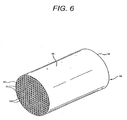
- Fig. 6 is isometric view of porous honeycomb substrate according to embodiments of the invention.
- Fig. 7 is isometric view of porous honeycomb filter according to embodiments of the invention.
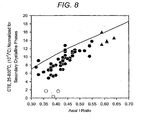
- Fig. 8 is a plot of thermal expansion coefficient from 25-800°C, normalized for the presence of secondary crystalline phases by the addition of 0.6 (%Mu+%Sp+%Sa+%Al) to the measured CTE value, versus axial I-ratio for examples (filled circles and triangles) and comparative (open circles) examples.
- FIG. 9 is a plot of the relationship between ⁇ mc and the parameter P MC for examples (filled circles and triangles) and comparative (open circles) examples.
- Fig. 11 is a plot of the relationship between MOR/E and the parameter P ST for examples (filled circles and triangles) and comparative (open circles) examples.
- Fig. 12 is a plot of the relationship between the E Ratio 1000°C and the microcrack parameter, Nb 3 for examples (filled circles and triangles) and comparative (open circles) examples.
- Fig. 13 is a plot of the thermal shock parameter, TSP (°C), versus ⁇ mc (10 -7 /°C) for examples (filled circles and triangles) and comparative (open circles) examples.
- Fig. 14 is a plot of MOR/CFA (psi) versus %porosity (%) for examples (filled circles and triangles) and comparative (open circles) examples having 11 ⁇ m ⁇ d 50 ⁇ 15 ⁇ m.
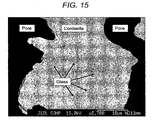
- FIG. 15 is a scanning electron micrograph view of a polished cross-section of the honeycomb wall of an example.
- E ratio 1000 E H 1000°C / E RT in the cordierite ceramic honeycomb bodies is achieved by providing bodies formed of a substantially non-microcracked porous, cordierite ceramic material.
- E ratio 1000 values above 1.00 and below 1.05 are indicative of very minor, but tolerable, levels of microcracking (see FIG. 1 ), i.e., substantially non-microcracked bodies.
- E ratio 1000 values above 1.05 are indicative of relatively higher levels of microcracking ( FIG. 2 ) which are less desirable in order to avoid adversely affecting product performance attributes, such as strength and insensitivity of thermal shock resistance to catalyzation.
- Fig.1 is a plot of the elastic modulus (psi) versus temperature (°C) during heating and cooling of a low microcracked cordierite example (I41). Filled circles therein denote heating data, open squares denote cooling data, small filled circles within open squares denote data that were fit by a polynomial to derive the point of tangency (open triangle) and the tangent line (solid line), and open diamond is the value of the tangent at room temperature, E° 25 . Also noted are the values of E 25 , E 900 , and E 1000 (elastic modulus at 25, 900, and 1000°C) during heating as will be referred to herein. Fig.
- FIG. 2 is a plot of the elastic modulus (psi) versus temperature (°C) during heating and cooling of a comparative "Prior Art” example (C4).
- Filled circles denote heating data
- open squares denote cooling data
- small filled circles within open squares denote data that were fit by a polynomial to derive the point of tangency (open triangle, point C) and the tangent line (solid line A-B)
- open diamond is the value of the tangent at room temperature, E° 25 .
- E 25 , E 900 , and E 1000 elastic modulus, at 25, 900, and 1000°C
- E ratio 1000 values of E ratio 1000 of less than or equal to 1.05 are desired, and values of E ratio 1000 defined as E H 1000 / E RT ⁇ 1.01 or even E H 1000 / E RT ⁇ 1.00 are more desired.
- E ratio 1000 ⁇ 0.98, E ratio 1000 ⁇ 0.96, E ratio 1000 ⁇ 0.95, or even E ratio 1000 ⁇ 0.93 are demonstrated. These are exemplary of relatively low levels of microcracking.
- High temperature elastic modulus values may be determined by referring to ASTM C 1198-01 or US Published Patent Application US 2009/0000378 A1 .
- TSL Thermal Shock Limit
- TSP Thermal Shock Parameter
- Illustrating improved thermal shock limit (TSL) in accordance with another aspect of the invention are values of TSP achieved by embodiments of the invention which are TSP ⁇ 400°C, TSP ⁇ 450°C, TSP ⁇ 525°C, TSP ⁇ 550°C, and even TSP ⁇ 600°C.
- TSP ⁇ 700°C (see examples 4-6, 8-9, 11, 13-14, 27-32, 35-39, 41-43, and 46), TSP ⁇ 800°C (see examples 4, 6, 13-15, 18, 20, 27-28, 31, 36-39, and 41-43), TSP ⁇ 900°C (see examples 14, 18, 27-28, 31, 37-38, and 41-42), and even TSP ⁇ 1000°C (see examples 18, 27, and 41) are achieved.
- low microcracked honeycombs achieve a desirable combination of relatively low CTE and high TSP.
- the present invention provides a low microcracked honeycomb having a combination of TSP ⁇ 400°C and CTE (25-800°C) ⁇ 15 x 10 -7 / °C ( FIG. 3 ).
- Certain examples achieve a combination of even lower CTE and higher TSP.
- a combination of TSP ⁇ 500°C and CTE (25-800°C) ⁇ 15 x 10 -7 /°C are achieved by many embodiments of the invention (See examples 2-9, 11-22, 27-39, and 41-48).
- excellent combinations of TSP ⁇ 525°C and CTE (25-800°C) ⁇ 15 x 10 -7 /°C are achieved.
- a combination of TSP ⁇ 600°C and CTE (25-800°C) ⁇ 15 x 10 -7 /°C, or even TSP ⁇ 700°C and CTE (25-800°C) ⁇ 13 x 10 -7 /°C, are achieved.
- a high proportion of well interconnected pores with a narrow pore size distribution of the cordierite honeycomb bodies of the invention may contribute importantly to the high TSP values observed ( FIG. 4 ).
- High pore interconnectivity in these non-microcracked ceramics has the effect of reducing elastic modulus values to a greater extent than MOR values.
- the ratio MOR RT /E RT upon which the TSP value depends, is favorably impacted by the pore morphology of these non-microcracked ceramics ( FIG. 5 ).
- a relatively high ratio of MOR RT /E RT is provided, wherein MOR RT /E RT ⁇ 0.09%, MOR RT /E RT ⁇ 0.10%, MOR RT /E RT ⁇ 0.12%, MOR RT /E RT ⁇ 0.14%, or even MOR RT /E RT ⁇ 0.16%.
- d 10 , d 50 , and d 90 in these equations are conventionally and defined herein as the pore diameters at which 10%, 50%, and 90%, respectively, of the pore volume of the material resides in pores of smaller pore diameter, as measured by standard mercury porosimetry.
- d 10 ⁇ d 50 ⁇ d 90 in these measurements are d f ⁇ 0.45, d f ⁇ 0.40, d f ⁇ 0.37, d f ⁇ 0.35, and d f ⁇ 0.30.
- Certain embodiments achieve relatively very low porosity d-factor (d f ), wherein d f ⁇ 0.28 (see examples 27, 36, 39, and 44-45), d f ⁇ 0.25 (see examples 36 and 44-45), or even d f ⁇ 0.23 (See examples 44-45).
- values of d b achievable by embodiment of the invention are d b ⁇ 1.65, d b ⁇ 1.4, d b ⁇ 1.20, d b ⁇ 1.00, or even d b ⁇ 0.90.
- PCF Pore Connectivity Factors
- embodiments may achieve PCF ⁇ 40%, PCF ⁇ 45%, PCF ⁇ 50%, PCF ⁇ 55%, or even PCF ⁇ 60%.
- PCF ⁇ 70% see examples 14, 18, 21, 27-28, 30-31, 36, 38-39, 41-44, 46, and 55
- PCF ⁇ 80% see examples 27-28, 30, 36, 38, 41-42, and 44
- PCF ⁇ 90% see examples 27-28 and 44.
- the median pore diameter (d 50 ) targeted may depend, in part, upon the particular end use for the honeycomb.
- the median pore size (d 50 ) of a ceramic honeycomb in accordance with the invention may be in the range of about 1-30 ⁇ m, with values of d 50 ⁇ 10 ⁇ m, or even 10-30 ⁇ m being especially beneficial when the pores are to contain a catalyst material; and values of median pore size (d 50 ) of between 1-10 ⁇ m being desired when the high porosity ⁇ 46%, is required to reduce the thermal mass of the substrate and improve light-off characteristics, for example, such as in non-plugged flow-through catalyst substrate applications.
- the median pore diameter (d 50 ) may be in the range of 5-15 ⁇ m in cases where the filter is to support a low loading of catalyst or is absent a catalyst, and in the range of 15-30 ⁇ m where the filter is to support a relatively higher loading of a catalyst.
- the total porosities of the walls may be, for example, %P ⁇ 46%, %P ⁇ 50%, %P ⁇ 55%, or even %P ⁇ 60%, and in some cases %P ⁇ 65%, or even %P ⁇ 70%.
- the ceramic honeycomb bodies may be porous cordierite ceramic honeycomb bodies having a plurality of cell channels extending between a first and second end as shown in Figs. 6 and 7 , for example.
- the ceramic honeycomb body may have a honeycomb structure that may be suitable for use as, for example, flow-through catalyst substrates or wall-flow exhaust gas particulate filters, such as diesel particulate filters.
- a typical porous ceramic honeycomb flow-through substrate article 10 is shown in Fig.
- the honeycomb article 10 also includes an extruded smooth skin 15 formed about the honeycomb structure, although this is optional and may be formed in later processing as an after applied skin.
- the wall thickness of each cell wall 14 for the substrate may be between about 0.002 to 0.010 inches (about 51 to 253 ⁇ m), for example.
- the cell density may be between 18.3 and 54.9 cells per square centimeter (300 and 900 cells per square inch (cpsi)), for example.
- the cellular honeycomb structure consists of multiplicity of parallel cell channels 11 of generally square cross section formed into a honeycomb structure.
- other cross-sectional configurations may be used in the honeycomb structure as well, including rectangular, round, oblong, triangular, octagonal, hexagonal, or combinations thereof.
- honeycomb as used herein is defined as a connected structure of longitudinally-extending cells formed of cell walls, having a generally repeating pattern therein.
- Fig. 7 illustrates a honeycomb filter 100.
- the general structure is the same as the flow-through substrate, including a body 101 made of intersecting porous ceramic walls 106 extending from the first end 102 to the second end 104.
- Certain cells are designated as inlet cells 108 and certain other cells are designated as outlet cells 110.
- certain selected channels include plugs 112.
- the plugs are arranged at the ends of the channels and in some defined pattern, such as the checkerboard patterns shown.
- the inlet channels 108 may be plugged at the outlet end 104 and the outlet channels 110 may be plugged at the inlet end 102.
- Other plugging patterns may be employed and all of the outermost peripheral cells may be plugged (as shown) for additional strength. Alternately, some of the cells may be plugged other than at the ends.
- each cell wall 14 for the filter may be between about 0.010 to 0.030 inches (about 253 to 759 ⁇ m), for example.
- the cell density may be between 6.1 and 24.4 cells per square centimeter (100 and 400 cells per square inch (cpsi)), for example.
- the average coefficient of thermal expansion of the cordierite ceramic honeycomb body over the 25°C-800°C temperature range (hereinafter the CTE) should be relatively low. Accordingly, CTE ⁇ 15.0x10 -7 /°C (25°C-800°C) along at least one direction in the ceramic body is exhibited by embodiments of the invention. In further embodiments CTE ⁇ 14.0x10 -7 /°C (25°C-800°C) along at least one direction are provided.
- the coefficient of thermal expansion of the cordierite ceramic honeycomb body along at least one direction over the temperature range is CTE ⁇ 12.0x10 -7 /°C (25°C-800°C), CTE ⁇ 1 0.0x10 -7 /°C (25°C-800°C), or even CTE ⁇ 9.0x10 -7 /°C (25°C-800°C).
- the relatively low level of microcracking of the invention generally provides that 7x10 -7 /°C ⁇ CTE(25-800°C) ⁇ 15x10 -7 /°C.
- microcracking provides a honeycomb body wherein 9x10 -7 /°C ⁇ CTE(25-800°C) ⁇ 15x10 -7 /°C, or even 10x10 -7 /°C ⁇ CTE(25-800°C) ⁇ 15x10 -7 /°C.
- the CTE may be such that CTE(25-800°C) ⁇ 0.20(%P) - 4.5, or even CTE(25-800°C) ⁇ 0.20(%P) - 3.0.
- the CTE of a cordierite body is largely determined by the intrinsic CTE of the cordierite crystals, by the overall degree of textural orientation of the cordierite crystals within the ceramic in the direction along which the CTE of the body is measured, by the amount of secondary crystalline phases in the ceramic body, and by the extent of microcracking in the ceramic body. Accordingly, each of these contributions to the CTE of the ceramic honeycomb body along a given direction may be evaluated individually.
- I T transverse I-ratio
- FIG. 8 shows a plot of the CTE normalized for 2 nd crystalline phase, CTE - 0.6(%Mu+Sp+Sa+Al), of inventive and comparative cordierite examples, versus axial I-ratio.
- the distance to which the normalized CTE lies below the curve for CTE vs. axial I-ratio is equivalent to the value of ⁇ mc for each example.
- references to cordierite ceramic bodies or honeycombs are intended to include bodies or honeycombs of similar physical properties comprising "stuffed” cordierites as well.
- Stuffed cordierites are cordierites having molecules or elements such as H 2 O, CO 2 , Li, K, Na, Rb, Cs, Ca, Sr, Ba, Y, or a lanthanide element in the channel site of the cordierite crystal lattice, such constituents imparting modified properties such as improved sinterability or reduced lattice thermal expansion or thermal expansion anisotropy that may be useful for some applications.
- Porous cordierite ceramic honeycomb structures such as hereinabove described may be made by a method in which inorganic raw material sources of MgO, Al 2 I 3 , SiO 2 or combinations thereof are combined with an organic binder, a liquid vehicle and one or more optional constituents including pore-forming agents, plasticizers, and lubricants to form a plasticized batch. The plasticized batch is then formed by shaping, such as by extrusion, into a green honeycomb.
- green honeycombs are then dried, such as by microwave or RF drying, and fired in a kiln to sinter or reaction-sinter the inorganic raw material sources into unitary cordierite ceramic honeycomb bodies.
- the green bodies are fired for a time and at a temperature sufficient to provide a sintered cordierite honeycomb including relatively low microcracking and relatively high thermal shock as exhibited by achieving E ratio ⁇ 1.05 and TSP ⁇ 525 °C.
- Inorganic ingredients suitable for use as raw materials for compounding such plasticized batches include natural or synthesized cordierite powders, as well as inorganic powders or combinations of inorganic powders capable of reacting to form non-microcracked cordierite bodies through high-temperature reactions.
- Examples include (1) cordierite powders, also called “grogs,” consisting predominantly of a cordierite phase ceramic; (2) magnesium aluminosilicate-based glass powders, also called frits; (3) powders wherein each particle comprises an assemblage of multiple phases that will react to form a cordierite; (4) mixtures of two or more compositionally different powders, each of which may be single-phase or multi-phase powder; and (5) chemically precipitated magnesium aluminosilicate powders such as sol-gel powders that will react to form a cordierite microstructure.
- the median particle diameter of the powders is not critical; particle sizes may be routinely adjusted to those diameters effective to provide a median pore size in the final body that is suitable for the particular application.
- the median particle size of the raw materials may be between 2 and 20 microns.
- the median particle size may be between 15 and 50 microns.
- the particle size distribution of the inorganic powder or inorganic powder combinations be made narrow so as to preferably provide a narrow pore size distribution, high pore connectivity, and a high MOR/E ratio in the fired body.
- the bulk composition of the raw materials present in the starting powders, exclusive of volatile components such as H 2 O, CO 2 , SO 2 , and organics, should be adjusted to provide a net oxide composition of approximately 48-54% SiO 2 , 33-37% Al 2 O 3 , and 11-16% MgO, with the cumulative weights of these three oxides constituting at least 95% of the total weight of batch exclusive of volatile or evaporable components.
- the ratios of these oxides will be adjusted so that the fired ceramic bodies will constitute at least 90% by weight of cordierite, or even 95% or 97% by weight of cordierite.
- magnesia, alumina, and silica components in the bulk raw material mixture may be chosen to form only stoichiometric cordierite, or may be selected to allow the formation of some spinel, sapphirine, mullite, forsterite, enstatite, or a glass phase.
- the sum of CaO + Na 2 O + K 2 O may be less than 1.0 wt.%, or even less than 0.5 wt%, and cristobalite development in the body should be limited to less than 1.0 wt%, or more preferably entirely avoided.
- the cordierite particles when coarser than about 20 microns, are preferably not single-crystal particles, but preferably comprise a polycrystalline aggregate of cordierite crystallites.
- the cordierite crystallites may be randomly oriented with respect to adjacent crystallites within the particles. If the cordierite raw material particles comprises, entirely, or in part, "domains" of crystallites sharing a near-parallel orientation with respect to one another within a domain, then these domains should not be larger than about 20 microns, and in some cases not larger than 10 ⁇ m.
- Cordierite powders suitable for the intended purpose can be obtained, for example, by the complete or partial pre-reaction of inorganic precursor materials, including mineral combinations such as clay + talc + alumina, spinel + silica, magnesia + alumina + silica, forsterite + kaolin, etc., or by the partial or complete devitrification (crystallization) of a magnesium alumino-silicate glass frit; or by the partial or complete crystallization of a chemically precipitated magnesium alumino-silicate material, such as a sol-gel powder.
- inorganic precursor materials including mineral combinations such as clay + talc + alumina, spinel + silica, magnesia + alumina + silica, forsterite + kaolin, etc.
- devitrification crystallization
- a chemically precipitated magnesium alumino-silicate material such as a sol-gel powder.
- cordierites ground to suitable particle sizes, can be used.
- the cordierite powder When the cordierite powder is prepared by reacting inorganic mineral raw materials or chemically precipitated materials, it may be formed, for example, by fabricating a mass of the mixed precursors or chemical precipitates, heating the mass to a temperature sufficient to form cordierite, and then crushing the mass to the desired particle size with optional sieving or air classification.
- the raw materials or precipitates could also be pre-powdered by spheroidizing, such as by spray drying or other atomization method, and the resulting granules heated to temperatures effective to form cordierite.
- the molten glass may be formed into a convenient shape and crushed, or it may be "drigaged” by pouring the molten glass into a quenching liquid such as water.
- the resulting glass feeds may then be ground to a desired particle size with optional sieving or air classification to select an appropriately necessary particle size range.
- the glass may contain a nucleating agent, such as titanium oxide, to promote the nucleation of cordierite at many locations throughout the interior of the glass particle during subsequent devitrification to prevent formation of crystal domains larger than 20 ⁇ m.
- a nucleating agent such as titanium oxide
- the glass powder is then heated so as to nucleate and grow cordierite by devitrification, or "ceramming.”
- the devitrified glass may be subjected to additional powder processing after heating to obtain the desired particle size distribution.
- the mixture of inorganic raw materials includes talc, an alumina-forming source, a silica-forming source, and, optionally, kaolin or calcined kaolin.
- the raw material mixture may further include a colloidal metal oxide source.
- the colloidal metal oxide source is capable of forming a colloidal suspension in a solvent preferably and contains 0 to 97 wt% SiO 2 , 0 to 97% MgO, 0 to 97% Al 2 O 3 , and at least 3.0 wit.% of one or more metal oxides selected from the group comprising Li 2 O, Na 2 O, K 2 O, CaO, Fe 2 O 3 , and TiO 2 .
- the metal oxides may further comprise at least 4%, at least 5%, or even at least 6 wt.% of the colloidal metal oxide source.
- the colloidal metal oxide source may comprise a colloidal silicate phase containing at least 50 wt% SiO 2 when the chemical formula is calculated on an anhydrous basis.
- the colloidal silicate may be a colloidal phyllosilicate, such as an attapulgite or bentonite clay.
- the mixture of inorganic raw materials may contain a nucleating agent for promoting the nucleation of cordierite by reaction of the inorganic raw materials.
- One useful nucleating agent is a pre-reacted cordierite powder.
- the batch may further include a pore-forming agent.
- the pore-forming agent may comprise greater than or equal to 50% by weight, or even 60% by weight, of the inorganic raw materials by superaddition.
- the pore-forming agents may comprise combinations of graphite and starch, for example.
- the starch may comprise corn or potato starch.
- the pore-forming agents may comprise greater than or equal to 40% graphite and greater than or equal to 10% starch, as a superaddition based upon 100% weight of the inorganic raw materials.
- certain components of the batch should be appropriately selected, in particular, the raw inorganic raw materials and the pore former, and the firing conditions should be appropriately controlled. It has been discovered that achieving a factor P MC ⁇ 5.0 tends to yield very low microcracking ( FIGS. 9 and 10 ), while achieving a factor of P ST ⁇ 0.090 tends to yield high strain tolerance (MOR/E), and thus achieves high TSP in the honeycomb article ( FIG. 11 ).
- P MC ⁇ 3.0, P MC ⁇ 2.0, or even P MC ⁇ 1.0 may be provided.
- P ST ⁇ 0.100, P ST ⁇ 0.120, or even P ST ⁇ 0.140 may be provided.
- the raw material mixture may be absent of pre-reacted cordierite or other cordierite nucleating agent.
- the method may include inorganic raw materials which are absent of kaolin or calcined kaolin. Lack of kaolin or calcined kaolin may provide a lesser degree of microcracking, and may also narrow the pore size distribution.
- the raw material mixture may be absent of an aluminum trihydrate [gibbsite or Al(OH) 3 ] having a median particle diameter smaller than 4 microns, as a lack of fine aluminum trihydrate may also provide a lesser degree of microcracking.
- the raw material mixture may be absent of kaolin or calcined kaolin and further comprise a talc source, one or more alumina-forming sources, a silica-forming source, at least 20 wt% pore former, and 0-10 wt% of a colloidal phyllosilicate which contains at least 4 wt% (Li 2 O + Na 2 O + K 2 O + CaO + Fe 2 O 3 + TiO 2 ).
- the presence of colloidal phyllosilicate may help introduce impurities and, therefore, may help produce more of a glassy phase which may generally reduce microcracking.
- the talc source and the silica-forming source may each be relatively fine and may have a median particle diameter of less than 12 ⁇ m, the colloidal phyllosilicate may constitute at least 3 wt.%, and the pore former may have a median particle diameter of not more than 40 ⁇ m.
- the talc source and the silica-forming source each have a median particle diameter of at least 12 ⁇ m and not more than 35 ⁇ m, and each pore former possesses a median particle diameter of not less than 30 ⁇ m and not greater than 60 ⁇ m.
- cordierite ceramics examples include materials with varying porosities, pore size distributions, degrees of pore connectivity (via varying PCF), as well as material strength (MOR) and thermal properties (CTE, etc.). Included in Table 1 is a list of the various raw materials that may be used in the batches formulating these inventive porous ceramic honeycombs.
- the batch compositions for the various examples of the present invention are provided in Tables 3-9. All particle sizes listed for the raw materials are obtained by laser diffractometry such as on a Model FRA9200 or Model S3000 Microtrac particle analyzer (products of Microtrac Inc.) unless noted otherwise.
- Tables 11-18 are relevant physical properties for exemplary embodiments of the low-microcracked cordierite ceramics honeycomb products of the invention, both as measured and as calculated from the measured values.
- the microcracked parameter Nb 3 is a measure of the level of microcracking in ceramic bodies, such as a cordierite ceramics.
- the present inventors have discovered that for a low-microcracked cordierite body, the elastic modulus gradually decreases with increasing temperature. This decrease in the elastic modulus is believed to be attributable to the increasing distance between atoms within the crystal structure with increasing temperature.
- An example of the decrease in elastic modulus with increasing temperature for a porous, non-microcracked cordierite honeycomb body is depicted in FIG. 1.
- FIG. 1 shows the elastic modulus versus temperature behavior for a non-microcracked cordierite honeycomb ceramic (example 42) during heating to 1,200°C (filled circles) and cooling back to room temperature (open squares).
- the near overlap of the heating and cooling trend lines signifies a virtual absence of microcracks.
- the elastic modulus decrease has been found to be essentially linear from room temperature to 900°C, or even to 1000°C. Above about 1,000°C, there is a greater rate of decrease in elastic modulus with increasing temperature. This is believed to be due to the softening, or even partial melting, of a small amount of residual glass phase that originally formed by reaction of impurities during sintering of the ceramic.
- E° 900°C /E° RT and E° 1000°C /E° RT provide a baseline against which to compare the E 900°C /E RT and E° 1000°C /E° RT values of a microcracked ceramic body.
- the temperature dependence of the elastic modulus during cooling after heating to a high temperature, such as 1,200°C is essentially identical to the temperature dependence during the original heating, so that, at any given temperature, the value of the elastic modulus during cooling is nearly the same as its value at that temperature during heating. This is also illustrated in FIG. 1 for a low-microcracked cordierite ceramic.
- FIG. 2 shows the elastic modulus versus temperature behavior for a microcracked cordierite honeycomb ceramic (comparative example C4) during heating to 1,200°C (filled circles) and cooling back to room temperature (open squares).
- Line A-B represents a tangent to the elastic modulus cooling curve at point C (open triangle) where the slope of the curve is equal to -7.5x10 -5 (E° RT ), and E° RT is the value of the tangent line at room temperature.
- the elastic modulus increases gradually, and then more steeply, with increasing temperature up to 1,200°C. This increase is believed to be due to the re-closing, and eventual annealing, of the microcracks with heating, so that the ceramic body has progressively fewer open microcracks at higher temperatures.
- the microcracks do not immediately re-open, because micro-stresses are initially too low.
- the trend in elastic modulus with cooling is initially that of a non-microcracked cordierite body.
- the increase is steep at first due to the increase in viscosity of any liquid or glass phase, possibly accompanied by a reduction in volume fraction of the liquid or glass due to crystallization or devitrification, respectively.
- the more gradual increase in E with decreasing temperature can be ascribed to the natural increase in the elastic modulus of the cordierite crystals with cooling.
- the elastic modulus undergoes a gradual, then more rapid, decrease with cooling. This is due to the progressive re-opening of the microcracks and a decrease in the rigidity of the ceramic.
- the elastic modulus has returned to a value close to the initial value of the ceramic before the thermal cycle to 1,200°C.
- the extent of microcracking in the cordierite ceramic is reflected in two features of the elastic modulus heating and cooling curves.
- One manifestation of the degree of microcracking is the extent to which the elastic modulus increases from 25°C to 900°C or to 1000°C during heating, as this increase is believed to be caused by a re-closing of the microcracks.
- the ratio of E 1000°C /E RT for the heating curve is 1.49. This value is much higher than the value of 0.927 that would be expected in the complete absence of microcracking.
- the value of E 1000°C /E RT for a cordierite ceramic may be utilized as a quantitative measure of the extent of microcracking in the room-temperature body.
- Another indication of the degree of microcracking is the gap between the elastic modulus heating and cooling curves.
- a method to quantify this hysteresis is based upon the construction of a tangent to the cooling curve in a temperature region where the sample is still in a non-microcracked state.
- a tangent is shown as line A-B, and the point of tangency is denoted by point "C”.
- the slope of the tangent line is, therefore, equivalent to the temperature dependence of the elastic modulus of the non-microcracked cordierite body, as constrained by EQ. 1.
- the upper limit of the temperature range over which the experimentally measured elastic modulus values are fit by EQ. 3 may be further restricted to a temperature less than 1000°C if it is determined that the trend in E versus temperature exhibits a very high curvature at, or below, about 1000°C, due to, for example, softening of a glass phase or formation of a small amount of liquid.
- the lower limit of the temperature range over which the experimentally measured elastic modulus values are fit by EQ. 3 may be further restricted to a temperature greater than 500°C if it is determined that the trend in E versus temperature exhibits a very high curvature at, or above, about 500°C, due to, for example, reopening of the microcracks.
- the method of least-squares regression analysis is used to derive the values of the regression coefficients "a,” "b,” and "c" in EQ. 3.
- E° RT The value of E° RT is obtained by solving for the elastic modulus and temperature at which the tangent line, given by EQ. 2, intersects the polynomial curve fit to the elastic modulus data during cooling, given by EQ. 3.
- the values of the elastic modulus and temperature at this point of intersection are denoted E i and T i , respectively.
- EQ. 4 and EQ. 5 provide two equations relating the two unknown quantities, E° RT and T i , to one another.
- EQ. 12 and EQ. 13 provide two possible values of T i , of which only one will have a physically realistic value, that is, a value lying between 25 and 1,200°C.
- the physically realistic value of T i computed in this manner is then substituted into EQ. 6, from which the value of E° RT is calculated.
- the ratio of the elastic modulus for the hypothetically non-microcracked sample at 25°C, E° RT , to the actual measured value of the elastic modulus of the microcracked sample at 25°C, E RT is proportional to the degree of microcracking in the initial sample before heating. That is, a greater degree of microcracking at room temperature will lower the value of E RT , and thereby raise the value of E° RT /E RT .
- the quantity Nb 3 provides another useful means to quantify the degree of microcracking in a ceramic body.
- the value of Nb 3 is 0.00.
- the value of Nb 3 is 0.56. It has been experimentally determined that the ratio E 1000°C /E RT is directly proportional to Nb 3 , and that a value of E 1000°C /E RT ⁇ 1.01 approximately corresponds to a value of Nb 3 ⁇ 0.08.
- a value of E 1000°C /E RT of 1.05 equates to a value of the value of Nb 3 of about 0.10.
- the relationship between E 1000°C /E RT and Nb 3 is shown in FIG. 12 .
- Suitable batch raw materials are provided in Table 1 below.
- Examples C1-C4 (labeled C standing for Comparative) in Table 9 above illustrate properties typical of microcracked cordierite ceramics utilized in the "prior art" for ceramic honeycombs.
- the ⁇ mc values in the axial directions of these examples indicate an extensive level of microcracking.
- Examples 1-55 shown in Tables 3-9 (batches) and 11-18 (properties) according to the present invention are representative of ceramic honeycomb bodies exhibiting a relatively lower degree of microcracking and relatively high thermal shock values, and may also include higher thermal expansion coefficients (as compared to highly microcracked cordierite materials), such as CTE between 7x10 -7 /°C and 15x10 -7 /°C (25-800°C).
- Values of the delta CTE microcracked parameter, ⁇ mc of less than 5.0 also indicate a relatively low level of microcracking.
- Lower (less positive) values of ⁇ mc indicate a relatively lesser degree of microcracking is likely to be present in the body.
- Values of ⁇ mc ⁇ 4.8, ⁇ mc ⁇ 3.5, ⁇ mc ⁇ 3.0, or even ⁇ mc ⁇ 2.0 express very low amounts of microcracking and are often associated with higher TSP ( FIG. 13 ). Even ⁇ mc ⁇ 1.0 may be provided by embodiments of the invention when very low microcracked bodies are desired.
- E ratio 1000 E 1000°c /E RT
- E ratio 900 E 900°C /E RT
- E RT is the room temperature elastic modulus
- E 900°C is the elastic modulus at 900°C
- E 1000°C is the elastic modulus at 1000°C.
- E Ratio 1000 ⁇ 1.01, E Ratio 1000 ⁇ 1.00, E Ratio 1000 ⁇ 0.97, E Ratio 1000 ⁇ 0.95, E Ratio , 1000 ⁇ 0.93, or even E Ratio 1000 ⁇ 0.90 may be achieved by embodiments of the invention. Many embodiments of the invention may achieve the desirable combination of E Ratio ⁇ 1.00, and TSP ⁇ 600°C, or even E Ratio ⁇ 0.97 and TSP ⁇ 700°C.
- Fig. 12 illustrates the very good correlation between the E Ratio and Nb 3 for low-microcracked ceramic materials. Accordingly, measured E Ratio is an excellent measure of the amount of microcracking present in a honeycomb structure.
- MOR/E computed strain tolerance
- PCF Pore Connectivity Factor
- the porous ceramic honeycomb may further comprise MOR/CFA ⁇ 6895 kPa (1000 psi) on a cellular bar, wherein MOR is the room temperature modulus of rupture strength (psi), and CFA is the closed frontal area fraction (wall area in axial cross section (excluding plugs) divided by the total area of the ceramic honeycomb).
- Fig. 14 illustrates that, for cordierite honeycomb bodies having 11 ⁇ m ⁇ d 50 ⁇ 15 ⁇ m, low-microcracked inventive bodies with 54-66% porosity possess MOR/CFA strengths that are as high, or higher, than those of conventional highly microcracked cordierite honeycombs having only 42-51 % porosity.
- FIG. 15 is a scanning electron micrograph view of a polished cross-section of the honeycomb wall of inventive example 129 showing the pores (black), cordierite matrix (gray), and intercrystalline glass phase (bright angular regions). Scale bar in lower right is 10 microns.
- randomly oriented embodiments of the ceramic bodies lack a high degree of preferred crystallite orientation, exhibit reduced microcracking, and possess well interconnected porosity.
- the microstructure of the skin and matrix are similar in such embodiments. This may help reduce physical properties differences that can induce stress giving rise to skin defects, such as cracking.
- the desirable pore morphologies of these ceramic honeycombs may additionally improve filtration efficiency and reduce pressure drops in clean and soot-loaded ceramic filters.
- Such low-microcracked ceramic honeycombs may include high mechanical strength, strength being particularly important for thin-walled, low-cell density, and/or high porosity structures that are needed for reduced exhaust back pressure (such as in wall-flow filters), or for reduced thermal mass (for faster catalyst light-off), and/or for high catalyst loading capacities.
- the minimization of, or relative absence of, microcracks additionally stabilizes the structures against properties (or at least makes them less sensitive to) changes arising from the application of catalyst coatings and/or the accumulation of non-combustible particulates present in exhaust gases.
- the lack of a dependence of thermal shock on microcracking may provide more consistent products and possibly fewer manufacturing upsets.
Landscapes
- Chemical & Material Sciences (AREA)
- Engineering & Computer Science (AREA)
- Materials Engineering (AREA)
- Organic Chemistry (AREA)
- Chemical Kinetics & Catalysis (AREA)
- Ceramic Engineering (AREA)
- Structural Engineering (AREA)
- Manufacturing & Machinery (AREA)
- Compositions Of Oxide Ceramics (AREA)
- Catalysts (AREA)
- Filtering Materials (AREA)
- Exhaust Gas After Treatment (AREA)
- Porous Artificial Stone Or Porous Ceramic Products (AREA)
Claims (7)
- Structure en nids d'abeille en céramique poreuse, comprenant :une phase céramique en cordiérite primaire exhibant une faible microfissuration et une orientation des cristallites de cordiérite et ayant un module d'élasticité à la température ambiante (ERT), un module de résistance à la rupture à la température ambiante (MORRT), et un coefficient d'expansion thermique à haute température (500 - 900° C) (CTEH) tels qu'un paramètre de choc thermique (TSP) de la structure calculé comme :
 est d'au moins 400° C, la structure a un CTE (25 - 800° C) ≤ 15 x 10-7 / °C, et la phase céramique en cordiérite a une caractéristique d'orientation des cristallites de cordiérite aléatoire caractérisée par une valeur Δ1 = IT - IA ≤ 0, dans laquelle IT est le rapport I transversal et IA est le rapport I axial mesurés pour la structure ;caractérisée en ce que les nids d'abeille en céramique poreuse ont un Erapport ≤ 1,05, où Erapport = EH / ERT et EH est un module d'élasticité à haute température à 1000° C.
 - Nids d'abeille en céramique poreuse selon la revendication 1, ayant :une porosité caractérisée par des facteurs df ≤ 0,48 et db ≤ 1,65 ; un facteur de connectivité de pore PCF ≥ 40 ; et une valeur du différentiel d'expansion thermique de microfissuration (Δαmc) où Δαmc ≥ 5,0.
- Nids d'abeille en céramique poreuse selon la revendication 1, ayant un CTE dans la gamme de 12 - 15x 10-7 / °C mesuré entre 25 - 800°C.
- Nids d'abeille en céramique poreuse selon la revendication 1, ayant un Erapport ≤ 0, 95.
- Nids d'abeille en céramique poreuse selon la revendication 1, ayant une porosité totale ≥ 46 %.
- Nids d'abeille en céramique poreuse selon la revendication 1, ayant un diamètre de pore médian (d50) de 10 - 30 µm.
- Nids d'abeille en céramique poreuse selon la revendication 1, configurés comme un dispositif sélectionné parmi le groupe constitué de : convertisseurs catalytiques pour une épuration en val d'un échappement de moteur à essence, des substrats de catalyseurs d'oxydation diesel, des substrats de réduction catalytique sélectifs, des substrats absorbeurs de NOx, des substrats catalyseurs de NOx, des filtres à particules diesel catalysés pour une épuration en val d'un échappement de moteur diesel, et des filtres à particules diesel non catalysés pour une épuration en val d'un échappement de moteur diesel.
Applications Claiming Priority (4)
| Application Number | Priority Date | Filing Date | Title |
|---|---|---|---|
| US81772206P | 2006-06-30 | 2006-06-30 | |
| US84080606P | 2006-08-29 | 2006-08-29 | |
| US11/544,271 US7923093B2 (en) | 2006-06-30 | 2006-10-06 | High porosity filters for 4-way exhaust gas treatment |
| PCT/US2007/015137 WO2008005337A1 (fr) | 2006-06-30 | 2007-06-28 | Structures poreuses en nid d'abeilles en céramique à faible fissuration et leurs procédés de fabrication |
Publications (2)
| Publication Number | Publication Date |
|---|---|
| EP2038236A1 EP2038236A1 (fr) | 2009-03-25 |
| EP2038236B1 true EP2038236B1 (fr) | 2013-08-14 |
Family
ID=38645810
Family Applications (2)
| Application Number | Title | Priority Date | Filing Date |
|---|---|---|---|
| EP07796574.7A Active EP2038236B1 (fr) | 2006-06-30 | 2007-06-28 | Structures poreuses en nid d'abeilles en céramique à faible fissuration |
| EP07810007.0A Active EP2043964B1 (fr) | 2006-06-30 | 2007-06-28 | Nids d'abeille en céramique poreuse à micro-fissures réduites |
Family Applications After (1)
| Application Number | Title | Priority Date | Filing Date |
|---|---|---|---|
| EP07810007.0A Active EP2043964B1 (fr) | 2006-06-30 | 2007-06-28 | Nids d'abeille en céramique poreuse à micro-fissures réduites |
Country Status (3)
| Country | Link |
|---|---|
| EP (2) | EP2038236B1 (fr) |
| JP (2) | JP5113168B2 (fr) |
| WO (2) | WO2008005337A1 (fr) |
Cited By (2)
| Publication number | Priority date | Publication date | Assignee | Title |
|---|---|---|---|---|
| US11229902B2 (en) | 2016-05-31 | 2022-01-25 | Corning Incorporated | Porous article and method of manufacturing the same |
| US11447422B2 (en) | 2017-10-31 | 2022-09-20 | Corning Incorporated | Batch compositions comprising spheroidal pre-reacted inorganic particles and spheroidal pore-formers and methods of manufacture of honeycomb bodies therefrom |
Families Citing this family (35)
| Publication number | Priority date | Publication date | Assignee | Title |
|---|---|---|---|---|
| WO2008005337A1 (fr) * | 2006-06-30 | 2008-01-10 | Corning Incorporated | Structures poreuses en nid d'abeilles en céramique à faible fissuration et leurs procédés de fabrication |
| CN101646632B (zh) * | 2006-08-29 | 2013-06-05 | 康宁股份有限公司 | 高孔隙的耐热冲击性的陶瓷结构 |
| US7964262B2 (en) * | 2006-08-29 | 2011-06-21 | Corning Incorporated | Layered silicate modified cordierite and method |
| CN101939271B (zh) * | 2007-08-31 | 2014-08-13 | 康宁股份有限公司 | 堇青石蜂窝体制品及其制造方法 |
| US8242038B2 (en) | 2007-10-31 | 2012-08-14 | Corning Incorporated | Low thermal expansion high strength honeycomb cement and method therefor |
| US7704296B2 (en) * | 2007-11-27 | 2010-04-27 | Corning Incorporated | Fine porosity low-microcracked ceramic honeycombs and methods thereof |
| US7960009B2 (en) | 2008-02-29 | 2011-06-14 | Corning Incorporated | Dispersion-toughened cordierite for filter and substrate applications |
| WO2009108357A1 (fr) * | 2008-02-29 | 2009-09-03 | Corning Incorporated | Nids d'abeilles céramiques faiblement microfissurés stabilisés et procédés correspondants |
| EP2974779A1 (fr) | 2008-11-04 | 2016-01-20 | Umicore AG & Co. KG | Filtre a particules diesel dote de proprietes de pression dynamique ameliorees |
| US8530029B2 (en) * | 2008-11-26 | 2013-09-10 | Corning Incorporated | Low thermal mass cordierite bodies and methods for making same |
| US9314727B2 (en) * | 2008-11-26 | 2016-04-19 | Corning Incorporated | Cordierite forming batch compositions and cordierite bodies manufactured therefrom |
| US8007557B2 (en) * | 2008-11-26 | 2011-08-30 | Corning Incorporated | High-strength low-microcracked ceramic honeycombs and methods therefor |
| FR2939204B1 (fr) | 2008-12-01 | 2011-03-11 | Actaris Sas | Dispositif de mesure de courant electrique et compteur electrique |
| US8231701B2 (en) * | 2009-01-21 | 2012-07-31 | Corning Incorporated | Particulate filters and methods for regenerating particulate filters |
| US8187353B2 (en) * | 2009-01-21 | 2012-05-29 | Corning Incorporated | Filtration structures for improved particulate filter performance |
| JP5527773B2 (ja) * | 2009-02-26 | 2014-06-25 | 京セラ株式会社 | ハニカム構造体およびガス処理装置 |
| JP5724873B2 (ja) * | 2009-03-31 | 2015-05-27 | 日立金属株式会社 | セラミックハニカム構造体及びその製造方法 |
| US8148297B2 (en) * | 2009-11-30 | 2012-04-03 | Corning Incorporated | Reticular cordierite composition, article and manufacture thereof |
| PL2558691T3 (pl) | 2010-04-14 | 2017-01-31 | Umicore Ag & Co. Kg | Filtr cząstek stałych z powłoką redukcyjno-katalityczną o polepszonych właściwościach |
| US8609032B2 (en) * | 2010-11-29 | 2013-12-17 | Corning Incorporated | Porous ceramic honeycomb articles and methods for making the same |
| US8999224B2 (en) * | 2010-11-30 | 2015-04-07 | Corning Incorporated | Cordierite porous ceramic honeycomb articles with delayed microcrack evolution |
| EP2567773B1 (fr) | 2011-09-08 | 2017-04-19 | TRUMPF Werkzeugmaschinen GmbH + Co. KG | Procédé de vérification de la qualité de la couture lors d'un processus de soudage au laser |
| US9908260B2 (en) | 2013-05-20 | 2018-03-06 | Corning Incorporated | Porous ceramic article and method of manufacturing the same |
| US9376347B2 (en) | 2013-05-20 | 2016-06-28 | Corning Incorporated | Porous ceramic article and method of manufacturing the same |
| US9623360B2 (en) * | 2013-05-20 | 2017-04-18 | Corning Incorporated | Porous ceramic article and method of manufacturing the same |
| US10029939B2 (en) * | 2015-02-27 | 2018-07-24 | Corning Incorporated | Ceramic composite beads and methods for making same |
| JP2018183710A (ja) * | 2015-09-24 | 2018-11-22 | 住友化学株式会社 | ハニカムフィルタ及びハニカムフィルタの製造方法 |
| JP2019515859A (ja) * | 2016-03-17 | 2019-06-13 | コーニング インコーポレイテッド | 高空隙率のセラミックハニカム構造及び製造方法 |
| JP2019150737A (ja) * | 2018-02-28 | 2019-09-12 | 日本碍子株式会社 | ハニカム構造体 |
| DE102019200180A1 (de) | 2018-07-25 | 2020-01-30 | Audi Ag | Filterelement für einen Partikelfilter, Abgaspartikelfilter, Verfahren zum Herstellen eines Filterelements sowie Verwendung eines Beschichtungsmaterials |
| JP6982555B2 (ja) * | 2018-08-02 | 2021-12-17 | 日本碍子株式会社 | ハニカム構造体の製造方法 |
| KR102562689B1 (ko) * | 2019-03-01 | 2023-08-03 | 미츠비시 파워 가부시키가이샤 | 탈초 촉매 |
| JP7289813B2 (ja) * | 2019-03-28 | 2023-06-12 | 日本碍子株式会社 | セラミックス多孔体及びその製造方法、並びに集塵用フィルタ |
| US11691137B2 (en) * | 2019-03-28 | 2023-07-04 | Ngk Insulators, Ltd. | Ceramic porous body and method for producing the same, and dust collecting filter |
| WO2022026664A1 (fr) | 2020-07-31 | 2022-02-03 | Corning Incorporated | Articles en céramique fabriqués à partir de billes de céramique à porosité ouverte |
Citations (1)
| Publication number | Priority date | Publication date | Assignee | Title |
|---|---|---|---|---|
| US4435512A (en) * | 1980-11-28 | 1984-03-06 | Nippondenso Co., Ltd. | Process for producing cordierite ceramic products |
Family Cites Families (16)
| Publication number | Priority date | Publication date | Assignee | Title |
|---|---|---|---|---|
| US3885977A (en) | 1973-11-05 | 1975-05-27 | Corning Glass Works | Anisotropic cordierite monolith |
| US4673658A (en) * | 1986-04-25 | 1987-06-16 | Corning Glass Works | Cordierite ceramics containing silicon carbide whisker reinforcement |
| US5114644A (en) * | 1991-02-13 | 1992-05-19 | Corning Incorporated | Fabrication of cordierite bodies |
| US5258150A (en) * | 1991-12-06 | 1993-11-02 | Corning Incorporated | Fabrication of low thermal expansion, high porosity cordierite body |
| DE69817945D1 (de) * | 1997-07-28 | 2003-10-16 | Corning Inc | Verfahren zur Herstellung von Cordierit-Körpern mittels Schnellbrand |
| KR20010086454A (ko) * | 1998-12-07 | 2001-09-12 | 알프레드 엘. 미첼슨 | 초저열팽창 코디어라이트 구조물의 제조방법 |
| EP1048626B1 (fr) * | 1999-04-26 | 2004-05-19 | Corning Incorporated | Stabilisation d'une vitrocéramique |
| US6864198B2 (en) * | 2003-01-30 | 2005-03-08 | Corning Incorporated | Cordierite ceramic body and method |
| GB0304939D0 (en) * | 2003-03-05 | 2003-04-09 | Johnson Matthey Plc | Light-duty diesel engine and a particulate filter therefor |
| CA2562671C (fr) * | 2004-04-21 | 2013-04-16 | Robert T. Nilsson | Procede permettant d'ameliorer la resistance de corps ceramiques poreux et corps ceramiques fabriques selon ledit procede |
| US7520911B2 (en) * | 2005-11-30 | 2009-04-21 | Corning Incorporated | Porous cordierite ceramic honeycomb article with improved strength and method of manufacturing same |
| US7485170B2 (en) * | 2005-11-30 | 2009-02-03 | Corning Incorporated | Narrow pore size distribution cordierite ceramic honeycomb articles and methods for manufacturing same |
| US7744980B2 (en) * | 2005-12-20 | 2010-06-29 | Corning Incorporated | Low CTE cordierite honeycomb article and method of manufacturing same |
| WO2008005337A1 (fr) * | 2006-06-30 | 2008-01-10 | Corning Incorporated | Structures poreuses en nid d'abeilles en céramique à faible fissuration et leurs procédés de fabrication |
| US7964262B2 (en) * | 2006-08-29 | 2011-06-21 | Corning Incorporated | Layered silicate modified cordierite and method |
| US7802478B2 (en) | 2007-06-27 | 2010-09-28 | Corning Incorporated | Methods and apparatus for measuring elastic modulus of non-solid ceramic materials by resonance |
-
2007
- 2007-06-28 WO PCT/US2007/015137 patent/WO2008005337A1/fr not_active Ceased
- 2007-06-28 JP JP2009518269A patent/JP5113168B2/ja active Active
- 2007-06-28 EP EP07796574.7A patent/EP2038236B1/fr active Active
- 2007-06-28 WO PCT/US2007/015044 patent/WO2008005291A1/fr not_active Ceased
- 2007-06-28 EP EP07810007.0A patent/EP2043964B1/fr active Active
- 2007-06-28 JP JP2009518290A patent/JP5276587B2/ja active Active
Patent Citations (1)
| Publication number | Priority date | Publication date | Assignee | Title |
|---|---|---|---|---|
| US4435512A (en) * | 1980-11-28 | 1984-03-06 | Nippondenso Co., Ltd. | Process for producing cordierite ceramic products |
Cited By (3)
| Publication number | Priority date | Publication date | Assignee | Title |
|---|---|---|---|---|
| US11229902B2 (en) | 2016-05-31 | 2022-01-25 | Corning Incorporated | Porous article and method of manufacturing the same |
| US11447422B2 (en) | 2017-10-31 | 2022-09-20 | Corning Incorporated | Batch compositions comprising spheroidal pre-reacted inorganic particles and spheroidal pore-formers and methods of manufacture of honeycomb bodies therefrom |
| US11591265B2 (en) | 2017-10-31 | 2023-02-28 | Corning Incorporated | Batch compositions comprising pre-reacted inorganic particles and methods of manufacture of green bodies therefrom |
Also Published As
| Publication number | Publication date |
|---|---|
| JP5276587B2 (ja) | 2013-08-28 |
| WO2008005337A1 (fr) | 2008-01-10 |
| JP2009542429A (ja) | 2009-12-03 |
| WO2008005291A1 (fr) | 2008-01-10 |
| EP2038236A1 (fr) | 2009-03-25 |
| JP2009542569A (ja) | 2009-12-03 |
| EP2043964A1 (fr) | 2009-04-08 |
| EP2043964B1 (fr) | 2013-06-19 |
| JP5113168B2 (ja) | 2013-01-09 |
Similar Documents
| Publication | Publication Date | Title |
|---|---|---|
| EP2038236B1 (fr) | Structures poreuses en nid d'abeilles en céramique à faible fissuration | |
| US7927682B2 (en) | Low-microcracked, porous ceramic honeycombs and methods of manufacturing same | |
| US7618699B2 (en) | Low-microcracked, porous ceramic honeycombs and methods of manufacturing same | |
| CN101495422B (zh) | 低微裂纹的多孔陶瓷蜂窝体及其制造方法 | |
| EP2247553B1 (fr) | Nids d'abeilles céramiques faiblement microfissurés stabilisés et procédés correspondants | |
| EP2586756B1 (fr) | Nids d'abeilles en céramique faiblement microfissurés à porosité fine | |
| EP2160370B1 (fr) | Article en nid d'abeilles céramique à porosité élevée contenant un oxyde de terre rare et son procédé de fabrication | |
| EP2069259B1 (fr) | Cordiérite modifiée à base de silicat stratifié, et procédé correspondant | |
| EP2188228B1 (fr) | Article en nid d'abeilles à base de cordiérite et son procédé de fabrication | |
| US20090297764A1 (en) | Stablized Low-Microcracked Ceramic Honeycombs And Methods Thereof | |
| JP2009542570A (ja) | 4ウエイ排気ガス処理のための高多孔度フィルタ |
Legal Events
| Date | Code | Title | Description |
|---|---|---|---|
| PUAI | Public reference made under article 153(3) epc to a published international application that has entered the european phase |
Free format text: ORIGINAL CODE: 0009012 |
|
| 17P | Request for examination filed |
Effective date: 20090129 |
|
| AK | Designated contracting states |
Kind code of ref document: A1 Designated state(s): AT BE BG CH CY CZ DE DK EE ES FI FR GB GR HU IE IS IT LI LT LU LV MC MT NL PL PT RO SE SI SK TR |
|
| AX | Request for extension of the european patent |
Extension state: AL BA HR MK RS |
|
| 17Q | First examination report despatched |
Effective date: 20090520 |
|
| DAX | Request for extension of the european patent (deleted) | ||
| RBV | Designated contracting states (corrected) |
Designated state(s): DE FR GB IT |
|
| RIN1 | Information on inventor provided before grant (corrected) |
Inventor name: THOMPSON, DAVID, J. Inventor name: TAO, TINGHONG Inventor name: MERKEL, GREGORY, A. Inventor name: MELSCOET-CHAUVEL, ISABELLE, M. Inventor name: BEALL, DOUGLAS, M. |
|
| GRAP | Despatch of communication of intention to grant a patent |
Free format text: ORIGINAL CODE: EPIDOSNIGR1 |
|
| GRAS | Grant fee paid |
Free format text: ORIGINAL CODE: EPIDOSNIGR3 |
|
| GRAA | (expected) grant |
Free format text: ORIGINAL CODE: 0009210 |
|
| AK | Designated contracting states |
Kind code of ref document: B1 Designated state(s): DE FR GB IT |
|
| REG | Reference to a national code |
Ref country code: GB Ref legal event code: FG4D |
|
| REG | Reference to a national code |
Ref country code: DE Ref legal event code: R096 Ref document number: 602007032269 Country of ref document: DE Effective date: 20131010 |
|
| PG25 | Lapsed in a contracting state [announced via postgrant information from national office to epo] |
Ref country code: IT Free format text: LAPSE BECAUSE OF FAILURE TO SUBMIT A TRANSLATION OF THE DESCRIPTION OR TO PAY THE FEE WITHIN THE PRESCRIBED TIME-LIMIT Effective date: 20130814 |
|
| PLBE | No opposition filed within time limit |
Free format text: ORIGINAL CODE: 0009261 |
|
| STAA | Information on the status of an ep patent application or granted ep patent |
Free format text: STATUS: NO OPPOSITION FILED WITHIN TIME LIMIT |
|
| 26N | No opposition filed |
Effective date: 20140515 |
|
| REG | Reference to a national code |
Ref country code: DE Ref legal event code: R097 Ref document number: 602007032269 Country of ref document: DE Effective date: 20140515 |
|
| GBPC | Gb: european patent ceased through non-payment of renewal fee |
Effective date: 20140628 |
|
| PG25 | Lapsed in a contracting state [announced via postgrant information from national office to epo] |
Ref country code: GB Free format text: LAPSE BECAUSE OF NON-PAYMENT OF DUE FEES Effective date: 20140628 |
|
| REG | Reference to a national code |
Ref country code: FR Ref legal event code: PLFP Year of fee payment: 10 |
|
| REG | Reference to a national code |
Ref country code: FR Ref legal event code: PLFP Year of fee payment: 11 |
|
| REG | Reference to a national code |
Ref country code: FR Ref legal event code: PLFP Year of fee payment: 12 |
|
| P01 | Opt-out of the competence of the unified patent court (upc) registered |
Effective date: 20230520 |
|
| PGFP | Annual fee paid to national office [announced via postgrant information from national office to epo] |
Ref country code: DE Payment date: 20250509 Year of fee payment: 19 |
|
| PGFP | Annual fee paid to national office [announced via postgrant information from national office to epo] |
Ref country code: FR Payment date: 20250512 Year of fee payment: 19 |