EP2040066A1 - Sensormaterial für eine potentiometrische Elektrode - Google Patents
Sensormaterial für eine potentiometrische Elektrode Download PDFInfo
- Publication number
- EP2040066A1 EP2040066A1 EP07018527A EP07018527A EP2040066A1 EP 2040066 A1 EP2040066 A1 EP 2040066A1 EP 07018527 A EP07018527 A EP 07018527A EP 07018527 A EP07018527 A EP 07018527A EP 2040066 A1 EP2040066 A1 EP 2040066A1
- Authority
- EP
- European Patent Office
- Prior art keywords
- sensor material
- material according
- sensor
- polymer material
- ionophore
- Prior art date
- Legal status (The legal status is an assumption and is not a legal conclusion. Google has not performed a legal analysis and makes no representation as to the accuracy of the status listed.)
- Granted
Links
Images



Classifications
-
- G—PHYSICS
- G01—MEASURING; TESTING
- G01N—INVESTIGATING OR ANALYSING MATERIALS BY DETERMINING THEIR CHEMICAL OR PHYSICAL PROPERTIES
- G01N27/00—Investigating or analysing materials by the use of electric, electrochemical, or magnetic means
- G01N27/26—Investigating or analysing materials by the use of electric, electrochemical, or magnetic means by investigating electrochemical variables; by using electrolysis or electrophoresis
- G01N27/28—Electrolytic cell components
- G01N27/30—Electrodes, e.g. test electrodes; Half-cells
- G01N27/333—Ion-selective electrodes or membranes
- G01N27/3335—Ion-selective electrodes or membranes the membrane containing at least one organic component
-
- C—CHEMISTRY; METALLURGY
- C08—ORGANIC MACROMOLECULAR COMPOUNDS; THEIR PREPARATION OR CHEMICAL WORKING-UP; COMPOSITIONS BASED THEREON
- C08L—COMPOSITIONS OF MACROMOLECULAR COMPOUNDS
- C08L75/00—Compositions of polyureas or polyurethanes; Compositions of derivatives of such polymers
- C08L75/04—Polyurethanes
Definitions
- the present invention relates to a sensor material for a potentiometric electrode and in particular for a surfactant electrode. It also relates to a method for producing the sensor material and its use in an electrode.
- Surfactants are used today in a wide variety of areas. They are used, for example, in the food industry, in the plastics industry and in particular in the detergent and cosmetics industries and serve, inter alia, as emulsifiers, wetting agents and dispersants. The diverse applications also require a good surfactant analysis. The surfactant content should be determined as quickly, accurately and correctly.
- a well-known method for the determination of surfactants is the Epton 2-phase titration.
- a second, organic and not water-miscible phase is added to the aqueous phase.
- the ion pair formed during the titration from the two ionic surfactants is converted by extraction into the organic phase and thus stabilized.
- dichloromethane or chloroform is typically used. Both solvents are hazardous to health and pollute the environment when they are disposed of. For example, chloroform is banned in the US for analytical applications.
- Vytras describes in "Potentiometric Titrations based on Ion-Pair Formation" common electrodes and titration agents for the determination of ionic and non-ionic surfactants ( Ion Selective Electrode Rev., 1985, Vol. 7, pp. 77-164 ).
- Matesic-Puac et al. disclose a surfactant sensor for the determination of soaps and their mixtures with anionic surfactants.
- the sensor is based on a "coated-wire" electrode, whereby PVC and graphite-PTFE serve as a template or as a conductive substrate ( Surfactants Surf. Det., 39, 2002, 4, pages 72-76 ).
- Kovacs et al. disclose surfactant electrodes based on a surfactant ion pair as the active component embedded in a polymer membrane of PVC and o-NPOE (ortho-nitrophenyl octyl ether) ( Kovacs et al., "All solid-state surfactant sensing electrode using conductive polymer as internal electric conduit", Analytica Chimica Acta, 437, 2001, pp. 67-76 ).
- Sak-Bosnar et al. describe inter alia PVC membrane-based electrodes for the potentiometric determination of ionic and nonionic surfactants in biotechnological processes ( Sak-Bosnar et al., "Surfactant Sensors in Biotechnology Part 1 - Electrochemical Sensors", Food Technol. Biotechnol., 42, 3, 2004, pages 197-206 ).
- the WO 99/38004 discloses a titration device for the determination of surfactants.
- the titration device comprises a surfactant electrode with a sensor material of a plastically deformable, conductive material.
- the sensor material may optionally include an ionophore and other additives.
- Surfactants are used very frequently and in a variety of ways in the chemical, cosmetic and pharmaceutical industries as well as in biotechnology and are also becoming increasingly important in the field of novel nanoparticle-based materials. Accordingly, the analysis of surfactants is of ever greater importance, in particular the routine analysis in chemical, cosmetic, pharmaceutical and biotechnological processes.
- the known methods for measuring surfactants use different endpoints for the determination. Methods have long been known which rely on a visual determination of the turnover point of a colored indicator. Such methods have the disadvantage that they are based on the experience of the person performing and are very time consuming. They are also difficult to access automation. In further methods, the end point is determined potentiometrically.
- Carbon based electrodes e.g. in the form of a paraffin / graphite paste, although can be used in media with an organic phase, but use up quickly and must therefore be constantly replaced or at least consuming regenerated. The regeneration must be done very carefully and requires skill and experience of the user.
- the measured signal is subject to fluctuations, that is, it is unstable and drifts. Moreover, in purely aqueous media, these electrodes no longer show sufficient sensitivity.
- the object underlying the present invention is to provide a sensor material for the potentiometric determination of surfactants, which can be used both in purely aqueous media and in two-phase media over a wide pH range.
- the sensor material or the electrode thus equipped should also be maintenance-free and deliver a fast, precise and stable measurement signal.
- the object is achieved by a sensor material, a method for its production and a potentiometric electrode with the inventive sensor material according to the independent claims. Further preferred embodiments are the subject of the dependent claims.
- the sensor material according to the invention comprises a polymer material that swells at least to a limited extent in organic solvent.
- the Shore hardness of the elastic polymer material is in the range of 40A to 80D.
- the Shore Hardness of the polymeric material is in the range of 40A to 95A, more preferably between 60A to 94A, and most preferably in the range of 74A to 93A.
- the Shore hardness of the polymeric material is in the range of 30D to 80D, more preferably 40D to 77D, and most preferably in the range of 55D to 75D.
- the polymeric material should be dissolved in common organic solvents, e.g. Methanol, ethanol, toluene, ethyl acetate, acetone, methyl ethyl ketone or methyl isobutyl ketone not soluble, but be swellable to a limited extent.
- the swellability in the organic solvents should be between 0.5% to 100%, preferably 1% to 50%, based on the initial volume of the polymer material.
- one test body e.g. a small disc, made of the polymer material in the desired solvent so that the test body was completely surrounded by solvent, and allowed to stand for a long time (up to 24 hours) at room temperature. For smaller samples, e.g. Slices of maximum 2 mm thickness, the maximum swelling can be reached already after about 12h.
- the sensor material according to the invention can advantageously be used both in purely aqueous media and in two-phase media.
- the sensor material according to the invention is not subject to erosion in organic solvents, that is, it does not wear out and does not have to be refilled or replaced, which makes an electrode having this material particularly user-friendly.
- the inventive sensor material can also be used over a pH range of 1 to 13, ie in acidic and alkaline media.
- the applicability in the alkaline range is advantageous, since this range is important, for example, in the determination of surfactants by soaps.
- the inventive sensor material shows in use or in the swollen state advantageously has a low impedance of less than 1 Mohm.
- the sensor material according to the invention should, after swelling, not exceed an impedance value of about 100 MOhm or more, such as eg plasticizer-free polymer membranes. This simplifies the structure of the measuring electronics and makes complex shielding superfluous. This also leads to an additional stability of the measurement signal.
- the sensor material according to the invention comprises an ionophore.
- Suitable ionophores are lipophilic ion pairs, in particular surfactant ion pairs. However, non-surfactant ion pairs or mixtures of ion pairs are also possible.
- the proportion of the ionophore on the sensor material is in the range of 0 to 10 percent by weight (wt .-%), preferably in the range of 1 to 3 wt .-% and particularly preferably at about 2 wt .-%.
- ionophore as an "active" component of the sensor material, on the one hand ion selectivity can be brought about and, on the other hand, the impedance of the sensor material according to the invention is further reduced, which is very advantageous for the stability and accuracy of the measurement signal.
- the sensor material according to the invention comprises an additive.
- An additive in the context of this application means substances which are added to the sensor material. These are in particular fillers and pigments. Through pigments, it is possible to give the sensor material a specific color. Thus, e.g. optimal visual distinctness of inventive sensor materials with different ionophores can be ensured for the user.
- a polyurethane is used as the polymer material.
- Aliphatic and especially aromatic polyurethane ethers, esters and carbonates have proven to be particularly suitable, which are therefore particularly preferred.
- Suitable polyurethanes have a suitable hardness and sufficient swellability in organic solvents.
- polysiloxanes and polysulfones are also conceivable as polymer material. However, polyurethanes are preferred.
- Suitable examples of aromatic polyurethane esters which can be used in sensor materials according to the invention and are therefore particularly preferred are available under the trade names Tygothane C210A or Nalgene 280.
- a suitable example of an aliphatic polyurethane ether is, for example, the polyurethane ether known under the trade name Tycoflex EG93A.
- the ionophore is selected from the group of hexadecylpyridinium dodecylbenzenesulfonate, 1,3-didecyl-2-methylimidazolium dodecylsulfate and benzethonium dodecylsulfate.
- the additive is selected from the group of carbon powder, graphite, titanium dioxide and copper phthalocyanine.
- Carbon powder, titanium dioxide and copper phthalocyanine can be used as color pigments, with carbon powder giving a black, titanium dioxide a white and copper phthalocyanine a blue color of the sensor material according to the invention.
- An addition of graphite also advantageously increases the electrical conductivity of the sensor material.
- other additives can be added to change the color or properties of the sensor material.
- a method for producing the sensor material according to the invention comprises the following steps.
- the polymeric material e.g. 5% by weight of the total solution
- a suitable organic solvent e.g. Dissolved tetrahydrofuran (THF) with constant stirring.
- THF Dissolved tetrahydrofuran
- the dissolution of the polymer material takes about 24 hours to 120 hours.
- the solution or suspension thus obtained is poured into a suitable mold.
- the solvent is gradually evaporated, resulting in slow curing of the polymer material. Depending on the expected layer thickness, this will take about 24h to 120h.
- the achievement of the weight constancy is an indicator of the end of the curing.
- an ionophore and / or an additive is added.
- the method comprises the following steps.
- the polymer material for example 5% by weight of the total solution, is dissolved in a suitable organic solvent, for example tetrahydrofuran (THF), with continuous stirring.
- THF tetrahydrofuran
- the dissolution of the polymer material takes about 24 hours to 120 hours.
- the ionophore and, if desired, further additives are added to the polymer solution.
- the solution or suspension thus obtained is poured into a suitable mold.
- the solvent is gradually evaporated, resulting in slow curing of the polymer material. This again takes about 24h to 120h.
- the inventive cured sensor material can now be brought into the desired shape, for example by punching or cutting of pieces of film.
- the thickness of the film pieces thus obtained is preferably about 300 ⁇ m.
- the polymer material is dissolved in a suitable solvent as already described above and, after optional addition of an additive, poured directly into a desired shape.
- the solvent is again evaporated at room temperature for about 24 to 120 hours.
- polymeric material having a greater thickness can also be converted by a suitable extrusion or rolling process into a polymer film of the desired thickness.
- the polymer film may now be subjected to a solution with the desired ionophore, e.g. a lipophilic ion pair, exposed.
- a solution with the desired ionophore e.g. a lipophilic ion pair
- An exposure time of approximately 30 minutes may already be sufficient for the polymer film to take up a sufficient amount of the ionophore.
- the sensor material according to the invention is used for the determination of ionic or nonionic surfactants in aqueous or organic media. Particularly preferred is the use of the sensor material according to the invention in two-phase titration media. Nonionic surfactants are used for this purpose with the help of Barium salts, such as BaCl 2 , converted into pseudo-cationic surfactants and preferably titrated with tetraphenyl borate.
- Barium salts such as BaCl 2
- Another aspect of the invention relates to a potentiometric electrode for the determination of surfactants, which has a sensor material according to the invention.
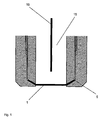
- FIG. 1 shows the schematic structure of an electrochemical or potentiometric electrode for the determination of surfactants with inventive sensor material 1.
- the sensor material 1 is firmly connected by means of an adhesive bond with the electrode housing 5.
- a reference element 10 is arranged, which is in an (electrical) contact with the sensor material 1 via an internal filling solution 15.
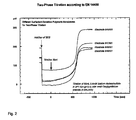
- FIG. 2 shows the results of four two-phase titrations of a sodium dodecyl sulfate (SDS) solution in 2PT-ISA, a surfactant-free emulsion mixture according to standard EN 14480, with cetylpyridine chloride, which was carried out according to the European standard EN 14480.
- SDS sodium dodecyl sulfate
- FIG. 2 shows the results of four two-phase titrations of a sodium dodecyl sulfate (SDS) solution in 2PT-ISA, a surfactant-free emulsion mixture according to standard EN 14480, with cetylpyridine chloride, which was carried out according to the European standard EN 14480.
- Electrode 944A01 contained a sensor material with Nalgene 280 polyurethane.
- Electrode 947A01 contained a sensor material with polyurethane Tygothan C210A (98 wt.%) And benzethonium dodecyl sulfate
- Electrode 946A01 contained a sensor material containing Tygothan C210A polyurethane (98 wt.%) And 1,3-didecyl-2-methylimidazolium dodecyl sulfate surfactant ion pair (2 wt.%).
- the electrode 948A01 contained a sensor material with the polyurethane Tygothan C2 0A (98 wt .-%) and hexadecylpyridinium dodecylbenzenesulfonates as Tensid-ion pair (2 wt .-%).
- FIG. 3 shows the comparison of the results of three two-phase titrations, which were carried out with two commercially available surfactant electrodes (RF, RS) and a surfactant electrode (913D01) with sensor material according to the invention.
- the electrode 913D01 contained the sensor material according to the invention with Tygothane C210A.
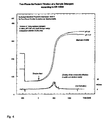
- FIG. 4 shows the results of two two-phase titrations carried out according to the European standard EN 14669.
- the two titrations were performed once each in the acidic range (pH 3.0) and in the alkaline range (pH 11.5) and show the Usability of the sensor material according to the invention both in the acidic and in the alkaline range.
- the polyurethane used was Tygothan C210A.
- the titrated detergent was a commercial dishwashing detergent titrated in 2PT-ISA with didecylmethylimidazolium chloride.
- FIG. 5 shows the results of two two-phase titrations, which were carried out with two electrodes with inventive sensor material according to the European standard EN 14480.
- SDS was titrated in 2PT-ISA with Hyamine.
- the sensor material of both electrodes contained the polyurethane Tygothan C210A.
- the 918B01 electrode was conditioned with an ionophore-containing solution prior to use.
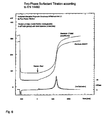
- FIG. 6 shows further results of two two-phase titrations with two electrodes with sensor material according to the invention carried out according to the European standard EN 14480.
- the electrode 171 B02 contained Tycoflex EG93A as polyurethane and was before use as under FIG. 5 described also conditioned.
- Electrode 949A01 contained Tycoflex EG93A (98 wt.%) As the polyurethane and benzethonium dodecyl sulfate (2 wt.%) As the surfactant ion pair.
- Fig. 7 shows the result of a two-phase titrations with an electrode with sensor material according to the invention carried out according to the European standard EN 14668.
- Hyamine was titrated in 2PT-ISA with SDS.
- the electrode contained the sensor material according to the invention with the polyurethane Tycoflex EG93A (98% by weight) and, as surfactant ion pair, benzethonium dodecyl sulfate (2% by weight).
Landscapes
- Chemical & Material Sciences (AREA)
- Life Sciences & Earth Sciences (AREA)
- Health & Medical Sciences (AREA)
- Physics & Mathematics (AREA)
- Chemical Kinetics & Catalysis (AREA)
- Electrochemistry (AREA)
- Molecular Biology (AREA)
- Analytical Chemistry (AREA)
- Biochemistry (AREA)
- General Health & Medical Sciences (AREA)
- General Physics & Mathematics (AREA)
- Immunology (AREA)
- Pathology (AREA)
- Investigating Or Analyzing Materials By The Use Of Electric Means (AREA)
Abstract
Description
- Die vorliegende Erfindung betrifft ein Sensormaterial für eine potentiometrische Elektrode und insbesondere für eine Tensid-Elektrode. Sie betrifft auch ein Verfahren zur Herstellung des Sensormaterials sowie dessen Verwendung in einer Elektrode.
- Tenside werden heutzutage in den unterschiedlichsten Bereichen eingesetzt. Sie werden beispielsweise in der Lebensmittelindustrie, in der Kunststoffindustrie und insbesondere in der Waschmittel- und der Kosmetikbranche verwendet und dienen dabei unter anderem als Emulgatoren, Netz- und Dispergiermittel. Die vielfältigen Anwendungen machen auch eine gute Tensid-Analytik notwendig. Der Tensid-Gehalt soll dabei möglichst rasch, genau und richtig bestimmt werden.
- Eine bereits seit langem bekannte Methode zur Bestimmung von Tensiden ist die 2-Phasen-Titration nach Epton. Dabei wird zur wässrigen Phase eine zweite, organische und nicht mit Wasser mischbare Phase zugegeben. Das sich während der Titration aus den beiden ionischen Tensiden bildende lonenpaar wird durch Extraktion in die organische Phase überführt und damit stabilisiert. Als organische Phase wird typischerweise Dichlormethan oder Chloroform verwendet. Beide Lösungsmittel sind gesundheitsschädlich und belasten bei ihrer Entsorgung die Umwelt stark. Chloroform ist zum Beispiel in den USA für analytische Anwendungen verboten.
- Vytras beschreibt in "Potentiometric Titrations based on Ion-Pair Formation" gebräuchliche Elektroden sowie Titrationsmittel zur Bestimmung von ionischen und nicht-ionischen Tensiden (Ion Selective Electrode Rev., 1985, Vol. 7, Seiten 77 - 164).
- Matesic-Puac et al. offenbaren einen Tensid-Sensor zur Bestimmung von Seifen und ihrer Mischungen mit anionischen Tensiden. Der Sensor basiert auf einer "coated-wire" Elektrode, wobei PVC und Graphit-PTFE als Matrize beziehungsweise als leitendes Substrat dienen (Tenside Surf. Det., 39, 2002, 4, Seiten 72 - 76).
- Kovacs et al. offenbaren Tensid-Elektroden basierend auf einem Tensid-lonenpaar als aktiver Komponente, eingebettet in einer Polymermembran aus PVC und o-NPOE (ortho-Nitrophenyl-Octylether) (Kovacs et al., "All solid-state surfactant sensing electrode using conductive polymer as internal electric conduit", Analytica Chimica Acta, 437, 2001, Seiten 67 - 76).
- Sak-Bosnar et al. beschreiben unter anderem auf PVC-Membranen basierende Elektroden zur potentiometrischen Bestimmung von ionischen und nicht-ionischen Tensiden in biotechnologischen Prozessen (Sak-Bosnar et al., "Surfactant Sensors in Biotechnology Part 1 - Electrochemical Sensors", Food Technol. Biotechnol., 42, 3, 2004, Seiten 197 - 206).
- Die
WO 99/38004 - Tenside werden sowohl in der chemischen, kosmetischen und pharmazeutischen Industrie als auch in der Biotechnologie sehr häufig und in vielfältiger Weise eingesetzt und gewinnen auch im Bereich neuartiger Materialien auf der Basis von Nanopartikeln zunehmend an Bedeutung. Dementsprechend ist auch die Analytik der Tenside von immer grösserer Bedeutung, insbesondere die Routineanalytik in chemischen, kosmetischen, pharmazeutischen und biotechnologischen Prozessen. Die bekannten Verfahren zur Messung von Tensiden verwenden unterschiedliche Endpunkte zur Bestimmung. Bereits lange bekannt sind Verfahren, die auf einer visuellen Bestimmung des Umschlagpunkts eines farbigen Indikators beruhen. Solche Verfahren haben den Nachteil, dass sie auf der Erfahrung der durchführenden Person beruhen und sehr zeitaufwendig sind. Sie sind zudem einer Automatisierung nur schwer zugänglich. In weiteren Verfahren wird der Endpunkt potentiometrisch bestimmt. Viele der hierfür verwendeten und kommerziell erhältlichen Elektroden basieren auf PVC-Membranen, die in der Regel zusätzlich ein lonenpaar und Weichmacher enthalten. Derartige Membranen lösen sich in organischen Medien auf und können daher nicht in Zwei-Phasen-Titrations-Medien eingesetzt werden. Der Weichmacher (Membrananteil bis zu 60%) ist ebenfalls nachteilig, da der Weichmacher extrahiert werden kann.
- Auf Kohlenstoff basierende Elektroden, z.B. in Form einer Paraffin/Graphit-Paste, können zwar in Medien mit einer organischen Phase verwendet werden, nutzen sich jedoch schnell ab und müssen daher laufend ersetzt oder zumindest aufwendig regeneriert werden. Die Regeneration muss sehr sorgfältig durchgeführt werden und erfordert Geschick und Erfahrung des Benutzers. Das gemessene Signal unterliegt Schwankungen, d.h., es ist instabil und driftet. In rein wässrigen Medien zeigen diese Elektroden zudem keine ausreichende Sensitivität mehr.
- Sogenannte "polymer coated wire"-Elektroden, die in der Bestimmung von Tensiden ebenfalls eingesetzt werden, haben recht lange Ansprechzeiten, was sie für die Routineanalytik unbrauchbar macht. Zudem können sie in alkalischen Medien nicht eingesetzt werden, wie dies in der europäischen Norm EN 14669 verlangt wird. Auch bei solchen Elektroden weist das Mess-Signal keine ausreichende Stabilität auf und unterliegt einem Drift.
- Die Bedeutung der Tensid-Analytik, z.B. im Umweltmonitoring, hat dazu geführt, dass die Methoden zur Durchführung dieser Analytik durch den Gesetzgeber normiert wurden. Hierfür einschlägige Normen sind zum Beispiel die europäischen Normen EN 14668, EN 14669 und EN 14480.
- Die der vorliegenden Erfindung zugrunde liegende Aufgabe besteht darin, ein Sensormaterial zur potentiometrischen Bestimmung von Tensiden zur Verfügung zu stellen, das sowohl in rein wässrigen Medien als auch in Zweiphasen-Medien über einen grossen pH-Bereich eingesetzt werden kann. Das Sensormaterial bzw. die damit ausgestattete Elektrode soll zudem unterhaltsfrei sein und ein schnelles, präzises und stabiles Messsignal liefern.
- Die Aufgabe wird durch ein Sensormaterial, ein Verfahren zu seiner Herstellung sowie eine potentiometrische Elektrode mit dem erfindungsgemässen Sensormaterial gemäss den unabhängigen Ansprüchen gelöst. Weitere bevorzugte Ausführungsformen sind Gegenstand der abhängigen Ansprüche.
- Das erfindungsgemässe Sensormaterial umfasst ein in organischen Lösungsmittel zumindest beschränkt quellbares Polymermaterial. Die Shore-Härte des elastischen Polymermaterials liegt im Bereich von 40A bis 80D.
- In einer bevorzugten Ausführungsform liegt die Shore-Härte des Polymermaterials im Bereich von 40A bis 95A, besonders bevorzugt zwischen 60A bis 94A und besonders bevorzugt im Bereich von 74A bis 93A.
- In einer weiteren bevorzugten Ausführungsform liegt die Shore-Härte des Polymermaterials im Bereich von 30D bis 80D, besonders bevorzugt zwischen 40D bis 77D und besonders bevorzugt im Bereich von 55D bis 75D.
- Das Polymermaterial soll in gängigen organischen Lösungsmitteln, z.B. Methanol, Ethanol, Toluol, Ethylacetat, Aceton, Methylethylketon oder Methylisobutylketon nicht löslich, jedoch in begrenztem Umfang quellbar sein. Die Quellbarkeit in den organischen Lösungmitteln sollte zwischen 0.5% - 100%, vorzugsweise 1% - 50% bezogen auf das Anfangsvolumen des Polymermaterials betragen. Zur Messung der Quellbarkeit wurde jeweils ein Testkörper, z.B. eine kleine Scheibe, aus dem Polymermaterial in das gewünschte Lösungsmittel eingelegt, so dass der Testkörper komplett von Lösungsmittel umgeben war, und für längere Zeit (bis zu 24h) bei Raumtemperatur stehengelassen. Für kleinere Proben, z.B. Scheiben von maximal 2 mm Dicke, kann die maximale Quellung bereits nach ungefähr 12h erreicht sein. Das erfindungsgemässe Sensormaterial kann vorteilhafterweise sowohl in rein wässrigen Medien als auch in Zwei-Phasen-Medien eingesetzt werden.
- Im Gegensatz zu Sensormaterialien, die auf Graphit-Pasten basieren, unterliegt das erfindungsgemässe Sensormaterial in organischen Lösungsmitteln keinem Abtrag, d.h., es verschleisst nicht und muss weder nachgefüllt noch ersetzt werden, was eine dieses Material aufweisende Elektrode besonders benutzerfreundlich macht.
- Das erfindungsgemässe Sensormaterial kann zudem über einen pH-Bereich von 1 bis 13, also in sauren und alkalischen Medien verwendet werden. Die Einsetzbarkeit im alkalischen Bereich ist vorteilhaft, da dieser Bereich z.B. bei der Tensid-Bestimmung von Seifen wichtig ist. Das erfindungsgemässe Sensormaterial zeigt im Einsatz bzw. im gequollenen Zustand vorteilhafterweise eine niedrige Impedanz von weniger als 1 MOhm. Insbesondere sollte das erfindungsgemässe Sensormaterial nach dem Quellen einen Impedanzwert von etwa 100 MOhm oder mehr, wie ihn z.B. weichmacherfreie Polymermembranen aufweisen, nicht überschreiten. Dieses vereinfacht den Aufbau der Messelektronik und macht aufwendige Abschirmungen überflüssig. Auch führt dies zu einer zusätzlichen Stabilität des Mess-Signals.
- In einer bevorzugten Ausführungsform umfasst das erfindungsgemässe Sensormaterial einen lonophor. Geeignet als lonophoren sind lipophile lonenpaare, insbesondere Tensid-lonenpaare. Möglich sind jedoch auch nicht-tensidische lonenpaare beziehungsweise Mischungen aus lonenpaaren. Der Anteil des lonophors am Sensormaterial liegt im Bereich von 0 bis 10 Gewichtsprozenten (Gew.-%), bevorzugt im Bereich von 1 bis 3 Gew.-% und besonders bevorzugt bei etwa 2 Gew.-%. Durch das Einbringen des lonophors als "aktive" Komponente des Sensormaterials kann zum einen eine Ionen-Selektivität herbeigeführt werden und zum anderen wird die Impedanz des erfindungsgemässen Sensormaterials weiter gesenkt, was für die Stabilität und Genauigkeit des Mess-Signals sehr vorteilhaft ist.
- In einer weiteren bevorzugten Ausführungsform umfasst das erfindungsgemässe Sensormaterial ein Additiv. Unter einem Additiv werden im Zusammenhang mit dieser Anmeldung Stoffe verstanden, die dem Sensormaterial beigefügt werden. Dies sind insbesondere Füllstoffe und Pigmente. Durch Pigmente ist es möglich, dem Sensormaterial eine spezifische Farbe zu verleihen. Damit kann z.B. für den Anwender eine optimale visuelle Unterscheidbarkeit von erfindungsgemässen Sensormaterialien mit unterschiedlichen lonophoren gewährleistet werden.
- In einer bevorzugten Ausführungsform wird als Polymermaterial ein Polyurethan eingesetzt. Als besonders geeignet haben sich aliphatische und insbesondere aromatische Polyurethan-Ether, -Ester und -Carbonate erwiesen, welche daher besonders bevorzugt sind. Geeignete Polyurethane besitzen eine geeignete Härte und ausreichende Quellbarkeit in organischen Lösungsmitteln. Alternativ zu Polyurethanen sind auch Polysiloxane und Polysulfone als Polymermaterial denkbar. Polyurethane werden jedoch bevorzugt.
- Geeignete Beispiele für aromatische Polyurethan-Ester, die in erfindungsgemässen Sensormaterialien verwendet werden können und daher besonders bevorzugt sind, sind unter den Handelsnamen Tygothane C210A, oder Nalgene 280 erhältlich. Ein geeignetes Beispiel für einen aliphatischen Polyurethan-Ether stellt beispielsweise der unter dem Handelsnamen Tycoflex EG93A bekannte Polyurethan-Ether dar.
- In einer bevorzugten Ausführungsform wird der lonophor aus der Gruppe von Hexadecylpyridinium Dodecylbenzolsulfonat, 1,3-Didecyl-2-methylimidazolium Dodecylsulfat und Benzethonium Dodecylsulfat ausgewählt.
- In einer weiteren bevorzugten Ausführungsform wird das Additiv aus der Gruppe von Kohlenstoffpulver, Graphit, Titandioxid und Kupfer-Phtalocyanin ausgewählt. Kohlenstoffpulver, Titandioxid und Kupfer-Phtalocyanin können als Farbpigmente eingesetzt werden, wobei Kohlenstoffpulver eine schwarze, Titandioxid eine weisse und Kupfer-Phtalocyanin ein blaue Färbung des erfindungsgemässen Sensormaterials ergibt. Eine Beimischung von Graphit erhöht zudem in vorteilhafter Weise die elektrische Leitfähigkeit des Sensormaterials. Neben den beispielhaft angegebenen Additiven können selbstverständlich auch andere Additive beigegeben werden, um die Farbe oder Eigenschaften des Sensormaterials zu verändern.
- Ein Verfahren zur Herstellung des erfindungsgemässen Sensormaterials umfasst folgende Schritte. In einem ersten Schritt wird das Polymermaterial, z.B. 5 Gew.-% der Gesamtlösung, in einem geeigneten organischen Lösungmittel, z.B. Tetrahydrofuran (THF) unter ständigem Rühren gelöst. Das Lösen des Polymermaterials dauert etwa 24h bis 120h. Nachdem eine homogene Lösung bzw. Suspension erhalten wurde, wird die so erhaltene Lösung bzw. Suspension in eine geeignete Form gegossen. Bei Raumtemperatur wird nun allmählich das Lösungsmittel verdampft, was zum langsamen Aushärten des Polymermaterials führt. Dies dauert je nach erwarteter Schichtdicke etwa 24h bis 120h. Das Erreichen der Gewichtskonstanz ist ein Indikator für das Ende der Aushärtung. Im Verfahren wird ein lonophor und/oder ein Additiv zugegeben.
- In einer bevorzugten Ausführungsform des Verfahrens zur Herstellung des erfindungsgemässen Sensormaterials umfasst das Verfahren folgende Schritte. In einem ersten Schritt wird das Polymermaterial, z.B. 5 Gew.-% der Gesamtlösung, in einem geeigneten organischen Lösungmittel, z.B. Tetrahydrofuran (THF) unter ständigem Rühren gelöst. Das Lösen des Polymermaterials dauert ungefähr 24h bis 120h. Anschliessend werden zur Polymerlösung der lonophor und, falls gewünscht, weitere Additive zugegeben. Nachdem eine homogene Lösung bzw. Suspension erhalten wurde, wird die so erhaltene Lösung bzw. Suspension in eine geeignete Form gegossen. Bei Raumtemperatur wird nun allmählich das Lösungsmittel verdampft, was zum langsamen Aushärten des Polymermaterials führt. Dies dauert wiederum ungefähr 24h bis 120h. Das derart ausgehärtete erfindungsgemässe Sensormaterial kann nun in die gewünschte Form gebracht werden, z.B. durch Ausstanzen oder Ausschneiden von Folienstücken. Die Dicke der so erhaltenen Folienstücke beträgt vorzugsweise etwa 300 µm.
- In einer weiteren bevorzugten Ausführungsform des Herstellungsverfahren des erfindungsgemässen Sensormaterials wird das Polymermaterial wie oben bereits beschrieben in einem geeigneten Lösungsmittel gelöst und nach wahlweiser Zugabe eines Additivs direkt in eine gewünschte Form gegossen. Das Verdampfen des Lösungsmittels erfolgt wiederum bei Raumtemperatur über ungefähr 24 bis 120h. Auf diese Weise erhält man eine zunächst lonophor-freie Polymerfolie. Alternativ kann Polymermaterial mit einer grösseren Dicke auch durch ein geeignetes Extrusions- oder Walzverfahren in eine Polymerfolie der gewünschten Dicke überführt werden.
- In einem weiteren Schritt kann die Polymerfolie nun einer Lösung mit dem gewünschten lonophor, z.B. einem lipophilen lonenpaar, exponiert werden. Eine Expositionsdauer von ungefähr 30 Minuten kann bereits ausreichen, damit die Polymerfolie eine ausreichende Menge des lonophors aufnimmt. Alternativ zum Exponieren mit einer Lösung kann auch einfach eine Zweiphasen-Titration zum Einbringen des lonophors bzw. zur Aktivierung der Polymerfolie durchgeführt werden.
- In einer weiteren bevorzugten Ausführungsform wird das erfindungsgemässe Sensormaterial zur Bestimmung von ionischen oder nicht-ionischen Tensiden in wässrigen oder organischen Medien verwendet. Besonders bevorzugt ist die Verwendung des erfindungsgemässen Sensormaterials in Zwei-Phasen-Titrationsmedien. Nicht-ionische Tenside werden zu diesem Zweck mit Hilfe von Barium-Salzen, z.B. BaCl2, in pseudo-kationische Tenside überführt und vorzugsweise mit Tetraphenyl-Borat titriert.
- Ein weiterer Aspekt der Erfindung betrifft eine potentiometrische Elektrode zur Bestimmung von Tensiden, welche ein erfindungsgemässes Sensormaterial aufweist.
- Im Folgenden wird das erfindungsgemässe Sensormaterial sowie dessen Anordnung in einer Elektrode anhand von Beispielen weiter ausgeführt und erläutert. Es zeigen rein schematisch:
- Fig. 1
- zeigt den Aufbau einer Tensid-Elektrode mit dem erfindungsgemässen Sensormaterial;
- Fig. 2
- zeigt die Resultate von vier Zwei-Phasen-Titrationen durchgeführt gemäss der europäischen Norm EN 14480;
- Fig. 3
- zeigt den Vergleich der Resultate von drei Zwei-Phasen-Titrationen, die mit zwei kommerziell erhältlichen Tensid-Elektroden und einer Tensid-Elektrode mit erfindungsgemässem Sensormaterial durchgeführt wurden;
- Fig. 4
- zeigt die Resultate von zwei Zwei-Phasen-Titrationen durchgeführt gemäss der europäischen Norm EN 14669;
- Fig. 5
- zeigt die Resultate von zwei Zwei-Phasen-Titrationen mit zwei Elektroden mit erfindungsgemässem Sensormaterial durchgeführt nach der europäischen Norm EN 14480;
- Fig. 6
- zeigt weitere Resultate von zwei Zwei-Phasen-Titrationen mit zwei Elektroden mit erfindungsgemässem Sensormaterial durchgeführt nach der europäischen Norm EN 14480; und
- Fig. 7
- zeigt das Resultat einer Zwei-Phasen-Titrationen mit einer Elektroden mit erfindungsgemässem Sensormaterial durchgeführt nach der europäischen Norm EN 14668.
-
Figur 1 zeigt den schematischen Aufbau einer elektrochemischen bzw. potentiometrischen Elektrode zur Bestimmung von Tensiden mit erfindungsgemässem Sensormaterial 1. Das Sensormaterial 1 ist mittels einer Klebeverbindung mit dem Elektrodengehäuse 5 fest verbunden. Im Inneren des Elektrodengehäuses 5 ist ein Referenzelement 10 angeordnet, welches über eine interne Fülllösung 15 in (elektrischem) Kontakt zum Sensormaterial 1 steht. - Alternativ zur Klebeverbindung zwischen dem Sensormaterial 1 und dem Elektrodengehäuse 5 sind auch andere Verbindungen, wie z.B. eine Schraubverbindung, denkbar.
-
Figur 2 zeigt die Resultate von vier Zwei-Phasen-Titrationen von einer Natrium Dodecylsulfat (SDS) Lösung in 2PT-ISA, einem tensidfreiem Emulsionsgemisch gemäss der Norm EN 14480, mit Cetylpyridin Chlorid, welche gemäss der europäischen Norm EN 14480 durchgeführt wurde. Eingesetzt wurden vier Elektroden mit unterschiedlichen erfindungsgemässen Sensormaterialien. Die Elektrode 944A01 enthielt ein Sensormaterial mit dem Polyurethan Nalgene 280. Die Elektrode 947A01 enthielt ein Sensormaterial mit dem Polyurethan Tygothan C210A (98 Gew.-%) und Benzethonium Dodecylsulfat als Tensid-lonenpaar (2 Gew.-%). Die Elektrode 946A01 enthielt ein Sensormaterial mit dem Polyurethan Tygothan C210A (98 Gew.-%) und 1,3-Didecyl-2-methylimidazolium Dodecylsulfat als Tensid-lonenpaar (2 Gew.-%). Die Elektrode 948A01 enthielt ein Sensormaterial mit dem Polyurethan Tygothan C2 0A (98 Gew.-%) und Hexadecylpyridinium Dodecylbenzolsulfonate als Tensid-lonenpaar (2 Gew.-%). -
Figur 3 zeigt den Vergleich der Resultate von drei Zwei-Phasen-Titrationen, die mit zwei kommerziell erhältlichen Tensid-Elektroden (RF, RS) und einer Tensid-Elektrode (913D01) mit erfindungsgemässem Sensormaterial durchgeführt wurden. Die Elektrode 913D01 enthielt das erfindungsgemässe Sensormaterial mit Tygothane C210A. -
Figur 4 zeigt die Resultate von zwei Zwei-Phasen-Titrationen durchgeführt gemäss der europäischen Norm EN 14669. Die beiden Titration wurden je einmal im sauren Bereich (pH 3.0) und im alkalischen Bereich (pH 11.5) durchgeführt und zeigen die Verwendbarkeit des erfindungsgemässen Sensormaterials sowohl im sauren als auch im alkalischen Bereich. Das verwendete Polyurethan war Tygothan C210A. Das titrierte Detergens war ein handelsübliches Geschirrspülmittel, welches in 2PT-ISA mit Didecylmethylimidazolium Chlorid titriert wurde. -
Figur 5 zeigt die Resultate von zwei Zwei-Phasen-Titrationen, die mit zwei Elektroden mit erfindungsgemässem Sensormaterial nach der europäischen Norm EN 14480 durchgeführt wurden. Titriert wurde SDS in 2PT-ISA mit Hyamine. Das Sensormaterial beider Elektroden enthielt das Polyurethan Tygothan C210A. Die Elektrode 918B01 wurde jedoch vor ihrem Einsatz mit einer lonophor enthaltenden Lösung behandelt bzw. konditioniert. -
Figur 6 zeigt weitere Resultate von zwei Zwei-Phasen-Titrationen mit zwei Elektroden mit erfindungsgemässem Sensormaterial durchgeführt nach der europäischen Norm EN 14480. Titriert wurde SDS in 2PT-ISA mit Hyamine. Die Elektrode 171 B02 enthielt als Polyurethan Tycoflex EG93A und war vor ihrem Einsatz wie unterFigur 5 beschrieben ebenfalls konditioniert worden. Die Elektrode 949A01 enthielt als Polyurethan Tycoflex EG93A (98 Gew.-%) und als Tensid-lonenpaar Benzethonium Dodecylsulfat (2 Gew.-%). -
Fig 7 zeigt das Resultat einer Zwei-Phasen-Titrationen mit einer Elektroden mit erfindungsgemässem Sensormaterial durchgeführt nach der europäischen Norm EN 14668. Titriert wurde Hyamine in 2PT-ISA mit SDS. Die Elektrode enthielt das erfindungsgemässe Sensormaterial mit dem Polyurethan Tycoflex EG93A (98 Gew.-%) und als Tensid-lonenpaar Benzethonium Dodecylsulfat (2 Gew.-%).
Claims (14)
- Sensormaterial für eine potentiometrische Elektrode zur Bestimmung von Tensiden umfassend ein in organischen Lösungsmitteln quellbares Polymermaterial mit einer Shore-Härte im Bereich von 40A bis 80D.
- Sensormaterial gemäss Anspruch 1, wobei die Shore-Härte des Polymermaterials im Bereich von 40A bis 95A, bevorzugt zwischen 60A bis 94A und besonders bevorzugt im Bereich von 74A bis 93A liegt.
- Sensormaterial gemäss Anspruch 1, wobei die Shore-Härte des Polymermaterials im Bereich von 30D bis 80D, bevorzugt zwischen 40D bis 77D und besonders bevorzugt im Bereich von 55D bis 75D liegt.
- Sensormaterial gemäss Anspruch 1, wobei das Sensormaterial einen lonophor umfasst.
- Sensormaterial gemäss einem der vorangehenden Ansprüche, wobei das Sensormaterial ein Additiv umfasst.
- Sensormaterial gemäss einem der vorangehenden Ansprüche, wobei das Polymermaterial ein Polyurethan, bevorzugt ein Polyurethan-Ether oder Polyurethan-Ester, besonders bevorzugt ein aromatischer Polyurethan-Ether oder Polyurethan-Ester ist.
- Sensormaterial gemäss einem der vorangehenden Ansprüche, wobei das Polymermaterial ausgewählt wird aus der Gruppe bestehend aus Tygothane C210A, Tycoflex EG93A oder Nalgene 280.
- Sensormaterial gemäss einem der Ansprüche 4 bis 7, wobei der lonophor ausgewählt wird aus der Gruppe bestehend aus Hexadecylpyridinium Dodecylbenzolsulfonat, 1,3-Didecyl-2-methylimidazolium Dodecylsulfat und Benzethonium Dodecylsulfat.
- Sensormaterial gemäss einem der Ansprüche 5 bis 8, wobei das Additiv ausgewählt wird aus der Gruppe bestehend aus Kohlenstoffpulver, Graphit, Titandioxid und Kupfer-Phtalocyanin.
- Verfahren zur Herstellung des Sensormaterials gemäss einem der vorangehenden Ansprüche, umfassend die Schrittea) Lösen des Polymermaterials in einem organischen Lösungsmittel;b) Giessen der unter Schritt a) erhaltenen homogenen Lösung in eine geeignete Form; undc) Verdampfen des Lösungsmittels und Aushärten des Polymermaterials,dadurch gekennzeichnet, dass im Verfahren ein lonophor und/oder ein Additiv zugegeben wird.
- Verfahren gemäss Anspruch 10, dadurch gekennzeichnet, dass dem gelösten Polymermaterial ein lonophor und/oder Additiv zugesetzt wird.
- Verfahren gemäss einem der Ansprüche 10 oder 11, dadurch gekennzeichnet, dass das aus Schritt c) resultierende Polymermaterial mit einer einen lonophor enthaltenden Lösung exponiert wird.
- Verwendung des Sensormaterials gemäss einem der Ansprüche 1 bis 7 zur Bestimmung von ionischen oder nicht-ionischen Tensiden in wässrigen oder organischen Medien.
- Potentiometrische Elektrode zru Bestimmung von Tensiden umfassend das Sensormaterial gemäss einem der Ansprüche 1 bis 9.
Priority Applications (1)
| Application Number | Priority Date | Filing Date | Title |
|---|---|---|---|
| EP07018527.7A EP2040066B1 (de) | 2007-09-20 | 2007-09-20 | Verwendung eines Sensormaterials für eine potentiometrische Elektrode |
Applications Claiming Priority (1)
| Application Number | Priority Date | Filing Date | Title |
|---|---|---|---|
| EP07018527.7A EP2040066B1 (de) | 2007-09-20 | 2007-09-20 | Verwendung eines Sensormaterials für eine potentiometrische Elektrode |
Publications (2)
| Publication Number | Publication Date |
|---|---|
| EP2040066A1 true EP2040066A1 (de) | 2009-03-25 |
| EP2040066B1 EP2040066B1 (de) | 2017-03-08 |
Family
ID=39092932
Family Applications (1)
| Application Number | Title | Priority Date | Filing Date |
|---|---|---|---|
| EP07018527.7A Active EP2040066B1 (de) | 2007-09-20 | 2007-09-20 | Verwendung eines Sensormaterials für eine potentiometrische Elektrode |
Country Status (1)
| Country | Link |
|---|---|
| EP (1) | EP2040066B1 (de) |
Citations (2)
| Publication number | Priority date | Publication date | Assignee | Title |
|---|---|---|---|---|
| WO1999038004A1 (de) * | 1998-01-22 | 1999-07-29 | Deutsche Metrohm Gesellschaft Mit Beschränkter Haftung & Co. | Titriervorrichtung zur bestimmung von tensiden |
| WO2002064656A2 (en) * | 2001-02-12 | 2002-08-22 | Noveon Ip Holdings Corp. | High molecular weight thermoplastic polyurethanes made from polyols having high secondary hydroxyl content |
-
2007
- 2007-09-20 EP EP07018527.7A patent/EP2040066B1/de active Active
Patent Citations (2)
| Publication number | Priority date | Publication date | Assignee | Title |
|---|---|---|---|---|
| WO1999038004A1 (de) * | 1998-01-22 | 1999-07-29 | Deutsche Metrohm Gesellschaft Mit Beschränkter Haftung & Co. | Titriervorrichtung zur bestimmung von tensiden |
| WO2002064656A2 (en) * | 2001-02-12 | 2002-08-22 | Noveon Ip Holdings Corp. | High molecular weight thermoplastic polyurethanes made from polyols having high secondary hydroxyl content |
Non-Patent Citations (4)
| Title |
|---|
| ANONYMOUS: "TYGOTHANE", INTERNET ARTICLE, 2000, pages 1 - 2, XP002471161, Retrieved from the Internet <URL:kmac-distribution.com/Plastics/data%20sheets/C210A.pdf> [retrieved on 20080226] * |
| FOGT E J ET AL: "Simplified procedure for forming polymer-based ion-selective electrodes", ANALYTICAL CHEMISTRY, vol. 57, no. 6, May 1985 (1985-05-01), ISSN: 0003-2700, pages 1155 - 1157, XP002471160 * |
| MATESIC-PUAC R ET AL: "Potentiometric determination of soaps and mixtures of soaps with anionic surfactants using a new surfactant sensor", TENSIDE, SURFACTANTS, DETERGENTS., vol. 39, no. 4, 2002, ISSN: 0932-3414, pages 72 - 76, XP001537958 * |
| SANCHEZ J ET AL: "A new potentiometric photocurable membrane selective to anionic surfactants", ELECTROANALYSIS, vol. 13, no. 6, April 2001 (2001-04-01), pages 471 - 476, XP002471162, ISSN: 1040-0397 * |
Also Published As
| Publication number | Publication date |
|---|---|
| EP2040066B1 (de) | 2017-03-08 |
Similar Documents
| Publication | Publication Date | Title |
|---|---|---|
| DE3405431C2 (de) | ||
| WO2010072510A1 (de) | Ionenselektive elektrode | |
| DE2722617C2 (de) | Ionenselektive Elektrode und Verwendung derselben | |
| DE102008055082A1 (de) | Referenzelektrode | |
| EP2453229B1 (de) | Sauerstoffsensor mit mikroporöser Elektrolytschicht und teiloffener Deckmembran | |
| EP3169993B1 (de) | Referenzelektrodenanordnung für elektrochemischen sensor und elektrochemischer sensor | |
| CH679526A5 (de) | ||
| DE2950383A1 (de) | Elektrochemische elektrode sowie verfahren zur ausbildung einer auf ionen ansprechenden membran fuer eine elektrochemische elektrode sowie verfahren zur herstellung einer elektrochemischen elektrode | |
| DE3874996T2 (de) | Chloridionenselektive elektrode. | |
| EP1936365B1 (de) | Verfahren zur Bestimmung einer Bezugselektrode auf einer ionenselektiven Festkontakt-Elektrode | |
| EP3564648B1 (de) | Verfahren zur ermittlung der viskosität von stoffen mit einem rotationsviskosimeter | |
| EP1480038B1 (de) | Potentiometrische, ionenselektive Elektrode | |
| DE102009051169B4 (de) | Phosphatelektrode, Elektrodensystem hiermit und deren Verwendung | |
| EP0247535A2 (de) | Referenzelektrode für die Ionenaktivitätsmessung, insbesondere für die pH-Wertmessung | |
| EP2040066B1 (de) | Verwendung eines Sensormaterials für eine potentiometrische Elektrode | |
| DE1598896B1 (de) | Elektrochemische elektrodenanordnung | |
| DE19533059A1 (de) | Bezugselektrode für elektrochemische Messungen und Verfahren zu deren Herstellung | |
| DE3000886A1 (de) | Anionenselektive elektrode | |
| DE10053006B4 (de) | Elektrisch leitfähiges Polymermaterial, seine Herstellung und Verwendung | |
| DE3932247A1 (de) | Elektrodenmaterial, elektroden, verfahren zur herstellung und verwendung der elektrode | |
| DE19861034B4 (de) | Verbesserte Titriervorrichtung | |
| DE10252481A1 (de) | Bezugselektrode und Herstellungsverfahren | |
| DE102018004653B3 (de) | Elektrochemischer Sensor mit einem gemeinsamen Elektrolytvolumen für Arbeits- und Referenzelektrode | |
| DE2943382A1 (de) | Summenelektrode, methode und vorrichtung zur bestimmung der gesamtkonzentration der freien ionen in loesungen | |
| DE102023108375A1 (de) | Messsonde |
Legal Events
| Date | Code | Title | Description |
|---|---|---|---|
| PUAI | Public reference made under article 153(3) epc to a published international application that has entered the european phase |
Free format text: ORIGINAL CODE: 0009012 |
|
| AK | Designated contracting states |
Kind code of ref document: A1 Designated state(s): AT BE BG CH CY CZ DE DK EE ES FI FR GB GR HU IE IS IT LI LT LU LV MC MT NL PL PT RO SE SI SK TR |
|
| AX | Request for extension of the european patent |
Extension state: AL BA HR MK RS |
|
| 17P | Request for examination filed |
Effective date: 20090925 |
|
| 17Q | First examination report despatched |
Effective date: 20091021 |
|
| AKX | Designation fees paid |
Designated state(s): AT BE BG CH CY CZ DE DK EE ES FI FR GB GR HU IE IS IT LI LT LU LV MC MT NL PL PT RO SE SI SK TR |
|
| GRAP | Despatch of communication of intention to grant a patent |
Free format text: ORIGINAL CODE: EPIDOSNIGR1 |
|
| INTG | Intention to grant announced |
Effective date: 20160929 |
|
| STAA | Information on the status of an ep patent application or granted ep patent |
Free format text: STATUS: GRANT OF PATENT IS INTENDED |
|
| GRAS | Grant fee paid |
Free format text: ORIGINAL CODE: EPIDOSNIGR3 |
|
| GRAA | (expected) grant |
Free format text: ORIGINAL CODE: 0009210 |
|
| STAA | Information on the status of an ep patent application or granted ep patent |
Free format text: STATUS: THE PATENT HAS BEEN GRANTED |
|
| AK | Designated contracting states |
Kind code of ref document: B1 Designated state(s): AT BE BG CH CY CZ DE DK EE ES FI FR GB GR HU IE IS IT LI LT LU LV MC MT NL PL PT RO SE SI SK TR |
|
| REG | Reference to a national code |
Ref country code: GB Ref legal event code: FG4D Free format text: NOT ENGLISH |
|
| REG | Reference to a national code |
Ref country code: CH Ref legal event code: EP Ref country code: AT Ref legal event code: REF Ref document number: 873978 Country of ref document: AT Kind code of ref document: T Effective date: 20170315 |
|
| REG | Reference to a national code |
Ref country code: IE Ref legal event code: FG4D Free format text: LANGUAGE OF EP DOCUMENT: GERMAN |
|
| REG | Reference to a national code |
Ref country code: DE Ref legal event code: R096 Ref document number: 502007015494 Country of ref document: DE |
|
| REG | Reference to a national code |
Ref country code: CH Ref legal event code: NV Representative=s name: PATENTANWAELTE SCHAAD, BALASS, MENZL AND PARTN, CH |
|
| REG | Reference to a national code |
Ref country code: LT Ref legal event code: MG4D |
|
| REG | Reference to a national code |
Ref country code: NL Ref legal event code: MP Effective date: 20170308 |
|
| PG25 | Lapsed in a contracting state [announced via postgrant information from national office to epo] |
Ref country code: GR Free format text: LAPSE BECAUSE OF FAILURE TO SUBMIT A TRANSLATION OF THE DESCRIPTION OR TO PAY THE FEE WITHIN THE PRESCRIBED TIME-LIMIT Effective date: 20170609 Ref country code: FI Free format text: LAPSE BECAUSE OF FAILURE TO SUBMIT A TRANSLATION OF THE DESCRIPTION OR TO PAY THE FEE WITHIN THE PRESCRIBED TIME-LIMIT Effective date: 20170308 Ref country code: LT Free format text: LAPSE BECAUSE OF FAILURE TO SUBMIT A TRANSLATION OF THE DESCRIPTION OR TO PAY THE FEE WITHIN THE PRESCRIBED TIME-LIMIT Effective date: 20170308 |
|
| PG25 | Lapsed in a contracting state [announced via postgrant information from national office to epo] |
Ref country code: BG Free format text: LAPSE BECAUSE OF FAILURE TO SUBMIT A TRANSLATION OF THE DESCRIPTION OR TO PAY THE FEE WITHIN THE PRESCRIBED TIME-LIMIT Effective date: 20170608 Ref country code: SE Free format text: LAPSE BECAUSE OF FAILURE TO SUBMIT A TRANSLATION OF THE DESCRIPTION OR TO PAY THE FEE WITHIN THE PRESCRIBED TIME-LIMIT Effective date: 20170308 Ref country code: LV Free format text: LAPSE BECAUSE OF FAILURE TO SUBMIT A TRANSLATION OF THE DESCRIPTION OR TO PAY THE FEE WITHIN THE PRESCRIBED TIME-LIMIT Effective date: 20170308 Ref country code: ES Free format text: LAPSE BECAUSE OF FAILURE TO SUBMIT A TRANSLATION OF THE DESCRIPTION OR TO PAY THE FEE WITHIN THE PRESCRIBED TIME-LIMIT Effective date: 20170308 |
|
| REG | Reference to a national code |
Ref country code: FR Ref legal event code: PLFP Year of fee payment: 11 |
|
| PG25 | Lapsed in a contracting state [announced via postgrant information from national office to epo] |
Ref country code: NL Free format text: LAPSE BECAUSE OF FAILURE TO SUBMIT A TRANSLATION OF THE DESCRIPTION OR TO PAY THE FEE WITHIN THE PRESCRIBED TIME-LIMIT Effective date: 20170308 |
|
| PG25 | Lapsed in a contracting state [announced via postgrant information from national office to epo] |
Ref country code: CZ Free format text: LAPSE BECAUSE OF FAILURE TO SUBMIT A TRANSLATION OF THE DESCRIPTION OR TO PAY THE FEE WITHIN THE PRESCRIBED TIME-LIMIT Effective date: 20170308 Ref country code: IT Free format text: LAPSE BECAUSE OF FAILURE TO SUBMIT A TRANSLATION OF THE DESCRIPTION OR TO PAY THE FEE WITHIN THE PRESCRIBED TIME-LIMIT Effective date: 20170308 Ref country code: RO Free format text: LAPSE BECAUSE OF FAILURE TO SUBMIT A TRANSLATION OF THE DESCRIPTION OR TO PAY THE FEE WITHIN THE PRESCRIBED TIME-LIMIT Effective date: 20170308 Ref country code: EE Free format text: LAPSE BECAUSE OF FAILURE TO SUBMIT A TRANSLATION OF THE DESCRIPTION OR TO PAY THE FEE WITHIN THE PRESCRIBED TIME-LIMIT Effective date: 20170308 Ref country code: SK Free format text: LAPSE BECAUSE OF FAILURE TO SUBMIT A TRANSLATION OF THE DESCRIPTION OR TO PAY THE FEE WITHIN THE PRESCRIBED TIME-LIMIT Effective date: 20170308 |
|
| PG25 | Lapsed in a contracting state [announced via postgrant information from national office to epo] |
Ref country code: PT Free format text: LAPSE BECAUSE OF FAILURE TO SUBMIT A TRANSLATION OF THE DESCRIPTION OR TO PAY THE FEE WITHIN THE PRESCRIBED TIME-LIMIT Effective date: 20170710 Ref country code: PL Free format text: LAPSE BECAUSE OF FAILURE TO SUBMIT A TRANSLATION OF THE DESCRIPTION OR TO PAY THE FEE WITHIN THE PRESCRIBED TIME-LIMIT Effective date: 20170308 Ref country code: IS Free format text: LAPSE BECAUSE OF FAILURE TO SUBMIT A TRANSLATION OF THE DESCRIPTION OR TO PAY THE FEE WITHIN THE PRESCRIBED TIME-LIMIT Effective date: 20170708 |
|
| REG | Reference to a national code |
Ref country code: DE Ref legal event code: R097 Ref document number: 502007015494 Country of ref document: DE |
|
| PLBE | No opposition filed within time limit |
Free format text: ORIGINAL CODE: 0009261 |
|
| STAA | Information on the status of an ep patent application or granted ep patent |
Free format text: STATUS: NO OPPOSITION FILED WITHIN TIME LIMIT |
|
| PG25 | Lapsed in a contracting state [announced via postgrant information from national office to epo] |
Ref country code: DK Free format text: LAPSE BECAUSE OF FAILURE TO SUBMIT A TRANSLATION OF THE DESCRIPTION OR TO PAY THE FEE WITHIN THE PRESCRIBED TIME-LIMIT Effective date: 20170308 |
|
| 26N | No opposition filed |
Effective date: 20171211 |
|
| PG25 | Lapsed in a contracting state [announced via postgrant information from national office to epo] |
Ref country code: SI Free format text: LAPSE BECAUSE OF FAILURE TO SUBMIT A TRANSLATION OF THE DESCRIPTION OR TO PAY THE FEE WITHIN THE PRESCRIBED TIME-LIMIT Effective date: 20170308 |
|
| PG25 | Lapsed in a contracting state [announced via postgrant information from national office to epo] |
Ref country code: MC Free format text: LAPSE BECAUSE OF FAILURE TO SUBMIT A TRANSLATION OF THE DESCRIPTION OR TO PAY THE FEE WITHIN THE PRESCRIBED TIME-LIMIT Effective date: 20170308 |
|
| REG | Reference to a national code |
Ref country code: IE Ref legal event code: MM4A |
|
| REG | Reference to a national code |
Ref country code: BE Ref legal event code: MM Effective date: 20170930 |
|
| PG25 | Lapsed in a contracting state [announced via postgrant information from national office to epo] |
Ref country code: LU Free format text: LAPSE BECAUSE OF NON-PAYMENT OF DUE FEES Effective date: 20170920 |
|
| PG25 | Lapsed in a contracting state [announced via postgrant information from national office to epo] |
Ref country code: IE Free format text: LAPSE BECAUSE OF NON-PAYMENT OF DUE FEES Effective date: 20170920 |
|
| PG25 | Lapsed in a contracting state [announced via postgrant information from national office to epo] |
Ref country code: BE Free format text: LAPSE BECAUSE OF NON-PAYMENT OF DUE FEES Effective date: 20170930 |
|
| REG | Reference to a national code |
Ref country code: FR Ref legal event code: PLFP Year of fee payment: 12 |
|
| PG25 | Lapsed in a contracting state [announced via postgrant information from national office to epo] |
Ref country code: MT Free format text: LAPSE BECAUSE OF FAILURE TO SUBMIT A TRANSLATION OF THE DESCRIPTION OR TO PAY THE FEE WITHIN THE PRESCRIBED TIME-LIMIT Effective date: 20170308 |
|
| REG | Reference to a national code |
Ref country code: AT Ref legal event code: MM01 Ref document number: 873978 Country of ref document: AT Kind code of ref document: T Effective date: 20170920 |
|
| PG25 | Lapsed in a contracting state [announced via postgrant information from national office to epo] |
Ref country code: AT Free format text: LAPSE BECAUSE OF NON-PAYMENT OF DUE FEES Effective date: 20170920 |
|
| PG25 | Lapsed in a contracting state [announced via postgrant information from national office to epo] |
Ref country code: HU Free format text: LAPSE BECAUSE OF FAILURE TO SUBMIT A TRANSLATION OF THE DESCRIPTION OR TO PAY THE FEE WITHIN THE PRESCRIBED TIME-LIMIT; INVALID AB INITIO Effective date: 20070920 |
|
| PG25 | Lapsed in a contracting state [announced via postgrant information from national office to epo] |
Ref country code: CY Free format text: LAPSE BECAUSE OF NON-PAYMENT OF DUE FEES Effective date: 20170308 |
|
| PG25 | Lapsed in a contracting state [announced via postgrant information from national office to epo] |
Ref country code: TR Free format text: LAPSE BECAUSE OF FAILURE TO SUBMIT A TRANSLATION OF THE DESCRIPTION OR TO PAY THE FEE WITHIN THE PRESCRIBED TIME-LIMIT Effective date: 20170308 |
|
| REG | Reference to a national code |
Ref country code: CH Ref legal event code: U11 Free format text: ST27 STATUS EVENT CODE: U-0-0-U10-U11 (AS PROVIDED BY THE NATIONAL OFFICE) Effective date: 20251001 |
|
| PGFP | Annual fee paid to national office [announced via postgrant information from national office to epo] |
Ref country code: DE Payment date: 20250924 Year of fee payment: 19 |
|
| PGFP | Annual fee paid to national office [announced via postgrant information from national office to epo] |
Ref country code: GB Payment date: 20250922 Year of fee payment: 19 |
|
| PGFP | Annual fee paid to national office [announced via postgrant information from national office to epo] |
Ref country code: FR Payment date: 20250922 Year of fee payment: 19 |
|
| PGFP | Annual fee paid to national office [announced via postgrant information from national office to epo] |
Ref country code: CH Payment date: 20251001 Year of fee payment: 19 |