EP2040066B1 - Emploi d'un matériau de détection pour une électrode potentiométrique - Google Patents
Emploi d'un matériau de détection pour une électrode potentiométrique Download PDFInfo
- Publication number
- EP2040066B1 EP2040066B1 EP07018527.7A EP07018527A EP2040066B1 EP 2040066 B1 EP2040066 B1 EP 2040066B1 EP 07018527 A EP07018527 A EP 07018527A EP 2040066 B1 EP2040066 B1 EP 2040066B1
- Authority
- EP
- European Patent Office
- Prior art keywords
- sensor material
- electrode
- sensor
- polyurethane
- surfactant
- Prior art date
- Legal status (The legal status is an assumption and is not a legal conclusion. Google has not performed a legal analysis and makes no representation as to the accuracy of the status listed.)
- Active
Links
Images


Classifications
-
- G—PHYSICS
- G01—MEASURING; TESTING
- G01N—INVESTIGATING OR ANALYSING MATERIALS BY DETERMINING THEIR CHEMICAL OR PHYSICAL PROPERTIES
- G01N27/00—Investigating or analysing materials by the use of electric, electrochemical, or magnetic means
- G01N27/26—Investigating or analysing materials by the use of electric, electrochemical, or magnetic means by investigating electrochemical variables; by using electrolysis or electrophoresis
- G01N27/28—Electrolytic cell components
- G01N27/30—Electrodes, e.g. test electrodes; Half-cells
- G01N27/333—Ion-selective electrodes or membranes
- G01N27/3335—Ion-selective electrodes or membranes the membrane containing at least one organic component
-
- C—CHEMISTRY; METALLURGY
- C08—ORGANIC MACROMOLECULAR COMPOUNDS; THEIR PREPARATION OR CHEMICAL WORKING-UP; COMPOSITIONS BASED THEREON
- C08L—COMPOSITIONS OF MACROMOLECULAR COMPOUNDS
- C08L75/00—Compositions of polyureas or polyurethanes; Compositions of derivatives of such polymers
- C08L75/04—Polyurethanes
Definitions
- the present invention relates to the use of a sensor material for a potentiometric electrode and in particular for a surfactant electrode for the determination of surfactants in two-phase media. Also described is a method for producing the sensor material and its use in an electrode.
- Surfactants are used today in a wide variety of areas. They are used, for example, in the food industry, in the plastics industry and in particular in the detergent and cosmetics industries and serve, inter alia, as emulsifiers, wetting agents and dispersants. The diverse applications also require a good surfactant analysis. The surfactant content should be determined as quickly, accurately and correctly.
- a well-known method for the determination of surfactants is the Epton 2-phase titration.
- a second, organic and not water-miscible phase is added to the aqueous phase.
- the ion pair formed during the titration from the two ionic surfactants is converted by extraction into the organic phase and thus stabilized.
- dichloromethane or chloroform is typically used. Both solvents are hazardous to health and pollute the environment when they are disposed of. For example, chloroform is banned in the US for analytical applications.
- Vytras describes in "Potentiometric Titrations based on Ion-Pair Formation" common electrodes and titration agents for the determination of ionic and non-ionic surfactants ( Ion Selective Electrode Rev., 1985, Vol. 7, pp. 77-164 ).
- Matesic-Puac et al. disclose a surfactant sensor for the determination of soaps and their mixtures with anionic surfactants.
- the sensor is based on a "coated-wire" electrode, whereby PVC and graphite-PTFE serve as a template or as a conductive substrate ( Surfactants Surf. Det., 39, 2002, 4, pages 72-76 ).
- Kovacs et al. disclose surfactant electrodes based on a surfactant ion pair as the active component embedded in a polymer membrane of PVC and o-NPOE (ortho-nitrophenyl octyl ether) ( Kovacs et al., "All solid-state surfactant sensing electrode using conductive polymer as internal electric conduit", Analytica Chimica Acta, 437, 2001, pp. 67-76 ).
- Sak-Bosnar et al. describe inter alia PVC membrane-based electrodes for the potentiometric determination of ionic and nonionic surfactants in biotechnological processes ( Sak-Bosnar et al., "Surfactant Sensors in Biotechnology Part 1 - Electrochemical Sensors", Food Technol. Biotechnol., 42, 3, 2004, pages 197-206 ).
- the WO 99/38004 discloses a titration device for the determination of surfactants.
- the titration device comprises a surfactant electrode with a sensor material of a plastically deformable, conductive material.
- the sensor material may optionally include an ionophore and other additives.
- Fogt EJ et al. "Simplified procedure for forming polymer-based ion-selective electrodes", Analytical Chemistry, Vol. 57, No. 6, pp. 1155-1157, May 1985 describes a method for producing a sensor material for polymer-based ion-selective electrodes.
- Polyurethanes such as Tygon R3603 are also mentioned.
- Tygothane Under the trade name Tygothane, an internet article from KMAC Distribution describes this polyurethane-based material as tubing for laboratory use. Tygothane has a Shore A hardness of 82.
- WO 02/064656 describes the preparation of high molecular weight thermoplastic polyurethanes from polyols wherein the polyurethanes are substantially linear and free of crosslinks.
- Surfactants are used very frequently and in a variety of ways in the chemical, cosmetic and pharmaceutical industries as well as in biotechnology and are also becoming increasingly important in the field of novel nanoparticle-based materials. Accordingly, the analysis of surfactants is of ever greater importance, in particular the routine analysis in chemical, cosmetic, pharmaceutical and biotechnological processes.
- the known methods for measuring surfactants use different endpoints for the determination. Methods have long been known which rely on a visual determination of the turnover point of a colored indicator. Such methods have the disadvantage that they are based on the experience of the person performing and are very time consuming. They are also difficult to access automation. In further methods, the end point is determined potentiometrically.
- Carbon based electrodes e.g. in the form of a paraffin / graphite paste, although can be used in media with an organic phase, but use up quickly and must therefore be constantly replaced or at least consuming regenerated. The regeneration must be done very carefully and requires skill and experience of the user.
- the measured signal is subject to fluctuations, that is, it is unstable and drifts. Moreover, in purely aqueous media, these electrodes no longer show sufficient sensitivity.
- the object underlying the present invention is to provide a sensor material for the potentiometric determination of surfactants, which can be used both in purely aqueous media but especially in two-phase media over a wide pH range.
- the sensor material or the electrode thus equipped should also be maintenance-free and deliver a fast, precise and stable measurement signal.
- the sensor material to be used comprises a polymer material that swells at least to a limited extent in organic solvents.
- the Shore hardness of the elastic polymer material is in the range of 74A to 93A.
- the Shore hardness of the polymeric material is in the range of 30D to 80D, more preferably 40D to 77D, and most preferably in the range of 55D to 75D.
- the polymeric material should be dissolved in common organic solvents, e.g. Methanol, ethanol, toluene, ethyl acetate, acetone, methyl ethyl ketone or methyl isobutyl ketone not soluble, but be swellable to a limited extent.
- the swellability in the organic solvents should be between 0.5% -100%, preferably 1% -50%, based on the initial volume of the polymer material.
- one test body e.g. a small disc, made of the polymer material inserted into the desired solvent, so that the test body was completely surrounded by solvent; and left for a long time (up to 24 hours) at room temperature.
- the maximum swelling can be reached already after about 12h.
- the sensor material can advantageously be used both in purely aqueous media and in two-phase media.
- the sensor material according to the invention is not subject to erosion in organic solvents, that is, it does not wear out and does not have to be refilled or replaced, which makes an electrode having this material particularly user-friendly.
- the sensor material to be used can also be used over a pH range of 1 to 13, ie in acidic and alkaline media.
- the applicability in the alkaline range is advantageous, since this range is important, for example, in the determination of surfactants by soaps.
- the sensor material shows in use or in the swollen state advantageously has a low impedance of less than 1 Mohm.
- the sensor material according to the invention should, after swelling, not exceed an impedance value of about 100 MOhm or more, such as eg plasticizer-free polymer membranes. This simplifies the structure of the measuring electronics and makes complex shielding superfluous. This also leads to an additional stability of the measurement signal.
- the sensor material comprises an ionophore.
- Suitable ionophores are lipophilic ion pairs, in particular surfactant ion pairs. However, non-surfactant ion pairs or mixtures of ion pairs are also possible.
- the proportion of the ionophore on the sensor material is in the range of 0 to 10 percent by weight (wt .-%), preferably in the range of 1 to 3 wt .-% and particularly preferably at about 2 wt .-%.
- ionophore as an "active" component of the sensor material, on the one hand ion selectivity can be brought about and, on the other hand, the impedance of the sensor material according to the invention is further reduced, which is very advantageous for the stability and accuracy of the measurement signal.
- the sensor material comprises an additive.
- An additive in the context of this application means substances which are added to the sensor material. These are in particular fillers and pigments. Through pigments, it is possible to give the sensor material a specific color. Thus, e.g. optimal visual distinctness of inventive sensor materials with different ionophores can be ensured for the user.
- Aliphatic and aromatic polyurethane ethers, esters and carbonates have proven to be particularly suitable as polymer material. Suitable polyurethanes have suitable hardness and sufficient swellability in organic solvents. Alternative to polyurethanes Polysiloxanes and polysulfones are also conceivable as polymer material. Suitable examples of aromatic polyurethane esters which can be used in sensor materials according to the invention and are therefore particularly preferred are available under the trade names Tygothane C210A or Nalgene 280. A suitable example of an aliphatic polyurethane ether is, for example, the polyurethane ether known under the trade name Tecoflex EG93A.
- the ionophore is selected from the group of hexadecylpyridinium dodecylbenzenesulfonate, 1,3-didecyl-2-methylimidazole, dodecylsulfate, and benzethonium dodecylsulfate.
- the additive is selected from the group of carbon powder, graphite, titanium dioxide and copper phthalocyanine.
- Carbon powder, titanium dioxide and copper phthalocyanine can be used as color pigments, with carbon powder giving a black, titanium dioxide a white and copper phthalocyanine a blue color of the sensor material according to the invention.
- An addition of graphite also advantageously increases the electrical conductivity of the sensor material.
- other additives can be added to change the color or properties of the sensor material.
- a method for producing the sensor material to be used comprises the following steps.
- the polymeric material e.g. 5% by weight of the total solution
- a suitable organic solvent e.g. Dissolved tetrahydrofuran (THF) with constant stirring.
- THF Dissolved tetrahydrofuran
- the dissolution of the polymer material takes about 24 hours to 120 hours.
- the solution or suspension thus obtained is poured into a suitable mold.
- the solvent is gradually evaporated, resulting in slow curing of the polymer material. Depending on the expected layer thickness, this will take about 24h to 120h. Achieving the weight constancy is an indicator of the end of curing.
- an ionophore and / or an additive is added.
- the method comprises the following steps.
- the polymer material for example 5% by weight of the total solution, is dissolved in a suitable organic solvent, for example tetrahydrofuran (THF), with continuous stirring.
- THF tetrahydrofuran
- the dissolution of the polymer material takes about 24 hours to 120 hours.
- the ionophore and, if desired, further additives are added to the polymer solution.
- the solution or suspension thus obtained is poured into a suitable mold.
- the solvent is gradually evaporated, resulting in slow curing of the polymer material. This again takes about 24h to 120h.
- the thus cured sensor material can now be brought into the desired shape, for example by punching or cutting out pieces of film.
- the thickness of the film pieces thus obtained is preferably about 300 ⁇ m.
- the polymer material is dissolved in a suitable solvent as already described above and, after optional addition of an additive, poured directly into a desired shape.
- the solvent is again evaporated at room temperature for about 24 to 120 hours.
- polymeric material having a greater thickness can also be converted by a suitable extrusion or rolling process into a polymer film of the desired thickness.
- the polymer film may now be subjected to a solution with the desired ionophore, e.g. a lipophilic ion pair.
- a solution with the desired ionophore e.g. a lipophilic ion pair.
- An exposure time of approximately 30 minutes may already be sufficient for the polymer film to take up a sufficient amount of the ionophore.
- the sensor material is used for the determination of ionic or nonionic surfactants in two-phase titration media.
- Nonionic surfactants are used for this purpose with the help of Barium salts, such as BaCl 2 , converted into pseudo-cationic surfactants and preferably titrated with tetraphenyl borate.
- a further aspect of the invention relates to a potentiometric electrode for the determination of surfactants, which has a sensor material to be used.
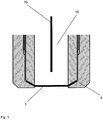
- FIG. 1 shows the schematic structure of an electrochemical or potentiometric electrode for the determination of surfactants with sensor material 1.
- the sensor material 1 is firmly connected by means of an adhesive bond with the electrode housing 5.
- a reference element 10 is arranged, which is in an (electrical) contact with the sensor material 1 via an internal filling solution 15.
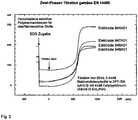
- FIG. 2 shows the results of four two-phase titrations of a sodium dodecyl sulfate (SDS) solution in 2PT-ISA, a surfactant-free emulsion mixture according to standard EN 14480, with cetylpyridine chloride, which was carried out according to the European standard EN 14480.
- SDS sodium dodecyl sulfate
- FIG. 2 shows the results of four two-phase titrations of a sodium dodecyl sulfate (SDS) solution in 2PT-ISA, a surfactant-free emulsion mixture according to standard EN 14480, with cetylpyridine chloride, which was carried out according to the European standard EN 14480.
- Electrode 944A01 contained a sensor material with Nalgene 280 polyurethane.
- Electrode 947A01 contained a sensor material with polyurethane Tygothan C210A (98 wt.%) And benzethonium dodecyl sulfate
- Electrode 946A01 contained a sensor material containing Tygothan C210A polyurethane (98 wt.%) And 1,3-didecyl-2-methylimidazolium dodecyl sulfate surfactant ion pair (2 wt.%).
- Electrode 948A01 contained a sensor material containing Tygothan C210A polyurethane (98% by weight) and hexadecylpyridinium dodecylbenzenesulfonates surfactant ion pair (2% by weight).
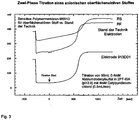
- FIG. 3 Figure 3 shows the comparison of the results of three two-phase titrations performed with two commercially available surfactant electrodes (RF, RS) and one surfactant electrode (913D01) with the sensor material to be used.
- the electrode 913D01 contained the sensor material according to the invention with Tygothane C210A.
- FIG. 4 shows the results of two two-phase titrations carried out according to the European standard EN 14669.
- the two titrations were performed once each in the acidic range (pH 3.0) and in the alkaline range (pH 11.5) and show the Usability of the sensor material both in the acidic and in the alkaline range.
- the polyurethane used was Tygothan C210A.
- the titrated detergent was a commercial dishwashing detergent titrated in 2PT-ISA with didecylmethylimidazolium chloride,
- FIG. 6 shows the results of two two-phase titrations, which were carried out with two electrodes with the sensor material to be used according to the European standard EN 14480.
- SDS was titrated in 2PT-ISA with Hyamine.
- the sensor material of both electrodes contained the polyurethane Tygothan C210A.
- the 918B01 electrode was conditioned before use with an ionophore-containing solution.
- FIG. 6 shows further results of two two-phase titrations with two electrodes with the sensor material to be used carried out according to the European standard EN 14480. Titrated SDS in 2PT-ISA with Hyamine.
- the electrode 171B02 contained Tecoflex EG93A as polyurethane and was as before under use FIG. 5 described also conditioned.
- Electrode 949A01 contained Tecoflex EG93A (98% by weight) as the polyurethane and benzethonium dodecyl sulfate (2% by weight) as a surfactant ion pair.
- Fig. 7 shows the result of a two-phase titrations with an electrode with the sensor material to be used carried out according to the European standard EN 14668. Hyamine was titrated in 2PT-ISA with SDS.
- the electrode contained the sensor material according to the invention with the polyurethane Tecoflex EG93A (98% by weight) and as surfactant ion pair benzethonium dodecyl sulfate (2% by weight).
Landscapes
- Chemical & Material Sciences (AREA)
- Life Sciences & Earth Sciences (AREA)
- Health & Medical Sciences (AREA)
- Physics & Mathematics (AREA)
- Chemical Kinetics & Catalysis (AREA)
- Electrochemistry (AREA)
- Molecular Biology (AREA)
- Analytical Chemistry (AREA)
- Biochemistry (AREA)
- General Health & Medical Sciences (AREA)
- General Physics & Mathematics (AREA)
- Immunology (AREA)
- Pathology (AREA)
- Investigating Or Analyzing Materials By The Use Of Electric Means (AREA)
Claims (4)
- Utilisation d'un matériau capteur pour une électrode potentiométrique pour la détermination d'agents tensioactifs ioniques ou non-ioniques dans des milieux à deux phases, le matériau capteur comprenant un matériau polymère, gonflable dans des solvants organiques, avec une dureté Shore dans un domaine de 74A à 93A, et un ionophore, le matériau polymère étant un polyuréthane-éther, -ester ou - carbonate aliphatique ou aromatique.
- Utilisation d'un matériau capteur selon la revendication 1, le matériau capteur comprenant un additif.
- Utilisation d'un matériau capteur selon l'une des revendications 1 à 2, l'ionophore étant choisi dans le groupe consistant en dodécylbenzènesulfonate de hexadécylpyridinium, dodécylsulfate de 1,3-didécyl-2-méthylimidazolium et dodécylsulfate de benzéthonium.
- Utilisation d'un matériau capteur selon l'une des revendications 2 à 3, l'additif étant choisi dans le groupe consistant en poudre de carbone, graphite, dioxyde de titane et phtalocyanine de cuivre.
Priority Applications (1)
| Application Number | Priority Date | Filing Date | Title |
|---|---|---|---|
| EP07018527.7A EP2040066B1 (fr) | 2007-09-20 | 2007-09-20 | Emploi d'un matériau de détection pour une électrode potentiométrique |
Applications Claiming Priority (1)
| Application Number | Priority Date | Filing Date | Title |
|---|---|---|---|
| EP07018527.7A EP2040066B1 (fr) | 2007-09-20 | 2007-09-20 | Emploi d'un matériau de détection pour une électrode potentiométrique |
Publications (2)
| Publication Number | Publication Date |
|---|---|
| EP2040066A1 EP2040066A1 (fr) | 2009-03-25 |
| EP2040066B1 true EP2040066B1 (fr) | 2017-03-08 |
Family
ID=39092932
Family Applications (1)
| Application Number | Title | Priority Date | Filing Date |
|---|---|---|---|
| EP07018527.7A Active EP2040066B1 (fr) | 2007-09-20 | 2007-09-20 | Emploi d'un matériau de détection pour une électrode potentiométrique |
Country Status (1)
| Country | Link |
|---|---|
| EP (1) | EP2040066B1 (fr) |
Family Cites Families (2)
| Publication number | Priority date | Publication date | Assignee | Title |
|---|---|---|---|---|
| DE19861034B4 (de) * | 1998-01-22 | 2005-06-23 | Deutsche Metrohm Gesellschaft mit beschränkter Haftung & Co. elektronische Messgeräte | Verbesserte Titriervorrichtung |
| US6734273B2 (en) * | 2001-02-12 | 2004-05-11 | Noveon Ip Holdings Corp. | High molecular weight thermoplastic polyurethanes made from polyols having high secondary hydroxyl content |
-
2007
- 2007-09-20 EP EP07018527.7A patent/EP2040066B1/fr active Active
Non-Patent Citations (2)
| Title |
|---|
| E. LINDNER ET AL: "Ion-selective membranes with low plasticizer content: Electroanalytical characterization and biocompatibility studies", JOURNAL OF BIOMEDICAL MATERIALS RESEARCH, vol. 28, no. 5, 1 May 1994 (1994-05-01), US, pages 591 - 601, XP055242980, ISSN: 0021-9304, DOI: 10.1002/jbm.820280509 * |
| ROBERT E. GYURCSÁNYI ET AL: "Spectroscopic Method for the Determination of the Ionic Site Concentration in Solvent Polymeric Membranes and Membrane Plasticizers", ANALYTICAL CHEMISTRY, vol. 74, no. 16, 1 August 2002 (2002-08-01), US, pages 4060 - 4068, XP055242872, ISSN: 0003-2700, DOI: 10.1021/ac020120k * |
Also Published As
| Publication number | Publication date |
|---|---|
| EP2040066A1 (fr) | 2009-03-25 |
Similar Documents
| Publication | Publication Date | Title |
|---|---|---|
| DE3405431C2 (fr) | ||
| DE60022177T2 (de) | Miniaturisierte festkörper-referenzelektrode mit selbstdiagnosefunktion | |
| DE102008055084A1 (de) | Ionenselektive Elektrode | |
| DE102008055082A1 (de) | Referenzelektrode | |
| DE102015121364A1 (de) | Potentiometrischer Sensor | |
| EP3423826B1 (fr) | Procédé d'étalonnage de capteurs de biomasse par spectroscopie d'impédance et utilisation d'une suspension pour exécuter un procédé de ce type | |
| EP3169993B1 (fr) | Ensemble d'électrodes de référence pour un capteur électrochimique et capteur électrochimique | |
| CH679526A5 (fr) | ||
| DE2950383A1 (de) | Elektrochemische elektrode sowie verfahren zur ausbildung einer auf ionen ansprechenden membran fuer eine elektrochemische elektrode sowie verfahren zur herstellung einer elektrochemischen elektrode | |
| EP1480038B1 (fr) | Electrode potentiométrique et sélectivement sensible aux ions | |
| EP1936365B1 (fr) | Procédé de détermination d'un électrode de rérérence sur un électrode sélective aux ions à contact solid | |
| EP0247535A2 (fr) | Electrode de référence pour la mesure de l'activité ionique, en particulier pour la mesure de pH | |
| EP2040066B1 (fr) | Emploi d'un matériau de détection pour une électrode potentiométrique | |
| DE102009051169B4 (de) | Phosphatelektrode, Elektrodensystem hiermit und deren Verwendung | |
| DE1598896B1 (de) | Elektrochemische elektrodenanordnung | |
| DE19533059A1 (de) | Bezugselektrode für elektrochemische Messungen und Verfahren zu deren Herstellung | |
| DE2909821A1 (de) | Fuer isocyanurat spezifische elektrode, analysenverfahren und quaternaere ammonium- isocyanursaeuresalze dafuer | |
| DE4232729C2 (de) | Mikrobezugselektrode zur Erzeugung eines konstanten Bezugs- oder Referenzpotentials | |
| DE10053006B4 (de) | Elektrisch leitfähiges Polymermaterial, seine Herstellung und Verwendung | |
| DE102012111814A1 (de) | Referenzhalbzelle zur Verwendung in einer elektrochemischen Messanordnung und potentiometrischer Messaufnehmer | |
| DE102023108375A1 (de) | Messsonde | |
| DE19861034B4 (de) | Verbesserte Titriervorrichtung | |
| DE10252481A1 (de) | Bezugselektrode und Herstellungsverfahren | |
| DE2400613C2 (de) | Elektrodenanordnung zur potentiometrischen Bestimmung von Ionen in einer Lösung | |
| DE102015108496B4 (de) | Vorrichtung und Verfahren zur Ermittlung einer Ozonkonzentration |
Legal Events
| Date | Code | Title | Description |
|---|---|---|---|
| PUAI | Public reference made under article 153(3) epc to a published international application that has entered the european phase |
Free format text: ORIGINAL CODE: 0009012 |
|
| AK | Designated contracting states |
Kind code of ref document: A1 Designated state(s): AT BE BG CH CY CZ DE DK EE ES FI FR GB GR HU IE IS IT LI LT LU LV MC MT NL PL PT RO SE SI SK TR |
|
| AX | Request for extension of the european patent |
Extension state: AL BA HR MK RS |
|
| 17P | Request for examination filed |
Effective date: 20090925 |
|
| 17Q | First examination report despatched |
Effective date: 20091021 |
|
| AKX | Designation fees paid |
Designated state(s): AT BE BG CH CY CZ DE DK EE ES FI FR GB GR HU IE IS IT LI LT LU LV MC MT NL PL PT RO SE SI SK TR |
|
| GRAP | Despatch of communication of intention to grant a patent |
Free format text: ORIGINAL CODE: EPIDOSNIGR1 |
|
| INTG | Intention to grant announced |
Effective date: 20160929 |
|
| STAA | Information on the status of an ep patent application or granted ep patent |
Free format text: STATUS: GRANT OF PATENT IS INTENDED |
|
| GRAS | Grant fee paid |
Free format text: ORIGINAL CODE: EPIDOSNIGR3 |
|
| GRAA | (expected) grant |
Free format text: ORIGINAL CODE: 0009210 |
|
| STAA | Information on the status of an ep patent application or granted ep patent |
Free format text: STATUS: THE PATENT HAS BEEN GRANTED |
|
| AK | Designated contracting states |
Kind code of ref document: B1 Designated state(s): AT BE BG CH CY CZ DE DK EE ES FI FR GB GR HU IE IS IT LI LT LU LV MC MT NL PL PT RO SE SI SK TR |
|
| REG | Reference to a national code |
Ref country code: GB Ref legal event code: FG4D Free format text: NOT ENGLISH |
|
| REG | Reference to a national code |
Ref country code: CH Ref legal event code: EP Ref country code: AT Ref legal event code: REF Ref document number: 873978 Country of ref document: AT Kind code of ref document: T Effective date: 20170315 |
|
| REG | Reference to a national code |
Ref country code: IE Ref legal event code: FG4D Free format text: LANGUAGE OF EP DOCUMENT: GERMAN |
|
| REG | Reference to a national code |
Ref country code: DE Ref legal event code: R096 Ref document number: 502007015494 Country of ref document: DE |
|
| REG | Reference to a national code |
Ref country code: CH Ref legal event code: NV Representative=s name: PATENTANWAELTE SCHAAD, BALASS, MENZL AND PARTN, CH |
|
| REG | Reference to a national code |
Ref country code: LT Ref legal event code: MG4D |
|
| REG | Reference to a national code |
Ref country code: NL Ref legal event code: MP Effective date: 20170308 |
|
| PG25 | Lapsed in a contracting state [announced via postgrant information from national office to epo] |
Ref country code: GR Free format text: LAPSE BECAUSE OF FAILURE TO SUBMIT A TRANSLATION OF THE DESCRIPTION OR TO PAY THE FEE WITHIN THE PRESCRIBED TIME-LIMIT Effective date: 20170609 Ref country code: FI Free format text: LAPSE BECAUSE OF FAILURE TO SUBMIT A TRANSLATION OF THE DESCRIPTION OR TO PAY THE FEE WITHIN THE PRESCRIBED TIME-LIMIT Effective date: 20170308 Ref country code: LT Free format text: LAPSE BECAUSE OF FAILURE TO SUBMIT A TRANSLATION OF THE DESCRIPTION OR TO PAY THE FEE WITHIN THE PRESCRIBED TIME-LIMIT Effective date: 20170308 |
|
| PG25 | Lapsed in a contracting state [announced via postgrant information from national office to epo] |
Ref country code: BG Free format text: LAPSE BECAUSE OF FAILURE TO SUBMIT A TRANSLATION OF THE DESCRIPTION OR TO PAY THE FEE WITHIN THE PRESCRIBED TIME-LIMIT Effective date: 20170608 Ref country code: SE Free format text: LAPSE BECAUSE OF FAILURE TO SUBMIT A TRANSLATION OF THE DESCRIPTION OR TO PAY THE FEE WITHIN THE PRESCRIBED TIME-LIMIT Effective date: 20170308 Ref country code: LV Free format text: LAPSE BECAUSE OF FAILURE TO SUBMIT A TRANSLATION OF THE DESCRIPTION OR TO PAY THE FEE WITHIN THE PRESCRIBED TIME-LIMIT Effective date: 20170308 Ref country code: ES Free format text: LAPSE BECAUSE OF FAILURE TO SUBMIT A TRANSLATION OF THE DESCRIPTION OR TO PAY THE FEE WITHIN THE PRESCRIBED TIME-LIMIT Effective date: 20170308 |
|
| REG | Reference to a national code |
Ref country code: FR Ref legal event code: PLFP Year of fee payment: 11 |
|
| PG25 | Lapsed in a contracting state [announced via postgrant information from national office to epo] |
Ref country code: NL Free format text: LAPSE BECAUSE OF FAILURE TO SUBMIT A TRANSLATION OF THE DESCRIPTION OR TO PAY THE FEE WITHIN THE PRESCRIBED TIME-LIMIT Effective date: 20170308 |
|
| PG25 | Lapsed in a contracting state [announced via postgrant information from national office to epo] |
Ref country code: CZ Free format text: LAPSE BECAUSE OF FAILURE TO SUBMIT A TRANSLATION OF THE DESCRIPTION OR TO PAY THE FEE WITHIN THE PRESCRIBED TIME-LIMIT Effective date: 20170308 Ref country code: IT Free format text: LAPSE BECAUSE OF FAILURE TO SUBMIT A TRANSLATION OF THE DESCRIPTION OR TO PAY THE FEE WITHIN THE PRESCRIBED TIME-LIMIT Effective date: 20170308 Ref country code: RO Free format text: LAPSE BECAUSE OF FAILURE TO SUBMIT A TRANSLATION OF THE DESCRIPTION OR TO PAY THE FEE WITHIN THE PRESCRIBED TIME-LIMIT Effective date: 20170308 Ref country code: EE Free format text: LAPSE BECAUSE OF FAILURE TO SUBMIT A TRANSLATION OF THE DESCRIPTION OR TO PAY THE FEE WITHIN THE PRESCRIBED TIME-LIMIT Effective date: 20170308 Ref country code: SK Free format text: LAPSE BECAUSE OF FAILURE TO SUBMIT A TRANSLATION OF THE DESCRIPTION OR TO PAY THE FEE WITHIN THE PRESCRIBED TIME-LIMIT Effective date: 20170308 |
|
| PG25 | Lapsed in a contracting state [announced via postgrant information from national office to epo] |
Ref country code: PT Free format text: LAPSE BECAUSE OF FAILURE TO SUBMIT A TRANSLATION OF THE DESCRIPTION OR TO PAY THE FEE WITHIN THE PRESCRIBED TIME-LIMIT Effective date: 20170710 Ref country code: PL Free format text: LAPSE BECAUSE OF FAILURE TO SUBMIT A TRANSLATION OF THE DESCRIPTION OR TO PAY THE FEE WITHIN THE PRESCRIBED TIME-LIMIT Effective date: 20170308 Ref country code: IS Free format text: LAPSE BECAUSE OF FAILURE TO SUBMIT A TRANSLATION OF THE DESCRIPTION OR TO PAY THE FEE WITHIN THE PRESCRIBED TIME-LIMIT Effective date: 20170708 |
|
| REG | Reference to a national code |
Ref country code: DE Ref legal event code: R097 Ref document number: 502007015494 Country of ref document: DE |
|
| PLBE | No opposition filed within time limit |
Free format text: ORIGINAL CODE: 0009261 |
|
| STAA | Information on the status of an ep patent application or granted ep patent |
Free format text: STATUS: NO OPPOSITION FILED WITHIN TIME LIMIT |
|
| PG25 | Lapsed in a contracting state [announced via postgrant information from national office to epo] |
Ref country code: DK Free format text: LAPSE BECAUSE OF FAILURE TO SUBMIT A TRANSLATION OF THE DESCRIPTION OR TO PAY THE FEE WITHIN THE PRESCRIBED TIME-LIMIT Effective date: 20170308 |
|
| 26N | No opposition filed |
Effective date: 20171211 |
|
| PG25 | Lapsed in a contracting state [announced via postgrant information from national office to epo] |
Ref country code: SI Free format text: LAPSE BECAUSE OF FAILURE TO SUBMIT A TRANSLATION OF THE DESCRIPTION OR TO PAY THE FEE WITHIN THE PRESCRIBED TIME-LIMIT Effective date: 20170308 |
|
| PG25 | Lapsed in a contracting state [announced via postgrant information from national office to epo] |
Ref country code: MC Free format text: LAPSE BECAUSE OF FAILURE TO SUBMIT A TRANSLATION OF THE DESCRIPTION OR TO PAY THE FEE WITHIN THE PRESCRIBED TIME-LIMIT Effective date: 20170308 |
|
| REG | Reference to a national code |
Ref country code: IE Ref legal event code: MM4A |
|
| REG | Reference to a national code |
Ref country code: BE Ref legal event code: MM Effective date: 20170930 |
|
| PG25 | Lapsed in a contracting state [announced via postgrant information from national office to epo] |
Ref country code: LU Free format text: LAPSE BECAUSE OF NON-PAYMENT OF DUE FEES Effective date: 20170920 |
|
| PG25 | Lapsed in a contracting state [announced via postgrant information from national office to epo] |
Ref country code: IE Free format text: LAPSE BECAUSE OF NON-PAYMENT OF DUE FEES Effective date: 20170920 |
|
| PG25 | Lapsed in a contracting state [announced via postgrant information from national office to epo] |
Ref country code: BE Free format text: LAPSE BECAUSE OF NON-PAYMENT OF DUE FEES Effective date: 20170930 |
|
| REG | Reference to a national code |
Ref country code: FR Ref legal event code: PLFP Year of fee payment: 12 |
|
| PG25 | Lapsed in a contracting state [announced via postgrant information from national office to epo] |
Ref country code: MT Free format text: LAPSE BECAUSE OF FAILURE TO SUBMIT A TRANSLATION OF THE DESCRIPTION OR TO PAY THE FEE WITHIN THE PRESCRIBED TIME-LIMIT Effective date: 20170308 |
|
| REG | Reference to a national code |
Ref country code: AT Ref legal event code: MM01 Ref document number: 873978 Country of ref document: AT Kind code of ref document: T Effective date: 20170920 |
|
| PG25 | Lapsed in a contracting state [announced via postgrant information from national office to epo] |
Ref country code: AT Free format text: LAPSE BECAUSE OF NON-PAYMENT OF DUE FEES Effective date: 20170920 |
|
| PG25 | Lapsed in a contracting state [announced via postgrant information from national office to epo] |
Ref country code: HU Free format text: LAPSE BECAUSE OF FAILURE TO SUBMIT A TRANSLATION OF THE DESCRIPTION OR TO PAY THE FEE WITHIN THE PRESCRIBED TIME-LIMIT; INVALID AB INITIO Effective date: 20070920 |
|
| PG25 | Lapsed in a contracting state [announced via postgrant information from national office to epo] |
Ref country code: CY Free format text: LAPSE BECAUSE OF NON-PAYMENT OF DUE FEES Effective date: 20170308 |
|
| PG25 | Lapsed in a contracting state [announced via postgrant information from national office to epo] |
Ref country code: TR Free format text: LAPSE BECAUSE OF FAILURE TO SUBMIT A TRANSLATION OF THE DESCRIPTION OR TO PAY THE FEE WITHIN THE PRESCRIBED TIME-LIMIT Effective date: 20170308 |
|
| REG | Reference to a national code |
Ref country code: CH Ref legal event code: U11 Free format text: ST27 STATUS EVENT CODE: U-0-0-U10-U11 (AS PROVIDED BY THE NATIONAL OFFICE) Effective date: 20251001 |
|
| PGFP | Annual fee paid to national office [announced via postgrant information from national office to epo] |
Ref country code: DE Payment date: 20250924 Year of fee payment: 19 |
|
| PGFP | Annual fee paid to national office [announced via postgrant information from national office to epo] |
Ref country code: GB Payment date: 20250922 Year of fee payment: 19 |
|
| PGFP | Annual fee paid to national office [announced via postgrant information from national office to epo] |
Ref country code: FR Payment date: 20250922 Year of fee payment: 19 |
|
| PGFP | Annual fee paid to national office [announced via postgrant information from national office to epo] |
Ref country code: CH Payment date: 20251001 Year of fee payment: 19 |