EP2040238A2 - Server zur statistischen Verarbeitung, Messinformationsstatistikverfahren und Messinformationsstatistikprogramm - Google Patents
Server zur statistischen Verarbeitung, Messinformationsstatistikverfahren und Messinformationsstatistikprogramm Download PDFInfo
- Publication number
- EP2040238A2 EP2040238A2 EP08015051A EP08015051A EP2040238A2 EP 2040238 A2 EP2040238 A2 EP 2040238A2 EP 08015051 A EP08015051 A EP 08015051A EP 08015051 A EP08015051 A EP 08015051A EP 2040238 A2 EP2040238 A2 EP 2040238A2
- Authority
- EP
- European Patent Office
- Prior art keywords
- category
- vehicle
- probe information
- data
- categories
- Prior art date
- Legal status (The legal status is an assumption and is not a legal conclusion. Google has not performed a legal analysis and makes no representation as to the accuracy of the status listed.)
- Withdrawn
Links
- 239000000523 sample Substances 0.000 title claims abstract description 117
- 238000012545 processing Methods 0.000 title claims abstract description 83
- 238000007619 statistical method Methods 0.000 title claims description 4
- 238000000034 method Methods 0.000 claims description 11
- 230000008685 targeting Effects 0.000 claims 3
- 230000001133 acceleration Effects 0.000 description 37
- 238000013500 data storage Methods 0.000 description 15
- 238000010586 diagram Methods 0.000 description 8
- 238000012544 monitoring process Methods 0.000 description 8
- 238000004891 communication Methods 0.000 description 6
- 238000013016 damping Methods 0.000 description 4
- 238000001514 detection method Methods 0.000 description 3
- 230000000694 effects Effects 0.000 description 3
- 239000000725 suspension Substances 0.000 description 3
- 230000004913 activation Effects 0.000 description 1
- 230000037237 body shape Effects 0.000 description 1
- 238000004364 calculation method Methods 0.000 description 1
- 230000001186 cumulative effect Effects 0.000 description 1
- 230000006866 deterioration Effects 0.000 description 1
- 238000011161 development Methods 0.000 description 1
- 239000000284 extract Substances 0.000 description 1
- 238000005259 measurement Methods 0.000 description 1
- 230000007246 mechanism Effects 0.000 description 1
- 239000000203 mixture Substances 0.000 description 1
- 238000012986 modification Methods 0.000 description 1
- 230000004048 modification Effects 0.000 description 1
- 230000002250 progressing effect Effects 0.000 description 1
Images






Classifications
-
- G—PHYSICS
- G08—SIGNALLING
- G08G—TRAFFIC CONTROL SYSTEMS
- G08G1/00—Traffic control systems for road vehicles
- G08G1/01—Detecting movement of traffic to be counted or controlled
- G08G1/0104—Measuring and analyzing of parameters relative to traffic conditions
Definitions
- the present invention relates to a statistical processing server, a probe information statistical method, and a probe information statistical program.
- probe information a communications device installed in the automobile
- Such probe information may include a vehicle position, speed, direction, whether windshield wipers are on or off, and the like.
- a server that collected the probe information executes statistical processing of the probe information and generates traffic congestion information, weather information, and the like. The server also distributes the generated traffic congestion and other information to a terminal used by a vehicle or user targeted for distribution.
- Driving history information includes driving route information regarding driving routes on which the automobile has driven and driving operation information regarding driving operations performed during the driving on the driving routes.
- the driving history information is accumulated in association with vehicle specifying information, which includes information about the model and type of the automobile.
- vehicle specifying information which includes information about the model and type of the automobile.
- the accumulated information can then be used by a user computer installed in a vehicle. If a user selects driving history information in which the vehicle model and type are matched, the selected driving history information is downloaded and the user computer then performs driving support processing based on the downloaded driving history information.
- the driving history information is selected according to the vehicle model and type in the above system, such driving history information is the driving history information for one driver. Therefore, the information may be biased toward that driver's mode of operation, and thus may not be the most appropriate information for the user.
- the state of the vehicle differs even among identical vehicle models and types depending on use conditions such as age and mileage, selection of the model and type alone may not ensure that the most appropriate information is obtained for the user.
- the present invention was devised in light of the above problems, and it is an object of the present invention to provide a statistical processing server, a probe information statistical method, and a probe information statistical program which are capable of distributing to a vehicle distribution information that matches a vehicle characteristic, and well maintaining the accuracy of the distribution information.
- the category targeted for statistical processing is selected depending on the accumulated quantity of each category.
- the category targeted for statistical processing is selected depending on the accumulated quantity of each category.
- a lower ranked category is set as a target for statistical processing. Therefore, it is possible to maintain the accuracy of the data in a good range and to send distribution data to vehicles that is in line with the characteristics of each vehicle.
- the third aspect of the present invention if the accumulated quantity of the probe information belonging to a certain category is less than the predetermined number, then a higher ranked category is set as a target for statistical processing. Therefore, it is possible to maintain the accuracy of the data in a good range and to send distribution data to vehicles that is in line with the characteristics of each vehicle.
- the category targeted for statistical processing is selected depending on the accumulated quantity of each category.
- the category targeted for statistical processing is selected depending on the accumulated quantity of each category.
- the category targeted for statistical processing is selected depending on the accumulated quantity of each category.
- the category targeted for statistical processing is selected depending on the accumulated quantity of each category.
- FIG. 1 is a schematic diagram of a statistical system 1 according to the present embodiment.
- the statistical system 1 has a statistical server 2 acting as a statistical processing server, a base station 3, and a navigation device 5 acting as an onboard device installed in vehicles C.
- the statistical server 2 is connected with the navigation devices 5 installed in the vehicles C via a network N such as the internet or dedicated line in a manner that enables the sending and receiving of various data.
- the base station 3 is set in predetermined areas, and sends an identifier specifying the area to the vehicles C.
- the navigation device 5 then sends the received area identifier and a vehicle identifier to the statistical server 2 via the base station 3.
- the statistical server 2 sequentially identifies the area in which the vehicle C is traveling based on the received area identifier and vehicle identifier.
- the navigation device 5 includes a main CPU 10, a RAM 11, a ROM 12, a vehicle-side interface (I/F) 13, a communication interface (1/F) 14, an image processor 15, a geographic information storage part 16, an attribute data storage part 17, and an audio processor 26.
- the main CPU 10 is input with an absolute position detection signal from the GPS receiving part 21 via the vehicle-side I/F 13, and calculates the latitude and longitude of the vehicle C.
- the main CPU 10 is also input with various signals from the gyro 22 and the vehicle speed sensor 23 to detect a host vehicle position based on autonomous navigation, which is used in combination with an absolute position from the GPS receiving part 21 to identify the host vehicle position.
- the main CPU 10 is input with an electric signal from the vertical acceleration sensor 24 via the vehicle-side I/F13.
- the vertical acceleration sensor 24 is attached to a vehicle body on a suspension spring of the vehicle C. Furthermore, the vertical acceleration sensor 24 detects a vertical acceleration ⁇ on the spring, and outputs an electric signal corresponding to the vertical acceleration ⁇ to the main CPU 10. Based on the magnitude of the vertical acceleration ⁇ , the main CPU 10 determines a magnitude of vibration experienced by the vehicle C.
- the communication 1/F 14 is an interface for sending and receiving various data to and from the statistical server 2.
- the geographic information storage part 16 is an external storage medium such as a hard disk, and stores route data 18 for searching a route to a destination and map drawing data 19 for outputting a map screen 25a to a display 25.
- the main CPU 10 searches for a recommended route that connects the destination and a current host vehicle position.
- the main CPU 10 also uses the host vehicle position and the map drawing data 19 to perform map matching that identifies the vehicle C on a road.
- the map drawing data 19 has, in addition to drawing data for drawing a map, road shape data for drawing the road the same as it is in the real world.
- the main CPU 10 calculate a travel trajectory based on the gyro 22 and the vehicle speed sensor 23, and matches the travel trajectory to the road shape data of the road on which the vehicle C is traveling. If there is any deviation between the travel trajectory and the road shape, then the main CPU 10 identifies the calculated host vehicle position at an appropriate position on the road so that the travel trajectory follows the road shape.
- the attribute data storage part 17 stores vehicle attribute data 20.
- the vehicle attribute data 20 is data that specifies attributes of the vehicle C in which the navigation device 5 is installed. As shown in FIG. 3A , the vehicle attribute data 20 has a vehicle ID 20a, a type 20b, a model 20c, a mileage 20d, and an age 20e.
- the vehicle ID 20a is an identifier assigned in advance to the vehicles C.
- the type 20b specifies a vehicle type such as sedan, minivan, station wagon, and the like, and stores the type of the vehicle C.
- the model 20c stores a vehicle name of the vehicle C.
- the mileage 20d stores a cumulative mileage of the vehicle C.
- the age 20e specifies a number of years that have passed since the vehicle C was newly registered.
- the navigation device 5 sends probe data 30, which acts as probe information specifying vehicle behavior during travel, to the statistical server 2.
- the navigation device 5 sends the probe data 30 indicating detection of a step; however, the probe data 30 may be sent at predetermined times. More specifically, based on the magnitude of the vertical acceleration ⁇ detected by the vertical acceleration sensor 24, the main CPU 10 determines that the vehicle C has passed over a step and generates the probe data 30, in addition to reading out the vehicle attribute data 20 from the attribute data storage part 17. Furthermore, the generated probe data 30 is sent to the statistical server 2 along with the vehicle attribute data 20 via the communication I/F 14.
- the probe data 30 has a vehicle ID 30a, a vehicle position 30b, a speed 30c, an acceleration 30d, a travel direction 30e, and a vertical acceleration 30f.
- the vehicle position 30b is a vehicle position when the step is detected.
- the speed 30c and the acceleration 30d are a speed and an acceleration when the step is passed over.
- the acceleration 30d may be obtained from a G sensor (not shown) or calculated based on the vehicle speed.
- the travel direction 30e specifies a direction of movement of the vehicle C.
- the vertical acceleration 30f is obtained from the vertical acceleration sensor 24 and is the vertical acceleration ⁇ when the step is passed over.
- the magnitude of the vertical acceleration 30f when passing over the step is influenced by factors such as the type and the model of the vehicle C, in addition to the mileage 20d and the age 20e of the vehicle C, as well as the speed 30c and the acceleration 30d when passing over the step.
- a vibration experienced when passing over the same step differs between the vehicle C of the sedan type and a vehicle of the compact car type due to differences in body shape and the like.
- the vertical acceleration ⁇ varies because of differences in the mounted suspension mechanisms.
- a greater mileage 20d or an older age 20e also means more aged deterioration of the vehicle C, and therefore the vertical acceleration ⁇ also differs depending on the mileage 20d and the age 20e.
- a faster speed 30c and acceleration 30d increases the vertical acceleration ⁇ when passing over the step as well.
- the vertical acceleration 30f included in the probe data 30 sent from the navigation device 5 is a different value depending on the above factors.
- the image processor 15 displays various screens such as the map screen 25a, a setting screen, a warning screen, and the like on the display 25.
- the audio processor 26 outputs audio such as audio guidance for guiding along a route from a speaker 27 and audio for drawing the driver's attention.
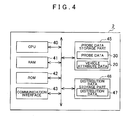
- the statistical server 2 includes a CPU 40, a RAM 41, a ROM 42, a communication interface (1/F) 43, a probe data storage part 45 acting as a probe information storing unit, and a distribution data storage part 46.
- the CPU 40 corresponds to a probe information accumulating unit, an accumulated quantity obtaining unit, a category determining unit, a distributing unit, and a control unit.
- the CPU 40 calculates the statistics of the probe data 30 obtained from the navigation device 5 based on a statistics program stored in the ROM 42.
- the probe data 30 obtained from the navigation device 5 is associated with the vehicle attribute data 20 and stored in the probe data storage part 45.
- the CPU 40 calculates a data quantity (an accumulated quantity) of the probe data 30 for each category.
- the categories are the type 20b, the model 20c, the mileage 20d, and the age 20e, which are divided into a hierarchy of four levels, as shown in FIG. 5 .
- the highest ranked category is the type category, which includes the categories of a sedan, a minivan, a station wagon, and a compact car, for example.
- the type categories are further respectively associated with model categories belonging in the applicable type category.
- the sedan category is associated with categories of vehicle names belonging to that type, such as model A and model B.
- the model categories are further respectively associated with mileage categories.
- the mileage category includes categories of distance ranges such as under 50,000 km, and from 50,000 km to under 100,000 km.
- the mileage categories are also associated with age categories belonging in the applicable mileage category.
- the age category includes categories of under 5 years, and from 5 year to under 10 years.
- the CPU 40 When calculating the data quantity for each category, the CPU 40 first calculates the data quantity for each type category, i.e., the highest rank of the hierarchy. Namely, when calculating the data quantity of the probe data 30 obtained from the vehicle C that is a sedan, the CPU 40 detects the vehicle attribute data 20 which includes the type 20b indicating the sedan type, and reads out the probe data 30 associated with the vehicle attribute data 20, after which the CPU 40 counts the data quantity. Additionally, the data quantity is counted in the same manner for other type categories such as the minivan and station wagon.
- the CPU 40 determines whether the data quantities for each type category are equal to or greater than a predetermined number N.
- the predetermined number N is found by calculating in advance a number with which it is estimated that a sufficient data quantity can be obtained regardless of the category subject to statistical processing.
- the type categories whose data quantity is less than the predetermined number N statistical processing is performed on the probe data 30 for each type category.
- data is extracted where the vehicle position 30b at which a step was detected is within a set range.
- a mean value or a median value of the vehicle positions 30b at which steps were detected are computed or the like to identify a point at which there is a step.
- a correlation among the speed 30c, the acceleration 30d, and the vertical acceleration 30f may be found, and a recommended speed and a recommended damping force calculated to ensure that vibrations generated when passing over the step are of a degree that does not cause an occupant discomfort.
- a vertical acceleration value that specifies a size of the step may be calculated.
- Such information is designated as distribution data 47, and the distribution data 47 is stored in the distribution data storage part 46.
- the distribution data 47 includes at least a category 47a specifying that the vehicle C is a target for distribution of the distribution data 47, a step point 47b, and support information 47c, as shown in FIG. 6 .
- the category 47a stores a category specifying sedan.
- the step point 47b stores coordinates that specify a step portion according to the statistical processing.
- the support information 47c stores driving support information regarding when the vehicle C of the sedan type passes over the step. For example, the recommended speed, recommended damping force, magnitude of vertical acceleration, and the like as mentioned above are stored.
- the statistical server 2 sends the distribution data 47 to the vehicle C traveling within a predetermined distance range centered around the step point 47b specified in the distribution data 47.
- the predetermined distance range may be within a radius of a predetermined distance whose center point is the step point 47b, or may be within a set distance range following a road that includes the step point 47b.
- the distribution data 47 may be sent at random to the vehicle C within the predetermined distance range, and it is determined on the vehicle side whether data among the distribution data 47 can be used by the host vehicle based on the category 47a.
- the vehicle C may send its vehicle attribute data 20 to the statistical server 2 in advance, after which the distribution data 47 for the vehicle C of the same category 47a is sent.
- the data quantity of the probe data 30 for the type category is equal to or greater than the predetermined number N, then it is determined that a sufficient data quantity is accumulated. Since information more in line with the vehicle characteristics can be provided, the data quantity for each category of lower rank in the hierarchy is further calculated. In other words, the data quantities of the probe data 30 obtained from the vehicle C of model A, model B, etc., which are lower ranked categories belonging to the sedan category, are respectively calculated as described above.
- the CPU 40 determines whether the data quantity of the probe data 30 collected from the vehicle C of the model A is equal to or greater than the predetermined number N. If less than the predetermined number, statistical processing is performed on the probe data 30 belonging to the model A category as explained above to generate the distribution data 47.
- the statistical server 2 calculates the data quantities of the respective categories and selects a category for generating the distribution data 47.
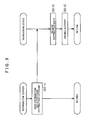
- Step S1-1 Monitoring is determined as started if the navigation device 5 is activated, or if an ON signal is input from an ignition, or if a predetermined operation switch is turned on, for example (YES at step S1-1). If it is determined that monitoring is not started (NO at step S1-1), then the processing waits for activation of the navigation device 5, or input of the ON signal from the ignition, or turning on of the predetermined operation switch.
- the main CPU 10 of the navigation device 5 next determines whether the vehicle C is traveling (step S1-2). At such time, based on a detection signal input from a shift position sensor for example, the vehicle C may be determined as traveling if the shift position is in a position other than a parking position.
- step S1-2 determines whether map matching is being correctly performed. If the travel trajectory of the vehicle C is following the road shape, then it is determined that the map matching is being correctly performed (YES at step S1-3), and the routine proceeds to step S1-4. If the travel trajectory of the vehicle C does not follow the road shape, then it is determined that the map matching is not being correctly performed (NO at step S1-3), and the routine proceeds to step S1-8 where it is determined whether monitoring is ended. Also, if it is determined at step S1-2 that the vehicle C is not traveling (NO at step S1-2), then the routine proceeds to step S1-8 at such time as well.
- the main CPU 10 determines that monitoring is ended if the navigation device 5 is shut down, or if an OFF signal is input from the ignition, or if a signal indicating an OFF operation of the predetermined operation switch is input, or the like (YES at step S1-8). If the navigation device 5 is still activated or if the above signals are not input (NO at step S1-8), then the routine returns to step S1-2 and the above processing is repeated.
- the main CPU 10 determines whether a step on the road is detected based on the vertical acceleration ⁇ input from the vertical acceleration sensor 24. If it is determined, for example, that the vertical acceleration ⁇ is equal to or greater than a predetermined value and the vertical acceleration ⁇ equal to or greater than the predetermined value is detected, then it is determined that the vehicle C has passed over a step.
- step S1-8 If a step is not detected (NO at step S1-4), then the routine proceeds to step S1-8. If it is determined that a step is detected (YES at step S1-4), then the main CPU 10 determines reads out and obtains the vehicle attribute data 20 from the attribute data storage part 17 (step S1-5). After obtaining the vehicle position 30b, the speed 30c, the acceleration 30d, the travel direction 30e, and the vertical acceleration 30f based on the GPS receiving part 21, the vehicle speed sensor 23, the gyro 22, the vertical acceleration sensor 24, and the like, the main CPU 10 generates the probe data 30 (step S1-6). Furthermore, the vehicle attribute data 20 and the probe data 30 are sent via the communication 1/F 14 to the statistical server 2 via the base station 3 (step S1-7). Once the statistical server 2 receives the vehicle attribute data 20 and the probe data 30, the statistical server 2 associates the vehicle attribute data 20 and the probe data 30, which are then stored in the probe data storage part 45.
- step S1-8 determines whether monitoring is ended. If it is determined that the monitoring as described above is ended (YES at step S1-8), then the processing is ended. If it is determined that the monitoring is not ended (NO at step S1-8), then the routine returns to step S1-2 and the above processing is repeated.
- the statistical server 2 may execute this processing at a predetermined time interval, or execute when the data quantity of the newly received probe data 30 is equal to or greater than the predetermined number.
- the CPU 40 of the statistical server 2 calculates the data quantity of the probe data 30 of the above type category stored in the probe data storage part 45. It is then determined whether the data quantity is equal to or greater than the predetermined number N (step S2-1). For example, the probe data 30 belonging to the sedan type category is detected, and the data quantity of the probe data 30 is calculated.
- step S2-1 If the data quantity belonging to the sedan category is less than the predetermined number N (NO at step S2-1), then the statistics of the probe data 30 belonging to the sedan category are calculated as described above and the distribution data 47 is generated having the category 47a that indicates the sedan type (step S2-2). The generated distribution data 47 is subsequently stored in the distribution data storage part 46.
- the routine then proceeds to step S2-3, where it is determined whether there are any type categories remaining (step S2-3).
- step S2-3 since the processing is only executed for the sedan category (NO at step S2-3), the routine returns to step S2-1, where the above processing is performed for the next type category, i.e., the minivan category. If there are no remaining type categories, namely, if the processing is ended for all the type categories (NO at step S2-3), then the processing is ended.
- step S2-4 the CPU 40 selects a category such as a model J category according to a predetermined order from among the model categories belonging to the sedan category, and calculates the data quantity of the probe data 30 belonging to the model J category.
- the CPU 40 further determines whether the applicable data quantity is equal to or greater than the predetermined number N. If the data quantity belonging to the model J category is less than the predetermined number N (NO at step S2-4), then the statistics of the probe data 30 belonging to the model J category are calculated, and the distribution data 47 assigned to the model J category is generated and stored (step S2-5).
- step S2-6 it is determined whether there are any model categories remaining whose data quantity has not been calculated among the categories ranked lower than the sedan category. If there are other model categories such as model J, model K, and model L ranked lower the sedan category and only the data quantity for model J has been calculated for example, then it is determined that there are categories remaining (YES at step S2-6).
- the routine consequently returns to step S2-4, where the data quantity of the probe data 30 belonging to the model K category is calculated next.
- the CPU 40 determines whether the applicable data quantity is equal to or greater than the predetermined number N. If it is determined at step S2-6 that there are no model categories remaining (NO at step S2-6), then the routine proceeds to step S2-3 described above.
- step S2-4 If it is determined at step S2-4 that the data quantity of the model K category is equal to or greater than the predetermined number N (YES at step S2-4), then the CPU 40 calculates the data quantity for each mileage category belonging to the model K category and determines whether the applicable data quantities are equal to or greater than the predetermined number N (step S2-7). For example, if there are the categories of under 50,000 km, from 50,000 km to under 100,000 km, and from 100,000 km to under 200,000 km ranked lower than the model K category, then the CPU 40 first selects the under 50,000 km category and calculates the data quantity of the probe data 30 belonging to the category. The CPU 40 further determines whether the calculated data quantity is equal to or greater than the predetermined number N.
- step S2-78 the CPU 40 determines whether there are any mileage categories remaining that belong to the model K category (step S2-9). If only the data quantity for the under 50,000 km category is calculated, then it is determined that the other mileage categories of from 50,000 km to under 100,000 km, and from 100,000 km to under 200,000 km are remaining categories (YES at step S2-9), and the routine returns to step S2-7. If it is determined at step S2-9 that there are no mileage categories remaining (NO at step S2-9), then the routine proceeds to step S2-6 described above.
- the CPU 40 selects the next mileage category belonging to the model K category, i.e., the from 50,000 km to under 100,000 km category.
- the CPU 40 calculates the data quantity of the probe data 30 belonging to this mileage category, and determines whether the data quantity is equal to or greater than the predetermined number N. If the data quantity is equal to or greater than the predetermined number N (YES at step S2-7), then the CPU 40 calculates the statistics of the probe data 30 for each age (step S2-10). Namely, statistical processing is performed for the probe data 30 belonging to the respective age categories of under 5 years, from 5 years to under 10 years, from 10 years to under 15 years, and so on ranked lower than the from 50,000 km to under 100,000 km category.
- the distribution data 47 is then generated for the categories of under 5 years, from 5 years to under 10 years, from 10 years to under 15 years, and so on.
- Such distribution data 47 is assigned to the categories of (model K, from 50,000 km to under 100,000 km, under 5 years), (model K, from 50,000 km to under 100,000 km, from 5 years to under 10 years), and (model K, from 50,000 km to under 100,000 km, from 10 years to under 15 years), and stored in the distribution data storage part 46.
- step S2-9 it is determined whether the data quantities of all the mileage categories have been calculated. If calculation of the data quantities is complete (NO at step S2-9), then the routine proceeds to step S2-6, where it is determined whether there are any model categories remaining. If there are model categories remaining (YES at step S2-6), then the routine proceeds to step S2-4.
- Steps S2-4 to S2-10 are subsequently repeated until there are no model categories remaining, after which the routine proceeds to step S2-3, where it is determined whether there are any type categories remaining (step S2-3).
- the routine since the processing is only executed for the sedan category (YES at step S2-3), the routine returns to step S2-1, where the above processing is performed for the next type category, i.e., the minivan category.
- the distribution data storage part 46 stores the distribution data 47 corresponding to the accumulated quantity of probe data 30.
- the statistical server 2 sends the distribution data 47 for each category to the navigation device 5 (step S3-1).
- the navigation device 5 receives the distribution data 47 (step S3-2).
- the navigation device 5 extracts data among the distribution data 47 determined as usable by the host vehicle, and uses the extracted data to give driving support (step S3-3).
- the main CPU 10 of the navigation device 5 determines whether there is a step ahead of the host vehicle based on the step point 47b included in the extracted data. If it is determined that there is a step ahead of the host vehicle, then such information is communicated to the driver or a vehicle control performed based on the support information 47c.
- the display 25 displays a warning screen indicating that there is a step, and the speaker 27 outputs audio to draw attention to the step.
- the driver can decelerate before passing over the step and lessen the impact while passing over the step.
- a brake device (not shown) is controlled to apply a braking force to vehicle wheels and decelerate to the recommended speed included in the support information 47c.
- a suspension damping force is adjusted to the recommended damping force included in the support information 47c.
- the navigation device 5 may determine a required deceleration and adjust the speed accordingly or the like depending on the size of the step. Thus, it is possible to automatically mitigate the impact when passing over the step.
- the statistical server 2 obtains the vehicle attribute data 20, which specifies attributes of the vehicle C, and the probe data 30, which measured vehicle behavior that varies depending on the vehicle attributes, from the navigation device 5.
- the statistical server 2 stores the vehicle attribute data 20 and the probe data 30 in the probe data storage part 45.
- the data quantity of the probe data 30 is obtained for each vehicle attribute category, namely, type, model, and the like.
- the size of the category for which the statistics of the probe data 30 are calculated is then determined in accordance with the data quantity.
- the statistics of the probe data 30 belonging to the category targeted for statistical processing are subsequently calculated, and the distribution data 47 corresponding to the vehicle attributes generated.
- the distribution data 47 is then sent to the navigation device 5 belonging to the applicable category.
- the category hierarchy is set depending on the data quantity, it is possible to send the distribution data 47 that matches the attributes of the vehicles C with good accuracy, while also suppressing statistical errors in the step point and the support information.
- the probe data 30 is divided into a hierarchy of four categories of type, model, mileage, and age. Also, if the data quantity of the probe data 30 belonging to a certain category is less than a predetermined number, then the statistical server 2 targets that category for statistical processing. If the data quantity is equal to or greater than the predetermined number, then the category is further broken down and the data quantity of the probe data 30 belonging to a lower ranked category is obtained. Based on the applicable data quantity, it is determined whether the lower ranked category is a target for statistical processing. In other words, if the data quantity is large, then the category is narrowed down to a small range. Therefore, the distribution data 47 in line with vehicle characteristics can be sent while also maintaining well the accuracy of the distribution data 47.
- FIGS. 10 to 11 A second embodiment realizing the present invention will be described next with reference to FIGS. 10 to 11 .
- the second embodiment has a configuration identical to that of the first embodiment except for a modification to the processing procedure. Detailed descriptions of like portions are thus omitted here.
- the threshold value S is set according to a value calculated as a data quantity required for performing statistical processing based on an error tolerance, a required degree of reliability, and the like.
- the CPU 40 of the statistical server 2 determines whether the data quantity with respect to one type category is equal to or greater than the threshold value S (step S4-1). If the data quantity is less than the threshold value S (NO at step S4-1), then the processing is not performed for the type category and the routine proceeds to step S4-9.
- the CPU 40 moves to a lower ranked category for which it is determined whether the data quantity sorted for the model category belonging to the type category is equal to or greater than the threshold value S (step S4-2). If the data quantity is less than the threshold value S (NO at step S4-2), then the CPU 40 moves up to the category one rank higher and calculates the statistics of the probe data 30 belonging to the type category (step S4-3). For example, if the data quantity belonging to the minivan category is equal to or greater than the threshold value S and the data quantity of the model A category belonging to the minivan category is less than the threshold value S, then the minivan category is targeted for statistical processing.
- step S4-4 it is determined whether the data quantity of the mileage category is equal to or greater than the threshold value S (step S4-4). If the data quantity is less than the threshold value S (NO at step S4-4), then the CPU 40 moves up to the category one rank higher and calculates the statistics of the probe data 30 belonging to the model category (step S4-5). If the data quantity is equal to or greater than the threshold value S (YES at step S4-4), then it is determined whether the data quantity of the age category belonging to the model category is equal to or greater than the threshold value S (step S4-6).
- the CPU 40 targets the mileage category for statistical processing and calculates the statistics of the probe data 30 (step S4-7). If the data quantity belonging to the age category is equal to or greater than the threshold value S (YES at step S4-6), then the CPU 40 targets, for example, the age category of under 5 years for statistical processing and calculates the statistics of the probe data 30 (step S4-8).
- step S4-9 shown in FIG. 11 , where it is determined whether there are any age categories remaining, such as from 5 years to under 10 years, and from 10 years to under 15 years. In cases such as when there are no other age categories remaining besides the age category subjected to statistical processing at step S4-8, or the model category was set at step S4-5, and if the category calculated immediately prior is a category other than age (NO at step S4-9), then the routine proceeds to step S4-10. Meanwhile, if there are age categories remaining (YES at step S-9), then the routine returns to step S4-6, where the processing is repeated until the statistics of all the age categories of the same rank are calculated.
- step S4-10 it is determined whether there are any mileage categories remaining. If there are mileage categories remaining (YES at step S4-10), then the routine proceeds to step S4-4. If there are no categories remaining or if a category ranked higher than the mileage category is a target for statistical processing (NO at step S4-10), then the routine proceeds to step S4-11.
- step S4-11 it is determined whether there are any model categories remaining. If there are model categories remaining (YES at step S4-11), then the routine proceeds to step S4-2. If there are no categories remaining or if a category ranked higher than the model category is a target for statistical processing (NO at step S4-11), then the routine proceeds to step S4-12.
- step S4-12 it is determined whether there are any type categories remaining. If there are type categories remaining (YES at step S4-12), then the routine proceeds to step S4-1. If there are no categories remaining (NO at step S4-12), this signifies that all the categories are set and the processing is ended.
- the probe data 30 is divided into a hierarchy of four categories of type, model, mileage, and age. Also, if the data quantity of the probe data 30 belonging to a certain category is less than the threshold value S, then the statistical server 2 targets a category one rank higher to which that category belongs for statistical processing. Therefore, it is possible to maintain the minimum data quantity required for statistical processing. As a consequence, the distribution data 47 in line with vehicle characteristics can be sent while also maintaining well the accuracy of the distribution data 47.
- the onboard device is realized by the navigation device 5.
- the onboard device may be realized by a device provided separately from the navigation device 5.
- the probe data 30 indicating vehicle behavior such as the speed 30c and the vertical acceleration 30f when passing over the step are sent.
- other data that indicates vehicle behavior depending on the road may be sent.
- the probe data 30 that includes an operation condition of the Antilock Brake System (ABS) may be sent.
- the statistical server 2 sets the size of the category targeted for statistical processing based on the data quantities for each category, and sends the distribution data 47 that includes the coordinates of a slip point, a recommended speed, and the like calculated based on the operating condition of the ABS.
- the probe data 30 may be fed back to the statistical server 2 along with data indicating that driving assistance was executed. Based on this probe data 30, the statistical server 2 may refer to the speed 30c, the vertical acceleration 30f, and the like if driving assistance was executed to determine whether the distribution data 47 is accurate.
- the categories were divided into the four ranks of type, model, mileage, and age.
- categories such as emissions and drive system may be used instead depending on the support content.
- the categories may also have a different hierarchy of other than four ranks.
Landscapes
- Chemical & Material Sciences (AREA)
- Analytical Chemistry (AREA)
- Physics & Mathematics (AREA)
- General Physics & Mathematics (AREA)
- Traffic Control Systems (AREA)
- Navigation (AREA)
- Mobile Radio Communication Systems (AREA)
- Instructional Devices (AREA)
Applications Claiming Priority (1)
| Application Number | Priority Date | Filing Date | Title |
|---|---|---|---|
| JP2007241330A JP2009075647A (ja) | 2007-09-18 | 2007-09-18 | 統計処理サーバ、プローブ情報統計方法及びプローブ情報統計プログラム |
Publications (2)
| Publication Number | Publication Date |
|---|---|
| EP2040238A2 true EP2040238A2 (de) | 2009-03-25 |
| EP2040238A3 EP2040238A3 (de) | 2009-05-06 |
Family
ID=40342717
Family Applications (1)
| Application Number | Title | Priority Date | Filing Date |
|---|---|---|---|
| EP08015051A Withdrawn EP2040238A3 (de) | 2007-09-18 | 2008-08-26 | Server zur statistischen Verarbeitung, Messinformationsstatistikverfahren und Messinformationsstatistikprogramm |
Country Status (4)
| Country | Link |
|---|---|
| US (1) | US20090076774A1 (de) |
| EP (1) | EP2040238A3 (de) |
| JP (1) | JP2009075647A (de) |
| CN (1) | CN101393026A (de) |
Families Citing this family (27)
| Publication number | Priority date | Publication date | Assignee | Title |
|---|---|---|---|---|
| GB2511260B (en) * | 2011-12-13 | 2015-01-14 | Ibm | Authentication method, authentication System, and authentication program |
| CN104025166B (zh) | 2011-12-28 | 2016-10-12 | 三菱电机株式会社 | 中心侧系统及车辆侧系统 |
| US9476732B2 (en) | 2012-11-30 | 2016-10-25 | Toyota Jidosha Kabushiki Kaisha | Poor visibility estimation system and poor visibility estimation method |
| DE102013003042A1 (de) * | 2013-02-22 | 2014-08-28 | Audi Ag | System zur Gewinnung von Regelsätzen für eine Kraftfahrzeugautomatisierung |
| JP6476557B2 (ja) * | 2014-03-07 | 2019-03-06 | 日産自動車株式会社 | 車両走行制御情報収集装置 |
| JP6187370B2 (ja) | 2014-04-10 | 2017-08-30 | トヨタ自動車株式会社 | 運転行動分類装置および運転行動分類方法 |
| JP6404750B2 (ja) * | 2015-03-13 | 2018-10-17 | トヨタ自動車株式会社 | ナビゲーションシステム |
| US10448225B2 (en) * | 2015-10-20 | 2019-10-15 | Sony Corporation | Device and method |
| JP2017204215A (ja) * | 2016-05-13 | 2017-11-16 | 住友電気工業株式会社 | 通信装置および移動通信装置 |
| JP6645942B2 (ja) * | 2016-09-27 | 2020-02-14 | 株式会社トヨタマップマスター | 地図データ配信装置、地図データ配信方法およびプログラム |
| US10263807B2 (en) * | 2016-12-19 | 2019-04-16 | Ciena Corporation | Hierarchical statistics acceleration |
| JP6997523B2 (ja) * | 2017-03-03 | 2022-01-17 | 株式会社デンソーテン | 運転支援装置および運転支援方法 |
| JP7056365B2 (ja) * | 2018-05-14 | 2022-04-19 | 富士通株式会社 | プログラム配信方法、プログラム配信装置およびプログラム配信システム |
| JP7136035B2 (ja) * | 2018-08-31 | 2022-09-13 | 株式会社デンソー | 地図生成装置及び地図生成方法 |
| JP7393887B2 (ja) * | 2019-07-05 | 2023-12-07 | 株式会社Subaru | 情報処理装置 |
| JP7247851B2 (ja) * | 2019-10-11 | 2023-03-29 | トヨタ自動車株式会社 | 運転者支援装置 |
| JP7191065B2 (ja) * | 2020-07-06 | 2022-12-16 | 本田技研工業株式会社 | 処理装置、処理方法、およびプログラム |
| JP7307404B2 (ja) * | 2020-10-07 | 2023-07-12 | トヨタ自動車株式会社 | 制振制御装置及びデータ管理装置 |
| JP7328626B2 (ja) * | 2020-10-30 | 2023-08-17 | トヨタ自動車株式会社 | 車両の制振制御システム |
| JP6992205B1 (ja) | 2021-01-29 | 2022-01-13 | 三菱電機株式会社 | 運転支援情報配信装置、交通システム、車両、車両制御装置およびコンピュータプログラム |
| JP7275238B2 (ja) * | 2021-01-29 | 2023-05-17 | 三菱電機株式会社 | 運転支援情報配信装置、交通システム、車両、車両制御装置およびコンピュータプログラム |
| DE102021201589B4 (de) * | 2021-02-18 | 2023-06-22 | Volkswagen Aktiengesellschaft | Steuerung eines Fahrzeugs abhängig von einem topographischen Merkmal einer Fahrbahnoberfläche |
| JP7484837B2 (ja) * | 2021-07-13 | 2024-05-16 | トヨタ自動車株式会社 | 地物データ収集装置、地物データ収集方法及び地物データ収集用コンピュータプログラム |
| JP7615952B2 (ja) * | 2021-08-03 | 2025-01-17 | トヨタ自動車株式会社 | サーバ、方法、及びプログラム |
| JP7544009B2 (ja) * | 2021-09-14 | 2024-09-03 | トヨタ自動車株式会社 | マップデータ、マップ更新方法、車両制御方法、及び車両制御システム |
| JP7713993B2 (ja) * | 2021-12-08 | 2025-07-28 | 三菱電機株式会社 | 運転支援情報配信装置、交通システム、運転支援情報配信方法およびコンピュータプログラム |
| CN119032353A (zh) * | 2022-04-18 | 2024-11-26 | 富士胶片株式会社 | 信息处理装置、信息处理方法及程序 |
Citations (2)
| Publication number | Priority date | Publication date | Assignee | Title |
|---|---|---|---|---|
| EP1288887A2 (de) | 2001-08-07 | 2003-03-05 | Mazda Motor Corporation | System und Verfahren zur Übermittlung des Steuerungszugriffs eines Fahrzeuges |
| EP1688903A1 (de) | 2003-10-08 | 2006-08-09 | Matsushita Electric Industrial Co., Ltd. | Zentralenvorrichtung, endgerätevorrichtung und driving-support-system damit |
Family Cites Families (4)
| Publication number | Priority date | Publication date | Assignee | Title |
|---|---|---|---|---|
| US6381533B1 (en) * | 1997-10-16 | 2002-04-30 | Navigation Technologies Corp. | Method and system using positions of cellular phones matched to road network for collecting data |
| US6047234A (en) * | 1997-10-16 | 2000-04-04 | Navigation Technologies Corporation | System and method for updating, enhancing or refining a geographic database using feedback |
| JP3472829B2 (ja) * | 2001-03-06 | 2003-12-02 | 国土交通省国土技術政策総合研究所長 | 路面状態計測装置および路面状態計測車両 |
| JP2005195536A (ja) * | 2004-01-09 | 2005-07-21 | Mazda Motor Corp | 自動車の運転支援システム |
-
2007
- 2007-09-18 JP JP2007241330A patent/JP2009075647A/ja not_active Abandoned
-
2008
- 2008-08-26 EP EP08015051A patent/EP2040238A3/de not_active Withdrawn
- 2008-08-29 US US12/230,539 patent/US20090076774A1/en not_active Abandoned
- 2008-09-02 CN CNA2008102143292A patent/CN101393026A/zh active Pending
Patent Citations (2)
| Publication number | Priority date | Publication date | Assignee | Title |
|---|---|---|---|---|
| EP1288887A2 (de) | 2001-08-07 | 2003-03-05 | Mazda Motor Corporation | System und Verfahren zur Übermittlung des Steuerungszugriffs eines Fahrzeuges |
| EP1688903A1 (de) | 2003-10-08 | 2006-08-09 | Matsushita Electric Industrial Co., Ltd. | Zentralenvorrichtung, endgerätevorrichtung und driving-support-system damit |
Also Published As
| Publication number | Publication date |
|---|---|
| CN101393026A (zh) | 2009-03-25 |
| JP2009075647A (ja) | 2009-04-09 |
| EP2040238A3 (de) | 2009-05-06 |
| US20090076774A1 (en) | 2009-03-19 |
Similar Documents
| Publication | Publication Date | Title |
|---|---|---|
| EP2040238A2 (de) | Server zur statistischen Verarbeitung, Messinformationsstatistikverfahren und Messinformationsstatistikprogramm | |
| US10726433B2 (en) | Methods and apparatus for connected vehicles application effectiveness estimation | |
| US9799219B2 (en) | Vehicle data system and method | |
| US9487212B1 (en) | Method and system for controlling vehicle with automated driving system | |
| EP3139131B1 (de) | Verfahren und systeme für fahrerassistenz | |
| US6995663B2 (en) | Driving workload estimation | |
| US9159227B2 (en) | Traffic congestion detection apparatus and vehicle control apparatus | |
| US7693651B2 (en) | Methods and systems for monitoring fuel status of vehicles | |
| EP3086303B1 (de) | Warnungsbenachrichtigungssystem, verfahren und programm | |
| JP4893598B2 (ja) | 運転支援システム、運転支援方法及びコンピュータプログラム | |
| US8918279B2 (en) | Route search device, route search method, and computer program | |
| US11087617B2 (en) | Vehicle crowd sensing system and method | |
| CN102381312B (zh) | 用于分析车辆的底盘的状态的方法以及装置 | |
| JP2007011558A (ja) | 渋滞予測装置および方法 | |
| US9412212B2 (en) | Unexpectedness prediction sensitivity determination apparatus | |
| US20090112463A1 (en) | Navigation device | |
| US20200408561A1 (en) | Method of characterizing the condition of a road | |
| JP2009080659A (ja) | 運転支援システム、運転支援方法及び統計プログラム | |
| JP2005135386A (ja) | センタ装置、端末装置およびそれを用いた運転支援システム | |
| US20180283880A1 (en) | Infrastructure to vehicle position verification | |
| US7057499B2 (en) | Communication system for communicating between moving objects and vehicular driving support apparatus | |
| JP2020194467A (ja) | 路面状態特定システム、路面状態特定装置及びコンピュータプログラム | |
| JP2024032849A (ja) | 情報処理装置、情報処理システム、情報処理方法及びプログラム | |
| CN114187762A (zh) | 降水指标估计装置 | |
| JP5527091B2 (ja) | 経路探索装置、経路探索方法及びコンピュータプログラム |
Legal Events
| Date | Code | Title | Description |
|---|---|---|---|
| PUAI | Public reference made under article 153(3) epc to a published international application that has entered the european phase |
Free format text: ORIGINAL CODE: 0009012 |
|
| AK | Designated contracting states |
Kind code of ref document: A2 Designated state(s): AT BE BG CH CY CZ DE DK EE ES FI FR GB GR HR HU IE IS IT LI LT LU LV MC MT NL NO PL PT RO SE SI SK TR |
|
| AX | Request for extension of the european patent |
Extension state: AL BA MK RS |
|
| PUAL | Search report despatched |
Free format text: ORIGINAL CODE: 0009013 |
|
| AK | Designated contracting states |
Kind code of ref document: A3 Designated state(s): AT BE BG CH CY CZ DE DK EE ES FI FR GB GR HR HU IE IS IT LI LT LU LV MC MT NL NO PL PT RO SE SI SK TR |
|
| AX | Request for extension of the european patent |
Extension state: AL BA MK RS |
|
| 17P | Request for examination filed |
Effective date: 20091104 |
|
| AKX | Designation fees paid |
Designated state(s): DE FR GB |
|
| RBV | Designated contracting states (corrected) |
Designated state(s): DE FR GB |
|
| 17Q | First examination report despatched |
Effective date: 20100414 |
|
| STAA | Information on the status of an ep patent application or granted ep patent |
Free format text: STATUS: THE APPLICATION IS DEEMED TO BE WITHDRAWN |
|
| 18D | Application deemed to be withdrawn |
Effective date: 20100825 |